5 Best Cordless Car Polishers for Beginners in 2026 (Easy to Use, Pro-Like Results)
Buying your first cordless car polisher can feel confusing. You want real shine, not swirl marks. You want easy control, not a heavy machine that fights your hands. And most importantly, you want something safe enough that you don’t ruin your car’s paint on day one. That’s exactly why beginners search for the best cordless car polisher for beginners — a tool that delivers visible results without complicated learning curves or risky power levels.
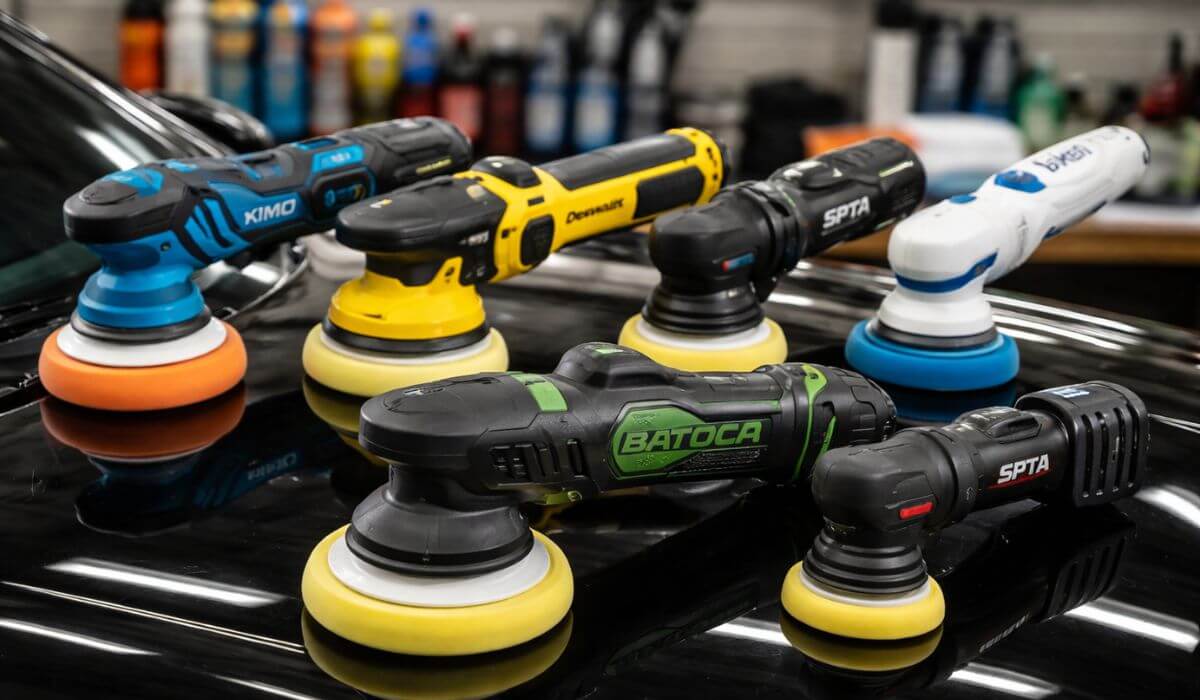
After comparing real-world features like weight balance, speed control, battery performance, vibration levels, and beginner safety design, two models clearly stand out for first-time users: BATOCA Cordless DA Polisher for its smooth dual-action control and excellent paint safety, and the KIMO 20V Cordless Polisher Kit for its strong battery life, full accessory bundle, and user-friendly speed range. Both offer the right mix of power and control that beginners actually need — not just marketing numbers.
In this guide, you’ll find cordless polishers that are easy to handle, gentle on clear coat, and practical for home garage or driveway use. Whether you want to remove light scratches, apply wax evenly, or bring back gloss without cords getting in the way, these picks focus on real beginner needs — stable performance, simple operation, and consistent results you can trust.
Best Cordless Car Polishers for Beginners
#1. BATOCA Cordless Car Buffer Polisher — Best Overall for Beginners
(Safe Dual Action Control + Balanced Power)
#2. KIMO 20V Cordless Car Polisher Kit — Best Lightweight High-Power Option
(Compact Size + Strong Motor + Full Accessory Kit)
#3. VERVEWAVE Cordless Polisher (DeWalt Battery Compatible) — Best for DeWalt Users
(Battery Sharing Convenience + 6-Inch Coverage)
#4. Saker Cordless Buffer Polisher — Best Ultra-Light Beginner Pick
(Easy Handling + Fast Charging + Portable Design)
#5. SPTA Cordless Mini Car Polisher — Best for Tight Areas & Detail Work
(Precision Polishing + Small Panel Control)
Comparison
| Model | Voltage | Pad Size | Speed Range | Weight | Battery Included | Best For |
|---|---|---|---|---|---|---|
| BATOCA Cordless Polisher | 12V | 6 Inch | 2500–5000 RPM | 3 lbs | Yes (2x) | Overall beginner safety |
| KIMO 20V Polisher | 20V | 4 Inch | 2500–6000 RPM | 2.5 lbs | Yes (2x) | Lightweight power users |
| VERVEWAVE Polisher | 20V | 6 Inch | 1800–5500 RPM | Medium | No | DeWalt battery owners |
| Saker Cordless Polisher | 12V | 6 Inch | Up to 5000 RPM | 1.78 lbs | Yes (2x) | Ultra light beginners |
| SPTA Mini Polisher | 12V | 1 Inch | 1000–5000 OPM | Ultra light | Yes | Tight areas & detail work |
Why Cordless Polishers Are the Smart Choice for Beginner Car Owners
For most beginners, the hardest part of polishing isn’t the paint — it’s controlling the machine. Cordless polishers remove that struggle instantly. Without a cable pulling from behind or getting caught around tires and mirrors, movement feels natural. Your hands stay steady, your passes stay straight, and learning proper technique becomes much easier.
Another reason cordless models work better for beginners is how quickly you can start. No extension cords. No power outlet hunting. Just grab the polisher, click the battery in, and begin. This convenience matters more than people realize. When setup is simple, beginners actually practice more, which leads to better results over time.
Weight distribution also plays a role. Most cordless polishers are designed to be compact and balanced. This reduces wrist strain and keeps pressure more consistent across panels. When fatigue is low, mistakes are fewer. That’s why beginners often get cleaner finishes with lightweight cordless tools compared to heavier corded machines.
Cordless polishers also naturally encourage better working habits. Because battery power is limited, beginners tend to work panel by panel instead of rushing the whole car. This improves polish breakdown, keeps surface temperatures controlled, and produces more even gloss.
For new car owners learning detailing, confidence is everything. Tools that feel easy to handle, simple to operate, and comfortable to use make the learning process smoother. That’s exactly why cordless polishers have become the go-to choice for beginners who want real results without unnecessary complexity.
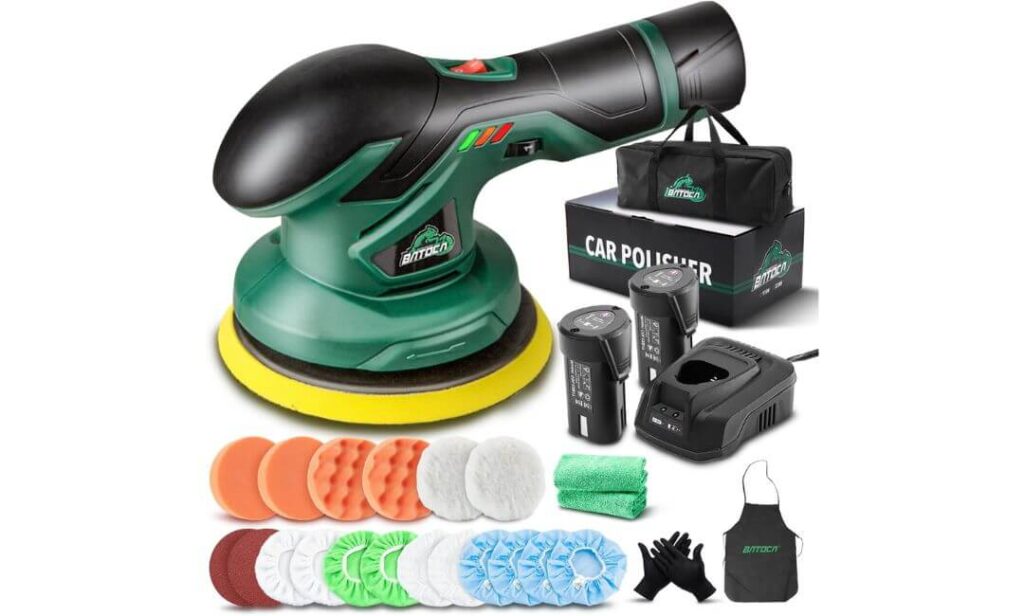
#1. BATOCA Cordless Car Buffer Polisher (12V Dual Action)
Key Specs:
- Power Type: 12V Cordless (Dual Battery System)
- Battery Capacity: 2 × 2.0Ah Lithium-Ion
- Motion Type: Dual Action (Random Orbital)
- Speed Range: 2,500 – 5,000 RPM
- Weight: Approx. 3 lbs
- Pad Size: 6 Inch
- Speed Levels: 6 Adjustable Settings
- Beginner Safety Feature: Low vibration + DA motion
- Charging Indicator: Yes (Multi-color battery status lights)
The first thing you notice when you pick up the BATOCA is the weight — or the lack of it. It feels light in the hand and well balanced, not front-heavy like many cheap polishers. That matters a lot if you’re new, because a heavy machine quickly causes uneven pressure and shaky movement. On flat panels like the hood and roof, the tool stays stable and easy to guide. The dual-action movement keeps the pad moving smoothly, which helps avoid heat buildup and makes it much safer for beginner-level paint work.
During real use, the cordless setup is where this machine shines. No cable dragging across the door panels, no extension cord to manage. With the two included batteries, you can polish one side of the car, swap batteries, and keep going. The power doesn’t suddenly drop under load either — it stays consistent while spreading wax and doing light polishing. The battery indicator lights are actually useful, especially when working outside, because you know exactly when it’s time to swap instead of getting surprised mid-panel.
Speed control is simple and practical. Lower settings work perfectly for waxing and sealant application, while the mid-range speeds handle light swirl removal without feeling aggressive. It doesn’t feel like a “toy” machine, but it also doesn’t behave like an overpowered rotary that can damage paint if you make a mistake. For someone learning car detailing at home, this balance is what makes it comfortable to use again and again.
Why We Love It
- Easy to control even on large panels
- Light weight reduces arm fatigue
- Dual-action movement keeps paint safer
- Two batteries mean no waiting to recharge
- Smooth power delivery without jerky starts
What Customers Are Saying
With an average rating of 4.4 out of 5 stars from more than 1,900 buyers, most owners agree this polisher is beginner friendly and easy to live with. Many users mention that it feels comfortable in hand and doesn’t vibrate aggressively like cheaper units. First-time polishers often say they were able to wax or lightly polish their cars without stressing about paint damage.
Battery performance and overall value come up frequently in feedback. Buyers appreciate being able to finish full detailing sessions using the two-battery setup without constant interruptions. The included pads and carry bag also get positive mentions because everything needed to start is already in the box. While a small group of users mention wear after heavy long-term use, the majority view it as a reliable home-use polisher that delivers solid results for the price.
#2. KIMO 20V Cordless Car Buffer Polisher Kit (High-Power Compact Polisher)
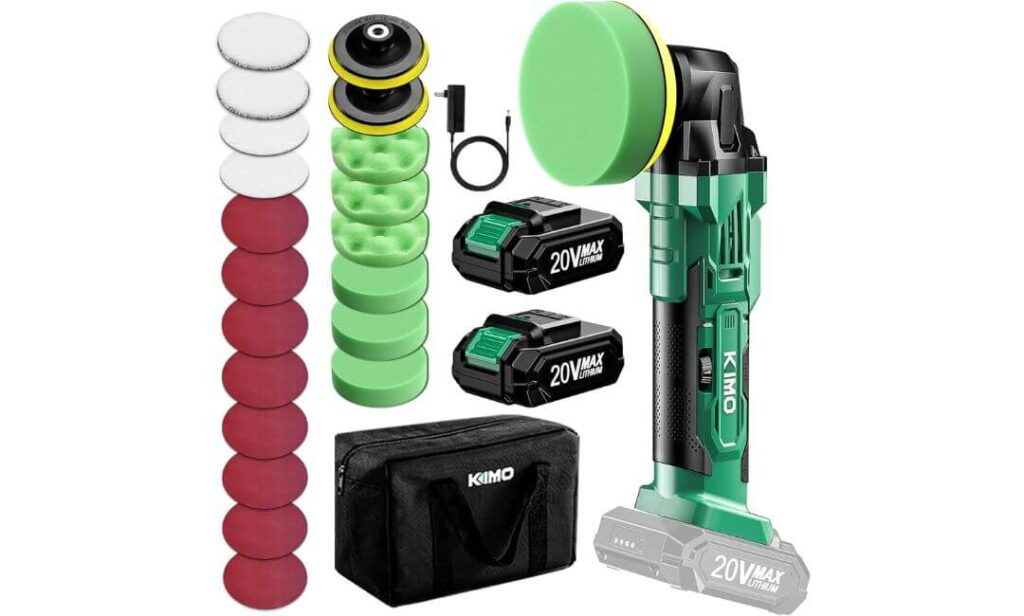
Key Specs:
- Power Type: 20V Cordless
- Battery Capacity: 2 × 2.0Ah Lithium-Ion
- Motor Type: Brushless
- Motion Type: Orbital Polisher
- Speed Range: 2,500 – 6,000 RPM
- Weight: Approx. 2.5 lbs
- Pad Size: 4 Inch
- Speed Levels: 6 Adjustable Settings
- Noise Level: Under 50 dB (Low Noise Operation)
- Beginner Comfort Features: Anti-vibration design + rubber grip
The KIMO 20V feels different the moment you hold it. It’s noticeably lighter than most cordless polishers in this category, and that makes a big difference when you’re working around mirrors, pillars, bumpers, and tight curves. The compact 4-inch head gives you much better control compared to large 6-inch machines. For beginners, this means fewer mistakes and more precision, especially on edges where people usually get nervous.
On the power side, this polisher has more punch than its size suggests. The brushless motor keeps the machine running smooth without sudden jerks when pressure is applied. At low speeds, it spreads wax cleanly and evenly. Step it up to mid-range and it handles light scratch removal and oxidation without struggling. The vibration control is noticeable too — your hands don’t go numb after 15 minutes of use, which is common with cheaper cordless units.
Where KIMO really stands out is the full kit setup. You’re not just getting the tool — you’re getting multiple pad types, microfiber, wool pads, sanding discs, backing plates, batteries, charger, and a carry bag. For someone starting from zero, this saves money and avoids compatibility guessing. The two 20V batteries give enough runtime to complete most home detailing jobs without feeling rushed, and the quick charging keeps downtime short.
Why We Love It
- Extremely light and easy to maneuver in tight areas
- Compact 4-inch head offers better control for beginners
- Strong brushless motor delivers steady power
- Full accessory kit covers waxing, polishing, and light sanding
- Comfortable grip and low vibration reduce hand fatigue
What Customers Are Saying
With an average rating of 4.3 out of 5 stars from thousands of buyers, most users highlight how easy this polisher is to handle and how comfortable it feels during real use. Many first-time buyers mention that the lightweight body makes it less intimidating than larger polishers, especially when working on door panels, bumpers, and curved surfaces. Several reviews also point out that it feels well balanced and doesn’t fight your hand movement.
Battery performance and value get frequent praise as well. Owners like the convenience of having two batteries ready to swap and appreciate the fast charging time. The accessory kit is another big plus, with many users saying they didn’t need to buy extra pads to get started. While some note that battery life drops faster at maximum speed, most agree that for home detailing and beginner-level work, the KIMO delivers solid performance, comfort, and versatility in one complete package.
#3. VERVEWAVE Cordless Buffer Polisher (DeWalt 20V Battery Compatible – Tool Only)
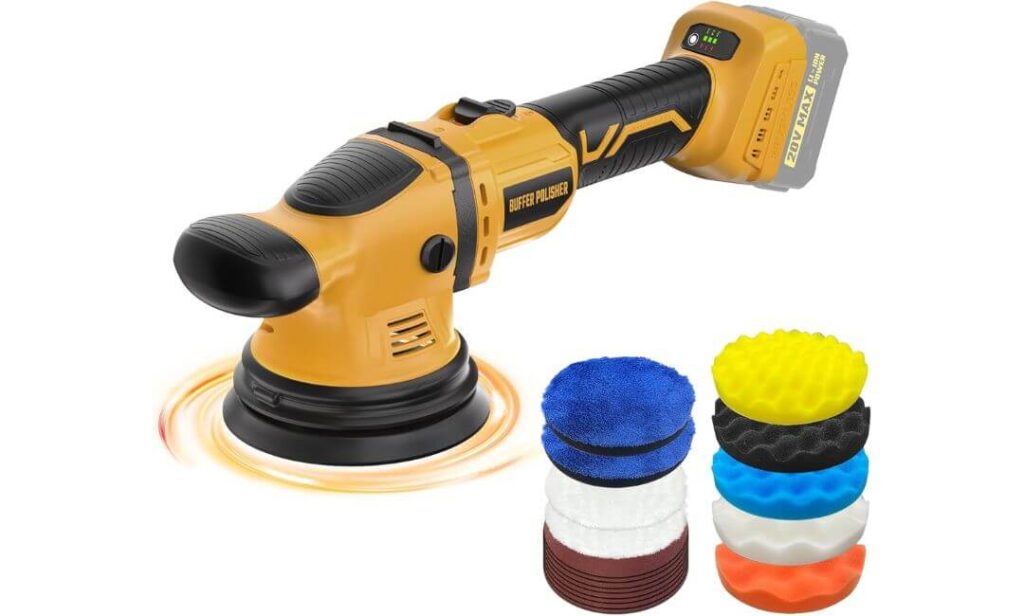
Key Specs:
- Power Type: 20V Cordless (DeWalt Battery Compatible – Battery Not Included)
- Motor Type: Brushless
- Motion Type: Orbital Polisher
- Speed Range: 1,800 – 5,500 RPM
- Pad Size: 6 Inch
- Speed Levels: 6 Adjustable Settings
- Handle Design: Extended ergonomic handle
- Safety Feature: Lock-on power switch
- Accessory Kit: 17-Piece Polishing Set Included
If you already use DeWalt 20V tools, the VERVEWAVE polisher makes a lot of sense. Instead of buying another charger and battery system, you simply snap in the same battery you already own and start working. That alone makes this polisher attractive for DIY car owners who want cordless freedom without building a whole new tool ecosystem. The 6-inch pad size also gives it an advantage on larger panels like hoods, roofs, and doors where wider coverage saves time.
In real use, the machine feels solid and stable. The brushless motor delivers smooth power without sudden surges, which is important when you’re learning proper pressure control. At lower speeds, it spreads wax and sealants evenly without splatter. Mid-range settings handle light polishing comfortably, and higher speeds can tackle oxidation when needed. The extended handle design helps with balance, especially when working on vertical surfaces where control matters most.
One feature beginners tend to appreciate is the lock switch. Instead of constantly holding the trigger, you can lock the machine into operation, which reduces hand fatigue during longer sessions. The rubberized grip also adds comfort and stability. While this unit doesn’t include a battery, the 17-piece accessory kit covers most basic detailing needs, making it easy to start polishing without buying extra pads right away.
Why We Love It
- Works with DeWalt 20V batteries for easy power sharing
- 6-inch pad covers large panels faster
- Smooth brushless motor keeps power delivery controlled
- Lock switch reduces hand strain during long jobs
- Strong value for users who already own DeWalt tools
What Customers Are Saying
With an average rating of 4.7 out of 5 stars from hundreds of users, most buyers highlight the convenience of using their existing DeWalt batteries and the solid performance for home detailing. Many mention that it feels well built in hand and delivers steady polishing power without excessive vibration. Beginners often say it’s easy to control and forgiving enough for learning proper technique.
Customers also appreciate the overall value, especially considering the included pad and accessory kit. Several users report good results on cars, motorcycles, and even boats. A few note that larger DeWalt batteries can make the tool feel heavier during long sessions, but most agree the trade-off is worth it for the cordless power and compatibility. Overall, it’s seen as a practical option for DIY users who want performance without extra battery investment.
#4. Saker Cordless Buffer Polisher (12V Portable Polishing Kit)
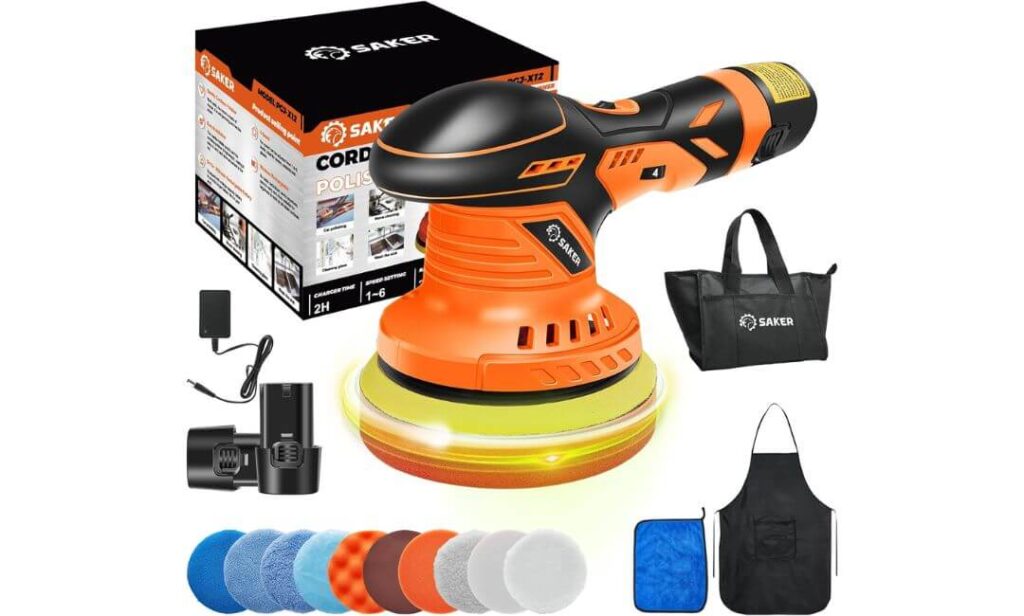
Key Specs:
- Power Type: 12V Cordless
- Battery Capacity: 2 × 2.0Ah Lithium-Ion
- Charging Time: Approx. 2 Hours Fast Charging
- Motion Type: Dual Action Random Orbit
- Speed Range: Up to 5,000 RPM
- Weight: Approx. 1.78 lbs
- Pad Size: 6 Inch
- Speed Levels: 6 Adjustable Settings
- Beginner Advantage: Ultra-lightweight body
The Saker polisher is built for people who want something simple, light, and easy to manage. The first thing that stands out is the weight. At under 2 pounds, it feels almost effortless in the hand. For beginners, this makes a huge difference, especially when working on doors, quarter panels, or doing longer waxing sessions. You don’t feel like you’re fighting the machine, which helps keep your pad flat and your pressure consistent.
In real-world use, the cordless setup and fast charging make it very convenient for quick detailing jobs. You can pull it out, swap in a battery, and get straight to work without setting up extension cords. The dual-action movement keeps the polishing motion smooth and controlled, while the six speed levels allow you to stay on lower settings for waxing and light polishing. It’s not aggressive, which is actually a good thing for beginners who want safe results without risking paint damage.
The included kit covers most basic needs. Between the sponge pads, wool discs, and sanding accessories, you can handle waxing, light scratch cleanup, oxidation removal, and basic surface prep. With two batteries included, you can usually finish a full car waxing session without stopping. It’s clearly designed for home users who want a practical, easy-to-use machine rather than a heavy professional-grade tool.
Why We Love It
- Extremely lightweight and comfortable for long sessions
- Fast charging keeps downtime low
- Cordless design makes setup quick and hassle-free
- Gentle power delivery keeps paint safer for beginners
- Complete starter kit included in the box
What Customers Are Saying
With an average rating of 4.4 out of 5 stars from hundreds of buyers, most users praise how easy this polisher is to handle and how comfortable it feels during use. Many mention being able to wax or buff an entire vehicle on a single charge and appreciate how light the machine feels in the hand. First-time users often say it’s simple to operate and forgiving enough to learn on.
Customers also highlight good value for the price, especially considering the included batteries and accessories. Several reviews mention solid results for waxing, light polishing, and oxidation removal. Some users point out that it’s better suited for light to moderate work rather than heavy paint correction, but for beginner-level detailing and routine car care, most agree it delivers reliable performance and convenience.
#5. SPTA Cordless Mini Car Polisher (12V Micro RO/DA Polisher)
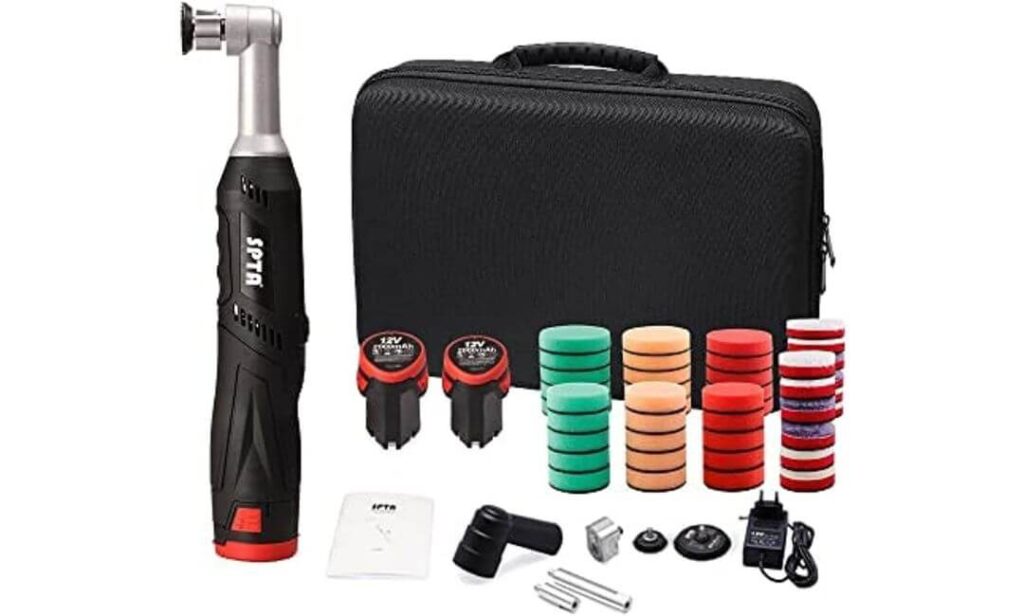
Key Specs:
- Power Type: 12V Cordless
- Motor Power: 80W
- Motion Type: Dual Action + Rotary Mode Support
- Speed Range: 1,000 – 5,000 OPM
- Weight: Over 50% lighter than standard polishers
- Pad Size: 1 Inch Precision Backing Plate
- Battery Runtime: Up to 60 Minutes (Detail Work)
- Primary Use: Tight areas, emblems, headlights, trim
- Beginner Safety Feature: Hologram-free DA movement
The SPTA Mini Polisher isn’t meant to replace a full-size machine — it’s built to handle the places where big polishers simply can’t reach. The moment you pick it up, you feel how compact and light it is. It sits comfortably in one hand and feels more like a precision tool than a traditional buffer. This makes it ideal for beginners who want better control while learning how paint reacts to pressure and movement.
In real use, this polisher shines in tight zones: around badges, door handles, mirrors, headlights, trim edges, and body lines. The 1-inch backing plate gives you pinpoint accuracy, which is impossible with standard 5- or 6-inch machines. The dual-action movement keeps the pad rotating safely and helps prevent swirl marks. You can work at lower speeds to spread polish or bump it up when you need more correction power — without feeling like the tool is trying to run away from you.
Cordless operation makes it easy to move around the car without dealing with extension cords. With two batteries included, you can keep working while one charges. Runtime is enough for detail work and spot correction rather than full-car polishing. This is the kind of machine that becomes your “go-to” tool for finishing touches, not heavy correction jobs — and that’s exactly where it performs best.
Why We Love It
- Extremely compact and easy to control
- Perfect for emblems, headlights, trims, and tight body lines
- Lightweight design reduces hand strain
- Dual-action mode helps prevent swirl marks
- Cordless setup makes detail work faster and cleaner
What Customers Are Saying
With an average rating of 4.4 out of 5 stars from hundreds of buyers, most users praise this polisher for its precision and ease of handling. Many mention that it works great in areas where larger polishers feel awkward or unusable. First-time users often say it feels comfortable in the hand and gives better control for learning detailed polishing work.
Battery feedback is mixed but realistic. Some users report solid runtime for small-area polishing and headlight restoration, while others note shorter battery life at higher speed settings. Durability also gets varied feedback, with many satisfied home users and a smaller group reporting wear after extended heavy use. Overall, customers see it as a useful detail-focused tool that adds flexibility to any beginner’s car care setup.
How to Choose the Best Cordless Car Polisher for Beginners
When choosing a cordless car polisher for the first time, the biggest mistake beginners make is chasing raw power instead of control. What actually matters is how stable the machine feels in your hands. A well-balanced polisher stays flat on the paint, moves smoothly across panels, and doesn’t fight your grip. This makes learning proper technique much easier and keeps the finish safer.
Battery setup is another detail that separates frustration from smooth work sessions. For beginners, a dual-battery kit is far more practical than a single battery system. It allows continuous polishing without rushing panels or stopping halfway through a job. Having a spare battery ready keeps workflow consistent and helps maintain even results across the entire vehicle.
Speed control should be simple and predictable. Beginners benefit from polishers that offer clearly stepped speed levels instead of aggressive trigger-style controls. Lower speeds are ideal for spreading wax and sealants, while mid-range settings handle light polishing work. This gradual control helps users build confidence without risking swirl marks or excessive heat on the paint surface.
Pad size also plays a major role in handling. Larger pads cover more area quickly, making them useful for hoods, roofs, and doors. Smaller pads offer better control for mirrors, bumpers, and tight curves. For most beginners, starting with a medium-sized pad and adding a compact polisher later for detail work creates the most balanced setup.
Weight is often overlooked but directly affects polishing quality. Lightweight machines reduce arm fatigue and help maintain steady pressure. When hands stay relaxed, movements stay smoother and results improve. Heavy tools may look powerful on paper, but they often lead to uneven passes and rushed work when fatigue sets in.
Finally, dual-action or random orbital motion should always be the first choice for beginners. This motion pattern is far more forgiving than rotary systems. It helps prevent paint damage, reduces swirl marks, and delivers consistent finishes while technique is still developing.
The best cordless car polisher isn’t the one with the biggest numbers — it’s the one that feels comfortable, stays predictable in motion, and allows beginners to focus on technique instead of worrying about mistakes.
Common Beginner Mistakes When Using a Cordless Car Polisher (And How to Fix Them)
Most paint damage doesn’t come from bad machines — it comes from small technique mistakes that beginners repeat without realizing. Fix these once, and your results improve immediately.
1) Applying Excess Pressure Instead of Letting the Pad Work
Most beginners push the machine into the paint thinking more pressure equals faster correction. What actually happens is pad rotation slows down, heat builds up unevenly, and the polish stops breaking down properly. This leads to haze, micro-marring, and poor gloss.
Correct approach:
Use only light downward pressure — just enough to keep the pad flat and stable. Watch the pad rotation. If it stalls, reduce pressure. Controlled contact produces better correction and safer results.
2) Running Maximum Speed on Fresh Paint or Soft Clear Coat
High speed feels productive but often causes polish sling, vibration, and inconsistent correction. On softer clear coats, aggressive RPM can even leave faint holograms.
Correct approach:
Spread product on low speed. Work the polish on mid-range RPM. Only increase speed if correction is slow and the paint type allows it. Gradual speed control always gives better surface finish.
3) Using One Pad for Every Step
Beginners often use the same pad for compounding, polishing, and waxing. This mixes abrasives and residue, leading to reduced cutting ability and contaminated finishing stages.
Correct approach:
Assign pads by purpose. Keep cutting pads separate from finishing pads. Label them if needed. Clean pads frequently during the job. This alone improves gloss and correction quality dramatically.
4) Moving the Machine Too Fast Across Panels
Fast arm movement prevents polish from working properly. The abrasives never get time to break down, and the finish ends up uneven.
Correct approach:
Use slow, overlapping passes. Move the polisher about 1 inch per second. Work in small sections instead of full panels. Controlled motion creates consistent shine and correction.
5) Ignoring Panel Temperature During Polishing
Cordless polishers stay quiet and smooth, which makes it easy to forget heat buildup. Overheating softens clear coat and increases the risk of surface haze.
Correct approach:
Touch the panel occasionally. If it feels hot, stop and let it cool. Work shaded areas when possible. Short polishing cycles with breaks protect paint long-term.
6) Polishing Without Proper Surface Prep
Polishing on dusty or lightly dirty paint traps debris between the pad and surface. This causes micro-scratches and reduces polish effectiveness.
Correct approach:
Always wash and dry the vehicle before polishing. Use a quick detail spray or panel wipe if needed. A clean surface allows pads and polish to work correctly.
7) Expecting Heavy Scratch Removal from Entry-Level Machines
Many beginners expect deep scratch correction from compact cordless polishers. This creates frustration and overworking of small machines.
Correct approach:
Use cordless polishers for swirl removal, oxidation cleanup, wax application, and light defect correction. Deep scratches require wet sanding or professional-level tools. Understanding machine limits prevents damage and disappointment.
Avoiding these mistakes turns polishing from trial-and-error into controlled improvement. With the right habits, cordless polishers become reliable tools instead of risky experiments.
Bottom Line: Who Should Buy Which Cordless Polisher?
- Choose BATOCA if you want the safest all-around cordless polisher for beginners with smooth control and balanced power.
- Go with KIMO 20V if you want lightweight handling with stronger performance and a full accessory kit for different polishing jobs.
- Pick VERVEWAVE if you already use DeWalt 20V batteries and want cordless polishing without buying another battery system.
- Select Saker if you want an ultra-light, portable polisher for quick waxing and easy home detailing.
- Choose SPTA Mini if you need a compact polisher for tight spaces, headlights, trims, and detailed correction work.
Are cordless car polishers actually safe for beginners?
Yes, cordless polishers are safe for beginners when you choose dual-action or random orbital models. These machines distribute motion across multiple directions, which reduces heat buildup and prevents paint burning. Unlike rotary polishers, they are more forgiving if your hand movement isn’t perfect. The key is using low speed at the start, keeping the pad flat, and avoiding heavy pressure. When used correctly, cordless polishers are one of the safest tools for home car detailing.
Can a cordless car polisher remove scratches?
Cordless polishers can remove light scratches, swirl marks, oxidation, and surface haze. Deep scratches that catch your fingernail usually require wet sanding or professional correction. For beginners, the goal should be improving paint clarity and gloss rather than chasing deep defect removal. Using the right pad and polish combination makes a big difference. Proper technique matters more than raw machine power.
How long does a cordless polisher battery last in real use?
In real-world use, most cordless polishers run between 30 to 60 minutes per battery depending on speed setting and pressure. Lower speeds used for waxing and finishing consume less power, while higher correction speeds drain batteries faster. That’s why having two batteries is important for beginners. It allows continuous work without rushing panels or stopping mid-job. Battery swap flexibility improves workflow and results.
What speed should beginners start with on a cordless polisher?
Beginners should always start at the lowest speed setting to spread polish or wax evenly. Once the product is distributed, moving to a medium speed helps activate the polish and improve correction. High speed should only be used when necessary and with experience. Starting slow improves control, reduces splatter, and protects clear coat. Speed control is about consistency, not aggression.
Is a cordless polisher better than a corded one for beginners?
For beginners, cordless polishers offer easier handling and less setup frustration. Without cables dragging across the car, movement feels more natural and controlled. Corded machines can offer more sustained power, but they also increase complexity for first-time users. Cordless models are better for home garages, driveways, and quick detailing sessions. Convenience often leads to better technique and more consistent results.
Final Thoughts
Getting into car polishing doesn’t have to feel complicated. With the right cordless polisher, it becomes simple, satisfying, and honestly fun. The tools in this list are built to help beginners learn safely, work comfortably, and see real shine without stressing over paint damage. Pick the one that matches your needs, take your time, and enjoy the process — because nothing beats stepping back and seeing your car look better than it did yesterday.
Also Check: