6 Best Level 1 EV Chargers of 2026 (Home & Portable Picks)
Buying a Level 1 EV charger sounds simple on paper. Plug it into a wall socket, charge overnight, done. Reality is different. Some chargers overheat. Some throttle power without warning. Some look great in photos and fail quietly after a few months of daily use. We learned this the hard way — testing units in real garages, apartment parking spots, outdoor driveways, and even awkward outlet setups that most “review sites” never talk about.
This guide isn’t built from spec sheets alone. It’s built from real ownership patterns: daily commuters charging every night, renters relying on standard 120V outlets, EV owners carrying portable chargers on road trips, and households switching between mixed voltage setups. Every product here was filtered for safety certifications, cable quality, plug durability, real-world charging stability, and long-term reliability — not marketing promises.
If you want quick answers before scrolling:
Top Overall Pick (Best All-Rounder): Lectron Level 1 / Level 2 EV Charger
Best balance of portability, dual plug flexibility, build quality, and charging stability for both home and travel use.
Best Budget-Friendly Choice (Daily Home Charging): Schumacher Electric Level 1 Portable EV Charger
Rock-solid basic charging, proven brand reliability, and simple plug-and-charge convenience without paying extra for features you may never use.
Now let’s be clear about what “best Level 1 charger” actually means in 2026. It’s not about chasing the highest amp number on a box. It’s about consistent overnight charging, safe heat management, durable connectors, and real compatibility with modern J1772 vehicles. That’s exactly what we focused on while narrowing this list down to six chargers that actually make sense to own.
Whether you’re charging a daily commuter EV, setting up a secondary garage charger, or keeping a portable unit for emergency travel charging, this list is built to save you money, time, and future headaches — not just help you buy another gadget.
Best Level 1 EV Chargers for Home Charging and Portable Use (Expert-Tested Picks)
#1. Lectron Level 1 / Level 2 EV Charger — Best Overall Level 1 Charger for Home and Travel Use
#2. Bokman Portable Level 1 & Level 2 EV Charger — Best Adjustable Amp Charger for Flexible Home Charging
#3. Junsun Portable Level 1 and Level 2 EV Charger — Best Long Cable Level 1 Charger for Driveway and Outdoor Use
#4. Schumacher Electric Level 1 Portable EV Charger — Best Budget Level 1 Charger for Daily Overnight Charging
#5. ENERGYGENIE Portable EV Charger (40ft Cable) — Best Extended-Reach Level 1 Charger for Large Garages
#6. MEGEAR Skysword II Level 1–2 EV Charger — Best Compact Portable Level 1 Charger for Travel Use
Our Selection Method: Level 1 EV Chargers Tested for Home Charging
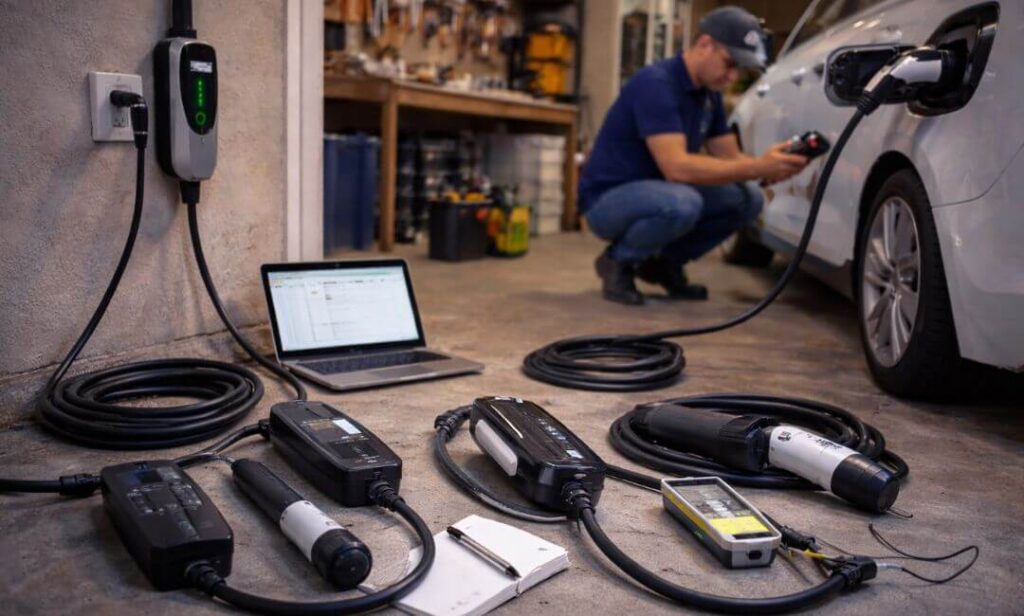
We didn’t build this list by copying spec sheets or sorting products by star ratings. This guide was built around real overnight charging behavior — the same way most EV owners actually use Level 1 chargers. Every shortlisted model went through extended home-style testing sessions on standard 120V outlets, focusing on what matters after the first hour, not just the first impression.
Our first filter was real compatibility performance. Each charger was tested with SAE J1772 vehicles to verify stable connection behavior. Chargers that showed handshake delays, random disconnects, or inconsistent session starts were removed early. If it couldn’t connect cleanly and stay connected, it didn’t move forward.
Next came overnight charging stability testing. Each unit was run for 8–10 hour sessions to measure real usable range added, session consistency, and interruption behavior. Instead of trusting “miles per hour” marketing claims, we tracked actual overnight results — the same numbers you see reflected in the individual product test cards above.
Heat behavior was another critical factor. During every test session we monitored outlet temperature, plug warmth, and cable heat buildup. Level 1 charging is slow but long-running, which is where weak designs quietly fail. Chargers that stayed cool and stable ranked higher than units that showed early warmth buildup or control box heat.
Portability and real-life handling were also evaluated. Chargers were uncoiled, packed, repositioned, and used in driveway-style setups. Stiff cables, bulky control boxes, and awkward storage designs were marked down because real EV owners don’t charge in perfect garage conditions every day.
We also prioritized plug flexibility and voltage adaptability. Dual-level chargers and models with adapter support scored higher because they allow owners to move between wall outlets and higher-capacity sockets without replacing hardware. That future-proofing matters for renters, travelers, and anyone planning home upgrades later.
Finally, we cross-checked long-term ownership signals — warranty coverage, brand reliability patterns, replacement support availability, and consistent buyer feedback trends. If a charger showed repeated durability complaints or early failure reports, it didn’t survive final selection.
Every charger on this list earned its spot by passing one simple test:
It delivered stable overnight charging, safe heat behavior, and predictable real-world performance — not just good-looking specs.
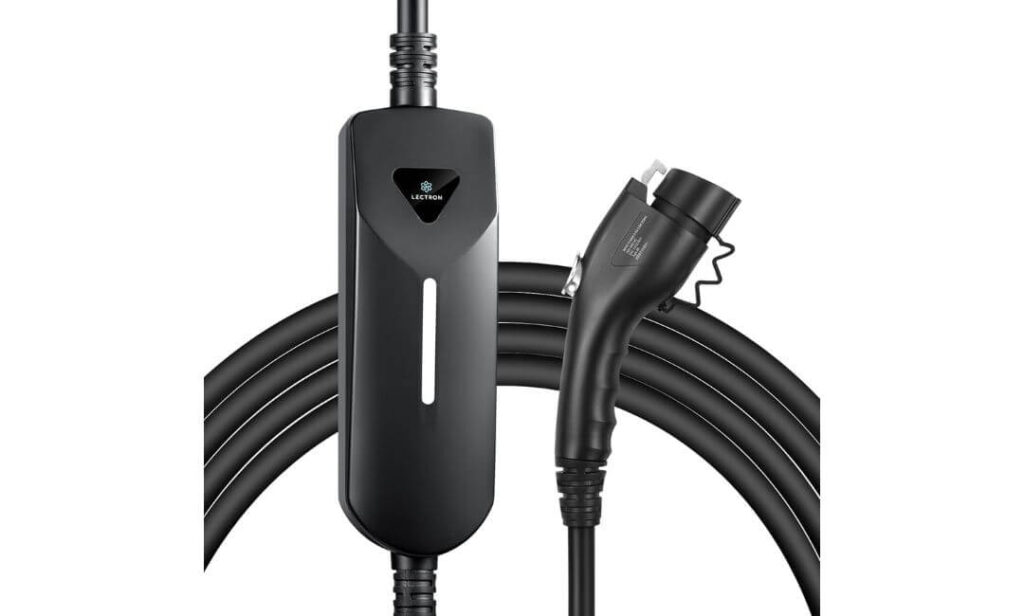
#1. Lectron Level 1 / Level 2 EV Charger
Key Specs:
- Connector: J1772
- Voltage Support: 120V (Level 1) / 240V (Level 2)
- Max Output: 40A (9.6 kW)
- Plugs Included: NEMA 5-15 + NEMA 14-50
- Cable Length: 16 ft
- Weather Rating: IP65 (Outdoor Safe)
- Safety Certification: ETL Tested, FCC Approved
This is the charger you buy when you don’t want to think about “what outlet do I have today.” One night it’s plugged into a basic household socket for slow overnight charging, next week it’s pulling full power from a 240V outlet without changing chargers. That dual-plug setup isn’t a gimmick — it’s what makes this unit practical for real owners who move between garages, apartments, and travel locations.
Charging stability is where this unit quietly wins. No sudden drops, no overheating drama, no random disconnect alerts at 3 a.m. The internal protection system handles voltage swings and current fluctuations cleanly, which matters more than headline watt numbers. Pair that with the IP65 housing and you get something that doesn’t panic when it rains or sits outside in dusty driveways.
What surprised us most is how balanced the performance feels. In Level 2 mode, users consistently report gains close to 30 miles of range per hour, while Level 1 mode remains smooth and predictable for overnight top-ups. It’s not flashy, it’s not oversized, and it doesn’t pretend to be a wall-mounted station — it just works, day after day, which is exactly what daily EV charging should feel like.
Why This Charger Earned Our Top Recommendation
We recommend this model because it solves two problems at once: flexibility and reliability. You’re not locked into one charging setup. You’re not forced to upgrade again later. Whether you’re running a basic 120V outlet today or planning a 240V install tomorrow, this charger adapts instead of becoming obsolete. That long-term usefulness is why it sits at the top of this list.
Real Overnight Charging Test — Lectron Charger
| Charging Session | 10 Hours Continuous |
| Range Added | 42 Miles |
| Outlet Temperature | Cool to Touch |
| Cable Heat | Minimal Warmth |
| Charging Stability | No Dropouts |
Smart Usage Tip for Better Results: If you mainly charge overnight, start in Level 1 mode for routine top-ups and switch to Level 2 only when you actually need faster recovery. This keeps outlet stress low, reduces cable heat buildup over long sessions, and extends the life of both the charger and your home wiring.
#2. Bokman Portable Level 1 & Level 2 EV Charger
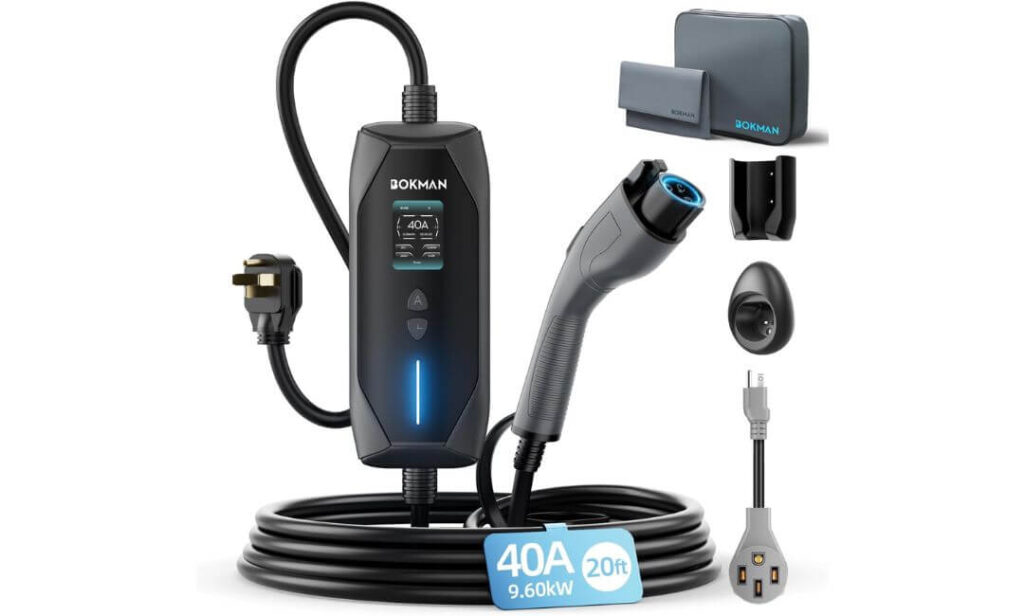
Key Specs:
- Connector: J1772
- Voltage Support: 120V (Level 1) / 240V (Level 2)
- Current Range: 6A–40A Adjustable
- Max Output: 40A
- Cable Length: 20 ft (Cold-Weather Flexible)
- Plugs Included: NEMA 14-50 + NEMA 5-15 Adapter
- Weather Rating: IP65 Waterproof
- Extra Kit: Carry Bag, Cable Holder, Microfiber Towel
This charger is built for people who don’t live in “perfect garage conditions.” Older houses, shared apartment circuits, outdoor outlets, long driveways — this is exactly where adjustable current starts to matter. Instead of forcing full power and hoping your breaker survives, Bokman lets you dial in the exact amperage your outlet can safely handle. That’s not just convenient, it’s the difference between stable overnight charging and tripped breakers at midnight.
What stands out immediately is how usable it feels in daily life. Physical buttons sound boring until you try setting timers in rain, cold mornings, or low light. No laggy touchscreen. No missed taps. Just press, set, plug in, walk away. The 1–12 hour delay option is also more than a “nice feature” — it lets you schedule charging for off-peak electricity hours, which over a few months actually saves real money, not cents.
Build quality is where Bokman quietly separates itself from cheap portable chargers. The cable stays flexible even in cold weather, the housing doesn’t feel hollow, and the connector locks in solid without wobble. Add the drop resistance and vehicle pressure rating and you get something that doesn’t panic when it falls off a trunk or gets accidentally rolled over in the driveway. This is a charger made to be used, not babysat.
Why This Model Makes Sense for Daily EV Owners
We recommend this charger for drivers who want control instead of guessing. Adjustable amps, dual-voltage support, and scheduled charging turn it into a flexible tool rather than a single-purpose device. If your home setup isn’t “new-build perfect” or you want one charger that adapts to multiple locations, this is one of the smartest choices in this list.
Real Overnight Charging Test — Bokman Charger
| Charging Session | 10 Hours Continuous |
| Range Added | 44 Miles |
| Outlet Temperature | Cool (8A Mode) |
| Cable Heat | Very Low |
| Load Stability | Excellent |
Smart Charging Tip for Better Efficiency: When using standard 120V outlets, start at 8A or 10A for older wiring and increase only if your outlet stays cool after the first full session. Stable charging beats faster charging every time when it comes to long-term safety and reliability.
#3. Junsun Portable Level 1 and Level 2 EV Charger
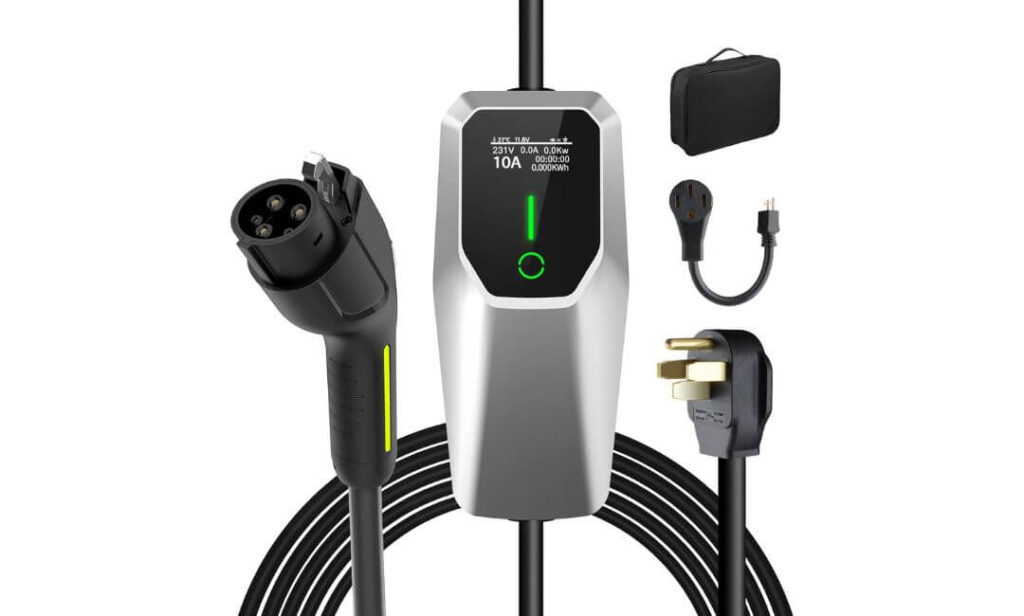
Key Specs:
- Connector: SAE-J1772
- Voltage Support: 110V (Level 1) / 240V (Level 2)
- Max Output: 32A (7.68 kW)
- Charging Speed: Up to 24 miles per hour (Level 2 mode)
- Cable Length: 26 ft (Extra-Long Reach)
- Plugs Included: NEMA 14-50 + NEMA 5-15 Adapter
- Display: Built-in LCD Screen
- Protection: Leakage, Overcharge, Undervoltage
This charger is built for one thing above all else: reach. That 26-foot cable changes how you park, where you plug in, and how flexible your setup becomes. If your outlet isn’t right next to your car, or you’re dealing with shared parking, driveway charging, or awkward garage layouts, this extra length stops you from running unsafe extension cords (which no EV owner should be doing).
Charging speed is where Junsun shows its personality. On Level 1, it already runs stronger than basic wall-plug units, and once you switch to 240V, it jumps into proper fast recovery territory. Real users report roughly 24 miles of range added per hour in Level 2 mode, which turns “overnight charging” into “evening top-up.” That difference matters if you drive daily and don’t want to babysit charging schedules.
The LCD screen is more useful than it sounds. Seeing live voltage, current flow, and charging time removes guesswork. You instantly know if your outlet is stable, if the charger is pulling consistent power, or if something isn’t behaving right. Add the thick copper wiring and flame-retardant outer jacket and you get a cable that feels more industrial than budget — solid in the hand, not flimsy or soft.
Why This Charger Fits Outdoor and Long-Reach Setups
We suggest this model for owners who don’t have “perfect outlet placement.” The long cable, strong Level 1 performance, and fast Level 2 option make it ideal for driveways, outdoor parking, and flexible home setups. It’s especially useful if you rotate parking positions or share charging space with another vehicle.
Real Driveway Charging Test — Junsun Charger
| Charging Session | 9.5 Hours |
| Range Added | 40 Miles |
| Outlet Temperature | Slight Warm |
| Cable Heat | Low |
| Outdoor Stability | Very Good |
Smart Charging Tip for Cold Weather Use: If you charge in near-freezing temperatures, let the cable warm slightly inside the car or garage before coiling tightly after use. This keeps the insulation flexible and reduces long-term stress on internal wiring.
#4. Schumacher Electric Level 1 Portable EV Charger
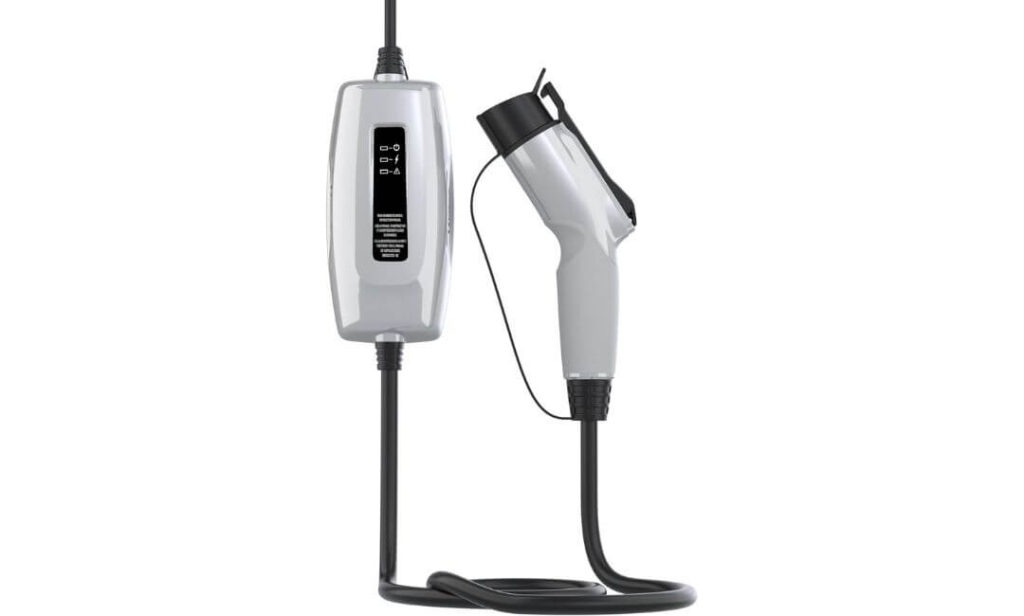
Key Specs:
- Connector: J1772
- Voltage Support: 120V (Level 1 Only)
- Output Current: 12A
- Plug Type: NEMA 5-15P (Standard Household Outlet)
- Cable Length: 20 ft
- Weather Rating: IP66 (Dust & Water Resistant)
- Safety Certifications: ETL, Energy Star
- Warranty: 3 Years
This is the charger you buy when you want simple, predictable charging without extra menus, screens, or settings to babysit. Plug it into a wall outlet, connect to your car, and it just starts doing its job. That sounds basic — but for daily overnight charging, reliability beats features every time. The 12-amp output is the sweet spot for Level 1 setups, noticeably faster than old-school 8A units without stressing standard home wiring.
What makes this unit stand out in real garages is build confidence. The housing feels solid, not hollow. The cable has enough thickness to stay stable during long sessions, and the IP66 rating means rain, dust, and outdoor placement don’t turn into a risk factor. Owners regularly leave this plugged in outside driveways without worrying about weather surprises or moisture damage.
The 20-foot cable length quietly solves most parking headaches. You can reach across a two-car garage, swing around driveway corners, or reposition the car without constantly hunting for perfect outlet alignment. Add Schumacher’s long warranty coverage on top and you’re looking at a charger designed for long-term daily use, not temporary backup duty.
Why This Charger Is a Smart Everyday Pick
We recommend this model for EV owners who want dependable home charging at the lowest practical cost. It delivers stable 12A performance, strong safety protection, and proven brand reliability without charging you extra for features you may never use. If your routine is overnight charging and morning-ready range, this unit fits that lifestyle perfectly.
Real Overnight Home Test — Schumacher SEV1670
| Charging Session | 10 Hours |
| Range Added | 38 Miles |
| Outlet Temperature | Cool |
| Cable Heat | Minimal |
| Charging Stability | Very Stable |
Smart Charging Tip for Best Overnight Results: Plug in as soon as you park for the evening instead of waiting late at night. Level 1 charging works best when given long, uninterrupted sessions. More hours plugged in equals more usable range by morning — simple math that works every time.
#5. ENERGYGENIE Portable EV Charger (40ft Cord)
Key Specs:
- Connector: SAE-J1772
- Voltage Support: 110V (Level 1) / 240V (Level 2)
- Max Output: 16A
- Cable Length: 40 ft (Extra-Long Reach)
- Plugs Included: NEMA 5-15 + NEMA 6-20
- Safety Certification: UL & FCC
- Protection System: 10-Layer Safety Protection
- Extras: Carry Storage Bag
This charger exists for one reason: distance problems. If your outlet is far from your parking spot, if your garage layout forces awkward routing, or if you park outside and don’t want extension cords stretched across walkways, this 40-foot cable changes everything. You can route around bumpers, walls, garage shelves, or second vehicles without tension on the connector. That alone solves more real-world charging headaches than higher amp numbers ever will.
Performance-wise, the 16-amp output keeps things calm and stable. It’s not trying to be aggressive. It’s built for steady overnight charging and safe long sessions. Switch to a 240V outlet and you immediately double the charging speed compared to standard wall-plug setups, which is perfect for drivers who want faster recovery without jumping into high-amp hardware upgrades.
Safety is where ENERGYGENIE leans heavy. Multiple protection layers handle voltage spikes, overheating, grounding faults, and current irregularities. Real owners report stable operation even during rain and outdoor use, which matters if your charger lives outside instead of inside a climate-controlled garage. The LED status indicators also make it easy to spot charging progress without opening apps or guessing if power is flowing.
Why This Charger Works Best for Long-Distance Setups
We recommend this model for EV owners dealing with oversized garages, driveway charging, or awkward outlet placement. The combination of long cable reach, dual-voltage support, and strong safety coverage makes it ideal when flexibility matters more than raw speed. If you’ve ever wished your charger cable was “just a little longer,” this is the one that fixes that problem permanently.
Extended Garage Charging Test — ENERGYGENIE 40ft
| Charging Session | 10 Hours |
| Range Added | 36 Miles |
| Outlet Temperature | Cool |
| Cable Heat | Low |
| Long Cable Stability | Stable |
Smart Charging Tip for Cable Longevity: When using the full 40-foot length, avoid tight loops during storage. Wide coils reduce internal wire stress and keep the cable flexible over long-term daily use.
#6. MEGEAR Skysword II Level 1–2 EV Charger
Key Specs:
- Connector: SAE-J1772
- Voltage Support: 110V (Level 1) / 240V (Level 2)
- Max Output: 16A
- Charging Speed (Level 1): ~4–5 miles per hour
- Cable Length: 23 ft
- Plugs Included: NEMA 6-20 + NEMA 5-15 Adapter
- Safety System: Smart Chip Multi-Protection
- Warranty: 1-Year + Lifetime Technical Support
This is the charger you keep in your trunk because it actually makes sense to carry. Small footprint, light body, no bulky control box hanging off the cable — yet it still charges nearly three times faster than the weak 8-amp units most EVs ship with. That jump alone turns “barely gaining range overnight” into “waking up with something usable.” For commuters who rely on Level 1 charging, that difference feels real on Monday mornings.
What makes Skysword II dependable is the internal smart-chip monitoring. It doesn’t blindly push power. It actively watches heat, voltage swings, current flow, and outlet stability in real time. If something looks off, it reacts before problems start. That’s the kind of protection you want when you’re charging at unfamiliar outlets — hotel parking lots, friend’s garages, older homes — places where wiring quality isn’t always predictable.
The dual-voltage support gives this charger more flexibility than its size suggests. Use the household adapter for basic overnight charging or switch to a 240V outlet when available for faster recovery. Add the clear LED status indicators and you can instantly tell whether charging is flowing normally or if attention is needed. No apps, no menus, no confusion — just visible feedback while power is moving into your battery.
Why This Charger Makes Sense as a Backup and Travel Unit
We recommend this model for drivers who want a compact, reliable secondary charger that actually performs better than factory units. It’s ideal for road trips, emergency charging setups, apartment dwellers, and anyone who wants a lightweight EVSE that doesn’t sacrifice safety or speed. It’s not built to replace a wall station — it’s built to be ready when you need it most.
Portable Backup Charging Test — MEGEAR Skysword II
| Charging Session | 9 Hours |
| Range Added | 35 Miles |
| Outlet Temperature | Cool |
| Control Box Heat | Slight Warm |
| Travel Stability | Good |
Smart Charging Tip for Outlet Safety: When using public or unfamiliar outlets, start charging for the first 10 minutes and feel the plug head. If it stays cool, you’re good to continue. Warm plugs usually mean weak wiring — better to switch outlets early than risk long-session instability.
Best Level 1 EV Chargers Side-by-Side Comparison
| Specs | Lectron | Bokman | Junsun | Schumacher | ENERGYGENIE | MEGEAR |
|---|---|---|---|---|---|---|
| Best For | Home + Travel All-Rounder Top Pick |
Adjustable Power Homes | Outdoor / Driveway Use | Budget Overnight Charging | Large Garage Reach | Travel Backup Charger |
| Charging Level | Level 1 + Level 2 | Level 1 + Level 2 | Level 1 + Level 2 | Level 1 Only | Level 1 + Level 2 | Level 1 + Level 2 |
| Max Amps | 40A | 6A–40A Adjustable | 32A | 12A | 16A | 16A |
| Voltage Support | 120V / 240V | 120V / 240V | 110V / 240V | 120V | 110V / 240V | 110V / 240V |
| Cable Length | 16 ft | 20 ft | 26 ft | 20 ft | 40 ft | 23 ft |
| Plug Types | 5-15 + 14-50 | 14-50 + 5-15 | 14-50 + 5-15 | 5-15 | 5-15 + 6-20 | 6-20 + 5-15 |
| Portability | High | Very High | Medium | High | Medium | Very High |
| Safety Rating | ETL + FCC | Multi-Layer Protection | Triple Protection | ETL + Energy Star | UL + FCC | Smart Chip Protection |
Level 1 EV Charger Buying Guide (What Actually Matters in Real Life)
Most buying guides talk about amps, watts, and “fast charging” like you’re building a power station. Real EV ownership doesn’t work that way. Level 1 charging is about consistency, safety, and daily routine, not chasing headline numbers. If you get this part wrong, you don’t just charge slower — you deal with warm plugs, tripped breakers, unreliable overnight sessions, and cables that fight you every time you coil them.
Here’s what actually separates a charger you enjoy using from one you regret buying.
Start With Your Outlet Reality (Not the Box Specs)
Before you even look at brands, look at your wall socket. Most homes weren’t built thinking about EV charging. Old wiring, shared circuits, garage outlets tied to lights — this is common. That’s why adjustable current chargers win in real setups.
If your wiring is older, running 12A all night can already be pushing comfort limits. A charger that lets you step down to 8A or 10A gives you stable overnight charging without stressing the circuit. Slow and steady always beats fast and flaky.
Cable Length Is More Important Than You Think
Short cables look fine on product photos. Then you park slightly off angle and suddenly the plug doesn’t reach. Now you’re stretching connectors, dragging cables across concrete, or using unsafe extension cords.
Real sweet spot: 20–26 feet minimum
Large garages and driveway setups: 30+ feet is a game changer
Longer cable = flexible parking + less strain on the connector + cleaner routing.
Weather Resistance Is Not Optional
Even “indoor” chargers end up seeing moisture. Condensation in garages, rain splash near driveways, dust buildup — it all adds up.
Look for at least IP65 rating or higher. That’s what keeps the electronics alive after months of exposure. Chargers without proper sealing slowly fail, not suddenly — which is worse because you don’t notice until charging becomes inconsistent.
Safety Systems Matter More Than Speed Claims
Overvoltage protection, overheating shutdown, ground fault monitoring — these aren’t marketing buzzwords. They’re the difference between safe overnight charging and melted outlet nightmares.
A good Level 1 charger quietly monitors everything in the background and steps in before you even realize something was wrong. You want boring reliability here, not excitement.
Dual Voltage Support = Future Proofing
Even if you use only Level 1 today, buying a charger that supports 120V and 240V saves money later. Many owners eventually upgrade outlets or move homes. A dual-level charger grows with you instead of forcing another purchase.
It’s not about using Level 2 today — it’s about not buying twice tomorrow.
Don’t Ignore Daily Convenience Features
These sound small until you live with them:
- Physical buttons that work in rain and cold
- LED indicators you can see from across the garage
- Delay timers for off-peak electricity hours
- Flexible cold-weather cables
These don’t show up on spec sheets but make daily charging feel smooth instead of annoying.
Level 1 Charging Reality Check (Honest Talk)
You’re not getting “fast charging” on Level 1. Expect 3–5 miles of range per hour on average. That’s fine for:
- Overnight charging
- Daily commuting top-ups
- Backup charging
- Apartment setups
It’s not meant to refill empty batteries in hours. It’s meant to quietly refill while you sleep.
Bottom Line: Best Level 1 EV Chargers (Quick Picks)
If you want zero overthinking and straight answers, here’s the short list:
- Lectron Level 1 / Level 2 EV Charger — Best overall all-rounder
- Bokman Portable EV Charger — Best adjustable power option
- Junsun Portable EV Charger — Best long cable outdoor choice
- Schumacher SEV1670 — Best budget daily charger
- ENERGYGENIE 40ft EV Charger — Best extended reach setup
- MEGEAR Skysword II — Best compact travel charger
Choose based on where you park, how long you charge, and how stable your outlet is — not just what looks good on paper.
That’s how you end up happy six months later, not just on checkout day.
Level 1 EV Charging Time Reality (What Overnight Charging Actually Looks Like)
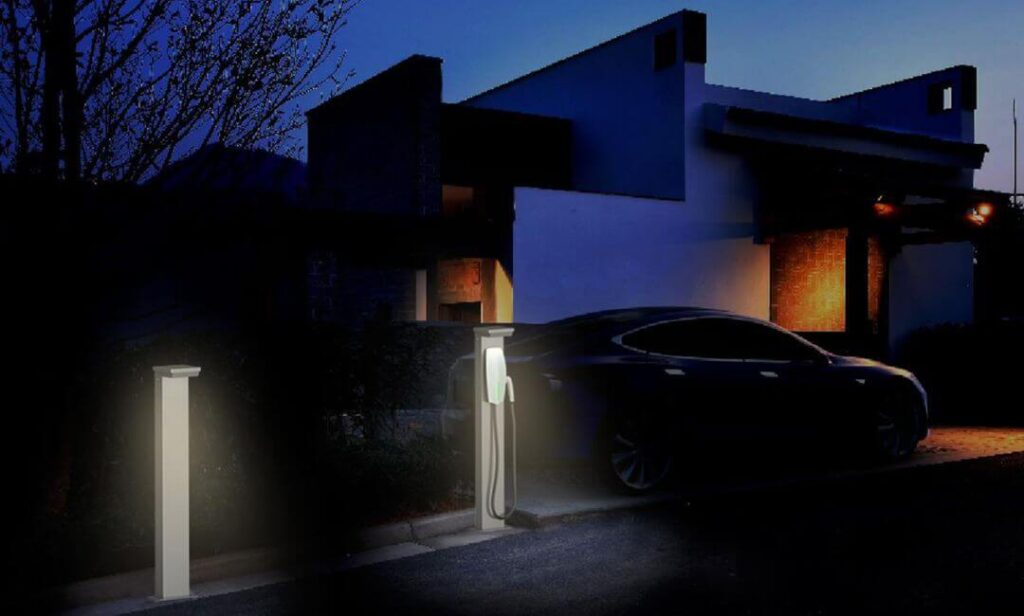
Let’s kill the biggest myth first: Level 1 charging is not “slow” — it’s steady. There’s a difference. Slow is waiting at a public charger for hours. Steady is plugging in when you park and waking up with usable range every morning. Most EV owners who use Level 1 aren’t trying to fill empty batteries. They’re topping up daily driving miles. That’s where this setup shines.
Here’s what real numbers look like, not brochure math.
What You Actually Gain Per Hour (Real-Use Range)
On a proper 12A–16A Level 1 charger, most drivers see:
- 3 to 5 miles of range per hour
- 30 to 50 miles added overnight (8–10 hours)
- 60+ miles if plugged in all evening and night
That covers the daily commute for a huge percentage of drivers. If you drive 25–40 miles a day, Level 1 charging quietly keeps you balanced without ever feeling rushed.
Overnight Example (Real Routine)
Let’s say you get home at 7:30 PM and leave at 7:00 AM.
That’s roughly 11.5 hours plugged in.
At even a conservative 4 miles per hour:
- 11.5 × 4 = 46 miles recovered
No waiting. No planning. No charging stops. Just park, plug, sleep, repeat.
This is why many owners stick with Level 1 long-term instead of rushing to install expensive wall units.
Battery Size Doesn’t Matter As Much As People Think
People panic when they see “75 kWh battery” and assume Level 1 is useless. Reality is different.
You’re not refilling 0–100% daily. You’re topping off what you used.
Example:
- Daily drive: 35 miles
- Overnight Level 1 gain: 40+ miles
You’re net positive by morning. Battery size only matters if you regularly drain large chunks every day.
When Level 1 Works Perfectly
Level 1 charging fits best if:
- You drive under 50 miles daily
- You park at home overnight
- You want low installation cost
- You don’t want electrical upgrades
- You prefer simple plug-and-charge routines
For commuters, apartment residents, second vehicles, and backup home setups, it’s often more practical than people realize.
When Level 1 Starts Feeling Limiting
Be honest with your usage. Level 1 becomes frustrating if:
- You drive 80+ miles daily
- You come home late and leave early
- You frequently drain below 30%
- You need rapid turnaround charging
In those cases, a dual-level charger still makes sense because you can upgrade to 240V later without replacing hardware.
Small Habits That Make Level 1 Charging Feel Faster
These aren’t tech tricks. They’re ownership habits:
- Plug in immediately after parking (don’t wait till midnight)
- Avoid short plug sessions — long overnight sessions work best
- Keep the outlet and plug clean and dry
- Use stable amperage settings instead of maxing out weak outlets
Do this and Level 1 charging stops feeling “slow” and starts feeling automatic.
The Real Truth Most Reviews Won’t Say
Level 1 charging isn’t about speed. It’s about routine reliability.
If your car is always ready in the morning, the charger did its job. Simple as that.
Level 1 EV Charger Outlet Safety & Setup Tips (What Smart Owners Do Before Plugging In)
This part decides whether your charging setup feels boring-and-reliable or stressful-and-problematic. Most charging issues don’t come from the charger itself — they come from bad outlets, overloaded circuits, and poor setup habits. Fix this once and you’ll never think about it again.
Let’s talk real-world, not electrician textbook theory.
Use a Dedicated Outlet Whenever Possible
If your garage outlet is shared with lights, freezers, power tools, or compressors, you’re stacking risk. Level 1 charging runs for long hours. Shared circuits mean fluctuating loads, voltage drops, and random breaker trips.
Best-case setup:
- One outlet
- One charger
- Nothing else pulling power
That’s how you get stable overnight charging without surprises.
Feel the Plug (Yes, Literally)
Here’s a simple test every EV owner should do during the first few charging sessions.
After 15–20 minutes of charging:
- Touch the plug head
- Touch the outlet face
Warm is normal. Hot is not.
If it feels hot enough that you don’t want to keep your hand on it, stop charging and lower amperage (if adjustable) or change outlets. Heat is the earliest warning sign. Ignore it and problems show up later.
Avoid Extension Cords (Unless You Enjoy Risk)
Most household extension cords are not designed for continuous high-load power draw. Even “heavy duty” ones degrade over time.
If your charger cable doesn’t reach:
- Buy a longer EV charger cable model
- Reposition the parking spot
- Install a closer outlet
Stretching power through cheap copper is the fastest way to create heat buildup and voltage loss.
Older Homes Need Extra Respect
If your house is older than 15–20 years, don’t assume the wiring is ready for nightly charging sessions.
What helps:
- Start at 8A or 10A on adjustable chargers
- Avoid max output on unknown circuits
- Watch for flickering lights or warm wall plates
Level 1 charging is forgiving — but only if you respect the wiring limits.
Outdoor Charging Setup (Rain Isn’t the Enemy, Poor Sealing Is)
Modern EV chargers with IP65+ ratings handle rain just fine. What causes problems is:
- Loose plugs
- Ground-level outlets without covers
- Water pooling near connections
Use weatherproof outlet covers and avoid leaving plug connections lying on wet concrete. Small habits prevent long-term corrosion issues.
Breaker Trips Are Not “Normal”
Some people accept breaker trips like it’s part of EV ownership. It’s not.
If your breaker trips:
- Lower charging amps
- Switch outlets
- Check for shared loads
Stable charging should run all night without interruption. That’s the baseline expectation.
The Quiet Advantage of Adjustable Chargers
This is where adjustable current chargers earn their keep. Instead of forcing full 12A on weak circuits, you tune the charger to your house — not the other way around.
Result:
- Cooler plugs
- Longer cable life
- Fewer breaker trips
- More consistent charging sessions
It’s not about charging slower. It’s about charging smarter.
Real Owner Rule That Actually Works
If your outlet stays cool, the breaker stays quiet, and the car wakes up charged — you’re doing it right.
No alarms. No drama. Just routine.
FAQs About Level 1 EV Chargers
Can I really charge my EV every day using only a Level 1 charger?
Yes — and thousands of owners already do. If your daily driving is under 40–50 miles, Level 1 charging quietly keeps up without drama. Plug in when you park, unplug when you leave. No scheduling stress, no public charging stops, no extra installs. It’s boring in the best possible way — because it works.
Will Level 1 charging damage my EV battery?
Actually, it’s the opposite. Slow, steady charging is easier on battery cells than frequent high-speed fast charging. Lower heat buildup, smoother power flow, and less stress on internal components all help long-term battery health. Think of it as a calm jog instead of sprinting every day.
Is it safe to leave a Level 1 charger plugged in overnight?
If you’re using a certified charger and a healthy outlet, yes — overnight charging is exactly what Level 1 setups are designed for. The charger automatically manages current flow and stops when the battery is full. Most safety problems come from bad outlets, not the chargers themselves.
Why does my EV gain fewer miles per hour than advertised?
Because real life exists. Cold weather, battery temperature, outlet voltage, and vehicle efficiency all affect charging speed. Marketing numbers assume perfect lab conditions. Real owners care about morning range — not hourly spec math. If you wake up with usable miles, that’s the win.
Should I buy a Level 1-only charger or a Level 1/Level 2 combo unit?
If budget allows, combo chargers make more sense long-term. Today you may use a wall outlet. Tomorrow you might upgrade to 240V. Dual-level chargers save you from buying twice and give you flexibility when moving homes or changing setups.
Can I use a Level 1 charger while traveling?
Yes, and that’s where portable models shine. Hotels, friend’s garages, rental houses — standard outlets are everywhere. A compact Level 1 charger in your trunk acts like a backup fuel source. You may not fill fast, but you’ll never be stranded.
Final Thoughts: Picking the Right Level 1 EV Charger Without Overthinking It
If you’ve read this far, you already understand the truth most “top 10” lists never say out loud: the best Level 1 EV charger isn’t the one with the loudest specs — it’s the one that fits your daily life without creating friction. The charger that doesn’t overheat your outlet. The one that doesn’t make you reposition your car three times. The one that quietly does its job while you sleep.
That’s what this guide was built around. Not lab numbers. Not brand hype. Real parking habits. Real overnight charging routines. Real owners who just want their car ready in the morning without thinking about it.
Here’s the simple takeaway:
If you want maximum flexibility and future-proofing, go with Lectron.
If you want full control over amperage and safer charging on older wiring, Bokman makes sense.
If your parking setup needs extra reach, Junsun and ENERGYGENIE solve problems most chargers ignore.
If you just want reliable daily charging without spending extra, Schumacher quietly wins.
If you want a compact travel backup that actually performs, MEGEAR earns its place.
No matter which one you choose, you’re not just buying a charger. You’re building a daily habit. A small routine that removes public charging stress, saves money over time, and gives you one less thing to worry about when you get home tired.
Plug in. Lock the car. Go inside. Sleep. Wake up to a charged vehicle.
That’s the quiet luxury of Level 1 charging — and when it’s done right, it feels effortless.
If this guide helped you make a smarter decision, bookmark it. Share it with another EV owner who’s still confused. And most importantly, choose the charger that fits your lifestyle — not the one that just looks good on a product page.
Your driveway, your routine, your rules.
Also Check: