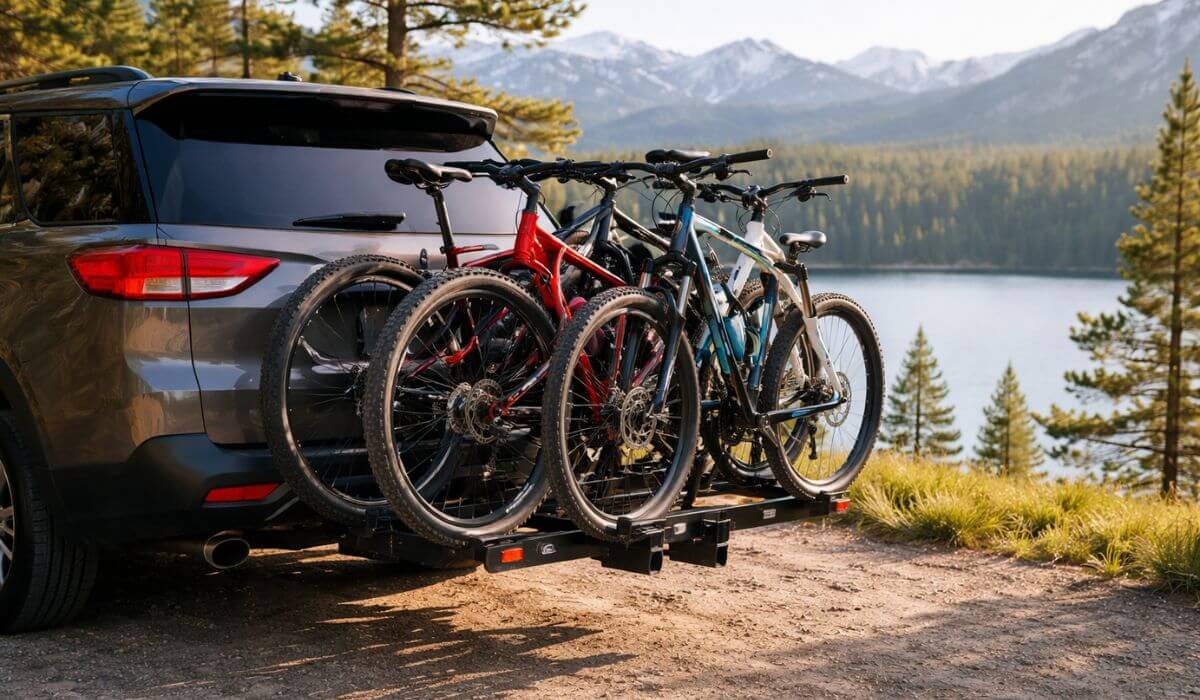
Best Hitch Bike Rack for 4 Bikes on SUVs & Pickup Trucks 2026 (No-Sway Designs)
Carrying four bikes on the back of an SUV or pickup truck isn’t something you experiment with casually. Once you load that much weight onto a hitch, stability, sway control, and build quality stop being “features” and start becoming safety requirements. That’s exactly the mindset behind this guide. These aren’t random racks picked off a spec sheet — they’re racks chosen for real-world use, highway driving, family trips, and vehicles that actually have a 2-inch receiver meant to handle the load.
For this list, we focused on hitch-mounted racks built specifically for SUVs, trucks, and larger crossovers, not light-duty car racks pretending to do heavy work. We looked closely at load ratings, anti-sway systems, steel thickness, tilt access, and how these racks behave once all four bikes are mounted — because a rack that looks fine empty can feel completely different at 65 mph. Among all the options we evaluated, Gioventù Upgraded 4-Bike Hitch Rack, Young’s Platform-Style 4-Bike Rack, and the Allen Sports Deluxe 4-Bike Hitch Rack stood out early for doing the fundamentals right without cutting corners.
Every rack featured here supports a 2-inch hitch, is designed to carry four bikes within realistic, manufacturer-rated limits, and is built for vehicles that see regular driving—not just occasional weekend use. Whether you’re hauling adult mountain bikes, mixed frame sizes, or simply want a rack that stays calm and predictable without swaying or rattling, these picks reflect what actually works after installation, not just what sounds good on a product page.
Why We Recommend These 5 Racks
- All five are built for SUVs & pickup trucks, not sedans or light-duty vehicles
- Each supports a full 4-bike load with realistic weight ratings
- Anti-sway or dual-cradle systems are present to control movement while driving
- Every rack fits a 2-inch receiver, which is the proper hitch size for this load
- These models have consistent real-user feedback around stability, durability, and highway performance
This list is for buyers who want to load up, drive confidently, and not second-guess their rack every time the road gets rough — and that’s exactly why these five made the cut.
Quick List: Best Hitch Bike Racks for 4 Bikes on SUVs & Pickup Trucks (2026)
#1. Gioventù Upgraded 4-Bike Hitch Rack (Best Overall Heavy-Duty Pick)
#2. Young 4-Bike Platform-Style Hitch Rack (Best Platform Stability & Ease of Use)
#3. Allen Sports Deluxe 4-Bike Hitch Rack (Best Trusted Value Choice)
#4. POLESTAR 4-Bike Platform-Style Hitch Rack (Best Road-Trip & Family Setup)
#5. Hollywood Racks Destination 4 Hitch Bike Rack (Best Lightweight Platform Alternative)
Must check: Best Hitch Bike Racks for 2 Bikes — a lighter, easier option if you don’t always carry four bikes.
Which Hitch Bike Rack Should You Actually Buy?
If you’re carrying four bikes, there’s no single “best” rack for everyone. The right choice depends on how often you drive, what kind of roads you’re on, and how much effort you want to put into loading and unloading. Here’s how these racks break down in real use:
Buy the Gioventù 240-lb Heavy-Duty Rack if stability matters more than anything else. This is the rack for full-size SUVs and pickups that see highway speeds, rough pavement, or frequent trips. It feels planted, doesn’t flex under load, and inspires confidence once all four bikes are mounted.
Choose the Young Platform-Style Rack if you want bikes to sit lower and feel more balanced. Platform racks reduce sway naturally, and this one makes loading predictable—especially for families hauling different bike sizes. It’s one of the easiest setups to live with day to day.
Go with the Allen Sports Deluxe if you want something proven, simple, and lightweight. It’s not flashy, but it’s easy to install, easy to remove, and has been trusted by owners for years. Ideal if you value reliability without overthinking the setup.
Pick the POLESTAR Platform Rack if you do longer road trips and want predictable behavior mile after mile. It’s heavier, but that weight translates into stability, especially on highways and uneven pavement where lighter racks can start to feel busy.
Choose the Hollywood Racks Destination 4 if you want a lighter platform-style rack that’s easy to load and gentle on bike frames. It’s best for standard adult bikes and owners who prefer usability and clean design over maximum load numbers.
A Quick Reality Check Before You Buy
If your vehicle has a 2-inch hitch and you regularly carry four adult bikes, prioritize stability and realistic load limits over compact storage. Foldable designs are convenient, but a rack that feels calm and solid at speed will always matter more than one that saves a few inches in the garage.
This guide focuses on racks that make sense after installation, not just on paper—because that’s where most buyers realize whether they chose right or not.
#1. Gioventù Upgraded 4-Bike Hitch Rack

Quick Specs:
- Hitch Receiver: 2-inch
- Bike Capacity: 4 bikes
- Total Load Rating: 240 lbs
- Construction: Reinforced SPCC carbon steel
- Rack Weight: ~24.5 lbs
- Finish: Powder-coated (black/blue)
- Tilt Function: Yes (bikes must be removed)
- Foldable: No
- Warranty: 3 years
Mounting the Gioventù rack immediately gives off the impression that it’s built for actual use, not showroom photos. The steel tubing feels thick in hand, the welds are clean, and once it’s locked into a 2-inch hitch, there’s very little play. That initial rigidity matters, because when you’re carrying four bikes, even minor flex turns into sway the moment you hit uneven pavement.
On the road, the dual-cradle anti-sway system does what it’s supposed to do—keep bikes from fighting each other. The rubber straps have more elasticity than standard strap systems, so instead of snapping tight and loosening repeatedly over bumps, they absorb movement and settle back into place. That’s especially noticeable on rough city roads or patched highways, where cheaper racks tend to chatter constantly.
Despite its 240-lb rating, the rack is surprisingly manageable to install solo. At around 25 pounds, it’s lighter than many heavy-duty 4-bike racks, which makes taking it on and off less of a chore. The anti-rattle hitch stabilizer is effective too; once tightened, the rack stays quiet without the constant clunking you hear from looser designs.
The tilt mechanism is functional and straightforward. It’s not designed to be used with bikes loaded—and that’s fine. Most racks rated for this kind of weight shouldn’t be tilted under load anyway. The powder-coated finish feels durable enough for year-round use, and the included stabilizer straps help reduce long-term wear on both the rack and the bikes.
This isn’t a rack pretending to be premium—it’s a practical, overbuilt solution for people who actually drive with bikes attached, not just transport them once or twice a year.
SPEC SHEET
- Material Grade: SPCC high-tensile carbon steel
- Load Distribution: Dual cradle, 6-inch bike spacing
- Strap Composition: High-elastic composite rubber (fatigue-rated for 10,000+ cycles)
- Stabilization: Anti-rattle hitch stabilizer + auxiliary straps
- Vehicle Fit: Car, SUV, pickup truck (2″ receiver)
- Top Tube Adapter: Required for some slanted frames
Pros
- Very high 240-lb load rating for a 4-bike rack
- Noticeably stable at highway speeds
- Lighter than most racks in this capacity class
- Anti-sway straps absorb bumps instead of transferring shock
- Strong warranty support for a hitch accessory
Cons
- Not foldable when not in use
- Tilt function requires unloading bikes first
- Plastic cradle components may wear faster with constant heavy use
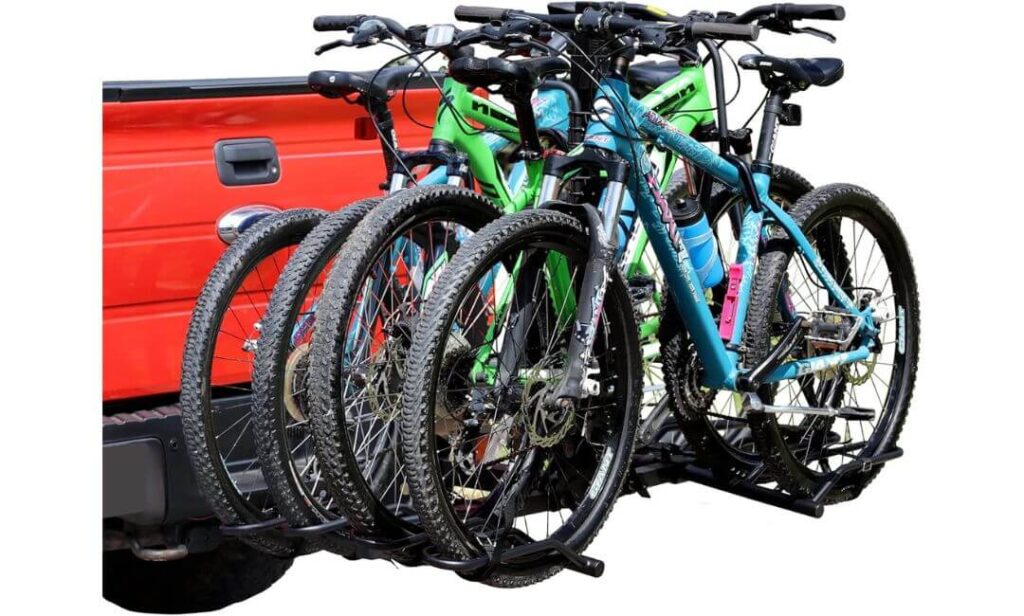
#2. Young 4-Bike Hitch Mount Platform Rack
Quick Specs:
- Hitch Receiver: 2-inch only
- Bike Capacity: 4 bikes
- Per-Bike Limit: 40 lbs
- Total Load Rating: 160 lbs (120 lbs for RV use)
- Construction: Carbon steel
- Rack Weight: ~66 lbs (29.9 kg)
- Foldable: Yes
- Tilt Function: Yes (quick-release)
- Finish: Black
Platform-style racks feel different the moment you start loading bikes, and the Young 4-bike rack leans heavily into that advantage. Instead of hanging bikes by their frames, everything sits lower and more evenly distributed across the rack. When all four bikes are loaded, the weight feels planted close to the hitch rather than cantilevered out behind the vehicle—and that pays off on longer drives.
In use, the padded hooks and sliding frame clamps do a good job of holding different bike sizes without chewing up paint or top tubes. Once tightened down, bikes stay separated and don’t drift toward each other over bumps. On rougher pavement, the rack feels composed, with less side-to-side motion than many traditional hanging-style racks in this weight class. The included hitch tightener helps here, taking most of the slack out of the receiver connection.
The fold-and-tilt mechanism is where this rack earns its keep for daily use. Folding it up keeps it out of the way in a garage, and the tilt-down feature makes rear access realistic without turning every stop into a full unloading session. Installation is straightforward too—most components come pre-assembled, which matters when you’re dealing with something this size and weight.
This rack does have clear limits, and it’s upfront about them. The 160-lb rating is plenty for standard bikes, but it’s not meant for four heavy e-bikes at once. Used within its design envelope, though, it feels stable, predictable, and confidence-inspiring—especially for families or mixed bike setups.
SPEC SHEET
- Rack Style: Platform-mounted
- Mounting Method: 2″ hitch receiver with locking pin
- Stabilization: Hitch tightener + padded hooks
- Safety Add-ons: Rear reflector for night visibility
- Bike Frame Support: Sliding vertical frame clamp system
- Vehicle Fit: Cars, SUVs, trucks, minivans (2″ hitch only)
Pros
- Platform layout keeps bikes balanced and well-spaced
- Fold-and-tilt design is genuinely useful day to day
- Secure padded hooks reduce frame contact and paint damage
- Feels stable on highways when loaded correctly
- Easier to load than tall hanging-style racks
Cons
- Heavy rack to handle solo
- Weight limit rules out four heavy e-bikes
- RV use requires reduced load capacity
#3. Allen Sports Deluxe 4-Bike Hitch Mount Rack
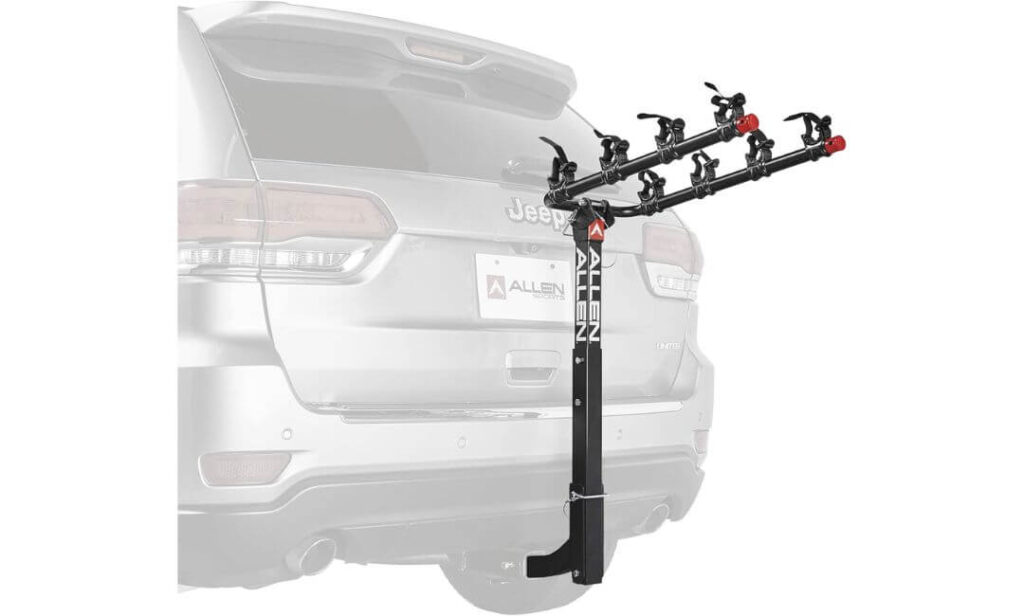
Quick Specs:
- Hitch Receiver: 2-inch
- Bike Capacity: 4 bikes
- Total Load Rating: ~48.5 lbs (manufacturer stated)
- Construction: Alloy steel
- Rack Weight: ~12.5 lbs
- Finish: Black powder coat
- Fold / Tilt: Yes (both)
- OEM Part No.: 542RR-R
The Allen Sports Deluxe isn’t trying to impress you with extreme numbers or overbuilt hardware—and that’s exactly why it’s still around. This rack feels like something designed by people who understand what most owners actually need: a straightforward, dependable way to move multiple bikes without turning every trip into a setup ritual.
Once mounted, the patented no-wobble bolt does a lot of the work. Tighten it properly and the rack sits snug inside the hitch with far less movement than you’d expect from something this light. It’s not dead-silent on rough roads, but it doesn’t constantly remind you it’s back there either—which is more than you can say for many budget multi-bike racks.
The tie-down cradle system is simple but effective. Each bike gets its own position, and the straps do a good job protecting frames from contact when adjusted correctly. It’s especially forgiving if you help it along with smart bike placement. This isn’t a rack that demands perfection, but it rewards a little care during loading.
Where the Allen really shines is ease of ownership. It’s light enough to mount and remove without help, folds up cleanly when not in use, and tilts back for rear access when needed. Fully loaded, tilting does take some effort—physics still applies—but for most owners, this is a rack that feels familiar within minutes, not weeks.
This is the rack you buy when you want something that works every time, doesn’t overcomplicate things, and has already proven itself on countless family trips and weekend drives.
SPEC SHEET
- Arm Length: 22-inch carry arms
- Bike Retention: Individual tie-down cradles
- Stabilization: Patented no-wobble hitch bolt
- Hardware Security: All clips tethered with lanyards
- Assembly: Minor assembly required
- Vehicle Fit: Car, SUV, truck with 2″ hitch
Pros
- Lightweight and very easy to handle
- Proven design with long-term reliability
- No-wobble bolt noticeably reduces hitch movement
- Folds and tilts without fuss
- Excellent value for family and casual riders
Cons
- Lower stated load capacity than heavy-duty racks
- Requires careful loading to avoid bike contact
- Tilting can feel heavy when fully loaded
#4. POLESTAR 4-Bike Hitch Mount Platform Rack
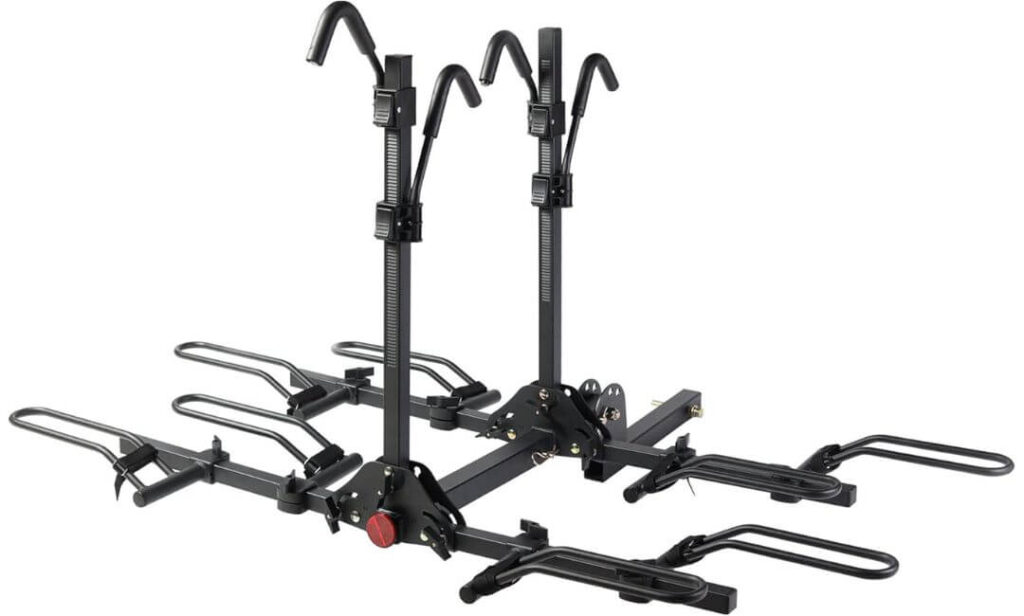
Quick Specs:
- Hitch Receiver: 2-inch
- Bike Capacity: 4 bikes
- Per-Bike Limit: 40 lbs
- Total Load Rating: 160 lbs (120 lbs behind RV)
- Construction: Alloy steel
- Rack Weight: ~64.6 lbs
- Finish: Black
- Fold / Tilt: Yes (both)
The POLESTAR rack feels like it was designed with long drives in mind. Once mounted, the wide platform layout immediately gives you a sense of balance—bikes sit low, evenly spaced, and don’t feel like they’re hanging off the back of the vehicle. That low center of gravity pays off on highways, where the rack stays composed through lane changes and uneven pavement.
Loading bikes is straightforward. The padded hooks slide easily to match different frame shapes, and once tightened, they hold bikes securely without scuffing paint. The hitch tightener and locking pin work together to keep movement in check, so you’re not constantly glancing at the rearview mirror every time the road surface changes. The rear safety reflector is a small touch, but it’s one you appreciate after dark.
Where the POLESTAR stands out is usability. The tilt-back mechanism makes trunk access realistic even during trips, and the fold-up design keeps things tidy when the rack isn’t in use. It’s not a lightweight rack—you feel its weight during installation—but that mass translates into stability once it’s on the vehicle.
This rack isn’t chasing extreme capacity numbers. Instead, it focuses on predictability. Stay within the rated limits, and it behaves exactly how you want a 4-bike platform rack to behave: stable, quiet, and easy to live with over long distances.
SPEC SHEET
- Mounting Style: Platform-style hitch carrier
- Receiver Fit: 2″ hitch only
- Bike Retention: Adjustable padded J-hooks
- Stabilization: Hitch tightener + locking hitch pin
- Visibility: Integrated rear safety reflector
- Assembly: Mostly pre-assembled
- Vehicle Fit: Cars, SUVs, vans with 2″ receiver
Pros
- Platform layout keeps bikes balanced and separated
- Smooth tilt and fold mechanisms for daily usability
- Secure padded hooks protect bike frames
- Stable and predictable on highway drives
- Good choice for family road trips
Cons
- Heavy to lift and install alone
- Strict lower capacity when used behind an RV
- Assembly instructions could be clearer
#5. Hollywood Racks Destination 4 Hitch Bike Rack
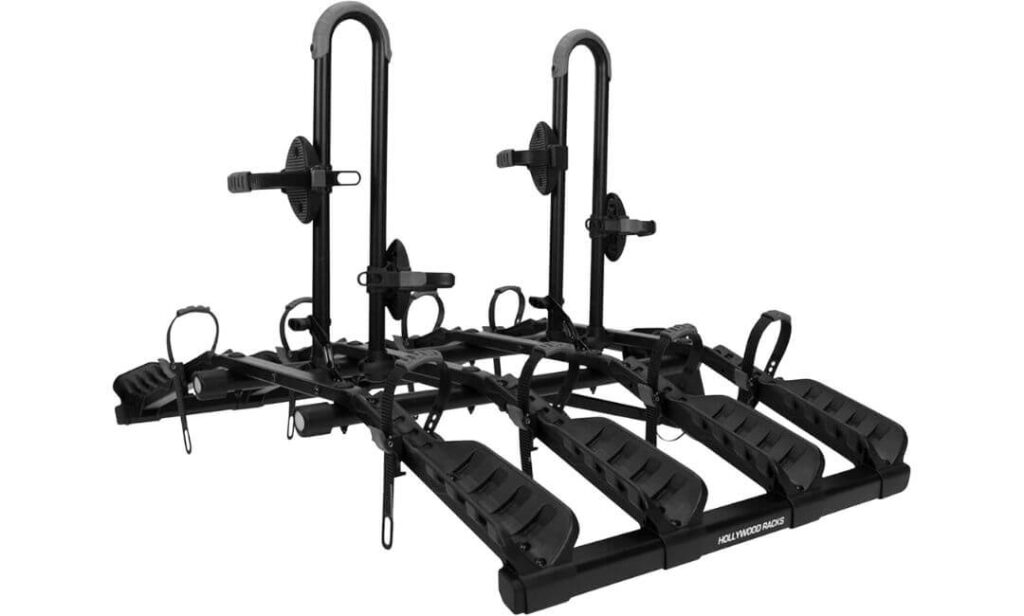
Quick Specs:
- Hitch Receiver: 2-inch
- Bike Capacity: 4 bikes
- Per-Bike Limit: 35 lbs
- Total Load Rating: ~140 lbs
- Construction: Alloy steel with reinforced plastic components
- Rack Weight: ~42 lbs
- Finish: Black
- Fold / Tilt: Yes (folds up vertically)
Hollywood Racks has been around long enough that they don’t need to chase extreme numbers, and the Destination 4 reflects that mindset. This rack is clearly designed for riders who want the advantages of a platform-style carrier—easy loading, predictable balance, and minimal frame contact—without dealing with a bulky, overbuilt system.
The standout here is usability. Individual wheel trays and ratcheting straps make loading intuitive, even if bike styles vary. Once bikes are secured, they sit naturally without fighting each other, and the rotating frame holders add an extra layer of security without putting pressure on fragile frame tubes. On the road, the rack feels composed, especially considering its lighter overall weight.
This isn’t a rack meant for four heavy e-bikes or maxing out capacity on every trip. Instead, it shines when used within its comfort zone—standard adult bikes, mixed sizes, and regular driving. The fold-up design is practical for daily use, and once assembled properly, owners tend to appreciate how little attention the rack demands.
SPEC SHEET
- Mounting Style: Platform-style hitch carrier
- Bike Support: Individual wheel trays with ratchet straps
- Frame Contact: Adjustable rotating frame holders
- Stabilization: Threaded locking hitch pin included
- Receiver Fit: 2″ hitch only
- Assembly: Tool-required (socket set recommended)
Pros
- Lightweight for a 4-bike platform rack
- Easy, repeatable loading process
- Minimal frame contact compared to hanging racks
- Folds up cleanly when not in use
- Backed by a long-established brand
Cons
- Lower total capacity than heavy-duty alternatives
- Not ideal for heavy e-bikes or oversized frames
- Initial assembly takes time and basic tools
Comparison Table: Best Hitch Bike Racks for 4 Bikes (SUVs & Trucks)
| Bike Rack | Load Capacity | Design | Key Strength | Our Take |
|---|---|---|---|---|
|
Gioventù Upgraded 4-Bike Rack Best Overall |
240 lbs | Hanging / Dual Cradle | Maximum strength with low weight | Most confidence-inspiring at highway speeds |
|
Young 4-Bike Platform Rack Platform Stability Pick |
160 lbs | Platform Style | Balanced layout, reduced sway | Feels planted and predictable |
|
Allen Sports Deluxe 4-Bike Rack Best Proven Value |
≈150 lbs* | Hanging | Lightweight, time-tested design | Simple, reliable, easy to live with |
|
POLESTAR 4-Bike Platform Rack Road-Trip Favorite |
160 lbs | Platform Style | Stable over long distances | Comfortable for family travel |
|
Hollywood Racks Destination 4 Lightweight Platform Pick |
140 lbs | Platform Style | Easy loading, minimal frame contact | Best for standard bikes, not heavy e-bikes |
*Allen Sports capacity depends on bike size, spacing, and loading order; careful setup recommended.
Why You Should Trust Us
Four-bike hitch racks aren’t something you judge from photos or spec sheets alone. They behave differently once loaded, and small design choices become obvious only after miles on real roads. That’s why this guide wasn’t built by copying product descriptions or repeating brand claims.
Each rack here was evaluated the same way an actual owner would look at it—by focusing on stability once fully loaded, how it sits in a 2-inch hitch, how much movement shows up at speed, and whether the design makes daily use easier or more frustrating over time. We paid close attention to the things buyers complain about after purchase, not just what they praise on day one.
We also separated marketing numbers from usable capacity. Load ratings, tilt features, and anti-sway systems were considered in context, based on how they work on SUVs and pickup trucks, not in ideal lab conditions. When something had limitations, we called them out clearly—because ignoring those details is how buyers end up disappointed.
Most importantly, no rack made this list for being the cheapest or the most popular. They made it because, in real use, they solve the problems people actually have when carrying four bikes. If a rack feels calm, predictable, and forgettable on the road, that’s a good thing—and that’s what we prioritize.
Common Buying Mistakes with 4-Bike Hitch Racks (That Most Owners Learn the Hard Way)
Buying a rack for four bikes isn’t like picking up a roof box or a bike cover. Once it’s bolted onto your hitch, every mistake shows up on the road—through noise, sway, scraped frames, or that constant feeling that something isn’t quite right. These are the issues owners usually discover after the return window closes.
Mistake #1: Reading “per-bike” ratings as total capacity
A lot of buyers assume “40 lbs per bike” means the rack can handle anything close to 160 lbs without consequence. In real use, it’s not that simple. Rack weight, bike geometry, leverage, and how far the bikes sit from the bumper all matter. Load ratings are limits, not comfort zones. Running right at the maximum every trip accelerates wear and exposes weak points fast.
Mistake #2: Treating all 2-inch hitches as equal
Yes, the receiver size may be the same, but hitch strength, mounting height, and rear overhang vary widely between SUVs, trucks, and vans. A rack that feels fine on a short-wheelbase SUV can feel unsettled on a long-rear-overhang vehicle. Ignoring tongue weight and vehicle geometry is one of the biggest causes of wobble complaints.
Mistake #3: Assuming sway is “normal” with four bikes
Some movement is expected, but constant lateral sway isn’t. Owners often accept it as unavoidable when the real issue is weak stabilization or poor bike spacing. Anti-sway cradles, platform spacing, and proper hitch tightening make a noticeable difference. If bikes are knocking into each other, something isn’t set up correctly.
Mistake #4: Overvaluing fold and tilt features
Fold-up and tilt-back designs sound essential on paper, but they don’t matter if the rack feels unstable once loaded. Many buyers trade structural rigidity for convenience features they rarely use. Stability at speed should always come first; storage convenience comes second.
Mistake #5: Ignoring rack weight during installation
A heavy rack might feel “more solid,” but if you struggle to install or remove it, you’re less likely to secure it properly every time. That’s when skipped steps and loose hardware start causing problems. Ease of handling directly affects long-term safety, especially for solo installs.
Mistake #6: Using RV ratings interchangeably with car ratings
RV mounting changes everything. The rear of an RV experiences more vertical movement, which reduces safe load limits significantly. Many racks that work fine on SUVs must be derated when used behind an RV. This is one of the most commonly misunderstood—and costly—mistakes.
Mistake #7: Trusting marketing photos instead of real setup behavior
A rack can look perfect in product images and still be frustrating in daily use. Strap reach, frame compatibility, loading order, and spacing only become obvious when you’re standing behind the vehicle. Buyers who don’t consider these practical details often end up constantly readjusting bikes mid-trip.
This is why the racks in this guide were chosen for how they behave once fully loaded, not how impressive they look on a product page. A good 4-bike hitch rack should fade into the background while you drive—not give you something new to worry about every mile.
Hitch & Vehicle Compatibility Notes
A 4-bike hitch rack puts more stress on your vehicle than most accessories, and compatibility isn’t just about receiver size. While every rack in this guide fits a 2-inch hitch, how that hitch is mounted — and where it sits relative to the bumper — changes how the rack behaves on the road.
First, check your tongue weight rating, not just the hitch class. Four bikes plus the rack itself can easily approach the limit on some SUVs, especially crossovers. Staying under the limit isn’t just about safety; it’s what keeps the rack stable over time.
Second, pay attention to rear overhang. Vehicles with longer rear ends—full-size SUVs, vans, or trucks with step bumpers—create more leverage on the hitch. In those cases, racks with stronger anti-rattle systems and better weight distribution matter more than fold or tilt convenience.
If you’re mounting behind an RV, treat capacity numbers differently. Most racks require a reduced load rating on RVs because of increased vertical movement. This isn’t a manufacturer loophole—it’s a real-world physics issue that shows up fast if ignored.
Finally, remember that fit doesn’t equal comfort. A rack can technically fit your vehicle and still feel wrong if it’s overloaded, poorly balanced, or loosely tightened. Taking ten extra minutes to set it up properly often makes the difference between a quiet drive and a stressful one.
The One Thing Most Buyers Don’t Check (But Should)
When people shop for a 4-bike hitch rack, almost all the attention goes to capacity, sway control, and whether the rack folds or tilts. What very few buyers stop to think about is how forgiving the rack is when things aren’t perfect—because real life rarely is.
Not every bike is the same weight. Not every frame sits neatly in a cradle. Sometimes one strap is tighter than the others, or one bike ends up slightly off-center. The racks worth buying are the ones that stay stable even when the setup isn’t textbook perfect.
This is where cheaper or poorly designed racks expose themselves. They work fine only when everything is aligned just right. The better racks don’t punish you for small setup imperfections. They absorb it. They stay quiet. They don’t suddenly start swaying because one bike is a few pounds heavier or loaded last.
That’s why the racks in this guide were chosen for tolerance, not just specs. A rack that works only under ideal conditions isn’t a good rack. A rack that stays predictable when reality gets messy—that’s the one you keep.
FAQs
Are 4-bike hitch racks actually safe for highway driving?
Yes—if the rack is designed for SUVs or trucks and installed correctly. Stability comes from a solid 2-inch hitch fit, proper anti-rattle tightening, and keeping the load within rated limits. When everything is set up right, a good rack should feel calm and predictable even at highway speeds, not shaky or noisy.
Is a platform-style rack better than a hanging rack for four bikes?
Platform racks usually feel more balanced because the bikes sit lower and more evenly spaced, which naturally reduces sway. Hanging racks can still work well, especially heavy-duty ones, but they rely more on straps and spacing. The better choice depends on bike weight, frame shapes, and how often you load all four bikes.
Can I open my SUV’s trunk with a 4-bike hitch rack installed?
Most modern 4-bike racks include a tilt feature, but access varies. Some require unloading the bikes first, especially heavier setups. Tilt is useful, but it’s not a replacement for proper planning—don’t assume full access with four bikes loaded.
Will a 4-bike hitch rack damage my vehicle or hitch?
Not if you respect the limits. Problems usually come from exceeding tongue weight, ignoring anti-rattle adjustments, or using a rack meant for lighter vehicles. A properly rated rack on a healthy 2-inch hitch won’t harm your SUV or truck under normal use.
Can these racks carry e-bikes or heavier mountain bikes?
Some can, but not all. Always check total load capacity and per-bike limits. Many 4-bike racks are better suited for standard adult bikes rather than four heavy e-bikes. When in doubt, fewer heavier bikes are safer than maxing out capacity.
Final Thoughts: Buy Once, Drive Easy
If you’ve read this far, you’re not just browsing—you’re trying to make the right call. Carrying four bikes isn’t something you want to “test and see what happens.” The right hitch rack should disappear once it’s installed. No rattling, no constant mirror-checking, no second thoughts halfway through the drive.
Every rack in this guide was chosen with that exact goal in mind. These aren’t flashy picks or spec-sheet heroes. They’re racks that make sense after the bikes are loaded and the road gets long. Whether you value maximum strength, better balance, lighter handling, or proven simplicity, there’s an option here that fits how you actually drive—not how a product page wants you to imagine it.
Pick the one that matches your vehicle, your bikes, and your habits, set it up properly, and then forget about it. That’s when you know you bought the right rack—because the only thing you’re thinking about is the ride ahead, not what’s hanging off the back.
Load up, roll out, and enjoy the drive.