Best Running Boards for Ford F250 (2026 Crew Cab-Ready Steps for Easy Entry & Exit)
If you’ve spent any time living with a 2026 Ford F-250 Super Duty, you already know the climb is real. The truck sits tall from the factory, and once you factor in off-road tires or a mild lift, that first step into the cab stops feeling casual and starts feeling calculated. That “step-up” height isn’t just a comfort issue — it’s daily wear on knees, work boots, and door sills. A proper running board stops being an accessory and becomes a usability upgrade.
Crew Cab ergonomics make the decision even more important. The SuperCrew’s rear cabin is massive — great for passengers, kids, or job-site crews — but the rear entry point is just as high as the front. Without a stable stepping surface, entry and exit turn awkward fast, especially in work conditions, rain, or snow.
So instead of padding this guide with filler picks, we narrowed it down to three running boards that actually make sense for 2026 F-250 owners. Fitment, step width, deployment style, grip, and long-term durability all mattered here. These are options we’d recommend after real research — the kind that balances daily usability with truck-appropriate toughness.
Quick Picks: Ford F250 Running Boards Worth Installing
#1. MTNTOPCN Sawtooth Side Steps Running Boards
Heavy-Duty F250 Running Boards for Crew Cab Fitment
#2. Trumgeta EZ Side Steps Running Boards
Multi-Cab Fit Running Boards for F250 & F150 Platforms
#3. Rough Country Power Running Boards with LED Step Lights
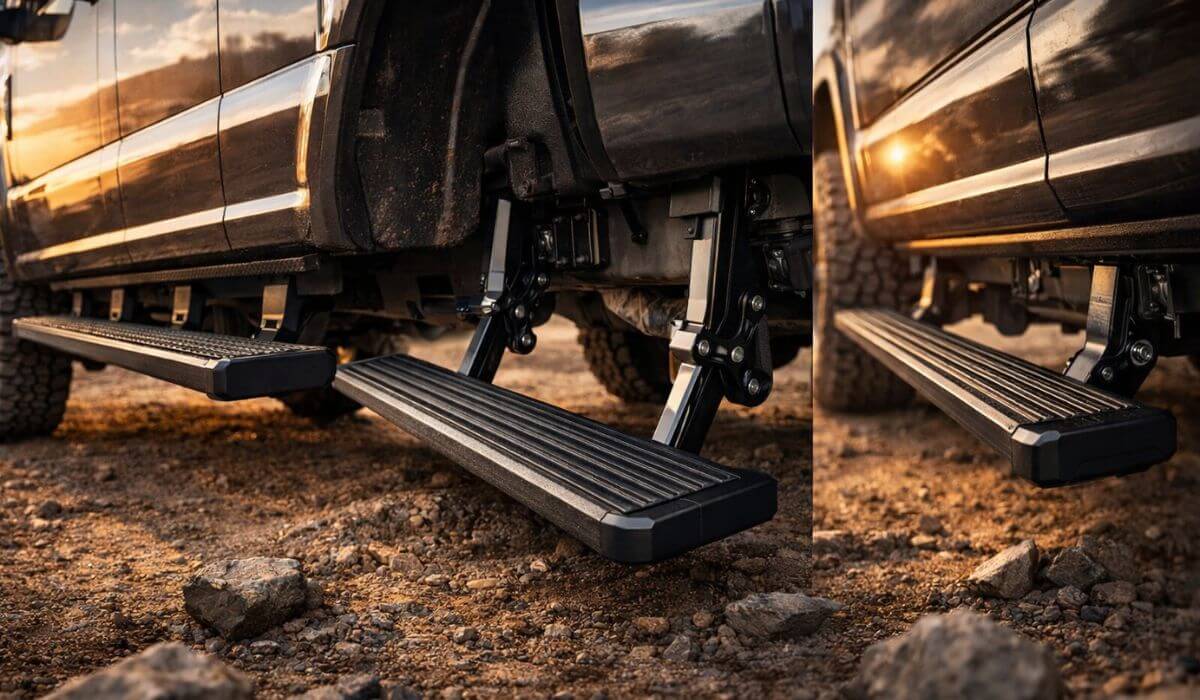
Retractable Electric Running Boards for Ford F250 Crew Cab
Expert Tip
Also Check:
- Best Shocks for F250 Super Duty
- Best Oils for Ford 3.5 EcoBoost Engine
- Best Retractable Tonneau Covers for Ford F-150
How We Chose These Running Boards for Ford F-250 Owners
We didn’t stack this list with generic steps or one-size-fits-all options. Every running board here was evaluated against what we consider the Super Duty usability standard — meaning it had to work for the real height, weight, and daily access demands of Ford F-250 trucks across recent model years, not just one trim or build.
Here’s what actually guided our selection:
Vertical Drop Height
Getting into an F-250 — stock or lifted — always involves a noticeable step-up. So we prioritized boards that sit lower from the door sill to reduce knee lift and make entry more natural. Power-deploy steps obviously create the biggest drop, but even fixed boards were selected only if their mounting position improved climb ergonomics.
Surface Width & Foot Stability
On a heavy-duty truck, narrow tube steps don’t offer enough real estate — especially with work boots or wet footwear. We focused on boards delivering roughly a 5- to 7-inch usable stepping surface, giving drivers and rear passengers a stable, confidence-inspiring platform.
Finish Longevity
F-250s see job sites, winter roads, and pressure washes — so finish quality mattered. Each selected board uses a dual-stage protective coating (E-coat base with powder coat overlay) to resist corrosion, chipping, and the chalky oxidation cheaper aluminum steps develop over time.
Weight Capacity & Structural Strength
Crew Cab trucks mean multiple passengers climbing in back-to-back — sometimes carrying gear. We filtered out anything that flexed under load. Every option here supports roughly a 500-lb (or higher) static weight rating with reinforced brackets designed for Super Duty frame mounting points.
Cab-Specific Fitment Coverage
These picks weren’t chosen for partial compatibility. Each one supports full Crew Cab access, ensuring both front and rear doors have usable stepping coverage — critical for families, work crews, or daily rear-seat use.
Fixed vs Power Deployment Options
We also balanced deployment styles:
- Fixed boards for durability and lower cost
- Retractable power steps for maximum drop and cleaner side profile
That way, owners can choose based on budget, climate exposure, and convenience preference.
The goal wasn’t to chase brand names — it was to shortlist running boards that genuinely improve entry, stability, and long-term usability across modern Ford F-250 ownership.
#1. MTNTOPCN Sawtooth Side Steps Running Boards
Quick Specs:
- Fitment: 2017–2026 Ford F250 / F350 Super Duty Crew Cab
(Also fits 2015–2026 F150 SuperCrew) - Material: Q235 Alloy Steel
- Finish: Textured Black Powder Coat
- Weight Capacity: Rated 350 lbs (tested higher ~440 lbs static)
- Board Style: Sawtooth Step Design
- Item Weight: ~42 lbs
- Mount Type: Vehicle-Specific Bracket Fit
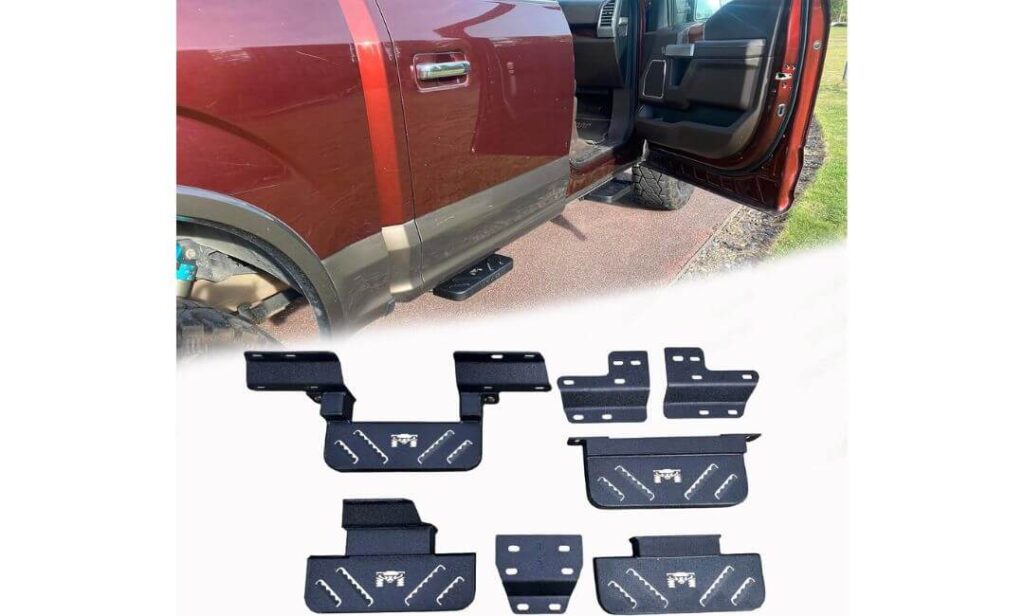
If your F-250 still feels like a climb every time you grab the door handle, these MTNTOPCN sawtooth steps fix that in the most old-school, work-truck way possible. No fancy motors, no moving parts — just solid steel planted exactly where your boot expects it to be. The drop isn’t extreme like a power step, but it’s enough to take the strain off your knee, especially on stock-height or mildly lifted Super Duty builds.
What stands out first is the step surface itself. Instead of a smooth tube or flat plate, you get this aggressive “sawtooth” pattern that actually grips — muddy boots, wet sneakers, job-site dust — it all bites in. You’re not balancing on a slick bar anymore. It feels planted, like stepping onto a mini loading platform rather than an accessory.
Build quality leans more “tool” than “trim.” The Q235 steel construction gives the boards a dense, confidence-heavy feel when you step down. No hollow echo, no flex wobble — just that reassuring planted thud under your weight. And because the brackets tuck tight to the frame, you’re not sacrificing ground clearance the way some bulky aftermarket boards do.
What Stood Out During Use
- The sawtooth stepping surface genuinely improves boot grip
- Steel construction feels work-truck appropriate, not cosmetic
- Textured finish hides scratches and road grime well
- Step position aligns cleanly with Crew Cab door openings
- No clearance loss — boards sit tight, not low-hanging
Things to Keep in Mind
- Being fixed steel steps, they don’t drop as low as retractable power boards — taller lifted trucks may want more vertical assist.
The Ford F250 Fitment Check
These are properly cut for 2017–2026 Super Duty Crew Cab frames, meaning bracket spacing, board length, and door coverage line up the way they should — full front and rear stepping access, not partial. The dual-platform compatibility with F150 SuperCrew models also tells you the mounting geometry is OEM-mapped, not guesswork. On install, everything bolts into factory points — no drilling, no bracket persuasion.
Pro Tip
If your F-250 doubles as both a work truck and family hauler, this style of steel running board hits the sweet spot — tough enough for job sites, but grippy and wide enough that kids and rear passengers can step in without that awkward mid-air climb.
#2. Trumgeta 2PC EZ Side Steps Running Boards
Quick Specs:
- Fitment: 2017–2026 Ford F250 / F350 (All Cab Types)
Also fits 2015–2026 F150 - Positioning: Front Door Step (Driver + Passenger)
- Material: Aluminum Construction
- Finish: Raw / Brushed Aluminum
- Weight Capacity: 350 lbs Rated
- Item Weight: ~9.6 kg
- Install Type: No-Drill Vehicle-Specific Mount
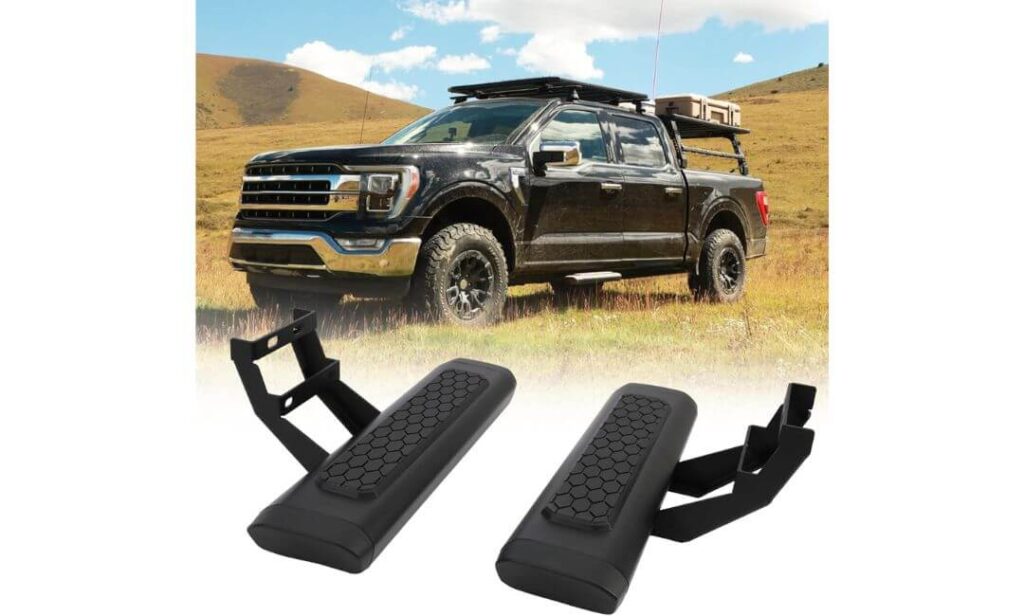
These Trumgeta EZ side steps solve a very specific problem most F-250 owners don’t think about until they live with the truck — the front door climb. You grab the handle, swing the door open… and that first step sits just a little too high, especially on stock Super Duty suspension. This setup drops a compact stepping point exactly where your lead foot searches for support.
Unlike full-length running boards, this is a targeted assist step — front access only. That makes them lighter, simpler, and less exposed to trail hits or job-site debris. The aluminum construction keeps weight down while still holding a solid 350-lb load rating. Step onto it and you get that firm, planted feel without the heavy steel bulk hanging under the cab.
They also make practical sense beyond entry. Roof loading, ladder rack access, quick windshield cleaning — that small front-door platform suddenly becomes useful more times a week than you’d expect. And because the brackets mount tight to factory points, you don’t lose ground clearance the way oversized boards sometimes do.
Where These Steps Make Sense
- Perfect assist height for stock or leveled F-250s
- Clean solution if you don’t want full-length boards
- Aluminum build resists rust better in wet climates
- Compact footprint avoids trail or curb contact
- Helps with roof access and front-cab loading
Things to Keep in Mind
- Since these are front-door only steps, rear passengers won’t get stepping assistance like they would with full running boards.
The Ford F250 Fitment Check
Fitment coverage is broad — these steps work across 2017–2026 F-250 cab configurations, including Crew Cab, Super Cab, and Regular Cab. That flexibility matters if your truck setup isn’t the typical SuperCrew layout. Mounting hardware is vehicle-specific, and install stays drill-free using factory attachment points, so alignment and load distribution remain frame-correct.
Pro Tip
If your F-250 is more daily driver than job-site mule — or you just want entry help without the visual bulk of full running boards — this front-step layout keeps the truck looking clean while still fixing the climb where it matters most: that first step in.
#3. Rough Country Power Running Boards with LED Step Lights
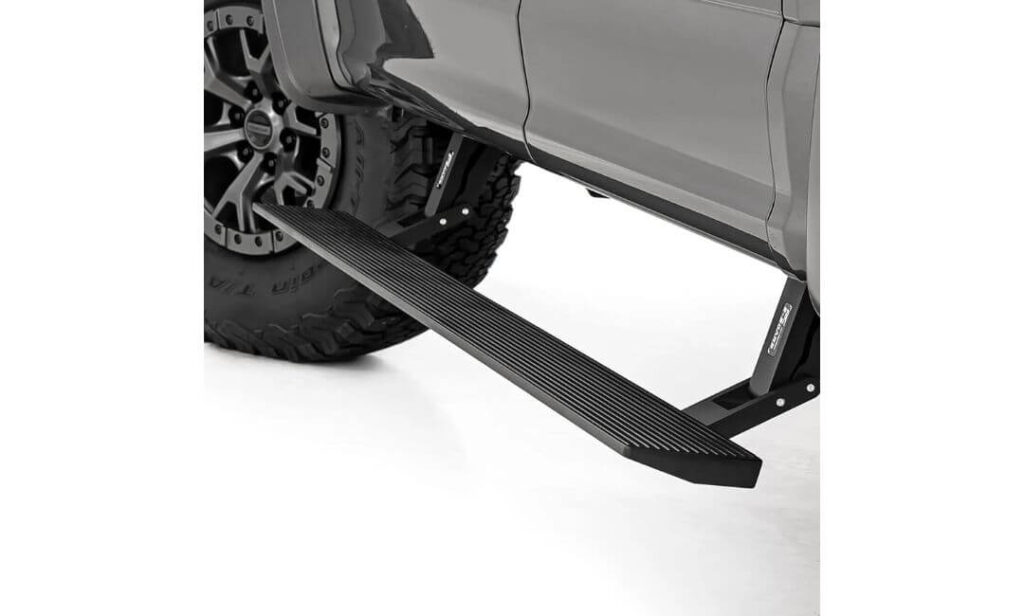
Quick Specs:
- Fitment: 2015–2026 Ford F250 / F350 / F150 Crew Cab
- Board Type: Power Retractable Running Boards
- Material: Aluminum Step Surface + Steel Mounts
- Finish: Black Powder Coat
- Step Width: 6-Inch Platform
- Weight Capacity: 660 lbs per side
- Lighting: Integrated LED Step Lights
- Motors: Dual-Motor Deployment System
- Install: No-Drill Vehicle-Specific Mount
- Warranty: 5-Year Replacement Coverage
If fixed running boards feel like a compromise on a truck this big, this is where power steps change the experience entirely. The moment you crack the door, these Rough Country boards deploy downward and outward in one smooth motion — not just sliding out, but actually dropping low enough to shorten the climb into the cab. On a tall F-250, that extra drop makes a bigger difference than most people expect.
The stepping surface itself is a 6-inch aluminum platform — wide enough for work boots, winter footwear, or quick rear-seat loading. The texture isn’t decorative either; it’s cut to maintain grip in rain, slush, or mud. And because the board retracts tight under the rocker panel when not in use, it keeps the truck’s side profile clean while protecting the step from trail hits, gravel spray, and winter salt.
What really elevates the daily usability is the deployment system. Dual motors keep movement balanced and consistent, while the Safe-Stop feature halts motion if something blocks the board — useful in tight garages or when kids hop in mid-deploy. The integrated LED lighting isn’t just aesthetic either; it lights up the stepping area at night, which you’ll appreciate more the first time you climb in wearing dark work boots after sunset.
What Makes These Stand Out
- True power drop height reduces the F-250 climb significantly
- 6-inch platform feels stable even with heavy footwear
- LED step lighting improves nighttime visibility
- Retracted position protects boards from debris
- 660-lb capacity handles multi-passenger entry easily
Things to Keep in Mind
- Power boards add mechanical complexity — more convenience, but more components compared to fixed steel steps.
The Ford F250 Fitment Check
These are built around Crew Cab frame geometry, covering both front and rear door access with full-length deployment. Mounting brackets align with factory points, so installation stays drill-free and structurally sound. Once retracted, the boards sit tucked beneath the rocker panels — factory-clean visually, but also better shielded from off-road debris and winter corrosion.
Pro Tip
If your F-250 runs bigger tires, a leveling kit, or sees frequent passenger use, power boards like these don’t just add convenience — they change how the truck feels to live with every single day. After a week of use, climbing in without them starts to feel like a step backward — literally.
Ford F250 Running Boards Compared — Fitment, Capacity & Step Design
| Running Board | Type | Material | Step Width | Weight Capacity | Best Use Case |
|---|---|---|---|---|---|
|
MTNTOPCN Sawtooth Side Steps
Heavy-Duty Steel
|
Fixed Running Board | Q235 Alloy Steel | Wide Sawtooth Platform | Up to 440 lbs | Work trucks, daily climb, boot grip priority |
|
Trumgeta 2PC EZ Side Steps
Lightweight Assist Step
|
Front-Door Step | Aluminum | Compact Step Pad | 350 lbs | Front entry assist, roof access, clean look builds |
|
Rough Country Power Running Boards
Power Deploy
|
Retractable Electric | Aluminum + Steel Mounts | 6-Inch Platform | 660 lbs | Lifted trucks, family use, premium convenience |
Which Running Board Style Actually Fits Your F-250 Life?
By this point, specs and features are clear — but running boards aren’t a one-style-fits-all upgrade. The right choice depends less on price and more on how your F-250 lives day to day. A work truck, a family hauler, and a lifted weekend build all demand very different stepping solutions.
Here’s how these three styles realistically break down once you factor in real ownership use.
If Your F-250 Is a Work Truck First
Steel fixed boards like the MTNTOPCN setup make the most sense here. No motors, no wiring, nothing exposed to job-site abuse. You step in with muddy boots, steel toes, gravel stuck in the tread — and you don’t think twice about damaging the board. The sawtooth surface grip also matters more in work environments than most buyers realize.
This is the “install once, forget forever” route.
If You Want Entry Help Without Bulking Up the Truck
That’s where front-door assist steps like the Trumgeta units quietly shine. Not everyone wants full-length boards hanging under the cab — especially if the truck still sees tight parking garages, trail edges, or urban driving.
They fix the hardest part of entry — that first step — while keeping the side profile clean. Think of them as functional without visually committing to running boards.
If Comfort & Convenience Matter Daily
Power boards like the Rough Country setup transform how the truck feels to live with. The deployment drop alone changes the climb — especially for kids, older passengers, or anyone using the rear seats regularly.
They also solve two problems at once:
- Easier entry
- Cleaner exterior when retracted
It’s the premium ownership experience route — less rugged simplicity, more daily comfort.
Height Reality Check — Stock vs Lifted Trucks
Here’s the part buyers underestimate.
- Stock height F-250: Fixed boards usually solve the climb fine
- Leveled trucks: Drop height starts to matter more
- Lifted builds (2–6 inches): Power steps become game-changing
The taller the truck gets, the more vertical drop matters — not just step presence.
Climate & Terrain Ownership Factor
Where the truck lives matters too.
- Snow / salted roads: Aluminum or retractable boards resist corrosion better
- Mud / job sites: Steel fixed boards handle abuse longer
- Rock trails: Retractable boards stay protected when tucked
It’s less about brand — more about environment exposure.
The Real Decision Shortcut
If you strip the buying decision down to one honest question, it’s this:
Do you want durability, simplicity, or convenience every time you open the door?
Because each running board style trades one strength for another:
- Steel fixed → toughest
- Assist steps → cleanest
- Power deploy → most comfortable
None are wrong — they just fit different F-250 lives.
Installation & Long-Term Ownership Reality Check
Running boards look simple in product photos — bolt on, step up, done. But once you’re dealing with a Super Duty frame, real-world install and ownership feel a little different. Not difficult — just worth understanding before you pick a style.
Install Time — What You’re Actually Looking At
For most F-250 Crew Cab setups, install lands somewhere between 60–120 minutes depending on board type.
- Fixed steel boards usually go on fastest
Brackets line up with factory holes, boards bolt in place, torque down — done. - Front assist steps are even quicker
Less length, fewer brackets, lighter weight — easier solo install. - Power boards take longest
You’re mounting motors, running wiring, connecting door sensors, and routing harnesses cleanly along the frame.
Nothing here requires fabrication — but patience matters more with electric units.
Drill vs No-Drill Reality
All three styles in this guide mount using factory attachment points — no drilling into the frame, no guesswork bracket alignment.
That matters for two reasons:
- Structural integrity stays OEM-safe
- Removal later doesn’t hurt resale value
It’s a true bolt-on upgrade, not a permanent modification.
Winter Ownership & Corrosion Exposure
This is where material choice starts showing long-term differences.
- Steel boards handle impact best but rely heavily on coating health
If the powder coat gets chipped by rocks or salt, rust can creep underneath over time. - Aluminum boards won’t rust the same way
They oxidize slower and handle salted roads better. - Retractable boards stay cleaner longer
Because they tuck under the rocker panel, they avoid direct road spray when retracted.
If you live in snow states or salted-road regions, this factor matters more than most buyers expect.
Motor & Moving Part Maintenance (Power Boards)
Power steps aren’t fragile — but they’re mechanical.
Long-term ownership means:
- Keeping hinge points clean
- Rinsing off mud buildup
- Avoiding ice freeze in extreme winters
Dual-motor systems like Rough Country’s are designed to handle weight and weather, but like any powered accessory, occasional cleaning keeps deployment smooth.
Ground Clearance After Install
A common worry — especially on off-road or leveled trucks.
Here’s the real breakdown:
- Fixed boards: Slight visual drop, minimal functional clearance loss
- Assist steps: Highest clearance retention
- Power boards: Zero clearance loss when retracted
So if trail driving or job-site terrain is frequent, retractable or compact steps hold the advantage.
Ownership Summary — What Changes After Install
Once running boards go on, three daily things improve immediately:
- Entry becomes natural instead of a climb
- Rear passengers stop grabbing door frames
- Interior seat bolsters see less wear
It’s one of those upgrades you stop noticing — until you step into a truck without them again.
And that’s usually when the value clicks.
FAQs — Ford F250 Running Boards
Do running boards actually reduce cabin wear on an F-250, or is that overstated?
It’s real — especially on Crew Cab trucks. Without a stepping surface, most drivers slide across the seat bolster while climbing in. Over time, that crushes foam, creases leather, and loosens stitching on the outer edge. Running boards shorten the climb and let you step in instead of dragging yourself up, which directly slows interior wear — something you only notice after living with the truck a few years.
Is there a noticeable difference between stepping on steel vs aluminum boards daily?
Yes — but not in the way most buyers expect. Steel boards feel denser and more planted under heavy work boots, which job-site owners prefer. Aluminum boards feel lighter but often have wider, more textured step pads, making them more comfortable for casual daily entry. The difference isn’t strength — it’s stepping feel and vibration under load.
Do power running boards hold up long-term on heavy trucks like the F-250?
Modern dual-motor systems are built specifically for heavy-duty trucks, not half-ton platforms. As long as hinges stay clean and wiring is mounted properly, reliability holds up well over years of daily deployment. Most failures owners report trace back to winter neglect — ice buildup or road salt corrosion — not motor weakness.
Will running boards affect ground clearance in real off-road or work-site driving?
Fixed boards slightly reduce side clearance visually, but most mount tight enough that they don’t become the first contact point off-road. Power boards eliminate that concern entirely since they retract above the frame line. Front assist steps maintain the highest clearance overall due to their compact footprint.
Are factory-style running boards better than aftermarket options for the F-250?
OEM boards prioritize appearance and dealership install ease, but aftermarket boards usually win in step width, weight capacity, and drop height. Especially on Super Duty trucks, aftermarket designs tend to be built for actual truck use — work boots, cargo loading, multi-passenger entry — not just visual trim upgrades.
Final Thoughts — Living With the Right Running Boards
Owning an F-250 changes your daily rhythm more than most trucks. You don’t just get in — you climb in. You don’t just load passengers — you help them up. And after a while, that extra height stops feeling tough and starts feeling inconvenient, especially when it’s happening five, ten, fifteen times a day.
That’s where the right running boards quietly earn their place.
Not as a styling add-on… but as something that makes the truck easier to live with every single time the door swings open.
Because once they’re installed, the difference shows up in small moments:
- You step in naturally instead of pulling yourself up
- Rear passengers stop grabbing seat backs for leverage
- Kids climb in without hesitation
- Work boots land solid instead of searching for footing
It’s the kind of upgrade you stop thinking about — until you hop into another Super Duty without steps and immediately feel the climb again.
And that’s really the point of this whole guide.
Not to sell you the flashiest board… but to narrow things down to setups that actually match how an F-250 gets used — job sites, grocery runs, road trips, muddy boots, family hauls — all of it.
Whether you go fixed steel, compact assist steps, or full power deploy… the end result is the same:
The truck feels less like something you have to climb into —
and more like something built to meet you halfway.
And once you experience that difference for a week or two…
you won’t want to own a Super Duty without it again.


