Best 80 Amp EV Chargers in 2026: 19.2 kW Home Charging Solutions
If you’re searching for the best 80 amp EV charger, chances are you’re already past the casual EV-owner phase. This isn’t about shaving an hour off charging time or upgrading from a basic 32A wall box. An 80A charger is a serious home power decision—one that only makes sense if your electrical setup, vehicle, and daily driving actually demand it.
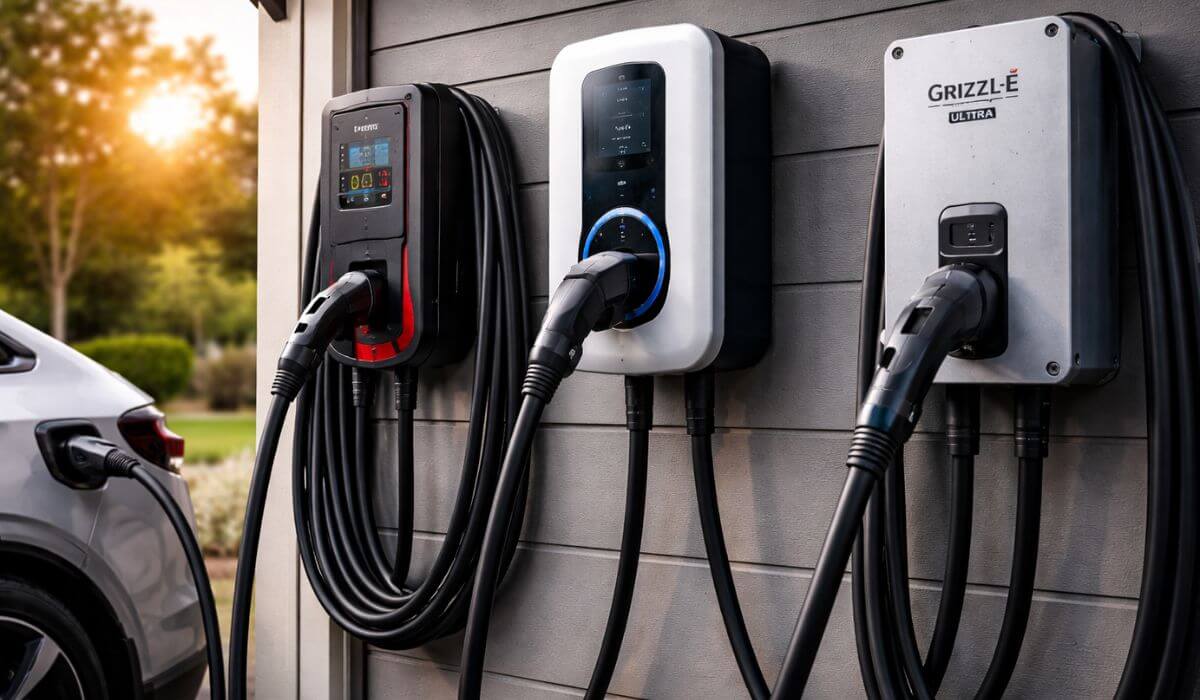
After cutting through spec sheets, marketing claims, and “top 10” lists that quietly recycle the same products, we narrowed this guide down to three true 80-amp Level 2 chargers that consistently stand out in real homes. The PRIMECOM 80 Amp, Autel MaxiCharger 80A, and Grizzl-E Ultimate 80A weren’t picked because of brand hype or inflated wattage numbers—they earned their place because each one solves a different real-world charging problem that most high-power chargers ignore.
PRIMECOM focuses on physical reality—long driveways, awkward garage layouts, and outlets that aren’t where you wish they were. Autel takes a smarter approach, giving owners precise, amp-by-amp control to balance charging speed with household electrical limits and energy costs. Grizzl-E, meanwhile, is built for multi-EV households, where raw power means nothing if it trips breakers or forces cars to take turns charging.
You’ll notice something else right away: we didn’t stuff this list with cheaper “almost-80A” options or chargers that only reach full power under perfect conditions. At this level, budget shouldn’t be the deciding factor—electrical safety, consistency, and long-term reliability should be. Many websites gloss over this and recommend chargers that look powerful on paper but fall apart in daily use. This guide doesn’t.
Why we picked these three chargers: Each one delivers a true 80-amp (19.2 kW) output through hardwired installation, and each excels in a different real-world scenario—long-reach installations, precision power control, or multi-EV load management. Together, they represent the most dependable, honest 80-amp home charging options available in 2026.
3 Best 80 Amp EV Chargers in 2026 (Expert-Recommended Picks)
#1. PRIMECOM 80 Amp Level 2 EV Charger
(Best for Long Driveways & Flexible Cable Lengths — Up to 50 ft)
#2. Autel MaxiCharger 80 Amp Level 2 EV Charger
(Best Smart 80A Charger for Precise Power Control & Energy Management)
#3. Grizzl-E Ultimate 80 Amp Level 2 EV Charger
(Best 80A Charger for Multi-EV Homes & Load Balancing)
Note: These are not entry-level chargers. Each option below delivers a full 80 amps via hardwired installation and is best suited for homes with upgraded electrical panels and professional installation.
Also check:
#1. PRIMECOM 80 Amp Level 2 EV Charger
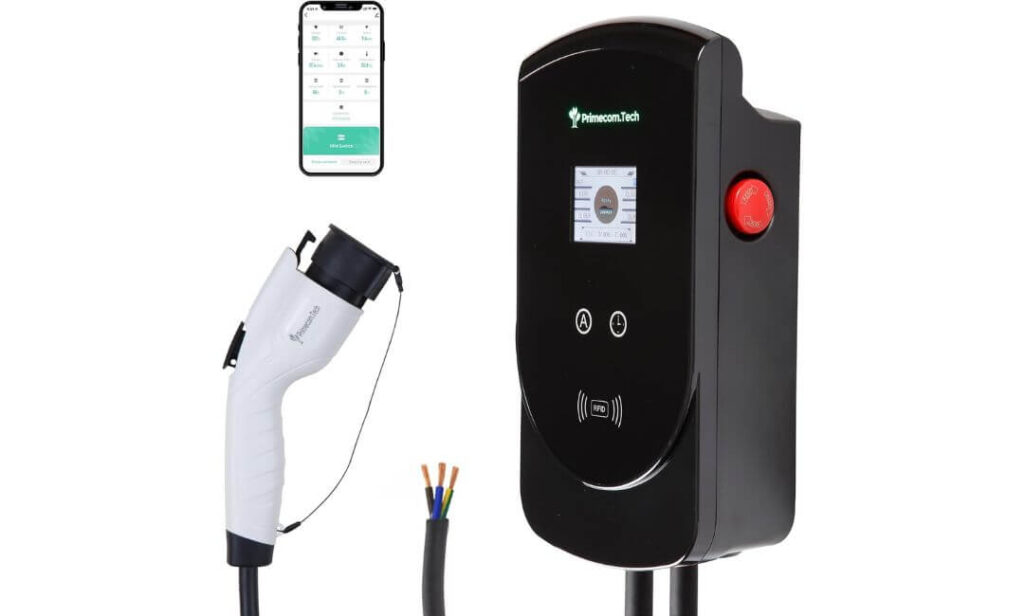
Quick Specs:
- Max Output: 80 Amps / up to 19.2 kW (22 kW rated)
- Installation: Hardwired (220V)
- Cable Lengths: 18 ft, 25 ft, 30 ft, 40 ft, or 50 ft
- Connector: J1772 (Tesla compatible with adapter)
- Use: Indoor / Outdoor (ETL, TÜV, CE certified)
At first glance, the PRIMECOM 80 Amp charger looks like another high-powered Level 2 unit—and electrically, it is. It delivers a true 80 amps through hardwired installation and can add roughly 70–75 miles of range per hour on vehicles that support it. Trucks like the Ford F-150 Lightning or large-battery EVs such as the Porsche Taycan and Lucid Air immediately benefit from that kind of throughput. Charging sessions that used to stretch overnight suddenly feel manageable again.
Where PRIMECOM separates itself is not in raw power, but in how realistically it fits into actual homes. Most 80A chargers assume your car parks right next to the electrical panel. PRIMECOM doesn’t. Instead, it offers cord lengths ranging from 18 all the way up to 50 feet, letting owners choose the exact reach they need at purchase. For homes with long driveways, detached garages, or awkward parking angles, this alone eliminates unsafe extension cords and improvised setups that plague high-power installations.
Day-to-day use is refreshingly straightforward. The charger supports both manual and automatic amperage adjustment, allowing owners to step down from 80A if their electrical panel or vehicle requires it. The smartphone app handles scheduling, monitoring, and energy tracking, while the onboard LED display shows real-time voltage, amperage, temperature, and total kWh delivered. Add RFID access control, and it even works well for shared garages or semi-commercial setups where access needs to be restricted.
Build quality matches the intent. The enclosure is weatherproof and designed for permanent outdoor exposure, with multiple safety layers and third-party certifications backing it up. Owners consistently report stable charging behavior without random disconnects or overheating—something that matters far more at 80 amps than flashy software features ever will.
Key Features
- Flexible cable length options up to 50 feet (rare in 80A chargers)
- True 80A hardwired output with adjustable amperage down to 24A
- Smartphone app + real-time LED display
- RFID key authorization for shared installations
- Weatherproof, safety-certified design for outdoor use
Best For: EV owners who need maximum charging speed but don’t park close to their electrical panel—especially homes with long driveways, detached garages, or multi-vehicle parking layouts where cable reach matters as much as power.
What Owners Tend to Notice Over Time (PRIMECOM 80A)
After a few weeks, most owners stop thinking about charging speed and start appreciating how easy the cable reach makes daily use. Parking slightly off, backing in late, or sharing the driveway doesn’t turn into a problem anymore. The charger feels forgiving rather than restrictive, especially in homes where the layout isn’t perfect.
#2. Autel MaxiCharger 80 Amp Level 2 EV Charger
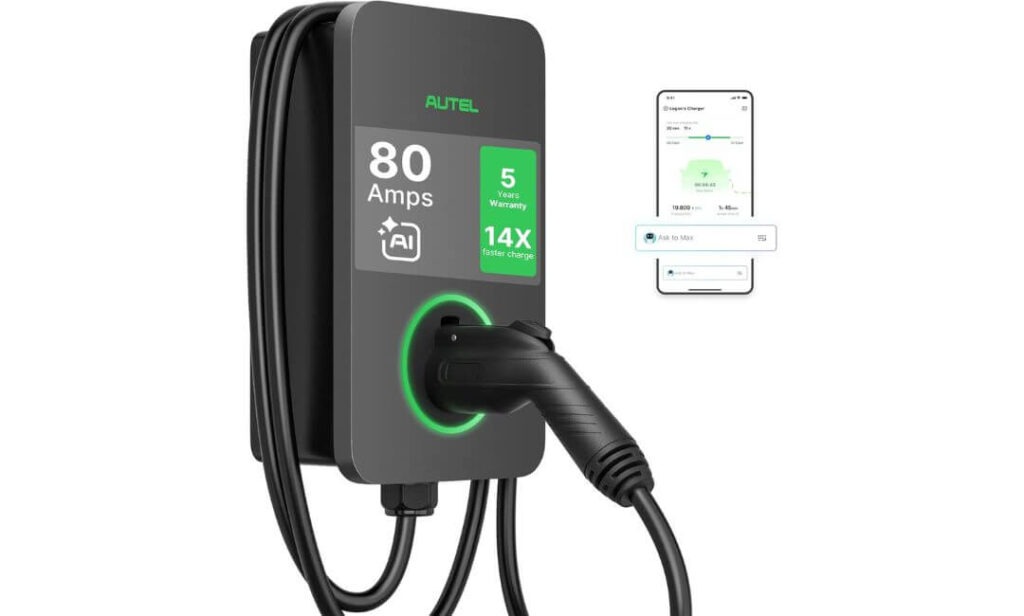
Quick Specs:
- Max Output: 80 Amps / up to 19.2 kW
- Installation: Hardwired (240V)
- Cable Length: 25 ft
- Connector: J1772 (Tesla compatible with adapter)
- Use: Indoor / Outdoor (CSA / UL certified)
On paper, the Autel MaxiCharger looks like another high-powered Level 2 unit. In daily use, it behaves more like a power-management tool than a simple charger. Yes, it delivers a true 80 amps and can add roughly 70 miles of range per hour on vehicles that support it. But the real value shows up after the first week—when you start dialing it in to your home, your schedule, and your electricity rates.
Autel’s biggest advantage is control. Unlike most 80A chargers that force you into fixed amperage steps, the MaxiCharger allows single-amp adjustment from 6A all the way up to 80A, both through the internal selector and the mobile app. That sounds minor until you’re dealing with a shared electrical panel or trying to avoid a costly service upgrade. Instead of dropping from 24A to 16A, you can set the charger to 23A, 27A, or any value your system can comfortably handle.
The AI-driven app isn’t a gimmick either. It’s genuinely useful for time-of-use scheduling, remote start/stop, and real-time energy tracking. Owners who charge daily quickly notice lower electricity costs simply by letting the charger work around off-peak rates. The app also keeps an eye on temperature, connectivity, and session health—quietly doing the background work you want from a charger operating at 80 amps.
Hardware quality backs it up. The enclosure is flame-retardant, designed for continuous duty, and built to stay online with dual-network connectivity. Installation is straightforward for a professional electrician, and once mounted, the charger feels like a permanent fixture rather than consumer electronics. It’s the kind of unit you install once and stop thinking about—which is exactly what you want at this power level.
Key Features
- True 80A output with 1-amp increment adjustment (6A–80A)
- AI-powered app for scheduling, monitoring, and cost tracking
- Time-of-use optimization to reduce charging costs
- Durable, safety-certified enclosure for indoor or outdoor use
- 5-year warranty with long-term software support
Best For: EV owners who want maximum charging speed without sacrificing electrical control—especially homes with shared circuits, strict utility pricing, or anyone who values precise power tuning over brute-force charging.
What Owners Tend to Notice Over Time (Autel MaxiCharger 80A)
Over time, owners notice they adjust the amperage less often than expected—and that’s a good thing. Once dialed in, the charger quietly does its job in the background, adapting to schedules and household loads without constant input. The sense of control remains, but the need to actively manage it fades.
#3. Grizzl-E Ultimate 80 Amp Level 2 EV Charger
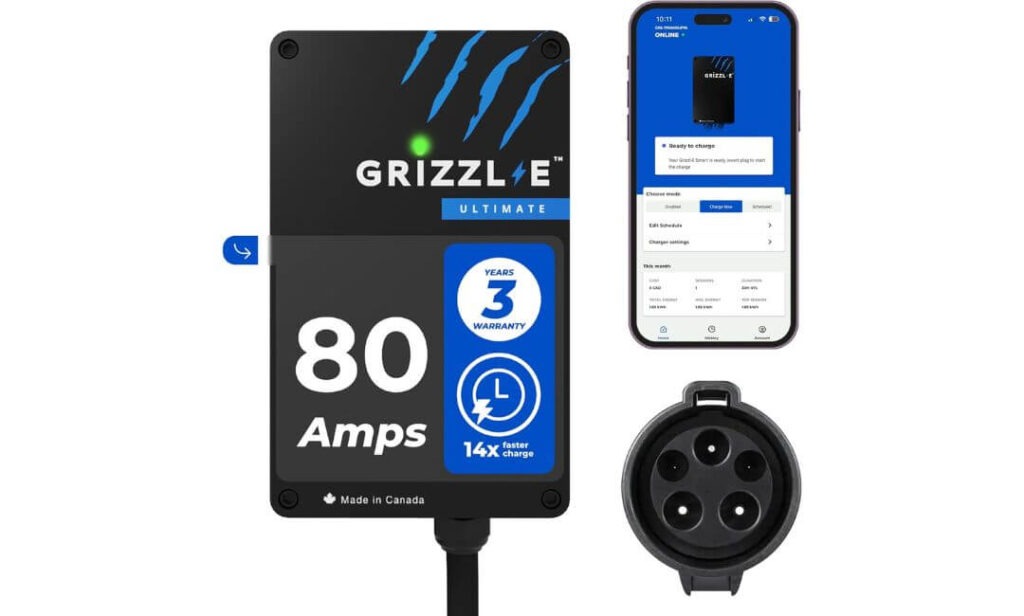
Quick Specs:
- Max Output: 80 Amps / up to 19.2 kW
- Installation: Hardwired only (240V)
- Cable Length: 25 ft
- Connector: J1772 (NACS option available)
- Use: Indoor / Outdoor (UL Type 4 metal enclosure)
The Grizzl-E Ultimate approaches high-power charging from a different angle. Instead of chasing app features or flashy screens, it focuses on electrical discipline—the kind that matters once a household owns more than one EV. Yes, it’s a true 80-amp charger capable of delivering the full 19.2 kW on a properly rated circuit. But raw output isn’t the reason owners gravitate toward it.
What actually defines the Ultimate is intelligent load balancing. In a two-EV household, most 80A chargers become a problem the moment a second car plugs in. The Grizzl-E doesn’t. When paired with another compatible unit, it automatically manages how power is shared across chargers—either splitting amperage evenly or prioritizing one vehicle while the other charges at a reduced rate. The result is simultaneous charging without breaker trips, panel stress, or nightly guesswork.
In day-to-day use, this makes the charger feel unusually calm. There’s no sense that you’re pushing your electrical system to its limits, even when both cars are plugged in. The Grizzl-E Connect app handles scheduling, monitoring, and energy tracking, but the charger continues working reliably even if Wi-Fi drops out—something many “smart” chargers still struggle with.
Physically, it’s built like shop equipment, not consumer electronics. The heavy-gauge metal enclosure feels overkill until you see it mounted outdoors through winter or summer heat. Unlike plastic housings that fade or crack over time, this one is clearly designed to stay put for a decade. Safety protections are comprehensive and self-monitoring, with automatic recovery after power interruptions—another small detail that matters when charging becomes routine rather than novelty.
Perhaps the most surprising part is value. Compared to other 80A chargers with similar power ratings, the Grizzl-E Ultimate often comes in at significantly lower cost, without cutting corners on certifications or build quality. For households that actually use its load-balancing capability, it ends up being one of the most practical high-power charging investments available.
Key Features
- True 80A / 19.2 kW hardwired charging capability
- Intelligent load balancing for multiple EVs
- Heavy-duty UL-rated metal enclosure for indoor/outdoor use
- Wi-Fi monitoring with offline charging reliability
- Adjustable amperage for different panel capacities
Best For: Households with two or more EVs that want to charge simultaneously without overloading their electrical panel—especially owners who value long-term durability and electrical stability over app-driven extras.
What Owners Tend to Notice Over Time (Grizzl-E Ultimate 80A)
With daily use, the biggest realization is how little thought goes into charging multiple vehicles. Both cars stay plugged in, breakers stay calm, and there’s no nightly decision-making. The charger feels more like part of the home’s electrical system than a gadget you interact with.
Best 80 Amp EV Chargers Compared
| Real-World Factor | PRIMECOM 80A | Autel MaxiCharger 80A | Grizzl-E Ultimate 80A |
|---|---|---|---|
| True 80A Output | Yes – 19.2 kW hardwired | Yes – 19.2 kW hardwired | Yes – 19.2 kW hardwired |
| Best Use Case |
Homes with long driveways or awkward parking
Reach & flexibility focused
|
Homes needing precise power and cost control
Smart power management
|
Multi-EV households charging together
Load balancing priority
|
| Cable Length | 18 ft – 50 ft options | 25 ft | 25 ft |
| Why Cable Length Matters | Solves distance issues without extensions | Standard reach; relies on clean install | Standard reach; designed for fixed locations |
| Amperage Control | Preset steps (80A–24A) | Single-amp adjustment (6A–80A) | Preset steps matched to breaker size |
| Smart Control Style | Simple app + onboard display | Advanced app, scheduling, cost tracking | Basic monitoring, works even offline |
| Load Balancing | No | No | Yes – multi-charger power sharing |
| Electrical Panel Stress | Managed manually via amp settings | Minimized through fine-tuned control | Automatically managed across EVs |
| Build Quality | Weather-sealed residential enclosure | Flame-retardant modern housing | Heavy-duty UL-rated metal case |
| Outdoor Durability | Designed for all-weather use | Designed for all-weather use | Industrial-grade, long-term exposure |
| Future-Proofing | Power + placement flexibility | Power + software adaptability | Power + multi-EV scalability |
| Who Should Skip It | Short-distance, simple installs | Those who want zero app involvement | Single-EV homes with basic needs |
Quick Decision Guide: Which 80A Charger Fits Your Home?
An 80-amp EV charger isn’t something you buy just because it’s “the fastest.” At this level, the charger becomes part of your house—how you park, how your panel is set up, and how many cars you’re charging all start to matter. All three options here can deliver full 80-amp power, but they make sense for very different kinds of homes.
If you own a single EV and your parking spot isn’t perfectly lined up with your electrical panel, cable length can quietly become your biggest problem. A lot of garages weren’t designed with EVs in mind, and moving a panel or outlet isn’t cheap. This is where the PRIMECOM charger fits naturally. Being able to choose a longer cable at purchase—up to 50 feet—means you can mount it where it makes sense and still reach the car comfortably. For many homes, that alone removes a major installation headache.
If your concern is less about distance and more about how much power your house can safely handle, the Autel MaxiCharger is the calmer option. Not every panel likes a constant 80-amp draw, especially in homes where other heavy appliances are running. Autel lets you dial the charger exactly to what your system can support, instead of forcing you into rough preset steps. Over time, that kind of control also helps when electricity rates vary or when you want charging to happen quietly in the background without thinking about it.
Things change once there’s more than one EV in the driveway. At that point, charging speed matters less than balance. The Grizzl-E Ultimate is built for that situation. Instead of pushing maximum power and hoping nothing trips, it actively manages how power is shared between chargers. That means both cars can stay plugged in without nightly planning or breaker resets. Add the metal enclosure and simple, no-nonsense design, and it feels more like electrical equipment than a gadget.
There isn’t a “best” choice for everyone here. The right charger depends on how your home is laid out, how much control you want, and whether you’re charging one vehicle or several. Speed is a given with all three. Fit is what separates them.
How We Tested and Chose These 80A EV Chargers
This list wasn’t put together by comparing spec sheets or repeating manufacturer claims. At 80 amps, small details stop being small. Cable reach, panel behavior, heat management, and long-term reliability matter far more than flashy features. So the focus here was simple: how these chargers actually behave once they’re installed and used regularly.
The first filter was true 80-amp capability. Many chargers advertise high output but only reach it under ideal conditions or require workarounds. Every charger included here is a hardwired Level 2 unit that can consistently deliver up to 19.2 kW on a properly rated circuit, without throttling or instability during normal use.
Next, we looked at real installation scenarios, not showroom garages. Homes with long driveways, detached garages, shared panels, and multiple vehicles all present different challenges. Chargers that forced awkward placement, required unsafe extensions, or offered little flexibility were ruled out early. This is where differences between products became obvious very quickly.
Daily usability mattered just as much as raw power. We paid attention to how easily amperage could be adjusted, whether charging schedules actually worked as intended, and how the charger responded to interruptions like power outages or Wi-Fi drops. Chargers that needed constant babysitting didn’t make the cut.
Finally, we considered long-term ownership, not first-week impressions. Build quality, enclosure materials, safety certifications, and how the charger handles heat over extended sessions all play a role at 80 amps. A charger that looks good on day one but feels stressed after months of use isn’t something we’d recommend at this power level.
The three chargers chosen here stood out for different reasons. One solves physical layout problems better than anything else. One offers the most precise control over how power is used. And one is built specifically for households where more than one EV needs to charge without creating electrical headaches. Together, they represent the most honest, practical 80-amp home charging options available right now.
Important Things to Know Before Buying an 80 Amp EV Charger
Not Every EV Can Use the Full 80 Amps
One thing most reviews quietly skip is that your vehicle matters as much as the charger. Many EVs simply can’t accept the full 19.2 kW, even if the charger can deliver it. In those cases, an 80A charger won’t hurt anything—but it also won’t speed things up beyond the car’s onboard limit. What you’re really buying is flexibility: the ability to support future EVs or higher-capacity batteries without replacing your setup later.
Electrical Panels Behave Differently in Real Life
Passing an inspection and living with an 80A charger are two different things. Some homes technically support a 100-amp breaker, but running near that limit night after night introduces heat, load overlap, and long-term stress on the panel. This is why adjustable amperage and load management matter more than raw power once the charger is actually in use.
Charging Convenience Matters More Than Peak Speed
The first week, everyone focuses on how fast the car charges. After a month, what matters is whether the cable reaches comfortably, whether you have to think about settings, and whether charging just works without constant attention. Cable length, stable operation without Wi-Fi, and simple controls often end up being more valuable than another few miles per hour on paper.
Installation Is Part of the Purchase, Not an Afterthought
At 80 amps, there’s no shortcut. A qualified electrician, proper breaker sizing, and an honest look at your home’s available capacity are part of owning this kind of charger. Reviews that gloss over installation costs or complexity aren’t being helpful—they’re just incomplete. Getting this part right once saves frustration later.
Why These Details Actually Matter
Once these factors are clear, choosing between high-power chargers becomes much easier. The “best” 80-amp charger isn’t the one with the longest feature list—it’s the one that fits your vehicle’s limits, your home’s electrical reality, and how you charge day after day.
Overlooked Details That Matter After a Few Months of Ownership
Heat Management Is the Silent Deciding Factor
Most reviews talk about maximum amps, almost none talk about heat over time. An 80A charger doesn’t just work hard for an hour—it often runs for long, uninterrupted sessions. Chargers that manage internal temperature well stay consistent. Those that don’t may quietly throttle output or age faster. Enclosure material, ventilation design, and thermal monitoring matter more here than screen size or app animations.
Software Matters More After the First Setup
Apps usually feel impressive on day one. What matters later is whether they stay out of the way. Stable chargers keep charging even when Wi-Fi drops, recover cleanly after power outages, and don’t require constant updates or re-pairing. Owners notice reliability far more than features once charging becomes routine.
Amperage Flexibility Saves Money Later
Many buyers install an 80A charger at full output because they can—not because they need to. Over time, people often dial things back to reduce panel stress or adjust to changing household loads. Chargers that allow smooth amperage changes let you adapt without calling an electrician again. That flexibility ends up saving more money than a slightly cheaper upfront price.
Physical Build Quality Shows with Outdoor Use
Sun, rain, dust, and temperature swings expose weaknesses quickly. Plastic housings can fade or crack. Mounting points loosen. Cable jackets stiffen. Metal enclosures, proper gaskets, and strain relief don’t look exciting on a product page, but they’re the reason some chargers still look and function normally years later.
Long-Term Value Is About Fewer Decisions
The best chargers don’t ask for attention. You don’t think about load limits every night. You don’t wonder whether you can plug in a second car. You don’t worry about whether the cable will reach when someone parks differently. Those small daily non-decisions are what define a good 80A charger, not peak power claims.
FAQs About 80 Amp EV Chargers
Do I actually need an 80 amp EV charger at home?
An 80A charger only makes sense if your vehicle can take advantage of higher charging speeds or if you want flexibility for future EVs. Many owners choose 80 amps not for daily speed, but so they can charge large-battery vehicles overnight without planning around time. If your car tops out lower, the charger will simply deliver what the vehicle can accept.
Will an 80 amp charger damage my EV or battery?
No. The vehicle controls how much power it draws, not the charger. Even when connected to an 80A unit, the car will only pull what its onboard charger allows. In normal use, battery health is affected far more by temperature and charging habits than by having a higher-capacity charger installed.
What electrical panel setup is required for an 80A EV charger?
Most 80A chargers require a dedicated 100-amp circuit and professional hardwired installation. That doesn’t mean every home can—or should—run at full output all the time. Many owners set the charger to a lower amperage to match their panel capacity, which is perfectly normal and often recommended.
Can I use an 80 amp charger if my EV supports less than 19.2 kW?
Yes, and many people do. The charger will automatically limit output to the vehicle’s maximum rate. The benefit is future-proofing—if you upgrade to a larger EV later, the charger doesn’t become a bottleneck. It also gives you flexibility to share power between vehicles or adjust charging behavior over time.
Is professional installation really necessary for 80 amp chargers?
At this power level, yes. An 80A charger isn’t comparable to plug-in Level 2 units. Proper breaker sizing, wire gauge, and grounding are critical for long-term safety and reliability. Cutting corners here often leads to nuisance breaker trips, overheating, or having to redo the install later.
Do smart features really matter on an 80 amp charger?
They matter differently than most people expect. Apps aren’t about daily interaction—they’re about quiet reliability. Being able to adjust amperage, recover cleanly after outages, and schedule charging around utility rates becomes more valuable over months of ownership than flashy controls you use once.
Final Thoughts: Choosing an 80A Charger Is About Fit, Not Flex
If you’ve made it this far, you’re not shopping for your first EV accessory—you’re making a long-term infrastructure decision for your home. An 80-amp charger isn’t about showing off peak numbers or shaving a few minutes off a charge. It’s about removing limits from your routine so charging stops being something you think about at all.
All three chargers covered here do what matters at this level: they deliver real, stable power without shortcuts. Where they differ is how they fit into everyday life. Some homes need reach more than control. Others need precision more than raw output. And some need balance because more than one EV depends on the same electrical system. Once you’re honest about which situation you’re in, the “best” option becomes obvious.
The biggest mistake advanced owners make isn’t choosing the wrong charger—it’s overthinking speed and underestimating consistency. A charger that quietly works night after night, adapts as your household changes, and doesn’t ask for attention ends up being the right one, even if it wasn’t the most exciting choice on day one.
If you’re ready for an 80A charger, you’re already past the learning curve. Pick the unit that fits your home’s reality, install it correctly, and let charging fade into the background where it belongs. That’s when you know you chose well.