
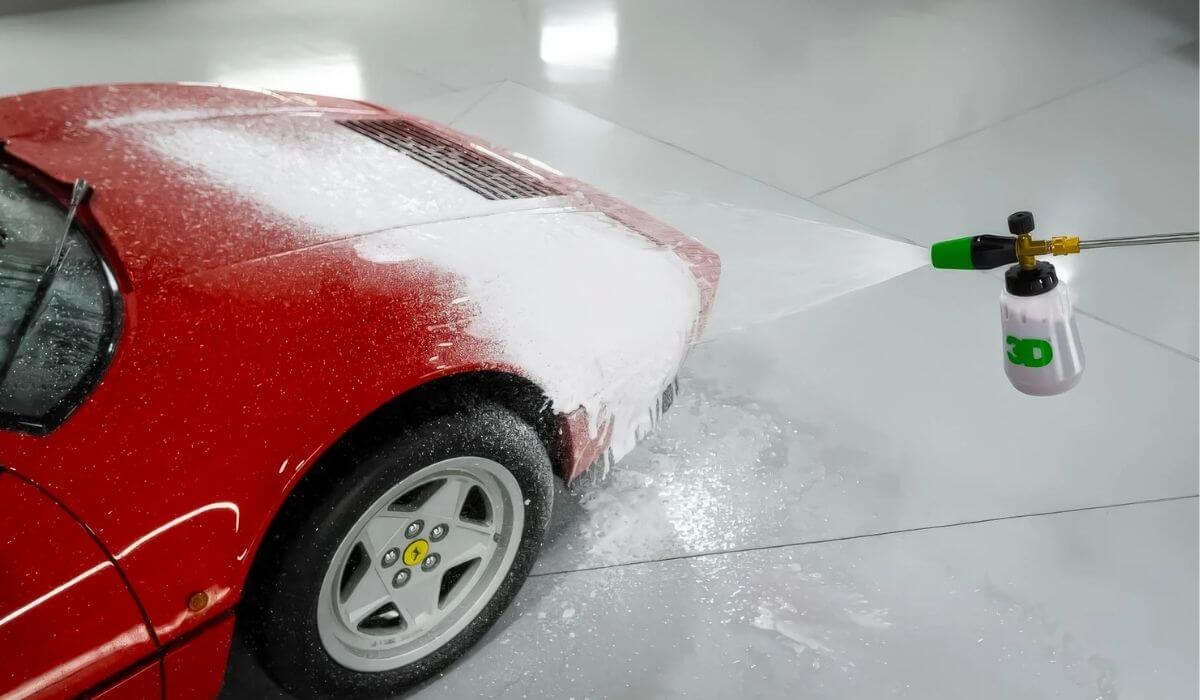
5 Best Foam Cannons for Pressure Washers (1,800–3,000 PSI Thick Foam Picks)
If you’re searching for the best foam cannon for a pressure washer, chances are you don’t just want soap spraying out of a bottle — you want thick, clinging foam that actually loosens dirt before you touch the paint. After testing foam cannons across different pressure washers, one thing became clear: the sweet spot for real snow foam lives between 1,800 and 3,000 PSI. Below that, foam turns watery. Above that, cheaper cannons start leaking or failing.
That’s exactly why every foam cannon in this list is built to handle at least 3,000 PSI, works flawlessly with both electric and gas pressure washers, and produces dense foam without wasting soap. From weekend car owners to serious detailers, these picks are designed to perform consistently in real-world washes — not just look good on paper.
Products like the Chemical Guys Big Mouth Max Release Foam Cannon stand out for their ease of use and reliable foam output with common electric pressure washers, while the MJJC PRO V3.0 Ultimate Foam Cannon delivers professional-grade thickness thanks to its stainless-steel internals and precise soap control. Both represent exactly what most buyers are looking for: strong foam, solid construction, and zero frustration during setup.
Every foam cannon here was chosen using the same criteria we use ourselves — proper PSI rating, brass or stainless fittings, wide-mouth bottles that don’t tip over, and adjustable controls that let you fine-tune foam density based on your shampoo and washer. If you’re running a 1,800–3,000 PSI pressure washer and want results you can actually see on your paint, these are the foam cannons worth spending money on.
Top 5 Foam Cannons for Pressure Washers 2026 (1,800–3,000 PSI)
#1. Chemical Guys Big Mouth Max Release Foam Cannon — Best Foam Cannon for Pressure Washer (Overall Thick Foam)
#2. MJJC PRO V3.0 Ultimate Foam Cannon — Best Professional Foam Cannon for Pressure Washers
#3. MTM Hydro Wide Mouth PF22 Foam Cannon & SG28 Trigger Gun Kit — Best Heavy-Duty Foam Cannon for Pressure Washers
#4. McKillans Stubby Pressure Washer Gun with Foam Cannon — Best Foam Cannon Setup for Control & Ease of Use
#5. Clean Car USA Foam King Foam Cannon — Best Budget Foam Cannon for Pressure Washers
Why We Picked These 5 Foam Cannons
We chose these five foam cannons because they meet the real-world requirements that actually affect foam quality and long-term reliability. Every model here is built to handle 1,800–3,000 PSI, which is the ideal range for producing thick, consistent foam with most electric and gas pressure washers. They all use a standard 1/4-inch quick-connect, so installation is instant and hassle-free, and each one relies on brass or stainless-steel internals to prevent leaks and premature wear under pressure. Large, wide-mouth bottles make mixing soap easier and eliminate constant refills, while adjustable soap controls allow you to fine-tune foam density based on your shampoo and washer. Most importantly, these are car-wash–specific foam cannons, designed to lay down paint-safe, clinging foam—not harsh spray. These aren’t random picks; they’re dependable tools that deliver better foam, safer washes, and consistent results over time.
Must Check:
- Best Ceramic Coating for Cars
- Best Dual-Action Polishers for Beginners
- Best Handheld Cordless Vacuum Cleaners
#1. Chemical Guys Big Mouth Max Release Foam Cannon
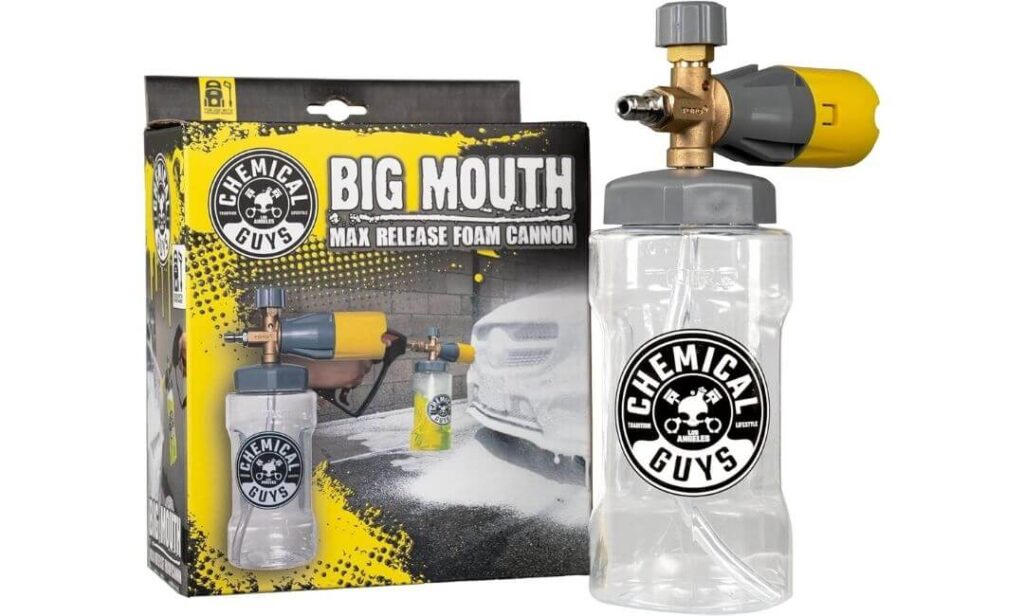
Quick Specs:
- PSI Rating: 500–3,500 PSI
- Bottle Capacity: 34 oz (1 liter+)
- Connector: 1/4-inch universal quick-connect
- Foam Control: Adjustable soap concentration knob
- Materials: Stainless steel fittings, heavy-duty plastic bottle
- Use Type: Cars, trucks, SUVs, motorcycles, boats, RVs
Many websites review this product, but the real differentiator that sets it apart from other foam cannons is the wide-mouth bottle design combined with Chemical Guys’ Big Mouth blow bezel nozzle system. This pairing isn’t about gimmicks — it directly affects how easily soap is mixed, how consistently foam is produced, and how mess-free the setup feels during regular washes.
In real-world use, the wide-mouth opening makes a noticeable difference. Soap pours in cleanly without spills, even when mixing thicker shampoos, and the 34 oz bottle holds enough solution for multiple vehicles in one session. Once connected, the foam output is dense and uniform, laying down a thick, clinging layer that stays on paint long enough to break down road grime and dust before contact washing.
Foam consistency is where this cannon earns its reputation. The adjustable air injection system allows fine control over foam thickness, producing a shaving-cream-like blanket even with mid-range electric pressure washers in the 1,800–2,500 PSI range. The spray pattern adjusts smoothly from a wide fan to a more focused stream, making it easy to cover large panels quickly without overspray.
Build quality also feels reassuring. Stainless steel internal fittings handle pressure without leaks, seals stay tight after repeated use, and the bottle material holds up well against common car shampoos and cleaners. While it’s versatile enough for boats, siding, and patios, its foam character is clearly tuned for paint-safe car washing, not harsh surface blasting.
What We Like
- Wide-mouth bottle makes soap mixing fast and spill-free
- Produces thick, clinging foam even with electric pressure washers
- Smooth, precise foam and spray adjustment
- Durable stainless steel internals with reliable sealing
What We Don’t Like
- The plastic bottle can crack if dropped from height on hard surfaces
What Our Tester Says: After multiple washes, the standout takeaway is consistency — foam thickness stays predictable wash after wash, and the wide-mouth bottle genuinely speeds up prep time. It feels like a tool designed by people who actually wash cars regularly, not just something built to look good on a product page.
#2. MJJC PRO V3.0 Ultimate Foam Cannon
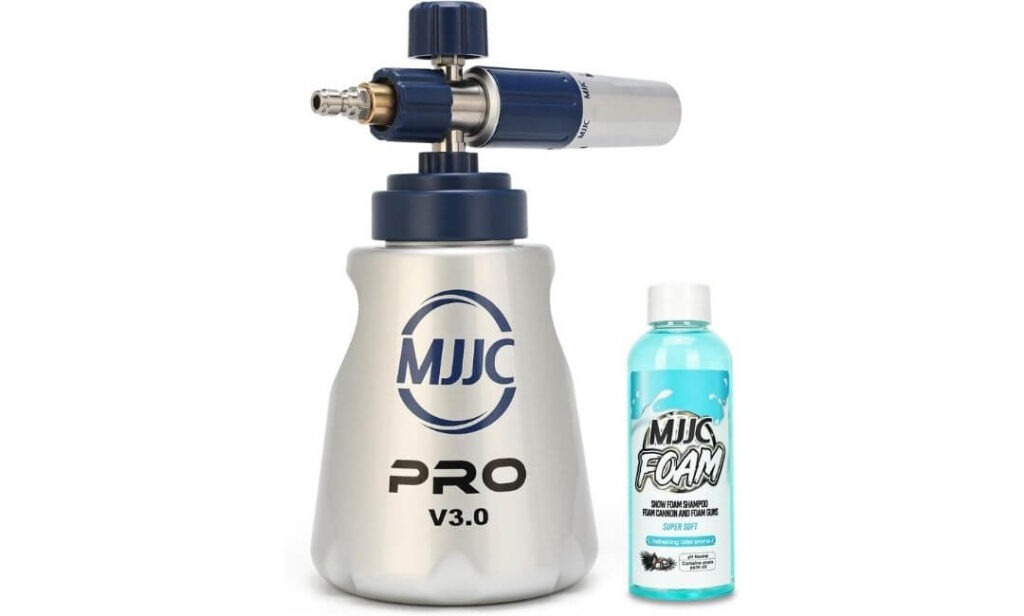
Quick Specs:
- PSI Rating: Up to 4,000 PSI (higher with optional orifice)
- Bottle Capacity: 44 fl oz / 1300 ml
- Connector: 1/4-inch quick-connect (included)
- Foam Control: Interchangeable orifices + adjustable spray
- Materials: Stainless steel and brass internals
- Use Type: Professional car washing, frequent detailing use
No one really talks about it, but this was one of the most solid and confidence-inspiring foam cannons tested. From the first pickup, the MJJC PRO V3.0 feels purpose-built for frequent use, not occasional weekend washing. Weight distribution is balanced, the grip feels intentional, and nothing flexes or rattles under pressure.
The #1 differentiating feature of the MJJC PRO V3.0 is its quarter-turn quick-release cap design paired with the wide-mouth bottle opening. Refilling soap takes seconds, cleanup is straightforward, and there’s no wrestling with threads or sticky seals. During back-to-back washes, this design alone saves noticeable time compared to traditional screw-on bottles.
Foam performance is exactly what professionals look for — dense, stable, and highly tunable. The included interchangeable orifices allow the cannon to be dialed precisely to the pressure washer being used, whether it’s a mid-range electric unit or a high-output gas washer. With the correct orifice installed, foam lays down thick and uniform, clinging long enough to soften grime before any contact wash.
Durability is another strong point. Stainless steel and brass internals handle pressure effortlessly, seals remain tight, and the bottle material holds up well against strong shampoos. The larger 44 oz capacity also means fewer refills during multi-vehicle washes, which matters more than expected once you’re working continuously.
What We Like
- Quarter-turn cap and wide mouth make refills fast and clean
- Exceptionally dense, controllable foam with proper orifice setup
- Built for frequent use with high-quality metal internals
- Large bottle capacity reduces downtime during washes
What We Don’t Like
- Higher price than basic foam cannons
What Our Tester Says: This is the foam cannon that gets picked up when consistency matters. Once the correct orifice is installed, foam output stays predictable wash after wash, and the quick-release bottle design genuinely makes frequent use easier. It feels engineered for people who wash cars often, not occasionally.
#3. MTM Hydro Wide Mouth PF22 Foam Cannon & SG28 Trigger Gun Kit
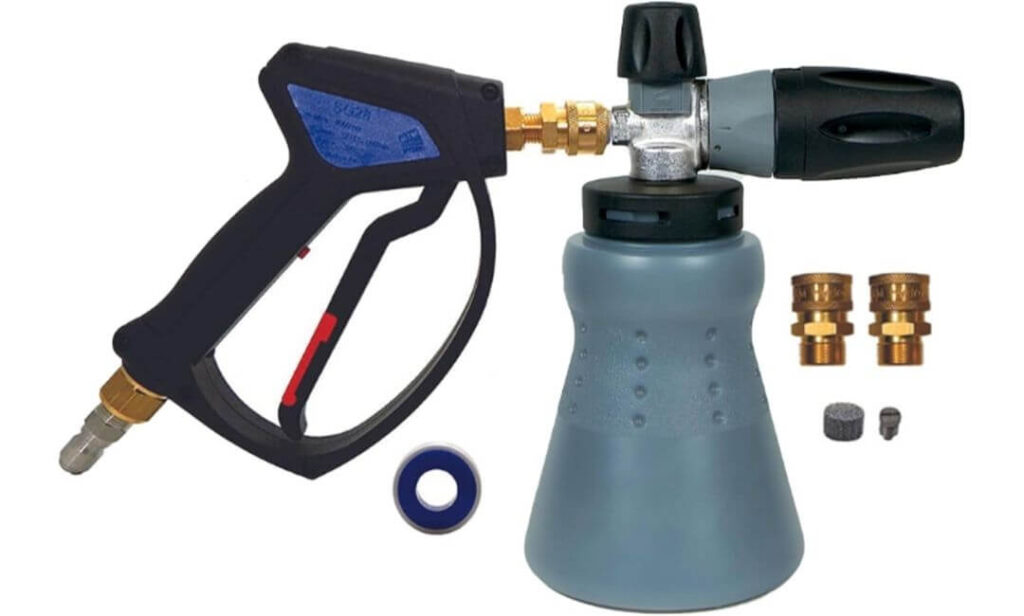
Quick Specs:
- PSI Rating: 1,100–5,000 PSI
- Max Flow Rate: Up to 5.3 GPM
- Bottle Capacity: 32 oz+
- Connector: 1/4-inch quick-connect outlet (adapters included)
- Materials: Solid brass, stainless steel, fiberglass-reinforced plastic
- Made In: Italy
- Use Type: Commercial and high-frequency car washing
Despite its simple appearance, this is the foam cannon kit that felt the most industrial during testing. The PF22 doesn’t try to be flashy or lightweight — it feels like equipment meant to live on a pressure washer full-time. Once assembled with the SG28 trigger gun, the entire setup gives off a clear “built to work” impression rather than a consumer accessory vibe.
Foam output is controlled rather than aggressive. The chemical injection knob allows precise tuning, letting the foam lay down thick and even without oversaturating panels or wasting soap. With higher-GPM gas pressure washers, foam stays dense and stable, but the cannon also performs predictably on electric units once dialed in correctly.
Where this kit really separates itself is durability. Brass and stainless-steel components take pressure without flex, seals stay tight, and the fiberglass-reinforced body shrugs off drops and constant use. This isn’t the kind of foam cannon that feels delicate or requires careful handling — it’s built for repeated daily washes.
The included SG28 trigger gun adds real value. Trigger pull is smooth, fatigue is reduced during long wash sessions, and the overall balance makes the setup easier to control compared to short, lightweight foam cannons. It’s not the fastest to swap bottles or adjust on the fly, but it rewards consistency and disciplined use.
What We Like
- Extremely durable, commercial-grade construction
- Stable, controllable foam with high-flow pressure washers
- Includes high-quality SG28 trigger gun
- Designed for long-term, frequent use
What We Don’t Like
- Heavier and less convenient for quick, casual washes
What Our Tester Says: This is the foam cannon that stays mounted on the pressure washer. It doesn’t demand attention, doesn’t leak, and doesn’t wear out quickly. For anyone washing vehicles regularly or running higher-output machines, it feels more like professional equipment than an accessory.
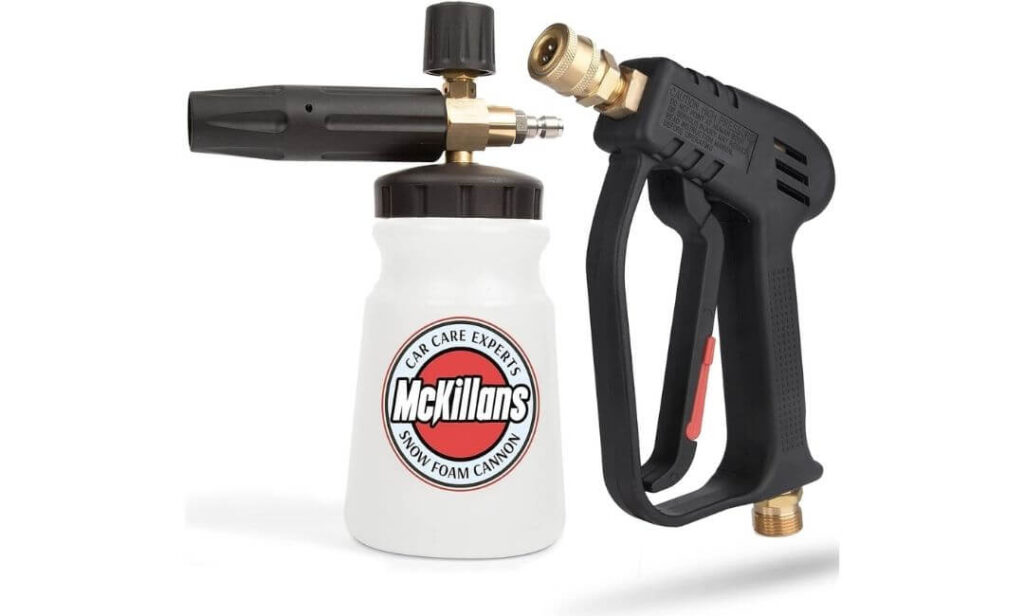
#4. McKillans Stubby Pressure Washer Gun with Wide Mouth Snow Foam Cannon
Quick Specs:
- PSI Rating: Up to 3,000 PSI
- Max Flow Rate: 2.6 GPM
- Bottle Capacity: 1 liter (wide-mouth, translucent)
- Connector: 1/4-inch quick-connect (M22-15mm adapter included)
- Materials: Brass and stainless steel fittings, chemical-resistant bottle
- Use Type: Car washing with electric and gas pressure washers
We tested this Wide Mouth Snow Foam Cannon with the 1/4-inch quick connector coupler, and the first thing that stood out wasn’t foam — it was control. The stubby pressure washer gun changes how the foam cannon feels in hand. Everything sits closer, balance improves, and maneuvering around mirrors, wheels, and lower panels becomes noticeably easier.
The wide-mouth bottle design plays a bigger role than expected. Mixing soap is quick, spills are rare, and the broader base keeps the cannon upright when setting it down between passes. The translucent bottle also makes it easy to track soap levels mid-wash, which helps avoid uneven foam toward the end of a session.
Foam output is strong and consistent within its recommended PSI range. With both electric and gas pressure washers, the cannon produces a dense foam layer that clings well to paint and trim. The adjustable soap control allows fine-tuning depending on shampoo type, and once dialed in, foam remains stable from panel to panel.
Build quality feels reassuring. Brass and stainless-steel fittings seal tightly, the quick connector snaps in securely, and the trigger pull is light enough to reduce hand fatigue during longer washes. It’s not built for extreme commercial pressure, but for vehicle-focused washing, it feels purpose-designed and dependable.
What We Like
- Stubby gun design improves balance and maneuverability
- Wide-mouth bottle is stable and easy to refill
- Light trigger pull reduces fatigue during longer washes
- Strong foam output with electric and gas pressure washers
What We Don’t Like
- Not designed for pressure washers above 3,000 PSI
What Our Tester Says: This setup feels intuitive the moment it’s in hand. The shorter gun and wide-mouth bottle make the wash process smoother and more controlled, especially around tight areas. It’s the kind of setup that makes longer washes feel easier rather than tiring.
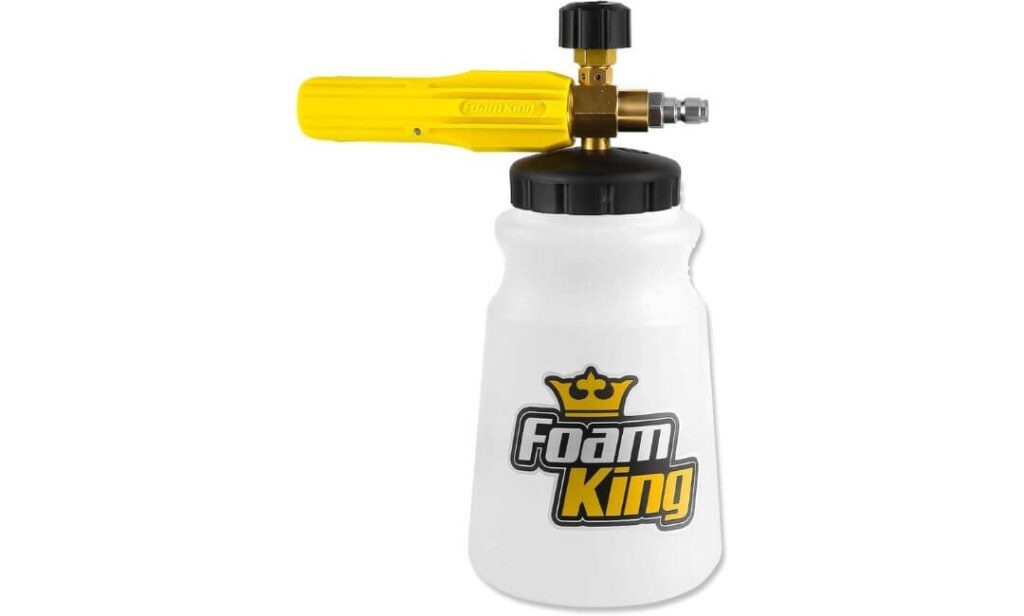
#5. Clean Car USA Foam King Foam Cannon
Quick Specs:
- PSI Rating: 500–4,200 PSI
- Flow Rate: 1.3–5.3 GPM
- Bottle Design: Wide-neck, translucent bottle
- Connector: 1/4-inch quick-connect
- Foam Control: Adjustable dilution and spray pattern
- Use Type: Car detailing, trucks, motorcycles, general vehicle washing
We spent time with the Foam King to see where it actually fits, and it became clear quickly that this is a practical, no-nonsense foam cannon built for everyday use. It doesn’t try to compete with heavy commercial units — instead, it focuses on ease, compatibility, and reliable foam for regular car washing.
The wide-neck bottle is one of its strongest points. Soap mixing is quick, threads seal tightly, and the bottle stays stable when set down between passes. During washes, foam builds evenly and clings well enough to lift dirt safely without overwhelming panels or wasting shampoo.
Foam adjustability is straightforward. The top-mounted dilution knob and adjustable spray pattern make it easy to move from full-coverage pre-wash foam to a narrower stream for lower panels and wheels. With both electric and gas pressure washers, foam output stays consistent once dialed in.
Build quality feels better than expected at this price point. While it relies more on reinforced plastic than metal, seals stay tight, connections don’t loosen, and the cannon handles repeated use without leaks. For regular vehicle washing, it performs reliably and predictably.
What We Like
- Wide-neck bottle makes filling and mixing easy
- Works well with both electric and gas pressure washers
- Simple foam and spray adjustments
- Good foam output without overusing soap
What We Don’t Like
- Lacks the heavy metal internals found on premium foam cannons
What Our Tester Says: This is the foam cannon that makes sense for most people starting out. It’s easy to use, produces satisfying foam, and doesn’t demand constant tweaking. For regular washes without overspending, it delivers exactly what’s needed.
Foam Cannon Comparison: Which One Fits Your Pressure Washer Best?
| Foam Cannon | Ideal PSI Range | Foam Density Control | Bottle Practicality | Internal Build | Best Use Pattern | Who Should Buy It |
|---|---|---|---|---|---|---|
| Chemical Guys Big Mouth Max | 1,800–3,000 PSI | Dial-based adjustment with stable air injection | Wide mouth, 34 oz, fast refill, good balance | Stainless steel internals | Weekly home car washes | Most car owners wanting thick foam without hassle |
| MJJC PRO V3.0 | 1,500–4,000 PSI+ | Orifice-based tuning for precise foam matching | 44 oz wide mouth with quarter-turn quick release | Brass + stainless steel | Frequent or back-to-back washes | Detailing enthusiasts and professional users |
| MTM Hydro PF22 + SG28 Kit | 1,100–5,000 PSI | Chemical injection knob, flow-stable foam | Large bottle, less convenient but durable | Commercial brass & reinforced body | High-output, long-duration washing | Users prioritizing durability over convenience |
| McKillans Stubby + Foam Cannon | 1,800–3,000 PSI | Manual dial, quick response adjustments | Wide-mouth, stable base, visible soap level | Brass & stainless steel fittings | Detail-focused, controlled washing | Users who value comfort and maneuverability |
| Clean Car USA Foam King | 1,800–3,000 PSI | Simple dilution knob, easy learning curve | Wide neck, lightweight, easy handling | Reinforced plastic construction | Occasional or beginner car washing | First-time foam cannon buyers on a budget |
Which Foam Cannon Should You Choose?
Choosing the right foam cannon comes down to how often you wash, the pressure washer you use, and how much control you want during the wash. After using all five, the differences become clear pretty quickly once they’re in hand.
For most car owners running an electric or mid-range gas pressure washer, the Chemical Guys Big Mouth Max Release is the easiest recommendation. It delivers consistently thick foam in the 1,800–3,000 PSI range, the wide-mouth bottle speeds up prep, and there’s very little learning curve. It’s the one that fits seamlessly into a regular wash routine.
If washing happens frequently or back-to-back, the MJJC PRO V3.0 stands out. The foam is more tunable, the larger bottle reduces refills, and the quick-release design makes repeated use noticeably easier. It feels engineered for people who wash often and expect repeatable results every time.
For users running higher-output machines or prioritizing long-term durability, the MTM Hydro PF22 kit makes the most sense. It’s heavier, more deliberate to use, and clearly built to last. This is equipment that stays mounted and works day after day without needing attention.
If comfort and control matter most, especially around mirrors, wheels, and tight body lines, the McKillans Stubby setup is the most natural in hand. The shorter gun reduces fatigue and improves balance, making longer washes feel easier and more precise.
For those starting out or washing occasionally, the Clean Car USA Foam King covers the basics well. It’s simple to set up, produces satisfying foam, and works reliably with both electric and gas pressure washers without overcomplicating the process.
Each of these foam cannons earns its place for a specific reason. Matching the tool to how you actually wash makes more difference than chasing the highest PSI or the biggest bottle.
What PSI & GPM Really Matter When Using a Foam Cannon (Beyond the Spec Sheet)
After running the same foam cannons across different pressure washers, one pattern keeps repeating: foam quality is limited more by water delivery than by the foam cannon itself. PSI gets all the attention, but once you cross a functional threshold, it stops being the deciding factor.
In real use, 1,800–3,000 PSI is already more than enough for a foam cannon to aerate soap properly. Past that point, higher PSI doesn’t make foam thicker — it only increases impact force. If foam looks weak at 2,000 PSI, the issue is almost never pressure; it’s flow rate, or how consistently the washer can maintain pressure under load.
GPM is the quiet driver of foam density. A washer delivering a stable 1.8–2.3 GPM at working pressure will consistently outperform a higher-PSI unit that drops flow as soon as the trigger is pulled. Foam cannons rely on water volume to pull soap through the injector and mix air evenly. When flow dips, foam collapses into mist no matter how good the cannon is.
This is why electric pressure washers behave differently. Many advertise high peak PSI, but under continuous spray, flow throttles back. With these machines, foam cannons tuned for lower orifice sizes and steady dilution produce better results than trying to force thick foam through pressure alone. Gas washers, by contrast, maintain flow more consistently, which is why the same foam cannon often looks dramatically better on them without any adjustment.
Another overlooked factor is pressure stability, not maximum pressure. Washers that surge — brief spikes followed by drops — create uneven foam that slides off panels too quickly. Cannons like the MJJC or MTM units feel more consistent not because they “make more foam,” but because they tolerate fluctuations without breaking the foam structure.
The takeaway after testing is simple but rarely stated clearly:
If a foam cannon is rated correctly and built well, foam quality is determined by usable PSI, sustained GPM, and stability — in that order. Chasing higher PSI numbers won’t improve results once the washer is already in the effective range. Matching the foam cannon to how the washer actually delivers water is what separates thick, clinging foam from disappointment.
This is also why the products in this guide were chosen for compatibility in the real 1,800–3,000 PSI working zone, not just headline specs. They perform where most pressure washers actually live, not where marketing numbers peak.
Common Foam Cannon Mistakes That Kill Foam (Even With Good Gear)
Foam quality often gets blamed on the foam cannon, but in real use the problem is usually setup-related. Small mistakes in dilution, pressure stability, or technique can flatten foam instantly, even when the equipment itself is well-built and properly rated.
Using the Wrong Orifice for Your Washer’s Real Output
Most foam failures start here. Pressure washers don’t operate at their advertised PSI and GPM once the trigger is pulled. When the orifice is too large for the washer’s sustained flow, the cannon floods with water and starves the soap injector. Foam looks forceful but lacks structure and collapses instantly. Proper foam comes from restricting flow just enough to allow air and soap to emulsify, not from pushing maximum water volume.
Confusing Peak PSI With Usable PSI
A washer rated at 3,000 PSI may only hold 2,000 PSI under continuous spray. Foam cannons respond to stable working pressure, not momentary spikes. Washers that surge — brief pressure jumps followed by drop-offs — produce inconsistent foam that slides off panels unevenly. Stability matters more than headline numbers.
Over-Thinning the Soap Mix
Excessive dilution is a silent foam killer. Foam cannons are designed to aerate concentrated solution, not pre-watered mixes. When the solution is too thin, the air injection system cannot build a foam matrix strong enough to cling. Thick foam usually comes from reducing water content, not increasing soap volume.
Ignoring Water Temperature Effects
Warm water reduces surface tension, which can shorten foam dwell time. While it helps dissolve grime, it often causes foam to shear off panels prematurely. Cooler water maintains foam integrity longer, allowing detergents more time to work before contact washing begins.
Spraying From Too Far Away
Foam cannons are not meant to project foam over distance. When sprayed from too far back, the foam stream breaks apart mid-air, losing density before it ever reaches the surface. Controlled, close-range passes allow the foam to settle gently and maintain thickness.
Using Soaps That Don’t Aerate Well
Cleaning strength and foam behavior are not the same thing. Some shampoos clean effectively but lack the surfactant structure needed to trap air in foam cannons. When foam quality changes dramatically between soaps with the same setup, the limiting factor is usually soap chemistry, not the cannon.
Adjusting Multiple Variables at Once
Changing dilution, nozzle position, and spray distance simultaneously makes it impossible to identify the real issue. Foam tuning works best when adjustments are made one variable at a time, allowing the system to stabilize before judging results.
How to Use a Foam Cannon Properly (Method Used for Consistent, Repeatable Foam)
Foam cannons reward precision, not speed. When used correctly, they create controlled, clinging foam that softens contamination before contact. When rushed or mis-set, the same equipment produces watery runoff that looks impressive but does very little.
Bottle Setup Matters More Than Soap Brand
Start by mixing directly in the foam cannon bottle (soap first, then water). This prevents uneven concentration zones that weaken foam structure. For example, a 1:10 mix added outside the bottle often separates under pressure, while the same ratio mixed inside remains stable.
Dial Foam Away From the Vehicle (Never on Paint)
Initial adjustment should always be done off-surface (driveway, grass, empty air). Dense foam moves slowly and falls rather than shoots. If foam travels fast, the mix is too thin or flow is too high.
Spray Distance Is Shorter Than Most People Think
Foam should be laid onto panels, not projected. Keep the nozzle closer than arm’s length (especially on doors, quarter panels, bumpers). At longer distances, foam breaks apart mid-air and loses density before contact.
Panel Order Changes How Foam Behaves
Work top-down (roof, glass, upper panels) so foam can naturally migrate and carry loosened dirt downward. Spraying lower panels first traps grime under fresh foam and reduces pre-wash effectiveness.
Dwell Time Is a Window, Not a Countdown
Foam should sit until it begins to slowly slide (not dry, not drip immediately). In cooler conditions this may be 3–4 minutes; in heat, far less. Dry foam stops working and can leave residue behind.
Rinse Direction Controls Recontamination
Initial rinse from the bottom up helps lift remaining foam without pushing dirt upward. Finish with a top-down rinse to clear panels cleanly. This sequence keeps loosened grit moving away from contact zones.
Reset the Cannon After Every Wash
Flush clean water through the foam cannon for a few seconds after use (no soap, full flow). This prevents detergent from drying inside the injector and keeps foam output consistent wash after wash.
Why This Process Holds Up Over Time
This method aligns flow, pressure, distance, and well into a single system. It removes guesswork, reduces adjustment fatigue, and keeps foam predictable regardless of washer type or soap brand.
FAQs About Foam Cannons for Pressure Washers
What PSI actually works best for a foam cannon?
In real-world use, foam cannons perform best between 1,800 and 3,000 PSI. Below that range, foam struggles to build structure, and above it, extra pressure doesn’t increase foam thickness. Once the washer can sustain pressure in this window, foam quality depends more on flow rate and stability than PSI.
Can an electric pressure washer produce thick foam with a foam cannon?
Yes, but only if expectations match the washer’s limits. Electric pressure washers with steady flow and the correct orifice can produce dense, clinging foam. The key is tuning the foam cannon for sustained output, not chasing peak PSI numbers printed on the box.
Why does foam look thick at the nozzle but slide off the car quickly?
This usually happens when the soap mixture is too thin or the water temperature is too warm. Foam may look dense initially, but without proper concentration and surface tension, it can’t maintain structure once it hits the paint. Stable foam should sit and cling, not immediately run off.
Does higher GPM always mean better foam?
Not automatically. Higher GPM helps only if the foam cannon is matched correctly to the washer. Too much flow without proper restriction can dilute the soap stream, weakening foam. Balanced flow that allows air and soap to emulsify consistently produces better results than raw volume alone.
Are all car shampoos compatible with foam cannons?
No. Some shampoos clean well but aren’t formulated to aerate properly in foam cannons. When switching soaps causes a big change in foam quality using the same setup, the difference is usually chemistry, not equipment. Foam cannons work best with shampoos designed to trap air and hold structure.
Final Thoughts
A good foam cannon doesn’t just make washing more satisfying — it makes it safer, more consistent, and more predictable. After real use across different pressure washers, one thing becomes clear: results don’t come from chasing the biggest numbers, but from matching the foam cannon to how a washer actually delivers water.
Every foam cannon covered here was chosen because it performs where most pressure washers truly operate, not where marketing specs peak. When PSI stays in the effective range, flow remains stable, and the foam cannon is built to manage air, water, and soap correctly, the wash process becomes smoother and more controlled. Dirt loosens more easily, contact washing feels safer, and results are repeatable from wash to wash.
If there’s one takeaway, it’s this: thick, clinging foam is a system result, not a single product feature. The right foam cannon simply makes that system easier to dial in and more forgiving once it’s set up correctly.
Choose based on how you wash, not how the numbers look. Do that, and any of the foam cannons in this guide will deliver the kind of foam that makes every wash feel like time well spent.