5 Best Power Running Boards for Jeep Wrangler in 2026: 2-Door & 4-Door, Retractable Steps & LED Lights
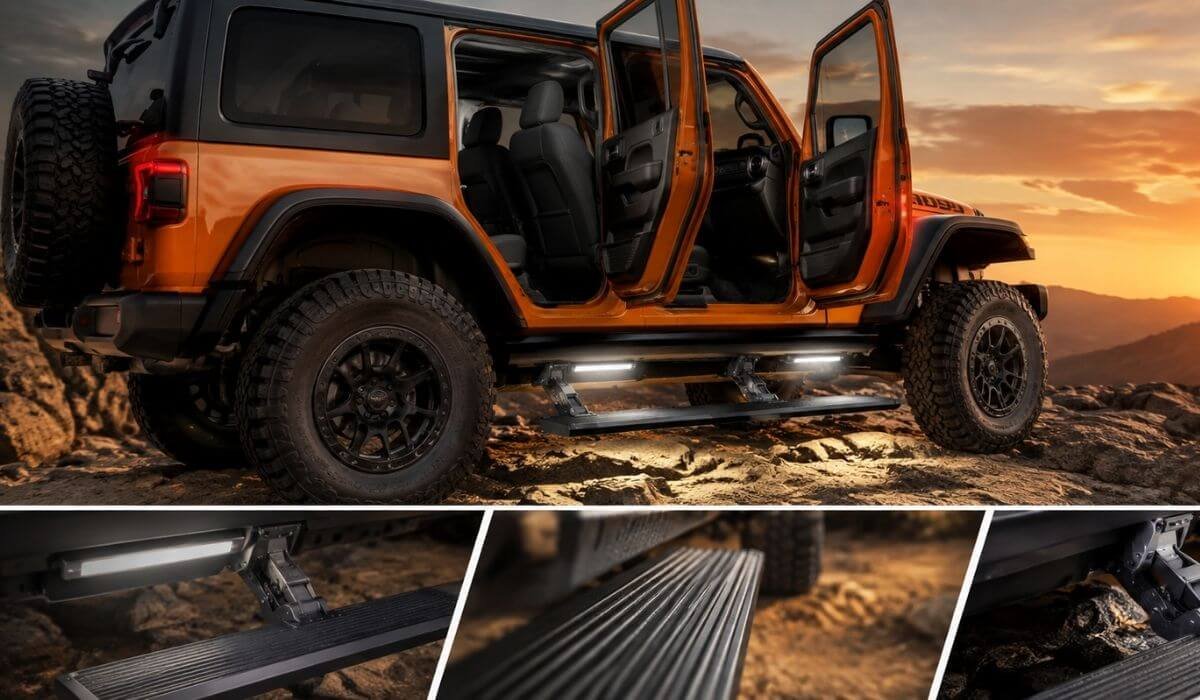
For a Jeep Wrangler, power running boards need to do more than look good parked in the driveway. The right setup should drop low enough for comfortable entry, retract tightly when the doors close, survive mud and water, and match the Wrangler’s exact body style. That last point matters more than many listings make it seem: the 2018–2026 JL 2-Door and 4-Door use different fitments, so a step designed for one should not be assumed to fit the other.
Two of the strongest options here are the AMP Research PowerStep 75132-01A and Rough Country Power Running Boards. The AMP 75132-01A is built for the JL 4-Door, including supported 4xe and Rubicon 392 applications, while Rough Country offers selectable 2-Door and 4-Door configurations. That distinction is worth checking before ordering, especially on Amazon, where multiple Wrangler variants can appear under the same product listing.
The lineup below focuses on the details that actually affect ownership—motor operation, step width, load capacity, LED lighting, sensors, construction, clearance, installation, and verified fitment—rather than simply ranking products by how impressive their feature list looks.
Samajh gaya — label noticeably longer, professional aur SEO-focused chahiye, lekin keyword stuffing nahi. Product name simple rahega.
Best Jeep Wrangler Power Running Boards: Retractable Steps for 2-Door & 4-Door Models
#1. AMP Research PowerStep 75132-01A
Best Retractable Electric Running Boards for Jeep Wrangler 2-Door & 4-Door with LED Step Lighting and Automatic Deployment
#2. Rough Country Power Running Boards
Best Dual-Motor Power Side Steps for Jeep Wrangler 2-Door & 4-Door with Retractable Steps, LED Lights and Automatic Operation
#3. SoFlo Premium Power Steps
Premium Smart Automatic Running Boards for 2018–2026 Jeep Wrangler JL 4-Door with Aircraft-Grade Aluminum and Sensor Activation
#4. Tuxtreme Power Running Boards
Retractable Electric Side Steps for 2018–2026 Jeep Wrangler JL 4-Door with Automatic Drop-Step Access and Full-Length Running Boards
#5. Tempsnow Power Running Boards
Electric Powered Running Boards for 2018–2026 Jeep Wrangler JL with Automatic Step Deployment and Convenient Side Access
Expert Tip
A power step should make getting into the Wrangler easier without becoming another thing to worry about. The biggest mistake is choosing a board because it looks impressive in the listing photos and checking fitment afterward. For the JL, start with 2-Door or 4-Door fitment, then look at how the board deploys, how much stepping area it gives you, how the motor is protected, and whether the installation makes sense for your particular Wrangler.
There is also a simple ownership test worth remembering: when the doors are closed, the step should largely disappear; when they open, it should appear where your foot naturally lands. That sounds obvious, but it separates a genuinely useful power running board from one that simply adds electronics underneath the Jeep.
How We Chose These Power Running Boards
This list was not built by putting five similar-looking Amazon products in order and calling the first one “best.” Each product was looked at from the perspective of what happens after it is installed on a real Wrangler.
1. Fitment Comes Before Features
The first filter was vehicle compatibility. A 2018–2026 Wrangler JL is not one universal fitment, and 2-Door and 4-Door configurations need to be treated separately. That is why the AMP Research 75132-01A and Rough Country options receive particular attention to body-style selection. Rough Country offers configurations for both 2-Door and 4-Door models, while the specific AMP 75132-01A application is a 4-Door JL product.
This matters more than an extra LED or a slightly wider step. A beautifully built running board that is ordered for the wrong body style is still the wrong running board.
2. Retraction Has to Make Sense
The whole reason to buy a powered step is to get easy access without permanently hanging a large step below the rocker panel. The products were therefore compared on their retractable design, deployment behavior, step position, and the hardware driving that movement.
The AMP Research PowerStep stands out here because its design is centered around automatic deployment and retraction rather than simply adding a motor to a conventional side step. Rough Country takes a different approach with its dual-motor setup, giving it a strong feature advantage for buyers who specifically want powered operation on both sides.
3. The Actual Step Matters More Than the Marketing
A running board can have a long feature list and still be annoying if the usable stepping surface is too narrow or slippery. Step width, anti-slip treatment, load capacity, construction, and where the board sits when deployed all matter because this is the part of the product your feet actually use.
That is one reason the Rough Country model earned a strong position: its aluminum step combines a practical stepping surface with anti-slip protection and a substantial load rating. AMP also brings a well-established step design with a 6-inch stepping surface and a 600-lb-per-side capacity.
4. Motors and Electronics Deserve More Attention
Power running boards are moving parts mounted underneath a vehicle, so motors, wiring, sensors, weather protection, and safety behavior matter considerably more than they would on a fixed nerf bar.
AMP’s weather-sealed motor design and automatic operation make it particularly compelling for buyers who want a more established premium solution. Rough Country adds dual motors and SAFE-STOP functionality, which makes its feature set especially attractive for buyers prioritizing powered operation and safety features.
The newer SoFlo, Tuxtreme, and Tempsnow options were not pushed upward simply because their listings contain attractive specifications. With newer marketplace products, limited long-term ownership feedback is itself useful information. There is a difference between a product having impressive specifications today and having years of proven real-world reliability.
5. Materials and Installation Were Part of the Decision
A power board is exposed to road grime, water, mud, rocks, temperature changes, and repeated movement. Aircraft-grade aluminum construction gives the SoFlo option a legitimate reason to be considered, while bolt-on installation and its three-bracket-per-side design add useful structural detail.
Installation also matters because a “bolt-on” product is not automatically effortless on every Wrangler. The quality of the brackets, wiring route, hardware, instructions, and vehicle-specific design can determine whether installation is straightforward or turns into a weekend project.
6. Newer Does Not Automatically Mean Better
This is probably the most important point behind the final ranking.
The SoFlo, Tuxtreme, and Tempsnow products can make sense for the right buyer, but they should not automatically outrank a product simply because they advertise more features or cost less. When a product has less established ownership history, the sensible approach is to judge what can actually be verified: construction, stated fitment, mechanism, step design, installation method, and included features.
That is why this list does not pretend that every product has the same level of proven history. The recommendation reflects the evidence available for each product, not just the number of features printed on its sales page.
The Bottom Line
The goal was simple: find power running boards that make a Jeep Wrangler easier to enter and exit without creating a new ownership headache. Fitment came first, mechanical design came next, and then came the details that determine everyday usefulness—step size, motors, lighting, sensors, materials, load capacity, clearance, installation, and safety features.
That approach puts the AMP Research PowerStep at the top for buyers who value an established premium design, while the Rough Country option becomes especially compelling for shoppers who want 2-Door/4-Door availability and a strong dual-motor feature set. The remaining three earn their place because they offer specific combinations of materials, sensors, retractable operation, and value—but they are presented honestly rather than being given an artificial “best” label simply to make the list look more exciting.
#1. RealTruck AMP Research PowerStep 75132-01A
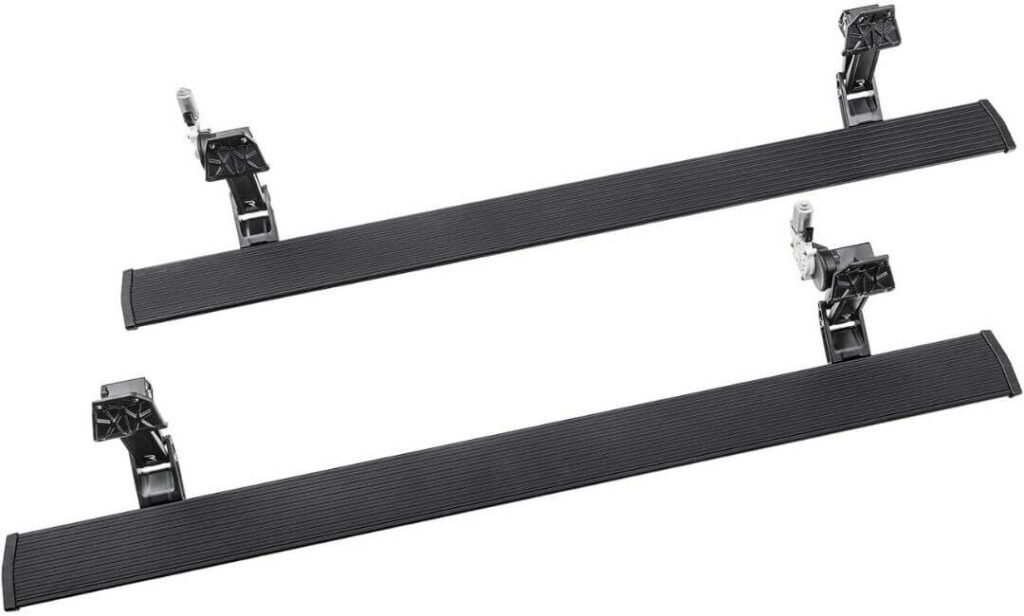
Quick Specs:
- Fitment: 2018–2026 Jeep Wrangler JL 4-Door
- Supported models: Includes 4xe and Rubicon 392
- Step width: 6 inches
- Load capacity: 600 lbs per side
- Construction: Aluminum with stainless-steel pivot pins
- Operation: Automatic deploy and retract
- Lighting: Integrated LED step lights
- Safety: Anti-pinch protection
- Step surface: Textured, slip-resistant finish
- Overall dimensions: 73 × 11.5 × 10.5 inches
- Product weight: 41.9 lbs
- Warranty: 5 years / 60,000 miles
- Amazon selection: If the listing shows multiple body-style variants, select the 2-Door or 4-Door option carefully; 75132-01A itself is the 4-Door application.
Some power steps try to win you over with a huge feature list. This one takes a quieter approach: open the door and the board comes down; close it and the board gets out of the way. That is exactly what a retractable step should do on a Wrangler. The 6-inch-wide aluminum platform gives your foot a proper landing area rather than making entry feel like balancing on a narrow tube, while the textured surface is a useful detail when the Jeep is wet, muddy, or simply being used like a Jeep.
The mechanical side is where this setup earns its reputation. Stainless-steel pivot pins support the folding mechanism, while the board is rated for 600 pounds per side. That does not mean the Jeep suddenly becomes a loading platform, of course; it means the step has been designed around the kind of repeated passenger use a proper powered running board should handle. The integrated LED lighting is also genuinely useful rather than decorative—when the step deploys after dark, the area where your foot is supposed to land is easier to see.
There is another detail worth paying attention to: anti-pinch protection. With an electrically moving component sitting beside your doors, safety should not be treated as an optional extra. Add the automatic operation, slip-resistant surface, aluminum construction, vehicle-specific hardware, and a 5-year/60,000-mile warranty, and the package makes sense for someone who wants a premium step that becomes almost invisible when it is not needed.
What We Like
- 6-inch stepping surface feels like a real step instead of a token foothold.
- Automatic deployment and retraction keeps the rocker area clean when the doors are closed.
- 600-lb-per-side capacity gives the board plenty of margin for normal passenger use.
- LED lighting and anti-pinch protection add genuine everyday usefulness.
- 5-year/60,000-mile warranty gives this expensive accessory a meaningful ownership safety net.
What We Don’t
- The main limitation is simple: this exact 75132-01A part is for the 4-Door JL, so a 2-Door owner needs the correct AMP application rather than ordering this part number by mistake.
Jeep Wrangler JL Fitment
This is a 2018–2026 Jeep Wrangler JL 4-Door application, with fitment covering supported 4xe and Rubicon 392 models as well. The important thing is to match the body configuration first; trim name alone is not enough to identify the correct running-board application.
For shoppers using Amazon, pay attention to the body-style selector and the part number shown for the selected variant. If the page presents both 2-Door and 4-Door choices, do not assume that selecting the 2-Door simply changes 75132-01A into a 2-Door-compatible board. The supplied part number remains a 4-Door JL fitment.
The Insider Pro-Tip
The smartest reason to choose this style of step is not the LED lighting or even the 600-lb rating—it is the fact that the board does its job only when you need it. A fixed step is always exposed; a retractable one gives the Wrangler a much cleaner rocker area and restores clearance when the doors are shut. That difference becomes much more noticeable once the Jeep is being driven off pavement.
One small ownership habit is worth keeping in mind: treat the mechanism like a moving suspension component, not like a piece of trim. Mud, road salt, ice, and debris eventually find their way underneath any powered step. Keeping the pivot area clean and following the manufacturer’s maintenance guidance can go a long way toward preserving the smooth deployment that makes this type of running board worth buying in the first place.
#2. Rough Country Power Running Boards
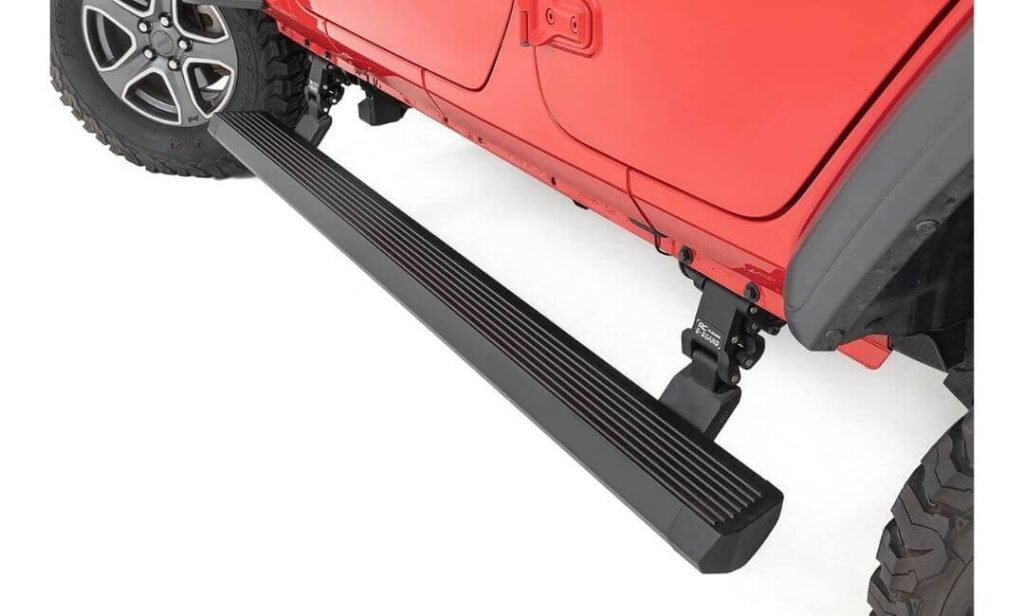
Quick Specs:
- Fitment: 2018–2026 Jeep Wrangler JL 4-Door
- Step design: 4.75-inch-wide retractable aluminum boards
- Drive system: Dual independent motors
- Load rating: 660 lbs per side
- Drop: 10.75 inches from door entry / 3.6 inches below rocker
- Lighting: Integrated LED step lights
- Safety: SAFE-STOP obstruction protection
- Control: Interior manual bypass switch
- Sensors: Magnetic door triggers
- Finish: Powder-coated black
- Installation: Bolt-on, no drilling through factory mounting points
- Weight: 33 lbs
- Warranty: 5 years
- Important: This specific listing is 4-Door only; Rough Country also offers a separate 2-Door application, so select the correct body-style variant on Amazon.
A dual-motor running board sounds like a specification until the Jeep is actually being used in mud, winter weather, or with a lift. That is where this design starts to make more sense. Each side has its own motor, the aluminum board drops when the door opens, and then tucks back underneath the rocker when the door closes. The result is a proper step when needed without leaving a permanent bar hanging down when the Wrangler is moving over rough ground.
The 660-pound-per-side rating is one of the stronger numbers in this group, but the more useful detail is the actual stepping position. The board drops 10.75 inches from the door entry, giving lifted Wranglers a noticeably easier first step. Its textured surface adds the grip you want when shoes are wet or covered in trail dirt, while the integrated LEDs light the board automatically during use and disappear with it when retracted.
Then there is the part that matters when something inevitably gets in the way. SAFE-STOP protection is designed to stop the board when an obstruction is detected, while the interior bypass switch gives you a manual way to control the system. Installation uses the Wrangler’s factory mounting points without drilling, although existing Mopar/Rubicon rock rails cannot share those mounting locations, and certain tire-deflector or long-arm configurations need extra attention before installation.
What Stands Out
- Dual independent motors give the system a serious mechanical advantage over basic single-motor designs.
- 660 lbs per side makes this one of the more substantial options for frequent passenger use.
- The 10.75-inch drop is especially useful on lifted Wranglers where the factory step-in height becomes noticeable.
- SAFE-STOP + manual bypass gives the electronics a useful safety fallback rather than leaving everything dependent on automatic operation.
- No-drill factory-point installation keeps the mounting approach cleaner than products requiring custom fabrication.
One Thing to Know Before Ordering
The installation is not necessarily a quick afternoon job. The wiring and sensor setup take most of the effort, and factory rock rails need to come off because they use the same mounting area. That is not a reason to avoid the boards—it is simply the kind of detail worth knowing before the boxes arrive.
JL Body-Style & Installation Check
This particular Rough Country listing is for the 2018–2026 Jeep Wrangler JL 4-Door. The product information also identifies a separate 2-Door application, so Amazon’s selector should be treated as an important part of the purchase process: choose the body style first, then confirm the displayed part/variant matches your Wrangler.
Before installation, check for factory rock rails, Mopar tire-deflector brackets, and long-arm suspension hardware. Most buyers will be dealing with a straightforward bolt-on installation, but those configurations can change the amount of work required. The supplied 5-year warranty is another worthwhile point for an electronic accessory that will spend its life underneath the Jeep.
The Insider Pro-Tip
The strongest reason to consider this one is not simply “dual motor.” It is the combination of dual motors + a deep drop + 660-lb-per-side capacity + automatic retraction. That combination makes much more sense for a Wrangler that sits higher than stock. If getting into the Jeep feels like climbing into it every morning, the extra drop is something you will notice on the first day—not just something that looks good on a specification sheet.
And one practical buying decision can save a lot of frustration: check your rocker area before ordering. If the Wrangler already has factory rock rails or one of the listed bracket configurations, knowing that beforehand is far better than discovering the conflict halfway through installation. For a clean JL build without those conflicts, this is a particularly strong value-oriented power-step package.
#3. SoFlo Premium Power Steps
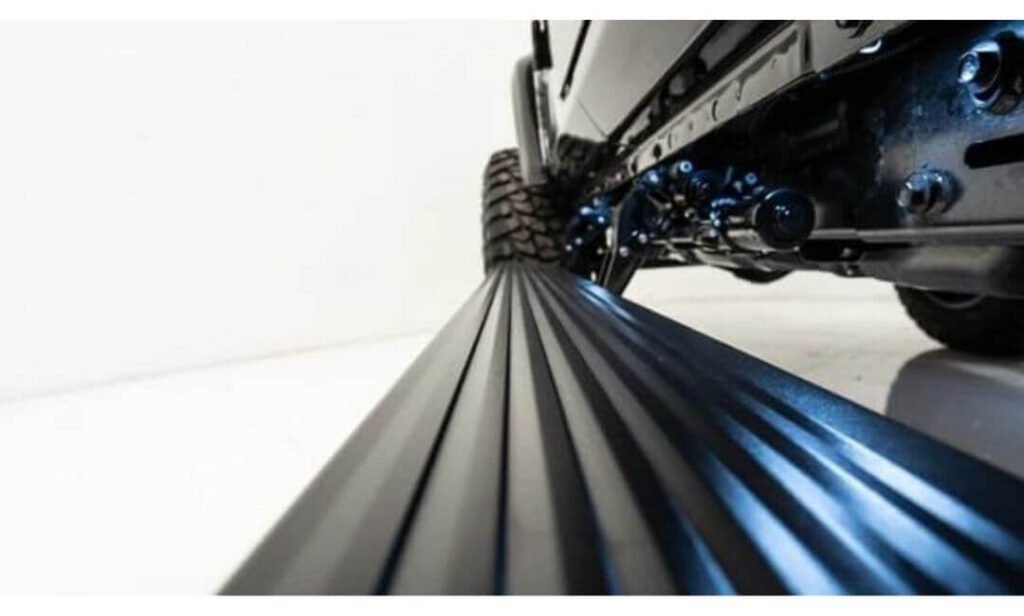
Quick Specs:
- Fitment: 2018–2026 Jeep Wrangler JL 4-Door
- Construction: Aircraft-grade aluminum
- Operation: Automatic deploy/retract
- Activation: Smart door sensors
- Support: 3 brackets per side
- Step surface: Non-slip finish
- Design: Low-profile, retractable
- Installation: Bolt-on using factory mounting points
- Drilling: Not required
- Finish: Black
- Included: 2 power steps, 6 support brackets, hardware and installation instructions
- Fit type: Vehicle-specific
- Warranty: Manufacturer’s stated coverage should be confirmed before purchase
There is a useful difference between a power step that simply moves and one that feels like it was designed around the Wrangler’s underside. This one takes the latter approach with three support brackets on each side, rather than relying on the two-bracket arrangement commonly seen on competing boards. That extra support is not a headline feature to chase blindly, but on a component that repeatedly carries passenger weight and moves every time a door opens, it is a detail worth noticing.
The material choice is another reason this model earned a place in the lineup. Aircraft-grade aluminum keeps the boards relatively light while giving them the corrosion resistance that matters underneath an SUV regularly exposed to rain, mud, road grime, and off-road conditions. When the doors open, the smart sensors trigger the boards automatically; close the doors and the steps retract into a low-profile position, keeping the Wrangler’s side profile much cleaner than a permanently exposed step.
The installation approach also makes sense for a Wrangler owner who does not want to start drilling into the vehicle. The system uses factory mounting points, with no drilling required, and the vehicle-specific design is intended to give the finished installation a more OEM-like appearance. The non-slip surface is another small but important touch—because a running board is only useful if the foot lands securely when the Jeep is wet, dirty, or being used after a trail run.
What We Like
- Three support brackets per side give the structure a reassuringly supported mounting arrangement.
- Aircraft-grade aluminum is a sensible material choice for an exposed underbody component.
- Smart automatic sensors remove the need to think about deploying the board manually.
- Low-profile retraction preserves more of the Wrangler’s original rugged appearance.
- Bolt-on, no-drill installation keeps the installation approach clean and vehicle-specific.
One Honest Consideration
This is a newer product, so there simply is not the same amount of long-term ownership history available as with an established PowerStep design. That does not make the construction questionable; it means durability over several years is something the growing customer base will ultimately establish.
Wrangler JL Fitment
The supplied application is specifically for the 2018–2026 Jeep Wrangler JL 4-Door. Fitment is vehicle-specific, and the product should not be treated as a universal Wrangler step or assumed to work on the JL 2-Door.
For a 4-Door JL, the combination of factory-point mounting and three brackets per side makes the installation concept particularly appealing. Before buying, however, match the listing against the exact Wrangler body style and check the seller’s current fitment information for your trim and configuration.
The Insider Pro-Tip
The three-bracket-per-side layout is the detail worth remembering here. A retractable board moves constantly, but the mounting hardware does not get to take a day off. More support points do not automatically prove better long-term durability, but they do show that the design is paying attention to how the board is held against the vehicle—not just how it looks when deployed.
And because this is a newer option, the sensible way to buy it is to judge what is actually in front of you: aircraft-grade aluminum, automatic door sensing, three support brackets per side, factory-point installation, and a low-profile retracting design are tangible advantages. The only thing that cannot honestly be claimed yet is a decade of ownership history. That distinction is exactly why this one sits behind the more established choices while still being a very interesting option for a Wrangler owner who wants a newer design.
#4. Tuxtreme Power Running Boards
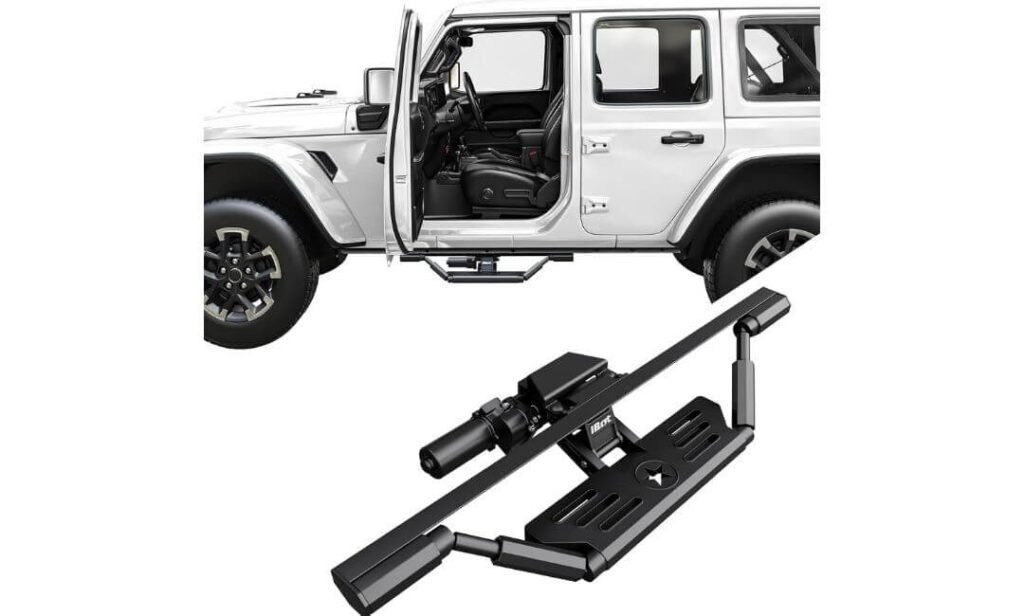
Quick Specs:
- Fitment: 2018–2026 Jeep Wrangler JL 4-Door
- 4xe compatibility: 2021–2026 JL 4xe
- Construction: Stainless steel
- Finish: Matte-black powder coating
- Operation: Independent electric deploy/retract
- Control: Smart controller with automatic stop
- Step surface: Slotted pad with raised traction ridges
- Unit dimensions: 36 × 13 × 5 inches
- Unit weight: 28.47 lbs
- Installation: Vehicle-specific mounting kit
- Warranty: 3 years
- Important: Factory side steps or rock rails must be removed
- Package detail: This listing represents one individual step unit, not automatically a complete four-door set
Most powered running boards are sold as a complete setup and assume every Wrangler owner wants the same thing on every door. This one takes a rather different route: each door can have its own independently powered step. That makes the product unusually flexible for a JL owner who wants to build the setup around actual usage rather than automatically buying a full-length system.
The mechanism extends when the door opens and folds back when it closes, while the smart controller automatically stops movement when an obstruction is detected. Underneath, the stainless-steel construction gets a multi-layer anti-corrosion treatment, and the matte-black powder-coated finish keeps the hardware looking appropriately at home on a Wrangler rather than like an aftermarket accessory bolted on as an afterthought.
Then there is the stepping surface, which is one of the better practical details here. The slotted pad and raised traction ridges give the shoe something to bite into while allowing mud and snow to drain through instead of sitting on a completely flat platform. For a Jeep that actually sees dirt, rain, or winter conditions, that is a more useful feature than another line of marketing text about “rugged” construction.
What We Like
- Independent door-by-door operation gives this design flexibility that most conventional power-step kits do not.
- Stainless-steel construction with multi-layer corrosion protection suits an underbody component exposed to the elements.
- Raised traction ridges and drainage slots are genuinely useful when the step gets muddy or wet.
- Automatic stop protection adds an important safety layer to the powered mechanism.
- 3-year warranty gives buyers reasonable coverage for a newer electronic product.
One Detail Worth Knowing
The biggest thing to understand is the package format. This listing is for an individual unit, so buyers should carefully check whether they are selecting the driver/passenger or required door configuration and how many units are needed. It is easy to see a product photo showing a complete Wrangler and assume the entire system is included.
Wrangler JL Fitment & Installation
This application is for the 2018–2026 Jeep Wrangler JL 4-Door, including supported 2021–2026 4xe models. It does not apply to the JL 2-Door or the older JK generation, so body style and generation should be confirmed before ordering.
Installation also has one important prerequisite: factory side steps or rock rails need to be removed. That is worth checking before buying because those components occupy the mounting area. The product uses vehicle-specific hardware rather than requiring a custom fabricated mounting solution, but existing rocker accessories can turn a straightforward installation into a more involved one.
The Insider Pro-Tip
The real appeal here is not trying to beat a premium full-length system at its own game. It is the modular idea. If the doors on your Wrangler are not used equally, being able to configure the powered steps around actual door usage can make more sense than paying for hardware you rarely use.
There is also a useful reality check for this particular product: it is a newer design with limited long-term ownership history. That does not cancel out the stainless-steel construction, smart controller, drainage-focused step surface, or independent operation. It simply means the honest buying decision is to appreciate what the hardware offers today while leaving room for real-world reliability data to build over time.
#5. Tempsnow Power Running Boards
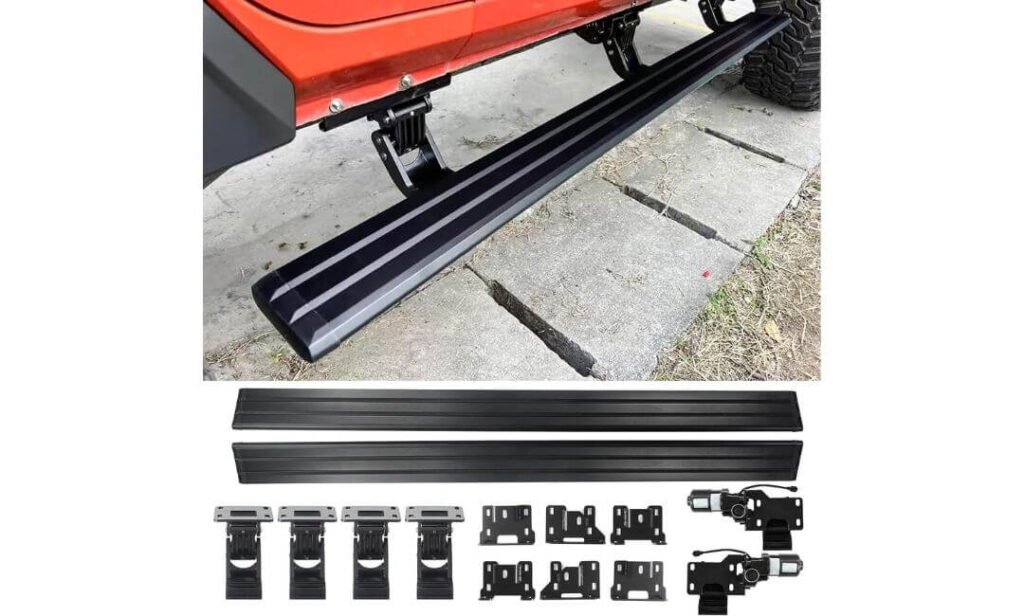
Quick Specs:
- Fitment: 2018–2026 Jeep Wrangler JL 4-Door
- Construction: Aluminum alloy
- Drive system: Dual motors
- Load capacity: 660 lbs per side
- Operation: Automatic retractable deployment
- Protection: Retracted board helps cover the rocker area
- Finish: Black
- Product weight: 75.2 lbs
- Fit type: Vehicle-specific
- Installation: Professional installation recommended
- Return/replacement period: 90 days
- Important: 4-Door JL only
There is nothing complicated about what this setup is trying to accomplish: give the JL a substantial powered step without leaving it permanently exposed underneath the Jeep. The aluminum-alloy construction is built around a 660-pound-per-side capacity, while the dual-motor mechanism handles deployment and retraction when the doors are used. Once closed, the boards tuck back toward the rocker area instead of remaining as a fixed obstacle below the vehicle.
That retracting movement has another practical benefit beyond appearance. When the board is tucked away, it can help shield the rocker panel from impacts and trail debris, which is particularly relevant on a Wrangler that spends time away from paved roads. The black finish also keeps the installation visually understated rather than making the side of the Jeep look overloaded with aftermarket hardware.
One detail worth being realistic about is installation. The seller recommends professional installation and provides instructions on request, and some customer feedback points to wiring and instruction illustrations requiring extra patience. That does not change the underlying appeal of the dual-motor, 660-pound-per-side design, but it does mean this is a product where allowing enough installation time—or having someone experienced handle the wiring—is the sensible approach.
What We Like
- 660-lb-per-side capacity gives the aluminum boards a genuinely heavy-duty specification.
- Dual-motor operation provides powered deployment and retraction rather than a basic manual step.
- Retracted position helps protect the rocker area, which suits the Wrangler’s off-road character.
- Aluminum-alloy construction keeps the product durable while avoiding a purely steel-heavy design.
- Vehicle-specific construction means the system is designed around the JL rather than being a universal running board.
One Thing to Keep in Mind
The installation documentation could be clearer, particularly around wiring. A professional installer or someone comfortable working with vehicle electronics can make the process much easier.
Jeep Wrangler JL Fitment
The supplied fitment covers 2018–2026 Jeep Wrangler JL 4-Door models. It is not a 2-Door application, so the body style needs to be confirmed before purchase rather than relying only on the Wrangler model name.
The product is also vehicle-specific, and the seller recommends professional installation. Before starting, have the complete mounting hardware and installation instructions available, and allow time for the electrical setup and initial operation check. That small amount of preparation can save a lot of unnecessary back-and-forth during installation.
The Insider Pro-Tip
The strongest argument for this option is its simple hardware-to-price logic: dual motors, aluminum-alloy construction, a 660-lb-per-side rating, and retractable rocker protection cover the fundamentals that actually matter. It does not need a dozen flashy features to make the concept work.
The honest trade-off is the short 90-day return/replacement window and limited long-term history compared with a more established power-step brand. For a buyer comfortable with that trade-off, the hardware specifications make it a reasonable lower-positioned alternative; for someone who wants the longest-established track record possible, the higher-ranked options remain the safer bet.
Best Jeep Wrangler Power Running Boards (2018–2026): Specs, Fitment & Features Compared
| Power Running Board | JL Fitment | Step & Build | Power System | Useful Features | Installation Reality | Warranty / Support | Best For |
|---|---|---|---|---|---|---|---|
|
AMP Research PowerStep 75132-01A
Established premium design
BEST OVERALL
|
2018–2026 JL 4-Door Includes supported 4xe and Rubicon 392 applications. 2-Door: Not for this part number |
6-inch wide aluminum step Stainless-steel pivot pins Textured slip-resistant surface 41.9 lbs |
Automatic deploy/retract Vehicle-triggered operation 600 lbs per side |
Integrated LED lighting Anti-pinch protection Retracts away from rocker area Full cab-length stepping surface |
Vehicle-specific hardware Professional-quality driveway installation possible Wiring/setup requires attention |
5 years / 60,000 miles Comprehensive limited warranty |
The strongest choice when **proven design, refined operation and long-term confidence** matter more than saving a few dollars. |
|
Rough Country Power Running Boards
Feature-heavy alternative
BEST VALUE
|
2018–2026 JL Dedicated body-style variants are available. 4-Door listing: 4-Door JL 2-Door: separate application |
4.75-inch aluminum step Textured anti-slip surface Powder-coated finish 33 lbs |
Dual independent motors Automatic deployment 660 lbs per side |
Integrated LED lights Magnetic door triggers SAFE-STOP protection Interior bypass switch |
Bolt-on factory mounting points No drilling required Rock rails may need removal Certain long-arm setups need checking |
5-year limited warranty | A particularly convincing pick when **dual motors, strong load capacity and a feature-rich setup** are high on the shopping list. |
|
SoFlo Premium Power Steps
Newer premium-spec option
PREMIUM ALTERNATIVE
|
2018–2026 JL 4-Door Vehicle-specific application 2-Door: Not compatible |
Aircraft-grade aluminum Low-profile retracting design Non-slip stepping surface |
Automatic deploy/retract Smart door sensors |
3 support brackets per side Low-profile appearance Automatic door activation |
Bolt-on installation Factory mounting points No drilling required |
Manufacturer coverage Confirm current warranty terms before purchase |
Interesting for buyers who want **aircraft-grade aluminum, extra mounting support and a newer OEM-style approach**. |
|
Tuxtreme Power Running Boards
Modular door-by-door design
MODULAR PICK
|
2018–2026 JL 4-Door Includes supported 2021–2026 4xe models. 2-Door / JK: Not compatible |
Stainless steel Slotted traction pad Raised grip ridges 28.47 lbs per unit |
Independent electric steps Automatic extend/retract Smart controller |
Door-by-door modular setup Auto-stop protection Multi-layer corrosion coating Mud/snow drainage |
Vehicle-specific hardware Factory side steps / rock rails must be removed Individual-unit configuration |
3-year warranty | Best suited to someone who values **modular installation flexibility and corrosion-focused construction** over a conventional full-kit approach. |
|
Tempsnow Power Running Boards
Straightforward dual-motor setup
BUDGET OPTION
|
2018–2026 JL 4-Door Vehicle-specific fit 2-Door: Not compatible |
Aluminum alloy Retractable board Black finish 75.2 lbs listed product weight |
Dual-motor system Automatic retractable operation 660 lbs per side |
Rocker-panel shielding when retracted Clean low-profile appearance Heavy-duty load rating |
Professional installation recommended Installation instructions available from seller Wiring may require extra patience |
90-day return/replacement | A sensible lower-cost route for buyers who mainly want **dual-motor power operation and a high stated load capacity** without chasing a long feature list. |
Buying Guide — How to Choose the Right Power Running Boards for Your Jeep Wrangler
A good power running board is not simply the one with the longest feature list. With the Wrangler, generation, body style, rocker configuration, step height, electrical setup, and installation requirements can change whether a product is genuinely suitable. Start with fitment, then compare the mechanism and construction, and only after that worry about extras such as LEDs.
Start With the Wrangler Generation and Body Style
The products in this guide are built around the 2018–2026 Jeep Wrangler JL, but that does not make every JL running board interchangeable. Older Wrangler generations, particularly the JK, should be treated separately unless the manufacturer explicitly lists compatibility.
Body style is equally important. A 2-Door JL and 4-Door JL have different dimensions and mounting requirements, so never assume a 4-Door board will work simply because the vehicle is also a Wrangler JL. The AMP 75132-01A and the specific Rough Country 4-Door listing covered here are 4-Door applications, while Rough Country also has a separate 2-Door application. Always match the exact variant or part number to the Wrangler sitting in your driveway.
Jeep Wrangler vs. Jeep Wrangler JL Fitment
“Jeep Wrangler” is the broad vehicle name; JL is the generation that matters for this particular buying decision. A marketplace title may say “Jeep Wrangler” prominently while the actual fitment is limited to a specific generation, body style, or model year.
Before ordering, verify generation, model year, 2-Door/4-Door configuration, and any special model such as 4xe or Rubicon 392. This is especially important with Amazon listings that combine several configurations on one product page. The selected variant should show the correct body style and application rather than relying on the headline alone.
Automatic Power Steps vs. Manual Running Boards
Automatic running boards earn their place by solving two problems at once: accessibility and clearance. The board drops when the door opens, giving you a lower stepping point, then retracts when the door closes so the Jeep does not carry a large fixed step underneath it all the time.
A manual step is simpler and usually has fewer moving parts, but it remains exposed whether you need it or not. A powered board is more convenient, particularly on a lifted Wrangler, but introduces motors, sensors, wiring, controllers, and moving pivots. That means the quality of the mechanism and the support behind it matter more than they would with a basic fixed nerf bar.
Retractable Running Boards vs. Fixed Steps
For a Wrangler that sees trails, a retractable design has a very practical advantage: the step gets out of the way when it is not being used. That can improve underbody clearance and reduce the chance of a permanently exposed board becoming the first thing to contact an obstacle.
Fixed running boards still make sense for buyers who want maximum simplicity. There is less mechanical complexity and no electrical system to operate the step. But if the goal is easier entry without permanently changing the Wrangler’s side profile, a retractable power board is the more natural fit.
Look Beyond the Material Name
“Aluminum” or “stainless steel” alone does not tell the whole story. What matters is how the material is used, how the board is supported, how the surface handles wet footwear, and how the mechanism deals with repeated movement.
The AMP uses an aluminum step with stainless-steel pivot pins, while SoFlo uses aircraft-grade aluminum and three support brackets per side. Tuxtreme takes a different route with stainless-steel construction, corrosion protection, and a slotted traction surface. These differences are more meaningful than simply choosing whichever product claims to be “heavy duty.”
For off-road use, also look at the retracted position and rocker clearance. A board that disappears tightly underneath the Wrangler when the doors close is generally more useful on trails than one that remains hanging low.
Weight Capacity Needs Some Context
A high load rating is reassuring, but it should not be treated as a competition where the largest number automatically wins. The figures in this lineup reach 600 to 660 pounds per side, depending on the product.
What matters is whether the board, brackets, pivot system, and mounting points are designed to handle repeated passenger loading. A 660-pound rating is useful information, but it does not mean the step should be treated as a platform for loading equipment or supporting unusual loads. Think of the rating as a measure of structural capacity for normal step use, not an invitation to exceed the manufacturer’s intended application.
LED Lighting Is Useful, But It Is Not the Main Reason to Buy
Integrated LEDs can be genuinely helpful on a Wrangler that is regularly entered at night. Lighting the actual stepping area makes it easier to see where your foot is going, particularly when the vehicle is lifted or parked somewhere without street lighting.
Still, LED lights should come after the fundamentals. The board needs to deploy reliably, retract completely, provide secure footing, and remain properly supported. There is little value in impressive lighting if the underlying power-step system is not suited to the vehicle.
Check the Electrical and Control System
Powered running boards depend on more than a motor. The system may use door sensors, magnetic triggers, controllers, wiring harnesses, safety-stop logic, and manual overrides, depending on the model.
AMP uses automatic door operation with anti-pinch protection, while Rough Country adds magnetic door triggers, SAFE-STOP protection, and an interior bypass switch. Tuxtreme uses a smart controller with automatic stop behavior, and SoFlo relies on smart door sensors.
This is where a little patience before installation pays off. Make sure the wiring route is appropriate for the Wrangler, understand where the sensors are positioned, and know how the system behaves if a step encounters an obstruction. A manual bypass or override can also be useful when troubleshooting or when you deliberately want the boards to remain in a particular position.
Installation Can Be More Important Than the Product Photos
Most of these systems are designed around vehicle-specific mounting points, and some advertise bolt-on or no-drill installation. That is good news, but it does not necessarily mean the installation is effortless.
Before buying, check whether your Wrangler already has factory rock rails, side steps, tire-deflector brackets, long-arm suspension components, or other aftermarket hardware around the rocker area. Rough Country, for example, requires attention to factory rock rails and certain long-arm or bracket configurations, while Tuxtreme specifically notes that factory side steps or rock rails need to be removed.
Also remember that the mechanical installation is only half the job. Wiring and sensor placement can take more time than bolting the boards onto the Jeep. If the manufacturer recommends professional installation, take that recommendation seriously, particularly if the instructions are limited or the electrical system is unfamiliar.
Warranty Is a Reliability Signal, Not Just a Number
A power running board has motors and electronics underneath a vehicle, so warranty coverage deserves more attention than it would on a simple fixed step.
AMP’s 5-year/60,000-mile warranty is a significant advantage for buyers prioritizing established support. Rough Country also provides a 5-year limited warranty. Tuxtreme lists a 3-year warranty, while the Tempsnow listing provides a 90-day return/replacement period. SoFlo’s current manufacturer coverage should be confirmed before purchase.
The difference is important because newer marketplace products can have attractive specifications without having years of ownership history behind them. A longer warranty does not guarantee trouble-free operation, but it does give the buyer more protection if the powered mechanism develops a problem later.
A Simple Pre-Order Checklist
Before clicking Buy, confirm these points:
- Generation: Is the Wrangler a JL, rather than an older JK?
- Body style: Is it a 2-Door or 4-Door, and does the selected variant match?
- Year: Does the exact model year appear in the manufacturer’s fitment?
- Special model: If it is a 4xe or Rubicon 392, is that application explicitly supported?
- Rocker hardware: Are factory rock rails, side steps, or aftermarket brackets already installed?
- Step design: Does the deployed height and width actually suit how the Jeep is used?
- Power system: How are the doors, sensors, motors, and controller connected?
- Safety: Does the system provide obstruction detection, anti-pinch, or an override?
- Construction: Is the material and mounting arrangement appropriate for the vehicle’s use?
- Warranty: Who covers the product, for how long, and what happens if the motor or electronics fail?
- Package contents: Are you receiving a complete pair/set, or does the listing sell individual units?
The final check is the one most likely to prevent a frustrating purchase: match the exact Amazon variant, body style, and part number before ordering. A running board can have excellent construction and still be the wrong product if the Wrangler configuration does not match.
Installation Overview — What to Know Before Fitting Power Running Boards
A powered running board is not difficult because the boards themselves are complicated; the work usually comes from getting the mounting points, wiring, sensors, and clearances right. The exact procedure varies by product, but the cleanest installations follow the same basic order: remove anything occupying the rocker mounting area, test-fit the brackets, mount the boards, route the wiring safely, connect the control system, and then test every door before putting the tools away.
1. Clear the Existing Rocker Area First
If the Wrangler already has factory side steps, rock rails, or aftermarket running boards, remove them before positioning the new brackets. Do not assume the existing hardware can remain simply because the new boards appear to sit in a different position.
This is particularly important on configurations where rock rails share or interfere with the mounting area. Also inspect for tire-deflector brackets, suspension components, skid plates, or other aftermarket hardware around the rocker panel. Finding interference before the new boards are installed is considerably easier than discovering it after the wiring has already been routed.
2. Test-Fit the Brackets Before Tightening Anything
Start with the vehicle-specific brackets and factory mounting points, but leave the hardware slightly loose during the initial positioning. This gives enough adjustment to get the board sitting evenly from front to rear.
Check the board from several angles before final tightening. It should sit consistently along the rocker, have adequate clearance from the body, and have enough room to deploy without contacting the door, fender, pinch seam, or other components.
Do not judge alignment only with the doors closed. Open every applicable door and watch the complete movement of the board. A step can look perfectly positioned when retracted and still have an interference problem during deployment.
3. Pay Attention to 2-Door vs. 4-Door Layouts
The installation is not simply a matter of cutting a longer or shorter board to fit. 2-Door and 4-Door JL models have different mounting locations and body dimensions, so the correct vehicle-specific hardware is important.
Use the brackets and mounting instructions supplied for the exact body style. If a listing offers multiple configurations, confirm the selected variant before beginning the installation. The wrong body-style hardware can create alignment and wiring problems that have nothing to do with the quality of the running board itself.
4. Mount the Boards Before Doing the Final Electrical Work
Once the brackets are positioned correctly, mount the boards and check their movement manually where the design permits. Make sure there is no obvious contact with the rocker, doors, tires, suspension components, or exhaust-related hardware.
Then tighten the mounting hardware according to the manufacturer’s specified torque values. Do not guess torque specifications or substitute a generic value simply because the bolt appears similar. The mounting hardware is carrying repeated passenger loads while the mechanism moves, so proper tightening is part of the installation rather than a finishing detail.
5. Route the Wiring Like It Will Stay There for Years
This is where a clean installation separates itself from a rushed one.
Keep the wiring away from exhaust heat, sharp edges, suspension travel, tire contact, and moving components. Follow the vehicle’s existing wiring paths where practical, secure the harness at regular intervals, and leave enough controlled slack near moving areas without allowing loose loops to hang below the vehicle.
Avoid placing connectors where water, mud, or road spray can collect unnecessarily. Any connection that is exposed underneath the Wrangler deserves proper protection and secure fastening. The goal is not merely to make the wiring work today; it is to prevent vibration and weather from turning a good installation into an intermittent electrical problem months later.
6. Treat Fuse Protection as Part of the Installation
Use the fuse, fuse holder, power connection, and wiring size specified by the manufacturer. Do not replace the recommended fuse with a higher-rated one simply because the original keeps blowing.
A repeatedly blown fuse is usually telling you that something needs attention—such as a wiring fault, overloaded circuit, damaged harness, incorrect connection, or mechanical resistance in the step. The correct response is to find the cause rather than increasing fuse capacity.
7. Keep Door Sensors and Controllers Properly Positioned
Automatic boards depend on knowing when a door has opened or closed. Depending on the design, that can involve magnetic triggers, door sensors, or a vehicle-specific control system.
Sensor placement matters. If a magnetic trigger is positioned too far away, misaligned, or mounted where vibration can move it, the board may behave inconsistently. Secure the sensor hardware firmly and follow the manufacturer’s specified positioning rather than choosing a convenient location that merely looks tidy.
If the system includes a manual bypass or override, understand how it works before finishing the installation. It can be extremely useful during troubleshooting or when you need to keep the boards from cycling while working around the vehicle.
8. Test Before Calling the Job Finished
Do not close the garage door after the first successful deployment.
Test every door several times, preferably with the engine running if the manufacturer’s procedure requires it. Watch the board as it extends and retracts, listen for unusual sounds, and check that both ends move evenly.
Then check the step with the doors closed, inspect the wiring underneath, and turn the steering through its normal range while checking for possible tire or suspension interference. If the Jeep has a lift, larger tires, or aftermarket suspension, give the system additional clearance checks.
Common Installation Problems to Avoid
- Leaving factory rock rails installed when they occupy the same mounting area.
- Routing wiring too close to the exhaust or moving suspension components.
- Allowing harnesses to hang where a tire, rock, or trail debris can catch them.
- Mounting sensors without checking their exact alignment and operating distance.
- Tightening brackets before the board has been properly aligned.
- Assuming the 2-Door and 4-Door installation hardware is interchangeable.
- Skipping the final door-by-door deployment test.
- Increasing fuse size instead of investigating an electrical fault.
- Forgetting to check clearance on lifted Jeeps or vehicles with larger tires.
- Starting the installation without confirming the complete hardware and wiring kit is present.
The Clean-Install Rule
The best installation is usually the one that becomes almost invisible afterward. No loose wiring, no crooked boards, no sensor hanging in an exposed location, and no contact during deployment should be noticeable when the Jeep is finished.
If the supplied instructions conflict with a generic installation video, follow the manufacturer’s instructions for the exact product and vehicle configuration. Power running boards can look very similar from one brand to another while using different brackets, sensors, and wiring arrangements. Taking a little extra time during the fitting stage is far cheaper than correcting a rubbing board or damaged harness later.
Maintenance Guide — Keep Your Wrangler Power Running Boards Working Smoothly
A powered running board lives in a much harsher environment than most accessories. It sits underneath the Wrangler, repeatedly moves through dust, mud, rain, road salt, and winter grime, and its motors, pivots, sensors, and wiring have to keep working every time a door opens. A few sensible maintenance habits can therefore matter more than any extra feature on the product page.
Keep the Step Mechanism Clean
The first habit is simple: do not let mud build up around the moving mechanism.
After off-road driving, inspect the underside of the boards, pivot areas, brackets, and the spaces around the rocker panel. A normal rinse can remove loose dirt, but heavy mud should not be allowed to dry around moving components.
Avoid directing extremely high-pressure water directly into motors, electrical connectors, sensors, or sealed mechanical joints from very close range. Washing the Jeep is fine; forcing water into electrical components is not.
Pay Attention to the Pivots and Moving Joints
A retractable board depends on smooth movement. If deployment becomes slower, noisy, uneven, or hesitant, do not simply assume the motor is failing.
First look for mud, stones, ice, corrosion, or other physical obstruction around the pivots and brackets. Some systems may also require lubrication at specified points, while others use sealed components that should not be lubricated indiscriminately.
The safest approach is to use only the lubricant and maintenance procedure specified by the manufacturer. A random spray product can attract dirt or affect seals, bushings, and electrical components.
Check the Step Surface
The stepping surface is where dirt accumulates fastest because shoes bring it directly onto the board.
Inspect the traction surface and drainage slots periodically. If mud fills the grooves or slots, clean them so water and debris can escape normally. This is especially useful on designs with raised traction ridges or perforated/slotted surfaces.
There is no advantage in making the surface unnecessarily shiny. What matters is keeping the anti-slip texture open and usable, particularly before driving in wet weather.
Inspect the Brackets and Fasteners
Every few months, or after particularly rough off-road use, take a quick look underneath the Jeep.
Check for:
- Loose mounting bolts
- Movement around bracket attachment points
- Bent or damaged brackets
- Scrapes that expose bare metal
- Corrosion around fasteners
- Anything touching the board during deployment
This is particularly worthwhile after trail driving because a rock strike can move a bracket even when the damage is not immediately obvious.
Do not simply tighten every bolt you can reach. If a fastener repeatedly loosens, there may be an alignment, vibration, or hardware issue that needs to be addressed properly.
Protect the Electrical Connections
Water resistance does not mean an electrical connection should be treated casually.
Inspect exposed connectors, harness clips, sensor wiring, and ground connections for damage or looseness. The wiring should remain secured away from exhaust heat, suspension movement, sharp edges, and tire contact.
If a step begins behaving intermittently—working on one door but not another, stopping unexpectedly, or failing to retract—check the wiring and sensor connections before assuming the motor is finished.
Keep the Door Sensors Aligned
Automatic deployment depends on the system correctly detecting door operation. If the board suddenly stops responding consistently, inspect the door sensor or magnetic trigger position before doing anything more complicated.
A sensor that has shifted, loosened, or become contaminated can create symptoms that look like a motor or controller problem. Secure mounting is therefore important, particularly on a Wrangler that regularly experiences vibration and rough terrain.
Winter Deserves Extra Attention
Cold weather can expose problems that remain invisible during warmer months.
Ice, packed snow, and road salt can accumulate around the board and its moving mechanism. Never force a frozen power step to move by hand unless the manufacturer specifically permits it. Remove the obstruction and allow the mechanism to thaw naturally before operating it.
For owners in areas with heavy winter road salt, more frequent rinsing underneath the vehicle is worthwhile. Salt sitting around brackets and fasteners for months is a much bigger concern than an occasional dirty step.
Do Not Ignore New Sounds
A healthy power board should have predictable movement. If it suddenly starts clicking, grinding, scraping, slowing down, or stopping halfway, investigate it early.
A small obstruction is inexpensive to deal with. Continuing to cycle the mechanism while something is binding can place unnecessary strain on the motor, gears, brackets, or electrical system.
The same applies if one side deploys differently from the other. Uneven movement is a reason to inspect the mechanism rather than repeatedly opening and closing the door hoping it corrects itself.
Give the Boards a Quick Check After Trail Use
For a Wrangler that regularly leaves the pavement, a useful routine is to inspect the running boards when the Jeep gets washed after a trail day.
Look underneath, rinse away packed mud, check the mounting brackets, examine the wiring, and make sure both sides still retract completely. This takes far less time than discovering a damaged harness or obstructed mechanism when you need the step to work.
When Professional Service Makes More Sense
Not every problem should be solved in the driveway.
If the board repeatedly blows a fuse, the motor becomes unusually hot, wiring shows damage, the mechanism binds after cleaning, or the controller behaves unpredictably, stop cycling the system and follow the manufacturer’s troubleshooting procedure.
Powered running boards combine mechanical movement with vehicle electrical systems. Guessing at wiring or bypassing safety components can turn a small fault into a much more expensive repair.
A Simple Wrangler Maintenance Routine
After muddy or off-road driving: rinse the boards and inspect for packed debris.
Every few months: check brackets, fasteners, wiring, sensors, and visible corrosion.
Before winter: make sure drainage areas are clear and wiring is securely protected.
When operation changes: investigate unusual noise, slower movement, incomplete retraction, or intermittent sensor response immediately.
The goal is not to constantly work on the running boards. It is the opposite: keep the mechanism clean, keep the wiring secure, catch small problems early, and let the system do its job without unnecessary interference. A good power step should eventually become something you barely think about—and sensible maintenance is how it stays that way.
FAQs About Jeep Wrangler Power Running Boards
Will power running boards fit a 2-Door and 4-Door Jeep Wrangler JL interchangeably?
No, and this is one of those fitment details that is easy to miss when shopping through a marketplace listing. 2-Door and 4-Door JL Wranglers have different mounting layouts and available running-board lengths, so a product designed around the 4-Door should not be treated as a universal JL accessory.
For this lineup, the distinction is especially important. The AMP Research 75132-01A, SoFlo, Tuxtreme, and Tempsnow applications covered here are 4-Door products, while the Rough Country range has separate 2-Door and 4-Door applications. If Amazon shows multiple body-style choices on one page, select the actual 2-Door or 4-Door variant and then verify the part number before checkout. The picture of a complete Wrangler is not enough to establish fitment.
Are retractable running boards actually better for a Jeep Wrangler that goes off-road?
For many Wrangler owners, yes—but not because “retractable” automatically means more rugged. The real advantage is that the board isn’t permanently hanging below the rocker when it is not being used. That can preserve useful clearance and reduce the chance of a fixed step becoming the first point of contact with an obstacle.
There is also a practical trade-off: powered boards introduce motors, pivots, sensors, wiring, and controllers. A fixed step has much less to go wrong. For a daily-driven Wrangler that also sees trails, however, a properly designed retractable system can be a very good compromise:
- Lower step-in height when the door opens
- Cleaner rocker area when it retracts
- Less permanent hardware below the Jeep
- Easier access without giving up the convenience of a powered system
The important part is choosing a mechanism that matches the way the Jeep is actually used, rather than buying a retractable board simply because the feature sounds impressive.
What should a Wrangler owner check if a power running board suddenly stops retracting?
Do not immediately assume the motor has failed. The first thing to check is whether something is physically preventing normal movement. Mud, ice, stones, damaged brackets, loose wiring, or a shifted sensor can all produce symptoms that look like an electrical failure.
A sensible troubleshooting order is:
- Check the board and pivot area for mud, ice, rocks, or other obstruction.
- Look for anything rubbing against the body, suspension, or tire.
- Inspect visible sensor wiring and connectors.
- Check whether the opposite side is behaving normally.
- Look at the manufacturer’s fuse and controller guidance.
- Use a supplied manual bypass/override, if the particular system has one, according to its instructions.
If the fuse keeps blowing or the mechanism is grinding, binding, or repeatedly stopping halfway, continued cycling is not a good test. That can turn a small obstruction or wiring fault into a motor or controller problem. Find the cause first, then operate the board again.
Can factory rock rails, aftermarket side steps, or suspension modifications interfere with power running boards?
Absolutely, and this is one of the most important pre-purchase checks for a modified Wrangler. Power running boards need specific space around the rocker panel, mounting points, suspension, tires, and moving step mechanism.
Factory rock rails are particularly important because some applications use mounting areas that conflict with existing rails. Rough Country’s supplied information, for example, calls out factory rock rails and certain long-arm configurations, while Tuxtreme specifically requires existing side steps or rock rails to be removed.
A quick inspection before ordering should include:
- Factory or aftermarket rock rails
- Existing side steps
- Tire-deflector brackets
- Long-arm suspension hardware
- Large aftermarket tires
- Lift-related changes
- Anything already mounted around the rocker panel
This is not a reason to avoid power steps. It is simply a reminder that a Wrangler’s modifications can matter more than its trim badge when it comes to installation.
Is a newer power running board with more features a better buy than an established design?
Not necessarily. This is where shopping for newer Wrangler accessories requires a little restraint. Specifications can tell you what a product is designed to do; they cannot tell you how it will behave after several years of mud, vibration, winter weather, and thousands of deployment cycles.
That distinction influenced the order of this guide. Established designs such as the AMP Research PowerStep have a different kind of advantage: there is more history behind the mechanism, warranty support, and overall ownership experience. Newer options can still be extremely interesting when they bring something genuinely useful—such as SoFlo’s three-bracket-per-side design or Tuxtreme’s modular door-by-door approach—but limited long-term feedback should be acknowledged rather than quietly ignored.
For a newer product, look beyond the feature count and ask a better question: What can actually be verified today? Check the construction, mounting system, body-style fitment, motor arrangement, safety features, warranty, installation requirements, and package contents. That gives a much more honest picture than assuming the newest listing must be the most advanced one.
Final Thoughts — Choose the Power Step That Fits the Way Your Wrangler Is Used
A power running board can completely change how a Wrangler feels to live with, but the best choice is not necessarily the one with the most features or the lowest price. Fitment comes first, then the mechanism, construction, installation, and support behind it. Get those right, and the step becomes one of those upgrades that quickly feels like it should have been there from the beginning.
For a 4-Door JL, the AMP Research PowerStep remains the strongest choice when long-term confidence, refined operation, LED lighting, anti-pinch protection, and established warranty support matter most. Rough Country makes a particularly strong case for buyers who want dual motors, a deeper step, 660-lb-per-side capacity, SAFE-STOP protection, and a 5-year warranty without moving straight into the most premium option.
The remaining choices have their own reasons to be considered. SoFlo brings aircraft-grade aluminum and three support brackets per side; Tuxtreme stands apart with its independent, modular door-by-door approach; and Tempsnow keeps things focused on dual-motor operation, aluminum construction, and a 660-lb-per-side rating. They should not all be judged by the same yardstick because their strengths—and their amount of long-term ownership history—are different.
One final point is worth keeping in mind before ordering: check the exact Wrangler generation and body style, not just the word “Wrangler” in the listing title. A 2-Door JL is not automatically compatible with a 4-Door application, and existing rock rails, side steps, suspension parts, or other modifications can change the installation. Once the fitment is confirmed, the right power running board should make entry easier, disappear when you do not need it, and give you one less thing to think about every time you use the Jeep.
That is ultimately what makes a good power step worth buying: not how impressive it looks on the product page, but how naturally it becomes part of the Wrangler once it is installed.
Also Check: