Best Leveling Kit for Jeep Gladiator in 2026: 33″ & 35″ Tire Picks
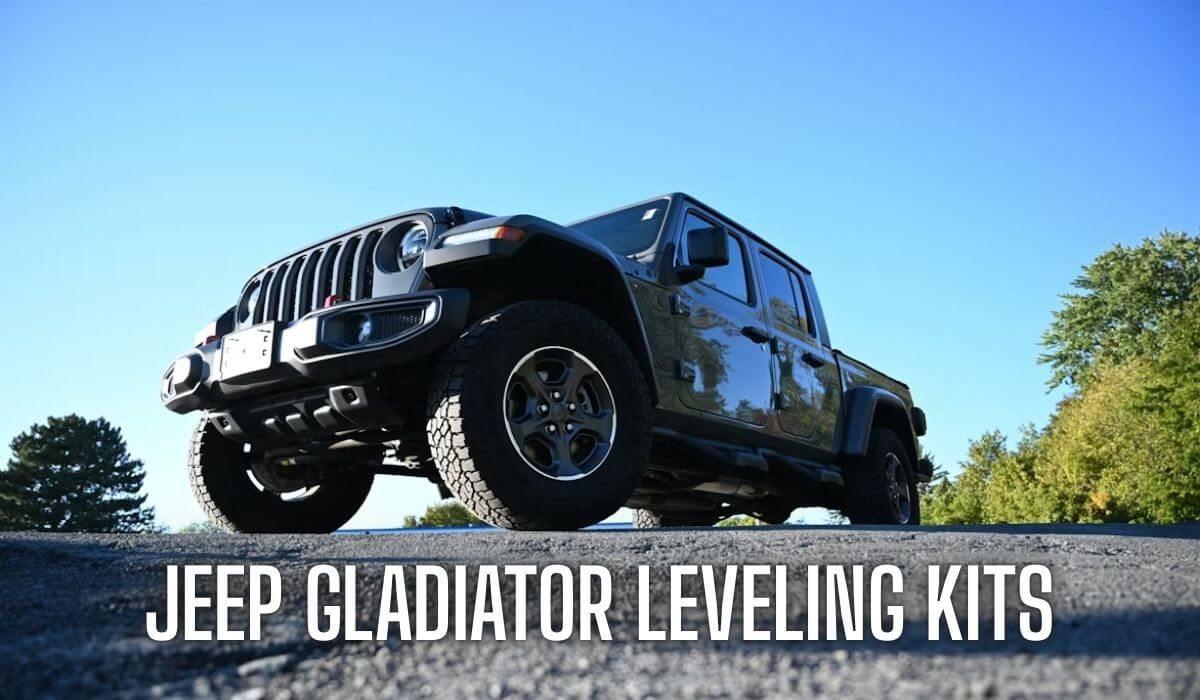
Best leveling kit for Jeep Gladiator searches usually start with one simple goal: fixing the factory nose-down stance while gaining enough clearance for 33-inch or 35-inch tires. The Gladiator leaves the factory with a clear rake, and that isn’t a design flaw—it exists to handle payload and towing. Problems begin when owners chase a level look or extra front clearance without understanding how easily the wrong leveling kit can change the way a Gladiator drives.
Unlike a Wrangler, the Gladiator carries more weight up front and spends more time hauling gear, bikes, and trailers. A cheap or poorly designed kit can make steering feel vague, accelerate suspension wear, or create alignment issues that don’t show up until months later. That’s why many Gladiator owners end up regretting quick fixes installed purely for appearance.
This guide isn’t built on spec sheets or brand marketing. It’s based on long-term ownership feedback—how these setups behave after daily driving, highway miles, and real-world use. After reviewing dozens of options, five kits were selected because they consistently deliver usable clearance, predictable handling, and realistic tire fitment without creating new problems.
The goal is simple: help you level your Gladiator for 33- and 35-inch tires while preserving how it drives, tows, and holds up over time—so you end up with the right Jeep Gladiator leveling kit, not just a taller one.
Who This Guide Is Actually For (And Who Should Skip It)
This guide is written for Jeep Gladiator owners who:
- Drive their truck daily and care about steering feel and stability
- Want a level stance without sacrificing ride quality
- Plan to run slightly larger tires but keep factory drivability intact
- Occasionally tow or haul, without turning the suspension into a compromise
This guide is not aimed at:
- Hardcore rock crawlers building dedicated trail rigs
- Owners planning 37-inch tires or aggressive long-arm setups
- Gladiators used for constant heavy towing near max payload
If your Gladiator needs to stay predictable on highways and comfortable on long drives, you’re in the right place. If you’re chasing maximum articulation and trail-only performance, a leveling kit isn’t the right tool—and pretending it is usually leads to disappointment.
5 Best Jeep Gladiator Leveling Kits (2026 Picks)
#1. TeraFlex 1.5-Inch Performance Spacer Leveling Kit
(Best for daily driving, stock-like ride, long-term reliability)
#2. Rough Country 3.5-Inch Lift Kit with N3 Shocks
(Maximum clearance option for aggressive off-road builds)
#3. KSP 2.5-Inch Front Leveling Lift Kit
(Ideal for running 35-inch tires without full lift)
#4. AEV 2-Inch Spacer Lift with ProCal SNAP
(Premium engineered option with factory-style integration)
#5. WeiSen 2.5-Inch Front Leveling Lift Kit
(Budget-friendly choice for basic stance and 35-inch clearance)
Also Check:
What a Leveling Kit Really Changes on a Jeep Gladiator
A leveling kit does one thing: it raises the front of the Gladiator to reduce factory rake. What it doesn’t do is magically improve suspension travel, ride comfort, or load capacity. That misunderstanding is where most bad decisions start.
On a Gladiator, even a small front lift changes suspension angles more noticeably than people expect. The steering geometry, alignment window, and front-end components all start working at slightly different positions. When done right, these changes are controlled and barely noticeable. When done wrong, the truck feels fine for a few weeks—and slowly degrades from there.
A good leveling kit should:
- Maintain factory steering feel
- Keep alignment within safe tolerances
- Avoid adding harshness over bumps
- Preserve the Gladiator’s on-road confidence
Anything beyond that isn’t a bonus—it’s usually a trade-off.
Choosing the Right Height: Where Most Gladiator Owners Go Wrong
Height is the single most important decision when choosing a leveling kit for a Jeep Gladiator. More height does not mean more capability—it just means tighter tolerances.
A 1.5-inch kit keeps the suspension closest to factory geometry. This is the safest option for owners who prioritize ride quality and long-term reliability. It levels the stance without introducing new variables.
A 2-inch kit is the sweet spot for most Gladiator owners. It delivers a noticeably level look, improves tire clearance, and still keeps alignment manageable when installed correctly. This is where form and function overlap best.
A 2.5-inch kit sits at the upper edge of what should still be considered “leveling.” At this height, alignment precision becomes critical, and not all kits handle it equally well. Done properly, it can work. Done cheaply, it’s where issues usually begin.
Once you push beyond this range, you’re no longer leveling—you’re compensating. And compensation almost always comes with consequences.
Quick Decision: Which Leveling Kit Fits Your Gladiator?
If you want the most factory-like driving experience and a subtle stance correction, stick with a 1.5–2 inch leveling kit.
If your priority is running 35-inch tires without jumping to a full lift, a 2.5-inch leveling kit makes the most sense.
If your Gladiator is built mainly for off-road use and maximum clearance matters more than daily comfort, skip leveling kits and look at a full lift setup instead.
This simple choice eliminates most buying mistakes before you even look at specific products.
Leveling Kit vs Lift Kit: Where Gladiator Owners Usually Get It Wrong
For Jeep Gladiator owners, choosing between a leveling kit and a lift kit isn’t really about height—it’s about how the truck is actually used. Most mistakes happen when expectations don’t match reality.
A leveling kit is meant to correct the factory rake and bring the front of the Gladiator up to match the rear. That’s it. When done properly, it keeps the suspension operating close to its original range, which is critical for a truck that sees daily driving, long highway runs, and mixed-use duty. Steering feel, braking stability, and overall balance should remain familiar.
A lift kit is a different commitment altogether. It changes suspension geometry more aggressively and is designed for owners who prioritize off-road capability, articulation, and larger tire clearance. Lift kits often require additional components to work correctly, and they almost always introduce trade-offs in ride feel and maintenance.
Where many Gladiator owners go wrong is expecting a leveling kit to behave like a lift kit. A leveling kit will not:
- Eliminate rear squat when towing heavy loads
- Add meaningful suspension travel
- Turn the Gladiator into a dedicated trail rig
And it shouldn’t be forced to.
The Gladiator’s strength is balance. It’s a truck that can commute comfortably, handle long trips, and still explore trails on weekends. A properly chosen leveling kit respects that balance. A lift kit only makes sense when your usage clearly demands it—not when the goal is purely visual.
If your Gladiator spends more time on pavement than rocks, and you care about how it drives months after installation—not just the first week—a leveling kit is usually the smarter, cleaner solution.
#1. TeraFlex 1155300 JT 1.5-Inch Performance Spacer Leveling Kit
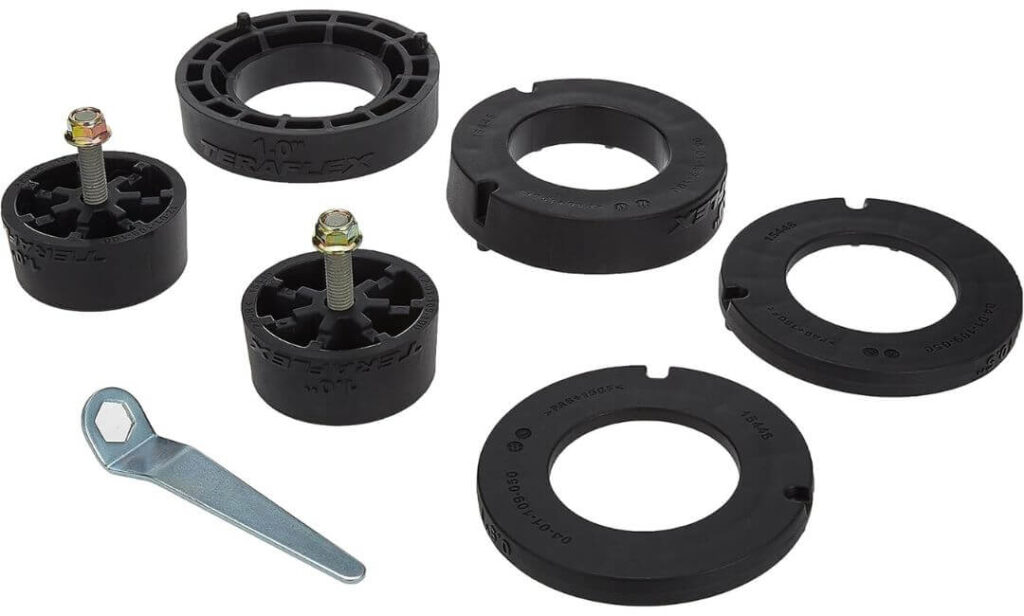
This affordable option at around $115.99 is aimed squarely at Jeep Gladiator owners who want to correct factory rake without overthinking the suspension. TeraFlex designed this 1.5-inch leveling kit for people who use their Gladiator as a real truck—daily driving, family trips, weekend gear, and the occasional trail—without wanting to introduce new variables into how it drives.
What makes this kit stand out is its restraint. Instead of chasing maximum height, it focuses on subtle front lift that preserves factory suspension behavior. The added height is enough to visually level the truck and provide practical clearance, especially for Gladiators carrying heavier front accessories like aftermarket bumpers or a winch. It works with stock-length shocks, which keeps costs down and avoids unnecessary changes to ride dynamics.
This kit also reflects real-world Gladiator ownership. Many owners don’t want to rebuild the suspension just to fit slightly larger tires or fix the nose-down stance. The 1.5-inch height sits safely within factory geometry limits, making it one of the lowest-risk leveling options available for long-term use.
Rather than trying to feel “upgraded,” the Gladiator simply feels corrected—balanced, planted, and familiar.
Why Gladiator owners choose it
- Corrects factory rake without altering suspension behavior
- Affordable entry point into leveling without cutting corners
- Designed to handle added front-end weight from accessories
- Compatible with stock-length shock absorbers
Ride quality impact (real feel)
Ride quality remains essentially unchanged from stock, which is the biggest reason owners stick with this kit long-term. Steering response stays consistent, and the front end doesn’t develop the light or unsettled feel that taller spacer kits sometimes cause. On highways, the Gladiator tracks straight and remains stable at speed.
Over rough pavement and expansion joints, there’s no added harshness or sharp rebound. The suspension still absorbs impacts naturally, and braking behavior feels predictable. With proper alignment, the front suspension never feels overextended, even after months of daily driving. This is a leveling kit that fixes stance without announcing itself every time the road surface changes.
Install difficulty (DIY / shop)
Installation is very manageable for a DIY owner with basic mechanical experience. Expect around 2–3 hours for the leveling kit alone using standard tools. The process is straightforward, and everything needed for installation is included.
While some owners report acceptable alignment afterward, a professional alignment is still strongly recommended. Even small geometry changes can affect tire wear over time, and skipping alignment is a gamble that rarely pays off.
Tire compatibility reality
With factory wheel backspacing, this kit works cleanly with 33-inch tires on Sport and Overland trims. On Rubicon fenders, 35-inch tires are achievable, but fitment depends heavily on wheel offset and driving style.
Wheels with less backspacing than stock may require additional rear bump stop extensions to prevent rubbing at full compression during articulation. This kit improves clearance, but it doesn’t change suspension travel—expect realistic limits, not miracles.
Downsides
- No improvement to suspension travel or articulation
- Shock absorbers are not included
- Larger tires may require extra bump stop support
- Not intended for aggressive off-road builds
#2. Rough Country 3.5-Inch Lift Kit with N3 Shocks
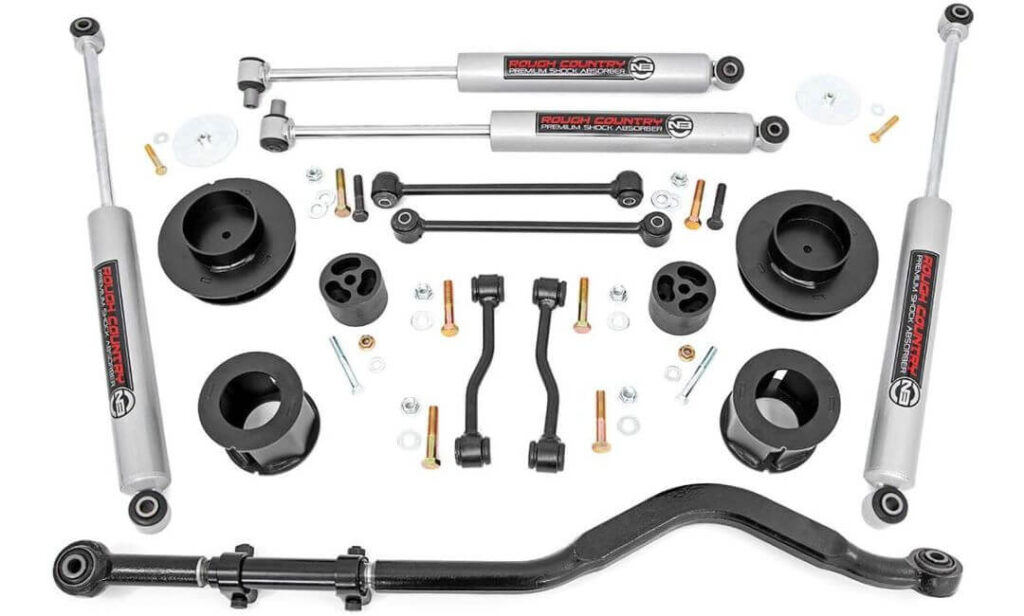
The Rough Country 3.5-inch kit is often mistaken for a “big leveling kit,” but in reality, it’s a full stance change for the Gladiator. This setup isn’t meant to subtly fix factory rake—it’s designed for owners who want noticeable height, real ground clearance, and the ability to run oversized tires without piecing together components one by one.
What draws many Gladiator owners to this kit is how complete it feels out of the box. You’re not just getting spacers and being sent on your way. The included N3 shocks, forged adjustable front track bar, sway bar links, and bump stops turn this into a proper suspension package rather than a cosmetic upgrade. For the price point, that matters.
It’s also worth understanding Rough Country’s lineup here. The brand offers 2.5-inch lift kits and 2.5-inch leveling kits for the Gladiator, and those options exist for a reason. The 3.5-inch kit sits at the top of that range. It delivers the most clearance, but it also brings the biggest change in how the truck feels day to day. That trade-off is exactly what buyers should be clear about before committing.
Why Gladiator owners choose it
- Clears larger tires without mixing multiple kits
- Includes shocks instead of treating them as an upgrade
- Forged adjustable track bar helps re-center the front axle
- Strong value for a complete lift system
- Backed by Rough Country’s lifetime replacement warranty
Ride quality impact (real feel)
Compared to stock, the Gladiator feels taller and more deliberate in its movements. Off-road, the added clearance and suspension travel are immediately noticeable, especially on uneven trails or rutted terrain. The N3 shocks keep things controlled, but this is not a “stock-like” ride anymore.
On pavement, the truck remains stable, but steering response slows slightly, and body motion becomes more apparent during braking and quick lane changes. It’s not uncomfortable, just different. Owners coming from a mild leveling kit will notice the change right away. Compared to Rough Country’s 2.5-inch options, the 3.5-inch kit demands more driver awareness during daily use.
Install difficulty (DIY / shop)
For a kit of this size, installation is relatively straightforward. Everything is bolt-on, and experienced DIY owners often finish the job in three to four hours with proper tools and space. The adjustable front track bar is a big plus during install, making axle centering less of a guessing game.
Alignment is non-negotiable here. At 3.5 inches of lift, even small geometry errors show up quickly in steering feel and tire wear. Anyone unfamiliar with suspension work should plan on professional installation or, at minimum, professional alignment immediately afterward.
Tire compatibility reality
This kit is designed with 37-inch tires in mind, and that’s where it shines. With the right wheel offset, 35s fit easily and offer a more balanced setup for mixed driving. Tire width and offset matter more than height alone—wider tires increase steering effort and can exaggerate road feedback.
For owners who want 35s without committing to 37-inch territory, the 2.5-inch Rough Country lift kit often makes more sense. Likewise, the 2.5-inch leveling kit is better suited for drivers focused on appearance with minimal change to driving behavior.
Downsides
- This is not a leveling solution; it significantly alters ride dynamics
- Braking feel and steering response change due to added height
- Alignment precision becomes critical
- Overkill for Gladiators used mainly as daily drivers
Choosing the right Rough Country setup
- 3.5-inch lift kit → Best for aggressive builds and 37-inch tires
- 2.5-inch lift kit → Strong balance for 35s with fewer compromises
- 2.5-inch leveling kit → Appearance upgrade with minimal behavior change
#3. KSP 2.5-Inch Front Leveling Lift Kit
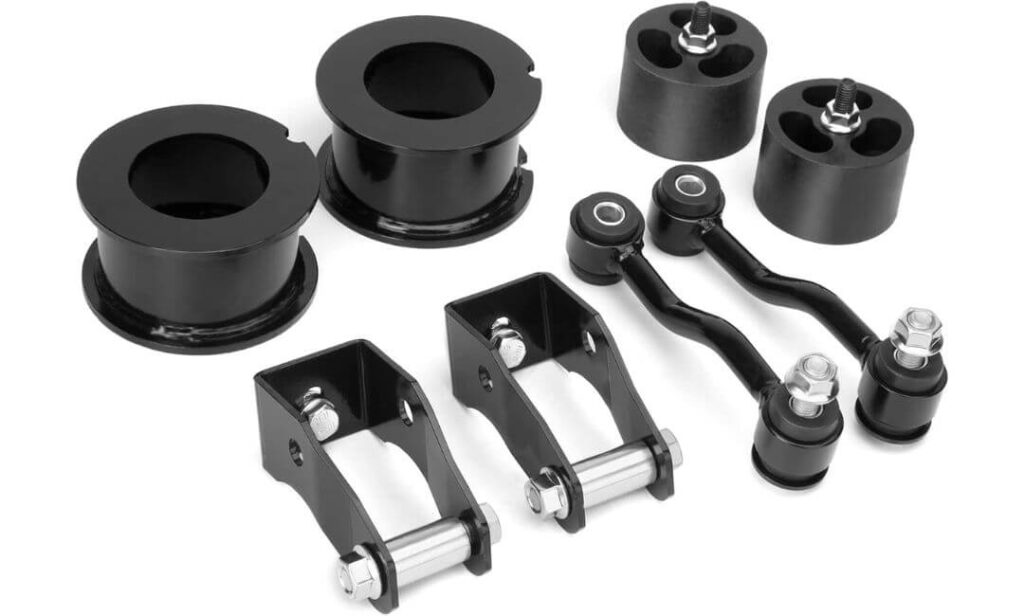
For Gladiator owners searching for the best Jeep Gladiator leveling kit on a tighter budget, the KSP 2.5-inch front leveling kit usually shows up early—and not without reason. This kit targets a very specific audience: owners who want a noticeable stance change, room for larger tires, and factory-like driving manners without stepping into full lift-kit territory.
The approach here is straightforward. KSP relies on solid steel spacers and reinforced hardware rather than trying to reinvent the suspension. There’s no attempt to “tune” ride quality with shocks or geometry corrections. Instead, the kit focuses on lifting the front to a usable height while keeping the stock suspension working as intended.
What helps this kit stand out is how predictable it feels after installation. Many budget leveling kits look good at first and slowly reveal flaws over time. This one tends to hold its shape and alignment when installed correctly, which explains why so many Gladiator owners run it daily without chasing follow-up fixes.
Why Gladiator owners choose it
- One of the more affordable 2.5-inch leveling options
- Strong steel construction with high-grade hardware
- Compatible across 2018–2024 Gladiator JT models
- Simple design that doesn’t overcomplicate the suspension
- Backed by lifetime KSP product support
Ride quality impact (real feel)
Ride quality remains very close to factory, which is often the biggest concern with taller leveling kits. On normal roads, the Gladiator still feels planted, with no added stiffness or front-end chatter. Steering response stays familiar, and the truck doesn’t feel nose-light at highway speeds.
Over uneven pavement or mild trails, the suspension reacts the same way it did stock, just operating slightly higher in its range. There’s no added harshness, and body control remains predictable. Owners often describe the driving experience as “unchanged,” which is exactly what most people want from a leveling kit at this height.
Install difficulty (DIY / shop)
Installation is beginner-friendly for anyone comfortable with basic suspension work. Most owners complete the install in two to three hours using standard hand tools. The kit is bolt-on, and nothing requires cutting or permanent modification.
That said, alignment is still recommended. While some owners report acceptable alignment afterward, skipping it long-term increases the risk of uneven tire wear—especially with wider tires. Instructions are serviceable but not exceptional, so many installers rely on visual guides or videos for clarity.
Tire compatibility reality
This kit handles 35-inch tires well, provided wheel offset and tire width are chosen carefully. With stock-style backspacing, clearance is generally clean for daily driving. Under extreme articulation, rubbing can occur, especially near the lower control arm or sway bar links.
This is not a flaw unique to KSP—it’s the reality of running 35s on a leveled Gladiator without changing suspension travel. For mixed daily driving and light trail use, fitment stays manageable and predictable.
Downsides
- No geometry correction beyond basic leveling
- Instructions could be clearer for first-time installers
- Rubbing possible at full articulation with aggressive wheel offsets
- Not designed for heavy off-road abuse
#4. AEV 2-Inch Spacer Lift with ProCal SNAP
When people talk about the best leveling kit for Jeep Gladiator, AEV usually enters the conversation for one reason: restraint backed by engineering. The AEV 2-inch Spacer Lift isn’t chasing maximum height or aggressive stance. It’s built for owners who want larger tires and better clearance while keeping the Gladiator’s factory suspension behavior intact.
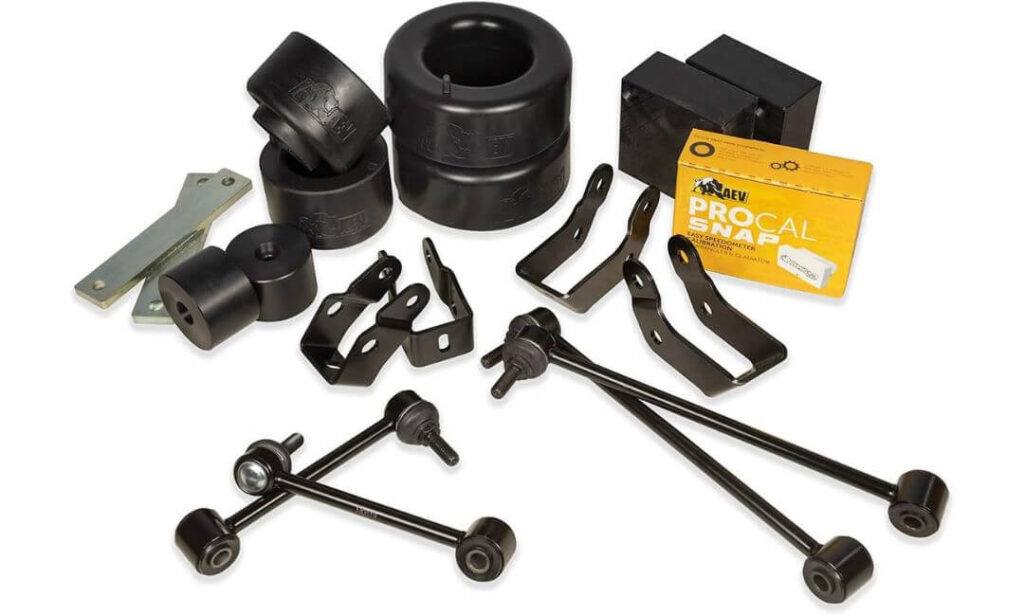
Instead of replacing springs or shocks, AEV works around the OEM system. The polyurethane coil spacers are shaped with integrated isolators and locating tabs, which sounds minor until you’ve driven a spacer kit that doesn’t sit quite right. Everything in this kit feels intentional, from the bump stop extensions to the shock extension brackets and sway bar links. Nothing is added just to pad the parts list.
What truly separates this kit from others in its class is the included AEV ProCal SNAP. Tire size changes throw off speedometer readings, shift points, and driver confidence. AEV addresses that problem directly, making this kit feel less like a “lift” and more like a factory-approved upgrade—especially for owners running larger tires long term.
Why Gladiator owners choose it
- Designed to integrate cleanly with the OEM suspension
- Maintains factory ride quality and suspension balance
- Includes ProCal SNAP for speedometer recalibration
- Supports larger tires without replacing springs or shocks
- Made in the USA by a brand known for OEM-level engineering
Ride quality impact (real feel)
Ride quality stays very close to stock, which is the hallmark of most AEV suspension products. On highways, the Gladiator feels composed and familiar, with no added float or stiffness. Steering response remains natural, and braking behavior doesn’t change in a way that draws attention.
On uneven roads or light trails, the suspension works through its travel smoothly, without the sharp rebound or awkward compression some spacer kits introduce. The truck doesn’t feel “lifted” in the driver’s seat—it simply feels like it has more room to work. For long trips and daily driving, that subtlety matters more than raw height numbers.
Install difficulty (DIY / shop)
Installation is well within reach for an experienced DIY owner. The kit includes all required components, and everything bolts on without permanent modification. Expect a half-day install if working carefully, especially when setting up the sway bar links and shock extensions correctly.
Alignment is recommended after installation, even though geometry changes are modest. The ProCal SNAP setup is straightforward, plugging into the OBDII port and using the vehicle’s stereo controls to input tire size values. One important note: due to a current Stellantis software issue, 2026 models may not allow tire-size recalibration until an official update is released.
Tire compatibility reality
This kit accommodates 35-inch tires comfortably on Sport and Sahara trims and supports 37-inch tires on Rubicon models equipped with high flares. These figures are based on AEV’s own testing using AEV wheels and BFG tires, not theoretical clearances.
As with any system engineered as a whole, AEV strongly advises against mixing components. Different wheels, offsets, or tire brands can introduce rubbing at full lock or compression. Used as designed, fitment remains clean and predictable.
Downsides
- Does not fit Gladiator Mojave models
- Higher price compared to basic spacer kits
- ProCal SNAP functionality on 2026 models depends on Stellantis software update
- Best results require sticking close to AEV-recommended wheel and tire specs
#5. WeiSen 2.5-Inch Front Leveling Lift Kit
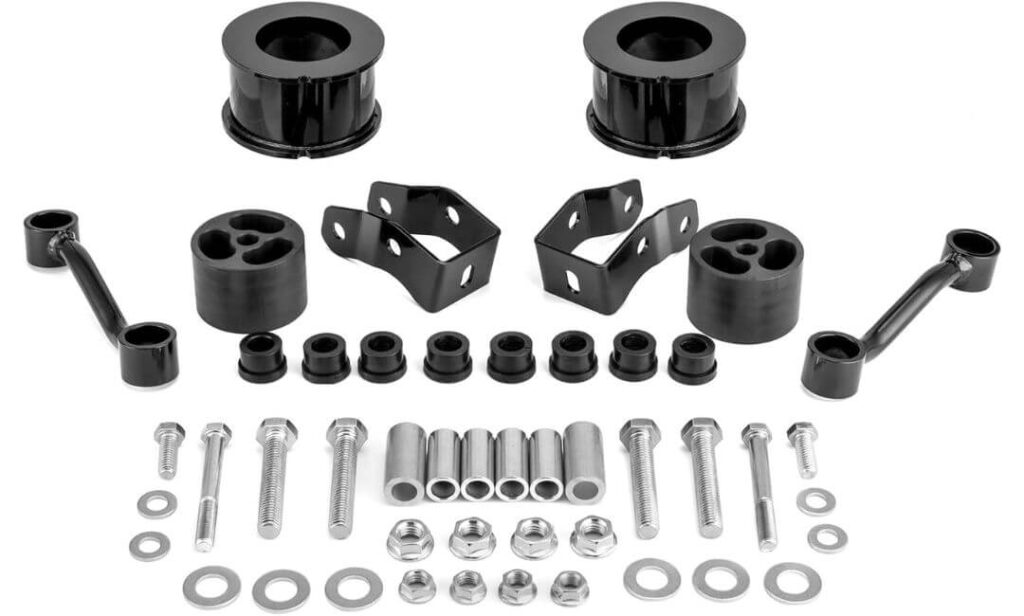
This Jeep Gladiator leveling kit takes a very direct approach. The complete kit includes shock brackets, coil spacers, sway links, and bump stop spacers, all designed to bring the front of the Gladiator up by 2.5 inches without cutting or welding. It’s aimed at owners who want a level stance and room for larger tires, but aren’t interested in paying for brand-driven extras.
WeiSen keeps things simple with heavy-duty steel components finished in black powder coating. There’s no attempt to redesign suspension behavior or add tuning features. Instead, the focus is on providing a bolt-on solution that uses factory mounting points and delivers predictable results once installed correctly.
This kit is most often chosen by Gladiator owners who plan to run 35-inch tires and want a visibly leveled look without stepping into full lift territory. It doesn’t promise refinement or factory integration—what it offers is coverage, clearance, and value.
Why Gladiator owners choose it
- Complete front leveling kit with all required components
- Heavy-duty steel construction with corrosion-resistant coating
- Bolt-on installation using OE mounting points
- Designed specifically for 2020–2024 Gladiator JT 4WD models
- Supports up to 35-inch tires
Ride quality impact (real feel)
Ride quality remains close to stock during normal driving, especially on smooth roads and highways. The Gladiator doesn’t develop excessive stiffness or bounce, and steering response stays familiar at moderate speeds. For daily driving, the suspension behaves in a predictable way once alignment is set correctly.
On rough pavement or uneven trails, you may notice a slightly firmer feel compared to lower-height leveling kits. This isn’t harsh, but it reflects the added height and the use of bracket-based components. The truck still feels controlled, just a bit more aware of road texture than factory.
Install difficulty (DIY / shop)
Installation is bolt-on but more involved than basic spacer kits. Multiple components need to be installed and aligned, and access to different socket sizes is required. Owners with moderate mechanical experience usually complete the install in three to four hours.
No drilling or welding is needed, but careful torque application is important. A professional alignment afterward is strongly recommended to prevent uneven tire wear and steering pull.
Tire compatibility reality
This kit is designed to run 35-inch tires (including common 35×12.50R17, R18, and R20 sizes). With factory-style wheel offset, clearance is generally clean for street use. Under full articulation, wider tires may approach inner suspension components, which is normal for this lift height.
This kit improves clearance but does not increase suspension travel. For aggressive off-road use, expectations should remain realistic.
Downsides
- Does not fit Gladiator Mojave models
- Ride feel is slightly firmer than lower leveling kits
- Installation involves more components than basic spacer setups
- Limited warranty compared to premium brands
Real-World Ranking: Best Leveling & Lift Kits for Jeep Gladiator
This ranking is based on how these kits behave after installation, not how attractive they look in product photos. Ride quality, tire compatibility, long-term usability, and owner regret all matter here.
Rank #1: TeraFlex 1.5-Inch Performance Spacer Leveling Kit
Best overall for daily-driven Gladiators
TeraFlex takes the top spot because it fixes the factory rake with the least compromise. The 1.5-inch height keeps suspension geometry close to stock, which protects steering feel, braking confidence, and long-term component life.
Best choice if your Gladiator is a daily driver that still sees weekend trails.
Rank #2: AEV 2-Inch Spacer Lift
Best premium engineered solution
AEV earns second place for integration and refinement. The kit feels like it belongs on the truck, not something added afterward. The included ProCal SNAP for speedometer recalibration is a major plus for owners running larger tires.
Best for owners who want OEM-level engineering and plan to keep the truck long term.
Rank #3: KSP 2.5-Inch Front Leveling Lift Kit
Best value option for running 35-inch tires
KSP sits right in the middle. The 2.5-inch height makes 35-inch tires realistic without jumping to a full lift. Ride quality remains close to stock when installed correctly, though it’s more noticeable than TeraFlex or AEV.
Best for owners who want a more aggressive stance but still daily drive.
Rank #4: Rough Country 3.5-Inch Lift Kit with N3 Shocks
Best for aggressive builds and maximum clearance
Rough Country drops here not because it’s bad, but because it’s a different animal. This is a true lift kit, not a leveling solution. It clears 37-inch tires and transforms off-road capability, but daily driving feel changes noticeably.
Best for trail-focused builds where clearance matters more than subtlety.
Rank #5: WeiSen 2.5-Inch Front Leveling Lift Kit
Best budget-focused option
WeiSen delivers height and clearance at a lower price point. It works, clears 35-inch tires, and includes all necessary components, but ride refinement and installation simplicity lag behind premium options.
Best for budget builds where cost matters more than long-term refinement.
Jeep Gladiator Leveling Kits Comparison Table
| Leveling / Lift Kit | Lift Height | Best Tire Size | Ride Feel After Install | Daily Driving Suitability | Install Reality | Who Should Buy It |
|---|---|---|---|---|---|---|
| TeraFlex 1.5″ Spacer | 1.5″ | 33″ / light 35″ | Feels closest to stock, no steering drama | Excellent for long-term daily use | Easy DIY, alignment required | Daily drivers who want zero regrets |
| AEV 2″ Spacer Lift | 2″ | 35″ / 37″ (Rubicon) | Stock-like but more planted | Very good, especially for highway use | Moderate, ProCal setup needed | Owners who want OEM-style engineering |
| KSP 2.5″ Leveling | 2.5″ | 35″ | Mostly stock, slightly firmer front | Good balance for mixed use | DIY friendly, alignment important | Buyers targeting 35″ tires |
| Rough Country 3.5″ Lift | 3.5″ | 37″ | Noticeably taller, firmer response | Fair, best for trail-focused builds | Longer install, shop recommended | Off-road priority, max clearance |
| WeiSen 2.5″ Leveling | 2.5″ | 35″ | Slightly firm over rough roads | Acceptable for budget builds | More involved DIY install | Cost-focused buyers |
Final Buying Call: Choose Based on How You Actually Use Your Gladiator
There is no single “best” leveling kit for every Jeep Gladiator owner, and that’s the mistake most buyers make. The right choice depends on how often you drive, what tire size you realistically plan to run, and how much change you’re willing to accept in ride behavior.
If your Gladiator is a daily driver that sees highway miles, traffic, and long trips, staying close to factory suspension geometry matters more than extra height. In that case, a mild setup like TeraFlex 1.5-inch or AEV’s 2-inch spacer system makes the most sense. These kits correct the stance without introducing new habits you have to “learn” while driving.
If your goal is clearly 35-inch tires and a more aggressive look, but you still expect the truck to behave well every day, the KSP 2.5-inch leveling kit offers the most practical middle ground. It delivers usable clearance without pushing the Gladiator into full lift territory.
For trail-focused builds where clearance matters more than subtlety, Rough Country’s 3.5-inch lift earns its place. Just understand that this is no longer a leveling decision—it’s a suspension commitment.
And if budget is the deciding factor, WeiSen’s 2.5-inch kit does the job as long as expectations stay realistic and installation is done carefully.
The best kit is the one that still feels right six months later, not the one that looks tallest on day one.
Frequently Asked Questions About Jeep Gladiator Leveling Kits
Does a leveling kit affect ride quality on a Jeep Gladiator?
At mild heights (1.5–2 inches), ride quality usually stays very close to stock when installed and aligned properly. Taller leveling kits around 2.5 inches can feel slightly firmer, while full lift kits introduce noticeable changes in steering and braking feel.
Is alignment really necessary after installing a leveling kit?
Yes. Even if the truck feels fine immediately after installation, suspension angles change. Skipping alignment often leads to uneven tire wear and subtle steering issues that appear later.
Can I run 35-inch tires with a leveling kit?
Yes, but results depend on lift height, wheel offset, and tire width. Most 2–2.5 inch leveling kits can handle 35-inch tires for daily driving, though minor trimming or bump stop adjustments may be required under full articulation.
Will a leveling kit affect towing performance?
It can. Leveling removes factory rake, which helps with looks but can increase rear squat when towing. If you tow regularly, consider rear support options like airbags to maintain stability.
What’s the difference between a leveling kit and a lift kit on a Gladiator?
A leveling kit corrects the factory nose-down stance by raising the front. A lift kit raises the entire vehicle and changes suspension behavior more significantly. Leveling focuses on balance; lift kits focus on clearance and off-road capability.