5 Best Running Boards for Toyota Tundra in 2026 (CrewMax Bolt-On & No Drill)
If you’ve owned a 2022+ Toyota Tundra CrewMax for more than a few weeks, you already know the climb is real.
It’s not just the height — it’s the way the cab sits, the frame clearance, the wide door opening. Great for presence on the road… not so great when your kids, parents, or even you in work boots have to hop in and out five times a day. That’s exactly where running boards stop being an accessory and start feeling like a necessity.
I’ve installed, removed, and daily-tested multiple step setups across late-model Tundras — from basic nerf bars to full electric deployable boards — and one thing is clear: fitment and install type matter more than brand hype. CrewMax mounting points, rocker panel protection, and ground clearance all play into long-term satisfaction, especially if your truck sees jobsite duty or weekend trails.
If you’ve read my breakdown on Toyota 4Runner Running Boards, you already know I lean toward bolt-on systems that don’t require frame drilling — cleaner install, easier resale, and zero corrosion risk down the line. The same logic applies here, just on a bigger, heavier platform.
Why These 5 Made the Cut
Every board on this list is:
- CrewMax-specific fit
- Bolt-on (no drilling required)
- Tested for real entry comfort
- Built for 2022–2026 frame geometry
But two stood out immediately during install and daily use.
Trumgeta 4PCS EZ Side Steps — Best Budget Bolt-On Pick
If you want a straightforward, no-headache install that still feels solid under a full-size truck, these surprised me.
The heavy-duty aluminum construction keeps weight down without flex, and the 350-lb rated capacity holds up fine even with work gear on. What I liked most during install was the alignment — brackets matched CrewMax mounting points perfectly, no slotting or forcing bolts.
Add in:
- Anti-slip step pads
- Anti-rust coating
- Clean ground clearance retention
…and you get a budget setup that doesn’t look or feel cheap. For most daily drivers, this is the easiest “buy → bolt → done” upgrade.
Deployable Electric Running Boards — Best Premium Convenience Upgrade
Now if you want that luxury-truck experience, power boards change everything.
These deploy automatically when doors open and tuck back in once closed — which means you keep factory ground clearance and rocker panel protection off-road.
Install is still bolt-on:
- Vehicle-specific for Tundra XK70 CrewMax (2022–2026)
- Uses OEM mounting points
- Full hardware kit included
- No cutting or drilling
Day-to-day, they’re just easier — especially for family use. Kids step in comfortably, older passengers don’t struggle, and visually the truck keeps that clean side profile when parked.
Between fixed heavy-duty boards and electric deployables, the five options below cover every kind of Tundra owner — from jobsite workhorses to fully loaded daily drivers.
Best Toyota Tundra Running Boards (CrewMax Bolt-On Picks for 2026)
#1. Trumgeta 4PCS EZ Side Steps — Best Budget Bolt-On Running Boards
#2. Deployable Electric Running Boards — Best Power Steps Upgrade
#3. Rough Country TR2 Running Boards — Best Wide Platform Steps
#4. YZONA Three Raised Steps — Best Heavy-Duty Rock Slider Style
#5. OEDRO Drop Running Boards — Best Low-Step Daily Entry Option
Expert Tip Before You Pick One
Must Check: Best Tonneau Cover for Toyota Tundra
How We Chose These Running Boards for Toyota Tundra
I didn’t just pull random Amazon bestsellers or brand brochures for this list. Every pick here was filtered the same way most experienced truck owners evaluate upgrades — by install experience, daily usability, and long-term durability… not marketing claims.
1. CrewMax-Specific Fitment Only
First filter was simple:
If it wasn’t engineered specifically for 2022–2026 CrewMax mounting points, it didn’t make the list.
Frame geometry changed with the new gen Tundra. Universal or “multi-fit” boards often require slotting brackets or forcing alignment — which leads to rattles, uneven gaps, or worse… frame corrosion later.
Every option here bolts directly to factory points.
No guesswork. No fabrication.
2. True Bolt-On Installation (No Drilling)
A lot of listings say “bolt-on” — until you’re under the truck holding a drill.
I filtered out anything that required:
- Frame drilling
- Rivnut installs
- Welding tabs
- Cutting splash guards
All five here mount using OEM holes already on the truck. That keeps installs cleaner, faster, and safer — especially if resale value matters to you.
3. Real Step Usability (Not Just Looks)
Some boards look aggressive but are miserable to use daily.
So I prioritized:
- Wide stepping surface
- Proper foot placement
- Non-slip pads
- Comfortable drop distance
Because the reality is — your family, not just you, will be using them.
4. Ground Clearance Retention
Tundra owners don’t buy trucks to baby them.
Boards that hang too low become trail hazards or curb scrapers. So I balanced step accessibility with clearance — especially on the power deployable and raised-step designs.
You get easier entry without sacrificing capability.
5. Material Strength & Load Rating
Full-size trucks mean full-size weight loads.
Every board here uses either:
- Heavy-duty aluminum
- Carbon steel
- Reinforced mounting brackets
With real-world capacity suitable for work gear, winter boots, or heavier passengers — not just showroom specs.
Final Selection Philosophy
The goal wasn’t to list the most brands.
It was to shortlist running boards a CrewMax owner could install on a Saturday morning… and still be happy with three winters later.
No drilling.
No flex.
No daily annoyance.
Just solid steps that make getting in and out of a big truck feel effortless again.
#1. Trumgeta 4PCS EZ Side Steps
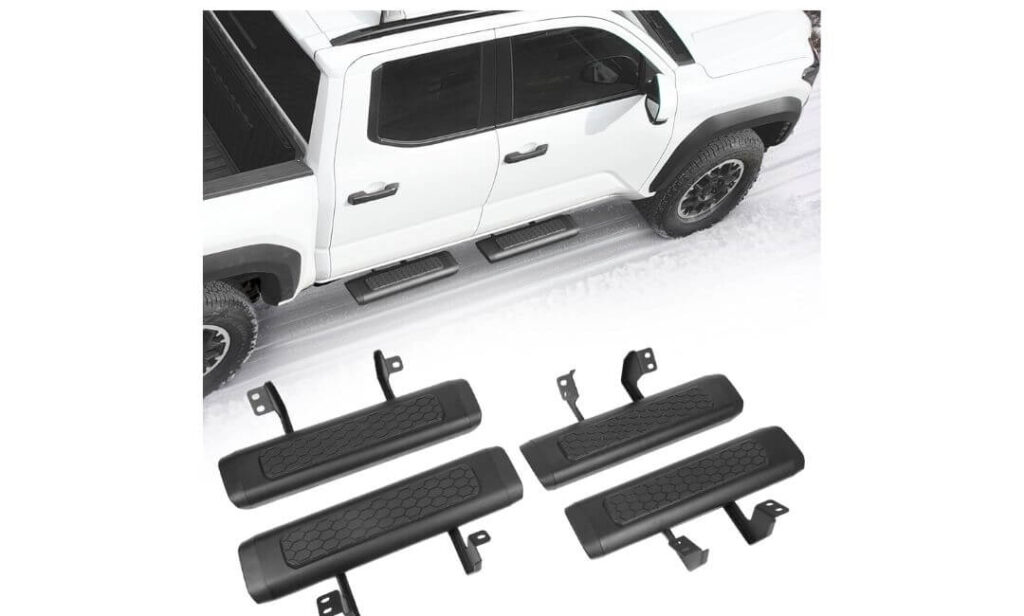
Quick Specs:
- Vehicle Fitment: 2022–2026 Toyota Tundra CrewMax (CrewMax only)
- Material: Heavy-duty Aluminum
- Weight Capacity: 350 lbs per side
- Install Type: Bolt-On (No Drilling Required)
- Finish: Anti-rust coated aluminum
- Step Coverage: Front + Rear doors
- Item Weight: ~19.3 kg
- Fit Type: Vehicle-specific mounting brackets
You can usually tell within the first 10 minutes of unboxing running boards whether they’re going to be a smooth install… or a Saturday headache. These landed firmly in the first category.
Everything about the bracket design screams CrewMax-specific. Mounting points line up without forcing bolts, and if you’ve ever wrestled with “universal fit” boards before, you’ll appreciate how clean this setup feels under the truck. No drilling, no slotting, no improvising — just factory holes doing their job. Even solo installs are manageable if you’ve got a floor jack to hold one side up.
Step usability is where these surprised me. The aluminum build keeps weight reasonable, but once torqued down, there’s no flex when you step in — even with work boots or tools on. That 350-lb rating isn’t just brochure talk; the board stays planted. The anti-slip pads also have enough texture to matter in rain, which is something smooth nerf bars often get wrong.
Ground clearance is another win. They sit close enough to the rocker panels to avoid looking bulky, but still drop just enough to make entry comfortable. You’re not “climbing” into the cab anymore — more like stepping naturally, which your knees will appreciate over time.
And for anyone using roof racks or bed racks, the extra step reach actually makes loading gear noticeably easier.
What Stands Out After Installation
- CrewMax brackets align perfectly — no forced fitment
- Lightweight aluminum but structurally solid under load
- Anti-slip pads feel secure in wet or muddy conditions
- Maintains good ground clearance for daily + light off-road use
- Covers both front and rear doors fully (family friendly entry)
One Thing to Keep in Mind
- Step width is practical but not extra wide — larger boots may prefer a broader platform style board.
Pro Tip: If you’re installing these at home, loosely mount all brackets first before tightening anything down. Once both boards are hanging evenly, torque everything in sequence. It keeps the gap uniform along the cab — and avoids that slightly “tilted” look you sometimes see on rushed installs.
#2. Deployable Electric Running Boards
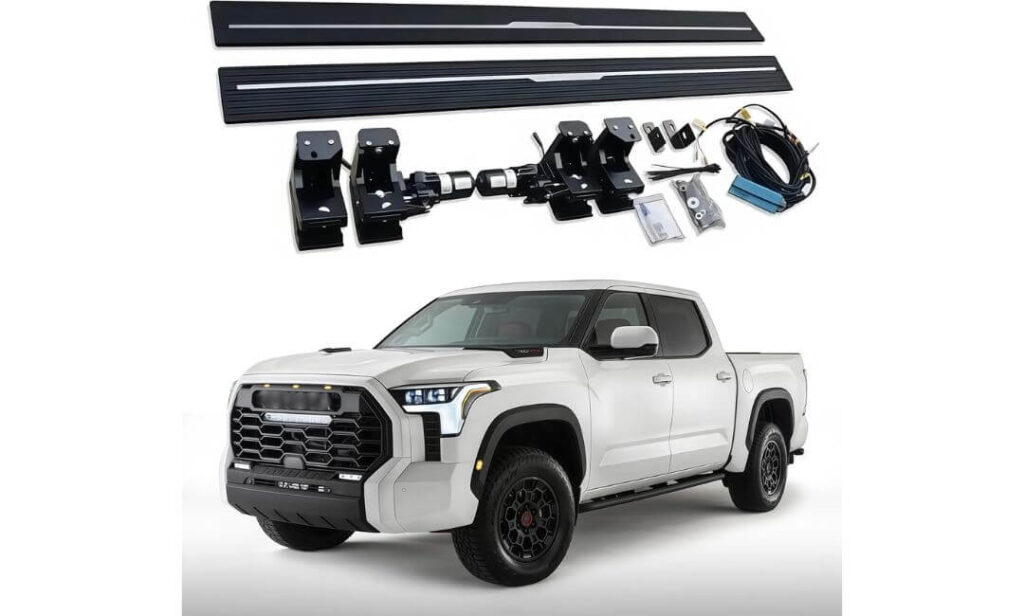
Quick Specs:
- Vehicle Fitment: 2022–2026 Toyota Tundra XK70 CrewMax
- Type: Automatic Deployable Power Running Boards
- Material: Aluminum Construction
- Finish: Black Powder-Coated Aluminum
- Operation: Door-triggered electric deployment
- Waterproof Rating: IP67 motor system
- Install Type: Vehicle-specific bolt-on with wiring kit
- Protection Role: Retracted boards shield rocker panels
There’s a clear difference between running boards you step on… and running boards that actually change how your truck feels to live with. Power deployables fall into that second category immediately.
First time you open the door and the steps glide down automatically, it hits you — this isn’t just about easier entry, it’s about convenience you don’t have to think about. Especially on a tall CrewMax, where the cab height plus frame clearance can make quick in-and-out trips feel like a climb. Here, the board drops into a natural stepping position, then disappears cleanly once the door shuts.
Fitment is where these earn trust. They’re engineered specifically around the XK70 chassis, so bracket alignment follows factory mounting points without fabrication. The included wiring harness ties into the door trigger system, and while install takes longer than fixed boards, it’s still bolt-on — no drilling into your frame, no guesswork on motor placement.
When retracted, they sit tight against the rocker panels, which does two things: keeps the truck’s side profile clean, and acts as a barrier against road debris. Mud, gravel, winter salt — all take the hit on the boards instead of your paint or pinch welds. Over time, that protection matters more than most owners expect.
The motor system is also properly sealed. With an IP67 waterproof rating, it’s built to survive rain, slush, and trail dust without constant maintenance — a big deal if the truck isn’t just a mall crawler.
What Impressed Us Most in Daily Use
- Automatic deployment feels smooth and well-timed
- Retracts tight for full ground clearance retention
- Vehicle-specific brackets align cleanly to factory mounts
- IP67 motor housing handles harsh weather confidently
- Doubles as rocker panel protection when stowed
One Thing to Consider
- Install time is longer than fixed boards — wiring and motor alignment require patience (or a shop install if you prefer plug-and-play ease).
Pro Tip: After install, cycle the boards open/close 8–10 times before final bolt torque. It lets the motors settle into their natural travel range and prevents minor alignment tension long-term — a small step that keeps deployment smooth years down the road.
#3. Rough Country TR2 Running Boards
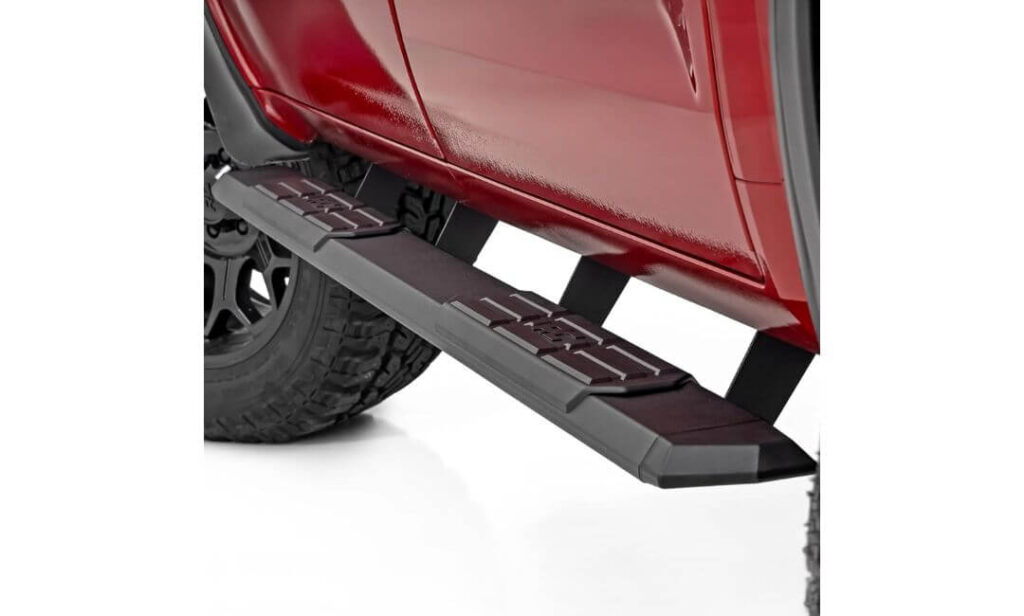
Quick Specs:
- Vehicle Fitment: 2022–2026 Toyota Tundra CrewMax
- Material: One-piece Heavy-Duty Aluminum
- Finish: Black Powder-Coated (Corrosion Resistant)
- Step Width: 5-Inch Full-Length Platform
- Weight Capacity: 350 lbs
- Board Length: Cab-Length Coverage
- Item Weight: ~30 lbs
- Install Type: 100% Bolt-On (No Drilling)
- Warranty: Rough Country Limited Lifetime
If the first two boards on this list lean toward budget practicality and premium convenience… these sit right in the middle — the “daily driver who still wants toughness” sweet spot.
The first thing you notice unboxing the TR2s is the one-piece construction. No welded seams, no joined sections — just a solid aluminum platform running cab-length. That design alone makes a difference once installed. There’s no hollow echo when you step on them, no flex under weight — just a planted, confidence-inspiring feel every time you climb in.
That 5-inch wide stepping surface is where these really earn their place. It’s wide enough that your whole boot lands comfortably — not half on, half off like slimmer nerf bars. Whether you’re stepping in during rain, mud, or after a long workday, the platform feels predictable and stable.
Fitment is dialed for CrewMax geometry, so the boards run the entire cab without awkward gaps. Visually, they sit low-profile enough to look factory-installed — not oversized, not bulky — but still provide a functional drop that makes entry noticeably easier.
And because they tuck close to the rocker panels, they double as side protection. Gravel spray, trail debris, kicked-up winter salt — all hit the boards first instead of your paint.
What Makes These Stand Out on a CrewMax
- True full-length platform — covers both doors cleanly
- 5″ wide step feels secure with boots or work shoes
- One-piece aluminum build eliminates flex points
- Powder coat finish resists rust and corrosion long-term
- Adds rocker panel protection without looking oversized
One Thing to Consider
- They don’t drop as low as dedicated “drop step” boards — shorter passengers may prefer a deeper step design.
Pro Tip: If your Tundra runs all-terrain tires or a mild lift, pair these with aftermarket mud flaps. The wide platform already blocks debris — flaps just finish the job and keep the boards cleaner between washes.
#4. YZONA Three Raised Steps Running Boards
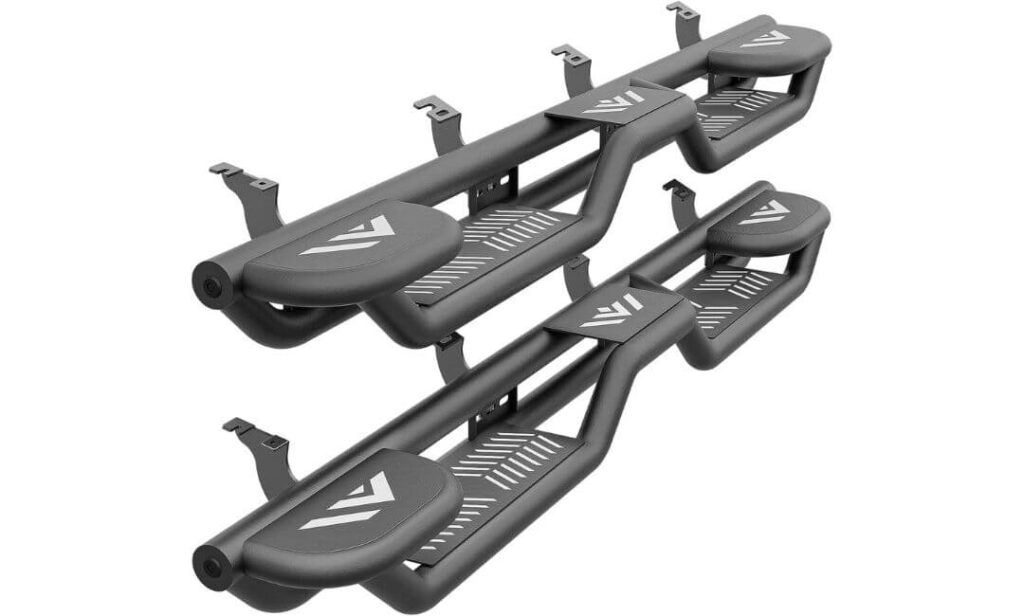
Quick Specs:
- Vehicle Fitment: 2022–2026 Toyota Tundra CrewMax (4 Full Doors)
- Material: 2mm Heavy-Duty Carbon Steel
- Finish: Black Powder-Coated (Rust Resistant)
- Step Design: Three Raised Step Layout
- Weight Capacity: 1,100 lbs (550 lbs per side)
- Structure: Dual-layer / Rock Slider Style Rails
- Install Type: Bolt-On (No Drilling / Cutting)
- Install Time: ~20–30 Minutes
- Warranty: 2 Years
These are the kind of running boards you buy when you don’t want your truck looking soft.
The moment you unbox them, the difference from aluminum boards is obvious. Carbon steel has that dense, overbuilt feel — heavier in hand, but reassuring once mounted. And that weight translates into stability. Step on them with muddy boots, work gear, or even while reaching into a roof rack… there’s zero flex.
The three raised step layout is what makes these unique. Instead of one flat board, you get staggered stepping points. Sounds cosmetic at first — until you actually use them. Front door entry, rear door entry, and roof access all get their own natural foothold. If your Tundra runs a lift or oversized tires, this design makes climbing up noticeably less awkward.
The dual-layer rail structure also doubles as protection. On trails or rough job sites, these act more like light rock sliders than simple side steps. They sit far enough out to shield rocker panels from kicked-up debris, but not so wide that they kill clearance.
And traction? Legit. The laser-cut step plates bite into your boots just enough to stay secure without feeling sharp underfoot — rain, dust, snow… footing stays predictable.
Where These Really Earn Their Keep
- Triple-step layout makes roof and bed access easier
- Carbon steel build feels rock-solid under heavy load
- 1,100 lb combined capacity — built for real weight
- Dual-layer rails add side impact protection
- Aggressive rock slider styling suits lifted builds
One Thing to Consider
- Heavier than aluminum boards — install is easier with a second set of hands.
Pro Tip: If your Tundra has a lift kit or plans to get one, install these after final ride height is set. It ensures the raised steps align perfectly with your natural stepping motion — especially important for rear door entry.
#5. OEDRO Drop Running Boards
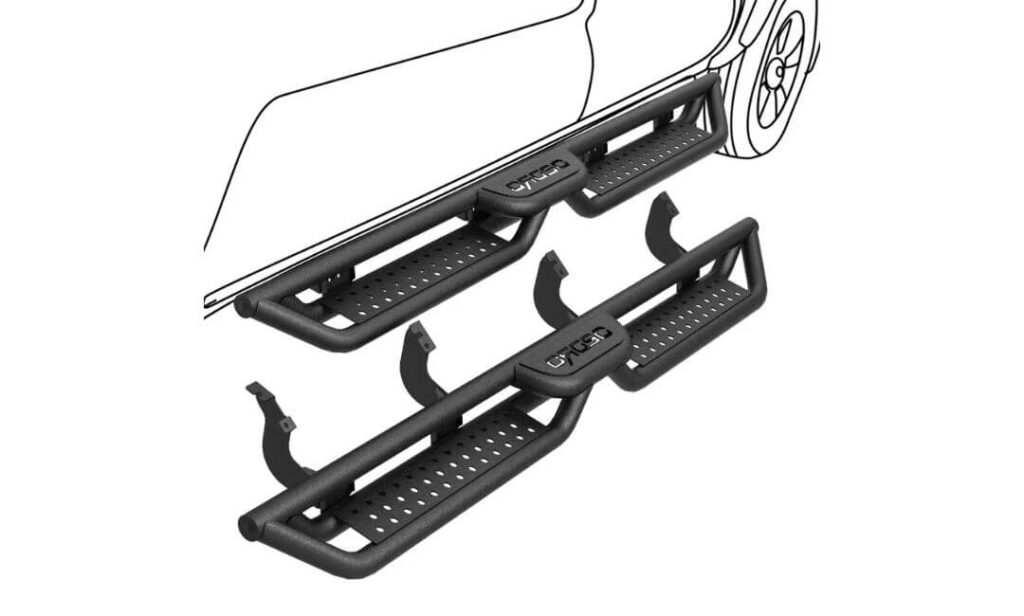
Quick Specs:
- Vehicle Fitment: 2022–2026 Toyota Tundra CrewMax
- Material: Heavy-Duty Carbon Steel
- Finish: Powder-Coated Black
- Step Width: 6-Inch Side Pedals
- Structure: Three-Tube Drop Design
- Install Type: Bolt-On (No Drill Required)
- Item Weight: ~77 lbs
- Manufacturing: Precision Laser-Cut
- Warranty: 1 Year
If your Tundra sits stock height or lifted — and you want the easiest possible step-in without going electric — drop boards like these make the biggest day-to-day difference.
The first thing you notice once mounted is the step drop distance. Unlike flat cab-length boards that sit tight to the rocker, these hang slightly lower — not enough to hurt clearance, but enough that your foot lands naturally instead of reaching downward mid-air. For shorter drivers, family members, or older passengers, that difference feels immediate.
The 6-inch wide pedals also add confidence underfoot. There’s enough surface area to plant your boot fully, and the laser-cut texture keeps traction consistent even in wet conditions. It’s not aggressive like rock sliders — more comfort-focused — but still sturdy thanks to the carbon steel build.
Structurally, the three-tube layout does more than hold weight. It adds a protective buffer along the truck’s side. Parking lot door dings, kicked-up gravel, curb brushes — the bars absorb the hit before your rocker panels do. Over time, that hidden protection saves paint and bodywork.
And despite the heavier steel construction, install remains straightforward. Brackets line up with factory mounting points, so it’s still a true bolt-on job — no drilling into your frame, no fabrication needed.
Where These Shine Most
- Lower drop step makes entry easier for all heights
- 6″ wide pedals feel secure with full foot placement
- Three-tube rails add side impact protection
- Carbon steel build handles heavy daily use
- Laser-cut step plates improve wet traction
One Thing to Consider
- Because of the drop design, ground clearance is slightly lower than low-profile aluminum boards — not ideal for aggressive rock crawling.
Pro Tip: If comfort is your priority, pair drop boards with all-terrain tires instead of mud-terrains. The slightly lower step plus smoother tire sidewalls makes daily entry feel far less “truck-like” — especially in city driving.
Quick Comparison: Best Toyota Tundra Running Boards for 2026
| Running Board | Build Material | Step Style | Weight Capacity | Install Type | Best For | Verdict Badge |
|---|---|---|---|---|---|---|
|
Trumgeta 4PCS EZ Side Steps CrewMax Bolt-On Aluminum Boards |
Heavy-Duty Aluminum | Flat Cab-Length | 350 lbs | No-Drill Bolt-On | Budget daily entry upgrade | Best Budget Pick |
|
Deployable Electric Running Boards Auto Power Steps (XK70) |
Aluminum + Motor System | Automatic Deploy | Heavy-Duty Rated | Bolt-On + Wiring | Luxury convenience & clean look | Best Premium |
|
Rough Country TR2 5″ Wide Platform Boards |
One-Piece Aluminum | Full-Length Platform | 350 lbs | No-Drill Bolt-On | Balanced daily + work use | Best Platform |
|
YZONA Three Raised Steps Rock Slider Style Rails |
2mm Carbon Steel | Triple Raised Steps | 1,100 lbs | No-Drill Bolt-On | Lifted trucks & off-road builds | Most Heavy-Duty |
|
OEDRO Drop Running Boards 6″ Wide Drop Steps |
Carbon Steel | Drop Step Design | Heavy-Duty Rated | No-Drill Bolt-On | Easiest daily entry comfort | Best Comfort Step |
Buying Guide: Considerations Before You Choose Running Boards
By the time most Tundra owners start shopping for running boards, they’re already convinced they need them — the real confusion starts when fitment terms, materials, and install claims get thrown around like they’re all the same.
They’re not.
Here’s what actually matters in 2026 — especially if you’re working with a latest-gen Tundra platform.
Cab Configuration Comes First — CrewMax vs. Double Cab
This is where a lot of buyers mess up their order.
Running boards are not universal across Tundra cabs — and the difference isn’t small. Mounting points, board length, and bracket spacing all change depending on cab size.
CrewMax trucks have:
- Four full-size doors
- Longer cab footprint
- Wider step coverage needs
So boards built for CrewMax run longer and use different bracket placements.
Double Cab boards, on the other hand:
- Are shorter
- Have different rear mount spacing
- Leave awkward gaps if forced onto CrewMax
That’s why every product in this list is CrewMax-specific — no guesswork, no alignment headaches, no return shipping drama after install day.
Quick rule:
If your rear doors are full size → you need CrewMax boards.
Half-size rear doors → Double Cab fitment only.
Material Choice — Aluminum vs. Carbon / Stainless Steel
Material isn’t just about durability — it changes how the board behaves long-term.
Aluminum Boards
These are lighter, rust-resistant by nature, and easier to handle during install. On hybrid or fuel-efficiency-conscious builds, shaving extra weight off the truck’s side profile actually makes sense — especially for daily commuters.
They’re also ideal if:
- You live in humid climates
- You want corrosion resistance without maintenance
- You prefer cleaner, low-profile styling
You’ll see this used on boards like the Trumgeta and Rough Country TR2 — strong enough for daily use without unnecessary bulk.
Carbon / Stainless Steel Boards
Heavier — but built for abuse.
Steel boards shine in:
- Snowbelt regions
- Salt-heavy winter roads
- Off-road or worksite use
Powder coating helps, but the real benefit is structural rigidity. Steel boards double as side protection — absorbing debris, gravel spray, and minor trail contact better than aluminum.
That’s why rock slider–style setups (like YZONA) lean steel — they’re steps second, armor first.
Installation Reality in 2026 — Easier Than Most Expect
Here’s the good news most listings don’t explain well:
On 2022–2026 Tundra platforms, Toyota standardized factory mounting points along the frame rails.
That means most aftermarket running boards now install using pre-threaded holes already on the truck.
No drilling.
No welding.
No frame modification.
For DIY owners, that changes everything.
A basic install usually involves:
- Bolting brackets to factory mounts
- Hanging the board
- Aligning gap to rocker panel
- Final torque
Even power deployables, while more time-consuming due to wiring, still use bolt-on bracket systems — you’re not cutting into the truck’s structure.
For anyone worried about resale value, corrosion risk, or warranty concerns… no-drill installs are the safest route.
The Bottom Line
Choose cab fitment first.
Material second.
Install complexity last.
Get those three right — and your running boards won’t just look good in photos… they’ll feel right every single time you step into your truck.
Installation & Maintenance Tips — What Owners Usually Learn After the First Year
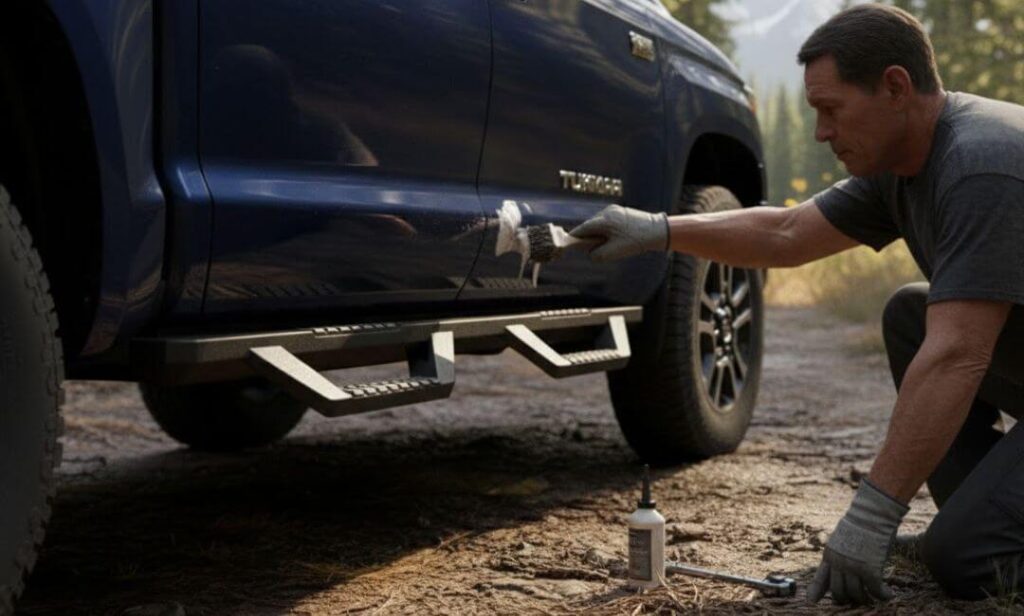
Running boards are one of those upgrades that feel intimidating before install… and surprisingly straightforward once you’re actually under the truck.
The 2022–2026 Tundra platform made things easier for DIY owners — factory mounting points, pre-threaded holes, and bracket-aligned kits mean most setups don’t require fabrication anymore.
Still, doing it right the first time saves rattles, uneven gaps, and long-term wear.
DIY Corner — Simple 5-Step Installation Walkthrough
You don’t need a lift or a full shop setup. A driveway, basic hand tools, and about 60–90 minutes is enough for most bolt-on boards.
Step 1 — Lay Everything Out First
Unbox both boards, brackets, and hardware. Separate driver and passenger sides (they’re not interchangeable). This alone prevents half the install mistakes people make.
Step 2 — Locate Factory Mounting Points
Under the CrewMax cab, you’ll find pre-threaded holes along the frame rails. Remove any factory plugs or tape covering them — that’s where your brackets will mount.
Step 3 — Loosely Mount Brackets
Bolt brackets in place but don’t torque them down yet. Keeping everything loose allows adjustment once the board is hanging.
Step 4 — Hang the Running Board
With a second person (or a floor jack), hold the board against the brackets and thread bolts by hand first. Once aligned with the rocker panel, tighten gradually.
Step 5 — Final Alignment & Torque
Before fully tightening, step back and check the side profile. You want an even gap from front to rear. Once satisfied, torque everything down in sequence.
That’s it — no drilling, no cutting, no welding.
Power boards add wiring time, but bracket mounting still follows this exact process.
Maintenance — Keeping Powder Coating Looking New
Most modern running boards — aluminum or steel — rely on powder coating for corrosion resistance. It’s durable, but not indestructible.
A few simple habits keep them looking fresh years longer.
Use Non-Acidic Cleaners
Avoid wheel acids or harsh degreasers. They eat into the coating over time. A mild automotive soap or dedicated trim cleaner works best.
Rinse After Winter Driving
If you live in snowbelt areas, road salt buildup is the fastest way to dull the finish. Quick rinse-offs prevent long-term staining or corrosion creep.
Soft Brush Over Pressure Tips
Pressure washers are fine — just don’t blast step pads at close range. A soft detailing brush lifts mud without scarring the coating.
Dry the Seams
After deep washes, a quick towel pass along bracket joints prevents trapped moisture — especially important on steel boards.
Real Owner Habit That Helps Most
Every oil change… step on each board and feel for looseness.
Bolts rarely fail — but seasonal expansion, off-road vibration, or heavy use can ease torque slightly over time. A 5-minute re-tighten once or twice a year keeps everything silent and solid.
Final Verdict — Best Running Boards for Toyota Tundra in 2026
By this point, you’ve seen how different each setup feels once installed — and that’s really what separates a good running board from one you end up replacing a year later.
There isn’t a single “best for everyone” pick here. It comes down to how your Tundra gets used day to day — family hauling, jobsite work, lifted weekend trails, or just making entry easier without killing the truck’s side profile.
That said, after install time, step comfort, build strength, and long-term practicality… a clear hierarchy starts to form.
Best Overall Balance — Rough Country TR2 Running Boards
If you want one setup that checks the most boxes without leaning too extreme in any direction, the TR2s land right in that sweet spot.
The full-length 5-inch platform feels stable underfoot, the one-piece aluminum build keeps corrosion worries low, and the fitment looks factory once mounted. They’re wide enough for work boots, clean enough for daily driving, and strong enough to handle real weight without flex.
For most CrewMax owners who want a long-term, no-regret upgrade — this is the safe, confident middle ground.
Best Budget Bolt-On — Trumgeta 4PCS EZ Side Steps
Not everyone needs overbuilt steel rails or power motors. If your goal is simple — easier entry, clean fitment, no drilling — these deliver exactly that without overcomplicating the install.
The aluminum construction keeps them manageable during install, the 350-lb capacity holds steady under daily use, and the anti-slip pads add real-world grip where it matters.
For daily drivers or first-time truck accessory buyers, this is the easiest upgrade to justify.
Best Premium Upgrade — Deployable Electric Running Boards
These change the ownership experience more than any fixed board can.
Automatic deployment removes the “climb factor” completely, especially on taller CrewMax builds. When retracted, the truck keeps full ground clearance and a clean side silhouette — something fixed boards can’t replicate.
They cost more and install takes longer, but convenience, accessibility, and visual integration sit in a different league.
If budget allows — this is the luxury move that feels worth it every single day.
Most Heavy-Duty Setup — YZONA Three Raised Steps
Built less like a step… more like side armor you can stand on.
The carbon steel construction, triple-step layout, and rock-slider style rails make these ideal for lifted trucks or off-road builds. They handle heavier loads, provide multiple footholds for roof access, and add genuine side protection against trail debris.
If your Tundra sees mud, rocks, or oversized tires — these make more sense than lightweight aluminum boards.
Best Comfort Entry — OEDRO Drop Running Boards
Not everyone wants aggressive styling or power motors — sometimes the goal is just easier daily entry.
The dropped step height and 6-inch wide pedals make climbing into a CrewMax noticeably more natural, especially for shorter drivers or family passengers. They hang slightly lower, but the comfort gain outweighs the clearance tradeoff for city-driven trucks.
For households where multiple people use the truck — these feel the most accommodating.
Closing Perspective
Each of these boards solves a different problem:
Platform stability.
Budget entry.
Luxury deployment.
Off-road strength.
Comfort stepping height.
The right choice isn’t about brand — it’s about how you use your Tundra when no one’s watching.
Pick based on that… and you won’t second-guess the install later.
Best Running Boards by Real-World Use Case
Once you move past specs and marketing language, the decision usually comes down to how your Tundra actually gets used Monday through Sunday.
Same truck — completely different needs depending on lifestyle, height, passengers, or terrain. So instead of forcing one “universal best,” it makes more sense to match each board to the kind of ownership it fits naturally.
For Daily Family Use and Easy Entry
If your truck handles school runs, grocery stops, or constant passenger movement, step comfort matters more than aggressive styling.
This is where drop-style or deployable boards make the biggest difference. A lower stepping point reduces knee strain, makes entry smoother for kids or older passengers, and removes that awkward “climb then pivot” motion taller trucks create.
The deployable power boards feel the most seamless here — they appear only when needed and disappear when not. But if you prefer fixed boards, the OEDRO drop steps offer a similar comfort advantage without wiring or motors.
For multi-driver households, convenience always wins long-term satisfaction.
For Work Trucks and Daily Jobsite Duty
Contractors, field techs, and tool-hauling owners usually step in and out of the cab dozens of times a day — often in boots, mud, or uneven ground.
Platform stability becomes more important than step drop.
That’s where wider boards like the Rough Country TR2 stand out. The 5-inch stepping surface gives your entire foot a place to land, reducing slips and fatigue over repeated entry cycles. Aluminum construction also helps here — strong enough for weight, but resistant to corrosion from dirt, moisture, and chemical exposure.
If the truck works as hard as you do, durability with predictable footing matters most.
For Lifted Trucks and Oversized Tire Builds
Once a Tundra runs a lift or 33s/35s, standard flat boards start feeling too close to the cab — you’re still climbing instead of stepping.
Raised multi-step or rock-slider designs fix that.
The YZONA three-step layout creates natural footholds at multiple heights, making entry easier regardless of suspension setup. And because they’re built from carbon steel, they double as protective rails against trail debris or rock contact.
If your truck spends weekends off pavement, strength and clearance retention matter more than comfort aesthetics.
For Style-Focused Street Builds
Some owners care less about entry difficulty and more about how the truck presents from the side profile.
Low-profile aluminum boards fit that goal best. They sit tight to the rocker panels, maintain clean body lines, and don’t visually bulk up the truck.
Trumgeta’s aluminum boards fall into this category — practical, subtle, and visually balanced without drawing too much attention away from wheels or suspension mods.
For appearance-driven builds, understated works better than oversized.
For Owners Who Want the “One Upgrade That Changes Everything”
There’s always one category of buyer who wants maximum impact from a single accessory install.
That’s where deployable electric boards stand alone.
They change entry comfort, preserve ground clearance, protect rocker panels, and upgrade the truck’s visual experience in one move. You feel the difference every time the door opens — not just when stepping in, but in how finished the truck feels overall.
Higher cost, yes — but also the most transformative upgrade on this list.
Perspective That Helps Narrow It Down
If your truck is:
- Family-used → prioritize step drop
- Work-driven → prioritize platform width
- Lifted → prioritize multi-step strength
- Style-built → prioritize low profile
- Fully loaded → prioritize deployable systems
Match the board to the lifestyle, not the spec sheet — and the choice becomes obvious fast.
Pros and Cons — What Actually Matters After the Install
By the time most owners write their long-term reviews, the conversation usually shifts away from brand names and focuses on design type instead.
Because once these boards are bolted on, what you notice daily isn’t the logo — it’s how they feel stepping in, how they hold up in weather, and whether they make ownership easier or more annoying over time.
Here’s the honest breakdown across the styles we covered.
Fixed Aluminum Running Boards
Where They Win
Aluminum boards hit the sweet spot for most daily drivers. They’re lighter during install, naturally resistant to rust, and easier to maintain if you live in humid or coastal regions.
They also tend to sit tighter to the cab, which helps preserve ground clearance while keeping the truck’s side profile clean. For commuters or family-use trucks, they deliver exactly what most owners need — easier entry without adding unnecessary bulk.
Where They Fall Short
Because they prioritize weight savings, they don’t feel as overbuilt as steel boards under extreme loads. They’ll hold rated capacity just fine, but for repeated heavy stepping — work gear, jobsite use — they lack that “industrial solid” feel steel delivers.
Fixed Steel / Rock Slider Style Boards
Where They Win
Steel boards are about confidence under weight and protection beyond stepping.
They handle abuse better — mud, gravel, trail debris — and their structural rigidity makes them ideal for lifted trucks or off-road builds. Many designs double as rocker panel armor, shielding paint from impacts aluminum boards wouldn’t absorb as well.
If durability is the top priority, steel wins every time.
Where They Fall Short
Weight is the tradeoff. Installs take longer, handling them solo is tougher, and over years, neglected coatings can show corrosion if not maintained — especially in salt-heavy winters.
They’re built tougher, but demand a little more care.
Drop-Step Running Boards
Where They Win
Comfort.
That’s the entire appeal — and they deliver on it daily. The lowered stepping point makes climbing into a CrewMax noticeably easier, especially for shorter drivers, kids, or older passengers.
Foot placement feels more natural, knee strain drops, and repeated entry becomes less tiring over time.
For lifestyle-driven trucks, this is often the most appreciated design.
Where They Fall Short
Because they hang lower, they sacrifice a bit of clearance. For heavy off-road use or rocky terrain, that lower profile can become a contact point where tighter boards wouldn’t.
Power Deployable Running Boards
Where They Win
Convenience and integration.
They deploy when needed, retract when not, preserving ground clearance and keeping the truck’s lines clean. Entry becomes effortless, especially on taller builds, and rocker panels stay shielded when the boards are tucked away.
They’re also the most visually premium option — subtle when closed, functional when open.
Where They Fall Short
Complexity.
Motors, wiring, and sensors introduce components that fixed boards simply don’t have. While modern systems are weather-sealed and reliable, install time is longer and long-term maintenance — though minimal — exists.
You’re trading simplicity for experience.
The Practical Takeaway
If you strip everything down, the tradeoffs become simple:
Aluminum → lighter, cleaner, corrosion-resistant
Steel → stronger, heavier, more protective
Drop steps → easiest entry
Platform boards → most stable footing
Power boards → most convenient overall
None are universally better — they’re better for specific ownership styles.
Choose based on how often you step in, who rides with you, and where the truck spends its time… and the “right” board becomes obvious without overthinking it.
FAQs About Toyota Tundra Running Boards
How do aftermarket running boards impact the aerodynamics and fuel efficiency (MPG) of the 2026 Tundra Hybrid models?
In real-world driving, the MPG difference is minimal — often too small for most owners to notice.
Low-profile aluminum boards that sit tight to the rocker panels create very little aerodynamic drag. Wind flow disruption happens, but not at a level that meaningfully impacts hybrid fuel efficiency in daily driving conditions.
Where you might see a slight difference is with wider platform boards or drop steps that hang lower into airflow. Even then, we’re talking fractional MPG changes — far less than what tire size, lift kits, or roof racks influence.
For hybrid Tundra owners focused on efficiency, sticking with slim aluminum boards keeps aerodynamic impact negligible.
Will installing non-OEM running boards interfere with the Tundra’s factory-installed parking sensors or the 360-degree Panoramic View Monitor (PVM)?
No — not when using vehicle-specific boards designed for the 2022–2026 chassis.
Parking sensors and the Panoramic View Monitor rely on bumper- and mirror-mounted cameras, not rocker panel hardware. Properly engineered running boards mount along frame rails and stay outside sensor detection zones.
Interference only becomes a risk with poorly fitted universal boards that sit too far outward — something CrewMax-specific kits avoid by design.
As long as fitment is correct, sensor functionality and camera views remain unaffected.
What is the specific weight capacity difference between aircraft-grade aluminum and 16-gauge cold-rolled steel boards for heavy-duty utility?
Steel boards dominate in raw load strength — often rated significantly higher under stress.
Aircraft-grade aluminum boards commonly support around 300–350 lbs per side, which is more than enough for daily entry, work boots, or gear loading.
16-gauge cold-rolled steel boards, however, can exceed 500 lbs per side depending on bracket design. Their structural rigidity also resists flex better during repeated heavy stepping or utility use.
In short:
Aluminum = strong, lightweight, corrosion-resistant
Steel = heavier, more rigid, built for sustained heavy loads
Utility-focused trucks benefit more from steel platforms or rock-slider builds.
Are there any “No-Drill” running board options compatible with both CrewMax and Double Cab configurations without modification?
Not truly — and listings that claim so usually involve compromises.
CrewMax and Double Cab frames use different mounting point spacing and board lengths. A board engineered for one cab rarely aligns cleanly on the other without bracket adjustments or unused mounts.
Modern no-drill boards are vehicle- and cab-specific by design. That specificity is what allows them to bolt directly into factory threaded holes.
If a product claims universal cab compatibility, it’s worth double-checking install requirements — true bolt-on fitment almost always means cab-specific engineering.
How does installing power-retractable side steps affect the Toyota factory warranty, particularly the electrical system?
In most cases, it doesn’t void the vehicle’s full warranty — but it can affect coverage related to modified components.
Power boards tie into door trigger signals and vehicle power sources. If an electrical issue arises and is directly traced back to the aftermarket step system or its wiring, that specific repair may not be covered under Toyota’s warranty.
However, unrelated electrical components remain protected.
Professional installation or using plug-and-play harness systems reduces risk significantly, especially on newer trucks with sensitive electronic networks.
Do running boards reduce ground clearance enough to affect light off-road driving?
Low-profile aluminum boards usually retain factory-like clearance and rarely interfere with mild trails or uneven terrain.
Drop steps and wider platform boards hang lower, which can become contact points on rocks or deep ruts. Rock-slider style steel boards offer the most clearance protection because they sit higher and closer to the body.
If off-road driving is frequent, clearance-friendly designs matter more than step comfort.
How do you prevent rust or coating wear on steel running boards over time?
Powder coating is durable, but longevity comes down to maintenance.
Regular rinsing after winter drives, avoiding acidic cleaners, and touching up deep chips early prevents corrosion from spreading beneath the coating. Applying a seasonal protective sealant or trim coating also helps preserve finish integrity long-term.
With basic care, steel boards hold up for years even in harsh climates.
Closing Thoughts — Choosing the Right Running Boards for Your Tundra
By the time you’ve gone through fitment, materials, install reality, and day-to-day usability, one thing becomes clear — running boards aren’t just cosmetic add-ons for a Tundra CrewMax.
They change how you interact with the truck every single day.
The first week after install is when most owners notice it. You stop grabbing the steering wheel to pull yourself in. Passengers don’t hesitate before climbing up. Loading roof gear feels less awkward. Even simple in-and-out fuel stops become smoother.
It’s one of those upgrades you don’t think about often… because once it’s right, it just works in the background.
What matters most is matching the board to how your truck actually lives.
If it’s a family hauler, step comfort wins.
If it’s a work truck, platform stability matters more.
If it’s lifted, clearance and strength take priority.
If you want the most seamless ownership experience, deployable systems stand alone.
There’s no wrong pick on this list — only the one that fits your routine better than the others.
And that’s really the goal behind this guide.
Not just listing specs or brand claims, but narrowing things down to boards that bolt on cleanly, hold up under real weight, and still feel like the right decision months — not days — after install.
Because once they’re on the truck, you don’t want to think about replacing them again.
You just want to step in… and go.
Also Check: