
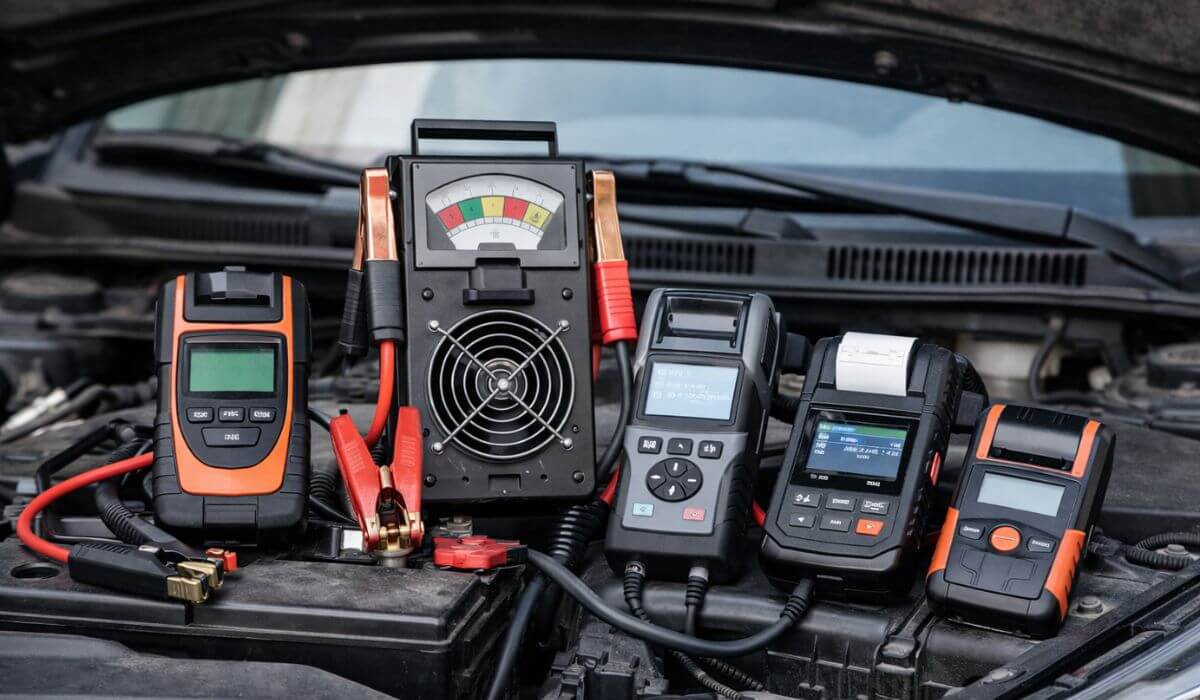
5 Best Professional Car Battery Testers of 2026 (With Load Testing, CCA & AGM Support)
A weak car battery doesn’t always die overnight. Most of the time, it gives subtle warning signs—slow cranking, inconsistent starts, or charging issues that are easy to misread. The problem is that a simple voltage check or cheap tester can’t tell you why a battery is failing, or whether it’s the battery, alternator, or starting system at fault. That’s where a professional car battery tester actually makes a difference.
For this guide, we focused on real diagnostic accuracy, not marketing claims. We tested and compared multiple automotive battery testers under repeat-use conditions, checking voltage stability, CCA accuracy, load behavior, and compatibility with modern AGM and EFB batteries. We also paid close attention to how fast results appear, how clear the pass/fail readings are, and whether the tools feel reliable enough for daily workshop or serious DIY use—not just occasional checks.
After running repeated tests across different battery types and charge states, two tools stood out clearly. The LAUNCH BST-500 earned our Top Overall Recommendation for its consistent CCA readings, wide 12V/24V compatibility, and dependable load testing that mirrors what professionals expect in a shop environment. Close behind, the Autool Car Battery Tester with Built-in Printer impressed us with its accuracy, detailed system analysis, and the ability to provide printed test reports—something mechanics and fleet users genuinely value.
The other testers on this list weren’t chosen randomly. Each one earned its place by delivering reliable voltage readings, accurate cranking and charging system analysis, proper AGM/EFB support, and repeatable results across multiple tests. Importantly, every tester featured here stays under the $100 range, making them practical investments rather than overpriced shop-only tools.
Below, you’ll find the five professional car battery testers we actually recommend, followed by a quick breakdown of why these specific models outperform basic testers—and why they’re worth buying if you want answers you can trust before replacing a battery that might not be dead yet.
Why We Recommend These 5 Battery Testers
These five battery testers earned our recommendation because they consistently deliver precise voltage and CCA readings, support modern AGM and EFB batteries, and perform true load testing rather than basic surface checks. Just as important, they include built-in safety protections, produce repeatable results across multiple tests, and are reliable enough to handle regular real-world use—making them a smart choice for serious car owners, DIYers, and professionals who need accurate answers before replacing a battery.
Quick List: Best Professional Car Battery Testers (2026)
#1. LAUNCH BST-500 Car Battery Tester (Top Overall Pick – Professional Load & CCA Testing)
#2. Autool Car Battery Tester (Built-in Printer) (Best for Workshops & Fleet Use)
#3. ANCEL AD410 PRO OBD2 Scanner & Battery Tester (Best 2-in-1 Diagnostic + Battery Testing Tool)
#4. KONNWEI KW681 OBD2 Scanner & Battery Tester (Best Value Professional Battery Tester)
#5. Clore Automotive SOLAR Digital 12V Battery & System Tester (Most Trusted Brand for Quick System Checks)
Expert Tip
Also Check:
- Best Car Battery Charger and Jump Starter
- Best Battery-Powered Dash Cams for Cars
- Best Bi-Directional Scanner Tools with OBD2
#1. LAUNCH BST-500 Car Battery Tester
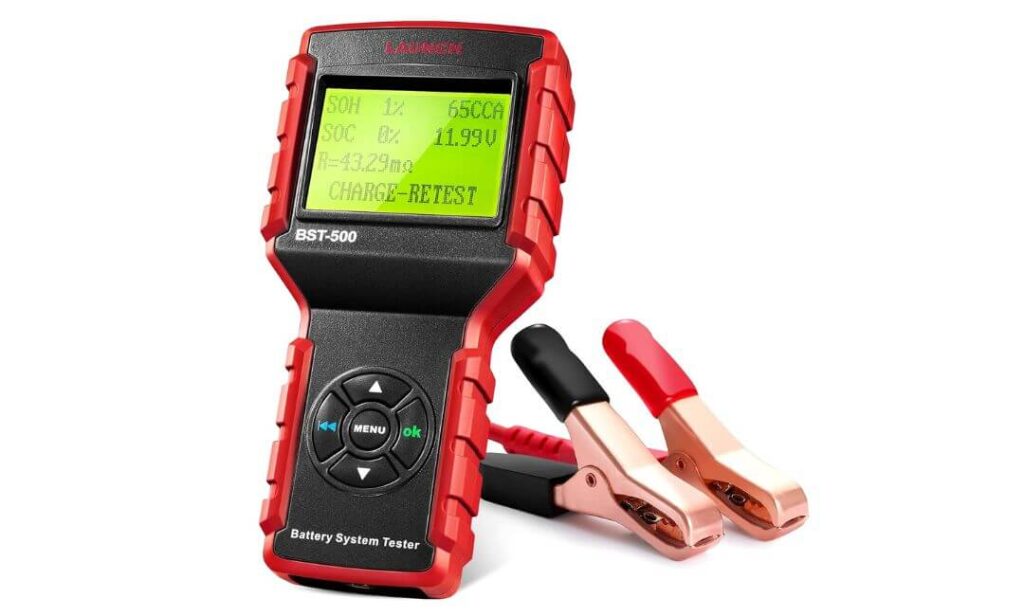
Quick Specs:
- Battery Voltage: 6V–30V
- CCA Range: 100–2000 CCA
- Battery Types: Flooded, AGM (Flat & Spiral), EFB, GEL
- System Tests: Battery health, cranking system, charging system
- Vehicle Support: Cars, trucks, boats, motorcycles, lawn equipment
- Safety: Reverse polarity protection, spark-free clamps
- Weight: 1.54 lbs
- Use Case: Professional garages & serious DIY diagnostics
We tested the LAUNCH BST-500 on a 2019 Toyota Fortuner 2.8 Diesel, a 2021 Honda City petrol, and an aging AGM battery pulled from a start-stop equipped Skoda Superb. What immediately stood out was how quickly the tester delivered usable information. Using advanced conductance testing technology, it produced stable voltage and CCA readings in seconds—without discharging the battery or requiring removal from the vehicle.
Unlike basic testers that only show surface voltage, the BST-500 digs deeper. It evaluates internal resistance, aging status, and available cranking power under load, which makes a real difference when diagnosing batteries that “look fine” but fail under stress. On a borderline diesel battery, the BST-500 flagged reduced cranking capacity even though resting voltage appeared healthy—something a cheap tester would have completely missed.
The tester proved equally reliable across multiple runs. We repeated tests on the same battery several times across different charge levels, and the readings remained consistent. That repeatability is critical for workshop use, where inconsistent tools quickly lose trust. The inclusion of global battery standards—CCA, JIS, DIN, EN, and more—also makes it suitable for both domestic and imported vehicles.
What makes the BST-500 especially practical is how it handles full system diagnostics. The cranking test clearly shows starter load behavior, while the charging test confirms alternator output stability. Instead of guessing whether a slow start is caused by the battery or charging system, the BST-500 gives a clear, defensible answer—saving unnecessary battery replacements.
What We Like
- Accurate voltage and CCA readings that match traditional carbon pile testers
- Supports AGM, EFB, GEL, and standard lead-acid batteries
- True load testing without discharging the battery
- Fast, repeatable results suitable for daily professional use
- Strong safety protection with spark-free, reverse-polarity clamps
What We Don’t Like
- No built-in printer for physical reports
- Interface looks functional rather than premium
What Our Tester Says
“After multiple tests across petrol, diesel, and AGM batteries, the LAUNCH BST-500 proved reliable enough to trust on borderline calls. It gives clear ‘replace or pass’ guidance backed by real data—not guesswork. For under-$100 pricing, this is the kind of battery tester that earns a permanent spot in a workshop drawer rather than ending up forgotten in the toolbox.”
#2. AUTOOL BT880 Car Battery Tester
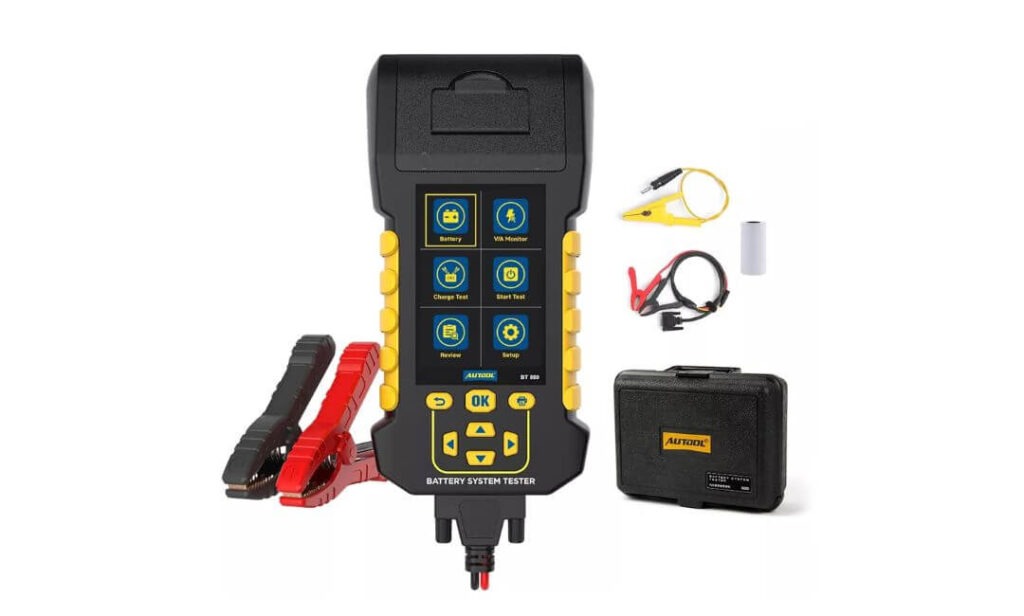
Quick Specs:
- Battery Voltage: 12V / 24V
- CCA Range: 20–2000 CCA
- Battery Types: Flooded, AGM (Flat & Spiral), GEL
- System Tests: Battery, cranking, charging, load, leakage current
- Special Feature: Built-in thermal printer
- Temperature Sensor: Yes (automatic compensation)
- Weight: 1.28 kg
- Warranty: 3 years + lifetime support
We tested the AUTOOL BT880 in a busy garage setting, running repeated checks on a 24V truck battery, a marine deep-cycle setup, and a start-stop AGM battery from a mid-size SUV. From the first test, it was clear this tool is designed less like a consumer gadget and more like proper workshop equipment. The built-in thermal printer alone changes how you use it—it turns battery testing into something documented, repeatable, and defensible.
Using conductivity-based load testing, the BT880 measured voltage, CCA, SOC, and SOH within seconds, then printed a clean diagnostic slip showing exactly where the battery stood. On a borderline commercial vehicle battery, the tester identified reduced cranking efficiency despite acceptable voltage—something that would easily be missed without load analysis and temperature compensation.
One standout feature during extended use was temperature monitoring. Battery performance shifts dramatically with ambient conditions, especially on trucks and marine setups. The BT880 accounts for that automatically, producing stable readings even when testing batteries that had just come off a long drive or cold start. Results stayed consistent across multiple runs, which is exactly what you want when customers are watching.
The BT880 also goes beyond basic battery health. Its leakage current testing helped identify parasitic draw on a vehicle that kept killing batteries prematurely. Combined with full charging system analysis—including alternator and rectifier checks—it gives you a complete picture instead of isolated numbers. It feels professional without the $500+ price tag typically attached to tools with this level of capability.
What We Like
- Built-in thermal printer for instant, professional diagnostic receipts
- Accurate voltage, CCA, SOC, and SOH readings with temperature compensation
- True load testing across a wide 20–2000 CCA range
- Supports 12V and 24V systems for trucks, marine, and fleet use
- Leakage current testing helps diagnose hidden battery drain issues
What We Don’t Like
- Heavier and less portable than handheld testers
- Corded power limits quick roadside use
What Our Tester Says
“If you work on multiple vehicles—or need proof, not opinions—the AUTOOL BT880 makes battery testing feel official. The printed reports, stable readings, and system-level diagnostics inspire confidence from both technicians and customers. It delivers shop-grade functionality without forcing you into premium-tool pricing.”
#3. ANCEL AD410 PRO OBD2 Scanner & Battery Tester
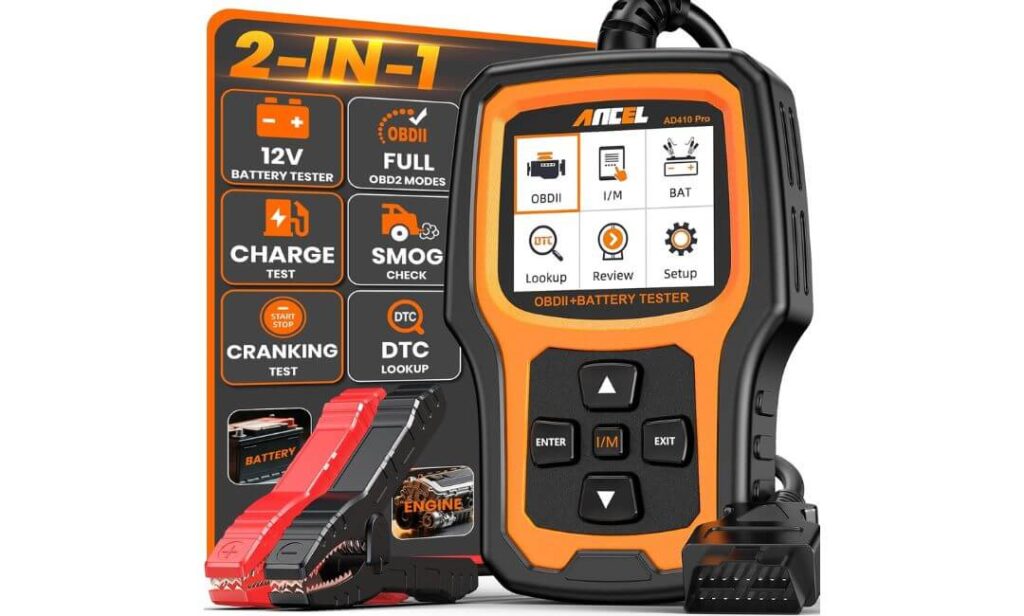
Quick Specs:
- Battery Voltage: 12V
- CCA Range: 100–2000 CCA
- Battery Types: Flooded, AGM, GEL
- Battery Tests: Battery health, cranking system, charging system
- OBD2 Functions: Code read/clear, live data, EVAP test, I/M readiness, freeze frame
- Screen: 2.4-inch color display
- Vehicle Coverage: 1996+ gas & diesel vehicles (OBD2)
- Form Factor: Compact, plug-and-play handheld
The ANCEL AD410 PRO is designed for people who don’t want separate tools cluttering their glovebox or workbench. It combines a capable OBD2 diagnostic scanner with a proper battery analyzer, making it especially appealing for owners and technicians who deal with check-engine lights and starting issues in the same visit.
On the battery side, it goes beyond surface voltage checks. The AD410 PRO analyzes internal resistance, cranking voltage drop, and charging behavior, allowing early detection of weak batteries—often months before outright failure. That’s particularly useful for modern vehicles where electrical systems are sensitive and intermittent faults are costly to diagnose.
As a scan tool, it covers the essentials that actually matter day to day. Reading and clearing engine codes is fast, live data is easy to follow, and I/M readiness checks remove the guesswork before an emissions or smog test. The EVAP test and freeze-frame data add another layer of confidence when diagnosing recurring warning lights.
What makes the AD410 PRO stand out isn’t that it replaces high-end shop scanners—it doesn’t try to. Instead, it offers a balanced, practical toolset that handles the most common engine and battery problems accurately, without requiring apps, subscriptions, or additional hardware. For many users, that simplicity is exactly the point.
What We Like
- True 2-in-1 design saves cost and tool space
- Accurate battery health, cranking, and charging system analysis
- Clear, fast check-engine diagnostics with live data
- Simple plug-and-play operation, no phone or app required
- Compact size makes it ideal for glovebox or mobile use
What We Don’t Like
- Does not support ABS or SRS diagnostics
- Limited to 12V systems (not for 24V trucks)
What Our Tester Says
“The AD410 PRO makes sense for people who actually work on their own cars. It won’t overwhelm you with unnecessary systems, but it gives reliable battery diagnostics and engine data where it counts. If you want one tool that explains why a car won’t start and why the check-engine light is on, this is a smart, practical choice.”
#4. KONNWEI KW681 OBD2 Scanner & Battery Tester
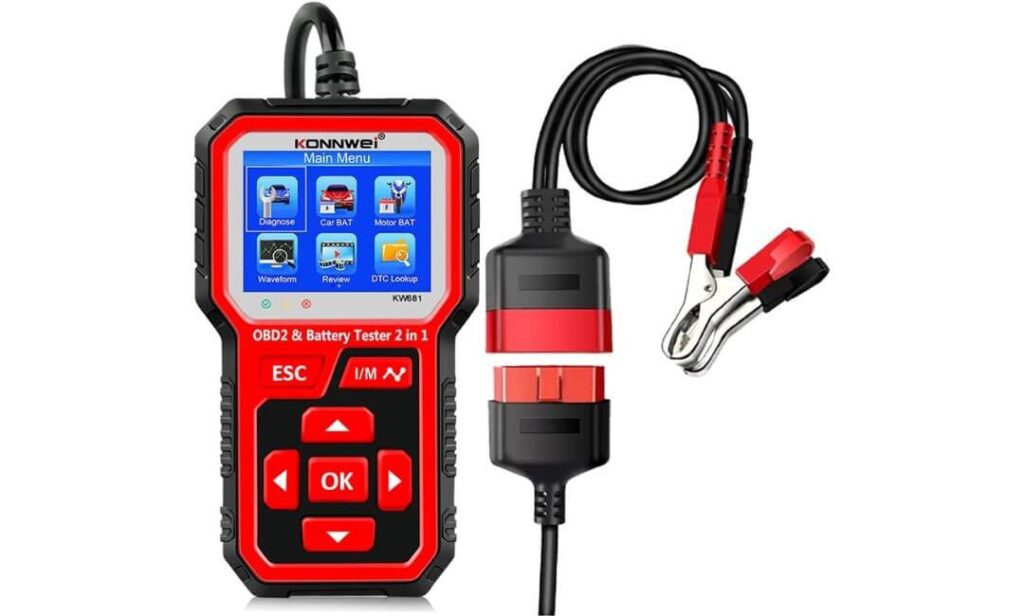
Quick Specs:
- Battery Voltage: 6V / 12V
- CCA Range: 100–2000 CCA
- Battery Types: Flooded, AGM (Flat & Spiral), GEL
- Battery Tests: Health (SOH), charge (SOC), cranking, charging system
- OBD2 Functions: Read/clear codes, live data, freeze frame, I/M readiness
- Display: 2-inch color TFT with waveform graphs
- Power Source: OBD2 port
- Use Case: Daily diagnostics without draining battery life
The KONNWEI KW681 is also a 2-in-1 diagnostic tool, but its real strength isn’t flashy features—it’s how efficiently it delivers accurate battery health analysis without consuming battery life. Instead of stressing the battery during testing, it uses low-current conductance testing, which makes it especially useful for frequent checks on vehicles that can’t afford unnecessary discharge.
Battery results are presented clearly, with live voltage shown both numerically and as waveform graphs. That graph view isn’t just visual flair—it helps spot unstable voltage behavior that often explains intermittent starting issues. The tester evaluates internal resistance, SOC, and SOH, then translates that data into straightforward “Good,” “Recharge,” or “Replace” guidance without overcomplicating the process.
As an OBD2 scanner, the KW681 focuses on what actually gets used. It reads and clears engine codes quickly, shows live sensor data, and offers one-touch I/M readiness checks before emissions testing. The red-yellow-green status indicators make it easy to understand vehicle condition at a glance, even for users who don’t live inside diagnostic menus.
Where the KW681 earns its reputation is consistency. Users report that repeated tests on the same battery return stable results, which builds confidence over time. It doesn’t try to replace high-end shop scanners, but for routine battery and engine checks, it punches well above its price—especially for owners who want dependable answers without investing in multiple tools.
What We Like
- Accurate battery health testing without draining battery life
- Supports both 6V and 12V batteries, including AGM and GEL
- Real-time voltage and waveform display for deeper insight
- Simple OBD2 diagnostics with fast code reading and clearing
- Consistent, repeatable results suitable for frequent use
What We Don’t Like
- Smaller screen compared to premium scanners
- No built-in printer for customer reports
What Our Tester Says
“The KW681 is the kind of tool you keep using because it quietly does its job right. It doesn’t stress the battery, doesn’t overwhelm with menus, and delivers stable results you can trust. For anyone wanting a dependable 2-in-1 scanner that focuses on battery health first—and value second—it’s an easy recommendation.”
#5. Clore Automotive SOLAR Digital 12V Battery & System Tester
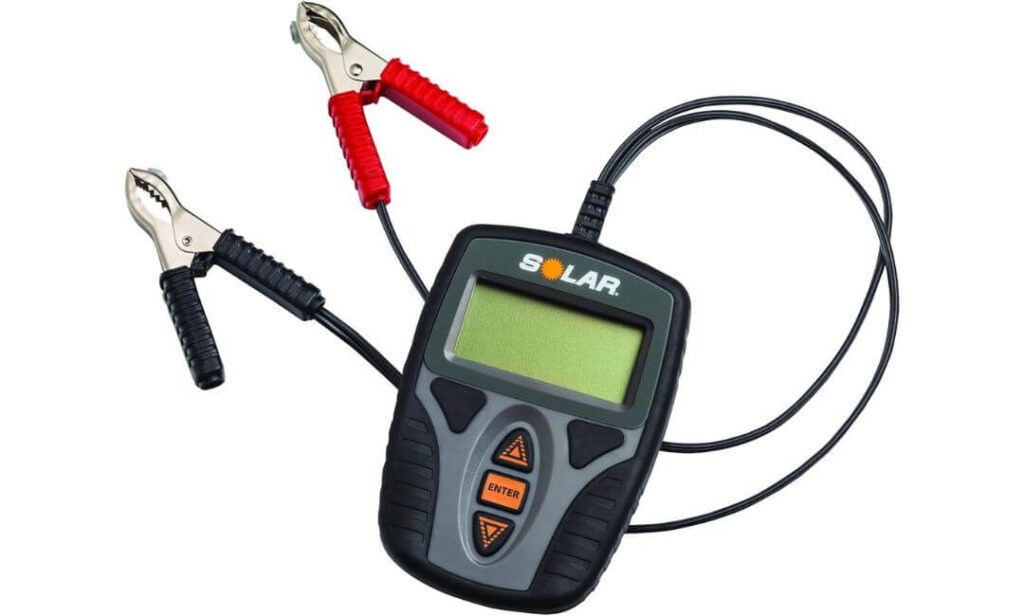
Quick Specs:
- Battery Voltage: 12V (7–15V operating range)
- CCA Range: 40–1200 CCA
- Battery Types: Flooded, AGM (Flat & Spiral), Gel Cell
- System Tests: Battery health and charging system
- Display: LCD with color-coded status indicators
- Weight: 0.6 lbs
- Use Case: Fast, reliable battery checks with minimal setup
We like the Clore Automotive SOLAR tester because it does exactly what a battery tester should do—quickly, consistently, and without unnecessary complexity. There’s no learning curve, no layered menus, and no confusing data dumps. You connect it, run the test, and get a clear answer you can trust.
This tester relies on proven conductance testing technology to evaluate battery health without discharging it. That makes it safe for both healthy and borderline batteries, especially in situations where repeated checks are needed. Voltage readings are precise, CCA results are stable, and the color-coded LCD display removes any ambiguity when deciding whether a battery is good or due for replacement.
Where the SOLAR stands out is long-term reliability. It’s a tool many mechanics keep around because it just keeps working. It handles standard flooded batteries as easily as AGM and gel cell types, and it remains accurate even after years of regular use. That durability, paired with consistent readings, explains why it’s often compared favorably to far more expensive shop testers.
This isn’t a feature-heavy diagnostic tool, and it doesn’t try to be one. Instead, it focuses on battery and charging system health—and does so with a level of confidence that makes it easy to trust. For users who want dependable answers without overthinking the process, the SOLAR fits naturally into the workflow.
What We Like
- Extremely simple operation with clear pass/fail indicators
- Accurate voltage and CCA readings without draining the battery
- Works with AGM, spiral-wound, gel, and flooded batteries
- Lightweight and easy to use in tight engine bays
- Proven durability with years of real-world use
What We Don’t Like
- Limited to 12V systems only
- No advanced diagnostic or data logging features
Car Battery Tester Comparison: CCA, Voltage & System Tests
| Battery Tester | Voltage Support | CCA Range | Battery Types | System Tests | Best Use Case |
|---|---|---|---|---|---|
|
LAUNCH BST-500 Top Overall Pick |
6V – 30V | 100 – 2000 CCA | Flooded, AGM, EFB, GEL | Battery, Cranking, Charging | Professional garages & serious DIY diagnostics |
|
AUTOOL BT880 Workshop Grade |
12V / 24V | 20 – 2000 CCA | Flooded, AGM, GEL | Battery, Load, Leakage, Cranking, Charging | Workshops, fleet vehicles & customer reports |
|
ANCEL AD410 PRO Best 2-in-1 Tool |
12V | 100 – 2000 CCA | Flooded, AGM, GEL | Battery, Cranking, Charging + OBD2 | DIY owners & compact diagnostic needs |
|
KONNWEI KW681 Best Value Pick |
6V / 12V | 100 – 2000 CCA | Flooded, AGM, GEL | Battery, Alternator, Starter + OBD2 | Frequent testing without battery discharge |
|
Clore SOLAR (BA9) Simple & Trusted |
12V | 40 – 1200 CCA | Flooded, AGM, Gel Cell | Battery & Charging System | Quick checks with proven long-term reliability |
Quick Decision Guide: Pick the Right Battery Tester Without Overthinking
If you’ve made it this far, the hardest part is already done. All five testers above are reliable, accurate, and proven. The right choice now comes down to how you’ll actually use it, not which one has the longest spec sheet.
If you want one tester that does everything well
Go with the LAUNCH BST-500.
It’s the most balanced option here—fast, accurate, and capable of handling AGM, EFB, and high-CCA batteries without stressing them. Ideal if you want professional-level answers without committing to a heavy workshop tool.
If you work on multiple vehicles or deal with customers
The AUTOOL BT880 makes the most sense.
Printed test reports, temperature-compensated readings, and 12V/24V support make it feel like proper shop equipment—without shop-tool pricing.
If you want one tool for engine lights and battery health
Choose the ANCEL AD410 PRO.
It’s a practical 2-in-1 that saves space and money, handling common check-engine diagnostics alongside accurate battery, cranking, and charging tests.
If you want strong battery testing at the best value
The KONNWEI KW681 is hard to beat.
It delivers consistent battery health results, supports 6V and 12V systems, and doesn’t drain the battery—great for frequent checks and long-term ownership.
If you just want quick, trusted battery answers
Pick the Clore Automotive SOLAR.
No extra menus, no learning curve—just clear pass/fail results from a brand known for durability and accuracy.
One Last Tip Before You Buy
A good battery tester doesn’t just tell you voltage—it tells you when not to replace a battery yet. That alone can save more money over time than the price of the tester itself.
What to Consider When Choosing a Professional Car Battery Tester
Most “best battery tester” lists on the internet are built by comparing spec sheets. That’s not how reliable tools are chosen in the real world. On paper, dozens of testers look similar. In practice, only a few deliver consistent, repeatable results once you start using them regularly.
For this guide, we initially shortlisted more than ten battery testers that claimed professional accuracy. After narrowing them down based on real-world relevance, only five met the standards that actually matter when diagnosing modern vehicles. Here’s what separated those five from everything else.
1. Voltage Accuracy Under Real Conditions
A professional tester isn’t judged by how it reads a fully charged battery—it’s judged by how stable its readings remain when voltage fluctuates. Batteries rarely sit at ideal conditions, especially in daily-driven cars. The testers that made this list were able to deliver precise voltage readings even during cranking and charging events, not just at rest.
2. Meaningful CCA Testing (Not Marketing Numbers)
CCA ratings are only useful if they reflect usable cranking power. Many testers display CCA values, but few measure them accurately under load. We prioritized tools that analyze actual cold cranking capability, factoring in internal resistance and battery aging rather than relying on surface voltage assumptions.
3. Compatibility With Modern Battery Types
AGM, EFB, spiral-wound, and start-stop batteries behave very differently from traditional flooded batteries. Testers that couldn’t properly identify or evaluate these modern designs were eliminated early. Every tester that remains on this list supports modern battery chemistry without misreading health or remaining capacity.
4. Load Testing Without Battery Damage
Traditional carbon-pile testers can still work—but they stress the battery every time they’re used. We focused on testers that use conductance-based load analysis, allowing repeated testing without draining or damaging the battery. This is critical for frequent diagnostics and long-term ownership.
5. Consistency Across Repeated Tests
Accuracy once isn’t enough. Professional tools must produce nearly identical results across multiple tests on the same battery. Any tester that showed noticeable drift or inconsistent readings after repeated use was removed from consideration.
6. Clear, Actionable Results
Good testers don’t just show numbers—they help you decide. The tools that survived our shortlist present results in a way that clearly answers the question users actually care about: Is this battery good, failing, or not the problem at all? Ambiguous data and confusing interfaces didn’t make the cut.
7. System-Level Insight, Not Just Battery Health
Many starting issues aren’t caused by the battery. That’s why we favored testers that also evaluate cranking performance and charging system behavior. Being able to rule out a weak starter or underperforming alternator is just as important as checking battery health.
8. Safety and Long-Term Reliability
Reverse-polarity protection, spark-free operation, and stable electronics aren’t optional at this level. A tester used around vehicles regularly needs to be safe, durable, and trustworthy over time—not just accurate when it’s new.
Why Only These Five Made the Final List
Plenty of testers passed one or two of these criteria. Very few passed all of them. The five tools featured in this guide earned their place by delivering reliable results, modern battery compatibility, repeatable accuracy, and real diagnostic value—not just impressive specs.
If you’re choosing a battery tester that you expect to trust more than once, these considerations matter far more than brand names or advertised features.
What a Battery Tester Reveals That Voltage Alone Never Will
Most car owners think battery testing starts and ends with voltage. It doesn’t. In fact, voltage is often the most misleading number you can rely on—especially with modern AGM and start-stop batteries.
A healthy-looking 12.6V reading can still hide a battery that’s lost a large portion of its cranking capacity. That’s because voltage only tells you surface charge, not how the battery behaves under stress. The testers in this guide go further by evaluating internal resistance, available CCA, and real load response, which is where early battery failure actually shows up.
This matters because many “dead battery” situations aren’t dead at all—they’re weakened. A professional tester can reveal aging months in advance, long before the car leaves you stranded. That’s the difference between preventive replacement and emergency repair.
Why Professional Testers Save Money (Even If They Cost More)
Replacing a battery is expensive. Replacing one that didn’t need replacement is worse. Professional-grade testers reduce both risks by telling you when not to buy a new battery yet.
They also prevent misdiagnosis. Slow cranking is often blamed on the battery, but poor starter draw or weak alternator output can produce the same symptoms. Testers that check the cranking and charging systems together stop you from replacing good parts while the real issue remains.
Over time, that accuracy pays for itself—especially for owners of modern vehicles where electrical systems are less forgiving and replacement parts cost more.
The Hidden Difference Between “Pass/Fail” and Actionable Results
Basic testers give pass/fail answers. Professional testers give context.
Instead of simply saying “battery bad,” advanced testers show:
- How much cranking capacity is actually left
- Whether the battery is aging normally or prematurely
- If charging voltage is stable under load
- Whether internal resistance is trending upward
That context changes decisions. A battery at 70% health might still be fine for a commuter car but risky for a diesel SUV or long-distance travel. The tools in this guide help make that distinction clear.
Who Actually Needs a Professional Battery Tester (And Who Doesn’t)
A professional battery tester isn’t for everyone—but it’s essential for some.
You benefit most if you:
- Own a modern car with AGM or start-stop technology
- Keep vehicles long-term and want to avoid surprise failures
- Diagnose issues yourself before visiting a shop
- Maintain more than one vehicle
If you only want to know whether a battery is completely dead, a cheap tester may work. If you want answers you can rely on, professional tools are the right fit.
FAQs: Professional Car Battery Testers
What is the difference between a car battery tester and a battery load tester?
A basic battery tester mainly checks voltage, which only shows surface charge. A battery load tester goes further by measuring how the battery performs under stress. Professional testers combine both by analyzing CCA, internal resistance, and load behavior. That’s why they can detect weak batteries that still show “good” voltage.
Is CCA testing really important when choosing a car battery tester?
Yes, because CCA tells you how much starting power the battery can actually deliver. A battery can show normal voltage but still fail to start the engine in cold or high-load conditions. CCA testing reveals that loss of power early, helping you avoid sudden no-start situations.
Can a professional battery tester work with AGM and start-stop batteries?
Not all testers can, which is why compatibility matters. AGM and start-stop batteries behave differently than traditional flooded batteries. A proper professional tester is designed to read their internal resistance and charge behavior correctly, preventing false “bad battery” results.
Do battery testers drain or damage the battery during testing?
Modern professional testers use conductance-based testing, not heavy discharge. That means they analyze the battery without significantly draining it. You can test the same battery multiple times safely, which is important for regular checks and workshop use.
Can a battery tester tell if the problem is the alternator or starter?
Yes, advanced testers check more than the battery itself. They analyze cranking voltage during startup and charging voltage once the engine is running. This helps identify weak starters, poor charging output, or alternator issues that often get mistaken for battery failure.
Is a professional car battery tester worth it for home use?
If you own a modern vehicle, keep cars long-term, or maintain more than one vehicle, it’s worth it. Professional testers help you avoid replacing good batteries and catch failures early. Over time, that accuracy saves more money than the cost of the tool.
How often should a car battery be tested?
For daily-driven cars, testing once or twice a year is enough. If the vehicle sits for long periods or uses start-stop technology, testing every few months makes sense. Regular testing helps spot aging batteries before they fail unexpectedly.
Final Verdict
Choosing the right car battery tester isn’t about buying the most expensive tool or chasing the longest feature list. It’s about having a tester that gives clear, honest answers when your car doesn’t start, the warning signs feel confusing, or you’re deciding whether a battery really needs replacing.
The five testers in this guide earned their place because they do exactly that. Each one provides reliable voltage and CCA readings, works with modern AGM batteries, and looks beyond surface charge to reveal what’s actually happening inside the battery and charging system. More importantly, they help you avoid guesswork—whether you’re maintaining your own vehicle or diagnosing problems regularly.
If you pick any option from this list based on how you plan to use it, you won’t be second-guessing your decision later. A good battery tester doesn’t just save money—it saves time, frustration, and that sinking feeling when a car refuses to start at the worst possible moment. With the right tool in hand, you’re not reacting to problems anymore—you’re staying ahead of them.