6 Best Bed Rack for Toyota Tundra in 2026: Adjustable Width & Overland Strength
Choosing a bed rack for a Toyota Tundra is mostly about getting the fitment details right before worrying about looks. The truck has two very different generations to account for: 2007–2021 Tundras and the newer 2022–2026 models. Bed lengths also vary by configuration, so a rack that fits one Tundra setup should not automatically be assumed to fit another. Rack width, mounting method, factory bed rails, overall height, and available clearance can all change whether a particular rack makes sense.
The options below cover a useful range of Tundra applications, from 14.5-inch adjustable racks and 17.3-inch low-profile designs to taller 22.3- and 22.5-inch overland racks. There are also meaningful differences in mounting and capacity: some are designed around factory bed rails, one is specifically listed for trucks without bed rails, while the AUXPACBO advertises an 800-lb capacity and an extendable design. LED-equipped options add another practical touch for loading gear around the bed after dark.
Because some of these products have limited long-term owner feedback, the safest way to compare them is through the specifications that can actually be checked: Tundra model-year coverage, rack dimensions, adjustability, mounting requirements, construction, lighting, and stated load capacity. That gives each recommendation a clear reason for being here instead of treating every universal truck rack as the same product.
Best Toyota Tundra Bed Rack: Top 2026 Picks for Bed-Rail Fitment & Gear Mounting
#1. POFENZE Adjustable Truck Bed Rack
Best Toyota Tundra Bed Rack for 2014–2026 Models With Factory Bed Rails, Adjustable Width and 22.5-Inch Height
#2. CLAMBER Overland Truck Bed Rack
Best Toyota Tundra Overland Bed Rack for 2007–2026 Models With Full-Size Pickup Fitment and Gear-Carrying Versatility
#3. longsun Full-Size Truck Bed Rack
Best Toyota Tundra Bed Rack for 2007–2026 Models Without Bed Rails With a Lower 17.3-Inch Profile
#4. EYOUHZ Adjustable Truck Bed Rack With LED Lights
Best Adjustable Toyota Tundra Bed Rack for 2007–2026 Models With 14.5–17.3-Inch Height Adjustment and Integrated Lighting
#5. OBNAUX Overland Truck Bed Rack With LED Lights
Best Toyota Tundra Overland Bed Rack for 2022–2025 Models With 22.3-Inch Height and Dual LED Lighting
#6. AUXPACBO 800-LB Extendable Truck Bed Rack
Best Heavy-Duty Toyota Tundra Bed Rack for 2007–2025 Models With 800-LB Capacity and Extendable Construction
Expert Tip
Before choosing a bed rack for a Toyota Tundra, check the mounting system before getting distracted by load capacity or accessory features. The biggest difference across these racks is not simply their size; it is how they attach to the truck. Some are designed around factory bed rails, while others are intended for Tundras without them. The rack also needs to match the usable bed area, not just the model year printed in the compatibility list.
Height deserves the same attention. A 14.5–17.4-inch rack keeps the setup lower and easier to access, while a 19.2–22.5-inch design makes more sense when additional clearance is needed for overland equipment. Also separate dynamic capacity from static capacity. A 1,000-lb static rating does not mean 1,000 pounds should be carried while driving; the dynamic rating is the number that matters on the road.
How We Choose These Toyota Tundra Bed Racks
The first filter is real Tundra fitment and mounting compatibility. The lineup covers different generations and bed configurations rather than treating every Tundra as the same truck. POFENZE is listed for 2014–2026 Tundra models with factory bed rails, while longsun covers 2007–2026 Tundras without bed rails. That distinction alone can eliminate the wrong rack before any other specification is considered.
The next step is comparing the dimensions that actually affect a finished installation. POFENZE provides 47.5–64.5 inches of width adjustment at a fixed 22.5-inch height. longsun moves from 52.5–64.4 inches wide and 14.5–17.4 inches high, while EYOUHZ offers an unusually broad 46.4–73-inch width range, plus 14.5–17.3-inch height adjustment and adjustable support-bar spacing. These are not interchangeable numbers; each range points toward a different kind of Tundra setup.
Load capacity is then judged in the context of how the rack will be used. POFENZE and EYOUHZ state 500 lbs dynamic / 1,000 lbs static, longsun lists 500 lbs dynamic / 900 lbs static, and CLAMBER lists 400 lbs dynamic / 800 lbs static. AUXPACBO is different again, with an 800-lb road rating and 600-lb off-road rating. The comparison therefore looks at the complete rating rather than ranking products by the largest headline number.
Construction and rack weight also matter. The steel designs range from approximately 73 to 129 pounds, while the AUXPACBO uses aluminum and weighs about 70 pounds. That difference becomes meaningful when the Tundra already carries passengers, tools, camping equipment, or other cargo. Corrosion protection is also considered because these racks are exposed to rain, mud, dust, and road conditions throughout the year.
Accessory support is another separator. CLAMBER’s 150+ mounting positions make it particularly interesting for owners building a rack around multiple accessories. EYOUHZ and OBNAUX add LED light bars and accessory slots, while AUXPACBO includes accessory channels and a large height range of 17.75–27.5 inches. These features were included only where they provide a practical reason to choose one design over another.
Installation requirements are checked just as carefully. Drill-free or bolt-on mounting can be preferable for an owner who does not want permanent changes to the truck, while CLAMBER’s slot, clamp, and drilling options provide more flexibility for different bed configurations. The physical weight of the rack also matters during installation; a 110–129-pound steel frame is a very different job to position than a 70–73-pound design.
The ranking also takes product-year coverage seriously. The OBNAUX listing provided for this comparison states 2022–2025 Tundra fitment, so it is presented that way rather than being stretched to claim 2026 compatibility. AUXPACBO likewise states 2007–2025 for the Tundra. That kind of distinction may look small on a comparison page, but it is exactly the information a buyer needs before spending money.
Finally, these products are relatively new and do not all have years of independent owner history behind them. That means the selection does not pretend that limited reviews prove long-term durability. Instead, the recommendations lean on verifiable fitment, mounting design, dimensions, material, dynamic and static capacity, adjustability, accessory support, installation requirements, and stated warranty information.
There is no universal winner for every Tundra. A truck with factory rails has different requirements from one without them, and a low-profile daily-use setup has different priorities from a rooftop-tent or overland build. The best choice is therefore the rack whose actual dimensions and mounting system match the Tundra in front of you, with the load rating and features fitting the way that truck will really be used.
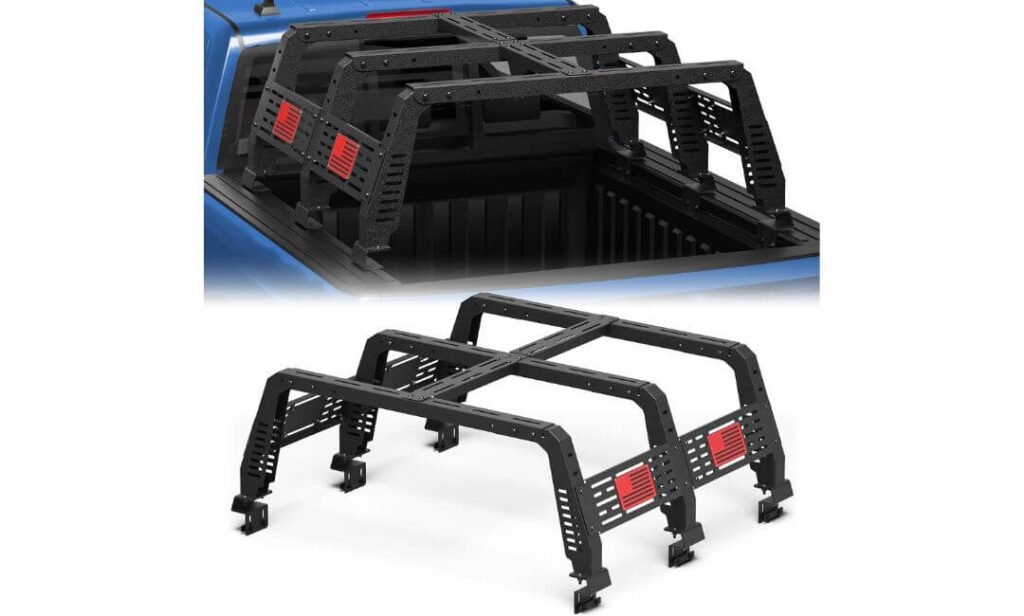
#1. POFENZE Adjustable Truck Bed Rack
Quick Specs:
- Tundra fitment: 2014–2026 with factory bed rails
- Rack size: 61.7 × 64.5 × 22.5 inches
- Height: Fixed 22.5 inches
- Width adjustment: 47.5–64.5 inches
- Material: Carbon steel
- Capacity: 500 lbs dynamic / 1,000 lbs static
- Rack weight: 110 lbs
- Mounting: Bolt-on to factory bed rails, no drilling
- Finish: E-coating + textured black powder coat
The biggest reason this rack makes sense for the Toyota Tundra is the combination of factory-bed-rail mounting and adjustable width. The rack is listed specifically for 2014–2026 Tundra models equipped with the OEM bed-rail system, with width adjustment from 47.5 to 64.5 inches. That gives considerably more room to dial in the mounting position than a fixed-width universal rack, while the 22.5-inch height keeps the load elevated above the bed.
The carbon-steel construction is where the numbers start to matter. The stated rating is 500 pounds while moving and 1,000 pounds when stationary, assuming the load is properly distributed. That distinction is important for anyone planning a rooftop tent, camping equipment, recovery gear, or other substantial cargo. At 110 pounds, this is also clearly built as a substantial piece of equipment rather than a lightweight utility rack.
There are a few practical touches that make the design more convincing for regular outdoor use. The E-coat base with textured black powder coating provides two layers of surface protection, while the fixed structure avoids introducing a height-adjustment mechanism that could add unnecessary movement. Installation is bolt-on through the factory rails, and the supplied hardware means there is no welding involved; because of the rack’s size and weight, having another person help position it during installation is the sensible approach. (A properly supported rack starts with properly aligned mounting hardware—not simply a high load number.)
What Stands Out
- 47.5–64.5-inch width adjustment gives the rack useful fit flexibility across supported Tundra configurations.
- The 22.5-inch fixed height is substantial enough for overland equipment and elevated cargo without relying on a telescoping height mechanism.
- 500-lb dynamic and 1,000-lb static ratings give it a clear advantage for heavier stationary setups.
- Factory bed-rail mounting keeps the installation clean and avoids drilling into the truck bed.
- The dual-layer finish is a worthwhile detail for a rack expected to spend its life outside.
One Thing to Know
The fixed 22.5-inch height is a deliberate design choice, so this is better suited to a Tundra build that already has the desired rack height in mind rather than someone specifically looking for a height-adjustable frame.
Toyota Tundra Fitment & Setup
The stated fitment covers 2014–2026 Toyota Tundra models with factory bed rails. That makes the mounting system the first thing to verify before ordering; the model year alone is not enough if the truck does not have the required OEM rail setup.
For installation, the rack uses a bolt-on mounting arrangement and does not require drilling or welding. The 110-pound rack is large enough that positioning it accurately is much easier with two people, particularly when aligning the adjustable width and securing the hardware evenly.
The Insider Pro-Tip
The 47.5–64.5-inch adjustment range is one of the most useful numbers on the entire specification sheet, so measure the actual mounting area on the Tundra before tightening anything down. Getting the width right first helps keep the rack square instead of using the mounting hardware to compensate for a poor initial position.
For heavier setups, pay attention to the difference between dynamic and static capacity rather than treating the advertised 1,000-pound figure as a driving load. A properly distributed load, correctly tightened mounting hardware, and a factory bed-rail system in good condition are just as important as the rack’s rating.
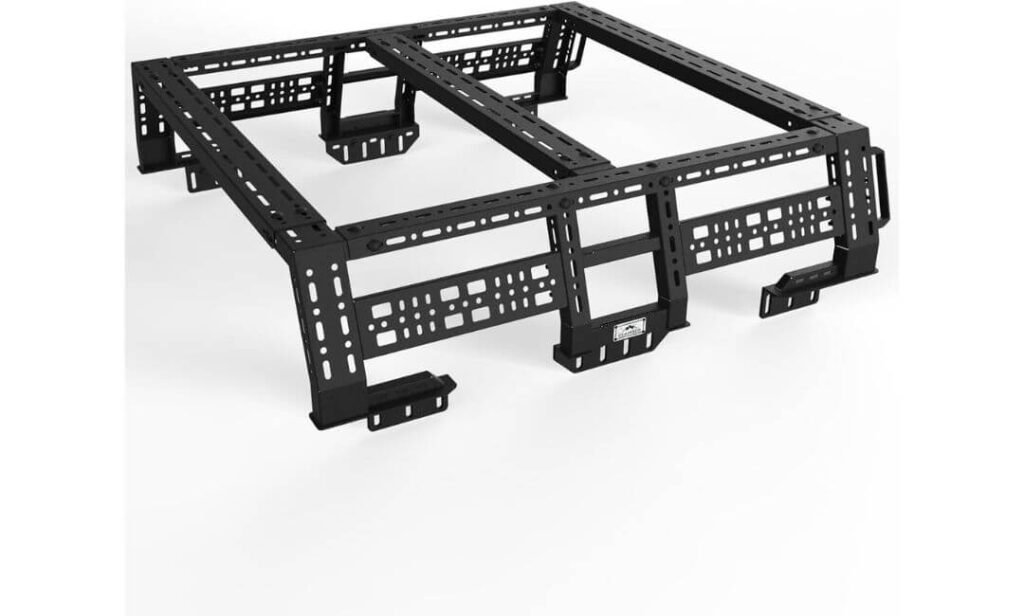
#2. CLAMBER Full-Size Overland Bed Rack
Quick Specs:
- Tundra fitment: 2007–2026 Toyota Tundra
- Rack dimensions: 63.3 × 60.7–64.5 × 13.6 inches
- Material: Carbon steel
- Capacity: 400 lbs dynamic / 800 lbs static
- Rack weight: 117.9 lbs
- Width: Adjustable from 60.7–64.5 inches
- Mounting: Bed rails, slot, clamp, or drilling options
- Accessory mounting: 150+ mounting positions
- Center support: H-style support with ladder function
- Bed-rail use: Designed for beds with or without utility rails
- Tonneau cover: Not compatible
- Installation: Assembly required
What makes this rack interesting is not simply the 800-pound capacity. The more useful detail is how much freedom the frame gives for building around the truck. With 150+ mounting positions, there is space for lights, tools, recovery equipment, spare tires, bikes, fuel containers, camping gear, and other accessories without forcing everything into one predetermined layout.
For the 2007–2026 Toyota Tundra, the adjustable 60.7–64.5-inch width gives the frame some welcome flexibility across different full-size bed setups. The carbon-steel construction brings the stated rating to 400 pounds dynamically and 800 pounds statically, while the H-style center support adds another practical feature: it can also serve as a step or ladder-style access point when reaching gear above the bed.
Another strong point is the mounting flexibility. The rack is designed to work with Tundra beds with or without utility bed rails, and the installation can use slot mounting, clamping, or drilling depending on the setup. Standard installation does not require drilling, which keeps the process simpler for many owners. Assembly is still required, and at 117.9 pounds, having a second person around during installation is a smart move rather than trying to wrestle the frame into position alone.
What Makes It Worth Considering
- 150+ mounting positions make this especially useful for owners who expect to add accessories over time.
- The 60.7–64.5-inch adjustable width gives more room to fine-tune the rack to the truck.
- 400-lb dynamic and 800-lb static capacity provide a clear separation between driving and stationary loads.
- The H-style center support is more than structural hardware; it can make accessing elevated cargo easier.
- Support for beds with or without utility rails makes the design more versatile than rail-only alternatives.
One Small Trade-Off
The rack is not compatible with a tonneau cover, so owners planning to retain a bed cover should account for that before committing to the setup.
Tundra Fitment & Mounting Details
The stated application includes 2007–2026 Toyota Tundra models, making this the widest Tundra year-range option in the current lineup. The important part is that it is intended for full-size truck beds and offers multiple mounting approaches rather than relying on one specific rail arrangement.
The installation hardware and mounting method should be selected according to the actual bed configuration. The slot and clamp methods can avoid drilling, while drilling is available as another installation route when the particular setup calls for it. Because the frame is substantial, careful alignment before fully tightening the mounts is worthwhile.
The Insider Pro-Tip
The 150+ mounting positions are the feature worth thinking about before buying accessories. Instead of treating the rack as a finished product, think of it as the mounting foundation for the Tundra build. Lights, recovery boards, spare tires, bikes, or camping equipment can be positioned around the frame according to how the truck is actually used.
One number deserves particular attention: 400 pounds dynamic versus 800 pounds static. That is not marketing fluff—it tells you the rack is rated differently when the truck is moving than when it is parked. Keep heavier equipment properly distributed and securely mounted, and use the dynamic rating as the relevant figure whenever the Tundra is on the road.
#3. longsun Adjustable Truck Bed Rack
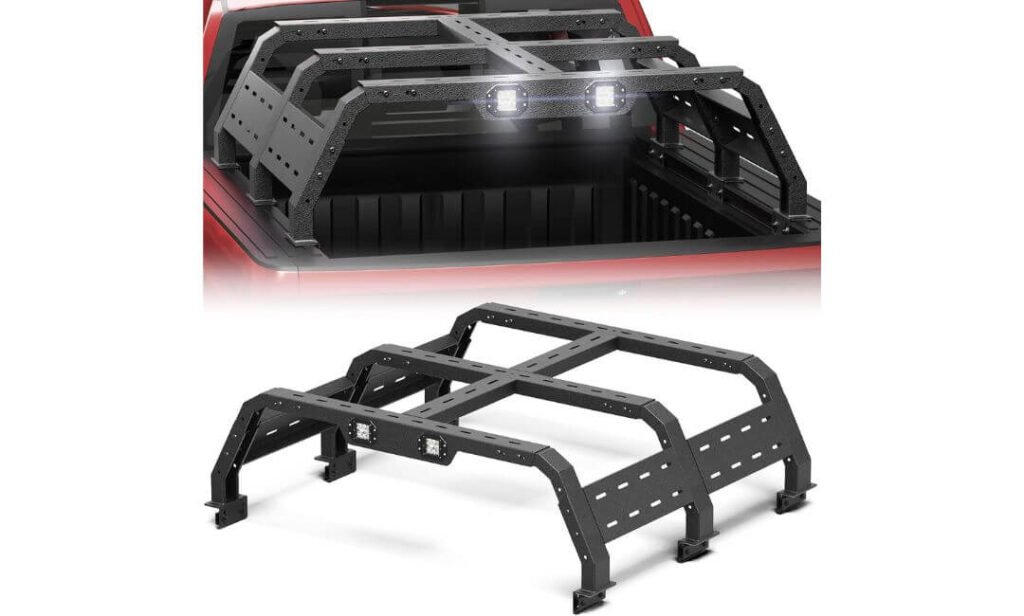
Quick Specs:
- Tundra fitment: 2007–2026 Toyota Tundra without bed rails
- Rack dimensions: 52.8 × 64.5 × 17 inches
- Width adjustment: 52.5–64.4 inches
- Height adjustment: 14.5–17.4 inches
- Material: Heavy-duty carbon steel
- Capacity: 500 lbs dynamic / 900 lbs static
- Mounting: Direct bolt-on
- Installation: No cutting, welding, or fabrication
- Finish: E-coating + textured black powder coat
- Accessory mounting: Multiple pre-set mounting holes
- Rack weight: 125 lbs
For a Toyota Tundra without factory bed rails, the mounting problem is usually more important than the rack’s appearance. This design is built specifically around that situation, with direct bolt-on mounting to the bed rather than depending on an OEM rail system. Its stated 2007–2026 Tundra fitment also gives it broad coverage across the truck’s generations.
The adjustable dimensions make the setup considerably more flexible than a rack locked to one size. The width can move from 52.5 to 64.4 inches, while height adjusts between 14.5 and 17.4 inches. That lower height range is particularly useful when the goal is to carry camping equipment, recovery gear, or other cargo without automatically committing to a tall 22-inch-plus structure.
Underneath that flexibility is a carbon-steel frame with an e-coating base and textured black powder coat. The stated capacity reaches 500 pounds dynamically and 900 pounds statically, while the pre-set mounting holes along the beams leave room for additional equipment and accessories. Installation is another practical advantage: the supplied hardware is intended for a direct bolt-on setup without cutting, welding, or fabrication, although the 125-pound rack is much easier to position with help.
What Makes It Stand Out
- 14.5–17.4-inch height adjustment lets the rack stay relatively low when extra vertical clearance is unnecessary.
- 52.5–64.4-inch width adjustment gives useful control over the final fit.
- 500-lb dynamic / 900-lb static capacity provides a clear load distinction for driving versus parked use.
- The no-bed-rail mounting design makes it a particularly relevant option for Tundras without an OEM rail system.
- Pre-set mounting holes make adding lights, tools, recovery equipment, or other accessories easier as the setup evolves.
One Practical Consideration
This is a 125-pound steel rack, so installation is far more manageable with a helper, especially when keeping the frame square while the mounting hardware is being secured.
Toyota Tundra Mounting & Fitment
The stated Tundra application is 2007–2026, specifically for trucks without bed rails. That makes the mounting configuration the key compatibility check before purchase; the year range alone should not be used to assume every bed configuration is identical.
The supplied setup is designed as a direct bolt-on installation, with no additional cutting, welding, or fabrication required. The adjustable width and height can then be set around the actual truck rather than forcing the Tundra to conform to a fixed rack dimension.
The Insider Pro-Tip
The height adjustment from 14.5 to 17.4 inches is easy to overlook, but it can make a noticeable difference to the finished truck. If the cargo does not require a tall platform, keeping the rack closer to its lower setting can create a cleaner, less top-heavy-looking setup while still leaving useful room for bed-mounted gear.
Also, use the 500-pound dynamic rating as the relevant figure whenever the Tundra is moving. The 900-pound static figure applies to a stationary load, so heavier rooftop-tent or overland setups should be planned around the dynamic rating, proper weight distribution, and secure mounting rather than the larger headline number.
#4. EYOUHZ Adjustable Truck Bed Rack With LED Lights
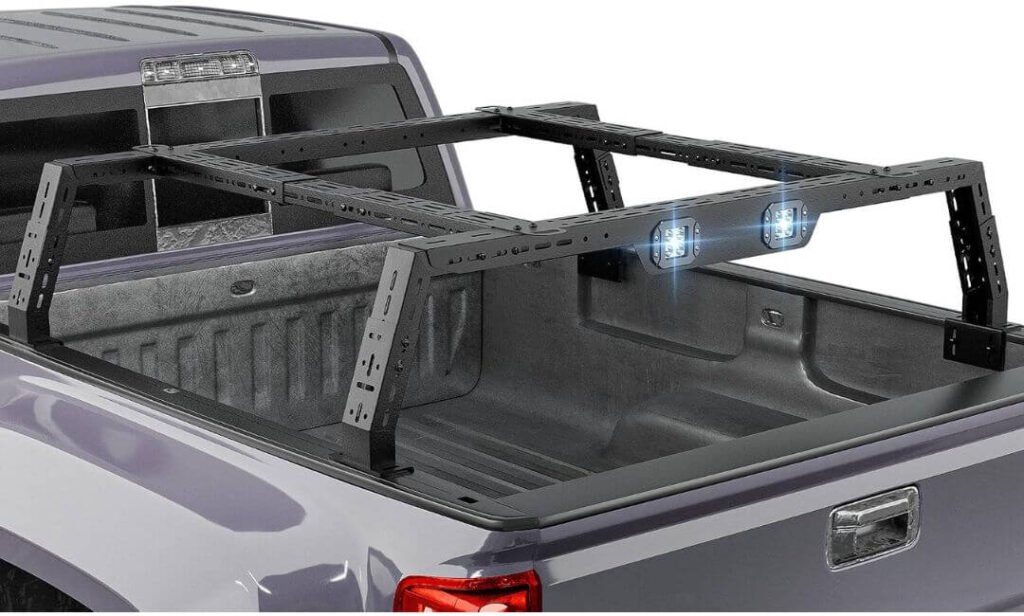
Quick Specs:
- Tundra fitment: 2007–2026 Toyota Tundra
- Height adjustment: 14.5–17.3 inches
- Width adjustment: 46.4–73 inches
- Crossbar spacing: 38.1–49.2 inches
- Material: Heavy-duty carbon steel
- Capacity: 500 lbs dynamic / 1,000 lbs static
- Rack weight: 73 lbs
- Mounting: Bed rail installation
- Lighting: 2 LED light bars
- Finish: Textured black powder coating
- Installation: No drilling, cutting, or modification
A lower bed rack can be surprisingly useful on a Toyota Tundra, especially when frequent access to the cargo matters. This design keeps its height adjustable between 14.5 and 17.3 inches, giving the setup a noticeably lower profile than the taller overland racks in this lineup. The result is a rack that can carry substantial equipment without automatically turning the bed into a tall structure that is harder to reach.
The adjustment range is where this one gets genuinely interesting. Width can be set anywhere from 46.4 to 73 inches, while the distance between the two support bars adjusts from 38.1 to 49.2 inches. That is a lot more flexibility than simply calling a rack “universal.” For the 2007–2026 Tundra, those measurements give owners more freedom to position the structure around the truck and the equipment being carried.
The carbon-steel construction is rated for 500 pounds while moving and 1,000 pounds when stationary. Multiple slots in the side panels provide mounting points for accessories such as lights, high-lift jacks, and other trail equipment, while the package includes two LED light bars. Installation is designed around the bed-rail system without drilling or cutting, and the rack itself weighs about 73 pounds, making it substantially easier to handle during installation than the heavier steel racks above.
What Makes It Stand Out
- The 46.4–73-inch width range is unusually broad and gives plenty of room for setup adjustment.
- 14.5–17.3-inch height adjustment keeps the rack relatively low while retaining useful cargo clearance.
- 500-lb dynamic / 1,000-lb static capacity makes the compact profile more impressive than its appearance suggests.
- Two LED light bars are included rather than requiring a separate lighting purchase.
- The side-panel mounting slots make it easier to build around accessories instead of leaving the rack as a bare frame.
One Practical Consideration
The rack is not designed for use with a tonneau or bed cover, so the bed needs to remain open around the rack installation area.
Toyota Tundra Fitment & Installation
The stated application covers 2007–2026 Toyota Tundra models and uses the truck’s bed-rail system for mounting. Before ordering, the actual rail configuration on the Tundra should match the mounting hardware supplied with the rack.
Installation is designed to be bolt-on with no drilling, cutting, or truck modification. The 73-pound frame is relatively manageable for a steel rack, although careful positioning and a final hardware check are still worthwhile before putting cargo on top.
The Insider Pro-Tip
The smartest way to use this rack is not necessarily to set it at its maximum height. Start around the lowest practical position, then raise it only as much as the carried equipment requires. That keeps the center of the load lower and makes everyday access to the bed noticeably easier.
One more detail deserves attention before a long trip: the manufacturer specifically recommends checking the rack hardware for looseness before driving. With adjustable width, height, and crossbar spacing, those joints are part of what makes the rack versatile. Properly tightened hardware is what turns all that adjustability into a secure setup.
#5. OBNAUX Adjustable Overland Truck Bed Rack With LED Lights
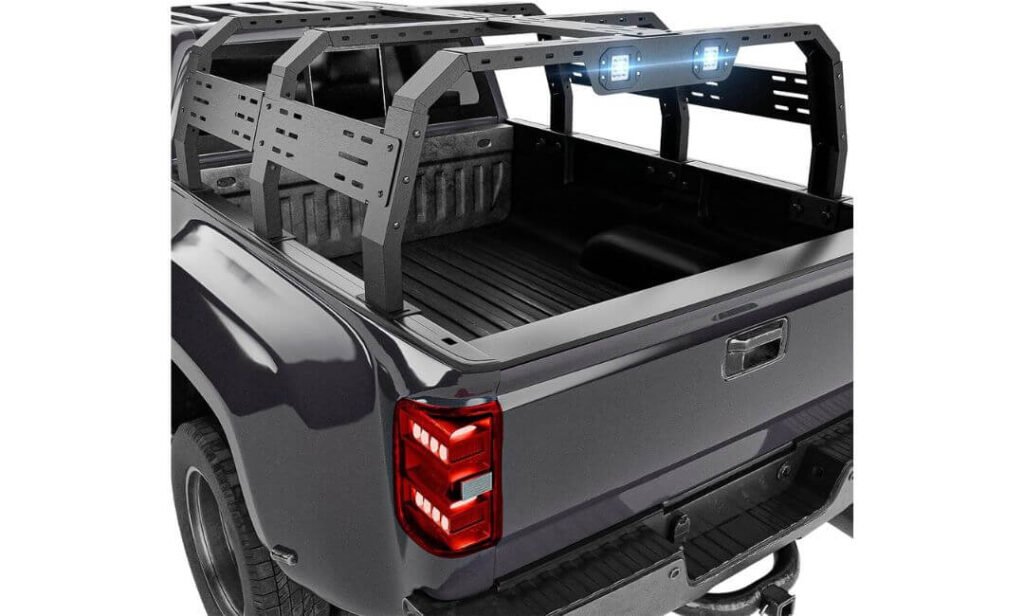
Quick Specs:
- Tundra fitment: 2022–2025 Toyota Tundra
- Height adjustment: 19.2–22.3 inches
- Width adjustment: 55.8–62.76 inches
- Length adjustment: 53–59 inches
- Material: Heavy-duty carbon steel
- Capacity: 500 lbs dynamic / 1,000 lbs static
- Rack weight: 129 lbs
- Mounting: Truck bed rails
- Lighting: 2 LED light bars
- Finish: Textured black powder coating
- Installation: Bolt-on, no drilling or cutting
The standout detail here is the adjustable three-way sizing. Instead of offering only a width adjustment, this rack can be positioned across a 53–59-inch length, 55.8–62.76-inch width, and 19.2–22.3-inch height range. For a newer-generation Tundra, that flexibility is useful when the goal is to keep the rack proportionate to the bed while still leaving enough room for larger camping or overland equipment.
The construction is equally straightforward: heavy-duty carbon steel, textured black powder coating, and a stated 500-pound dynamic / 1,000-pound static capacity. The side panels have elongated mounting slots for equipment such as high-lift jacks, bikes, recovery boards, lights, and other accessories. Two LED light bars are included, giving the rack some practical nighttime utility without needing to add lighting from scratch.
Installation follows the same sensible approach as the rest of this lineup. It mounts to the bed-rail system without drilling, cutting, or modification, with mounting hardware and instructions included. At 129 pounds, it is a substantial rack, so having another set of hands during positioning is the easier route. One fitment detail should not be overlooked: the supplied listing specifically states 2022–2025 Tundra compatibility, so a 2026 owner should confirm fitment with the seller before ordering rather than assuming the same hardware carries over.
What Makes It Stand Out
- Three-way adjustment lets the rack change in length, width, and height rather than only one dimension.
- The 19.2–22.3-inch height range works well for owners wanting a taller overland-style platform.
- 500-lb moving / 1,000-lb stationary capacity gives the rack a clear heavy-load specification.
- Two included LED light bars add useful illumination around the bed after dark.
- The elongated side-panel slots leave plenty of room for a customized accessory setup.
One Practical Consideration
The stated Tundra fitment is 2022–2025, so 2026 Tundra owners should verify compatibility before purchase. The rack is also not designed to work with a tonneau or bed cover.
New-Generation Tundra Fitment
This rack is specifically listed for the 2022–2025 Toyota Tundra, making it the lineup’s more generation-specific choice. Its bed-rail mounting system and adjustable dimensions are intended to work with the newer truck configuration rather than treating every Tundra generation as identical.
The installation itself is uncomplicated on paper: no drilling, cutting, or fabrication, with the required mounting hardware included. The key is getting the rack positioned correctly before fully tightening the hardware so the adjustable frame sits square on the bed rails.
The Insider Pro-Tip
The useful part of the adjustment range is not simply having more numbers to work with. Set the length and width around the actual bed first, then choose the lowest height that gives the carried equipment enough clearance. That creates a cleaner setup and avoids raising the load higher than necessary.
And for anyone planning a rooftop tent or substantial overland load, use the 500-pound dynamic rating as the real-world ceiling while driving. The 1,000-pound figure is the static rating, so it is not the number to use when calculating what the Tundra can safely carry down the highway.
#6. AUXPACBO 800-LB Extendable Aluminum Bed Rack
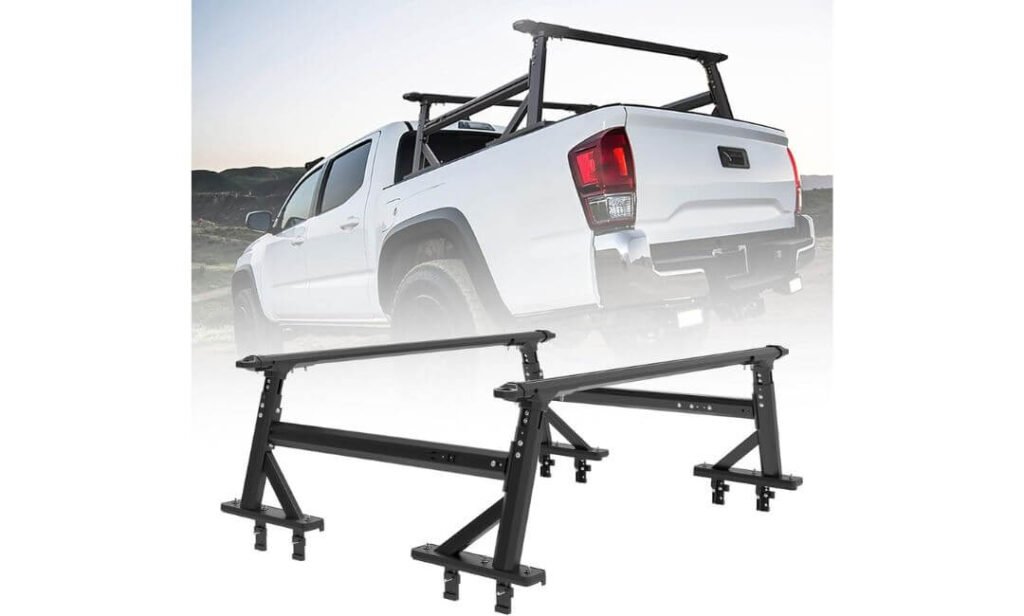
Quick Specs:
- Tundra fitment: 2007–2025 Toyota Tundra
- Material: Heavy-duty aluminum
- Load rating: 800 lbs road / 600 lbs off-road
- Length adjustment: 41.75–52.5 inches
- Height adjustment: 17.75–27.5 inches
- Mounting: U-bolt
- Rack weight: 70 lbs
- Finish: Black powder coating
- Accessory mounting: Integrated accessory channels
- Installation: Approx. 1–2 hours with included hardware
- Not compatible with: Tonneau covers, camper shells, tool boxes, or certain rear-compartment configurations
An aluminum bed rack changes the equation for a Tundra owner who wants substantial carrying capacity without putting another extremely heavy steel structure on the truck. At just 70 pounds, this AUXPACBO is considerably lighter than the 100-plus-pound steel racks in this lineup, while its stated road rating reaches 800 pounds.
The other useful part is the adjustment range. Length moves from 41.75 to 52.5 inches, while height can extend from 17.75 to 27.5 inches. That unusually tall maximum gives plenty of room when carrying longer equipment or working around different cargo heights. The integrated accessory channels also leave room for adding equipment without having to treat the rack as a finished, one-purpose setup.
The U-bolt mounting system keeps installation relatively straightforward, and the black powder-coated aluminum construction provides a good balance between strength and weight. Rubber buffer strips are also included to help keep the rack and carried equipment from taking unnecessary contact during transport. The stated Tundra range ends at 2025, so that is the fitment point to verify carefully for a 2026 truck rather than relying on a generic universal-fit description.
What Makes It Stand Out
- 70-pound aluminum construction keeps the rack noticeably lighter than the heavier steel alternatives.
- 800-lb road / 600-lb off-road rating gives it a clear and useful load distinction.
- 17.75–27.5-inch height adjustment provides substantial flexibility for taller cargo setups.
- 41.75–52.5-inch length adjustment helps accommodate different carrying requirements.
- Accessory channels and rubber buffer strips add useful functionality without making the frame unnecessarily complicated.
One Practical Consideration
The stated application ends at 2025 for the Toyota Tundra, so a 2026 owner should confirm the exact mounting compatibility before ordering. The rack also requires the truck to be free of incompatible equipment such as a tonneau cover, camper shell, or tool box in the mounting area.
Toyota Tundra Fitment & Mounting
The product is listed for 2007–2025 Toyota Tundra models, along with several other pickup applications. Its universal-fit designation means the actual bed configuration and available mounting area deserve attention before installation.
Mounting uses U-bolts, with installation hardware supplied. The manufacturer estimates roughly 1–2 hours for assembly, and an installation video is available. Checking the fit before fully tightening the rack is worthwhile, particularly because the length and height can both be adjusted.
The Insider Pro-Tip
The most useful feature here may actually be the weight-to-capacity balance. A 70-pound aluminum rack with an 800-pound road rating leaves a very different starting point from a 110–130-pound steel rack. That can matter when the Tundra is already carrying passengers, camping equipment, tools, or other bed cargo.
For off-road use, stick to the stated 600-pound off-road rating, even though the road rating is higher. And before loading the rack, make sure the U-bolts are properly secured and the load is distributed across the structure rather than concentrated at one point. That simple check matters far more than chasing the biggest number on the product page.
Best Toyota Tundra Bed Rack Options Compared for Fitment & Load Support (2007–2026)
Buying Guide: How to Choose the Best Toyota Tundra Bed Rack for Your Truck
A good Tundra bed rack should solve a specific cargo and mounting problem, not simply add another piece of hardware to the bed. The right choice depends on how the truck is configured, what will sit on the rack, how often the load will move, and whether the rack needs to work with existing bed equipment. These are the details worth checking before the product page’s photos and big load numbers make the decision for you.
Start With the Tundra Fitment, Not the Rack Size
The Toyota Tundra has changed significantly between the 2007–2021 and 2022–2026 generations, so model year should be the first filter. After that, check the actual bed configuration and mounting system. A rack listed for “2007–2026 Tundra” can still have specific requirements for factory bed rails, bed-side mounting points, or available clearance.
The six racks in this comparison are not identical in that respect. The POFENZE, EYOUHZ, and OBNAUX designs use a bed-rail mounting approach, while the longsun is specifically aimed at Tundras without bed rails. The CLAMBER gives more mounting flexibility, with slot, clamp, and drilling options. The AUXPACBO uses U-bolt mounting and has its own clearance requirements. That difference matters more than a universal-fit label.
Adjustable Width Is Useful, but Measure First
An adjustable rack is valuable because full-size truck beds are not all configured exactly the same way. It also gives more freedom when positioning rooftop tents, kayaks, bikes, recovery equipment, storage cases, or long cargo.
Look at the actual adjustment range rather than simply choosing a rack because it says “adjustable.” The POFENZE adjusts from 47.5–64.5 inches, longsun from 52.5–64.4 inches, and EYOUHZ from 46.4–73 inches. The EYOUHZ also allows adjustment between the two support bars, while the OBNAUX changes in length, width, and height. Those extra adjustment points can be useful when the cargo setup is likely to change later.
A quick measurement of the intended mounting area before ordering can prevent the most frustrating kind of fitment problem: discovering that the rack technically fits the truck but does not sit where the accessories need it to.
Match Rack Height to the Gear You Actually Carry
Rack height changes both usability and the final shape of the truck. The 14.5–17.3-inch EYOUHZ and 14.5–17.4-inch longsun keep the load relatively low, which can make reaching equipment easier. The POFENZE sits at a fixed 22.5 inches, while the OBNAUX adjusts from 19.2–22.3 inches. AUXPACBO offers the widest vertical range in this group, from 17.75 to 27.5 inches.
There is no automatic advantage to choosing the tallest rack. More height can be useful for creating clearance around larger equipment, but unnecessary height also puts the load farther above the bed. For a daily-driven Tundra that mainly carries boxes, bikes, or outdoor gear, a lower arrangement may be more convenient. A rooftop-tent or larger overland setup can justify a taller platform.
Look at Dynamic and Static Ratings Separately
This is one of the easiest specifications to misunderstand. Static capacity applies when the truck is stationary, while dynamic capacity is the figure that matters when the Tundra is moving.
For example, POFENZE and EYOUHZ state 500 pounds dynamic and 1,000 pounds static. longsun lists 500 pounds dynamic and 900 pounds static, while CLAMBER lists 400 pounds dynamic and 800 pounds static. AUXPACBO takes a different approach, stating 800 pounds for road use and 600 pounds off-road.
Those numbers should never be treated as permission to load the rack to its maximum without considering the rest of the setup. The rack, mounting hardware, bed structure, cargo attachment points, and the truck’s own payload limits all work together. A properly distributed load is much more important than simply chasing the highest advertised number.
Carbon Steel vs. Aluminum: Choose for the Whole Setup
Most of these racks use carbon steel, which gives them a substantial, rigid feel but also adds weight. POFENZE weighs about 110 pounds, CLAMBER about 117.9 pounds, longsun about 125 pounds, EYOUHZ about 73 pounds, and OBNAUX about 129 pounds.
The AUXPACBO is different, using aluminum and weighing about 70 pounds. That lower rack weight can be attractive when the truck already carries passengers, camping equipment, tools, or other heavy cargo. It does not automatically make aluminum the better material; the useful comparison is the complete rack weight, stated load rating, mounting method, and intended use.
Check the Finish if the Rack Will Live Outdoors
Bed racks spend a lot of time exposed to rain, road moisture, dirt, mud, and road salt, so surface protection is more than a cosmetic detail. Several of the steel racks use a combination of e-coating and textured black powder coating, while the EYOUHZ, OBNAUX, and AUXPACBO specify powder-coated finishes.
A good finish helps protect the underlying material, but it does not eliminate the need to inspect mounting hardware and exposed areas after hard use. Scratches around mounting points should be dealt with rather than left to collect moisture.
Think About Bed Rails and Existing Accessories
Before buying, check what is already installed in the Tundra bed. Bed rails, tonneau covers, tool boxes, camper shells, and other bed accessories can determine whether a rack will work at all.
This is especially important with this group. The EYOUHZ, OBNAUX, and AUXPACBO listings state that they are not compatible with tonneau or bed covers, while the CLAMBER also states that it is not compatible with a bed tonneau cover. The longsun is specifically designed for trucks without bed rails. Those are not minor details; they can completely change which rack belongs on the shortlist.
Installation: Easy Does Not Mean Careless
Drill-free installation is convenient because it avoids permanent changes to the truck, but the rack still needs to be aligned, tightened, and checked properly. POFENZE, longsun, EYOUHZ, and OBNAUX use bolt-on approaches designed to avoid drilling under their stated configurations. CLAMBER provides multiple mounting methods, including slot and clamp installation, while AUXPACBO uses U-bolts.
Also consider the physical size of the rack. A steel frame weighing 110–129 pounds is much easier to install with a second person, even when the mounting itself is straightforward. Check the included hardware, installation instructions, and manufacturer’s support before starting rather than discovering halfway through the job that an additional tool or mounting component is needed.
Rooftop Tents and Auxiliary Gear Need Extra Attention
If the rack will carry a rooftop tent, recovery boards, spare tire, fuel containers, bikes, kayaks, or other bulky equipment, look beyond the rack’s headline capacity. Check where the accessory will mount, how much space remains around it, and whether the rack’s height and crossbar arrangement actually suit that equipment.
Accessory mounting slots are particularly useful for builds that will grow over time. CLAMBER offers 150+ mounting positions, while EYOUHZ, OBNAUX, and longsun provide multiple slots or mounting holes for additional equipment. That flexibility can be more valuable than a rack with a higher capacity but fewer practical mounting locations.
Weight Distribution, Clearance, and Road Use
Heavy equipment should be spread across the available structure rather than concentrated at one mounting point. Keep an eye on the center of gravity, especially with tall cargo or rooftop equipment, and make sure nothing interferes with the cab, tailgate, lights, or other truck functions.
Aerodynamics also deserve some common sense. A tall rack with bulky equipment creates more wind exposure than an empty low-profile frame. Secure every item independently, keep loose straps under control, and recheck the rack hardware after installation and after the first few drives. These small checks are much more useful than assuming a high load rating makes the setup maintenance-free.
Warranty and Return Policy Matter More With Newer Racks
Several products in this group have relatively limited long-term owner history, so manufacturer support, warranty coverage, and return terms deserve a place in the buying decision. POFENZE states a 1-year manufacturer warranty, longsun lists a 1-year quality guarantee with lifetime service support, and EYOUHZ also lists 1-year warranty coverage with lifetime customer service.
The important part is to check the current seller’s actual warranty and return policy before purchase. A rack can have excellent specifications and still become frustrating if a damaged component, missing hardware, or fitment issue is difficult to resolve.
Quick-Start Checklist Before Ordering
- Confirm the exact Tundra generation and model year.
- Measure the bed and intended mounting area, rather than relying only on the advertised truck compatibility.
- Check whether the truck has factory bed rails and choose the mounting style accordingly.
- Verify the rack’s width, height, and length adjustment ranges against the planned cargo.
- Use the dynamic load rating when calculating weight for a moving truck.
- Check compatibility with tonneau covers, tool boxes, camper shells, and existing bed accessories.
- Confirm that the rack leaves adequate clearance for the cab, tailgate, and carried equipment.
- Check what mounting hardware and tools are included before installation.
- Have assistance available for heavier steel racks.
- Read the current warranty and return policy before placing the order.
- After installation, check every mounting point and recheck the hardware before carrying a serious load.
A bed rack should ultimately make the Tundra more useful, not create another fitment problem to solve. The strongest choice is the one whose mounting system, dimensions, load rating, height, and accessory support match the way the truck will actually be used.
Installation Tips and Safety Checks for a Toyota Tundra Bed Rack
A bed rack does not need a complicated installation to be secure, but it does need the right mounting points, even alignment, and properly tightened hardware. The exact procedure varies by rack, especially between rail-mounted and bed-mounted designs, so the manufacturer’s hardware and instructions should always take priority over a generic installation sequence.
A Clean Installation Flow
- Confirm the mounting setup first.
Before lifting anything into the bed, verify whether the rack is designed for factory bed rails, direct bed mounting, clamps, or U-bolts. Make sure the Tundra’s bed configuration matches the rack’s stated fitment. - Lay out every component before assembly.
Separate the crossbars, side frames, brackets, bolts, washers, and adjustment hardware. This is much easier than discovering halfway through assembly that a bracket was installed on the wrong side. - Set the approximate width and height.
For adjustable designs, start slightly loose and establish the basic dimensions before final tightening. Do not force the rack into position by tightening one side while the opposite side is still misaligned. - Position the frame squarely on the truck.
Check that the rack sits evenly from side to side and that the mounting points are contacting the intended surfaces correctly. The tailgate, cab, bed accessories, and carried equipment should all have adequate clearance. - Tighten progressively.
Tighten the mounting hardware in stages rather than completely securing one corner first. This helps keep the frame aligned as the remaining hardware is tightened. - Perform a physical check before loading anything.
Push and pull the frame by hand and look for unwanted movement. Adjustable sections should be fully secured, and there should be no obvious contact with the cab or bed that could become a problem when the truck flexes. - Install accessories only after the rack itself is secure.
Lights, recovery boards, jacks, bikes, tents, and other equipment should be mounted after the primary structure is properly installed. Keep accessory weight distributed instead of concentrating everything on one section.
Common Installation Mistakes Worth Avoiding
| Mistake | Why It Matters | Better Approach |
|---|---|---|
| Assuming every Tundra bed mounts the same way | Generations and bed configurations differ | Check the exact truck and mounting system |
| Tightening one side completely first | Can pull an adjustable frame out of square | Tighten both sides progressively |
| Ignoring bed-rail condition | Damaged or loose mounting points compromise the setup | Inspect rails and attachment areas first |
| Measuring only the rack, not the truck | Advertised adjustment range does not guarantee usable clearance | Measure the actual mounting area |
| Loading immediately after installation | Small alignment or hardware issues may go unnoticed | Perform a complete unloaded inspection |
| Using static capacity as the driving limit | Static and dynamic ratings describe different conditions | Use the dynamic rating while driving |
| Forgetting cab and tailgate clearance | Cargo or rack movement can create contact | Check clearance with the truck fully assembled |
| Leaving accessory hardware unchecked | Added equipment introduces additional attachment points | Recheck every accessory mount |
Safety Checks Before the First Drive
The most important inspection is the one done before the rack carries its first serious load. Check every visible fastener, mounting bracket, adjustable joint, and accessory attachment point. Nothing should shift when the structure is pushed by hand.
For a rooftop tent or other heavy equipment, check more than the rack’s advertised capacity. The truck’s payload rating, rack dynamic rating, mounting hardware, bed structure, and actual cargo weight all need to work together. A rack rated for 500 pounds dynamically does not mean the Tundra can automatically add 500 pounds without considering everything else already inside the truck.
Maintenance and Inspection Schedule
There is no need to treat a bed rack like a daily mechanical service item, but it should not be installed and forgotten either.
| When to Check | What to Inspect |
|---|---|
| Before the first drive | All mounting hardware, frame alignment, clearance, accessory mounts |
| After the first few drives | Fastener tightness and any movement around mounting points |
| Before long trips | Rack joints, bolts, accessory hardware, load security |
| After rough off-road use | Loose hardware, scratches, bent sections, mounting-point movement |
| After carrying heavy loads | Fasteners, adjustment points, load-bearing areas |
| Periodically | Corrosion, coating damage, hardware condition, bed-rail or bed contact points |
One Inspection Habit That Pays Off
Pay particular attention to the areas where adjustable sections meet fixed sections. These joints are what give an adjustable rack its flexibility, but they are also places worth checking after repeated loading, vibration, and rough-road use.
If the rack develops unexpected movement, rattling, shifted alignment, damaged hardware, or visible structural damage, stop using it until the cause has been identified and corrected. A five-minute inspection before a trip is far cheaper than dealing with a loose rack after the cargo is already on the road.
Toyota Tundra Bed Rack Maintenance: Simple Checks That Prevent Bigger Problems
A bed rack spends its life dealing with vibration, weather, changing loads, dust, mud, and repeated accessory removal, so basic maintenance is worth doing even when everything appears solid. Most of the work is visual and takes only a few minutes; the important part is catching loosened hardware, damaged finishes, or movement before they turn into a real fitment or cargo-security problem.
Check the Mounting Hardware Regularly
The mounting points deserve the most attention. Look over the bolts, nuts, washers, clamps, U-bolts, brackets, and adjustment hardware for looseness or visible movement. This is particularly important after the first few drives, after rough trails, and whenever the rack has carried a heavy load.
Do not simply tighten everything as hard as possible. Use the manufacturer’s recommended tightening specifications where provided, and make sure the hardware is seated correctly before tightening.
Inspect Adjustable Sections
Adjustable width, height, and crossbar sections should move only when deliberately adjusted. Check the locking points and adjustment joints for play, shifting, or unusual rattling.
If the rack has been adjusted for a new cargo setup, treat that as a fresh installation check. Confirm that both sides remain even and that all adjustment hardware is properly secured before driving.
Keep an Eye on the Finish
Small scratches are not automatically a problem, but exposed metal should not be ignored. Inspect the frame for scrapes, chipped coating, bubbling, or early corrosion, particularly around mounting points and areas where accessories contact the rack.
A simple cleaning after muddy or salty driving helps remove material that can hold moisture against the finish. If bare metal becomes exposed, address it before corrosion has time to spread.
Check the Tundra Bed and Rails Too
Maintenance is not limited to the rack itself. Look at the factory bed rails, bed mounting surfaces, clamps, and contact points for movement or damage.
This becomes especially important when the rack has been carrying substantial equipment. If a mounting point starts moving with the rack, tightening the rack alone may not solve the underlying problem.
Inspect Cargo and Accessories With the Rack
Lights, recovery boards, jacks, bike mounts, rooftop equipment, and other accessories introduce their own fasteners and mounting points. Give each one a quick check before a long trip.
A rack can remain perfectly secure while an accessory mount gradually loosens. Check for loose bolts, cracked brackets, damaged straps, and unwanted movement, especially after off-road driving.
A Practical Maintenance Routine
| Check | When It Makes Sense |
|---|---|
| Mounting bolts and brackets | Before long trips and after the first few drives |
| Adjustable joints | After every major height or width change |
| Bed rails and contact points | During routine rack inspections |
| Powder-coated / finished surfaces | After mud, salt, or harsh weather exposure |
| Accessory mounts | Before carrying equipment |
| Rack alignment | After heavy loads or rough trails |
| Structural condition | After any impact or unusual movement |
When to Stop and Inspect Properly
A little vibration is normal for a truck carrying a large external structure. New movement, persistent rattling, visible bending, cracked welds, damaged mounting hardware, or shifting alignment is different.
If any of those appear, remove the load and identify the cause before continuing to drive with the rack. The goal of maintenance is not to make the rack look perfect—it is to keep the mounting system, frame, and cargo secure throughout the life of the setup.
FAQs About About Toyota Tundra Bed Racks
Will a 2007–2021 Toyota Tundra use the same bed rack setup as a 2022–2026 Tundra?
Not automatically. The Toyota Tundra changed generations for 2022, so a rack’s stated year range is more useful than assuming that one mounting arrangement works across every truck. The listings in this comparison show why: some cover 2007–2026, while others are specifically listed for the newer 2022–2025 trucks.
The bigger question is the actual mounting configuration. Factory bed rails, bed dimensions, clearance around the cab, and the rack’s adjustment range all matter. A product saying “fits Tundra” should never replace checking the manufacturer’s exact fitment notes for the truck in question.
Can a 2022–2026 Toyota Tundra keep a tonneau cover with these bed racks?
For the racks covered here, do not assume that a tonneau cover will work. Several of the product specifications explicitly state that the rack is not compatible with tonneau or bed covers, so this is one of those details worth checking before purchase rather than discovering it after installation.
If keeping a bed cover is important, check the exact rack-and-cover combination with the manufacturer. Even when two products physically appear to leave enough room, their mounting rails, clamps, side frames, or cover-opening path can interfere with one another.
Is a 1,000-pound bed rack actually safe for a Toyota Tundra while driving?
The 1,000-pound figure is generally a static rating, not a blanket recommendation for carrying 1,000 pounds down the highway. In this comparison, some racks rated at 1,000 pounds stationary are rated at 500 pounds dynamically. That lower number is the relevant rack rating once the truck is moving.
There is another layer that is easy to miss: the rack’s rating does not increase the Tundra’s own payload capacity. The practical load calculation needs to account for:
- Rack weight
- Rooftop-tent or accessory weight
- People and cargo inside the truck
- Bed cargo
- Mounting hardware and accessories
- The rack’s dynamic rating
So a rack with a large static number can be useful without being a reason to load the truck to that number.
Which matters more on a Tundra: a wider adjustment range or a higher load rating?
For many builds, fit flexibility is more valuable than an impressive maximum rating. A rack that can be positioned correctly on the actual bed and keep its load properly supported is a better starting point than one with a higher number that does not suit the mounting area.
The adjustment ranges in this article show how different these designs really are. One rack offers 46.4–73 inches of width adjustment, another adjusts from 47.5–64.5 inches, while the taller designs take a different approach with adjustable height and length.
The useful question is therefore: What will actually be carried? A rooftop tent, kayak, bikes, recovery boards, or long camping equipment can each favor a different rack geometry.
What should be checked after installing a Toyota Tundra bed rack before taking it off-road?
The first serious inspection should happen before the rack carries a heavy load, and then again after the first few drives. Off-road vibration can expose small issues that are not obvious while the truck is sitting in the driveway.
Pay particular attention to:
- Mounting hardware — bolts, clamps, U-bolts, washers, and brackets should remain properly seated.
- Adjustable joints — width, height, and crossbar locking points should not develop unexpected play.
- Bed and rail contact — look for shifting, unusual marks, or movement around the mounting areas.
- Accessory mounts — lights, jacks, recovery boards, bike carriers, and other equipment need their own inspection.
- Rack alignment — the frame should remain square and should not move closer to the cab or bed during use.
A rack that survives a difficult trail is not necessarily maintenance-free afterward. A quick inspection after rough driving is one of the simplest ways to catch a loose fastener or shifted mount before the next trip.
Final Take: The Right Tundra Bed Rack Is the One That Fits the Truck You Actually Have
A Toyota Tundra bed rack should earn its place by making the truck easier to use, not by having the longest feature list. The strongest options in this comparison take very different approaches: some prioritize factory bed-rail fitment, some work around trucks without rails, some stay deliberately low, and others provide more height and mounting space for serious overland equipment.
For an all-around combination of Tundra fitment, adjustable width, steel construction, and 500-lb dynamic / 1,000-lb static capacity, the POFENZE is the most balanced choice in this group. The CLAMBER makes more sense when accessory mounting flexibility is the priority, while longsun is particularly useful when the Tundra does not have bed rails. EYOUHZ brings a lower profile and broad adjustment range, and the OBNAUX is aimed more directly at newer-generation overland builds. AUXPACBO takes a different route with lightweight aluminum construction and an 800-lb road rating.
One final detail matters more than any ranking: verify the mounting configuration before ordering. Model-year compatibility is only one part of fitment. Bed rails, covers, available clearance, rack dimensions, cargo weight, and the intended use all need to line up. Get those details right, and a bed rack stops being just another truck accessory—it becomes useful extra real estate for the Tundra without making the truck unnecessarily complicated.
Also Check: