5 Best Bed Rack for Jeep Gladiator in 2026: Rugged Picks for Overlanding & Heavy Cargo
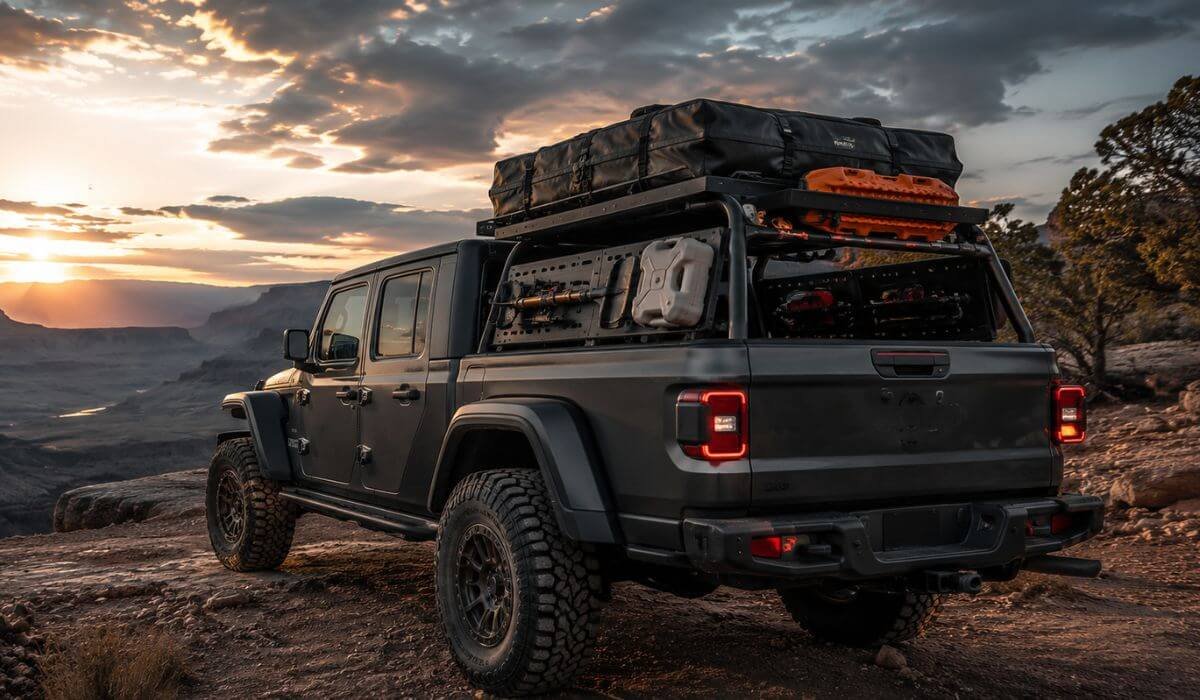
A Jeep Gladiator bed rack can completely change how the JT’s cargo area works once camping gear, recovery equipment, bikes or a rooftop tent become part of the setup. The Gladiator’s 60.3-inch bed, 56.8-inch overall bed width and 44.8-inch wheel-well clearance leave enough room for capable builds, but they also make rack dimensions, mounting position and accessory clearance far more important than many buyers expect.
For 2020–2026 Jeep Gladiator JT models, choosing the right rack is less about finding the biggest advertised load rating and more about matching the rack to the way the truck is actually used. Steel construction makes sense for demanding overland cargo, while aluminum designs reduce added weight for everyday driving. Rack height affects bed access, adjustable dimensions change how gear fits, and details like side panels, T-slot mounting, tie-down points, LED lighting and rooftop-tent compatibility can make one setup far more practical than another. Tonneau-cover clearance is another specification worth checking early because not every rack is designed around the same mounting approach.
The six options below were chosen by comparing the differences that matter most on a Gladiator: fitment, construction, dynamic and static load ratings, adjustability, accessory mounting, installation requirements and real-world cargo utility. Instead of treating every bed rack as interchangeable, this guide focuses on helping Jeep Gladiator owners find the setup that genuinely fits their build, whether the goal is heavier cargo, a lighter aluminum platform, a rooftop-tent-ready overland rig or a full-height utility setup.
5 Best Bed Rack for Jeep Gladiator in 2026: Adjustable Designs Built for Real-World Gear
#1. Hooke Road 12.3″ High Overland Bed Rack
Best Adjustable Jeep Gladiator Bed Rack for 2020–2026 JT Builds Balancing Compact Rack Height, Heavy-Duty Strength and Everyday Cargo Versatility
#2. Black Horse Overland Bed Rack TR09B
Best Heavy-Duty Jeep Gladiator Truck Bed Rack for 2020–2026 JT Builds Designed for Serious Gear, Trail Equipment and Dependable Load Support
#3. Tyger Auto TG-BK2U55347 Plate Style Overland Bed Rack
Best Versatile Jeep Gladiator Bed Rack for 2020–2026 JT Owners Building a Practical Overland Cargo System Without Excessive Rack Bulk
#4. YZONA Adjustable Truck Bed Rack with 2 LED Lights
Best Adjustable Jeep Gladiator Bed Rack for 2020–2026 JT Setups Combining Flexible Cargo Positioning, Elevated Storage and Integrated LED Illumination
#5. Trumgeta Aluminum Truck Bed Rack
Best Lightweight Jeep Gladiator Bed Rack for 2020–2026 JT Builds Seeking Lower Added Weight, Useful Cargo Space and a Cleaner Adventure Setup
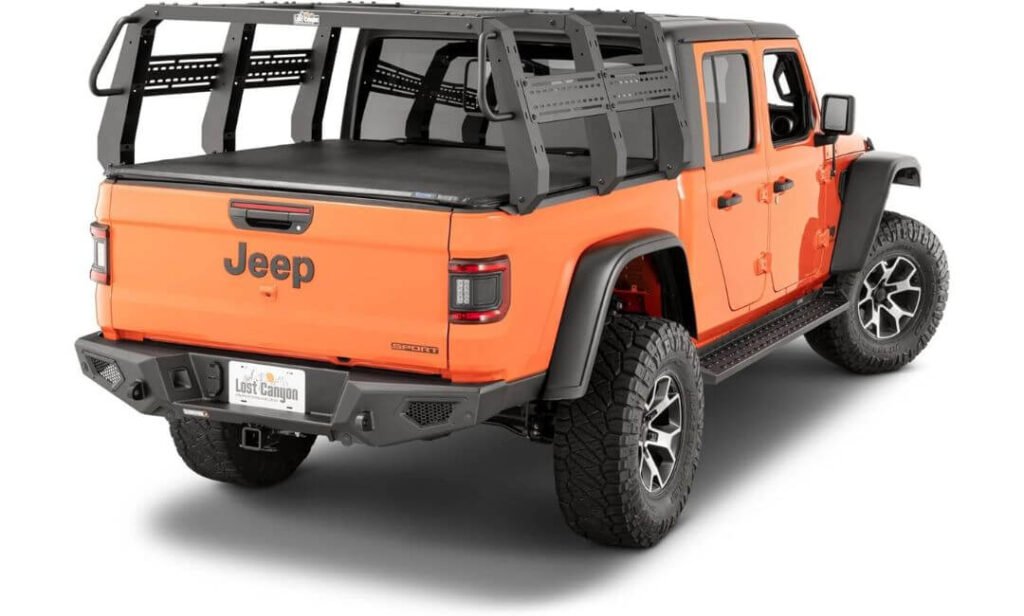
#6. Lost Canyon Truck Bed Rack
Best Full-Height Jeep Gladiator Bed Rack for 2020–2026 JT Overland Builds Carrying Rooftop Tents, Camping Equipment and Larger Cargo Loads
Expert Tip
A bed rack should solve a specific cargo problem, not create another one. Before ordering, compare the rack’s actual dimensions, mounting method, height, construction and stated load rating with the gear you plan to carry. For a Gladiator running a rooftop tent, “tent compatible” by itself is not enough. The rack, mounting points and truck setup all need to be appropriate for the combined static and dynamic loads involved. Tonneau-cover clearance should also be confirmed before buying, especially if keeping the bed cover is part of the plan.
How We Choose These Jeep Gladiator Bed Racks
This list was not built by placing six product listings side by side and choosing whichever one has the most aggressive-looking photos. The goal was to separate these racks by what they actually bring to a Jeep Gladiator build and where each one makes the most sense.
First comes fitment. The focus is on racks specifically advertised for the Jeep Gladiator JT, with 2020–2026 model-year coverage considered where stated by the respective product information. Generic mid-size truck compatibility was not treated as proof of Gladiator fitment. Mounting points, bed dimensions, clearance and installation requirements still matter even when a manufacturer lists several truck applications.
Next is construction, dimensions and rack height. The Hooke Road option stands out with its approximately 12.3-inch profile and adjustable width, making it a practical choice for buyers who want a relatively compact rack with flexible cargo positioning. Black Horse and Lost Canyon take a more substantial steel-platform approach for owners building around heavier equipment and dedicated overland use. These differences matter more than simply labeling every steel rack “heavy duty.”
We also compared how each design can realistically be used. Tyger Auto offers a versatile Gladiator-specific platform with multiple mounting positions, making it useful for owners who want more freedom when positioning accessories. YZONA takes that flexibility further with adjustable dimensions and integrated LED lighting, giving the rack a more equipment-focused role. Trumgeta stands apart with aluminum construction, making it the natural consideration for a lighter setup where reducing added rack weight matters.
The Lost Canyon takes a different approach again. Its full-height configuration, steel construction and stated rooftop-tent capability make it better suited to builds carrying larger camping equipment or using the rack as a more permanent overland platform. That makes the comparison more useful than ranking everything from “strongest” to “weakest,” because a compact low-profile rack and a full-height overland rack are solving different problems.
Another important factor is load rating. Published dynamic and static capacities were considered separately wherever those figures were provided. That distinction matters because a rack carrying gear while the Gladiator is moving experiences different forces from a stationary setup supporting a rooftop tent. A higher number in a product listing does not automatically make one rack the better choice for every application.
There is also a practical limitation worth being clear about: not every product in this category has years of extensive Gladiator-specific review history. Some newer or less-established options have limited review depth compared with long-running truck-accessory brands. Rather than filling that gap with exaggerated owner claims, the recommendations here are tied to the published fitment, construction, dimensions, adjustability, load ratings, mounting design and stated features. Where a rack has a meaningful limitation, it is better to understand it before checkout than discover it after installation.
That approach keeps the list useful even as product review histories change. The recommendation is based on what each rack is designed to do and which Gladiator build it suits best, not on manufactured popularity or the biggest-looking number in a product listing.
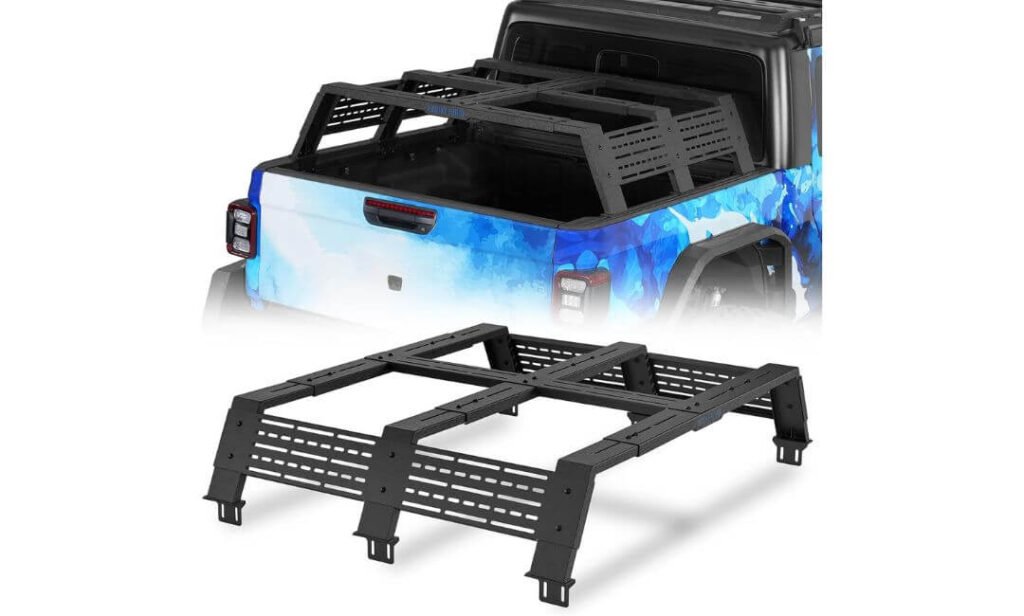
#1. Hooke Road 12.3″ High Overland Bed Rack
Quick Specs:
- Gladiator fitment: 2020–2026 Jeep Gladiator JT
- Rack height: 12.3 inches above the bed rail
- Fixed length: 50 inches
- Adjustable width: 54.3–65 inches
- Construction: High-tensile carbon steel
- Load rating: 400 lbs dynamic / 800 lbs static
- Rack weight: Approximately 116 lbs
- Mounting: Bolt-on, no drilling required
- Accessory mounting: Slotted side panels
- Finish: Textured powder coating with internal E-coating
- Tonneau cover: Not compatible
For a Gladiator that needs more than a simple cargo shelf, the biggest advantage here is the combination of adjustable width and a relatively low 12.3-inch profile. The rack has a fixed 50-inch length, while its width can be set between 54.3 and 65 inches, giving more flexibility when positioning equipment across the bed. That is useful for a JT carrying camping boxes, recovery equipment, bikes or other gear that needs a dedicated mounting point rather than being piled loose in the bed.
The 400-pound dynamic and 800-pound static ratings are where this design becomes much more interesting for overlanding. The difference between those two figures matters: moving loads place different demands on the rack than equipment simply sitting on it at camp. The structure uses 13-gauge steel for the main rack and thicker 9-gauge steel for the mounting brackets, with reinforced ribs added to the structure. In practical terms, this is built more like a serious cargo platform than a lightweight decorative rack.
The side panels are another genuinely useful detail. Their elongated cutouts give room for mounting accessories such as lights, a high-lift jack, recovery tools, bike mounts and other trail equipment without having to fabricate a completely custom mounting system. Installation is also straightforward for the right Gladiator setup: it is fully bolt-on, requires no drilling, and can work with or without bed rails. The trade-off is important, though—a tonneau cover is not compatible with this rack, so buyers planning to keep a tonneau should account for that before ordering.
(A strong choice when the priority is adaptable cargo mounting, substantial steel construction and a rack height that leaves the Gladiator bed reasonably accessible.)
What Stands Out
- Adjustable 54.3–65-inch width gives the rack more setup flexibility than a fixed-width design.
- 400-lb dynamic capacity makes it suitable for substantial moving cargo when the load is properly distributed.
- 800-lb static capacity gives useful headroom for equipment that remains stationary at camp.
- Slotted side panels make accessory mounting considerably easier for an overland-style Gladiator build.
- No-drill bolt-on installation keeps the installation process more approachable for a factory-bodied JT.
One Thing to Know Before Ordering
- Tonneau covers are not compatible with this design, so it makes the most sense for a Gladiator setup where open-bed access is part of the plan.
Gladiator JT Fitment
This is a Jeep Gladiator JT-specific fitment within its stated vehicle range, covering 2020–2026 Gladiator models. The adjustable width is particularly useful because the rack is designed around a range rather than relying on one universal dimension across every mid-size pickup.
For a Gladiator build, the more important check is the intended configuration before checkout: confirm the available mounting area, bed-rail arrangement and the equipment that will sit on top. The rack’s 12.3-inch height and 50-inch fixed length should also be considered alongside any tent, cargo box or accessory being added.
The Insider Pro-Tip
The 400-lb dynamic rating is the number to pay attention to when the Gladiator is actually moving. It is easy to see the 800-lb figure and assume that is the everyday carrying limit, but static and dynamic loads are not the same thing. Keep the heavier equipment properly distributed and treat the lower dynamic rating as the practical reference when the truck is on the road or trail.
One other detail can save a frustrating purchase: do not wait until installation to think about the tonneau cover. This rack is specifically stated to be incompatible with one. If the goal is an open overland bed with side-mounted accessories and equipment above the bed rails, that is a straightforward trade-off; if covered cargo is essential, a different rack design will make more sense from the beginning.
#2. Black Horse Overland Bed Rack TR09B
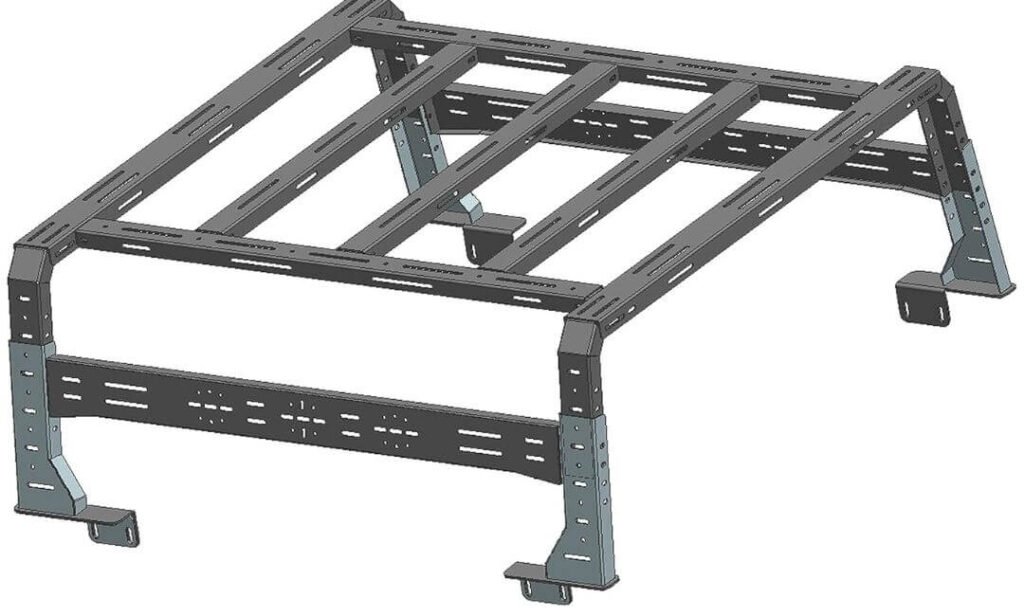
Quick Specs:
- Gladiator fitment: 2020–2026 Jeep Gladiator
- Construction: Steel
- Rack dimensions: 54.7″L × 20.1″W × 9″H
- Product weight: 125.5 lbs
- Mounting: U-bolt, bolt-on installation
- Height: Adjustable
- Load rating: Listed at 125.5 lbs
- Finish: Chip-resistant black powder coating
- Load management: Integrated tie-down points
- Rooftop-tent use: Supported by the manufacturer
- Tonneau cover: Not compatible
A 9-inch rack height changes the character of a Gladiator build. Instead of adding a tall structure that dominates the bed, this design keeps the platform relatively close to the bed while still leaving room for equipment above it. The adjustable-height setup is particularly useful when the rack needs to work around a specific cargo arrangement rather than being installed at one fixed height and left there.
The steel construction and 125.5-pound product weight give it a substantial feel, while the black powder-coated finish is intended to deal with the everyday exposure that comes with a truck—road grime, weather and occasional contact with equipment. The integrated tie-down points are a practical touch too; they give loose cargo a proper place to be secured instead of relying on improvised straps around the rack.
Installation is another straightforward part of the design. It uses a bolt-on U-bolt mounting system with no drilling required, which keeps the installation considerably less invasive than a rack that requires permanent modification to the truck. The manufacturer also states that it can support rooftop tents and accessories, making it relevant for an overland-oriented JT rather than just basic bed organization.
(The lower 9-inch profile and adjustable height make this a particularly interesting option for a Gladiator build that wants useful overhead storage without turning the bed into a towering rack system.)
What We Like About the Design
- Adjustable height gives more control over how the rack works with the rest of the Gladiator setup.
- 9-inch listed height keeps the overall structure comparatively low for owners who do not want an oversized rack.
- Integrated tie-down points provide dedicated locations for securing equipment.
- U-bolt, no-drill mounting makes the installation less complicated and avoids drilling into the truck.
- Rooftop-tent support broadens its usefulness beyond ordinary cargo carrying.
One Detail Worth Knowing
- The listed 125.5-lb load capacity is considerably more restrictive than some competing racks, so it is important to size the tent and cargo around the manufacturer’s stated rating rather than assuming every overland accessory is automatically suitable.
Built Around the Gladiator JT
Fitment is refreshingly straightforward here: the rack is listed specifically for the 2020–2026 Jeep Gladiator rather than relying only on generic mid-size pickup compatibility. That makes the JT application much easier to evaluate before ordering.
The 54.7-inch length and 9-inch height, combined with adjustable height and U-bolt mounting, make the design better suited to buyers who already know how they want their Gladiator bed configured. As always, the exact cargo arrangement should be checked against the available load rating, especially when a rooftop tent or other substantial equipment is involved.
The Insider Pro-Tip
The biggest mistake with a rack like this would be choosing it solely because the listing says “rooftop tent compatible.” Tent compatibility and load capacity are two different questions. Before putting a tent on top, account for the tent’s weight, occupants and the dynamic forces created while the vehicle is moving, then stay within the manufacturer’s stated limits.
There is also a simple ownership decision hidden in the fitment details: this rack is not designed to work with a tonneau cover. For a Gladiator that is being built around an open bed, rooftop equipment and accessible tie-down points, that may never matter. But if covered bed storage is part of the plan, that requirement should be settled before the rack goes on the shopping list.
#3. Tyger Auto TG-BK2U55347 Plate Style Overland Bed Rack
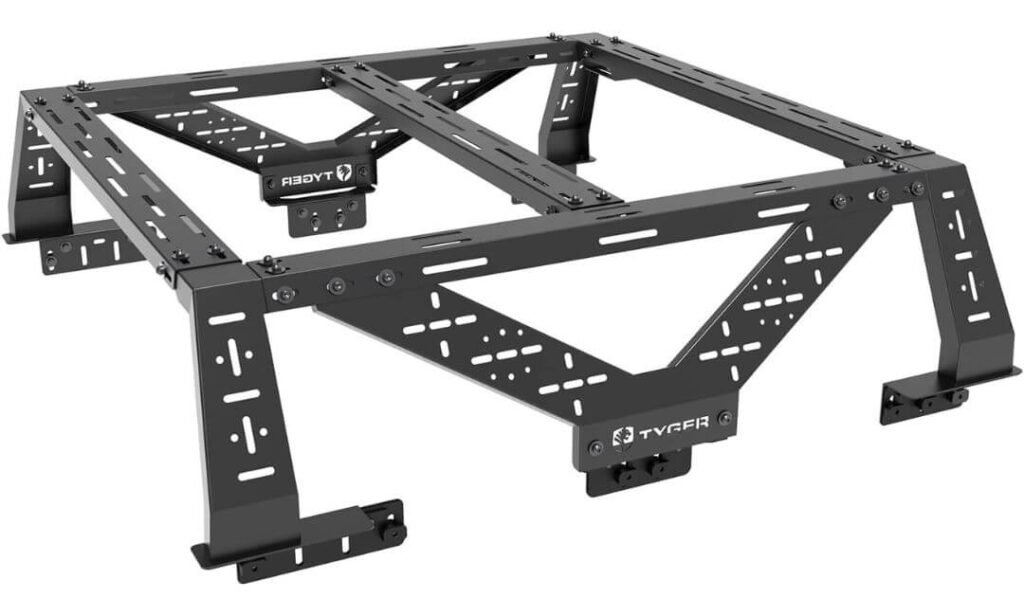
Quick Specs:
- Gladiator fitment: 2020–2026 Jeep Gladiator JT 5-ft bed
- Construction: 3 mm carbon steel with diagonal V-bracing
- Rack dimensions: 56.6″L × 13.6″H
- Adjustable base width: 54.58–59.54 inches
- Adjustable upper width: 49.61–54.62 inches
- Product weight: Approximately 79 lbs
- Load rating: 700 lbs static / 150–400 lbs dynamic
- Mounting: Bolt-on, no drilling required
- Accessory mounting: 100+ mounting positions
- Bed compatibility: Works with or without utility bed rails
- Warranty: 3 years for U.S. customers
- Tonneau cover: Not compatible
Some bed racks are essentially a platform with a few convenient holes. This one takes a different approach. The combination of V-shaped side plates, corner arms and a heavily slotted top surface creates more than 100 potential mounting positions, which is the feature that really defines the design. Recovery boards, shovels, lights, spare tires, fuel cans and other overlanding equipment can be positioned around the rack instead of all competing for the same mounting points.
Despite that flexibility, the rack weighs only about 79 pounds, which is noticeably lighter than many substantial steel bed-rack designs. The frame uses 3 mm carbon steel with diagonal V-bracing, and the stated capacity reaches 700 pounds static with a 150–400-pound dynamic range. That combination makes the rack interesting for a Gladiator owner who wants a strong platform without adding an unnecessarily heavy structure to the truck.
The width adjustment is another detail worth paying attention to. The base adjusts from 54.58 to 59.54 inches, while the upper section adjusts from 49.61 to 54.62 inches. It is also designed to mount without drilling and can work with or without utility bed rails. Assembly is required, but the included hardware and instructions keep the installation in the bolt-on category rather than turning it into a fabrication project.
(This is the option to look at when accessory flexibility matters as much as the rack itself—the unusually high number of mounting positions gives a Gladiator build plenty of room to evolve.)
What We Like About This Setup
- 100+ mounting positions give genuine flexibility for changing an overland setup later.
- 79-pound rack weight keeps the added steel hardware relatively manageable.
- Adjustable upper and lower widths make the structure more adaptable to the Gladiator bed.
- Diagonal V-bracing adds meaningful structural reinforcement rather than relying only on flat steel panels.
- No-drill installation keeps the factory bed easier to work with and avoids permanent drilling.
One Small Detail to Keep in Mind
- The unusual slot layout may not line up perfectly with every aftermarket accessory, so accessories such as RotopaX-style mounts should be checked against the available mounting positions before purchase.
A Proper Match for the Gladiator JT
The relevant fitment here is the 2020–2026 Jeep Gladiator JT with the 5-foot bed. That is the configuration to verify before ordering, particularly if the truck already has utility-bed hardware or other accessories occupying the bed rails.
For this Gladiator application, the adjustable 54.58–59.54-inch base width and 49.61–54.62-inch upper width give the rack some useful room for positioning. The 13.6-inch listed height also keeps it in a relatively practical range for carrying equipment above the bed without going straight to a full-height rack.
The Insider Pro-Tip
The smartest way to use the 100+ mounting positions is not to fill them all. Plan where the heaviest equipment will live first, then use the remaining positions for lighter accessories. Keeping recovery gear, spare equipment and other dense loads sensibly distributed makes the rack easier to live with and leaves the useful mounting space available when the build changes later.
And one detail should be settled before checkout: this rack is not compatible with tonneau covers. If the Gladiator is being built as an open overlanding rig, that may be a non-issue. If covered bed storage is essential, it is better to choose around that requirement now than discover the conflict after the rack has already been assembled.
#4. YZONA Adjustable Truck Bed Rack with 2 LED Lights
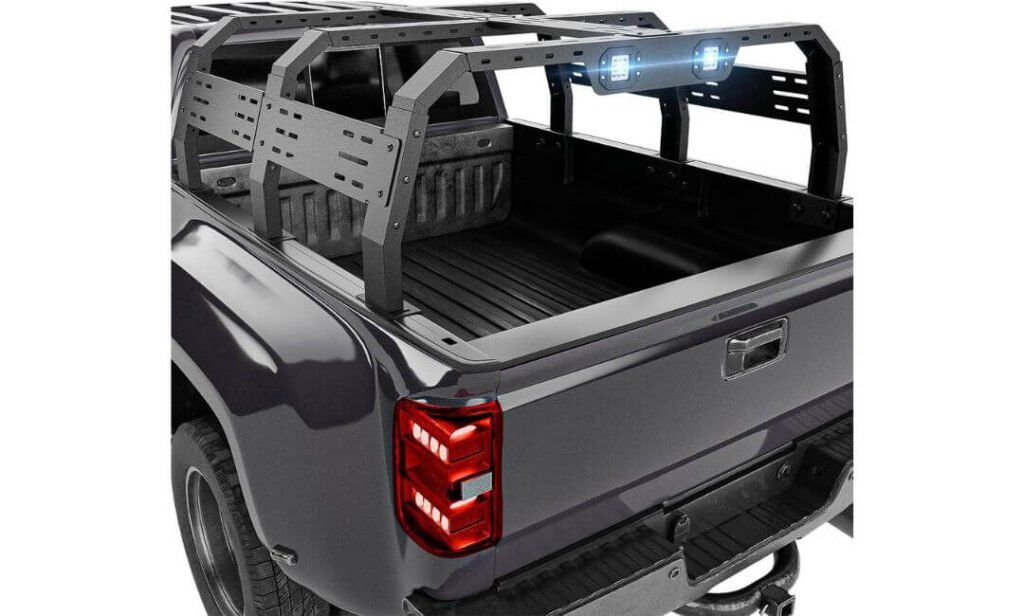
Quick Specs:
- Gladiator fitment: 2020–2026 Jeep Gladiator JT
- Construction: Heavy-duty carbon steel
- Adjustable length: 53–59 inches
- Adjustable height: 19.2–22.3 inches
- Adjustable width: 55.8–62.76 inches
- Load rating: 1,000 lbs static / 500 lbs dynamic
- Product weight: Approximately 103 lbs
- Lighting: 2 LED light bars included
- Mounting: Bolt-on bed-rail installation; no drilling or cutting
- Accessory mounting: Slotted side panels and cargo tie-down slots
- Finish: Textured black powder coating
- Tonneau cover: Not compatible
- Light wiring: Extension harnesses sold separately
The useful thing about this design is not simply the included lights; it is the amount of physical adjustment built into the rack. The length can move from 53 to 59 inches, the height from 19.2 to 22.3 inches, and the width from 55.8 to 62.76 inches. That gives a Gladiator owner considerably more freedom to set the rack around the equipment being carried rather than forcing the equipment to work around one fixed rack dimension.
Then there is the capacity. The manufacturer lists 1,000 pounds static and 500 pounds dynamic, which puts this among the more substantial options in this lineup on paper. That makes sense for a setup carrying bulky equipment such as kayaks, boards, ladders, camping gear or a rooftop tent. The frame is made from carbon steel and receives a textured black powder-coated finish, giving it the kind of exterior protection expected from equipment that will spend its life exposed to weather and trail debris.
The two LED light bars are a nice bonus for owners who actually use their Gladiator after dark. They come with the rack, while extension harnesses are sold separately, so that small wiring detail should be accounted for before installation. The side panels also provide elongated mounting slots for lights, jacks, bike equipment, extinguishers and other accessories. Installation stays relatively simple because the rack is designed to bolt to the bed rails without drilling, cutting or permanent modification.
(The appeal here is flexibility: it can start as a cargo rack and be adjusted around the way the Gladiator is actually used instead of locking the truck into one rack configuration.)
What We Like About This Setup
- Three-way adjustability gives useful control over length, width and height.
- 1,000-lb static / 500-lb dynamic ratings provide substantial stated capacity for a properly distributed load.
- Two LED light bars included add genuine usefulness for nighttime loading and campsite work.
- Slotted side panels leave plenty of room for adding practical overland accessories.
- No-drill installation keeps the setup straightforward for a Gladiator owner.
One Detail Worth Knowing
- The light extension harnesses are not included, so anyone planning a more distant or customized light placement should factor that wiring requirement into the installation.
Designed Around the Gladiator JT
The stated fitment includes the 2020–2026 Jeep Gladiator JT, making the Gladiator a specifically supported application rather than an afterthought in the compatibility list. Its broad adjustment range is particularly useful when the bed already has equipment that needs to remain accessible.
At the same time, this is a relatively tall rack at its maximum 22.3-inch height. That can be excellent for kayaks, larger cargo and elevated storage, but the final height should be chosen around the actual gear being carried rather than automatically using the maximum setting.
The Insider Pro-Tip
With a rack that adjusts in three directions, set the height last. Start by deciding where the load needs to sit, establish the useful width and length, and only then raise the rack enough to clear the equipment. That approach keeps the center of the load more sensible and avoids adding unnecessary height to the Gladiator.
The other practical point is the 500-lb dynamic rating. The 1,000-lb static figure is useful when the truck is stationary, but once the Gladiator is moving, braking, cornering and uneven terrain introduce additional forces. For a rooftop tent or heavy adventure setup, the moving-load figure is the one that deserves the most attention—not the larger number printed first.
#5. Trumgeta Aluminum Truck Bed Rack
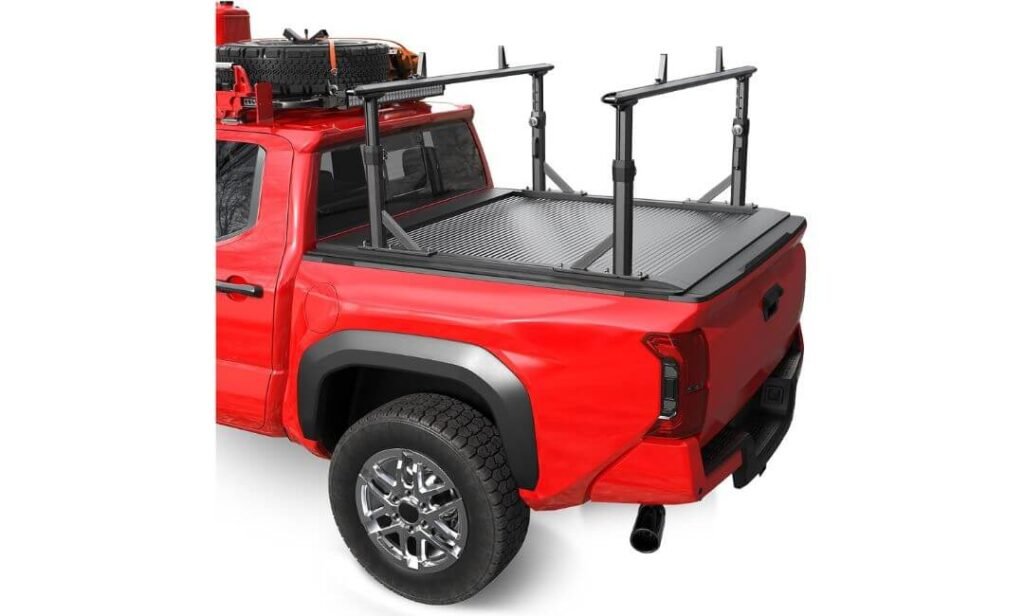
Quick Specs:
- Gladiator fitment: 2019–2026 Jeep Gladiator
- Construction: Powder-coated aluminum
- Product weight: 44.9 lbs
- Load rating: 800 lbs on-road / 600 lbs off-road
- Adjustable length: 41.75–52.5 inches
- Adjustable height: 17.75–27.5 inches
- Height positions: 4 levels
- Mounting: Screw-mounted, pre-assembled
- Installation: No drilling; basic tools
- Cargo control: End-cap and handle-area tie-down points
- Crossbar: Integrated T-slot system
- Tonneau requirement: Requires a compatible tonneau cover
- Roll-up tonneau: Not compatible
A 44.9-pound aluminum rack brings something very different to a Gladiator build. Instead of adding another 100-plus-pound steel structure before any cargo is loaded, this design keeps the rack itself relatively light while still offering a stated 800-pound on-road and 600-pound off-road capacity. For owners carrying ladders, lumber, bikes, cargo boxes or adventure equipment, that lower rack weight can be a meaningful advantage.
What makes it more interesting is the adjustment range. The rack can change from 41.75 to 52.5 inches in length and from 17.75 to 27.5 inches in height, with four height positions. That means the same basic setup can sit lower when garage clearance matters, move into a more practical position for everyday hauling, or be raised when additional clearance is needed for larger equipment. It is a much more flexible arrangement than simply bolting on one fixed-height platform.
The aluminum construction is also paired with T-slot mounting, giving compatible accessories a cleaner way to attach to the crossbars. Tie-down points at the end caps and handle areas provide additional places to control awkward loads, while the rack arrives pre-assembled and requires no drilling. There is, however, one fitment detail that should be treated as a requirement rather than a footnote: the rack needs a compatible tonneau-cover setup and is not designed for roll-up tonneau covers.
(This is the lightweight specialist in the lineup: particularly appealing when keeping added rack weight down and retaining a tonneau-covered bed are both priorities.)
What We Like About This Setup
- 44.9-pound construction is dramatically lighter than the steel racks in this lineup.
- Four height positions make it easier to adapt the rack to different cargo and clearance needs.
- 800-lb on-road / 600-lb off-road ratings give the aluminum design useful stated capacity.
- T-slot crossbars create a practical foundation for compatible cargo and overland accessories.
- Pre-assembled installation removes much of the time normally spent putting a rack structure together.
One Detail Worth Knowing
- This design requires a compatible tonneau cover, and roll-up tonneau covers are specifically excluded, so the existing bed-cover setup needs to be checked before ordering.
A Different Kind of Gladiator Bed Rack
The stated application covers 2019–2026 Jeep Gladiator models, but the important part for a buyer is the tonneau-cover requirement. This is not a conventional bare-bed rack that can simply be installed on any open Gladiator bed; it is designed around a compatible tonneau system.
That makes it a particularly interesting choice for a Gladiator owner who wants covered bed storage underneath and elevated cargo space above. The adjustable 17.75–27.5-inch height also gives more control over the final profile, especially when garage clearance or rooftop equipment is part of the setup.
The Insider Pro-Tip
The clever part of this rack is not just that it is aluminum—it is that the low rack weight and adjustable height work together. If the Gladiator already carries a tonneau cover and the goal is to add useful upper cargo space without putting a heavy steel structure on top, this design solves a very specific problem.
Before buying, though, identify the exact tonneau-cover style first. The listing requires a compatible tonneau system and specifically rules out roll-up covers. That single check is more important here than comparing powder-coat finishes or accessory slots, because the rack’s mounting concept depends on the cover underneath it.
#6. Lost Canyon Truck Bed Rack
Quick Specs:
- Gladiator fitment: 2020–2026 Jeep Gladiator JT
- Design: Full-height bed rack
- Construction: Heavy-duty steel
- Product weight: 148 lbs
- Load rating: 750 lbs static / 300 lbs dynamic
- Rooftop-tent use: Supported
- Tonneau cover: Compatible
- Side structure: Integrated side panels
- Access: Built-in grab handles
- Configuration: Full-height version; half-height option also available
When the goal is to turn a Gladiator into a genuine gear-carrying platform, a full-height rack makes more sense than trying to squeeze everything onto a low crossbar. This design is built around that idea. The taller structure creates substantially more usable mounting area for rooftop tents, larger camping equipment, work gear and bulky cargo, while the integrated side panels give the sides of the rack their own useful role.
The steel construction gives the rack a substantial footprint, and at 148 pounds, this is clearly not the lightweight choice in the lineup. The trade-off is a more substantial platform with a stated 750-pound static and 300-pound dynamic capacity. For equipment that remains stationary at camp, the higher static figure provides useful headroom; when the Gladiator is moving, the 300-pound dynamic rating is the figure that should govern the actual load.
Perhaps the most interesting part for everyday Gladiator use is the tonneau-cover compatibility. Unlike several racks in this lineup that require an open bed, this one is designed to work with a tonneau while still providing elevated cargo space above it. Integrated grab handles and side panels also make it easier to reach and secure equipment, which becomes more valuable once a full-height rack starts carrying gear at shoulder level.
(The appeal is simple: this is the choice for a Gladiator build where maximum vertical utility and covered-bed functionality matter more than keeping the rack itself lightweight.)
What We Like About This Setup
- Full-height architecture creates significantly more room for larger equipment and rooftop-tent applications.
- 750-lb static capacity gives the platform substantial stated stationary-load capability.
- Tonneau-cover compatibility makes it more versatile for owners who still want protected cargo underneath.
- Integrated side panels and grab handles make the tall structure more practical to access and organize.
- Dedicated Gladiator JT fitment keeps the application focused rather than treating the rack as a generic universal platform.
One Detail Worth Knowing
- At 148 pounds, this is the heaviest rack in this six-product lineup, so buyers prioritizing minimum added weight should look toward the aluminum option instead.
Built for the Gladiator JT
The rack is specifically listed for 2020–2026 Jeep Gladiator JT models, making it a straightforward choice for the current-generation Gladiator platform. The full-height design is particularly suited to builds where rooftop-tent mounting or large overhead cargo is part of the plan.
The important advantage is that the elevated storage does not require giving up the bed cover underneath. Tonneau-cover compatibility allows the Gladiator to retain protected lower-bed storage while using the upper structure for larger equipment—a useful combination for longer trips and mixed work/adventure builds.
The Insider Pro-Tip
With a full-height rack, think about how often the equipment will actually be reached before deciding what goes where. Heavy items that need frequent access are better positioned where they can be handled without repeatedly climbing or stretching over the rack. The upper space is best reserved for equipment that benefits from the elevation, particularly a rooftop tent or larger gear that would otherwise consume the bed.
And when a rooftop tent is involved, use the 300-pound dynamic rating as the practical ceiling for the moving vehicle, not the 750-pound static figure. The larger number describes a stationary load; road movement, braking and uneven terrain change the forces acting on the rack. That distinction is easy to overlook and is one of the most important details to get right before loading a Gladiator for a trip.
Best Jeep Gladiator Bed Rack Options (2020–2026): Side-by-Side Specs & Features
| Bed Rack | Gladiator Fitment | Build & Size | Load Rating | Height / Adjustability | Mounting & Utility | Tonneau Cover | Best Match |
|---|---|---|---|---|---|---|---|
| Hooke Road 12.3″ High Overland Bed Rack Best adjustable pick |
2020–2026 Jeep Gladiator JT |
Carbon steel 50″ fixed length 116 lbs |
400 lbs dynamic 800 lbs static |
12.3″ high 54.3–65″ width |
Bolt-on, no drilling Slotted side panels Accessory-ready |
Not compatible | Balanced overland builds, rooftop-tent gear and adjustable cargo setups |
| Black Horse Overland Bed Rack TR09B Low-profile steel option |
2020–2026 Jeep Gladiator |
Steel 54.7″ × 20.1″ × 9″ 125.5 lbs |
125.5 lbs listed |
9″ listed height Adjustable height |
U-bolt mounting No drilling Integrated tie-downs |
Not compatible | Buyers wanting a comparatively low rack profile and simple cargo securing |
| Tyger Auto TG-BK2U55347 Plate Style Overland Bed Rack Best accessory flexibility |
2020–2026 Jeep Gladiator JT 5′ bed |
3 mm carbon steel 56.6″ × 13.6″ ~79 lbs |
150–400 lbs dynamic 700 lbs static |
13.6″ high Adjustable upper/lower width |
100+ mounting positions V-bracing No drilling |
Not compatible | Overlanding setups that expect to add, move or change accessories over time |
| YZONA Adjustable Truck Bed Rack with 2 LED Lights Most adjustable |
2020–2026 Jeep Gladiator JT |
Carbon steel Up to 59″ length ~103 lbs |
500 lbs dynamic 1,000 lbs static |
19.2–22.3″ high 53–59″ length 55.8–62.76″ width |
Bolt-on bed-rail mount 2 LED light bars Slotted side panels |
Not compatible | Large cargo, kayaks, ladders and builds needing broad dimensional adjustment |
| Trumgeta Aluminum Truck Bed Rack Best lightweight pick |
2019–2026 Jeep Gladiator |
Powder-coated aluminum 44.9 lbs |
800 lbs on-road 600 lbs off-road |
17.75–27.5″ high 41.75–52.5″ length 4 height levels |
T-slot crossbars Tie-down points Pre-assembled |
Compatible setup required Not for roll-up covers |
Lightweight builds that want elevated cargo space while retaining covered-bed storage |
| Lost Canyon Truck Bed Rack Best full-height setup |
2020–2026 Jeep Gladiator JT |
Heavy-duty steel Full-height design 148 lbs |
300 lbs dynamic 750 lbs static |
Full-height Maximum vertical utility |
Integrated side panels Grab handles Rooftop-tent support |
Compatible | Rooftop tents, large equipment and Gladiator builds needing covered-bed storage below |
Why a Bed Rack Makes Sense on the Jeep Gladiator
The Gladiator already has something many midsize trucks do not: a factory pickup bed combined with serious off-road capability. A bed rack makes that space considerably more useful by moving bulky equipment upward, leaving the lower bed available for coolers, recovery bags, tools and everyday cargo. That becomes especially valuable on longer trips, where using the bed floor for everything quickly turns into a packing problem.
A good rack also creates a much cleaner way to carry equipment that is awkward to place inside the cab or directly on the bed floor. The real benefit is not simply “more storage.” It is having separate zones for different types of gear, so frequently accessed equipment stays reachable while larger or less frequently used items can ride above the bed.
More Usable Space Without Giving Up the Bed
A rack effectively creates a second cargo level. Instead of laying a tent, kayak, ladder, recovery boards or other long equipment across the bed, those items can be carried above it while the lower section remains available for smaller gear.
That is particularly useful with the Gladiator’s 60.3-inch bed, where available floor space can disappear quickly once camping equipment starts going in. A properly selected rack lets the bed do two jobs at once: the rack handles larger elevated equipment, while the bed floor remains useful for everything that should stay low and easy to reach.
A Rooftop Tent and Bed Rack Work Naturally Together
For an overlanding Gladiator, the most obvious combination is a rooftop tent mounted to a bed rack. The rack provides the elevated platform needed for the tent while keeping the sleeping area separate from the cargo stored underneath.
But the rack itself needs to be matched to the tent. The important figures are the manufacturer’s dynamic and static load ratings, not just the fact that the listing mentions rooftop-tent compatibility. Static capacity becomes relevant when the truck is parked and the tent is occupied, while dynamic capacity matters when the Gladiator is actually moving.
That distinction is easy to miss when shopping, but it is one of the most useful checks to make before choosing a rack.
Accessories Become Easier to Organize
A bed rack also gives smaller pieces of equipment a proper home. Depending on the design, side panels, slots and mounting points can accommodate things such as:
- Recovery boards and traction equipment
- High-lift jacks and recovery tools
- Shovels, axes and other trail equipment
- Bike mounts and outdoor carriers
- Auxiliary lights and light bars
- Fire extinguishers and emergency equipment
- Cargo boxes and camping accessories
This is where the differences between racks become obvious. A design with a large number of mounting positions can be much more useful for an evolving overland build than a rack with a completely fixed accessory layout.
Better Cargo Security on Rough Roads
Loose equipment is rarely a problem when a truck is sitting in the driveway. It becomes a different story once the Gladiator is bouncing over washboard roads or uneven trails.
Dedicated tie-down points and properly positioned mounting hardware allow cargo to be secured close to the rack instead of relying on whatever convenient loop or bed corner happens to be available. The result is a more organized load and less opportunity for equipment to shift around during travel.
Still, a rack does not make cargo automatically secure. Heavy items should be positioned thoughtfully, straps should be appropriate for the load, and mounting hardware should be checked periodically, particularly after substantial off-road use.
The Right Rack Depends on the Gladiator Build
There is no single bed-rack layout that makes sense for every JT. A Gladiator carrying a rooftop tent needs a different approach from one primarily used for work equipment, bikes or occasional weekend camping.
The six racks in this guide reflect those differences:
- Lower-profile designs make sense when bed access and a less imposing setup matter.
- Adjustable racks suit owners who expect their cargo arrangement to change.
- Accessory-heavy designs are useful for builds carrying recovery and overlanding equipment on multiple sides.
- Lightweight aluminum construction can appeal when reducing added rack weight is a priority.
- Full-height racks make more sense when maximum vertical mounting space and larger equipment are the priority.
- Tonneau-compatible designs are worth considering when covered bed storage needs to remain available underneath the rack.
One Fitment Detail That Should Never Be Assumed
The phrase “fits Jeep Gladiator” is only the starting point. Before ordering, check the exact model-year coverage, bed configuration, mounting method, rack dimensions, tonneau-cover requirements and the intended cargo.
That last point is particularly important with this group. Some of the racks listed here do not work with tonneau covers, while others are specifically designed around one. Likewise, a rack’s stated static capacity should never be treated as its moving-load capacity.
A few minutes spent checking those details can prevent the most frustrating kind of aftermarket purchase: a rack that technically fits the truck but does not fit the way the truck is actually used.
Jeep Gladiator Bed Rack Buying Guide: What Actually Matters Before You Order
A bed rack can look simple in a product photo, but the important differences usually sit in the details that are easy to skip. Load rating, mounting points, rack dimensions, height, accessory compatibility and tonneau-cover clearance can determine whether a rack works beautifully on a Gladiator or becomes an expensive compromise. The best choice depends on the equipment being carried and how the truck is used, not simply on which rack has the biggest number in its listing.
Start With the Load You Actually Plan to Carry
Do not choose a rack by looking only at its highest advertised capacity. First make a realistic list of everything that will sit on or attach to it, including the rooftop tent, mounting hardware, awning, recovery boards, spare equipment and other accessories.
The distinction between static and dynamic capacity is particularly important. Static capacity applies when the Gladiator is stationary, while dynamic capacity applies while the truck is moving. A rack may advertise a high static rating but have a considerably lower dynamic rating, so the lower moving-load figure deserves attention whenever the vehicle will be driven with equipment mounted.
For a rooftop-tent setup, also consider the weight of the tent itself before adding occupants or additional equipment. The rack should not be selected on the tent’s advertised compatibility alone.
Check How the Rack Actually Mounts
Mounting method matters more than many buyers expect. Some racks use bed rails, U-bolts or other bolt-on mounting hardware, while certain designs depend on a particular tonneau-cover system.
A no-drill rack can be attractive because installation does not require permanently modifying the Gladiator’s bed. That does not mean every no-drill system mounts the same way, though. Check whether the rack works with the truck’s existing rail arrangement and whether any brackets, adapters or additional hardware are required.
This is also where tonneau compatibility needs to be settled early. Several racks in this guide are not compatible with tonneau covers, while the Trumgeta and Lost Canyon designs take a different approach. If keeping a bed cover is important, that requirement should narrow the choices before comparing smaller features.
Look Beyond the Basic Crossbars
A rack becomes considerably more useful when it gives you room to expand the setup later. Slotted side panels, T-slots, accessory rails, tie-down points and multiple mounting positions can turn a basic cargo rack into a proper equipment platform.
That matters because most Gladiator builds evolve. A setup might start with camping boxes and recovery boards, then gain a rooftop tent, awning, bike mounts, auxiliary lighting or other equipment later. A rack with flexible mounting positions gives more freedom to make those changes without replacing the entire system.
The Tyger Auto option is a good example of this approach, with more than 100 mounting positions, while the Trumgeta uses T-slot mounting and the YZONA provides slotted side panels for additional accessories.
Think About the Gear Before Buying the Rack
Different equipment creates different requirements.
A rooftop tent needs a suitable platform and appropriate load capacity. Kayaks, canoes and ladders may benefit from greater rack height and a wider usable platform. Recovery boards and shovels are easier to organize when the rack provides dedicated side mounting locations. Awnings may require clear side mounting space rather than simply a strong top surface.
Before ordering, consider:
- Rooftop tent: Check both static and dynamic load ratings.
- Kayaks or long cargo: Pay attention to rack width, length and available clearance.
- Recovery equipment: Look for accessible side mounting positions.
- Awning: Confirm that the rack provides a suitable side mounting location.
- Bike equipment: Check the mounting interface and available clearance.
- Cargo boxes: Verify crossbar spacing and accessory compatibility.
- Tonneau cover: Confirm compatibility before anything else.
A rack that is excellent for one of these jobs can be unnecessarily complicated for another.
Rack Height Changes More Than Appearance
Height is not just a styling decision. A lower rack can make loading and accessing the bed easier, while a taller rack can create useful clearance for larger equipment or a rooftop tent.
The options here cover a meaningful range. The Black Horse design is listed around 9 inches, Hooke Road is 12.3 inches, Tyger Auto is 13.6 inches, while the YZONA and Trumgeta designs offer much broader height adjustment. Lost Canyon takes the full-height approach for buyers who want maximum vertical mounting space.
There is no universal “best” height. The right setting is the one that gives enough clearance for the intended equipment without adding unnecessary height to the truck.
Installation Should Be Part of the Value Equation
A rack that saves money but requires extensive modification is not necessarily the better deal. Look at how much assembly is involved, whether drilling is required, what hardware is included, and whether additional brackets or wiring components are needed.
The products in this lineup are largely designed around bolt-on installation, but the details differ. YZONA includes its lighting hardware, for example, while its light extension harnesses are sold separately. Hooke Road is supplied with mounting hardware and installation instructions, while the Trumgeta arrives pre-assembled.
Those small differences affect the actual ownership experience, so they belong in the buying decision rather than being treated as fine print.
Price Should Be Judged Against the Complete Setup
The cheapest rack is not automatically the best value, and the most expensive-looking rack is not automatically the strongest choice. Value comes from getting the features that your Gladiator actually needs.
A lighter aluminum rack may make more sense than a heavy steel rack when reducing added weight is a priority. A highly adjustable rack can justify its cost when cargo dimensions change regularly. A simpler steel rack can be the smarter purchase when the goal is straightforward equipment carrying without a long accessory list.
Also account for anything that may need to be purchased separately, such as mounting adapters, light extension harnesses, accessory mounts or tonneau-cover components. The real cost is the cost of getting the complete setup ready for use.
A Simple Comparison Checklist Before Checkout
Use this quick check before choosing between two otherwise similar Gladiator racks:
- Fitment: Is the exact Jeep Gladiator JT model year covered?
- Bed configuration: Does the rack match the Gladiator’s bed and mounting arrangement?
- Dynamic capacity: Is the moving-load rating sufficient for the actual equipment?
- Static capacity: Is there enough capacity for stationary rooftop-tent use?
- Dimensions: Does the length, width and height work with the intended cargo?
- Mounting: Is drilling required, and is all necessary hardware included?
- Tonneau cover: Does the rack work with the existing or planned bed cover?
- Accessory support: Are there enough mounting points for the equipment planned now?
- Future expansion: Can the rack accept additional accessories later?
- Installation: Is the assembly realistic with the tools and time available?
- Added weight: Is the rack itself unnecessarily heavy for the build?
- Total cost: Are adapters, wiring or other required components extra?
The best bed rack is ultimately the one that fits the Gladiator, fits the gear and fits the way the truck is used. Once those three things line up, the choice becomes much easier—and there is far less reason to pay for features that will never leave the product listing.
Jeep Gladiator Bed Rack Installation: A Practical Guide to Getting the Fit Right
Installing a bed rack on a Gladiator is usually straightforward, but the quality of the final result depends far more on preparation, mounting alignment and hardware checks than on simply getting every bolt into a hole. Most problems that show up later—movement, rattling, uneven positioning or hardware loosening—start during installation.
The exact procedure varies by rack design, so the manufacturer’s instructions should always take priority for mounting locations, hardware and torque values. The overview below is intended to help prepare the truck and avoid the mistakes that commonly make an otherwise good installation frustrating.
Tools to Have Ready
Most bolt-on systems can be installed with ordinary workshop equipment rather than specialist fabrication tools. A useful basic setup includes:
- Metric socket and wrench set
- Ratchet and suitable extensions
- Torque wrench
- Allen or hex keys, if supplied hardware requires them
- Screwdrivers and trim tools, where necessary
- Measuring tape
- Level or straightedge, useful for checking alignment
- Work gloves and eye protection
- A second person to help hold larger rack sections during positioning
Do not assume every rack uses the same hardware. Check the supplied fasteners against the installation instructions before starting, especially if the rack has multiple brackets or adjustable sections.
Prepare the Gladiator Before Mounting
Start with a clean, empty bed. Dirt, loose debris or equipment left around the mounting area can make it difficult to seat brackets correctly and can hide an alignment problem.
Inspect the bed rails and mounting areas for anything that could interfere with the brackets. If accessories are already installed, check their clearance before assembling the rack. This is also the right time to confirm tonneau-cover compatibility, because some rack designs require an open bed while others depend on a compatible cover system.
Lay out the hardware before installation and separate the fasteners by size. It sounds basic, but this prevents one of the most common installation mistakes: using a similar-looking fastener in the wrong location.
Understand the Mounting Pattern Before Tightening Anything
Do not fully tighten the first bracket as soon as it is positioned. Start by loosely assembling the mounting points, allowing the rack enough movement to settle into its intended position.
Once the major sections are attached, check that the rack is sitting evenly across the bed. Measure from consistent reference points on both sides rather than judging alignment by eye. The rack should sit squarely, and adjustable sections should be positioned symmetrically unless the manufacturer’s instructions specifically call for another arrangement.
This is particularly important with adjustable designs. Set the length, width and height before final tightening, because changing those dimensions after everything has been torqued down can mean repeating part of the installation.
Torque Is Not a Guessing Game
Use the manufacturer’s specified torque values for the actual rack hardware. A bolt that feels tight is not necessarily tightened correctly, and simply applying as much force as possible can damage threads, brackets or mounting surfaces.
genui{“learning_viz”:{“type_id”:”TORQUE”,”locale_override”:”en-US”}}
If the product instructions provide separate torque values for mounting brackets and structural fasteners, follow those values individually. Do not substitute a generic torque figure simply because the hardware looks similar.
If no torque specification is supplied, the safest approach is to contact the manufacturer rather than inventing a value.
Give the Installation a Proper Final Check
Once the rack is fully tightened, go around every mounting point and verify that:
- All fasteners are installed
- Brackets are seated correctly
- The rack is square and level
- Adjustable sections are fully secured
- No hardware is contacting the bed unnecessarily
- Side panels and accessory mounts are firmly attached
- Nothing interferes with the tailgate or other truck functions
- Any installed lighting has secure wiring and adequate clearance
Before loading expensive equipment, give the rack a careful physical inspection. A small amount of movement at an unloaded mounting point is worth investigating rather than assuming the cargo will somehow stabilize it.
Common Installation Mistakes to Avoid
The biggest mistake is tightening everything too early. Keeping the mounting hardware slightly loose until the complete structure is aligned gives the rack room to settle and makes final positioning much easier.
Another common problem is ignoring the difference between static and dynamic load ratings. Installation does not increase either rating. A rack capable of supporting a substantial stationary load may have a considerably lower limit once the Gladiator is moving, so the appropriate rating should be considered before loading a rooftop tent or heavy equipment.
It is also easy to overlook accessory clearance. A rack can be perfectly installed and still create a problem if a mounted jack, fuel container, bike carrier, light or cargo box interferes with the tailgate, bed access, cab clearance or tonneau system.
The Post-Installation Check That Is Actually Worth Doing
After the first short drive, inspect the mounting hardware again. Look for movement, shifted brackets, unusual noise or any change in alignment. This is especially worthwhile after the rack has carried its first substantial load or the truck has been driven over rough terrain.
From there, make hardware inspection part of normal maintenance. A quick check before a long trip is far easier than discovering a loose mounting point halfway through an overland route. The same applies whenever the rack’s height, width or accessory configuration is changed.
The goal is not merely to get the rack installed. It is to finish with a setup that remains square, secure, properly loaded and compatible with the way the Gladiator is actually being used.
Overlanding With a Jeep Gladiator Bed Rack: Smart Ways to Load and Use It
A bed rack becomes much more useful once the Gladiator leaves the pavement, but off-road travel changes how the cargo should be arranged. Weight, height, movement and accessibility all matter more on rough terrain. A setup that feels perfectly fine in the driveway can behave very differently after hours of washboard roads, steep climbs and uneven trails.
The best overlanding setup is not the one carrying the most equipment. It is the one that keeps the heaviest gear low, essential equipment secure and frequently needed items easy to reach.
Keep Heavy Gear as Low as Practical
A rooftop tent, recovery equipment, spare parts and camping supplies can add considerable weight to a rack. Putting too much weight high above the bed raises the Gladiator’s center of gravity, which is especially noticeable on uneven ground, side slopes and tight trail sections.
Keep dense equipment as low as practical and avoid concentrating several heavy accessories on one side of the rack. The bed floor is still valuable space for heavier items such as recovery bags, tools, water containers and other dense gear. Use the rack primarily for equipment that benefits from elevated storage or needs the additional mounting space.
For rooftop-tent builds, remember that the tent is only part of the calculation. The tent, mounting hardware and anything permanently attached to the rack all contribute to the overall load.
Secure Everything for the Worst Part of the Trail
Smooth pavement hides poor cargo organization. Rough terrain does not.
Every item mounted to the rack should have a deliberate attachment point, and anything capable of moving, swinging or rattling deserves attention before leaving. Tie-down points, accessory slots and proper mounting hardware are much more useful than simply relying on friction or a loosely wrapped strap.
Before a longer trip, check:
- Recovery boards are firmly mounted and cannot slide sideways.
- Shovels and tools have positive attachment points.
- Cargo boxes are properly secured against movement.
- Bike and outdoor equipment mounts are tightened and supported correctly.
- Rooftop-tent hardware is checked before departure.
- Loose straps are secured so they cannot flap against the rack or truck.
- Heavy accessories are distributed rather than concentrated on one corner.
After the first rough section of a trip, it is worth stopping for a quick inspection. A few minutes checking the rack can catch a loose fastener or shifted accessory before it becomes a bigger problem.
Protect Equipment From Weather Instead of Hoping the Rack Will
A bed rack creates useful space, but it does not automatically make exposed cargo weatherproof. Dust, rain, mud and road spray can reach equipment from several directions, especially on trails.
Use weather-resistant storage boxes or properly sealed bags for equipment that cannot tolerate moisture. Electronics, recovery accessories with corrosion-sensitive hardware and spare clothing deserve more protection than equipment that is naturally weather tolerant.
The rack itself also benefits from basic care. After particularly muddy or salty conditions, rinse exposed areas and inspect mounting hardware for accumulated debris or corrosion. A good protective finish helps, but it does not eliminate the need for normal maintenance.
Keep Frequently Used Equipment Within Easy Reach
There is a surprisingly simple rule for an overland build: the equipment needed most often should be the easiest equipment to reach.
Recovery boards, basic tools, first-aid supplies, tire equipment and frequently used camping gear should not be buried underneath everything else. Put less frequently accessed equipment higher or farther back, and keep the items likely to be needed during a roadside stop or trail recovery in accessible positions.
Side panels and accessory mounting slots are particularly useful here because they can move smaller equipment out of the bed while keeping it visible and reachable.
Organize the Rack Around Real Trips
It is tempting to keep adding accessories once a rack is installed because the available mounting space makes every new accessory look useful. That can quickly create a heavier, more complicated setup than necessary.
Instead, organize the Gladiator around the trips it actually takes. A weekend camping setup may need very different equipment from a multi-day remote overland trip. Modularity is valuable because the rack can change with the trip, rather than forcing every accessory to remain permanently installed.
A practical arrangement might keep recovery equipment on one side, camping equipment above the bed, frequently accessed tools toward the rear, and heavier supplies down in the bed itself.
Recheck the Setup Before Every Long Trip
The most reliable overland setup is one that receives a quick inspection before it is needed. Check the mounting hardware, accessory fasteners, straps, rack alignment and load distribution before a long journey.
Pay particular attention after changing the rack height, adding new equipment or removing a major accessory. A changed configuration can alter both the weight distribution and the way other equipment needs to be secured.
A bed rack should make the Gladiator more capable without making it unnecessarily top-heavy, difficult to access or overloaded. That balance is what separates a useful overland setup from a truck that simply has a lot of equipment bolted to it.
Jeep Gladiator Bed Rack Maintenance, Warranty, and Long-Term Support
A bed rack spends most of its life outside, exposed to rain, road salt, mud, dust, ultraviolet light and repeated vibration. Even a well-built rack can develop problems if mounting hardware, coating and accessory connections are ignored for months at a time. The good news is that maintenance is not complicated; it is mostly about catching small changes before they become expensive problems.
Because these products also come from different manufacturers and have different stated warranties, support should be considered part of the purchase rather than an afterthought.
Cleaning and Inspection That Actually Matters
After muddy trails or exposure to road salt, rinse the rack thoroughly and pay attention to areas where dirt can collect around mounting brackets, fasteners, slots and joints. A mild automotive soap and water are generally sufficient for routine cleaning. Avoid aggressive abrasives that can damage a powder-coated or painted surface.
A more important habit is visual inspection. Look for:
- Loose or missing hardware
- Changes in rack alignment
- Scratches that have exposed bare metal
- Early signs of surface corrosion
- Cracked or distorted mounting brackets
- Damaged accessory mounts
- Wiring that has become loose or rubbed against the truck
- Tie-down points showing unusual wear
There is no need to treat every drive like a workshop inspection. A sensible routine is to check the rack before long trips, after substantial off-road use, and whenever the cargo configuration changes. A more thorough inspection every few months is also worthwhile for a truck that regularly sees trails, winter roads or heavy equipment.
Protect the Finish Before Corrosion Gets a Head Start
Powder coating and other protective finishes provide an important first line of defense, but they are not indestructible. A deep scratch from a shovel, recovery board, mounting bracket or trail debris can expose the metal underneath.
If that happens, clean and dry the affected area rather than leaving it exposed through repeated wet or salty conditions. Pay particular attention to bolt heads, bracket edges and drainage areas, where moisture can remain trapped longer than it does on the larger exposed surfaces.
Steel racks deserve more attention in harsh climates because corrosion can eventually affect both appearance and hardware. Aluminum construction has a natural advantage against conventional red rust, but its hardware, coating and mounting components still require inspection. In either case, keeping the rack clean is much easier than trying to correct neglected corrosion later.
Hardware Deserves More Attention Than the Paint
The rack can still look almost new while its mounting hardware is slowly becoming the part that needs attention.
Vibration from normal driving, rough roads and repeated off-road use can gradually expose loose hardware. Check the main mounting bolts, brackets, accessory fasteners and rooftop-tent mounting hardware according to the manufacturer’s instructions.
Do not simply tighten everything as hard as possible. Use the specified torque values where the manufacturer provides them. Over-tightening can damage threads or mounting components just as under-tightening can allow movement.
If a rack has been adjusted for a new height or width, treat that as another reason for a hardware check. Any change to the mounting configuration should be followed by a careful inspection before the truck is loaded again.
Warranty Coverage Is Not the Same Across the Lineup
Warranty terms vary considerably, so the warranty should be checked for the exact product and seller before purchase. A longer warranty can be useful, but the details matter more than the headline number.
Pay attention to:
- Length of warranty coverage
- Whether the warranty covers manufacturing defects only
- Who handles the claim, the manufacturer or seller
- Whether the warranty is limited by region
- What proof of purchase is required
- Whether installation or modification can affect coverage
- Whether replacement parts are available separately
For this group, the supplied product information includes different support commitments, including one-year, two-year and three-year coverage depending on the product. That difference is worth recording before checkout rather than assuming every rack carries the same protection.
Seller Support Can Matter More Than the Warranty Number
A warranty becomes useful only when the manufacturer or seller actually helps resolve the problem. Before buying, it is worth checking whether the company provides installation instructions, replacement hardware, accessory information and a reachable customer-support channel.
This matters particularly for adjustable or modular racks. If a bracket, fastener or accessory component is missing or damaged, being able to obtain the correct replacement is far more convenient than trying to identify a generic substitute.
Keep the order confirmation, installation instructions and product documentation after purchase. If a warranty issue appears later, having those details available can make the claim considerably easier.
What Long-Term Ownership Really Comes Down To
The strongest maintenance routine is simple: keep it clean, inspect the mounting points, protect damaged finishes and pay attention to anything that suddenly moves, rattles or looks different.
A bed rack is not a maintenance-heavy accessory, but it is a structural part of the cargo system. Once it starts carrying a rooftop tent, recovery equipment or other expensive gear, a few minutes of periodic inspection become cheap insurance.
And when choosing between two otherwise suitable racks, do not look only at steel thickness, load ratings or appearance. A sensible warranty, accessible replacement hardware and responsive manufacturer support have real value over years of ownership, particularly for a Gladiator that regularly leaves the pavement.
FAQs About Jeep Gladiator Bed Racks
Can a Jeep Gladiator bed rack carry a rooftop tent without making the truck too top-heavy?
Yes, but rack capacity alone does not answer the question. The tent, mounting hardware, occupants and any permanently mounted accessories all contribute to the load, while the vehicle is also dealing with additional forces once it starts moving. That is why the static and dynamic ratings need to be considered separately.
For a Gladiator used on uneven trails, the smarter approach is to keep the heavier loose equipment low in the bed and use the rack primarily for the tent and gear that benefits from elevated storage. A rack with a high static rating is useful when parked, but the dynamic rating is the figure that matters while traveling.
Is a taller bed rack actually better for a 2020–2026 Jeep Gladiator?
Not automatically. A full-height rack can be excellent for rooftop tents, kayaks, ladders and larger equipment because it creates more vertical mounting space, but additional height can also make loading less convenient and raise the overall equipment higher above the bed.
The better question is what the Gladiator actually carries. A lower design can make more sense for everyday cargo access, while an adjustable or full-height setup is more appropriate when the build needs additional clearance. The six options in this guide deliberately cover those different use cases rather than treating maximum height as a universal advantage.
Can a Jeep Gladiator keep its tonneau cover with a bed rack installed?
This is one of the details that should be checked before buying, because bed racks do not share the same tonneau-cover compatibility. Some designs in this lineup are specifically listed as incompatible with tonneau covers, while others are designed around a compatible cover system.
For example, the Trumgeta aluminum design requires a compatible tonneau-cover setup and excludes roll-up covers, while the Lost Canyon option is specifically described as tonneau-cover friendly. That means the existing bed-cover design can completely change which rack makes sense.
What is the most important specification to compare when two Gladiator bed racks look almost identical?
Look at the dynamic load rating, mounting system and actual dimensions before getting distracted by cosmetic differences. Two racks can both advertise rooftop-tent compatibility while having very different moving-load limits, mounting arrangements or height profiles.
A useful comparison should include:
- Dynamic and static capacity
- Rack height and adjustable range
- Mounting method and included hardware
- Tonneau-cover compatibility
- Overall rack weight
- Accessory mounting positions
- Rooftop-tent and other equipment compatibility
That comparison often reveals more than a star rating. A lighter aluminum rack may be the better choice for one build, while a heavier steel platform with extensive accessory mounting may make more sense for another.
Should the bed rack be removed when the Gladiator is not being used for overlanding?
Not necessarily. A properly installed rack can remain useful for work equipment, bikes, kayaks, camping gear and everyday cargo, so removing it after every trip is rarely practical for owners who use it regularly.
The bigger consideration is whether the permanent rack suits the truck’s normal life. A full-height setup may be fantastic for an expedition build but unnecessary for someone who mostly drives around town. If the Gladiator switches between work, daily driving and weekend trips, an adjustable or more modular rack can provide a better long-term compromise than a permanently specialized setup.
Final Take: Choose the Gladiator Bed Rack Around the Build, Not the Listing
A good Jeep Gladiator bed rack should make the truck easier to use, not simply make the bed look more equipped. After comparing these six designs, the biggest takeaway is that there is no honest reason to call one rack perfect for every JT. The right choice depends on how much weight needs to ride above the bed, how often the truck leaves the pavement, whether a tonneau cover matters, and how much flexibility the cargo setup needs.
For a more adaptable overland setup, the Hooke Road stands out for its adjustable width, steel construction and useful accessory mounting space. The Black Horse takes a lower-profile approach, while the Tyger Auto is particularly interesting when a large number of accessory mounting positions matters. The YZONA makes sense when broad dimensional adjustment and integrated lighting are priorities. The Trumgeta is the obvious alternative when keeping added rack weight down is important, especially for a tonneau-based setup. The Lost Canyon takes the opposite route, favoring full-height utility, rooftop-tent use and covered-bed functionality.
The important part is not to buy the rack with the biggest capacity number or the most impressive-looking product photo. Match the rack to the actual load, mounting arrangement and equipment already on the Gladiator. Check the dynamic rating for travel, confirm the tonneau-cover situation, verify the dimensions, and leave sensible capacity for the hardware and accessories being added later.
That is ultimately what makes a bed rack worth having: more usable cargo space without turning the Gladiator into a harder truck to live with. Choose around the way the JT is genuinely used, and the rack becomes a useful part of the truck rather than another accessory that merely looks good in the driveway.
Also Check: