5 Best Air Suspension Kits for Ram 1500 in 2026: 100 PSI, Load Leveling & No-Drill Fit
If your Ram 1500 starts to squat under a trailer, payload or heavy cargo, the right air-spring kit can make a meaningful difference in how the truck sits, handles and feels under load. But the honest part is that there is no universal kit for every Ram 1500. Generation, drivetrain, factory suspension and special trims can change fitment, while factory air suspension and configurations such as Rebel, TRX and RHO may have specific exclusions.
For this guide, Firestone Airide Ride-Rite 2595 takes the top spot because it combines broad fitment, 100 PSI capability, no-drill installation and practical towing-focused support. The other picks take different approaches, from coil-spring inserts to external rear air bags, giving buyers useful options depending on how much load support and installation work they actually need.
The focus here is real-world load leveling, towing stability, ride control and fitment—not simply the biggest capacity number on the box. A properly matched system should provide extra support when the Ram is working hard without making an unloaded truck unnecessarily stiff. Most importantly, air bags are a helper system: they can improve load handling, but they do not increase the manufacturer’s GVWR or change the truck’s legal payload rating.
Best Ram 1500 Air Suspension Kits: Top 2026 Picks for Adjustable Load Support
#1. Firestone Airide Ride-Rite Air Suspension Kit 2595
Best Ram 1500 air suspension kit for towing with 100 PSI air bags, 3,000 lb load support, no-drill mounting and practical load leveling
#2. Air Lift 1000 HD Air Spring Kit 60828HD
Ram 1500 air suspension kit with 2,100 lb load-leveling capability, 5–50 PSI adjustment, polyurethane air springs and no-drill installation
#3. maXpeedingrods Rear Air Suspension Bag Kit
Ram 1500 rear air suspension kit for heavy loads with 5–100 PSI adjustment, internal jounce bumper, multi-ply rubber construction and towing support
#4. DEEAGLE 57375 Rear Air Bags Suspension Kit
Ram 1500 load leveling air suspension kit with 5–100 PSI support, rear suspension control, towing stability and adjustable load handling
#5. TORQUE Air Bag Suspension Kit
Best Ram 1500 air suspension kit for heavy-load support with up to 100 PSI pressure, high-carbon steel components and rear ride-height control
Expert Tip Before You Buy
Air bags are most useful when your Ram squats under a real load, not simply because an aftermarket kit claims a large weight number. If the truck is comfortable unloaded but drops noticeably with a trailer or cargo, look for adjustable air support and proper load leveling rather than the highest advertised capacity.
Also, don’t choose by model year alone. A 2019–2026 Ram 1500 can have different suspension configurations, and special models such as the Rebel, TRX and factory-air-equipped trucks can change compatibility. Before ordering, match the kit to the exact cab, drivetrain, trim and rear suspension. That small check can save far more trouble than trying to make an incompatible kit work after delivery.
How We Chose These Air Suspension Kits
The selection was not based on star ratings or whichever product had the biggest capacity printed in its title. These kits were judged on the things that actually matter once a Ram 1500 is carrying weight: fitment, load support, pressure range, suspension design, installation requirements, towing usefulness and everyday ride behaviour.
Fitment came first. The Ram 1500 has gone through several configurations across the years, so a kit covering a wide model range was not automatically treated as better. The Firestone Ride-Rite 2595, for example, earns its top position partly because its listed application covers 2010–2026 Ram 1500 4WD models, while its exclusions are clearly identified. That is more useful to a buyer than simply seeing a long year range.
Load support was judged in context. A 3,000-lb or 2,300-lb advertised air-spring capacity does not mean the truck can legally carry that much additional weight. The number tells you about the support system, not a new GVWR. That distinction matters, especially for owners who tow regularly. Products that offered meaningful load-leveling support without presenting the capacity as extra legal payload scored better.
Air pressure and adjustability also mattered. The Firestone’s 5–100 PSI range gives it considerable adjustment room, while the maXpeedingrods system’s 5–50 PSI range makes it more focused on moderate rear support. Air Lift’s 1000 HD takes another route, using internal polyurethane air springs inside the coil springs rather than conventional external bags. These are genuinely different designs, so they were compared on how they serve the buyer rather than pretending they are identical systems.
Installation was another deciding factor. A kit that can provide the required support without unnecessary drilling or complicated fabrication has a real advantage for a daily-driven Ram. That’s why features such as no-drill installation on the Firestone and Air Lift systems were given meaningful weight rather than being treated as marketing extras.
Finally, the list considers what the buyer is actually trying to fix. Someone towing a trailer every weekend needs dependable rear support and predictable levelling. Someone who occasionally carries a heavy load may care more about adjustability and value. And someone driving an unloaded Ram most of the week needs a system that can be backed down rather than permanently making the rear suspension feel unnecessarily stiff.
Because several of these are newer aftermarket options with a smaller long-term review history, the ranking deliberately gives more weight to documented specifications, clearly stated fitment and established suspension design than to a handful of fresh marketplace reviews. That approach keeps the recommendations useful even when there isn’t years of owner feedback available yet.
Most importantly, none of these kits should be selected purely because of the biggest number on the box. The right kit is the one that fits the exact Ram, provides the amount of support the truck actually needs, and solves the original problem without creating another one. That’s the standard used for this list.
#1. Firestone Airide Ride-Rite Air Suspension Kit 2595
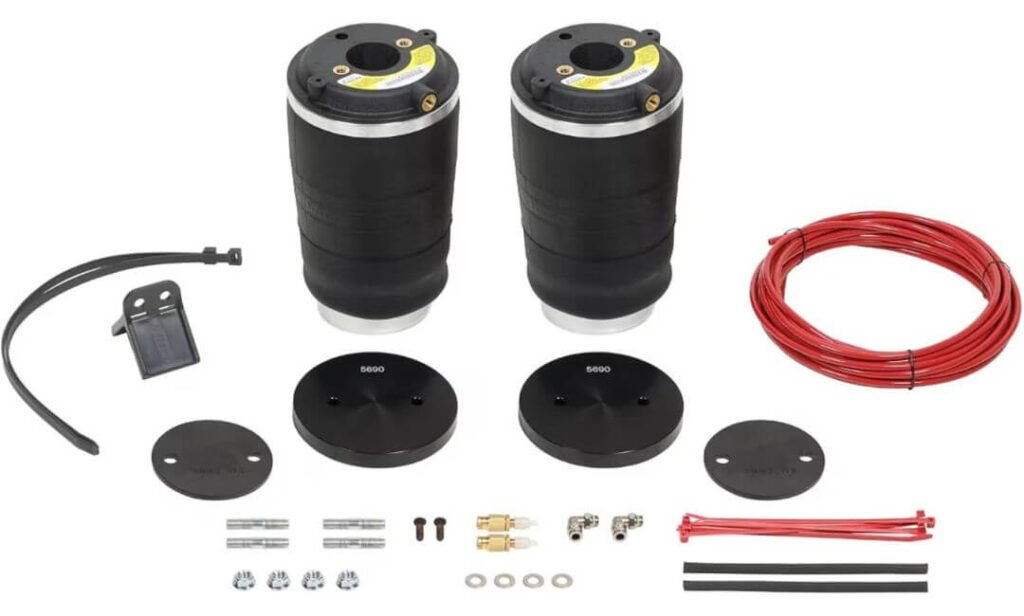
Quick Specs:
- Fitment: 2010–2026 Ram 1500 4WD
- Maximum Pressure: 100 PSI
- Listed Load Support: Up to 5,000 lbs
- Position: Rear
- Air Springs: 2 Red Label bellows
- Installation: No-drill bolt-on design
- Inflation: Separate left and right valves
- Kit Weight: 19.35 lbs
- Fitment Note: Not for Ram 1500 TRX, RHO, Rebel or 2WD
The first thing that makes this kit interesting is not the 5,000-lb figure on the box. It is the way the system is built around the Ram 1500’s existing suspension and the amount of control it gives you once the truck is actually carrying weight. With 100 PSI capability and independently adjustable air springs, the rear suspension can be tuned for a trailer, camper, loaded bed or simply a heavy hitch load without leaving the truck permanently stiff.
That matters with a half-ton pickup because the ideal pressure changes with the load. A lightly loaded Ram does not need the same air pressure as one pulling a trailer. Keeping the bags at a sensible low pressure when unloaded and increasing support as the load increases is what makes this type of setup useful beyond simply stopping rear-end sag. The no-drill mounting assembly is another genuine advantage: installation uses the truck’s existing mounting points rather than asking you to permanently modify the frame.
There is also a practical detail worth appreciating: the separate inflation valves allow left-to-right adjustment. If your trailer or cargo sits slightly heavier on one side, that gives you a way to correct the stance rather than accepting an uneven rear end. The included mounting hardware, air lines, valves and two rear air springs make this a complete installation rather than a kit that leaves you hunting for basic pieces afterwards.
(For a Ram 1500 that regularly switches between unloaded driving and serious towing, adjustable support is far more useful than simply chasing maximum air pressure.)
What We Like About It
- Wide 2010–2026 4WD coverage makes it one of the more versatile choices for Ram 1500 owners with different model years.
- 100 PSI capability gives plenty of adjustment headroom when the truck is working hard.
- No-drill installation keeps the installation cleaner and avoids unnecessary permanent frame modification.
- Independent air adjustment is genuinely useful when trailer tongue weight or cargo is not perfectly balanced.
- Red Label air springs and the established Firestone Ride-Rite design make this a more reassuring long-term choice than buying purely on the lowest price.
What We Would Keep in Mind
The only thing to check carefully is exact Ram 1500 configuration before ordering. The kit is for 4WD applications and specifically excludes the TRX, RHO and Rebel, so the year alone is not enough to confirm fitment.
Ram 1500 Fitment That Actually Matters
This is designed for 2010–2026 Ram 1500 4WD models, giving it unusually broad coverage across older and newer trucks. That makes it especially useful for owners of an earlier Ram who want a current aftermarket solution without moving into a completely different suspension system.
For newer Ram 1500s, the important part is confirming the exact suspension and trim rather than assuming every 1500 uses the same rear setup. TRX, RHO and Rebel models are excluded, and 2WD trucks are not compatible. If the truck falls within the listed standard 4WD application, this is a much more straightforward proposition.
The Insider Pro-Tip
Don’t set the pressure once and forget it. Air springs work best when the pressure follows the load. For normal unloaded driving, use only enough pressure to keep the bags properly supported; when a trailer or substantial cargo goes on the truck, increase pressure gradually until the Ram sits level and the suspension has the support it needs.
And one installation habit is worth taking seriously: after fitting the air lines, check every connection before putting the truck to work. A small fitting leak can look like a suspension problem when the real issue is simply a connection that was not seated correctly. Taking a few extra minutes here is far cheaper than finding the problem halfway through a towing trip.
#2. Air Lift 1000 HD Air Spring Kit 60828HD
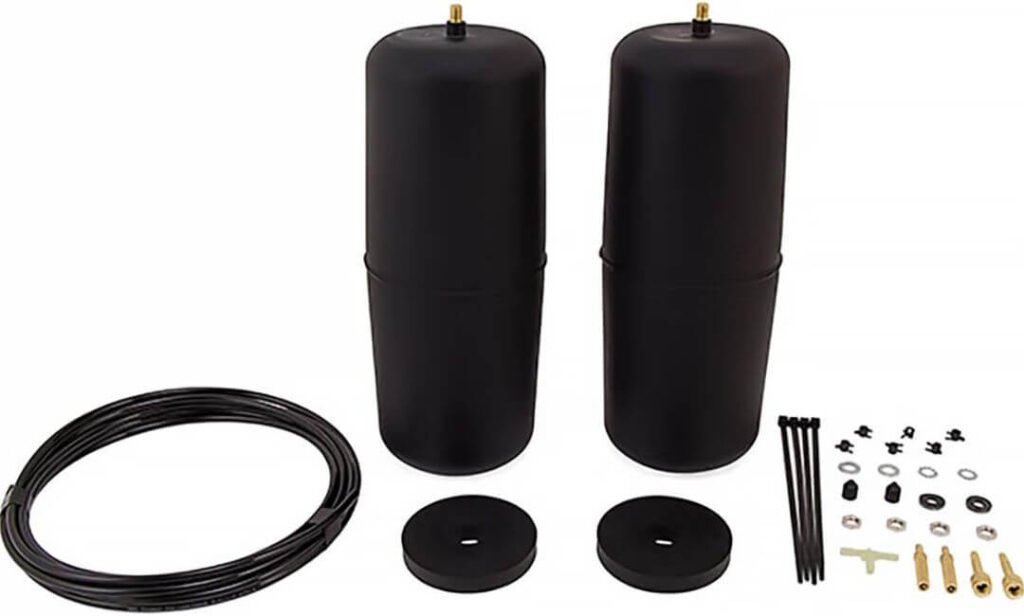
Quick Specs:
- Fitment: 2019–2026 Ram 1500, 2WD and 4WD
- Air Pressure: 5–50 PSI
- Load-Leveling Support: Up to 2,100 lbs
- Spring Type: Internal coil-spring air bags
- Material: Polyurethane
- Installation: No-drill design
- Coverage: Lifetime warranty
- Ride Guarantee: 60-day Ride Satisfaction Guarantee
- Important Fitment: Not for Classic, TRX, RHO, factory air suspension or taller aftermarket coil springs
A Ram 1500 that spends most of its life unloaded does not necessarily need a large external air-bag system. That is exactly where this Air Lift 1000 HD becomes interesting. Instead of mounting a conventional air spring outside the coil, the polyurethane bags sit inside the factory rear coil springs, giving the suspension additional support only when the load demands it.
The 5–50 PSI adjustment range is the part worth paying attention to. You can run considerably less pressure when the truck is empty and add air when a trailer, camper or heavy cargo changes the rear-end attitude. With up to 2,100 lbs of load-leveling support, the system is designed to address the familiar Ram 1500 problems—rear squat, excessive bounce and reduced stability—without replacing the entire suspension.
There is also a practical advantage for daily drivers: the air can be reduced when the extra support is not needed, allowing the original coil-spring suspension to do most of the work again. The polyurethane construction, included brackets and hardware, no-drill installation and lifetime warranty with a 60-day ride guarantee make this a particularly easy product to understand: add support when you need it, back it off when you don’t.
(The real attraction here is not maximum PSI; it is having adjustable support inside the existing coil springs without turning a normal Ram 1500 into a complicated suspension project.)
What Makes It Worth Considering
- 2,100-lb load-leveling capability gives this compact coil-insert design serious working ability.
- 5–50 PSI adjustment lets the support change with the actual load rather than staying fixed.
- Internal installation keeps the system tucked inside the factory rear coil springs.
- No-drill installation makes it much more approachable for a DIY Ram 1500 owner.
- Lifetime warranty and 60-day ride guarantee add meaningful reassurance when choosing an aftermarket suspension component.
One Thing to Check Before Ordering
The fitment is quite specific despite the broad year range. This kit is for the new-body-style 2019–2026 Ram 1500, not the Classic, and it is also unsuitable for trucks with factory air suspension, TRX/RHO models or aftermarket taller coil springs. A quick suspension check before buying is worth doing.
Ram 1500 Compatibility and Fitment
For the right truck, the coverage is useful: 2019–2026 Ram 1500 models in both 2WD and 4WD can use this system, provided they have the standard compatible coil-spring configuration. That makes it a particularly sensible choice for owners of newer fifth-generation Ram 1500s who want load support without moving to an externally mounted air-bag arrangement.
The biggest fitment distinction is the 2019 Ram 1500 Classic. It is not the same application, and this 60828HD should not be selected simply because the registration says 2019. Factory air suspension and taller aftermarket coil springs are also exclusions. In other words, confirm the actual truck configuration, not just the model year.
The Insider Pro-Tip
With an internal air spring, more pressure is not automatically better. Start conservatively, load the truck or trailer normally, and increase the pressure only until the rear sits properly and the suspension feels controlled. That approach usually gives a better unloaded-to-loaded balance than running unnecessarily high pressure all the time.
And if the Ram is your everyday vehicle, take advantage of what makes this design different: let the air support work when the truck is working. When the trailer comes off or the heavy cargo leaves the bed, reducing the pressure lets the factory coils take back more of the ride duty. That simple habit is one of the best reasons to choose an adjustable system in the first place.
#3. maXpeedingrods Rear Air Suspension Bag Kit
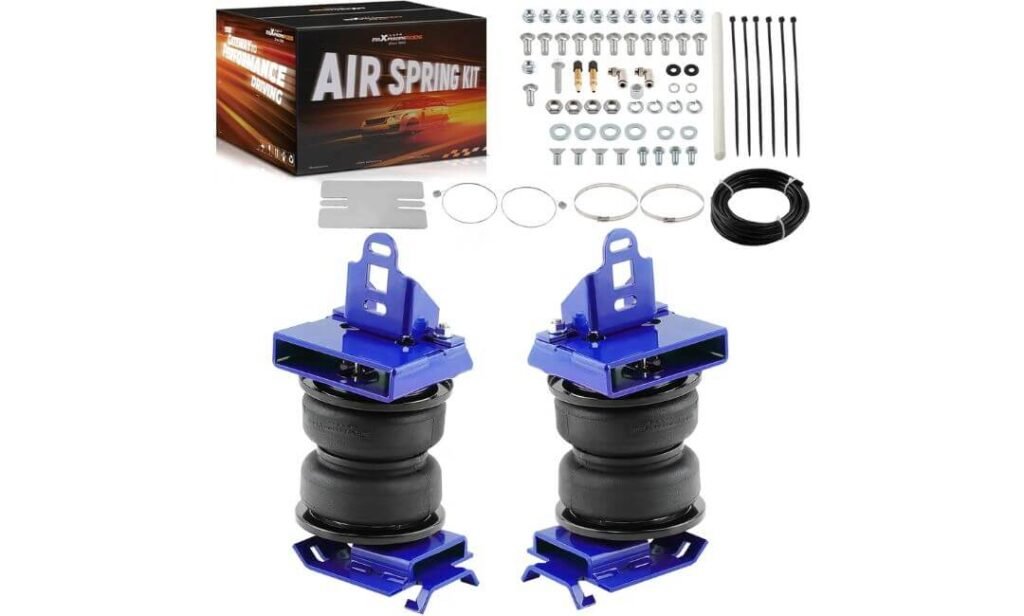
Quick Specs:
- Fitment: 2019–2025 Ram 1500 Standard 4WD
- Load-Leveling Capability: Up to 5,000 lbs
- Air Pressure: 5–100 PSI
- Air Spring Material: Multi-ply rubber
- Rubber Thickness: 4–4.5 mm
- Protection: Internal jounce bumpers
- Design Height: 180 mm
- Suspension Travel: 100 mm
- Installation: Bolt-on system
- Position: Rear left and right
- Fitment Note: Not for 2019 Classic, TRX or 2WD
What makes this kit stand out is the internal jounce bumper. That small detail becomes important when the truck is unloaded because it gives the air spring a built-in layer of protection if pressure gets very low. For a Ram 1500 that moves between an empty daily commute and towing or hauling on the weekend, that is a genuinely useful feature rather than something that simply looks impressive in a specification list.
The 5–100 PSI adjustment range also gives the system plenty of room to adapt to different loads. When a trailer puts substantial tongue weight on the rear suspension, additional air support can help bring the truck back towards level and reduce the squat and bottoming that can make a loaded Ram feel unsettled. The goal should not be maximum pressure; it should be finding the pressure that gives the right stance and controlled suspension movement for the load being carried.
Construction is another area where the numbers tell a useful story. The bags use 4–4.5 mm multi-ply rubber, while the double-bellow design is built around durability and sealing. The kit also includes the rear brackets and hardware needed for installation. It is a more involved install than an internal coil-spring insert, however, and factory bump-stop removal is part of the job, so this is better suited to an owner who is comfortable spending a few hours underneath the truck.
(The strongest reason to consider this system is the combination of wide pressure adjustment and built-in jounce protection—not simply the large load-capacity number.)
What We Like About It
- 5–100 PSI adjustment gives the Ram a broad tuning range for light and heavy loads.
- Internal jounce bumpers provide extra protection when the bags are running at very low pressure.
- 4–4.5 mm multi-ply rubber gives the air springs a substantial construction compared with basic budget bags.
- Rear load support helps address squat, bottoming and trailer movement without replacing the entire suspension.
- Bolt-on hardware and complete mounting components keep the installation within reach of a capable DIY owner.
The One Detail We’d Plan For
The installation deserves a little more preparation than the Air Lift above. Factory bump stops need to be removed, and some trucks may require additional mounting-hole work, so it is worth checking the frame and having the correct tools ready before starting rather than discovering those details halfway through the installation.
Ram 1500 Fitment and Year Coverage
This application is aimed at the 2019–2025 standard Ram 1500 4WD, making it a suitable choice for owners of the fifth-generation truck when the suspension configuration matches the manufacturer’s application. The 2019 Classic is different, so the model year by itself should never be used as the fitment check.
The important exclusions are 2WD and TRX, while newer 2024–2025 trucks have less long-term owner feedback available than earlier applications. That does not make the kit unsuitable; it simply means checking the exact configuration before ordering is the sensible move.
The Insider Pro-Tip
Before installation, look underneath the Ram and check the mounting points first. If the frame holes and surrounding hardware are ready for the kit, the job becomes much more predictable. It is also worth planning for the factory bump-stop removal rather than treating it as an afterthought.
Once installed, don’t judge the system by how much pressure it can hold. Load the Ram exactly as you normally would, start at the lower end of the recommended pressure range, and increase air gradually until the rear sits correctly. A level truck with controlled suspension is the target—not an air bag running at its maximum just because it can.
#4. DEEAGLE 57375 Rear Air Bags Suspension Kit
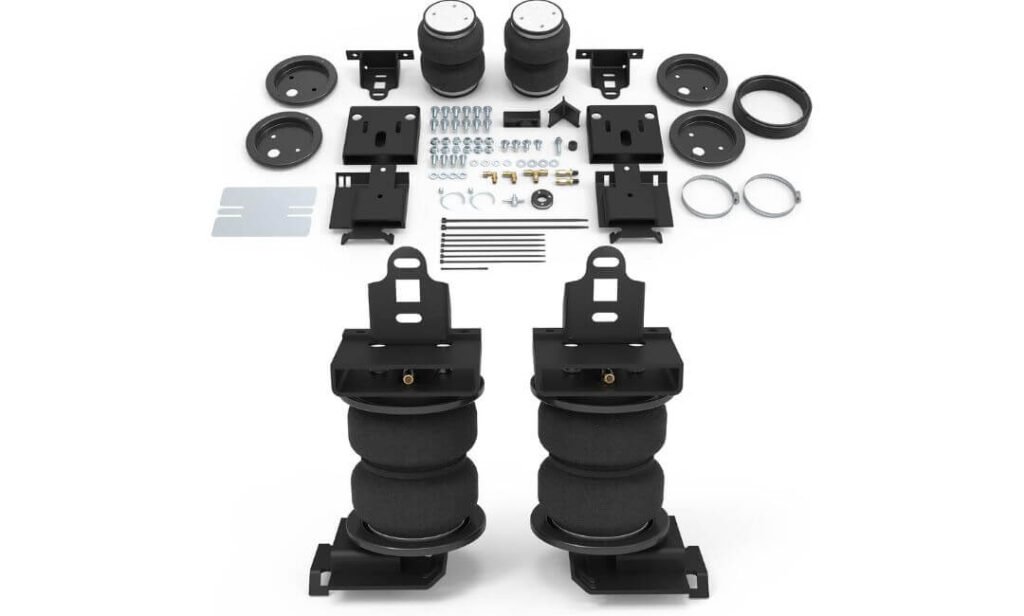
Quick Specs:
- Fitment: 2019–2026 Ram 1500, 2WD and 4WD
- Load-Leveling Capability: Up to 5,000 lbs
- Air Pressure: 5–100 PSI
- Position: Rear
- Air Bags: 2
- Installation: Drilling and frame modification required
- Hardware: Mounting brackets, self-tapping bolts, clamps and heat shields
- Adjustment: Independent front-to-rear and side-to-side levelling
- Warranty: 1-year limited warranty
- Fitment Note: Not for 2019 Classic, TRX or RHO; lifted trucks may require spacers
Some Ram 1500 owners simply want an air bag to stop the rear from dropping. This system goes a little further. The 5–100 PSI adjustment range gives you enough room to tune the rear suspension around the actual load, while the ability to balance pressure side-to-side can be useful when a trailer or cargo puts more weight on one side than the other.
The headline 5,000-lb load-leveling capability should be read correctly. It describes the support capability of the air-spring system; it does not give a Ram 1500 permission to carry another 5,000 lbs beyond its factory payload rating. Used properly, the benefit is much more practical: keeping the truck closer to its normal ride height, reducing squat and giving the rear suspension more support when the load starts working against the factory springs.
Another reason this kit deserves its place is its broad application. It covers 2019–2026 Ram 1500 models in both 2WD and 4WD, which is useful because many competing kits narrow their fitment to one drivetrain. The trade-off is installation. This is not the type of kit to buy expecting a quick bolt-on afternoon; drilling and cutting around the factory bump-stop mounting area are part of the installation, so the buyer should be comfortable with that before ordering.
(This is a better match for an owner who values adjustability and broad drivetrain coverage and is comfortable doing a more involved installation.)
What We Like About It
- 2WD and 4WD coverage gives it a useful advantage for Ram 1500 owners who cannot use many 4WD-only alternatives.
- 5–100 PSI adjustment provides substantial room to tune support for different towing and hauling situations.
- Side-to-side adjustment can help compensate for uneven trailer tongue weight or cargo distribution.
- Heat shields and mounting hardware are included, so the kit is built as a complete rear suspension installation rather than just two bare bags.
- Clear labelled parts and illustrated instructions make a more involved installation easier to work through.
What We’d Tell a Buyer Up Front
The important thing here is the installation. Drilling is required and the factory bump-stop mounting area needs modification, so this is not the right choice if your priority is the simplest possible installation. For a mechanically confident owner, however, that extra work can be worthwhile for the adjustability and 2WD/4WD versatility.
Ram 1500 Compatibility and Fitment
The stated application covers 2019 through 2026 Ram 1500 models, including both 2WD and 4WD versions. That is a meaningful advantage over products restricted to one drivetrain. However, the 2019 Classic is excluded, as are the TRX and RHO.
Lifted trucks need additional attention. If the Ram has a larger lift or modified four-link geometry, air-spring spacers or other fitment changes may be necessary. The safest approach is to confirm the exact suspension configuration before ordering rather than assuming the advertised year range covers every modified truck.
The Insider Pro-Tip
If you’re installing this yourself, remove the spare tyre before starting. That sounds minor, but the extra working room underneath the Ram can make the difference between a frustrating installation and one you can actually work through comfortably.
After installation, load the truck the way you normally use it and tune the pressure gradually. Don’t chase a perfectly rigid rear end. The useful setting is the one that brings the Ram back to a sensible ride height while retaining normal suspension movement and stability. And because this kit requires drilling, protect any exposed or newly modified metal properly against corrosion once the brackets are secured.
#5. TORQUE Air Bag Suspension Kit
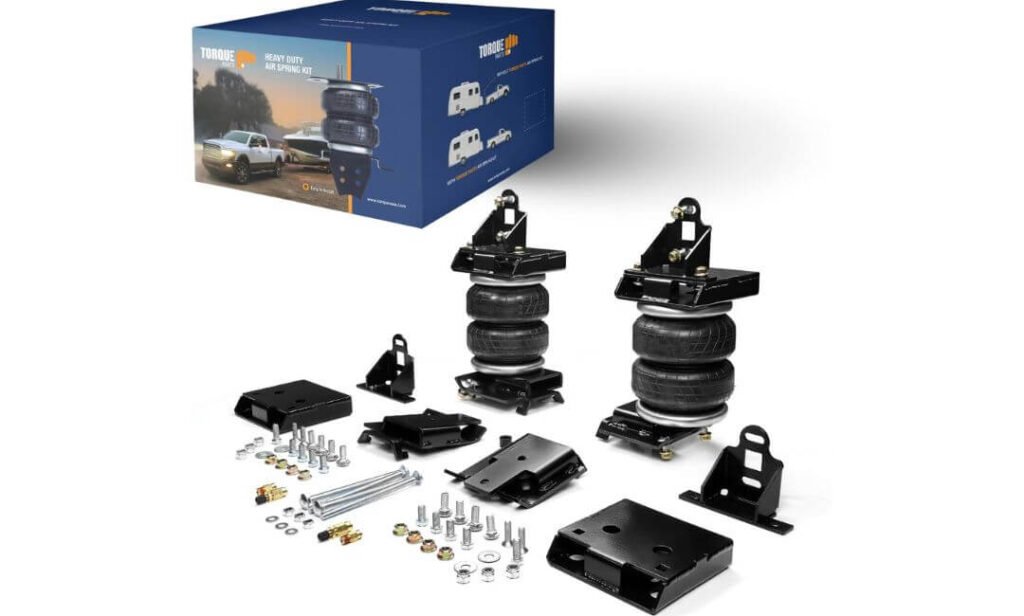
Quick Specs:
- Fitment: 2019–2026 Ram 1500 4WD
- Load-Leveling Capability: Up to 5,000 lbs
- Maximum Pressure: Up to 100 PSI
- Position: Rear axle
- Air Springs: 2
- Construction: High-carbon-steel mounting components
- Adjustment: Air pressure adjustable for changing loads
- Installation: Frame drilling and bump-stop bracket modification required
- Included: Brackets, hardware, air lines, fittings and inflation valves
- Warranty: 1-year manufacturer warranty
If the goal is to add serious rear support without changing the basic character of the Ram 1500, this kit takes the familiar 5,000-lb load-support class approach. The useful part is the adjustable air pressure: instead of relying on a fixed-rate helper spring, the rear suspension can be given more support when a trailer or heavy cargo is attached and less when the truck returns to normal driving.
The 100 PSI maximum pressure gives plenty of adjustment room, while the two rear air springs work alongside the existing suspension to help control squat and reduce the harsh axle-to-frame contact that can happen when the truck is heavily loaded. The system is also positioned as an equivalent replacement for the Air Lift 57375-style application, which makes it an interesting option for buyers comparing systems built around the same general installation concept.
There is one thing that should be understood before buying: this is a fabrication-style installation, not a quick afternoon bolt-on. The frame needs drilling and the factory bump-stop bracket requires modification. The upside is that the kit arrives with the brackets, bolts, nuts, fittings, tubing and inflation valves needed for the installation, so the challenge is the work itself rather than having to assemble a collection of missing components.
(For a Ram owner comfortable with mechanical work, the appeal is simple: substantial adjustable rear support without paying purely for a premium badge.)
What We Like About It
- 5,000-lb load-leveling capability puts it in the serious towing and hauling category.
- Up to 100 PSI adjustment allows the support level to follow changing loads.
- Complete installation hardware means the core brackets, fittings, tubing and valves are supplied.
- Ram-specific 4WD application keeps the kit focused on the intended fifth-generation truck.
- Air-pressure-based support is more adaptable than a fixed helper spring when the Ram regularly changes between empty and loaded use.
What We’d Keep in Mind
The main consideration is simply the installation. Frame drilling and bump-stop bracket modification are required, so anyone without the right tools or fabrication experience should have the work handled by a qualified installer. That is not a reason to dismiss the kit; it is just part of choosing this particular design.
Ram 1500 Compatibility and Fitment
The application covers 2019–2026 Ram 1500 4WD models. This is specifically a fifth-generation application, so it should not be treated as a universal Ram 1500 air-bag kit simply because the brand name appears in the listing.
Most importantly, 2WD Ram 1500 models are excluded, as are earlier generations and the larger Ram 2500/3500 platforms. Checking the drivetrain and exact model before ordering is therefore essential.
The Insider Pro-Tip
Treat this as an installation project first and a suspension upgrade second. Before buying, make sure you have the equipment needed to drill the frame cleanly and deal with the factory bump-stop mounting area. If you’re paying a shop to install it, asking for a firm quote beforehand is a much better move than discovering the fabrication work after the kit is already on the bench.
Once fitted, set the pressure according to the actual load rather than the maximum rating. The best result is a Ram that sits level and remains composed—not a rear suspension inflated as hard as possible. That is where an adjustable air-helper system earns its place over a basic fixed-support solution.
Best Ram 1500 Air Suspension Kits (2010–2026): Side-by-Side Comparison
| Air Suspension Kit | Ram 1500 Fitment | Air Support | What Sets It Apart | Installation Reality | Best Use | Buyer Take |
|---|---|---|---|---|---|---|
|
Best Overall
Firestone Ride-Rite 2595
Rear air-spring system
|
2010–2026 4WD Excludes TRX, RHO, Rebel and 2WD. |
100 PSI Up to 5,000-lb listed support |
Red Label air springs Independent inflation valves No-drill mounting design |
Factory mounting points No drilling required |
Frequent towing Heavy hauling Variable loads |
The strongest all-round combination of coverage, adjustability and installation practicality. |
|
Air Lift 1000 HD 60828HD
Internal coil-spring air bags
|
2019–2026 2WD / 4WD Not for Classic, TRX, RHO or factory air suspension. |
5–50 PSI Up to 2,100-lb load leveling |
Polyurethane bags Fit inside factory coil springs Lifetime warranty |
No drilling DIY-friendly installation |
Daily driving Moderate towing Coil-spring Ram owners |
The cleanest choice when you want adjustable support without external rear air bags. |
|
maXpeedingrods Rear Air Suspension Bag Kit
Rear air-helper system
|
2019–2025 4WD Not for 2019 Classic or TRX. |
5–100 PSI Up to 5,000-lb listed support |
Internal jounce bumpers 4–4.5 mm multi-ply rubber Wide pressure adjustment |
Bolt-on design Bump-stop removal required |
Towing Camper hauling Value-focused builds |
A compelling value option when pressure range and built-in jounce protection matter more than brand prestige. |
|
DEEAGLE 57375
Rear load-leveling air bags
|
2019–2026 2WD / 4WD Not for Classic, TRX or RHO. Lifted trucks may need spacers. |
5–100 PSI Up to 5,000-lb listed support |
Side-to-side adjustment Heat shields included 1-year warranty |
Drilling required Factory bump-stop area needs modification |
2WD or 4WD owners Heavy loads DIY fabrication projects |
Its biggest advantage is broad drivetrain coverage, but the installation demands more mechanical commitment. |
|
TORQUE Air Bag Suspension Kit
Rear air-helper system
|
2019–2026 4WD Not for 2WD or earlier Ram 1500 generations. |
Up to 100 PSI Up to 5,000-lb listed support |
High-carbon-steel brackets Adjustable air support Complete fitting kit |
Frame drilling required Bump-stop modification required |
Towing Heavy cargo OEM-style replacement projects |
Makes sense for buyers wanting serious adjustable support at a value-focused price and who are prepared for the installation work. |
Ram 1500 Air Suspension Kit Buying Guide: What Actually Matters Before You Order
Buying an air-spring kit for a Ram 1500 is not really about finding the bag with the biggest number printed on the packaging. The better question is: what does the truck actually need to do? A Ram that occasionally carries a loaded bed has different requirements from one that pulls a travel trailer every weekend. The five systems above also use different installation approaches, pressure ranges and fitment rules, so comparing them only by price or advertised load capacity can lead to the wrong choice.
Start With the Pressure Range, Not Just the Maximum PSI
A 100 PSI rating looks impressive, but maximum pressure is not the pressure you should automatically run every day. It simply tells you how much adjustment headroom the air spring has.
For a Ram 1500 used for different jobs, a useful system should let you increase support as the load increases and reduce it again when the truck is empty. That is why the broad adjustment range of the Firestone, maXpeedingrods, DEEAGLE and TORQUE systems is useful, while the Air Lift 1000 HD takes a more compact 5–50 PSI approach.
What matters in practice:
- Low-pressure adjustability helps preserve a comfortable unloaded ride.
- Higher-pressure capability provides more support when towing or hauling.
- Pressure should be adjusted according to the actual load, not simply set to the maximum.
- Left-to-right adjustment can be useful when a trailer or cargo load is uneven.
- A properly levelled truck should still retain sensible suspension movement.
The important distinction is that air-spring capacity is not additional legal payload. If a kit is advertised with 5,000 lbs of load-leveling capability, that does not mean a Ram 1500 can legally carry another 5,000 lbs beyond its factory rating.
Load Leveling Is the Real Reason to Buy
When a trailer is connected or the bed is heavily loaded, the rear of a half-ton pickup can drop enough to change how the truck feels. The steering can become lighter, the headlights can point upward, suspension travel can be reduced, and the rear can feel less settled over bumps.
A properly adjusted air-spring system helps by supporting the rear suspension and bringing the truck closer to its normal ride height.
Look for these practical benefits:
- Less visible rear-end squat.
- Better suspension support under tongue weight.
- More controlled movement over bumps.
- Reduced risk of bottoming under a heavy load.
- More consistent vehicle attitude while towing.
- Better weight distribution across the working suspension.
- Ability to remove most of the extra air support when the truck is unloaded.
That last point is easy to overlook. If the Ram is a daily driver during the week and a towing vehicle at the weekend, adjustability is more valuable than simply having a stiff rear suspension all the time.
No-Drill Fit or Frame Drilling: Choose Honestly
Installation is one of the biggest differences between these kits.
The Firestone Ride-Rite 2595 uses a no-drill mounting approach for its specified Ram 1500 application. The Air Lift 1000 HD also avoids frame drilling because its air springs install inside the existing coil springs.
The DEEAGLE and TORQUE systems require considerably more work, while the maXpeedingrods setup can also involve bump-stop removal and additional installation preparation.
| Installation approach | What it means for the buyer |
|---|---|
| No-drill | Usually the more attractive option for a DIY owner who wants a cleaner installation |
| Internal coil-spring installation | Keeps the air springs inside the factory coils and avoids an external bag assembly |
| Frame drilling | Requires proper tools, accurate measurements and more installation time |
| Bump-stop modification | Adds another step and should be planned before the truck is taken apart |
| Modified or lifted suspension | May require additional fitment checks, spacers or other hardware |
There is nothing inherently wrong with a drilling-required system. The important thing is knowing what you are buying. A buyer expecting a one-hour bolt-on installation can be disappointed by a kit that requires frame modification, while an experienced installer may have no issue with it at all.
Match the Kit to Your Ram 1500 Configuration
This is where model-year shopping can become misleading. Saying “2019–2026 Ram 1500” does not automatically mean every Ram 1500 in those years is compatible.
Before ordering, verify:
- Exact model year
- 2WD or 4WD
- Standard Ram 1500 or Classic
- Factory air suspension or conventional suspension
- Rebel, TRX, RHO or another specialised configuration
- Factory or aftermarket lift
- Coil-spring configuration
- Any modified four-link or suspension geometry
For example, the Air Lift 1000 HD covers the newer 2019–2026 Ram 1500 application but excludes the 2019 Classic, TRX, RHO and trucks with factory air suspension or taller aftermarket coil springs. The Firestone 2595 has broader year coverage but is specifically a 4WD application and excludes the TRX, RHO and Rebel.
That is why fitment should be checked against the actual truck rather than selected from the year range alone.
Think About the Towing Job You Actually Do
A light utility trailer, a loaded cargo trailer and a large travel trailer do not put the same demands on the rear suspension.
For occasional towing, the priority may simply be reducing squat and maintaining a comfortable ride. For frequent towing, stability, adjustability and predictable load support become much more important.
A sensible way to approach it is:
Occasional cargo:
Prioritise easy adjustment, comfortable unloaded driving and straightforward installation.
Regular trailer towing:
Look for a broad pressure range, dependable rear support and the ability to fine-tune the truck once the trailer is connected.
Heavy camper or frequent hauling:
Pay closer attention to fitment, mounting strength, air-line routing, pressure control and how easily the system can be inspected or serviced.
Whatever the application, the air springs should complement the truck’s existing suspension rather than being treated as a replacement for the manufacturer’s payload or towing limits.
Don’t Ignore the Air Lines and Fittings
The bags get most of the attention, but the system is only as dependable as its air lines, fittings, valves and mounting hardware.
During installation, check that:
- Air lines are routed away from exhaust heat and moving suspension parts.
- Fittings are properly seated.
- Lines are cut cleanly rather than crushed or damaged.
- Left and right air lines are not rubbing against brackets.
- Inflation valves are mounted somewhere accessible.
- The bags have adequate clearance through the suspension’s full movement.
- All mounting hardware is properly secured.
A good air spring with a poorly routed airline is still a poorly installed suspension system. After installation, check the system for pressure loss before relying on it for a long towing trip.
Do You Need a Compressor?
Not necessarily.
A basic air-spring setup can use manual inflation valves, allowing you to add or remove air with an external compressor or suitable air source. That keeps the system relatively simple.
A compressor and onboard air management system become more attractive when the truck’s load changes frequently. If you connect and disconnect trailers often, having the ability to adjust pressure from the cab is considerably more convenient than getting out and finding an air source.
For an occasional tower, manual valves can be perfectly reasonable. For someone constantly changing loads, onboard air management is a convenience upgrade rather than a mandatory part of the air-bag system.
Durability Comes Down to More Than the Bag
Air springs live underneath the truck, where they encounter water, dirt, road salt, heat and constant suspension movement. That makes material quality and installation just as important as the headline PSI rating.
Pay attention to:
- Air-spring construction and rubber or polyurethane material.
- Bellows design.
- Bracket strength.
- Heat protection around the air lines.
- Fitting quality.
- Abrasion clearance.
- Proper mounting alignment.
- Warranty coverage.
The Air Lift system uses polyurethane internal air springs, while the maXpeedingrods system uses multi-ply rubber construction and includes internal jounce protection. Firestone’s Ride-Rite system uses its Red Label air springs. These are different approaches, which is exactly why there is no single specification that can fairly decide the entire comparison.
Common Ram 1500 Air Suspension Questions
Do Air Bags for Ram 1500 Require Professional Installation?
No, not automatically.
A capable DIY owner can install many air-helper systems, but the difficulty depends heavily on the design. No-drill systems are generally more approachable, while kits requiring frame drilling, bump-stop removal or other modifications demand better tools and mechanical confidence.
If the installation requires structural drilling or fabrication and you are not comfortable measuring, drilling and protecting modified metal against corrosion, professional installation is the safer choice.
Can I Tow With Air Bag Suspension Without a Complicated Setup?
Yes.
You do not need a fully electronic air-management system just to gain useful load support. A basic system with air springs, inflation valves and correctly routed air lines can provide adjustable rear support for towing.
The important part is setting the pressure for the actual trailer load and staying within the Ram’s factory payload, axle and towing limits. Air bags can improve the truck’s stance and suspension support; they do not turn a half-ton Ram into a higher-rated truck.
How Do I Maintain a Ram 1500 Air Spring Kit?
Maintenance is mostly inspection rather than constant servicing.
Every so often, inspect the bags and air lines for:
- Visible rubbing or abrasion.
- Cracks or unusual wear.
- Loose fittings.
- Damaged brackets.
- Heat damage.
- Changes in ride height.
- Unexplained pressure loss.
It is also smart to check the system after the first installation and again after the truck has completed some loaded or towing miles. If one side repeatedly loses pressure, find the cause instead of simply adding more air. A small fitting or airline problem is much easier to fix early than after it develops into a larger failure.
The best air suspension kit for a Ram 1500 is ultimately the one that fits the exact truck, matches the real load, provides the adjustment you will actually use and can be installed correctly. That is a much more useful buying standard than choosing whichever listing has the largest capacity number.
Practical Ram 1500 Air Suspension Kit Installation and Application Guide
Buying the correct air-spring system is only half the job. The other half is making sure it is installed with the same care you would give any load-bearing suspension component. The five kits in this guide do not all install the same way, so the installation method should be considered before opening the box. A no-drill design can be relatively approachable for a confident home mechanic, while a system requiring frame drilling and bump-stop modification deserves more preparation, time and appropriate tools.
Start With a Proper Pre-Installation Check
Before lifting the Ram, verify the kit against the exact model year, drivetrain, trim and suspension configuration. This is especially important with the 2019 model year because the Classic and newer body style are not interchangeable applications for every kit.
Then inspect the rear suspension before installing anything. Look for damaged coil springs, worn suspension components, bent brackets or anything that could prevent the air springs from sitting correctly. An air-helper system is designed to supplement a healthy suspension; it should not be used to hide an existing mechanical problem.
A sensible pre-check includes:
- Confirming the exact vehicle fitment.
- Checking whether the truck has factory air suspension.
- Measuring or visually confirming available clearance around the rear suspension.
- Inspecting the existing springs and suspension mounting areas.
- Reading the complete installation instructions before removing parts.
- Checking that every bracket, fitting, airline and fastener is actually present.
- Planning where the inflation valves or compressor controls will be located.
No-Drill and Drill-Required Systems Are Very Different Jobs
A no-drill installation generally uses existing mounting points or installs the air springs within the factory coil springs. That can make the job considerably easier and reduces the risk of accidentally creating a corrosion-prone hole in the frame.
A drill-required system is not necessarily inferior. It simply demands more care. When brackets need to be attached directly to the frame, the holes must be positioned correctly, the supplied hardware must be installed properly, and any exposed metal created during the work should be protected against corrosion.
For this group, the installation approach roughly falls into two categories:
| Installation style | What to expect |
|---|---|
| No-drill external mounting | Cleaner DIY installation, with less permanent modification |
| Internal coil-spring system | Air springs sit inside the existing coils, keeping the setup compact |
| Drill-required mounting | More preparation, accurate drilling and additional installation time |
| Bump-stop modification | Requires extra clearance work and should be planned before installation |
The important thing is not to choose a kit because its installation sounds easy on paper. Choose the installation complexity you are genuinely comfortable handling.
What the Installation Usually Involves
The exact procedure varies by kit, but a typical rear air-spring installation follows a logical sequence.
1. Secure and support the truck
Park on a level surface, apply the parking brake and use properly rated jack stands. Never rely on the hydraulic jack alone while working underneath the vehicle.
2. Create suspension clearance
The rear suspension needs to be unloaded enough to provide access to the springs, bump-stop area and mounting locations. Follow the kit-specific instructions for supporting the axle.
3. Remove or modify components as instructed
Some designs require the factory bump stops or their mounting brackets to be removed. Others install inside the existing coil springs with considerably less modification.
4. Position the air springs and brackets
Correct orientation matters. The bags should sit naturally between their mounting points without being twisted, pinched or forced into position.
5. Secure the hardware
Tighten the brackets and fasteners according to the manufacturer’s instructions. With drill-required systems, this is the stage where accurate hole placement becomes particularly important.
6. Route the air lines
Keep the tubing away from exhaust heat, sharp edges, brake components, tyres and moving suspension parts. Leave enough controlled movement for the suspension to travel without pulling or kinking the line.
7. Install the inflation valves or compressor
Manual valves should be placed somewhere protected but accessible. If an onboard compressor is being used, its location should allow proper airflow and protection from unnecessary water and road debris.
8. Inflate and inspect
Add air gradually, inspect the bags for correct seating, and check every connection for leakage before putting the truck back into normal service.
How Much Time and What Tools Should You Expect?
There is no honest single installation time for every Ram 1500 air-spring kit. A straightforward no-drill installation can be completed much faster than a system requiring frame drilling and bump-stop modification.
For a prepared DIY owner, roughly 1–2 hours can be realistic for a relatively simple installation, while a drill-and-modification setup can reasonably become a 3–5 hour project depending on access, tools and experience.
Useful equipment can include:
- Floor jack and properly rated jack stands.
- Basic metric socket and wrench set.
- Torque wrench.
- Screwdrivers and pliers.
- Drill and suitable drill bits for drill-required applications.
- Cutting or grinding equipment where specifically required.
- Measuring tools for bracket positioning.
- Tubing cutter for clean airline cuts.
- Soapy-water solution for leak checking.
- Eye protection and appropriate gloves.
- Corrosion-protection coating for modified frame surfaces.
Do not underestimate the value of a good tubing cutter and a torque wrench. A poorly cut airline can create sealing problems, while incorrectly tightened mounting hardware can create a problem that is much harder to diagnose later.
Protect the Air Lines Like They Are Part of the Suspension
The air bags themselves tend to get all the attention, but the airlines are equally important to the finished system.
Run each line so it has enough freedom for normal axle movement but cannot contact anything that moves or gets hot. Avoid tight bends, crushed sections and unsupported lengths that can flap against the frame.
Pay particular attention to:
- Exhaust pipes and mufflers.
- Brake lines.
- Tyres and wheels.
- Shock absorbers.
- Suspension brackets.
- Sharp frame edges.
- Areas exposed to road debris.
After routing, turn the steering and cycle the suspension as appropriate for the installation to make sure nothing can contact the tubing through its normal range of movement.
Compressor Installation Needs Its Own Safety Check
An onboard compressor is convenient, but it is not simply another accessory to wire wherever there is spare space.
The compressor should have an appropriate electrical supply, correct fuse protection and wiring sized for its current demand. Connections should be secure and protected from moisture and abrasion. Follow the compressor manufacturer’s wiring requirements rather than copying a generic wiring diagram.
A clean installation should leave you with:
- Correctly sized power wiring.
- Appropriate fuse or circuit protection.
- Secure ground connection.
- Protected wiring away from exhaust heat.
- A properly mounted compressor.
- Accessible controls or pressure management.
- No loose wiring hanging near moving suspension parts.
If the electrical side is outside your comfort zone, having that portion installed professionally is sensible. A suspension upgrade is not the place to improvise with undersized wiring or an unprotected power connection.
Get the Bag Position and Load Distribution Right
Correct air-bag positioning is critical. The spring should sit squarely between its mounting surfaces, with adequate clearance throughout suspension movement. If the bag is rubbing against the frame, coil spring, bracket or another component, additional air pressure will not solve the problem.
Load distribution matters too. Air springs can help compensate for an uneven load, but they should not be used to cover up a badly loaded trailer or cargo area.
When towing:
- Keep heavy cargo as evenly distributed as practical.
- Follow the trailer manufacturer’s loading guidance.
- Stay within the Ram’s payload and axle ratings.
- Check that the trailer’s tongue weight is appropriate.
- Adjust air pressure after the normal load is connected.
- Confirm the truck sits at a sensible ride height before driving away.
If one side of the Ram sits substantially lower, correct the load first and then fine-tune the air pressure. Air pressure should be the adjustment tool, not the excuse for carrying an obviously unbalanced load.
Don’t Choose Bag Size by Capacity Alone
A common mistake is assuming that the largest advertised air spring must be the best choice. The bag has to physically fit the suspension, have the correct mounting arrangement and provide the required travel.
The useful combination is:
correct fitment + correct mounting position + suitable travel + appropriate pressure range + sensible load support.
A bag that is technically capable of supporting a huge load is of little value if its dimensions, brackets or suspension travel do not match the Ram 1500.
Final Installation Check Before Driving
Once everything is installed, do not immediately attach a trailer and head onto the highway.
First, inspect every mounting point and airline. Inflate the system within the manufacturer’s specified range, listen for obvious leaks and use a soapy-water check around fittings where appropriate. Look for bubbles, rubbing, pinched tubing or unusual bag positioning.
Then drive slowly in a safe area and listen for anything that should not be there. After the first loaded trip, it is worth checking the fittings and mounting hardware again.
The best installation is the one you never have to think about while towing. If the truck sits level, the bags remain properly positioned, the pressure stays stable and the airlines stay protected, the system is doing its job quietly in the background.
How Ram 1500 Air Suspension Performs When Towing, Hauling and Driving Every Day
Air-helper suspension makes the most sense when the Ram 1500 is asked to do more than simply carry its driver. The difference becomes easier to understand once the truck is used in three very different situations: connected to a trailer, carrying a heavy load, and completely unloaded on normal roads. The right pressure and a properly installed system can make the truck feel more controlled, but the air springs should support the factory suspension rather than replace good loading practices.
Towing With a Ram 1500: Where Air Bags Make the Biggest Difference
A trailer changes the way the rear suspension works because the trailer’s tongue weight is transferred onto the truck. If that weight pushes the rear of the Ram down too far, the front can become comparatively light, suspension travel can decrease and the truck may feel less settled.
This is where Ram 1500 air bags for towing can be genuinely useful. The bags add spring support at the rear, allowing the truck to return closer to its normal ride height when the trailer is connected. That can help maintain more consistent handling and reduce the feeling of the rear suspension being overwhelmed by the load.
Before adjusting the air pressure, connect the trailer exactly as you normally would:
- Hitch the trailer securely.
- Connect the safety chains and electrical connection.
- Check the trailer’s tongue weight and overall loading.
- Make sure the trailer is sitting correctly behind the truck.
- Check tyre pressures on both the truck and trailer.
- Adjust the air springs only after the normal towing load is connected.
- Increase pressure gradually until the Ram sits at a sensible ride height.
The goal is not to make the rear suspension rock hard. If the truck is sitting level but feels harsh and bounces excessively over imperfections, there may simply be too much air pressure.
Trailer Connection Tips That Matter More Than Extra Air Pressure
Air bags cannot correct a badly loaded trailer.
A trailer with excessive rear or front weight can still behave poorly even when the Ram looks perfectly level. Load the trailer according to its manufacturer’s guidance, keep heavy items positioned appropriately, and stay within the Ram’s published payload, axle and towing limits.
Once the trailer is connected, look at the truck from the side. The useful result is a Ram that remains close to its normal stance without excessive rear squat. If the trailer is properly loaded and the suspension still drops noticeably, then increase air support gradually.
This is also why a system with independent or easily adjustable pressure can be valuable. Different trailers can put very different loads on the rear suspension, so one pressure setting does not necessarily suit every trip.
Heavy Loads: Keeping the Ram 1500 at the Right Ride Height
A heavily loaded bed creates a different situation from towing. Instead of concentrated tongue weight, the load is distributed through the cargo area, and the exact effect depends on where the weight sits.
For Ram 1500 air bags for heavy loads, the objective is to provide additional rear spring support while keeping enough suspension travel available.
A sensible approach is:
- Load the truck normally.
- Check how far the rear suspension has settled.
- Add air gradually.
- Recheck the truck’s stance.
- Make sure the air springs remain correctly positioned.
- Drive slowly and check how the suspension responds.
- Fine-tune the pressure if necessary.
If heavy cargo sits mostly toward one side, independent left-to-right adjustment can help level the truck. But it should be used as a fine adjustment, not as a substitute for proper cargo distribution.
Keeping the truck near its intended ride height is useful because excessive squat can change suspension geometry and reduce available compression travel. The air springs can help restore support, but they do not change the truck’s factory payload rating.
What About a Camper, Motorcycle or Long-Trip Load?
This is where the difference between a light occasional load and a serious hauling job becomes obvious.
A camper, motorcycle carrier or heavily loaded cargo setup can place substantial weight toward the rear of the Ram. In that situation, the suspension needs enough support to prevent excessive compression while still allowing the axle to move naturally.
Before leaving:
- Check the actual loaded weight.
- Confirm axle and payload limits.
- Distribute cargo as evenly as possible.
- Verify the air-spring pressure.
- Inspect the air lines and fittings.
- Make sure nothing is rubbing against the bags.
- Check the truck’s ride height.
- Perform a short low-speed test before a long journey.
That final short test is worth doing. A suspension system may look perfectly installed while stationary, but suspension movement can reveal an airline or clearance problem that was not obvious in the driveway.
Daily Driving When the Ram Is Completely Unloaded
This is the part many buyers overlook.
Most Ram 1500 owners do not tow a trailer every day. The truck may spend Monday through Friday carrying almost nothing and then pull a camper on Saturday. Running an air-helper system at unnecessarily high pressure during unloaded driving can make the rear suspension feel firmer than it needs to be.
With an adjustable system, the sensible approach is to reduce the air pressure when the heavy load is gone, while staying within the manufacturer’s minimum pressure requirements. This allows the factory suspension to contribute more of the normal ride response.
The result should not feel like a completely different truck. You should still have normal suspension movement over rough pavement, expansion joints and broken roads.
Does a 100 PSI System Ride at 100 PSI Every Day?
No.
A 100 PSI maximum rating is not a recommendation to run 100 PSI continuously. It is the upper pressure capability of the air spring.
This distinction is particularly important when comparing the systems in this guide. A system capable of 100 PSI gives you a wide adjustment range, but the correct pressure depends on the load, truck configuration and desired ride height.
Think of the pressure range as a tuning tool, not a target.
For an unloaded Ram, only the manufacturer’s required minimum pressure may be necessary. Add a trailer or substantial cargo, and more pressure may be appropriate. The exact setting should be established from the manufacturer’s instructions and the truck’s actual behaviour.
Ride Quality, Cabin Noise and Comfort
A properly installed air-helper system should not automatically make the Ram noisy.
The air springs themselves are not supposed to create a constant source of cabin noise. What you may notice is a change in rear suspension response. With the correct pressure, the truck can feel more controlled when loaded because the additional spring support reduces excessive compression and bouncing.
Too much pressure is another story. An overinflated system can make the rear feel unnecessarily firm, especially when the truck is empty. That is not evidence that air bags are uncomfortable; it is usually evidence that the suspension is being asked to provide more support than the current load requires.
Installation also affects noise. Air lines and brackets should never be allowed to contact the frame, exhaust, tyres or moving suspension components. A small amount of contact underneath the truck can become an irritating rattle inside the cabin.
The Real-World Difference Between Loaded and Unloaded Driving
The best way to think about an air-helper system is load-dependent support.
| Driving situation | What the air springs should accomplish |
|---|---|
| Empty daily driving | Maintain the required minimum pressure without making the rear unnecessarily firm |
| Light cargo | Add enough support to prevent noticeable squat |
| Heavy bed load | Restore sensible ride height and maintain suspension control |
| Trailer connected | Counter rear squat and help maintain a more balanced stance |
| Heavy camper or carrier | Provide additional spring support while preserving useful suspension travel |
| Uneven cargo | Fine-tune side-to-side support where the system allows independent adjustment |
The air bags are doing their best work when you barely notice them. The truck should simply feel more composed under the load it is carrying.
What Air Suspension Cannot Fix
This deserves a straight answer because it is easy for aftermarket suspension advertising to blur the line.
Air bags cannot:
- Increase the Ram’s legal GVWR.
- Make an overloaded truck safe.
- Correct an incorrectly loaded trailer.
- Repair worn suspension components.
- Compensate for damaged tyres or brakes.
- Replace a properly rated hitch.
- Turn an unsuitable truck into a higher-rated towing vehicle.
What they can do is provide additional adjustable spring support and help the rear suspension maintain a more appropriate ride height under changing loads.
That is the real reason to add them. If the Ram already handles its normal load comfortably, there is no reason to inflate the system simply because it is capable of holding more pressure. If the rear squats noticeably whenever a trailer or heavy cargo is added, that is where the upgrade starts earning its place.
Ram 1500 Air Suspension Maintenance and Long-Term Reliability
An air-spring kit does not need constant attention, but it does need periodic inspection. The bags, airlines, fittings, valves and brackets live underneath the Ram where they are exposed to water, mud, road salt, heat and suspension movement. A few minutes of checking the system occasionally can catch a small leak or rubbing airline before it becomes a roadside problem.
There is also no honest universal lifespan for an air spring. How long the system lasts depends on mileage, climate, load frequency, installation quality, pressure settings and exposure to road debris. A well-installed system that is inspected regularly can provide years of useful service, while poor airline routing or constant abrasion can shorten its life dramatically.
Check Air Pressure Before the Truck Has a Problem
Pressure is one of the easiest things to monitor, and changes can tell you a lot.
If the Ram normally holds its pressure but suddenly loses air overnight, do not simply add more air and forget about it. A slow pressure loss can point to a fitting, valve, airline or bag that needs attention.
A useful routine is to:
- Check pressure before a major towing or hauling trip.
- Compare the pressure from side to side when using independent inflation valves.
- Watch for an unexplained pressure drop while the truck is parked.
- Use the manufacturer’s specified minimum and maximum pressure limits.
- Adjust pressure according to the actual load.
- Avoid running more pressure than necessary simply because the system can handle it.
For a truck that changes between empty and loaded use, keeping a note of the pressure that works well for common loads can make future adjustments much easier.
Look for Leaks Before They Become Obvious
You do not need sophisticated equipment to perform a useful leak check.
If you suspect a leak, inflate the system within the manufacturer’s recommended range and apply a soapy-water solution around accessible fittings and connections. Growing bubbles indicate escaping air and give you a much better starting point than guessing.
Pay particular attention to:
- Inflation valves.
- Elbow fittings.
- Airline connections.
- Areas where tubing enters fittings.
- Places where the airline passes close to brackets.
- Air-spring surfaces showing unusual wear.
A tiny leak may take hours to lower the truck, so a system can appear perfectly normal during a short drive while still losing pressure while parked.
Inspect the Air Lines More Often Than the Bags
The air spring gets the attention because it is the large visible component, but the airline is often the part most exposed to accidental damage.
Every so often, look underneath the Ram and check for:
- Chafing against the frame.
- Cuts or flattened sections.
- Heat damage near the exhaust.
- Loose tubing.
- Sharp bends.
- Contact with moving suspension parts.
- Contact with the tyre or wheel.
- Dirt or debris trapped around the routing.
If an airline is rubbing against a bracket, do not wait for it to fail. Correct the routing and add appropriate protection where required.
A line that looks fine in the driveway can move considerably when the suspension cycles, so clearance should be considered through the suspension’s normal range of movement.
Give the Valves a Little Attention
Manual inflation valves are simple, but that does not mean they can be ignored indefinitely.
Keep the valve area clean and protected from unnecessary road contamination. When checking pressure, make sure the valve connection is sealing properly and that the cap is fitted afterward.
If the system uses separate left and right valves, confirm that each valve is connected to the correct air spring. A crossed or poorly labelled setup can make side-to-side pressure adjustment unnecessarily confusing.
For owners who use the Ram for towing regularly, accessible valve placement is especially useful because pressure can be checked and adjusted without repeatedly crawling underneath the truck.
Compressor and Electrical System Care
If an onboard compressor has been added, it needs a little more attention than a manual inflation setup.
The compressor should be securely mounted, protected from excessive water and debris, and installed with the correct fuse, wiring and ground connection specified by its manufacturer.
Check periodically for:
- Loose electrical connections.
- Damaged insulation.
- Corrosion around terminals.
- A loose compressor mount.
- Blocked airflow.
- Unusual compressor noise.
- Longer-than-normal compressor run times.
- Moisture or contamination around the compressor.
A compressor that suddenly takes much longer to build pressure than it normally does deserves investigation. The problem may be a leak in the suspension system rather than the compressor itself.
Watch How the Ram Sits When Parked
One of the simplest maintenance checks requires no tools at all.
Park the Ram on reasonably level ground and look at its stance after it has been sitting for several hours. If one rear corner gradually drops while the other remains at the expected height, that is worth investigating.
A changing ride height can point toward:
- A leaking air spring.
- A leaking fitting.
- A damaged airline.
- A valve problem.
- Unequal pressure between the two sides.
Do not immediately assume the bag itself has failed. Start with the simplest possible leak points, particularly the fittings and airline connections.
How Long Should Ram 1500 Air Springs Last?
There is no responsible mileage number that applies to every installation.
Air springs can last several years when properly installed and protected, but actual service life varies considerably. A Ram that spends its life in harsh weather, carries heavy loads frequently or has poorly routed airlines can experience wear much earlier than a lightly used truck with a careful installation.
The most important factor is not the calendar—it is the condition of the components.
Signs that deserve attention include:
- Visible cracking or abnormal rubber wear.
- Bulging or distorted air-spring shape.
- Repeated pressure loss.
- Air escaping around fittings.
- An airline showing abrasion.
- A bag rubbing against another component.
- Unusual changes in ride height.
- The compressor cycling much more frequently than normal.
- New noises from underneath the truck.
- A mounting bracket that has shifted or loosened.
A small amount of surface dirt is normal. Physical damage, persistent leakage or abnormal deformation is not.
Don’t Wait for a Complete Failure
The smartest maintenance habit is dealing with small problems while the truck is still usable.
A worn airline can usually be addressed much more easily in the driveway than after it fails while towing. Likewise, a loose fitting is a minor maintenance issue until it becomes a completely deflated air spring during a long trip.
Before a major towing journey, give the entire system a quick inspection:
- Check the air pressure.
- Inspect both bags visually.
- Look over the airlines.
- Check accessible fittings and valves.
- Confirm the mounting hardware looks secure.
- Check for exhaust or heat exposure.
- Make sure nothing is rubbing.
- Verify the compressor operates normally, if equipped.
- Perform a short test drive before starting the trip.
That routine takes far less time than dealing with a suspension problem on the roadside.
Pressure Habits Matter for Longevity
There is a useful balance here. Too little pressure can allow the air spring to become poorly supported or contact surrounding components, while unnecessarily high pressure can make the rear suspension harsher than required.
Always follow the minimum-pressure and operating guidance supplied with the specific kit. When the Ram is unloaded, use the manufacturer’s recommended minimum rather than assuming zero pressure is acceptable. When towing or hauling, add only enough air to achieve the required support and ride height.
The best long-term setup is usually the least dramatic one: correct pressure, correct clearance, clean routing and regular inspection.
The Simple Rule for Keeping an Air-Spring Kit Healthy
Treat the system as part of the Ram’s suspension, not as a fit-and-forget accessory.
A good installation gives the air springs enough clearance, protects the airlines from heat and abrasion, and secures the brackets correctly. Good maintenance then means checking pressure, looking for leaks and paying attention to changes in how the truck sits or drives.
If something changes suddenly, investigate it. A healthy air-suspension system should not require constant pressure correction, repeated compressor cycling or regular topping-up just to maintain the same stance. When those behaviours appear, finding the reason early is almost always the better—and cheaper—approach.
FAQs About Ram 1500 Air Suspension Kit
Can a Ram 1500 air suspension kit improve towing stability without making the truck harsh when unloaded?
Yes, provided the air pressure is adjusted to the actual trailer load rather than left at a high setting all the time. Air springs add support as the rear suspension takes on additional tongue weight, helping the truck maintain a more appropriate ride height and reducing excessive rear-end movement.
For a Ram 1500 that is a daily driver during the week and a tow vehicle at the weekend, this adjustability is arguably the biggest advantage. When the trailer is disconnected, pressure can be reduced within the manufacturer’s specified range so the added spring support does not unnecessarily dominate the unloaded ride.
A useful towing routine is:
- Connect the fully loaded trailer first.
- Check the truck’s stance.
- Add air gradually.
- Stop once the rear returns to a sensible ride height.
- Take a short test drive and reassess the pressure.
The aim is controlled suspension movement, not the stiffest possible rear end. Air bags can improve load support, but they cannot correct excessive trailer weight, poor weight distribution or a truck operating beyond its factory ratings.
Does a Ram 1500 with 100 PSI air bags actually need 100 PSI to carry a heavy trailer?
No, and this is one of the easiest mistakes to make when comparing air suspension kits.
A 100 PSI maximum rating describes the system’s pressure capability, not the pressure a Ram 1500 should normally run. The correct setting depends on the trailer or cargo weight, the truck’s suspension, the desired ride height and the manufacturer’s operating requirements.
For example, the systems in this guide offer different pressure ranges, including 5–50 PSI and 5–100 PSI. That difference does not automatically make a 100 PSI system better. A lower-pressure system can be perfectly appropriate if it provides enough support for the intended load.
The better approach is to adjust pressure until:
- The truck sits at a sensible height.
- The rear suspension remains controlled.
- There is adequate suspension travel.
- The ride is not unnecessarily harsh.
- The system remains within its specified pressure range.
And there is an important reality behind the big load-capacity numbers: air-spring capacity is not additional payload capacity. A 5,000-lb-rated helper system does not increase the Ram 1500’s factory GVWR by 5,000 lbs.
Is a no-drill Ram 1500 air suspension kit always the better choice than one that requires frame drilling?
Not necessarily. No-drill is easier, not automatically better.
A no-drill system can be a very attractive choice for an owner who wants a cleaner installation with fewer permanent modifications. It can also make a DIY installation considerably less intimidating. But a drill-required system can still be a perfectly legitimate solution when its mounting design is appropriate for the truck and the installer is comfortable doing the work correctly.
The real question is whether the installation matches your ability and the truck’s use.
If choosing a drill-required system, make sure you are prepared for:
- Accurate frame-hole positioning.
- Factory bump-stop or bracket modification where required.
- Proper corrosion protection on modified metal.
- Correct tightening of mounting hardware.
- Careful airline routing.
- A complete post-installation clearance check.
For a mechanically confident owner, that extra work may be completely reasonable. For someone expecting a quick driveway installation, the easier system is usually the smarter purchase.
Why can two Ram 1500 air bag kits with the same advertised load capacity feel completely different on the road?
Because load capacity is only one part of suspension behaviour.
Two systems can both advertise 5,000 lbs of load-leveling capability yet use different air-spring designs, pressure ranges, mounting arrangements and suspension interfaces. One may sit inside the factory coil spring, while another may use an externally mounted rear air spring. Those differences affect how the additional spring support interacts with the truck.
Installation also has a huge influence. An incorrectly routed airline, poor mounting alignment or insufficient clearance can create noise, rubbing or unwanted suspension behaviour regardless of how impressive the specifications look.
For a more meaningful comparison, look at:
- Air-pressure adjustment range.
- Air-spring construction.
- Mounting position.
- Available suspension travel.
- Minimum operating pressure.
- Fitment for the exact Ram configuration.
- Installation requirements.
- Ability to adjust support for different loads.
This is why the best air suspension kit for Ram 1500 is not necessarily the one with the highest number in the product title. The better system is the one whose design actually suits the way that particular truck is used.
What should a Ram 1500 owner check if one side slowly drops overnight after installing rear air bags?
Start with the air system itself, not the suspension alignment.
A slow overnight drop usually deserves a methodical leak check. Inflate the system according to the manufacturer’s instructions, then inspect the valves, fittings, airlines and air springs. A soapy-water test around accessible connections can reveal escaping air through bubbles.
Work through the system rather than immediately replacing expensive components:
- Check both inflation valves.
- Inspect every airline connection.
- Look for rubbing, cuts or heat damage.
- Check the air spring surface for abnormal wear.
- Confirm the mounting position has not shifted.
- Compare pressure after the truck has been parked for several hours.
If the same side repeatedly loses pressure, do not compensate by simply adding more air every morning. Find the source first. A small fitting or airline leak is usually much easier to address than a problem that is allowed to continue until the system is completely deflated.
And if an onboard compressor is installed, unusually frequent compressor operation is another useful warning sign. The compressor may be doing nothing more than repeatedly replacing air that is escaping somewhere in the system.
Final Take: Choose the Support Your Ram 1500 Actually Needs
An air-spring kit is one of those upgrades that makes the most sense when the truck has a specific problem to solve. If the rear of your Ram 1500 drops when a trailer is connected, the steering feels lighter under tongue weight, or a heavy bed load uses more suspension travel than it should, adjustable air support can make the truck feel considerably more composed. But the smartest purchase is not automatically the kit with the biggest capacity number or the highest PSI rating.
The five options in this guide take noticeably different approaches. Firestone Ride-Rite 2595 stands out for its broad 2010–2026 4WD application, 100 PSI capability and no-drill mounting design. Air Lift 1000 HD makes more sense for newer coil-sprung Ram 1500 owners who prefer an internal air-spring solution with simple pressure adjustment. The maXpeedingrods option brings a wide pressure range and internal jounce protection, while DEEAGLE offers the unusual advantage of 2WD and 4WD coverage. TORQUE is aimed at buyers who are comfortable with a more involved installation and want substantial adjustable rear support.
The important part is knowing where your own truck fits into that picture. Check the exact model, drivetrain, suspension configuration and load requirements before ordering, particularly if you have a Classic, Rebel, TRX, RHO, factory air suspension or aftermarket lift. A correct fitment check is worth more than any five-star badge.
And once the right system is installed, don’t chase a number just because the gauge allows it. Set the pressure for the load, keep the bags and airlines properly maintained, and let the suspension do its job. That is when an air-helper system stops being an aftermarket accessory and starts feeling like a genuinely useful part of the Ram 1500.
For most owners, the best result is not a truck that feels heavily modified. It is a Ram that sits correctly, tows with confidence, carries its load with less squat and still feels like a normal truck when the load is gone. That’s the standard that matters.
Also Check:


