
Best 6×8 Speakers for Bass in 2026: High-Power Upgrades for Punchier Car Audio
If your factory system uses a 6×8-inch speaker location, upgrading to a better pair can make a noticeable difference in bass, but the result depends on much more than the speaker itself. A 6×8 shares a similar mounting footprint with many 5×7 applications, yet mounting depth, adapter brackets, wiring, window clearance and factory grille space can vary significantly between vehicles and model years.
For this list, I looked beyond the biggest number printed on the box and focused on RMS power, sensitivity, low-frequency response, speaker construction and real-world installation fit. The Rockford Fosgate T1682 immediately stands out for a bass-focused upgrade, with 80W RMS power handling, 88dB sensitivity and a 55Hz–22kHz frequency response. Those specifications make it a strong candidate for adding more punch and authority to factory-size speaker locations without confusing louder output with genuinely better bass.
Before ordering any 6×8 speaker, check your vehicle’s exact year, trim and factory speaker location. A speaker can match the opening and still create problems with mounting depth, window movement, wiring or grille clearance, so proper fitment is just as important as the specifications on the product page.
High Quality 6×8 Speakers for Bass in 2026: Top Picks With Strong Midbass
#1. Rockford Fosgate T1682 Power 6×8 2-Way Coaxial Speakers
Best 6×8 Speakers for Bass With High-Output Midbass, Punchy Low-End Impact, Strong RMS Power and Full-Range Car Audio Performance
#2. JBL Stadium GTO 860C 6×8 Component Speaker System
Best 6×8 Component Speakers for Bass With Powerful Midbass, High-Output Performance, Detailed Sound and a More Dynamic Front-Stage Upgrade
#3. KICKER 51KSC6804 KS-Series 6×8 Coaxial Speakers
Best 6×8 Car Speakers for Midbass With Strong Factory-System Output, Clean Vocals, Smooth Treble and Efficient Everyday Car Audio Performance
#4. Alpine S2-S68 S-Series 6×8 Coaxial Speakers
Best 6×8 Speakers for Sound Quality With Controlled Bass, Clean High-Frequency Detail, Low-Distortion Output and a Refined Full-Range Upgrade
#5. Infinity REF687F 6×8 2-Way Car Speakers
Best 6×8 Car Speakers for Factory Upgrades With Efficient Output, Balanced Bass, High Sensitivity, Clear Vocals and Easy Everyday System Integration
Expert Tip
Do not choose a 6×8 speaker for bass simply because its peak wattage looks impressive. In a factory system, the speaker has to work with the power your vehicle can actually provide. A speaker with sensible RMS handling, good sensitivity and a capable woofer can sound more satisfying than a higher-rated model that your factory radio cannot properly drive.
I would also pay attention to what kind of bass you actually want. A door speaker is normally there to deliver punch and midbass rather than reproduce the deepest subwoofer frequencies. If you want kick-drum impact, fuller vocals and more authority from the lower end, the right 6×8 upgrade can make a genuine difference. If you are expecting subwoofer-level low bass, no 6×8 speaker should be judged by that standard.
How We Choose These High Quality 6×8 Speakers
We did not rank these speakers by price, brand reputation or the largest number printed on the box. For a list built around bass-focused 6×8 upgrades, each model has to make sense in a real vehicle.
First, we looked at RMS power handling rather than treating peak power as the main performance figure. RMS gives a much more useful indication of how a speaker is intended to handle sustained power. That matters when deciding whether a speaker is a sensible match for a factory head unit or a more powerful aftermarket amplifier.
Next came low-frequency performance and woofer design. A lower published frequency figure does not automatically mean deeper or stronger bass inside a car, so we did not use frequency response alone to rank the speakers. We considered it alongside cone construction, surround design, sensitivity and the speaker’s overall architecture. This is why the Rockford Fosgate, JBL and KICKER models are particularly interesting for different reasons rather than simply because one specification happens to be lower than another.
We also considered sensitivity because it can make a real difference in a factory-powered system. A speaker that can produce strong output without demanding excessive amplifier power is often a smarter upgrade for someone keeping the original radio. That is an important distinction between a speaker that looks impressive on paper and one that is actually practical in a daily-driven vehicle.
Fitment was another non-negotiable. A 6×8 label does not guarantee a direct installation in every vehicle. Mounting depth, screw locations, connector type, factory brackets and door clearance can vary considerably between model years and trims. Some vehicles also use 5×7 speakers in locations that can accept certain 6×8 designs. We therefore treat the manufacturer’s dimensions and your vehicle’s original speaker configuration as more important than the size printed in the product title.
Finally, we looked at what each speaker does differently. The Rockford Fosgate T1682 brings high RMS capability and a bass-friendly 55Hz lower response. The JBL Stadium GTO 860C is a different proposition altogether because its component design is aimed at a more developed front-stage system. KICKER puts strong emphasis on controlled midbass, while Alpine’s S-Series focuses on cone movement and clean reproduction. Infinity takes a more efficient approach that can make sense for a factory system.
That difference matters. There is no honest reason to pretend that five speakers are equally good for every vehicle or every listener. The best 6×8 speaker is the one whose power requirements, fitment and sound characteristics match the system you already have. That is the standard we used here, rather than forcing every product into the same ranking formula.
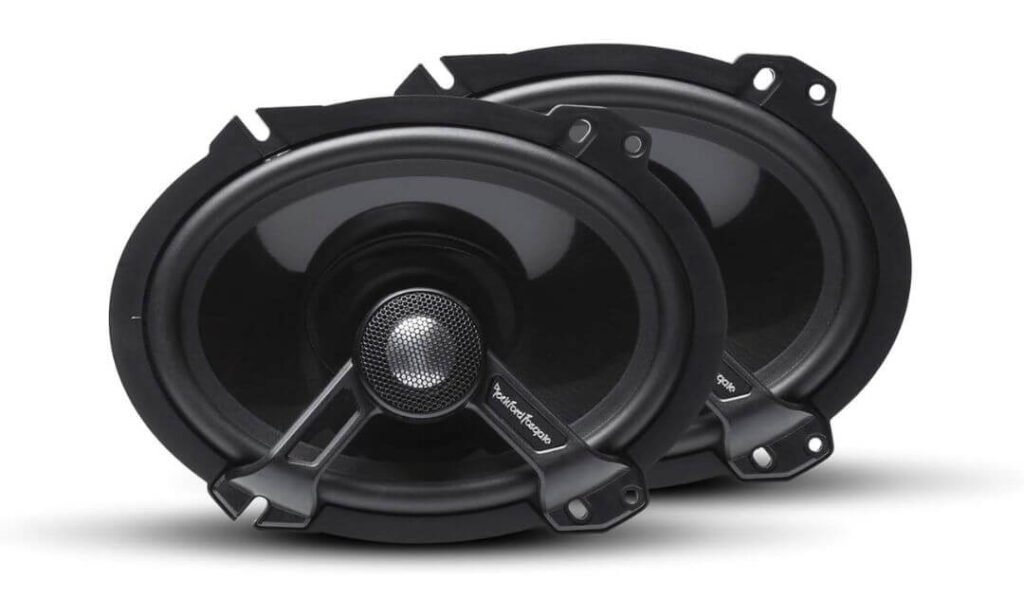
#1. Rockford Fosgate T1682 Power 6×8 2-Way Coaxial Full-Range Speakers
Quick Specs:
- Speaker size: 6×8-inch, 2-way coaxial
- Power handling: 80W RMS / 160W maximum
- Impedance: 4 ohms
- Frequency response: 55Hz–22kHz
- Sensitivity: 88dB
- Mounting depth: 2.6 inches
- Woofer: Carbon-fiber reinforced polypropylene
- Tweeter: 1-inch aluminum dome
- Surround: Butyl rubber
- Crossover: Integrated concealed design
- Included: Adapter plates and mounting hardware
- Warranty: 1 year
There is a reason I would put this speaker at the top of a bass-focused 6×8 shortlist. Rockford has not simply increased the power rating and called it an upgrade. The woofer uses a carbon-fiber reinforced polypropylene construction, the surround uses VAST geometry to increase the effective cone area, and the speaker is rated for 80W RMS. Put those pieces together and you have a design that is much more interested in producing convincing impact than a basic factory replacement. The 55Hz lower response is useful for door-speaker bass, but the real-world advantage is the stronger midbass you can actually hear on kick drums, bass guitar and heavier tracks.
The other thing I appreciate is that the bass has not been achieved by making the top end an afterthought. A 1-inch aluminum dome tweeter handles the higher frequencies, while Rockford hides the crossover inside the speaker assembly. That keeps the installation tidy and separates the woofer and tweeter duties properly. At 88dB sensitivity, it is also not an especially demanding speaker for a normal vehicle system, although the 80W RMS capability gives you considerably more room to exploit it if an aftermarket amplifier is part of your setup.
There is one specification I would check before ordering rather than discovering it during installation: 2.6 inches of mounting depth. A 6×8 label tells you the general speaker format, not whether the basket will clear the window mechanism or door hardware in your particular vehicle. The supplied adapter plates and mounting hardware are useful, but your exact vehicle may still need a wiring harness or mounting adapter. That is normal with OEM replacements and is worth checking before you pull the factory speaker out.
Why This Model Earned the First Position
The strongest case for this speaker is not one isolated specification. It is the way 80W RMS power handling, 88dB sensitivity, VAST surround geometry and the reinforced woofer construction work together. For a listener who wants a factory-size speaker to hit harder without immediately adding a subwoofer, that combination makes more sense than chasing an exaggerated peak-power number.
I also like that it remains a 2-way full-range design. You get a meaningful bass upgrade without turning the speaker into a one-trick product. Vocals, guitars and upper-frequency detail still have their own dedicated tweeter, which matters if you actually listen to the entire track rather than judging a speaker only by how much it shakes the door.
The Details I Would Not Ignore
- 80W RMS is the figure I would use when planning the system; the 160W maximum figure should not be treated as continuous power.
- The 4-ohm impedance makes it a conventional match for many aftermarket car-audio systems.
- 88dB sensitivity makes it reasonably suitable for factory-powered applications.
- The 55Hz–22kHz response gives it useful full-range coverage, while the speaker should still be viewed as a midbass upgrade rather than a replacement for a subwoofer.
- The 2.6-inch depth deserves a vehicle-specific fitment check.
- Adapter plates and mounting hardware are included, but vehicle-specific wiring or brackets may still be necessary.
Where the Upgrade Becomes Noticeable
With a factory radio, I would expect the biggest improvement to come from cleaner output and stronger midbass, rather than some dramatic transformation into a subwoofer system. That distinction is important. If your original speakers are tired, lightweight or distorted when turned up, these can make the system feel substantially more capable.
Add a properly matched amplifier and the story changes. The 80W RMS handling gives the speaker useful headroom, allowing you to take advantage of more power without choosing a speaker that was designed only for low-output factory radios. I would still set the amplifier gains correctly rather than simply turning everything up; clean power is far more useful than excess power.
The Installation Reality
Before buying, measure the factory speaker location rather than relying only on the vehicle’s advertised speaker size. Check mounting depth, screw position, connector style and clearance behind the speaker. This becomes especially important in doors where the window glass and regulator sit directly behind the speaker.
If the fit is correct, I would also make sure the speaker is mounted firmly and that the surrounding area is not allowing excessive air leakage. A solid mounting surface helps the woofer work against the door properly, while basic vibration control can prevent the common situation where the new speaker is capable of more bass but the door panel simply rattles instead.
The Insider Pro-Tip
If your goal is specifically more bass from a 6×8 location, spend as much attention on the installation as you do on the speaker. A poorly sealed mounting surface can rob a capable woofer of the very punch you bought it for. Even a simple improvement around the speaker mounting area can make the bass feel tighter and more controlled.
And if you are keeping the factory head unit, don’t assume that buying an 80W RMS speaker means the radio will suddenly deliver 80 watts to it. It will not. The speaker’s higher rating gives you useful headroom; it does not create amplifier power. If you later add a properly matched amplifier, that is when this particular model’s power handling starts making much more sense.
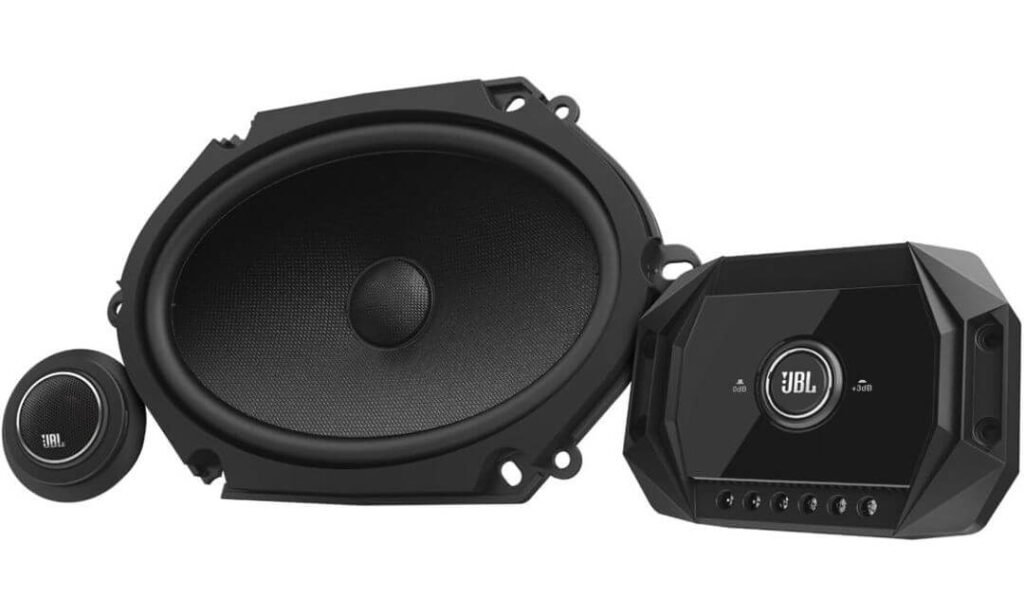
#2. JBL Stadium GTO 860C 6×8 Component Car Audio Speaker System
Quick Specs:
- Speaker size: 6×8-inch component system
- Design: Separate woofer and tweeter
- Impedance: 2 ohms
- Woofer: Plus One glass-fiber cone
- Voice coil: Oversized 35mm
- Surround: Rubber
- Tweeter: Edge-driven soft dome
- System type: Component
- Crossover: Included component crossover network
- Power: High-output design intended for stronger systems
- Warranty: 1 year
If your idea of a 6×8 upgrade is simply replacing the factory speaker and hoping for a little more volume, this JBL is taking a different route. The Stadium GTO 860C is a component system, so the woofer and tweeter are separated rather than sharing the same basket. That matters because the woofer can concentrate on the lower and midrange frequencies while the dedicated tweeter handles the upper end. For a bass-focused system, that separation gives the installation more flexibility than a conventional coaxial.
The woofer itself is the interesting part. JBL uses its Plus One glass-fiber cone, which increases the effective radiating area while keeping the cone rigid, and the oversized 35mm voice coil gives the driver a substantial motor structure for handling demanding listening. The 2-ohm design is particularly important here: it is intended to draw more power from compatible amplification, so I would view this as a much more interesting choice for an upgraded audio system than for someone running a very modest factory radio.
Then there is the installation side, which is where buyers need to be realistic. A component system is not as simple as dropping in a coaxial and connecting one pair of wires. You have a separate tweeter and crossover to accommodate, so available mounting locations, wiring and crossover placement all matter. If you are prepared to install it properly, though, that extra complexity is also part of what makes this system more interesting for someone chasing a genuinely stronger front soundstage.
What Gives This System Its Character
- Plus One glass-fiber woofer gives the bass driver more usable cone area within the same general speaker footprint.
- 35mm voice coil gives the woofer more thermal and power-handling headroom for demanding playback.
- 2-ohm impedance makes it particularly attractive when paired with a compatible aftermarket amplifier.
- Edge-driven soft-dome tweeters keep the upper range smoother than a harsh-sounding high-output setup.
- Component architecture gives you more freedom over tweeter placement and overall front-stage presentation.
The Trade-Off I Would Know About
The main downside is not really the speaker itself; it is the installation commitment. If you want a simple factory-style replacement, a coaxial is easier. This system makes more sense when you are willing to mount the separate tweeters, position the crossover properly and make sure your amplifier is comfortable driving a 2-ohm load.
Why It Makes Sense for a Bass-Focused Build
The appeal here is not simply “more bass.” It is the ability to build a higher-output front stage where the woofer has the authority to produce strong midbass while the separate tweeter keeps the upper frequencies from becoming buried when you turn the system up.
That makes this a particularly interesting option for someone who already has, or intends to add, a capable amplifier. I would not choose it purely because the impedance is lower. The important part is that the complete system is designed around getting more usable output from the available amplifier power, while the component layout gives you more control over where the high frequencies come from.
One Installation Detail That Can Change the Result
With a component system, tweeter positioning matters. I would not simply mount the tweeter wherever the factory speaker happens to sit. A sensible location and angle can make the difference between vocals sounding properly elevated and the entire system feeling like the sound is trapped down in the door.
Also check the amplifier’s specifications before using the 2-ohm load. A compatible amplifier can take advantage of the system’s high-output design; an amplifier that is not rated for the load is simply the wrong partner.
The Insider Pro-Tip
If you are installing this in a Toyota Tundra, Subaru Crosstrek or another vehicle with a 6×8-style factory location, think of it as a small system upgrade rather than just a speaker swap. Before ordering, confirm the woofer mounting depth, available tweeter location, crossover space and amplifier compatibility. The 6×8 dimension only tells you where the woofer is intended to fit; it does not solve the rest of the installation.
And there is one thing I would absolutely avoid: choosing this model for a factory radio simply because 2 ohms sounds like more power. The lower impedance can be an advantage with the right amplifier, but the wrong factory system may not be designed around it. If the electrical match is right, however, this is one of the more serious choices in the list for someone who wants stronger midbass and a more developed front-stage sound rather than another ordinary OEM replacement.
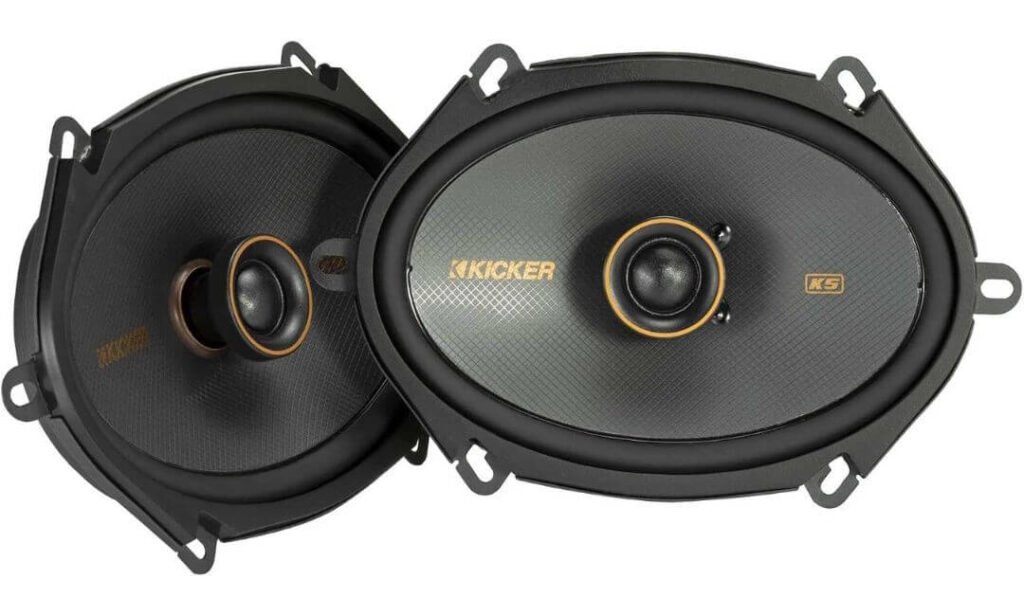
#3. KICKER 51KSC6804 KS-Series 6×8 Coaxial Speakers
Quick Specs:
- Size: 6×8-inch coaxial
- Power handling: 75W RMS / 225W maximum
- Impedance: 4 ohms
- Frequency response: 45Hz–21kHz
- Sensitivity: 90dB
- Tweeter: 0.75-inch silk-dome
- Woofer: Internally dampened polypropylene
- Surround: Rubber
- Mounting depth: 2.25 inches top / 2.625 inches bottom
- Design: Minimal tweeter protrusion
- Warranty: 1 year
What makes this KICKER interesting for a bass-focused 6×8 upgrade is that it does not try to make the woofer sound aggressive at the expense of control. The internally dampened polypropylene cone is built to reduce unwanted resonance, while the rubber surround allows the woofer to move without making the bass feel loose. The published 45Hz lower response looks promising on paper, but I would judge this speaker more by its ability to deliver clean, usable midbass from a door location than by expecting subwoofer-type bass.
The 90dB sensitivity is another reason this model makes sense for a factory system. You do not necessarily need a huge amplifier just to get useful output from it, and the 75W RMS rating leaves reasonable room for an amplifier upgrade later. The small 0.75-inch silk-dome tweeter is also deliberately unobtrusive, which is a practical advantage in vehicles where the factory grille leaves little room for a protruding tweeter.
KICKER’s redesigned KS-Series construction is particularly appealing if your goal is to get away from the thin, flat sound that many factory speakers produce. The combination of the dampened cone, rubber surround and low-profile tweeter makes this feel like a properly considered replacement rather than simply a larger speaker dropped into the same opening.
Where This One Gets the Balance Right
- 90dB sensitivity makes it a sensible choice when retaining the factory radio.
- 75W RMS handling gives it useful headroom for a future amplifier.
- 45Hz–21kHz response provides broad full-range coverage for a coaxial.
- Internally dampened polypropylene keeps the woofer controlled when pushed.
- Minimal tweeter protrusion makes fitment easier in many factory locations.
The One Catch Worth Knowing
The 2.25-inch top and 2.625-inch bottom mounting depths still need to be checked against your vehicle. The low-profile tweeter helps with grille clearance, but it does not guarantee that the entire basket will clear the window mechanism or other hardware behind the factory speaker.
Why I Would Pick It for a Factory System
This is probably the easiest model here to recommend to someone who says, “I want more bass, but I am not rebuilding my entire car audio system.”
It has enough sensitivity to work sensibly with factory power, enough RMS capacity to grow with an amplifier, and a woofer designed around controlled movement rather than exaggerated bass. That combination is what makes it useful. You can improve the factory system today without buying a speaker that becomes the weak link if you add amplification later.
The 4-ohm impedance also keeps the electrical side straightforward for a conventional replacement. Just remember that the 75W RMS figure describes what the speaker can handle; it does not mean your factory radio is producing 75 watts.
A Better Way to Think About Its Bass
I would describe the KSC6804 as a midbass-first upgrade, not a substitute for a subwoofer. Expect more authority from kick drums, bass guitar and the lower part of vocals, along with cleaner output when you turn the system up.
That distinction is important because a lot of 6×8 buying advice treats the lowest published frequency as if it tells the entire story. It doesn’t. In an actual vehicle door, cone control, mounting, door sealing, available amplifier power and sensitivity all influence how much bass you ultimately hear.
The Insider Pro-Tip
If you are installing these in a truck or SUV with factory 6×8/5×7-style locations, take advantage of the relatively low-profile tweeter design, but still measure the speaker cavity before ordering. Do not assume that “fits 6×8” means every year and trim uses identical brackets and connectors.
And if the factory speakers sound weak mainly because the doors are noisy or poorly sealed, fix that part of the installation too. A good woofer needs a stable mounting surface and a reasonably controlled door environment to produce the tight midbass it was designed for. That’s where this KICKER makes much more sense than simply chasing the biggest wattage figure on the box.
#4. Alpine S2-S68 S-Series 6×8 Coaxial Speakers
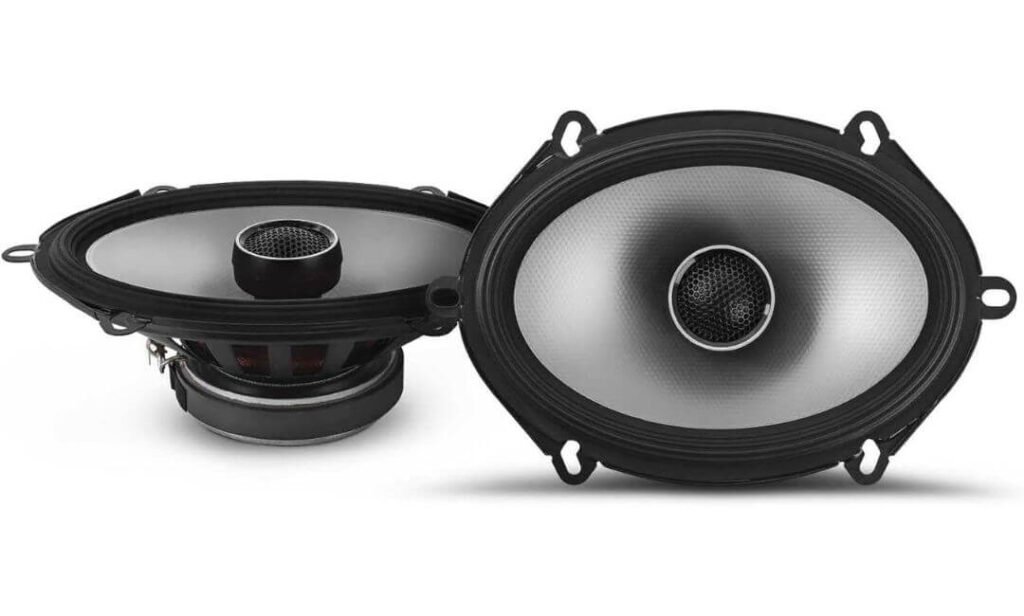
Quick Specs:
- Size: 6×8-inch coaxial
- Power handling: 75W RMS / 230W maximum
- Impedance: 4 ohms
- Frequency response: 73Hz–40kHz
- Cone: Polypropylene, glass fiber and mica construction
- Surround: HAMR multi-roll design
- Tweeter: 1-inch center-mounted
- Certification: Hi-Res Audio Certified
- Design: Full-range coaxial
- Warranty: 1 year
The S2-S68 takes a slightly different approach from the more aggressively bass-oriented speakers higher on this list. Its biggest advantage is control. Alpine combines polypropylene with glass fiber and mica in the woofer cone, then pairs it with its High Amplitude Multi-Roll (HAMR) surround. The surround is designed to allow greater cone movement, which is important when you want a small 6×8 woofer to produce convincing impact without the cone becoming uncontrolled.
I would not buy this model because the specification sheet says 40kHz and assume that number automatically means better bass. It does not. The more relevant part for this article is the mechanical design behind the woofer. The 75W RMS rating gives it useful headroom, while the cone construction is intended to remain rigid as output rises. That makes it particularly appealing for someone who wants a noticeable factory-speaker upgrade but still cares about clean vocals and instrumental detail.
The other advantage is simplicity. You are getting a 1-inch integrated tweeter in a conventional coaxial arrangement, so there is no separate tweeter installation or crossover box to find a home for. For an older vehicle or a newer model using a compatible 6×8 location, that can make the installation considerably easier than moving to a component system.
Where Alpine Has Taken a Smarter Approach
- HAMR surround allows greater cone excursion for a more capable low end.
- 75W RMS handling gives enough headroom for a meaningful amplifier upgrade.
- Polypropylene, glass fiber and mica cone construction balances rigidity with controlled movement.
- 1-inch center-mounted tweeter keeps the installation straightforward while providing dedicated high-frequency output.
- 40kHz certified response gives the speaker a genuinely wide operating range, although the upper extension is more relevant to detail than bass.
The Bass Reality I Would Keep in Mind
The published 73Hz lower response is not especially impressive if you compare numbers alone with some other 6×8 speakers. I would not hide that.
But frequency-response figures should not be treated as a simple bass ranking. In a real door, the result depends on enclosure conditions, installation, power and the speaker’s mechanical behaviour. Alpine’s HAMR surround is the part I would pay attention to here because it is specifically designed to support greater cone movement. This is a controlled-bass and sound-quality choice, rather than a “lowest number wins” product.
Why It Earned a Place on This List
For someone replacing tired factory speakers, this is the kind of upgrade that can make the entire system feel cleaner rather than merely louder. The woofer gets enough excursion to add useful midbass, while the rigid composite construction helps maintain definition when you increase the volume.
The 75W RMS capacity also means you are not buying a speaker that has to be replaced the moment you decide to add an amplifier. It can work with a factory system today and give you some room to build around it later.
That versatility is why I prefer it over a speaker that looks impressive on one specification but is less balanced as a complete car-audio upgrade.
What I Would Check Before Ordering
The 6×8 format makes this a natural candidate for many factory locations, but do not order based on size alone. Check the vehicle’s original speaker depth, mounting pattern, connector and grille clearance.
If your vehicle uses a 5×7-style opening, verify the exact mounting arrangement rather than assuming every 6×8 speaker will line up identically. An adapter can solve some installations, but it is better to know that before the door panel is already off.
The Insider Pro-Tip
If your current system sounds thin rather than genuinely distorted, I would give this Alpine a serious look. It is easy to get distracted by speakers advertising huge peak numbers, but for daily driving, controlled cone movement and a solid woofer-to-tweeter balance are often what make the upgrade enjoyable for hours rather than impressive for five minutes.
And if you eventually add an amplifier, do not use the extra power simply to chase maximum volume. The real opportunity is to give the woofer cleaner, better-controlled power so the HAMR suspension and composite cone can do their job properly. That is where this model’s design starts to make much more sense than its headline 230W figure suggests.
#5. Infinity REF687F 6×8 2-Way Car Speakers
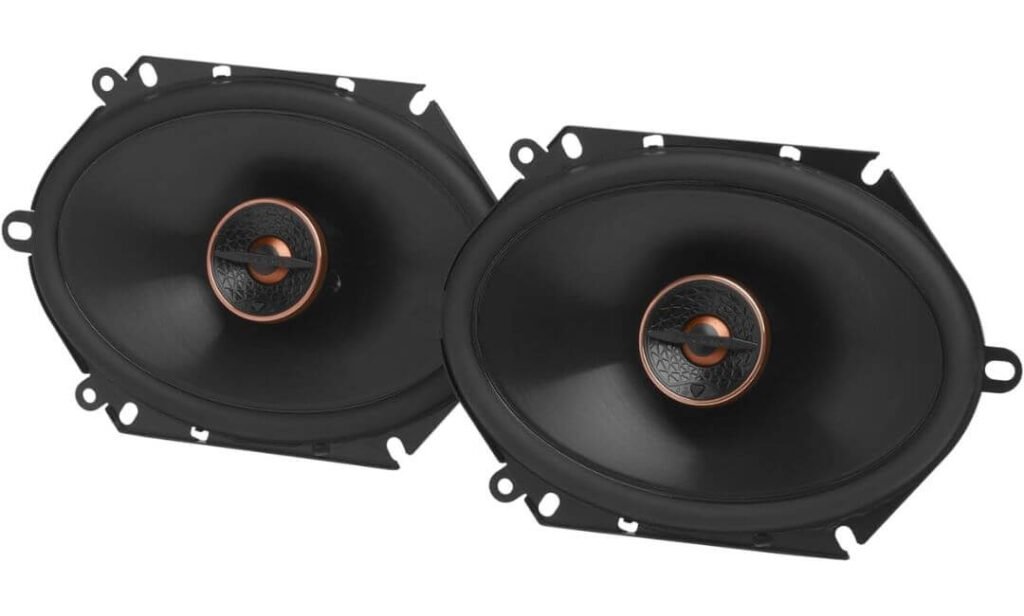
Quick Specs:
- Size: 6×8-inch, 2-way coaxial
- Power handling: 60W RMS / 120W maximum
- Impedance: 3 ohms
- Frequency response: 49Hz–21kHz
- Sensitivity: 93dB
- Woofer: Plus One polypropylene cone
- Tweeter: Edge-driven textile dome
- Design: Compact factory-replacement format
- Installation: Standard 6×8 locations, vehicle-specific fitment still required
- Warranty: 1 year
If your priority is getting more from a factory radio without turning the installation into a project, this Infinity makes a lot of sense. The big reason is its 93dB sensitivity. That is the kind of specification I pay attention to when recommending speakers for an OEM-powered system because the speaker does not need a huge amount of amplifier power to produce useful output.
Infinity’s Plus One cone is also relevant here. Rather than simply making the speaker louder with a bigger power rating, the design gives the woofer more effective cone area within the available frame. That can help with low-frequency output and midrange presence, which is exactly what you want when replacing a thin-sounding factory speaker in a door.
The 3-ohm impedance is another detail worth noticing. It can help a compatible factory or aftermarket amplifier deliver more output than a conventional 4-ohm load, but I would not assume that every factory radio is designed for it. Check the vehicle’s audio specifications before buying, particularly if you are replacing an unusual OEM system.
What Makes the Reference Design Interesting
- 93dB sensitivity makes it especially appealing for factory-powered systems.
- Plus One cone technology provides greater effective cone area for the speaker’s size.
- 60W RMS handling is sensible for an OEM replacement while still allowing some amplifier headroom.
- Edge-driven textile tweeter is designed for smoother high-frequency reproduction at higher listening levels.
- Compact construction can make it easier to work with in factory speaker locations.
One Specification I Would Not Misread
The published low-frequency response should not be treated as proof that this speaker will reproduce subwoofer-level bass. A 6×8 door speaker is still limited by its physical size and the acoustic environment of the vehicle.
What this model does well is deliver useful, controlled midbass while remaining easy to drive. If your factory system sounds weak, that can be a much more noticeable improvement than chasing a lower frequency number that the vehicle’s door cannot realistically reproduce.
Where This One Makes the Most Sense
I would choose this Infinity when the goal is balanced improvement rather than maximum bass aggression. The 93dB sensitivity gives it a practical advantage with modest factory power, while the Plus One woofer helps it produce a fuller presentation from the same general speaker footprint.
That makes it a particularly sensible option for an older daily driver where you want better sound but do not want to start adding an amplifier, separate tweeters and extensive wiring just to make the system enjoyable again.
It is also a good reminder that more power is not automatically better. If your factory radio is relatively weak, a highly sensitive speaker can sometimes make more sense than a lower-sensitivity model with a much larger RMS rating.
The Fitment Detail Worth Checking
Infinity keeps the Reference design relatively compact, but I would still verify your exact year, trim, mounting depth, factory connector and speaker location before ordering.
A 6×8 speaker can share a mounting footprint with some 5×7 applications, but that does not mean every vehicle uses identical mounting holes or wiring. A vehicle-specific harness or adapter bracket may be all you need, but it is better to know that before beginning the installation.
The Insider Pro-Tip
If you are keeping the factory head unit, I would seriously consider the REF687F before automatically buying the speaker with the highest RMS rating. Its 93dB sensitivity is the specification that can make the bigger difference in that situation.
And if your current system already has an amplifier, I would compare the amplifier’s recommended load with the speaker’s 3-ohm impedance before connecting it. When the electrical match is right, this is a very sensible way to get a fuller factory-style system without sacrificing the clean, easy-going character that makes Reference-series speakers attractive for everyday listening.
Best 6×8 Speakers for Deep Bass in 2026 (Power, Sound & Fitment Compared)
| 6×8 Speaker | Bass Approach | Power & Load | Low-End Range | System Match | Installation Reality | Best Use |
|---|---|---|---|---|---|---|
| Rockford Fosgate T1682 Strongest all-round bass pick | Punchy, controlled midbass VAST surround and reinforced woofer construction favour impact without turning the speaker into a one-note bass upgrade. |
80W RMS / 160W max
4 ohms · 88dB Amplifier friendly |
55Hz–22kHz A useful range for door-speaker midbass; not a substitute for a dedicated subwoofer. |
Bass-first upgrade
Works as an OEM-style upgrade while leaving useful headroom for amplification. |
2.6-inch mounting depth
Adapter plates and hardware are included. Vehicle-specific clearance and wiring should still be checked. |
Best for: Drivers who want noticeably harder midbass without immediately moving to a component system. |
| JBL Stadium GTO 860C High-output component choice | Powerful woofer-led system Plus One glass-fiber woofer and oversized 35mm voice coil are built around higher-output playback. |
100W RMS / 300W max
2.5 ohms nominal · 93dB Best with suitable amplification |
40Hz–25kHz Strong published low-end extension, with the component layout allowing better control of the front stage. |
High-output system
The lower-impedance design makes amplifier compatibility especially important. |
Component installation
Separate tweeters and crossover mean more work than a conventional coaxial replacement. |
Best for: A properly planned system where output and front-stage control matter more than plug-and-play simplicity. |
| KICKER 51KSC6804 KS-Series Best factory-power balance | Clean, tight midbass Internally dampened polypropylene and rubber surround focus on controlled movement rather than exaggerated bass. |
15–75W recommended RMS
4 ohms · 90dB Factory-power friendly |
45Hz–21kHz Broad enough for full-range listening while keeping the emphasis on useful midbass. |
OEM-friendly
High sensitivity makes it one of the easier choices for a factory-powered system. |
2.25″ top / 2.625″ bottom
Zero tweeter protrusion helps with grille clearance; actual vehicle depth still needs verification. |
Best for: A straightforward factory-speaker upgrade that can still benefit from an amplifier later. |
| Alpine S2-S68 S-Series Best bass + detail balance | Controlled cone movement HAMR surround supports greater excursion while the composite cone construction keeps the response clean. |
75W RMS / 230W peak
4 ohms · 88dB Balanced upgrade |
73Hz–40kHz The higher published bass limit makes this less of a deep-bass specification leader, but its mechanical design remains useful for midbass. |
Simple coaxial
A sensible choice when clean full-range sound matters alongside bass. |
6.1cm mounting depth
Integrated tweeter keeps the installation simpler than a component setup. |
Best for: Listeners who want a cleaner, more refined upgrade rather than maximum low-end aggression. |
| Infinity REF687F Best efficient factory upgrade | Balanced, efficient midbass Plus One cone geometry increases effective cone area without requiring a larger speaker format. |
60W RMS / 180W peak
3 ohms · 93dB Excellent sensitivity |
49Hz–21kHz Useful published low-end range, but real bass output still depends heavily on the vehicle installation. |
Factory-system specialist
High sensitivity is the major advantage when keeping the original radio. |
Compact 6×8 format
Designed around common factory locations, but exact connectors, brackets and clearance vary by vehicle. |
Best for: A daily-driver upgrade where efficient output and balanced sound matter more than maximum bass. |
Buying Guide for the Best 6×8 Speakers for Bass Without Guessing From the Box
A good 6×8 speaker upgrade is less about finding the lowest advertised frequency or the biggest wattage number and more about matching the speaker to the car, amplifier and type of bass you actually want. The five models above are not interchangeable in that respect. Some make more sense with factory power, some come alive with an amplifier, and one is a proper component-system choice.
Start With RMS Power and Sensitivity, Not Peak Wattage
If I were narrowing down a 6×8 speaker for my own vehicle, RMS power handling would be one of the first numbers I checked. Peak or maximum wattage is easy to market because the number looks impressive, but it does not tell you how much continuous power the speaker is designed to handle.
A more useful way to read the specification is:
- RMS rating tells you the continuous power the speaker is designed to handle.
- Sensitivity tells you how efficiently it converts available amplifier power into sound.
- A high-RMS speaker is not automatically louder in a factory system.
- A highly sensitive speaker can be a smarter choice when you are keeping the original radio.
- If you have an aftermarket amplifier, higher RMS capability becomes more useful because you have enough clean power to take advantage of it.
That is why the KICKER and Infinity deserve attention for factory-powered systems, while the Rockford and JBL become more interesting when there is enough amplification behind them.
Understand What “Bass” Means From a 6×8 Door Speaker
This is where a lot of buying guides become misleading.
A 6×8 speaker can produce strong midbass, but it is not a substitute for a dedicated subwoofer. The physical driver is simply not moving the same amount of air as a purpose-built subwoofer.
What you should realistically expect from a good 6×8 replacement is:
- More impact from kick drums.
- Fuller bass guitar.
- Better lower-midrange presence.
- Less thinness from the factory system.
- Cleaner bass at higher volume.
- Better transition between the midrange and a future subwoofer.
The published frequency-response number is useful, but it should never be used by itself to decide which speaker has the deepest real-world bass. A vehicle door is not an ideal speaker enclosure, and installation, door sealing, amplifier power and cabin acoustics all influence what you actually hear.
Match the Speaker to the Power You Already Have
Before choosing the speaker, work out what is driving it.
If you are using the factory head unit, sensitivity becomes particularly important. A speaker that can produce good output with modest power can give you a more noticeable improvement than a high-power model that is barely being driven.
If you have an aftermarket amplifier, the calculation changes. Now RMS handling, impedance and amplifier output become much more important.
A simple way to think about it:
| Your system | What matters most |
|---|---|
| Factory radio | Sensitivity, impedance, fitment |
| Factory radio + small amp | Sensitivity + RMS handling |
| Dedicated 4-channel amplifier | RMS matching + impedance |
| High-output front-stage build | RMS handling, impedance, component design |
| System with subwoofer | Controlled midbass and clean crossover integration |
Do not assume that buying an 80W RMS speaker means your factory radio will suddenly provide 80 watts. The speaker rating describes what the speaker can handle, not what the radio produces.
Impedance Can Change Which Speaker Makes Sense
Impedance is another specification that deserves more attention than it usually gets.
Most conventional aftermarket car speakers are 4 ohms, but some high-output designs use a lower impedance. That can allow a compatible amplifier to deliver more power, but it also means you need to confirm that the amplifier is designed to operate safely at that load.
This is especially important with a 2-ohm or 3-ohm speaker.
Before connecting one, check:
- The amplifier’s minimum supported impedance.
- Its rated output at that impedance.
- Whether the factory radio is designed to handle the replacement load.
- Whether you are replacing one pair or changing the entire system.
- Whether the amplifier channels are bridged.
A lower impedance is not automatically better. It is only an advantage when the electronics driving the speaker are designed for it.
Coaxial vs Component: Which Gives Better Bass?
For most people replacing factory 6×8 speakers, a coaxial speaker is the easier answer.
The woofer and tweeter share one assembly, installation is simpler, and you generally do not have to find another location for the tweeter.
A component system takes a different approach. The woofer, tweeter and crossover are separate, which gives you more freedom over tweeter positioning and can produce a more convincing front soundstage when installed correctly.
For bass specifically, however, component does not magically mean deeper bass.
The bigger advantage is system control.
A properly installed component system can give the woofer a more dedicated role while allowing the tweeter to be positioned where it works best. That is why the JBL Stadium system belongs in this comparison even though the other choices are coaxial.
Check the Actual 6×8 Fit Before Ordering
This is one of the easiest mistakes to make.
A product being labelled 6×8 does not mean it will be a completely direct installation in every vehicle.
Before buying, check:
- Factory speaker dimensions.
- Mounting-hole pattern.
- Mounting depth.
- Basket shape.
- Window-glass clearance.
- Door-panel clearance.
- Factory grille clearance.
- Speaker connector.
- Whether a mounting bracket is required.
- Whether a wiring harness adapter is available.
Some vehicles use 5×7 speakers in locations that can accept certain 6×8 replacements, but you should verify the exact application rather than assuming the two sizes are universally interchangeable.
Older and newer generations of the same vehicle can also use different audio packages. The same model name is not enough information for a guaranteed fit.
Doors and Rear Decks Do Not Behave the Same Way
Where the speaker is installed can change how it sounds.
A front door speaker has to deal with a large, imperfect enclosure, moisture exposure, vibration and the movement of the window mechanism. A rigid mounting surface and reasonable sealing around the speaker can make a noticeable difference.
A rear deck can provide a different acoustic environment, particularly in sedans where the trunk area sits directly behind the speakers.
For a door installation, I would put extra attention on:
- Firm mounting.
- Correct spacer or adapter.
- Door-panel vibration.
- Water protection.
- Sealing around the speaker.
- Clearance from the window mechanism.
This is also why a more expensive speaker does not always produce a proportionally bigger improvement. If the factory mounting location is loose or leaking air badly, the installation can become the limiting factor.
Choose the Price Level Based on the Rest of the System
There is no reason to spend premium-speaker money if the rest of the system cannot take advantage of it.
Entry-Level Upgrade
This makes sense when the original speakers are worn, distorted or simply too thin.
Look for:
- Sensitivity around the higher end of the range.
- Straightforward 4-ohm compatibility.
- Decent woofer construction.
- Easy installation.
- Sensible RMS requirements.
The goal here is better sound from the equipment you already have, not building an entire competition-style system.
Mid-Range Upgrade
This is the sweet spot for many daily drivers.
You can look for:
- Better cone materials.
- Rubber surrounds.
- Higher RMS handling.
- Improved tweeter construction.
- Better low-frequency control.
- Compatibility with a small aftermarket amplifier.
This is where you begin getting a genuine improvement in both bass authority and overall clarity.
Premium Upgrade
Premium makes more sense when the vehicle already has, or will receive, better amplification.
At this level I would pay attention to:
- RMS power handling.
- Impedance.
- Cone and surround engineering.
- Voice-coil design.
- Crossover architecture.
- Component versus coaxial layout.
- Installation requirements.
The JBL Stadium option is a good example of why premium does not simply mean “more watts.” Its component architecture changes how the entire front stage can be built.
6×8 Door Speakers vs Other Speaker Locations
If the speakers are going into the front doors, I would prioritise midbass, sensitivity and installation quality.
If they are going into the rear deck, overall balance becomes more important because rear speakers should generally support the front stage rather than overpower it.
And if the vehicle already has a subwoofer, I would not try to make the 6×8 speakers reproduce extremely low bass. Let the subwoofer handle the lowest frequencies and allow the door speakers to concentrate on clean midbass and vocals.
That usually creates a better system than forcing every speaker to reproduce the same range.
Do You Need an Amplifier for Better Bass?
Not necessarily.
A good 6×8 speaker can improve a factory system without an amplifier, particularly when its sensitivity is well matched to the available power.
But if your goal is genuinely stronger output, an amplifier can make a much bigger difference.
The important part is matching the amplifier to the speaker rather than simply adding the biggest amplifier you can afford.
A sensible upgrade path is:
Factory speakers → better 6×8 speakers → proper installation → amplifier → subwoofer
You do not have to complete every step. In many daily drivers, the second step alone is enough to make the system much more enjoyable.
Do Not Treat a Car Door Like a Home Speaker Enclosure
This is an important distinction.
A home speaker usually operates inside an enclosure designed around the driver. A car-door speaker often works with a large, irregular and partially ventilated space.
That means the installation itself becomes part of the acoustic system.
If you are chasing stronger bass, consider:
- A rigid speaker mounting surface.
- Proper sealing around the speaker.
- Basic door damping where appropriate.
- No obstruction behind the woofer.
- Correct polarity.
- Secure wiring.
- No loose trim that can rattle.
You can buy an expensive speaker and still end up disappointed if the installation allows the door panel to vibrate more than the woofer.
Sealed vs Ventilated Installations Need a Reality Check
I would not recommend modifying a vehicle door simply because someone claims that a “vented” setup automatically produces deeper bass.
The factory door structure is part of the vehicle’s design, and cutting or opening areas without understanding the water-management system can create problems.
For most replacement installations, the better approach is to work with the factory location, make the mounting secure, maintain proper water protection and control unwanted vibration.
That is a much safer and more repeatable way to improve bass than turning the door into an improvised speaker enclosure.
The Final Buying Filter
Before placing the order, I would run these six questions through the exact vehicle:
- Will the 6×8 physically fit?
- Is the mounting depth safe around the window mechanism?
- Will the factory radio or amplifier handle its impedance?
- Is its sensitivity appropriate for the available power?
- Do I want stronger midbass or genuinely deep sub-bass?
- Do I need a coaxial replacement, or am I ready for a component installation?
If those answers line up, the speaker itself becomes much easier to choose.
For this particular shortlist, I would not call the most expensive or highest-powered model automatically the best. The right choice depends on the system behind it. That is the difference between buying a speaker because its specification sheet looks impressive and buying one that actually makes your vehicle sound better.
Installation and Tuning Tips for Getting Better Bass From 6×8 Speakers
A good 6×8 speaker can only perform as well as the installation around it allows. If the speaker is mounted loosely, the polarity is wrong, the amplifier is mismatched or the gain is being used as a volume control, even an expensive pair can sound weaker than expected. For a bass-focused setup, installation and tuning are part of the speaker upgrade, not something to worry about afterward.
Start With the Wiring Before You Touch the Amplifier
For a normal coaxial replacement, the first priority is getting the wiring correct.
Check the factory connector before cutting anything. A vehicle-specific speaker harness is usually preferable because it lets you connect the new speaker without permanently modifying the original wiring.
Pay particular attention to polarity:
- Connect positive to positive and negative to negative.
- Do not assume wire colours are identical across vehicle manufacturers.
- If one speaker is wired out of phase with the other, bass can become noticeably weaker because the speakers partially cancel each other’s low-frequency output.
- Keep the left and right speaker wiring consistent.
- Secure the wiring so it cannot touch the window mechanism or rattle against the door.
That last point is easy to overlook. A speaker may be working perfectly while the wiring behind it creates a vibration that sounds like a damaged speaker.
Match the Amplifier to the Speaker, Not the Other Way Around
If you are adding an amplifier, start with the speaker’s RMS rating and impedance.
For example, an 80W RMS speaker does not require an amplifier that produces exactly 80 watts, but the amplifier should be capable of delivering clean power at the speaker’s impedance without being pushed beyond its limits.
The same applies to lower-impedance speakers.
A 2-ohm speaker can draw substantially more current than a 4-ohm speaker when connected to an amplifier designed to support that load. A 3-ohm design also should not simply be treated as an ordinary 4-ohm replacement without checking the amplifier specifications.
Before connecting anything, verify:
- Amplifier RMS output at the speaker’s actual impedance.
- Minimum supported impedance per channel.
- Number of amplifier channels.
- Whether channels are being bridged.
- Speaker RMS handling.
- Whether the amplifier has an appropriate high-pass filter.
How Many Amplifier Channels Do You Actually Need?
For four 6×8 speakers, a 4-channel amplifier is usually the cleanest arrangement because each speaker can have its own channel.
For two front speakers, a 2-channel amplifier can be sufficient.
If you are also running a subwoofer, a common arrangement is:
- Channels 1–2 → front 6×8 speakers
- Channels 3–4 → rear speakers
and a separate amplifier for the subwoofer.
Alternatively, a suitable multi-channel amplifier can power the complete system.
The important thing is not the number of channels printed on the amplifier. It is whether each speaker receives appropriate, clean power at the correct impedance.
Give the Door Speaker a Solid Mechanical Mount
This is one of the most underrated parts of a bass upgrade.
A woofer needs to move air. If the speaker basket itself moves because the mounting surface is weak, some of that energy is wasted and the door can become a source of unwanted vibration.
Use the correct mounting bracket or adapter when required, and make sure:
- Every mounting point is secure.
- The speaker sits flat against the mounting surface.
- There are no obvious gaps around the frame.
- The speaker does not touch the door panel.
- The window glass has adequate clearance.
- The woofer cone can move freely.
- The wiring cannot contact the cone or basket.
If there is a gap between the speaker and the mounting surface, seal the mounting interface appropriately rather than leaving the woofer firing into an uncontrolled opening.
Do Not Accidentally Block the Woofer
When installing a deeper 6×8 speaker, check what is directly behind it.
The window regulator, glass, wiring and structural parts of the door can occupy surprisingly little space behind the factory speaker.
This is particularly important with models having a deeper basket. Measure with the window both fully open and fully closed if the speaker sits near the glass.
A speaker that physically fits while the window is closed can still become a very expensive problem if the glass hits the basket when the window comes down.
Crossover Settings: Start With a High-Pass Filter
For a door-mounted 6×8, I would normally start with a high-pass filter, not a low-pass filter.
The purpose is simple: prevent the door speaker from being asked to reproduce frequencies that it cannot reproduce cleanly at useful volume.
A sensible starting point for many systems is around 60–80Hz, depending on the speaker, vehicle and whether a subwoofer is present.
If the speaker begins sounding strained when you turn the system up, raise the high-pass frequency slightly rather than immediately adding more bass through the equalizer.
With a subwoofer in the system, the high-pass filter on the 6×8 speakers becomes even more useful because the subwoofer can handle the lowest frequencies.
When a Low-Pass Filter Makes Sense
A low-pass filter is normally used on the subwoofer, not the full-range 6×8 door speakers.
The subwoofer can be filtered to handle the lower portion of the music while the 6×8 speakers concentrate on vocals, instruments and midbass.
This creates a cleaner division of labour:
6×8 speakers → upper bass, midbass, midrange and treble
Subwoofer → deepest bass
Trying to make both reproduce exactly the same low-frequency range can sometimes make the system sound louder but less controlled.
Set the Gain Properly Instead of Using It as a Bass Control
This is probably the most common amplifier mistake.
The gain control is not a volume knob.
Its job is to match the amplifier’s input sensitivity to the signal coming from the head unit. Turning the gain all the way up does not make the amplifier “unlock more bass”; it increases the likelihood of clipping.
A sensible process is:
- Set the head unit’s equalizer close to flat.
- Turn off loudness enhancement and artificial bass boost initially.
- Set the amplifier gain low.
- Play a clean recording at a sensible high listening level.
- Increase the gain gradually.
- Stop when the speaker reaches the desired clean output or distortion begins to appear.
- Back the gain down slightly.
The exact procedure can vary with the amplifier and head unit, but the principle remains the same: clean signal first, volume second.
Use Equalization to Correct the System, Not Rescue It
If you want more bass, it is tempting to immediately add several decibels of low-frequency boost.
I would not.
If the speaker is already struggling, adding a large bass boost simply asks the woofer to work harder and can increase distortion.
Start with a flat response and listen.
If the system genuinely needs adjustment, make small changes rather than creating a large hump in one frequency range.
Also remember that a large bass boost can consume considerably more amplifier headroom. A speaker that sounds clean with a flat signal may begin distorting when you add substantial low-frequency boost.
Avoid Distortion Before It Becomes Speaker Damage
Distortion is not just an annoying sound.
A heavily clipped amplifier signal can generate excessive heat and stress the speaker, particularly when the system is played loudly for extended periods.
Warning signs include:
- Bass becoming fuzzy rather than tight.
- Vocals sounding harsh as volume increases.
- The woofer sounding like it is bottoming out.
- A mechanical knocking or clicking sound.
- Sudden changes in tonal balance.
- The speaker sounding clean at moderate volume but collapsing at high volume.
If you hear any of these, turn it down and find the cause rather than trying to compensate with more equalization.
Give the Speaker a Chance to Work With the Door
You do not necessarily need to turn your entire door into a competition-style enclosure.
For most daily drivers, the priorities are much simpler:
Secure mounting → controlled vibration → proper sealing → correct polarity → appropriate crossover
Basic sound-deadening around the speaker mounting area can also help reduce panel vibration. The objective is not to make the entire door completely inert at any cost; it is to stop obvious rattles and give the speaker a more stable mounting environment.
And be careful around factory water drainage. Do not block drain paths or interfere with the vehicle’s moisture-management system simply to improve speaker sealing.
When a 6×8 Speaker Upgrade Makes the Most Sense
A 6×8 upgrade is particularly worthwhile in these situations:
Factory speakers are worn out:
A quality replacement can immediately restore clarity and add stronger midbass.
The factory system sounds thin:
A better woofer, surround and tweeter can produce a noticeably fuller presentation.
You want more volume without a subwoofer:
A sensitive 6×8 paired with appropriate amplification can provide a substantial improvement.
You already have a subwoofer:
The 6×8 speakers can be tuned to handle midbass and vocals while the subwoofer takes care of the lowest frequencies.
You plan to add an amplifier later:
Choosing a speaker with sensible RMS capacity gives you room to build the system gradually.
DIY Installation or Professional Installation?
If you are replacing a direct-fit coaxial pair and you are comfortable removing door panels, checking dimensions and using a multimeter, this can be a perfectly reasonable DIY project.
I would consider professional installation when:
- The vehicle has a complicated factory amplified system.
- The speaker impedance differs substantially from the original.
- You are installing a component system.
- New amplifier wiring is required.
- Factory wiring uses unusual connectors.
- Door-panel removal risks damaging clips or trim.
- You are adding sound treatment and multiple crossover components.
- You are unsure about amplifier load or gain settings.
The JBL component system in this list is a good example of where professional installation can make more sense. Once separate tweeters, crossover placement and amplifier matching enter the picture, the job is no longer simply “remove one speaker and install another.”
The Best Bass Setup Is Usually the Least Complicated One That Works
You do not need to turn a daily-driven vehicle into a full competition system to get satisfying bass from 6×8 speakers.
A properly fitted speaker, solid mounting, correct polarity, suitable amplifier power and sensible crossover settings will usually produce a bigger real-world improvement than throwing expensive equipment at an incorrectly tuned system.
And if you eventually want genuinely deep bass below what a 6×8 can comfortably reproduce, that is the point where I would stop asking the door speakers to do more and add a properly integrated subwoofer. The 6×8 speakers can then concentrate on what they do best: clean, punchy midbass and full-range detail without being pushed beyond their limits.
Real-World Setup Guidance for 6×8 Speakers
The same 6×8 speaker can behave very differently depending on the vehicle it is installed in. A compact sedan may have limited clearance behind the door speaker, an SUV can provide a much larger and more forgiving door cavity, while a sport coupe may have a completely different goal because the owner is trying to get significantly more impact from a relatively small speaker.
That is why I would not choose the amplifier, wiring or installation method independently of the vehicle. The speaker, available mounting space, factory audio system and intended listening level all need to work together.
Scenario 1: Compact Sedan With Limited Mounting Depth
A compact sedan is usually the situation where I would pay the most attention to mounting depth before worrying about amplifier power.
Some doors have the speaker mounted very close to the window glass or a window regulator. A deeper aftermarket basket may technically fit the factory opening but interfere with the glass once the window is lowered.
Before ordering, measure:
- Available speaker depth with the window fully lowered.
- Diameter and shape of the factory mounting opening.
- Factory speaker mounting points.
- Distance between the speaker and the door panel.
- Clearance between the tweeter and the factory grille.
- Location of the factory wiring connector.
A shallow 6×8 can therefore be a smarter choice than a more powerful model that requires excessive modification.
For this type of installation, I would also avoid chasing extremely high amplifier power. A clean 50–75 watts RMS per channel can be more than enough for a sensitive 6×8 in a daily-driven compact car, especially when the speaker is efficient.
The installation should focus on making the mounting surface rigid and eliminating obvious air leaks around the speaker. A small amount of appropriate door treatment around the mounting area can also reduce panel vibration.
If the factory head unit is being retained, a high-sensitivity speaker can make particular sense because it can produce useful output without demanding a huge amount of amplifier power.
Scenario 2: Midsize SUV With Strong Door Openings
A midsize SUV generally gives you more physical room to work with, although you still need to verify the exact vehicle and trim.
Here, I would be more comfortable using a higher-power 6×8 with a dedicated amplifier, particularly if the goal is stronger midbass rather than simply replacing tired factory speakers.
A practical setup could look like this:
| Component | Sensible starting point |
|---|---|
| Front 6×8 speakers | 60–100W RMS capable |
| Amplifier | Around 60–100W RMS per channel |
| High-pass filter | Approximately 60–80Hz |
| Speaker wiring | Quality 16-gauge copper wiring |
| Main amplifier power cable | Sized according to amplifier current demand |
| Door treatment | Targeted treatment around speaker and major vibration areas |
| Subwoofer | Optional, depending on how much deep bass is wanted |
The larger door structure can also make targeted sound treatment worthwhile. I would concentrate first on the area immediately around the speaker and obvious rattling sections rather than covering every square inch simply because more material sounds impressive.
An SUV is also a good environment for a front-stage-focused setup. Rather than trying to make every speaker equally loud, put more attention into the front pair and allow the rear speakers to provide supporting fill.
That usually produces a more natural listening position and gives you a better upgrade path if you later add a subwoofer.
Scenario 3: Sport Coupe With Aggressive Bass Goals
This is where expectations need to be realistic.
If the objective is aggressive bass that you can physically feel, I would not try to force the 6×8 speakers to become subwoofers. A quality 6×8 can produce punchy midbass, but the smallest and deepest bass frequencies require substantially more cone movement and usually a dedicated subwoofer.
For a sport coupe, I would build the system around three separate jobs:
- 6×8 speakers handle midbass, vocals and the majority of the full-range music.
- A dedicated subwoofer handles the deepest bass.
- Amplifiers and crossovers divide the workload cleanly.
A good starting point is to high-pass the 6×8 speakers somewhere around 70–90Hz, depending on how they behave in the vehicle, and low-pass the subwoofer in a complementary region.
The exact crossover point should be adjusted by listening rather than treated as a universal number.
If you want the system to hit hard without sounding bloated, resist the temptation to add huge amounts of bass boost to the 6×8 speakers. Let the subwoofer generate the lowest frequencies and keep the door speakers working within their comfortable range.
Budget Amplifier Setup
For a straightforward factory-speaker upgrade, you may not need an amplifier at all.
If the factory head unit has enough clean output, a high-sensitivity 6×8 can provide a noticeable improvement by itself.
If you do want an amplifier, the budget approach should be simple:
- 2-channel or 4-channel amplifier.
- Approximately 50–75W RMS per channel.
- Properly matched to the speaker impedance.
- Built-in high-pass filtering.
- Quality 16-gauge speaker wire.
- Correctly sized power and ground wiring.
- Fuse installed close to the battery.
I would rather use a modest amplifier operating cleanly than buy a cheap high-wattage amplifier and run it into clipping.
Mid-Range Amplifier Setup
This is the sweet spot for most people who genuinely want better bass and more authority from their 6×8 speakers.
A good mid-range system could use:
- 4-channel amplifier.
- Approximately 75–100W RMS per channel.
- 4-gauge or appropriately sized power wiring depending on total amplifier demand.
- 14–16 gauge speaker wiring.
- High-pass filters for the 6×8 speakers.
- Proper grounding to a clean chassis point.
- Optional sound treatment around the front doors.
With four speakers, a 4-channel amplifier gives you independent control over each channel and makes future system upgrades easier.
If you later add a subwoofer, you can either move to a dedicated subwoofer amplifier or use a multi-channel amplifier designed for the complete system.
High-End Setup for Serious Bass
If the goal is a genuinely powerful system rather than simply a better factory replacement, I would stop treating the 6×8 speakers as the entire bass solution.
A stronger system could include:
- High-quality front 6×8 speakers.
- A dedicated 4-channel amplifier for the cabin speakers.
- Separate mono or dedicated subwoofer amplifier.
- Properly designed subwoofer enclosure.
- Quality power distribution and grounding.
- Adequately sized battery-to-amplifier wiring.
- Speaker-level or line-level integration appropriate to the factory system.
- Digital signal processing when the factory audio system requires more sophisticated tuning.
At this level, system integration matters more than buying the most expensive 6×8 speaker.
A $200-plus speaker installed incorrectly can easily sound worse than a cheaper speaker that has been mounted properly and powered cleanly.
Choosing the Right Wiring Kit
Do not select a wiring kit simply because it says “high power” on the packaging.
The correct wire size depends on the amplifier’s current demand, cable length and installation layout.
As a practical starting point:
| System category | Typical setup | Wiring approach |
|---|---|---|
| Budget | 50–75W RMS × 2–4 channels | Quality 16-gauge speaker wire, appropriately sized power cable |
| Mid-range | 75–100W RMS × 4 channels | 14–16 gauge speaker wire, appropriately sized main power cable |
| High-end | Multiple amplifiers + subwoofer | Larger power cable, distribution block where appropriate, dedicated grounds and correctly sized fusing |
For the main power cable, follow the amplifier manufacturer’s recommended wire gauge rather than assuming a particular gauge is always sufficient.
Also make sure the fuse rating protects the cable, not just the amplifier. The fuse should be installed close to the battery so the section of unfused cable inside the vehicle is kept as short as practical.
Do Not Ignore the Ground Connection
A poor ground can create problems that look like an amplifier or speaker failure.
The ground should connect to a suitable, clean chassis location with a solid mechanical connection. Paint, rust and loose mounting hardware can increase resistance and compromise the installation.
Keep the ground connection short and secure, and use a cable size appropriate for the amplifier’s current requirements.
If an amplifier is producing noise, cutting out or behaving inconsistently, check the power and ground installation before replacing equipment.
When the Factory Head Unit Should Stay
There is no automatic reason to replace the factory radio just because you are installing better speakers.
In many modern vehicles, the factory head unit is integrated with other vehicle functions, and replacing it can introduce unnecessary complications.
If you like the factory interface, retain it when practical and use an appropriate amplifier or integration solution.
However, some factory systems apply equalization, volume-dependent processing or speaker-specific tuning. In those situations, adding aftermarket speakers alone may not produce the result you expect.
This is where a suitable line-output converter, factory integration interface or digital signal processor can become useful, depending on the vehicle.
When a Digital Signal Processor Is Worth Considering
A digital signal processor is usually unnecessary for a basic speaker replacement.
It becomes much more useful when the factory system has aggressive factory tuning that you cannot correct through the head unit.
A DSP can give you control over:
- Crossover points.
- Equalization.
- Time alignment.
- Channel levels.
- Phase.
- Subwoofer integration.
- Overall system response.
But I would not add a DSP simply because a system is expensive. If the factory signal is already clean and the system sounds balanced, unnecessary processing can add complexity without delivering a meaningful improvement.
The Real-World Setup I Would Choose
If I were upgrading a normal daily driver primarily for stronger bass, better vocals and higher clean volume, I would keep the system relatively simple:
Good 6×8 speakers → solid mounting → clean amplifier power → high-pass filtering → sensible gain → targeted door treatment.
If that still does not provide enough low-end impact, I would add a subwoofer rather than continuing to increase the bass boost on the door speakers.
That approach is more reliable, easier to tune and generally produces a better-balanced system than trying to make a 6×8 do something it was never designed to do.
FAQs About 6×8 Speakers for Bass
Will 6×8 speakers actually add more bass in a Ford F-150 or similar truck, or will they mostly make the system louder?
They can add noticeably stronger midbass, but I would not promise the kind of deep, low-frequency bass that a subwoofer produces. That distinction matters because many aftermarket 6×8 speakers are marketed with impressive power numbers, while the real-world improvement comes from the combination of cone design, sensitivity, mounting and available amplifier power.
In a truck such as a Ford F-150, I would pay particular attention to how firmly the speaker is mounted and how well the door or factory speaker opening is sealed. If the installation is loose or the new speaker is allowed to leak around the mounting surface, some of the potential punch is lost before it reaches the cabin.
If your current system sounds thin, a good 6×8 upgrade can give you:
- More impact from kick drums and bass guitar.
- Stronger upper-bass and midbass presence.
- Better output at higher listening levels.
- Cleaner bass when the factory speakers are already worn.
- More usable volume when the speaker is paired with a suitable amplifier.
But if the real goal is deep bass you can physically feel, I would stop trying to get it from the 6×8 speakers and add a properly integrated subwoofer.
Is it worth putting an amplifier on 6×8 speakers in a Ford Explorer, or is the factory radio already enough?
It depends heavily on the particular factory audio system, but an amplifier can make a much bigger difference than simply buying a speaker with a higher peak-wattage rating.
A common mistake is to look at a speaker rated for 150 or 200 watts peak and assume it needs a huge amplifier. It does not. RMS power, sensitivity and the actual output of the factory system matter much more.
For a Ford Explorer or similar SUV, I would first determine whether the vehicle has a factory amplified system and what impedance the original speakers use. Then match the replacement speaker and amplifier around those characteristics.
A useful way to think about the upgrade is:
Factory radio + efficient speaker = sensible improvement
Aftermarket amplifier + efficient speaker = substantially more headroom
Amplifier + 6×8 speakers + properly integrated subwoofer = much stronger complete system
There is also a point where adding more amplifier power stops being useful. If the door speaker is already reaching its mechanical limits, turning up the amplifier will not magically create deeper bass. It can simply create distortion, excess heat and eventually speaker damage.
Can a 6×8 speaker with a 45Hz or 50Hz specification really produce deep bass in a Toyota Tacoma?
A published low-frequency figure such as 45Hz or 50Hz does not mean the speaker will reproduce 45Hz in your Toyota Tacoma with subwoofer-like authority. Manufacturers measure and publish specifications under particular conditions, while an installed car door is a completely different acoustic environment.
This is where I would ignore the marketing for a moment and look at the complete system.
A 6×8 can provide excellent midbass punch, but how much usable low-end you hear depends on:
- Speaker sensitivity.
- RMS amplifier power.
- Door construction.
- Mounting and sealing.
- Factory equalization.
- High-pass filtering.
- Cabin acoustics.
- The amount of bass boost being applied.
If you are comparing two speakers and one claims 45Hz while another claims 55Hz, I would not automatically choose the 45Hz model. A speaker with better sensitivity, stronger construction and a better installation can sound considerably more convincing in the vehicle.
That is one reason this article does not rank the speakers simply by their lowest published frequency.
Why can an expensive 6×8 speaker sound worse after installation than the factory speaker it replaced?
The most common issue is that the aftermarket speaker has been installed into a mounting location that was designed around a different basket, gasket or connector. Even a small air gap around the mounting surface can change the way the woofer behaves.
There is another problem that is rarely mentioned in basic buying guides: factory systems are often tuned around the original speakers. The head unit or factory amplifier may use equalization, filtering and output levels specifically designed for the original speaker characteristics.
So after installing an aftermarket model, you can sometimes get a strange result:
More expensive speaker, less convincing bass.
Before blaming the speaker, I would check:
- Correct polarity on every speaker.
- Mounting depth and clearance.
- Speaker-to-panel sealing.
- Factory amplifier compatibility.
- Speaker impedance.
- High-pass filtering.
- Excessive factory equalization.
- Any rattles or loose door-panel components.
If those are correct, then you can start tuning the system rather than throwing another speaker at the problem.
If I want genuinely stronger bass from 6×8 speakers, what should I upgrade first: speakers, amplifier, sound treatment, or subwoofer?
For a completely stock system with tired factory speakers, speakers come first.
But once you already have decent 6×8 speakers, the answer changes. If the system is lacking volume and dynamic headroom, an appropriately matched amplifier can be the smarter upgrade. If the bass sounds loose or the door itself is rattling, installation and targeted sound treatment may produce a larger improvement than buying another set of speakers.
And if what you actually mean by “more bass” is deep, physical low-end below what the door speakers comfortably reproduce, the subwoofer is the honest answer.
My upgrade order for most daily-driven vehicles would be:
- Correct speaker fitment and mounting
- Good 6×8 speakers
- Clean amplifier power where needed
- Basic door treatment and vibration control
- Proper crossover and gain tuning
- Subwoofer when genuinely deep bass is required
The important part is not to keep spending money at the wrong stage. A more expensive 6×8 will not turn a door into a subwoofer enclosure, and a huge amplifier will not fix a badly mounted speaker.
For this particular type of setup, clean midbass from the 6×8 speakers plus properly crossed-over subwoofer bass is usually a far better end result than forcing the door speakers to reproduce frequencies they cannot handle comfortably.
Final Verdict: Which 6×8 Speaker Setup Actually Makes Sense?
If you came here expecting a 6×8 speaker to behave like a subwoofer, I would rather correct that expectation than sell you on a specification sheet. A good 6×8 can make a major difference in midbass, punch and overall fullness, but its biggest advantage comes from doing those jobs cleanly while working with the vehicle’s door, amplifier and factory audio system.
After looking at the speakers from that perspective, the Rockford Fosgate T1682 is the strongest choice in this lineup for someone whose priority is more authoritative bass from a conventional 6×8 replacement. Its power handling and low-frequency capability make it a particularly convincing upgrade when the goal is stronger impact without immediately building a complete aftermarket audio system.
The other choices make sense for different priorities. A component setup is worth considering when you are prepared to spend more time on installation and tuning, while a highly sensitive coaxial can be the smarter move when you are retaining factory power. A speaker focused more heavily on overall sound quality can also be preferable when you do not want the system tuned around bass alone.
The Part Most Buyers Get Wrong
I would not choose between these speakers by looking at peak wattage or the lowest frequency printed on the box.
The better question is:
What can this speaker realistically do in my vehicle with the power, mounting space and factory audio system I actually have?
That changes the recommendation from vehicle to vehicle.
A speaker that works brilliantly with a factory head unit may not be the best choice for a high-powered aftermarket amplifier. Likewise, the speaker with the strongest specifications on paper may not perform properly if it is too deep for the door or installed without adequate sealing.
My Buying Advice
If you want the shortest version of the decision:
- Want stronger punch and midbass: prioritise the speaker with solid RMS handling, good sensitivity and a robust woofer.
- Keeping factory power: sensitivity and impedance become particularly important.
- Adding an amplifier: match its real RMS output to the speaker rather than chasing peak numbers.
- Want the best soundstage: a properly installed component system can be worth the extra work.
- Want genuinely deep bass: stop asking the 6×8 speakers to do a subwoofer’s job and add a properly integrated subwoofer.
- Installing in a tight door: measure mounting depth, window clearance and grille clearance before ordering.
- Want the biggest improvement for the money: spend part of the budget on proper installation and tuning instead of putting every dollar into the speaker itself.
The biggest takeaway from this guide is simple: a 6×8 speaker upgrade is a system decision, not just a speaker purchase. The right speaker, correctly mounted, properly powered and sensibly tuned will almost always beat a more expensive speaker that is poorly matched to the vehicle.
And that is ultimately how I would approach this upgrade myself. I would choose the speaker based on the vehicle and existing audio system first, install it properly, tune the amplifier without clipping, and only then decide whether I actually need more bass. In many cars, that process produces the upgrade people were hoping to get from simply buying a more expensive speaker in the first place.
Also Check:


