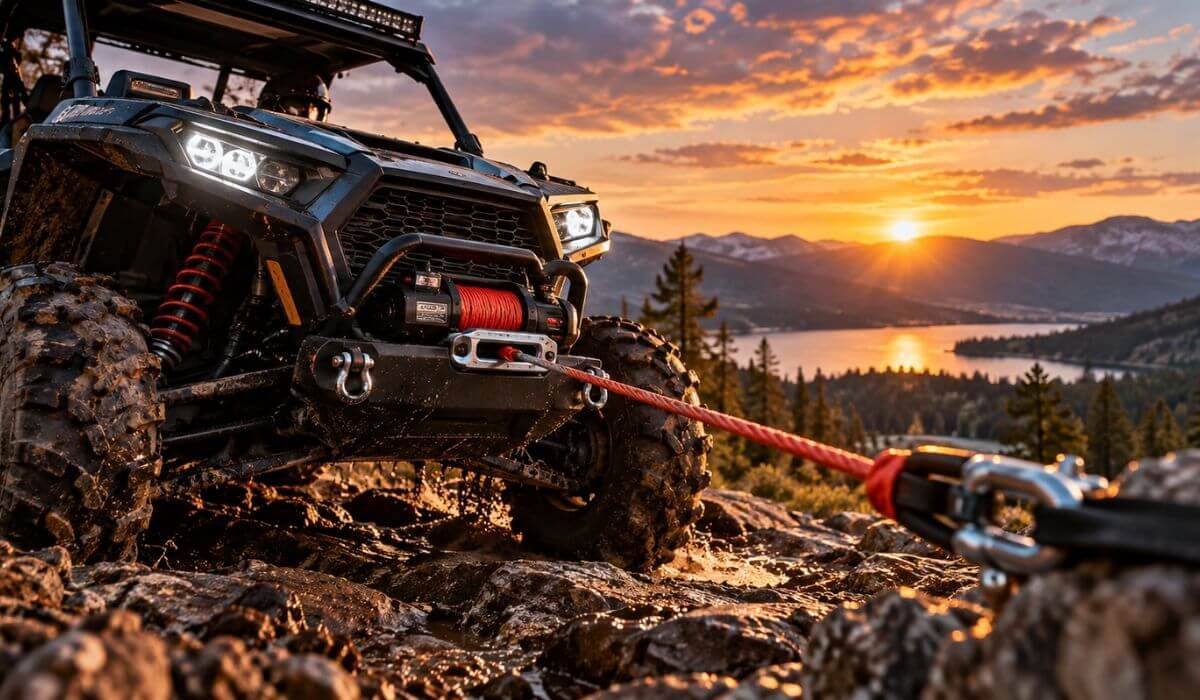
Best UTV Winches (2026): Heavy Pulling Power Without the Guesswork
Getting stuck is part of owning a UTV, but the wrong winch can turn a simple recovery into a frustrating and potentially unsafe job. The WARN VRX 45-S delivers 4,500 lb of rated pulling capacity, while the Rough Country ProSeries steps up to 6,500 lb, with a 50-foot synthetic rope and wireless remote. Both offer useful advantages, but neither is automatically the right choice for every machine or trail condition.
We selected six 12V electric UTV winches rated from 3,500 to 6,500 lb for different recovery needs and budgets. Whether you ride an older Polaris Ranger or a newer Can-Am Defender, look beyond the headline capacity. Your loaded vehicle weight, mounting compatibility, electrical requirements, rope specifications and included recovery hardware all matter. The best UTV winch for the money is the one that fits your machine, handles your likely recovery demands and gives you the right features without paying for capacity you don’t need.
Best UTV Winches for 2026 (3,500–6,500 lb) – Top Picks for Every Budget
#1. WARN VRX 45-S Powersport Winch
Best Overall 4,500 lb UTV Winch for Dependable Off-Road Recovery on Muddy Trails and Rocky Terrain
#2. Superwinch Terra 4500SR Powersports Winch
Best 4,500 lb Electric UTV Winch for Reliable Pulling Power During Trail Recovery and Utility Work
#3. Rough Country ProSeries 6,500 LB UTV/ATV Winch
Best Heavy-Duty UTV Winch With 50-Ft Synthetic Rope and Wireless Remote for Demanding Recovery Situations
#4. SuperATV Black Ops 3,500 LB Winch Kit
Best 3,500 lb UTV Winch Kit for Compatible Lightweight Machines and Everyday Off-Road Recovery Needs
#5. X-BULL 4,500 LB Electric Winch Kit
Best 4,500 lb UTV Winch With Synthetic Rope, Wireless Remotes and Mounting Hardware for Convenient Installation
#6. Nilight 4,500 LB ATV/UTV Electric Winch
Best Value-Oriented 4,500 lb UTV Winch With Synthetic Rope and Remote Control for Budget-Conscious Buyers
Must Check: Best ATV Winches
Expert Tip
Before buying a UTV winch, check your machine’s loaded weight, not just its advertised dry weight. Include the rider, fuel, cargo and fitted accessories, then consider the terrain where you expect to get stuck. A 4,500 lb winch may suit many recreational UTVs, while heavier machines or demanding recovery conditions may call for a higher-rated option. Also, confirm that the mounting plate fits your exact make, model and year. A winch with the right pulling capacity but the wrong mounting hardware is no bargain.
How We Chose These UTV Winches
We selected these six winches to cover different recovery needs rather than simply ranking them by the biggest pulling-capacity number. The lineup ranges from the SuperATV Black Ops 3,500 lb kit to the Rough Country ProSeries 6,500 lb winch, with several 4,500 lb options in between. This gives buyers a practical starting point for comparing capacity, features and intended use.
Pulling capacity and intended use: We considered the range of rated capacities across the list. The 6,500 lb Rough Country model stands out on paper for buyers who need a higher rating, while the 3,500 lb SuperATV kit may suit compatible, lighter-duty setups. Neither rating alone proves that a winch is suitable for every UTV or recovery situation.
Rope type and remote control: The Rough Country and X-BULL listings specify synthetic rope and wireless remotes, features worth considering when comparing recovery equipment. The Nilight listing also specifies synthetic rope and remote control. We treated these as practical differences between products, not proof that one winch is more reliable than another.
Brand and product choice: WARN and Superwinch provide established alternatives in the 4,500 lb category, while SuperATV, Rough Country, X-BULL and Nilight broaden the selection across different capacities and feature combinations. We included these options to give readers meaningful comparisons rather than six nearly identical recommendations.
Fitment and installation: A winch kit is only useful if it works with your machine. Before purchasing, verify the exact model-year compatibility, mounting plate, electrical requirements, rope configuration and included accessories. Do not assume that a kit advertised for ATVs and UTVs fits every vehicle in either category.
What we have not assumed: Product specifications and advertised features help narrow the shortlist, but they do not establish real-world recovery speed, durability or long-term reliability. We have not treated these six products as independently tested winners or claimed that limited customer feedback proves their performance. Check current warranty terms, recent owner reviews and the manufacturer’s fitment information before making your final decision.
The aim is straightforward: recommend options for different needs while being clear about what the specifications actually tell you. The best UTV winch is the one that fits your machine, meets the demands of your typical recoveries and can be installed and operated safely.
#1. WARN VRX 45-S Powersport Winch
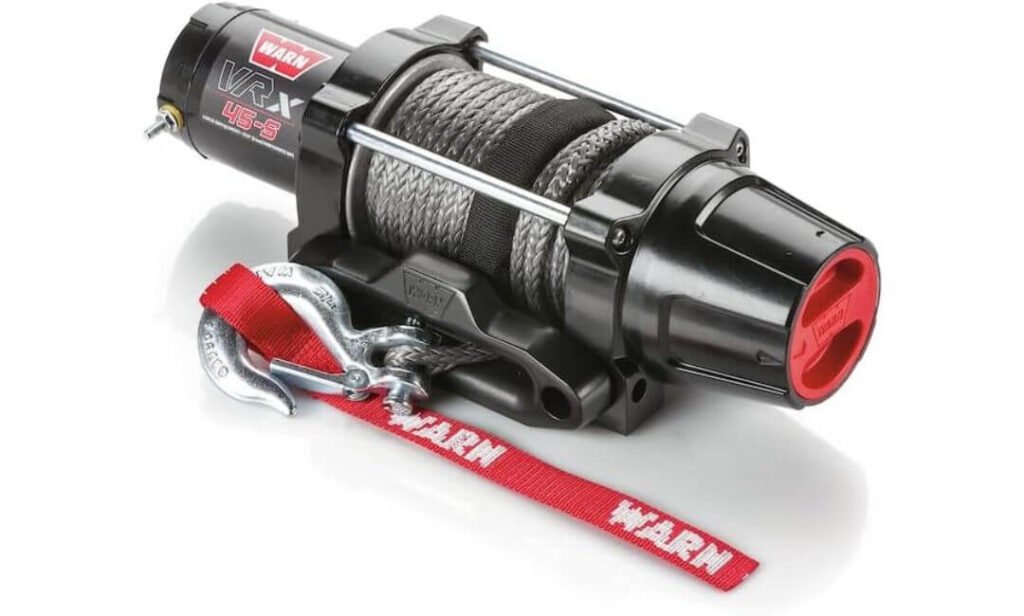
Quick Specs:
- Pulling capacity: 4,500 lb
- Rope type: Synthetic rope
- Rope length and diameter: 50 ft × 1/4 in (confirm for the exact package)
- Waterproof rating: IP68
- Gear system: Three-stage planetary gear train
- Brake: Mechanical load-holding brake
- Controls: Handlebar/dash-mounted rocker switch and corded remote (verify package contents)
- Warranty: Limited lifetime mechanical and limited 1-year electrical warranty
- Mounting: Vehicle-specific mounting plate sold separately
A winch earns its place on a UTV when it can handle the recovery jobs you actually encounter, not just when its capacity looks impressive on the box. The WARN VRX 45-S is rated at 4,500 lb, making it an option worth considering for compatible recreational and utility UTVs. Before choosing that rating, account for the machine’s loaded weight, the terrain and the resistance it may face when stuck.
The synthetic rope is another practical advantage. Compared with traditional steel cable, it is generally lighter and easier to handle during setup. The listed 50-foot, 1/4-inch rope gives you useful working length, although you should confirm those dimensions against the exact version being sold. Inspect the rope regularly for abrasion, cuts and other damage, particularly after muddy recoveries or contact with rocks.
The IP68-rated construction is relevant for riders who regularly encounter mud, rain and wet trails. Its three-stage planetary gear train and mechanical load-holding brake are also useful features to consider when comparing recovery equipment. However, waterproofing does not eliminate maintenance, and the brake should never be treated as a substitute for proper recovery procedures.
What We Like About Its Setup
- 4,500 lb rated capacity: A useful starting point for compatible UTVs when matched to the machine and expected recovery conditions.
- Synthetic rope: Reduces cable weight and makes handling easier during routine recovery preparation.
- IP68 protection: Designed to protect the winch against dust and water ingress under the rating’s specified test conditions.
- Planetary gearing and load-holding brake: Practical mechanical features for controlled winch operation.
- Warranty coverage: Limited lifetime mechanical coverage and a limited one-year electrical warranty provide defined terms of support, subject to WARN’s conditions.
One Thing to Check Before Ordering
The vehicle-specific mounting plate is sold separately. Budget for the correct bracket if your UTV does not already have compatible mounting hardware. Confirm the exact make, model and year before ordering, as a winch that fits electrically may still require a different mounting plate or installation arrangement.
Where It Fits in a UTV Winch Setup
The appeal here is the combination of a 4,500 lb rating, synthetic rope, sealed construction and established mechanical features. That makes it a sensible candidate for riders comparing a conventional recovery-focused winch with cheaper alternatives that may advertise similar pulling capacities. Still, brand reputation alone cannot establish how long a particular unit will last or how it will perform under your specific conditions.
Before installation, check the battery and charging-system requirements in the manufacturer’s instructions, along with the wiring route, solenoid placement and mounting clearance. Use the specified electrical protection and suitable recovery accessories, and never exceed the winch’s rated capacity. A properly matched installation matters just as much as the winch itself.
The Insider Pro-Tip
Do not choose a 4,500 lb winch simply because your UTV weighs less than 4,500 lb. The rated line pull is not a guarantee that the winch can recover a machine from every mud hole, incline or awkward position. Rolling resistance, suction in deep mud, line angle and the use of recovery equipment can change the load substantially. Follow the manufacturer’s capacity guidance and use an appropriate recovery plan.
One final detail worth checking is the exact kit configuration. Confirm the rope dimensions, included controls, fairlead, wiring and warranty terms with the seller before paying. The mounting plate is sold separately, so the advertised winch price may not represent the full cost of getting it installed. That small check can save you from ordering a unit that arrives without the hardware your UTV needs.
(A well-matched winch is a recovery tool, not a substitute for correct rigging, safe operating practices or vehicle-specific fitment.)
#2. Superwinch Terra 4500SR Powersports Winch
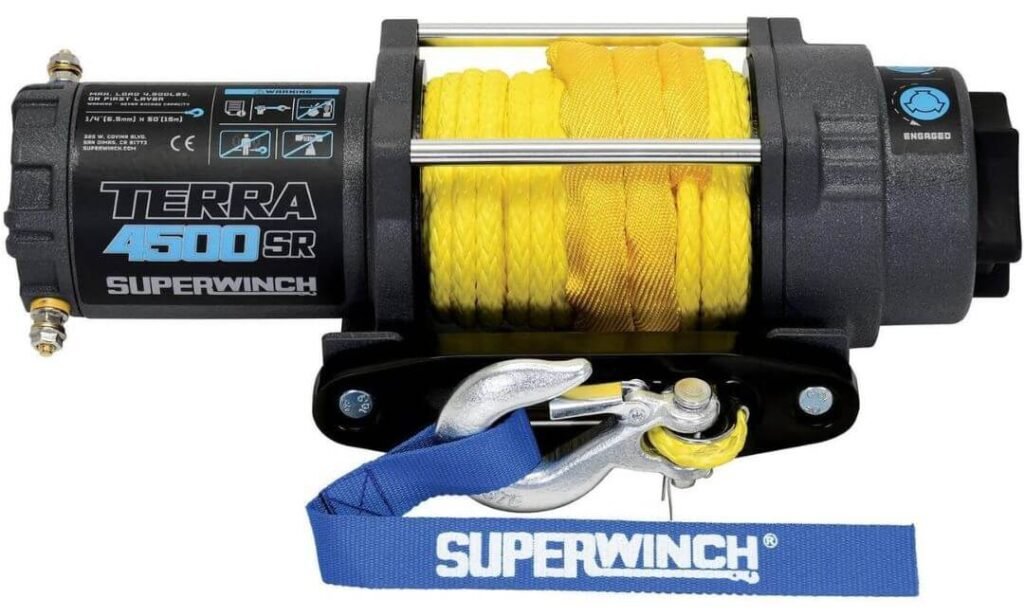
Quick Specs:
- Rated pulling capacity: 4,500 lb (2,041 kg)
- Power supply: 12V DC
- Rope: 50-ft synthetic rope, listed as 1/4-inch in the supplied product details
- Fairlead: Verify the exact supplied configuration before purchase
- Package weight: 26.45 lb
- Package dimensions: 17.49 × 10.49 × 8.69 inches
- Intended use: Powersports applications, subject to vehicle-specific fitment
- Mounting: Confirm the included mounting channel and any additional vehicle-specific hardware
When comparing 4,500 lb UTV winches, the details beyond the capacity rating can make the decision easier. The Superwinch Terra 4500SR combines a 12V DC power system with a listed 50-foot synthetic rope, giving buyers a recovery setup to consider for compatible ATVs and UTVs. Its rating is not a guarantee that it will recover every machine in every situation, so match the winch to your vehicle, its loaded weight and the conditions you expect to encounter.
The synthetic rope is useful for riders who prefer lighter line that’s easier to handle than conventional steel cable. The listed 50-foot length also gives you a reasonable amount of line to work with, although the usable reach depends on the recovery setup and how much rope remains on the drum. Keep the rope clean, inspect it for abrasion and follow the manufacturer’s spooling and maintenance instructions.
Another practical consideration is installation. This is a 12V winch, so your UTV’s electrical system, battery condition, wiring and mounting arrangement all need to be suitable. The supplied package information lists a weight of 26.45 lb, but package dimensions are not the same as the winch’s installed dimensions. Check the manufacturer’s installation drawing before deciding whether it will fit your bumper or mounting location.
What We Like About Its Recovery Setup
- 4,500 lb rated pull: A useful capacity to compare against other recreational UTV winches, provided it suits your machine and recovery needs.
- 50-ft synthetic rope: Offers lighter handling than steel cable and useful line length for many trail-recovery situations.
- 12V DC operation: Designed for compatible 12V electrical systems, with the manufacturer’s wiring requirements still needing to be followed.
- Powersports-focused design: Worth considering for ATV and UTV owners who need a dedicated recovery winch rather than a general-purpose pulling device.
- Manageable listed package weight: At 26.45 lb, the supplied package is a useful reference when planning installation, although the actual installed weight may differ.
One Detail to Verify Before Buying
The supplied information mentions a roller fairlead in one listing, while the additional description refers to a hawse-style fairlead. Those are different designs, so confirm which fairlead comes with the exact Terra 4500SR package before ordering. Also check whether the mounting channel, controls, wiring and vehicle-specific mounting plate are included; don’t assume every seller supplies an identical kit.
Why It Deserves a Place in This UTV Winch Comparison
The Terra 4500SR gives readers another option in the 4,500 lb synthetic-rope winch category. That makes it particularly relevant when comparing it with the WARN VRX 45-S, which has the same advertised pulling capacity. Instead of assuming one is automatically superior, compare the actual kit contents, fitment, warranty coverage, control arrangement and total installed cost.
The most important distinction for your purchase may be practical rather than dramatic: whether the included hardware works with your UTV and whether the rope, wiring and controls suit your intended setup. Check the manufacturer’s instructions for electrical demand and mounting requirements before installation, and use suitable recovery accessories rated for the loads involved.
The Insider Pro-Tip
Before fitting the winch, measure the distance between the mounting position, solenoid location and battery. A wiring harness that doesn’t reach your preferred layout can complicate installation, and any extension must be appropriate for the current draw and specified wiring requirements. Never choose cable thickness or connections by guesswork.
If you’re comparing this model with the WARN VRX 45-S, put the two packages side by side and verify the actual included parts, warranty terms and fitment for your specific UTV. Both carry a 4,500 lb rating, so the better purchase is the one that meets your recovery needs and fits correctly—not simply the one with the more persuasive product description.
(Confirm the exact kit contents and vehicle compatibility with the seller or manufacturer before ordering.)
#3. Rough Country ProSeries 6,500 LB UTV/ATV Winch
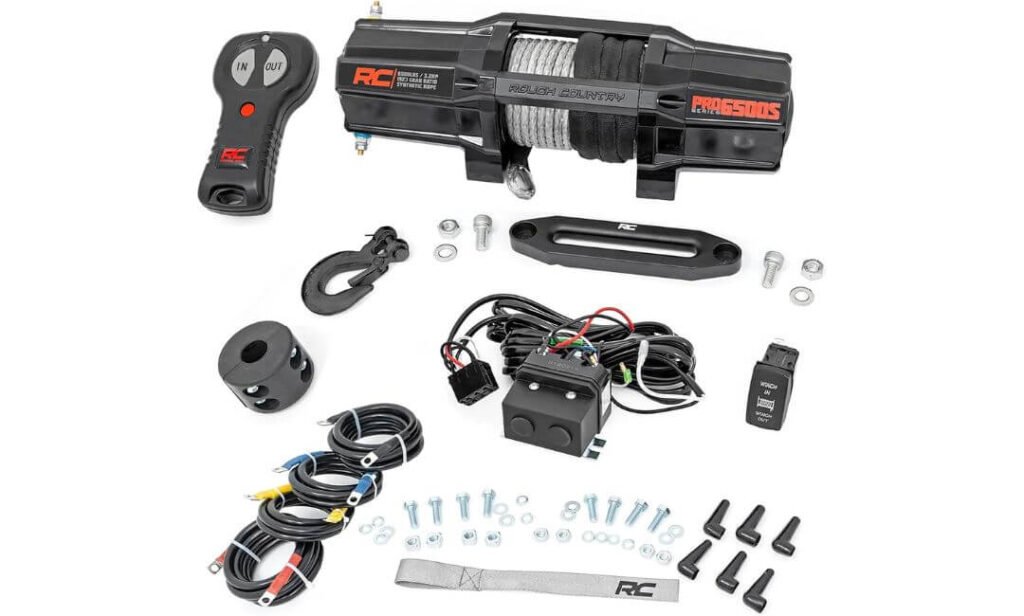
Quick Specs:
- Rated pulling capacity: 6,500 lb
- Motor: 2.7 HP electric motor
- Gear ratio: 192:1
- Power supply: 12V
- Rope: 50-ft synthetic rope
- Water and dust protection: IP67
- Controls: Wireless remote and dash-mounted rocker switch
- Braking: Automatic braking system
- Fairlead: Aluminium hawse fairlead
- Included accessories: Clevis hook, installation hardware and instructions, as listed
- Fitment: Confirm mounting compatibility with your exact UTV or ATV
A higher pulling-capacity rating becomes worth considering when your UTV is heavier, carries substantial accessories or regularly encounters demanding recovery conditions. This 6,500 lb ProSeries winch offers a higher advertised rating than the 4,500 lb options elsewhere in this roundup. Its 2.7 HP motor and 192:1 gear ratio are useful specifications to compare, although the rating alone does not establish how quickly it will pull under load or whether it suits every machine.
The supplied 50-foot synthetic rope keeps the setup lighter than a comparable steel-cable arrangement and is easier to handle during routine deployment. An aluminium hawse fairlead is included in the listed package, providing a rope-guiding surface designed for synthetic line. As with any recovery rope, inspect it for cuts, abrasion and contamination, and follow the manufacturer’s guidance on spooling and replacement.
The feature set is another reason to consider this model. An IP67-rated enclosure, water-resistant solenoid and heavy-gauge wiring are specified for challenging outdoor conditions. You also get a wireless remote and a dash-mounted rocker switch, so there are two control options. The automatic braking system is designed to help hold the load when operation stops, but safe recovery still depends on correct rigging, suitable anchor points and staying clear of the loaded line.
What We Like About Its Heavy-Duty Setup
- 6,500 lb rated capacity: The highest advertised capacity among the six winches in this roundup, giving it a distinct role for buyers who need a higher-rated option.
- 2.7 HP motor and 192:1 gear ratio: Useful technical details when comparing its powertrain with lower-capacity alternatives.
- 50-ft synthetic rope: A lighter, easier-to-handle line for compatible recovery applications.
- Two control methods: Wireless operation and a dash-mounted rocker switch provide flexibility when setting up a recovery.
- IP67 protection and water-resistant solenoid: Features intended to help protect the equipment against dust and water exposure within the rating’s limits.
Check the Mounting Before You Commit
Although the listing describes bolt-on installation and includes hardware, do not assume the winch fits every UTV without modifications. Mounting patterns, bumper clearance and vehicle-specific brackets can differ between model years and trims. Confirm the exact fitment with Rough Country before ordering, especially if your machine has aftermarket bodywork or a non-standard bumper.
Where the Extra Pulling Capacity Matters
The main reason to choose this model over a 4,500 lb alternative is its higher rated line pull, not simply the number on its packaging. That additional capacity may be useful for a compatible, heavier machine or more demanding recovery work. However, the right rating depends on the vehicle’s loaded weight, the recovery conditions and the manufacturer’s recommendations. A bigger winch is not automatically the safest choice for every setup.
Before installation, check the required battery capacity, electrical connections, fuse or circuit protection and mounting arrangement in the manufacturer’s instructions. The motor’s actual current draw under load matters, so don’t assume every UTV charging system can support extended winching without limitations. Also verify exactly which mounting components are included in the package.
The Insider Pro-Tip
If you’re deciding between a 4,500 lb winch and this 6,500 lb model, start with your UTV’s actual loaded weight and the recovery situations you expect—not an arbitrary rule that says every machine needs a particular multiple of its weight. Deep mud, steep slopes and a poor pulling angle can increase the force required considerably. Follow the winch manufacturer’s capacity guidance, and use properly rated recovery accessories rather than relying on the winch alone.
One last detail: IP67 does not mean the winch is indestructible or suitable for unlimited underwater use. Follow the manufacturer’s water-exposure limits, rinse off mud and debris appropriately, inspect the rope and electrical connections, and maintain the equipment after wet rides. Those checks are more useful than assuming a waterproof rating eliminates routine care.
(A 6,500 lb rating gives you a higher-capacity option, but correct fitment, electrical support and safe recovery technique remain essential.)
#4. SuperATV Black Ops 3,500 LB Winch Kit
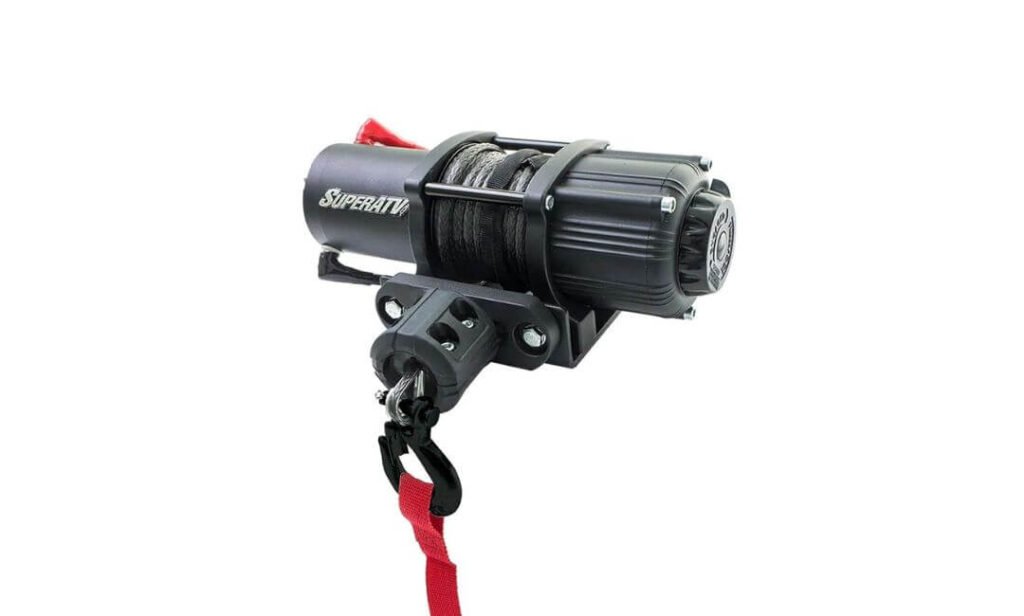
Quick Specs:
- Rated pulling capacity: 3,500 lb
- Motor: 1.2 HP permanent-magnet DC motor (verify against the exact model specification)
- Power supply: 12V DC
- Gear ratio: 166:1
- Rope: Synthetic rope; confirm the exact material and length for this kit
- Fairlead: Aluminium hawse fairlead
- Controls: Wireless remote and wired rocker switch, as listed
- Braking: Automatic load-holding brake
- Mounting: Machine-specific SuperATV winch mounting plate sold separately
- Fitment: Check the exact UTV make, model and year before ordering
Not every UTV owner needs the highest-rated winch in the lineup. The SuperATV Black Ops 3,500 lb winch kit offers a lower-capacity alternative for compatible machines and recovery tasks that fall within its rated limits. It may be worth considering if your UTV is relatively light and your usual riding involves occasional trail recovery or general utility work. The right choice still depends on loaded vehicle weight, terrain and the manufacturer’s fitment recommendations.
One of its useful features is the synthetic rope paired with an aluminium hawse fairlead. Synthetic rope is generally lighter and easier to handle than steel cable, while a hawse fairlead provides a smooth guiding surface for compatible synthetic line. That doesn’t make the rope immune to damage: abrasion, sharp edges, dirt and improper spooling can shorten its service life, so inspect it before and after demanding recoveries.
The listed 12V DC motor, 166:1 gear ratio and automatic load-holding brake are additional points to consider. The kit is also described as having wireless and wired control options. Those features are useful on paper, but actual performance and reliability should not be assumed without verified testing. Check the exact product documentation for the motor specification, rope details and included controls before purchase.
What We Like About This Winch Kit
- 3,500 lb rated capacity: Gives buyers a lower-capacity alternative to the 4,500 lb and 6,500 lb options in this roundup.
- Synthetic rope: Offers easier handling and lower line weight than traditional steel cable.
- Aluminium hawse fairlead: A suitable guiding design for compatible synthetic rope when correctly installed and maintained.
- Wired and wireless controls: Provides alternative ways to operate the winch, subject to the exact kit contents.
- Purpose-specific mounting options: SuperATV offers vehicle-specific mounting plates, helping buyers build a setup around compatible machines.
The Mounting Plate Is an Extra Purchase
The most important buying detail is that the machine-specific SuperATV mounting plate is sold separately. You will need the correct plate for your exact UTV, and the winch’s bolt pattern alone does not guarantee that it will fit your bumper or mounting location. Confirm compatibility with SuperATV before ordering, particularly if your vehicle has aftermarket accessories or a non-standard front end.
Where This 3,500 lb Option Fits
This model makes the most sense for shoppers who have checked their UTV’s requirements and don’t need the higher advertised capacities of the other winches on this list. A lower rating can be entirely appropriate when the winch is correctly matched to the machine and intended recovery work. It should not, however, be selected simply because the vehicle’s dry weight appears to fall below 3,500 lb.
Before installation, check the electrical requirements, battery connections, wiring protection and mounting instructions. Confirm the supplied rope, remote, switch and wiring harness rather than assuming every retailer’s package contains the same accessories. If your recovery conditions regularly involve deep mud, steep inclines or heavy loads, review the manufacturer’s capacity guidance before choosing this lower-rated option.
The Insider Pro-Tip
Confirm the mounting plate before you buy the winch. This is especially important when choosing between different UTV trims or model years, because mounting arrangements can change even when the vehicle name stays the same. Ask SuperATV to verify the winch and plate combination for your exact machine rather than relying on a generic ATV/UTV compatibility label.
Also, test the wired and wireless controls according to the manufacturer’s instructions before heading out on a trail. Keep the rope correctly spooled, inspect it for fraying and use properly rated recovery accessories. If a remote behaves inconsistently, don’t depend on it during a difficult recovery until the issue has been resolved.
(A correctly matched 3,500 lb winch can be a sensible choice, but vehicle fitment and recovery requirements should decide the purchase—not price or capacity alone.)
#5. X-BULL 4,500 LB Electric Winch Kit
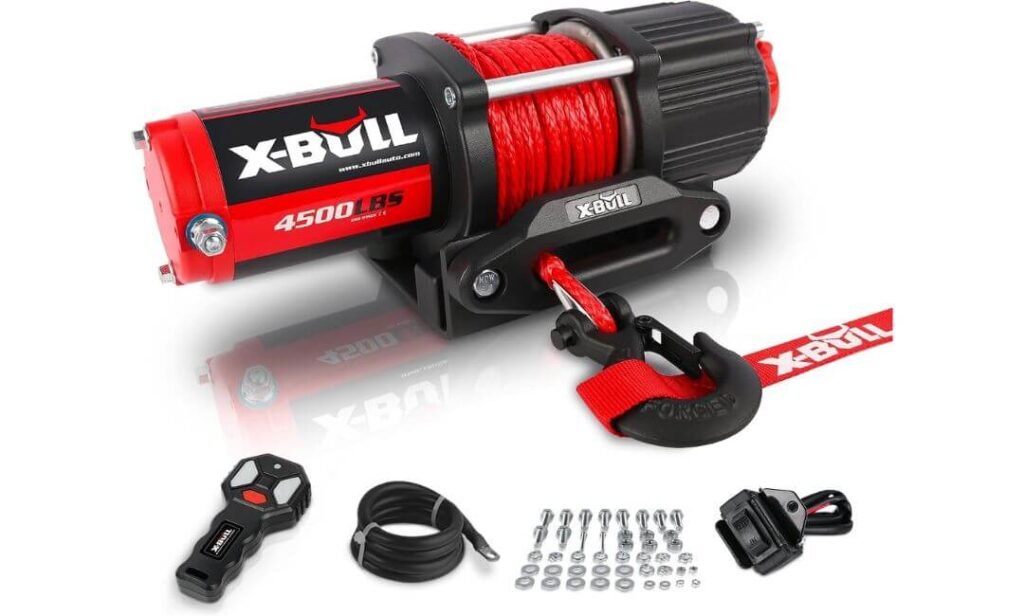
Quick Specs:
- Rated pulling capacity: 4,500 lb
- Motor: 1.5 HP
- Power supply: 12V DC
- Gear system: Three-stage planetary gear train
- Gear ratio: 136:1, according to the supplied specifications
- Rope: 50-ft × 1/4-inch synthetic rope with protective sleeve
- Water and dust protection: IP66
- Full-load line speed: 8.6 ft/min
- No-load line speed: 20.5 ft/min
- Controls: Wireless remote with a listed 82-ft range and an 8-ft wired rocker switch
- Braking: Dynamic load-holding brake
- Mounting: Supplied bracket; verify vehicle-specific compatibility
If you want a 4,500 lb UTV winch with synthetic rope and wireless control, the X-BULL is worth comparing with the more established options in this roundup. Its listed 1.5 HP motor and three-stage planetary gear system give you useful specifications to evaluate, while the 50-foot rope provides practical working length for many recovery situations. The advertised capacity still needs to match your UTV’s loaded weight, terrain and intended use.
The supplied wireless remote has a stated range of 82 feet, and the kit also lists an 8-foot wired rocker switch. Having both control methods can be useful when positioning yourself away from the winch during recovery. In practice, actual wireless range depends on the surroundings, battery condition and interference, so test the controls before relying on them in the field.
Another detail worth looking at is the IP66 rating, alongside the powder-coated exterior and corrosion-resistant mounting hardware described in the listing. These features are intended for outdoor use in dusty and wet conditions, but IP66 does not mean the entire assembly can be submerged without risk. Protect the electrical connections and relay or solenoid box according to the manufacturer’s instructions, especially if you regularly ride through deep water or thick mud.
What We Like About Its Feature Set
- 4,500 lb rated pulling capacity: Puts it in the same capacity category as the WARN and Superwinch options, allowing a more direct comparison.
- 50-ft synthetic rope: Provides useful line length while remaining lighter and easier to handle than conventional steel cable.
- Wireless and wired controls: Gives you two ways to operate the winch, provided both are included in the package you receive.
- Published line-speed figures: The listing specifies 8.6 ft/min at full load and 20.5 ft/min without a load, giving buyers more context than capacity alone.
- Mounting hardware included: Can simplify installation, although an additional vehicle-specific adapter or bracket may still be necessary.
Check These Installation Details First
The supplied listing specifies a 3 × 6.6-inch bolt pattern and a mounting bracket measuring 5.9 × 5.1 × 4.9 inches. Confirm these dimensions against the actual mounting arrangement on your UTV before ordering. A bracket advertised as universal does not guarantee a direct fit for every Polaris, Can-Am, Honda, Yamaha or Kawasaki model.
The listed gear ratio is 136:1, but other supplied descriptions conflict on this specification. Verify the exact model documentation before relying on the figure. Also check the wiring harness length, control-switch placement and the mounting position of the electrical components so you can plan a tidy, protected installation.
Where It Makes Sense in This UTV Winch Roundup
The X-BULL stands out for the number of features advertised in its kit: synthetic rope, two control methods, a planetary gear system and mounting hardware. That makes it an option for buyers who want to compare equipment and included accessories rather than paying for brand reputation alone. It does not, by itself, establish that the winch will last as long as a more expensive alternative.
For regular trail recovery, check the warranty, availability of replacement remotes, rope replacement options and seller support before making your decision. These details matter if a control stops working or a component needs replacing after repeated use. The overall value depends on the complete package, not just the initial purchase price.
The Insider Pro-Tip
Before installation, test the winch controls and plan where the relay box will sit. Keep electrical components protected from direct impacts and water exposure, route wiring away from hot or moving parts, and use the specified electrical protection. If the wired switch does not reach your preferred position, use only an extension and connectors rated for the application rather than improvising a connection.
Also, don’t interpret the 4,500 lb rating as a promise that every stuck UTV can be pulled free in one straight line. Deep mud, steep inclines and poor line angles can increase recovery loads. Use suitable rated recovery equipment, follow the manufacturer’s instructions and stop if the setup becomes unstable.
(The X-BULL is worth considering for its advertised features, but confirm the exact gear ratio, mounting fitment and package contents before purchasing.)
#6. Nilight 4,500 LB ATV/UTV Electric Winch
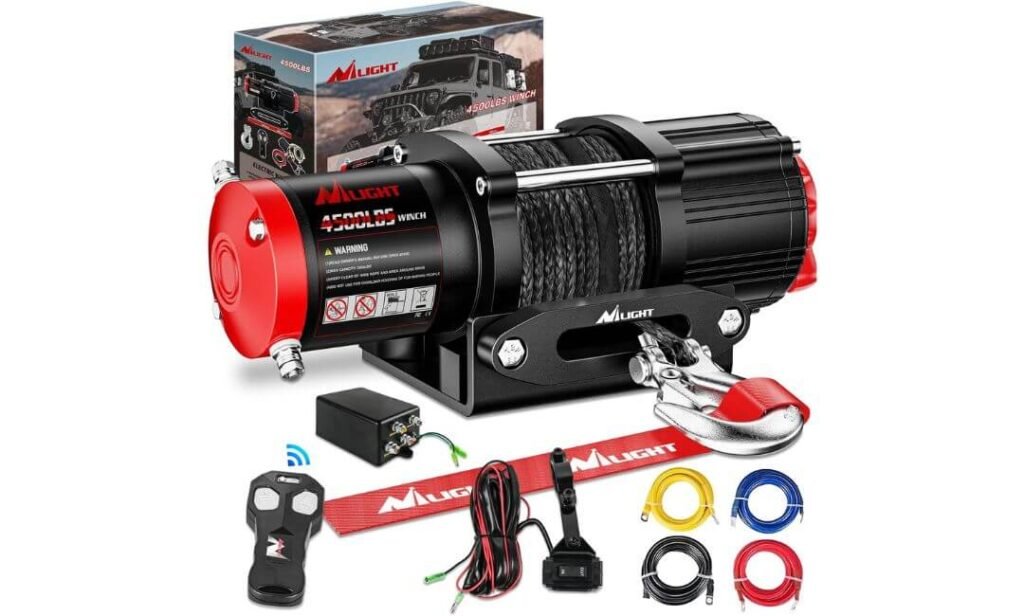
Quick Specs:
- Rated pulling capacity: 4,500 lb
- Motor: 2.4 kW / 3.2 HP permanent-magnet motor, as listed
- Power supply: 12V DC
- Gear ratio: 166:1
- Gear system: Three-stage planetary
- Rope: 40-ft × 3/16-inch synthetic rope
- Water and dust protection: IP67
- Controls: Wireless remote with a listed 82-ft range and a 10-ft wired controller
- Housing: Cast aluminium with a powder-coated finish
- Listed winch dimensions: 12.6 × 4.6 × 4.6 inches
- Mounting: Verify the bolt pattern and included mounting hardware for your vehicle
If you want a 4,500 lb UTV winch with both wireless and wired controls, this Nilight model offers a feature set worth comparing against more expensive options. Its listing specifies a 3.2 HP motor, a 166:1 gear ratio and a three-stage planetary gear system. Those figures help describe the hardware, but they do not independently prove that it will outperform another winch with the same rated line pull.
One difference is the 40-foot synthetic rope, which is shorter than the 50-foot ropes specified for several other products in this roundup. That may be perfectly adequate for your usual recovery setup, but it’s worth considering before buying. Synthetic rope is generally easier to handle than steel cable, and the listed 3/16-inch diameter and 12-strand construction are details to confirm against the exact version you receive. Inspect the rope regularly and protect it from abrasion and sharp edges.
The unit also has a cast-aluminium housing, powder-coated finish and IP67 protection rating. These are useful features for equipment exposed to outdoor conditions, including dust, rain and muddy trails. However, IP67 should not be treated as permission for unlimited underwater use, and the winch’s electrical connections still need appropriate installation and maintenance.
What We Like About Its Practical Features
- 4,500 lb rated pulling capacity: Places it alongside the WARN and Superwinch options for buyers comparing winches in the same capacity category.
- 3.2 HP motor specification: Gives buyers a useful point of comparison, although motor horsepower alone does not establish overall recovery performance.
- 40-ft synthetic rope: Offers lighter handling than conventional steel cable, with a shorter listed length than some competing kits.
- Two control options: The wireless remote and 10-foot wired controller provide flexibility during setup and recovery.
- IP67-rated construction: Adds a stated level of protection against dust and water ingress when the unit is correctly installed and used within its rating.
Check the Rope Length and Mounting Pattern
The 40-foot rope is the first detail I’d compare with your intended use. If your regular recovery points require more working line, you may need a suitable extension or a different setup. Any extension must be properly rated and used according to the manufacturer’s instructions.
The listing also gives mounting measurements of approximately 4.5 inches for the fairlead pattern and 3.1 or 3.0 inches for alternative mounting dimensions. Verify the exact bolt pattern, fairlead arrangement and supplied hardware before ordering. A stated mounting pattern does not guarantee a direct fit on every ATV or UTV.
Where This Nilight Winch Fits in the Lineup
This model is a reasonable candidate for buyers who want to compare advertised motor power, synthetic rope and dual controls without focusing exclusively on premium-brand positioning. Its shorter rope and specific mounting dimensions distinguish it from some of the other 4,500 lb options here. Whether it represents good value depends on the current price, included accessories, warranty terms and availability of replacement parts.
Before installation, confirm the winch’s current draw and wiring requirements, check that your UTV’s 12V electrical system is suitable, and route cables away from heat and moving parts. Also verify which fairlead, hook, mounting plate and electrical components are included in the exact package. Retail listings can vary, so don’t assume every advertised accessory comes with every version.
The Insider Pro-Tip
When comparing this model with the WARN VRX 45-S or Superwinch Terra 4500SR, look beyond the shared 4,500 lb rating. Compare rope length, mounting compatibility, control layout, warranty coverage and the cost of any missing installation hardware. A lower purchase price can be attractive, but the complete installed cost is what matters.
One final point: never judge recovery suitability by motor horsepower alone. The load, line angle, terrain, battery condition and rigging all affect the job. Follow the manufacturer’s capacity guidance, use properly rated recovery accessories and inspect the rope and electrical connections regularly. If the mounting pattern or included components are unclear, confirm them with the seller before placing the order.
(A useful budget comparison starts with verified fitment, the exact kit contents and the recovery requirements of your UTV—not the advertised specifications alone.)
Best UTV Winch for the Money in 2026 (Specs Compared)
| Winch | Rated Pull | Rope & Length | Controls | Protection | Key Advantage | Before You Buy |
|---|---|---|---|---|---|---|
|
WARN VRX 45-S
Powersport winch
Best Overall Candidate
|
4,500 lb | Synthetic rope 50 ft × 1/4 in, as supplied |
Rocker switch and corded remote, according to the supplied details | IP68 | Sealed construction, planetary gearing and mechanical load-holding brake | Vehicle-specific mounting plate sold separately |
|
Superwinch Terra 4500SR
Model 1145270
Established Brand Alternative
|
4,500 lb | Synthetic rope 50 ft × 1/4 in, as supplied |
Verify the included control configuration for the exact package | Sealed motor listed; confirm the specific ingress rating | 12V DC operation and a planetary gear system, according to the supplied details | Confirm fairlead type, mounting channel and vehicle fitment |
|
Rough Country ProSeries
UTV/ATV winch
Highest Rated Pull
|
6,500 lb | Synthetic rope 50 ft; diameter to verify |
Wireless remote and dash-mounted rocker switch | IP67 | 2.7 HP motor, 192:1 gear ratio and automatic braking system | Confirm mounting compatibility and included hardware for your UTV |
|
SuperATV Black Ops
3,500 lb winch kit
Lower-Capacity Option
|
3,500 lb | Synthetic rope Material and length to verify |
Wireless remote and wired rocker switch, as described | IP67 protection claimed in supplied details | Aluminium hawse fairlead and a listed 166:1 gear ratio | Machine-specific SuperATV mounting plate sold separately |
|
X-BULL Electric Winch
4500 lb kit
Dual-Control Kit
|
4,500 lb | Synthetic rope 50 ft × 1/4 in |
Wireless remote, listed 82-ft range, and 8-ft wired rocker switch | IP66 | 1.5 HP motor, listed 136:1 gear ratio and stated line-speed figures | Verify the bolt pattern and whether an adapter bracket is needed |
|
Nilight Electric Winch
12V ATV/UTV model
Budget-Oriented Option
|
4,500 lb | Synthetic rope 40 ft × 3/16 in |
Wireless remote, listed 82-ft range, and 10-ft wired controller | IP67 | Listed 3.2 HP motor, 166:1 gear ratio and aluminium housing | Check mounting dimensions, rope length and exact kit contents |
Fitment note: Pulling capacity alone does not determine whether a winch is suitable for your UTV. Check loaded vehicle weight, manufacturer guidance, mounting compatibility and electrical requirements before purchase.
Specification note: Details are based on the product information supplied for this comparison. Verify the exact model, package contents, control configuration and warranty with the manufacturer or seller; some listing details may vary or conflict.
UTV Winch Buying Guide for the Right Pulling Power and Fit
Choosing a UTV winch is not just about picking the highest pulling-capacity number or the cheapest kit available. Your machine’s loaded weight, the ground you’re riding on, the mounting space and the winch’s electrical demands all affect whether a particular model makes sense. A good match should handle your expected recovery work without creating avoidable installation problems or putting unnecessary strain on your vehicle.
How Much Pulling Capacity Does Your UTV Need?
Start with your UTV’s actual loaded weight, including the rider, fuel, cargo, accessories and any fitted equipment. Then consider the conditions in which you’ll use the winch. Pulling a machine across firm ground is very different from recovering it from deep mud, a steep incline or a position where the tyres are buried.
The six winches in this roundup range from 3,500 lb to 6,500 lb of rated pulling capacity. That range gives you several options, but the rating alone does not tell you which is appropriate for your machine.
| Rated pulling capacity | What to consider |
|---|---|
| 3,500 lb | Consider for compatible lighter-duty setups when the manufacturer’s guidance supports the rating |
| 4,500 lb | A middle option to evaluate for many recreational and utility UTV applications |
| 6,500 lb | Worth considering for demanding recovery needs when the vehicle, mounting system and electrical setup are compatible |
These are comparison categories, not universal vehicle-weight limits. Do not assume that a winch can safely recover a UTV simply because its rated pull exceeds the machine’s weight. Recovery loads change with terrain, line angle, resistance and rigging. Follow the winch manufacturer’s capacity guidance, and use a suitable recovery plan for difficult situations.
Synthetic Rope or Steel Cable: Which Makes More Sense?
Rope choice affects handling, maintenance and the type of care your winch will need. Most options in this roundup use synthetic rope, but the length, diameter and exact material can vary between kits.
| Feature | Synthetic rope | Steel cable |
|---|---|---|
| Handling | Generally lighter and easier to handle | Heavier and can develop sharp broken wire strands |
| Corrosion | Does not rust like steel, but still needs care | Can corrode if damaged or poorly maintained |
| Abrasion | Can be damaged by sharp rocks, rough edges and rubbing | Can tolerate some abrasion but may develop kinks or broken strands |
| Inspection | Check for cuts, fraying, contamination and heat damage | Check for kinks, crushed sections, corrosion and broken wires |
| Maintenance | Keep clean and follow the manufacturer’s storage and inspection guidance | Inspect regularly and handle with suitable protective equipment |
Synthetic rope is not automatically the best choice for every recovery. It is lighter and usually easier to handle, but it can be vulnerable to abrasion and heat. Steel cable has its own drawbacks, including weight and the risk of injury from broken wire strands. Either option must be correctly rated, inspected and used according to its instructions.
For a synthetic-rope winch, check the supplied length and diameter before buying. The X-BULL and WARN listings specify 50-foot rope, while the Nilight listing specifies 40 feet. That difference can matter when planning a recovery, although usable reach also depends on the anchor point, routing and amount of line remaining on the drum.
Motor Power, Gearing and Duty Cycle Matter Too
Motor horsepower is useful information, but it should not be treated as a standalone performance ranking. A winch’s actual pulling speed and electrical demand depend on the motor, gearing, load, battery condition and other design factors.
The product information supplied for this roundup lists a 2.7 HP motor and 192:1 gear ratio for the Rough Country ProSeries, a 1.5 HP motor and 136:1 ratio for the X-BULL, and a 3.2 HP motor and 166:1 ratio for the Nilight. These specifications help distinguish the advertised designs, but they do not establish that one will recover a vehicle faster or last longer in real-world use.
Before buying, look for the manufacturer’s information on:
- Line speed under load: A no-load speed figure does not tell you how fast the winch will pull a heavy vehicle.
- Current draw: Winching can demand substantial current, so confirm the battery and electrical-system requirements.
- Duty cycle and cooling: Electric winches generate heat under load. Follow the specified operating and cooling intervals rather than running the motor continuously.
- Braking and gearing: Understand how the winch holds a load and what operating limitations apply.
- Replacement parts and warranty: Check the availability of ropes, remotes, solenoids and other service components.
Do not infer duty cycle from horsepower or gear ratio. If the manufacturer does not provide a clear duty-cycle specification, avoid assuming that the winch is suitable for repeated, prolonged pulls without cooling breaks.
Wireless Remote or Wired Control?
Wireless remotes can make recovery more convenient because you can operate the winch from a suitable position away from the mounting point. A wired controller or dash-mounted rocker switch can provide a direct alternative, depending on the kit.
Several options in this roundup advertise both wireless and wired controls. The listed wireless ranges include 82 feet for the X-BULL and Nilight models, but advertised range is not a guarantee of reliable operation in every environment. Terrain, obstructions, interference and remote battery condition can affect performance.
Before heading out, check that the controls pair correctly, the wired switch works as intended and the wiring is routed safely. Keep everyone clear of the loaded line, maintain a safe position during recovery and never rely on a wireless remote as a substitute for proper recovery procedures.
Check Mounting Compatibility Before You Order
This is one of the easiest details to overlook. A winch may have the right pulling capacity and electrical specification yet still be unsuitable for your UTV because the mounting plate, bolt pattern or available clearance does not match.
The WARN VRX 45-S and SuperATV Black Ops listings specify that their vehicle-specific mounting plates are sold separately. Other kits advertise mounting hardware, but that does not guarantee a direct fit on every vehicle.
Before purchasing, verify the following:
- Your UTV’s exact make, model, year and trim.
- Whether the mounting plate is included or must be purchased separately.
- The winch and fairlead bolt patterns, plus bumper clearance.
- Whether the mounting arrangement interferes with body panels, lights or other accessories.
- The required wiring layout, solenoid location and battery connections.
- Whether the supplied installation hardware is suitable for your particular machine.
A general statement such as “fits ATVs and UTVs” is not enough to confirm compatibility. Ask the manufacturer or seller to verify the exact winch-and-mounting-plate combination if any dimension or fitment detail is unclear.
Common UTV Winch Buying Myths Worth Ignoring
Myth 1: More pulling capacity is always better.
A higher rating can be useful, but it does not automatically make a winch the right choice. The winch must suit the vehicle, mounting system, electrical supply and intended recovery work. A larger unit may also introduce different packaging, installation and power requirements.
Myth 2: Synthetic rope is always better than steel cable.
Synthetic rope is lighter and easier to handle, but it can be damaged by abrasion, heat and poor storage. Steel cable is heavier and can develop dangerous broken strands or kinks. Choose based on your conditions and willingness to inspect and maintain the line.
Myth 3: A waterproof rating means the winch can be submerged without concern.
The IP67 and IP68 ratings listed for some models describe protection under specified test conditions. They do not eliminate the need to follow the manufacturer’s water-exposure limits, inspect electrical connections and maintain the winch after muddy or wet rides.
Myth 4: A universal mounting bracket will fit every UTV.
Mounting patterns, bumper designs and clearances differ. Even if the bolt pattern appears similar, the complete installation may not fit correctly. Confirm the exact vehicle application before ordering.
Myth 5: A powerful motor guarantees faster recovery.
Horsepower alone does not establish loaded line speed or overall recovery performance. Gearing, load, voltage, line position and thermal limits also matter. Compare the manufacturer’s specifications rather than relying on one impressive number.
The Final Compatibility Check Before Buying
Use this quick checklist before placing your order.
- I’ve confirmed my UTV’s make, model, year and loaded weight.
- The winch’s rated pulling capacity suits my intended recovery work and the manufacturer’s guidance.
- I’ve checked the rope material, length and diameter.
- The motor’s electrical requirements are compatible with my vehicle.
- I understand the winch’s duty-cycle and cooling requirements.
- The controls and required electrical components are included.
- The mounting plate fits, and I know whether it is sold separately.
- I’ve checked the warranty, replacement parts and seller support.
- I have suitable recovery accessories and understand safe operating procedures.
The right UTV winch is not necessarily the one with the highest rating or the longest feature list. It is the one that fits your machine, meets your expected recovery needs and can be installed, maintained and operated safely. Confirming those details before ordering is a far better way to avoid an expensive mismatch than relying on the product headline alone.
4,500 lb UTV Winches for Everyday Trail and Utility Recovery
A 4,500 lb winch sits in the middle of this roundup’s capacity range, making it a useful category to compare if you own a compatible recreational or utility UTV. It offers more rated pulling capacity than the 3,500 lb SuperATV option, while avoiding the assumption that every rider needs the 6,500 lb Rough Country model. The right choice still depends on your machine’s loaded weight, the terrain and the manufacturer’s recovery guidance.
Why a 4,500 lb Rating Can Be a Practical Choice
For riders who encounter occasional mud, loose sand, uneven trails or routine utility work, a 4,500 lb winch may be worth considering when its rating suits the vehicle and expected loads. The capacity figure alone does not establish performance in every condition, though. Deep mud can create substantial resistance, and a steep or poorly aligned pull can increase the force required.
Three options in this roundup offer different approaches to the same advertised capacity:
- WARN VRX 45-S: Listed with synthetic rope and IP68 protection, plus a limited lifetime mechanical warranty and limited one-year electrical warranty, subject to the manufacturer’s terms. Its vehicle-specific mounting plate is sold separately.
- Superwinch Terra 4500SR: Another 4,500 lb option with a listed 50-foot synthetic rope. Confirm the exact package’s fairlead, controls and mounting components before buying.
- X-BULL 4500 lb: Advertises a 50-foot synthetic rope, wireless remote and wired rocker switch. Check the mounting pattern and verify the listed gear ratio against the exact product documentation.
The Nilight 4,500 lb model is another option to compare, particularly if the shorter 40-foot synthetic rope suits your intended setup. Its advertised motor power and IP67 rating are useful specifications, but neither should be treated as proof of better real-world performance.
What Matters in Mud, Sand and Rocky Terrain
A winch does not overcome every recovery problem simply because its rating looks sufficient. In mud, suction and buried tyres can increase resistance; on sand, the vehicle may need a carefully planned pull to avoid digging in further; around rocks, line abrasion and the position of the anchor point become important considerations.
For these conditions, prioritise correct capacity, suitable rope protection, a compatible mounting arrangement and properly rated recovery accessories. Inspect synthetic rope after contact with rocks, avoid dragging it over sharp edges and follow the manufacturer’s instructions for safe line routing. Never stand in line with a loaded rope or cable.
6,500 lb UTV Winches for More Demanding Recovery Needs
The Rough Country ProSeries 6,500 lb winch is the only model in this roundup with that advertised capacity, so it is the natural option to evaluate if you need a higher-rated setup. It lists a 2.7 HP motor, a 192:1 gear ratio, a 50-foot synthetic rope, IP67 protection, wireless control and a dash-mounted rocker switch.
When Is a 6,500 lb Winch Worth Considering?
A higher-capacity winch may make sense for a compatible UTV that is heavier when loaded or faces more demanding recovery conditions. However, don’t choose it simply because the number is larger. Check the vehicle manufacturer’s guidance, the winch’s rated line pull, the mounting system and the electrical requirements before deciding.
A higher rating also does not automatically mean faster pulling or better durability. Actual performance depends on the load, gearing, available voltage, line position and thermal limits.
Motor Cooling and Construction: What to Verify
The Rough Country listing specifies heavy-gauge wiring, a water-resistant solenoid and an automatic braking system. These are relevant features, but the supplied specifications do not establish a comparative duty cycle or prove that the winch can sustain prolonged heavy pulls without cooling breaks.
Before buying, look for the manufacturer’s operating limits and guidance on cooling intervals. During recovery, avoid repeatedly running the motor under heavy load without allowing it to cool as instructed. Confirm that the battery and charging system meet the winch’s electrical requirements, and protect wiring from heat, abrasion and moving components.
The listed IP67 rating indicates protection under specified test conditions; it should not be interpreted as permission for unlimited underwater use. Proper installation and maintenance remain important even with weather-resistant construction.
UTV Winches With Wireless Remotes for Better Control
A wireless remote can be useful when you need to operate a winch from a suitable position away from the mounting point. It gives you more flexibility when arranging a recovery, but it does not make an unsafe recovery safe by itself.
Advantages and Limitations of Wireless Control
Wireless operation can reduce the need to remain beside the winch during a pull. Some kits also include a wired switch, which gives you another control method. That combination is useful, provided both systems are compatible with the installation and work as intended.
There are a few limitations to keep in mind:
- Range is not guaranteed: The advertised range can be affected by obstacles, interference and remote battery condition.
- Controls need checking: Test the wireless remote and wired switch according to the manufacturer’s instructions before relying on them in the field.
- A remote does not replace safe positioning: Keep people away from the loaded line, use rated recovery equipment and maintain a clear view of the operation where possible.
- Electrical components still need protection: Mount the receiver and solenoid as directed, with suitable wiring protection and connections.
Which Models Offer Wireless Control?
The supplied listings identify wireless remotes on the Rough Country ProSeries, X-BULL and Nilight winches. The SuperATV Black Ops description also mentions wireless and wired controls, but the exact kit configuration should be confirmed before purchase.
The X-BULL listing specifies an 82-foot wireless range and an 8-foot wired rocker switch; Nilight lists an 82-foot range and a 10-foot wired controller. These are advertised figures, not guarantees of usable range or cable reach in every installation. Check the exact package contents and switch placement before ordering.
For any wireless-controlled winch, the practical question is not simply whether a remote is included. It is whether the complete setup fits your UTV, the controls function reliably and you can operate the winch while maintaining safe recovery practices.
UTV Winches With Synthetic Rope for Easier Handling and Trail Recovery
Synthetic rope is a common feature across this roundup, but the details matter more than the label alone. Rope length, diameter, construction and resistance to abrasion can all affect how well a setup suits your riding conditions. A lighter rope can be easier to handle during recovery, but it still needs regular inspection and correct use.
Synthetic Rope vs. Steel Cable: The Differences That Matter
For many recreational UTV owners, synthetic rope has practical advantages over traditional steel cable. It is generally lighter, easier to handle and does not rust like steel. That can make preparing for a recovery less cumbersome, especially when you regularly use your winch on muddy trails or during utility work.
Steel cable has its own characteristics, but it can develop kinks, corrosion and broken wire strands that may injure your hands. Synthetic rope avoids those broken-wire hazards, although it can still fail under load if damaged, incorrectly spooled or used beyond its limits. Neither type should be treated as risk-free.
Here is what to consider before choosing:
- Weight and handling: Synthetic rope is generally lighter, which makes it easier to pull out and guide by hand.
- Abrasion resistance: Rope rubbing against rocks, sharp edges or rough metal can become damaged. A protective sleeve helps in some situations but does not make the rope abrasion-proof.
- Water and dirt: Synthetic rope does not rust like steel, but grit and embedded debris can wear down its fibres. Clean and inspect it according to the manufacturer’s instructions.
- Heat exposure: Synthetic fibres can be vulnerable to excessive heat. Keep the rope away from hot components and follow the winch manufacturer’s guidance.
- Inspection and replacement: Cuts, fraying, melted areas, unusual stiffness or other damage can indicate that the rope needs attention or replacement.
How to Keep Synthetic Winch Rope in Good Condition
A synthetic rope needs more than an occasional glance. Dirt can work into its fibres, while repeated contact with abrasive surfaces can weaken sections that still look acceptable from a distance.
After a muddy or dusty recovery, clean the rope using the method recommended by the manufacturer and let it dry appropriately before storage. Inspect its full usable length for cuts, abrasion, discolouration, damaged stitching or other signs of wear. Pay particular attention to the section that sees the most contact with the fairlead and the portions that may rub against the vehicle or terrain.
Spooling also matters. Follow the manufacturer’s instructions for winding the rope evenly and maintaining the required wraps on the drum. Avoid allowing the line to bunch up on one side, and never pull against a sharp edge without suitable protection and an appropriate recovery arrangement.
Most importantly, replace damaged rope rather than assuming it will handle one more recovery. Never exceed the winch’s rated capacity, and use recovery accessories that are properly rated for the loads involved. Synthetic rope is easier to handle than steel cable, but it still stores energy under tension and can cause serious injury if it fails.
Which Winches in This Roundup Include Synthetic Rope?
All six products in this comparison are listed with synthetic rope, although their stated lengths and some rope specifications differ.
| Winch | Listed rope details | What to check |
|---|---|---|
| WARN VRX 45-S | 50 ft × 1/4 in | Confirm the exact kit and rope dimensions |
| Superwinch Terra 4500SR | 50 ft × 1/4 in | Verify the supplied fairlead and rope specification |
| Rough Country ProSeries 6,500 lb | 50 ft | Confirm the rope diameter and package details |
| SuperATV Black Ops 3,500 lb | Synthetic rope | Confirm the material, length and exact kit version |
| X-BULL 4,500 lb | 50 ft × 1/4 in | Check the rope and mounting hardware included |
| Nilight 4,500 lb | 40 ft × 3/16 in | Consider whether the shorter line suits your recovery setup |
These specifications are based on the product information supplied for this article. Confirm the exact model and package with the manufacturer or seller before ordering, particularly where the rope material, diameter or length is not clearly stated.
Choosing the Right Synthetic-Rope Setup
A longer rope is not automatically better, and a thicker rope is not automatically suitable for every winch. The rope must be compatible with the drum, fairlead and rated pulling capacity of the particular model. Use only the rope type and dimensions approved by the manufacturer.
For riders who regularly travel through rocky terrain, inspect the rope more frequently and plan recovery routes that minimise contact with sharp surfaces. For muddy or wet conditions, pay attention to cleaning, drying and the condition of the line after use. If the rope’s specification or replacement requirements are unclear, check the manufacturer’s documentation before buying.
The real benefit of synthetic rope is straightforward: lighter handling and easier deployment, provided you maintain it properly. A compatible rope, a suitable winch and careful recovery technique matter far more than choosing synthetic simply because it sounds like the newer option.
UTV Winch Installation and Mounting Tips for a Reliable Setup
A good UTV winch is only as useful as its installation. A poorly matched mounting plate, undersized wiring or loose electrical connections can create problems when you need recovery power most. Before starting, confirm that the winch, mounting plate and electrical connections are approved for your exact UTV make, model and year. If the manufacturer specifies professional installation, follow that guidance rather than improvising.
Step 1: Confirm Fitment and Gather the Right Hardware
Check the winch’s mounting pattern, mounting plate dimensions, rated pulling capacity and electrical requirements against the manufacturer’s fitment information. A winch advertised as suitable for UTVs is not necessarily a direct fit for every Polaris Ranger, Can-Am Defender, Honda Pioneer or other machine.
Lay out the supplied hardware before removing any components. Depending on the kit, you may need a compatible mounting plate, fairlead, electrical cables, contactor or solenoid, handlebar switch, remote receiver and mounting fasteners. Some kits include a plate while others require you to buy one separately.
Park on firm, level ground, switch off the ignition, remove the key and disconnect the battery’s negative terminal before working on the electrical system. Let hot components cool and secure the vehicle against movement.
Step 2: Install the Mounting Plate and Winch
Follow the installation sequence in the instructions for your particular UTV and winch kit. Some mounting plates fit behind the front bumper, while others require different access or component removal.
- Prepare the mounting location: Remove only the components specified in the instructions. Check for obstructions, damaged mounting points and possible interference with steering or suspension components.
- Fit the mounting plate: Align it with the approved mounting points and use the specified hardware. Do not drill or modify structural parts unless the manufacturer explicitly permits it.
- Secure the winch: Position the winch according to its mounting instructions, keeping the drum orientation and rope exit path correct. Tighten fasteners to the specified torque rather than guessing.
- Install the fairlead: Align it with the rope path so the rope can enter and leave the drum without rubbing against sharp edges or nearby components.
- Check clearance: Confirm that the rope, hook, bumper, wiring and other parts cannot interfere with steering, suspension travel or moving components.
Do not rely on a universal mounting plate simply because its bolt pattern appears close. The plate must support the winch properly and suit the vehicle’s intended mounting points.
Step 3: Wire the Winch Correctly
Winches draw substantial current, particularly under heavy load. Correct cable sizing, sound connections and suitable electrical protection are essential.
Mount the contactor or solenoid in the location recommended by the manufacturer, away from excessive heat and direct exposure to water where possible. Route the cables away from exhaust components, sharp edges, steering linkages, suspension parts and pinch points. Secure them so vibration cannot cause chafing or pull on the terminals.
Connect the battery cables according to the supplied wiring diagram, observing the correct polarity. Use the specified cable gauge and cable lengths; longer cable runs may require different sizing. Make sure terminals are properly crimped or secured, protected against accidental contact and kept free of corrosion.
Do not choose a fuse or circuit breaker by guesswork. The correct protection depends on the winch design, motor current, wiring and the manufacturer’s instructions. Some winch systems use a specified circuit-protection arrangement, while others require a different setup. Use only the recommended fuse, breaker or other protection, if specified, and never install a larger fuse merely to stop it from blowing. A fuse does not compensate for undersized wiring or poor connections.
Reconnect the battery only after checking the wiring and confirming that all terminals are secure. If the wiring diagram is unclear or the electrical system needs modification, have a qualified technician complete the work.
Step 4: Protect the Electrical System From Water and Dirt
A winch advertised with an IP water-resistance rating is not automatically safe to submerge in every situation. Protection depends on the specific component, its condition and the manufacturer’s stated limits.
Keep cable connections clean and secure, use the supplied protective covers where provided, and position the contactor and connectors as directed. Avoid routing wiring where mud, standing water or pressure washing can repeatedly force contamination into connections. After wet or muddy rides, inspect the cables, connectors, mounting hardware and rope for damage.
Do not apply sealant indiscriminately to electrical components. Blocking drainage paths or sealing a component that is designed to breathe can create new problems. Use only weatherproofing methods approved for the particular system.
Step 5: Check the Installation Before Applying Load
Before operating the winch, work through a final inspection:
- Confirm that the mounting plate and winch fasteners are secure.
- Check that the fairlead is aligned with the rope path.
- Inspect the battery terminals, cable routing and electrical connections.
- Make sure the hook latch operates correctly and the rope has no visible damage.
- Confirm that the remote and handlebar switch are connected as directed.
- Ensure the rope is wound onto the drum correctly, with the minimum number of drum wraps specified by the manufacturer.
Keep hands, clothing and tools clear of the drum, fairlead and rope while the winch is operating. Never guide a moving rope by hand.
Step 6: Perform a Controlled Test Pull
Do not make the first test a full-force recovery. Begin with the UTV stationary on level ground, with the parking brake applied and the vehicle secured according to the manufacturer’s instructions.
First, operate the winch briefly without a recovery load, if the manual permits, to confirm that the drum turns in the correct direction and the controls respond properly. Stop immediately if you hear unusual noises, notice smoke or smell overheated wiring.
Next, carry out a low-load test using an appropriate, secure anchor point and a suitable recovery arrangement. Keep everyone clear of the line of pull and the area around the rope. Confirm that the rope winds evenly onto the drum and that the winch stops when the control is released. Check the braking and load-holding functions only as directed by the manufacturer; do not stand near a tensioned line to test them.
If the rope bunches up, the mounting plate moves, the wiring heats excessively or the winch behaves unpredictably, stop and investigate before using it for recovery. Never test the system by deliberately exceeding its rated capacity.
Common Installation Mistakes to Avoid
Using the wrong mounting plate: A close-looking bolt pattern does not guarantee a safe fit. Confirm exact model-year compatibility.
Guessing the wire or fuse size: Use the specified wiring and protection for the winch rather than relying on generic recommendations.
Routing cables too close to moving or hot parts: Vibration and heat can damage insulation, leading to electrical faults.
Ignoring the rope’s winding direction: Incorrect routing can affect operation and may damage the rope or winch.
Skipping the first inspection: Check the installation after the initial test and periodically thereafter, especially following muddy, wet or demanding recoveries.
When Professional Installation Makes More Sense
A straightforward bolt-on kit can be manageable for an experienced DIY owner who follows the instructions closely. Professional installation is the safer choice when the mounting plate requires structural modification, the vehicle’s wiring needs alteration, the battery or charging system is marginal, or the instructions do not clearly explain the setup.
Once installed, inspect the winch and mounting hardware periodically and before demanding recoveries. A careful installation, compatible electrical system and controlled test are what turn a winch from an accessory into dependable recovery equipment.
UTV Winch Maintenance and Repair Tips to Extend Its Service Life
A UTV winch can sit unused for weeks and then be expected to work under heavy load in mud, rain or rough terrain. That is why maintenance matters even when you rarely need a recovery. Regular inspections help identify rope damage, loose mounting hardware, electrical corrosion and early signs of mechanical trouble before they become bigger problems.
Maintenance requirements vary by winch design. Follow the manual for your exact model, especially for lubrication, cleaning, service intervals and replacement parts. Do not assume that every sealed winch needs the same maintenance or that every internal component is designed to be serviced by the owner.
UTV Winch Maintenance Schedule
Use this schedule as a practical starting point, then adjust it to match the manufacturer’s instructions and how you ride. Muddy trails, water crossings, dusty conditions and frequent heavy pulls may require more frequent checks.
| When to check | What to inspect | What to do |
|---|---|---|
| Before each use | Rope, hook, fairlead, controls and visible wiring | Look for damage, loose connections and obstructions |
| After a recovery | Rope condition, drum winding and mounting hardware | Check for abrasion, uneven spooling or movement |
| After muddy or wet rides | Rope, terminals, connectors and exposed hardware | Clean and dry components according to the manual |
| Monthly during regular use | Mounting bolts, cable routing, remote and switch operation | Correct loose hardware or investigate control problems |
| Before demanding recovery work | Battery condition, rope, hook, anchor accessories and winch operation | Confirm the system is ready and all accessories are correctly rated |
| At the manufacturer’s service interval | Lubrication points, internal components and electrical connections | Perform the specified service or arrange professional inspection |
This is a general inspection routine, not a substitute for the service schedule supplied with your winch. If you notice unusual noises, damaged rope, overheating or unreliable operation, inspect the system before using it again rather than waiting for the next scheduled check.
Synthetic Rope Care: Cleaning, Inspection and Replacement
Synthetic rope is lighter and easier to handle than steel cable, but its fibres can be damaged by abrasion, contamination and excessive heat. Good rope care starts with inspecting the line along its usable length, not just the section visible on the drum.
After a muddy outing, clean the rope using the manufacturer’s recommended method. Dirt and grit can become trapped between fibres and contribute to wear. Allow the rope to dry as directed before storing it, and avoid harsh chemicals or cleaning methods that may damage the material.
During inspection, look for:
- Fraying or broken fibres: Localised damage can indicate abrasion or overloading.
- Cuts and flattened sections: These may point to contact with sharp edges, pinching or other mechanical damage.
- Heat damage: Melted, glazed, stiff or discoloured areas require careful assessment.
- Uneven winding: Rope piled on one side of the drum can cause tangling and uneven loading.
- Damaged termination points: Inspect the hook connection, splices and other attachment points for wear or deformation.
A protective sleeve can help reduce abrasion where the rope contacts a suitable surface, but it does not make sharp edges safe. Use appropriate recovery equipment and protect the rope from damaging contact wherever possible.
Replace synthetic rope when it is damaged beyond the manufacturer’s acceptance criteria. Do not cut away a visibly damaged section and continue using the remaining rope unless the manufacturer specifically approves that repair. Replacement rope must match the winch’s specified material, diameter, length and attachment method.
Greasing and Lubrication: What Should You Actually Do?
More grease does not necessarily mean better winch maintenance. Many modern electric winches use sealed assemblies or factory-lubricated components that are not intended for routine owner disassembly. Applying lubricant to the wrong area can attract dirt, contaminate the rope or interfere with electrical components.
Before lubricating anything, consult the product manual and identify the components that are approved for service. If the manufacturer specifies a lubricant for a particular point, use the recommended product and quantity.
Keep these areas separate:
- Synthetic rope: Do not apply ordinary grease or oil unless the rope manufacturer explicitly approves it. Lubricants can contaminate the fibres or affect their performance.
- Electrical terminals: Keep connections clean and secure. Use only an appropriate electrical-protection product where permitted by the manufacturer.
- Gearbox and internal bearings: Do not open a sealed gearbox or add grease without instructions for that model.
- Fairlead and drum: Check for damage, debris and unrestricted rope movement. Do not assume that these parts require regular greasing.
If the winch develops grinding noises, excessive resistance or signs of internal damage, stop using it and consult the manufacturer’s service guidance. Unnecessary disassembly can create further problems and may affect warranty coverage.
Electrical and Mechanical Warning Signs You Should Not Ignore
A winch that operates intermittently or slows unexpectedly may have an electrical problem, a mechanical fault or simply be working beyond the limits of the setup. Avoid diagnosing every symptom as a failed motor.
| Symptom | Possible cause | Recommended action |
|---|---|---|
| Winch clicks but does not turn | Weak battery, poor connection, faulty contactor or motor issue | Stop and check the battery and connections according to the manual |
| Slow pulling under a light load | Low battery voltage, undersized or damaged cables, excessive resistance or mechanical trouble | Stop using it under load and inspect the electrical system |
| Winch stops during repeated pulls | Excessive load, duty-cycle limit or overheating | Allow it to cool and review the manufacturer’s duty-cycle guidance |
| Grinding or unusual mechanical noise | Gear, bearing or other internal damage | Stop operation and arrange an appropriate inspection |
| Rope bunches or tangles | Poor spooling, incorrect routing or rope damage | Stop, unload safely and correct the winding problem as instructed |
| Corroded terminals or damaged insulation | Moisture exposure, vibration or cable wear | Repair or replace affected parts before further use |
| Remote or switch works intermittently | Battery, wiring, receiver or control fault | Check the specified control components and connections |
Never touch, tighten or disconnect electrical connections while the winch is operating or under load. Disconnect the power source as directed before carrying out electrical work. If the motor, cables or terminals become unusually hot, stop and allow the system to cool before investigating the cause.
How to Maintain the Motor, Drum and Mounting Hardware
The motor and gearbox should be operated within their specified limits. Repeated heavy pulls with insufficient cooling time can overheat the motor, while excessive loads can strain gears, bearings, mounting hardware and electrical connections.
Use short, controlled pulls and respect the duty cycle in the manual. There is no single cooling interval that applies to every UTV winch. If the manufacturer specifies a maximum operating period or a cooling period, follow those limits.
Check the mounting plate and fasteners for looseness, corrosion, cracking or signs of movement. Inspect the fairlead for sharp edges, deformation and damaged rollers where fitted. Verify that the hook latch moves correctly and that the hook, shackles and other recovery accessories show no signs of bending or damage.
Do not continue using a winch with a visibly cracked mount, damaged hook or questionable load-bearing accessory. These components are part of the recovery system, not merely installation hardware.
Replacement Parts: What to Buy and Where to Find Them
When a component wears out, match the replacement to the exact winch model and version. Similar-looking parts may have different dimensions, electrical ratings or attachment requirements.
Start with the winch manufacturer’s official website, authorised dealer or approved service centre. Check the product manual and parts diagram where available. Depending on the model, replacement items may include:
- Synthetic replacement rope: Match the specified diameter, length, material and termination.
- Fairlead: Choose the correct type and mounting dimensions for the rope and winch.
- Hook and attachment hardware: Use parts with suitable ratings and compatible connections.
- Remote control or handlebar switch: Confirm compatibility with the winch’s control system and receiver.
- Contactor or solenoid: Match the approved electrical specification rather than choosing by appearance.
- Wiring and terminals: Use the correct cable gauge, length, insulation and approved connectors.
- Mounting hardware: Obtain the correct fasteners and replacement mounting components specified for the kit.
For the WARN VRX 45-S, Superwinch Terra 4500SR, Rough Country ProSeries, SuperATV Black Ops, X-BULL and Nilight models in this article, verify the precise model number and current parts availability before ordering. A brand may sell several versions with similar names, and the included accessories can vary between packages.
Avoid unverified replacement parts for load-bearing or electrical components. An inexpensive rope or contactor is not a saving if it is incompatible with the winch or cannot safely handle the intended use. Keep the purchase record, model number and installation documentation so that future replacement parts can be matched correctly.
When to Repair a UTV Winch and When to Replace It
Not every problem requires a new winch. A damaged remote, worn rope or replaceable electrical component may be repairable if the manufacturer offers a compatible replacement. However, the decision should account for the condition of the motor, gearbox, mounting system and other critical components.
Repair is worth investigating when the fault is clearly identified, compatible parts are available and the manufacturer or a qualified technician considers the unit serviceable. Replacement may make more sense if the housing or load-bearing components are cracked, internal damage is extensive, the correct parts are unavailable or repair costs approach the price of a suitable new unit.
Do not open a sealed assembly or attempt an improvised repair on a component that carries recovery loads. If the fault involves the gearbox, motor, braking mechanism or uncertain load-holding performance, have the unit assessed by an appropriate service professional.
A Simple Routine for Long-Term Reliability
Before each ride, inspect the rope, hook, controls and visible wiring. After difficult recoveries, check for damage, uneven winding and loose hardware. Clean the system after muddy or wet use, lubricate only the components specified by the manufacturer, and investigate unusual noise, overheating or intermittent operation before the next recovery.
A UTV winch lasts longer when it is kept within its rated limits, maintained according to its actual design and repaired with compatible parts. Regular inspection cannot eliminate every failure, but it can help you catch many preventable problems before you depend on the winch in a difficult situation.
FAQs About UTV Winches
Is a 4,500 lb winch enough for a Polaris Ranger or Can-Am Defender when it gets stuck in deep mud?
A 4,500 lb UTV winch can suit many Polaris Ranger and Can-Am Defender models, but the badge on the vehicle does not tell you the whole story. Model size, passengers, cargo, accessories, tyre size and the conditions causing the vehicle to stick all affect the recovery demand.
Deep mud can create substantial suction around the tyres and underbody, so a recovery may demand much more effort than pulling the same UTV across firm ground. A 4,500 lb rating is also not a promise that the winch can pull 4,500 lb in every drum configuration; rated line pull is generally highest on the first rope layer and decreases as rope builds up.
Before buying, check your machine’s loaded weight, the winch manufacturer’s sizing guidance and the recovery conditions you actually face. A properly rated snatch block can provide a mechanical advantage when used correctly, but it also requires compatible, suitably rated recovery equipment and a safe anchor point.
Should I upgrade from a 4,500 lb to a 6,500 lb UTV winch, or is the extra capacity unnecessary?
The upgrade makes the most sense when your UTV is heavier, carries substantial accessories, regularly works with cargo or faces demanding recovery conditions. The Rough Country ProSeries 6,500 lb is the higher-capacity option in this roundup, while the WARN VRX 45-S and Superwinch Terra 4500SR offer 4,500 lb ratings.
However, buying the largest winch available is not automatically the smartest move. A higher-capacity unit still needs a compatible mounting plate, adequate electrical supply, suitable rope and enough installation clearance. It may also cost more and place greater demands on the electrical system under heavy load.
The practical rule: choose capacity for the loaded machine and realistic recovery conditions, not just the biggest number on the product page. If you regularly recover a heavy crew UTV from deep mud or steep terrain, compare higher-rated options carefully. If your machine is lighter and your use is mostly recreational trail riding, a correctly selected 4,500 lb winch may be the more sensible purchase.
Is synthetic rope still the better choice for a UTV winch if I ride around sharp rocks and abrasive terrain?
Synthetic rope is easier to handle and lighter than steel cable, but sharp rocks are one of the situations where its limitations deserve attention. Contact with rough edges can cut or abrade the fibres, and dirt trapped in the rope can contribute to wear. A protective sleeve can help in suitable situations, but it cannot make a sharp edge harmless.
For the products in this article, the WARN VRX 45-S, Superwinch Terra 4500SR and X-BULL 4500 are listed with 50-foot synthetic ropes, while the Nilight 4500 is listed with a 40-foot rope. Length alone does not tell you how resistant a rope is to abrasion, so check the manufacturer’s specifications and care instructions.
After a recovery on rocky ground, inspect the rope along its usable length, especially where it contacted an edge or passed through the fairlead. If it shows damage beyond the manufacturer’s acceptance criteria, replace it before the next pull. Do not keep using damaged rope simply because the winch motor still works. If your riding regularly exposes the line to severe abrasion, compare the maintenance needs of synthetic rope and steel cable before deciding.
Can I install a wireless UTV winch on my existing bumper, or do I need a separate mounting plate?
A wireless remote does not determine whether a winch fits your bumper. Fitment depends on the winch’s mounting pattern, the bumper or mounting plate, available space, fairlead alignment and compatibility with your particular UTV model year.
Some winch kits include a vehicle-specific plate; others supply only the winch and require a separate mount. For example, the SuperATV Black Ops range can require a machine-specific mounting plate or a winch-ready bumper, depending on the setup. Never assume that a bolt pattern advertised as universal guarantees direct fitment.
Before ordering, verify these details:
- Your UTV’s exact make, model and year.
- The winch mounting-hole pattern and the plate’s specifications.
- Fairlead clearance and rope alignment.
- Whether the kit includes the contactor, wiring, switches and mounting hardware you need.
Wireless control adds convenience, but it does not eliminate the need for correct wiring or safe positioning during recovery. Check the complete kit contents rather than buying based on the remote feature alone.
Why does my UTV winch slow down, click or stop working even though the battery seems fine?
A battery that starts the engine normally is not necessarily capable of supplying the high current a winch can demand under load. Clicking without drum movement can point to low voltage under load, poor battery connections, a faulty contactor or a motor problem. Slow pulling can also result from cable resistance, excessive load, mechanical resistance or the winch reaching its duty-cycle limit.
Do not immediately replace the motor. Start by stopping the recovery and checking for obvious issues, such as loose terminals, damaged wiring, a weak battery or a rope that has become tangled. Follow the manufacturer’s diagnostic instructions, and never inspect or tighten electrical connections while the winch is operating or under load.
If the winch has overheated, allow it to cool as directed by the manual. Repeatedly operating a stalled or overheating winch can make the damage worse. If the problem continues, have the battery, contactor, wiring and winch assembly checked by a qualified technician.
For long-term reliability, inspect the rope and mounting hardware regularly, keep electrical connections in good condition and use only compatible replacement parts. A winch that has become unreliable should be repaired or assessed before the next demanding recovery—not tested by putting it under an even heavier load.
Final Verdict: Which UTV Winch Is Worth Buying?
The right UTV winch is not necessarily the one with the highest pulling capacity or the longest list of features. It is the one that fits your machine properly, handles the recoveries you are realistically likely to face and remains dependable when conditions turn difficult.
For a balanced 4,500 lb option, the WARN VRX 45-S and Superwinch Terra 4500SR deserve consideration if their specifications and mounting requirements suit your UTV. If you expect more demanding recoveries and your machine can accommodate the setup, the Rough Country ProSeries 6,500 lb offers a higher rated pulling capacity. The SuperATV Black Ops 3,500 lb is worth considering for a suitable lighter-duty application, while the X-BULL and Nilight models provide additional alternatives for buyers comparing synthetic-rope kits and remote-control features.
Before making your final choice, check three things: the winch’s suitability for your loaded UTV, the exact mounting and electrical requirements, and the quality and availability of compatible replacement parts. These details are easy to overlook when comparing product listings, yet they matter long after the initial purchase.
One final point is worth remembering: a winch is recovery equipment, not a guarantee that every stuck vehicle can be pulled free. Mud suction, steep terrain, poor anchor points and excessive loads can make a recovery dangerous regardless of the advertised capacity. Use properly rated recovery accessories, follow the manufacturer’s instructions and stop if the setup becomes unsafe.
Buy for your actual riding conditions rather than an impressive number on the box. A correctly fitted, properly maintained winch is a far better investment than an oversized unit that does not suit your machine—or a cheaper kit whose compatibility and support you have not verified.
Also Check:


