Best 10,000 lb Winches (2026): High-Speed Pulling, Synthetic Rope and Wireless Control
A 10,000 lb winch can make a real difference when your truck, SUV or Jeep gets stuck in deep mud, loose sand or on a difficult trail, but choosing the right one takes more than comparing pulling capacity. The WARN ZEON XD 10-S stands out as a premium option, combining a 10,000 lb rated line pull with a 100-ft synthetic rope and hub-based wireless and wired controls. Other options, including the Smittybilt X2O-10K, X-BULL and VEVOR, offer different combinations of rope length, weather protection and remote-control features at different price points.
The important thing is to match the winch to your actual vehicle and recovery setup. A 12V winch needs a suitable 12V electrical system, adequate battery capacity, properly sized wiring and a mounting plate rated for the job. You should also check the mounting bolt pattern, bumper clearance, fairlead position and available space before ordering. Whether you drive an older pickup or a newer off-road SUV, fitment depends on the specific vehicle, bumper and mounting hardware—not simply its model year or engine size.
For this guide, I’ve compared six 10,000 lb electric winches across brand reputation, rope configuration, stated weather-protection ratings, remote controls and practical buying considerations. You’ll find premium recovery equipment alongside more budget-conscious alternatives, making it easier to narrow down the right choice without paying extra for features you may never use. One point worth remembering: 10,000 lb is the rated line pull under specified conditions, not a guarantee of safe recovery in every situation. Your vehicle’s weight, terrain, recovery angle and equipment all matter when choosing a winch you can rely on.
Best 10,000 lb Winches With Synthetic Rope and Wireless Controls
#1. WARN ZEON XD 10-S Convertible Winch Kit
Best WARN 10000 lb Winch for Premium Off-Road Recovery, 100-ft Synthetic Rope and Hub-Based Wireless Control
#2. Smittybilt X2O-10K Waterproof Synthetic Winch (SB98510)
Best Smittybilt 10000 lb Winch for Waterproof Trail Recovery, Synthetic Rope Handling and Demanding Off-Road Conditions
#3. Champion Power Equipment 10,000-lb Truck/SUV Winch Kit
Best 10000 lb Winch for Truck and SUV Recovery with Remote Control and Practical Everyday Utility
#4. X-BULL 10,000 lb Synthetic Rope Electric Winch Kit
Best 10000 lb Synthetic Rope Winch with IP67 Water Protection, Wireless Remote and Corded Recovery Control
#5. VEVOR 10,000 lb Electric Winch
Best Budget 10000 lb Winch for Jeep, Truck and Trailer Recovery with Synthetic Rope and Dual Remote Operation
#6. XYCLE 10,000 lb Recovery Winch
Best Alternative 10000 lb Winch with 70-ft Synthetic Rope, IP68 Protection and Dual Wireless Remotes
Expert Tip Before You Buy
Don’t choose a 10,000 lb winch simply because its rating looks right for your truck. The mounting plate, battery supply, cable routing and recovery angle matter just as much as the winch itself. Synthetic rope is easier to handle than traditional steel cable, but it still needs proper inspection, correct spooling and protection from abrasion. If you’re buying for a newer vehicle, check bumper compatibility before ordering; an older truck with a custom bumper may need a different mounting solution. And remember, never rely on the winch’s rated line pull alone to decide whether a recovery is safe.
How We Chose These 10,000 lb Winches
We selected these six winches to cover different buying priorities rather than simply filling a list with similar-looking products. The WARN ZEON XD 10-S leads our selection for its premium positioning, 100-ft synthetic rope and hub-based wired and wireless controls. The Smittybilt X2O-10K offers a different proposition with its synthetic rope and stated IP68 protection, while the Champion Power Equipment kit gives truck and SUV owners another established brand to consider.
We also included the X-BULL, VEVOR and XYCLE models because their advertised features address buyers looking for remote operation, synthetic-rope configurations and potentially lower-cost alternatives. Their positions reflect the features listed for each product, not a claim that we’ve tested their pulling performance against one another. Where a specification is based on a product listing, it should be verified against the current manufacturer documentation before purchase.
Our comparison focuses on five practical considerations:
- Rated pulling capacity: Every selection is advertised in the 10,000 lb class, but actual recovery demands depend on vehicle weight, terrain, line angle and rigging.
- Rope and fairlead setup: We considered synthetic-rope configurations and the supplied fairlead where specified, because rope compatibility and correct alignment matter during use.
- Weather protection: We noted stated IP ratings where available, without treating them as proof that every component can withstand every environment.
- Remote controls: Wired and wireless controls can make operation more convenient, but the included equipment and operating range should be confirmed for the exact kit.
- Fitment and ownership considerations: Mounting dimensions, bumper clearance, electrical requirements, warranty coverage and replacement-part availability deserve attention before price or extra features sway the decision.
One distinction matters: a product’s advertised specifications tell you what the manufacturer claims; they do not establish long-term reliability on their own. We have not presented these models as independently load-tested or ranked them using invented performance scores. Before committing to a purchase, verify the current specifications, warranty and vehicle-specific mounting requirements. That is the difference between choosing a winch because its listing looks impressive and choosing one that genuinely suits your recovery setup.
#1. WARN ZEON XD 10-S Convertible Winch Kit
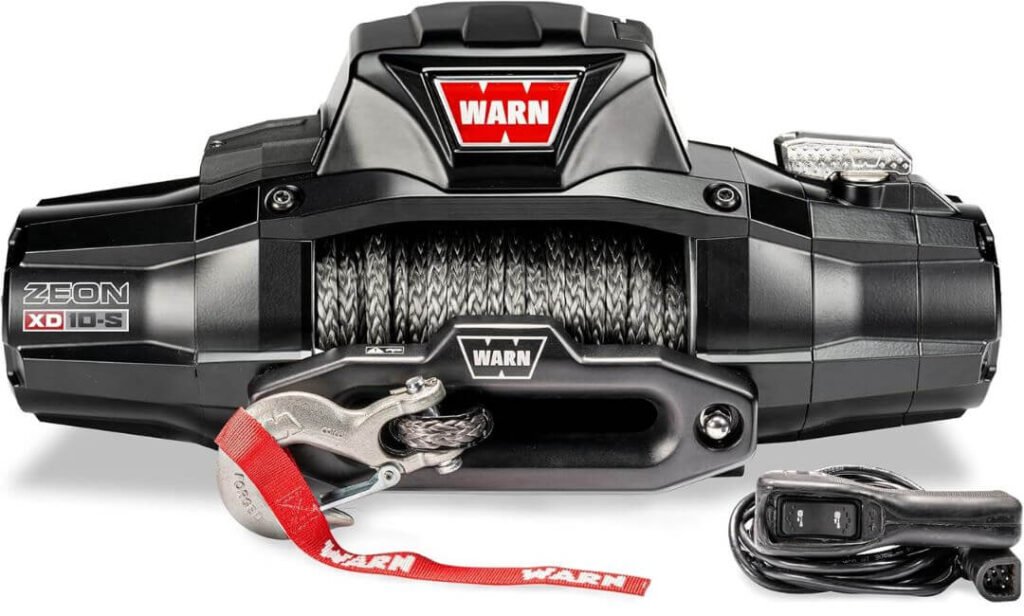
Quick Specs:
- Rated line pull: 10,000 lb
- Rope: 100-ft synthetic rope
- Gear system: Three-stage planetary geartrain
- Controls: HUB wireless receiver with a stated 100+ ft range and waterproof wired remote with a 12-ft lead
- Installation flexibility: Convertible control pack with optional short- or long-cable relocation kits
- Construction: Sealed housing with automotive-grade O-ring seals and corrosion-resistant finishes
A winch is easy to judge by its capacity rating until you need to mount it behind a bumper with limited space. The ZEON XD 10-S addresses that practical problem with a convertible control pack, allowing the control unit to be relocated when the installation calls for a lower-profile arrangement. That flexibility can be particularly useful on custom bumpers, provided the correct relocation kit and cable lengths are selected.
Its three-stage planetary geartrain is another reason to consider it for a serious recovery setup. WARN advertises fast line speed for its class, while the redesigned gearing aims to deliver quieter, more efficient operation. Line speed still depends on the load and available electrical power, so don’t expect the rope to move at its unloaded speed when pulling a vehicle out of deep mud.
The control arrangement is well thought out, too. You get a HUB wireless receiver with a stated range of more than 100 ft, alongside a waterproof wired remote with a 12-ft lead. That gives you two operating options rather than forcing you to rely entirely on a wireless connection. Before purchasing, confirm exactly which HUB functions are supported by the supplied receiver and your device.
What We Like About the Design
- Flexible mounting: The relocatable control pack offers more installation options when bumper space is tight.
- Two control methods: Wireless operation and a wired backup are useful in different recovery situations.
- Purpose-built gearing: The three-stage planetary system is designed for efficient, comparatively quiet operation.
- Attention to sealing: Automotive-grade O-ring seals and corrosion-resistant finishes are valuable for a winch exposed to mud, rain and trail debris.
- A premium recovery package: The combination of synthetic rope, dual controls and installation flexibility makes it worth considering for a carefully planned off-road build.
One Detail to Check Before Ordering
The control-pack relocation kits are optional accessories, not automatically included with every winch kit. If your bumper requires the control pack to be moved, confirm the correct kit and cable configuration before ordering rather than assuming the standard installation will fit.
Where It Fits in a 10,000 lb Winch Setup
The WARN ZEON XD 10-S is a strong option for truck and SUV owners who want premium recovery equipment with flexible mounting and two control methods. Its 10,000 lb rated line pull, 100-ft synthetic rope and three-stage planetary geartrain make it worth considering for regular trail use, particularly when a custom bumper or restricted mounting space makes installation more complicated. The relocatable control pack is a practical advantage, although the correct relocation kit may need to be purchased separately.
Before choosing it for your F-150, Silverado, Ram 1500, Toyota Tundra or Jeep build, check the vehicle’s mounting plate, bumper clearance, electrical requirements and recovery configuration. A 10,000 lb rating alone does not establish suitability for every vehicle or recovery situation. If the fitment checks out and you value the added control options and premium construction, this winch is a compelling choice for a carefully planned recovery setup.
The Insider Pro-Tip
Before installation, measure the available bumper space and check the winch’s current dimensional drawing, mounting bolt pattern and fairlead position. A convertible control pack can solve a clearance problem, but it won’t correct an incompatible mounting plate or insufficient space for the rope to feed cleanly.
Also, don’t size your electrical setup by battery label alone. Follow WARN’s installation instructions for the required wiring, connections and power supply, and inspect the synthetic rope for abrasion or damage before each recovery. The extra attention is worthwhile: a premium winch is only as dependable as the setup supporting it.
#2. Smittybilt X2O-10K Waterproof Synthetic Winch (SB98510)
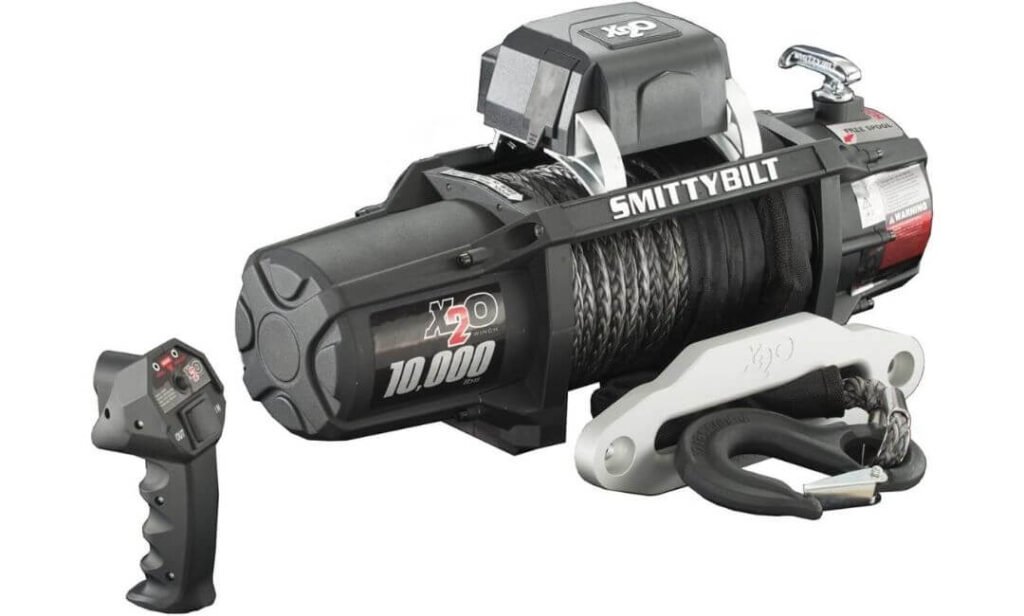
Quick Specs:
- Rated line pull: 10,000 lb (single line)
- Motor: 6.6 HP series-wound motor
- Gear system: Three-stage planetary geartrain with a 218:1 gear ratio
- Rope: 98.5-ft synthetic rope, 3/8-inch diameter
- Controls: Integrated wireless remote and wired remote with a 12-ft lead
- Brake: Automatic out-of-drum brake
- Mounting pattern: 10 × 4.5 inches
- Dimensions: Approximately 22.3 × 5.4 × 9.4 inches
- Weight: Approximately 67 lb
- Battery recommendation: Minimum 650 CCA for winching
- Solenoid pack: Waterproof 500-amp unit with two mounting-position options
When you’re comparing 10,000 lb winches, motor output and rope configuration tell you more than the capacity figure alone. The 6.6 HP series-wound motor in the X2O-10K is designed for demanding recovery work, while its three-stage planetary geartrain and 218:1 gear ratio provide the mechanical reduction needed to pull heavy loads. Smittybilt also advertises optimised line speed, although actual pulling speed will vary with load, battery voltage and the amount of rope remaining on the drum.
The 98.5-ft synthetic rope is another practical advantage. That length gives you more reach than many compact winch setups with shorter ropes, which can help when a suitable recovery anchor isn’t close to the vehicle. Synthetic rope is also generally easier to handle than steel cable, but it isn’t damage-proof: abrasion, contamination, incorrect spooling and poor storage can shorten its service life. Inspect it regularly, particularly after muddy or rocky recoveries.
For wet-weather use, Smittybilt specifies a sealed motor and a waterproof 500-amp solenoid pack. The model is marketed as a waterproof winch, and its published specifications list IP68 protection; however, the rating shouldn’t be treated as permission to ignore installation instructions or assume every electrical connection remains waterproof after installation. Its wired and wireless controls give you two operating options, while the solenoid’s alternative mounting positions can help accommodate different layouts.
What We Like About This Setup
- Strong motor specification: The 6.6 HP series-wound motor makes this a serious contender for truck and off-road recovery applications.
- Useful rope length: The 98.5-ft synthetic rope offers flexibility when choosing an appropriate anchor point.
- Two control options: Wireless operation is convenient, while the 12-ft wired remote provides an alternative.
- Adaptable solenoid placement: Two mounting-position options can help with installation where space is limited.
- Practical mounting dimensions: The 10 × 4.5-inch bolt pattern is common on many winch mounting plates, although the full installation still needs to be checked.
One Installation Detail to Watch
Take care when connecting the power cables. The electrical terminals and studs can be damaged by excessive tightening, so follow the manufacturer’s torque instructions rather than guessing. Also check the available bumper space, cable routing and solenoid position before bolting everything down; a familiar mounting pattern doesn’t guarantee vehicle-specific fitment.
Where It Fits in a 10,000 lb Winch Setup
The X2O-10K is a sensible option for buyers who want a powerful motor, a long synthetic rope and both wired and wireless controls without automatically moving to the highest-priced winch on the market. Its feature set makes it worth comparing for properly equipped pickups, Jeeps and off-road SUVs, particularly if wet-weather protection is an important consideration.
Before ordering, confirm that your bumper or mounting plate supports the winch’s dimensions and bolt pattern, and that your battery, wiring and electrical connections meet Smittybilt’s requirements. The 10,000 lb rating is a rated line-pull figure, not a guarantee that the winch is suitable for every vehicle or recovery angle. Vehicle weight, terrain, rigging and the complete recovery setup all influence what can be done safely.
The Insider Pro-Tip
If you’re choosing this winch for a truck that sees regular mud, water or rocky trails, pay attention to the rope’s condition and the solenoid’s mounting location, not just the advertised waterproof rating. Keep electrical connections secure and protected as directed by the manufacturer, and inspect the synthetic rope for cuts, fraying and abrasion before each recovery. Water protection is valuable, but correct installation and maintenance still matter.
One final check before buying: Smittybilt’s published specifications recommend a minimum 650 CCA battery for winching. That figure is a starting requirement, not a substitute for checking the complete electrical setup, including cable sizing, connection quality and the vehicle manufacturer’s guidance. If your mounting space and electrical system are suitable, the X2O-10K offers a compelling combination of motor output, rope length and control flexibility without relying on headline capacity alone.
#3. Champion Power Equipment 10,000-lb Truck/SUV Winch Kit
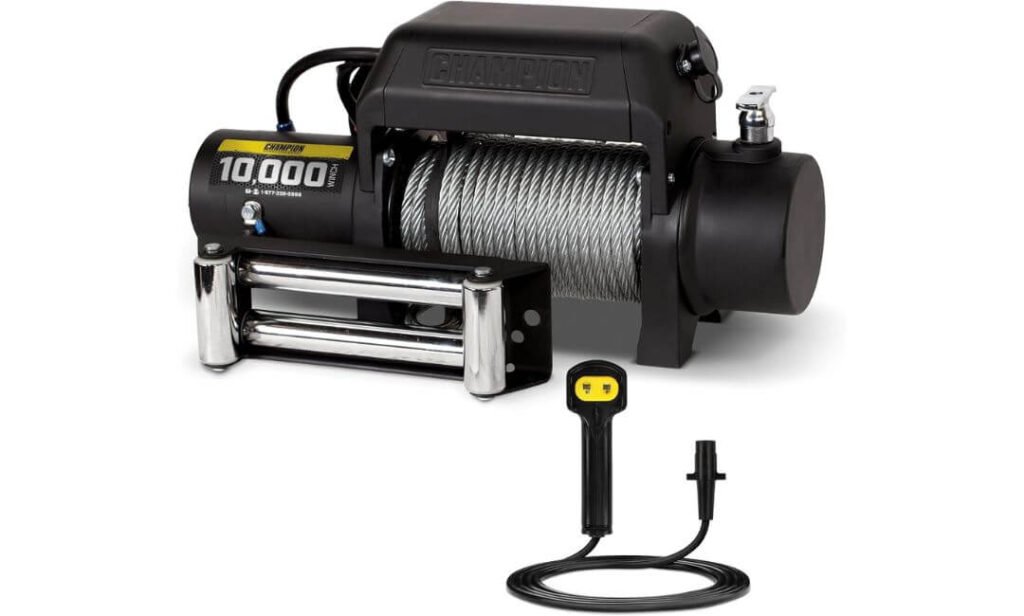
Quick Specs:
- Rated line pull: 10,000 lb
- Motor: 3.6 HP, 12V DC series-wound motor
- Gear reduction: 216:1
- Rope type: 85-ft galvanized steel aircraft cable, 3/8-inch diameter
- Line speed: 3.9 ft/min at full load; 15.7 ft/min with no load
- Controls: Handheld quick-connect wired remote
- Clutch: Free-spooling clutch for manual cable deployment
- Fairlead: Roller fairlead
- Drum dimensions: Approximately 2.5 × 8.8 inches
- Weight: Approximately 85 lb
- Model number: 11008
Not everyone wants to switch to synthetic rope or pay extra for wireless controls. The Champion 10,000-lb winch kit takes a more traditional approach, combining a 3.6 HP, 12V DC series-wound motor with an 85-ft galvanized steel aircraft cable. For buyers who prefer a conventional steel-cable setup, that combination offers a straightforward alternative to the synthetic-rope models higher up this list.
Its published line speeds also give you a more realistic picture of what to expect during recovery. Champion lists 3.9 ft/min at full load and 15.7 ft/min with no load. The difference matters: a heavily loaded winch pulls much more slowly than it does when the cable is unloaded. Those figures are useful when comparing specifications, but actual performance will depend on the load, battery voltage and operating conditions.
The included roller fairlead and free-spooling clutch make the setup practical for conventional winching. The fairlead guides the steel cable onto the drum, while the clutch allows the cable to be pulled out manually when the winch is disengaged, following the manufacturer’s instructions. Its quick-connect handheld remote keeps operation simple without adding a wireless receiver or app-based controls that some buyers may not need.
What We Like About This Setup
- Traditional steel cable: The 85-ft galvanized cable suits buyers who prefer a conventional wire-rope winch.
- Clearly stated line speeds: The full-load and no-load figures help set realistic expectations before purchase.
- Straightforward controls: The handheld quick-connect remote avoids unnecessary wireless features.
- Manual cable deployment: The free-spooling clutch makes it easier to pull out the cable before connecting to a suitable anchor.
- A complete recovery package: The included roller fairlead and cable reduce the need to source those core components separately.
One Detail to Consider Before Buying
This model uses steel cable rather than synthetic rope. Steel cable is durable when correctly maintained, but it is heavier to handle and can develop sharp broken wires. Inspect it regularly for kinks, corrosion, crushed sections and fraying, and use the protective equipment and safe handling procedures specified by the manufacturer.
Where It Fits in a 10,000 lb Winch Setup
The Champion is worth considering if you want a conventional 10,000 lb winch with steel cable, wired controls and uncomplicated operation. It may suit occasional recovery work on a properly equipped truck, SUV or utility trailer, provided the mounting system and electrical setup are compatible. Its appeal is less about premium connectivity and more about having the essential winching components in one package.
Before ordering, check the exact model number, mounting dimensions, bolt pattern and bumper clearance. At approximately 85 lb, the winch also adds a meaningful amount of weight to the front of a vehicle, so the mounting structure must be rated for the installation. The 10,000 lb line-pull rating should not be treated as a guarantee that it can safely recover any vehicle of a particular weight.
The Insider Pro-Tip
With steel cable, the first few layers on the drum matter. Follow Champion’s instructions for cable attachment and spooling, keep the cable evenly wound under appropriate tension, and avoid allowing it to pile up on one side. Poor spooling can cause pinching, uneven winding and damage when the winch is loaded.
Also, don’t judge this model by its 15.7 ft/min no-load speed alone. Its published full-load speed is only 3.9 ft/min, which is the more relevant figure when assessing a loaded pull. If you prefer steel cable and don’t need wireless controls, that trade-off may be perfectly reasonable—provided you understand the maintenance requirements and install the winch correctly.
#4. X-BULL 10,000 lb Synthetic Rope Electric Winch Kit
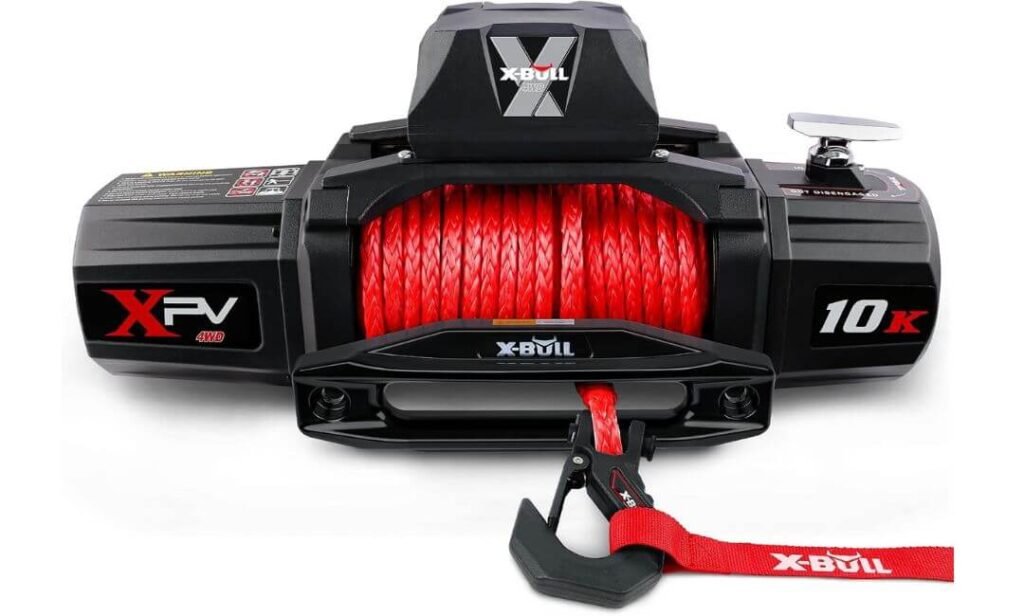
Quick Specs:
- Rated line pull: 10,000 lb
- Motor: 5.6 HP (4.5 kW), 12V DC series-wound motor
- Gear system: Three-stage planetary geartrain with a 218:1 gear ratio
- Rope: 85-ft synthetic rope, 3/8-inch diameter
- Controls: Wireless remote with a stated range of up to 35 m (115 ft), plus wired control
- Weather protection: Advertised IP67 rating
- Clutch: Free-spooling clutch
- Fairlead: Hawse fairlead
- Mounting bolt pattern: Approximately 10 × 4.5 inches
- Listed dimensions: Approximately 20.8 × 6.5 × 10.24 inches
If you want a 10,000 lb winch with synthetic rope and wireless operation but don’t want to jump straight to a premium-priced model, the X-BULL 10K deserves a look. Its stated 5.6 HP, 12V series-wound motor and 218:1 planetary gear ratio give buyers useful specifications to compare against more expensive alternatives. Those figures describe the motor and gearing, however, rather than proving that it will outperform another winch under the same load.
The supplied 85-ft synthetic rope is a practical choice for off-road recovery. Compared with steel cable, synthetic rope is generally lighter and easier to handle, which can make setup and inspection less cumbersome. The hawse fairlead is designed for synthetic rope, but the rope still needs to be spooled correctly and protected from sharp edges, abrasion and excessive heat. A lightweight rope is not an excuse to overlook recovery safety.
The other attraction is its wired and wireless control system. X-BULL lists a wireless operating range of up to 35 m and an IP67 rating for the remote. That gives you flexibility when operating the winch, although actual range depends on the environment and the condition of the equipment. The manufacturer also describes an upgraded solenoid and clutch arrangement, but long-term durability should not be assumed from those design claims alone.
What We Like About the Design
- Useful motor specification: The stated 5.6 HP motor gives buyers a clear reference point when comparing 10,000 lb winches.
- Synthetic rope included: The 85-ft rope avoids the additional weight and handling characteristics of steel cable.
- Two control methods: Wired and wireless operation provide alternatives if one method is inconvenient.
- Common mounting pattern: The approximately 10 × 4.5-inch bolt pattern may suit many compatible winch plates, subject to dimensional checks.
- Purpose-built hawse fairlead: Its design suits synthetic-rope setups when installed and aligned correctly.
One Detail to Check Before Ordering
Don’t assume the standard control-box position will suit every bumper. Measure the available space and check the supplied cables, mounting dimensions and control-box arrangement before installation. Although the listed bolt pattern is common, bumper compatibility is vehicle-specific, and some installations may require a different mounting plate or a permitted control-box relocation.
Where It Fits in a 10,000 lb Winch Setup
The X-BULL is worth comparing if you’re building a recreational off-road setup and want 10,000 lb rated line pull, synthetic rope and wired/wireless controls in one kit. Its feature list is appealing for buyers who prioritise equipment and convenience over premium-brand positioning. For occasional trail recovery, it may be a practical candidate when the vehicle’s mounting system and electrical supply are suitable.
It’s less compelling if your priority is frequent commercial pulling or a proven record of long-term performance under repeated heavy loads. The stated capacity does not tell you how a winch will handle every recovery, and published motor power alone cannot establish durability. Check the current warranty, replacement-part availability and manufacturer instructions before choosing it over an established premium alternative.
The Insider Pro-Tip
Before the first recovery, practise using the wired and wireless controls in a safe, unloaded setup and confirm that you understand the winch’s operating instructions. Keep bystanders clear of the rope path, use appropriately rated recovery equipment and never stand over a loaded synthetic rope. If the winch slows noticeably, follow the manufacturer’s duty-cycle and cooling guidance rather than continuing to pull until the motor overheats.
Also, check the exact product listing for the supplied rope, remote and mounting hardware before purchasing; specifications can vary between listings and revisions. The strongest reason to choose this model is its combination of features and price—not an assumption that it matches premium winches in long-term durability.
#5. VEVOR 10,000 lb Electric Winch
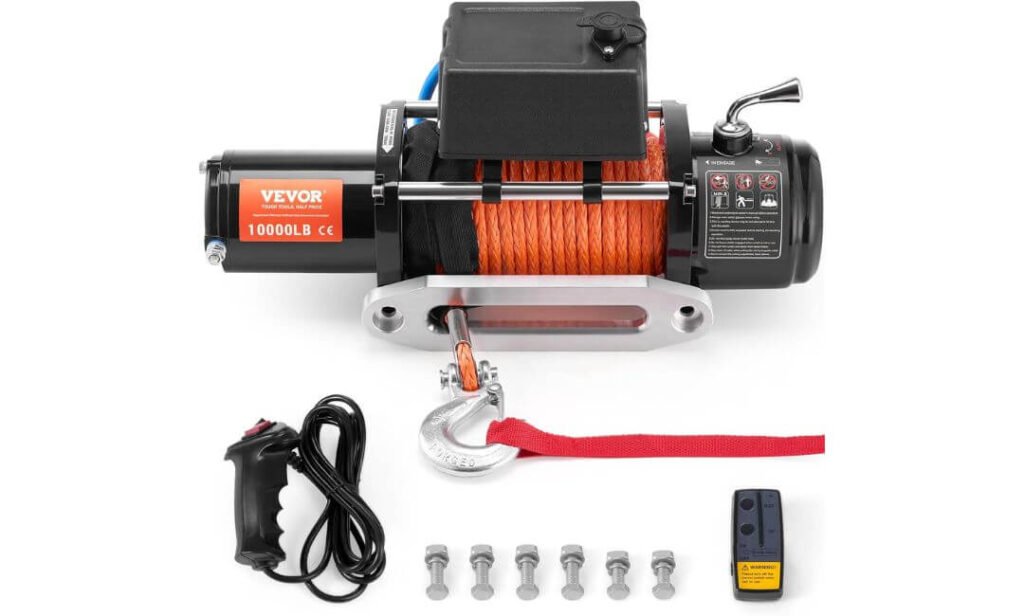
Quick Specs:
- Rated line pull: 10,000 lb
- Motor: 3 HP, 12V DC permanent-magnet copper motor
- Gear system: Three-stage planetary geartrain with a 195.8:1 gear ratio
- Rope: 65-ft, 12-strand high-density polyethylene synthetic rope
- Rope-end markings: Red markings on the final five wraps
- Controls: Wireless remote with a stated 65.6-ft (20 m) range, plus wired remote
- Weather protection: Advertised IP55 rating
- Fairlead: Aluminum fairlead
- Included equipment: Control box, power cables, remote controls and installation hardware as specified in the listing
Not every 10,000 lb winch buyer needs a premium-priced unit with advanced controls or a particularly long rope. The VEVOR 10K electric winch focuses on the essentials: a 12V DC, 3 HP permanent-magnet motor, a three-stage planetary geartrain and a 65-ft synthetic rope. Those specifications make it worth comparing for buyers who want a complete winch kit for recreational recovery or suitable trailer applications without paying for features they may not use.
One useful detail is the rope’s red markings near the final five wraps. They provide a visual warning that you’re approaching the end of the rope, helping you avoid paying attention only to the vehicle being pulled. This is a helpful feature, but it doesn’t replace correct spooling, maintaining the required number of wraps on the drum or following the manufacturer’s operating instructions.
The winch also includes wired and wireless controls, with the wireless remote advertised to work at up to 20 m. That gives you some flexibility when positioning yourself during a recovery. Its IP55 rating is a more limited level of ingress protection than the IP67 or IP68 ratings advertised by some competitors, so buyers who regularly encounter deep water or demanding wet conditions should weigh that difference carefully.
What We Like About the Design
- Useful entry-level feature set: The motor, planetary gearing and synthetic rope cover the main requirements many recreational buyers look for.
- Visible rope-end warning: Red markings make it easier to recognise when the rope is nearing its final wraps.
- Two control options: The wired remote provides an alternative to wireless operation.
- Lightweight rope handling: Synthetic rope is generally easier to handle than comparable steel cable, although it still needs careful inspection.
- Supplied installation components: The included fairlead, control box and wiring components can simplify sourcing, provided the exact kit contents match the current listing.
One Detail to Check Before Ordering
The IP55 rating should not be treated as submersion protection. If your vehicle regularly crosses deep water or you expect prolonged exposure to wet, muddy conditions, compare the manufacturer’s protection guidance with your intended use. Also verify the supplied rope diameter and length, mounting dimensions and wiring requirements before installation; the winch may need a compatible mounting plate or vehicle-specific bracket.
Where It Fits in a 10,000 lb Winch Setup
The VEVOR is worth considering for buyers who want a budget-oriented 10,000 lb winch with synthetic rope and dual controls. Its relatively straightforward feature set may suit occasional recreational recovery or appropriate trailer-pulling applications, provided the load, mounting arrangement and electrical system are within the manufacturer’s specifications. The included rope-end markings are a useful practical touch for buyers learning to operate a winch correctly.
However, its advertised capacity alone doesn’t establish long-term reliability or make it equivalent to more expensive models. If your use involves frequent heavy recoveries, remote locations where a breakdown would be particularly problematic, or regular exposure to severe water conditions, investigate warranty coverage, replacement parts and independent owner feedback before choosing it. For lighter-duty ownership needs, the key question is whether its verified specifications match your setup—not simply whether it costs less.
The Insider Pro-Tip
Before your first pull, learn to recognise the red rope-end markings and stop well before the rope reaches its terminal wraps. Never operate with too little rope remaining on the drum, and follow the manufacturer’s specified minimum-wrap requirement. Keep the rope evenly spooled, inspect it for abrasion or damaged strands, and use an appropriate recovery point rather than an ordinary tie-down point.
Finally, remember that a 10,000 lb winch is not automatically suitable for every 10,000 lb vehicle. The terrain, recovery angle, resistance of the stuck vehicle and rigging arrangement can substantially increase the load. Confirm that the mounting structure and electrical supply are appropriate, and use rated recovery equipment throughout the setup.
#6. XYCLE 10,000 lb Recovery Winch
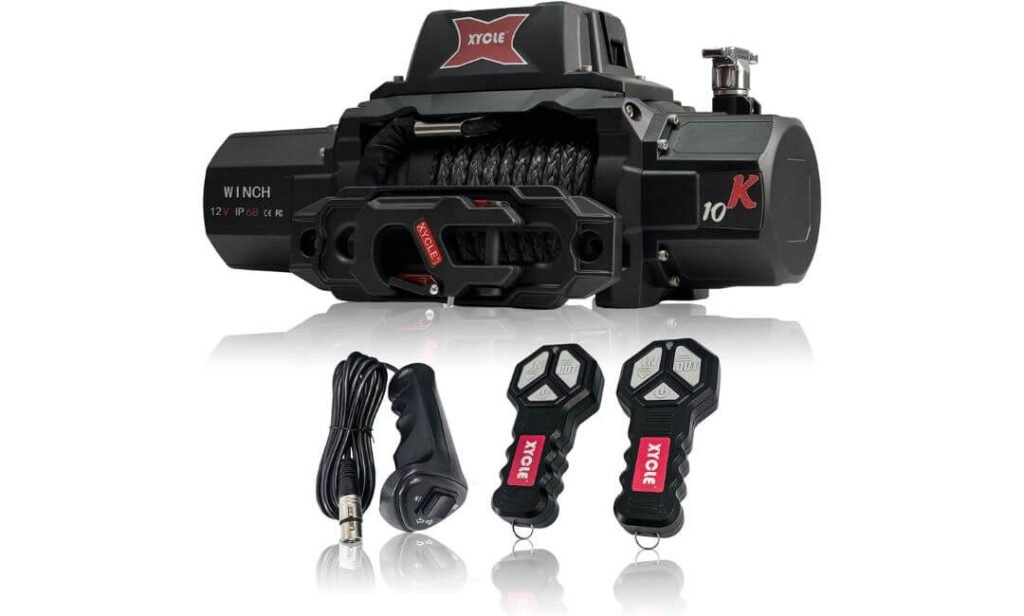
Quick Specs:
- Rated line pull: 10,000 lb
- Electrical system: 12V DC
- Rope: 70-ft synthetic rope, 1/2-inch diameter
- Weather protection: Advertised IP68 rating
- Housing: Aluminum-alloy construction
- Controls: Two wireless remotes with a stated range of up to 100 ft, plus a wired controller
- Fairlead: Aluminum hawse fairlead
- Included hardware: Forged tow hook and installation hardware as specified in the listing
- Mounting pattern: Approximately 10 × 4.49 inches
- Mounting plate: Not included
- Remote batteries: A23 12V batteries required; not included
The XYCLE takes a slightly different approach from the other budget-friendly options in this guide. Its 1/2-inch synthetic rope is thicker than the 3/8-inch rope supplied with several competing models, and the stated 70-ft length gives you a useful amount of line for suitable recovery setups. Rope diameter alone doesn’t prove that a winch is stronger or safer, but it is a specification worth checking alongside the rope’s rated strength, drum capacity and manufacturer instructions.
Another distinguishing feature is its three-control arrangement: two wireless remotes and a wired controller. The wireless remotes are advertised with a range of up to 100 ft, giving you flexibility when positioning yourself during a recovery. The wired controller provides another operating option, although its presence doesn’t eliminate the need to inspect the wiring, connectors and power supply before use. The remote batteries also need to be purchased separately.
The advertised IP68 protection and aluminum-alloy housing make this model worth considering for buyers who regularly encounter wet or muddy trails. Still, an IP rating should be understood within the manufacturer’s stated testing conditions; it doesn’t guarantee that every connection or installation remains waterproof indefinitely. The aluminum hawse fairlead is designed to guide synthetic rope, while the included forged hook and mounting hardware help complete the basic recovery package.
What We Like About the Design
- Thicker synthetic rope: The stated 1/2-inch diameter sets it apart from the 3/8-inch ropes used by several alternatives, although rope strength still needs verification.
- Three control options: Two wireless remotes and a wired controller provide useful operating flexibility.
- Advertised IP68 protection: A feature worth considering for outdoor use, provided the manufacturer’s limitations are followed.
- Aluminum hawse fairlead: Designed for synthetic-rope operation when correctly aligned.
- Useful supplied accessories: The listed hook and installation hardware reduce the need to source every component separately.
One Detail to Check Before Ordering
The mounting plate is not included, so budget for a compatible plate if your bumper doesn’t already have one. Check the 10 × 4.49-inch mounting footprint, available clearance, rope path and electrical connections before ordering. Also account for the A23 remote batteries, which aren’t supplied with the winch.
Where It Fits in a 10,000 lb Winch Setup
The XYCLE is an interesting alternative for buyers who want a thicker synthetic rope, IP68-rated construction and multiple control options without automatically moving to a premium-priced model. Those features make it worth comparing for recreational truck, Jeep and SUV recovery, particularly if you value flexibility in how the winch is operated.
However, the advertised specifications don’t establish its long-term reliability under repeated heavy loads. Before choosing it for frequent trail recovery, confirm the motor and gear-system specifications, duty-cycle limits, warranty terms and availability of replacement parts. The correct mounting plate, battery supply and recovery equipment remain essential, regardless of how many accessories come in the box.
The Insider Pro-Tip
Pay particular attention to the manufacturer’s instruction to maintain at least 10 wraps of synthetic rope on the drum during loaded recovery. Don’t pull until the rope is nearly exhausted; insufficient wraps can allow the rope to detach from its drum attachment. Check the rope for cuts, abrasion and damaged fibres, and spool it evenly before applying a load.
Finally, don’t let the thicker rope or higher waterproof rating make the decision for you. Confirm the rope’s actual rated strength, the winch’s duty-cycle instructions and the mounting requirements for your vehicle. If the specifications and installation suit your needs, the XYCLE offers a distinctive feature combination—but safe recovery depends on the complete setup, not the headline 10,000 lb rating alone.
Best 10,000 lb Winch for the Money in 2026 (Top 6 Compared)
| Comparison point | WARN ZEON XD 10-S | Smittybilt X2O-10K | Champion 11008 | X-BULL 10K | VEVOR 10K | XYCLE 10K |
|---|---|---|---|---|---|---|
| Best suited to | Premium setupFlexible control-pack mounting | Trail recoveryLong synthetic rope | Traditional setupSteel cable and wired control | Feature valueDual controls and synthetic rope | Budget optionStraightforward feature set | Alternative pickThicker rope and three controls |
| Rated line pull | 10,000 lb | 10,000 lb | 10,000 lb | 10,000 lb | 10,000 lb | 10,000 lb |
| Motor | Verify current model specification | 6.6 HP series-wound | 3.6 HP, 12V series-wound | 5.6 HP, 12V series-wound | 3 HP, 12V permanent-magnet | Confirm exact motor specification |
| Rope or cable | 100-ft synthetic rope | 98.5-ft synthetic rope, 3/8 in | 85-ft galvanized steel cable, 3/8 in | 85-ft synthetic rope, 3/8 in | 65-ft synthetic rope, 12-strand HDPE | 70-ft synthetic rope, 1/2 in |
| Weather protection | IP68 / IP69K advertised | IP68 advertised | Confirm current manufacturer rating | IP67 advertised | IP55 advertised | IP68 advertised |
| Remote controls | HUB wireless receiver + wired remote | Wireless + 12-ft wired remote | Quick-connect wired remote | Wireless + wired control | Wireless + wired control | 2 wireless remotes + wired controller |
| Gear system | 3-stage planetary | 3-stage planetary, 218:1 | 216:1 reduction listed | 3-stage planetary, 218:1 | 3-stage planetary, 195.8:1 | Confirm ratio for exact model |
| Fairlead | Confirm kit configuration | Confirm exact kit contents | Roller fairlead | Hawse fairlead | Aluminum fairlead | Aluminum hawse fairlead |
| Mounting footprint | Verify current drawing and bumper clearance | 10 × 4.5 in bolt pattern | Verify exact model drawing | Approx. 10 × 4.5 in | Verify current product drawing | 10 × 4.49 in; plate not included |
| Electrical consideration | Follow WARN wiring requirements | 650 CCA minimum recommended | Follow Champion wiring requirements | Verify wiring and duty-cycle guidance | Verify wiring and duty-cycle guidance | Verify wiring and duty-cycle guidance |
| Main trade-off | Premium purchase; relocation kit may be extra | Heavier than some synthetic-rope alternatives | Steel cable needs careful handling and inspection | Long-term durability needs independent verification | IP55 is less protective than IP67/IP68 ratings | Mounting plate and remote batteries not included |
Specifications reflect the supplied product information and advertised ratings. Confirm the exact SKU, current manufacturer documentation, kit contents and vehicle fitment before ordering. Winch capacity alone does not determine whether a recovery is safe.
Buying Guide for Choosing the Right 10,000 lb Winch
A 10,000 lb winch can be a valuable addition to a truck, Jeep or SUV, but the capacity printed on the box is only one part of the decision. Rope type, motor performance, electrical demand, weather protection and mounting compatibility all affect how well a winch suits your vehicle. Before choosing between the six models in this guide, focus on the recovery conditions you expect to encounter and the equipment needed to install and operate the winch safely.
Understand What a 10,000 lb Load Rating Really Means
The 10,000 lb rating refers to the winch’s rated line pull under specified conditions, not the maximum vehicle weight it can recover in every situation. A vehicle rolling freely on firm ground presents a different load from one buried in mud, trapped against rocks or sitting on a steep incline. Wheel resistance, terrain and recovery angles can increase the force required considerably.
Before buying, consider these factors:
- Vehicle weight: Account for passengers, fuel, accessories and loaded equipment rather than relying solely on the advertised curb weight.
- Recovery conditions: Deep mud, loose sand, snow and steep slopes can increase the pulling force required.
- Recovery method: A straight pull and a pull involving additional rigging can place different demands on the equipment.
- Capacity margin: Choose a winch that meets the manufacturer’s guidance for your expected recovery loads. Don’t routinely operate at the limit of its rated capacity.
A 10,000 lb winch may suit some full-size pickups and off-road SUVs, but it isn’t automatically adequate for every heavy vehicle or recovery situation. If your expected loads exceed the winch’s capabilities, consider a higher-capacity system.
Choose Between Synthetic Rope and Steel Cable
Rope material affects handling, maintenance, weight and the way you should use your winch. Five of the models in this comparison feature synthetic rope, while the Champion 11008 uses galvanized steel cable. Neither option is best for every owner.
Synthetic rope
Synthetic rope is generally lighter and easier to handle than steel cable. It can be a practical choice for recreational off-road use, particularly when you regularly need to pull the line out and position it around a suitable anchor point.
The trade-off is that synthetic rope can suffer damage from abrasion, sharp edges, excessive heat, contamination and poor storage. It requires regular inspection and a compatible fairlead.
Steel cable
Steel cable is a traditional option that can suit buyers who prefer wire-rope construction. The Champion kit includes an 85-ft galvanized steel aircraft cable and a roller fairlead.
Steel cable is heavier to handle and can develop kinks, corrosion or dangerous broken wires. Wear suitable gloves and inspect the cable before use.
| Feature | Synthetic rope | Steel cable |
|---|---|---|
| Handling | Generally lighter and easier to handle | Heavier and stiffer |
| Maintenance | Inspect for cuts, abrasion and damaged fibres | Inspect for broken wires, kinks and corrosion |
| Fairlead | Commonly paired with a compatible hawse fairlead | Commonly paired with a roller fairlead |
| Best consideration | Rope condition and abrasion protection | Cable condition and careful handling |
Both types can cause serious injury if they fail under load. Keep people clear of the line path and follow the winch manufacturer’s safety instructions.
Check the Fairlead Before Choosing Your Rope
The fairlead guides the rope or cable as it enters and leaves the drum. Its job is to help the line feed correctly, not to increase the winch’s rated capacity.
- Hawse fairlead: Commonly used with synthetic rope. Check for smooth surfaces, correct alignment and adequate clearance.
- Roller fairlead: Commonly used with steel cable. Inspect the rollers for damage and confirm that they turn freely.
The X-BULL and XYCLE kits list hawse fairleads, while the Champion kit includes a roller fairlead. VEVOR lists an aluminum fairlead, so verify its exact design and compatibility with the supplied rope. For the WARN and Smittybilt kits, confirm the current package contents before assuming a fairlead is included.
Understand Gear Ratio, Motor Power and Line Speed
The motor supplies power, while the gearbox converts that power into the rotation and torque required to pull a load. A higher numerical gear ratio generally provides greater mechanical reduction, but gear ratio alone cannot tell you which winch will pull faster or perform better. Motor characteristics, drum diameter, electrical voltage and load all affect performance.
Here are some of the published specifications worth comparing:
- Smittybilt X2O-10K: 6.6 HP series-wound motor and 218:1 gear ratio.
- X-BULL 10K: 5.6 HP series-wound motor and 218:1 gear ratio.
- VEVOR 10K: 3 HP permanent-magnet motor and 195.8:1 gear ratio.
- Champion 11008: 3.6 HP series-wound motor and 216:1 gear reduction.
- WARN ZEON XD 10-S: Three-stage planetary geartrain, with the manufacturer promoting fast line speed for its class.
These figures aren’t a direct performance ranking. Where the manufacturer provides them, compare both loaded and unloaded line speed. A winch may retrieve rope quickly without a load but operate much more slowly when pulling a stuck vehicle.
Duty cycle matters as well. Electric winches generate heat under load, and repeated heavy pulls without adequate cooling can damage the motor, solenoid or wiring. Follow the exact model’s operating and cooling instructions rather than continuing to pull when the winch is struggling.
Look Beyond the Waterproof Rating
Water and dust protection matter if your vehicle regularly encounters rain, mud, snow or water crossings. However, IP ratings describe specific ingress-protection conditions; they don’t guarantee that every component will remain waterproof indefinitely.
| Model | Advertised protection | What to consider |
|---|---|---|
| WARN ZEON XD 10-S | IP68/IP69K | Confirm the current manufacturer’s documentation and test conditions. |
| Smittybilt X2O-10K | IP68 | Inspect seals and accessible electrical connections after demanding use. |
| X-BULL 10K | IP67 | Follow the stated immersion and operating limitations. |
| VEVOR 10K | IP55 | Offers a lower stated protection level than IP67/IP68 models. |
| XYCLE 10K | IP68 | Check the manufacturer’s specific limitations for immersion and outdoor use. |
| Champion 11008 | Not established from the supplied specifications | Verify the current manufacturer documentation. |
IP67 generally covers dust protection and temporary immersion under specified test conditions. IP68 covers immersion under conditions specified by the manufacturer, while IP69K concerns high-pressure, high-temperature water jets under defined testing conditions. These ratings aren’t interchangeable guarantees against every combination of depth, pressure, temperature and duration.
After wet or muddy use, inspect the rope, fairlead, fasteners and accessible electrical connections. Follow the manufacturer’s cleaning and maintenance instructions, especially where sealed components are concerned.
Match the Winch to Your Battery and Electrical System
A 12V winch can draw very high current during a heavy pull. The battery, cable gauge, cable length, connections and solenoid are therefore just as important as the motor specification.
Before installation, check the following:
- Voltage: Confirm that the winch matches the vehicle’s electrical system.
- Battery recommendation: Follow the manufacturer’s minimum battery specification. Smittybilt lists a minimum 650 CCA recommendation for winching; don’t automatically apply that figure to other models.
- Power cables: Use the specified cable gauge and length, routing the cables away from exhaust components, sharp edges and moving parts.
- Connections: Ensure terminals are correctly installed and secure. Poor connections can cause heat and voltage drop.
- Control-box placement: Confirm where the solenoid and control box can be mounted, and whether a relocation kit or longer cables are needed.
Never replace a specified fuse or electrical protection component with a higher-rated one simply because it keeps tripping. If cables become unusually hot, you smell burning insulation or the motor behaves abnormally, stop using the winch and investigate the problem before operating it again.
Confirm Mounting Compatibility Before You Order
A common mounting bolt pattern is helpful, but it doesn’t establish universal vehicle fitment. The bumper or mounting plate must support the winch and the forces involved in recovery. The mounting structure, fasteners, fairlead position and rope path all need to be suitable for the installation.
The X-BULL lists an approximately 10 × 4.5-inch mounting pattern, the Smittybilt lists 10 × 4.5 inches, and the XYCLE lists approximately 10 × 4.49 inches. Those measurements are close, but you should still confirm the exact hole spacing and manufacturer’s drawing before purchasing a mounting plate.
Check these details before ordering:
- Available space: Measure the winch body, control box, cables and fairlead against the bumper’s internal dimensions.
- Mounting strength: Use a winch plate and fasteners rated for the intended installation.
- Control-box placement: Check whether relocation is possible and whether the required kit is included or sold separately.
- Rope alignment: Ensure the rope feeds through the fairlead without contacting sharp edges or bodywork.
- Vehicle-specific restrictions: Newer vehicles may have sensors, cameras, cooling components or crash structures that complicate installation. Older vehicles with aftermarket bumpers also need careful fitment checks.
If you aren’t certain that the mounting structure is suitable, have the installation checked by a qualified off-road accessory installer.
Follow Safe Recovery Practices and Maintain the Winch
A winch is recovery equipment, not a substitute for a suitable recovery plan. Assess the terrain, choose an appropriate rated anchor point and use compatible recovery accessories. Keep bystanders away from the winch line, and never stand directly in line with a loaded rope or cable.
Make these checks part of your routine:
- Inspect the rope or cable: Look for fraying, cuts, broken wires, kinks, abrasion and other damage.
- Check mounting hardware: Look for loose fasteners, corrosion and signs of movement or damage.
- Inspect the fairlead: Check for sharp edges, damaged rollers and secure mounting.
- Test the controls: Check wired and wireless controls before heading out, and replace missing remote batteries.
- Respect the duty cycle: Allow the winch to cool according to its manual.
- Re-spool carefully: Keep the line evenly distributed and maintain the manufacturer’s required minimum wraps on the drum.
The XYCLE listing specifically calls for maintaining at least 10 wraps of synthetic rope on the drum during loaded recovery. Other models may have different requirements, so follow the instructions for your exact winch.
Quick Reference for Choosing a 10,000 lb Winch
| Your priority | Models worth comparing | What to verify |
|---|---|---|
| Premium construction and flexible control-pack mounting | WARN ZEON XD 10-S | Kit contents, warranty and relocation requirements |
| High stated motor output and long synthetic rope | Smittybilt X2O-10K | Electrical requirements, mounting clearance and rope condition |
| Traditional steel-cable operation | Champion 11008 | Cable maintenance, mounting compatibility and warranty |
| Synthetic rope with wired and wireless controls | X-BULL 10K | Duty cycle, installation space and parts support |
| Budget-oriented synthetic-rope kit | VEVOR 10K | IP55 limitations, mounting dimensions and warranty |
| Thicker synthetic rope and three control options | XYCLE 10K | Rope strength, mounting plate and remote batteries |
Start with the recovery conditions you expect to face, then eliminate any winch that doesn’t meet your mounting, electrical and rope requirements. Compare prices and extra features only after those essentials are satisfied. The right 10,000 lb winch is the one whose verified specifications, installation requirements and maintenance demands suit your vehicle and intended use—not simply the one with the longest feature list.
High-Speed Pulling: What to Expect from a 10,000 lb Winch
A 10,000 lb winch is not automatically a fast winch. Its actual pulling speed depends on the motor, gear reduction, battery voltage under load, rope layer on the drum and the resistance the vehicle encounters during recovery. A winch may retrieve slack rope quickly when unloaded but slow considerably once it starts pulling a vehicle through mud, sand or an uphill section.
For a practical comparison, look for both no-load line speed and loaded line speed in the manufacturer’s specifications. No-load speed tells you how quickly the drum turns without a meaningful pulling load. Loaded speed is more relevant during recovery, although the actual figure will vary with the load and conditions. If a specification sheet lists only one speed figure, check whether it refers to loaded or unloaded operation before using it to judge performance.
How Motor Speed and Gear Ratio Affect Recovery Time
Motor power and gear ratio work together to determine how a winch performs under load. A motor with sufficient power can help maintain pulling performance, while the geartrain converts motor speed into the torque needed to move a heavy load. A higher numerical gear reduction generally favours torque over drum speed, while a lower reduction can allow faster drum rotation, depending on the motor and overall design.
However, gear ratio alone does not tell you which winch will recover a vehicle faster. Motor design, electrical supply, drum diameter, rope layering and the load itself all influence the result. A winch with a powerful motor may still slow significantly if the battery voltage drops or the vehicle is deeply bogged down.
Rope layering also matters. As rope builds up on the drum, the effective drum diameter increases. This can increase the amount of rope retrieved per revolution, but it reduces the mechanical advantage available at the rope. In practical terms, the outer layers can retrieve rope faster while providing less pulling force than the inner layers.
The Trade-Off Between High Line Speed and Reliable Pulling Power
Fast line speed is useful when taking up slack, repositioning equipment or completing a relatively light pull. During a demanding recovery, however, consistent pulling ability and controlled operation matter more than the highest advertised speed. A winch that slows under heavy resistance is not necessarily underperforming; it is working against a greater load.
The key is to distinguish between speed and pulling capacity. The 10,000 lb rating represents the manufacturer’s specified line-pull capacity under defined conditions, not the force available at every point on the drum or a promise that the winch will maintain the same speed at its rated load. Pulling capacity generally decreases as additional rope layers build up on the drum.
Heat is another consideration. Extended or repeated heavy pulls place stress on the motor, solenoid, wiring and battery. Operating continuously beyond the manufacturer’s recommended duty cycle can lead to overheating or electrical problems. Allow the winch to cool as directed by its manufacturer rather than trying to compensate for slow progress by running it for longer periods without a break.
How to Get Better Line Speed Without Sacrificing Safety
A properly matched electrical and mounting setup helps a winch deliver its intended performance. These checks are worth making before the first recovery:
- Use a suitable battery and electrical system: Follow the manufacturer’s battery and cable recommendations. Undersized wiring, loose connections or a weak battery can cause voltage drop, slower pulling and excessive heat.
- Keep the rope layers under control: When practical, keep enough rope on the drum for safe operation while avoiding unnecessary layers. Always retain the minimum number of wraps specified by the manufacturer.
- Use an appropriate pulling arrangement: A correctly rated snatch block can provide mechanical advantage and reduce the load on the winch, but it also increases the amount of rope that must be retrieved. The setup must account for the resulting forces on the anchor point, recovery equipment and vehicle.
- Reduce avoidable resistance: Clear obstacles where safe, choose a suitable recovery line and avoid sharp changes in pulling direction. A winch should not be expected to overcome every situation through speed or motor power alone.
- Allow cooling time: Follow the manufacturer’s duty-cycle guidance, especially during repeated pulls or recovery from deep mud and steep terrain.
- Monitor the recovery: Keep people clear of the rope path, maintain a safe distance and stop if the rope, mounting hardware or electrical components show signs of damage or abnormal heat.
Which Winch Setup Makes Sense for Faster Recovery?
For occasional recoveries, prioritise reliable electrical connections, suitable mounting hardware and a line speed specification that clearly distinguishes loaded from no-load operation. For frequent off-road use, pay closer attention to the manufacturer’s duty-cycle guidance, thermal limits, service support and replacement-part availability. A longer rope may offer more reach, but it does not automatically improve pulling speed or capacity.
If speed is a deciding factor, compare verified loaded line-speed figures under comparable conditions rather than relying on motor horsepower, gear ratio or no-load speed alone. When manufacturers do not publish directly comparable figures, it is more accurate to treat speed as an unknown than to assume that one winch will outperform another.
Ultimately, the best 10,000 lb winch is not simply the one that retrieves rope fastest. It is the one that provides suitable pulling capacity, predictable control and dependable operation for your vehicle, electrical system and intended recovery conditions.
Synthetic Rope vs Steel Cable for 10,000 lb Winches
Choosing between synthetic rope and steel cable affects more than the weight of a 10,000 lb winch. It changes how easily you handle the line, how you maintain it, how it responds to abrasion and heat, and what precautions you need during recovery. Neither option is automatically better for every truck, SUV or off-road setup. The right choice depends on the terrain, frequency of use, storage conditions and the type of recovery work you expect to do.
Synthetic Rope vs Steel Cable: Key Differences
| Feature | Synthetic Rope | Steel Cable |
|---|---|---|
| Weight | Lighter and easier to handle | Heavier and more tiring to handle |
| Handling | Flexible, with less tendency to form sharp kinks | Can develop kinks, broken wires and sharp strands |
| Abrasion resistance | More vulnerable to cuts and abrasion against rocks | Generally better suited to rough contact, but can still wear or fray |
| Heat resistance | Sensitive to excessive heat and friction | Generally tolerates heat better |
| Corrosion | Does not rust, but can be damaged by contamination and moisture | Can corrode, particularly when damaged or poorly maintained |
| Maintenance | Needs inspection for cuts, abrasion, contamination and UV damage | Needs inspection for broken wires, kinks, crushing and corrosion |
| Typical fairlead | Compatible hawse fairlead, as specified by the winch manufacturer | Roller fairlead is commonly used |
| Best suited to | Many recreational off-road setups where low weight and easier handling matter | Applications where steel cable’s abrasion and heat characteristics are advantageous |
Both rope types must be compatible with the winch drum, fairlead and rated pulling capacity. The cable or rope supplied with a winch should not be replaced with another line based on diameter alone; check the manufacturer’s specifications for line construction, strength and compatibility.
Benefits of Synthetic Rope on a 10,000 lb Winch
Synthetic rope is popular for recreational off-roading because it is substantially lighter than a comparable steel cable and is generally easier to pull out, guide and rewind. That difference becomes noticeable when you need to deploy a long line across uneven ground or pack recovery equipment back into a vehicle after a difficult trail session.
Lighter weight and easier handling: Synthetic rope reduces the weight of the line itself, making it easier to manage during setup and recovery. It can also reduce the amount of weight added to the front of a vehicle, although the complete winch, mounting plate and accessories still determine the overall installation weight.
More flexible handling: Synthetic rope is less prone to permanent kinks than steel cable and is generally easier to coil and position. However, it can still twist, snag, become contaminated or suffer hidden damage. Follow the manufacturer’s instructions for unwinding and rewinding the line evenly onto the drum.
Different behaviour if the line fails: Synthetic rope generally stores less elastic energy than steel cable of comparable application, but it can still recoil and cause serious injury if it breaks under tension. Never treat synthetic rope as harmless or stand near a tensioned recovery line.
The main compromise is that synthetic rope needs more careful protection from abrasion, sharp edges, excessive heat and prolonged ultraviolet exposure. If the winch will frequently operate around jagged rocks, hot surfaces or debris, inspect the route carefully and use only manufacturer-approved protective sleeves and accessories.
When to Choose a 10,000 lb Winch With Steel Cable
Steel cable can make sense for applications where abrasion and heat exposure are important considerations. It is often found on utility, trailer and work-oriented winches, although the suitability of any particular cable depends on its construction and the manufacturer’s intended use.
Better tolerance of certain harsh conditions: Steel cable generally handles contact with heat sources better than synthetic rope and may be a practical choice in environments where rope could be exposed to hot components. It is not immune to damage, and damaged strands can create serious handling hazards.
Suitable for demanding work environments: For frequent use around abrasive surfaces, steel cable may be preferable when the installation and operating conditions suit it. Even so, dragging a cable across sharp edges or allowing it to rub against the fairlead incorrectly can shorten its service life.
Important disadvantages: Steel cable is heavier, can develop permanent kinks and may corrode if moisture reaches damaged areas or the cable is not maintained. Broken wires can protrude and cut your hands, so wear suitable heavy-duty gloves when handling it and never run your bare hand along the cable to check its condition.
For a steel-cable setup, inspect the entire accessible length for kinks, crushed sections, corrosion and broken wires. Replace a damaged cable according to the manufacturer’s guidance rather than trying to straighten a serious kink and continuing to use it.
Synthetic Rope Safety and Maintenance
Synthetic rope is not maintenance-free. Dirt, sand and fine grit can work into its fibres, while cuts, abrasion and heat can weaken the line even when the damage is not obvious from a distance. A basic inspection before and after demanding recoveries helps identify problems before the next pull.
- Inspect the full length: Look for cuts, fraying, flattened or glazed areas, discolouration, severe abrasion and other changes in the rope’s construction. Pay particular attention to sections that contact the fairlead or drum.
- Keep the rope clean: Mud and grit can contribute to internal abrasion. Clean and dry the rope according to the manufacturer’s instructions; avoid chemicals or cleaning methods that could damage its fibres.
- Protect it from sharp edges: Keep the rope away from jagged rocks, damaged fairleads and sharp vehicle components. Use a suitable protective sleeve where approved, but do not assume a sleeve makes every contact point safe.
- Store it properly: When the winch is not in use, protect exposed rope from prolonged sunlight, unnecessary moisture and contamination. Follow the manufacturer’s recommendations for covering and storing the winch.
- Wind it onto the drum correctly: Keep the rope evenly spooled and maintain the minimum number of wraps required by the manufacturer. Follow the prescribed initial spooling procedure for a new line.
- Retire damaged rope: Do not continue using a line with serious cuts, heat damage, significant abrasion or uncertain structural integrity. Follow the manufacturer’s inspection and replacement criteria.
Before a recovery, check the rope, hook, fairlead, mounting hardware and electrical connections. Use only compatible, appropriately rated recovery accessories, keep bystanders clear of the line and never touch a rope under tension.
Waterproof Ratings and Rope-System Protection
A winch’s advertised waterproof or ingress-protection rating does not automatically mean that its rope, remote controls, electrical connections and every accessory have identical protection. The complete system includes several components, each of which may have different exposure limits.
For example, a winch may have a stated IP rating for its housing or specified components, but that rating should not be interpreted as a guarantee that the entire installation can be submerged indefinitely. Check the manufacturer’s documentation to confirm which parts were tested, the conditions covered by the rating and any restrictions on water exposure.
Synthetic rope does not rust, but that does not make it immune to water-related damage. Mud, grit and debris can remain trapped in the fibres, and a wet line stored without adequate drying may develop contamination or other problems. Steel cable, meanwhile, needs particular attention to corrosion, especially if its protective coating is damaged.
After a wet or muddy recovery, inspect the rope or cable, fairlead, drum and accessible electrical connections. Clean and dry the line as directed, and check for corrosion, damage or moisture where the manufacturer’s maintenance instructions recommend it. Avoid pressure-washing electrical components or directing water into openings unless the manufacturer explicitly permits it.
Which Is Better for Your 10,000 lb Winch?
For many recreational off-road users, synthetic rope is a sensible choice because it is lighter and easier to handle. Steel cable remains worth considering for work-oriented applications where its heat tolerance and resistance to some forms of abrasion suit the operating environment.
Make the decision based on the conditions you will actually encounter, not simply the winch’s pulling rating or the assumption that one rope type is universally safer. Confirm the rope’s rated capacity, compatible fairlead, minimum drum wraps, maintenance requirements and replacement criteria before buying.
Whichever option you choose, the rope is only one part of a safe recovery system. Correct mounting, sound electrical connections, suitable anchor points and properly rated recovery accessories are equally important when using a 10,000 lb winch.
Wireless Control and Connectivity Options for 10,000 lb Winches
Wireless control can make a 10,000 lb winch easier to operate during off-road recovery, particularly when the operator needs to stand where the rope, vehicle and recovery path are clearly visible. However, a wireless remote is not automatically safer than a wired controller. Its value depends on reliable communication, sensible operator positioning, compatible equipment and the ability to stop the winch promptly when conditions change.
When comparing winches, check whether wireless control is included, whether a wired remote is also supplied and how the manufacturer specifies the remote’s operating range. These details matter more than the simple presence of a wireless-control feature.
Why Choose a 10,000 lb Winch With a Wireless Remote?
A wireless remote allows the operator to control the winch without remaining physically connected to it by a cable. This can make it easier to move to a suitable observation point, keep clear of the mounting area and monitor how the rope tracks across the fairlead.
More flexible positioning: The operator can select a position with a clear view of the recovery, provided it remains outside the rope path and other hazards. This is especially useful when the winch is mounted behind a bumper or in a location where the wired controller’s cable limits movement.
Less cable management: Without a remote cable stretching across the working area, there is less risk of the cable snagging on equipment or creating an additional trip hazard. The wireless handset still needs to be stored securely and kept away from water or impact beyond its specified protection.
Convenient control during setup: Wireless control can make it easier to operate the winch while checking rope alignment and observing the vehicle’s movement. The operator must still maintain a safe position and must not approach a tensioned line to correct its alignment.
Wireless operation does not change the winch’s rated capacity, improve its mechanical pulling power or remove the need for a properly rated anchor point. It is a control convenience, not a substitute for correct recovery technique.
Wireless Remote Range and Signal Reliability
Advertised wireless range is usually measured under particular conditions and should not be treated as a guaranteed working distance in every recovery. Obstacles, vehicle bodywork, interference, remote battery condition and the receiver’s placement can all affect signal reliability.
Before buying, check the manufacturer’s stated range and operating instructions. A longer advertised range is not necessarily an advantage if the operator cannot maintain a clear view of the recovery or communicate effectively with the spotter.
For actual use:
- Keep the remote within the manufacturer’s specified operating range.
- Maintain a clear view of the winch line and the vehicle whenever possible.
- Check the remote’s battery condition before heading off-road.
- Test the controls according to the manufacturer’s instructions before a demanding recovery.
- Stop if the signal becomes intermittent or the winch responds unpredictably. Do not continue pulling on the assumption that the connection will recover.
A wireless remote should never encourage the operator to stand farther away than is safe or move behind an obstacle simply to maximise distance from the vehicle.
Wired Remotes, Wireless Controllers and Smartphone Apps
A wired remote remains useful as a backup when wireless communication is unreliable, provided the winch manufacturer supports both control methods and the wired controller is compatible with that specific model. A supplied wired remote can also be practical when the operator needs a predictable connection within the cable’s reach.
Before ordering, verify whether the winch includes both remotes or requires a separate accessory. Check the connector type, receiver compatibility, power requirements and any model-specific restrictions. Wireless controllers that look similar are not necessarily interchangeable, even when they are sold for winches with the same pulling capacity.
Smartphone app control is a separate feature and should not be assumed just because a winch includes wireless operation. Some winches use a dedicated handheld transmitter and receiver rather than a mobile app. If app support is advertised, confirm the exact compatible model, supported phone operating system, connection method and whether the app provides full winch control or only monitoring and configuration functions.
Do not rely on a smartphone as the only control method unless the manufacturer explicitly designs the winch for that arrangement. Phone battery life, connection interruptions, screen visibility and app compatibility can all become problems in wet, cold or dusty conditions.
Safe Remote Placement and Communication With Spotters
The operator’s position is one of the most important parts of a controlled recovery. Wireless operation provides freedom to move, but that freedom should be used to improve visibility and separation from hazards—not to stand close to the rope or in the direction of a potential failure.
Choose a position that provides a clear view of the vehicle, winch line and relevant anchor point while keeping you outside the line of pull and away from likely recoil paths. Do not stand over the rope, straddle it or reach across it while the system is under tension. Maintain the separation distances and exclusion zones specified by the winch and recovery-equipment manufacturers.
If a spotter is helping, agree on clear commands before applying tension. Everyone involved should understand the stop signal, know who has authority to call a halt and avoid giving conflicting instructions. The operator should stop immediately if the spotter loses sight of the recovery, someone enters the hazard area or the vehicle moves unexpectedly.
A wireless remote does not replace communication between the operator and spotter. In noisy environments, use agreed hand signals or another reliable method, but do not continue pulling when signals are unclear. Never allow anyone to approach the rope, fairlead or anchor point to make an adjustment while the line is tensioned.
What to Check Before Buying a Wireless Winch
Use these checks to establish whether the remote-control system suits your recovery setup:
- Included controls: Confirm whether a wireless handset, wired remote, receiver and required batteries are included.
- Specified range: Compare the manufacturer’s published range, but prioritise reliable operation and visibility over maximum distance.
- Compatibility: Verify that replacement remotes and receivers are approved for the exact winch model.
- Weather protection: Check the protection rating for the handset and receiver separately. A rating for the winch housing does not automatically apply to its remote.
- Power and battery requirements: Check how the remote is powered, how its battery is replaced and what the manufacturer recommends before storage.
- Manual override or backup: Determine whether a supported wired controller is available if the wireless remote fails.
- Control behaviour: Understand the manufacturer’s instructions for starting, stopping and responding to a lost or interrupted connection before using the winch under load.
Is Wireless Control Worth It on a 10,000 lb Winch?
For recreational off-roading, wireless control is a useful feature when it allows the operator to observe the recovery from a better position. A combination of wireless and wired controls offers additional flexibility, provided both are compatible and maintained properly.
Do not choose a winch on remote range alone. Rated pulling capacity, mounting compatibility, electrical requirements, rope or cable quality and manufacturer support remain more important to the overall setup. Wireless connectivity should make a correctly configured recovery easier to manage—not encourage a riskier one.
Installation and Mounting Guidelines for a 10,000 lb Winch
A 10,000 lb winch is only as dependable as the structure supporting it, the electrical system powering it and the hardware connecting it to the recovery point. Choosing a winch that fits the available space is not enough; the mounting surface, bolt pattern, fairlead position and wiring must all be suitable for the intended load.
Before ordering, check the winch manufacturer’s installation manual alongside the vehicle or bumper manufacturer’s fitment information. Mounting dimensions and electrical requirements vary between models, so do not assume that every 10,000 lb winch will fit the same bumper or use identical wiring.
Mounting Surface Requirements and Frame Compatibility
The mounting plate must be designed for winch use and securely attached to an appropriate structural part of the vehicle. A decorative bumper face, thin sheet metal or an improvised bracket should not be treated as a suitable mounting point simply because the winch’s bolt holes line up.
Start by checking the winch’s mounting pattern, the plate’s specified load capacity and the bumper manufacturer’s compatibility guidance. Confirm that the mounting arrangement transfers recovery forces into the intended structural attachment points. If the installation requires drilling, welding or changes to the vehicle’s structure, follow the relevant manufacturer’s instructions and seek a qualified installer when necessary.
Also check the available space around the drum, motor, control box and wiring. A winch can match the bolt pattern yet still interfere with the bumper, grille, suspension components or other accessories. The rope must travel through the fairlead without rubbing against sharp edges or contacting nearby parts.
Before tightening the mounting hardware, verify that the winch and fairlead are correctly aligned. Use the specified fastener type, grade, length and tightening torque. Do not substitute random bolts or rely on an unverified universal mounting plate. Incorrect hardware or poor alignment can compromise the installation under load.
Choosing the Correct Fairlead for Synthetic Rope or Steel Cable
The fairlead guides the rope or cable as it enters and leaves the drum. It must be compatible with the line type, line diameter and winch installation.
For synthetic rope: A compatible hawse fairlead is commonly used because it provides a smooth guide surface without the rollers found in a roller fairlead. Check that the fairlead is specifically approved for the rope and inspect its surface for burrs, dents or sharp edges that could cut or abrade the fibres.
For steel cable: A suitable roller fairlead is commonly used to guide the cable as the pulling direction changes within the manufacturer’s permitted limits. Inspect the rollers for free movement, damage and rough surfaces. A seized or damaged roller can cause excessive wear.
Neither fairlead type makes every pulling angle acceptable. Follow the winch manufacturer’s guidance on alignment and side pulls, and reposition the vehicle or recovery arrangement when necessary. Do not allow the rope or cable to run against the bumper opening or other unprotected surfaces.
Electrical Supply, Fuses and Wiring Best Practices
Most winches in this category use a 12V DC electrical system, but the exact motor, current demand, cable requirements and protection arrangements vary by model. A winch’s rated pulling capacity does not tell you the correct wire gauge or fuse rating.
Check the installation manual for the recommended battery capacity, minimum starting-battery specification where applicable, cable gauge, cable length, grounding arrangement and circuit protection. Heavy winch loads can draw substantial current, so undersized cables, poor connections and unsuitable terminals can cause voltage drop, overheating or unreliable operation.
Follow these electrical installation principles:
- Use the specified cable size: Select cable according to the winch manufacturer’s current and cable-length recommendations. Longer cable runs can increase voltage drop.
- Connect to an appropriate power source: Use the battery or approved electrical arrangement specified by the manufacturer. Do not assume a standard accessory socket or ordinary auxiliary circuit can power a winch.
- Follow the specified protection requirements: Install only the fuse, circuit breaker or other protective device required by the manufacturer and appropriate to the system. Do not select a rating arbitrarily or bypass protection to prevent nuisance trips.
- Make secure connections: Tighten terminals to the specified torque and protect connections against accidental short circuits. Avoid overtightening terminal studs, which can damage internal components.
- Route wiring carefully: Keep cables away from exhaust heat, moving parts, sharp edges and pinch points. Secure them so vibration cannot cause chafing or loosen connections.
- Check polarity and grounding: Follow the wiring diagram for the exact model. Incorrect polarity or an unsuitable ground connection can damage components or prevent correct operation.
- Protect against accidental activation: Follow the manufacturer’s instructions for isolating the winch when it is not in use, particularly during installation, servicing or storage.
Do not add an arbitrary fuse or circuit breaker without checking the manufacturer’s specified arrangement. Some winch systems use particular contactors, solenoids and high-current connections that require model-specific installation. If you are unsure about battery connections, cable sizing or circuit protection, have the system installed by a qualified automotive electrical technician.
Control Box and Remote Placement
The control box should be mounted in a location permitted by the manufacturer, with enough clearance for wiring, inspection and any required ventilation. Avoid placing it where it can be struck by debris, exposed to exhaust heat or subjected to water beyond its specified protection rating.
Keep electrical connections accessible enough to inspect without requiring you to reach near the rope path during recovery. If the winch includes a wireless remote, confirm the receiver’s permitted mounting position and keep a compatible wired controller available when supplied or supported. Remote-control convenience does not remove the need to isolate the winch safely before maintenance.
Post-Installation Inspection Checklist
Once the installation is complete, inspect the entire setup before using the winch for a recovery. Follow the manufacturer’s commissioning procedure and do not perform a loaded test unless the manual explicitly describes a safe test method.
- Mounting hardware: Confirm the winch, mounting plate and fairlead are secured using the specified hardware and torque.
- Structural fitment: Check for movement, interference, distorted brackets or contact with surrounding vehicle components.
- Rope or cable path: Verify that the line feeds through the fairlead smoothly and winds evenly onto the drum.
- Rope or cable condition: Inspect for cuts, abrasion, broken wires, kinks or other damage, as applicable.
- Electrical connections: Check cable routing, terminal security, insulation and protection from heat or sharp edges.
- Control operation: Test the wired and wireless controls according to the manufacturer’s procedure, including the stop function.
- Control-box security: Confirm that the box and receiver are firmly mounted and that their connections are protected as specified.
- Manufacturer requirements: Verify that the installation follows the correct wiring diagram, grounding instructions and any required commissioning steps.
Stop and correct any loose hardware, damaged wiring, unusual noise, inconsistent control response or line-tracking problem before putting the winch under load.
Ongoing Maintenance After Installation
Installation is not a one-time check. Off-road vibration, water exposure, mud and repeated recovery loads can loosen hardware, damage insulation and wear the rope or cable. Inspect the system before and after demanding recoveries, and follow the manufacturer’s service intervals.
Pay particular attention to the mounting plate, fairlead, fasteners, power connections, control box and rope or cable. After muddy or wet use, clean and dry components as directed by the manufacturer and look for corrosion or damage. Replace compromised parts with compatible components rather than improvising repairs to load-bearing or high-current equipment.
Final Installation Advice
Before buying a 10,000 lb winch, confirm three things: the vehicle has a suitable structural mounting arrangement, the fairlead matches the supplied rope or cable, and the electrical system meets the winch manufacturer’s requirements. These checks help prevent fitment surprises and reduce the risk of installation-related failures.
If the bumper’s load capacity, mounting pattern or wiring requirements are unclear, resolve those questions before ordering or operating the winch. Correct installation is fundamental to safe recovery, regardless of the winch’s advertised capacity or remote-control features.
FAQs About 10,000 lb Winches
Is a 10,000 lb winch enough for a Ford F-150, Jeep Wrangler or another full-size 4×4 when it gets stuck in deep mud?
It can be, but the vehicle’s weight alone does not determine whether the winch can recover it safely. Mud suction, steep slopes, buried tyres, added accessories and the angle of the pull can increase the resistance substantially. A vehicle that moves easily on firm ground may need considerably more pulling force when its chassis is sitting in mud.
Check the vehicle’s actual loaded weight, the winch manufacturer’s sizing guidance and the recovery conditions you expect to encounter. A winch rated at 10,000 lb does not provide that force under every drum-layer condition, and its rating is not a guarantee that every recovery below that weight is safe. For frequent heavy recoveries, choose the equipment and mounting system around the worst realistic conditions rather than the vehicle’s advertised curb weight.
Does a 10,000 lb winch actually pull with 10,000 lb of force throughout the rope, or does its capacity drop during recovery?
The rated line pull is generally specified on the innermost drum layer, where the winch has its greatest mechanical advantage. As more rope or cable builds up on the drum, the effective drum diameter increases and the available line pull decreases. The amount of reduction varies by winch, so check the manufacturer’s line-pull-by-layer chart instead of applying one percentage to every model.
This matters when choosing an anchor position. Pulling out enough line to work on a lower drum layer can provide greater pulling capacity, provided you retain the minimum number of wraps specified in the manual. Never run the rope to its terminal attachment point to gain extra reach; that attachment is not intended to carry the recovery load.
Will a snatch block make a 10,000 lb winch powerful enough for a recovery it cannot handle on a single line?
A properly configured snatch block can provide mechanical advantage in a double-line pull, reducing the line force required from the winch for a given load. It can be useful when a direct pull is too demanding, but it does not make an undersized or poorly installed recovery system automatically safe. The setup also retrieves rope more slowly, and friction reduces the theoretical advantage.
Before using one, confirm the working-load limits of the block, rope, shackles, anchor and vehicle recovery points. The anchor arrangement can experience forces approaching twice the winch-line tension in a typical double-line configuration, depending on the geometry. If you cannot verify the ratings and loading of the complete system, do not improvise a doubled pull.
Is synthetic rope worth choosing over steel cable on a 10,000 lb winch if the vehicle is used in mud, rain and rocky terrain?
Synthetic rope is lighter and generally easier to handle, which makes it attractive for many recreational off-road setups. However, it is vulnerable to cuts, abrasion, contamination and excessive heat. Mud and grit can work into the fibres, while sharp rocks can damage the line if it rubs against them under tension.
Steel cable is heavier and can develop kinks, broken wires and corrosion, but it generally tolerates heat better. Neither option is maintenance-free, and neither should be dragged carelessly across sharp edges. Choose based on your actual terrain and maintenance habits, then inspect the line after demanding recoveries. A damaged synthetic rope should not remain in service simply because its outer surface still looks acceptable.
Why does a 10,000 lb winch slow down, overheat or stop pulling even when the battery is fully charged?
A fully charged battery does not guarantee that the winch receives adequate voltage under load. Heavy current demand, undersized cables, loose terminals, poor connections or an unsuitable battery can cause voltage drop. The winch may also slow because the recovery load is high, the rope is on an outer drum layer or the motor has reached its thermal limits.
If the winch slows unusually, smells hot or stops during a pull, release the control and follow the manufacturer’s shutdown and cooling instructions. Do not repeatedly restart it to force the recovery. Check the wiring and connections only when the system has been safely isolated, and investigate any recurring fault before the next use. If the load is beyond what the setup can handle, reassess the recovery method rather than treating a longer pull as the solution.
Final Verdict on Choosing a 10,000 lb Winch
Choosing a 10,000 lb winch comes down to more than finding a model with the right pulling rating or the longest synthetic rope. The real difference shows up when the vehicle is loaded, the ground offers little traction, the rope is under tension and the electrical system has to sustain a demanding pull. That’s where mounting quality, line capacity, control reliability and sensible recovery technique matter more than an impressive specification sheet.
A premium winch may make sense if you regularly head off-road and value established manufacturer support, flexible controls and clearly documented specifications. A budget option can still suit occasional use, but only if its mounting requirements, rope rating, electrical connections and replacement-part support check out. Saving money on the winch itself is a poor trade if the installation needs unsuitable hardware or the product documentation leaves important safety details unanswered.
Before you buy, verify the exact fitment for your bumper or mounting plate, the winch’s pulling capacity across its drum layers, the supplied rope or cable, and the manufacturer’s electrical requirements. Also consider how often you’ll use it and whether you can maintain the line and inspect the equipment properly. A 10,000 lb rating is a starting point for selection—not proof that a winch can handle every recovery your vehicle encounters.
The best choice is the winch that suits your real recovery conditions, not the one with the biggest claims. If your vehicle, mounting system and electrical setup are properly matched, and you use appropriately rated recovery equipment within its limits, you’ll be making a far more useful decision than simply buying on capacity, price or remote-control features alone.
Also Check:


