5 Best Grille Guard for Ford Ranger in 2026: Heavy-Duty Protection, Modular Designs & Push-Bar Picks
If you drive a 2019–2023 Ford Ranger, a grille guard is one of those upgrades where fitment matters more than a flashy product photo. The Ranger’s compact front end leaves limited room around the grille, headlights and bumper, so a guard needs to sit correctly without looking oversized or interfering with the factory setup. The five options below are selected specifically around that 2019–2023 Ranger fitment, with different approaches to protection, construction and front-end styling.
One thing worth knowing before buying: these are not universal Ranger guards that happen to fit with extra hardware. They are designed around this Ranger generation, and the differences become noticeable in the way each guard wraps the headlights, uses its mounting structure and changes the truck’s front profile. We’ve therefore separated them by the kind of protection and build you actually get rather than simply calling one “the best” because it looks tougher in a listing photo.
Best Ford Ranger Grille Guards: Top 2026 Picks for Full Front-End Coverage
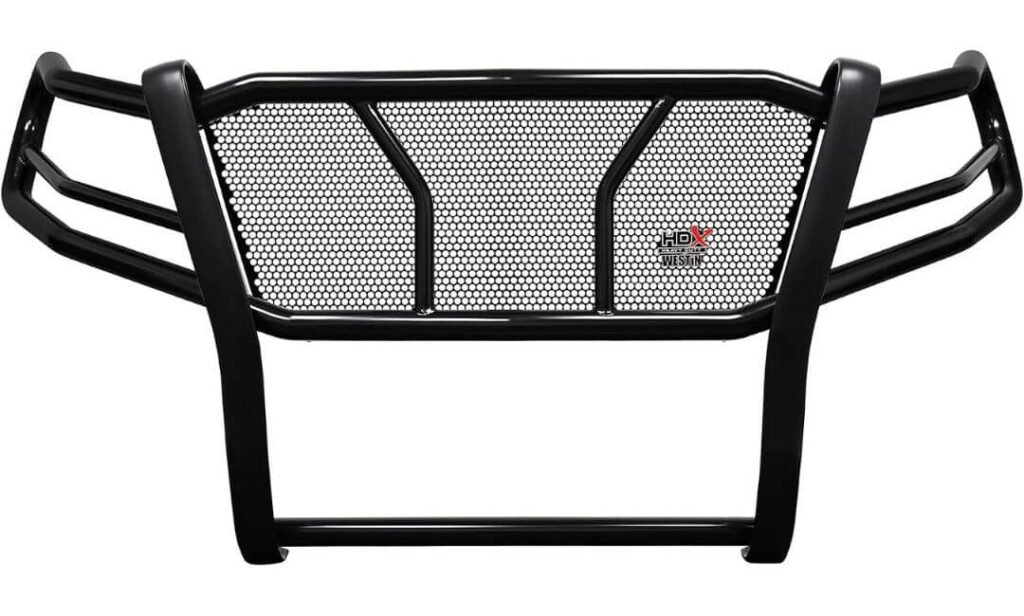
#1. Westin 57-3985 HDX 1-Piece Grille Guard
Best Heavy-Duty Grille Guard for 2019-2023 Ford Ranger With 1-Piece Construction and Full Front-End Protection
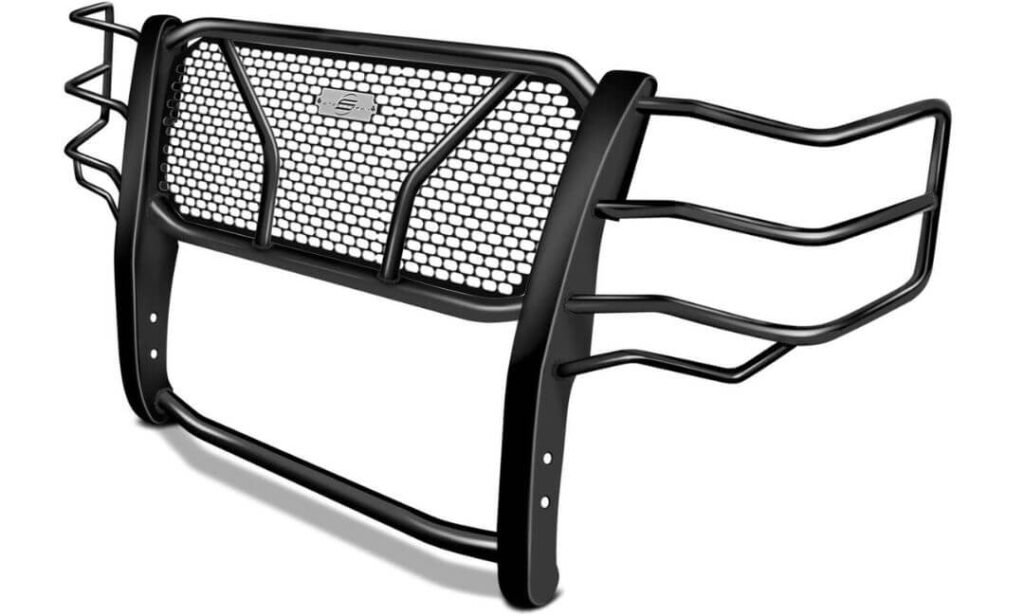
#2. Steelcraft Automotive 50-1340 Grille Guard
Best Ford Ranger Grille Guard for 2019-2023 Models With Wraparound Protection and a Rugged Front-End Design
#3. Black Horse Off Road 17FP10MA Modular Grille Guard
Best Modular Grille Guard for 2019-2023 Ford Ranger Builds Wanting Flexible Front-End Protection and Off-Road Styling
#4. BLACK HORSE Rugged RU-FORA19-B Grille Guard
Best Brush Guard for 2019-2023 Ford Ranger With Rugged Steel Construction and Added Headlight Protection
#5. Westin Automotive 57-93985 Grille Guard/Push Bar
Best Ford Ranger Push Bar for 2019-2023 Models Wanting Front-End Protection With a Clean Blacked-Out Appearance
Expert Tip
Here’s the part I would not skip before ordering: do not choose a Ranger grille guard by appearance alone. All five picks here are aimed at the 2019–2023 Ford Ranger, but they do not serve exactly the same purpose. If you want the most substantial one-piece setup, the Westin HDX makes the most sense. If you want broader traditional coverage, Steelcraft is the stronger alternative. The Black Horse modular option makes more sense for a customised build, while the Rugged and Westin push-bar designs suit owners who care more about a particular front-end style. That distinction is important because a grille guard should look like it belongs on your Ranger, not like a universal accessory bolted onto it.
How We Choose These Ford Ranger Grille Guards
We did not rank these five simply by star ratings, aggressive photos or the order products appear in a shopping search. Since these are relatively newer options with less long-term owner feedback than some established truck accessories, we put more weight on what can actually be judged from the product itself: vehicle fitment, construction style, coverage, mounting approach, design purpose and the type of Ranger build each guard suits.
First comes fitment. Every product on this list is specifically aimed at the 2019–2023 Ford Ranger, which is the generation covered by this guide. That matters because grille guards are not accessories where a small difference in bumper shape or mounting location can simply be ignored. A guard that fits the truck properly should sit naturally around the grille and front-end components rather than forcing the owner to compromise the original shape of the vehicle.
We then looked at how each guard is built and what kind of protection it is trying to provide. The Westin HDX gets the top position because its 1-piece heavy-duty construction gives it the most convincing combination of substantial protection and a cohesive front-end design. Steelcraft follows because its wraparound coverage gives the Ranger a more traditional grille-guard setup with useful protection extending toward the headlight areas.
The Black Horse 17FP10MA earns its place for a different reason. Its modular design makes it more interesting for owners building a Ranger around their own off-road style rather than simply adding the biggest possible guard. The RU-FORA19-B is selected for buyers specifically looking for a rugged brush-guard appearance and additional front-end coverage. The Westin 57-93985 rounds out the list because its grille guard/push-bar design gives buyers another legitimate route without pretending that every Ranger owner needs a heavy one-piece guard.
We also avoided treating “heavy-duty” as automatically meaning “best.” A larger guard is not necessarily the right purchase for every Ranger. Weight, visual bulk, intended use and the overall build of the truck all matter. Someone running a daily-driven Ranger may prefer a cleaner setup, while an owner building a more aggressive trail truck may willingly accept a larger front profile for additional coverage.
Most importantly, we have not treated limited review volume as proof of long-term durability. That would be misleading. These products can be compared on their stated construction, design and fitment, but real-world longevity depends on installation quality, use, impacts and exposure to weather. That is why our ranking focuses on what we can reasonably stand behind rather than inventing owner experiences that simply are not there yet.
In short, these five guards were chosen because they give the 2019–2023 Ford Ranger owner five genuinely different approaches to front-end protection. The goal is not to push everyone toward one product. It is to make the differences clear enough that you can pick the guard that actually matches your Ranger, your driving and the kind of protection you expect from it.
#1. Westin 57-3985 HDX 1-Piece Grille Guard
Quick Specs:
- Ranger Fitment: 2019–2023 Ford Ranger
- Construction: Fully welded 1-piece powder-coated steel
- Protection: Full wraparound wings with welded headlight guards
- Main Tube: 2-inch diameter steel tubing
- Front Coverage: Full punch-plate grille
- Mounting: Bolt-on installation with included mounting hardware
- Upright Protection: Wide 1/8-inch-thick rubber guards
- Weight: Approximately 89 lbs
- Installation Time: Around 1.5 hours with basic tools
- Warranty: 3 years
- Finish: Black powder coat
The first thing that makes this guard different is the one-piece construction. Instead of looking like a separate centre bar added to the Ranger, the welded structure gives the whole front end a much more complete feel. The 2-inch tubing and full wraparound wings also make sense for a truck that sees gravel roads, trails or everyday driving where the front bumper can take more abuse than you expect.
The welded headlight guards are another detail I like here. They extend the protective structure beyond the centre grille, while the full punch-plate section fills the middle without leaving the front looking unfinished. The wide rubber guards on the uprights are a small touch, but they help keep the steel contact areas from looking overly harsh.
Installation is also refreshingly straightforward for something this substantial. The kit comes with the mounting hardware, and the bolt-on design means you are not committing to a fabrication project just to get it onto a 2019–2023 Ranger. At roughly 89 pounds, this is clearly a substantial accessory, but that weight is also part of why the guard feels more purpose-built than a lightweight cosmetic bar.
(A proper Ranger grille guard should look like part of the truck, not something the truck is carrying.)
What we like
- One-piece welded construction gives the front end a solid, integrated appearance.
- Full wraparound wings and headlight guards provide more useful coverage than a simple centre push bar.
- The 2-inch tubing and punch-plate grille give it a properly heavy-duty character without relying on oversized styling.
- Bolt-on installation keeps the upgrade realistic for a home garage with basic tools.
- The rubber upright guards add a practical finishing touch that is easy to overlook in product photos.
What we would keep in mind
- At around 89 lbs, this is a substantial front-end addition, so having a second person around during installation is a sensible move.
Ford Ranger Fitment and Installation
For this guide, the important part is simple: the Westin HDX is designed specifically around the 2019–2023 Ford Ranger. That generation-specific fitment is why it makes more sense here than trying to adapt a universal grille guard. The wraparound wings, headlight guards and mounting arrangement are all intended to work with the Ranger’s factory front-end shape.
Before starting, have the truck parked level and give yourself enough room to work around both sides of the bumper. Because the guard is close to 89 lbs, positioning it during the first mounting stage is much easier with another person helping. The included mounting hardware keeps the installation focused on bolting the guard into place rather than fabricating brackets from scratch.
The Insider Pro-Tip
If your Ranger is mainly a daily driver, don’t assume you need to make the installation look as aggressive as possible. The best result is when the guard sits square, centred and naturally aligned with the grille and headlights. Spend a little extra time checking the position before fully tightening everything; that small bit of patience makes a surprisingly big difference to how professional the finished truck looks.
And if you’re choosing this particular setup because you actually use your Ranger on rough roads, think about the guard as front-end insurance rather than decoration. The 2-inch tubing, wraparound wings, punch plate and welded headlight protection are the reasons it earned the top spot here. You are getting a substantial protective structure, not simply a black accessory designed to make the truck look tougher.
#2. Steelcraft Automotive 50-1340 Grille Guard
Quick Specs:
- Ranger Fitment: 2019–2023 Ford Ranger
- Construction: One-piece fully welded grille guard
- Material: Stainless steel construction with protective finish
- Finish: E-coat with black powder coating
- Design: Full grille coverage without a winch mount
- Factory Tow Hooks: Retained
- Camera Support: Not designed for the newer camera-equipped setup
- Installation: Bolt-on installation; typically easier with two people
- Approximate Install Time: 3–5 hours
- Warranty: 2 years
- Newer Ranger Option: Steelcraft 50-1345C covers 2023–2026 models
There is something refreshingly straightforward about the 50-1340: it does not try to turn the Ranger into something it is not. The one-piece welded construction gives the front end a properly finished look, while the black e-coat and powder-coated finish make sense for a truck that is going to see normal road grime, weather and occasional trail use.
What I particularly like is the full-grille coverage without a winch mount. That makes this a cleaner choice for a Ranger owner who wants meaningful front-end protection but has no interest in carrying a winch setup. It also retains the factory tow hooks, which is a useful detail if you still want those original recovery points available.
There is one fitment detail worth being honest about. The 50-1340 is the 2019–2023 Ranger version; Steelcraft’s newer 50-1345C is the better match for the later 2023–2026 trucks. That distinction is exactly the kind of thing worth checking before ordering, especially because the model-year overlap can otherwise make Ranger grille guards confusing.
(The right grille guard is not necessarily the biggest one; it is the one that fits the truck you actually own.)
What we like
- The one-piece welded design gives the Ranger a clean, substantial front-end profile.
- Factory tow hooks remain usable, which is a genuinely useful advantage for owners who use them.
- The no-winch configuration keeps the setup simpler for everyday trucks.
- E-coat plus black powder coating gives the guard a more considered finish than bare steel.
- The availability of a separate newer-generation model makes Steelcraft’s Ranger fitment easier to understand when shopping across model years.
What we would keep in mind
- The 50-1340 should be treated as the 2019–2023 model; if you have a newer Ranger, check the 50-1345C rather than assuming the two versions are interchangeable.
2019–2023 Ford Ranger Fitment
For the Ranger covered in this article, the fitment is refreshingly clear: the 50-1340 is intended for 2019–2023 Ford Ranger models. Its one-piece design is built around that generation’s front-end layout, so this is not a case of adapting a generic guard and hoping the proportions work.
Installation is bolt-on, but this is one of those jobs where an extra pair of hands is worth having. The guard is large enough that keeping it correctly positioned while the mounting points are lined up is much easier with two people. Give yourself a little time for alignment before fully tightening everything; a properly centred guard makes the finished Ranger look far more factory-like.
The Insider Pro-Tip
If you own a 2019, 2020, 2021, 2022 or 2023 Ranger and do not need a winch mount, this is the kind of product I would shortlist before chasing a more complicated setup. You get the important basics — one-piece construction, full grille coverage and retained factory tow hooks — without paying for features you may never use.
And if your truck falls into the newer 2023–2026 overlap, slow down before clicking Buy. The 50-1340 and 50-1345C can look similar at a glance, but the model-year distinction matters. That small check can save you from ordering the wrong generation and is exactly why fitment deserves more attention than a product photo.
#3. Black Horse Off Road 17FP10MA Modular Grille Guard
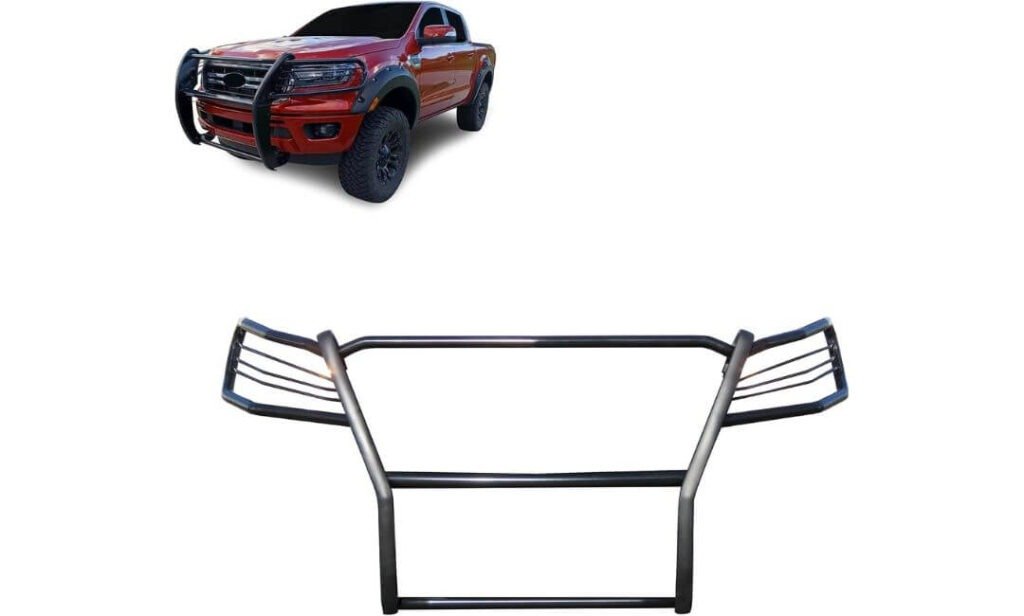
Quick Specs:
- Ranger Fitment: 2019–2023 Ford Ranger
- Construction: 3-piece modular, bolt-together steel design
- Tubing: 1.5-inch diameter, 16-gauge cold-rolled steel
- Vertical Plates: 1/4-inch thick HRPO steel
- Finish: Corrosion-resistant E-coat with high-impact powder coat
- Installation: Frame-mounted, bolt-on and no drilling required
- Light Guards: Removable for a more open front-end setup
- Tow Hooks: Factory hooks can be retained with minor trim adjustment
- Weight: Approximately 76 lbs
- Warranty: 3 years
- Lighting: Compatible with selected halogen, LED and OEM-style fog-light options
Modular is not just a marketing word here. The 17FP10MA uses a 3-piece bolt-together construction, so the Ranger gets a more configurable front end without asking you to weld or drill the truck. That is a useful difference for an owner who wants a grille guard that can evolve with the build rather than locking everything into one fixed shape.
The hardware also tells you where this guard is coming from. The 1.5-inch cold-rolled steel tubing is backed by 1/4-inch vertical steel plates, while the E-coat underneath the high-impact powder coating adds another layer to the finish. At around 76 pounds, it is still a substantial piece of equipment, but it does not have the same sheer bulk as some heavier one-piece designs.
Then there are the removable light-guard covers. That small feature gives you some freedom over the final appearance and opens the door to additional lighting options. For a Ranger being built around camping, trails or night driving, that flexibility is much more useful than another decorative styling detail.
(A modular guard earns its place when the owner can actually make the setup work around the truck, rather than the other way around.)
What we like
- 3-piece modular construction gives the front end more flexibility than a fixed one-piece layout.
- No-drill bolt-on installation keeps the fitting process much more approachable.
- The combination of 1.5-inch tubing and 1/4-inch vertical plates gives it a properly substantial structure.
- Removable light guards let you change the appearance and lighting setup later.
- The E-coat plus high-impact powder coat is a sensible finish for a truck that spends time outside.
What we would keep in mind
- The parking-assist sensors can be affected, so owners using that factory feature should be prepared to manage the system after installation.
2019–2023 Ford Ranger Fitment
The 17FP10MA is specifically designed for the 2019–2023 Ford Ranger, with a vehicle-specific frame-mounted application rather than a universal bracket arrangement. That is important because the modular pieces still need to sit correctly around the Ranger’s factory front end once assembled.
The installation is officially no-drill and bolt-on, but I would not treat that as meaning “five-minute job.” The upper mounting brackets can take some positioning, and removing the front bumper is recommended for easier access. If you’re working at home, having basic tools and a second set of hands will make the process considerably less frustrating.
The Insider Pro-Tip
The smartest reason to choose this one is flexibility, not simply the word “modular.” If your Ranger is going to become a more personalised off-road or lighting build, the removable light guards and additional lighting compatibility give you room to change things later without replacing the entire grille guard.
One thing I would check before installation is your Ranger’s parking-assist setup. The guard can interfere with those sensors, so knowing that beforehand means you can plan around it instead of discovering it after everything is tightened down. That is a small detail, but it is exactly the sort of detail that separates a genuinely useful buying guide from a product-description rewrite.
#4. BLACK HORSE Rugged RU-FORA19-B Grille Guard
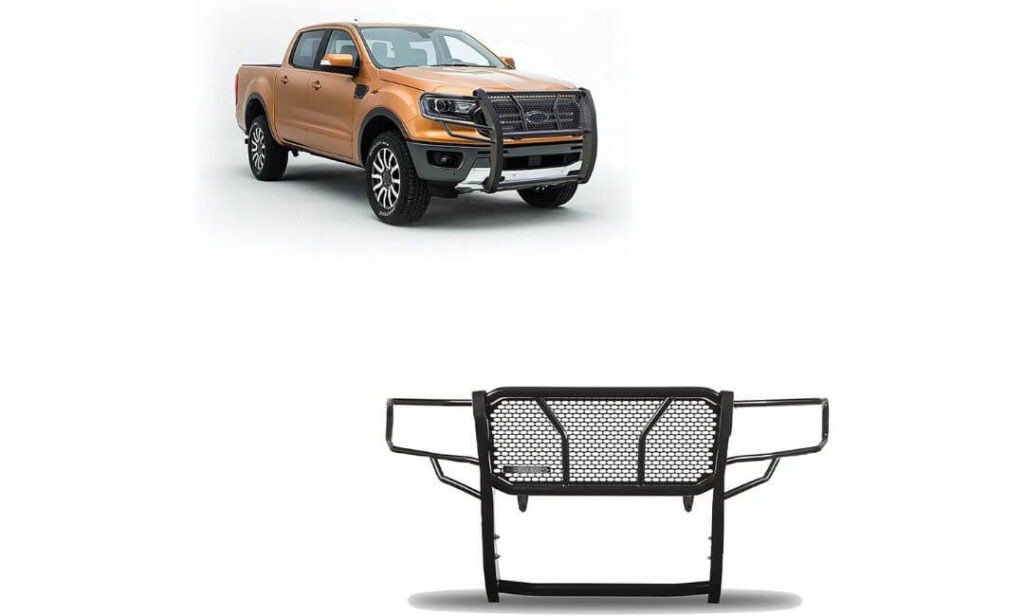
Quick Specs:
- Ranger Fitment: 2019–2023 Ford Ranger
- Construction: 3-piece bolt-together alloy-steel design
- Main Tubing: 2.25-inch diameter, 16-gauge cold-rolled steel
- Vertical Plates: 5/16-inch HRPO steel
- Protection: Custom-punched centre grille
- Finish: Corrosion-resistant E-coat with high-impact powder coat
- Installation: Frame-mounted, bolt-on and no drilling required
- Installation Time: Approximately 2–3 hours
- Packaging: Ships in two boxes
- Warranty: 3 years
- Sensor Note: May affect factory front parking sensors
What catches my attention with this setup is the 2.25-inch tubing. That is noticeably more substantial than the 1.5-inch tubing used on the modular Black Horse option above, and it gives the Ranger a much stronger visual presence without turning the guard into an unnecessarily complicated structure.
The 5/16-inch vertical steel plates are another meaningful detail. Combined with the custom-punched centre grille, the design puts considerably more material across the areas where a conventional open guard leaves plenty of space. The E-coat underneath the high-impact powder coating is also a sensible combination for something that will spend most of its life exposed to road spray, dirt and weather.
Installation remains pleasantly straightforward in principle: it is a 3-piece, no-drill, frame-mounted bolt-on system with the brackets and hardware supplied. In practice, allow around 2–3 hours and expect to remove the lower centre bumper area to reach the tow-hook cover properly. That is not a flaw; it is simply something better known before you put the truck on stands and start taking things apart.
(This is the kind of guard that makes sense when you want the Ranger to look genuinely protected, rather than merely accessorised.)
What we like
- 2.25-inch tubing gives it a noticeably stronger, more purposeful profile.
- 5/16-inch vertical plates provide substantial structure behind the outer design.
- The custom-punched centre grille adds protection without completely closing off the front.
- No-drill installation keeps the truck’s frame untouched.
- E-coat underneath the powder coat is a thoughtful finish combination for an exposed exterior accessory.
What we would keep in mind
- The guard may affect factory front parking sensors, so sensor compatibility should be checked before installation if your Ranger relies heavily on that feature.
2019–2023 Ford Ranger Fitment
The RU-FORA19-B is built specifically for the 2019–2023 Ford Ranger, using a vehicle-specific frame-mounted design rather than asking you to adapt universal brackets. That is particularly useful here because the three-piece construction needs to align properly around the Ranger’s front bumper and grille.
Installation does not require drilling, but it is still a proper mechanical installation rather than a quick accessory fit. The lower centre bumper section needs to be removed to access the tow-hook cover, and the guard arrives in two boxes, so give yourself enough floor space before starting. With basic tools, around 2–3 hours is a realistic window for a careful installation.
The Insider Pro-Tip
If your priority is a more substantial-looking Ranger front end, the 2.25-inch tubing is the reason I would consider this over the smaller modular design above. It has a distinctly tougher presence while still retaining the practical no-drill mounting approach.
Just make the parking-sensor check part of your buying decision, not an afterthought. If your truck has front sensors, knowing how the guard may affect them before installation lets you plan properly. That small bit of preparation can make the difference between a modification you enjoy every time you see the Ranger and one that leaves you wondering what you should have checked first.
#5. Westin Automotive 57-93985 HDX Winch Mount Grille Guard
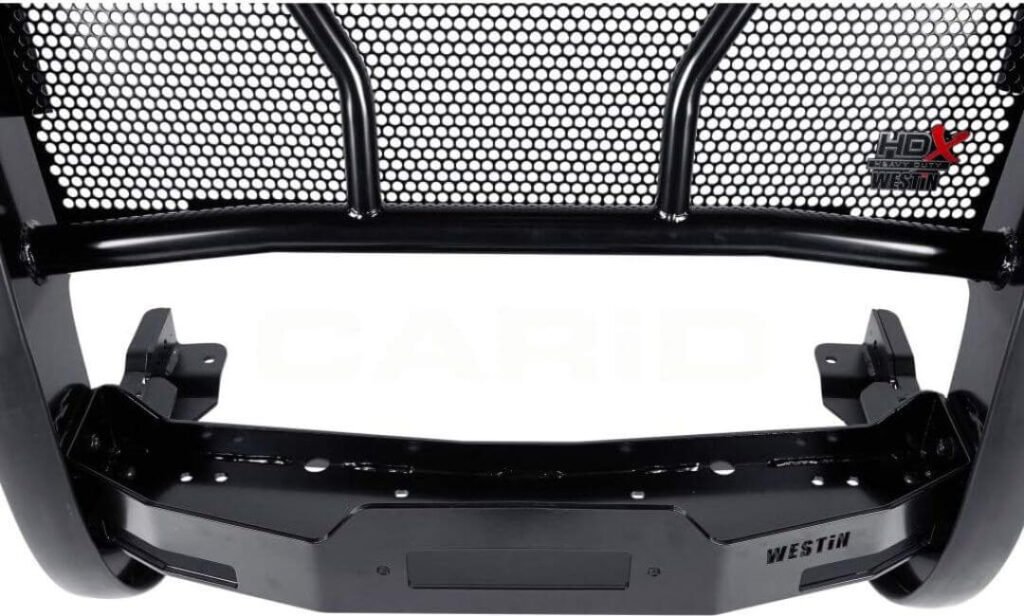
Quick Specs:
- Ranger Fitment: 2019–2021 Ford Ranger
- Construction: Heavy-duty 1-piece fully welded steel
- Winch Capacity: Up to 12,000 lbs
- Winch Size: Up to 10.25 inches tall
- Tray Pull Rating: Tested to at least 16,500 lbs straight-line pull
- Weight: Approximately 84–85 lbs
- Installation: Bolt-on with lower air-dam cutting and tow-hook bracket modification
- Finish: Black powder coat
- Warranty: 3 years with black powder-coated version
- Sensors: Original bumper and sensors remain in place
- Package Size: Approximately 71.9 × 35.9 × 23.4 inches
A winch changes the conversation completely. The 57-93985 is not simply another grille guard with a tougher-looking front bar; its main reason for existing is the integrated 12,000-lb winch tray. If your Ranger is being built around serious recovery capability, that feature immediately separates it from the other guards in this list.
The construction matches that purpose. You are getting a fully welded 1-piece structure weighing roughly 84–85 pounds, with a tray designed around winches up to 10.25 inches tall. The tray itself has been tested to a minimum 16,500-lb straight-line pull, which gives this setup a very different role from a grille guard bought mainly for front-end appearance.
There is, however, one fitment detail I would absolutely check before ordering: the information supplied for this specific 57-93985 lists 2019–2021 Ranger compatibility. That is narrower than the 2019–2023 fitment of the regular 57-3985 above. The installation is also more involved because the lower air dam needs cutting and tow-hook brackets may require modification, particularly on FX4 models.
(When a grille guard carries a serious winch, the installation and fitment deserve just as much attention as the winch rating.)
What we like
- Integrated 12,000-lb winch capacity gives this guard a genuine recovery-focused purpose.
- The 16,500-lb minimum straight-line pull testing adds useful confidence to the tray’s intended workload.
- Fully welded 1-piece construction gives the assembly the rigidity expected from a winch-ready setup.
- Factory bumper and sensors remain intact, which is a welcome detail for a more involved front-end upgrade.
- The 3-year warranty on the black powder-coated version adds some useful ownership reassurance.
What we would keep in mind
- The 2019–2021 fitment and modified installation requirements make this a much more specialised choice than the other guards in this guide.
2019–2021 Ford Ranger Fitment
For this particular model, I would follow the narrower 2019–2021 Ford Ranger fitment rather than assuming it carries over to every Ranger covered by this article. That is especially important because Westin also offers the 57-3985 for the broader 2019–2023 range, and the two part numbers should not be treated as interchangeable simply because they share the HDX name.
Installation is also a different proposition. The setup is bolt-on, but the lower air dam needs to be cut, and tow-hook bracket modifications may be necessary. FX4 owners should pay particular attention here because additional bracket and tow-hook work may be required.
The Insider Pro-Tip
If you genuinely need a winch on your Ranger, this is the reason to consider this guard. If you do not, I would not choose a heavier winch-mount setup simply because the 12,000-lb number sounds impressive. The extra hardware, weight and installation work only make sense when you are actually going to use the capability.
And before ordering, check the exact Ranger year and trim against the specific part number. That two-minute check is more valuable here than another hour of comparing product photos. For a 2019–2021 Ranger being built around recovery gear, though, the integrated tray and heavy welded construction make this a purpose-built solution rather than a cosmetic upgrade.
Best Ford Ranger Grille Guards Compared for Protection and Fitment
Ford Ranger Grille Guard Buyers Guide: What Actually Matters Before You Order
Choosing a grille guard for the Ford Ranger is less about finding the toughest-looking piece and more about matching the guard to the way you use the truck. The five options above cover very different needs, from a substantial one-piece guard to a modular setup and a dedicated winch-mount design. Before ordering, look beyond the product photo and check the construction, coverage, mounting method, vehicle year, sensor setup and the amount of weight you are comfortable adding to the front of your Ranger.
Start With the Protection You Actually Need
If your Ranger regularly sees gravel roads, trails, brush, rough work areas or long stretches of rural driving, broader coverage becomes more valuable. The Westin 57-3985 and Steelcraft 50-1340 are the more traditional choices here, with substantial one-piece construction and wider front-end coverage.
For a more customised build, the Black Horse 17FP10MA gives you a modular approach with removable light guards, while the RU-FORA19-B uses larger 2.25-inch tubing and 5/16-inch vertical plates for a more pronounced protective structure. The 57-93985 is different again because its real purpose is supporting a winch, not simply adding another heavy bar to the front of the truck.
Match the Grille Guard to Your Ranger Year
This is one area where I would slow down before clicking the purchase button. The main products in this guide are designed around the 2019–2023 Ford Ranger, but that does not mean every part number covers every Ranger year.
The Westin 57-3985, Steelcraft 50-1340, Black Horse 17FP10MA and RU-FORA19-B are the 2019–2023 options discussed here. The Westin 57-93985 is narrower at 2019–2021, so it should not be treated as automatically compatible with every 2022 or 2023 Ranger.
There is also an important overlap with newer Rangers. Steelcraft’s 50-1345C is the newer option listed for 2023–2026 models. If you own a 2024, 2025 or 2026 Ranger, do not assume that a grille guard listed for the earlier generation will transfer simply because the truck name is the same.
Steel Construction, Tubing Size and Real-World Weight
Material specifications are useful, but they need context. A grille guard is not automatically better because a listing contains a bigger steel number. Construction design, tubing diameter, welded joints, vertical plates and mounting structure all contribute to how substantial the finished guard feels.
The Westin 57-3985 uses 2-inch tubing and weighs about 89 pounds. The Black Horse 17FP10MA uses 1.5-inch 16-gauge tubing with 1/4-inch vertical plates, while the RU-FORA19-B steps up to 2.25-inch tubing and 5/16-inch vertical plates. Those differences tell you more about the character of each guard than a generic “heavy-duty” label ever could.
Weight is worth considering too. An approximately 76–89-pound accessory is not something I would casually install alone, especially while trying to align mounting brackets. It is also worth remembering that the front of the Ranger now has additional mass hanging from it, so choose the guard because you need its construction, not simply because heavier sounds better.
One-Piece or Modular: Which Setup Makes More Sense?
A one-piece grille guard is the straightforward choice when you want a strong, cohesive front-end structure. The Westin HDX and Steelcraft are good examples of this approach. There are fewer separate pieces to assemble, and the finished appearance tends to look more integrated.
A modular guard gives you more flexibility. The Black Horse 17FP10MA uses a 3-piece design and removable light guards, which can make more sense for someone gradually building an off-road Ranger. The RU-FORA19-B also uses a 3-piece bolt-together construction, but its larger tubing and heavier plates give it a more substantial appearance.
Neither approach is universally better. The better choice is the one that fits the way you expect the Ranger to look and work six months after installation.
Pay Attention to Sensors Before Installation
Modern Ranger owners should not treat the grille guard as a completely passive accessory. Parking-assist sensors and other front-end equipment can influence which design makes sense.
The Black Horse 17FP10MA may interfere with front parking-assist sensors, while the RU-FORA19-B also carries a sensor-interference consideration. The Westin 57-93985 is noted as retaining the original bumper and sensors, although its installation is considerably more involved.
If your Ranger relies heavily on front parking assistance, check this before installation rather than discovering the issue after the guard is already mounted. A grille guard should improve the truck without creating an avoidable daily annoyance.
Finish Matters More Than It Looks
For an exterior accessory, the finish is not just about whether the black looks good in a product photograph. These guards live directly in the path of rain, road salt, mud, dust, gravel and general road contamination.
Several of the options here use an E-coat beneath a powder-coated finish, which is a sensible combination for exposed steel. Still, no coating makes steel completely immune to damage. If the finish is chipped by an impact, cleaning the affected area and dealing with exposed metal early is much smarter than waiting for corrosion to become visible.
Installation: Bolt-On Does Not Mean Effortless
All five products are fundamentally designed around bolt-on installation, but the amount of work varies considerably.
The Westin 57-3985 is the most approachable of the group, with included hardware and an estimated installation time of around 1.5 hours. The Black Horse 17FP10MA is also no-drill, although its upper brackets can require additional positioning and bumper access can make the job easier.
The RU-FORA19-B generally takes around 2–3 hours, while the Steelcraft 50-1340 can take roughly 3–5 hours with two people. The winch-equipped Westin 57-93985 is the most involved, with lower air-dam cutting and possible tow-hook bracket modifications.
For any of these, I would have a socket set, basic hand tools, a level working area and another person available to help support and align the guard. With heavier units, that second person is not a luxury; it simply makes the installation safer and the final alignment easier.
What You Get at Different Buying Priorities
Instead of thinking only in terms of cheap, mid-range and expensive, think about what the money is actually buying.
- Best all-around protection: Westin 57-3985, with its 1-piece welded structure, 2-inch tubing, wraparound wings and headlight guards.
- Traditional full grille coverage: Steelcraft 50-1340, particularly for owners who do not need a winch mount.
- Customisable build: Black Horse 17FP10MA, thanks to its modular construction and removable light guards.
- More aggressive structure: BLACK HORSE RU-FORA19-B, with 2.25-inch tubing and 5/16-inch vertical plates.
- Recovery-focused setup: Westin 57-93985, where the integrated 12,000-lb winch capability is the reason to choose it.
That is a more useful way to compare these products than simply chasing the lowest price. A cheaper guard that lacks the features you actually need is not a bargain once you have to replace it.
The Fitment Check I Would Do Before Paying
Before ordering, verify these five things on your own Ranger:
- Exact model year, especially if you have a 2023 Ranger because of the generation overlap.
- Trim and front-end equipment, particularly if your truck is an FX4 or has front parking sensors.
- Winch requirement, because the 57-93985 is designed around that specific use.
- Tow-hook configuration, especially where installation requires access or bracket modification.
- Available installation space, because these guards are large, heavy components and are much easier to handle with a second person.
The biggest mistake is assuming that all Ranger grille guards are interchangeable because they carry the same truck name. They are not. The part number is what you should trust, not a generic “fits Ford Ranger” headline.
Ford Ranger Grille Guard Installation and Fitment: The Details That Matter Before You Start
A grille guard installation on a Ford Ranger is usually a bolt-on job, but “bolt-on” should not be confused with effortless. The guards in this guide are large, heavy components, and getting the mounting points aligned correctly is just as important as getting the bolts tight. The biggest difference between a clean installation and a frustrating afternoon is usually preparation, not mechanical skill.
What to Have Ready Before the Guard Comes Out of the Box
For most of these Ranger grille guards, you will want:
- Metric socket and wrench set
- Ratchet and suitable extensions
- Torque wrench
- Screwdrivers and trim-removal tools
- Jack and appropriately rated jack stands if additional clearance is required
- Work light
- Protective gloves and eye protection
- A second person to help support and position the guard
- Manufacturer-supplied mounting brackets and hardware
- The vehicle-specific installation instructions
A torque wrench is particularly worthwhile. With a heavy steel guard attached to the Ranger’s frame, “tight enough” is not a useful measurement. Follow the supplied installation instructions for the correct tightening specifications rather than guessing.
Step 1: Confirm the Ranger and Part Number First
Before removing a single factory component, check the exact grille guard part number against your Ranger’s model year and configuration.
The primary products in this guide are intended for the 2019–2023 Ford Ranger, including the Westin 57-3985, Steelcraft 50-1340, Black Horse 17FP10MA and BLACK HORSE RU-FORA19-B.
The Westin 57-93985 is different, with the supplied fitment covering 2019–2021 Ranger models. Do not assume that its winch-mount design automatically carries over to later trucks.
There is also a model-year overlap worth understanding. Steelcraft lists the newer 50-1345C for 2023–2026 Rangers, so a 2023 owner should verify which generation their particular truck and grille-guard application correspond to before ordering. For 2024–2026 Rangers, use the newer vehicle-specific application rather than treating a 2019–2023 product as universal.
Step 2: Put the Ranger on a Level Working Surface
Park the truck on a flat, stable surface, engage the parking brake and make sure there is enough room around both sides of the front bumper.
You do not necessarily need to lift the Ranger for every installation. In fact, keeping the truck at normal ride height can make final alignment easier. If you do need additional access underneath, use properly rated jack stands and never rely on a floor jack as the sole support.
Before starting, take a few minutes to look underneath the bumper and locate the factory mounting areas. Knowing where the brackets need to end up makes the actual installation much less confusing.
Step 3: Remove Only What the Instructions Require
This is where different guards begin to separate themselves.
The Westin 57-3985 is designed around a straightforward bolt-on installation, with the mounting hardware included. The Black Horse 17FP10MA is also a no-drill, frame-mounted design, although its upper brackets can be easier to access with the front bumper removed.
The RU-FORA19-B similarly uses a no-drill bolt-on system, but access to the lower centre bumper and tow-hook cover is part of the installation process.
The Westin 57-93985 requires more commitment because the lower air dam needs to be cut, and tow-hook bracket modifications may be required. FX4 owners should pay particular attention to the supplied instructions because additional modification can be involved.
The important rule is simple: do not start cutting, drilling or modifying anything until you have confirmed that your exact part number requires it.
Step 4: Position the Mounting Brackets First
Do not fully tighten everything immediately.
Start by loosely attaching the mounting brackets so they can still move slightly. This gives you room to align the grille guard properly before locking the hardware down.
This is especially important with a large one-piece guard. Even a small amount of misalignment at the mounting points can make the grille guard look noticeably crooked once viewed from several feet away.
A second person should support the guard while you start the hardware. Once the main mounting points are engaged, check that the guard sits evenly in relation to the grille, headlights and bumper before progressively tightening the hardware.
Step 5: Check Clearance Before Final Tightening
This is the step people tend to rush.
Look carefully around the grille, headlights, bumper edges, tow hooks and sensors. Make sure nothing is being pushed against the factory bodywork and that the guard sits where the manufacturer intended.
For the Black Horse 17FP10MA and RU-FORA19-B, pay particular attention to front parking sensors. Both designs can create sensor-related considerations, so test the system after installation rather than assuming everything will behave exactly as it did before.
If the guard uses removable light guards or lighting provisions, make sure those components are also sitting correctly before completing the final tightening.
Step 6: Tighten Everything Gradually
Once the alignment looks right, tighten the mounting hardware progressively rather than locking down one side completely first.
Work from one mounting point to the other so the guard settles evenly. Then use the manufacturer’s specified torque values.
After everything is tight, step back and look at the Ranger from directly in front. This simple check catches crooked positioning surprisingly well.
What Can Go Wrong During Installation?
Most problems are not dramatic mechanical failures. They are small fitment issues that become annoying because they were discovered too late.
Common examples include:
- Starting installation without confirming the correct model-year application
- Trying to install an approximately 76–89-pound guard alone
- Fully tightening one side before the opposite side is aligned
- Forgetting to check parking-sensor clearance
- Assuming every Ranger guard requires the same bumper removal
- Modifying factory components before reading the specific instructions
- Using impact tools aggressively instead of controlling final tightening
- Leaving insufficient clearance around the bumper or headlights
- Treating a 2019–2023 fitment as automatically suitable for a 2024–2026 Ranger
The last point deserves special attention. The Ranger name remained the same, but vehicle-specific accessory fitment can change with the generation and front-end design.
Weekend Installation vs. Professional Installation
For a mechanically comfortable owner, the Westin 57-3985 can be a realistic weekend-garage project, particularly because its supplied installation information puts the job around 1.5 hours with basic tools. The Black Horse modular products can also be handled at home, although bracket positioning and bumper access can extend the job.
The Steelcraft 50-1340 is more of a two-person project, with an estimated 3–5-hour installation window. The additional time is not necessarily because the product is difficult; its size and positioning simply make it worthwhile to work carefully.
The Westin 57-93985 is the one I would be least inclined to treat as a casual afternoon project. Once you add air-dam cutting, tow-hook bracket modification and winch-related considerations, professional installation becomes much more attractive for owners who are not comfortable modifying the front end.
The Fitment Rule for 2019–2026 Rangers
For this article, keep the year ranges simple:
- 2019–2023: Westin 57-3985, Steelcraft 50-1340, Black Horse 17FP10MA and RU-FORA19-B are the primary options discussed.
- 2019–2021: Westin 57-93985 has the narrower supplied fitment and should be checked carefully before purchase.
- 2023: Verify the exact generation and part number because this is an overlap year for some Ranger accessories.
- 2024–2026: Do not assume the earlier 2019–2023 guards fit; use the newer vehicle-specific application where required.
- 2021: Falls within the established 2019–2023 range for the main guards in this guide, subject to the exact product’s fitment information.
One Final Installation Check I Would Not Skip
Once the guard is completely installed, drive the Ranger slowly around your property or a quiet area first rather than immediately heading onto the highway or trail.
Listen for anything unusual, check that the guard is still sitting square, confirm the parking-assist system behaves as expected and look underneath the truck once more after the first short drive. Heavy accessories can settle slightly as the mounting hardware takes its final position.
That final inspection costs almost nothing and gives you much more confidence that the grille guard is not merely attached, but properly fitted to the Ranger it was designed for.
Real-World Ford Ranger Grille Guard Comparisons: What Works for Different Builds
A grille guard can look perfect in a product photo and still be the wrong choice for your Ranger. The better question is what you actually expect the truck to do. A daily-driven Ranger, a weekend trail truck and a recovery-focused build can all benefit from front-end protection, but they do not need the same type of guard.
That is why the options in this guide should be viewed as different tools rather than five versions of the same product. Coverage, weight, construction, sensor considerations, installation effort and future modifications all change the ownership experience.
Daily Driver: Protection Without Overbuilding the Truck
For a Ranger that spends most of its time commuting, running errands and travelling on normal roads, I would prioritise a balanced front-end setup rather than automatically choosing the heaviest guard available.
A one-piece design with sensible grille and headlight coverage makes the most sense when you want the truck to feel protected but still look like a factory-based build. The goal here is not to prepare the Ranger for a recovery operation every time you leave the driveway. It is to add useful protection against the sort of minor hazards that become expensive when they reach the bumper, grille or headlights.
Weight matters more in this situation than many buying guides admit. Adding roughly 76–89 pounds to the front is not insignificant, particularly when you are never going to use a winch or regularly drive through heavy brush. A substantial guard can still be worthwhile, but the features should justify the additional mass.
Off-Road Ranger: Coverage Becomes More Valuable
Once the Ranger regularly sees rocky trails, gravel, brush, uneven access roads or remote camping routes, the priorities change.
Here, broader coverage around the front end becomes much more useful. Wraparound wings, headlight protection, stronger vertical plates and a properly supported centre section all start making practical sense.
This is also where modularity becomes attractive. If you expect to add auxiliary lighting or change the front-end setup later, a modular design can save you from replacing the entire guard when the rest of the build evolves.
The important distinction is that an off-road grille guard should be chosen for how it protects and integrates with the truck, not simply because it makes the Ranger look more aggressive.
Recovery-Focused Builds: When a Winch Changes Everything
A Ranger that is genuinely being built for recovery work is a different conversation altogether.
If you actually intend to run a winch, an integrated winch-mount design can make sense because the mounting structure is built around that purpose. The specific setup covered here supports a winch rated up to 12,000 pounds, with the tray tested to a minimum 16,500-pound straight-line pull.
But I would not recommend a winch-mount grille guard simply because the numbers sound impressive. If your Ranger never leaves paved roads, you are adding substantial weight and installation complexity for capability you may never use.
That is the difference between buying for real requirements and buying because a specification looks impressive on a product page.
2019–2023 vs. 2024–2026: Why the Year Matters
Searches such as “best grille guard for Ford Ranger 2023” and “best grille guard for Ford Ranger 2024” can look almost identical, but the accessory fitment should not be treated that way.
The main guards covered in this guide are centred around the 2019–2023 Ranger application. That is a specific fitment range, not a suggestion that every Ranger from every year uses the same mounting points and front-end geometry.
The 2023 model year deserves extra attention because it sits around the transition between applications. If you own a 2023 Ranger, verify the exact part number and vehicle application rather than relying solely on a retailer’s generic compatibility headline.
For a 2024, 2025 or 2026 Ranger, I would start with accessories specifically listed for the newer generation. The Steelcraft 50-1345C, for example, is the newer application referenced for 2023–2026 models, rather than assuming the older 50-1340 is suitable.
The same principle applies to a 2021 Ranger: it falls comfortably within the 2019–2023 range discussed for the primary products here, but you should still match the exact part number to the truck before ordering.
A Simple Way to Think About Weight vs. Protection
| Ranger Use | What Matters Most | Sensible Direction |
|---|---|---|
| Mostly commuting | Moderate coverage, clean fitment, manageable weight | Balanced one-piece guard |
| Rural roads and gravel | Wider coverage, stronger structure | Full grille and headlight protection |
| Weekend off-roading | Protection, clearance, modularity | Rugged or modular configuration |
| Overlanding build | Protection plus future accessories | Modular design with lighting flexibility |
| Recovery-focused truck | Winch support, mounting strength | Dedicated winch-mount configuration |
There is no prize for carrying the heaviest grille guard. The useful question is whether the extra structure gives you something you will actually use.
Modularity vs. Maximum Structure
This is one of the easiest trade-offs to understand.
A fixed one-piece guard is attractive because the finished assembly feels cohesive and substantial. There are fewer decisions to make after installation, and the front end has a defined appearance.
A modular guard gives you more freedom. Removable light guards and accessory compatibility can become valuable when the Ranger is still being built. You can change lighting or styling without necessarily replacing the entire front protection system.
The trade-off is that modular construction introduces more individual pieces and mounting points. That is not automatically worse; it simply means there is more to assemble and align correctly.
Protection Does Not Mean Ignoring Sensors
Real-world ownership also means living with the Ranger after installation.
If your truck has front parking-assist sensors, check how the selected guard interacts with them before making the purchase. Some designs can interfere with sensor operation, while others are designed to retain the original bumper and sensor arrangement.
This is especially important for a daily driver. A grille guard that looks fantastic but causes constant sensor warnings is not a successful upgrade.
What I Would Choose for Each Type of Ranger Owner
If I were narrowing these options down based purely on actual use, my thinking would be straightforward:
- Daily driver: choose balanced coverage and avoid paying for capability you will never use.
- Rural or work truck: prioritise stronger front coverage and a durable finish.
- Weekend off-roader: look for substantial protection without making the front unnecessarily bulky.
- Custom or overlanding build: modularity becomes more valuable because the truck may evolve.
- Serious recovery build: a properly engineered winch-mount setup is the logical choice.
That is ultimately what makes a grille guard “best.” The best guard is not the one with the longest specification sheet; it is the one whose construction, fitment and features make sense for the life your Ranger actually lives.
Ford Ranger Grille Guard Maintenance and Longevity: Keep the Protection Looking Right for Years
A good grille guard is not a fit-and-forget accessory. It sits directly in front of the truck and takes the first hit from road salt, mud, dust, water, gravel and minor trail debris. The difference between a guard that still looks solid years later and one that starts showing corrosion early usually comes down to simple maintenance rather than expensive products.
Clean It Like Part of the Truck, Not a Decorative Accessory
After muddy trips or winter driving, rinse the guard thoroughly with clean water before doing anything aggressive with a brush or cloth. Pay particular attention to the mounting brackets, lower sections, weld areas, tubing joints and spaces behind the grille where dirt can remain trapped.
For normal cleaning, use a mild automotive soap and a soft wash mitt or microfiber towel. Avoid letting mud dry onto the powder-coated surface, especially if the truck has been driven through salty or chemically treated roads.
A pressure washer can be useful, but keep the nozzle at a sensible distance. Blasting directly into mounting hardware, sensor areas or coating damage at very close range is unnecessary and can create problems rather than solve them.
Check the Finish Before Rust Gets a Chance
Powder coating is durable, but it is not indestructible. A stone can chip the finish, a recovery strap can rub against an edge, or a small impact can expose bare metal.
During routine washing, look for:
- Small chips or scratches around the front-facing tubing
- Exposed metal around welds and mounting points
- Surface corrosion near bolts or brackets
- Damage underneath the lower sections
- Loose or damaged hardware
- Cracks, bends or movement after an impact
If you find a small coating chip, deal with it early. Clean and dry the area properly, remove any surface corrosion and use a suitable touch-up coating intended for the surface rather than leaving exposed steel sitting through another season of rain.
Pay Extra Attention to the Mounting Hardware
The grille guard’s job is to protect the Ranger, so the mounting system deserves just as much attention as the visible tubing.
After the first few drives, particularly after an off-road trip, inspect the mounting brackets and fasteners. Look for movement, unusual gaps or anything that suggests the guard has shifted.
You do not need to constantly dismantle the installation. A simple visual inspection is enough for normal use, while a more careful check makes sense after a significant impact or extended rough-road trip.
If you remove hardware during maintenance, follow the manufacturer’s installation instructions when reinstalling it and use the specified tightening procedure rather than guessing.
Sensor and Accessory Checks Matter Too
Maintenance is not only about rust.
If your Ranger uses front parking-assist sensors, check that they continue behaving normally after cleaning, installation adjustments or any front-end contact. Some grille-guard designs can affect sensor operation, so an unexpected warning should not automatically be dismissed as an electronic fault.
The same applies to auxiliary lights or removable light guards. Check that brackets remain secure and wiring is not rubbing against sharp edges or moving components.
When a Touch-Up Is Enough
A small cosmetic mark does not mean the grille guard needs replacing.
If the structure is still straight, the mounting points are secure and the damage is limited to the finish, a properly cleaned and touched-up area is usually the sensible approach.
The important thing is to distinguish cosmetic damage from structural damage. A small scratch is one thing; a bent tube, cracked weld or distorted mounting bracket after an impact is another.
When It Is Time to Replace the Guard
Replacement becomes worth considering when the protection system has suffered damage that you can no longer confidently inspect or trust.
Look more seriously at replacement after:
- A significant collision or impact
- Bent main tubing
- Cracked or separated welds
- Distorted mounting brackets
- Persistent corrosion that has penetrated the metal
- Hardware that can no longer secure the guard correctly
- Damage that changes clearance around the grille, headlights or bumper
Do not try to straighten a heavily damaged structural component simply to save the cost of a replacement. A grille guard is protective equipment; once its structure has been compromised, appearance should be the least important consideration.
When an Upgrade Makes More Sense Than Another Repair
Sometimes the guard is perfectly usable but no longer matches what you are doing with the Ranger.
For example, an owner who originally bought a straightforward grille guard for commuting may later start building the truck for overlanding, trail driving or recovery work. At that point, a modular design with lighting flexibility or a properly engineered winch-mount setup may make more sense than trying to modify the original guard beyond its intended purpose.
The same works in reverse. If the truck has become a dedicated daily driver, there may be little reason to carry a large winch-focused structure that you never use.
The best upgrade is the one that solves a new requirement, not the one that simply looks newer.
Understanding Warranty Expectations
Warranty coverage varies by product, finish and manufacturer, so keep the original purchase information and installation documentation rather than throwing them away after the guard is fitted.
For the products covered in this guide, the supplied information includes warranties such as three years on several black powder-coated options, while the Steelcraft 50-1340 carries a two-year warranty. The Westin winch-mount option also has different warranty coverage depending on the finish, with the black powder-coated version listed with a three-year warranty.
A warranty should not be treated as insurance against every scratch or impact. Normal wear, damage caused by an accident, improper installation or modifications may be handled differently from a manufacturing defect.
If something genuinely appears wrong with the product, photograph the issue while it is still installed, keep your order information and contact the manufacturer or seller before attempting a major repair.
A Simple Long-Term Routine
For most Ranger owners, you do not need a complicated maintenance schedule.
After heavy mud, salt or trail use: rinse the guard thoroughly and inspect the lower sections.
Every few months: look over the finish, weld areas, mounting brackets and fasteners.
After an impact: inspect the entire structure before continuing normal driving.
At the start and end of winter: clean away accumulated road contamination and deal with coating damage before corrosion spreads.
That is usually enough to keep a quality grille guard looking good and doing the job it was installed for.
The Long-Term Reality
The most expensive mistake is often ignoring a small coating chip or loose mounting point because the guard still looks fine from ten feet away. Heavy-duty steel accessories reward early attention. A few minutes spent cleaning the underside, checking the mounting points and touching up exposed metal can save you from dealing with a much bigger problem later.
And when the time eventually comes to replace or upgrade it, make the decision based on how your Ford Ranger is being used now, not how you used it when you first bought the guard. That is how you end up with protection that remains useful instead of simply becoming another heavy accessory sitting on the front of the truck.
FAQs About Ford Ranger Grille Guard
Is a grille guard actually worth adding to a 2019–2023 Ford Ranger if I mostly drive on normal roads?
Yes, but only if you have a reason beyond making the Ranger look tougher. On a daily-driven 2019–2023 Ford Ranger, the real benefit is having an additional structure in front of vulnerable areas such as the grille and headlights. That can be useful if you regularly deal with gravel roads, rural driving, wildlife-prone areas or poorly maintained roads where small impacts are more realistic than serious off-road collisions.
The part I would not do is automatically choose the heaviest guard available. A guard weighing roughly 76–89 pounds is a meaningful addition to the front of the truck. If you never leave pavement and do not need additional coverage, a substantial one-piece guard may be more equipment than you actually need. The sensible choice is the lightest level of protection that genuinely matches your driving.
Does a 2023 Ford Ranger use the same grille guard as a 2024–2026 Ranger?
Not necessarily, and this is one of the most important fitment questions in this entire buying decision. 2023 is an overlap year for some Ranger accessories, so simply seeing “Ford Ranger” and “2023” in a listing is not enough to confirm compatibility.
For the products covered in this guide, the main fitment is centred on 2019–2023 Rangers, while newer applications such as Steelcraft’s 50-1345C are listed for 2023–2026 models. That means a 2023 owner should verify the exact part number and vehicle application before ordering rather than assuming the older and newer designs are interchangeable.
If you have a 2024, 2025 or 2026 Ranger, start with a grille guard specifically listed for that newer application. Spending five minutes checking the part number is far cheaper than dealing with a large accessory that does not align correctly.
Can a Ford Ranger grille guard interfere with parking sensors or other factory equipment?
It can, depending on the guard and the Ranger’s equipment. This is one of those details that often gets buried beneath attractive product photos, but it matters considerably once the truck is back on the road.
Some of the guards covered here have specific front parking-sensor considerations, while the winch-mount option is noted as retaining the original bumper and sensors. If your Ranger has front parking assistance, I would treat sensor compatibility as a buying criterion rather than something to troubleshoot after installation.
Before ordering, check:
- Whether your Ranger has front parking sensors.
- Whether the specific guard has known sensor-clearance considerations.
- Whether the manufacturer recommends sensor relocation or disabling.
- Whether the guard changes clearance around the factory bumper.
If the truck is your everyday vehicle, sensor behaviour matters just as much as the appearance of the finished guard. A grille guard should make ownership better, not turn every parking manoeuvre into a warning chime.
Is the heaviest Ford Ranger grille guard automatically the safest or best choice?
No. Weight is only one part of the equation, and treating it as the deciding specification is an easy way to buy the wrong accessory.
A heavier guard can indicate substantial construction, but you also need to consider how that weight is distributed, how the guard is mounted, how much of the front end it covers and whether you actually need that level of structure. In this guide, the guards range from roughly 76 pounds to around 89 pounds, yet they serve noticeably different purposes.
For example, a modular design can make more sense for an evolving off-road build, while a one-piece guard may be preferable when you simply want a solid, integrated front-end structure. A winch-mount guard is another completely different proposition because its additional weight and structure exist for a specific recovery function.
The better question is: “What problem am I asking this guard to solve?” Once you answer that honestly, the weight and construction become much easier to judge.
What should I check after installing a Ford Ranger grille guard before taking the truck on a long trip?
Do one proper inspection rather than assuming that a successful installation automatically means everything is perfect. A large grille guard can look completely fine from the front while a bracket, clearance point or sensor issue needs attention underneath.
Before a long drive, I would check:
- Mounting hardware and bracket alignment — make sure the guard remains square and secure.
- Grille, headlight and bumper clearance — nothing should be pressing against factory components.
- Parking sensors and driver-assistance equipment — confirm they behave normally.
- Tow-hook access — especially if the selected design required modifications around the factory tow-hook area.
- Any auxiliary-light wiring — make sure cables are protected from sharp edges, heat and movement.
Then take a short, slow drive and listen for rattles, movement or unusual contact before heading onto the highway. After that first drive, another quick visual inspection is worthwhile.
That small routine is something I would genuinely recommend to anyone installing one of these guards. The goal is not simply to have a grille guard bolted onto the Ranger; it is to know that the guard, truck and factory equipment are still working together properly.
Final Word: Choose the Ford Ranger Grille Guard You Will Actually Use
A grille guard is one of those Ford Ranger upgrades that can look simple from ten feet away, but the right choice becomes much clearer once you consider fitment, construction, weight, protection, sensors and how you actually drive the truck.
For the 2019–2023 Ranger, the Westin HDX stands out as the strongest all-around choice if you want substantial one-piece protection. Steelcraft makes sense for a more traditional full-coverage setup, while the Black Horse options give you different routes depending on whether you value modularity or a more rugged structure. The winch-mount Westin is the specialist option, and it only really makes sense when recovery capability is part of the plan.
The biggest takeaway from this guide is simple: do not buy a grille guard because it looks toughest in a photograph. Check the exact year, part number, sensor situation, installation requirements and the type of driving your Ranger actually does. A guard that suits your truck properly will always be a better purchase than one with an impressive specification sheet that does not match your needs.
And if you are still deciding between two options, go back to the comparison table and ask yourself one question: which features will I genuinely use after the excitement of installation wears off? That answer is usually the clearest path to the right grille guard.


