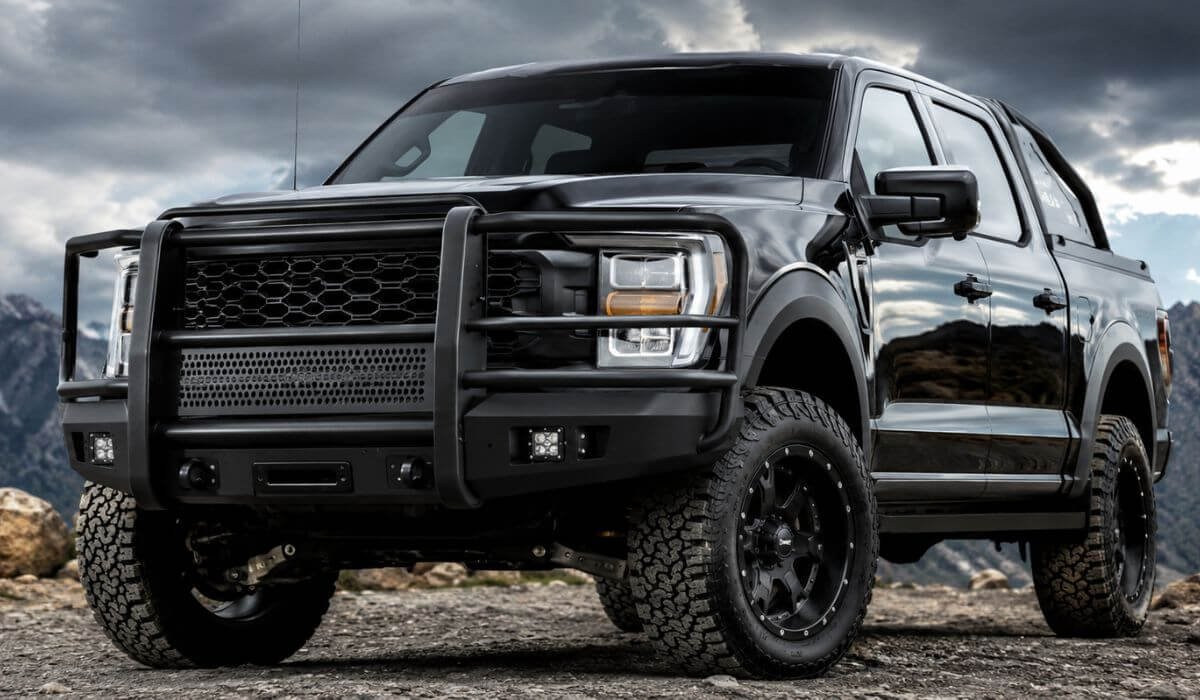
5 Best Grille Guard for Ford F-150 in 2026: Heavy-Duty Front-End Protection & Tough Off-Road Builds
A grille guard on an F-150 is not something to buy just because it makes the truck look tougher. The wrong one can interfere with parking sensors, a front camera, tow hooks, or even the factory bumper shape. That is why this list focuses on actual F-150 fitment, construction, model-year coverage, and front-end differences rather than choosing five guards that simply look good in photos.
The 2026 F-150 range also makes fitment more important than ever. The picks below cover newer 2021–2026 trucks as well as older F-150 applications, with options for standard trims such as XL, XLT, Lariat, King Ranch and Platinum. Front-camera trucks need extra attention, while Raptor and 2022+ F-150 Lightning use different front-end designs and should not be treated as universal fitments. The goal here is simple: find a guard that actually matches the truck before spending money on one.
Best Ford F-150 Grille Guard: Top 2026 Picks for Heavy-Duty Coverage and Easy Mounting
#1. Black Horse RUGGED Heavy Duty Grille Guard Modular Black
Best Grille Guard for Ford F-150 2021–2026 for Maximum Front End Protection and Modular Heavy Duty Coverage
#2. Westin 57-24065 HDX 3-Piece Grille Guard
Best Grille Guard for Ford F-150 2021–2026 XLT and Lariat With Heavy Duty 3-Piece Protection
#3. Westin 57-24085 HDX 3-Piece Grille Guard
Best Grille Guard for Ford F-150 2021–2026 With Front Camera Compatibility and Heavy Duty Coverage
#4. PARTREE Bull Bar Grille Brush Guard
Best Grille Brush Guard for Ford F-150 2004–2026 for Off Road Builds and Broad Model Year Coverage
#5. Steelcraft HD Grille Brush Guard
Best Grille Guard for Ford F-150 2015–2024 XL and XLT Models With Heavy Duty Brush Protection
Expert Tip
Before you order a grille guard for your F-150, check the exact model year and front-end equipment first. This matters more than the brand name. A 2021–2026 F-150, a Raptor and a Lightning may look related, but their front-end designs are not interchangeable. The same goes for trucks equipped with a front camera. If you get the fitment right before buying, you avoid the most frustrating grille-guard problem of all: receiving a heavy, expensive product that technically does not belong on your truck.
How We Choose These Ford F-150 Grille Guards
We did not rank these guards simply by how aggressive they look in product photos. For an F-150, fitment comes first, because a grille guard has to work with the truck you actually own.
1. We Started With Model Year Coverage
The first thing we looked at was year-specific compatibility. Our list includes guards covering newer 2021–2026 F-150s as well as options reaching back to older generations. That gives you a much better starting point than a generic “fits F-150” claim.
The Black Horse RUGGED and both Westin HDX options are particularly relevant to newer F-150 owners, while PARTREE offers unusually broad stated coverage from 2004–2026. Steelcraft is focused on the 2015–2024 range.
2. We Paid Attention to the Front Camera
This is one detail we would not ignore. Modern F-150s can have equipment mounted around the front of the truck that a traditional grille guard never had to account for.
That is why the Westin 57-24085 earns a dedicated place on this list for buyers looking specifically at a front-camera application. We also make the camera issue clear rather than pretending every guard has identical fitment.
3. We Looked at Construction Instead of Just Appearance
A grille guard should have a reason to be on the truck. We considered the actual design approach of each product, including modular construction, 3-piece HD construction and brush-guard or bull-bar layouts.
The Black Horse RUGGED gives you a modular heavy-duty setup. The Westin HDX models take a more substantial 3-piece approach. PARTREE goes in a bull-bar and brush-guard direction, while Steelcraft provides a traditional HD grille-brush-guard design.
That difference matters because not every F-150 owner wants the same thing from the front of the truck.
4. We Separated Standard F-150s From Different Front Ends
This is where many grille-guard lists become misleading.
We have not treated Raptor as just another F-150 trim because its front-end design is different. The same applies to the 2022+ F-150 Lightning, which has a substantially different grille and bumper arrangement. A product having a wide F-150 year range does not automatically mean it fits every F-150 variant.
For that reason, we would rather tell you where a product does not fit than give you a five-star recommendation that creates a return later.
5. We Considered the Truck Trims Buyers Actually Drive
The standard F-150 range includes popular configurations such as XL, XLT, Lariat, King Ranch and Platinum, but trim alone should never be treated as the final fitment check.
Cab style, front-end equipment and the exact model year can change what works. So our recommendations are designed to help narrow the choice first, followed by the manufacturer’s exact application information before you place the order.
6. We Did Not Pretend Every Product Was Perfect
This is probably the most important part of our selection.
There is no single grille guard here that is automatically the best choice for every F-150. The Black Horse is particularly interesting for newer trucks wanting modular protection. The Westin HDX options make more sense for buyers who prefer a heavy-duty 3-piece design, with the 57-24085 standing out for the front-camera application. PARTREE is attractive when broad model-year coverage matters, while Steelcraft makes sense for compatible 2015–2024 trucks.
That is why the ranking is not just a popularity contest. We matched each guard to the type of F-150 owner it actually makes sense for.
And one final bit of real-world advice: do not buy a grille guard until you have confirmed your exact year, cab configuration, front camera setup and whether your truck is a Raptor or Lightning. Spending five minutes checking fitment is far cheaper than finding out after delivery that the guard was built for a different front end.
#1. Black Horse RUGGED Heavy Duty Grille Guard Modular Black
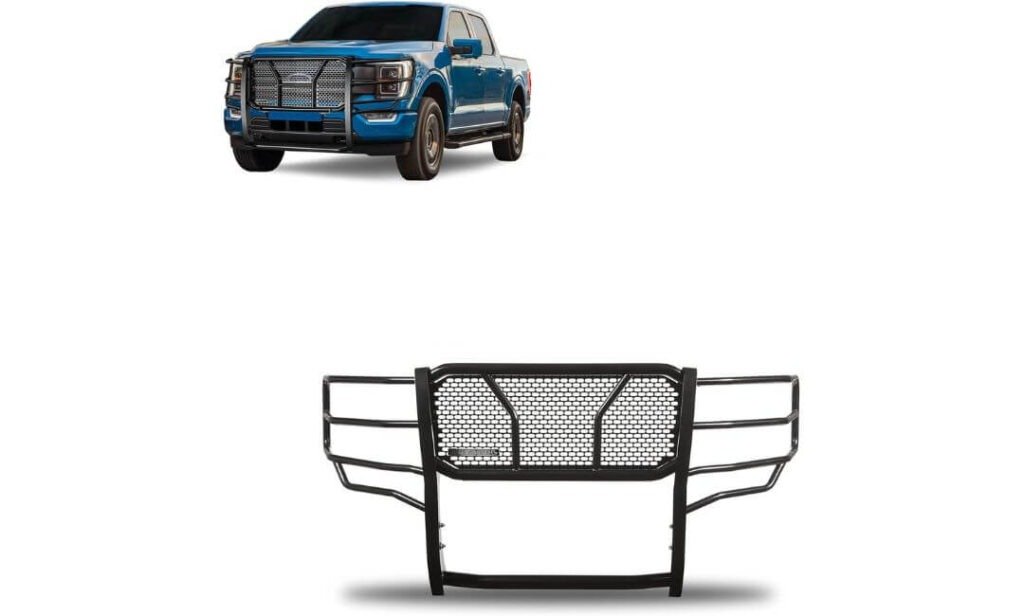
Quick Specs:
- Fitment: 2021–2026 Ford F-150, excluding Raptor, 2020–2022 diesel models and 2022–2023 Lightning EV
- Build: 3-piece modular, frame-mounted construction
- Main tubing: 2.25-inch diameter 16-gauge cold-rolled mild steel
- Vertical plates: 5/16-inch thick HRPO steel
- Installation: No-drill bolt-on design with included brackets and hardware
- Finish: E-Coat base with high-impact powder-coat top layer
- Grille design: Custom-punched centre section
- Lighting: Pre-drilled mounting points for optional LED lights
- Warranty: 3 years
- Overall size: 45 × 24 × 11 inches
- Colour: Black
There is a difference between a grille guard that merely changes the look of an F-150 and one that feels like it was actually designed around the truck. The RUGGED sits firmly in the second category. Its 2.25-inch mandrel-bent steel tubing and 5/16-inch vertical plates give the front end a substantial layer of protection without relying on a bulky one-piece frame. The three-piece layout also makes the guard easier to handle before installation, which is a small detail you appreciate once you’re actually standing beside the truck with the parts laid out.
The no-drill frame-mounted design is another reason this one makes sense for a daily-driven F-150. You are not modifying the frame just to get the guard installed, and the supplied mounting hardware keeps the job relatively straightforward. It is still a proper installation rather than a five-minute bolt-on, though; plan for bumper removal and give yourself roughly 2–3 hours if you’re doing it yourself and want everything aligned properly.
Then there is the finish. Black Horse uses an E-Coat corrosion-resistant base underneath a high-impact powder coat, which is exactly the sort of detail I want to see on something sitting at the very front of a truck and taking road grime, moisture and debris. The punched centre grille also gives the front a cleaner appearance than a completely solid plate, while the pre-drilled light mounts leave room for auxiliary LEDs later without making you modify the guard.
(The important part is not how aggressive it looks parked outside; it is how confidently it fits the F-150 you actually own.)
What We Like
- Proper steel construction: The 2.25-inch tubing and thick vertical plates give it a genuinely substantial feel rather than a lightweight decorative-bar appearance.
- Thoughtful modular layout: Three-piece construction makes handling and positioning much more manageable than wrestling with one enormous guard.
- No-drill mounting: A frame-mounted bolt-on approach keeps the installation cleaner for owners who want protection without permanent drilling.
- Useful accessory provision: The built-in LED mounting points are handy if the truck regularly sees dark roads, trails or work areas.
- Finish feels purpose-built: E-Coat beneath the powder coat is a reassuring combination for something expected to live outside year after year.
What We Don’t
- Installation takes some patience: Bumper removal and alignment add time to the job, so this is better suited to someone comfortable with a detailed truck installation or willing to have a professional handle it.
Ford F-150 Fitment That Actually Matters
This is a strong match for 2021–2026 Ford F-150s when the exact application is confirmed, including standard F-150 configurations such as XL, XLT and Lariat applications. The important exclusions are the Raptor, 2020–2022 diesel models and 2022–2023 Lightning EV, so those trucks should not be treated as interchangeable simply because they carry the F-150 badge.
There is also one modern-F-150 detail worth checking before ordering: front sensors can be affected by a grille guard. If your truck uses adaptive cruise, collision-warning hardware or other front-facing sensors, verify the specific setup before installation. That is not a reason to avoid this guard; it is simply the kind of fitment check that can save you a frustrating adjustment later.
The Insider Pro-Tip
If you’re installing this yourself, don’t fully tighten everything immediately. Get the mounting points started, position the guard evenly against the front end, check the centre alignment and clearance around the grille and sensors, and only then torque everything down. That little bit of patience can make the finished installation look dramatically more factory-minded.
And if your F-150 has a front camera or sensitive driver-assistance equipment, treat that as part of the installation rather than an afterthought. A grille guard should protect the truck without creating a new problem in front of it. The best result is one that looks tough when you see it from ten feet away but is still properly aligned when you inspect it up close.
#2. Westin 57-24065 HDX 3-Piece Grille Guard
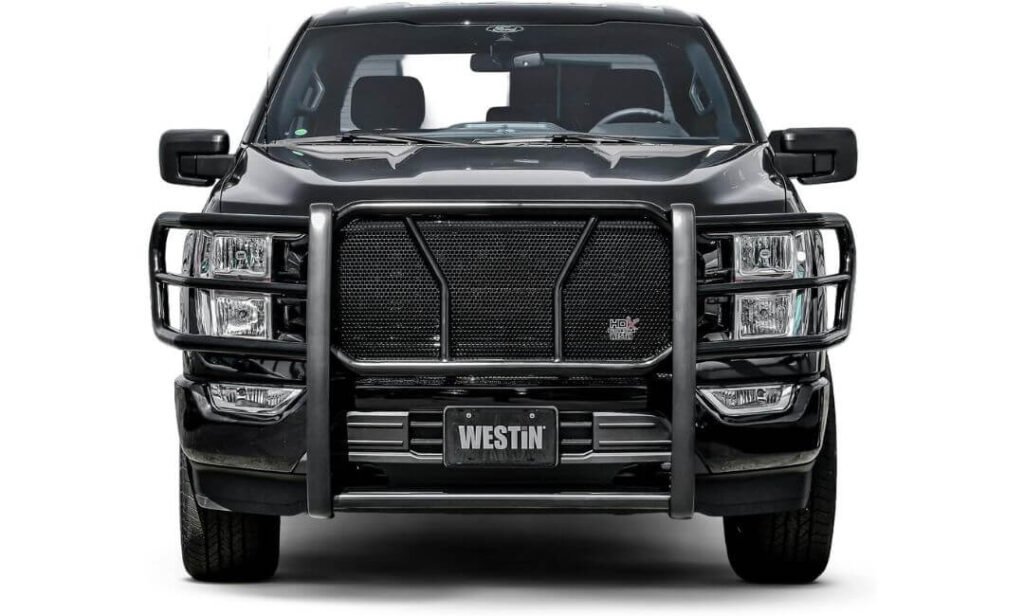
Quick Specs:
- Fitment: 2021–2026 Ford F-150, excluding Platinum, Raptor and 2022+ Lightning EV
- Camera setup: Designed for F-150s without a front camera
- Construction: 3-piece grille guard with bolt-on headlight guards
- Main tubing: 2-inch wrap-around wing tubing
- Support tubing: 1.25-inch support wings on applicable configurations
- Grille protection: Full punch-plate design
- Installation: Bolt-on system with mounting kit and hardware included
- Lighting: Optional light clamps available separately
- Overall size: 44 × 39 × 13 inches
- Colour: Black
Some grille guards try to make an F-150 look tougher; this one takes a more complete front-end approach. The full punch-plate grille works together with the wrap-around wings and bolt-on headlight guards, so protection is not concentrated in one narrow bar. For an owner who wants the front of the truck to feel properly covered rather than simply accessorised, that layout is a meaningful difference.
The 2-inch outer tubing gives the HDX its substantial structure, while the 1.25-inch support tubes used on applicable applications keep the design from looking unnecessarily oversized. I also like the three-piece construction here because it makes the guard much more manageable to position during installation. You get the mounting kit and hardware with it, and optional light clamps are available if you want to add auxiliary lighting later.
There is one fitment detail I would put ahead of the aggressive styling: this particular application is for F-150s without a front camera. It covers the standard trim range including XL, XLT, Lariat and King Ranch, but Platinum, Raptor and 2022+ Lightning EV are excluded. That is useful information, not a footnote, because the F-150 family has enough front-end variations that assuming every grille guard fits every trim is asking for trouble.
(A good grille guard should make the truck look better without making you question whether it belongs there.)
What We Like
- Full punch-plate coverage: Gives the grille area considerably more presence and protection than a simple centre bar.
- Headlight guards included: The bolt-on headlight sections make the overall setup feel more complete.
- Wrap-around design: The 2-inch wing tubing extends protection beyond the centre grille rather than stopping short.
- Broad standard F-150 coverage: XL, XLT, Lariat, King Ranch and other standard trims are covered across Regular, SuperCab and SuperCrew configurations.
- Accessory-friendly setup: Optional light clamps give you an easy path to auxiliary lighting without changing the main guard.
What We Don’t
- Front-camera trucks need a different solution: This application is intended for trucks without a front camera, and camera relocation may be required if you try to adapt it to a camera-equipped F-150.
Ford F-150 Fitment Details
For the right truck, the fitment range is genuinely useful. This HDX application covers 2021–2026 Ford F-150s across standard configurations, including XL, XLT, Lariat and King Ranch, with Regular Cab, SuperCab and SuperCrew options and the common 5.5-, 6.5- and 8-foot bed configurations.
The exclusions deserve equal attention. Platinum and Raptor are not supported, and neither are 2022+ Lightning EV models. Most importantly, this version is for F-150s without a front camera. There has also been owner feedback from a 2024 STX installation noting that the main bracket lined up well while the upper bracket sat slightly differently because of bumper differences, although the guard still mounted securely without modification.
The Insider Pro-Tip
If you’re fitting this to a 2024–2026 F-150, dry-fit the brackets before tightening anything down. Modern bumper variations can change the final alignment slightly, and giving yourself room to position the upper section before everything is locked down is much smarter than trying to correct the alignment after the bolts are tight.
And if your truck has a front camera, don’t try to make this particular application work simply because the year appears on the fitment list. The camera changes the equation. Confirm the exact configuration first, then choose the version designed around your truck. That small check is what separates a clean grille-guard installation from an expensive workaround later.
#3. Westin 57-24085 HDX 3-Piece Grille Guard
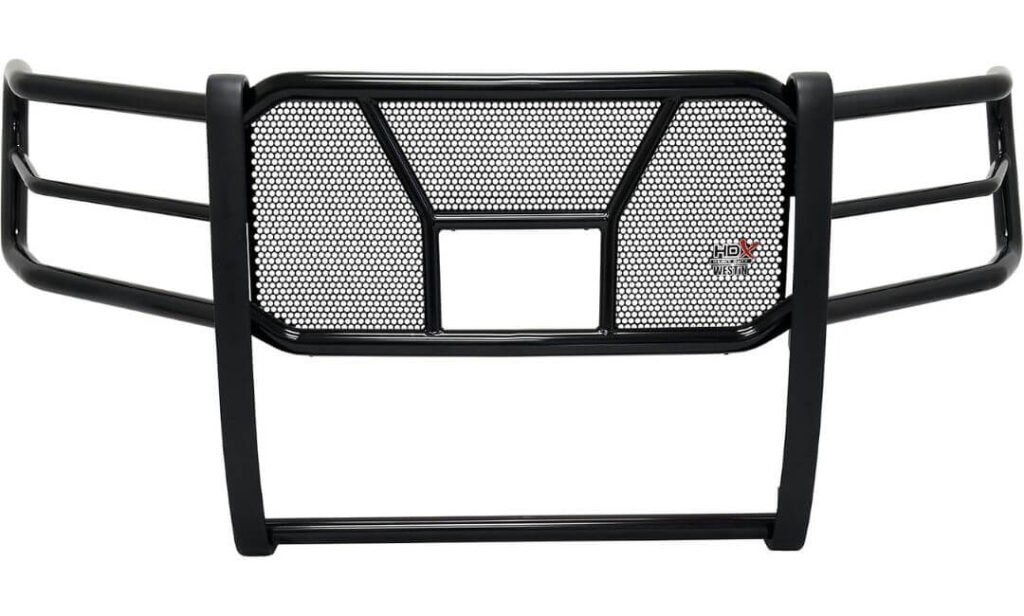
Quick Specs:
- Fitment: 2021–2026 Ford F-150 with front camera, excluding Raptor, Platinum and 2022+ Lightning EV
- Camera setup: Designed specifically around front-camera F-150 applications
- Construction: 3-piece design with removable bolt-on headlight guards
- Main tubing: 2-inch wrap-around wing tubing
- Support tubing: 1.25-inch support wings on applicable configurations
- Grille protection: Full punch-plate centre section
- Installation: Bolt-on mounting system with hardware and mounting kit included
- Finish: Black powder coat with electrostatic base coat
- Lighting: Optional light clamps available separately
- Warranty: 3 years
- Overall size: 45 × 39 × 13 inches
- Colour: Black
Here is where the HDX gets genuinely interesting for a newer F-150 owner: this version is built for the front-camera configuration, rather than asking you to treat a standard grille guard as a universal solution. That distinction matters on modern trucks because the camera is part of the vehicle’s safety and driver-assistance equipment. Getting the guard matched to that setup from the beginning is simply the smarter way to buy.
The construction is equally serious. You get 2-inch wrap-around tubing, reinforcement through the guard structure and a full punch-plate grille, while the three-piece arrangement gives you removable bolt-on headlight guards. That means you can keep the complete look or remove those sections when you prefer a cleaner front-end appearance. It is a useful bit of flexibility rather than a gimmick.
The finish also makes sense for something that lives directly in the weather. The electrostatic base coat and black powder coat provide a proper corrosion-resistant finish, while the supplied mounting kit keeps the installation firmly in the bolt-on category. Westin rates the DIY difficulty around 3/5, which feels realistic: it is absolutely manageable for someone comfortable working on a truck, but I would not call it a casual driveway accessory you throw on in half an hour.
(The real advantage here is not the bigger-looking front end; it is getting heavy-duty protection without ignoring the technology already built into the F-150.)
What We Like
- Purpose-built camera application: This is the biggest reason to consider it over a standard HDX version.
- Removable headlight guards: Gives you control over how much front-end coverage you actually want.
- Strong wrap-around profile: The 2-inch tubing gives the corners useful presence instead of leaving the protection concentrated at the grille.
- Full punch-plate centre: Adds a more complete barrier across the grille area while keeping the design visually cohesive.
- Proper weather-ready finish: The electrostatic base and powder coat combination is reassuring for long-term exterior use.
What We Don’t
- It is not a universal F-150 fit: Raptor, Platinum and 2022+ Lightning EV owners need to look elsewhere rather than trying to force this application onto a different front-end design.
Ford F-150 Front Camera Fitment
This is the Westin option in the lineup I would put directly in front of an owner with a 2021–2026 F-150 equipped with the factory front camera. It is designed around that configuration and is intended to work with systems such as adaptive cruise and collision-warning equipment, although the presence of a grille guard can still affect certain parking sensors depending on the truck’s exact equipment.
The same rule applies here as with any modern accessory: year alone is not enough. Confirm the front-camera setup and exact truck configuration before ordering. Raptor, Platinum and 2022+ Lightning EV models are excluded, so the fact that they share the F-150 name should not be used as a shortcut for fitment.
The Insider Pro-Tip
If your truck has the front camera, this is the type of fitment I would prioritise before looking at styling. Once the correct application is established, spend a little extra time checking the camera view and sensor behaviour after installation. The guard should sit confidently around the truck’s equipment, not become something the safety systems have to work around.
One more thing: the removable headlight sections are worth thinking about before you install everything permanently. Keep them on if maximum coverage is your priority; remove them if you prefer a slightly cleaner front profile. That flexibility is one of the genuinely useful details in this HDX design, and it is easy to overlook when you’re only comparing product photos.
#4. PARTREE Bull Bar Grille Brush Guard
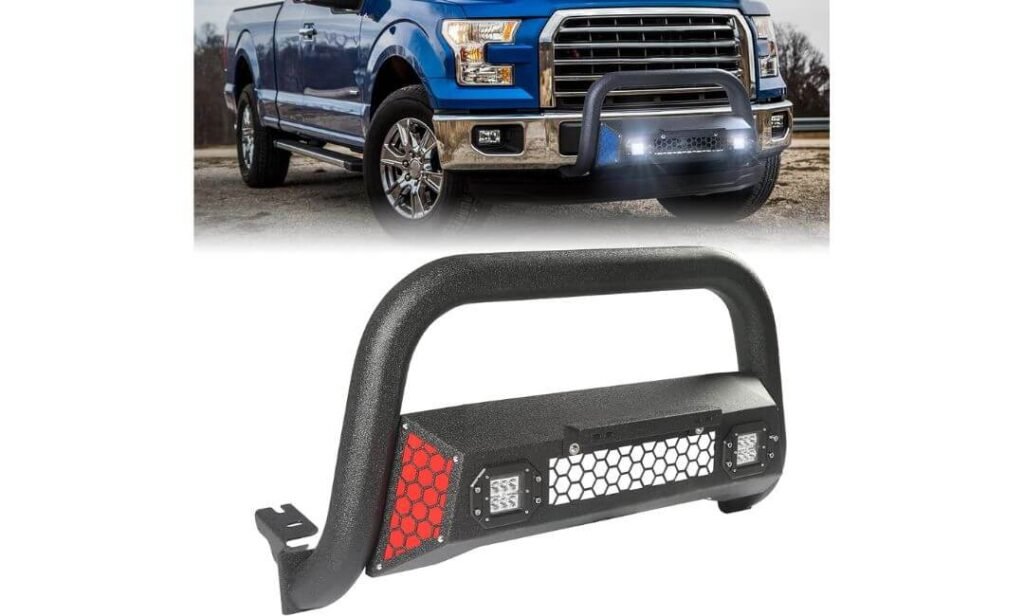
Quick Specs:
- Fitment: 2004–2026 Ford F-150 applications
- Construction: Thickened carbon-steel 3-inch tube design
- Installation: Bolt-on, no-drill setup with mounting hardware included
- Finish: Black powder coating for corrosion resistance
- Lighting: LED light included
- Plate support: License plate bracket included
- Customisation: Paintable trim panels
- Radar note: Not recommended for F-150s equipped with front radar systems
- Coverage: Listed for XL, XLT, Lariat, King Ranch and Platinum applications
- Cab styles: Regular Cab, SuperCab and SuperCrew
- Colour: Black
What immediately separates this bull bar from the newer F-150 specific guards is its sheer model-year reach. A product claiming 2004–2026 coverage needs to be approached carefully, but for owners of an older F-150 who want a straightforward front-end upgrade, that broad application range is genuinely useful. Instead of chasing a guard designed around only one generation, this gives older-truck owners a much easier starting point.
The 3-inch carbon-steel tube is the main story here. It gives the front of the truck a noticeably heavier presence while adding another layer between the bumper and the kind of minor contact you would rather not put directly into the truck. The powder-coated surface is there for the less glamorous but equally important job of dealing with moisture and road exposure, while the included LED light and license-plate bracket make the package feel more complete out of the box.
Installation is also refreshingly uncomplicated on paper. It uses a bolt-on, no-drill mounting approach, with the required hardware and instructions included. That does not mean every installation will be identical across such a wide model range, but it does mean you’re not being asked to permanently modify the truck just to fit the guard. The paintable trim panels are another nice touch if you want to personalise the appearance later.
(For an older F-150, the appeal is simple: substantial steel, useful extras and a fitment range that does not force you into a newer-truck-only accessory.)
What We Like
- Huge F-150 coverage: The 2004–2026 stated range makes it particularly interesting for owners of older generations.
- 3-inch steel tubing: Gives the bull bar a properly substantial profile without relying on decorative styling alone.
- Useful extras included: The LED light and license-plate bracket add practical value rather than leaving you buying basic accessories separately.
- No-drill installation: Keeps the mounting approach straightforward for owners who want a bolt-on solution.
- Paintable trim: Gives you room to change the visual character of the guard instead of being locked into the factory black finish.
What We Don’t
- Front radar is the big consideration: Trucks equipped with front radar systems should not use this application because the guard can obstruct the sensors.
Ford F-150 Fitment Across Generations
This is the broadest application in the lineup, with stated compatibility covering 2004–2026 Ford F-150s, including XL, XLT, Lariat, King Ranch and Platinum configurations, along with Regular Cab, SuperCab and SuperCrew layouts. That makes it especially appealing if you’re shopping for an F-150 from an older generation where newer grille-guard options simply do not apply.
But broad fitment should never mean blind fitment. Front radar-equipped trucks are specifically excluded, so owners using adaptive cruise, collision-avoidance or related radar equipment need to verify their setup before considering this guard. The same careful approach applies to unusual front-end configurations across such a large model-year span.
The Insider Pro-Tip
With a product covering this many F-150 generations, do not order from the year range alone. Match your exact truck’s front bumper and mounting arrangement before buying. That’s the one check that matters most with a broad-fit accessory.
If your F-150 does not use the affected front radar hardware and the application matches your truck, the included LED light, plate bracket and no-drill mounting make this a surprisingly complete package. For an older truck especially, that combination can make more sense than paying extra for a newer-generation guard whose design was never meant for your front end.
#5. Steelcraft HD Grille Brush Guard Black
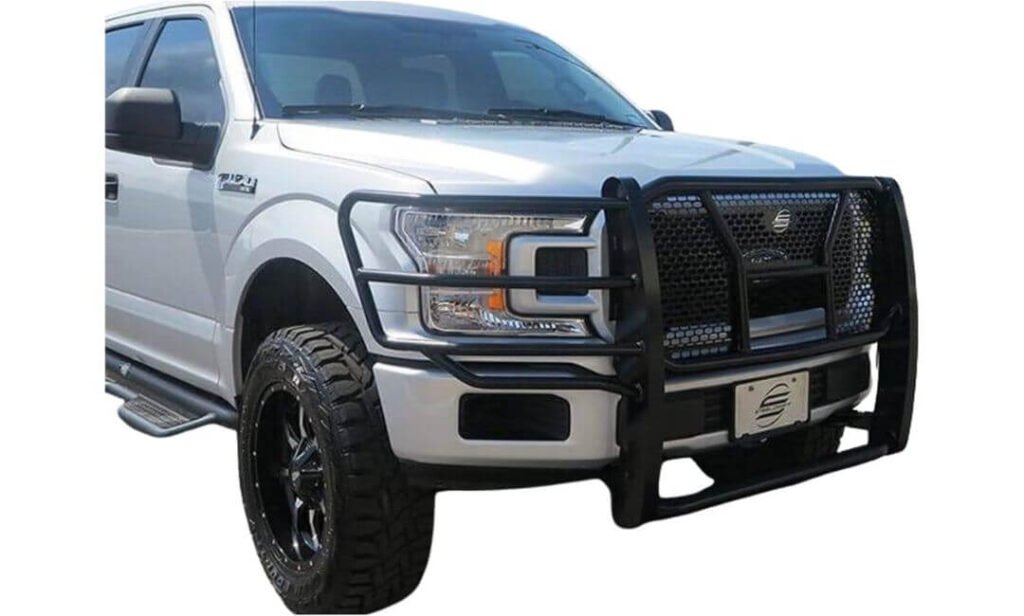
Quick Specs:
- Fitment: 2015–2024 Ford F-150 standard applications
- Construction: One-piece fully welded steel design
- Grille protection: Punch-plate grille with removable centre panel
- Camera provision: Removable grille panel allows emblem or parking-camera accommodation
- Tow hooks: Retains the factory tow hooks
- Finish: E-Coated and powder-coated semi-gloss black
- Sensor note: Parking sensors can detect the guard
- Sensor solution: Relocation kit #10447SRP available separately
- Cab coverage: Regular Cab, SuperCab and SuperCrew
- Bed coverage: 5.5-foot, 6.5-foot and 8-foot configurations
- Exclusions: Raptor and 2022+ Lightning EV
- Colour: Semi-gloss black
There is something reassuring about a fully welded one-piece guard. Instead of a modular design with several sections coming together, this Steelcraft takes the straightforward route: one solid structure, a punch-plate grille and a front profile built around the 2015–2024 F-150. For an owner who prefers a traditional brush-guard appearance and wants fewer moving pieces, that simplicity is actually part of its appeal.
The useful detail is what happens around the factory equipment. The removable grille panel gives room for the emblem or parking-camera setup, while the design allows you to keep the truck’s original tow hooks. Those are small details, but they are exactly what I look for in a truck accessory because you should not have to give up useful factory equipment just to add protection.
The finish is also properly suited to something mounted at the very front of the truck. It gets an E-Coat underneath the powder coat, giving the steel an additional layer of protection against the sort of moisture and road exposure a grille guard naturally sees. The one thing to know beforehand is the parking-sensor behaviour: the sensors can detect the guard, and a dedicated relocation kit is available if your truck requires it.
(This is the kind of guard that makes sense for an owner who values solid construction and straightforward F-150 fitment over unnecessary complexity.)
What We Like
- Fully welded construction: A simple, solid approach that suits buyers who prefer a traditional heavy-duty guard.
- Factory tow hooks remain usable: You do not lose an important piece of the F-150’s original utility.
- Removable grille panel: Adds useful flexibility for emblem and parking-camera arrangements.
- Broad standard F-150 coverage: Works across Regular Cab, SuperCab and SuperCrew configurations.
- E-Coat plus powder coat: Gives the steel a sensible exterior defence against corrosion.
What We Don’t
- Parking sensors need attention: The sensors can detect the guard, so some trucks may benefit from the separately available relocation kit.
Ford F-150 Fitment Details
The application covers 2015–2024 Ford F-150 standard trims, including XL, XLT, Lariat, King Ranch and Platinum configurations, with Regular Cab, SuperCab and SuperCrew options. It also covers the common 5.5-foot, 6.5-foot and 8-foot bed configurations, giving it useful coverage across this generation.
The exclusions are straightforward: Raptor and 2022+ Lightning EV are not compatible because their front-end designs are different. If your truck has parking sensors, check how they interact with the guard before installation. The available relocation solution means this is manageable, but it is better to know about it before the guard is sitting in your driveway.
The Insider Pro-Tip
If your F-150 has parking sensors, test them before and after installation. That gives you a clear baseline and immediately tells you whether the guard is being detected in a way that affects your normal parking routine. If it is, the available relocation kit is the cleaner answer than trying to live with false alerts.
And if you’re choosing between a modular guard and this one-piece design, think about how you actually use the truck. If you want a straightforward welded structure that keeps the factory tow hooks and gives the front end a traditional brush-guard look, this Steelcraft has a very honest reason for being on the list.
Best Ford F-150 Grille Guard Options (2004–2026) Ranked by Protection and Design
| Grille Guard | Best Match | Build & Protection | Installation | Front-End Equipment | Fitment Range | Standout Advantage |
|---|---|---|---|---|---|---|
| Black Horse RUGGED Modular Heavy Duty Grille Guard | NEWER F-150 Best suited to owners wanting substantial protection with a modular setup. |
2.25″ steel tubing 5/16″ vertical steel plates 3-piece construction |
No-drill bolt-on Frame mounted Bumper removal recommended |
Front sensors may be affected Check camera and driver-assistance equipment before ordering. |
2021–2026 F-150 standard applications |
BEST OVERALL Strong steel construction without giving up the flexibility of a modular design. |
| Westin 57-24065 HDX 3-Piece Grille Guard | STANDARD TRIMS A strong choice when your F-150 does not have a front camera. |
2″ wrap-around tubes Full punch-plate grille Bolt-on headlight guards |
Bolt-on design Mounting kit included Optional light clamps |
NO FRONT CAMERA Camera-equipped trucks require a different application. |
2021–2026 XL, XLT, Lariat, King Ranch and other standard trims |
FULL FRONT COVERAGE Punch plate plus headlight guards gives it a more complete protective profile. |
| Westin 57-24085 HDX Front Camera Grille Guard | FRONT CAMERA The specialist pick for owners who need a camera-specific application. |
2″ wrap-around tubes Reinforced structure Full punch-plate grille |
Bolt-on system Mounting kit included Removable headlight guards |
CAMERA APPLICATION Designed around the front-camera configuration; sensor behaviour should still be checked after installation. |
2021–2026 Front-camera F-150 applications |
BEST FOR CAMERA TRUCKS The most logical choice here when front-camera compatibility is the starting point. |
| PARTREE Bull Bar Grille Brush Guard | WIDE YEAR RANGE Particularly useful for owners of older F-150 generations. |
3″ carbon-steel tube Powder-coated finish LED light included |
No-drill bolt-on Hardware included License plate bracket |
NO FRONT RADAR Not recommended where front radar equipment could be obstructed. |
2004–2026 Broad F-150 applications |
WIDEST COVERAGE Its unusually broad model-year reach makes it stand out from the newer-truck-focused options. |
| Steelcraft HD Grille Brush Guard | 2015–2024 F-150 A straightforward option for standard F-150 configurations. |
One-piece welded steel Punch-plate grille Removable grille panel |
One-piece construction Factory tow hooks retained |
Parking sensors detect guard Relocation kit #10447SRP is available separately. |
2015–2024 Regular Cab, SuperCab and SuperCrew |
SIMPLE & SOLID A traditional welded design for buyers who prefer straightforward construction. |
Ford F-150 Grille Guard Buying Guide: What Actually Matters Before You Order
A grille guard is one of those F-150 upgrades where fitment matters just as much as steel thickness. A heavy guard that does not clear your sensors, camera, bumper or tow hooks is not a better product; it is simply the wrong product for your truck. The easiest way to avoid that mistake is to decide what you need the guard to do first, then narrow the choices by construction, mounting style and exact vehicle configuration.
Start With the Protection You Actually Need
If your F-150 spends most of its time on pavement, a full punch-plate grille guard may offer more coverage than you realistically need. A bull-bar style design can make more sense when you mainly want a strong centre-front barrier and a simpler appearance.
For regular off-road use, brush, loose branches and rough trails are a different story. That is where wrap-around wings, headlight guards and stronger vertical sections become useful. The Black Horse RUGGED and Westin HDX designs, for example, take a more complete approach to front-end coverage than a simple centre bull bar.
Do not confuse a more aggressive appearance with better protection, though. Tube diameter, steel thickness, mounting points and how much of the front end the guard actually covers tell you considerably more than the shape of the product in a photograph.
Material and Construction: Look Beyond the Finish
Steel remains the practical choice for this type of accessory because the guard needs to handle impact, vibration and constant exposure to road debris.
The construction style is just as important:
- Thicker steel tubing generally gives the guard a more substantial structure.
- Mandrel-bent tubing can provide a cleaner continuous shape around the front corners.
- Welded one-piece construction is appealing if you prefer a fixed, straightforward structure.
- Three-piece modular construction can make handling and installation easier while allowing certain sections to be removed.
- Punch-plate sections provide broader grille coverage than a single horizontal tube.
- Wrap-around wings are useful when you want protection extending toward the headlights and front corners.
For this reason, do not choose between the five guards solely by asking which one has the largest tube. The overall construction and mounting design matter more than one specification in isolation.
Check the Mounting Hardware Before Thinking About Looks
A proper grille guard should mount securely to the truck’s intended mounting points. The products in this guide use bolt-on approaches, but that does not mean every installation will feel equally simple.
Look for a setup with vehicle-specific brackets, supplied mounting hardware and clear attachment points. A no-drill design is particularly attractive when you want to avoid modifying the truck’s frame.
Also remember that a bolt-on installation can still be a substantial job. On some F-150s, bumper removal and careful bracket alignment may be required. If you are not comfortable supporting the bumper, working around sensors or aligning a large steel assembly, paying for professional installation can be money well spent.
Your F-150’s Front Camera Changes the Decision
This is probably the most important compatibility check on a newer truck.
The Westin 57-24065 is intended for F-150 applications without a front camera, while the Westin 57-24085 is specifically designed around front-camera applications. That difference is exactly why you should never assume two guards with similar construction will work equally well on the same truck.
Before installation, check that the guard does not obstruct the camera’s field of view. After installation, verify the camera image and the operation of the relevant driver-assistance systems. A grille guard should not become an obstacle in front of equipment the truck relies on.
If your F-150 uses adaptive cruise, collision warning or other front-facing technology, verify the exact product application rather than relying on the model year alone.
Do Not Forget Your Cab and Bed Configuration
Cab and bed dimensions do not necessarily determine whether a grille guard fits the front end, but they are still worth confirming when checking a product’s complete vehicle application.
Your F-150 may be a:
- Regular Cab
- SuperCab
- SuperCrew
Bed configurations can include:
- 5.5-foot bed
- 6.5-foot bed
- 8-foot bed
A product listing that explicitly covers your cab and bed combination gives you more confidence than a vague “fits F-150” description. This is particularly important with broad-year products, where mounting arrangements can vary between generations.
Trim Level Is Important, But It Is Not the Whole Story
Standard F-150 trims such as XL, XLT, Lariat, King Ranch and Platinum can share a basic platform, but that does not mean every grille guard fits every trim.
Front-end equipment is the bigger concern. The Platinum and Raptor exclusions on some of the products in this guide are good examples of why the trim name needs to be checked before ordering.
The Raptor should be treated separately because its front-end design is different. The same applies to the 2022+ F-150 Lightning EV, whose grille and bumper arrangement is substantially different from the standard F-150.
In other words, never read “2004–2026 F-150” and assume every F-150 built during those years is automatically covered.
Think About Off-Road Clearance Before Installation
A grille guard can protect the front end while also changing how the truck interacts with obstacles.
If you regularly approach steep trails, rocks or uneven ground, look closely at where the guard sits relative to the bumper, lower front area and approach angle. A large lower section may become the first thing to contact an obstacle.
This is one reason the right guard depends on how you drive. A daily-driven F-150 needs different priorities from a truck that regularly leaves the pavement.
DIY Installation or Professional Installation?
If the product is advertised as bolt-on and no-drill, that is encouraging, but it does not automatically make the installation easy.
A DIY installation makes sense if you already have:
- A suitable workspace
- Proper lifting and support equipment
- Basic truck-handling experience
- Enough time to align the guard correctly
- Someone available to help handle the weight during positioning
A professional installation becomes more attractive when bumper removal, camera alignment, sensor clearance or complicated bracket positioning is involved.
The goal is not simply to get the guard attached. It should sit evenly, maintain sensible clearance around the truck’s equipment and remain securely mounted after the first rough road.
Common Clearance Problems to Check
Before tightening everything completely, inspect the areas where problems are most likely to show up:
- Front camera visibility
- Parking sensor clearance
- Adaptive cruise and collision-warning hardware
- Headlight clearance
- Grille and bumper gaps
- Tow-hook access
- Licence plate position
- Auxiliary-light mounting space
- Lower bumper and approach clearance
Do a complete visual and functional check before the final tightening. It is much easier to correct a small alignment issue while the brackets still have some adjustment than after everything has been fully torqued.
How to Avoid Camera or Signal Problems
There is no universal rule that every grille guard will interfere with every F-150 sensor system. The exact truck equipment and guard design matter.
For a camera-equipped truck, make sure the guard does not sit directly across the camera’s viewing area. For radar-equipped vehicles, pay even closer attention to the manufacturer’s compatibility information. The PARTREE application in this guide, for example, specifically warns against use with front radar systems.
If a product requires camera relocation or excludes a particular sensor configuration, take that information seriously rather than trying to improvise after installation. A clean fitment decision before purchase is always better than modifying an expensive accessory afterward.
Ford F-150 Grille Guard Fitment by Cab, Bed and Trim
One thing worth clearing up before getting into the configurations: cab and bed length generally do not determine grille-guard fitment by themselves. The front bumper, mounting points, sensors, camera equipment and model year matter much more. Cab and bed details are still useful because they help confirm the complete vehicle application and prevent ordering from a vague “fits F-150” description.
Regular Cab
The Regular Cab is usually the simplest F-150 configuration from a front-end perspective, but you should still match the exact model year and bumper design before ordering. A grille guard does not mount according to cab length alone; its brackets attach around the front structure of the truck.
For older Regular Cab trucks, a broad-fit product such as the PARTREE application can be interesting because it covers a large range of F-150 generations. For 2021–2026 trucks, the Black Horse RUGGED and applicable Westin HDX versions provide more generation-specific options.
The practical advantage is that the shorter cab does not require a different grille guard width simply because the cabin is shorter. Do not choose a guard based on the cab label alone. Confirm the front-end application, mounting brackets and sensor configuration.
SuperCab
The SuperCab follows the same basic rule: the grille guard is primarily determined by the front-end architecture, not the rear passenger-door arrangement.
When checking a SuperCab application, pay attention to whether the manufacturer specifically lists your model year and trim. Westin’s 2021–2026 HDX applications cover standard F-150 configurations across cab styles, but the important exclusions remain the same. A Platinum, Raptor or Lightning should not be treated as compatible simply because the truck is a SuperCab.
If your SuperCab has front sensors or a camera, check those before installation. The guard may physically bolt onto the truck while still creating a problem with the equipment mounted around the grille or bumper.
SuperCrew
For SuperCrew owners, there is no special grille-guard shape required simply because of the larger cab. What matters is still the front bumper, mounting system and vehicle equipment.
SuperCrew trucks are common candidates for full front-end protection because they are often used as everyday family trucks as well as work or travel vehicles. In that situation, a guard with a clean wrap-around design can provide useful coverage without making the truck feel unnecessarily overbuilt.
The Westin HDX applications are particularly relevant here because the listed fitment includes SuperCrew configurations. Still, check the exact front-end equipment before ordering, especially if your truck has a front camera or parking sensors.
5.5-Foot Bed
The 5.5-foot bed is common on SuperCrew F-150s, but bed length does not normally change the grille guard’s physical mounting points.
What it does give you is another useful confirmation point when checking the manufacturer’s application. If a listing specifically identifies your cab and bed combination, you have a stronger fitment reference than a generic F-150 statement.
For the grille guard itself, focus on front bumper alignment, bracket position, sensor clearance and the guard’s relationship with the lower front end. The shorter bed does not mean you need a narrower grille guard.
6.5-Foot Bed
The 6.5-foot bed appears across several F-150 configurations, so it is another case where the front-end configuration matters more than the bed measurement.
When installing a guard, check that the mounting brackets sit naturally against their intended points and that the guard is centred before final tightening. If the truck has parking sensors, camera equipment or other front-facing technology, verify clearance at this stage rather than discovering an issue after the installation is complete.
The Westin applications in this guide specifically list broad F-150 configurations, making them easier to evaluate than a product with an unclear application chart.
8-Foot Bed
The 8-foot bed is most often associated with work-oriented F-150 configurations, but the long bed itself does not require a different grille guard design.
The important thing is confirming the generation, cab configuration and front-end equipment. A long-bed F-150 can still have different front bumper equipment depending on its year and trim.
For a work truck, I would also pay close attention to tow-hook access, front clearance and whether the guard leaves enough room for anything else you regularly use at the front of the truck. A grille guard should add protection without taking away useful factory functionality.
Ford F-150 XL
The XL is generally the easiest trim to shop for because it tends to have a straightforward equipment package, but the exact year still matters.
For newer XL trucks, the Black Horse RUGGED is worth considering when you want heavy-duty steel construction and a modular three-piece design. Westin’s HDX options also cover standard XL applications, with the important distinction between the non-camera and front-camera versions.
Before buying, check whether your XL has parking sensors, a front camera or other optional equipment. The base trim name does not tell the whole story.
Ford F-150 XLT
The XLT is one of the most common F-150 configurations, and several products in this guide are aimed at it.
The Westin 57-24065 is particularly relevant for 2021–2026 XLT trucks without a front camera, while the 57-24085 is the more appropriate HDX application when the truck has a front camera. That distinction is much more useful than simply saying “both fit an XLT.”
If you have a 2024 or newer XLT, pay attention to the exact bumper and sensor configuration during installation. Small front-end differences can affect bracket positioning even when the basic vehicle application is correct.
Ford F-150 Lariat
The Lariat is where optional front-end technology becomes especially important. Depending on the truck’s equipment, you may encounter front cameras, parking sensors and other driver-assistance hardware that need to be considered before installing a grille guard.
For a Lariat without a front camera, the applicable Westin HDX 57-24065 is a logical option. With a front-camera configuration, the 57-24085 is the more relevant choice from this lineup.
The key point is simple: do not shop by “Lariat” alone. Confirm the equipment fitted to your individual truck.
Ford F-150 King Ranch
The King Ranch brings more premium equipment into the equation, so the grille guard should be selected with the truck’s actual front-end hardware in mind.
Standard grille-guard applications can cover the King Ranch, but some products in this guide specifically exclude Platinum, while others distinguish camera-equipped vehicles from non-camera versions. That means a King Ranch owner should verify the exact application rather than assuming a higher trim automatically requires a special guard.
Also check the position of any parking sensors and front lighting before installation. A premium trim can have more equipment occupying the same front-end area where the guard needs to sit.
Ford F-150 Platinum
Platinum deserves a separate warning because some of the products in this guide explicitly exclude it.
The Westin 57-24065 and 57-24085 applications both exclude Platinum, even though they cover many other standard F-150 trims. That is a perfect example of why “fits 2021–2026 F-150” is not enough information on its own.
If you own a Platinum, verify the exact manufacturer’s application before purchasing. Do not assume that a grille guard designed for an XLT or Lariat will transfer simply because the basic body style looks similar.
F-150 Raptor
The Raptor should be treated as a separate vehicle application for grille-guard shopping.
Its different front-end design means several of the guards in this guide specifically exclude it. The Black Horse RUGGED, both Westin HDX applications and Steelcraft application should not be treated as Raptor-compatible simply because they list F-150 in their names.
If you own a Raptor, look for a guard specifically engineered around the Raptor’s bumper, grille and mounting arrangement.
F-150 Lightning
The 2022+ F-150 Lightning EV is another major exception.
Its front-end design is substantially different from the conventional F-150, and the products in this guide specifically exclude Lightning applications where stated. The Lightning should therefore be treated as its own fitment category rather than another trim level.
This is especially important because the product year range can look impressive on paper. A “2004–2026 F-150” claim does not automatically override a manufacturer’s specific Lightning exclusion.
Front Camera Integration
If your F-150 has a front camera, this should be one of the first things you check.
The Westin 57-24085 is the dedicated front-camera option in this lineup, while the 57-24065 is intended for trucks without the front camera. The Black Horse RUGGED can also require careful consideration because front sensors may be affected.
After installation, check the camera view rather than simply looking at whether the camera physically remains visible. The important question is whether the guard has entered the camera’s field of view.
Also verify any related driver-assistance functions according to the truck manufacturer’s instructions. A grille guard should never be considered properly installed until you are satisfied that the truck’s front-facing equipment is behaving normally.
The Fitment Rule I Would Follow
If you remember only one thing from this section, make it this:
Match the grille guard to the front end, not just the truck name.
Start with model year, then confirm trim, cab configuration, front camera, parking sensors, radar equipment and bumper design. Bed length is useful as a final application check, but it is rarely the deciding factor for the guard itself.
That approach may take a few extra minutes before ordering, but it is exactly what prevents the most common grille-guard mistake: buying a product that technically says “F-150” on the box while overlooking the one piece of equipment that makes it incompatible with your truck.
Ford F-150 Grille Guard Installation Tips and Best Practices
A grille guard can be a straightforward bolt-on upgrade, but the difference between a clean installation and a frustrating one usually comes down to alignment, sensor clearance and patience. The products in this guide use bolt-on mounting approaches, yet several are large, heavy assemblies that may require bumper removal or careful bracket positioning. If you are comfortable working on your F-150, the job is manageable; if you are dealing with cameras, radar or unfamiliar bumper hardware, professional installation is the safer route.
Quick Installation Overview
Before touching a bolt, park the F-150 on a flat, level surface, switch the engine off and give yourself enough room to work around the entire front end. Read the product-specific instructions first because bracket locations and bumper-removal requirements can vary between generations.
A sensible installation sequence looks like this:
- Confirm the exact application. Verify the model year, trim, front camera, parking sensors, radar equipment and bumper configuration before unpacking the hardware.
- Inspect everything first. Lay out the grille guard, brackets, bolts and washers so you know nothing important is missing before starting.
- Photograph the original setup. A few quick photos of the bumper, tow hooks, sensors and wiring can be surprisingly useful when putting everything back together.
- Remove only what the instructions require. Some applications require bumper removal, while others provide access to the frame mounting points without extensive disassembly.
- Install the brackets loosely. Do not fully tighten the mounting hardware yet. You need enough movement to centre the guard properly.
- Position the grille guard. With another person supporting the assembly, check the gaps around the grille, headlights, bumper and lower front section.
- Check all equipment before final tightening. Look at the camera, parking sensors, radar equipment, tow hooks and any factory wiring.
- Tighten the hardware to the manufacturer’s specified torque. Do not guess torque values for structural mounting bolts.
- Recheck everything after installation. Make sure the guard is centred, the brackets are seated correctly and no wiring or plastic trim is being pinched.
- Carry out a controlled test drive. Start slowly, listen for movement or vibration and test the relevant parking and driver-assistance equipment before returning to normal driving.
DIY Installation or Professional Installation?
For someone who regularly works on trucks, a bolt-on grille guard is a reasonable DIY project. The Black Horse RUGGED, for example, uses a no-drill frame-mounted design, although bumper removal and careful alignment can still make the job considerably more involved than the phrase “bolt-on” suggests.
The Westin HDX products also arrive with mounting kits and hardware, but their three-piece construction does not mean the installation is weightless or effortless. Having a second person available is a very good idea when positioning the guard.
Professional installation becomes more attractive when your F-150 has a front camera, parking sensors, radar equipment or complicated front-end wiring. You are paying for more than someone turning a wrench; you are paying for correct positioning around equipment that the truck depends on.
The Most Common Sensor Mistake
Do not install the guard, look at the truck from ten feet away and assume everything is fine.
Modern F-150s can have parking sensors, front cameras and radar-based equipment positioned around the bumper and grille area. A guard can physically fit while still affecting what those systems see.
The Westin 57-24065 is intended for F-150s without a front camera, while the 57-24085 is designed for the front-camera application. The PARTREE guard has a separate warning regarding front radar systems, and the Steelcraft application notes that parking sensors can detect the guard.
After installation, test the equipment exactly as you normally would. If a warning appears, sensors begin detecting the guard constantly, or the camera view is obstructed, stop and investigate rather than assuming the system will eventually “settle down.”
Keep an Eye on Fog Light and Front Lighting Clearance
If your F-150 has factory fog lights or other lower front lighting, check the guard’s position carefully before final tightening.
The guard should not sit against the light housing, block a significant portion of the beam or put pressure on surrounding trim. This is particularly important when the truck has optional lighting equipment that differs from the base configuration.
If you are using the optional light mounts available with applicable Westin HDX products, decide their final position before tightening the grille guard completely. It is much easier to adjust everything while the brackets still have some movement.
Wiring LED Lights the Right Way
If you add auxiliary lighting to a grille guard, treat the wiring as a proper electrical installation rather than simply connecting the lights to whatever wire happens to be nearby.
A clean setup normally includes:
- A dedicated fused power feed appropriate for the actual light load.
- An automotive-rated relay where the lighting circuit and manufacturer’s instructions call for one.
- A properly positioned switch that the driver can reach without taking attention away from driving.
- Weather-resistant connectors at exposed points.
- Protective loom around wiring running near the grille guard, radiator support or other areas where vibration and rubbing can occur.
- Secure cable routing away from hot exhaust components, sharp brackets and moving parts.
The fuse should be selected according to the actual current draw of the lights and the wiring capacity, not simply because a larger fuse seems safer. Oversizing a fuse defeats its protective purpose.
If you are unsure about the truck’s electrical system or the lighting load, having an automotive electrician handle the wiring is a much better decision than troubleshooting a melted connector later.
Protect the Wiring From the Real World
The front of an F-150 gets dirty, wet and repeatedly shaken. A wiring connection that looks perfect in a garage can become unreliable after months of water, mud and vibration.
Use weather-resistant connectors where appropriate, keep connections away from direct spray and leave enough slack for normal movement without allowing the cable to hang loosely. Any wire passing close to the grille guard should have proper abrasion protection.
Most importantly, never route wiring where it can be crushed between the guard and the bumper or caught by a bracket.
Torque and Alignment Matter More Than Speed
One of the easiest ways to make a grille guard look cheap is to install it slightly crooked.
Before final tightening, step back and look at the gaps from several angles. Check that both sides sit at a similar height and that the guard follows the centreline of the truck.
For structural mounting bolts, use the torque specification supplied by the grille-guard manufacturer or vehicle application instructions. There is no responsible universal torque number for every grille guard because bolt size, grade, bracket design and mounting location can differ.
Do not substitute “tight enough” for a specified torque value.
Check These Things Before the First Drive
Once the guard is fully installed, run through this checklist:
- Is the grille guard visually centred?
- Are both sides sitting at the same height?
- Is there adequate clearance around the headlights and bumper?
- Are tow hooks still accessible where applicable?
- Is the front camera’s view unobstructed?
- Are parking sensors behaving normally?
- Is radar equipment clear and compatible with the specific application?
- Are all brackets fully seated?
- Are mounting bolts tightened to the manufacturer’s specification?
- Is any wiring trapped, rubbing or hanging near moving parts?
- Are auxiliary lights securely mounted?
- Does the licence plate remain visible and properly mounted?
- Does anything touch the bumper when the truck moves over uneven ground?
Take a Short Test Drive Before Calling It Finished
The first drive should be treated as a shakedown, not a victory lap.
Start slowly on a familiar road and listen for rattling, vibration or contact between the guard and the truck. Test braking and parking normally, then check the camera and driver-assistance systems again.
After the short drive, park the truck and inspect the mounting points once more. If anything has shifted, moved or started making noise, correct it before taking the truck onto rough trails.
That final inspection is easy to skip, but it is one of the best habits you can have with a heavy front-end accessory. A grille guard is only doing its job properly when the truck, its hardware and its electronic equipment all continue working together after the installation.
Ford F-150 Grille Guard Maintenance and Care
A grille guard does not need constant attention, but it does sit in one of the dirtiest and most exposed areas of the F-150. Mud, road salt, gravel dust, water and small scratches all reach the guard before they reach the truck’s original front end. Good maintenance is less about making it look perfect and more about catching corrosion or coating damage before it spreads.
Clean It Like Part of the Truck
A quick rinse after an especially dirty drive is more valuable than polishing the guard every few weeks. Pay particular attention to the inside edges of the tubing, mounting brackets, welds and areas behind the punch plate, because those are the places where dirt and moisture can stay trapped.
For normal cleaning:
- Rinse loose dirt away with clean water first.
- Use a mild automotive soap and a soft wash mitt or brush.
- Work around the tubing, grille openings, brackets and mounting hardware.
- Rinse thoroughly so soap does not remain around the mounting points.
- Dry the guard rather than allowing standing water to evaporate on its own.
- Inspect the underside after driving through mud or deep water.
Avoid attacking the finish with harsh chemicals or abrasive pads. A grille guard does not need aggressive treatment to stay clean, and unnecessarily rough cleaning can create tiny scratches in the coating.
Pay Extra Attention After Winter Driving
If you drive where roads are treated with salt or other de-icing chemicals, cleaning becomes much more important. Salt can sit around brackets and seams long after the visible surface looks clean.
After winter or salty-road use, give the entire guard a thorough rinse, including the areas you cannot easily see from the front. If possible, rinse behind the guard and around the mounting hardware as well.
The goal is simple: do not let salty residue become a permanent part of the installation.
Watch the Coating, Not Just the Colour
A small scratch is not automatically a reason to replace a grille guard. What matters is whether the damage has reached the underlying metal and whether moisture is starting to work underneath the protective coating.
The products in this guide use finishes such as powder coating and E-Coat, which provide useful corrosion protection, but no coating is indestructible. A rock strike, branch, recovery equipment or repeated off-road contact can eventually damage it.
After a hard trail day, look for:
- Deep scratches exposing bare metal
- Chips around the front-facing tubing
- Damage around welds
- Rust-coloured spots
- Bubbling or lifting paint
- Corrosion around mounting hardware
- Coating damage underneath the guard
A superficial mark is mostly cosmetic. Bare steel that stays wet is a maintenance issue.
When a Re-Coat Makes Sense
You do not need to re-coat a grille guard just because it has a few scratches. If the finish is intact and the marks are shallow, clean the area and keep an eye on it.
Re-coating becomes worthwhile when you have repeatedly exposed bare metal, particularly on areas that receive constant water and road debris. Clean the damaged area thoroughly, remove any surface corrosion, allow the metal to dry completely and use a coating appropriate for the guard’s material and existing finish.
For extensive coating damage, professional refinishing can produce a much better result than repeatedly touching up individual spots.
After a Real Off-Road Impact
A grille guard’s job is to take some abuse, but that does not mean every impact can be dismissed as cosmetic.
After hitting a branch, animal, obstacle or another object, inspect more than the visible front face. Look at the mounting brackets, frame attachment points, welds and bumper clearance.
Signs that deserve attention include:
- A guard that has moved noticeably from its original position
- Uneven gaps from one side to the other
- Bent mounting brackets
- Cracked or distorted weld areas
- New vibration or rattling
- Contact with the bumper or grille
- Damaged sensor or camera equipment
If the structure has actually bent, do not simply pull it back into position and assume it is fine. A professional inspection is sensible after a meaningful impact.
Cosmetic Damage vs Real Protection
This is where it helps to keep expectations realistic.
A grille guard can help protect vulnerable front-end areas from minor impacts, brush and trail debris, but it is not a guarantee against major collision damage. Its presence does not turn the F-150 into an impact-proof vehicle.
A few scratches after an off-road trip may simply mean the guard did what you wanted it to do. A bent tube, displaced mounting bracket or damaged frame attachment is a completely different matter.
Judge the damage by structure first, appearance second.
Keep the Hardware in Your Maintenance Routine
Every so often, inspect the visible mounting hardware and brackets, particularly if the truck regularly travels on rough roads.
Look for:
- Loose-looking fasteners
- Corrosion around bolts
- Damaged washers
- Movement around mounting brackets
- Any new gap between the guard and bumper
If you find something unusual, use the manufacturer’s installation instructions for the correct torque and hardware information rather than guessing.
This is especially worthwhile with a three-piece grille guard, where several sections and mounting points work together to keep the assembly properly aligned.
The Simple Maintenance Routine That Actually Works
You do not need a complicated schedule. For most F-150 owners, this is enough:
After heavy mud or salty-road use: rinse thoroughly.
After serious off-road use: clean, dry and inspect the structure.
Every few months: look closely at coating, welds, brackets and hardware.
After an impact: inspect alignment and mounting points immediately.
When bare metal appears: clean and protect it before corrosion gets established.
That is really the secret to keeping a grille guard looking good for years. Clean the dirt away, deal with coating damage early and never mistake structural damage for a cosmetic scratch. A little attention after the hard drives is far easier than trying to rescue a neglected steel guard once corrosion has already taken hold.
FAQs About Ford F-150 Grille Guard
Can I put a grille guard on a Ford F-150 with a front camera without affecting the camera system?
Yes, but you need the correct camera-specific application rather than assuming any F-150 grille guard will work. The Westin 57-24085 in this guide is specifically intended for 2021–2026 F-150 applications with a front camera, while the 57-24065 is intended for trucks without one.
The real issue is not simply whether the camera is still physically visible. The guard must stay out of its useful viewing area, and you should verify the camera and related driver-assistance functions after installation. If your truck has adaptive cruise, collision warning or other front-facing equipment, treat the exact application as a requirement, not a suggestion.
Will a grille guard affect parking sensors or radar on a Ford F-150?
It can, and this is one of the few things I would check before buying rather than after installing. Different guards interact differently with the truck’s front electronics. The Steelcraft HD application, for example, notes that parking sensors can detect the guard, while the PARTREE application specifically warns against vehicles equipped with front radar systems.
If your F-150 has this equipment, check:
- Where the sensors are positioned on your exact bumper
- Whether the manufacturer lists your configuration as compatible
- Whether a relocation kit is available
- Whether the guard can obstruct the sensor’s operating area
A grille guard that physically fits is not automatically an electronically compatible grille guard. That distinction matters far more on a newer F-150 than a few extra millimetres of tube diameter.
Does a heavier grille guard actually give a Ford F-150 better protection, or is the extra steel mostly for looks?
More steel can mean a more substantial structure, but heavier does not automatically mean better. What matters is how that material is arranged, where the guard mounts and which parts of the front end it actually protects.
For example, the Black Horse RUGGED combines 2.25-inch tubing with 5/16-inch vertical plates, while the PARTREE uses a 3-inch tube design. Those numbers are useful, but they should be considered alongside the mounting system, coverage and intended use.
If your driving involves brush, gravel roads or mild trail obstacles, look for useful coverage around the grille and front corners. If your truck mainly sees pavement, buying the largest possible guard may simply add bulk without giving you a meaningful advantage.
The smartest grille guard is the one whose construction matches your driving, not the one with the biggest specification on the product page.
Is a three-piece grille guard better than a one-piece design for everyday F-150 use?
Not automatically. The difference is more about how you want the guard to behave and how much flexibility you value.
A three-piece design, such as the Westin HDX products, can make the assembly easier to handle and may give you removable headlight-guard sections. A one-piece welded design like the Steelcraft takes the opposite approach, giving you a fixed structure with fewer separate sections.
For an everyday truck, I would think about three things:
- Handling during installation, especially if you are working without professional help.
- The coverage you actually want, including headlight and wrap-around protection.
- Whether you value adjustability or a straightforward fixed structure.
There is no universal winner. The better choice is the construction that fits your truck, installation preference and daily use.
What should I check after installing a grille guard on my Ford F-150 before taking it off-road?
This is where I would be more careful than most grille-guard buying guides. The installation is not finished when the last bolt is tightened. The first short drive is effectively a shakedown.
Before heading onto a rough trail, check the guard’s alignment, mounting hardware, bumper clearance and any camera or sensor equipment. If you installed auxiliary lighting, inspect the wiring and make sure nothing can rub against the guard or get close to a hot or moving component.
Then take a short drive and listen for unusual rattling or movement. Afterward, inspect the mounting points again.
If everything remains centred and secure, the electronics behave normally and nothing is contacting the bumper or grille, you have a much better indication that the installation is ready for rougher use. That ten-minute post-install check can tell you more about the quality of the finished job than the product photograph ever will.
Final Thoughts: Choose the Guard That Fits Your F-150, Not Just Your Budget
A good grille guard should not require you to compromise something important on the truck just to make the front end look tougher. After comparing the five options, the biggest takeaway is surprisingly simple: fitment is more valuable than marketing. The right tubing, finish and styling matter, but they come after knowing exactly which F-150 you have and what equipment is sitting behind that grille.
For newer trucks, the Black Horse RUGGED is a compelling all-round choice when you want substantial steel construction and a modular design. The Westin HDX options make more sense when you want a more complete wrap-around setup, with the 57-24085 standing out specifically for front-camera applications. The PARTREE is interesting for owners who need unusually broad model-year coverage, while the Steelcraft remains a straightforward choice for compatible 2015–2024 trucks.
The honest part is that none of these guards is perfect for every F-150. A Raptor is different. A Lightning is different. A camera-equipped truck needs different consideration from one without a camera, and radar-equipped trucks require even more care. That is not a weakness in the products; it is simply the reality of modern F-150 fitment.
If you have checked the model year, trim, cab configuration, front-camera setup, parking sensors and bumper design, you have already done the most important part of the buying decision. From there, choose the construction and coverage that match how you actually drive.
Buy the guard for the truck sitting in your driveway, not the truck shown in the product photo. That is the difference between an accessory that merely looks right and one you can live with confidently for years.
Also Check:


