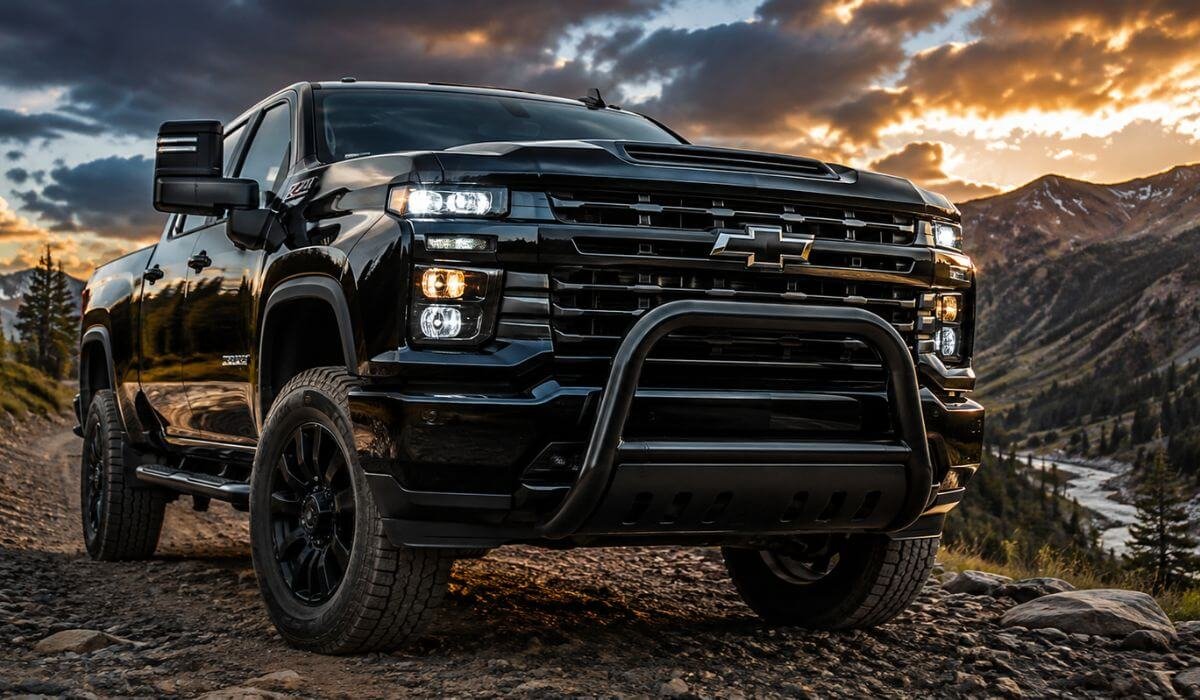
5 Best Bull Bar for Chevy Silverado 2500HD in 2026: 3-Inch Steel, Sensor-Safe Fit & Tough Protection
A bull bar can make a Chevy Silverado 2500 HD look tougher, but the right one should do more than fill the front end. On a truck this heavy, fitment, tubing size, mounting points, bumper clearance, and sensor compatibility matter far more than an aggressive product photo.
This list focuses on bull bars made for the 2020–2026 Silverado 2500 HD generation, with attention to 3-inch steel construction, current-generation fitment, skid-plate coverage, finish, and parking-sensor considerations. Older 2500 HD models should not automatically be treated as compatible simply because the truck name is the same—bumper design and mounting locations change between generations.
The five options below were selected to give buyers a practical spread: current-generation protection, established-brand fitment, budget value, aggressive coverage, and LED-equipped styling. That makes the comparison more useful than simply ranking five similar-looking bars.
Best Chevy Silverado 2500HD Bull Bar: Top 2026 Picks for Steel, Sensors & Skid Plates
#1. Black Horse Armour AB-GM27-NL Bull Bar
Best Bull Bar for 2020-2026 Chevy Silverado 2500 HD With Heavy-Duty 3-Inch Tubing, Matte-Black Styling and Full Front-End Coverage
#2. Westin 31-6025 E-Series Bull Bar
Best Chevy Silverado 2500 HD Bull Bar for 2020-2026 Models Wanting Established Brand Fitment, 3-Inch Steel Construction and Clean Front-End Protection
#3. YHTAUTO 3-Inch Bull Bar
Best Budget Bull Bar for 2020-2026 Chevy Silverado 2500 HD With 3-Inch Steel Tubing, Bolt-On Installation and Tough Front-End Defense
#4. Barricade 3-Inch Bull Bar
Best Aggressive Bull Bar for 2020-2026 Chevy Silverado 2500 HD With 3-Inch Steel Tubing, Integrated Skid Plate and Rugged Off-Road Protection
#5. Armordillo 8707869 AR-T Series LED Bull Bar
Best LED Bull Bar for 2020-2023 Chevy Silverado 2500 HD With Parking Sensor Compatibility, Integrated Lighting and Matte-Black Protection
Expert Tip
With a Silverado 2500 HD, the smartest bull bar is not automatically the biggest or most aggressive-looking one. Check the exact model year, bumper configuration, parking-sensor setup, mounting points, and included hardware before paying. A 3-inch bar can look nearly identical across listings while having completely different fitment. For a 2026 truck, prioritize a bar with a clearly stated 2020–2026 application rather than assuming an older 2500 HD bar will transfer over. And if the truck already has factory sensors, treat sensor clearance as a fitment requirement—not a nice extra.
How We Choose These Bull Bars
The five bars above were not selected simply because they look good in product photos. The selection starts with the thing that matters most on a heavy-duty truck: whether the bar actually belongs on the truck being discussed.
1. Current Silverado 2500 HD Fitment Comes First
The biggest filter was model-year coverage. The current Silverado 2500 HD uses a different front-end design from earlier generations, so a bull bar being advertised for a “2500 HD” does not automatically make it suitable for every year.
That is why the 2020–2026 fitment of the newer options carries real weight in this list. It gives a 2026 owner a much safer starting point than an older bar whose application ends years earlier.
2. Construction Matters More Than a Thick-Looking Photo
A bull bar is exposed to road debris, parking bumps, brush and off-road abuse. We therefore looked for 3-inch tubing and steel construction rather than ranking products purely by appearance.
The goal is not to pretend that a bull bar replaces a heavy-duty bumper. It does not. Its value is in adding a solid protective structure around the front bumper area while keeping the truck’s original bodywork and overall shape intact.
3. We Looked at What Makes Each Product Different
There is no point putting five nearly identical products in an article and calling one “best” simply because it has a different logo.
Each selection has a reason to exist:
- Black Horse Armour stands out for its current-generation coverage and substantial, clean design.
- Westin brings an established name and clear current Silverado application.
- YHTAUTO gives buyers a more budget-oriented route to a 3-inch bull-bar setup.
- Barricade adds a more aggressive appearance with integrated skid-plate coverage.
- Armordillo is the specialist option for buyers interested in LED lighting and parking-sensor compatibility, but its listed 2020–2023 coverage makes it less suitable for a newer 2026 truck.
That distinction is important. A product can be excellent for one buyer and still be the wrong recommendation for another.
4. Sensor Compatibility Was Treated Seriously
Modern Silverado HD trucks can have equipment around the front bumper that older trucks simply did not have. A bull bar should not be chosen without considering parking sensors and front-end clearance.
The Armordillo earns attention here because its product description specifically addresses parking-sensor compatibility. For the other products, the exact vehicle configuration should still be checked against the manufacturer’s fitment information before ordering.
That is a much safer approach than assuming every 3-inch bar leaves the same amount of clearance.
5. 2026 Buyers Should Not Ignore Older Fitment
This is where the list deliberately avoids one common mistake.
The Armordillo may be attractive because of its integrated LED design, but its listed application stops at 2023. It would be misleading to place it above a properly listed 2020–2026 option simply because it has more visible features.
For a buyer shopping today, correct fitment beats extra features.
6. The Final Ranking Balances Protection, Fit and Real-World Use
The ranking is therefore not a simple “most expensive wins” list. It considers fitment range, construction, useful features, sensor considerations, design, and the type of Silverado owner each product actually suits.
That is also why the list includes different strengths instead of pretending there is one perfect bull bar for every 2500 HD.
If a 2026 Silverado 2500 HD is the priority, the current-generation options deserve the closest attention. If the truck is an earlier 2020–2023 model and LED lighting or sensor-friendly design matters more, the Armordillo becomes much more interesting.
The safest purchase is the one that fits the exact truck—not the one with the longest feature list.
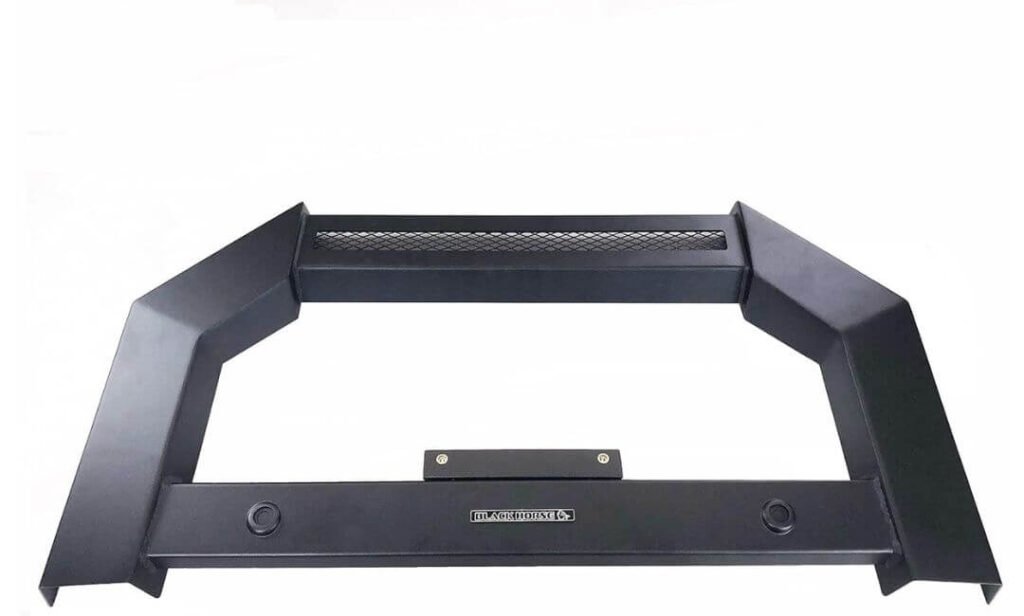
#1. Black Horse Armour AB-GM27-NL Bull Bar
Quick Specs:
- Fitment: 2020–2026 Chevrolet Silverado 2500 HD
- Material: Cold-rolled mild steel
- Weight: 39 lb
- Finish: Matte-black hi-impact powder coat
- Tube Size: 3-inch
- Mounting: Frame-mounted, bolt-on, no drilling
- Sensors: Pre-drilled sensor holes
- LED Ready: Accepts 20-inch Black Horse LED light bar
- Skid Plate: Not included
- Hardware: Grade 5 OEM-spec
- Warranty: 3 years
The 2500 HD already has a serious presence, so a good bull bar should add useful structure without making the front end look unnecessarily complicated. This one uses cold-rolled mild steel and weighs around 39 pounds, giving it a substantial feel while keeping the design relatively clean.
The matte-black hi-impact powder coat is a practical choice for a truck that sees regular road use, work sites or rougher conditions. It gives the bar a factory-friendly appearance while helping the steel stand up better to everyday moisture, road grime and exposure.
A detail worth noticing is the pre-drilled sensor provision. Instead of treating factory bumper sensors as an afterthought, the design provides dedicated holes for sensor relocation. Add the bolt-on, no-drill frame mounting, and this becomes a much more straightforward upgrade than a universal bar that requires fabrication. (Simple installation is a feature worth having on a truck this expensive.)
What We Like
- Cold-rolled steel gives it genuine substance.
- No-drill frame mounting keeps installation straightforward.
- Sensor-ready design is valuable on modern HD trucks.
- Matte-black finish blends naturally with the Silverado’s styling.
- 20-inch LED light-bar provision leaves room for a useful future upgrade.
What We Would Improve
- There is no integrated skid plate, so buyers wanting additional lower-front coverage should consider a skid-plate-equipped design instead.
Silverado 2500 HD Fitment
The important part is the 2020–2026 Silverado 2500 HD application. This is designed around the current HD front end rather than relying on a vague “2500 HD compatible” claim.
The frame-mounted design keeps the installation focused on the truck’s existing mounting structure, while the pre-drilled sensor holes make the setup more suitable for sensor-equipped trucks. Exact trim and factory-equipment compatibility should still be confirmed before ordering.
The Insider Pro-Tip
For a 2500 HD that needs clean protection rather than maximum hardware, this configuration is particularly sensible. The absence of a skid plate is not automatically a weakness—it keeps the front end lighter and cleaner when underbody protection is not part of the truck’s job.
The real selling point is the combination of current-generation fitment, steel construction, sensor provision and no-drill mounting. Those are the details that matter after the product photo stops looking impressive and the bar actually has to live on the truck.
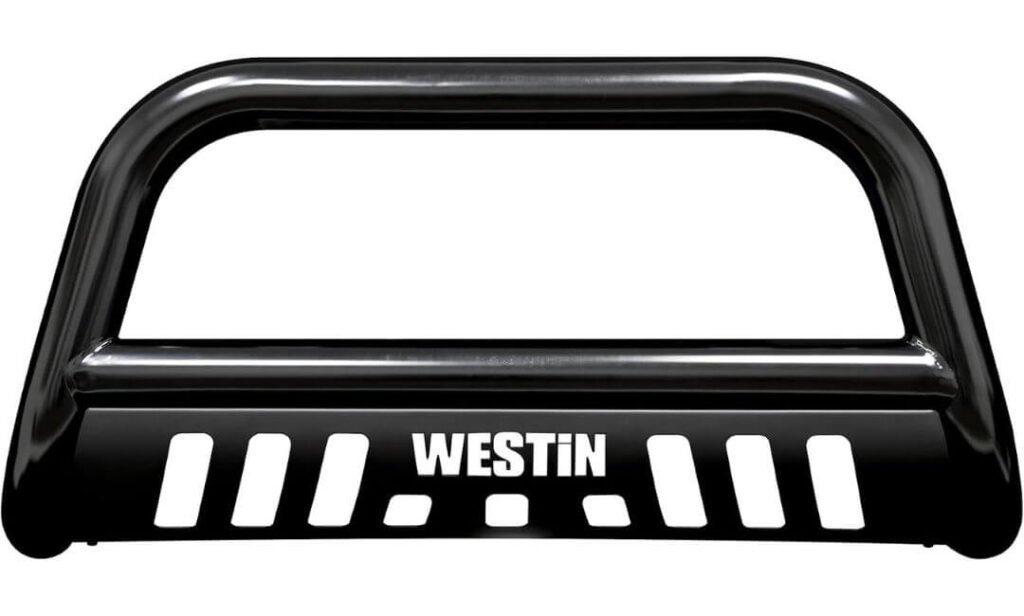
#2. Westin 31-6025 E-Series Bull Bar
Quick Specs:
- Fitment: 2020–2026 Chevrolet Silverado 2500 HD
- Material: 3-inch stainless steel tubing
- Weight: 23 lb
- Finish: Black powder-coated / e-coated steel
- Skid Plate: Integrated textured skid plate
- Mounting: Vehicle-specific bolt-on mount kit
- Installation: No drilling, cutting or welding
- Light Mounts: 2 auxiliary-light mounting points
- Light Capacity: Up to 6-inch diameter lights
- Warranty: 3 years
- Tow Hooks: Factory tow hooks must be removed
The first thing that separates this E-Series setup from a basic tubular bar is the integrated skid plate. On a Silverado 2500 HD, that changes the character of the upgrade completely. Instead of stopping at the upper bumper area, the design adds a lower layer of coverage while keeping the overall front end relatively tidy.
The 3-inch stainless steel tubing is another reason this one deserves attention. At roughly 23 pounds, it is noticeably lighter than the Black Horse option while still giving the truck the substantial tubular look most buyers are after. The black powder-coated and e-coated finish also gives the steel a more durable surface for regular road and work-truck exposure.
Then there is the practical stuff that is easy to overlook in a product photo. The included vehicle-specific mount kit means there is no drilling, cutting or welding, and the bar provides mounting points for two auxiliary lights up to 6 inches in diameter. Factory parking sensors are designed to remain functional, although the exact truck configuration should still be checked before installation. (The laser-cut Westin lettering on the skid plate is a small touch, but it gives the otherwise functional front end some personality.)
What We Like
- 3-inch stainless steel tubing gives it a premium feel without excessive weight.
- The integrated skid plate adds useful lower-front coverage.
- Included vehicle-specific hardware keeps installation straightforward.
- Two light mounts provide room for up to 6-inch auxiliary lights.
- The 3-year warranty adds confidence for a long-term truck accessory.
What We Would Improve
- Factory tow hooks need to come off for installation, so owners who regularly use those recovery points should factor that into the decision.
Silverado 2500 HD Fitment
This E-Series application is listed for the 2020–2026 Chevrolet Silverado 2500 HD, making it a current-generation option rather than an older-generation bar being carried forward under a broad truck description.
The mounting is designed around the vehicle’s existing points and requires no drilling, cutting or welding. One important installation detail is the factory tow hooks: they must be removed to install the bar. That is not necessarily a deal-breaker, but it is something worth knowing before the box is opened and the installation begins.
The Insider Pro-Tip
This is the option to look at closely if the Silverado needs more than just a tubular front accent. The combination of stainless tubing and an integrated skid plate gives it a more complete protective feel, while the auxiliary-light mounts leave the lighting decision entirely in the owner’s hands.
The 23-pound weight is also worth remembering. A bull bar does not need to be excessively heavy to look substantial or add useful front-end structure. Here, the lighter construction, stainless tubing, current HD fitment and included mount kit create a particularly balanced package for a 2500 HD that still sees everyday driving.
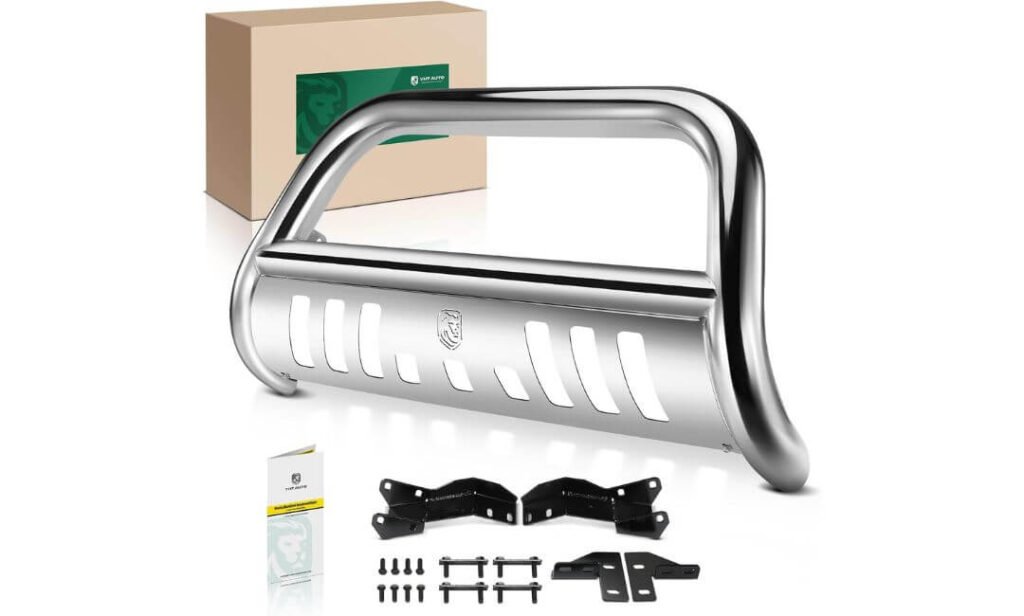
#3. YHTAUTO 3-Inch Bull Bar Front Bumper
Quick Specs:
- Fitment: 2020–2026 Chevrolet Silverado 2500 HD
- Material: 304 stainless steel
- Tube Size: 3-inch diameter
- Finish: Mirror-polished
- Weight: Approx. 30.4 lb
- Skid Plate: Integrated formed skid plate
- Light Mounts: Pre-drilled auxiliary-light holes
- Mounting: Vehicle-specific bolt-on hardware
- Installation: Cutting/drilling may be required
- Tow Hooks: Factory tow hooks cannot be reinstalled
- Lights: Sold separately
Some bull bars are bought for protection, some for appearance, and some because the owner wants both without covering the entire front of the truck. This YHTAUTO sits firmly in that third category. The 304 stainless-steel construction and mirror-polished finish give the Silverado 2500 HD a noticeably brighter, more distinctive front-end appearance than a conventional black powder-coated bar.
The 3-inch tubing is where the design gets its familiar heavy-duty presence, while the formed skid plate extends that coverage lower on the front end. At around 30.4 pounds, it has enough physical substance to feel like a proper truck accessory without becoming an unnecessarily massive addition. The CNC-bent tubing and seamless welding also give the structure a cleaner finished appearance than a generic universal push bar.
Another useful detail is the pre-drilled light mounting provision in the skid plate. Auxiliary lights can be added later without changing the basic bar, although the lights themselves are not included. Installation is vehicle-specific with the supplied brackets and hardware, but this is one option where the buyer should genuinely expect that cutting or drilling may be necessary, depending on the truck’s exact configuration. (That extra installation work is worth knowing before ordering, not after the package arrives.)
What We Like
- 304 stainless steel offers strong corrosion resistance with a polished appearance.
- The integrated skid plate gives the front end more complete coverage.
- 3-inch tubing delivers the substantial HD-truck look without unnecessary bulk.
- Pre-drilled light holes make future auxiliary-light installation easier.
- CNC bending and seamless welding give the bar a cleaner, more finished appearance.
What We Would Improve
- The installation can require cutting or drilling, so this is better suited to owners comfortable with a more involved fitment than a simple bolt-on installation.
Silverado 2500 HD Fitment
The application covers the 2020–2026 Chevrolet Silverado 2500 HD, so the product is specifically aimed at the current HD generation rather than a smaller Silverado configuration.
There are two fitment details that deserve attention before ordering. Factory tow hooks cannot be reinstalled with this bar, and the manufacturer notes that the design may affect front sensors or collision-avoidance equipment on some configurations. Those are not reasons to automatically reject the product—they are simply the kind of details that should be matched against the exact truck before purchase.
The Insider Pro-Tip
If the goal is a stainless-steel bull bar that looks noticeably different from the usual matte-black options, this one has a strong argument. The polished 304 stainless construction catches the eye, while the integrated skid plate keeps the design from feeling like nothing more than a decorative tube across the bumper.
Just make the fitment decision with the whole front end in mind. If the truck relies heavily on factory tow hooks or sensitive front-mounted equipment, another option in this list may make more sense. If those considerations are acceptable, the combination of 3-inch stainless tubing, skid-plate coverage and auxiliary-light provisions makes this a particularly interesting choice for a 2500 HD.
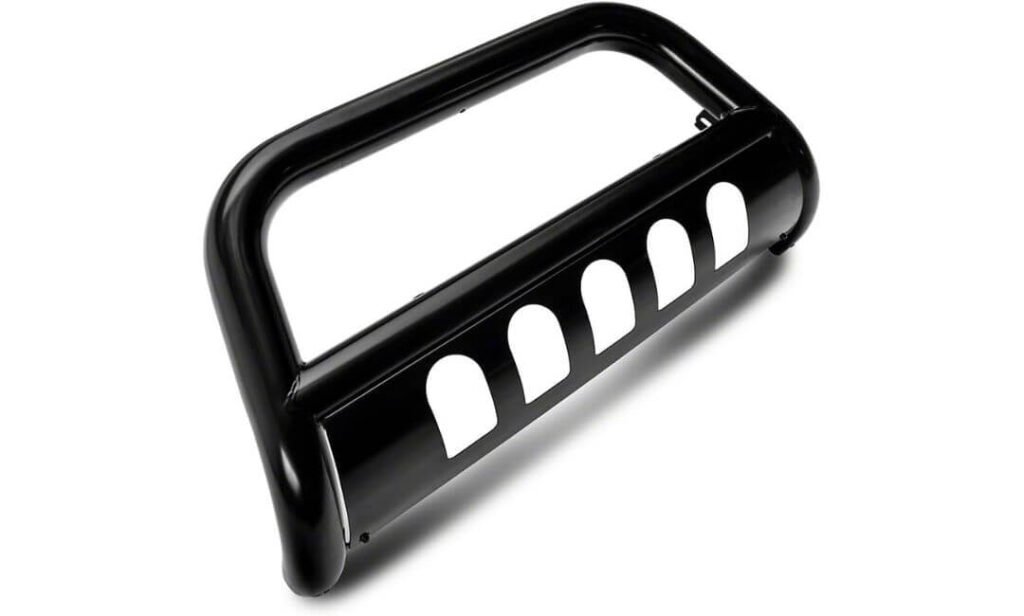
#4. Barricade 3-Inch Bull Bar
Quick Specs:
- Fitment: 2020–2026 Chevrolet Silverado 2500 HD
- Material: Heavy-duty alloy steel
- Tube Size: 3-inch
- Finish: Gloss-black powder coat
- Skid Plate: Integrated front skid plate
- Mounting: Direct bolt-on
- Drilling: Not required
- Installation: Basic hand tools
- Hardware: Included
- Use: Daily driving, work sites and off-road use
There is something refreshing about a bull bar that does not try to complicate the job. The Barricade takes the traditional 3-inch tubular design and gives it a more purposeful lower section with an integrated skid plate. On a Silverado 2500 HD, that extra coverage makes the bar feel like a functional front-end upgrade rather than something added purely for appearance.
The construction is straightforward: heavy-duty alloy steel tubing finished in a gloss-black powder coat. That combination gives the bar the dark, aggressive look that works naturally with a heavy-duty Silverado while providing a surface designed to handle regular exposure to weather, road grime and trail conditions.
The installation is where this option becomes particularly appealing. It is engineered as a direct bolt-on, with the required hardware included, and does not require drilling. For an owner who wants to install a bull bar without turning the truck into a fabrication project, that simplicity has real value. (Sometimes the best accessory is the one that gets installed cleanly and gets out of the way.)
What We Like
- 3-inch steel tubing gives the bar a properly substantial HD-truck presence.
- Integrated front skid plate adds useful lower-front protection.
- Gloss-black powder coating keeps the finish aggressive and easy to match.
- No-drill bolt-on installation makes it one of the simpler options here.
- Included hardware means there is less guesswork once installation begins.
What We Would Improve
- The gloss-black finish is more attention-grabbing than a subdued matte finish, so owners wanting a quieter factory-style appearance may prefer another option.
Silverado 2500 HD Fitment
This Barricade application is designed specifically for the 2020–2026 Chevrolet Silverado 2500 HD. That makes it a straightforward current-generation choice for owners who want a bull bar with a more aggressive appearance and integrated lower protection.
The direct bolt-on mounting is especially useful here because the bar is designed to use the truck’s existing mounting locations rather than requiring drilling. Even so, it is always worth confirming the exact trim and factory equipment before ordering—particularly on a truck with additional front-end accessories.
The Insider Pro-Tip
The real appeal here is balance. You get the 3-inch tubular structure, a useful integrated skid plate and a tough powder-coated finish without moving into an unnecessarily complicated installation.
For a Silverado 2500 HD that sees a mixture of highway miles, work-site use and occasional rough roads, this is the kind of bull bar that makes sense because its features are easy to understand. It is not trying to be everything at once—it simply adds a stronger front-end presence and practical lower coverage while keeping installation refreshingly straightforward.
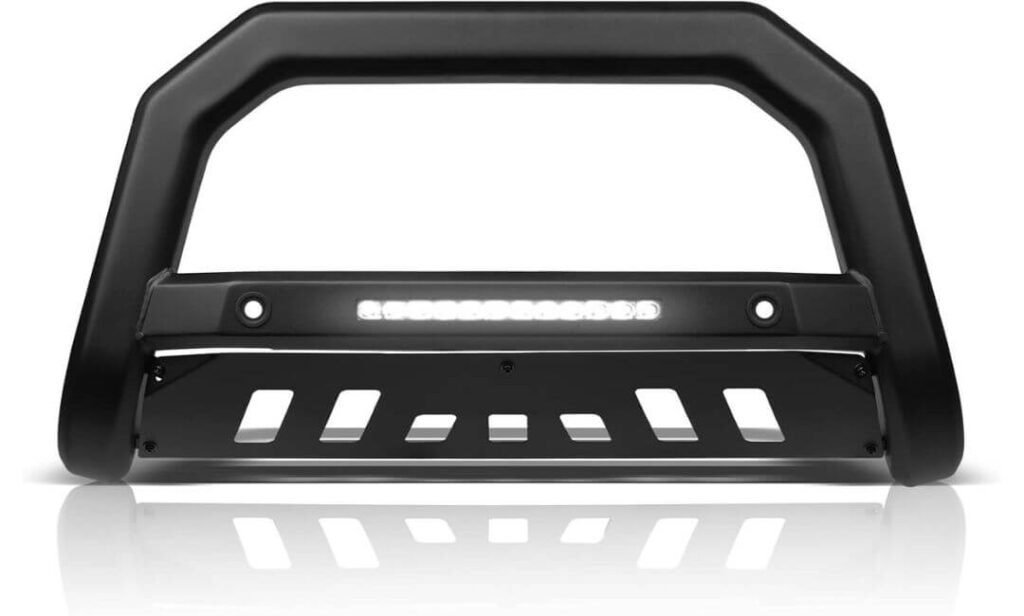
#5. Armordillo 8707869 AR-T Series LED Bull Bar
Quick Specs:
- Fitment: 2020–2023 Chevrolet Silverado 2500 HD
- Material: Alloy steel
- Weight: Approx. 47.9 lb
- Finish: 3-stage textured black powder coat with E-coat
- LED: Integrated 12-inch LED light bar
- Skid Plate: Full-coverage laser-cut skid plate
- Sensors: Pre-drilled parking-sensor holes
- Lighting: Auxiliary-light mounting holes
- Wiring: Harness and switch included
- Plate Support: License-plate relocation kit included
- Mounting: Vehicle-specific bolt-on brackets
This is the bull bar for the buyer who wants the lighting and protection built into the same package. The AR-T design combines an integrated 12-inch LED light bar, a large laser-cut skid plate and a sharply pressed angular structure, so there is considerably more going on here than a simple tubular bar across the bumper.
The construction is also substantial. The alloy-steel body weighs about 47.9 pounds and receives a three-stage textured black coating with E-coat treatment. That gives the bar a noticeably more purposeful feel, while the large skid plate extends coverage against rocks, road debris and minor trail impacts without closing off the radiator area.
Another thoughtful detail is the parking-sensor provision. The bar comes with pre-drilled sensor holes and a design intended to accommodate relocated sensors, while the included wiring harness, switch and license-plate relocation kit mean fewer separate pieces to source. It is a much more complete package for someone who specifically wants an illuminated front-end setup. (The built-in lighting is the feature that makes this one immediately different from the other four.)
What We Like
- Integrated 12-inch LED light bar means no separate light-bar purchase is necessary.
- Large laser-cut skid plate gives the front end substantial lower coverage.
- Parking-sensor holes are built into the design rather than added as an afterthought.
- Included wiring harness, switch and license-plate relocation kit make the package unusually complete.
- The angular AR-T styling gives the 2500 HD a distinctive, more technical appearance.
What We Would Improve
- The listed fitment is limited to 2020–2023, so newer Silverado 2500 HD owners should choose one of the current-generation options above instead.
Silverado 2500 HD Fitment
This is the one product in the lineup where model-year verification is especially important. The supplied fitment information identifies the AR-T bar for 2020–2023 Chevrolet Silverado 2500 HD, so it should not be presented as a 2026-compatible choice.
For an owner of a 2020–2023 2500 HD, however, the vehicle-specific brackets, parking-sensor provisions and bolt-on mounting make it a much more purposeful option than a universal LED bull bar. The exact factory sensor setup should still be checked before installation because the sensors are designed to be relocated into the bar’s dedicated openings.
The Insider Pro-Tip
This is a classic case where more features do not automatically mean a higher ranking. The integrated LED, full skid plate and sensor-ready design make the Armordillo unusually feature-rich, but correct fitment matters more than having the longest feature list.
If the truck falls within the 2020–2023 application, this is arguably the most interesting choice for someone who wants protection and lighting in one piece. If the truck is newer, do not try to make the fitment work simply because the body style looks similar—choose a bar specifically listed for the truck’s model year. That one check can save far more trouble than any extra feature is worth.
Best Chevy Silverado 2500HD Bull Bar (2020–2026): Side-by-Side Features & Fitment Comparison
Chevy Silverado 2500 HD Bull Bar Buying Guide
A bull bar for a Chevy Silverado 2500 HD should be chosen around the truck’s actual front-end hardware, not just the shape of the bar. The right setup depends on the model year, bumper configuration, factory sensors, mounting points, intended use, and how much additional coverage is genuinely useful. The options in this article are not interchangeable simply because they all fit a 2500 HD.
Start With Exact Vehicle Fitment
Before comparing steel thickness, finishes or lighting, confirm the exact Silverado 2500 HD model year and front-end configuration. The current 2020–2026 HD application is different from older Silverado generations, and even products covering the same year range can have different installation requirements.
For this article, the important distinction is that the strongest current-generation choices are specifically listed for the 2020–2026 Chevrolet Silverado 2500 HD. The Armordillo option is different, with its listed application ending at 2023, so it should not be treated as a universal choice for newer trucks.
Also check whether the truck has:
- Factory parking sensors
- Front collision-warning equipment
- Adaptive-cruise hardware, where equipped
- Factory tow hooks
- Additional front-mounted accessories
- Non-standard bumper or grille modifications
A product that technically fits the truck but conflicts with factory equipment is not a good fit.
Material and Tubing: What Actually Matters
The 3-inch tubing used by most of the leading options here is popular because it gives a useful balance between structural presence, weight and appearance. Going larger does not automatically mean better protection, especially if the additional size adds unnecessary weight or affects visibility around the front bumper.
The material is where these products begin to separate.
| Construction | What it means in practice |
|---|---|
| Cold-rolled mild steel | Strong, traditional bull-bar material with a substantial feel |
| Alloy steel | Designed for strength while keeping the structure relatively manageable in weight |
| 304 stainless steel | Excellent corrosion resistance with a brighter, polished appearance |
| Powder-coated steel | Practical finish for everyday road, work-site and weather exposure |
| E-coated + powder-coated surfaces | Adds another layer of corrosion protection beneath the visible finish |
The finish should match how the truck is actually used. A matte or gloss black powder coat makes sense for a work truck that needs a subdued, easy-to-maintain appearance. Polished stainless steel is more visually distinctive and naturally resistant to corrosion, but it also gives the front end a very different character.
Sensor Compatibility Is Not Optional
Modern Silverado 2500 HD trucks can have sensors and safety equipment positioned around the front bumper. A bull bar should therefore never be judged only by whether its brackets line up.
Look specifically for information about:
- Parking sensor clearance
- Sensor relocation provisions
- Front collision-warning equipment
- Adaptive-cruise radar, if equipped
- Camera visibility, where applicable
- Clearance between the bar, bumper and factory sensors
A sensor-ready design can make installation considerably easier, but it does not mean every trim or factory configuration will behave identically.
This is particularly important with aftermarket bars that use sensor relocation holes. Relocating a sensor changes its physical position, so the manufacturer’s instructions and the vehicle’s factory safety-system requirements should be followed carefully. If a sensor becomes unreliable after installation, the bull bar is no longer a simple appearance upgrade—it has become a safety-system concern.
Bolt-On vs. More Involved Installation
For a 2500 HD, frame-mounted bolt-on designs are generally the most attractive option for owners who want a reversible aftermarket upgrade.
A good bolt-on setup should use:
- Vehicle-specific brackets
- Existing frame mounting points where possible
- Supplied mounting hardware
- Clear installation instructions
- No unnecessary cutting or welding
The five products reviewed here are not identical in installation difficulty. Some are designed as no-drill installations, while the YHTAUTO option specifically notes that cutting or drilling may be required depending on the truck configuration.
That difference matters.
A no-drill installation is usually more appealing for a newer Silverado because it keeps the modification cleaner and easier to reverse. If drilling, cutting or significant bumper modification is required, professional installation may be worth considering, particularly when factory sensors or other electronic equipment are involved.
Protection: Know What a Bull Bar Is Actually Protecting
A bull bar primarily adds structure around the front bumper and grille area. It can help provide an additional layer of protection against certain low-speed impacts, brush, road debris and minor trail hazards, depending on the design and circumstances.
It should not be treated as a replacement for a heavy-duty aftermarket bumper.
The presence of an integrated skid plate is another major distinction. A bar with a skid plate extends protection farther downward and can be more useful for rough-road or trail driving. A bar without one can provide a cleaner, lighter front-end appearance and may be perfectly adequate for highway, work-site and everyday use.
Also remember that a bull bar does not automatically provide winch mounting capability. A bull bar, brush guard and winch bumper serve different purposes. If winching is part of the plan, look specifically for a bumper or mounting system designed and rated for that job rather than assuming the bull bar can carry a winch.
Bull Bar vs. Brush Guard: They Are Not the Same Thing
The terms are often mixed together in online listings, but there is a practical difference.
A bull bar generally focuses on a central section of the front bumper, often using a tubular structure with optional skid-plate or lighting provisions.
A brush guard or grille guard normally extends farther around the grille and headlights, providing broader front-end coverage.
For a Silverado 2500 HD, the choice comes down to what you actually need:
| If your priority is… | Consider |
|---|---|
| Cleaner appearance | Bull bar |
| Central bumper protection | Bull bar |
| Integrated skid-plate coverage | Bull bar with skid plate |
| Wider grille and headlight protection | Brush guard / grille guard |
| Maximum front-end armor | Full grille guard or heavy-duty bumper |
| Winch recovery capability | Winch-rated bumper |
For many owners, the bull bar is the sensible middle ground: more protection than the factory bumper alone, without covering the entire front end with a large grille guard.
Weight, Airflow and Front-End Balance
A heavier bar is not automatically a better bar.
The products in this comparison range from approximately 23 pounds to nearly 48 pounds, which is a meaningful difference on the front of a truck. The actual weight should be considered alongside the construction, skid plate, lighting equipment and mounting design.
Airflow is another reason not to overbuild the front end unnecessarily. A properly designed bull bar should leave the truck’s primary cooling openings reasonably clear. Bars with large skid plates or additional accessories deserve closer attention to how they sit around the lower front end.
Approach angle also matters if the 2500 HD regularly leaves paved roads. A bulky lower structure can become an advantage for protection but a disadvantage when negotiating steep transitions, rocks or uneven terrain. For normal highway and work-site driving, this is usually less important.
Installation: What a DIY Owner Should Expect
A straightforward bolt-on installation can often be handled by an experienced DIY owner with normal hand tools, but the exact difficulty depends on the product and the truck.
Before starting, have:
- Socket and wrench set
- Torque wrench
- Ratchet and extensions
- Vehicle jack and suitable support equipment where required
- Basic trim-removal tools
- A second person to help position the bar
Do not judge installation difficulty from the words “bolt-on” alone. One product may simply bolt to existing points, while another may require tow-hook removal, sensor relocation or drilling.
The Westin setup, for example, is designed around a vehicle-specific mounting kit and does not require drilling, while the YHTAUTO design may require additional cutting or drilling. Those are meaningful differences for a buyer deciding whether the job belongs in the driveway or at a professional shop.
Maintenance and Long-Term Durability
Once installed, a bull bar is not completely maintenance-free.
Inspect the mounting hardware periodically, especially if the truck sees rough roads, towing, work sites or off-road use. Check for loose hardware, coating damage, surface corrosion and any movement around the mounting points.
The finish also matters over time. If a powder-coated bar gets chipped down to bare steel, cleaning and addressing the damaged area early can help prevent corrosion from spreading.
For stainless steel, regular cleaning is more than cosmetic. Road salt, mud and industrial grime can leave deposits on the surface even when the underlying material has strong corrosion resistance.
Warranty coverage is another useful tie-breaker. A 3-year manufacturer’s warranty, where provided, adds some confidence, but it should never replace checking the actual construction and fitment first.
Safety and Factory Equipment
This is the part worth taking seriously before installation.
A bull bar should not obstruct or interfere with the truck’s airbag-related systems, parking sensors, collision-warning equipment, cameras or other factory safety technology. It should also be installed according to the manufacturer’s instructions, with mounting hardware properly tightened to the specified requirements.
Do not assume that a bar marketed as “sensor compatible” will automatically preserve every factory safety function exactly as before. Sensor position, angle and clearance can matter.
After installation, verify that the truck’s warning systems, parking assistance and other affected equipment operate normally. If a warning appears, a sensor behaves unexpectedly, or a safety feature stops working correctly, the issue should be addressed before normal driving rather than ignored.
Choose the Bar Around the Truck’s Job
The best Silverado 2500 HD bull bar is ultimately the one that matches the truck’s actual workload.
For a mostly road-driven truck, clean fitment, manageable weight, sensor compatibility and straightforward mounting may matter more than maximum coverage.
For a work truck or off-road build, an integrated skid plate, stronger tubular structure and durable coating become more valuable.
And for someone who wants lighting, a product with dedicated auxiliary-light mounts or an integrated LED system can eliminate the need to build the front end piece by piece.
That is why there is no single feature that makes one bull bar universally better than the others. The right decision comes from matching fitment, protection, installation and equipment compatibility to the way the Silverado 2500 HD is actually used.
Chevy Silverado 2500 HD Bull Bar Installation Guide
A bull bar installation on a Silverado 2500 HD is usually manageable when the product is genuinely vehicle-specific and bolt-on, but the job should be approached as a fitment project rather than simply hanging a heavy steel bar on the front bumper. The exact steps can change between products, especially when tow hooks, parking sensors, skid plates or auxiliary lighting are involved.
Before touching the truck, read the product-specific instructions completely. The installation approach for a no-drill Westin or Black Horse setup is not identical to a bar that may require drilling or cutting, so forcing one installation method onto every product is a good way to create unnecessary problems.
Unbox Everything Before Touching the Truck
Start by laying every component on a clean surface and comparing it with the supplied parts list.
Look for:
- Main bull bar
- Left and right mounting brackets
- Frame or bumper mounting hardware
- Washers, nuts and spacers
- Sensor-related components, if supplied
- Skid plate and its hardware, where included
- Auxiliary-light brackets
- Wiring harness and switch, if the bar includes lighting
- License-plate relocation hardware, where applicable
- Installation instructions
This is also the right time to inspect the bar itself. Check the welds, tubing, coating, mounting tabs and threaded holes before installation. Finding a damaged part on the floor is much easier than discovering it after the bar has already been mounted.
Prepare the Silverado 2500 HD
Park the truck on a flat, stable surface, engage the parking brake and allow the front end to cool if the truck has recently been driven.
Take a few minutes to photograph the original bumper area. This gives you a useful reference if brackets, sensors or other components need to be moved.
Do not remove factory components simply because a generic installation video tells you to. The product-specific instructions should determine what comes off.
Some of the bars in this comparison have important differences:
- Some use existing mounting points with no drilling.
- Some require factory tow-hook removal.
- Some may require cutting or drilling, depending on configuration.
- Some require parking-sensor relocation.
- LED-equipped designs require additional wiring work.
Knowing which category your chosen bar falls into before starting can save a lot of wasted time.
Clear the Mounting Area
If the installation requires removal of tow hooks, bumper trim or other components, remove only the parts specified by the manufacturer.
For example, the Westin application requires the factory tow hooks to be removed. That is different from saying the entire bumper must come off.
Keep removed hardware organized rather than throwing everything into one pile. Factory bolts, aftermarket spacers and sensor brackets can look surprisingly similar once they are off the truck.
If the truck has aftermarket bumper accessories, recovery equipment or other modifications, stop and confirm clearance before proceeding.
Position the Mounting Brackets First
Do not immediately tighten everything as soon as the first bolt enters the frame bracket.
Loosely position the mounting brackets first, then bring the bull bar into place. On a heavy 2500 HD, having another person support the bar while the brackets are aligned makes the job considerably easier and reduces the chance of scratching the bumper or powder-coated finish.
Check that:
- Left and right brackets are correctly positioned.
- Bolt holes line up naturally.
- The bar sits centered relative to the truck.
- The bar does not press against the bumper.
- The skid plate, if supplied, has reasonable clearance.
- Sensor openings are positioned correctly.
- Wiring paths are not being pinched.
This is the stage where a few extra minutes of patience can prevent an entire installation from being redone.
Attach the Brackets to the Frame
Once the brackets are aligned, install the supplied bolts, washers and spacers according to the manufacturer’s instructions.
Keep the hardware snug but not fully torqued at first. Leaving a little adjustment allows the bar to be centered and leveled before everything is locked down.
Do not substitute random hardware because it “looks the same.” A bull bar carries meaningful loads, so the supplied mounting hardware and vehicle-specific brackets are part of the safety of the installation.
Align the Bull Bar Before Final Tightening
With the bar loosely mounted, step back and look at it from several angles.
Check the gap between the bull bar and the bumper on both sides. The tubing should sit evenly, the bar should be centered, and the skid plate should not appear twisted.
Also turn the steering from side to side and inspect the surrounding area where appropriate. Look for anything that could contact the bar or its brackets.
This is the point to correct alignment—not after everything has been fully tightened.
Torque the Mounting Hardware Correctly
Once the position is right, tighten the mounting hardware according to the torque specification supplied by the manufacturer.
There is no universal torque value that should be applied to every Silverado 2500 HD bull bar. Hardware size, bracket design, material and mounting location can all change the required specification.
A torque wrench is therefore preferable to simply tightening everything as hard as possible.
Over-tightening can damage hardware, brackets or threads. Under-tightening can allow movement and create a serious problem over time.
Reinstall or Relocate Sensors Carefully
Sensor-equipped trucks deserve a separate check before the installation is considered finished.
If the bull bar has dedicated sensor openings or relocation provisions, install the sensors exactly as instructed. Make sure the sensor face is correctly positioned and that nothing is sitting directly in front of it.
The sensor area should remain:
- Clean
- Properly aligned
- Free from the bull bar tubing
- Free from loose wiring
- Free from brackets or hardware blocking the sensor
- Positioned according to the manufacturer’s instructions
Do not simply tape or loosely hang a relocated sensor somewhere behind the bar. Its position matters.
Connect LED Wiring Without Creating a New Problem
For bars with integrated lighting or auxiliary-light provisions, route wiring away from moving, hot or sharply edged components.
Secure the harness properly and leave enough slack for normal movement without allowing the wiring to hang below the truck.
Check the path around:
- Radiator and cooling components
- Steering components
- Suspension movement
- Sharp bracket edges
- Exhaust and other hot areas
An included wiring harness and switch can make an LED installation much easier, but the quality of the final installation still depends on how that wiring is routed and secured.
Sensor-Safe Final Check
Before driving the truck, switch on the ignition and verify that no new warning lights or sensor errors appear.
Test the relevant factory functions at low speed in a safe location. If the truck uses parking sensors, check that they respond normally and are not constantly detecting the bull bar as an obstruction.
For vehicles equipped with more advanced driver-assistance equipment, do not assume everything is correct simply because there is no warning on the dashboard. Follow the vehicle and accessory manufacturer’s requirements for sensor positioning, calibration or recalibration.
If the installation instructions call for recalibration, that step should not be skipped.
Tools Checklist
For a typical bolt-on installation, have these available:
- Metric socket set
- Combination wrenches
- Ratchet and extensions
- Torque wrench
- Screwdrivers and trim tools
- Allen or hex keys if specified by the hardware
- Work gloves
- Safety glasses
- Floor jack and properly rated jack stands, if the installation requires additional access underneath
- Electrical tools for LED wiring, where applicable
- Clean cloth or protective padding for painted surfaces
A second person is also genuinely useful. A 3-inch bull bar may not be extremely heavy compared with other truck accessories, but holding it perfectly aligned while starting frame bolts is much easier with another set of hands.
When Professional Installation Makes More Sense
A straightforward no-drill, vehicle-specific bar is a reasonable DIY project for someone comfortable working underneath a truck.
Professional installation becomes the better choice when the job involves:
- Cutting or drilling
- Sensor relocation
- Driver-assistance equipment
- Significant bumper modification
- Complicated electrical wiring
- Unclear mounting alignment
- Aftermarket bumper or recovery equipment already installed
The YHTAUTO application is a good example of why this matters because its supplied information states that cutting or drilling may be required depending on the truck. That is very different from a simple no-drill installation.
Final Clearance and Road Test
Before calling the job finished, inspect the entire front end one last time.
Check the:
- Bull bar-to-bumper gap
- Frame mounting bolts
- Skid-plate clearance
- Sensor position
- Wiring security
- License-plate position
- Auxiliary-light mounts
- Steering and suspension clearance
- Ground clearance
Then take a short, slow test drive and listen for rattles, movement or contact.
After the first few drives, inspect the mounting hardware again. A newly installed accessory can settle slightly once the truck has experienced normal road vibration, and catching any movement early is far better than discovering it after a long trip.
The goal of a good installation is simple: the bull bar should feel like part of the truck, not like something bolted onto it yesterday.
Silverado 2500 HD Grille Guard vs. Bull Bar: What Is Actually Different?
The two accessories are often grouped together in online listings, but they are not simply two names for the same thing. On a Chevy Silverado 2500 HD, the biggest difference is how much of the front end each one is designed to cover.
A bull bar normally concentrates protection around the center of the bumper and grille area. A grille guard extends much farther across the front, often wrapping around the grille and providing additional structure in front of the headlights.
That difference matters because the larger accessory is not automatically the better choice.
What a Bull Bar Actually Does
A bull bar is a relatively compact tubular guard mounted toward the center of the front bumper. Depending on the design, it can include a skid plate, auxiliary-light mounts, sensor provisions or integrated lighting.
The five options in this article are bull bars, not full grille guards. Their purpose is to add useful front-end structure while keeping much of the Silverado’s original front-end design visible.
For a 2500 HD used primarily for:
- Highway driving
- Daily commuting
- Work-site access
- Gravel and rough roads
- Occasional off-road driving
- Light brush and debris exposure
a bull bar can be a sensible middle ground.
It gives the truck a more protected front-end appearance without adding a large steel framework around the entire grille.
What a Grille Guard Actually Does
A grille guard is a much larger front-end structure. Instead of stopping around the central bumper area, it generally extends across a greater portion of the grille and headlight area.
Depending on the design, a grille guard can provide:
- Wider grille protection
- Additional headlight-area protection
- Side protection around the front fascia
- More substantial brush deflection
- Greater overall front-end coverage
That makes it more appropriate for trucks that regularly travel through dense brush, wooded trails, ranch property or demanding off-road environments where protection around the outer front end matters.
The trade-off is obvious: more steel means more weight, more visual bulk and potentially more complicated installation.
The Visual Difference Is Easy to Spot
Think of the front of the Silverado 2500 HD as three broad zones.
A bull bar mainly occupies the center zone:
[ Headlight ] — [ Bull Bar / Bumper Area ] — [ Headlight ]
A grille guard reaches much farther across the front:
[ Headlight + Guard ] — [ Grille + Guard ] — [ Headlight + Guard ]
The exact design varies, but the principle remains the same. A bull bar leaves more of the factory front end exposed, while a grille guard creates a much larger protective framework.
That is also why a bull bar generally looks cleaner on a daily-driven Silverado.
Protection: Where Each One Makes More Sense
Neither accessory should be viewed as an indestructible shield. They are aftermarket protection components, not a guarantee against serious collisions.
A bull bar is better suited to localized front-end protection, particularly around the center bumper and grille area.
A grille guard makes more sense when the truck’s environment creates a realistic need for broader protection, particularly around the grille and headlights.
| Silverado use | Bull bar | Grille guard |
|---|---|---|
| Daily road driving | Excellent fit | Usually more than necessary |
| Work-site use | Very practical | Useful for harsher environments |
| Gravel roads | Good | Good |
| Light brush | Good | Better |
| Heavy brush | Limited | Better suited |
| Occasional trails | Good | Stronger coverage |
| Maximum front-end coverage | Limited | Better choice |
| Cleaner factory-like appearance | Better | More aggressive |
| Lower overall weight | Usually better | Usually heavier |
Bull Bar Advantages for a 2500 HD
The biggest advantage is proportion.
A Silverado 2500 HD is already a large truck. Adding a compact 3-inch bull bar can strengthen the front-end appearance without making the truck look overloaded with accessories.
Other advantages include:
- Less visual bulk than a full grille guard
- Easier access to much of the factory grille
- Often simpler bolt-on installation
- Good compatibility with auxiliary lighting
- Skid-plate options on some designs
- Lower weight than many full grille guards
- Easier fit for owners who want protection without a complete front-end conversion
The products reviewed here show how much variety can exist within the bull-bar category. Some emphasize sensor provisions, some add skid plates, some offer auxiliary-light mounting and one combines protection with an integrated LED system.
Bull Bar Limitations
The smaller footprint is also its main limitation.
A bull bar does not provide the same broad protection around the headlights and outer grille area that a properly designed grille guard can provide.
It is also not automatically a winch mount. If recovery equipment is part of the truck’s regular work, a purpose-built winch bumper should be considered instead of assuming a tubular bull bar can perform the same job.
There can also be sensor considerations. Adding steel around the front bumper can change the environment around factory sensors, so compatibility should be checked before installation.
Grille Guard Advantages
The main reason to choose a grille guard is simple: coverage.
For a Silverado 2500 HD that regularly works around brush, trees, rough trails or rural property, the additional structure around the grille and headlight area can be more useful than a compact center-mounted bar.
A grille guard can also provide a more substantial platform for owners who want their truck to have a distinctly work-truck or off-road appearance.
Grille Guard Limitations
More protection comes with compromises.
A full grille guard is normally:
- Heavier
- More visually dominant
- More expensive
- More involved to install
- More likely to affect access to front-end components
- More important to evaluate carefully around factory sensors and safety equipment
There is also a practical question that gets overlooked: does the truck actually need that much protection?
If a 2500 HD spends most of its life on paved roads, carrying a large grille guard simply because it looks tougher may add weight and complexity without providing much additional real-world value.
Which One Should a Silverado 2500 HD Owner Choose?
Choose a bull bar when the goal is a balanced combination of front-end protection, appearance, manageable weight and relatively simple installation.
Choose a grille guard when the truck regularly faces conditions where protection around the grille and headlights is genuinely important.
For most daily-driven 2500 HD owners, the bull bar is the more proportionate upgrade. For a truck that spends serious time in dense brush, remote trails or demanding work environments, the broader coverage of a grille guard can justify the additional weight and cost.
The important part is not choosing the accessory that looks toughest in a photograph. It is choosing the one that protects the areas the truck is actually exposed to while still working properly with its factory sensors, bumper configuration and intended use.
Silverado 2500 HD Bull Bar Maintenance, Care, and Longevity
A bull bar does not need complicated maintenance, but it does need basic attention at the right time. The steel, coating, mounting hardware and sensor openings all live directly in the path of road salt, mud, water, gravel and debris. A few minutes of inspection can make a much bigger difference than waiting until rust or loose hardware becomes obvious.
The good news is that most of the care is simple. The important part is doing it consistently, especially if the Silverado 2500 HD regularly sees rain, snow, salted roads, construction sites, dirt roads or off-road conditions.
Clean the Bar Before Dirt Becomes a Problem
Regular washing is the simplest way to protect the finish.
Road grime often contains moisture-retaining dirt, salt and other contaminants that can remain around welds, mounting brackets and the underside of the bar. These areas are easy to overlook because they are not always visible when looking at the truck from the front.
During a normal truck wash, pay particular attention to:
- The lower side of the tubing
- Welded areas and joints
- Mounting brackets
- Bolt heads and washers
- The underside of any skid plate
- Sensor openings
- Areas behind the bull bar where mud can collect
Use a mild automotive soap and clean water, then rinse thoroughly. Avoid allowing strong chemical cleaners or concentrated wheel and tire products to sit on the bull bar finish longer than necessary.
After driving through mud, salt or heavily contaminated water, cleaning sooner is better than letting the residue dry and remain attached for weeks.
Corrosion Prevention Starts With the Finish
Powder-coated and e-coated steel can provide very good corrosion resistance, but neither coating makes steel completely immune to rust.
The vulnerable areas are usually places where the coating has been scratched, chipped or worn through. Small chips can happen from stones, branches or normal road debris.
Inspect the finish occasionally for:
- Bare metal spots
- Stone chips
- Scratches around mounting hardware
- Rust-colored marks
- Corrosion around welds
- Peeling or damaged coating
For stainless-steel designs, the maintenance approach is slightly different. Stainless steel generally handles corrosion extremely well, but it can still develop surface staining from road salt, dirt and contaminated water. Keeping the surface clean is still important.
Pay Extra Attention After Off-Road Driving
A truck that stays on pavement and one that regularly travels dirt trails should not have the same inspection routine.
After rough-road or off-road use, check the bar for fresh impacts, movement, scratches and accumulated debris.
Look underneath the skid plate if the product has one. Mud, stones and packed dirt can remain trapped around mounting areas and eventually make inspection more difficult.
If the bar has taken a noticeable impact, do not only look at the visible tubing. Inspect the mounting brackets and frame attachment points as well. A bar can look perfectly straight from the front while a bracket or mounting point has moved underneath.
Check the Mounting Hardware Periodically
A bull bar is attached to a truck that experiences constant vibration, road shocks and changes in load. That makes mounting hardware worth checking periodically.
There is no universal interval that applies to every product, so the manufacturer’s instructions should take priority. As a practical habit, inspect the hardware after installation, after the first several drives, and periodically afterward.
Pay attention to:
- Loose nuts or bolts
- Movement at the mounting brackets
- Uneven gaps between the bar and bumper
- New rattling sounds
- Scraped coating around mounting points
- Changes in the bar’s alignment
If the manufacturer specifies a torque value, use a torque wrench rather than guessing by feel.
Give the Finish a Little Protection
A clean powder-coated surface is usually easy to maintain. Once the bar has been washed and dried, an appropriate automotive surface protectant can help keep the finish looking cleaner, provided the product is safe for the specific coating.
Avoid aggressive polishing compounds on textured or matte finishes. They can change the appearance of the coating and create shiny patches that do not match the surrounding surface.
For a matte-black bull bar, preserving the original texture is usually more important than trying to make it glossy.
Repair Small Chips Before They Spread
A small stone chip is not necessarily a serious problem. Ignoring dozens of them for several seasons can become one.
If bare steel becomes visible, clean the area properly and use a compatible touch-up coating or corrosion-protection product recommended for the finish. The goal is to restore protection before moisture gets underneath the surrounding coating.
Do not simply paint over loose rust. Remove the corrosion and prepare the surface properly first.
For a more substantial coating failure, especially around welds or mounting points, professional refinishing can produce a much better result than repeatedly applying household paint.
Skid Plates Need Their Own Inspection
Bull bars with integrated skid plates deserve an additional check because the lower plate is more likely to encounter rocks, gravel and trail obstacles.
Look for:
- Dents that change clearance
- Bent mounting tabs
- Cracked welds
- Loose skid-plate hardware
- Packed mud or stones
- New contact points underneath the truck
A small cosmetic scrape is normal for a truck that actually sees trails. A bent mounting point or cracked weld is a different matter and should not be ignored.
Keep Sensor Areas Clean
If the bull bar uses parking-sensor openings or sensor relocation provisions, keep those areas clean and unobstructed.
Mud, wax residue, road grime or an incorrectly positioned sensor can create false warnings or unreliable operation.
After washing the truck, check that the sensor faces are clean. After any repair, adjustment or impact to the bull bar, verify that the sensors still operate normally.
If a factory safety system begins behaving differently after the bull bar has been installed or adjusted, do not assume the issue will correct itself. Have the installation and sensor positioning checked.
A Simple Long-Term Inspection Routine
A practical maintenance routine can be as simple as this:
| When | What to check |
|---|---|
| After installation | Mounting alignment, hardware tightness, sensor operation |
| After the first few drives | Bracket movement, rattles, bolt tightness |
| During regular washing | Dirt buildup, coating condition, sensor openings |
| After off-road use | Impact marks, skid plate, brackets, frame mounting points |
| Before long trips | Hardware, clearance, lighting and visible damage |
| After any significant impact | Tubing, welds, brackets, sensors and frame attachment points |
This does not replace the manufacturer’s maintenance instructions, but it is a sensible habit for a truck that depends on its front-end accessories every day.
The Real Key to Long Life
The longest-lasting bull bar is not necessarily the one with the thickest tubing or the most expensive finish. It is the one that fits correctly, stays properly mounted and receives basic care throughout its life.
Keep the surface clean, deal with coating damage early, inspect the mounting hardware, and pay attention after hard use. Those simple habits can keep a Silverado 2500 HD bull bar looking good and functioning properly for years instead of allowing small problems to quietly turn into expensive ones.
FAQs About Silverado 2500 HD Bull Bars
Will a 3-inch bull bar affect the factory parking sensors on a Silverado 2500 HD?
It can, depending on the bull bar design, sensor position and truck configuration. A bar with dedicated sensor openings or relocation provisions is a much better starting point than a generic design that simply passes in front of the bumper.
For the Chevrolet Silverado 2500 HD, sensor compatibility should be checked before installation and again afterward. If sensors are relocated into the bull bar, their position matters; simply moving them somewhere that “looks clear” is not enough.
After installation, check for unexpected parking warnings and make sure the sensors are not constantly detecting the bar itself. If the truck has additional driver-assistance equipment, follow the manufacturer’s requirements for checking or recalibrating those systems.
Is a 2020–2023 Silverado 2500 HD bull bar automatically compatible with a 2026 model?
No. This is one of the easiest mistakes to make when shopping for a Silverado 2500 HD bull bar.
The model name alone is not enough to establish fitment. Bumper shape, mounting points, sensor placement and front-end equipment can change across model years. In this comparison, the Armordillo AR-T option is specifically listed through 2023, while several other options are listed through 2026.
Before ordering, match the manufacturer’s exact application against the truck’s model year and factory configuration. If the listing stops at 2023, it should not be treated as a 2026 fit simply because both trucks are called 2500 HD.
Is a skid plate actually worth having on a Silverado 2500 HD bull bar?
It depends on what the truck does when the pavement ends.
For a 2500 HD that mainly sees highways, commuting and normal work-site driving, a bull bar without a skid plate can make perfect sense. It keeps the front-end setup lighter and visually cleaner while still adding central protection.
For a truck that regularly travels gravel, trails, rocky access roads or uneven terrain, an integrated skid plate becomes more useful because it extends protection below the tubular section.
The important distinction is this: a skid plate adds coverage, not unlimited armor. It should be viewed as another layer of protection for the lower front end, not as permission to treat the bull bar like a full off-road bumper.
Can installing a bull bar interfere with Silverado 2500 HD safety systems even when the bar physically fits?
Yes, and this is where “fits the truck” and “works correctly with the truck” become two different questions.
A bull bar can physically bolt into the correct mounting points while still changing the surroundings of parking sensors, collision-warning equipment or other front-mounted technology. A sensor may have enough room to fit but not necessarily have the same unobstructed environment it had from the factory.
Before installation, identify the equipment on the truck and compare it with the accessory manufacturer’s compatibility information. After installation:
- Check for new dashboard warnings.
- Test parking sensors in a safe location.
- Confirm that relocated sensors are positioned correctly.
- Inspect wiring for pinching or damage.
- Follow any required calibration procedure.
If a safety system behaves differently after installation, that is not something to simply “get used to.” The installation should be checked before normal use.
What is the smartest way to choose between the Silverado 2500 HD bull bars in this comparison?
Start with the truck and its job, not the product photograph.
A buyer who wants a clean current-generation setup may value 2020–2026 fitment, no-drill mounting and sensor provisions more than an aggressive design. Someone who spends time on rough trails may place greater value on an integrated skid plate. Another owner may specifically want built-in lighting and accept a narrower model-year application.
A useful way to narrow the decision is:
- Confirm the exact 2500 HD model year and front-end equipment.
- Decide whether a skid plate is genuinely useful.
- Check parking-sensor and safety-system compatibility.
- Compare the installation requirements.
- Choose the construction and finish that suit the truck’s actual use.
- Only then compare styling and lighting features.
That approach prevents one of the most common aftermarket mistakes: buying the bar with the longest feature list instead of the bar that fits the truck, suits its workload and creates the fewest compromises once it is installed.
Final Verdict: The Right Bull Bar Is the One That Fits the Truck, Not Just the Photo
A Chevy Silverado 2500 HD does not need a bull bar simply to look tougher. It already has the size, stance and presence of a heavy-duty truck. The better reason to add one is to give the front end useful additional protection, a more purposeful appearance, or practical lighting and skid-plate coverage without creating new problems around the factory equipment.
After comparing the five options, the biggest takeaway is that there is no honest “one bar beats everything” answer. The Black Horse Armour is a particularly well-rounded choice for buyers who want current-generation fitment, steel construction, sensor provisions and a clean no-drill setup. The Westin E-Series makes a strong case when an integrated skid plate, stainless tubing and auxiliary-light capability matter more. The YHTAUTO stands apart with its polished 304 stainless construction, while the Barricade is a straightforward choice for buyers who want aggressive styling, lower-front coverage and simple bolt-on installation. The Armordillo AR-T is the specialist option for earlier 2020–2023 trucks where integrated LED lighting and extensive coverage are the priority.
The most important lesson is the one that can easily get lost among product specifications: fitment comes before features. A beautiful bull bar with the wrong model-year application, poor sensor clearance or an installation requirement that does not suit the truck is not a good deal. Likewise, a skid plate is only valuable if the truck actually encounters the kind of terrain where that extra coverage earns its place.
For a 2500 HD owner, the smartest purchase is the one that disappears into the truck’s purpose once it is installed. It should sit correctly, mount securely, preserve the equipment that needs to keep working, and provide the level of protection the truck genuinely needs. That is what turns a bull bar from a cosmetic accessory into a worthwhile upgrade.
Also Check:


