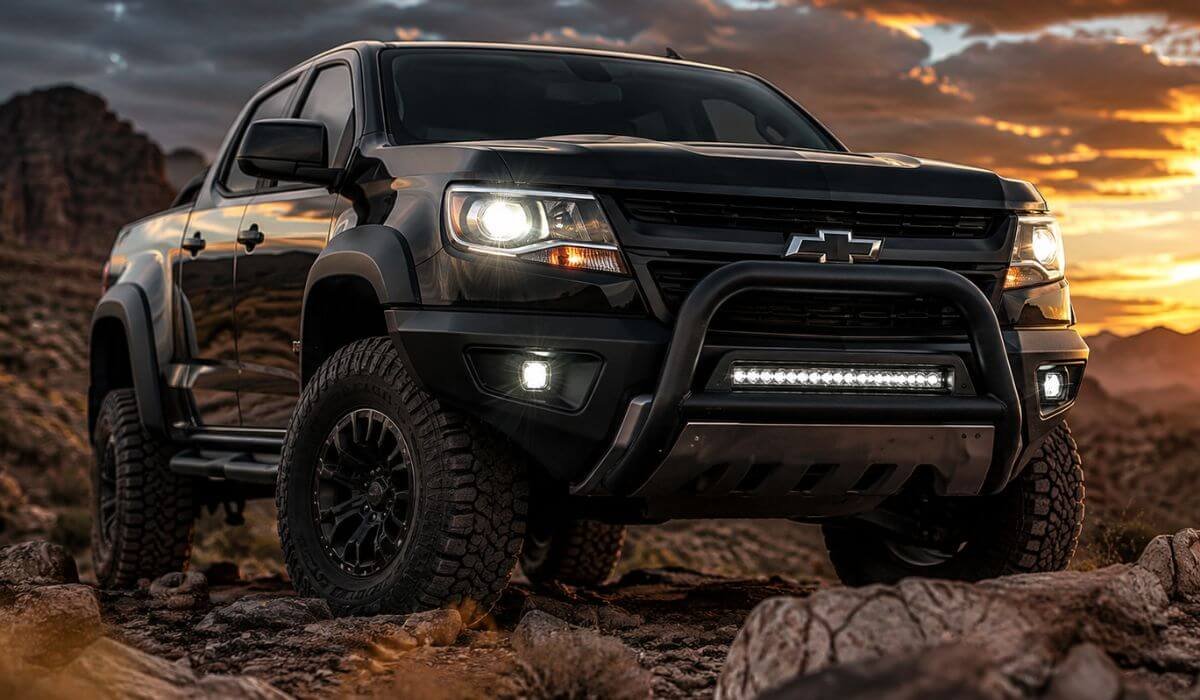
5 Best Bull Bars for Chevy Colorado in 2026: Radar Fitment, Steel Build & Exact-Year Protection
For a Chevy Colorado bull bar, the smartest place to start is not the finish, tube size, or aggressive styling—it is exact fitment. The Colorado has gone through major generation changes, so a bar designed for a 2004–2012, 2015–2022, or 2023–2026 truck should never be treated as a universal fit. Newer Colorado models also bring another layer to the decision: front radar and sensor clearance can determine whether a seemingly suitable bar is actually compatible. On some older applications, trim restrictions such as the ZR2 exclusion matter just as much.
This guide keeps the selection grounded in the details that can affect the purchase after the box arrives: year-specific compatibility, steel construction, mounting design, sensor considerations, lighting, skid-plate coverage, and known fitment limitations. Several of these products have limited long-term owner feedback, so there is no attempt to turn a handful of reviews into a durability guarantee. Instead, each option is judged on what can genuinely be established from its stated design and fitment. The result is a practical shortlist built to help you choose the right bull bar for the Colorado you actually own, not simply the one that looks best in a product photo.
Best Chevy Colorado Bull Bar: Top 2026 Picks for Steel, LEDs & Fitment
#1. Black Horse Armour Matte Black Bull Bar
Best Bull Bar for 2023–2026 Chevy Colorado with Matte-Black Steel Construction, Clean Styling, and Current-Generation Fitment
#2. PARTREE Heavy-Duty Front Bull Bar
Best Chevy Colorado Bull Bar for 2015–2026 Models with Broad Year Coverage, Steel Construction, and Front Radar-Sensor Considerations
#3. MAXDOM Black Steel Bull Bar
Best Bull Bar for 2015–2022 Chevy Colorado with Black Steel Construction, Traditional Front-End Protection, and Generation-Specific Fitment
#4. Nilight Black Steel Bull Bar
Best Chevy Colorado Bull Bar for 2015–2022 Models with Straightforward Front-End Protection, Durable Steel Construction, and ZR2 Fitment Exclusion
#5. Aries B35-4010 Steel Bull Bar
Best Bull Bar for 2004–2012 Chevy Colorado with 2½-Inch Steel Tubing, Classic Styling, and First-Generation Fitment
Expert Tip
Before ordering any Colorado bull bar, verify the exact model year and trim first. That one check can save more trouble than any feature on the product page. A 2015–2022 bar should not be treated as a match for the redesigned 2023–2026 Colorado, and a broad “2015–2026” claim still needs a closer look when front radar equipment is involved. The same goes for the ZR2 exclusion on the Nilight model. When fitment is clear, the decision becomes much simpler: choose the construction and style that suit the truck rather than trying to make an attractive bar work after the fact.
How These Chevy Colorado Bull Bars Were Chosen
The selection was built around fitment first, product details second, and appearance last. That matters here because these five bull bars cover three different Colorado generations, and their compatibility is not interchangeable.
The 2023–2026 Black Horse Armour model gets the first position because it is specifically aimed at the current-generation Colorado. That makes it a more logical starting point for newer-truck owners than carrying over an older-generation design. Its matte-black finish and steel construction also give it the traditional protection-focused appearance without relying on an unnecessarily complicated feature list.
The PARTREE model is different. Its stated 2015–2026 coverage gives it unusually broad appeal, but the front radar-sensor restriction is important enough that it cannot simply be called a universal Colorado bull bar. That limitation is part of the recommendation, not something to bury after the purchase decision. For a truck without the affected radar setup, the broad fitment can make this a practical choice.
For the 2015–2022 Colorado, MAXDOM and Nilight were kept as separate options because their fitment details are not identical in practice. MAXDOM offers a straightforward black steel bull-bar design for that generation, while Nilight carries a clear ZR2 exclusion. That distinction is exactly the kind of small detail that can turn an apparently suitable product into the wrong purchase.
Finally, the Aries B35-4010 serves a completely different owner: someone with a 2004–2012 Colorado. Its 2½-inch steel tubing and older-generation fitment make it a natural choice for first-generation trucks rather than forcing a newer product into an outdated application.
Most importantly, these recommendations do not treat limited review history as proof of long-term durability. Several of these listings are newer or have relatively little owner feedback, so claims about years of real-world performance would be overstating what the available evidence supports. The shortlist instead prioritizes what can be established from the products themselves: correct generation, stated year range, construction, sensor compatibility, trim exclusions, and the type of Colorado each bar is actually intended for.
That is the safer way to narrow the list. A bull bar should fit the truck before it looks good on the truck.
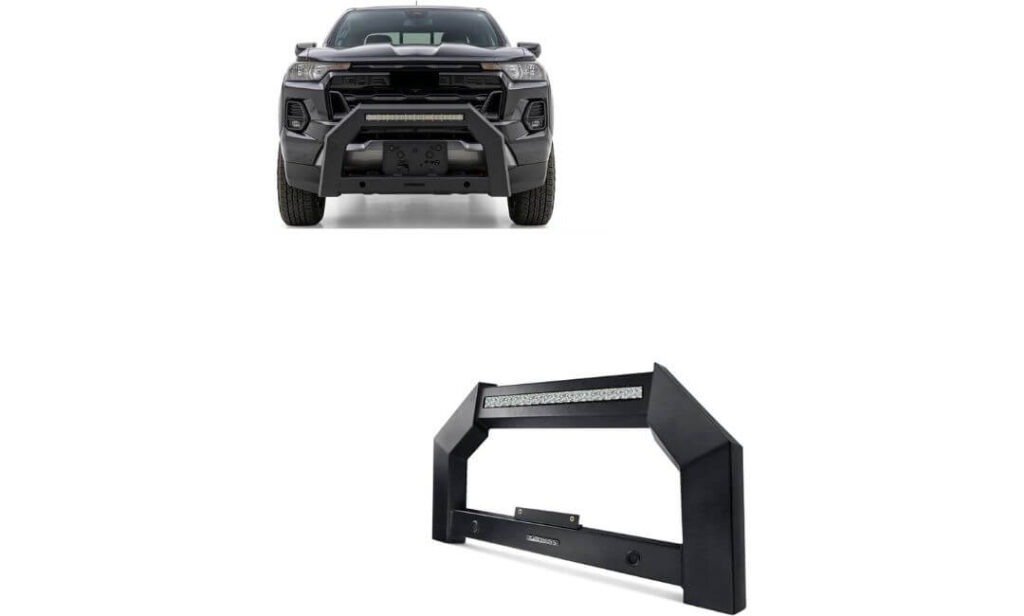
#1. Black Horse Armour Matte Black Bull Bar
Quick Specs:
- Fits: 2023–2026 Chevrolet Colorado
- Build: Cold-rolled mild alloy steel
- Finish: Matte-black high-impact powder coat
- Lighting: Integrated 20-inch LED light bar
- Mounting: Frame-mounted, bolt-on installation
- Sensor provision: Pre-drilled and capped openings for bumper-sensor relocation
- Included: Grade 5 OEM-spec mounting hardware and wiring harness, when applicable
- Weight: 36 lb
- Size: 44″L × 24″W × 12″H
- Warranty: 3 years
- Skid plate: Not included
The biggest reason this setup stands out for a 2023–2026 Chevrolet Colorado is that it feels designed around the current truck rather than being a generic tubular bar adapted to it. The one-piece construction brings the 20-inch LED light bar into the main design, so the front end gets additional lighting without hanging a separate light across the bumper.
The cold-rolled mild steel construction is the part worth paying attention to if the goal is more than appearance. Add the high-impact matte-black powder coating and the result is a practical combination for a truck that sees daily roads as well as occasional rougher use. It has the tougher visual presence most owners expect from a bull bar, but the finish keeps it from looking unfinished or overly flashy.
Installation is another useful detail here. The frame-mounted, no-drill bolt-on design is considerably more appealing than a product that requires cutting or drilling into a newer Colorado. The pre-drilled and capped openings are also a thoughtful touch because bumper sensors cannot simply be ignored on a modern truck. That does not mean every sensor-equipped configuration is automatically problem-free, though; sensor placement should still be confirmed for the exact Colorado trim before ordering.
What stands out in the real world
- Integrated lighting: The 20-inch LED is built into the bar instead of being treated as an afterthought.
- Current-generation fitment: The stated 2023–2026 coverage keeps this specifically relevant to the redesigned Colorado.
- No-drill mounting: A genuine advantage when working around a newer truck’s factory front-end hardware.
- Sensor-conscious design: The prepared openings give installers a practical route for bumper-sensor relocation.
- Useful balance: At 36 lb, it adds a substantial front-end accessory without turning the product into an unnecessarily oversized bumper replacement.
One thing worth knowing before buying
The lack of a skid plate is intentional rather than a hidden feature. This is a bull bar focused on the front-end area, so buyers looking for additional protection underneath the truck will need a separate skid-plate solution.
Colorado fitment that should not be overlooked
This model is specifically listed for the 2023–2026 Chevrolet Colorado, making it the most generation-specific choice in this lineup. That distinction matters because the current Colorado’s front-end layout is not the same as the earlier 2015–2022 trucks.
The sensor openings are helpful, but they should not be interpreted as a blanket promise that every factory sensor arrangement will work without adjustment. Check the exact trim and sensor configuration before purchase, especially if the truck relies heavily on factory front sensing.
The Insider Pro-Tip
The smartest reason to choose this one is not the aggressive appearance or even the integrated LED. It is the combination of current-generation fitment, bolt-on mounting, and a provision for dealing with bumper sensors. Those are the details that become important after the product arrives, not while scrolling through product photos.
One practical point is easy to miss: the bar does not turn the Colorado into a full underbody-protected build. If the truck will regularly see rocky trails, treat this as a front-end protection and lighting upgrade, then address skid protection separately. That approach gives the truck a much more complete setup without expecting one accessory to do three different jobs.
#2. PARTREE 3-Inch Carbon Steel Bull Bar
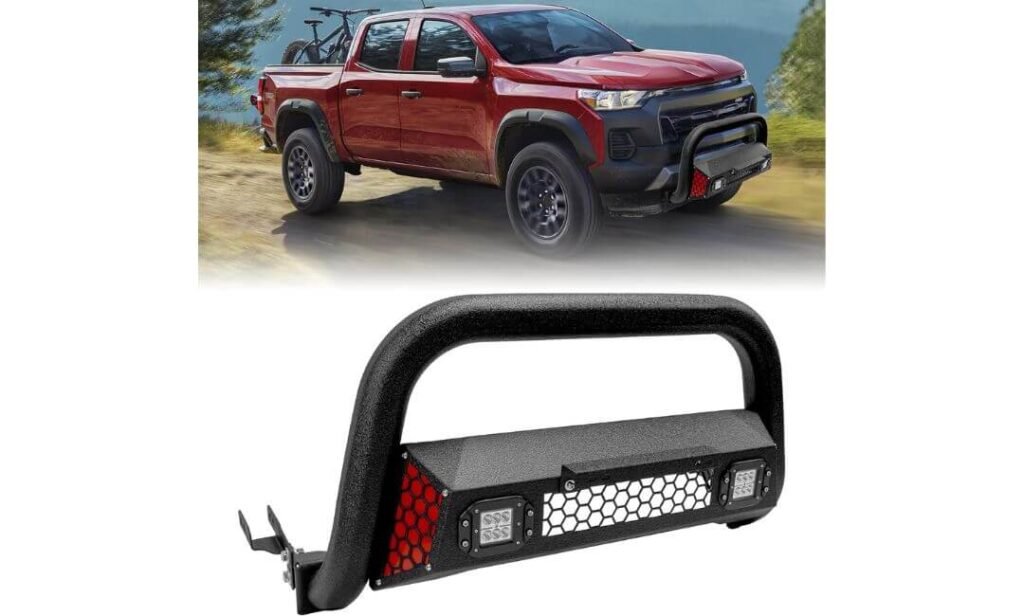
Quick Specs:
- Fits: 2015–2026 Chevrolet Colorado
- Important exclusion: Not compatible with Colorado models equipped with a front radar sensor system
- Construction: Thickened 3-inch carbon-steel tubular frame
- Finish: Textured black powder coating
- Lighting: 2 integrated auxiliary LED lights
- Design: Bull bar, push bar, brush guard, and grille-guard styling
- Installation: Vehicle-specific bolt-on mounting; no drilling required
- Included: Mounting brackets, hardware, installation instructions, LED lights, and license-plate bracket
- Extra detail: Paintable trim panel for personalization
What makes this bar interesting is its 3-inch carbon-steel tubing and unusually broad year coverage. It is listed for Colorado models from 2015 through 2026, so it can make sense for buyers across two very different generations—but that wide range should not be mistaken for universal compatibility.
The front-end coverage is also more substantial than a simple tubular hoop. The design brings together push-bar, brush-guard, and grille-guard elements, giving the Colorado a more pronounced protective structure around the grille area. The textured black coating is practical too, helping the steel deal with normal outdoor exposure, scratches, and corrosion while keeping the finish understated.
Then there is the convenience factor. The package includes two auxiliary LED lights, a license-plate bracket, vehicle-specific mounting brackets, and hardware, while installation is designed around compatible factory mounting points without drilling. For someone looking for several front-end additions in one purchase, that makes the package considerably more interesting than a bare bull bar.
What we like about the setup
- Wide model-year coverage: One of the few options here listed across 2015–2026 Colorado models.
- 3-inch carbon steel: Gives the bar a noticeably substantial tubular profile without claiming it is a replacement bumper.
- Built-in extras: The two LEDs and license-plate bracket make the package more complete from the start.
- No-drill approach: Vehicle-specific brackets keep installation focused on existing mounting points.
- Customizable trim: The paintable accent panel is a small detail, but useful for owners who want something beyond an entirely black front end.
The important compromise
The front-radar exclusion is the deal-breaker for the wrong truck. If the Colorado has a factory front radar system, this is not a “buy it and see” situation. Confirm the truck’s sensor configuration before ordering rather than assuming the stated 2015–2026 range covers every configuration.
Matching it to the right Colorado
The year range is impressive, but this is exactly where careful fitment checking pays off. A 2015–2022 Colorado and a 2023–2026 Colorado do not share the same front-end design, so the specific vehicle configuration still matters even when a listing presents one broad year range.
The most important check is the front radar system. If that equipment is present, this bar should be removed from the shortlist. For a compatible Colorado without that restriction, the combination of carbon-steel construction, integrated lighting, and bolt-on hardware makes the package much easier to justify.
The Insider Pro-Tip
Do not let the 2015–2026 label make the decision for you. The more useful question is whether the individual truck matches the bar’s mounting and sensor requirements. That single check is more valuable than comparing cosmetic details between five nearly identical black bars.
And keep expectations realistic: the manufacturer describes this as front-end protection against things such as brush, branches, road debris, and minor everyday contact. It should not be treated as a crash-rated replacement for the Colorado’s factory bumper. That distinction is important—and it is exactly why this bar makes the most sense for buyers who want added front coverage and useful extras, not a full heavy-duty bumper conversion.
#3. MAXDOM 3-Inch Black Steel Bull Bar
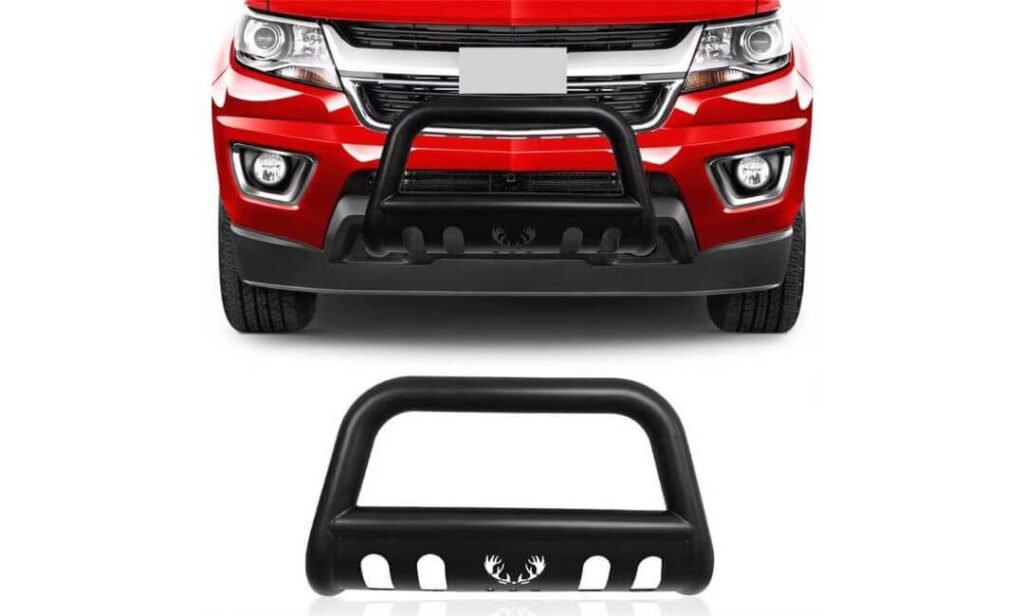
Quick Specs:
- Fits: 2015–2022 Chevrolet Colorado
- Trim exclusion: Not compatible with Colorado ZR2
- Construction: 3-inch steel tubing
- Finish: Black powder coat
- Design: One-piece front push guard
- Mounting: Direct bolt-on installation with no vehicle modifications
- Included: Mounting brackets, hardware, and installation instructions
- Weight: 25.8 lb
- Installation note: Professional installation is recommended
- Warranty: 1 year
Sometimes the appeal of a bull bar is simply that it does the job without turning the front of the truck into a project. That is where this 2015–2022 Colorado setup makes sense. The one-piece design uses 3-inch steel tubing, giving it the substantial appearance expected from a traditional push guard while keeping the overall setup relatively straightforward.
At 25.8 pounds, it is also noticeably less imposing than some heavier front-end accessories. The black powder-coated finish keeps the appearance clean, while the vehicle-specific brackets and direct bolt-on approach mean there is no stated need to modify the Colorado just to get the bar mounted. That is a useful distinction for an owner who wants a tougher front end without moving into a full bumper replacement.
There are, however, a couple of ownership details worth knowing before clicking buy. Installation can involve dealing with the factory skid plate, and the bar can interfere with or require removal of the truck’s factory tow hooks. Those are not reasons to reject it outright, but they are exactly the sort of details that are much better understood before the box arrives in the garage.
What we like about it
- 3-inch steel tubing: Gives the bar a strong, traditional profile without pretending to be a full replacement bumper.
- 25.8-pound weight: A relatively manageable addition for a front-end accessory of this type.
- True one-piece design: Fewer individual pieces to deal with during installation.
- No vehicle modification stated: The direct bolt-on approach is a major plus for a clean installation.
- Complete mounting package: Brackets, hardware, and instructions come with the bar rather than leaving the buyer hunting for basic installation parts.
One thing to plan for
The biggest practical consideration is the factory tow-hook and skid-plate situation. Installation may mean giving up the original tow hooks, and removing the factory skid plate can take more effort than the simple “bolt-on” description might suggest.
The right Colorado for this bar
This is specifically a 2015–2022 Chevrolet Colorado option, so it belongs with the second-generation trucks rather than the redesigned 2023–2026 model. The fitment is also not for ZR2, making the trim check essential before ordering.
For a compatible 2015–2022 Colorado, the combination is refreshingly uncomplicated: 3-inch steel tubing, vehicle-specific brackets, powder-coated finish, and no stated vehicle modification for mounting. That makes it a sensible choice for an owner who wants traditional front-end coverage and a tougher appearance without stepping up to a much larger bumper system.
The Insider Pro-Tip
The tow-hook trade-off is the detail worth deciding on before purchase. If those factory recovery points are something you regularly use, this bar deserves a second thought; if they are not important to your setup, the straightforward one-piece construction becomes much easier to appreciate.
Also, do not confuse “bolt-on” with “zero effort.” The mounting itself is designed to avoid vehicle modification, but access around the factory skid plate and front hardware can still make professional installation worthwhile. For the right 2015–2022 non-ZR2 Colorado, that is a small installation consideration compared with getting a bar that actually matches the truck.
#4. Nilight 17-Inch LED Stainless Steel Bull Bar
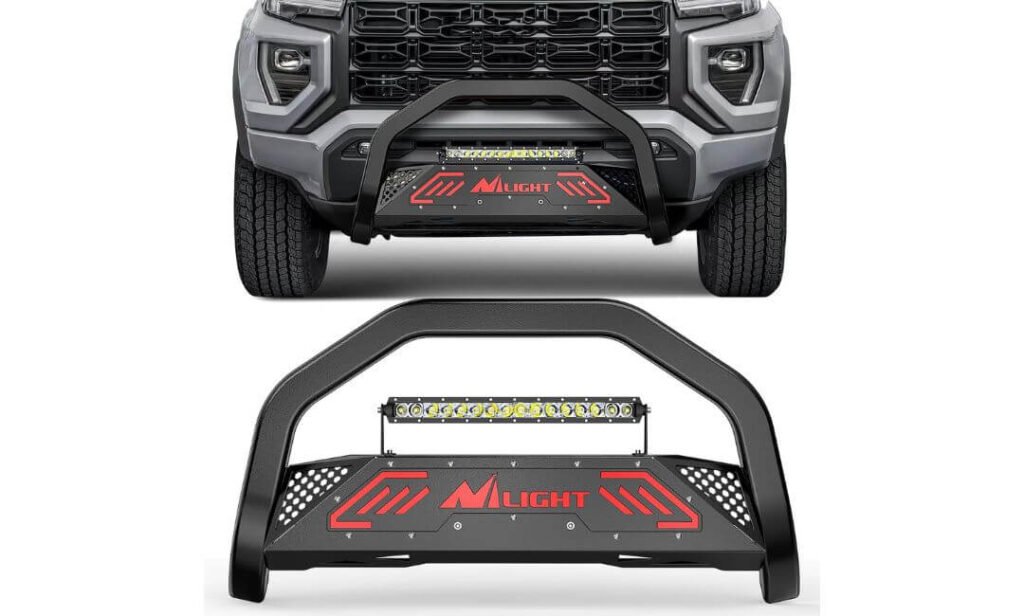
Quick Specs:
- Fits: 2015–2022 Chevrolet Colorado
- Trim exclusion: Not compatible with Colorado ZR2
- Construction: Stainless steel
- Finish: Matte-black brushed surface
- Lighting: Integrated 17-inch light bar
- Mounting: DIY-friendly installation with included hardware
- Customization: Removable red rear panel that can be painted
- Plate provision: Reserved mounting holes for a license-plate holder
- Bracket choice: 2 light-mounting bracket styles
- Skid plate: Included
- Weight: 30.45 lb
- Important: May interfere with Adaptive Cruise Control
The interesting part of this setup is that it is trying to give the 2015–2022 Colorado more than just a black tubular bar. The stainless-steel construction, matte-black brushed finish, 17-inch integrated light bar, and included skid plate create a more complete front-end package, particularly for an owner who cares about the truck’s appearance as much as the added hardware.
The lighting is genuinely useful as part of the package. Two mounting-bracket styles give some flexibility, while the reserved holes for a license-plate holder avoid having to improvise a mounting point later. The removable red rear panel is another unusual touch—it can be left as supplied or painted to better suit the truck, which gives the otherwise black setup a little room for personalization.
Installation is marketed toward the home garage, with common tools and mounting hardware supplied. That sounds appealing, but this is also where expectations should stay realistic. Owner feedback is mixed on fit, hardware completeness, and bracket strength, so this is better viewed as a styling-and-lighting upgrade than a piece of equipment to rely on for serious impact protection.
What we like about it
- 17-inch integrated light bar: Useful functionality without buying a separate lighting setup.
- Stainless-steel construction: A sensible material choice for an exterior accessory exposed to weather.
- Skid plate included: Adds coverage below the bull-bar area that the other simpler designs do not provide.
- Customizable rear panel: The removable panel can be painted rather than forcing the supplied accent color to stay unchanged.
- Garage-friendly concept: Common-tool installation and included hardware make the setup approachable for hands-on owners.
The one concern worth taking seriously
The combination of mixed fitment feedback, reported bracket weakness, and possible ACC interference means this should not be selected purely because it looks substantial. Confirm the truck’s trim and driver-assistance equipment first, and do not expect the bar to provide heavy-impact protection.
Colorado fitment, without the fine print getting lost
The stated application is 2015–2022 Chevrolet Colorado, with the ZR2 excluded. The product also specifically warns that it may interfere with Adaptive Cruise Control, so a Colorado equipped with ACC deserves an extra compatibility check before purchase.
For a compatible non-ZR2 truck, the appeal is straightforward: you get a bull bar, integrated lighting, a skid plate, and some visual customization in one package. Just keep the role of the accessory clear—its strongest case is appearance, added coverage, and lighting, not serious collision protection.
The Insider Pro-Tip
This is the one in the lineup where the feature list should not be confused with a strength rating. A skid plate and stainless-steel tube can make a product look highly protective, but the reported bracket concerns are a good reminder that the mounting system matters just as much as the visible bar.
If the Colorado has ACC, make that check before anything else. If it does not, and the truck is a non-ZR2 2015–2022 model, this becomes a more interesting value proposition because the 17-inch light, skid plate, and customizable panel are already included rather than added later.
#5. ARIES B35-4010 2½-Inch Steel Bull Bar
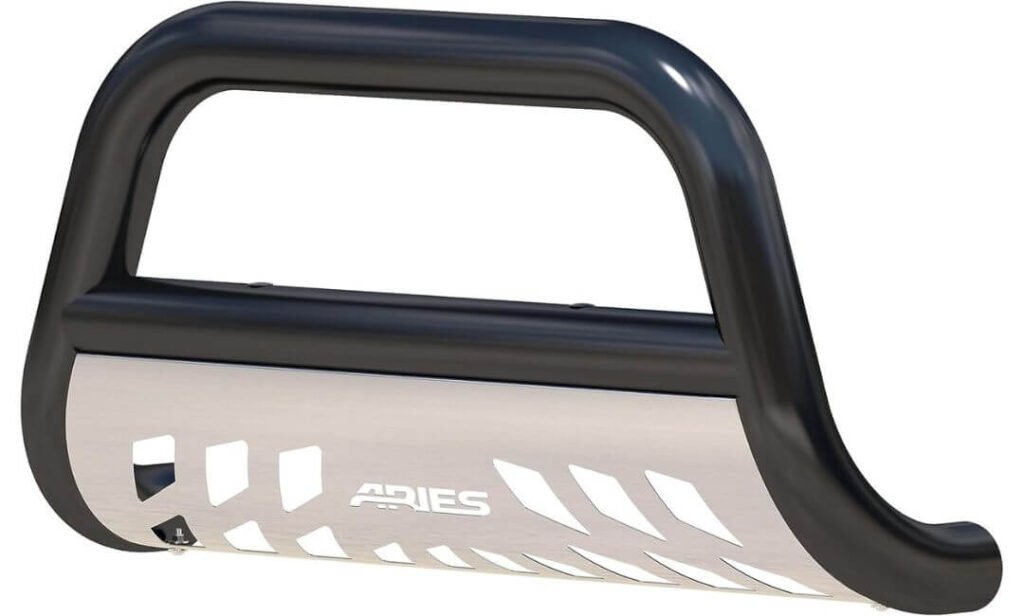
Quick Specs:
- Fits: Select 2004–2012 Chevrolet Colorado models
- Construction: Welded 2½-inch heavy-wall carbon-steel tubing
- Finish: E-coat plus semi-gloss black powder coating
- Skid plate: Removable brushed 304 stainless steel
- Lighting: Two pre-drilled mounting holes; lights sold separately
- Light compatibility: Can accommodate two square lights, two round lights, or an LED light bar
- Installation: No drilling; uses existing factory frame holes
- Design: Vehicle-specific bend and mounting brackets
- Weight: Approximately 19 lb
There is something refreshing about this setup: nothing is pretending to be included that isn’t actually included. The bar uses a welded 2½-inch heavy-wall steel frame, adds a removable 304 stainless-steel skid plate, and leaves the lighting decision to the owner. For a first-generation Colorado, that makes the design feel more like a properly thought-out accessory than a collection of unnecessary extras.
The finish is another quiet strength. The combination of E-coat and semi-gloss black powder coating is intended to give the steel better resistance against rust, chipping, UV exposure, and everyday weather. Meanwhile, the removable stainless skid plate adds some lower front-end coverage while giving the bar a cleaner visual break than an entirely tubular design.
Then comes the useful part for owners who already have lighting in mind. The crossbar has two pre-drilled mounting holes, and the layout can accommodate two square lights, two round lights, or an LED light bar. Since the lights are not included, there is no paying for a lighting setup that may not suit the truck. The no-drill mounting design also uses existing factory frame holes, although some model years may require minor lower-valance trimming.
What we like about it
- Heavy-wall 2½-inch tubing: A substantial welded-steel construction suited to the older Colorado’s simpler front-end design.
- 304 stainless skid plate: Removable, practical, and more corrosion-resistant than ordinary mild steel.
- Flexible lighting setup: The pre-drilled crossbar lets the owner choose the lighting rather than locking the truck into one included light.
- No-drill mounting: Uses existing factory frame holes instead of requiring permanent modification.
- Proven, straightforward design: The product’s established fitment and simple construction make more sense than chasing features that an older truck may not need.
One small installation reality
Some 2004–2012 Colorado applications may need minor trimming around the lower valance or spoiler. It is not a reason to avoid the bar, but it is worth knowing before starting the installation.
Where it fits in the Colorado lineup
This is the dedicated 2004–2012 Chevrolet Colorado choice in this guide. It should not be confused with the 2015–2022 or 2023–2026 products above; the generations are different, and this bar is specifically built around the earlier truck’s mounting points and front-end shape.
That older fitment is actually its advantage. The vehicle-specific brackets, existing-frame-hole mounting, 2½-inch steel tubing, and removable stainless skid plate create a package that makes sense for owners preserving the character of a first-generation Colorado while adding some useful front-end hardware.
The Insider Pro-Tip
The smartest way to approach this bar is to treat the pre-drilled lighting holes as an option, not a promise that lights are part of the package. If lighting is already planned, the freedom to choose your own setup can be more useful than an inexpensive included light that eventually gets replaced.
And before installation, check the lower valance for your exact Colorado year. A small amount of trimming may be necessary on some applications, but the underlying no-drill mounting concept remains the real attraction. For an older Colorado owner who wants steel protection without turning the truck into a completely different build, that simplicity is hard to beat.
Best Chevy Colorado Bull Bar Comparison for Steel, Lighting & Fitment (2004–2026)
Chevy Colorado Bull Bar Buying Guide: Fitment, Sensors, Steel, Protection, and Installation
A bull bar is one of those upgrades where fitment matters more than the photograph. Two bars can look almost identical online and still have completely different mounting points, sensor limitations, or generation compatibility. The Colorado is a good example because the 2004–2012, 2015–2022, and 2023–2026 trucks are not one interchangeable application.
Start With Your Colorado’s Exact Generation
Before comparing tubing size, finish, or lighting, confirm the truck’s exact model year.
- 2004–2012: First-generation Colorado applications, such as the ARIES B35-4010, belong here.
- 2015–2022: Second-generation Colorado applications include the MAXDOM and Nilight options in this guide.
- 2023–2026: The redesigned Colorado requires current-generation-specific attention, particularly around front-end sensors.
A listing covering a wide range such as 2015–2026 should not automatically be considered a universal fit. Always read the actual exclusions and mounting requirements for the specific product.
Radar and Sensor Clearance Come Before Everything Else
Modern Colorado models can have equipment behind or around the front bumper that a traditional bull bar was never designed around. The PARTREE model, for example, specifically excludes vehicles equipped with a front radar sensor system.
That warning should be treated as a genuine fitment requirement, not a minor footnote. A bar can physically mount to the truck and still be the wrong accessory if it interferes with factory sensing equipment.
For a sensor-equipped Colorado, check:
- Front radar location and equipment
- Adaptive cruise-control hardware
- Forward-facing sensors around the bumper
- Whether the bull bar provides a stated sensor solution
- Whether sensor relocation is actually supported for the exact trim
The Black Horse Armour design includes pre-drilled and capped openings intended for bumper-sensor relocation, but that still does not mean every Colorado configuration is automatically compatible.
Steel vs. Stainless Steel: Do Not Judge Protection by Finish
The material tells you more than whether the bar looks premium.
Carbon or mild steel generally gives these products their substantial tubular construction, while stainless steel brings strong corrosion resistance and a different balance of weight and finish. Powder coating or E-coating then provides another layer of protection against outdoor exposure.
But material alone does not make a bull bar heavy-duty. Mounting brackets, frame attachment points, tubing thickness, and the overall design matter just as much.
That is why a 3-inch steel tube should not automatically be described as stronger in real-world use than every smaller bar. The complete mounting system is what ultimately determines how the accessory behaves on the truck.
Protection Is Not the Same as a Replacement Bumper
A bull bar adds a layer of structure around the front of the Colorado, but it should not be marketed as a replacement for the factory bumper or as crash protection.
These products are better understood as accessories intended to help with things such as:
- Brush and branches
- Flying road debris
- Minor everyday contact
- Front-end appearance and added coverage
The difference becomes especially important when a product includes a skid plate. A skid plate can add useful lower-front coverage, but it does not automatically turn the entire bull bar into a heavy-duty off-road bumper.
Approach Angle and Ground Clearance Still Matter
More metal at the front is not automatically better for trail use.
A large bull bar can change the way the truck approaches obstacles, particularly if its lower section sits close to the factory bumper or if additional accessories hang below it. Owners who regularly leave paved roads should look at where the bar sits relative to the front tires, bumper, and lower skid area, not just how wide or thick the tubing looks.
This is one reason the simpler designs can make sense for some owners. The right setup is the one that adds the protection and appearance wanted without creating a new clearance problem.
Installation: “Bolt-On” Does Not Always Mean Effortless
No-drill installation is a major advantage, but it does not mean every installation takes the same amount of time.
A proper check should include:
- Vehicle-specific mounting brackets
- Existing frame mounting points
- Included hardware
- Factory tow-hook compatibility
- Skid-plate removal requirements
- Possible lower-valance trimming
- Sensor positioning after installation
The MAXDOM, for example, uses a one-piece bolt-on design but may require attention around the factory skid plate and can mean losing the factory tow hooks. The ARIES option is also no-drill, although some older Colorado applications may need minor valance trimming.
Those details are much more useful to a buyer than simply saying “easy installation.”
Think About the Front-End Look Before Ordering
A bull bar becomes part of the truck’s visual identity, so consider how much of the grille and bumper you actually want covered.
A 3-inch tubular bar gives a noticeably stronger, more traditional truck appearance. An integrated light bar creates a different look again, while a removable skid plate can make the front end feel more complete.
Also check the position of your license plate, factory grille, fog lights, and any aftermarket accessories. A bull bar should complement those parts rather than forcing a second round of modifications.
Common Bull Bar Myths That Can Cost You Money
“All Colorado bull bars fit every year.”
They do not. The Colorado has gone through major generation changes, and this guide alone includes products for 2004–2012, 2015–2022, and 2023–2026 applications.
“A thicker tube automatically means better protection.”
Not necessarily. Tube diameter is only one part of the equation. Mounting design and bracket strength are equally important.
“If the product says Colorado, it will work with every trim.”
Trim exclusions prove otherwise. The MAXDOM and Nilight products specifically exclude the ZR2, while the PARTREE model excludes Colorado vehicles with a front radar system.
“A skid plate means the bull bar is heavy-duty.”
A skid plate provides additional coverage, but it does not make a bull bar equivalent to a full off-road bumper or guarantee impact performance.
“More included features always mean better value.”
Not if those features create compatibility problems. An integrated light bar, sensor openings, or customizable panel only adds value when they work with the particular Colorado being equipped.
The Pre-Purchase Check That Prevents Most Mistakes
Before placing the order, run through these points:
- Model year: Does the stated range include the exact Colorado?
- Trim: Is your truck excluded, particularly if it is a ZR2?
- Radar and sensors: Does the truck have front radar or other bumper-mounted sensing equipment?
- Mounting: Are the supplied brackets designed for your specific generation?
- Tow hooks: Will installation affect the factory recovery points?
- Skid plate: Is one included, removable, or required to be removed during installation?
- Clearance: Will the bar affect approach angle or lower-front clearance?
- Lighting: Are lights included, or are the mounting holes simply provided for your own lights?
- Hardware: Does the package include the brackets and mounting hardware needed for the stated application?
- Warranty: Is there manufacturer coverage worth considering alongside the purchase price?
The safest purchase is rarely the bar with the longest feature list. It is the one where the truck, trim, mounting points, sensors, and intended use all line up without forcing compromises.
How to Choose a Chevy Colorado Bull Bar by Year and Front-End Setup
The most reliable way to choose a bull bar is to start with the truck, not the accessory. Colorado fitment changes significantly between generations, and even within the same year range, trim-specific equipment can affect whether a bar is genuinely suitable. Once the year, trim, front sensors, and factory bumper layout are confirmed, the product choice becomes much easier.
2004–2012 Colorado: First-Generation Fitment
For an older 2004–2012 Chevrolet Colorado, look specifically for products designed around the first-generation frame and bumper structure. A bar intended for the later 2015–2022 body should not be assumed to transfer simply because the vehicle name is the same.
This generation can also have different lower-valance arrangements depending on the exact year, so check the installation instructions and mounting photographs before ordering. Some applications may require minor lower-valance trimming, even when the primary mounting system is advertised as no-drill.
2015–2022 Colorado: Second-Generation Fitment
The 2015–2022 Colorado has its own mounting geometry, making second-generation-specific hardware important. This is where checking the trim becomes just as important as checking the year.
For example, some bull bars in this range specifically exclude the ZR2. That exclusion should be treated as a hard compatibility boundary rather than something that can be solved with a different bracket.
Also look underneath the front bumper before installation. Depending on the design, the factory skid plate may need to come off, and certain setups can interfere with or require removal of factory tow hooks. A “bolt-on” label describes the mounting method, not necessarily every step involved in accessing those mounting points.
2023–2026 Colorado: Current-Generation Considerations
The redesigned 2023–2026 Colorado deserves the most careful sensor check. The front-end architecture is different from the previous generation, so older bull bars should not be carried forward simply because their tubing dimensions look similar.
This is also where front radar equipment becomes particularly important. If the truck uses a front radar system, the bull bar must be specifically compatible with that arrangement. A product that physically reaches the correct mounting area is not automatically a safe or functional match.
Where a bar provides prepared sensor openings or a stated sensor-relocation provision, verify the exact trim before installation. Sensor clearance should be checked again once the bar is mounted, rather than assuming that an opening on the accessory guarantees unrestricted operation.
Sensor, Driver-Assistance, and Airbag Considerations
Front-end accessories should never be selected without considering the factory systems they sit around. Radar sensors, parking sensors, cameras, and other driver-assistance hardware can depend on a clear field of view and a known mounting position.
A bull bar should not be installed in a way that blocks, redirects, or casually relocates a factory sensor. If relocation is part of the design, it should follow the accessory’s intended mounting method and the vehicle-specific instructions.
Airbag considerations deserve the same respect. A bull bar is an external accessory, not an airbag component, so it should never be treated as something that can be mounted wherever there is physical space. The safest approach is to use the vehicle-specific mounting points and supplied hardware, avoid structural modifications unless explicitly required by the manufacturer, and have uncertain installations checked by a qualified installer.
OEM Bumper and Grille Compatibility
A good bull bar should work with the Colorado’s factory front end, not force the owner to redesign it.
Before buying, check the relationship between the bar and:
- Factory bumper corners
- Grille opening and grille surround
- Fog-light locations
- License-plate position
- Tow hooks
- Factory skid plate
- Parking or radar sensors
- Any aftermarket grille or lighting already installed
This matters particularly when shopping for a best brush guard for Chevy Colorado, because brush-guard styling can extend farther across the grille than a simple center bull bar. More coverage can look excellent, but only if it leaves the factory components where they need to remain.
Aftermarket Grille and Accessory Compatibility
If the Colorado already has an aftermarket grille, winch-related equipment, auxiliary lighting, or another front-end modification, do not assume the bull bar will clear it.
The safest combination is one where the mounting brackets, grille shape, bumper contours, and accessory positions have been designed to coexist. Otherwise, a bar that technically fits the truck may still require trimming, repositioning, or removing another component.
This is especially important with integrated or pre-drilled lighting arrangements. Having a mounting hole does not mean every light will clear the grille, sensors, or license plate once everything is installed.
Installation Caveats With a Colorado Grille Guard
No-drill installation is preferable because it normally means the accessory uses existing mounting points, but the phrase should not be read as “install it in minutes with nothing else to check.”
Before starting, confirm that:
- The correct vehicle-specific brackets are supplied.
- All mounting hardware is present.
- Factory tow hooks remain usable if they are important to your setup.
- The skid plate does not need removal or modification.
- Lower-valance clearance is adequate.
- Sensor positions remain unobstructed.
- The grille and bumper sit naturally without being forced against the bar.
- The final mounting torque follows the manufacturer’s instructions.
A professional installation can be worthwhile when the truck has radar, parking sensors, aftermarket front-end parts, or a complicated bumper arrangement. The small installation cost is usually easier to justify than discovering afterward that a sensor, tow point, or factory panel no longer functions as intended.
The Simple Rule for Getting the Fitment Right
Think of Colorado bull-bar fitment as four separate checks: generation, trim, front-end equipment, and mounting. If all four agree, the product has a legitimate reason to be on the shortlist. If even one does not, the attractive price or aggressive styling is not enough to make it the right purchase.
That is the difference between a bull bar that merely fits the listing and one that genuinely fits the truck sitting in your driveway.
Chevy Colorado Bull Bar Installation: A Clean Fitment and Setup Guide
A good installation starts before the first bolt is tightened. With a Colorado bull bar, the important part is getting the mounting points, bumper clearance, sensor locations, and final alignment right. A bar that is slightly off-center or sitting against the factory bumper can look fine from a distance but become a constant source of rattles, rubbing, or sensor problems later.
Pre-Installation Checks and Useful Tools
Before removing anything, place the bull bar and all supplied brackets on a clean surface and compare the hardware with the installation instructions. The vehicle should be on a level surface, with enough room to open the front end and work around both sides.
Useful tools normally include:
- Metric socket and wrench set
- Ratchet and suitable extensions
- Torque wrench
- Screwdrivers or trim tools where required
- Work light
- Protective gloves
- Measuring tape for checking left-to-right alignment
- Manufacturer-specified hardware and mounting brackets
Do not substitute random bolts simply because they appear to fit. The supplied vehicle-specific brackets and hardware are part of the fitment system.
Step 1: Confirm the Front-End Configuration
Before mounting anything, check the exact Colorado year and trim against the bull bar’s stated application. Pay particular attention to ZR2 exclusions, radar equipment, parking sensors, factory tow hooks, and the skid plate.
For the 2015–2022 applications in this guide, the front-end layout and trim can change what the accessory can accommodate. On the 2023–2026 Colorado, sensor placement deserves even more attention because the redesigned front end uses newer factory equipment.
If another aftermarket grille, light, plate mount, or bumper accessory is already installed, check its clearance before beginning.
Step 2: Prepare the Factory Mounting Area
Remove only the factory components identified in the product instructions. Depending on the bull bar and Colorado configuration, this can involve access around the lower bumper, skid plate, tow hooks, or existing mounting hardware.
Keep the original hardware organized instead of mixing everything together. Some factory components may remain useful even after the bull bar brackets are installed.
This is also the right moment to inspect the frame mounting area. Dirt, rust, damaged threads, or bent hardware should be addressed before the new brackets go into position.
Step 3: Position the Vehicle-Specific Brackets
Start by loosely attaching the supplied brackets to the appropriate factory mounting points. Do not fully tighten everything immediately.
The reason is simple: a bull bar needs a little adjustment while the complete assembly is being positioned. Keeping the brackets slightly loose allows the bar to be centered, leveled, and spaced correctly before final tightening.
For products using a no-drill design, the brackets should align with their intended factory mounting points rather than being forced into position.
Step 4: Mount the Bull Bar and Check the Spacing
With the brackets positioned, attach the main bar and bring all fasteners together by hand before tightening.
Now check the front end from several angles:
- Equal distance from the left and right bumper edges
- Even spacing around the grille
- No contact with the factory bumper
- No pressure against the grille
- Adequate clearance around fog lights and other factory equipment
- No obstruction of the license plate location
- No interference with the skid plate or tow-hook area
This is where patience pays off. Center the bar visually and measure it, rather than relying only on eyesight from directly in front of the truck.
Step 5: Deal With Lighting and Wiring
For bull bars with integrated or optional LED lighting, keep the wiring away from sharp edges, moving components, hot engine parts, and areas exposed to excessive water or debris.
Use the supplied wiring harness where provided, secure the wiring neatly, and make sure connectors are fully seated. Avoid leaving loose wire hanging behind the bar where it can rub against the frame or suspension components.
For a bar with separate lighting, confirm the light’s mounting position before permanently routing the wiring. It is much easier to correct the light position before everything is secured.
Step 6: Check Radar and Sensor Clearance
This deserves a separate check on modern Colorado models.
If the accessory provides sensor openings or a sensor-relocation provision, make sure the factory sensor sits in the intended position and is not physically blocked by the bull bar, bracket, light, license plate, or wiring.
A product being described as “sensor-friendly” does not mean every trim has identical sensor placement. If the truck has front radar or other driver-assistance equipment, verify the final configuration against the accessory’s fitment instructions.
For products that explicitly exclude front radar-equipped vehicles, that exclusion should not be worked around by improvising a mounting position.
Step 7: Align First, Torque Second
Once the entire assembly is sitting correctly, tighten the fasteners gradually and evenly. Do not fully tighten one side while the opposite side is still loose.
Use the manufacturer’s specified torque values rather than guessing based on bolt size or how tight the fastener feels.
The basic principle is straightforward: proper torque gives the fastener the intended clamping force without unnecessarily stressing the hardware or mounting point.
After the first tightening pass, check the bar’s position again. If the alignment changed, loosen, reposition, and repeat rather than forcing the bar into place.
Post-Installation Checks That Are Worth Doing
Once installation is complete, do not immediately consider the job finished. Give the front end a final inspection.
Check:
- Bull bar is centered and level
- No part of the bar touches the bumper or grille
- Sensors have unobstructed placement
- Wiring is secured away from heat and movement
- LED lights operate correctly
- License plate remains properly positioned
- Skid plate and tow hooks have the intended clearance
- All visible fasteners are seated correctly
- No bracket is visibly twisted or under unusual tension
Take the truck through a slow initial drive and listen for rattling, vibration, or contact. Recheck the mounting hardware afterward according to the manufacturer’s installation guidance.
Keeping the Installation Tight Over Time
A bull bar lives directly in the path of rain, road salt, dust, mud, and debris, so maintenance is simple but worthwhile. Periodically inspect the coating, mounting brackets, fasteners, weld areas, and wiring.
If the finish gets chipped down to bare steel, address it rather than allowing moisture to sit on the exposed area. Stainless-steel components should also be cleaned rather than left covered in road grime.
Most importantly, if the bar ever receives a significant impact, inspect the brackets and mounting points, not just the visible tube. A bull bar can look perfectly straight while the hardware behind it has moved.
For the Colorado, the best installation is not the one that simply gets the bar onto the truck. It is the one that leaves the front end centered, factory equipment clear, wiring protected, and every mounting point working as intended.
Chevy Colorado Bull Bar Maintenance, Care, and Warranty: Keeping the Finish and Fitment Right
A bull bar does not need complicated maintenance, but it does sit directly in the path of water, road salt, mud, dust, gravel, and debris. The most useful routine is simple: keep the surface clean, inspect the coating and mounting hardware, and deal with small damage before moisture gets underneath the finish. That matters even more with steel construction, where a tiny exposed area can eventually become a corrosion point.
Cleaning a Steel Bull Bar Without Damaging the Finish
For regular cleaning, use clean water and a mild automotive soap with a soft microfiber cloth or wash mitt. Pay particular attention to the underside of the tubing, mounting brackets, weld areas, and the spaces around the skid plate, because road grime tends to stay there longer than it does on the visible front surface.
Avoid aggressive abrasive pads or harsh household cleaners. They can dull a powder-coated or painted surface and make scratches more noticeable. After washing, dry the bar rather than allowing dirty water to sit around the mounting hardware.
If the Colorado is regularly driven through mud or salted winter roads, give the underside and bracket area a more thorough rinse. That hidden area is often more important for long-term corrosion prevention than the front face that receives all the attention.
Protecting Powder-Coated and Painted Surfaces
The matte-black and semi-gloss finishes used across these products are designed to handle outdoor exposure, but no coating is completely immune to damage.
Small stone chips, scratches, and contact with branches can expose the underlying metal. When that happens, clean and dry the affected area and repair the exposed spot with a suitable touch-up coating rather than allowing water and road grime to work into it.
For a bull bar with an E-coat and powder-coat system, such as the older-generation ARIES design, the layered finish provides useful protection against rust, chipping, and UV exposure, but regular inspection still matters.
Do not polish a matte finish aggressively in an attempt to make it glossy. The surface was designed to have a particular texture, and harsh polishing can leave an uneven appearance.
Stainless Steel Still Deserves Attention
Stainless steel is naturally better suited to resisting corrosion than ordinary carbon steel, but it is not maintenance-free. Dirt, salt, and contaminants can still sit on the surface and cause staining over time.
The Nilight setup uses stainless-steel construction with a matte-black brushed finish, so routine washing is still the safest approach. If the surface develops deposits, use a cleaner appropriate for the specific finish rather than an abrasive product that can permanently alter the brushed appearance.
The same principle applies to the 304 stainless-steel skid plate used on the ARIES bar. Its material provides excellent corrosion resistance, but keeping accumulated road grime from sitting against it for months is still good ownership practice.
Check the Hardware, Brackets, and Welds
Every few months, or more frequently after heavy trail use, inspect the parts that actually hold the bull bar to the Colorado.
Look for:
- Loose or visibly shifted mounting hardware
- Scratches exposing bare metal
- Corrosion around fasteners
- Cracks or unusual movement around welded areas
- Bent mounting brackets
- Contact marks where the bar may be touching the bumper or grille
- Damaged skid-plate hardware
- Wiring that has become loose or rubbed against another component
A visual inspection is especially worthwhile after a significant impact, even if the bar still looks straight. The mounting hardware can take stress that is not obvious from the front of the truck.
Keeping Sensors and Radar Areas Clear
Maintenance is not only about appearance on a modern Colorado. If the truck has front radar, parking sensors, or other driver-assistance equipment, keep the relevant areas clean and unobstructed.
Mud, thick road grime, snow, or an accessory that has shifted position can change the clearance around a sensor. If the bull bar uses a sensor opening or relocation arrangement, periodically check that the sensor remains where it was installed and that nothing has moved into its field of view.
A sensor-compatible installation should remain a sensor-compatible installation after months of use, not just on the day the bull bar is fitted.
Warranty: What the Buyer Should Realistically Expect
Warranty terms vary by manufacturer and product, so the manufacturer’s current warranty documentation should always take priority over a retailer’s summary.
For the products in this guide, the stated coverage is not identical. The Black Horse Armour model is listed with a 3-year manufacturer warranty, while the MAXDOM option is listed with 1-year coverage. Other product listings may have different terms or conditions, so warranty length should not be assumed simply from the brand name.
More importantly, warranty coverage generally should not be interpreted as protection against every form of damage. Accident damage, improper installation, unauthorized modifications, normal cosmetic wear, corrosion caused by neglected maintenance, or damage from misuse may be treated differently from a manufacturing defect.
Keep the purchase documentation and installation information. If a warranty issue ever arises, those records can make the process considerably easier.
Material Should Influence How You Maintain It
The easiest way to think about long-term care is by the material and finish:
| Construction | What deserves the most attention |
|---|---|
| Carbon or mild steel | Chips, exposed metal, surface rust, coating damage |
| Powder-coated steel | Scratches, edge damage, trapped moisture |
| Stainless steel | Salt deposits, staining, surface contamination |
| Stainless skid plate | Dirt buildup, fasteners, scratches, mounting points |
There is no need to over-maintain any of these products. Regular washing plus occasional inspection does far more for longevity than repeatedly applying unnecessary products.
A Simple Long-Term Routine
For a Colorado that sees normal road use, inspect the bull bar whenever the truck is washed thoroughly. For trucks that regularly see mud, gravel, trails, or winter salt, make the inspection more frequent.
The useful routine is:
- Rinse away dirt and salt.
- Wash with mild automotive soap.
- Dry the tubing, brackets, and lower sections.
- Check for chips or exposed metal.
- Inspect mounting hardware and brackets.
- Check sensor and radar clearance where applicable.
- Inspect LED wiring and connectors.
- Touch up damaged coating before corrosion starts.
- Recheck the assembly after significant off-road use or impact.
The goal is not to make the bull bar look brand new forever. It is to prevent small finish damage, loose hardware, corrosion, or sensor clearance issues from becoming expensive problems later. That kind of routine is enough to keep a properly fitted Colorado bull bar looking right and doing its intended job for years.
FAQs About Chevy Colorado Bull Bars
Can a bull bar made for a 2015–2022 Chevy Colorado be used on a 2023–2026 Colorado?
No, the model-year range should be treated as a real fitment boundary, not a loose recommendation. The 2023–2026 Colorado is a redesigned generation with different front-end architecture, so a bar intended for the earlier truck should not be assumed to transfer simply because the vehicle name has not changed.
This is also why the year-specific options in this guide are separated rather than ranked as if they were interchangeable. A correct fit means the mounting points, bumper clearance, grille position, and front-end equipment all make sense for that particular generation.
What should a Chevy Colorado owner check if the truck has front radar or driver-assistance sensors?
This is one of the few checks that can completely change the buying decision. The bull bar must leave the factory sensing equipment with the clearance and positioning it requires; otherwise, an accessory that physically bolts on can still create a compatibility problem.
Before ordering, check:
- Front radar equipment and its location
- Adaptive cruise-control hardware
- Parking or bumper-mounted sensors
- Whether the product specifically excludes radar-equipped trucks
- Whether any stated sensor-relocation provision actually applies to the exact trim
The PARTREE option explicitly excludes front-radar-equipped vehicles, while another design in this guide provides openings intended to accommodate bumper-sensor relocation. Those are very different situations, and the wording should not be treated as interchangeable.
Is a 3-inch steel bull bar actually better protection than a smaller Colorado bull bar?
Not automatically. Tube diameter is only one part of the equation. The quality of the mounting brackets, frame attachment points, tubing construction, welds, and overall design can matter just as much.
A 3-inch tube can certainly give a bull bar a more substantial structure and appearance, but it should not be interpreted as a crash-rated upgrade. These accessories are primarily intended to add front-end coverage against brush, branches, road debris, and minor everyday contact.
That distinction becomes especially important when shopping by appearance. A larger bar can look dramatically stronger in a photograph while the actual mounting system remains the more important engineering detail.
Can adding a bull bar affect the Colorado’s factory tow hooks, skid plate, or front-end accessories?
Yes, and this is one of the details worth checking before installation rather than discovering it afterward.
Depending on the design, installation can involve:
- Removing or repositioning the factory skid plate
- Losing access to factory tow hooks
- Checking clearance around the lower bumper
- Confirming grille and fog-light clearance
- Repositioning or accommodating sensors
- Making minor lower-valance adjustments on some older applications
For example, one of the 2015–2022 options in this guide may require the factory tow hooks to be sacrificed, while the older-generation setup may require minor valance trimming on certain applications. Neither point automatically makes a product bad; it simply means the accessory has to be judged against how the particular truck is actually used.
If factory recovery points are important for trail work, that should carry more weight in the decision than an attractive finish or included lighting.
How can you tell whether a Chevy Colorado bull bar is still properly fitted months after installation?
Look beyond whether the bar still looks straight. A proper long-term check should include the mounting hardware, brackets, finish, sensor clearance, and wiring, particularly after rough-road or trail use.
A useful inspection is:
- Check for movement or loose mounting hardware.
- Look around brackets and welds for unusual stress or damage.
- Inspect chips where bare steel could begin corroding.
- Make sure the bar has not shifted against the bumper or grille.
- Check radar and sensor areas for dirt or changed clearance.
- Inspect LED wiring for rubbing, looseness, or damaged connectors.
This is also where maintenance becomes part of fitment. A bull bar can remain mechanically sound while its coating deteriorates, or it can look perfect while a bracket has taken an impact. The visible tube is only the part you see; the mounting system is what deserves the closer inspection.
Final Thoughts: Choose the Colorado Bull Bar That Fits the Truck, Not Just the Listing
A good bull bar purchase is not really about finding the biggest tube, the most aggressive photograph, or the longest feature list. It comes down to whether the accessory actually matches the Colorado sitting in your driveway. Model year, trim, radar equipment, mounting points, tow-hook access, skid-plate clearance, and intended use all matter more than a product title that simply says “fits Chevy Colorado.”
The five options covered here make sense for different reasons. Some are aimed at the 2023–2026 Colorado, others at the 2015–2022 generation, and one is specifically for 2004–2012 trucks. Some bring integrated lighting, some keep the design deliberately simple, and some include additional lower protection. None should be treated as a universal answer for every Colorado.
The most important takeaway is to be honest about what a bull bar can and cannot do. It can add front-end coverage, useful lighting, a tougher appearance, and some protection from everyday debris and minor contact. It is not a substitute for a properly engineered replacement bumper, and a larger-looking bar is not automatically a stronger one.
For a newer Colorado, sensor compatibility deserves the same attention as physical fitment. For an older truck, mounting points, trim clearance, tow-hook access, and the condition of the existing front end become more important. That is why the best choice can be completely different from one Colorado to another.
In the end, the right bull bar is the one that fits without forcing compromises. Get the generation right, confirm the trim and sensor setup, understand what installation will change, and choose the construction and features that genuinely suit how the truck is driven. That approach may take a few extra minutes before ordering, but it is far better than discovering after installation that the “perfect-looking” bar was never the right match in the first place.
Also Check: