5 Best Bed Rack for Ford F-150 in 2026: Full-Height, MOLLE & Overland Gear
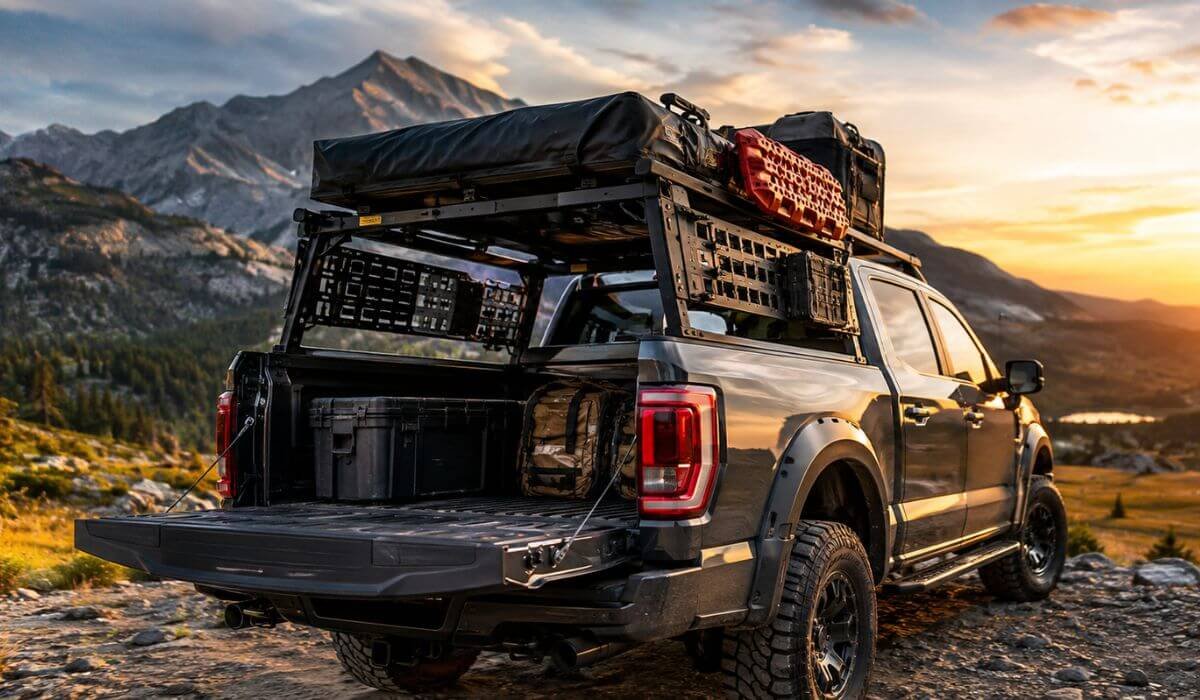
A well-chosen Ford F-150 bed rack should do more than add another level of cargo space. It needs to work with the truck’s actual bed configuration, mounting points and the way you intend to use the vehicle. The F-150 is offered with 5.5-, 6.5-, and 8-foot beds, and rack designs can differ substantially in overall height, adjustable width, mounting method, material, static and dynamic load capacity, accessory mounting, MOLLE support, and rooftop-tent clearance. Those differences can have a much bigger impact on day-to-day usability than the rack’s appearance or advertised load number.
The right setup depends heavily on what you are trying to carry. A full-height bed rack makes more sense when you need elevated cargo space, crossbars or rooftop-tent support, while a lower or MOLLE-based system can be the better choice when the priority is keeping recovery equipment, tools and camping gear organized and easy to reach. Steel and aluminum also bring different trade-offs in weight, strength and long-term use, while tonneau covers, bed liners and factory mounting points can determine whether a seemingly compatible rack actually works with your truck.
This guide compares the most useful F-150 bed rack setups for 2026, including adjustable designs, full-height platforms and compact MOLLE storage systems. The focus is on real fitment, usable capacity, installation, accessory compatibility and everyday practicality, so you can choose a rack based on how your F-150 is actually built and used—not simply on the longest feature list in a product listing.
Best Ford F-150 Bed Rack: Top 2026 Picks for MOLLE, Mounting & Load Support
#1. JOYTUTUS 24.6-Inch Full-Size Truck Bed Rack with Foldable MOLLE Panel
Best 2026 F-150 Bed Rack for Rooftop Tents, Overland Gear, Adjustable Cargo Mounting and Flexible Bed-Space Management
#2. Rough Country Full-Height Bed Rack
Best 2015–2026 F-150 Full-Height Bed Rack for Rooftop Tents, Heavy Cargo, Modular Accessories and Serious Overland Setups
#3. tokmowin Truck Bed Rack
Best 2004–2024 F-150 Truck Bed Rack for Overland Gear, Multi-Use Cargo Carrying, Adjustable Mounting and Versatile Truck Fitment
#4. Hooke Road Front Truck Bed MOLLE Panel System
Best 2015–2026 F-150 MOLLE Bed Rack for 5.5-Ft Beds, Modular Gear Organization, Tool Storage and Easy Access to Trail Equipment
#5. OUSUWO Front Truck Bed MOLLE Panel Rack System
Best 2015–2025 F-150 Bed Storage Rack for 5.5-Ft Beds, Modular Cargo Organization, Tool Access and Compact Gear Management
Expert Tip
Before ordering a bed rack, check the F-150 bed length, model year, mounting points, rack height, and intended load together. A 5.5-ft bed and a 6.5-ft bed may look close enough in a product photo, but the mounting position and usable clearance can be completely different. The same applies to rooftop tents: static capacity for a parked tent is not the same as dynamic capacity while driving.
For this list, that distinction matters. The JOYTUTUS and Rough Country racks are aimed at owners who actually need a platform for tents, overland equipment, and larger cargo, while the Hooke Road and OUSUWO systems are much more about organized bed-side storage. Choosing the right category first can save more frustration than choosing the most expensive rack.
How We Chose These F-150 Bed Racks
The five products were not treated as interchangeable racks. They serve different jobs, and that is the first thing worth making clear before comparing them.
The selection started with real-world F-150 fitment. Model-year coverage was checked alongside the bed configuration because “fits F-150” is not enough information on its own. The JOYTUTUS was given the top position because it brings a useful combination of 24.6-inch height, adjustable width, foldable MOLLE panels, no-drill mounting, and high static-load capability, while also covering the newer 2026 F-150. That combination makes it the most broadly useful choice in this particular group.
The Rough Country rack was judged differently. Its full-height aluminum construction, T-slot mounting system, and 750-lb static / 400-lb dynamic capacity make it a more serious platform for owners carrying rooftop tents and heavier overland equipment. Its 2015–2026, 5’7-inch bed fitment is narrower than the JOYTUTUS, but the more focused design is exactly why it earns the second position rather than being treated as a weaker version of the first.
The tokmowin occupies another space. Its attraction is broad vehicle compatibility and multi-purpose cargo use, which can be useful for someone building a versatile setup rather than a dedicated F-150-only system. However, its listed F-150 coverage is older, so newer-truck buyers should verify exact fitment before ordering instead of assuming that a broad compatibility list guarantees a 2026 fit.
The final two selections were included deliberately even though they are not traditional full-height bed racks. The Hooke Road system is built around a 5.5-ft bed and modular MOLLE storage, making it a sensible choice when accessible gear organization matters more than carrying a tent above the bed. OUSUWO follows the same storage-first idea, with 2015–2025 F-150/Raptor 5.5-ft-bed compatibility, but its exclusion of 6.5-ft beds makes accurate fitment especially important.
Most importantly, the ranking does not assume that the biggest rack is automatically the best rack. Rack height, bed compatibility, mounting hardware, load capacity, accessory flexibility, and the actual job the rack needs to perform all matter. That is why these five products are ranked according to where each one makes the most sense—not simply by price, appearance, or the number of accessories shown in the listing.
For a newer F-150, especially a 2024–2026 model, checking the exact bed configuration before purchase is still the final step. Product listings change, revisions happen, and a rack that looks universal may have very specific mounting requirements. That small check is worth doing before spending money on a setup that has to be returned later.
#1. JOYTUTUS 24.6-Inch Full-Size Truck Bed Rack with Foldable MOLLE Panel
Quick Specs:
- Rack Height: 24.6 inches — a useful middle ground for rooftop-tent and overland setups without going to an excessively tall profile.
- Static Load: Up to 800 lbs — plenty of headroom for a parked rooftop tent and substantial camping or recovery equipment.
- Mounting: No-drill U-bolts — installation avoids permanent drilling into the bed.
- MOLLE Utility: Fold-down side panels double as 40-lb work or dining tables, adding useful space outside the bed.
- Construction: Heavy-duty steel with electrophoretic corrosion protection and a sandblasted surface.
- Bed Compatibility: Designed around full-size trucks, including F-150 applications, with fitment dependent on the truck’s exact bed and mounting configuration.
- Visibility: Integrated third brake light helps maintain rear visibility with the rack installed.
- Rack Weight: 114.4 lbs, reflecting its substantial steel construction.
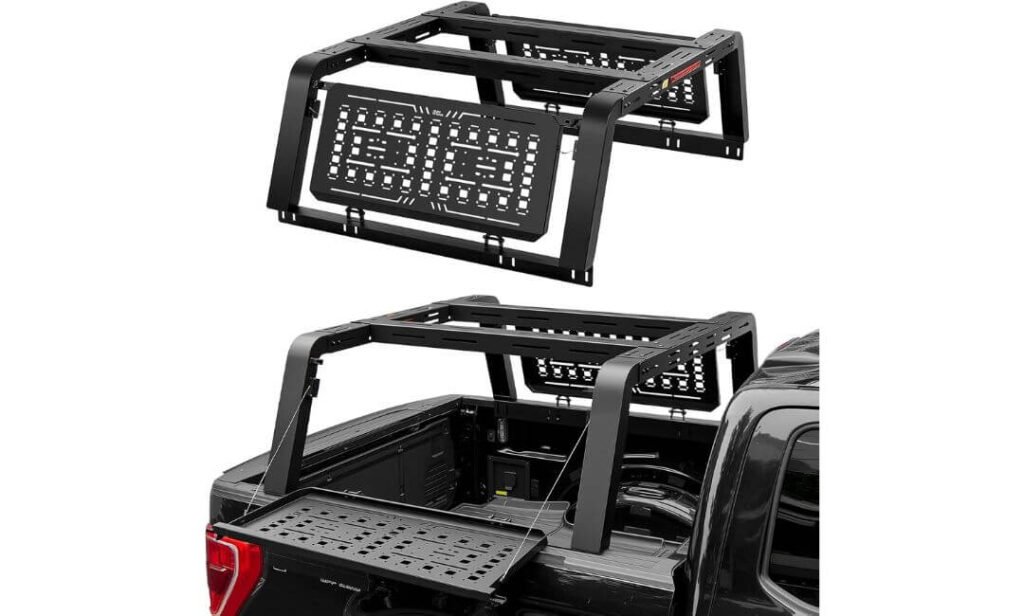
Some bed racks are essentially just a metal frame placed above the truck bed. This one takes a more useful approach by combining the elevated cargo platform with foldable MOLLE panels that can actually become part of the campsite or work area. That matters when the bed is already packed with recovery gear, coolers, tools, or camping equipment and there is nowhere convenient to prepare food or sort smaller gear.
The 24.6-inch height is particularly well suited to owners who need additional vertical clearance for equipment while keeping the bed available underneath. Combined with an 800-lb static rating, it gives this setup the kind of capacity expected from a rack intended for rooftop tents, kayaks, recovery equipment, and larger overland loads. The rating is for a stationary setup, so moving-load requirements should always be checked separately.
Installation is another reason this option makes sense for an F-150. The U-bolt mounting system is designed for no-drill installation, so the truck does not need permanent modifications just to add the rack. The steel structure does make this a substantial piece of equipment at 114.4 pounds, but that weight is accompanied by corrosion protection and a solid construction intended for repeated outdoor use. The integrated third brake light is also a smart addition when the rack and its cargo occupy more of the truck’s rear profile.
(The appeal here is simple: one elevated rack adds cargo capacity, MOLLE organization, a usable side table, and integrated rear lighting without asking for permanent bed modifications.)
What We Like
- 800-lb static capacity gives plenty of usable margin for serious parked cargo and rooftop-tent applications.
- Fold-down MOLLE panels are genuinely functional, especially for recovery tools, cooking equipment, and smaller overland accessories.
- 40-lb table capacity turns otherwise vertical panel space into a useful campsite or roadside work surface.
- No-drill U-bolt mounting makes the setup more approachable for owners who do not want to modify the bed permanently.
- Integrated third brake light adds a practical safety feature that is easy to overlook when comparing racks.
What We Don’t
- Its 114.4-lb construction is something worth accounting for during installation, particularly when positioning the assembled rack onto the truck.
F-150 Fitment
This rack is marketed for Ford F-150 applications across multiple generations, along with other full-size pickups. Because F-150 beds have varied considerably by generation, cab configuration, bed length, bed-side equipment, and mounting arrangement, the model-year label alone should not be treated as a universal fit guarantee.
The product is intended for full-size truck beds and is particularly relevant to F-150 owners looking for a rack that can work with or without traditional bed-rail arrangements. Before ordering, verify the exact bed configuration and existing accessories, especially if a tonneau cover or other bed-mounted equipment is already installed.
The Insider Pro-Tip
The smartest way to judge a rack like this is not simply by asking, “How much weight can it hold?” Check what will be mounted, where that weight sits, and whether the truck remains practical to use afterward. An 800-lb static rating is valuable for a rooftop tent or loaded campsite, but the rack’s real advantage is being able to organize that equipment without sacrificing the entire bed.
Also take a few minutes to plan the installation around the truck’s existing setup. Measure the bed width, mounting area, cover clearance, and available space around the tailgate before opening the box. That small bit of preparation can make the difference between a rack that merely fits the F-150 and one that feels like it was meant to be there.
#2. Rough Country Full-Height Bed Rack
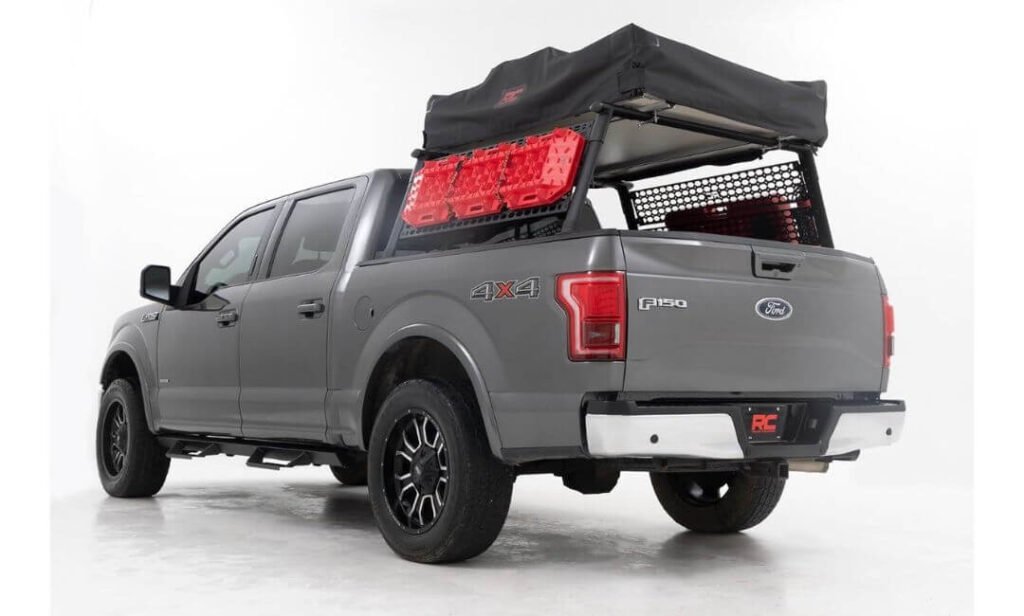
Quick Specs:
- Fitment: 2015–2026 F-150 and F-150 Lightning with the 5’7″ bed
- Load Rating: 750 lbs static / 400 lbs dynamic
- Build: Powder-coated aluminum
- Rack Weight: Just 37 lbs
- Mounting: U-bolt, no drilling required
- Mounting System: Integrated T-slot channels with modular crossbar compatibility
- Design: Full-height, adjustable layout designed to preserve rear-window visibility
- Tonneau Compatibility: Works with soft/roll-up covers, not hard covers
- Warranty: Limited Lifetime Warranty
The first thing that separates this rack from a lot of full-height setups is the 37-pound weight. That is remarkably light for a rack carrying a 750-pound static load, and it makes the design particularly attractive for an F-150 that still spends plenty of time doing normal truck duties during the week. There is less unnecessary weight sitting over the bed, yet the rack still has the capacity for a rooftop tent, ladders, kayaks, bikes, and the kind of equipment that usually ends up fighting for space in the cargo area.
Then there is the 400-pound dynamic rating, which is the number worth paying attention to when the truck is actually moving. That distinction makes this a more credible option for owners planning a rooftop-tent setup rather than simply choosing a rack because its static number looks impressive. The full-height structure also keeps the upper cargo area useful while maintaining rear-window visibility, something that becomes surprisingly important once a rack is loaded with real equipment.
The real strength, though, is the modular mounting system. The T-slot channels and adjustable crossbars give lights, accessories, recovery equipment, and other gear more freedom in where they can be mounted. Installation uses U-bolts with standard tools and no drilling, so the bed does not need to be permanently altered. There is one practical detail to keep in mind: this version is specifically for the 5’7″ bed, and side MOLLE panels are optional rather than included.
(A lightweight full-height platform with serious load capability—particularly well suited to an F-150 that needs to switch between weekday utility and weekend overland duty.)
What We Like About the Setup
- The 37-lb aluminum construction keeps the rack unusually light without giving up substantial load capacity.
- 750 lbs static and 400 lbs dynamic makes the capacity genuinely useful for both parked and traveling loads.
- T-slot mounting channels provide much more freedom than a fixed crossbar-only design.
- The full-height layout is designed to retain rear-window visibility, which is valuable on a daily-driven truck.
- No-drill U-bolt installation keeps the setup reversible and relatively straightforward.
One Practical Consideration
The 5’7″ bed requirement is the main thing to verify before ordering. That is not a weakness of the rack—it simply means this particular configuration is engineered around a specific F-150 bed size rather than trying to cover every bed length.
F-150 Fitment Details
This setup is designed for 2015–2026 F-150 and F-150 Lightning models equipped with the 5’7″ bed. That makes it a particularly relevant option for owners of the 2015-and-newer generation range, but the bed-length requirement remains important even when the truck itself falls within the listed model years.
The rack can also work with soft or roll-up tonneau covers, while hard tonneau covers are not supported. The separate MOLLE panels and rooftop-tent compatibility details should also be considered when planning the complete build, because the rack itself is the foundation rather than every accessory being included in the box.
The Insider Pro-Tip
The 37-pound weight is one of the most interesting numbers here, but it should be viewed alongside the dynamic rating—not separately. A lightweight aluminum rack can be a major advantage on a truck that carries a lot of equipment, because the rack itself is not consuming as much of the available payload before camping gear, passengers, and accessories are added.
For an F-150 with a 5’7″ bed, this is the kind of rack that makes sense when the build needs to stay adaptable. Keep the T-slots available for the accessories that are actually needed, rather than filling every mounting position simply because it is there. A clean setup with the right crossbar position, appropriate tonneau arrangement, and correctly distributed load will generally be more useful than a rack covered in equipment that rarely gets used.
#3. tokmowin Truck Bed Rack
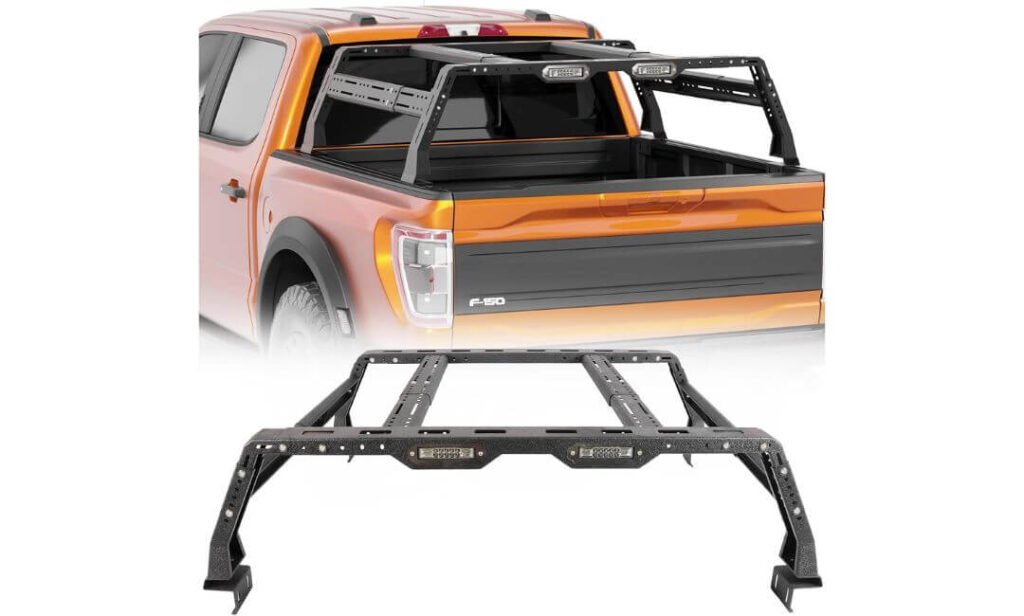
Quick Specs:
- F-150 Coverage: Listed for 2004–2024 F-150 applications
- Adjustable Height: 18.58–27.28 inches
- Adjustable Length: 37.7–60.7 inches
- Adjustable Width: 55.11–66.77 inches
- Load Rating: 800 lbs static / 400 lbs dynamic
- Construction: Heavy-duty carbon steel with powder-coated finish
- Lighting: Two 39W LED light bars included
- Mounting: Truck-bed rail mounting with no drilling
- Accessory Support: Side slots for lights, hi-lift jacks, bike racks, rooftop tents and other gear
- Tonneau Limitation: Not designed for trucks using a tonneau/bed cover; tailgate-cover thickness must also be checked
The interesting part of this rack is not the long compatibility list on the box; it is the amount of adjustment built into the frame. Height can move from 18.58 to 27.28 inches, length from 37.7 to 60.7 inches, and width from 55.11 to 66.77 inches. That gives an F-150 owner considerably more freedom to position the rack around the actual bed and the equipment being carried rather than being locked into one fixed geometry.
That flexibility becomes useful when the cargo changes. Kayaks, surfboards, skis, bikes, luggage and rooftop-tent equipment all have different clearance requirements, and the side mounting slots provide additional places for lights, recovery accessories and other gear. The 800-lb static / 400-lb dynamic rating also gives this setup enough capacity for substantial loads, while the distinction between those two ratings remains important when the truck is actually moving.
Another nice touch is that the package includes two 39W LED light bars, rather than making lighting an immediate separate purchase. The carbon-steel construction and powder-coated finish are suited to outdoor use, while the bed-rail mounting avoids drilling or permanent modifications. The trade-off is straightforward: this is a rack designed around flexibility, so the truck needs to have the right bed configuration and available mounting space for that flexibility to be useful.
(A highly adjustable choice for an F-150 build where cargo dimensions change more often than the truck does.)
What We Like About It
- The 18.58–27.28-inch height adjustment makes it easier to balance cargo clearance with overall rack height.
- 800-lb static and 400-lb dynamic capacity gives the frame useful capability for both parked and moving loads.
- The two included 39W LED light bars add genuine nighttime utility without immediately expanding the accessory budget.
- Side slots and mounting points make the rack adaptable to different types of overland and recreational equipment.
- The wide adjustment range is especially useful when the rack needs to accommodate different cargo shapes or accessory positions.
One Practical Consideration
The main thing to settle before purchase is the bed-cover arrangement. This rack is not intended for trucks running a tonneau or bed cover, and the listed tailgate-cover thickness limit is 2.8 cm. Checking that measurement beforehand keeps the installation straightforward.
F-150 Fitment Details
The listed F-150 coverage is 2004–2024, making this one of the more broadly positioned options in the lineup for older and mid-generation trucks. Its adjustable dimensions are helpful across different configurations, but “adjustable” does not mean every F-150 combination is automatically compatible.
For a truck with a bed-mounted accessory already installed, the mounting area should be checked carefully before ordering. The manufacturer specifically calls out tonneau and bed-cover restrictions, so this is a case where physical clearance matters more than the broad vehicle list.
The Insider Pro-Tip
The biggest advantage here is the ability to set the rack around the load instead of forcing the load around the rack. Start with the equipment that will spend the most time on top—whether that is a tent, kayak, bike, or cargo—and then choose the rack height and crossbar position around its clearance requirements. That approach usually produces a cleaner and more usable setup.
One detail deserves equal attention: the 400-lb dynamic rating is the relevant figure when the truck is traveling, while the 800-lb figure applies to a stationary load. Keeping heavier equipment low, distributing it across the rack, and checking every mounting point after installation will make better use of what this adjustable frame is designed to do.
#4. Hooke Road Front Truck Bed MOLLE Panel System
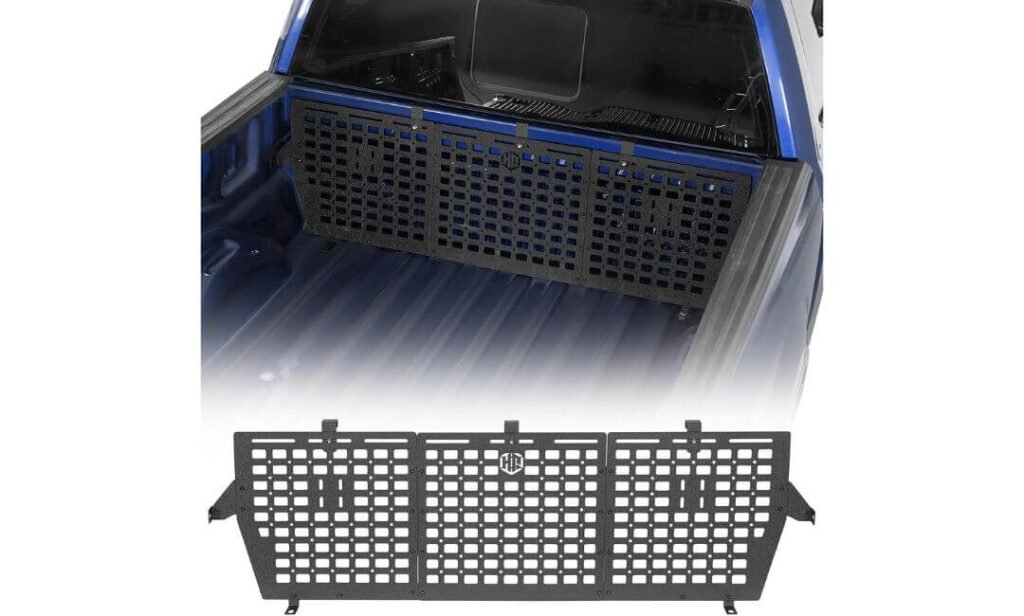
Quick Specs:
- Fitment: 2015–2026 F-150 with the 5.5-ft short bed
- Panel Height: 19.1 inches
- Panel Length: 60.34 inches
- Construction: 14-gauge carbon steel with textured powder coating and inner E-coating
- Weight: Approximately 26 lbs
- Mounting: No-drill bolt-on installation using factory mounting points
- Storage Style: Full MOLLE cutout layout for pouches, straps, tools and recovery equipment
- Bed-Liner Compatibility: Not compatible with bed liners
- Warranty: 2-year limited warranty with lifetime customer support
A crowded truck bed does not always need a bigger rack. Sometimes the smarter move is to stop putting everything on the floor. This system uses the otherwise underused front bed wall and turns roughly 19.1 inches of vertical space into a dedicated mounting area for recovery gear, tools, pouches and other equipment. That can make a noticeable difference when coolers, boxes and larger cargo already need the floor.
The 14-gauge carbon-steel construction gives the panel a substantial base for MOLLE-mounted equipment, while the textured powder coat and inner E-coating add protection against the rain, mud and road salt that a working truck inevitably sees. At around 26 pounds, it also avoids adding the kind of weight associated with a complete elevated bed-rack structure.
What makes the setup particularly appealing is how clean the installation remains. It uses factory mounting points, included hardware and factory bolts, so there is no need to drill into the truck. The full MOLLE pattern can then be configured around the gear that actually gets used—whether that means recovery straps, shovels, axes, fuel containers or smaller pouches. There is one fitment detail that should not be overlooked: this version is specifically built for the 5.5-ft bed and does not accommodate a bed liner.
(A storage-first solution for turning wasted vertical bed space into organized, reachable equipment storage.)
What We Like About It
- Vertical storage keeps frequently used gear off the bed floor and easier to reach.
- The full MOLLE layout allows the storage arrangement to change as equipment changes.
- 14-gauge steel provides a durable foundation without the bulk of a complete overhead rack.
- Factory-point, no-drill installation keeps the truck’s original bed structure intact.
- At roughly 26 lbs, it adds useful organization without becoming a major payload consideration.
One Practical Consideration
The 5.5-ft bed requirement is important, and the panel is not designed for trucks with a bed liner. Checking both before ordering is much easier than discovering the mounting area does not provide the required clearance after the package arrives.
F-150 Fitment Details
This system is specifically listed for 2015–2026 Ford F-150 5.5-ft short-bed models. It is not intended for the 6.5-ft standard bed, so the bed length needs to be confirmed even when the truck falls within the supported model years.
The other key point is the bed surface itself. Because installation relies on the truck’s factory mounting locations and available clearance, a bed liner can interfere with the intended fit. For a bare or appropriately configured bed, the bolt-on design keeps the installation considerably cleaner than a system requiring drilling or permanent modification.
The Insider Pro-Tip
The best way to use a MOLLE panel is to treat it like a tool wall, not a place to hang everything that happens to fit. Put the equipment that needs to be reached quickly—recovery straps, gloves, small tools or frequently used trail gear—where it can be grabbed without unloading the bed. Keep heavier items positioned thoughtfully rather than loading the panel simply because there is available space.
And before ordering, look at the truck when it is actually loaded for a normal trip. If the bed floor disappears under coolers, boxes and camping equipment, reclaiming the unused front-wall area can be more useful than adding another large overhead structure. That is where this style of setup earns its place in the lineup.
#5. OUSUWO Front Truck Bed MOLLE Panel Rack System
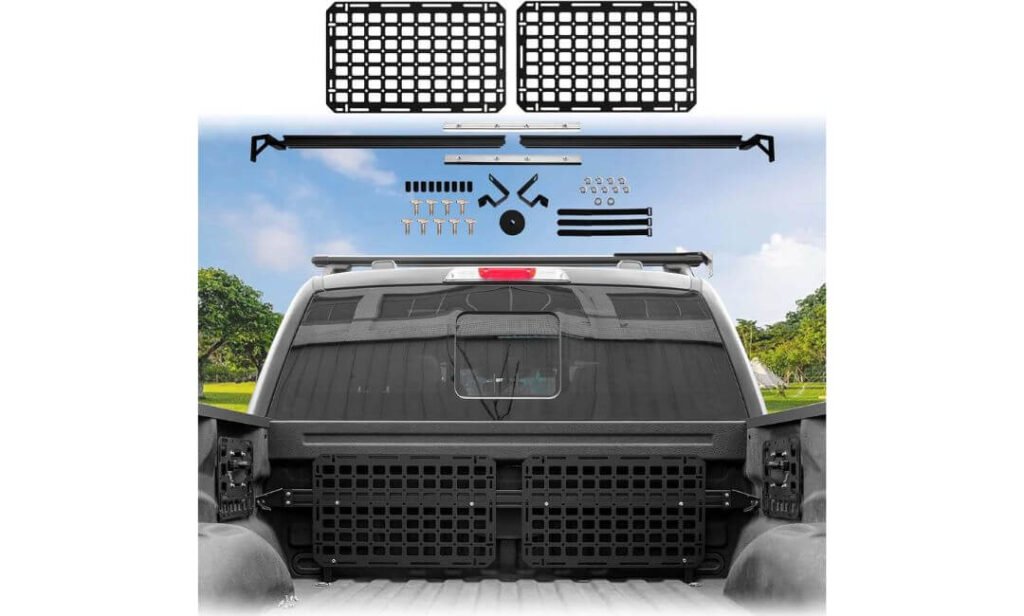
Quick Specs:
- Fitment: 2015–2025 F-150 and Raptor with the 5.5-ft short bed
- Load Capacity: Up to 300 lbs
- Construction: Heavy-duty carbon steel
- Mounting: Zero-drill installation through factory mounting holes
- Storage Layout: Full MOLLE grid for straps, tools and mounted equipment
- Supported Gear: Jacks, shovels, recovery kits, fire extinguishers and fishing equipment
- Bed-Liner Note: Drop-in liners require access to the original mounting holes
- Grab-Handle Limitation: Not compatible with models using motor-driven grab handles
- Installation Help: QR-code video guide included
There is a point where adding more boxes to an F-150 bed stops solving the storage problem. This system takes the opposite approach: instead of consuming more floor space, it turns the front wall of the bed into usable storage. The MOLLE grid gives equipment a fixed home, so items such as jacks, shovels, recovery kits and smaller trail tools do not have to compete with cargo sitting on the bed floor.
The 300-pound capacity is more than enough for the type of equipment this panel is intended to organize, while the carbon-steel construction gives it a sturdy foundation for mounted gear. That makes the design especially useful for camping, road trips and work-oriented hauling where the same tools tend to travel in the truck repeatedly. The included straps also make it easier to secure different shapes rather than relying on one fixed accessory arrangement.
Installation follows the same practical philosophy. No drilling is required, with the panel using the truck’s existing factory holes, so there is no reason to permanently alter the bed just to gain additional organization. It can also work alongside a tonneau-cover setup without becoming an overhead obstruction. The important detail is the bed itself: this version is for the 5.5-ft bed, and trucks with motorized grab handles require a different solution.
(The result is less about adding another rack and more about making the space already present in the bed considerably easier to use.)
What We Like About It
- 300-lb capacity gives the panel plenty of strength for tools and recovery equipment.
- The MOLLE grid makes the storage layout easy to adapt as equipment changes.
- Factory-hole installation avoids drilling and keeps the modification reversible.
- The front-wall position helps free valuable bed-floor space for larger cargo.
- The design remains practical alongside a tonneau cover, without requiring an overhead structure.
One Practical Consideration
The fitment is quite specific: 5.5-ft bed only, and trucks with motor-driven grab handles are excluded. A drop-in bed liner can also require access to the factory mounting holes, so that detail is worth checking before installation.
F-150 Fitment Details
The panel is listed for 2015–2025 F-150 and F-150 Raptor models with the 5.5-ft short bed. It is not a universal F-150 solution, and the 6.5-ft bed is specifically excluded. That narrower fitment is actually useful information because it makes the intended application clear rather than relying on a vague “fits F-150” description.
For trucks with a drop-in liner, the original mounting holes need to remain accessible for installation. The factory-hole design otherwise keeps the process straightforward, with an installation video available through the supplied QR code.
The Insider Pro-Tip
Think about the panel in terms of frequency of use, not maximum capacity. A shovel, recovery strap, jack accessory or frequently used tool deserves a mounting position where it can be reached immediately; equipment that only comes out twice a year is usually better stored elsewhere. That simple distinction keeps the MOLLE system useful instead of turning it into another crowded storage surface.
There is also a practical reason to check the mounting area before buying: the best storage accessory is the one that does not interfere with the way the truck already works. Confirm the bed length, grab-handle configuration, liner arrangement and tonneau-cover clearance first. When those four pieces line up, this kind of front-wall storage can give back surprisingly valuable bed-floor space without adding a large structure above it.
Best Ford F-150 Bed Rack (2004–2026): See Which Setup Fits Your Truck
| Rack / System | Best Use | F-150 Fitment | Load Capacity | Build & Weight | Mounting | Key Advantage | Important Fitment Detail |
|---|---|---|---|---|---|---|---|
| JOYTUTUS 24.6-Inch Full-Size Bed Rack Best Overall | Rooftop tents, overland gear, kayaks and larger cargo with added MOLLE organization |
Multiple F-150 generations 2026 applications listed |
800 lbs static Static rating; verify dynamic requirements for moving loads |
Rugged steel 114.4 lbs Electrophoretic protective coating |
No-drill U-bolt mounting |
24.6-inch height plus fold-down MOLLE side tables rated to 40 lbs | Check bed configuration, mounting area and existing bed accessories before installation |
| Rough Country Full-Height Bed Rack Best Full-Height | Rooftop tents, ladders, bikes, kayaks and modular overland equipment |
2015–2026 F-150 5’7″ bed only |
750 lbs static 400 lbs dynamic |
Powder-coated aluminum Only 37 lbs |
No-drill U-bolt mounting |
T-slot channels and adjustable crossbars provide flexible accessory mounting | Works with soft/roll-up tonneau covers; not compatible with hard covers |
| tokmowin Truck Bed Rack Best Adjustable | Variable cargo, kayaks, surfboards, bikes, rooftop tents and overland equipment |
2004–2024 F-150 Verify exact newer-model fitment |
800 lbs static 400 lbs dynamic |
Carbon steel 85.7 lbs |
Bed-rail mounting No drilling |
Height 18.58–27.28″, width 55.11–66.77″, length 37.7–60.7″ | Not intended for tonneau/bed covers; cover thickness and mounting clearance need checking |
| Hooke Road Front Truck Bed MOLLE Panel Best MOLLE Storage | Recovery equipment, tools, pouches and frequently accessed trail gear |
2015–2026 F-150 5.5-ft bed only |
Designed for mounted gear No published overall rack load rating supplied |
14-gauge carbon steel Approx. 26 lbs |
No-drill bolt-on Factory mounting points |
Turns unused front bed-wall space into organized vertical storage | Not for 6.5-ft beds or beds with a liner that obstructs the mounting points |
| OUSUWO Front Truck Bed MOLLE Panel Best Compact Storage | Tools, jacks, shovels, recovery kits and organized bed-side equipment |
2015–2025 F-150 / Raptor 5.5-ft bed only |
300 lbs | Heavy-duty carbon steel |
Zero-drill Factory holes |
Full MOLLE grid helps free bed-floor space without adding a large overhead rack | Not for 6.5-ft beds or motor-driven grab-handle models; drop-in liners need mounting-hole access |
Ford F-150 Bed Rack Buying Guide: How to Choose the Right Setup for Your Truck
A bed rack should be chosen around the way the F-150 is actually used, not simply by its advertised load number or how impressive the rack looks in photographs. A truck carrying a rooftop tent has very different requirements from one carrying fishing gear, work tools, recovery equipment, or bikes. The most useful comparison comes down to bed compatibility, usable height, load ratings, mounting design, rack weight, accessory support, and how much of the original bed remains usable.
Start With Your F-150 Bed Configuration
The first check is simple but easy to overlook: identify the exact bed length before comparing racks. F-150s have been offered with different bed configurations across generations, and the products in this lineup do not all cover the same applications.
For example, the Rough Country setup is specifically designed around the 5’7″ bed, while the Hooke Road and OUSUWO MOLLE systems are also restricted to 5.5-ft beds. The tokmowin offers a much wider adjustment range, but its listed F-150 coverage is 2004–2024, so newer trucks deserve an additional fitment check. The JOYTUTUS is positioned more broadly for full-size trucks, including newer F-150 applications, but the actual mounting area still needs to be checked.
That distinction matters because “fits F-150” does not necessarily mean “fits every F-150.” Bed length, bed rails, liners, grab-handle configurations, tonneau hardware, and other factory or aftermarket equipment can all change what will physically work.
Decide How Much Rack Height You Actually Need
Rack height is not just a styling choice. It determines what can sit above the bed, how easily the rear window remains visible, and how much clearance exists between the rack and equipment mounted below or above it.
A full-height rack is the better direction when the truck needs to carry a rooftop tent, ladders, kayaks, bikes, or larger overland equipment. The Rough Country rack is a good example of this approach, combining a full-height structure with adjustable crossbars and T-slot mounting points.
A more adjustable or lower configuration can make more sense when the priority is cargo access and a lower overall profile. The tokmowin, for instance, can be adjusted from 18.58 to 27.28 inches, allowing the setup to be positioned around different types of cargo.
The right height is ultimately the one that leaves enough clearance for the equipment being carried without making the truck unnecessarily tall or compromising normal bed access.
Static Capacity Is Not the Same as Dynamic Capacity
This is one of the most important numbers to understand when shopping for a rack.
A static load rating refers to a stationary setup, such as a rooftop tent with occupants while the truck is parked. A dynamic rating applies while the truck is moving, when braking, cornering, potholes, and uneven terrain can place substantially different forces on the mounting system.
That is why the Rough Country rack’s 750-lb static and 400-lb dynamic ratings tell a more useful story than simply saying it supports 750 pounds. The tokmowin is similarly listed at 800 lbs static and 400 lbs dynamic.
Never assume that a high static figure automatically means the same amount is appropriate on the road. The manufacturer’s dynamic rating, the mounting hardware, the accessory weight, and the truck’s own payload limit all need to be considered together.
Aluminum vs. Steel: The Trade-Off Is More Than Weight
Material choice becomes noticeable once the rack stays on the truck permanently.
Aluminum has an obvious advantage when minimizing added weight matters. The Rough Country rack weighs only 37 pounds, which is exceptionally light compared with the heavier steel alternatives in this lineup. That leaves more of the truck’s payload available for passengers, camping equipment, tools, and other cargo.
Steel, on the other hand, can provide a substantial, confidence-inspiring structure and is commonly chosen for equipment expected to see rough outdoor use. The JOYTUTUS uses rugged steel and weighs 114.4 pounds, while the tokmowin uses carbon steel at 85.7 pounds. Both also use protective finishes intended to help against corrosion.
There is no universal winner here. For a permanently installed adventure setup where every pound matters, aluminum is attractive. For a heavier-duty structure where mass is less of a concern, steel can make more sense. Either way, corrosion protection and finish quality deserve attention because bed racks spend their lives exposed to rain, dirt, road spray, and changing temperatures.
MOLLE Storage Can Be More Useful Than Another Crossbar
Not every F-150 needs a large overhead rack.
The Hooke Road and OUSUWO systems demonstrate a different approach: use the unused vertical bed-wall area for tools and recovery equipment instead of consuming more space above the truck.
A MOLLE system is particularly useful for equipment that needs to remain organized and accessible, such as recovery straps, pouches, shovels, jacks, fire extinguishers, and smaller trail tools. The Hooke Road panel uses 14-gauge steel and a full MOLLE layout, while the OUSUWO system provides a 300-lb capacity with factory-hole, zero-drill mounting.
This type of setup is worth considering when the real problem is a cluttered bed rather than a lack of rooftop cargo capacity. There is little value in installing a full-height rack if most of the equipment will still end up loose on the bed floor.
Check Tonneau Cover and Bed-Liner Compatibility
This is where a promising rack can quickly become the wrong purchase.
Tonneau covers, bed liners, factory bed rails, and other accessories occupy space that a rack may need for its mounting hardware. Compatibility therefore has to be checked against the actual truck configuration, not just the F-150 model year.
The Rough Country rack supports soft or roll-up tonneau covers, but not hard covers. The tokmowin specifically has restrictions around tonneau and bed-cover setups. The Hooke Road panel is not designed for beds where a liner interferes with its mounting points, while the OUSUWO system requires access to the original factory holes when a drop-in liner is present.
These details may look minor on a product page, but they are exactly the kind of details that determine whether installation is straightforward or becomes a project.
Think About Installation Before Choosing the Rack
A no-drill design is valuable when keeping the truck as close to stock as possible matters. Both the larger rack options and the MOLLE systems in this lineup use bolt-on or U-bolt-style mounting, avoiding permanent drilling into the bed.
That does not mean every installation will take the same amount of time. Larger racks involve more components, crossbars, brackets, and alignment points, while a MOLLE panel is considerably more compact.
For a full rack, it is also worth planning for assembly and positioning before installation day. A substantial steel structure can be awkward to move into place even when the actual mounting process is straightforward. Having the correct tools, enough working room, and a second set of hands can make the process much smoother.
Match the Rack to the Job, Not the Accessory List
The best F-150 bed rack is the one that supports the equipment actually carried most often.
For rooftop tents and serious overland loads, prioritize dynamic and static ratings, structural height, mounting security, and accessory clearance. For kayaks, bikes, ladders, and recreational equipment, adjustable crossbars and mounting positions become more important. For tools and recovery gear, a MOLLE panel can be the more practical answer because it keeps frequently used equipment accessible without filling the bed floor.
That is also why there is no single specification that makes one rack automatically better than another. A lightweight aluminum rack with T-slots may be perfect for one F-150, while a steel rack with fold-down MOLLE tables may be far more useful for another.
The Final Fitment Check
Before placing the order, verify model year, bed length, bed-rail arrangement, tonneau-cover type, bed liner, existing accessories, and the equipment that will actually be mounted. Then compare the rack’s static and dynamic ratings against the expected load.
That final check is more valuable than relying on a broad compatibility headline. An F-150 bed rack is a structural accessory, so the best result comes from matching the rack to the truck first and the accessories second. Once those two pieces line up, installation becomes simpler, cargo stays more organized, and the rack becomes something the truck can genuinely use rather than another accessory taking up space.
Installation & Fitment Essentials for a Ford F-150 Bed Rack
A bed rack can be structurally strong and still cause problems if the installation is rushed. The important part is not simply getting every bolt into a hole; it is making sure the rack sits square, the mounting surfaces are clean, the hardware is properly seated, and nothing interferes with the bed, tailgate, rear window, tonneau cover, or existing accessories.
Start With the Truck, Not the Rack
Before unpacking the hardware, confirm the rack matches the actual truck configuration. Check the F-150 model year, bed length, bed rails, bed liner, tonneau cover, grab-handle configuration, and existing bed accessories against the manufacturer’s current fitment information.
Park the truck on a level, stable surface and give yourself enough room to work around both sides of the bed. Remove loose cargo, dirt, and anything that could prevent the mounting brackets from sitting flat. If a bed liner is present, pay particular attention to the mounting holes and contact surfaces; some products in this lineup specifically require clear access to the factory mounting points.
Inspect and Identify Every Mounting Point
Before tightening anything, loosely position the major brackets and identify where every attachment point belongs. This is especially important with adjustable racks because the final width and height can affect how the structure sits relative to the bed.
For a no-drill U-bolt or factory-point system, the hardware should sit naturally in the intended mounting location. Never force a bracket into alignment by pulling the entire rack sideways with a partially tightened bolt. If something does not line up, stop and check the configuration rather than assuming the hole or bracket needs modification.
With a MOLLE panel, make sure the panel is sitting evenly against its intended mounting surface before final tightening. A clean, square installation helps prevent unnecessary stress on the hardware.
Build and Align Before Final Tightening
For larger bed racks, assemble the major sections according to the manufacturer’s sequence while leaving the mounting hardware slightly loose. This gives the frame enough movement to settle into its correct position.
Once the structure is assembled, check the left-to-right alignment, rack height, crossbar position, tailgate clearance, rear-window visibility, and accessory clearance. Stand behind the truck and look along the rack; an uneven gap or visibly crooked crossbar is often easier to spot before everything is fully tightened.
Only after the rack is sitting correctly should the mounting hardware be tightened progressively. Work from one side to the other rather than fully tightening one corner while the remaining corners are loose.
Torque the Hardware Correctly
There is no universal torque number that should be applied to every bed rack. Use the manufacturer’s specified torque value for each fastener and hardware size. The correct figure depends on the bolt, nut, material, mounting design, and hardware supplied with that particular rack.
genui{“learning_viz”:{“type_id”:”TORQUE”,”locale_override”:”en-US”}}
A calibrated torque wrench is preferable to tightening by feel, particularly on a rack that will carry substantial equipment. Under-tightening can allow movement, while excessive torque can damage threads, deform mounting surfaces, or create unnecessary stress.
After the first installation, recheck the mounting hardware according to the manufacturer’s instructions, particularly after the truck has been driven with the rack installed. If any fastener repeatedly loosens, investigate the cause rather than simply tightening it harder.
Common Installation Mistakes Worth Avoiding
A few problems show up repeatedly with truck accessories, and most are easy to prevent.
- Ordering the wrong bed configuration: A rack for a 5.5-ft or 5’7″ bed should not be assumed to fit a 6.5-ft bed simply because the truck is an F-150.
- Ignoring existing accessories: Tonneau covers, bed liners, grab handles, toolboxes, and other equipment can change the available mounting space.
- Fully tightening too early: Locking down one section before the entire rack is aligned can make the remaining holes difficult to line up.
- Skipping clearance checks: Open and close the tailgate, check the rear window, and inspect the area around the cab before loading equipment.
- Treating static capacity as the driving limit: A rack’s parked load rating is not automatically its allowable moving load.
- Adding accessories without checking their weight: The rack, rooftop tent, crossbars, lights, and mounted equipment all contribute to the overall load.
Tools Worth Having Ready
Most no-drill systems are designed around ordinary workshop tools, but having the right equipment makes the installation cleaner.
- Metric and/or SAE socket set, depending on the supplied hardware
- Ratchet and appropriate extensions
- Combination wrenches
- Calibrated torque wrench
- Measuring tape
- Level for checking the rack structure
- Protective gloves
- Work light when installing in a garage or low-light area
- Thread-cleaning brush or cloth for dirty mounting points
For a large steel rack, a second person is also extremely useful during positioning and alignment. That is less about technical difficulty and more about keeping the rack controlled while the mounting hardware is being started.
When Professional Installation Makes Sense
A mechanically experienced owner can usually handle a straightforward bolt-on rack, particularly when the product uses factory mounting points and provides clear instructions. A professional installation becomes more worthwhile when the setup includes a heavy rooftop tent, complicated tonneau arrangement, multiple accessories, unusual bed configuration, or uncertain mounting clearance.
Professional help is also sensible if the truck has been modified around the mounting area or if the supplied instructions and the physical truck do not appear to agree. It is better to resolve a fitment question before tightening the first bolt than to discover the problem after the rack is loaded.
Protect the Rack Through Weather and Seasonal Use
A bed rack lives in a harsher environment than most interior accessories. Water, road salt, mud, dust, and trapped moisture can eventually affect exposed hardware even when the main structure has a protective coating.
After driving through winter salt, mud, or particularly wet conditions, rinse the rack and pay attention to the mounting hardware, joints, slots, and areas where dirt can collect. Allow those areas to dry rather than leaving moisture trapped against the bed.
During routine checks, look for scratched coating, surface corrosion, loose fasteners, damaged hardware, or movement at the mounting points. Small coating damage is much easier to address early than after corrosion has spread underneath the finish.
Give the Installation a Short Follow-Up Check
The first inspection should happen sooner than the first major maintenance interval. After the rack has experienced its first few drives and normal vibration, inspect the mounting points and accessory hardware for movement.
For a setup carrying a rooftop tent or other substantial equipment, make this check part of the normal pre-trip routine. Before a long journey, look over the mounting bolts, crossbars, accessory brackets, electrical connections, and visible rack joints. A two-minute inspection is a much better habit than waiting until a problem becomes obvious on the road.
The Fitment Rule That Saves the Most Trouble
The safest installation is one where nothing has to be forced into place. If a bracket requires unusual pressure, a mounting hole appears misaligned, a tonneau cover contacts the rack, or a bed liner prevents proper seating, stop and resolve the fitment issue before proceeding.
That is particularly important with the five options in this guide because their designs are genuinely different. Some are full-height cargo platforms, while others use the front bed wall for MOLLE storage. The correct installation method therefore starts with the specific product instructions and the exact F-150 configuration, not a generic truck-rack procedure.
MOLLE & Overland Gear Compatibility: Building a More Useful F-150 Bed Setup
A good overland setup is not about covering every available mounting point with accessories. The useful setup is the one where every mounted item has a job, stays secure on rough roads, and remains accessible without forcing the entire bed to be unloaded. MOLLE panels, T-slots, crossbars, side slots, and elevated platforms each solve a slightly different storage problem, so combining them intelligently can make a much bigger difference than simply adding more hardware.
What MOLLE Compatibility Actually Unlocks
MOLLE compatibility turns otherwise unused vertical or side-panel space into organized mounting real estate. Instead of leaving recovery straps, tools, cooking equipment, fire extinguishers, or smaller trail supplies loose inside the bed, compatible pouches, straps, brackets, and holders can keep them in predictable positions.
That becomes particularly useful when the truck carries bulky equipment underneath or on top of the rack. Large cargo belongs where it can use the available bed space efficiently, while smaller frequently accessed items can move onto the MOLLE structure. The result is not necessarily more total cargo capacity; it is better use of the capacity already available.
There is also an important distinction between a MOLLE panel and a full overhead rack. A panel is primarily an organization system, while a full rack creates an elevated platform for equipment such as rooftop tents, kayaks, bikes, ladders, and larger cargo. They can complement each other, but they should not be treated as the same type of accessory.
Match Accessories to the Mounting System
Different mounting interfaces are better suited to different equipment. A clean setup starts by matching the accessory to the structure rather than buying accessories first and trying to make them fit afterward.
- MOLLE pouches and tool holders: Best for smaller equipment, recovery accessories, gloves, straps, hand tools, and frequently used supplies.
- Jerry-can mounts: Useful when additional fuel or water storage is genuinely required, but the container should be mounted securely and positioned with overall vehicle balance in mind.
- Shovel and axe mounts: A natural fit for MOLLE-style side storage, particularly when these tools need to remain accessible without occupying bed-floor space.
- Recovery-board brackets: Better placed on a strong rack or dedicated mounting location where the boards cannot shift into the bed or interfere with other equipment.
- LED lighting: T-slot channels and dedicated accessory slots can provide cleaner mounting positions for work or camp lighting, while wiring should be protected from abrasion and water exposure.
- Crossbars: Useful for kayaks, bikes, ladders, cargo boxes, and rooftop-tent platforms where the equipment needs a stable elevated support point.
- Bed drawers: A strong companion for a rack-based build when smaller equipment needs to stay protected, dry, and organized beneath the elevated cargo area.
Choosing Accessories for Each Type of Setup
For the JOYTUTUS-style full-size rack, the strongest accessory combination is one that takes advantage of the elevated platform and its MOLLE functionality at the same time. A rooftop tent or larger cargo can use the upper structure, while recovery equipment, cooking supplies, or smaller tools can live on the side panels. The fold-down panels are especially useful because they can also become a practical work or dining surface.
A full-height modular aluminum rack benefits most from accessories that use its T-slot system efficiently. Adjustable crossbars, lighting, bike mounts, kayak supports, and rooftop-tent hardware can be positioned around the actual cargo instead of being permanently locked into one arrangement. Keeping the accessory layout modular is particularly useful on a truck that changes between daily driving and weekend travel.
For the highly adjustable steel rack, accessory selection should take advantage of its broad range of height, width, and length adjustment. Kayak supports, bike mounts, lighting, recovery equipment, and other cargo brackets can be positioned according to the load being carried. The important point is to adjust the rack first, then mount the accessory, rather than using an accessory to compensate for a poorly positioned rack.
The front-wall MOLLE systems make more sense with lighter, frequently accessed equipment. Tool pouches, recovery straps, shovels, jacks, fire extinguishers, and smaller camping supplies are natural candidates. There is little reason to turn a compact organization panel into a substitute for a heavy overhead cargo rack; its real advantage is reclaiming the bed floor.
Build the Storage Around Access, Not Just Capacity
An overland truck becomes frustrating when the equipment that is needed most often is buried underneath everything else. Place high-use gear in the easiest-to-reach positions and reserve deeper or less accessible storage for equipment that is used occasionally.
For example, recovery straps and gloves should be reachable without unloading the bed, while seasonal camping equipment can sit farther back or underneath. Similarly, a shovel mounted externally can be more useful than one buried beneath a cooler, but only if its mounting hardware keeps it completely secure.
This approach also prevents the common mistake of filling every MOLLE opening simply because the panel provides them. Empty mounting space is not wasted space if it leaves room for future equipment or makes existing gear easier to reach.
Load Distribution Matters More Than a Big Number
A rack’s maximum capacity does not tell the entire story. Where the weight is placed affects how the truck behaves, how the rack is loaded, and how much stress reaches the mounting points.
Keep heavier equipment as low and centered as practical. Avoid creating a setup where most of the weight sits far toward one side or hangs unnecessarily far outside the rack structure. Rooftop tents, recovery equipment, fuel or water containers, bikes, and other accessories should be considered as part of the complete loaded system, not as independent items.
The vehicle’s own payload rating also remains relevant. Rack weight, tent weight, accessories, passengers, cargo, and other equipment all contribute to the truck’s overall load.
Secure Every Piece of Gear Before Driving
Anything mounted to the rack should be treated as cargo that can move if it is not properly restrained. Use appropriately rated straps, clamps, brackets, or fasteners for the equipment being carried, and make sure the mounting hardware is fully engaged before travelling.
Before heading onto rough roads, check that:
- MOLLE pouches are properly attached and closed.
- Tool handles cannot rotate or fall through mounting openings.
- Jerry cans are firmly secured and cannot shift.
- Recovery boards cannot slide sideways.
- Bikes and kayaks have independent restraints where appropriate.
- Rooftop-tent mounting hardware is fully tightened.
- Lighting cables are protected from rubbing against metal edges.
- Nothing can contact the cab, rear window, tailgate, or tonneau cover while moving.
Keep Weight and Movement Under Control
Overland equipment experiences considerably more movement on rough terrain than it does while the truck is parked. A piece of equipment that feels completely secure in the driveway can develop movement after repeated vibration.
That is why dynamic load capacity deserves attention whenever the truck is being driven with equipment mounted above the bed. Static capacity is useful for stationary loads, but it should never be used as a substitute for the manufacturer’s dynamic rating.
After the first few trips, inspect the mounting hardware again. If an accessory has shifted, the solution is not automatically to tighten everything harder; determine why it moved and correct the mounting arrangement.
Lighting and Electrical Accessories Need Their Own Attention
Auxiliary lighting can make a campsite or worksite much easier to manage, but wiring deserves the same care as mechanical mounting. Keep cables away from sharp edges, moving components, hot surfaces, and areas where cargo can crush them.
Where LED light bars are included with a rack, use the supplied mounting hardware and follow the electrical installation instructions. Where additional lights are added later, the combined accessory weight should be included in the overall rack and vehicle load calculation.
A clean wiring route also makes maintenance easier. If a cable has to be disconnected later, it should not require removing half the rack or pulling apart unrelated accessories.
The Best Overland Setup Is Usually the Simplest One
The most effective F-150 bed build is rarely the one with the most accessories attached to it. It is the one where large gear has a stable platform, small gear has a defined home, frequently used equipment remains reachable, and nothing interferes with normal truck functions.
That is the real advantage of combining a bed rack with MOLLE storage. The rack handles the equipment that needs elevation and support, while the MOLLE system handles the smaller items that would otherwise disappear into the bed. Done properly, the result is a truck that carries more useful equipment without becoming harder to load, harder to drive, or harder to live with every day.
Real-World F-150 Bed Rack Use Cases: How Different Setups Work Beyond the Campsite
A bed rack earns its place on an F-150 when it continues to be useful after the weekend adventure is over. Camping equipment may be the reason for buying one, but daily hauling, bikes, firewood, work gear, and ordinary trips are where the design either proves itself or becomes something that simply stays mounted on the truck. The better setups are the ones that add carrying flexibility without making the bed awkward to use.
Weekend Camping Without Turning the Bed Into a Storage Puzzle
A weekend trip is where a full-height rack makes the biggest difference. A rooftop tent or other elevated sleeping system can occupy the upper structure while the bed remains available for coolers, recovery equipment, cooking supplies, water, chairs, tools, and luggage.
The JOYTUTUS setup is particularly interesting for this kind of use because its 24.6-inch height, 800-lb static capacity, and fold-down MOLLE panels give the truck more than one way to carry equipment. Smaller items can be organized against the MOLLE panels, while the elevated area handles larger camping equipment. The fold-down panels can also provide a convenient 40-lb work or dining surface, which is genuinely useful when the campsite has no table nearby.
A full-height modular aluminum setup takes a slightly different approach. Its 750-lb static and 400-lb dynamic ratings, T-slot channels, and adjustable crossbars make it better suited to a carefully configured camping build where a rooftop tent, lighting, bikes, or other equipment may be changed from one trip to another.
Firewood, Coolers, and Ordinary Weekend Hauling
A useful rack should not make the truck less useful for the jobs that originally justified owning an F-150.
For a firewood run, the important thing is not maximum rack capacity; it is keeping the bed floor available for bulky, dirty cargo while making sure nothing above it is exposed to unnecessary impact. Firewood should remain contained and properly secured, with the rack used only for equipment it is actually designed to support.
The same principle applies to coolers, camping boxes, landscaping supplies, or home-improvement materials. When the rack creates additional separation above the bed, larger items can remain on the floor without automatically competing with every piece of equipment mounted overhead.
A MOLLE panel can be particularly useful on these ordinary days. Tools, straps, gloves, and recovery equipment can stay attached to the front wall while the remaining bed space is used for whatever the day’s job requires.
Bike Hauling Without Sacrificing the Entire Bed
Bikes are a good example of why mounting position matters. A bed rack can provide an elevated location for bike-related equipment while leaving the lower bed available for helmets, bags, tools, coolers, or other cargo.
A modular T-slot system offers flexibility here because crossbars and bike-mounting accessories can be positioned around the truck’s existing setup. The goal is to keep the bikes stable while maintaining enough clearance from the cab, rear window, tailgate, and other mounted equipment.
For occasional bike trips, there is also no reason to build an unnecessarily complicated permanent arrangement. A modular rack earns its keep when accessories can be added for the trip and removed when the truck returns to normal work or hauling duty.
Using the Truck Between Overland Trips
This is where the difference between a genuinely useful rack and a purely recreational accessory becomes obvious.
During the week, the F-150 may be carrying tools, supplies, work equipment, or ordinary cargo. On the weekend, the same truck might carry a rooftop tent, bikes, recovery boards, and camping equipment. A modular mounting system allows those two uses to coexist rather than requiring the truck to be rebuilt every time plans change.
The adjustable steel setup is useful for this kind of mixed use because its height, length, and width can be configured around different cargo requirements. The MOLLE systems take an even simpler approach: leave the panel installed and use it as a permanent organizational area while the main bed remains available for changing loads.
Tonneau Covers Change the Equation
A tonneau cover can be extremely convenient, but it needs to be considered before choosing the rack rather than afterward.
The Rough Country setup is listed as compatible with soft and roll-up tonneau covers, but not hard covers. The tokmowin system has more restrictive cover requirements and is not intended for tonneau or bed-cover arrangements. The front-wall MOLLE systems approach the issue differently because they do not create a large overhead platform.
This is why the phrase “tonneau compatible” needs context. A rack may clear one type of cover while interfering with another, or the cover may work only when the rack is positioned at a particular height. Existing rails, clamps, hinges, and the way the cover opens can all affect the final installation.
Bed Liners and Other Accessories Matter Too
Bed liners can affect mounting just as much as tonneau covers. The Hooke Road system specifically requires an appropriate mounting surface and is not intended for configurations where a bed liner interferes with its mounting points. The OUSUWO system can accommodate a drop-in liner only when the original mounting holes remain accessible.
Other accessories deserve the same attention. Bed toolboxes, grab handles, lighting, camping equipment, and aftermarket storage systems can all occupy space needed by a rack or panel.
A good setup should leave the tailgate operating normally, preserve useful rear-window visibility where applicable, and avoid creating contact points between the rack and the truck’s body.
When the Rack Should Stay Empty
There is no requirement to use every available mounting position just because the rack has them.
An empty crossbar or MOLLE slot can actually be useful. It leaves room for future equipment and keeps the truck lighter when the additional accessory is not needed. For everyday driving, removing unnecessary rooftop or side-mounted equipment can also reduce clutter and preserve the truck’s normal practicality.
The most sensible approach is to install only what the current job requires and add accessories when there is a clear reason for them.
The Real Test: Monday Morning
A bed rack should still make sense when the camping gear is back in the garage.
If the truck can carry a weekend’s equipment on Saturday, haul firewood on Sunday, and still accommodate normal work or household cargo on Monday, the rack is doing what it should. That is why bed access, accessory clearance, mounting flexibility, and everyday usability deserve as much attention as load capacity.
For the F-150, the best setup is ultimately the one that adds capability without taking away the qualities that make the truck useful in the first place. A well-matched rack should feel like an extension of the bed—not something that forces every future trip to revolve around the rack.
FAQs About F-150 Bed Racks
Is a bed rack that fits a 2024 F-150 automatically suitable for a 2026 F-150?
Not necessarily. A Ford F-150 bed rack should never be judged by model year alone because bed length, mounting arrangement, bed-side equipment, and factory changes can affect the actual fit. A product listing may cover several generations while still restricting the rack to a particular bed configuration.
For newer trucks, verify the exact bed length and mounting points against the current manufacturer fitment information. In this lineup, the Rough Country option is specifically tied to the 5’7″ bed, while the MOLLE systems have their own 5.5-ft-bed restrictions. That is a much more useful fitment check than simply seeing “F-150” in a compatibility list.
Can a Ford F-150 bed rack support a rooftop tent and still leave the bed usable?
Yes, provided the rack is correctly rated and the tent is compatible with its mounting system. The more important question is not simply whether the rack can hold the tent while parked, but whether its dynamic rating is adequate for the loaded setup while driving.
For example, the Rough Country rack is rated at 750 lbs static and 400 lbs dynamic, while the tokmowin is listed at 800 lbs static and 400 lbs dynamic. Those numbers should be considered alongside the tent’s weight, mounting hardware, occupants, other accessories, and the F-150’s overall payload limit. Keeping the bed floor available is one of the major advantages of an elevated rack, but the final build still needs sensible weight distribution.
Does a taller F-150 bed rack always make more sense for overlanding?
No, and this is one of the easiest ways to buy more rack than the truck actually needs. Height should follow the equipment, not the other way around. A rooftop tent, kayak, bike, or ladder may justify a taller structure, while a truck primarily carrying tools and recovery equipment may benefit more from vertical MOLLE storage.
The tokmowin’s 18.58–27.28-inch adjustable height illustrates why flexibility can matter. Meanwhile, a 24.6-inch structure such as the JOYTUTUS offers a fixed elevated platform with additional MOLLE functionality. The right choice depends on the clearance required by the equipment, rear-window visibility, tailgate access, and how high the complete truck is allowed to become.
Can a bed rack work with a tonneau cover and other bed accessories at the same time?
Sometimes, but compatibility needs to be checked accessory by accessory. There is no reliable “yes or no for all tonneau covers” answer because soft covers, roll-up covers, hard covers, bed rails, liners, and mounting brackets occupy different areas of the bed.
A useful pre-purchase check is:
- Identify the exact tonneau-cover type.
- Measure where its rails, clamps, hinges, and opening mechanism sit.
- Check whether the rack’s mounting hardware occupies the same space.
- Confirm tailgate and cover operation after the rack is positioned.
- Check clearance around existing toolboxes, grab handles, lights, and other bed accessories.
The Rough Country setup, for instance, is listed for soft/roll-up covers but not hard covers, while the tokmowin has more restrictive cover requirements. That difference alone can change which rack makes sense for an otherwise identical truck.
Is a MOLLE bed panel actually useful if the F-150 already has plenty of cargo space?
It can be surprisingly useful because the problem with a truck bed is often organization rather than raw volume. A cooler, toolbox, recovery box, camping container, and loose equipment can consume the entire floor even when there is unused vertical space along the bed wall.
A MOLLE panel gives frequently used equipment a fixed location. A practical arrangement might look like this:
- Recovery straps and gloves: easy-access pouch
- Shovel or trail tool: dedicated exterior mount
- Smaller tools: MOLLE pouch
- Fire extinguisher: secure, reachable position
- Larger camping equipment: kept on the bed floor
That is where a front-wall system can make more sense than a full overhead rack. It does not try to turn every F-150 into an overland rig; it simply reclaims space that was difficult to use before. For owners who rarely carry a rooftop tent or elevated cargo, that can be the more rational upgrade.
Final Thoughts on Choosing the Right F-150 Bed Rack
A good F-150 bed rack should solve a real problem without creating three new ones. The right setup depends on what actually travels in the truck: a rooftop tent and overland equipment call for a properly rated full-height structure, while tools, recovery gear, and everyday cargo may be better served by a well-designed MOLLE storage system. There is no prize for choosing the largest or heaviest rack if half of its capability never gets used.
The five options in this guide take noticeably different approaches. The JOYTUTUS combines elevated cargo capacity with fold-down MOLLE tables, Rough Country keeps the full-height concept unusually light with its 37-pound aluminum construction, tokmowin focuses on wide dimensional adjustability, and the Hooke Road and OUSUWO systems concentrate on reclaiming vertical storage space. That difference is exactly why comparing them as if they were identical products would be misleading.
The final decision should come down to fitment first, intended load second, and convenience third. Confirm the F-150’s bed length, mounting arrangement, tonneau-cover setup, bed liner, and existing accessories before ordering. Then look at static and dynamic capacity, rack weight, mounting hardware, accessory compatibility, and how easily the bed can still be used afterward.
A bed rack is at its best when it becomes almost invisible in the way the truck works. Camping gear has a proper place, recovery equipment can be reached without unloading everything, bikes or kayaks stay secure, and the bed remains useful when the weekend is over. That is the standard worth judging a rack against—not how impressive the product page looks, but how well the finished setup works when the truck is actually being used.
Also Check: