6 Best Rooftop Tents for Jeep Wrangler in 2026: Thermal Protection, Power Hubs & Quick Setup
The Wrangler needs a more careful rooftop-tent setup than a typical SUV. Roof load, rack capacity, tent weight, and off-road use all matter, especially when the vehicle is carrying gear as well as people. The 2-door and 4-door Wrangler configurations also give you different packaging considerations, so a tent that suits a 4-door build may not be the best choice for a shorter 2-door setup.
That’s why I’d look beyond simple fitment and focus on a properly rated rack, manageable tent weight, solid mounting, and features you’ll actually appreciate at camp. Things like 4-season weather protection, thermal insulation, anti-condensation mats, quick setup, USB power, solar charging, and an annex room can make a much bigger difference than another few inches of sleeping space.
For the picks below, I’ve focused on real-world Wrangler compatibility, hard-shell construction where applicable, weight, weather protection, setup convenience, and useful camping features. The goal isn’t to find the biggest tent—it’s to find a rooftop setup that makes your Wrangler better to camp with without creating an unnecessary load or mounting headache.
Best Jeep Wrangler Rooftop Tent: Top 2026 Picks for 4-Season Camping & Insulation
#1. Bayati Naturnest Sirius 1 Plus with Annex Room
Best rooftop tent for Jeep Wrangler owners wanting extra living space, 4-season protection and a versatile annex setup
#2. HEYFUN Adventurer Pro Rooftop Tent
Best lightweight rooftop tent for Jeep Wrangler owners seeking an aluminum hard shell and straightforward setup
#3. Jiadrooe Hard Shell Roof Top Tent with Adjustable Crossbars
Best 4-season rooftop tent for Jeep Wrangler campers wanting thermal insulation, anti-condensation protection and USB power
#4. ShinHye Rooftop Tent Hard Shell
Best waterproof rooftop tent for Jeep Wrangler owners looking for a simple hard-shell camping setup
#5. WildFinder Rooftop Tent Hard Shell
Best Jeep Wrangler rooftop tent for SUV campers wanting a practical hard-shell design for road trips and weekends
#6. ARCTWONDER Solar Panel Rooftop Tent
Best rooftop tent for Jeep Wrangler campers interested in solar power and added winter thermal protection
Expert Tip
With a Wrangler, I would choose the rack and vehicle setup first, then the rooftop tent. Check the tent’s weight against the rack’s rating and make sure the mounting system suits your exact Wrangler configuration. A tent can technically fit the vehicle and still be a poor choice once you add the rack, bedding, and other rooftop gear.
There is also a real difference between building around a 2-door Wrangler and a 4-door Wrangler. More tent space is nice, but a heavier rooftop setup can become noticeable when you are regularly driving trails. That is why I’d put more value on reasonable weight, a properly supported mounting system, quick deployment, and genuine weather protection than simply chasing the biggest sleeping area.
For longer trips, the small details become much more important. Thermal liners, anti-condensation mats, blackout fabric, waterproof construction, USB charging, ventilation, and an annex room can make the difference between a rooftop tent that looks great on paper and one you actually enjoy using. And if you are going off-grid for several days, features such as the ARCTWONDER’s solar panel and 12V/USB power options can have a practical purpose rather than being just another feature on the list.
How We Choose These Jeep Wrangler Rooftop Tents
We did not rank these tents by star ratings or the number of features printed on the product listing. Several of these newer models have limited long-term owner history, so claiming that one is “proven” simply because a product page has impressive specifications would not be honest. Instead, we looked at what each tent actually offers and how those features translate to a Wrangler camping setup.
Weight and mounting practicality were the first filters. These six tents range from roughly 105 to 198 pounds, which is a meaningful difference on a vehicle that may already be carrying a rack and other rooftop equipment. We also looked at the mounting approach, included crossbars where applicable, overall dimensions, and the importance of checking the exact rack capacity for your Wrangler before buying.
Then we looked closely at construction and weather protection. The list includes ABS and aluminum hard-shell designs as well as the ShinHye inflatable option, so they are not all trying to solve the same problem. Waterproof fabrics, sealed seams, shell construction, blackout materials, and 4-season positioning all matter, but we also paid attention to things that are easy to overlook—especially thermal insulation and anti-condensation systems.
The Bayati Naturnest Sirius 1 Plus stands out because it combines an ABS hard shell with a honeycomb thermal panel, anti-condensation mat, blackout fabric, USB power, ventilation, and an annex room. That annex is more than a nice-looking extra; it gives you somewhere to change clothes, organize equipment, or get some separation from the sleeping area.
The HEYFUN Adventurer Pro takes a simpler route. Its aluminum hard shell, hydraulic deployment, 5,000 mm water-resistance rating, condensation mat, LED lighting, storage pouches, and side awning make it particularly interesting if fast setup is high on your priority list. Its listed 160-pound weight still means the rack needs to be checked carefully.
The Jiadrooe earned attention for the amount of practical equipment built into the package. You get detachable thermal insulation, an anti-condensation mat, a two-layer mattress system, USB power, dual-mode lighting, and adjustable aluminum crossbars. The product information has some conflicting specifications, so we would verify the exact version and supplied hardware before treating every listed number as definitive.
The ShinHye is the unusual one here because it uses an inflatable TPU air-column design rather than a conventional hard shell. Its 5,000 mm waterproof rating, 600D Oxford/polyester construction, manual pressure-limiting pump, and thermal/weather-oriented design make it worth considering for someone who specifically wants that type of setup. It should not be judged as though it were simply another aluminum or ABS shell.
The WildFinder is more traditional: an aircraft-grade aluminum shell, 163-pound weight, 5 cm mattress, condensation pad, telescoping ladder, organizer bags, LED lighting, and a 9-inch closed profile. Its appeal is straightforward—a relatively low-profile aluminum rooftop tent with a practical camping layout rather than a long list of unnecessary electronics.
Finally, the ARCTWONDER is aimed at campers who want more off-grid capability. At 198 pounds, it is the heaviest tent in this group, so weight is the obvious trade-off. In return, you get a solar panel, USB and 12V outlets, removable winter insulation, a 6 cm mattress system, LED lighting, luggage bars, and a 7-inch closed profile. For extended trips away from hookups, those power features can be genuinely useful.
Most importantly, we kept the list focused on why each tent makes sense, rather than pretending there is one perfect Wrangler rooftop tent for everyone. A lighter setup may make more sense for frequent trail use. Someone camping in cold weather may care far more about insulation and condensation control. Another owner may happily accept extra weight for solar power or an annex.
That is how these six were ranked: by the trade-offs that actually matter once the tent is mounted on a Wrangler and you are using it outdoors—not by whoever has the longest feature list.
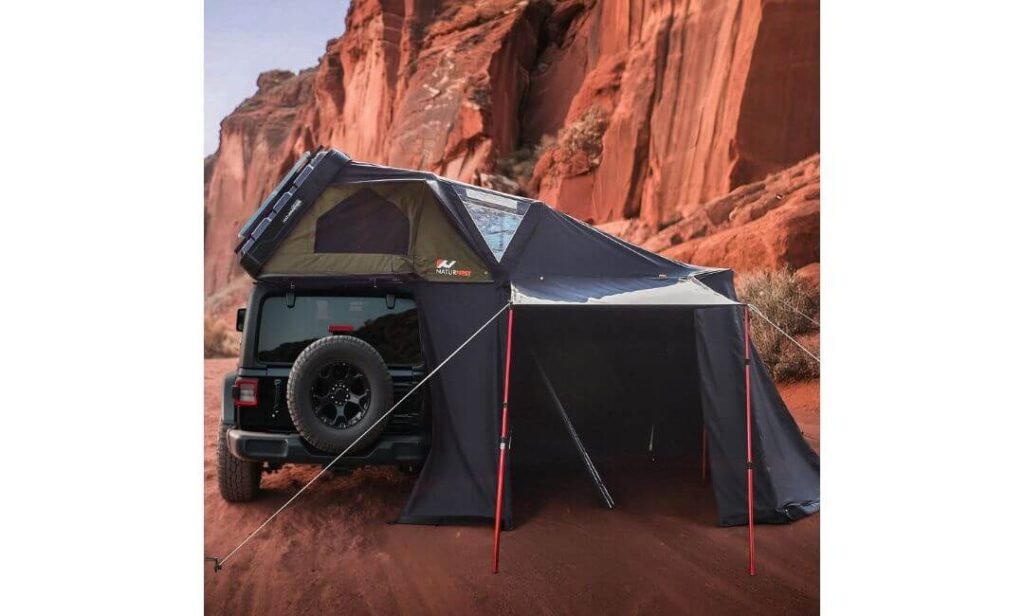
#1. Bayati Naturnest Sirius 1 Plus Rooftop Tent with Annex Room
Quick Specs:
- Sleeping capacity: 2 adults + 1 child
- Tent weight: 128.3 lb
- Floor size: 82.7 × 63 inches
- Overall closed dimensions: 82.7 × 63 × 47.2 inches
- Construction: ABS hard shell with aluminum-alloy frame
- Weather rating: 4-season, waterproof coated ripstop fabric with sealed seams
- Comfort: 1.97-inch high-rebound mattress + anti-condensation mat
- Extra space: Included annex room
- Useful extras: Top crossbars, USB charging, LED lighting, skylight and vent port
The first thing to understand here is that this is not a small, stripped-down rooftop tent. At 128.3 lb, it is a substantial piece of equipment, but that weight comes with a genuinely useful amount of camping space. The 82.7 × 63-inch floor gives two adults a comfortable sleeping platform, with room for a child, while the side-opening design and 7.5-foot telescoping ladder make getting camp set up much less of a chore after a long day on the trail.
The hard shell is another reason this makes sense for a Wrangler build. The ABS shell, aluminum-alloy frame and honeycomb insulating panel give it a more substantial structure than a basic fabric rooftop tent, while the 316-grade gas struts handle the lifting instead of making you wrestle with the shell every time you arrive at camp. Add the blackout ripstop fabric, sealed seams, oversized windows and skylight, and it is clearly designed around spending real nights outside rather than simply having a bed on the roof.
Where this setup gets particularly interesting is the amount of camping functionality built into it. The 1.97-inch mattress and anti-condensation mat take care of two things you notice immediately when a rooftop tent is used regularly: sleeping comfort and moisture underneath the mattress. The annex gives you another usable area at ground level, while the USB port, storage pockets, shoe bags and interior/exterior LED strips keep the small everyday annoyances of camp life under control. (That combination makes the setup feel considerably more complete than a tent that only gives you a sleeping platform.)
What We Like About It
- The 63-inch floor width is genuinely useful when two adults are sharing the tent; it does not feel like the dimensions were optimized only for a product listing.
- The annex room adds functionality that you will actually notice on longer trips, particularly for changing, storing muddy gear or creating a little sheltered space below.
- Thermal insulation + blackout fabric is a smart combination for campers dealing with both temperature swings and early-morning sunlight.
- The two aluminum crossbars give you another way to carry selected gear without immediately sacrificing the sleeping area.
- The anti-condensation mat and vent port show that the design goes beyond simply making the exterior waterproof.
One Thing We’d Keep in Mind
The 128.3-lb weight deserves attention before installation. That is perfectly manageable for the right Wrangler rack setup, but it is not a tent I’d recommend mounting blindly because the vehicle happens to be a Jeep. Check the specific rack’s load rating and mounting system first, and remember that your complete rooftop load includes the tent and anything you carry on top.
Wrangler Setup: What You Need to Check
For a Jeep Wrangler, the important question is not simply whether the manufacturer lists “Jeep” among the compatible vehicles. This tent needs a properly supported crossbar or roof-rack system capable of carrying its weight and handling the loads created while the vehicle is moving. The supplied top crossbars are useful for carrying additional equipment, but they do not remove the need for a correctly rated mounting system underneath.
The other consideration is the particular Wrangler configuration. TJ, JK, JL, 2-door and 4-door setups can differ in their roof and rack arrangements, so the mounting hardware and available support should be checked against your exact vehicle before ordering. If your rack is already installed, this is the point where I’d verify its specifications rather than relying on a generic “fits Wrangler” statement.
The Insider Pro-Tip
Here’s the part I’d pay attention to before getting excited about all the extras: 128.3 lb is the tent’s own weight. If you add anything to those two upper crossbars, that additional gear becomes part of the rooftop load too. On a Wrangler that actually sees trails, keeping the roof setup disciplined is a better long-term decision than trying to use every available mounting point.
And there is a second reason I like this particular configuration: the annex, thermal insulation, anti-condensation mat and blackout construction solve problems you normally discover only after several camping trips. If your priority is a comfortable, genuinely usable basecamp rather than the lightest possible rooftop tent, those are the features I’d value first.
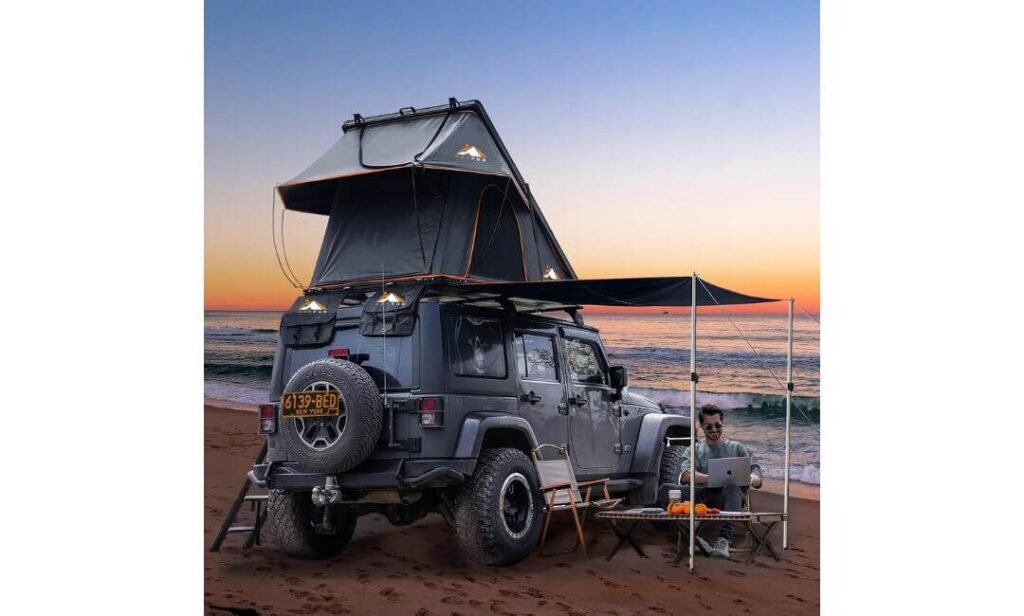
#2. HEYFUN Adventurer Pro Rooftop Tent Hard Shell
Quick Specs:
- Sleeping capacity: 2 adults + 1 child
- Tent weight: 160 lb
- Floor size: 83.86 × 51.57 inches
- Closed profile: 83.86 × 51.57 × 7 inches
- Opened height: 62.99 inches
- Shell: Aircraft-grade aluminum
- Fabric: 320g polyester
- Water resistance: Up to 5,000 mm
- Season rating: 4-season
- Setup: Hydraulic gas-strut assisted, approximately 5 seconds
- Included: Condensation mat, sleeping mat, ladder, side awning, shoe bags and universal mounting hardware
Five seconds sounds like the kind of number that belongs on a product page, but here it actually describes the reason this tent makes sense. The hydraulic gas-strut system handles the main lifting job, so the transition from driving to sleeping is remarkably simple: release the dual buckles, let the shell rise, and finish the basic setup. For a Wrangler owner arriving at a campsite after a long trail day, that simplicity is worth far more than another paragraph of decorative features.
The construction is equally purposeful. You get an aircraft-grade aluminum hard shell, 320g polyester fabric, a waterproof rubber seal and a flocked lining on the tent floor. The 83.86-inch length gives two adults a useful sleeping platform, while the 51.57-inch width keeps the overall footprint relatively narrow. That narrower layout is worth noticing—it is not the widest tent in this roundup, but it creates a more compact sleeping arrangement while still allowing a stated 2-adult-plus-child capacity.
Then there is the part that becomes useful once the tent is actually being lived in. The condensation mat helps manage moisture beneath the sleeping area, 13 storage pouches keep small gear from becoming campsite clutter, and the built-in LED strip gives you usable light without hanging another lamp inside. The detachable side awning is also a genuinely practical addition for a Wrangler: it creates a bit of shade or sheltered working space beside the vehicle without turning the main sleeping compartment into a storage room. (That is the sort of convenience you appreciate more on the third night than on the first.)
What We Like About It
- The 5-second opening system is the standout feature and makes frequent campsite moves much less tedious.
- Aircraft-grade aluminum construction gives the shell a rigid, purposeful feel suited to an overlanding-oriented setup.
- 5,000 mm water resistance gives the weather protection specification some substance rather than simply calling the tent “waterproof.”
- The included side awning adds useful ground-level shade without requiring a separate shelter.
- 13 storage pouches + condensation mat are small details, but they make the interior considerably easier to live with.
One Thing We’d Keep in Mind
At 160 lb, this is heavier than the Bayati above it. That does not make it a poor Wrangler choice, but it makes your rack selection more important. The manufacturer calls for mounting crossbars supporting at least 165 lb, leaving very little margin if the rack specification is treated as a hard static limit.
Wrangler Roof Setup: The Part to Check First
For a Jeep Wrangler, I would treat the rack rating as the first buying check, not the last installation detail. The tent includes universal mounting hardware, but that does not make every Wrangler roof-rack arrangement suitable. Your crossbars or rack need to be properly supported and rated for the load, and the mounting points need to match the supplied hardware.
This matters even more if you have a JK, JL or JLU, because Wrangler roof configurations and aftermarket rack systems vary considerably. The tent is marketed for Wrangler applications, but the final fit still depends on the specific rack and vehicle configuration. If you are running a 2-door Wrangler or an older setup with a particular aftermarket rack, verify the rack’s actual specifications before ordering rather than assuming the vehicle name alone guarantees compatibility.
The Insider Pro-Tip
The smartest thing about this design is not actually the LED strip or the awning—it is the combination of a rigid aluminum shell and genuinely fast deployment. If your trips involve moving camp often, a tent that takes seconds to open can change how willingly you use it. A rooftop tent that is annoying to deploy eventually becomes something you leave packed up.
One detail I’d keep in perspective is the 51.57-inch floor width. It is perfectly reasonable for two adults who prefer a more compact sleeping arrangement, but don’t confuse its 2–3-person rating with the spacious feel of a much wider family tent. For a Wrangler owner who values quick setup, hard-shell durability and a relatively streamlined footprint, that trade-off makes considerably more sense.
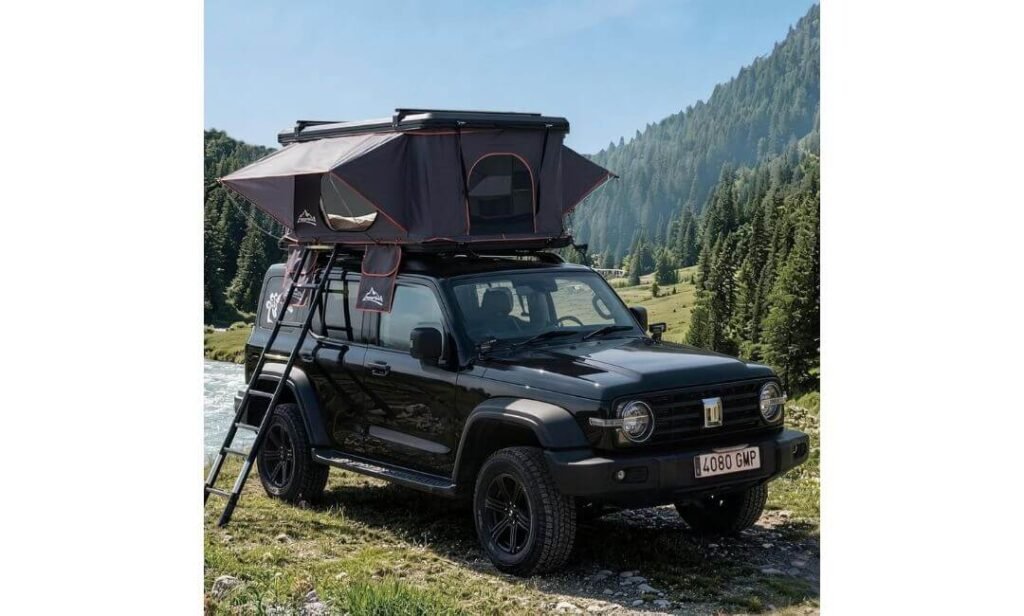
#3. Jiadrooe Hard Shell Rooftop Tent with Adjustable Crossbars
Quick Specs:
- Sleeping capacity: 2 adults + 1 child
- Tent weight: 176 lb
- Floor size: 77 × 64 inches
- Closed dimensions: 77 × 64 × 40 inches
- Shell: Aerodynamic ABS hard shell
- Fabric: Triple-coated 600D Oxford
- Waterproofing: Up to 5,000 mm hydrostatic rating
- Season rating: 4-season
- Setup: Hydraulic pop-up system, under 60 seconds
- Comfort: 2-layer mattress with integrated anti-condensation mat
- Built-in extras: Adjustable aluminum crossbars, USB power hub and dual-mode LED lighting
What makes this one interesting for a Wrangler is that it tries to solve three different camping problems at once: weather, storage and power. The 77 × 64-inch sleeping area is genuinely broad enough for two adults, while the ABS hard shell keeps the overall package enclosed when you’re driving. Then you get two adjustable aluminum crossbars on top, giving you a place to carry selected gear without immediately filling the Wrangler’s interior.
The weather-focused design is where the specification sheet becomes more meaningful. The triple-coated 600D Oxford fabric is listed with up to 5,000 mm hydrostatic waterproofing, while the detachable thermal insulation liner is intended to make the tent more comfortable across changing temperatures. The two-layer mattress and integrated anti-condensation mat are equally practical: one deals with the sleeping surface, the other with the moisture that can accumulate beneath it. For anyone who has spent a cold morning dealing with a damp mattress underside, that is not a throwaway feature.
Then there is the convenience side. The hydraulic system is designed to open the shell in under a minute, and the built-in USB power controller gives you somewhere to charge a phone or tablet without improvising a cable arrangement around the tent. The cool/warm LED strips are simple, but useful once the sun goes down. (The appeal here is less about having the biggest feature list and more about having several genuinely useful things already built into the structure.)
What We Like About It
- 64-inch floor width gives it a notably comfortable sleeping footprint for two adults.
- Detachable thermal insulation is a useful advantage when the same tent is expected to handle both warm and cold-weather trips.
- Adjustable top crossbars can free up valuable Wrangler cargo space for selected camping equipment.
- Integrated USB power and dual-mode lighting make the interior easier to use after dark.
- Under-one-minute deployment keeps the setup process practical for road trips where you are not staying in one campsite for several nights.
One Thing We’d Keep in Mind
At 176 lb, this is the heaviest tent in the lineup so far. The tent’s own crossbars are advertised with a separate load capacity, but that should not be confused with the vehicle rack’s dynamic rating. For a Wrangler that sees regular off-road use, I’d want plenty of confidence in the underlying rack and mounting system before adding anything to the upper bars.
A Better Wrangler Fit Check
The fact that this model is sold for SUVs, trucks and vans makes it broadly useful, but a Wrangler still needs to be treated as its own installation. Check the specific roof-rack or crossbar system on your Jeep, its dynamic load rating, mounting points and clearance before purchase. The tent itself weighs 176 lb, so this is not a setup where I would make a decision based solely on the phrase “Jeep compatible.”
For JK, JL and JLU Wranglers, the exact roof configuration and aftermarket rack can change the installation considerably. The supplied universal hardware helps, but it does not eliminate the need to verify that your particular rack is designed for a rooftop tent of this size and weight. If you’re carrying bikes, recovery equipment or solar gear on the upper crossbars as well, include that additional weight in the calculation.
The Insider Pro-Tip
The feature I’d pay closest attention to here is actually the adjustable crossbar system. On a Wrangler, roof space is valuable, and being able to move selected gear onto the tent can make a noticeable difference to how the cabin and cargo area are used. Just resist the temptation to treat those bars as unlimited storage—the more you put up there, the more weight and wind load you’re asking the entire rack system to handle.
And if you’re deciding between this and a lighter option, be honest about how you camp. The 176-lb weight is a real trade-off, but so are the 64-inch width, thermal liner, power hub and integrated cargo bars. For a Wrangler owner building a more complete four-season overlanding setup, those are meaningful advantages rather than specifications added just to make the listing look impressive.
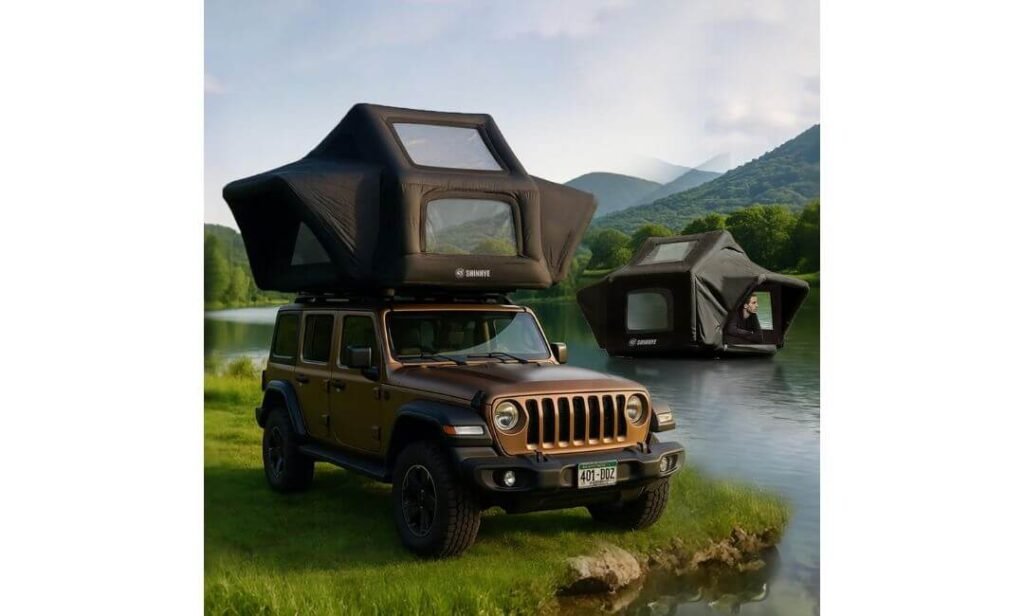
#4. ShinHye Inflatable Hard Shell Rooftop Tent
Quick Specs:
- Sleeping capacity: 2 people
- Tent weight: 104.8 lb listed in the supplied specifications
- Floor size: 83 × 55.2 inches
- Opened height: 59.2 inches
- Fabric: 600D Oxford + 190T polyester
- Support: Inflatable self-supporting TPU structure
- Waterproofing: PU coating with seam sealing; up to 5,000 mm rating
- Season rating: 4-season / 5-season listed
- Setup: Manual inflation with pressure-limiting pump
- Notable extras: Rainproof side eaves, windproof buckles and steel stakes
Here is where this tent breaks away from the usual hard-shell conversation: there are no conventional tent poles to assemble. The self-supporting inflatable structure is designed to go up with a manual pump, which can be genuinely convenient when you are setting up alone. For a Wrangler owner who regularly reaches camp without another pair of hands around, that is a more meaningful advantage than another generic claim about “easy setup.”
The sleeping area is also better than its compact-looking concept might suggest. At 83 × 55.2 inches, there is enough length and width for two people, while the 59.2-inch opened height gives the interior a less cramped feel. The 600D Oxford fabric, 190T polyester and TPU air columns are intended to handle outdoor use, and the PU5000 waterproof rating with seam sealing gives the weather protection specification some real substance. The rainproof eaves on both sides are particularly useful during wet-weather setup because they help keep rain away from the entrance and surrounding area.
What I find most unusual is the floating capability. It is certainly not a reason to buy a rooftop tent by itself, and I would not treat it as the primary selling point for a Wrangler setup, but it does make this a genuinely different product from the typical rigid-shell designs in this list. The practical story is simpler: you get a relatively light sleeping platform, one-person inflation, TPU support and a waterproof exterior without carrying a conventional pole system. (That makes the design interesting for the right kind of traveler, rather than merely different for the sake of being different.)
What We Like About It
- 104.8-lb listed weight makes this notably easier to handle than the heavier options above.
- Inflatable self-supporting construction removes the usual pole-assembly routine.
- 83-inch length gives two adults useful sleeping space without requiring an oversized footprint.
- PU5000 waterproofing and seam sealing provide a meaningful weather-protection specification.
- TPU air columns are an interesting alternative to rigid pole structures for campers who value easier solo setup.
One Thing We’d Keep in Mind
The supplied product information contains different weight and packing-size figures, so I would verify the final specification shown for the exact version you are purchasing before planning the installation. That matters on a Wrangler because rack capacity should be calculated from the confirmed tent weight, not an inconsistent listing figure.
Wrangler Mounting: Keep This Simple
For a Jeep Wrangler, the lighter construction is attractive, but the same basic rule still applies: the roof rack or crossbar system must be properly rated for a rooftop tent. The vehicle being listed as compatible does not replace checking your particular rack, mounting points and dynamic load rating.
This is especially worth doing on JK and JL/JLU Wranglers, where owners commonly use different aftermarket rack configurations. The tent’s lower listed weight can make installation easier, but it does not mean you can skip the rack check. Get the confirmed product weight, match it against your rack’s rating, and make sure the mounting hardware is appropriate before heading out.
The Insider Pro-Tip
If your camping style is mostly solo setup, frequent movement and keeping roof weight under control, this is the one I’d investigate more closely before automatically choosing a heavier aluminum shell. Its real advantage is not that it has an unusual inflatable design—it is that the design potentially removes some of the physical hassle of putting camp together by yourself.
I’d also keep expectations realistic about the “floating” feature. It is an unusual bonus, but the reasons to consider this for a Wrangler are much more straightforward: low listed weight, two-person sleeping space, simple inflation and strong waterproofing. Those are the attributes that actually matter when you’re parked at the trailhead and the weather suddenly changes.
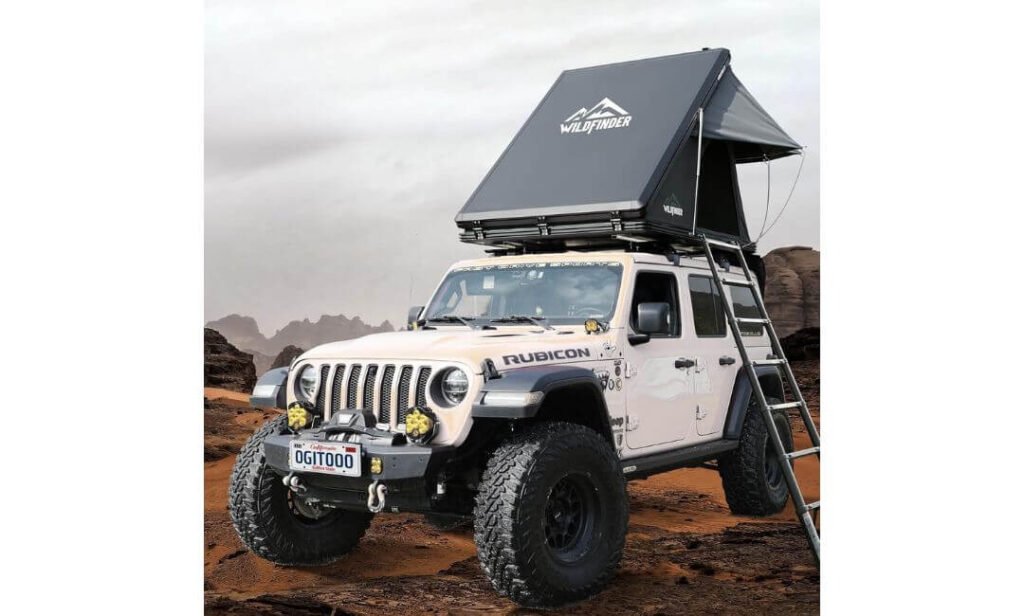
#5. WildFinder Aluminum Hard Shell Rooftop Tent
Quick Specs:
- Sleeping capacity: 2 people
- Tent weight: 163 lb
- Floor size: 83 × 52 inches
- Closed height: 9 inches
- Shell: Aircraft-grade aluminum alloy
- Fabric: Waterproof, breathable polyester
- Weather protection: 5,000 mm rainproof rating
- Season rating: 4-season
- Setup: Pop-up stainless-steel pressure-rod system
- Comfort: 5 cm non-deforming mattress + condensation pad
- Included extras: 7.5-ft telescoping ladder, LED strip, 10 organizer bags, 2 shoe organizers and 3 mesh windows
There is something refreshingly straightforward about this setup. It uses aluminum where you want rigidity and keeps the closed package only 9 inches high. At 163 lb, it is not a lightweight tent by Wrangler standards, but the aircraft-grade aluminum shell gives it a substantial, long-term feel without turning the closed tent into a tall box sitting above the roof. That low profile is particularly appealing if the Wrangler still has to do normal road duty between camping trips.
Inside, the design is much more considered than the basic “2-person rooftop tent” label suggests. The 83 × 52-inch sleeping platform gives two adults a usable amount of room, while the 5 cm mattress is designed not to deform easily. More importantly, WildFinder includes both a recessed marine pad and a condensation pad. Those details address the less glamorous side of rooftop camping—humidity, condensation and moisture under the sleeping area—which is exactly the sort of thing you notice after several nights outdoors.
The weather specification is also unusually specific: the fabric is listed with 5,000 mm rain protection, along with wind, sun and snow protection claims. The stainless-steel pressure rods are another sensible touch because they do the lifting without relying on ordinary steel hardware. Add the blackout polyester, three mesh windows, LED strip, 10 storage organizers and two shoe organizers, and the result feels built around actually using the tent rather than simply getting it onto the roof. (That distinction matters when your Wrangler becomes the campsite for more than one weekend.)
What We Like About It
- The 9-inch closed height keeps the hard shell unusually low for a tent of this type.
- Aircraft-grade aluminum construction gives the shell a durable, rigid feel.
- Marine pad + condensation pad is a thoughtful combination for managing moisture during overnight use.
- 83-inch sleeping length works well for two adults without making the interior unnecessarily complicated.
- 10 storage organizers and two shoe organizers make the limited interior space much easier to keep orderly.
One Thing We’d Keep in Mind
At 163 lb, this is still a serious rooftop load. The low-profile shell helps aerodynamics and everyday usability, but it does not make the tent lightweight. Before fitting it, verify the dynamic rating of your Wrangler’s actual rack or crossbar system and account for any other equipment mounted on the roof.
Wrangler Installation Reality
For a Jeep Wrangler, the attraction here is the combination of a low closed profile and rigid aluminum shell, but installation still depends on the rack underneath it. The supplied information does not mean the tent can simply be placed on factory mounting points without checking their specifications. Your rack needs suitable tent-rated mounting points and enough dynamic capacity for the 163-lb tent plus anything else you intend to carry.
The same check applies across JK, JL and JLU configurations, because the rack arrangement can vary significantly between vehicles. If you already have aftermarket crossbars, confirm their actual dynamic rating and mounting dimensions before ordering. And if you intend to add anything above the shell, remember that the extra cargo becomes part of the total roof load.
The Insider Pro-Tip
The feature I’d value most here is actually the 9-inch closed profile. A rooftop tent that sits lower can be easier to live with when the Wrangler is still your daily driver—less visual bulk, less unnecessary height and a cleaner roofline. That matters much more if you are constantly moving between trail runs, highways and ordinary parking areas.
I also like that the design does not try to hide its 163-lb weight behind a “lightweight” marketing claim. It is a substantial aluminum tent, and that’s fine. If your Wrangler rack is properly rated and you want a rigid, low-profile shell with strong moisture-management features, this makes sense. If keeping the roof as light as possible is your priority, however, the lighter options earlier in this list deserve a closer look.
#6. ARCTWONDER Solar Panel Hard Shell Rooftop Tent
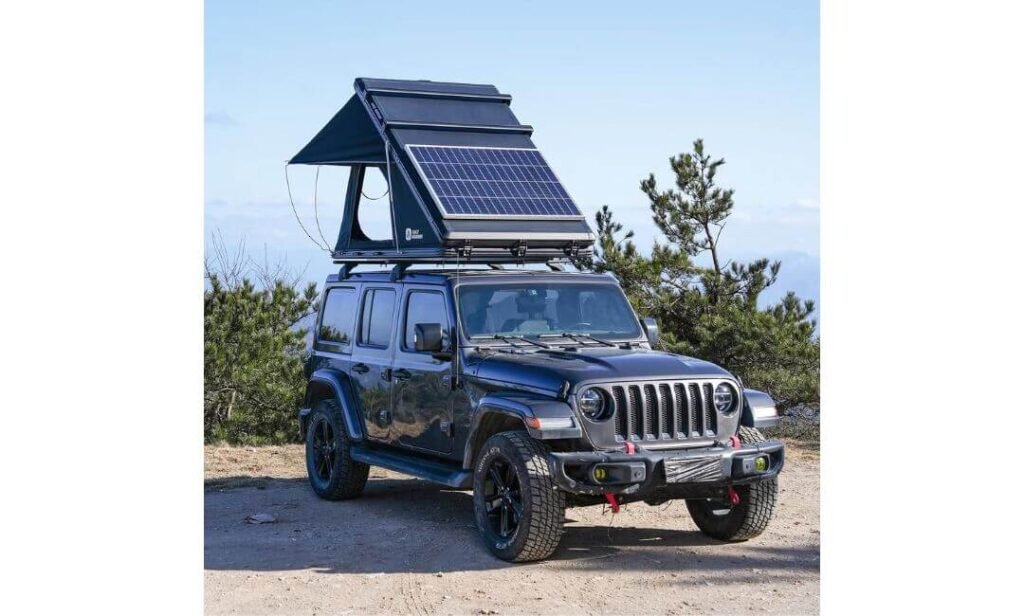
Quick Specs:
- Sleeping capacity: 2 people
- Tent weight: 198 lb
- Floor size: 83 × 51 inches
- Opened height: 59 inches
- Closed height: 7 inches
- Shell: Aluminum construction
- Fabric: 320g polyester with blackout and sun-protection treatment
- Water resistance: Up to 5,000 mm
- Season rating: 4-season
- Setup: Pop-up pressure-rod system, approximately 10 seconds
- Power: Integrated solar panel + 12V multi-function outlet + USB
- Included: Winter thermal layer, 6 cm mattress system, two luggage bars, LED strip, ladder and shoe bags
The interesting thing here is not simply that a solar panel is included. It is that the tent is built around the idea of staying away from hookups for longer without turning the Wrangler into a mess of portable chargers and loose cables. The integrated solar setup can help charge a power bank, while the 12V outlet and USB connection give you a practical place to run everyday devices. For off-grid camping, that is a much more useful feature than a decorative “smart” label.
The other major difference is the removable winter thermal layer. The outer 320g polyester fabric is rated up to 5,000 mm for water resistance and treated for sun protection and blackout, while the additional thermal layer is designed to reduce the amount of cold air reaching the sleeping area. The supplied sleeping system is also substantial: a 5 cm foam mattress plus a 1 cm condensation pad, giving a combined 6 cm sleeping/condensation layer. That combination makes this much more interesting for someone who intends to use the Wrangler beyond mild-weather weekends.
There is, however, one number I would not gloss over: 198 lb. This is the heaviest option in the lineup, and while the 7-inch closed height is impressively low, the low profile does not change the weight sitting on your roof. The two luggage bars are useful for additional gear, but they make proper load planning even more important. (In other words, the solar capability and winter insulation are real advantages, but they make the most sense when the Wrangler is already equipped with a rack system designed to carry this kind of setup.)
What We Like About It
- Integrated solar + 12V + USB power gives genuine off-grid usefulness rather than just another accessory.
- Removable winter thermal layer lets you adapt the tent instead of permanently carrying extra insulation.
- 7-inch closed height is excellent for a hard-shell tent of this size.
- 6 cm combined mattress and condensation layer provides both sleeping comfort and moisture management.
- Two luggage bars create additional carrying flexibility when the rack and total load allow it.
One Thing We’d Keep in Mind
198 lb is a lot of rooftop weight. The manufacturer-supplied fit information should not be interpreted as a blanket approval for every Wrangler rack. Before installation, confirm your rack’s dynamic load rating and crossbar spacing, and account for anything else you plan to carry on the roof.
Making It Work on a Wrangler
The supplied information indicates compatibility with 2-door and 4-door Wrangler configurations when the crossbars are spaced at least 31 inches apart, but the rack itself still needs to be suitable for the tent’s weight. This is particularly important with aftermarket systems because their ratings and mounting arrangements can differ significantly.
For JK, JL and JLU owners, check the exact rack you’re using rather than relying on a generic Jeep fitment statement. If you want to use the two luggage bars for additional equipment, factor that cargo into the overall roof load as well. The 198-lb tent already consumes a significant portion of the available capacity on many setups.
The Insider Pro-Tip
I’d choose this one for the solar and winter capability, not because it is somehow a “better” tent simply because it has more equipment attached to it. If you spend several days away from electrical hookups, the integrated solar system can genuinely make camp life easier. If most of your trips are one-night summer outings near civilization, you’re carrying a lot of extra weight for benefits you may barely use.
The 198-lb weight is the honest trade-off. But if your Wrangler has a properly rated rack and your camping style actually calls for four-season insulation, independent charging and a low 7-inch travel profile, those compromises start to make sense. That is exactly why this sits lower in our list: the feature package is compelling, but it demands more from the vehicle than the lighter alternatives.
Best Jeep Wrangler Rooftop Tent Comparison (2026): Weight, Comfort & Weather Protection
| Rooftop Tent | Best Match | Weight | Sleeping Space | Setup | Weather Edge | Standout Feature | Real Trade-Off | Wrangler Check |
|---|---|---|---|---|---|---|---|---|
|
Bayati Naturnest Sirius 1 Plus
Best Overall
|
Comfort-focused Wrangler camping Especially useful when extra ground-level space matters. |
128.3 lb A meaningful rack load, but lighter than several options here. |
82.7 × 63 in 2 adults + 1 child |
Approx. 30 sec Side-opening hydraulic assist |
4-season Waterproof ripstop fabric, insulation, blackout fabric and sealed seams. |
Annex + thermal insulation Also includes anti-condensation mat and top crossbars. |
The 128.3-lb weight still needs a properly rated Wrangler rack. |
Check rack rating first 2-door and 4-door configurations can require different rack solutions. |
|
HEYFUN Adventurer Pro
Fastest Setup
|
Frequent campsite moves A strong choice when deployment speed matters most. |
160 lb Requires at least 165-lb supporting crossbars per supplied information. |
83.86 × 51.57 in 2 adults + 1 child |
Approx. 5 sec Hydraulic automatic pop-up |
4-season 320g polyester with up to 5,000 mm water resistance. |
Aluminum shell + side awning Built-in LED lighting and condensation mat add everyday convenience. |
The 51.57-inch width is noticeably narrower than the roomiest options. |
Rack capacity is critical Verify the actual Wrangler rack before installation. |
|
Jiadrooe Hard Shell
Best 4-Season Features
|
Feature-rich overlanding Best suited to campers who will actually use the insulation and power features. |
176 lb Heavy-duty setup requiring careful rack planning. |
77 × 64 in 2 adults + 1 child |
Under 60 sec Hydraulic hard-shell deployment |
4-season Thermal liner, anti-condensation mat and up to 5,000 mm waterproofing. |
Power hub + adjustable bars Useful for charging devices and carrying selected gear. |
176 lb before adding anything to the upper crossbars. |
Do not skip rack verification The tent’s own cargo bars do not replace a properly rated Wrangler rack. |
|
ShinHye Rooftop Tent
Lightest Listed
|
Solo-friendly camping Interesting for owners who prioritize lower listed weight and easy inflation. |
104.8 lb* *Supplied specifications conflict with another 121-lb listing figure. |
83 × 55.2 in 2 people |
Inflatable One-person setup with manual pump. |
4-season listed 600D Oxford fabric, PU5000 waterproofing and TPU air columns. |
Inflatable structure A genuinely different approach from the rigid-shell tents above. |
The supplied listing has conflicting weight details, so confirm the exact version before buying. |
Confirm exact rack fit Wrangler compatibility still depends on the rack and mounting arrangement. |
|
WildFinder Aluminum Hard Shell
Low-Profile Pick
|
Daily-driver Wrangler builds Appealing when keeping the closed tent low is a priority. |
163 lb Substantial weight despite the low closed profile. |
83 × 52 in 2 people |
Pop-up design Pressure-rod assisted opening. |
4-season 5,000 mm rain protection with snow, wind and sun protection claims. |
9-inch closed height One of its strongest practical advantages for everyday Wrangler use. |
163 lb means the low profile should not be mistaken for a lightweight build. |
Check dynamic rack capacity Especially important if additional gear is carried above the tent. |
|
ARCTWONDER Solar Panel RTT
Best Off-Grid Features
|
Extended off-grid trips Makes the most sense when solar charging and winter insulation will actually be used. |
198 lb The heaviest option in this comparison. |
83 × 51 in 2 people |
Approx. 10 sec Pop-up pressure-rod system. |
4-season 5,000 mm water resistance plus removable winter thermal layer. |
Integrated solar + 12V + USB A real advantage for campers spending several days away from hookups. |
198 lb is a serious rooftop load before any additional cargo is added. |
31-inch bar spacing listed Confirm your exact Wrangler rack spacing and dynamic capacity first. |
Jeep Wrangler Rooftop Tent Buying Guide: The Checks That Matter Before You Mount One
A rooftop tent can be a fantastic addition to a Wrangler, but “fits Jeep Wrangler” is not enough information to make a good buying decision. The right choice depends on the Wrangler you have, the rack underneath it, how much weight you are putting on the roof, and how you actually camp. The six tents above make that clear: one prioritizes an annex and living space, another keeps deployment extremely quick, while others focus on insulation, low-profile travel or off-grid power.
Start With Your Wrangler, Not the Tent
The first distinction is two-door versus four-door. A four-door Wrangler generally gives you more practical room around the vehicle and is a common foundation for longer camping trips, but that does not automatically make a larger rooftop tent the better choice. A two-door Wrangler can also carry a rooftop tent, provided the rack and mounting arrangement are properly designed for it.
Generation matters too. TJ, JK, JL and JLU Wranglers can have different roof and rack configurations, particularly when aftermarket equipment is involved. That is why I would not buy a tent solely because an Amazon listing mentions “Jeep Wrangler.” Check the exact Wrangler configuration, then check the rack, crossbars and mounting hardware that will actually support the tent.
Get the Rack and Mounting System Right
This is the part worth taking seriously before anything else. A Jeep Wrangler rooftop tent installation needs a properly rated rack or crossbar system, suitable mounting points and enough capacity for the tent while the vehicle is moving.
There is an important difference between static and dynamic load ratings. A tent may be able to sit on a rack when the vehicle is parked, but driving creates movement, vibration and changing forces. Your calculation should therefore start with the rack’s dynamic rating, not simply the weight the rack can theoretically hold while stationary.
Then add the real-world load: the tent, any gear carried on top, and anything else that becomes part of the rooftop setup. This is particularly important with the heavier options in this list. The ARCTWONDER is listed at 198 lb, Jiadrooe at 176 lb, WildFinder at 163 lb, and HEYFUN at 160 lb. Those numbers are not deal-breakers, but they make the quality and rating of the rack much more important.
Hard Shell Is Usually the More Practical Wrangler Setup
For this particular group of products, hard shell rooftop tents for Jeep Wrangler make a lot of sense because they are quick to deploy, enclosed when packed and generally easier to live with between trips.
A hard shell does not automatically mean “better,” though. The real advantage is how the shell works with the rest of the design. The HEYFUN uses an aluminum shell with hydraulic deployment, the WildFinder uses an aluminum construction with a particularly low 9-inch closed height, while the Bayati combines an ABS shell with an aluminum frame and insulating honeycomb panel.
Soft-shell tents can still be worthwhile when lower purchase cost, different sleeping layouts or reduced packed weight are more important. But if your priority is quick setup, a cleaner packed profile and less folding fabric to deal with, the hard-shell designs here are easier to justify.
Weight Matters More Than the Sleeping Capacity Number
It is tempting to see “2–3 person” and immediately compare interior dimensions. I would reverse that process. First ask whether your Wrangler’s rack can comfortably support the tent, then decide how much sleeping space you actually need.
For example, the Bayati gives you a generous 82.7 × 63-inch floor at 128.3 lb, while the HEYFUN provides an 83.86 × 51.57-inch floor at 160 lb. Jiadrooe offers a broad 77 × 64-inch floor but weighs 176 lb. These are very different trade-offs despite all being marketed for similar camping use.
A lightweight rooftop tent for Jeep Wrangler is not necessarily the one with the smallest dimensions. What matters is the complete system: tent weight, rack weight, additional rooftop cargo and how much of that load you actually need.
Think About Thermal Protection Before You Need It
A rooftop tent can feel comfortable during a mild evening and completely different when the temperature drops overnight. This is why thermal protection and insulation deserve more attention than generic “four-season” wording.
The Bayati uses an insulating honeycomb panel, while the Jiadrooe adds a detachable thermal insulation liner. The ARCTWONDER goes further with a removable winter thermal layer. These features give you more control over changing conditions rather than forcing you to use the same configuration all year.
Also look for an anti-condensation mat. It is not glamorous, but it addresses a very real rooftop-tent problem: warm, humid air meeting a cold sleeping surface underneath you. Several tents in this roundup include one, and that is a feature I would value more than an extra pocket or decorative accessory.
Don’t Confuse Waterproofing With Complete Weather Protection
A high waterproofing number is useful, but it is only one part of the weather story. Fabric treatment, sealed seams, shell construction, ventilation, window design and condensation management all affect how the tent behaves in actual weather.
The HEYFUN and Jiadrooe both list up to 5,000 mm water resistance, while WildFinder and ARCTWONDER also list 5,000 mm-class rain protection. Those figures help compare the products, but they should not be interpreted as a guarantee that every part of the tent will remain equally protected under every condition.
For year-round Wrangler camping, I’d look for the complete package: waterproof construction, sensible ventilation, insulation when needed, and a way to manage condensation. “4-season” is a useful starting label, not a substitute for examining the construction.
Power Features Are Useful When They Solve a Real Problem
USB ports and LED strips are easy features for manufacturers to advertise, but they become valuable only when they fit the way you camp.
The Jiadrooe’s integrated USB power hub is useful if you regularly charge phones or tablets inside the tent. The ARCTWONDER is more interesting for longer off-grid trips because it combines a solar panel, USB outlet and 12V power connection. Those features can reduce the number of separate charging solutions you need to bring.
On the other hand, if most of your Wrangler trips are short weekend campsites with easy access to vehicle power, I would not choose a tent simply because it has more electrical features. Power should support the camping setup, not dictate it.
Look at What You Can Carry After the Tent Is Installed
One overlooked part of a Jeep Wrangler rooftop tent setup is the gear you still need to transport. The tent takes up roof capacity, but you may also want recovery equipment, camping gear, bikes, kayaks or a solar panel.
That is where designs with integrated or adjustable crossbars become interesting. The Bayati and Jiadrooe provide additional carrying options, while the ARCTWONDER includes two luggage bars. These can be genuinely useful, but there is an important catch: extra cargo adds weight and wind load.
So don’t look at a 150-lb or 330-lb crossbar capacity in isolation. The crossbar’s own rating, the rack’s rating and the Wrangler’s overall rooftop limitations all need to work together.
Setup Speed Is More Important Than It Sounds
A tent that takes several minutes to deploy is not necessarily a bad tent. But if you regularly change campsites, arrive late, or travel alone, setup becomes one of those things you appreciate every single trip.
The HEYFUN’s approximately 5-second pop-up, Jiadrooe’s under-one-minute hydraulic opening, ARCTWONDER’s approximately 10-second deployment and Bayati’s quick side-opening design all target that problem in different ways.
The important question is not which manufacturer claims the fastest number. Ask whether the whole campsite setup is convenient: opening the shell, extending the ladder, securing the tent, arranging bedding and accessing your gear. That is the real experience you are buying.
Check the Packed Size and Everyday Driving Height
A rooftop tent does not disappear when camping ends. You will drive with it attached, park with it attached and potentially take the Wrangler through garages, trails and tight spaces.
This makes closed height and aerodynamic shape worth considering. WildFinder’s listed 9-inch closed height is particularly attractive from an everyday-use perspective, while ARCTWONDER lists a 7-inch closed height. HEYFUN is also designed around a relatively compact closed shell.
Just remember that the tent’s closed height is not the same as your Wrangler’s final vehicle height. Add the rack, mounting system and any rooftop accessories when thinking about real-world clearance.
Choose the Features You Will Actually Use
The best rooftop tent is rarely the one with the longest specification sheet. A Wrangler owner who takes short weekend trips may get more value from low weight and fast deployment. Someone camping for several days may care more about insulation, condensation control and storage. An overlander staying off-grid may value integrated solar charging and additional cargo capacity.
That is why this list does not treat every feature as equally important. The Bayati makes a strong case for comfort and extra living space; HEYFUN emphasizes speed; Jiadrooe packs in four-season and power features; ShinHye takes a different inflatable approach; WildFinder focuses on a low-profile aluminum shell; and ARCTWONDER targets off-grid and winter use.
Once you know which of those problems actually exists in your camping routine, choosing becomes much easier.
The Bottom Line for a Wrangler Owner
If there is one rule worth taking from this guide, it is this: buy the complete rooftop system, not just the tent. A great tent on the wrong rack is still the wrong setup.
Confirm your Wrangler’s exact configuration, verify the rack’s dynamic capacity, account for the tent and any additional roof cargo, and then compare sleeping space, weather protection, insulation, setup speed and useful extras. Do that in this order and the marketing language becomes much easier to filter out.
For the six options in this roundup, there is no single feature that makes one universally correct. The better choice is the one whose weight, mounting requirements and camping features line up with your actual Wrangler build and the way you spend nights outdoors.
Jeep Wrangler Rooftop Tent Installation Guide: A Safe, Practical Setup From Rack to First Night
Installing a rooftop tent on a Wrangler is not particularly complicated, but the part that deserves attention is the load path from the tent to the vehicle. A tent can be easy to bolt down and still be poorly supported. Before lifting anything, confirm the exact tent weight, the rack or crossbar’s dynamic load rating, the mounting hardware, and the spacing required by the tent. This is especially important with heavier hard-shell designs.
Check the Wrangler and Rack Before You Lift Anything
Start with the exact Wrangler configuration: two-door or four-door, model generation, hardtop or soft-top arrangement, and the specific roof-rack system being used.
Do not assume that a rack advertised for luggage is automatically suitable for a rooftop tent. Check its manufacturer-rated dynamic capacity and make sure the mounting points can accept the tent’s hardware.
You should have these details confirmed before installation:
- Tent weight, using the specification for the exact version you purchased.
- Rack dynamic load rating, not just its parked or static capacity.
- Crossbar spacing and usable mounting area.
- Mounting-track or bracket dimensions.
- Clearance around the Wrangler’s roof, doors, antenna and other accessories.
- Whether the rack manufacturer specifically permits rooftop-tent use.
If you plan to carry anything on top of the tent, such as a solar panel, recovery boards, bike or other camping equipment, include that weight from the beginning.
Tools and Hardware You Will Typically Need
The exact hardware varies by rooftop tent and rack, so the supplied installation instructions should take priority. For a typical Wrangler installation, have the following ready:
- Correct mounting brackets, plates and bolts supplied with the tent.
- Appropriate washers, nuts and locking hardware.
- Wrenches or sockets matching the supplied fasteners.
- Torque wrench, if the rack or tent manufacturer provides torque specifications.
- Measuring tape for checking crossbar spacing and centering.
- Step stool or stable work platform for safer access.
- A second person to help position the tent.
Do not substitute random bolts because they appear to fit. The fastener diameter, length, washer arrangement and thread type all matter, particularly when the tent is exposed to vibration and changing loads on rough roads.
Lift the Tent Onto the Rack Safely
This is the stage where rushing can cause the most avoidable trouble. Even a relatively light rooftop tent is awkward because it is wide, difficult to grip and being lifted above shoulder height.
For heavier hard-shell tents, use at least two people, and consider a proper lifting aid if the rack height makes the job uncomfortable. Keep the tent supported from its structural areas rather than pulling on fabric, hinges, ladders or accessories.
Once the tent is on the rack, do not immediately tighten everything. First position it approximately where you want it, then check:
- Front-to-rear balance.
- Left-to-right centering.
- Door and hatch clearance.
- Roof-rack contact points.
- Clearance from the windshield and other vehicle components.
- Access to the tent ladder after deployment.
A few extra minutes here can save you from repositioning a fully tightened tent later.
Position the Mounting Hardware Correctly
With the tent sitting in its approximate final position, align the mounting brackets with the rack’s crossbars or mounting tracks. The goal is secure structural contact, not simply getting all the bolts through the holes.
Keep the mounting points distributed as intended by the tent manufacturer. Avoid improvising new holes or modifying the shell unless the manufacturer specifically provides instructions for doing so.
Once the hardware is loosely installed, check that the tent remains centered and that the mounting plates sit flat. Then tighten the fasteners progressively rather than fully tightening one corner while leaving the others loose.
If torque specifications are provided, use them. “Tight enough” is not a useful installation specification for a rooftop tent.
Verify the Tent Before Driving
Before your first road trip, deploy the tent while the Wrangler is parked on level ground and inspect the entire setup.
Check that:
- The shell opens and closes without interference.
- The ladder locks and supports correctly.
- The fabric is not trapped in the hinges or closing mechanism.
- Every mounting fastener remains properly seated.
- The tent does not shift when you apply reasonable hand pressure to the structure.
- The rack itself shows no visible movement, deformation or unusual contact.
- Doors, roof panels and other Wrangler components still operate normally.
Then close everything and inspect the packed configuration again. A tent that opens correctly but does not close cleanly is not ready for the road.
Level the Vehicle Before Judging the Sleeping Surface
A rooftop tent follows the vehicle, so parking on a slope can make the sleeping platform feel noticeably different from how it feels on level ground.
Whenever practical, choose a reasonably level campsite. Use the Wrangler’s normal parking position and, where appropriate, proper wheel chocks on suitable terrain rather than trying to compensate for a badly sloped location with an improvised solution beneath the tent.
Do not place loose objects, rocks or makeshift supports under the tent or rack to “level” it. The rack and tent should remain supported exactly as designed.
Common Installation Mistakes to Avoid
The most common mistakes are surprisingly basic.
Ignoring dynamic load capacity is the big one. A rack can have an impressive static capacity while having a much lower dynamic rating once the vehicle is moving.
Another mistake is forgetting the additional rooftop cargo. A tent with built-in crossbars does not give you unlimited carrying capacity. Every extra item adds weight and can change the load placed on the rack.
Also avoid:
- Installing the tent before checking crossbar spacing.
- Using mounting hardware that was not intended for the system.
- Tightening one side completely before aligning the other.
- Assuming “Jeep compatible” means every Wrangler configuration fits identically.
- Leaving loose straps, fabric or accessories exposed while driving.
- Installing the tent where it interferes with doors, hatches or other equipment.
- Modifying the rack or tent without manufacturer approval.
- Treating a product listing’s generic fitment statement as a substitute for the actual rack specifications.
Do a Short Road-Test Inspection
After installation, take a short, low-speed drive on normal roads rather than immediately heading into rough terrain. Stop somewhere safe and inspect the mounting hardware and rack again.
Look for anything unusual: shifted brackets, loosened hardware, movement between the tent and rack, or noise that was not present before.
After the first few drives, repeat the inspection. This is especially worthwhile before an extended trip or off-road route. If the manufacturer specifies a particular inspection or retightening procedure, follow that procedure rather than creating your own torque schedule.
Safety Matters Even More Off-Road
A rooftop tent changes the Wrangler’s center of gravity and overall vehicle height. That matters on uneven trails, steep side slopes and areas with low branches or other overhead obstacles.
Drive accordingly. Avoid aggressive maneuvering simply because the tent feels securely mounted. Pay attention to overhead clearance, particularly when entering garages, parking structures, forest roads and trails with low branches.
Once parked, deploy the tent only when the vehicle is securely positioned and stationary. Keep the ladder fully supported, avoid exceeding the tent’s stated occupant capacity, and distribute people and gear sensibly inside the sleeping area.
Give the Installation One Final Real-World Check
Before calling the job finished, stand back and look at the Wrangler as a complete vehicle rather than just looking at the bolts.
The tent should sit securely and reasonably centered, the rack should look properly loaded rather than visibly stressed, the ladder should have a sensible landing area, and nothing should interfere with normal vehicle operation.
Most importantly, keep the installation documentation with the vehicle. If you later change the rack, add rooftop equipment or move the tent to another Wrangler, treat it as a new installation and repeat the compatibility check.
A good rooftop-tent installation should become almost boring once it is finished: solid mounting, sensible weight distribution, clean clearance and nothing that needs improvisation. That is exactly what you want before taking the Wrangler somewhere where the nearest garage is several hours away.
Real-World Jeep Wrangler Rooftop Tent Scenarios: Which Setup Makes Sense for the Way You Camp
A rooftop tent becomes much easier to judge when you stop comparing feature lists and ask a simpler question: what will your Wrangler actually be doing with it? A tent that is excellent for a quick Friday-night escape may be unnecessary for a week-long overland trip, while a heavily insulated setup can be worth its extra weight if you regularly camp through cold weather. The right choice comes down to how often you move, how much roof weight your Wrangler can comfortably support, and which features you will genuinely use.
Overlanding Through Mixed Climates
For longer overlanding trips, thermal control and moisture management become more valuable than small convenience features. Temperatures can change dramatically between daytime and nighttime, especially when a route climbs into higher elevations.
Look for a setup with:
- Removable or integrated thermal insulation, so you can adapt the interior as temperatures change.
- Anti-condensation protection, particularly for cold nights.
- Proper ventilation through mesh windows and vents.
- Water-resistant fabric with sealed seams, rather than relying on a waterproof label alone.
- A hard shell that protects the tent while traveling between campsites.
The Jiadrooe and ARCTWONDER configurations are particularly interesting for this kind of use because they put genuine emphasis on thermal insulation and condensation control. The Bayati also makes sense when comfort and additional living space matter during longer stays.
The important Wrangler-specific trade-off is weight. A feature-rich tent can make a fantastic basecamp, but if it pushes the roof system close to its limits, you have created a compromise before the trip even begins.
Quick Weekend Trips Where Setup Speed Wins
For a Friday evening departure or a one-night trail escape, setup speed becomes a surprisingly important feature. Nobody wants to spend the first part of a short trip fighting with a complicated tent.
This is where hydraulic and assisted hard-shell designs have a real advantage. A system that opens in seconds or roughly a minute lets you arrive, secure the vehicle, deploy the tent and get on with the evening.
The HEYFUN is especially suited to this style because its hydraulic system is designed around approximately five-second deployment. The Jiadrooe and ARCTWONDER also keep opening time short.
For frequent weekend travelers, I would put deployment simplicity ahead of having every possible accessory. If the tent takes less effort to use, you are more likely to actually take the Wrangler camping instead of deciding that setting everything up is too much work for one night.
Winter Camping and Cold-Weather Nights
Cold-weather camping changes what matters inside a rooftop tent. A comfortable mattress is useful, but insulation, condensation control and sensible ventilation can make a much bigger difference once temperatures fall.
A winter-oriented setup should ideally give you:
- A thermal liner or insulating layer that can be fitted when temperatures drop.
- An anti-condensation mat beneath the sleeping surface.
- Adequate ventilation so moisture does not simply remain trapped inside.
- A well-sealed shell and weather-resistant fabric.
- Convenient power access if you carry approved camping electronics or other equipment that needs charging.
The ARCTWONDER stands out here because its removable winter thermal layer can be used when needed rather than remaining part of the setup year-round. The Jiadrooe similarly offers a detachable insulation liner and integrated USB power.
One point deserves real-world clarity: a USB port does not make a tent winter-ready. Power is convenient; insulation and moisture management are what actually affect the sleeping environment. Treat those as separate features when comparing tents.
Extended Off-Grid Trips
If the Wrangler is being used as a mobile basecamp for several days, power becomes more relevant. A phone, camera, GPS device or other small electronics can quickly become inconvenient when there is no reliable electrical hookup.
A built-in USB power hub or solar charging system can reduce the number of separate charging accessories you have to carry. The ARCTWONDER is the most obvious fit in this group because it combines a solar panel with USB and 12V connectivity.
But there is a sensible limit. Solar equipment and rooftop cargo should be considered part of the complete load, not treated as free additions. If the tent already weighs close to the practical limit of your rack, adding more equipment on top simply because mounting bars are available is not necessarily a smart trade.
For extended trips, I would rather have a properly balanced setup with fewer useful pieces than a roof covered in accessories.
Budget-Conscious Wrangler Builds
Being budget-conscious does not mean buying the cheapest tent you can find. With a Wrangler, the cheaper decision can become expensive if you later discover that the existing rack is unsuitable, additional mounting hardware is needed, or the tent’s weight forces you to rethink the entire setup.
A sensible budget build starts with the basics:
- A properly rated rack or crossbar system.
- A tent whose weight makes sense for that rack.
- A comfortable sleeping surface.
- Weather protection appropriate for your camping season.
- Condensation management.
- Only the accessories you will actually use.
This is where simpler designs can make a lot of sense. You do not necessarily need integrated solar charging, multiple cargo bars, extensive lighting or an annex if your camping consists of occasional weekends close to established campsites.
The better value is the tent that gives you the right core equipment without making you pay in weight, complexity or unused features.
Two-Door Wrangler Weekend Warrior
A two-door Wrangler can be an excellent camping platform, but space and payload deserve more thought. If the vehicle is already carrying recovery equipment, tools, coolers and camping supplies, a very heavy rooftop tent can quickly turn the roof into the most heavily loaded part of the vehicle.
For this type of build, I would pay particular attention to tent weight, packed height and sleeping dimensions. A compact hard shell with fast deployment can be a better match than a large family-oriented setup, especially if the vehicle still needs to remain useful for trail driving.
The key is not to make the roof carry everything. Keep heavier equipment as low in the Wrangler as practical and use the rooftop tent primarily for what it is designed to provide: a comfortable elevated sleeping space.
Four-Door Wrangler for Longer Trips
The four-door Wrangler gives you more flexibility for extended camping because there is generally more useful interior and cargo space around the sleeping setup. That makes larger sleeping areas, annexes and additional rooftop equipment easier to justify, provided the rack and vehicle limitations are respected.
For this configuration, the Bayati’s 63-inch floor width and annex room make particular sense if campsite comfort is the priority. The Jiadrooe is more interesting if you want a broader sleeping area combined with thermal and power features.
The important distinction is that a four-door Wrangler gives you more practical room around the vehicle, not an unlimited rooftop payload. The rack still determines what can safely be carried above you.
When You Move Camp Every Day
If your trip involves packing the tent every morning and opening it again somewhere new that afternoon, convenience should become a major selection factor.
In that situation, prioritize:
- Fast deployment and closure
- Simple ladder operation
- Minimal loose components
- Secure packed-down hardware
- A manageable closed profile
- A mounting system that does not require constant adjustment
This is where the fast-opening hard-shell designs have a genuine advantage. A rooftop tent should make moving camp easier, not turn every campsite into another installation project.
When Comfort Matters More Than Speed
If you typically stay several nights in one place, the equation changes. Sleeping width, mattress quality, ventilation, blackout fabric, storage and an annex can become more important than saving a few seconds during setup.
That is the situation where a more spacious configuration earns its extra bulk. You are using the tent as a temporary bedroom rather than simply somewhere to sleep between trail drives.
For longer stationary stays, features such as an annex, larger sleeping platform and better moisture management can have a bigger impact on your experience than a dramatic setup-time claim.
The Real Wrangler Trade-Off
There is no perfect rooftop tent for every Wrangler because every advantage comes with a cost somewhere else. More space usually means more weight. More equipment usually means more roof load. More insulation can mean a more substantial tent. A lower profile does not necessarily mean a lighter one.
That is why the best choice depends on the trip you actually take.
If you move constantly, prioritize fast deployment and manageable weight. If you camp through changing seasons, prioritize insulation and condensation control. If you stay off-grid, power becomes genuinely useful. And if you are building a Wrangler camping setup on a budget, spend first on sound mounting, sensible weight and dependable weather protection, then add the extras later.
That approach keeps the rooftop tent working for the Wrangler, rather than forcing the Wrangler to become a vehicle built entirely around the tent.
Jeep Wrangler Rooftop Tent Maintenance & Care: Simple Habits That Prevent Expensive Problems
A rooftop tent does not need complicated maintenance, but it does need regular attention to the parts that are exposed to weather, dust, vibration and repeated setup. On a Wrangler, the tent also lives in a fairly demanding environment: trail dust can work its way into hardware, rain can sit around seams, and rough roads can expose a mounting problem long before you notice it from inside the tent.
The good news is that most of the important maintenance is simple. Keep it clean, dry it properly, inspect the mounting system, and deal with small problems before they become structural ones.
Clean the Tent Without Damaging the Fabric
After a dusty or muddy trip, allow loose dirt to dry enough that it can be brushed away rather than aggressively scrubbing wet grit into the fabric.
For normal cleaning:
- Use a soft brush or clean cloth to remove loose dirt.
- Use mild soap and water for stubborn marks.
- Rinse thoroughly so soap residue does not remain on the fabric.
- Avoid aggressive pressure washing around seams, zippers, vents and mounting areas.
- Allow the fabric to dry completely before closing the tent.
Do not use harsh household cleaners simply because they remove dirt faster. Strong chemicals can affect coatings, waterproof treatments, window materials or stitching.
The same principle applies to the hard shell. Wipe it down with mild soapy water and inspect the surface while cleaning. If you have been driving through mud or dusty trails, pay particular attention to hinges, latches, gas-strut areas and mounting hardware.
Never Pack It Away Wet
This is probably the most important care rule.
If you close a damp rooftop tent and leave it that way, you are creating a warm, enclosed environment where mildew, unpleasant odors and fabric deterioration can develop. A tent that looks perfectly clean when packed can come out of storage smelling completely different a few weeks later.
If rain forces you to pack up wet, open the tent again as soon as practical and let everything dry thoroughly. Check the mattress and condensation mat separately, because moisture can remain underneath the sleeping surface even when the visible fabric appears dry.
For longer-term storage, the tent should be completely dry inside and out before it is closed and covered.
Give the Seams a Proper Inspection
Waterproof fabric is only part of the weather protection system. Seams and stitching deserve attention because they are repeatedly exposed to folding, tension and weather.
Look for:
- Loose or separated stitching.
- Areas where seam sealing appears damaged.
- Peeling or deteriorating waterproof treatment.
- Small tears around attachment points.
- Fabric damage near zippers, windows or corners.
Do not wait until you are sitting inside the tent during a storm to discover a seam problem.
If the manufacturer provides a specific repair or seam-treatment recommendation, use that rather than applying a random waterproofing product. Different fabrics and coatings can require different care.
Keep Zippers Clean and Moving Smoothly
Zippers are easy to ignore until one starts sticking.
Dust, sand and dried mud can make zipper movement increasingly difficult, especially after trail use. Brush away debris and operate the zipper gently rather than forcing it through a contaminated section.
If a zipper repeatedly catches, do not keep pulling harder. Check whether fabric, mesh or the zipper track is trapped. Forcing it can turn a minor obstruction into a damaged zipper or torn fabric panel.
The same applies to window mesh and blackout panels. Close them properly before packing so they do not become trapped in the shell or folding areas.
Inspect the Ladder Before Every Extended Trip
The ladder carries a surprisingly important part of the system because it supports people getting into and out of the tent.
Check:
- Telescoping sections for smooth movement.
- Locking mechanisms at each section.
- Loose or damaged hardware.
- Bent rails or rungs.
- Feet and contact points.
- Mounting hardware where the ladder attaches to the tent.
Keep the ladder clean, especially if you camp in mud or sand. If a locking mechanism does not engage properly, do not rely on it simply because it held the previous night.
When deployed, the ladder should be positioned according to the manufacturer’s instructions and on a stable surface.
Inspect the Mounting Rails and Rack Hardware
This deserves more attention than it usually receives in rooftop-tent articles.
Your tent is connected to the Wrangler through the rack, crossbars, mounting brackets and fasteners. Every one of those components is exposed to vibration while driving, particularly on rough roads.
Regularly inspect:
- Mounting bolts and nuts.
- Brackets and mounting plates.
- Roof-rack attachment points.
- Crossbar condition.
- Mounting rails on the tent.
- Visible cracks, deformation or unusual movement.
- Any change in the tent’s position relative to the rack.
If the manufacturer specifies torque values or inspection intervals, follow those specifications. Do not automatically retighten everything as hard as possible. Over-tightening can be just as unhelpful as leaving hardware loose, depending on the fastener and mounting design.
After particularly rough off-road travel, make a habit of checking the mounting system before the next long highway drive.
Look After Gas Struts and Hinges
Hard-shell tents rely on moving hardware every time you open and close them. Gas struts, hinges and latches therefore deserve occasional inspection.
Watch for:
- Uneven opening.
- Unusual resistance.
- Strange noises.
- Visible damage to struts.
- Loose hinge hardware.
- A shell that no longer opens evenly.
Do not force a hard shell open if something feels mechanically wrong. A sudden change in opening resistance is worth investigating, particularly if the tent previously operated smoothly.
If lubrication is recommended, use the product specified by the manufacturer rather than spraying a general-purpose lubricant everywhere. Some components can be damaged or contaminated by unsuitable products.
Look After the Mattress and Condensation Mat
The mattress is often the first thing to develop an odor if moisture is trapped underneath it.
After camping, lift the mattress and check the underside of both the mattress and anti-condensation mat. Let them air out whenever necessary.
The condensation mat is there to help manage moisture beneath the sleeping surface, but it cannot compensate for closing a wet tent every time. Good ventilation, drying and regular inspection still matter.
For long-term storage, avoid leaving bedding compressed inside the tent if the manufacturer recommends removing it. Giving the mattress and fabric room to breathe can help prevent stale odors and moisture problems.
Check the Solar, USB and LED Connections
If your tent includes electrical features, inspect the connections occasionally rather than assuming they are protected simply because they are installed inside the tent.
Look for:
- Damaged cables.
- Loose connections.
- Water intrusion around electrical interfaces.
- Frayed wiring.
- Physical damage to the solar panel or charging components.
Keep electrical connections clean and dry, and follow the manufacturer’s instructions for the power system. Do not improvise electrical repairs inside a fabric rooftop tent, particularly around charging equipment.
Store It Correctly When the Wrangler Is Not Camping
If the tent will remain mounted on the Wrangler between trips, keeping it clean and properly closed is usually more practical than repeatedly removing it. Make sure all fabric is tucked inside the shell or packed according to the manufacturer’s instructions before driving.
For longer periods without use, consider the manufacturer’s recommended storage procedure. If the tent is removed from the vehicle, store it in a dry, protected location, supported in a way that does not put unnecessary pressure on the shell, hinges or mounting hardware.
Do not store a wet tent in a sealed bag or leave moisture trapped beneath protective covers. Covers are useful for protection, but they should not become a way of trapping condensation against the tent.
Do a Pre-Trip Check Before Long Wrangler Trips
Before a major road trip or off-road journey, take five minutes to inspect the complete setup.
A useful check is:
- Mounting hardware — no visible looseness or movement.
- Rack and rails — no cracks, bending or unusual contact.
- Shell and latches — closing securely.
- Fabric and seams — no obvious damage.
- Zippers and mesh — operating freely.
- Ladder — locking correctly.
- Gas struts and hinges — opening normally.
- Electrical accessories — connections intact, where applicable.
- Mattress and condensation mat — dry and clean.
- All external accessories — properly secured before driving.
This is especially worthwhile after a rough trail day. Five minutes in the driveway is considerably better than discovering a problem halfway through a remote trip.
Know When Maintenance Is No Longer Enough
Cleaning and tightening can solve ordinary wear, but not every problem should be treated as a DIY repair.
If you find a cracked shell, damaged structural mounting point, badly bent bracket, failed ladder lock, compromised waterproof seam, damaged electrical wiring or a gas strut that is no longer supporting the shell correctly, stop and follow the manufacturer’s repair or replacement guidance.
A rooftop tent is part of the vehicle’s traveling load. When a structural component is questionable, saving a little time or money is not worth guessing.
The Maintenance Routine Worth Keeping
You do not need to spend an afternoon maintaining a rooftop tent after every trip. A simple routine is enough: clean off the dirt, dry everything completely, inspect the fabric and zippers, check the ladder, and periodically inspect the entire mounting system.
For a Wrangler that sees real trail use, increase that attention after dusty, muddy or rough-road trips. The tent itself is only one part of the system; the rack, brackets and fasteners deserve just as much respect.
Look after those basics and a rooftop tent becomes pleasantly boring in the best possible way: open it, sleep in it, close it, drive home, clean it, and know exactly what condition it will be in the next time you need it.
FAQs About Jeep Wrangler Rooftop Tents
Can a rooftop tent be too heavy for a Jeep Wrangler even when the rack is advertised as compatible?
Yes, and this is one of the easiest details to misunderstand. “Compatible with Jeep Wrangler” does not automatically mean every tent and every rack combination is appropriate. The tent’s own weight, rack weight, mounting hardware and any equipment carried above the tent all become part of the real rooftop setup.
The distinction between dynamic and static load capacity matters here. A rack may support a much higher load while the Wrangler is parked than it is designed to carry while driving. That is why a 160-, 176- or 198-lb tent deserves considerably more scrutiny than a product title suggesting it is simply “for Jeep.”
Before buying, check these together:
- Exact tent weight
- Rack or crossbar dynamic rating
- Mounting-point compatibility
- Crossbar spacing
- Additional rooftop cargo
If those numbers leave very little margin, I would look at a lighter setup rather than trying to make the rack work harder than it was designed to.
Is a hard-shell rooftop tent actually better for a two-door Jeep Wrangler?
Not automatically. The hard-shell design is more about how you use the Wrangler than whether the vehicle has two doors. A rigid shell can be attractive because it generally gives you quick deployment, a protected closed package and less fabric to fold away after a trip.
For a two-door Wrangler, however, I would pay closer attention to weight and packed dimensions because the vehicle’s compact nature makes a huge rooftop setup less appealing. A tent with an enormous sleeping area may sound better on paper, but if it adds unnecessary roof weight and makes the vehicle harder to live with between trips, that extra space may not be worth it.
For a two-door build, the sweet spot is often a tent that gives you comfortable two-person sleeping space without turning the roof into the entire camping system. Your rack capacity should decide what is practical before the tent’s marketing claims do.
What matters more in a Wrangler rooftop tent: insulation, waterproofing, or ventilation?
For genuine four-season use, all three work together. Waterproof fabric keeps external precipitation out, insulation helps moderate the interior temperature, and ventilation gives warm, humid air somewhere to escape.
This becomes particularly noticeable on cold nights. You can have an excellent waterproof shell and still wake up to condensation if the interior is poorly ventilated. Likewise, a thermal liner can make a cold-weather setup more comfortable, but it cannot replace sensible airflow.
The most useful combination is therefore:
- Weather-resistant outer construction
- Reliable seam protection
- Anti-condensation layer
- Usable ventilation
- Removable or integrated thermal insulation when conditions demand it
That is why features such as thermal liners and condensation mats deserve more attention than simply choosing the tent with the largest waterproofing number.
Do integrated solar panels and USB power really make a difference when camping with a Wrangler?
They can, but only if your camping style actually benefits from them. A built-in USB or 12V power system is convenient for phones, cameras and small electronics, while solar charging becomes more useful when you spend several days away from electrical hookups.
The important reality is that power features should be treated as part of the complete rooftop system. Solar panels, luggage bars and other equipment add weight and may increase wind exposure. A tent should not be chosen for its electrical features if your rack is already close to its practical load limit.
For occasional weekend camping, a separate small power bank may be all you need. For extended off-grid travel, however, integrated charging can remove a surprising amount of clutter from the campsite. The difference is not the technology itself; it is whether the feature solves a problem you actually have.
How should I choose between a spacious annex tent and a more compact rooftop tent for Wrangler camping?
Think about where you spend your time after the tent is deployed. If the Wrangler is your basecamp for several nights, an annex can be genuinely useful for changing clothes, storing muddy equipment or creating sheltered ground-level space. In that situation, giving up some simplicity for additional living space can make sense.
If you move every day, the calculation changes. A more compact setup with fast deployment may be much less frustrating when you are packing everything away each morning. You are not going to enjoy having a huge collection of camping features if breaking camp becomes the part you dread.
A simple way to decide is:
- One campsite for several nights: prioritize space, insulation and livability.
- New campsite every day: prioritize weight, packed height and setup speed.
- Cold-weather trips: prioritize thermal protection and condensation control.
- Long off-grid trips: give meaningful weight to power and cargo options.
- Occasional weekend use: avoid paying in weight and complexity for features you rarely need.
That is ultimately how I’d approach this entire category. The “best” Wrangler rooftop tent is not the one with the most features; it is the one whose compromises you will barely notice once you are actually camping.
Final Thoughts: Choose the Rooftop Tent That Fits Your Wrangler, Not Just the Product Listing
A good rooftop tent should make the Wrangler more capable as a camping vehicle, not more complicated as a vehicle. After looking at these six options, the biggest takeaway is that there is no sensible reason to choose purely on sleeping capacity or the longest feature list. Weight, rack compatibility, setup speed, weather protection and the way you actually spend your nights outdoors matter far more once the novelty wears off.
The Bayati makes the strongest all-around case when sleeping comfort and an annex are high on the list. The HEYFUN is compelling for travelers who want to get from trail to campsite with almost no setup fuss. Jiadrooe brings together insulation, condensation control, cargo flexibility and built-in power, while the ShinHye takes a much less conventional inflatable approach. WildFinder is particularly interesting if a low-profile aluminum shell matters to your everyday driving, and ARCTWONDER makes the most sense when solar charging and winter insulation are genuinely useful rather than simply nice to have.
There is one thing I would not compromise on, regardless of which direction you go: verify the complete roof system before buying. Check the exact Wrangler configuration, rack dynamic capacity, mounting arrangement, tent weight and any additional rooftop cargo. A tent can be beautifully designed and still be the wrong choice for a particular rack.
And that is really the point of this guide. We have not tried to make every tent sound perfect, because real products always involve trade-offs. The better purchase is the one where those trade-offs fit your Wrangler and your camping habits. If you get that part right, the tent stops feeling like an accessory bolted to the roof and starts doing what it is supposed to do—turning the Wrangler into a genuinely useful place to spend the night, wherever the road happens to end.
Also Check: