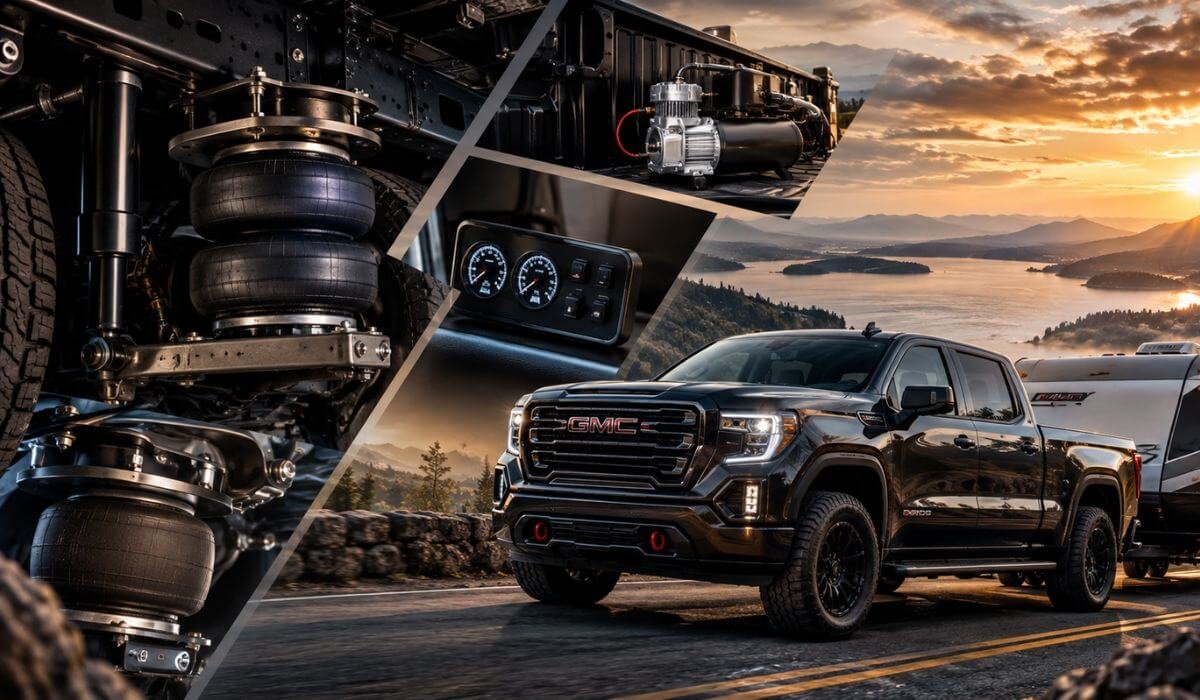
6 Best Air Bag Suspension Kits for GMC Sierra 1500: Load Leveling, Towing & Stability
If your GMC Sierra 1500 starts squatting under a loaded trailer, camper, or heavy cargo, a well-matched air-bag suspension kit can be one of the more useful upgrades for bringing the rear suspension back under control. But this is not a “buy the biggest air bag and bolt it on” situation. The 2019–2026 Sierra 1500 spans different trims and suspension configurations, and details such as Denali, AT4/AT4X, Adaptive Ride Control, rear-spring setup, lift height, and bump-stop clearance can change what actually fits. That makes proper fitment more important than a flashy load-rating number.
For this comparison, Rough Country Air Bags Suspension Kit with Compressor takes the #1 spot as the best overall choice because it combines adjustable rear air support, an onboard 12V compressor, durable brackets, and a configuration designed around lifted Sierra applications. The other five kits earn their place for different reasons, including higher-rated air springs, internal jounce support, simpler bag-only setups, upgraded hardware, and added heat protection.
Most importantly, these picks are judged around real Sierra 1500 ownership—towing stability, load leveling, pressure control, installation, construction, and exact fitment—not marketing numbers alone. And one truth should never get lost: air bags support the suspension; they do not increase the Sierra’s factory payload, GVWR, axle ratings, or towing capacity. The right kit simply helps a properly loaded truck handle that load with better control.
Best GMC Sierra 1500 Air Bag Suspension Kits: Top 2026 Picks, PSI & Fitment
#1. Rough Country Air Bags Suspension Kit with Compressor
GMC Sierra 1500 Air Bag Suspension | 5,000-Lb Support | 12V Onboard Compressor | Adjustable Load Leveling | 2–3.5-Inch Lift (2019–2026)
#2. TORQUE Air Suspension Bags Kit TR75609
GMC Sierra 1500 Rear Air Bags | 7,500-Lb-Rated Air Springs | 5–100 PSI | Internal Jounce Bumper | Bolt-On Installation (2019–2025)
#3. BSWParts Air Bag Kit with Compressor Kit
GMC Sierra 1500 Air Suspension Kit | 7,500-Lb-Rated Support | Onboard Compressor | Adjustable Pressure | 2WD & 4WD (2019–2026)
#4. WINSBULL Air Bags Suspension Kit
GMC Sierra 1500 Towing Air Bags | 5,000-Lb Load-Leveling Support | Double-Convoluted Design | 5–100 PSI | Bolt-On Setup (2019–2026)
#5. maXpeedingrods Air Suspension Bags Kit
GMC Sierra 1500 Air Helper Springs | 5,000-Lb Load Support | 5–100 PSI | Stainless Air Lines | Bolt-On Design (2019–2024)
#6. RETRUE Rear Air Bags Suspension Kit
GMC Sierra 1500 Rear Air Suspension | 5,000-Lb Load-Leveling Support | 5–100 PSI | Natural-Rubber Air Bags | Heat Shield (2019–2026)
Expert Tip: Do Not Choose an Air Bag Kit by the Biggest Number
One of the easiest mistakes with truck air bags is seeing a 7,500-lb rating and assuming the truck can suddenly carry 7,500 additional pounds. It cannot. That number describes the air spring’s stated support rating; it does not change the GMC Sierra 1500’s factory payload, axle, hitch, or towing limits.
For a Sierra 1500, the better question is much simpler: Does this kit actually match the truck, the load, and the way the truck is used? If the truck regularly pulls a trailer, carries a heavy tongue load, or sits noticeably lower in the rear when loaded, air bags can provide useful support and help restore a more controlled ride height. If the truck is lightly loaded most of the time, paying extra for a compressor-equipped system may not be necessary.
That is why the ranking above does not simply put the kit with the largest advertised number first. Fitment, suspension design, lift compatibility, included equipment, and practical use matter more than a headline rating.
How We Chose These Air Bag Suspension Kits
There is a reason this list does not read like a copy-and-paste collection of six similarly named products. These kits were compared for what a Sierra 1500 owner actually needs underneath the truck, rather than for marketing language alone.
1. Exact Sierra 1500 application comes first.
A product title saying “2019–2026” is not enough by itself. Sierra 1500 fitment can vary with the truck’s generation, trim, factory suspension, rear spring arrangement, and aftermarket lift. The Rough Country option, for example, specifically addresses lifted applications, which gives it a meaningful advantage for owners whose truck is not at stock ride height.
2. Load support was separated from truck capacity.
The TORQUE and BSWParts kits advertise 7,500-lb-rated air springs, but that figure was not treated as the Sierra’s usable payload. This distinction is important because a suspension helper can support the load without legally or mechanically increasing the truck’s factory-rated capacity. A trustworthy comparison should make that clear instead of using the largest number as a sales pitch.
3. Compressor-equipped kits received credit for genuine convenience.
The Rough Country and BSWParts packages include a compressor, which changes how practical they are for owners whose loads vary frequently. Being able to adjust air pressure is considerably more useful than installing a system and leaving one pressure setting for every situation. It also explains why a compressor-equipped kit can justify a higher position than an otherwise similar bag-only product.
4. Internal support features were taken seriously.
The TORQUE TR75609’s internal jounce bumper is not just another specification to fill a comparison table. It provides additional internal support as suspension travel becomes heavily compressed. That makes the design particularly relevant for owners who expect their truck to work under heavier loads.
5. Lift compatibility can completely change the right choice.
This is one area where generic “fits Sierra 1500” recommendations often fall short. A lifted truck may need a different air-bag application than a stock-height truck. The Rough Country kit’s stated 2–3.5-inch lift compatibility is therefore a real selection advantage, not a cosmetic feature.
6. We did not manufacture long-term praise where there isn’t enough evidence.
Several of these products have limited long-term owner-review history compared with established suspension brands. That matters. Rather than claiming that every kit has thousands of proven miles behind it, the ranking puts more weight on the specifications that can actually be checked: application, stated air-spring design, compressor inclusion, lift range, and support features.
7. The ranking reflects different buyer needs, not just one “best” specification.
A Sierra owner with a lifted truck may reasonably prefer the Rough Country setup. Someone focused on heavy rear-load support may find the TORQUE kit more compelling. Another owner may value the convenience of an included compressor. There is no honest reason to pretend those are the same buying decision.
Ultimately, these six were selected because they cover the most useful combinations of rear load support, towing stability, leveling capability, compressor convenience, and fitment flexibility found in this group. The goal is not to make the biggest claim possible; it is to make the buying decision easier without hiding the details that could make a kit the wrong choice for a particular Sierra.
Before ordering, verify the exact model year, trim, rear suspension configuration, current ride height, and lift amount against the manufacturer’s fitment information. That final check takes a few minutes and can save far more time than trying to make an incorrectly matched air-bag kit work afterward.
#1. Rough Country Air Bags Suspension Kit with Compressor
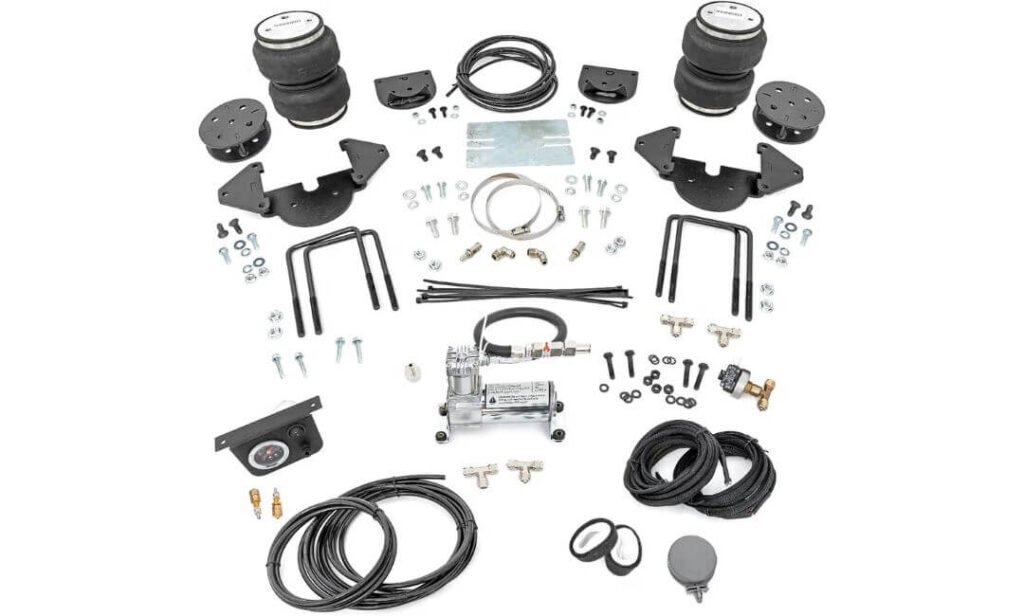
Quick Specs:
- Air Spring Type: Double-convoluted rear air bags
- Support Rating: Up to 5,000 lbs
- Compressor: Onboard 12V compressor included
- Adjustment: Adjustable air pressure for changing loads
- Construction: Powder-coated steel brackets with heavy-duty hardware
- Air Lines: DOT-approved airlines with 1/4-inch push-to-connect fittings
- Lift Range: 2–3.5 inches with the applicable spacer configuration
- Position: Rear suspension
- Best Use: Towing, hauling and rear load leveling
There is a big difference between an air-bag kit that simply fits underneath a truck and one that actually makes sense when the truck is working with a changing load. This setup falls into the second category. Its double-convoluted bags are designed to add support at the rear when a trailer, camper, or cargo pushes the Sierra down, while the onboard compressor lets you change pressure instead of living with one compromise setting. That is especially useful when today’s load is nothing like tomorrow’s.
The hardware is also reassuringly practical. Powder-coated steel brackets, DOT-approved air lines, 90-degree fittings, and 1/4-inch push-to-connect connections make this feel like a complete suspension system rather than a box of parts that leaves the important details to the installer. The 5,000-lb support rating is substantial, but it should be understood correctly: the air bags support the suspension; they do not raise the Sierra 1500’s factory payload or towing rating.
The lift detail is where careful buying matters. This application can be configured around the specified lift range, with 2–3.5 inches being the relevant setup here, and the kit includes brackets, U-bolt plates, block shims, inflation valves, and mounting hardware. Some Sierra configurations can require a little extra work, so checking the truck’s actual rear suspension measurements before ordering is far smarter than assuming every truck with the same model badge is identical.
What We Like
- Onboard air adjustment is the standout convenience when trailer and cargo weights change regularly.
- The double-convoluted air bags provide the kind of additional rear support this kit is actually being bought for.
- Powder-coated brackets and DOT-approved airlines show attention to the parts that live underneath the truck.
- The included fittings and mounting hardware make it a genuinely complete package rather than an air-bag-only purchase.
- The 5,000-lb support rating gives plenty of headroom for serious load-support duties without confusing that figure with the truck’s own capacity.
One Thing to Keep in Mind
The only real catch is fitment precision. Sierra 1500 trims with Adaptive Ride Control, certain rear-spring configurations, or insufficient bump-stop clearance can require a different application, so checking those details first is money well spent.
Sierra 1500 Fitment: Check These Before You Order
For the Sierra 1500, this kit is intended for 2WD and 4WD applications, but the exact suspension configuration matters. It is not intended for Denali or Denali Ultimate models with Adaptive Ride Control, and the rear bump-stop clearance needs to be checked before installation. The supplied configuration also needs to match the truck’s lift height rather than being selected purely from the model year.
A useful pre-purchase check is the rear bump-stop gap and current ride height. The supplied information calls for roughly 9.5–10.5 inches of bump-stop clearance, with the correct spacer configuration selected for the truck. That small measurement can tell you far more about whether the installation will be straightforward than a generic “fits Sierra 1500” statement ever could.
The Insider Pro-Tip
If the Sierra spends most of its life unloaded but occasionally hooks up to a heavy trailer, don’t set the air pressure once and forget it. The whole advantage of having an onboard compressor is being able to adjust support for the load actually sitting behind or inside the truck. Too little air leaves the rear working harder than it should; too much can make an unloaded truck feel unnecessarily firm. Start with the manufacturer’s recommended pressure and fine-tune from there based on the truck sitting level and driving predictably.
And one more thing worth knowing before buying: air bags are load-support equipment, not a license to exceed the Sierra’s factory limits. If the trailer or cargo is already beyond the truck’s rated payload, axle, hitch, or towing limits, adding air does not fix that. Used within those limits, though, this is the kind of upgrade that can make a loaded Sierra feel much more composed without turning the truck into something it was never designed to be.
#2. TORQUE Air Suspension Bags Kit TR75609
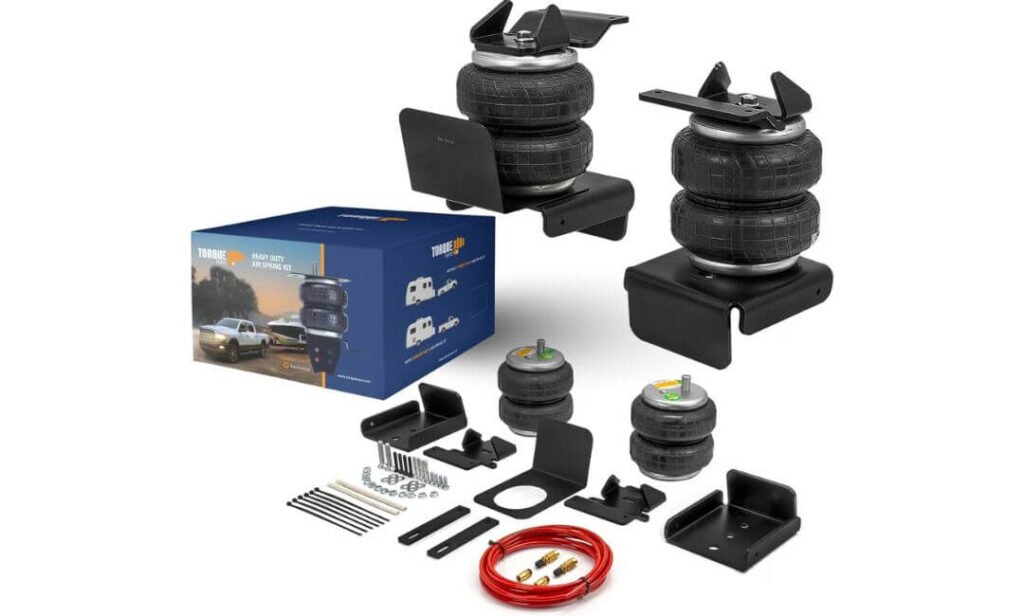
Quick Specs:
- Air Spring Type: Heavy-duty rear air bags with internal jounce bumpers
- Support Rating: Up to 7,500 lbs air-spring rating
- Pressure Range: 5–100 PSI
- Adjustment: Adjustable air pressure for different loads
- Installation: Bolt-on, no frame drilling required
- Construction: Steel mounting brackets with complete hardware
- Lift Capability: Up to 3.5 inches at 35 PSI
- Included: 2 air bags, brackets, tubing, fittings, inflation valves and hardware
- Best Use: Towing, hauling, rear load leveling and bottom-out control
The interesting part of this kit is not the 7,500-lb number printed in the specifications. It is what happens when the rear suspension gets pushed hard under load. The internal jounce bumper is designed to provide additional support as the suspension approaches full compression, helping soften the kind of harsh axle-to-frame contact that can make a heavily loaded truck feel unsettled.
That makes this a particularly sensible option for a Sierra 1500 that regularly works rather than simply sits at stock height with an empty bed. The 5–100 PSI adjustment range gives you room to tune the bags around the actual load, while the air springs can help bring the rear back toward a more controlled stance when a trailer or cargo puts extra weight over the axle. Just remember that the 7,500-lb figure is an air-spring support rating, not extra payload that can be added to the truck’s factory rating.
There is also a practical advantage here that is easy to overlook: no-drill bolt-on installation. The included steel brackets, bolts, nuts, washers, tubing, elbow fittings and inflation valves mean you are not piecing together a suspension upgrade from separate components. The existing mounting points are used, and a step-by-step manual is included, which makes this a much more approachable DIY project for someone comfortable working underneath their Sierra.
What We Like About It
- The internal jounce bumper gives this kit a meaningful advantage when suspension compression gets aggressive.
- 5–100 PSI adjustability allows much more useful tuning than a fixed-support setup.
- The no-drill bolt-on design keeps installation cleaner and avoids unnecessary frame modification.
- The complete hardware package means there is less guesswork about sourcing the small parts needed to finish the installation.
- The combination of rear load support and adjustable pressure makes it well suited to a truck whose workload changes from day to day.
One Honest Consideration
There are some owner reports of gradual pressure loss, so the air connections deserve a careful leak check after installation and whenever the system has been disturbed. That is a reason to inspect the fittings properly—not a reason to dismiss the entire kit.
Sierra 1500 Fitment & Setup
The supplied application covers 2019–2025 Sierra 1500 models, with the product information also listing 2WD and 4WD configurations and broad trim compatibility. If the truck is lifted, the available information indicates that a spacer may be required, so the current suspension height should be checked rather than assuming the standard configuration will be correct.
For installation, the manufacturer-supplied design is refreshingly straightforward: the bags, brackets, tubing, fittings and hardware are all included, and no frame drilling is required. Allowing roughly 2–4 hours for a careful DIY installation is more realistic than expecting the job to be finished instantly, particularly if the truck has accumulated years of road grime underneath.
The Insider Pro-Tip
Keep at least 5 PSI in the bags rather than running them completely empty. These are suspension components, not temporary lifting cushions, and maintaining the minimum pressure helps protect the bags and preserve their intended range of movement. From there, pressure should follow the load: a lightly loaded Sierra needs far less support than one carrying a substantial tongue load.
Most importantly, don’t chase the highest PSI just because the kit allows it. The best setting is the one that brings the loaded Sierra back under control without making the rear unnecessarily stiff. Check the truck’s stance, steering feel and ride after loading, then make small pressure adjustments. That approach gets far more out of an adjustable air-spring system than simply inflating it as much as possible.
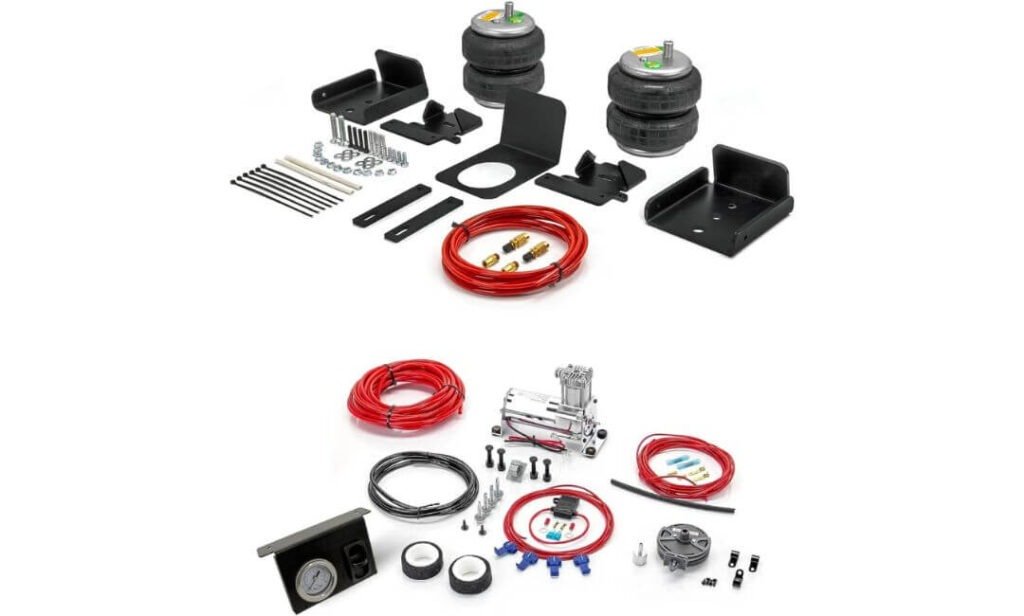
#3. BSWParts Air Bag Kit with Compressor Kit
Quick Specs:
- Air Spring Type: Rear air helper springs
- Support Rating: Up to 7,500 lbs
- Compressor: Onboard air compressor included
- Adjustment: Adjustable air pressure for changing loads
- Installation: Bolt-on, no frame drilling required
- Fitment: 2WD and 4WD Sierra 1500 applications
- Replacement Reference: Firestone Ride-Rite W21-760-2609
- Included: 2 air bags, compressor, brackets, tubing, fittings, inflation valves and hardware
- Best Use: Towing, hauling, load leveling and rear-suspension support
Some air-bag kits solve the support problem; this one tries to solve the support-and-adjustment problem at the same time. The onboard compressor is the real reason to look at this package. When the Sierra goes from an empty bed to a loaded trailer, you can change the air pressure without treating a portable compressor as another piece of equipment you need to carry around.
Its stated 7,500-lb air-spring rating also puts it firmly in the heavy-duty end of this comparison. That does not mean the Sierra can legally carry another 7,500 lbs—the truck’s original GVWR, GAWR and towing limits remain exactly what they are. What the air springs can do is provide additional suspension support so a properly loaded truck is less prone to rear sag, excessive compression and an unsettled feel.
Another reason this one deserves attention is its Firestone Ride-Rite W21-760-2609 replacement reference. For a buyer looking for an alternative to that particular air-spring application, having a recognizable replacement reference gives the product a useful starting point for comparison. The package is also unusually complete: two bags, compressor, brackets, inflation hardware, tubing, fittings and installation hardware arrive together instead of leaving you to build the system piece by piece.
What We Like About It
- The included onboard compressor is the biggest practical advantage for changing loads.
- A 7,500-lb-rated air-spring system gives it substantial support capability on paper.
- The Firestone Ride-Rite replacement reference makes cross-shopping easier for buyers replacing a comparable setup.
- No-drill bolt-on installation keeps the installation approach straightforward.
- It arrives as an all-in-one package, including the compressor and the small hardware that is easy to overlook when buying components separately.
One Honest Consideration
The main thing to verify is exact application fitment, especially on higher trims and trucks with factory suspension technology. The supplied listing claims broad Sierra 1500 coverage, including Denali, but a replacement reference alone should not replace checking the exact truck configuration before ordering.
Sierra 1500 Fitment & Installation
The supplied application covers Sierra 1500 models in 2WD and 4WD configurations, with the listing specifically claiming compatibility with Denali and High Country applications. It also references the W21-760-2609 application for 2019–2024 trucks, while the product listing itself extends the stated fitment through later model years. Because those ranges do not line up perfectly, checking the exact year and factory suspension before purchase is the sensible move.
Installation is designed around existing frame mounting points, with no frame drilling required according to the supplied information. The package includes the bags, onboard compressor, brackets, inflation valves, elbow fittings, tubing, nuts, bolts and an installation manual, so the job is much more self-contained than a bag-only purchase.
The Insider Pro-Tip
The compressor is valuable only if you actually use the adjustability intelligently. Don’t inflate the bags to a high pressure simply because the system can handle it. Start with the manufacturer’s minimum operating guidance and adjust gradually until the loaded Sierra sits properly and feels controlled. An unloaded truck and a truck carrying a trailer tongue load should not necessarily run the same pressure.
Also, treat the 7,500-lb figure as a suspension rating, not additional carrying permission. If your Sierra’s factory payload or axle rating says the load is too heavy, air bags cannot change that. Used within the truck’s original limits, however, the combination of rear air support and an onboard compressor is exactly the sort of upgrade that makes sense for someone who regularly switches between everyday driving and serious towing duty.
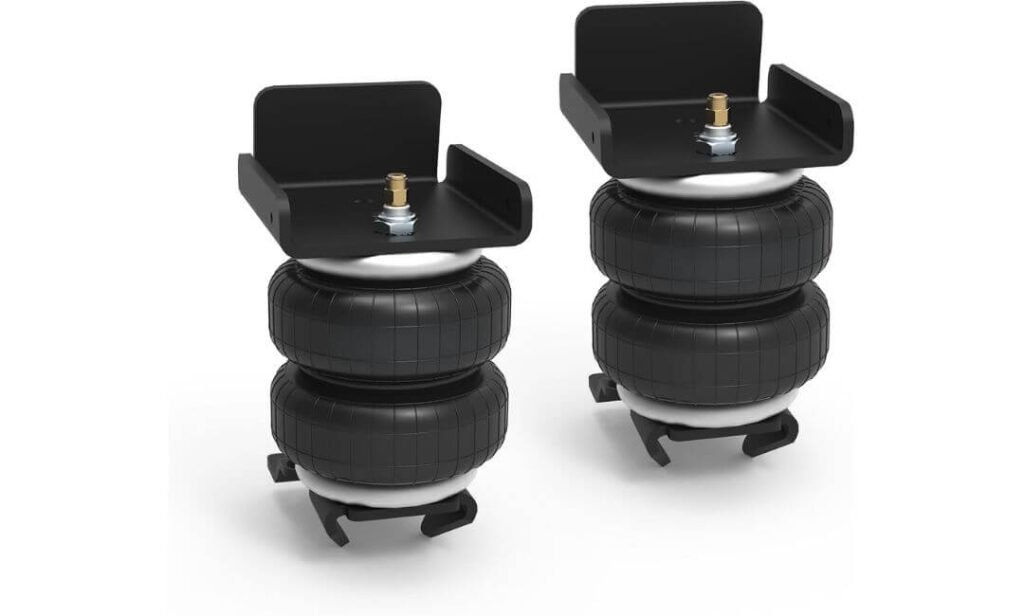
#4. WINSBULL Air Bags Suspension Kit
Quick Specs:
- Air Spring Type: Double-convoluted rear air bags
- Support Rating: Up to 5,000 lbs load-leveling capacity
- Pressure Range: 5–100 PSI
- Construction: Rubber air bags with steel brackets
- Installation: Bolt-on design with no drilling required on most trucks
- Air Connection: 1/4-inch tee fitting with air-line tubing
- Included: 2 air bags, brackets, fittings, tubing, hardware and owner’s manual
- Best Use: Rear load leveling, towing support and reducing squat
Not every Sierra needs a compressor-equipped air suspension system. Sometimes the truck simply needs more rear support when a trailer or heavy load is attached, and that is where this setup makes sense. The double-convoluted bags are built to work alongside the factory rear suspension, helping bring the truck back toward a level stance instead of allowing the rear to sit noticeably lower under load.
The useful part is the 5–100 PSI adjustment range. A lightly loaded Sierra does not need the same amount of air as one carrying a substantial trailer tongue weight, so being able to change pressure gives you a way to tune the support rather than accepting one fixed ride characteristic. Used properly, that additional support can help reduce rear squat, excessive suspension compression and the bouncing or instability that often becomes more noticeable when the truck is working.
The package also keeps things refreshingly simple. You get the air bags, steel brackets, 1/4-inch tee fitting, tubing and installation hardware together, and the design uses existing mounting points rather than calling for frame drilling on most applications. There is one thing buyers should know before clicking the order button, though: there is no compressor included. That is not necessarily a disadvantage—it simply means inflation needs to be handled with a suitable external compressor.
What We Like About It
- The 5–100 PSI range gives useful control for changing trailer and cargo loads.
- Double-convoluted air bags provide a proven form of additional rear suspension support.
- The bolt-on approach keeps installation relatively straightforward for a home installer.
- The included 1/4-inch tee fitting and air-line hardware make the basic inflation setup easy to understand.
- Its simpler design can be a good fit for owners who do not need an onboard compressor permanently installed in the truck.
One Honest Consideration
There is no compressor in the box, so if you want pressure adjustment away from home, you will need to supply a suitable 12V or other compatible air source separately.
Sierra 1500 Fitment & Setup
The supplied listing covers 2019–2026 Sierra 1500 applications, including 2WD and 4WD configurations, and identifies the kit as a replacement for the Firestone W217602609 application. That makes the replacement reference useful when comparing it with an existing suspension setup, but the safest approach is still to verify the exact truck configuration before ordering.
Installation is designed as a bolt-on rear suspension upgrade, with brackets and hardware included and no drilling required on most trucks. For a careful DIY installation, allowing around 2–4 hours is a sensible expectation rather than assuming the job will take only a few minutes.
The Insider Pro-Tip
This is the kind of kit where the compressor decision should be made before the purchase, not after installation. If you already keep a portable compressor in the Sierra for tires or roadside use, the missing onboard compressor may not matter at all. You can keep the system simple and avoid permanently mounting another component.
And don’t fall into the “more air is always better” trap. Start around the manufacturer’s recommended minimum pressure and increase it only enough to bring the loaded truck back under control. The goal is not to make the rear suspension rock hard; it is to support the load while keeping the Sierra’s ride and handling predictable. Also remember that a 5,000-lb load-leveling rating does not add 5,000 lbs to the truck’s factory payload or towing limit.
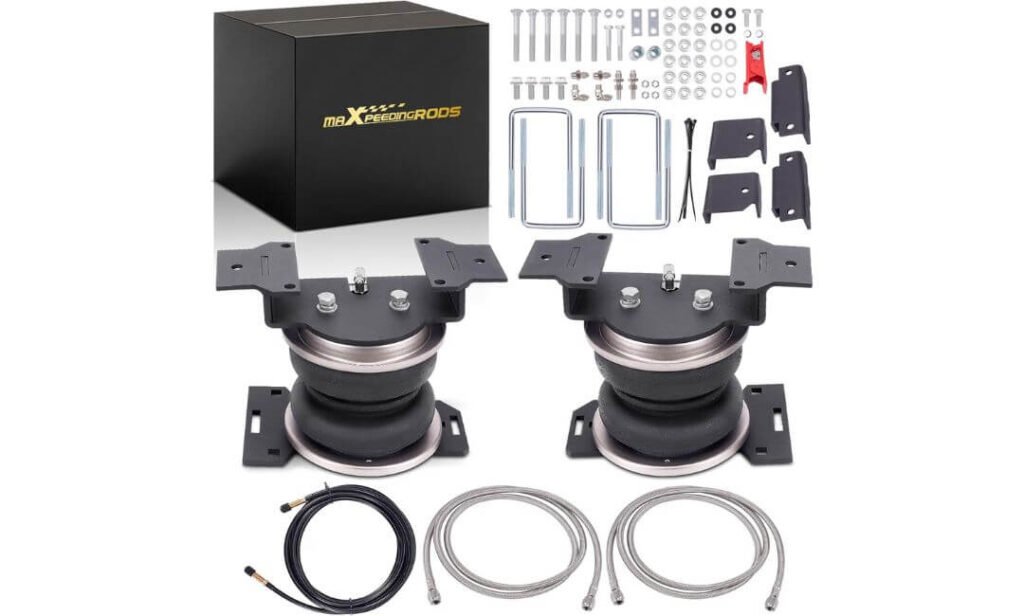
#5. maXpeedingrods Air Suspension Bags Kit
Quick Specs:
- Air Spring Type: Double-bellow rear air helper springs
- Support Rating: Up to 5,000 lbs
- Pressure Range: 5–100 PSI
- Air Spring Material: Multi-ply natural rubber, 4.5–5 mm thick
- Air Lines: Stainless-steel braided lines with nylon backup lines
- Roll Plates: Stainless-steel construction
- Installation: Bolt-on design
- Suspension Travel: 85 mm stroke, 175 mm maximum extension
- Best Use: Towing, hauling, rear load leveling and squat reduction
Look underneath the marketing language and there is a genuinely useful detail here: the air-spring construction and the hardware have both received attention. The multi-ply natural-rubber bags use a stated 4.5–5 mm thickness, while the stainless-steel air lines and stainless roll plates are upgrades that make sense in a component spending its life underneath a truck exposed to heat, water, road debris and corrosion.
That matters more than a flashy capacity number for a Sierra that is actually used. The system is rated for up to 5,000 lbs of load support, and its adjustable 5–100 PSI range lets the rear suspension be tuned around the load rather than forcing the same setup on an empty and fully loaded truck. Properly adjusted, the bags are intended to reduce rear squat and bottoming while helping the truck maintain a more controlled ride height when towing or hauling.
There is also a nice bit of engineering detail in the rolling hardware. The stainless-steel roll plates replace more ordinary steel construction, while the stainless braided air lines offer better protection and heat resistance than basic tubing. Combined with the double-bellow design and bolt-on brackets, this makes the kit particularly interesting for someone who cares about what is physically sitting underneath the Sierra—not just what the product page promises.
What We Like About It
- Stainless-steel air lines and roll plates are meaningful upgrades for an under-truck component.
- The 4.5–5 mm multi-ply natural rubber construction gives the bags a substantial physical build.
- 5–100 PSI adjustment provides useful flexibility for different trailer and cargo loads.
- The bolt-on design keeps the installation approach relatively straightforward.
- The combination of 5,000-lb support and upgraded corrosion-resistant hardware makes it a well-rounded option rather than a kit built around one headline specification.
One Honest Consideration
The biggest thing to watch is fitment. This application is for non-AT4 Sierra 1500 models, so AT4/AT4X owners should not assume the kit will work simply because the model year matches.
Sierra 1500 Fitment & Setup
The supplied application covers 2019–2024 GMC Sierra 1500 models in 2WD and 4WD configurations, specifically excluding AT4 and AT4X applications. The listing also calls out trucks equipped with Adaptive Ride Control as requiring additional fitment verification. If the Sierra has aftermarket suspension changes, the available clearance should be checked before ordering as well.
Installation is designed as a bolt-on replacement for the factory rear jounce-bumper support, with the bags, upper and lower brackets, stainless air lines, backup nylon lines and hardware supplied. A mechanically comfortable owner can reasonably expect a few hours for the job, although actual installation time depends heavily on access underneath the truck and how cleanly the existing hardware comes apart.
The Insider Pro-Tip
The stainless hardware is one of the reasons this kit caught our attention, but it is still worth treating the air-line connections as the part that deserves the most care during installation. A perfectly good air bag is not much use if a fitting is not seated correctly. After installation, check the system for pressure loss before trusting it with a long towing trip.
For everyday use, start with modest pressure and increase it only as the load demands. A lightly loaded Sierra does not need the same support as one carrying a heavy trailer tongue load. And if the truck is an AT4, AT4X, or has substantial suspension modifications, stop at the fitment check rather than trying to make the kit work by force. Correct application beats clever installation every time.
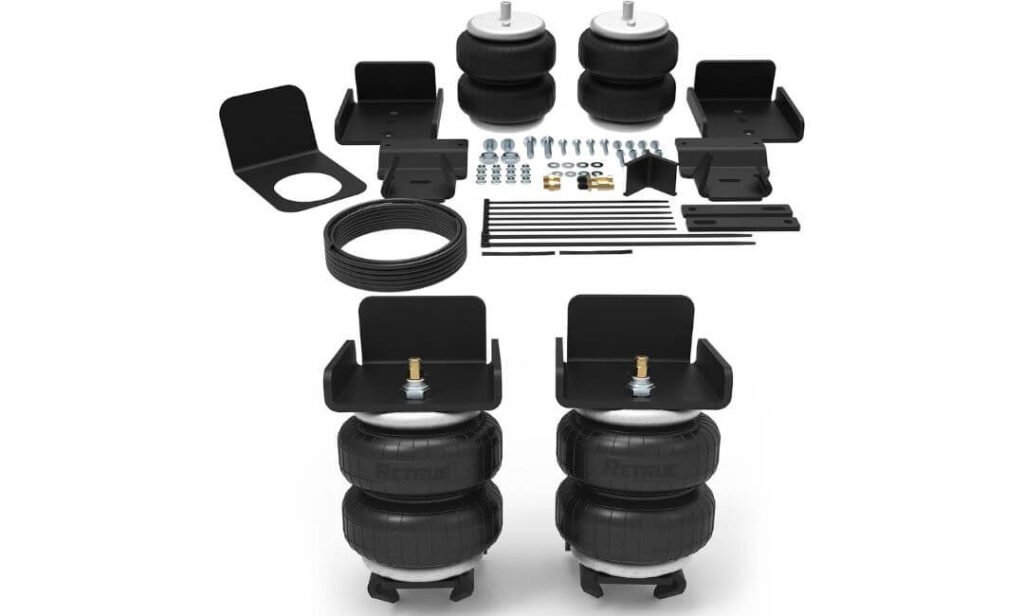
#6. RETRUE Rear Air Bags Suspension Kit
Quick Specs:
- Air Spring Type: Rear natural-rubber air bags
- Support Rating: Up to 5,000 lbs
- Pressure Range: 5–100 PSI
- Construction: Natural rubber bags with alloy-steel brackets
- Heat Protection: Metal heat shield included
- Installation: Pre-drilled, bolt-on design
- Replacement Reference: Firestone Ride-Rite W21-760-2609
- Included: Air bags, brackets, heat shield, tubing, fittings, valve, hardware and installation guide
- Best Use: Rear load leveling, towing support and reducing squat
The first thing worth noticing here is the metal heat shield. It is easy to overlook when comparing air-bag kits because it does not sound as impressive as a large load rating, but an air spring lives underneath the truck and has to deal with heat, road debris and everything else that comes with real-world driving. Having dedicated shielding included is a practical touch, particularly for an owner who wants the bags protected rather than simply installed.
The system provides 5–100 PSI adjustment and a stated 5,000-lb load-leveling capacity, giving the rear suspension room to be tuned for different loads. When a trailer or cargo pushes the rear down, the additional air support is intended to restore a more balanced stance and reduce excessive squat, vibration and suspension compression. As always, that 5,000-lb figure describes the air-spring support system—it does not increase the Sierra 1500’s factory payload or towing rating.
Installation is another area where this kit keeps things uncomplicated. The brackets are pre-drilled, the mounting hardware is included, and the supplied air tubing, fittings and valve mean there is no need to start assembling a parts list before the installation can even begin. The Firestone Ride-Rite W21-760-2609 replacement reference is also useful when cross-checking the application, although the truck’s exact configuration should still be verified before ordering.
What We Like About It
- The included metal heat shield is a genuinely useful protection feature rather than just another specification.
- 5–100 PSI adjustability lets the support be changed as the truck’s workload changes.
- The pre-drilled brackets make the installation approach straightforward.
- The Firestone W21-760-2609 reference gives buyers a useful point of comparison.
- The kit includes the small but important installation pieces—tubing, fittings, valve and hardware—instead of leaving those details to the buyer.
One Honest Consideration
The supplied application information specifically excludes Duramax models, so diesel owners should not assume this kit fits simply because the truck is a Sierra 1500.
Sierra 1500 Fitment & Setup
The listed application covers 2019–2026 Sierra 1500 2WD and 4WD models, with the supplied information specifically mentioning Sierra 1500 Denali 4WD. It is also positioned as a replacement for the Firestone Ride-Rite W21-760-2609. However, Duramax models are excluded, and Silverado LD/Sierra Limited applications use a different kit, so those distinctions matter when checking compatibility.
The installation itself uses a bolt-on, pre-drilled bracket design, with the bags, alloy-steel brackets, heat shield, air lines, fittings, valve and hardware supplied. The lower bracket area can be somewhat tight to work in, so giving yourself enough time and access underneath the truck is more sensible than treating this as a rushed driveway job.
The Insider Pro-Tip
Don’t judge this kit only by its 5,000-lb rating. For a Sierra owner, the more useful question is how consistently the system holds the pressure you set. After installation, inflate the bags, let the truck sit, and check the connections carefully for pressure loss before putting a trailer behind it. A few minutes spent on that check is far better than discovering an air-line problem halfway through a towing trip.
For pressure, resist the temptation to copy someone else’s PSI setting blindly. Start conservatively and adjust according to the actual load and truck stance. The right pressure is enough to bring the loaded rear back under control—not the maximum pressure the bag can accept. And if the Sierra is a Duramax, LD/Limited model, or has unusual suspension modifications, verify the application first rather than assuming the replacement reference guarantees fitment.
Best GMC Sierra 1500 Air Bag Suspension Kits (2019–2026): Specs Compared
| What Matters on a Sierra 1500 | Rough Country | TORQUE TR75609 | BSWParts | WINSBULL | maXpeedingrods | RETRUE |
|---|---|---|---|---|---|---|
| Best fit for | Towing + lifted trucks A strong all-around choice when suspension height matters. BEST OVERALL | Heavy load support Internal jounce bumper adds useful compression support. HEAVY-DUTY PICK | Frequent load changes The included compressor is the major advantage. COMPRESSOR INCLUDED | Simple air-bag upgrade Straightforward rear support without an onboard compressor. | Upgraded under-truck hardware Stainless lines and roll plates are the standout details. | Simple load leveling Includes a heat shield and a complete basic hardware package. |
| Air-spring support rating | Up to 5,000 lbs | Up to 7,500 lbs | Up to 7,500 lbs | Up to 5,000 lbs | Up to 5,000 lbs | Up to 5,000 lbs |
| Pressure adjustment | Adjustable | 5–100 PSI | Adjustable | 5–100 PSI | 5–100 PSI | 5–100 PSI |
| Onboard compressor | Included | Not included | Included | Not included | Not included | Not included |
| Standout suspension feature | Double-convoluted bags + compressor | Internal jounce bumper | Compressor-equipped all-in-one setup | Double-convoluted bags | Stainless roll plates + air lines | Metal heat shield |
| Lift consideration | 2–3.5-inch lift configuration | Spacer may be needed on lifted trucks | Verify exact suspension setup | Verify exact suspension setup | Aftermarket lifts may require spacers | Verify exact suspension setup |
| Installation approach | Complete bolt-on kit; configuration-dependent | No-drill bolt-on | No-drill bolt-on | No-drill on most trucks | **Bolt-on installation** | Pre-drilled, bolt-on design |
| Air-line setup | DOT-approved lines + 1/4-inch push-to-connect fittings | Tubing + elbow fittings | Tubing + elbow fittings | 1/4-inch tee fitting + tubing | Stainless braided lines + nylon backup lines | Air tubing + fittings |
| Notable construction | Powder-coated steel brackets | Steel brackets + internal jounce bumper | Heavy-duty bags + mounting hardware | Rubber bags + steel brackets | 4.5–5 mm multi-ply rubber | Natural rubber + alloy steel brackets |
| Compressor-free simplicity | Less relevant — compressor is included | Good | Less relevant — compressor is included | Good | Good | Good |
| Important fitment check | Check Adaptive Ride Control, rear spring setup and bump-stop clearance. | Verify exact year, trim and suspension configuration. | Verify exact application, especially higher trims and factory suspension equipment. | Confirm application before ordering; compressor is separate. | Non-AT4 application; verify Adaptive Ride Control and suspension modifications. | Not for Duramax models; verify exact application. |
| Best reason to choose it | Best balance of support, adjustment and lift flexibility. | Internal jounce bumper + 7,500-lb-rated springs. | 7,500-lb-rated springs with compressor included. | Simple 5–100 PSI load-leveling setup. | Stainless hardware adds real under-truck value. | Heat shield + simple bolt-on load support. |
| Our take | Especially compelling for towing and lifted setups. | Particularly interesting if compression control matters. | Convenience is the main selling point. | Good if an external compressor is already available. | Strong details where corrosion and durability matter. | Worth considering when heat protection is useful. |
Buying Guide: How to Choose the Best Air Bag Suspension Kit for GMC Sierra 1500
Choosing air bags for a Sierra 1500 is one of those jobs where fitment matters more than the product title. Two kits can both claim to support 5,000 or 7,500 lbs and still be completely different choices once you look at the truck’s trim, rear suspension, ride height, towing routine, and how often the load changes.
The six products in this guide also show why there is no single specification that tells the whole story. Some include a compressor, some are intentionally simple bag-only systems, one adds an internal jounce bumper, another uses stainless-steel air lines and roll plates, and another includes a heat shield. Those differences are much more useful to a buyer than simply asking which kit has the biggest number on the box.
Start With the Load You Actually Carry
Air bags are most useful when the rear suspension is being asked to handle additional weight. A trailer tongue, camper, loaded bed, equipment, or other concentrated rear load can make the back of the Sierra sit lower than it should.
Look for a system that can:
- Bring the rear closer to a level factory stance when loaded.
- Reduce excessive rear squat and suspension compression.
- Give you enough pressure adjustment to accommodate different loads.
- Maintain predictable steering and braking behavior when the truck is properly loaded.
- Reduce the chance of the suspension reaching its bump stops during heavy compression.
Do not, however, choose a kit simply because it advertises a 5,000- or 7,500-lb rating. That is not additional payload for the truck. Your Sierra’s factory GVWR, GAWR, payload and towing limits remain unchanged after installing air bags.
That distinction is especially important when comparing the TORQUE and BSWParts options, both of which advertise 7,500-lb-rated air-spring support. The number tells you about the spring system, not how much extra weight the truck can legally or safely carry.
Think About Towing Stability, Not Just Rear Height
A truck that sits level can feel noticeably better than one that is sagging at the rear, but the goal should not be to use air bags as a cure for every towing problem.
When correctly adjusted for a legal and properly distributed load, additional rear support can help the Sierra maintain a more controlled stance. That can contribute to better steering feel, braking control and overall stability because the suspension is not sitting excessively deep in its travel.
For towing, pay particular attention to:
- Rear squat: How much does the truck drop once the trailer is connected?
- Suspension travel: Is the rear suspension getting close to bottoming under compression?
- Pressure adjustment: Can you change support when trailer or cargo weight changes?
- Ride behavior: Does the system support the load without making the unloaded truck unnecessarily stiff?
- Trailer setup: Are the hitch height, tongue weight and trailer loading already correct?
Air bags can help with the suspension side of the equation. They cannot correct an improperly loaded trailer, excessive tongue weight, an overloaded truck, or an unsuitable hitch setup.
Match the Kit to Your Sierra’s Exact Suspension
This is probably the most important buying step in the entire guide.
A listing that says “fits Sierra 1500” should be treated as the starting point, not the final answer. Sierra 1500 trucks can differ by model year, trim, drivetrain, factory suspension equipment, rear-spring arrangement and ride height.
Before ordering, check:
- Exact model year
- 2WD or 4WD
- Trim level
- Factory suspension equipment
- Rear spring configuration
- Current ride height
- Aftermarket lift or leveling kit
- Available bump-stop clearance
- Whether the truck has Adaptive Ride Control
- Whether the product specifically excludes your configuration
This is where the products in this article are deliberately different.
The Rough Country setup is particularly relevant when the truck has the applicable 2–3.5-inch lift configuration, while the maXpeedingrods application specifically excludes AT4/AT4X configurations in the supplied fitment information. The RETRUE information also excludes Duramax models and points Silverado LD/Sierra Limited applications toward a different kit.
Those aren’t small details. They can determine whether the brackets and bags physically belong on your truck.
Decide Whether You Actually Need an Onboard Compressor
An onboard compressor sounds like an obvious upgrade until you consider how you use the truck.
If the Sierra frequently switches between:
empty → cargo → trailer → heavy trailer,
being able to change air pressure conveniently is genuinely useful. You are not stuck carrying a separate compressor every time the load changes.
That makes compressor-equipped systems particularly attractive for frequent towing.
If the truck only needs extra support a few times a year, a bag-only system with an external compressor may make more financial and practical sense. WINSBULL, maXpeedingrods, TORQUE and RETRUE are examples where the basic air-spring system does not give you the same integrated compressor convenience as the compressor-equipped choices.
A simple way to decide:
| Your Sierra use | What makes more sense |
|---|---|
| Frequent towing with changing trailer weights | Onboard compressor |
| Occasional heavy hauling | Adjustable air bags + external compressor |
| Mostly empty daily driving | Simple adjustable system |
| Regular towing with a lifted truck | Lift-specific application |
| Want the simplest installation | Complete bolt-on kit with verified fitment |
Pay Attention to the Air Bag Construction
Not all air bags are described with the same level of detail, and that information is worth reading.
A double-convoluted design is common in rear helper-spring applications because the shape allows the bag to work through suspension movement while providing additional support under load.
Material and hardware matter too.
The maXpeedingrods kit, for example, specifies multi-ply natural rubber with a stated 4.5–5 mm thickness, along with stainless-steel air lines and stainless roll plates. The RETRUE setup includes a metal heat shield, while the Rough Country system uses powder-coated steel brackets and DOT-approved airlines.
These aren’t reasons to automatically declare one material “best.” They are clues about what each manufacturer has chosen to emphasize in the system.
For an under-truck component, it is worth looking at:
- Air-bag rubber construction
- Number and type of reinforcement layers
- Bracket material
- Corrosion protection
- Air-line material
- Heat protection
- Fitting quality
- Internal bump-stop or jounce-bumper design
Installation: Bolt-On Does Not Mean Five-Minute Job
“No drilling required” is useful information, but it should not be interpreted as “anyone can install it in minutes.”
A proper installation still involves working around the rear axle, springs, brackets and air lines. Rust, limited access and the truck’s existing suspension can make a straightforward kit take considerably longer than the optimistic time shown in a product listing.
Before starting, make sure you have:
- Safe access to the underside of the truck
- Correct hand tools
- Adequate support equipment
- Enough working space around the rear suspension
- A way to route and secure the air lines
- A method for checking the finished system for leaks
The bolt-on designs in this comparison are attractive because they generally avoid unnecessary frame modification. But always follow the specific installation instructions for the exact kit, particularly if the Sierra has aftermarket suspension components.
Air Pressure Is a Setup Tool, Not a Competition
One of the biggest mistakes with helper air bags is assuming that more pressure automatically means better support.
It doesn’t.
The correct pressure depends on the load, truck stance and desired ride behavior. A lightly loaded Sierra may need relatively little air, while a properly loaded towing setup may require substantially more.
A sensible approach is:
- Begin with the manufacturer’s recommended minimum operating pressure.
- Add air gradually after the load is on the truck.
- Look at the rear stance rather than chasing a specific PSI number.
- Make sure the truck remains within its factory weight ratings.
- Recheck the system after the first loaded drive.
The goal is controlled support, not maximum inflation.
This is also why fixed pressure recommendations copied from another owner’s truck are not particularly useful. Two Sierra 1500s pulling apparently similar trailers can have different tongue weights, suspension setups and existing loads.
Consider What the Kit Includes Before Comparing Prices
A lower-priced bag kit can stop looking like a bargain once you add the components needed to make it convenient.
Compare the complete package:
| Component | Why it matters |
|---|---|
| Air bags | The primary load-support component |
| Mounting brackets | Determines fit and installation method |
| Air lines | Affects routing, durability and connection setup |
| Fittings | Poor connections can create frustrating leaks |
| Inflation valves | Required for external inflation |
| Compressor | Adds convenient pressure adjustment |
| Heat shield | Useful where heat exposure is a concern |
| Jounce bumper | Adds support during deep compression |
| Installation hardware | Avoids sourcing small parts separately |
| Warranty/support | Useful if a fitment or component issue appears |
This is one reason the compressor-equipped packages can make sense despite costing more than a basic bag-only setup. You are paying for a more complete system, not simply a more expensive pair of bags.
Don’t Ignore Warranty and Long-Term Support
These are relatively newer aftermarket choices compared with some long-established suspension systems, so it would be a mistake to pretend every product has decades of independent owner history.
Instead, look at what can actually be verified:
- Length of the manufacturer warranty
- Availability of technical support
- Replacement-part availability
- Quality of the included hardware
- Clear installation documentation
- Whether the manufacturer provides specific fitment information
A strong warranty does not automatically make a poor-fitting kit good. Likewise, a shorter warranty does not automatically mean the product is unsuitable. Fitment and construction should come first; warranty is your additional layer of protection.
Do You Need Air Bags or a Complete Suspension Upgrade?
For most Sierra 1500 owners considering this type of product, the answer starts with the problem.
If the truck drives normally unloaded but squats when towing or hauling, a rear helper-air-spring system can be a sensible targeted upgrade. You are adding support exactly where the problem occurs without replacing the entire suspension.
A more extensive suspension change may make more sense if the truck has broader issues such as worn springs, damaged shocks, persistent alignment problems, or a suspension setup that is fundamentally unsuitable for its intended use.
Air bags are best viewed as load-support equipment, not a universal replacement for worn suspension components.
How Do Load-Leveling Air Bags Work With Heavy Trailers?
The principle is fairly simple. When the trailer applies additional tongue weight to the rear of the Sierra, the rear suspension compresses. The air bags sit between the axle and frame area and add spring support as they are inflated.
That extra support can help the truck return closer to its intended loaded ride height and reduce excessive suspension compression.
The important word is support.
Air bags don’t move the truck into a higher factory weight class. They don’t increase the rating on the hitch, axle or chassis, and they don’t make an overloaded trailer safe. Their job is to help the suspension manage a properly loaded truck more effectively.
For that reason, the best setup is the one that gives the Sierra enough support to remain controlled while staying within all of its original factory limits.
What Should You Check Before Clicking Buy?
Before placing the order, run through this short checklist:
- Confirm the exact Sierra 1500 year.
- Confirm 2WD or 4WD.
- Check the trim and factory suspension equipment.
- Look for Adaptive Ride Control if applicable.
- Check whether the kit excludes AT4, AT4X, Denali, Duramax or other specific configurations.
- Measure the relevant rear suspension/bump-stop clearance where required.
- Confirm the kit’s lift range if the truck has been modified.
- Decide whether you want an onboard compressor or external inflation.
- Check the air-bag support rating, but don’t confuse it with payload.
- Read the installation requirements before ordering.
- Plan to leak-test the system after installation.
- Keep the Sierra within its factory GVWR, GAWR and towing limits.
That final check is worth doing even when a listing claims broad compatibility. A few minutes spent verifying the truck can save you from buying the right air bags for the wrong Sierra.
Installation Insights: GMC Sierra 1500 Air Bags for Towing and Load Leveling
Installing rear air bags on a Sierra 1500 is not particularly mysterious, but it is also not a job where rushing pays off. The bags themselves are only one part of the system. Bracket alignment, air-line routing, minimum pressure, suspension clearance and leak checking all have a direct effect on how the finished setup behaves. A clean installation is what turns a good air-spring kit into a dependable towing upgrade.
The process below is intentionally high-level because bracket locations and hardware can vary between applications. Always follow the installation manual supplied with the exact kit, and never work underneath a truck supported only by a jack.
1. Prepare the Sierra Before Touching the Suspension
Start with the truck on a solid, level working surface, unload the bed, and make sure the trailer is disconnected. The rear suspension needs to be in a safe, unloaded condition before the original bump-stop area and mounting points are accessed.
Before installation, take a few minutes to inspect the area around the rear axle. Look for:
- Existing suspension damage or heavily worn components
- Rust that could interfere with bracket mounting
- Brake lines and electrical wiring near the proposed air-line route
- Exhaust or other heat sources
- Aftermarket lift, leveling, or suspension components
- Available clearance around the bump-stop and spring area
This is also the right time to confirm that the selected air-bag configuration actually matches the truck. Do not try to solve a fitment problem during installation by modifying brackets or drilling the frame unless the manufacturer specifically calls for it.
2. Remove or Reposition the Factory Bump-Stop Hardware
Most rear helper-air-spring installations use the space occupied by the factory jounce or bump-stop arrangement.
The exact removal procedure varies, but the basic idea is to create the mounting space required for the new brackets while keeping the factory suspension components that the installation instructions tell you to retain.
This is where working slowly pays off. A bracket that looks “almost aligned” is not good enough. The mounting surfaces should sit correctly, the hardware should pass through the intended mounting points, and the air bag should have adequate clearance throughout suspension movement.
3. Position the Brackets and Air Bags
Once the mounting area is prepared, the upper and lower brackets are positioned according to the supplied instructions.
The important part here is alignment rather than speed. The air bag should sit squarely between its mounting points, with enough room around it that it will not contact the frame, axle, brake components, exhaust or other hardware as the suspension moves.
Before fully tightening everything, visually check:
- Bag alignment
- Bracket seating
- Axle and frame clearance
- Clearance at full suspension movement
- Distance from exhaust heat
- Routing space for the air lines
A few extra minutes here can prevent a frustrating noise, rubbing issue or air-line problem later.
4. Route the Air Lines Like They Actually Have to Survive Under a Truck
Air-line routing deserves more attention than it usually gets.
The tubing should be routed away from sharp edges, moving suspension components, hot exhaust components and areas where road debris can strike it. Leave enough controlled slack for suspension movement, but don’t leave loose loops hanging underneath the truck.
Avoid creating unnecessary bends, and make sure the line is properly secured along its route.
For push-to-connect fittings, make sure the tubing is inserted fully and cleanly. A connection that looks connected is not necessarily a connection that will hold pressure for weeks.
5. Connect the Inflation System or Compressor
For a bag-only setup, the air lines are normally routed toward the chosen inflation valves. If the system includes an onboard compressor, the air lines and electrical connections must be installed according to that system’s instructions.
A compressor-equipped setup adds another layer to the installation:
- Compressor mounting
- Electrical power connection
- Ground connection
- Control or remote connection where supplied
- Air-line connection
- Protection from water, heat and road debris
This is where a complete compressor package can save time, because the necessary components are designed to work together rather than being selected individually.
6. Perform a Proper Leak Check Before Driving
This step should never be treated as optional.
After the system is assembled, inflate the bags according to the manufacturer’s instructions and inspect every connection. A suitable soapy-water leak check around fittings can reveal bubbles that are difficult to spot by simply listening for escaping air.
Check the system again after allowing it to sit.
If pressure drops noticeably, find the leak before towing. Do not assume that a small loss will somehow disappear once the truck is on the road.
7. Set the Initial Air Pressure With the Truck Empty
Once installation is complete and the system passes its leak check, establish the manufacturer’s recommended minimum operating pressure.
Do not immediately inflate the bags to a high pressure just because the system allows it.
The purpose of the initial setting is to give the bags enough pressure to operate correctly while leaving room for adjustment when the truck is loaded.
8. Load the Sierra, Then Tune the Pressure
This is where the system actually starts earning its place.
Connect the trailer or add the cargo you normally carry, then look at the truck’s stance. If the rear drops substantially, increase pressure gradually until the suspension returns toward a controlled, level loaded position.
The target is not necessarily a perfectly flat body line at all costs. You want:
- Controlled rear ride height
- Adequate suspension travel
- Stable steering feel
- Predictable braking
- Reduced squat
- No obvious bottoming
- No air bag contact with surrounding components
Make small adjustments rather than jumping straight to maximum pressure.
Common Pit Stops and Troubleshooting
The truck still sits low after adding air
First check whether the load itself is within the truck’s factory limits. If it is, gradually increase pressure while observing the rear stance.
If a large pressure increase produces little change, check the installation, bag position, suspension clearance and air system for leaks.
One side sits differently from the other
Check whether the load is distributed unevenly. If the system uses separate left and right air circuits, individual adjustment may be possible. If the bags share a common line, the system will naturally equalize pressure between them.
Do not use air pressure to hide a badly unbalanced load.
The ride feels too stiff
This is usually a good reason to reduce pressure gradually, provided the bags remain above the manufacturer’s required minimum.
Air bags are not supposed to make an unloaded truck feel like a heavy-duty commercial chassis. Their job is to provide additional support when the truck needs it.
You hear rubbing or unusual suspension noise
Stop and inspect it.
Check the air bag, brackets, brake lines, exhaust clearance and air-line routing. A suspension component should not be rubbing against another component simply because the truck is loaded.
The bags lose pressure
Start with the fittings. Check the valves, tubing connections and any junctions with a leak-detection solution.
If the pressure loss continues after the connections have been checked, the system should not be trusted for towing until the source is identified.
GMC Sierra 1500 Air Bags for Towing: Calibration Tips for Stability
Think of pressure adjustment as suspension calibration, not inflation.
The same Sierra can need different settings on different days. An empty truck, a loaded bed, a small trailer and a heavier trailer all put different demands on the rear suspension. Copying another owner’s exact PSI number therefore isn’t particularly useful.
A better routine is:
- Start at the manufacturer’s recommended minimum.
- Add the actual trailer or cargo load.
- Increase pressure gradually.
- Check that the rear has returned toward a controlled loaded stance.
- Drive carefully at low speed first.
- Pay attention to steering response, braking feel and rear-end movement.
- Make small pressure changes if necessary.
- Recheck the system after the first loaded trip.
Do not use air pressure to compensate for an overloaded truck. Air bags can improve support and help maintain ride height, but they do not increase the Sierra 1500’s factory GVWR, GAWR, hitch rating or towing capacity.
One Installation Detail That Is Easy to Miss
After the first loaded drive, give the installation another inspection.
Look for:
- Air lines that have shifted toward moving parts
- Bracket hardware that needs checking
- Signs of rubbing
- Heat exposure around the tubing
- Pressure loss
- Uneven bag positioning
- Anything that looks different from the initial installation
That second inspection is valuable because the suspension has now actually moved through its working range under load.
A well-installed system should eventually become boring: the truck sits properly, the pressure stays where it should, the bags clear everything through suspension movement, and there is no need to constantly think about them. That is the real goal of an air-bag upgrade—not simply getting the bags installed, but having a setup you can trust when the Sierra is carrying the load that made you buy them in the first place.
Real-World Scenarios: When to Choose Each Air Bag Kit for Your Sierra 1500
The right air-bag setup depends on what the Sierra actually does, not what looks impressive on a specification sheet. A truck that carries a heavy bed load every weekend has a different suspension problem from one that spends Saturday pulling a camper, and neither should be set up exactly like a truck that occasionally leaves the pavement.
That is why the six options in this guide are better understood as different solutions to the same basic problem: giving the rear suspension more control when the load changes. The most expensive-looking feature is not automatically the most useful one. Your towing frequency, load weight, ride height, available compressor, and factory suspension configuration should decide the purchase.
When the Sierra Carries a Heavy Bed Load
A heavy bed load usually creates a very recognizable problem: the rear of the truck drops, the suspension loses some of its normal travel, and the truck can feel less settled than it does empty.
For this type of use, an adjustable rear air-bag system makes sense because you can add support when the bed is loaded and reduce it again when the truck returns to normal daily driving.
This is where a 5,000-lb-rated system can be perfectly reasonable. You do not necessarily need the highest advertised rating simply because it exists. What matters is having enough support for the load you are actually carrying while keeping the truck within its factory limits.
For occasional heavy-bed use, pay particular attention to:
- Adjustable pressure, so the support can change with the load.
- A straightforward installation, particularly if you maintain the truck yourself.
- Durable brackets and air lines, since these components remain underneath the truck.
- Whether an external compressor is already available.
- Minimum-pressure requirements for the bags.
A compressor is convenient, but it is not mandatory. If the Sierra already has access to a suitable portable compressor, a simpler bag-only system can be a perfectly sensible choice.
When the Main Job Is Towing a Trailer or Camper
Towing is where air bags can become especially useful, because tongue weight acts directly on the rear suspension.
A properly matched system can help the Sierra maintain a more controlled rear ride height when the trailer is connected. That can make the truck feel less squatted and can improve the overall sense of stability because the rear suspension is no longer sitting excessively deep in its travel.
For frequent towing, look for:
- Adjustable air pressure
- Strong rear load support
- Good suspension travel
- Reliable air-line routing
- Adequate bracket strength
- Compressor convenience if loads change frequently
- Features that help control deep suspension compression
The TORQUE option is interesting here because of its internal jounce bumper, while the compressor-equipped choices make pressure changes much easier when the truck regularly moves between different trailer weights.
But there is an important boundary: air bags are not a substitute for correct trailer setup. They do not increase the Sierra’s factory towing capacity, payload rating, axle rating, or hitch rating. Trailer loading, tongue weight, hitch setup and the truck’s original ratings still determine whether the combination is appropriate.
When You Tow Often, an Onboard Compressor Changes the Experience
For someone who connects a trailer several times a month, the compressor question becomes more important.
Imagine leaving home with an empty truck, picking up a trailer, and then loading additional cargo. The suspension requirements have changed three times, but the truck has not.
An onboard compressor lets you make those pressure adjustments without searching for an air station or unpacking a portable compressor. That is why the compressor-equipped systems are particularly attractive for frequent towing.
The trade-off is simple: you are buying a more complete system and taking on additional installation involving the compressor, controls and electrical connections.
For occasional towing, that extra complexity may not be worthwhile. For frequent towing, it can be one of the most useful features in the entire setup.
When the Sierra Sees Dirt Roads or Mixed-Use Driving
Air bags are sometimes described as an off-road upgrade, but that needs a little context.
If the Sierra spends time on rough access roads, construction sites, gravel roads, or uneven terrain while carrying a load, additional rear support can be useful. It can help the truck manage the added weight without allowing the rear suspension to become excessively compressed.
But more air is not automatically better off pavement.
An overly firm air-bag setting can make an unloaded or lightly loaded truck feel unnecessarily stiff and can reduce the suspension’s ability to move naturally over uneven surfaces. For mixed-use driving, the better approach is to adjust the pressure to the actual load rather than leaving the bags permanently inflated to a heavy-towing setting.
Hardware also matters more in this environment. Stainless air lines and protected components can be attractive when the truck regularly encounters mud, water, dust, gravel and road debris.
That makes the upgraded stainless components on the maXpeedingrods setup particularly noteworthy for this kind of use, while a kit with a dedicated heat shield can make sense where underbody heat exposure is a concern.
When Comfort Matters as Much as Load Support
A common mistake is to think that air bags should always make the suspension feel firmer.
That is not the objective.
When the truck is unloaded, the air bags should not be doing unnecessary work. When the truck is loaded, they should provide enough support to prevent excessive squat and compression without turning the rear suspension into a rigid platform.
For mixed daily driving, the most useful feature is therefore adjustability.
A good routine is simple:
Empty truck: keep the system around the manufacturer’s minimum operating pressure.
Moderate load: add enough air to restore controlled ride height.
Heavy trailer: increase support gradually until the loaded suspension behaves predictably.
Then return to a lower setting when the load is removed.
That approach is much more useful than copying a single PSI recommendation from somebody else’s Sierra.
Use-Case Matrix: Which Type of Kit Fits Your Routine?
| Sierra 1500 use | What matters most | Most suitable approach |
|---|---|---|
| Heavy bed loads several times a month | Adjustable support, simple operation | 5,000-lb-class adjustable air bags |
| Frequent trailer or camper towing | Load support + pressure adjustment | Compressor-equipped system |
| Heavy towing with deeper suspension compression | Additional compression protection | Air bags with internal jounce support |
| Daily driving with occasional hauling | Comfort when empty + support when loaded | Adjustable bag-only system |
| Lifted Sierra used for towing | Correct lift-specific fitment | Lift-compatible application |
| Rough roads with regular heavy loads | Durable air lines and hardware | Reinforced/stainless components |
| Existing portable compressor | Simple air-bag system | Bag-only setup |
| Want pressure adjustment without external equipment | Convenience | Onboard compressor |
| Need protection around heat-sensitive areas | Underbody protection | System with dedicated heat shielding |
A Better Way to Think About the Six Choices
The comparison becomes much easier when you stop asking, “Which kit is strongest?” and start asking, “Which kit solves my particular problem with the least compromise?”
The Rough Country setup is the natural choice for a buyer who wants a complete compressor-equipped system with lift compatibility.
The TORQUE setup makes more sense when the buyer is attracted to heavy-duty air-spring support and the internal jounce bumper, without requiring an onboard compressor.
The BSWParts package is appealing when compressor convenience and a high stated air-spring rating are priorities in one package.
The WINSBULL option suits someone looking for a straightforward adjustable rear air-bag system and who is comfortable supplying the air source separately.
The maXpeedingrods kit stands out for its stainless-steel air lines, stainless roll plates and multi-ply rubber construction, making the hardware itself part of the appeal.
The RETRUE setup takes a simpler route, with natural-rubber bags, alloy-steel brackets and a metal heat shield, giving it a practical combination of load support and underbody protection.
None of those differences makes the other five useless. They simply point toward different owners.
The One Scenario Where You Should Not Buy Any of Them Yet
If the Sierra is already showing signs of a worn, damaged, or otherwise failing suspension, air bags should not be used to hide the problem.
Likewise, if the intended trailer or cargo load exceeds the truck’s factory ratings, adding air pressure is not a solution.
Air bags work best when the underlying truck is healthy and the load is within the manufacturer’s limits. They are there to give the rear suspension additional support, not to rewrite the truck’s engineering specifications.
For a properly loaded Sierra 1500, though, the difference can be meaningful: less rear squat, better ride-height control, more useful suspension travel, and a truck that feels closer to the way it should feel when the load is doing its best to push the rear end down.
FAQs About Air Bag Suspension Kits for GMC Sierra 1500
Will air bags make a GMC Sierra 1500 tow a heavier trailer than its factory rating?
No, and this is one of the most important things to understand before buying any air-bag suspension kit. Air bags add suspension support; they do not increase the Sierra 1500’s factory towing or payload rating. If the truck is already at its GVWR, GAWR, hitch rating, or maximum towing limit, adding more air pressure does not create additional legal or mechanical capacity.
Where air bags can make a real difference is with a properly rated load that is pushing the rear suspension down. The added spring support can help reduce rear squat, maintain a more controlled ride height, and keep the truck from using up suspension travel unnecessarily. That can make a correctly loaded trailer combination feel considerably more composed.
Think of it this way: the air bags can help the truck handle its permitted load better, but they cannot turn a Sierra 1500 into a higher-rated truck.
How much air pressure should I run in GMC Sierra 1500 air bags when towing?
There is no honest single PSI number that works for every Sierra 1500. Trailer tongue weight, cargo in the bed, truck configuration, suspension condition, and the particular air bags all change the amount of support required. A pressure setting that feels right on one truck can be completely wrong on another.
A better approach is to treat pressure as an adjustment rather than a target:
- Start with the manufacturer’s required minimum pressure.
- Add the trailer or actual cargo load.
- Increase pressure gradually.
- Watch the rear ride height and suspension behavior.
- Make sure the truck remains within its factory weight limits.
- Recheck the pressure after the first loaded drive.
The goal is not maximum PSI. The goal is enough air to bring the loaded rear suspension back under control without making the truck unnecessarily harsh.
Is an onboard compressor really worth paying more for on a Sierra 1500?
If the truck frequently changes between empty driving, hauling and towing, yes, the compressor can be one of the most useful upgrades in the package. The advantage is not that it makes the air bags stronger; it makes the system much easier to live with.
For example, a Sierra might leave home empty, pick up a heavy trailer later in the day, and then return without the trailer. Those three situations do not need the same air pressure. An onboard compressor means you can make that adjustment without carrying a separate compressor or searching for an air source.
For an owner who only tows a few times a year, however, a bag-only system may be perfectly sensible. If a suitable portable compressor is already available, spending extra for permanently installed inflation equipment may provide very little additional value.
That is why the compressor-equipped options in this article are not automatically “better” in every situation. They are better for the owner who will actually use that convenience.
What should I check if my Sierra 1500 has a lift, special trim, or factory suspension technology?
This is where many apparently straightforward air-bag purchases go wrong. Model year alone is not enough to establish fitment. The exact rear suspension arrangement, trim, factory equipment, ride height and aftermarket modifications can change whether a particular bracket and air bag combination is appropriate.
Before ordering, verify:
- Exact model year and drivetrain
- Trim level
- Rear suspension configuration
- Factory suspension technology
- Current lift or leveling height
- Bump-stop clearance
- Whether Adaptive Ride Control is present
- Whether the manufacturer’s listing excludes your configuration
The six products here demonstrate why that check matters. One application specifically targets a 2–3.5-inch lift configuration, another excludes AT4/AT4X, and another supplied listing excludes Duramax models. Those aren’t details to discover after the box arrives.
And if the truck has been modified, don’t assume a spacer will automatically solve everything. The bag needs adequate clearance through the suspension’s working range, not merely enough room for it to fit while the truck is sitting in the driveway.
Why do some Sierra 1500 air-bag kits have 5,000-lb ratings while others advertise 7,500 lbs, and which one should I trust?
The bigger number is not automatically the better purchase. A 7,500-lb air-spring rating can sound impressive, but it should never be interpreted as 7,500 lbs of additional payload for the Sierra. The truck’s factory ratings still control what it can carry and tow.
What matters more is whether the rest of the system matches the intended use. Look at the complete package:
- Air-spring construction
- Pressure adjustment range
- Bracket design
- Internal jounce or bump-stop support
- Air-line material
- Heat protection
- Compressor inclusion
- Lift compatibility
- Installation requirements
- Warranty and manufacturer support
That is why this comparison does not rank everything purely by advertised capacity. A 5,000-lb-rated system with the right fitment and features can be a smarter purchase than a higher-rated system that does not match the truck or the owner’s actual workload.
Final Take: Choose the Air Support That Matches the Truck, Not the Biggest Number
After comparing these six systems closely, the biggest takeaway is surprisingly simple: the best air-bag suspension kit for a GMC Sierra 1500 is not necessarily the one with the highest advertised load rating or the longest feature list. It is the one that fits the truck correctly, supports the loads you actually carry, and gives you enough control to keep the rear suspension working properly.
For a Sierra that regularly changes between daily driving and towing, a compressor-equipped system is hard to ignore because pressure adjustment becomes part of normal use rather than an occasional chore. A lifted truck needs a kit that genuinely matches its suspension height. A heavy-duty towing setup may benefit from additional compression support such as an internal jounce bumper. And if durability underneath the truck is your priority, details such as stainless air lines, reinforced rubber construction, corrosion-resistant brackets, or heat shielding deserve more attention than a marketing headline.
There is also a reason this guide has been careful with the 5,000- and 7,500-lb figures. Air bags support the suspension; they do not rewrite the Sierra 1500’s factory weight ratings. That distinction is easy to miss when shopping, but it is exactly the kind of detail that matters once a trailer is actually connected.
If the goal is an all-around setup, the Rough Country kit remains the strongest choice from this group because it combines rear air support, an onboard compressor, and a configuration aimed at lifted applications. The TORQUE option is particularly compelling if the internal jounce bumper and high-rated air springs are more important than having a compressor. The remaining choices each make more sense for specific priorities, from compressor convenience to upgraded stainless hardware and heat protection.
Before ordering, take one last look at your exact Sierra configuration, rear suspension, ride height, factory equipment, and intended load. That small amount of homework is worth far more than buying a kit simply because its product title promises the biggest number.
A good air-bag installation should eventually become something you stop thinking about. The truck stays controlled when loaded, returns to normal when unloaded, holds its pressure, clears everything through suspension travel, and gives you confidence when the trailer is behind you. That’s the standard worth shopping for.
Also Check:


