6 Best Air Suspension Kits for Ford F150 in 2026: Towing Stability, 100 PSI & Rear Sag Control
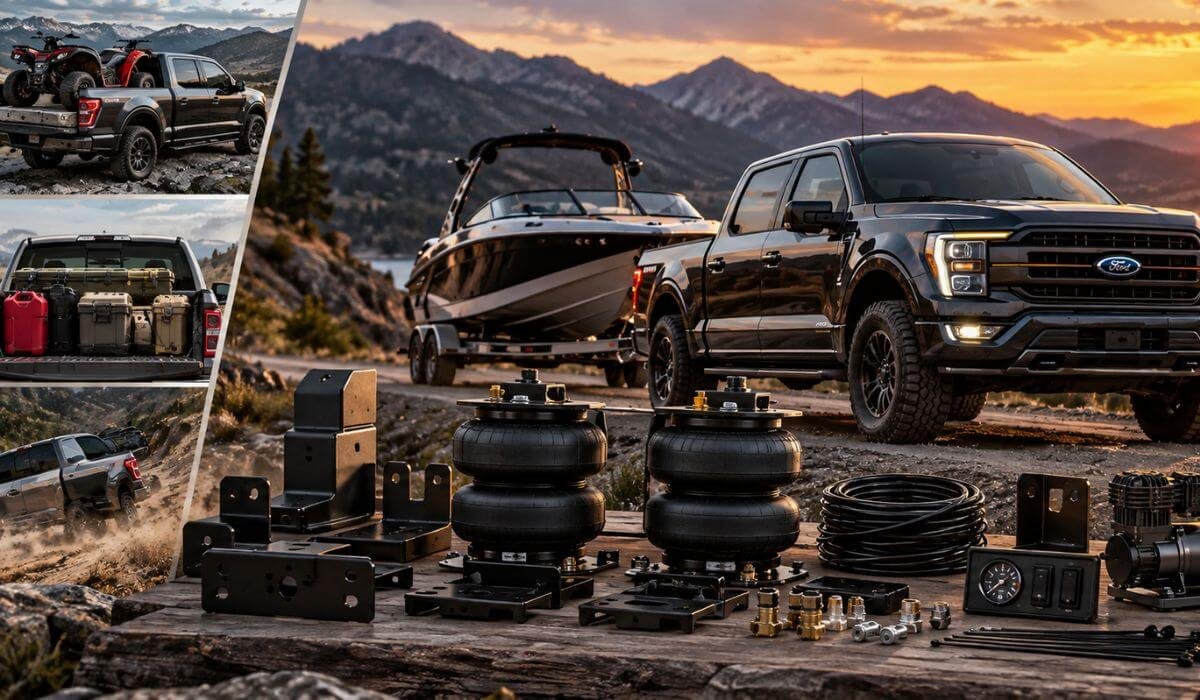
If your Ford F-150 starts sagging at the rear when towing a trailer, carrying tools, or loading the bed, a properly matched air suspension kit can bring the truck back to a more controlled, level stance without replacing the factory suspension. This roundup covers options for 2015–2026 F-150 models, including 2WD and 4WD applications where supported. The standout choice is the Firestone Airide Ride-Rite Air Suspension Kit, offering up to 5,000 lbs of stated load support, 5–100 PSI adjustment and a vehicle-specific no-drill mounting system. Most importantly, these systems support the existing suspension; they do not increase the F-150’s factory payload, GVWR or towing rating.
The comparison focuses on what actually matters after the truck is loaded: rear-sag control, pressure adjustment, towing stability, load-leveling performance, installation, clearance and exact fitment. The other kits bring different combinations of capacity, compressor convenience, coverage and value, so the right choice depends on how the F-150 is used rather than the biggest number on the specification sheet. Fitment also deserves serious attention, particularly with Raptor models, lifted trucks, aftermarket suspension components and certain factory configurations, where a kit that looks correct on paper may require a different application or additional clearance checks.
Best Ford F-150 Air Suspension Kits in 2026: Towing Support, PSI & Fitment Picks
#1. Firestone Airide Ride-Rite Air Suspension Kit
Best Ford F150 Air Suspension Kit for Towing with 5,000-Lb Load Support and 5–100 PSI Adjustment
#2. Torque Air Suspension Bag Kit
Ford F150 Air Suspension Kit for Heavy Loads with Stated 7,500-Lb Support and 5–100 PSI Pressure Control
#3. maXpeedingrods 5000 lbs Air Suspension Bags Kit
Ford F150 Rear Air Suspension Kit with 5,000-Lb Support, Multi-Ply Rubber Bags and Grade 8 Steel Brackets
#4. TORQUE Air Bag Kit w/Compressor Kit
Ford F150 Air Bag Suspension Kit with Onboard Compressor, 5,000-Lb Support and Adjustable Pressure Control
#5. DEEAGLE Air Bags Suspension Kit
Ford F150 Load-Leveling Air Suspension Kit with 5,000-Lb Support, 5–100 PSI Adjustment and Rear Sag Control
#6. MILLISEC Rear Air Suspension Kit
Ford F150 Rear Air Suspension Kit for Load Leveling with Malaysian Rubber, Nylon Construction and Approx. 8-Inch Clearance
Expert Tip
A good air-bag kit should support the F-150 under load, not make promises the truck itself cannot legally or mechanically deliver. If the truck only occasionally carries a trailer or a heavy bed load, a basic rear air-bag system can be enough. For frequent towing, an adjustable-pressure setup becomes much more useful because the truck can be kept close to level without running unnecessary pressure when unloaded.
One detail that is easy to overlook: more air pressure does not automatically mean a better ride. Start with the manufacturer’s recommended minimum and increase pressure only enough to level the truck and control the load. Also check the exact F-150 configuration before buying. A 2015–2026 fitment claim does not mean every trim, Raptor, suspension package or factory option uses the same brackets.
How We Choose These Air Suspension Kits
The shortlist was built around real-world F-150 use, not simply the number printed in a product title. Each kit was looked at for the things that actually determine whether an air-bag upgrade will be useful after installation.
Fitment comes first. The model-year range, 2WD/4WD coverage and stated vehicle compatibility were considered before anything else. A kit with impressive specifications is not a good recommendation if its brackets or mounting design do not match the truck. That is particularly important with the F-150 because configurations changed considerably across the 2015–2026 range.
Load support was the next filter. The purpose of these systems is to help the rear suspension handle additional load more confidently, so stated capacity was compared alongside the intended use. The 5,000-lb-class kits make sense for typical towing and hauling support, while the higher-capacity Torque option becomes interesting for owners who regularly work their truck harder. These figures are air-spring support ratings, not permission to exceed the F-150’s factory payload or GVWR.
Pressure adjustment also matters. A useful air suspension should allow the owner to change support according to the load. That’s why pressure range and adjustability received more attention than marketing claims about simply being “heavy duty.” The Firestone kit, for example, stands out with its 5–100 PSI operating range, giving it considerably more documented adjustment flexibility.
Installation design was another deciding factor. No-drill or bolt-on systems can save considerable time and reduce the temptation to modify the truck’s frame unnecessarily. That is one reason the Firestone option ranks so strongly, while the Torque kits gain attention for their straightforward installation approach and, in one version, an included compressor.
Long-term confidence was treated differently from headline specifications. Firestone has a much longer-established presence in vehicle air-suspension systems. The newer options can still offer compelling specifications and value, but they should not automatically be treated as equivalent simply because their product pages advertise similar capacity. Where independent long-term feedback is limited, the recommendation is based more heavily on documented fitment, hardware design, stated specifications and intended use rather than pretending there is years of owner data when there isn’t.
Finally, the list was deliberately kept to six genuinely different choices. Instead of filling the article with near-identical kits, the selection gives the reader a premium established option, higher-capacity choices, value-focused air bags, a compressor-equipped solution and a 2WD-specific alternative. That makes the ranking useful even when two readers have completely different F-150 towing and hauling needs.
The goal is simple: choose the kit that fits the truck and the job, rather than choosing the kit with the biggest number or the loudest marketing claim. That is ultimately what makes an air suspension upgrade worth the money.
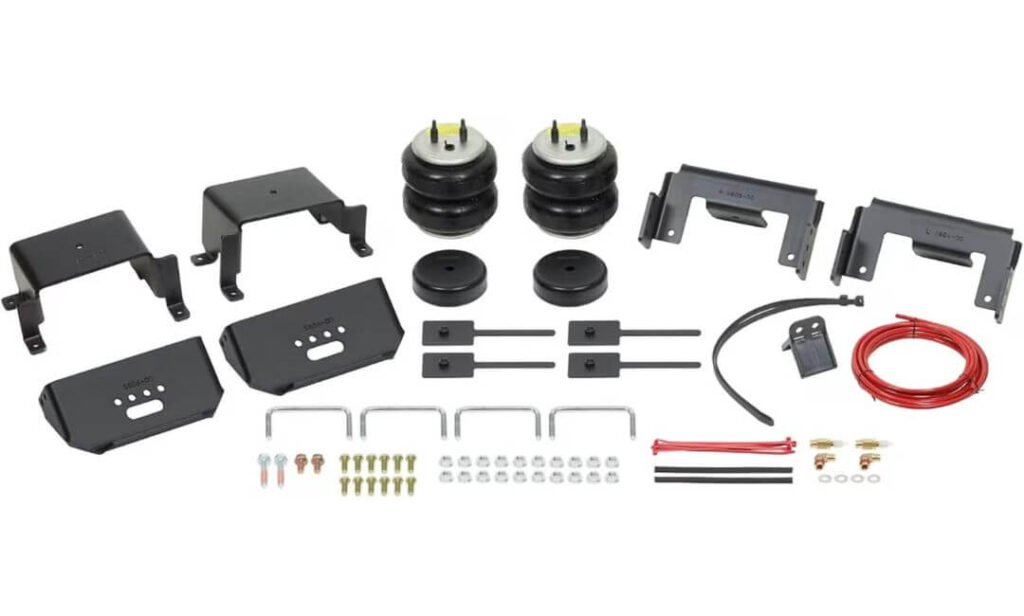
#1. Firestone Airide Ride-Rite Air Suspension Kit
Quick Specs:
- Load support: Up to 5,000 lbs for heavier bed loads and trailer tongue weight
- Pressure range: 5–100 PSI, allowing support to be adjusted according to the load
- Suspension position: Rear axle for controlling squat and restoring a more level loaded stance
- Mounting design: Vehicle-specific no-drill bracket system
- Air spring construction: Reinforced rubber bellows designed for repeated load changes
- Bracket material: Alloy steel
- Clearance needed: Approximately 8 inches between frame and tyre
- Installation package: Two air springs, mounting assembly, air lines, valves and hardware
- Best use: Frequent towing, hauling and changing between unloaded and loaded driving
- Application note: 2015–2026 F-150; excludes Raptor and certain factory-equipped configurations
- Part number: 2582
There is a big difference between adding air bags because they sound impressive on a product page and choosing a system that actually makes sense underneath an F-150. The Ride-Rite 2582 is designed around a very specific problem: the rear of a loaded truck drops as weight is added. Instead of asking the factory springs to do everything on their own, the air springs provide additional support where the load is actually affecting the truck.
What makes the setup particularly useful is the 5–100 PSI adjustment range. An F-150 carrying nothing shouldn’t be driven around with the same pressure used for a substantial trailer or bed load. The ability to adjust the bags means the support can follow the job rather than leaving the truck permanently stiff. At its rated 5,000-lb support level, it gives owners meaningful headroom for towing and hauling while still working alongside the factory suspension.
The other reason this earns the top position is that Firestone has paid attention to the parts people actually have to live with after installation. The kit includes two rear air springs, mounting hardware, air lines and valves, while the vehicle-specific bracket design is intended to avoid drilling. The reinforced bellows and alloy-steel mounting components also make more sense for an underbody component that will see road spray, dirt and repeated compression than a kit chosen purely because its marketplace listing has a large load number.
(The 5,000-lb figure describes the air-spring support capacity; it does not increase the F-150’s factory payload, GVWR or towing rating.)
What We Like
- 5–100 PSI adjustment is genuinely useful when the same F-150 spends part of the week empty and another day pulling a trailer.
- 5,000-lb support capacity puts it firmly in the serious towing and hauling category without relying on an exaggerated headline number.
- The vehicle-specific mounting system is a much cleaner approach than modifying the truck simply to make a universal kit fit.
- The complete package includes the air springs, lines, valves and mounting assembly, so the core suspension hardware is supplied together.
- Firestone’s Ride-Rite platform gives this kit an advantage for buyers who would rather choose an established suspension manufacturer than judge an unfamiliar product solely by its advertised capacity.
One Thing We’d Keep in Mind
The no-drill design is convenient, but F-150 configuration still matters. The listed application has specific exclusions, so checking the truck’s factory equipment before ordering is the smart move.
F-150 Fitment and Clearance
The kit is designed for 2015–2026 Ford F-150 rear suspension applications, including 2WD and 4WD configurations covered by the specified application. It is not intended for Raptor models, and the supplied fitment information also excludes trucks equipped with the factory scale option or self-leveling headlights. Trucks using an in-bed hitch should also be checked carefully because that configuration is listed as incompatible with this application.
The physical space around the rear suspension matters just as much as the model year. The supplied specification calls for roughly 8 inches of frame-to-tyre clearance, so that measurement is worth confirming before ordering. This is one of those details that rarely gets attention in a headline but can save a lot of unnecessary work once the truck is on the driveway.
The Insider Pro-Tip
The smartest way to set up an air-bag suspension isn’t to find the highest pressure the bags can tolerate and leave them there. Use pressure to level the truck for the actual load. Start low, add air gradually, and stop once the rear sits properly and the truck feels supported. That usually produces a much more useful result than simply chasing a bigger PSI number.
Also, treat the first installation as a setup check rather than a job that ends when the last bolt is tightened. Seat the air-line fittings properly, keep the lines clear of rubbing points, inflate the system and check for pressure loss before towing. That small bit of attention is what turns an air-bag kit from a box of parts into a suspension upgrade you can actually depend on.
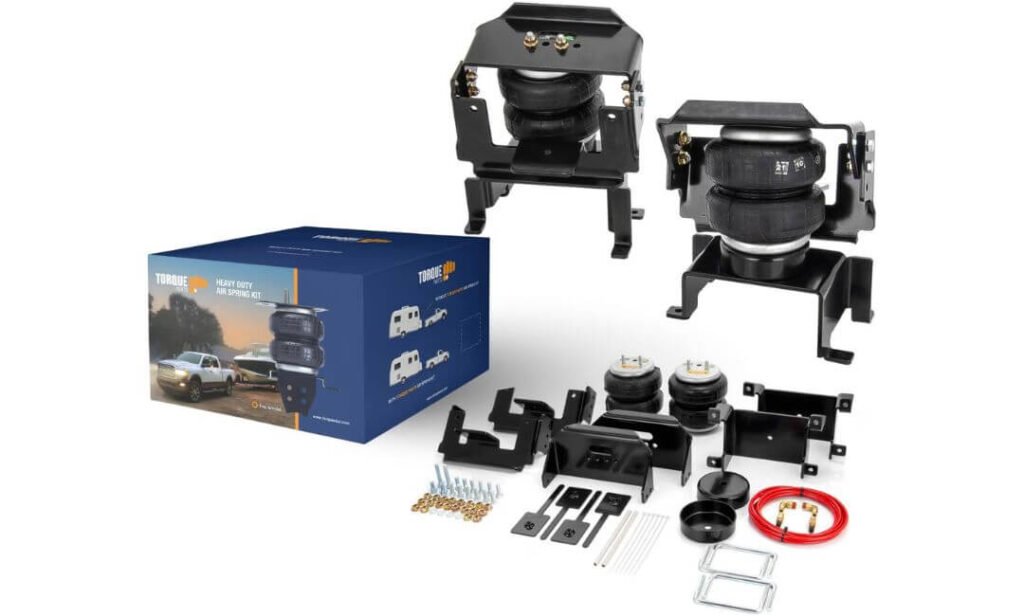
#2. Torque Air Suspension Bag Kit
Quick Specs:
- Stated load support: Up to 7,500 lbs
- Pressure adjustment: 5–100 PSI
- Application: Rear suspension
- Coverage: 2015–2026 F-150, 2WD and 4WD
- Compression protection: Internal jounce bumper built into the air springs
- Mounting: No-drill bolt-on brackets
- Purpose: Load leveling, rear-sag control and additional towing support
- Kit contents: 2 air bags, brackets, bolts, nuts, tubing, elbow fittings and inflation valves
- Installation: DIY-oriented with step-by-step instructions
- Warranty: 1 year
- Important: Lifted F-150s may require additional spacers
Some air-bag kits win you over with a familiar brand name; this one makes its case through capacity and design. With a stated 7,500-lb load-support rating and a 5–100 PSI adjustment range, it is aimed at F-150 owners who want substantial rear support when the truck is working rather than simply looking for a small suspension tweak. The important distinction is that the air pressure is adjustable, so the bags can be softened for lighter loads instead of keeping the truck unnecessarily firm all the time.
The detail that deserves more attention is the internal jounce bumper. When the suspension is heavily compressed, the bumper provides an additional layer of support before the axle makes abrupt contact with the frame. That’s particularly relevant when a loaded F-150 hits a dip or uneven section of road. It doesn’t turn the truck into a heavier-rated vehicle, but it can make the suspension feel more controlled when the rear is carrying serious weight.
Installation is another strong point. The supplied no-drill brackets, bolts, nuts, tubing, fittings and inflation valves mean the basic hardware needed for the installation comes together in one package. For an owner who is comfortable working underneath an F-150, that bolt-on approach is much more appealing than a system that requires permanent frame modification. The broad 2015–2026 2WD and 4WD coverage also makes this one of the more versatile choices in the lineup.
(The advertised 7,500-lb figure is the air-spring support rating—not an increase to the F-150’s factory GVWR, GAWR or towing limit.)
What We Like About It
- 7,500-lb stated support gives this kit a strong position for owners regularly dealing with substantial towing or hauling loads.
- The internal jounce bumper is a genuinely useful mechanical detail because it helps cushion the suspension at deep compression.
- 5–100 PSI adjustment lets the support level change with the truck’s workload.
- No-drill bolt-on mounting keeps installation straightforward and avoids drilling the F-150’s frame.
- The package includes the core mounting and inflation hardware, rather than leaving the buyer to source basic fittings separately.
One Detail Worth Knowing
If your F-150 has a lift kit, the factory suspension geometry may leave a larger gap than this application was designed around. Additional spacers can be necessary, so lifted trucks should confirm the required setup before ordering.
F-150 Application and Installation Notes
This kit is listed across 2015 through 2026 Ford F-150 models, with both 2WD and 4WD applications covered. That wide range is useful for buyers because the same basic product is not restricted to a narrow group of model years. Still, year coverage should be treated as the starting point rather than the entire fitment check, particularly if the truck has aftermarket suspension modifications.
The installation is designed around a bolt-on, no-drill approach, with the supplied brackets attaching to the truck using the included hardware. Before putting the F-150 back to work, the air lines should be properly seated and the bags checked for leaks. If the truck is lifted, the required spacer arrangement should also be confirmed before installation rather than improvising it afterwards.
The Insider Pro-Tip
The 7,500-lb rating is not a target pressure or a reason to run the bags hard. Think of the air springs as a support tool: add just enough pressure to bring the loaded F-150 back to a sensible ride height and give the rear suspension the help it needs. That approach generally makes more sense than filling the bags aggressively and accepting a harsh unloaded ride.
And there is a small piece of maintenance discipline that pays off with any air suspension: after installation, check the fittings again once the system has been pressurized and give the bags and air lines a visual inspection after the first loaded trip. A properly installed air-bag system should become something you stop thinking about—not another thing you have to worry about while towing.
#3. maXpeedingrods 5000 lbs Air Suspension Bags Kit
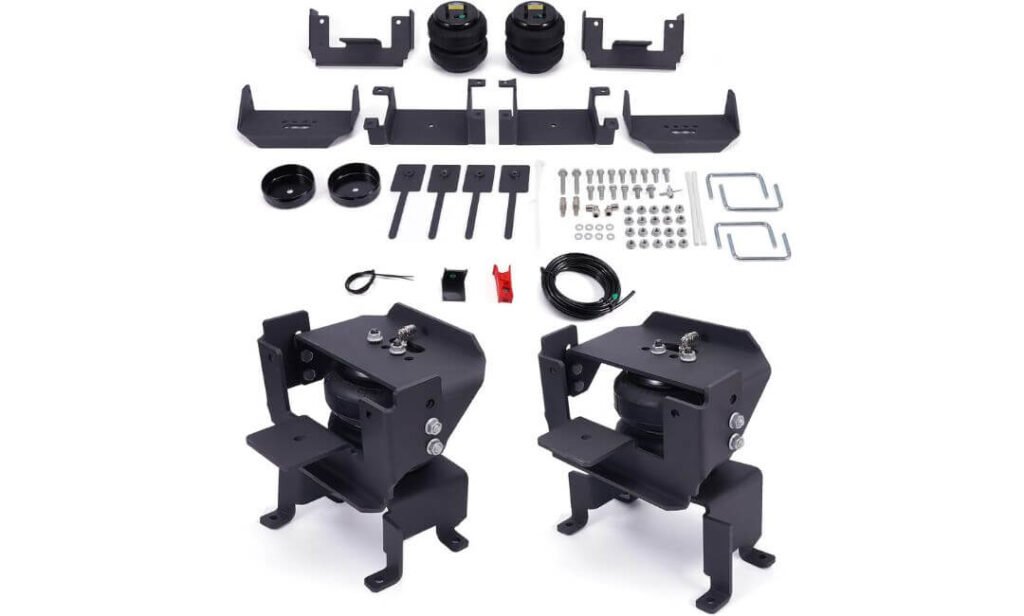
Quick Specs:
- Load-leveling capacity: Up to 5,000 lbs of air-spring support
- Pressure adjustment: 5–100 PSI according to load and driving conditions
- Air-spring material: Multi-ply natural rubber, approximately 4–4.5 mm thick
- Rear coverage: Left and right rear positions
- Suspension travel: 130 mm stroke, 70 mm compressed and 200 mm extended
- Hardware: Grade 8 steel mounting brackets
- Durability testing: Claimed 5,000,000+ compression-cycle testing
- Temperature range: -40°C to 70°C
- Fitment: 2015–2026 F-150 2WD and 4WD
- Exclusions: Raptor, FX2 and F-150s with in-bed hitches
- Included: 2 air bags, 6 mounting brackets and installation hardware
- Air supply: Separate compressor or inflation source required
Value doesn’t mean much if the parts underneath the truck are the first thing to compromise. That is why the multi-ply natural-rubber construction is one of the more meaningful details here. The listed 4–4.5 mm rubber thickness, combined with the multi-ply design, is intended to give the bags better resistance to repeated flexing while maintaining an airtight seal. For an F-150 that regularly changes between an empty bed and a loaded one, that repeated movement is exactly what the air springs have to deal with.
The 5–100 PSI adjustment range gives this setup a useful amount of flexibility. At the lower end, the bags can provide modest assistance without making an unloaded truck unnecessarily firm; with heavier cargo or trailer weight, pressure can be increased to bring the rear back under control. The stated 5,000-lb load-leveling capability is substantial enough for serious hauling support, while features such as the 130 mm stroke and 200 mm maximum extension show that this is more than a generic rubber bag with a bracket attached to it.
Another detail worth appreciating is the hardware. The package includes six mounting brackets and installation hardware, with Grade 8 steel brackets specified for the mounting system. There is no compressor in the box, so this is best viewed as a proper air-spring foundation that you can pair with your preferred inflation setup. That actually makes sense for an owner who already has onboard air or wants to choose their own compressor rather than paying for a bundled system they may not need.
(The stated 5,000-lb figure is the air-spring load-support capability and does not change the F-150’s factory payload, GVWR or axle ratings.)
What We Like About It
- Multi-ply natural rubber construction gives the bags a more convincing durability story than a generic single-material air spring.
- The 5–100 PSI range makes it practical for both light-duty daily driving and heavier towing or hauling.
- Grade 8 steel brackets provide a solid foundation for the rear installation.
- The 130 mm stroke offers useful suspension movement rather than treating the air bag as a simple load prop.
- The kit covers 2015–2026 2WD and 4WD F-150s, giving it broad appeal while still clearly identifying its exclusions.
One Detail We’d Check
There is no compressor included, so make sure you already have an inflation method or budget for one. That’s not necessarily a drawback—it gives the buyer freedom to choose a manual fill setup or onboard compressor—but it is something worth knowing before ordering.
F-150 Fitment and Configuration Check
The application covers 2015–2026 Ford F-150 2WD and 4WD models. However, the supplied fitment specifically excludes Raptor and FX2 models, as well as trucks equipped with an in-bed hitch. Those exclusions are important enough to check before purchase rather than assuming every F-150 from these years uses the same mounting arrangement.
The kit works at the rear left and rear right positions, with the supplied brackets and hardware designed for a bolt-on installation. If the truck has aftermarket suspension modifications, it is sensible to compare the current ride height and available mounting space with the kit’s dimensions before starting the installation.
The Insider Pro-Tip
This is one of those kits where the 5–100 PSI range should be treated as a tuning tool, not a bragging number. Set the pressure with the truck actually carrying its normal load, then adjust until the rear suspension is properly supported. The goal isn’t to make the F-150 feel like it is riding on inflated balloons; the goal is to give the factory suspension the extra help it needs when the load changes.
One other thing is worth planning before the kit arrives: decide how you want to inflate it. If the truck only tows occasionally, a straightforward inflation setup can be perfectly practical. If you’re changing loads regularly, an onboard compressor becomes much more convenient. Choosing that part around your real usage will make this kit far more satisfying than simply installing the bags and forgetting about how you’ll manage pressure later.
#4. TORQUE Air Bag Kit w/Compressor Kit
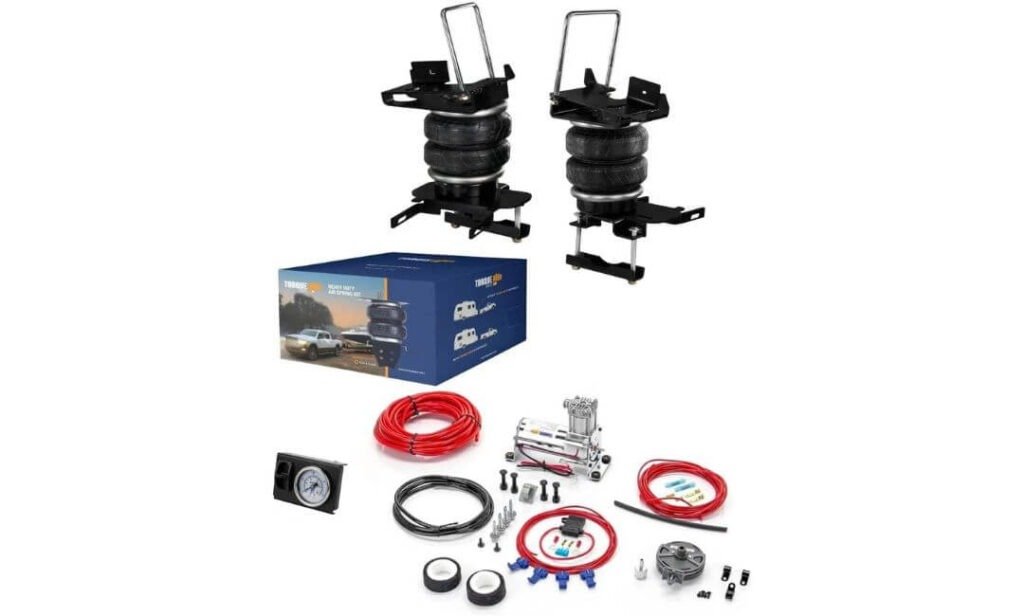
Quick Specs:
- Application: Rear air-bag suspension with onboard compressor
- Vehicle coverage: 2021–2026 F-150, 2WD and 4WD
- Load support: Up to 5,000 lbs
- Air management: Onboard air compressor included
- Mounting: No-drill, bolt-on installation
- Suspension benefit: Adjustable support for towing, hauling and rear-sag control
- Replacement reference: Designed as a replacement for Air Lift LoadLifter 5000 57355
- Included: 2 air bags, compressor, brackets, air lines, valves, fittings and installation hardware
- Installation: DIY-oriented with step-by-step instructions
- Warranty: 1-year unlimited warranty
- Best suited to: 2021–2026 F-150 owners who regularly change loads and want pressure control without buying a separate compressor
For someone who uses an F-150 for both normal driving and towing, the most annoying part of air bags isn’t installing them—it’s managing the pressure afterwards. A load changes, the desired support changes, and suddenly a system that looked simple on paper needs an external compressor or a trip to a petrol station. This package takes that extra decision away by putting an onboard air compressor in the box with the rear air-bag system.
The underlying suspension setup is designed to provide up to 5,000 lbs of load support, helping compensate for rear-end squat when a trailer or heavy cargo is added. The adjustable air support also means the F-150 doesn’t have to be left at one unnecessarily high pressure when it’s empty. That matters because a properly tuned air spring should complement the factory suspension, not make an unloaded pickup feel unnecessarily stiff.
The other practical advantage is the no-drill bolt-on installation. The package includes the two air bags, mounting brackets, compressor, inflation hardware, tubing and fittings, so the buyer isn’t starting with bags and then building the rest of the system separately. It is listed as a direct replacement for the Air Lift LoadLifter 5000 57355, although that should be understood as a product-reference claim rather than proof that every truck configuration is identical.
(This is a newer product, so the all-in-one design is particularly attractive, but its long-term owner history is naturally shorter than that of established air-suspension platforms.)
What We Like About It
- Onboard compressor included is the biggest advantage here—it turns pressure adjustment into part of the system rather than another purchase.
- 5,000-lb stated support gives the 2021–2026 F-150 meaningful assistance for towing and hauling.
- No-drill bolt-on brackets make the installation approach much more approachable for DIY owners.
- The package is genuinely comprehensive, including bags, compressor, brackets, tubing, fittings, valves and hardware.
- 2021–2026 2WD/4WD coverage makes it a focused choice for owners of the newer-generation F-150.
One Detail We’d Keep in Perspective
This kit is newer than the established systems in the roundup, so there simply isn’t the same amount of long-term real-world history behind it. That doesn’t make it a bad choice; it just means the strongest reason to buy it is the complete compressor-equipped package and convenience, rather than pretending it already has years of durability evidence.
F-150 Fitment and Setup
This application is specifically for 2021–2026 Ford F-150 models, with both 2WD and 4WD coverage stated. It should not be treated as a universal F-150 air-bag kit—the 2021–2026 limitation is important, particularly for owners of 2015–2020 trucks who may be looking at similar-looking suspension hardware.
Because the compressor is part of the package, installation involves more than simply mounting the two rear bags. The air lines, fittings and compressor placement need to be installed carefully, with the lines kept away from heat, sharp edges and moving suspension components. Once everything is connected, pressure should be checked before the truck is put under a serious towing load.
The Insider Pro-Tip
The real advantage of the compressor isn’t simply that it is included; it’s that it makes correct pressure management practical. If the F-150 goes from empty to towing a trailer regularly, being able to add or reduce air when the load changes is far more useful than setting one pressure and forgetting it. Start conservatively and adjust until the truck sits level and feels properly supported.
And because this is a relatively new product, be a little more deliberate during the first few weeks of ownership. Check the compressor connections, fittings and air lines after the initial installation and again after the first few loaded drives. That’s not because the system should be expected to fail—it’s simply good practice with any newly installed air-management hardware, especially when the compressor and suspension are being introduced together.
#5. DEEAGLE Air Bags Suspension Kit
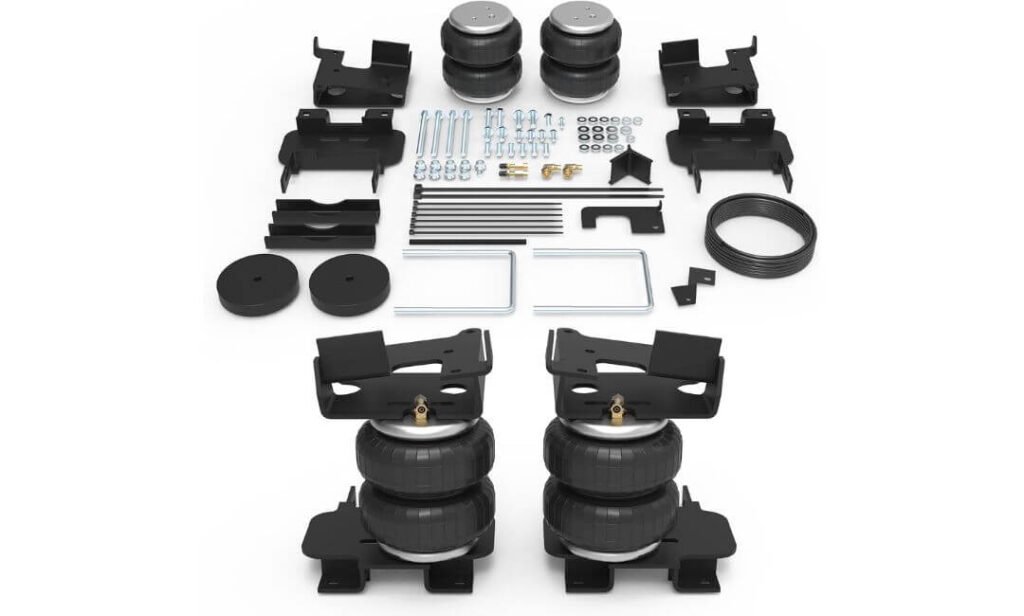
Quick Specs:
- Load-leveling support: Up to 5,000 lbs
- Pressure adjustment: 5–100 PSI
- Application: Rear air-bag suspension
- Model coverage: 2021–2026 F-150, 2WD and 4WD
- Leveling control: Front-to-rear and side-to-side adjustment
- Mounting: Pre-drilled, no-drill installation design
- Ride benefit: Helps control rear squat, impacts and vibration under load
- Installation package: Labeled components with installation instructions
- Fitment exclusions: Raptor and PowerBoost models
- Best suited to: Stock or minimally modified F-150s used for towing and hauling
- Important: Heavily lifted trucks may require additional fitment verification
A loaded F-150 doesn’t always need a completely different suspension setup; sometimes it simply needs controlled support at the rear when the workload changes. That’s where this kit is aimed. Its 5,000-lb load-leveling capability gives the rear suspension additional assistance when cargo or trailer weight pushes the truck down, while the 5–100 PSI range lets the driver tailor that support instead of treating every load the same.
The more interesting part is the ability to fine-tune the truck’s front-to-rear and side-to-side balance through air pressure. That’s useful when a trailer isn’t perfectly balanced or the bed carries an uneven load. Rather than relying solely on the factory springs, the air bags can be adjusted to help bring the truck back towards a more controlled stance and reduce the harsh impacts that can occur when the rear suspension becomes heavily compressed.
Installation has also been kept relatively straightforward. The pre-drilled mounting arrangement eliminates the need for additional frame drilling, while the supplied labeled parts and instructions make it easier to identify the hardware during assembly. For a stock F-150 owner who wants additional towing and hauling support without turning the suspension into a complicated project, that’s a sensible combination.
(The 5,000-lb figure represents the stated air-spring support capability and does not increase the F-150’s factory payload or GVWR.)
What We Like
- 5–100 PSI adjustment gives useful control over how much support the F-150 receives as the load changes.
- 5,000-lb stated capacity makes it suitable for meaningful towing and hauling assistance.
- The ability to address front-to-rear and side-to-side leveling is particularly useful when loads aren’t perfectly distributed.
- Pre-drilled, no-drill mounting keeps the installation approach relatively uncomplicated.
- Labeled parts and supplied instructions are small details, but they can make a difference when installing suspension components underneath a truck.
One Detail We’d Keep in Mind
This is a much better match for a stock or lightly modified F-150. The supplied information specifically excludes Raptor and PowerBoost models, while heavily lifted trucks can require additional spacing or fitment considerations.
F-150 Fitment and Installation
The stated application covers 2021–2026 Ford F-150 2WD and 4WD models. However, this isn’t a blanket “every F-150” fitment: Raptor and PowerBoost models are excluded, and trucks with substantial aftermarket suspension changes should be checked separately before ordering.
For a standard-height truck, the pre-drilled mounting design is intended to keep installation simple, but the job still involves safely creating enough working room between the frame and axle. Having the correct jack/support equipment and enough workspace matters here. If the F-150 has a significant lift, don’t assume the factory configuration will transfer directly to the modified suspension geometry.
The Insider Pro-Tip
The best way to judge an air-bag system is after the truck is actually loaded, not while it is sitting empty in the driveway. Once the trailer or cargo is connected, add air gradually until the F-150 regains a sensible stance and feels properly supported. If you have an uneven bed load, the adjustable air support can also help compensate for that imbalance rather than simply increasing pressure equally and hoping for the best.
One final bit of real-world advice: don’t rush the installation just because the brackets are pre-drilled. Suspension work is one of those jobs where a few extra minutes spent supporting the truck correctly and routing the air lines cleanly can save much more time later. Get the mechanical fit right first, then tune the pressure—the result will feel far better than trying to solve an installation issue with more air.
#6. MILLISEC Rear Air Suspension Kit
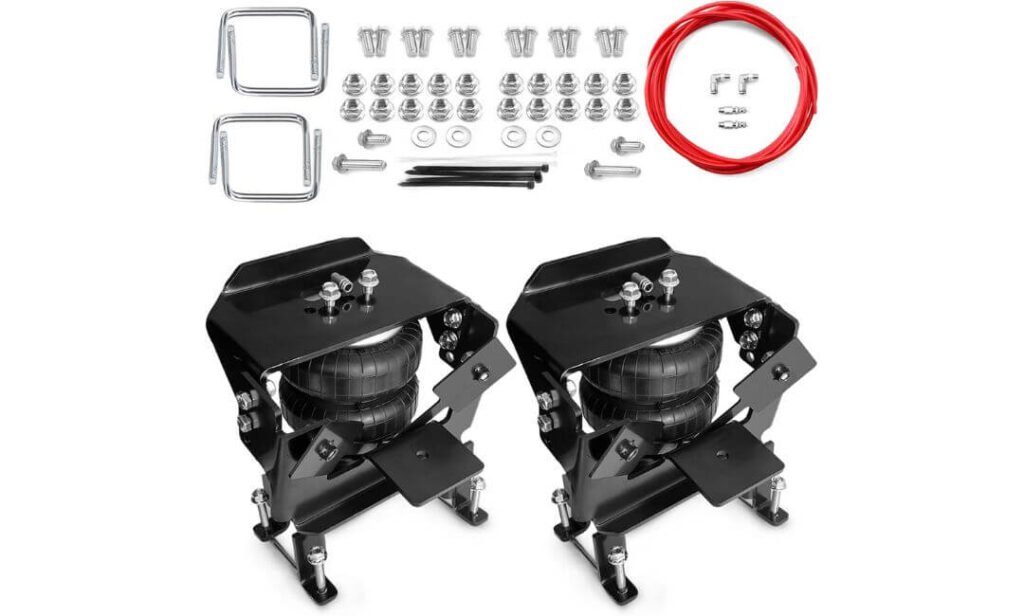
Quick Specs:
- Rear support: Air-spring assistance for the F-150 rear axle
- Construction: High-density nylon with Malaysian rubber air-spring material
- Fitment: 2015–2025 F-150 applications; supplied listing specifies 2WD and also references 4WD fitment
- Ride-height control: Air-pressure-based load leveling
- Clearance requirement: Approximately 8 inches from frame to tyre
- Replacement reference: Firestone 2582 / W21-760-2582
- Main purpose: Rear-sag reduction, load support and improved shock absorption
- Included: Rear air springs and installation guide
- Warranty: 365 days
- Fitment exclusions: Raptor and trucks with self-leveling headlights or factory scale option
Not every F-150 owner needs a compressor-equipped system or the biggest advertised capacity. Sometimes the requirement is much simpler: give the rear suspension additional air support when the truck is carrying weight and keep the ride more composed. That’s the space this MILLISEC kit occupies. Its air springs use the elasticity of rubber together with compressed air to provide additional support, helping the truck maintain a more controlled stance as the load changes.
The construction is worth looking at beyond the brand name. The bags use high-density nylon and Malaysian rubber, with the manufacturer positioning the combination around durability and repeated suspension movement. The kit is also listed as a replacement for Firestone 2582 / W21-760-2582, which gives buyers a useful reference point when comparing the mounting application and intended design rather than judging it from a generic “air suspension” description.
What makes this particularly relevant to older F-150s is its 2015–2025 coverage. If the truck has spent years towing or carrying loads, adding air assistance can help take some of the workload away from a suspension that may already have seen plenty of use. Of course, air bags are not a cure for worn shocks, damaged springs or overloaded axles, so the existing suspension should be in sound condition before adding them.
(The supplied listing contains both 2WD and 4WD references, so verify the exact drivetrain and configuration before ordering.)
What We Like
- High-density nylon and Malaysian rubber construction gives the air springs a more substantial material specification than a basic generic listing.
- The Firestone 2582 replacement reference makes it easier to understand the intended application.
- 8-inch frame-to-tyre clearance is clearly stated, giving buyers an important physical fitment check before installation.
- The 365-day warranty provides useful coverage for a relatively value-focused kit.
- Its straightforward design makes sense for owners who want rear load support without paying for features they may never use.
One Detail We’d Check
The product information gives mixed drivetrain wording, with the main listing and fitment details referring to both 2WD and 4WD applications. Because suspension brackets are vehicle-specific, confirm the exact F-150 drivetrain and configuration before purchasing rather than relying only on the general year range.
F-150 Fitment and Installation Notes
The supplied application covers 2015–2025 Ford F-150 models, with the listing referencing both 2WD and 4WD versions while excluding Raptor models. Trucks equipped with self-leveling headlights or the factory scale option are also listed as incompatible. The approximately 8-inch frame-to-tyre clearance requirement is another important check, particularly on trucks with altered ride height.
The package is relatively straightforward, containing the rear air springs and an installation guide. Because this is suspension hardware, the F-150 needs to be securely supported and enough room must be created around the axle during installation. If other suspension components are already worn, fixing those issues first is the better route; air bags are designed to assist the existing suspension, not replace a damaged suspension system.
The Insider Pro-Tip
The smartest reason to choose this kit is not the replacement number or the material list—it’s whether the simple air-spring approach matches how you actually use the F-150. If the truck regularly changes from an empty bed to a loaded one, adjustable air support can be much more useful than a permanently stiff helper spring because the amount of assistance can change with the workload.
Before ordering, measure the truck rather than assuming the year alone guarantees a fit. That 8-inch clearance requirement is worth physically checking, especially if the F-150 has non-stock wheels, tyres or suspension components. A two-minute measurement before purchase is the kind of small step that makes the installation far more predictable once the kit is in your hands.
Best Ford F-150 Air Suspension Kits (2015–2026) Compared for Towing and Load Control
| Air Suspension Kit | Load Support | Pressure Control | F-150 Coverage | Installation | Standout Advantage | Best Fit For |
|---|---|---|---|---|---|---|
|
Firestone Airide Ride-Rite 2582
Established air-suspension option with vehicle-specific mounting
|
5,000 lbs Rear load support | 5–100 PSI Wide adjustment range | 2015–2026 2WD / 4WD; configuration exclusions apply | No-drill design Vehicle-specific brackets | Established platform Reinforced bellows + alloy-steel hardware | Frequent towing & hauling For buyers prioritising established engineering |
|
TORQUE Air Suspension Bag Kit
High-capacity option with internal compression protection
|
Up to 7,500 lbs Stated air-spring support | 5–100 PSI Adjustable by load | 2015–2026 2WD / 4WD | No-drill bolt-on Brackets and hardware included | Internal jounce bumper Helps cushion deep compression | Heavy towing & hauling For owners wanting higher stated support |
|
maXpeedingrods 5000 lbs Air Suspension Bags Kit
Multi-ply natural-rubber air springs with broad model coverage
|
5,000 lbs Load-leveling capability | 5–100 PSI Adjustable support | 2015–2026 2WD / 4WD; Raptor & FX2 excluded | Bolt-on No welding; hardware supplied | Multi-ply rubber Approx. 4–4.5 mm listed thickness | Value-focused towing Owners wanting broad fitment and adjustable support |
|
TORQUE Air Bag Kit with Compressor
Complete air-bag package with onboard air management
|
5,000 lbs Stated support capacity | Adjustable Onboard compressor included | 2021–2026 2WD / 4WD | No-drill bolt-on Complete mounting hardware | Compressor included No separate compressor purchase required | Frequent load changes For owners who want convenient pressure adjustment |
|
DEEAGLE Air Bags Suspension Kit
Newer-F-150-focused option with adjustable leveling support
|
5,000 lbs Load-leveling capability | 5–100 PSI Front-to-rear & side-to-side tuning | 2021–2026 2WD / 4WD; Raptor & PowerBoost excluded | Pre-drilled Labeled parts and supplied instructions | Fine leveling control Useful for uneven cargo distribution | Stock or lightly modified F-150 Towing and hauling support |
|
MILLISEC Rear Air Suspension Kit
Straightforward air-spring option with broad stated application
|
Load leveling Capacity figure not clearly stated in supplied listing | Air-pressure based Adjustable support | 2015–2025 Verify exact drivetrain/configuration | DIY-oriented Installation guide included | Nylon + Malaysian rubber Firestone 2582 replacement reference | Simple rear support For owners seeking a straightforward setup |
Buying Guide: How to Choose the Right Air Suspension Kit for Your Ford F-150
An air-bag system can be one of the more useful suspension upgrades for an F-150 that regularly changes between empty driving, towing and bed loads, but the best kit isn’t automatically the one with the biggest capacity number. The right choice comes down to how much weight the truck actually carries, how often the load changes, how much adjustment you want, and whether the kit genuinely fits the truck sitting in your driveway.
Start With the Load You Actually Carry
The first number to look at is air-spring support capacity, but don’t confuse that figure with the F-150’s legal payload rating. A 5,000-lb or 7,500-lb air-bag rating does not give the truck permission to carry another 5,000 or 7,500 lbs.
Think of the air springs as additional support for the existing suspension. If a trailer or cargo causes the rear of the truck to squat, the bags help carry some of that load and bring the suspension back towards a sensible ride height.
Before buying, check:
- Your F-150’s factory payload rating
- Rear axle and tire ratings
- Trailer tongue weight
- Typical bed load
- Whether the truck is loaded occasionally or almost every week
- Whether the load is evenly distributed
- The manufacturer’s recommended air pressure for your application
That makes the capacity number much easier to interpret. A higher-rated bag can be useful for demanding work, but higher capacity alone does not make a kit better for every F-150.
Understand the 5–100 PSI Range Before Chasing PSI
A range such as 5–100 PSI tells you how much adjustment the air spring provides; it does not mean the truck should normally be operated at 100 PSI.
For an unloaded F-150, excessive pressure can make the rear suspension feel unnecessarily firm. Once a trailer or heavy cargo is added, additional pressure can be used to restore the truck’s stance and give the rear suspension more support.
A practical way to think about it is:
| Driving situation | What the air bags should accomplish |
|---|---|
| Empty F-150 | Provide only the minimum required support |
| Moderate bed load | Reduce rear compression and maintain a controlled stance |
| Heavy cargo | Add enough pressure to prevent excessive squat |
| Trailer connected | Compensate for tongue weight and maintain sensible ride height |
| Uneven load | Use pressure carefully to improve overall balance |
The goal is correct support, not maximum pressure. Always remain within the F-150’s factory weight ratings and the air-spring manufacturer’s pressure recommendations.
Look at Towing Behaviour, Not Just Ride Height
A truck that sits level isn’t automatically a truck that tows well. When the rear suspension compresses excessively, the change in stance can affect steering feel, braking behaviour, suspension travel and overall confidence behind the wheel.
This is where air helper springs become useful. They add progressive support as air pressure increases, helping the rear suspension deal with the additional load. That can make a loaded F-150 feel more settled and can help reduce the exaggerated movement associated with a heavily compressed rear suspension.
However, air bags aren’t a substitute for proper trailer setup. Trailer weight distribution, tongue weight, tire pressure, hitch setup and loading technique still matter. If a trailer is badly balanced, adding air pressure isn’t going to fix the underlying problem.
For frequent towing, pay particular attention to:
- Rear-sag control
- Adjustable pressure
- Suspension travel
- Trailer stability
- Braking feel under load
- Steering confidence
- Whether the system can be adjusted easily between towing and unloaded driving
Find the Balance Between Comfort and Load Support
This is where many buyers make the wrong decision.
An air spring that is extremely firm can keep the rear of the truck high, but that doesn’t necessarily mean it will produce the best everyday ride. An F-150 that spends most of its time empty needs a different setup from one that spends most of its life carrying a trailer.
More support and more comfort are not always the same thing.
A sensible setup allows the factory suspension to continue doing its job while the air springs provide extra assistance when the load demands it. That is why adjustable pressure is so valuable: the suspension can be tuned for the truck’s current workload instead of being permanently stiff.
If the F-150 is mainly a daily driver with occasional towing, prioritise adjustability and sensible minimum pressure. If it regularly carries substantial loads, stronger load support and convenient pressure management become more important.
Check the Installation Before Ordering
“No-drill” sounds simple, but it shouldn’t be interpreted as “no installation work required.” These are suspension components, so the truck still has to be safely supported, the bags and brackets positioned correctly, and the air lines routed away from moving or hot components.
A good F-150 air suspension installation should account for:
- Correct vehicle-specific brackets
- Frame and axle clearance
- Tire clearance
- Air-line routing
- Proper fitting connections
- Suspension movement through its travel
- Safe lifting and support of the truck
- Correct compressor or inflation arrangement
The kits in this roundup take different approaches. Some use no-drill bolt-on brackets, while one option includes an onboard compressor. That difference matters if you’re installing the system yourself.
If you’re comfortable with brakes, suspension or under-truck mechanical work, a bolt-on system may be a realistic DIY project. If you’re not comfortable safely supporting the truck and working around the rear axle, professional installation is money better spent than improvising underneath a loaded pickup.
Don’t Assume Every 2015–2026 F-150 Is the Same
This is probably the most important fitment lesson in the entire article.
Seeing 2015–2026 F-150 in a product title does not mean every truck from those years is guaranteed to accept that particular kit. The roundup itself shows why. Some applications cover 2WD and 4WD, while others have more specific exclusions.
Depending on the kit, you may need to check:
- Model year
- 2WD or 4WD
- Raptor status
- FX2 configuration
- PowerBoost hybrid configuration
- Factory scale option
- Self-leveling headlights
- In-bed hitch equipment
- Frame-to-tire clearance
- Lifted or modified suspension
For example, the Firestone application specifies approximately 8 inches of frame-to-tire clearance and excludes certain factory configurations. The maXpeedingrods application also excludes Raptor, FX2 and trucks with in-bed hitches, while the DEEAGLE option excludes Raptor and PowerBoost.
That is why the safest approach is to match the exact truck configuration, not simply search by “F-150 air bags” and assume the first result fits.
Consider Your F-150’s Suspension Modifications
A factory-height truck is generally the easiest starting point.
Once a truck has a substantial lift, aftermarket control arms, unusual wheel-and-tire combinations or other suspension changes, the original mounting geometry may no longer be the same. A bag can physically fit the truck and still have an unsuitable amount of extension, compression or clearance.
If your F-150 is lifted, check:
- Current ride height
- Frame-to-axle distance
- Tire clearance
- Air-bag compressed and extended dimensions
- Bracket position
- Whether spacers are required
- Whether the manufacturer specifically supports that modification
This matters particularly for the higher-lift applications mentioned in the product information. Don’t use a spacer or modification simply because it makes the bag reach the mounting point. The final setup needs adequate clearance throughout the suspension’s movement.
Decide Whether You Need a Compressor
Not every F-150 owner needs an onboard compressor.
If the truck only occasionally carries a heavy load, manual inflation valves can be perfectly reasonable. But if the truck changes from empty to loaded several times a week, a compressor becomes much more convenient because pressure can be changed without hunting for an external air source.
The difference is simple:
Manual inflation: lower complexity, useful for occasional load changes.
Onboard compressor: easier pressure adjustment, better suited to frequent towing and changing loads.
That’s why the compressor-equipped TORQUE package has a different appeal from the standalone air-bag kits. You’re paying for convenience and integrated air management, not simply another pair of bags.
Pay Attention to What Is Actually Included
Two products can both be called an “air suspension kit” while giving the buyer very different packages.
Before ordering, check whether the box contains:
- Two rear air springs
- Mounting brackets
- Bolts and nuts
- Air lines
- Inflation valves
- Elbow fittings
- Installation instructions
- Compressor or air-management equipment
This is particularly important when comparing prices. A cheaper-looking kit can become less attractive if you have to purchase the compressor, fittings or other installation hardware separately.
Durability Is More Than a Rubber Thickness Number
Air bags live underneath the truck, where they encounter water, dirt, road salt, heat and constant movement. Material quality therefore deserves more attention than a generic “heavy duty” label.
Useful construction details include:
- Multi-ply rubber construction
- Reinforced bellows
- Corrosion-resistant mounting hardware
- Strong bracket material
- Properly protected air fittings
- Resistance to repeated compression
- Manufacturer warranty and support
The maXpeedingrods option, for example, specifies multi-ply natural rubber and approximately 4–4.5 mm thickness, while the Firestone kit uses reinforced rubber air springs with alloy-steel mounting hardware. Those are more useful details than simply calling a bag “premium.”
At the same time, don’t treat a manufacturer’s laboratory claim as the same thing as years of independent ownership. Construction specifications tell you what the product is designed to withstand; real-world longevity depends on installation, loading, environment and maintenance too.
Warranty and After-Sales Support Matter More Than They Look
An air suspension kit has several points where support can become important: fittings, air lines, brackets, mounting hardware and the air springs themselves.
A manufacturer offering a clear warranty and responsive support gives the buyer another layer of confidence, particularly with newer products that have less long-term owner history.
Look for:
- Clearly stated warranty period
- Accessible manufacturer support
- Replacement-part availability
- Clear installation documentation
- Vehicle-specific fitment information
For this particular roundup, that distinction matters because not every brand has the same depth of established market history. A newer kit can still be a very good value, but it should be judged on what is actually documented rather than assumed to have the same long-term track record as a long-established suspension manufacturer.
Air Bag Suspension vs Air Helper Springs vs Complete Suspension Kit
These terms are often used interchangeably, but they can mean slightly different things.
| Term | What it generally means | What an F-150 owner should expect |
|---|---|---|
| Air bag suspension | Air springs used to add or provide suspension support | Adjustable support through air pressure |
| Air helper springs | Air springs added alongside the factory suspension | Extra assistance for towing and hauling |
| Air suspension kit | A packaged system containing the bags plus mounting/inflation components | Usually the easiest way to buy a complete setup |
| Load leveling | Using air pressure to help restore ride height under load | Less rear squat and a more controlled stance |
| Rear sag control | Reducing excessive rear suspension compression | Better loaded stance and suspension support |
For the products covered here, the important distinction is that these are primarily load-support systems for the F-150, not a replacement for every component of the factory suspension.
The Bottom Line When Choosing
If established manufacturer experience is your priority, the Firestone option has the strongest argument. If you care most about higher stated load support, the 7,500-lb-rated TORQUE kit deserves attention. For a broad fitment range and a value-focused package, maXpeedingrods is compelling. If you own a newer F-150 and want integrated compressor convenience, the compressor-equipped TORQUE kit solves a different problem. DEEAGLE and MILLISEC make more sense when their specific fitment and straightforward air-support approach match your truck.
The best purchase is ultimately the one that matches your F-150’s exact configuration, actual workload and willingness to manage air pressure. Once those three things line up, the choice becomes much easier—and you don’t have to pay for capacity or features your truck will never actually use.
How Each F-150 Air Bag Kit Stacks Up for Real-World Towing and Hauling
There is no single winner in every category here. A kit that makes the most sense for a frequently loaded work truck may not be the most convenient choice for someone who tows twice a month. The useful comparison is therefore what each system does particularly well, and where its design makes the most sense for an F-150 owner.
Towing Stability and Load Behaviour
Air bags help by giving the rear suspension additional support as trailer tongue weight or bed cargo compresses the factory springs. That can improve the truck’s loaded stance and reduce excessive suspension movement, but it is important to separate suspension support from actual trailer sway control. Air bags cannot correct an improperly loaded trailer or replace a suitable hitch setup.
For the six kits in this roundup, the practical differences look like this:
- Firestone Ride-Rite 2582: The strongest all-around choice for owners who want an established system with a broad 5–100 PSI adjustment range and documented 5,000-lb support.
- TORQUE 7,500-lb kit: The standout when the priority is higher stated load-support capacity, with an internal jounce bumper adding support during deep compression.
- maXpeedingrods 5,000-lb kit: A strong value-oriented option, particularly for owners wanting adjustable support across a broad 2015–2026 application range.
- TORQUE with compressor: Particularly attractive for frequent towing because pressure can be adjusted using the included onboard compressor rather than relying on an external air source.
- DEEAGLE: Its front-to-rear and side-to-side pressure adjustment makes it interesting for loads that are not perfectly balanced.
- MILLISEC: More of a straightforward rear-support solution for owners who want air-assisted load leveling without a compressor-equipped package.
The key point is that none of these systems increases the factory towing or payload rating of the F-150. Their job is to help the existing suspension deal with a load more effectively.
Which Kits Make the Most of 100 PSI?
A 100 PSI maximum is useful because it provides plenty of adjustment headroom, but it shouldn’t be treated as a performance score by itself.
The Firestone, TORQUE 7,500-lb and maXpeedingrods kits are all listed with a 5–100 PSI range. DEEAGLE also provides the same stated range. That gives these systems considerable flexibility when moving between a lightly loaded truck and heavier towing or hauling.
The more important question is how you use that range.
Running maximum pressure all the time can make an unloaded F-150 feel unnecessarily firm. The useful setup is to add enough air to support the actual load and restore a sensible stance. If you’re looking for a kit specifically because you regularly change between empty driving and heavy towing, broad pressure adjustment is much more valuable than simply seeing “100 PSI” printed on the product page.
The compressor-equipped TORQUE version deserves separate mention here. Its advantage isn’t necessarily a unique pressure ceiling; it’s that pressure adjustment becomes much more convenient because the compressor is supplied with the kit.
Rear Sag Control
This is the area where all six products have the same fundamental purpose.
When a trailer or heavy bed load pushes the rear of the F-150 downward, the air springs add support to help bring the truck closer to its unloaded ride height. That can help maintain suspension travel and reduce the exaggerated squat that makes a loaded pickup feel different from the same truck when empty.
For maximum stated support, the TORQUE 7,500-lb kit leads this group.
For a well-established 5,000-lb solution, Firestone is the stronger choice.
For 5,000-lb support with broad model coverage and value, maXpeedingrods is compelling.
For a newer F-150 where convenient pressure adjustment matters, the compressor-equipped TORQUE system has a practical advantage.
DEEAGLE’s ability to fine-tune pressure for front-to-rear and side-to-side balance is useful when the load isn’t perfectly distributed, while MILLISEC is aimed more toward straightforward rear load assistance.
Again, the air bags should be viewed as load support, not as a replacement for worn factory springs, shocks or other damaged suspension components.
Installation: What the Owner Is Actually Signing Up For
The phrase “easy installation” can be misleading with suspension products. Even a no-drill kit still requires the truck to be safely supported and the bags, brackets and air lines to be positioned correctly.
| Kit | Installation approach | DIY outlook | What deserves attention |
|---|---|---|---|
| Firestone Ride-Rite 2582 | Vehicle-specific, no-drill design | Reasonable for experienced DIY owners | Confirm clearance and exact factory configuration |
| TORQUE 7,500-lb | Bolt-on, no frame drilling | DIY-friendly | Lifted trucks may need spacers |
| maXpeedingrods | Bolt-on, no welding | DIY-oriented | Check exclusions and route air lines carefully |
| TORQUE with compressor | Bolt-on plus compressor installation | Best for mechanically confident DIY owners | Compressor location and air-line routing |
| DEEAGLE | Pre-drilled, no-drill mounting | DIY possible | Lifted or heavily modified trucks need extra checking |
| MILLISEC | Rear air-spring installation | Moderate mechanical ability recommended | Clearance and exact drivetrain configuration |
For a first-time installer, allow several hours rather than planning the job around an optimistic minimum. Having a proper jack and secure support equipment, normal hand tools, and enough room to work around the rear axle is more important than trying to finish quickly.
The compressor-equipped setup adds another layer because the air-management hardware also needs to be mounted and connected correctly. That extra work is the trade-off for getting much easier pressure adjustment afterwards.
Longevity Starts With the Air Lines
The air bags themselves get most of the attention, but air lines, fittings and valves are just as important to the finished system. A perfectly good bag won’t help if an air line is rubbing against a suspension component or a fitting isn’t properly seated.
After installation, check:
- Air-line connections for leaks
- Tubing for rubbing or sharp bends
- Clearance around moving suspension components
- Clearance from exhaust heat
- Valve and fitting condition
- Bracket tightness
- Air pressure after the truck has been sitting
The maXpeedingrods kit, for example, specifically lists multi-ply natural rubber, approximately 4–4.5 mm material thickness and testing claims for repeated compression and air retention. Those specifications are useful indicators of the manufacturer’s design intent, but they should not be confused with a guarantee of how long a particular installation will last.
Similarly, the established Firestone option has an advantage in manufacturer history and product familiarity, while the newer products can offer attractive specifications without having the same depth of long-term ownership history.
Maintenance Is Mostly About Catching Small Problems Early
An air-bag system shouldn’t require constant attention once properly installed. The maintenance routine is relatively simple: look, listen and check pressure.
If one side of the truck begins sitting lower than the other, the system loses pressure unusually quickly, or you hear air escaping around a fitting, investigate it rather than continuing to drive as though nothing changed.
For trucks that tow frequently, it is sensible to inspect the system whenever you service the truck. Look for damaged tubing, loose fittings, signs of rubbing and anything that could interfere with suspension movement.
Replacement air lines and fittings are generally much easier to deal with when a problem is caught early. The expensive mistake is not a worn fitting; it is allowing a small air leak or damaged line to remain unnoticed until the system is needed for a heavy towing job.
Which Type of Owner Does Each Kit Suit?
- Firestone Ride-Rite 2582: Best match for the buyer who values established suspension experience and documented fitment.
- TORQUE 7,500-lb: Best for an owner prioritising higher stated load support and internal jounce-bumper protection.
- maXpeedingrods 5,000-lb: Best for someone seeking broad F-150 coverage, adjustable support and strong value.
- TORQUE with compressor: Best for an F-150 that changes loads frequently and would benefit from onboard pressure adjustment.
- DEEAGLE: Best for newer F-150 owners wanting adjustable load leveling and straightforward mounting.
- MILLISEC: Best for buyers looking for a simple rear air-support setup and whose exact truck configuration matches the application.
The real winner depends on the truck sitting outside your house. Fitment comes before capacity, and actual usage comes before marketing claims. If those two things are right, the air-spring system can become a genuinely useful part of the F-150 rather than an upgrade that only looks impressive on paper.
Practical F-150 Air Suspension Setups for Different Towing and Hauling Jobs
An air-bag kit makes the most sense when it is chosen around how the F-150 is actually used. A truck that pulls a boat a few weekends each summer has a very different requirement from one that leaves the driveway loaded every morning. The same goes for an F-150 that spends its week on pavement but heads onto rough trails with a trailer behind it.
Weekend Boat or Trailer Towing
For occasional boat, camper or utility-trailer towing, the priority should be predictable rear support rather than maximum advertised capacity.
When the trailer is connected, tongue weight pushes the rear of the F-150 down and changes the truck’s normal stance. A properly adjusted air-bag system helps bring the rear back towards a sensible ride height, which can make the truck feel more settled and preserve useful suspension travel.
For this type of owner, the Firestone Ride-Rite 2582 is particularly appealing because its established design, 5–100 PSI adjustment and 5,000-lb stated support give plenty of room to tune the suspension around occasional towing. The compressor-equipped TORQUE kit is another interesting choice if pressure changes are frequent and convenience matters more than keeping the system as simple as possible.
A weekend towing setup should focus on:
- Controlled rear sag, rather than trying to eliminate every movement.
- Enough air pressure to restore a sensible stance without making the unloaded truck harsh.
- Proper trailer tongue weight and weight distribution.
- Clean air-line routing before the first long trip.
- Checking tire pressure and trailer condition alongside the suspension.
An air bag cannot correct a badly loaded trailer. If the trailer itself is unstable, the correct solution starts with trailer loading and hitch setup, with the air springs providing additional suspension support.
Regular Full-Payload Bed Loads
A very different situation exists when the F-150 regularly carries substantial cargo in the bed.
Here, the objective is consistent ride height and load support over repeated trips, rather than simply making the truck look level for one towing weekend. A contractor carrying tools and equipment, for example, may load and unload the truck several times every week.
This is where the adjustable nature of the air springs becomes particularly valuable. The pressure can be changed as the payload changes, allowing the rear suspension to receive the amount of assistance it actually needs.
The TORQUE 7,500-lb kit stands out on stated support capacity, while the Firestone and maXpeedingrods options offer 5,000-lb-class support with broad pressure adjustment. DEEAGLE is also worth considering for newer F-150s because its supplied specifications emphasise front-to-rear and side-to-side leveling.
For frequent payload work, look closely at:
- Actual payload carried on a normal working day.
- Trailer tongue weight if towing is also involved.
- Rear axle and tire ratings.
- Available pressure adjustment.
- Whether an onboard compressor would save time.
- Air-line durability and routing.
- Bracket clearance throughout suspension travel.
The important distinction is that load leveling is not load-rating replacement. If the truck’s factory payload or axle rating has already been reached, adding air pressure does not legally or mechanically create additional capacity.
Mixed Daily Driving and Heavy Hauling
Many F-150 owners fall somewhere between those two extremes. The truck might be completely empty Monday through Thursday, carry equipment on Friday, and pull a trailer at the weekend.
For this use, adjustability is arguably more important than maximum capacity.
A permanently firm helper spring can feel acceptable when the truck is loaded but unnecessarily harsh when the bed is empty. Air springs allow the support level to change with the job, which makes them better suited to an F-150 that has no single “normal” load.
A compressor-equipped system becomes particularly attractive here. The TORQUE air-bag package with onboard compressor removes one of the biggest inconveniences of an adjustable system: finding a convenient air source whenever the load changes.
If you change loads several times a week, think about the system as an air-management setup, not just a pair of bags. Easy pressure adjustment can have more day-to-day value than another thousand pounds of advertised capacity that you may never use.
Off-Road Driving With a Trailer
This is where a little more care is needed.
An F-150 that travels off pavement while towing needs support without destroying the suspension’s ability to move. Trails introduce dips, articulation, uneven surfaces and sudden changes in load. Running excessive air pressure simply to keep the rear high can make the suspension feel unnecessarily rigid over rough terrain.
For mixed off-road and towing use, concentrate on:
- Maintaining useful suspension travel.
- Avoiding excessive pressure when the truck is lightly loaded.
- Keeping the air bags and lines clear of debris and moving components.
- Checking compressed and extended suspension clearance.
- Using pressure appropriate for the actual trailer and terrain.
- Inspecting the system after rough-road trips.
The internal jounce bumper in the higher-capacity TORQUE kit is an interesting feature for this kind of use because it provides additional support during deep compression. That doesn’t make it an off-road suspension kit, but it can be useful when the rear suspension encounters a substantial compression event.
The Firestone option also makes sense for an owner who wants an established system and is prepared to tune the pressure carefully rather than simply running the bags hard.
Lifted F-150 With Occasional Towing
A lifted truck deserves its own category because factory fitment cannot automatically be transferred to a modified suspension.
Once ride height changes, the relationship between the frame, axle, air bag and brackets changes too. A kit that fits a stock-height F-150 may need spacers or additional consideration on a lifted truck.
This matters particularly with the TORQUE and DEEAGLE applications, where the supplied product information specifically indicates that substantial lifts can require additional fitment consideration.
Before installing an air-bag system on a lifted F-150, check:
- Current frame-to-axle distance.
- Air-bag compressed and extended dimensions.
- Tire-to-bag clearance.
- Bracket alignment.
- Suspension travel.
- Whether spacers are required.
- Whether the manufacturer supports the specific lift.
Do not assume that making the bag physically reach the mounting points means the installation is correct. The bag needs sufficient clearance throughout the suspension’s complete range of movement.
Older F-150 Used for Heavy Work
A 2015 or 2016 F-150 that has spent years towing and hauling deserves a slightly different approach from a nearly new truck.
Before adding air support, inspect the factory rear suspension, shocks, mounting points and tires. Air bags are excellent at supplementing a healthy suspension, but they aren’t designed to hide a worn shock, damaged spring or other mechanical problem.
For an older work truck, the Firestone and maXpeedingrods options are particularly interesting because both have broad stated model-year coverage. MILLISEC also covers older applications, but its exact drivetrain and configuration should be verified carefully before ordering.
The best result comes from treating the air bags as one part of the suspension system, not as a replacement for maintenance that the truck already needs.
The Practical Match
If the F-150 is primarily a weekend tow vehicle, prioritise predictable load leveling and easy pressure adjustment.
If it regularly carries heavy bed loads, prioritise support capacity, suspension travel and consistent ride height.
If it frequently switches between empty and loaded driving, prioritise adjustability and convenient air management.
If towing continues onto rough trails, prioritise controlled support without excessive pressure, and pay close attention to suspension clearance.
And if the truck is lifted or heavily modified, put fitment ahead of every other specification.
That is the real advantage of choosing from these six kits rather than simply buying the one with the largest number on the box: the right system should complement the way your F-150 is actually used, not force the truck into a setup that only looks good in a product listing.
Installation Spotlight: Ford F-150 Air Suspension Kit Installation
Installing rear air bags on an F-150 is not complicated in principle, but it is one of those jobs where the small details matter more than speed. The exact bracket arrangement, suspension clearance, air-line routing and compressor wiring vary by kit, so the following is a practical overview rather than a substitute for the supplied vehicle-specific instructions.
Prepare the F-150 Before Starting
Park the truck on a level, stable surface, apply the parking brake and make sure the work area gives you enough room around both sides of the rear axle. Gather the appropriate socket set, wrenches, jack and properly rated jack stands, along with a drill only if the particular application specifically calls for one.
Before removing anything, lay out the supplied brackets, air springs, fittings, tubing and hardware. This sounds trivial, but it makes the installation considerably easier because vehicle-specific hardware can look surprisingly similar.
Never rely on a hydraulic jack alone while working underneath the truck. The frame needs to be securely supported before you begin working around the rear suspension.
Position the Mounting Brackets
The first real installation stage is fitting the upper and lower mounting brackets around the factory suspension.
Depending on the application, the brackets attach to existing mounting points and may use a no-drill bolt-on arrangement. Position each bracket exactly as shown in the supplied instructions and leave the hardware slightly loose until the complete assembly is correctly aligned.
This is important because tightening one side completely before checking the other can make final alignment unnecessarily difficult.
Before fully tightening the hardware, check that the brackets have adequate clearance from:
- Tires and wheels
- Brake components
- Exhaust components
- Axle and suspension members
- Electrical wiring
- Other moving parts underneath the truck
The air spring should sit squarely between its mounting points, rather than being forced into position by tightening the bolts.
Install and Secure the Air Springs
Once the brackets are positioned correctly, mount the two air springs and secure them according to the supplied hardware arrangement.
Don’t judge the installation simply by whether the bolts line up. The bags need to remain properly aligned as the rear suspension moves through its travel.
With the truck still safely supported, inspect the area around each bag and make sure there is no obvious contact point. This is particularly important on trucks with non-stock ride height, wheels or tires, where clearance can differ from the original application.
Take a moment here rather than rushing to the air lines. A perfectly sealed bag is of little use if it can rub against another component every time the suspension moves.
Route the Air Lines Carefully
The air tubing is one of the easiest parts of the installation to underestimate.
Run the lines from the air springs towards the chosen inflation point or compressor location while keeping them away from sharp edges, exhaust heat and moving suspension components. Avoid unnecessary tight bends and leave enough slack for normal suspension movement.
Where the tubing passes near the frame or another component, secure it so it cannot repeatedly rub against the surrounding hardware.
The fittings should be inserted correctly into their connection points, and the tubing should be cut cleanly rather than crushed or damaged at the end. A poorly prepared air line can create a slow leak that is difficult to diagnose later.
Connecting an Onboard Compressor
If your setup includes an onboard compressor, the compressor needs a secure mounting location that is protected from unnecessary water, road debris and excessive heat.
The basic air-management path is:
air spring → air line → fitting/manifold → compressor or air-management system
The exact plumbing depends on the supplied system, so follow its diagram rather than copying a generic compressor layout.
The compressor should also have enough ventilation and should not be mounted where normal vibration or road impact can damage it.
Wire the Compressor and Control Switch
Electrical work deserves the same care as the mechanical installation.
The compressor’s power wiring should be connected according to the supplied wiring diagram, with the appropriate protection and secure connections. The control switch should be mounted somewhere that is easy for the driver to reach without becoming a distraction while driving.
Keep electrical wiring away from:
- Exhaust heat
- Sharp metal edges
- Moving suspension components
- Areas where water can collect
- Places where the wire can be pinched
Do not guess at the wiring simply because two wires appear to have the correct colours. Use the wiring diagram supplied with the exact compressor system. Different compressor and control setups can use different wiring arrangements.
Fill the System Slowly
Once the mechanical and electrical installation is complete, don’t immediately inflate the bags to a high pressure.
Add air gradually and observe the bags, fittings and mounting hardware as the system builds pressure. Listen carefully around every connection. A faint hiss or noticeable pressure loss deserves attention before the truck is driven.
If the system uses an onboard compressor, allow it to operate according to its instructions rather than repeatedly cycling it unnecessarily.
Perform a Proper Leak Check
A leak check should be treated as part of the installation, not an optional final step.
Inspect every accessible connection, including:
- Air-bag fittings
- Elbow fittings
- Inflation valves
- Compressor connections
- Tubing joints
- Manifold connections, if equipped
A suitable leak-detection solution can help identify small leaks that aren’t obvious by sound alone.
After pressurising the system, allow it to sit and check whether the pressure remains stable. Never assume a connection is fine simply because you cannot hear air escaping.
Check Suspension Movement
Before taking the F-150 onto the road, inspect the system with the suspension in different positions where safely possible.
Look for contact between the bags, brackets, tubing and surrounding components. Pay particular attention to the air lines, because a line that looks perfectly safe while the suspension is static can move closer to another component as the axle travels.
This step becomes even more important with modified trucks, aftermarket wheels and tires, or any configuration that differs from the vehicle used for the kit’s original fitment.
Take a Short Test Drive First
The first drive should be treated as a system check, not a towing test.
Start with a short unloaded drive and listen for anything unusual. Check whether the truck maintains its expected stance and whether there are any signs of air loss.
After returning, inspect the fittings and tubing again.
Only once everything looks correct should you introduce a meaningful load and begin tuning the air pressure for your normal towing or hauling situation.
The Pressure Setting Is Part of the Installation
Installation isn’t truly finished when the bags are mounted. The final step is finding the pressure that supports the actual load without unnecessarily stiffening the unloaded truck.
Start conservatively and increase pressure gradually when the truck is loaded. The objective is to restore a sensible ride height and provide additional support, not simply to reach the highest pressure printed in the specifications.
And remember, air bags do not increase the F-150’s factory payload, GVWR, GAWR or towing rating. The truck’s original weight limits remain the limits that matter.
One Important Final Check
The instructions above describe the general installation logic shared by these systems, but the manufacturer’s installation guide for your exact kit and F-150 configuration takes priority. Bracket orientation, torque specifications, compressor wiring, air-line connections and fitment details can differ between applications.
If anything in the supplied instructions conflicts with a generic installation explanation, follow the vehicle-specific instructions. That’s the safest way to make sure the finished system works as intended rather than merely looking correctly installed.
FAQs About Ford F-150 Air Suspension Kit
Will an air suspension kit make my Ford F-150 capable of towing more than its factory rating?
No, and this is one of the most important distinctions to understand before buying one. An air suspension kit can help the rear of a Ford F-150 sit more level under a trailer or heavy payload, but it does not legally or mechanically rewrite the truck’s factory payload, GVWR, GAWR or maximum towing rating.
What it can change is how the truck manages a load that is already within its rated limits. If the rear suspension is sagging, additional air support can improve ride height, reduce the nose-up appearance and make the truck feel more controlled. It does not turn an F-150 into a higher-rated truck.
The practical rule is simple:
- Stay within the F-150’s factory payload and axle ratings
- Use the air bags to support the load, not justify a heavier load
- Check tongue weight before adjusting air pressure
- Keep the trailer properly balanced
That distinction is easy to miss in product marketing, but it matters far more than the headline load-support number.
How much air pressure should I actually run in my Ford F-150 when towing?
There is no honest universal PSI number for every Ford F-150. The correct setting depends on tongue weight, payload, trailer balance, truck configuration and how much the rear suspension moves under load.
The better approach is to start with the minimum pressure recommended for the particular kit, load the truck normally, then increase pressure gradually until the rear returns to a sensible ride height without making the truck unnecessarily harsh.
A useful real-world check is the truck’s stance. If you keep adding pressure simply because the bags allow it, you can end up with a much firmer rear suspension than necessary. 100 PSI is a maximum operating figure on several kits in this category, not a pressure target.
For regular towing, pay attention to:
- Rear ride height before and after loading
- Steering feel after the trailer is connected
- Trailer stability
- Rear suspension movement over bumps
- Whether the truck becomes excessively stiff
The sweet spot is the pressure that supports the actual load while preserving sensible suspension movement.
Can I install rear air bags on a Ford F-150 with a lift, aftermarket wheels or larger tires?
Sometimes, but this is exactly where a generic “fits 2015–2026 F-150” statement can become misleading.
A truck with a factory suspension and a truck with a lift kit may share the same model designation while having very different available clearance and suspension geometry. Lift height, spacer thickness, wheel offset, tire size and aftermarket suspension components can all affect how an air bag and its brackets sit between the frame and axle.
Before ordering, check:
- Exact model year and drivetrain
- 2WD or 4WD configuration
- Suspension lift or leveling kit
- Wheel and tire combination
- Existing aftermarket suspension components
- Whether the truck has a special factory configuration excluded by the kit
For a lifted F-150, the question isn’t only “Will the bracket bolt on?” The better question is “Will the air spring remain correctly aligned and clear everything throughout suspension travel?”
That is the difference between checking catalogue fitment and checking real fitment.
Is an onboard compressor worth adding to an F-150 air suspension setup?
For an F-150 that changes between unloaded driving, occasional hauling and regular towing, an onboard compressor can be genuinely useful. It lets you adjust pressure without stopping at a petrol station or carrying a separate compressor every time the load changes.
The bigger advantage is repeatability. If the truck regularly carries different trailer tongue weights or bed loads, being able to make small pressure adjustments from the driver’s position is much more convenient than manually setting the bags each time.
For occasional towing, however, a compressor is not automatically necessary. A manual inflation setup can make more sense when the pressure rarely changes.
A compressor becomes particularly attractive when:
- The truck tows different trailers
- Loads change frequently
- The F-150 is used for work during the week and towing at weekends
- You want easier pressure adjustments
- Maintaining a consistent loaded ride height matters
The twist is that the compressor itself doesn’t improve the air bags’ load capacity. It improves how conveniently you manage the system. Those are two very different benefits.
What should I inspect after installing an air suspension kit on my Ford F-150?
The first inspection should happen before the first serious towing trip, not after something starts rubbing or losing pressure.
Pay particular attention to the air lines and fittings because installation-related problems are often small at first. A line can look perfectly secure while the truck is parked and then move against a bracket, suspension component or heat source once the axle starts travelling.
After installation, check:
- Air-bag alignment
- Bracket tightness
- Air-line routing and clearance
- Fittings for slow leaks
- Compressor and electrical connections, if equipped
- Clearance around the exhaust and tires
- Suspension movement at different ride heights
- Pressure retention after the truck has been parked
Then repeat the inspection after the first loaded drive.
Real talk: don’t treat a successful installation as the end of the job. The first loaded drive is effectively part of the commissioning process. The truck is finally experiencing the forces and suspension movement that cannot be fully reproduced while it is sitting safely in the driveway.
If pressure drops noticeably, a fitting loosens, tubing moves or any component shows contact marks, fix the cause before continuing to tow. That small inspection can prevent a minor installation issue from becoming an expensive roadside problem.
Final Verdict: Choose Support for the Load You Actually Carry
A good air suspension kit can make a noticeable difference to a Ford F-150 that regularly deals with trailer tongue weight, a loaded bed or changing payloads. The benefit is not some dramatic transformation into a heavier-duty truck. It is much more practical than that: better rear load support, improved ride height and more controlled suspension behaviour when the truck is carrying weight within its factory limits.
The most important buying decision is therefore not the biggest PSI figure or the highest load-support number on the box. It is whether the system matches the F-150’s exact configuration, the loads it actually carries and the way those loads change from one trip to another. A truck that tows every weekend has different needs from one that only hauls a heavy load a few times a year.
For a straightforward, established setup, a well-matched rear air-bag system with a sensible pressure range is usually the better long-term choice. If pressure needs to be changed frequently, an onboard compressor adds genuine convenience. If the truck has a lift, unusual wheel and tire combination or other suspension modifications, fitment and clearance deserve more attention than the headline specifications.
There is also one reality worth keeping front and centre: air bags are a suspension-support upgrade, not a licence to exceed the truck’s factory ratings. They can help the F-150 handle a properly loaded trailer or bed more confidently, but they do not increase its legal payload, GVWR, axle rating or factory towing capacity.
The Bottom Line
The right setup is the one that lets the F-150 carry its normal workload with the rear suspension sitting correctly, the trailer remaining properly balanced and the truck retaining predictable behaviour. Start with the actual load, verify the fitment, install the system carefully, and then tune the pressure rather than simply running the bags at maximum pressure.
That approach may sound less exciting than a giant load-capacity claim, but it is the one that makes the most sense for real F-150 ownership. The best air suspension kit is ultimately not the one with the most impressive specification sheet, it is the one that solves the specific sag, stability and load-leveling problem without creating a new one.
Also Check:


