Best 5th Wheel Hitch for Ford F350 in 2026: 30K Towing, OEM Puck Fit & Heavy-Duty Jaws
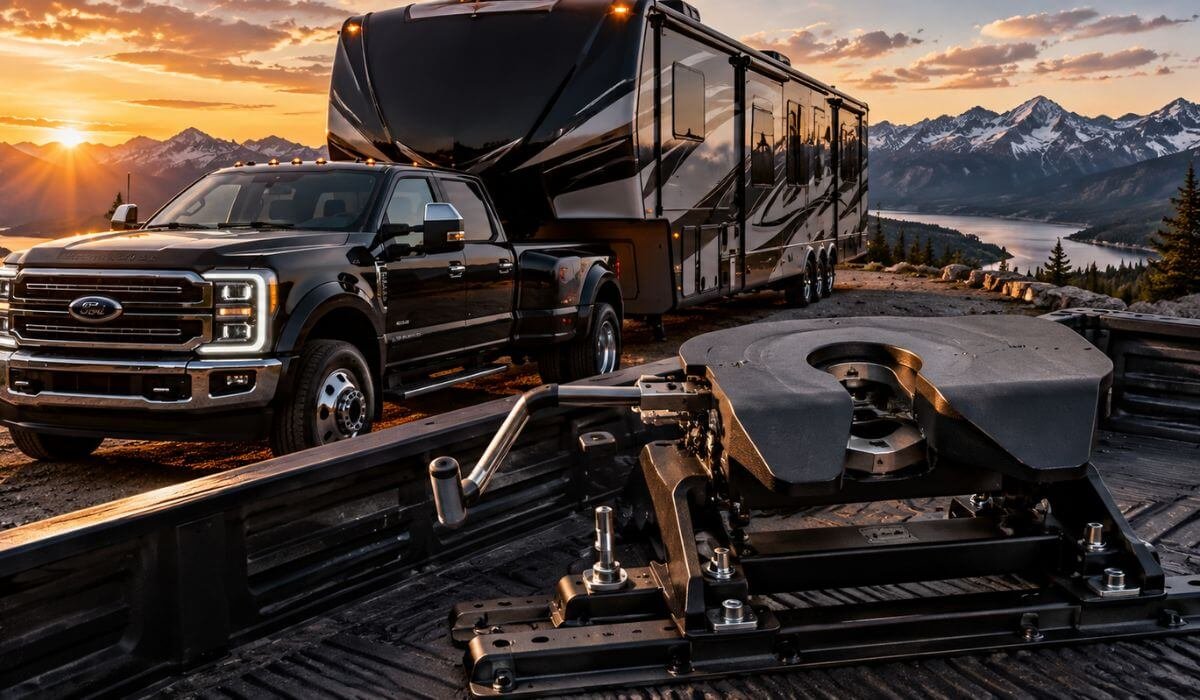
If you are towing a heavy fifth-wheel with a Ford F-350, choosing by capacity alone is a good way to end up with the wrong hitch. The real decision comes down to your truck’s model year, bed length, factory fifth-wheel prep, mounting system, trailer weight and loaded pin weight. A high-rated hitch cannot increase the F-350’s own towing or payload limits, and a perfect-looking fit is still wrong if the mounting hardware or bed configuration does not match.
Among the options covered here, the CURT 16594 PowerRide 30K 5th Wheel Hitch stands out as the best choice for maximum-capacity towing, with a 30,000-lb gross trailer weight rating, 7,500-lb vertical load rating and Ford OEM puck compatibility for select 8-foot long-bed applications. The B&W and REESE options step into lower capacity ranges with different jaw, articulation and removal designs.
The goal is simple: match the hitch to the actual loaded trailer and F-350 setup, not the biggest number printed on the box.
Best Ford F-350 Fifth Wheel Hitch: Top 2026 Picks With Heavy-Duty Jaws
#1. CURT 16594 PowerRide 30K 5th Wheel Hitch
Best Fifth Wheel Hitch for Ford F-350 | 30,000-Lb Towing Capacity | 7,500-Lb Vertical Load | Ford OEM Puck System | Heavy-Duty Cast Steel
#2. REESE 30922 M5 Fifth Wheel Hitch
Ford F-350 5th Wheel Hitch | 27,000-Lb Gross Trailer Weight | 6,750-Lb Pin Weight | Talon Jaw System | 14–18-Inch Adjustable Height
#3. B&W RVK3305 Companion OEM 25K Fifth Wheel Hitch
Ford F-350 Fifth Wheel Hitch With Puck System | 25,000-Lb Towing | 6,250-Lb Vertical Load | 1-Inch Cast Locking Jaws | Fully Articulating Head
#4. B&W RVK3300 Companion OEM 20K Fifth Wheel Hitch
Heavy-Duty Fifth Wheel Hitch for F-350 | 20,000-Lb Trailer Rating | 5,000-Lb Vertical Load | Ford OEM Puck Mount | 16.75–18.75-Inch Height
#5. CURT A25 5th Wheel Hitch
Ford F-350 Fifth Wheel Towing Hitch | 24,000-Lb Gross Trailer Weight | 6,250-Lb Vertical Load | OEM Puck Compatibility | Interlocking Jaws & Torsion Head
Expert Tip
With a Ford F-350, a higher hitch rating does not automatically make it the right hitch. The trailer’s loaded weight, pin weight, truck’s towing limits, bed length and factory puck configuration all need to agree. A 30K-rated hitch is useful only when the rest of the combination is capable of handling that load. For everyday towing, a properly matched 20K or 25K hitch can make more sense than paying for capacity you will never use.
Also, do not assume that an F-350 from one generation has the same fifth-wheel mounting setup as another. Ford changed its factory fifth-wheel prep and fitment across model years, so check the exact truck year and OEM puck arrangement before placing the order. That small check can save you from buying the right hitch for the wrong truck.
How We Choose These Ford F-350 Fifth Wheel Hitches
This list was not built by simply sorting Amazon listings by star ratings or putting the hitch with the biggest number at #1. The actual job of a fifth-wheel hitch is to create a secure connection between the truck and trailer, so the selection starts with fitment and towing requirements before price or popularity.
Ford compatibility comes first. Each hitch was examined for its stated compatibility with Ford Super Duty applications, particularly the F-250, F-350 and F-450 factory puck systems where applicable. This matters because a hitch designed for Ford’s OEM mounting points is a very different proposition from a generic rail-mounted setup. The truck’s exact model year and bed configuration still need to be verified before purchase.
Rated capacity was the next major filter. The seven-product selection spans different capacity levels rather than pretending every F-350 owner needs a 30,000-lb hitch. The CURT PowerRide, for example, reaches 30,000 lb gross trailer weight and 7,500 lb vertical load, while the B&W Companion options step down to 25,000 and 20,000 lb ratings. That gives the buyer meaningful choices depending on the trailer rather than forcing the highest-rated product on everyone.
The connection itself matters just as much as the number on the label. Jaw construction, kingpin engagement, pivoting action, mounting method and overall hitch design were considered because these are the components you rely on every time the trailer is coupled. The Reese M5’s Talon Jaw, for example, gives it a different coupling approach from the B&W Companion and CURT designs, so the products are not being treated as identical simply because they perform the same basic job.
We also looked at installation and truck compatibility. Factory-puck hitches can provide a much cleaner installation on an appropriately equipped Super Duty because they use the truck’s existing mounting points rather than requiring a traditional above-bed rail installation. For long-bed F-350 owners, the 8-foot-bed-specific CURT applications are particularly relevant; short-bed owners should pay closer attention to trailer clearance requirements before choosing a hitch.
Most importantly, the list does not confuse manufacturer specifications with real-world ownership experience. Some of these newer product listings do not yet have the enormous volume of independent long-term reviews that older towing equipment has accumulated. Rather than inventing durability claims or pretending thousands of owners have already confirmed something, the selection is based on the published specifications, stated Ford fitment, hitch architecture and the practical requirements of fifth-wheel towing.
That is why the final list contains different capacity levels and different hitch designs. The goal is not to make every product sound perfect. It is to give an F-350 owner enough genuine information to match the hitch to the truck and trailer they actually have.
Before ordering, check your exact F-350 model year, bed length, factory fifth-wheel prep/puck system, trailer GVWR and loaded pin weight against the manufacturer’s current fitment information. Those five details matter far more than a flashy capacity number on a product page.
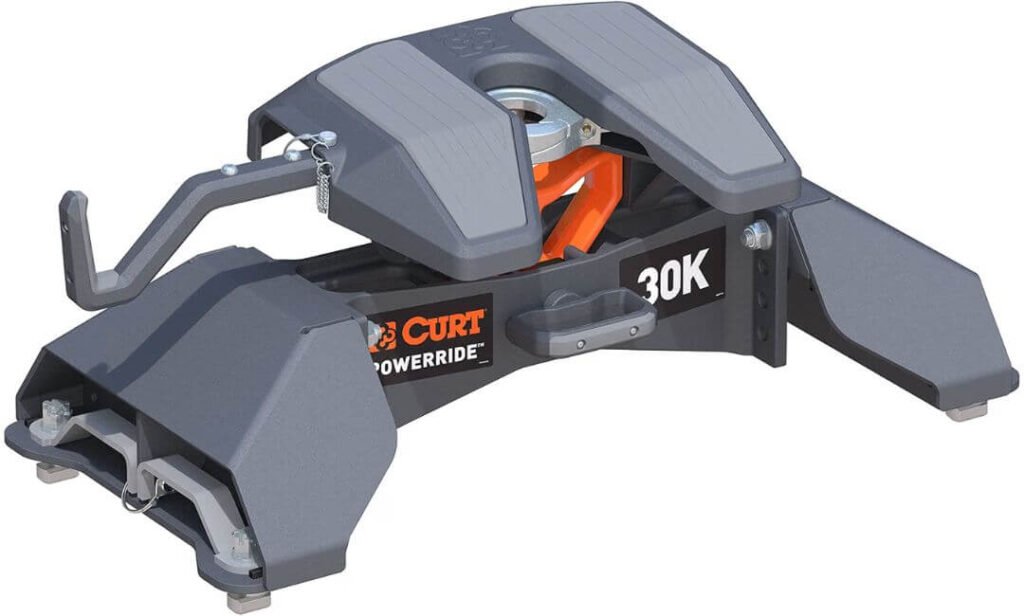
#1. CURT 16594 PowerRide 30K 5th Wheel Hitch
Quick Specs:
- Towing Rating: 30,000 lbs GTW
- Vertical Load: 7,500 lbs
- Truck Fitment: Select Ford F-350 Super Duty with OEM puck system
- Bed Requirement: 8-foot long bed
- Mounting: Direct Ford OEM puck-system legs
- Head Design: Multi-directional cast-steel yoke
- Coupling: Interlocking jaws with three-position indicator
- Height Adjustment: 4 inches
- Finish: Dark Grey Teridium powder coat
- Warranty: Limited lifetime
For an F-350 owner pulling a genuinely heavy fifth-wheel, this is the kind of hitch where the 30,000-lb rating is only the beginning of the story. The PowerRide combines that capacity with a cast-steel body, a multi-directional head and interlocking jaws that maintain full kingpin contact. In practical terms, that design is aimed at keeping the connection controlled when the trailer and truck are moving over uneven roads rather than relying on a rigid head that simply follows every movement.
The detail that makes a difference once you actually use it is the self-resetting handle and coupling indicator. The handle can be reached from the side of the F-350 bed, while the indicator gives you a quick visual check of the coupling position before you pull away. It is a small usability improvement, but with a fifth-wheel hitch, being able to verify the connection without repeatedly climbing around the bed is exactly the sort of thing that makes equipment feel properly thought through.
Another smart touch is the way the head comes apart. A single-pin removal system lets the head separate into smaller pieces, and the built-in grip points make those pieces easier to handle when the hitch needs to come out of the truck. The 4-inch height adjustment also gives more room to establish the truck-to-trailer clearance you actually need. CURT says the hitch requires no welding or fabrication and is supplied with the Ford puck-system legs.
(The important part is not simply having a 30K number on the box; the truck, trailer and every towing component still need to stay within the lowest-rated limit.)
What We Like
- 30,000-lb GTW and 7,500-lb vertical-load rating give the F-350 plenty of headroom for appropriately rated heavy fifth-wheel applications.
- The multi-directional cast-steel head is a meaningful advantage for smoother articulation instead of treating the hitch as a completely rigid connection.
- Interlocking jaws provide full kingpin contact, while the coupling indicator gives you another visual check before towing.
- The one-pin head removal is genuinely useful when the truck needs its bed back for normal hauling.
- The 4-inch height adjustment gives the F-350 owner more flexibility when dialing in trailer clearance.
What We Would Keep in Mind
The one thing worth checking before ordering is actual truck-to-trailer clearance. CURT specifically notes that every truck-and-trailer combination is different, so the hitch being physically compatible with the F-350 does not by itself guarantee the correct cab, bed-rail and trailer clearance.
Ford F-350 Fitment and Setup
This is a long-bed F-350 solution, not a universal hitch for every F-350 configuration. The truck needs Ford’s factory fifth-wheel puck mounting system, and CURT’s compatibility is year-specific. The supplied legs install into the four factory mounting points, so there is no need to weld or fabricate a custom mounting arrangement.
For an F-350 with an 8-foot bed and the correct puck preparation, that direct mounting is one of the strongest reasons to consider this setup. If the truck does not have the required factory puck system, or if the trailer requires a different clearance arrangement, the correct answer is to verify the exact configuration first rather than assuming the hitch will fit simply because the truck badge says F-350.
The Insider Pro-Tip
Before you spend money on a 30K hitch, measure the actual combination you are going to tow. Check the distance from the truck bed to the trailer’s kingpin plate, then consider the trailer’s front profile and the clearance needed when turning. The extra height adjustment here gives you useful room to work with, but it cannot compensate for a fundamentally mismatched truck-and-trailer setup.
And one more thing that is easy to overlook: 30,000 lb is a hitch rating, not a recommendation to load an F-350 to 30,000 lb. Your truck’s rated towing capacity, trailer GVWR, loaded pin weight and the rating of the other towing components still govern the final setup. That is the sensible way to use the PowerRide’s considerable capacity — as available strength and operating headroom, not as a target weight.
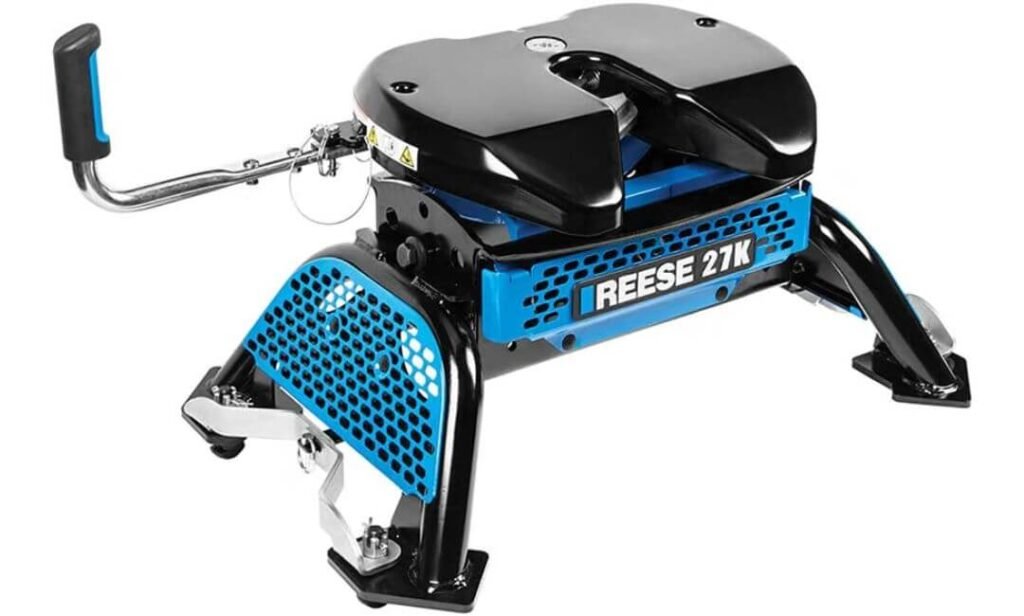
#2. REESE 30922 M5 Fifth Wheel Hitch
Quick Specs:
- Towing Capacity: 27,000 lbs GTW
- Maximum Pin Weight: 6,750 lbs
- Vertical Adjustment: 14–18 inches
- Jaw Design: Talon Jaw System
- Construction: Alloy steel
- Design: Three-piece modular system
- Fitment: Select Ford F-350 Super Duty with factory fifth-wheel prep
- Mounting: Factory puck system or ISR rail configuration, depending on version
There is a reason a 27,000-lb rating gets attention on an F-350: it puts this hitch comfortably into the heavy fifth-wheel category without chasing the absolute highest number simply for marketing value. The M5 combines that capacity with a 6,750-lb pin-weight rating, so it is built around the kind of substantial trailer loads an F-350 is commonly used to handle. The important part is matching those ratings to the actual loaded trailer rather than treating 27,000 lbs as a target.
The more interesting engineering detail is the Talon Jaw System. Instead of leaving the kingpin with excessive room to move inside the coupling mechanism, the jaw is designed to grip it securely and reduce the lateral movement that can contribute to the familiar clunking, chucking and noise of a fifth-wheel connection. That matters on long towing days, where small movements between truck and trailer become much more noticeable.
The M5 also takes a practical approach to adjustment. Its 14-to-18-inch vertical range gives an F-350 owner useful room to establish the correct trailer attitude and clearance, while the three-piece modular construction makes handling more manageable than dealing with one enormous assembled unit. The ergonomic slide handle is another genuinely useful detail — coupling equipment should not require excessive force just to operate the release mechanism.
(The real attraction here is the combination of a substantial 27K rating, controlled kingpin engagement and useful height adjustment — not simply the number printed on the product.)
What We Like
- 27,000-lb towing capacity gives this setup substantial headroom for appropriately rated F-350 fifth-wheel applications.
- The Talon Jaw System is designed to maintain a firm grip around the kingpin and minimise unwanted movement.
- 14–18 inches of vertical adjustment provides useful flexibility when setting up truck-to-trailer clearance.
- The three-piece modular design makes the hitch easier to handle during installation or removal.
- The easy-slide handle is a practical feature that reduces the effort needed when operating the coupling mechanism.
One Thing We Would Check
Before buying, verify the exact listing and included components for your F-350. The M5 was offered in configurations for factory puck systems and industry-standard rails, so the mounting hardware needs to match the truck rather than relying on the product name alone.
F-350 Fitment and Mounting Details
For an F-350, the important question is not simply whether the listing says “Super Duty.” The exact factory fifth-wheel prep package, model year and mounting configuration should match the version being purchased. The M5 is designed around vehicle-specific mounting options, including factory-installed fifth-wheel towing packages, while certain versions can also use ISR-style rails.
That modular approach is useful when the F-350 is regularly used for serious towing because the hitch can be configured around the truck’s mounting system rather than requiring an improvised installation. Still, confirm the exact Reese part number and included legs/base before ordering — especially when buying from an older or third-party listing.
The Insider Pro-Tip
The best way to use the M5’s 14–18-inch height adjustment is to set the hitch around the trailer you actually tow, not around a generic measurement from another F-350. Once coupled, you want appropriate bed-rail clearance while keeping the trailer sitting as level as practical. A few minutes with a tape measure before installation can tell you far more than a product photograph ever will.
And pay attention to pin weight, not just gross trailer weight. A fifth-wheel advertised at 27,000 lbs may never approach that number in your particular setup, but its loaded pin weight still transfers directly into the F-350. Keeping the trailer, pin weight, hitch and truck within their respective ratings is what turns a high-capacity hitch into a properly matched towing system.
#3. B&W RVK3305 Companion OEM 25K Fifth Wheel Hitch
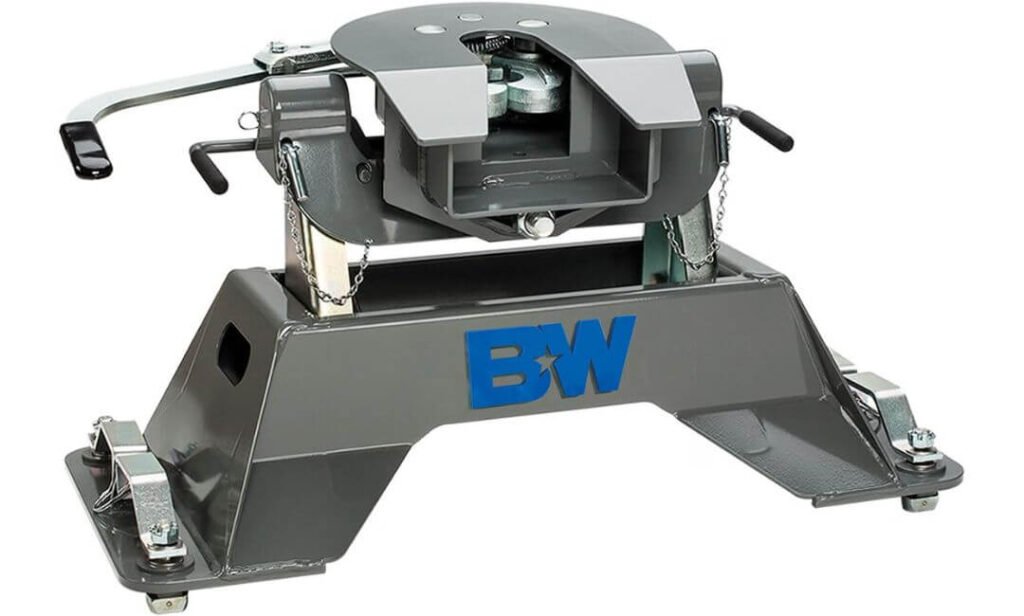
Quick Specs:
- Towing Capacity: 25,000 lbs GTW
- Vertical Load: 6,250 lbs
- Mounting: Ford OEM puck system
- Head Movement: Front-to-back and side-to-side articulation
- Jaw Design: 1-inch thick cast-locking jaws
- Construction: Alloy steel
- Design: Removable two-piece head and base
- Finish: Powder coated
- Warranty: Limited lifetime
- Origin: Made in America
A 25,000-lb fifth-wheel hitch is already more capacity than many F-350 owners will ever need, which is exactly why the details around the rating matter more here than simply chasing the biggest number. The RVK3305 pairs 25,000 lbs of gross trailer weight capacity with a 6,250-lb vertical-load rating, giving it substantial working headroom for a properly matched heavy fifth-wheel.
What stands out once you look beyond the capacity is the fully articulating head. It can move both front-to-back and side-to-side, allowing the connection to follow the natural movement between the F-350 and trailer. That becomes especially useful when manoeuvring across uneven ground or approaching a campsite that is anything but perfectly level.
Then there is the part you appreciate after owning a heavy hitch for a while: it comes apart. The two-piece design separates the head from the base, making removal considerably more manageable than trying to wrestle the complete assembly out of the F-350 bed. The cam-action handle is also designed to make uncoupling easier when the truck is sitting on uneven ground.
(This is the kind of hitch where the appeal is in the complete package — substantial capacity, controlled articulation, secure jaw construction and a removable design rather than one headline specification.)
What We Like
- 25,000-lb GTW and 6,250-lb vertical-load ratings give the F-350 serious towing headroom.
- The fully articulating head allows movement in both directions instead of forcing the connection to remain rigid.
- 1-inch-thick cast-locking jaws provide a substantial mechanical connection around the kingpin.
- The two-piece removable construction makes taking the hitch out of the F-350 bed much more practical.
- Direct Ford OEM puck mounting keeps installation clean when the truck has the required factory preparation.
One Thing We Would Keep in Mind
At 161 lbs, this is still substantial equipment. The removable two-piece design makes the job easier, but having another person around when installing or removing it is sensible.
Ford F-350 Fitment and Mounting
The important requirement here is the Ford OEM fifth-wheel puck system. The RVK3305 is built to use those factory mounting points, so an appropriately equipped F-350 does not need a custom drilled or welded mounting solution. That is particularly useful if the truck alternates between fifth-wheel towing and normal bed duties.
For the F-350 owner, however, the exact model year, factory prep package and bed configuration should still be checked against B&W’s current fitment information before ordering. A factory puck-equipped truck is the starting point; the final clearance between the hitch, bed rails, cab and particular fifth-wheel remains a truck-and-trailer measurement rather than something a product listing can guarantee.
The Insider Pro-Tip
Do not judge this hitch only by its 25K rating. If your fifth-wheel is well below that figure, what you are really paying attention to is the combination of the articulating head, substantial locking jaws and the convenience of being able to separate the hitch for removal. Those are the features that become noticeable every time you couple, uncouple and manoeuvre the trailer.
Before installation, measure your F-350 and trailer together with the actual loaded setup in mind. Get the hitch height right, confirm bed-rail clearance and check the turning relationship between the trailer and cab. Once those measurements work, the direct OEM puck mounting and removable design make this a particularly straightforward way to keep the F-350 ready for both serious towing and normal truck-bed use.
#4. B&W RVK3300 Companion OEM 20K Fifth Wheel Hitch
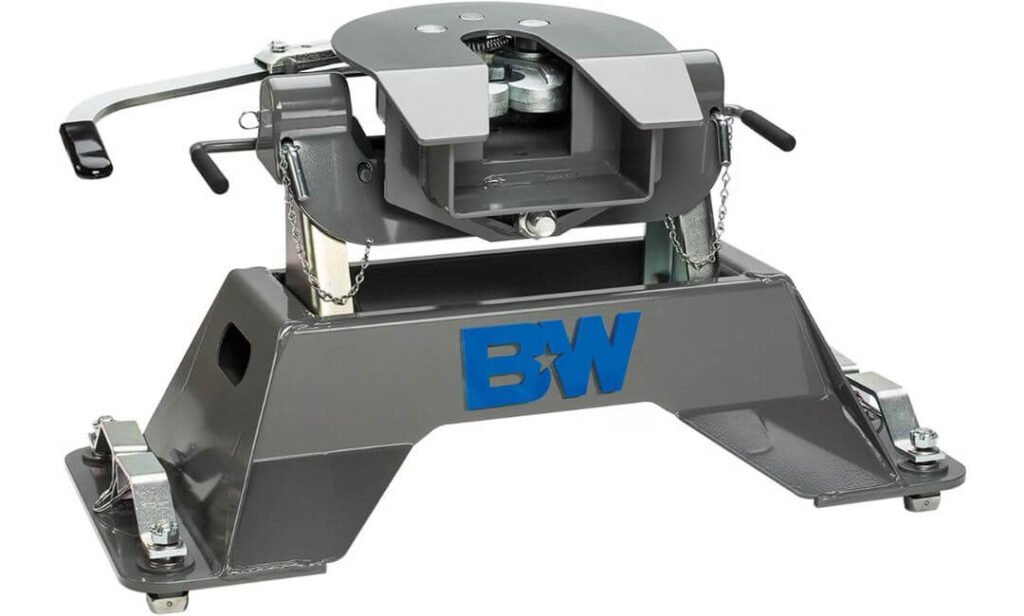
Quick Specs:
- Towing Capacity: 20,000 lbs GTW
- Vertical Load: 5,000 lbs
- Mounting: Ford OEM puck system
- Head Movement: Front-to-back and side-to-side articulation
- Jaw Design: 1-inch-thick cast-locking jaws
- Height Range: 16.75–18.75 inches
- Adjustment: 2-inch front-to-back
- Design: Removable two-piece construction
- Finish: Powder coated
- Warranty: Limited lifetime
- Origin: Made in America
Not every F-350 needs a 25K or 30K hitch. That is where this Companion makes sense. Its 20,000-lb gross trailer rating and 5,000-lb vertical-load rating provide substantial capacity for an F-350 towing a properly matched fifth-wheel, without paying for a higher rating that may never be used.
What makes it more interesting than a simple capacity-based option is the fully articulating head. It moves front-to-back as well as side-to-side, allowing the hitch to follow the trailer’s movement during turns, backing and uneven ground. Add the 1-inch cast-locking jaws and the cam-action handle, and the result is a connection designed around controlled movement rather than a loose, noisy coupling.
The adjustment range is another detail worth paying attention to. You get three vertical positions between 16.75 and 18.75 inches, plus 2 inches of front-to-back adjustment. That gives an F-350 owner useful room to dial in the hitch position for the particular fifth-wheel instead of accepting whatever height happens to come out of the box.
(For an F-350 owner whose trailer sits comfortably within the 20K rating, this is a case where sensible capacity can be more useful than simply buying the biggest hitch available.)
What We Like
- 20,000-lb GTW and 5,000-lb vertical-load capacity make it a substantial match for many F-350 fifth-wheel setups.
- Full two-way articulation helps the hitch accommodate movement between truck and trailer.
- 1-inch cast-locking jaws give the kingpin a substantial locking interface.
- 16.75–18.75-inch height adjustment plus 2-inch fore-aft adjustment makes trailer setup more flexible.
- Two-piece removable construction is genuinely useful when the F-350 needs its bed back.
One Thing We Would Keep in Mind
At this size, the hitch is still heavy equipment, so having another person available during initial installation or removal makes the process considerably easier.
Ford F-350 Fitment and Mounting
The RVK3300 is designed around the Ford OEM fifth-wheel puck system. When the F-350 has the required factory preparation, the hitch uses those existing mounting points rather than requiring a custom drilled or welded installation. That is particularly convenient for an F-350 that spends part of its time towing and part of its time working as a normal pickup.
Do not rely on the F-350 name alone, though. Verify the exact model year and factory puck configuration against B&W’s current fitment information before ordering. The truck-side mounting can be correct while the final trailer height or cab clearance still needs adjustment for the particular fifth-wheel.
The Insider Pro-Tip
If your loaded fifth-wheel is nowhere near 20,000 lbs, there is little practical reason to choose a hitch solely because another model carries a larger number. What matters is having enough rated capacity with a properly adjusted connection. The RVK3300 gives you meaningful headroom while keeping the focus on the features you will actually use — articulation, secure jaws and straightforward height adjustment.
Before you couple up for the first serious trip, spend the time setting the 16.75–18.75-inch height range and fore-aft position around your actual trailer. Then check bed-rail clearance and cab clearance through the turning range. A correctly adjusted 20K hitch on the right F-350 is far more useful than an oversized hitch that has simply been bolted into the bed without taking the truck-and-trailer geometry seriously.
One correction before the copy: the CURT A25 #16036 is officially rated at 24,000-lb GTW and 6,250-lb vertical load, not 25,000/5,000+. CURT also confirms the Ford version is intended for 8-foot beds with the factory puck system, with 13–17 inches of installation height. I’ve used the manufacturer figures below so the article stays accurate.
#5. CURT A25 24K 5th Wheel Hitch
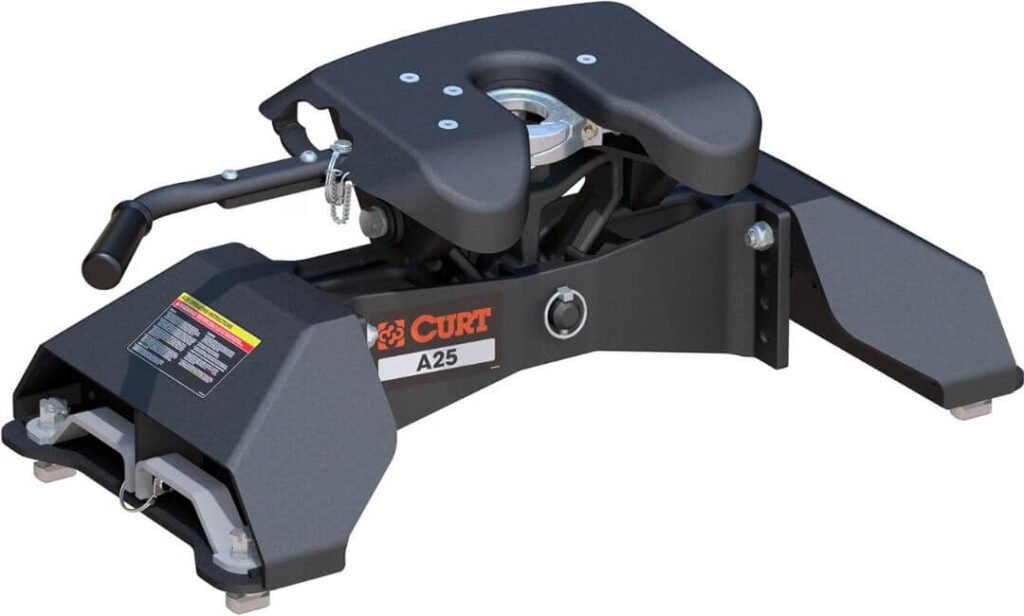
Quick Specs:
- Towing Capacity: 24,000 lbs GTW
- Vertical Load: 6,250 lbs
- F-350 Fitment: Select Ford F-350 with 5th-wheel prep
- Bed Requirement: 8-foot long bed
- Mounting: Ford OEM puck system
- Installation Height: 13–17 inches
- Head Design: Fully articulating torsion head
- Jaw Design: High-strength interlocking jaws
- Weight: 158 lbs
- Finish: Carbide black powder coat
- Warranty: Limited lifetime
The first thing worth knowing about the A25 is that 24,000 lbs is not just a headline figure. CURT pairs that rating with a 6,250-lb vertical load rating, giving an F-350 owner considerable capacity for a properly matched fifth-wheel without stepping all the way up to the 30K PowerRide. That makes this a particularly interesting middle ground when the trailer’s actual numbers do not justify buying the largest hitch simply because it exists.
The clever part is underneath the head. The cast yoke uses poly-torsion inserts to absorb shock loads and help suppress the harshness and noise that can otherwise travel through the truck-and-trailer connection. The fully articulating head then allows the trailer to move naturally during coupling and manoeuvring, while the high-strength jaws wrap around the kingpin rather than relying on a loose connection.
There is also a very practical side to the design. The Ford puck legs use quarter-turn anchors, so the hitch can be installed or removed without turning the F-350 bed into a permanent fifth-wheel-only workspace. The one-pin head removal system separates the head into a more manageable piece, while the coupling indicator can be seen from the cab during hookup. Those are the details that tend to matter more after the first few towing trips than another thousand pounds added to a specification sheet.
(The A25’s real appeal is the balance between substantial capacity, quieter operation, direct puck mounting and everyday removability.)
What We Like
- 24,000-lb GTW with 6,250-lb vertical load gives the F-350 serious capacity for appropriately matched fifth-wheels.
- Poly-torsion inserts help absorb shock and reduce unwanted towing noise.
- The fully articulating torsion head allows controlled movement between truck and trailer.
- Quarter-turn puck anchors make installation and removal much less involved than a permanently mounted system.
- The visible coupling indicator and one-pin head removal are genuinely useful touches during regular F-350 ownership.
One Thing We Would Keep in Mind
This particular Ford configuration is intended for an 8-foot bed with the factory puck system, so short-bed F-350 owners should not assume the same setup will provide the clearance they need. CURT specifically advises checking each truck-and-trailer combination for adequate cab and trailer clearance.
Ford F-350 Fitment and Puck Setup
The A25 Ford configuration comes with the A25 hitch head #16580 and Ford puck-system legs #16017, allowing it to mount directly into the truck’s four-point factory puck system. CURT’s current fitment table lists F-350 Super Duty applications with an 8-foot bed and fifth-wheel prep package, spanning model years shown from 2011 through 2027.
That direct mounting is a major part of the appeal for an F-350 owner. There is no need to turn the bed into a traditional rail installation when the factory preparation is already there. The important check before ordering is simple: confirm the truck has the OEM fifth-wheel prep package and that the exact year/bed configuration matches CURT’s application guide.
The Insider Pro-Tip
The A25 is one of those hitches where setup quality matters more than squeezing every last pound out of the rating. Use the 13–17-inch height adjustment to establish the right relationship between the F-350 bed and your actual fifth-wheel, then check the trailer-to-cab clearance before taking the combination onto a tight turn. CURT itself notes that every truck-and-trailer combination is different.
And there is a useful reason to appreciate the quarter-turn mounting system: you do not have to treat the hitch as a permanent part of the truck. When the fifth-wheel is parked, the A25 can come back out and the F-350 can return to normal bed duty. For an owner who uses the truck for more than towing, that small bit of flexibility can be worth far more than a specification that looks impressive on a product page.
Ford F-350 5th Wheel Hitch Comparison: Capacity, Puck Fit & Towing Setup
| What matters on an F-350 |
CURT 16594 PowerRide 30K
30K Capacity
Top Capacity
|
REESE 30922 M5
27K Capacity
Talon Jaw
|
B&W RVK3305 Companion
25K Capacity
OEM Puck
|
B&W RVK3300 Companion
20K Capacity
OEM Puck
|
CURT A25 24K
24K Capacity
Torsion Head
|
|---|---|---|---|---|---|
| Gross trailer weight Rated towing capacity |
30,000 lbs Maximum rating in this comparison |
27,000 lbs Heavy-duty fifth-wheel capacity |
25,000 lbs Substantial F-350 towing headroom |
20,000 lbs Strong capacity for many large fifth-wheels |
24,000 lbs High-capacity alternative below the 30K class |
| Vertical load Pin-weight rating | 7,500 lbs | 6,750 lbs | 6,250 lbs | 5,000 lbs | 6,250 lbs |
| Truck-side connection F-350 mounting |
Ford OEM Puck Direct factory puck mounting |
Ford Factory Prep Vehicle-specific mounting configuration |
Ford OEM Puck Direct factory puck-system connection |
Ford OEM Puck Designed around the factory puck platform |
Ford OEM Puck Direct puck-system installation |
| Bed configuration Important fitment detail |
8-ft long bed CURT specifies the long-bed application |
Check exact configuration Verify the specific M5 mounting version |
Verify truck application OEM puck compatibility; trailer clearance still matters |
Verify truck application OEM puck compatibility; final clearance is vehicle-specific |
8-ft long bed Ford puck configuration required |
| How the head moves Articulation |
Multi-directional Front-to-back and side-to-side movement |
Controlled movement Designed around Talon Jaw coupling |
Fully articulating Front-to-back and side-to-side |
Fully articulating Front-to-back and side-to-side |
Torsion head Fully articulating head with torsion inserts |
| Kingpin connection Jaw / coupling design |
Interlocking jaws Three-position coupling indicator |
Talon Jaw System Designed to minimise lateral kingpin movement |
1-inch cast-locking jaws Substantial mechanical locking design |
1-inch cast-locking jaws Secure kingpin engagement |
Interlocking jaws Extra-wide head opening and coupling indicator |
| Height setup Room to dial in the trailer | 4-inch adjustment |
14–18 inches Vertical adjustment range |
Height adjustment available; confirm final truck/trailer geometry |
16.75–18.75 inches Plus 2-inch front-to-back adjustment |
13–17 inches Installation height range |
| Removal practicality When the F-350 needs its bed back |
One-pin head removal Head separates for easier handling |
Modular Three-part design |
Two-piece Head and base separate |
Two-piece Removable head and base |
One-pin removal Head can be separated from the base |
| Useful ownership detail What you notice after installation |
Side-access handle Self-resetting handle and visual coupling indicator |
Low-effort control Ergonomic slide handle |
Easy uncoupling Cam-action handle works on uneven sites |
Simple operation Cam-action latching handle |
Quieter connection Poly-torsion inserts help suppress shock and noise |
| Build approach Construction |
Cast steel main body Professional-grade construction |
Alloy steel Three-piece modular architecture |
Alloy steel Made in America |
Alloy steel Made in America |
Cast steel main body Precision-built heavy-duty construction |
| Real-world matching point Who should look closely? | F-350 owners with a very heavy fifth-wheel and an 8-ft Ford puck-equipped bed who want maximum hitch capacity. | F-350 owners who want substantial capacity with the Talon Jaw and adjustable modular design. | F-350 owners wanting a 25K-class OEM-puck hitch with full articulation and removable construction. | F-350 owners whose trailer fits comfortably within a 20K rating and who value the Companion’s adjustable, removable design. | F-350 owners wanting a high-capacity 24K hitch with torsion-based shock and noise control. |
| Before you order The check that matters |
Verify OEM Puck Confirm 8-ft bed, model year and trailer clearance. |
Verify Exact Version Match the M5 mounting configuration to the F-350. |
Verify OEM Puck Check exact F-350 year and truck/trailer clearance. |
Verify OEM Puck Check exact F-350 application and trailer geometry. |
Verify 8-ft Bed Confirm Ford puck prep and actual turning clearance. |
Ford F-350 Fifth Wheel Hitch Buying Guide: The Details That Actually Matter
Buying a fifth-wheel hitch for an F-350 is not really a matter of finding the largest capacity number and putting it in the cart. The truck’s factory equipment, bed length, trailer weight, pin weight, hitch height and clearance all have to work together. That is why two hitches that look almost identical in a product photo can behave very differently once they are installed and the trailer is connected.
The five hitches covered above also show why there is no single specification that tells the whole story. A 30,000-lb hitch gives enormous capacity headroom, while a 20,000-lb model can be a perfectly sensible match when the loaded fifth-wheel is comfortably below that limit. The right choice is the one whose mounting system and ratings match the actual F-350 and trailer, not the one with the most impressive number on the packaging.
Start With the F-350’s Factory Fifth-Wheel Preparation
If the F-350 has Ford’s factory fifth-wheel puck system, a compatible OEM-puck hitch is usually the cleanest route. The mounting points are already built into the truck bed, allowing the appropriate hitch legs to lock into the factory positions without turning the installation into a custom fabrication project.
That is important because a factory puck system is not the same thing as simply having an F-350 with a large towing package. Before ordering, physically check the truck and confirm that the required factory mounting points are present.
For an OEM-puck setup, check these details:
- Exact F-350 model year
- Bed length
- Factory fifth-wheel/gooseneck preparation
- Number and arrangement of the factory mounting points
- Exact hitch base or legs supplied with the product
- Manufacturer’s year-specific fitment information
Do not assume that because a product says “F-350 Super Duty” it automatically fits every F-350 ever produced. Fitment is a truck-specific question, and the exact factory preparation matters.
Long Bed vs Short Bed Is a Real Towing Consideration
Bed length can completely change the fifth-wheel equation.
An 8-foot F-350 bed gives substantially more space between the hitch and cab, making conventional fifth-wheel positioning much easier. That is why products such as the CURT 16594 and the Ford-specific A25 configuration are particularly relevant to the long-bed F-350 applications specified by the manufacturer.
A short-bed F-350 requires more attention to the relationship between the trailer’s front overhang and the truck cab. Simply finding a hitch that fits the puck holes does not guarantee adequate turning clearance.
Before buying, measure:
- Bed rail to trailer overhang clearance
- Hitch-to-cab clearance
- Trailer-to-tailgate clearance where applicable
- Hitch height
- Trailer kingpin height
- Clearance during a tight turn
A hitch can fit the truck perfectly and still be wrong for a particular trailer. That is one of the easiest mistakes to make when shopping online.
Choose Capacity From the Loaded Trailer, Not the Advertisement
The capacity range in this comparison runs from 20,000 lbs to 30,000 lbs, but that does not mean every F-350 owner should automatically buy the 30K option.
Look at the trailer’s numbers first.
| What to check | Why it matters |
|---|---|
| Trailer GVWR | Maximum loaded trailer weight |
| Actual loaded trailer weight | Tells you what the combination is really carrying |
| Pin weight | Determines how much vertical load reaches the hitch and truck |
| Hitch GTW rating | Must be sufficient for the trailer |
| Hitch vertical-load rating | Must accommodate the loaded pin weight |
| F-350 towing rating | The truck itself still sets a limit |
| Other towing components | The lowest-rated relevant component remains important |
A 30,000-lb rating is useful as headroom, but it does not increase the F-350’s own towing capacity. Likewise, a 25K or 20K hitch should not be judged simply because its number is smaller.
For example, the PowerRide’s 30,000-lb GTW rating and 7,500-lb vertical-load rating put it in a different capacity class from the 20,000-lb Companion. The important question is whether your loaded fifth-wheel actually needs that additional capacity.
Never calculate your setup from the empty trailer weight alone. Water, propane, batteries, cargo, tools and personal equipment can materially change the loaded weight and pin weight.
Understand the Difference Between GTW and Pin Weight
This is one specification that deserves more attention than it normally gets.
Gross Trailer Weight (GTW) is the total weight of the trailer. Pin weight is the portion transferred through the fifth-wheel connection onto the truck.
That distinction explains why a hitch can have a large GTW rating but still have a separate vertical-load limit.
For the hitches in this comparison:
- CURT PowerRide 30K — 30,000-lb GTW / 7,500-lb vertical load
- REESE M5 — 27,000-lb GTW / 6,750-lb pin weight
- B&W Companion RVK3305 — 25,000-lb GTW / 6,250-lb vertical load
- CURT A25 — 24,000-lb GTW / 6,250-lb vertical load
- B&W Companion RVK3300 — 20,000-lb GTW / 5,000-lb vertical load
Those figures give you a much better basis for comparison than simply asking which hitch has the highest towing rating.
Pay Attention to the Jaw Design
The jaw is the part that physically captures the trailer’s kingpin, so this is not an area where flashy marketing terminology should replace understanding the mechanism.
Different designs approach the connection differently. The Talon Jaw on the REESE M5 is intended to grip the kingpin and reduce unwanted lateral movement. The B&W Companion models use cast-locking jaws, while CURT uses interlocking jaw designs on the PowerRide and A25.
What matters in real use is a secure, properly locked kingpin connection with the handle and indicator correctly showing the coupled state.
A useful pre-trip routine is simple:
- Confirm the kingpin is properly seated.
- Confirm the jaws are completely closed around it.
- Check the hitch’s coupling indicator or handle position.
- Perform the manufacturer’s recommended pull test.
- Connect the trailer breakaway system and electrical plug.
- Do a final walk-around before moving.
The hitch should never be considered correctly coupled merely because the trailer has lifted slightly off the landing gear.
Articulating Heads Can Make Uneven Ground Easier
A fully articulating head is more than a specification designed to fill a product page.
When the truck and trailer are not perfectly level with one another, a head that can pivot front-to-back and side-to-side allows the connection to accommodate that movement. This can make coupling and manoeuvring less awkward, particularly at campsites, driveways and uneven parking areas.
The B&W Companion models use fully articulating heads, while the CURT designs also provide controlled head movement. The exact mechanism differs, but the underlying objective is similar: allow the hitch to move with the trailer rather than fighting every change in angle.
That does not eliminate the need for careful coupling. It simply gives the connection more freedom to articulate as the truck and trailer move.
Hitch Height Deserves a Proper Measurement
A common mistake is installing a hitch at a convenient height and assuming the trailer will automatically sit correctly.
It is better to measure the truck and trailer together.
The goal is to establish adequate bed-rail clearance while maintaining a sensible trailer attitude. Too little clearance can create contact between the trailer and truck; excessive height can alter the trailer’s attitude and may affect how the combination behaves.
The products here offer different adjustment ranges. The REESE M5 provides 14–18 inches of vertical adjustment, the B&W RVK3300 provides 16.75–18.75 inches plus fore-and-aft adjustment, and the CURT A25 provides 13–17 inches of installation height.
Use those ranges as adjustment tools, not as a substitute for measuring your own F-350 and fifth-wheel.
Installation: What You Actually Need
An OEM-puck hitch is generally more straightforward than a traditional rail installation because the truck already has the mounting points.
Still, “drop-in installation” does not mean no work at all.
You may need:
- Appropriate sockets and wrenches
- Torque wrench
- Basic hand tools
- Hitch manufacturer’s assembly hardware
- A second person for positioning heavy components
- Manufacturer-specified torque values
- Adequate working space around the truck bed
Several of these hitches are heavy enough that two-person handling is simply sensible, particularly when positioning the head or removing the assembled unit.
Never guess at torque values. Use the manufacturer’s instructions for the exact hitch and hardware rather than copying a torque figure from another fifth-wheel model.
Rails and Puck Systems Are Not Interchangeable by Default
This is another place where online shopping can become confusing.
A Ford OEM puck system uses factory mounting points in the bed. Traditional fifth-wheel rails are a different mounting approach. Some hitch families are available in multiple mounting configurations, but that does not mean every base, leg or adapter works with every truck.
For an F-350 with factory pucks, verify that the exact product includes or is paired with the correct Ford-specific puck legs/base.
Do not purchase a rail-mounted version simply because the hitch head looks identical to the OEM-puck version. The head may be compatible while the mounting hardware is completely different.
Build Quality Matters More With a Heavy Fifth-Wheel
A fifth-wheel hitch lives in a difficult environment: substantial vertical loading, repeated coupling cycles, road vibration, weather exposure and constant movement between the truck and trailer.
That makes cast steel or alloy-steel construction, properly protected finishes and solid mechanical components more meaningful than cosmetic features.
Powder coating can help protect exposed metal against normal corrosion and wear, but it is not a reason to ignore maintenance. Keep the hitch clean, inspect the moving parts and follow the manufacturer’s lubrication requirements.
Pay particular attention to:
- Jaw condition
- Kingpin contact surfaces
- Locking mechanism
- Handle and indicator
- Mounting pins/anchors
- Fasteners
- Visible cracks or unusual wear
- Corrosion around moving components
A few minutes of inspection before a long trip is cheap insurance for equipment carrying a very expensive trailer.
Safety Features Should Be Practical, Not Decorative
The useful safety features on a fifth-wheel hitch are the ones that help you verify the connection and maintain it correctly.
A visible coupling indicator, self-resetting handle, positive locking mechanism and properly designed jaws all have a practical purpose.
The CURT PowerRide, for example, uses a three-position coupling indicator and self-resetting handle. The A25 also uses a self-resetting handle and coupling indicator. The B&W models use cam-action latching handles designed to make uncoupling easier, including when parked on uneven ground.
These features do not replace a proper hitching procedure. They simply make it easier to perform that procedure correctly.
Also remember that the trailer’s electrical connection and breakaway system are separate parts of the overall towing setup. A quality fifth-wheel hitch does not eliminate the need to verify those systems before every trip.
Noise and Chucking: Know What the Hitch Can Actually Improve
Some fifth-wheel movement is normal. The truck and trailer are connected through a mechanical pivot, so expecting the combination to feel completely motionless is unrealistic.
What good hitch engineering can do is control unnecessary movement and absorb some shock.
The CURT A25 uses poly-torsion inserts specifically to help suppress shock loads and reduce noise. The REESE M5’s Talon Jaw is designed to minimise lateral movement around the kingpin. Articulating heads on the B&W and CURT designs allow controlled movement rather than forcing the connection to remain completely rigid.
That is a much more useful way to think about “quiet towing.” The objective is controlled connection behaviour, not the promise of eliminating every sound or movement.
Consider Removal Before You Buy
An F-350 is still a pickup truck when the fifth-wheel is parked.
If you regularly use the bed for tools, equipment, materials or general hauling, the ability to remove the hitch becomes a surprisingly important ownership consideration.
The products in this comparison approach that differently, but several use removable head-and-base or modular construction. That allows the heavy assembly to be broken into more manageable pieces rather than requiring one person to lift the entire hitch.
Think about how often you will actually remove it. If the hitch stays installed for an entire season, removal convenience may be less important. If the truck switches between towing and regular work every few weeks, it becomes much more valuable.
Budget Should Be Compared With the Whole Towing Setup
The cheapest hitch is not necessarily the cheapest solution if it requires additional mounting hardware, adapters or compromises your intended configuration.
At the same time, spending more simply because a hitch has a larger capacity does not automatically provide a better match for your F-350.
Look at the complete installed system:
- Hitch
- Correct Ford puck legs/base
- Required hardware
- Installation requirements
- Trailer clearance
- Maintenance requirements
- Warranty
- Expected frequency of removal
- Actual trailer weight and pin weight
A properly matched 20K hitch can make more sense than an unnecessarily oversized unit, while a heavy fifth-wheel may justify moving into the 24K, 25K, 27K or 30K class.
Common F-350 Fifth-Wheel Hitch Mistakes to Avoid
Buying by GTW alone: A large trailer rating does not tell you whether the vertical-load rating, truck rating or actual setup is appropriate.
Ignoring the factory puck system: Confirm the truck actually has the required OEM preparation.
Assuming every F-350 bed is the same: Bed length directly affects trailer clearance and hitch positioning.
Using the empty trailer weight: Base your calculations on the loaded configuration and manufacturer’s rated limits.
Skipping the height measurement: Set the hitch around the actual truck-and-trailer combination.
Confusing hitch head compatibility with mounting compatibility: The correct head still needs the correct F-350 mounting hardware.
Installing without checking torque specifications: Use the manufacturer’s instructions for the exact model.
Forgetting cab clearance: Perform the necessary turning-clearance checks before taking the trailer on the road.
Treating the capacity rating as a target: A 30K hitch does not make a truck legally or mechanically capable of towing 30,000 lbs.
The Simple F-350 Checklist Before Ordering
If these questions can all be answered clearly, you are much less likely to end up with a hitch that looks right online but does not suit the actual truck:
| Check before buying | What you should know |
|---|---|
| F-350 model year | Exact year, not just “Super Duty” |
| Bed length | 8-foot or short bed |
| Factory puck system | Confirm it is physically installed |
| Trailer GVWR | Manufacturer-rated maximum |
| Loaded trailer weight | Realistic towing weight |
| Loaded pin weight | Actual vertical load to the truck |
| Hitch GTW rating | Must cover the trailer requirement |
| Hitch vertical rating | Must cover the loaded pin weight |
| Hitch height | Match to the actual trailer |
| Cab clearance | Confirm during turning |
| Mounting hardware | Correct Ford-specific configuration |
| Removal needs | Decide whether the bed must remain usable |
The safest buying process is therefore quite straightforward: identify the exact F-350, identify the exact fifth-wheel, calculate the real loaded weights, confirm the Ford mounting system, measure clearance, and only then choose the hitch rating and design. That approach removes most of the guesswork before the money is spent.
Ford F-350 Fifth Wheel Hitch Installation Essentials: Get the Truck and Trailer Working as One
Installing a fifth-wheel hitch on an F-350 is straightforward when the truck already has the correct factory puck preparation, but it is still a job where careful measurements matter more than speed. The hitch needs to sit correctly in the factory mounting points, the head needs to be at the right height for the trailer, and the kingpin must couple cleanly without forcing anything into position.
The five hitches covered in this guide are not all identical, so always use the installation instructions supplied with the exact hitch for hardware locations, torque specifications and adjustment procedures. The process below explains the practical sequence, while the manufacturer’s instructions remain the authority for the final installation values.
Start With a Clean F-350 Bed and Confirm the Mounting System
Before lifting any hitch components into the truck, remove debris from the factory puck openings and inspect the mounting points.
For an OEM-puck installation, check:
- The F-350 has the required factory fifth-wheel puck preparation.
- All puck openings are clean and free from dirt, rust buildup or packed debris.
- The hitch has the correct Ford-specific legs or mounting base.
- The truck bed is clear enough to safely position the hitch components.
- No mounting hardware appears damaged, bent or incomplete.
Do not force a puck anchor into position. If something does not drop into place naturally, stop and find out why. A factory puck system is designed for a precise mechanical fit, so forcing an anchor can create a problem that is much harder to diagnose after the hitch is loaded.
Assemble the Hitch Outside the Truck Where Practical
Heavy fifth-wheel hitches are much easier to work with when their major components can be assembled on a stable surface before installation.
For the modular and removable designs in this guide, follow the supplied instructions to assemble the appropriate head, base and Ford puck legs.
Keep the process simple:
- Lay out every supplied component.
- Identify the correct Ford-specific mounting hardware.
- Assemble the base and legs according to the manufacturer’s sequence.
- Install the head and locking hardware.
- Check that all moving components operate freely.
- Only then position the assembly in the F-350 bed.
With a hitch weighing well over 100 pounds in several configurations, a second person is worth having. There is no benefit in trying to prove that one person can lift something that was designed to be installed safely.
Position the Puck Anchors Before Tightening Anything
Once the hitch is in the bed, place each mounting point into its corresponding factory puck.
The important part is alignment. The anchors should sit properly into the factory openings before the locking mechanism is engaged. On systems using quarter-turn-style anchors, rotate them into the locked position exactly as instructed by the manufacturer.
At this stage, do not rush into final tightening.
Check that:
- Every mounting point is seated correctly.
- The locking handles or pins are in their intended positions.
- The hitch base sits evenly.
- Nothing is visibly cocked or sitting above the bed.
- The anchors can be locked without excessive force.
If one corner looks different from the others, stop and correct the alignment. Do not compensate for poor seating by simply tightening harder.
Set the Hitch Height Around the Actual Fifth-Wheel
This is where the installation becomes specific to your F-350 rather than simply following a generic hitch manual.
Measure the relationship between the truck bed and the trailer’s kingpin plate, then use the hitch’s available adjustment to establish appropriate clearance.
You are looking for enough space between the top of the F-350 bed rails and the underside of the fifth-wheel overhang, while keeping the trailer at a sensible towing attitude.
The hitches in this comparison have different adjustment ranges:
| Hitch | Published height/adjustment detail |
|---|---|
| CURT PowerRide 30K | 4 inches of height adjustment |
| REESE M5 | 14–18 inches vertical adjustment |
| B&W RVK3305 | Adjustable hitch height |
| B&W RVK3300 | 16.75–18.75 inches, plus 2-inch fore-and-aft adjustment |
| CURT A25 | 13–17 inches installation height |
Do not copy another F-350 owner’s hitch height. Your trailer’s kingpin height, suspension, bed configuration and loaded attitude determine the useful setting.
Check Cab, Bed-Rail and Trailer Clearance Before Coupling Fully
A fifth-wheel can look perfectly positioned when the truck and trailer are straight and still have a clearance problem when turning.
Before heading onto the road, inspect the combination through the range of movement that can reasonably occur during manoeuvring.
Pay particular attention to:
- Trailer overhang versus the F-350 cab
- Bed-rail clearance
- Tailgate clearance, where relevant
- Trailer body clearance during turns
- Hitch head movement
- Landing gear and other trailer components
For short-bed configurations, this becomes even more important. A hitch that physically fits the factory pucks does not automatically guarantee adequate cab clearance with every fifth-wheel.
Use the Correct Torque Procedure
Torque is one area where guessing is not acceptable.
The correct torque value depends on the specific hitch, fastener size, hardware and installation location. The figures for one CURT or B&W model should not be copied into another hitch installation simply because the bolts look similar.
Use:
- A properly calibrated torque wrench
- The exact manufacturer’s installation manual
- The supplied hardware wherever specified
- The manufacturer’s tightening sequence
- The specified final torque values
A useful approach is to initially snug the hardware evenly, verify that the hitch remains correctly aligned, and then complete the final tightening sequence specified by the manufacturer.
genui{“learning_viz”:{“type_id”:”TORQUE”,”locale_override”:”en-US”}}
The important principle is simple: tight enough is not a torque specification. Under-tightening can allow movement, while improper over-tightening can damage hardware or components.
OEM Puck Alignment: The Small Detail That Prevents Big Problems
Factory puck systems are convenient precisely because the truck already provides accurately positioned mounting points. Take advantage of that precision.
If the hitch will not sit correctly:
- Remove tension from the mounting mechanism.
- Check that the puck openings are clean.
- Make sure the anchor orientation is correct.
- Reposition the hitch squarely over the mounting points.
- Engage the anchors again.
- Confirm the locking mechanism is fully seated.
Never use the mounting hardware as a tool for pulling a badly positioned hitch into alignment.
Once installed correctly, the base should feel secure without unusual rocking or movement. If there is unexpected play, investigate the mounting system before towing rather than assuming the movement will disappear under load.
Coupling the F-350 to the Fifth-Wheel
With the hitch installed and adjusted, coupling deserves its own deliberate procedure.
Before backing under the trailer, make sure the hitch is in the manufacturer’s ready-to-couple position. Align the F-350 carefully with the trailer kingpin and back in slowly.
After engagement:
- Confirm the kingpin is fully seated.
- Confirm the jaws have closed completely.
- Check the hitch’s coupling indicator or handle position.
- Perform the manufacturer’s recommended pull test.
- Raise the landing gear appropriately.
- Connect the electrical plug.
- Connect the trailer breakaway system.
- Complete a final walk-around.
Do not use the trailer’s landing gear to “test” an uncertain connection. If the coupling indicator does not show the correct locked condition, stop and investigate.
Wiring and Breakaway Equipment Still Matter
The fifth-wheel hitch itself does not provide the trailer’s electrical safety systems.
Before every trip, confirm that the F-350’s electrical connection is properly seated and that the trailer’s lighting, brakes and breakaway system are functioning as intended.
The basic pre-trip check should include:
- Trailer running lights
- Brake lights
- Turn signals
- Electric trailer brakes
- Brake controller operation
- Trailer electrical plug
- Breakaway switch and battery system
- Safety-related connections specified by the trailer manufacturer
If the trailer uses a factory or aftermarket brake controller, make sure it is configured for the actual trailer rather than assuming the previous setting is correct.
The hitch connects the trailer; the electrical and braking systems make the towing combination complete.
Common Installation Problems and What They Usually Mean
| What you notice | What to check first |
|---|---|
| Puck anchor will not engage | Clean the puck opening and verify anchor orientation |
| One side of the base sits higher | Remove tension and realign the mounting points |
| Hitch has unusual movement | Recheck mounting hardware, seating and specified torque |
| Kingpin will not couple | Confirm hitch is in the ready-to-couple position and truck alignment is correct |
| Coupling indicator does not show locked | Do not tow; inspect kingpin and jaw engagement |
| Trailer sits too nose-high or low | Recheck hitch height and trailer geometry |
| Cab clearance looks tight | Stop and measure before attempting a tight turn |
| Electrical connection is loose | Inspect plug, socket and cable routing |
| Breakaway system is questionable | Test according to the trailer manufacturer’s procedure before travel |
Do Not Confuse Rail Alignment With Puck Alignment
Traditional fifth-wheel rails and Ford’s OEM puck system solve the same basic mounting problem in different ways.
If your F-350 has the factory puck system, the hitch should use the correct Ford puck-compatible mounting hardware. A rail-mounted hitch or base may look similar in photographs, but that does not make it a direct replacement for the puck version.
This is particularly important when buying a modular hitch where the head and mounting base can be sold or referenced separately. Always make sure the complete combination of head, legs/base and truck mounting system is the configuration intended for your F-350.
Give the Installation a Final Inspection Before the First Trip
Once everything is assembled, do not immediately hook up the most expensive trailer you own and head for the highway.
Take a few minutes for a complete inspection.
Check:
- Every mounting anchor is fully locked.
- All required fasteners are torqued to specification.
- The head pivots as designed.
- The jaws open and close correctly.
- The coupling handle operates normally.
- The indicator shows the correct positions.
- Hitch height is appropriate.
- Bed-rail clearance is adequate.
- Cab clearance is adequate.
- Electrical and breakaway connections work correctly.
After the first towing trip, inspect the mounting points and hitch components again. A new installation deserves a second look after it has experienced its first real load.
The most important lesson is that installing a fifth-wheel hitch on an F-350 is not about forcing a heavy piece of equipment into the truck and tightening a handful of bolts. It is about getting the puck connection, hitch height, kingpin engagement, clearance and trailer systems working together. When those pieces are checked methodically, the installation becomes much less mysterious and much easier to trust.
Ford F-350 Fifth Wheel Hitch for Different Towing Scenarios
An F-350 can be used for everything from a moderately loaded fifth-wheel to a very large RV, but the towing setup should be built around the actual trailer weight and pin weight, not the maximum number printed on the hitch. A 30,000-lb hitch provides substantial capacity headroom, but it does not give the truck permission or mechanical capability to carry 30,000 lbs. The truck’s own ratings, the trailer’s ratings and the hitch’s ratings all have to agree.
Setting Up a 30K Fifth-Wheel Combination Correctly
The CURT PowerRide 30K is the highest-capacity hitch in this comparison, with a 30,000-lb gross trailer weight rating and 7,500-lb vertical-load rating. That makes its capacity relevant to genuinely heavy fifth-wheel applications, but the sensible starting point is still the trailer’s actual numbers.
Before using a 30K-rated hitch, check:
- F-350 maximum loaded trailer weight
- Trailer GVWR
- Actual loaded trailer weight
- Actual loaded pin weight
- F-350 payload rating
- Rear-axle weight rating
- Gross vehicle weight rating
- Hitch gross trailer weight rating
- Hitch vertical-load rating
- Tire and wheel ratings
- Other towing-component ratings
A useful way to think about it is this: the hitch rating is only one ceiling in the system. If the hitch can handle 30,000 lbs but the truck, axle, tires or trailer are rated lower, the lower limit remains the one that matters.
Also remember that payload is not simply unused towing capacity. The F-350’s available payload has to account for the fifth-wheel pin weight plus passengers, cargo and other equipment carried by the truck.
Dually F-350 vs. Single-Rear-Wheel F-350
The F-350 is available in different configurations, including single-rear-wheel and dual-rear-wheel versions, and that difference becomes important as trailer weight increases.
A dually’s additional rear tires and wider rear axle setup can provide greater rear-axle load capability, tire capacity and lateral stability, depending on the exact truck configuration and factory ratings. That can be particularly relevant with a large fifth-wheel carrying substantial pin weight.
A single-rear-wheel F-350 can also be an extremely capable towing truck, but its exact payload, axle and tire ratings need to be checked against the particular truck.
Do not use “F-350 dually” or “F-350 single rear wheel” as a substitute for checking the door-jamb certification label. Two trucks carrying the same badge can have different factory ratings depending on configuration, engine, drivetrain, axle and equipment.
For a heavy fifth-wheel, check the actual truck’s:
- Gross vehicle weight rating
- Rear gross axle weight rating
- Front gross axle weight rating
- Payload rating
- Tire load ratings
- Wheel ratings
- Factory towing rating
That information belongs to the individual truck, not simply the F-350 model name.
Long-Distance Towing Is Where Hitch Design Becomes Noticeable
A short trip around town does not expose a towing system to the same conditions as several hours on the highway.
During a long-distance haul, the connection experiences repeated acceleration, braking, lane changes, road joints, crosswinds and changes in road surface. That is where features such as secure kingpin engagement, controlled head articulation and shock management become more than specification-sheet language.
The REESE M5’s Talon Jaw is designed to grip the kingpin and reduce lateral movement. The B&W Companion models use substantial cast-locking jaws and articulating heads, while the CURT A25 adds poly-torsion inserts intended to suppress shock loads and noise.
None of these systems should be described as a replacement for correct trailer loading or a separate sway-control device. A fifth-wheel’s stability begins with proper weight distribution, correct pin weight, appropriate tire pressures and a correctly adjusted hitch.
Jaw Locking Should Be Treated as a Pre-Trip Routine
A strong jaw design is useful, but even the best mechanical connection needs to be used correctly.
Before every significant trip:
- Position the F-350 squarely with the trailer.
- Confirm the hitch is ready to couple.
- Back in slowly until the kingpin is fully engaged.
- Verify the jaws have completely closed.
- Check the hitch’s indicator or handle position.
- Perform the manufacturer’s recommended pull test.
- Raise and secure the landing gear.
- Connect the electrical plug.
- Connect and verify the trailer breakaway system.
- Perform a complete walk-around.
That routine takes far less time than dealing with a coupling problem after the trailer is moving.
Sway and Stability: The Hitch Is Only One Part of It
A fifth-wheel connection is inherently different from a conventional bumper-pull trailer because the kingpin sits over the truck’s rear axle area. That gives the combination a different weight-transfer and handling characteristic.
Still, a fifth-wheel hitch should not be treated as a magic sway-control device.
If the trailer feels unstable, look beyond the hitch:
- Trailer loading
- Pin-weight percentage
- Tire pressure
- Trailer suspension
- Wheel alignment
- Road and wind conditions
- Truck payload
- Rear-axle loading
- Hitch height
- Trailer level
- Mechanical condition of the kingpin and hitch
A properly loaded fifth-wheel with the hitch correctly adjusted should be the starting point. If unusual movement or handling continues, the underlying cause should be identified rather than attempting to solve everything through hitch adjustments.
Why Articulation Matters When the Road Gets Uneven
The F-350 and fifth-wheel do not always travel on the same plane. Campsites, steep driveways, uneven pavement and angled approaches can put the truck and trailer at noticeably different angles.
A fully articulating hitch head can accommodate some of this movement by allowing front-to-back and side-to-side articulation. That is one reason the B&W Companion models and the articulating CURT designs are interesting for owners who regularly manoeuvre their trailers away from perfectly level pavement.
The important distinction is controlled movement. You want the hitch to allow the connection to articulate as designed while the kingpin remains securely captured.
Getting Better Highway Efficiency From the Setup
“Efficiency” with an F-350 fifth-wheel is not just about fuel economy. It also means reducing unnecessary load, avoiding excessive mechanical stress and making the towing combination easier to manage.
A few practical habits help:
- Load the trailer deliberately, keeping heavy cargo positioned according to the trailer manufacturer’s guidance.
- Keep tire pressures at the correct cold inflation pressure specified for the truck and trailer.
- Avoid carrying unnecessary weight in the F-350 bed.
- Set the hitch height so the trailer is properly positioned rather than unnecessarily nose-high or nose-low.
- Keep the trailer and truck aligned correctly.
- Inspect the kingpin and hitch jaws regularly.
- Remove the hitch when it is not needed if bed access matters to your normal truck use.
- Check wheel and tire condition before long trips.
- Use the truck’s recommended tow/haul and braking settings for the conditions.
- Make gradual steering and braking inputs with a heavy trailer attached.
The objective is to make the truck do only the work the trailer actually requires. An oversized hitch does not make an overloaded trailer efficient.
Choosing the Capacity for Your Actual F-350
The capacity spread in this comparison gives you a useful way to think about the purchase:
| Towing situation | What deserves attention |
|---|---|
| Fifth-wheel comfortably below 20,000 lbs | A properly matched 20K hitch may provide ample headroom |
| Larger fifth-wheel approaching 20K | Compare loaded pin weight and truck payload carefully |
| Heavy fifth-wheel in the 20K–25K range | Higher-capacity hitch becomes increasingly relevant |
| Trailer approaching 25K+ | Verify every truck, axle, tire and hitch rating before purchase |
| Very heavy fifth-wheel | A 30K-rated hitch may provide useful headroom, but truck ratings still govern |
These are not recommended trailer limits for every F-350. They are simply capacity bands for understanding why the hitches in this article are different.
The individual F-350’s factory certification information and the trailer manufacturer’s ratings should always take priority over a generic table.
Making the Most of a Ford F-350 Fifth-Wheel Setup
The strongest towing setup is rarely the one with the biggest specification sheet. It is the combination where the hitch capacity, truck payload, axle rating, trailer weight, pin weight, mounting system and clearance all make sense together.
For an F-350 owner, that also means taking advantage of the factory puck system when equipped, setting the hitch height properly, keeping the kingpin connection maintained and checking the complete truck-and-trailer combination before long journeys.
A high-capacity hitch gives you valuable structural headroom. Correct loading and correct setup are what turn that capacity into a dependable towing system.
Ford F-350 Fifth Wheel Hitch Maintenance, Inspection, and Long-Term Care
A heavy-duty fifth-wheel hitch does not need complicated maintenance, but it does need consistent attention to the parts that actually move, lock and carry the load. On an F-350, the hitch may sit unused for weeks and then immediately be asked to handle a large trailer, so the worst time to find dry jaws, contaminated locking surfaces or corrosion is when the trailer is already hooked up.
The good news is that most of the important checks are simple. A few minutes before towing, followed by a more thorough inspection at sensible intervals, can help catch wear before it becomes an expensive problem.
Keep the Kingpin and Jaw Area Clean
The kingpin connection is one of the most important areas to keep clean.
Road grime, old grease, dust and debris can accumulate around the hitch head and interfere with the smooth movement of the jaws or locking mechanism. Cleaning does not mean aggressively washing the mechanism and leaving it wet; the objective is to remove contamination while preserving the lubrication specified by the manufacturer.
Before lubrication:
- Remove old contaminated grease where appropriate.
- Wipe dirt from the jaw and kingpin contact area.
- Check for unusual scoring, burrs or visible damage.
- Make sure the locking mechanism moves normally.
- Inspect the kingpin itself for abnormal wear.
- Never lubricate a component where the manufacturer specifically calls for a dry surface.
The correct lubricant and application points vary by hitch. Use the maintenance instructions for the exact model rather than applying grease to every moving part you can see.
Lubricate the Parts That Actually Need It
There is a temptation with towing equipment to think that more grease automatically means better protection. It does not.
The hitch manufacturer specifies which surfaces need lubrication and what type of lubricant should be used. Depending on the design, this can include the kingpin contact area, jaw mechanism, pivot points or other specified moving surfaces.
A sensible routine is:
- Clean the relevant area.
- Inspect the component.
- Apply the specified lubricant sparingly.
- Operate the mechanism to distribute it where appropriate.
- Wipe away excessive lubricant that can attract dirt.
- Recheck the locking action.
For a hitch such as the B&W Companion or CURT designs in this guide, follow the manufacturer’s specific maintenance procedure rather than treating all fifth-wheel mechanisms as interchangeable.
Inspect the Ford Puck Connection Regularly
The factory puck system is the foundation connecting the hitch to the F-350 bed, so it deserves the same attention as the hitch head.
Before towing, look at the puck anchors, locking handles, pins, mounting hardware and surrounding bed area.
Check for:
- Dirt or debris inside the puck openings
- Corrosion
- Damaged anchor components
- Loose hardware
- Unusual movement
- Deformation around the mounting points
- Locking mechanisms that do not fully engage
The hitch should sit securely in the factory mounting points. If an anchor suddenly feels different from the others, do not simply compensate by tightening something harder. Find the reason for the change first.
If Your F-350 Uses Rails, Inspect the Rails Differently
Not every fifth-wheel configuration uses Ford’s OEM puck system. If an F-350 is equipped with an appropriate rail-mounted setup, the inspection points change.
Inspect:
- Rail attachment hardware
- Mounting brackets
- Pins and clips
- Rail-to-bracket connections
- Visible corrosion
- Elongated holes
- Cracks or deformation
- Any new movement between the hitch and rails
Do not mix rail hardware with puck-system components unless the manufacturer specifically approves the combination.
For the products covered in this article, the exact mounting configuration matters. A hitch head can be perfectly healthy while the wrong base, legs or mounting hardware creates a completely different problem.
Give the Locking Mechanism a Proper Pre-Trip Check
The easiest maintenance habit is also one of the most valuable: operate the hitch before you tow.
With the trailer disconnected and following the manufacturer’s procedure, check that the handle and locking mechanism move smoothly.
Look for:
- A handle that returns to its intended position
- Jaws that open and close correctly
- A coupling indicator that moves as designed
- No unusual binding
- No excessive looseness
- No damaged springs, pins or retaining hardware
When the trailer is connected, verify the locked position visually and perform the manufacturer’s recommended pull test.
Never assume the connection is secure simply because the trailer moved backward or the landing gear lifted.
Check the Hitch After the First Heavy Trip
A new installation deserves special attention after its first real towing load.
After the initial trip, inspect the mounting system and hitch for anything that has changed:
- Mounting hardware
- Puck anchors
- Jaw mechanism
- Head pivot points
- Visible fasteners
- Finish around high-contact areas
- Signs of abnormal movement
- Unusual wear marks
This does not mean every hitch needs to be dismantled after its first trip. It simply gives you an opportunity to catch installation-related issues before they become repeated-use problems.
Protect the Finish From Rust and Road Contamination
Powder coating provides useful protection, but no coating makes steel permanently immune to corrosion.
F-350 owners who tow in rain, snow, salted-road conditions or near coastal environments should pay particular attention to exposed metal.
Good habits include:
- Remove road salt and grime after exposure.
- Dry the hitch before storing it for an extended period.
- Do not leave standing water around mounting points.
- Touch up damaged coating according to the manufacturer’s recommendations.
- Store a removed hitch in a dry location.
- Keep dirt and moisture out of puck openings when the hitch is removed.
If you find surface corrosion, deal with it early. Small areas of damaged finish are much easier to address than corrosion that has been allowed to spread around a highly loaded mechanical component.
Do Not Forget the Kingpin
The hitch gets most of the attention, but the trailer’s kingpin is equally important.
Inspect the kingpin for:
- Abnormal wear
- Deep scoring
- Burrs
- Damage
- Unusual shape
- Excessive grease contamination
- Anything that looks different from its normal condition
A hitch cannot compensate for a damaged or incorrectly maintained kingpin.
The kingpin and jaw should be treated as one mechanical connection, not two unrelated components.
A Practical Inspection Schedule
There is no universal interval that applies identically to every F-350, trailer and hitch. Manufacturer instructions should take priority, especially for lubrication and replacement intervals.
As a practical routine:
| When | What to inspect |
|---|---|
| Before every towing trip | Coupling mechanism, jaws, handle/indicator, puck anchors, visible hardware and kingpin |
| After initial installation | Mounting security, alignment, hardware and unusual movement |
| After the first heavy trip | Puck connection, fasteners, jaws, pivot points and visible wear |
| During regular towing season | Clean and lubricate manufacturer-specified components |
| After severe weather or salted roads | Clean, dry and inspect exposed metal and mounting points |
| Before long-distance towing | Complete hitch, kingpin, mounting and electrical/brake inspection |
| During off-season storage | Clean, protect and store removed components somewhere dry |
Think of these as inspection habits rather than replacement deadlines. Actual service requirements depend on the manufacturer’s instructions and how heavily the hitch is used.
Know the Difference Between Normal Wear and a Problem
Some polished contact surfaces and minor finish wear are normal on a hitch that is regularly coupled and uncoupled.
What deserves attention is a change in how the mechanism behaves.
Pay closer attention if you notice:
- Increasing slack in the coupling
- Jaws not closing smoothly
- A handle that does not return correctly
- A coupling indicator behaving differently
- Unusual clunking that was not previously present
- New movement at the hitch base
- Damaged or missing retaining hardware
- Cracks or significant deformation
- Rapidly worsening wear on the kingpin contact area
A change is often more useful than a single visual inspection. If something that normally operates smoothly suddenly requires force, sticks or develops noticeable play, investigate it.
When Moving Parts Should Be Serviced or Replaced
Do not replace a jaw, handle, spring or pivot simply because it has been used for a certain number of miles unless the manufacturer specifies such an interval.
Instead, replacement becomes relevant when a component is worn beyond its specified limits, damaged, cracked, bent, no longer locks correctly or cannot be restored through the manufacturer’s approved service procedure.
For a critical locking component, improvisation is not worth the risk. Use genuine manufacturer-approved replacement parts where available, and follow the manufacturer’s service instructions.
If you are unsure whether a worn component is still within specification, have the hitch inspected by a qualified towing-equipment professional rather than making a guess based on appearance alone.
Storage Matters More Than Most Owners Expect
If the F-350 is not towing throughout the year, removing the hitch can protect both the equipment and the truck bed.
Before storage:
- Clean the hitch thoroughly.
- Remove contaminated lubricant where appropriate.
- Apply the manufacturer-specified protective lubricant.
- Inspect the jaws, handle and pivots.
- Check the mounting components.
- Dry the hitch completely.
- Store it somewhere protected from direct weather.
- Keep small pins and hardware together so nothing is missing next season.
The removable designs featured in this guide are particularly useful here because the head and base can be separated into more manageable pieces.
The Simple Rule for Keeping an F-350 Hitch Healthy
You do not need to become a towing-equipment mechanic to look after a fifth-wheel hitch properly.
Keep the jaws clean and correctly lubricated, inspect the kingpin, verify the locking mechanism, check the Ford puck connection, protect exposed metal and investigate any new movement or unusual operation.
Most importantly, do not wait for the hitch to make a dramatic noise before giving it attention. A fifth-wheel connection is mechanical equipment carrying a substantial load behind your F-350. Regular, boring inspections are exactly what you want here — because when the hitch is doing its job properly, there should be nothing dramatic to notice.
FAQs About Ford F-350 Fifth Wheel Hitches
Can a 30,000-lb fifth-wheel hitch make a Ford F-350 capable of towing a 30,000-lb trailer?
No — and this is one of the easiest numbers to misunderstand when shopping for a heavy-duty fifth-wheel hitch.
A 30,000-lb hitch rating describes the hitch’s rated capacity, not the maximum trailer weight your particular F-350 can legally or mechanically tow. The truck’s factory towing rating, gross vehicle weight rating, rear-axle rating, available payload, tire and wheel ratings, trailer rating and loaded pin weight still have to be considered together.
For a real-world F-350 setup, check these numbers before looking at the hitch rating:
- Trailer GVWR
- Actual loaded trailer weight
- Loaded pin weight
- F-350 payload rating
- Rear-axle rating
- Truck gross vehicle weight rating
- Hitch gross trailer and vertical-load ratings
That is why a 30K-rated hitch can be excellent capacity headroom without being a reason to load the truck anywhere near 30,000 lbs.
Does the Ford F-350 factory puck system matter more than choosing a higher-capacity fifth-wheel hitch?
For a properly equipped F-350, the mounting system is one of the first things that should be verified, not something to check after buying the hitch.
A factory-puck-compatible hitch is designed around Ford’s built-in mounting points. That can give you a clean installation without drilling or fabricating a traditional rail system. But the exact truck year, bed configuration and hitch-specific mounting hardware still matter.
The important distinction is that a hitch head and a hitch base are not necessarily the same thing. A product may be advertised as compatible with an F-350 while the particular version in the listing uses different legs or a different mounting arrangement.
Before ordering, confirm:
- Your F-350 actually has the factory fifth-wheel preparation.
- The hitch includes the correct Ford-specific puck mounting hardware.
- The exact model year is listed as compatible.
- The bed length matches the application.
- The trailer has sufficient cab and bed-rail clearance.
A perfect hitch head attached to the wrong mounting system is still the wrong hitch.
Is a 20,000-lb fifth-wheel hitch enough for a Ford F-350 if the trailer is well below 20,000 lbs?
It can be, provided the actual loaded trailer and pin weight remain within the hitch, truck and trailer ratings.
The B&W RVK3300 illustrates why capacity should be matched rather than automatically maximised. Its 20,000-lb GTW and 5,000-lb vertical-load ratings provide substantial capacity for an appropriately matched F-350 fifth-wheel setup. Moving to a 25K, 27K or 30K hitch simply because the F-350 is capable of serious towing does not automatically improve a combination whose actual trailer requirements are comfortably below 20K.
There is also another number worth watching: pin weight. A trailer can have a total weight comfortably below the hitch’s GTW rating while still placing substantial vertical load on the truck.
So the better question is not “Is 20K enough for an F-350?” It is:
Does the complete loaded truck-and-trailer combination stay within every applicable rating?
If the answer is yes, a correctly matched lower-capacity hitch can be entirely sensible.
Why can an F-350 fifth-wheel hitch feel different after changing trailers even when the same hitch is used?
Because the hitch is only one part of the geometry between the truck and trailer.
Change the fifth-wheel and you can change the kingpin height, front overhang, pin weight, trailer length, suspension behaviour and the way the trailer sits behind the F-350. Even if the hitch itself has not changed, the truck-and-trailer combination has.
That is why hitch height should be set around the actual fifth-wheel rather than copied from another F-350 owner’s setup. Check:
- Bed-rail clearance
- Trailer-to-cab clearance
- Kingpin height
- Trailer attitude
- Turning clearance
- Loaded pin weight
The articulating heads used by several hitches in this guide can accommodate movement between the F-350 and trailer, but articulation does not solve poor setup geometry.
If a new trailer changes the relationship between the truck and hitch, recheck the measurements instead of assuming the previous adjustment remains correct.
How should an F-350 owner prepare a fifth-wheel hitch for long-distance towing after it has been sitting unused?
Treat the first trip after storage almost like a fresh installation inspection. A hitch can look perfectly fine sitting in a garage while its moving parts, mounting hardware and lubrication still deserve attention before carrying a large trailer for several hundred miles.
Start with the mechanical connection:
- Clean the hitch and inspect the jaws.
- Check the kingpin for unusual wear or damage.
- Apply only the manufacturer-specified lubricant to the specified points.
- Operate the handle and locking mechanism.
- Confirm the coupling indicator functions correctly.
- Inspect the Ford puck anchors or rail hardware.
- Check for loose, damaged or corroded components.
- Verify hitch height and trailer clearance.
Then connect the trailer and complete the manufacturer’s recommended coupling and pull-test procedure before departure. Check the electrical connection, trailer brakes and breakaway system as well.
The genuinely useful habit is to do another inspection after the first loaded trip. That gives you an opportunity to catch any installation or adjustment issue before the next long haul. With fifth-wheel equipment, a few quiet minutes in the driveway are considerably more valuable than discovering a problem halfway down the highway.
Final Thoughts
Choosing a fifth-wheel hitch for a Ford F-350 becomes much simpler once the decision is taken away from the biggest-number-wins mentality. The hitch has to suit the truck’s factory mounting system, bed configuration, trailer weight, loaded pin weight and actual clearance. Get those fundamentals right, and the rest of the decision becomes much clearer.
The five options covered here take different approaches. The 30,000-lb CURT PowerRide is built around maximum hitch capacity, the 27,000-lb REESE M5 combines substantial capacity with its Talon Jaw design, the 25,000-lb B&W Companion brings a fully articulating head and removable construction, while the 20,000-lb B&W Companion makes sense when the trailer’s numbers do not require a larger rating. The 24,000-lb CURT A25 sits between those capacity classes while adding torsion-based shock and noise control.
The part worth remembering is simple: do not buy the hitch first and figure out the truck later. Check the F-350’s exact factory preparation, confirm the correct mounting hardware, calculate the loaded trailer and pin weight, measure clearance, and then choose the capacity and design that actually fit the job.
That is the difference between buying a fifth-wheel hitch because it looks impressive on a product page and building a towing setup you can understand, inspect and trust every time you connect the trailer.
Also Check:


