Best 5th Wheel Hitch for Ford F250 in 2026: Puck Mount, Talon Jaw & Heavy-Duty Build
Choosing the best 5th wheel hitch for Ford F250 takes more than looking at the biggest number on the box. Model year, bed length, factory 5th-wheel prep, OEM puck layout, trailer weight and pin weight all play a part in getting the right setup. A hitch that works perfectly on an 8-foot-bed F-250 may not offer the same clearance or fitment on another configuration, so checking the exact truck before ordering is essential.
Among the hitches covered here, the CURT 16594 PowerRide 30K is the standout choice for serious F-250 towing, particularly with an 8-foot bed and factory puck system. Its cast-steel construction, multi-directional head, secure jaw design and 30,000-lb gross trailer rating give it the hardware expected for demanding fifth-wheel use. The other options bring different strengths, including OEM puck integration, Talon Jaw coupling, easier removal and different capacity levels, making the final choice dependent on the truck and trailer combination rather than the rating alone.
Best Ford F250 5th Wheel Hitch: Top 2026 Picks for OEM Puck Towing
#1. CURT 16594 PowerRide 30K 5th Wheel Hitch
Ford F250 5th Wheel Hitch | 30,000-Lb Towing Capacity | OEM Puck Mount | Cast-Steel Head | Multi-Directional Articulation | 8-Foot Bed
#2. Reese 30180 Elite Series Fifth Wheel Hitch Mounting System
Ford F250 OEM Puck 5th Wheel Hitch Mounting System | Power Puck Design | Heavy-Duty Rail Platform | Up to 32,000-Lb Fifth-Wheel Capacity
#3. Reese 30921 M5 Fifth Wheel Hitch
Ford F250 5th Wheel Hitch | 20,000-Lb Towing Capacity | Talon Jaw Locking System | 5,000-Lb Pin Weight | Factory HD Towing Prep | Modular Design
#4. B&W RVK3300 Companion OEM Fifth Wheel Hitch
Ford F250 OEM Puck 5th Wheel Hitch | 20,000-Lb Towing Capacity | 5,000-Lb Vertical Load | 1-Inch Cast Jaws | Fully Articulating Head | Removable Design
#5. CURT A25 5th Wheel Hitch
Ford F250 5th Wheel Hitch | 25,000-Lb Towing Capacity | OEM Puck Mount | Fully Articulating Torsion Head | Interlocking Jaws | 8-Foot Bed Fitment
Expert Tip
A fifth wheel hitch can look perfect on paper and still be the wrong choice for a particular F-250. Check the truck’s model year, bed length and factory puck system first, then match the hitch to the trailer’s actual loaded weight—not simply its advertised maximum. For an 8-foot-bed F-250 with the OEM puck system, a direct puck-mounted hitch can keep the installation cleaner and avoid adding a separate rail system. Short-bed owners need extra attention to cab clearance and slider requirements, because that is where an otherwise good hitch can become inconvenient in real towing.
How We Choose These Ford F-250 Fifth Wheel Hitches
The selection is based on the things that actually matter once the truck and trailer are connected, rather than choosing products simply because they carry a high weight number.
Fitment comes first. Each hitch was assessed around Ford Super Duty applications, with particular attention to the F-250 OEM puck system, bed configuration and model-year compatibility. This matters because the products in this list are not interchangeable across every F-250. Some are designed around the factory puck system, while the Reese Elite mounting system serves a different installation requirement. The truck’s exact configuration should always be confirmed before purchase.
Towing capacity comes next. The list includes serious towing hardware ranging from the CURT A25 and Reese M5 to the 20,000-lb B&W Companion and Reese M5, plus the 30,000-lb CURT PowerRide. That does not mean the highest-rated hitch is automatically the right one. The sensible choice is the hitch whose capacity comfortably covers the trailer’s actual loaded weight, while staying within the truck and trailer manufacturer’s limits.
The kingpin connection received particular attention. A fifth wheel hitch spends its life dealing with repeated pulling, braking and articulation, so the jaw mechanism is more important than a marketing-heavy feature list. The Reese M5’s Talon Jaw, CURT’s interlocking jaw design and B&W’s Companion coupling system were considered for how they approach secure kingpin retention and everyday hookup.
Mounting design also matters. OEM puck compatibility can make a major difference for F-250 owners who already have Ford’s factory 5th-wheel preparation. The B&W Companion and CURT PowerRide are particularly relevant here because they are built around that factory mounting arrangement rather than requiring a conventional above-bed rail installation.
Build quality was judged against the job. Heavy-duty cast-steel construction, head articulation, vertical-load capability, locking hardware and the overall design of the hitch were given more weight than small convenience features. A fifth wheel hitch is a towing component first; the mechanism that holds the trailer securely deserves more attention than cosmetic details.
Finally, fitment claims were treated carefully because these are not products with decades of identical owner feedback across every F-250 generation. Manufacturer-listed applications and specifications therefore carry significant weight in this comparison. Where a listing tells buyers to verify vehicle application, that warning should not be ignored. Model year, factory prep package and bed length can change the correct hitch choice.
The result is a list built around real towing requirements, verified fitment considerations, connection design and usable capacity—not a simple popularity contest. That makes the comparison more useful for an F-250 owner who wants to know why a hitch belongs on the truck before spending serious money on towing equipment.
#1. CURT 16594 PowerRide 30K 5th Wheel Hitch
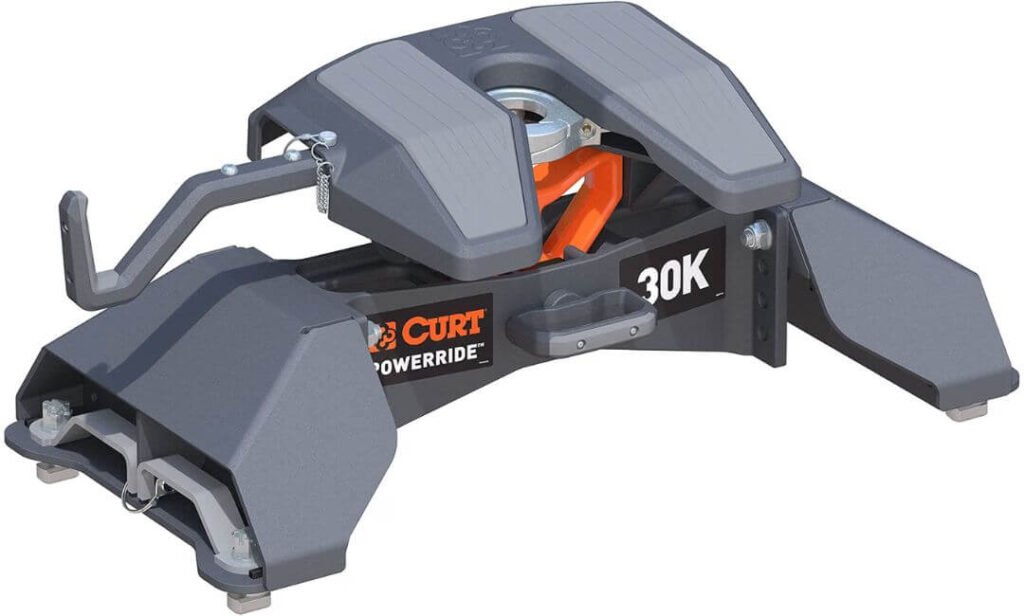
Quick Specs:
- Towing Capacity: 30,000 lbs GTW
- Vertical Load Capacity: 7,500 lbs
- Truck Bed: 8-foot long bed
- Mounting: Ford OEM puck system
- Construction: Cast-steel head and heavy-duty alloy-steel body
- Head Movement: Front-to-back and side-to-side articulation
- Hitch Weight: 116.8 lbs
- Coupling: Interlocking jaw with 3-position indicator
- Removal: One-pin head removal for easier handling and storage
There is a difference between a hitch that simply carries a big number on the box and one that makes sense for a properly equipped F-250 long bed. This one is built for the latter. Its 30,000-lb gross trailer rating and 7,500-lb vertical load capacity give it substantial headroom for a genuinely heavy fifth-wheel setup, while the factory puck mounting keeps the installation much cleaner than a traditional rail arrangement. For an F-250 with an 8-foot bed and Ford’s OEM puck prep, that combination is the reason this hitch deserves serious attention.
The cast-steel head is where the design starts to feel purposeful. It can articulate front-to-back as well as side-to-side, allowing the trailer and truck to move more naturally over uneven roads instead of forcing every movement through a rigid connection. The interlocking jaw is paired with a 3-position coupling indicator, so there is a useful visual check when hitching up rather than relying entirely on feel. The side-access self-resetting handle is another small detail that matters in practice—you can operate it from beside the bed instead of reaching awkwardly around the hitch.
At 116.8 lb, this is not a lightweight component, and that is worth understanding before installation. The useful part is that the head can be separated from the lower assembly with the one-pin removal design, making seasonal removal and storage considerably more manageable. The powder-coated finish adds another layer of protection for a component that will spend its life exposed underneath a trailer, while the supplied puck-system legs keep the setup purpose-built for the factory mounting points.
(A serious long-bed towing setup where capacity, articulation and factory-puck installation matter more than saving a few pounds.)
What We Like
- 30,000-lb capacity with 7,500-lb vertical load rating gives heavy F-250 towing setups meaningful capacity headroom.
- Two-direction head articulation is a genuinely useful feature when roads, campsites or driveways are less than perfectly level.
- OEM puck mounting avoids turning the truck bed into a permanent rail-hitch installation.
- The self-resetting side handle and coupling indicator make the hitching process more straightforward, particularly when working alone.
- The ability to remove the head separately is a practical advantage when the hitch comes out of the F-250 between towing seasons.
What We Would Keep in Mind
- Its 8-foot-bed and OEM puck requirement is the important part of the fitment story. Before ordering, confirm the F-250 has the factory puck preparation and check the height relationship between the bed rails and your particular fifth-wheel trailer.
Ford F-250 Fitment and Installation Notes
For the F-250, this setup is intended for a Super Duty with an 8-foot bed and Ford factory OEM puck system. That makes it a particularly straightforward match for a truck already equipped with the factory fifth-wheel prep package. It is not a universal solution for every F-250 configuration, so the model year and factory equipment should be checked against the application before purchase.
Installation itself does not call for welding or fabrication when the truck has the correct factory puck system. The supplied puck legs locate into the truck’s existing mounting points, but the real preparation should happen before the hitch ever goes into the bed: measure the trailer-to-bed-rail clearance, confirm hitch height and check the kingpin position. Those few measurements can save a lot of frustration after the trailer is connected.
The Insider Pro-Tip
With an F-250 this capable, it is tempting to look at 30,000 lbs and assume more is automatically better. The smarter approach is to start with the fifth wheel’s actual loaded weight and pin weight, then make sure the complete truck-and-trailer combination remains within Ford’s ratings. The hitch should have comfortable capacity above the trailer—not become the excuse to tow beyond what the truck is rated to handle.
One more measurement deserves attention: bed-rail-to-trailer clearance. The hitch’s maximum adjustment height is around 17 inches, and some trailer combinations can leave less clearance than expected. Measure before buying rather than discovering the issue on the first campsite driveway. That is the kind of five-minute check that turns an expensive towing component into a genuinely well-matched F-250 setup.
#2. Reese 30180 Elite Series Fifth Wheel Hitch Mounting System
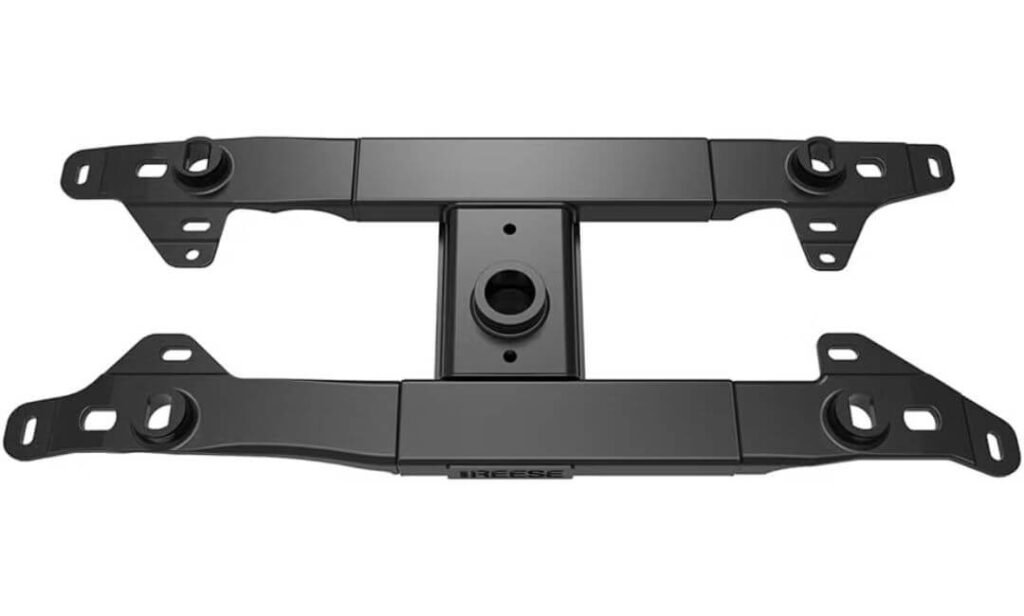
Quick Specs:
- Application: 2017–2022 Ford F-250 Super Duty
- System: Ford OEM Power Puck mounting
- Material: Alloy steel
- Weight: 95 lbs
- Finish: Powder coated
- 5th Wheel Capacity: Up to 20,000 lbs with bolt-in inner brackets
- Higher Capacity: Up to 32,000 lbs with welded inner frame brackets, depending on configuration
- Bed Access: Mounting system can be removed when towing equipment is not installed
- Important: This is a mounting system, not a complete fifth-wheel hitch
Sometimes the smartest part of a towing setup is not the hitch head itself—it is having a proper mounting foundation underneath it. That is exactly where this Elite Series system fits. For a 2017–2022 F-250 equipped with Ford’s factory Power Puck preparation, it creates a broad, stable mounting platform while keeping the truck bed usable when the towing equipment is removed.
The wider footprint is more than a cosmetic change. A fifth-wheel connection puts substantial forces through the mounting points during acceleration, braking and turns, so spreading that load across a purpose-built platform makes practical sense. At 95 pounds, the alloy-steel assembly has the substantial feel expected from a permanent towing component, while the powder-coated finish provides protection against the everyday exposure a truck-bed mounting system sees.
There is one detail worth making absolutely clear before clicking the buy button: this is not the complete hitch. It provides the mounting system, and the appropriate hitch head and inner frame brackets are needed to finish the installation. That may sound obvious to experienced towers, but overlooking it can leave a buyer with an expensive piece that cannot be used immediately. Once configured correctly, however, the system gives an F-250 owner a clean OEM-style foundation with the flexibility to remove the towing hardware and reclaim the bed.
(The real attraction here is not another bulky rail permanently occupying the bed; it is the combination of factory puck integration, a wider mounting footprint and removable towing hardware.)
What We Like About the Design
- OEM Power Puck integration makes this a natural option for the specified F-250 factory-prepped trucks.
- The wider mounting footprint gives the fifth-wheel assembly a substantial base rather than concentrating everything through a narrow mounting arrangement.
- Removable mounting hardware helps restore usable bed space when the truck is being used without the fifth wheel.
- The alloy-steel construction and powder-coated finish suit the demands of a component that stays close to the truck bed and chassis.
- The capacity can be configured for different towing requirements, depending on whether the inner frame brackets use a bolt-in or welded installation.
One Thing to Know Before Ordering
The important consideration is simply that you are buying the mounting foundation, not a complete fifth-wheel hitch. The correct inner frame brackets and a compatible hitch head are part of the overall setup, so the complete combination should be planned before ordering individual components.
F-250 Power Puck Fitment and Installation
For the F-250, the stated application covers 2017 through 2022 Super Duty models with the appropriate factory Power Puck preparation. This is therefore a much more specific fitment than a universal rail system. Check the truck’s actual factory equipment and model year rather than assuming every F-250 has the same mounting points.
Installation also deserves more attention than simply bolting the visible pieces into the bed. The inner frame bracket arrangement determines the available capacity, with the supplied information listing up to 20,000 lbs for the bolt-in configuration and higher ratings when the appropriate welded inner brackets are used. Because the work connects the bed mounting structure to the truck frame, professional installation is sensible if you are not already comfortable working around heavy towing hardware.
The Insider Pro-Tip
Treat this as the foundation of the towing system, not the towing system itself. Before buying, decide which hitch head you intend to run and then verify that the complete combination—mounting system, inner brackets and hitch—has the capacity and compatibility required for your F-250 and trailer. That one step prevents the common mistake of judging a mounting component by its headline capacity without checking how that capacity is actually achieved.
Also inspect the hardware when the package arrives. Reports of packaging or hardware issues do not define the product, but with a component this important, there is no good reason to start an installation with missing or incorrect fasteners. Lay everything out, match the hardware to the instructions and confirm the exact bracket configuration before the first wrench turns. For a heavy-duty F-250 towing setup, that kind of boring preparation is exactly what you want.
#3. Reese 30921 M5 Fifth Wheel Hitch
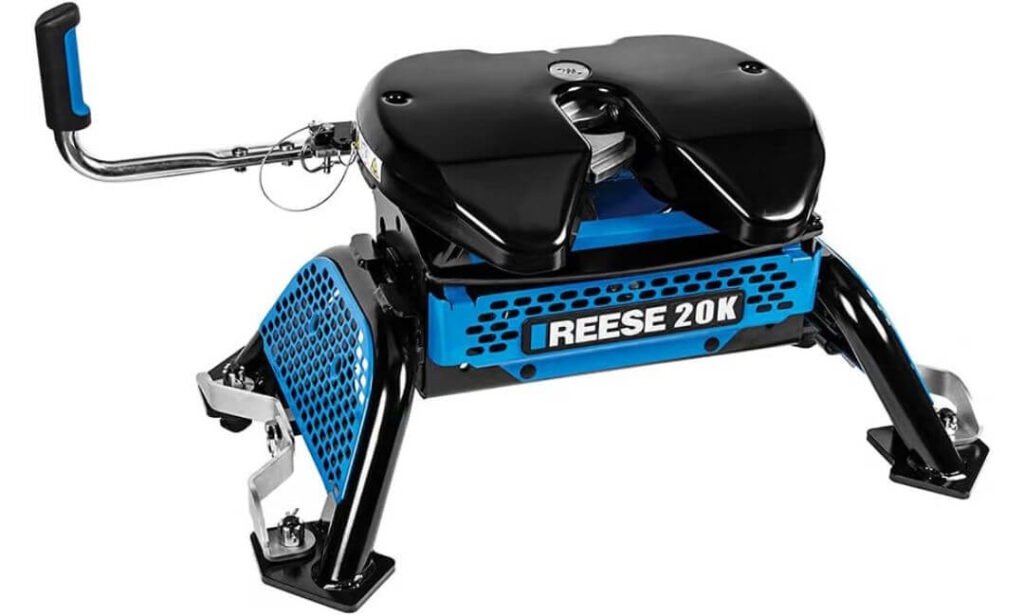
Quick Specs:
- Towing Capacity: 20,000 lbs
- Maximum Pin Weight: 5,000 lbs
- F-250 Application: 2011–2024 F-250 Super Duty with Factory HD Towing Option
- Mounting: Ford OE prep package
- Jaw: Talon Jaw with locking handle
- Construction: Alloy steel
- Finish: Black powder coat over E-coat
- Weight: 46.9 lbs
- Design: Modular, removable three-piece system
What makes this setup worth looking at is its Talon Jaw. Instead of treating the kingpin connection as an afterthought, the jaw is designed to be ready to receive the kingpin and lock around it securely. That matters on an F-250 because a fifth wheel does not only pull in a straight line—the connection sees movement under braking, acceleration, turns and uneven pavement. A good jaw should feel deliberate when it closes, not leave you guessing whether the trailer is properly locked.
The 20,000-lb towing rating and 5,000-lb pin-weight rating put it in the range many serious F-250 towing setups need, while the modular construction makes the 46.9-lb assembly much easier to handle than a permanently assembled heavy hitch. The locking handle and visible tow/no-tow indication are useful touches too; they give the driver a straightforward confirmation before pulling away rather than relying purely on memory.
There is also a practical advantage to the black powder coat over E-coat finish. This is not just about appearance—the extra corrosion protection makes sense for a component repeatedly exposed to moisture, road grime and changing weather. And because the system breaks down for storage, an F-250 owner who removes the fifth wheel between trips does not have to wrestle with one enormous assembly every time the truck bed is needed.
(The Talon Jaw and modular design are the real reasons to consider this one; the 20K rating is useful, but the way the hitch handles the kingpin and storage is what separates it from a basic towing platform.)
What We Like About It
- Talon Jaw design gives the kingpin connection the attention it deserves for quieter, more controlled fifth-wheel towing.
- 20,000-lb GTW and 5,000-lb pin capacity provide substantial working room for a properly matched F-250 and trailer.
- At 46.9 lbs, the modular construction is unusually manageable when the hitch needs to come out of the bed.
- The tow/no-tow indication and locking handle make the coupling process easier to verify before departure.
- E-coat beneath the powder coating is a worthwhile detail for long-term exposure to road moisture and grime.
What to Verify Before Buying
The fitment wording deserves extra attention here. The listing specifies Ford OE preparation and Factory HD Towing Option applications, but buyer reports have described fitment problems with some Ford puck-equipped trucks. That does not mean the hitch is universally incompatible; it means the safest approach is to verify the exact F-250 model year, factory towing preparation and puck configuration against the current manufacturer application before ordering.
F-250 Fitment and Installation
The stated application covers 2011–2024 Ford F-250 Super Duty models with the Factory HD Towing Option. For this article, that is the important distinction: do not assume that simply owning an F-250 guarantees the required factory preparation. The exact truck equipment needs to match the hitch’s mounting requirements.
Installation is relatively straightforward when the truck has the correct Ford OE preparation, and the three-piece design also makes removal considerably less awkward. Before tightening everything down, confirm the mounting points, hitch height and trailer clearance. A correct connection is more than getting the hitch into the bed—it needs to leave the fifth wheel sitting at a sensible height while maintaining adequate clearance between the trailer and the F-250.
The Insider Pro-Tip
This is one of those products where fitment verification is more important than the 20,000-lb headline. If your F-250 has the right factory preparation, the combination of Talon Jaw, modular construction and a 5,000-lb pin rating makes a lot of practical sense. If the truck’s equipment is uncertain, do not guess based on the product title alone.
And before the first trip, physically confirm the jaw has fully captured the kingpin and that the indicator shows the correct locked position. That extra check takes seconds. With a fifth wheel, those seconds are worth far more than trying to save time during hookup.
#4. B&W Trailer Hitches RVK3300 Companion OEM 5th Wheel Hitch
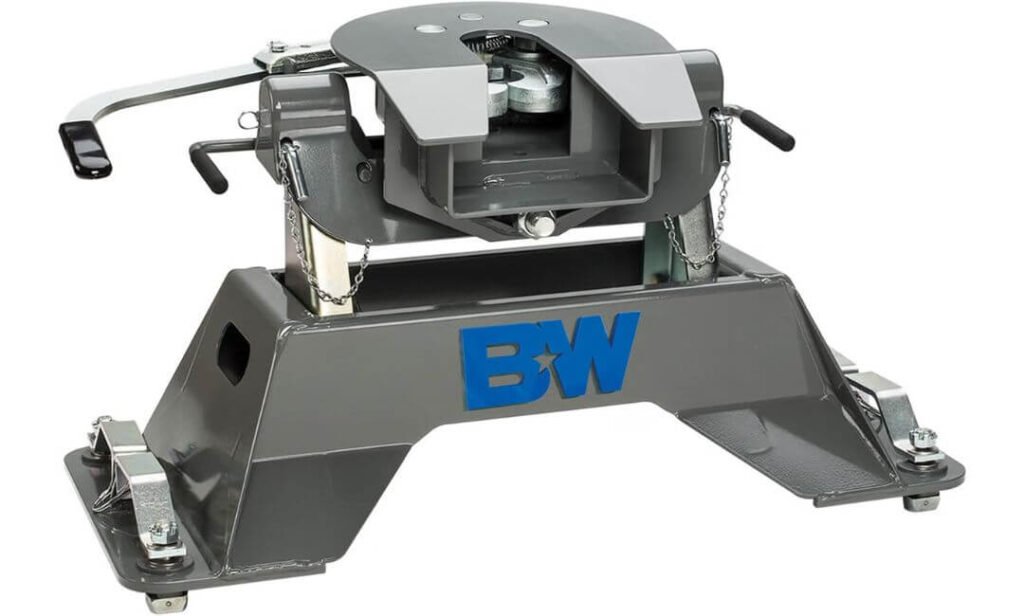
Quick Specs:
- Towing Capacity: 20,000 lbs GTW
- Vertical Load Capacity: 5,000 lbs
- Mounting: Ford OEM puck system
- Head: Fully articulating front-to-back and side-to-side
- Jaw: 1-inch thick cast-locking jaws
- Adjustment: 16.75–18.75 inches
- Construction: Alloy steel
- Finish: Powder coated
- Design: Two-piece removable hitch
- Warranty: Limited Lifetime
- Origin: Made in America
Some fifth-wheel hitches try to impress with capacity alone. This one takes a more practical route: the connection itself is the centre of the design. The fully articulating head can pivot both front-to-back and side-to-side, which becomes especially useful when an F-250 and trailer are negotiating an uneven campsite, steep driveway or rough access road. Instead of forcing every change in angle through a rigid head, the hitch is designed to move with the trailer.
The 20,000-lb GTW and 5,000-lb vertical load rating give it serious towing capability without making the headline capacity the only reason to consider it. The 1-inch cast-locking jaws are built around a secure kingpin connection, while the cam-action handle is designed to make releasing the trailer easier—even when the truck and trailer are sitting on less-than-level ground. That is the sort of detail you appreciate after several real-world hookups, not while reading a specification sheet.
Then there is the two-piece construction. At its full size, a fifth-wheel hitch is simply awkward to move, regardless of how strong you are. Splitting the assembly into the base and head makes seasonal removal far more realistic and leaves the F-250 bed available for normal truck duty when the trailer is parked. The three height positions, ranging from 16.75 to 18.75 inches, also give some useful flexibility when getting the trailer sitting correctly behind the truck.
(For an F-250 owner who values a quiet connection, genuine articulation and the ability to reclaim the truck bed, the design choices here make more sense than a long list of flashy extras.)
What We Like About the Setup
- Fully articulating head is genuinely useful when the truck and fifth wheel encounter uneven surfaces or changing angles.
- 1-inch cast-locking jaws put the emphasis where it belongs—the kingpin connection.
- Cam-action release handle is a thoughtful touch for uncoupling on uneven ground.
- The two-piece design makes removal much less cumbersome than handling one permanently assembled hitch.
- Three height positions provide useful adjustment when matching the hitch to the F-250 and trailer combination.
One Detail Worth Knowing
The hitch is substantial when assembled, so although the two-piece design makes removal easier, having another person available for moving the separate sections is still a sensible idea. For short-bed F-250 owners, clearance should also be measured carefully before the first trip because trailer front-overhang geometry varies.
F-250 OEM Puck Fitment
This configuration is designed to drop into the Ford OEM puck system, making it particularly relevant to an F-250 that already has the factory fifth-wheel preparation. No drilling or traditional above-bed rail installation is needed when the truck has the correct factory mounting points.
Both long-bed and 6.5-foot-bed F-250 configurations can require different practical considerations. A long bed generally gives more turning clearance, while a short bed deserves a proper clearance check between the trailer’s front overhang and the cab before committing to tight turns. Measure the actual truck-and-trailer combination rather than relying on bed length alone.
The Insider Pro-Tip
The biggest mistake with a 20K hitch is treating 20,000 lbs as the target rather than the ceiling. Start with the fifth wheel’s realistic loaded weight and pin weight, then make sure the F-250 and the entire towing combination stay within their respective ratings. The hitch should provide comfortable capacity without encouraging a heavier load than the truck is designed to carry.
Before the first proper trip, spend a few minutes checking the jaw lock, coupling indicator, hitch height and cab clearance. Especially with a short-bed F-250, turn the combination through the angles you expect to encounter before heading out. A campsite is a much better place to find a clearance problem than a busy road.
#5. CURT A25 5th Wheel Hitch
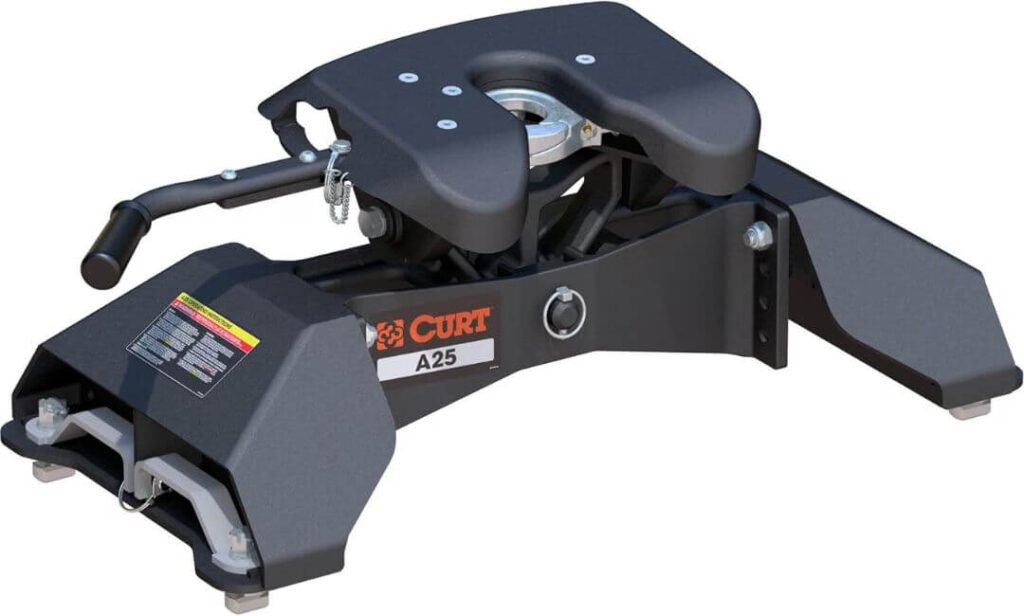
Quick Specs:
- Towing Capacity: 25,000 lbs GTW
- Vertical Load Capacity: 5,000+ lbs
- Truck Bed: 8-foot long bed
- Mounting: Ford OEM puck system
- Head: Fully articulating torsion head
- Yoke: Cast yoke with poly-torsion inserts
- Jaws: High-strength interlocking jaws
- Coupling: Lockable single-throw handle with visible indicator
- Construction: Cast steel main body
- Weight: 158 lbs
- Finish: Carbide black powder coat
- Certification: SAE J2638
A heavy fifth-wheel hitch does not need to feel complicated every time the F-250 is hooked to the trailer. The A25 takes a fairly sensible approach: make the coupling process easier while controlling the movement and noise that come with a heavy trailer behind the truck. Its fully articulating torsion head allows movement in multiple directions, while the cast yoke and poly-torsion inserts are there to absorb shock loads rather than passing every little movement straight through the connection.
The 25,000-lb gross trailer rating gives this setup considerable capacity, but the feature that may matter more during everyday use is the coupling system. The high-strength interlocking jaws work around the kingpin, while the single-throw handle automatically returns to the ready-to-couple position after uncoupling. The coupling indicator is another genuinely useful touch—you get a visual confirmation of the hitch’s status instead of repeatedly wondering whether everything is positioned correctly.
Then there is the Ford puck installation. The quarter-turn anchoring system allows the assembly to attach directly to the factory mounting points without drilling the F-250 bed. The variable-position anchors also help take up movement at the mounting interface. At 158 pounds, this is unquestionably a substantial piece of equipment, but that weight comes with a cast-steel main body and a design intended for serious towing rather than occasional light-duty use.
(The standout here is the combination of a high capacity, torsion-based head and a coupling indicator that actually makes sense when you’re standing beside a loaded F-250.)
What We Like About the Design
- Poly-torsion inserts are a meaningful feature for reducing shock and unwanted hitch noise.
- The fully articulating head allows the connection to move naturally as the truck and trailer change angles.
- Visible coupling indication makes the final hookup check easier and less dependent on guesswork.
- Quarter-turn puck anchors make installation and removal cleaner on a properly equipped F-250.
- The 25,000-lb rating provides substantial capacity for an appropriately matched heavy fifth wheel.
One Thing to Plan For
At 158 pounds, the complete assembly is heavy enough that removal is not something most owners will want to do casually. If the F-250’s bed needs to be reclaimed regularly, plan how the hitch will be lifted, separated and stored before installation day.
F-250 OEM Puck Fitment
For the F-250, this configuration is intended for a long-bed truck with Ford’s factory OEM puck system. The supplied puck legs allow the hitch to locate directly into the factory preparation, so there is no need to drill the bed or install conventional fifth-wheel rails when the truck has the correct equipment.
The important check is simple: confirm the F-250 has the factory puck preparation and an 8-foot bed before ordering. This particular configuration is not the one to choose by assumption if the truck has a 5.5- or 6.5-foot bed. Trailer height and front-overhang clearance should also be checked once the hitch height is established.
The Insider Pro-Tip
With this hitch, do not focus only on the 25,000-lb number. Look at the trailer’s actual loaded weight and pin weight first, then check the F-250’s own towing and payload limits. A hitch can have plenty of capacity while the truck becomes the limiting factor—that distinction is easy to miss when shopping.
And there is a small habit worth keeping: after coupling, use the indicator as a confirmation, then physically verify the kingpin/jaw connection before pulling away. The indicator makes the process easier; it should complement a proper hitching check, not replace it. That is the kind of routine that makes a premium towing setup feel genuinely dependable rather than merely expensive.
Ford F-250 5th Wheel Hitch Buying Guide for a Proper Towing Setup
Buying a fifth-wheel hitch for an F-250 is one of those jobs where fitment should come before features and price should come last. A hitch can have an impressive towing number and still be a poor match if the truck has the wrong bed length, factory mounting system, hitch height or trailer pin weight. The right setup is the one where the truck, hitch and fifth wheel work together without forcing any part of the combination beyond its intended limits.
With the products covered in this guide, the biggest differences are not just capacity. You are looking at OEM puck-mounted hitches, different jaw designs, articulating heads, removable assemblies and even a mounting system that requires a separate hitch head. That is why the buying decision needs a little more thought than simply sorting products by their advertised weight rating.
Start With Your F-250’s Exact Configuration
Before comparing hitch brands, identify what is actually sitting in your truck bed. Ford has used different factory towing preparations and mounting arrangements across F-250 generations, so the model year alone is not enough.
Check these four things first:
| What to Check | Why It Matters |
|---|---|
| Model year | Hitch fitment can change between F-250 generations |
| Bed length | Long-bed and short-bed trucks have different clearance requirements |
| Factory puck preparation | OEM puck hitches require the correct factory mounting points |
| Factory towing equipment | Some hitches specifically require a factory HD towing or fifth-wheel prep option |
If your F-250 already has the factory puck system, an OEM-puck-compatible hitch can provide a much cleaner installation than adding a traditional rail arrangement. If the truck does not have the required factory preparation, do not assume a puck hitch can simply be adapted into place.
Match the Hitch Capacity to the Trailer You Actually Tow
The number printed on a hitch should never be the first and only number you consider.
A 20,000-lb, 25,000-lb or 30,000-lb rating describes the hitch’s capacity, but your actual towing limit is determined by the complete truck-and-trailer combination. The F-250’s own ratings, the fifth wheel’s loaded weight and the trailer’s pin weight all matter.
A useful way to compare the hitches in this article is:
| Hitch Capacity | What It Tells You | What You Still Need to Check |
|---|---|---|
| 20,000 lbs | Substantial fifth-wheel towing capability | Actual trailer weight, pin weight and F-250 ratings |
| 25,000 lbs | More capacity headroom for heavier fifth wheels | Truck payload and manufacturer limits still apply |
| 30,000 lbs | Very high hitch capacity for heavy-duty applications | A high hitch rating does not increase the F-250’s own limits |
For example, the CURT PowerRide’s 30,000-lb rating is impressive, but there is no practical benefit in paying for capacity your particular trailer and truck cannot use. Likewise, a 20,000-lb hitch should not automatically be dismissed simply because another option carries a larger number.
The better question is: What is the fifth wheel’s realistic loaded weight, and what is its actual pin weight when ready for travel?
That gives you a much more useful starting point.
Understand Pin Weight Before You Buy
Pin weight deserves special attention with a fifth wheel because it is carried directly by the truck.
A trailer may have a large gross weight rating while its actual loaded pin weight is considerably different. Your F-250 must be capable of carrying that pin weight along with passengers, fuel, cargo and the hitch itself.
Do not use the hitch’s maximum vertical-load figure as permission to load the truck beyond its own limits.
A sensible check looks like this:
- Find the fifth wheel’s actual or expected loaded weight.
- Determine its actual pin weight when loaded for travel.
- Check the F-250’s applicable towing and payload ratings.
- Account for passengers, cargo, fuel and hitch weight.
- Make sure the complete combination remains within the manufacturer’s limits.
This is much more meaningful than simply seeing “20K” or “25K” and assuming the setup is automatically suitable.
Bed Length Changes the Hitch Decision
This is one of the easiest details to overlook.
An 8-foot F-250 bed generally gives considerably more space between the hitch and the cab, which is why several of the products in this comparison are specifically configured around long-bed trucks.
A 6.5-foot short bed needs more careful attention. The front corners of the fifth wheel can move toward the cab during tight turns, and the amount of clearance depends on the trailer’s front profile, kingpin position, hitch position and overall geometry.
Before buying, measure:
- Bed rail height
- Hitch height range
- Trailer overhang height
- Kingpin position
- Distance from the kingpin to the trailer’s front corners
- Available cab clearance during turning
If the numbers are marginal, do not rely on a product photograph to judge clearance. The actual F-250 and fifth wheel combination is what matters.
Choose the Mounting System Carefully
For an F-250 with the factory puck preparation, there is a major convenience advantage to using a hitch designed around those factory mounting points.
OEM puck mounting generally means:
- No conventional fifth-wheel rails across the bed
- No drilling into the truck bed for the hitch itself
- Faster installation and removal
- Cleaner bed appearance when the hitch is removed
- Better use of the factory towing preparation
But there is an important distinction in this list.
The Reese 30180 Elite Series is a mounting system rather than a complete fifth-wheel hitch. It should therefore not be compared with the complete hitch assemblies as though you are buying the same thing. A compatible hitch head and the appropriate inner frame bracket arrangement are part of the finished installation.
That is exactly the sort of detail worth checking before purchasing because it is easy to see “fifth wheel” in a product title and assume everything needed for towing is included.
Pay Attention to the Jaw and Coupling Design
The jaw is one of the most important mechanical parts of a fifth-wheel hitch because it is responsible for securing the trailer’s kingpin.
Different designs approach the job differently.
Talon Jaw: The Reese M5 uses its Talon Jaw system, with a locking handle and coupling indication designed to make the connection easier to verify.
Interlocking jaws: The CURT options use robust jaw arrangements designed to capture the kingpin securely.
Cast-locking jaws: The B&W Companion uses substantial cast-locking jaws alongside its articulating head.
The useful feature is not necessarily whichever name sounds most impressive. What matters is having a positive kingpin connection, a clear locking procedure and a reliable way to verify that the hitch is properly coupled.
Always perform a physical coupling check before towing, even when the hitch has an indicator.
A Moving Head Can Make a Real Difference
A fifth wheel does not stay perfectly aligned with the F-250.
The truck and trailer move independently when:
- Entering a sloped driveway
- Crossing uneven ground
- Turning into a campsite
- Travelling over uneven pavement
- Moving through a dip or rise
That is why articulating heads can be useful.
The B&W Companion and CURT A25, for example, use articulating head designs that allow controlled movement in more than one direction. The PowerRide also uses a multi-directional cast head.
This does not mean articulation automatically makes one hitch right for every trailer. It simply means the head design deserves attention if the truck regularly travels through uneven campsites, mountain roads or awkward trailer entrances.
Consider Noise and Shock Control
A little movement between the truck and trailer is unavoidable, but excessive play can make towing feel unpleasant.
The CURT A25 is particularly interesting here because its poly-torsion inserts are designed to suppress shock loads and reduce unwanted noise through the hitch assembly.
That can matter during repeated acceleration, braking and changes in road surface.
Still, do not expect any fifth-wheel hitch to eliminate every sound from a trailer. Suspension movement, trailer brakes, tires, kingpin geometry and road conditions all contribute to what you hear and feel.
The realistic goal is controlled movement rather than chasing a completely silent trailer.
Think About Removal Before Installing It
A hitch that lives permanently in the F-250 bed is fine if the truck is primarily a tow vehicle. It becomes a different story if you regularly use the truck for normal hauling.
The products here vary considerably in how manageable they are to remove.
The B&W Companion uses a two-piece design, while the PowerRide allows its head to be separated from the lower assembly. The Reese M5 also uses a modular design.
That matters because a 100-plus-pound assembly is awkward to lift safely by yourself. A removable head or sectional design can turn a frustrating job into something considerably more manageable.
If you expect to remove the hitch frequently, consider how the pieces will actually be lifted and stored, not just whether the manufacturer calls them removable.
Do Not Ignore Hitch Height
Getting the hitch into the puck system is only half the installation.
The final hitch height needs to work with the fifth wheel so that you have appropriate bed-rail clearance while keeping the trailer reasonably level.
A setup that is too low can create clearance problems. A setup that is unnecessarily high can affect the towing attitude of the trailer.
Before finalising the height, check:
- F-250 bed-rail clearance
- Trailer level
- Kingpin position
- Cab clearance
- Trailer-to-bed relationship
- Available adjustment range
The PowerRide, for example, has a listed maximum height around 17 inches, so measure your actual trailer combination before assuming the available adjustment will be enough.
Installation Complexity Is Part of the Price
The cheapest-looking hitch is not necessarily the cheapest installation.
An OEM puck-compatible complete hitch can be relatively straightforward when the F-250 already has the required factory preparation. A mounting system that needs inner frame brackets is a different project, particularly if the chosen configuration calls for welded installation.
Before ordering, ask:
- Is the hitch complete?
- Are Ford puck legs included?
- Are inner frame brackets required?
- Does the installation require drilling?
- Does it require welding?
- Can the hitch be installed and removed without specialist equipment?
- Is professional installation sensible for this particular setup?
If you are not experienced with heavy towing equipment, paying for a proper installation can be money well spent. The hitch is a structural connection between a very heavy trailer and the truck; it is not the place to improvise.
Warranty and Long-Term Ownership Matter
A fifth-wheel hitch is not a disposable accessory. It can spend years exposed to rain, road salt, dust and repeated loading cycles.
Look beyond the warranty headline and consider:
- Warranty length and coverage
- Corrosion protection
- Availability of replacement parts
- Service support
- Ease of lubricating and inspecting moving components
- Whether the hitch can be disassembled for maintenance
A limited lifetime warranty can provide useful reassurance, but warranty coverage does not replace correct installation or maintenance.
Price vs Value: What Are You Actually Paying For?
There is no useful rule saying the most expensive hitch is automatically the right choice for an F-250.
The better way to look at price is to identify what the extra money is buying.
A higher-priced setup may justify itself through:
- Higher towing capacity
- Better articulation
- More substantial jaw construction
- OEM puck integration
- Easier removal
- Better noise and shock management
- More adjustment range
- Stronger mounting architecture
On the other hand, paying for a 30,000-lb capacity makes little sense if your F-250 and fifth wheel are comfortably below that level and another properly rated hitch provides the features you actually need.
The same goes for a mounting system. If the truck needs a complete hitch, a rail or puck mounting foundation by itself is not a finished towing solution.
Questions to Ask Before Ordering
Use this checklist before putting any of these hitches into the cart:
- Does this exact hitch fit my F-250 model year?
- Does my truck have the required factory puck or towing preparation?
- Is my bed 6.5 feet or 8 feet?
- Does the hitch provide enough cab and bed-rail clearance?
- What is my fifth wheel’s actual loaded weight?
- What is the trailer’s actual pin weight?
- Are those numbers within the F-250’s ratings?
- Is this a complete hitch or only a mounting system?
- Will I need additional brackets, hardware or a separate hitch head?
- Can I realistically remove and store a hitch weighing well over 100 pounds?
- Is the available hitch-height adjustment appropriate for my trailer?
- Am I paying for capacity or features that I genuinely need?
The Simple Buying Logic
If the truck has the correct Ford OEM puck system and an 8-foot bed, the complete puck-mounted options in this guide deserve the closest attention.
If maximum hitch capacity is genuinely required by the towing application, the 30K-rated PowerRide provides substantial headroom.
If articulation, quiet operation and removable construction are higher priorities, the B&W Companion and CURT A25 bring those characteristics into the decision.
If the Talon Jaw and modular design appeal to you, the Reese M5 offers a different approach, but its exact F-250 application should be verified carefully before ordering.
And if you are considering the Reese Elite mounting system, remember that it is the foundation for the hitch rather than the complete hitch itself.
That is ultimately the best way to approach an F-250 fifth-wheel purchase: start with the truck, then the trailer, then the mounting system, then the hitch features, and only after that compare price. It takes a little longer than choosing by star rating or towing number, but it gives you a setup that actually makes sense once the trailer is sitting behind the truck.
Ford F-250 5th Wheel Hitch Installation Essentials for a Safe, Clean Fit
Installing a fifth-wheel hitch on an F-250 is not difficult simply because the hardware is heavy; the real challenge is getting the mounting system, hitch height, torque, clearance and kingpin alignment right. The exact procedure varies with the hitch and the truck’s factory preparation, so the manufacturer’s installation instructions should always take priority over a generic guide.
For the products covered here, the biggest advantage is that several are designed around the Ford OEM puck system. That removes much of the drilling and rail work associated with older-style installations, but it does not remove the need for careful preparation and final inspection.
1. Confirm the F-250 and Hitch Match Before Installation
Do this before lifting anything into the bed.
Check the:
- F-250 model year
- Bed length
- Factory 5th-wheel/gooseneck puck preparation
- Required factory HD towing equipment, where applicable
- Hitch part number and application
- Trailer weight and pin weight
- Required hitch-height range
This is especially important with the products in this comparison because they do not all have identical applications.
For example, the Reese M5 30921 has a stated F-250 application that includes specific factory towing preparation, while the CURT PowerRide and A25 configurations discussed here are intended around the OEM puck system and long-bed setup. The Reese 30180 is different again because it is a mounting system rather than a complete fifth-wheel hitch.
Do not begin installation until those details line up.
2. Prepare the Truck Bed
Start with an empty, clean bed.
Remove:
- Loose cargo
- Bed mats that interfere with the puck openings
- Dirt or debris around the factory mounting points
- Any temporary covers or plugs from the puck sockets
Inspect each puck location before installing the hitch. The mounting points should be clean and free of anything that could prevent the anchors from seating completely.
This is also the right time to inspect the bed for damage. A clean mounting surface makes it much easier to spot a problem before the hitch is carrying several thousand pounds of trailer load.
3. Lay Out the Hitch Components First
Do not start assembling pieces while they are scattered around the truck.
Put the major components on a clean surface and identify:
- Hitch head
- Base or legs
- OEM puck anchors
- Locking pins
- Handles
- Brackets
- Fasteners
- Any required hardware
If the hitch uses a removable head, decide where the head will be supported while assembling it.
For a two-piece or modular hitch, this is one of the easiest ways to avoid lifting more weight than necessary.
Never substitute random hardware because a bolt “looks about right.” Hitch mounting hardware is structural hardware, so use the components specified by the manufacturer.
4. Install the OEM Puck Mounting Components
For a factory-prepped F-250, the puck anchors generally locate into the truck’s existing mounting points.
The basic sequence is:
- Position the hitch over the factory puck locations.
- Lower the mounting legs or anchors into the openings.
- Make sure every anchor is fully seated.
- Operate the locking mechanism according to the hitch instructions.
- Confirm that each attachment point is actually locked.
- Only then proceed with final tightening or adjustment.
The important part is not getting the hitch to look centred. The important part is getting every mounting point properly engaged.
With quarter-turn or similar puck anchors, verify the locking position individually. A partially engaged anchor can look acceptable from above while not being properly secured.
5. Set the Hitch Height Before Connecting the Trailer
This is where many installations become unnecessarily complicated later.
Start by comparing the truck’s bed-rail height with the fifth wheel’s front overhang. Set the hitch at an appropriate height while leaving enough clearance between the trailer and the truck bed.
You want a setup that provides:
- Adequate bed-rail clearance
- Sufficient cab clearance
- A sensible trailer attitude
- Secure kingpin engagement
- No unnecessary extreme hitch-height adjustment
Do not automatically choose the highest or lowest setting.
The correct position depends on the actual F-250, hitch and fifth wheel together.
6. Check Trailer Clearance Before the First Road Trip
This is particularly important for a short-bed F-250.
With the trailer connected, check the relationship between the:
- Cab
- Trailer front corners
- Fifth-wheel overhang
- Bed rails
- Hitch head
Then perform controlled turning checks in an open area.
A trailer can have plenty of clearance while travelling straight and lose that clearance rapidly during a tight turn. Do not assume bed length alone tells you whether the combination is safe.
For an 8-foot bed, clearance is generally less restrictive, but it should still be physically checked.
7. Tighten and Torque the Hardware Correctly
Once the hitch is positioned and the mounting arrangement is confirmed, torque the specified fasteners according to the manufacturer’s instructions.
A useful installation sequence is:
- Seat all mounting components.
- Check alignment.
- Snug the hardware evenly.
- Confirm the hitch remains correctly positioned.
- Use a calibrated torque wrench.
- Apply the manufacturer’s specified torque values.
- Recheck the assembly after the initial installation.
Do not guess torque values. Different hitches and bracket systems use different hardware and specifications.
This is especially important if using a mounting system such as the Reese Elite setup, where the inner frame bracket configuration affects the overall installation.
8. Couple the Fifth Wheel Carefully
Before backing the trailer into the hitch, make sure the hitch jaw is in its proper ready-to-couple position.
Then:
- Align the kingpin with the centre of the hitch head.
- Back the F-250 slowly and steadily.
- Allow the kingpin to enter the jaw.
- Stop once the connection is made.
- Engage the locking mechanism.
- Check the hitch’s coupling indicator, if equipped.
- Perform a physical inspection of the jaw and kingpin connection.
Do not rely on the sound of the kingpin entering the hitch.
A proper visual and physical confirmation is far more useful than assuming “it sounded like it locked.”
9. Perform a Low-Speed Test Before Normal Driving
Once connected, do not immediately head onto the highway.
Perform a controlled check in a safe area.
Look for:
- Abnormal movement
- Unusual hitch noise
- Incorrect trailer attitude
- Insufficient bed clearance
- Cab clearance problems
- Any movement at the mounting points
- Correct brake and electrical connections
Make a few gentle starts and stops, then inspect the connection again.
This first short test is valuable because it gives you an opportunity to catch something small before it becomes a serious towing problem.
Common Installation Mistakes to Avoid
Assuming Every F-250 Uses the Same Mounting System
They do not.
Model year and factory equipment matter. Always match the exact hitch application to the actual truck.
Treating a Mounting Kit as a Complete Hitch
The Reese 30180 is the obvious example in this guide. It is a mounting system, so a compatible hitch head and the appropriate inner frame bracket arrangement are needed for a complete towing setup.
Setting Hitch Height Without the Trailer
A height that looks perfect in an empty truck bed may not produce the clearance or trailer attitude you need once the fifth wheel is connected.
Ignoring Pin Weight
A hitch’s vertical-load rating does not override the F-250’s own payload limitations. The trailer’s actual pin weight must be considered as part of the truck’s total loaded weight.
Skipping the Turning Clearance Check
Straight-line clearance is not enough. The trailer’s front overhang can move substantially closer to the cab during a sharp turn.
Using Improvised Hardware
Do not replace specified structural hardware with whatever happens to fit. Use the correct components and torque specifications.
Installing Heavy Components Alone
Some complete fifth-wheel assemblies are extremely heavy. Use a second person or suitable lifting equipment when required. A dropped hitch can damage the truck, the equipment or the person underneath it.
Tools Checklist
For a typical OEM-puck installation, the exact requirements vary by hitch, but having the following available is sensible:
- Socket and ratchet set
- Combination wrenches
- Calibrated torque wrench
- Manufacturer-specified sockets
- Hex or Allen keys where required
- Screwdrivers
- Work gloves
- Flashlight or inspection light
- Tape measure
- Clean rag
- Suitable lifting assistance or a second person
- Manufacturer installation instructions
If the installation involves frame brackets, drilling or welding, additional tools and expertise may be required. That is where a professional installation becomes much more reasonable.
Safety Checks Before the First Tow
Before putting the F-250 and fifth wheel onto the road, run through the complete connection one more time:
- Hitch fully seated in the factory mounting points
- All locking mechanisms engaged
- Correct hardware installed
- Fasteners torqued to specification
- Kingpin completely captured
- Coupling indicator showing the correct position
- Safety breakaway cable attached correctly
- Trailer electrical connection secure
- Trailer brakes functioning
- Bed-rail clearance confirmed
- Cab clearance confirmed
- Trailer sitting at an appropriate height
- Truck and trailer weights within their applicable ratings
Then do one final walk-around.
A Small Step That Pays Off Later
After the first towing trip, inspect the hitch again rather than assuming the installation is finished forever. Look for anything unusual around the puck anchors, fasteners, jaw mechanism and head assembly.
That does not mean constantly dismantling a properly installed hitch. It simply means giving the connection a quick inspection after its first real load cycle. Heavy towing rewards that habit.
The best installation is not the one completed fastest. It is the one where, before the F-250 ever leaves the driveway, the mounting points are locked, the hitch is correctly adjusted, the kingpin is positively captured and the truck-to-trailer clearances have been physically checked.
Ford F-250 5th Wheel Hitch Performance in Real-World Towing
A fifth-wheel hitch earns its place when the trailer is actually behind the truck, not when it looks impressive in a product listing. With an F-250, the difference becomes noticeable when a loaded fifth wheel starts braking, climbing, turning through a campsite or crossing uneven pavement. Hitch capacity, jaw engagement, head articulation, mounting stability and trailer weight all work together, so real-world behaviour cannot be judged from the towing rating alone.
The products in this comparison use different approaches. The CURT options focus on articulated head movement and controlled shock, the B&W Companion combines a fully articulating head with substantial locking jaws, and the Reese M5 brings its Talon Jaw and modular construction into the mix. The Reese Elite system is different again because it provides the mounting foundation rather than the complete hitch head. That distinction matters when comparing how each setup behaves behind an F-250.
What Changes When the F-250 Is Actually Towing
A properly matched fifth wheel should feel controlled rather than nervous. You will still feel the trailer because there is a large amount of mass behind the truck, but excessive clunking, harsh movement or unexpected trailer motion deserves investigation rather than being accepted as “normal fifth-wheel behaviour.”
Several things influence what you feel from the driver’s seat:
- Trailer weight and pin weight
- Hitch jaw design
- Head articulation
- Mounting stability
- Trailer suspension
- Tire condition and pressure
- Trailer brake adjustment
- Road surface
- Hitch height and trailer attitude
This is why two F-250s pulling similarly sized trailers can feel quite different even when both have a 20,000-lb-rated hitch.
Braking and Weight Transfer
The hitch itself does not stop the trailer, but it is directly involved in transferring the trailer’s pulling and braking forces into the truck.
When the trailer brakes engage correctly, the combination should settle into a predictable braking motion. When the trailer is heavily loaded, the pin weight places substantial load over the F-250’s rear axle, which is why payload and axle ratings remain just as important as the hitch rating.
A high-capacity hitch cannot compensate for an overloaded truck.
For a real towing setup, check:
- Fifth-wheel loaded weight.
- Actual pin weight.
- F-250 payload capacity.
- Front and rear axle ratings.
- Combined truck-and-trailer limits.
- Trailer brake operation and adjustment.
If the truck is properly loaded and the trailer brakes are correctly set up, the hitch can do its job without being asked to solve a problem elsewhere in the combination.
Why Articulating Heads Matter on Uneven Roads
The truck and fifth wheel rarely remain perfectly level with one another.
Think about pulling into a campsite where one wheel drops into a depression while the trailer remains on higher ground. The hitch head needs to accommodate that changing relationship.
The B&W Companion and CURT A25 use articulating head designs that allow controlled movement in more than one direction. The PowerRide also uses a multi-directional cast head.
That movement is particularly useful during:
- Uneven campsite entrances
- Steep driveway transitions
- Rough access roads
- Off-camber turns
- Uneven pavement
- Slow manoeuvring around a trailer site
Articulation is not the same thing as sway control, however. The hitch’s ability to pivot does not eliminate trailer movement caused by speed, loading, tires, suspension or road conditions.
Sway Control Is Not Just a Hitch Feature
This is an important distinction.
A fifth-wheel trailer is connected differently from a conventional bumper-pull trailer, and the hitch’s job is primarily to provide a secure pivoting connection and transfer loads into the truck. Do not expect a fifth-wheel hitch to correct an improperly loaded or poorly maintained trailer.
If the trailer feels unstable, investigate the entire setup:
- Trailer loading
- Pin weight
- Tire pressure
- Tire condition
- Suspension components
- Wheel alignment
- Trailer brakes
- Hitch installation
- Road and weather conditions
A hitch with a strong jaw and stable head can reduce unwanted movement at the connection, but it cannot overcome poor trailer setup.
Quiet Towing: What You Should Realistically Expect
Some movement and mechanical noise are normal.
What you do not want is persistent excessive clunking, harsh shock or unusual looseness coming from the hitch connection.
The CURT A25 is particularly interesting because its poly-torsion inserts are designed to suppress shock loads and reduce noise. The B&W Companion’s substantial locking jaws and articulating head take a different approach to maintaining a controlled connection.
The realistic goal is not a completely silent trailer. Instead, look for a connection that feels predictable, secure and controlled under acceleration, braking and changing road surfaces.
Daily Towing vs Heavy-Haul Use
An F-250 used occasionally for weekend camping has different priorities from one regularly moving a large fifth wheel.
Regular Weekend and Recreational Towing
For occasional towing, convenience becomes increasingly valuable.
A removable or modular hitch can be worthwhile because you can reclaim the F-250 bed when the trailer is parked. Features such as a self-resetting handle, coupling indicator and easy-to-remove head can also make repeated hookups less frustrating.
The B&W Companion’s two-piece design and the removable-head approach used by the PowerRide are particularly relevant if the hitch will not stay installed permanently.
Frequent Heavy Towing
For frequent heavy-haul work, put more emphasis on:
- Appropriate towing capacity
- Actual pin-weight capacity
- Jaw construction
- Mounting stability
- Head articulation
- Hitch-height adjustment
- Corrosion protection
- Serviceable moving components
- Correct installation
This is where simply choosing the lightest or cheapest hitch can become false economy. A fifth-wheel hitch is structural towing equipment, and frequent heavy use puts substantially more demand on every part of the connection.
Maintaining a Ford F-250 OEM Puck System
The factory puck system is convenient, but it still deserves inspection.
Keep the puck openings clean and free of packed dirt, rust scale and debris. Before installing the hitch, inspect the mounting points and make sure the anchors can seat fully.
During ownership:
- Keep the puck openings clean.
- Inspect the anchor hardware periodically.
- Check for unusual movement at the mounting points.
- Follow the hitch manufacturer’s lubrication requirements.
- Inspect exposed hardware for corrosion.
- Avoid forcing an anchor into a contaminated or obstructed puck.
- Recheck the mounting assembly after periods of heavy towing.
Do not cover a problem with grease. If an anchor is not seating correctly, find out why before towing.
Looking After the Talon Jaw
The Reese M5’s Talon Jaw deserves its own maintenance routine because the kingpin connection is one of the most important moving parts in the entire hitch.
Keep the jaw and surrounding mechanism clean enough to inspect properly, and follow Reese’s specified lubrication procedure rather than applying random products whenever the mechanism feels stiff.
Before towing, look for:
- Proper jaw closure
- Correct locking-handle position
- Correct coupling indication
- Abnormal wear
- Damage around the jaw
- Contamination that could interfere with movement
If the jaw does not operate as intended, do not compensate by pulling harder on the handle or towing anyway. Find the cause first.
Lubrication Is Part of Ownership
The exact lubrication points and lubricant type depend on the hitch.
That means the manufacturer’s instructions should win over generic internet advice.
In general, moving components that are specifically designed to be lubricated should not be allowed to run dry, while components that use special friction materials or inserts should not automatically receive conventional grease.
This is particularly important with modern hitch designs because more lubricant is not necessarily better. The wrong lubricant in the wrong location can attract dirt or interfere with components that are intended to work with a particular surface treatment.
Inspect the Kingpin, Not Just the Hitch
A perfectly maintained hitch cannot compensate for a damaged or poorly maintained trailer kingpin.
Whenever the trailer is being prepared for a trip, inspect the kingpin area for obvious damage, abnormal wear or contamination. The mating surfaces should be clean enough to inspect properly, and the connection should engage normally.
If something looks different from previous trips, investigate it.
A useful habit is to look at the kingpin and hitch together, rather than treating them as two unrelated pieces of equipment.
Watch for Changes in Towing Feel
Experienced owners often notice a change before a component becomes obviously damaged.
If the F-250 suddenly develops:
- More hitch clunk
- Excessive movement
- Difficult coupling
- Difficult uncoupling
- Unusual jaw behaviour
- New mounting movement
- Strange noises during braking
stop treating it as ordinary towing noise.
A change from the way the truck normally behaves is useful information. Investigate the change before the next long trip, particularly if the fifth wheel is carrying a heavy load.
The Real Takeaway for F-250 Owners
The best-performing setup is not necessarily the hitch with the biggest number on the label. It is the combination where the F-250’s ratings, trailer weight, pin weight, mounting system, hitch height, jaw mechanism and clearance all make sense together.
For long-distance or heavy towing, the details that seem small while shopping—articulating head movement, a positive jaw, controlled shock, a useful coupling indicator and removable sections—can become the features you appreciate most after hundreds of miles.
And maintenance does not need to be complicated. Keep the OEM puck system clean, keep the hitch’s moving parts maintained according to its instructions, inspect the jaw and kingpin, and pay attention when the towing feel changes. That simple discipline does more for long-term confidence than buying a hitch purely because its capacity number looks impressive.
FAQs About Ford F-250 5th Wheel Hitches
What should I check if my Ford F-250 has the factory puck system but the hitch listing still says to verify fitment?
That warning is worth taking seriously. Having factory puck openings does not, by itself, prove that every puck-mounted fifth-wheel hitch will fit your F-250. Model year, factory towing preparation, bed length and the specific hitch configuration can all change the application.
Before ordering, match the exact hitch part number against the truck and check:
- F-250 model year
- Factory fifth-wheel/gooseneck preparation
- Bed length
- Required hitch configuration
- Trailer weight and pin weight
- Required hitch height
The Reese M5 is a good example of why this matters. Its stated application covers specific F-250 configurations, but the product information also asks buyers to verify vehicle application. That is not a line worth skipping simply because the truck is an F-250.
Is a 30,000-lb fifth wheel hitch actually useful on a Ford F-250, or is 20,000 lbs enough?
The honest answer is: it depends on the trailer and the truck’s own ratings. A 30,000-lb hitch does not give an F-250 permission to tow a 30,000-lb fifth wheel.
The hitch rating should be comfortably above the trailer’s realistic loaded weight, but the final limit can still be determined by the truck’s towing, payload and axle ratings. For example, the CURT PowerRide’s 30,000-lb rating provides substantial hitch capacity, while the B&W Companion and Reese M5 are rated at 20,000 lbs. That difference is meaningful only if your actual towing combination needs it.
A sensible calculation starts with the loaded fifth-wheel weight and actual pin weight, then checks those figures against the F-250’s applicable ratings. If a 20K hitch comfortably covers the complete setup, paying extra purely for a larger number may not provide a practical advantage.
Can a Ford F-250 with a 6.5-foot bed use a fifth wheel hitch without a slider?
It can depend heavily on the actual fifth-wheel geometry, so bed length should not be treated as the only answer.
A 6.5-foot F-250 has less distance between the hitch and cab than an 8-foot truck. During a sharp turn, the trailer’s front overhang can move toward the cab surprisingly quickly. Whether there is enough clearance depends on the hitch position, kingpin location, trailer front profile and the amount of articulation available.
Before towing, physically check the combination at turning angles you expect to encounter. If clearance is marginal, a different hitch arrangement may be necessary.
The important point is that “it fits a 6.5-foot bed” and “it has safe turning clearance with my fifth wheel” are two different statements. The second one is the check that actually matters.
Why can two 20,000-lb fifth wheel hitches feel completely different behind the same Ford F-250?
Because the capacity rating tells you very little about how the hitch manages movement, articulation and the kingpin connection.
Take the B&W Companion and Reese M5 as examples. Both are rated for 20,000 lbs, but their approaches are different. The Companion uses a fully articulating head and substantial locking jaws, while the M5 brings the Talon Jaw, locking handle and modular construction into the design.
Other factors can change what the driver feels:
- Trailer pin weight
- Suspension condition
- Tire pressure
- Trailer loading
- Jaw design
- Head articulation
- Mounting stability
- Road surface
- Trailer brake adjustment
That is why a hitch should not be judged by capacity alone. A properly loaded trailer connected to a correctly installed hitch should feel controlled and predictable, but the hitch cannot compensate for an improperly loaded trailer or a problem elsewhere in the towing combination.
What is the most commonly overlooked detail when installing a fifth wheel hitch on an F-250?
Clearance and final hitch height. Buyers naturally concentrate on whether the hitch physically fits the factory pucks, but that is only the beginning.
Once installed, the hitch needs to place the fifth wheel at an appropriate height while maintaining enough space above the F-250’s bed rails. At the same time, the trailer needs sufficient clearance from the cab during turning.
Before the first serious trip, check:
- Bed-rail-to-trailer clearance.
- Cab-to-trailer clearance through a controlled turn.
- Hitch height and trailer attitude.
- Kingpin engagement and jaw lock.
- Puck-anchor engagement.
- Final hardware torque according to the manufacturer’s instructions.
This is also why measuring the actual truck and actual trailer together is more valuable than copying a height from another F-250 owner online. Two trucks with the same bed length can have different setups, and two fifth wheels with similar weights can have very different front-overhang geometry.
Final Word on Choosing a Ford F-250 5th Wheel Hitch
A good fifth-wheel hitch should make the connection between the F-250 and trailer feel deliberate, predictable and properly matched. That starts long before the first hookup. The truck’s model year, factory puck preparation, bed length, loaded trailer weight, pin weight and available clearance all deserve a place in the decision—not just the largest capacity printed on the box.
The products covered here take different approaches to that job. The CURT PowerRide brings substantial capacity for an appropriately equipped long-bed F-250, while the B&W Companion puts considerable emphasis on articulation, jaw construction and removable design. The Reese M5 takes a different route with its Talon Jaw and modular build, the CURT A25 combines a high capacity with torsion-based shock control, and the Reese Elite system is aimed at buyers who need a proper mounting foundation rather than another complete hitch assembly.
The most important takeaway is simple: buy for the truck and trailer you actually have. If the numbers, mounting system and clearances all line up, the right hitch becomes a piece of equipment you rarely think about—and that is exactly what you want from something responsible for connecting your F-250 to a very heavy trailer.
Before ordering, verify the exact fitment, measure your clearances and confirm the complete towing combination stays within its applicable ratings. A few careful checks before purchase can save far more time, money and frustration than trying to correct a mismatched setup after the trailer is already sitting in the driveway.
Also Check: