
Best 48 Volt Lithium Battery Charger in 2026: 58.4V Output, 18A Fast Charging & IP67 Waterproofing
Finding the right 48V lithium battery charger is not as simple as matching the “48V” label. Most 48V LiFePO4 systems are actually 51.2V nominal 16S battery packs, with 58.4V used as the full-charge target. That distinction matters because the charger must match the battery chemistry, BMS, charging voltage and permitted current—not just its advertised voltage. Among the chargers covered here, the KAISAL 48V/58.4V 18A Lithium Battery Charger is the best overall pick for its combination of 58.4V output, 18A charging, 5-stage charging control, IP67 protection, temperature management and flexible installation.
The six chargers below cover different real-world needs, from fast 18A charging and waterproof construction to compact designs, onboard golf-cart installation and flexible connections. Rather than judging them by review counts alone, this comparison looks closely at the specifications that actually affect compatibility and everyday use. Before buying, verify the battery’s chemistry, full-charge voltage, maximum charging current, connector and installation requirements. That quick check is what separates a genuinely suitable charger from one that merely carries a 48V label.
Best 48 Volt Lithium Battery Charger: Top 2026 Picks and Expert Tested Features
#1. KAISAL 48V/58.4V 18A LiFePO4 Battery Charger
Best 48V LiFePO4 Battery Charger with 58.4V Full Charge Output, 18A Fast Charging, 5 Stage Smart Charging, 0V Wake Up and IP67 Waterproof Protection
#2. LiTime 48V 18A LiFePO4 Battery Charger
Best 48V Lithium Battery Charger with 58.4V Output, 18A Charging, 3 Stage Charging Control, Built In BMS Activation and IP65 Waterproof Construction
#3. DC HOUSE 48V 18A Lithium Battery Charger
Best 48V Lithium Battery Charger with 58.4V Output, 18A Fast Charging, 900W Power, 93% Plus Claimed Efficiency and IP65 Protection
#4. EPOWREY 48V/58.4V 18A LiFePO4 Charger
Best 48V LiFePO4 Battery Charger with 58.4V Output, 18A Charging, Pre Charge Control, Automatic Shutoff and IP67 Aluminum Alloy Protection
#5. LHLC 48V/58.4V 18A LiFePO4 Battery Charger
Best 48V Lithium Battery Charger with 58.4V Output, 18A Charging, IP68 Sealed Protection, 0V Wake Up, Temperature Control and Flexible Connection Options
#6. FORM 48V 15A LiFePO4 Battery Charger
Best 48V Lithium Battery Charger for Golf Carts with 58.4V Output, 15A Onboard Charging, Battery Sensing, Maintenance Mode and IP67 Weather Protection
Expert Tip
One thing worth checking before ordering is the battery label, not just the charger listing. If the battery is a 51.2V LiFePO4 pack, the charger should have the correct 58.4V charging output and a charging profile suitable for lithium chemistry. The amp rating matters too: an 18A charger can replenish a battery faster than a 15A model, but faster is not automatically better if the battery manufacturer specifies a lower charging current. Also check the connector, ring terminals, installation style, and whether the charger will be exposed to water or dust. These small details are where many otherwise good charger purchases go wrong.
How We Choose These 48V Lithium Battery Chargers
The selection starts with the charging voltage, because that is the part that cannot be guessed. Every charger included here is built around the 48V lithium / 51.2V LiFePO4 category, with the relevant models offering the 58.4V output expected for fully charging a 16-cell LiFePO4 battery pack.
Next comes charging current. Five of the six options provide an 18A output, while the FORM charger is rated at 15A. That difference is useful to know rather than hide: the 18A models are better suited to buyers specifically looking for higher charging speed, while the 15A FORM unit has a different advantage with its onboard design and ring-terminal connection.
Protection and construction were also treated as practical buying factors. The KAISAL stands out on paper with IP67 waterproofing and a 1250W rating, while the LiTime offers IP65 protection. Those ratings matter for chargers used around golf carts, boats, RVs, outdoor equipment, or other environments where moisture and dust are realistic concerns.
Efficiency and intended use were considered separately rather than treating every 18A charger as identical. The DC HOUSE specifies at least 93% efficiency and is positioned for golf-cart battery applications. The EPOWREY covers the 48V/58.4V and 51.2V LiFePO4 combination, while LHLC keeps the specification straightforward with an 18A, 58.4V charging setup.
There is also an important reason these products are not presented as if they all have decades of proven ownership history. Several are newer or have a smaller pool of long-term customer feedback, so the selection does not rely on review volume alone. Instead, the comparison gives greater weight to verifiable electrical specifications, battery compatibility, charging output, protection rating, installation format, efficiency, and the actual use case described by the manufacturer.
Finally, no charger earns its place here simply because it says “48V” on the box. A proper match depends on the battery chemistry, nominal voltage, required full-charge voltage, BMS requirements, connector, and recommended charging current. That is the standard used throughout this list, which is why the six chargers are not ranked purely by price or by the number of reviews they happen to have.
That approach keeps the recommendations useful for someone who actually has a 48V lithium battery to charge, rather than someone simply searching for the cheapest charger carrying a 48V label.
#1. KAISAL Lithium Battery Charger 48 Volt/58.4V 18A
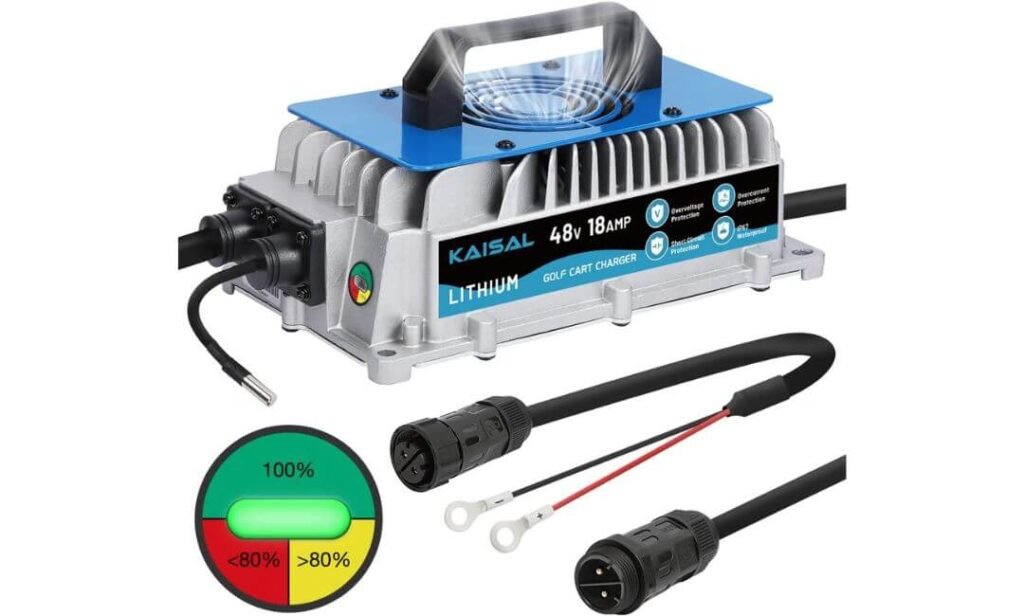
Quick Specs:
- Charging output: 58.4V at 18A for compatible 48V/51.2V LiFePO4 battery systems
- Charging power: 1250W for higher-capacity lithium battery setups
- Battery compatibility: 48V lithium / 51.2V nominal LiFePO4 batteries
- Charging control: 5-stage smart charging that reduces current as the battery approaches full charge
- Low-voltage recovery: 0V wake-up mode for compatible batteries after BMS protection
- Outdoor protection: IP67 sealed aluminium housing for water, dust and vibration resistance
- Connection: O-shaped M8 ring terminals for direct battery connection
- Installation reach: 16-ft total cable, including 10-ft input and 6-ft output leads
- Temperature management: Built-in temperature sensing with active cooling fan
- Safety protection: Overvoltage, overcurrent, overheating, short-circuit, reverse-connection, no-load and timeout protection
- Operating range: -4°F to 113°F
- Status feedback: Multi-stage LED indication showing charging progress
- Mounting: Four integrated mounting holes for vehicle or wall installation
- Warranty: 3 years
The useful thing about this charger becomes clear when the numbers are put together. A 51.2V LiFePO4 battery needs a charger designed around its lithium charging requirements, and the 58.4V output here is intended for that job. At 18A, it also gives buyers noticeably more charging capacity than a typical 10A unit; the manufacturer states that a 100Ah battery can take roughly five hours under suitable charging conditions. Actual charging time will depend on the battery’s state of charge, BMS limits, temperature and charging losses.
There is also a practical installation advantage that is easy to overlook. The O-shaped M8 terminals allow direct battery connection for suitable onboard installations, while the 16-foot cable gives considerably more freedom when the charger cannot sit right beside the battery. Four mounting holes are built into the housing as well, allowing it to be secured properly to a vehicle or wall. For a golf cart, RV, boat, forklift or off-grid setup, these are the kinds of details that make a charger easier to live with.
The hardware is clearly designed for environments where a charger may encounter moisture, dust or vibration. Its sealed die-cast aluminium housing carries an IP67 rating, while the built-in fan and temperature sensor help manage heat during operation. The 0V wake-up function is another useful inclusion for compatible batteries that have entered BMS protection after reaching an unusually low voltage. Alongside that, the charger includes multiple electrical protections and a 14-hour software timeout.
What stands out in real-world use
- 18A / 58.4V output gives this charger a useful charging-speed advantage for compatible LiFePO4 packs.
- IP67 protection makes the design particularly relevant to outdoor vehicles and equipment.
- The 0V wake-up mode can be valuable when a compatible battery has switched off through BMS protection.
- M8 ring terminals remove the need for a conventional charger socket on suitable onboard installations.
- The combination of 16-ft cabling, mounting holes and active cooling gives much more flexibility when planning the installation.
A practical installation detail worth knowing
The charger measures 23 × 12.4 × 4.5 inches, so it is worth choosing the mounting position before connecting the cables. The good news is that the 16-ft cable gives you plenty of freedom around that decision, while the four mounting holes make a fixed installation straightforward. Leave sensible space around the unit for airflow and secure it firmly rather than allowing it to move around with the vehicle.
Why this 48V Lithium Battery Charger earns the lead position
What puts this charger at the front of this particular list is the breadth of useful hardware rather than one headline specification. You get 58.4V/18A charging, 1250W power, IP67 protection, direct M8 terminals, 16-ft cabling, temperature management and a wake-up function in one package. That gives it a particularly well-rounded specification for buyers comparing 48V lithium chargers for different applications.
More importantly, it fits the core requirement of this roundup: 48V lithium systems using 51.2V LiFePO4 batteries. The final check should always be made against the battery manufacturer’s charging voltage and maximum permitted current. When those requirements match, the combination of charging output, rugged construction and flexible installation makes this a very complete option.
The Insider Pro-Tip
The 0V wake-up feature is useful, but it is best viewed as a recovery function rather than something to rely on regularly. If a battery has entered BMS protection, check the battery’s condition and manufacturer’s charging instructions first. That simple step can tell you whether the pack merely needs waking up or whether there is another reason the BMS has disconnected it.
For the installation itself, use the M8 terminals exactly as intended and mount the charger securely with adequate airflow. IP67 protection helps against water and dust, but sensible mounting still matters for long-term operation. The combination of the long cable and fixed mounting points makes it easier to place the charger where it can stay protected while the battery connection remains clean and accessible.
#2. LiTime 48V 18A Lithium Battery Charger
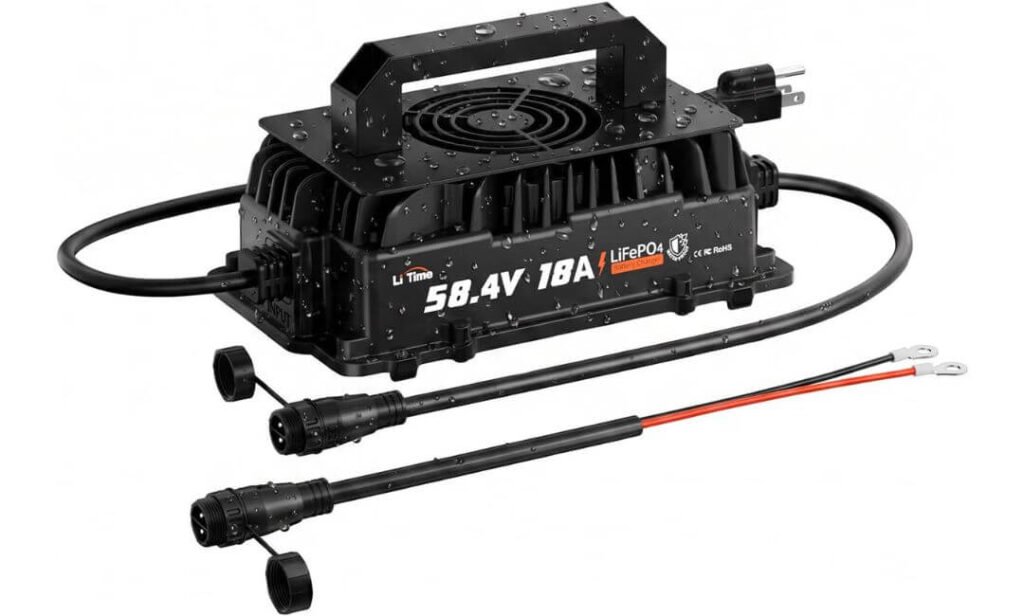
Quick Specs:
- Charging output: 58.4V DC / 18A
- Battery platform: 48V (51.2V nominal) LiFePO4
- AC input: 100–240V
- Charging system: 3-stage activation, constant-current and constant-voltage charging
- Battery recovery: Built-in lithium/BMS activation
- Protection: IP65 water and dust resistance
- Housing: Die-cast aluminium, shock- and corrosion-resistant
- Connection: Anderson connector with sealed protective cap
- Cooling: Active cooling fan
- Installation: Carry handle plus pre-drilled mounting holes
- Dimensions: 9.13 × 4.54 × 5.37 inches
- Weight: 5.07 lb
Size tells an interesting part of the story here. At just over 9 inches long and 5 pounds, this is considerably easier to position than the larger fixed-style chargers often found around older golf-cart and utility-battery setups. But the smaller enclosure does not mean the important electrical specification has been left behind: it still provides 58.4V DC at 18A for compatible 48V/51.2V LiFePO4 batteries.
The charging sequence is another reason this model deserves attention. Its three-stage system begins with lithium activation, moves into constant-current charging and then transitions to constant-voltage charging as the battery approaches its target. LiTime specifies a 20A constant-current stage in its charging description, while the listed charger output is 18A, so the practical takeaway is simple: this is designed around a controlled lithium charging process rather than treating a LiFePO4 pack like an older lead-acid battery.
Then there is the connector. The Anderson connection with a protective cap gives this charger a very different installation character from the M8-terminal KAISAL above. It makes sense for buyers who want a secure, detachable connection and the ability to move the charger between suitable charging locations. The built-in handle and mounting holes reinforce that flexibility—you can carry it when needed or give it a permanent home.
What stands out in real-world use
- 58.4V and 18A match the core charging requirement for compatible 51.2V LiFePO4 systems.
- The BMS activation function can help bring a compatible battery back from a protection shutdown.
- IP65 protection adds useful resistance to dust and water for normal outdoor charging environments.
- The Anderson connector provides a secure, practical connection without committing the charger to one fixed mounting position.
- At 5.07 lb, the combination of a carry handle and compact enclosure makes it genuinely portable.
A small detail that makes installation easier
The pre-drilled mounting holes give this charger two personalities: it can remain a portable charging unit, or it can be secured in a garage, workshop, RV or suitable vehicle installation. Just keep the fan’s airflow path clear and position the unit where the connector and cables can be reached without strain.
Why this 48V Lithium Battery Charger stands out
The appeal here is balance. It combines the 58.4V/18A output buyers are looking for with a compact body, 100–240V AC input, lithium activation, active cooling and IP65 protection. There is no need to depend on one headline feature—the individual details make sense together.
It is particularly interesting for someone who does not want a large permanently installed charger. The handle, mounting points and Anderson connector make it easier to use in different ways, while the LiFePO4-specific charging sequence keeps the electrical side focused on the battery chemistry that this roundup is actually about.
The Insider Pro-Tip
The Anderson connector is worth checking before purchase. Make sure your existing battery-side connection uses the matching style and polarity rather than assuming every 48V lithium system uses the same plug. If the connector matches, the detachable setup is genuinely convenient; if it does not, the connection should be addressed properly rather than improvised.
One more useful point: IP65 is protection against dust and water exposure, but it is not the same as treating the charger as submersible equipment. A sensible mounting position, protected connector and clear cooling path will make much better use of what the enclosure is designed to provide.
(A compact 58.4V/18A LiFePO4 charger with the flexibility to travel with the battery setup.)
#3. DC HOUSE 48V 18A Lithium Charger
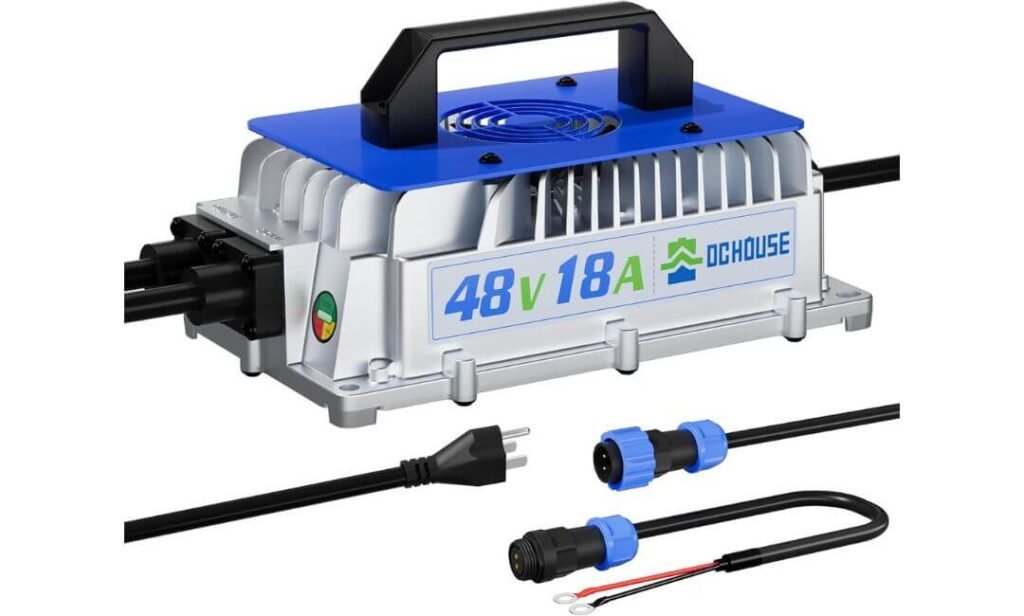
Quick Specs:
- Charging output: 58.4V / 18A
- Rated power: 900W
- Efficiency: ≥93%
- Battery compatibility: 48V lithium-ion / LiFePO4 systems
- Charging capacity: Manufacturer-rated for approximately 50Ah in 2 hours and 100Ah in 4 hours
- Protection: Input voltage, overvoltage, overcurrent, overheating, short-circuit, reverse-connection and no-load protection
- Weather protection: IP65
- Housing: Aluminium alloy die-cast construction
- Cooling: Built-in cooling fan
- Cable reach: Approximately 7.2 ft total, with 3.6-ft input and 3.6-ft output cables
- Connection: Battery charging connector
- Design: Integrated carry handle
- Automatic charging cut-off: Yes
- Weight: 6.18 lb
- Dimensions: 9.13 × 5.39 × 4.5 inches
A charger can have the right 58.4V and 18A figures and still leave buyers wondering how efficiently it turns mains power into battery charging. DC HOUSE puts a specific number behind that part of the design, with a claimed ≥93% efficiency. Combined with the 900W output, that makes this a particularly relevant choice for buyers who want strong charging performance without stepping into a much larger charger.
The charging capacity is also easy to understand in practical terms. The manufacturer rates it at roughly 2 hours for a 50Ah battery and 4 hours for a 100Ah battery, although actual charging time will naturally depend on the battery’s starting state, BMS limits and charging conditions. For a golf cart or other 48V lithium vehicle that gets used regularly, an 18A output gives a useful middle ground between leisurely charging and unnecessarily aggressive current.
Then comes the physical design. The IP65 aluminium die-cast housing, cooling fan and carry handle make it well suited to equipment that moves between the garage and the vehicle. It is not restricted to golf carts either; the listed applications include trolling motors, boats, forklifts, logistics vehicles, ATVs and other 48V lithium equipment. The automatic shut-off and multiple electrical protections add another layer of practical reassurance during routine charging.
What stands out in real-world use
- ≥93% claimed efficiency gives this model a useful point of difference beyond its 18A rating.
- 58.4V at 18A puts it squarely in the specification range expected for compatible 48V/51.2V LiFePO4 systems.
- The manufacturer provides useful 50Ah and 100Ah charging-time references, making it easier to estimate whether the output suits your battery.
- IP65 protection and die-cast aluminium construction make sense for golf carts and other equipment used outside the house.
- The carry handle and compact enclosure make moving or storing the charger considerably easier.
A useful fit for portable charging setups
The 7.2-foot total cable length is worth considering when planning the charging position. It is enough for many straightforward setups without making the charger unnecessarily cumbersome, while the integrated handle makes it easy to move when the vehicle needs charging elsewhere.
For permanent installation, the aluminium housing and fan also make it worth giving the unit a stable, ventilated location. The charger is designed for practical outdoor use, but good placement still helps the cooling system do its job properly.
Why this 48V Lithium Battery Charger deserves a close look
The strongest argument here is its well-defined charging package. You get 58.4V/18A output, a claimed ≥93% efficiency figure, 900W charging power, IP65 protection, active cooling and automatic shut-off without the charger becoming excessively large. That combination makes it particularly relevant for buyers comparing chargers for everyday 48V lithium equipment.
It also brings a useful application focus to the roundup. While it is especially suited to golf carts and trolling motors, the same core charging specification can serve other compatible 48V lithium systems. The important check remains the same: confirm your battery’s chemistry, charging voltage and permitted current before connecting any charger.
The Insider Pro-Tip
The efficiency rating is useful, but don’t confuse it with charging speed. The 18A output is what determines the charger-side current available to the battery; the ≥93% figure tells you how efficiently the charger handles the conversion. Looking at both numbers together gives a much clearer picture than choosing a charger simply because it says “fast charging.”
One practical detail deserves equal attention: the 7.2-ft total cable length. Measure the distance from your normal power outlet to the battery before installation. If that reach works for your setup, the compact design and handle make this a very straightforward charger to keep ready for regular use. If the battery is mounted farther away, plan the installation properly rather than relying on improvised extensions.
(A practical 18A lithium charger where efficiency, outdoor protection and straightforward everyday charging all matter.)
#4. EPOWREY 18AMP Lithium Battery Charger for 48 Volt/58.4V
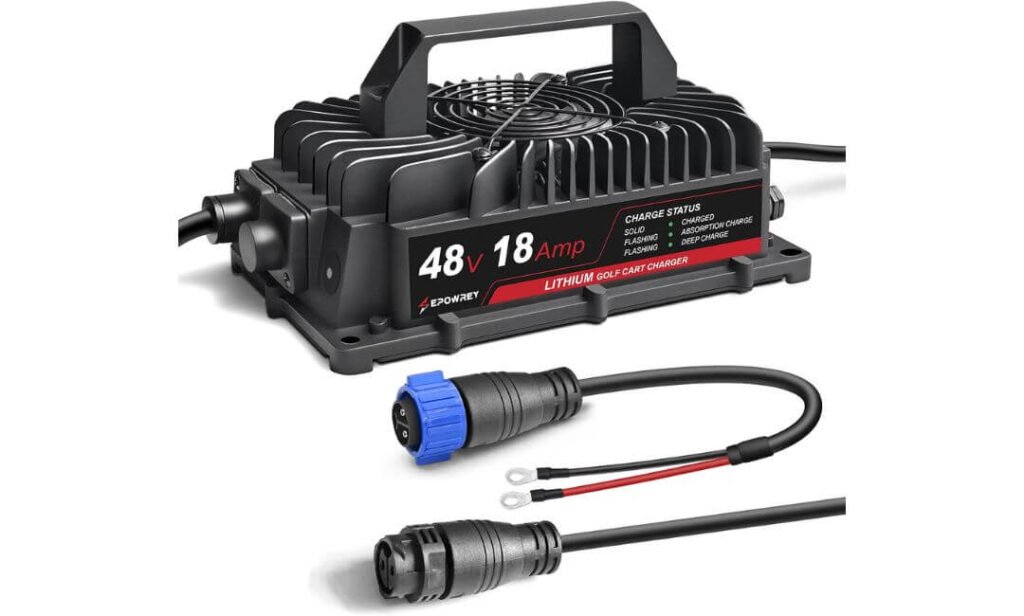
Quick Specs:
- Charging output: 58.4V / 18A
- Battery compatibility: 48V (51.2V nominal) LiFePO4, 16S configuration
- Charging connection: Ring terminals for direct battery connection
- Protection: IP67 dust- and water-resistant aluminium housing
- Charging control: Pre-charge function with automatic shut-off at full charge
- Safety: Overvoltage, overcurrent, overheating, short-circuit and reverse-polarity protection
- Cooling: Built-in cooling fan
- Installation: Wall-mount or onboard installation
- Status: LED charging indicator
- Weight: 5.7 lb
- Dimensions: 5.3 × 9 × 4.6 inches
- Warranty/support: 1-year product support
For a 48V lithium setup, getting the charging voltage and battery chemistry right comes before chasing extra features. This unit is built around the combination that matters here: 58.4V output, 18A charging and 51.2V nominal LiFePO4 compatibility. It is designed for 16-series LiFePO4 packs, so it fits the core electrical requirements this roundup is focused on.
The ring-terminal connection is another practical touch. Instead of depending on a particular vehicle charging socket, the charger can be connected directly to the battery for suitable onboard installations. That makes it particularly interesting for golf carts, RVs, boats, forklifts and custom lithium setups where a permanent battery connection is more useful than a conventional plug.
The construction is equally purposeful. An IP67-rated aluminium-alloy shell gives it protection against dust and water exposure, while the cooling fan helps manage heat during charging. The pre-charge function is designed to bring the battery into the charging cycle more gradually, and once the battery reaches full charge, the charger automatically stops. For everyday use, that combination keeps the operation pleasantly straightforward.
What stands out in real-world use
- 58.4V / 18A output directly matches the charging specification expected by compatible 51.2V LiFePO4 systems.
- IP67 protection gives it a useful advantage for outdoor vehicles and equipment.
- Ring terminals make direct onboard battery installation particularly convenient.
- The pre-charge function and automatic shut-off add useful control to the charging cycle.
- At 5.7 lb, the unit remains manageable for both fixed and portable use.
A useful installation advantage
The compact 5.3 × 9 × 4.6-inch body gives you several mounting possibilities, and the manufacturer supports both wall and onboard installation. For a golf cart or similar vehicle, check the available mounting area first and keep the cooling path around the fan clear. The ring-terminal setup is best suited to a clean, secure battery connection rather than a temporary loose installation.
Why this 48V Lithium Battery Charger fits the roundup
This model earns its place because it keeps the important parts together without overcomplicating the setup. 18A charging, 58.4V output, 16S LiFePO4 compatibility, IP67 protection and direct ring-terminal installation cover the features most relevant to someone actually maintaining a 48V lithium battery.
Its strongest use case is for buyers who want a directly connected charger rather than one tied to a proprietary vehicle socket. That makes the design adaptable across several applications, provided the battery’s charging voltage and current requirements match the charger’s specification.
The Insider Pro-Tip
With a ring-terminal charger, the quality of the battery connection matters. Use the correct terminal size, make sure the connection is tight and secure the cable so vibration cannot pull against the battery terminals. The charger itself may be well protected, but a poor connection can still create unnecessary resistance and heat.
Also, don’t choose 18A simply because it sounds faster. Check the battery manufacturer’s maximum recommended charging current first. When the battery supports 18A and the 58.4V requirement matches, this charger makes a particularly straightforward pairing for a 51.2V LiFePO4 system.
(A direct-connect 58.4V charger for buyers who value IP67 protection and uncomplicated onboard installation.)
#5. LHLC 48V Lithium Battery Charger 58.4V 18A
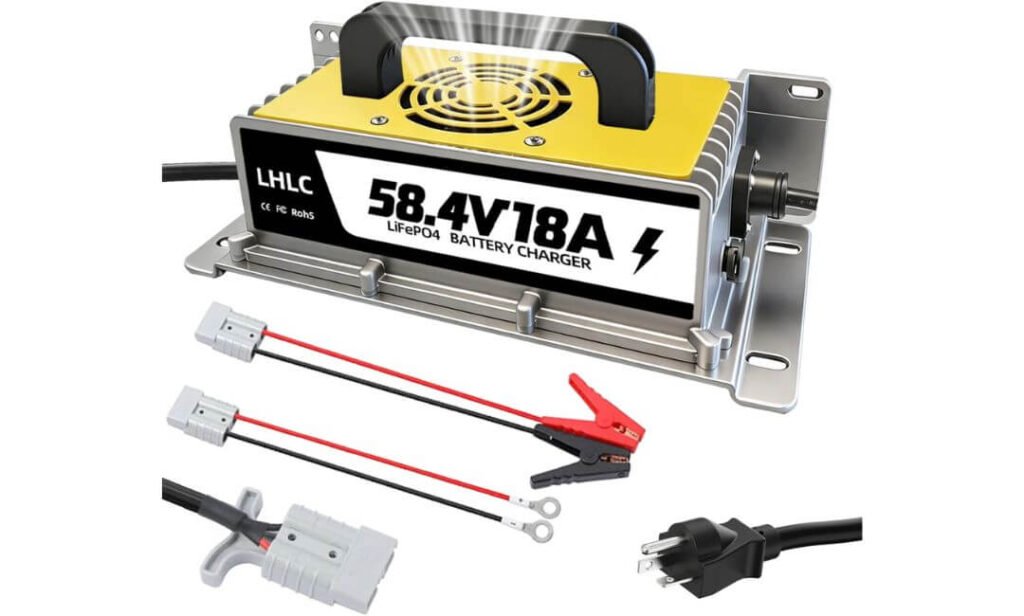
Quick Specs:
- Charging output: 58.4V / 18A DC
- Battery compatibility: 48V / 51.2V LiFePO4, 16S battery systems
- Connection system: SB-50 Anderson plug with support for M8 terminals and alligator clips
- Water protection: IP68 sealed die-cast aluminium housing
- Temperature management: Built-in temperature sensor and cooling fan
- Operating range: -22°F to 140°F
- Recovery function: 0V battery wake-up charging
- Charging control: Automatic shut-off when the battery reaches full charge
- Status monitoring: Red/green charging indicators with flashing fault alerts
- Cable reach: 8.8 ft total, including 4.9-ft input and 3.9-ft output
- Mounting: Four mounting points for wall or vehicle installation
- Certifications: CE, ETL and FCC
- Weight: 4.4 lb
- Dimensions: 4.7 × 8.4 × 3 inches
- Warranty: 3 years
There is a useful bit of flexibility built into this charger that can easily get missed in a normal product listing. The SB-50 Anderson connection is supplied as the main interface, but the design can also be adapted for M8 terminals or alligator clips. That matters when a 48V lithium battery is being added to an existing vehicle or custom setup and the connection you already have does not follow one standard format.
Electrically, the important numbers are right where they should be for this category: 58.4V output at 18A for compatible 48V/51.2V LiFePO4 batteries. The 0V wake-up function adds another useful layer for batteries that have entered BMS protection, while automatic shut-off takes care of the charging cycle once the battery reaches full charge.
The physical construction is arguably the bigger story. An IP68 sealed die-cast aluminium housing gives this unit a higher stated water-protection rating than the IP65/IP67 options elsewhere in this list. The built-in temperature sensor adjusts charging behaviour according to ambient conditions, while the cooling fan helps move heat away during operation. The manufacturer also specifies a broad -22°F to 140°F operating range, which gives this model a particularly wide stated environmental envelope.
What stands out in real-world use
- Three connection possibilities make it easier to integrate with different 48V battery installations.
- IP68 construction gives the charger a particularly strong outdoor-protection specification.
- 58.4V / 18A output keeps it aligned with the core charging requirements of compatible 51.2V LiFePO4 packs.
- The 0V wake-up function can be useful after a compatible battery has entered BMS protection.
- Fault-indicating LEDs provide more information than a simple charging/full indicator.
A clever little detail for custom installations
The 4.4-lb weight and 8.8-ft cable set make this a fairly manageable unit to position around a vehicle, boat, RV or workshop. The mounting holes are available on both the bottom and side, giving you more freedom when the available mounting surface is not perfectly flat or conventional.
The connector flexibility is the part worth planning around. If your existing setup uses an SB-50, M8 connection or another suitable arrangement, check polarity and terminal compatibility before installation. That quick check can save unnecessary connector changes later.
Why this 48V Lithium Battery Charger deserves its place
This model brings something genuinely useful to the comparison: installation flexibility combined with unusually strong environmental protection. The 58.4V/18A charging specification is familiar in this roundup, but the combination of an IP68 enclosure, multiple connection options, 0V wake-up and temperature management gives it a different personality.
It is particularly relevant for buyers building or modifying a 48V lithium setup rather than simply replacing an identical plug-in charger. The ability to work with Anderson, M8 or alligator-clip connections gives the installation more room to adapt, while the sealed aluminium construction makes sense for equipment that spends time outside.
The Insider Pro-Tip
If you’re choosing between chargers with similar 58.4V/18A outputs, look closely at the connection system before looking at another specification number. A charger that fits your existing battery wiring cleanly can save far more hassle than a small difference in physical size or advertised power.
And remember what the IP68 rating actually tells you: it describes the charger’s enclosure protection, not the entire battery installation. Keep the battery connections properly secured and protected, verify polarity before energising the system, and give the cooling fan enough open space to move air.
(A versatile 58.4V charger for 48V lithium systems where connection flexibility and high-level enclosure protection matter.)
#6. FORM 48V Lithium LiFePO4 Battery Charger
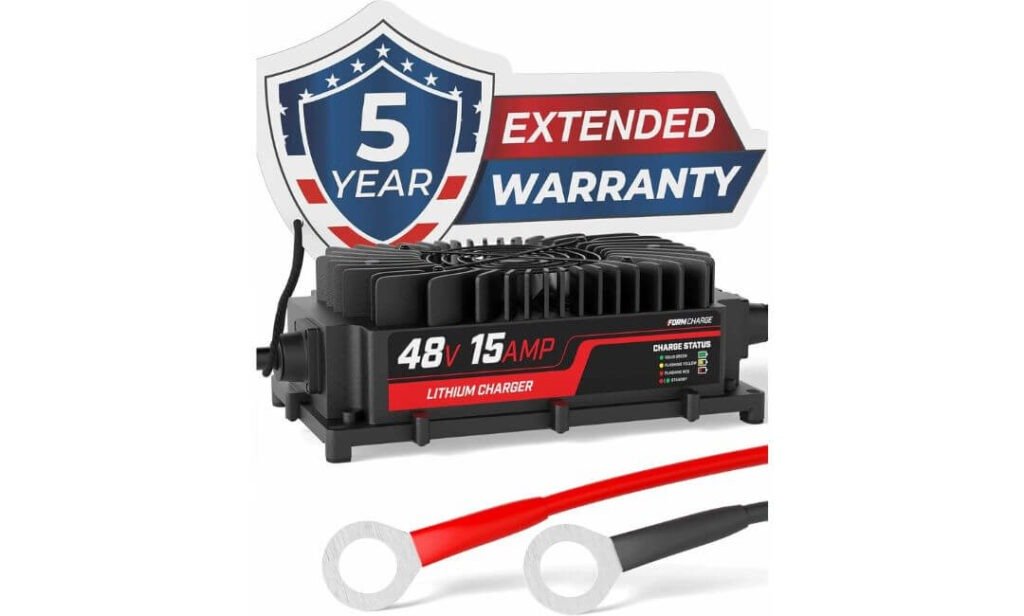
Quick Specs:
- Charging output: 15A
- Full-charge voltage: 58.4V for compatible 48V/51.2V LiFePO4 systems
- Battery type: 48V (51.2V nominal) LiFePO4
- Charging design: Automatic charging with maintenance mode after reaching full charge
- Battery sensing: Improved sensing technology for controlled charging
- Installation: Onboard mounting with ring-terminal connection
- Weather protection: IP67 with internal WeatherShield coating
- Cooling: Built-in cooling fan
- Design: Approximately 80% lighter than the referenced OEM charger
- Mounting format: Compact onboard design
- Dimensions: 5.25 × 10 × 3 inches
- Weight: 6.16 lb
- Warranty: 24 months
- Support: USA-based customer support
FORM takes a different route from the portable-style chargers higher in this list. This is an onboard 48V LiFePO4 charger, designed around a permanent installation and a direct ring-terminal connection. That makes sense for a golf cart where the charger needs to remain part of the vehicle rather than being carried back and forth after every charging session.
The 15A charging output is lower than the 18A models above, but that is not automatically a drawback. The more important question is whether the battery manufacturer allows a 15A charging rate and whether that output suits the way the cart is used. FORM specifies a 58.4V charging target for compatible 48V/51.2V LiFePO4 packs, keeping the electrical side aligned with the battery chemistry this article focuses on.
The maintenance feature is where the design becomes particularly convenient. Once the battery reaches full charge, the charger can transition into its maintenance mode, so the user does not have to keep manually restarting the charging process. Add the IP67 WeatherShield treatment, cooling fan and battery-sensing technology, and the overall design is clearly aimed at a charger that can simply live on the vehicle and handle routine charging.
What stands out in real-world use
- Onboard-focused design makes it particularly convenient for golf-cart installations.
- 58.4V charging is appropriate for compatible 51.2V LiFePO4 battery systems.
- 15A output offers a controlled charging rate for batteries that specify this current.
- IP67 protection and WeatherShield coating add useful protection for an outdoor vehicle.
- Automatic maintenance mode means less attention once the battery reaches full charge.
The installation is refreshingly straightforward
The ring-terminal connection is designed for direct battery wiring, so there is no dependence on a particular external charging socket. Its 5.25 × 10 × 3-inch enclosure also gives installers a fairly defined footprint to work with.
Before mounting, measure the available battery-compartment space and confirm the terminal arrangement supplied by the battery manufacturer. Once those basics line up, the onboard format is exactly the kind of setup that can make daily charging feel almost invisible—plug it in, let the charger do its work, and leave it installed.
Why this 48V Lithium Battery Charger earns its place
The reason to consider this model is convenience rather than chasing the highest amp rating. At 15A, it sits below the 18A chargers in this roundup, but its onboard design, ring terminals, maintenance mode, battery sensing and IP67 protection give it a clear purpose.
For a golf-cart owner who wants a charger that stays with the vehicle, that distinction matters. The package is focused on permanent installation and uncomplicated everyday charging, while the 24-month warranty and USA-based support provide additional ownership support.
The Insider Pro-Tip
If your battery manufacturer specifies a charging current around 15A, don’t automatically rule this one out simply because another charger offers 18A. A charger should be matched to the battery’s recommended current—not selected by the largest amp number alone.
The other thing worth checking is the physical mounting space before buying. Because this is designed as an onboard unit, knowing exactly where it will sit makes the installation much easier. Keep the cooling fan unobstructed, route the ring-terminal wiring securely, and let the maintenance mode handle the routine charging cycle.
(A purpose-built onboard 48V lithium charger for buyers who value permanent installation and hands-off maintenance charging.)
Best 48V Lithium Battery Charger (2026) Features and Specs Compared
| 48V Lithium Charger | Charging Output | Battery Fit | Protection & Build | Connection & Installation | Standout Feature | Best Fit For |
|---|---|---|---|---|---|---|
|
KAISAL 48V/58.4V 18A
Most Complete Package
1250W lithium charger
|
58.4V / 18A
1250W charging power
|
48V / 51.2V
LiFePO4, 16S compatible
|
IP67
Sealed die-cast aluminium housing
Temperature sensing + fan cooling
|
M8 ring terminals
16-ft total cable
Wall or vehicle mounting
|
0V wake-up
5-stage smart charging + 7 protection functions
|
Golf carts, RVs, boats, forklifts & off-grid systems |
|
LiTime 48V 18A
Compact Pick
58.4V AC-DC charger
|
58.4V / 18A
100–240V AC input
|
48V / 51.2V
LiFePO4 battery systems
|
IP65
Die-cast aluminium housing
Active cooling fan
|
Anderson connector
Carry handle + mounting holes
Compact 9.13 × 4.54 × 5.37 in body
|
Lithium activation
3-stage charging sequence
|
Portable charging, golf carts, RVs & outdoor lithium setups |
|
DC HOUSE 48V 18A
Efficiency Focus
900W lithium charger
|
58.4V / 18A
900W output
|
48V lithium
Suitable for compatible LiFePO4 systems
|
IP65
Aluminium alloy die-cast shell
Cooling fan + multiple electrical protections
|
Portable handle
Approx. 7.2-ft total cable
Straightforward charging setup
|
≥93% claimed efficiency
Automatic shut-off at full charge
|
Golf carts, trolling motors, boats & utility vehicles |
|
EPOWREY 48V/58.4V 18A
Direct-Connect Choice
Ring-terminal lithium charger
|
58.4V / 18A
Designed for 16S LiFePO4 packs
|
48V / 51.2V
LiFePO4 chemistry
|
IP67
Aluminium alloy housing
Cooling fan + thermal protection
|
Ring terminals
Wall or onboard mounting
Compact 5.3 × 9 × 4.6 in body
|
Pre-charge function
Automatic full-charge shut-off
|
Golf carts, RVs, boats, forklifts & solar systems |
|
LHLC 48V 58.4V 18A
Most Flexible Connection
58.4V LiFePO4 charger
|
58.4V / 18A
DC lithium charging
|
48V / 51.2V
LiFePO4, 16S battery systems
|
IP68
Sealed die-cast aluminium housing
Temperature sensor + cooling fan
|
SB-50 Anderson
Adaptable to M8 terminals or alligator clips
8.8-ft total cable
|
3 connection options
0V wake-up + fault-alert indicators
|
Custom installations, marine use & outdoor equipment |
|
FORM 48V 15A Onboard
Onboard Specialist
LiFePO4 golf-cart charger
|
15A
58.4V charging target
|
48V / 51.2V
LiFePO4 battery packs
|
IP67
WeatherShield internal coating
Rugged cooling fan
|
Ring terminals
Purpose-built onboard installation
5.25 × 10 × 3 in body
|
Maintenance mode
Battery-sensing technology
|
Golf carts and permanent onboard charging |
| One important buying check: a “48V” lithium battery is commonly a 51.2V nominal LiFePO4 pack, so the charger’s chemistry, full-charge voltage and permitted charging current should match the battery manufacturer’s specifications. The differences above are mainly about charging rate, protection, connection style and installation needs—not simply which charger carries the biggest number. | ||||||
Buying Guide: What to Look For in a 48V Lithium Battery Charger
A good 48V lithium charger is not chosen by the “48V” printed on the product title. That number describes the battery class, but the charger has to match the battery’s actual chemistry, charging voltage, permitted current, connector and installation requirements. For a typical 51.2V nominal LiFePO4 pack, the important charging target is generally 58.4V, which is why that figure appears repeatedly across the chargers in this roundup.
There are also meaningful differences between an 18A portable charger, an onboard golf-cart charger and a heavily sealed outdoor unit. The right choice depends on how the battery is installed and used, not simply which specification looks biggest.
Start With the Battery’s Actual Chemistry
Before looking at charger brands, look at the battery label or manufacturer specifications.
A 48V lithium battery may be marketed as 48V, while a LiFePO4 pack is commonly 51.2V nominal because it uses 16 cells in series. That distinction matters because the charger must provide the correct voltage for the battery’s chemistry.
For a compatible 16S LiFePO4 battery, the commonly used full-charge voltage is:
| Battery specification | What to check |
|---|---|
| 48V LiFePO4 | Confirm the battery is actually a 51.2V nominal pack |
| 51.2V LiFePO4 | Look for a charger designed around this battery platform |
| Full-charge requirement | Commonly 58.4V for 16S LiFePO4 |
| Maximum charging current | Follow the battery manufacturer’s stated limit |
| BMS | Confirm the charger works with the battery’s charging/BMS requirements |
That last line is easy to overlook. A charger being electrically capable of 18A does not automatically mean every 48V lithium battery should be charged at 18A. The battery’s BMS and manufacturer specifications should have the final say.
Check 58.4V Before Chasing Higher Amps
For this particular type of battery, charging voltage is more important than simply seeing a high amp number.
The chargers in this roundup mainly use 58.4V output, which is the figure relevant to fully charging compatible 16S LiFePO4 packs. Once that requirement is confirmed, then compare the charging current.
For example:
- 15A can be perfectly suitable when the battery specifies that charging rate.
- 18A provides more available charging current when the battery permits it.
- A higher-current charger is not automatically a better match if the battery has a lower recommended charging limit.
- Charging time also depends on battery capacity, starting state, BMS behaviour and charging conditions.
A simple way to estimate charging time is:
Approximate charging time = battery capacity in Ah ÷ charging current in A
So a 100Ah battery theoretically takes about 5.6 hours at 18A before allowing for charging losses and the slower final portion of the cycle. Real charging time can therefore be longer.
Look at the Charging Process, Not Just the Output
Lithium batteries do not need the same charging approach as traditional lead-acid batteries. A well-designed LiFePO4 charger should have a charging sequence appropriate for the battery and should transition correctly as the pack approaches full charge.
The useful features to look for include:
- Constant-current charging during the main charging period
- Constant-voltage control as the battery approaches its target
- Appropriate reduction in charging current near full charge
- Automatic shut-off or controlled completion
- Battery or BMS activation where specifically supported
- Temperature monitoring where provided
This is why the charging architecture deserves attention alongside the headline 58.4V/18A figure. Two chargers can have identical output ratings while offering very different approaches to controlling the charging cycle.
Do Not Ignore BMS Wake-Up Features
A LiFePO4 battery can sometimes appear completely dead because its BMS has disconnected the pack after low-voltage protection. A charger with a lithium activation or wake-up function may be able to begin charging a compatible protected battery.
That can be genuinely useful, but there is an important distinction:
Wake-up is a recovery feature, not a reason to repeatedly deeply discharge the battery.
If the BMS has disconnected the pack, check the battery manufacturer’s instructions first. The shutdown could be caused by low voltage, temperature, wiring, a protection event or another condition that should be understood before charging is restarted.
The KAISAL, LiTime and LHLC options in this roundup specifically highlight battery activation or wake-up functionality, while the other models have their own charging-control approaches.
Protection Matters More on a Vehicle Than It Does on a Shelf
A charger sitting permanently in a dry indoor workshop has a very different job from one mounted on a golf cart, boat or outdoor utility vehicle.
At minimum, look for protection against conditions such as:
- Overvoltage
- Overcurrent
- Overheating
- Short circuit
- Reverse connection or polarity
- No-load conditions
- Abnormal input voltage, where supported
- Charging timeout, where provided
These protections are not marketing decorations. They are there because charging equipment can encounter incorrect connections, abnormal temperatures, wiring problems and changing battery conditions.
The more important point is to look at the complete protection package, rather than assuming that every charger with the word “smart” on its listing provides the same level of protection.
IP67 and IP68 Mean Something, But They Are Not Permission To Ignore Installation
For outdoor charging, the IP rating deserves a proper look.
An IP65-rated charger, for example, is protected against dust ingress and water jets from the relevant test conditions. IP67 adds protection against temporary immersion under specified test conditions, while IP68 represents a higher immersion rating under manufacturer-defined conditions.
That makes the distinction useful when comparing the models here:
| Rating | Practical takeaway |
|---|---|
| IP65 | Good protection against dust and water jets |
| IP67 | Higher water protection, including specified temporary immersion |
| IP68 | Higher immersion protection, subject to the manufacturer’s specified conditions |
The LHLC’s IP68 housing is therefore notable, while KAISAL, EPOWREY and FORM use IP67-rated designs. LiTime and DC HOUSE specify IP65 protection.
Still, an IP rating applies to the charger enclosure under its test conditions. It does not make exposed battery terminals, connectors or poorly sealed wiring waterproof. Good cable routing and protected connections still matter.
Choose the Connector Before You Choose the Charger
This is one of the easiest ways to avoid buying the wrong product.
Some chargers are designed around ring terminals, while others use an Anderson-style connector or provide more flexible connection arrangements.
| Installation style | What it makes sense for |
|---|---|
| Ring terminals | Direct, permanent or onboard battery connection |
| Anderson connector | Secure detachable connection and portable use |
| Multiple connection options | Custom setups with different existing battery interfaces |
| Wall-mounted installation | Garage, workshop or stationary battery systems |
| Onboard charger | Golf carts and vehicles where the charger stays with the vehicle |
The KAISAL and EPOWREY use ring-terminal-oriented installations, while FORM is specifically designed around an onboard golf-cart setup. LiTime uses an Anderson connector, and LHLC adds flexibility by supporting an SB-50 connection that can be adapted to M8 terminals or alligator clips.
Before ordering, check connector type, polarity, terminal size and cable reach. A perfect 58.4V charger is still the wrong purchase if the physical connection does not suit the battery installation.
Think About Where the Charger Will Live
Portability and onboard installation are two different requirements.
If the charger will be carried between vehicles or stored after charging, a carry handle, manageable weight and detachable connector can be genuinely useful.
If it will remain on a golf cart, boat or other vehicle, look for:
- Suitable mounting holes
- Appropriate cable length
- Secure battery connections
- Adequate airflow around cooling vents
- Protection from unnecessary mechanical movement
- A location that keeps connectors accessible without exposing them unnecessarily
The FORM is particularly focused on the onboard approach, while the LiTime’s compact body and handle give it a more portable character. The larger KAISAL, meanwhile, compensates with its 16-ft total cable length, which can make positioning easier on larger installations.
Efficiency Is Worth Comparing, But Understand What It Means
Efficiency tells you how effectively the charger converts AC input power into DC charging power. It should not be confused with charging current.
The DC HOUSE specifies ≥93% efficiency, giving it a useful measurable advantage for buyers who care about conversion efficiency.
But don’t use efficiency alone to decide between chargers. A charger can have excellent conversion efficiency while still being unsuitable for a particular battery because its voltage, connector or charging current is wrong.
A better comparison is:
Efficiency + correct charging voltage + appropriate current + thermal management + battery compatibility.
That gives you a much more realistic picture of the charger.
Heat Management Is Part of Charger Quality
An 18A charger can generate meaningful heat during a long charging session, especially when charging a larger battery from a low state of charge.
Look for practical thermal features such as:
- Cooling fans
- Temperature sensors
- Thermal protection
- Aluminium housings that help dissipate heat
- Automatic reduction or control of charging output where supported
- A sensible installation location with airflow
The chargers in this roundup use active cooling in different forms, while KAISAL and LHLC also specify temperature sensing. Those details become particularly relevant when the charger will be working for several hours rather than being used for short top-up sessions.
And one simple installation rule still applies: don’t bury a fan-cooled charger inside a completely enclosed, heat-trapping compartment.
Certifications Are Useful, But Read Them Alongside the Actual Specifications
Certifications can provide another useful layer when comparing charging equipment. Depending on the product, you may see markings such as ETL, FCC or CE.
They should be treated as supporting information rather than a replacement for checking the charger itself.
Look at:
- The certification claims.
- The exact model being sold.
- The battery chemistry supported.
- The output voltage.
- The charging current.
- The protection functions.
- The manufacturer’s installation instructions.
For example, the KAISAL and LHLC listings include FCC and ETL certification claims, while LHLC also lists CE. Those details add useful context, but the battery match remains the first thing to verify.
Smart Features Are Useful When They Solve a Real Problem
“Smart charging” can mean very different things from one charger to another.
For a standalone 48V LiFePO4 charger, genuinely useful features can include:
- Battery activation
- Automatic charging-stage transitions
- Temperature-based charging control
- Full-charge shut-off
- Fault indication
- Charging-status indicators
- Timeout protection
More advanced battery systems may separately provide state-of-charge monitoring, Bluetooth connectivity, shunt monitoring or app-based data, but those features are not automatically part of a charger simply because its listing calls it “smart.”
For this roundup, the focus is therefore on charging intelligence that directly affects the charging process, rather than adding software features just to make a specification sheet look impressive.
Match the Charger to the Way You Actually Use the Battery
The best specification on paper can still be inconvenient if it does not suit the installation.
For a golf cart: prioritize battery compatibility, charging current, connector fit, onboard mounting and weather protection.
For an RV or off-grid system: pay closer attention to battery-bank specifications, charging voltage, installation location, thermal management and cable routing.
For boats and trolling motors: weather protection, connector security and physical mounting become especially important.
For forklifts and utility equipment: confirm the battery manufacturer’s charging-current requirements and make sure the charger is appropriate for the specific battery system.
For a custom lithium installation: connection flexibility can become just as important as the 58.4V/18A specification.
One Final Check Before You Buy
Before placing the order, compare these seven numbers and details against the battery’s documentation:
| Check before purchase | What you want to confirm |
|---|---|
| Battery chemistry | LiFePO4 compatibility |
| Nominal battery voltage | 48V / 51.2V system |
| Full-charge voltage | Commonly 58.4V for 16S LiFePO4 |
| Maximum charge current | Charger output does not exceed the battery’s specification |
| Connector | Correct type, size and polarity |
| Installation | Onboard, wall-mounted or portable as required |
| Environment | Appropriate IP rating and thermal setup |
If those seven points line up, then features such as 18A charging, IP67/IP68 protection, wake-up capability, efficiency and smart charging become meaningful differences rather than marketing noise.
That is the real trick with a 48V lithium charger: get the electrical match right first, then choose the hardware that makes sense for the environment and the way the battery is actually used.
Performance Spotlight: 58.4V Output and 18A Charging for 48V Lithium Batteries
When comparing 48V lithium chargers, 58.4V and 18A are two numbers worth understanding properly. They tell you much more about how the charger will interact with a 51.2V LiFePO4 battery than the generic “48V” label does. The voltage determines whether the charger can bring a compatible pack to its intended full-charge level, while the current affects how quickly energy can be put back into the battery.
Why 58.4V Matters for a 51.2V LiFePO4 Battery
A typical 48V-class LiFePO4 battery is built from 16 cells connected in series. Each cell has a nominal voltage of around 3.2V, giving the finished battery a nominal rating of approximately 51.2V.
At full charge, LiFePO4 cells are commonly charged to around 3.65V per cell:
3.65V × 16 cells = 58.4V
That is why a charger marked 58.4V is not actually “too high” simply because the battery is marketed as 48V. The two numbers describe different points of the same battery system:
- 48V — the battery’s market/class voltage
- 51.2V — typical nominal voltage of a 16S LiFePO4 pack
- 58.4V — typical full-charge voltage for a 16S LiFePO4 pack
This distinction is one of the easiest things to get wrong when shopping online. A charger should be selected from the battery manufacturer’s charging specification, not from the number printed most prominently in the product title.
What 18A Actually Changes
Charging current is where the difference becomes noticeable during everyday use.
Assuming the battery and BMS permit the full 18A output, an 18A charger can put energy back into the pack faster than a 15A or 12A charger.
For a simple comparison with a 100Ah battery:
| Charger output | Idealised charging time* |
|---|---|
| 12A | ~8.3 hours |
| 15A | ~6.7 hours |
| 18A | ~5.6 hours |
Actual charging time will be longer or vary because batteries do not charge at a perfectly constant current from empty to full. The BMS, battery temperature, starting state of charge and final constant-voltage stage all affect the result.
That means the jump from 12A to 18A is not just a specification-sheet difference. For someone using a golf cart every day, running an electric boat, or relying on a 48V battery for equipment, those saved hours can determine whether the battery is ready when it is needed again.
18A Versus 15A: The Difference Is Useful, Not Magical
The 18A models in this roundup provide roughly 20% more charging current than a 15A charger.
For a compatible 100Ah battery, a rough calculation illustrates the difference:
- 15A: about 6.7 hours at the theoretical rate
- 18A: about 5.6 hours at the theoretical rate
In actual use, neither figure should be treated as a guaranteed empty-to-full time. The final part of the charging cycle normally takes longer as the charger transitions toward its target voltage.
This is also why the FORM 15A charger should not automatically be dismissed. If a battery manufacturer recommends or limits charging around 15A, using an 18A charger simply because it is faster would not be the sensible approach. Battery specifications come first.
Does 18A Charging Reduce Battery Life?
Not necessarily.
The important question is whether 18A is within the battery manufacturer’s permitted charging current.
A properly matched LiFePO4 battery can be designed to accept a particular charging rate without that rate being inherently harmful. Problems arise when buyers assume that every battery can accept whatever current a charger can produce.
For example, a battery’s documentation may specify:
- Recommended charging current
- Maximum continuous charging current
- Maximum charging temperature
- Low-temperature charging restrictions
- BMS charging-current limits
Those specifications should be checked before choosing between 12A, 15A and 18A.
So the honest way to look at 18A is simple: it gives you more available charging speed; it does not give you permission to exceed the battery’s limits.
Heat Is the Part People Often Forget
More charging current means the charging system has to handle more electrical power.
At the same nominal charging voltage, moving from 15A to 18A represents a meaningful increase in charging power. That makes thermal management important, particularly during long charging sessions.
This is why features such as:
- Cooling fans
- Temperature sensors
- Thermal protection
- Aluminium housings
- Appropriate ventilation
- Controlled charging stages
are more than decorative specifications.
The chargers selected for this article use different combinations of these features. KAISAL and LHLC, for example, specify temperature sensing alongside active cooling, while other models use fan-assisted cooling and protective circuitry.
Why the Final Charging Stage Matters
An 18A charger does not necessarily push 18A into the battery for the entire charging session.
During the main charging period, the charger can provide substantial current when the battery needs it. As the pack approaches its target voltage, the charging process transitions toward constant-voltage control, and the current can gradually fall.
That is why an “18A charger” should be understood as its maximum rated charging current, rather than assuming the battery receives a continuous 18A until the moment it becomes full.
This controlled final stage is important because the goal is not merely to fill the battery quickly. The charger needs to reach the correct voltage and complete the charging process in a way that is compatible with the battery’s BMS and charging requirements.
What 58.4V and 18A Mean Together
These two specifications answer two different questions:
58.4V:
“Can this charger reach the appropriate full-charge voltage for a compatible 16S LiFePO4 pack?”
18A:
“How much charging current can this charger provide when the battery allows it?”
That is why a 58.4V/18A charger can be an attractive combination for a compatible 51.2V LiFePO4 system. The voltage addresses the charging target, while the current helps reduce charging downtime.
But neither number should be considered in isolation. A charger with the right voltage but an unsuitable connector is still inconvenient. A charger with 18A output but a battery that only permits 10A charging is not the right match. And a powerful charger installed where heat cannot escape can create its own problems.
The Practical Takeaway for 48V Lithium Owners
If the battery documentation specifies 51.2V LiFePO4, 58.4V full-charge voltage and permits 18A charging, then an 18A/58.4V charger is a very straightforward match.
If the battery specifies 15A maximum, the 15A option makes more sense even though it charges more slowly.
If the battery’s charging requirements are unclear, that is the point where checking the battery manual or manufacturer should come before ordering the charger.
The best-performing charger is ultimately the one whose voltage, current, charging profile, protection and physical installation all agree with the battery. The 58.4V/18A figure is important, but the complete match is what turns a specification into a reliable charging setup.
Ruggedness and Reliability: What IP67 Means for a 48V Lithium Charger
For a charger that may spend its life around a golf cart, boat, RV, forklift or outdoor battery system, water and dust protection is not a cosmetic extra. Charging equipment lives around cables, connectors, metal surfaces, battery compartments and changing temperatures, so the enclosure can make a real difference over years of use.
The important thing is to understand what the rating actually covers. IP67 applies to the charger’s enclosure under defined test conditions; it does not mean the entire charging installation becomes waterproof. Battery terminals, connectors, cable joints and the mounting location still need sensible protection.
What IP67 Actually Protects Against
The “IP” in IP67 refers to an Ingress Protection rating.
The two numbers have separate meanings:
| Rating | Meaning |
|---|---|
| 6 | Dust-tight enclosure |
| 7 | Protection against temporary immersion under specified test conditions |
The first “6” is particularly useful for outdoor equipment. Dust, fine particles and debris are much harder on cooling equipment and electrical components than many buyers realise.
The second “7” means the enclosure has been tested for temporary immersion according to the relevant test conditions. It does not mean the charger is designed to operate underwater or that every connector attached to it has the same protection.
That distinction matters because product listings often reduce IP67 to simply “waterproof.” The rating is useful, but understanding its limits is even more useful.
What IP67 Means Around a Golf Cart
A golf cart is a good example of why this protection can matter.
The charger may encounter:
- Rain while the cart is parked outdoors
- Water splashes during cleaning
- Dust and dirt from roads or paths
- Mud and debris around the battery compartment
- Vibration while the vehicle is moving
- Temperature changes between charging sessions
A sealed IP67 enclosure gives the charger considerably more protection against those environmental conditions than an ordinary unsealed electrical enclosure.
That does not mean the charger should be deliberately sprayed with a pressure washer. IP67 is protection against specified ingress conditions, not an invitation to expose electrical connections to unnecessary water.
Rain and Accidental Splashes
For an outdoor charger, rain is one of the most obvious situations where enclosure protection becomes valuable.
A properly sealed housing can help keep water away from the internal electronics when the charger encounters normal outdoor exposure. This is particularly useful when a golf cart, utility vehicle or battery system cannot always be kept inside a completely dry building.
But the installation still matters.
The charger should be positioned so that:
- Water does not continuously collect around the connectors.
- Cables are routed without creating water traps.
- Battery terminals remain properly protected.
- The cooling system has enough airflow.
- The charger is securely mounted rather than left loose.
The enclosure protects the electronics; good installation protects the complete charging system.
Dust Can Be Just as Important as Water
Water gets the attention, but dust protection is another major advantage of a sealed design.
Golf carts, forklifts, ATVs, boats and outdoor utility equipment can operate around:
- Fine road dust
- Sand
- Dirt
- Grass and plant debris
- Workshop particles
- Construction or industrial dust
The IP6X dust-tight portion of an IP67 rating is therefore meaningful for equipment that spends time outside.
It can also help reduce the amount of airborne contamination reaching sensitive internal components, although normal maintenance and keeping ventilation areas clear are still important.
Off-Road and Outdoor Installations Need More Than an IP Rating
This is where product construction starts to matter.
An outdoor charger can have a strong IP rating and still need careful mounting because vehicles introduce vibration, movement and heat that a stationary garage charger does not experience.
For an onboard installation, look for a combination of:
Sealed housing + secure mounting + protected connections + sensible cable routing + adequate cooling.
That combination is far more useful than looking at the IP number alone.
The KAISAL, EPOWREY and FORM chargers in this roundup specify IP67 protection, while the LHLC goes a step further with an IP68-rated enclosure. LiTime and DC HOUSE specify IP65 protection.
Those ratings give the models different environmental specifications, but they should not be interpreted as a simple “higher number always equals better charger” formula. Installation, connector protection and intended use still matter.
IP67 Versus IP65 for 48V Lithium Charging
The difference is worth understanding because two chargers can otherwise look almost identical on paper.
| Feature | IP65 | IP67 |
|---|---|---|
| Dust protection | Dust-tight | Dust-tight |
| Water jets | Protected | Protected |
| Temporary immersion | Not covered by IP65 | Covered under specified IP67 test conditions |
| Typical appeal | Outdoor rain, dust and splashes | More demanding outdoor exposure |
| Installation still matters | Yes | Yes |
For normal garage, workshop or sheltered outdoor charging, IP65 may already provide useful protection.
For a charger that could experience heavier outdoor exposure, IP67 provides another level of enclosure protection.
The decision should therefore follow the environment rather than the badge. There is little benefit in paying attention to IP67 while ignoring a badly protected connector or mounting the charger directly where water constantly collects.
What About IP68?
The LHLC’s IP68 rating is particularly notable in this group.
IP68 represents a higher level of protection against immersion than IP67, but there is an important technical detail: the exact IP68 test conditions are specified by the manufacturer, so “IP68” should not automatically be interpreted as one universal depth or duration.
For buyers, the practical takeaway is simple: it indicates a higher stated enclosure protection level, but you should still follow the manufacturer’s installation instructions.
Waterproof Does Not Mean Heatproof
This is probably the most important trade-off to understand.
A sealed aluminium enclosure is excellent for keeping contaminants away from electronics, but a charger still generates heat while converting AC power into DC charging power.
That is why several chargers here use cooling fans, while some also incorporate temperature sensing.
A good outdoor installation therefore needs both:
- Environmental protection
- Thermal management
Don’t place a sealed charger inside a tiny, completely enclosed compartment simply because its IP rating looks impressive. If the cooling system cannot move heat away effectively, the enclosure rating does not solve the thermal problem.
Where a Rugged Charger Makes the Most Sense
An IP-rated 48V lithium charger becomes particularly useful when the charging equipment is regularly exposed to the environment.
Golf carts: rain, dust, vibration and outdoor storage.
Boats and trolling motors: moisture and splashes make enclosure protection especially relevant.
RVs: outdoor charging locations can expose the charger to changing weather.
Forklifts and utility equipment: dust, movement and repeated charging cycles can place greater demands on the housing.
Off-grid systems: chargers may be installed in garages, sheds, workshops or other locations where environmental conditions are less controlled than inside a home.
The Trade-Off With a More Rugged Charger
There is no need to pretend that rugged construction solves everything.
A sealed, die-cast aluminium charger can be larger, heavier or more installation-specific than a simple indoor charger. Cooling also becomes an important design consideration, particularly when active fans are used.
For example, the KAISAL combines IP67 protection with a sealed die-cast aluminium housing, temperature management and fan cooling. FORM uses IP67 protection with its WeatherShield coating and onboard-focused design. EPOWREY also uses an IP67 aluminium-alloy enclosure, while LHLC adds IP68 protection.
The right choice depends on where the charger will actually live.
A Simple Outdoor Installation Checklist
Before mounting any waterproof 48V lithium charger, check these points:
- Battery compartment: Is there enough room for the charger and its cables?
- Airflow: Can the cooling fan move air freely?
- Water path: Could rain or washing water collect around the connections?
- Mounting: Is the charger firmly secured against vibration?
- Cable routing: Are the cables protected from rubbing, sharp edges and excessive movement?
- Battery terminals: Are the connections tight, clean and correctly polarised?
- Connector: Does the connector have appropriate protection when disconnected?
- Heat: Can the charger release heat during a long charging session?
These checks take only a few minutes, but they are much more valuable than choosing an IP rating blindly.
The Real Meaning of Ruggedness
A rugged charger is not simply one with IP67 printed on the box.
The more useful combination is a properly sealed enclosure, sensible thermal management, secure mounting, suitable connectors and charging electronics designed for the battery. That is why the protection ratings in this roundup are considered alongside cooling, construction, installation style and charging controls.
For a 48V lithium system that lives indoors, IP65 may already be more than adequate. For a golf cart, boat, RV or outdoor utility setup, IP67 or IP68 can provide valuable additional protection. Either way, the goal is the same: keep the electronics protected without creating a new heat or installation problem.
Use-Case Scenarios: Matching a 48V Lithium Charger to the Job
The charger that makes sense for a golf cart is not necessarily the same charger that makes sense for an RV battery bank or a stationary solar system. The electrical requirements may look similar on paper, but installation, connector style, exposure to weather, charging routine and battery capacity can completely change what is practical.
The easiest way to choose correctly is to start with the battery and then work backwards from how you actually use it.
48V Lithium Charger for a Golf Cart
Golf carts are probably the clearest example of where charger selection needs to go beyond voltage.
A typical lithium-converted cart may use a 51.2V nominal LiFePO4 battery, even though the cart and charger are commonly described as a 48V system. That means the battery documentation should confirm the required 58.4V full-charge voltage and permitted charging current before selecting the charger.
For a cart used regularly, the charging routine matters just as much as maximum charging speed.
An 18A charger can be useful when the battery manufacturer permits that current because it can reduce the time the cart spends connected to the charger. For example, a 100Ah battery has a simple theoretical charging time of about 5.6 hours at 18A, compared with roughly 6.7 hours at 15A. Actual times will vary because the current does not necessarily remain at the maximum throughout the complete charging cycle.
For a golf cart, look particularly closely at:
- 58.4V output for the appropriate 16S LiFePO4 battery
- Battery-approved charging current
- Onboard versus portable design
- Connector or ring-terminal compatibility
- IP protection if the cart is stored outdoors
- Cooling and mounting arrangements
- BMS activation, if supported by the battery
- Cable length and routing
This is where the different chargers in this roundup separate themselves. FORM is specifically oriented toward onboard golf-cart installation, while KAISAL and EPOWREY use ring-terminal connections that suit direct battery installation. LiTime takes a more portable approach with an Anderson connector.
When an Onboard Charger Makes More Sense
An onboard charger is attractive when the vehicle itself is the permanent home for the charging equipment.
The basic routine becomes simple: park the cart, connect the appropriate AC supply, and leave the charger installed rather than carrying a separate unit every time the battery needs charging.
An onboard setup can be particularly useful for:
- Golf carts used frequently
- Utility vehicles
- Equipment where charging happens in the same location
- Owners who prefer permanent battery wiring
- Installations where a dedicated charging socket is not required
But permanent installation also means the charger becomes part of the vehicle environment. Vibration, moisture, heat and available mounting space therefore matter more than they would with a charger sitting on a workshop bench.
The FORM is the clearest example in this article because its design is specifically built around onboard golf-cart use, with ring terminals, IP67 protection and a maintenance mode.
External Chargers: More Flexibility When the Equipment Moves
An external charger makes more sense when the same charger may be used in different places or when permanent installation is unnecessary.
This approach can work well for:
- Garage charging
- RV batteries
- Portable lithium systems
- Workshop setups
- Custom battery installations
- Equipment shared between locations
The LiTime is a good example of this style. Its carry handle, compact dimensions and Anderson connector make it easier to move or mount depending on the setup.
The trade-off is that the charger needs to be connected and positioned each time. That is not a problem for occasional charging, but it may become less convenient when a vehicle is charged every day.
48V Onboard Charger vs External Charger
| Consideration | Onboard charger | External charger |
|---|---|---|
| Convenience | Charger stays with the vehicle | Charger is connected when needed |
| Installation | Requires permanent mounting | Little or no permanent mounting required |
| Portability | Limited once installed | Easy to move between suitable setups |
| Cable planning | Important during installation | Usually easier to reposition |
| Vehicle vibration | Charger must be securely mounted | Less exposure when stored separately |
| Outdoor exposure | Enclosure rating becomes more important | Can be stored in a protected area |
| Best suited to | Golf carts and utility vehicles | RVs, garages and flexible setups |
There is no universal winner here. The charging routine should decide the format.
48V AC-DC Lithium Battery Charger for RVs
RV installations introduce a different set of priorities.
An RV battery system may sit in a compartment with limited airflow, while the charger itself could be exposed to vibration, temperature changes and occasional moisture. Cable distance can also be more important because the battery bank and available AC power source may not be directly beside one another.
For this kind of setup, pay attention to:
- 100–240V AC input, where supported
- Correct 58.4V lithium charging output
- Battery capacity and permitted charging current
- Cable length
- Mounting options
- Cooling requirements
- IP protection appropriate to the installation
- Connector compatibility
The LiTime’s 100–240V AC input and portable/mountable design can be useful in flexible charging environments. KAISAL’s 16-ft total cable is another practical feature when the charger needs more freedom around the battery and power source.
For an RV, however, never assume that an ordinary 120V outlet or an onboard electrical system can support a charger simply because the charger itself accepts that input. The available AC circuit, inverter and other electrical equipment should be capable of handling the load.
Solar and Off-Grid 48V Battery Systems
A 48V lithium battery used in an off-grid or solar installation deserves a slightly different approach.
If the charger is being used as a backup or supplementary charging source, the important questions become:
- What is the battery’s nominal voltage?
- What full-charge voltage does the battery manufacturer specify?
- What charging current is permitted?
- Is the charger being used alongside a solar charge controller?
- How will the charger be connected to the battery?
- Where will the charger be mounted?
- How will heat and moisture be managed?
The charger should not simply be connected in parallel with other charging equipment without checking the battery manufacturer’s system requirements.
If a solar charge controller and AC charger are both capable of charging the same battery, the BMS, charging limits and system design need to accommodate both sources. The charger itself does not replace the system-level protection provided by the battery and its BMS.
51.2V LiFePO4 Charger Considerations
This is perhaps the most important terminology issue in the entire article.
A battery advertised as a 51.2V LiFePO4 battery is generally a 16-cell series configuration. It is still commonly sold as a “48V battery” because it belongs to the 48V-class battery category.
That means buyers may encounter all three numbers:
48V battery → 51.2V nominal → 58.4V full charge
There is no contradiction between them.
Before buying a charger, verify:
- Nominal battery voltage: 51.2V
- Chemistry: LiFePO4
- Cell configuration: 16S, where applicable
- Required charging voltage: commonly 58.4V
- Maximum permitted charging current
- BMS charging specifications
- Connector and polarity
This is also why a charger marketed simply as a “48V battery charger” should not automatically be assumed to work with a 51.2V LiFePO4 pack. The chemistry and charging voltage need to match.
What If the Battery Has a Built-In BMS?
A BMS is not a replacement for the correct charger.
The BMS can provide important battery protection functions, but the charger still needs to deliver the correct charging voltage and an appropriate current. Some chargers in this roundup add features such as BMS activation or 0V wake-up, which can be useful when a compatible battery has entered protection.
However, if a battery has shut down, find out why before repeatedly trying to wake it.
A low-voltage shutdown may simply require a suitable recovery charge, but a persistent protection event can indicate another battery or system issue.
Choosing the Right Charger by Scenario
| Your setup | Features worth prioritising |
|---|---|
| Daily-use golf cart | 58.4V output, suitable charging current, onboard mounting, weather protection |
| Lithium-converted golf cart | 51.2V LiFePO4 compatibility, correct connector, BMS-compatible charging |
| RV battery system | AC input compatibility, cable reach, thermal management, flexible mounting |
| Boat or trolling motor | Weather protection, secure connections, cooling, correct battery voltage |
| Forklift or utility equipment | Battery-approved current, rugged construction, secure installation |
| Off-grid battery bank | Correct charging voltage, current limits, system compatibility, thermal management |
| Portable/custom setup | Carry handle, detachable connector, manageable size, flexible installation |
| Permanent onboard setup | Mounting points, direct terminals, cable routing, environmental protection |
The Practical Difference Between These Six Chargers
The products in this roundup are not identical even though several share the same 58.4V/18A headline specification.
KAISAL focuses heavily on rugged construction, long cable reach, direct M8 installation and additional charging controls.
LiTime brings a more compact, portable format with an Anderson connector, carry handle and 100–240V AC input.
DC HOUSE adds a clearly stated ≥93% efficiency figure and a compact design aimed strongly at golf-cart and similar applications.
EPOWREY keeps the installation straightforward with ring terminals, IP67 protection and a pre-charge function.
LHLC stands out for its IP68 enclosure and multiple connection possibilities, making it interesting for custom or demanding outdoor installations.
FORM takes the most dedicated onboard approach, with a 15A output, ring terminals and a maintenance mode designed around permanent golf-cart charging.
That difference is exactly why it is useful to compare the complete product rather than simply searching for the highest amperage.
The One Rule That Applies to Every Use Case
Before connecting any charger, verify the battery manufacturer’s charging requirements.
The charger should match the battery’s chemistry and required voltage, while the charging current should stay within the battery’s permitted range. Then consider the physical side—connector, cable length, mounting, cooling and environmental protection.
Once those basics are right, the decision becomes much easier: choose the charger format that fits the way the battery is actually used, rather than choosing a product simply because its specification sheet has the biggest numbers.
Installation Tips and Best Practices for a 48V Lithium Battery Charger
A good charger can only do its job properly if the installation is equally well thought out. With a 48V lithium / 51.2V LiFePO4 system, most avoidable problems are not caused by the headline charging specification; they come from incorrect polarity, unsuitable connections, poor ventilation, damaged cables, moisture around terminals, or using a charging current that the battery was never designed to accept.
The safest approach is simple: treat the battery, charger and wiring as one system. Match the electrical specifications first, then make the physical installation clean, secure and easy to inspect.
Confirm the Battery and Charger Match Before Wiring
Before making a single connection, verify the information printed on the battery or provided in its manual.
Check these points:
- Battery chemistry: Confirm it is LiFePO4 if the charger is designed specifically for LiFePO4.
- Nominal voltage: A typical 48V-class LiFePO4 pack may be labelled 51.2V.
- Required charging voltage: For a compatible 16S LiFePO4 pack, this is commonly 58.4V.
- Maximum charging current: Confirm that the battery and BMS permit the charger’s rated current.
- Connector: Check the exact connector, terminal size and polarity.
- BMS requirements: Follow the battery manufacturer’s instructions for charging and recovery.
- AC supply: Make sure the wall outlet, circuit and any inverter supplying the charger can handle its electrical demand.
Do not rely solely on the phrase “48V lithium charger.” That is a category description, not enough information to prove compatibility.
Get Polarity Right Before Connecting Anything
Reverse polarity is one of the simplest mistakes to prevent and one of the worst ones to make.
Before connecting ring terminals, Anderson connectors or another battery interface:
- Identify the positive and negative terminals on the battery.
- Identify the corresponding charger leads.
- Confirm the connector polarity against the charger documentation.
- Make sure the battery terminals are clean and properly secured.
- Only then make the final connection.
If the charger uses M8 ring terminals, as several models in this roundup do, the terminals should be secured firmly and the cables routed so they cannot pull, twist or rub against surrounding components.
For Anderson-style connectors, make sure the connector is fully seated and that the correct mating connector and polarity are being used.
Do Not Improvisе the Battery Connection
This is particularly important with a permanent onboard installation.
Avoid:
- Loose wires wrapped around battery posts
- Improvised connectors
- Damaged terminals
- Exposed conductor strands
- Connections held together only by tape
- Cables routed against sharp metal edges
- Unprotected connections sitting where water can collect
A proper connection should be mechanically secure, electrically sound and protected from unnecessary movement.
If a connector or terminal supplied with the charger does not suit the battery, use a correctly rated and properly installed solution rather than forcing the existing hardware to fit.
Mount the Charger Like You Mean to Keep It There
An onboard charger should not be left loose inside a golf cart, RV or utility vehicle.
Use the manufacturer’s mounting points where available and secure the unit against:
- Vibration
- Movement
- Cable strain
- Accidental impact
- Water accumulation
The chargers in this roundup use different mounting approaches. KAISAL, LHLC and FORM provide mounting holes, while LiTime combines mounting points with a carry handle.
The important part is not the mounting style itself. The charger should remain stable while the vehicle is moving and the cables should not be carrying the mechanical load.
Give the Cooling System Room to Work
This is one of the most overlooked installation details.
An 18A charger can generate substantial heat during a long charging session. Fan-assisted models need enough open space for air to enter and leave the enclosure.
When mounting the charger:
- Do not block the fan or ventilation openings.
- Avoid placing it directly against heat-producing equipment.
- Do not bury it inside an airtight box unless the manufacturer specifically permits that installation.
- Keep dust and debris away from the cooling path.
- Leave sensible clearance around the unit.
- Make sure the mounting position does not allow water to collect around the charger.
IP67 or IP68 protection does not remove the need for thermal management.
A sealed charger still has to get rid of the heat produced during AC-to-DC conversion.
Temperature Matters More Than Most Buyers Expect
LiFePO4 batteries are particularly sensitive to charging temperature at the lower end of the range.
Many lithium batteries have restrictions on charging when the cells are extremely cold. Some battery BMS systems will prevent charging automatically, while others rely on the charger and battery-management system working together.
Always follow the battery manufacturer’s stated temperature limits.
On the charger side, temperature management can include:
- Built-in temperature sensors
- Cooling fans
- Thermal protection
- Temperature-adjusted charging behaviour
KAISAL and LHLC, for example, specify temperature-sensing features, while several of the chargers use active fan cooling.
The practical lesson is simple: do not assume a wide charger operating-temperature specification means the battery itself can safely be charged at every temperature. The battery’s limits remain important.
Keep Water Away From the Actual Electrical Connections
A waterproof charger does not make the complete charging circuit waterproof.
This distinction matters on golf carts, boats and outdoor equipment.
Even with an IP67 or IP68-rated housing:
- Keep battery terminals protected.
- Keep disconnected connectors capped where the manufacturer provides a cap.
- Avoid routing connections through areas where water naturally collects.
- Do not deliberately spray the charger or connections with high-pressure water.
- Inspect cables periodically for damaged insulation.
- Keep corrosion from developing around battery terminals.
The charger enclosure rating protects the enclosure. The complete installation still depends on the quality of the connections and cable routing.
Charging Etiquette for LiFePO4 Batteries
Lithium batteries are much less demanding in some respects than older battery chemistries, but that does not mean charging habits are irrelevant.
A sensible routine is:
- Use a charger specifically intended for the battery chemistry.
- Follow the battery manufacturer’s recommended charging current.
- Do not repeatedly force a battery into extremely low-voltage conditions.
- Allow the battery’s BMS to perform its designed protection functions.
- Disconnect or stop charging if the battery shows an abnormal condition.
- Avoid charging outside the battery manufacturer’s permitted temperature range.
- Give the charger adequate ventilation during long charging sessions.
The charger should not be treated as a universal battery recovery tool. If a battery repeatedly enters BMS protection, the cause should be investigated rather than simply resetting it every time.
Do You Need to Stop Charging at 100%?
For everyday use, there is no need to create an unnecessarily complicated routine.
A properly matched LiFePO4 charger is designed to bring the battery through its normal charging cycle and reach the manufacturer’s specified full-charge voltage. Many systems then stop charging or move into an appropriate maintenance behaviour depending on the charger and battery design.
However, long-term storage is different from everyday charging. If the battery manufacturer recommends a particular storage state of charge, follow that guidance rather than keeping the battery at 100% indefinitely simply because the charger can remain connected.
For a vehicle that is used frequently, charging it when needed and following the battery manufacturer’s recommended storage procedure is generally more sensible than inventing a rigid percentage rule that may not apply to that particular battery.
State of Charge: Avoid the Two Extremes
LiFePO4 batteries generally handle partial charging well, which is one reason they work so nicely for vehicles and off-grid applications.
For routine use, there is usually no need to deliberately run the battery completely flat before charging it again.
A sensible habit is to:
- Recharge after normal use rather than repeatedly waiting for an extremely low state of charge.
- Avoid leaving the battery deeply discharged for extended periods.
- Follow the battery manufacturer’s recommended minimum state of charge.
- Charge fully when the application requires maximum available range or runtime.
- Follow the manufacturer’s storage recommendation when the vehicle will sit unused for an extended period.
The exact ideal state-of-charge window can vary between battery manufacturers and applications, so the battery documentation should take priority over generic internet rules.
What to Do When the BMS Has Shut the Battery Down
A completely unresponsive lithium battery is not automatically a dead battery.
The BMS may disconnect the pack because of:
- Excessively low voltage
- Excessive temperature
- Overcurrent
- Another detected protection condition
Some chargers here include 0V wake-up or lithium activation functions. These can be useful when the battery manufacturer specifically supports that recovery procedure.
Before using the function, check the battery’s instructions. If the BMS has shut down because of an unresolved fault, repeatedly forcing a charging cycle is not the right solution.
Use the Charger Indicators Properly
Don’t ignore the status lights.
Several chargers in this roundup use LEDs to communicate charging progress or faults. If the charger indicates a fault, stop and identify the reason rather than repeatedly unplugging and reconnecting it.
A flashing fault indicator can point toward issues such as:
- Incorrect battery connection
- Abnormal input voltage
- Output voltage problems
- Temperature conditions
- Reverse connection
- Battery disconnection
The exact indicator sequence differs between manufacturers, so keep the charger manual available during the first installation.
A Clean Installation Checklist
Before considering the installation finished, run through this list:
| Installation check | What to verify |
|---|---|
| Battery chemistry | LiFePO4 and charger compatibility confirmed |
| Battery voltage | 48V-class / 51.2V nominal where applicable |
| Charging voltage | Correct full-charge voltage, commonly 58.4V for 16S LiFePO4 |
| Charging current | Within the battery manufacturer’s permitted range |
| Polarity | Positive and negative correctly identified |
| Connector | Correct type, size and secure connection |
| Mounting | Charger firmly secured |
| Cable routing | No sharp edges, crushing or excessive strain |
| Cooling | Fan and ventilation path unobstructed |
| Water exposure | Connections protected and charger sensibly positioned |
| BMS | Charging and wake-up procedures understood |
| AC supply | Outlet or inverter suitable for charger requirements |
The Best Charging Habit Is the Boring One
There is no clever trick that replaces a correctly matched charger and a clean installation.
For a 48V-class LiFePO4 system, the safest routine is correct voltage, appropriate charging current, secure wiring, controlled temperature and sensible charging habits. Let the charger and BMS perform the functions they were designed for, rather than repeatedly overriding protection events or pushing the battery beyond its documented limits.
That approach may sound less exciting than “fast charging hacks,” but it is exactly what you want from a lithium battery system that is expected to work reliably for years.
FAQs About 48V Lithium Battery Chargers
Can a 58.4V 18A charger actually be used on a 48V lithium battery, or is the 58.4V output too high?
The important detail is what “48V” means on the battery label. A 16S LiFePO4 battery is commonly marketed as a 48V battery but has a nominal voltage of 51.2V. Each cell reaches about 3.65V at full charge, giving a pack-level charging voltage of 58.4V. In that specific configuration, 58.4V is not an unnecessarily high output; it is the normal full-charge target for a compatible 16S LiFePO4 pack.
The mistake is assuming every battery sold as 48V follows that same configuration. Before using an 18A charger, check the battery’s chemistry, cell configuration, specified charging voltage and maximum charge current. If those figures do not match, the fact that both products say “48V” is not enough.
Is an 18A charger safe for a 51.2V LiFePO4 battery in a golf cart such as a Club Car or EZGO?
It can be, but 18A is not automatically safe simply because the battery is 51.2V. The battery’s own charging-current specification and BMS rating have to permit it. A 51.2V 100Ah pack, for example, may have a completely different recommended charging current from another 51.2V 100Ah pack because battery construction, BMS limits and manufacturer charging guidance can differ.
For a Club Car or EZGO conversion, verify the battery rather than choosing the charger from the golf-cart brand alone. Pay particular attention to:
- 51.2V nominal LiFePO4 chemistry
- 58.4V required charging voltage, if specified
- Maximum permitted charging current
- BMS charging limits
- Battery connector and polarity
- Whether the charger is intended for onboard installation
There is also a practical point that gets missed in many buying guides: faster charging is only useful when the battery can comfortably accept it. If the battery manufacturer specifies a lower current, using an 18A charger defeats the purpose of matching the system properly.
Does an onboard 48V lithium charger charge a golf-cart battery differently from an external charger?
Not necessarily. Onboard and external describe the installation format, not a fundamentally different lithium charging chemistry. A properly matched onboard charger and a properly matched external charger can use the same appropriate charging voltage and current profile.
The real difference is what happens around the charger. An onboard unit lives permanently with the vehicle, so vibration, water exposure, cable routing, mounting and ventilation become part of the charging system. An external charger can be removed and stored in a dry location, which can make environmental management easier.
For a golf cart used every day, permanent installation can make the charging routine considerably cleaner. For a battery that moves between a golf cart, RV, workshop or solar setup, an external charger can be more practical.
The twist is that “onboard” should never be treated as a quality grade. A well-installed external charger can be perfectly suitable, while an incorrectly mounted onboard charger can create unnecessary heat, cable strain or environmental exposure.
Can I leave a 48V LiFePO4 charger connected overnight, and should I keep the battery at 100% state of charge?
A properly matched lithium charger is designed to complete its charging cycle rather than continuously forcing maximum current into a full battery. Many modern chargers transition through their charging stages and stop or enter the behaviour specified by the manufacturer once charging is complete.
That does not mean keeping a LiFePO4 battery at 100% indefinitely is always the best storage strategy. Everyday charging and long-term storage are different situations.
For normal vehicle use, follow the battery manufacturer’s charging instructions and use the charger as intended. If the golf cart or RV will be parked for an extended period, check the battery manufacturer’s recommended storage state of charge and whether the charger should remain connected.
A useful rule is:
- Daily use: charge according to the manufacturer’s normal operating guidance.
- Short periods of inactivity: follow the battery’s normal maintenance instructions.
- Long-term storage: use the manufacturer’s specified storage state of charge and storage procedure.
The genuine point here is that there is no universal “always keep LiFePO4 at exactly X%” rule that overrides the battery manufacturer’s own engineering guidance.
Why can a 48V lithium charger show the correct 58.4V output but still be the wrong charger for my battery?
Because voltage is only one part of charger compatibility.
Two batteries can both be described as 48V lithium batteries while requiring different charging characteristics. The battery chemistry, cell configuration, maximum charging current, BMS behaviour, connector, charging algorithm and installation environment can all matter.
For example, a charger producing 58.4V may be appropriate for a compatible 16S LiFePO4 battery, but that does not automatically make it suitable for every lithium battery carrying a 48V label.
Before buying, treat compatibility as a checklist rather than a single number:
- Confirm the battery chemistry.
- Confirm the nominal voltage and cell configuration.
- Confirm the required maximum charging voltage.
- Check the battery’s permitted charging current.
- Verify BMS and wake-up requirements.
- Match the connector and polarity.
- Check whether the charger is suitable for the intended installation.
- Consider IP protection and thermal management if it will live outdoors.
This is the part worth remembering: a charger can have an impressive specification sheet and still be the wrong purchase if one fundamental battery requirement does not match. For a 48V-class LiFePO4 system, getting the complete electrical and physical match right matters far more than simply chasing 18A, IP67 or a large wattage number.
Final Verdict: Choose the Charger That Matches the Battery, Not the Label
A 48V lithium battery charger looks like a straightforward purchase until the numbers are checked properly. 48V, 51.2V, 58.4V and 18A are not interchangeable terms; each tells you something different about the battery and the charging process. For a compatible 16S LiFePO4 system, 51.2V is the nominal pack voltage and 58.4V is the typical full-charge target, but that should always be confirmed against the battery manufacturer’s specifications.
Among the chargers covered here, the KAISAL 58.4V 18A stands out for its combination of charging control, direct M8 connections, long cable reach, temperature monitoring and IP67 construction. That does not make it universally correct for every 48V battery. A battery with a lower permitted charging current, different connector or different charging requirement should be paired with a charger built around those specifications instead.
The same principle applies to the other options. LiTime makes sense where a more compact and flexible charger is useful, DC HOUSE puts a clear emphasis on efficiency and practical vehicle use, EPOWREY offers a straightforward ring-terminal installation with IP67 protection, LHLC brings IP68 protection and flexible connection options, while FORM is particularly relevant when a dedicated onboard golf-cart installation is the priority.
The Real Buying Decision Comes Down to Four Checks
Before clicking the buy button, verify these four things in the battery manual:
- Chemistry and configuration: Is it actually a compatible LiFePO4 pack, such as a 16S 51.2V system?
- Charging voltage: Does the battery specify the charger’s output, commonly 58.4V for 16S LiFePO4?
- Charging current: Can the battery and BMS accept 15A or 18A safely?
- Physical installation: Do the connector, cable length, mounting arrangement, cooling and environmental protection suit where the charger will live?
If those four checks line up, then features such as IP67 protection, BMS activation, temperature sensing, fan cooling and onboard mounting become meaningful advantages rather than marketing specifications.
The biggest takeaway from this comparison is simple: the best 48V lithium battery charger is not necessarily the charger with the highest current or the toughest-looking enclosure. It is the one whose electrical profile, protection and installation requirements genuinely match the battery.
That is the difference between buying a charger because it says 48V and buying one that actually belongs in your 48V lithium system.
Also Check: