

Best 36 Volt Lithium Battery Charger in 2026: 25A Power, 43.8V Peak & Waterproof Design
Choosing a 36V lithium battery charger is not about grabbing the highest amp rating and calling it a day. The charger has to match the battery’s chemistry, charging voltage, BMS requirements and connector. For a typical 12S LiFePO4 battery, 38.4V is the nominal voltage and 43.8V is the full-charge voltage, which is why that 43.8V figure matters so much when comparing chargers.
For this list, the LiTime 36V 25A Lithium Battery Charger stands out as the best overall choice for compatible 36V LiFePO4 setups, combining 25A charging, 43.8V output, 3-stage charging and IP65 protection in a rugged AC-DC design. The other four options bring their own strengths, including 0V activation, higher waterproof ratings, 18A charging and onboard installation. The real goal is simple: choose the charger that fits the battery’s actual specifications, not the one with the biggest-looking numbers on the box.
Best 36V Lithium Battery Charger: Top 2026 Picks for LiFePO4 Support & Outdoor-Ready Charging
#1. LiTime 36V 25A Lithium Battery Charger
Best 36V Lithium Battery Charger with 43.8V Output, 25A Fast Charging, 3 Stage Charging and IP65 Protection
#2. Redodo 36V 25A Lithium Battery Charger
Best 36V Lithium Battery Charger with 43.8V Output, 25A Charging, 0V Activation and IP65 Waterproof Protection
#3. DC HOUSE 36V 25A Lithium Battery Charger
Best 36V Lithium Battery Charger with 43.8V Output, 25A Charging, 93% Plus Efficiency and IP65 Protection
#4. EPOWREY 36V 18A LiFePO4 Battery Charger
Best 36V Lithium Battery Charger for 12S LiFePO4 with 18A Charging, M8 Ring Terminals and IP67 Waterproof Protection
#5. FORM 36V 18A LiFePO4 Battery Charger
Best 36V Lithium Battery Charger with 18A Charging, 38.4V/43.8V Support, Onboard Design and IP67 Protection
Must Check: Best 48V Lithium Battery Charger
Expert Tip
Before buying any 36V lithium charger, check the battery label first. “36V” only tells you the nominal voltage; it does not automatically tell you the required charging voltage. A typical 12S LiFePO4 pack is nominally 38.4V and reaches 43.8V when fully charged, which is why the 43.8V models in this list are not interchangeable with every battery simply because both are marketed as 36V chargers.
Also check the battery chemistry, maximum charging current, connector or terminal arrangement, and BMS requirements. If your battery manufacturer specifies 18A, moving to a 25A charger is not automatically an upgrade. The charger should match what the battery is designed to accept. That small check can prevent an expensive wrong purchase.
How We Choose These 36V Lithium Battery Chargers
This list was not built by simply picking five chargers with the highest amp number or copying marketplace ratings. The products were filtered around the things that actually determine whether a 36V lithium battery charger is suitable for a real battery.
First, voltage compatibility comes before charging speed. The 43.8V chargers were treated as options for compatible 36V LiFePO4/12S systems rather than being presented as universal 36V chargers. That distinction is important because a charger can have the right-looking “36V” label while still having the wrong charging profile for a particular lithium pack.
Second, charging current was compared honestly. LiTime, Redodo and DC HOUSE offer 25A charging, which can be useful when the battery and BMS are rated for that current. EPOWREY and FORM use 18A charging, giving the list alternatives for batteries or installations where a lower charging rate is appropriate. Higher amperage was not automatically treated as better.
Third, construction matters. The LiTime model carries an IP66 waterproof rating, while Redodo and DC HOUSE are listed with IP65 protection. These ratings were included because charger placement can expose equipment to dust, splashes and moisture. They are not a promise that a charger can simply be submerged or left outdoors without considering the installation.
Fourth, the charging format was considered. FORM stands apart with its onboard charger design, which is useful for an installation where the charger is intended to remain with the vehicle or equipment. That makes it a genuinely different option rather than another copy of the external AC-DC chargers.
Fifth, battery chemistry and pack configuration were checked. EPOWREY is specifically listed for a 12S LiFePO4 battery, while the other models are positioned around 36V lithium/LiFePO4 applications with their stated output specifications. This matters because lithium batteries are not all charged identically, even when their nominal voltage is the same.
Finally, newer products were not penalized simply because they have fewer reviews. At the same time, limited review history was not treated as proof of reliability. Where long-term user feedback is thinner, the specifications and compatibility requirements deserve more scrutiny. That is why this selection focuses on verifiable charging specifications, protection ratings, charging format and battery compatibility rather than pretending that a newer charger has years of field history.
The result is a list with different strengths: 25A high-current charging, weather-resistant construction, dedicated 12S LiFePO4 compatibility and onboard charging are all represented. The goal is not to make every charger look identical; it is to make it easier to identify which one actually fits your battery.
#1. LiTime 36V 25A Lithium Battery Charger
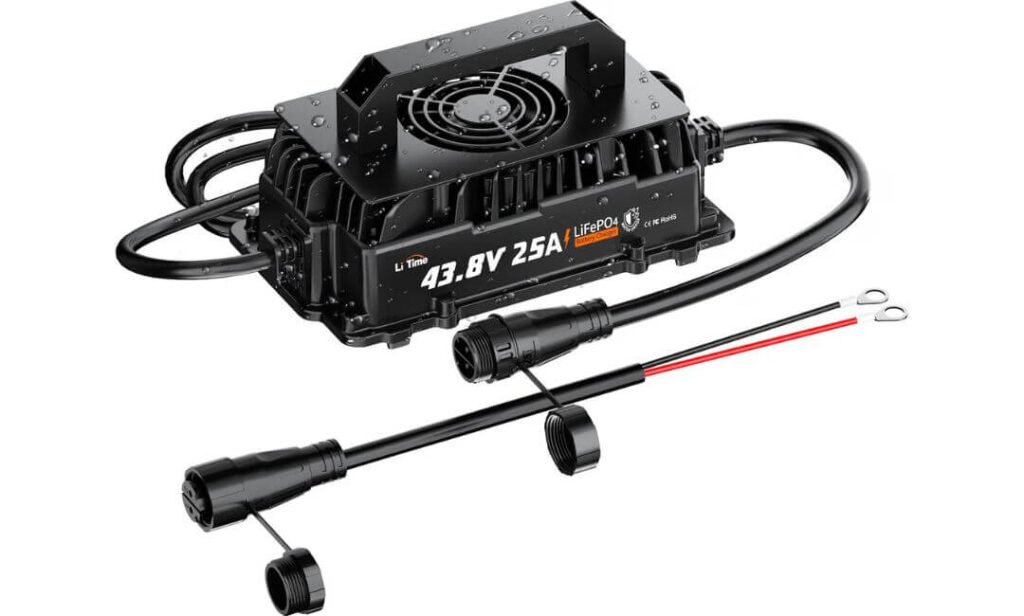
Quick Specs:
- Charging Output: 25A high-current charging
- Full-Charge Voltage: 43.8V
- Battery Voltage: 36V nominal / 38.4V LiFePO4
- Charging Capacity: Around 900W
- Charging Process: Pre-Charge, Constant Current, Constant Voltage
- Conversion Efficiency: Up to 90%+
- Weather Protection: IP65 sealed aluminum housing
- Cooling: Built-in cooling fan
- Status Monitoring: LED charging-stage indicators
- Installation: Wall-mount design with M25 waterproof connector
- Size: 9.13 × 5.37 × 4.54 inches
- Weight: 6.18 lbs
- Warranty: 2 years
- Certifications: FCC, CE and RoHS
A 36V lithium charger should be judged by how well its voltage, current and charging profile match the battery—not simply by the biggest number printed on the box. This model brings 25A charging with a 43.8V peak output, making it a particularly interesting option for compatible 36V (38.4V) LiFePO4 batteries. Compared with a conventional 8A charger, the extra charging capacity can make a noticeable difference when getting a golf cart, trolling motor or other equipment ready again.
The three-stage charging process is another detail worth noticing. Pre-Charge, Constant Current and Constant Voltage allow the charger to change its behaviour as the battery fills rather than treating the entire cycle as one constant push. With roughly 900W of charging power, a 100Ah pack can theoretically take around four hours under suitable conditions, although real charging time depends on the battery’s state of charge, BMS limits and temperature.
The physical design also feels suited to equipment that actually gets used outside a clean indoor workshop. The sealed aluminum housing, IP65 protection, cooling fan and M25 waterproof connector give it a more practical installation profile for areas exposed to dust, moisture and splashing. The LED indicators are a small but genuinely useful touch—you can check the charging stage at a glance instead of wondering whether the charger is still working.
What We Like
- 25A charging gives compatible battery packs a meaningful speed advantage over basic low-current chargers.
- The 43.8V charging target is clearly suited to compatible 38.4V LiFePO4 systems.
- Three-stage charging makes the charging cycle more controlled as the battery approaches full capacity.
- IP65 protection and aluminum construction make the housing well suited to demanding garage, marine and outdoor environments.
- A 2-year warranty with technical support is reassuring for equipment that may be installed permanently.
What We Don’t
There is really only one important thing to verify beforehand: your battery’s maximum charging current and required charging voltage. If those specifications line up with 25A and 43.8V, there is no reason to complicate the choice with an unnecessarily lower-output charger.
Why This 36V Lithium Battery Charger Makes Sense
The appeal is the combination of 25A output, 43.8V charging, controlled three-stage operation and weather-resistant construction. Those specifications give it a clear role for compatible 36V LiFePO4 packs rather than making it another generic charger that happens to carry a 36V label.
It is also flexible enough for several real-world installations, including golf carts, trolling motors, boats, RV systems and off-grid battery setups. The important part is matching the charger to the battery’s own specifications; once that check is made, the high-current output and rugged enclosure become genuinely useful rather than just numbers on a product page.
The Insider Pro-Tip
Before buying, look at the battery documentation for one line in particular: maximum charging current. A 25A charger is valuable when the battery and BMS are designed to accept it, but there is no benefit in forcing a higher current onto a pack that specifies otherwise. Also confirm that the battery’s required full-charge voltage is 43.8V.
For installation, give the charger some breathing room around its cooling area and keep the mains connection protected from direct water exposure. IP65 is excellent for dust and water splashes, but it does not mean the charger should be submerged. That small installation detail can matter just as much as the charger itself when you’re looking for dependable long-term use.
#2. Redodo 36V 25A Lithium Battery Charger
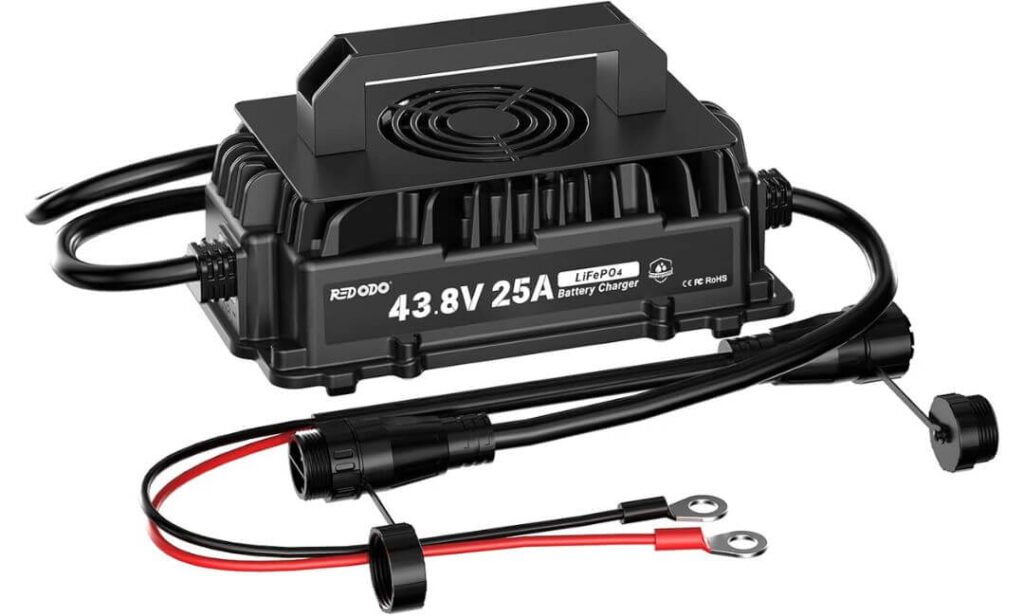
Quick Specs:
- Charging Current: 25A
- Full-Charge Output: 43.8V
- Battery Compatibility: 36V / 38.4V LiFePO4
- Charging Power: About 1,095W
- Charging Efficiency: Up to 90%
- Charging System: 3-stage charging
- Battery Wake-Up: 0V activation function
- Weather Protection: IP65 water- and dust-resistant housing
- Input Range: 100–240V AC
- Housing: Aluminum die-cast construction
- Cooling: Built-in cooling fan
- Status Display: LED charging indicators
- Installation: Wall-mount capable
- Weight: 5.03 lbs
- Size: 5.37 × 9.13 × 4.54 inches
- Warranty: 2 years
What immediately makes this charger interesting is the combination of 25A output and 43.8V charging voltage without turning the product into a complicated setup. It is designed around 36V (38.4V) LiFePO4 batteries, so compatible packs can take advantage of the higher charging current. A 100Ah battery is advertised at roughly four hours of charging and a 50Ah battery around two hours under suitable conditions, although actual times will naturally depend on the battery’s state of charge and BMS limits.
Then there is a feature that is genuinely more useful than it sounds on a product page: 0V battery activation. Some lithium batteries can appear completely dead after their BMS has disconnected the pack for protection. A compatible charger with a wake-up function can attempt to bring that protected battery back into its normal charging state. It is not a magic repair function, and a physically damaged battery should never be forced back into service, but for a BMS-protected pack it can potentially save an otherwise unnecessary replacement.
The outdoor design is equally practical. The IP65-rated housing, protected connectors and aluminum die-cast construction make this a sensible option for golf carts, RV compartments, boats and other places where dust, humidity or splashing are part of normal use. The built-in fan helps with heat during longer charging sessions, while the LED display gives a simple visual indication of charging progress. With 100–240V AC input, it also avoids tying the charger to one specific household-voltage range.
What We Like
- 0V activation is the standout feature for compatible batteries that have entered BMS protection.
- 25A and 43.8V provide the charging combination expected by compatible 36V LiFePO4 packs.
- IP65 protection with dedicated connector caps makes the unit better suited to outdoor and marine environments.
- The 5.03-pound weight keeps it relatively manageable for moving or mounting compared with bulkier high-output chargers.
- 2-year warranty and technical support give some useful backup when the charger is being installed as part of a permanent setup.
What We Don’t
The only thing worth paying extra attention to is the 0V activation feature’s compatibility with your particular battery and BMS. It is a useful recovery function, but it should never be treated as a way to revive a battery that has been damaged, swollen or otherwise unsafe.
Why This 36V Lithium Battery Charger Earns Its Place
This model earns its position because it adds something meaningful to the basic 25A/43.8V formula. The combination of fast charging, 0V wake-up capability, IP65 protection and universal AC input gives it a broader practical use case than simply charging a healthy battery faster.
For a compatible 36V lithium battery, that makes the charger particularly interesting when the equipment lives outside the house or when occasional BMS protection events are a concern. It is a more thoughtful package for a golf cart, trolling motor, RV or marine setup where charging conditions are not always as controlled as they would be in a dry garage.
The Insider Pro-Tip
The smartest way to use the 0V function is as a battery-recovery convenience, not a battery-health test. If a LiFePO4 pack suddenly shows 0V because its BMS has disconnected it, checking the battery manufacturer’s instructions first is still the right move. If the pack is healthy and the BMS simply needs to wake up, this feature can be genuinely handy.
One more detail is easy to overlook: 25A charging capability does not mean every 36V battery should be charged at 25A. Check the battery’s permitted charging current before connecting it. When the battery specification, 43.8V target and connector all line up, the charger becomes a very straightforward high-current option rather than a gamble based on the “36V” label alone.
#3. DC HOUSE 36V 25A Lithium Battery Charger
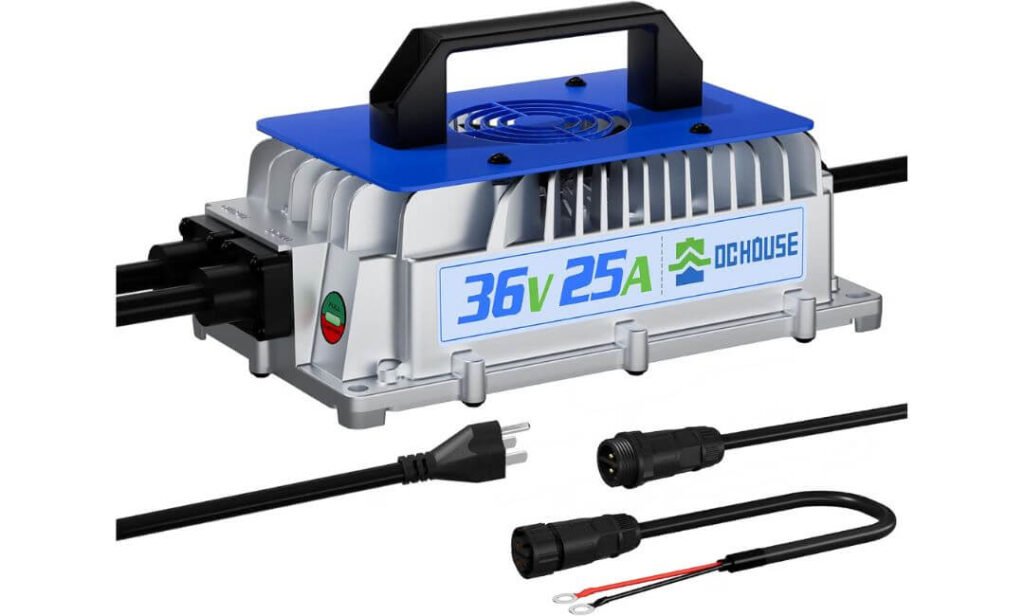
Quick Specs:
- Charging Current: 25A
- Maximum Charging Voltage: 43.8V
- Battery Fit: 36V / 38.4V LiFePO4
- Charging Power: 900W
- Charging Efficiency: ≥93%
- Battery Wake-Up: 0V activation function
- Input: 100–240V AC
- Operating Temperature: -20°C to 45°C
- Protection: IP65 water-resistant aluminum alloy housing
- Safety Coverage: Over-voltage, over-current, overheating, short-circuit, reverse-connection and no-load protection
- Cooling: Built-in cooling fan
- Charging Display: LED status indicators
- Cable Reach: Approximately 7.2 ft total
- Design: Integrated carry handle
- Dimensions: 9.13 × 5.39 × 4.5 inches
- Weight: 6.52 lbs
There is a useful difference between a charger that simply says 25A and one that gives you a complete charging package around it. This unit pairs 25A output with a 43.8V maximum charging voltage and 900W charging power, making it suitable for compatible 36V (38.4V) LiFePO4 batteries. The manufacturer states that it can charge a 50Ah pack in around two hours and a 100Ah pack in around four hours under suitable conditions, which gives a much clearer idea of what the output means in everyday use.
Another practical advantage is the ≥93% charging efficiency claim. For a high-current charger, efficiency matters because less wasted energy generally means less unnecessary heat to deal with. The built-in fan helps manage that heat during longer sessions, while the LED indicators keep the charging process easy to follow. There is also a 0V activation function for compatible batteries that have entered BMS protection, giving this charger a useful recovery-oriented feature beyond ordinary charging.
The construction tells you where this model is meant to live. The IP65-rated aluminum alloy die-cast shell is designed for environments where dust, moisture, vibration and occasional knocks are realistic possibilities. The carry handle and roughly 7.2 feet of combined cable also make it easier to position around equipment rather than treating it like a permanently fixed desktop charger. That is particularly useful for golf carts, trolling motors, boats, forklifts and other 36V equipment where the charging point is not always in the same place.
What We Like
- ≥93% efficiency is an unusually useful specification to see on a high-current charger because it gives some indication of how efficiently the 900W input power is being converted.
- 25A output with 43.8V maximum charging voltage gives compatible 36V LiFePO4 packs a genuinely quick charging option.
- 0V activation can be useful when a healthy battery has been disconnected by its BMS and needs a compatible wake-up sequence.
- The carry handle and 7.2-ft total cable reach make the unit more practical for equipment that is charged in different locations.
- The IP65 die-cast aluminum housing is well suited to rougher outdoor and utility environments.
What We Don’t
The charger is fairly substantial at 6.52 pounds, so it is more of a sturdy high-output unit than something designed to disappear into a small storage compartment. For a portable charger, though, the integrated handle makes that extra weight much easier to manage.
Why This 36V Lithium Battery Charger Deserves a Closer Look
Its strongest point is the balance between charging speed, efficiency and ruggedness. You get 25A output without giving up useful protections, a 0V activation function or outdoor-oriented construction. The ≥93% efficiency figure is especially relevant when the charger will be used frequently rather than only once in a while.
It also has a practical advantage over chargers designed around one fixed installation. The carry handle, extended cable length and 100–240V AC input make it easier to move between compatible equipment or use in different charging locations. For someone who actually works with a 36V lithium system rather than simply replacing a charger on paper, those little details can matter.
The Insider Pro-Tip
The 43.8V figure is the number to verify before purchasing. A battery may be marketed as 36V while having a different chemistry, cell configuration or manufacturer-specified charging voltage. For a 38.4V LiFePO4 pack that calls for a 43.8V full-charge voltage and permits 25A charging, the specifications line up; otherwise, do not rely on the “36V” name alone.
And if you plan to use the 0V activation feature, treat it as a BMS wake-up function, not a way to force-charge a genuinely damaged battery. A healthy pack that has simply gone into protection is one thing; physical damage, swelling or abnormal heating is another. That small distinction is exactly the kind of check that turns a fast charger into a sensible long-term purchase rather than just a higher-amp replacement.
#4. EPOWREY 18A Lithium Battery Charger
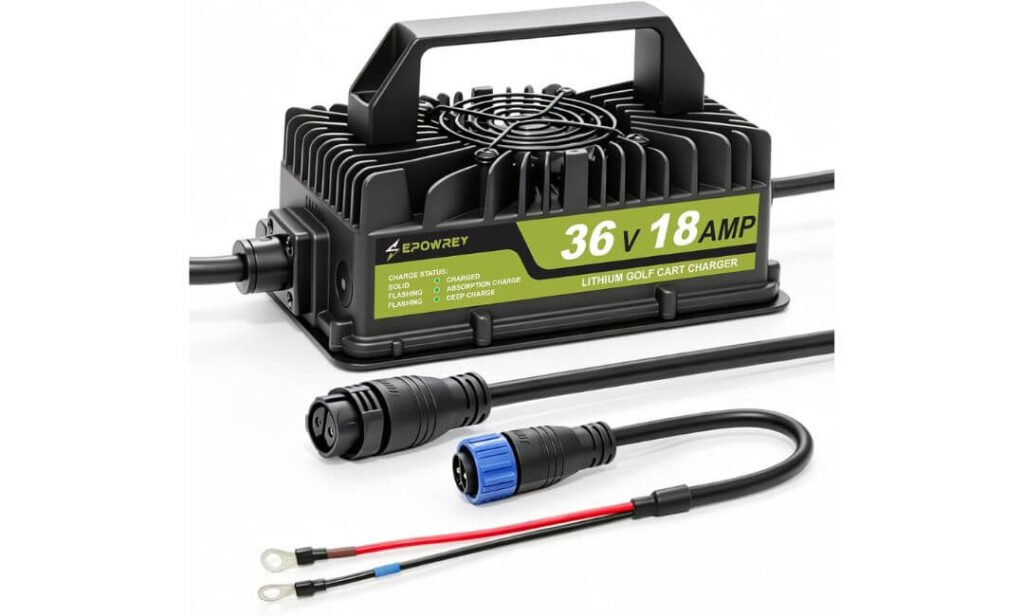
Quick Specs:
- Charging Current: 18A
- Battery Fit: 36V / 38.4V 12S LiFePO4
- Input Voltage: 100–240V AC
- Charging Format: Direct battery connection with M8 terminals
- Connector Support: Included adapter cable for different connection types
- Weather Protection: IP67 waterproof and dustproof housing
- Housing: Anodized aluminum alloy
- Cooling: Built-in cooling fan
- Safety Protection: Reverse polarity, short-circuit, over-voltage, over-current and over-temperature protection
- Operating Range: -4°F to 149°F
- Portability: Integrated carry handle
- Size: 7.4 × 4.2 × 4.6 inches
- Weight: 5.5 lbs
- Certifications: FCC and ETL
- Warranty: 1 year
For this charger, the important detail is not simply the 18A rating. It is the fact that it is specifically designed around a 36V (38.4V) 12S LiFePO4 battery. That makes the compatibility story considerably clearer than products that only advertise themselves as a generic “36V lithium charger.” If your battery is a matching 12S LiFePO4 pack and its charging specification calls for 18A, this is the kind of straightforward pairing worth considering.
The M8 ring terminals are another genuinely useful touch. Once those terminals are correctly connected to the battery, there is no need to remove them every time you charge. The included adapter cable also gives some flexibility when the equipment uses a different connection arrangement. For a golf cart, RV or other equipment where the charger can stay installed, that can turn charging into a simple plug-in routine rather than another cable-management job.
Then there is the housing. An IP67 aluminum-alloy enclosure with an anodized surface gives this unit a noticeably more rugged profile for outdoor use. IP67 is a higher ingress-protection rating than the IP65 models elsewhere in this list, although the rest of the installation still matters. The cooling fan helps move heat away during longer charging sessions, while protection against reverse polarity, short circuits, over-current, over-voltage and excessive temperature adds another layer of sensible protection.
What We Like
- 12S LiFePO4 compatibility gives this charger a clearly defined battery target instead of relying on the generic 36V label.
- IP67 protection is particularly useful where dust, moisture and occasional water exposure are part of the environment.
- M8 ring terminals make a permanent or semi-permanent battery connection much more convenient.
- The 5.5-pound carry-handle design keeps it practical if the charger needs to move between equipment or charging locations.
- FCC and ETL certification plus multiple electrical protections provide useful reassurance for regular charging.
What We Don’t
The main consideration is simply that 18A is its intended charging rate. That is not a disadvantage when the battery is designed around 18A, but someone specifically looking for the shortest possible charging time may prefer one of the 25A options above—assuming their battery is rated to accept that higher current.
Why This 36V Lithium Battery Charger Fits a Different Need
The appeal here is specific compatibility rather than chasing maximum amperage. A charger built specifically around a 36V/38.4V 12S LiFePO4 battery can make the buying decision much cleaner when your battery documentation matches those specifications.
Its physical design also suits a charger that may spend its life attached to the equipment. The M8 terminals, IP67 enclosure, cooling fan and integrated handle make sense for golf carts, forklifts, RVs and marine equipment where durability and convenient installation can matter just as much as raw charging speed.
The Insider Pro-Tip
If your battery documentation says 36V/38.4V 12S LiFePO4 and 18A charging, this is one of those cases where the less glamorous specification is actually the most useful one: the charger has a clearly defined target. Before installation, check the battery’s connector arrangement and maximum permitted charging current, then make the M8 connection once and leave it in place if your setup allows it.
One more practical point: IP67 does not mean every part of the charging setup is waterproof. The charger housing may have strong ingress protection, but the AC connection, cable joins and battery terminals still deserve proper placement and protection. Get those basics right, and the rugged enclosure becomes a useful part of the installation rather than just another number on the box.
#5. FORM 36V Lithium LiFePO4 Battery Charger
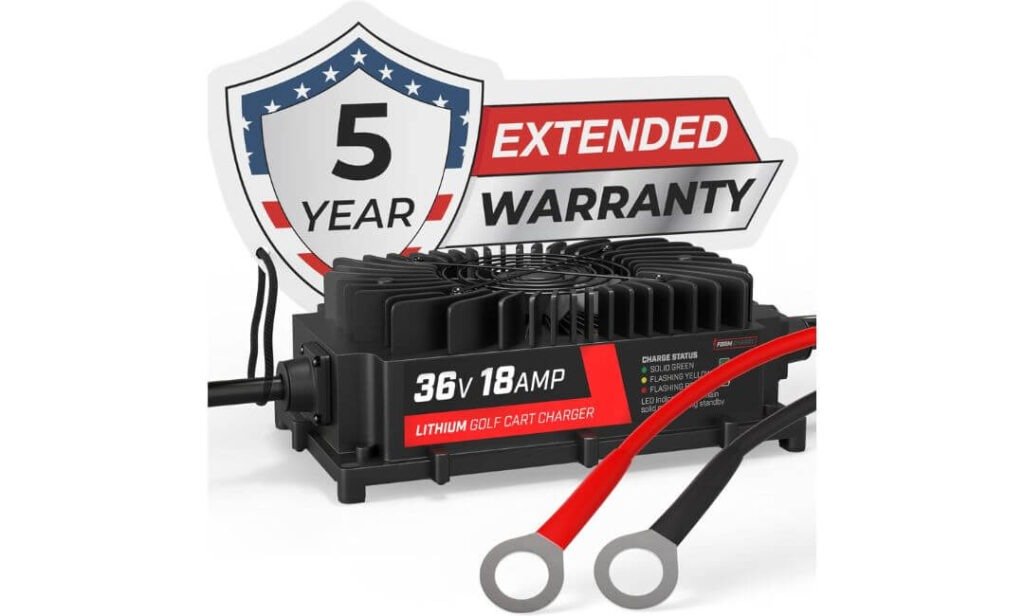
Quick Specs:
- Charging Current: 18A
- Battery Fit: 36V / 38.4V LiFePO4
- Charger Type: Onboard charger
- Connection: Ring terminals
- Charging Voltage: 38.4V / 43.8V specification
- Maintenance Mode: Automatic post-charge maintenance
- Battery Monitoring: Improved battery-sensing technology
- Weather Protection: IP67 waterproof rating
- Internal Protection: WeatherShield coating
- Cooling: Built-in cooling fan
- Installation Size: 10 × 5.25 × 3 inches
- Weight: Listed at 3.84 oz
- Warranty: 24 months
- Support: USA-based customer support
Some 36V chargers are made to be carried out, connected, removed and stored after every charging session. This one takes a different route. It is designed as an onboard 18A charger for 36V/38.4V LiFePO4 golf-cart batteries, using ring terminals so the charging connection can stay installed. Once that setup is done correctly, charging becomes pleasantly simple: plug into the AC supply and let the charger handle the cycle.
The most useful part is what happens after the battery reaches full charge. Its automatic maintenance mode takes over rather than leaving the charger behaving as though the battery still needs a full charging current. The battery-sensing system is also designed to adjust the charging behaviour around the pack, which is a much more meaningful feature for an onboard charger than simply advertising a large amp number.
Then there is the environment it is built for. The IP67 rating, WeatherShield internal coating and cooling fan make sense underneath a golf-cart seat or in another location where dust, moisture and temperature changes are realistic. The compact 10 × 5.25 × 3-inch form factor is also useful when space is limited. FORM says the unit is substantially lighter than a traditional OEM charger, although the supplied listing’s 3.84-ounce weight should be treated cautiously given the charger’s physical dimensions.
What We Like
- Onboard design means the charger can stay with the equipment instead of becoming another accessory to carry around.
- Automatic maintenance mode is genuinely convenient for users who prefer to leave a compatible battery connected between outings.
- IP67 protection and WeatherShield coating give the internal electronics an extra layer of environmental protection.
- Ring-terminal installation keeps the battery connection clean and straightforward once properly fitted.
- The 24-month warranty and USA-based support add useful reassurance, particularly for an onboard installation.
What We Don’t
The main consideration is its 18A charging rate. That is perfectly sensible for a battery designed to accept 18A, but it is not intended to compete with the 25A chargers above purely on charging speed. Its real advantage is the onboard, maintenance-oriented setup.
Why This 36V Lithium Battery Charger Makes Sense
This is the option for someone who values convenience and permanent installation as much as raw charging speed. The 18A output, battery-sensing technology and automatic maintenance mode are built around keeping a compatible 36V LiFePO4 pack ready without making charging another daily chore.
The IP67 housing, WeatherShield protection and compact onboard format reinforce that purpose. For a compatible Club Car, EZGO or Yamaha 36V lithium setup, the appeal is straightforward: install it properly once, connect it to the battery with the supplied ring-terminal arrangement, and keep the charging process simple.
The Insider Pro-Tip
With an onboard charger, installation quality matters just as much as the charger itself. Make sure the ring terminals are firmly attached to the correct battery connections, the cables are routed away from moving or hot components, and the AC inlet is positioned where it can be reached without exposing the connection unnecessarily to water.
One detail deserves special attention before ordering: verify that your golf cart’s lithium conversion uses a 36V/38.4V LiFePO4 battery compatible with the charger’s charging profile. “36V” is the starting point, not the complete compatibility check. Once that matches, the maintenance mode and onboard format are what make this model particularly convenient for everyday use.
Best 36V Lithium Battery Charger (2026) Comparison: 25A Output, 43.8V Charging & IP65/IP67 Protection
| Charger | Charging Output | Battery Match | Protection & Build | Charging Approach | Installation | Best-Suited Use |
|---|---|---|---|---|---|---|
|
LiTime 36V 25A
High-current external charger
25A PICK
|
25A 43.8V peak ~900W 90%+ claimed conversion efficiency |
36V / 38.4V LiFePO4
Compatible packs requiring a 43.8V full-charge target
|
IP65 Sealed aluminum housing Built-in cooling fan Multiple electrical protections |
3-stage Pre-Charge → CC → CV LED charging-stage display |
Wall-mount capable M25 waterproof connector 9.13 × 5.37 × 4.54 in |
Golf carts, trolling motors, boats, RVs and compatible off-grid systems Strong fit when 25A charging is permitted |
|
Redodo 36V 25A
High-output charger with wake-up function
0V WAKE-UP
|
25A 43.8V peak ~1,095W 90% claimed efficiency |
36V / 38.4V LiFePO4
Designed for compatible 43.8V charging requirements
|
IP65 Aluminum die-cast housing Protected connectors Fan cooling |
3-stage Controlled charging cycle 0V activation for compatible BMS-protected packs |
Wall-mount capable 100–240V AC input 5.03 lbs |
Golf carts, marine equipment, RVs and outdoor 36V lithium setups Useful when BMS wake-up capability matters |
|
DC HOUSE 36V 25A
Portable high-efficiency charging unit
≥93% EFFICIENCY
|
25A 43.8V maximum 900W 50Ah ≈ 2h / 100Ah ≈ 4h under stated conditions |
36V / 38.4V LiFePO4
Intended for compatible lithium battery systems
|
IP65 Aluminum alloy die-cast shell Drop-resistant construction Cooling fan |
High-current charging 0V activation LED charging indication |
Integrated carry handle ~7.2 ft total cable reach 9.13 × 5.39 × 4.5 in |
Golf carts, boats, forklifts, ATVs and utility equipment A practical choice where portability matters |
|
EPOWREY 36V 18A
12S LiFePO4-focused charger
12S MATCH
|
18A 36V / 38.4V battery system 100–240V AC input |
36V / 38.4V 12S LiFePO4
Specifically defined around a 12S LiFePO4 battery configuration
|
IP67 Anodized aluminum alloy Fan cooling Multi-point electrical protection |
18A charging Battery-side protection monitoring Designed for stable regular charging |
M8 ring terminals Included adapter cable Carry handle |
Golf carts, forklifts, RVs and marine applications Particularly useful when 12S compatibility is confirmed |
|
FORM 36V 18A
Onboard charging specialist
ONBOARD
|
18A 36V / 38.4V LiFePO4 38.4V / 43.8V charging specification |
36V / 38.4V LiFePO4
Purpose-built for compatible lithium golf-cart battery systems
|
IP67 WeatherShield internal coating Cooling fan Battery-sensing technology |
Maintenance mode Automatically transitions after full charge Designed for convenient long-term connection |
Ring-terminal connection Onboard installation 10 × 5.25 × 3 in |
Club Car, EZGO and Yamaha 36V lithium golf-cart setups Best suited to a permanent onboard arrangement |
36V Lithium Battery Charging Basics You Should Know
Calling a battery “36V” gives you only the nominal voltage, not the complete charging requirement. That distinction is easy to miss when shopping for a charger. A 36V lithium battery can use different cell chemistries and pack configurations, so the correct charger depends on the battery manufacturer’s specified charging voltage, chemistry, maximum charging current, and BMS requirements.
What 36V Actually Means on a Lithium Battery
For lithium batteries, the number printed on the battery is generally a nominal system voltage rather than the voltage you will see throughout the entire charging cycle.
A common example is a 36V LiFePO4 battery, which typically consists of 12 cells in series. Its nominal voltage is about 38.4V, while a fully charged 12S LiFePO4 pack reaches approximately 43.8V. That is why several chargers in this guide specify 43.8V output even though they are marketed as 36V chargers.
Other lithium chemistries can have different voltage characteristics. A 36V-class NMC or NCA lithium-ion battery does not automatically use the same charging profile as a 36V LiFePO4 pack. The charger should therefore be selected from the battery’s actual chemistry and manufacturer specifications, not from the “36V” label alone.
Why 43.8V Matters for a 36V LiFePO4 Battery
The 43.8V figure is the full-charge target for a compatible 12S LiFePO4 configuration. It is not an arbitrary higher voltage added to a 36V charger.
That is an important distinction when comparing products. A charger advertised as “36V” can still have a 43.8V charging output because the battery’s nominal voltage and full-charge voltage are different things.
For example, the 25A models in this guide, including LiTime, Redodo and DC HOUSE, specify 43.8V maximum charging output. That makes them relevant to compatible 36V/38.4V LiFePO4 batteries designed for that charging target. EPOWREY and FORM are also positioned around 36V/38.4V LiFePO4 applications, but their charging approach and intended installation differ.
The simple rule is:
- 36V = nominal battery/system designation
- 38.4V = typical nominal voltage of a 12S LiFePO4 pack
- 43.8V = typical full-charge voltage for that 12S LiFePO4 configuration
- 25A or 18A = charging current the charger can provide, which still needs to be permitted by the battery and BMS
So, if a battery specifies a 43.8V charger, a charger with the correct current and connection arrangement becomes much easier to evaluate. If the battery specifies something different, do not assume a 43.8V charger is suitable simply because both products say “36V.”
36V LiFePO4 vs Other Lithium Chemistries
“Lithium battery” is a broad category. LiFePO4, NMC and NCA are not interchangeable charging profiles, even when their batteries are marketed around the same nominal voltage.
LiFePO4 is particularly common in applications such as golf carts, marine equipment, RVs, solar storage and utility vehicles. The products selected for this article are primarily aimed at 36V/38.4V LiFePO4 systems, with specific voltage and current requirements.
NMC and NCA batteries can have different cell voltages and therefore require chargers designed for their own pack configuration. A charger intended for a 12S LiFePO4 battery should not be treated as a universal charger for every 36V lithium-ion battery.
Before purchasing, check these four details on the battery documentation:
- Battery chemistry, such as LiFePO4 or another lithium-ion chemistry.
- Nominal voltage, such as 36V or 38.4V.
- Required full-charge voltage, such as 43.8V for a compatible 12S LiFePO4 pack.
- Maximum permitted charging current, which determines whether an 18A or 25A charger is appropriate.
That quick check is far more useful than choosing based on the word “lithium” alone.
Why IP Ratings Matter With Outdoor Chargers
Water resistance becomes important when a charger is used around golf carts, boats, trolling motors, RVs, forklifts or outdoor battery systems. A charger sitting in a dry garage has a very different job from one installed around equipment exposed to humidity, dust and occasional splashing.
An IP65 rating indicates protection against dust ingress and water jets from various directions under the relevant test conditions. IP67 goes further by adding protection against temporary immersion under specified laboratory conditions.
That does not mean an IP-rated charger can be installed carelessly. The AC connection, battery terminals, cable joints and ventilation area still need sensible protection and placement. An IP67 charger does not make an exposed electrical connection automatically waterproof.
In this group, LiTime, Redodo and DC HOUSE use IP65-rated construction, while EPOWREY and FORM are listed with IP67 protection. That difference can be useful when deciding where the charger will actually live, but the rating should be viewed as one part of the installation rather than the entire weatherproofing solution.
Choosing 18A or 25A Charging
More amperage sounds better until the battery’s own charging limit enters the conversation.
A 25A charger can reduce charging time compared with an 18A unit when the battery is large enough and its BMS is designed to accept 25A. That is why the LiTime, Redodo and DC HOUSE models are interesting for compatible higher-current applications.
An 18A charger can make more sense when the battery manufacturer specifies that charging rate, or when the installation is designed around a lower current. EPOWREY and FORM take this approach, with FORM adding an onboard maintenance-oriented charging system.
For a rough comparison, charging time can be estimated from:
Battery capacity ÷ charging current = theoretical charging time
So a 100Ah battery receiving 25A is theoretically around four hours, while 18A would be roughly 5.6 hours. Real charging time is usually longer because charging current changes as the battery approaches full, and the BMS, temperature and battery condition can all affect the cycle.
A Final Compatibility Check Before You Buy
The safest way to choose a 36V lithium battery charger is to work backwards from the battery.
Check the battery label or manufacturer’s manual for the chemistry, nominal voltage, full-charge voltage, maximum charging current and connector arrangement. Then compare those specifications with the charger.
If the battery is a 36V/38.4V 12S LiFePO4 pack requiring a 43.8V charging target, a compatible charger from this list can make sense. If it is another lithium chemistry or has a different charging specification, stop at the battery documentation rather than assuming that every product labelled “36V lithium charger” will work.
That is the small piece of information that can save the most frustration: the right charger is the one that matches the battery’s charging specification, not simply the one with the highest amperage or the most impressive feature list.
36V Lithium Battery Charger Buying Guide: What Actually Matters Before You Buy
A good charger is not simply the one with the highest amp rating or the longest feature list. With 36V lithium systems, compatibility has to come first. A charger can be powerful, well-built and heavily protected, yet still be the wrong choice if its charging voltage, chemistry profile or connector does not match the battery.
The five chargers in this guide cover two useful groups: 25A external high-current chargers and 18A options aimed at more specific or onboard applications. That makes the buying decision easier if you judge each specification against the battery and the way the equipment is actually used.
Start With the Battery, Not the Charger
Before comparing brands, find these details on the battery label, manual or manufacturer’s specifications:
| Battery information | What to check | Why it matters |
|---|---|---|
| Chemistry | LiFePO4, NMC, NCA, etc. | Different lithium chemistries require different charging profiles |
| Nominal voltage | 36V / 38.4V, etc. | Confirms the charger’s intended voltage class |
| Full-charge voltage | Often 43.8V for a compatible 12S LiFePO4 pack | Determines the charger’s required peak output |
| Maximum charge current | For example, 18A or 25A | Prevents choosing a charger that exceeds the battery’s permitted charging rate |
| Connector | Ring terminals, Anderson, XT60 or another arrangement | Determines whether the charger can physically connect |
| BMS requirements | Battery-specific charging limitations | The BMS may restrict current or charging behaviour |
That five-minute check is worth doing before looking at price or reviews. “36V lithium” is not a complete compatibility specification.
Voltage and Current: The Two Numbers You Cannot Ignore
For a compatible 36V/38.4V LiFePO4 battery, the charger needs the correct charging voltage, while the charging current determines how quickly energy can be put back into the pack.
The 25A models here are built for users whose batteries permit that higher charging rate. Under suitable conditions, a 100Ah battery receiving 25A has a theoretical charging time of around four hours. An 18A charger would take roughly 5.6 hours at the same simple calculation.
Real charging time will not be exactly that number. Current can reduce as the battery approaches full charge, and the battery’s BMS, temperature, state of charge and condition can all change the result.
A useful way to think about it is:
Higher current = potentially shorter charging time, but only when the battery is designed to accept it.
Do not upgrade from 18A to 25A simply because 25A sounds better. Check the battery’s maximum permitted charging current first.
Why 43.8V Is Such an Important Number
For a typical 12S LiFePO4 battery, 38.4V is the nominal pack voltage, while approximately 43.8V is the full-charge target.
That is why a charger can legitimately be marketed as a “36V lithium battery charger” while specifying 43.8V output. The two figures describe different points in the battery’s operating range.
This is particularly important when comparing the chargers in this article. The LiTime, Redodo and DC HOUSE options specify 43.8V output, making them relevant to compatible 36V/38.4V LiFePO4 batteries requiring that charging target.
Do not apply that number universally to every battery labelled 36V. If your battery uses another chemistry or pack configuration, use its manufacturer’s specified charging voltage.
Look at the Charging Profile, Not Just the Amp Rating
A lithium charger should control how charging changes as the battery fills.
The most important stages for these products are generally based around constant-current and constant-voltage charging. During the high-current portion, the charger supplies the intended charging current. As the battery approaches its voltage limit, the charger transitions into the voltage-controlled portion and charging current naturally falls.
That is why a charger advertising 25A does not mean the battery receives exactly 25A from empty to full.
For LiFePO4 systems, proper battery management is also important. The BMS belongs to the battery, where it monitors and protects the cells. Do not confuse a charger’s charging stages with active cell balancing. A charger can provide an appropriate CC/CV profile, while actual cell balancing is generally handled by the battery’s BMS or battery-management system.
LiFePO4 Compatibility Deserves Its Own Check
A charger designed for 36V LiFePO4 should not automatically be assumed suitable for every 36V lithium-ion battery.
LiFePO4, NMC and NCA use different cell characteristics and can have different charging requirements. The nominal voltage may look similar while the required full-charge voltage and charging profile differ.
For this article’s products, the relevant target is primarily 36V/38.4V LiFePO4. EPOWREY, for example, is specifically described around a 12S LiFePO4 configuration, while FORM is positioned as an onboard charger for compatible 36V/38.4V LiFePO4 golf-cart batteries.
If the battery documentation does not clearly identify the chemistry and required charging voltage, that is the point where guessing should stop.
Charging Protection Is More Important Than Fancy Extras
A charger operating at 18A or 25A is moving substantial electrical power, so protection features deserve real attention.
Useful protections include:
- Over-current protection, to prevent excessive output current.
- Over-voltage protection, to limit abnormal voltage conditions.
- Over-temperature protection, particularly during long charging sessions.
- Short-circuit protection, for unexpected output faults.
- Reverse-polarity protection, where supported, to reduce the risk of an incorrect battery connection.
- No-load protection, where provided, for situations where the charger is powered without a suitable battery connection.
- Automatic charging termination or transition, depending on the charger’s design.
These features do not make an incorrectly connected battery safe, and they do not replace the battery’s BMS. Think of them as layers of protection around a correctly specified charging system.
Temperature and Heat Management Matter During 25A Charging
High-current charging creates heat. That is normal, but excessive heat is something a well-designed charger needs to manage.
The products here use features such as built-in cooling fans and aluminum housings to move heat away from the electronics. DC HOUSE also lists an operating range of -20°C to 45°C, while EPOWREY lists -4°F to 149°F.
Those figures are useful, but they should not be interpreted as a guarantee that every battery can safely charge across the entire range. The battery itself has its own temperature limits, and LiFePO4 batteries in particular may have charging restrictions at very low temperatures.
For permanent installations, leave adequate airflow around the charger rather than squeezing it into a sealed compartment simply because the dimensions fit.
Connector Type and Cable Reach Can Make or Break Installation
A charger can have perfect electrical specifications and still be inconvenient if the connection does not suit your battery.
Pay attention to:
- Ring terminals, useful for direct battery connections and permanent installations.
- Anderson-style connectors, common in higher-current equipment.
- Adapter cables, which can provide additional connection flexibility.
- Cable length, especially when the charger will sit away from the battery.
- Waterproof connector caps or sealed connection points, useful in outdoor environments.
FORM and EPOWREY are particularly installation-focused, using ring-terminal connections for onboard-style setups. DC HOUSE takes a more portable approach with a carry handle and approximately 7.2 feet of combined cable.
Before ordering, compare the actual connector with the battery terminals. An adapter can solve some connection differences, but it should never be used to compensate for an electrically incompatible charging system.
IP65 vs IP67: Understand What You Are Actually Getting
IP ratings are useful when the charger will live around golf carts, boats, trolling motors, RVs or outdoor equipment.
IP65 generally means the enclosure is dust-tight and protected against water jets under the applicable test conditions.
IP67 adds protection against temporary immersion under specified laboratory conditions.
In this selection, LiTime, Redodo and DC HOUSE are listed with IP65 protection, while EPOWREY and FORM are listed with IP67 protection.
The higher number does not mean the entire installation can be ignored. The AC plug, cable joints, battery terminals and ventilation openings still need sensible placement. A charger enclosure being IP67 does not make an exposed household electrical connection waterproof.
Efficiency Is More Than an Electricity-Bill Number
Charging efficiency tells you how much of the electrical energy entering the charger is successfully converted into useful charging power.
DC HOUSE lists ≥93% efficiency, while other models in this group advertise around 90% conversion efficiency. Higher efficiency can mean less energy lost as heat and potentially less thermal stress inside the charger during extended charging.
It is worth treating efficiency figures as manufacturer specifications rather than expecting laboratory-level numbers in every real installation. Input voltage, temperature, battery state and operating conditions can all influence actual performance.
Portable or Onboard: Decide How You Really Charge
This is one of the easiest buying decisions to overlook.
A portable charger makes sense when the same charger may be used in different places, stored between charging sessions or moved between compatible equipment. A handle and longer cables become genuinely useful here.
An onboard charger makes more sense when the equipment has a dedicated charging location and you want the charger to remain installed. FORM’s onboard design and ring-terminal setup are built around that type of use.
Neither arrangement is inherently better. The right choice depends on whether you want mobility or permanent convenience.
Displays, Firmware and “Smart” Features
A simple LED indicator can actually be more useful than an elaborate display if all you need to know is whether the charger is charging or finished.
The products in this group use LED status indicators to show charging progress or charging state. That is enough for many everyday installations.
Firmware updates are different. Unless a charger specifically provides a documented firmware-update system through an app, service interface or manufacturer-supported procedure, there is no reason to assume that “smart charging” means the unit can be updated like a phone or laptop.
For a basic AC-to-DC lithium charger, correct voltage, current, charging profile and protection matter considerably more than having a complicated screen.
The Buying Checklist That Actually Helps
Before placing the order, run through this list:
- 36V/38.4V battery? Confirm the nominal system voltage.
- LiFePO4? Confirm the chemistry.
- 43.8V required? Verify the battery’s full-charge voltage.
- 18A or 25A permitted? Check the battery’s maximum charging current.
- Correct connector? Compare terminals and cable arrangement.
- Outdoor installation? Look at IP65/IP67 protection and protect the connections separately.
- Permanent installation? Consider an onboard design and mounting method.
- Portable charging? Look for a handle and adequate cable reach.
- Long charging sessions? Check cooling and operating-temperature specifications.
- Recovery feature needed? Verify whether 0V/BMS wake-up is actually supported by your battery.
- Warranty and support? Check what assistance is provided if the charger needs troubleshooting.
The most important takeaway is simple: buy around the battery’s specifications first, then use charging speed, protection, construction and installation features to separate the compatible options. That approach prevents a common mistake in the 36V charger market—choosing a charger because its headline number looks impressive without checking whether the battery can actually use it.
Safety, Maintenance, and Long-Term Charger Care
A good 36V lithium battery charger should not be treated as something you plug in and forget about forever. The charger, battery, connectors, cables and cooling system all work together, and a little basic care can prevent many of the problems that eventually shorten equipment life. This becomes even more important with 25A charging, onboard installations and chargers used around boats, golf carts, forklifts or other outdoor equipment.
Give the Charger a Proper Home
Where the charger is installed matters more than many buyers realise. Even an IP65 or IP67-rated enclosure still needs sensible placement.
Keep these basics in mind:
- Mount the charger where it has adequate airflow, especially around the cooling fan and heat-dissipation areas.
- Avoid covering the ventilation area with bags, seats, insulation or other equipment.
- Keep the charger away from unnecessary sources of direct heat, such as hot engine components or exhaust systems.
- Route cables so they cannot rub against sharp metal, moving parts or hot surfaces.
- Keep AC connections and plugs positioned away from areas where water can collect.
- For onboard installations, secure the charger firmly so repeated vibration does not gradually loosen terminals or mounting hardware.
An IP rating protects the enclosure under specified test conditions. It does not make poor installation safe. Water-resistant housing and sensible cable placement need to work together.
Store a Portable Charger the Right Way
If the charger is not permanently installed, avoid throwing it into a damp garage corner with cables still tightly wrapped around the housing.
Before storing it:
- Disconnect the charger from the AC supply first.
- Disconnect the battery connection according to the manufacturer’s recommended sequence.
- Allow the housing to cool if it has just completed a long charging session.
- Keep the connectors clean and protected from moisture.
- Coil cables loosely instead of bending them sharply at the connector.
- Store the charger somewhere dry, clean and reasonably cool.
The goal is simple: protect the electronics and, just as importantly, protect the connectors and cables that carry the charging current.
Do Not Treat 25A as a Permanent Charging Requirement
A 25A charger can charge a compatible battery quickly, but that does not mean the battery should always be charged at the maximum available current.
The battery manufacturer’s maximum charging current should determine how much current the charger is allowed to deliver. If a battery is rated for 18A, using a 25A charger because it appears faster is not an appropriate upgrade unless the manufacturer specifically confirms that the pack can accept the higher current.
This is especially important when replacing an older charger. Compare the old charger’s rating with the battery documentation rather than assuming that a newer, higher-output model is automatically better.
Let the Battery’s BMS Do Its Job
A lithium battery’s Battery Management System (BMS) is an important part of the charging system. It monitors conditions within the battery and can disconnect the pack when certain protection limits are reached.
The charger and BMS have different jobs.
The charger provides the appropriate charging voltage and current according to its design. The BMS protects and manages the battery according to the battery manufacturer’s specifications.
That is why features such as 0V activation should be understood correctly. If a compatible battery has entered protection and the charger supports a suitable wake-up function, the feature can be useful. It should not be interpreted as permission to force-charge a battery that is physically damaged or showing signs of a serious fault.
Heat Is Something Worth Watching
Some warmth during charging is normal, particularly with a higher-current charger. What matters is excessive or unusual heat.
Pay attention if you notice:
- A charger becoming significantly hotter than it normally does.
- A cooling fan repeatedly struggling or stopping unexpectedly.
- Burning smells or discolouration around connectors.
- Cables or terminals becoming unusually hot.
- Charging repeatedly stopping without an obvious reason.
- Unusual noises, smoke or visible damage.
If something suddenly behaves differently from previous charging cycles, do not simply keep restarting the charger. Disconnect the system safely and investigate the cause.
Also remember that the charger and battery have separate operating-temperature requirements. A charger may advertise a wide operating range, but that does not mean the battery itself is safe to charge at every temperature within that range.
Keep Connectors and Terminals Clean
High-current charging makes connector condition important.
A loose, dirty or corroded connection can create resistance, and resistance produces heat. Over time, that can damage terminals, connectors or cable insulation.
During routine checks, look for:
- Corrosion or oxidation on terminals.
- Loose ring-terminal connections.
- Damaged connector housings.
- Cracked or hardened cable insulation.
- Discolouration around high-current connection points.
- Moisture trapped around connectors.
Do not simply tighten everything as hard as possible. Follow the battery, charger or equipment manufacturer’s recommended connection and torque specifications where available.
Avoid Unnecessary Overcharging
Modern lithium charging systems are designed to control the charging process, but that does not mean every charger should remain connected indefinitely without checking its intended behaviour.
Chargers with a maintenance mode are specifically designed to transition after the battery reaches its charging target. That is different from assuming that every 36V charger provides the same long-term maintenance behaviour.
If the manufacturer does not explicitly state that the charger is suitable for extended connection, follow the recommended charging procedure instead of assuming it is safe to leave plugged in permanently.
For an onboard charger designed with automatic maintenance functionality, such as the FORM model in this guide, that feature is part of the reason the product suits a permanently installed setup.
A Healthy Charging Routine Helps
You do not need a complicated maintenance schedule. A sensible routine is enough.
Before charging:
Check that the battery, charger, cable and connectors look normal. Confirm that the charger is intended for the battery’s chemistry and voltage.
During charging:
Allow sufficient ventilation and occasionally check for unusual heat, smell, noise or connector heating.
After charging:
Make sure the charger has completed its normal charging cycle. If the system has a status indicator, use it rather than unplugging randomly during every cycle.
Periodically:
Inspect mounting hardware, cable routing, terminals, connectors and the charger housing for signs of wear.
When Should a Charger Be Serviced?
A charger does not necessarily need replacing just because it has been used for several years. Condition and behaviour are more useful indicators than age alone.
Professional inspection or manufacturer support is worth considering if the charger:
- Repeatedly fails to start charging.
- Stops charging well before the battery should be full.
- Shows abnormal error behaviour.
- Overheats during normal operation.
- Has a cooling fan that no longer operates correctly.
- Has damaged cables, connectors or housing.
- Produces unusual smells, smoke or visible electrical damage.
- Repeatedly trips protection without an obvious battery-side explanation.
For an intermittent problem, do not immediately assume the charger is defective. The battery, BMS, connector, wiring or AC supply can create very similar symptoms.
When Replacement Makes More Sense
Replacement is generally the sensible route when the charger has physical electrical damage, repeated unexplained faults, deteriorated cables, persistent overheating or a failure that cannot be resolved through the manufacturer’s troubleshooting process.
Do not attempt internal repairs on a mains-powered charger unless you are properly qualified to work on that equipment. A charger can contain hazardous voltages even when it is not actively connected to a battery.
And when replacing it, do not automatically buy the same nominal voltage and call the job finished. Recheck the battery’s chemistry, full-charge voltage, permitted charging current and connector configuration. That is the best opportunity to correct an old mismatch rather than carrying it into the next charger.
The Long-Term Rule Worth Remembering
The easiest way to get dependable service from a 36V lithium charging system is not complicated: match the charger correctly, keep heat under control, protect the connections, and pay attention when the charging behaviour changes.
A 25A charger, an IP67 enclosure or a sophisticated charging algorithm cannot compensate for an incompatible battery or neglected wiring. When the charger and battery are correctly matched and the installation is given basic care, there is far less reason to interfere with the system—and that is exactly what good charging equipment should provide: quiet, predictable charging that does its job without becoming another problem to manage.
36V Lithium Battery Charger Installation and Compatibility Checklist
Buying the right charger is only half the job. The other half is making sure the battery, charger, connector, cables and installation location actually work together. A charger can have the correct 36V label and still be unsuitable because the battery needs a different charging voltage, cannot accept the available current, or uses a connection that does not match the charger.
Before ordering, use the checklist below rather than relying on the product title alone.
Confirm These Battery Details First
Start with the battery documentation, not the charger listing. These are the details worth having in front of you before making the purchase:
- Battery chemistry: Confirm whether it is LiFePO4 or another lithium chemistry.
- Nominal voltage: Verify the battery is actually a 36V-class system.
- Nominal pack voltage: A typical 12S LiFePO4 battery is around 38.4V nominal.
- Required full-charge voltage: Confirm whether the battery specifies 43.8V.
- Maximum charging current: Check whether the battery and BMS permit 18A, 25A, or another charging rate.
- BMS requirements: Look for any manufacturer-specific charging limitations or wake-up instructions.
- Connector arrangement: Identify the battery terminals and the connector used by the charger.
- Installation type: Decide whether you need a portable charger or a permanently mounted onboard unit.
If any of these specifications are unclear, checking the battery manufacturer’s manual is much safer than guessing from the phrase “36V lithium.”
Match the Charger to the Battery’s Charging Profile
For the products in this guide, the most relevant configuration is a 36V / 38.4V LiFePO4 battery with a 43.8V full-charge requirement.
That makes the 43.8V models relevant when the battery documentation confirms the same requirement. The 18A models can also make sense when the battery is designed around that charging current.
The important part is the combination:
Chemistry + battery voltage + full-charge voltage + permitted charging current
All four need to make sense together.
For example, choosing a 25A charger for a battery that only permits 18A charging is not a sensible shortcut. Likewise, choosing an 18A charger for a system specifically designed for a higher charging current may simply give you a slower charging cycle.
Check the Connector Before You Click Buy
Connector compatibility is one of those small details that can turn an apparently perfect purchase into an inconvenient one.
Depending on the charger and installation, you may encounter:
- M8 ring terminals, useful for direct battery connections.
- Anderson-style connectors, commonly used on higher-current equipment.
- XT60-style connections, depending on the particular setup.
- Adapter cables, useful when the charger’s supplied connection does not directly match the equipment.
- Water-resistant connector caps, useful for outdoor installations.
EPOWREY and FORM use ring-terminal connections, which are particularly suitable when the charger is intended to remain connected to the battery. DC HOUSE is more portable and provides a longer overall cable arrangement, making it easier to position around equipment.
Do not assume that a connector being physically similar means it is electrically interchangeable. Check polarity, current rating and the manufacturer’s specified connection method before making an adapter or changing a connector.
Cable Length Can Matter More Than You Expect
Measure the distance between the intended charger position and the battery connection before installation.
A charger may have excellent electrical specifications, but if the cable barely reaches the battery, you may end up putting strain on the connector or routing the cable through an awkward path.
Look for:
- Enough cable length to reach without stretching.
- A route away from sharp edges and moving components.
- Adequate clearance around bends and connectors.
- Secure cable mounting rather than letting the cable hang or rub.
- No contact with exhausts, motors, hot housings or other heat sources.
DC HOUSE, for example, lists approximately 7.2 feet of combined cable, which can be useful for a portable arrangement. An onboard charger with a direct ring-terminal connection takes a different installation approach.
Portable Charger vs Onboard Charger
Think about how you actually use the equipment.
A portable charger is useful when:
- The charging location changes.
- The charger needs to be stored after use.
- Multiple compatible pieces of equipment may share it.
- You want a carry handle and flexible positioning.
An onboard charger is useful when:
- The charger can remain permanently installed.
- You want to charge without opening compartments or reconnecting battery leads.
- The equipment has a dedicated AC charging inlet.
- Space is available for a secure mounting position.
FORM is specifically designed around the onboard approach, while the other models in this selection provide more flexibility for external or portable arrangements.
Choose the Mounting Location Before Installing
For a permanently installed charger, do not choose the mounting position simply because it is the closest empty space.
Look for a location that provides:
- Good airflow around the charger.
- Protection from direct water accumulation.
- Enough room to inspect the connectors.
- A solid mounting surface.
- Protection from excessive vibration.
- Distance from high-temperature components.
- A cable route that does not interfere with moving equipment.
A compact charger may physically fit under a seat or inside a compartment, but that does not automatically make the location suitable. Physical fit and proper operating clearance are two different things.
Waterproof Does Not Mean “Install Anywhere”
IP65 and IP67 protection are valuable, particularly for golf carts, boats, trolling motors and other outdoor equipment, but the entire installation still needs common sense.
The charger housing may be sealed against specified dust and water exposure, while the AC plug, charging inlet, cable joints and battery terminals remain vulnerable.
For an outdoor installation:
- Keep the charger away from places where standing water can collect.
- Position connectors so water cannot naturally pool around them.
- Protect exposed electrical connections according to the equipment manufacturer’s instructions.
- Avoid placing the charger where pressure washing or direct high-pressure spray will hit it.
- Keep cooling openings clear.
- Secure cables so vibration cannot pull on the connections.
This is especially important on boats and marine equipment. A waterproof-rated enclosure does not turn the entire electrical system into a waterproof installation.
Make Sure the Battery Connection Is Secure
Before applying AC power, inspect the battery-side connection carefully.
The terminals should be:
- Correctly matched to positive and negative.
- Firmly secured.
- Free from obvious corrosion or contamination.
- Properly insulated where required.
- Routed so they cannot contact moving or conductive parts.
If ring terminals are being used for an onboard installation, follow the battery and equipment manufacturer’s recommended fastening method and torque specification. Do not rely on “tight enough” when dealing with a high-current connection.
Check AC Power Requirements Too
The battery is not the only side of the system that matters.
Many chargers in this group accept 100–240V AC, but your installation should still have an appropriate electrical supply and protection.
Before installation, verify:
- The available AC voltage is within the charger’s specified input range.
- The outlet and circuit are appropriate for the charger’s power demand.
- Extension cables, if permitted, are suitably rated.
- The AC connection is protected from water and physical damage.
- The charger is not sharing an overloaded circuit with equipment that could cause problems.
For permanent installations, follow applicable electrical requirements rather than improvising the mains connection.
First-Charge Installation Check
Once everything is connected, the first charging session is a good opportunity to make sure the installation behaves normally.
Watch for:
- Normal LED charging indication.
- Stable operation from the beginning of the cycle.
- No unusual smell or sound.
- No excessive heating at connectors.
- No loose cables or movement from vibration.
- Normal transition as the battery approaches full charge.
- The expected completion or maintenance behaviour for that charger.
You do not need to stand over the charger for hours, but the first cycle deserves more attention than the hundredth. It is much easier to correct a routing, mounting or connector problem before it becomes a repeated source of heat or wear.
The Final Compatibility Check
Before placing the order, make sure you can answer yes to these questions:
- Is the battery a compatible 36V lithium system?
- Is the chemistry supported by the charger?
- Does the battery’s required full-charge voltage match the charger’s output?
- Does the battery permit the charger’s 18A or 25A charging current?
- Do the connectors and polarity match?
- Is the cable long enough for the planned installation?
- Does the charger have suitable protection for the environment?
- Will the mounting location provide adequate airflow?
- Is the AC supply appropriate?
- Does the charger suit your intended portable or onboard setup?
If those answers line up, the charger is being selected for the actual electrical system, rather than simply because the product title contains “36V.”
That is the approach worth taking with every charger in this guide: verify the battery first, match the electrical specifications second, then choose the construction and installation features that fit the way you actually use the equipment.
FAQs About 36V Lithium Battery Chargers
Can a 36V lithium charger with 43.8V output be used on a 36V golf cart battery?
Yes, if the golf cart uses a compatible 36V/38.4V LiFePO4 battery that specifically requires a 43.8V full-charge voltage. This is particularly relevant for lithium-converted Club Car, EZGO and Yamaha golf carts, because the “36V” description refers to the nominal system rather than the battery’s voltage at full charge.
The important check is not the golf-cart brand by itself. Check the lithium battery installed in the cart for its chemistry, charging voltage and permitted charging current. A 43.8V charger can be appropriate for a compatible 12S LiFePO4 pack, but it should not be assumed suitable for every battery sold as a 36V lithium conversion.
Is 25A actually better than 18A for a 36V lithium battery charger?
Not automatically. 25A mainly gives you the ability to charge faster when the battery and its BMS are designed to accept 25A. If the battery manufacturer specifies an 18A maximum charging current, using a 25A charger simply because it has a bigger number is not the right approach.
For example, a compatible 100Ah battery receiving 25A has a simple theoretical charging time of about four hours, while 18A works out to roughly 5.6 hours. Real charging takes longer because current normally changes as the battery approaches full charge.
The better question is:
- What is the battery’s maximum permitted charging current?
- What full-charge voltage does it require?
- Does its BMS support the selected charger?
- Is the connector and charging profile correct?
That is why both 18A and 25A chargers have a legitimate place in this guide.
Can a 36V lithium charger be left connected to a Club Car or EZGO golf cart overnight?
That depends on the charger’s charging design and the battery manufacturer’s instructions, not simply on the fact that it is a lithium charger. A model with an appropriate automatic completion or maintenance mode is designed differently from a charger that expects to be disconnected after charging.
FORM’s onboard design is particularly relevant here because it is built around automatic maintenance mode after the compatible LiFePO4 battery reaches full charge. That is useful for a golf cart that remains connected to its charger between outings.
Still, “leave it plugged in” should never mean “ignore everything.” The first few charging cycles are worth observing, and the charger should have adequate ventilation with its connections protected from moisture. If the battery manufacturer specifically instructs you to disconnect after charging, follow that instruction.
What should you check if a 36V LiFePO4 battery suddenly shows 0V and the charger will not start?
First, do not assume that a 0V reading means the battery is permanently dead. A LiFePO4 battery’s BMS can disconnect the pack as a protection measure, and some chargers include a compatible 0V activation or wake-up function.
The sensible sequence is:
- Check the battery manufacturer’s instructions for its BMS recovery procedure.
- Inspect the battery and cables for visible damage, loose connections or overheating.
- Confirm that the charger is actually designed for the battery’s voltage and chemistry.
- Check whether the charger supports 0V/BMS wake-up.
- Stop if the battery is swollen, physically damaged, unusually hot or otherwise abnormal.
The Redodo and DC HOUSE chargers in this guide specifically list 0V activation, while that feature should not be confused with a universal method for repairing a damaged battery. A protection shutdown and a physically failed battery are two very different situations.
If two chargers both say 36V LiFePO4 and 43.8V, why would one be a better fit for my setup?
Because matching voltage is only the beginning of the compatibility check. Two chargers can share a 43.8V output while differing substantially in current, protection, connector arrangement, enclosure rating and installation format.
For this group, the differences are quite practical. A 25A unit may suit a battery that permits higher-current charging, while an 18A model can be the better electrical match for a battery with a lower charging limit. EPOWREY’s 12S LiFePO4 focus and M8 terminals make it a different proposition from a portable high-current charger, while FORM’s onboard format and maintenance mode are aimed at a different type of installation.
The final choice should therefore come from the complete specification:
battery chemistry → full-charge voltage → permitted current → connector → installation environment → charging routine
That is also why review count alone should not decide this purchase. With newer charger models, there may simply not be years of independent ownership data available yet. In that situation, verified compatibility and sensible installation details are more useful than pretending a small review sample proves long-term reliability.
Final Thoughts
A 36V lithium battery charger is one of those purchases where compatibility beats marketing every time. A 25A charger can look more attractive than an 18A model, and IP67 can look better than IP65 on a product page, but neither specification matters if the charger does not match the battery’s chemistry, charging voltage and permitted current.
For a compatible 36V/38.4V LiFePO4 system, the 43.8V charging target is the detail that ties much of this guide together. From there, the decision becomes much more practical: choose 25A when the battery and BMS allow it, choose 18A when that is the specified charging rate, consider IP protection when the charger will live outdoors, and pay close attention to connectors when installing an onboard system.
The five chargers covered here are not identical, and that is intentional. LiTime, Redodo and DC HOUSE focus on higher-current charging, while EPOWREY brings a more specifically defined 12S LiFePO4 setup and FORM takes the onboard, maintenance-oriented route. There is no reason to force the same charger onto every 36V application when the installations themselves are different.
The smartest purchase is ultimately the one that fits the battery you already have. Check the label, verify the charging voltage and current, confirm the connector, then look at the convenience features. That extra few minutes of checking is worth far more than buying a charger first and trying to make the battery fit it later.
Also Check:


