
7 Best 2 Bank Battery Charger in 2026: 10A-20A, 12V, Waterproof, Marine & Onboard Picks
If you run a boat with two 12V batteries, a 2-bank charger is usually the cleaner setup than juggling separate chargers. But the important part is matching the charger to the batteries you actually have. A 10A two-bank unit may mean 5A per bank, while a 20A model can deliver 10A to each battery, so the difference is significant when you are charging larger deep-cycle or trolling-motor batteries. The models below also vary in battery chemistry support, from flooded and AGM to lithium, and in protection levels such as IP65 or IP68 waterproofing.
The details beyond the headline amp rating matter just as much. Older boats and newer boats can have very different installation constraints, so physical clearance, AC input, cable reach, battery type, and whether you are working with two independent 12V batteries or a 24V setup all deserve attention before buying. For example, the NOCO GEN5X2 measures about 7 × 4.84 × 2.2 inches, while the more powerful GENPRO10X2 is about 8.15 × 6.5 × 2.87 inches. That difference can matter when mounting inside a cramped battery compartment.
That is why this list is not simply ranked by the biggest number on the box. It brings together marine-ready onboard chargers, waterproof designs, higher-output options, and a lithium-focused model so you can choose based on the battery setup, charging demands and available installation space—not just the marketing label.
Best 2-Bank Battery Charger: Top 2026 Picks for Marine & Onboard Charging
#1. NOCO GENPRO10X2 2-Bank Charger
Best 20A 2-Bank Marine Battery Charger with 10A-Per-Bank Output, Lithium Support & IP68 Protection
#2. Minn Kota Precision MK-220PCL 2-Bank Charger
Best 20A 2-Bank Onboard Marine Battery Charger with 10A-Per-Bank Output & Independent Charging
#3. NOCO GEN5X2 2-Bank Charger
Best 10A Two-Bank Battery Charger with 5A-Per-Bank Output, Lithium Support & IP68 Marine Protection
#4. FirstPower Pro 2-Bank Marine Charger
Best 10A 2-Bank Marine Battery Charger with 5A-Per-Bank Output, Repair Mode & Temperature Compensation
#5. Guest 2707A 2-Bank Onboard Charger
Best 8A 2-Bank Onboard Battery Charger with Automatic 5-Stage Charging, AGM Support & IP67 Protection
#6. ProMariner ProSport HD 44008 2-Bank Charger
Best 8A 2-Bank Boat Battery Charger with 5-Stage Charging, Distributed-On-Demand Technology & IP67 Protection
#7. LiTime 2-Bank 10A Lithium Charger
Best 2-Bank Lithium Battery Charger with 10A Charging, 12V/24V Compatibility, LiFePO4 Support & IP65 Protection
Expert Tip
Before buying a 2-bank charger, check how much current each bank actually receives, not just the total number in the product title. That small detail is easy to miss. A “10A” two-bank charger may provide 5A to each battery, while a 20A unit can provide 10A per bank. If you have two larger batteries that regularly come home heavily discharged, that difference can save you a lot of waiting time.
Also, don’t assume that a newer charger automatically makes an older one useless. If an older boat already has a well-fitting onboard charger and it matches the battery chemistry, voltage and charging requirements, replacing it simply because a newer model exists may not make sense. Compatibility and installation fit come before brand or headline amperage.
How We Choose These 2-Bank Battery Chargers
We did not build this list by picking the chargers with the biggest amp numbers or by treating every two-bank model as interchangeable. The goal was to find the models that make the most sense for real two-battery marine and onboard setups, including both newer installations and boats that still have limited space around the battery compartment.
1. We checked the output per bank
The first thing we looked at was actual bank-level output. This is important because two chargers with the same “10A” wording can behave very differently from a 20A model delivering 10A to each bank. That is why the NOCO GENPRO10X2 and Minn Kota MK-220PCL rank highly: both are built around 10A-per-bank output, making them better suited to users who want faster recovery from two batteries.
At the same time, we kept lower-output models in the list because not every boat needs maximum charging speed. The GEN5X2, FirstPower and Guest models can make more sense when charging demand is moderate or when a smaller, simpler setup is preferred.
2. We looked at the battery chemistry, not just the voltage
A charger can say “12V” and still be the wrong choice for a particular battery. We considered whether each model is intended for flooded, AGM, gel or lithium batteries, and whether its charging modes are appropriate for that chemistry.
This is one reason the LiTime earns a place rather than being treated as another generic marine charger. Its lithium-focused design and 12V/24V capability make it relevant to a different type of buyer. Conversely, a traditional lead-acid-focused charger can be the more sensible choice for an older boat that already uses compatible AGM or flooded batteries.
3. Marine protection had to be meaningful
For an onboard charger, waterproofing is not a decorative specification. The charger lives around an environment where humidity, splashes, condensation and vibration are normal parts of ownership.
We therefore paid attention to the stated protection ratings and marine construction. The NOCO models stand out with IP68 protection, while the Guest and LiTime options provide IP67 and IP65 protection, respectively. Those differences matter, but we did not treat a higher IP rating alone as proof that one charger is better in every situation.
4. We considered installation space
This is where many online comparisons fall short. A charger can look perfect on paper and still be a poor choice if it simply doesn’t fit where your existing charger is mounted.
We considered physical size, cable reach and the practical reality of mounting an onboard unit inside a boat. The difference between the compact NOCO GEN5X2 and the larger GENPRO10X2 is worth knowing before ordering. If you are replacing an older charger in a tight compartment, measure the available space first rather than assuming the new unit will use the same footprint.
5. We separated genuine strengths from marketing language
Every charger on this list has a reason to be here, but they are not equal in every category. The GENPRO10X2 is the stronger choice when output and modern protection are priorities. The MK-220PCL makes sense for buyers who specifically want 10A per bank. The GEN5X2 is more attractive when a compact 10A total solution is enough.
The Guest and ProMariner models are worth considering for buyers who prefer a more traditional marine-charger approach, while the LiTime is deliberately included for users with lithium and mixed-voltage requirements.
That distinction is important: we are not saying that one charger is perfect for every boat. We are showing why each one earned its position, what kind of battery setup it suits, and where you should think twice before buying.
6. We kept older and newer use cases in the same comparison
A good 2-bank charger should not be judged only by how recently it was released. Many boat owners are replacing an existing onboard charger rather than building a system from scratch. For them, battery compatibility, mounting dimensions, output, cable arrangement and environmental protection can matter more than having the newest-looking product.
That is the standard we used here. The result is a list built around how these chargers actually fit different boat-owner needs, rather than a simple ranking based on price, reviews or amp rating alone.
#1. NOCO GENPRO10X2 12V 20A 2-Bank OnBoard Marine Battery Charger & Maintainer
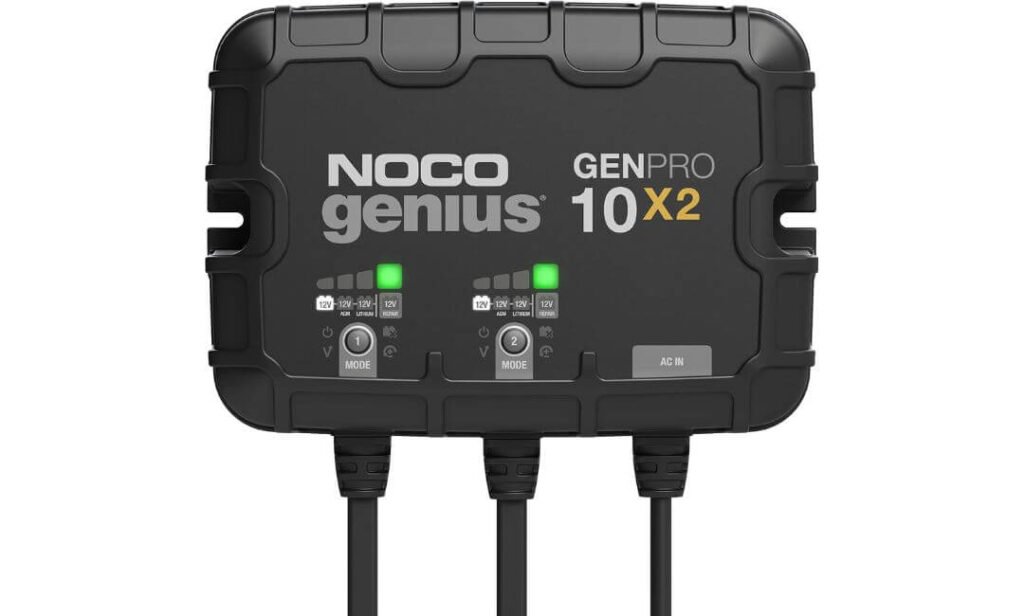
Quick Specs:
- Charging setup: 2 independent banks, 10A per bank / 20A total
- Battery voltage: 12V batteries; also suitable for 24V trolling-motor systems using two 12V batteries in series
- Battery types: Flooded lead-acid, AGM and lithium-ion
- Bank modes: 12V, 12V AGM, 12V Lithium and Repair Mode
- Water protection: IP68 fully sealed construction
- Cable reach: 72-inch AC and DC cables
- DC connection: 3/8-inch eyelets
- Warranty: 3 years
- Best suited to: Boats with two batteries that need dependable onboard charging and long-term maintenance
If your boat has a starting battery alongside a trolling-motor or deep-cycle battery, this is the kind of charger that makes the setup considerably easier to live with. You get 10 amps going to each bank, rather than watching one battery wait while another gets attention. That makes a real difference when both batteries come back from a hard day on the water needing a proper recharge. Better still, the two banks operate independently, so you are not forced into treating two different batteries as though they were identical.
The flexibility is where this unit starts to separate itself from a basic two-bank charger. Each bank has its own charging selection, including 12V, AGM, Lithium and Repair Mode, so an AGM starting battery and a lithium trolling battery can be handled according to their respective requirements. The built-in temperature sensing also adjusts the charging approach as conditions change, which is particularly useful for a charger that may remain connected during storage rather than being used only for an occasional top-up.
Then there is the part boat owners tend to care about after installation: whether the charger can live in the environment it was bought for. The fully sealed IP68 housing, anti-vibration mounting and 72-inch leads give it a distinctly onboard-oriented design rather than the feel of a portable garage charger. The body is listed at roughly 10.28 × 9.25 × 6.06 inches in the supplied product information, so I would still measure the intended mounting area before ordering—especially if you are replacing an older charger inside a crowded compartment. (For a permanent installation, measure twice; the charger only needs to fit once.)
What We Like About It
- 10A per bank is the big practical advantage — you are getting meaningful output to both batteries instead of a small shared trickle.
- The independent controls are genuinely useful when your setup mixes AGM, flooded or lithium batteries.
- IP68 sealing is reassuring for an onboard charger that has to deal with moisture, spray and vibration.
- The 72-inch leads give you more freedom when the batteries are not sitting directly beside the mounting point.
- The compact-for-its-output design makes it a particularly interesting upgrade when replacing an older onboard unit with limited room.
What We’d Keep in Mind
The only thing I would check before buying is available mounting space and cable routing. It is compact for what it does, but “compact” does not mean it will automatically drop into the exact footprint left by an older charger. A quick measurement of the mounting area and the distance to both batteries can save a frustrating installation day.
Why This Is One of the Strongest 2-Bank Choices
The real strength here is the combination rather than one headline specification. 20A total output, independent 10A banks, selectable battery-chemistry modes, temperature compensation and IP68 protection give it a level of flexibility that suits both everyday charging and longer periods of unattended maintenance. That is why it makes sense for a boat owner who wants one permanent charger rather than a collection of compromises.
It is also a good fit for more complicated two-battery arrangements. If one battery starts the engine and another runs a trolling motor, you can configure each bank independently instead of forcing both batteries through the same charging profile. For a newer boat, that flexibility gives you room to grow; for an older boat, it can make a replacement worthwhile if the existing charger is outdated or no longer matches the batteries you are using.
The Insider Pro-Tip
Before mounting it, label the two battery leads at both ends and take a quick photo of the existing wiring. It sounds trivial, but it is one of those five-minute jobs that becomes incredibly useful later—especially on a boat where multiple battery cables can look almost identical after a season of use.
And if you are replacing an older onboard charger, don’t use the old mounting holes as your only measurement. Check the actual charger footprint, cable path and distance to each battery first. The smartest installation is the one you never have to redo.
#2. Minn Kota Precision MK-220PCL On-Board Marine Battery Charger – 2 Banks, 10 Amps Each
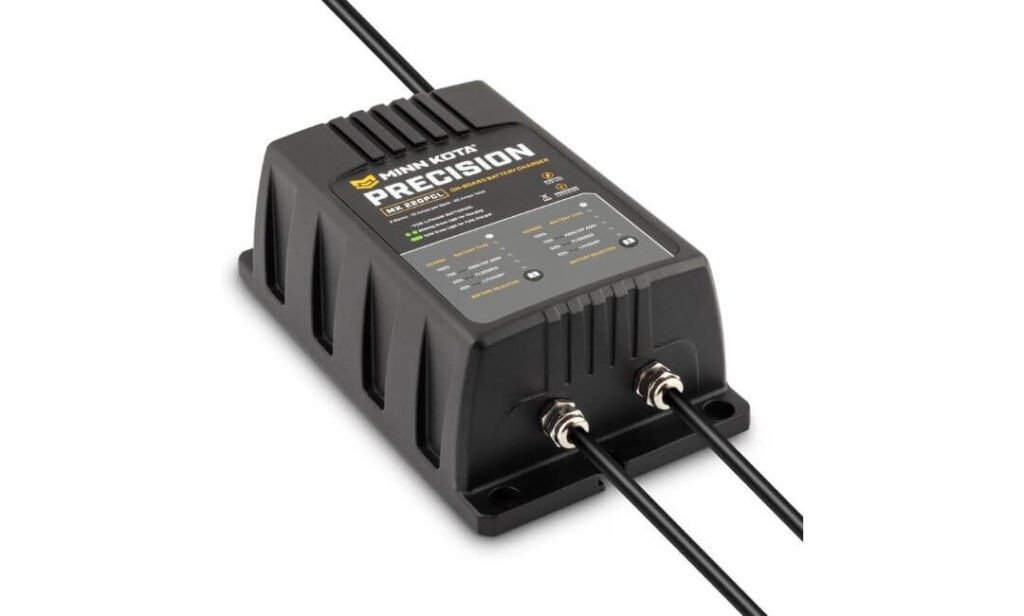
Quick Specs:
- Charging output: 2 independent banks, 10A per bank / 20A total
- Battery voltage: 12V per bank
- Battery compatibility: AGM, flooded lead-acid, gel and LiFePO4 lithium
- Charging control: Microprocessor-controlled, automatic multi-stage charging
- Temperature control: Automatic temperature compensation
- Marine protection: Waterproof, shock-resistant and vibration-resistant construction
- Status feedback: LED indicators for charging stage, maintenance, errors and full charge
- Size: 9.88″H × 3.5″W × 5.88″D
- Weight: 8.7 lb
- Warranty: 3 years
There is something reassuring about a charger that lets you set up each battery according to what is actually sitting in the boat. That is the biggest practical advantage here. Each bank can be configured independently for AGM, flooded lead-acid, gel or LiFePO4, so you are not locked into one charging profile simply because both batteries share the same charger. For a boat running a conventional starting battery alongside a lithium trolling-motor battery, that flexibility is genuinely useful rather than just another specification on the box.
The 10A-per-bank output is another reason this model sits near the top of our list. Both batteries can receive their own 10A supply at the same time, giving you 20A total output without dividing a single charging channel between them. The microprocessor-controlled system continuously manages voltage and current through the charging cycle, while temperature compensation helps keep the charging process consistent when conditions or shore-power quality change.
What I particularly like for permanent onboard use is that the charger is built around the realities of a boat rather than a dry garage. It is designed to handle water, shock and vibration, and the LED indicators tell you what is happening without requiring you to guess whether a battery is still charging, being maintained or showing an error. The 9.88 × 3.5 × 5.88-inch footprint is also worth paying attention to if you are replacing an older charger; its tall, narrow shape may actually work better in some compartments and worse in others. (Measure the available mounting area first—the dimensions matter more than a product photo.)
What We Like About It
- 10A to each bank gives both batteries meaningful charging output simultaneously.
- Independent battery selection makes it especially practical for mixed battery chemistry setups.
- The lithium-specific charging capability gives it a clear advantage over older lead-acid-only onboard chargers.
- Temperature compensation and digital control add useful protection without requiring constant user intervention.
- The LED system is genuinely convenient when the charger is mounted somewhere you cannot easily inspect.
One Thing We’d Keep in Mind
The main consideration is installation orientation and available space. At nearly 10 inches tall, it has a different physical shape from some compact modern chargers, so check the mounting area and cable routing before assuming it will replace an older unit directly.
Why It Earns a Top Spot in This 2-Bank Comparison
This is a strong choice for someone who wants serious dual-bank output without giving up battery-specific control. The combination of 10A per bank, independent chemistry selection, multi-stage digital charging and marine-oriented construction makes it more versatile than a basic two-bank maintainer.
It is particularly compelling when your boat has evolved over time. Maybe the original setup used flooded batteries and you have since moved to lithium on the trolling-motor side. Rather than treating that change as a reason to replace the entire charging arrangement, the independent bank controls give this unit the flexibility to accommodate different battery types together.
The Insider Pro-Tip
If you are replacing an older onboard charger, don’t copy its battery settings blindly. Check what battery is connected to each bank today and select the charging mode for that battery—not for the boat, not for the charger you removed, and not simply because both batteries have the same voltage.
That one check is easy to overlook, especially after a battery upgrade, but it is exactly the sort of small detail that separates a properly matched onboard charger from one that merely happens to turn on.
#3. NOCO GEN5X2 12V 10A 2-Bank OnBoard Marine Battery Charger & Maintainer
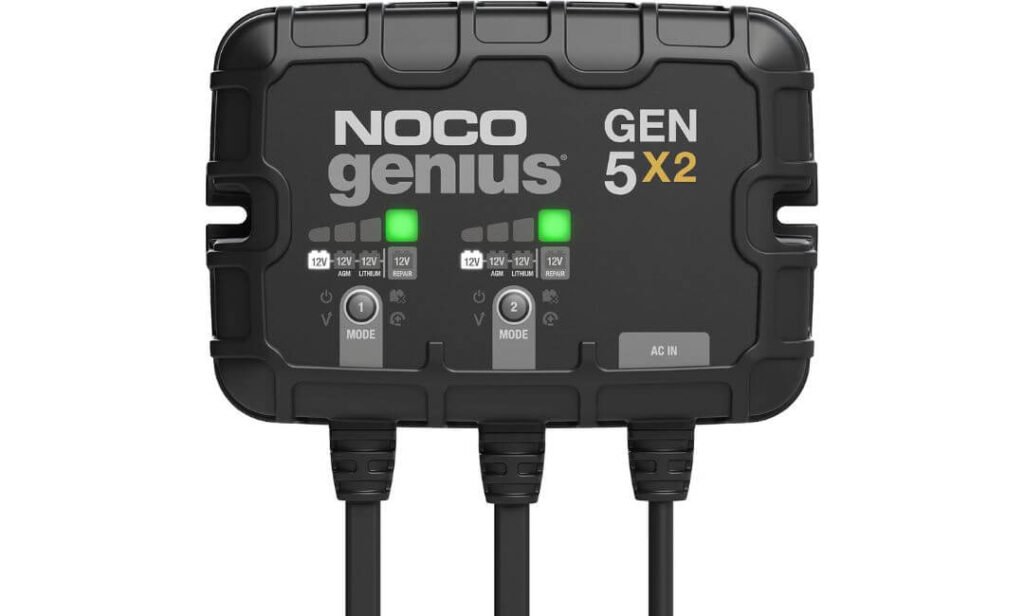
Quick Specs:
- Charging output: 2 independent banks, 5A per bank / 10A total
- Battery voltage: 12V per bank
- Battery compatibility: Flooded lead-acid, AGM and lithium-ion
- Bank modes: 12V, 12V AGM, 12V Lithium and Repair Mode
- Recovery: Force Mode can initiate charging on batteries down to 0V
- Temperature control: Integrated thermal sensor adjusts charging for ambient conditions
- Water protection: IP68 fully sealed construction
- Mounting: Can be installed in different orientations with anti-vibration backing
- Cable reach: 72-inch AC and DC cables with 3/8-inch eyelets
- Size: 9.15″W × 7.2″D × 5.39″H
- Weight: 4.17 lb
- Warranty: 3 years
Not every boat needs a 20A charger, and that is exactly where this model makes sense. Its 10A total output is split into 5A per bank, giving two batteries their own charging channels without stepping up to the larger output of the first two chargers in this list. For a typical starting battery and trolling/deep-cycle battery that is charged between trips, that can be a very sensible middle ground.
The useful part is that the two banks are independent. You can select 12V, AGM, Lithium or Repair Mode separately, which means the charger does not force both batteries into the same charging profile. That becomes particularly valuable if your boat has changed over the years—perhaps the starting battery remains AGM while the trolling-motor side has been upgraded to lithium.
Then there is the installation side, which is easy to overlook until the charger is actually sitting in your hands. At only 4.17 pounds, with a fully sealed IP68 housing, anti-vibration mounting and 72-inch leads, this is clearly designed to stay onboard rather than being carried around after every trip. The footprint is also relatively compact, although I would still measure the available space before replacing an older charger because the mounting shape is not something you want to discover after removing the old unit. (The charger should fit your boat; your boat should not have to be rearranged around the charger.)
What We Like About It
- 5A per bank is enough for many everyday two-battery boat setups without paying for output you may never use.
- Independent modes make it genuinely flexible for AGM, flooded and lithium batteries.
- IP68 waterproofing gives it the kind of environmental protection expected from a permanently mounted marine charger.
- The 4.17-pound weight and flexible mounting make installation less cumbersome than many heavier onboard units.
- Force Mode and temperature sensing add useful capability without turning everyday charging into a complicated process.
One Thing We’d Keep in Mind
The obvious trade-off is charging speed. With only 5A available to each bank, larger batteries will naturally take longer to replenish than they would with a 10A-per-bank charger. That is not a flaw—it simply means this model is better matched to owners who value compactness and everyday maintenance over maximum charging speed.
Why It Earns Its Place in This 2-Bank Lineup
The appeal here is balance. You are getting independent dual-bank charging, multi-chemistry support, temperature compensation, Repair Mode and IP68 protection in a considerably lighter package than the higher-output options above it. For a boat that spends most of its time between fishing trips or in seasonal storage, that combination can be more useful than simply buying the biggest charger available.
It also gives owners of older boats a practical upgrade path. If the existing charger is dated, bulky or limited to one battery chemistry, this model brings modern charging modes and sealed marine construction without jumping straight to a much larger 20A-per-bank-class system. Just be honest about your charging habits: if both batteries routinely come back heavily depleted, 5A per bank will take longer, and a higher-output model may be worth the extra size.
The Insider Pro-Tip
If you are deciding between this and a 20A two-bank charger, look at your routine rather than the specification sheet. If the boat is plugged in soon after every trip and normally has plenty of time before you head back out, 5A per bank can be perfectly reasonable. If you regularly fish hard, run large batteries down deeply and need the boat ready again in a short window, that is when the higher-output option starts earning its extra cost.
And one more thing: after installing it, leave the battery-type selection alone unless the battery itself changes. The charger is smart enough to manage the process; constantly switching modes because the LED behavior looks unfamiliar is more likely to create confusion than improve charging.
#4. FirstPower Pro 2-Bank Marine Battery Charger 5X2, 10A
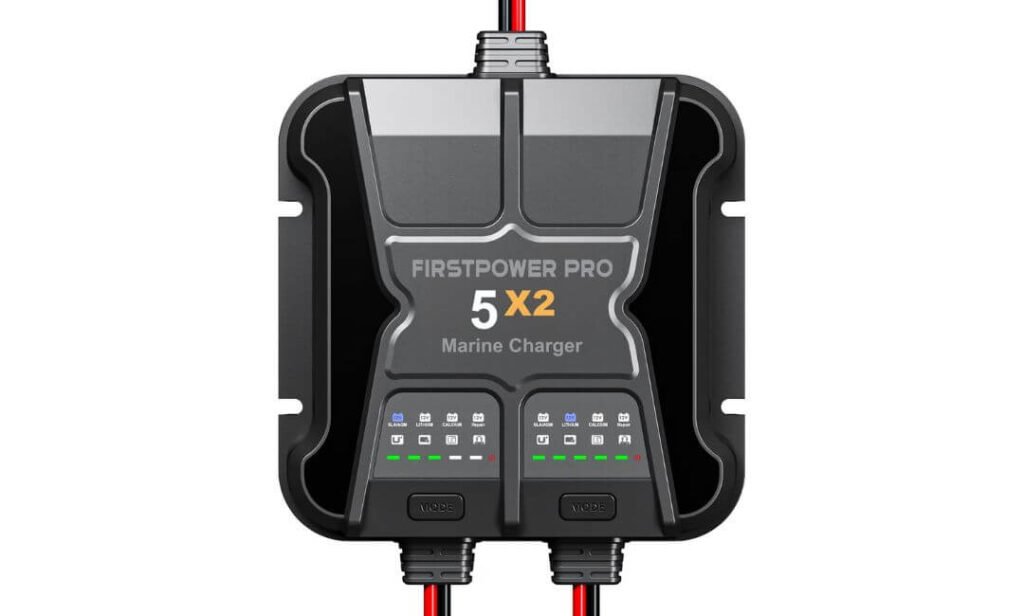
Quick Specs:
- Charging output: 2 independent banks, 5A per bank / 10A total
- Battery voltage: 12V
- Battery compatibility: 12V lead-acid and lithium-ion batteries
- Charging modes: 12V SLA/AGM, 12V Lithium and 12V Calcium
- Recovery: Automatic Repair Mode
- Temperature control: Built-in thermal sensor for temperature-adjusted charging
- Diagnostics: Over-voltage, bad battery, over-temperature and reverse-connection detection
- Water protection: IP68 fully sealed
- Charging indication: 5-stage display from 20% to 100%
- Size: 7.55″H × 6.49″W × 2.16″D
- Weight: 4.51 lb
- Warranty: 3 years
Some two-bank chargers are built around maximum output; this one takes a more practical approach. You get 5A to each battery simultaneously, which is perfectly reasonable when the boat is normally plugged in between trips and the batteries are not being brought back from extremely deep discharge every time. It is especially useful for a straightforward starting-battery plus deep-cycle setup where you want both banks charging without having to move cables around.
The independent mode selection is the feature I would pay the most attention to. One bank can be configured for AGM/SLA, Lithium or Calcium, while the other can be set differently. That gives you useful flexibility if your two batteries aren’t identical. The built-in temperature sensor also adjusts the charging behavior as conditions change, and the charger provides diagnostics for issues such as reverse connection, over-temperature, over-voltage and a bad battery—the sort of information that is genuinely helpful when something isn’t behaving normally.
For an onboard installation, the IP68 fully sealed housing is another strong point. The 7.55 × 6.49 × 2.16-inch body and 4.51-pound weight keep it reasonably manageable in a crowded compartment, and the included battery connectors mean you have more installation flexibility than with a charger that only expects permanent hardwiring. The important limitation is equally straightforward: this is a 12V charger. If your setup requires charging a 24V or 36V battery system as a system, this is not the model to choose.
What We Like About It
- 5A per bank gives you genuine simultaneous charging rather than a shared single-battery output.
- Independent charging modes are useful when the two batteries use different chemistries.
- IP68 sealing makes sense for a permanently mounted marine charger exposed to moisture.
- The built-in diagnostics can tell you about problems instead of leaving you wondering why a battery isn’t charging.
- The included connectors, clips and spare fuses make the package feel more installation-ready.
One Thing We’d Keep in Mind
The biggest consideration is charging speed. Ten amps sounds substantial until you remember that it is 5A per bank. That is perfectly workable for routine charging, but owners with large-capacity batteries or very short turnaround times may be better served by a 10A-per-bank charger.
Why It Makes the Cut
This charger earns its place because it gets the fundamentals right without trying to compete solely on output. Independent 5A banks, multiple 12V battery modes, temperature compensation, diagnostics and IP68 protection give it a useful combination for everyday marine use.
It is also one of the more sensible choices for someone who wants a compact onboard setup but does not need the higher-output capability of the NOCO GENPRO10X2 or Minn Kota above it. In other words, you are not paying for 20A simply to have 20A. If your batteries have enough time to charge between outings, the lower output can be entirely reasonable.
The Insider Pro-Tip
The 5-grid display is more useful than it looks. When you first install the charger, watch how both banks progress rather than assuming the batteries are behaving identically. If one battery repeatedly remains behind the other, that tells you something worth investigating—battery condition, capacity or connections may be different.
And if you are using the included connectors on a boat, give the connection points a proper look during routine maintenance. Marine moisture is unforgiving of neglected connections, and a good charger cannot compensate for a poor electrical connection.
#5. Guest 2707A 2-Bank Onboard Battery Charger
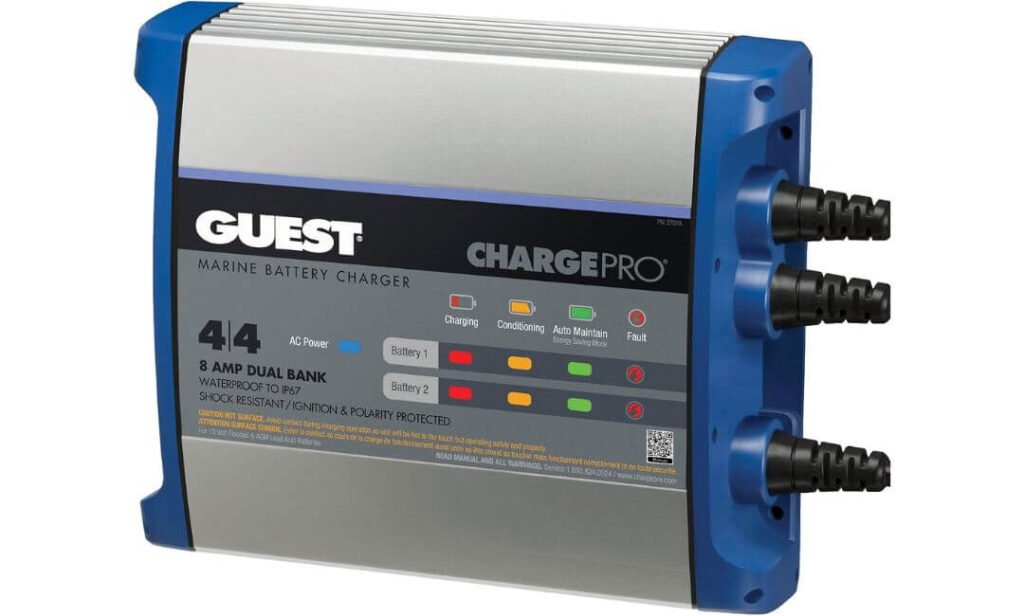
Quick Specs:
- Charging setup: 2 independent banks, 8A total / 4A per bank when both are charging
- Battery voltage: 12V per bank
- Battery compatibility: 12V flooded and AGM lead-acid
- Input: 120V AC shore power
- Charging: Automatic multi-stage charging and maintenance
- Water protection: IP67 sealed marine housing
- Safety protection: Reverse polarity, over-current, over-voltage, over-temperature and ignition protection
- Construction: Shock-resistant housing with in-line fuse protection
- Size: 9″H × 7.5″W × 2.4″D
- Weight: 4.5 lb
There is a reason a simple charger can still make sense on a boat: not every battery setup needs lithium modes, high-current output or a long list of digital controls. This unit is aimed squarely at owners running two conventional 12V flooded or AGM batteries and wanting them charged independently while the boat is sitting at the dock or in storage. The two banks are separated, so your engine battery and auxiliary or trolling battery can be managed without constantly moving cables between them.
The 8A total output is worth understanding before you buy. When both banks are charging, the available current works out to roughly 4A per bank, so this is much more of a steady onboard-maintenance solution than a fast-recovery charger. If your batteries are normally topped up between trips and the boat can remain connected to 120V shore power for several hours or overnight, that slower pace is not necessarily a disadvantage. It simply needs to match your routine.
What makes it more convincing for marine use is the protection built around that basic job. The IP67 sealed housing, shock-resistant construction and multiple electrical protections are appropriate for an onboard environment where moisture, vibration and accidental connection mistakes are real possibilities. Its 9 × 7.5 × 2.4-inch body is also relatively manageable, although I would still measure the mounting area if this is replacing an older charger rather than being installed in a new location. (For an older boat, matching the installation space can be just as important as matching the electrical specifications.)
What We Like About It
- Independent two-bank operation keeps both batteries managed without manual swapping.
- Its straightforward design makes sense for traditional AGM and flooded marine batteries.
- IP67 protection gives it appropriate resistance to water and moisture for onboard use.
- Multiple safety protections provide useful reassurance around permanent battery connections.
- The relatively light 4.5-pound housing is easier to work with in a cramped compartment.
One Thing We’d Keep in Mind
The main trade-off is output per bank. At 8A total, it is considerably slower than the 10A-per-bank models higher on this list, so it is better suited to routine charging and maintenance than quickly recovering two large, heavily discharged batteries.
Why It Still Deserves a Place in This Lineup
This is the choice for someone who values simplicity and compatibility with traditional marine batteries over maximum output. It does not try to be a universal lithium charger or compete with 20A models. Instead, it focuses on independently maintaining two 12V flooded or AGM batteries with marine-oriented protection.
That makes it particularly relevant for older boats and established dual-battery systems where the existing batteries are still lead-acid and the main requirement is keeping them ready between outings. If your setup has not moved to lithium and you have plenty of charging time, there is little reason to buy features you will never use.
The Insider Pro-Tip
If you are replacing an older onboard charger with this type of setup, identify which battery is your starting battery and which is your auxiliary/deep-cycle battery before disconnecting anything. Then check the battery labels for AGM or flooded construction before choosing a replacement.
One more practical point: if your batteries routinely come back heavily discharged after a long trip, don’t judge this charger by how quickly it restores them. Its strength is controlled, independent maintenance—not high-speed recovery. If that matches how you actually use the boat, its lower output is much less of a concern.
#6. ProMariner ProSport HD 44008 2-Bank Marine Battery Charger
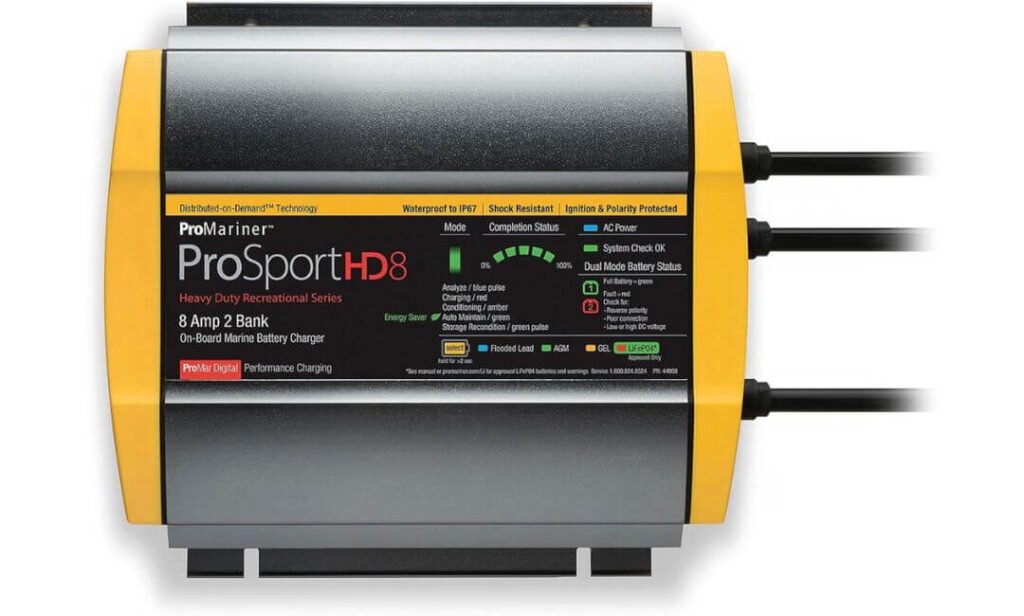
Quick Specs:
- Charging output: 8A total with Distributed-On-Demand current allocation
- Battery system: 12V and 24V applications
- Battery profiles: LiFePO4, flooded, AGM and GEL, according to the supplied product specifications
- Charging cycle: Automatic 5-stage digital charging
- Water protection: IP67 waterproof construction
- Status monitoring: Separate LED indicators for charging and fault conditions
- Installation: Onboard/permanent mounting design
- Size: 11.9″W × 8.7″D × 6.7″H
- Weight: 4 lb
- Best suited to: Smaller two-bank marine systems where charging demand is moderate
An 8A charger normally sounds unremarkable next to the 10A-per-bank models above it, but that is not quite the whole story here. The Distributed-On-Demand system can move available charging current toward the battery that needs more of it instead of rigidly dividing the output equally. So if one battery is nearly full while the other needs substantially more attention, the charger can make better use of its limited 8A capacity.
That makes this a more interesting option for a two-battery setup where the batteries do not always discharge at the same rate. Think of a boat where the starting battery barely gets used while the trolling or house battery does most of the work. You are not buying this for brute-force charging; you are buying it for smarter use of a modest output.
The automatic five-stage charging also makes it suitable for leaving connected during periods when the boat is not being used. Add the IP67 marine construction, LED status indicators and relatively light 4-pound body, and it becomes a practical onboard package. The physical dimensions deserve a quick check, though: at roughly 11.9 × 8.7 × 6.7 inches, its footprint is not necessarily an obvious drop-in replacement for every older charger. (A charger can be electrically compatible and still be the wrong physical fit.)
What We Like About It
- Distributed-On-Demand charging is the standout feature because it makes better use of limited current.
- Automatic five-stage charging keeps the process simple once the charger is installed.
- The IP67 marine construction is appropriate for onboard environments.
- Clear LED indicators make it easier to see charging or fault status from the compartment.
- At around 4 pounds, it is relatively easy to handle during installation.
One Thing We’d Keep in Mind
The 8A total output is modest. If you regularly bring two large batteries back from a deep discharge and need them ready quickly, one of the higher-output chargers earlier in this list will be the better fit.
Why It Earns a Place in This Lineup
This model earns its position for a slightly different reason than the chargers above it. Its advantage is not maximum amperage; it is the way Distributed-On-Demand technology manages the available current between two batteries. For a smaller marine system where one battery commonly needs more charging than the other, that can be more useful than a simple 50/50 split.
It also bridges the gap between basic two-bank maintenance and more feature-heavy modern chargers. You get automatic charging, battery-type selection, status monitoring and marine-oriented construction without moving into a much larger unit. Just make sure the battery profile and system voltage match your actual setup before installation.
The Insider Pro-Tip
Don’t automatically assume that an 8A charger will behave like a 4A + 4A charger all the time. Distributed charging is the reason this model can make better use of its available current when one battery needs more attention.
But there is a practical rule I would follow: choose the charger according to your worst normal charging day, not your easiest one. If your batteries usually need only maintenance between trips, this output can be perfectly sensible. If you routinely return with heavily depleted batteries and a short turnaround before the next trip, spend more on output rather than expecting smart distribution to compensate for a lack of amps.
#7. LiTime 2-Bank 12V & 24V 10A Lithium Battery Charger
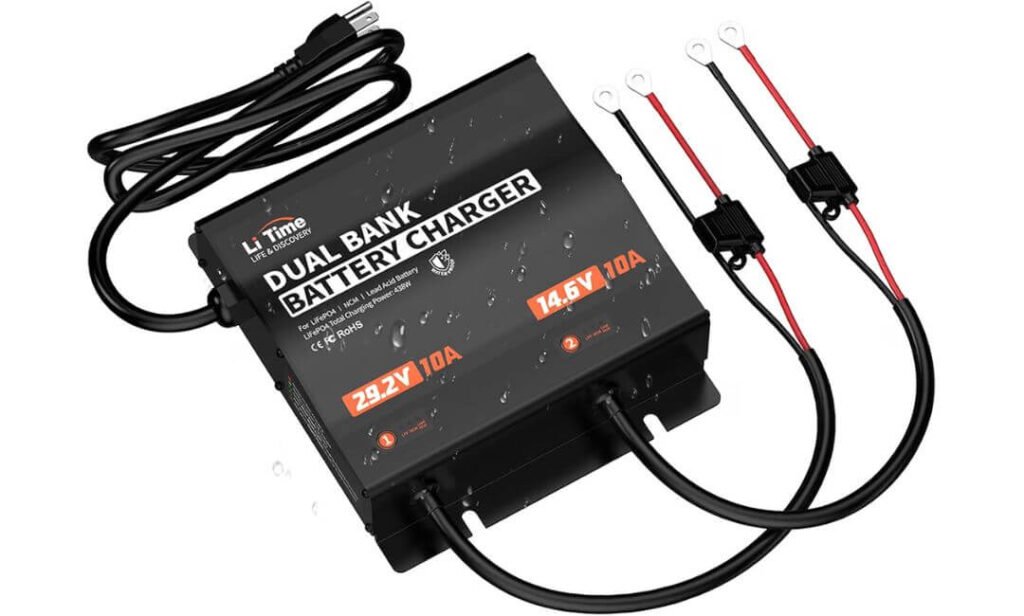
Quick Specs:
- Charging output: 2 independent banks, 10A per bank
- Voltage configuration: 12V and 24V charging channels
- Charging voltage: 14.6V / 29.2V for LiFePO4; additional profiles for NCM and lead-acid
- Battery compatibility: LiFePO4, NCM lithium and lead-acid
- Battery activation: Can activate lithium batteries protected by their BMS
- Charging control: Automatic CC, CV and float/cut-off operation
- Input range: 90–260V AC, 47–63Hz
- Water protection: IP65 with waterproof connector
- Safety protection: Over-temperature, over-current, reverse polarity, short circuit and over-voltage
- Connection: M8 terminals
- Size: 9.08″D × 8.03″W × 2.64″H
- Weight: 8.82 lb
A 12V starting battery paired with a 24V trolling-motor system creates a problem that ordinary two-bank chargers cannot simply solve. That is where this model becomes genuinely interesting. Instead of expecting both banks to operate at the same voltage, it provides two independent 10A channels, with one capable of handling a 12V battery and the other a 24V battery. For a boat that has moved to a 24V lithium trolling setup while retaining a conventional 12V engine battery, that is a much more relevant feature than another generic “dual-bank” label.
The lithium side is clearly where this charger is most at home. LiFePO4 charging uses 14.6V and 29.2V outputs, while the supplied specifications also list profiles for NCM and lead-acid batteries. The ability to activate a lithium battery that has entered BMS protection is another useful touch, particularly when a battery has been sitting unused and its protection system has disconnected the output. Just make sure the selected voltage/profile actually matches the battery you own—this is not a charger where guessing the setting is a good idea.
Installation is fairly different from the smaller onboard chargers above. The housing is only 2.64 inches high, but its footprint is roughly 9.08 × 8.03 inches and it weighs about 8.82 pounds, so check the mounting surface rather than assuming “low profile” means small overall. The IP65 rating and waterproof connector provide useful protection around moisture, but I would still treat it as a properly mounted electrical component rather than something to leave sitting exposed to direct water. (Water-resistant equipment still benefits from sensible installation.)
What We Like About It
- 10A per independent bank makes it much more capable than a basic 5A-per-bank charger.
- The ability to handle 12V and 24V simultaneously is its biggest differentiator.
- Particularly useful for 24V LiFePO4 trolling motors paired with a 12V starting battery.
- The BMS activation feature can be genuinely helpful when a lithium battery has entered protection mode.
- Multiple electrical protections and the waterproof connector make it well suited to a carefully installed marine setup.
One Thing We’d Keep in Mind
This is the most specialized charger in the lineup, so don’t buy it simply because “10A × 2” looks attractive. Its real advantage is the independent 12V/24V capability. If both of your batteries are ordinary 12V batteries, one of the simpler marine chargers above may be a more straightforward fit.
Why It Deserves the Final Spot
The reason for including it is simple: not every two-bank system is two identical 12V batteries. This model covers a configuration that the more conventional chargers in this list do not address as directly—particularly a 12V engine battery alongside a 24V lithium trolling-motor system.
Its 10A-per-bank output, lithium-focused voltage profiles, BMS activation, IP65 protection and broad AC input range make it a useful specialist option. It sits at #7 not because it lacks capability, but because its appeal depends heavily on having the right battery configuration. For the right boat, however, that specialization is exactly the reason to consider it.
The Insider Pro-Tip
Before ordering, write down the voltage and chemistry of each battery separately. Not the trolling motor’s advertised voltage—the actual battery configuration and battery label. Then match each charger channel accordingly.
For a 12V starting battery plus a 24V lithium trolling system, that simple check can save you from buying the wrong type of “2-bank” charger. The number of banks tells you how many batteries you can charge; it does not tell you whether those batteries require the same charging voltage.
Best 2-Bank Battery Charger (2026): Side-by-Side Specs, Bank Output & Battery Support
| Charger | Bank Output | Battery Fit | Marine Protection | Standout Advantage | Best Match |
|---|---|---|---|---|---|
| NOCO GENPRO10X2 Best Overall |
20A total 10A per bank |
12V AGM, flooded & lithium |
IP68 Fully sealed |
Independent modes, temperature sensing, Repair Mode & Force Mode | High-use boats needing strong, flexible two-bank charging |
| Minn Kota Precision MK-220PCL High-Output Choice |
20A total 10A per bank |
12V AGM, flooded, gel & LiFePO4 |
Marine-ready Waterproof, shock & vibration resistant |
Microprocessor control, temperature compensation & independent battery profiles | Boats mixing battery chemistries or demanding faster recovery |
| NOCO GEN5X2 Compact Choice |
10A total 5A per bank |
12V AGM, flooded & lithium |
IP68 Fully sealed |
Compact body, independent modes, temperature sensing & Force Mode | Smaller boats and routine between-trip maintenance |
| FirstPower Pro 5X2 Value Choice |
10A total 5A per bank |
12V SLA/AGM, lithium & calcium |
IP68 Fully sealed |
Diagnostics, temperature sensing, Repair Mode & 5-grid charge display | Budget-conscious owners with moderate charging needs |
| Guest 2707A Traditional Lead-Acid |
8A total About 4A per bank when both charge |
12V Flooded & AGM lead-acid |
IP67 Sealed housing |
Independent banks, multi-stage charging & broad safety protection | Older or established boats using conventional batteries |
| ProMariner ProSport HD 44008 Smart Distribution |
8A total Distributed-On-Demand |
12V / 24V systems Multiple selectable profiles |
IP67 Marine construction |
Distributed-On-Demand technology directs available current where needed | Smaller systems where batteries discharge at different rates |
| LiTime 2-Bank 10A Specialist Choice |
10A per bank Independent channels |
12V + 24V LiFePO4, NCM & lead-acid |
IP65 Waterproof connector |
BMS activation, multiple voltage profiles & five safety protections | 12V starting battery + 24V lithium trolling-motor setup |
2-Bank Battery Charger Buying Guide: What Actually Matters Before You Buy
A good two-bank charger is less about finding the highest amp number and more about matching the charger to your batteries, boat and charging routine. Two chargers can both be advertised as “2-bank” and still behave very differently. The models in this comparison make that clear: some deliver 5A per bank, some 10A per bank, while the LiTime takes a different approach by supporting separate 12V and 24V charging channels.
Start With the Output Each Bank Actually Gets
This is probably the easiest specification to misunderstand. Always look for the per-bank output, not just the total output printed in a product title.
| Charger rating | What it generally means with two active banks | Best suited to |
|---|---|---|
| 8A total | Around 4A per bank when both need charging, depending on charger design | Routine maintenance and smaller systems |
| 10A total | 5A per bank | Regular between-trip charging |
| 20A total | 10A per bank | Larger batteries and faster recovery |
| 10A per bank | 20A available across two independent banks | Higher-demand dual-battery setups |
The difference becomes obvious when you have larger batteries. A 5A-per-bank charger is not automatically bad; it simply needs more time to put the same amount of energy back into a battery. If your boat sits at the dock overnight after every trip, that may be completely acceptable. If you fish hard on Saturday and need the batteries ready again a few hours later, 10A per bank is considerably more attractive.
Also pay attention to chargers using current-distribution technology. A unit such as the ProSport HD can redirect available current depending on which battery needs it, so its 8A rating should not automatically be interpreted as a fixed 4A/4A split under every condition.
Check the Battery Chemistry Before Anything Else
Voltage alone does not tell you whether a charger is suitable. Your battery might be flooded lead-acid, AGM, GEL, LiFePO4 or another lithium chemistry, and the charging profile needs to match it.
Here is a practical way to look at the seven models in this guide:
| Battery type | What to look for |
|---|---|
| Flooded lead-acid | A charger with a dedicated flooded profile |
| AGM | AGM-specific charging mode is preferable |
| GEL | Confirm the charger explicitly supports GEL |
| LiFePO4 | Dedicated lithium/LiFePO4 mode and appropriate voltage |
| Mixed batteries | Independent bank selection is particularly valuable |
| 12V + 24V setup | Requires a charger specifically designed for separate voltage channels |
This is one area where the newer multi-chemistry models have an advantage. Independent bank selection allows different charging profiles to be assigned to different batteries. That can matter if your boat has evolved from an older lead-acid setup to lithium on the trolling-motor side while retaining a conventional starting battery.
Do not assume that because a product page mentions several battery types, every combination can be used on every bank without checking the manufacturer’s instructions. The battery label and charger documentation should always have the final word.
Understand What “2-Bank” Means for Your Boat
A two-bank charger normally means two independently managed battery outputs. That is particularly useful on boats where the starting battery and deep-cycle/trolling battery have different jobs.
For example:
- One bank can maintain the engine starting battery.
- The second can charge a trolling-motor or auxiliary battery.
- Each bank can monitor its own charging progress.
- With compatible chargers, different battery chemistries can be selected independently.
- The charger can remain onboard rather than requiring you to remove batteries after every trip.
There is another important distinction. Two 12V batteries can be connected in series to provide a 24V trolling-motor system, but that does not automatically mean every two-bank charger should be treated as a 24V charger. Some units are designed to charge individual 12V batteries that happen to be wired in series, while others specifically provide different voltage outputs.
The LiTime is unusual in this comparison because its two channels are designed around 12V and 24V output requirements independently. That makes it particularly relevant to a boat with a 12V starting battery and a 24V lithium trolling-motor setup.
Look at the Charging Process, Not Just the Amp Rating
A quality onboard charger does more than push a fixed amount of current into a battery. Modern units typically move through stages such as bulk, absorption and float/maintenance, adjusting the charging process as the battery approaches full charge.
That matters because the battery does not need the same treatment from beginning to end.
A useful charger should be able to:
- Deliver higher current when the battery can accept it.
- Gradually control voltage as the battery approaches full charge.
- Reduce charging activity once the battery is full.
- Maintain the battery without continuously forcing maximum current into it.
- Detect abnormal conditions where supported by the charger.
Some models add temperature compensation, repair functions or battery diagnostics. These features are useful, but they should be viewed as supporting features, not reasons to ignore basic compatibility.
For Marine Use, Waterproofing Is More Than a Marketing Number
An onboard charger lives in a very different environment from a charger sitting on a dry workshop bench. Humidity, condensation, spray, vibration and temperature changes are normal parts of boat ownership.
That is why IP ratings deserve attention.
- IP65 provides protection against dust and water jets.
- IP67 adds protection against temporary immersion under specified test conditions.
- IP68 provides a higher level of protection against continuous immersion under conditions defined by the manufacturer.
A higher IP rating is useful, but it does not mean you can install the charger carelessly. Cable entries, connectors, mounting position and wiring still matter. Water-resistant equipment performs best when it is mounted correctly and kept away from unnecessary exposure.
The NOCO models in this list use IP68-rated sealed construction, while the Guest and ProMariner units use IP67 protection. The LiTime carries IP65 protection with a waterproof connector. Those are meaningful differences, but the right choice still depends on the actual location where the charger will live.
Onboard Installation: Measure the Space You Actually Have
This is where I would slow down before ordering.
If you are installing a charger on a new boat, you have more freedom. If you are replacing an older charger, the physical dimensions can become just as important as the electrical specifications.
Do not measure only the old mounting holes. Check:
- Available height, width and depth.
- Clearance around the charger.
- Distance from the charger to each battery.
- AC power-cable routing.
- DC cable length.
- Whether the mounting surface is strong enough.
- Whether the chosen orientation is permitted.
- Whether the charger will remain protected from unnecessary water exposure.
The GEN5X2, for example, is relatively light at about 4.17 pounds, while other models in the list have different shapes and footprints. A charger that looks smaller in a product photograph can still require more usable mounting area once cables and connectors are attached.
Portable vs. Permanent Onboard Charging
If you only charge batteries occasionally in a garage, a portable charger can be perfectly adequate. But for a boat that stays equipped with two batteries, an onboard charger is much more convenient.
You connect it once, route the cables properly, secure the charger, and then connect shore power when the boat comes back in.
That means you are not repeatedly:
- Removing batteries,
- Carrying heavy batteries,
- Reconnecting terminals,
- Checking separate chargers,
- Or remembering which charger belongs to which battery.
For seasonal boats, the advantage becomes even more obvious. A suitable automatic charger can maintain compatible batteries during extended storage, provided the installation, battery condition and manufacturer’s instructions support that use.
Don’t Ignore Cable Length and Connections
A charger may have excellent electrical specifications and still be awkward to install if the cables are too short.
Look at the actual DC cable length and the type of battery connection supplied. The NOCO units, for example, use 72-inch DC cables with 3/8-inch eyelets. Other products may include connectors, clips, ring terminals or different terminal arrangements.
For a permanent marine installation, I generally prefer a secure, properly protected connection over a setup that relies on loose temporary connections. Whatever connection method you use, it should be appropriate for the marine environment and installed according to the manufacturer’s instructions.
Temperature Compensation Is Worth Having
Temperature changes affect battery charging, which is why several chargers in this comparison use temperature sensing or compensation.
The idea is straightforward: charging parameters can be adjusted as the surrounding temperature changes, helping avoid inappropriate charging behavior in very warm or cold conditions.
It is not a substitute for choosing the correct battery profile, but it is a worthwhile feature on an onboard charger that may operate through different seasons.
Diagnostics Can Save You From Guesswork
A charger that simply shows “charging” leaves you with little information when something goes wrong.
More informative models can identify conditions such as:
- Reverse connection
- Over-temperature
- Over-voltage
- Short circuit
- Battery faults
- Charging completion
- Maintenance status
LED indicators may sound basic compared with app-based monitoring, but on a boat they can be surprisingly useful. You can open the compartment, look at the indicators and immediately have a better idea of whether both banks are behaving normally.
Safety and Installation Deserve More Attention Than They Usually Get
A marine charger should be installed as an electrical component, not treated like an accessory you can simply screw anywhere.
Follow the manufacturer’s installation instructions for fusing, wire routing, polarity and battery connections. Keep connections secure, protect wiring from abrasion, and make sure the installation area has the ventilation and clearance required by the charger and battery manufacturer.
Never select a charging profile based on what you think the battery is. Read the battery label first.
And before powering everything up, verify:
- The correct battery is connected to the intended bank.
- Positive and negative connections are correct.
- The selected charging mode matches the battery.
- Fuses and wiring are appropriate for the installation.
- The charger is firmly mounted.
- Cables are protected from rubbing, sharp edges and unnecessary heat.
- Shore power is connected only after the battery-side installation has been checked.
Why Two Banks Make Sense for a Boat
The biggest advantage is convenience, but there is more to it than that. A boat often has batteries doing different jobs at the same time. The engine needs reliable starting power, while a trolling motor, electronics or auxiliary system can put much deeper demands on another battery.
A two-bank charger lets those batteries be managed together while still keeping their charging paths separate. That means fewer charging devices, less cable swapping and a much easier routine after a day on the water.
The best choice ultimately depends on your actual battery setup. If you have two moderate-capacity batteries and plenty of charging time, 5A per bank can be perfectly reasonable. If you have larger batteries and short turnaround times, 10A per bank becomes more compelling. If you have a 12V starting battery paired with a 24V lithium trolling system, you need to pay particular attention to voltage-channel compatibility rather than simply searching for any product labeled “2-bank.”
That is the real takeaway from this comparison: buy the charger around the batteries and the way you use the boat, not the other way around.
How to Choose the Right 2-Bank Charger for Your Actual Battery Setup
The right charger depends less on the size of the boat and more on what the two batteries are doing, how deeply they are discharged, and how much time you have between uses. A small fishing boat can need a stronger charger than a larger vessel if its trolling-motor batteries are worked hard, while an older cruiser with lightly used batteries may be perfectly happy with a lower-output maintenance-focused unit.
If Your Batteries Usually Have Plenty of Time to Recharge
For a smaller setup with moderate battery use, a 5A-per-bank or similar output can be completely sensible. If the batteries are normally connected to shore power overnight or between trips, there is little benefit in paying extra for maximum charging speed simply because a larger number looks better on the specification sheet.
The NOCO GEN5X2 and FirstPower Pro 5X2 fit this kind of use particularly well. Both provide 5A per bank, while offering independent charging modes and marine-oriented protection. The important question is whether that output matches your battery capacity and routine—not whether 5A sounds small compared with a 20A model.
If One or Both Batteries Work Hard Between Trips
If you regularly run a trolling motor, electronics or other equipment long enough to bring the batteries down substantially, 10A per bank becomes much more attractive.
That is where the higher-output options in this comparison make more sense. The NOCO GENPRO10X2 and Minn Kota Precision MK-220PCL both provide 10A to each bank, giving you considerably more charging capability than a 5A-per-bank charger.
This is particularly useful when your turnaround time matters. If the boat goes back on the water the following morning, you have less room for a slow recharge than someone who leaves it connected for several days.
If Your Setup Uses AGM, Flooded and Lithium Batteries
Do not choose a charger until you know exactly what chemistry each battery uses.
A traditional flooded or AGM setup gives you plenty of compatible options, but lithium changes the decision. If one battery has been upgraded to LiFePO4 while another remains AGM or flooded lead-acid, independent bank selection becomes much more valuable.
Look for:
- A dedicated LiFePO4/lithium charging mode.
- Independent settings for each bank.
- Correct charging voltage for the battery.
- Manufacturer-confirmed compatibility.
- Appropriate protection for lithium battery systems.
The Minn Kota and NOCO models stand out here because their individual banks can be configured for different supported battery types. The LiTime takes the idea further for a more specialized setup, supporting separate 12V and 24V charging requirements.
If You Have a 24V Trolling-Motor System
This is where shoppers can easily buy the wrong charger.
Two 12V batteries wired in series can provide a 24V system, but that does not mean every “2-bank 24V charger” should be connected in the same way. You need to understand whether the charger is designed to charge the individual 12V batteries separately or provides a dedicated output intended for a 24V battery/system.
For a conventional pair of 12V batteries connected in series, a compatible two-bank onboard charger can often manage the individual batteries independently. For a setup involving a 12V starting battery plus a separate 24V lithium battery, the requirements are different again.
That is precisely why the LiTime deserves attention for the right buyer: its two channels are designed around 12V and 24V charging requirements, rather than assuming both banks are identical.
If You Are Replacing an Older Onboard Charger
Do not assume the new charger will fit just because the old one was also a two-bank model.
Before ordering, measure:
- Mounting footprint
- Available height and depth
- Distance to both batteries
- Existing cable routes
- Shore-power cable location
- Battery-terminal access
- Ventilation and surrounding clearance
This matters because charger designs vary considerably. A physically narrow unit may be taller, while another may be shorter but require more mounting area. If you are working inside an older boat with an established battery compartment, physical fit can be the difference between a clean upgrade and an unnecessarily difficult installation.
If the Charger Will Live in a Damp or Exposed Location
For onboard use, waterproof protection deserves serious attention.
An IP65, IP67 or IP68 rating tells you how well the enclosure is protected under defined testing conditions, but the rating should not become an excuse for careless installation. Even a highly sealed charger benefits from being mounted securely, keeping cable connections protected and avoiding locations where it will receive unnecessary direct water exposure.
For this lineup, the IP68-rated NOCO units offer the highest stated enclosure protection, while the Guest and ProMariner models use IP67 protection and the LiTime carries IP65 protection with a waterproof connector.
Common Mistakes That Are Easy to Avoid
Buying by total amperage
A “20A” two-bank charger and a “10A” two-bank charger are not minor variations. One may provide 10A per bank, while the other provides 5A per bank. Always find the actual bank output.
Assuming both batteries need the same charging profile
Your starting battery and trolling battery may have completely different chemistries. If they do, a charger with independent bank selection can be a much better fit.
Treating 12V and 24V as interchangeable
A 24V trolling-motor setup deserves a closer look at how the batteries are wired and what the charger is actually designed to output. Do not select a charger based solely on the motor’s voltage.
Ignoring the installation footprint
Measure the new charger’s actual dimensions, not just the existing mounting holes. Leave room for cables, connectors and sensible access around the unit.
Assuming waterproof means installation-proof
IP protection helps protect the charger; it does not correct poor wiring, exposed connections, damaged insulation or bad mounting. Marine electrical equipment still needs a proper installation.
Choosing more amperage than your routine requires
More output is not automatically better for every owner. If the boat remains connected overnight after every trip, a 5A-per-bank charger may do the job perfectly well. Paying for 10A per bank makes more sense when charging time is genuinely a constraint.
The Simple Way to Narrow It Down
If you want a practical starting point, think about your setup in this order:
First, identify the two batteries.
Know their voltage, chemistry and approximate capacity.
Next, decide how quickly they need to recover.
Routine overnight charging and fast turnaround are very different requirements.
Then check the installation.
Measure the space and make sure the supplied cables can reach comfortably.
Finally, look at protection and charging features.
For onboard use, marine construction, appropriate IP protection, temperature compensation and useful diagnostics are worth considering after the electrical requirements are already satisfied.
The best charger is therefore not necessarily the most powerful one in the lineup. It is the one that matches your batteries without compromise, fits the available space, survives the environment and gives you enough charging output for the way you actually use the system.
Installation Tips and Maintenance for a 2-Bank Onboard Charger
A good charger can only do its job properly if the installation is right. With an onboard unit, the wiring, mounting position, connections and heat management matter just as much as the charger’s specifications. This becomes even more important when replacing an older charger, because reusing the old installation without checking it can hide problems that have nothing to do with the new unit.
Choose the Mounting Location Carefully
Start with a dry, secure and accessible location that follows the charger’s installation requirements. Marine chargers are built to tolerate moisture and vibration, but that does not mean they should be mounted wherever water can regularly collect.
Before drilling anything, check:
- Available height, width and depth.
- Clearance around the charger.
- Cable length to both battery banks.
- Distance from heat sources.
- Whether the mounting surface is strong enough.
- Whether the manufacturer’s approved mounting orientation allows the position you have chosen.
- Whether you can still reach the connections and status indicators later.
If you are replacing an older charger, don’t assume the existing holes or bracket position are suitable. Measure the new charger first, including the space required for cables and connectors.
Use the Correct Wiring and Fuse Protection
The battery cables need to be appropriately sized for the charger output, cable length and installation requirements. Longer cable runs create more voltage drop, so simply extending a supplied cable without considering the electrical requirements is not a good shortcut.
Follow the manufacturer’s specified wire size and fuse arrangement rather than choosing a fuse based on the charger label alone. The fuse is there to protect the wiring and circuit, so its rating needs to match the installation—not simply be made as large as possible.
Keep positive and negative cables properly routed, secured and protected from rubbing against sharp edges. Connections should be tight and protected from moisture and corrosion, particularly in a marine environment.
Get the Battery Connections Right the First Time
Before connecting anything, identify Bank 1, Bank 2, positive and negative terminals. If you are replacing an existing charger, take a clear photo of the old wiring before disconnecting it.
Then verify:
- Positive goes to positive.
- Negative goes to negative.
- Each charger bank is connected to the intended battery.
- The selected charging profile matches that battery.
- Any required inline fuse is installed correctly.
- Cables cannot be pulled, pinched or rubbed after the charger is secured.
This is especially important with mixed setups. If one battery is AGM and the other is lithium, the charger settings need to correspond to the actual battery connected to each bank.
Give the Charger Room to Manage Heat
Waterproof construction does not eliminate heat. During charging, the electronics generate heat, particularly when the charger is working hard for an extended period.
Avoid squeezing the unit into a completely enclosed space when the installation instructions require ventilation or clearance. Keep it away from unnecessary heat sources such as engines, exhaust components and other equipment that raises the surrounding temperature.
A sensible installation gives the charger clearance for heat dissipation while keeping it protected from unnecessary water exposure.
Pay Attention to the Battery Compartment
The charger and the batteries should be treated as one electrical system, not two unrelated components.
Keep cables neat and secure, but don’t bundle everything so tightly that inspection becomes difficult. You should be able to see the terminals, inspect the connections and identify each bank without dismantling half the installation.
If the compartment contains other electrical equipment, make sure nothing can sit directly against the charger or obstruct the required clearances.
Check the Indicators After Installation
The first charging cycle is a good opportunity to make sure both banks are behaving as expected.
Check the status indicators for each bank and confirm that:
- Both batteries are recognized.
- The expected charging mode is active.
- Neither bank reports a fault.
- Connections remain secure.
- The charger is not developing unusual heat.
- Charging progresses normally rather than repeatedly stopping and restarting.
If one bank behaves differently from the other, don’t immediately assume the charger is defective. The batteries may have different states of charge, capacities, ages or conditions. Independent banks are designed to manage those differences.
Make a Quick Inspection Part of Your Routine
You do not need to perform a complicated maintenance procedure every time you use the boat. A quick visual inspection every so often catches most of the things worth catching.
Look for:
- Damaged or cracked cable insulation.
- Loose battery connections.
- Corrosion around terminals.
- Damaged connectors.
- Pinched or rubbing cables.
- Water accumulation around the mounting area.
- Unusual indicator behavior.
- Dirt or debris blocking the charger’s ventilation or cooling area.
If you notice corrosion, clean and address the connection according to the battery and installation manufacturer’s recommendations rather than simply tightening everything and moving on.
Keep the Charger Clean Without Soaking It
A sealed marine charger still benefits from being kept reasonably clean. Dust, grime and salt residue can accumulate around mounting surfaces and connections over time.
Use the cleaning method recommended by the manufacturer. Avoid aggressive chemicals, high-pressure water or anything that could force moisture into connectors or cable interfaces. Waterproof does not mean pressure-washer-proof.
Recheck Everything After the First Few Trips
A newly installed charger deserves another look after the boat has been used a few times. Vibration can reveal problems that were invisible during installation.
Check that:
- Mounting hardware remains secure.
- Cables have not shifted against an edge.
- Battery terminals remain tight.
- Fuses and holders look normal.
- Connectors show no signs of moisture or corrosion.
- The charger still sits firmly in its original position.
This is particularly worthwhile on boats that spend a lot of time running through rough water.
When to Stop Troubleshooting Yourself
If a bank repeatedly shows a fault, the wiring becomes unusually hot, a fuse repeatedly blows, there is visible damage, or the charger behaves abnormally after the connections have been verified, stop treating it as a routine maintenance issue.
Disconnect power according to the manufacturer’s procedure and have the electrical system inspected if you are not qualified to diagnose the problem safely. A charger is only one part of the circuit, and a battery, cable, terminal or fuse can sometimes be the real source of the issue.
The Maintenance Habit That Pays Off
The best maintenance routine is surprisingly simple: look at the charger, look at both sets of cables and look at the battery terminals every so often. You are checking for changes, not trying to perform a full electrical inspection every weekend.
If the installation remains dry where it should, firmly mounted, properly fused, free from damaged wiring and showing normal charging behavior, you have already covered the things most likely to turn a useful onboard charger into a frustrating problem.
FAQs About 2-Bank Battery Chargers
Can a 10A 2-bank charger handle two large batteries, or is 20A per bank really necessary?
It can, but charging time is the deciding factor, not whether the charger is technically capable of connecting to two batteries. A 10A total charger delivering 5A to each bank can maintain and recharge many two-battery setups perfectly well when the boat is plugged in overnight or for several days. If both batteries are heavily discharged and you need them ready again within a short window, 10A per bank becomes much more useful.
A simple way to judge it is to look at your normal turnaround time. If the boat comes home Sunday evening and does not leave again until the following weekend, slower bank output may never bother you. If you return at 4 PM and need full batteries at 7 AM the next morning, higher output becomes a much more meaningful buying decision.
Can I use a 2-bank charger on a 24V trolling-motor setup with a separate 12V starting battery?
Yes, but the charger has to support the exact arrangement you have. Two 12V batteries connected in series can supply a 24V trolling motor, but that does not make every 2-bank charger a suitable 12V-and-24V charger. Some onboard units charge the individual 12V batteries separately, while specialized chargers provide separate voltage capabilities.
For a setup such as a 12V starting battery plus a 24V lithium trolling system, check the charger’s actual output configuration before buying. The LiTime in this comparison is specifically interesting because its two channels are designed for separate 12V and 24V requirements. With any other charger, follow the manufacturer’s wiring instructions rather than assuming that “2-bank” automatically means “12V + 24V.”
Is upgrading an older boat’s charger worth it if the existing two-bank unit still works?
Sometimes no—and that is an important answer. If the existing charger is correctly matched to healthy batteries, charges both banks normally, has sound wiring and provides adequate protection for its installation, replacing it merely because a newer model has appeared may accomplish very little.
The upgrade becomes much more compelling when the battery setup has changed. For example, moving from conventional lead-acid batteries to LiFePO4, needing substantially more charging current, dealing with an outdated or poorly protected charger, or wanting independent battery profiles can justify the change. Before buying, compare the old and new output per bank, battery chemistry support, physical footprint, cable routing and environmental protection. Sometimes the smartest upgrade is the one that solves an actual limitation rather than simply being newer.
What matters more for an onboard charger: IP67/IP68 waterproofing or proper installation?
You really want both. An IP rating describes the protection provided by the charger enclosure under specified test conditions; it does not protect against badly routed cables, loose terminals, damaged insulation or water collecting around an improperly installed connection.
For example, an IP68 charger can be an excellent choice for a demanding marine environment, but it still needs secure mounting and correctly protected wiring. On the other hand, a properly installed IP67 unit may be entirely appropriate for a sheltered battery compartment. I would look at the actual location first, then choose the protection level that makes sense for it rather than treating IP68 as a magic “install anywhere” rating.
Can one 2-bank charger safely charge different battery types at the same time?
Only when the charger explicitly supports independent charging profiles for those batteries. This is one of the most useful distinctions between modern two-bank chargers and older basic units.
If your setup has an AGM starting battery and a LiFePO4 trolling battery, you want a charger where each bank can be configured for its own chemistry. A charger that merely has two outputs does not automatically provide that flexibility. Before connecting anything, verify the manufacturer’s supported combinations and select the correct profile for each individual bank.
One detail I would never skip: if you replace a battery later, recheck that bank’s charging setting. The charger may still remember the previous configuration, while the new battery may require something completely different. That five-second check is much more valuable than assuming the charger will know that you changed batteries.
Final Verdict: Choose the Charger Around Your Batteries, Not the Headline Number
After looking at these seven chargers side by side, the biggest takeaway is that there is no universal “best” 2-bank charger. The right choice depends on what is actually sitting in your battery compartment. A 5A-per-bank charger can be perfectly sensible for a boat that stays plugged in between trips, while a 10A-per-bank model makes much more sense when larger batteries are discharged heavily and need to recover quickly.
For most buyers, the NOCO GENPRO10X2 is the strongest all-around option because it combines 10A-per-bank output, independent charging modes, lithium support, temperature sensing and IP68 protection. The Minn Kota Precision is equally interesting when independent battery chemistry selection and 20A total output are priorities. At the other end, the GEN5X2 and FirstPower Pro make more sense when moderate output is enough, while the Guest and ProMariner appeal to owners with more traditional setups. The LiTime is the specialist choice when 12V and 24V batteries need separate charging capability.
The one thing I would not do is buy purely from the words “2-bank,” “20A,” or “waterproof.” Check the battery chemistry, per-bank current, system voltage, installation dimensions, cable reach and protection level first. If you are replacing an older onboard charger, compare those details with what you already have before removing anything.
A good charger should quietly do its job and leave you thinking about the next trip—not the charging system. Match the charger properly once, install it correctly, and the rest should become the boring part. That is exactly what you want from an onboard battery charger.
Also Check: