
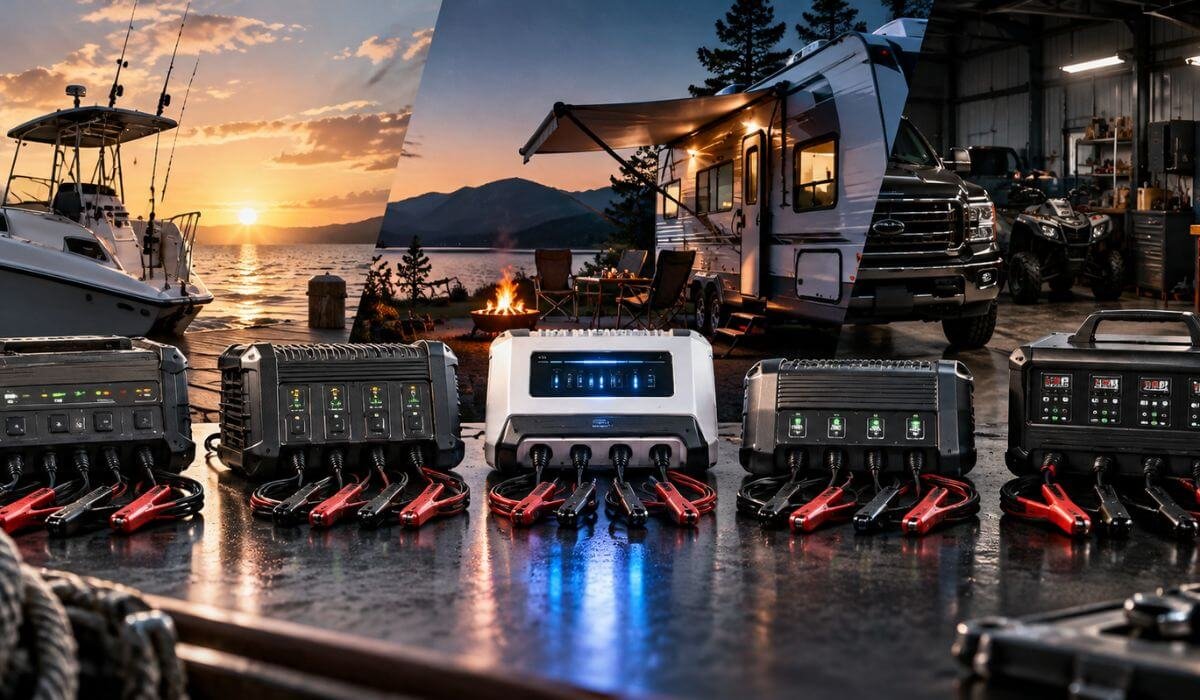
5 Best 4 Bank Battery Chargers in 2026: 40A Power, LiFePO4 & Onboard Charging
When charging four batteries, the charger is only half the equation. What matters is how each bank handles the battery connected to it, whether the output matches the battery’s requirements, and whether the charging profile is suitable for the chemistry. A quality 4-bank battery charger can eliminate the hassle of swapping cables between batteries while maintaining proper charging across AGM, flooded, gel, deep-cycle, and compatible LiFePO4 setups.
This list focuses on true 4-bank charging systems, rather than products selected simply because they advertise high amperage. A good four-bank battery charger should provide dedicated charging across the connected batteries, use the correct charging profile, and offer protection against common electrical issues. For example, the NOCO GENPRO10X4 delivers 40A total through four 10A banks, giving each connected 12V battery its own charging channel instead of treating the entire battery setup as one load.
Installation is another detail worth checking before buying. The NOCO measures 11.4 × 9.1 × 2.83 inches, so this is a purpose-built multi-bank charger rather than a small plug-in maintainer designed for occasional glove-box use. That difference matters when planning a permanent installation where cable routing, ventilation, mounting space, and access to the batteries all need to work together.
Best 4-Bank Battery Chargers: Top 2026 Picks for Multi-Battery & Car Setups
#1. NOCO GENPRO10X4 4-Bank Charger
Best 40A 4-Bank Battery Charger with 10A-Per-Bank Output, LiFePO4 Support & IP68 Protection
#2. Minn Kota MK-440PCL 4-Bank Charger
Best Marine 4-Battery Charger with Independent 10A Banks, Multi-Stage Charging & Temperature Compensation
#3. Guest 2740A 4-Bank Charger
Best 40A Multi-Bank Battery Charger for 12V Marine Systems with Independent Charging & IP67 Protection
#4. LiTime 4-Bank LiFePO4 Charger
Best 4-Channel Battery Charger for LiFePO4 Systems with 10A Charging Per Bank & Lithium Activation
#5. Schumacher DSR125 4-Bank Charger
Best 4-Bank Battery Maintainer for 6V/12V Batteries with 10A Channels, LiFePO4 Support & Flexible Charging
Expert Tip
With a 4-bank charger, 40A on the box does not automatically mean 40A into one battery. On the NOCO, Minn Kota, Guest, and LiTime models here, the important number is the 10A-per-bank output. That means the charger is designed to manage four batteries at the same time rather than acting like one oversized 40A charger.
Before buying, check the battery chemistry first. A 12V AGM or flooded battery is not charged exactly like a LiFePO4 battery, so choosing a charger simply because it says “4-bank” can be an expensive mistake. Also check whether you need a permanent onboard charger or a garage/workshop unit. That single decision can narrow this list down faster than almost any other specification.
How We Chose These 4-Bank Battery Chargers
We did not rank these chargers by amp rating alone. A four-bank charger has to make sense at the individual-bank level, because that is where the real charging work happens.
First, we looked for genuine four-bank charging capability. The NOCO GENPRO10X4, Minn Kota MK-440PCL, Guest 2740A, and LiTime models all provide four charging banks, with the leading 40A units delivering roughly 10A per bank. That makes them suitable for maintaining a multi-battery setup without constantly moving a single charger from one battery to another.
Next came battery compatibility. This matters because the list is not made up of four identical chargers wearing different badges. The NOCO supports 12V lead-acid and lithium batteries and adds dedicated charging modes. Minn Kota supports several common marine battery types, including AGM, flooded, gel, and LiFePO4. LiTime is particularly relevant to lithium users because its four-bank charger is designed around LiFePO4 and other supported battery chemistries. The Schumacher earns its place for a different reason: its four banks can handle 6V or 12V batteries, making it much more flexible for mixed battery situations.
We also considered where each charger actually makes sense. NOCO and Minn Kota are strong choices for permanent onboard installations, where waterproof construction and straightforward multi-bank management matter. LiTime makes more sense when LiFePO4 is the priority, while Schumacher is better suited to a garage, workshop, or owner who may need to charge different 6V and 12V batteries rather than four identical marine batteries.
Physical design was another practical filter. These are not tiny portable chargers. The NOCO measures about 11.4 × 9.1 × 2.83 inches, while the LiTime is about 11.93 × 9.08 × 2.64 inches. That is enough hardware to make mounting space, cable routing, ventilation, and terminal access worth checking before purchase.
Finally, we looked at what each charger does beyond simply supplying power. Multi-stage charging, automatic maintenance, battery-type selection, waterproof protection, individual-bank monitoring, and built-in safety protections can make a much bigger difference in everyday ownership than a headline amp number.
That is why the ranking is deliberately not “highest amps first.” NOCO takes the overall spot because it combines four independent 10A banks, broad battery support, onboard design, and strong environmental protection. Minn Kota follows closely for marine-focused charging. Guest is a straightforward high-output marine option. LiTime moves up when LiFePO4 is the priority. Schumacher is last only because it serves a different job—not because it is a poor charger.
That distinction is important. The best 4-bank battery charger is the one that matches your batteries and how you actually use them, not necessarily the one with the biggest number printed on the front.
#1. NOCO GENPRO10X4 4-Bank Charger
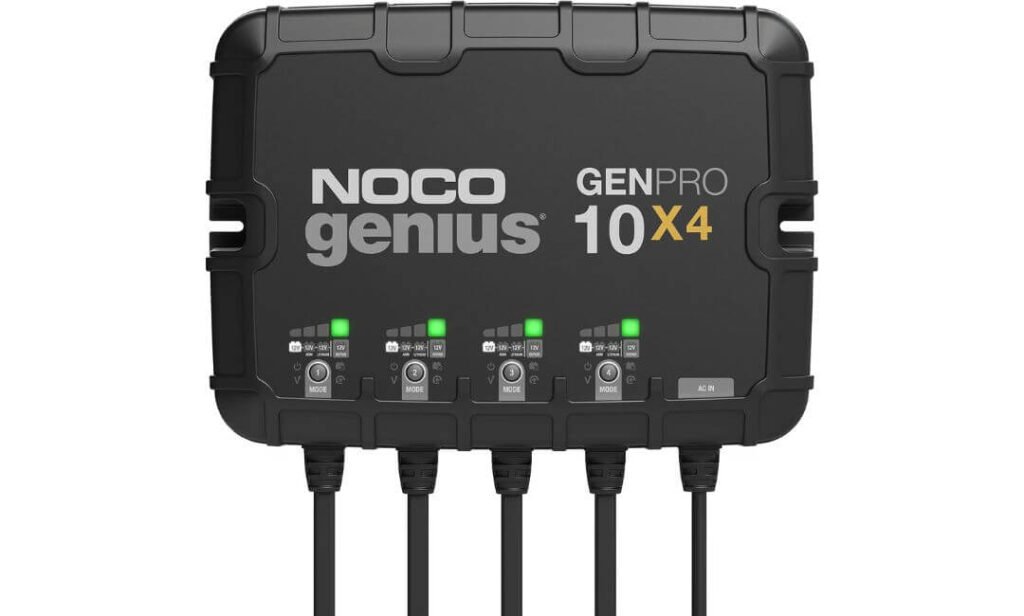
Quick Specs:
- Bank configuration: Four fully independent charging banks
- Charging output: 10A per bank, 40A total
- Battery voltage: 12V batteries on each bank
- Battery chemistry: Lead-acid, AGM, and lithium
- Selectable profiles: 12V, AGM, Lithium, and Repair Mode
- Low-voltage recovery: Starts charging batteries from 1V; Force Mode can initiate charging from 0V
- Environmental protection: IP68 fully sealed construction
- Cable reach: 72-inch DC charging cables
- Mounting footprint: 13.78 × 11.65 × 6.06 inches
- Unit weight: 16.98 lb
- Warranty: 3 years
When a four-bank charger is installed permanently, the real convenience is not having one huge number on the label—it is being able to leave four batteries connected at the same time. Each bank here delivers up to 10A independently, giving you 40A of combined charging capacity while allowing the charger to manage each 12V battery on its own.
That independent control becomes especially useful when the batteries do not all have exactly the same requirements. Each bank can be set to 12V, AGM, Lithium, or Repair Mode, so a starting battery and deep-cycle batteries do not have to be treated as one identical load. The built-in temperature sensor also adjusts the charging response according to surrounding conditions, helping avoid the extremes of overcharging in high heat or undercharging when temperatures fall.
This is a proper onboard charger, not a portable unit that happens to have four outputs. Its IP68-rated sealed housing is designed to deal with moisture, while the anti-vibration backing helps isolate the charger from the constant movement and vibration found in marine installations. At 16.98 pounds, it has some real hardware behind that weather protection.
Installation is also more forgiving than the size might initially suggest. The mounting system supports different orientations, including upside-down mounting, and the supplied 72-inch DC cables give you useful room when positioning the unit. Still, check the available mounting area first: the charger measures 13.78 × 11.65 × 6.06 inches, so this is something you plan into the installation rather than squeeze in afterward.
What we like about it
- Independent bank control makes four-battery charging genuinely convenient.
- Lithium and AGM modes give it useful room for different battery setups.
- IP68 sealing is a major advantage for an onboard installation exposed to water and moisture.
- Force Mode gives you an option when a neglected battery has fallen to an extremely low voltage.
- Temperature compensation adds useful protection without requiring the owner to constantly adjust the charger.
A useful fitment note
The four charging outputs are intended for individual 12V batteries, which keeps the system straightforward for the type of four-battery setup this charger is designed around. If your vehicle or boat uses a higher-voltage battery system, simply make sure the individual batteries and your wiring arrangement match the charger’s 12V-per-bank design before installation. For a four-battery 12V configuration, that setup is exactly what makes the independent-bank approach so practical.
Why it makes sense as our top pick
The strongest part of this charger is the balance between control and convenience. You get four separate 10A charging banks, chemistry-specific settings, temperature compensation, maintenance capability, and serious environmental protection—all from one permanently installed unit.
The 40A total output is useful, but it is not the only reason this model stands out. What you are really buying is the ability to connect four batteries, select the appropriate profile for each one, and let the charger handle the day-to-day work without repeatedly moving cables or carrying a portable charger around. That is the kind of convenience that becomes more valuable the longer you own the setup.
The Insider Pro-Tip
Before mounting it permanently, lay out all four battery connections exactly where they will run. The supplied 72-inch leads give you plenty of flexibility, but good cable routing is still worth planning before drilling the mounting holes. Keep each bank clearly matched to its intended battery, especially if your setup mixes AGM, lead-acid, and lithium.
And if you are replacing an older charger, do not judge the upgrade only by the jump from one amp rating to another. The bigger improvement here is having four independently managed charging channels with selectable battery profiles and automatic temperature adjustment. That is what turns a multi-battery setup from a chore into something you can largely leave alone.
#2. Minn Kota MK-440PCL 4-Bank Charger
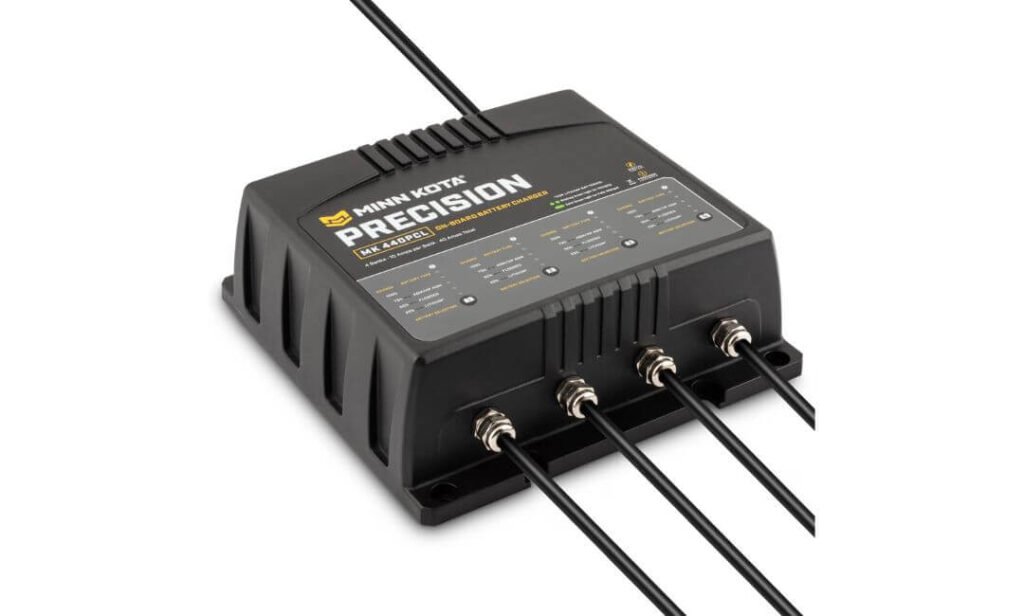
Quick Specs:
- Bank setup: 4 independent charging banks
- Output: 10A per bank
- Battery voltage: 12V
- Supported batteries: AGM, flooded lead-acid, gel, and LiFePO4
- Charging control: Microprocessor-controlled multi-stage charging
- Temperature management: Automatic temperature and low-line voltage compensation
- Construction: Waterproof, shock-resistant, and vibration-resistant
- Dimensions: 9.88 × 3.5 × 9.88 inches
- Weight: 11.5 lb
- Cable reach: 6-foot charging leads
- Warranty: 3 years
The useful thing about this charger becomes obvious when you stop looking at it as simply a four-bank, 40A unit. Each bank can be configured separately, so one battery can be set for AGM while another uses the LiFePO4 profile. That is a much more practical arrangement for a real multi-battery setup, where the batteries may have different jobs—or may have been replaced at different times.
Behind that flexibility is a microprocessor-controlled charging system that manages voltage and current throughout the charging cycle rather than simply pushing a fixed amount of power into the batteries. It also compensates for temperature changes and low-line voltage, which is particularly useful when the available shore power is not perfectly consistent. The result is less guesswork for the owner and a charging process that adjusts itself instead of requiring constant attention.
There is also a nice piece of long-term battery care built into the design. Flooded lead-acid batteries can benefit from the automatic equalization and maintenance function, while a dedicated push-button cycle provides a more thorough cleaning charge when needed. Add the 6-foot leads, LED status indicators, and waterproof, shock- and vibration-resistant construction, and this feels much more like equipment intended to stay installed than something you pull out only when a battery goes flat. At 11.5 pounds and 9.88 × 3.5 × 9.88 inches, it is also worth measuring the intended mounting area before installation.
What we like about it
- Independent battery profiles are the standout feature when different battery chemistries share one setup.
- LiFePO4 support makes it a sensible choice for owners moving from traditional marine batteries to lithium.
- Microprocessor-controlled charging gives the charger more control over the charging process than a basic multi-bank unit.
- Temperature and low-voltage compensation is genuinely useful when real-world power conditions are less than perfect.
- Equalization and maintenance functions give flooded lead-acid batteries attention beyond simply reaching full charge.
One practical fitment note
Its four banks are designed around individual 12V batteries, so the cleanest use case is a multi-battery installation where each battery can be connected and managed separately. If you are working with a higher-voltage series arrangement, check the complete battery and wiring configuration before installation rather than assuming the system voltage can be connected directly to one charging bank. For four individual 12V batteries, the independent-bank design keeps things refreshingly straightforward.
Where this charger earns its spot
The reason we place this model near the top is its control rather than headline power. Four 10A banks are useful, but being able to select the correct charging profile for each battery and then let the microprocessor manage the cycle is what makes the setup genuinely convenient.
It is especially compelling for a boat owner whose battery system is likely to evolve over time. AGM today, LiFePO4 tomorrow does not necessarily mean replacing the charger, and the temperature compensation, maintenance functions, and rugged construction give it the kind of versatility that can continue to make sense as the rest of the electrical system changes.
The Insider Pro-Tip
If your battery setup contains different chemistries, take a moment to label each bank before installation. The independent controls are one of this charger’s biggest advantages, but that advantage only helps when each battery is matched to the correct charging profile.
One other detail deserves attention: the advertised fast-charge capability is useful, but do not assume every four-battery setup will reach full charge in exactly the same time. Battery capacity, state of charge, temperature, and the condition of the battery itself all affect charging time. That is the more realistic way to judge a charger like this—and it is far more useful than taking a single advertised charging-time figure at face value.
#3. Guest 2740A 4-Bank Charger
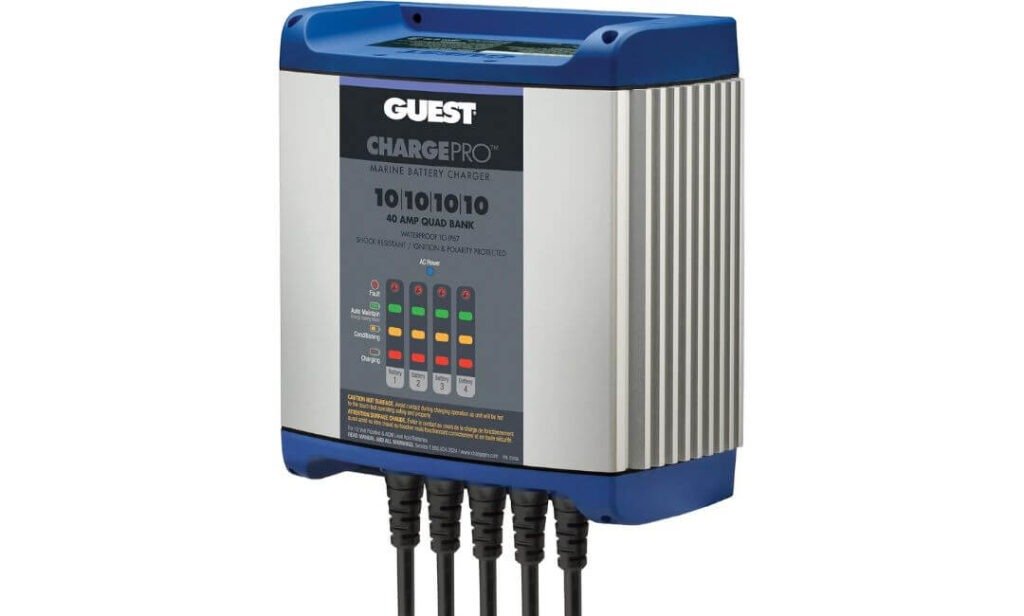
Quick Specs:
- Bank configuration: 4 independent charging banks
- Rated output: 40A total
- Battery voltage: 12V
- Battery compatibility: 12V flooded lead-acid and AGM
- Marine protection: IP67 waterproof construction
- Safety protection: Reverse polarity, over-current, over-voltage, over-temperature, and ignition protection
- Additional protection: In-line fuses
- Housing: Shock-resistant heavy-duty construction
- Dimensions: 9 × 10 × 15 inches
- Weight: 8.49 lb
- Input: 120V AC
Some battery systems do not need a long list of charging modes—they need four batteries charged independently and kept ready without constant intervention. That is where this charger makes its case. Its 40A rating is spread across four banks, allowing the batteries to be handled separately rather than forcing them into one shared charging path.
The compatibility is deliberately focused: it is designed for 12V flooded lead-acid and AGM batteries. That is worth knowing before buying, but it is also part of the appeal if your setup already uses those battery types. There is no need to pay extra for lithium-focused functionality you may never use. For a conventional marine electrical system, the simpler approach can sometimes be the more sensible one.
Then you get the kind of protection that matters once a charger is permanently installed around water. The IP67 housing, shock-resistant construction, ignition protection, and safeguards against reverse polarity, over-current, over-voltage, and excessive temperature give it a solid layer of protection around the charging system. The in-line fuses add another practical safety measure, while the zero battery draw when the charger is switched off is particularly useful during storage or a longer layup.
What we like about it
- Independent four-bank charging keeps each 12V battery managed separately.
- IP67 protection makes it well suited to permanent marine installations.
- Multiple electrical safeguards provide reassuring protection against common wiring and charging problems.
- Zero draw when off is a useful detail during winter storage or extended periods without shore power.
- 8.49-pound build keeps it noticeably lighter than some of the heavier four-bank onboard alternatives.
One practical fitment note
This model is best matched to a setup built around 12V flooded or AGM lead-acid batteries. If you are planning a move to LiFePO4, that is something to factor into the purchase now rather than later. For an existing traditional battery system, though, the focused compatibility keeps the job uncomplicated.
Why it earns a place in this lineup
The Guest takes a more no-nonsense approach than some of the newer, more feature-heavy chargers. You still get four independent banks and a 40A total rating, but the emphasis is on reliable charging and protection rather than piling on functions that every owner may not need.
That makes it a particularly sensible option for someone who has a conventional AGM or flooded-lead-acid setup and wants a permanent onboard charger that can simply do its job. The IP67 construction, ignition protection, fused outputs, and zero-draw design are the details that make more sense in actual ownership than another impressive-looking specification on a product page.
The Insider Pro-Tip
If your batteries are all 12V AGM or flooded lead-acid, do not automatically assume you need a more complicated charger just because newer models offer more battery modes. The right charger is the one that matches the batteries you actually own.
Before installation, also plan the AC and DC cable routing carefully. The charger is designed for onboard use, and a clean installation with secure connections and appropriate electrical work will matter just as much to long-term reliability as the charger itself. If hardwiring is outside your experience, having a qualified marine electrician handle that part is money well spent.
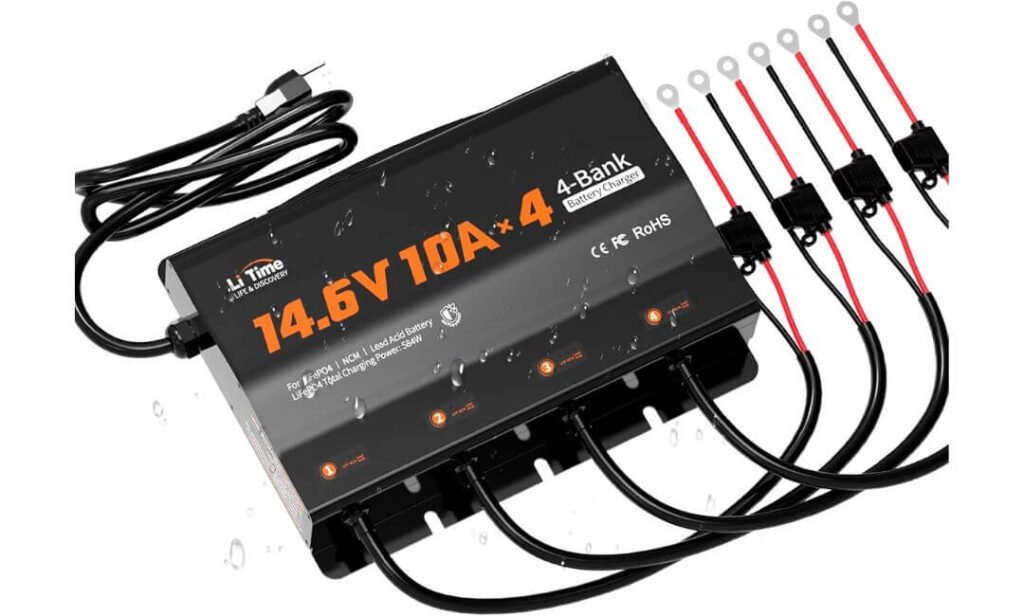
#4. LiTime 4-Bank LiFePO4 Charger
Quick Specs:
- Bank configuration: 4 independent charging channels
- Charging output: 10A per bank
- Battery voltage: 12V batteries
- Supported chemistries: LiFePO4, NCM, and lead-acid
- Output profiles: 14.6V LiFePO4, 16.8V NCM, and 14.7V lead-acid
- Lithium activation: 0V BMS wake-up function
- Protection: Over-current, over-temperature, reverse polarity, over-voltage, under-voltage, and short-circuit protection
- Weather resistance: IP65 water- and dust-resistant construction
- Dimensions: 8.19 × 3.58 × 2.07 inches
- Weight: 12.35 lb
- Warranty: 2 years
There is a clear reason to put this charger on a four-bank shortlist: it was built with modern battery chemistry in mind. Each of the four channels supplies 10A independently, while the charger can be configured for LiFePO4, NCM, or lead-acid batteries. That makes it more interesting than a basic four-output charger if your setup is moving toward lithium—or already has several lithium batteries doing the heavy lifting.
The voltage profiles are where that distinction becomes real. LiFePO4 uses a 14.6V charging output, NCM uses 16.8V, and lead-acid uses 14.7V. In other words, the charger is not simply applying one generic charging profile to everything connected to it. For an owner running four batteries with different requirements, that flexibility can save space and eliminate the temptation to keep multiple chargers around just to accommodate different battery types.
There is another feature here that is easy to overlook until you actually need it: the 0V activation function for BMS-protected lithium batteries. When a lithium battery’s management system has disconnected the battery after a deep discharge, a conventional charger may not immediately recognize it. This unit can initiate the wake-up process, with the manufacturer stating that BMS-protected lithium batteries can be activated in about three seconds. Add six built-in protection systems and an IP65 water- and dust-resistant housing, and it becomes a practical choice for an RV, boat, workshop, or other installation where the charger may see more than a perfectly dry shelf.
What we like about it
- Independent 10A channels make simultaneous four-battery charging straightforward.
- LiFePO4 and NCM profiles give it more relevance for modern lithium setups.
- 0V BMS activation is a genuinely useful feature when a lithium battery has gone into protection.
- Six protection functions cover the electrical problems you most want a charger to guard against.
- Compact 8.19 × 3.58 × 2.07-inch body makes it easier to work into a tighter installation than many larger onboard chargers.
One practical fitment note
The impressive chemistry range should not be confused with universal battery compatibility. You still need to select the correct charging profile for the battery connected to each bank. If your four batteries are all LiFePO4, that is wonderfully straightforward; if you are mixing chemistries, take the extra minute to verify every bank before leaving the system unattended.
Why it stands out among multi-bank chargers
This is the option we would look at when the battery setup is more lithium-focused than traditional marine-focused. The four 10A channels give you the same basic convenience expected from a serious multi-bank charger, but the chemistry-specific outputs and BMS wake-up capability give it a different reason to be here.
It also avoids making the charger unnecessarily large. At just over 8 inches wide and 2 inches high, it has a relatively compact footprint for a four-bank unit, while IP65 protection and multiple electrical safeguards make it suitable for demanding environments. That combination is particularly appealing when installation space is limited but the battery system is not.
The Insider Pro-Tip
If you are converting an older setup from lead-acid to LiFePO4, do not judge this charger by the number of amps alone. The bigger advantage is having a charger that understands the chemistry you are moving toward and can deal with a BMS-protected battery that is not immediately visible after a deep discharge.
For mixed batteries, write the chemistry beside each bank before you connect anything. It sounds overly cautious, but it takes seconds—and with independently selectable charging profiles, that tiny bit of preparation is exactly how you get the benefit of having four smart charging channels instead of turning a flexible charger into a source of confusion.
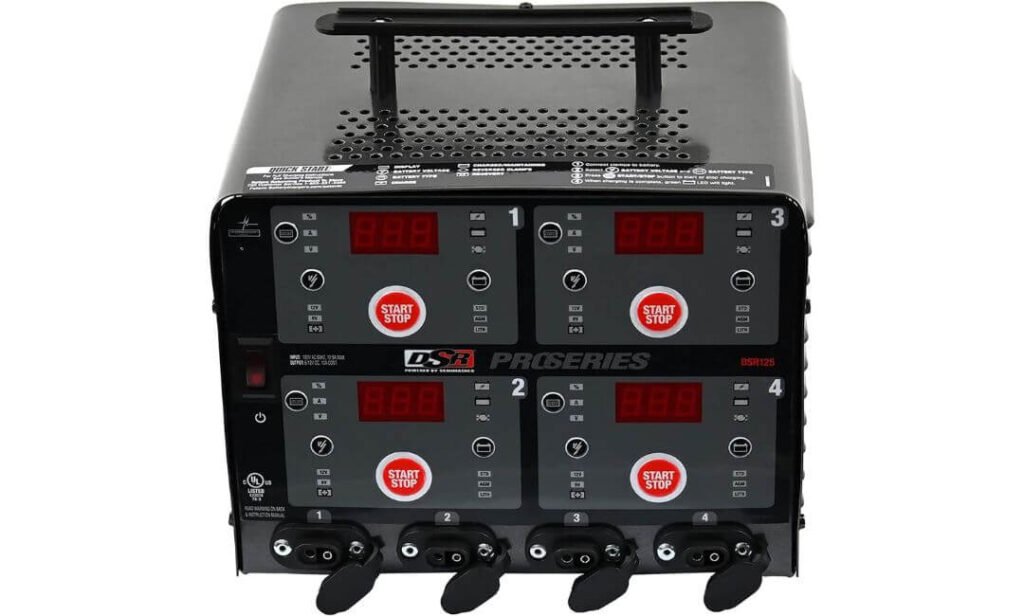
#5. Schumacher DSR125 4-Bank Charger
Quick Specs:
- Charging setup: 4 independent banks
- Output: Up to 10A per bank
- Battery voltage: 6V or 12V on each bank
- Battery support: Standard, AGM, gel, deep-cycle, and LiFePO4
- Charging: Multi-stage with automatic amperage selection
- Maintenance: Float-mode monitoring
- Recovery: Lead-acid battery recovery function
- Protection: Short-circuit, overcharge, reverse-polarity, and thermal-runaway protection
- Cables: Four detachable 6-foot leads with 75A color-coded clamps
- Cooling: Fan-cooled
- Construction: Heavy-duty steel case with carry handle
- Dimensions: 10.36 × 9.75 × 10.13 inches
- Weight: 12 lb
This charger earns its place for a reason that the other models on this list do not quite match: every bank can work with either a 6V or 12V battery. That makes it particularly useful in a garage or workshop where the batteries coming through the door are not always identical. Add support for standard lead-acid, AGM, gel, deep-cycle, and LiFePO4 batteries, and it becomes less of a dedicated marine charger and more of a flexible battery-management tool.
The output is also configurable around the job in front of you. Each bank can supply up to 10A, while two banks can be connected to one battery when you need more charging power. Its multi-stage charging and float-mode monitoring then take over as the battery reaches the appropriate state, rather than leaving you to keep checking it manually. For someone maintaining several batteries at once, that can make a noticeable difference in how much attention the setup requires.
What makes the design feel more workshop-oriented is everything around the charging electronics. You get four detachable 6-foot cables with 75A color-coded clamps, individual bank monitoring, fan cooling, and a steel housing with a carry handle. At 12 pounds and roughly 10 × 10 × 10 inches, it is not something you would mount permanently just for the sake of mounting it; it makes more sense as a substantial charger you can move between batteries, benches, vehicles, or equipment when the job changes.
What we like about it
- 6V and 12V support on every bank gives it unusually broad usefulness.
- LiFePO4 compatibility means it can stay relevant as battery technology changes.
- Two-bank charging on one battery gives you an option when faster charging matters.
- Detachable 6-foot leads and color-coded clamps make moving between batteries simple.
- Float monitoring and multi-stage charging make it useful for ongoing battery care, not just bringing a flat battery back to life.
One practical fitment note
The strongest use case here is a garage, workshop, fleet, or mixed-equipment environment, rather than a permanently installed onboard marine system. Its carry handle, detachable leads, and steel case are actually advantages when you need to move from one battery to another. If your only requirement is four permanently mounted marine batteries, the dedicated onboard chargers higher in this list have a more natural fit.
Why this 4-bank charger makes the list
The DSR125 is not trying to win the comparison by being another 40A marine box. Its advantage is versatility. Being able to charge four batteries simultaneously while accepting either 6V or 12V batteries on each bank makes it a much more useful tool for people who deal with different vehicles and battery types.
That also explains its #5 position. It is not lower because it lacks capability; it is lower because this article is centered on the best four-bank charging solutions overall, and the models above it are more specifically suited to the permanent 12V multi-battery applications that define this category. For a shop that regularly sees different batteries, however, this could easily become the most useful charger of the five.
The Insider Pro-Tip
If you are buying this for a workshop, do not underestimate the value of the 6V capability. It can save you from keeping a separate charger around for older or specialty batteries, while the independent banks let several jobs happen at once.
And if one battery needs more attention than the others, the two-bank-to-one-battery option gives you another tool without buying a second charger. Just make sure the battery and connection arrangement is appropriate before combining outputs. That flexibility is the real reason to choose this model—not simply the fact that the front of the charger says “four bank.”
Best 4-Bank Battery Chargers Side by Side: Banks, Battery Types & Protection (2026)
4-Bank Battery Charger Buying Guide: What Actually Matters Before You Buy
A four-bank charger looks simple until you start comparing the details. Four outputs do not automatically mean four identical charging channels, and a 40A rating does not mean one battery receives 40A. The right choice depends on the batteries you have, how they are wired, where the charger will live, and whether you want a permanent onboard system or a charger you can move around the workshop.
Start With Battery Chemistry, Not Amp Rating
This is the first check because charging chemistry determines whether a charger is actually suitable for your batteries.
Traditional flooded lead-acid, AGM, gel, and LiFePO4 batteries can require different charging behavior. A charger that supports several chemistries is useful, but only when you can select the appropriate profile for each bank.
For example, the NOCO and Minn Kota units offer dedicated settings for AGM and lithium alongside conventional 12V charging. The LiTime goes further with separate profiles for LiFePO4, NCM, and lead-acid, while the Guest 2740A is intentionally focused on 12V flooded and AGM lead-acid batteries. The Schumacher is the unusual one here because each bank can accept 6V or 12V batteries and it also supports LiFePO4.
If your setup is all one chemistry, compatibility is straightforward. If you have mixed batteries, independent bank selection becomes much more important.
Four Banks and Four Channels Are Not Terms to Ignore
You will see both “4-bank battery charger” and “4-channel battery charger” used in product listings, but don’t assume those phrases tell you everything about the internal design.
For practical buying purposes, what you want to establish is whether the charger gives you four independently managed charging outputs. With the models in this guide, each bank is designed to work with its connected battery rather than simply splitting one charging output between four batteries.
That is why the 10A-per-bank figure matters so much on the NOCO, Minn Kota, and LiTime models. Their 40A combined rating comes from four individual 10A charging banks. The Guest is also rated at 40A across four banks, while the Schumacher can provide up to 10A per bank depending on what each battery requires.
| What the listing says | What you should actually check |
|---|---|
| 40A charger | Is that 40A total or 40A to one battery? |
| 4-bank | Are all four banks independently controlled? |
| 4-channel | Can each output be connected and managed separately? |
| 10A per bank | Is 10A available to each battery simultaneously? |
| Multi-battery charger | Which battery chemistries can each bank support? |
This small distinction prevents one of the most common buying mistakes: assuming the biggest number on the product page tells you how quickly every battery will charge.
Understand What the Charging Stages Are Doing
A good charger does more than push current until the battery appears full.
Modern multi-stage chargers generally move through stages such as bulk, absorption, and float/maintenance. During bulk charging, the charger supplies substantial current to bring the battery up quickly. Absorption then becomes more controlled as the battery approaches full charge, while float or maintenance operation keeps it ready without continually charging at the maximum rate.
That is why automatic multi-stage charging is more valuable than simply chasing the highest amperage. Minn Kota uses microprocessor-controlled charging to regulate voltage and current throughout the cycle, while the Schumacher adds float-mode monitoring. The NOCO also combines automatic charging with temperature sensing and selectable battery profiles.
One important reality: charging time is never determined by amperage alone. Battery capacity, starting state of charge, temperature, battery age, and battery condition all affect how long a full charge actually takes.
Match the Charger to the Installation
A permanent onboard charger has a very different job from a workshop charger.
If the unit is going inside a boat or another installation exposed to moisture, look closely at water resistance, vibration protection, cable length, mounting options, and heat management. The NOCO carries an IP68 rating, while the Guest is IP67 and the LiTime is IP65. Those ratings are useful, but they should be viewed alongside the actual installation rather than treated as permission to mount a charger anywhere.
Heat also deserves attention. A charger is converting electrical energy while working, so adequate clearance and sensible mounting matter. Do not bury the unit in a sealed compartment simply because it physically fits. Follow the manufacturer’s installation requirements and leave appropriate space around the charger.
The Schumacher takes a different approach. Its steel case, carry handle, detachable six-foot leads, and fan cooling make it much more natural for a garage or workshop than for a permanently mounted marine compartment.
Think About Monitoring Before You Pay More
You do not necessarily need an app to have useful battery monitoring.
Individual LED indicators can tell you whether a bank is charging, complete, in maintenance, or reporting an error. That is enough for many owners who simply want to plug in the charger and check the system occasionally.
For a more complex setup, independent status information becomes more useful because it lets you identify which battery needs attention instead of treating all four as one system.
This is one area where you should avoid paying for features you will never use. If the charger is permanently installed in a location you can easily access, straightforward indicators may be all you need. If the installation is difficult to reach, remote monitoring can be more valuable—but it should be considered a convenience feature, not a substitute for correct installation.
Safety Features Matter More Than They Look on the Box
Battery charging involves high current, so protection features are not just marketing extras.
At minimum, look for protection against short circuits, reverse polarity, over-current, over-voltage, and excessive temperature. Temperature compensation is another useful feature because charging behavior can change with ambient conditions.
The Guest 2740A is particularly strong in this respect, with reverse-polarity, over-current, over-voltage, over-temperature, and ignition protection, plus in-line fuses. The LiTime adds six separate electrical protection functions, while the NOCO uses thermal sensing and sealed construction alongside its charging controls.
A good rule is simple: the charger should protect both itself and the battery system when something goes wrong.
Choose Between a Battery Charger and a Battery Maintainer
These terms overlap, but they are not interchangeable in everyday use.
A battery charger is designed to bring a discharged battery back toward full charge. A battery maintainer is primarily concerned with keeping a charged battery at an appropriate level during storage or periods of low use.
Many of the chargers in this guide do both. That is why features such as automatic maintenance and float operation matter. If your boat, RV, vehicle, or equipment sits unused for weeks at a time, maintenance capability can be just as useful as the initial charging function.
For a workshop, the priority may be different. You may care more about charging several batteries during the day, moving cables between jobs, or having 6V and 12V compatibility. That is where the Schumacher’s design becomes particularly practical.
Know Where Each Type Fits Best
There is no single four-bank charger that makes every setup better.
| Your situation | What to prioritize |
|---|---|
| Four 12V marine batteries | Independent 10A banks, marine protection, onboard mounting |
| AGM + flooded batteries | Separate battery profiles and multi-stage charging |
| LiFePO4 setup | Dedicated lithium profile and BMS-friendly charging |
| Mixed battery chemistries | Independent bank controls |
| Garage or workshop | Flexible voltage support, detachable leads, portability |
| Long-term storage | Float/maintenance operation and low standby draw |
| Wet marine environment | High ingress protection and vibration resistance |
Check the Physical Installation Before Ordering
This is an easy step to skip because online listings make chargers look smaller than they really are.
The NOCO measures about 13.78 × 11.65 × 6.06 inches, Minn Kota is about 9.88 × 3.5 × 9.88 inches, LiTime is about 8.19 × 3.58 × 2.07 inches, and Schumacher is roughly 10.36 × 9.75 × 10.13 inches. Those differences can completely change which charger is easiest to install.
Also check the distance between the charger and each battery. Longer supplied leads can make installation much easier, but you still want clean cable routing, secure terminals, appropriate fusing, and no unnecessary strain on the connections.
For a permanent installation, measure first, plan the cable paths second, and drill last. It sounds obvious, but it saves far more frustration than trying to make the wiring work after the charger is already mounted.
The Simple Rule for Choosing Your Charger
If you want the shortest possible decision process, use this order:
- Confirm battery voltage.
- Confirm battery chemistry.
- Confirm four independent charging banks.
- Check the actual output per bank, not just the total rating.
- Decide whether you need onboard or portable/workshop use.
- Check waterproofing, temperature control, and safety protection.
- Measure the mounting area and cable runs.
- Only then compare extra features and price.
That order keeps the decision grounded in compatibility first and marketing claims second. A charger with fewer headline features can be the better purchase if it matches the batteries, installation, and workload more accurately.
In-Depth Buyer Tips for Getting a Four-Battery Charging Setup Right
Buying the charger is only the first part. A four-battery system can work beautifully for years, but the details around battery matching, installation, wiring, and maintenance determine how well it actually performs. These are the things that are easy to overlook when shopping online because they rarely get the same attention as the headline amp rating.
When a Battery Maintainer Is Enough—and When You Need a Full Charger
A maintainer makes the most sense when the battery is already healthy and substantially charged and your goal is simply to keep it ready during storage.
For example, if a boat or recreational vehicle sits for several weeks between trips, a charger with a proper maintenance or float stage can keep the batteries topped up without requiring you to repeatedly intervene. The NOCO, Minn Kota, and Schumacher models all have maintenance-oriented functions that make them useful for this kind of long-term care.
A full charger becomes more important when the batteries are regularly being discharged and need meaningful energy put back into them.
Think about the difference this way:
| Situation | Better approach |
|---|---|
| Battery is already charged and sitting unused | Maintenance/float charging |
| Battery has been moderately discharged | Multi-stage charger |
| Deep-cycle battery is regularly depleted | Full charger with appropriate profile |
| Battery has been neglected for a long time | Charger with recovery capability |
| Four batteries need charging together | Four-bank charger |
| Battery chemistry has changed to lithium | Charger with the correct lithium profile |
The useful middle ground is a charger that can also maintain. That gives you one installation that handles normal recharging and long periods of storage instead of buying separate equipment for each job.
Match Every Bank to the Battery Connected to It
A four-bank setup does not mean you should treat four batteries as one large battery.
Each bank should be considered independently. If Bank 1 is connected to an AGM battery and Bank 2 is connected to LiFePO4, the charger needs to know that those batteries have different charging requirements.
This is where the models in this article separate themselves:
- NOCO: 12V, AGM, Lithium, and Repair Mode selections for individual banks.
- Minn Kota: AGM, flooded lead-acid, gel, and LiFePO4 selections per bank.
- Guest: Designed around 12V flooded and AGM lead-acid batteries.
- LiTime: Supports LiFePO4, NCM, and lead-acid with chemistry-specific voltage profiles.
- Schumacher: Each bank supports 6V or 12V batteries and a broad range of battery types.
The practical rule is simple: identify the battery first, select the appropriate charging profile second, and connect the bank third.
If all four batteries are identical, the process is easy. If they are different, take a few minutes to label the batteries and corresponding charger leads. That tiny bit of organization can prevent a surprisingly expensive mistake.
Installation Is Part of the Charger Choice
A charger can have excellent electronics and still be a poor installation if it is squeezed into the wrong location.
For an onboard installation, look for a location that is dry enough for the charger’s rating, protected from unnecessary vibration, accessible for inspection, and able to dissipate heat. Do not assume that an IP-rated housing means the charger should be installed directly where water regularly collects.
Physical size also matters. The NOCO is considerably larger than the compact LiTime, while the Schumacher’s steel enclosure and carry handle make it better suited to a movable workshop setup.
Before installation, check:
- Available mounting space
- Clearance around the charger
- Distance to all four batteries
- Cable routing
- Terminal accessibility
- Exposure to water and spray
- Heat buildup inside enclosed compartments
- Access to the AC connection
- Whether the mounting surface can handle the unit securely
For a permanent marine installation, secure mounting matters because vibration never really stops. For a workshop charger, portability may be more useful than permanent mounting.
Wiring Gauge and Fuse Sizing Should Follow the Installation
This is one area where copying a wire size from another installation can be misleading.
The correct wire gauge depends on the expected current, cable length, acceptable voltage drop, conductor material, installation environment, and applicable electrical requirements. A short cable run and a long cable run carrying the same current do not necessarily have the same wiring requirements.
The same applies to fuse sizing. The fuse should protect the wiring and be selected according to the charger’s installation instructions and the applicable electrical standard; simply installing the largest fuse that does not immediately blow is not a safe approach.
For a permanent installation, use the manufacturer’s wiring instructions as the starting point rather than treating generic online charts as a substitute for them. If you are unsure about conductor sizing, protection, or hardwiring, having a qualified marine or automotive electrician handle that portion is a sensible decision.
One thing you should always avoid is extending charging leads casually just because the supplied cables do not reach. Longer wiring changes voltage drop, and the correct solution may involve appropriately sized conductors rather than simply adding more cable.
Keep the Battery Connections Clean and Secure
A sophisticated charger cannot compensate for a poor electrical connection.
Before connecting a bank, inspect the terminals for corrosion, looseness, damaged hardware, or contamination. Ring terminals should sit securely against clean connection points, and cables should be routed so that their weight or movement is not pulling against the battery terminals.
This becomes even more important on a boat or recreational vehicle because vibration can gradually expose problems that would never appear on a stationary workbench.
A good four-bank installation should look almost boring: secure terminals, sensible cable routing, clearly identified banks, proper protection, and nothing under unnecessary mechanical strain.
Troubleshooting Starts With the Individual Bank
When a four-bank charger reports a problem, do not immediately assume the entire charger has failed.
Start by identifying which bank is reporting the issue. Then check the battery connected to that bank, the polarity, terminal condition, cable connection, and battery voltage. If three banks are behaving normally and one is not, the problem may be isolated to that battery or its connection.
A sensible troubleshooting sequence is:
- Confirm the charger has AC power.
- Identify the affected bank.
- Verify positive and negative connections.
- Check the battery’s condition and voltage.
- Confirm the selected battery profile.
- Inspect the cable and terminal connections.
- Check any applicable fuse or protection device.
- Allow the charger to complete its normal detection process before repeatedly disconnecting and reconnecting it.
Do not use a charger as a diagnostic tool for a battery that may have a genuine internal fault. A battery that repeatedly refuses to accept a charge can have a problem that no charging mode will fix.
Pay Attention to Storage and Long Periods of Inactivity
Four-bank chargers are particularly useful when equipment spends long periods sitting unused.
During storage, the goal is not to keep forcing maximum current into the batteries. A proper maintenance stage should take over once the batteries reach the appropriate state of charge. The Guest’s zero-draw behavior when switched off is useful for storage, while chargers with automatic maintenance modes can remain connected when the installation and manufacturer instructions allow it.
If the equipment will be stored for an extended period, follow the battery manufacturer’s storage recommendations as well as the charger’s instructions. Different battery chemistries can have very different preferences for storage voltage, temperature, and connection.
The Real Test Is How Well the Whole System Works Together
The best four-bank charger is not necessarily the one with the most features, the highest number on the box, or the newest-looking design.
It is the one where the charger, batteries, wiring, protection, and installation all agree with one another.
For a four-battery 12V marine setup, that may mean choosing a rugged onboard unit with independent charging profiles. For a lithium-heavy system, chemistry-specific charging and BMS compatibility may matter more. For a workshop dealing with everything from 6V batteries to 12V LiFePO4 packs, flexibility can be worth more than marine-specific construction.
That is ultimately what separates a genuinely good multi-bank installation from a collection of four charging outputs: every bank has the right battery, the right profile, the right wiring, and the right protection behind it.
FAQs About 4-Bank Battery Chargers
Can a 4-bank charger handle different battery types on a Chevy Traverse or another vehicle setup?
It can, but only when the charger is specifically designed to support those battery chemistries and each bank is configured correctly. A four-bank charger is not automatically suitable for every battery simply because the batteries are all rated at 12V. AGM, flooded lead-acid, gel, and LiFePO4 batteries can require different charging profiles.
For a Chevy Traverse or similar vehicle, I would not buy one of these simply because you see “4-bank” in the title. First establish why you actually need four charging banks. If the vehicle has only one battery that needs charging, a four-bank onboard charger is solving a problem you may not have. These chargers make much more sense when the vehicle, boat, RV, workshop, or auxiliary system genuinely has multiple independent batteries that need to be maintained.
Is 40A on a four-bank battery charger really 40A going into each battery?
No, and this is one of the easiest specifications to misunderstand. On a charger such as the NOCO GENPRO10X4 or Minn Kota MK-440PCL, the 40A figure is the combined rating, with up to 10A available to each of the four banks.
That distinction matters when estimating charging time. Four batteries do not suddenly receive 40A each. The actual charging rate for an individual battery depends on its bank output, capacity, state of charge, temperature, battery condition, and the charging stage it has reached.
A useful way to look at it is:
- 40A total = the combined capability of the charger.
- 10A per bank = the figure that matters for an individual battery.
- Charging does not necessarily stay at the maximum rate from empty to full.
- A battery’s condition can have a bigger effect on real charging time than the headline rating.
So if your main goal is to charge one large battery as quickly as possible, a four-bank charger should not automatically be treated as a 40A single-bank charger.
What should I check if one bank stops charging while the other three continue working?
Do not immediately condemn the charger. In a four-bank system, one problem can be isolated to the battery, cable, connection, fuse, charging profile, or that individual bank.
Start with the simple things: confirm the battery terminals are clean and secure, verify polarity, check the selected charging mode, and inspect the relevant cable and protection device. If the other three banks are operating normally, that is useful information—it tells you the entire charging system has not necessarily failed.
If the battery has been deeply discharged, the situation can become more complicated. Some chargers have recovery or low-voltage functions, such as the NOCO’s Force Mode or the Schumacher’s recovery capability for appropriate lead-acid batteries. Lithium batteries can also enter BMS protection, which is why a lithium-compatible charger with a suitable wake-up function can behave differently from a conventional charger.
The honest rule is this: a charger cannot repair a physically failed battery. If one battery repeatedly refuses to accept a charge while the charger and other banks behave normally, test that battery independently rather than endlessly cycling the charger. That saves time, protects the rest of the system, and usually gets you to the real fault much faster.
Final Take: Choosing the Right 4-Bank Battery Charger
There is no prize for buying the charger with the biggest number on the label. With a four-battery setup, compatibility and independent control matter more than a headline amp figure. A charger can be powerful, well-built, and packed with features, but if its charging profile does not match your batteries, or its physical design does not suit the installation, those specifications do not mean much once you are actually living with the system.
That is why this list is deliberately split by real-world use rather than pretending one charger is perfect for everybody. The NOCO GENPRO10X4 is the strongest all-around choice for a serious 12V four-bank installation, while the Minn Kota MK-440PCL makes a lot of sense for marine users who want precise battery-specific charging. The Guest 2740A is a straightforward choice for traditional AGM and flooded batteries, the LiTime becomes particularly compelling when LiFePO4 is central to the setup, and the Schumacher DSR125 is the flexible option when 6V and 12V batteries regularly share the same workspace.
Before you click Buy, look at your batteries first, then the charger. Count the banks, identify the chemistry, check the output per bank, measure the installation space, and think about how you will actually use it six months from now. That last part is easy to forget. A charger that fits today’s battery setup but cannot support the direction your electrical system is heading may not be the bargain it initially appears to be.
If you get those fundamentals right, the rest becomes much easier. You are no longer choosing from five product pages—you are choosing the charger that makes the entire battery system simpler, safer, and easier to live with. And that is ultimately what a good four-bank charger should do: sit there, do its job across all four banks, maintain the batteries when you are not using them, and give you one less thing to worry about when you are ready to head out.
Also Check: