
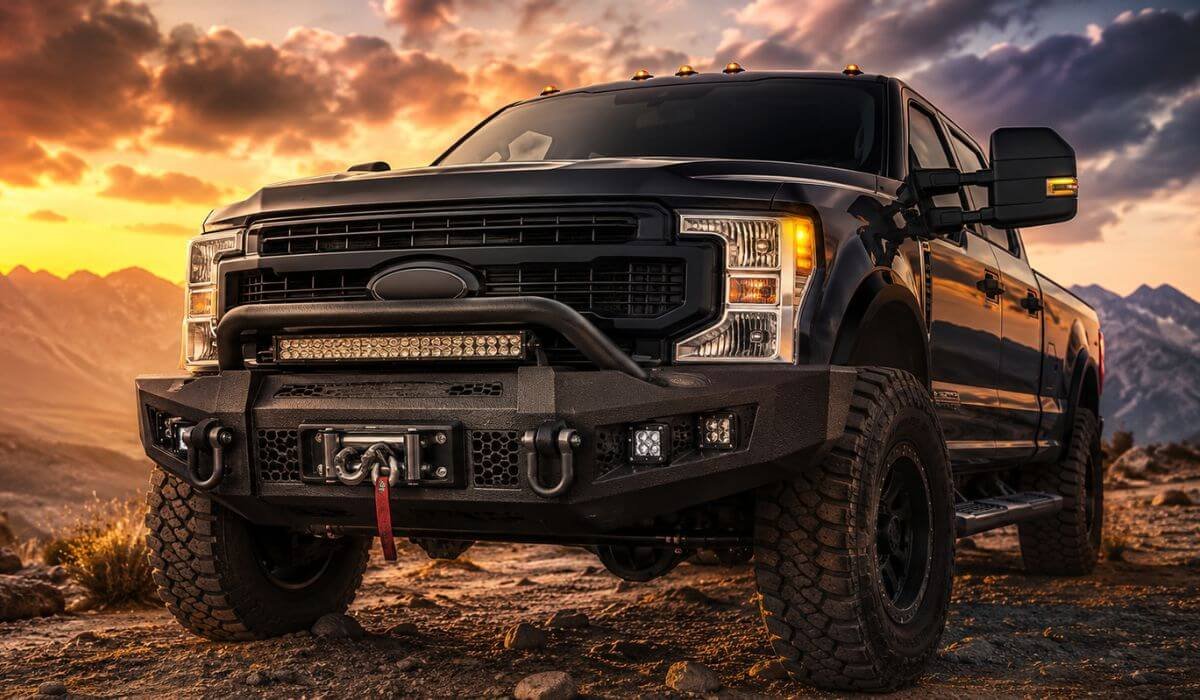
Best Ford F250 Winch Bumper in 2026: Winch-Ready Protection With Factory Sensor Support
The Ford F250 is one of those trucks that often ends up doing far more than its factory front bumper was designed for. Whether you’re pulling a trailer to a job site, recovering a stuck truck on a muddy trail, or mounting a heavy-duty winch for peace of mind, the stock setup can quickly become a limitation. That is why many F250 owners upgrade to a dedicated winch bumper long before they start modifying anything else.
For this guide, we focused specifically on 2023-2026 Ford F250 Super Duty models and looked beyond marketing claims. We compared steel construction, winch readiness, recovery points, parking sensor compatibility, lighting provisions, overall protection, and real-world value. Since many of these bumpers are relatively new to the market, we paid close attention to design, features, installation quality, and how well each option fits the needs of actual F250 owners rather than simply relying on review counts.
If you want a bumper that can support a winch, improve front-end protection, and still work with modern factory features, these are the Ford F250 winch bumpers worth considering.
Best Ford F250 Winch Bumper: Top 2026 Picks With Sensor Support and Steel Construction
#1. Hawkley Front Winch Bumper
Best Front Winch Bumper for 2023-2026 Ford F250 Owners Seeking Factory Sensor Compatibility, Reliable Recovery Points, and Daily-Driven Practicality
#2. longsun Full Width Winch Bumper
Best Full Width Winch Bumper for 2023-2026 Ford F250 Trucks Requiring Maximum Front-End Protection for Towing, Ranch Work, and Off-Road Recovery
#3. BESTZHEYU Steel Winch Bumper
Best Value Winch Ready Bumper for 2023-2026 Ford F250 Models Offering LED Lighting, Sensor Support, and Straightforward Bolt-On Installation
#4. VISIDA Steel Bumper Package
Best Front and Rear Bumper Package for 2023-2026 Ford F250 Owners Wanting Complete Truck Protection and Recovery-Focused Features
Must Check: Best Winch for Ford F250
Expert Tip Before You Buy a Ford F250 Winch Bumper
One mistake we see many F250 owners make is shopping for a bumper based on appearance alone. A bumper can look aggressive in photos and still become a headache once you try to install a winch, reconnect parking sensors, or mount a front license plate. The details that matter most usually aren’t visible in the marketing images.
Before buying, look closely at the winch mounting area, sensor provisions, recovery points, and overall bumper design. A well-designed bumper should make recovery situations easier, not create new problems. If your truck spends time towing, working on job sites, travelling through ranch land, or exploring remote trails, choosing a bumper with proper recovery hardware and full front-end protection will matter far more than an extra cutout or decorative plate.
In our experience, the best F250 winch bumper is rarely the one with the most aggressive styling. It is the one that still feels like the right choice after a long day of towing, hauling, or pulling a truck out of a difficult situation.
How We Chose These Ford F250 Winch Bumpers
There are dozens of F250 bumpers online that look nearly identical at first glance. After comparing specifications, design layouts, installation details, and real-world usability, we found that most options fall short in at least one important area. Some offer a winch mount but sacrifice sensor compatibility. Others provide protection but lack practical recovery features. A few simply add weight without delivering meaningful functionality.
That is why we narrowed our recommendations to bumpers that solve the problems most F250 owners are actually trying to solve.
First, we looked at winch readiness. Every bumper on this list includes a dedicated winch mounting solution because adding a separate winch plate later often increases cost, complexity, and installation time. If a bumper is advertised for recovery use, it should be prepared for recovery equipment from the start.
Next, we evaluated recovery-focused design. Features such as integrated D-ring mounts, reinforced mounting points, and heavy-duty steel construction received significant attention. For many F250 owners, recovery capability is the primary reason for upgrading the factory bumper, so these features were treated as necessities rather than optional extras.
We also prioritized factory feature compatibility. Modern F250 trucks rely on parking sensors and driver-assistance technology that owners do not want to lose after installing an aftermarket bumper. Products that properly accommodate these factory systems earned a clear advantage during our selection process.
Protection was another major factor. We compared full-width and standard-width designs, paying close attention to how each bumper shields vulnerable front-end components. Options offering stronger coverage without compromising functionality ranked higher than designs focused primarily on appearance.
Finally, we looked at overall value for real F250 owners. Instead of chasing the highest review counts or the biggest brand names, we focused on the features buyers actually receive for their money. The bumpers that made this list consistently delivered the combination of winch support, recovery capability, protection, sensor compatibility, and practical usability that most F250 owners are searching for.
The result is a shortlist of bumpers that we believe offer the strongest balance of capability, protection, and everyday usefulness for the 2023-2026 Ford F250 Super Duty. That is ultimately why these four products earned a place in this guide.
#1. Hawkley Front Winch Bumper
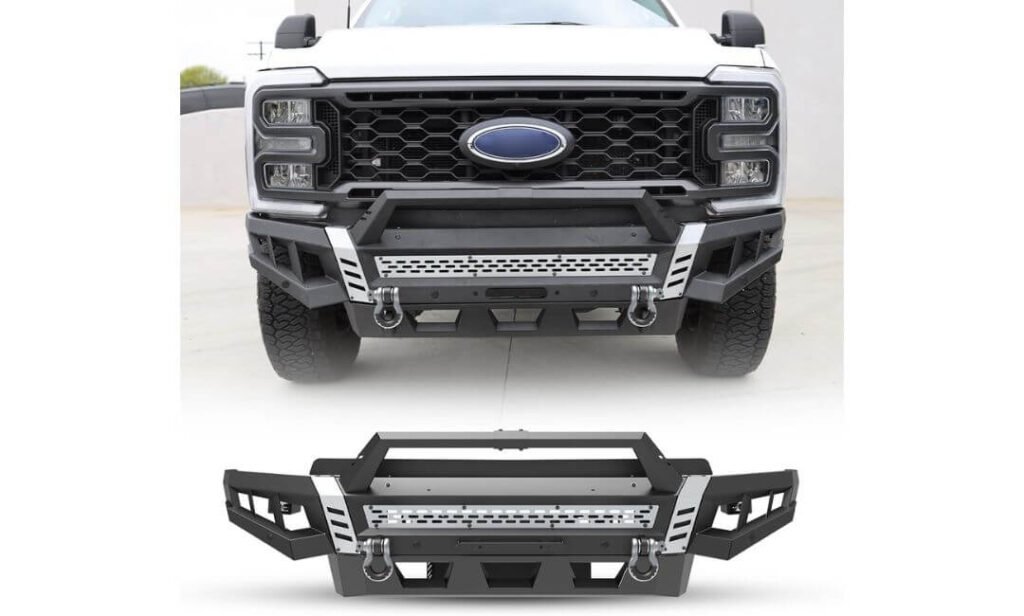
Quick Specs:
- Integrated winch-ready mounting system
- Heavy-duty Q235A carbon steel construction
- Full-width front-end protection design
- Parking sensor compatible
- Included D-rings for vehicle recovery
- Two LED pod lights included
- 30-inch light bar mounting provision
- Flip-up license plate bracket
- Textured black powder-coated finish
- Direct bolt-on installation using factory mounting points
Real talk, this is the kind of bumper that feels like it was designed by someone who actually uses a truck rather than someone creating a catalog photo. The first thing that stands out is how well the recovery features, protection, and factory compatibility work together. You get an integrated winch plate, included D-rings, parking sensor provisions, auxiliary lighting mounts, and a full-width steel structure without turning installation into a weekend-long fabrication project.
The Q235A carbon steel construction gives it the kind of strength most F250 owners are looking for when upgrading from the factory setup. The full-width layout provides additional protection around the front corners, which becomes especially valuable when navigating job sites, ranch roads, wooded trails, or tight off-road terrain. The textured black finish also does a good job hiding everyday wear that naturally comes with truck ownership.
What really pushed this option to the top of our list was the attention to practical details. The flip-up license plate bracket keeps the winch area accessible, the included pod lights add useful illumination, and the pre-drilled parking sensor locations help retain factory functionality that many owners don’t want to sacrifice after upgrading.
(If your goal is adding recovery capability without giving up the convenience of a modern Super Duty, this is one of the most balanced setups currently available.)
What Stood Out During Our Evaluation
- Integrated winch mounting system already built into the design
- Full-width protection without an overly bulky appearance
- Parking sensor ready for factory-equipped trucks
- Included D-rings eliminate the need for immediate recovery upgrades
- Light bar and pod light provisions offer future expansion options
- Factory mounting point installation keeps the process straightforward
A Small Thing Worth Knowing
- A winch and light bar are not included, so recovery and lighting upgrades will need to be selected separately.
Ford F250 Compatibility Notes
This bumper is designed for gasoline-powered Ford F250 Super Duty models and works particularly well for owners looking to combine recovery equipment, front-end protection, and factory sensor functionality in a single upgrade.
Before ordering, it is still worth confirming your truck’s engine configuration and factory equipment package. Taking a few minutes to verify fitment can save a lot of installation headaches later.
The Insider Pro-Tip
Most buyers focus entirely on the winch rating and forget about recovery access. In real-world situations, being able to quickly reach your winch controls, recovery points, and license plate mount matters more than most people expect. The flip-up plate design here is one of those small details that becomes surprisingly useful once the truck is actually equipped and in use.
If you’re planning to add a winch later, consider choosing the winch first and the bumper second. That approach helps ensure proper fitment and gives you a cleaner installation the first time around rather than having to make adjustments after everything is mounted.
#2. longsun Full Width Winch Bumper
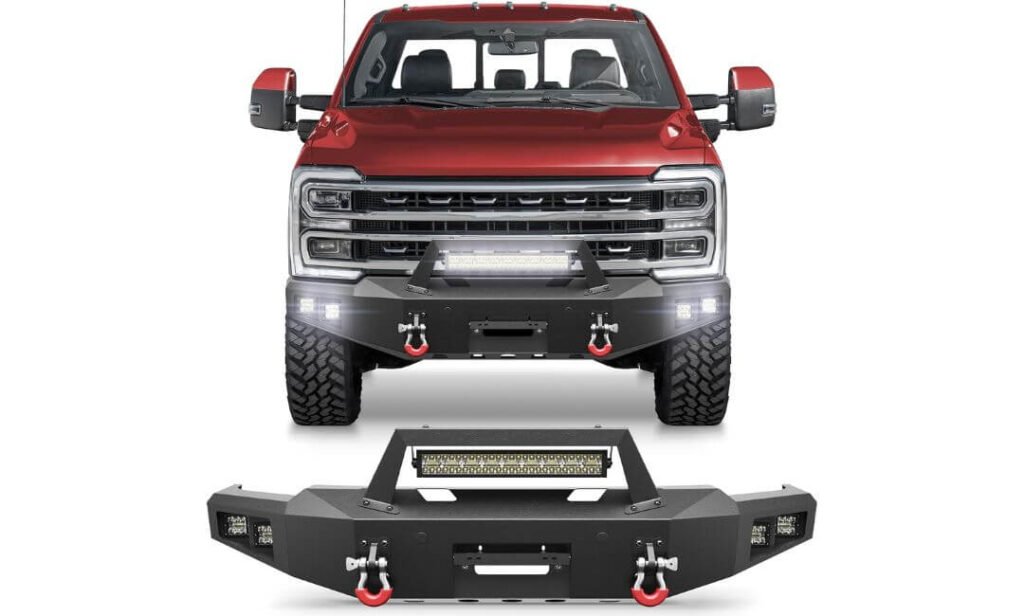
Quick Specs:
- Built-in 12,000-pound winch-ready mounting plate
- Heavy-duty low carbon steel construction
- Full-width protection design
- 144W LED light bar included
- Four 18W LED auxiliary lights included
- Recovery-ready D-ring mounting points
- Parking sensor compatible design
- Flip-up license plate bracket
- Textured black powder-coated finish
- Three-piece modular construction
- Approximate weight: 132 lbs
Few things change the presence of an F250 faster than a properly designed full-width bumper, and this setup immediately makes its intentions clear. Instead of focusing only on appearance, it combines recovery capability, lighting upgrades, and front-end protection into one package that feels purpose-built for heavy-duty truck owners.
The biggest advantage here is the combination of a 12,000-pound rated winch plate and true full-width steel construction. Whether your truck spends time pulling trailers, crossing rough access roads, working around ranch property, or exploring remote trails, the additional coverage around the front corners provides protection that many narrower bumper designs simply cannot match. The steel construction feels substantial without looking oversized, which is not always easy to achieve on a Super Duty platform.
Another detail that impressed us is the lighting package. The included 144W center light bar and four integrated 18W auxiliary lights remove the need for immediate aftermarket lighting upgrades. Combined with recovery points, parking sensor provisions, and a flip-up plate bracket, the overall package feels remarkably complete right out of the box.
(For buyers who want protection, recovery capability, and integrated lighting in a single upgrade, this is one of the strongest value-focused packages currently available.)
Highlights That Made It Stand Out
- Full-width design offers excellent front-end coverage
- Integrated winch plate supports up to 12,000-pound recovery systems
- Included LED light bar and auxiliary lights add immediate functionality
- Recovery-ready D-ring mounts included
- Parking sensor provisions help retain factory convenience
- Three-piece modular construction simplifies transportation and assembly
One Thing To Keep In Mind
- Due to its substantial steel construction and 132-pound weight, having an extra set of hands during installation is highly recommended.
Ford F250 Installation and Compatibility Notes
This bumper is designed around the front-end dimensions of modern Ford F250 Super Duty trucks and uses factory mounting locations to simplify installation. The three-piece design also makes handling easier than many one-piece heavy-duty bumpers during the installation process.
If your truck is already equipped with parking sensors, the pre-drilled sensor locations help preserve factory functionality while still allowing you to move into a much stronger recovery-focused setup.
The Insider Pro-Tip
When evaluating full-width bumpers, don’t focus solely on steel thickness. Pay attention to everything that would normally become an additional purchase after installation. Recovery points, lighting, sensor provisions, license plate access, and winch compatibility all add cost over time.
What makes this option particularly interesting is that many of those upgrades are already integrated from day one. For a lot of F250 owners, that means less time researching accessories and more time actually using the truck the way it was intended to be used.
#3. BESTZHEYU Steel Winch Bumper
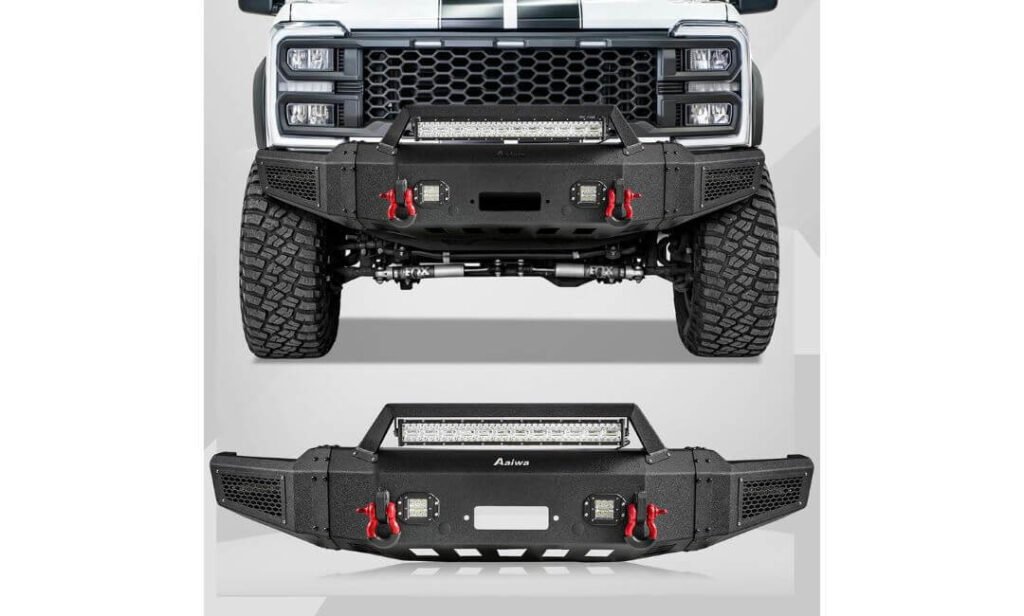
Quick Specs:
- Integrated 12,000-pound winch-ready mounting plate
- Heavy-duty steel construction with reinforced mounting system
- Approximate weight: 142 lbs
- Five LED lights included
- Recovery-ready D-ring mounting points
- Textured black anti-rust powder-coated finish
- Direct bolt-on installation
- Reinforced 3/16-inch steel winch plate
- Sensor-ready front bumper design
- Compact recovery-focused layout
What immediately stands out here is how much functionality is packed into the design without pushing the price into premium territory. Some bumpers focus heavily on appearance while treating recovery features as an afterthought. This one takes the opposite approach. The foundation starts with a reinforced 3/16-inch steel winch plate welded directly into the bumper structure, creating a solid platform for a recovery setup capable of handling serious work.
The lighting package is another pleasant surprise. Instead of requiring immediate accessory purchases, the bumper arrives with five integrated LED lights already built into the design. For owners who regularly drive rural roads, enter job sites before sunrise, or spend time on remote trails after dark, that additional visibility becomes genuinely useful. Combined with the compact front profile, the overall setup feels practical rather than overly decorative.
Another reason this option earned a place in our rankings is its balanced approach to protection and installation. The steel structure provides meaningful front-end defense while still using factory mounting points for a straightforward bolt-on upgrade. That combination makes it appealing to F250 owners who want a capable winch bumper without turning the project into a major modification.
(Sometimes the smartest upgrade is not the most expensive one. It is the one that delivers the features most owners actually use every week.)
Features That Made Us Take Notice
- Reinforced integrated winch plate built into the bumper structure
- Supports recovery systems rated up to 12,000 pounds
- Five included LED lights add immediate value
- Heavy-duty steel construction designed for demanding use
- Direct bolt-on installation simplifies the upgrade process
- Recovery-ready D-ring mounting points already included
One Detail Worth Knowing
- Factory parking sensor compatibility should be verified before installation, as sensor sizing may vary depending on the truck’s original equipment configuration.
Ford F250 Installation and Usage Notes
For F250 owners looking for a straightforward winch-ready upgrade, this bumper keeps things relatively simple. The factory mounting point design eliminates the need for cutting or drilling, helping maintain a cleaner installation process.
The integrated winch plate is one of the strongest aspects of the design. Because it is built directly into the bumper structure rather than added later, recovery loads are supported through a more substantial mounting system that feels purpose-built for heavy-duty truck use.
The Insider Pro-Tip
When comparing value-focused winch bumpers, pay attention to what is already included. Recovery hardware, integrated lighting, reinforced winch support, and installation components can add up surprisingly fast when purchased separately.
That is what makes this option interesting. By the time many owners finish adding lights, recovery points, and mounting accessories to a basic bumper, they often end up spending more than they originally planned. Starting with a bumper that already includes those essentials can be a smarter long-term decision for both convenience and overall value.
#4. VISIDA Steel Bumper Package
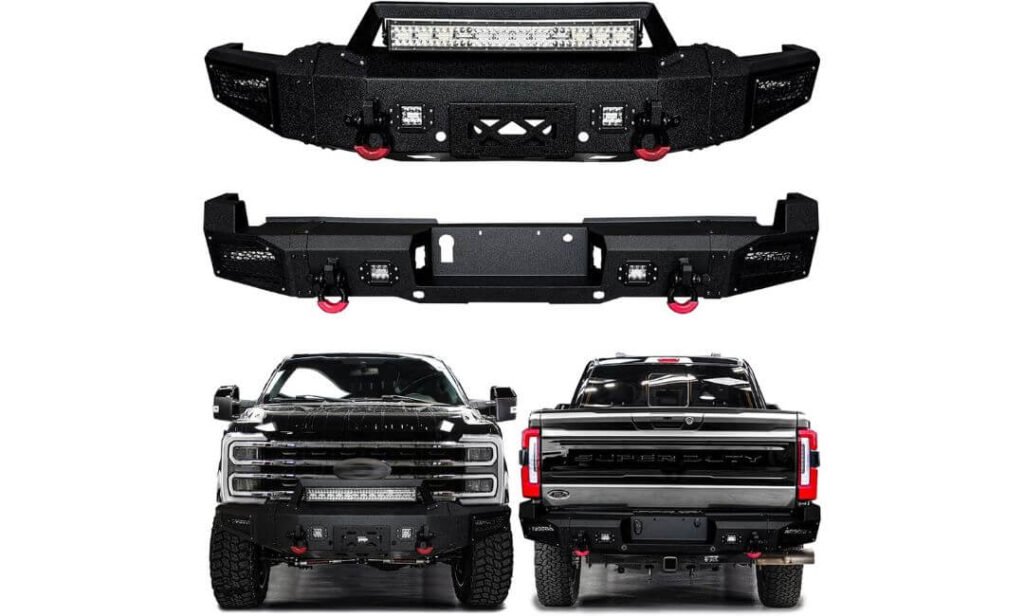
Quick Specs:
- Complete front and rear bumper package
- Integrated winch-ready front bumper design
- Heavy-duty steel construction throughout
- Front bumper weight: 140 lbs
- Rear bumper weight: 92 lbs
- Reinforced 3/16-inch steel winch mounting system
- Included 144W LED light bar
- Included eight 20W LED auxiliary lights
- Four recovery D-rings with isolators included
- Folding license plate bracket
- Textured black powder-coated finish
- Direct bolt-on factory mounting design
There’s a big difference between upgrading a front bumper and transforming the entire protection package of a truck. That’s exactly where this setup separates itself from the rest of the field. Instead of focusing solely on front-end recovery capability, it gives F250 owners a coordinated front and rear protection system that feels far more complete once installed.
The front bumper brings everything most buyers expect from a modern winch-ready design. A reinforced steel structure, integrated winch mounting area, recovery points, lighting provisions, and aggressive styling all come together in a package that looks substantial without appearing excessive. The rear bumper then finishes the truck with the same design language, creating a factory-like appearance that many mixed-brand bumper combinations simply cannot achieve.
Another area where this package stands out is included equipment. Between the 144W light bar, eight auxiliary LED lights, multiple recovery points, folding plate bracket, and both bumpers arriving in one purchase, there is very little left for the owner to source separately. For buyers planning a complete truck build, that convenience can be surprisingly valuable.
(If your long-term goal is upgrading the entire truck rather than only the front end, this package offers a level of consistency that individual bumper purchases often struggle to match.)
Why It Made Our Shortlist
- Includes both front and rear bumpers in one package
- Integrated winch-ready front bumper design
- Large LED lighting package already included
- Multiple recovery points with D-ring hardware
- Consistent styling across both ends of the truck
- Direct factory-mount installation approach
One Thing To Be Aware Of
- The bumper package requires assembly before installation, so setting aside extra installation time is recommended.
Ford F250 Ownership Notes
For many F250 owners, the biggest advantage here is not a single feature. It is the fact that the truck receives a complete protection upgrade all at once. Front-end recovery capability, rear-end durability, integrated lighting, and matching styling are all handled in a single purchase.
Owners building overlanding rigs, towing setups, work trucks, or off-road-focused Super Duty projects will likely appreciate not having to mix different bumper brands later in order to achieve a consistent appearance.
The Insider Pro-Tip
One of the easiest ways to make a truck build look unfinished is installing a heavy-duty front bumper while leaving the rear completely stock. The difference becomes more noticeable every time you walk around the vehicle.
That is why complete bumper packages continue to attract serious truck owners. Even if recovery capability is the original goal, having both ends upgraded at the same time often delivers a cleaner result, better long-term value, and a truck that looks purpose-built rather than modified one piece at a time.
Best Ford F250 Winch Bumper Comparison Chart: Features, Protection and Recovery Capability
| Comparison Area | Hawkley Front Winch Bumper | longsun Full Width Winch Bumper | BESTZHEYU Steel Winch Bumper | VISIDA Steel Bumper Package |
|---|---|---|---|---|
| Our Verdict | Best Overall Choice | Best Full Width Protection | Best Value Pick | Best Complete Upgrade |
| Steel Construction | Q235A Carbon Steel | Low Carbon Steel | Heavy-Duty Reinforced Steel | Heavy-Duty Alloy Steel |
| Winch Ready Design | Integrated Winch Plate | 12,000 lb Winch Support | 12,000 lb Winch Support | Integrated Winch Plate |
| Front-End Protection | Excellent | Maximum Coverage | Strong Protection | Excellent |
| Parking Sensor Support | Factory Sensor Ready | Sensor Ready | Verify Sensor Fitment | Aftermarket Sensors Needed |
| LED Lighting Included | 2 Pod Lights | 144W Light Bar + 4 LED Lights | 5 LED Lights | 144W Light Bar + 8 LED Lights |
| D-Ring Recovery Points | Included | Included | Included | 4 Included |
| Light Bar Provision | Up To 30 Inches | Included | LED System Included | Included |
| Installation Style | Direct Bolt-On | Direct Bolt-On | Direct Bolt-On | Direct Bolt-On |
| Approximate Weight | Moderate Weight Design | 132 lbs | 142 lbs | 232 lbs Combined |
| Best For | Daily Drivers Needing Balance | Towing And Heavy-Duty Protection | Budget-Conscious Buyers | Complete Truck Builds |
| Standout Advantage | Factory-Friendly Design | Protection + Lighting Package | Value + Recovery Capability | Front And Rear Coverage |
| Overall Recommendation | Most F250 Owners | Work Trucks & Towing Setups | Best Bang For Your Buck | Full Vehicle Protection Build |
Ford F250 Winch Bumper Buying Guide
Upgrading to a winch bumper is one of the most functional modifications you can make to a Ford F250. Unlike cosmetic accessories, a bumper directly affects recovery capability, front-end protection, off-road durability, lighting options, and even how well factory safety systems continue to operate. The challenge is that many bumpers look similar online, yet perform very differently once installed on the truck.
Before spending your money, it helps to understand what actually separates a good winch bumper from one that simply looks good in product photos.
Compatibility Should Always Come First
The most expensive mistake F250 owners make is assuming every bumper marketed for their truck will fit their specific configuration.
Modern F250 models can be equipped with parking sensors, adaptive systems, factory tow hooks, front cameras, and other equipment that may affect bumper compatibility. A bumper may physically bolt onto the truck while still creating issues with sensors, license plate placement, or recovery equipment.
Before ordering, verify:
- Model year compatibility
- Gas or diesel configuration if specified by the manufacturer
- Parking sensor requirements
- Factory camera requirements
- Factory tow hook compatibility
- Front-end accessory requirements
A bumper that works properly with your truck’s existing equipment will almost always provide a better ownership experience than one requiring additional modifications after installation.
Understanding Winch Mount Capacity
Not all integrated winch plates are created equally.
A winch bumper should provide a reinforced mounting structure capable of handling recovery loads without excessive flex or stress. The winch plate is one of the most important structural components because it transfers pulling forces into the vehicle frame during recovery situations.
When evaluating a bumper, look for:
- Integrated steel winch mounting systems
- Reinforced mounting brackets
- Frame-supported mounting points
- Clear winch capacity information
- Recovery-focused construction
For most F250 owners, a bumper capable of supporting a 12,000-pound winch provides an excellent balance between recovery capability and practicality.
Remember that the bumper itself is only part of the recovery system. The quality of the winch mounting structure is just as important as the winch you eventually install.
Steel vs Aluminum Construction
Material selection plays a major role in long-term durability, protection, and overall weight.
Steel remains the most common choice for heavy-duty F250 applications because it offers excellent impact resistance and recovery strength. Most quality aftermarket bumpers use carbon steel, low-carbon steel, or reinforced alloy steel construction.
Steel Bumpers Typically Offer:
- Better impact resistance
- Greater recovery strength
- Improved durability in demanding environments
- Better value for heavy-duty applications
Aluminum Bumpers Typically Offer:
- Reduced overall vehicle weight
- Better corrosion resistance
- Easier handling during installation
- Improved fuel-efficiency potential
For towing, work trucks, overlanding, and recovery-focused builds, steel continues to be the preferred option for most F250 owners.
Why Powder Coating Matters More Than Many Buyers Realize
A bumper is constantly exposed to road salt, rain, mud, rocks, gravel, and changing weather conditions.
The quality of the protective finish often determines how good the bumper will look several years after installation.
A quality textured powder-coated finish helps:
- Reduce corrosion
- Resist scratches and chips
- Maintain appearance over time
- Simplify cleaning and maintenance
- Improve long-term durability
When comparing bumpers, don’t focus solely on steel thickness. The protective coating deserves equal attention because it directly affects long-term ownership satisfaction.
Approach Angles and Ground Clearance
Many buyers focus on protection while overlooking how a bumper affects vehicle capability.
A poorly designed bumper can reduce approach angles, increase front-end overhang, and make off-road driving more difficult.
A well-designed F250 winch bumper should:
- Maintain reasonable approach angles
- Protect vulnerable front-end components
- Avoid unnecessary overhang
- Support recovery equipment without excessive bulk
- Preserve practical ground clearance
This becomes especially important for trucks used on trails, ranch roads, logging roads, construction sites, or remote access routes.
Installation Requirements and What To Expect
Most modern F250 winch bumpers use direct bolt-on designs that reuse factory mounting locations.
However, installation complexity can still vary significantly depending on bumper size and weight.
Before beginning installation, prepare:
- Socket set
- Ratchet and extensions
- Torque wrench
- Safety gloves
- Floor jack or lifting assistance
- Additional helper for heavy bumpers
Many steel bumpers weigh well over 100 pounds. Having a second person available often makes installation safer, easier, and faster.
Warranty and After-Sales Support
Warranty coverage is often overlooked until a problem occurs.
A manufacturer willing to support its product after the sale usually provides greater confidence than a company offering little or no customer support.
Before purchasing, check:
- Warranty duration
- Replacement part availability
- Customer support responsiveness
- Installation assistance
- Return policies
- Hardware replacement options
Even the best bumper can occasionally require replacement hardware or technical assistance, making support quality an important factor in the buying decision.
Ford F250 Winch Bumper Evaluation Checklist
Before making a final purchase decision, ask yourself the following questions:
- Is the bumper designed specifically for my F250 generation?
- Does it support the winch size I plan to install?
- Will my factory parking sensors continue to function?
- Does it include recovery points?
- Is the steel construction appropriate for my intended use?
- Does it use a durable powder-coated finish?
- Will installation require cutting or drilling?
- Does the bumper maintain acceptable ground clearance?
- Is warranty coverage available?
- Does the overall design match how I actually use my truck?
If the answer is yes to most of these questions, you’re likely looking at a quality option.
Mistakes That Frequently Lead To Buyer Regret
The biggest problems usually appear when buyers focus on appearance while ignoring functionality.
Common mistakes include:
- Buying solely based on price
- Ignoring sensor compatibility
- Overlooking bumper weight
- Choosing style over recovery capability
- Not verifying winch fitment
- Ignoring warranty coverage
- Purchasing a bumper without recovery points
- Underestimating installation requirements
The best bumper is rarely the most aggressive-looking option. It is the one that performs reliably every time the truck needs it.
Essential Winch Bumper Terms Every Buyer Should Know
Winch Plate
A reinforced steel mounting structure designed to securely support a recovery winch.
Recovery Points
Dedicated attachment locations used during vehicle recovery operations, typically supporting D-rings or shackles.
D-Rings
Heavy-duty recovery hardware used to connect straps, ropes, and recovery equipment to the vehicle.
Shackle Mounts
Reinforced bumper mounting points designed to support recovery shackles.
Approach Angle
The maximum angle a vehicle can climb without the front bumper contacting the ground or obstacle.
Powder Coating
A protective finish applied to metal surfaces to improve corrosion resistance and durability.
Direct Bolt-On Installation
An installation method that uses factory mounting locations without requiring cutting, drilling, or welding.
Full-Width Bumper
A bumper extending across the full front width of the vehicle, providing maximum protection.
Parking Sensor Compatibility
The ability of a bumper to accommodate factory or aftermarket parking sensors without interfering with their operation.
Integrated Lighting Mounts
Built-in locations designed for LED pods, fog lights, or light bars without requiring additional brackets.
A well-chosen winch bumper is not simply an accessory. For many Ford F250 owners, it becomes one of the most useful upgrades on the truck, improving recovery capability, protection, and confidence every time the vehicle leaves the pavement.
Feature Spotlight: What Separates These Ford F250 Winch Bumpers From Average Options
One thing became clear while researching this guide. Most aftermarket bumpers promise the same things, stronger protection, better recovery capability, aggressive styling, and improved durability. However, once you start comparing the details, the differences become much easier to spot.
The bumpers that earned a place in this guide were not selected simply because they look rugged in photos. They stood out because they addressed the practical needs of modern F250 owners, including recovery readiness, factory feature compatibility, protection, installation simplicity, and long-term usability.
Factory Sensor Compatibility Is No Longer Optional
A few years ago, bumper shopping was relatively simple. Most truck owners only needed a strong steel structure and recovery points.
Modern F250 trucks are different.
Many models are equipped with parking sensors and other factory technologies that owners rely on every day. Losing those features after installing an aftermarket bumper often creates frustration that lasts far longer than the excitement of the upgrade itself.
That is why sensor integration received significant attention during our evaluation process.
Several bumpers in this guide include dedicated sensor provisions designed to work with factory-style parking sensor layouts. Others provide pre-drilled sensor locations that simplify installation for owners planning to retain or add compatible sensors later.
For many truck owners, maintaining these factory conveniences is just as important as gaining additional protection.
A bumper should improve capability without forcing you to sacrifice features you already paid for.
Real Winch Readiness Goes Beyond A Marketing Claim
The phrase “winch-ready” appears on countless product listings, but the actual implementation varies dramatically from one bumper to another.
A true winch-ready bumper should provide a reinforced mounting structure capable of transferring recovery forces safely into the vehicle’s frame. Simply cutting a hole for a winch does not automatically create a reliable recovery platform.
The bumpers featured in this guide offer integrated winch mounting solutions designed specifically for recovery applications. Several also support recovery systems rated up to 12,000 pounds, making them suitable for the type of heavy-duty work many F250 owners regularly encounter.
We also paid attention to practical installation details such as:
- Integrated winch plate design
- Reinforced mounting structures
- Fairlead mounting provisions
- Front-access recovery points
- License plate accessibility after winch installation
- Recovery-friendly bumper layouts
These details may not appear exciting in product photos, but they become extremely important the first time a recovery situation occurs.
Front-End Protection That Works In The Real World
The factory bumper performs adequately for normal driving, but many owners upgrade because they want greater confidence when operating in demanding environments.
Job sites, ranch roads, hunting trails, mountain access roads, construction zones, and remote campsites all expose the front of a truck to hazards that everyday commuting rarely presents.
The bumpers selected for this guide improve protection in several key areas.
First, the heavy-duty steel construction provides a stronger defense against impacts than the factory setup.
Second, full-width and reinforced designs help shield vulnerable front-end components from brush, rocks, debris, and unexpected obstacles.
Third, many of these bumpers improve lower-front durability around areas where factory air dams and plastic trim components are often susceptible to damage.
Protection is not simply about surviving a collision. It is about reducing the likelihood of damage occurring in the first place.
Recovery Hardware Quality Matters More Than Most Buyers Expect
Recovery points are among the most important components on any winch bumper.
Unfortunately, they are also one of the easiest features for buyers to overlook.
During recovery operations, significant loads can be transferred through D-rings, shackle mounts, recovery straps, and associated hardware. Weak mounting locations or poorly designed recovery points can quickly become liabilities.
That is why we paid close attention to:
- Integrated D-ring mounting locations
- Reinforced shackle mounts
- Steel recovery brackets
- Mounting plate strength
- Recovery-oriented bumper construction
Several products in this guide include D-rings as standard equipment, while others incorporate dedicated recovery points that allow owners to build a more complete recovery setup later.
The result is a bumper that contributes to vehicle recovery rather than simply providing a place to attach accessories.
Finding The Right Balance Between Appearance And Function
Every truck owner wants a bumper that looks good.
The challenge is that some bumpers prioritize appearance so heavily that functionality becomes secondary.
Large decorative sections, excessive bulk, awkward overhangs, and unnecessary design elements may attract attention online, but they do not always improve real-world performance.
The strongest options typically balance visual appeal with practical engineering.
That balance was one of the reasons these products consistently rose to the top during our research.
Several offer aggressive styling while still preserving:
- Recovery accessibility
- Winch usability
- Parking sensor integration
- Front-end protection
- Lighting flexibility
- Reasonable installation requirements
A well-designed bumper should enhance the truck’s appearance because it serves a purpose, not because it relies on unnecessary styling tricks.
The Small Details That Often Separate Good From Great
After comparing dozens of options, it became obvious that the best bumpers are usually distinguished by details many buyers initially overlook.
Features such as:
- Flip-up license plate brackets
- Integrated light bar mounting provisions
- Included auxiliary lighting
- Modular construction designs
- Direct bolt-on installation systems
- Protective powder-coated finishes
- Pre-drilled sensor locations
may seem minor individually.
However, when combined into a single product, they create a noticeably better ownership experience.
That is ultimately why the bumpers in this guide stood out. They do not rely on a single feature to justify their position. Instead, they combine protection, recovery capability, compatibility, and practical functionality into packages that make sense for how most Ford F250 owners actually use their trucks every day.
Ford F250 Winch Bumper Installation Primer
Installing a winch bumper on a Ford F250 is not necessarily a difficult project, but it is very different from installing smaller truck accessories. Most winch bumpers are built from heavy-gauge steel, often weighing well over 100 pounds before a winch, fairlead, lighting equipment, or recovery hardware is added. Because of that, preparation matters just as much as the installation itself.
The good news is that all of the bumpers featured in this guide are designed around factory mounting locations, which significantly simplifies the process compared to custom fabrication projects. Even so, taking a careful approach can make the difference between a clean factory-like installation and a frustrating weekend in the garage.
Tools and Preparation Checklist
Before touching a single bolt, gather everything you may need for the installation. Stopping halfway through because a tool is missing is one of the most common reasons installations take far longer than expected.
Recommended preparation items include:
- Complete metric and SAE socket set
- Ratchet and breaker bar
- Torque wrench
- Open-end wrench set
- Trim removal tools
- Protective gloves
- Safety glasses
- Floor jack or transmission jack
- Jack stands if additional clearance is needed
- Thread locker where recommended by the manufacturer
- Touch-up paint for exposed hardware if desired
- Shop light or portable work light
In addition to tools, it is worth inspecting the new bumper immediately after delivery. Shipping damage is uncommon but much easier to address before installation begins.
Take a few minutes to verify:
- Mounting brackets are included
- Hardware kits are complete
- Powder coating is undamaged
- Recovery points are properly welded
- Winch mounting surfaces are straight
- Sensor openings match your intended setup
A short inspection now can prevent major delays later.
Understanding The Installation Process Before You Begin
Most modern F250 winch bumpers follow a similar installation sequence.
First, the factory bumper assembly is removed along with any brackets, trim panels, license plate mounts, and related hardware. Depending on the truck configuration, parking sensors, wiring harnesses, or lighting components may also need to be disconnected and transferred.
Once the factory bumper is removed, the frame mounting points become accessible. This is an excellent opportunity to inspect mounting surfaces, remove accumulated dirt, and check for corrosion or damage before installing the new bumper.
The aftermarket bumper is then positioned onto the factory mounting locations. Due to weight, many owners find this stage significantly easier with a second person assisting.
After alignment is confirmed:
- Mounting hardware is installed loosely
- Sensor components are transferred if applicable
- Winch mounting components are installed if required
- Lighting systems are connected
- Recovery hardware is secured
- Final alignment adjustments are made
- Hardware is torqued to specification
Only after everything is properly aligned should final tightening begin.
Why Bumper Alignment Deserves Extra Attention
One area that often separates professional-looking installations from average ones is alignment.
Even a high-quality bumper can look incorrect if spacing around the grille, headlights, fenders, and lower valance is uneven.
Before final torqueing, carefully inspect:
- Hood-to-bumper spacing
- Headlight alignment gaps
- Fender-to-bumper transitions
- License plate bracket positioning
- Winch fairlead alignment
- Sensor placement consistency
Small adjustments at this stage can dramatically improve the finished appearance.
Many experienced installers spend more time aligning the bumper than actually mounting it.
Common Installation Challenges And How To Avoid Them
Most installation difficulties are predictable and can usually be avoided with proper preparation.
One of the most common challenges involves bumper weight. Heavy-duty steel bumpers are awkward to lift and position alone, even for experienced installers.
Using a floor jack, transmission jack, or an additional helper often makes installation safer and more accurate.
Another frequent issue involves sensor transfer.
Factory sensors may require careful handling to avoid damage during removal and installation. Rushing this step can create unnecessary troubleshooting later.
Wiring management can also become problematic when auxiliary lights or light bars are involved.
Taking the time to properly secure wiring away from moving components, heat sources, and sharp edges helps prevent future electrical issues.
Finally, many owners underestimate the importance of loosely mounting all hardware before tightening anything.
Keeping everything adjustable until final alignment is completed makes the process far easier.
Safety Considerations Every F250 Owner Should Know
A winch bumper is one of the heaviest accessories commonly installed on a truck.
Because of that, safety should never be treated as an afterthought.
Keep these principles in mind throughout the installation:
- Never support a bumper solely by hand during final mounting
- Use lifting assistance whenever possible
- Wear eye protection when working beneath the truck
- Verify all mounting hardware is fully seated before tightening
- Follow manufacturer torque recommendations
- Keep wiring away from sharp edges and moving parts
- Avoid working alone when handling large steel components
Even experienced truck owners often choose to have a second person present during installation simply because it makes positioning and alignment significantly easier.
When Professional Installation Makes Sense
Many F250 owners successfully install winch bumpers at home.
However, professional installation may be worth considering if:
- A winch is being installed simultaneously
- Lighting systems require extensive wiring
- Sensor integration is unfamiliar territory
- Lifting equipment is unavailable
- The bumper package is particularly heavy
- Time is limited
Professional installation can also be beneficial when multiple accessories are being installed together because everything can be aligned and wired during a single visit.
Post-Installation Checks You Should Never Skip
The installation is not truly complete once the last bolt is tightened.
A thorough inspection afterward helps ensure the bumper performs as intended.
Begin with a visual inspection.
Check for:
- Even body gaps
- Proper grille clearance
- Secure recovery points
- Straight license plate bracket alignment
- Lighting functionality
- Sensor positioning
- Winch plate accessibility
Next, verify that all hardware remains properly torqued after the bumper has settled into position.
For trucks equipped with parking sensors, test sensor operation in a safe environment before returning to normal driving. If the truck uses sensor-equipped bumper provisions, confirm that no warning messages appear and that detection remains consistent.
Lighting systems should also be checked for proper operation, beam alignment, and wiring security.
The Final Step Most Owners Forget
After several days of driving, perform a complete hardware recheck.
New bumpers, mounting brackets, winch plates, and recovery hardware can settle slightly after initial installation.
A quick inspection of mounting bolts, recovery points, lighting brackets, and winch hardware can help catch minor loosening before it becomes a problem.
It is a simple step, but it is one of the best habits any F250 owner can develop after installing a heavy-duty winch bumper. Properly installed, aligned, and inspected, a quality winch bumper can provide years of dependable service while adding meaningful protection and recovery capability to the truck.
Ford F250 Winch Bumper Maintenance and Care
A quality winch bumper is designed to handle conditions that would quickly damage many factory components. Mud, gravel, road salt, standing water, recovery loads, flying debris, and harsh weather are all part of the environment these bumpers are built for. However, even the strongest steel bumper benefits from regular maintenance.
The reality is simple. Most bumper failures do not happen because the steel was weak. They happen because small issues go unnoticed for months or years until corrosion, loose hardware, or neglected recovery components create larger problems.
Fortunately, keeping a Ford F250 winch bumper in excellent condition does not require complicated maintenance routines. A few simple inspections throughout the year can significantly extend its lifespan and preserve both appearance and functionality.
Keeping The Finish Clean And Protected
The powder-coated finish found on most modern winch bumpers does an excellent job resisting weather and everyday wear. Even so, dirt, road grime, salt residue, and mud can gradually damage protective coatings if left untreated for long periods.
Routine cleaning helps preserve the finish while making inspections easier.
A simple maintenance routine should include:
- Rinsing off mud and road salt as soon as practical
- Washing with automotive-safe soap
- Cleaning around D-ring mounts and recovery points
- Removing debris trapped behind lighting mounts
- Inspecting lower edges where moisture often accumulates
- Drying the bumper after washing when possible
Many owners focus only on visible surfaces, but the underside of the bumper often experiences the harshest conditions.
Pay particular attention to:
- Mounting brackets
- Welded joints
- Winch plate areas
- Recovery point mounting locations
- Hardware mounting surfaces
These locations are often exposed to moisture long before visible corrosion appears.
Preventing Corrosion Before It Starts
Corrosion prevention is far easier than corrosion repair.
Even heavily powder-coated steel can eventually develop surface damage from rocks, debris, branches, or recovery equipment.
When inspecting the bumper, look closely for:
- Paint chips
- Scratches exposing bare metal
- Surface rust spots
- Abrasions around recovery points
- Damage near mounting hardware
- Areas where accessories contact the bumper
Small chips should be addressed early.
Touch-up paint designed for textured black finishes can help seal exposed metal before corrosion spreads. While cosmetic imperfections are normal on working trucks, protecting exposed steel helps preserve structural integrity over the long term.
Owners who frequently encounter road salt or coastal environments should be particularly proactive with inspections.
Recovery Points Deserve Special Attention
Recovery points are among the hardest-working components on a winch bumper.
Every recovery load, tow strap, shackle, and extraction operation places stress on these areas.
That is why recovery hardware should never be treated as a permanent install-and-forget component.
Inspect recovery points regularly for:
- Visible cracks
- Bent hardware
- Distorted mounting surfaces
- Damaged D-rings
- Excessive wear around shackle holes
- Rust forming inside recovery openings
Any component that appears compromised should be replaced immediately.
Recovery equipment is designed to handle significant loads, but only when maintained properly.
A few minutes spent inspecting recovery points can prevent much larger problems during a future recovery situation.
Checking Mounting Hardware For Long-Term Reliability
Heavy-duty steel bumpers place substantial loads on mounting systems.
Daily driving, towing, rough roads, and off-road use can gradually introduce vibration throughout the mounting structure.
For that reason, periodic hardware inspections are highly recommended.
At regular intervals, verify:
- Mounting bolts remain properly tightened
- Brackets remain properly aligned
- No hardware shows signs of corrosion
- Washers remain correctly positioned
- Recovery brackets remain secure
- Winch mounting bolts remain tight
Many experienced truck owners perform a quick visual inspection whenever the truck is already being serviced or washed.
The process takes only a few minutes but provides valuable peace of mind.
Winch Mount Areas Require Additional Monitoring
Even if a winch is rarely used, the mounting area deserves routine attention.
Winches add significant weight to the front bumper and create additional stress around mounting locations.
Inspect the winch area for:
- Loose mounting hardware
- Fairlead movement
- Corrosion near mounting points
- Cable abrasion
- Wiring wear
- Frame contact points
A secure winch installation helps protect both the winch and the bumper structure supporting it.
Lighting Components Should Not Be Ignored
Many modern F250 winch bumpers include integrated lighting systems.
Whether equipped with LED pods, fog lights, or larger light bars, these components benefit from occasional inspections.
Check periodically for:
- Moisture inside lenses
- Damaged wiring
- Loose mounting hardware
- Corrosion on electrical connectors
- Cracked lenses
- Reduced light output
Catching small electrical issues early is usually far easier than diagnosing larger lighting problems later.
What To Inspect After Every Off-Road Trip
Off-road use places unique stress on bumper systems.
Even a short trail run can expose the bumper to impacts, vibration, mud, branches, rocks, and recovery loads.
After returning home, perform a quick inspection that includes:
- Recovery points
- Winch mounting hardware
- D-rings and shackles
- Lighting systems
- Parking sensor openings
- Lower bumper edges
- Powder-coated surfaces
- Mounting brackets
Pay special attention to areas that may have contacted rocks, brush, or obstacles during the trip.
Most problems are easiest to identify immediately after an off-road outing while evidence is still visible.
Seasonal Maintenance Makes A Difference
Different seasons create different maintenance priorities.
Winter often introduces road salt and moisture.
Spring frequently reveals damage hidden beneath winter grime.
Summer can expose coatings to intense UV radiation and dust.
Fall often brings wet leaves, mud, and increased moisture retention.
Adjusting maintenance routines to match seasonal conditions helps maximize bumper longevity.
For many owners, a thorough inspection at the start and end of each season provides an ideal balance between effort and protection.
The Long-Term Ownership Mindset
The best-maintained bumpers are rarely the ones that receive constant attention.
They are the ones that receive consistent attention.
Most of the bumpers featured in this guide are built from heavy-duty steel and designed for years of service. However, durability should never be confused with invincibility.
Regular cleaning, occasional touch-ups, recovery hardware inspections, and post-trip checks require very little time, yet they play a major role in preserving appearance, safety, and performance.
A winch bumper is more than an accessory hanging on the front of a truck. It is a critical piece of recovery and protection equipment. Treat it accordingly, and it will continue serving your Ford F250 long after lesser components have worn out or been replaced.
Real-World Use Cases and Testing Protocols
A winch bumper can look impressive in a product listing, but the real question is how it performs once the truck leaves the pavement. Most Ford F250 owners do not buy a heavy-duty bumper simply for appearance. They buy one because they want additional protection, reliable recovery capability, and greater confidence when conditions become less predictable.
That is why we always place more value on real-world usability than marketing claims. A bumper that performs well during an actual recovery, survives repeated exposure to mud and debris, and continues working with factory systems is far more valuable than one that only looks good in a parking lot.
The following situations represent the types of environments where a quality F250 winch bumper can genuinely prove its worth.
How These Bumpers Perform In Mud, Deep Ruts, And Soft Terrain
Mud remains one of the most common situations where a winch bumper becomes useful.
Unlike rocky terrain, mud often creates recovery situations with little warning. A truck that feels perfectly stable one moment can suddenly lose traction and sink into soft ground the next.
In these conditions, several bumper characteristics become particularly important:
- Strong winch mounting support
- Easily accessible recovery points
- D-ring compatibility
- Front-end protection from hidden obstacles
- Secure mounting hardware
One advantage of the bumpers featured in this guide is that recovery hardware remains relatively accessible even when the truck is partially buried in mud.
Integrated winch plates also provide a more secure mounting solution than temporary recovery setups that rely on aftermarket brackets or improvised attachment points.
For F250 owners who frequently travel on ranch property, construction sites, hunting land, logging roads, or muddy access trails, these recovery-focused features can become valuable much sooner than expected.
Rock Crawling And Technical Trail Conditions
Although the F250 is not typically viewed as a dedicated rock-crawling platform, many owners encounter rocky terrain during overlanding trips, mountain travel, and remote worksite access.
In these situations, bumper design plays a major role in vehicle protection.
The strongest performers typically provide:
- Full-width steel protection
- Reinforced recovery points
- Durable powder-coated finishes
- Secure frame-mounted construction
- Protection for vulnerable front-end components
Rock impacts rarely occur exactly where drivers expect them.
A quality steel bumper helps absorb minor impacts while reducing the risk of damage to factory body panels, lower trim sections, and other expensive components.
This becomes especially valuable when maneuvering a large truck through tight terrain where precise tire placement is not always possible.
Water Crossings And Wet Conditions
Water crossings introduce a different set of challenges.
While a bumper itself is designed to tolerate moisture exposure, water can accelerate corrosion if maintenance is neglected afterward.
During testing and evaluation, several bumper characteristics become important:
- Powder-coated finish quality
- Weld integrity
- Recovery point durability
- Hardware corrosion resistance
- Drainage around mounting locations
The heavy-duty steel bumpers featured in this guide generally provide excellent structural durability in wet environments. However, regular cleaning and post-trip inspections remain essential after repeated exposure to water, mud, or road salt.
The bumper should not simply survive water crossings. It should remain reliable months and years afterward.
Sensor Performance In Dirt, Dust, And Debris
Modern F250 trucks often include parking sensors that owners rely on daily.
One concern many buyers have when upgrading bumpers is whether sensor performance will remain consistent after installation.
The reality is that sensor performance depends on several factors:
- Sensor placement
- Sensor alignment
- Mounting depth
- Wiring integrity
- Environmental conditions
In debris-heavy environments, mud, snow, dust, and packed dirt can temporarily affect sensor performance regardless of bumper design.
That is not necessarily a bumper issue.
Even factory sensor systems can experience reduced effectiveness when sensor surfaces become obstructed.
The bumpers included in this guide earned attention partly because they provide dedicated sensor provisions or sensor-ready configurations that help preserve factory functionality.
For owners who regularly encounter harsh conditions, occasional cleaning of sensor surfaces should be considered part of normal vehicle maintenance.
Recovery Situations Where Winch Bumpers Earn Their Value
Many truck owners install a winch bumper long before purchasing a winch.
Then one day they find themselves wishing they had installed both at the same time.
Recovery situations rarely arrive with advance notice.
Common examples include:
- Deep mud
- Snow-covered trails
- Washed-out roads
- Steep inclines
- Stuck trailers
- Fallen trees
- Soft sand
- Remote backcountry routes
In these moments, the quality of the bumper’s winch mounting system becomes extremely important.
The integrated winch-ready designs featured throughout this guide provide a stronger and more organized solution than many aftermarket mounting alternatives.
When properly installed, the bumper, winch plate, recovery points, and vehicle frame work together as a complete recovery system.
That level of integration is one of the primary reasons many experienced truck owners choose dedicated winch bumpers in the first place.
What We Look For During Recovery-Focused Evaluation
When evaluating winch bumpers, we focus on more than specifications.
Several practical questions help determine whether a bumper is truly recovery-ready.
These include:
- Can recovery points be accessed easily?
- Is the winch mounting location properly reinforced?
- Is license plate access maintained?
- Are D-rings positioned for practical use?
- Does the bumper interfere with recovery equipment?
- Is lighting protected from recovery hardware?
- Does the bumper remain stable under load?
These considerations often reveal more about a bumper’s real-world capability than a product description ever will.
Why Real-World Functionality Matters More Than Specifications
Specification sheets are useful.
They tell you steel thickness, dimensions, weight, lighting output, and recovery ratings.
What they do not tell you is how a bumper feels when you are knee-deep in mud trying to reach a recovery point during bad weather.
They do not tell you whether sensor provisions were thoughtfully designed.
They do not tell you whether mounting hardware remains secure after months of rough roads.
That is why real-world functionality remains one of the most important evaluation criteria in this guide.
The bumpers featured here were selected because they offer a practical balance of protection, recovery capability, compatibility, and durability that aligns with how many Ford F250 owners actually use their trucks.
At the end of the day, the best winch bumper is not the one with the longest feature list. It is the one that performs exactly as expected when the truck needs it most.
FAQs About Ford F250 Winch Bumper
Will a heavy-duty winch bumper affect the ride quality or front suspension of a Ford F250?
In most cases, a quality winch bumper alone will not dramatically change how a Ford F250 drives. However, things become different once a steel bumper, winch, fairlead, recovery gear, auxiliary lights, and additional accessories are installed together. At that point, the combined weight can become significant.
What many owners discover is that suspension performance depends less on the bumper itself and more on the total front-end weight being added to the truck. A bumper that feels perfectly fine on a lightly equipped F250 may behave differently once a fully loaded recovery setup is installed.
If your truck regularly carries a snow plow, heavy diesel equipment, large toolboxes, or towing accessories, it is worth considering how all of those additions work together. Looking at the truck as a complete system rather than a collection of individual upgrades often leads to better long-term results.
Is it better to buy a Ford F250 winch bumper now and add the winch later, or purchase everything at once?
A surprising number of experienced truck owners install the bumper first and the winch months later. There is nothing wrong with that approach, especially when budget planning is involved.
The challenge is that not every winch has identical dimensions, mounting requirements, or fairlead configurations. Installing the winch at the same time often allows everything to be aligned, wired, and tested during a single installation session.
If you know which winch you eventually plan to use, consider checking:
- Winch footprint dimensions
- Fairlead compatibility
- Controller access location
- Cable routing requirements
- Electrical wiring plans
Doing that homework early can eliminate a lot of guesswork later and help avoid surprises during the final installation.
For a Ford F250 used mainly for towing and highway travel, is a full-width bumper actually worth it?
For many towing-focused F250 owners, a full-width bumper makes more sense than an aggressive off-road design.
When towing large trailers, travelling rural highways, crossing ranch property, or driving through areas with wildlife activity, the additional corner protection offered by a full-width bumper can provide real-world benefits. It helps shield more of the truck’s front-end structure and often creates a more integrated appearance with the Super Duty’s overall size.
That said, there is no universal answer. Owners who prioritize maximum approach angles for off-road travel may prefer a more compact design. The best choice depends less on appearance and more on how the truck is actually used throughout the year.
How can I tell if a winch bumper is truly recovery-ready instead of simply being marketed as winch compatible?
This is one of the smartest questions a buyer can ask.
Many bumpers advertise winch compatibility, but recovery readiness involves much more than having a space where a winch can physically fit. The real strength comes from how the winch plate, mounting brackets, bumper structure, and frame attachment points work together under load.
When evaluating a bumper, pay attention to details such as:
- Reinforced winch mounting structure
- Weld quality around recovery areas
- D-ring integration
- Hardware size and mounting method
- Frame-supported load paths
A bumper designed around recovery will usually reveal that focus in its engineering. A bumper designed primarily for appearance often becomes much easier to identify once you start examining those structural details.
What is the biggest mistake first-time buyers make when choosing a Ford F250 winch bumper?
Most people assume the biggest mistake is buying a cheap bumper. In reality, the more common mistake is buying the wrong bumper for how the truck is actually used.
A truck that spends its life towing equipment trailers has different needs than a truck used for overlanding. A work truck operating on construction sites has different priorities than a weekend trail rig. Yet many buyers shop based on styling alone and only think about functionality afterward.
The best purchases usually happen when owners are honest about their actual usage. Ask yourself where the truck spends most of its time, what recovery situations are realistic, whether factory sensors matter to you, and if a winch will eventually be installed.
Once those answers are clear, choosing the right bumper becomes much easier, and buyer’s remorse becomes far less likely.
Final Thoughts
After spending time comparing these bumpers side by side, one thing became obvious. There is no single “perfect” Ford F250 winch bumper for every owner. The right choice depends entirely on how your truck earns its miles.
If your priority is the best overall balance of recovery capability, factory-friendly fitment, and everyday usability, the Hawkley Front Winch Bumper remains our top recommendation. It delivers the features most F250 owners actually use without overcomplicating the installation process.
For owners who spend more time towing, working on large properties, or travelling rough access roads, the longsun Full Width Winch Bumper offers additional protection that can make a noticeable difference over the long haul. Meanwhile, buyers looking for strong recovery capability without stretching the budget will find plenty to like in the BESTZHEYU Steel Winch Bumper. And for those building a complete truck from front to back, the VISIDA Steel Bumper Package provides a level of consistency that individual upgrades often cannot match.
What matters most is choosing a bumper that supports the way your truck is actually used. Recovery points, winch readiness, sensor compatibility, lighting provisions, installation quality, and long-term durability will always have a greater impact on ownership satisfaction than aggressive styling alone.
The truth is, a good winch bumper is one of those upgrades you rarely think about when everything is going right. Its value becomes obvious when you’re pulling a trailer through difficult terrain, navigating a rough worksite, helping another vehicle out of trouble, or protecting expensive front-end components from unexpected damage.
That is why we focused on real-world capability rather than marketing claims throughout this guide. Every option here brings something valuable to the table, but the best choice will always be the one that fits your truck, your environment, and your expectations.
Choose carefully, install it properly, and a quality Ford F250 winch bumper can serve your truck for years while adding the kind of protection and recovery confidence that factory equipment simply was not designed to provide.
Also Check:


