
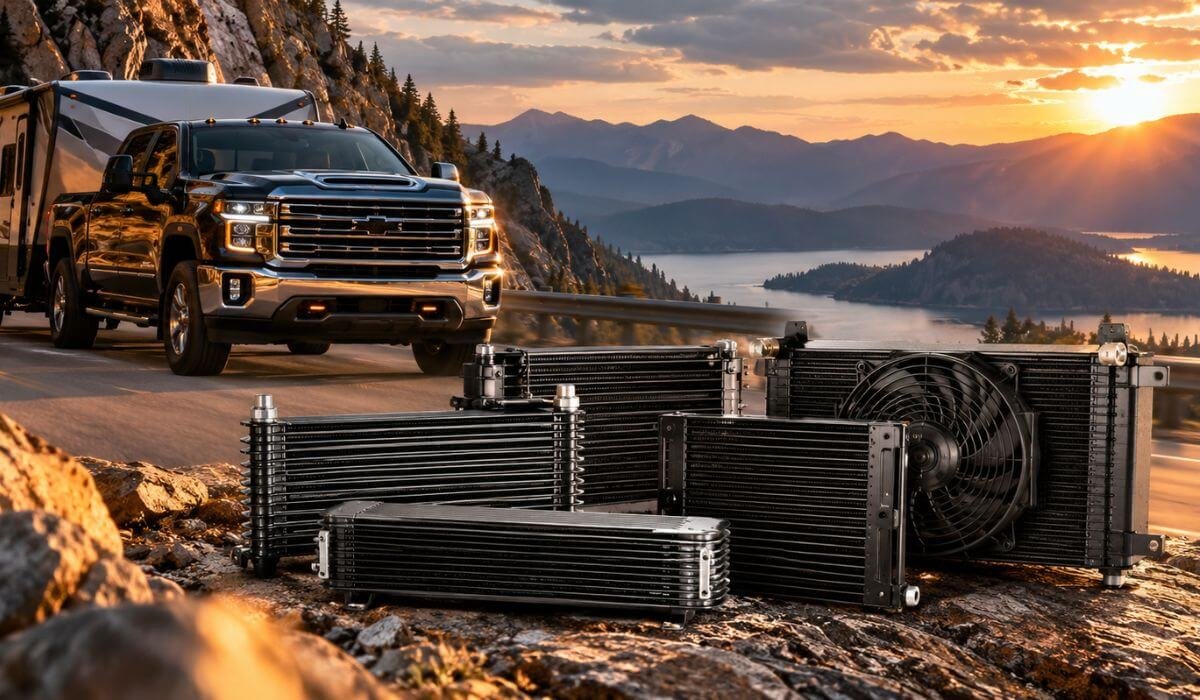
5 Best Transmission Coolers for Towing (2026): High-Heat Fluid Cooling
If you tow a trailer, camper, boat, or heavy load regularly, transmission heat is one of those problems you often notice only after it has already started costing you. The factory cooler may handle everyday driving without a problem, but long uphill grades, slow traffic, heavy trailers, and hot weather can push transmission fluid temperatures much higher than normal. An auxiliary transmission cooler gives that fluid more time and surface area to release heat before it makes its way back through the transmission.
The right cooler, however, is not simply the largest one that will fit. The Derale 13960 Hyper-Cool shows why the details matter. Its 25-row stacked-plate core works with an 8-inch electric fan producing 500 CFM of airflow, while the cooler is rated for 46,000 BTU/hr of heat rejection. At 13 × 10 × 5.625 inches, it offers serious cooling capacity while still giving trucks and SUVs a practical remote-mount option when natural airflow or grille space is limited.
That is why this guide covers more than advertised cooling numbers. Older trucks, newer tow vehicles, and heavy-duty towing setups can have very different cooling requirements, and details such as transmission-line size, mounting space, factory cooler routing, hose quality, and existing cooling equipment can change the right choice. The five coolers below are selected around those real-world differences, with attention to how each design handles heat, airflow, fluid flow, installation, and demanding towing conditions.
Heavy Duty Transmission Cooler for Towing in 2026: Top Cooling Options for Heavy Loads
#1. Derale 13960 Hyper-Cool Remote Transmission Cooler
Best Transmission Cooler for Heavy Towing With 46,000 BTU Heat Rejection, 500 CFM Fan-Assisted Airflow and 180°F Thermostatic Control
#2. Lucky Seven 40K LPD47391 Transmission Oil Cooler
Best Auxiliary Transmission Cooler for Heavy-Duty Towing With 40,000 GVW Rating, Low-Pressure Fluid Flow and Large-Truck Cooling Capacity
#3. Derale 13950 Atomic-Cool Remote Transmission Cooler
Best Automatic Transmission Cooler for Towing With 500 CFM Fan Airflow, 180°F Thermostat and Compact Remote-Mount Design
#4. Mishimoto MMOC-F Racing Transmission Cooler With Electric Fan
Best Transmission Cooler for Trucks and SUVs With Up to 1,100 CFM Electric-Fan Airflow, TIG-Welded Aluminum Construction and Flexible Installation
#5. Hayden Automotive 678 Rapid-Cool Transmission Cooler
Best Transmission Cooler for Trailer Towing With Plate-and-Fin Construction, Low-Pressure Flow and 24,000 GVW Cooling Capacity
Expert Tip
If your truck already has a factory transmission cooler, do not assume an aftermarket cooler automatically means better cooling. The smarter setup is one that works with the vehicle’s existing system, has enough airflow for the way you actually tow, and does not create unnecessary restriction in the cooler circuit.
For long grades, heavy trailers, hot weather, or slow off-road towing, I would give extra attention to fan-assisted designs such as the Derale 13960 and 13950. A fan can keep moving air through the cooler when road speed is low. If your truck gets plenty of airflow through the grille and you mainly tow at highway speeds, a large passive cooler such as the Lucky Seven 40K can make more sense. That difference is easy to overlook when shopping from a specification sheet, but it can matter more than a big BTU number on its own.
How We Chose These Transmission Coolers
We did not rank these coolers simply by advertised cooling capacity or by choosing the most expensive-looking unit. For a towing cooler, the number that matters on paper is only part of the story. What matters more is how that cooler is likely to behave once a loaded truck is climbing a grade, sitting in traffic, or pulling through hot weather.
First, we looked at how each cooler actually moves heat out of the transmission fluid. The Derale 13960 stood out because its 25-row stacked-plate core is backed by an 8-inch 500-CFM electric fan and a published 46,000-BTU/hr rating. That combination gives it an important advantage in situations where natural vehicle airflow becomes weak. The Derale 13950 follows the same basic thinking in a smaller package, using a 15-row plate-and-fin cooler with its own 500-CFM reversible fan.
We also wanted a product that made sense for owners who do not need an electric fan. That is why the Lucky Seven 40K LPD47391 is here. Its low-pressure-drop design and 40,000-GVW positioning make it a very different proposition from a remote fan-cooled unit. Rather than treating that difference as a weakness, we considered where a passive cooler can actually be the better fit: a vehicle with good grille airflow, regular highway towing, and enough room for a properly mounted auxiliary cooler.
Installation reality was another part of the selection. Universal transmission coolers are not automatically universal in the practical sense. Cooler-line fittings, hose routing, mounting position, airflow, and available space all matter. The Mishimoto MMOC-F earned its place because its electric fan gives owners another way to create airflow while its relatively compact 12.8 × 7.5 × 3.45-inch assembly can be easier to package than a much larger cooler.
Finally, we kept the Hayden 678 because not every towing vehicle needs a remote electric-fan system. Its plate-and-fin construction, 11 × 9.5-inch size, and straightforward auxiliary installation approach make it a sensible option for an owner who wants additional transmission-fluid cooling without adding another powered component to the vehicle.
The result is deliberately not five versions of the same cooler. The Derale 13960 is about maximum active cooling, the Lucky Seven is about high-capacity low-pressure cooling, the Derale 13950 brings fan-assisted cooling into a smaller package, the Mishimoto focuses on universal electric-fan airflow, and the Hayden takes the simpler passive route. That distinction is why they made the list.
One last point is worth being completely clear about: a transmission cooler cannot compensate for an incorrectly sized trailer, poor fluid condition, restricted airflow, or an installation that ignores the vehicle manufacturer’s cooler-line requirements. The best cooler is the one that matches the vehicle, towing load, available space, and the conditions in which you actually drive. That is the standard we used here—not simply whichever product has the biggest number printed on its box.
#1. Derale 13960 Hyper-Cool Remote Transmission Cooler
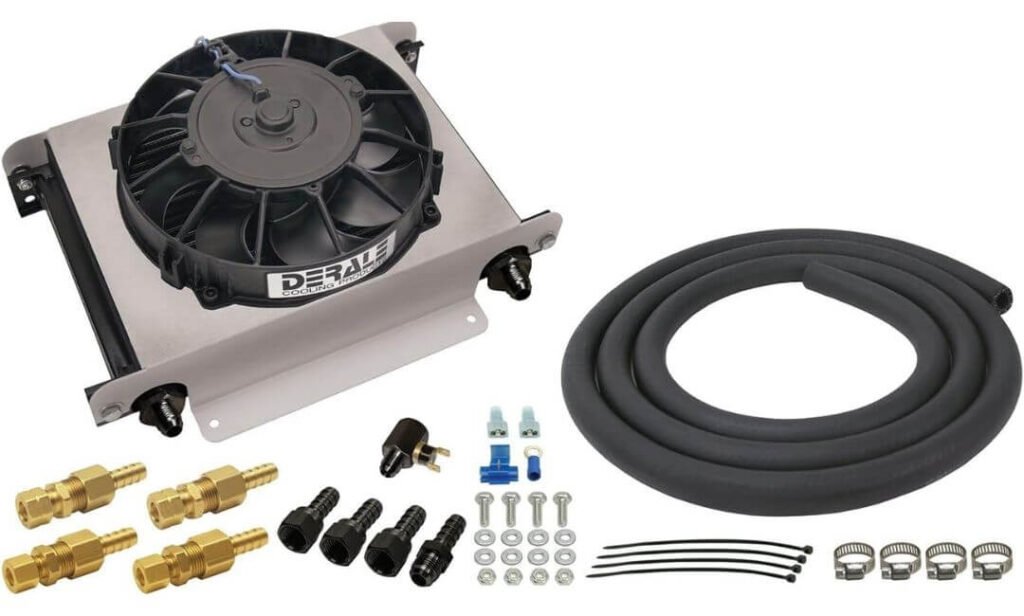
Quick Specs:
- Cooler type: 25-row stacked-plate
- Fan: 8-inch Tornado electric fan
- Airflow: 500 CFM
- Thermostat: 180°F in-line thermostat
- Cooling capacity: 46,000 BTU/hr
- Cooler size: 13 × 10 × 5.625 inches
- Line compatibility: 5/16-inch and 3/8-inch transmission lines
- Mounting: Remote mount; installs wherever suitable space and airflow are available
- Best suited to: Heavy towing, hauling and high-heat conditions
There is a big difference between adding a transmission cooler for peace of mind and adding one because your truck actually spends hours generating heat. The 13960 belongs firmly in the second category. Its 25-row stacked-plate core is designed to pack substantial cooling surface into a relatively compact assembly, while the 8-inch Tornado fan provides its own airflow rather than relying entirely on air rushing through the grille.
That matters when you’re pulling a trailer up a long grade, crawling through a campsite, or sitting in summer traffic with a loaded vehicle. The 500-CFM fan keeps air moving when road speed isn’t doing much for you, while the 180°F in-line thermostat controls when that airflow is needed. You’re not simply bolting a larger heat exchanger onto the vehicle and hoping for the best; the system is designed around the temperature of the transmission fluid.
The other advantage is placement. Because this is a remote cooler, you have more freedom than with a conventional front-mounted auxiliary unit. A suitable location can be chosen based on available space and airflow, which is particularly useful on trucks where the grille area is already occupied by an intercooler, radiator, condenser, or other equipment. The supplied hardware and fittings for 5/16-inch and 3/8-inch transmission lines also make it much more approachable for a proper auxiliary installation.
What Stands Out in Real Towing Use
- The electric fan is the big deal: it continues supplying airflow when towing speed drops.
- 25-row stacked-plate construction gives it a serious heat-exchange surface without requiring an enormous cooler body.
- 46,000 BTU/hr puts this firmly into heavy-duty territory rather than basic supplemental cooling.
- 180°F thermostat control means the fan isn’t running unnecessarily all the time.
- Remote mounting gives you more freedom to work around the existing layout of a truck or SUV.
The One Thing We’d Watch
The installation is more involved than simply mounting a cooler in front of the radiator and connecting two lines. You need correct hose routing, secure fittings, adequate mounting, and a location where the fan can actually breathe. If you’re not comfortable working with transmission cooler lines, this is one of those jobs where paying a mechanic is cheaper than learning from a leak.
Where Its Strength Really Shows
For a towing-focused setup, the important combination here isn’t any single number. It’s the way the stacked-plate core, 500-CFM fan and thermostatic control work together. A passive cooler can perform extremely well when a truck is moving quickly through clean airflow; this type of remote system becomes more interesting when towing conditions are unpredictable.
That’s why we’d put this option toward the top for someone who regularly pulls a substantial trailer, spends time on mountain roads, or tows in genuinely hot weather. It isn’t necessarily the cooler every daily driver needs, and that’s exactly the point—the design makes much more sense when transmission heat is a recurring towing problem rather than an occasional concern.
The Insider Pro-Tip
Don’t choose the mounting location simply because it is the easiest place to bolt the cooler. Airflow and serviceability matter more than convenience. Leave the fan enough room to draw air properly, keep the lines away from exhaust heat and moving components, and make sure the finished installation can still be inspected for leaks.
For a truck such as a Toyota Tundra, I would also check the existing transmission-cooler arrangement before cutting or rerouting anything. The goal of an auxiliary cooler is to remove more heat while preserving a sensible fluid path, not to create unnecessary restrictions or make the factory system harder to service.
#2. Lucky Seven 40K LPD47391 Transmission Oil Cooler
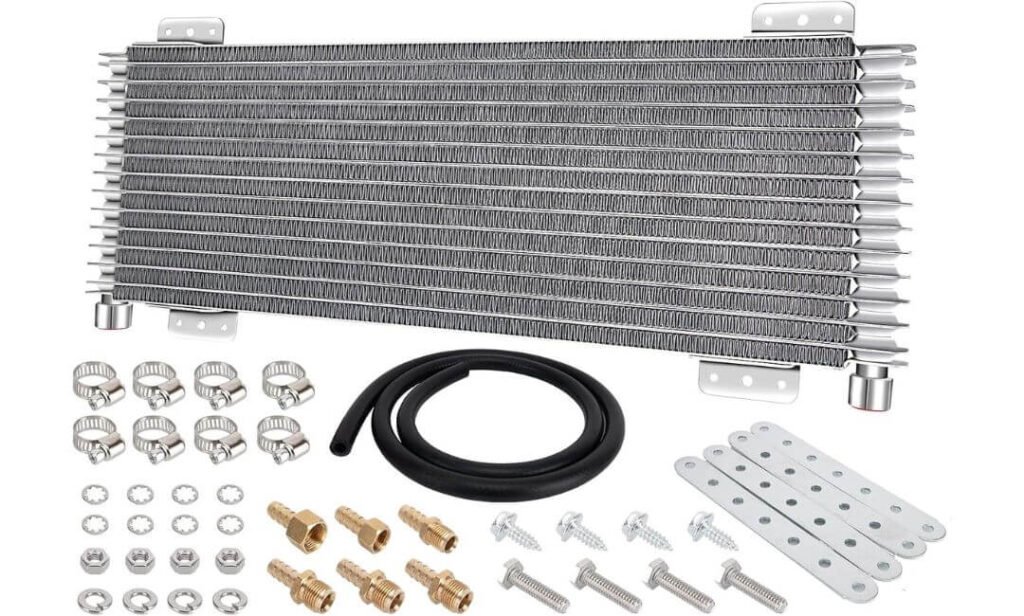
Quick Specs:
- Cooler type: Auxiliary transmission oil cooler
- GVW rating: Up to 40,000 lbs
- Design: Low-pressure-drop
- Application: Heavy trucks, trailers and towing vehicles
- Mounting: Universal-style mounting
- Hardware: Bolts, fasteners and brackets included
- Warranty: Lifetime warranty stated by the seller
- Best suited to: Heavy-load towing where passive auxiliary cooling is preferred
The interesting thing about this cooler isn’t simply the 40,000-GVW figure printed in its description. It’s the combination of that rating with a low-pressure-drop design. When you’re adding an auxiliary cooler to a towing vehicle, you want to get heat out of the transmission fluid without turning the cooler circuit into an unnecessary restriction. That’s a much more useful consideration than simply asking which cooler looks largest.
For someone pulling a large camper, equipment trailer or loaded utility trailer, the attraction is straightforward: give the transmission another place to reject heat before the fluid returns to the system. The manufacturer positions this unit for large trucks, trailers and heavy-duty vehicles, and the supplied mounting hardware makes the physical installation less complicated than starting with a bare cooler and sourcing every bracket separately.
There is also a practical reason this cooler sits below the fan-assisted Derale in our ranking. It is a passive design. That can be perfectly sensible when the vehicle gets strong airflow through the grille at towing speeds, but it doesn’t have the same built-in airflow advantage as a remote cooler with an electric fan. If you’re spending long periods crawling uphill or moving slowly with a heavy trailer, that distinction becomes much more important.
What We Like About the 40K Setup
- 40,000-GVW positioning makes it clearly aimed at serious towing rather than light-duty use.
- The low-pressure-drop design is a valuable feature because fluid flow matters just as much as adding cooling surface.
- Mounting hardware is included, so the installation doesn’t start with a completely bare cooler.
- Its intended use covers large trucks, trailers and heavy vehicles, which matches the article’s towing focus.
- The lifetime warranty claim adds some reassurance for buyers who plan to keep the vehicle and cooler in service for years.
What We Wouldn’t Ignore
The biggest concern isn’t the cooler’s advertised capacity; it’s the included plumbing hardware. There are customer reports describing hose leaks, hose failures and fitting/clamp problems. Those reports do not mean every unit will fail, but they are serious enough that we would inspect the supplied hose and connections carefully before putting the vehicle under a heavy towing load.
For a towing application, a cooler that performs well is only useful if the fluid stays inside the system. A leaking transmission line can turn a cooling upgrade into a much more expensive problem very quickly.
Where This Cooler Makes the Most Sense
This is the option I’d consider when the priority is high-capacity auxiliary cooling without adding an electric fan. A truck that spends most of its towing time on open roads, where ram airflow is plentiful, can make very good use of that approach.
It is also an interesting choice for owners who want to keep the installation relatively straightforward. The included brackets and hardware remove some of the fabrication headache, while the low-pressure-drop philosophy addresses a concern that is often ignored in basic cooler comparisons: more cooling should not come at the expense of sensible fluid flow.
That said, I would not buy this one based on the 40,000-GVW number alone. The plumbing deserves just as much attention as the cooler itself, particularly if the vehicle is going to pull a heavy trailer in hot weather.
The Insider Pro-Tip
If you’re using this for genuine heavy towing, replace questionable supplied hose before the first serious towing trip rather than waiting for a problem to reveal itself. Use properly rated transmission-cooler hose and secure every connection correctly.
And don’t let the 40,000-GVW label convince you that the cooler is automatically appropriate for a 40,000-lb vehicle. GVW terminology is not the same thing as your truck’s actual towing capacity or the cooler’s exact vehicle fitment. Check the transmission-line size, available mounting area and the manufacturer’s vehicle requirements first. That’s the difference between buying a big cooler and building a dependable towing setup.
#3. Derale 13950 Atomic-Cool Remote Transmission Cooler
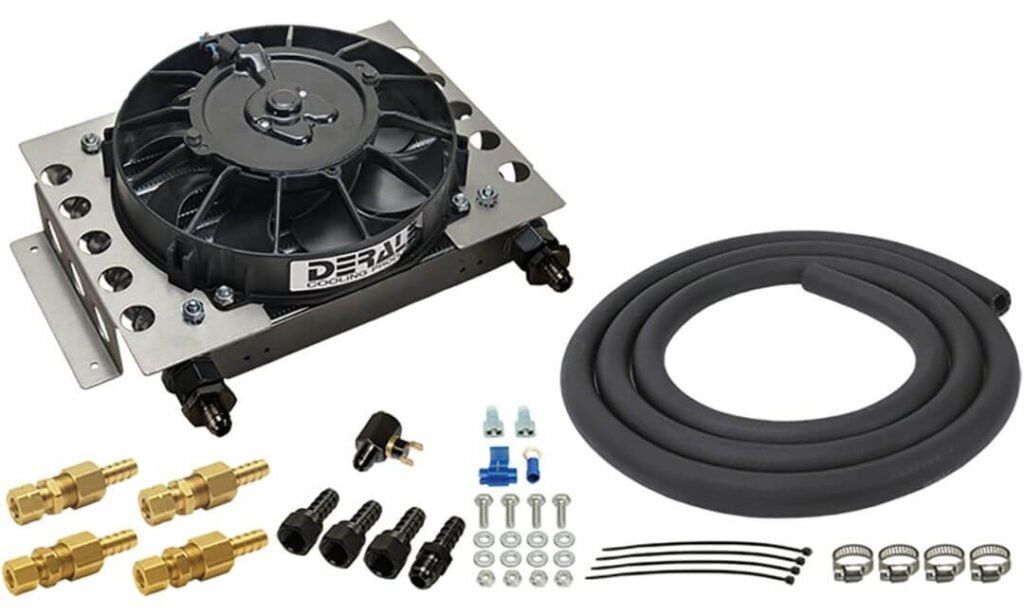
Quick Specs:
- Cooler type: OEM-style plate-and-fin
- Fan: 12V electric fan
- Airflow: 500 CFM
- Fan power: 35 watts
- Cooler size: 12.75 × 9.375 × 4.3125 inches
- Construction: Aluminum
- Mounting: Remote; install wherever suitable space permits
- Fittings: 5/8″-18 female O-ring
- Best suited to: Towing setups needing active airflow in a compact remote package
A transmission cooler becomes much more useful when it can make its own airflow. That’s the real reason this particular setup caught our attention. The 13950 combines an OEM-style plate-and-fin cooler with a 500-CFM electric fan, so it isn’t completely dependent on the truck moving quickly enough to force air through the core.
That matters during the parts of a tow that are hardest on the transmission: climbing slowly, manoeuvring a trailer into position, crawling through traffic, or pulling a loaded rig on a hot day. The 35-watt 12V fan can move air through the cooler when natural airflow is weak, while the relatively compact 12.75 × 9.375 × 4.3125-inch footprint gives you more freedom when the front of the vehicle is already crowded.
The remote design is another genuine advantage. You’re not locked into one location directly in front of the radiator. With an appropriate mounting point, it can be positioned where there’s enough room and airflow, which can be especially useful on trucks with crowded grille assemblies. It can also be incorporated with the factory cooling arrangement rather than forcing you to abandon an existing OEM cooler.
What We Like About It
- 500 CFM of fan-assisted airflow gives it an advantage during slow-speed towing.
- The plate-and-fin core offers a good balance between cooling ability and physical size.
- Remote mounting makes it easier to work around crowded engine bays and front-end components.
- At roughly 35 watts, the fan doesn’t demand a huge electrical load compared with larger powered cooling equipment.
- The aluminum construction keeps the assembly relatively manageable while offering good corrosion resistance.
What We’d Keep an Eye On
The electric fan and thermostat connections deserve attention during installation. Some customer feedback mentions fan failures and thermostat-area leaks, so I would not treat the wiring, fittings or sealing as an afterthought. A proper installation should verify the fan’s airflow direction and make sure every fluid connection is secure before the vehicle sees a heavy trailer.
Where This One Fits Best
The Atomic-Cool makes the most sense when you want something between a basic passive auxiliary cooler and a much larger extreme-duty system. It gives you active airflow without turning the installation into a huge cooling assembly, which is a useful combination for a truck or SUV that tows regularly but doesn’t necessarily need the maximum cooling package available.
For a vehicle that sees mixed use—daily driving during the week and trailer duty on weekends—that balance is appealing. You get a compact remote cooler that can continue moving air when towing conditions slow the vehicle down, without occupying the same amount of physical space as a much larger heavy-duty installation.
I’d still consider the 13960 ahead of it when the vehicle routinely sees very heavy loads and severe heat, but the 13950 is arguably easier to justify for an owner who wants serious auxiliary cooling without going completely overboard.
The Insider Pro-Tip
With a remote fan cooler, where you mount it can matter almost as much as which cooler you buy. Don’t hide the assembly behind a solid obstruction just because the location is convenient. Give the fan a clean path to move air through the core, keep the unit away from exhaust heat, and leave enough room to inspect the fittings later.
For a Toyota Tundra or similar full-size truck, I’d also verify the transmission-line fittings before ordering rather than assuming “universal” means plug-and-play. A few minutes spent confirming the plumbing and mounting location can save considerably more time once the vehicle is apart.
#4. Mishimoto MMOC-F Racing Transmission Cooler With Electric Fan
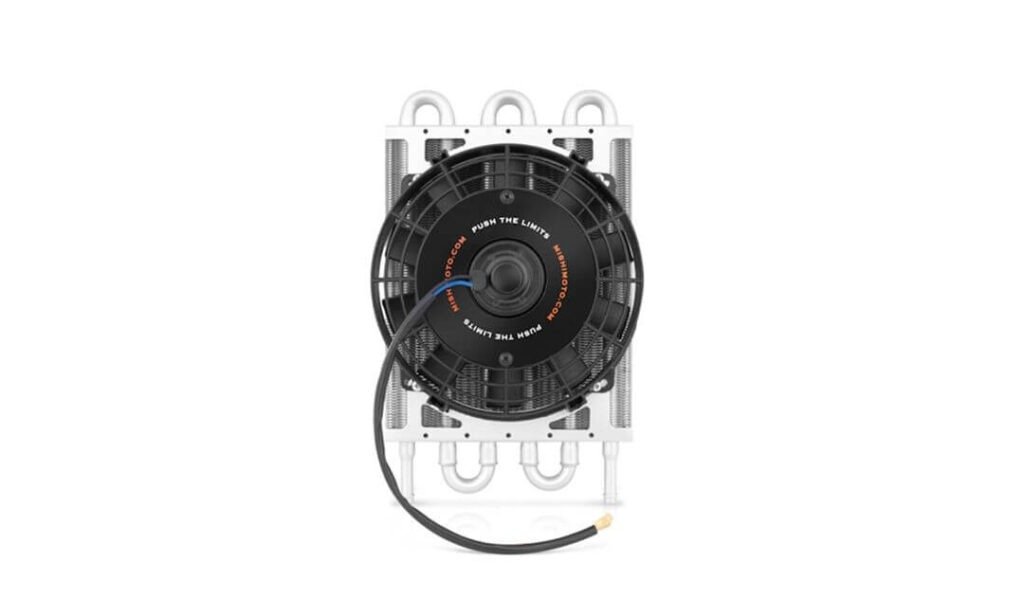
Quick Specs:
- Cooler type: 2-row aluminum core
- Construction: TIG-welded aluminum end tanks
- Fan: 8-inch slim electric fan
- Maximum airflow: Up to 1,100 CFM
- Dimensions: 12.8 × 7.5 × 3.45 inches
- Fitment: Universal
- Mounting: Comprehensive hardware included; custom positioning may be required
- Best suited to: Towing, modified trucks and SUVs, and high-load applications
The MMOC-F takes a slightly different route from the other coolers on this list. Its biggest talking point isn’t a huge row count or an enormous cooler body; it’s the 8-inch slim fan capable of moving up to 1,100 CFM. That’s a serious amount of airflow for an assembly only 3.45 inches deep, and it gives the cooler a useful advantage when the vehicle isn’t travelling fast enough to create strong natural airflow.
That can be particularly relevant when towing. A loaded truck may spend part of a mountain climb moving at modest speed, or sit in traffic immediately after working hard. Those are exactly the situations where relying purely on ram air becomes less attractive. The electric fan can keep air moving through the core independently of vehicle speed, which is why Mishimoto positions this cooler for towing, track use and other demanding applications.
The 2-row aluminum core with TIG-welded end tanks also gives this unit a different character from the larger stacked-plate options above. At 12.8 × 7.5 × 3.45 inches, it is relatively compact, so it can be useful where space behind the grille or around the front of the vehicle is limited. Just don’t confuse universal fitment with direct bolt-on fitment—you should expect to spend some time deciding exactly where and how it will be mounted.
What We Like About It
- Up to 1,100 CFM is the standout figure and gives the fan plenty of airflow potential.
- The slim 3.45-inch depth makes it easier to package than a bulky remote cooler.
- TIG-welded aluminum construction gives the core a solid, performance-oriented build.
- The universal design works across a wide range of trucks, SUVs and modified vehicles.
- The combination of a compact cooler and powerful fan makes it interesting for low-speed heavy towing.
What We’d Change Before Calling It Perfect
The universal design means installation isn’t truly plug-and-play. You may need to work out your own mounting arrangement, and the fan does not provide the same built-in thermostatic control found on some dedicated transmission-cooler kits. For automatic operation, you’ll want an appropriate temperature-controlled switch or controller rather than simply relying on a manual toggle.
Where This Cooler Makes the Most Sense
This is the one I’d look at when available space is tight but airflow isn’t something you want to compromise on. The 1,100-CFM fan gives the compact core a lot of air-moving capability, while the shallow profile makes it easier to position around existing components.
It’s also a sensible option for someone who is comfortable doing a more customised installation. A well-mounted cooler with a strong fan can be far more useful than a larger passive cooler installed somewhere that barely receives airflow. That’s particularly true for a truck that sees long climbs, slow towing or repeated heavy-load cycles.
There is a trade-off, though: the fan can be noticeable, and the final result depends heavily on how you mount and control it. In other words, this is a cooler with plenty of potential, but installation quality becomes part of the cooling system.
The Insider Pro-Tip
Don’t get distracted by the 1,100-CFM number and assume more airflow automatically means lower transmission temperatures. The fan still needs a sensible path through the core. Seal obvious gaps around the mounting area where practical, avoid placing the unit directly in an exhaust-heat path, and make sure the fan is oriented correctly for the way you want air to move.
If you’re fitting this to a Toyota Tundra or another full-size truck, I’d plan the mounting location before buying fittings or cutting hose. The compact dimensions give you options, but the best location is the one that combines clean airflow, safe hose routing and easy future servicing—not simply the first place where the cooler physically fits.
#5. Hayden Automotive 678 Rapid-Cool Transmission Cooler
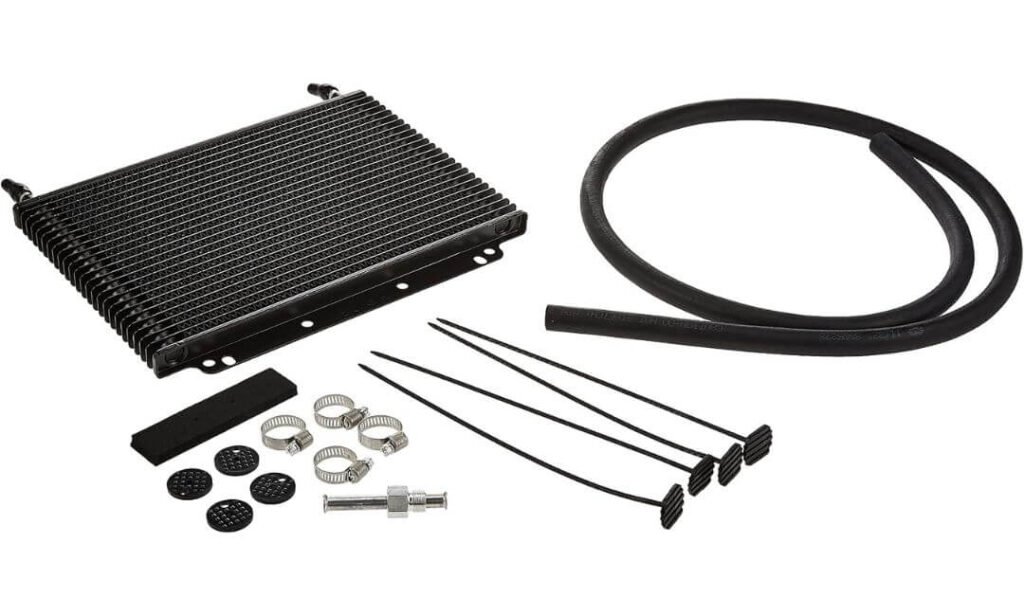
Quick Specs:
- Cooler type: Universal add-on plate-and-fin
- Size: 11 × 9.5 × 2.1 inches
- GVWR rating: Up to 24,000 lbs
- Recommended towing: Up to 5,000 lbs
- Application: Pickups, vans, Class C motorhomes and travel trailers
- Cooling design: Internal turbulation with low-pressure-drop flow path
- Construction: Aluminum
- Installation: Auxiliary cooler; not a direct OE replacement
- Best suited to: Light-to-moderate towing and vehicles needing straightforward supplemental cooling
Not every towing vehicle needs a giant remote cooler with an electric fan. In fact, for someone pulling a 5,000-pound trailer or lighter load, adding a well-designed passive cooler can be a much more sensible upgrade than installing a powered system that the vehicle may never really need.
That’s where the Hayden 678 makes sense. Its 11 × 9.5 × 2.1-inch body is relatively compact, while the internal turbulation is designed to disturb the transmission fluid as it passes through the cooler and improve heat transfer without creating excessive pressure loss. It’s a simple idea, but it’s exactly the sort of detail that matters when you’re trying to cool fluid without unnecessarily restricting its path.
The other thing we like is the application range. Hayden specifically positions it for pickup trucks, vans, Class C motorhomes and travel trailers, with a stated GVWR capability of up to 24,000 pounds and towing applications up to 5,000 pounds. That makes its place on this list quite different from the 46,000-BTU Derale 13960 above. We’re not pretending they’re interchangeable—the Hayden is here because a simpler cooler can be the right answer for the right towing load.
What We Like About It
- Internal turbulation helps improve heat transfer while keeping pressure drop under control.
- The 2.1-inch depth makes it easier to package in a crowded front-end area.
- A stated 5,000-pound towing application makes its intended use easy to understand.
- Aluminum construction keeps the cooler lightweight and resistant to corrosion.
- It doesn’t require an electric fan, separate fan wiring or complex temperature control, keeping the setup straightforward.
What We’d Keep in Mind
This is an add-on cooler, not a direct replacement for the OE cooler. Installation should be planned around the vehicle’s existing cooling circuit, and the cooler should not simply be bypassed or installed wherever it happens to fit. For serious towing beyond its stated application, I’d move up to one of the higher-capacity options rather than asking this smaller unit to do a job it wasn’t designed for.
Where It Makes the Most Sense
The Hayden 678 is the sensible choice for the owner who says, “I tow, but I’m not hauling a 10,000-pound trailer every weekend.” A pickup pulling a modest camper, boat, utility trailer or other load can benefit from additional transmission-fluid cooling without necessarily needing a fan-assisted remote system.
Its compact size also makes it attractive when the front of the vehicle is already busy. You can concentrate on getting the cooler into a position with useful airflow rather than finding room for a much deeper assembly. And because there is no electric fan to wire, there are fewer components to troubleshoot later.
That’s really its strength: simple supplemental cooling for a clearly defined towing range. If your towing demands are substantially higher, the other coolers on this list give you considerably more headroom.
The Insider Pro-Tip
For this type of passive cooler, installation direction and airflow matter more than many buyers realise. Don’t bury it behind a solid obstruction simply because there’s an empty space there. Give the core access to clean air and keep the transmission lines away from exhaust heat and sharp edges.
And if you’re adding it to a Toyota Tundra or similar truck, confirm the factory cooler routing before connecting anything. The goal is to add useful heat rejection while maintaining a sensible fluid path—not to create a plumbing arrangement that looks neat but makes future servicing or diagnosis unnecessarily difficult.
Best Transmission Coolers for Towing (2026): Cooling Capacity, Airflow & Fitment Compared
| Transmission Cooler | Cooling Approach | Airflow / Capacity | Size & Installation | Best Towing Use | Our Take |
|---|---|---|---|---|---|
|
Derale 13960 Hyper-Cool Remote Transmission Cooler
Top Heavy-Towing Choice
|
25-Row Stacked Plate Remote cooler with dedicated electric-fan airflow and thermostatic control. |
500 CFM electric fan 46,000 BTU/hr 180°F in-line thermostat |
13 × 10 × 5.625 in. Remote mounting gives more placement freedom. 5/16- and 3/8-inch line compatibility. |
Heavy trailers, long grades, hot-weather towing and slow-speed hauling. |
Maximum Active Cooling The strongest overall match when transmission heat is a recurring towing problem. |
|
Lucky Seven 40K LPD47391 Transmission Oil Cooler
High-Capacity Passive Pick
|
Low-Pressure Design Built around substantial auxiliary cooling without relying on an electric fan. |
40,000 GVW stated rating Low-pressure-drop design Passive airflow |
Universal-style installation with mounting bolts, fasteners and brackets supplied. | Heavy highway towing where the vehicle receives consistent natural airflow. |
Strong Cooling / Check Hardware Attractive on paper for heavy loads, but the supplied hose and connection quality deserve careful inspection. |
|
Derale 13950 Atomic-Cool Remote Transmission Cooler
Balanced Fan-Assisted Option
|
Plate-and-Fin + Fan Compact remote design with its own airflow rather than relying entirely on vehicle speed. |
500 CFM fan 35-watt 12V fan 180°F thermostat |
12.75 × 9.375 × 4.3125 in. Flexible remote mounting for tighter spaces. |
Regular towing, hot-weather use and slow-speed hauling where compact active cooling helps. |
Best Balanced Remote Setup A sensible middle ground when the 13960 feels like more cooler than the vehicle really needs. |
|
Mishimoto MMOC-F Racing Transmission Cooler With Electric Fan
High-Airflow Compact Choice
|
2-Row Aluminum Core TIG-welded aluminum construction paired with a slim electric fan. |
Up to 1,100 CFM 8-inch electric fan Strong airflow for low-speed conditions |
12.8 × 7.5 × 3.45 in. Universal fitment. Custom mounting and fan control may be required. |
Tight mounting spaces, modified trucks, heavy towing and demanding low-speed use. |
Powerful Fan / More DIY Excellent airflow potential, but installation quality becomes a bigger part of the equation. |
|
Hayden Automotive 678 Rapid-Cool Transmission Cooler
Simple Towing Upgrade
|
Plate-and-Fin Passive auxiliary cooling with internal turbulation designed to improve heat transfer. |
Up to 5,000-lb towing application Up to 24,000-lb GVWR Low-pressure flow path |
11 × 9.5 × 2.1 in. Compact auxiliary installation. Not a direct OE replacement. |
Light-to-moderate trailer towing, campers, boats and utility trailers. |
Simple & Sensible The better choice when you need additional fluid cooling without a fan-assisted system. |
Buying Guide: How to Choose the Right Transmission Cooler for Towing
A transmission cooler is one of those parts where bigger does not automatically mean better. The right choice depends on how much heat your transmission actually produces, how the vehicle is used, how much airflow the cooler will receive, and whether the installation works properly with the existing cooling circuit. A cooler that is excellent for a pickup pulling a 4,000–5,000-pound trailer may be completely different from what makes sense for a truck regularly moving a 10,000-pound load through mountain roads.
Start With the Towing Load, Not the Cooler Size
The first question is simple: what are you actually towing?
A vehicle pulling a lightweight utility trailer on flat highways does not place the same thermal load on its transmission as a truck climbing a long 6% grade with a large camper in 100°F weather. Trailer weight matters, but so do road conditions, speed, ambient temperature, payload, gearing, and how frequently you tow.
Use this as a practical starting point:
| Towing Situation | What Matters Most | Cooler Type Worth Considering |
|---|---|---|
| Occasional light trailer towing | Extra cooling without unnecessary complexity | Compact passive plate-and-fin |
| Regular 3,000–5,000 lb towing | Better heat rejection and good airflow | Larger passive auxiliary cooler |
| Frequent heavy trailer towing | Higher cooling capacity and dependable fluid flow | Large stacked-plate or fan-assisted cooler |
| Mountain towing and long grades | Cooling at low vehicle speed | Electric-fan remote cooler |
| Heavy towing in very hot weather | Maximum heat rejection | High-capacity stacked-plate + fan |
| Slow-speed hauling or off-road towing | Independent airflow | Remote fan-assisted design |
The important takeaway is that the heaviest-looking cooler isn’t automatically the right answer. Match the cooling system to the work your transmission actually performs.
Heat Rejection Is More Than a Big BTU Number
Manufacturers often advertise BTU/hr because it gives buyers an easy number to compare. It is useful, but it shouldn’t be the only number you look at.
A cooler has to transfer heat from the transmission fluid into the surrounding air. That depends on the core design, available surface area, airflow, fluid flow and temperature difference. A high-capacity cooler sitting somewhere with almost no airflow may perform worse than a smaller unit mounted where it can breathe properly.
That’s why the difference between passive and fan-assisted designs matters so much.
- Passive coolers rely on vehicle movement and airflow through the front of the vehicle.
- Fan-assisted coolers generate their own airflow, making them more useful when towing at low speed.
- Stacked-plate designs generally provide a dense heat-exchange package and are particularly attractive for demanding applications.
- Plate-and-fin designs can offer a useful balance of cooling performance, size and cost.
- A remote cooler gives you more freedom to choose the mounting location, but that freedom only helps if the chosen location has a sensible airflow path.
For example, a cooler with a 500-CFM electric fan has an obvious advantage when a loaded truck is crawling uphill. At 15–20 mph, the vehicle itself isn’t pushing nearly as much air through the cooler as it would at highway speed.
Fan-Assisted vs Passive Cooling: Which One Do You Need?
This is probably the most important decision after towing weight.
A passive cooler is attractive because it is simple. There is no fan motor, wiring, relay or fan-control strategy to worry about. If your truck spends most of its towing time at highway speeds and has a clean airflow path through the grille, that simplicity can be a genuine advantage.
A fan-assisted cooler becomes more compelling when your towing conditions involve:
- Long uphill climbs
- Stop-and-go traffic with a trailer
- Low-speed off-road towing
- Hot summer temperatures
- Heavy campers or equipment trailers
- Vehicles with limited natural airflow around the mounting location
The Derale 13960 and 13950 demonstrate why this matters. Their electric fans allow the cooler to keep moving air even when the vehicle itself isn’t moving quickly.
The Mishimoto takes that idea further with an 8-inch fan rated for up to 1,100 CFM, but its universal format also means the installer has more responsibility for mounting and fan control.
Stacked Plate vs Plate-and-Fin Construction
These two designs are worth understanding before you buy.
Stacked-plate coolers use multiple plates with internal passages for the transmission fluid. They can provide a high amount of cooling surface in a relatively compact package, which is one reason they’re popular for severe-duty towing.
Plate-and-fin coolers use plates combined with finned sections to increase the available heat-transfer area. They can be lighter and easier to package, and a good example can provide plenty of cooling for moderate towing.
Neither construction should automatically be labelled “better” in every vehicle. What matters is whether the cooler’s capacity, airflow and physical dimensions match your application.
Check Fluid Flow and Pressure Drop Before Installation
This is an area where many basic buying guides gloss over the important part.
A transmission cooler sits inside a fluid circuit. You don’t want to add cooling at the expense of creating an unnecessarily restrictive path. That’s why pressure drop and fluid flow deserve attention, particularly on heavy-duty applications.
A low-pressure-drop design is attractive because it aims to provide additional heat rejection while keeping resistance through the cooler under control.
But don’t interpret that as “lower pressure is always better.” The transmission’s actual fluid circuit, cooler-line size and manufacturer requirements still matter. The goal is appropriate flow through a properly sized cooler, not chasing the lowest possible pressure number.
Verify Your Transmission Cooler Lines Before Buying
“Universal” does not mean every vehicle uses the same fittings.
Before ordering, check:
- Existing transmission cooler-line diameter
- Thread and fitting type
- Hose connection size
- Available mounting space
- Distance between the cooler and connection points
- Factory cooler arrangement
- Whether an adapter is required
- Whether the existing lines can be routed safely
The Derale 13960, for example, supports 5/16-inch and 3/8-inch transmission lines, but that doesn’t mean those are the only dimensions you need to consider. The actual fittings and routing on your vehicle still have to be confirmed.
This becomes especially important on newer trucks and SUVs where the transmission cooling system may be integrated into the radiator or another heat exchanger.
Auxiliary Cooler vs Factory Cooler
For most towing upgrades, think “add cooling” rather than “replace everything.”
Many vehicles already have a factory transmission cooler or a cooler integrated into the radiator. An auxiliary unit can provide additional heat-rejection capacity rather than requiring the factory system to be discarded.
The exact plumbing arrangement should follow the vehicle and cooler manufacturer’s recommendations. Don’t assume that simply bypassing the factory cooler will automatically produce better results.
In some applications, the factory cooler is part of a broader temperature-management strategy. Changing the routing without understanding that system can create a new problem while trying to solve an old one.
Measure the Space Before Choosing the Cooler
Take measurements before buying.
This sounds obvious, but a cooler can have excellent specifications and still be the wrong choice if you cannot give it a proper mounting position.
Measure:
- Width
- Height
- Depth
- Clearance from the radiator and condenser
- Clearance from the fan and belts
- Distance from exhaust components
- Room for transmission hoses
- Room to remove the cooler later for inspection
Don’t forget that an electric-fan cooler needs breathing room. A fan cannot perform properly if its inlet or outlet is blocked by another component.
The compact Hayden 678, for example, is only about 2.1 inches deep, which can make it easier to package than a substantially deeper remote unit. On the other hand, a deeper fan-assisted cooler may deliver a completely different level of cooling when the vehicle is working hard.
Consider the Installation, Not Just the Product
A good transmission cooler installed badly is still a bad cooling system.
For a proper installation, pay attention to:
- Secure mounting
- Correct hose routing
- Heat protection near the exhaust
- Properly supported transmission lines
- Correct clamps and fittings
- Fan wiring where applicable
- Adequate airflow
- Easy access for future inspection
If the installation requires cutting lines, fabricating brackets or working around the factory transmission circuit, professional installation can be money well spent.
This is particularly true for a vehicle that regularly pulls a heavy trailer. Saving a little on installation isn’t worth risking a transmission-fluid leak on a long towing trip.
Don’t Ignore Hose and Fitting Quality
The cooler itself isn’t the only component carrying transmission fluid.
This became particularly important when evaluating the Lucky Seven 40K option. Its 40,000-GVW positioning and low-pressure-drop design are attractive, but customer reports concerning hose and connection failures are worth taking seriously.
That doesn’t mean every unit will experience a problem. It does mean I would inspect the supplied plumbing carefully and, for serious towing, consider using properly rated transmission-cooler hose and quality clamps/fittings rather than assuming every included accessory is equally robust.
A cooler that never leaks is more valuable than one with an impressive specification sheet.
Newer Trucks and Older Vehicles Need Different Checks
Older trucks often have relatively straightforward transmission cooler plumbing, making an auxiliary cooler easier to understand and install.
Newer vehicles can be more complicated. They may use:
- Integrated transmission cooling
- Multiple heat exchangers
- Factory thermostatic control
- Vehicle-specific transmission temperature management
- Different line and fitting arrangements
So don’t assume that a cooler that worked perfectly on an older pickup will connect the same way to a newer model.
For a 2026 Toyota Tundra, for example, I would verify the existing transmission-cooling arrangement, line sizes and available mounting space before deciding whether a passive cooler or remote fan-assisted system makes more sense. The same principle applies to newer Ford, GM, Ram and other full-size trucks.
How Much Cooling Do You Really Need?
A useful way to think about the decision is this:
Light towing: Don’t overcomplicate it. A quality passive auxiliary cooler may be enough.
Regular towing: Step up to a larger plate-and-fin or stacked-plate design and pay close attention to airflow.
Heavy towing: Look for substantial cooling capacity and robust construction.
Heavy towing in heat or mountains: A fan-assisted remote cooler becomes much more attractive.
Slow-speed towing: Prioritise independent airflow instead of relying entirely on vehicle speed.
And if you’re already seeing unusually high transmission temperatures while towing, don’t simply install the biggest cooler you can find and assume the problem is solved. Find out why the transmission is running hot first. Fluid condition, vehicle loading, gearing, airflow and the factory cooling system can all contribute.
Warranty and Long-Term Reliability Matter
A transmission cooler is relatively inexpensive compared with a transmission rebuild, but that doesn’t mean you should ignore build quality.
Look beyond the warranty headline and consider:
- Cooler-core construction
- Hose quality
- Fitting design
- Fan reliability
- Availability of replacement parts
- Manufacturer support
- Ease of servicing
A lifetime warranty can be reassuring, but it doesn’t make a poorly installed cooler dependable. For a towing vehicle, reliability of the complete cooling system matters more than the warranty period printed on the package.
Match the Cooler to Your Actual Towing Life
The easiest way to make the right decision is to stop thinking about the cooler as an isolated product.
Ask yourself:
How heavy is the trailer?
How often do I tow?
Do I climb long grades?
Do I tow in extreme heat?
Does the vehicle spend time crawling with a load?
How much room do I have for a cooler?
Does the vehicle already have a factory transmission cooler?
Am I comfortable modifying the plumbing and wiring?
If the answers point toward high heat, heavy loads and low-speed towing, the more serious fan-assisted designs on this list deserve your attention.
If you mainly tow a moderate trailer on the highway and want straightforward supplemental cooling, a well-sized passive cooler with sensible airflow may be the smarter purchase.
That is ultimately how I’d approach this upgrade: buy for the conditions your transmission actually experiences, not for the biggest specification you can find.
How to Install and Maintain a Transmission Cooler for Towing
Adding an auxiliary transmission cooler is not a complicated idea, but the plumbing and mounting deserve more attention than the cooler itself. A transmission can lose a surprising amount of fluid through a poorly secured hose or fitting, and a powerful electric fan is only useful if it has clean airflow and is wired correctly. The safest approach is to treat the cooler as part of the vehicle’s existing transmission-fluid circuit, not as an isolated accessory.
Before You Start the Installation
Before touching a transmission line, confirm exactly how your vehicle’s factory cooling system is arranged. Some trucks and SUVs already use a cooler integrated into the radiator, while others have a separate factory heat exchanger.
Have the following information ready:
- Your vehicle’s transmission cooler-line size and fitting type
- The cooler manufacturer’s recommended installation method
- Available mounting space and clearance
- Correct transmission-cooler hose
- Appropriate clamps and fittings
- Mounting brackets or hardware
- Electrical wiring, relay and fuse if the cooler uses a fan
- Transmission-fluid specification for your vehicle
- A way to check transmission-fluid level after installation
Do not assume that a product described as universal will connect directly to your vehicle. “Universal” generally means the cooler can be adapted to different applications; it does not mean every truck uses the same fittings or hose arrangement.
Choose the Mounting Location Before Cutting Any Hose
This is probably the easiest mistake to avoid.
Hold the cooler in several possible locations and check the entire installation, not just whether the cooler physically fits. You need enough space for airflow, hoses, brackets and future inspection.
For a passive cooler, a location with good natural airflow is particularly important. For an electric-fan cooler, make sure the fan has enough room to draw and discharge air without being blocked by the radiator, condenser, bodywork or another component.
Keep the cooler away from:
- Exhaust manifolds and hot exhaust piping
- Moving belts and pulleys
- Steering and suspension components
- Sharp body edges
- Areas exposed to unnecessary road debris
- Locations where the cooler or hose could rub against another component
A slightly less convenient mounting position with clean airflow and safe hose routing is usually better than the easiest place to bolt it.
Understand the Fluid Routing Before Connecting Anything
This is where you should slow down.
The exact routing depends on the vehicle and the cooler manufacturer’s instructions, so don’t copy a generic diagram from another truck and assume it applies to yours.
The important thing is to identify:
- Which line carries hot transmission fluid away from the transmission.
- Where the factory cooler sits in that circuit.
- Where the auxiliary cooler is intended to be placed.
- Which fitting is the cooler inlet and which is the outlet, if the design specifies a direction.
- How the finished circuit returns fluid to the transmission.
If the vehicle already has a factory cooler, do not automatically bypass it. An auxiliary cooler is commonly used to supplement the existing system, but the correct arrangement should be confirmed for the specific vehicle.
Use Proper Transmission-Cooler Hose
This is not the place to improvise with ordinary fuel hose, generic rubber tubing or whatever happens to fit the barb.
Transmission fluid can become extremely hot, and the hose needs to be rated for the temperature and pressure conditions of the application. Use proper transmission-cooler hose that matches the required diameter and specifications.
Also pay attention to the bends. A hose that technically fits but is sharply kinked can restrict fluid flow. Keep the route smooth, support longer sections properly, and prevent the hose from touching hot or moving components.
Secure Every Connection Properly
A transmission cooler installation has very little tolerance for a connection that is “almost secure.”
Before starting the engine, check:
- Every hose connection
- Every clamp
- Every threaded fitting
- Cooler fittings
- Factory-line adapters
- Brackets and mounting bolts
Use the correct fitting and sealing method for the particular connection. Do not overtighten fittings simply because you’re trying to prevent a leak; excessive force can damage threads, fittings or sealing surfaces.
With a product such as the Lucky Seven 40K, where customer feedback has raised concerns about supplied hose and connection quality, I would be especially careful about inspecting or upgrading the plumbing before putting the vehicle under a heavy towing load.
Wiring an Electric-Fan Transmission Cooler
Fan-assisted coolers add another layer to the installation.
The fan should have:
- Correct power supply
- Appropriate fuse protection
- Properly sized wiring
- Secure electrical connections
- Correct grounding
- A suitable relay or controller where required
- Temperature-based control if automatic operation is desired
Do not simply connect a large electric fan directly to an unsuitable switched circuit.
A thermostat-controlled setup is particularly useful because the fan can operate when cooling demand requires it instead of running continuously. With remote units such as the Derale 13960 and 13950, the fan and thermostat become part of the overall temperature-management strategy rather than just an accessory bolted to the cooler.
Check the Fan Direction Before Finalising the Installation
This sounds minor, but it matters.
After installation, verify that the fan is moving air through the cooler in the intended direction. A powerful fan moving air the wrong way is still the wrong installation.
Also listen for unusual vibration or rubbing. If the fan is touching its shroud, mounting surface or another component, fix the problem before regular driving.
The Mishimoto MMOC-F deserves particular attention here because its 8-inch fan can move up to 1,100 CFM. That much airflow is useful, but it also makes correct mounting and electrical installation more important.
Refill and Check the Transmission Fluid Carefully
Adding a cooler and additional hose increases the volume of the transmission-fluid circuit.
After the installation:
- Confirm all connections are secure.
- Add the correct fluid if required.
- Start the engine according to the vehicle manufacturer’s procedure.
- Allow the fluid to circulate.
- Move the transmission through the specified ranges if the manufacturer requires it.
- Inspect every connection for leaks.
- Recheck the fluid level using the vehicle’s correct procedure.
- Reinspect the system after a short drive.
Never guess the fluid level. Some modern transmissions require a very specific temperature range and procedure for checking fluid level, and checking them incorrectly can produce a misleading reading.
Do a Short Test Before Towing
The first drive should not be your next 8,000-pound trailer trip.
Take the vehicle for a short drive without the trailer and inspect the installation afterward. Look for:
- Fresh transmission-fluid residue
- Damp hose connections
- Loose clamps
- Hose movement
- Fan vibration
- Unusual electrical smell
- Contact between hoses and hot or moving parts
Once everything looks correct, gradually increase the load and monitor transmission temperature if the vehicle provides a reliable temperature reading.
A proper test is especially important because a cooler can look perfectly installed while stationary but behave differently once the vehicle is vibrating, flexing and generating heat on the road.
Keep the Cooler Clean
A transmission cooler cannot reject heat effectively if its cooling surface becomes packed with dirt, insects, mud or road debris.
During routine servicing, inspect the cooler face and remove accumulated debris carefully. Do not bend the cooling fins while cleaning them.
If the cooler is mounted behind another heat exchanger, check both surfaces. A clean cooler with restricted airflow is still going to struggle.
For vehicles that see dirt roads, construction sites, off-road trails or winter salt, this inspection becomes even more important.
Check the Hoses and Fittings Regularly
You don’t need to dismantle the system every month. A quick visual inspection during normal vehicle maintenance can catch problems early.
Look for:
- Cracked or hardened hose
- Abrasion marks
- Swelling
- Fluid residue
- Loose clamps
- Corroded fittings
- Damaged brackets
- Hoses touching exhaust components
If you see transmission fluid around a connection, don’t simply wipe it clean and continue towing. Find the source and correct it.
A small seep can become a major leak once the transmission reaches operating temperature and the vehicle is pulling a heavy load.
Monitor Fan-Assisted Coolers Differently
If your cooler has an electric fan, listen to it occasionally.
A change in fan noise can be an early indication of a bearing, mounting or motor problem. Also check that the fan actually operates when the temperature-control system calls for it.
Don’t wait until the truck is climbing a mountain with a trailer to find out that the fan stopped working weeks earlier.
For a remote cooler, also inspect the mounting hardware. Vibration over time can loosen hardware even when the original installation was done correctly.
Watch Transmission Temperature Rather Than Guessing
A transmission cooler is designed to manage heat, but temperature monitoring tells you whether the complete system is actually doing its job.
If you regularly tow, pay attention to temperature trends rather than becoming obsessed with one isolated reading. Compare similar towing situations, such as the same trailer on the same route, and look for unusual increases.
If temperatures suddenly become higher than normal, investigate before simply adding another cooler.
Possible causes can include:
- Low or degraded transmission fluid
- Restricted cooler flow
- Poor airflow
- A damaged hose
- A malfunctioning fan
- Excessive vehicle or trailer load
- Mechanical transmission problems
- Problems with the factory cooling system
A bigger cooler isn’t a substitute for diagnosing an underlying mechanical problem.
Know When the Cooler Needs Attention
There is no universal replacement interval for every auxiliary transmission cooler because the cooler itself is generally not a wear item like transmission fluid or a filter.
Instead, inspect it based on age, mileage, towing frequency and operating conditions.
A truck that spends every weekend towing through dusty construction roads deserves more frequent inspection than a vehicle that pulls a small utility trailer twice a year.
Replace damaged hose, compromised fittings, failing fans and leaking components promptly rather than waiting for the next scheduled service.
The Biggest Installation Mistakes to Avoid
The most common problems are surprisingly basic:
- Choosing a location with poor airflow
- Using the wrong hose
- Ignoring fitting compatibility
- Bypassing the factory cooler without understanding the circuit
- Leaving hoses unsupported
- Routing lines too close to exhaust heat
- Skipping a leak inspection
- Wiring an electric fan incorrectly
- Assuming universal means direct-fit
- Towing heavily before testing the installation
None of these problems are caused by the cooler’s advertised BTU rating. They’re installation issues, which is why a carefully installed mid-range cooler can outperform a much more expensive unit that has been poorly positioned or plumbed.
When Professional Installation Is the Smarter Choice
If you’re comfortable identifying transmission lines, selecting the correct hose and fittings, making secure mounts and wiring a fan circuit, an auxiliary cooler can be a manageable project.
But if you’re unsure which transmission line is which, don’t know the vehicle’s factory cooling arrangement, or need to modify complicated plumbing, use a qualified mechanic.
That is particularly important for a truck that regularly pulls a heavy trailer. The cost of professional installation is small compared with the cost of losing transmission fluid on the road and damaging the transmission.
The goal isn’t merely to install a cooler. It’s to create a reliable, leak-free cooling circuit that continues doing its job when the truck is hot, loaded and working hard.
Real-World Transmission Cooling Scenarios for Towing
A transmission rarely gets into trouble because of one short pull. The harder situations are usually the repeated heat cycles—a loaded trailer, a long climb, slow traffic, high ambient temperature, and a transmission that keeps working instead of getting a chance to cool down. These three situations show why the best cooler can change depending on how the vehicle is actually used.
Heavy Trailer, Long Grade, and a Hot Afternoon
Imagine a full-size pickup pulling a 7,000–10,000-pound camper or equipment trailer up a sustained mountain grade when the outside temperature is around 95°F. The truck is working hard, vehicle speed is relatively low, and the transmission may be shifting frequently to keep the engine in its useful power range.
This is where a fan-assisted remote transmission cooler starts making a lot of sense. Natural airflow is reduced at low road speeds, so a cooler that relies entirely on air coming through the grille may not have the same advantage it would at highway speed.
For this kind of use, the Derale 13960 is the strongest match from this list. Its 25-row stacked-plate core, 500-CFM electric fan and 46,000-BTU/hr rating give it substantial cooling capacity, while the thermostat helps control fan operation rather than leaving it running continuously.
The key isn’t simply buying the largest cooler. The mounting location still needs clean airflow, safe hose routing and enough clearance around the fan. If the truck already has a factory transmission cooler, the auxiliary unit should be integrated according to the vehicle and cooler manufacturer’s recommended plumbing arrangement.
What I’d choose: A high-capacity, fan-assisted remote cooler.
Why: Low-speed airflow and sustained heat are the real problems here, so independent airflow has genuine value.
Long-Haul Towing With Constant Gear Changes
Now consider a different situation: a truck towing a trailer for several hours on the highway, with rolling terrain, repeated overtaking and frequent changes between gears.
The transmission may not experience the same extreme low-speed conditions as the mountain climb above, but it is being asked to manage load for a much longer period. Every acceleration, grade and gear change adds another small heat cycle.
Here, a properly sized passive or fan-assisted auxiliary cooler can both make sense. The deciding factors become trailer weight, ambient temperature, available airflow and how hard the vehicle normally works.
The Lucky Seven 40K LPD47391 is interesting for this type of application because of its stated 40,000-GVW positioning and low-pressure-drop design. It does not rely on an electric fan, so it can work well when the truck receives steady highway airflow. However, given the reported concerns around some supplied hose and connection components, I would pay particular attention to the plumbing before using it for extended heavy towing.
For a smaller or moderately loaded trailer, the Hayden 678 can be the more sensible approach. Its stated towing application goes up to 5,000 pounds, and its compact plate-and-fin construction avoids adding an electric fan and its associated wiring.
What I’d choose: Match the cooler to the trailer rather than automatically choosing the biggest unit.
Why: Long-distance towing rewards consistent heat rejection, but the required capacity depends heavily on the actual load and conditions.
Weekend Warrior With More Than One Towing Job
This is probably the most common real-world situation.
During the week, the truck might be a daily driver. On one weekend it pulls a 3,500-pound boat, the next it carries a utility trailer, and a few weeks later it may pull a much heavier camper. Sometimes the trips are on flat highways; sometimes they’re through mountains.
For this owner, buying an extreme-duty cooler purely for the occasional heavy trip may not be the smartest decision. You want enough capacity for the toughest situation you regularly encounter without turning a relatively simple vehicle into an unnecessarily complicated project.
The Derale 13950 Atomic-Cool is attractive here because its remote design and 500-CFM fan provide active airflow without the physical size of the larger 13960. The Mishimoto MMOC-F is another interesting choice when available mounting space is limited and the owner is comfortable with a more custom installation. Its slim 8-inch fan can move up to 1,100 CFM, but the universal setup means you need to take more responsibility for mounting and fan control.
If most weekend towing stays around the 5,000-pound range or below, the Hayden 678 can also be perfectly reasonable. There’s no prize for installing a huge fan-assisted cooler when a properly positioned passive unit already matches the job.
What I’d choose: A balanced cooler based on the heaviest trailer you actually tow, not the heaviest trailer you might tow someday.
Why: The best setup for a mixed-use truck is usually the one that provides enough thermal headroom without unnecessary installation complexity.
What These Three Situations Tell Us
The same transmission cooler isn’t automatically the best choice in every towing situation.
Heavy trailer + mountain grade + hot weather: prioritise cooling capacity and independent airflow.
Long-distance highway towing: prioritise consistent heat rejection, proper fluid flow and reliable plumbing.
Mixed weekend towing: prioritise appropriate capacity, installation practicality and flexibility.
That’s also why the five coolers in this guide aren’t ranked simply by one specification. A 46,000-BTU/hr fan-assisted cooler has a very different job from a compact passive cooler rated for lighter towing. The useful question isn’t “Which one is biggest?” It’s “Which one gives my transmission enough thermal headroom for the way I actually tow?”
And if your towing pattern changes substantially—for example, moving from a 4,000-pound boat to a 9,000-pound camper—the cooler should be reconsidered along with payload, hitch weight, vehicle rating and transmission temperature, rather than assuming the original setup will always be sufficient.
FAQs About Transmission Coolers for Towing
Is an auxiliary transmission cooler worth adding to a Toyota Tundra that already has factory transmission cooling?
It can be, particularly if the Tundra regularly works harder than normal road use—such as pulling a heavy camper through long grades, hot weather, slow traffic or repeated stop-and-go towing. The important point is that an auxiliary cooler should complement the factory system rather than being installed simply because “more cooling is always better.”
Before adding one, I’d look at the truck’s actual transmission temperatures during the type of towing you do. If temperatures remain controlled, there may be little reason to add a large remote cooler. If they climb consistently under load, an auxiliary unit can provide useful thermal headroom.
For a Tundra or any other modern truck, check the factory cooler arrangement, line size and manufacturer’s recommended routing first. A properly integrated cooler is an upgrade; an incorrectly routed cooler can become a new problem.
Does a transmission cooler with an electric fan actually help when towing uphill?
Yes, but the advantage becomes most obvious when vehicle speed is low. A passive cooler depends heavily on airflow created by the vehicle moving through the air. During a long climb, however, a loaded truck may be working hard while travelling relatively slowly.
That’s where a fan-assisted cooler earns its place. The Derale 13960, for example, combines a 25-row stacked-plate core with a 500-CFM electric fan, while the Mishimoto MMOC-F uses an 8-inch fan rated for up to 1,100 CFM.
There is a catch: more fan airflow does not automatically mean better transmission cooling. The cooler still needs an intelligent mounting position, unobstructed air movement and proper fluid flow. If the fan is fighting a blocked installation, the impressive CFM figure on the box won’t rescue the setup.
Should you install a transmission cooler before the factory cooler or after it?
There isn’t one universal arrangement that should be copied onto every truck. The correct routing depends on the vehicle’s existing transmission-cooling system and the auxiliary cooler manufacturer’s instructions.
The important thing is to understand what the factory system is already doing before changing it. Many vehicles use a radiator-integrated or dedicated factory cooler, and an auxiliary unit can be added to increase heat rejection rather than replacing the original system.
Before installation, identify:
- The transmission’s cooler-out and cooler-return lines
- Existing factory heat exchangers
- Correct hose and fitting sizes
- The recommended auxiliary-cooler routing
- Whether the vehicle manufacturer specifies a particular fluid path
Don’t bypass the factory cooler simply because an internet diagram makes the installation look easier. If the vehicle’s cooling circuit has temperature-management functions built into it, changing the routing without understanding those functions can create more problems than it solves.
Is a 40,000-GVW transmission cooler automatically better for a truck that tows a heavy trailer?
No. This is one of the easiest specifications to misunderstand.
A 40,000-GVW rating should not be treated as your vehicle’s towing capacity, nor does the number alone tell you how effectively the cooler will perform on your particular truck. Cooling performance still depends on airflow, fluid flow, ambient temperature, cooler placement and the heat being generated by the transmission.
The Lucky Seven 40K LPD47391 is interesting because it combines its stated 40,000-GVW positioning with a low-pressure-drop design, but that doesn’t automatically make it the best choice for every heavy-towing application.
For a genuinely heavy setup, I’d compare:
- Actual trailer weight and towing frequency
- Transmission temperature under load
- Available airflow
- Cooler construction and capacity
- Fluid-line compatibility
- Hose and fitting quality
A smaller cooler in excellent airflow can make more sense than a huge cooler installed somewhere that barely receives air.
How do you know when your transmission cooler is no longer keeping up with your towing demands?
The first warning isn’t necessarily a dramatic failure. More often, you’ll notice that transmission temperatures are consistently higher under the same towing conditions than they used to be.
For example, if the same truck, trailer and route previously produced manageable temperatures but now runs noticeably hotter, don’t immediately assume you need a larger cooler. Check the whole system first.
Look for:
- Restricted cooler airflow
- Dirt or debris covering the cooling fins
- Damaged or kinked transmission hose
- Fluid leaks or low fluid level
- Electric fan failure
- Loose fittings
- Changes in trailer weight or payload
- Transmission-fluid condition
- Problems elsewhere in the factory cooling system
If the vehicle is suddenly overheating while towing, treat that as a diagnostic problem rather than simply a shopping problem. A new cooler may help an undersized system, but it cannot repair a failing transmission, a restricted fluid circuit or a leaking cooler line.
Final Verdict: Choose Cooling That Matches How You Tow
A transmission cooler isn’t one of those upgrades where the biggest specification automatically wins. Your towing weight, road speed, climate, terrain and existing cooling system all change what makes sense. A cooler that is perfect for a weekend boat trailer can be the wrong choice for a truck that spends summer afternoons pulling a heavy camper through mountain grades.
After looking at the five options from that perspective, the Derale 13960 Hyper-Cool is the strongest overall choice for serious towing. Its 25-row stacked-plate core, 500-CFM fan and 46,000-BTU/hr rating give it the combination of high heat-rejection capacity and independent airflow that becomes valuable when a loaded vehicle is moving slowly but the transmission is working hard.
That doesn’t make the other four unnecessary. The Lucky Seven 40K makes more sense if you want substantial passive cooling and have strong natural airflow, while its supplied plumbing deserves careful inspection. The Derale 13950 is a more compact route to fan-assisted cooling, and the Mishimoto MMOC-F is particularly interesting when you need a slim package with substantial fan airflow and don’t mind a more customised installation. For lighter towing, the Hayden 678 is the simpler answer and avoids adding a fan when you may not need one.
The real takeaway is simple: don’t buy a transmission cooler because the number on the box looks impressive. Buy it because its cooling method, size, airflow and installation requirements make sense for the work your vehicle actually does. If you’re towing heavy loads through heat, grades or slow traffic, spend your attention on heat management rather than just cooler size. And before installation, verify the vehicle’s transmission-line routing, fittings and factory cooling arrangement.
A good auxiliary cooler should quietly do its job in the background. You shouldn’t have to think about it while climbing the next hill with a trailer behind you—and that’s exactly what makes the right one worth installing.
Also Check:


