

Best 6.5″ Component Car Speakers (2026): Flax Cones, Punchy Midbass & High-Detail Sound
If you are replacing the factory speakers in a car, truck, or SUV with 6.5-inch door locations, the first thing to get right is not the biggest wattage number on the box. A good 6.5″ component set needs to fit the vehicle, work properly with the available amplifier power, and deliver a clear improvement in midbass, vocals, imaging, and treble detail without turning harsh at higher volume. Most of the sets here use a separate tweeter and passive crossover, which means mounting depth, tweeter placement, and the quality of the installation can matter just as much as the speaker itself.
For this list, I focused on 2-way 6.5″ component systems from Focal, Morel, Hertz, Rockford Fosgate, Alpine, and Audison rather than simply following review counts or brand popularity. At the top, the Focal PS 165 FE Flax EVO stands out with a 70W RMS rating, 91.5 dB sensitivity, a Flax sandwich-cone woofer, TAM aluminum/magnesium inverted-dome tweeter, and external crossover. The other sets take noticeably different approaches, from Morel’s treated-paper woofer and soft-dome tweeter to Hertz’s efficient V-Cone design and the more energetic presentation of Rockford Fosgate. I also looked at RMS handling, sensitivity, tweeter design, crossover control, mounting requirements, and how realistically each system can pair with a factory radio or aftermarket amplifier.
One important point before you buy: a 6.5″ label does not guarantee that every component speaker will physically fit your doors. Check the cutout diameter, mounting depth, magnet clearance, grille clearance, and tweeter location for your specific vehicle. Older cars may need adapter brackets or wiring adapters, while newer vehicles with factory amplification, built-in equalization, or unusual speaker loads can require additional integration hardware. The six sets below are ranked around different real-world priorities, so the right choice is not simply the most expensive one—it is the speaker that best matches your vehicle, amplifier, installation space, and the kind of sound you actually want to hear every day.
Best 6.5″ Component Speakers for Sound Quality and Midbass in 2026
#1. Focal PS 165 FE Flax EVO 6.5″ 2-Way Component Kit
Best Sounding 6.5″ Component Speakers for Sound Quality, Flax-Cone Detail, Natural Vocals and Controlled Midbass
#2. Morel Tempo Ultra 602 MKII 6.5″ 2-Way Component Speakers
Best 6.5″ Component Speakers for Smooth Sound Quality, Full Midbass, Natural Vocals and Comfortable Long-Listening Detail
#3. HERTZ Mille Pro MPK 165.3 6.5″ 2-Way Component System
Best 6.5″ Component Speakers for Punchy Midbass, High Efficiency, Dynamic Output and Detailed Car Audio Performance
#4. Rockford Fosgate T2652-S Power 6.5″ 2-Way Component Speaker System
Best 6.5″ Component Speakers for Bass Impact, Strong Output, Crisp Highs and Hard-Hitting Amplifier-Based Car Audio
#5. Alpine R2-S65C R-Series 6.5″ 2-Way Component Speaker Set
Best Rated 6.5″ Component Speakers for High-Resolution Detail, Powerful Amplifier Matching, Adjustable Tweeter Output and Precise Sound
#6. Audison APK 165P Prima 6.5″ 2-Way Component Speaker Set
Best 6.5″ Component Speakers for Factory-Radio Upgrades, High Sensitivity, Balanced Midbass, Easy Integration and Efficient Car Audio
Expert Tip
Before buying any 6.5″ component speaker, match the speaker to the rest of your system—not just the speaker’s specifications. A high-end set can sound disappointing if the factory radio cannot give it enough clean power, while a properly matched speaker can transform a stock system without needing an enormous amplifier. Pay particular attention to sensitivity, RMS power handling, mounting depth, tweeter placement and crossover adjustment. And if your vehicle already has a factory amplifier, verify its impedance and output before ordering; a physically perfect 6.5″ speaker is not automatically an electrically suitable replacement.
How We Choose the Best 6.5″ Component Speakers
We did not build this list by taking six popular products and putting the most expensive one at the top. The goal was to create a shortlist that makes sense for different types of car-audio systems, because the speaker that sounds excellent in a lightly powered daily driver may not be the right choice for a heavily amplified build.
First, we looked at the actual speaker architecture. These are component systems, so the separate tweeter and crossover matter just as much as the 6.5″ woofer. We considered the type of cone material, tweeter design, crossover configuration and the way each manufacturer approaches the transition between midrange and high frequencies. That is one reason the Focal PS 165 FE and its Flax cone stand out differently from the Morel, Hertz, Rockford Fosgate, Alpine and Audison designs.
Power handling was the next filter. We did not treat a higher RMS number as an automatic win. A speaker rated for substantial power is useful only when the rest of the system can actually deliver it cleanly. The Hertz Mille Pro, Rockford Fosgate Power and Alpine R-Series make particularly interesting choices for stronger aftermarket amplification, while the Audison Prima makes more sense when straightforward integration and balanced everyday performance are the priority.
We also paid close attention to sensitivity and system matching. This is easy to overlook when comparing component speakers online. Someone running a factory head unit has a very different requirement from someone using a dedicated multi-channel amplifier. A speaker that needs serious amplifier power should not be recommended casually to a buyer expecting a simple plug-and-play upgrade.
Midbass was another major deciding factor. A 6.5″ door speaker is not supposed to replace a dedicated subwoofer, but it should still produce convincing kick, body and low-frequency weight when installed correctly. We looked at each set as part of a complete system rather than judging bass from the woofer specification alone. Door treatment, enclosure volume, installation rigidity and amplifier control can make a surprisingly large difference here.
Then comes the tweeter, where personal preference becomes especially important. Some listeners want maximum detail and an energetic top end; others would rather have vocals that remain smooth during long listening sessions. We therefore avoided calling one sound signature universally “best.” The Focal, Morel, Hertz, Rockford Fosgate, Alpine and Audison sets each appeal to slightly different listeners, and that difference is useful rather than a weakness.
Installation was also part of the selection process. A 6.5″ speaker still has to physically fit the vehicle. We considered the practical importance of mounting depth, adapter brackets, tweeter placement and crossover location instead of assuming that every 6.5″ opening is identical. Older vehicles may need additional mounting hardware, while newer vehicles can have factory amplification, unusual wiring or integrated audio processing that changes the installation completely.
Finally, we considered what each speaker is actually good at and gave it a position where that strength matters. Focal earns the top spot because its Flax-based design and overall refinement make it a particularly compelling sound-quality choice. Morel follows closely for buyers who value smooth, detailed reproduction and strong midbass. Hertz brings a more dynamic, performance-oriented character, while Rockford Fosgate is an obvious fit for listeners chasing stronger impact and output. Alpine offers a high-resolution option with serious system-building potential, and Audison rounds out the list with a practical, well-integrated approach that suits many factory-based upgrades.
One thing we deliberately did not do was pretend that six component speakers can be ranked with laboratory-level certainty from a specification sheet. Real car-audio performance depends on the vehicle, door installation, tuning, amplifier and listening preference. So this ranking is built around how each set fits a real-world system, not simply which model has the biggest numbers on its box.
That is ultimately why these six made the cut: each one has a clear reason to be here. You are not looking at six versions of the same recommendation—you are looking at six different approaches to getting better sound from a 6.5″ component setup.
#1. Focal PS 165 FE Flax EVO 6.5″ 2-Way Component Kit
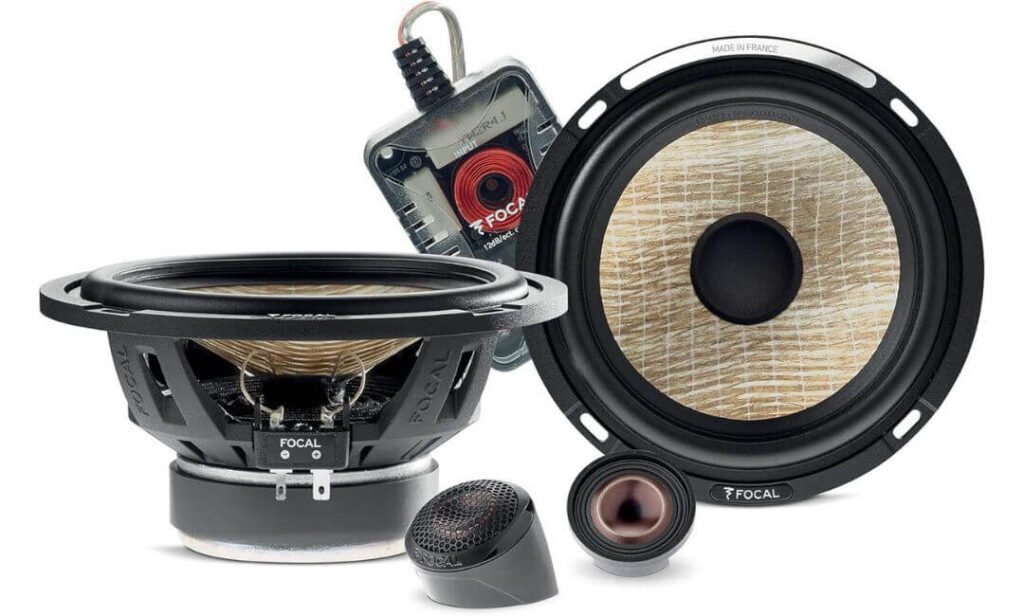
Quick Specs:
- Speaker size: 6.5″ / 165 mm
- Power handling: 70W RMS / 140W max
- Impedance: 4Ω
- Sensitivity: 91.5 dB
- Frequency response: 60Hz–28kHz
- Woofer cone: Flax sandwich
- Tweeter: TAM aluminum/magnesium inverted-dome
- Crossover: 12 dB/octave at 3kHz
- Mounting depth: 2.87″ / 72.7 mm
- Suspension: TMD rubber
The first thing that separates this set from an ordinary factory-speaker replacement is the Flax sandwich cone. Focal uses it to keep the woofer controlled without giving the midrange that overly coloured character you sometimes hear from cheaper composite cones. With a 70W RMS rating, 91.5 dB sensitivity and a published response reaching down to 60Hz, it is not trying to be a subwoofer; its real job is to give the door speaker more body, texture and definition while leaving the deepest bass to a subwoofer. Focal also uses its TMD suspension to help control cone movement, which is one of the reasons this woofer makes more sense in a serious sound-quality build than simply chasing a larger power number.
Then there is the TAM inverted-dome tweeter, which is where this kit becomes particularly interesting for an actual car interior. The aluminum/magnesium M-profile design is intended to provide wide dispersion, something that matters because the listener is rarely sitting directly in front of a door-mounted speaker. That off-axis behaviour can help preserve detail when the tweeters cannot be aimed perfectly at the driver’s ears. The supplied crossover also gives the system a proper handoff between the woofer and tweeter rather than asking one driver to cover everything.
Installation is the part I would check before ordering, especially on a newer vehicle. The woofer uses a 165 mm / 6.5″ cutout and sits 72.7 mm deep, so “6.5-inch” alone does not mean it will drop straight into every door. You may need an adapter bracket, spacer or other vehicle-specific hardware, and the tweeter needs a sensible mounting position to get the benefit of its wide dispersion. At 4Ω and 91.5 dB sensitivity, it is also a fairly sensible match for a properly powered aftermarket system, although I would still prefer a clean amplifier when the goal is to extract everything this set can do.
What We Like About It
- Flax cone character: Natural, controlled midrange is the biggest reason to choose it.
- TAM tweeter: Wide dispersion is genuinely useful inside a car rather than being just a specification-sheet talking point.
- TMD suspension: Helps keep the woofer composed when the volume comes up.
- 91.5 dB sensitivity: Gives you useful output without requiring an extreme amount of amplifier power.
- 60Hz–28kHz response: Gives the system enough range to handle vocals, instruments and upper detail convincingly when properly installed.
The One Thing to Check First
The 72.7 mm mounting depth deserves attention. This is not an ultra-shallow 6.5″ component set, so measure the actual door cavity and check the window mechanism before assuming it will fit.
Where This 6.5″ Component Speaker Fits Best
Think of this as a sound-quality-first 6.5″ component speaker, not an SPL speaker. Its strongest argument is the combination of the Flax woofer, TAM tweeter and controlled crossover behaviour. If your goal is to hear vocals with more texture, guitars with more bite and bass notes with cleaner attack, those are the areas where this design earns its place at the top of our list.
It also leaves room for a sensible system upgrade path. You can run the set in a modest setup, then add a quality multi-channel amplifier and subwoofer later without immediately needing to replace the front speakers. Just remember that a good speaker cannot compensate for a poorly treated door or badly positioned tweeter; installation and tuning are part of the speaker’s performance.
The Insider Pro-Tip
If this is going into a daily-driven car, I would spend money on proper door treatment and solid mounting before chasing a bigger amplifier. The Flax woofer can give you considerably better midbass authority when the door behaves more like a controlled enclosure instead of a loose metal panel.
And there is one small detail I would not ignore: the 60Hz lower response figure does not mean you should run this set without a subwoofer and expect sub-bass. In a well-tuned system, let the component set handle the midbass and musical body while the subwoofer takes over the genuinely low stuff. That division usually produces a cleaner front stage—and it is exactly where a premium 6.5″ component set like this starts making sense.
(A French-engineered Flax cone, wide-dispersion TAM tweeter and TMD-controlled woofer make this a particularly strong choice when natural tone matters more than simply playing louder.)
#2. Morel Tempo Ultra 602 MKII 6.5″ 2-Way Component Speakers
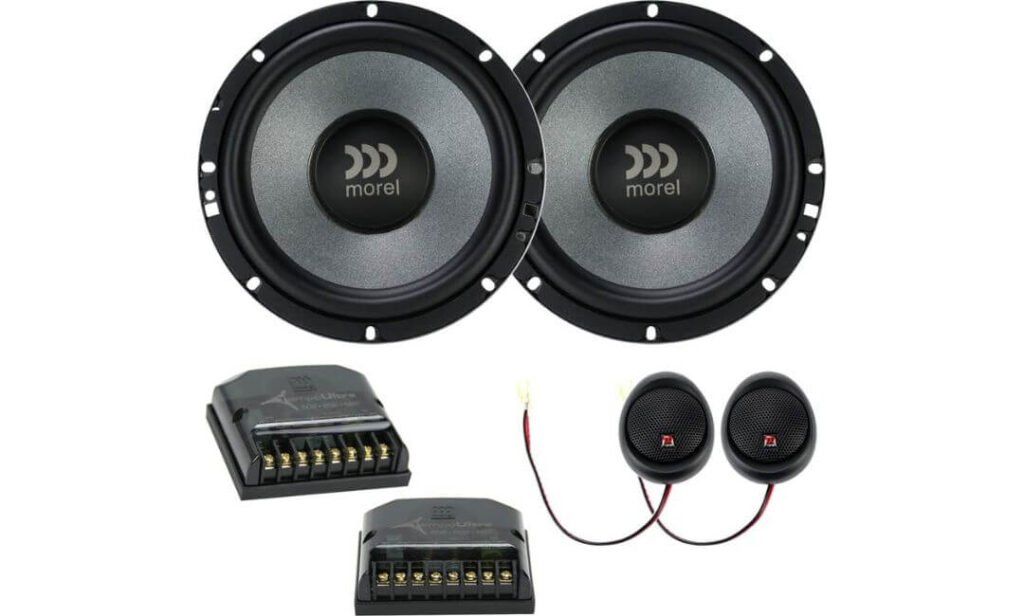
Quick Specs:
- Speaker size: 6.5″ / 165 mm
- Power handling: 130W RMS / 250W peak per speaker
- Impedance: 4Ω
- Sensitivity: 90 dB
- Frequency response: 55Hz–22kHz
- Woofer cone: Treated paper composite
- Tweeter: 1.1″ soft dome
- Crossover: MXR Direct
- Mounting depth: 2.56″ / 65 mm
- Voice coil: Copper wire
The Tempo Ultra 602 MKII takes a different route from the Focal above it. Instead of chasing a highly exotic-looking cone material, Morel uses a treated paper composite cone and puts considerable attention into the driver, tweeter and crossover combination. The result is a component set aimed at listeners who want their music to retain its natural character rather than sounding artificially bright. With 130W RMS per speaker, 90 dB sensitivity and a 55Hz lower frequency specification, it also has considerably more power-handling headroom than many conventional 6.5″ component sets.
The 1.1″ soft-dome tweeter is an important part of that personality. In a car, an overly aggressive tweeter can become tiring surprisingly quickly because of glass, hard trim and reflections inside the cabin. The softer presentation here is better suited to someone who spends hours listening rather than someone who only wants maximum initial sparkle. The MXR Direct crossover then separates the woofer and tweeter duties so the two drivers can work as a proper system instead of competing across the same range.
There is also a practical advantage that is easy to overlook: the 65 mm mounting depth is noticeably friendlier to many doors than deeper premium component sets. That does not mean it is universally plug-and-play—vehicle-specific brackets, wiring and tweeter mounting may still be necessary—but it gives installers more breathing room around the window mechanism and inner door structure. The 4Ω impedance also keeps it within the familiar range for conventional aftermarket car-audio amplification.
What We Like About It
- 130W RMS per speaker: Plenty of headroom for a properly amplified front stage.
- 1.1″ soft-dome tweeter: A strong choice for listeners who prefer detail without an aggressive top end.
- 55Hz response: Gives the woofer useful low-frequency reach for a component set.
- 65 mm mounting depth: Easier to work with in many doors than deeper high-output designs.
- MXR Direct crossover: Keeps the woofer and tweeter working as a coordinated system rather than simply adding more drivers.
The One Thing to Keep in Mind
The 130W RMS rating should not be mistaken for a requirement to feed 130 watts constantly. Good clean power is more important than chasing the number, and a properly tuned amplifier will generally produce a better result than simply overpowering the speakers.
Where This 6.5″ Component Speaker Fits Best
This is the kind of 6.5″ component speaker I would look at when the priority is a strong combination of warm musicality, midbass weight and long-listening comfort. It has enough power handling for a serious aftermarket amplifier, but its appeal is not simply how hard it can be driven. The treated paper cone and soft-dome tweeter give it a more relaxed personality that can work particularly well with vocals, acoustic recordings, rock and everyday mixed playlists.
It is also a sensible option when installation space is becoming a concern. The 65 mm depth gives you more flexibility than some larger premium sets, while the 4Ω load keeps amplifier matching straightforward. If your system already has a subwoofer, I would use the set for the front stage and let the sub handle the deepest bass; that usually gives the woofer a cleaner job and leaves more usable headroom for the music itself.
The Insider Pro-Tip
Do not judge this set by playing one bright, heavily compressed track for thirty seconds. The soft-dome tweeter and treated-paper woofer are better appreciated over a longer listening session, where vocal texture, cymbals and the transition between midrange and upper frequencies become easier to judge.
And if you are pairing it with an amplifier, resist the temptation to turn the gain up simply because the speakers can handle 130W RMS. Set the gain correctly, high-pass the front stage when you have a subwoofer doing the lowest work, and concentrate on getting the tweeters positioned properly. With component speakers, good installation and tuning can make a bigger audible difference than another few watts on the amplifier specification sheet.
(A treated-paper woofer, soft-dome tweeter and 130W RMS power handling give this set a particularly convincing balance of musical warmth, midbass authority and amplifier-friendly headroom.)
#3. HERTZ Mille Pro Series MPK 165.3 6.5″ 2-Way Pro Audio Component System
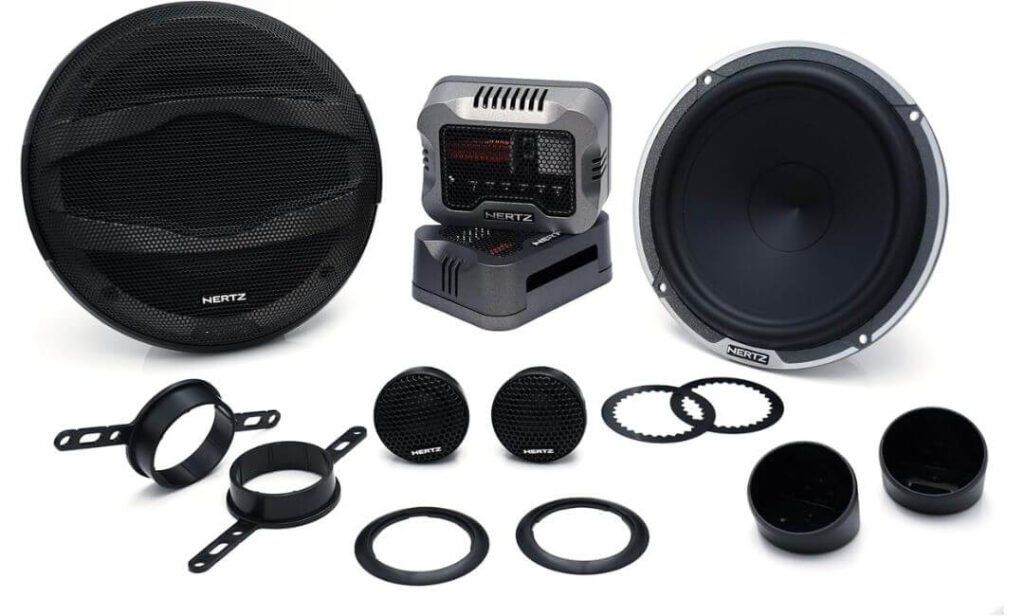
Quick Specs:
- Speaker size: 6.5″ / 165 mm
- Power handling: 110W continuous / 220W peak
- Impedance: 4Ω
- Sensitivity: 92 dB SPL
- Frequency response: 40Hz–22.5kHz
- Woofer cone: V-Cone pressed-pulp with cotton fibers
- Tweeter: 29 mm / 1.14″ Tetolon fiber soft dome
- Crossover: MPCX 2.3 passive, 3.5kHz
- Tweeter adjustment: 0 / +2 dB
- Mounting depth: 63 mm
- Woofer voice coil: 25 mm copper
Some 6.5″ component speakers are tuned primarily around a smooth, refined presentation. The Mille Pro takes a slightly more energetic approach. Its V-Cone woofer, Boundary Free rubber surround and 92 dB sensitivity give it the kind of efficiency that can make a noticeable difference when you want the front stage to play with authority rather than simply sound louder on paper. The published 40Hz lower response is also unusually ambitious for a 6.5″ door woofer, although how much of that low-end you actually hear will depend heavily on the vehicle door, installation and crossover settings. Hertz designed this woofer specifically to provide broad low-frequency extension and strong output from a relatively compact driver.
The 29 mm Tetolon soft-dome tweeter gives the system a different personality from a bright, aggressively voiced car speaker. Hertz combines it with a high-density neodymium motor structure and a rear chamber designed to control its high-frequency behaviour. The useful part for a real installation is the 0/+2 dB tweeter adjustment on the MPCX 2.3 crossover. If the tweeters sound a little too relaxed in your particular cabin, you have a way to bring them forward without immediately reaching for an equalizer.
The crossover is also more than an afterthought here. The woofer and tweeter are crossed at 3.5kHz, while the woofer section uses a low-loss 1 mm copper inductor. The 6.5″ woofer itself uses a pure copper voice coil on a polyamide former, an aluminum-alloy basket and a low-profile design. With approximately 63 mm of mounting depth, it is easier to package in many doors than some large premium component sets, but you should still measure the actual vehicle location before buying—especially where the window glass and inner door structure pass behind the speaker.
What We Like About It
- 92 dB sensitivity: Excellent efficiency for a 6.5″ component system and useful when amplifier power is limited.
- V-Cone + Boundary Free surround: Gives the woofer a strong combination of dispersion and midbass capability.
- Tetolon soft-dome tweeter: Detailed without forcing an excessively sharp top end.
- 0/+2 dB tweeter control: A genuinely useful adjustment for different cabin acoustics and tweeter positions.
- 63 mm mounting depth: Gives installers more flexibility in tighter factory door locations.
The One Thing to Keep in Mind
The 40Hz frequency-response figure should not be read as “this replaces a subwoofer.” A 6.5″ door woofer can produce useful low-end weight, but the cabin, door construction and installation determine how much of that extension survives in the driver’s seat.
Where This 6.5″ Component Speaker Fits Best
This is a particularly strong 6.5″ component speaker for someone who wants the front stage to feel alive, efficient and punchy without moving into an overly aggressive sound. The combination of 92 dB sensitivity, 110W continuous power handling and the V-Cone/Boundary Free woofer makes it comfortable in a properly amplified system, while the Tetolon tweeter keeps the upper range from becoming unnecessarily hard.
It is also one of the more convincing choices here for a system that may initially run without a dedicated subwoofer. The 40Hz published extension gives the woofer useful ambition on paper, but I would still treat that as bonus range rather than a substitute for dedicated low-frequency reinforcement. Add a subwoofer later and the front stage can concentrate on midbass, vocals and detail, which is where this design becomes much easier to appreciate.
The Insider Pro-Tip
If your car has a naturally bright cabin—lots of glass, hard plastics and reflective trim—start the crossover’s tweeter setting at 0 dB, not +2 dB. Give the system some time to settle into the vehicle before deciding that it needs more top-end energy. That small switch can be more useful than people expect because the same speaker can behave quite differently once it is mounted off-axis in an actual door.
And if you are building around an amplifier, this is one of those sets where clean power and proper gain setting matter more than chasing the biggest amplifier number. The 92 dB sensitivity means you already have an efficient front stage; use that efficiency to get clean, controlled output rather than simply pushing the system harder. Pair it with a properly treated door and a sensible high-pass point once a subwoofer is added, and the woofer has a much easier job producing the punch that makes this set stand out.
(Italian engineering, a V-Cone woofer, Tetolon soft-dome tweeter and adjustable crossover give this set a convincing mix of efficiency, punch and controlled detail.)
#4. Rockford Fosgate T2652-S Power 6.5″ 2-Way Component Speaker System
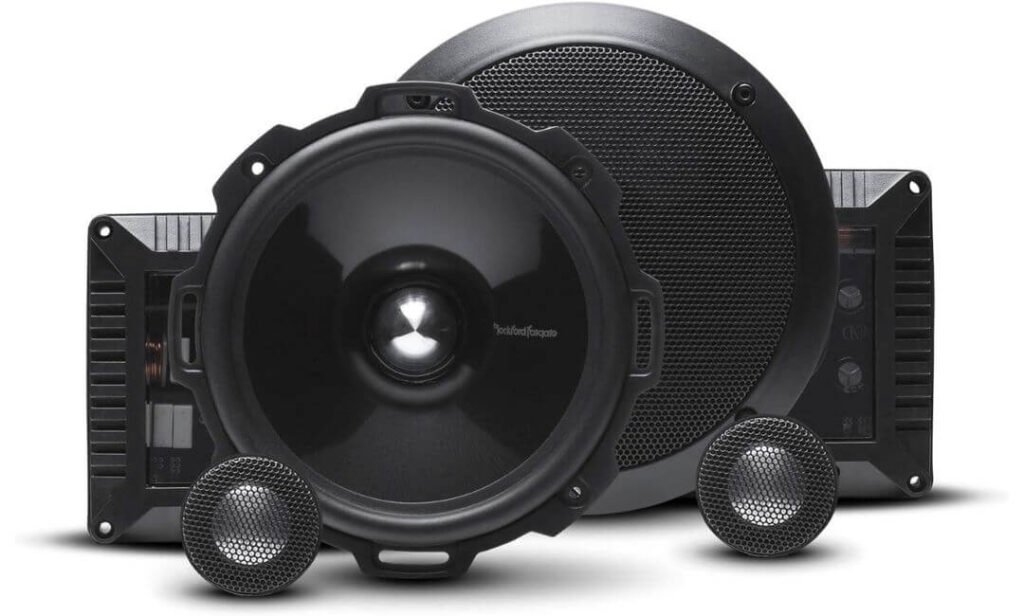
Quick Specs:
- Speaker size: 6.5″
- Power handling: 100W RMS / 200W max
- Impedance: 4Ω
- Frequency response: 55Hz–22kHz
- Woofer: Carbon-fiber reinforced cone with VAST surround
- Tweeter: 1″ aluminum-dome Neo
- Phase plug: Billet aluminum
- Crossover: External audiophile crossover
- Tweeter mounting: Flush or surface mount
- Included: Woofers, tweeters, grilles, crossovers and mounting hardware
The T2652-S is aimed at the listener who does not want a soft or overly relaxed front stage. Its carbon-fiber reinforced woofer, VAST surround and aluminum-dome tweeter give the system a more energetic character, particularly when the volume starts climbing. The 100W RMS rating is enough to make it comfortable with a proper aftermarket amplifier, while the 4Ω load keeps amplifier matching relatively straightforward. This is not a speaker set I would choose simply because its power number looks impressive; its real appeal is the combination of output, attack and crisp upper-frequency detail.
Rockford also gives the woofer a billet aluminum phase plug, which is more than cosmetic decoration. It helps with heat management around the motor structure during sustained playback, something that becomes more relevant when the speakers are being driven hard. The VAST surround increases the effective radiating area of the woofer, giving the 6.5″ driver more room to produce useful midrange and midbass energy. In a properly sealed and treated door, that can translate into a noticeably more confident front stage than a basic factory replacement.
The separate 1″ aluminum-dome Neo tweeter is where the personality becomes obvious. It is designed for clear, immediate high-frequency reproduction rather than the softer presentation of the Morel above it. The external crossover keeps the woofer and tweeter separated, while the included flush and surface mounting options give you some freedom over tweeter placement. That flexibility matters in a car because the best location is rarely identical from one dashboard or door design to another.
What We Like About It
- 100W RMS handling: Gives it useful headroom for a properly amplified front stage.
- Aluminum-dome Neo tweeter: Brings a crisp, lively character to vocals and high-frequency detail.
- VAST surround: Helps the 6.5″ woofer produce stronger usable cone area and midbass energy.
- Billet aluminum phase plug: Useful thermal and mechanical engineering for sustained higher-volume use.
- Flexible tweeter mounting: Flush and surface options make installation easier to adapt to different interiors.
The One Thing to Keep in Mind
The aluminum tweeter has an energetic presentation, so careful positioning and tuning are worthwhile if your vehicle has a particularly reflective cabin. More treble is not automatically more detail.
Where This 6.5″ Component Speaker Fits Best
This is a strong 6.5″ component speaker for someone who wants the front stage to feel lively, immediate and powerful, particularly with an aftermarket amplifier. It sits in an interesting position in this list: it is less focused on the ultra-refined presentation of the Focal and Morel, but it gives you plenty of energy when you want to turn the system up and actually feel the music.
It also makes sense for a build that is going to grow. Start with the component set and a capable four-channel amplifier, then add proper door treatment and a subwoofer later. Once the subwoofer takes over the lowest frequencies, the front woofers can concentrate on the punch and vocal range where they are most useful. For someone who listens at higher volumes, that can be a much more satisfying approach than trying to make a factory-powered speaker do everything.
The Insider Pro-Tip
With this set, tweeter placement is worth treating as part of the installation—not an afterthought. Start with the tweeters positioned so they are not firing directly into a hard piece of glass or trim, then make small adjustments before touching the amplifier’s EQ. You may find that simply changing the angle gives you a smoother balance without sacrificing the crisp detail that attracted you to the set in the first place.
I would also budget for proper door treatment if midbass matters to you. A powerful 6.5″ woofer mounted into a loose, resonant door can waste much of its potential. A rigid mounting surface and controlled door cavity let the woofer move air instead of making the door panel move with it. That is one of those upgrades you cannot see in a product photograph, but you can hear immediately once the system is playing.
(A carbon-fiber reinforced woofer, VAST surround, billet phase plug and aluminum-dome Neo tweeter make this a compelling choice for listeners who want crisp detail with a more energetic, high-output character.)
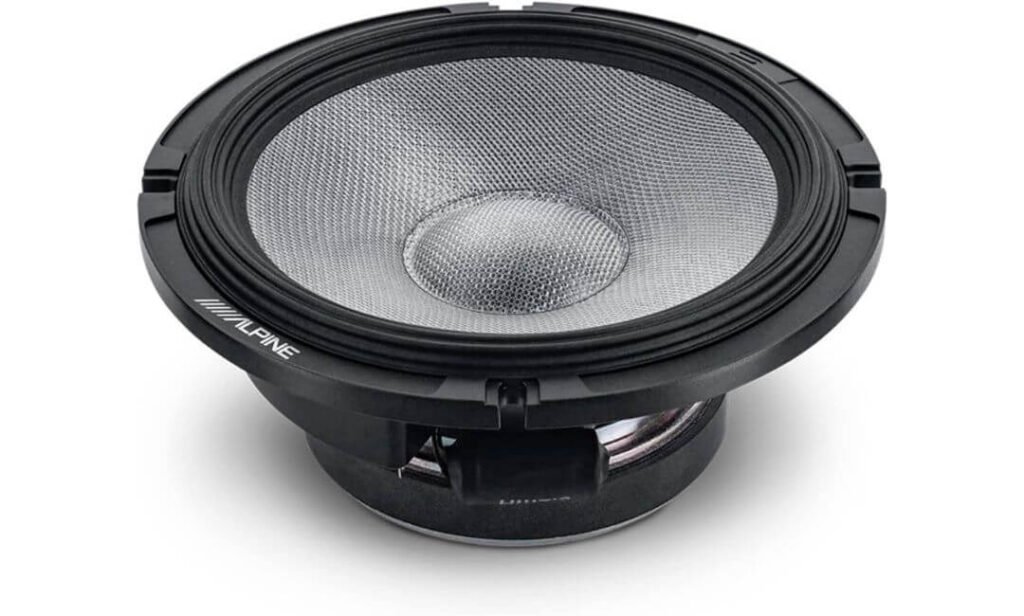
#5. Alpine R2-S65C 6.5″ R-Series High-Resolution 2-Way Component Speaker Set
Quick Specs:
- Speaker size: 6.5″ / 16.5 cm
- Power handling: 100W RMS / 300W peak
- Impedance: 4Ω
- Sensitivity: 88 dB
- Frequency response: 65Hz–40kHz
- Woofer cone: Glass-fiber reinforced
- Tweeter: 4.3 cm magnesium hard dome
- Crossover: External network with tweeter level adjustment
- Tweeter options: Flush, angled surface and other included mounts
- Tweeter frame: Removable for smaller installation footprint
The R2-S65C takes a noticeably different approach from the warmer-sounding component sets above it. Alpine uses a glass-fiber reinforced woofer cone that is both light and rigid, with the aim of keeping the driver quick and controlled when music changes rapidly. That matters with busy recordings where vocals, guitars, percussion and electronic elements can otherwise start blending together. The 100W RMS rating also gives the woofer enough headroom for a serious aftermarket system, while its 4Ω impedance keeps it familiar to most conventional car-audio amplifiers.
The standout feature is the 4.3 cm magnesium hard-dome tweeter, which extends the published response all the way to 40kHz. You will not hear 40kHz directly, of course; the more useful takeaway is that Alpine designed the tweeter for extended high-frequency reproduction and detailed transient response. In an actual car, the bigger advantage is the tweeter’s ability to bring out small details in cymbals, strings and vocal textures without relying on an overly boosted midrange to create the impression of clarity.
Installation is another area where Alpine deserves credit. The tweeter has a removable installation frame, and the kit includes several mounting approaches, so you are not locked into one bulky housing. That can be genuinely useful when the factory door or sail-panel location is tight. The supplied crossover also provides +3dB, 0dB and -3dB tweeter adjustment, giving you a practical way to compensate for the acoustic behaviour of your particular cabin instead of accepting the same treble balance in every vehicle.
What We Like About It
- Glass-fiber woofer cone: Lightweight and rigid for quick, controlled driver response.
- Magnesium hard-dome tweeter: Produces a precise, highly detailed upper range.
- 40kHz extended response: Shows Alpine’s focus on high-resolution reproduction rather than simply maximizing bass output.
- Tweeter level adjustment: +3dB, 0dB and -3dB settings make system balancing easier.
- Flexible tweeter mounting: The removable frame and multiple brackets are useful when factory locations are restrictive.
The One Thing to Keep in Mind
The 88 dB sensitivity is lower than the Hertz set above, so although it can work in a variety of systems, a clean aftermarket amplifier can make a meaningful difference if you want higher output and more headroom.
Where This 6.5″ Component Speaker Fits Best
This is a strong 6.5″ component speaker for listeners who care about resolution, separation and a precise front stage more than simply making the system louder. The glass-fiber woofer keeps the lower and middle frequencies controlled, while the magnesium tweeter gives the upper range a clean, articulate character. It is particularly attractive for modern recordings where there is a lot of information competing across the soundstage.
The installation flexibility also makes it easier to work with vehicles where the original tweeter location is awkward. Add a capable amplifier and, ideally, a DSP, and you have enough adjustment range to tailor the front stage to the cabin rather than accepting a one-size-fits-all sound. If you already have a subwoofer, the 65Hz lower response is less of a concern because the woofer can concentrate on the midbass and midrange duties it handles best.
The Insider Pro-Tip
Do not chase the 40kHz specification as though it automatically means better sound. In a car, tweeter positioning, crossover level, reflections and tuning will affect what you actually hear far more than frequencies above the normal audible range. The real reason to like this tweeter is its fast, detailed presentation, not the number printed at the top of its frequency range.
If the system sounds too forward after installation, try the -3dB tweeter setting before reaching for aggressive EQ cuts. That small adjustment can preserve the detail of the magnesium dome while taking some edge out of a reflective cabin. Once the balance is right, the R-Series can give you a very clean front stage without needing to artificially brighten the rest of the system.
(A rigid glass-fiber woofer, magnesium hard-dome tweeter and flexible crossover adjustment make this a particularly capable choice for listeners who value high-resolution detail and precise imaging.)
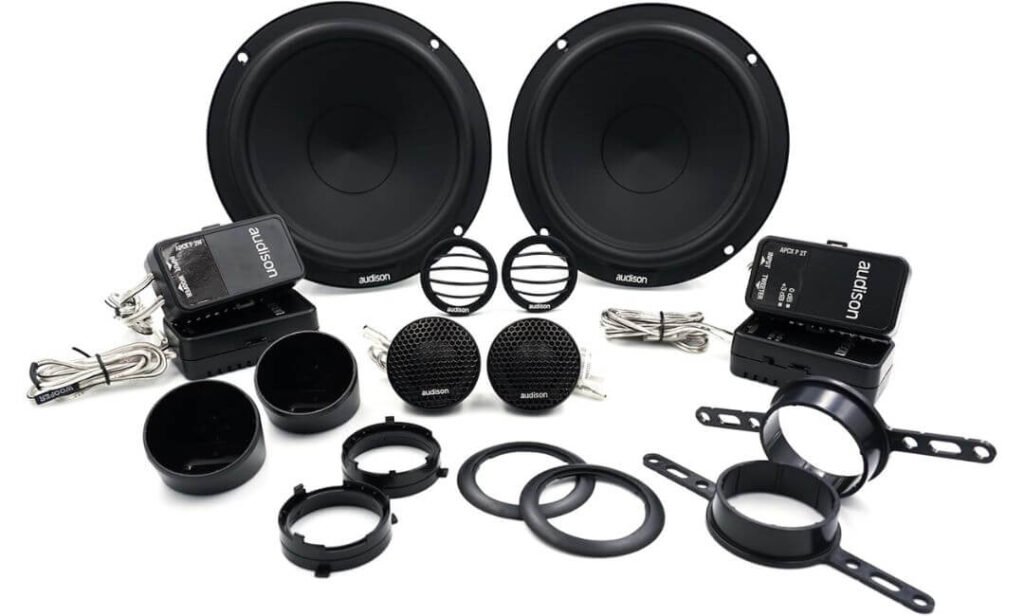
#6. Audison APK 165P Prima Series 6.5″ 2-Way Component Speaker Set
Quick Specs:
- Speaker size: 6.5″
- Power handling: 115W continuous / 345W peak
- Impedance: 4Ω
- Sensitivity: 92.5 dB SPL
- Frequency response: 50Hz–24kHz
- Woofer: AP 6.5P
- Tweeter: AP 1P
- Voice coil: CCAW
- Magnet: Double neodymium
- Tweeter mounting: Flush, surface or bracket installation
- Included: External crossover and grilles
The Audison Prima takes a slightly different approach to the premium 6.5″ component speaker market. Rather than making the system difficult to integrate into a normal vehicle, Audison designed the AP 6.5P woofer and AP 1P tweeter around the realities of factory-style door installations. With 92.5 dB sensitivity, 4Ω impedance and 115W continuous power handling, it can produce useful output without demanding an enormous amplifier, while still leaving enough headroom for a more serious system later.
The woofer’s published 50Hz–24kHz system response gives it useful range for a front-door speaker, but I would not interpret that 50Hz figure as a reason to remove the subwoofer from a complete system. The real advantage is having a component set that can deliver convincing midbass and vocal weight before the subwoofer takes over the lowest frequencies. Its CCAW voice coil and double-neodymium motor structure are also aimed at keeping the driver responsive when the system is pushed harder.
The AP 1P tweeter is where the installation-friendly philosophy becomes particularly obvious. Audison’s AIF mounting approach allows several ways to position it, including flush, surface and bracket mounting. That gives you much more freedom than a fixed tweeter location when working around an existing door panel or sail panel. The external crossover completes the component arrangement and gives the woofer and tweeter their own jobs, while the included grilles provide basic protection during installation.
What We Like About It
- 92.5 dB sensitivity: Excellent efficiency when working with modest amplifier power.
- 115W continuous handling: Enough headroom for a meaningful aftermarket amplifier upgrade.
- 50Hz–24kHz response: Gives the front stage useful bandwidth for midbass and vocals.
- Flexible AP 1P tweeter mounting: Flush, surface and bracket options make real-world installation easier.
- OEM-friendly approach: A sensible choice when you want a premium component upgrade without turning the installation into a fabrication project.
The One Thing to Keep in Mind
The 50Hz specification should be viewed as useful extension, not subwoofer replacement. If you want genuinely deep bass at higher volume, a properly integrated subwoofer will still do that job far better.
Where This 6.5″ Component Speaker Fits Best
This is a particularly sensible 6.5″ component speaker for someone upgrading a factory system who wants better clarity and midbass without immediately building a complicated competition-style installation. Its high sensitivity is especially useful when the available amplifier power is limited, while the 115W continuous rating means it can comfortably remain part of the system when you add an aftermarket amplifier later.
It also suits vehicles where tweeter placement is awkward. The multiple mounting options give the installer room to work with the existing interior rather than forcing a particular position. That matters because even a very good component set can sound disappointing when the tweeter is mounted poorly or aimed directly into a reflective surface.
The Insider Pro-Tip
If you are replacing factory speakers but keeping the original radio, do not assume that buying the highest-powered component set will automatically give you the biggest improvement. The 92.5 dB sensitivity here is actually a useful advantage because it can make better use of limited available power. Get the mounting rigid, seal the speaker properly to the door adapter and position the tweeter carefully before spending money on more amplification.
If you eventually add an amplifier, this set gives you room to grow without forcing you to rebuild the front stage. I would rather see this installed correctly with clean 75–100W-per-channel power than installed casually with a huge amplifier and poor door preparation. In car audio, the quality of the installation is part of the speaker, and that is particularly true with a component system where tweeter position and woofer mounting directly affect the final sound.
(High sensitivity, flexible tweeter placement and a factory-friendly 6.5″ woofer make this a particularly practical choice for upgrading an OEM system without sacrificing future amplifier potential.)
Best 6.5″ Component Speakers Compared (2026)
| 6.5″ Component Speaker | Power & Efficiency | Sound Character | Tweeter & Detail | Installation Reality | Best Fit |
|---|---|---|---|---|---|
| Focal PS 165 FE Flax EVO Sound Quality Pick | 70W RMS 140W max · 4Ω · 91.5 dB | Natural, controlled and refined Flax cone · strong vocal texture · clean midbass | TAM inverted dome Aluminum/magnesium · wide off-axis dispersion | 72.7 mm depth; measure the door before buying. Proper tweeter aiming matters. | Best for pure SQ |
| Morel Tempo Ultra 602 MKII Warm SQ Pick | 130W RMS 250W peak · 4Ω · 90 dB | Warm, musical and full Treated paper cone · strong midbass · easy long listening | 1.1″ soft dome Smooth presentation without an overly sharp top end | 65 mm depth gives it useful door clearance, but vehicle-specific brackets may still be needed. | Best for musicality |
| HERTZ Mille Pro MPK 165.3 Dynamic Performance Pick | 110W RMS 220W peak · 4Ω · 92 dB | Punchy, efficient and lively V-Cone woofer · Boundary Free surround · strong output | 29 mm Tetolon soft dome 0/+2 dB adjustment · detailed without excessive brightness | Approx. 63 mm depth; crossover offers useful tweeter-level control for cabin tuning. | Best for punch |
| Rockford Fosgate T2652-S Power High-Output Pick | 100W RMS 200W max · 4Ω | Energetic, crisp and assertive VAST surround · carbon-fiber reinforced woofer · strong attack | 1″ aluminum-dome Neo Crisp highs · external audiophile crossover | Flush or surface tweeter mounting gives useful placement flexibility. Door treatment is worthwhile. | Best for impact |
| Alpine R2-S65C R-Series High-Resolution Pick | 100W RMS 300W peak · 4Ω · 88 dB | Fast, precise and detailed Glass-fiber woofer · controlled response · strong separation | 4.3 cm magnesium hard dome Extended response to 40kHz · adjustable tweeter level | Removable tweeter frame and multiple mounting options help with tight factory locations. | Best for detail |
| Audison APK 165P Prima OEM Upgrade Pick | 115W continuous 345W peak · 4Ω · 92.5 dB | Balanced, efficient and practical AP 6.5P woofer · useful midbass · factory-friendly approach | AP 1P tweeter AIF mounting approach · flexible placement | Designed with OEM-style installations in mind; still verify the vehicle’s actual mounting dimensions. | Best for OEM upgrades |
| The right 6.5″ component speaker depends on the system around it. Focal leans hardest toward refined sound quality, Morel toward warm musicality, Hertz toward efficient punch, Rockford Fosgate toward energetic output, Alpine toward high-resolution detail, and Audison toward practical OEM integration. Mounting depth, amplifier power, door treatment and tweeter position should be checked before purchase. | |||||
Why 6.5″ Component Speakers Still Make Sense for Modern Car Audio
A 6.5″ component set remains one of the most useful upgrades for a factory car-audio system because it sits in a practical middle ground: large enough to produce convincing midbass and vocal body, but compact enough to work with the door locations found in a wide range of cars, trucks and SUVs. The important part is not simply finding a speaker that says “6.5-inch” on the box. Mounting depth, cutout dimensions, door construction and the factory audio system all determine whether that particular driver will actually work well in your vehicle.
The 6.5″ Format Fits More Than Just the Speaker Opening
The popularity of the 6.5″ format comes down to more than standard sizing. A properly installed 165 mm woofer has enough cone area to move useful air through a vehicle door without requiring the enormous enclosure space of a larger driver. That makes it a sensible front-stage size for everything from older sedans and pickups to newer SUVs.
There is still a catch: 6.5″ does not mean universal fitment. Two speakers with the same advertised diameter can have very different mounting depths, basket shapes and magnet clearances. The Focal in this list, for example, needs considerably more depth than the Morel, Hertz or some OEM-oriented designs. Before buying, check the speaker cutout, mounting depth, window clearance and whether your vehicle needs an adapter bracket or spacer.
Cone Material Changes How the Woofer Behaves
This is where the six speakers in our list become genuinely different from one another. Focal’s Flax sandwich cone is designed around a combination of light weight, rigidity and controlled behaviour, while Morel takes a different route with its treated paper composite cone. Alpine uses a glass-fiber reinforced cone, and Rockford Fosgate uses a carbon-fiber reinforced construction.
There is no single material that automatically sounds better. What matters is how the cone, surround, motor structure and suspension work together. A well-controlled cone can respond quickly to changes in music while avoiding unnecessary resonances, but the final result still depends heavily on the crossover and installation. That is why we did not rank these speakers simply by looking at which one has the most exotic-sounding cone material.
Midbass Is Where a 6.5″ Door Speaker Has to Earn Its Place
When people search for 6.5″ component speakers for bass, they often mean something slightly different from subwoofer bass. What they usually want is the kick from a bass guitar, the impact of a snare, the body of a kick drum and enough low-mid weight that vocals do not sound thin.
That is exactly where a good 6.5″ woofer can make a factory system feel dramatically different. The Hertz Mille Pro’s V-Cone and Boundary Free surround, the Morel’s treated-paper design and the Rockford Fosgate’s VAST surround all take different approaches to getting useful output from the door. But none of them should be expected to behave like a dedicated subwoofer. Door sealing, mounting rigidity and acoustic treatment can matter just as much as the speaker itself when you are chasing strong midbass.
The Tweeter and Crossover Decide What Your Ears Actually Hear
A component speaker’s separate tweeter is not there simply to make the product look more premium. Moving the high-frequency driver away from the woofer gives the installer control over soundstage height, imaging and tonal balance.
The differences between these six sets are particularly interesting here. Focal uses its TAM aluminum/magnesium inverted dome, Morel uses a soft-dome design, Hertz uses a Tetolon soft dome with level adjustment, Rockford Fosgate takes a more energetic aluminum-dome approach, Alpine uses a magnesium hard dome, and Audison focuses on flexible installation with its AP 1P tweeter.
The crossover is equally important. It determines how smoothly the woofer hands over to the tweeter and, in some designs, lets you adjust tweeter output for the vehicle’s acoustics. That matters because a speaker that sounds balanced in a showroom can become overly bright once it is installed near glass, hard dashboard surfaces and other reflective materials.
More Power Is Not Automatically Better
One of the easiest mistakes when comparing component speakers is assuming that higher RMS power means better sound. It doesn’t. RMS tells you how much continuous power the speaker is designed to handle; it does not tell you how musical, efficient or well-balanced the speaker will sound.
That distinction is particularly clear across our six choices. The Morel is rated at 130W RMS per speaker, Hertz at 110W, Rockford Fosgate and Alpine at 100W, Audison at 115W, while the Focal is rated at 70W. Yet the Focal sits at the top of this list because its overall driver design, sensitivity, tweeter behaviour and sound-quality focus make it a compelling choice for a different type of system.
For a factory-radio upgrade, sensitivity and proper impedance matching can matter more than chasing a huge RMS figure. For an amplified system, clean power, correct gain settings and appropriate crossover points become much more important.
A Good 6.5″ Component Setup Is a System, Not Just a Speaker
The biggest takeaway is that the speaker is only one part of the result. A rigid adapter, sealed mounting surface, properly treated door, correctly positioned tweeter and sensible crossover settings can turn a good component set into a genuinely impressive front stage.
That is also why these six products are not interchangeable recommendations. Focal is the strongest sound-quality choice, Morel leans toward warm musicality, Hertz brings efficiency and punch, Rockford Fosgate favours energetic output, Alpine prioritizes high-resolution detail, and Audison offers a particularly practical route into a premium OEM-style upgrade. The best choice depends on what your existing system can support and what you actually want to hear from the driver’s seat.
6.5″ Component Speakers Buying Guide: What Actually Matters Before You Buy
Choosing a 6.5″ component speaker set is not as simple as comparing wattage, frequency range, or the brand name on the grille. Two sets can have similar power ratings and completely different sound once they are installed in a real vehicle. The door itself becomes part of the acoustic system, the factory radio may limit available power, and the position of the tweeter can change how bright or balanced the entire front stage sounds.
For this reason, the right way to compare component speakers is to look at the complete system: woofer design, frequency response, sensitivity, impedance, RMS power, tweeter behaviour, crossover quality, physical fitment, and the amplifier or head unit driving them. These are the factors that separate a genuinely good upgrade from an expensive speaker that never gets the opportunity to perform properly.
Start With the Woofer, Not the Maximum Wattage
The woofer is responsible for most of the sound you physically feel from a 6.5″ component set, particularly vocals, guitars, kick drums, bass-guitar notes and the upper portion of the bass range. That makes the cone and motor design more important than a large maximum-power number printed on the packaging.
When comparing the six sets in this guide, the cone materials are deliberately different:
| Cone approach | Typical characteristics | What to expect |
|---|---|---|
| Flax sandwich | Light, rigid and well controlled | Refined detail, natural tone and controlled midbass |
| Treated paper composite | Naturally damped and musical | Smooth presentation with good vocal body |
| Pressed-pulp / V-Cone | Efficient, responsive and lightweight | Strong dynamics and punch |
| Carbon-fiber reinforced | Rigid and responsive | Firm attack and energetic presentation |
| Glass-fiber reinforced | Stiff and controlled | Clean transient response and detailed sound |
| Traditional polypropylene-style designs | Durable, damped and generally forgiving | Smooth sound, but character depends heavily on the complete driver |
This does not mean one material automatically wins. Cone material is only one part of the driver. The surround, voice coil, magnet, suspension and basket all influence how the cone behaves.
Focal’s Flax construction is particularly interesting because the material is being used as part of a complete sandwich-cone design rather than simply being a marketing label. Morel’s treated-paper approach takes a different path, favouring a naturally damped character. Hertz uses its V-Cone geometry to concentrate on efficiency and dynamic response, while Alpine and Rockford Fosgate use reinforced materials to provide a more rigid platform.
The useful question is therefore not, “Which cone material is best?” It is, “Which driver behaviour suits the sound and power level I am building?”
Frequency Response Is Useful, But Do Not Shop by the Numbers Alone
Frequency response is one of the most misunderstood specifications in car-audio shopping.
A published range such as 40Hz–22.5kHz or 65Hz–40kHz tells you the frequencies the manufacturer specifies for the speaker under its measurement conditions. It does not mean the woofer will produce strong, usable bass at the bottom of that range inside your vehicle.
For a 6.5″ door speaker, the more useful question is where it produces clean and convincing output, not which product claims the lowest number.
That distinction matters because a component set rated down to 40Hz still does not replace a dedicated subwoofer. The door is not a sealed subwoofer enclosure, and road noise makes the lowest bass particularly difficult to reproduce convincingly.
For this type of system, pay more attention to:
- Midbass performance, especially around kick-drum and bass-guitar frequencies.
- Vocal presence, because the woofer handles a large portion of the human voice.
- Smooth transition into the tweeter, rather than an obvious gap between drivers.
- Clean output at your normal listening volume, rather than an impressive specification at low output.
- How the speaker behaves after installation, because door acoustics can change the result dramatically.
The published frequency range is still worth checking, but it should support your decision rather than make it for you.
Sensitivity Matters More Than Many Buyers Realize
Sensitivity becomes particularly important when deciding between a factory-radio installation and an aftermarket amplifier.
A speaker with higher sensitivity can generally produce more acoustic output from the same amount of amplifier power than a less sensitive design. That does not make it automatically better, but it can make the difference between a speaker that feels lively from a factory system and one that feels underpowered.
There is a useful spread among the six choices:
- Audison APK 165P: 92.5 dB
- Hertz Mille Pro MPK 165.3: 92 dB
- Focal PS 165 FE: 91.5 dB
- Morel Tempo Ultra 602 MKII: 90 dB
- Alpine R2-S65C: 88 dB
- Rockford Fosgate T2652-S: manufacturer specifications should be considered alongside the complete amplifier setup rather than using sensitivity as the only ranking factor.
Higher sensitivity can be especially useful with a factory head unit, but do not interpret it as a direct sound-quality ranking. A less-sensitive speaker paired with a capable amplifier can outperform a highly sensitive speaker in overall tonal quality, headroom and detail.
RMS Power Is a Matching Specification, Not a Quality Score
RMS power tells you considerably more about system matching than it does about sound quality.
A 130W RMS speaker is not automatically better than a 70W RMS speaker. It simply has a different power-handling target. The amplifier must also be capable of delivering clean power at the speaker’s impedance without clipping.
A sensible way to approach power matching is:
- Check the speaker’s RMS rating, not only its peak or maximum figure.
- Check the amplifier’s real output at the speaker’s impedance.
- Leave enough headroom for clean playback rather than running an amplifier at its limit.
- Set gains correctly; gain is not a volume control.
- Use appropriate high-pass filtering when a subwoofer is handling deep bass.
- Avoid assuming that more amplifier power will fix poor installation or weak door acoustics.
For example, the 100W, 110W and 115W-class systems in this guide are not separated by huge power differences. Their real-world personalities come more from driver design, sensitivity, tweeter behaviour, crossover implementation and installation.
Impedance: Match the Speaker to the Amplifier
Most of the component sets here use a 4-ohm nominal impedance, which is a common and practical choice for aftermarket car-audio systems.
That matters because an amplifier’s output changes depending on the impedance it sees. If an amplifier is rated for a particular power output at 4 ohms, that is the figure you should use when deciding whether the combination is appropriate.
Do not choose speakers based on impedance alone. Instead, check:
- The speaker’s nominal impedance.
- The amplifier’s rated output at that impedance.
- Whether the factory amplifier is designed for the replacement load.
- Whether the system uses active or passive crossovers.
- Whether multiple speakers are being wired together.
A 4-ohm component set is generally straightforward for a conventional aftermarket amplifier, but factory systems can be less predictable. Some vehicles use dedicated factory amplification, equalization, or unusual speaker loads, so compatibility should be checked before assuming a direct swap.
The Crossover Is More Important Than It Looks
A component set earns its name because the woofer and tweeter are separated, but that separation only works properly when the crossover network is doing its job.
A passive crossover determines which frequencies are sent to each driver and helps control the transition between them. A good design can make the woofer and tweeter sound like one coherent system rather than two separate speakers.
Look for:
- Appropriate crossover frequency
- Slope characteristics
- Tweeter-level adjustment
- Build quality
- Installation flexibility
- Whether the crossover can be accessed and mounted safely
This is one area where the products in this guide differ in useful ways. The Focal uses an external 12 dB/octave crossover around 3kHz, while Hertz provides tweeter adjustment that can be useful for adapting the high-frequency balance to the cabin. Alpine also gives the installer tweeter-level adjustment, which can be valuable when the tweeter is mounted high on the door or closer to reflective glass.
Do not hide the crossover where it can rattle against the door or become exposed to unnecessary moisture. A secure, protected mounting location is part of a proper installation.
Flax vs Polypropylene vs Other Cone Materials: Which One Should You Choose?
There is no universal winner here.
Flax or other lightweight composite constructions can be attractive when your priority is a controlled, detailed presentation. The Focal is the obvious example in this group, where the Flax sandwich cone is part of a larger design focused on natural reproduction and controlled behaviour.
Treated paper can be an excellent choice when you want a more relaxed, musical presentation. Morel’s approach shows why paper has never disappeared from serious car audio: when properly engineered, it can offer useful damping and a natural character without needing an exotic material.
Glass-fiber and carbon-fiber reinforced designs tend to appeal to buyers who want a rigid diaphragm and fast response. That can contribute to a crisp, energetic presentation, although the rest of the driver still determines whether the result is smooth or aggressive.
Polypropylene remains popular because it is durable, moisture-resistant and naturally damped. It can make an excellent daily-driver cone material, particularly for factory-style replacements, but simply being polypropylene does not tell you whether a particular speaker is good.
The real-world hierarchy is therefore not:
Flax > carbon fiber > paper > polypropylene.
It is closer to:
Complete driver design + crossover + installation + system matching > cone material alone.
That is the honest way to compare them.
When Should You Choose 2-Way Component Speakers?
A 2-way component set uses one woofer and one tweeter, with a crossover dividing the frequencies between them. For most front-door upgrades, this remains the most practical configuration.
A good 2-way setup can provide:
- Stronger front-stage imaging than many coaxial replacements.
- Better control over tweeter positioning.
- Useful midbass from the larger door-mounted woofer.
- A simpler installation than a three-way system.
- Easier crossover and tuning decisions.
- Lower installation complexity and cost.
For the majority of daily-driven vehicles, a well-installed 2-way component set is already capable of producing a substantial improvement.
When Do 3-Way Component Speakers Make More Sense?
This is where the keyword best 6.5 3 way component speakers needs some context.
A 3-way component system typically adds a dedicated midrange between the woofer and tweeter. Instead of asking the 6.5″ woofer to cover everything from midbass through much of the vocal range, the system divides the workload among three drivers.
A three-way system can be worthwhile when:
- You are building a more serious front stage.
- You have suitable locations for a dedicated midrange.
- You have enough amplifier channels.
- You are comfortable with more complicated crossover tuning.
- You want greater control over vocal placement and imaging.
- Your vehicle has suitable factory locations for a midrange driver.
The downside is just as important: more drivers do not automatically mean better sound.
A poorly installed three-way system can sound less coherent than a properly installed two-way set. You also need to consider additional wiring, mounting, amplifier channels, crossover configuration and physical space.
For a normal front-door upgrade, I would rather see a high-quality 2-way component set installed correctly than an inexpensive three-way system installed wherever there happens to be room.
Factory Radio or Aftermarket Amplifier: Where Should You Spend?
This is one of the most important decisions before buying.
If you are keeping the factory radio and factory amplifier, prioritise sensitivity, reasonable power requirements and impedance compatibility. A highly power-hungry speaker may technically fit the vehicle but fail to deliver the improvement you expected because the original system cannot provide enough clean power.
Higher-sensitivity designs such as the Hertz and Audison can be attractive in this situation, assuming the factory system is compatible with their impedance and wiring requirements.
If you are adding a dedicated amplifier, your choices become much broader. You can take better advantage of speakers with higher RMS ratings and use clean amplifier power to provide greater headroom.
But there is an important distinction:
A factory-radio upgrade is not the same thing as a factory-radio-only upgrade.
You can install component speakers without immediately adding an amplifier, but that does not mean every component speaker will perform equally well from the original head unit.
Choosing the Right Speaker for Factory Radio vs Amplified Car Audio
| System | What to Prioritize | What to Avoid |
|---|---|---|
| Factory radio only | Higher sensitivity, 4-ohm compatibility, efficient design | Extremely power-hungry speakers |
| Factory radio + factory amp | Impedance compatibility, OEM integration, sensitivity | Assuming every aftermarket speaker is electrically compatible |
| Small aftermarket amp | Sensitivity, clean power, moderate RMS handling | Buying purely by maximum wattage |
| Strong 4-channel amp | RMS handling, driver quality, crossover control | Running gains too high |
| Amplifier + subwoofer | Midbass control, high-pass filtering, front-stage balance | Asking door speakers to reproduce deep sub-bass |
| Full custom system | Driver integration, crossover flexibility, imaging and installation | Choosing components independently without system planning |
This is also why there is no single answer to best 6.5″ component speakers for car audio. A speaker that is excellent in a fully amplified system may not be the smartest choice for a factory-radio upgrade.
Fitment: The 6.5″ Label Does Not Guarantee a Direct Fit
Before ordering any component set, measure the actual vehicle.
At minimum, check:
- Factory speaker cutout diameter
- Mounting depth
- Window-glass clearance
- Magnet clearance
- Basket diameter
- Mounting-hole pattern
- Door-panel grille clearance
- Tweeter mounting location
- Crossover mounting space
- Factory wiring and connector type
A spacer or adapter bracket is often perfectly acceptable. In fact, a properly made adapter can provide a much stronger mounting surface than trying to force a new speaker into an incompatible factory bracket.
Mounting depth deserves particular attention. A speaker can have the correct 6.5″ diameter and still fail to fit because the magnet contacts the window mechanism when the glass is lowered.
Which 6.5″ Component Speakers Suit Different Vehicle Setups?
There is no reliable “sedan speaker” or “SUV speaker” rule because factory locations vary dramatically between models. Instead, think about the physical and acoustic environment.
Sedans and compact cars:
Door depth can be limited, and the tweeter may sit relatively low. A shallower component set with flexible tweeter mounting can simplify installation.
SUVs and larger vehicles:
There may be more door volume, but that does not automatically mean better bass. Door sealing and treatment still matter, particularly when you want strong midbass without rattles.
Pickup trucks:
Door construction and limited cabin volume can make tweeter positioning and midbass control particularly noticeable. Installation quality can have a bigger effect than moving from one premium brand to another.
Older vehicles:
Adapter brackets, wiring adapters and aftermarket amplifier integration may be required. Check the factory speaker depth rather than assuming the standard 6.5″ size will drop straight in.
Newer vehicles with complex factory audio:
The speaker itself may not be the biggest limitation. Factory equalization, active noise cancellation, proprietary amplifiers and integrated infotainment systems can affect the upgrade path. In these cases, integration should be planned before purchasing the speakers.
What About Sound Quality, Bass and Detail?
These are three different priorities, and understanding the difference makes choosing much easier.
If your priority is sound quality, pay attention to tonal balance, vocal naturalness, tweeter smoothness, imaging and crossover integration.
If your priority is midbass and impact, look at woofer efficiency, cone control, surround design, installation rigidity and the ability to provide clean output at your preferred volume.
If your priority is high-frequency detail, the tweeter and its positioning become extremely important. A technically detailed tweeter that is aimed directly at your ears can sound less pleasant than a slightly softer design that is positioned correctly.
That is why the best sounding 6.5 component speakers are not necessarily the ones with the widest published frequency range or the highest power rating.
A Simple Way to Narrow Down the Right Set
If you are still between several models, use this order rather than starting with price:
- Confirm physical fitment.
- Check impedance compatibility.
- Decide whether the factory radio can power the speakers properly.
- Choose the RMS range that matches your amplifier.
- Decide whether you prefer warm, neutral, detailed or energetic sound.
- Look at tweeter placement and adjustment options.
- Check the crossover design and installation space.
- Consider door treatment and mounting quality.
- Only then compare price and extra features.
That process eliminates a lot of the marketing noise around component speakers.
The biggest mistake is buying the “most powerful” set and expecting it to automatically sound the best. A 6.5″ component speaker is only as good as the environment it is installed into and the system driving it. A properly sealed door, rigid adapter, correctly positioned tweeter and well-matched amplifier can make a good component set sound far more impressive than its specifications suggest.
For this particular group, the differences are meaningful: the Focal is aimed at refined sound quality, the Morel at smooth musicality, the Hertz at efficient punch and dynamics, the Rockford Fosgate at energetic output, the Alpine at high-resolution detail, and the Audison at efficient, practical integration. None is universally “best”; each solves a slightly different problem for the person building the system.
6.5″ Component Speaker Installation: Fitment, Wiring, Crossover Placement and Final Tuning
Installing a 6.5″ component speaker set is not simply a matter of removing the factory speaker and putting the new one in its place. The woofer, tweeter and passive crossover all have to work together, and the quality of the mounting can have a surprisingly large effect on the final sound. A loose adapter, an unsealed door opening or a poorly positioned tweeter can undo much of the benefit of an otherwise excellent component set.
The safest approach is to treat the installation as an acoustic and electrical upgrade, not just a speaker replacement. Verify the vehicle’s dimensions before drilling or cutting anything, protect the wiring from moisture, give the woofer a solid mounting surface, and take time to position and tune the tweeters after everything is installed.
Prepare the Vehicle Before Removing the Factory Speakers
Start by checking the vehicle-specific installation requirements before touching the factory wiring.
You should know:
- The factory speaker diameter and mounting pattern.
- Available mounting depth with the window fully lowered.
- Whether an adapter bracket or spacer is required.
- Where the tweeter can be installed.
- Where the passive crossover can be mounted.
- Whether the factory connector needs an adapter.
- Whether the vehicle uses a separate factory amplifier.
- Whether the door contains side-impact equipment or other components that must not be disturbed.
Once you know the installation plan, disconnect the negative battery terminal before working on the vehicle’s speaker wiring. This reduces the possibility of an electrical short while connectors are being handled.
Some modern vehicles have complex electronics, so follow the vehicle manufacturer’s recommended procedure for battery disconnection. Do not disconnect the battery casually if doing so can affect security codes, electronic modules or other vehicle functions without knowing the reset procedure.
Verify Fitment Before You Start Drilling
This is one of the easiest steps to skip and one of the most expensive mistakes to make.
Place the new woofer and adapter ring in the factory location before permanently fastening anything. Check the speaker basket, magnet and surround against the door structure, then lower and raise the window completely.
You want to confirm:
- The magnet clears the window glass and mechanism.
- The surround does not contact the door panel.
- The speaker sits flat against the mounting surface.
- The mounting screws have enough material to hold securely.
- The speaker grille does not press against the cone.
- The adapter ring does not interfere with the window.
- The door panel can be reinstalled without touching the speaker.
A 6.5″ speaker can have the correct diameter and still be completely unsuitable for a particular vehicle because of its mounting depth. This is especially important with deeper premium component woofers.
Protect the Door From Moisture
A car door is not a dry interior enclosure.
Water can enter around the window and run down the inside of the door, particularly during rain or a car wash. Factory speakers are normally designed with this environment in mind, so your aftermarket installation needs to account for it as well.
Keep the following points in mind:
- Do not mount the crossover where water can collect.
- Keep exposed electrical connections protected.
- Do not create unnecessary holes in the factory moisture barrier.
- Use appropriate seals around the speaker mounting surface.
- Make sure wiring cannot hang where it can contact the window mechanism.
- Avoid placing components directly underneath known water paths.
If the factory moisture barrier has to be removed, reinstall it properly. It is not decorative plastic; it helps keep moisture away from the interior of the vehicle.
Use the Correct Adapter Ring for the Woofer
Most factory speaker locations are not designed around the exact mounting pattern of an aftermarket 6.5″ component woofer.
An adapter ring bridges that difference. A good adapter should be rigid, flat and securely attached to the factory mounting location.
Plastic, composite and properly treated mounting rings can all work. The important point is rigidity and correct fitment rather than simply choosing the thickest material available.
Avoid installing a speaker onto a flexible or poorly supported surface. When the mounting structure moves, some of the woofer’s energy is wasted moving the mounting assembly instead of moving air.
Seal the Speaker to the Mounting Surface
A small foam gasket can make a bigger difference than many buyers expect.
The objective is to prevent air from escaping around the rear of the speaker and to reduce unwanted vibration between the speaker basket, adapter ring and door.
A useful installation stack is often:
Factory mounting location → adapter ring → foam gasket → component woofer
The exact arrangement depends on the vehicle and bracket, but the principle is consistent: the speaker should be rigidly mounted and properly sealed.
Ring spacers can also be useful when additional clearance is needed between the speaker and the door panel. However, adding a spacer changes the speaker’s position, so always check window clearance and grille clearance again after installing it.
Do Not Treat the Door as a Perfect Speaker Enclosure
A vehicle door is a difficult acoustic environment.
The rear side of the woofer faces the inside of the door, while the front of the woofer fires toward the cabin through the door panel. Any large leaks, loose trim or uncontrolled vibration can reduce the quality of the midbass.
If you are chasing stronger midbass, consider addressing:
- Speaker mounting rigidity.
- Door-panel vibrations.
- Large openings around the factory speaker location.
- Loose trim and clips.
- Unwanted rattles.
- The sealing between the speaker and adapter.
This does not mean every installation needs an expensive sound-deadening treatment. Even basic mechanical improvements can be worthwhile when the factory mounting location is weak.
Wire the Woofer Without Guessing
The woofer normally connects to the passive crossover rather than directly to the head unit or amplifier when using the supplied passive network.
Follow the manufacturer’s terminal markings carefully.
The basic signal path is:
Head unit or amplifier → passive crossover → woofer + tweeter
Observe polarity at every connection. Positive from the source should ultimately connect to positive at the appropriate crossover and speaker terminals, and negative should remain negative.
Do not assume wire colour alone tells you polarity, especially when working with a factory harness. Vehicle wiring colours are not universal.
Use a Factory Harness Adapter Whenever Possible
If the vehicle uses a proprietary factory speaker connector, a vehicle-specific harness adapter is usually preferable to cutting the original wiring.
This gives you several advantages:
- Cleaner installation.
- Easier troubleshooting.
- Less chance of reversing polarity.
- Ability to return the vehicle to stock later.
- Less risk of damaging the original harness.
If a harness adapter is unavailable and modification is genuinely necessary, make the connection mechanically secure and properly insulated rather than relying on a loose twist-and-tape connection.
High-Level and Low-Level Signal Are Not the Same Thing
This becomes important when installing an aftermarket amplifier.
A factory head unit normally sends an amplified speaker-level, or high-level, signal to the factory speakers. An aftermarket amplifier may instead receive a low-level signal from RCA preamp outputs, depending on the vehicle and equipment.
The correct signal path depends on the system architecture.
If your factory system has no RCA outputs, an amplifier with high-level inputs or a suitable line-output interface may be required. If clean RCA preamp outputs are available, low-level connection is generally preferable for a conventional aftermarket amplifier installation.
Do not connect an amplifier’s low-level RCA input directly to a factory speaker output unless the equipment specifically supports that type of signal.
Connect the Passive Crossover Correctly
The crossover usually has separate terminals for:
- Input from the amplifier or head unit.
- Woofer output.
- Tweeter output.
Follow the markings rather than assuming all crossovers use the same terminal arrangement.
Before closing the door panel, confirm that:
- The input polarity is correct.
- Woofer polarity is correct.
- Tweeter polarity is correct.
- No bare conductor can touch the vehicle chassis.
- Connections are mechanically secure.
- Wires cannot reach moving parts.
Take a photograph of the finished wiring before reinstalling the trim. It is surprisingly useful if you ever need to troubleshoot the system later.
Find a Protected Location for the Crossover
Do not simply throw the crossover inside the bottom of the door.
The door can experience moisture, vibration and temperature changes, so the passive network should be mounted in a dry, secure location whenever the vehicle layout allows it.
Possible locations include:
- Behind the interior door panel in a protected upper section.
- Inside the cabin near the kick panel.
- Behind an accessible trim panel.
- In another protected location close enough to the speaker wiring.
Secure it so it cannot rattle against the vehicle structure.
Also make sure that mounting the crossover does not interfere with airbags, window mechanisms, door locks or other moving components.
Tweeter Placement Can Change the Entire Soundstage
The tweeter is small, but its position can have a disproportionately large effect on how the system sounds.
A tweeter mounted low in the door may produce a lower perceived soundstage, while a higher installation can make vocals and cymbals appear closer to dashboard height.
Depending on the vehicle and supplied hardware, you may have options such as:
- Flush mounting.
- Surface mounting.
- Angled mounting.
- Factory sail-panel placement.
- A-pillar installation where appropriate.
Do not automatically aim both tweeters directly at the driver’s head.
That can create a very direct high-frequency presentation and may make the nearest tweeter dominate the soundstage. A slightly different angle can sometimes produce a smoother and more balanced result.
Use Tweeter Adjustment Instead of Fighting the Installation
Several component sets in this article provide tweeter-level adjustment.
If the tweeter sounds too aggressive after installation, reducing its level can be more effective than trying to solve the problem through random equalizer changes.
Likewise, if the high frequencies seem recessed because of the mounting position or cabin acoustics, a modest increase may help.
Make one adjustment at a time and listen from the driver’s seat. Do not make several changes simultaneously, because you will not know which adjustment actually improved the system.
Check Polarity Before You Start Serious Tuning
Incorrect polarity is one of the most common problems after a component speaker installation.
If one woofer is wired out of phase with the other, the front stage can lose bass and sound strangely disconnected, particularly around the crossover region.
Before assuming the speakers themselves are weak, verify polarity on:
- Left woofer.
- Right woofer.
- Left tweeter.
- Right tweeter.
- Both crossover inputs.
A simple polarity-checking tool or suitable test track can help, but careful wiring verification should come first.
Test the System With Familiar Music Before Using Sweeps
Frequency sweeps are useful, but your ears are still the final judge of whether the installation works for your vehicle.
Start with music you know extremely well. Use recordings with:
- Centered vocals.
- Acoustic instruments.
- Kick drums.
- Bass guitar.
- Cymbals and high-frequency percussion.
- Wide stereo information.
Listen from the driver’s seat and ask yourself whether the vocals appear to come from the centre of the dashboard rather than obviously from the nearest door.
Then move to the passenger seat and listen again. A good front stage should not completely collapse when you move away from the driver’s position.
Use Frequency Sweeps to Find Problems, Not to Impress Yourself
A slow frequency sweep can help identify obvious gaps, peaks, rattles and unusual resonances.
You are not trying to make every frequency equally loud. Real vehicles have reflections, cabin gain and other acoustic effects that make perfectly flat in-car response unrealistic.
Use a sweep to identify problems such as:
- A sudden drop around the woofer-to-tweeter crossover.
- Excessive brightness in the upper frequencies.
- Weak midbass.
- Mechanical rattles.
- Vibrations from the door panel.
- A frequency range that becomes uncomfortable at normal listening volume.
If a sweep reveals a problem, fix the installation or crossover configuration first before reaching for extreme equalizer adjustments.
Listen for Imaging, Not Just Loudness
A component speaker upgrade should ideally improve the front-stage image, not simply make the doors louder.
With a well-integrated system, the main vocals should appear relatively centred, while instruments spread across the front of the cabin.
If everything sounds like it is coming from the left or right door, check:
- Tweeter positioning.
- Speaker polarity.
- Left/right level balance.
- Crossover settings.
- Time alignment, if available.
- Reflections from the glass and dashboard.
This is one reason the installation details matter so much. A premium tweeter cannot compensate for poor placement indefinitely.
Doors and Dashboards Require Different Installation Thinking
The woofer and tweeter do not necessarily need to occupy the same physical area.
A door-mounted 6.5″ woofer is normally dealing with a relatively large, irregular cavity and significant mechanical vibration. The tweeter may be mounted considerably higher, closer to the dashboard or sail panel.
Dashboard locations create a different challenge. They can offer a naturally higher soundstage, but they may also place the tweeter or small speaker close to the windshield, creating strong reflections.
The installation location should therefore be chosen around acoustic behaviour and safe fitment, not simply whichever position requires the least work.
Watch for Airbags and Other Safety Equipment
Modern doors and pillars can contain airbags, sensors and wiring that should not be disturbed.
Never route speaker wiring across an airbag deployment path, and do not drill into a pillar or structural area without knowing what is behind it.
Particular caution is needed around:
- A-pillar trim.
- Door-mounted side airbags.
- Curtain-airbag areas.
- Seat-mounted airbags.
- Factory wiring looms.
- Window mechanisms.
- Door locks and cables.
If you are not certain what is behind a panel, check the vehicle’s service information before drilling or routing new wiring.
The Final Installation Check
Before reinstalling every trim panel, perform a complete test.
Turn the system on at low volume and verify that:
- Both woofers are playing.
- Both tweeters are playing.
- Left and right channels are correct.
- There are no obvious rattles.
- The window operates normally.
- Door locks operate normally.
- No wire contacts the window mechanism.
- The crossover remains secure.
- The door panel does not press against the speaker.
- The speaker grille does not touch the cone.
Then raise the volume gradually.
If something sounds wrong, stop and investigate rather than assuming the speaker needs more equalization. A loose mount, reversed polarity, incorrect crossover connection or damaged wiring is far more likely to cause a serious problem than the speaker simply needing more bass or treble.
A properly installed 6.5″ component set should feel like one coherent front stage rather than a woofer and tweeter competing for attention. The installation does not need to be unnecessarily complicated, but it does need to be deliberate: solid mounting, proper sealing, protected wiring, sensible crossover placement, careful tweeter positioning and patient final tuning will usually produce a much larger improvement than simply spending more money on the next speaker upgrade.
FAQs About 6.5″ Component Car Speakers
Is the Focal PS 165 FE actually a better choice than Morel Tempo Ultra 602 MKII for sound quality, or is that mostly personal preference?
It is partly personal preference, but there is a genuine engineering difference in how the two approach sound. The Focal PS 165 FE Flax EVO is the stronger choice if you want a more refined, open and highly resolved presentation, particularly when vocals, acoustic instruments and fine details matter. Its Flax sandwich cone, TAM tweeter and external crossover are designed as a complete system rather than simply chasing maximum output.
The Morel Tempo Ultra 602 MKII takes a different route. Its treated-paper woofer and soft-dome tweeter give it a smoother, more relaxed character that can be easier to live with during long drives. Neither should be labelled universally “better.” If your system already has a bright amplifier or reflective cabin, the Morel can be the more sensible pairing. If the rest of the system is well controlled and your priority is extracting more detail from good recordings, the Focal has the stronger case.
The real mistake is choosing between them from the cone material or RMS number alone. These are two different interpretations of a good front stage, not two versions of the same speaker.
Would the Hertz Mille Pro MPK 165.3 or Audison APK 165P be smarter than a premium 6.5″ component set when keeping the factory radio?
Potentially, yes, and this is where real-world system matching matters more than price. The Hertz Mille Pro MPK 165.3 and Audison APK 165P both have relatively high sensitivity, at 92 dB and 92.5 dB respectively, which can make them attractive when available amplifier power is limited.
That does not mean either speaker is guaranteed to outperform a lower-sensitivity component set from the factory radio. The vehicle’s factory amplifier, equalization, speaker impedance and available output all matter. Some newer vehicles also apply aggressive factory processing, so replacing the speakers alone may not produce the expected tonal improvement.
Before buying, check these four things:
- The factory amplifier’s actual speaker impedance and output.
- Whether the replacement speaker is electrically compatible.
- Whether the factory system applies significant equalization.
- Whether a DSP, amplifier interface or integration module is needed.
This is one of those situations where spending more on the speaker can be the wrong move. A correctly matched 92 dB component set can make more sense than a technically superior speaker that the factory system cannot drive properly.
Can a 6.5″ component speaker really improve bass without adding a subwoofer?
Yes, but there is an important distinction between better midbass and actual sub-bass.
A good 6.5″ woofer can give you considerably more authority from kick drums, bass guitar, lower vocals and other upper-bass information. You may hear the system as fuller and punchier even though no subwoofer has been added. That improvement becomes much more noticeable when the speaker is mounted rigidly and the door is properly sealed.
What it cannot realistically do is reproduce the deepest bass with the same authority as a dedicated subwoofer. A specification showing 40Hz or 50Hz does not turn a door-mounted 6.5″ woofer into a subwoofer enclosure.
For stronger results, the smarter approach is often:
- Install the component woofer securely.
- Seal the mounting interface.
- Reduce major door vibration and air leakage.
- Use an appropriate high-pass filter.
- Let a subwoofer handle the deepest bass if you eventually add one.
Real talk: if a 6.5″ component speaker sounds weak in the midbass, buying an even more expensive speaker is not necessarily the answer. A badly mounted woofer can lose more performance through the installation than you gain by moving to another premium model.
Are 6.5″ 3-way component speakers actually worth choosing over a high-quality 2-way system?
Only when the rest of the installation can take advantage of the extra driver.
A three-way system adds a dedicated midrange, allowing the woofer, midrange and tweeter to operate over narrower frequency bands. Done properly, that can improve vocal placement, midrange clarity and overall control. It becomes particularly interesting in a serious front-stage build with multiple amplifier channels, DSP processing and suitable mounting locations.
But there is a catch that gets ignored in a lot of “best 6.5 3-way component speakers” articles: adding a driver adds another integration problem.
You now have to manage:
- Additional crossover points.
- More phase relationships.
- More physical mounting locations.
- More amplifier channels in many installations.
- Greater sensitivity to time alignment.
- More opportunities for poor positioning.
A well-installed two-way component system can sound more natural and coherent than a poorly integrated three-way setup. For a normal daily driver, I would prioritise driver quality, installation and tuning before adding another speaker.
Three-way becomes worthwhile when the rest of the system is genuinely capable of exploiting it, not simply because “three” sounds better than “two.”
What is the biggest installation mistake that can make an expensive 6.5″ component speaker sound worse than expected?
Poor acoustic installation is probably the most underestimated problem.
People often spend heavily on the speaker, amplifier and wiring, then bolt the woofer to a flexible factory bracket, leave gaps around the mounting surface and place the tweeter wherever it is easiest. The result can be disappointing even though every individual component is technically high quality.
The most important checks are:
- The woofer should be rigidly mounted.
- The mounting interface should be properly sealed.
- The magnet must clear the window mechanism.
- The door panel must not touch the surround or cone.
- The crossover should be protected from moisture.
- The tweeter should be positioned deliberately rather than randomly.
- Left and right speaker polarity should be verified before tuning.
Tweeter positioning deserves particular attention. A bright tweeter aimed directly toward the listener can sound completely different from the same tweeter mounted at a more controlled angle. Likewise, a reversed woofer polarity can create weak midbass around the crossover region and make the entire front stage feel strangely hollow.
The uncomfortable truth is that the last 10% of installation quality can matter more than the next $200 spent on speakers. If the foundation is wrong, upgrading from one premium component set to another often just gives you a more expensive version of the same problem.
Final Verdict: Choose the 6.5″ Component Set That Fits Your System, Not Just Your Budget
There is no honest way to call one of these six speakers the universal winner, because they are built around different priorities. After looking beyond the headline wattage and price, the real differences come down to how each woofer behaves in a door, how the tweeter presents detail, how much amplifier power the set actually needs, and how much control you have over installation and tuning.
The Focal PS 165 FE is the strongest overall choice when refined sound quality, natural vocals and controlled midbass are the priority. Its Flax cone and TAM tweeter give it a character that feels deliberately engineered around sound quality rather than simply maximum output. The Morel Tempo Ultra 602 MKII is the alternative I would consider when you prefer a smoother, fuller and less aggressive presentation for long listening sessions.
The Hertz Mille Pro MPK 165.3 is where efficiency and dynamics become especially attractive. Its higher sensitivity and punchy V-Cone design make it a compelling option when you want the front stage to stay lively without requiring an extreme amount of amplifier power. Rockford Fosgate T2652-S takes a more energetic approach, making it particularly appealing to listeners who want stronger attack and an assertive presentation rather than a laid-back sound.
The Alpine R2-S65C is the more detail-focused option, especially when you have a clean amplifier and want to take advantage of its high-resolution tweeter and adjustable crossover. The Audison APK 165P, meanwhile, is a very practical choice for someone building an OEM-style upgrade where efficiency, integration and useful output matter more than chasing an exotic specification sheet.
But there is one point that matters more than the ranking: none of these speakers can overcome a poor installation. A rigid adapter, proper sealing, correct polarity, protected crossover placement and sensible tweeter positioning can transform the performance of a component set. Likewise, the best speaker on paper can disappoint when the factory amplifier cannot provide enough clean power or the door cannot accommodate its physical dimensions.
If I were narrowing the decision down purely by intent, I would look at it this way:
- Best overall sound quality: Focal PS 165 FE
- Best smooth and musical character: Morel Tempo Ultra 602 MKII
- Best punch and efficiency: Hertz Mille Pro MPK 165.3
- Best energetic high-output presentation: Rockford Fosgate T2652-S
- Best high-resolution detail: Alpine R2-S65C
- Best practical OEM-style upgrade: Audison APK 165P
And if you are upgrading a daily driver, do not feel pressured to buy the most expensive set here. A correctly matched 6.5″ component speaker with a solid mounting surface, sensible crossover settings and adequate clean power will usually give you a more satisfying result than an expensive set that was chosen only because its specifications look impressive.
That is ultimately what separates a good component-speaker purchase from an expensive parts upgrade: the speaker has to make sense in your actual car, with your actual amplifier, your doors, your listening position and the kind of music you play every day.
Also Check:


