5 Best 1 Inch Battery Impact Gun in 2026: Extreme Torque, Extended Anvil & All-Day Runtime
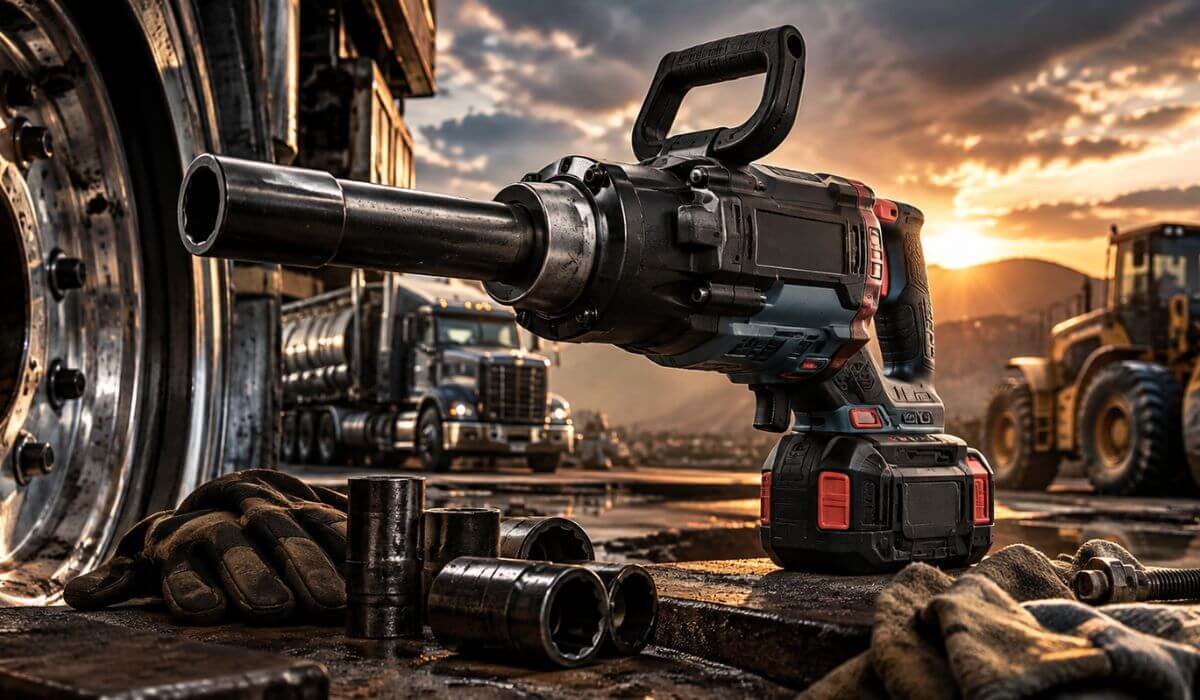
A 1-inch impact gun is built for work where a normal cordless impact can simply run out of muscle. Heavy trucks, trailers, agricultural machinery, construction equipment and large stubborn fasteners are where this drive size starts making real sense. The difference is not just the bigger socket; it is the combination of high breakaway torque, heavy-duty construction, battery capacity and reach needed when smaller tools are being pushed beyond their comfortable workload.
For serious heavy-duty use, the Ingersoll Rand W9691-K4E is the standout choice in this lineup, bringing a 1-inch drive, 6-inch extended anvil, 3,000 ft-lbs of nut-busting torque and four 5.0Ah 20V batteries into one professional kit. The extended reach is particularly useful around recessed truck-wheel fasteners, while the additional batteries make more sense for long service jobs than a setup that leaves the technician waiting for a single pack to recharge.
There is one important reality behind all those impressive torque figures: the largest number does not automatically make one impact the most effective tool. Battery condition, socket fit, anvil design, fastener condition and the way torque is measured can change real-world results considerably. That is why this comparison looks beyond headline power, while also keeping final tightening separate from breakaway work — when a manufacturer specifies an exact torque, a calibrated torque wrench or approved torque procedure is still the right way to finish the job.
Best 1 Inch Battery Impact Gun: Top 2026 Picks for Cordless Power and Heavy Duty Torque
#1. Ingersoll Rand W9691-K4E 1″ Cordless High-Torque Impact Wrench
1 Inch Battery Powered Impact Gun with 3,000 Ft-Lbs Nut-Busting Torque, 6-Inch Extended Anvil and Dual 20V Battery Power
#2. Ingersoll Rand W9491-K2E 1″ Cordless High-Torque Impact Wrench
1 Inch Cordless Impact Gun with 2,600 Ft-Lbs Nut-Busting Torque, 2,200 Ft-Lbs Fastening Torque and 20V Battery Power
#3. Milwaukee M18 FUEL 1″ D-Handle Extended Anvil Impact Wrench
1 Inch High Torque Impact Wrench with 2,000 Ft-Lbs Nut-Busting Torque, 6-Inch Extended Anvil and Brushless Motor
#4. AUTOJARE 1″ Brushless High-Torque Impact Wrench
1 Inch Electric Impact Wrench with Claimed 2,200 Ft-Lbs Torque, Brushless Motor, 4,800 RPM and Milwaukee 18V Battery Compatibility
#5. Rueqior 1″ Cordless Impact Wrench
1 Inch Battery Impact Wrench with Claimed 2,250 Ft-Lbs Torque, Brushless Motor, 4,800 RPM and DeWalt 20V Battery Compatibility
Expert Tip
With a 1-inch impact gun, the biggest number on the box is not automatically the most important thing. A tool rated for huge breakaway torque can still be the wrong choice if the anvil length, battery system, weight, or access does not suit the job. For truck and equipment work, I would first match the 1-inch drive and anvil length to the fasteners you actually work on, then look at torque and battery capacity. And when a manufacturer gives a fastening-torque figure, remember that an impact gun is for running fasteners on and breaking them loose—not for replacing a calibrated torque wrench when the final tightening specification matters.
How We Choose These 1 Inch Impact Wrenches
We did not choose these five simply by sorting marketplace listings from the highest advertised torque to the lowest. That approach looks impressive in a table but can give readers a misleading picture of what they are actually buying.
Our first filter was drive size and intended workload. Every tool here uses a 1-inch drive, putting the group into the heavy-duty category rather than mixing genuine 1-inch equipment with oversized marketing around smaller impacts. These are the kinds of tools that make sense for large truck wheels, trailers, agricultural machinery, construction equipment and other applications where ordinary automotive impacts can reach their limits.
We then looked closely at how the torque is delivered and what comes with the tool. The Ingersoll Rand W9691 and W9491 stand apart because their published specifications come from an established professional tool manufacturer, and both belong to the W9000 platform. The W9691 adds a 6-inch extended anvil and is rated at up to 3,000 ft-lbs of nut-busting torque, while the W9491 uses a more conventional anvil and reaches 2,600 ft-lbs. That difference matters more than simply saying one is “stronger”—the extended reach can be genuinely useful when socket access is the problem.
Battery configuration was another major part of the selection. A huge cordless impact is only useful when its battery system can support the workload. The W9691 kit includes four 20V 5.0Ah batteries, the W9491 includes two 20V 5.0Ah batteries, and the Milwaukee kit goes in a different direction with two 12.0Ah M18 batteries. We considered the complete package rather than treating the bare tool’s specification as the whole story.
We also considered ergonomics and access, because a 1-inch impact is already a substantial machine in your hands. Milwaukee’s D-handle extended-anvil design, adjustable handle and tri-LED lighting make it a very different proposition from a conventional compact impact. For someone working around truck wheels or equipment where access and positioning matter, those details can be more useful than another headline torque number.
The last filter was honesty around less-established products. AUTOJARE and Rueqior are included because they address two real buyer needs: a lower-cost route into a 1-inch cordless tool and battery-platform compatibility. But we have not treated their marketplace claims as automatically equivalent to independently established manufacturer specifications. For example, AUTOJARE lists 2,200 ft-lbs / 3,000 Nm, but we present that as a claimed figure rather than pretending all torque measurements are directly comparable.
That distinction is important. Torque numbers from different brands are not always measured under identical conditions, and “maximum,” “fastening,” and “nut-busting” torque are not interchangeable terms. So our selection considers the specification itself, the battery ecosystem, anvil design, professional usability, available kit contents and the credibility of the information behind the claim.
In other words, these five were selected to represent different legitimate reasons to buy a 1-inch battery-powered impact gun, not five versions of the same tool. That gives you a much more useful starting point than a list built around the biggest number printed on a product page.
#1. Ingersoll Rand W9691-K4E Cordless 1″ High-Torque Impact Wrench
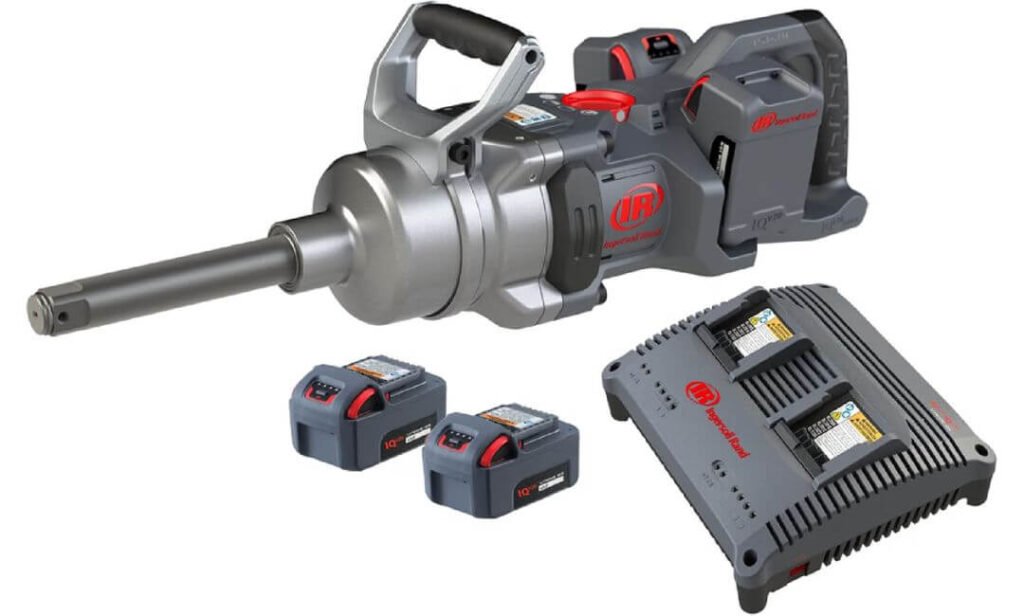
Quick Specs:
- 3,000 ft-lbs Nut-Busting Torque: Serious breakaway power for seized truck and equipment fasteners.
- 6-Inch Extended Anvil: Extra reach for recessed wheels and hard-to-access bolts.
- 2 × 20V IQV20 Batteries: High-output cordless setup designed for heavy-duty work.
- 4 × 5.0Ah Batteries Included: Two working batteries plus two ready for rotation.
- Up to 250 Fasteners per Charge: Useful runtime reference for extended service jobs.
- 180/400 ft-lb Auto Shutoff: Extra control when full power is unnecessary.
- 29.1 lbs With Battery: Substantial, balanced build for a professional 1-inch tool.
- IP56 Protection: Added resistance against dust and water exposure.
A 1-inch impact gun only makes sense when the work genuinely demands it, and this is exactly that kind of tool. The W9691-K4E is built around large truck, trailer, agricultural and heavy-equipment fasteners, where a smaller impact can become the limiting factor. Its 3,000 ft-lbs of nut-busting torque is backed by a 6-inch extended anvil, giving you both serious breakaway force and useful reach when the socket needs to get deeper into the job.
The battery package is another reason this particular configuration stands out. It runs on two 20V IQV20 batteries at a time, while the K4E kit gives you four BL2022 5.0Ah packs and a dual-bay charger. Ingersoll Rand rates the tool for up to 250 fasteners per charge, so the setup is clearly aimed at sustained service work rather than occasional garage use. If you already use IQV20 tools, the shared battery platform makes even more sense.
Then there is the control side, which is easy to overlook when everyone is talking about torque. Variable-speed operation, automatic shutoff thresholds and a 360° auxiliary handle give you more control over a tool this powerful. At 29.1 pounds with a battery, it is unquestionably a substantial machine, but the D-handle layout and balanced design make that size much more manageable during serious work.
(The real attraction is the combination of extreme breakaway power, extended reach and a complete four-battery setup—not just a big torque number.)
What We Like
- 3,000 ft-lbs nut-busting torque gives it serious authority on stubborn fasteners.
- The 6-inch extended anvil adds useful reach where standard impacts struggle for socket access.
- Four 5.0Ah batteries make the kit well suited to long service sessions.
- The 250-fastener-per-charge rating gives the runtime claim useful context.
- IP56 protection and heavy-duty construction suit demanding workshop and field environments.
What We Don’t
The 29.1-pound operating weight is the one thing buyers should account for. That is simply the nature of a full-size 1-inch impact built to deliver this level of output, so it is best suited to users who actually need heavy-duty capability rather than those looking for an everyday automotive impact.
Why This 1 Inch Battery Impact Gun Stands Out for Heavy-Duty Work
What makes this configuration interesting is that the major specifications all serve the same purpose. You get a 1-inch drive, 6-inch extended anvil, 3,000 ft-lbs of nut-busting torque and 2,200 ft-lbs of maximum fastening torque, backed by a four-battery package. Nothing about the setup feels added just to make the specification sheet look impressive; the reach, power and battery capacity are all relevant to the kind of work this tool is intended to perform.
The four-battery arrangement is particularly useful for mobile technicians and busy equipment shops. Two batteries power the tool while another pair can be charging or ready to go, reducing the downtime that can make cordless equipment frustrating during a long job. Add the IQV20 ecosystem and three-year limited warranty, and this becomes a complete professional setup rather than simply a powerful bare impact.
The Insider Pro-Tip
If your work involves semi-truck wheels, recessed fasteners or heavy machinery, pay attention to the 6-inch anvil before getting distracted by the torque headline. Reach can be the difference between a socket sitting perfectly on a fastener and struggling to get proper engagement.
One more thing experienced technicians know: use all that power for breaking fasteners loose and running them down, but switch to a calibrated torque wrench or approved torque system for final tightening whenever the application has a specified torque value. That gives you the speed of a high-output impact without sacrificing accuracy where it actually matters.
#2. Ingersoll Rand W9491-K2E Cordless 1″ High-Torque Impact Wrench
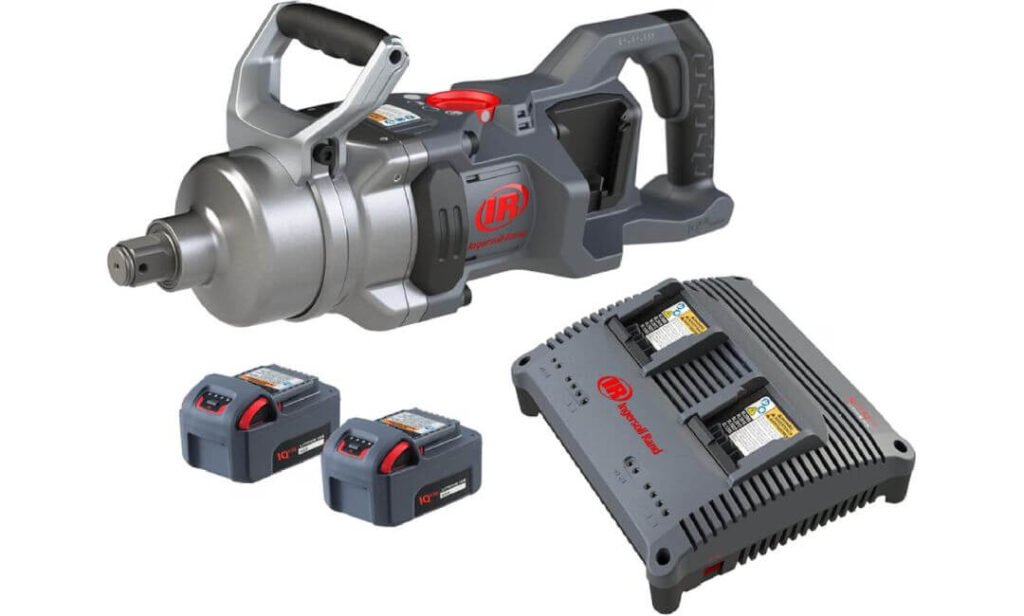
Quick Specs:
- 2,600 ft-lbs Nut-Busting Torque: Serious breakaway strength for stubborn truck and equipment fasteners.
- 2,200 ft-lbs Fastening Torque: Plenty of output for large 1-inch-drive applications.
- Standard 1-Inch Anvil: Straightforward socket access without the extra length of an extended-anvil model.
- 2 × 20V IQV20 Batteries: High-output setup built around Ingersoll Rand’s professional cordless platform.
- 2 × 5.0Ah Batteries Included: Enough capacity for substantial work with a second pair available separately when needed.
- 180/400 ft-lb Auto Shutoff: Gives you useful control when maximum output is not required.
- 20.1-Inch Tool Length: More compact than the extended-reach W9691 for jobs where extra anvil length is unnecessary.
- 27.5 lbs With Battery: A substantial but balanced package for heavy-duty fastening.
The W9491 makes sense for the technician who wants serious 1-inch cordless power without specifically needing an extended anvil. Its 2,600 ft-lbs of nut-busting torque puts it comfortably into heavy-duty territory, making it suited to semi-truck wheels, trailers, agricultural machinery, industrial maintenance and large equipment where smaller impacts can struggle with stubborn fasteners.
What makes this version interesting is the more straightforward configuration. You get a standard 1-inch anvil and 20.1-inch overall length, so there is less tool extending forward when the job already provides good socket access. That can be useful around equipment where you need substantial torque but do not want the additional reach of the W9691. The D-handle and 360° auxiliary handle also give you better control when the tool is working against a seriously stuck fastener.
The K2E package includes two BL2022 5.0Ah batteries and a dual-bay charger, while the IQV20 platform gives you room to expand later with other compatible Ingersoll Rand cordless tools. The variable-speed switch and 180/400 ft-lb automatic shutoff thresholds are also worth having on a tool this powerful. You get the ability to use its full output when necessary without treating maximum power as the only setting that matters.
(This is the more straightforward W9000 choice: huge torque, a standard 1-inch anvil and a slightly shorter body for users who do not need extended reach.)
What We Like
- 2,600 ft-lbs nut-busting torque gives it serious authority on stubborn heavy-duty fasteners.
- Standard 1-inch anvil keeps the setup practical for conventional truck and equipment work.
- Two 5.0Ah batteries and a dual-bay charger are included with the K2E kit.
- 20.1-inch length keeps it more compact than the extended-anvil alternative.
- IQV20 battery compatibility makes it easier to build around an existing Ingersoll Rand cordless setup.
What We Don’t
The main consideration is that the standard anvil does not provide the additional reach of the extended W9691 configuration. That is actually a benefit for many users, but if your regular work involves deeply recessed fasteners, the longer-anvil version may make socket access easier.
Why This 1 Inch Battery Impact Gun Makes Sense for Heavy-Duty Service
The W9491 gets the fundamentals right without trying to complicate the formula. 1-inch drive, 2,600 ft-lbs nut-busting torque, 2,200 ft-lbs fastening torque and a standard anvil give it the core capability needed for serious truck and equipment work. It is especially appealing when the fastener is accessible and what you really need is dependable breakaway strength.
The K2E package also gives you a practical starting point with two 5.0Ah batteries and a dual-bay charger. If your workload grows, the IQV20 ecosystem lets you add batteries rather than replacing the tool. That makes this more than a one-job purchase for a professional who expects to keep expanding the cordless setup.
The Insider Pro-Tip
If you are choosing between this and an extended-anvil 1-inch impact, look at the fasteners you actually service. If your sockets already reach the nuts comfortably, the standard-anvil W9491 avoids carrying extra length you may never use. That makes the configuration easier to position while still giving you an enormous amount of breakaway power.
For roadside truck work, shop maintenance and general heavy equipment, that simpler setup can be exactly what you want. Just remember that 2,600 ft-lbs is breakaway capability, not a final tightening specification—use the appropriate calibrated torque equipment whenever the application calls for a precise final torque.
#3. Milwaukee M18 FUEL 1″ D-Handle Extended Anvil Impact Wrench
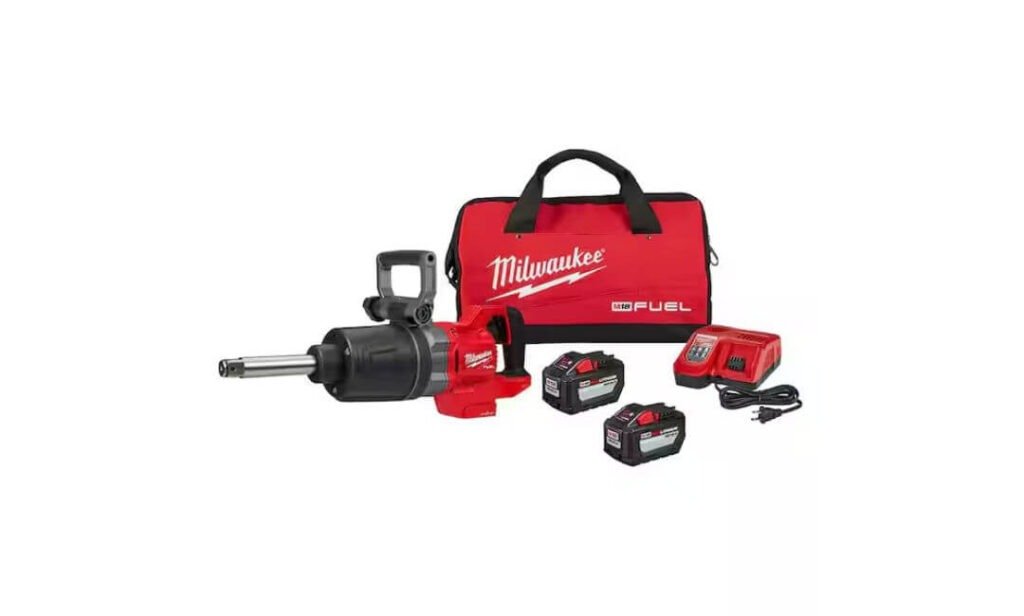
Quick Specs:
- 2,000 ft-lbs Nut-Busting Torque: Serious breakaway power for large truck and equipment fasteners.
- 6-Inch Extended Anvil: Extra socket reach around recessed wheels, axles and machinery.
- 1,900 ft-lbs Fastening Torque: High-output installation power with adjustable control.
- Dual HD12.0Ah Batteries: High-capacity M18 packs built for demanding work.
- Up to 120 Lug Nuts per Battery: Useful real-world runtime reference for truck service.
- ONE-KEY Lug Nut Mode: Helps control output and reduce the chance of over-torquing.
- 4-Mode Drive Control: Lets you tailor speed and power to the fastening job.
- Tri-LED Lighting: Better visibility around the socket with reduced shadows.
This Milwaukee is aimed at the technician who wants 1-inch cordless power with more control built into the tool. The POWERSTATE brushless motor delivers up to 2,000 ft-lbs of nut-busting torque and 1,900 ft-lbs of fastening torque, while the 6-inch extended anvil gives it the reach needed around large truck wheels, axles and heavy machinery.
The battery setup is equally important. The kit includes two M18 REDLITHIUM HIGH OUTPUT HD12.0 batteries, and Milwaukee rates the tool for removing and installing up to 120 lug nuts on a single HD12.0 battery. That makes the package particularly relevant to mobile technicians and diesel shops where an air compressor and hose are not always practical. Since it uses the M18 platform, existing Milwaukee users also have the option of using other compatible M18 batteries.
Where this model gets genuinely interesting is the electronics. ONE-KEY, four drive modes and Lug Nut Mode give you considerably more control than a basic high-torque impact. The battery isolation system is designed to manage vibration and maintain the battery connection during demanding use, while the adjustable 360° side handle and tri-LED lighting make sense when you’re working around large equipment rather than on an open garage floor.
(The appeal here is the combination of heavy-duty output, extended reach and smart control—not simply the torque figure printed on the box.)
What We Like
- 2,000 ft-lbs nut-busting torque gives it serious capability for heavy truck and equipment work.
- 6-inch extended anvil provides useful reach where conventional 1-inch impacts can be awkward.
- HD12.0 batteries give the tool a substantial cordless power reserve.
- ONE-KEY and four drive modes provide control that basic heavy-duty impacts do not offer.
- M18 compatibility makes it especially practical for users already invested in Milwaukee’s cordless ecosystem.
What We Don’t
The extended-reach D-handle design is substantial, so this is better suited to genuine heavy-duty service than occasional automotive work. If your jobs rarely involve large fasteners, a smaller impact will be easier to handle and more convenient.
Why This 1 Inch Battery Impact Gun Stands Out for Heavy-Duty Service
The Milwaukee earns its place here because it does more than deliver high output. Its 6-inch extended anvil addresses access, the 2,000 ft-lb nut-busting rating addresses stubborn fasteners, and ONE-KEY adds a level of repeatable control that is genuinely useful when the same type of fastener has to be serviced repeatedly.
The battery package also fits the intended workload. Two HD12.0Ah M18 batteries, a rapid charger and the established M18 ecosystem give a mobile technician a complete cordless setup without having to build an entirely separate battery platform. That combination makes it particularly relevant for diesel service, fleet maintenance, roadside repairs and heavy equipment work.
The Insider Pro-Tip
If you already own several M18 tools, the battery ecosystem may be just as important as the impact’s torque rating. You are not buying into another battery family, and the HD12.0 packs give this large motor the energy reserve it needs.
For truck wheel service, also take advantage of the Lug Nut Mode and repeatable ONE-KEY settings rather than simply pulling the trigger at maximum power every time. A powerful impact is most useful when you can control it—not when you treat maximum output as the default.
#4. AUTOJARE 1″ Brushless High-Torque Impact Wrench
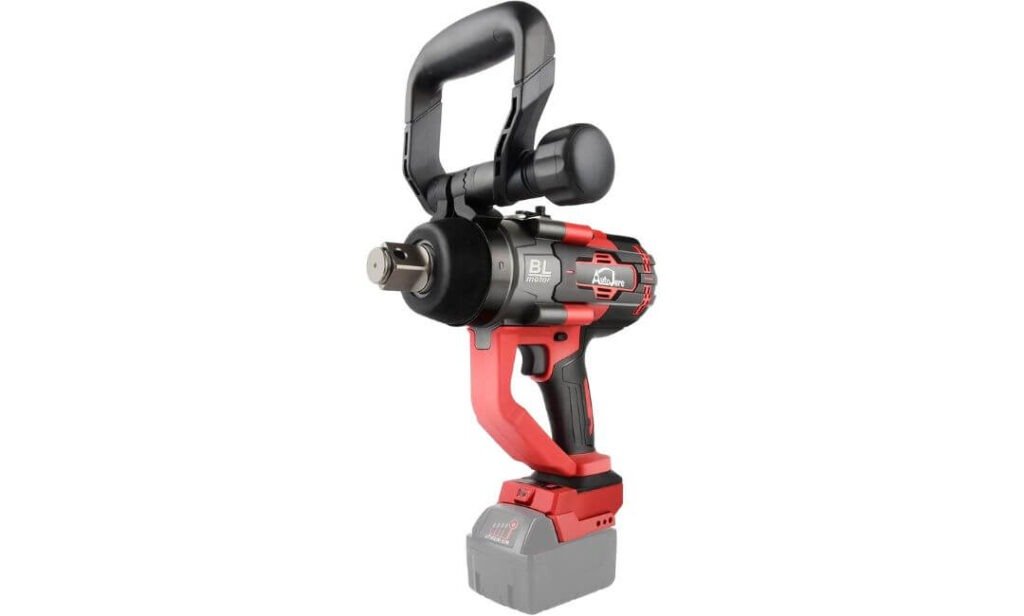
Quick Specs:
- Claimed 3,000 Nm / 2,200 ft-lbs Torque: Designed for large truck and heavy-equipment fasteners.
- Brushless Motor: Efficient power delivery with less maintenance than a brushed design.
- Milwaukee 18V Compatible: Works with compatible M18 battery packs already in your toolbox.
- 6.0Ah+ Recommended: Higher-capacity batteries are the sensible choice for demanding work.
- 3 Working Modes: Forward, reverse and Auto-Stop operation for different fastening jobs.
- 5-Speed Forward Control: Output can be adjusted instead of running maximum power continuously.
- 10.58-lb Weight: Considerably easier to handle than full-size D-handle 1-inch impacts.
- 10-Second LED Delay: Keeps the work area illuminated after the trigger is released.
This AUTOJARE takes a noticeably different route from the heavyweight professional models above. Instead of a large D-handle body and a complete proprietary battery kit, you get a 10.58-pound 1-inch impact with a brushless motor and compatibility with Milwaukee 18V batteries. That makes it interesting for someone who wants genuine 1-inch-drive capability without carrying a much heavier tool around every job.
The headline specification is 3,000 Nm (claimed 2,200 ft-lbs) maximum torque, which puts it squarely into the heavy-duty conversation. The important word is “claimed,” because third-party torque figures should not automatically be compared one-for-one with laboratory specifications from established manufacturers. For truck wheels, construction equipment and large fasteners, the practical question is whether the tool has enough output for your particular application—and the manufacturer specifically positions it for those jobs.
The control system is actually one of its more useful features. You get five forward speed levels, reverse operation and an Auto-Stop mode that brakes when a loosened nut reaches the end of its travel. The built-in LED stays illuminated for around 10 seconds, which is a small feature until you’re working underneath a truck or inside a poorly lit equipment area. Just remember that this is a bare tool, so the battery you pair with it will have a direct effect on how long it can work at high load.
(Its real appeal is simple: 1-inch drive capability in a much easier-to-handle package, especially for someone who already owns compatible Milwaukee batteries.)
What We Like
- 10.58-pound body makes it considerably easier to maneuver than many full-size 1-inch D-handle impacts.
- Brushless motor gives it the modern motor design expected for demanding cordless work.
- Milwaukee 18V compatibility can save you from starting another battery ecosystem.
- Auto-Stop mode is a genuinely useful touch when removing nuts.
- Five forward speed levels and LED lighting give it more everyday control than a basic bare-bones impact.
What We Don’t
The main thing to plan around is the battery setup. Batteries are not included, and for heavy 1-inch work the manufacturer recommends a 6.0Ah or larger Milwaukee 18V pack. If you already have high-capacity M18 batteries, that is much less of an issue.
Why This 1 Inch Battery Impact Gun Makes Sense for Buyers Wanting Less Weight
Not every 1-inch impact buyer needs a 25-plus-pound professional D-handle machine. AUTOJARE’s biggest advantage is the 10.58-pound form factor, giving you the 1-inch drive and claimed high-torque output in something considerably easier to position around a vehicle or machine.
The Milwaukee 18V compatibility adds another practical advantage. If your workshop already runs on M18 batteries, the bare-tool format means you can use the batteries you own rather than buying another charger and battery family. For occasional heavy-duty work, roadside use or users who value lower tool weight, that combination is genuinely worth considering.
The Insider Pro-Tip
If you choose this model, do not pair it with the smallest battery you own just because it fits. A 1-inch brushless impact can demand substantial current when breaking stubborn fasteners loose, so a high-capacity M18 pack is the more sensible match for serious work.
And because this is a lighter third-party option with a marketplace torque claim, judge it by the job you need it to perform, not by trying to declare 3,000 Nm automatically equal to another manufacturer’s 3,000 Nm rating. That is the more honest way to buy a high-torque impact—and it can save you from paying for specifications that don’t translate to your actual work.
#5. Rueqior 1″ Cordless Impact Wrench Compatible with DeWalt 20V Battery
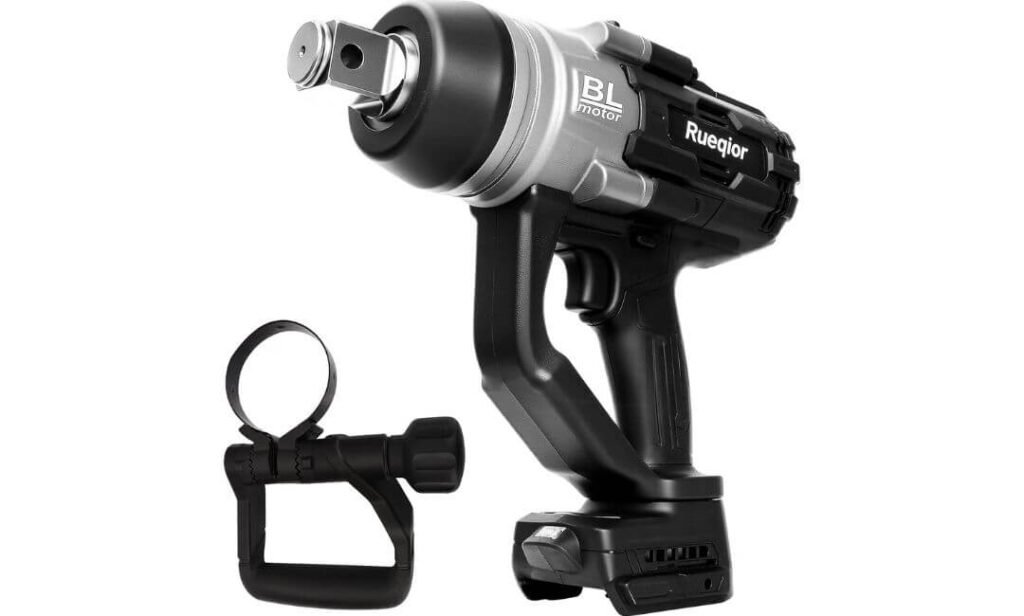
Quick Specs:
- Claimed 3,000 Nm / 2,250 ft-lbs Torque: Built for large lug nuts and stubborn heavy-duty fasteners.
- 1-Inch Square Drive: Made for standard 1-inch impact sockets and larger fastening jobs.
- DeWalt 20V Compatible: Uses compatible DeWalt 20V battery packs already in your workshop.
- Brushless Motor: Efficient motor design aimed at strong output and longer service life.
- 3 Forward Speeds + Reverse: Gives you more control than a single-output impact.
- Up to 4,800 RPM: High-speed operation for faster fastening and removal.
- Auto-Stop Function: Helps control the tool when the fastener reaches the end of its travel.
- 11.88-lb Weight: A more manageable package for a 1-inch cordless tool.
- Bare Tool: Battery and charger are not included.
Rueqior is aimed at a very specific buyer: someone who wants a 1-inch cordless impact but already owns compatible DeWalt 20V batteries. Instead of paying for another battery platform, you can use the packs already in your toolbox. That makes the bare-tool format particularly interesting for DIY users, mobile technicians and occasional heavy-duty work where buying a complete premium kit may not make financial sense.
The manufacturer claims up to 3,000 Nm (2,250 ft-lbs) of torque, backed by a brushless motor and a 1-inch square drive. The tool also offers three forward speeds, reverse operation and up to 4,800 RPM, giving you more flexibility than simply running the impact at maximum output every time. For large wheel nuts, truck work and equipment fasteners, that combination gives the tool a clear heavy-duty purpose.
The useful detail is that it remains relatively manageable at 11.88 pounds compared with the much larger professional D-handle impacts in this list. You also get an LED work light for dark or confined areas and an Auto-Stop function for more controlled operation. Just remember that the tool is supplied without a battery, so your existing DeWalt 20V pack becomes an important part of the overall setup.
(The real reason to consider this one is not simply its torque claim—it is the combination of 1-inch drive capability, brushless power and DeWalt 20V battery compatibility.)
What We Like
- DeWalt 20V compatibility makes it convenient for existing DeWalt battery users.
- 1-inch square drive gives it the socket capacity expected for large fasteners.
- Brushless motor brings efficient cordless power without a brushed motor design.
- 11.88-pound body keeps it easier to position than many full-size 1-inch impacts.
- Three forward speeds plus Auto-Stop give you useful control for different jobs.
What We Don’t
It comes as a bare tool, so buyers without compatible DeWalt 20V batteries will need to factor a battery and charger into the setup. For someone already invested in DeWalt, however, this is much less of a concern.
Why This 1 Inch Battery Impact Gun Makes Sense for DeWalt Users
The strongest reason to choose this model is its battery-platform compatibility. If your workshop already revolves around DeWalt 20V tools, adding another battery ecosystem just for a 1-inch impact can be unnecessary. This approach lets you put your existing batteries to work while gaining a much larger 1-inch drive.
The claimed 2,250 ft-lbs of torque, brushless motor, variable-speed operation and relatively manageable 11.88-pound weight make it an interesting option for users who need occasional heavy-duty capability without stepping directly into the large professional kits higher on our list. As with other third-party high-torque impacts, treat the advertised torque as a manufacturer claim rather than assuming it was measured under exactly the same conditions as premium-brand testing.
The Insider Pro-Tip
If you already have DeWalt 20V batteries, check their capacity before starting a big truck or equipment job. A high-output 1-inch impact can draw considerably more power under heavy load, so a larger-capacity pack is a smarter match than relying on a small battery simply because it fits.
Also, don’t confuse the impressive 2,250 ft-lb claimed breakaway figure with a final tightening specification. Use the impact for speed and removal, then use the correct calibrated torque equipment whenever the vehicle or equipment manufacturer specifies a precise final torque.
Best 1 Inch Battery Impact Gun Options Compared (2026)
| What Matters | Ingersoll Rand W9691-K4E Maximum Reach & Output | Ingersoll Rand W9491-K2E Heavy-Duty Standard Anvil | Milwaukee M18 FUEL 1″ Smart M18 Platform | AUTOJARE 1″ Lighter Alternative | Rueqior 1″ DeWalt 20V Compatible |
|---|---|---|---|---|---|
| Drive & Reach |
1-inch square 6-inch extended anvil |
1-inch square Standard anvil |
1-inch square 6-inch extended anvil |
1-inch square Fixed square drive |
1-inch square Fixed square drive |
| Breakaway Power |
3,000 ft-lbs Manufacturer-rated nut-busting torque |
2,600 ft-lbs Manufacturer-rated nut-busting torque |
2,000 ft-lbs Manufacturer-rated nut-busting torque |
2,200 ft-lbs* Manufacturer-listed claim |
2,250 ft-lbs* Manufacturer-listed claim |
| Fastening Output | 2,200 ft-lbs | 2,200 ft-lbs | 1,900 ft-lbs | Not clearly specified | Not clearly specified |
| Battery Setup |
2 × 20V in use 4 × 5.0Ah included |
2 × 20V in use 2 × 5.0Ah included |
2 × M18 HD12.0Ah Included |
Milwaukee 18V compatible Battery not included |
DeWalt 20V compatible Battery not included |
| Runtime Reference |
Up to 250 fasteners Manufacturer-rated figure |
Built for extended service work Kit includes two 5.0Ah packs |
Up to 120 lug nuts Per HD12.0 battery |
6.0Ah+ recommended High-capacity pack preferred |
High-capacity 20V preferred Battery sold separately |
| Control |
Variable speed 180 / 400 ft-lb shutoff |
Variable speed 180 / 400 ft-lb shutoff |
4-mode control ONE-KEY + Lug Nut Mode |
3 modes 5 forward speed levels + Auto-Stop |
3 forward speeds Reverse + Auto-Stop |
| Motor & Build |
Rugged steel-lined hammer IP56 |
Steel-lined hammer Heavy-duty construction |
POWERSTATE brushless REDLINK PLUS + battery isolation |
Brushless motor Alloy-steel construction |
Brushless motor Metal construction |
| Weight | 29.1 lbs with battery | 27.5 lbs with battery | Full-size D-handle design | 10.58 lbs | 11.88 lbs |
| Access & Visibility |
6-inch reach 360° auxiliary handle |
Standard reach 360° auxiliary handle |
6-inch reach Tri-LED lighting |
LED work light 10-second delay |
LED work light Designed for dark, confined areas |
| Best Fit | Semi trucks, heavy equipment & recessed fasteners | Truck service & large fasteners with easy socket access | Professional truck service & M18 users wanting smart control | Buyers wanting 1-inch capability with less tool weight | DeWalt 20V owners wanting a 1-inch bare tool |
| Kit Advantage | 4 Batteries + Dual Charger | 2 Batteries + Dual Charger | 2 HD12.0 + Rapid Charger | Bring Existing M18 Battery | Bring Existing DeWalt 20V |
* AUTOJARE and Rueqior torque figures are manufacturer-listed claims and should not be assumed to have been measured under the same test conditions as the published specifications from Ingersoll Rand or Milwaukee.
Buying Guide for Choosing the Right 1 Inch Battery Impact Gun
A 1-inch battery impact gun is a different class of tool from the impacts most people keep in a normal garage. The right choice is not simply the model showing the largest torque number. For truck wheels, trailers, construction equipment and industrial fasteners, you need to look at how that power is delivered, how easily the socket reaches the fastener, how the battery system handles repeated high-load work, and whether you can realistically control the tool for the job.
Start With the Fasteners You Actually Work On
Before comparing brands, think about the largest and most stubborn fasteners you regularly encounter. A 1-inch drive is generally chosen for heavy trucks, agricultural machinery, construction equipment, trailers and industrial applications, rather than ordinary passenger-car maintenance.
If you regularly work around recessed wheel nuts or awkward equipment fasteners, an extended anvil can be more useful than simply chasing a higher torque rating. If access is straightforward, a standard-anvil design can be easier to position.
This is why the products in this guide are not identical despite all using a 1-inch drive. The W9691 and Milwaukee bring extended reach, the W9491 keeps a more conventional configuration, while AUTOJARE and Rueqior put more emphasis on lighter handling and existing battery compatibility.
Torque: Read More Than the Biggest Number
Torque is obviously important, but there are several numbers that can appear on an impact wrench specification sheet, and they do not mean the same thing.
- Nut-busting or breakaway torque refers to the manufacturer’s measure of loosening capability. This is the number you care about when dealing with seized, rusted or heavily tightened fasteners.
- Maximum fastening torque tells you how much output the manufacturer specifies for installation.
- Working torque or controlled torque can be more useful than maximum output when you are repeatedly installing the same fasteners.
- A very high breakaway figure does not mean you should tighten every fastener at maximum power.
For example, the W9691 is rated at 3,000 ft-lbs of nut-busting torque and 2,200 ft-lbs of maximum fastening torque, while the W9491 reaches 2,600 ft-lbs of nut-busting torque. Milwaukee lists 2,000 ft-lbs of nut-busting torque and 1,900 ft-lbs of fastening torque. Those figures are useful for comparison, but they should not be treated as laboratory-equivalent measurements across different manufacturers.
genui{“learning_viz”:{“type_id”:”TORQUE”,”locale_override”:”en-US”}}
Most importantly, breakaway torque is not a final tightening specification. When a vehicle or machine calls for a specific torque, finish the job with the appropriate calibrated torque equipment.
Anvil Length Can Change the Buying Decision
This is one of those specifications that is easy to overlook until you are standing beside a truck trying to reach the fastener.
A standard 1-inch anvil is perfectly sensible when the socket already has clear access. An extended anvil becomes valuable when the fastener sits deeper inside a wheel, axle area or machinery assembly.
| Anvil setup | Where it makes the most sense |
|---|---|
| Standard 1-inch anvil | Accessible wheel nuts, general heavy-duty fastening |
| Extended 1-inch anvil | Recessed wheels, axles, frames and difficult access |
| 6-inch extended anvil | Jobs where additional socket reach is genuinely required |
The W9691 and Milwaukee both use a 6-inch extended anvil, so their extra length is a functional part of the design rather than just another specification to advertise. The W9491 takes the standard-anvil route, which can be preferable when extra reach is unnecessary.
Battery Capacity Matters More Than Voltage Alone
One of the easiest mistakes is looking at 20V or 18V and assuming the higher-looking number automatically means more power. It does not work that simply.
For cordless high-torque tools, the battery’s amp-hour capacity, current delivery and battery design all matter. A large 1-inch impact can draw substantial current when breaking a stubborn fastener loose, so a small battery may technically fit while being a poor choice for demanding work.
Look at the complete setup:
- Voltage: Indicates the electrical platform, but does not tell the whole performance story.
- Amp-hours (Ah): Gives you an indication of stored energy and potential runtime.
- High-output battery design: Can be particularly important for tools that demand substantial current.
- Number of batteries: Matters for mobile technicians doing repeated work.
- Charger configuration: A dual-bay or rapid charger can reduce downtime between jobs.
- Battery ecosystem: Existing Milwaukee M18, DeWalt 20V or Ingersoll Rand IQV20 ownership can materially change the value of a bare tool or kit.
That distinction is why the four-battery W9691 package, the two-battery W9491 kit and Milwaukee’s two HD12.0Ah configuration should be viewed differently from the bare-tool AUTOJARE and Rueqior options.
Runtime: Look for a Useful Workload Reference
“Long runtime” is one of the least useful phrases on a product page unless it is supported by something measurable.
The W9691, for example, is listed for up to 250 fasteners per charge, while Milwaukee gives a more specific reference of up to 120 lug nuts on a single HD12.0 battery. Those figures provide context that a generic runtime statement cannot.
For the two battery-compatible bare tools, the battery becomes part of your decision. AUTOJARE recommends a 6.0Ah or larger Milwaukee-compatible battery, while Rueqior is designed around compatible DeWalt 20V packs.
Your actual runtime will still vary with fastener size, corrosion, torque required, battery condition, temperature and how aggressively the tool is used.
Brushless Motors Are Worth Having
A brushless motor is now the sensible choice for a high-output cordless impact. It eliminates the physical brushes used in traditional brushed motors and generally allows manufacturers to build more efficient, electronically controlled power systems.
But don’t treat “brushless” as a performance ranking by itself. Two brushless impacts can have completely different output, control systems, battery requirements and durability.
Here, brushless construction appears across the newer alternatives, while the established professional models add much more sophisticated control and battery-management systems around their motors.
Control Is More Important at 1-Inch Size
Once you move into this torque class, maximum power is not something you necessarily want every time you pull the trigger.
Useful control features include:
- Variable-speed trigger: Helps you approach a fastener without immediately applying maximum output.
- Multiple drive modes: Useful when switching between removal and installation.
- Automatic shutoff: Can help prevent unnecessary over-tightening during controlled operation.
- Lug Nut Mode: Particularly useful for repeated wheel service.
- Repeatable electronic settings: Valuable in professional environments where the same fastening operation is repeated.
- Auxiliary handles: Give you additional leverage and control when the tool reacts against a stubborn fastener.
Milwaukee’s ONE-KEY system and four-mode drive control are particularly relevant here. The Ingersoll Rand models use automatic shutoff thresholds and variable-speed operation, while AUTOJARE and Rueqior provide simpler multi-mode controls.
Weight and Balance Are Real Working Specifications
A 1-inch impact capable of breaking extremely stubborn fasteners is not going to feel like a compact 1/2-inch automotive wrench.
What matters is how that weight is carried.
A D-handle can make sense when you need two-handed control and leverage. A lighter conventional body can be easier to move between fasteners and may be more comfortable for users who only occasionally need 1-inch capability.
That is why the listed weight differences in this group are meaningful. The W9691 and W9491 are substantial professional machines, while AUTOJARE and Rueqior are much lighter alternatives. Neither approach is automatically right for every user.
Durability Should Match the Environment
For heavy-duty work, look beyond the word “rugged.”
Useful indicators include:
- Steel-lined or reinforced hammer construction
- Impact-resistant housing
- Dust and water protection
- Battery isolation systems
- Rubber overmold around working surfaces
- Quality auxiliary handles
- Manufacturer warranty and service support
Milwaukee’s battery isolation system and REDLINK PLUS electronics, for example, address a different set of durability concerns than simply putting a metal housing around the tool. Ingersoll Rand’s W9000 platform adds IP56 protection and a steel-lined hammer design.
1-Inch Drive Does Not Mean Every 1-Inch Impact Is the Same
All five products in this article use a 1-inch square drive, but that only tells you the socket interface.
When comparing them, also check:
| Specification | Why it matters |
|---|---|
| Drive size | Confirms the tool is intended for 1-inch impact sockets |
| Anvil length | Determines practical socket reach |
| Nut-busting torque | Indicates stated breakaway capability |
| Fastening torque | Shows maximum installation output |
| RPM | Influences how quickly the tool spins the fastener |
| BPM/IPM | Indicates hammering frequency |
| Battery Ah | Helps estimate energy capacity |
| Battery count | Important for continuous field work |
| Weight | Directly affects handling |
| Control modes | Determines how precisely output can be managed |
One thing to watch closely is RPM versus torque. A higher RPM does not automatically mean a more powerful impact. RPM mainly affects how quickly the tool spins between hammer impacts, while the torque and hammer mechanism determine how effectively it deals with resistance.
Choosing Between a Complete Kit and Bare Tool
This is where the battery ecosystem can save—or cost—you money.
If you already own compatible batteries, a bare 1-inch impact can be an efficient addition to your workshop. AUTOJARE makes sense for users already invested in compatible Milwaukee 18V batteries, while Rueqior targets users with compatible DeWalt 20V packs.
If you do not own the battery platform, a complete kit can be easier because the batteries and charger are already matched to the tool. The W9691-K4E, W9491-K2E and Milwaukee package follow this approach.
For someone doing roadside truck service or daily fleet maintenance, having spare charged batteries can be more valuable than saving money on the initial bare-tool purchase.
What the Specifications Don’t Tell You
A specification sheet cannot tell you everything about a 1-inch impact.
It will not tell you exactly how a particular tool behaves on a rusted wheel nut, how comfortable it feels after an hour of overhead work, or whether a six-inch anvil is actually helpful on your equipment.
That is why we considered the complete tool configuration, not isolated numbers: drive size, reach, torque, battery arrangement, control technology, weight, protection and intended workload.
There is also an important difference in how confidently you should compare published figures. The Ingersoll Rand and Milwaukee specifications come from established manufacturers with documented product specifications, while the very high torque figures listed for AUTOJARE and Rueqior should be treated as manufacturer claims rather than assumed equivalent test results.
The Bottom Line Before You Buy
If your work regularly involves large truck wheels, heavy equipment or stubborn industrial fasteners, start with access and workload, then narrow the choice using torque and battery capacity. A six-inch extended anvil is valuable only when you need the reach; four batteries are valuable only when your workload actually justifies them.
For existing battery-platform owners, compatibility can change the equation completely. And for professional daily use, control, serviceability, battery availability and proven specifications deserve just as much attention as the biggest torque number.
The best 1-inch battery impact gun is ultimately the one whose drive, reach, power delivery and battery system match the work in front of you. That is a much safer way to choose than buying purely from a headline figure.
1 Inch vs Smaller Drives: When a Cordless 1 Inch Impact Is Actually Worth It
A 1-inch cordless impact is not automatically a better choice just because it is larger. The drive size should match the fastener size, torque requirement, socket access and workload. For a technician changing semi-truck wheels every day, stepping up to 1 inch can be a practical decision. For someone working mostly on passenger cars, it can simply mean carrying more tool than the job requires.
When a 1-Inch Drive Earns Its Place
A 1-inch drive becomes much more practical when the work involves large fasteners that require substantial breakaway force and a smaller impact starts reaching its limits.
Typical applications include:
- Class 7 and 8 truck wheel service, particularly large lug nuts and heavily tightened wheel fasteners.
- Heavy construction equipment, including loaders, excavators, backhoes and similar machinery.
- Agricultural equipment, where large bolts can remain exposed to dirt, moisture and corrosion for long periods.
- Trailers and heavy-duty suspension components, where fasteners can require considerably more force than ordinary automotive hardware.
- Industrial maintenance, especially structural assemblies using large-diameter bolts.
- Stubborn or seized fasteners, where the main requirement is high breakaway capability rather than simply spinning the nut quickly.
- Roadside heavy-equipment service, where cordless operation removes the need for an air compressor and long pneumatic hose.
The other advantage is socket capacity. A 1-inch square drive is designed around large 1-inch impact sockets, so the entire system is built for hardware that is physically bigger and demands more from the tool.
When a Smaller Drive Makes More Sense
For many automotive jobs, moving up to 1 inch is unnecessary.
A 1/2-inch cordless impact is usually much easier to carry and maneuver for passenger cars, SUVs, light trucks, brake work and general suspension jobs. It is also more convenient when you are working in a confined engine bay or moving between many small fasteners.
A 3/4-inch impact sits in a useful middle ground. It can make sense for users who regularly work on pickups, larger trucks, trailers and equipment but do not routinely encounter the very large fasteners that justify a full 1-inch setup.
Smaller drives can also be preferable when:
- You value lower weight and easier one-handed handling.
- Most of your work involves passenger vehicles.
- Fasteners are relatively accessible and do not require an extended anvil.
- You rarely deal with severely seized or over-tightened hardware.
- You want a tool that can cover many everyday automotive jobs rather than a specialist heavy-duty workload.
- You already have a capable 1/2-inch or 3/4-inch impact that handles your normal work comfortably.
The Practical Difference on a Real Job
The easiest way to think about the difference is not, “Which drive is strongest?” but “Where does my current tool stop being useful?”
If your existing 1/2-inch impact removes most of your wheel nuts without hesitation, there may be little reason to replace it simply because a 1-inch model produces a much larger torque figure.
But if you are regularly standing beside a truck with a stubborn lug nut, working on large machinery, or dealing with fasteners where your smaller impact requires excessive time and repeated attempts, that is where a 1-inch tool starts earning its place.
There is also a productivity consideration. A high-output 1-inch cordless impact can remove large fasteners without an air compressor, pneumatic hose or fixed workshop position. For mobile technicians, that convenience can be just as important as the raw torque.
Extended Reach Changes the Equation
Drive size and anvil length are two different things.
A 1-inch tool with a standard anvil can be exactly right when the socket has direct access to the fastener. An extended-anvil configuration becomes useful when the nut sits deeper inside a wheel or machinery assembly.
That is why a longer anvil should not be treated as an automatic upgrade. More reach is helpful when you need it, but unnecessary length can make the tool harder to position in some jobs.
For recessed truck wheels, axles and equipment assemblies, however, the additional reach can make socket engagement much easier.
A Simple Way to Decide
| Your typical work | Drive size to consider | Why |
|---|---|---|
| Passenger cars and routine repairs | 1/2-inch | Easier handling and broad everyday usefulness |
| Light trucks and mixed automotive work | 1/2-inch to 3/4-inch | Good balance of size and output |
| Pickups, trailers and larger equipment | 3/4-inch | More capability without the size of a 1-inch tool |
| Semi-trucks and heavy trailers | 1-inch | Built around large fasteners and heavy wheel service |
| Construction and agricultural machinery | 1-inch | High breakaway capability for large hardware |
| Frequent industrial heavy-duty work | 1-inch | Better suited to large, demanding fasteners |
The Honest Buying Rule
If you are buying your first serious impact, do not jump to 1 inch simply because the specification sheet looks impressive. Buy for the work you actually perform.
If your day involves large truck wheels, heavy equipment or industrial fasteners, a 1-inch cordless impact can eliminate a genuine limitation in your workflow. If your work is mostly normal automotive repair, a smaller drive will usually be easier to handle and more versatile.
The important distinction is simple: 1 inch is a workload decision, not a status symbol. Once the job regularly demands the extra drive capacity, torque and reach, the larger tool stops being excessive and starts becoming the appropriate tool for the job.
How to Use and Maintain Your 1 Inch Battery Impact Gun
A 1-inch battery impact gun works under considerably higher loads than a typical automotive impact wrench, so good maintenance is not just about keeping the tool looking clean. The anvil, socket, battery, hammer mechanism and control electronics all have to work together correctly when you are dealing with large, heavily tightened fasteners. Proper use also matters because maximum breakaway torque can place substantial force through the socket, fastener and surrounding components.
Use the Correct 1-Inch Impact Socket
Always use impact-rated 1-inch drive sockets designed for high-torque impact tools. Standard chrome sockets are not intended for repeated impact loading and can crack or fail when subjected to the rapid hammering produced by a heavy-duty impact gun.
Before starting work, check the socket for:
- Cracks, chips or visible deformation.
- Excessive wear around the drive opening.
- Damage to the retaining hole or pin area.
- Rounded internal surfaces that no longer grip the fastener correctly.
- Heavy rust or corrosion that could weaken the socket.
Make sure the socket is pushed completely onto the anvil before applying power. A socket that is only partially engaged can increase wear on both the socket and anvil, while also creating a greater chance of the socket coming loose during operation.
Take Care of the Anvil and Retaining System
The 1-inch anvil takes repeated shock loads, particularly when the tool is being used to break loose seized fasteners. Keep the anvil clean and inspect the retaining mechanism regularly.
For pin-and-O-ring or similar retaining systems, check that the components remain secure and are not excessively worn. If the anvil develops noticeable play, unusual movement or damage around the drive section, stop using the tool until it has been inspected.
Avoid using the anvil as a lever. If a socket is difficult to remove, do not repeatedly hammer it sideways with another object. That can place unnecessary loads on the anvil and internal mechanism.
For extended-anvil models, be especially careful about side loading. The additional reach is useful for recessed fasteners, but it also gives users more opportunity to accidentally apply sideways force instead of keeping the tool aligned with the fastener.
Keep the Tool Clean After Heavy-Duty Work
Dust, road grime, metal particles and moisture are common around trucks, trailers and construction equipment. After demanding jobs, wipe the housing and anvil area with a clean cloth and remove accumulated debris.
Pay particular attention to:
- The anvil and socket connection.
- Ventilation openings.
- Battery contacts.
- Trigger and control buttons.
- Areas around the hammer housing.
- The D-handle and auxiliary handle.
Do not deliberately spray the tool with water simply because it has a stated level of environmental protection. Water resistance is not the same thing as being designed for pressure washing or immersion.
Look After the Battery Before You Need It
Cordless performance depends heavily on battery condition. A large 1-inch impact can draw substantial current when operating near its maximum output, so an aging or poorly maintained battery may become the limiting factor before the tool itself does.
For lithium-ion battery packs, use these habits:
- Charge batteries with the manufacturer’s approved charger.
- Allow an excessively hot battery to cool before charging.
- Do not continue using a battery that is visibly swollen, cracked or physically damaged.
- Keep battery contacts clean and dry.
- Store batteries away from extreme heat and direct sunlight.
- Avoid leaving packs completely discharged for long periods.
- Rotate multiple battery packs during long service jobs instead of repeatedly exhausting one pack.
- Follow the manufacturer’s storage recommendations when the tool will not be used for an extended period.
Battery capacity also matters. A higher-capacity pack can provide longer working time, but it can add weight to an already substantial 1-inch tool. For extended roadside or workshop use, having multiple compatible batteries can be more practical than relying on one very large pack.
Use Full Power Strategically
Real talk: maximum torque should not be the default setting for every fastener.
If the tool has multiple power modes, begin with an appropriate lower setting when the application allows it. Higher output is useful when breaking loose heavily tightened hardware, but unnecessary maximum power can increase wear and make it easier to damage threads, fasteners or components.
For final tightening, do not assume that the impact gun’s advertised fastening torque is an accurate substitute for a calibrated torque wrench. When the vehicle, equipment manufacturer or service procedure specifies a final torque, tighten the fastener using the approved torque procedure.
This is particularly important for wheel fasteners, suspension components, structural hardware and other safety-critical assemblies.
Keep the Tool Straight on the Fastener
Alignment is one of the simplest ways to reduce unnecessary stress.
Keep the impact gun as square as practical to the fastener. Avoid operating at an awkward angle where the socket is pulling sideways against the nut or bolt head.
Poor alignment can contribute to:
- Socket wear.
- Fastener rounding.
- Anvil wear.
- Excessive vibration.
- Reduced impact transfer.
- Greater operator fatigue.
With a heavy 1-inch tool, maintaining alignment also gives you better control when the hammer mechanism starts delivering high-energy impacts.
Use Both Handles on High-Torque Models
If the tool includes a D-handle and adjustable auxiliary handle, use them for demanding applications rather than treating the second handle as optional decoration.
Large impacts can produce significant reaction forces when the hammer mechanism engages. Position the auxiliary handle so you can maintain control without twisting your wrist or fighting the tool’s movement.
Before applying maximum output, establish a stable stance and make sure your hands, feet and body position are clear of surrounding components.
Give Seized Fasteners More Thought Than Just More Torque
A fastener that refuses to move is not always a situation where maximum impact power is the correct answer.
First check whether:
- You have the correct socket size.
- The socket is fully seated.
- The tool is aligned correctly.
- The battery has sufficient charge.
- The fastener is damaged or rounded.
- Corrosion or thread seizure is preventing movement.
- The surrounding component can safely withstand the applied force.
For seriously seized hardware, penetrating lubricant, controlled heat where appropriate, mechanical preparation or another approved removal method may be necessary. Do not keep hammering indefinitely simply because the specification sheet lists a very high nut-busting figure.
Do Not Ignore Heat During Extended Use
Heavy-duty cordless impacts can generate considerable heat during repeated high-load cycles. If the housing or battery becomes unusually hot, give the equipment time to cool rather than immediately continuing with maximum-power operation.
Heat can affect battery performance and may trigger protective systems in the battery or tool. A temporary reduction in performance does not necessarily mean the motor has failed.
During long jobs, alternating batteries can help maintain productivity while giving used packs time to cool and recharge.
Quick Troubleshooting for Reduced Performance
If the Tool Vibrates More Than Normal
First inspect the socket and fastener. A damaged socket, incorrect socket size or poor engagement can create vibration that feels like a tool problem.
Also check:
- Anvil condition.
- Auxiliary handle tightness.
- Battery seating.
- Housing damage.
- Unusual movement around the drive mechanism.
If the vibration remains after changing to a known-good impact socket and correctly seating the battery, professional inspection is sensible.
If the Impact Cycles More Slowly
A slower cycle can have several causes, and battery condition is one of the first things worth checking.
Try:
- Installing a fully charged battery.
- Checking whether the battery is excessively hot or cold.
- Cleaning the battery contacts.
- Confirming that the tool is operating in the intended power mode.
- Testing with a different compatible battery if available.
- Checking whether the fastener itself is creating an abnormal load.
If performance remains slow with a healthy battery under normal conditions, the tool may require service.
If the Tool Suddenly Feels Weaker
Do not immediately assume that the motor has failed.
Check the battery charge and temperature first, then inspect the socket and fastener. Some cordless systems can reduce output when the battery reaches a protection threshold or when operating conditions become excessive.
If the same reduction occurs with multiple healthy batteries, that points more strongly towards a tool-side issue and warrants inspection.
If the Battery Runtime Drops Sharply
A noticeable reduction in runtime can come from battery age, temperature, workload or repeated maximum-power use.
Compare the battery with another compatible pack under a similar workload. If one pack consistently provides substantially less working time, it may be reaching the end of its useful service life.
Remember that manufacturer runtime figures are workload-dependent. Removing small fasteners under moderate load is very different from repeatedly breaking loose large, seized truck hardware.
A Simple Maintenance Routine
For professional or frequent users, a basic routine can prevent many problems before they become expensive repairs.
Before the job
- Inspect the battery and housing.
- Check the anvil and retaining system.
- Inspect the socket for damage.
- Confirm the correct drive and socket size.
- Make sure the handles are secure.
During the job
- Keep the tool aligned with the fastener.
- Use the appropriate power mode.
- Avoid unnecessary maximum-power cycles.
- Monitor unusual vibration or heat.
- Replace or rotate batteries when necessary.
After the job
- Remove the battery if required by the manufacturer’s storage procedure.
- Clean the tool and anvil area.
- Inspect the socket and retaining components.
- Allow hot batteries and tools to cool appropriately.
- Store the equipment in a dry, suitable environment.
When to Stop Using the Impact Gun
Some problems should not be treated as routine maintenance.
Stop using the tool if you notice cracked housing, damaged battery packs, burning smells, severe arcing, abnormal hammer noise, excessive anvil movement, persistent vibration or a sudden mechanical change that cannot be explained by the battery or socket.
A 1-inch impact gun is capable of applying enormous force. Continuing to operate a tool with a mechanical or electrical fault is not worth the risk of damaging the tool, fastener or surrounding equipment.
The Real E-E-A-T Takeaway
The biggest mistake with a 1-inch battery impact gun is focusing entirely on its maximum torque number. Long-term performance comes from using the right socket, maintaining battery health, keeping the tool aligned and knowing when maximum power is actually appropriate.
Treat the impact gun as a precision heavy-duty tool rather than simply a bigger version of a normal cordless wrench. That approach will give you better control, reduce unnecessary wear and, most importantly, help you use all that available torque where it genuinely belongs.
FAQs About 1 Inch Battery Impact Guns
Is a 1 Inch Battery Impact Gun Overkill for Wheel Work on a Ford F-250 or Ram 3500?
Not necessarily, but it depends heavily on what “wheel work” means in your garage. If you are occasionally removing normally tightened lug nuts on a Ford F-250 or Ram 3500, a capable 1/2-inch or 3/4-inch cordless impact can already handle a large part of the job with less weight and easier manoeuvrability. A 1-inch tool starts making more sense when the vehicle is part of regular commercial work, the fasteners are repeatedly exposed to corrosion and high tightening loads, or you are dealing with stubborn hardware where a smaller impact has reached its practical limit.
There is another detail that is easy to miss: more breakaway torque does not automatically mean faster wheel service. If the socket, battery, operator position or fastener condition is the limiting factor, simply moving to a larger drive will not magically solve the problem. For occasional pickup maintenance, the convenience of a smaller tool can outweigh the extra output. For repeated heavy-truck service, roadside repairs or mixed equipment work, the 1-inch platform becomes much easier to justify because the tool is designed around the larger sockets and loads involved.
Would a 1 Inch Cordless Impact Be Suitable for a Chevy Silverado 3500HD, or Is 3/4 Inch Enough?
A Chevy Silverado 3500HD does not automatically require a 1-inch impact simply because it is a heavy-duty pickup. The correct choice depends on the actual fasteners and the work being performed. For routine maintenance where fasteners are accessible and not unusually seized, a strong 3/4-inch impact can provide a useful balance between torque, weight and handling. A 1-inch setup becomes more compelling when the same tool is also being used on trailers, heavy equipment, commercial vehicles or large industrial fasteners.
This is where buying purely from a torque headline can lead you in the wrong direction. A 1-inch impact is an investment in capability, not just a bigger number on the specification sheet. If your Silverado work is only occasional, the larger tool may spend most of its life sitting in the case. If it is part of a broader heavy-duty workload, the larger drive can save time when you encounter hardware that smaller tools struggle to break loose.
Does a 6 Inch Extended Anvil Actually Make a 1 Inch Impact More Useful, or Does It Just Add Length?
An extended anvil can make a meaningful difference when the socket needs to reach recessed wheel nuts or fasteners positioned deeper inside an assembly. On heavy trucks, trailers and machinery, that additional reach can make socket engagement easier without relying on extensions that may introduce another connection point between the tool and fastener.
But there is a trade-off that specification sheets rarely explain well. Longer is not universally better. Extra anvil length can make the tool more awkward in tight spaces and increases the importance of keeping the impact aligned with the fastener. It should therefore be selected according to the hardware you regularly encounter, rather than because the extended version sounds more professional.
For deep-access work, the additional reach can be genuinely useful. For open-access fasteners, a standard anvil may provide a more compact working package. The best setup is the one that puts the socket directly where it needs to be without forcing the operator to introduce unnecessary side loading.
Can You Trust a 1 Inch Impact Gun’s Advertised 2,000 to 3,000 Ft-Lbs Torque Number?
You can use the specification as a performance reference, but you should not treat every manufacturer’s torque figure as an interchangeable measurement. Nut-busting or breakaway torque, maximum fastening torque, test conditions, battery state, fastener condition and measurement methodology can all affect what the number actually represents.
This becomes particularly important when comparing established professional platforms with less-established cordless 1-inch impacts that advertise very large torque figures. A headline such as 3,000 ft-lbs may look dramatically stronger than another tool rated at 2,000 ft-lbs, but that does not prove the first tool will remove a real-world fastener 50 percent more effectively.
When comparing these tools, look beyond the headline and consider:
- Nut-busting versus fastening torque, because they describe different parts of the job.
- Battery capacity and how the tool maintains output under load.
- Published runtime or workload information where available.
- Drive and anvil configuration.
- Speed and impact rate.
- Manufacturer support and warranty.
- Whether the torque figure is independently documented or simply a manufacturer-listed claim.
The real test is not which box carries the biggest number. It is whether the tool delivers predictable performance on the fasteners you actually service.
Can a 1 Inch Battery Impact Gun Be Used for Final Tightening on Truck Wheels?
It can be used to run fasteners down during installation, but that is different from establishing the correct final torque. For truck wheels and other safety-critical assemblies, the manufacturer’s specified torque procedure should take priority. An impact gun’s maximum fastening specification is not a substitute for a calibrated torque wrench or an approved controlled-torque system when an exact final value is required.
There is a practical reason for this distinction. Impact tools deliver force through a hammering mechanism, while final torque requirements are normally specified for the fastener and assembly under particular conditions. Lubrication, thread condition, wheel seating, corrosion and repeated impact cycles can all influence the resulting clamp load.
A sensible workflow is:
- Run the fastener down carefully using an appropriate low or controlled setting where possible.
- Seat the component correctly and confirm there is no debris or abnormal interference.
- Perform final tightening using the specified torque procedure.
- Recheck the assembly according to the vehicle or equipment manufacturer’s service instructions when required.
That extra step may feel slower than simply holding the trigger until the impact stops, but this is one area where “more torque” is not the same thing as “correct torque.” For wheel hardware, accuracy matters more than the maximum capability printed on the tool.
Final Verdict
A 1-inch battery impact gun makes sense when the work genuinely demands it. Large truck wheels, trailers, agricultural machinery, construction equipment and stubborn industrial fasteners can put a smaller cordless impact outside its comfortable working range. In those situations, the value is not simply having an impressive torque figure; it is having enough reserve power, the correct 1-inch socket interface, suitable reach and a battery system that can keep working when the job takes longer than expected.
The more important buying decision is how that power is delivered and controlled. A professional-grade tool with predictable output, useful speed control, a well-designed handle and a dependable battery platform can be more valuable in daily service work than a cheaper model carrying a larger headline torque number. The same applies to extended anvils — extra reach can be extremely useful around recessed truck wheels, but it is not automatically an advantage for every application.
There is also no reason to treat a 1-inch impact as a replacement for every other drive size. A 1/2-inch tool remains easier for general automotive work, while a 3/4-inch impact can occupy the middle ground for users who regularly work on larger vehicles and equipment. The 1-inch category is best understood as a specialised heavy-duty step up, particularly when large fasteners and repeated high-load work are part of the normal workload.
One final point deserves more attention than it usually gets: breakaway torque is not final tightening torque. A powerful impact is excellent for removing stubborn hardware and rapidly running fasteners down, but safety-critical assemblies still need the manufacturer’s specified tightening procedure. Using the biggest impact available and simply holding the trigger until the fastener stops is not a substitute for controlled torque.
After comparing the available options, the right choice ultimately comes down to your working environment, fastener size, access requirements, battery ecosystem and how frequently the tool will operate near its upper limits. Buy around those realities rather than the largest number on the packaging, and a 1-inch cordless impact becomes a genuinely useful piece of heavy-duty equipment rather than an unnecessarily oversized tool.
Also Check:


