

5 Best Coilovers for Honda Civic 2001–2005 — Full-Length & 32-Click Tuning
If you are shopping for coilovers for a 2001–2005 Honda Civic, the first thing to get right is the chassis, not the lowering number. This is the 7th-generation Civic, but EM2 coupes, ES/ET sedans and EP3/Si applications should not be treated as one interchangeable fitment. The kits below cover different combinations of these applications, so matching your exact body style and trim before ordering is just as important as choosing the suspension itself.
What makes this group useful is that the five kits take noticeably different approaches. You will find mono-tube and twin-tube designs, full-length height adjustment, independent spring tension, 16-level and 32-click rebound control, different spring rates, and both adjustable and preset damping. In other words, there is a genuine choice here: a daily-driven Civic does not necessarily need the same setup as a car being built around sharper street handling and a lower stance.
I also would not pretend that every kit has years of independent feedback behind it. Some of these products have much less long-term owner history than established suspension names, so the ranking is based on the documented specifications, adjustment hardware, Civic fitment, construction and practical usefulness of each setup. Where the available information is limited, I have kept that distinction clear rather than turning a manufacturer’s claim into a guarantee.
Best Honda Civic Coilovers (2001–2005): Top 2026 Picks for Adjustable Ride Height
#1. Rev9 R9-HS2-013_2 Hyper-Street II Coilover Suspension Kit
Best 2001–2005 Honda Civic Coilovers for EM/ES Models Wanting Full-Length Height Control and 32-Click Rebound Tuning
#2. Godspeed MSS0131-A MonoSS Coilover Lowering Kit
Best 2001–2005 Honda Civic Adjustable Coilovers for EM2 Owners Wanting 16-Level Damping and Rebuildable Mono-Tube Shocks
#3. FAPO Adjustable Mono-Tube Coilover Kit
Best 2001–2005 Honda Civic Coilovers for EM, ES and EP3/Si Builds With 16-Level Damping and 1–3-Inch Height Adjustment
#4. maXpeedingrods Adjustable Coilovers
Best 2001–2005 Honda Civic Coilovers for DX, EX, GX, HX, LX and Si Owners Wanting a Simple 1–3-Inch Lowered Setup
#5. Vahaha Honda Civic VII 4-Piece Coilover Suspension Kit
Best 2001–2005 Honda Civic Coilovers for EM2 and ES/ET Street Builds Wanting Twin-Tube Comfort and Adjustable Ride Height
Expert Tip
On a 2001–2005 Civic, more adjustment does not automatically mean a better ride. A 32-click damper can give you more room to fine-tune the car, but that does not make every setting useful for a daily driver. Your tires, wheel size, alignment, road conditions and how low you set the car all change the result.
For most owners, I would start with moderate ride height rather than immediately chasing the lowest stance. Keep enough suspension travel to deal with potholes and uneven roads, then use the damping adjustment to fine-tune the feel. If you are buying coilovers mainly for appearance, there is no reason to pay extra for adjustment features you will never use. If you actually want to tune the Civic, however, the difference between 16-click and 32-click damping becomes much more meaningful.
One more thing: before clicking Buy, match the kit to your exact Civic body style and trim. A listing that says “2001–2005 Civic” is not enough by itself when different EM, ES, EM2 and EP3 applications are involved.
How We Chose These Coilovers
We did not rank these five kits simply by their advertised lowering range or by putting the most expensive-looking option first. The selection starts with the things that actually matter when replacing suspension on a 7th-generation Honda Civic: fitment, adjustment range, damper design, height control and the amount of useful information available for the specific kit.
The Rev9 Hyper-Street II takes the top position because its specification is the most convincing combination in this group. It uses a mono-tube shock design, offers full-length adjustment, and provides 32-click rebound adjustment. That gives an owner considerably more scope to change the suspension response than a basic height-only kit. We are not saying every driver needs 32 settings; the point is that the adjustment is genuinely useful if you intend to spend time getting the car where you want it.
The Godspeed MonoSS follows closely because it offers a similarly useful set of controls without pretending to be something it is not. Its ride-height, spring-tension and 16-click damping adjustments make it a much more serious option than a simple lowering kit. We placed it just behind Rev9 because the available damping range is narrower, not because 16 clicks is inadequate for normal street use.
The FAPO coilover is an interesting middle-ground choice. Its advertised mono-tube construction, adjustable height and 16-level damping give it the core features we want to see in an adjustable Civic setup. It also covers several relevant Civic applications. The reason it does not rank above the two options ahead of it is simple: we would rather reward a stronger overall combination of documented specifications and established product information than make a performance claim that the available evidence cannot support.
The maXpeedingrods kit earns its place for owners who are more concerned with getting adjustable suspension at a lower price. It is particularly relevant because the listed applications cover several 2001–2005 Civic trims, but the exact product version still matters. We therefore treat it as a value-focused recommendation rather than automatically calling it the best-performing setup.
Finally, the Vahaha kit stays on the list because it gives budget-conscious Civic owners another adjustable-height option. However, its available specifications are less detailed than the higher-ranked kits. That matters. When two products look similar in a marketplace listing but one gives you much clearer information about its damping system and adjustment range, I would rather put the better-documented product higher.
That is the main principle behind this list: we have not filled gaps with assumptions. Where a manufacturer clearly states a feature, we use it. Where the available information is limited, we say so. And where two kits offer similar headline features, we look at how much control they actually give the owner and how confidently the kit can be matched to the Civic application.
For an older Civic, that approach is more useful than a list based purely on marketing numbers. You are buying suspension that will affect ride comfort, handling, ride height and alignment, so the right choice is the kit that fits your particular build—not simply the one with the biggest number on the box.
#1. Rev9 R9-HS2-013_2 Hyper-Street II Coilover Suspension Lowering Kit
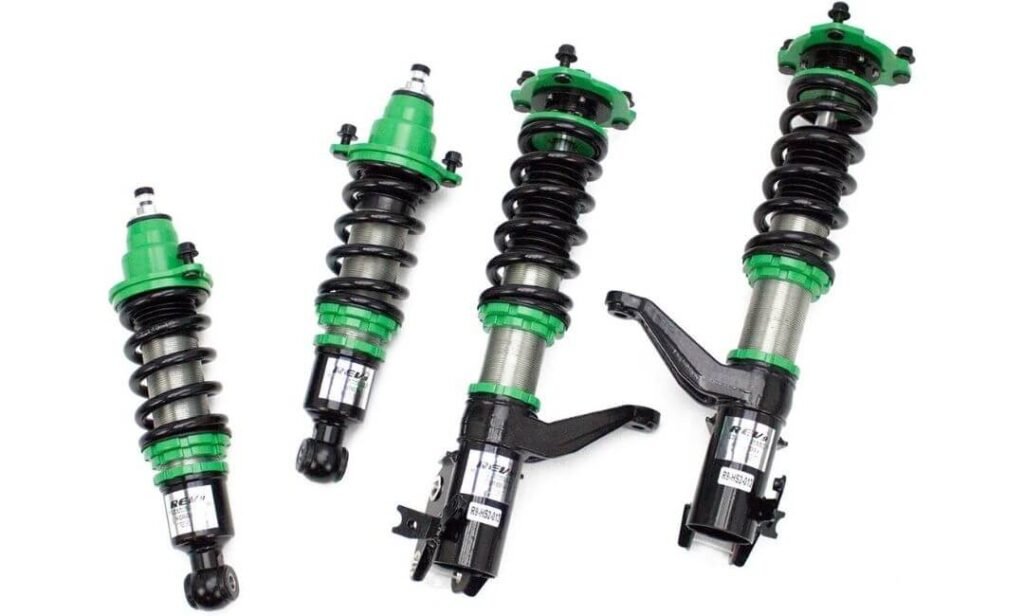
Quick Specs:
- Fitment: 2001–2005 Honda Civic Coupe/Sedan (EM/ES)
- Shock Design: Mono-tube
- Damping: 32-way rebound adjustment
- Spring Rate: Front 8 kg/mm (448 lb/in) | Rear 10 kg/mm (560 lb/in)
- Adjustment: Full-length ride height + independent spring tension
- Top Mount: Pillow-ball camber plate
- Camber Adjustment: Up to ±3° at the front
- Position: Front and rear
- Construction: Steel-alloy shock body
- Purpose: Lowered street/performance setup
If your 2001–2005 Civic needs more than just a lower stance, this is where the Rev9 setup starts making sense. The important part is not simply the 32-click adjustment printed in the listing; it is the combination of that damping range with a mono-tube shock and full-length adjustment. You can change the car’s ride height without using the spring itself as the only way of getting the car lower, which is a much more sensible approach when you still care about how the Civic drives.
The spring rates are also worth paying attention to: 8 kg/mm up front and 10 kg/mm at the rear. That gives this kit a clearly firmer performance-oriented character rather than trying to imitate the soft factory suspension. The front pillow-ball camber plates add another useful layer of adjustment, particularly for an owner who has lowered the car and wants more control over alignment rather than simply accepting whatever camber the drop creates.
There is one practical detail I would not skip. This is a lowering kit, not a system intended to return the Civic to factory ride height, and the supplied listing does not include installation instructions. Professional installation is the sensible route, followed by a proper alignment. If the kit or your particular Civic setup requires outer tie-rod ends, those need to be accounted for before the job starts rather than discovered halfway through it. (A properly set-up coilover is worth far more than a maximum-drop stance that leaves the suspension fighting the road.)
What We Like
- 32-way rebound control gives you meaningful room to find a setting that suits your roads and driving style.
- Full-length adjustment separates ride-height changes from spring tension, which is the feature I would value most here.
- The mono-tube shock design gives this kit a more serious suspension layout than a basic height-adjustable replacement.
- Front pillow-ball camber plates give lowered-Civic owners useful alignment flexibility.
- The 8/10 kg/mm spring combination makes its performance-oriented purpose clear instead of leaving you guessing what kind of setup it is.
One Thing We’d Keep in Mind
The 32 settings are not a reason to keep turning the adjuster. Start from a sensible setting and make small changes; the best setting for a daily-driven Civic will depend heavily on your wheels, tires, roads and ride height.
2001–2005 Honda Civic Fitment
This particular application is listed for the 2001, 2002, 2003, 2004 and 2005 Honda Civic Coupe and Sedan using the EM/ES application. That makes it a direct match for the Civic generation this guide is targeting, but I would still verify the exact body style before ordering rather than relying only on the year range.
The EP3/Si should not be assumed to use this exact EM/ES kit just because it is also a 2001–2005 Civic. If you own an Si or another chassis variation, match the product’s listed application to your car first.
The Insider Pro-Tip
If this were my Civic, I would set the ride height first, get the alignment right, and only then start playing with the 32-way damping. Dropping the car as far as the threads allow and trying to fix the resulting ride with the damper is backwards. A moderate drop with usable suspension travel will usually make a much happier street car.
Also, don’t overlook the front camber adjustment. Once a 7th-gen Civic is lowered, alignment becomes part of the suspension setup rather than an afterthought. Get the car sitting where you actually intend to drive it, have the alignment checked properly, and then use the damping adjuster to fine-tune the feel. That’s how you get value from the features you’re paying for instead of just having an impressive-looking coilover specification sheet.
#2. Godspeed MSS0131-A MonoSS Coilover Lowering Kit
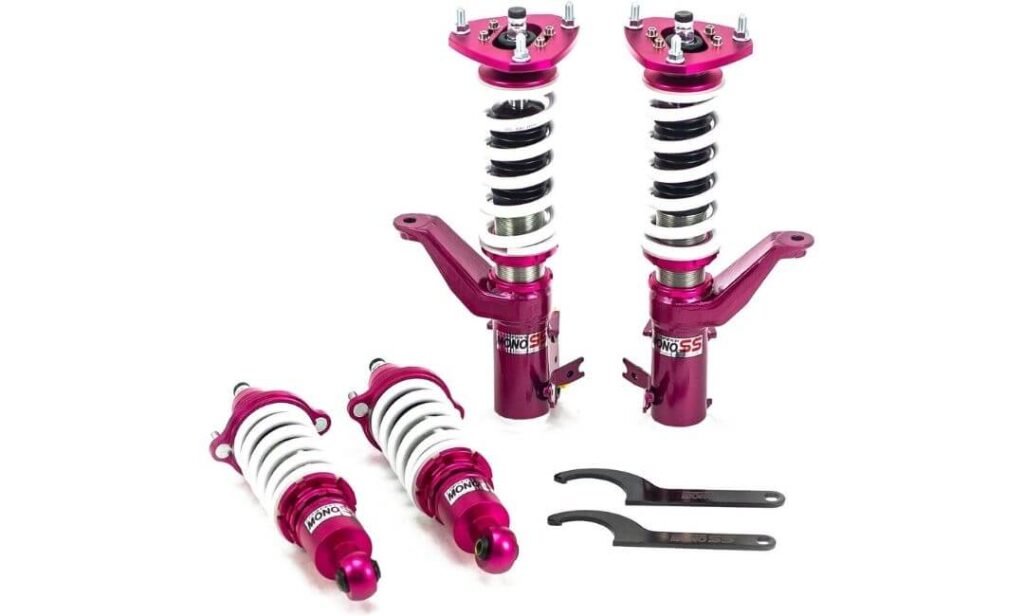
Quick Specs:
- Fitment: 2001–2005 Honda Civic Coupe/Sedan (EM/ES)
- Shock Design: 52mm mono-tube stainless steel
- Damping: 16-level rebound adjustment
- Spring Rate: Front 10 kg/mm (560 lb/in) | Rear 12 kg/mm (672 lb/in)
- Adjustment: Independent ride height + spring tension
- Top Mount: Pillow-ball with KOYO 6204Z bearing
- Damper: Rebuildable
- Oil: High-viscosity-index racing-grade shock oil
- Construction: CNC-machined aluminum + carbon steel components
- Warranty: 1-year limited warranty
- Position: Front and rear
What immediately separates this kit from a basic lowering setup is how much of the suspension can actually be adjusted independently. The 16-level rebound control is useful when you want to move the Civic away from a one-setting-fits-all suspension. You can leave it relatively controlled for normal road use and make small changes when the car sees more spirited driving, rather than being stuck with the damping that came out of the box.
The hardware underneath those adjustments is equally important. The kit uses 52mm mono-tube stainless steel shocks, with a performance internal piston and KOYO 6204Z bearing at the mount. The 10 kg/mm front and 12 kg/mm rear spring rates put this firmly on the firmer, performance-minded side of the Civic suspension market. That is worth knowing before buying because this is not designed around preserving the soft feel of a factory suspension.
Another detail I genuinely like here is the rebuildable damper design. Coilovers are a wear item, especially when a car is driven hard or sees rough roads, so having a damper that can be rebuilt instead of automatically replacing the entire assembly is a meaningful long-term advantage. The independent spring-tension and ride-height adjustment also lets you set the car’s height without treating spring preload as your lowering mechanism. (That distinction is easy to overlook, but it is one of the things that makes an adjustable suspension easier to set up properly.)
What We Like
- 16-way rebound adjustment gives enough range for meaningful street setup without making the system unnecessarily complicated.
- The rebuildable mono-tube dampers make more sense for an owner planning to keep the Civic for years.
- Independent height and spring-tension adjustment gives you better control over the final setup.
- The KOYO 6204Z bearing and pillow-ball mount add useful hardware where steering and suspension movement meet.
- A 1-year limited warranty provides some additional coverage for a new aftermarket suspension purchase.
One Thing We’d Keep in Mind
The 10/12 kg/mm spring rates are fairly firm, so I would choose the damping and ride height with your actual roads in mind rather than automatically setting everything to its stiffest position.
2001–2005 Honda Civic Fitment
The listed application covers the 2001, 2002, 2003, 2004 and 2005 Honda Civic Coupe and Sedan (EM/ES), which fits the main Civic application this article is targeting. That makes the year range straightforward, but body style and chassis code should still be matched before ordering.
If yours is an EP3 Si or another 7th-gen Civic variant, don’t assume that the EM/ES application automatically transfers. Check the exact application for your car before placing the order; suspension fitment is one area where a familiar model name can hide important chassis differences.
The Insider Pro-Tip
I would treat the 16 damping clicks as a tuning tool, not a feature to show off. Start somewhere in the middle, drive the same stretch of road, and change only a few clicks at a time. If the Civic becomes unnecessarily harsh without gaining useful control, you have simply gone too far.
And before lowering the car aggressively, make sure the suspension is going to retain sensible travel. The MonoSS gives you enough adjustment to build a properly controlled setup, but the final result still comes down to ride height, damping, alignment and tire choice working together. Get those four things right and the hardware starts earning its place; ignore them and even a well-equipped coilover can feel mediocre.
#3. FAPO Coilover Suspension Lowering Kit
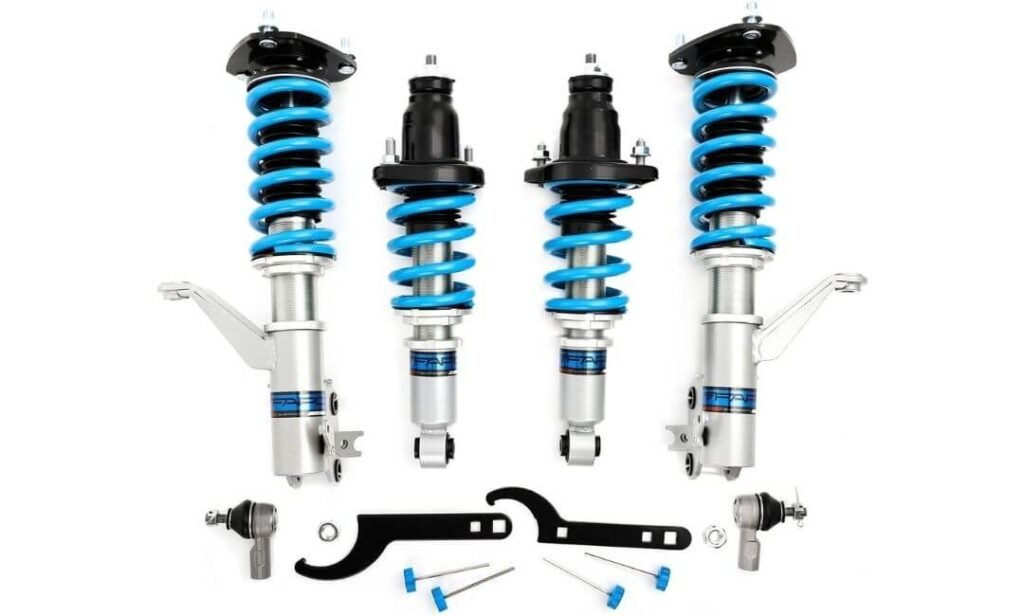
Quick Specs:
- Fitment: 2001–2005 Honda Civic EM/ES/Si/EP3
- Shock Design: Mono-tube
- Damping: 16-level adjustable
- Spring Rate: Front 10 kg/mm (560 lb/in) | Rear 12 kg/mm (671 lb/in)
- Spring Preload: 7–10mm
- Spring Length: Front 180mm | Rear 140mm
- Adjustment: Full-length height adjustment
- Lowering Range: 1–3 inches
- Finish: Painted anti-rust surface treatment
- Included: 4 coilovers + installation wrenches
- Warranty: 1-year manufacturer warranty + 7-day satisfaction guarantee
Here is where the FAPO becomes interesting: it is trying to cover three very different types of Civic use with one adjustable setup. The 16-level damper can be adjusted across the range, with the manufacturer suggesting the softer end for street driving and the firmer range for track or rougher, more demanding roads. That does not mean those numbers magically make the car comfortable or track-ready; it simply gives you room to tune the response around how and where you drive.
The hardware follows the same performance-minded approach. You get a mono-tube design, 10 kg/mm front and 12 kg/mm rear springs, plus 7–10mm of spring preload. The full-length height adjustment is particularly useful because the advertised 1–3-inch lowering range can be set without relying solely on compressing the spring to put the Civic where you want it. For a street car, that distinction matters more than an impressive maximum-drop figure.
There are also a few practical details that make this more than a bare four-corner suspension kit. The package includes installation wrenches, uses a protective painted finish intended to resist corrosion, and includes dust protection for the damper internals. The manufacturer also lists adjustable camber plates. At the same time, this is a relatively newer option with less long-term independent feedback than some established suspension brands, so I would judge it on its documented equipment and value rather than promise a level of durability that the available information cannot prove. (That is exactly why it lands here rather than being pushed artificially higher on the list.)
What We Like
- 16-level damping gives you useful adjustment for a Civic that sees both normal roads and occasional spirited driving.
- Mono-tube construction gives the kit a performance-oriented foundation without making it a track-only proposition.
- The 1–3-inch height range gives enough flexibility for a functional lowered stance rather than forcing one fixed drop.
- 10/12 kg/mm springs make the intended handling character clear and give the setup a firmer performance bias.
- The combination of camber adjustment, preload and height control gives an owner considerably more setup flexibility than a basic replacement suspension.
One Thing We’d Keep in Mind
The broad Civic fitment list deserves attention: EM/ES and EP3/Si applications should be matched to the exact car before ordering, even though all fall within the 2001–2005 Civic generation.
2001–2005 Honda Civic Fitment
This kit is specifically listed for the 7th-generation Honda Civic from 2001 through 2005, including EM, ES, Si and EP3 applications. The listing also covers the 2002–2006 Acura Integra/RSX DC5, but that additional application does not change the Civic fitment being evaluated here.
For the Civic, I would still check the exact chassis/body style against the seller’s current application information before purchase. The fact that a product lists both regular Civic variants and the EP3 Type-R/Si is useful, but it is not a reason to skip that final fitment check.
The Insider Pro-Tip
With this setup, do not use the lowering range as your target. Pick the ride height that leaves the car usable on your normal roads first, then dial in the damping. A Civic that looks slightly less dramatic but still has sensible suspension travel will be far more enjoyable than one sitting at the bottom of the adjustment range.
And if you are choosing this specifically because of the 16-way adjustment, actually use it methodically. Make one small change at a time and judge the car over the same roads. That is where an adjustable coilover earns its money—not in the product listing, but in your ability to make the Civic feel right for the way you actually drive it.
#4. maXpeedingrods Adjustable Coilovers
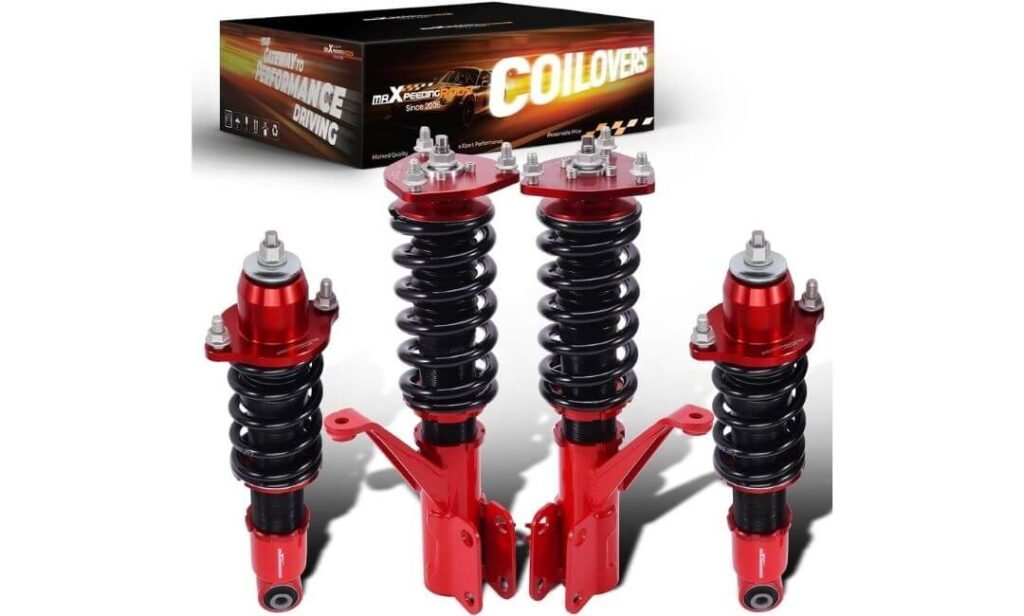
Quick Specs:
- Fitment: 2001–2005 Honda Civic DX/EX/GX/HX/LX/Si
- Body Styles: Coupe (EM2) and Sedan (ES/ET)
- Hybrid Fitment: Not compatible
- Lowering Range: 1–3 inches
- Damping: Preset damping value
- Spring Rate: Front 10 kg/mm (560 lb/in) | Rear 6 kg/mm (336 lb/in)
- Spring Testing: Over 600,000 continuous cycles; distortion under 0.04%
- Main Material: 6061-T6 aluminum alloy
- Adjustment: Ride height
- Purpose: Street-focused lowered setup
Sometimes the useful choice is the one that does not pretend to offer every adjustment under the sun. That is essentially where this maXpeedingrods setup fits. Instead of giving you a long list of damping clicks to experiment with, it uses a preset damping value and concentrates on adjustable ride height, making the kit more straightforward for someone who mainly wants a lower Civic with a controlled suspension setup.
The 1–3-inch height adjustment gives you plenty of room to change the stance without locking you into one drop. The springs are also notably different from the two higher-ranked kits, using a 10 kg/mm front and 6 kg/mm rear rate. That difference is important because it tells you this is not simply another version of the 10/12 kg/mm setups above. The manufacturer also states that the springs underwent more than 600,000 continuous test cycles, with distortion below 0.04%, along with surface treatment intended to improve durability.
Then there is the construction. The kit uses 6061-T6 aluminum alloy and precision components, which gives it a reasonable hardware foundation for a budget-oriented suspension upgrade. The preset damping is actually a useful distinction for a daily-driven owner who would rather install the coilovers, set the height sensibly and get on with driving than spend weekends chasing tiny changes in damper settings. (Less adjustment is not automatically a disadvantage when you know what you actually need.)
What We Like
- 1–3-inch height adjustment gives plenty of flexibility for a lowered street stance.
- The preset damping keeps the setup simple for owners who do not need manual damper tuning.
- 10/6 kg/mm spring rates give this kit a different balance from the firmer 10/12 kg/mm options above.
- 600,000+ cycle spring testing provides a useful durability reference from the manufacturer.
- 6061-T6 aluminum construction keeps the hardware focused on strength and weight without making the kit unnecessarily complicated.
One Thing We’d Keep in Mind
The preset damping cannot be manually fine-tuned, so this is better suited to someone who wants straightforward height adjustment rather than a suspension setup they can continually tune.
2001–2005 Honda Civic Fitment
This application covers the 2001–2005 Honda Civic VII DX, EX, GX, HX, LX and Si, with listings for both the EM2 coupe and ES/ET sedan. That is a useful range of standard Civic applications for this generation.
The important exception is the Civic Hybrid. It is specifically excluded from the listed fitment, so Hybrid owners should not use the standard EM2/ES/ET application as a substitute.
The Insider Pro-Tip
If your Civic is primarily a daily driver, I would seriously consider whether you actually need adjustable damping before spending extra for it. A correctly installed height-adjustable kit with predictable preset damping can be easier to live with than a complicated setup that you constantly adjust without knowing what changed.
The bigger priority here is the 1–3-inch drop. Set it conservatively, check that the tires and suspension have adequate clearance, then get a proper four-wheel alignment. On a 20-plus-year-old Civic, that final alignment can make a bigger difference to how the car feels and wears its tires than another dozen adjustment settings ever would.
#5. Vahaha Honda Civic VII 4-Piece Coilover Suspension Kit
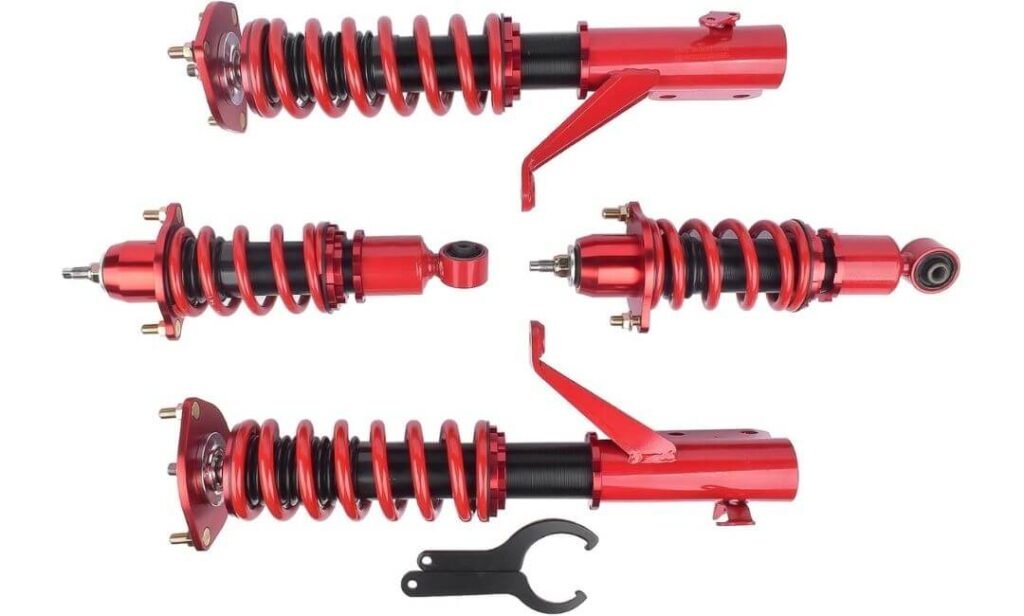
Quick Specs:
- Fitment: 2001–2005 Honda Civic DX/EX/GX/HX/LX/Si
- Body Styles: Coupe (EM2) and Sedan (ES/ET)
- Hybrid Fitment: Not compatible
- Shock Design: Twin-tube
- Adjustment: Full-length ride height + independent spring tension
- Lowering Range: Approximately 2–3 inches
- Top Mount: Pillow-ball
- Bearing: Deep-groove ball bearing structure
- Damping: Factory-preset
- Package: 2 front + 2 rear coilovers + adjustment wrenches
- Position: Front and rear
There is a simple reason this kit earns a place in the lineup: not every Civic owner wants a stiff, highly tuned suspension. The Vahaha setup takes a different route with a twin-tube shock design, giving the damper more stroke and aiming for a more forgiving ride while still allowing the car to be lowered. For an older Civic that spends most of its time on normal roads, that difference is worth understanding.
The useful part is how the adjustment is arranged. The lower mount controls ride height, while spring tension can be adjusted independently. That means you can change the stance without using the spring itself to force the car lower. The listed 2–3-inch lowering range gives plenty of visual change, but I would still set it around the roads you actually drive rather than treating the maximum drop as the goal.
There are a couple of thoughtful details in the hardware too. The pillow-ball top mount is intended to sharpen steering response, while the deep-groove bearing structure is designed to reduce friction and unwanted turning noise. Damping itself is factory-preset, so this is not the kit I would choose if you want to spend time adjusting rebound click by click. Its appeal is much more straightforward: adjustable height, independent spring tension and a twin-tube layout in one complete four-corner package. (For a budget street build, simplicity can be a feature rather than a compromise.)
What We Like
- Twin-tube construction prioritizes useful suspension travel and a more forgiving street character.
- Full-length height adjustment lets you change the Civic’s stance through the lower mount.
- Independent spring-tension adjustment gives you more control without making ride height dependent on spring compression.
- Pillow-ball mounts and deep-groove bearings address steering response and friction at the top of the suspension.
- The complete four-piece package includes the adjustment wrenches, keeping the installation package straightforward.
One Thing We’d Keep in Mind
The damping is factory-preset, so choose this one for its height adjustment and street-oriented design rather than expecting the tuning flexibility of the Rev9 or Godspeed kits.
2001–2005 Honda Civic Fitment
The listed fitment covers the 2001–2005 Honda Civic VII, including DX, EX, GX, HX, LX and Si trims in both EM2 coupe and ES/ET sedan applications. That makes it a broad fitment for the standard Civic variants covered by this article.
Just like the maXpeedingrods option, the listing specifically excludes the Hybrid. If your Civic is a Hybrid, do not treat the standard EM2/ES/ET application as confirmation that this kit will fit.
The Insider Pro-Tip
For a Civic that is mainly driven around town, I would look at the twin-tube design and available suspension travel before worrying about how low the car can go. A sensible drop with enough room for the suspension to work will feel much better over broken pavement than a maximum-drop setup that constantly runs out of usable travel.
And because the damping is preset, spend your setup time where it actually matters: ride height, preload, tire pressure and alignment. Get those basics right and this type of kit can make sense as a simple way to change the Civic’s stance without turning the car into a constant suspension-tuning project.
Best Honda Civic Coilovers (2001–2005) Compared for Ride Height & Damping
Honda Civic 2001–2005 Coilovers Buying Guide
Choosing coilovers for a 2001–2005 Honda Civic is less about finding the lowest advertised price and more about matching the suspension to the exact car and the way you drive it. The five kits above cover noticeably different approaches: some give you extensive damping control, some focus mainly on ride height, and others use a twin-tube design to prioritize usable street travel. That difference is worth understanding before you buy.
Start With Exact Civic Fitment
The 2001–2005 Civic is the 7th-generation platform, but the year range alone does not confirm compatibility. Coupe and sedan applications can use different chassis codes, and the EM2, ES, ET and EP3/Si designations matter when checking a coilover kit.
The products in this guide are not all listed for exactly the same Civic applications. Rev9 and Godspeed are specifically listed for the 2001–2005 EM/ES Coupe and Sedan, while the FAPO listing also includes Si and EP3 applications. The maXpeedingrods and Vahaha kits cover the EM2 coupe and ES/ET sedan, but both specifically exclude the Hybrid.
That is why I would check the exact body style, trim and chassis application before ordering. If the listing does not clearly identify your Civic, do not assume that a similar-looking 7th-gen model will be interchangeable.
Decide What You Actually Want From the Suspension
Your intended use should determine the type of coilover you buy.
For a daily-driven Civic, ride quality and usable suspension travel should matter more than achieving the maximum possible drop. A lower car can look great, but going excessively low can reduce available travel and make rough roads considerably less pleasant.
For a more aggressive street or occasional track setup, adjustable damping becomes much more valuable. Rev9 gives you 32 rebound settings, while Godspeed and FAPO provide 16-level adjustment. Those controls allow you to change how quickly the suspension responds, but they are not a substitute for proper spring rates, alignment or sensible ride height.
The maXpeedingrods and Vahaha options take a simpler approach, with preset damping. That can actually suit an owner who wants to set the height once and drive rather than continually experiment with suspension settings.
Understand Spring Rates Before Choosing a Kit
Spring rate has a major influence on how a coilover feels, and the five kits are not using identical rates.
The Rev9 uses 8 kg/mm front and 10 kg/mm rear, while both Godspeed and FAPO list 10 kg/mm front and 12 kg/mm rear. Those are relatively firm rates and point toward a more performance-oriented setup.
The maXpeedingrods kit is different, using 10 kg/mm front and 6 kg/mm rear. Vahaha does not provide a spring-rate specification in the information used for this comparison, so I would not invent one simply to make the table look complete.
There is no universally “best” spring rate for every Civic. Wheel and tire choice, road quality, vehicle weight and personal preference all affect the result. A spring that works well on a smooth road with performance tires can feel very different on a Civic driven every day over broken pavement.
Full-Length Adjustment vs. Damping Adjustment
These two features are often mentioned together, but they do completely different jobs.
Full-length adjustment is primarily about setting ride height while keeping the coilover’s working geometry and spring tension properly managed. On the Rev9, Godspeed, FAPO and Vahaha kits, the design allows height adjustment through the lower portion of the assembly rather than simply winding the spring down until the car sits lower.
Damping adjustment, meanwhile, changes the shock’s response. Rev9 provides 32-way rebound adjustment, while Godspeed and FAPO provide 16-level adjustment. More clicks give you more increments to work with, but more adjustment does not automatically mean a better suspension. What matters is whether the range is useful for your particular car.
The maXpeedingrods and Vahaha kits use preset damping, so they are simpler choices. If you have no interest in tuning rebound, paying specifically for additional damping adjustment may not provide much real-world benefit.
Match the Drop to the Roads You Drive
A coilover that can lower a Civic by 1–3 inches does not mean you should automatically use the full range.
For most street cars, I would start with a moderate drop, check wheel and tire clearance, make sure the suspension still has sensible travel, and then get the alignment corrected. Lowering changes suspension geometry, so alignment becomes especially important once the ride height moves away from stock.
The goal should be a Civic that looks lower while still behaving like a car you can comfortably drive every day. If the car constantly scrapes, bottoms out or becomes unnecessarily harsh, the extra lowering has probably taken you past the useful point.
Look Beyond the Coilover Body
Construction details matter, particularly on an older Civic that may see years of road use.
Rev9 uses a mono-tube design with a steel-alloy body, while Godspeed specifies a 52mm mono-tube stainless-steel shock, performance internals and rebuildable dampers. FAPO also uses a mono-tube design, while Vahaha takes the twin-tube route and emphasizes longer stroke and suspension travel.
Godspeed’s rebuildable damper is particularly interesting for long-term ownership because a worn damper does not necessarily mean replacing the entire coilover assembly. The maXpeedingrods kit uses 6061-T6 aluminum alloy components, while FAPO lists an anti-rust painted finish.
These details should not be treated as proof that one kit will automatically last longer than another. They simply tell you more about how each product is built and what kind of ownership it is designed to support.
Warranty and Long-Term Support Matter
A coilover is not a disposable appearance accessory. It is part of the suspension, so warranty coverage and serviceability deserve a place in the buying decision.
Godspeed lists a 1-year limited warranty and rebuildable dampers. FAPO also lists a 1-year manufacturer warranty plus a 7-day satisfaction guarantee. The Rev9 listing includes warranty coverage, although the supplied product information does not give the same level of warranty detail.
For the lower-cost options, I would pay particular attention to the seller’s current warranty terms, replacement-part availability and return policy before purchasing. A low initial price becomes much less attractive if obtaining a replacement component later is difficult.
One Final Fitment Check Before You Order
Before buying any of these kits, have your year, body style, trim and chassis code in front of you and compare them directly with the current product listing. Pay special attention if you own an EP3/Si or Hybrid, because those applications are not interchangeable simply because they share the 2001–2005 Civic name.
Then decide what matters most: maximum tuning, balanced performance, straightforward height adjustment, or a simpler street setup. Once you answer that honestly, the five options become much easier to separate, and you are far less likely to buy a coilover based only on how aggressive the product photos look.
32-Click Damping Explained: How to Tune a 2001–2005 Civic Properly
The 32-click adjustment on the Rev9 Hyper-Street II is one of the most useful features in this group, but it is also one of the easiest to misunderstand. Those clicks control rebound damping, meaning they change how quickly the shock controls the suspension as it returns after being compressed. They do not change the spring rate, maximum lowering amount, or alignment.
More clicks should not be interpreted as “more performance.” Think of the adjuster as a range between a more compliant response and a more controlled, firmer response. The correct setting depends on your spring rate, tire sidewall, wheel size, road surface, ride height and driving style.
What the 32 Clicks Actually Change
Rebound damping controls the shock’s resistance as the suspension extends after compression. A softer setting generally allows the suspension to move more freely, which can help the Civic deal with rough pavement without feeling unnecessarily tied down.
A firmer setting slows that extension and can make the car feel more controlled during quick transitions. This can be useful on smoother roads or during more aggressive driving, but going too firm can make the suspension feel busy over broken pavement because the wheel may not return to the road as naturally.
That is why I would not chase a particular click number simply because someone else recommends it. The same setting can feel completely different on two Civics with different tires, wheel sizes, ride heights and alignment settings.
A Sensible Starting Point for Daily Driving
For a new owner, start around the middle of the available adjustment range, rather than immediately choosing either extreme. On a 32-click system, that gives you a reasonable baseline from which to make small changes.
Drive the car over a familiar section of road that includes the surfaces you normally encounter. Pay attention to whether the Civic settles cleanly after bumps, whether the body feels controlled during direction changes, and whether the tires continue to feel planted over uneven pavement.
If the ride feels unnecessarily sharp or the car seems reluctant to settle over repeated bumps, move the damping a few clicks toward the softer side. Make the change gradually; there is no advantage to moving ten or fifteen clicks at once because you lose the ability to tell which change actually helped.
For a More Aggressive Street Setup
If the Civic is used for spirited driving on reasonably smooth roads, you can move toward a firmer rebound setting from your daily-driver baseline.
The objective is not to make the suspension as stiff as possible. You are looking for a setting where the car feels controlled through transitions without becoming harsh or losing composure over surface changes.
A good aggressive street setup should still allow the suspension to work. If the car begins feeling nervous over bumps, skips across uneven pavement, or becomes noticeably less settled when the road gets rough, that is useful feedback that you have probably gone too far.
Fine-Tuning Cornering Feel
When cornering, look for how the Civic behaves after the initial steering input, not just how stiff it feels.
If the body takes too long to settle after a direction change, a small increase in rebound damping may make the response feel more controlled. Test the same corner or sequence of bends after each adjustment so you are comparing something meaningful.
If the car starts feeling harsh and the tires seem less settled over imperfect pavement, back the adjustment off. More rebound is not automatically better cornering; the suspension still needs to allow the tire to follow the road.
Improving Bump Absorption
Bump absorption is where many first-time coilover owners make the mistake of assuming a softer setting is always better.
If the Civic feels too sharp over ordinary road imperfections, try moving the rebound adjustment slightly softer and test the same road again. If the car feels floaty or takes too long to settle afterward, move it back toward the firmer side.
The important part is changing one variable at a time. Do not adjust damping, ride height and tire pressure simultaneously and then try to decide what improved the car.
Do Not Use Damping to Fix Ride Height
This is an important distinction with the Rev9 system.
The coilover provides independent spring tension and ride-height adjustment, so use the height adjustment to establish where the Civic sits. Do not lower the car excessively and then try to compensate for reduced suspension travel by making the damping extremely firm.
Set the ride height first, check clearance and suspension travel, complete the alignment, and then tune the rebound. That order makes far more sense mechanically.
A Simple 3-Step Tuning Process
1. Establish a baseline
Set the ride height to a sensible level for your roads, make sure the suspension is correctly installed, and get the alignment checked. Start the rebound adjustment around the middle of its range.
2. Change only a few clicks
Drive the same familiar route and pay attention to bump absorption, body control and how naturally the car settles after steering inputs. Change only a few clicks at a time, then repeat the test.
3. Keep the setting that solves a real problem
Do not change the adjustment simply because you can. If the Civic feels controlled, predictable and comfortable enough for your use, stop. The best setting is not the one with the most impressive number; it is the one that makes the car behave the way you actually want.
One Rule I Would Follow With Any Adjustable Coilover
Write down your settings.
Record the click position, ride height and tire setup before experimenting. If a change makes the car worse, you can return to your previous baseline immediately instead of trying to remember where you started.
And remember that rebound adjustment cannot correct everything. If the Civic has poor alignment, unsuitable tire pressure, excessive lowering, worn suspension components, or inadequate suspension travel, changing the damper setting is treating the symptom rather than the cause. A properly installed and aligned coilover with a sensible ride height will always give you a much better foundation for tuning.
Coilover Installation Guide for a 2001–2005 Honda Civic
Installing coilovers on a 7th-generation Civic is not difficult because the parts are mysterious; it is difficult because ride height, spring preload, fastener torque, brake-line routing and final alignment all need to be right at the same time. The Rev9, Godspeed, FAPO, maXpeedingrods and Vahaha kits also differ in their adjustment hardware, so always follow the instructions supplied with your exact kit where they conflict with a generic procedure.
For a first-time installer, I would treat this as a high-level installation roadmap, not a substitute for the manufacturer’s instructions or a service manual. If you do not have a safe way to support the Civic securely, professional installation is the better choice.
Tools and Preparation Checklist
Before taking the original suspension apart, have the following ready:
- Quality floor jack and four properly rated jack stands
- Wheel chocks
- Complete metric socket and wrench set
- Breaker bar and suitable extensions
- Torque wrench
- Hex or Allen keys where required by the coilover hardware
- Screwdriver and trim-removal tools as needed
- Penetrating lubricant for older fasteners
- Measuring tape for recording the original ride height
- Thread-cleaning brush
- Anti-seize where the manufacturer specifically permits it
- Manufacturer-supplied adjustment wrenches
- Service information for the exact Civic chassis
- Alignment appointment arranged for after installation
Before lifting the car, measure from a consistent wheel-center reference to the fender on all four corners and write the measurements down. This gives you a useful reference when setting the new suspension rather than relying on how the car looks by eye.
Prepare the Civic Safely
Park the Civic on a solid, level surface, engage the parking brake and secure the wheels that remain on the ground. Loosen the wheel nuts slightly before lifting the vehicle.
Raise the car using the correct lifting points and place it securely on jack stands. Never rely on the floor jack alone while working underneath or around the suspension.
Once the wheels are removed, inspect the existing suspension before immediately removing anything. On a Civic that is more than two decades old, it is worth looking for worn bushings, damaged brake hoses, tired ball joints, leaking shocks and corroded fasteners. Installing expensive coilovers while leaving an obviously worn suspension component untouched can make diagnosing the final result unnecessarily difficult.
Remove the Original Suspension
The exact sequence varies between the front and rear suspension and between Civic body styles, so work from the service information for your specific chassis.
In general, the process involves supporting the relevant suspension assembly, disconnecting components that retain the original shock assembly, removing the upper mounting hardware, and carefully taking the factory shock and spring assembly out.
Do not allow a brake hose, ABS wiring or other attached component to become stretched while the original assembly is being removed. If a fastener is heavily corroded, work it loose carefully rather than applying uncontrolled force that could damage surrounding components.
If the original suspension uses a spring that remains under compression, do not attempt to dismantle the spring assembly without the correct spring-compression equipment and experience. That stored energy can cause serious injury.
Set Up the New Coilovers Before Installation
This is one of the places where rushing causes unnecessary problems.
Compare the new assemblies with the original parts and verify the left/right position, front/rear application and mounting points before installation. Set the initial ride height according to the manufacturer’s adjustment procedure.
For the Rev9, Godspeed, FAPO and Vahaha designs in this comparison, the important concept is that ride height should be established through the appropriate height-adjustment mechanism, rather than simply winding the spring down to make the car lower.
Do not guess at spring preload. Use the manufacturer’s specified setup procedure for your exact kit. The same applies to the damping adjustment on Rev9, Godspeed or FAPO products.
Mount the Coilovers
Install each coilover into its correct position and loosely secure the mounting hardware first, allowing the assembly to settle into its proper position before final tightening.
Pay particular attention to:
- Correct mounting orientation
- Brake-line and ABS-wire clearance
- Clearance around the tire and wheel
- Clearance through the full steering range
- Adequate clearance between the spring, damper and surrounding components
- Proper seating of all supplied hardware
Do not automatically reuse every factory washer, spacer or mounting component. Use the hardware specified for the particular coilover kit and follow its installation instructions.
Once the assembly is correctly positioned, tighten the mounting hardware to the manufacturer or vehicle-specific torque specification. Do not substitute “tight enough” for a torque specification on suspension hardware.
Reinstall the Wheels and Settle the Suspension
After all four corners are installed, reinstall the wheels and lower the Civic carefully.
Before judging the final ride height, move the car back and forth or roll it a short distance so the suspension can settle naturally. Then measure the ride height again from the same reference points used before installation.
Make adjustments gradually and equally where appropriate. A visually level car is not necessarily correctly adjusted, so use measurements rather than relying entirely on your eye.
Alignment Is Part of the Installation
Do not consider the job finished simply because the Civic is sitting at the desired height.
Lowering the car changes suspension geometry, which can affect camber, toe and steering behavior. Have a proper four-wheel alignment performed after the suspension settles.
This is especially important with the Rev9 and other kits that provide additional setup flexibility. If your particular kit has adjustable front camber hardware, tell the alignment technician what you are trying to achieve rather than simply requesting that everything be returned to an arbitrary factory number.
For a street car, prioritize stable, predictable alignment and even tire wear over chasing an aggressive alignment number just because the car is lowered.
Important 2001–2005 Civic Fitment Notes
The phrase “2001–2005 Civic” covers several applications. The products in this article include different combinations of EM2 coupe, ES/ET sedan and EP3/Si fitment.
That means you should verify the exact chassis before installation, especially if you own an EP3/Si or Hybrid. The maXpeedingrods and Vahaha listings specifically exclude Hybrid models, while the FAPO listing includes EP3/Si applications.
Also remember that lowering the car changes the relationship between the wheel, tire and suspension. Your final wheel and tire combination needs to have sufficient clearance at full steering lock and through suspension movement, not merely while the car is parked.
Common Installation Mistakes to Avoid
Setting the car too low immediately: Start with a sensible height. You can always lower it later, but excessive lowering can reduce useful suspension travel and create clearance problems.
Using spring preload to create the drop: Follow the coilover’s height-adjustment design. Spring tension and ride height are not interchangeable adjustments.
Ignoring brake and ABS wiring: Turn the steering from lock to lock and inspect the complete range after installation. Nothing should be stretched, pinched or rubbing.
Skipping the alignment: A coilover installation without a final alignment is incomplete, particularly after changing ride height.
Changing several settings at once: If the kit has damping adjustment, establish a baseline first. Changing height, damping and tire pressure simultaneously makes it difficult to understand what actually improved or worsened the car.
Guessing torque values: Suspension fasteners are not the place for estimates. Use the correct specifications for the Civic and the coilover manufacturer.
Assuming every 7th-gen Civic uses the same kit: Always match the product to the exact body style, trim and chassis application.
The Final Check I Would Not Skip
Before taking the Civic on a normal drive, inspect every installed corner once more. Confirm that the mounting hardware is secure, wheels are correctly tightened, brake and ABS components have adequate clearance, and nothing contacts the tire or suspension.
Then take a slow, short test drive over familiar roads. Listen for unusual noises, pay attention to steering behavior and confirm that the car settles normally after bumps. If something does not feel right, stop and inspect it rather than assuming a new coilover simply needs to “break in.”
Once everything checks out, recheck ride height and have the alignment completed. That final sequence is what turns a coilover purchase into a properly installed suspension setup rather than simply putting four new assemblies on the car.
Daily Driving vs. Performance: Choosing the Right Civic Coilover Setup
There is no single coilover setting that makes every 2001–2005 Honda Civic owner happy. A Civic used for commuting, rough city roads and occasional highway trips has very different requirements from one that is regularly driven hard on smooth back roads or sees occasional track use. The good news is that the five kits in this guide give you enough variety to choose based on how the car is actually used, rather than buying the most aggressive specification by default.
If the Civic Is Your Daily Driver
For daily driving, I would put ride quality, suspension travel and predictable control ahead of maximum lowering. The Civic is old enough that road conditions, worn suspension components and tire choice can have a noticeable effect on how any aftermarket coilover feels.
The Rev9, Godspeed and FAPO kits give you damping adjustment, but that does not mean you should run them stiff. A softer-to-moderate setting can make more sense on broken pavement, while the car can be firmed up gradually if the steering response feels too relaxed.
The maXpeedingrods and Vahaha options take a simpler route with preset damping. That can actually be attractive for a daily driver. You set the ride height sensibly, make sure the alignment is correct, and avoid turning suspension adjustment into another thing you have to think about every week.
If You Want a Lowered Stance Without Ruining the Ride
A lowered Civic can look dramatically better, but the lowest possible setting is rarely the best street setting.
The products in this comparison generally advertise roughly 1–3 inches of lowering or adjustment, depending on the kit. Treat that as available adjustment, not a recommendation to use the entire range. The lower the car goes, the more carefully you need to think about suspension travel, tire clearance, alignment and contact with the road.
For a street-focused build, I would lower the Civic until the stance looks right while still leaving enough room for the suspension to work properly. If you are constantly scraping the underside, hitting the bump stops or feeling every small road imperfection through the cabin, the car is probably lower than it needs to be.
When Performance Becomes the Priority
If you enjoy spirited street driving, the Rev9, Godspeed and FAPO become more interesting because their damping adjustments give you something to work with.
The Rev9 offers 32-way rebound adjustment, while Godspeed and FAPO provide 16-level damping adjustment. That extra control is useful when you want to fine-tune how the Civic responds to steering inputs, bumps and transitions.
But there is an important distinction: a firmer setting is not automatically faster. If the damper is adjusted too aggressively for the road, the suspension may struggle to follow uneven pavement and the car can feel less settled. The best performance setup is the one that keeps the tires working with the road, not the one that simply feels the stiffest.
Choosing Between the Five Based on Your Use
For maximum tuning flexibility, the Rev9 is the obvious starting point because of its 32-way rebound adjustment, full-length height control and front pillow-ball camber plates.
For a firmer, more performance-minded street setup, the Godspeed MonoSS is compelling, particularly with its 10/12 kg/mm spring rates, 16-way rebound adjustment and rebuildable mono-tube dampers.
For an owner wanting adjustable performance hardware at a more value-focused position, FAPO combines mono-tube construction, 16-level damping and full-length height adjustment.
For someone who mainly wants adjustable height without manual damping work, maXpeedingrods makes more sense because its damping is preset.
For a simpler street-oriented lowering setup, Vahaha’s twin-tube design, independent height and spring-tension adjustment, and factory-preset damping make its priorities quite clear.
Do Not Confuse Stance With Suspension Setup
A good-looking Civic should still be a good car to drive.
Wheel size, tire sidewall, tire pressure and alignment all influence the final result. A very low Civic on stiff, low-profile tires will naturally feel different from a moderately lowered Civic on a more forgiving tire, even if both use the same coilovers.
That is why I would make the ride height the last part of the appearance decision, not the first. Get the suspension installed correctly, establish usable travel, check wheel clearance, and then decide whether another small adjustment is genuinely worth making.
Maintenance Matters More Than People Think
Coilovers do not become maintenance-free simply because they are new. Dirt, moisture, road salt and repeated suspension movement eventually affect threaded adjustment areas and damper components.
A sensible maintenance routine includes:
- Inspecting the threaded bodies and adjustment collars periodically, particularly after winter or heavy rain.
- Cleaning accumulated dirt from adjustment threads before attempting to change ride height.
- Checking for oil leakage, unusual knocking or changes in damping behavior.
- Inspecting springs, mounts, bushings and surrounding suspension hardware.
- Checking tire wear, because uneven wear can reveal an alignment or suspension problem.
- Rechecking ride height if the car develops an unexpected lean or the suspension has been disturbed.
- Having the alignment checked whenever ride height is significantly changed.
Do not force a seized adjustment collar. Clean the threads and use only the lubricant or procedure recommended by the coilover manufacturer.
How Often Should You Inspect Them?
There is no honest universal mileage number that guarantees every coilover needs servicing at exactly the same interval. A Civic driven through salt, potholes and poor roads will place very different demands on suspension hardware than one driven gently on clean, smooth roads.
For that reason, condition-based inspection makes more sense than pretending every owner needs the same service schedule. Give the suspension a proper visual check during routine maintenance, and inspect it more closely whenever you notice a new noise, ride-height change, fluid leakage, uneven tire wear or noticeable change in handling.
For rebuildable dampers such as the Godspeed setup, follow the manufacturer’s guidance when the dampers eventually show signs that servicing is needed rather than replacing functioning components unnecessarily.
The Best Setup Is the One You Can Live With
For most 2001–2005 Civic daily drivers, I would rather have a moderately lowered car with sensible alignment and usable suspension travel than an extremely low car that looks impressive but becomes tiring to drive.
If your priority is tuning and spirited driving, choose the kit that gives you the adjustment range you will actually use. If your priority is simple daily transportation with a better stance, a straightforward height-adjustable setup can be the smarter purchase.
The right coilover is ultimately not the one with the longest feature list. It is the one whose fitment, spring rate, damping design, adjustment range and maintenance requirements make sense for the Civic sitting in your driveway.
FAQs About 2001–2005 Honda Civic Coilovers
Are 32-click coilovers actually worth paying more for on a 2001–2005 Honda Civic?
They can be, but only if you will actually use the adjustment. On the 2001–2005 Honda Civic, the Rev9’s 32-way rebound control gives you considerably more room to fine-tune the shock response than the 16-level systems in the Godspeed and FAPO kits. That is useful when you are trying to balance a lowered stance with the road conditions you drive on.
The important reality is that 32 clicks does not mean 32 levels of “better.” If your Civic is a daily driver and you never change the damping after installation, the extra adjustment has little practical value. If you enjoy experimenting with suspension response, change wheel and tire combinations, or occasionally drive more aggressively, the additional range becomes much more worthwhile.
Is a 1–3 inch drop sensible on a 2001–2005 Honda Civic, or is that too low for real roads?
A 1–3 inch adjustment range does not mean the Civic should automatically be lowered by three inches. On an older Civic, the usable height depends on your wheel and tire combination, road quality, suspension travel and alignment.
For a street car, I would establish the height from the bottom up: enough clearance for normal driving, enough travel for the suspension to work, and then lower it further only if there is still a genuine reason to do so. A Civic that clears real-world roads and keeps its tires working properly is a better setup than one that looks perfect in a parking lot but constantly scrapes.
A few checks are particularly important after lowering:
- Tire-to-spring clearance
- Full steering-lock clearance
- Suspension travel
- Brake-line and ABS-wire routing
- Final alignment and tire wear
Can I use the same coilovers on an EM2 coupe, ES sedan and EP3 Si just because they are all 2001–2005 Civics?
No, and this is one of the fitment details I would take seriously.
The 2001–2005 Civic name covers several chassis and body-style applications. In this comparison, Rev9 and Godspeed are listed for EM/ES Coupe and Sedan applications, while FAPO specifically lists EM/ES as well as EP3/Si. The maXpeedingrods and Vahaha listings cover EM2 coupe and ES/ET sedan applications but exclude Hybrid models.
That means “fits a 2001–2005 Civic” should never be the final fitment check. Match the exact body style, trim and chassis code against the current listing before ordering. If your Civic is an EP3/Si or Hybrid, this becomes particularly important.
Why can two Civic coilover kits with similar lowering ranges feel completely different?
Because ride height is only one part of the suspension equation. Spring rate, shock design, damping, tire sidewall, alignment and available suspension travel all influence what you feel from the driver’s seat.
For example, the Rev9 uses 8 kg/mm front and 10 kg/mm rear springs, while Godspeed and FAPO list 10 kg/mm front and 12 kg/mm rear. maXpeedingrods uses a different 10 kg/mm front and 6 kg/mm rear combination, and Vahaha does not provide a spring-rate figure in the information used here. Those are meaningful differences even though several kits advertise roughly similar lowering capability.
There is also a real difference between mono-tube and twin-tube construction. Rev9, Godspeed and FAPO use mono-tube designs, while Vahaha uses a twin-tube layout intended to provide longer stroke and a more forgiving street character. So two Civics sitting at the same fender height can still behave very differently.
What should I check after installing coilovers on my Civic before deciding whether the setup is actually good?
Do not judge the suspension from the first five minutes of driving. Give yourself a repeatable baseline.
First, check the basics: ride height, wheel clearance, suspension travel, fastener security and brake/ABS-line clearance. Then get the car properly aligned. Lowering changes suspension geometry, so an alignment is part of the installation rather than an optional finishing touch.
After that, drive the same familiar roads and pay attention to how the Civic settles after bumps, responds to steering input and behaves over uneven pavement. If you have adjustable damping, change only a few clicks at a time and record what you changed.
One of the best habits you can develop is keeping a small setup record containing your ride height, damping position, tire pressure and alignment settings. It sounds excessive until you make a change that makes the car worse; then having the previous setup written down becomes extremely useful. The goal is not to find the stiffest setting—it is to find the most controlled and predictable setup for the roads you actually drive.
Final Thoughts
A 2001–2005 Honda Civic does not need the most expensive coilover or the lowest possible ride height to become a better car. What it needs is a suspension setup that makes sense for the chassis, your roads and the way you actually drive. That is why these five options are separated by their real differences rather than treating every adjustable coilover as the same product.
The Rev9 Hyper-Street II stands out when damping control and setup flexibility are the priority. Godspeed MonoSS makes a strong case for someone who wants a firmer, rebuildable mono-tube setup with useful adjustment. FAPO offers a similar performance-oriented formula with 16-level damping, while maXpeedingrods keeps things simpler with height adjustment and preset damping. Vahaha takes the more straightforward twin-tube street approach for owners who value simplicity and suspension travel.
The honest part is that none of these features can compensate for incorrect fitment or a poor installation. Check your exact Civic chassis, body style and trim, set the ride height sensibly, protect your suspension travel, and finish the job with a proper alignment. Those details will matter every time you drive the car.
And if you are still deciding between them, don’t ask only, “Which one lowers my Civic the most?” Ask the better question: “Which one gives me the control I will actually use?” That answer will usually lead you to the right coilover far quicker than a maximum-drop number or a flashy product photo ever will.
Also Check: