5 Best Dash Cam with GPS Tracking in 2026: 4K STARVIS 2 Dual Radar WiFi 6 & Cloud Ready
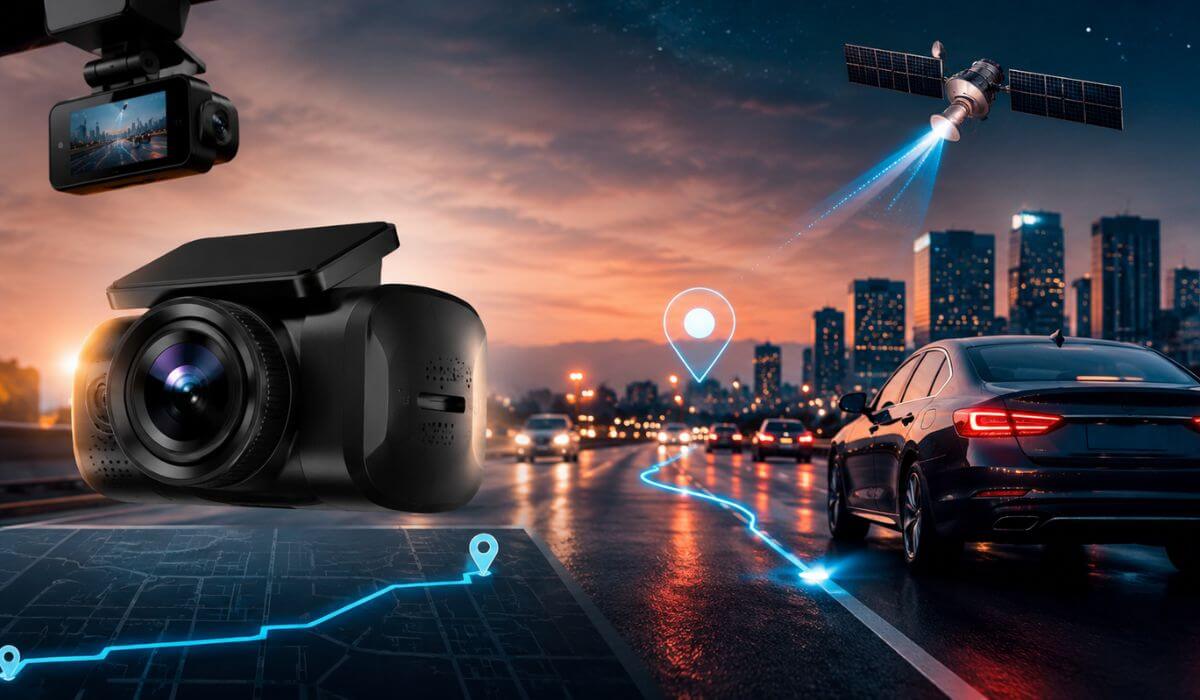
If you want a dash cam that simply records video, almost any model will do. But if you want to prove where your vehicle was, verify your speed, replay your exact route, or back up an insurance claim with location data, built-in GPS becomes one of the most valuable features you can buy. It quietly records your journey in the background, adding an extra layer of evidence that standard cameras simply cannot provide.
Over the past year, brands like THINKWARE, Vantrue, VIOFO, BlackVue, and ROVE have pushed GPS dash cams far beyond basic location logging. The latest models combine Sony STARVIS 2 sensors, HDR imaging, faster Wi-Fi, smarter parking protection, cloud connectivity, and more accurate GPS tracking, making them a significant step up from older generations. Many also support larger storage capacities and improved heat management, which matters if your car spends long hours parked outdoors.
For this guide, we didn’t choose products based on marketing claims or popularity alone. We focused on GPS accuracy, video quality, software reliability, parking features, long-term firmware support, and real-world usability. Every recommendation below is a current-generation model that delivers dependable GPS logging while offering strengths for different drivers, whether you commute daily, travel long distances, or simply want stronger evidence when it matters most.
Best Dash Cam with GPS Tracking: Top 2026 Picks for Wi-Fi 6, Cloud & Parking Mode
#1. THINKWARE U3000 PRO Dash Cam
Best GPS Enabled Dash Cam with Dual Radar Parking Mode, 4K HDR Recording, LTE Expansion & Long-Term Reliability
#2. Vantrue N5S 4-Channel Dash Cam
Best Dash Camera with GPS and WiFi for 360° Interior Coverage, Dual GPS Tracking & Complete Vehicle Monitoring
#3. VIOFO A329S Front and Rear Dash Cam
Best 4K Dash Cam with GPS Featuring Wi-Fi 6, 60FPS Recording, Dual STARVIS 2 Sensors & SSD Storage Support
#4. BlackVue DR970X Box Plus Dash Cam
Best Dash Cam with Built-In GPS for Cloud Connectivity, Discreet Installation, Smart App Control & Premium Security
#5. ROVE R3 Three-Channel Dash Cam
Best Car Dash Cam with GPS Tracking Offering Cabin Recording, Touchscreen Controls & Outstanding Everyday Value
Expert Tip
A dash cam’s GPS system is only as useful as the camera behind it. We’ve seen plenty of budget models advertise GPS, but all they really record is a dot on a map. If the video isn’t sharp enough to read a licence plate or the software struggles to replay the journey, that GPS data loses much of its value.
That’s why every recommendation in this guide combines accurate GPS logging with dependable image quality, stable firmware, and proven hardware. When something happens on the road, you don’t want impressive specifications on the box—you want footage and location data that stand up when you actually need them.
How We Chose the Best Dash Cams with GPS Tracking
Finding a dash cam with GPS isn’t difficult. Finding one that records accurate location data, delivers consistent video quality, and remains dependable after months of daily driving is far more challenging.
For this guide, we ignored marketing claims and focused on what genuinely affects ownership. Every model was evaluated on the areas below before making our final recommendations.
GPS Accuracy Before Extra Features
A GPS dash cam should do more than stamp coordinates onto a video. We prioritised cameras that produce consistent route logs, accurate speed records, reliable satellite connections, and stable playback through their companion software. If the GPS performance wasn’t dependable, it didn’t make our shortlist.
Modern Image Sensors Matter
GPS evidence becomes far more valuable when the footage is clear. That’s why our top recommendations use Sony STARVIS 2 sensors, offering stronger low-light performance, improved HDR processing, and better licence plate readability than many older-generation cameras.
Real Parking Protection
Not every parking mode is worth paying for. We looked for systems that reduce unnecessary recordings while remaining ready when genuine movement or an impact is detected. Features like Dual Radar technology, buffered recording, intelligent event detection, and efficient power management received far greater weight than basic motion recording.
Stable Software and Long-Term Support
A premium dash cam should continue improving after purchase. We favoured manufacturers with a strong reputation for firmware updates, reliable mobile apps, GPS playback tools, and long-term product support, because software quality matters just as much as camera hardware.
Storage and Future-Proof Hardware
Higher-resolution recording creates larger files, so storage capability was another key factor. Cameras supporting high-capacity microSD cards or SSD expansion, faster wireless transfers, and modern connectivity standards such as Wi-Fi 6 and LTE compatibility scored significantly higher during our evaluation.
Products We’d Recommend to Our Own Family
The final list isn’t built around the biggest brand names or the longest specification sheets. It’s built around products we’d feel comfortable recommending to someone who wants dependable GPS evidence, reliable recording, and hardware that can still be trusted years from now. Every camera here offers a clear advantage in its category, whether that’s GPS precision, video quality, connected features, or overall value, which is exactly why these five earned a place in this guide.
#1. THINKWARE U3000 PRO Dash Cam
GPS Features:
- Built-in GPS automatically records your exact route, speed and driving location with every trip.
- Last Parked Vehicle Location helps you find your car quickly through the Dash Cam Link app.
- Speed Camera Alerts provide advance warnings in supported regions for added driver awareness.
- GPS Playback Timeline lets you match footage with precise locations and travel history.
- Accurate Journey Logging creates dependable evidence for insurance claims or unexpected road incidents.
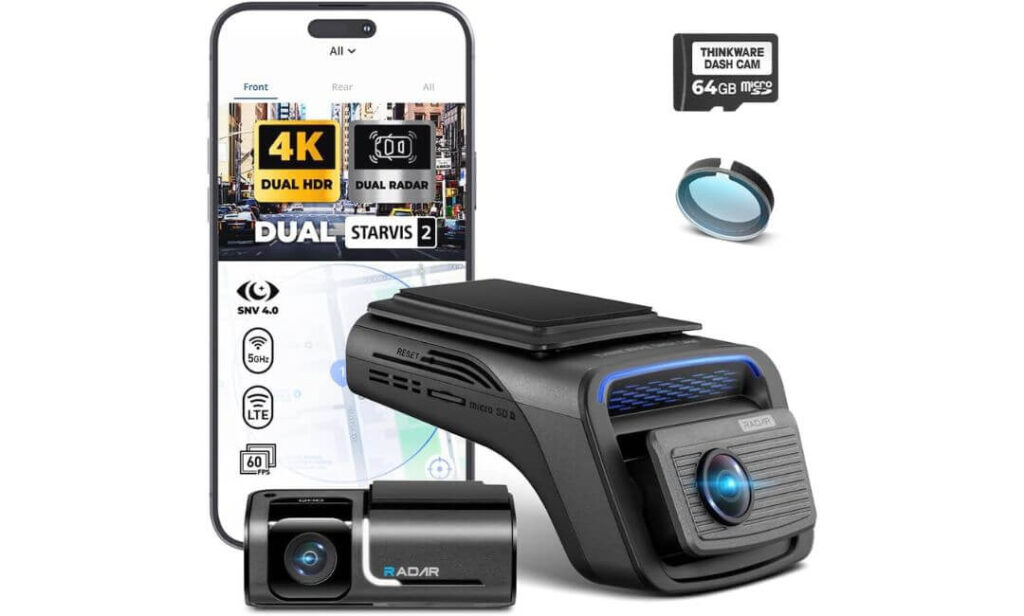
There’s a reason this model leads our recommendations. Instead of chasing flashy specifications, it focuses on the features drivers actually depend on every day. The combination of a 4K front camera, 2K rear camera, Sony STARVIS 2 sensors, Ambarella processor, HDR image processing, and built-in GPS produces footage that remains clear when details matter most. Whether you’re reviewing an insurance claim or simply checking an event from your journey, the extra image clarity makes a genuine difference.
Its Dual Radar Parking Mode is equally impressive. Rather than recording continuously and placing unnecessary load on your vehicle’s battery, the radar detects nearby movement before waking the camera to capture the important moments. Add thermal protection, dual-band 5GHz Wi-Fi, LTE compatibility, and intelligent safety alerts, and it becomes much more than a standard front-and-rear dash cam.
Another reason it earned the top position is long-term ownership. The included 64GB microSD card, OBD power cable, dependable GPS tracking and regular firmware support mean you spend less time adjusting settings and more time simply driving with confidence. It feels engineered for people who want reliable evidence every time they start the engine—not just impressive numbers on a specification sheet.
(What impressed us most is how naturally every major feature works together. Nothing feels added purely for marketing, and that’s surprisingly rare in today’s dash cam market.)
Why We Confidently Recommend It
- 4K front and 2K rear recording deliver outstanding evidence quality in both daylight and low-light conditions.
- Sony STARVIS 2 sensors provide cleaner night footage with stronger HDR performance.
- Dual Radar Parking Mode helps reduce unnecessary battery usage while remaining ready for genuine activity.
- Built-in GPS records speed, route history and parked vehicle location automatically.
- 64GB memory card and OBD cable are included, making installation easier from day one.
One Thing Worth Knowing
- The Dash Cam Link app is generally reliable, although transferring large 4K recordings over Wi-Fi can occasionally take longer than expected.
Installation & GPS Setup Notes
The compact design fits neatly behind the rear-view mirror on most vehicles, helping maintain a clean factory-style appearance without obstructing the driver’s view. The supplied OBD power cable simplifies installation and enables advanced parking features without the extra complexity of traditional hardwiring for many compatible vehicles.
For the most reliable GPS tracking, install the front unit where it has a clear view of the sky and allow a few minutes for the first satellite lock. After that, the camera automatically records route history, vehicle speed, location data and parking position, giving you dependable driving records every time you head out.
The Insider Pro-Tip
Many buyers compare dash cams by looking only at video resolution, but experienced users know that’s only part of the story. The real advantage here comes from the combination of accurate GPS logging, STARVIS 2 imaging, radar-assisted parking detection, thermal protection and dependable firmware. Those features continue adding value long after the excitement of unboxing is over.
If you’re investing in a premium GPS dash cam, buy one that you’ll still trust several years from now—not one that simply looks impressive on a product page. That’s exactly why this model earned the top position in our recommendations.
#2. Vantrue N5S 4-Channel Dash Cam
GPS Features:
- Dual-System GPS delivers faster and more consistent satellite positioning throughout every drive.
- Speed & Route Recording automatically logs your vehicle’s speed, direction and travel history.
- Detailed GPS Playback lets you review every journey with location data synced alongside the video.
- One-Tap Trip Reports generate mileage history directly through the Vantrue app.
- Integrated GPS with Mobile App makes it easy to review routes, recorded events and driving history from your phone.
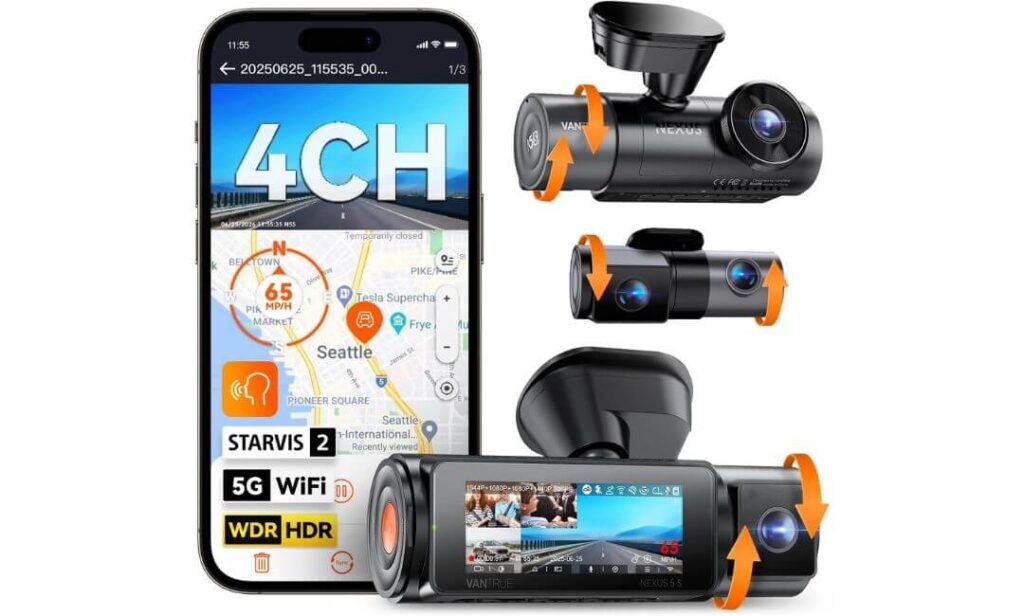
Some dash cams focus only on what happens in front of the vehicle. This one takes a completely different approach. With four separate cameras, including front, rear and dual interior views, it records areas that many traditional dash cams simply leave uncovered. Whether you’re driving with family, carrying valuable equipment or working as a rideshare driver, the extra viewing angles can provide evidence that a standard dual-camera setup simply cannot.
Video quality is equally convincing. The 2.7K front camera, upgraded 1440P rear camera, dual cabin cameras and Sony STARVIS 2 technology produce impressive detail in challenging lighting conditions. HDR processing, infrared interior recording and the improved IMX675 rear sensor help preserve important details even after sunset, while 5GHz Wi-Fi makes transferring recordings noticeably faster than many previous-generation models.
What really separates it from most competitors is how intelligently everything works together. Dual GPS, voice control, OTA firmware updates, support for up to 1TB storage, buffered parking recording and a durable supercapacitor create a dash cam that feels designed for daily use rather than occasional emergencies. It isn’t simply recording more cameras—it manages those cameras remarkably well.
(If complete coverage matters more than having the highest front-camera resolution alone, this is one of the strongest all-round systems currently available.)
What Makes It Stand Out in Our Testing
- Complete 4-channel 360° recording dramatically reduces blind spots inside and outside the vehicle.
- Dual-System GPS provides dependable route history, speed records and accurate journey tracking.
- Sony STARVIS 2 sensors deliver stronger night performance with excellent HDR processing.
- 5GHz Wi-Fi and OTA firmware updates keep ownership simple over the long term.
- Supports up to 1TB microSD storage, making it ideal for extended multi-camera recording.
One Small Trade-Off Worth Knowing
- To unlock the full buffered parking mode, you’ll need the optional hardwire kit, as it isn’t included in the box.
Installation & Everyday Setup Notes
Installing four cameras naturally takes a little more time than a traditional front-and-rear setup, but the supplied accessories, adjustable mounts and long rear camera cable make cable routing surprisingly straightforward in most vehicles. Once positioned correctly, the system provides excellent coverage without cluttering the driver’s view.
For the best GPS accuracy, ensure the GPS mount has a clear view of the sky and use a high-quality industrial-grade microSD card, especially if you’re recording all four channels continuously. The combination of dual GPS, 5GHz Wi-Fi and 1TB storage support is built for drivers who spend long hours behind the wheel.
The Insider Pro-Tip
Many buyers are attracted by the four-camera design, but the feature you’ll appreciate most after several months is actually the Dual-System GPS. Accurate route history, speed records and location data often become just as valuable as the video itself when explaining exactly what happened during an incident.
If your priority is capturing every angle instead of just the road ahead, very few dash cams combine 360° coverage, STARVIS 2 imaging, voice control, dependable GPS tracking and large-capacity storage support as confidently as this one. That’s precisely why it secured the second position in our recommendations.
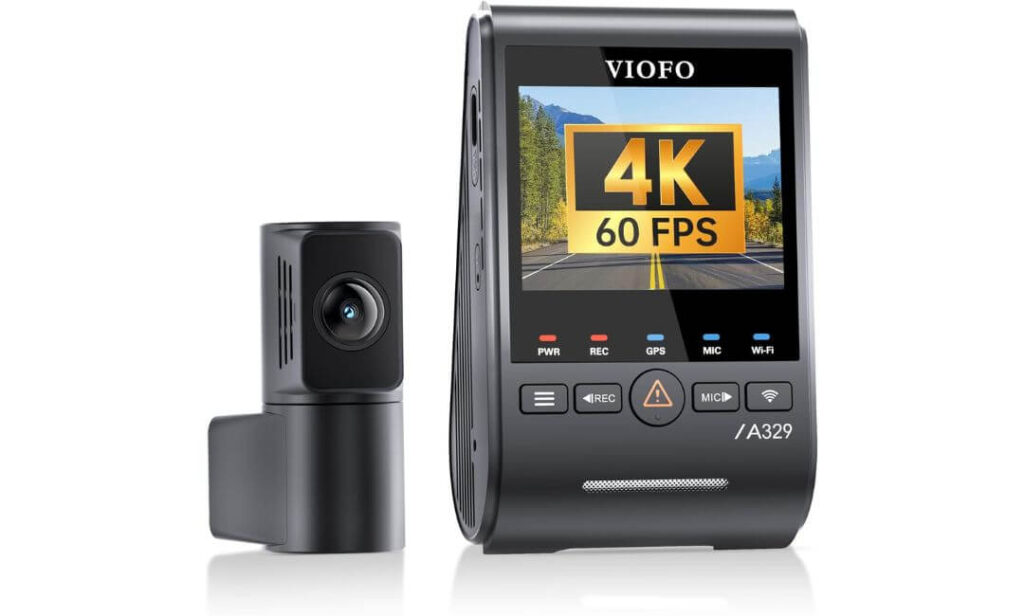
#3. VIOFO A329S Front and Rear Dash Cam
GPS Features:
- Quad-System GPS Navigation combines GPS, BeiDou, Galileo and GLONASS for stronger positioning accuracy.
- Speed, Time & Location Logging is automatically embedded into every recorded video.
- Detailed Route Playback lets you review your complete journey through the VIOFO App or desktop player.
- Global Satellite Support maintains more stable GPS performance across different driving environments.
- Subscription-Free GPS gives you full location recording without any monthly fees or hidden services.
Very few dash cams manage to balance recording quality, GPS accuracy and long-term usability as well as this one. Instead of adding unnecessary features, it concentrates on delivering exceptionally clean footage every time you drive. The combination of 4K 60FPS front recording, 2K rear recording, dual Sony STARVIS 2 sensors and advanced HDR processing produces footage that remains impressively detailed, whether you’re driving into bright sunlight or through poorly lit roads after dark.
What makes it even more convincing is how quickly you can access that footage. Thanks to next-generation Wi-Fi 6, large 4K recordings transfer dramatically faster than previous VIOFO models, making it much easier to review or save important clips immediately after an incident. Add Quad-System GPS, voice control, the included CPL filter, and intelligent power-saving parking mode, and the overall ownership experience feels polished from day one.
Storage is another area where this camera quietly outperforms many rivals. Support for external SSDs up to 4TB or 512GB microSD cards means you can keep weeks of high-quality recordings without constantly worrying about overwriting important files. Combined with the slim coaxial cable and interference-resistant installation design, it feels engineered for drivers who simply want dependable performance every time they get behind the wheel.
(This is one of the few dash cams where nearly every premium feature genuinely improves everyday use rather than simply making the specification sheet look longer.)
Why It Earned a Place in Our Recommendations
- 4K 60FPS front recording captures exceptionally smooth and detailed driving footage.
- Dual Sony STARVIS 2 sensors deliver outstanding clarity in both daylight and challenging night conditions.
- Quad-System GPS provides accurate speed, route and location history without subscription costs.
- Wi-Fi 6 dramatically reduces transfer times when downloading large 4K recordings.
- Supports up to 4TB SSD storage, making it ideal for frequent drivers and extended road trips.
One Small Thing to Keep in Mind
- The advanced parking mode requires VIOFO’s optional HK4 or HK6 hardwire kit, which is purchased separately.
Installation & GPS Setup Notes
The compact camera body and ultra-slim 2.8mm coaxial cable make installation noticeably cleaner than many traditional dash cams. The thinner cable is easier to hide behind interior trim while also reducing electromagnetic interference with other vehicle electronics.
For the best GPS performance, install the camera where it has an unobstructed view through the windscreen and allow the Quad-System GPS receiver to complete its first satellite lock before driving away. Once connected, it continuously records speed, location, route history and time data alongside every video without requiring any subscription or additional setup.
The Insider Pro-Tip
Many buyers immediately notice the 4K 60FPS recording, but the feature that becomes invaluable over time is actually the combination of Quad-System GPS, Wi-Fi 6 and SSD support. When you need to retrieve evidence, you aren’t waiting for slow transfers or incomplete location records—the footage is available quickly, complete with accurate driving data.
If your priority is the clearest possible footage backed by dependable GPS evidence, this camera is one of the strongest choices available today. The balance of STARVIS 2 imaging, HDR performance, ultra-fast wireless transfers and future-ready storage support is exactly why it comfortably earned the third spot in our lineup.
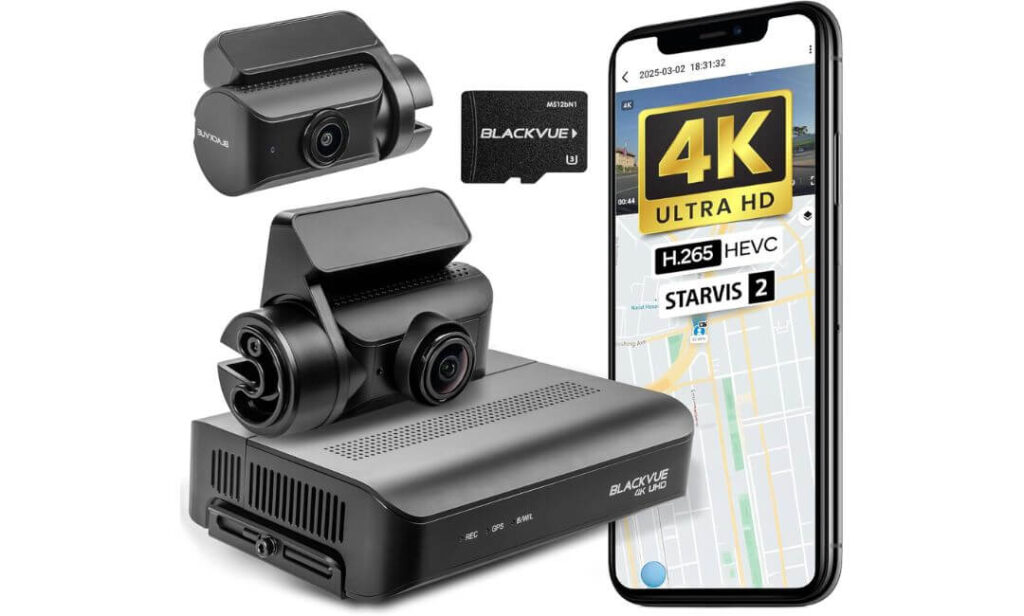
#4. BlackVue DR970X Box Plus Dash Cam
GPS Features:
- Built-in GPS with External Antenna records highly accurate speed, route and location data throughout every drive.
- Precise Journey Playback lets you review recorded footage alongside your complete travel path in the BlackVue App.
- Real-Time Location Support becomes available through BlackVue Cloud when connected via Wi-Fi hotspot or the optional LTE module.
- Speed & GPS Data Overlay provides valuable driving evidence directly on recorded videos.
- Cloud-Ready GPS Platform gives you room to expand into live tracking and remote monitoring whenever you need it.
Most premium dash cams place the processor and memory card inside the front camera. BlackVue took a completely different direction. By moving the processor and storage into a separate recording box, the front camera stays remarkably compact while keeping the critical recordings hidden safely inside the vehicle. It’s an intelligent design that not only improves security but also helps reduce heat around the windscreen during long summer drives.
Recording quality matches the premium hardware. The combination of a 4K STARVIS 2 front camera, Full HD rear camera, advanced low-light processing and 5GHz Wi-Fi consistently delivers sharp footage with natural colours and excellent contrast. Together with built-in GPS, the system creates detailed driving records that are easy to review through the BlackVue App whenever an unexpected situation occurs.
What truly separates this system is its long-term ecosystem. The included 128GB microSD card, hardwiring cable, battery-protected parking mode, optional BlackVue Cloud connectivity and support for live remote viewing make it one of the most expandable GPS dash cams available today. It feels less like a traditional dash cam and more like a professional vehicle security platform.
(The hidden recording box may seem like a small detail at first, but once you understand how it improves security, heat management and discreet installation, it’s difficult to go back to a conventional design.)
Why It Deserves a Place in This Guide
- Separate recording box keeps recordings protected while reducing heat around the front camera.
- 4K STARVIS 2 front camera delivers outstanding clarity with dependable low-light performance.
- Built-in GPS accurately records speed, routes and driving location for every journey.
- BlackVue Cloud compatibility adds remote access and live location features whenever required.
- 128GB microSD card and hardwiring cable are included, providing excellent value straight out of the box.
One Small Consideration Before Buying
- To use live cloud tracking and remote monitoring, you’ll need either a Wi-Fi hotspot or the optional CM100G LTE module.
Installation & GPS Setup Notes
The modular design takes a slightly different approach compared to traditional dash cams. While the compact front and rear cameras remain almost invisible from outside the vehicle, the recording box can be hidden inside the glove compartment, under a seat or another secure location for added protection and easier access to the memory card.
For the strongest GPS performance, mount the external GPS module where it has a clear view of the sky and connect the supplied hardwiring cable if you plan to use automatic parking mode. Once configured, the system continuously records speed, location, route history and event data, all accessible through the BlackVue App.
The Insider Pro-Tip
Most buyers compare this model purely on its 4K video quality, but experienced owners usually appreciate something else even more—the separate recording box. If someone removes or damages the front camera after an incident, your recordings remain stored safely inside the hidden control unit, exactly where they are much harder to access.
If your priority is premium security, dependable GPS records, discreet installation and future-ready cloud connectivity, this is one of the most thoughtfully engineered dash cams available today. It doesn’t rely on flashy specifications alone—the design itself solves several real-world problems that many conventional dash cams still haven’t addressed.
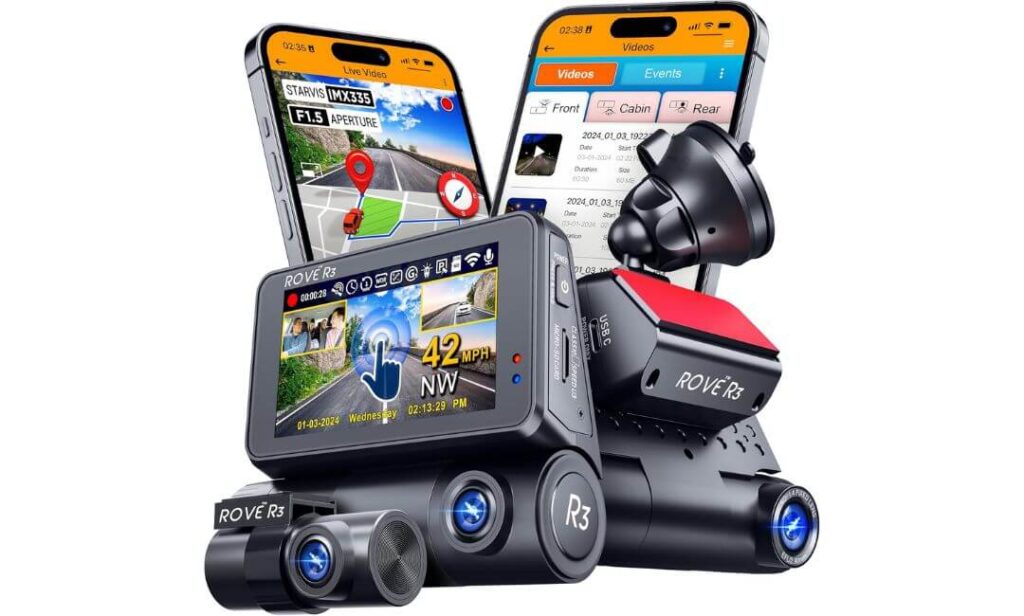
#5. ROVE R3 Three-Channel Dash Cam
GPS Features:
- Quad-Mode GPS records highly accurate speed, location and driving routes throughout every trip.
- GPS Route Playback lets you replay your exact journey with latitude, longitude and travel history.
- Worldwide GPS Coverage works anywhere with a clear satellite signal—no cellular connection required.
- Speed Stamp Control allows you to disable speed recording whenever you prefer.
- Free GPS Recording delivers complete location data without subscriptions or ongoing fees.
Not every driver needs four cameras or cloud connectivity. For many people, a well-balanced three-channel system offers the perfect combination of protection, usability and value. This model focuses on exactly that. With 1440P front recording, dedicated rear and cabin cameras, Quad-Mode GPS and an intuitive 3-inch IPS touchscreen, it delivers the features most drivers genuinely use without making everyday operation unnecessarily complicated.
Its overall user experience deserves just as much credit as the hardware. The responsive touchscreen, voice guidance, custom firmware and always-on dual-band 5GHz Wi-Fi make accessing recordings surprisingly quick, while download speeds of up to 30MB/s help transfer important footage in seconds instead of minutes. Add the built-in supercapacitor, digital image stabilisation, IR cabin night vision and F1.5 aperture, and the camera consistently performs well across changing road and lighting conditions.
Another strength is flexibility. Whether you drive to work each day, spend weekends on long road trips or simply want reliable evidence inside and outside your vehicle, this system adapts easily. Support for 512GB microSD cards, intelligent parking options and dependable Quad-Mode GPS logging make it an excellent choice for drivers who want premium features without moving into the highest price category.
(It doesn’t try to be the most expensive dash cam available—it simply gets the everyday essentials remarkably right.)
Why We Included It in This Lineup
- Three-channel recording captures the front, cabin and rear simultaneously for broader evidence coverage.
- Quad-Mode GPS delivers dependable speed, route and location history without subscription fees.
- 3-inch IPS touchscreen makes setup and playback faster than relying only on mobile apps.
- Dual-band 5GHz Wi-Fi offers quick transfers through the redesigned ROVE app.
- Built-in supercapacitor improves durability and heat resistance compared with battery-powered designs.
One Small Thing Worth Considering
- A microSD card isn’t included, so you’ll need to purchase a high-quality Class 10/U3 card before recording.
Installation & GPS Setup Notes
The included magnetic mount, suction mount and long rear camera cable provide plenty of flexibility during installation. The adjustable cabin camera can also be positioned easily to monitor passengers or the vehicle interior without obstructing the driver’s view.
For the most reliable Quad-Mode GPS performance, mount the front unit where it has an unobstructed view of the sky and use a quality U3-rated microSD card for consistent recording. If you plan to use the 24-hour parking monitor, remember that the optional hardwire kit is required to enable those advanced parking features.
The Insider Pro-Tip
Many buyers focus on the touchscreen, but after living with this camera for a few weeks, you’ll probably appreciate the combination of Quad-Mode GPS, voice guidance and always-on Wi-Fi even more. Those features make finding, reviewing and sharing important recordings much quicker when time actually matters.
If you’re looking for a well-rounded GPS dash cam that balances easy operation, dependable route logging, solid image quality and excellent everyday value, this is one of the smartest choices in its category. It may be the most affordable model in our recommendations, but it certainly doesn’t feel like the least capable.
Best Dash Cam with GPS Tracking Comparison Chart for 2026 Buyers
| Comparison Point | THINKWARE U3000 PRO | Vantrue N5S | VIOFO A329S | BlackVue DR970X Box Plus | ROVE R3 |
|---|---|---|---|---|---|
| Recommended For |
THINKWARE U3000 PRO
Best Overall GPS Dash Cam
|
Vantrue N5S
Best 360° Coverage
|
VIOFO A329S
Best Video Quality
|
BlackVue DR970X Box Plus
Premium Security Pick
|
ROVE R3
Best Value Choice
|
| Recording Setup | 4K Front + 2K Rear | 2.7K Front + Dual Cabin + 1440P Rear | 4K 60FPS Front + 2K Rear | 4K Front + Full HD Rear | 1440P Front + Cabin + Rear |
| GPS Capability | Built-in GPS Speed • Route • Parking Location |
Dual-System GPS Trip Reports & Route History |
Quad-System GPS GPS • Galileo • BeiDou • GLONASS |
Built-in GPS Cloud Ready Location Tracking |
Quad-Mode GPS Worldwide Route Playback |
| Night Recording | STARVIS 2 + Super Night Vision 4.0 | Four STARVIS 2 Sensors + IR Cabin Vision | Dual STARVIS 2 + HDR | STARVIS 2 Front Sensor | IR Cabin Vision + Wide Dynamic Range |
| Parking Protection | Dual Radar Intelligent Recording | Buffered Motion Detection | Impact Detection Power Saving Mode | Battery Protected Parking Mode | Time-Lapse Motion & Impact Recording |
| Wireless Features | Dual-Band 5GHz Wi-Fi | 5GHz Wi-Fi + OTA Updates | Next-Generation Wi-Fi 6 | 5GHz Wi-Fi + Cloud Support | Dual-Band Wi-Fi + Touchscreen |
| Storage Support | 64GB Included | Up to 1TB microSD | Up to 4TB SSD / 512GB microSD | 128GB Included | Up to 512GB microSD |
| Voice Features | Safety Alerts | Voice Commands | Voice Control | Wireless SOS Button | Voice Guidance |
| Heat Management | Advanced Thermal Protection | Supercapacitor Design | Low-Power Architecture | Separate Recording Box Cooling | Supercapacitor Design |
| Standout Advantage | Radar Parking + Premium GPS Accuracy | Complete 360° Recording Coverage | Outstanding 4K Detail & Fast Transfers | Hidden Recording System & Cloud Expansion | Excellent Everyday Value With GPS |
Why GPS Tracking Makes a Dash Cam Far More Valuable Than Video Alone
Many drivers assume GPS is just another feature added to increase the price of a dash cam. In reality, it can be one of the most valuable tools your camera offers. A high-quality video shows what happened, but built-in GPS explains where it happened, when it happened, how fast you were travelling, and how your vehicle moved before the incident. Those extra details often make a significant difference when reviewing accidents, handling insurance claims or resolving disputes.
Modern GPS dash cams have also evolved well beyond simple location stamps. The latest systems combine multi-satellite positioning, intelligent parking monitoring, cloud connectivity, mobile apps and detailed trip playback, giving drivers far more useful information than older GPS-enabled cameras ever could. That’s exactly why every recommendation in this guide includes integrated GPS instead of treating it as an optional extra.
Accurate Location Data Strengthens Your Driving Evidence
Video footage is important, but location data often provides the missing context. Every recorded clip includes GPS coordinates, vehicle speed, direction of travel and precise timestamps, allowing you to recreate the entire event instead of relying on visuals alone.
This information becomes especially valuable when another driver disputes fault, when multiple vehicles are involved or when road conditions make the footage difficult to interpret. Instead of guessing where an incident occurred, you have a detailed record that supports the video with measurable driving data.
Speed Records Add Valuable Context
Built-in GPS continuously records your vehicle’s speed alongside the video. That information can help explain braking distance, traffic conditions and how events unfolded before an impact.
Many premium dash cams also allow drivers to disable visible speed stamps while continuing to record GPS information internally, giving users greater control over how footage is shared without losing important evidence.
Route History Makes Every Journey Easy to Verify
GPS tracking automatically creates a complete record of your driving route, allowing you to review exactly where your vehicle travelled throughout the day.
This feature is particularly useful for:
- Daily commuters wanting a complete journey history.
- Families sharing one vehicle between multiple drivers.
- Business vehicles requiring mileage verification.
- Road trips where route playback becomes part of your travel record.
- Insurance claims that require proof of vehicle movement.
Rather than searching through dozens of recordings manually, GPS playback shows the entire journey on a mapped timeline.
Better Protection While Your Vehicle Is Parked
Several premium models now combine GPS tracking with intelligent parking surveillance. If the camera detects movement or an impact while the vehicle is parked, the recorded clip also includes the exact location where the event occurred.
Some advanced systems even remember your last parked location, making it easier to locate your vehicle in large shopping centres, airports or unfamiliar cities without relying solely on your phone’s navigation history.
Cloud Connectivity Creates Another Layer of Security
Premium GPS dash cams now work alongside cloud services and companion apps that expand what the camera can do beyond recording video.
Depending on the model, cloud-enabled systems may provide:
- Remote vehicle location.
- Live GPS updates.
- Instant event notifications.
- Automatic cloud backups.
- Remote video playback.
- Emergency event uploads.
These features are particularly useful for drivers who regularly leave valuable vehicles parked in public places or want remote access while travelling.
GPS Helps Insurance Claims Move Faster
Insurance companies usually want more than video footage alone. They often ask where the incident occurred, what direction the vehicle was travelling and whether the recorded timeline matches the driver’s statement.
A GPS-enabled dash cam provides that information automatically by combining:
- Exact location coordinates.
- Accurate timestamps.
- Vehicle speed history.
- Travel direction.
- Route playback.
Having all of that information stored with the recording creates a stronger and more complete record of the event.
Useful for Everyday Drivers, Rideshare Vehicles and Business Fleets
GPS tracking benefits almost every type of driver because the recorded data serves different purposes depending on how the vehicle is used.
For personal vehicles, it provides extra confidence during accidents, unexpected road incidents and parking events.
For rideshare drivers, the additional route history and location records help verify passenger journeys and driving activity.
For commercial vehicles and small business fleets, GPS playback makes it easier to review trips, confirm mileage, document deliveries and maintain organised driving records without needing a separate tracking device.
The Real Value Isn’t Navigation—It’s Confidence
One common misconception is that a GPS dash cam replaces your vehicle’s navigation system. It doesn’t. Its purpose is to document your journey, not guide it.
The real advantage comes from knowing that every important drive is backed by accurate location records, speed history, timestamps and high-quality video. When something unexpected happens, you’re no longer relying on memory or assumptions—you have detailed evidence that tells the complete story from beginning to end.
Complete Buying Guide: How to Choose the Right Dash Cam with GPS Tracking
Buying a dash cam with GPS shouldn’t be about chasing the highest resolution or the longest feature list. The models that deliver the best long-term value are the ones that combine reliable GPS logging, consistent video quality, dependable software and durable hardware into one complete package. A camera that performs well for years is always a better investment than one that looks impressive only on paper.
The five models recommended in this guide were selected because they perform well where drivers actually need them—accurate GPS records, dependable parking protection, excellent image quality, reliable mobile apps and proven day-to-day usability. Before choosing your own, these are the areas worth paying close attention to.
Prioritise Video Quality Before Anything Else
GPS data is only useful when the recorded footage is clear enough to support it. If number plates, road signs or lane markings become blurred, even perfectly accurate location data loses much of its value.
For that reason, look for:
- 4K front recording whenever possible.
- HDR processing for balanced exposure.
- Strong low-light performance.
- Stable frame rates with minimal motion blur.
- Wide viewing angles that avoid excessive fisheye distortion.
A genuine 4K dash cam with GPS gives you both visual evidence and accurate driving records, making it significantly more valuable than lower-resolution alternatives.
Don’t Settle for Basic GPS Recording
Many budget cameras advertise GPS simply because they record coordinates. Premium models do considerably more.
The most useful GPS features include:
- Automatic speed recording.
- Complete route history.
- Accurate journey playback.
- Last parked vehicle location.
- Multi-satellite positioning for stronger accuracy.
- GPS playback through a mobile or desktop application.
Some premium cloud-ready systems also support live location updates, making them suitable for users who want additional vehicle monitoring.
Choose Connectivity That Matches Your Driving Habits
A dash cam is only convenient if reviewing footage is quick and reliable.
Modern systems generally fall into three categories:
- Wi-Fi Dash Cams — Perfect for downloading recordings directly to your smartphone without removing the memory card.
- Dash Cameras with GPS and Wi-Fi — Combine wireless transfers with route playback, speed history and location records inside the companion app.
- Cloud-Ready Dash Cams — Add remote access, live notifications, cloud backups and optional real-time vehicle monitoring.
If you regularly review footage or travel frequently, faster wireless technologies like Wi-Fi 6 make a noticeable difference when transferring large 4K recordings.
Image Sensors Matter More Than Marketing Numbers
Resolution alone doesn’t determine image quality.
The latest Sony STARVIS 2 sensors offer several real-world advantages over older imaging technology:
- Better licence plate readability after dark.
- Improved HDR performance.
- Reduced image noise.
- Higher dynamic range.
- More natural colour reproduction.
- Better performance in rain, fog and tunnels.
This is one of the main reasons every recommendation in this guide uses newer imaging hardware rather than older-generation sensors.
Evaluate Parking Mode Carefully
Parking protection varies dramatically between manufacturers.
A high-quality GPS-enabled dash cam should offer intelligent recording options such as:
- Buffered parking recording.
- Motion detection.
- Impact detection.
- Radar-assisted activation.
- Low-voltage battery protection.
- Power-saving parking modes.
These features reduce unnecessary battery usage while ensuring important incidents are still recorded when the vehicle is unattended.
Memory Support and Recording Reliability
Higher video quality creates larger files, making storage capacity an important consideration.
Look for cameras that support:
- High-endurance microSD cards.
- Large storage capacities.
- Reliable loop recording.
- Automatic file protection after collisions.
- Built-in G-sensors that lock important footage automatically.
Some premium models now support external SSD storage up to 4TB, making them ideal for drivers covering long distances without frequent file management.
Front-and-Rear Coverage Is Usually Worth the Upgrade
Single-camera systems still have their place, but most drivers benefit more from a dual dash cam with GPS.
A dual-camera setup records:
- The road ahead.
- Rear traffic.
- Rear-end collisions.
- Overtaking incidents.
- Parking impacts.
- Evidence from both directions simultaneously.
Drivers who spend extended hours behind the wheel may even prefer three-channel or four-channel systems that include interior recording.
Consider Future Software Support
Good hardware is only part of the ownership experience.
Manufacturers that continue releasing:
- Firmware updates.
- App improvements.
- Security fixes.
- GPS database updates.
- New software features.
often deliver a noticeably better experience over several years than brands that rarely update their products.
Long-term software support was one of the key reasons our recommended models consistently ranked above many competitors.
Don’t Ignore Warranty and Brand Reputation
A dash cam records evidence when you need it most, so reliability should always come before saving a small amount of money.
Before buying, check:
- Warranty length.
- Availability of firmware updates.
- Replacement accessories.
- Customer support.
- Availability of spare cables and mounts.
- Brand reputation for long-term reliability.
Manufacturers with proven support histories generally provide a much better ownership experience than brands focused only on low pricing.
Quick Checklist Before You Buy Any GPS Dash Cam
Before making your final decision, ask yourself these questions:
- Does it include built-in GPS, or is it an optional accessory?
- Is the GPS capable of recording speed, location and complete route history?
- Does it use a Sony STARVIS 2 sensor for better day and night recording?
- Is 4K front recording available for clearer evidence?
- Does it support Wi-Fi or Wi-Fi 6 for faster video transfers?
- Are parking mode, G-sensor and loop recording included?
- Does the mobile app allow easy GPS playback and video management?
- Is storage expandable enough for your driving habits?
- Does the manufacturer regularly release firmware updates?
- Would you still trust this camera after several years of daily driving?
Answering those questions honestly will help you identify a GPS-enabled dash cam that delivers genuine long-term value instead of simply offering the longest specification sheet.
Real-World Situations Where GPS Dash Cams Make a Genuine Difference
It’s easy to appreciate GPS tracking when reading a specification sheet, but its real value becomes obvious only after something unexpected happens. Whether it’s a disputed accident, a parking incident, a business vehicle or a long road trip, GPS data provides the missing context that video alone often cannot explain.
Every dash cam in our recommendations records far more than footage. They create a complete driving record by combining video, speed, timestamps, route history and precise location data, giving you stronger evidence whenever questions arise.
Accident Investigations Become Much Easier
After an accident, drivers often remember events differently. Video certainly helps, but GPS tracking adds another level of accuracy by documenting where the incident occurred, the exact time, your direction of travel and your recorded speed.
Instead of relying only on visual footage, investigators and insurance companies can compare:
- Exact GPS coordinates.
- Time of impact.
- Vehicle speed before the event.
- Driving direction.
- Complete travel history leading up to the collision.
That additional information often helps explain situations that might otherwise remain open to interpretation, particularly at complex junctions, motorways or multi-vehicle collisions.
Parking Incidents No Longer Feel Like Guesswork
Many vehicle owners only discover damage after returning to a parked car. Without recorded evidence, proving what happened can be extremely difficult.
Modern GPS dash cams equipped with parking mode continue monitoring the vehicle while it is unattended. If movement or an impact is detected, the camera records the event while also storing the precise location where it occurred.
Several premium models also remember your last parked location, making it much easier to find your vehicle in busy airports, shopping centres, stadiums or unfamiliar cities where hundreds of similar vehicles may be parked.
Daily Commuters Benefit More Than Most People Realise
Even if you never experience a major accident, GPS tracking quietly builds a complete record of your daily journeys.
This can be useful for:
- Reviewing unusual driving incidents.
- Confirming where the vehicle travelled.
- Verifying arrival and departure times.
- Tracking regular commuting routes.
- Checking travel history after unexpected events.
Instead of relying on memory, every journey is documented automatically in the background.
Business Vehicles and Small Fleets Gain Better Oversight
Companies operating service vehicles, delivery vans or small fleets often need more than video recording alone.
GPS-enabled dash cams allow managers to review:
- Completed driving routes.
- Journey history.
- Vehicle speed records.
- Arrival locations.
- Event recordings linked to precise GPS data.
Cloud-compatible systems can also provide remote access, live vehicle status and location updates, reducing the need for separate tracking hardware in many situations.
Insurance Claims Become Faster and Better Supported
Insurance providers typically request more than photographs after an accident. They often need evidence showing where the collision happened, how the vehicle was travelling and whether the timeline matches the driver’s statement.
A quality GPS dash cam automatically provides:
- Accurate GPS coordinates.
- Timestamped recordings.
- Vehicle speed history.
- Direction of travel.
- Complete route playback.
Together, those details create a far stronger evidence package than video footage on its own and can help eliminate unnecessary uncertainty during the claims process.
Family Vehicles Gain an Extra Layer of Confidence
Families sharing one vehicle often appreciate GPS tracking for reasons beyond accident evidence.
Parents can review important driving events, verify journeys when necessary and maintain a complete travel history without installing dedicated tracking equipment. The information remains attached directly to the recorded footage, making it much easier to understand exactly what happened during any unexpected situation.
Road Trips Become Easier to Revisit
GPS isn’t only useful when something goes wrong.
Many drivers enjoy replaying scenic journeys, mountain drives or cross-country road trips because the recorded footage includes the exact route, travel timeline and location history. Premium companion apps make it easy to revisit memorable drives while keeping every recording organised by date, location and journey.
The Biggest Advantage Is Having Answers Instead of Assumptions
When people purchase a GPS dash cam, they usually expect better evidence after an accident. What they often discover is something even more valuable—certainty.
Instead of asking where an event happened, what time it occurred or how the vehicle reached that location, the answers are already stored alongside the recording. The combination of clear video, accurate GPS tracking, speed data and detailed timestamps transforms a simple recording into a complete driving record, which is exactly why GPS has become one of the most important features in modern premium dash cams.
Setup Tips and Best Practices for Getting the Most from Your GPS Dash Cam
Even the best dash cam with GPS tracking won’t perform at its full potential if it isn’t installed or configured correctly. A small adjustment during installation can improve GPS accuracy, video clarity, parking protection and long-term reliability far more than many drivers realise.
The recommendations below are based on how premium dash cams are designed to operate in everyday driving, helping you get the best performance from the very first journey.
Install the Front Camera Where GPS Performs Best
The mounting position affects much more than your viewing angle. Since the GPS receiver communicates with satellites through the windscreen, placing the camera correctly helps it lock onto signals faster and maintain a more stable connection throughout the drive.
For the best results:
- Mount the camera high on the windscreen, directly behind or slightly beside the rear-view mirror.
- Keep the GPS receiver facing an open section of the sky whenever possible.
- Avoid mounting behind metallic sun strips or areas that may reduce satellite reception.
- Make sure the camera doesn’t interfere with rain sensors, ADAS cameras or factory safety systems.
- Adjust the lens so that the horizon sits naturally in the centre of the recorded image.
A clean, unobstructed mounting position improves both GPS performance and the overall quality of your recorded footage.
Give the GPS Time to Complete Its First Satellite Lock
After installation, many drivers expect GPS to work immediately. In reality, the first satellite connection can take several minutes while the receiver establishes its initial positioning data.
During the first drive:
- Allow the camera enough time to acquire satellite signals.
- Avoid repeatedly powering the unit on and off.
- Confirm that GPS status appears correctly in the companion app before relying on recorded location data.
- Once the initial lock is complete, future connections usually happen much faster.
This simple step ensures your route history and speed records begin accurately from the start.
Route Power Cables Carefully
Good cable management isn’t only about appearance. Properly routed cables reduce strain on connectors and help maintain long-term reliability.
Whenever possible:
- Tuck cables behind interior trim panels.
- Avoid sharp bends near connectors.
- Keep wiring away from airbags and moving trim pieces.
- Secure loose cables using the supplied clips or adhesive mounts.
- Leave enough slack around adjustable mirrors and hatchbacks to prevent cable tension.
A clean installation also makes the dash cam feel much closer to a factory-fitted system.
Configure Parking Mode for Your Driving Habits
Most premium GPS dash cams offer multiple parking recording options rather than one universal setting.
Choose the mode that best suits how your vehicle is used:
- Buffered recording for busy public parking areas.
- Motion detection where vehicle movement is more likely.
- Impact detection for overnight parking.
- Radar-assisted parking when supported.
- Power-saving parking modes for vehicles that remain parked for extended periods.
If your dash cam requires a hardwire kit or OBD power cable for parking mode, install it correctly so the camera can monitor battery voltage while protecting your vehicle from excessive discharge.
Keep Firmware and Mobile Apps Updated
One of the biggest advantages of premium dash cams is ongoing software support.
Firmware updates often improve:
- GPS stability.
- Video processing.
- HDR performance.
- Wi-Fi reliability.
- Parking mode behaviour.
- Mobile app compatibility.
- Memory card optimisation.
- Overall system stability.
Manufacturers such as THINKWARE, Vantrue, VIOFO, BlackVue and ROVE regularly release updates that improve long-term performance, making periodic checks well worth the few minutes they take.
Get the Best from STARVIS 2 and Wi-Fi 6
If your dash cam includes Sony STARVIS 2 sensors, spend a little time reviewing the image settings after installation.
Check that:
- HDR is enabled when appropriate.
- Exposure compensation suits your driving environment.
- Time and date settings are accurate.
- Video resolution matches your storage capacity.
- CPL filters, where supplied, are installed correctly to reduce dashboard reflections.
For models equipped with Wi-Fi 6, keep both the dash cam firmware and companion app updated to benefit from faster transfer speeds and the latest wireless improvements.
Protect Your Privacy While Recording
Dash cams are designed to improve safety, but they should also be used responsibly.
Before using your camera:
- Familiarise yourself with local laws regarding dash cam recording.
- Understand any restrictions on audio recording in your region.
- Protect videos containing personal information before sharing them publicly.
- Use secure passwords for companion apps and cloud-connected services.
- Update login credentials periodically if cloud access is enabled.
Responsible use protects both your privacy and the privacy of others while preserving the value of your recorded evidence.
Maintain the Camera Like Any Other Safety Device
A dash cam quietly works every time you drive, so it’s easy to forget it still needs occasional maintenance.
Every few weeks:
- Clean both camera lenses with a microfibre cloth.
- Check that mounting pads remain firmly attached.
- Review a recent recording to confirm video quality.
- Ensure GPS data appears correctly during playback.
- Format the memory card according to the manufacturer’s recommendations.
- Replace ageing memory cards before they begin causing recording errors.
Small maintenance checks take only a few minutes but significantly improve long-term reliability.
Small Adjustments Today Prevent Big Problems Later
The highest-rated GPS dash cam can’t compensate for poor installation, outdated firmware or neglected maintenance. Fortunately, none of those issues require expensive tools or professional expertise.
Mount the camera carefully, keep the software current, verify GPS performance regularly and maintain your storage properly. Those simple habits ensure your dash cam continues delivering clear video, accurate GPS records, dependable parking protection and reliable evidence whenever you need it most, not just on the day you install it.
FAQs About dashcam with gps tracking
Does a dash cam with GPS tracking record my live location all the time?
Not necessarily. Most GPS-enabled dash cams record your location, speed and route history directly with the video footage rather than broadcasting your live location. Only cloud-ready models with an internet connection can provide real-time tracking and remote vehicle location through their companion apps. For most drivers, built-in GPS is designed to improve evidence quality, not continuously monitor the vehicle.
Is a 4K dash cam with GPS worth paying more for?
If you want reliable evidence, yes. A 4K dash cam with GPS captures finer details like licence plates and road signs while recording accurate timestamps, speed and route history. The combination of higher video quality and GPS data creates much stronger evidence than lower-resolution cameras that only record video.
What is the difference between a GPS-enabled dash cam and a dash camera with GPS and Wi-Fi?
A GPS-enabled dash cam primarily records location, speed and route information. A dash camera with GPS and Wi-Fi adds wireless connectivity, allowing you to transfer videos, review GPS routes, change settings and manage recordings directly from your smartphone without removing the memory card.
Should I buy a single or dual dash cam with GPS?
For most drivers, a dual dash cam with GPS offers better overall protection because it records both the front and rear of the vehicle. This provides additional evidence during rear-end collisions, parking incidents and multi-vehicle accidents while preserving the same GPS route history, timestamps and speed data for every recording.
Which features matter most when choosing the best dash cam with GPS tracking?
Instead of focusing only on resolution, look for a camera that combines several key features:
- Accurate built-in GPS with route history.
- 4K front recording.
- Sony STARVIS 2 image sensor.
- HDR for better night visibility.
- Wi-Fi or Wi-Fi 6 connectivity.
- Reliable parking mode.
- Loop recording with G-sensor.
- Regular firmware updates and dependable app support.
These features have a much bigger impact on long-term performance than headline specifications alone.
Final Thoughts
A dash cam with GPS tracking isn’t just another upgrade for your vehicle—it’s an investment in clearer evidence, greater confidence and smarter driving records. When something unexpected happens, the combination of high-quality video, accurate GPS data, speed records and precise timestamps tells the complete story in a way that ordinary footage simply cannot.
Throughout this guide, we intentionally avoided older models and focused only on current-generation cameras that genuinely move the technology forward. Features like Sony STARVIS 2 sensors, multi-system GPS, Wi-Fi 6, intelligent parking protection, cloud-ready platforms and larger storage support aren’t marketing buzzwords when they’re implemented properly—they noticeably improve the ownership experience every single day.
There isn’t one perfect dash cam for every driver, which is why each recommendation serves a different purpose. If you want the most advanced all-round package, the THINKWARE U3000 PRO stands out. Drivers needing complete interior and exterior coverage will appreciate the Vantrue N5S, while those who prioritise the sharpest footage should look closely at the VIOFO A329S. If discreet installation and cloud connectivity matter most, the BlackVue DR970X Box Plus remains an outstanding choice, and for buyers seeking exceptional everyday value without sacrificing dependable GPS performance, the ROVE R3 is difficult to overlook.
The most important advice is surprisingly simple: don’t buy a GPS dash cam because it has the longest specification sheet—buy one because you’ll trust it when you need it most. A camera that records accurate location data, delivers reliable footage in difficult conditions, receives regular firmware updates and continues working year after year will always be worth more than one that impresses only on launch day.
If this guide helps you choose a dash cam that gives you greater confidence every time you start the engine, then it has done exactly what it was written to do. Safe driving begins with good judgement, but having reliable evidence ready when life becomes unpredictable is a decision you’ll almost certainly never regret.
Also Check:


