5 Best Rooftop Tents for Toyota Tundra in 2026: 4-Season Comfort, Fast Setup & Smarter Truck Camping
A rooftop tent on a Toyota Tundra makes a lot of sense when the goal is a proper elevated sleeping setup without turning the truck bed into a permanent bedroom. But there is an important catch: Tundras come in different cab and bed configurations, so a tent that works beautifully on one setup may not be the right match for another. The current Tundra offers 5.5-, 6.5-, and 8.1-foot bed options, while earlier model years have their own cab-and-bed combinations that can affect rack placement, mounting space, and overall usability.
This list focuses on hard-shell rooftop tents that bring something useful to a Tundra camping setup, rather than simply chasing the longest feature list. The comparison looks at the details that become important once the tent is actually being used—weight, sleeping capacity, interior space, setup speed, weather protection, insulation, condensation control, storage, power options, and mounting practicality. Features such as blackout interiors, aluminum shells, thermal liners, anti-condensation mats, integrated outlets, solar capability, and quick-deploy hydraulic systems can make a noticeable difference depending on the type of trip.
There is also an important payload distinction worth understanding before buying. Toyota lists the 2026 Tundra with up to 1,850 pounds of maximum payload, but that figure represents the truck’s overall payload capacity, not a specific rooftop-tent allowance. The tent, rack, mounting hardware, occupants, bedding, recovery equipment, coolers, and other cargo all become part of the real-world load. The correct setup therefore depends on the specific Tundra configuration and the rated limits of the rack and mounting system, not simply the truck’s headline payload number.
The six picks below cover very different camping styles, from a spacious four-season setup with thermal insulation to a lighter 131.5-pound aluminum hard shell, ultra-fast deployment, winter-focused construction, integrated solar power, and straightforward rugged designs. That variety matters because the best rooftop tent for a Tundra is rarely the one with the most impressive specification sheet. It is the one that fits the truck properly, suits the way you actually travel, and remains practical after the excitement of the first camping trip wears off.
For older or differently configured Tundras, verify the exact model year, cab style, bed length, rack system, mounting spread, dynamic/static load ratings, and manufacturer installation requirements before ordering. A technically compatible tent is only half the equation; the complete truck-and-rack system needs to work safely and comfortably as one setup.
Best Toyota Tundra Rooftop Tent: Top 2026 Picks for Space, Weight & Features
#1. Bayati Naturnest Sirius 1 Plus Rooftop Tent
Best Toyota Tundra rooftop tent for four-season comfort, spacious living area, and easy pop-up setup
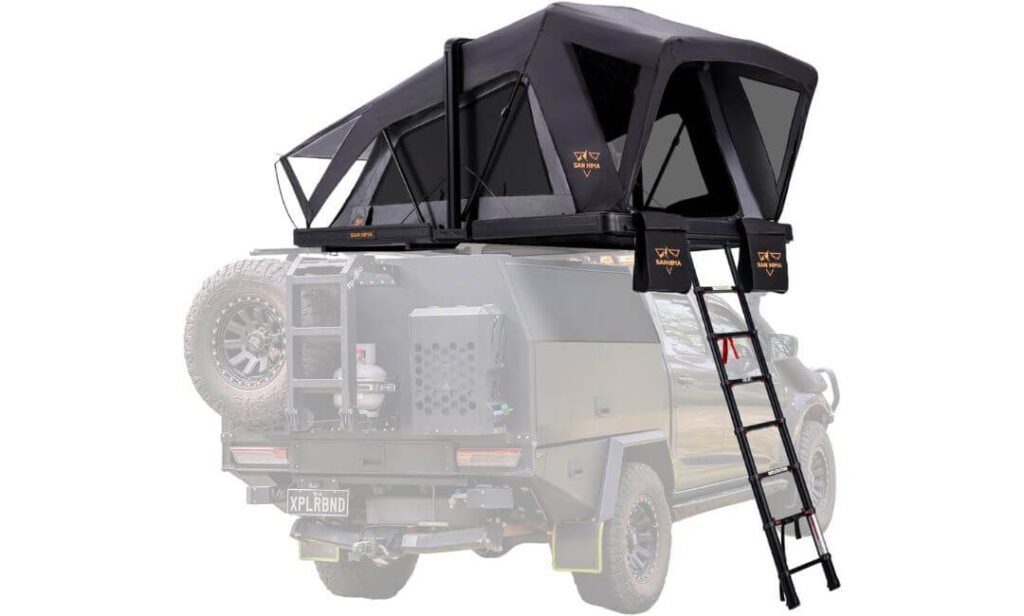
#2. SanHima Aluminium Fold-Out Rooftop Tent
Best rooftop tent for Tundra owners seeking rugged aluminum construction, roomy sleeping space, and reliable weather protection
#3. HEYFUN Adventurer Pro Rooftop Tent
Best hard-shell Tundra camping tent for 2–3 people with quick setup, aluminum construction, and everyday camping convenience
#4. JOYINRUTE Rooftop Tent with Winter Insulation
Best four-season rooftop tent for Toyota Tundra camping with added winter insulation, weather resistance, and cold-weather comfort
#5. ARCTWONDER Solar Panel Rooftop Tent
Best Tundra rooftop tent for off-grid campers wanting solar-ready convenience, thermal protection, and dependable four-season shelter
#6. WildFinder Hard Shell Rooftop Tent
Best hard-shell rooftop tent for Tundra, SUV, and truck campers wanting straightforward setup, solid protection, and practical value
Expert Tip
Before choosing a rooftop tent for a Toyota Tundra, start with the rack and vehicle limits, not the tent’s feature list. A full-size pickup gives you a strong platform, but that does not mean every tent-and-rack combination is automatically suitable. The tent weight, rack weight, mounting hardware, occupants, bedding, and gear all become part of the real setup, and the supporting rack has its own dynamic and static load requirements.
There is also a difference between what looks like a simple fitment and what works well in everyday use. The tent needs enough mounting support, adequate crossbar or rack spacing, and sufficient clearance for the shell to open without interfering with the cab, bed accessories, or other equipment. A setup can technically mount to the truck and still be a poor choice once everything is installed.
Bed length is another detail that gets misunderstood. A 5.5-foot Tundra bed can work perfectly well with the right rack and mounting arrangement, while an 8.1-foot bed does not automatically make every rooftop tent a better fit. What matters is the actual usable mounting footprint, not simply the length of the pickup bed.
Before ordering, measure the rack, confirm the tent’s mounting points and hardware requirements, check the rack’s rated capacity, and make sure the finished setup still allows reasonable bed access. Also account for how the tent will be opened, closed, and loaded in real camping conditions. A few minutes spent checking those details can prevent a very expensive compatibility problem later.
How We Choose These Rooftop Tents
These tents were not selected by counting features or automatically giving the highest score to the model with the biggest specifications. The more useful question for a Tundra owner is what the tent contributes once it is mounted, driven with, and used repeatedly outdoors.
Construction was the first major filter. Every model in this comparison uses a hard-shell design, which keeps the selection focused on tents that prioritize quick deployment, a protected packed structure, and a more streamlined setup when closed. Aluminum shells received particular attention where available because they can provide a strong structural enclosure without relying entirely on fabric for the tent’s exterior protection.
That does not mean every aluminum tent is equally durable, or that shell material alone determines quality. Seals, hinges, gas struts, mounting points, fabric, zippers, hardware, and overall construction quality all influence how a rooftop tent holds up after repeated road travel and exposure to weather.
Weather protection was considered more carefully than simply accepting a “four-season” label. A useful cold-weather tent needs more than a marketing claim. Waterproof fabric, sealed openings, blackout material, thermal insulation, ventilation, and condensation management each address a different part of the camping environment.
That distinction becomes particularly important during winter. A tent can resist rain extremely well and still become uncomfortable because moisture from occupants condenses inside overnight. Models with thermal liners, insulated panels, condensation mats, multiple ventilated openings, or better moisture management therefore received more consideration than a tent that only advertises a high waterproof rating.
Sleeping space was evaluated from a practical perspective rather than the advertised occupancy alone. A two-person rating does not tell the entire story. Floor width, interior length, mattress thickness, headroom, entry access, storage, and the amount of personal gear that can remain inside all affect whether two adults will actually find the tent comfortable after several nights.
That is why the 63-inch-wide Bayati interior, for example, has a different appeal from a narrower 51-inch-class sleeping platform. Likewise, a 2–3-person rating can be useful, but the available floor area and how people move around inside the tent ultimately determine whether that capacity feels realistic.
Setup and breakdown speed also mattered, but not in isolation. A five-second opening system sounds impressive, and the HEYFUN’s hydraulic deployment is genuinely useful for travelers who change campsites frequently. But arriving quickly is only half the process. The tent also needs to close cleanly, secure properly, and remain manageable when bedding, condensation, wet fabric, or gear are involved.
The same principle was applied to convenience features. Solar charging, integrated outlets, LED lighting, shoe storage, luggage bars, awnings, heater ducts, and internal organizers were treated as useful only when they solve a real camping problem. More features do not automatically create a better tent.
For example, integrated solar capability can be valuable during several days away from electrical hookups. For someone spending most nights at established campgrounds, it may simply add weight and complexity without providing much practical benefit. The best feature is often the one that eliminates an inconvenience you repeatedly encounter.
Weight received particular attention because the tent is only one part of the system. The difference between a 131.5-pound rooftop tent and a 198-pound model is significant before the rack, mounting hardware, bedding, occupants, and camping equipment are added. A heavier tent may justify its weight through better insulation, additional equipment, or a larger feature set, but those advantages should match the way the truck is actually used.
Tundra compatibility was therefore considered as a complete system rather than a simple “fits truck” claim. The exact truck configuration, bed length, rack design, mounting spread, load ratings, cab clearance, and other accessories can change the suitability of the same tent.
Why Long-Term Review Depth Matters
There is one area where caution is more valuable than a confident-sounding recommendation: long-term durability.
Some of the models in this comparison are newer and do not yet have the same depth of multi-year owner history as established rooftop-tent manufacturers. A handful of positive reviews can tell you that buyers received functional products and had good initial experiences, but they cannot prove how a tent will perform after years of highway vibration, repeated deployment, UV exposure, snow, dust, moisture, and seasonal temperature changes.
That is why manufacturer specifications and available owner feedback are treated differently here. A listed 5,000-mm water-resistance rating is a specification; a claim that a tent will remain waterproof for years is a durability conclusion. The first can be evaluated from the available product information. The second requires much more real-world evidence.
The same caution applies to wind and temperature claims. Manufacturer-tested or manufacturer-stated ratings can be useful when comparing designs, but they should not be interpreted as a promise that every installation will perform identically in every environment.
That distinction is especially important for a purchase that becomes part of the truck itself. A rooftop tent is exposed continuously to road spray, dust, sunlight, vibration, and weather even when nobody is camping in it.
What Ultimately Made the Final Six
The final six were chosen because they provide meaningfully different strengths, rather than six versions of the same rooftop tent.
The Bayati brings spacious four-season comfort and insulated construction. SanHima makes a strong case for weight-conscious Tundra builds while retaining useful camping conveniences. HEYFUN prioritizes exceptionally quick deployment and rugged hard-shell construction. JOYINRUTE puts more emphasis on removable winter insulation and cold-weather use. ARCTWONDER combines thermal protection with integrated solar capability for campers who genuinely spend time off-grid. WildFinder takes a simpler route, focusing on an aluminum hard shell, weather protection, storage, and straightforward functionality.
That variety is intentional. A solo traveler who changes campsites every day should not necessarily buy the same tent as a family preparing for winter weekends, and neither should automatically choose the same setup as an overland camper carrying several days of gear.
The goal is therefore not to declare one universal winner. It is to make the differences clear enough that the right choice becomes easier: match the tent’s weight, space, insulation, setup system, weather protection, and accessories to the way the Tundra will actually be used.
That is a much more useful buying decision than simply choosing the tent with the longest specification sheet.
#1. Bayati Naturnest Sirius 1 Plus Rooftop Tent
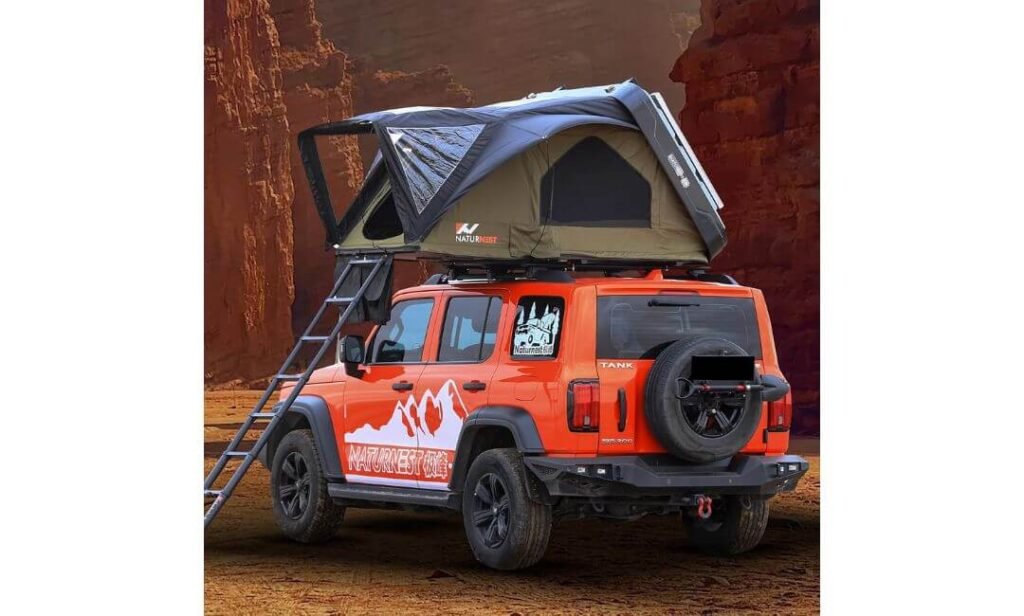
Quick Specs:
- Sleeping capacity: 2–3 people
- Tent size: 82.7 × 63 × 47.2 in.
- Weight: 160 lb
- Construction: ABS hard shell with aluminum frame
- Season rating: 4-season
- Floor width: 63 in.
- Mattress: 1.97-in. thick
- Weather protection: Waterproof coating with UV-resistant, blackout fabric
- Setup: Around 30 seconds
- Useful extras: Rooftop load bars, ventilation, storage pockets, shoe bags, ladder, mounting hardware
There is a lot more going on here than simply having a hard shell that pops open. The 82.7-by-63-inch sleeping area gives a Tundra camper enough interior room to feel like a small bedroom rather than a cramped rooftop box, and the 1.97-inch mattress is a particularly worthwhile detail if you expect to spend several nights in it. Add the blackout fabric and insulated honeycomb panels, and the whole setup is aimed at making the tent genuinely comfortable once you’re inside—not just impressive when it is sitting on the truck.
The weather protection is another reason it earned the top spot. The combination of a high-strength ABS shell, aluminum framing, waterproof fabric, and thermal insulation gives it a much more substantial feel for shoulder-season and colder camping. The dedicated vent for connecting a heater or cooler is also the kind of small detail that becomes surprisingly useful on a long trip. You are not buying a tent just for fair-weather weekends here; the design is clearly intended for people who want to keep using their Tundra when conditions turn less predictable.
Then there is the convenience factor. Releasing the locks and pulling down the ladder gets the shelter open in roughly 30 seconds, while the external bars give you another place to carry lightweight camping equipment without eating into the sleeping area. The 316 stainless-steel gas struts, YKK zippers, replaceable fabric, and honeycomb construction are also reassuring choices for something that will spend its life exposed to sun, rain, dust, and highway travel. (In other words: this is built more like a permanent camping system than a tent you happen to carry on a truck.)
What We Like
- Very usable interior: The 63-inch floor width gives two adults considerably more breathing room than many compact rooftop layouts.
- Fast deployment: The roughly 30-second opening time is genuinely useful when you arrive at camp late, especially after a long Tundra drive.
- Cold-weather thinking: Honeycomb insulation, blackout material, and the dedicated climate-control vent make the design more convincing for four-season use.
- Smart external storage: The roof bars can take lightweight gear such as a solar panel or skis while keeping the sleeping area uncluttered.
- Better long-term hardware: Stainless gas struts, YKK zippers, and replaceable tent fabric are details we like seeing on a product intended for repeated outdoor use.
What We Would Keep in Mind
The 160-lb weight is the one specification that deserves attention before ordering. It is not a reason to dismiss the tent—the Tundra is a full-size pickup—but it does mean the rack and mounting arrangement need to be chosen properly rather than assuming any crossbar setup will do.
Tundra Fitment: The Part to Check Before Ordering
For a Toyota Tundra, the important question is not simply whether the tent is advertised for trucks. You need a properly rated bed rack or roof-rack system with compatible crossbar spacing and mounting hardware, and the rack needs to be capable of handling the tent’s weight as well as the occupants and other loads according to its own specifications. That becomes especially important with a 160-lb tent.
Your Tundra’s model year, cab configuration, and bed length can also change the most sensible rack arrangement. Whether you’re working with a shorter 5.5-foot bed, a 6.5-foot bed, or the longer bed configuration, measure the actual rack footprint rather than buying on bed length alone. The tent’s mounting position, hatch/bed clearance, ladder placement, and rack capacity all need to work together.
The Insider Pro-Tip
If this were my Tundra, I would make the rack decision before buying the tent. The tent itself is a strong package, but a great rooftop tent becomes a bad purchase if it is paired with an undersized or poorly matched rack. Get the rack’s dynamic and static ratings in writing, confirm its crossbar spacing against the mounting hardware, and then account for the people and gear that will actually be up there.
And there is one practical advantage to this particular design that is easy to miss: the external load bars mean you don’t have to turn the sleeping compartment into a storage closet. Keep bulky lightweight gear outside, leave the 82.7-by-63-inch interior for sleeping, and the Tundra becomes a much more livable camping setup. That is the sort of detail you appreciate on the third or fourth night, not while scrolling through product photos.
#2. SanHima Aluminium Fold-Out Rooftop Tent
Quick Specs:
- Sleeping capacity: 2–3 people
- Open interior: 84.65 × 51.18 × 40.94 in.
- Packed size: 56.69 × 42.52 × 9.84 in.
- Weight: 131.5 lb
- Shell: Aluminium hard shell
- Season rating: 4-season
- Mattress: 2.17-in. high-density foam
- Main-body fabric: 600D Oxford with blackout lining
- Water protection: 2,000 mm main body / 3,000 mm canopy
- UV protection: UPF 50+
- Power: USB-C, USB-A and 12V CIG socket
- Setup: Snap Fold System
- Included: Anti-condensation mat, LED strip, mattress, telescopic ladder and mounting hardware
The first thing I would notice here isn’t the LED light or the digital panel—it’s the 131.5-lb weight. On a full-size Tundra, that difference matters. You are getting a hard-shell rooftop tent without immediately starting with the kind of weight that can make rack selection unnecessarily complicated. And despite the compact 9.84-inch packed height, it opens into an 84.65-inch-long sleeping area, which is a pretty smart use of space.
Once you’re inside, the details become more convincing. The 600D Oxford main body, blackout lining and 2,000 mm waterproof rating are suited to the kind of changing weather you can run into on a truck trip, while the full-coverage canopy steps that protection up to 3,000 mm and adds UPF 50+ protection. The 2.17-inch high-density mattress is also thicker than many basic rooftop-tent pads, and the anti-condensation mat is the sort of feature you appreciate after waking up in a humid environment rather than while reading a specification sheet.
What makes this one particularly interesting for a Tundra is how much everyday convenience has been built into a relatively light package. The internal USB-C, USB-A and 12V CIG outlets mean you don’t have to improvise a charging setup every night, while the dedicated AC/heater duct opening gives you a cleaner way to route climate-control equipment. Add the adjustable LED strip, ceiling organizers, shoe pockets and multiple mesh openings, and it starts feeling less like a bare camping shelter and more like a deliberately designed little room above the bed. (That is the difference between a tent that looks good at camp and one you actually enjoy using.)
What We Like
- Low weight for a hard shell: At 131.5 lb, it is one of the easier options here to work into a properly rated Tundra setup.
- Excellent space-to-size ratio: The compact closed footprint opens into an 84.65-inch-long interior.
- Power is already built in: USB-C, USB-A and 12V charging are useful when your truck becomes the base camp for several days.
- Strong weather details: 2,000 mm main-body waterproofing, 3,000 mm canopy protection, blackout lining and UPF 50+ give it more than just basic rain coverage.
- Good sleeping package: The 2.17-inch foam mattress and anti-condensation mat address two things you notice quickly on a real trip—comfort and moisture.
What We Would Keep in Mind
The 51.18-inch floor width is comfortable for two people but is not especially generous if three adults are expected to sleep inside. For two campers, however, the layout makes considerably more sense.
A Better Way to Think About Tundra Fitment
At 131.5 lb, the tent gives a Tundra owner more flexibility than a heavier rooftop model, but weight alone does not make an installation automatically safe. The crossbars or rack still need the appropriate load rating and mounting compatibility, and the complete setup has to account for the tent, occupants and any gear being carried.
For a Tundra, I would also check the actual rack width, crossbar spacing and mounting points before ordering. The truck’s bed length and cab configuration can influence where a rack sits, while the fold-out design needs enough clearance to open properly. In other words, this is a relatively easy tent to pair with a Tundra—but it still deserves a proper measurement rather than a blind “fits trucks” assumption.
The Insider Pro-Tip
If your priority is keeping the Tundra setup light without giving up the feel of a proper hard shell, this is the kind of specification sheet I would pay attention to. The 131.5-lb starting weight leaves you in a more comfortable position when choosing the supporting rack, and the built-in power panel means you don’t have to immediately start adding accessories just to make the interior useful.
One small detail I would not overlook is the anti-condensation system. Rooftop tents can feel fantastic at bedtime and surprisingly damp by morning when airflow and moisture aren’t handled properly. Having that mat included means one less thing to figure out before your first trip—and combined with the mesh windows, blackout lining and duct provision, it makes this a particularly well-rounded choice for a Tundra that will see more than occasional weekend use.
#3. HEYFUN Adventurer Pro Rooftop Tent
Quick Specs:
- Sleeping capacity: 2–3 people
- Open dimensions: 83.86 × 51.57 × 62.99 in.
- Closed height: 7 in.
- Weight: 160 lb
- Shell: Aircraft-grade aluminum
- Season rating: 4-season
- Maximum load: 660 lb
- Water protection: Up to 5,000 mm
- Fabric: 320g polyester
- Mattress: Non-deformable sleeping mat
- Setup: Approximately 5 seconds
- Included: Side awning, condensation mat, LED strip, ladder, shoe bags and universal mounting hardware
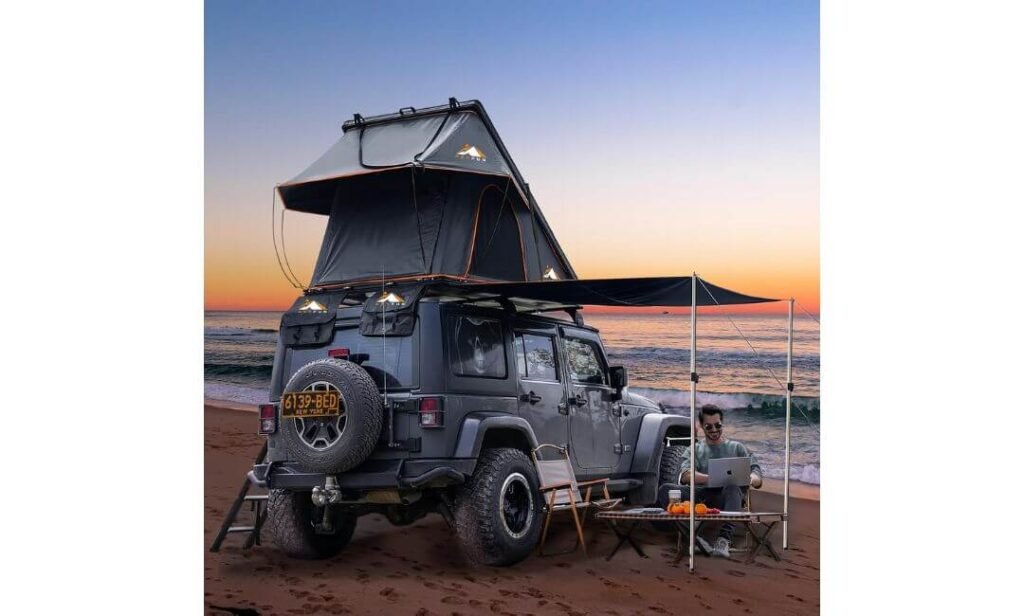
Five seconds is the headline, but it is not the reason I would put this tent on a Tundra. The more interesting part is what happens around that quick deployment. The aircraft-grade aluminum shell, rubber sealing and 320g polyester fabric give the structure a noticeably more substantial approach to weather protection, while the hydraulic gas struts do the heavy lifting when you arrive at camp. If your idea of camping involves driving until you find somewhere worth staying rather than setting up beside a campsite all afternoon, that speed actually has value.
The interior follows the same practical thinking. At 83.86 inches long and 51.57 inches wide, it gives two adults a sensible sleeping platform, with enough capacity for a third person when the trip calls for it. The flocked floor lining, condensation mat and sleeping mat are small details that become much more important overnight, particularly when temperatures drop or the air gets damp. The 13 storage pouches are another nice touch—you can keep phones, headlamps and smaller essentials within reach instead of turning the mattress into a pile of gear.
Then there is the feature I think makes this one more versatile than its basic tent dimensions suggest: the detachable side awning. It gives you somewhere to stand in the shade or get a little protection while getting in and out, without making the sleeping compartment larger or heavier than it needs to be. The built-in LED strip adds useful evening lighting, while the claimed up-to-5,000-mm water resistance gives the tent serious wet-weather credentials on paper. (It is a particularly sensible combination for a Tundra that gets used for quick overnight stops as often as full weekends away.)
What We Like
- Exceptionally fast deployment: The hydraulic system can open the tent in around five seconds, which is genuinely useful after a long day behind the wheel.
- Aluminum shell construction: It brings rigidity and durability without relying on a soft rooftop enclosure as the primary outer structure.
- Useful awning included: A separate shaded area adds real campsite utility rather than simply adding another decorative accessory.
- Strong weather specification: Up to 5,000 mm water resistance, UV resistance, ventilation and windproof layers make it a serious all-season proposition.
- Excellent organization: Thirteen interior storage pockets, shoe bags and the included condensation mat show that the design considers how people actually live inside a rooftop tent.
What We Would Keep in Mind
The 160-lb weight puts this in the heavier category, so the supporting Tundra rack needs to be selected with care. The manufacturer recommends crossbars capable of supporting at least 165 lb, but that should be treated as a minimum product-installation requirement rather than the only number that matters for your complete truck setup.
A Proper Tundra Fitment Check
This is where I would slow down before clicking “buy.” The tent itself is marketed for trucks and uses universal mounting hardware, but a Toyota Tundra does not have one universal rack configuration across every generation, cab and bed combination. Your actual crossbars or bed rack need compatible mounting points, adequate spacing and sufficient capacity for the tent and the people using it.
The 160-lb tent weight is particularly important. Do not confuse a rack’s advertised static capacity with what it can safely carry while the truck is moving. For a Tundra, check the manufacturer’s dynamic rating for the rack, then check the vehicle’s own applicable load limits and leave sensible margin for occupants and equipment. If your setup cannot comfortably accommodate that weight, the lighter SanHima above is the more straightforward direction.
The Insider Pro-Tip
The smartest reason to choose this one is speed without giving up a serious shell. If you regularly change locations, arrive after dark, or simply hate spending twenty minutes turning a truck into a campsite, a five-second deployment is something you will appreciate every single trip. That convenience is worth considerably more than it sounds on a product page.
I would also take advantage of the awning instead of treating it as an accessory you might never use. Keep the sleeping area for sleeping, use the shaded section for shoes and quick gear changes, and keep the 13 storage pockets working for the small things you reach for constantly. Done that way, this becomes a very efficient Tundra setup rather than just another box sitting above the truck bed.
#4. JOYINRUTE Rooftop Tent with Winter Insulation
Quick Specs:
- Sleeping capacity: 2 people
- Overall size: 83 × 51.8 × 39.4 in.
- Weight: 178 lb
- Floor width: 47.29 in.
- Shell: Aircraft-grade aluminum
- Season rating: 4-season
- Water resistance: Up to 5,000 mm
- UV protection: Up to 99%
- Wind protection: Rated to Grade 6
- Weather system: Removable winter thermal liner
- Ventilation: 4 windows with mesh and windproof layers
- Setup: Hydraulic-assisted opening
- Included: 7.5-ft telescoping ladder, condensation pad, mattress, LED strip, storage bags, shoe organizers and installation tools
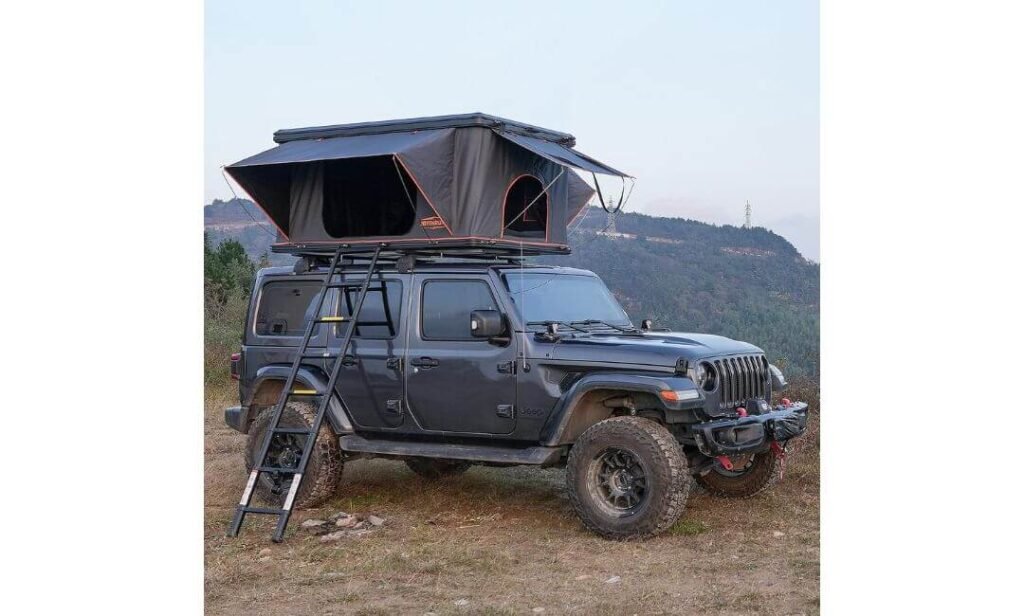
Cold-weather camping is where this design starts making real sense. The removable winter thermal liner is the feature that separates it from a lot of generic hard-shell tents because you can keep the insulation when temperatures fall and remove it when summer arrives. That sounds simple, but it is exactly the sort of flexibility that makes a four-season tent more useful over an entire year instead of becoming a hot, over-insulated box once the weather changes.
The construction is equally purposeful. The aircraft-grade aluminum shell gives the tent a rigid outer structure, while the 320G polyester fabric, blackout coating and claimed 5,000-mm water resistance are designed for serious exposure. The manufacturer also specifies 99% UV protection and Grade 6 wind resistance, although those figures should be understood as product claims rather than a guarantee that every real-world storm will behave the same way. For a Tundra owner who spends time in exposed campsites, the combination is certainly more reassuring than a lightweight summer-only shelter.
Inside, the details are aimed at keeping the sleeping area comfortable rather than simply making it weatherproof. The flocked floor lining and condensation pad help deal with moisture created by temperature differences, while four windows combine mesh with windproof layers so you can maintain airflow without leaving the whole enclosure exposed. The five internal storage bags, two shoe organizers and LED strip also keep the small necessities under control. (It is the sort of arrangement that starts earning its keep when the temperature drops and you would rather stay inside than reorganize your entire campsite.)
What We Like
- Removable thermal liner: A genuinely useful feature for owners who camp through both cold winters and warmer months.
- Serious weather specification: Up to 5,000 mm water resistance, strong UV protection and Grade 6 wind resistance give it a robust all-weather brief.
- Aluminum hard shell: The rigid construction is well suited to repeated use and outdoor exposure.
- Thoughtful moisture control: The flocked floor, condensation pad and four ventilated windows address a problem that many buyers only notice after their first cold night.
- Well-equipped from the box: A long telescoping ladder, storage organizers, LED lighting and shoe bags mean fewer immediate accessory purchases.
What We Would Keep in Mind
At 178 lb, this is the heaviest tent in the lineup so far, so I would make the supporting rack and its load ratings part of the buying decision from day one rather than treating fitment as an afterthought.
Tundra Fitment: Get the Supporting System Right
The tent is marketed for truck applications, but its 178-lb weight means the important question for a Tundra is not simply whether the mounting hardware physically attaches. Your rack or crossbar system needs to be specifically rated for the load, and you also need to consider the people and equipment that will occupy the tent.
Your exact Tundra generation, cab configuration and bed length can affect which rack arrangement makes the most sense. Measure the available mounting area, verify crossbar spacing and check the rack manufacturer’s dynamic and static load ratings before purchase. If your intended setup cannot comfortably accommodate this weight, choosing a lighter tent is the smarter solution—not trying to make the heavier one work through an improvised mounting arrangement.
The Insider Pro-Tip
If you are specifically the person who says, “I don’t want my camping season to end when winter arrives,” this is the feature combination worth paying attention to. The removable thermal liner gives you a way to change the tent with the season instead of changing the tent with the season. Keep it installed when the nights are genuinely cold, remove it when you want maximum airflow, and let the four-layered window arrangement do more of the ventilation work.
The bigger consideration is weight. At 178 lb, I would personally treat this as a rack-first purchase for a Tundra. Get the supporting system sorted, confirm its real moving-load capacity, and then decide whether the winter insulation justifies the additional weight for the way you camp. If cold-weather trips are a priority, the answer can absolutely be yes; if most of your camping is warm-weather travel, one of the lighter options in this list is likely the more sensible buy.
#5. ARCTWONDER Solar Panel Rooftop Tent
Quick Specs:
- Sleeping capacity: 2 people
- Overall size: 83 × 51 × 59 in.
- Weight: 198 lb
- Floor width: 48.03 in.
- Shell: Aluminum hard shell
- Season rating: 4-season
- Water resistance: Up to 5,000 mm
- Thermal system: Removable winter insulation layer
- Solar: Integrated solar panel with USB outlet
- Power: 12V multi-function outlet
- Mattress: 6 cm total, including condensation pad
- Setup: Around 10 seconds
- Closed height: 7 in.
- Included: 2 luggage bars, LED strip, ladder, storage bags, shoe bags and installation hardware
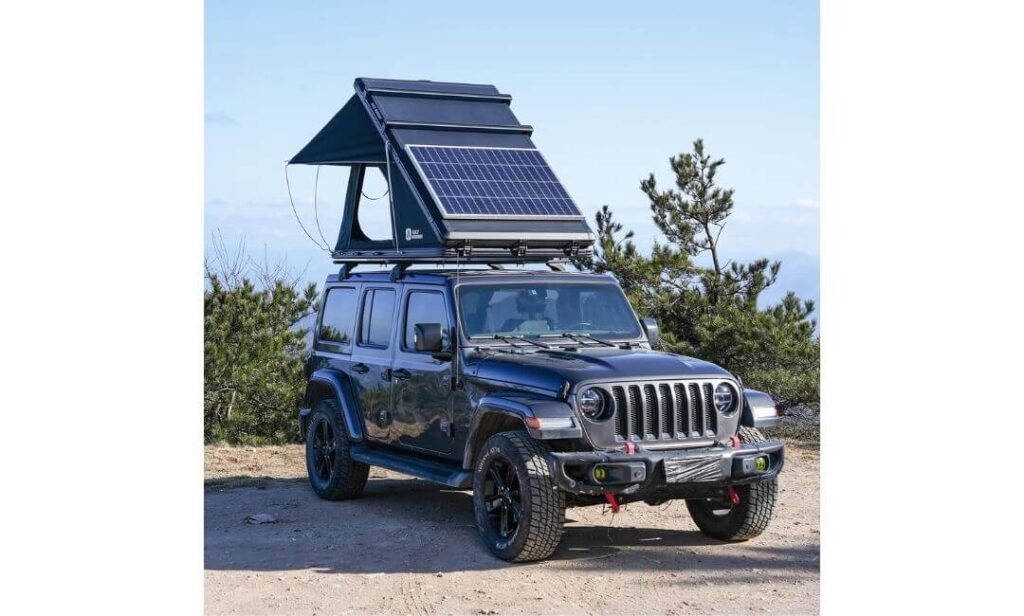
Some rooftop tents add a solar panel because it sounds good in a specification list. This one is more interesting because the solar panel is part of the camping setup itself. The integrated panel is intended to charge compatible power banks, while the USB and 12V outlets give you somewhere practical to use that power once you’re inside. For a Tundra used for longer off-grid stops, that can remove one more accessory from the shopping list and keep the bed area less cluttered.
The winter side of the design is just as deliberate. You get a removable thermal layer, 320g polyester fabric, blackout treatment and claimed 5,000-mm waterproofing, with waterproofed seams intended to keep the enclosure protected when the weather turns ugly. The aluminum construction adds rigidity, while the insulation can be removed when you no longer need the extra warmth. That seasonal flexibility is important because a tent that works beautifully in cold weather can become unnecessarily stuffy in summer if its insulation is permanent.
Then there is the surprisingly compact closed profile. At just 7 inches high when closed, it keeps the package relatively low for highway travel, while the air-pressure rods allow it to pop open in around 10 seconds. Inside, the 6-cm mattress system combines 5 cm of foam with a 1-cm condensation pad, and ten storage bags plus two shoe bags give you plenty of places for smaller equipment. (It is a thoughtful setup for someone who wants the truck to remain useful during the day rather than turning the entire bed into camping storage.)
What We Like
- Integrated solar charging: A useful off-grid feature when you actually spend several days away from regular power.
- Removable winter insulation: Gives the tent more flexibility between cold-weather and summer camping.
- Low closed profile: The 7-inch packed height is a nice touch for a large pickup that still sees plenty of highway miles.
- Complete sleeping system: The 6-cm mattress and condensation pad are included rather than requiring an immediate upgrade.
- Excellent storage provision: Two luggage bars, ten internal storage bags and two shoe bags make it easier to keep the small stuff organized.
What We Would Keep in Mind
At 198 lb, this is the heaviest option in the lineup, so it is not a tent I would choose first if keeping rooftop weight low is your priority. The supporting rack system becomes a major part of the purchase.
A Tundra Setup Needs More Than “Fits Trucks”
The advertised truck compatibility is only the starting point. At nearly 200 lb before adding occupants or equipment, this tent needs a properly engineered rack solution with sufficient dynamic and static capacity, compatible mounting points and the correct crossbar spacing. Do not assume that because the tent physically attaches to a Tundra rack, the complete moving setup is automatically within limits.
For the Tundra specifically, I would look at a bed-mounted rack system if your intended configuration cannot safely accommodate the tent on the vehicle’s standard roof/crossbars. Your exact Tundra generation, cab and bed configuration also matter when deciding rack height and mounting position. The right setup should leave enough clearance for the shell to open fully, the ladder to deploy comfortably and your other truck equipment to remain usable.
The Insider Pro-Tip
The solar feature makes the most sense if your camping style actually benefits from it. If you’re spending one night at a developed campground with easy access to power, it is not going to transform your trip. But if you’re taking the Tundra deep into an off-grid route and staying put for several days, having solar already integrated into the tent can be genuinely convenient.
I would make one decision before anything else, though: solve the weight problem first. At 198 lb, this is a “build the right rack around the tent” choice, not a “throw it on whatever crossbars I already own” purchase. Once that foundation is right, the low 7-inch profile, 10-second setup, winter liner and integrated charging system make much more sense as a complete overland package rather than a collection of impressive-sounding features.
#6. WildFinder Hard Shell Rooftop Tent
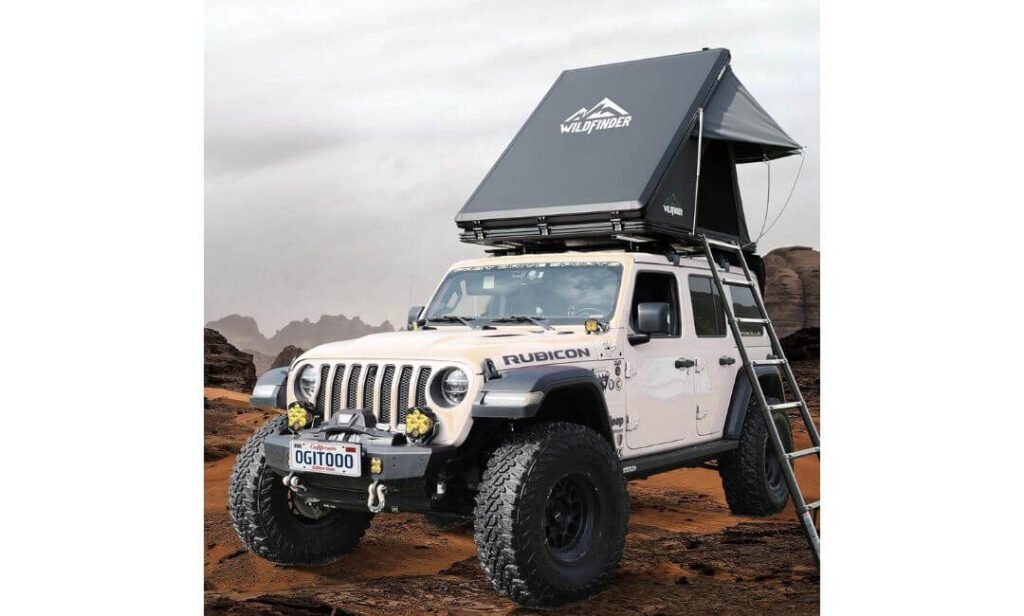
Quick Specs:
- Sleeping capacity: 2 people
- Overall size: 83 × 52 × 9 in. closed
- Weight: 163 lb
- Floor width: 51 in.
- Shell: Aircraft-grade aluminum
- Season rating: 4-season
- Weather protection: 5,000 mm rainproof / Level 6 windproof / Level 4 snow protection
- UV protection: Up to 99.99%
- Mattress: 5-cm non-deforming comfort mattress
- Moisture control: Recessed marine pad + condensation pad
- Windows: 3 mesh windows
- Setup: Pop-up hydraulic/air-pressure system
- Included: 7.5-ft ladder, LED strip, 10 organizer bags, 2 shoe bags and mattress system
What caught my attention here is how little the design tries to complicate things. You get an aircraft-grade aluminum shell, stainless-steel pressure hardware and a straightforward pop-up mechanism, while the closed tent measures only 9 inches high. For a Tundra owner who wants a hard shell that can live on the truck without becoming the centerpiece of the entire vehicle, that simplicity is a genuine advantage.
The weather package is stronger than the relatively straightforward design might suggest. The manufacturer rates it for 5,000 mm rain protection, Level 6 wind resistance, Level 4 heavy-snow protection and up to 99.99% sun protection. The three mesh windows also give you a way to keep air moving when the weather is warm. Those ratings should still be treated as manufacturer claims rather than a promise that the tent is invincible in every storm, but the underlying combination of aluminum construction, waterproof polyester and blackout/privacy treatment makes it a credible four-season option.
The sleeping system is another area where the details make more sense together. A recessed marine pad, condensation pad and 5-cm mattress are intended to tackle moisture from underneath while giving you a more comfortable surface above it. Ten organizer bags and two shoe organizers may sound excessive until you’re actually inside a rooftop tent with phones, headlamps, jackets and small camping equipment everywhere. (That organization is exactly the kind of thing you stop noticing once it works—and notice immediately when it doesn’t.)
What We Like
- Straightforward aluminum construction: A rigid shell without unnecessary complexity makes this a sensible long-term camping platform.
- Strong weather credentials: 5,000 mm rain protection combined with Level 6 wind and Level 4 snow ratings gives it a serious all-weather brief.
- Thoughtful moisture control: The marine pad and condensation layer address the dampness that can otherwise make rooftop sleeping uncomfortable.
- Low closed profile: At roughly 9 inches packed, it keeps the tent relatively unobtrusive on the truck.
- Useful included organization: Ten gear organizers, two shoe bags and the ladder storage system make the interior easier to keep tidy.
What We Would Keep in Mind
The 163-lb weight means this is not a lightweight rooftop option, so the rack system deserves just as much attention as the tent itself.
Making It Work on a Toyota Tundra
The universal-style mounting approach makes the tent appealing for truck applications, but physical compatibility is only half the fitment equation. Your Tundra needs a rack or crossbar system with the correct mounting points, spacing and load capacity for this particular tent. The rack’s moving-load rating is especially important because a rooftop tent is carried while the truck is driving, not just while parked at camp.
The Tundra’s generation, cab configuration and bed length can also influence the best rack arrangement. Measure the actual mounting footprint and make sure the deployed tent has enough clearance around the cab and bed area. If your current rack is not comfortably rated for the 163-lb tent, a properly engineered bed-rack solution is a much better answer than trying to make an undersized crossbar system work.
The Insider Pro-Tip
This is the one I’d look at if you want the hard-shell experience without paying for features you may never use. There is no solar system or elaborate electronic setup competing for your attention; instead, the money is going toward aluminum construction, weather protection, moisture management and the basic things you actually depend on once you’re sleeping outdoors.
One thing I would do before the first trip is give the mattress a proper test at home. The included 5-cm pad is perfectly usable on paper, but mattress comfort is highly personal, and a few minutes lying on it at home will tell you whether you need an additional topper before you’re three hours down a forest road. Get that sorted beforehand, keep the condensation system clear, and this becomes a very uncomplicated Tundra camping setup—which, honestly, is often exactly what you want.
Best Toyota Tundra Rooftop Tent Picks by Features & Fit (2022–2026)
Toyota Tundra Rooftop Tent Buying Guide: What Actually Matters Before You Mount One
A Tundra gives you more room to work with than most SUVs, but that does not mean every rooftop tent is automatically a good match. The tent, rack, mounting hardware, passengers, and camping gear all become part of the equation. The smartest purchase is therefore not the tent with the biggest feature list; it is the one that fits your Tundra configuration, rack system, camping style, and realistic load requirements without forcing compromises later.
Start With Weight, Not Features
This is the first thing I would check because it can eliminate a lot of unsuitable options before you spend time comparing mattresses and LED lights.
The six tents in this guide range from 131.5 to 198 pounds, which is a meaningful spread on a truck. A lighter tent gives you more flexibility when selecting the supporting rack, while a heavier hard shell demands more attention to the rack’s dynamic and static ratings.
| What to check | Why it matters on a Tundra |
|---|---|
| Tent weight | Determines how much of your available load capacity is consumed before anyone climbs inside |
| Rack dynamic rating | Matters while the truck is moving with the tent installed |
| Rack static rating | Matters when people are sleeping inside |
| Occupant weight | Two adults can add several hundred pounds to the stationary setup |
| Camping gear | Bedding, bags, recovery equipment and other accessories add to the total |
| Mounting hardware | Must physically match the rack and tent mounting channels |
Do not use a rack’s impressive static capacity as proof that it is suitable for highway travel. Dynamic capacity is the number that deserves attention while driving. Once parked, the static rating becomes relevant because the tent is carrying people rather than simply being transported.
For this reason, the 131.5-lb SanHima has an obvious advantage for weight-conscious builds, while the 178-lb JOYINRUTE and 198-lb ARCTWONDER require a more deliberate rack strategy.
Tundra Bed Length Changes the Installation Conversation
Toyota has offered the Tundra with different bed lengths and cab configurations over the years, so there is no universal mounting position that makes sense for every truck.
A shorter bed does not automatically prevent rooftop-tent use, and a longer bed does not automatically make every tent a better fit. What matters is where your rack’s crossbars sit, how much usable mounting surface they provide, and whether the deployed tent has adequate clearance.
Before ordering, measure:
- Bed length and cab configuration
- Rack height and crossbar position
- Crossbar spacing
- Available mounting width
- Tent mounting-channel dimensions
- Clearance between the tent and cab
- Ladder position when fully deployed
- Clearance required to open the hard shell
That last part is easy to overlook. A tent can technically mount to the truck and still be awkward if the ladder lands in an inconvenient position or the shell interferes with another piece of equipment.
Aftermarket Rack or Factory Rails?
For a Tundra, I would not make this decision based purely on convenience.
A properly rated aftermarket bed rack gives you a dedicated platform and can make sense when you’re carrying a heavier rooftop tent, additional recovery equipment, solar gear, or other overland accessories. It can also provide more flexibility in positioning the tent over the bed.
Factory rails or crossbars can be perfectly suitable when their specifications and mounting arrangement genuinely support the complete installation. The mistake is assuming that because a tent’s manufacturer says it fits trucks, every factory crossbar arrangement is therefore acceptable.
Think of the rack as part of the rooftop-tent system, not as an accessory you buy afterward.
Four-Season Does Not Mean the Same Thing on Every Tent
“4-season” is useful as a starting description, but it tells you surprisingly little by itself.
Look for the actual features behind the label:
- Insulation or removable thermal liners for cold-weather camping
- Waterproof fabric and sealed seams for sustained rain
- Blackout material for heat, light, and privacy
- Mesh windows for airflow without completely opening the enclosure
- Condensation mats or moisture-control flooring
- Wind-resistant construction
- Vent or duct provisions when using compatible heating or cooling equipment
The JOYINRUTE’s removable winter thermal layer is particularly relevant if winter camping is a serious part of your plans. The Bayati combines thermal and honeycomb insulation with blackout fabric, while the ARCTWONDER takes a similar year-round approach with a removable thermal layer.
On the other hand, don’t buy a heavily insulated tent simply because the words “four-season” sound better. If most of your Tundra trips happen during warm weather, ventilation and heat management may matter more to you than maximum insulation.
Setup Time Is a Real Feature After a Long Drive
Manufacturers love talking about setup speed, and sometimes that number actually matters.
A tent that opens in seconds can be a genuine quality-of-life improvement when you arrive at camp tired, especially if you move between locations frequently. The HEYFUN, for example, is designed around a very quick hydraulic pop-up system, while other models use different assisted-opening arrangements.
But there is an important distinction between opening quickly and living with the tent easily.
Ask yourself:
- Can one person open it comfortably?
- Is closing it equally straightforward?
- Does the ladder deploy naturally?
- Can bedding remain inside when the tent is closed?
- Are the latches easy to reach?
- Does the opening mechanism require significant force?
- Can you pack it away without repeatedly walking around the truck?
A five-second opening time is impressive, but if closing the tent becomes a two-person job every evening, the headline number tells only half the story.
Construction Quality Matters More Than a Long Feature List
A rooftop tent lives a harder life than a conventional tent. It experiences sun, rain, road vibration, wind, dust, temperature changes, and repeated opening and closing.
That makes the basic construction worth examining carefully.
An aluminum hard shell can provide a rigid outer structure and good protection while traveling. Inside the tent, look at the quality of the fabric, zippers, hinges, gas struts, ladder, mounting hardware, and floor construction.
The details I would pay particular attention to are:
- Aluminum shell and frame: useful for rigidity and long-term outdoor exposure
- Fabric weight and coating: affects weather protection and durability
- Zippers: frequently used and easy to take for granted
- Gas struts or pressure rods: responsible for repeated opening cycles
- Ladder: important because it carries your full body weight every time you enter
- Condensation management: directly affects comfort and fabric longevity
- Replaceable fabric components: useful when the tent is intended for years of use
This is also why I would be cautious about making a durability judgment from a handful of new reviews. A new rooftop tent can have excellent specifications without having a decade of owner history behind it. For newer models, construction details and warranty support deserve more weight than a small collection of enthusiastic early reviews.
Comfort Is More Than Mattress Thickness
Mattress thickness gets plenty of attention, but it is only one part of sleeping comfort.
Interior dimensions, floor width, headroom, ventilation, blackout material, condensation control, storage and access all affect how pleasant the tent feels at 2 a.m.
For example, the Bayati’s 63-inch floor width gives it a noticeably roomy sleeping platform for a rooftop tent, while several of the two-person models sit closer to the 48–51-inch range. That difference may not sound dramatic on a product page, but it becomes obvious when two adults are trying to sleep with blankets and personal gear inside.
If you regularly camp with another adult, prioritize usable floor area over a marketing claim about maximum occupancy.
Convenience Features Should Solve an Actual Problem
This is where I would separate genuinely useful extras from feature-sheet decoration.
A built-in USB-C, USB-A and 12V panel, like the SanHima’s, can be useful because charging is something you actually do inside the tent. The ARCTWONDER’s integrated solar system makes more sense for campers who spend several days away from conventional power. The HEYFUN’s side awning can create useful shaded space outside the sleeping compartment.
Those are meaningful additions because they change how you use the tent.
By contrast, don’t pay extra for a feature simply because it sounds impressive. Your camping routine should decide which extras matter, not the order in which they appear on a product listing.
Installation: Plan the Rack Before the Tent Arrives
A rooftop tent is not something I would recommend opening the box for and improvising on the driveway.
Before installation, have the rack instructions, tent mounting hardware, correct tools, and the manufacturer’s mounting requirements available. Confirm that the crossbars are positioned correctly and that the mounting channels can accept the supplied hardware.
After installation, check that:
- The mounting hardware is properly secured.
- The tent sits evenly on the rack.
- The shell opens without contacting the cab or other equipment.
- The ladder reaches the ground safely.
- Nothing interferes with doors, bed access, or other truck functions.
- The rack remains within its stated load limits.
- The complete setup is rechecked after the first few trips.
That final step is worth remembering. Road vibration can expose installation issues that are invisible when the truck is sitting still in your driveway.
How Much Should You Spend?
Price should be considered alongside what you are actually getting, because the cheapest hard shell is not necessarily the best value and the most expensive-looking feature list is not necessarily worth the premium.
| Budget level | What you should realistically expect |
|---|---|
| Entry-level | Basic hard shell, essential sleeping equipment, simpler hardware and fewer integrated conveniences |
| Mid-range | Better insulation, stronger construction, improved mattresses, more storage and useful extras |
| Premium-focused | More refined materials, stronger hardware, advanced insulation, integrated power features and better overall finish |
For this particular lineup, I would think in terms of use case rather than price alone. A camper who wants the lightest reasonable hard shell may value the SanHima more than a heavier tent with additional features. Someone prioritizing winter comfort may accept additional weight for removable thermal insulation. Someone building an off-grid setup may find integrated solar genuinely useful.
There is no prize for buying the tent with the longest specification sheet. The best value is the tent whose features you will actually use.
The Tundra-Specific Buying Rule I Would Follow
If I were narrowing these down for a Tundra, my order of checks would be simple:
vehicle configuration → rack compatibility → tent weight → sleeping space → weather needs → setup system → useful extras → price.
That order prevents a surprisingly common mistake: choosing a tent because it looks perfect first, then discovering that the rack, weight, or mounting arrangement makes the complete setup unnecessarily complicated.
The Tundra is capable of making a fantastic rooftop camping platform, but the truck itself is only one piece of the system. Get the foundation right, and the tent becomes the enjoyable part of the purchase.
Setup Speed, Comfort, and 4-Season Performance: The Details You Notice After the First Night
A rooftop tent can look almost identical to another one in a product photo, yet feel completely different once you have driven for hours, arrived at camp in bad weather, and actually had to sleep in it. Setup speed, insulation, ventilation, mattress comfort, and usable storage are the things that become obvious after the novelty wears off.
Setup Speed: Seconds on Paper, Convenience in Real Life
The advertised setup times in this lineup range from roughly 30 seconds to around 10 seconds, depending on the opening mechanism. That difference sounds small, but quick deployment is genuinely useful when you are moving camps frequently or arriving late in the evening.
| Model | Approx. setup | Opening system | What it means in practice |
|---|---|---|---|
| Bayati Naturnest Sirius 1 Plus | ~30 sec | Lock-and-ladder pop-up design | Very quick for a larger sleeping area |
| SanHima Aluminium Fold-Out | Quick snap-fold | Snap Fold System | Simple deployment without relying on hydraulic struts |
| HEYFUN Adventurer Pro | ~5 sec | Hydraulic gas struts | Fastest option for frequent campsite changes |
| JOYINRUTE Winter Insulated | <30 sec | 4 hydraulic support rods | Fast opening with a more substantial shell |
| ARCTWONDER Solar Panel | ~10 sec | Air-pressure rods | Designed for straightforward one-person deployment |
| WildFinder Hard Shell | ~3–5 min* | Air-pressure system | Straightforward pop-up design, though slower in real-world use |
*Actual setup time can vary with how much unpacking, ladder adjustment, bedding arrangement, and campsite preparation you need to do.
The important part is not to treat the smallest number as automatically the winner. Opening is only half the job. Closing the shell, securing the latches, arranging the ladder, and getting everything packed away can matter just as much. A tent that opens in five seconds but requires awkward handling when closing it may not feel dramatically faster after a week on the road.
Comfort Starts With the Sleeping Platform
Once the tent is installed, the mattress is probably the first thing you will notice.
The models here use different sleeping surfaces, from approximately 1.97 inches to 2.36 inches of mattress or combined mattress-system thickness. That difference can matter, but mattress thickness alone does not tell you how comfortable a tent will be.
The more useful question is how the mattress, floor width, interior length, condensation protection, and available storage work together.
The Bayati offers a particularly generous 63-inch floor width, making it one of the more spacious choices for two adults. The SanHima stretches the interior to 84.65 inches long, while the narrower two-person designs generally sit around the 47–51-inch floor-width range.
For couples, that distinction is worth taking seriously. A two-person rating does not mean two adults will have the same amount of usable space in every tent. Bedding, pillows, clothing and personal equipment quickly consume the extra room.
Mattress Thickness Is Only One Part of Sleeping Comfort
Here is where I would avoid getting too caught up in the numbers.
A thicker mattress can feel better, but a good sleeping setup also depends on how the floor handles moisture and temperature changes. The SanHima includes a 2.17-inch high-density foam mattress and anti-condensation mat, while the ARCTWONDER uses a 6-cm system combining foam with a condensation layer. The WildFinder also uses a layered approach with a recessed marine pad, condensation pad and comfort mattress.
Those systems are valuable because waking up on a comfortable mattress is one thing; waking up to moisture underneath it is another.
If you are planning regular cold-weather trips, I would give condensation management almost as much attention as mattress thickness. It is an unglamorous detail, but it has a direct effect on how comfortable the tent feels night after night.
Four-Season Performance Is Really About Temperature Control
The phrase “4-season” gets used heavily in rooftop-tent marketing, but year-round comfort requires more than waterproof fabric.
There are two opposite problems to solve:
Keeping heat in during cold weather, and getting heat out during warm weather.
That is why removable insulation is particularly useful. The JOYINRUTE and ARCTWONDER both include removable winter thermal layers, allowing you to add insulation when temperatures fall and remove it when summer ventilation becomes more important.
The Bayati takes a different approach, using honeycomb sound and thermal insulation along with blackout fabric. That makes it attractive for campers who want a more insulated sleeping environment without constantly changing the tent configuration.
Winter Camping: Insulation Helps, but Heating Still Needs Thought
A thermal liner can reduce heat loss and make the interior more comfortable, but it does not turn a rooftop tent into a heated room by itself.
If you use a compatible heater, pay close attention to ventilation and the manufacturer’s instructions. A dedicated duct opening, such as the one provided on the Bayati and SanHima, can make routing compatible heating or cooling equipment more practical, but it should never be treated as permission to operate equipment in an unsafe way.
For winter trips, I would prioritize:
- Removable or integrated thermal insulation
- Blackout material
- Condensation management
- Adequate ventilation
- Weather-sealed windows
- A mattress that remains comfortable at lower temperatures
- A safe, manufacturer-approved heating arrangement
The JOYINRUTE is particularly focused on this use case because of its removable winter thermal liner, while the Bayati’s insulated honeycomb construction gives it a more built-in approach to thermal comfort.
Summer Camping: Ventilation Becomes the Priority
A well-insulated tent can become uncomfortable in warm weather if there is nowhere for hot air to escape.
Look for multiple mesh windows, breathable fabric, ventilation openings, and blackout material. Blackout lining is especially useful because direct morning sunlight can turn a rooftop tent into a greenhouse surprisingly quickly.
The SanHima’s multiple windows, blackout lining and light-shielding approach are particularly practical here. The JOYINRUTE also uses four windows with mesh and windproof layers, giving you the option to maintain airflow while retaining some weather protection.
The goal is not simply to make the tent darker. It is to give yourself control over light, airflow, and heat depending on what the weather is doing.
Storage Is What Separates a Comfortable Tent From a Cluttered One
Storage sounds like a minor feature until two people are inside a rooftop tent with nowhere to put their phones, glasses, headlamps, jackets and shoes.
Several models here address that problem differently:
- Bayati: six interior storage pockets plus shoe bags
- SanHima: ceiling organizers and shoe pockets
- HEYFUN: 13 interior ceiling and sidewall storage pouches
- JOYINRUTE: five internal storage bags and two shoe organizers
- ARCTWONDER: 10 storage bags and two shoe bags
- WildFinder: 10 organizer bags and two shoe organizers
The HEYFUN stands out for the sheer number of dedicated pockets, while the ARCTWONDER and WildFinder also give you substantial organizational space.
But there is a bigger point here: storage should keep the mattress free for people, not become an excuse to carry more gear. The best setup is still the one where you bring only what you need and give frequently used items a predictable place.
External Storage Can Be Even More Valuable
The Bayati and ARCTWONDER include external load bars that can carry lightweight equipment such as solar panels or other suitable gear. That can be particularly useful on a Tundra because it preserves the interior sleeping area for its intended purpose.
Just remember that external cargo is still weight. Adding equipment to the top of the tent changes the overall load, and the rack, tent, and vehicle limits still need to be respected.
This is especially important with heavier tents such as the ARCTWONDER. The convenience of carrying additional gear should never come at the expense of staying within the supporting system’s ratings.
Which Features Matter Most for Different Camping Styles?
| If your trips look like this | Prioritize these features |
|---|---|
| Frequent campsite changes | Very fast opening, easy closing, simple ladder deployment |
| Cold-weather camping | Thermal liner, insulated floor, condensation control |
| Hot summer trips | Mesh windows, ventilation, blackout lining |
| Long off-grid stays | Solar/power options, storage, comfortable mattress |
| Two-adult trips | Floor width, mattress quality, interior length |
| Family camping | Larger sleeping area, storage, weather protection |
| Minimalist truck camping | Lower weight, simple setup, fewer unnecessary accessories |
There is no single winner in every category, and that is exactly why these tents are worth separating rather than treating them as interchangeable hard shells.
The Bayati is the comfort-and-space choice, SanHima makes a strong case for lighter construction and built-in convenience, HEYFUN is about exceptionally fast deployment, JOYINRUTE leans heavily toward adaptable cold-weather use, ARCTWONDER adds integrated solar capability for off-grid campers, and WildFinder keeps the formula comparatively straightforward.
That difference is more useful than simply saying one tent has “better features.” Your Tundra camping routine should decide which features are actually worth carrying on the roof.
Toyota Tundra Rooftop Tent Installation Tips: Get the Rack, Weight, and Setup Right First
A rooftop tent is only as good as the structure supporting it. On a Tundra, the installation becomes especially important because these tents range from 131.5 to 198 pounds before occupants and camping gear are added. A clean installation is not about making everything look perfectly aligned for photographs; it is about creating a stable, predictable setup that remains secure when the truck is moving and comfortable when you are sleeping above the bed.
Do a Rack Compatibility Check Before Lifting the Tent
Before the tent ever goes onto the truck, confirm that the rack or crossbars are suitable for the specific tent.
Check these items first:
- Dynamic load rating: The rack must be capable of carrying the rooftop tent while the Tundra is moving.
- Static load rating: The rack must safely support the tent, occupants, and appropriate gear when parked.
- Crossbar spacing: The tent’s mounting channels need to line up with the rack’s usable mounting area.
- Crossbar dimensions: Confirm that the supplied clamps or mounting hardware actually fit.
- Mounting hardware: Use the hardware specified for the tent and rack rather than improvising with unrelated fasteners.
- Clearance: Check the cab, bed, rear window, antenna, and any other equipment before final positioning.
- Rack manufacturer requirements: Follow the rack’s own installation and load limitations as well as the tent manufacturer’s requirements.
One important distinction: a tent being advertised as compatible with trucks does not mean every Tundra rack is automatically compatible. The rack is the connection between the vehicle and the tent, so both sets of specifications have to agree.
Use the Tundra’s Exact Configuration, Not a Generic Fitment Claim
Tundras have been sold in different generations, cab configurations, and bed lengths. That can change where a rack can be positioned and how the tent sits over the truck.
Before installation, measure the actual truck and rack rather than relying entirely on a statement such as “fits all Tundras.”
Pay particular attention to:
- Bed length
- Cab configuration
- Rack height
- Crossbar position
- Distance between mounting points
- Clearance over the cab
- Ladder landing area
- Clearance needed when the shell opens
This matters even more with triangular or fold-out designs, because the tent occupies a much larger footprint once deployed than it does when closed.
A Simple Pre-Installation Checklist
You do not need to turn installation into a weekend project, but rushing the first setup is a mistake. A simple sequence keeps the important things from being forgotten.
1. Position the Rack Correctly
Set the crossbars or bed rack where the tent manufacturer and rack manufacturer specify. Make sure the bars are level and properly secured before the tent is lifted into place.
If you are working with a heavier tent, having another person help position it is a much better idea than trying to wrestle a large hard shell onto the truck alone.
2. Place the Tent on the Mounting Points
Lower the tent carefully onto the rack and line up its mounting channels with the crossbars.
Do not fully tighten everything immediately. Leave enough adjustment to center the tent and confirm that the mounting hardware is sitting correctly.
3. Center and Level It
Look at the tent from the front, rear, and both sides.
You want a stable, balanced position, not simply a visually centered one. Make sure the shell does not sit unnecessarily far toward one end of the rack and that there is sufficient clearance for opening, closing, and ladder deployment.
4. Secure the Mounting Hardware
Once the position is confirmed, tighten the mounting hardware according to the manufacturer’s instructions.
Do not guess at torque values, and do not substitute “as tight as possible” for the specified procedure. Over-tightening can damage hardware, while under-tightening can allow movement.
5. Test the Opening Mechanism
Open the tent before loading it with bedding or equipment.
Check that:
- The shell opens evenly.
- Gas struts or pressure rods operate normally.
- Fabric does not catch in the mechanism.
- The ladder extends correctly.
- Doors and windows open without interference.
- The tent does not shift on the rack.
6. Secure the Ladder Properly
The ladder is one of the most important physical contact points because it transfers your body weight into the setup every time you climb in.
Make sure it is fully extended, properly locked, and resting securely on the ground. Avoid positioning it on loose rocks, soft mud, uneven soil, or anything that can move underneath it.
Keep the Weight Low and Balanced
A rooftop tent naturally raises the Tundra’s center of gravity. Adding heavy equipment on top of the tent raises it further.
That is why I would avoid treating the rooftop as another cargo shelf.
Keep heavier equipment as low as practical, preferably in the truck bed or another suitable storage area, while lightweight equipment can be carried on approved external bars when the tent and rack allow it.
For example, a lightweight solar panel may make sense on a tent’s luggage bars, while unnecessarily putting dense recovery equipment or heavy storage boxes on top is a very different proposition.
The goal is simple: don’t turn a rooftop tent into a second roof rack.
Remember the Difference Between Driving Weight and Camping Weight
This is one of the most important things to understand before installation.
While driving, the tent is subjected to road vibration, braking forces, cornering forces, wind loads, and bumps. That is why dynamic rack capacity matters.
When parked, the situation changes. The rack is supporting the tent plus the people sleeping inside it, which is where static capacity becomes important.
For the six tents in this guide, the tent-only weights already range from 131.5 lb to 198 lb. Once two adults climb inside, the load becomes substantially higher.
Never calculate compatibility from the tent’s weight alone.
Do a Final Shake and Movement Check
Once everything is tightened, give the setup a sensible physical check.
You are not trying to move the entire truck. Instead, look for unexpected movement between the tent, mounting hardware, and rack.
If you notice looseness, shifting, rattling, or hardware that does not appear seated correctly, stop and inspect the installation before driving.
After your first few trips, inspect the mounting hardware again. New installations can settle slightly, and road vibration is excellent at revealing problems that were not obvious while parked in the driveway.
Security: Make the Tent Harder to Steal
A rooftop tent is expensive enough that security deserves some thought, particularly if you leave the Tundra parked overnight in unfamiliar places.
If your rack and tent support it, consider:
- Locking rack hardware
- Security nuts or locking fasteners
- Anti-theft straps where appropriate
- Keeping installation tools out of sight
- Parking in a well-lit, secure location when possible
Do not rely on a simple strap as your only theft protection for a permanently mounted tent. A dedicated locking solution is a much better approach.
And remember, security hardware should not interfere with the tent’s mounting system or compromise the manufacturer’s installation requirements.
Wind Changes How the Whole Setup Feels
A hard-shell rooftop tent creates additional surface area above the truck, and strong crosswinds can make that more noticeable.
When driving, keep the tent fully closed and properly latched. Do not carry loose rooftop equipment that can move or create unexpected wind loads.
When camping, pay attention to changing conditions. If strong winds are forecast, use the tent according to the manufacturer’s operating guidance and avoid treating the maximum wind claim on a product page as a guarantee of performance in every possible situation.
A calm evening can become very different a few hours later.
Do Not Skip the First-Night Test
Before taking a newly installed rooftop tent hundreds of miles from home, I would spend one night with it somewhere convenient.
That gives you the chance to discover the things product descriptions never tell you:
Does the ladder land where you expected? Is the mattress comfortable? Can you close it easily with bedding inside? Does anything rattle? Is the storage actually convenient? Do you like where the tent sits relative to the cab?
Those answers are much easier to deal with in your driveway than at the end of a remote trail.
The best installation is ultimately the boring one: nothing shifts, nothing rattles, the ladder feels solid, the tent opens cleanly, and you stop thinking about the hardware once camp is set. That is exactly what you want from a rooftop tent on a Toyota Tundra.
Smart Truck Camping: Practical Accessories and Tundra Compatibility That Actually Matter
A rooftop tent is the sleeping space, but a good Tundra camping setup is really a system around it. The difference between a setup that feels organized and one that becomes frustrating usually comes down to where you put shoes, cooking gear, charging equipment, recovery equipment, and the things you need during the day.
The key is not to keep adding accessories. It is to build around the way you actually use the truck.
Start With the Accessories That Give You Space Back
The most useful accessories are the ones that keep the sleeping area from becoming storage.
An awning is a good example. The HEYFUN includes a side awning, giving you a covered area outside the sleeping compartment for changing shoes, taking a break from the sun, or simply keeping the entrance drier during light rain.
An annex room can go a step further by creating additional enclosed space below the tent. It can be useful for longer family trips or when you want somewhere to change clothes, but it also adds weight, setup time, and bulk. If most of your trips are quick overnight stops, I would not buy one simply because it is available.
For a Tundra, useful storage accessories can include:
- Roof or tent-mounted luggage bars for approved lightweight equipment
- Bed organizers for recovery and camping equipment
- Weather-resistant storage boxes for gear that should stay outside the sleeping area
- Shoe storage to keep dirt and moisture away from the mattress
- Interior organizers for phones, headlamps, glasses, and small essentials
The Bayati, HEYFUN, and ARCTWONDER already include useful external or internal storage features, so you may not need to start buying accessories immediately.
Keep the Truck Bed Available for Daytime Use
This is one of the biggest advantages of using a Tundra for rooftop camping.
Your truck bed does not have to become the bedroom.
Keep sleeping equipment above the bed and use the bed for things you need during the day—coolers, recovery equipment, cooking equipment, camp chairs, water containers, and other gear that would be inconvenient inside the tent.
A bed-mounted storage system can make this even easier, but don’t build the truck so aggressively around camping that you lose the everyday usefulness of the pickup. The best Tundra camping build is usually the one that can still haul normal cargo when the tent is closed.
Charging and Electrical Planning for Longer Trips
Power requirements become much more noticeable when you move from one-night camping to several days off-grid.
Start by working out what you actually need to power:
- Phones and tablets
- Cameras
- Headlamps
- Portable refrigerators or coolers
- Small camping electronics
- Tent lighting
- Compatible heating or cooling equipment
The SanHima is particularly convenient here because it includes USB-C, USB-A, and a 12V outlet inside the tent. That can eliminate a surprising amount of cable clutter.
The ARCTWONDER takes the idea further with an integrated solar panel and USB charging provision. For someone spending several days away from shore power, that can be genuinely useful. For someone staying at established campgrounds, it may be unnecessary complexity.
The important part is to think about energy consumption before buying accessories. A solar panel does not automatically mean unlimited power, and a larger battery does not automatically solve an inefficient setup.
Solar Is Most Useful When Your Camping Is Actually Off-Grid
An integrated solar panel makes the most sense when your Tundra spends multiple days away from conventional power.
If you are driving every day and only need to recharge a phone or camera, the truck itself may already provide most of what you need. If you park for several days, however, solar can reduce how often you need to run the vehicle or find an external power source.
For an off-grid setup, think about the whole chain:
solar input → charge controller → battery/power station → device load
Do not assume the tent’s solar provision can safely power every device you own. Check the manufacturer’s electrical specifications and the requirements of your particular power station or battery system before connecting anything.
Heating and Cooling Need More Than a Duct Opening
A dedicated duct opening, like the provision on the Bayati and SanHima, is a thoughtful feature because it gives compatible climate-control equipment a cleaner route into the tent.
But the opening itself does not make a heater or air conditioner safe to use.
For any heating or cooling equipment, follow the equipment manufacturer’s ventilation, exhaust, electrical, and operating requirements. Never improvise combustion-air or exhaust arrangements inside a rooftop tent.
For cold-weather camping, the tent’s own insulation should do as much of the work as possible. A thermal liner, insulated floor, blackout material, and proper ventilation can reduce the demand placed on supplemental heating.
In hot weather, airflow becomes equally important. Open mesh windows where conditions allow, use the tent’s ventilation features, and avoid assuming that insulation alone will keep the interior cool.
Towing Changes What You Can Carry Up Top
This is an area that deserves more attention when the Tundra is being used as a working truck as well as a camping vehicle.
A rooftop tent does not exist separately from the rest of the truck. If you are towing a trailer, carrying a heavy load in the bed, or loading passengers and equipment into the vehicle, all of those demands need to be considered together.
Do not look only at the tent’s weight.
Your overall setup can include:
- Rooftop tent
- Rack system
- Occupants
- Bed cargo
- Recovery equipment
- Camping equipment
- Trailer tongue weight
- Additional vehicle accessories
The Tundra’s available payload and the applicable towing limits for your specific truck configuration need to be respected together. A rooftop tent may be perfectly manageable by itself and become a very different proposition once the truck is fully loaded for a long trip.
A Bed Rack Can Solve One Problem and Create Another
A bed-mounted rack is attractive because it can provide a dedicated structure for the rooftop tent while leaving the cab roof untouched.
But adding a rack also adds weight and height.
Before choosing one, consider:
- Rack weight
- Dynamic and static load ratings
- Tent mounting compatibility
- Available bed space
- Overall vehicle height
- Clearance around the cab
- Trailer visibility
- Access to the bed
- Whether the rack interferes with tonneau covers or other equipment
If you tow regularly, check the relationship between the rack, trailer, rear visibility, and any accessories mounted around the bed. A camping build should not make normal towing unnecessarily difficult.
Don’t Let Accessories Turn the Tundra Into a Permanent Campground
This is probably the most practical advice in the entire section.
It is very easy to keep adding things—awning, annex, solar panel, recovery boards, storage boxes, shower enclosure, extra lighting, cooking equipment, roof bars, traction gear—and suddenly the truck is carrying hundreds of pounds of accessories you rarely use.
Every addition has a cost in weight, space, aerodynamic drag, complexity, and maintenance.
A cleaner setup usually wins.
If your tent already provides internal storage, use it. If the HEYFUN’s awning covers your needs, there may be no reason to add another shade system. If the SanHima gives you the charging connections you actually need, don’t build an unnecessarily complicated electrical system around it.
Build Around Your Actual Tundra Camping Style
| Your camping routine | Accessories worth prioritizing |
|---|---|
| Quick overnight stops | Fast-opening tent, simple storage, basic charging |
| Weekend family trips | Awning, larger storage, comfortable bedding, organized bed space |
| Cold-weather camping | Thermal liner, condensation management, appropriate heating setup |
| Long off-grid stays | Solar, battery storage, efficient lighting, weatherproof gear storage |
| Frequent towing | Low-profile rack, organized bed storage, careful payload planning |
| Mixed work and camping use | Removable storage, practical rack, minimal permanent accessories |
The smartest build is rarely the one with the most equipment. It is the one where every accessory has a job.
One Tundra Compatibility Check Before You Add Anything
Before buying a new accessory, ask three questions:
Where will it mount? How much does it weigh? What else does it interfere with?
That simple test catches a lot of expensive mistakes.
A luggage bar may look perfect until you realize the tent already uses that mounting space. An awning may fit the rack but interfere with a bed cover. A large storage box may be convenient until it reduces the room needed for towing equipment. A solar setup may work electrically but add more weight than your rack configuration comfortably allows.
Your Tundra is valuable because it can do more than one job. Keep the camping system modular enough that you can still use the truck like a truck. That is what makes a rooftop setup genuinely smart rather than simply impressive in a campsite photograph.
Real-World Tundra Camping Scenarios: Choosing the Right Tent for the Way You Travel
The best rooftop tent changes once you stop comparing specifications and start thinking about how the Tundra is actually going to be used. A solo traveler covering long distances has very different priorities from a couple spending a week in cold weather, and neither necessarily needs the same tent as a family that wants more room at the end of a long day.
That is why I would not choose from this list by ranking alone. Think about where you camp, how often you move, how much weight you want above the truck, and who will be sleeping inside.
Solo Adventurer: Keep the Setup Light and Fast
For one person, there is little reason to carry a huge rooftop tent simply because it has room for three.
The SanHima Aluminium Fold-Out makes the most sense when weight is a major concern. At 131.5 pounds, it is the lightest model in this lineup, while still giving you an 84.65-inch-long interior, a 2.17-inch mattress, blackout lining, built-in charging connections, and a useful anti-condensation system.
That combination is hard to ignore if your trips involve long stretches of driving followed by quick overnight stops. You are not giving up the basic comforts just to save weight, and the built-in USB-C, USB-A and 12V outlets are genuinely useful when the truck becomes your mobile base.
If absolute setup speed matters more than weight, the HEYFUN Adventurer Pro deserves consideration. Its hydraulic system can deploy in roughly five seconds, making it particularly attractive to someone who changes campsites frequently.
The trade-off is its 160-pound weight, so the supporting rack becomes more important. For a solo Tundra build, I would generally lean toward the SanHima when keeping the system light is the priority, and the HEYFUN when speed of deployment is the thing you value most.
Couple or Small Family: Space Starts to Matter More
Once two adults are sharing the tent, floor width becomes something you actually notice.
The Bayati Naturnest Sirius 1 Plus has the strongest space argument in this lineup, with a 63-inch floor width and 82.7-inch length. It is rated for two adults and one child, and the blackout interior, insulated honeycomb panels, 1.97-inch mattress, storage pockets and shoe bags make it better suited to people who plan to spend real time inside rather than simply sleep and leave.
That extra room is particularly valuable when the weather turns bad. Two people can get dressed, organize their sleeping gear, and move around without immediately feeling as though every item has to be packed away.
The HEYFUN can also make sense for a small family because of its 2–3-person capacity, 13 storage pouches and included side awning. The awning creates useful covered space outside the sleeping compartment, which can be particularly handy when everyone is getting in and out of the tent.
For family use, I would prioritize floor area and access before chasing the fastest setup time. Saving ten seconds is nice; having enough room to sleep comfortably for three nights is much more important.
Winter Expeditions: Insulation Becomes a First-Class Feature
Cold-weather camping changes the buying decision considerably.
Here, I would look closely at the JOYINRUTE Winter Insulated and ARCTWONDER Solar Panel because both include a removable winter thermal layer. That gives you the ability to add insulation when temperatures fall and remove it when warmer weather arrives.
The JOYINRUTE also combines that liner with 320G polyester, blackout coating, claimed 5,000-mm water resistance, four windows with mesh and windproof layers, and a condensation-control floor system. For someone who deliberately camps through winter, that collection of features makes more sense than simply looking for a tent advertised as “four-season.”
The Bayati takes a slightly different route, using honeycomb thermal insulation within the hard-shell construction along with blackout fabric and a dedicated climate-control duct. It is a strong choice if you want the insulation to be part of the tent’s basic construction rather than something you install and remove seasonally.
But there is an important reality check: insulation is not the same thing as heating. A thermal liner can help retain warmth, but safe supplemental heating still requires equipment designed for the job and proper ventilation. Never improvise combustion equipment inside a rooftop tent.
For winter camping, I would therefore prioritize:
- Thermal insulation
- Condensation management
- Ventilation
- Weather-sealed windows
- Blackout material
- A safe, manufacturer-approved heating arrangement
Off-Road and Overland Travel: Durability Comes Before Gadgets
Off-road travel puts more emphasis on the physical construction of the tent.
Repeated vibration, dust, mud, rain, branches, rough access roads and frequent opening and closing are more relevant here than whether the tent has the most impressive collection of electronic features.
The HEYFUN Adventurer Pro stands out for its aircraft-grade aluminum shell, corrosion-resistant gas struts, waterproof rubber sealing, condensation mat, and included side awning. The WildFinder also follows a straightforward rugged approach with an aluminum shell, stainless pressure hardware, recessed marine pad, condensation pad and a claimed 5,000-mm rainproof rating.
The important thing is not to confuse a weather rating with invincibility. Mud and water management still depend heavily on how you use and maintain the tent.
After a particularly dirty trip, give attention to:
- Zippers and zipper tracks
- Fabric around the shell
- Ladder joints
- Mounting hardware
- Drainage areas
- Condensation mats
- Underside of the tent
- Rack mounting points
Letting wet mud dry around moving components is an easy way to create problems later.
Remote Off-Grid Travel: Power Can Change the Equation
If your Tundra regularly disappears from developed campgrounds for several days, power becomes much more useful than it is for a one-night trip.
The ARCTWONDER is the obvious choice here because it combines an integrated solar panel with a USB outlet and 12V multi-function outlet. It also includes two luggage bars, allowing suitable lightweight equipment to be carried without occupying the sleeping compartment.
The SanHima is another strong option for this type of traveler because its USB-C, USB-A and 12V outlets are already integrated into the tent.
The difference is simple: the SanHima focuses on convenient access to vehicle or auxiliary power, while the ARCTWONDER adds solar capability for campers who actually need additional off-grid charging.
If you spend most nights near electrical hookups, I would not let solar capability decide your purchase. If you spend several days away from them, it becomes a much more meaningful feature.
Frequent Campsite Changes: Setup Speed Wins
There is a certain type of Tundra traveler who will appreciate fast deployment more than almost anything else.
You drive until you find somewhere worth stopping, pull over, level the truck, and want to be sleeping rather than assembling camp.
For that use, the HEYFUN’s approximately five-second hydraulic opening is the standout. The ARCTWONDER follows at around ten seconds, while the Bayati and JOYINRUTE are also designed for rapid pop-up deployment.
But there is a catch: fast opening does not necessarily mean fast packing.
When comparing tents for frequent travel, pay attention to the entire routine—opening, ladder deployment, bedding, closing, latching, and securing everything for the road. A tent that saves time at arrival but becomes frustrating when leaving may not actually save you much time over a long trip.
Long Road Trips: Weight Becomes More Important Every Day
For a Tundra that spends more time on highways than at campsites, I would give extra attention to the tent’s packed weight and profile.
The range here is significant:
| Tent | Approx. weight | Best fit for |
|---|---|---|
| SanHima Aluminium Fold-Out | 131.5 lb | Weight-conscious travel |
| Bayati Naturnest Sirius 1 Plus | 160 lb | Space and comfort |
| HEYFUN Adventurer Pro | 160 lb | Fast-moving travel |
| WildFinder Hard Shell | 163 lb | Straightforward rugged use |
| JOYINRUTE Winter Insulated | 178 lb | Cold-weather priority |
| ARCTWONDER Solar Panel | 198 lb | Off-grid power and winter use |
The lighter the tent, the more flexibility you generally have when planning the rest of the rack and camping system. With the heavier models, the supporting rack becomes an even more important part of the purchase.
The Tundra Owner Who Wants One Tent for Everything
If your camping style changes throughout the year, the Bayati Naturnest Sirius 1 Plus is the easiest all-around recommendation from this lineup.
It combines a roomy 63-inch floor width, 2–3-person capacity, four-season construction, thermal and sound insulation, blackout fabric, quick setup, a comfortable mattress, external load bars and a strong collection of hardware and storage features.
It does not win every individual category. The SanHima is lighter, HEYFUN is faster to deploy, and ARCTWONDER brings integrated solar capability.
But that is precisely why the Bayati works well as an all-round Tundra camping platform. It does not force you to build the entire truck around one narrow use case.
Match the Tent to the Trip, Not the Marketing
The simplest way to narrow the list is to ask what you will be doing most often:
- Solo and weight-conscious: SanHima
- Fast campsite changes: HEYFUN
- Maximum sleeping comfort: Bayati
- Winter-focused camping: JOYINRUTE
- Off-grid power: ARCTWONDER
- Simple rugged camping: WildFinder
There is no embarrassment in choosing the lighter or simpler option. In fact, for many Tundra owners, less weight and fewer complications make the truck more enjoyable to travel with.
The right rooftop tent should disappear into the trip once camp is set. You should be thinking about the trail, the weather, dinner, and where you’re heading tomorrow—not worrying about the equipment sitting above your bed.
FAQs About Rooftop Tents for Toyota Tundra
Is a rooftop tent actually a good match for a Toyota Tundra, or does the truck’s payload make the setup more complicated than it looks?
The Toyota Tundra is an excellent platform for a rooftop tent, but the smart way to build one is to treat the tent, rack, occupants, bedding, recovery gear, coolers, tools, and other cargo as one complete system. The Tundra’s published maximum payload can be substantial, but that number is not a rooftop-tent rating and should never be used as permission to put any tent on any rack.
The part many buying guides skip is the difference between what the truck can carry overall and what the specific rack and mounting system are designed to support. A 198-pound tent such as the ARCTWONDER is a very different proposition from a 131.5-pound SanHima once the rack, mounting hardware, bedding, and camping equipment are added.
For a Tundra build, I would check these three numbers separately:
- The tent’s actual weight
- The rack’s rated dynamic and static capacity
- The Tundra configuration’s applicable load limits and manufacturer guidance
Then consider how the load changes when people climb into the tent. That is the real-world calculation that matters, not the biggest payload figure printed in a truck brochure.
Which Toyota Tundra bed and rack configuration makes the most sense for a rooftop tent?
There is no single “best Tundra bed” for every rooftop-tent setup. The current Tundra is available with 5.5-, 6.5-, and 8.1-foot bed configurations, so the better question is how much of the truck you want the tent system to consume.
A shorter bed can make the overall setup easier to live with when the tent is mounted on a properly selected bed rack, especially if you still want reasonable access to the remaining bed area. A longer bed gives you more freedom for gear management, but it does not automatically make a rooftop tent safer or more stable.
For a Tundra used as a daily driver, I would also think beyond simple fitment:
- Does the rack leave enough room for bed covers or tonneau systems?
- Can you still open the tailgate normally?
- Will the tent interfere with a cab-mounted accessory?
- Does the rack provide the correct mounting spread for the tent?
- Can you still use the bed for normal truck work?
Real talk: a rooftop tent that technically fits the Tundra but makes the bed unusable is not a great truck-camping setup. The best configuration is the one that still lets the Tundra behave like a Tundra when you are not camping.
Is a heavier four-season rooftop tent really better for a Toyota Tundra, or is a lighter hard-shell the smarter choice?
Heavier does not automatically mean better.
A heavier tent can bring advantages such as thicker insulation, a larger mattress, stronger structural components, additional weather protection, or integrated accessories. The JOYINRUTE, for example, adds a removable winter thermal liner, while the ARCTWONDER combines thermal insulation with integrated solar hardware. Those features can be genuinely useful if you camp in the conditions they were designed to address.
But if most of your trips are warm-weather weekends, a nearly 200-pound tent may simply be more equipment than you need.
This is where the SanHima becomes interesting. At about 131.5 pounds, it removes a meaningful amount of weight from the system while still offering a proper hard shell, blackout interior, comfortable mattress, power outlets, weather protection, and anti-condensation features.
The better question is therefore not:
“Which tent has the most features?”
It is:
“Which features will I still appreciate after six months of actually owning the truck?”
That distinction can save you from paying for weight and complexity you rarely use.
What is the biggest mistake people make when choosing a rooftop tent for Toyota Tundra camping?
The biggest mistake is choosing the tent first and figuring out the rack, weight distribution, access, and daily usability afterward.
That approach looks harmless when you’re shopping. The tent appears to fit, the dimensions look right, and the manufacturer provides universal mounting hardware. Then the real-world problems start: the rack is too low for the truck bed setup, the tent blocks something you use regularly, the mounting hardware does not work cleanly with the rack, or the complete system becomes heavier than expected.
There is another mistake that is even less obvious: buying for the worst trip you might take instead of the trips you actually take.
If you camp three weekends a year and spend most of your time on maintained roads, a highly specialized expedition setup may add weight and expense without adding much enjoyment. Conversely, if you regularly disappear into remote areas for several days, saving a few pounds while ignoring insulation, condensation management, power, and weather protection can become frustrating very quickly.
A good Tundra rooftop-tent setup should answer four questions before you buy:
- Where will I actually camp?
- How often will I move the truck with the tent installed?
- What does the complete loaded system weigh?
- Can I still use the Tundra normally when camping season is over?
Those questions are much more useful than simply asking which tent has the highest rating.
Do rooftop tents stay comfortable in real winter and severe weather, or is “four-season” mostly a marketing term?
“Four-season” should never be treated as a guarantee of comfort in every winter condition. It is a description of the tent’s intended construction and features, not a promise that you will automatically be warm, dry, and condensation-free regardless of temperature, wind, snow, or moisture.
The tents in this comparison take different approaches. The JOYINRUTE and ARCTWONDER use removable thermal insulation layers, while the Bayati uses insulated hard-shell construction. Weather-resistant fabrics, blackout coatings, sealed openings, ventilation and condensation mats all help, but they solve different problems.
The uncomfortable truth about winter rooftop camping is that condensation can ruin an otherwise impressive setup. Two people breathing inside a relatively small enclosed sleeping space can introduce a surprising amount of moisture overnight. Good ventilation and a proper condensation-management layer can therefore matter just as much as the tent’s rain rating.
For serious cold-weather trips, I would look for:
- Actual insulation, not just a “winter” label
- Adjustable ventilation that can remain open without exposing the sleeping area
- A condensation mat or equivalent moisture-management system
- Properly sealed fabric and shell interfaces
- Enough interior space to avoid pressing sleeping bags and clothing against wet walls
- A safe plan for supplemental heating, if required
And one final point matters more than any product description: never use improvised combustion heaters inside a rooftop tent. A tent can be highly weather-resistant and still require deliberate ventilation and safe heating practices.
Final Verdict: The Best Rooftop Tent for Toyota Tundra Depends on What You Expect From the Truck
After looking at these tents as complete camping systems rather than simply comparing mattress thickness, shell material, or setup times, one thing becomes clear: there is no single rooftop tent that makes sense for every Toyota Tundra owner.
The better choice depends on what you want the truck to do once the campsite is 20 miles behind you and you are back on the highway.
The Bayati Naturnest Sirius 1 Plus is the strongest all-around choice when comfort, usable interior space, insulation, and four-season versatility matter most. Its 63-inch floor width gives it a noticeable advantage for couples and small families, and the combination of insulated construction, blackout fabric, storage, quick deployment, and external gear-carrying capability makes it a genuinely versatile Tundra camping setup.
The SanHima Aluminium Fold-Out is the more rational choice for someone who cares about keeping the system relatively light without giving up the conveniences that make rooftop camping enjoyable. At 131.5 pounds, it leaves more room in the overall build for camping gear, passengers, and the accessories you actually use.
The HEYFUN Adventurer Pro is where the decision becomes more about lifestyle. Its extremely quick hydraulic deployment makes sense for travelers who change locations frequently, while the aluminum shell and included awning give it enough versatility for more than simple overnight stops.
For people who genuinely camp through colder months, the JOYINRUTE deserves attention because its removable thermal liner addresses a problem that many generic rooftop-tent comparisons barely discuss: keeping the sleeping environment manageable when temperatures drop. The ARCTWONDER, meanwhile, makes more sense for the off-grid Tundra owner who will actually use its integrated solar capability rather than simply liking the idea of having it.
And then there is the WildFinder, which makes a convincing case for keeping things uncomplicated. It does not try to turn the tent into a technological command center. Its appeal is the straightforward aluminum hard-shell construction, low closed profile, weather protection, storage, and relatively simple camping experience.
The Real Buying Decision
If there is one thing I would take away from this entire comparison, it is this:
Do not buy the rooftop tent first and build the Tundra around it. Build the camping system around the way you already use the truck.
Check the exact Tundra configuration, rack compatibility, mounting points, dynamic and static load ratings, bed access, total system weight, and the equipment you expect to carry. Then decide which tent actually earns its place on top.
That approach may lead you to a different winner than a generic “best rooftop tent” list—and that is exactly the point.
A good rooftop tent should make Tundra travel simpler, faster, and more comfortable, not turn every trip into a logistics exercise. When the tent is packed away, the rack is secure, the bed still works, and you can drive another few hundred miles without thinking about the equipment above you, you have probably built the right setup.
For most Tundra owners, the Bayati is the best overall balance. For weight-conscious travelers, SanHima is the smarter buy. For rapid-moving campers, HEYFUN stands out. For winter-focused trips, JOYINRUTE deserves the edge, while ARCTWONDER is the more interesting choice for genuine off-grid travel. WildFinder remains the straightforward option for buyers who would rather have dependable hardware than unnecessary complexity.
Ultimately, the “best” rooftop tent is not the one with the longest specification sheet. It is the one you can confidently mount to your Tundra, comfortably sleep in, realistically carry, and still enjoy using after the novelty of rooftop camping wears off.