
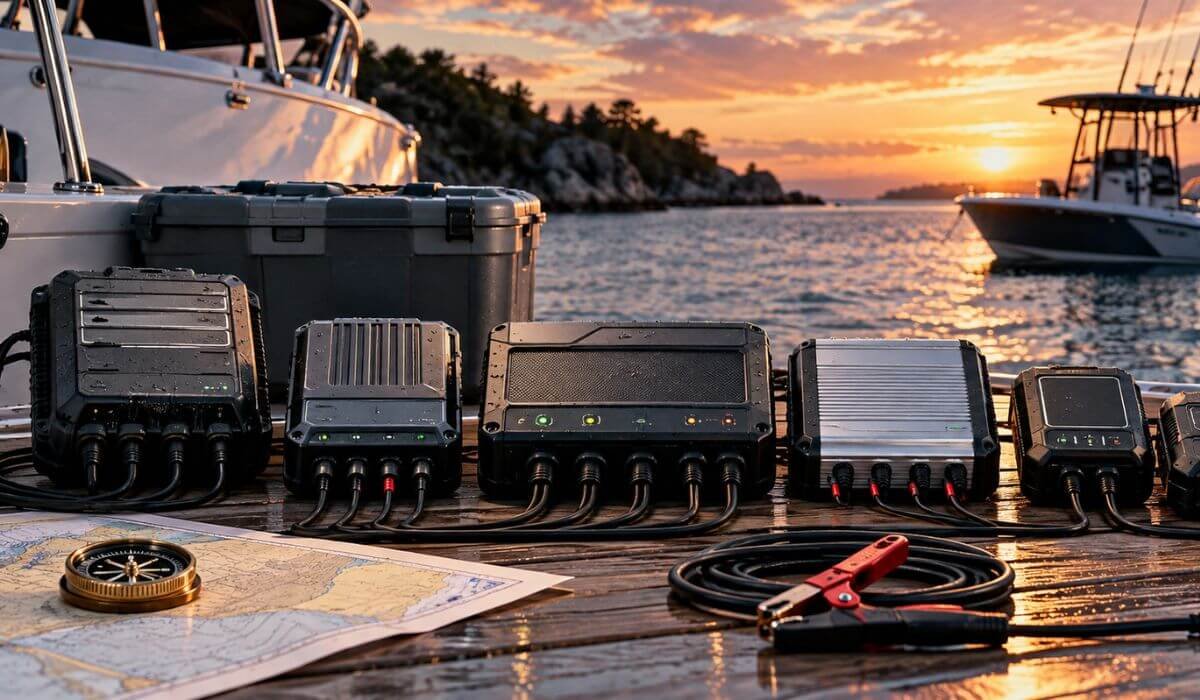
7 Best Marine Battery Chargers in 2026: 40A Power, 4-Bank Charging, LiFePO4 Support & Waterproof Protection
Choosing a marine battery charger gets complicated the moment your boat has more than one battery. A starting battery, house battery, trolling-motor bank, and auxiliary battery do not necessarily need the same charging treatment, and simply buying the charger with the highest amp rating can be a costly mistake. Bank count, battery chemistry, charging output, battery capacity, installation space, and the amount of time available between trips all matter more than a big number printed on the box.
That is why this guide focuses on chargers that make sense for actual onboard setups, not just impressive specifications. The NOCO GENPRO10X4, for example, delivers 40A across four independent banks, supports 12V lead-acid and lithium batteries, and carries an IP68 rating, making it particularly interesting for larger boats where several batteries need to be charged without constantly moving a portable charger from one battery to another.
There is another detail that is easy to overlook: physical size and installation conditions. A charger can have excellent electrical specifications and still be the wrong choice if there is not enough protected mounting space, the cables cannot reach the batteries cleanly, or the installation leaves connections exposed to moisture and corrosion. Marine protection ratings such as IP67 and IP68 are useful, but they do not eliminate the need for sensible mounting, proper wiring, fusing, and protected connections.
The seven chargers below cover very different requirements, from compact two-bank maintenance charging to high-output four-bank systems, with options for LiFePO4, AGM, flooded batteries, trolling-motor setups, and long-term onboard maintenance. The goal is simple: match the charger to the boat you actually have, rather than paying for capacity or features your battery system will never use.
Best Marine Battery Charger: Top 2026 Picks by Bank, Power & Battery Type
From compact 2-bank boat chargers to powerful 3-bank and 4-bank onboard marine battery chargers, these picks cover lithium, AGM, flooded batteries, smart charging, and long-term maintenance.
#1. NOCO GENPRO10X4 40A 4-Bank Marine Charger
Best 40A Marine Battery Charger for 4-Bank Boat Systems with 10A Per Bank, LiFePO4 Support & IP68 Waterproof Protection
#2. Minn Kota Precision MK-440PCL 4-Bank Charger
Best 4-Bank Onboard Marine Battery Charger with 10A Per Bank, LiFePO4 Compatibility, Automatic Temperature Compensation & Smart Charging Control
#3. NOCO GEN5X3 3-Bank Charger
Best 3-Bank Boat Battery Charger with 15A Total Output, 5A Per Bank, LiFePO4 Support, Multiple Charging Modes & IP68 Waterproof Protection
#4. ProMariner ProSportHD 20 Plus Global Gen 4
Best 20A Marine Battery Charger for 3-Bank Boat Systems with Distributed-On-Demand Charging, Multi-Voltage Support, LiFePO4 Compatibility & IP67 Protection
#5. Guest 2713A On-Board Battery Charger
Best 15A Marine Battery Charger for 3-Bank AGM & Flooded Battery Systems with 5A Per Bank, Automatic 5-Stage Charging & IP67 Protection
#6. FirstPower Pro 3-Bank Marine Battery Charger 5X3
Best Budget 3-Bank Marine Battery Charger with 15A Total Output, 5A Per Bank, Lithium Support, Thermal Protection & Smart Charging Features
#7. Battery Tender WaveCharge 6A 2-Bank Charger
Best 2-Bank Marine Battery Charger for 6V/12V Batteries with 3A Per Bank, Lithium & AGM Support, Independent Charging & Smart Maintenance
Expert Tip
Before buying a marine battery charger, look at your battery setup first and the charger second. A 40A four-bank charger sounds impressive, but it is unnecessary if your boat only has two batteries. On the other hand, putting a small 2-bank charger on a boat with several large deep-cycle batteries can leave you waiting far longer than expected.
Also check the battery chemistry before ordering. Newer LiFePO4 batteries need a charger that specifically supports lithium charging, while many older boats still use AGM or flooded lead-acid batteries. If you are replacing an older onboard charger, do not assume the new model will be a direct upgrade just because it has a higher amp rating. Bank count, charging profile, physical size, mounting space, and battery capacity all matter.
How We Choose These Marine Battery Chargers
We did not rank these chargers simply by looking at the biggest number on the box. The goal was to build a list that covers the different battery setups boat owners actually have, from a compact two-bank system to a demanding four-bank trolling-motor setup.
1. We Started With Charging Capacity
Output is one of the first things we compared because it directly affects how useful a charger is for a multi-battery boat. The list ranges from the 6A Battery Tender WaveCharge to the 40A NOCO GENPRO10X4.
That difference is important. A 6A two-bank charger can be a sensible choice for a smaller setup, while a four-bank charger delivering 10A to each bank is much better suited to a boat carrying several batteries that need regular charging.
We therefore considered total output and output per bank, rather than treating every multi-bank charger as equal.
2. Battery Compatibility Was a Major Filter
Battery chemistry can completely change which charger makes sense.
Some of the newer models in this list support LiFePO4/lithium batteries alongside AGM and flooded lead-acid batteries, giving owners more flexibility as battery technology changes. The NOCO GENPRO10X4, NOCO GEN5X3, and Minn Kota Precision are particularly relevant here.
We also kept conventional options in the list because not every boat owner is running lithium batteries. If your boat still has AGM or flooded batteries, buying a lithium-focused charger simply because it is newer may not give you any meaningful advantage.
3. We Looked at Bank Count, Not Just Amp Rating
A charger with multiple banks is useful because it can charge separate batteries at the same time instead of forcing you to move cables from one battery to another.
That is why the list deliberately includes 2-bank, 3-bank, and 4-bank chargers. The right number depends on your actual setup.
A two-bank charger can be ideal for a simple starting-and-house arrangement. Three banks make more sense when a trolling motor battery is added. Four-bank models are aimed at more demanding setups where several batteries need dedicated charging connections.
4. Marine Protection Matters More Than It Does in a Garage
A boat is a harder environment for electronics than a dry garage. Water exposure, vibration, temperature changes, and limited mounting space all become part of the buying decision.
For that reason, we gave additional weight to models with water-resistant or waterproof construction, vibration resistance, thermal protection, and purpose-built onboard designs. These features do not make a charger magically better, but they are exactly the sort of details that matter once the charger is permanently installed on a boat.
5. We Considered Older Boats as Well as Newer Setups
One thing we did not want to do was make this list entirely about the newest technology.
Many boat owners are replacing a charger that has been installed for years. Their requirements can be very different from someone building a new lithium-powered setup from scratch. That is why this list includes both modern lithium-capable chargers and more traditional marine charging options.
This also helps explain why a lower-output charger appears beside a 40A model. It is not there because it can compete with the GENPRO10X4 on raw power. It is there because not every boat needs 40A, and paying for capacity you will never use is not automatically a smart purchase.
6. Physical Size and Installation Were Part of the Decision
An onboard charger has to physically fit where you intend to mount it. That sounds obvious, but it is an easy detail to overlook when comparing chargers online.
We considered the overall footprint, bank configuration, onboard design, and practical installation requirements alongside electrical specifications. A charger that has excellent specifications but cannot comfortably fit your available mounting area is not a good recommendation for that particular boat.
7. Finally, We Matched Each Charger to a Real Use Case
The final ranking is therefore not simply “most amps wins.”
The GENPRO10X4 leads because it combines high output, four-bank capability, modern battery support, and strong marine protection. The Minn Kota follows as a highly capable four-bank option. The GEN5X3 gives owners a more compact three-bank alternative, while the ProMariner offers a different approach to distributing its 20A output.
Further down the list, the Guest, FirstPower, and Battery Tender models serve owners with more specific requirements, particularly conventional battery systems, tighter budgets, or smaller two-bank setups.
That is the approach behind these recommendations: match the charger to the boat, not the boat to the charger. If you know your battery type, number of banks, and charging requirements before you buy, you are far less likely to end up paying for features or output that your boat will never actually use.
#1. NOCO GENPRO10X4 12V 40A 4-Bank Onboard Marine Battery Charger & Maintainer
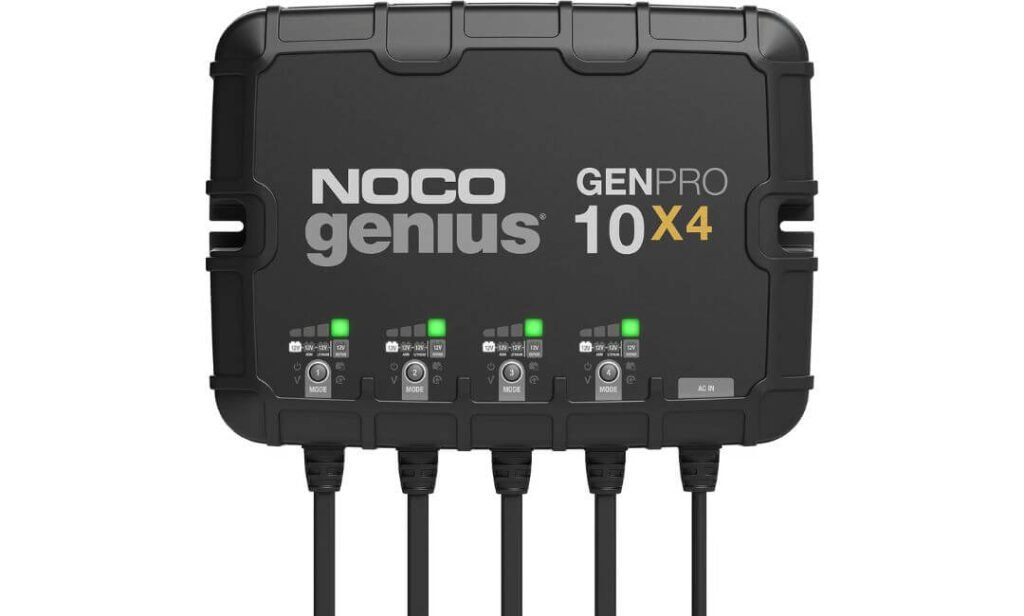
Quick Specs:
- Banks: 4 independent charging banks
- Charging Output: 10A per bank / 40A total
- Battery Voltage: 12V
- Battery Compatibility: Lead-acid, AGM & LiFePO4/lithium-ion
- Charging Modes: 12V, AGM, Lithium & Repair
- Water Protection: IP68 fully sealed housing
- Temperature Control: Built-in thermal sensing for temperature-adjusted charging
- DC Cable Length: 72 inches
- AC Cable Length: 72 inches
- Physical Size: 13.78 × 11.65 × 6.06 inches
- Weight: 16.98 lb
- Warranty: 3 years
Four batteries are where a marine charging setup can get annoying fast. You can have a starting battery, house battery, and multiple trolling-motor batteries all needing attention—and that is exactly where a four-bank design earns its space. Here, each bank gets its own 10A output, so you can leave four 12V batteries connected rather than playing cable-swapping games every time you return to the dock.
What makes the setup more interesting is the independent charging selection. One bank can be configured for standard 12V, another for AGM, and another for lithium, rather than forcing every connected battery into the same charging profile. That is a particularly useful detail for boats that have been gradually upgraded over time. The built-in thermal sensing also adjusts charging around temperature changes, which is one of those features you may barely notice when everything is working properly—but appreciate when the boat is sitting through very different seasonal temperatures.
Then there is the part I would pay close attention to on a marine charger: protection from the environment. The IP68-rated sealed housing is designed for permanent onboard use, while the anti-vibration backing helps deal with the movement and vibration a charger experiences on a boat. The 72-inch leads give you useful installation reach, although you should still measure your intended mounting location before ordering; a charger this capable is not a tiny accessory at 13.78 × 11.65 × 6.06 inches and 16.98 lb.
(In simple terms: this is the kind of charger you install once, wire correctly, select the right battery modes, and let quietly handle the charging and maintenance in the background.)
What We Like About It
- Four genuinely independent banks make it a strong fit for boats running several batteries at once.
- 10A per bank is a useful middle ground—substantial enough for serious multi-battery setups without turning the charger into an unnecessarily oversized power unit.
- The ability to select Lithium, AGM, standard 12V, or Repair mode independently is a big advantage when a boat uses different battery types.
- IP68 protection and the vibration-isolating mounting design make far more sense for permanent marine installation than treating a normal garage charger as an onboard solution.
- The 3-year warranty adds some welcome reassurance when you are putting a premium charger into a setup that may be difficult to access once installed.
What We Don’t
The only thing to keep in mind is its physical footprint and weight. It is compact for a four-bank charger, but it is still a substantial piece of equipment, so measure the available mounting area and cable routing before installation.
Why It Earns the Top Spot in Our Marine Charger Picks
The biggest reason this one sits at the top is not simply the 40A headline number. It is the combination of four-bank independence, 10A-per-bank output, broad battery compatibility, temperature-aware charging, and serious marine protection. Those features solve several problems at the same time, which is exactly what we want from a premium onboard charger.
It also makes sense for a boat owner who is moving from an older battery setup toward lithium without wanting to replace the charger again later. You get the flexibility to manage different 12V battery chemistries independently, while the sealed construction and permanent-mount design keep the charger suited to its actual environment.
The Insider Pro-Tip
Before installation, take five minutes to map every battery and its chemistry. Write down which bank is connected to the starting battery, house battery, and trolling-motor batteries, then set each charging mode accordingly. It sounds almost too simple, but this little bit of planning can save a lot of confusion later—especially on a mixed-battery boat.
And one more practical point: don’t choose a four-bank charger just because four banks sound better. If your boat only needs two banks today, buy according to the system you actually run. But if you already have four 12V batteries, particularly a mix of AGM/lead-acid and LiFePO4, this is the sort of charger where the extra capability has a real purpose rather than being just another number on the specification sheet.
#2. Minn Kota Precision MK-440PCL On-Board Marine Battery Charger – 4 Banks, 10A Each
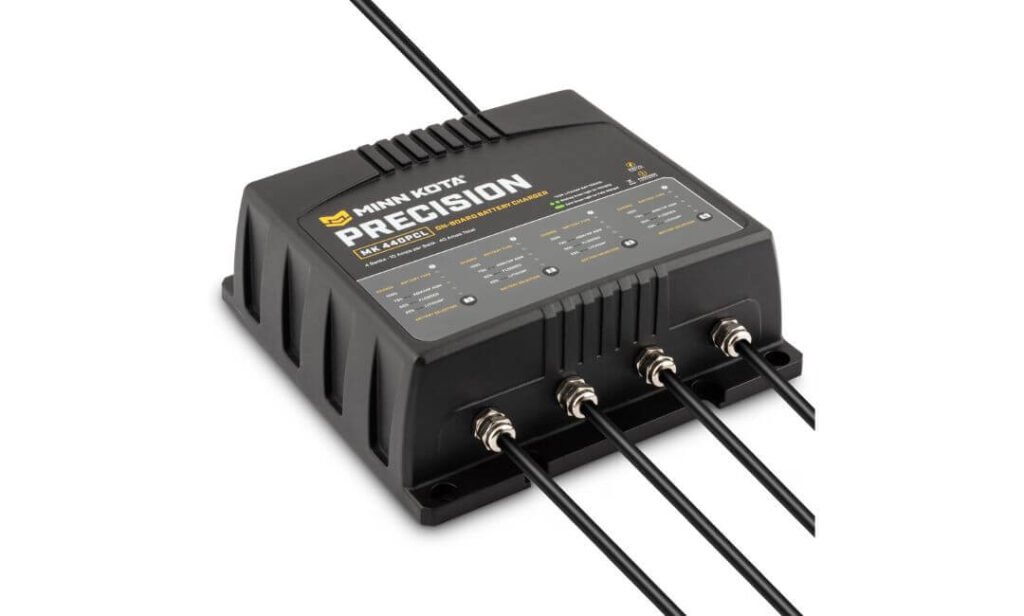
Quick Specs:
- Charging setup: 4 independent banks
- Output: 10A per bank / 40A total
- Battery support: 12V AGM, flooded lead-acid, gel & LiFePO4
- Charging system: Automatic multi-stage, microprocessor-controlled
- Temperature control: Automatic temperature compensation
- Maintenance: Automatic maintenance/float charging
- Battery care: Equalization cycle for flooded lead-acid batteries
- Construction: Waterproof, shock-resistant & vibration-resistant
- Status monitoring: Individual LED indicators for charging, maintenance & errors
- Input: 120V AC
- Size: 9.88 × 3.5 × 9.88 inches
- Weight: 11.5 lb
- Warranty: 3 years
There is a particular point where a four-bank charger stops being a luxury and starts becoming a genuinely useful part of the boat. If your setup includes a cranking battery, trolling-motor batteries, and another auxiliary battery, charging everything individually gets old very quickly. This unit is built around that exact situation, giving each of its four banks 10A of dedicated output instead of making you manage batteries one at a time.
The part I like most is the freedom to treat each battery according to what it actually is. You can select AGM, flooded lead-acid, gel, or LiFePO4 independently on each bank, so a boat that has evolved from traditional batteries to lithium does not necessarily need every battery to be the same chemistry. The microprocessor-controlled charging also continuously manages voltage and current through the charging cycle, while temperature compensation helps keep the charging process consistent when conditions change.
There is some thoughtful battery-care technology here too. Flooded lead-acid batteries can receive automatic equalization, with a push-button option for a more thorough cleaning cycle, while fully charged batteries can move into maintenance charging automatically. Add the shock- and vibration-resistant waterproof construction, individual LED status information, and the relatively narrow 3.5-inch width, and this feels much more like a charger designed around the realities of an onboard installation than a generic charger adapted for marine use.
(The simple takeaway: if your boat has four batteries and you want each one treated according to its own chemistry, this is where the four-bank design starts making very good sense.)
What We Like About It
- Independent battery-type selection is a major advantage for mixed setups, especially when upgrading individual batteries to LiFePO4 over time.
- 10A for every bank gives all four connected batteries dedicated charging capacity rather than relying on one shared connection.
- The automatic temperature compensation is a useful behind-the-scenes feature because charging requirements can change with ambient conditions.
- Equalization and maintenance functions give owners of flooded batteries something genuinely useful beyond simply putting them back on charge.
- The LED indicators for each bank make it much easier to spot what is happening without guessing from a single status light.
What We Don’t
The only practical consideration is that the four-bank capacity is more than a smaller boat may need. If you only have one or two batteries, there is little reason to install a charger designed around four independent banks.
Why It Deserves a High Spot in Our Boat Charger Picks
This one earns its place near the top because it gets the fundamentals right without making the feature list feel like the product is trying too hard. Four independent 10A banks, broad battery chemistry support, automatic multi-stage charging, temperature compensation, and marine-ready construction cover the things that actually matter once the charger is installed and the boat is being used regularly.
It is particularly compelling for anglers with a more involved electrical setup. You are not locked into one battery chemistry, and the charger can continue making sense if your boat changes over time. That makes it more than a high-output charger—it is a flexible long-term charging solution for a boat that may not stay configured exactly the way it is today.
The Insider Pro-Tip
If you are replacing an older four-bank charger, photograph and label the existing battery connections before removing anything. Then match each new bank to the correct battery and select its chemistry before plugging into shore power. It takes a few extra minutes, but on a mixed AGM/LiFePO4 setup, that small bit of organization is much smarter than trying to remember which battery is connected where after everything is mounted.
One other thing worth checking before you buy: measure the mounting area, not just the charger itself. At 9.88 × 3.5 × 9.88 inches, the narrow body can be convenient in some installations, but the surrounding cable routing and access for the connections matter just as much as the charger’s listed dimensions.
#3. NOCO GEN5X3 12V 15A 3-Bank Onboard Marine Battery Charger & Maintainer
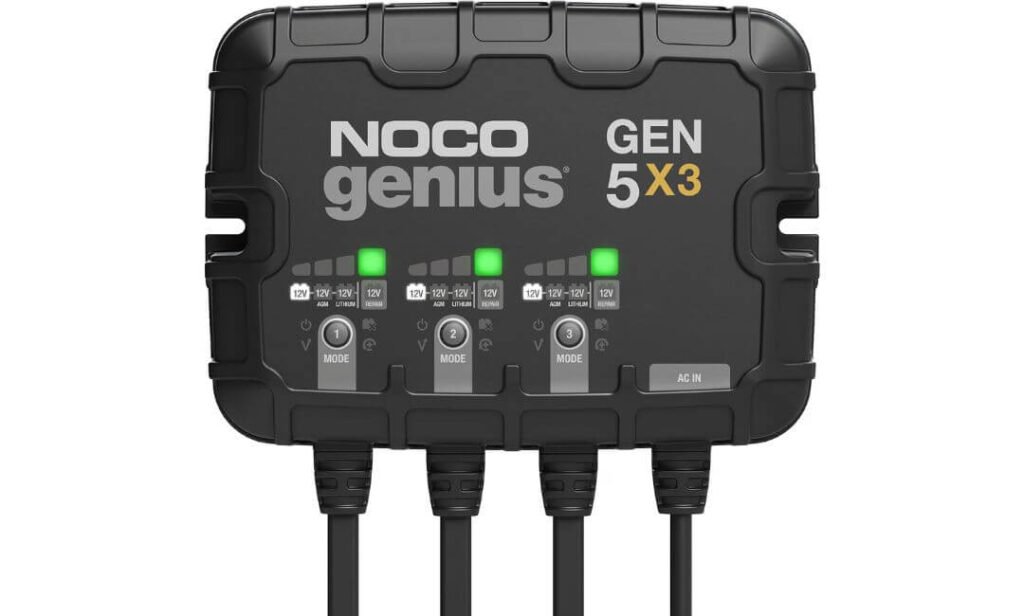
Quick Specs:
- Charging setup: 3 independent banks
- Output: 5A per bank / 15A total
- Battery voltage: 12V
- Battery support: Lead-acid, AGM, gel & LiFePO4/lithium-ion
- Charging modes: 12V, AGM, Lithium & Repair
- Water protection: IP68 fully sealed
- Temperature control: Integrated thermal sensing
- Deep-discharge support: Charging from 1V; Force Mode for batteries down to 0V
- Mounting: Any orientation, including upside down
- DC cable length: 72 inches
- AC cable length: 72 inches
- Size: 10.08 × 8.86 × 5.63 inches
- Weight: 6.09 lb
- Warranty: 3 years
Three batteries are a very common point for a fishing boat to become more complicated than it needs to be. You may have a starting battery, trolling-motor battery, and house or auxiliary battery, and charging them separately after every trip quickly becomes one more job nobody wants to deal with. This charger takes that routine away by giving each battery its own 5A charging bank, for 15A total.
The useful part is not just the number of banks. Each one can be configured independently for 12V, AGM, Lithium, or Repair mode, which gives you considerably more freedom if your battery setup is not completely uniform. That is especially handy when an older lead-acid or AGM battery is still running alongside a newer LiFePO4 battery. Instead of treating the whole boat as one system, the charger can deal with each battery according to what is actually connected to it.
There is also a lot packed into a relatively small 6.09-pound housing. The fully sealed IP68 construction, anti-vibration backing, and flexible mounting orientation make it well suited to permanent onboard installation. The thermal sensor adjusts charging as temperatures change, while the low-voltage capability can be useful when a neglected battery has fallen so far that an ordinary charger may not recognize it.
(This is the sort of three-bank setup that makes sense when you want the batteries ready without turning charging into another pre-trip chore.)
What We Like About It
- Independent 5A charging gives each battery its own controlled charging path.
- Lithium, AGM, gel, and flooded battery support makes it flexible for mixed or evolving boat setups.
- IP68 sealing is a major advantage for a charger that will live onboard rather than in a dry workshop.
- The compact 6.09-lb design is considerably easier to accommodate than many larger multi-bank units.
- Repair and low-voltage charging capability give it an extra layer of usefulness when dealing with batteries that have been neglected or deeply discharged.
What We Don’t
The 5A-per-bank output is the main limitation to understand. It is perfectly sensible for many three-battery setups, but owners with larger-capacity batteries who want the fastest possible recharge may prefer a higher-output charger.
Why It Makes So Much Sense for a Three-Battery Boat
This is where the GEN5X3 separates itself from simply being a smaller version of a four-bank charger. Its real strength is balance. Three independent banks, modern battery compatibility, IP68 protection, temperature-aware charging, and a relatively compact body give it a very practical combination for boats that do not need four banks.
It is also a particularly sensible choice if your boat is in the middle of a battery transition. You can have conventional batteries today and move toward LiFePO4 later without immediately having to rethink the entire charging setup. That kind of flexibility is worth more than a flashy specification that you may never use.
The Insider Pro-Tip
Before mounting it permanently, identify every battery by its actual chemistry and role—starting, trolling, house, or auxiliary. Then configure each bank accordingly. Do not assume that because all three batteries are 12V they should all use the same charging mode; voltage is only one part of battery compatibility.
Also measure the installation area with the cables in mind, not just the charger’s 10.08 × 8.86 × 5.63-inch body. The 72-inch leads give you useful reach, but good cable routing matters on a permanent marine installation. A neat installation today means far less frustration the next time you need to inspect a battery connection.
#4. ProMariner ProSportHD 20 Plus Global Gen 4 3-Bank Battery Charger
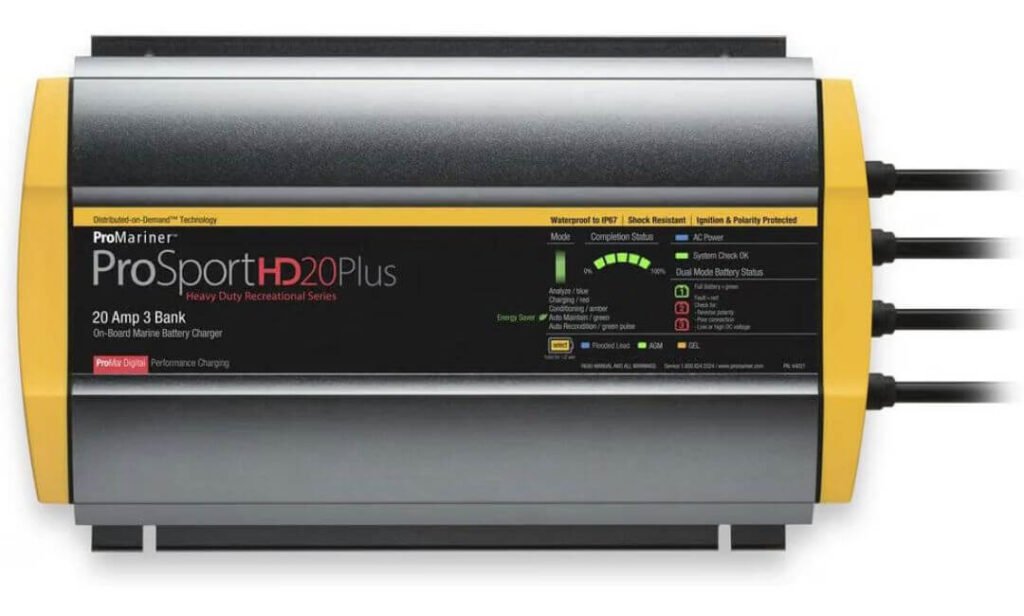
Quick Specs:
- Charging setup: 3 independent banks
- Output: 20A total with Distributed-On-Demand charging
- Battery voltage: 12V
- Battery support: AGM, flooded lead-acid & gel
- Charging system: Automatic 5-stage charging
- Power input: 100–240V AC, 50/60Hz
- Maintenance: Automatic float/maintenance charging
- Design: Marine-focused onboard installation
- Size: 16.4 × 8.7 × 6.3 inches
- Weight: 8.8 lb
Some chargers make their case with a big output number; this one makes more sense when you look at how that output is managed. The ProSportHD provides 20A across three banks, but it does not simply behave like three permanently fixed outputs. Its Distributed-On-Demand system can move available charging power toward the battery that needs more attention, which is useful when three batteries are rarely sitting at exactly the same state of charge.
That makes it a natural fit for a familiar fishing-boat arrangement: two deep-cycle trolling-motor batteries plus a starting or house battery. The automatic 5-stage charging process handles the progression from bulk charging through absorption and float maintenance without requiring you to babysit it. It supports flooded, AGM, and gel batteries, so it remains a straightforward choice for a conventional lead-acid boat that is not moving to lithium.
Another detail that can genuinely matter depending on where you use the charger is its 100–240V global input. It is designed around international power standards rather than being locked to one input voltage. The trade-off is worth knowing before purchase, though: the Global version can come with a computer-style AC connector rather than the standard U.S. household plug. That is not a performance problem, but it is something you want to discover before installation, not when you are standing beside the boat with the charger ready to connect.
(In other words, this is a conventional-battery charger with a clever way of managing its 20A capacity—not a lithium-ready replacement for the newer models above.)
What We Like About It
- 20A total output gives it more charging capacity than many basic three-bank units.
- Distributed-On-Demand technology makes better use of that available power when the three batteries have different charging needs.
- The 5-stage automatic charging cycle handles charging and maintenance without constant attention.
- 100–240V input gives the Global model useful flexibility for different electrical environments.
- Its 8.8-lb construction keeps it reasonably manageable for an onboard multi-bank installation.
What We Don’t
The biggest consideration is battery compatibility: this model is aimed at conventional flooded, AGM, and gel batteries rather than LiFePO4. If lithium is part of your current setup—or your immediate upgrade plan—the newer lithium-capable options in this list are a better direction.
Where It Fits in Our Marine Charger Lineup
The ProSportHD earns its position because it offers something genuinely useful for a traditional three-bank boat: 20A of available charging power with intelligent distribution. For a conventional lead-acid/AGM setup, that can be a very practical combination, particularly when the three batteries do not all need the same amount of charging at the same time.
But we would not pretend it is the most future-proof charger here. The lack of LiFePO4 support matters in 2026, especially as more boat owners replace trolling-motor batteries with lithium. That is precisely why it sits behind the newer lithium-compatible models rather than being ranked purely on its 20A output.
The Insider Pro-Tip
If your boat still runs flooded, AGM, or gel batteries, this charger can make a lot of sense—but check the exact battery chemistry before you connect anything. And if you are buying the Global version for use in the U.S., check the included AC connector before installation so you have the correct connection solution ready.
One final point: don’t compare the 20A figure directly with a charger advertised as “10A per bank.” The charging architecture is different here. Distributed-On-Demand means the available current can be directed where it is needed, so the total-output figure tells only part of the story.
#5. Guest 2713A On-Board Battery Charger – 15A, 3-Bank
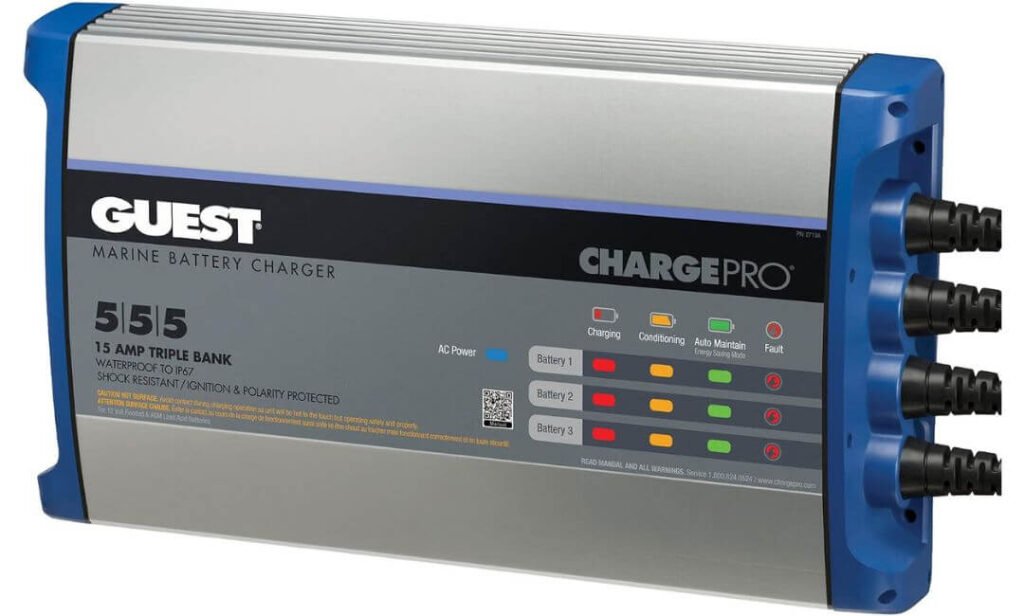
Quick Specs:
- Charging setup: 3 independent banks
- Output: 15A total / 5A per bank
- Battery voltage: 12V DC
- Battery support: 12V flooded lead-acid & AGM
- Input: 120V AC
- Charging: Automatic multi-stage charging
- Water protection: IP67 sealed housing
- Safety: Reverse-polarity, over-current, over-voltage, over-temperature & ignition protection
- Bank protection: In-line fuses
- Construction: Shock-resistant marine design
- Size: 12.9 × 7.5 × 2.4 inches
- Weight: 6.7 lb
There is something to be said for a charger that does exactly what a conventional boat owner needs without making the setup unnecessarily complicated. The 2713A is built around a straightforward three-bank arrangement, delivering 5A to each 12V battery so your starting, trolling, and auxiliary batteries can remain connected and charge independently.
Its strongest argument is its practicality. You get dedicated sensing for each bank, automatic charging and maintenance, and an IP67 sealed housing designed for the environment it will actually live in. The charger also includes protections for reverse polarity, over-current, over-voltage, overheating, and ignition-related hazards. Those aren’t glamorous specifications, but they are the kinds of details that become important when electrical equipment is permanently installed around batteries, moisture, and boat electronics.
It is also a particularly honest choice for someone who is staying with flooded or AGM lead-acid batteries. There is no need to pay for lithium functionality you will not use. The slim 2.4-inch depth is another nice touch when installation space is tight, while the 6.7-pound weight keeps mounting relatively manageable.
(This is the “keep my three conventional batteries charged and stop making me think about them” option—and sometimes that is exactly what you want.)
What We Like About It
- Three independent 5A banks make it a sensible match for conventional multi-battery boat setups.
- IP67 sealing gives it the environmental protection expected from a permanent onboard charger.
- The combination of dedicated bank sensing and automatic maintenance means less hands-on battery management.
- Multiple electrical and ignition protections add meaningful peace of mind around a marine battery compartment.
- Its 2.4-inch depth is genuinely useful when you are working with a cramped mounting location.
What We Don’t
The main limitation is simple: it is designed for 12V flooded and AGM lead-acid batteries, so it is not the choice for a LiFePO4 setup or a boat running a 24V/36V battery system.
Why It Still Belongs on This List
Not every good marine charger needs to chase the newest battery technology. The 2713A earns its place because it handles a very common requirement well: three 12V lead-acid/AGM batteries that need independent charging and long-term maintenance.
Compared with the more advanced chargers above it, you give up lithium support and some charging flexibility. In return, you get a relatively straightforward onboard system with useful protection, sealed construction, and a compact profile. For the right boat, that simplicity is actually an advantage.
The Insider Pro-Tip
If your boat has three conventional 12V batteries, look at this model as a complete charging system rather than focusing only on the 15A headline. Five amps per bank is the number that matters when all three batteries are connected, and that makes it better suited to steady overnight or dockside charging than situations where you regularly need a very fast turnaround.
Also, give the charger some breathing room around the housing during installation. It is only 2.4 inches deep, but enclosed marine compartments can retain heat. A little attention to mounting and ventilation is far better than squeezing an electrical component into the smallest possible space and forgetting about it.
#6. FirstPower Pro 5X3 12V 15A 3-Bank Marine Battery Charger
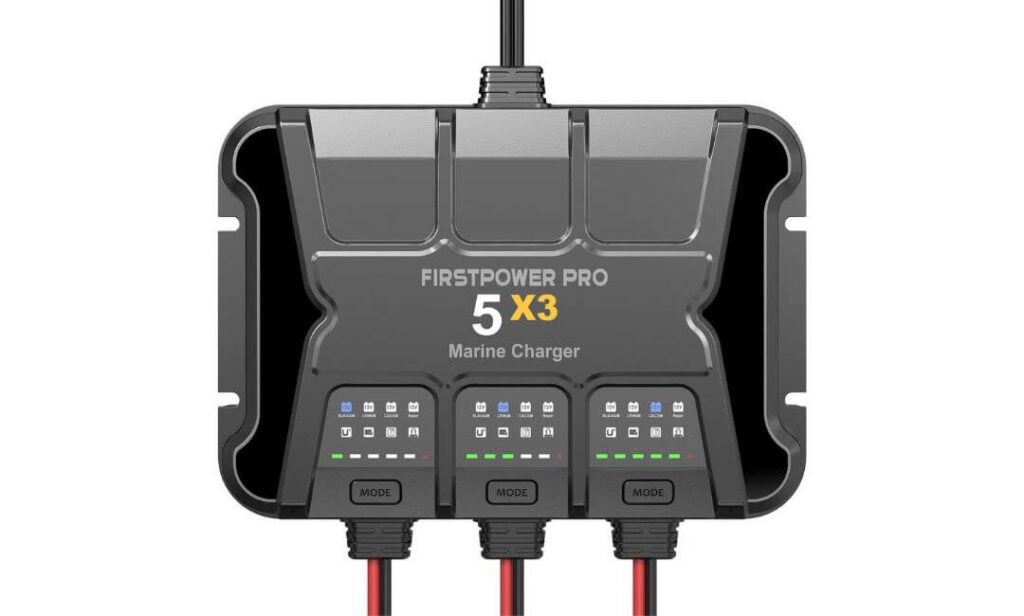
Quick Specs:
- Charging setup: 3 independent banks
- Output: 5A per bank / 15A total
- Battery voltage: 12V
- Battery support: Lead-acid, AGM, lithium-ion & calcium
- Charging modes: SLA/AGM, Lithium & Calcium
- Repair function: Automatic 12V Repair mode
- Diagnostics: Over-voltage, bad battery, over-temperature & reverse-connection detection
- Water protection: IP68 fully sealed
- Temperature control: Integrated thermal sensor
- Progress indicator: 5-stage 20–100% display
- Input: 120V AC
- Size: 9.45 × 7.68 × 1.97 inches
- Weight: 7.59 lb
- Warranty: 3 years
If you are looking at the price before anything else, that does not automatically mean you are looking for a bare-bones charger. This FirstPower Pro is interesting because it brings several features normally associated with more expensive onboard units into a 15A three-bank package. Each bank gets 5A, and each can be configured separately for SLA/AGM, lithium, or calcium, so the charger is not restricted to one battery type across the entire boat.
That flexibility is particularly useful on a boat where the battery setup has changed over time. Perhaps the trolling-motor battery has already been upgraded to lithium while the starting battery is still AGM or lead-acid. Instead of forcing everything onto one charging profile, each bank can be set independently. The integrated thermal sensor also adjusts the charging behavior according to ambient temperature, which is a sensible feature for equipment that may spend months onboard through changing conditions.
Then there is the installation side. At only 1.97 inches deep, the housing is notably slim, and the fully sealed IP68 construction is well suited to an onboard environment. Automatic repair mode, diagnostic alerts, inline fuses, and the five-level charging display add useful information without making the basic operation complicated. It is still a 12V-only charger, though, so owners running a 24V or 36V trolling-motor system need to look elsewhere.
(For a three-bank 12V boat that wants lithium flexibility without immediately jumping into premium pricing, this is a surprisingly feature-rich package.)
What We Like About It
- Independent chemistry selection lets you configure each of the three banks for the battery actually connected to it.
- IP68 sealing is a strong feature at this price point for permanent marine installation.
- The 1.97-inch depth makes it easier to work into cramped compartments where deeper chargers become awkward.
- Automatic diagnostics and repair mode provide useful feedback when a battery is not behaving normally.
- The 5-level charging display gives you a quick visual indication of progress without needing an app or complicated interface.
What We Don’t
The 5A-per-bank output is the main thing to keep in perspective. It is well suited to steady charging and maintenance, but larger batteries that regularly need a fast turnaround may benefit from a higher-output charger.
Why It Makes the Cut for a 3-Bank Boat
This is where the FirstPower Pro earns its spot rather than simply being the “budget option.” It gives you three independent banks, lithium compatibility, IP68 protection, temperature compensation, diagnostics, and repair functionality in a relatively slim housing.
It does not replace the higher-end choices above when maximum output, established marine-brand track record, or four-bank capacity is the priority. But for someone building a practical 12V three-battery setup, it covers a lot of the right ground without paying for capability they may never use.
The Insider Pro-Tip
If you are buying this specifically because you have a mixed battery setup, do not rush the initial configuration. Identify the chemistry of each battery first, connect the correct bank, and select the corresponding mode before leaving the charger to operate unattended. The independent controls are one of its most useful features, so there is little reason not to use them properly.
And if you are installing it in a tight compartment, take advantage of that 1.97-inch depth, but don’t bury the charger where you cannot inspect the connections or fuses later. A clean installation should make future maintenance easier, not turn a simple fuse check into a full afternoon job.
#7. Battery Tender WaveCharge 6A 2-Bank Marine Battery Charger & Maintainer
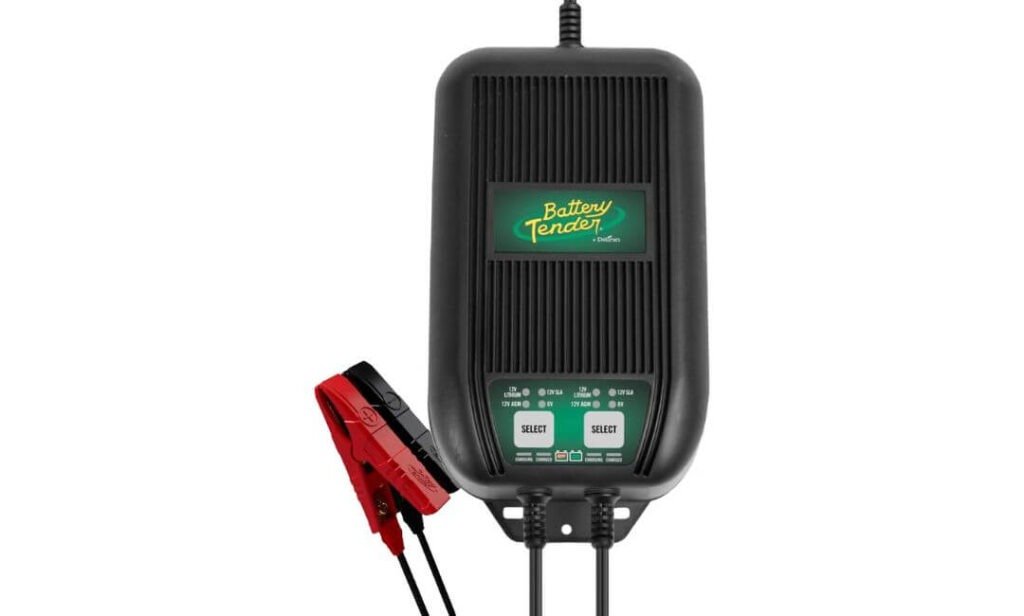
Quick Specs:
- Charging setup: 2 independent banks
- Output: 3A per bank / 6A total
- Selectable voltage: 6V or 12V per bank
- Battery support: Lead-acid, flooded, AGM, gel & compatible 12V lithium
- Charging system: Automatic 4-stage charging
- Maintenance: Automatic float/maintenance mode
- Water protection: IP67
- Marine safety: Marine UL rated, spark-proof & ignition protected
- Connection options: Alligator clips + ring-terminal harnesses
- Size: 13.86 × 3.98 × 4.23 inches
- Weight: 3.22 lb
- Warranty: 2 years + lifetime customer support
Not every boat needs a four-bank charger sitting in the battery compartment. For a two-battery setup, adding more charging capacity than you actually need can simply make the installation bigger and more expensive. The WaveCharge takes the opposite approach: two independent banks, 3A per bank, and selectable 6V/12V operation, giving it a very specific job—and doing that job without unnecessary complexity.
The 6V/12V selection is probably the feature that makes this one stand out most from the other chargers in our lineup. Each bank can be configured independently, while the charger supports flooded, AGM, gel, lead-acid and compatible 12V lithium batteries. Once charging is complete, its automatic four-stage system moves into float and maintenance operation, making it useful for a boat that spends long periods sitting at the dock or in storage.
For marine use, the details are reassuringly practical. The IP67-rated housing, Marine UL rating, spark-proof design, ignition protection, reverse-connection warning, and fused quick-disconnects are all relevant when electrical equipment is living around batteries and moisture. At just 3.22 pounds, it is also considerably easier to handle than the larger multi-bank units above it. The limitation is equally straightforward: 3A per bank is intended for steady charging and maintenance, not rapid recovery of large, heavily discharged batteries.
(This is the charger for the owner who knows they need two banks—not the biggest charger possible—and would rather have the right tool than a larger one.)
What We Like About It
- Independent 6V/12V selection gives it unusual flexibility for a compact two-bank marine charger.
- 3A per bank is well suited to maintaining batteries and gradually bringing them back to full charge.
- IP67 and Marine UL-rated construction make it appropriate for permanent marine environments.
- The combination of spark-proof and ignition protection is a meaningful safety consideration around boat batteries.
- The included alligator-clip and ring-terminal harnesses make the charger adaptable to different connection setups.
What We Don’t
The obvious trade-off is 6A total output. If you regularly need to recharge large deep-cycle batteries quickly after a demanding trip, one of the higher-output chargers in this lineup will make more sense.
Why It Earns a Place in Our Marine Charger Picks
The WaveCharge is not competing with the 40A chargers on raw charging power, and it does not need to. Its strength is that it gives a two-battery boat a compact, flexible, marine-rated charging solution without asking the owner to install a much larger system.
The ability to select 6V or 12V independently, combined with automatic maintenance and marine-focused safety features, gives this model a legitimate reason to be here. If your setup is simple, the smartest charger is sometimes the one that doesn’t give you five extra banks you will never use.
The Insider Pro-Tip
Think about your normal charging routine rather than your worst-case scenario. If your boat’s two batteries are usually topped up after each trip and then sit for days or weeks, 3A per bank can be perfectly reasonable. If you routinely come home with deeply depleted, high-capacity batteries and need them ready again quickly, don’t expect a 6A charger to behave like a 20A or 40A system.
And before installation, confirm the 6V/12V requirement of each battery rather than assuming both banks should use the same setting. That small check is what makes one of this charger’s most unusual features genuinely useful instead of just another specification on the box.
Best Marine Battery Charger Comparison: 2-Bank, 3-Bank & 4-Bank Models (2026)
| Charger | Bank Setup | Output | Battery Support | Marine Protection | Smart Charging | Best Fit |
|---|---|---|---|---|---|---|
| BEST OVERALL NOCO GENPRO10X4 Premium 4-bank | 4 independent banks |
40A total 10A per bank |
Lead-acid, AGM & LiFePO4 Independent mode selection |
IP68 Fully sealed + anti-vibration |
Thermal sensing Repair + maintenance modes |
Four-battery boats needing high output and maximum flexibility. |
| BEST 4-BANK ALTERNATIVE Minn Kota Precision MK-440PCL 4-bank marine | 4 independent banks |
40A total 10A per bank |
AGM, flooded, gel & LiFePO4 Independent selection |
Waterproof Shock + vibration resistant |
Multi-stage Temperature compensation + equalization |
Fishing boats with four batteries and mixed chemistry needs. |
| BEST 3-BANK BALANCE NOCO GEN5X3 Compact 3-bank | 3 independent banks |
15A total 5A per bank |
Lead-acid, AGM, gel & LiFePO4 Independent mode selection |
IP68 Fully sealed + anti-vibration |
Thermal sensing Repair + maintenance |
Three-battery boats wanting modern lithium support in a compact unit. |
| SMART 20A OPTION ProMariner ProSportHD 20 Plus 3-bank Global | 3 independent banks |
20A total Distributed-On-Demand |
AGM, flooded & gel No LiFePO4 support |
Marine-focused Built for onboard use |
5-stage charging Automatic float maintenance |
Traditional 12V three-bank setups that can benefit from distributed charging. |
| BEST TRADITIONAL SETUP Guest 2713A 3-bank lead-acid | 3 independent banks |
15A total 5A per bank |
12V AGM & flooded No lithium support |
IP67 Sealed + shock resistant |
Automatic charging Maintenance + conditioning |
Conventional three-battery boats that do not need lithium compatibility. |
| BEST VALUE FirstPower Pro 5X3 3-bank budget pick | 3 independent banks |
15A total 5A per bank |
Lead-acid, AGM, lithium & calcium Independent mode selection |
IP68 Fully sealed |
Thermal sensing Repair + diagnostics |
Three-bank 12V setups where features matter but spending needs to stay sensible. |
| BEST FOR 2-BANK BOATS Battery Tender WaveCharge 6A Compact 2-bank | 2 independent banks |
6A total 3A per bank |
Lead-acid, AGM, gel & compatible lithium 6V/12V selectable |
IP67 Marine UL rated |
4-stage charging Automatic float maintenance |
Smaller two-battery setups where maintenance matters more than rapid charging. |
Buying Guide: How to Choose the Right Marine Battery Charger
A marine charger has a harder job than a basic garage charger. It may be installed permanently in a damp compartment, exposed to vibration, connected to several batteries, and left plugged into shore power for days or even months. So the right choice is not simply the charger with the highest amp rating. Battery chemistry, bank count, charging profile, protection, installation space, and the way you use the boat all need to make sense together.
The easiest way to avoid a bad purchase is to work through these points in order.
Start With the Boat’s Battery Setup
Before comparing chargers, count the batteries you actually need to charge.
A typical fishing boat might have:
- One starting/cranking battery for the engine
- One or more deep-cycle batteries for a trolling motor
- One house or auxiliary battery for electronics, pumps, lights, and accessories
- A more advanced setup may use four separate 12V batteries
That determines your required bank count.
A 2-bank charger makes sense for a simpler two-battery boat. A 3-bank charger is often a better match for a starting battery plus a trolling-motor setup. Four-bank charging becomes useful when several batteries need their own charging connection.
Do not buy additional banks simply because the number looks better on paper. If you have two batteries, a quality two-bank charger is often the cleaner solution. If you have four batteries, trying to make a smaller charger do the job defeats the whole purpose of an onboard system.
Understand What Makes a Charger Marine-Ready
The word “marine” should mean more than a charger being advertised for boats.
A permanently installed charger has to live with moisture, vibration, temperature changes, and electrical conditions that a garage charger normally never encounters. That is why sealed construction and marine-specific protection deserve real attention.
Look for:
- IP67 or IP68 protection against water and dust
- Sealed construction suitable for onboard installation
- Shock and vibration resistance
- Ignition protection where specified
- Reverse-polarity and over-temperature protection
- Proper marine-rated connectors, fuses, and wiring
- A design intended for permanent mounting rather than occasional portable use
IP ratings are worth understanding. IP67 generally means protection against dust plus temporary immersion. IP68 provides a higher level of water-ingress protection, although the exact testing conditions depend on the manufacturer’s specification.
That does not mean an IP68 charger should be casually thrown underwater. The practical takeaway is much simpler: a properly sealed marine charger is far better suited to life onboard than an ordinary household charger.
Match the Charger to Your Shore Power
Most onboard chargers are designed to receive AC shore power and convert it into the controlled DC charging current your batteries need.
For a typical U.S. boat, 120V AC input is common. Some Global models accept a wider 100–240V AC range, which can be useful for owners operating across different electrical standards.
But do not stop at the voltage number. Check the included AC cable and plug configuration before installation, particularly when buying a Global or international version. The ProMariner Global model in this guide is a good example of why this matters; its international-oriented input design can mean the included connector is not the standard U.S. household plug some buyers expect.
That is a small detail, but it is exactly the kind of detail worth discovering before the charger is mounted.
Decide How Much Charging Power You Actually Need
Amperage tells you how much charging current the charger can deliver, but it needs to be read in context.
For example:
| Charger output | What it means in practice |
|---|---|
| 6A total | Better suited to smaller two-bank setups and long-term maintenance |
| 15A total | Practical for steady three-bank charging |
| 20A total | More charging capacity for conventional three-bank setups |
| 40A total | Designed for demanding multi-bank systems, with 10A available per bank on the four-bank models here |
A common mistake is seeing 40A and assuming it is automatically four times better than a 10A charger. It is not that simple.
What matters is how that current is distributed.
A four-bank unit providing 10A to each bank is very different from a charger that has 40A available but distributes it according to a different charging architecture. Likewise, a 20A three-bank charger using Distributed-On-Demand technology should not be judged solely by dividing 20 by three and assuming every battery permanently receives exactly the same current.
For your own boat, ask a more useful question:
How quickly do I need the batteries ready after a normal day on the water?
If the boat returns to the dock and remains connected overnight, moderate charging output can be perfectly adequate. If you fish hard one day and need the batteries ready again a few hours later, higher output becomes much more valuable.
Know the Difference Between Battery Chemistries
This is probably the most important compatibility check in the entire buying process.
Flooded Lead-Acid Batteries
Traditional flooded batteries remain common because they are relatively inexpensive and familiar. They can work well in marine applications, particularly when maintained properly.
They also benefit from charging systems that provide conditioning or equalization functions, depending on the battery manufacturer’s recommendations.
The downside is that they require more attention than sealed alternatives and are generally less convenient for owners who want a completely maintenance-free setup.
AGM Batteries
AGM batteries are sealed lead-acid batteries with good resistance to vibration, making them popular for boats.
They are generally easier to live with than flooded batteries, but they still need a charging profile appropriate for AGM chemistry. A charger that lets you select AGM mode is preferable to simply assuming the standard lead-acid setting is suitable.
Gel Batteries
Gel batteries are another sealed lead-acid option. They have their own charging requirements, so a charger specifically supporting gel batteries can be useful when this chemistry is installed onboard.
Do not assume that “all lead-acid batteries charge exactly the same.” The chemistry and manufacturer’s charging requirements still matter.
LiFePO4 / Lithium Batteries
LiFePO4 has become increasingly popular for trolling motors because of its lighter weight, usable capacity, and different charging characteristics compared with conventional lead-acid batteries.
This is where newer chargers have a meaningful advantage.
A lithium battery should be charged using a charger that explicitly supports the battery’s chemistry and required charging profile. Do not connect a lithium battery to an older charger simply because both are labeled 12V.
The voltage label alone does not make two batteries interchangeable from a charging perspective.
Deep-Cycle and Trolling-Motor Batteries Need Special Attention
Deep-cycle batteries are designed to provide sustained power over longer periods rather than delivering one short burst like a starting battery.
Trolling motors can put substantial demand on these batteries, particularly during long fishing sessions, strong wind, current, or heavy boat loads.
That is why a charger should be selected around the actual capacity and chemistry of the trolling-motor batteries, not just the engine starting battery.
If your boat uses two batteries for a trolling-motor system plus a separate starting battery, a three-bank charger is often a logical arrangement. If the trolling-motor setup has more batteries or the boat carries additional auxiliary batteries, moving to four banks can make installation much cleaner.
Look for Independent Charging Profiles
This feature becomes especially valuable when the batteries are not identical.
A charger with independent bank control can treat each connected battery according to its chemistry and charging requirements.
For example, a boat could potentially have:
- Bank 1: AGM starting battery
- Bank 2: LiFePO4 trolling-motor battery
- Bank 3: LiFePO4 trolling-motor battery
- Bank 4: AGM or flooded auxiliary battery
The advantage is obvious: you are not asking one charging profile to suit four completely different batteries.
This is one reason independent mode selection appears repeatedly among the stronger choices in this guide.
Smart Charging Is More Than a Marketing Phrase
A good automatic charger does considerably more than push current into a battery until the voltage rises.
Modern multi-stage systems can move through different charging phases, typically involving bulk charging, absorption, and float or maintenance charging. The exact algorithm varies between manufacturers.
The basic idea is straightforward:
- Bulk: The charger supplies substantial current while the battery accepts it.
- Absorption: Charging becomes more controlled as the battery approaches full capacity.
- Float/Maintenance: The charger maintains the battery rather than continuously forcing maximum current into it.
Some models add temperature compensation, repair functions, equalization, or other battery-management features.
These functions matter because an onboard charger may remain connected long after the battery has reached full charge.
Temperature Compensation Is Worth Having
Boats see substantial temperature changes, especially during seasonal storage.
Battery charging behavior changes with temperature, so a charger with an integrated temperature sensor can adjust its charging approach as ambient conditions change.
This is one of those features that is easy to ignore while comparing specification sheets. In real ownership, however, automatic temperature compensation is useful precisely because you do not have to remember to compensate manually when the environment changes.
Don’t Ignore Safety Features
A marine battery compartment is not the place to treat electrical protection as an afterthought.
Useful features include:
- Reverse-polarity protection
- Over-current protection
- Over-voltage protection
- Over-temperature protection
- Ignition protection
- Inline fuses or dedicated bank protection
- Spark-resistant or spark-proof construction where specified
These features do not make an installation safe by themselves. Correct wiring, appropriate fusing, proper ventilation where required, and following both the battery and charger manufacturer’s instructions remain essential.
But when comparing otherwise similar chargers, better protection is a worthwhile differentiator.
Check the Physical Size Before You Buy
This is an easy mistake to make when shopping online.
A charger can have excellent electrical specifications and still be a poor choice if it does not fit the available compartment.
Measure:
- Available mounting surface
- Height and depth around the charger
- Space required for cable bends
- Access to terminals and fuses
- Distance between the charger and batteries
- Available AC shore-power connection
For example, the four-bank units in this guide are substantially larger than the compact two-bank option. That is normal. More banks and higher output usually require more hardware, so compare the physical dimensions before deciding which specification sheet looks best.
When a Higher-Amp Charger Is Actually Worth It
Higher output is most useful when you regularly return with batteries significantly discharged and have limited time before the next trip.
Choose more charging capacity when:
- You run large deep-cycle batteries
- Your trolling motor sees heavy use
- Several batteries need substantial recovery simultaneously
- The boat is used frequently
- You have a short charging window between trips
Stay with a lower-output option when:
- Your batteries are relatively small
- The boat remains connected to shore power overnight
- You mainly need maintenance during storage
- You have only two or three modestly sized batteries
The goal is not maximum amperage. The goal is enough charging power for your actual battery bank without paying for capacity you will rarely use.
The Bottom Line Before You Buy
If you remember only one thing from this buying guide, make it this: choose the charger around the batteries and the boat, not the other way around.
First identify the number of batteries. Then confirm their chemistry. After that, choose the appropriate bank count, output, charging profile, marine protection, shore-power configuration, and physical size.
For a modern mixed-battery boat, independent LiFePO4/AGM support and sealed marine construction can be more valuable than simply chasing the highest amp rating. For a conventional AGM or flooded setup, a reliable three-bank charger with appropriate maintenance and protection may be the smarter purchase.
That is also why the seven chargers in this guide are not interchangeable “good, better, best” products. Each one makes the most sense for a slightly different boat and battery setup.
How to Choose a Marine Battery Charger by Boat Type and Battery Setup
The best charger for a boat is really the one that fits the way that boat is wired and used. A weekend sailboat with two house batteries has very different charging needs from a bass boat carrying several trolling-motor batteries. Start with the battery bank, then consider the environment, available mounting space, and how often the boat returns to shore power.
Sailboats: Prioritize House-Battery Management and Long-Term Maintenance
Sailboats often spend longer periods away from shore power, so reliable maintenance charging can matter as much as fast charging.
A typical setup may include a starting battery and one or more house batteries powering navigation equipment, lighting, pumps, refrigeration, electronics, and other onboard systems. Depending on the boat, a two- or three-bank charger may be enough.
For this type of boat, look for:
- Independent charging banks for separate starting and house batteries
- AGM, flooded, or LiFePO4 compatibility matching the batteries installed
- Automatic float and maintenance charging for extended dockside periods
- Temperature compensation for seasonal storage
- Strong water and corrosion protection
- Enough output to restore the batteries within your normal time at the dock
There is little benefit in installing a huge four-bank charger if the electrical system does not need four independent charging outputs. Conversely, if the sailboat has been upgraded with multiple lithium house batteries, a modern charger with independently selectable lithium profiles becomes much more useful.
Powerboats: Match Charging Power to How Hard You Use the Boat
Powerboats can have a much wider range of electrical demands. A simple runabout may have one starting battery and an auxiliary battery, while a fishing boat can carry three or four batteries dedicated to starting, trolling motors, and onboard electronics.
For heavier setups, bank count and charging output become increasingly important.
A good rule is:
- Two batteries: Consider a two-bank charger.
- Three batteries: A three-bank charger is usually the natural fit.
- Four batteries: A four-bank charger becomes much more practical.
- Large deep-cycle banks: Consider higher output if you have short recharge windows.
- Frequent fishing trips: More charging capacity can reduce the time needed between outings.
The four-bank chargers in this guide are particularly suited to boats where several batteries need to be connected permanently. The important part is not simply having four outputs; each bank should be appropriate for the battery connected to it.
Trolling Motors: This Is Where Battery Chemistry Really Matters
Trolling motors can place considerably more demand on deep-cycle batteries than many general onboard accessories.
If you regularly run a trolling motor for hours, the battery bank can return to the dock significantly discharged. That makes charger output, battery capacity, and charging chemistry worth checking carefully.
Older setups commonly use flooded lead-acid or AGM deep-cycle batteries. Newer trolling-motor setups increasingly use LiFePO4 batteries, which require a compatible charging profile.
If you are running lithium, look specifically for a charger that states LiFePO4 or lithium compatibility. Do not rely on the fact that both the charger and battery are labeled “12V.” Voltage tells you the system voltage; it does not tell you that the charger’s charging algorithm is suitable for the battery chemistry.
This is also where independent bank selection becomes valuable. A boat might have a lithium trolling-motor battery alongside an AGM starting battery. A charger capable of configuring the banks separately can handle that arrangement much more appropriately than one that applies the same profile everywhere.
LiFePO4 vs. AGM vs. Flooded: Which Setup Makes Sense?
| Battery type | What boat owners generally like | What to consider when choosing the charger |
|---|---|---|
| LiFePO4 | Lower weight, strong usable capacity, popular for trolling motors | Charger must explicitly support lithium/LiFePO4 |
| AGM | Sealed construction, good vibration resistance, familiar marine option | Use an AGM-compatible charging profile |
| Flooded lead-acid | Traditional, widely available and often lower cost | Correct charging, maintenance and equalization requirements matter |
| Gel | Sealed design and established marine use | Requires an appropriate gel charging profile |
There is no universal winner for every boat. The battery you already own should influence the charger you buy, rather than choosing a battery charger first and assuming the batteries will adapt to it.
Measure the Onboard Space Before Ordering
This sounds basic, but it is one of the easiest mistakes to make when buying an onboard charger online.
Do not measure only the flat surface where you think the charger will sit. Check the entire installation area, including room for cables and access.
Before ordering, measure:
- Mounting surface length and width
- Available depth and height
- Clearance around the charger
- Battery-to-charger cable distance
- Space required to route and bend the cables
- Access to fuses and connections
- AC shore-power cable routing
A charger can physically fit into a compartment while still being a poor installation if the cables have to be sharply bent or the terminals become impossible to reach.
This matters particularly with four-bank models. They naturally require more wiring, so installation planning becomes part of choosing the charger, not something to worry about afterward.
Think About Where the Charger Will Live
A charger mounted inside a dry, protected compartment has different environmental demands from one exposed to spray and moisture.
For onboard use, prioritize a sealed marine-rated design, especially when the charger will remain permanently connected.
IP ratings are useful here:
- IP67: Dust-tight and designed to withstand temporary immersion under specified test conditions.
- IP68: Provides a higher level of protection against water ingress, with the exact conditions defined by the manufacturer.
Neither rating means you should ignore the installation instructions. Water protection works best when the charger is mounted correctly and its cables, connectors, and surrounding installation are also properly protected.
Dockside Use Calls for Good Maintenance Charging
If your boat spends most of its time at a marina, the charger may remain connected to shore power for long periods.
In that situation, automatic maintenance charging becomes extremely valuable. Once the batteries are full, the charger should move into an appropriate maintenance or float phase rather than continuously delivering maximum charging current.
That is particularly useful during:
- Overnight charging
- Week-long periods between trips
- Winter storage
- Extended periods at the dock
- Boats that are used irregularly
A good onboard charger essentially becomes part of the boat’s routine: connect to shore power, let the charging system do its work, and return to batteries that are properly maintained.
Saltwater Boats Need More Than a Waterproof Housing
Saltwater is considerably less forgiving of electrical equipment than ordinary freshwater use.
Salt deposits and moisture can contribute to corrosion around terminals, connections, fasteners, and exposed electrical components. Even a charger with excellent IP protection cannot compensate for poor wiring or neglected connections.
For saltwater boats:
- Use properly protected marine-grade connections.
- Keep terminals clean and secure.
- Inspect wiring periodically for corrosion or damage.
- Follow the charger’s installation and grounding instructions.
- Avoid leaving connections exposed to unnecessary spray.
- Check inline fuses and connectors as part of routine maintenance.
- Make sure cable entry points remain properly sealed.
The charger itself is only one part of the system. A waterproof charger connected through poor, corroded wiring is still a poor charging installation.
Freshwater Boats Still Need Protection
Freshwater does not mean corrosion is impossible. Rain, humidity, condensation, and repeated wet-dry cycles can still affect electrical connections.
For a freshwater boat, you may not need to prioritize every extreme saltwater feature, but sealed construction, vibration resistance, and proper cable protection are still worthwhile—particularly if the charger remains installed year-round.
Choose the Charger Around Your Real Use Case
A useful way to narrow the choices is to forget the product names for a moment and describe your boat.
Small two-battery boat:
A compact two-bank charger can be the sensible answer. There is no reason to carry four-bank hardware when you only have two batteries to maintain.
Three-battery fishing boat:
A three-bank charger gives each battery its own charging connection. If the trolling-motor batteries are lithium, make sure the charger explicitly supports LiFePO4.
Four-battery fishing setup:
A four-bank charger becomes much easier to justify, particularly when starting, trolling, and auxiliary batteries all need independent charging.
Older AGM/flooded setup:
A proven conventional charger with appropriate charging and maintenance profiles may be all you need. Lithium compatibility is not automatically valuable if you have no plans to use lithium.
Mixed AGM and LiFePO4 setup:
Independent battery-type selection becomes one of the most important features to look for.
Boat with very limited installation space:
Compare the actual dimensions and cable routing requirements before worrying about headline charging power.
The Practical Rule
If you are standing at the dock trying to decide between two chargers, ask yourself four questions:
- How many batteries do I need to charge?
- What chemistry is each battery?
- How quickly do I need them recharged?
- Where exactly will the charger and its cables be installed?
Those four answers eliminate most unsuitable choices before you even start comparing brands.
The right marine charger is not necessarily the largest, newest, or most expensive model. It is the one whose bank count, charging profile, output, environmental protection, and physical design line up with the boat you actually own.
Installation and Maintenance Tips for Marine Battery Chargers
A good onboard charger can take a lot of work out of battery ownership, but the installation still matters. The charger can only work as well as the wiring, connections, fuses, ventilation, and batteries around it. A clean installation also makes future troubleshooting much easier, especially when a boat has three or four batteries tucked into separate compartments.
Mount the Charger Where It Can Actually Live
Start with the manufacturer’s mounting requirements, then look at the real conditions inside your boat.
Choose a location that is:
- Secure and structurally sound, so vibration does not gradually loosen the mounting hardware.
- Protected from unnecessary direct spray, even when the charger itself has a high IP rating.
- Accessible enough to inspect the charger, connections, and fuses later.
- Large enough to accommodate the charger and its cable bends without forcing wires into sharp angles.
- Away from areas where standing water can collect.
- Suitable for the charger’s specified ventilation and clearance requirements.
An IP67 or IP68 rating is valuable, but it should not be treated as permission to install the charger wherever water happens to reach. Good marine installation starts with keeping water away rather than relying on the enclosure to defeat it.
Also measure before drilling. Four-bank chargers can take up considerably more space than compact two-bank units, and the cables need room too.
Get the Wiring and Polarity Right
This is one area where taking an extra few minutes is absolutely worth it.
Before connecting anything, identify which battery belongs to which bank and confirm the positive and negative terminals. If you are replacing an existing charger, taking clear photographs before removing the old wiring is a simple trick that can save considerable confusion.
A sensible installation sequence is:
- Identify every battery and its chemistry.
- Confirm the charger’s bank assignments.
- Check the positive and negative connections.
- Inspect cables for cuts, corrosion, loose terminals, or damaged insulation.
- Install the correct fuses according to the manufacturer’s instructions.
- Make the connections secure before applying shore power.
- Select the appropriate charging profile for each battery.
- Check the charger’s indicators after startup.
Do not guess the battery chemistry. A 12V AGM battery and a 12V LiFePO4 battery may share the same nominal system voltage while requiring very different charging profiles.
Use the Correct Fusing and Protection
Fusing is not something to remove simply because the charger already has electronic safety features.
The fuse and wiring should be selected according to the charger manufacturer’s instructions and the requirements of the installation. Inline fuses can provide important protection for individual charging circuits, while the charger itself may also have internal protection against conditions such as reverse polarity, over-current, and overheating.
Never replace a specified fuse with one of a substantially higher rating just because the original keeps blowing. A repeatedly blown fuse is usually telling you that something needs investigating, not that the fuse needs to be defeated.
Keep Connections Clean and Tight
Marine electrical connections have a difficult life.
Moisture, salt, vibration, and temperature changes can gradually affect terminals and connectors. A charger may be perfectly healthy while a poor connection prevents it from delivering the expected performance.
During routine inspection, look for:
- White or green corrosion around terminals
- Loose ring terminals
- Damaged cable insulation
- Heat discoloration
- Cracked connectors
- Loose fuse holders
- Moisture around connection points
On a saltwater boat, these checks deserve particular attention. Corrosion often starts quietly, and by the time a connection becomes obviously bad, charging performance may already have suffered.
Do Not Ignore Shore-Power Connections
The charger may be permanently installed, but the AC side still deserves proper attention.
Before connecting to shore power, make sure:
- The shore-power connection is in good condition.
- The correct voltage is being supplied.
- The AC cable is undamaged.
- Connections are kept dry and properly protected.
- The installation follows the charger and boat manufacturer’s electrical requirements.
Global chargers deserve an additional check here. A model designed for 100–240V input may have a different plug or cable configuration from what you expect locally. Verify the actual connector supplied with your particular version before installation.
Check the Battery Before Blaming the Charger
One of the most useful troubleshooting habits is to check the battery before assuming the charger has failed.
A battery that is severely discharged, damaged, sulfated, internally shorted, or otherwise unhealthy can behave very differently from a healthy battery. Some smart chargers may identify a battery as faulty or refuse to begin a normal charging cycle under certain conditions.
If one bank suddenly stops behaving normally:
- Check the battery connections first.
- Inspect the corresponding fuse.
- Confirm the charging mode.
- Check for visible battery damage.
- Compare the affected bank with the other banks.
- Consult the charger and battery manufacturer’s troubleshooting instructions.
A charger cannot repair every failed battery simply because it has a “Repair” mode.
Give Lithium Batteries the Correct Charging Profile
If your boat uses LiFePO4, make sure the charger is specifically configured for lithium according to the manufacturer’s instructions.
Do not assume that selecting a normal 12V lead-acid mode is acceptable simply because the battery is also labeled 12V.
This becomes particularly important on mixed systems. If one bank is AGM and another is lithium, the ability to select each bank independently is a genuine advantage. Set each bank for the battery connected to it rather than choosing one profile for the entire charger.
Seasonal Storage: Let the Charger Do Its Job
Boats often sit much longer than they are used, particularly during winter or between fishing seasons.
If your charger and batteries are designed for long-term maintenance charging, automatic float or maintenance operation can be useful during storage. But “leave it connected” should always be interpreted within the manufacturer’s instructions and the condition of the electrical system.
Before putting the boat away:
- Fully charge the batteries.
- Inspect terminals and cables.
- Check the charger and AC connection.
- Confirm each bank is operating normally.
- Make sure the batteries are appropriate for the selected charging profiles.
- Keep the installation dry and protected.
- Follow the battery manufacturer’s storage recommendations.
If the boat will be unattended for a long period, periodically checking the system is still sensible. A maintenance charger is not a substitute for inspecting the batteries and wiring.
Temperature Can Change Charging Behavior
Temperature affects battery charging, which is why temperature compensation can be such a useful feature on an onboard charger.
A charger with an integrated temperature sensor can adjust its charging behavior as the surrounding temperature changes. That is particularly helpful for boats exposed to hot summers and cold storage periods.
Still, temperature compensation does not mean the charger can ignore extreme conditions. Keep the equipment within the operating limits specified by the manufacturer, and avoid enclosing it in a compartment where heat can build up excessively.
Hot Weather: Watch the Installation Environment
A sealed charger may protect its electronics from water, but that does not mean heat should be trapped around it.
During hot weather:
- Avoid unnecessary insulation around the charger.
- Follow the manufacturer’s clearance requirements.
- Keep cable connections clean.
- Check for unusual heat or discoloration.
- Make sure the charger is not installed beside another component producing excessive heat.
If a charger becomes unusually hot, do not automatically assume that is normal because it is charging. Check the manufacturer’s operating guidance and investigate unusual behavior rather than ignoring it.
Cold Weather and Winter Storage
Cold conditions can change battery charging requirements and reduce available battery performance.
A charger with temperature compensation can help maintain a more appropriate charging process, but the battery itself still needs to be suitable for the conditions.
For winter storage, pay particular attention to:
- Battery manufacturer’s temperature recommendations
- Lithium battery charging restrictions in cold conditions
- Shore-power reliability
- Charger operating temperature limits
- Moisture and condensation
- Corrosion around terminals
This is particularly important with lithium batteries because charging a LiFePO4 battery at temperatures below its permitted charging range can cause damage unless the battery system has appropriate low-temperature protection.
A Simple Maintenance Routine That Actually Works
You do not need to dismantle the charging system every month. A practical inspection routine is enough for most owners.
Before the boating season:
Inspect the charger, cables, terminals, fuses, mounting hardware, and shore-power connection. Confirm every bank recognizes and charges its battery correctly.
During the season:
Pay attention to any change in charging time, unusual heat, warning indicators, or a battery that repeatedly appears weaker than the others.
Before long-term storage:
Fully charge and inspect the batteries, confirm the charger is configured correctly, and follow the storage recommendations for the specific battery chemistry.
After storage:
Do not simply assume everything is ready because the charger was connected. Check the batteries, connections, charger indicators, and overall system before heading out.
One Installation Habit Worth Keeping
After everything is installed, label the charging banks.
Something as simple as:
- Bank 1 — Starting
- Bank 2 — Trolling Motor
- Bank 3 — Trolling Motor
- Bank 4 — House
can make future maintenance dramatically easier.
It becomes especially valuable when different battery chemistries are involved. You know exactly which charger bank belongs to which battery, which charging profile should be selected, and where to start if a warning light appears.
The best onboard charging system is ultimately the one you can understand, inspect, and maintain without turning a simple battery check into a guessing game. A quality marine charger does a lot automatically, but a few minutes of sensible installation and periodic inspection are what allow those features to work the way they were intended.
FAQs About Marine Battery Charger
Can I use a newer lithium-compatible marine charger with an older AGM or flooded battery setup?
Yes, provided the charger explicitly supports that battery chemistry and you select the correct charging profile. For example, the NOCO GENPRO10X4 and GEN5X3 allow individual banks to be configured for different battery types, which is useful when a boat is gradually moving from traditional lead-acid batteries to LiFePO4.
The important point is not whether the charger is newer. It is whether the charging profile matches the battery. A 12V label alone does not make every 12V battery interchangeable from a charging perspective.
If your boat has a mixed setup, check each bank separately:
- Confirm the battery chemistry.
- Select the corresponding charger mode.
- Follow the battery manufacturer’s charging specifications.
- Do not assume all banks should use the same setting.
Is a 40A four-bank marine battery charger actually better than a 15A three-bank charger?
Not automatically. The 40A figure is useful only when your boat can take advantage of that additional charging capacity. The NOCO GENPRO10X4 provides 10A to each of four banks, making it a strong choice for a larger multi-battery setup. A 15A three-bank charger, meanwhile, can be perfectly adequate when the boat has smaller batteries and plenty of overnight charging time.
Think about recharge time rather than the biggest number on the specification sheet. If your boat comes back from a long trolling session with heavily discharged deep-cycle batteries and needs to be ready again quickly, higher output becomes more valuable. If it sits connected to shore power overnight, moderate output may be all you actually need.
Can one onboard charger handle an AGM starting battery and LiFePO4 trolling-motor batteries at the same time?
Yes, if the charger supports both chemistries and provides independent charging control for each bank. This is one of the strongest reasons to consider a modern multi-bank charger when a boat has a mixed battery setup.
For example, you might have:
- Bank 1: AGM starting battery
- Bank 2: LiFePO4 trolling-motor battery
- Bank 3: LiFePO4 trolling-motor battery
- Bank 4: AGM or flooded auxiliary battery
The key is that each battery must be connected to the appropriate bank and assigned the correct charging profile. You should never connect a lithium battery and simply leave the charger on a generic lead-acid setting because both batteries happen to be 12V.
Is IP68 enough to safely install a marine battery charger in a wet boat compartment?
IP68 is excellent protection against water ingress, but it should not be treated as a license to install the charger directly where water collects or sprays constantly.
A good installation still keeps the charger as protected as reasonably possible, routes cables properly, and prevents water from sitting around terminals and connections. Remember that the charger’s enclosure rating does not automatically make every part of the installation waterproof.
For a wet marine environment, pay attention to:
- Charger enclosure rating
- Cable-entry points
- Battery terminals
- Inline fuses and holders
- AC shore-power connection
- Mounting orientation
- Corrosion around connections
In saltwater, this becomes even more important because corrosion can attack the wiring and connections long before the charger itself shows a problem.
Should I replace an old onboard charger simply because a newer model has more features?
Not necessarily. Replace it when the existing charger is no longer appropriate for your batteries, charging requirements, safety expectations, or installation condition.
A newer charger becomes particularly worthwhile when you are changing battery chemistry, adding banks, needing faster recovery, or moving from a basic lead-acid setup to LiFePO4. But if an older charger correctly supports your batteries, is properly protected, and continues to operate within its specifications, age alone is not a technical reason to replace it.
Before upgrading, compare the old and new systems on these points:
- Battery chemistry compatibility
- Number of charging banks
- Output per bank
- Charging and maintenance profiles
- Marine protection
- Physical dimensions and cable reach
- Shore-power requirements
- Manufacturer installation requirements
That comparison often tells you more than the product’s marketing claims.
Final Verdict
After comparing these chargers by battery chemistry, bank count, charging output, marine protection, installation practicality, and long-term maintenance, one thing becomes clear: there is no single charger that is perfect for every boat.
The NOCO GENPRO10X4 is the strongest overall choice when you genuinely need four independent banks, 40A of total charging power, and the flexibility to run different 12V battery chemistries. The Minn Kota Precision MK-440PCL is a very close alternative for anglers who want four-bank charging with broad battery compatibility and intelligent charging control. For a three-bank setup, the NOCO GEN5X3 offers an excellent balance of compact size, LiFePO4 support, IP68 protection, and independent charging.
But the lower-ranked options should not be dismissed simply because they have smaller numbers. The ProSportHD makes sense for conventional three-bank systems that can benefit from distributed charging, while the Guest 2713A remains a straightforward option for 12V AGM and flooded batteries. The FirstPower Pro is particularly interesting for buyers wanting lithium compatibility and a strong feature set without moving into the highest-priced category. And if your boat only has two batteries, the Battery Tender WaveCharge can be the smarter choice precisely because you do not need four banks of hardware.
The real buying decision comes down to your boat, not this ranking. Count your batteries, identify every battery chemistry, consider how deeply you discharge them, and work out how much time you normally have to recharge. Then check the install space and shore-power connection before ordering.
That is the approach behind this list. A charger should not win because its specification sheet looks impressive; it should win because it solves the charging problem your boat actually has.
Also Check: