
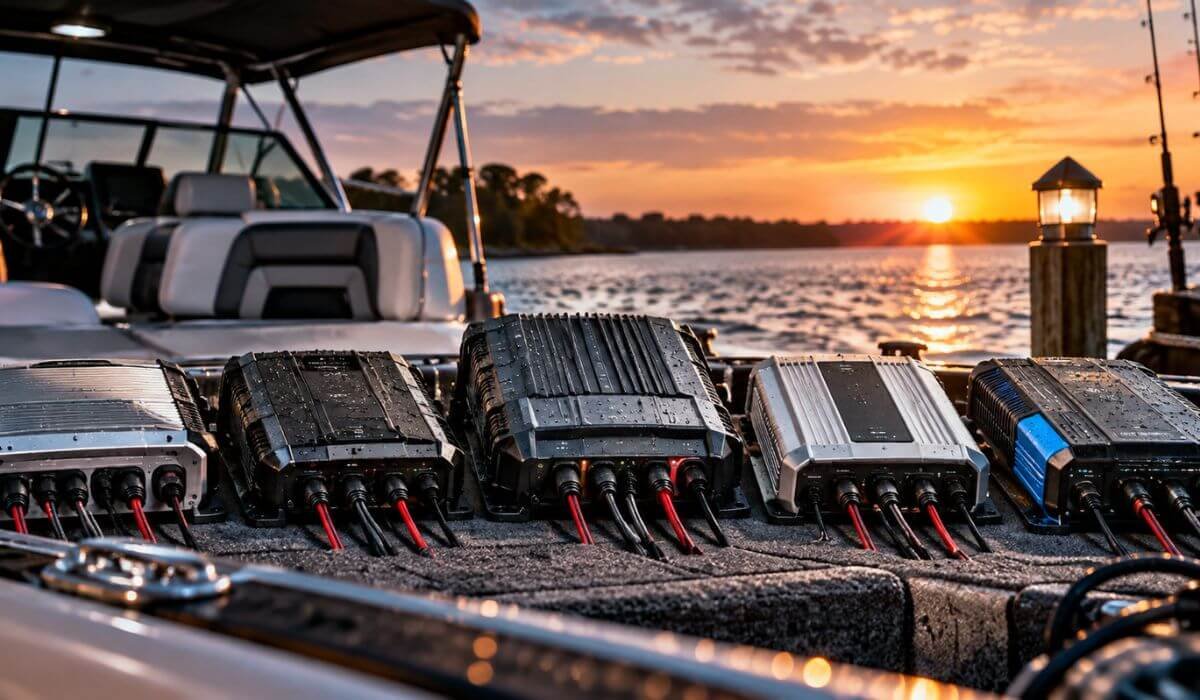
5 Best 4 Bank Marine Battery Chargers in 2026: 40A Power, Smart Charging & LiFePO4
A 4-bank marine battery charger makes the most sense when a boat has several batteries that need to stay ready—such as a trolling-motor bank alongside starting and house batteries. One properly installed onboard charger can handle four 12V banks independently, eliminating the hassle of moving batteries around or connecting multiple portable chargers. But the right choice isn’t simply the unit with the biggest amp number. Per-bank output, battery chemistry, charging control, waterproof protection, physical size, and your boat’s actual battery configuration all matter.
For this 2026 list, the focus is on chargers that make practical sense for real multi-battery marine setups, including newer models where long-term owner feedback is still developing. The comparison goes beyond headline marketing numbers and looks at the specifications that affect everyday use: 10A-per-bank output, 40A total capacity, LiFePO4 compatibility, charging stages, marine protection, battery maintenance, installation dimensions, and chemistry-specific controls. The Minn Kota Precision MK-440PCL stands out as the best overall choice, combining four independent 10A banks with AGM, flooded, gel and LiFePO4 support, automatic multi-stage charging, temperature compensation, battery equalization and a marine-ready waterproof design.
The reason for looking at all five models is simple: a charger that is excellent for one boat can be a poor fit for another. A fishing boat with lithium trolling batteries, a larger cruiser running AGM banks, and an installation with very limited mounting space can have completely different priorities. The five chargers below are therefore not treated as interchangeable 40A boxes—each has a specific strength, a specific buyer, and a few things worth knowing before purchase.
Best Four Bank Marine Battery Chargers: Top 2026 Picks for Smart Charging
#1. Minn Kota Precision MK-440PCL 4-Bank Marine Charger
Best 4-Bank Marine Battery Charger with 10A-Per-Bank Output, LiFePO4 Support & Automatic Multi-Stage Charging
#2. NOCO GENPRO10X4 4-Bank Onboard Marine Charger
Best 40A 4-Bank Onboard Marine Battery Charger with IP68 Protection, Lithium Support & Independent Bank Control
#3. VEVOR 4-Bank 12V Marine Battery Charger
Best 4-Bank Boat Battery Charger with 40A Total Output, IP68 Protection, Lithium Support & Multi-Stage Charging
#4. Guest 2740A 4-Bank Onboard Battery Charger
Best 4-Bank Marine Battery Charger with 40A Output, 5-Stage Charging, AGM Support & Dedicated Bank Control
#5. LiTime 4-Bank 12V 10A Battery Charger
Best 4-Bank LiFePO4 Battery Charger with 40A Total Output, Lithium Activation, Multi-Chemistry Support & IP65 Protection
Must Check: Best 3 Bank Marine Battery Charger
Expert Tip: Don’t Choose a 4-Bank Charger by 40A Alone
A 40A 4-bank charger sounds impressive, but the total number doesn’t tell you how well it will work on your boat. In most of these models, that 40A is divided into four 10A outputs, so each battery gets its own charging channel rather than one battery receiving the entire output.
Before buying, check your battery labels first. Look for 12V, battery chemistry, and the manufacturer’s recommended charging method. This is particularly important if you’re switching from traditional lead-acid or AGM batteries to LiFePO4. Lithium support is not something I would assume just because a charger says “smart.”
Also measure the installation area before ordering. These are onboard chargers, so the charger has to physically fit in a dry, properly ventilated mounting location with enough room for the cables and connections. A charger that has excellent specifications but doesn’t fit your boat is simply the wrong charger.
And one more thing: don’t pay extra for features you won’t use. If your boat has four compatible 12V batteries and you want simple, dependable onboard charging, a well-matched 10A-per-bank charger can be a better choice than chasing the biggest number on the box.
How We Chose These 4-Bank Marine Battery Chargers
We didn’t rank these chargers by review count, brand name, or headline wattage alone. That would be especially misleading here because several of these models are newer and don’t yet have the enormous volume of long-term owner feedback that older marine chargers have.
Instead, we started with the actual job the charger needs to perform: maintaining four separate 12V battery banks on a boat.
1. We checked the charging configuration first
A genuine 4-bank charger should provide four independently managed charging outputs. The Minn Kota MK-440PCL, NOCO GENPRO10X4, VEVOR 4-bank model and Guest 2740A all fit the core 4-bank/10A-per-bank configuration, giving them a clear place in this comparison.
That matters more than simply seeing “40A” in a product title. A 40A charger that doesn’t provide the right bank arrangement isn’t really solving the same problem.
2. Battery chemistry was a major filter
We paid close attention to whether each charger is designed for AGM, flooded lead-acid, gel, LiFePO4, NCM, or a combination of these.
This is one reason the list isn’t made up of five interchangeable products. The Minn Kota is particularly interesting for buyers who want broad battery compatibility, while NOCO and VEVOR bring strong modern lithium and marine-focused capabilities. LiTime is more specialized toward lithium-oriented buyers, so we kept it in the list rather than pretending it is the universal choice for every boat.
The goal was simple: match the charger to the battery, not make the battery fit the charger.
3. Marine protection had to be meaningful
A charger installed on a boat lives in a much harsher environment than a charger sitting in a garage. Moisture, spray, vibration and temperature changes all matter.
So we looked at waterproof/intrusion protection ratings and marine-specific construction, rather than casually calling every charger “waterproof.” The differences are worth noticing: NOCO and VEVOR advertise IP68, Guest specifies IP67, while LiTime’s current listing specifies IP65.
Those numbers shouldn’t be treated as interchangeable. They give the buyer a much clearer idea of what the manufacturer actually claims.
4. We considered installation, not just charging
An onboard charger has to work as part of the boat, not just on a specification sheet.
We considered the physical size, mounting style, cable arrangement, input requirements and intended onboard use wherever manufacturer information was available. This is particularly important for smaller boats where available mounting space can be surprisingly limited.
That’s also why we mention dimensions when they are useful. Knowing that a charger is roughly 10–11 inches long doesn’t sound exciting, but discovering it won’t fit behind your battery compartment after you’ve bought it is much less exciting.
5. We separated “best overall” from “best for a specific buyer”
There isn’t one 4-bank charger that automatically wins for every boat.
The Minn Kota MK-440PCL earns the #1 position because it offers a particularly well-rounded combination of established marine positioning, four-bank 10A charging and broad battery support.
The NOCO GENPRO10X4 is a strong alternative for someone who specifically values a 40A total output, onboard charging, maintenance capability and IP68 protection.
VEVOR becomes interesting when value and broad compatibility matter. Guest remains a straightforward choice for buyers looking for a conventional 40A/4-bank onboard setup, while LiTime makes more sense for someone whose priority is multi-bank lithium charging rather than the broadest marine-battery application.
That distinction is intentional.
6. We didn’t pretend limited reviews mean proven long-term reliability
This is probably the most important part of our selection process.
Some of these chargers are newer products, so there simply isn’t enough independent owner history yet to make strong claims about five or ten years of real-world reliability. We won’t manufacture that confidence just to make a product sound better.
Instead, we leaned more heavily on manufacturer specifications, charging architecture, protection ratings, compatibility and intended use, while treating limited long-term review history as exactly that: limited long-term review history.
That’s the honest way to evaluate newer marine electronics.
7. The final test was simple: would we recommend it for a real 4-battery setup?
Every charger on this list had to make sense beyond its product title.
If a model has the right four-bank architecture, appropriate 12V charging, useful battery-chemistry support, credible marine protection, and a practical reason to choose it over the alternatives, it belongs here.
If it only looks impressive because the listing contains a large amp number or a long feature list, that’s not enough.
That’s the standard behind this list: not five chargers that happen to say “4-bank” on the box, but five models with different strengths that can genuinely make sense for different four-battery marine setups.
#1. Minn Kota Precision MK-440PCL 4-Bank Marine Charger
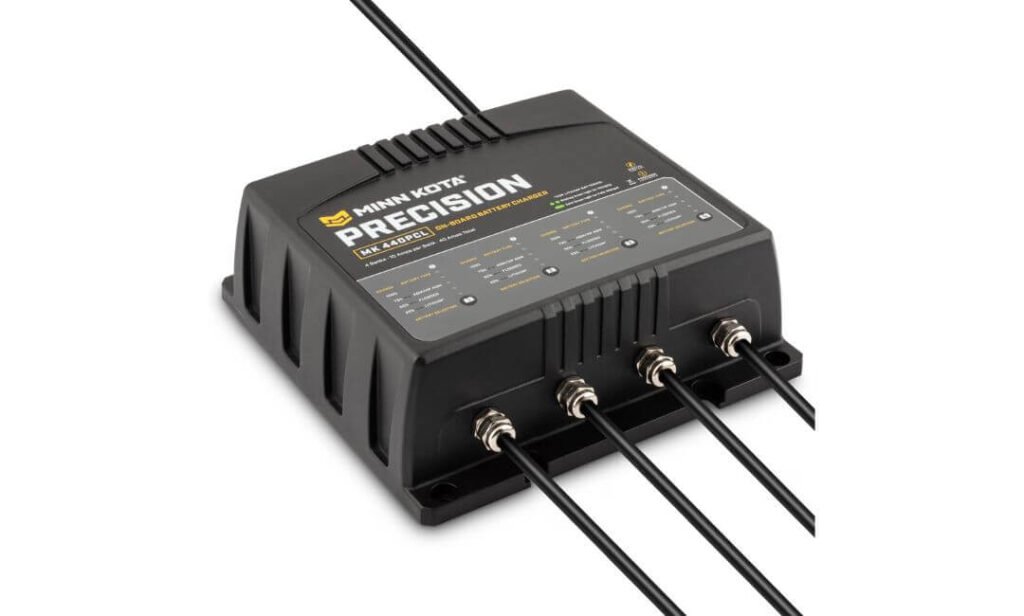
Quick Specs:
- Charging setup: 4 independent banks × 10A
- Total output: 40A
- Battery support: 12V AGM, flooded lead-acid, gel & LiFePO4
- Charging control: Automatic multi-stage with microprocessor digital control
- Marine protection: Waterproof, shock- and vibration-resistant construction
- Size: 9.88 × 3.5 × 9.88 inches
- Weight: 10.5 lb
- Connections: Four 6-ft fused battery leads with ring terminals
- Shore power: 120V AC
- Charge time: Approximately 4–6 hours, depending on battery condition
- Warranty: 3 years
If you are running four batteries and want one charger to handle the whole setup, this is the kind of configuration that makes life considerably easier. You get 10 amps going to each bank, rather than having to shuffle a portable charger between batteries, and each bank can be configured for the battery chemistry actually connected to it. That is a genuinely useful feature when a boat has, for example, lithium trolling batteries alongside an AGM or flooded starting battery.
The smarter part is what happens after you plug it in. Its microprocessor-controlled multi-stage charging manages voltage and current through the charging cycle, while temperature compensation helps account for changing conditions. It also compensates for low-line voltage, which is one of those features you may not think about until you’re charging from a less-than-perfect shore-power supply. The LED indicators then give you a quick view of charging stage, maintenance status, errors and full charge.
There is also a very practical advantage for boats moving toward lithium: the charger has a dedicated LiFePO4 charging profile and lithium wake-up capability. That means you don’t necessarily have to replace the entire charging setup just because one or more banks have moved to lithium. Add the waterproof, shock-resistant and vibration-resistant construction, saltwater compatibility, four 6-foot fused leads and a 3-year replacement warranty, and the package starts to make a lot of sense as a permanent onboard installation.
(The real advantage here isn’t the “40A” printed on the box; it is having four separately managed 10A charging channels that can be matched to the batteries actually installed on your boat.)
What We Like About It
- Bank-by-bank battery selection is the standout feature. You can configure each of the four charging outputs for the battery type actually connected to it instead of treating the entire boat as one battery system.
- LiFePO4 support is properly integrated, including a lithium-specific charging profile and the ability to wake compatible lithium batteries from standby.
- Low-line voltage compensation is a surprisingly useful detail for real boat use. It helps the charger maintain consistent charging when the incoming AC supply isn’t delivering a perfect 120V.
- The 9.88 × 3.5 × 9.88-inch footprint is compact for a four-bank charger, which gives you more flexibility when choosing a permanent mounting location.
- Six-foot fused battery leads and a six-foot power cord make the installation considerably easier to plan without immediately needing to extend everything.
One Thing to Know Before Buying
The 10A-per-bank output is deliberate rather than extreme. For most multi-bank fishing-boat setups, tNOCO GENPRO10X4 12V 40A 4-Bank OnBoard Marine Battery Charger & Maintainer that’s a sensible balance between charging speed and a compact onboard design, but if your priority is the shortest possible recovery time for heavily discharged, high-capacity batteries, a higher-output 4-bank charger may be worth considering.
Why It Earns the Top Spot in This 4-Bank Comparison
The reason this sits at #1 isn’t simply because it says “40A.” It is the combination of four independent charging banks, battery-type selection, lithium optimization, automatic multi-stage control, temperature and low-line compensation, marine protection and a 3-year warranty. Those are features that affect how the charger actually behaves after installation, not just how impressive the specification sheet looks.
For a boat with four 12V batteries—or a mixed setup where the trolling, starting and accessory batteries don’t all use the same chemistry—the flexibility is especially valuable. You get one permanently mounted charging system without giving up the ability to treat each battery according to its own requirements.
The Insider Pro-Tip
Before mounting it, label all four battery leads and decide which bank will serve which battery. It sounds obvious, but doing this before installation makes a mixed AGM/lithium setup much easier to configure correctly. More importantly, don’t choose a charging profile based on the boat’s battery type as a whole; choose it according to the individual battery connected to each bank.
And check the battery manufacturer’s charging requirements before using the lithium profile. “LiFePO4 compatible” does not mean every lithium battery has identical charging requirements.
#2. NOCO GENPRO10X4 4-Bank Onboard Marine Charger
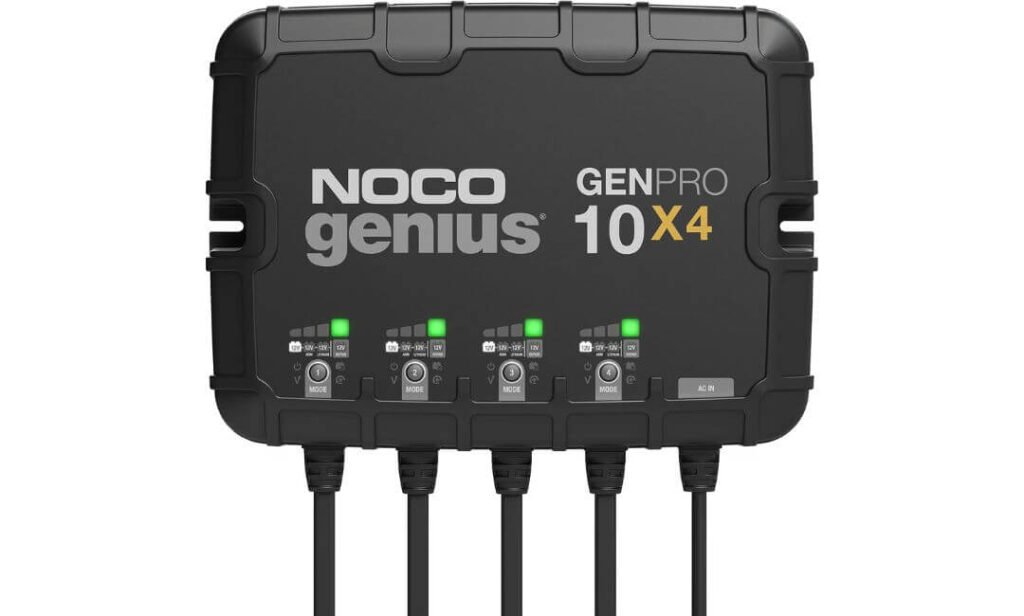
Quick Specs:
- Charging setup: 4 independent banks × 10A
- Total output: 40A
- Battery support: 12V lead-acid, AGM & lithium-ion batteries
- Charging modes: 12V, 12V AGM, 12V Lithium & Repair Mode
- Low-voltage recovery: Charges batteries from 1V; Force Mode can initiate charging from 0V
- Marine protection: IP68 fully sealed construction
- Temperature control: Integrated thermal sensing
- Mounting: Any orientation, including upside down
- DC cable length: 72 inches per bank
- AC cable: 72 inches
- Weight: 16.98 lb
- Warranty: 3 years
Some four-bank chargers are essentially about having four outputs and calling the job done. This one takes a more deliberate approach: each bank gets its own charging mode. That becomes genuinely useful on a boat where the battery arrangement isn’t perfectly uniform—for example, three lithium batteries powering a 36V trolling motor alongside a conventional starting battery. You can select the appropriate mode for each bank instead of forcing every battery into the same charging profile.
The 40A total output is split into four 10A channels, so this isn’t a charger designed to dump 40 amps into one battery. Its strength is simultaneous, independent charging. The built-in thermal sensor also adjusts charging according to ambient temperature, helping prevent the charger from behaving the same way in very different conditions. For an owner who leaves the boat connected to shore power between trips, that combination of automatic charging and maintenance is much more useful than a charger that simply reaches full charge and stops.
Then there is the feature that separates this model from a lot of ordinary onboard units: very-deep-discharge recovery. It can begin charging batteries at 1V, while Force Mode is available when a battery has dropped even further. That doesn’t magically make a damaged battery healthy again, but it can be extremely useful when a battery has been neglected and a normal charger refuses to recognize it. Add the IP68 sealed housing, anti-vibration backing and orientation-independent mounting, and this is clearly designed around the realities of permanent marine installation rather than occasional garage use.
(Four independent 10A channels are the heart of the design; IP68 sealing and selectable chemistry modes are what make that setup particularly interesting for a serious onboard installation.)
What We Like About It
- Four charging modes can be selected independently, which makes mixed AGM, lead-acid and lithium setups far easier to manage correctly.
- IP68 protection is a major advantage for a permanently mounted charger exposed to moisture and marine conditions.
- 1V charging capability and Force Mode give it an edge when dealing with batteries that have been deeply discharged and are no longer immediately recognized by a conventional charger.
- The thermal sensor adjusts charging for ambient temperature, rather than treating a cold battery compartment and a hot one exactly the same.
- Mounting in virtually any orientation is genuinely convenient when the available space on a boat is awkward. The integrated anti-vibration backing is another thoughtful installation detail.
One Thing to Know Before Buying
The unit weighs 16.98 pounds, so although NOCO has made the newer design more compact than its predecessor, this is still a substantial onboard charger. Make sure the mounting surface is solid and that there is enough room to route all four 72-inch DC leads cleanly.
Why It Stands Out Among 4-Bank Onboard Chargers
Its biggest advantage is control rather than headline output. You get the familiar 40A/4-bank arrangement, but each bank can be configured separately for 12V, AGM, lithium or repair operation. That gives the charger much more flexibility when the four batteries on a boat serve different jobs or use different chemistries.
The IP68 sealed construction, temperature-adaptive charging, deep-discharge recovery and orientation-flexible mounting then make the package feel purpose-built for permanent marine use. For someone running a 36V trolling-motor bank plus a separate starting battery, that flexibility is especially compelling.
The Insider Pro-Tip
If you are using three batteries for a 36V trolling-motor system, remember that the charger still sees them as three separate 12V banks. Set each bank individually according to the battery manufacturer’s specified chemistry and charging requirements; don’t select a mode simply because the batteries are part of a 36V system.
And if you find a battery sitting below 1V, don’t immediately assume Force Mode means the battery is safe to use. Deep discharge can indicate a seriously compromised battery. The recovery function is useful for getting a neglected battery recognized again, but it is not a substitute for checking the battery’s actual condition before putting it back into service.
#3. VEVOR 4-Bank 12V Marine Battery Charger
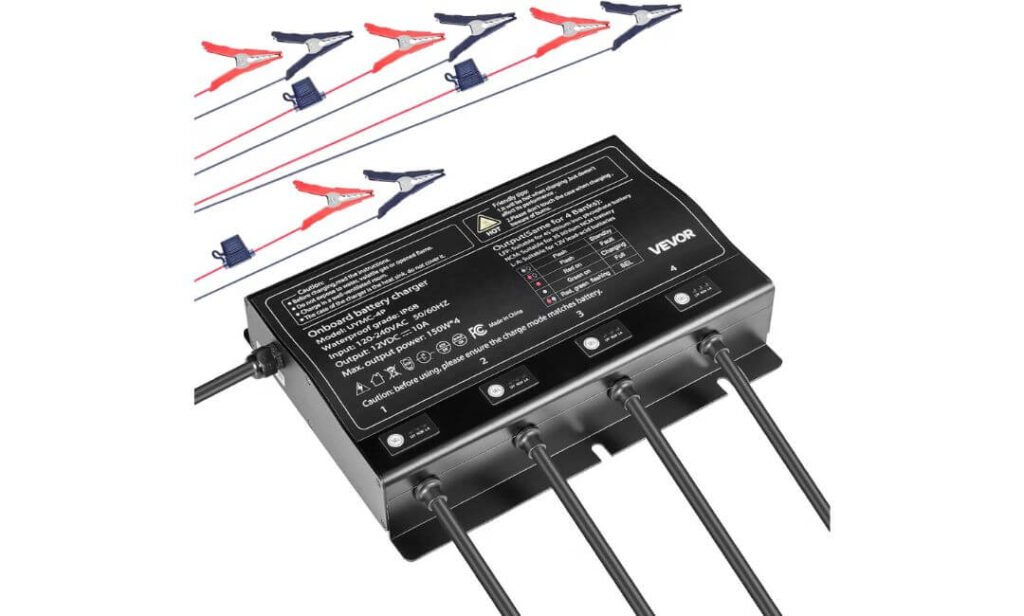
Quick Specs:
- Charging setup: 4 independent banks × 10A
- Total charging output: 40A
- Battery support: LiFePO4, NCM lithium-ion & lead-acid
- Charging modes: LFP, NCM & L-A
- Charging system: Intelligent multi-stage charging
- Deep-discharge support: Can initiate charging from 0V
- Marine protection: IP68 waterproof and dust-resistant
- Construction: Aluminum-alloy housing
- Size: 11.93 × 9.1 × 2.64 inches
- Weight: 12.79 lb
- DC leads: Approximately 5.74 ft
- Safety monitoring: Overvoltage, overcurrent, short circuit, overheating, sparks & reverse connection
Value is usually where marine electronics get tricky. A cheaper charger isn’t necessarily a bargain if it gives you fewer charging modes or doesn’t have the environmental protection needed for permanent onboard use. This four-bank unit takes a more interesting route: four 10A outputs, three battery-chemistry modes and an IP68-rated enclosure are packed into a relatively slim 2.64-inch-high body.
The battery flexibility is particularly useful. Each bank can be set independently for LiFePO4, NCM or lead-acid, so you’re not restricted to having four identical batteries. That gives it a legitimate advantage for mixed setups—say, lithium batteries on the trolling side and a lead-acid battery elsewhere in the boat. The intelligent charging system then adjusts its charging process according to battery condition rather than simply applying one fixed charging pattern.
Then there is the enclosure. An IP68 rating is exactly the sort of specification worth paying attention to on an onboard marine charger because moisture and salt exposure are very different from what a garage-mounted charger sees. The aluminum-alloy housing, thermal protection and monitoring for reverse connection, short circuit, overcurrent and overheating add another layer of practical protection. It also supports starting a charge from 0V, which can be useful with deeply discharged batteries—but that should be viewed as a recovery feature, not proof that a severely discharged battery is still healthy.
(For buyers trying to get four-bank charging, lithium flexibility and serious water protection without automatically moving into the most expensive tier, this is where the VEVOR becomes genuinely interesting.)
What We Like About It
- Three independent charging modes give it unusually broad coverage for a charger in this price-oriented category.
- IP68 protection makes it much easier to consider for a permanent onboard location where water and salt exposure are unavoidable.
- The 2.64-inch height is useful when mounting space is shallow, especially around crowded battery compartments.
- 0V charging capability can help when a deeply discharged battery isn’t immediately recognized by a conventional charger.
- The built-in protection covers several real installation risks, including reverse connection, overcurrent, overheating and short circuits.
One Thing to Know Before Buying
Its 10A-per-bank output is the limiting factor for very large-capacity batteries. It is a sensible configuration for many four-bank setups, but owners with exceptionally large batteries should check the battery manufacturer’s recommended charging current and expected recharge time before choosing it.
Why It Deserves a Place in the Top Four-Bank Choices
What makes this model competitive is how much practical functionality it puts behind the four-bank configuration. You aren’t just getting four charging leads—you get independent battery-mode selection, lithium support, intelligent charging, 0V recovery and IP68 protection in one onboard unit.
That combination makes it especially appealing when the goal is to build a modern multi-battery system without paying solely for a premium brand name. It may not have the same established marine track record as some long-standing names, but on specifications and intended use, it gives buyers a surprisingly capable alternative.
The Insider Pro-Tip
If you are mixing battery chemistries, write the selected mode next to each bank before installation. Once the charger is buried inside a compartment, it becomes surprisingly easy to forget which output is configured for which battery.
One other detail deserves attention: don’t confuse the advertised power figure with the charging current each battery actually receives. For this model, the number that matters for your individual batteries is 10A per bank. If your battery manufacturer recommends a different charging current, use that requirement—not the larger headline power figure—to decide whether this unit is a good match.
#4. Guest 2740A 4-Bank Onboard Battery Charger
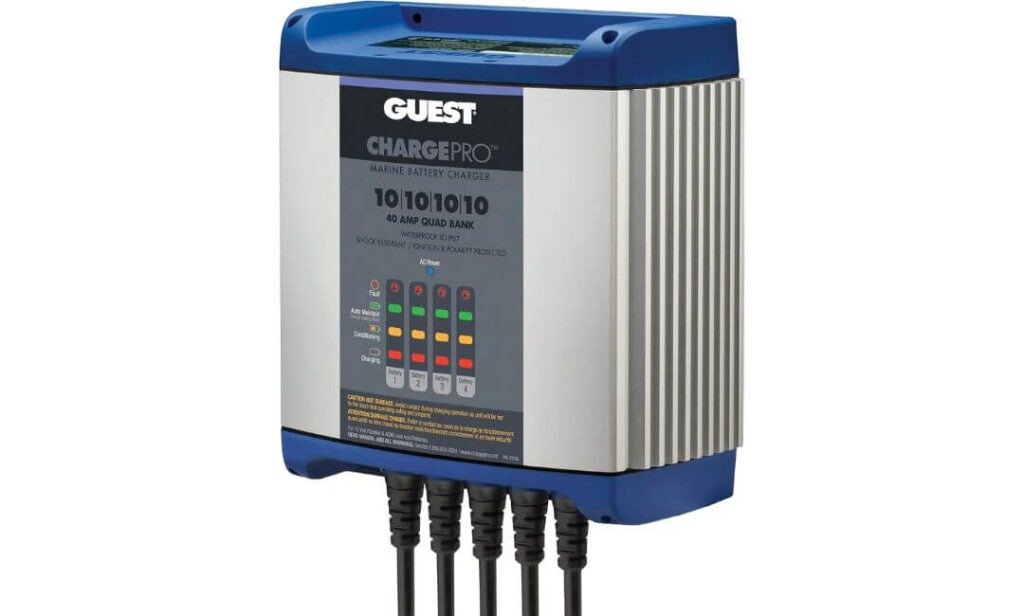
Quick Specs:
- Charging setup: 4 independent banks × 10A
- Total output: 40A
- Battery support: 12V flooded lead-acid & AGM
- Input: 120V AC
- Marine protection: IP67 waterproof construction
- Safety protection: Reverse polarity, over-current, over-voltage, over-temperature & ignition protection
- Construction: Shock-resistant housing with in-line fuses
- Weight: 8.49 lb
- Output: 12V charging system
- Best suited for: Traditional multi-battery marine setups
Not every boat owner is looking for lithium compatibility or a long list of modern charging modes. If your boat still runs flooded lead-acid or AGM batteries, there is something reassuring about a charger that concentrates on doing that particular job properly. This unit gives you four independent 10A outputs, allowing four 12V batteries to be charged at the same time without manually moving connections from one battery to another.
That simplicity becomes especially useful on a larger boat with a starting battery, trolling batteries and an auxiliary or house battery. The charger is designed for permanent onboard installation, with IP67 protection and a shock-resistant housing intended for the conditions found around marine equipment. Its electrical protection is equally practical: reverse polarity, over-current, over-voltage and over-temperature protection are built in, while ignition protection makes the design better suited to marine installation than an ordinary household charger.
One feature I particularly like for boat owners who store their vessel for months is the zero parasitic draw when switched off. It sounds like a small detail until a boat sits through the winter and you don’t want the charger itself contributing to battery drain. Guest also uses in-line fuses for an additional layer of protection. This isn’t the flashy option in the lineup, but for a traditional lead-acid/AGM setup, its straightforward approach can be exactly what you want.
(Sometimes the smartest marine upgrade isn’t more features—it is a charger that matches your existing batteries, stays out of the way, and doesn’t create another problem during storage.)
What We Like About It
- Four genuinely independent 10A charging banks make it practical for boats carrying several separate 12V batteries.
- Zero draw when switched off is a valuable storage-season feature that is easy to overlook when comparing chargers.
- IP67 protection plus a shock-resistant housing gives it the marine-oriented construction expected from a permanent onboard unit.
- The combination of reverse-polarity, over-current, over-voltage and thermal protection provides useful safeguards during everyday operation.
- Its 8.49-lb weight is relatively manageable for a four-bank charger, which can make handling and installation easier.
One Thing to Know Before Buying
This is the model to choose only when your batteries are 12V flooded lead-acid or AGM. It does not support LiFePO4 lithium batteries, so if a lithium upgrade is part of your near-term plans, one of the lithium-compatible options in this list will make more sense.
Why It Still Belongs in a Serious 4-Bank Comparison
The appeal here is reliability through simplicity. You get 40A total capacity, four 10A banks, marine protection and extensive electrical safeguards without paying for lithium-specific functionality you may never use.
It is particularly compelling for owners who have stayed with conventional AGM or flooded batteries and want a permanent charger that can remain installed through the boating season and then be shut down for storage without adding parasitic drain. That’s a narrower audience than the first three picks, but for that audience, the fit is very clear.
The Insider Pro-Tip
Before buying any four-bank charger, look at the labels on all four batteries, not just the main starting battery. If even one bank has been upgraded to LiFePO4, this isn’t the right match for the complete system.
For an all-AGM or flooded setup, however, the lack of lithium support isn’t really a weakness—it simply tells you exactly what this charger was designed to do. Choose the charger around the batteries you actually own, and the installation becomes much more straightforward.
#5. LiTime 4-Bank 12V 10A Battery Charger
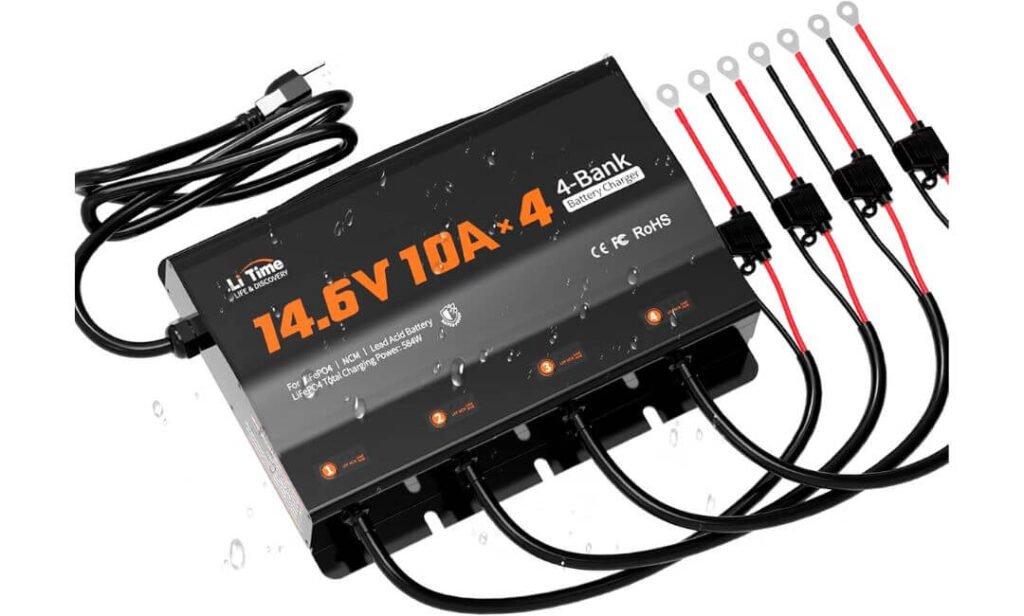
Quick Specs:
- Charging setup: 4 independent banks × 10A
- Total charging output: 40A
- Battery support: LiFePO4, NCM & lead-acid
- Charging profiles: 14.6V LiFePO4, 16.8V NCM & 14.7V lead-acid
- Lithium activation: BMS wake-up function
- Protection: Over-current, over-temperature, reverse polarity, over-voltage, under-voltage & short circuit
- Marine protection: IP65 waterproof and dust-resistant
- Status monitoring: LED indicators for standby, charging, full and error
- Size: 8.19 × 3.58 × 2.07 inches
- Weight: 12.35 lb
- Warranty: 2 years
The first thing worth noticing here isn’t the 40A number. It is the 2.07-inch-high body. When you are trying to fit a four-bank charger into an already crowded boat compartment, that kind of profile can make installation considerably easier. You still get four independent 10A outputs, but the charger doesn’t take up the vertical space that some larger onboard units require.
Its real strength, though, is chemistry flexibility. Each bank can be configured around LiFePO4, NCM or lead-acid, with different charging voltages for each chemistry. That makes it an interesting choice for owners who have moved beyond an all-lead-acid setup and don’t want four separate chargers just because their batteries aren’t identical. A lithium trolling setup, for example, can coexist with a conventional starting battery when the individual banks are configured correctly.
There is another useful detail for lithium owners: the BMS activation function can wake a protected lithium battery that has shut itself down. The built-in protection package also monitors reverse polarity, over-current, over-voltage, under-voltage, short circuits and temperature. Add the LED status indicators and IP65-rated weather protection, and you have a compact charger designed to be straightforward to live with rather than something that demands constant attention.
(Its strongest argument is simple: four 10A charging channels, three battery chemistries and a surprisingly shallow housing in one package.)
What We Like About It
- Three battery-chemistry profiles give it excellent flexibility for mixed battery installations.
- The 2.07-inch height is a genuine advantage when mounting space is tight.
- BMS activation is particularly useful for lithium batteries that have entered protection mode and are no longer immediately recognized by a charger.
- The protection system covers six important fault conditions, including reverse polarity, over-voltage and overheating.
- Individual LED status indicators make it easy to see what each charging bank is doing without connecting another monitoring device.
One Thing to Know Before Buying
The enclosure is rated IP65, so don’t treat it as equivalent to the IP67 or IP68 chargers higher on this list. It has useful weather and dust resistance, but your mounting location should still provide sensible protection from direct water exposure and unnecessary spray.
Why It Makes Sense as a 4-Bank Alternative
This charger earns its place because it solves a slightly different problem. It is less about premium marine branding and more about getting four independently managed charging channels with broad battery-chemistry support into a relatively compact package.
For a boat owner upgrading to lithium while still keeping some conventional batteries, that flexibility can be worth more than a higher headline specification. The 40A total / 10A-per-bank configuration, multiple charging voltages and BMS activation give it a clear purpose, particularly for modern mixed-battery systems.
The Insider Pro-Tip
Pay attention to the actual chemistry of each battery before connecting the four leads. The fact that one charger supports three chemistries does not mean one setting works for all of them. Set every bank according to the battery connected to that specific output and follow the battery manufacturer’s charging specifications.
And if you are buying this mainly because of its compact size, measure the compartment including cable clearance, not just the flat mounting surface. A charger can fit perfectly on paper and still become awkward once four battery cables and the AC lead need to bend into place.
Best 4 Bank Marine Battery Chargers Compared (2026)
| What matters on a real boat | Minn Kota MK-440PCL Best Overall | NOCO GENPRO10X4 Best Protection | VEVOR 4-Bank Best Value | Guest 2740A Lead-Acid Pick | LiTime 4-Bank Lithium Flexible |
|---|---|---|---|---|---|
| Bank setup | 4 × 10A independent | 4 × 10A independent | 4 × 10A independent | 4 × 10A independent | 4 × 10A independent |
| Total output | 40A | 40A | 40A | 40A | 40A |
| Battery chemistry | AGM, flooded, gel & LiFePO4 | Lead-acid, AGM & lithium-ion | LiFePO4, NCM & lead-acid | Flooded & AGM | LiFePO4, NCM & lead-acid |
| Per-bank selection | Yes — battery type selected independently | Yes — mode selected independently | Yes — chemistry selected independently | Optimized for supported lead-acid types | Yes — chemistry selected per bank |
| Lithium capability | LiFePO4 + lithium wake-up | 12V Lithium + Force Mode | LiFePO4 + NCM | Not supported | LiFePO4 + NCM + BMS activation |
| Deep-discharge recovery | Automatic lithium wake-up | 1V; Force Mode to 0V | 0V start capability | Not a lithium-recovery charger | BMS activation for protected lithium batteries |
| Marine protection | Waterproof, shock & vibration resistant | IP68 fully sealed | IP68 waterproof & dust resistant | IP67 waterproof | IP65 weather resistant |
| Charging intelligence | Microprocessor multi-stage + temperature & low-line compensation | Multi-mode + thermal sensing | Intelligent multi-stage charging | Optimized independent charging | Smart charging + battery-status recognition |
| Safety focus | Temperature compensation + diagnostics | Thermal, electrical & marine protection | Over-current, over-voltage, short circuit, heat & reverse connection | Reverse polarity, over-current, over-voltage, thermal & ignition protection | Over-current, over-voltage, under-voltage, thermal, short circuit & reverse polarity |
| Approx. dimensions | 9.88 × 3.5 × 9.88 in | 13.78 × 11.65 × 6.06 in* | 11.93 × 9.1 × 2.64 in | 9 × 10 × 15 in* | 8.19 × 3.58 × 2.07 in |
| Weight | 10.5 lb | 16.98 lb | 12.79 lb | 8.49 lb | 12.35 lb |
| Best suited to | Mixed 12V marine batteries and anglers upgrading to lithium | Serious onboard setups needing maximum sealing and recovery features | Budget-conscious owners wanting lithium flexibility | AGM or flooded boats that do not need lithium support | Mixed-chemistry systems where compact mounting matters |
| Our honest takeaway | Most balanced choice for a four-bank marine setup | Most feature-rich for harsh marine conditions | Strong value without giving up modern battery support | Straightforward and proven for traditional batteries | Compact and flexible for newer mixed-battery systems |
*Check the manufacturer’s current dimensional diagram before mounting. Product listings can present dimensions in different orientations.
Buying Guide: What Actually Matters When Choosing a 4-Bank Marine Battery Charger
A four-bank charger is easy to misunderstand because manufacturers often lead with the 40A total output. That number is useful, but it is not the whole story. In a real boat setup, what matters is how that current is divided, whether each bank can be configured for the battery connected to it, how the charger behaves during long-term maintenance, and whether the unit is genuinely suited to the environment where you plan to install it.
The five chargers above are not identical, and that is actually a good thing. Your best choice depends on the batteries you have, the space available for installation, how exposed the charger will be to moisture, and whether you want to stay with conventional AGM/flooded batteries or move toward lithium.
Start With the Bank Output, Not the Big Number on the Box
For the chargers in this comparison, 40A means 40A across four banks, generally working out to 10A per bank. It does not mean one battery can receive the entire 40A.
That distinction matters when estimating charging time. A 100Ah battery receiving 10A is in a very different situation from a large-capacity battery that needs considerably more charging current. Actual charging time will also vary with battery condition, state of charge, temperature, battery chemistry and the charger’s charging stages.
So, before buying, ask a simple question:
Does 10A per bank fit the batteries I already have?
If the answer is yes, a four-bank 10A charger can be an excellent setup for keeping several batteries ready at once. If you have unusually large-capacity batteries and need the fastest possible turnaround between trips, look closely at the manufacturer’s recommended charging current before deciding.
Make Sure the Charger Matches Every Battery
This is probably the most important compatibility check.
A boat may have four batteries, but that does not necessarily mean all four are the same. You could have LiFePO4 trolling batteries, an AGM starting battery, and another conventional battery serving an auxiliary system.
| Battery setup | What to look for |
|---|---|
| All AGM | AGM-compatible charging profile |
| All flooded lead-acid | Flooded/lead-acid support |
| All LiFePO4 | Dedicated LiFePO4 charging profile |
| Mixed AGM + lithium | Independently selectable bank settings |
| Mixed lithium chemistries | Verify the exact chemistry and charging voltage for each bank |
| 36V trolling setup | Three separate 12V batteries can be charged through three independent banks |
This is where independently configurable banks become genuinely valuable. You are not choosing one charging profile for the entire boat; you can configure the appropriate bank for the battery actually connected to it.
Don’t rely on a product title that simply says “lithium compatible.” Check whether it supports your exact chemistry and whether the charging voltage/profile agrees with the battery manufacturer’s requirements.
LiFePO4 Support Is More Than a Checkbox
Lithium batteries have changed what buyers expect from onboard chargers. A proper LiFePO4 charging profile is important because lithium batteries don’t use exactly the same charging behavior as traditional lead-acid batteries.
Some chargers in this roundup go further by offering lithium wake-up or BMS activation, which can help when a protected lithium battery has entered a low-voltage shutdown state.
That is useful, but it should not be misunderstood. A charger that can wake a protected battery doesn’t repair a physically damaged or genuinely failed battery. If a battery has been deeply discharged, check its condition and follow the battery manufacturer’s recovery instructions before putting it back into regular service.
Waterproof Ratings Are Not All the Same
“Waterproof” is one of those words I would never use as the deciding factor by itself.
The chargers here span IP65, IP67 and IP68, and those ratings are not interchangeable. Higher protection can be particularly valuable on a boat, but installation still matters. Even a highly protected charger should be mounted according to the manufacturer’s instructions and away from unnecessary exposure where possible.
A simple way to think about the five options:
- IP68: NOCO and VEVOR, the strongest stated ingress protection in this group.
- IP67: Guest, offering substantial water protection for marine installation.
- IP65: LiTime, suitable for weather-resistant applications but not equivalent to IP67/IP68.
- Minn Kota: Marine-focused waterproof, shock-resistant and vibration-resistant construction, with its specific installation requirements worth following.
Don’t turn an IP rating into a promise that the charger can be mounted anywhere on the boat. Location, cable routing and mounting are still part of the protection system.
Look at the Physical Size Before You Order
This is the boring part that can save you from a very annoying installation problem.
Measure the actual mounting area, then leave room for battery cables, the AC connection, ventilation where required, fasteners and cable bends. A charger may technically fit inside a compartment while still being awkward or unsafe to wire.
The physical differences in this group are noticeable. Some models are relatively shallow, while others require a more generous mounting area. If your boat has a cramped battery compartment, dimensions should be treated as a buying requirement, not an afterthought.
Also remember that the charger’s weight matters when mounting it in a location exposed to vibration. A secure mounting surface is more important than simply finding a spot where the housing will fit.
Maintenance Features Matter More Than They Sound
A marine charger isn’t only there to get batteries from empty to full. Many boat owners leave the charger connected while the vessel is stored between trips.
That makes maintenance charging, automatic monitoring and temperature compensation valuable features.
Temperature compensation is particularly useful because battery charging behavior changes with temperature. A charger that can adjust its charging behavior rather than blindly applying the same approach in every condition is better suited to long-term unattended charging.
The Minn Kota also adds battery equalization/maintenance functionality for supported flooded batteries, while other models take different approaches to maintaining the battery after the primary charging cycle.
The key is to choose features that match how you actually use the boat. If the charger will only be used occasionally, some advanced maintenance functions may matter less. If it will remain connected at the dock for long periods, they become much more relevant.
Don’t Ignore Safety and Fault Protection
Four batteries mean four sets of connections, cables and potential fault points. Good protection isn’t a luxury here.
Look for safeguards such as:
- Reverse-polarity protection
- Over-current protection
- Over-voltage protection
- Over-temperature protection
- Short-circuit protection
- Ignition protection, where applicable
- Thermal monitoring
- Properly fused battery connections
The exact protection package differs between models, so don’t assume that every charger offers the same level of protection simply because all five are marketed for marine use.
Choose According to the Boat, Not the Product Ranking
The ranking is useful as a starting point, but your battery setup should ultimately make the decision.
| Your situation | What makes the most sense |
|---|---|
| Mixed AGM, flooded and LiFePO4 batteries | A model with independently selectable battery profiles |
| Four traditional AGM/flooded batteries | A straightforward lead-acid-focused charger can be the better fit |
| 36V trolling motor + starting battery | Four independent 12V banks |
| Lithium-heavy setup | Dedicated lithium profiles and BMS activation are worth prioritizing |
| Extremely wet marine environment | Consider the stronger stated IP protection |
| Tight installation compartment | Compare actual height, width, depth and cable clearance |
| Long periods connected to shore power | Prioritize maintenance, temperature control and safety features |
| Planning a lithium upgrade | Avoid buying a lead-acid-only charger just to save money today |
Best 4-Bank Onboard Charger vs. 4-Bank Charger for a Boat
These phrases sound almost identical, but the buying intent behind them can be slightly different.
A 4-bank onboard marine battery charger is generally the better search term for someone specifically looking for a charger that will be permanently installed on the boat, connected to shore power and used to maintain multiple batteries without repeatedly moving a portable charger around.
A 4-bank battery charger for a boat can be broader. The buyer may care more about four-bank charging itself and may be comparing different installation styles, battery chemistries or even RV/marine crossover products.
For a permanent marine installation, I would prioritize marine-rated construction, appropriate ingress protection, independent bank control, battery compatibility, proper fusing and installation dimensions over a generic “40A” headline.
One Last Check Before You Buy
Before clicking the purchase button, verify these six things against your actual setup:
- Four separate 12V batteries or four appropriate banks?
- 10A-per-bank output suitable for your battery capacities?
- Correct charging profile for every battery chemistry?
- Enough physical room for the charger and its cables?
- Protection rating appropriate for the intended mounting location?
- Shore-power and installation requirements compatible with your boat?
If those six answers line up, you’re much less likely to end up with a charger that looked perfect online but doesn’t suit the boat in the real world.
The biggest mistake is choosing the most powerful-looking charger. The smarter purchase is the one whose charging profile, bank arrangement, protection and physical design actually match the batteries sitting in your boat.
Performance Showdown: How These 4-Bank Chargers Compare in Real Boat Use
On paper, these five chargers look surprisingly similar: four banks, 10 amps per bank, and 40 amps total. The differences become much clearer once you look past those headline numbers. Waterproofing, battery-chemistry support, temperature management, recovery functions, installation flexibility, and long-term maintenance can matter more than a small difference in charging specifications.
The Numbers That Actually Separate Them
| What matters | Minn Kota MK-440PCL | NOCO GENPRO10X4 | VEVOR 4-Bank | Guest 2740A | LiTime 4-Bank |
|---|---|---|---|---|---|
| Banks | 4 | 4 | 4 | 4 | 4 |
| Output per bank | 10A | 10A | 10A | 10A | 10A |
| Total output | 40A | 40A | 40A | 40A | 40A |
| Battery profiles | AGM, flooded, gel, LiFePO4 | 12V, AGM, lithium, repair | LFP, NCM, lead-acid | Flooded, AGM | LiFePO4, NCM, lead-acid |
| Temperature management | Yes | Yes | Intelligent charging | Protection-focused | Automatic monitoring |
| Deep-discharge feature | Lithium wake-up | 1V + Force Mode | 0V start | — | Lithium BMS activation |
| Stated ingress protection | Marine waterproof construction | IP68 | IP68 | IP67 | IP65 |
| Warranty | 3 years | 3 years | Check current seller/manufacturer terms | Check current seller/manufacturer terms | 2 years |
| Standout strength | Battery flexibility | Protection + recovery | Value + broad chemistry support | Traditional battery reliability | Compact lithium flexibility |
The interesting part is that charging speed isn’t really the deciding factor here. Since each model is built around 10A per bank, a similarly sized battery connected to each bank will see broadly comparable current from the charger. The more meaningful differences are what happens before, during and after that charging cycle.
Heat Management and Charging Control
Heat is not something I would ignore on a permanently installed marine charger. The charger itself produces heat while converting AC power into DC charging current, and the surrounding compartment can become warm as well.
The strongest designs in this group don’t simply switch current on and off. The Minn Kota uses microprocessor-controlled charging with temperature and low-line compensation, while the NOCO uses an integrated thermal sensor to adjust charging behavior according to ambient temperature.
That is useful because the boat may be sitting in a cool garage one week and a hot dockside compartment the next. The charger shouldn’t have to behave as though those conditions are identical.
VEVOR and LiTime also use intelligent charging and protection systems, while Guest takes a more straightforward approach around its supported AGM and flooded batteries.
Charging Speed: What 10A Per Bank Really Means
A four-bank charger delivering 10A to each bank can be a very convenient overnight charging solution for many boat owners because all four batteries are being handled simultaneously.
But don’t translate “40A total” into “40A charging one battery.” That isn’t how these chargers are designed.
For example, if four 100Ah batteries are connected, each bank is working at up to 10A rather than one battery receiving 40A. Actual charging time will depend on how depleted the batteries are, their capacity, chemistry, temperature and the final stages of the charging cycle.
This is why I would rather have a properly matched 10A-per-bank charger than choose a unit simply because its advertising uses a larger total-current number.
Where Each Charger Has the Real Advantage
Minn Kota: Best Balanced Marine Setup
The strongest point here is flexibility without making the system complicated. Each bank can be configured for the battery type connected to it, including LiFePO4, AGM, flooded and gel batteries.
That makes it particularly attractive for fishing boats where the starting battery and trolling batteries may not all be the same chemistry. The combination of 40A total output, independent bank selection, temperature compensation, maintenance functions and marine construction gives it the broadest all-around appeal in this group.
NOCO: Best for Maximum Protection and Recovery Features
The NOCO takes a more aggressive approach to difficult charging situations. IP68 sealing, thermal sensing, independently selectable charging modes and 1V/Force Mode recovery give it a particularly strong feature set.
For an owner who wants a charger that can deal with deeply discharged batteries and is likely to encounter demanding marine conditions, those features have genuine practical value.
VEVOR: Best Feature-to-Price Proposition
The VEVOR is interesting because it doesn’t strip away the features that modern boat owners actually care about just to compete on price.
You get four 10A banks, LiFePO4/NCM/lead-acid support, IP68 protection, intelligent charging and multiple electrical safeguards. It is particularly compelling for someone who wants modern battery compatibility without automatically moving into the premium-priced options.
Guest: Best for Traditional AGM and Flooded Systems
Guest is the specialist here rather than the all-purpose choice.
If your boat uses 12V AGM or flooded lead-acid batteries and you have no interest in moving to lithium, its straightforward four-bank architecture, IP67 protection, electrical safeguards and zero parasitic draw when switched off are meaningful advantages.
The limitation is equally clear: no lithium support. That isn’t a hidden flaw; it simply makes this a more specialized recommendation.
LiTime: Best for Compact, Chemistry-Flexible Installations
The standout here is the combination of four-bank charging, multiple chemistry profiles and a relatively shallow 2.07-inch height.
For a modern mixed-battery setup where installation space is tight, that can be more useful than having another premium feature you will rarely touch. LiTime also adds BMS activation for protected lithium batteries, giving it a particularly strong lithium-oriented identity.
Which One Fits Your Boat Best?
| Boat situation | The choice I would look at first | Why |
|---|---|---|
| Fishing boat with mixed battery types | Minn Kota | Broad battery selection and independent bank control |
| 36V trolling motor + starting battery | NOCO or Minn Kota | Four independent 12V banks handle the arrangement cleanly |
| Boat exposed to heavy moisture | NOCO or VEVOR | Both advertise IP68 protection |
| Budget-conscious modern setup | VEVOR | Strong chemistry support and marine protection |
| All-AGM or flooded setup | Guest | Purpose-built around traditional lead-acid batteries |
| Lithium-heavy boat | Minn Kota, NOCO or LiTime | Dedicated lithium charging support |
| Tight mounting compartment | LiTime | Particularly shallow housing |
| Long-term storage between trips | Minn Kota or Guest | Strong maintenance/storage-oriented features |
| Buyer wanting the broadest overall feature balance | Minn Kota | Few major compromises across battery types and marine use |
What About Rental Boats, Fishing Boats, and Cruisers?
For a rental or frequently used boat, simplicity matters. You don’t want the charging system to depend on the next person understanding a complicated setup. A properly labeled, independently managed four-bank charger with clear status indicators is the safer practical approach. Minn Kota and NOCO stand out here because their charging controls make the individual banks easier to manage.
For a fishing boat, battery diversity is usually the bigger issue. Trolling motors, starting systems and accessories can create a mixed battery environment, making independent chemistry selection much more valuable than a generic four-bank charger.
For a cruising boat, long periods connected to shore power change the priorities. Maintenance behavior, temperature management, protection, reliable installation and battery compatibility become more important than squeezing a few minutes out of the charging cycle. In that situation, I’d put more emphasis on the charger’s long-term charging behavior and marine protection than on the 40A headline.
The Bottom Line on Performance
There is no dramatic winner in raw charging current because all five deliver 10A per bank and 40A total. The real performance gap appears in the details.
If you want the most balanced four-bank marine package, Minn Kota remains the strongest overall choice. If harsh exposure and battery recovery are priorities, NOCO has an unusually compelling feature set. VEVOR makes a strong case when value matters, Guest is the sensible traditional lead-acid specialist, and LiTime is particularly appealing when compact installation and mixed lithium chemistry support are high on the list.
That is the more useful way to compare these chargers: not “which one has the biggest number,” but which one will behave best with the batteries, boat and charging routine you actually have.
Installation & Maintenance: Set Up a 4-Bank Charger the Right Way
A good four-bank charger can make battery maintenance almost effortless, but only when the installation is done properly. The charger may be the expensive part of the system, yet cable routing, bank identification, fusing, battery compatibility and mounting location are what determine whether the setup remains easy to live with months later.
The goal is simple: install it once, label everything clearly, keep the charger protected, and let its automatic charging and maintenance functions do the routine work.
Step 1: Map the Four Batteries Before Installing Anything
Don’t start by connecting cables. Start by identifying what each battery actually does.
Write down:
- Bank 1: Starting/cranking battery
- Bank 2: Trolling motor battery
- Bank 3: Trolling motor battery
- Bank 4: House, accessory, or additional trolling battery
Then record the battery chemistry and capacity beside each one.
This is particularly important on mixed systems. If you have AGM on one bank and LiFePO4 on another, you need to know that before selecting the charging profile. If three 12V batteries are connected in series for a 36V trolling motor, remember that the charger still connects to and charges each 12V battery individually.
A small label on every battery lead can save a surprising amount of confusion later.
Step 2: Choose the Mounting Location Carefully
The best location is not necessarily the closest empty piece of wall.
Look for a solid, dry, accessible mounting surface with enough room around the charger for cable routing and servicing. Keep it away from unnecessary standing water, direct spray, excessive heat and locations where loose equipment can strike the housing.
Before drilling, place the charger against the intended surface and check:
- Charger dimensions and mounting-hole positions
- Clearance around the housing
- Battery-cable reach
- AC cable reach
- Space required for cable bends
- Accessibility of controls and status indicators
- Protection from unnecessary water exposure
For a permanent installation, spend an extra ten minutes planning this. It is much easier than discovering later that one battery cable is just a few inches too short.
Step 3: Secure the Charger Before Routing the Cables
Use the manufacturer’s supplied or specified mounting hardware and make sure the mounting surface can handle engine vibration, boat movement and the charger’s weight.
Do not leave an onboard charger sitting loose inside a compartment just because the cables appear to hold it in place. Vibration is part of marine use, and a loose charger can eventually damage its own connections or surrounding equipment.
Once the housing is securely mounted, plan the four DC cable routes so they are short, protected and easy to identify.
Step 4: Connect One Bank at a Time
This is where being methodical pays off.
Connect each charging lead to its intended battery, keeping the positive and negative connections correct and following the charger’s installation instructions. Work one bank at a time, then verify it before moving to the next.
Avoid creating unnecessary cable loops. At the same time, don’t stretch a cable tight just to make the installation look tidy. The wiring should have enough slack for normal movement and future servicing.
If the charger uses fused leads, keep those protective components in the intended circuit and don’t remove or bypass them simply to make the wiring cleaner.
Step 5: Configure Each Bank for the Correct Battery
This is the step that deserves the most attention when the boat uses different battery chemistries.
A charger supporting multiple battery types does not mean every bank should be left on the same setting.
For each bank, confirm:
- Battery voltage
- Battery chemistry
- Recommended charging voltage/profile
- Recommended charging current
- Any lithium-specific requirements from the battery manufacturer
For LiFePO4 batteries, use the charger’s dedicated lithium setting where applicable. For AGM or flooded batteries, use their appropriate profile.
If the battery manufacturer provides a specific charging recommendation, that information takes priority over assumptions based on the charger’s marketing description.
Step 6: Connect Shore Power Only After the DC Side Is Checked
Before applying AC power, look over the complete installation.
Check that:
- Positive and negative connections are correct.
- Each bank is connected to the intended battery.
- Connections are secure.
- Fuses are installed correctly.
- Cables aren’t rubbing against sharp edges.
- No cable is trapped underneath the charger or another component.
- The selected charging profiles match the batteries.
- The AC connection is appropriate for the boat’s electrical system.
Only then connect the charger to shore power according to the manufacturer’s instructions.
Step 7: Watch the First Charging Cycle
Don’t install the charger, plug it in and immediately walk away for the first ever charging cycle.
Stay around long enough to confirm that all four banks are behaving as expected. Check the status indicators and make sure each battery is being recognized correctly.
A quick first-cycle inspection can catch a wrongly assigned bank, incorrect charging mode, loose connection or unexpected error before it becomes a much bigger problem.
Common Installation Mistakes Worth Avoiding
Treating 40A as 40A for One Battery
This is probably the easiest specification to misunderstand.
A four-bank 40A charger with 10A per bank is designed to distribute charging across four independent outputs. Don’t calculate charging time as though one battery receives the entire 40A.
Assuming Every 12V Battery Uses the Same Profile
A 12V AGM battery and a 12V LiFePO4 battery are not interchangeable from the charger’s perspective.
Voltage alone does not determine charging requirements.
Always verify the chemistry before selecting a charging mode.
Installing It Where Water Routinely Collects
An IP65, IP67 or IP68 rating provides important protection, but it doesn’t mean installation location no longer matters.
Mount the charger where it can remain secure, accessible and appropriately protected. Avoid locations where it can sit in standing water or receive unnecessary direct spray.
Forgetting Cable Clearance
A charger can fit inside a compartment while the cables don’t.
Measure the space with the actual cable routing in mind, especially when four battery leads have to leave the housing without sharp bends or excessive tension.
Mixing Up Series-Battery Connections
A 36V trolling system may contain three 12V batteries connected in series. The charger still needs to connect to the individual batteries according to its installation instructions.
Don’t treat the three batteries as one 36V charging bank unless the charger is specifically designed for that arrangement.
How to Get the Most From Maintenance Charging
Once the batteries reach full charge, the charger can move into its maintenance behavior, depending on the model and battery type.
This is where an onboard charger becomes genuinely convenient. Instead of repeatedly charging the batteries from scratch, the system can monitor and maintain their charge between trips.
For boats that remain connected to shore power, maintenance charging can be particularly useful during periods of inactivity. It helps keep batteries ready without requiring the owner to remember to start another charging cycle every few days.
But maintenance mode does not eliminate basic battery care.
A Better Long-Term Battery Routine
Every few weeks, take a quick look at the battery compartment rather than assuming everything is fine because the charger shows full.
Check for:
- Loose terminals
- Corrosion
- Damaged cables
- Unusual heat
- Swelling or physical damage
- Water or moisture where it shouldn’t be
- Changes in battery behavior
- Charger error indicators
For flooded lead-acid batteries, follow the battery manufacturer’s requirements for electrolyte inspection and maintenance. AGM and lithium batteries have different maintenance requirements, so don’t apply flooded-battery procedures to them.
Don’t Use “Maintenance Mode” to Ignore a Bad Battery
A charger can maintain a healthy battery, but it cannot turn a failing battery into a healthy one.
If one bank repeatedly takes much longer to charge, drops voltage unusually quickly, triggers charger errors, or behaves differently from the other banks, investigate that battery instead of simply leaving the charger connected longer.
The charger is part of the battery system, not a replacement for battery testing.
The Cleanest Four-Bank Setup Is the One You Can Understand Later
A good installation should make sense six months after you finish it, even if somebody else has to inspect it.
Label the four banks, keep the wiring organized, document which charging profile belongs to each battery, and leave enough access to inspect the connections later.
That small amount of organization is what turns a four-bank charger from another piece of marine hardware into a genuinely convenient set-and-maintain battery system.
FAQs About 4-Bank Marine Battery Chargers
Is a 4-bank marine battery charger really worth it if three batteries are used for a 36V trolling motor?
Yes, and this is one of the situations where a four-bank charger makes considerably more sense than the “40A” headline might suggest. A typical 36V trolling-motor system uses three separate 12V batteries, while the boat may also have a fourth battery for engine starting or other electrical loads. A four-bank charger can therefore give each 12V battery its own charging channel instead of treating the trolling-motor system as one oversized battery.
With the Minn Kota Precision MK-440PCL or NOCO GENPRO10X4, for example, you get four independent 10A banks. That means the three trolling batteries can be charged individually while the fourth bank handles the starting battery. The important detail is that the charger is still dealing with individual 12V batteries, even though those three batteries work together as a 36V system when connected in series.
If your four batteries don’t all use the same chemistry, independent bank settings become even more useful. You can configure each bank according to the battery connected to it rather than applying one charging profile to the entire boat.
Can you mix LiFePO4, AGM, and flooded batteries on the same 4-bank charger?
Yes, but only when the specific charger provides independently selectable charging profiles for those chemistries. This is one of the most important distinctions between four-bank chargers that otherwise look almost identical on a product page.
The Minn Kota, NOCO, VEVOR and LiTime models in this comparison offer different forms of multi-chemistry support, while the Guest 2740A is specifically intended for 12V flooded and AGM lead-acid batteries. You should never assume that a four-bank charger automatically makes mixed chemistry charging safe.
For a mixed setup, verify these before connecting anything:
- The exact battery chemistry on each bank
- The charging voltage/profile specified by the battery manufacturer
- Whether that chemistry can be selected independently for each bank
- Whether the battery manufacturer permits that particular charging method
The genuinely useful part of a multi-bank design is not merely charging four batteries at once; it is being able to charge each battery according to what it actually is.
If two 4-bank chargers both provide 40A total, what makes one better for a boat?
This is where shopping by the biggest number can lead you in the wrong direction. If both chargers deliver 40A total and 10A per bank, their basic charging capacity is very similar. The more meaningful differences are everything surrounding that current.
For example, the NOCO’s IP68 protection, thermal sensing, selectable charging modes and deep-discharge recovery give it a different character from the Guest, which is much more focused on conventional AGM and flooded batteries. The Minn Kota adds bank-specific battery selection, temperature compensation and maintenance features, while VEVOR and LiTime offer their own combinations of lithium support and protection.
When comparing two otherwise similar chargers, I would look at:
- Battery compatibility
- Independent bank controls
- Marine ingress protection
- Temperature management
- Recovery/maintenance functions
- Installation dimensions and cable length
- Warranty and manufacturer support
That is why there isn’t one universal “best” four-bank charger for every boat. The best charger is the one that fits the battery system, installation environment and charging routine you actually have.
Is IP68 automatically better than IP67 or IP65 for an onboard marine charger?
Not necessarily in the way buyers sometimes assume. A higher ingress-protection rating is certainly attractive, especially in a wet marine environment, but the rating should be considered alongside the installation location and the rest of the charger’s design.
In this comparison, the NOCO and VEVOR carry IP68, Guest specifies IP67, and LiTime specifies IP65. Those ratings tell you about the level of protection claimed against water and dust ingress, but they don’t mean you should mount a charger wherever water happens to collect.
A sensible installation still means:
- Secure mounting
- Protected cable routing
- No unnecessary standing-water exposure
- Correct ventilation or clearance where specified
- Properly protected electrical connections
- Following the manufacturer’s installation instructions
So yes, IP68 is a meaningful advantage on paper, but “IP68” shouldn’t be treated as a substitute for a good installation. A correctly mounted IP67 charger can be a better real-world setup than an IP68 charger installed carelessly.
What should I do if one battery in my four-bank system keeps showing an error or won’t accept a charge?
Don’t immediately blame the charger. This is one of the situations where a four-bank system actually gives you useful information because you can compare the behavior of one battery with the other three.
First, check the basics: correct polarity, secure connections, fuse condition, selected charging profile and visible cable damage. If everything looks correct, compare that bank’s behavior with the others.
If the same battery repeatedly:
- Takes dramatically longer to charge,
- Falls back to a low state of charge quickly,
- Triggers repeated charger errors,
- Refuses to enter a normal charging cycle, or
- Behaves very differently from otherwise similar batteries,
then the battery itself deserves attention.
Some of the chargers here can attempt recovery from very low-voltage conditions. That’s useful, but it doesn’t mean a severely discharged battery is automatically healthy again. A recovery feature can help a charger recognize or restart a protected battery; it cannot undo physical battery damage, severe degradation or an internal fault.
This is also why I would avoid swapping charging profiles just to make a stubborn battery accept current. The correct profile should be determined by the actual battery chemistry and manufacturer’s specifications, not by which setting happens to make the charger start working.
Can I leave a 4-bank marine charger connected all the time between fishing trips?
In many installations, that is exactly what an onboard maintenance charger is designed to facilitate, but the answer depends on the specific charger, battery chemistry and manufacturer’s instructions.
Modern multi-stage chargers can transition from bulk charging toward maintenance behavior rather than continuously forcing maximum current into a fully charged battery. Temperature-aware charging can further improve how the system behaves as conditions change.
For long-term storage, though, I would not simply connect it and forget the boat exists. A sensible routine is:
- Inspect the batteries and terminals periodically.
- Check that the charger shows normal status on all four banks.
- Look for corrosion, damaged wiring or unusual heat.
- Confirm the battery manufacturer permits the intended maintenance/charging method.
- Disconnect or configure the system for storage according to the charger and boat manufacturer’s instructions.
The real advantage of an onboard maintainer is reducing the amount of battery babysitting you have to do, not eliminating battery care altogether.
Do I need a 4-bank charger if I plan to upgrade my boat to lithium later?
If a lithium upgrade is genuinely part of your plan, it is worth considering lithium compatibility before buying a lead-acid-only charger. Otherwise, you can save money today and end up replacing the charger when the battery upgrade happens.
This is particularly relevant when only part of the boat is being converted. You might have lithium trolling batteries while retaining an AGM starting battery for the time being. A charger with independently selectable bank profiles can make that transition much easier.
The important word is “compatible,” though. Don’t stop at the phrase on the product page. Check the exact lithium chemistry, charging voltage, BMS requirements and manufacturer’s charging recommendations. A charger supporting LiFePO4 is not automatically suitable for every lithium battery configuration.
For someone expecting a gradual battery upgrade, paying for the right four-bank architecture now can be more sensible than buying twice.
Final Verdict: The Right 4-Bank Charger Is the One That Fits Your Boat
After looking at these chargers side by side, the biggest takeaway is that 40A is not the deciding factor. All five models deliver the same basic 4-bank, 10A-per-bank arrangement, but they are built around different kinds of boat owners and battery systems.
The Minn Kota Precision MK-440PCL is the strongest all-around choice because it balances independent battery selection, LiFePO4 support, multi-stage charging, temperature compensation and marine-focused construction without making the setup unnecessarily complicated. The NOCO GENPRO10X4 is particularly compelling when IP68 protection, deep-discharge recovery and advanced charging controls are high priorities. VEVOR makes a strong value case with broad chemistry support and IP68 protection, while Guest 2740A remains a sensible choice for boats staying with AGM or flooded batteries. LiTime brings an appealing combination of compact dimensions, multi-chemistry support and lithium-focused functionality.
But there is no prize for buying the most feature-packed charger if your batteries don’t match it.
Before you order, look at the four batteries actually sitting in your boat. Check their chemistry, capacity and charging requirements, then make sure the charger provides the correct profile for each bank. Measure the installation space, account for cable clearance, and consider how exposed that location is to moisture. Those few checks are far more valuable than choosing a charger because a product page happens to advertise a larger number.
And if you’re upgrading from a portable charger, the real benefit of moving to four-bank onboard charging is not just convenience. It is having a system that can charge and maintain multiple batteries independently while they remain installed and connected. Done correctly, you plug into shore power, the charger handles the routine work, and your boat is much more likely to be ready when the next trip comes around.
One final piece of honest advice: don’t replace a perfectly suitable battery simply because a newer charger supports lithium, and don’t buy a lithium charger simply because lithium sounds like the future. Buy for the batteries and electrical system you actually have—or for a realistic upgrade you genuinely plan to make.
That’s ultimately what makes a four-bank marine charger a good purchase: correct compatibility, sensible installation, dependable maintenance, and no unnecessary complexity. If those four things line up, the charger stops being another piece of equipment to think about and becomes exactly what it should be—something quietly taking care of the batteries while you get on with using the boat.
Also Check: