
Best 5 Bank Marine Battery Charger in 2026: Fast Charging, Smart Control & Boat-Ready Power
If your boat relies on five batteries, the charger needs to do more than simply offer five connections. Battery chemistry, system voltage, charging behavior, marine protection, and installation space all matter once the charger is actually working aboard the boat. Among the models covered here, the ProMariner 53505 ProTournament Elite 500 stands out as the best overall choice for demanding five-bank marine charging, with 50A total capacity, Distributed-On-Demand charging, IP67 protection, and support for 12V, 24V, 36V and 48V systems plus the engine battery.
That makes this guide useful for both newer and older boat setups, where battery configurations can vary considerably. The ProMariner measures about 9.3 × 4.2 × 14.7 inches, weighs roughly 16.9 lb, and is designed for specified Group 24–31 flooded, AGM/HP AGM and approved LiFePO4 applications. The Minn Kota brings 50A with a predictable 10A per bank, while the Battery Tender focuses on 5 independent 4A banks, selectable 6V/12V operation, and long-term maintenance. The important part is matching those strengths to the batteries and charging demands already on your boat.
Best 5 Bank Marine Battery Charger: Top 2026 Picks with 50A Output & LiFePO4 Support
#1. ProMariner ProTournament Elite 500 5-Bank
Best 5-Bank Marine Battery Charger with 50A Distributed-On-Demand Charging, IP67 Protection & 48V System Support
#2. Minn Kota Precision MK-550PCL
Best 5-Bank Onboard Marine Battery Charger with 10A-Per-Bank Output, LiFePO4 Support & Temperature Compensation
#3. Battery Tender 5-Bank 20A Multibank Charger
Best 5-Bank Battery Charger & Maintainer with 6V/12V Selection, 4A-Per-Bank Charging & Multi-Chemistry Support
Must Check: Best 4 Bank Marine Battery Charger
Expert Tip
One thing I would not overlook: do not choose a five-bank charger simply because your boat has five batteries. Look at what those batteries actually are. A charger that is excellent for five 12V AGM or lithium banks may be the wrong fit for a different setup, especially if the batteries are larger, use a different chemistry, or the charger does not have enough room around it for proper installation.
For a typical multi-battery fishing or cruising setup, the real question is how each bank is going to be used. If you regularly come back with heavily discharged batteries, the 50A ProMariner and 50A Minn Kota make much more sense than a lower-output maintenance-focused unit. If your priority is keeping several different batteries healthy over long periods, the Battery Tender becomes interesting because each bank can independently select 6V/12V and lithium or lead-acid chemistry. That is the kind of difference that matters after the charger has been installed—not another impressive-looking number on a product page.
How We Chose These 5-Bank Marine Battery Chargers
We did not build this list by taking the first three five-bank chargers we found and calling them “best.” Each model had to earn its place for a different reason.
First, we looked at real charging capability. The ProMariner 53505 and Minn Kota MK-550PCL both deliver 50 amps across five banks, but they do it differently. The Minn Kota provides a straightforward 10 amps per bank, while the ProMariner uses Distributed-On-Demand charging, allowing available current to be directed where it is needed rather than treating every battery as if it always needs the same amount of power. That distinction is important when batteries come back from a day on the water at different charge levels.
Second, we checked battery compatibility instead of assuming “marine” means everything. The Minn Kota supports 12V AGM, flooded lead-acid, and LiFePO4 batteries, while the ProMariner is designed around specific flooded, AGM and approved LiFePO4 applications and has limitations, including large 4D/8D batteries. Battery Tender takes a completely different approach, allowing each of its five banks to be independently configured for 6V or 12V and lithium or lead-acid chemistry, with a stated 14Ah–100Ah range.
Third, we considered what the charger is actually good at. The ProMariner belongs here because it is the high-output, serious marine option: 50A total, five-bank charging, 12V/24V/36V/48V system compatibility plus engine support, and an IP67 waterproof design. The Minn Kota earns its spot because it combines 50A output with genuinely marine-focused construction, including waterproof, shock-resistant, vibration-resistant and saltwater-compatible design.
Fourth, we checked the physical side of ownership. A charger can have excellent electronics and still be a poor choice if it simply does not fit where you intend to mount it. The MK-550PCL measures about 11.75 × 9.88 × 3.5 inches, while the ProMariner is about 14.75 × 9.3 × 4.25 inches. Those are not minor details when space inside a boat compartment is tight.
Finally, we wanted the list to represent three genuinely different buying decisions. The ProMariner is here for owners who want maximum marine charging capability. The Minn Kota is the more predictable 10A-per-bank onboard solution for a modern 12V battery setup. And the Battery Tender is here because some owners care more about independent charging and long-term battery maintenance than raw charging speed. That is why these three made the cut: not because they look similar on paper, but because each solves a different five-battery problem.
That is also the standard we used throughout this guide: real specifications first, real-world fit second, and marketing claims last.
#1. ProMariner 53505 ProTournament Elite 500 5-Bank
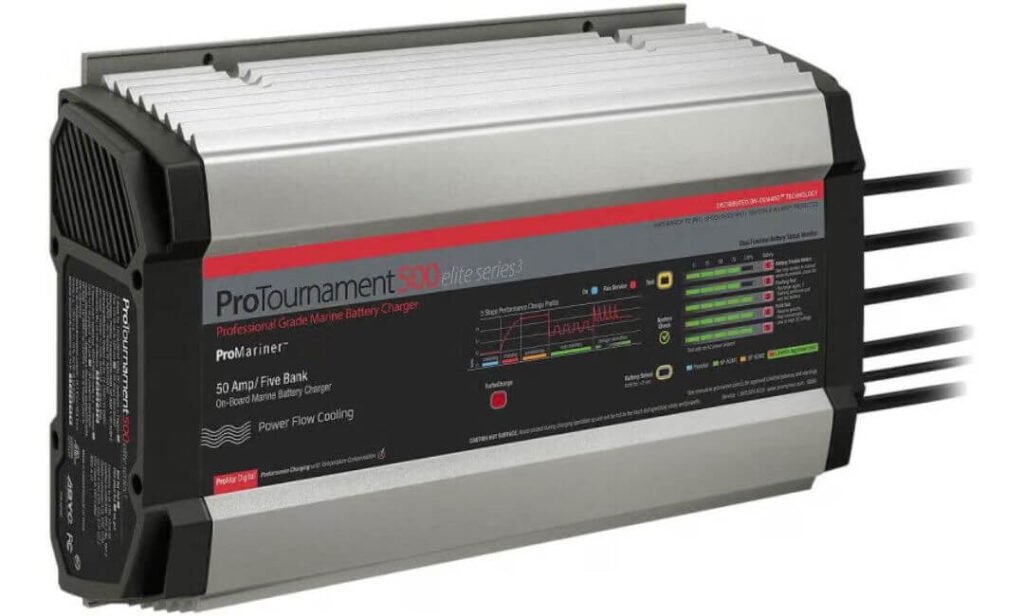
Quick Specs:
- Charging capacity: 50A total across 5 banks
- DC system support: 12V / 24V / 36V / 48V + engine
- Charging design: Distributed-On-Demand
- Bank output: Up to 18A per bank when required
- Battery fit: Group 24–31 flooded, AGM, HP AGM & approved LiFePO4
- AC input: 120V AC ±10%, 13A max
- Water protection: IP67 waterproof
- Cable length: 6 ft
- Physical size: 9.3 × 4.2 × 14.7 in
- Weight: 16.9 lb
- Warranty: 5 years
If you are comparing five-bank chargers seriously, the first thing that stands out here is not the number “5”—it is the 50A total charging platform behind it. The 53505 is built for a multi-battery boat where different banks may come home at different charge levels. Its Distributed-On-Demand system can direct more available current toward a bank that needs it instead of forcing every bank into the same fixed-output pattern. That is a much more useful distinction in real ownership than simply saying “10 amps per bank.”
The other reason this model feels purpose-built for a serious onboard installation is the combination of IP67 waterproof construction, Power Flow Cooling, selectable Turbo Charge, five-stage charging and bank-by-bank charge-status monitoring. It supports 12V, 24V, 36V and 48V DC systems plus an engine battery, while the six-foot DC leads give you some practical flexibility when positioning the charger. The important compatibility detail is that this is not a universal charger for every large marine battery: it is intended for Group 24–31 flooded, AGM/HP AGM and approved LiFePO4 applications, with 4D/8D and Gel batteries excluded.
There is also a small but important ownership detail worth knowing before installation: the charger itself runs from 120V AC, drawing up to 13A—not 240V as some marketplace listings incorrectly show. Its listed dimensions are roughly 9.3 inches high, 4.2 inches wide and 14.7 inches deep, and it weighs about 16.9 pounds, so this is a substantial permanent onboard component rather than something you casually tuck beside the batteries. If your boat has the right battery configuration and enough mounting room, though, the combination of high output, marine sealing and bank-by-bank charging control is exactly why this model deserves serious consideration.
(The short version: this is built for owners who want five-bank charging without treating five batteries as five identical problems.)
What We Like About It
- 50A total capacity gives this charger enough headroom for demanding multi-battery setups.
- Distributed-On-Demand charging is a genuinely useful feature when the banks return at different states of charge.
- IP67 construction makes much more sense on a boat than a charger designed only for dry indoor environments.
- 12V through 48V system support plus engine charging gives it unusually broad usefulness for larger trolling-motor configurations.
- Five-year warranty is reassuring for a permanently installed charger that is expected to live aboard the boat for years.
One Thing We’d Watch
The main thing I would check before ordering is battery compatibility. This charger is a particularly strong fit for its intended Group 24–31 flooded, AGM/HP AGM and approved LiFePO4 applications, so it is worth confirming your exact battery type and size first—especially if you are using a less common marine battery configuration. That quick check helps ensure you get the full benefit of what this charger is designed to do.
Why This Is a Standout 5-Bank Marine Charger
What makes this one different is the way the 50A is managed. A five-bank charger can sound impressive on a specification sheet, but the useful question is what happens when one battery is nearly full and another is heavily discharged. Distributed-On-Demand charging is designed around that exact situation, allowing the available output to move toward the banks that need it most. That makes the architecture more interesting than a simple “five outputs × 10A” description suggests.
It also covers the things that matter once the charger leaves the product page and goes onto a real boat: water resistance, thermal management, multiple DC system voltages, automatic multi-stage charging, status feedback and a permanent onboard form factor. It is not the smallest or simplest option, and it is not meant for every battery type. But for the right Group 24–31 marine setup, that focused design is a strength rather than a weakness.
The Insider Pro-Tip
If this were my installation, I would match the charger to the batteries before worrying about charging speed. Five banks only help when all five batteries are being charged with the profile they actually require. With this unit, verify the exact battery chemistry and size—especially if you have LiFePO4—then check the physical mounting area and AC supply before you buy. The 120V/13A input and roughly 9.3 × 4.2 × 14.7-inch body are easy details to overlook when you are focused on the headline 50A rating.
And there is one more thing I would keep in mind: do not judge this charger by whether every bank receives an identical number at every moment. That is not what its charging system is designed to do. The whole point of Distributed-On-Demand is to use the available power intelligently as the batteries move through their charging cycles. For a boat where five batteries rarely come back in exactly the same condition, that is the part of this charger I would value most.
#2. Minn Kota Precision MK-550PCL 5-Bank
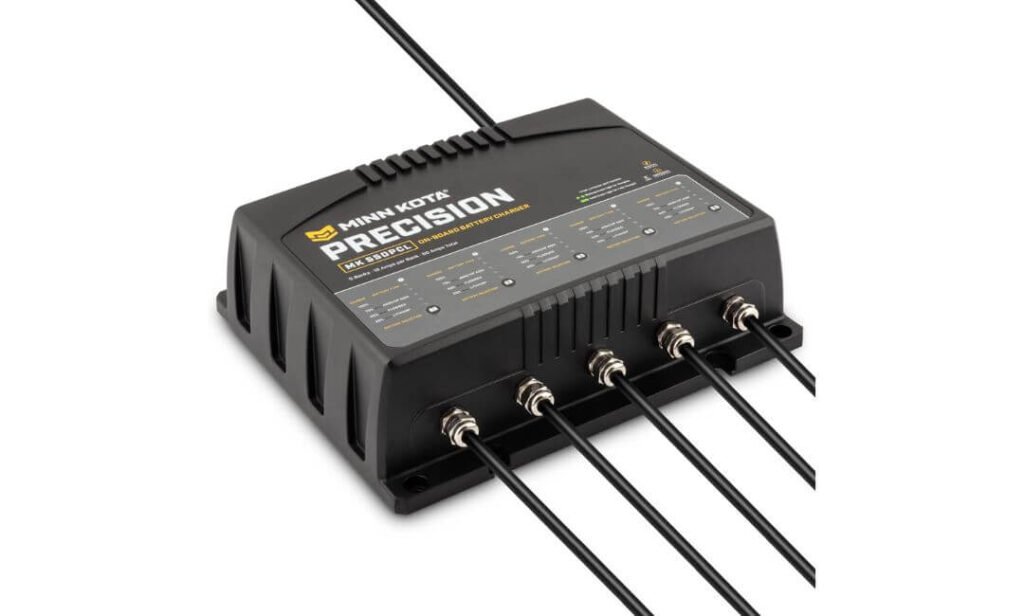
Quick Specs:
- Charging capacity: 50A total, 10A per bank
- Battery selection: 12V AGM, Flooded Lead Acid, Gel & LiFePO4
- Charging control: Microprocessor-based automatic multi-stage charging
- Temperature management: Automatic temperature compensation
- System type: 12V DC
- Marine construction: Waterproof, shock-resistant & vibration-resistant
- Status monitoring: Individual LED indicators for charging, maintenance and errors
- Dimensions: 3.5 × 9.88 × 11.75 in
- Weight: 12 lb
- Installation: Permanent onboard mounting
For a five-bank charger, there is something reassuring about knowing exactly what each bank is designed to deliver. This Minn Kota provides 10 amps to each of the five banks, giving you 50 amps of total charging capacity without relying on a shared-output design. That makes it particularly straightforward for a boat where you want predictable charging across several 12V batteries rather than having to think about where the available current is moving.
The more interesting part is what happens beyond that 10A figure. Each bank can be configured independently for AGM, flooded lead-acid, Gel or LiFePO4, so the charger does not require every battery in the boat to use the same chemistry. Its microprocessor-controlled multi-stage charging adjusts voltage and current throughout the cycle, while automatic temperature compensation helps maintain the intended charging behavior when conditions or incoming line voltage change. That combination is much more useful for a real boat than a charger that simply advertises a large total-amp number
Then there is the physical side, which is easy to underestimate until you are actually inside a cramped battery compartment. At roughly 11.75 inches high, 9.88 inches wide and 3.5 inches deep, this 12-pound unit has a relatively compact footprint for a five-bank charger. It is built for permanent onboard use with waterproof, shock-resistant and vibration-resistant construction, and the individual LEDs provide useful feedback without requiring an app or phone just to see whether a bank has finished charging.
(In other words: five banks, a clear 10A-per-bank layout, and enough charging intelligence to make mixed battery setups considerably easier to manage.)
What We Like About It
- True 10A-per-bank output makes its charging behavior easy to understand and plan around.
- Independent battery-type selection is a major advantage when different batteries are used for trolling, starting or auxiliary duties.
- LiFePO4 support gives it a useful place in newer boat electrical systems while retaining compatibility with traditional battery chemistries.
- Temperature compensation and low-line-voltage compensation are thoughtful additions for real-world charging conditions.
- Compact 12-pound design is easier to accommodate when onboard mounting space is limited.
One Thing We’d Watch
The one check worth making before installation is the exact battery and charging setup you have, particularly if you are moving to LiFePO4. The charger supports multiple chemistries, but selecting the correct battery type for each bank still matters. Taking a minute to verify the battery manufacturer’s charging requirements is a much better approach than assuming every lithium battery will behave identically.
Why This One Makes Sense for a Five-Bank Boat
The strongest argument for this charger is its simplicity without being basic. You get five independent 10A charging outputs, but each bank can still be configured around the battery chemistry it is actually connected to. That makes the unit especially logical for boats using a mixture of starting, trolling and auxiliary batteries where one universal charging profile would be a compromise.
Its compact body also deserves more credit than it usually gets. A five-bank charger is naturally a fairly substantial piece of equipment, yet this one stays around 3.5 inches deep and 12 pounds, while still providing waterproof and vibration-resistant construction for permanent onboard use. Add the individual LED feedback and automatic multi-stage control, and you have a charger that is designed to stay in the boat and quietly do its job rather than demand attention every time you plug in.
The Insider Pro-Tip
If your five batteries are not all the same chemistry, this is where the independent bank selection really earns its keep. Set each bank according to the battery it is actually connected to, rather than choosing one setting because most of the batteries happen to match. It is a small installation decision, but it prevents you from treating an AGM starting battery and a LiFePO4 trolling battery as though they require identical charging behavior.
I would also measure the mounting area before ordering. The 11.75 × 9.88 × 3.5-inch footprint is compact for this category, but onboard compartments rarely have as much usable space as their outside dimensions suggest. Leave sensible room around the unit and route the battery leads cleanly. Once installed correctly, the appeal is straightforward: 50A of total charging, five independently selectable banks, and very little day-to-day fuss.
#3. Battery Tender 5-Bank Multibank Charger 20A
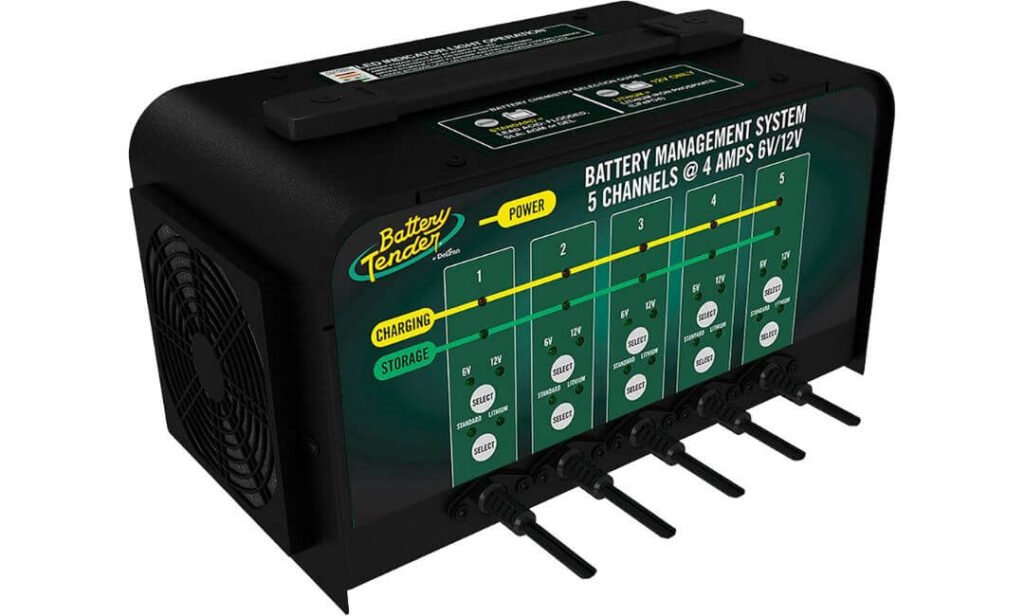
Quick Specs:
- Charging capacity: 20A total, 4A per bank
- Number of banks: 5 independent charging stations
- Voltage selection: 6V / 12V, selectable by bank
- Battery compatibility: Lead-acid, flooded, AGM, Gel & 12V LiFePO4
- Charging program: 4-step automatic charging with float maintenance
- Safety: Reverse-polarity protection & spark-proof operation
- Included connections: 5 alligator-clip leads + 6-ft AC power cord
- Dimensions: 13.5 × 7.5 × 7 in
- Weight: 10.56 lb
- Warranty: 3 years
Sometimes the most useful charger is not the one with the biggest number on the box. This five-bank Battery Tender takes a different route, giving you four amps to each of five batteries simultaneously rather than chasing high-output charging. That makes its sweet spot much clearer: it is designed for keeping several batteries charged and healthy at the same time, particularly when those batteries spend more time sitting than being hammered by daily use.
The feature I find genuinely useful here is the selectable 6V/12V operation on each bank. You are not locked into five identical batteries, so the same unit can accommodate different battery requirements across a garage, workshop, RV setup or marine battery collection. It also supports flooded, AGM, Gel and 12V LiFePO4 batteries, while its four-step charging process moves from charging into float maintenance once the battery is full. That is exactly the behavior you want when the charger may remain connected for extended storage periods.
Its physical design tells you quite a bit about where it fits best, too. At 13.5 × 7.5 × 7 inches and 10.56 pounds, it is compact enough to keep in a workshop or storage area, and Battery Tender supplies five separate alligator-clip connections along with a six-foot AC cord. Reverse-polarity protection and spark-proof operation add another layer of convenience when you are connecting several batteries rather than dealing with a single permanent installation.
(Think of this one less as a high-speed boat charger and more as a five-battery caretaker that happens to charge everything at once.)
What We Like About It
- Five genuinely independent charging stations let you work with several batteries at the same time.
- 6V/12V selection per bank makes it unusually flexible for mixed battery collections.
- Broad chemistry support covers traditional lead-acid batteries as well as AGM, Gel and compatible 12V LiFePO4 batteries.
- Automatic float maintenance makes it particularly useful for seasonal storage and batteries that remain connected for long periods.
- Alligator-clip connections included keep setup simple when you are moving between batteries rather than performing a permanent installation.
One Thing We’d Watch
The main consideration is charging speed. At 4A per bank, it is intentionally much gentler than the 10A-per-bank output of the ProMariner and Minn Kota above. That is not a problem if your priority is maintaining batteries or gradually bringing them back to full charge, but if five heavily discharged boat batteries need to be ready quickly, a higher-output marine charger is the more sensible choice.
Why This One Earns a Place in a Five-Bank Charger Guide
Its strength is flexibility rather than brute force. Five banks, individual 6V/12V selection and support for several battery chemistries give this unit a role that the two 50A chargers above do not fill as naturally. It can make sense when the batteries being maintained are not identical and when charging overnight—or over several days—is perfectly acceptable.
There is also something practical about the old-school connection method. You get five separate leads and individual charging circuits, so there is no complicated installation just to maintain a collection of batteries. For a garage, workshop, seasonal vehicle setup or removable marine batteries that are charged away from the boat, that simplicity can be more valuable than paying for marine-grade hardware you do not actually need.
The Insider Pro-Tip
If your batteries live outside the boat during storage, this becomes much more interesting. Rather than paying for a permanently mounted high-output marine charger when your actual requirement is to keep several batteries topped up, the 4A-per-bank approach can be perfectly reasonable. The important distinction is knowing whether you need recovery speed or maintenance over time.
For actual onboard installation, I would be more selective. The supplied specifications make this a versatile automotive/marine battery charger, but it does not have the same waterproof, vibration-resistant onboard construction as the ProMariner or Minn Kota. So I would treat it as a battery-maintenance solution for a protected location, not automatically as a permanent charger inside an exposed marine compartment. That is a limitation worth understanding—and once you know it, the product’s strengths become much easier to appreciate.
5-Bank Marine Battery Charger Comparison
| What Matters | ProMariner ProTournament Elite 500 High-Output Pick | Minn Kota Precision MK-550PCL 10A-Per-Bank Pick | Battery Tender 5-Bank 20A Maintenance Pick |
|---|---|---|---|
| Total Charging Output | 50A total | 50A total | 20A total |
| Per-Bank Output | Up to 18A when required | 10A per bank | 4A per bank |
| Charging Approach |
Distributed-On-Demand Current can favor batteries needing more charge |
Independent 10A banks Predictable output across all five banks |
Independent 4A banks Designed around gradual charging and maintenance |
| Battery Voltage | 12V / 24V / 36V / 48V systems + engine | 12V | Selectable 6V / 12V |
| Battery Chemistry | Flooded, AGM, HP AGM & approved LiFePO4 | AGM, Flooded, Gel & LiFePO4 | Lead-acid, Flooded, AGM, Gel & 12V LiFePO4 |
| Independent Chemistry Selection | Bank-specific charging management | Yes — select battery type per bank | Yes — 6V/12V and chemistry selection |
| Charging Intelligence | Multi-stage charging + Distributed-On-Demand | Microprocessor-controlled multi-stage charging | Automatic 4-step charging + float mode |
| Temperature / Line Compensation | Power Flow Cooling & charging control | Automatic temperature + low-line-voltage compensation | Automatic charging/maintenance control |
| Marine Construction | IP67 waterproof | Waterproof, shock & vibration resistant |
Protected-location use Not the same onboard marine construction as the first two |
| Status Feedback | Individual bank LEDs + charge-status monitoring | Individual LED indicators for charging, maintenance & errors | Individual bank status indicators |
| Physical Footprint | Approx. 9.3 × 4.2 × 14.7 in | Approx. 3.5 × 9.88 × 11.75 in | Approx. 7 × 13.5 × 7 in |
| Weight | Approx. 16.9 lb | 12 lb | 10.56 lb |
| Best Fit | Demanding multi-battery boats High-output charging where different banks may need different amounts of current. | Modern onboard 12V setups Five predictable 10A banks with flexible battery-type selection. | Storage & maintenance Multiple batteries that can be charged gradually and kept at float. |
| Installation Character | Permanent onboard installation | Permanent onboard installation | Portable / protected-location charging |
| Warranty | 5 years | Manufacturer-backed coverage | 3 years |
| The honest takeaway | Best when charging capacity and intelligent current distribution matter most. | Best balance of consistent output, battery selection and onboard practicality. | Best when flexibility and long-term battery maintenance matter more than charging speed. |
Buying Guide: How to Choose the Right 5-Bank Marine Battery Charger
A five-bank charger is one of those purchases where the headline number can be misleading. Five banks only tells you how many batteries can be connected; it does not tell you how quickly they charge, how the current is distributed, which battery chemistries are supported, or whether the unit belongs permanently on a boat. Those details matter far more once the charger is installed and your batteries are actually being used.
Start With the Batteries, Not the Charger
Before comparing brands, write down what is actually sitting in the boat. Check the voltage, chemistry, capacity, battery size, and job of each battery.
A five-bank setup might contain a starting battery, trolling-motor batteries, house power, or auxiliary batteries. They do not necessarily return to the charger in the same condition, and they may not even use the same chemistry.
| What to check | Why it matters |
|---|---|
| Battery voltage | Determines whether the charger is suitable for your electrical system |
| Battery chemistry | AGM, flooded, Gel, and LiFePO4 can require different charging profiles |
| Battery capacity | Helps determine whether the charger’s output is appropriate for the batteries |
| Battery size | Physical battery dimensions and group size can affect compatibility |
| Battery role | Starting, trolling, house, and auxiliary batteries can have very different charging demands |
| Number of batteries | Confirms whether five independent banks are actually useful for your setup |
This is also where the three chargers in this guide separate themselves. The ProMariner is aimed at higher-output multi-battery marine systems, the Minn Kota gives a predictable 10A per bank, while the Battery Tender makes a stronger case when you need 6V/12V flexibility and long-term maintenance. There is no benefit in choosing the most powerful model if your actual requirement is simply keeping several batteries maintained.
Charging Speed Is More Than the Total Amp Number
Look beyond “50A” or “20A.” Ask how that power reaches the individual banks.
For example, the Minn Kota provides 10A to each of its five banks, which is easy to understand. The ProMariner takes a different approach with Distributed-On-Demand, allowing available charging current to be directed according to battery demand. Battery Tender provides 4A per bank, making it considerably more maintenance-oriented than the two 50A models.
That difference becomes important if your batteries are regularly heavily discharged.
A useful way to think about it:
- 4A per bank: Better suited to gradual charging, storage, and maintaining several batteries.
- 10A per bank: A strong middle ground for regular onboard charging.
- Higher available current with intelligent distribution: More useful when battery banks return at substantially different charge levels and recovery time matters.
Do not confuse charging amperage with a guaranteed charging time. Actual results depend on battery capacity, state of charge, battery temperature, charging efficiency, and the charging profile. A larger amp rating can reduce charging time, but it does not magically make every battery charge at the same rate.
Look for Proper Charging Control
Modern onboard chargers should do more than push current into a battery until the voltage rises.
A microprocessor-controlled, multi-stage charging system can manage different parts of the charging cycle more intelligently, moving from bulk charging toward absorption and then maintenance or float operation as appropriate.
That matters because a battery sitting on charge for hours needs different treatment from one that has just come back heavily discharged.
Useful features include:
- Automatic multi-stage charging
- Independent charging circuits
- Battery-type selection
- Float or maintenance mode
- Charge-stage monitoring
- Protection against incorrect connections
- Automatic adjustment where supported
The important part is not how many technical phrases appear on the box. What matters is whether the charger can apply the appropriate charging behavior to the battery connected to each bank.
Battery Chemistry Can Make or Break the Purchase
This is one of the easiest things to overlook.
AGM, flooded lead-acid, Gel, and LiFePO4 batteries should not simply be treated as interchangeable because they all have a “12V” label. Their charging requirements differ, and a charger needs to support the specific chemistry you are using.
If you have multiple chemistries, look for independent bank selection rather than a single charging setting for the entire unit.
The Minn Kota is particularly useful here because its banks can be selected for 12V AGM, flooded lead-acid, Gel, or LiFePO4. Battery Tender goes a step further in a different direction by allowing 6V or 12V selection and supporting several battery types. The ProMariner also supports specified flooded, AGM and approved LiFePO4 applications, but its compatibility list needs to be checked carefully for the exact battery being installed.
For lithium, do not stop at the words “LiFePO4 compatible.” Check the battery manufacturer’s charging requirements and the charger’s approved battery list. Lithium batteries can have their own BMS behavior, and compatibility is ultimately about the specific combination, not the word “lithium” printed on a product page.
Temperature Compensation Is a Feature Worth Paying Attention To
Battery charging does not happen in a perfectly controlled laboratory.
A boat may sit in a cold storage area, spend a day under a hot compartment, or experience changing temperatures between seasons. A charger with automatic temperature compensation can adjust its charging behavior as conditions change.
The Minn Kota specifically includes temperature compensation as well as compensation for low-line-voltage conditions. That is the sort of feature that is easy to ignore while shopping but can be genuinely useful over years of ownership.
The same principle applies to safety protection. Look for features such as:
- Reverse-polarity protection
- Overcharging protection
- Thermal management
- Fault or error indication
- Spark-resistant or spark-proof operation where specified
- Automatic maintenance/float control
You do not need every feature imaginable. You need the protections that make sense for the way your batteries will actually be charged.
For a Boat, Marine Construction Matters
This is where a normal multi-bank charger and a genuine onboard marine battery charger can become very different products.
A boat exposes electronics to water, humidity, vibration, movement, heat, and potentially saltwater. A charger intended to sit permanently in that environment needs appropriate protection.
Pay attention to:
- IP waterproof rating
- Vibration resistance
- Shock resistance
- Corrosion-resistant construction
- Thermal management
- Permanent mounting provisions
- Cable routing and connector quality
An IP rating is especially useful because it gives you something more meaningful than simply saying “waterproof.” Still, the rating has to be interpreted correctly. Waterproofing does not mean you can mount the charger anywhere without considering ventilation, direct spray, condensation, or manufacturer installation requirements.
The ProMariner’s IP67 construction and the Minn Kota’s waterproof, shock-resistant and vibration-resistant design are therefore meaningful differences for permanent onboard use. The Battery Tender is a different proposition; its strengths are flexibility and maintenance, not the same level of dedicated onboard marine construction.
Think About Installation Before You Buy
A charger can have perfect specifications and still be the wrong choice if you have nowhere sensible to mount it.
Measure the actual usable mounting area, not simply the size of the compartment. Account for cable routing, connectors, access to indicators, ventilation requirements, and enough clearance around the unit.
For reference, the three chargers here have noticeably different footprints:
| Charger type | Approximate dimensions | Practical consideration |
|---|---|---|
| ProTournament Elite 500 | 9.3 × 4.2 × 14.7 in | Larger, substantial permanent installation |
| Minn Kota Precision | 3.5 × 9.88 × 11.75 in | Relatively compact for a 50A five-bank unit |
| Battery Tender 5-Bank | 7 × 13.5 × 7 in | Better suited to a protected charging/storage location |
Also think about weight and mounting strength. A 10–17-pound charger attached to a boat experiences movement that a garage-mounted charger never sees.
Shore Power Is Part of the Charger Decision
Your charger does not operate in isolation. It needs an appropriate AC power source.
Check the charger’s input requirements and make sure your shore-power arrangement can safely supply it. Do not assume that because a charger is sold for boats, every boat’s electrical system can simply accommodate it.
The same applies if your boat also uses solar charging, an alternator, or another battery charger. Multiple charging sources can coexist, but the complete system needs to be designed so that the charging equipment and battery management strategy work together properly.
The practical question is simple: Where is the AC power coming from, how much can it supply, and how will the charger behave alongside the other charging sources already on the boat?
Do Not Overlook Monitoring
A charger that tells you what is happening is easier to live with than one that leaves you guessing.
At minimum, look for individual bank indicators that can show charging progress, maintenance status, faults, or completion.
Bluetooth and app connectivity can be convenient, but they should not automatically outrank useful physical indicators. For a permanently installed marine charger, being able to walk to the compartment and immediately see the status of each bank can be more practical than opening an app.
The best monitoring system is therefore the one that gives you useful information without adding unnecessary complexity.
Understand What “5-Bank” Actually Means
The terminology used in product listings can make similar chargers sound more interchangeable than they really are.
| Search phrase | What it generally signals |
|---|---|
| 5 bank battery charger | Broad category; may include automotive, workshop, storage, or marine products |
| 5 bank onboard battery charger | Usually suggests a charger intended for permanent installation |
| 5 bank marine battery charger | More specifically targets boat use and marine conditions |
| 5 bank onboard marine battery charger | The most specific phrase for a permanently installed boat charger |
| 5 bank battery charger for boat | User-focused search wording, but specifications still need to be checked |
The wording itself is not a guarantee of construction quality. A product can contain the word “marine” in its title without having the waterproofing, vibration resistance, or installation design you would want for a permanent onboard location.
That is why we would always read the actual specifications before trusting the title.
A Simple Way to Narrow Down Your Choice
Once you know your battery setup, the decision becomes much easier:
- Choose around charging speed if your batteries routinely come back heavily discharged and need to be ready again quickly.
- Prioritize independent 10A-per-bank charging when predictable output across five 12V banks is what you want.
- Look for independent chemistry selection when your boat uses different battery types.
- Give extra weight to IP-rated, vibration-resistant construction for permanent onboard installation.
- Choose 6V/12V flexibility and maintenance-focused charging when several batteries need to be kept healthy during storage.
- Check physical dimensions and AC input before ordering, not after the charger arrives.
- For LiFePO4, verify the exact battery/charger compatibility, rather than relying only on a generic “lithium compatible” claim.
The best five-bank charger is ultimately not the one with the longest feature list. It is the one whose charging method, battery compatibility, physical design, and marine protection match the job your five batteries actually have to do.
Smart Charging Features That Actually Matter on a Boat
“Smart” is one of the most overused words on battery-charger product pages. In practice, a smart marine charger should do something useful with that intelligence: control charging accurately, recognize the selected battery chemistry, protect the battery from charging mistakes, manage changing conditions, and tell you when something is not right. A fancy label or phone connection alone does not make a charger smarter.
What Smart Charging Is Actually Doing
A modern multi-bank charger does not simply apply maximum current until the battery is full. Its control system monitors the battery during the charging cycle and changes voltage and current as the battery moves from a deeply discharged state toward full charge and maintenance.
That matters on a boat because five batteries rarely behave exactly alike.
One bank may have powered a trolling motor all day, another may only have started the engine, while a house or auxiliary battery may have seen very little load. A good charging system should be able to deal with those different starting points rather than treating every bank as though it needs the same amount of charging at the same moment.
That is where features such as microprocessor control, multi-stage charging, independent bank management, and intelligent current distribution become more than marketing language.
How Smart Control Helps Protect Battery Health
The useful part of multi-stage charging is the transition between different charging phases.
During the heavier charging stage, the charger can deliver substantial current to bring the battery’s state of charge up. As the battery approaches full charge, the charging behavior changes rather than continuing to push maximum current indefinitely. Once the battery reaches the appropriate level, a maintenance or float stage can keep it ready without treating it like a permanently discharged battery.
For a boat that spends days or weeks connected to shore power, that distinction is important.
It can help reduce unnecessary charging stress while keeping the batteries ready for the next trip. The exact charging profile still depends on the battery chemistry, which is why selecting the correct battery type is just as important as having a smart charger in the first place.
Independent Banks Are the Feature to Watch
With a five-bank system, independence matters.
The Minn Kota, for example, allows the battery type to be selected independently for each bank, supporting AGM, flooded lead-acid, Gel, and LiFePO4 applications. That gives you much more freedom when the five batteries are not identical.
The ProMariner approaches the problem differently with Distributed-On-Demand charging. Instead of assuming every bank needs exactly the same amount of current at all times, its charging system can direct available power toward batteries that need it more.
These are two different interpretations of “smart charging,” and both can be useful.
The important thing is not which technology sounds more advanced. It is whether the technology solves a problem your boat actually has.
Temperature Compensation Is Not Just a Bonus Feature
Battery charging is affected by temperature, and a boat is rarely operated in a perfectly stable environment.
A charger with automatic temperature compensation can adjust its charging behavior as the surrounding conditions change. The Minn Kota also incorporates low-line-voltage compensation, which can help maintain more consistent charging behavior when the incoming AC supply is less than ideal.
This becomes particularly useful when a boat is exposed to significant temperature changes between seasons or when the electrical supply is not always identical.
It is one of those features you may never notice when everything is working correctly—and that is actually the point.
Marine Safety Requires More Than a Smart Circuit Board
The electronics inside the charger are only part of the equation.
A marine charger also needs to deal with the physical environment around it. Water, vibration, shock, heat, humidity, and salt exposure are all very different from what a charger experiences sitting on a dry garage shelf.
For permanent onboard use, pay attention to:
- Waterproofing or IP protection
- Shock and vibration resistance
- Thermal management
- Reverse-polarity protection
- Fault and error indication
- Proper battery-chemistry profiles
- Appropriate mounting and cable routing
The ProMariner’s IP67 protection and the Minn Kota’s waterproof, shock-resistant and vibration-resistant construction are meaningful because these features relate directly to where the chargers are intended to operate.
A charger can have excellent charging electronics and still be the wrong product for a permanently exposed marine location if the physical construction does not match the environment.
Where Bluetooth and Apps Fit In
Bluetooth and smartphone apps can be useful, but I would not make them the deciding factor when buying a five-bank marine charger.
Remote monitoring is valuable when you want to check charging status without opening a battery compartment, especially on a larger boat where the charger is installed somewhere inconvenient. Diagnostic information can also make troubleshooting easier when a bank is not behaving as expected.
But there is a practical limit.
An app cannot compensate for the wrong charger, wrong battery profile, poor installation, or incompatible battery.
For many boat owners, clear individual LED indicators are still perfectly adequate. Being able to look at the charger and immediately see whether a bank is charging, maintaining, complete, or reporting an error is often all the information needed.
What About Remote Diagnostics and Firmware Updates?
These features are useful when a manufacturer actually supports them, but they should be treated as convenience features rather than reasons to overlook core specifications.
Remote diagnostics can help identify charging faults without physically accessing the unit. Firmware updates can also improve supported electronics over time, but not every charger offers updateable firmware, and the process varies considerably by manufacturer.
For a five-bank charger, I would rank these below:
battery compatibility → charging architecture → marine protection → output → installation requirements → monitoring convenience.
That order keeps the buying decision grounded in the things that directly affect charging performance and safety.
The Smartest Feature May Be the One You Never Notice
A genuinely well-designed charger should quietly handle much of the work for you.
You connect the batteries correctly, select the appropriate chemistry where required, provide the proper AC supply, and let the charging system manage the cycle. You should not need to constantly intervene because one bank has reached full charge or because the boat’s temperature changed during the day.
That is why features such as automatic multi-stage charging, temperature compensation, independent bank control, maintenance modes, and fault monitoring deserve more attention than flashy terminology.
For this guide, that is the distinction we care about: smart charging is valuable when it improves how the batteries are treated—not simply when it gives the charger more features to advertise.
Installation and Maintenance Tips for a 5-Bank Marine Battery Charger
A good charger can only work as well as its installation allows. On a boat, mounting location, airflow, cable routing, protection, and battery connections all matter because the charger is dealing with vibration, moisture, heat, and a demanding electrical system. The goal is not simply to get the charger powered up; it is to create an installation that remains safe, accessible, and reliable after months of use.
Choose the Mounting Location Carefully
Start by finding a dry, secure, and reasonably ventilated location that is close enough to the batteries for the manufacturer’s specified cable length and routing requirements.
Avoid placing the charger where it can receive direct spray, sit in standing water, or become repeatedly soaked by condensation. Even a marine-rated charger should not be treated as though waterproofing makes installation location irrelevant.
Before drilling anything, check:
- Available mounting space, including room for connectors and cables.
- Ventilation and heat dissipation, particularly around higher-output chargers.
- Protection from direct water and salt spray.
- Distance from moving equipment, hatches, steering components, and areas likely to experience impact.
- Accessibility of status indicators, so you can inspect the charger without dismantling the boat.
- Structural strength of the mounting surface, especially because a charger weighing around 10–17 pounds is exposed to constant vibration while underway.
For a permanent installation, mount the charger firmly according to the manufacturer’s instructions. A charger that can move or vibrate against its mounting surface is not something I would consider properly installed, regardless of how good the electronics are.
Give Heat Somewhere to Go
Charging produces heat, and higher-output chargers can generate considerably more of it.
Do not bury the charger inside a tightly sealed compartment simply because the dimensions appear to fit. Follow the manufacturer’s required clearances and ventilation guidance, and keep the area around the unit free from unnecessary insulation, loose equipment, or anything that could restrict airflow.
This is especially relevant when comparing a 50A charger with a 20A maintenance-oriented unit. More charging capability generally means you need to pay closer attention to heat management during extended charging cycles.
A simple rule is useful here: fit the charger into the space, but do not make the space fit so tightly around the charger that it cannot dissipate heat properly.
Keep Water Away From Electrical Connections
Water resistance of the charger itself does not make every connection on the boat waterproof.
Pay particular attention to:
- Battery terminals
- Inline fuses or circuit protection
- Cable connectors
- Crimped terminals
- AC connections
- Cable entry points
- Areas where condensation can collect
Keep connections clean, tight, protected, and properly supported. Avoid allowing cables to hang from terminals or connectors under their own weight. Secure the wiring so vibration does not repeatedly flex the same connection.
On saltwater boats, inspect for corrosion or salt buildup more frequently. A charger may remain perfectly healthy while a corroded terminal gradually creates resistance, heat, or intermittent charging problems.
Use the Correct Cable Size and Protection
Do not choose wire gauge by looking only at the charger itself. The correct cable size depends on the current, cable length, voltage drop, installation method, and manufacturer’s requirements.
For the battery-side wiring:
- Follow the charger’s installation manual for the recommended cable size.
- Keep cable runs as practical rather than unnecessarily long.
- Use appropriately rated fuses or circuit protection where specified.
- Make sure every connection is properly crimped and insulated.
- Support cables so vibration does not pull on battery terminals.
- Keep positive and negative conductors routed cleanly and protected from abrasion.
- Never substitute a larger fuse simply because the original one keeps opening.
That last point is particularly important. If a fuse repeatedly trips, find the reason instead of increasing the fuse rating. A fuse is there to protect the wiring and electrical system, not to be bypassed when the charger or circuit is demanding more current than it should.
Treat Each Bank as Its Own Charging Circuit
A five-bank charger is easier to troubleshoot when you think of it as five separate battery connections sharing one charger enclosure.
Do not casually mix the positive and negative leads between batteries. Follow the manufacturer’s wiring diagram exactly, and verify which positive and negative cable belongs to each bank before connecting anything.
If the boat uses several batteries in a series or parallel configuration for a trolling motor, the charger connections need to follow the manufacturer’s specific instructions for that configuration. A five-bank charger does not automatically mean five completely unrelated batteries.
Before applying AC power, physically trace every connection and confirm:
- Bank 1 is connected to the intended battery.
- Bank 2 is connected to the intended battery.
- The remaining banks are correctly identified.
- Positive and negative polarity is correct.
- Series or parallel battery arrangements are wired as specified.
- No battery terminal is accidentally sharing a charger lead intended for another bank.
A few minutes spent checking this before energizing the charger is considerably cheaper than troubleshooting a wiring mistake afterward.
Do Not Guess the Battery Chemistry Setting
If the charger provides selectable battery types, set each bank for the battery actually connected to it.
This is especially important when a boat has mixed batteries. An AGM starting battery and a LiFePO4 trolling battery should not be treated as though they automatically require the same charging profile.
Before selecting a mode, check the battery label or manufacturer’s documentation. If the battery specification is unclear, do not guess based solely on its appearance.
For lithium batteries, check both the charger’s approved compatibility information and the battery manufacturer’s charging requirements. “Lithium compatible” is useful information, but it is not a substitute for confirming that the specific battery and charger are a suitable combination.
Make the First Charging Cycle a Check, Not a Celebration
After installation, do not simply connect shore power and walk away for the weekend.
Watch the first charging cycle.
Check that:
- Every bank is recognized.
- The expected charging indicators appear.
- No bank immediately reports an error.
- Battery connections remain cool and secure.
- There is no unusual smell, noise, sparking, or excessive heat.
- The charger transitions through its normal charging stages.
- The batteries reach the expected maintenance or float condition.
The first cycle is your opportunity to catch a wiring, configuration, or compatibility issue while you are still standing next to the boat.
Use the LEDs as an Early Warning System
Individual LED indicators are more useful than they look.
If one bank repeatedly shows a fault while the other four operate normally, do not immediately assume the charger is defective. Check that bank’s battery, terminals, fuse, cable connections, and battery condition first.
A simple pattern can tell you a lot:
| What you see | What I would check first |
|---|---|
| All banks charging normally | Installation is behaving as expected |
| One bank shows an error | Battery, polarity, fuse, cable, or battery condition |
| Several banks fail together | AC supply, charger input, or installation issue |
| One battery never reaches maintenance | Battery condition, chemistry setting, connection, or compatibility |
| Charging stops unexpectedly | AC supply, thermal condition, protection circuit, or battery fault |
| Indicator behavior changes repeatedly | Check the manual’s specific LED/error pattern before replacing anything |
The exact LED meanings vary by charger, so use the manufacturer’s indicator guide rather than interpreting a flashing light from memory.
Check Bank Balance Without Overthinking It
“Balanced charging” does not necessarily mean every bank will display the same charging behavior at every moment.
If one battery was heavily discharged and another was nearly full, their charging stages will naturally differ.
With a charger such as the ProMariner, Distributed-On-Demand charging is specifically intended to manage current according to battery demand. With the Minn Kota, each bank has a defined 10A output, making its behavior more predictable. The Battery Tender operates at a gentler 4A per bank and is particularly suited to maintaining batteries over time.
So do not look at five different LED states and automatically conclude something is wrong.
The better question is: Is each battery progressing normally according to its own condition and charging profile?
Maintenance Mode Is Where Long-Term Ownership Gets Easier
Once the batteries reach full charge, the charger should not simply continue behaving as though they are empty.
A proper maintenance or float stage is designed to keep the battery ready while avoiding unnecessary continuous high-current charging.
This is particularly valuable for boats that sit unused between trips.
If your charger has reached its maintenance state and the batteries remain connected according to the manufacturer’s instructions, there is usually no reason to repeatedly disconnect and reconnect everything just because the batteries are already full.
However, if the boat will remain unused for an extended period, follow the battery manufacturer’s storage guidance as well. Battery chemistry, onboard electronics, parasitic loads, and storage conditions can all affect the right approach.
A Few Dockside Troubleshooting Checks
If a bank is not charging, start with the simple things before assuming the charger has failed.
No charger activity at all:
Check the AC supply, shore-power connection, breaker, outlet, and charger input. If other equipment on the same supply is also dead, the problem may not be the charger.
One bank is not charging:
Inspect that battery’s positive and negative connections, fuse, cable, polarity, and battery condition. Compare its connections with a bank that is working correctly.
A battery charges unusually slowly:
Check the battery’s state of health, capacity, temperature, connections, and charging profile. A charger cannot make a badly degraded battery behave like a healthy one.
The charger reports a fault:
Use the manufacturer’s LED or error-code guide first. Do not repeatedly reset the charger without understanding what caused the protection circuit to activate.
The charger becomes unusually hot:
Stop and investigate the installation, airflow, ambient temperature, charging load, and connections. Normal warmth during charging is not the same thing as unexplained excessive heat.
A lithium battery will not accept the charge:
Confirm the selected lithium mode, the battery’s voltage and condition, and the compatibility information for that specific battery. A lithium battery’s BMS can also affect charging behavior.
What I Would Check Before Leaving the Boat
Before closing the compartment and leaving the charger connected, I would make one final pass:
- All five banks are connected correctly.
- Every battery is set to the correct charging profile.
- Fuses and connections are secure.
- Cables are supported and protected from abrasion.
- The charger has adequate ventilation.
- No connection is showing corrosion or unusual heat.
- The AC supply is appropriate for the charger.
- The indicators show normal charging or maintenance status.
That routine may take only a few minutes, but it gives you something far more valuable than another feature on a specification sheet: confidence that the charger and the batteries are actually working together the way they should.
FAQs About 5-Bank Marine Battery Charger
Can a ProMariner 53505 really be a better choice than a conventional 10A-per-bank charger if all five batteries are not equally discharged?
Yes, and this is one of the more important differences to understand before comparing five-bank chargers purely by their headline output. The ProMariner 53505 uses Distributed-On-Demand charging, so it is not simply locked into sending an identical 10A to every bank at every moment. When the batteries are at different states of charge, the available charging current can be directed according to the charging demand of the individual banks.
That can be useful on a real fishing boat. Your trolling-motor batteries may return heavily depleted while the starting battery has barely been used. Treating those batteries as five identical loads would not make much sense. The ProMariner’s charging architecture is designed around that uneven situation, which is why its 50A total capacity should not be interpreted as merely “five fixed 10A outputs.”
There is an important qualification, though: the charger’s compatibility still has to match the batteries. The 53505 is intended for specified Group 24–31 flooded, AGM/HP AGM and approved LiFePO4 applications, so a higher-output charger is not automatically the better purchase for every five-battery boat.
Is the Minn Kota MK-550PCL actually useful with a boat that has different battery chemistries across its five banks?
Yes, and this is arguably one of its most practical features. The Minn Kota MK-550PCL allows the charging type to be selected independently for each bank, supporting 12V AGM, flooded lead-acid, Gel, and LiFePO4 applications. That means you are not forced to give all five batteries the same charging treatment simply because they are connected to one charger.
Imagine a setup where the starting battery is AGM, the trolling batteries are LiFePO4, and another auxiliary battery uses a different supported chemistry. The useful part is not merely that the charger says “lithium compatible”; it is that each bank can be configured for the battery actually connected to it.
There is still one step I would never skip: check the exact battery manufacturer’s charging requirements before selecting the mode. Different batteries can have different requirements even within the same broad chemistry category, and “supports LiFePO4” should never be interpreted as “every LiFePO4 battery is automatically compatible.”
Is a 20A five-bank charger such as Battery Tender’s a sensible marine choice, or does 4A per bank make it too slow?
It depends entirely on what you expect the charger to accomplish. The Battery Tender 5-Bank 20A is not trying to compete with a 50A onboard charger on recovery speed. Its five banks provide 4A per battery, making it much more attractive for gradual charging, battery storage, and long-term maintenance than for rapidly recovering five heavily discharged batteries.
That distinction is actually useful when choosing between these products. If the boat comes back from a demanding day on the water and needs all five batteries ready again as quickly as practical, the 50A options are much more appropriate. If several batteries are sitting in storage and your priority is keeping them healthy and ready over time, 4A per bank can be perfectly reasonable.
I would also be careful about where this unit is used. Its 6V/12V selection, broad battery compatibility, independent charging, and float maintenance are excellent reasons to consider it for a protected garage, workshop, storage area, or removable marine batteries. They do not automatically make it equivalent to a purpose-built waterproof onboard marine charger.
Why can a five-bank charger show different charging or maintenance statuses on different batteries at the same time?
Because different battery conditions do not require identical charging behavior. If one battery is deeply discharged and another is already close to full, it is completely normal for their charging stages to differ.
This is actually something I would prefer to see rather than five indicators behaving identically simply for the sake of appearance.
A bank may be:
- In a higher-current charging stage.
- Moving through absorption.
- Already at full charge.
- In maintenance or float mode.
- Reporting a connection or battery-related fault.
The important question is not whether all five LEDs look the same. It is whether each battery is progressing normally for its own condition and selected charging profile.
This is also why blindly comparing chargers by the phrase “five independent banks” can be misleading. Independence, current distribution, charging algorithms, battery selection, and maintenance behavior all describe different parts of the charging system.
If my boat uses LiFePO4 batteries, should I choose a five-bank charger simply because the product listing says “lithium compatible”?
No. “Lithium compatible” is the beginning of the compatibility check, not the end of it.
Before buying, I would verify the exact battery model against the charger’s supported chemistry and charging requirements, then check the battery manufacturer’s recommended charging voltage, current, and operating conditions. This matters even more with a five-bank installation because you may have several lithium batteries connected simultaneously, potentially with different capacities or battery-management systems.
A sensible pre-purchase check looks like this:
- Confirm the battery is 12V LiFePO4, if that is what the charger supports.
- Check the charger’s manufacturer documentation for the supported lithium application.
- Confirm the battery’s recommended charging specifications.
- Verify the charger has the correct charging mode for that battery.
- Check the complete electrical configuration if the batteries are connected in series or parallel.
- Make sure the charger and battery system are being installed exactly as their manufacturers specify.
That extra five-minute check is worth far more than trusting a marketplace title. A charger can be excellent in every other respect and still be the wrong choice if the specific battery/charger combination is not approved or appropriate.
And if your batteries are not lithium, do not assume you need lithium support just because it sounds more future-proof. Buy for the batteries you actually have and the system you genuinely intend to run.
Final Verdict: Which 5-Bank Marine Battery Charger Makes the Most Sense?
After looking at these chargers as actual pieces of boat equipment rather than simply comparing numbers on a product page, the choice becomes fairly clear: there is no single winner for every five-battery setup. The right charger depends on what your batteries need, how quickly you need them recovered, and whether the charger will live permanently aboard the boat or spend most of its life maintaining batteries in a protected location.
The ProMariner ProTournament Elite 500 is the one I would look at first for a demanding multi-battery marine system where charging capability is the priority. Its 50A total capacity, Distributed-On-Demand charging, 12V through 48V system support, IP67 construction, and five-year warranty give it a serious advantage for the type of installation it was designed for. It is also the charger where I would pay closest attention to the exact battery compatibility before purchasing, because its supported battery range is specific rather than universal.
The Minn Kota Precision MK-550PCL is arguably the easier recommendation for someone who wants predictable 10A-per-bank charging combined with independent battery-type selection. Its support for AGM, flooded lead-acid, Gel, and LiFePO4, along with temperature compensation and compact onboard design, makes it a particularly sensible fit for modern 12V boat systems. It does not need to win every specification battle; its strength is that the feature set makes practical sense together.
Then there is the Battery Tender 5-Bank 20A, which should not be dismissed simply because its output is lower. Its real value is elsewhere: five independent 4A channels, selectable 6V/12V operation, broad battery compatibility, and automatic maintenance charging. For storage, workshop use, seasonal batteries, or a protected charging location, that can be exactly the right tool. I would simply not treat it as a direct substitute for a waterproof, permanent onboard marine charger.
The Buying Decision I Would Make
If you need maximum charging capability for a serious multi-battery boat, start with the ProMariner.
If you want consistent 10A-per-bank charging with flexible chemistry selection, the Minn Kota is the more straightforward choice.
If your priority is keeping several different batteries charged and maintained over time, especially outside the boat, the Battery Tender has a very legitimate reason to be on the list.
And before buying any of them, check the one thing that can make every other specification irrelevant: your actual batteries. Confirm their voltage, chemistry, capacity, physical size, charging requirements, and the manufacturer’s compatibility guidance. Then check the charger’s dimensions, AC requirements, mounting location, ventilation, and cable routing.
That is the part of five-bank charger shopping that is easy to skip because it is not exciting. It is also the part most likely to determine whether you are genuinely happy with the purchase six months from now.
A good charger should disappear into the background once it is installed. Your batteries should come back ready, the charging system should behave predictably, and you should not have to constantly wonder whether the charger is treating each bank correctly. That is ultimately the standard I would use—not which product has the loudest marketing claim, but which one fits your boat so well that you stop thinking about the charger altogether.
Also Check: