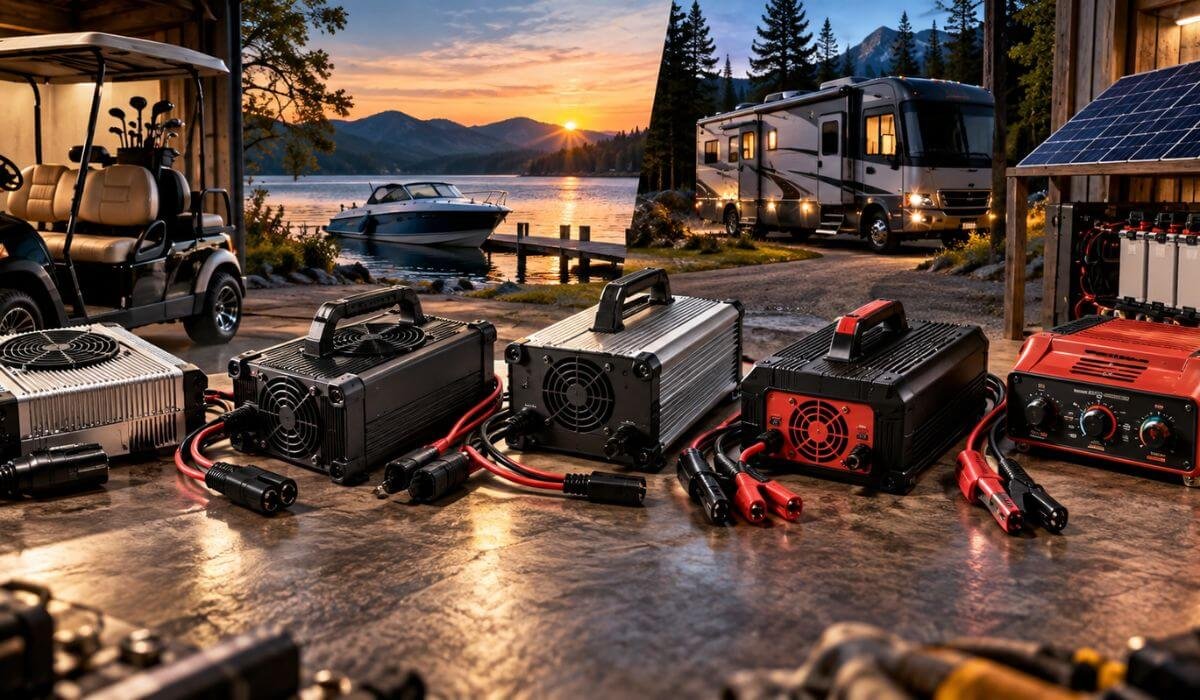
5 Best 48V Battery Charger in 2026: Lithium, LiFePO4, 20A & Smart Charging
A 48V battery charger is not a one-size-fits-all purchase. A battery marketed as 48V may actually be a 51.2V LiFePO4 pack, while an older golf cart may still use a 48V lead-acid battery bank. Both carry the same nominal voltage label, but their charging requirements are not the same. That single detail is responsible for many poor charger choices, especially when shopping from product titles alone.
For this comparison, the focus is on what actually matters after the charger leaves the box: battery chemistry, full-charge voltage, charging current, BMS compatibility, protection, and real-world installation. The KAISAL 48V/58.4V 18A LiFePO4 Battery Charger takes the #1 spot because it brings together the key requirements for a compatible 51.2V LiFePO4 system—58.4V output, 18A charging, 5-stage control, 0V wake-up, temperature management, IP67 protection, and a 16-foot cable—without relying on a vague “48V compatible” claim.
One number deserves special attention before buying: 58.4V is the correct full-charge voltage for a compatible 16S 51.2V LiFePO4 battery, so seeing 58.4V on the charger does not mean it is too powerful for a 48V-class battery. At the same time, that specification should never be applied blindly to every 48V pack. The right charger is the one whose chemistry, charging voltage, current and connection match the battery actually being used, whether that is a newer lithium setup, a custom battery system, or an older lead-acid golf cart.
Best 48V Battery Charger: Top 2026 Picks for 58.4V, 20A & IP67 Protection
#1. KAISAL 48V/58.4V 18A LiFePO4 Battery Charger
Best 48V Lithium Battery Charger for 51.2V LiFePO4 Packs, 18A Charging, 0V Wake-Up & IP67 Protection
#2. DALY 48V 20A Adjustable Lithium Battery Charger
Best Adjustable 48V Battery Charger for LiFePO4 & NCM Packs, 38V–60V Output, Bluetooth Control & IP67 Protection
#3. YUANRI 48V 17A LiFePO4 Battery Charger
Best 48V LiFePO4 Battery Charger with 58.4V Output, 0V Wake-Up, M8 Terminals & IP67 Protection
#4. FORM 48V 15A Golf Cart Battery Charger
Best 48V Golf Cart Battery Charger for EZGO Lead-Acid Systems, Maintenance Mode, Triangle Plug & IP67 Protection
#5. Beleeb C20 12V–48V Adjustable Battery Charger
Best Multi-Voltage Battery Charger for 48V Lithium, LiFePO4 & Lead-Acid Batteries, Adjustable Current & H-Pulse Maintenance Mode
Must Check: Best Marine Battery Charger
Expert Tip: Check the Battery Before You Check the Charger
The easiest way to get a 48V charger wrong is to shop by the “48V” label alone. Check the battery label first. If it says 51.2V LiFePO4, you generally need a charger designed to finish at 58.4V. If it is a conventional lead-acid golf-cart system, the charging requirements are different.
Also check the maximum charging current your battery manufacturer allows. A higher-amp charger is not automatically a better charger; it is only better when the battery and BMS are designed to accept that current. For older equipment, connector type and charging profile matter just as much as headline wattage.
That is why these five chargers are not ranked simply by their amp rating. Battery compatibility comes first, charging behavior comes second, and convenience features come after that.
How We Chose These 48V Battery Chargers
There is a reason these five models are not all the same type of charger. The goal was to represent the real-world situations people encounter when shopping for a 48V charger in 2026, rather than filling a list with five nearly identical products.
1. Battery chemistry was the first filter.
A charger intended for LiFePO4 was evaluated differently from one built around lead-acid golf-cart batteries. This matters because a charger that physically connects to a battery is not necessarily electrically appropriate for it. KAISAL, DALY, and YUANRI stand out for their lithium/LiFePO4 focus, while FORM makes more sense for compatible EZGO lead-acid applications.
2. Actual charging voltage mattered more than the “48V” name.
For a 51.2V LiFePO4 pack, 58.4V charging voltage is a meaningful specification. KAISAL and YUANRI are built around this charging point, while DALY adds flexibility through its adjustable output. That makes these models much easier to evaluate against the battery’s actual configuration instead of relying on marketing terminology.
3. Charging current was considered in context.
DALY’s 20A output is the highest in this group, followed by KAISAL at 18A, YUANRI at 17A, and FORM at 15A. But the ranking does not assume that 20A is automatically superior. The right current depends on the battery’s capacity, BMS limits, and manufacturer’s recommended charging rate.
4. Protection and enclosure quality were taken seriously.
A charger used around a boat, RV, golf cart, outdoor battery bank, or off-grid setup can face conditions that a garage-only charger never sees. KAISAL, DALY, and YUANRI therefore get meaningful credit for features such as IP67 protection, while DALY also brings Bluetooth connectivity and adjustable charging parameters to the table.
5. Compatibility breadth was another deciding factor.
DALY is particularly interesting because it supports 16S LiFePO4, 13S Li-ion, and adjustable output, giving it a wider range than a charger designed around one specific battery type. KAISAL earns its position through its combination of 48V/51.2V LiFePO4 compatibility, 18A charging, IP67 construction, and broad application range. YUANRI adds 0V wake-up and multiple protection features, which can be genuinely useful with compatible LiFePO4 packs.
6. We did not ignore older 48V equipment.
Not every buyer is replacing a brand-new battery system. Many 48V golf carts and other equipment still use established lead-acid configurations. That is why the FORM 48V 15A model remains on the list: it is a more specialized choice, but for a compatible EZGO RXV or TXT lead-acid system, specialization is actually a strength rather than a weakness.
7. The final ranking reflects the charger, not the brand name.
No model was placed higher simply because it has a familiar name or an impressive-looking specification sheet. The question was: What type of 48V battery is this charger genuinely suited to, what does it actually deliver, and where does it make the most sense? That approach is also why the multi-voltage Beleeb C20 sits below the more dedicated 48V models despite supporting several battery types.
The result is a list with a useful spread: dedicated LiFePO4 chargers, an adjustable lithium charger, a golf-cart-specific lead-acid option, and a multi-voltage alternative. That makes the comparison more useful than simply declaring one charger “best” for every 48V battery.
#1. KAISAL 48V/58.4V 18A LiFePO4 Battery Charger
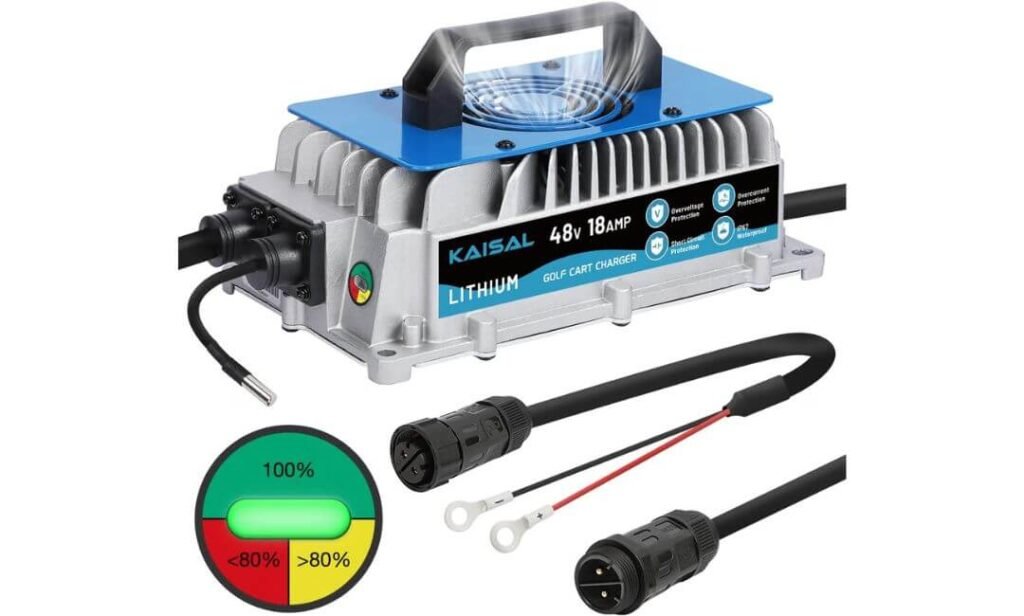
Quick Specs:
- Battery compatibility: 48V (51.2V) LiFePO4
- Output: 58.4V / 18A
- Rated charging power: 1,250W
- Charging system: 5-stage smart charging
- Standout feature: 0V battery wake-up
- Protection: IP67 waterproof and dustproof housing
- Connection: O-shaped M8 terminals
- Cable length: 16 ft total
- Operating temperature: -4°F to 113°F
- Safety protection: Overvoltage, overcurrent, overheating, short-circuit, reverse connection, no-load and timeout protection
- Warranty: 3 years
The important number here is 58.4V, not simply “48V” printed on the product. This charger is designed for 48V (51.2V) LiFePO4 batteries, where 58.4V is the intended full-charge voltage for the compatible 16S configuration. That makes the charging profile far more meaningful than a generic charger that happens to advertise 48V compatibility.
Its 18A output is another practical advantage. Compared with basic 10A chargers, it gives a compatible 100Ah LiFePO4 battery substantially more charging capacity, with the manufacturer estimating around five hours for a full charge under suitable conditions. The charger then transitions through its 5-stage charging process, reducing current as the battery gets close to full rather than treating the entire cycle like a constant high-current session.
The feature that really earns attention is 0V wake-up. A deeply discharged lithium battery can be disconnected by its BMS and may not immediately be recognized by a conventional charger. This unit is designed to help wake a compatible protected pack back into charging. Add the IP67 sealed aluminum housing, temperature monitoring, cooling fan, 16-foot cable and M8 terminals, and it becomes a particularly practical choice for installations where the charger may live around a golf cart, boat, RV, forklift or off-grid battery system. (The useful combination is 51.2V LiFePO4 compatibility, 58.4V charging and 18A output—not the 48V label by itself.)
What We Like About It
- 58.4V output is properly matched to compatible 51.2V LiFePO4 packs.
- 18A charging capacity gives it an advantage over slower 10A alternatives.
- 0V wake-up addresses a real problem with batteries disconnected by BMS protection.
- IP67 construction makes more sense for outdoor, marine and utility applications.
- 16-foot cabling and M8 terminals give owners more flexibility when the charger needs to be mounted away from the battery.
One Thing to Know Before Buying
The 18A figure should not be treated as the required charging current for every 48V LiFePO4 battery. The battery’s BMS and manufacturer specifications still determine how much current it should accept. Checking that rating before purchase is the smart move, especially with aftermarket or older 48V battery conversions.
Why It’s Our #1 48V Battery Charger Pick
This earns the top position because the specification sheet actually lines up with what a 48V lithium owner needs. You get a dedicated 51.2V LiFePO4 charging profile, 58.4V output, 18A capability, smart charging and 0V wake-up in the same unit. There is no need to rely on a vague “universal 48V” claim to figure out whether the charger belongs with the battery.
It is also unusually versatile for a dedicated lithium charger. Compatible golf carts, boats, RVs, forklifts, electric outboards and off-grid battery systems can all make sense here. That combination of correct charging voltage, useful current, protection and installation flexibility is why it makes a stronger overall recommendation than simply picking the charger with the biggest number on the box.
The Insider Pro-Tip
Before ordering, check three things on the battery label: 51.2V LiFePO4 chemistry, 58.4V charging voltage, and the battery’s permitted charging current. If all three match, you have removed the biggest source of compatibility mistakes before spending money.
And although IP67 protection gives this charger a serious advantage outdoors, installation still matters. Keep the cooling area unobstructed, secure the M8 connections properly, and avoid leaving electrical connections sitting in standing water. Good hardware lasts much longer when the installation gives it a fair chance to do its job.
#2. DALY 48V 20A Lithium Battery Charger
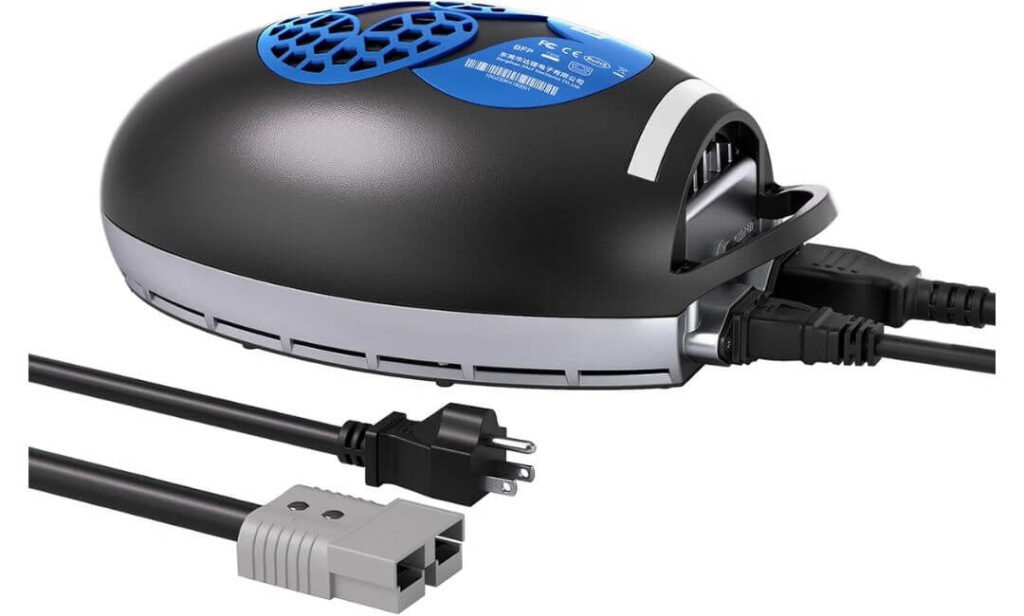
Quick Specs:
- Battery compatibility: 15S/16S LiFePO4 and 13S/14S NCM lithium packs
- Output range: 38V–60V
- Current range: 5A–20A
- Preset charging voltages: 54.75V, 58.4V, 54.6V and 58.8V
- Charging control: Bluetooth app + 5-stage charging
- Efficiency: ≥93%
- Wake-up: 0V battery activation
- Protection: 11 built-in safety protections
- Enclosure: IP67 sealed aluminum housing
- Operating range: -4°F to 167°F
- AC input: 110V–240V
- Certifications: CE, FCC, UL test report
- Weight: 10 lbs
Some 48V battery systems are straightforward. Others are not. A 48V label can hide very different pack configurations, and that is where this charger takes a different approach: instead of locking the owner into one charging profile, it provides a 38V–60V adjustable voltage range and 5A–20A current range. Through the Bluetooth app, compatible packs can be configured around presets such as 54.75V for 15S LiFePO4, 58.4V for 16S LiFePO4, and 54.6V or 58.8V for supported NCM configurations.
That flexibility is the real reason this model sits at #2. If the battery has a specific charging requirement, being able to set the charger around the pack is far more useful than buying a fixed-output unit and hoping the numbers happen to line up. The 5-stage charging algorithm handles wake-up, diagnosis, pre-charge, constant-current charging and constant-voltage charging, while the system continuously monitors the charging process. With claimed efficiency of 93% or higher, it is also designed to reduce unnecessary energy loss during operation.
Then there is the hardware. The IP67 sealed aluminum enclosure, full-potting construction and stated operating range of -4°F to 167°F give it a serious advantage for marine, RV, industrial and outdoor installations. Its 11 protection functions cover everything from reverse polarity and short circuits to AC/DC voltage problems and thermal protection. The 0V activation feature is another useful touch for compatible batteries whose BMS has put the pack into a dormant state. (This is less of a “plug it in and forget it” charger and more of a configurable charging tool for owners who care about getting the settings right.)
What We Like About It
- Adjustable 38V–60V output makes it unusually adaptable across compatible 48V-class lithium configurations.
- Bluetooth control lets the charging profile be checked and configured without treating the charger like a black box.
- 15S/16S LiFePO4 and 13S/14S NCM presets give it broader chemistry and pack-configuration coverage than a fixed 58.4V charger.
- 11 protection functions provide a deeper layer of monitoring than the basic protection package found on many chargers.
- IP67 sealed aluminum construction makes it a serious option for demanding outdoor and mobile installations.
One Thing to Know Before Buying
The adjustability is a strength only when it is used correctly. Do not choose voltage or current by guesswork—use the battery manufacturer’s specified charging voltage and maximum charging current for the exact pack configuration. That is particularly important with DIY or modified battery systems.
Why It’s Our #2 48V Battery Charger Pick
This is the charger to look at when “48V” is not enough information. Its ability to work across several supported lithium configurations, combined with adjustable voltage/current and Bluetooth control, makes it far more versatile than a conventional fixed-output charger. For a custom battery build, upgraded vehicle, RV system or solar setup, that flexibility can be worth more than simply having the highest charging amperage.
It comes in just behind the first pick for one simple reason: most buyers do not need this much configurability. Someone with a straightforward 51.2V LiFePO4 battery may prefer a dedicated 58.4V charger that requires less setup. But for the right owner, the DALY’s ability to match the charger to the battery is exactly what makes it special.
The Insider Pro-Tip
If your battery is a custom, rebuilt, upgraded or less-common 48V lithium pack, this is where the adjustable output becomes genuinely valuable. Before connecting anything, write down the pack’s series configuration, chemistry, required full-charge voltage and maximum charge current. Those four numbers tell you far more about charger compatibility than the words “48V lithium” on a product listing.
And there is a practical reason to appreciate the Bluetooth control: once the correct profile is established, you can verify what the charger is actually doing instead of relying purely on a sticker or LED. For owners who have invested in an expensive lithium battery, that extra visibility is not a gimmick—it can make the charging setup much easier to understand and manage.
#3. YUANRI 48V LiFePO4 Battery Charger 17A
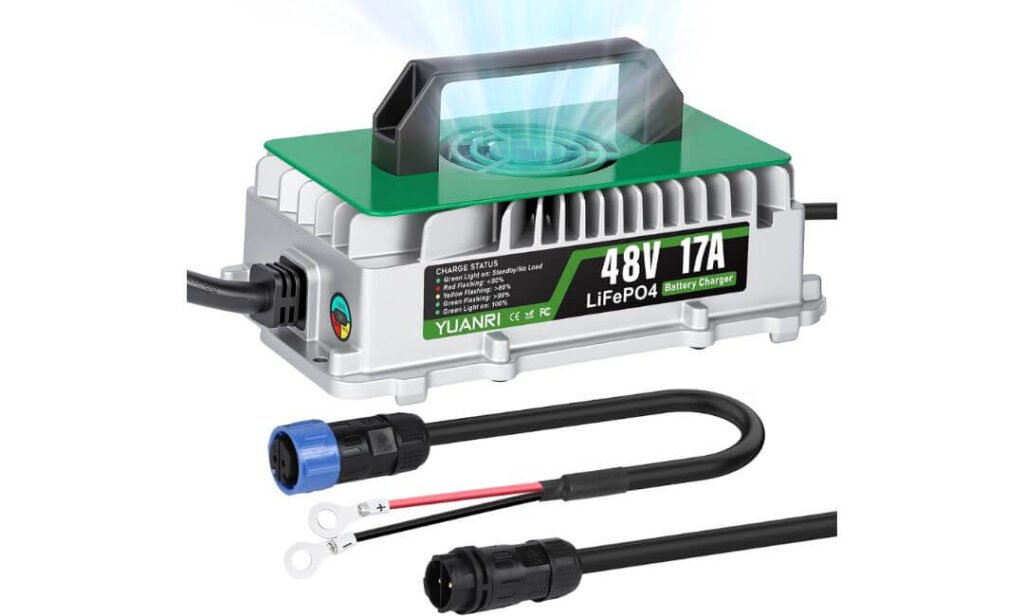
Quick Specs:
- Battery compatibility: 48V (51.2V) LiFePO4
- Output: 58.4V / 17A
- AC input: 90V–240V
- Wake-up: 0V BMS wake-up
- Protection: 8 charging safety protections
- Housing: Die-cast aluminum, IP67
- Connection: M8 ring terminals + M25 waterproof connector
- Weight: 5.5 lbs
- Dimensions: 8.7 × 4.4 × 2.4 in
- Certifications: UL, CE, FCC, ETL, RoHS
- Warranty: 3 years
There is something refreshing about a charger that does not try to cover every battery chemistry under the sun. This one is built around a 48V/51.2V LiFePO4 battery, with a 58.4V / 17A output that directly matches the charging requirements of compatible packs. That makes the compatibility question much simpler: if the battery specification calls for a 58.4V LiFePO4 charger, this is the type of setup you want to be looking at.
The 17A charging output gives it considerably more capability than entry-level 48V chargers, while the 0V wake-up function adds something genuinely useful for lithium owners. If the BMS has disconnected an otherwise undamaged battery because of low voltage, the charger is designed to initiate the charging process again. Importantly, that does not mean it repairs a damaged battery—a swollen, physically damaged, shorted or water-damaged pack should never be treated as a normal wake-up situation.
The physical design is equally practical. The IP67 die-cast aluminum housing provides dust and water protection while helping with heat dissipation, and the M8 ring terminals allow direct connection to the battery rather than forcing the owner to hunt for a vehicle-specific plug. With 90V–240V AC input, eight protection functions and a compact 5.5-pound body, it fits naturally into golf carts, RVs, marine systems, solar installations and other compatible 48V lithium setups. (Its strength is simplicity: correct LiFePO4 voltage, useful current, outdoor protection and a genuinely useful wake-up function.)
What We Like About It
- 58.4V / 17A output is a clean match for compatible 51.2V LiFePO4 batteries.
- 0V wake-up can be extremely useful when BMS low-voltage protection has interrupted charging.
- IP67 aluminum construction makes it better suited to outdoor and marine environments than an ordinary indoor charger.
- M8 ring terminals provide a direct battery connection without relying on a proprietary golf-cart charging port.
- Compact 5.5-pound design makes mounting and handling easier than with larger industrial chargers.
One Thing to Know Before Buying
This is a LiFePO4-specific charger, so it should not be treated as a universal 48V charger for lead-acid or other lithium chemistries. Confirm the battery chemistry and 58.4V charging requirement first.
Why It’s a Strong 48V LiFePO4 Charger Choice
This model sits at #3 because it gets the fundamentals right without adding unnecessary complexity. 58.4V charging, 17A output, 0V wake-up, IP67 protection and direct M8 connections cover the features that matter most for a compatible 48V lithium installation. It is especially appealing when the goal is a dedicated LiFePO4 charger rather than a configurable charger intended for several different pack architectures.
Its broad application range also helps. The same basic charging platform can make sense for a lithium golf cart, RV, boat, solar battery bank or compatible light industrial system. It does not need to pretend to be everything; its value comes from being very clear about what it is designed to charge.
The Insider Pro-Tip
For this type of charger, battery identification is everything. Do not stop at “48V” on the battery label—look for 51.2V LiFePO4 and the required 58.4V full-charge voltage. That one check can prevent the most common mistake people make when shopping for lithium chargers.
Also, treat the 0V wake-up feature with the respect it deserves. It is intended for a compatible battery whose BMS has temporarily disconnected the pack, not as a way to bring a physically failed battery back to life. If the battery is healthy and simply sitting in protection mode, this feature can be genuinely helpful; if the pack shows signs of physical damage, charging should stop there.
#4. FORM 48V 15A Golf Cart Battery Charger

Quick Specs:
- Battery type: 48V lead-acid
- Charging output: 48V / 15A
- Golf cart fit: EZGO RXV & TXT with compatible Triangle Plug
- Charging approach: Automatic maintenance mode
- Weather protection: IP67 WeatherShield coating
- Cable reach: 14+ ft
- Cooling: Integrated cooling fan
- Weight: 5.5 lbs
- Dimensions: 5.25 × 10 × 3 in
- Warranty: 24 months
- Support: USA-based customer service
Not every 48V battery is lithium, and this is exactly why a lead-acid option belongs in this list. If the golf cart still runs a 48V lead-acid battery bank, particularly an EZGO RXV or TXT with the appropriate connector, there is little reason to complicate the setup with a lithium charger. This model is built around that older, well-established battery architecture and focuses on making everyday charging easier.
Its 15A output gives it a useful middle ground for a golf-cart charging routine, while the Set It & Forget It maintenance mode is arguably more important than the raw amperage. Once the batteries reach full charge, the charger transitions into maintenance rather than simply stopping and leaving the pack sitting unused. The built-in battery-sensing system is also designed specifically around lead-acid charging, helping the charger adapt its operation to the battery rather than treating every charging cycle identically.
The physical design makes sense for a golf cart too. At 5.5 pounds, it is considerably easier to handle than a bulky OEM-style unit, and the 14+ feet of cable gives you more freedom over where the charger sits. The IP67 WeatherShield treatment and cooling fan add useful protection for an outdoor vehicle that may see changing weather and temperatures. (The key here is compatibility: this is a lead-acid golf-cart charger, not a lithium substitute.)
What We Like About It
- Lead-acid-specific charging makes it a sensible choice for compatible older 48V golf-cart battery banks.
- Maintenance mode means the charger can keep a fully charged pack maintained instead of requiring constant manual attention.
- 5.5-pound body is a practical advantage when compared with heavier OEM-style chargers.
- 14+ ft cable length gives useful placement flexibility around the cart.
- IP67 protection and cooling fan make the design better suited to the outdoor environment a golf cart actually lives in.
One Thing to Know Before Buying
The biggest thing to get right is battery chemistry and connector compatibility. This model is intended for 48V lead-acid EZGO applications and should not be used as a replacement for a charger designed for a lithium battery pack.
Why It’s a Smart 48V Golf Cart Charger Pick
This is ranked #4 not because it is a weak charger, but because its audience is much narrower than the lithium models above it. For someone with a compatible EZGO RXV or TXT lead-acid setup, that specialization is actually a benefit. The 15A output, battery sensing and maintenance mode are all centered around the job it is supposed to perform.
The reason it cannot compete directly with the top three for the overall keyword is simple: those models cover the rapidly growing 48V lithium and LiFePO4 segment, while this one is deliberately built for traditional lead-acid systems. If your cart still uses lead-acid batteries, however, choosing a charger designed for that chemistry is far more sensible than chasing newer lithium features you do not need.
The Insider Pro-Tip
If your EZGO is an older setup, do not replace the charger just because a newer lithium charger has more amps or more features. First identify what is actually inside the cart. If it still has a compatible 48V lead-acid bank, a purpose-built lead-acid charger with maintenance charging can be the cleaner solution.
And check the Triangle Plug and cart model/year compatibility before ordering. The charger can be excellent and still be the wrong purchase if the connector or battery configuration does not match. A two-minute compatibility check is worth far more than choosing a charger based on its headline “15A” rating alone.
#5. Beleeb C20 Adjustable 12V–48V Battery Charger
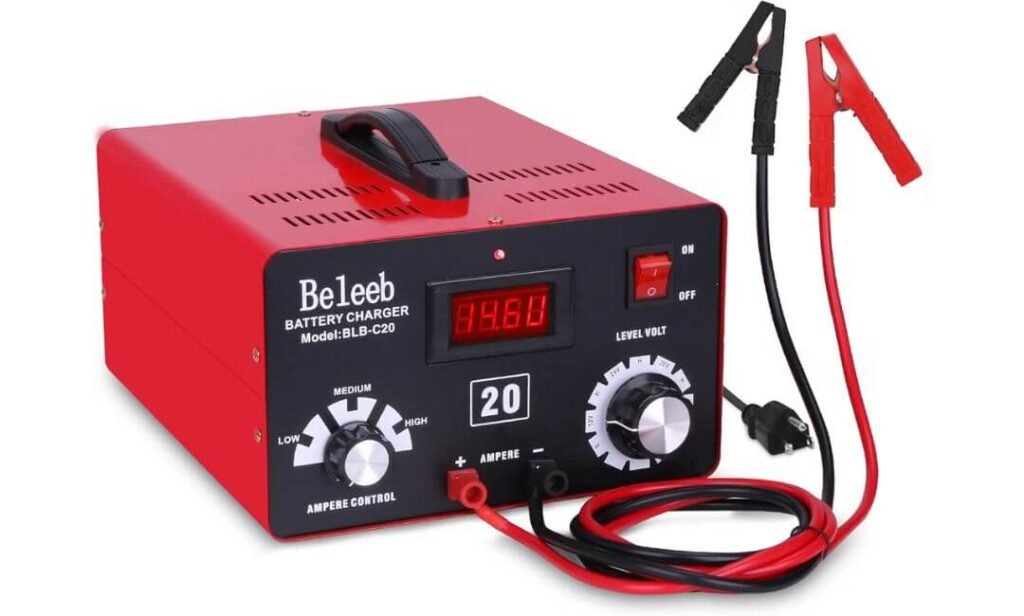
Quick Specs:
- Voltage selection: 12V / 24V / 36V / 48V
- 48V charging current: Up to 6A
- Battery compatibility: Lead-acid, SLA, AGM, GEL, LiFePO4 and lithium with appropriate BMS
- Charging modes: Normal + H pulse/equalizing mode
- Charging control: Automatic voltage/current adjustment
- Low-voltage function: Zero-voltage charging support
- Protection: Overload, short circuit, reverse polarity and circuit-breaker protection
- Applications: Golf carts, RVs, marine, vehicles and industrial equipment
- Weight: 17.71 lbs
- Dimensions: 11.41 × 9.84 × 6.29 in
Some buyers do not need a dedicated 48V charger—they need one charger that can follow them from one battery project to another. That is where this model makes sense. Instead of being locked to a single voltage, the selector covers 12V, 24V, 36V and 48V, making it useful for everything from smaller vehicle batteries to a 48V golf-cart bank.
At 48V, the important detail is that it is limited to 6A maximum, so this is not competing with the 17A, 18A or 20A chargers above on charging speed. Its value is elsewhere. The adjustable current control and automatic charging program make it more flexible for routine charging, while the H pulse mode is designed for battery maintenance and equalizing applications. That can be particularly interesting with compatible lead-acid golf-cart banks where one weaker battery can affect the overall system.
There is also some useful versatility for mixed battery ownership. The charger supports lead-acid, SLA, AGM, GEL, LiFePO4 and lithium batteries, but lithium use needs the correct BMS and voltage selection. The manufacturer also positions the unit for zero-voltage charging situations and includes overload, short-circuit and reverse-polarity protection. It is considerably heavier than the dedicated lithium chargers, though, so this is better thought of as a workbench-style multi-voltage charger than a lightweight permanent installation unit. (Its selling point is flexibility, not speed.)
What We Like About It
- 12V–48V selection makes one unit useful across several battery systems.
- H pulse/equalizing mode gives compatible lead-acid batteries a useful maintenance option.
- Adjustable charging current lets the charging rate be reduced for situations where slower charging makes more sense.
- Broad battery support makes it practical for households or workshops dealing with different battery chemistries.
- Automatic charging control reduces the need to manually manage the charging cycle.
One Thing to Know Before Buying
At 48V, the maximum current is only 6A, so buyers looking for fast charging should choose one of the dedicated higher-output chargers above. This model wins on versatility rather than speed.
Why It’s a Useful 48V Multi-Voltage Charger
Its place at #5 is deliberate. For someone buying specifically for a 48V LiFePO4 battery and wanting the fastest practical charging, the dedicated 48V models are better fits. But for a garage, workshop, RV owner or golf-cart owner who also deals with 12V, 24V and 36V batteries, having one adjustable charger can be considerably more convenient than owning several separate units.
The H maintenance/equalizing function also gives this charger a different purpose from the dedicated lithium options. It is particularly relevant to compatible lead-acid systems where battery maintenance matters alongside ordinary charging. That broader role is exactly why it remains useful in this comparison, even though its 48V charging speed is modest.
The Insider Pro-Tip
If you are buying this primarily for a 48V system, do not choose it because it says “48V” and stop there. Look at the 6A maximum and decide whether that charging speed actually fits your battery capacity and routine. A slower charger can be perfectly sensible when charging overnight or maintaining a battery, but it is the wrong tool if you regularly need a faster turnaround.
The bigger advantage is what happens when you own several battery types. One adjustable charger covering 12V through 48V can earn its space by replacing several single-purpose units—provided you select the correct voltage and battery profile every time. That is the reason this model belongs on the list: not because it beats the dedicated chargers at their own game, but because it plays a completely different one.
Best 48V Battery Charger Picks (2026): LiFePO4, Amps, Protection & Compatibility
| What Matters | KAISAL 48V/58.4V 18A Best Overall | DALY 48V 20A Most Adjustable | YUANRI 48V 17A Dedicated LiFePO4 | FORM 48V 15A Golf Cart Pick | Beleeb C20 Multi-Voltage |
|---|---|---|---|---|---|
| Best fit | 48V / 51.2V LiFePO4 | Multiple lithium pack configurations | 48V / 51.2V LiFePO4 | 48V lead-acid golf carts | 12V–48V mixed battery systems |
| Charging output | 58.4V / 18A1,250W rated | 38V–60V / 5A–20AAdjustable through Bluetooth | 58.4V / 17A | 48V / 15A | 48V / up to 6A12V: 12A · 24V: 10A · 36V: 8A |
| Battery chemistry | LiFePO4 | LiFePO4 + supported NCM15S/16S LiFePO4 · 13S/14S NCM | LiFePO4 | Lead-acid | Lead-acid + lithiumLiFePO4/lithium require appropriate BMS |
| 48V charging voltage | 58.4VFor compatible 51.2V LiFePO4 | Selectable54.75V · 58.4V · 54.6V · 58.8V presets | 58.4VFor compatible 51.2V LiFePO4 | 48V charging profileLead-acid system | 48V selectableCurrent limited to 6A at 48V |
| Smart charging | 5-stageReduces current near full charge | 5-stageWake-up → soft start → pre-charge → CC → CV | Smart chargingDesigned for compatible LiFePO4 packs | Maintenance modeAutomatically maintains full batteries | Automatic controlNormal + H pulse/equalizing mode |
| 0V / low-voltage wake-up | YesFor compatible BMS-protected batteries | Yes0V activation | YesFor compatible undamaged packs | No dedicated 0V wake-up | Zero-voltage charging support |
| Outdoor protection | IP67Sealed die-cast aluminum housing | IP67Sealed aluminum + full potting | IP67Die-cast aluminum housing | IP67WeatherShield coating | Not specified as IP67 |
| Protection package | 7 protectionsIncluding thermal, reverse connection & timeout | 11 protectionsIncludes AC/DC voltage and thermal safeguards | 8 protectionsIncludes overcharge, thermal & reverse polarity | Battery sensing + protection | Multiple protectionsOverload, short circuit, reverse polarity & breaker |
| Connection / installation | M8 terminals16-ft total cable · wall/vehicle mounting | Anderson connectionConfiguration depends on supported setup | M8 ring terminalsM25 waterproof connector | EZGO Triangle Plug14+ ft cable | Adjustable chargerMore suited to workshop-style use |
| Special advantage | Fast + outdoor-ready18A, 0V wake-up and IP67 in one package | True configuration flexibilityBluetooth voltage/current adjustment | Simple dedicated LiFePO4 setup17A + 0V wake-up | Easy lead-acid golf-cart chargingSet-it-and-forget-it maintenance | One charger for several voltages12V, 24V, 36V and 48V |
| Best for | Most 51.2V LiFePO4 owners | Custom or varied lithium systems | Dedicated LiFePO4 applications | Compatible EZGO lead-acid carts | Mixed-voltage owners & workshops |
| What to watch | Confirm the battery accepts 18A charging. | More settings mean more responsibility for correct configuration. | LiFePO4 only; confirm 58.4V requirement. | Not for lithium batteries. | 6A maximum at 48V makes it slower than the dedicated models. |
48V Battery Charger Buying Guide: What Actually Matters Before You Buy
A “48V charger” is not automatically suitable for every battery carrying a 48V label. The number usually describes the nominal battery voltage, while the charger must be matched to the battery’s actual chemistry, series configuration, required full-charge voltage, and acceptable charging current. That distinction becomes especially important with lithium batteries, where a 48V-class pack may actually be 51.2V nominal LiFePO4 and require a 58.4V charging voltage.
The safest way to choose is therefore to start with the battery specification, not the charger listing. Once chemistry and charging voltage are confirmed, amperage, charging behavior, protection, connector style, and installation environment become much easier to compare.
What a 48V Battery Charger Really Means
For most consumer and recreational applications, “48V” refers to the battery system’s nominal voltage. It does not mean the charger should necessarily output exactly 48V.
For example, a compatible 51.2V LiFePO4 battery is commonly charged to 58.4V. That is why a charger can correctly be advertised for a “48V lithium battery” while its actual charging output is 58.4V.
Lead-acid systems work differently, so the same rule cannot simply be applied across chemistries. The battery type, pack construction, and manufacturer’s charging specification should always determine the correct charger.
A useful way to think about it is:
| Battery information | What you should check on the charger |
|---|---|
| 48V / 51.2V LiFePO4 | Correct LiFePO4 profile and usually 58.4V full-charge output |
| 48V lithium-ion/NCM | Exact series configuration and specified charging voltage |
| 48V lead-acid golf-cart bank | Lead-acid charging profile and compatible connector |
| Multi-voltage battery system | Selectable voltage plus chemistry-specific charging support |
| Custom or rebuilt lithium pack | Exact series count, chemistry, BMS limits and charging voltage |
That is also why the five chargers in this comparison are not interchangeable. Some are deliberately built around 51.2V LiFePO4, one offers unusually broad lithium configuration control, one targets traditional lead-acid golf carts, and another is designed for people who need several charging voltages from one machine.
The Charging Current Is More Important Than the Biggest Number
Amperage is one of the easiest specifications to misunderstand.
A 20A charger is not automatically better than a 10A charger. It can charge a compatible battery faster, but the battery and BMS must be designed to accept that current. Using more current than the battery manufacturer allows is not a performance upgrade.
For example, a 48V battery charger 10 amp can be perfectly reasonable for a battery owner who charges overnight and does not need a quick turnaround. A higher-output 17A, 18A or 20A model becomes more attractive when the battery supports that current and charging time matters.
A simple approximation is:
Charging time ≈ battery capacity (Ah) ÷ charging current (A)
Real charging time will usually be longer because charging is not perfectly efficient and the current normally tapers as the battery approaches full charge.
So, for a 100Ah battery:
- 10A: roughly 10 hours under idealized conditions
- 17A: roughly 5.9 hours
- 18A: roughly 5.6 hours
- 20A: roughly 5 hours
These are estimates, not guaranteed real-world charge times. The battery’s charging curve, state of charge, temperature, BMS behavior and charger efficiency all affect the final result.
48V Lithium Battery Charger vs. 48V LiFePO4 Battery Charger
“Lithium” is a broad category. LiFePO4 is one particular lithium chemistry, and the charger profile must match it.
This distinction matters because a charger designed for one lithium configuration should not automatically be assumed suitable for another. Series count can matter just as much as the nominal voltage printed on the battery.
A good example is the difference between a fixed 58.4V LiFePO4 charger and an adjustable lithium charger. A dedicated 58.4V unit can be an excellent choice when the battery is confirmed to be a compatible 51.2V LiFePO4 pack. An adjustable model can make more sense when the owner has a custom pack or another supported series configuration.
Before buying a 48V lithium battery charger, verify:
- Battery chemistry
- Nominal battery voltage
- Series configuration, if provided
- Required full-charge voltage
- Maximum permitted charging current
- BMS compatibility
- Connector or terminal arrangement
If any of these are unclear, the battery manufacturer’s specification sheet is more useful than relying on a generic “48V compatible” claim.
Charging Modes and Smart Features: Which Ones Actually Help?
“Smart charging” is used so broadly in product listings that the phrase alone tells you very little.
What matters is what the charger actually does.
A useful charging system may begin with a low-current or diagnostic stage, move into constant-current charging, then transition to constant-voltage charging as the battery approaches full. Some models also reduce current near the end of the cycle or enter a maintenance state after charging.
Other features can be genuinely useful in specific situations:
- 0V wake-up: Can help a compatible lithium battery whose BMS has disconnected it because of low voltage. It does not repair a physically damaged battery.
- Temperature management: Helps prevent excessive charging stress when operating conditions become hot or cold.
- Maintenance mode: Particularly useful with compatible lead-acid systems that remain connected for longer periods.
- Adjustable current: Useful when the battery allows different charging rates or when slower charging is preferred.
- Pulse/equalizing functions: More relevant to certain lead-acid maintenance applications than to ordinary LiFePO4 charging.
- Automatic shutoff or timeout: Adds another layer of protection if a charging cycle runs longer than expected.
The important point is that more modes do not necessarily mean a better charger. A feature is valuable when it solves a problem your battery actually has.
Temperature Management Matters More Than It Sounds
Charging is not just an electrical process; temperature affects both the charger and battery.
A charger used inside a garage may have an easier job than one mounted around a golf cart, boat, RV, forklift or outdoor solar system. That is where cooling fans, thermal monitoring, sealed housings and appropriate operating-temperature specifications become meaningful.
An aluminum enclosure can help with heat dissipation, while intelligent thermal control can reduce output or shut the charger down if temperatures become excessive.
For lithium batteries, there is another important consideration: the battery itself has charging-temperature limitations. A charger having a wide operating-temperature range does not mean the battery can safely charge under every condition. Always follow the battery manufacturer’s temperature requirements.
IP67 Protection Is Useful, But It Is Not a License to Ignore Installation
Several chargers in this comparison use IP67-rated housings, which is valuable for outdoor and mobile applications.
IP67 generally indicates protection against dust ingress and temporary immersion under defined test conditions. It does not mean every connector, terminal, cable joint or installation point is automatically waterproof forever.
For a charger mounted near a boat or golf cart, pay attention to:
- Where the charger is mounted
- Whether cooling airflow is restricted
- How terminals are protected
- Whether water can collect around connections
- Cable routing and strain relief
- Exposure to vibration and road or marine conditions
A well-sealed charger can still suffer from a poor installation.
Safety Features and Certifications Deserve a Closer Look
A decent 48V battery charger should have protection against common electrical faults. Depending on the model, that can include overvoltage, overcurrent, overheating, short circuit, reverse polarity, no-load conditions and charging timeout.
Certification markings can also provide useful information, but they should not be treated as proof that a charger is suitable for your particular battery. A charger can carry recognized certification and still have the wrong charging profile for a specific battery pack.
In other words:
Safety certification answers “Is the equipment built to certain safety requirements?”
Battery compatibility answers “Is this the right charger for my battery?”
You need both considerations, but compatibility comes first.
Connector Compatibility Can Save You From an Unnecessary Headache
The charger can have perfect voltage and amperage specifications and still be inconvenient—or unusable—if the connection does not match the battery system.
Dedicated golf-cart chargers may use a model-specific connector, while lithium installations often use ring terminals, Anderson-style connectors or other direct battery connections.
This is particularly important when replacing an OEM charger or converting an older golf cart from lead-acid to lithium. Do not assume that because two products both say “48V,” their plugs are interchangeable.
If the charger uses direct terminals, installation may also require appropriate access to the battery and secure terminal connections. For a permanent installation, cable length and mounting options can matter just as much as the charger itself.
Which Type of 48V Charger Makes Sense for Your Setup?
| Your situation | What to prioritize | Why |
|---|---|---|
| 51.2V LiFePO4 golf cart | 58.4V LiFePO4 charger | Correct charging voltage and chemistry matter most |
| Large LiFePO4 pack needing quicker charging | Higher permitted amperage | Only if the battery/BMS supports it |
| Custom lithium battery | Adjustable voltage/current | More control over different pack configurations |
| EZGO with compatible 48V lead-acid bank | Lead-acid golf-cart charger | Correct charging profile and connector |
| Several battery voltages at home/workshop | Multi-voltage charger | One unit can handle different systems |
| Outdoor or marine installation | IP67 + thermal management | Better suited to demanding environments |
| Overnight charging | 10A-class charger may be enough | Slower charging can be perfectly practical |
| Frequently discharged large battery | Higher-current compatible charger | Reduces turnaround time when supported |
What About a 48V Battery Charger 10 Amp?
A 10A charger should not automatically be dismissed as outdated or weak.
For a battery that is charged overnight, a lower charging rate can be completely adequate. The real question is how much energy you need to put back into the battery and how much time you have available.
The trade-off becomes obvious with larger batteries. If a 100Ah pack needs charging from a low state of charge, a 10A charger may require much of a day under real conditions. A compatible 17A or 18A charger can shorten that window considerably, while a 20A charger can shorten it further—provided the battery is rated for that charging current.
So the better question is not:
“Which charger has the most amps?”
It is:
“What charging current does my battery safely allow, and how quickly do I actually need it charged?”
That is the number worth building the purchase around.
A Few Mistakes Worth Avoiding
The most common 48V charger mistakes are surprisingly simple:
- Buying by voltage alone — “48V” does not identify the chemistry.
- Assuming all lithium batteries use the same charger — lithium chemistry and series configuration matter.
- Choosing maximum amperage without checking the BMS — faster is only better within the battery’s permitted charging range.
- Ignoring the actual full-charge voltage — a 51.2V LiFePO4 pack may require 58.4V charging.
- Using a lead-acid charger on a lithium pack — the charging profile must be appropriate for the chemistry.
- Treating 0V wake-up as battery repair — it is intended for compatible BMS-protected low-voltage situations, not physically failed batteries.
- Ignoring the connector — electrical compatibility and physical connection are two separate checks.
- Assuming IP67 solves every installation problem — cable connections, mounting and ventilation still matter.
The Safest Way to Make the Final Choice
Start with the battery label or manufacturer’s specification and write down chemistry, nominal voltage, full-charge voltage, maximum charging current and connector type. Then compare those details against the charger.
For a straightforward 51.2V LiFePO4 system, a dedicated 58.4V charger is usually the easiest path. For a custom lithium configuration, adjustable output can be much more valuable. For an older lead-acid golf cart, the correct lead-acid profile and connector matter more than chasing lithium-specific features. And if several battery voltages are part of your day-to-day work, a multi-voltage charger can justify its slower 48V charging speed through sheer versatility.
That is the real takeaway from this comparison: the best 48V battery charger is the one whose electrical profile matches the battery exactly, while its charging speed, protection and physical design fit the way you actually use the system.
Practical Buying Tips for Real-World 48V Battery Charger Setups
Choosing the charger is only half the job. The other half is making sure the battery, charging profile, connector, and daily usage pattern actually agree with each other. A charger can have excellent specifications and still be the wrong purchase if it is paired with the wrong chemistry or series configuration.
These are the situations where the small details become much more useful than another generic “fast charging” claim.
If You Have a 48V LiFePO4 Golf Cart Battery
For a golf cart using a 51.2V LiFePO4 battery, start by confirming that the battery calls for a 58.4V charging voltage. After that, look at the battery’s permitted charging current. If the battery and BMS support 17A, 18A or 20A, a higher-output charger can make sense when you regularly need the cart ready again in a shorter window.
For longevity, however, charging speed should not be the only consideration. Look for proper LiFePO4 charging control, overvoltage and overcurrent protection, thermal management, and sensible end-of-charge behavior. A charger that gradually reduces current near full charge can be more useful over the long term than one chosen purely because its amp rating looks impressive.
For carts that spend time outdoors, IP67 protection and a durable enclosure are also worth paying attention to. Just remember that the battery itself still needs to be suitable for the environmental conditions. The charger being weather-resistant does not make an unsuitable battery installation safe.
If You Need One Charger for an E-Bike and a Small Solar Setup
This is where you need to be careful with the phrase “all-around 48V charger.”
A 48V e-bike battery and a 48V-class solar battery can have completely different chemistry, series configuration, connector, BMS arrangement and charging requirements. Even when both are described as 48V, that does not make their chargers interchangeable.
If you genuinely need one charger for more than one lithium system, prioritize adjustable voltage and current, documented chemistry support, smart charging, and a clear way to configure the correct charging profile. A charger such as the adjustable DALY model makes more sense for this kind of situation than a fixed 58.4V unit, but only when the battery configurations fall within its supported range.
For a small solar installation, also consider where the charger will physically operate. An indoor workshop charger and an outdoor charger mounted near an energy-storage system have very different environmental requirements.
How to Verify Compatibility Before Ordering
Do not rely on the product title alone. Spend a couple of minutes checking the battery itself.
Look for these details on the battery label, manual, manufacturer’s page, or BMS documentation:
- Nominal voltage: Confirm whether the pack is actually a 48V-class system.
- Battery chemistry: Identify LiFePO4, NCM lithium-ion, lead-acid, AGM, GEL, or another chemistry.
- Full-charge voltage: This is particularly important for lithium batteries.
- Maximum charging current: Make sure the charger does not exceed the battery or BMS specification.
- Series configuration: For lithium packs, 13S, 14S, 15S and 16S configurations can require different charging voltages.
- Connector: Check the actual plug, Anderson connection, ring terminals, or other interface.
- Polarity: Confirm positive and negative connections before connecting a direct-terminal charger.
- Manufacturer requirements: If the battery manufacturer specifies a particular charging profile, that information should take priority over a generic charger listing.
This check is especially important when replacing an older charger or working with a converted golf cart, custom battery pack, or aftermarket lithium conversion. The physical connector may look right while the electrical requirements are completely different.
Do Not Confuse 48V With 58.4V
This deserves its own reminder because it causes so much unnecessary confusion.
A 51.2V LiFePO4 battery is commonly described as a 48V battery, while its compatible full-charge voltage can be 58.4V. So seeing “58.4V” on a charger does not automatically mean it is unsuitable for a 48V battery.
The reverse is also true: seeing “48V charger” does not tell you enough to safely connect it to a lithium battery.
The battery chemistry and charging specification are what determine the correct charger.
Give the Battery Time to Charge Instead of Chasing Maximum Current
If the battery is normally charged overnight, a lower-current charger may be perfectly adequate. There is no prize for finishing a charging cycle three hours earlier if the battery does not require it.
A useful way to think about charging current is:
10A: sensible for slower, overnight-style charging when the battery supports it.
15A–18A: useful when a larger 48V battery needs a shorter turnaround.
20A: attractive when faster charging is genuinely useful and the battery’s BMS permits it.
Actual charging time will vary because the charger does not necessarily deliver its maximum rated current throughout the entire cycle. Current normally changes as the battery approaches full charge.
Keep an Eye on Temperature
Heat is one of the easiest things to overlook.
During a longer charging session, check that the charger has reasonable ventilation and that its cooling openings are not blocked. An aluminum housing and cooling fan can help the charger manage heat, but they cannot compensate for being enclosed in a cramped, poorly ventilated space.
The battery also matters. Lithium batteries have their own charging-temperature requirements, and a charger having a wide operating-temperature specification does not override those limits.
If either the charger or battery becomes unusually hot, stop treating it as normal simply because the unit is advertised as “fast charging.” Find out why it is heating up before continuing.
Avoid Unnecessary Overcharging
Modern smart chargers are designed to manage the charging cycle, but that does not mean every charger should be left connected indefinitely without checking its intended operating behavior.
For lithium batteries, use a charger with the correct chemistry and charging profile, and allow the BMS and charger to perform the functions they were designed for. For lead-acid batteries, a compatible maintenance mode can be useful when the battery remains connected for longer periods.
Do not deliberately use an incorrect charger simply because it appears to charge faster.
Periodic Balancing Depends on the Battery
Battery balancing is often discussed as if every 48V battery needs the same maintenance routine. It does not.
Many modern lithium packs have a BMS that handles cell monitoring and balancing, but the actual balancing strategy depends on the battery design and BMS. Follow the battery manufacturer’s instructions rather than manually forcing an equalization procedure intended for lead-acid batteries onto a lithium pack.
This is also why the H pulse/equalizing mode on a multi-purpose charger should not be treated as a universal lithium maintenance feature. It has a much more specific role and should only be used where the battery manufacturer says it is appropriate.
A Simple Pre-Purchase Check That Saves the Most Trouble
Before clicking Buy, match these five things:
Battery chemistry → nominal voltage → full-charge voltage → maximum charging current → connector.
If all five line up, then look at the secondary considerations: IP rating, temperature management, cable length, mounting options, charging modes, warranty and certifications.
That order matters. A beautifully built charger with the wrong charging profile is still the wrong charger. Conversely, a charger that exactly matches the battery can be a much better purchase even if it has fewer flashy features.
For the five models compared in this guide, that is the same principle used throughout the recommendations: match the charger to the battery first, then choose the features that make sense for the way you actually use it.
FAQs About 48V Battery Charger
Is a 58.4V charger actually safe for a 48V LiFePO4 battery?
Yes, when the battery is a compatible 51.2V LiFePO4 pack designed for a 58.4V full-charge voltage. This is one of the most confusing parts of shopping for a 48V lithium battery charger because “48V” normally describes the battery’s nominal voltage, not the voltage the charger will output throughout the charging cycle.
For example, the KAISAL 48V/58.4V 18A, YUANRI 48V/58.4V 17A, and the DALY’s 16S LiFePO4 preset are built around this 58.4V charging point. That does not mean every battery sold as 48V should receive 58.4V. Before connecting one, verify:
- The battery is LiFePO4
- Its nominal voltage is 51.2V
- Its specified full-charge voltage is 58.4V
- Its BMS permits the charger’s intended charging current
The important distinction is simple: 48V is the battery class; 58.4V can be the correct charging endpoint for a compatible 16S LiFePO4 pack.
Is the DALY 48V 20A charger better than an 18A or 17A charger just because it charges faster?
Not automatically. The DALY’s biggest advantage is actually its adjustability, not the extra 2–3 amps.
Its output can be configured from 38V to 60V and 5A to 20A, with presets for different supported lithium pack configurations. That makes it particularly interesting for custom or less-common 48V-class battery systems where a fixed 58.4V charger may not be the right match.
For a normal 51.2V LiFePO4 battery that is specifically rated for 18A, an 18A charger can be every bit as sensible. The correct decision comes down to the battery’s specifications:
- If the battery permits 20A, the extra charging capacity can reduce charging time.
- If it is limited to 10A or 15A, turning a 20A charger into a “faster” charger would be the wrong approach.
- If the battery has an unusual series configuration, adjustable voltage may matter more than maximum amperage.
So, if choosing between these models, do not ask only, “Which one has more amps?” Ask “Which one gives me the charging profile my battery actually needs?”
Can a 48V lithium battery charger wake up a battery that shows 0V?
Sometimes, yes—but the phrase “0V wake-up” needs to be understood correctly.
When a lithium battery’s BMS disconnects the pack because of excessive discharge, the charger may see little or no usable voltage. A compatible charger with a wake-up function can initiate a controlled charging sequence and allow the BMS-protected battery to become chargeable again. That is why the wake-up functions on the KAISAL, DALY and YUANRI models are genuinely useful features rather than just another specification to put on a product page.
But it is not a battery-repair button. A battery showing zero output could have a serious internal problem, damaged cells, a failed BMS, an internal short, water damage, or other faults.
A sensible approach is:
- Check why the BMS entered protection.
- Inspect the battery for swelling, damage, leakage or unusual heat.
- Confirm the charger matches the battery chemistry and voltage.
- Use the wake-up function only when the battery manufacturer allows it.
That distinction matters because “0V” can describe a protection state, but it can also describe a genuinely failed battery. The charger should never be used to guess which one you have.
Can one 48V charger be used for a golf cart, boat, RV, and solar battery system?
It can, if the batteries use compatible chemistry, voltage, charging requirements and connections. The application name alone does not determine compatibility.
A 48V golf cart may have lead-acid batteries, a converted golf cart may have a 51.2V LiFePO4 pack, an RV may use a completely different lithium configuration, and a solar battery bank may have its own BMS and charging requirements. They can all be called “48V” while requiring different charging approaches.
That is why the charger selection in this article deliberately separates the use cases. A dedicated LiFePO4 charger makes sense for a compatible lithium system, the FORM model is aimed at compatible EZGO lead-acid golf-cart setups, while the DALY offers much broader configuration control for supported lithium packs.
If one charger needs to serve multiple systems, verify every battery individually rather than assuming that a single 48V setting makes the charger universal. In a workshop or multi-battery household, a multi-voltage charger such as the Beleeb C20 can be convenient, but its 6A maximum at 48V makes it a very different proposition from the dedicated high-current models.
Does a higher-amp 48V charger improve battery life, or can slower charging actually be better?
A higher-current charger primarily changes how quickly energy is put back into the battery; it does not automatically improve battery longevity.
If a battery is rated to accept 20A, a 20A charger can be perfectly appropriate. If its BMS or manufacturer specifies a lower charging current, using a higher-rated charger does not create extra capacity—the battery will limit or reject the current, or the setup may become inappropriate depending on the equipment.
For long-term ownership, the more meaningful factors are:
- Correct charging voltage
- Correct battery chemistry profile
- Charging current within the battery’s specification
- Reasonable operating temperature
- Proper BMS operation
- A charger that transitions appropriately as the battery approaches full charge
There is also a practical side that gets overlooked. If the battery is normally charged overnight, a 10A-class charger can be entirely adequate. If the same battery needs to be recharged quickly between repeated uses, a supported 17A, 18A or 20A charger becomes much more attractive.
So the smartest charger is not necessarily the fastest one. It is the one that gives the battery the charging rate it was designed to receive while fitting the owner’s actual schedule.
Final Verdict: Choose the 48V Charger That Matches Your Battery, Not the Biggest Specification
A good 48V battery charger does not need the longest feature list to be the right one. What matters is whether the charging voltage, battery chemistry, current rating, BMS requirements, and physical connection all make sense together. That is the difference between buying a charger that merely says “48V” and buying one that is actually appropriate for the battery sitting in your garage, golf cart, RV, boat, or energy-storage system.
For a 51.2V LiFePO4 battery, the strongest choices in this comparison are the dedicated 58.4V models, with the KAISAL standing out for its combination of 18A charging, 0V wake-up, 5-stage charging, IP67 construction, temperature control, and broad installation flexibility. The DALY becomes more compelling when the battery configuration is less conventional and adjustable voltage/current genuinely matters. YUANRI is a straightforward dedicated LiFePO4 option, while FORM makes more sense when the job is an older compatible 48V lead-acid EZGO golf cart. The Beleeb C20 fills a different role for owners who value 12V–48V versatility and battery-maintenance capability over fast 48V charging.
The one thing worth remembering after all the specifications are forgotten is this: do not buy the charger first and try to make the battery fit it. Read the battery label, confirm the chemistry, check the full-charge voltage and permitted current, then choose the charger around those facts. That small change in buying approach can save money, prevent compatibility headaches, and give the battery a much better chance of delivering the service life you paid for.
A charger is ultimately a support system for the battery. Get that relationship right, and the numbers on the box finally start to mean something.
Also Check: