

Best 6.5″ Coaxial Car Speakers (2026): Louder Sound, Rich Midbass & Expert Tested
If your factory speakers sound thin, harsh, or lifeless, replacing them with the right 6.5-inch coaxial speakers can transform the system without turning the car into a full-blown audio project. The catch is that not every 6.5-inch speaker will give you the same result. Most models here use the familiar 6.5-inch / 165 mm format, which suits a wide range of sedans, SUVs, trucks, and older vehicles, but mounting depth, grille clearance, wiring connectors, and factory amplifier setups can still make one speaker a better fit than another.
The numbers on the box tell only part of the story. Sensitivity, RMS power handling, impedance, tweeter design, cone material, frequency response, and mounting depth all affect how a coaxial speaker behaves once it is inside an actual car door. A high-sensitivity model can make much better use of a factory radio’s limited power, while a speaker with higher RMS capability can become the smarter choice when you plan to use an aftermarket amplifier. I have therefore ranked these speakers around how they make sense in a real car audio system, rather than simply putting the model with the biggest power rating at the top.
This guide brings together current options from Alpine, Focal, Morel, KICKER, Rockford Fosgate, and Hertz, covering everything from efficient factory replacements to more capable speakers designed to take advantage of amplifier power. The aim is not to sell you the most expensive pair; it is to help you choose a 6.5-inch coaxial speaker that delivers a genuine improvement in clarity, midbass, vocals, treble detail, and overall output while matching the system you already have.
Best 6.5″ Coaxial Car Speakers: Top 2026 Picks for Sound Quality
#1. Alpine R2-S65 6.5-Inch Coaxial Speakers
Best 6.5 Inch Coaxial Car Speakers for High-Resolution Sound, 100W RMS Power, Powerful Output and Amplifier Use
#2. Focal PC 165 FE Flax EVO 6.5-Inch Coaxial Speakers
Best 6.5 Car Speakers for Sound Quality With Natural Vocals, Flax Cone Technology, Smooth Highs and Controlled Midbass
#3. Morel Maximo Ultra 602 Coax MKII 6.5-Inch Coaxial Speakers
Best 6.5 Coaxial Speakers for Rich Midbass, Detailed Vocals, 91dB Sensitivity and Comfortable Long Listening
#4. KICKER 51KSC6504 KS-Series 6.5-Inch Coaxial Speakers
Best 6.5 Inch Car Speakers for Factory Stereo Upgrades With 90dB Sensitivity, Shallow Mounting and Clear Everyday Sound
#5. Rockford Fosgate P1V2-65 Punch P1 6.5-Inch Coaxial Speakers
Best 6.5 Car Speakers for Bass With Punchy Midbass, VAST 2.0 Cone Area, Tru-Sight Tweeters and Energetic Output
#6. HERTZ UNO X-165 6.5-Inch Coaxial Speakers
Best 6.5 Speakers for Car With 93.5dB Sensitivity, 55W RMS Power, Clear Midrange and Efficient Factory-System Performance
An Expert Tip Before You Buy
A 6.5-inch speaker that looks impressive on a product page can still be the wrong speaker for your car. The first thing I would check is what is powering it. If you are keeping the factory head unit, sensitivity and sensible power requirements become much more important. If you already have an amplifier, you can take better advantage of speakers with higher RMS handling such as the Alpine R2-S65.
Also, do not assume that a three-way coaxial is automatically better than a two-way. The extra driver can change how the speaker presents vocals and upper frequencies, but the quality of the driver, tweeter, crossover and cone matters more than the number of ways printed on the box. The same goes for bass: a good 6.5-inch speaker can give you noticeably better midbass, but it will not replace a properly installed subwoofer when you want genuine low-end depth.
One last thing that gets overlooked far too often: fitment. A 6.5-inch label does not guarantee that every speaker will drop straight into every 6.5-inch factory location. Check mounting depth, cutout diameter, adapter requirements and door clearance before ordering. That five-minute check can save you from buying an excellent speaker that simply does not suit your particular door.
How We Choose the Best 6.5-Inch Coaxial Car Speakers
We did not build this list by picking the six most recognisable names and putting the most expensive model at the top. That would make the list easy to create, but it would not make it particularly useful.
The first filter was what each speaker actually offers as a 6.5-inch coaxial upgrade. We looked at RMS power handling, sensitivity, frequency response, impedance, tweeter configuration, cone construction, mounting considerations and the type of audio system each model is realistically suited to. Those details tell us much more than a headline maximum-wattage figure.
Power handling was important, but it was never used on its own. The Alpine R2-S65, for instance, stands out because its higher power capability makes it a particularly strong candidate for an amplified system. That is very different from recommending it simply because it has a large wattage number. Likewise, the KICKER KS-Series earns its place because its sensitivity and practical design make considerably more sense for someone retaining a factory radio.
We also paid close attention to sound character. The Focal PC 165 FE brings its Flax-cone construction and a more premium approach to detail. The Morel Maximo Ultra 602 Coax MKII is appealing for listeners who care about a fuller presentation and strong vocal reproduction. Rockford Fosgate’s Punch P1 takes a more energetic approach, while the Hertz UNO X-165 gives buyers a more accessible route into an aftermarket coaxial upgrade.
That distinction matters because there is no honest answer to the question of which 6.5-inch speaker sounds “best” without knowing the rest of the system. A speaker that works beautifully with an amplifier can be unnecessary overkill on a weak factory head unit. Conversely, choosing a speaker purely because it is easy to drive can leave an enthusiast wanting more once an amplifier is added later.
We also considered newer and older vehicles separately in our thinking. Many older cars and trucks use straightforward 6.5-inch door locations, but newer vehicles can have unusual mounting depths, proprietary connectors, factory amplifier integration or speaker locations that look like standard 6.5-inch openings but are not truly universal. That is why fitment should always be confirmed against the specific year, trim and factory audio system before purchase.
Most importantly, we did not try to make every model sound like the same recommendation. Alpine is here for the enthusiast who wants more output and high-resolution capability. Focal and Morel bring a stronger focus on refined sound. KICKER makes particular sense as a factory-system upgrade. Rockford Fosgate is attractive for a punchier presentation. Hertz gives the list a more affordable entry point. That gives the reader six genuinely different reasons to choose a speaker instead of six versions of the same recommendation.
The final ranking therefore reflects how well each model solves a real buying problem, not simply how impressive its specification sheet looks. That is also why a less expensive speaker can appear above a more expensive one when it is the better match for the system it is likely to be installed in.
And that is the standard we would use ourselves: match the speaker to the car, match it to the amplifier, then choose the sound you actually want to hear. Once those three things line up, the difference from a tired factory speaker can be immediately noticeable without wasting money on specifications your system cannot use.
#1. Alpine R2-S65 6.5″ R-Series High-Resolution Coaxial Speakers, Pair
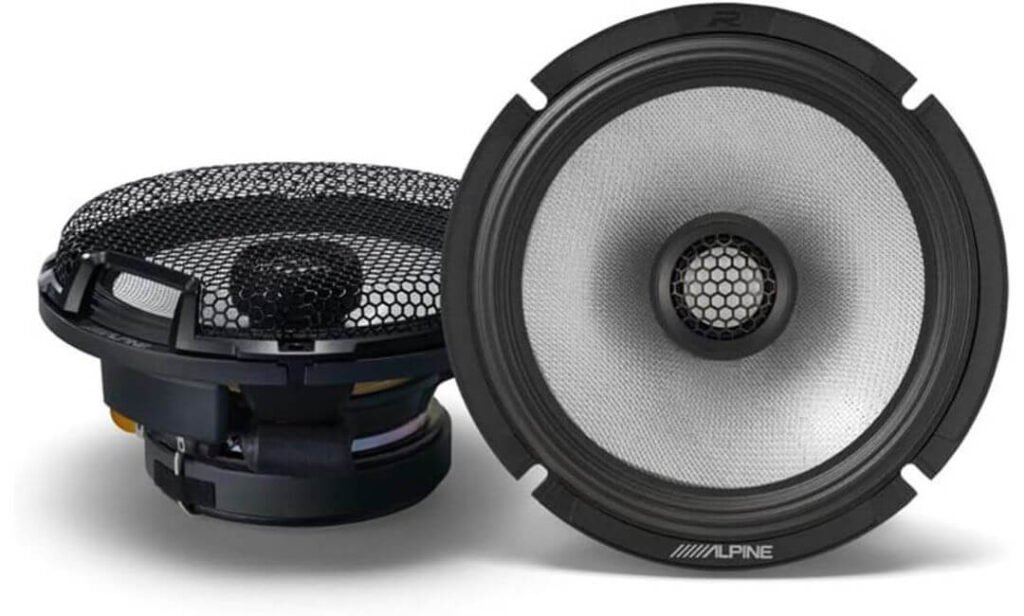
Quick Specs:
- Speaker type: 2-way coaxial
- Woofer size: 16.5 cm / 6.5 inches
- Power handling: 100W RMS / 300W peak
- Impedance: 4 ohms
- Sensitivity: 88 dB
- Frequency response: 65Hz–40kHz
- Tweeter: Magnesium hard-dome
- Woofer cone: Glass-fiber reinforced
- Surround: HAMR (High-Amplitude Multi-Roll)
- Basket: Composite
- Mounting depth: 2.5 inches / 63.5 mm
- Configuration: Pair
If your idea of an upgrade is simply “make the door speakers louder,” this isn’t really where the R2-S65 gets interesting. The glass-fiber reinforced 16.5cm woofer is stiff without being unnecessarily heavy, so it reacts quickly to changes in the music instead of sounding lazy when a track gets busy. Add the magnesium hard-dome tweeter and the result is a much more deliberate top end—vocals have definition, guitars have texture, and small details that disappear behind an ordinary factory speaker become easier to hear.
The 100W RMS rating is where the story changes for people running an amplifier. You can use these from a factory system, but their real potential makes more sense when you have clean aftermarket power behind them. The 88dB sensitivity also means they are not difficult speakers to drive, while the 4-ohm impedance keeps them straightforward from a system-matching standpoint. In a newer SUV or an older sedan with a tired factory door speaker, that combination gives you room to upgrade the rest of the system later without immediately replacing the speakers again.
There is also a clever bit of engineering underneath the specifications. Alpine’s HAMR surround allows greater cone movement while keeping that movement controlled, which helps the woofer produce more useful midbass without turning the door into a boomy mess. The 65Hz–40kHz response and Hi-Res capability are useful indicators of its bandwidth, although I would not buy a car speaker simply because it reaches 40kHz; what matters more in the driver’s seat is how cleanly it handles the frequencies you can actually hear.
(The interesting part here is not the 40kHz number—it is the combination of a light rigid cone, controlled excursion and a properly engineered tweeter.)
What Makes This One Stand Out on the Door
- Fast, controlled response: The glass-fiber cone gives the woofer a crisp feel rather than the softer character common with basic factory paper drivers.
- A genuinely premium tweeter: The magnesium hard-dome unit brings plenty of detail without relying on an oversized separate tweeter.
- Excellent amplifier headroom: 100W RMS gives this pair considerably more breathing room than many entry-level factory replacements.
- Useful physical depth: At around 2.5 inches, it is not an unusually deep 6.5-inch speaker, although vehicle-specific clearance should still be checked.
- Built for an upgrade path: It makes sense now with a good source and makes even more sense later if you add a dedicated amplifier.
The One Thing I Would Check Before Ordering
The R2-S65 is not a guaranteed bolt-in for every vehicle simply because the opening is called “6.5-inch.” Check the mounting depth, factory bracket, connector and window/door clearance for your exact car before buying. If an adapter ring or wiring harness is required, that is normal for aftermarket installation and is much better than forcing a speaker into a factory location where it does not properly belong.
Where the R2-S65 Makes the Most Sense
Think of this as a speaker for someone who wants the front stage to grow with the rest of the system. In a factory-powered older car, it can already be a worthwhile upgrade, but its 100W RMS capability makes it particularly attractive when an amplifier is part of the plan. The composite basket also keeps the standard R-Series version more approachable than Alpine’s heavier PRO construction.
What I particularly like is that it doesn’t try to win by being a one-trick bass speaker. The woofer handles the lower and middle portion of the music while the hard-dome tweeter takes care of the detail above it. If you already have—or eventually plan to add—a subwoofer, that division of labour becomes even more sensible because the door speakers can concentrate on clean midbass, vocals and detail instead of being pushed to reproduce deep bass they were never designed to deliver.
The Insider Pro-Tip
Before turning the gain up on an amplifier, get the door installation right. A rigid mounting surface, a proper adapter and some basic sealing around the speaker can make a surprisingly large difference. A great driver mounted loosely against a vibrating factory panel is still going to sound like a badly installed speaker.
And if you are deciding between using these with the factory radio or an amplifier, don’t judge the choice by peak wattage. The 100W RMS rating is the useful number here. Feed the speakers clean, controlled power, keep the crossover sensible, and let a subwoofer handle the genuinely low frequencies. That is the setup in which this particular 6.5-inch coaxial starts to make much more sense than simply buying the loudest speaker you can find.
#2. Focal PC 165 FE Flax EVO 6.5” Coaxial Speakers, Pair
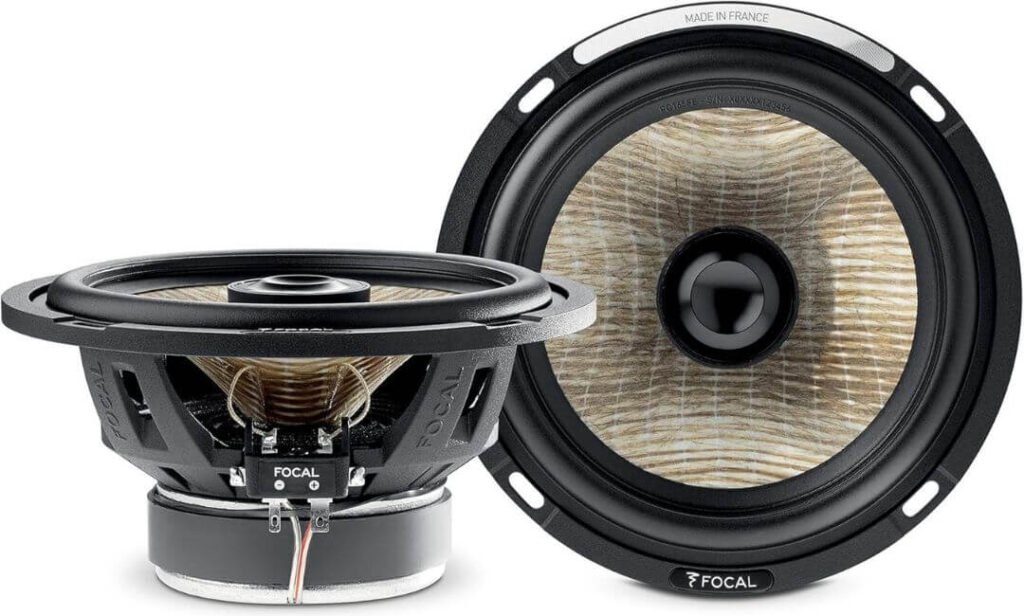
Quick Specs:
- Speaker type: 2-way coaxial
- Woofer size: 6.5 inches / 165 mm
- Power handling: 70W RMS / 140W maximum
- Impedance: 4 ohms
- Woofer cone: Flax sandwich cone
- Tweeter: TAM aluminium/magnesium inverted-dome
- Surround: TMD (Tuned Mass Damper)
- Frequency response: up to 28kHz
- Magnet: Ferrite
- Mounting depth: approximately 3 inches
- Sold as: Pair
- Made in: France
Focal took a slightly different route with this speaker, and that is exactly why it deserves a place near the top of this list. The Flax cone is not there for marketing decoration; Focal has been developing this material for its speaker range since 2013 because it offers a useful balance between stiffness, lightness and natural reproduction. In a car door, where you are listening from an angle rather than sitting directly in front of the driver, that matters. Music comes across less forced, particularly through the midrange, where vocals, guitars and most everyday music actually live.
The other clever part is the TAM tweeter. Its aluminium/magnesium inverted-dome construction and wide-angle dispersion are particularly well suited to a car cabin, where the left and right speakers are rarely aimed directly at your ears. Instead of treating off-axis listening as an afterthought, Focal designed this speaker around it. That makes the PC 165 FE interesting for an older sedan or newer crossover where the factory speaker sits low in the door and the listening position is anything but ideal.
Then there is the TMD surround, which helps control the driver’s suspension rather than simply allowing the cone to move freely. Combined with the Flax cone, it gives this speaker a more composed character when the music gets busy. The 70W RMS / 140W maximum rating is also much more useful than simply looking at peak wattage: it makes this a sensible choice for a moderate aftermarket amplifier while still remaining practical for many factory-powered systems.
(The real appeal is the balance: natural midrange, controlled bass movement and wide tweeter dispersion rather than one exaggerated “wow” effect.)
What We Like About the Flax EVO Approach
- Natural midrange reproduction: The Flax cone gives vocals and instruments a convincing, less coloured character.
- Excellent off-axis behaviour: The wide-dispersion TAM tweeter is a particularly smart choice for door-mounted car speakers.
- Controlled suspension: TMD technology helps keep the woofer composed when the volume rises.
- Premium materials without unnecessary complexity: The aluminium/magnesium tweeter and Flax driver give this pair a genuinely upscale design.
- Useful 70W RMS handling: Enough headroom for a quality amplifier without making the speaker unnecessarily demanding.
One Installation Detail Worth Checking
The approximately 3-inch mounting depth is reasonable for many 6.5-inch locations, but don’t treat “6.5-inch” as a universal fitment guarantee. Check your exact vehicle for mounting depth, speaker adapter requirements, grille clearance and factory wiring before ordering. This is especially important in newer cars with shallow doors or unusual factory speaker brackets.
Why This 6.5-Inch Coaxial Makes Sense for Real Cars
The PC 165 FE makes the most sense when your priority is sound quality rather than chasing the biggest number on the volume dial. A factory speaker can often sound acceptable at low volume but lose composure as you turn it up. This Focal is designed with a more sophisticated cone and suspension system, so the upgrade is about making the entire presentation cleaner—not just making the door speaker louder.
It is also a good choice for listeners who spend a lot of time with vocals, rock, jazz, acoustic tracks or detailed recordings. You get enough bass from the 6.5-inch woofer to make the doors sound fuller, but the speaker’s character is ultimately about balance. If your system already has a subwoofer, that becomes an even better pairing because the Focal can concentrate on the midrange and upper bass while the sub handles the frequencies a door speaker cannot reproduce convincingly.
The Insider Pro-Tip
If you are replacing a basic factory speaker with this pair, do not judge the upgrade during the first few seconds of a track. Listen to familiar music at a realistic driving volume and pay attention to vocals, cymbals, guitar texture and the way the midbass blends into the rest of the system. That is where the Flax construction starts to make sense.
And if your car has a factory amplifier, verify its actual output before assuming the 70W RMS rating means you need a new amp. You may already have enough power. In many installations, better mounting, proper polarity and sealing the speaker to the door can contribute more to the final result than simply adding another piece of hardware.
#3. Morel Maximo Ultra 602 Coax MKII 6-1/2″ 2-Way Coaxial Speakers
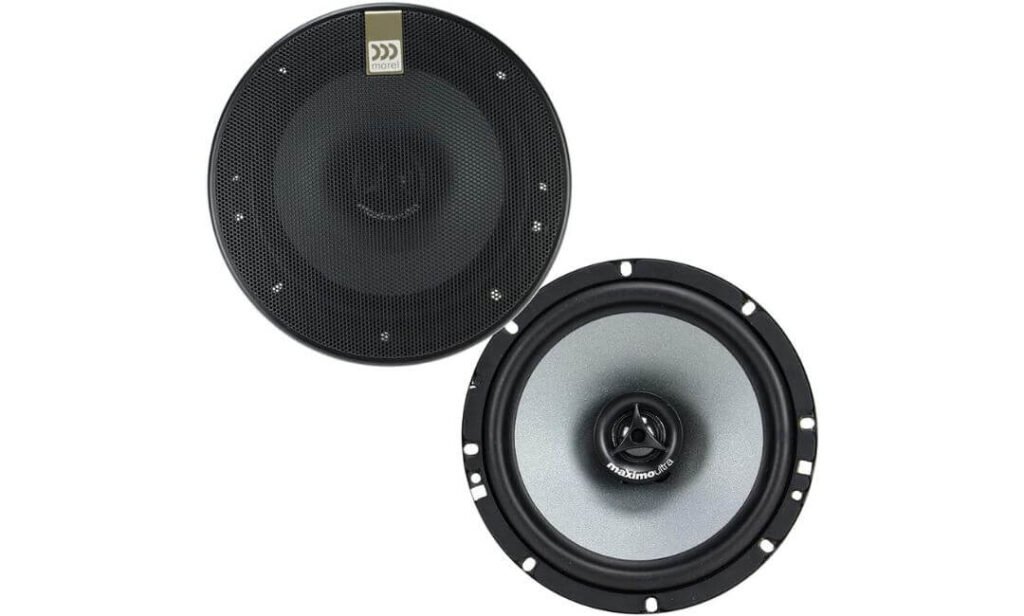
Quick Specs:
- Speaker type: 2-way coaxial
- Woofer size: 6-1/2 inches
- Power handling: 90W RMS each / 180W per pair
- Peak power: 160W each / 320W per pair
- Impedance: 4 ohms
- Sensitivity: 91 dB
- Frequency response: 55Hz–20kHz
- Woofer cone: Treated paper composite
- Tweeter: 1-inch soft dome
- Crossover: Built-in MXR
- Magnet: High-grade ferrite
- Mounting depth: 63mm / 2.5 inches
- Configuration: Pair
- Grilles: Included
There is a reason the Maximo Ultra 602 Coax MKII feels different from a typical factory-speaker replacement: it does not need to shout to sound impressive. The 91dB sensitivity is one of the first numbers I would look at here because it tells you that this speaker can produce useful output without demanding a huge amount of amplifier power. In an older sedan with a factory radio, that can be a much more meaningful advantage than buying a speaker with an enormous peak-wattage number.
The treated paper composite cone is another detail worth paying attention to. Paper gets dismissed far too easily in modern car-audio shopping, but a properly treated composite cone can deliver a very natural midrange. That suits the Maximo Ultra particularly well with vocals, guitars and everyday music, while the 1-inch soft-dome tweeter keeps the upper frequencies smoother than some brighter hard-dome designs. It is a sensible combination for someone who spends hours in the car rather than only turning the volume up for a few minutes.
Then there is the 90W RMS per speaker rating. That gives this pair plenty of room if you later add an amplifier, while the 2.5-inch mounting depth keeps installation relatively straightforward in many factory 6.5-inch locations. The built-in MXR crossover is also useful because you are not left figuring out where to put a separate crossover box in a door that may already be cramped.
(The standout here is the combination of 91dB sensitivity, 90W RMS handling and a smooth soft-dome tweeter—it is an unusually practical mix for both factory and amplified systems.)
What We Like About This Morel
- 91dB sensitivity: A genuine advantage when working with limited factory-radio power.
- Strong 90W RMS handling: Gives the speaker enough headroom for a serious amplifier upgrade later.
- Natural-sounding cone: The treated paper composite construction is well suited to vocals and midrange-heavy music.
- Smooth 1-inch tweeter: A softer presentation can be easier to live with during long drives than an aggressively bright tweeter.
- 2.5-inch mounting depth: Makes it a realistic candidate for many factory door locations.
The One Fitment Check I Would Not Skip
Although the 63mm / 2.5-inch depth is relatively manageable, check the actual door clearance on your vehicle before ordering. Window mechanisms, factory brackets and wiring can occupy space directly behind the speaker. You may also need a vehicle-specific mounting adapter and wiring harness, particularly when replacing an unusual factory speaker.
Where This 6.5-Inch Coaxial Fits Best
The Maximo Ultra is particularly convincing for someone who wants a speaker that sounds full without becoming tiring. That makes it a strong choice for a daily-driven SUV, sedan or pickup where the system will be used for hours at a time. It is also an interesting rear-door option when the front of the vehicle already has a stronger component setup and you want the rear fill to remain musical rather than distracting.
Its 55Hz low-end extension is useful for making the doors feel more substantial, but I would not confuse that with subwoofer territory. The speaker can give you satisfying upper-bass and midbass weight, especially with proper door treatment, but genuinely deep bass still belongs to a dedicated subwoofer. That is not a weakness—it is simply using a 6.5-inch door speaker for what it does best.
The Insider Pro-Tip
If you are running the factory head unit, 91dB sensitivity is one of the reasons I would seriously consider this model. You do not necessarily need to buy an amplifier just to make the upgrade worthwhile. Get the installation right first, make sure the speaker is sealed properly against the mounting surface, and listen before deciding you need more equipment.
If you eventually add an amplifier, the 90W RMS rating gives you useful headroom. Just set the gain correctly rather than treating the gain control as a volume knob. A clean, properly powered 6.5-inch speaker will generally give you a better result than an overdriven speaker being pushed beyond what the system can deliver cleanly.
#4. KICKER 51KSC6504 KS-Series 6.5″ Coaxial Speakers with .75″ Tweeters, 4-Ohm, Pair
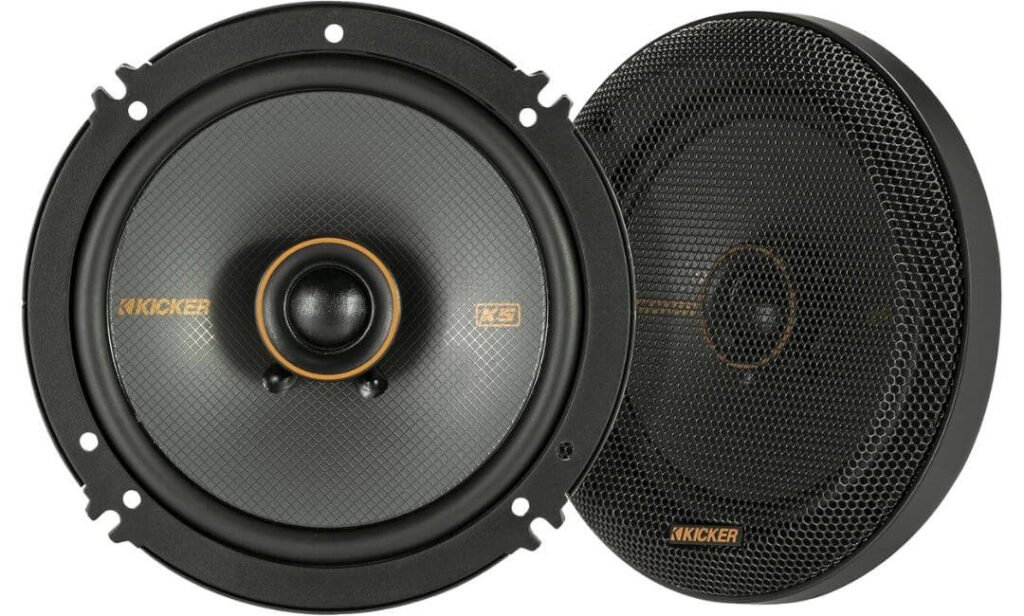
Quick Specs:
- Speaker type: 2-way coaxial
- Woofer size: 6.5 inches
- Impedance: 4 ohms
- Sensitivity: 90 dB
- Recommended power: 15–100W RMS
- Peak power: 200W
- Frequency response: 43Hz–21kHz
- Woofer cone: Internally damped polypropylene
- Surround: Rubber
- Tweeter: 0.75-inch silk dome
- Tweeter magnet: Neodymium
- Crossover: Integrated inline crossover
- Mounting depth: Less than 2 inches
- Tweeter protrusion: Approximately 5/16 inch
- Configuration: Pair
- Grilles: Included
If your main goal is to replace tired factory door speakers without turning the installation into a weekend project, this is where the KSC6504 becomes genuinely interesting. KICKER has kept the tweeter profile extremely low, with roughly 5/16-inch of protrusion, so the speaker can sit behind many factory grilles without the common problem of the tweeter hitting the grille or looking out of place. That is a small physical detail, but anyone who has actually worked around a cramped factory door knows how valuable it can be.
The woofer uses an internally damped polypropylene cone with a rubber surround, which gives this model a slightly different character from the paper-based Morel or Flax-based Focal above. The design is aimed at keeping the midrange controlled while still giving the door speaker some authority in the bass. With 90dB sensitivity and a recommended 15–100W RMS range, it is also one of the more sensible choices here for a factory radio. You do not need a huge amplifier simply to get useful volume from it.
The 0.75-inch silk-dome tweeter is another reason this speaker works well as an everyday upgrade. It is not trying to produce an exaggerated top end; instead, it adds clarity while keeping the presentation relatively smooth. The stated 43Hz–21kHz response gives the speaker useful bandwidth on paper, but the more important real-world advantage is the combination of efficient output, shallow installation depth and a forgiving sound that suits a wide range of factory systems.
(For a difficult factory door location, the low-profile tweeter may be more valuable than another 50 watts printed on a specification sheet.)
What We Like About the KS-Series Design
- Very shallow installation: Less than 2 inches of mounting depth makes this particularly attractive for tight factory doors.
- Minimal tweeter protrusion: The 0.75-inch tweeter stays remarkably unobtrusive behind many original grilles.
- 90dB sensitivity: A useful advantage when retaining the factory head unit.
- Damped polypropylene cone: Gives the woofer a controlled, durable platform for midrange and everyday bass.
- Smooth silk-dome tweeter: Keeps vocals and upper frequencies detailed without making the system unnecessarily aggressive.
The Fitment Advantage Is the Real Story
The KSC6504 is one of those speakers where physical design matters just as much as acoustic specifications. A speaker can sound fantastic and still be a poor recommendation if it requires cutting the door or relocating the factory grille. This one was designed with minimal tweeter protrusion specifically to make factory replacement easier.
Still, do not assume “fits most vehicles” means guaranteed fitment for yours. Check the speaker adapter, factory connector, mounting holes and window clearance for your exact year and trim. Some vehicles also use proprietary amplified systems, in which case the factory wiring and amplifier arrangement need to be considered before installation.
Why This Is a Smart Factory-System Upgrade
For someone keeping the original head unit, this is arguably one of the easiest recommendations to understand. The combination of 90dB sensitivity and a 15–100W RMS recommended range means you are not buying a speaker that requires an expensive amplifier just to wake it up. That makes it particularly appealing for an older daily driver where the original speakers have become dull, distorted or damaged but the owner has no interest in rebuilding the entire audio system.
It also works nicely as a practical rear-door speaker. You get enough output to keep the cabin lively, while the soft-dome tweeter avoids turning rear fill into something that constantly grabs your attention. Add some basic door treatment and a solid mounting surface, and the improvement over a worn factory driver can be much more noticeable than the specification sheet would suggest.
The Insider Pro-Tip
If this is going into a factory-powered car, resist the temptation to add an amplifier immediately. Install the speakers correctly first and listen. The 90dB sensitivity means they are already designed to make good use of modest power. If the system still feels limited after that, then you have a much clearer reason to add amplification.
And pay particular attention to the door seal around the speaker. The woofer needs the door panel to behave like part of the enclosure. A loose adapter, air leaks or a poorly sealed mounting surface can rob you of the midbass you bought the speaker for. In other words, with this particular KICKER, a careful installation can be worth far more than chasing another specification on the box.
#5. Rockford Fosgate P1V2-65 Punch P1 6.5″ 3-Way Coaxial Speakers, Pair
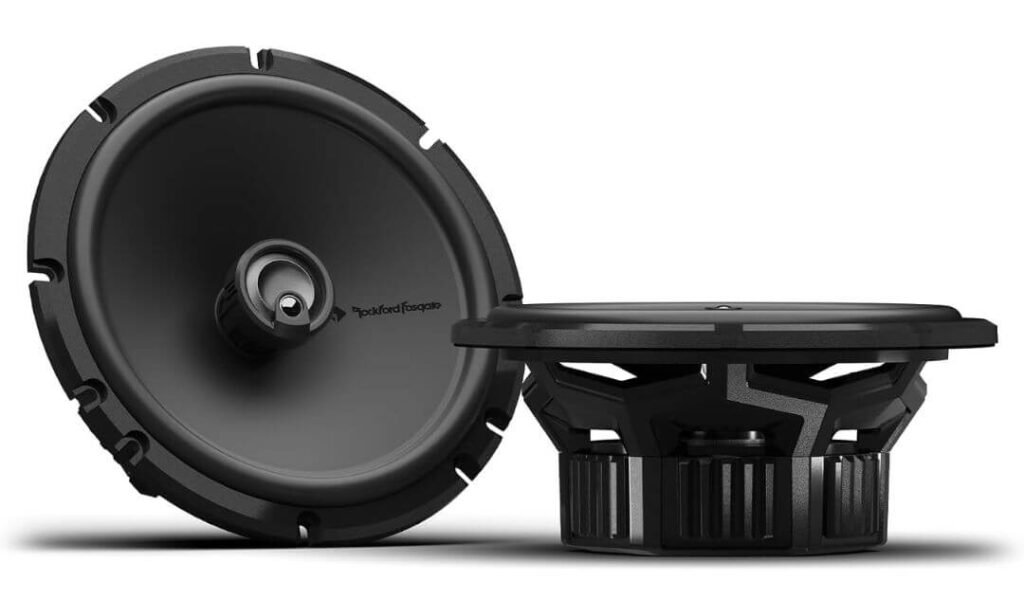
Quick Specs:
- Speaker type: 3-way coaxial / full-range
- Woofer size: 6.5 inches
- Power handling: 75W RMS / 150W maximum
- Impedance: 4 ohms
- Frequency response: 50Hz–20kHz
- Cone: Polypropylene
- Technology: VAST 2.0
- Tweeter system: Tru-Sight dual-tweeter
- Surround: Rubber
- Mounting depth: approximately 2.26–2.5 inches
- Frame: Auto Fit Architecture
- Terminals: Push terminals
- Configuration: Pair
- Grilles: Not included
If you want your factory system to feel more alive rather than simply more refined, the P1V2-65 takes a different route from the speakers above it. This is a 3-way coaxial, but the interesting part is not the extra driver count by itself. Rockford Fosgate combines its Tru-Sight dual-tweeter arrangement with VAST 2.0, which increases the effective cone area by 25%. In a 6.5-inch door location, that gives the speaker more surface area to work with and helps explain why it has that unmistakable Punch-series character.
The 75W RMS / 150W maximum rating also puts it in a useful middle ground. It is not an amplifier-hungry monster, so a factory system can make use of it, but there is enough headroom for a modest aftermarket amplifier later. The polypropylene cone and rubber surround are built for the sort of environment a door speaker actually lives in—temperature changes, vibration, moisture and years of repeated movement—rather than just looking impressive on a product page.
What I particularly like here is the attention to installation. Rockford’s Auto Fit Architecture, redesigned frame and removable motor cover are intended to make the speaker easier to integrate into modern factory locations. That matters because a speaker can have excellent acoustic hardware and still become a headache when its basket interferes with the door. The P1V2-65 is designed around that real-world problem.
(The clever part is the combination of increased cone area and dual-tweeter positioning—not simply calling it a “3-way” and leaving the explanation there.)
What We Like About the Punch P1
- VAST 2.0 cone-area increase: The extra effective surface area helps the speaker produce a stronger sense of impact from the door.
- Tru-Sight dual tweeters: Gives the upper range a more deliberate presentation across the uneven listening angles found inside a car.
- Useful 75W RMS handling: Works with factory systems while leaving room for moderate amplification.
- Auto Fit construction: The redesigned frame is a genuine practical advantage when dealing with modern factory mounting locations.
- Rubber surround and polypropylene cone: A sensible combination for a daily-driven door or rear-deck installation.
The Installation Detail You Should Not Ignore
Rockford specifically recommends measuring the available space before purchase, and I would take that seriously. The approximately 2.26–2.5-inch mounting depth is manageable for many locations, but exact clearance varies by vehicle. Check the window mechanism, adapter bracket, speaker opening and grille clearance for your particular year and trim.
Also remember that grilles are sold separately. If your factory grille is not reusable, factor that into the installation rather than discovering it after the speakers arrive.
Where This 6.5-Inch Speaker Makes the Most Sense
The P1V2-65 is a good match for somebody who wants a noticeable jump in energy and punch from a standard factory system. It can work particularly well in trucks, SUVs and older cars where the original door speakers have lost their authority and you want music to feel more substantial without immediately adding a subwoofer.
The 50Hz lower response specification is useful for the upper-bass region, but I would still keep expectations realistic. A 6.5-inch coaxial can improve midbass impact, but it cannot create the deep low-frequency pressure of a dedicated subwoofer. That distinction is important because it keeps the recommendation honest: buy this if you want your doors to contribute more punch and presence, not because you expect it to replace a sub.
The Insider Pro-Tip
The dual-tweeter arrangement makes speaker positioning and polarity worth checking carefully during installation. If one side is wired incorrectly, you can lose some of the very midrange and bass presence you were trying to gain. Check polarity before securing the door panel, then listen from the driver’s seat rather than judging the speaker with your ear directly beside it.
And if you are keeping the factory radio, start there. The 75W RMS rating does not mean you need 75 watts from the head unit. If the system sounds clean but you eventually want more authority, then add amplification later. The speaker already gives you a solid platform for that next step.
#6. HERTZ UNO Series X-165 6.5″ Two-Way Coaxial Speakers, Pair
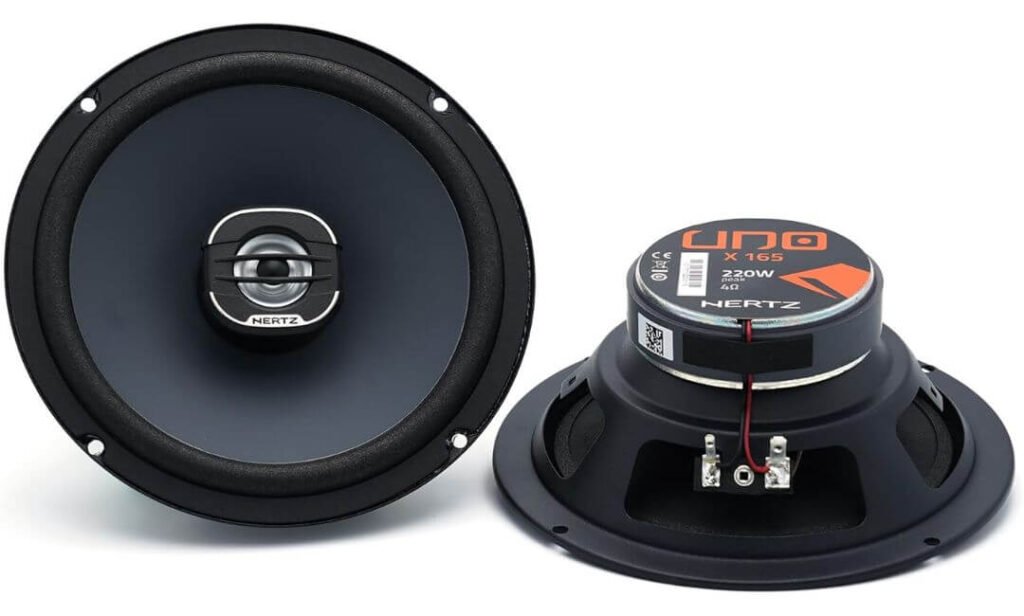
Quick Specs:
- Speaker type: 2-way coaxial
- Woofer size: 6.5 inches
- Power handling: 55W RMS / 220W peak
- Impedance: 4 ohms
- Sensitivity: 93.5 dB
- Frequency response: 60Hz–21kHz
- Woofer cone: Water-repellent pressed paper
- Woofer magnet: Ferrite
- Tweeter: PEI dome
- Tweeter magnet: Neodymium
- Voice coil: 25mm pure copper
- Surround: Foam
- Basket: DIN-size
- Configuration: Pair
The first thing that makes the X-165 interesting is not its 220W peak figure. It is the 93.5dB sensitivity. That is a genuinely useful number for someone replacing factory speakers because it means the speaker can produce strong output without demanding huge amounts of power. If you have an older sedan, pickup or SUV with the original head unit still doing the work, this is exactly the sort of specification I would pay attention to before getting distracted by peak wattage.
Hertz also hasn’t tried to make the woofer unnecessarily complicated. The water-repellent pressed-paper cone is a practical choice for a door speaker, where the environment can be considerably less friendly than a home-audio cabinet. The 80mm ferrite motor and 25mm pure-copper voice coil give the woofer a solid foundation, while the foam surround allows the driver to move without making the speaker excessively difficult to drive. The result is a design that is much more about efficient everyday performance than chasing premium-system bragging rights.
The tweeter arrangement is equally sensible. A compact neodymium magnet drives the PEI dome, keeping the tweeter assembly small while still providing the upper-frequency detail needed from a coaxial speaker. Hertz also pays attention to the faceplate geometry for off-axis listening, which matters in a car because your ears are almost never directly in front of the door speaker. With 55W RMS handling and 93.5dB sensitivity, this is one of the clearest examples in this list of why the right speaker is not necessarily the one with the biggest power rating.
(The X-165’s real advantage is efficiency: it can make a modest factory system feel considerably more capable without demanding a major amplifier upgrade.)
What We Like About the X-165
- 93.5dB sensitivity: One of the strongest reasons to consider it for a factory-powered system.
- Water-repellent woofer cone: A sensible material choice for the temperature and moisture exposure of a car door.
- Compact neodymium tweeter motor: Keeps the high-frequency driver physically unobtrusive.
- 25mm copper voice coil: Gives the woofer a useful balance between efficiency and power handling.
- DIN-size basket: Designed around straightforward aftermarket integration rather than an unnecessarily complicated installation.
The Important Fitment Reality
The DIN-size basket makes the X-165 a promising factory replacement, but do not interpret that as universal fitment. Your car may still require an adapter bracket or wiring harness, and the actual door opening can differ between model years and trims. Check the mounting diameter, depth and window clearance before ordering.
Where This 6.5-Inch Coaxial Makes the Most Sense
This is the speaker I would look at when the priority is getting a clear, lively upgrade from limited factory power rather than building an elaborate amplified system. Its 93.5dB sensitivity gives it an advantage in precisely that situation. You can replace tired original speakers and get more usable volume without immediately adding an amplifier, which can make the overall upgrade considerably less expensive.
The 60Hz–21kHz response also tells you where to set expectations. It can add useful upper-bass and midrange energy, but it is not intended to produce the kind of deep bass that belongs to a subwoofer. If you eventually add one, the X-165 can concentrate on vocals, midrange and upper bass while the subwoofer handles the heavy low-end work.
The Insider Pro-Tip
If you are installing these in a car that still has its original head unit, start by taking advantage of what makes this model different: its efficiency. Do not automatically add an amplifier just because other speakers on your shortlist can handle more watts. A well-installed 93.5dB speaker can make a surprisingly big difference with the power you already have.
And because the cone is designed to cope better with the realities of a car door, I would still spend a little time sealing the speaker against its adapter and checking the mounting surface for vibration. That small installation detail can make the bass sound tighter and cleaner, especially when the factory door panel itself is doing more work than the speaker specifications suggest.
Best 6.5″ Coaxial Car Speakers in 2026 Compared for Bass, Clarity and Fitment
| 6.5″ Coaxial Speaker | Power & Efficiency | Driver / Tweeter Design | Frequency Range | Installation Reality | Best System Match | What You Are Really Buying |
|---|---|---|---|---|---|---|
|
Top Overall
Alpine R2-S65
High-Resolution Choice
|
100W RMS 300W peak 4Ω · 88dB |
Glass-fiber reinforced cone Magnesium hard-dome tweeter HAMR surround |
65Hz–40kHz Hi-Res Audio |
2.5″ / 63.5mm depth Vehicle-specific fitment check recommended |
Factory power → Good Amplifier → Excellent |
Most complete enthusiast option A fast, detailed speaker with enough RMS headroom to grow with an amplified system. |
|
Premium Sound
Focal PC 165 FE Flax EVO
Natural Sound Focus
|
70W RMS 140W max 4Ω |
Flax cone TAM aluminium/magnesium inverted dome TMD surround |
Up to 28kHz Wide-angle tweeter dispersion |
≈3″ depth Check door clearance and adapter requirements |
Factory power → Good Moderate amp → Excellent |
For listeners who value realism The Flax driver and TAM tweeter prioritise natural midrange, controlled bass and detail. |
|
Sound Quality
Morel Maximo Ultra 602 Coax MKII
Smooth Daily Listening
|
90W RMS each 160W peak each 4Ω · 91dB |
Treated paper composite cone 1″ soft-dome tweeter Built-in MXR crossover |
55Hz–20kHz |
2.5″ / 63mm depth Adapter may be required depending on vehicle |
Factory power → Very good Amplifier → Excellent |
Easy to live with High sensitivity and a soft-dome tweeter make it a strong choice for long listening sessions. |
|
Factory Upgrade
KICKER 51KSC6504 KS-Series
Easy-Fit Focus
|
15–100W RMS recommended 200W peak 4Ω · 90dB |
Internally damped polypropylene cone 0.75″ silk-dome tweeter Rubber surround |
43Hz–21kHz |
<2″ depth ≈5/16″ tweeter protrusion |
Factory power → Excellent Amplifier → Good |
One of the easiest upgrades here Shallow construction and high efficiency make it particularly attractive for factory installations. |
|
Punchy Output
Rockford Fosgate P1V2-65 Punch P1
Bass & Energy
|
75W RMS 150W max 4Ω |
3-way coaxial VAST 2.0 Tru-Sight dual-tweeter system |
50Hz–20kHz |
≈2.26–2.5″ depth Auto Fit frame; measure before ordering |
Factory power → Good Moderate amp → Very good |
For a more energetic presentation Increased cone area and dual tweeters make it a compelling choice for punch and lively playback. |
|
Factory Power
HERTZ UNO X-165
High-Efficiency Pick
|
55W RMS 220W peak 4Ω · 93.5dB |
Water-repellent pressed-paper cone PEI tweeter Neodymium tweeter magnet |
60Hz–21kHz |
DIN-size basket Verify vehicle-specific bracket and clearance |
Factory power → Excellent Amplifier → Good |
Smart choice when power is limited Its 93.5dB sensitivity makes it particularly convincing when keeping the factory head unit. |
6.5-Inch Coaxial Speakers Buying Guide: What Actually Matters Before You Spend Your Money
Buying a 6.5-inch coaxial speaker is surprisingly easy to get wrong. Most product pages lead with peak watts, oversized frequency ranges, or the number of drivers, but those figures do not tell you whether the speaker will actually sound better in your car. The better approach is to start with the vehicle, understand how much power the system can provide, then choose the speaker’s sound character and construction around that setup.
Start With the Sound You Actually Want
Before comparing specifications, decide what is missing from your current system.
If your factory speakers sound thin, start by looking for stronger midbass and a cleaner midrange. If vocals sound buried, a well-controlled tweeter and good off-axis response become more important. If the system becomes unpleasant when you turn it up, look for a speaker with better power handling and a more controlled driver rather than simply choosing the highest-sensitivity model.
For a typical 6.5-inch door speaker, the useful areas are:
- Midbass: Look around the 50–100Hz region for the weight behind kick drums, bass guitar and lower notes. Do not expect a door speaker to reproduce true sub-bass.
- Midrange: This is where vocals, guitars, piano and most of the information in everyday music sit. Cone material and driver control matter greatly here.
- Treble: A good tweeter should add detail without making the system painfully bright. Hard-dome and soft-dome designs can sound quite different.
- Sensitivity: Higher sensitivity generally means more output from the same amount of amplifier power.
- Off-axis performance: Extremely important in a car because the speakers are mounted in doors rather than aimed directly at the listener.
This is why the six speakers in this guide are not interchangeable. The Alpine R2-S65 leans toward high-resolution performance and amplifier headroom, while the Hertz UNO X-165 makes a particularly strong case when efficiency from factory power is the priority. Those are two very different buying situations.
Match RMS Power to the System, Not the Advertisement
The most useful power figure is RMS, not peak or maximum power.
Peak ratings describe what a speaker may tolerate briefly under particular conditions. RMS is much more useful when you are trying to understand how the speaker will behave with continuous musical power.
A simple way to approach it:
| Your current system | What to prioritise |
|---|---|
| Factory radio, no external amp | High sensitivity, sensible RMS requirement |
| Factory amplified system | Verify the factory amplifier’s output and speaker impedance |
| Small aftermarket amplifier | Moderate RMS handling with good sensitivity |
| Strong aftermarket amplifier | Higher RMS handling and thermal headroom |
| Future amplifier upgrade planned | Choose a speaker that can grow with the system |
For example, the 93.5dB sensitivity of the Hertz X-165 makes it particularly attractive when the factory head unit is staying. On the other hand, a model such as the 100W RMS Alpine R2-S65 becomes more interesting when an amplifier is part of the plan.
One mistake I would avoid is assuming that a 100W RMS speaker needs exactly 100 watts to sound good. It does not. Likewise, a 55W RMS speaker is not automatically inferior to a 100W model. Speaker efficiency, distortion behaviour, installation and system matching all affect the result.
Understand What 6.5 Inches Really Means
“6.5-inch” sounds universal, but aftermarket fitment is rarely that simple.
The nominal driver diameter tells you roughly what category the speaker belongs to. It does not guarantee that the basket, mounting holes, depth or tweeter position will match your factory door.
Before ordering, measure or verify:
- Mounting diameter
- Mounting depth
- Factory speaker bracket dimensions
- Window-glass clearance behind the speaker
- Factory grille clearance
- Tweeter height and protrusion
- Wiring connector
- Whether a mounting adapter is required
- Whether a wiring harness adapter is required
- Whether the vehicle uses a factory amplifier
This is especially important with newer cars. A vehicle may advertise a 6.5-inch speaker location while using a proprietary basket or mounting system. Older cars can have the opposite problem: the opening may be straightforward, but the original speaker may use a non-standard connector or bracket.
The KICKER KS-Series is particularly interesting from a physical-design perspective because its shallow mounting depth and minimal tweeter protrusion address a problem that specification sheets often ignore. Meanwhile, the Morel and Alpine both sit around the 2.5-inch depth range, which is manageable in many applications but still needs to be checked against the actual door.
Cone Material Changes More Than the Specification Sheet Suggests
The cone is the part of the speaker doing the physical work, so its material deserves more attention than it usually gets.
Different materials can produce different combinations of stiffness, weight, damping and tonal character.
Glass-fiber reinforced cones such as the one used in the Alpine are designed to stay stiff while remaining relatively light. That can help produce a fast, controlled response.
Flax construction in the Focal takes a different approach, aiming for a natural and well-controlled presentation, particularly through the midrange.
Treated paper composite in the Morel is not a cheap-material compromise. Properly engineered paper-based cones can have excellent damping characteristics and can produce a very natural midrange.
Polypropylene, used in models such as the KICKER and Rockford Fosgate, is popular in automotive applications because it offers durability, moisture resistance and predictable behaviour.
The Hertz uses water-repellent pressed paper, which is particularly sensible for a door environment where the speaker can be exposed to moisture and temperature changes.
So rather than asking, “Which cone material is best?”, ask “Which combination of cone material, suspension and tweeter suits the sound I want?”
Do Not Choose a Speaker by the Number of Ways
A 3-way coaxial is not automatically better than a 2-way coaxial.
A typical 2-way design combines:
- One woofer
- One tweeter
A 3-way coaxial adds another high-frequency or midrange driver into the same assembly.
That can help with separation and presentation, but it also introduces more engineering variables. A well-designed 2-way can sound considerably better than a poorly implemented 3-way.
The Rockford Fosgate P1V2-65 is interesting because its Tru-Sight dual-tweeter arrangement and VAST 2.0 technology are part of a broader design rather than simply adding another driver for the sake of a specification.
That is the distinction worth remembering: count the engineering, not just the drivers.
Pay Attention to Sensitivity if You Are Keeping the Factory Radio
Sensitivity is one of the most underrated specifications in car-audio shopping.
If two speakers require similar power but one has a significantly higher sensitivity rating, the more sensitive model can generally produce more output from the same amplifier power.
That is why the Hertz X-165’s 93.5dB sensitivity immediately makes sense for a factory-powered installation. The Morel at 91dB and KICKER at 90dB are also practical choices when amplifier power is limited.
The Alpine, at 88dB, is different. That does not make it a worse speaker. It simply means its appeal is less about extracting maximum loudness from minimal power and more about its driver construction, high-resolution tweeter and ability to handle a stronger amplified system.
Mounting Depth Can Make or Break the Installation
This is the specification that can turn a five-minute purchase into a frustrating installation.
A speaker that physically fits the 6.5-inch opening can still be too deep for the door. Behind that speaker may be:
- Window glass
- Window regulator
- Wiring
- Door bracing
- Factory moisture protection
- A metal mounting structure
The approximate depths of the models here range from under 2 inches for the KICKER to around 3 inches for the Focal, with several models around the 2.5-inch mark.
That difference sounds small on paper. Inside a door, it can be the difference between a clean installation and the speaker physically interfering with the window mechanism.
Also check tweeter protrusion. A coaxial speaker can have enough woofer clearance but still hit the factory grille because its tweeter sits too high.
Think About the Installation as Part of the Speaker
A good 6.5-inch speaker installed badly can sound worse than a cheaper speaker installed properly.
The mounting surface should be rigid, the speaker should sit securely against its adapter, and unwanted air leaks around the mounting surface should be minimised.
For many vehicles, a proper installation may involve:
- Removing the factory speaker.
- Checking the actual mounting opening and depth.
- Installing the correct vehicle-specific adapter.
- Using the correct wiring harness rather than cutting the factory wiring where possible.
- Mounting the speaker firmly.
- Sealing the speaker-to-adapter interface.
- Checking window clearance before reinstalling the door panel.
- Confirming polarity.
- Listening for rattles before finishing the installation.
Door treatment can also make a meaningful difference. The speaker is working against the door structure, so reducing panel vibration and improving the mounting surface can tighten the midbass considerably.
Choose Your Budget Around the Rest of the System
There is no reason to spend premium-speaker money if the rest of the system is limiting the result.
| Budget approach | What makes sense | Who it suits |
|---|---|---|
| Entry-level upgrade | Efficient 6.5-inch coaxial with sensible power requirements | Factory-radio owners replacing worn speakers |
| Mid-range upgrade | Better cone, tweeter and suspension with higher power handling | Daily drivers wanting noticeably better sound |
| Premium upgrade | Advanced cone materials, refined tweeters and stronger amplification capability | Enthusiasts who care about detail and system growth |
The important point is that price should follow the system, not the other way around.
A premium coaxial connected to a weak factory source will not suddenly turn the vehicle into a high-end audio system. Likewise, putting an inexpensive speaker behind a powerful amplifier can leave performance on the table.
Your 6.5-Inch Coaxial Speaker Checklist Before You Buy
Use this quick check before pressing the buy button:
- Vehicle: Confirm the exact year, model and trim.
- Location: Verify that the factory speaker location is genuinely compatible with a 6.5-inch aftermarket driver.
- Depth: Check the available mounting depth, not just the diameter.
- Power: Identify whether the speaker will run from a factory radio, factory amplifier or aftermarket amplifier.
- Sensitivity: Give this extra weight when using factory power.
- RMS: Compare continuous power handling with the amplifier’s realistic output.
- Impedance: Make sure the speaker’s impedance is appropriate for the amplifier or factory system.
- Tweeter clearance: Confirm the tweeter will not interfere with the factory grille.
- Mounting: Check whether you need an adapter bracket.
- Wiring: Check whether a vehicle-specific harness is required.
- Sound preference: Decide whether you prefer smooth, natural sound or a more energetic presentation.
- Bass expectations: Remember that better midbass is not the same thing as subwoofer-level deep bass.
- Installation quality: Budget for adapters, sealing and basic door treatment if needed.
The safest purchase is rarely the speaker with the biggest wattage number or the longest specification list. It is the one whose sensitivity, power handling, physical dimensions and sound character make sense for the vehicle sitting in your driveway. That is the difference between replacing a factory speaker and actually upgrading the car’s audio system.
6.5-Inch Coaxial Speakers Installation: How to Replace Factory Door Speakers Without Losing Sound Quality
Replacing a factory 6.5-inch speaker is usually straightforward, but the installation quality can decide how much of the upgrade you actually hear. A premium coaxial speaker mounted loosely, wired incorrectly, or sitting against an unsuitable adapter can lose midbass and introduce rattles that were never part of the speaker’s design. The goal is not simply to make the new driver fit the hole; it is to create a solid, sealed connection between the speaker and the vehicle’s door.
Check the Vehicle Before Removing the Factory Speaker
Before buying or installing 6.5-inch coaxial speakers, confirm the exact year, model, trim and factory audio system. Two versions of the same car can use different speaker brackets, connectors or factory amplifiers.
Check these measurements first:
- Factory speaker diameter and mounting pattern
- Available mounting depth
- Distance between the speaker and window glass
- Factory grille and tweeter clearance
- Speaker connector type
- Mounting bracket or adapter requirements
- Whether the vehicle has a factory amplifier
- Whether the original speaker uses a proprietary impedance
That last point is easy to overlook. A factory system designed around a particular speaker load should not be treated like a completely universal aftermarket amplifier. Verify the factory amplifier or head-unit requirements before changing impedance.
Tools You Will Usually Need
The exact tools depend on the vehicle, but a normal door-speaker replacement commonly requires:
- Phillips and flat-head screwdrivers
- Trim-removal tools
- Socket set with the appropriate metric sizes
- Ratchet and extension
- Torx bits on vehicles that use Torx fasteners
- Wire stripper/crimper if wiring adapters are required
- Multimeter for checking wiring and polarity
- Vehicle-specific speaker adapter brackets
- Speaker wiring harness adapters
- Foam gasket or sealing tape
- Electrical tape or heat-shrink tubing where appropriate
A trim-removal tool is worth having. Using a screwdriver to pry directly against a painted door panel is an easy way to create a mark that costs more to fix than the tool you were trying to avoid buying.
Disconnect Power Before Touching the Speaker Wiring
Before removing the factory speaker, switch the vehicle off and follow the manufacturer’s procedure for electrical disconnection.
If the installation requires disconnecting the battery, make sure you understand whether your vehicle has radio security codes, window-memory functions or other settings that may need to be restored afterward.
Do not start cutting factory wiring immediately. In many vehicles, a simple plug-in speaker harness is available and is preferable because it keeps the original wiring intact.
Understand Impedance Before Connecting Anything
Impedance is not something to change casually.
Most aftermarket speakers in this category use a 4-ohm impedance, which is a common arrangement for car audio. That does not mean every factory system should automatically receive any 4-ohm speaker without checking compatibility.
If your vehicle has a factory amplifier, identify what the original speaker was designed to work with. Some factory systems use unusual loads or active amplification arrangements.
Also remember that wiring speakers incorrectly can affect the amplifier load. Do not connect speakers in unusual series or parallel configurations unless you know exactly how the amplifier is designed to handle the resulting impedance.
Use a Wiring Harness Instead of Cutting the Factory Connector When Possible
A vehicle-specific harness adapter is one of the simplest upgrades you can make during installation.
It normally lets you connect the aftermarket speaker to the factory plug without cutting the vehicle’s original wiring. That makes the installation cleaner and makes it easier to return the car to stock later.
Before connecting anything, verify:
- Positive and negative speaker wires
- Factory connector orientation
- Harness compatibility with your exact vehicle
- Whether the speaker terminals require adapters
Polarity matters. If one speaker is wired backwards, the system can lose some of its bass and sound strangely hollow because the left and right speakers are working against each other.
Mount the Speaker as a Solid Part of the Door
This is where a lot of otherwise good installations fall short.
The speaker needs a rigid mounting surface. If the adapter flexes or the speaker moves when the cone is working, some of the driver’s energy is wasted moving the mounting structure instead of moving air.
Make sure:
- The mounting adapter is rigid.
- Every mounting point is secure.
- The speaker sits flat against the adapter.
- There are no gaps around the speaker frame.
- The mounting screws are tight without damaging the frame.
- The speaker does not contact the window mechanism.
- The factory grille does not touch the tweeter.
Do not overtighten the screws simply because you want the speaker to be “extra secure.” Tighten them evenly and firmly enough to hold the driver without distorting the basket.
Seal the Speaker to Improve Midbass
One of the easiest ways to make a 6.5-inch speaker sound weaker than expected is to leave air gaps around the mounting surface.
A simple foam gasket or suitable sealing material between the speaker and adapter can help prevent air leakage. This becomes particularly noticeable in the midbass region, where the front and rear movement of the cone need to remain acoustically separated.
The improvement is not about making the speaker “more powerful.” It is about allowing the driver to work against a more controlled acoustic environment.
This is also why door treatment can be worthwhile. You do not necessarily need to cover every square inch of the door with damping material. Concentrating on areas that vibrate or resonate can be a more sensible approach.
Sound Deadening Can Help, But Do It With a Purpose
If you are already removing the door panel, this is a convenient time to address obvious vibration.
A sensible approach is to treat:
- The metal area immediately around the speaker
- Large sections of the inner door skin that visibly vibrate
- Areas producing rattles
- The speaker mounting surface where appropriate
The objective is less unwanted vibration and a more stable mounting environment, not simply adding as much material as possible.
Also keep factory drainage paths, wiring and moisture barriers in mind. A door is designed to deal with water, so do not block drainage holes or incorrectly reinstall the factory vapor barrier.
Check Window and Door-Panel Clearance Before Finishing
Before reinstalling the entire door panel, operate the window and verify that nothing interferes with the new speaker.
Check:
- Window fully down.
- Window fully up.
- Door handle operation.
- Speaker grille clearance.
- Wiring movement.
- Door-panel clips and trim.
- Any unusual vibration or contact.
This is particularly important with deeper speakers such as the Focal PC 165 FE. A speaker can appear to fit perfectly with the window down but interfere once the glass moves through its full travel.
Test the Speakers Before Putting the Door Back Together
Do not wait until every trim panel is clipped back into place to discover that one channel is silent.
Before final assembly, check:
- Left and right channels
- Speaker polarity
- Tweeter output
- Midrange vocals
- Midbass
- Unusual distortion
- Rattles
- Volume response
Use a familiar recording rather than a random song. Something you know extremely well makes it easier to notice whether the vocals have moved, the bass has disappeared or one side sounds noticeably different.
Common Installation Mistakes Worth Avoiding
Choosing by Diameter Alone
A speaker can be advertised as a 6.5-inch model and still require an adapter or fail to clear the window mechanism.
Ignoring Tweeter Height
Coaxial speakers with raised tweeters can interfere with factory grilles even when the woofer itself fits correctly.
Reversing Polarity
This is one of the easiest mistakes to make and one of the most obvious once both speakers are playing. If the system suddenly sounds thin after the upgrade, check polarity before blaming the speakers.
Leaving the Speaker Unsealed
Even a small gap between the speaker and adapter can reduce the authority of the midbass and allow unwanted vibration.
Cutting Factory Wiring Too Early
Use a compatible harness whenever possible. There is rarely a good reason to destroy the original connector simply to install an aftermarket speaker.
Assuming More Watts Means Better Sound
A 100W RMS speaker is not automatically better than a 55W RMS model. If the factory system can only provide limited power, sensitivity and system matching can matter more than maximum power handling.
Reinstalling the Door Panel Without Testing
Always test the speaker and window movement before the final trim installation. Finding a wiring problem after everything is clipped back together is an avoidable waste of time.
Best Practice for a Clean 6.5-Inch Coaxial Speaker Replacement
For most vehicles, the ideal sequence is simple:
Confirm fitment → identify the factory system → prepare the adapter → connect the harness → verify polarity → mount firmly → seal the speaker → test the window → test the audio → reinstall the door panel.
That order keeps the job controlled and prevents the common situation where the speaker technically works but does not sound as good as expected.
The biggest lesson with 6.5 inch coaxial speakers installation is that the speaker itself is only part of the equation. A rigid mount, correct polarity, proper sealing and adequate system power can make a good speaker sound considerably better. If you get those fundamentals right, you are far more likely to hear the upgrade you paid for rather than simply seeing a new speaker behind the door grille.
How to Maintain 6.5-Inch Coaxial Car Speakers for Long-Term Performance
A good set of 6.5-inch coaxial speakers should not need constant attention, but they are still installed inside one of the harsher areas of a vehicle. Door speakers deal with moisture, temperature changes, vibration, dust, repeated door slamming and, in some vehicles, water entering through the window area. That makes basic maintenance and periodic inspection more important than most buyers realise.
You do not need to remove the door panel every few months. The sensible approach is to keep the speaker area dry and unobstructed, listen for changes in sound, and inspect the mounting whenever there is a reason to suspect movement, vibration or water exposure.
Keep the Speaker Cone and Grille Free From Dust
The easiest maintenance job is also the one most people overlook.
Dust and debris can collect around the factory grille and speaker opening over time. If the grille is removable, clean it carefully with a soft brush or dry microfiber cloth. Avoid pushing dirt through the grille and directly onto the cone or tweeter.
For the speaker itself:
- Use a soft, dry brush for loose dust.
- Do not spray cleaner directly onto the speaker.
- Do not soak the cone or tweeter.
- Avoid household cleaners containing solvents or aggressive chemicals.
- Never press heavily against the cone while cleaning.
- Keep sharp objects away from the surround.
A little dust is not normally a problem. The bigger concern is moisture combined with dirt, particularly around paper or treated-paper cones and the speaker’s surround.
Pay Attention to Moisture Inside the Door
Car doors are not completely dry environments. Water can enter around the window and is normally directed through drainage channels. The factory moisture barrier and door design are there to manage that water.
If you notice unusual moisture around the speaker, do not simply dry the speaker and forget about it. Look for the reason.
Check for:
- Damaged or poorly fitted door moisture barriers
- Blocked door drainage holes
- Water marks around the speaker
- Loose seals
- Incorrectly installed aftermarket speaker adapters
- Signs of corrosion on terminals
- Dampness around the lower section of the door
This matters particularly for speakers using paper-based cones. The Hertz UNO X-165, for instance, uses a water-repellent pressed-paper cone, but water resistance does not mean the speaker should routinely be exposed to standing water.
Inspect the Speaker Mounting Once in a While
You generally do not need to remove a properly installed speaker on a fixed schedule.
However, it is sensible to inspect the mounting if you start hearing a new rattle, vibration, buzzing sound or change in bass response.
Look for:
- Loose mounting screws
- A cracked plastic adapter
- A compressed or damaged gasket
- Speaker movement around the mounting surface
- Loose wiring touching the cone or frame
- Door-panel clips that have become loose
- Signs that the speaker has shifted inside the adapter
Door speakers experience a surprising amount of vibration. After months or years of driving, especially on rough roads, a previously perfect installation can develop a small amount of movement.
When Should You Re-Torque or Re-Secure the Speaker?
There is no universal “every six months” torque interval for aftermarket car speakers.
That is important because speaker manufacturers and vehicle manufacturers can use different mounting hardware, materials and torque specifications. Follow the vehicle or speaker manufacturer’s specified torque where one is provided.
If there is no published torque specification, the practical approach is to inspect the fasteners and tighten them evenly and firmly rather than aggressively.
Do not keep tightening a screw simply because it turns a little further. Plastic speaker adapters can crack, thin mounting surfaces can strip, and excessive pressure can distort the speaker frame.
A useful time to check the mounting is:
- After the first few weeks of a new installation
- After removing and reinstalling the door panel
- When a new rattle appears
- After driving on particularly rough roads
- If the bass suddenly becomes weaker
- When replacing a damaged door panel or trim
- After any water leak around the door
Check the Wiring and Terminals for Movement
Loose wiring can create problems that initially sound like a bad speaker.
Make sure the speaker wires are secured so they cannot hit the cone, basket or door metal while the vehicle is moving. Pay particular attention to areas where the wiring passes through the door.
Inspect for:
- Loose crimp connections
- Corroded terminals
- Damaged insulation
- Wires rubbing against sharp metal
- Connectors that no longer lock securely
- Wiring trapped between the door panel and mounting surface
If you used a plug-in harness during installation, check that the connector remains properly seated.
Do Not Ignore a Sudden Change in Sound
Your ears are one of the best maintenance tools for a car audio system.
If a speaker that previously sounded clean suddenly develops distortion, buzzing or reduced output, do not immediately assume that the driver has failed.
A new sound can come from:
- Loose mounting hardware
- A damaged door-panel clip
- Wiring contacting the speaker
- A loose grille
- Moisture
- A failing connection
- A damaged surround
- An amplifier or head-unit issue
If only one speaker changes, compare it with the opposite side at moderate volume. If both speakers suddenly sound different, investigate the source unit, amplifier and settings before removing either speaker.
Protect the Speaker From Excessive Amplifier Clipping
Maintenance is not only physical.
If you are running an aftermarket amplifier, avoid driving it into severe clipping. A speaker does not need to be operated at its maximum rated power to be damaged.
This is especially relevant when a system is repeatedly played at very high volume. The problem is not simply the number printed beside “watts”; distorted power and excessive heat can put considerable stress on a voice coil and tweeter.
Set gains properly, avoid using extreme bass boost to compensate for poor installation, and make sure the amplifier is matched sensibly to the speaker’s RMS capability.
Keep Bass Boost and Equalisation Under Control
A well-installed 6.5-inch coaxial speaker should not need extreme EQ to sound good.
If you have to add a huge amount of low-end boost to make the speakers produce the bass you want, the limitation may be the speaker’s enclosure environment, door sealing, amplifier power or the rest of the system.
Use EQ to shape the sound, not to force a small door speaker to behave like a dedicated subwoofer.
This is particularly important with the speakers in this guide because their strengths are different. The Alpine R2-S65 can benefit from clean amplifier power and a subwoofer when deeper bass is required, while a high-sensitivity model such as the Hertz X-165 makes more sense when working with limited factory power.
Protect the Surround and Cone During Interior Work
Be careful whenever you remove the door panel, clean the interior or work around the speaker.
Do not place tools, trim pieces or heavy objects on the speaker cone. A small puncture or deformation can permanently change the driver’s behaviour.
Also check that:
- Door-panel insulation is not touching the cone.
- Wires cannot fall against the moving cone.
- The grille is not pressing against the tweeter.
- Foam or sealing material has not shifted into the speaker opening.
- Nothing behind the panel interferes with cone movement.
A speaker can be electrically perfect and still sound poor because something is physically touching it.
What You Should Check After a Door Panel Has Been Removed
Whenever the door panel comes off, take an extra few minutes to inspect the entire installation rather than simply putting everything back together.
A useful inspection checklist is:
- Speaker mounting screws secure
- Adapter bracket undamaged
- Foam gasket still sealed
- Speaker terminals tight
- Wiring secured away from moving parts
- Moisture barrier correctly positioned
- Door drainage paths unobstructed
- Speaker cone and surround undamaged
- Factory grille clear of the tweeter
- No loose trim or clips around the speaker
This is especially worthwhile if the vehicle has been exposed to heavy rain or if the door has previously been repaired.
How to Make Your 6.5-Inch Coaxial Speakers Last Longer
The best longevity strategy is actually quite simple: install them correctly once, then avoid creating problems around them.
For the best 6.5 coaxial car speakers in this guide, focus on these habits:
- Use the correct mounting adapter. A rigid, properly fitted bracket is much better than forcing a universal bracket into position.
- Seal the speaker mounting surface. This helps maintain cleaner midbass response and prevents unnecessary vibration.
- Keep water away from the speaker whenever possible. If water is reaching the driver directly, investigate the door rather than accepting it as normal.
- Use clean amplifier power. Do not run an amplifier into obvious clipping.
- Avoid excessive EQ. Especially large bass boosts at high volume can create unnecessary thermal and mechanical stress.
- Keep the wiring secure. A wire rubbing against the cone can eventually damage both the wiring and speaker.
- Listen for changes. New buzzing, rattling or distortion is usually worth investigating rather than ignoring.
- Do not overtighten mounting hardware. Secure is good; crushing a plastic adapter or speaker frame is not.
- Handle the cone carefully. Never use the cone as a convenient place to push, clean or rest something.
- Keep the door panel properly secured. Loose trim can create noises that are easily mistaken for speaker distortion.
When Is It Actually Time to Replace a Coaxial Speaker?
A speaker does not have a fixed expiry date.
A quality 6.5-inch coaxial can remain useful for many years if it is correctly installed and operated within sensible limits. Replacement becomes more reasonable when you find a genuine mechanical or electrical problem, such as a damaged cone, torn surround, failed tweeter, burnt voice coil, severe corrosion or persistent distortion that is confirmed to come from the speaker itself.
Before replacing it, eliminate the simpler possibilities first: wiring, mounting, polarity, amplifier settings and door-panel vibration.
That approach can save you from replacing a perfectly good speaker because a loose screw was creating the noise.
The Real Key to Speaker Longevity
The most expensive 6.5-inch coaxial speaker is not automatically the one that will last the longest. Correct fitment, proper mounting, controlled moisture exposure, clean power and sensible volume levels matter far more than simply buying the most expensive model.
If the installation is solid and the system is properly matched, these speakers should not require much maintenance beyond occasional inspection. The best thing you can do is treat the speaker as part of the entire door and audio system rather than as an isolated component. That is what preserves the clean midbass, vocal clarity and high-frequency detail you bought the upgrade for in the first place.
FAQs About 6.5-Inch Coaxial Car Speakers
Are 6.5-inch coaxial speakers actually a worthwhile upgrade in a Toyota Camry or Honda Civic, or is the factory system usually the limiting factor?
Yes, they can be a worthwhile upgrade, but the result depends heavily on what you are replacing and what is powering the new speakers. A good 6.5-inch coaxial does not magically overcome a weak factory amplifier, poor door acoustics or an aggressive factory EQ curve. That is the part many speaker comparisons leave out.
In a Toyota Camry or Honda Civic, for instance, a quality aftermarket coaxial can give you cleaner vocals, better treble separation and tighter midbass, but you should not judge the upgrade purely by how loud the new speakers become. The more meaningful improvement is often clarity at normal listening volume, particularly when the factory speaker has a lightweight paper cone or has already started deteriorating.
There is another catch: if the factory system deliberately boosts or cuts certain frequencies, the aftermarket speaker is still receiving that processed signal. In that situation, a speaker with good sensitivity and an easy-to-drive 4-ohm load can make more sense than buying an extremely power-hungry model simply because its specifications look impressive.
Why can a more expensive 6.5-inch coaxial speaker sound worse than a cheaper model after installation?
Because the price of the speaker is only one part of the system, and the door is effectively the speaker’s acoustic environment.
A premium driver mounted on a flimsy adapter with air leaking around the frame can lose the very midbass and control you paid extra for. Add reversed polarity, an unsuitable factory amplifier or a tweeter that sits badly behind the original grille, and the expensive speaker can produce a less convincing result than a cheaper, more efficient model.
The things I would check before blaming the speaker are:
- Correct polarity on both sides
- Proper mounting depth and window clearance
- Rigid speaker adapter
- Foam sealing around the mounting surface
- Factory amplifier compatibility
- Sensitivity and RMS requirements
- Door-panel or grille vibration
- Whether the factory EQ is heavily processing the signal
This is why the Alpine R2-S65, Focal PC 165 FE and Morel Maximo Ultra 602 Coax MKII should not simply be ranked by price. They approach sound differently, and the best choice depends on the rest of the system.
If I am keeping the factory radio, should I prioritise sensitivity over RMS power when choosing 6.5-inch coaxial speakers?
In many cases, yes. If the factory head unit is doing the amplification, sensitivity becomes particularly important because you have limited power available.
A speaker rated for enormous power handling is not automatically a better factory-radio upgrade. In fact, buying a speaker that really wants a strong external amplifier can leave you wondering why the new system does not sound dramatically louder.
A high-sensitivity model can make better use of the relatively modest power coming from a factory source. The Hertz UNO X-165 is a good example from this group, with a 93.5dB sensitivity rating, while the Alpine R2-S65 is rated at 88dB. Those numbers do not tell you which speaker sounds better, but they do tell you something important about how efficiently each speaker converts available amplifier power into output.
The real-world decision is therefore:
Factory radio → prioritise efficiency, sensible impedance and easy driveability.
Aftermarket amplifier → you have considerably more freedom to choose around RMS handling, tonal preference and dynamic headroom.
That distinction is far more useful than chasing the biggest wattage figure on the box.
Is installing sound deadening behind 6.5-inch coaxial speakers really worth it, or is it mostly an expensive car-audio upgrade people sell you?
It is worth doing when it solves an actual problem, but covering the entire door simply because someone says “more deadening equals better sound” is not the point.
The most useful areas are usually around the speaker and the larger sections of metal that visibly resonate or contribute to rattles. A solid speaker mount, proper sealing and controlled vibration can make a noticeable difference to perceived midbass and cleanliness.
There is also a less glamorous truth: speaker installation quality often matters before extensive sound deadening does.
If you have a choice between spending money on excessive damping while leaving a leaking speaker adapter untouched, fix the mounting and sealing first. A 6.5-inch woofer needs a reasonably controlled environment to work properly.
For a typical upgrade, I would prioritise it in roughly this order:
- Correct speaker and vehicle fitment
- Rigid mounting
- Proper sealing around the speaker
- Correct wiring and polarity
- Elimination of obvious rattles
- Targeted sound deadening
- More advanced acoustic treatment
That is a much more sensible use of money than turning the inside of the door into a science project.
How do I know whether my 6.5-inch coaxial speakers need more power, better installation or simply a different speaker?
This is probably the most useful question to ask after installation, because several completely different problems can produce the same complaint: “the new speakers don’t sound as good as I expected.”
Start with the symptom rather than changing components randomly.
If they sound clean but not loud enough:
The factory radio or amplifier may simply not be providing enough power. Check sensitivity and amplifier output before replacing the speakers.
If they are loud but have weak midbass:
Look at mounting, sealing, polarity and the door environment first. A badly sealed speaker can lose impact even when the driver itself is perfectly capable.
If vocals are clear but the highs are too aggressive:
The tweeter design, off-axis position and factory EQ may be responsible. A brighter speaker is not necessarily a more detailed speaker once you are sitting in the driver’s seat.
If there is buzzing or rattling:
Do not immediately blame the cone. Check the door panel, grille, mounting screws, wiring and adapter.
If the speaker distorts when you turn it up:
Check whether the source or amplifier is clipping, whether the speaker is being asked to reproduce excessive boosted bass, and whether its power requirements match the system.
And if one side sounds different from the other, swap the diagnosis before swapping the speaker. Compare channels, verify polarity and inspect the wiring. That simple process can save you from buying another pair when the original speaker was never the problem.
Final Verdict: Which 6.5-Inch Coaxial Car Speakers Make the Most Sense?
After looking at these speakers as complete upgrades rather than simply comparing wattage, cone material and frequency-response numbers, one thing becomes clear: there is no single “best” 6.5-inch coaxial speaker for every car and every system. The right choice depends on what is already in the vehicle, how much power is available, how the door is mounted, and what you actually want to hear when the music starts playing.
The Alpine R2-S65 is the strongest all-round choice in this group if you want a technically capable speaker with high-resolution detail, strong power handling and plenty of headroom for an aftermarket amplifier. Its 100W RMS rating, glass-fibre cone, magnesium hard-dome tweeter and 40kHz upper response give it serious hardware, but I would not recommend buying it simply because the specifications look impressive. It makes much more sense when the rest of the system can feed it properly.
The Focal PC 165 FE is the more interesting choice for someone who cares about the character of the music rather than simply wanting more output. Its Flax cone and TAM inverted-dome tweeter give it a different presentation, particularly with vocals and acoustic instruments. If your idea of an upgrade is “make everything sound cleaner and more natural,” rather than “make the doors louder,” this is where the Focal becomes difficult to ignore.
The Morel Maximo Ultra 602 Coax MKII sits in a very appealing middle ground. It has the sensitivity, power handling and tonal balance to work in a variety of systems, while its soft-dome tweeter and treated paper-composite cone give it a less aggressive character. For long daily drives, that matters more than a specification sheet might suggest. A speaker that sounds impressive for ten minutes but becomes tiring after an hour is not necessarily a better speaker.
Then there is the KICKER 51KSC6504, which makes a particularly strong case for a factory-system upgrade. Its relatively shallow design, 90dB sensitivity and 15–100W recommended RMS range make it easier to integrate into vehicles where you are not planning a complete amplifier and DSP installation. This is the kind of speaker I would look at when the goal is simply to make the factory system sound substantially better without turning the car into a full custom audio project.
The Rockford Fosgate P1V2-65 takes a different route. Its VAST 2.0 architecture, three-way design and Tru-Sight tweeter arrangement are aimed at giving the listener a lively, energetic presentation. It makes sense for drivers who want more punch and excitement from the doors, particularly with modern music where kick drums and upper-midrange energy are important.
Finally, the Hertz UNO X-165 is the reminder that you do not always need to spend the most money to make a worthwhile upgrade. Its 93.5dB sensitivity makes it particularly interesting for factory-powered systems, and its straightforward design suits someone who wants a noticeable improvement without immediately adding an amplifier.
What matters more than the “best” label
If you take only one thing away from this guide, make it this: do not buy your 6.5-inch speakers in isolation.
A speaker is part of a chain:
Factory radio or aftermarket source → amplifier → wiring → speaker mounting → door acoustics → speaker → listener.
A weak link anywhere in that chain can change the result.
That is why a 55W RMS Hertz can be a smarter purchase for one car than a 100W RMS Alpine, while the Alpine can be the obvious winner in another vehicle with a proper amplifier behind it. Likewise, spending heavily on a premium coaxial speaker while leaving a loose factory adapter or leaking mounting surface untouched is simply putting expensive hardware into a poor installation.
And there is one more reality worth mentioning: 6.5-inch coaxial speakers are not subwoofers. You can improve their midbass dramatically through correct installation, sealing and amplification, but trying to make them reproduce deep bass through aggressive EQ is usually the wrong solution. If you want genuine low-frequency impact, let a properly integrated subwoofer handle that job.
My final recommendations
If I were narrowing this list according to real buying situations rather than simply declaring one winner, I would look at it this way:
- Best overall: Alpine R2-S65
- Best for premium sound quality: Focal PC 165 FE
- Best balanced everyday upgrade: Morel Maximo Ultra 602 Coax MKII
- Best factory-radio upgrade: KICKER 51KSC6504
- Best for energetic, punchy music: Rockford Fosgate P1V2-65
- Best for efficient factory-powered systems: Hertz UNO X-165
The smartest purchase is ultimately the one that matches your vehicle, amplifier power, installation space and listening preference, not the one with the longest specification sheet.
A properly installed mid-priced coaxial can sound far more satisfying than an expensive speaker installed badly. Get the fitment right, seal the mounting surface, check polarity, match the speaker to the available power and give the door a chance to work acoustically. Do that first, and then the differences between these six speakers become meaningful rather than just numbers on a product page.
That is the real purpose of this guide: not to convince you that the most expensive speaker is the best, but to help you spend your money on the right 6.5-inch coaxial speaker for the system you actually have.
Also Check:


