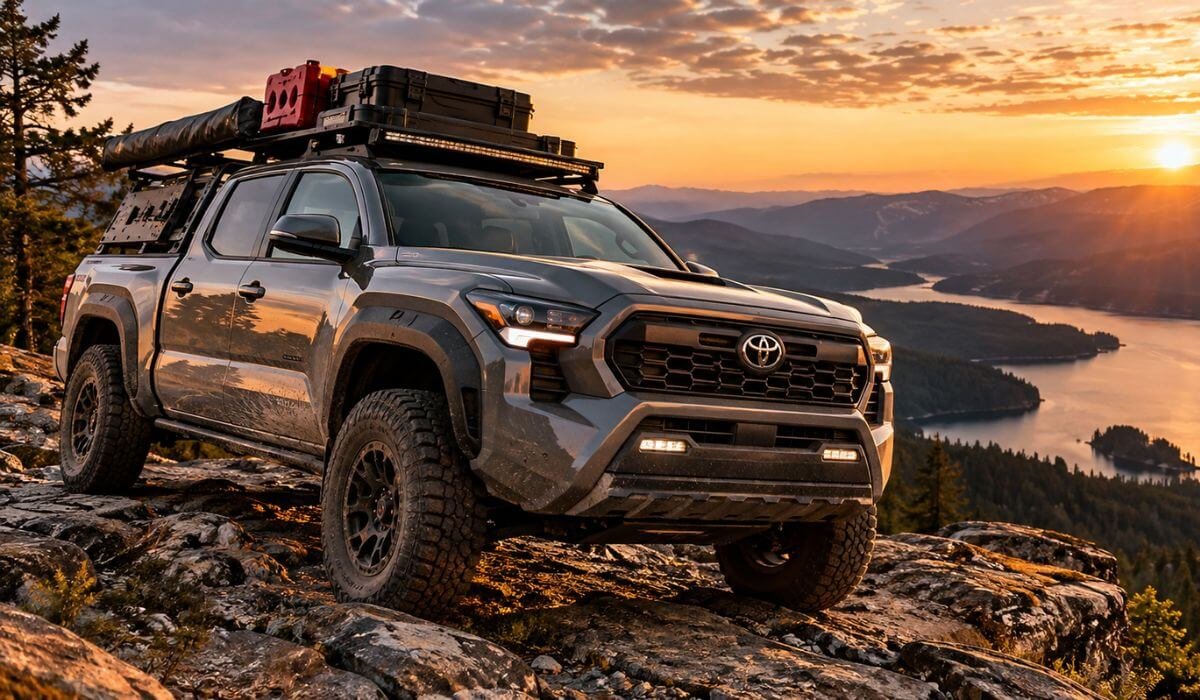
7 Best Roof Racks for Toyota Tacoma (2026): Heavy-Duty Builds and Cargo Capacity
A roof rack can transform a Toyota Tacoma into a more capable adventure truck, but the right choice comes down to construction, mounting design and the cargo you plan to carry. A rugged platform is only worth buying when its weight capacity, usable space and installation system suit your truck and your gear.
This guide compares seven heavy-duty roof racks for the 2024–2026 Toyota Tacoma Double Cab, covering aluminum platforms, powder-coated steel frames, modular mounting systems and practical cargo-carrying features. From the SR and SR5 to the TRD Sport, TRD Off-Road, TRD Pro, Limited and Trailhunter, the comparison focuses on the details that matter when choosing a rack for camping equipment, recovery gear, rooftop accessories and everyday cargo.
The differences go beyond materials and appearance. The TRUMGETA lists a 1,000-pound static and 800-pound dynamic capacity, while other options offer different load ratings, accessory mounting points and platform layouts. We compare these specifications alongside installation design and real-world usefulness, keeping static and dynamic ratings separate and distinguishing manufacturer specifications from independently verified performance. The result is a practical shortlist for choosing a roof rack that suits your Tacoma and the way you use it.
Best Toyota Tacoma Roof Rack: Top 2026 Picks With Aluminum and Steel Construction
#1. TRUMGETA Heavy-Duty Aluminum Roof Rack Cargo Platform
Best Overall Toyota Tacoma Roof Rack (2024–2026) for Heavy-Duty Cargo, Modular Accessories and Overlanding Gear
#2. LOX ROX Top Heavy-Duty Powder-Coated Roof Rack
Best Toyota Tacoma Roof Rack (2024–2026) for Overlanding, Steel-and-Aluminum Construction and No-Drill Installation
#3. KOKSHELY Heavy-Duty Full Roof Rack Cargo Carrier
Best Full-Platform Roof Rack (2024–2026 Toyota Tacoma) for Camping Gear, Recovery Boards and Outdoor Cargo Storage
#4. X-TALIMU Heavy-Duty Roof Rack Carrier
Best Modular Toyota Tacoma Roof Rack (2024–2026) for Cargo Organisation, Accessory Mounting and Off-Road Adventures
#5. IIIREENO Heavy-Duty Fourth-Gen Tacoma Roof Rack
Best Toyota Tacoma Roof Rack (2024–2026) for Multi-Point Cargo Tie-Downs, Awning Mounts and Flexible Gear Storage
#6. KEREEYEA Heavy-Duty Easy-Install Roof Rack
Best Toyota Tacoma Roof Rack (2024–2026) for Rooftop Cargo, Camping Equipment and Practical Mounting Options
#7. POFENZE Full-Platform Toyota Tacoma Roof Rack Carrier
Best Full-Platform Roof Rack (2024–2026 Toyota Tacoma) for Cargo Boxes, Traction Boards and Overlanding Storage — Confirm 2026 Fitment Before Buying
Expert Tip Before You Buy
A roof rack is only as useful as its fit on your specific Tacoma. Before ordering, confirm that it is designed for the 2024–2026 fourth-generation Double Cab, then check how it mounts, whether drilling is required and what hardware comes in the box. If you plan to carry a rooftop tent, pay particular attention to the manufacturer’s dynamic and static load ratings. These describe different loading conditions, and neither overrides Toyota’s own vehicle limits. A rack advertised as heavy-duty is not automatically the safest choice for your intended setup.
How We Chose These Toyota Tacoma Roof Racks
We selected these seven options around a specific buyer: someone looking for a roof rack for the fourth-generation Toyota Tacoma Double Cab, rather than a universal carrier or a rack designed for an older truck. The goal is to help you compare products that are actually relevant to this Tacoma generation, while being clear about what their listings do and do not establish.
Fitment came first. We prioritised products explicitly listed for the 2024–2026 Tacoma Double Cab. This matters because roof dimensions, mounting arrangements and cab configurations can differ between generations. The POFENZE listing requires particular care because its stated fitment covers 2024–2025; buyers with a 2026 truck should confirm compatibility directly with the seller before ordering.
Construction and mounting were the next considerations. Aluminum construction can be attractive for buyers trying to manage added vehicle weight, while a powder-coated finish may help protect metal surfaces from corrosion. We also considered advertised installation methods, including no-drill designs. These are useful buying factors, but the actual mounting hardware, finish quality and installation requirements should be confirmed for each product rather than assumed from its title.
We treated load capacity as a specification to verify, not a marketing contest. A large weight figure means little without knowing whether it refers to a moving vehicle or a stationary one. We would not rank a rack higher simply because its listing advertises a larger capacity. The rating needs to be clearly stated, applicable to the intended use and compatible with Toyota’s vehicle limits.
Finally, we considered the differences between the products so readers have alternatives rather than seven near-identical recommendations. TRUMGETA, LOX ROX, KOKSHELY, X-TALIMU, IIIREENO, KEREEYEA and POFENZE each have a place in the comparison, but their inclusion is not a claim that all seven have been independently tested or proven equally reliable. These are relatively new or lesser-documented options, and independent long-term evidence may be limited. Where manufacturer claims cannot be independently verified, buyers should treat them accordingly.
Our aim is straightforward: help you choose a rack that fits your Tacoma, suits the gear you carry and has specifications you can check before spending your money.
#1. TRUMGETA Heavy-Duty Aluminum Roof Rack for Toyota Tacoma
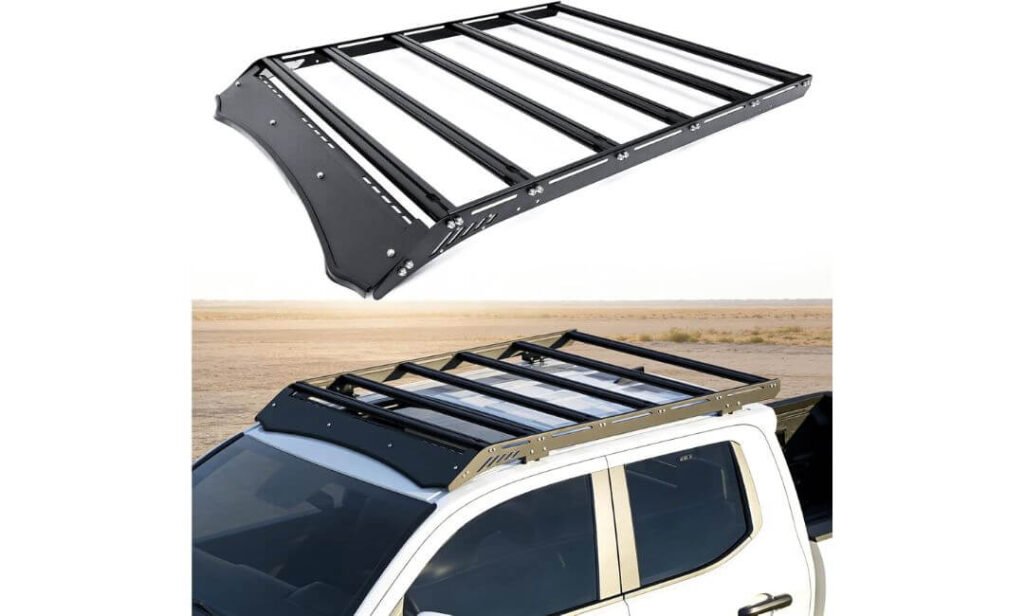
Quick Specs:
- Fitment: 2024–2026 Toyota Tacoma Double Cab, four-door models without factory side rails
- Construction: Aluminum with black powder-coated finish
- Claimed Load Capacity: 1,000 lbs static and 800 lbs dynamic
- Mounting: No-drill installation using factory roof mounting points
- Accessory Compatibility: T-slot mounting for compatible awnings, lights, kayak carriers and cargo accessories
- Installation: Hardware included; manufacturer estimates 1–2 hours
A roof rack should make carrying bulky equipment easier without making the truck awkward to use every day. This design uses aluminum T-slot crossbars rather than a bulky enclosed basket, giving Tacoma owners flexibility to mount compatible accessories for camping, kayaking and recovery gear. That modular layout is useful if your cargo changes from one trip to the next.
The factory-point mounting system is another practical advantage. According to the manufacturer, installation requires no drilling, and the necessary hardware is included. However, check your truck’s roof configuration before ordering. This version is listed for four-door Double Cab models without factory side rails; it is not intended for the XtraCab or earlier Tacoma generations.
The advertised capacity is 1,000 lbs static and 800 lbs dynamic. These are manufacturer-stated figures, not a guarantee that your Tacoma can safely carry that much weight on its roof. Dynamic capacity applies while the vehicle is moving, whereas static capacity applies when it is stationary. Toyota’s vehicle limits and the manufacturer’s installation requirements must also be followed, particularly when carrying a rooftop tent.
What Stands Out About This Roof Rack
- Versatile T-slot mounting: Accommodates compatible lights, awnings and cargo accessories, allowing you to adapt the setup to different trips.
- Aluminum construction: Provides an alternative to heavier steel designs, although the actual weight saving depends on the rack being compared.
- No-drill installation: Uses factory roof mounting points according to the product listing, avoiding the need to create new holes.
- Low-profile design: Offers a cleaner appearance than a large enclosed basket while retaining accessory-mounting flexibility.
- Black powder-coated finish: Provides a protective surface intended to resist everyday weather exposure, although scratches and wear can still occur.
One Thing to Verify Before Buying
The advertised load ratings are high, so check the installation manual and the conditions attached to those figures before carrying heavy equipment. The supplied product information does not independently establish that the complete setup has been tested at those loads.
Why It Earned a Place on Our Shortlist
Its appeal lies in the combination of T-slot versatility, factory-point mounting and a low-profile aluminum design. Owners who want to switch between cargo accessories may prefer this flexibility over a rack designed around one specific load. It is worth comparing with bulkier cargo platforms if keeping the roof setup relatively streamlined matters to you.
However, the available information does not establish independent long-term durability, verified fuel-economy improvements or independently tested highway-noise performance. Those claims should be assessed through reliable owner feedback rather than assumed from the product description.
The Insider Pro-Tip
Before installation, lay out the mounting brackets and compare them with the supplied instructions. Start the fasteners by hand, check that the rack sits evenly on the factory mounting points, and tighten everything to the manufacturer’s specified torque. Never guess the torque setting or use an impact wrench to finish tightening the hardware.
If you intend to carry a rooftop tent, add together the weight of the rack, tent, mounting hardware and other roof-mounted equipment. Check the applicable vehicle and rack limits before driving, and recheck the fasteners as directed by the manufacturer. A correctly fitted rack with suitable capacity is a better investment than choosing one based on the biggest number in its listing.
#2. LOX ROX Top Heavy-Duty Steel and Aluminum Roof Rack for Toyota Tacoma
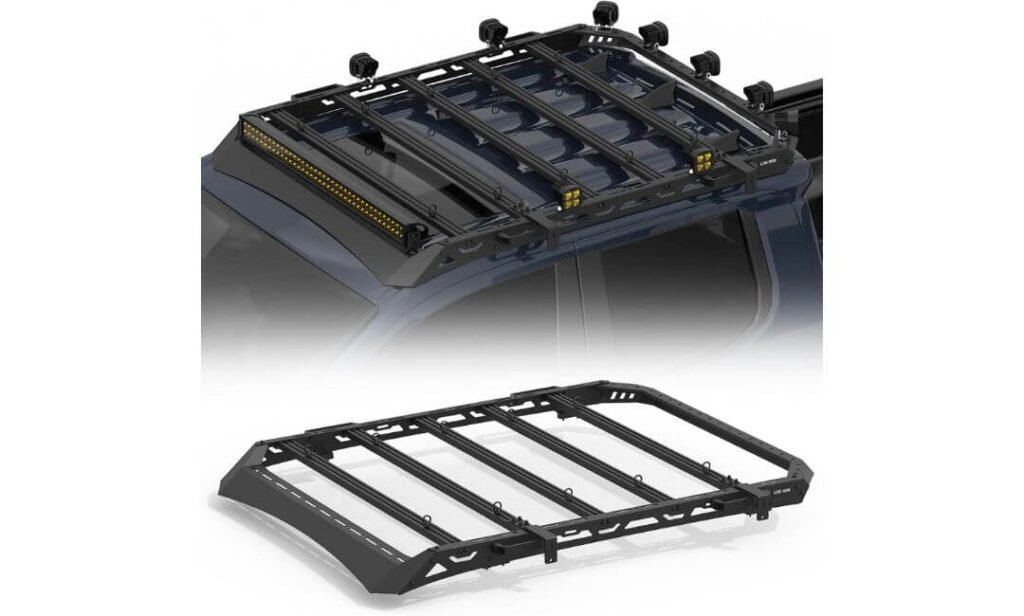
Quick Specs:
- Fitment: 2024–2026 Toyota Tacoma Fourth Generation, Double Cab with four full-size doors
- Frame Construction: Carbon steel frame with aluminum crossbars
- Finish: Rust-resistant powder coating
- Claimed Load Capacity: 750 lbs static and 400 lbs dynamic
- Mounting: No-drill installation using factory threaded roof inserts
- Accessory Mounting: Multiple mounting holes and provisions for a light bar up to 40 inches
- Included Equipment: Noise-dampening front trim and mounting hardware
- Installation: Assembly required; two-person installation is recommended
Some Tacoma owners need more than a couple of crossbars for occasional luggage. Camping equipment, recovery boards, awnings and auxiliary lighting can quickly turn a simple cargo setup into a more involved build. This rack uses a carbon steel frame with aluminum crossbars, giving buyers a platform with multiple mounting positions for compatible accessories rather than limiting them to one fixed arrangement.
The mounting system is designed around the factory threaded inserts along the roof rain gutters, so drilling is not required according to the product description. The included front trim is intended to help dampen wind noise, while reserved mounting holes at the front and rear accommodate a compatible light bar up to 40 inches wide. Keep in mind that the rack arrives requiring assembly, so allow time to organise the hardware and align the components properly.
Its stated load ratings are 750 lbs when stationary and 400 lbs while moving. Those figures are manufacturer claims, not a substitute for Toyota’s permitted roof load or the rack’s installation requirements. The steel frame also makes the rack’s own weight worth checking before purchase, particularly if you plan to add a rooftop tent, lighting and other accessories. The listing mentions panoramic or moonroof compatibility, but verify roof clearance on your exact truck before installation.
What Makes This Rack Worth Considering
- Mixed-material construction: A carbon steel frame paired with aluminum crossbars provides a different balance of structure and accessory mounting from an all-aluminum design.
- Multiple mounting positions: Useful for arranging compatible recovery equipment, awnings, bike carriers and other overlanding accessories.
- Integrated lighting provisions: The reserved front and rear mounting holes accommodate a compatible light bar up to 40 inches, which must be purchased separately.
- Factory-point installation: Uses existing threaded roof inserts rather than requiring new holes in the truck.
- Noise-dampening front trim: Included to help manage wind noise, although the actual result depends on installation, speed and accessory placement.
One Practical Trade-Off
The rack requires assembly, and the steel frame may add more weight than an equivalent aluminum-only design. Allow sufficient time for fitting and alignment, preferably with a second person. The supplied information also does not establish independently verified long-term corrosion resistance or highway-noise performance.
Why It Earned a Place on Our Tacoma Roof Rack Shortlist
This option stands out for its modular mounting layout and combination of steel framing with aluminum crossbars. It may suit owners planning a more involved overlanding setup, especially if they want provisions for lighting and several different accessories on one rack. Its stated 400-lb dynamic rating also gives buyers a specific figure to investigate when comparing options, rather than relying solely on a generic heavy-duty label.
Fitment is important here: the listing specifies fourth-generation 2024–2026 Double Cab models and excludes 2005–2023 Tacomas and Access Cab configurations. Before buying, confirm your exact trim, roof configuration, installed rack weight and permitted cargo load. Those checks matter more than appearance or the highest advertised capacity.
The Insider Pro-Tip
Because this rack uses a steel frame and aluminum crossbars, take care when assembling the joints and mounting hardware. Follow the supplied instructions and specified torque, and do not assume that adding extra thread-locking products or replacement fasteners is necessary or appropriate for every connection. If the instructions or supplied hardware leave any doubt, ask the manufacturer before changing the fastening arrangement.
If you plan to install a rooftop tent, account for the rack’s own weight, the tent, mounting hardware and all other roof-mounted equipment. Check the manufacturer’s dynamic and static limits alongside Toyota’s vehicle limits, and verify that a moonroof can open without contacting the rack. A little checking before installation can prevent an expensive fitment mistake later.
#3. KOKSHELY Heavy-Duty Carbon Steel Roof Rack for Toyota Tacoma
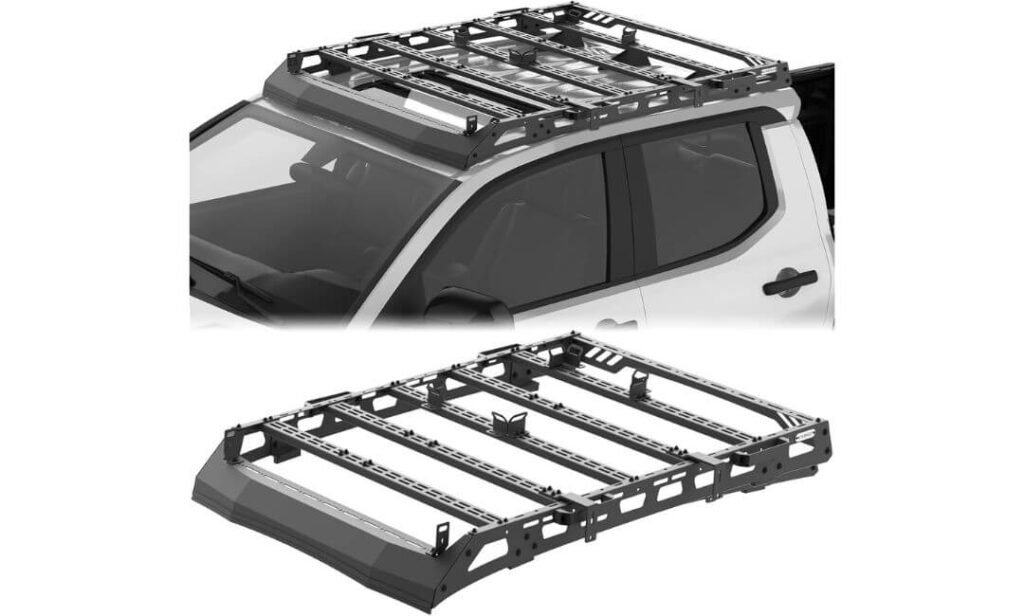
Quick Specs:
- Fitment: 2024–2026 Toyota Tacoma Fourth Generation Double Cab; verify 2026 compatibility with the seller
- Construction: Carbon steel frame with matching crossbars
- Finish: Textured black e-coating
- Claimed Load Capacity: 700 lbs static and 300 lbs dynamic
- Mounting: No-drill installation using factory threaded roof inserts
- Included Accessories: Spotlight mounts, four aluminum side handles, side awning brackets and cargo tie-down rings
- Assembly: Approximately 1.5 hours; two-person lifting recommended
- Warranty: A limited two-year manufacturer warranty is stated in the supplied product information
If you want a roof rack that can handle more than occasional luggage, the included accessories deserve attention. This setup comes with spotlight mounts, four aluminum side handles, awning brackets and cargo tie-down rings, reducing the need to source every mounting component separately. That is useful for Tacoma owners planning camping trips or carrying a mixture of outdoor equipment, provided their chosen accessories are compatible with the rack.
The low-profile, flush-mounted design is intended to sit closer to the roof rather than create a tall, bulky silhouette. Its open platform accommodates compatible cargo and accessories such as awnings, recovery boards, shovels and lighting equipment. The manufacturer also specifies a no-drill installation using the factory threaded roof inserts. Assembly is still required, and a second person is recommended to help lift and position the rack safely.
The stated load ratings are 700 lbs static and 300 lbs dynamic. These are manufacturer-provided figures, not independently verified limits for every installation. The carbon steel construction and textured black e-coating are intended to provide a sturdy, corrosion-resistant finish, but the rack’s own weight and long-term resistance to wear should also factor into your decision. Before ordering, confirm the exact model-year fitment and make sure your truck is a four-door Double Cab, not an Access Cab.
Details That Make It Worth Considering
- Useful included hardware: Spotlight mounts, awning brackets and tie-down rings provide a head start for building a practical cargo setup.
- Open-platform layout: Gives you room to arrange compatible camping gear and accessories instead of being restricted to one enclosed cargo basket.
- Flush-mounted appearance: Offers a more integrated look than taller rack designs, although actual clearance depends on the installation and accessories fitted.
- Coated steel construction: The textured black e-coating is designed to protect the frame, but regular inspection is still sensible after exposure to moisture, road salt or trail debris.
- No-drill mounting: Uses the factory threaded inserts according to the listing, avoiding the need to drill new holes into the roof.
One Detail Worth Keeping in Mind
The advertised 300-lb dynamic capacity is lower than the static rating, so do not use the 700-lb stationary figure to judge what you can carry while driving. Some user feedback supplied with the listing also mentions noise or vibration at highway speeds. A correctly aligned installation matters, and persistent rattling should be investigated rather than ignored.
Why It Made Our Tacoma Roof Rack Shortlist
The strongest reason to consider this option is its combination of included mounting accessories, an open cargo platform and a low-profile design. Buyers who would otherwise need to purchase separate awning brackets, tie-down rings and lighting mounts may appreciate having those components included. It is a practical candidate for owners who want to build out their cargo setup gradually.
However, the available product information does not establish independent load testing or long-term durability. Customer reports can help identify potential fitment and noise issues, but they do not replace manufacturer documentation. Confirm the current warranty terms, accessory compatibility and exact fitment before committing to the purchase.
The Insider Pro-Tip
Before loading the rack, check every mounting point and make sure the included brackets sit correctly against the factory threaded inserts. Follow the specified tightening procedure, and use only manufacturer-approved fasteners or thread-locking products. If vibration persists, inspect the installation instead of simply tightening bolts beyond the recommended torque.
For a rooftop tent or other heavy cargo, calculate the combined weight of the rack, mounting hardware, accessories and load. Check both the rack’s applicable rating and Toyota’s vehicle limits. The key is not how much the rack claims to hold while stationary, but whether the complete setup is suitable for the way you intend to use your Tacoma.
#4. X-TALIMU Heavy-Duty Modular Roof Rack for Toyota Tacoma
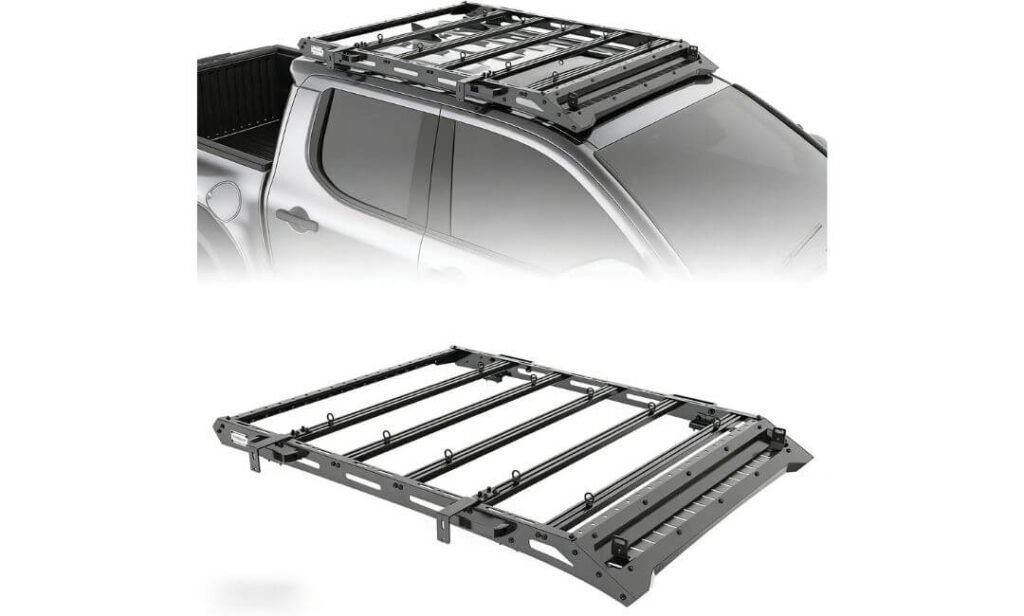
Quick Specs:
- Fitment: 2024–2026 Toyota Tacoma Double Cab, four-door models; not compatible with XtraCab
- Construction: Carbon steel frame with aluminum crossbars
- Claimed Load Capacity: 750 lbs static and 400 lbs dynamic
- Mounting: No-drill installation using existing roof mounting points; minor weather-seal adjustment may be required
- Accessory Mounting: Slide tracks, multiple mounting holes, eye-bolt anchors and light-bar mounting provisions
- Compatible Gear: Rooftop tents, awnings, recovery boards, shovels, spare tires and other compatible equipment
- Installation: Approximately two hours; two people recommended for lifting the assembled rack onto the roof
- Warranty: Two-year manufacturer warranty, according to the supplied product information
A roof rack becomes more useful when you can arrange it around the gear you actually carry. The modular mounting layout on this model includes slide tracks, mounting holes and eye-bolt anchor points, giving you options for securing compatible cargo and adding accessories. That flexibility may appeal to Tacoma owners who alternate between camping equipment, recovery tools and longer overlanding loads rather than keeping the same configuration year-round.
Its carbon steel frame and aluminum crossbars combine two materials in one assembly. The manufacturer advertises a 750-lb static rating and a 400-lb dynamic rating, but those figures should be treated as product claims, not as permission to load your truck’s roof to either limit. The rack itself also adds weight to the vehicle, and that weight must be included when calculating the total roof load.
Installation is advertised as a no-drill process using the existing roof mounting points, although the supplied instructions indicate that a small adjustment to the weather-sealing rubber may be needed. Plan for roughly two hours of assembly and ask someone to help lift the completed rack into position. Before starting, check the hardware against the instructions and confirm that the mounting points align with your exact Tacoma configuration.
Features That Matter for Real-World Use
- Multiple cargo attachment points: Eye-bolt anchors and slide tracks provide flexibility for securing compatible equipment in different positions.
- Accessory-ready layout: Mounting provisions accommodate compatible awnings, lighting and recovery gear without requiring a custom-fabricated platform.
- Mixed-material construction: The steel frame and aluminum crossbars offer a different balance of structure and weight from an all-steel design.
- Low-profile shape: The approximately five-inch height stated in the supplied product information may help keep the setup relatively compact, although the overall height changes with accessories.
- No-drill mounting approach: Uses existing roof mounting points according to the listing, with minor weather-seal adjustment potentially required.
The Trade-Off to Know About
Highway wind noise is a reported concern in the customer feedback supplied for this product. A roof rack changes airflow over the cab, and noise can vary with vehicle speed, crossbar position and attached accessories. The rack can also affect fuel economy, particularly when carrying bulky cargo. Do not assume that its low-profile design makes it silent or eliminates the aerodynamic penalty.
Why We Included It in Our Tacoma Roof Rack Comparison
The strongest reason to consider this option is its modular design and range of mounting positions. Owners who want to customise their cargo arrangement may appreciate having more flexibility than a basic pair of crossbars offers. The stated 750-lb static and 400-lb dynamic ratings also give buyers specific figures to investigate when comparing the rack with alternatives.
However, a modular platform is not automatically the best choice for every driver. The reported wind noise, additional vehicle weight and assembly requirements deserve consideration, especially if your Tacoma spends more time commuting on highways than travelling on trails. The supplied information does not independently verify the load ratings or establish long-term durability under repeated off-road use.
The Insider Pro-Tip
Before assembly, organise the brackets, eye bolts and fasteners and match each part to the installation instructions. Tighten fasteners only to the specified torque; forcing a bolt can damage its threads or mounting hardware. If the supplied fasteners do not match the instructions, stop and confirm the correct specification with the manufacturer instead of guessing or substituting hardware.
Once installed, test the rack with a modest load before adding more equipment. Check for movement, unusual noise and contact with weather seals, then inspect the mounting hardware as directed by the manufacturer. If you plan to carry a rooftop tent, calculate the combined weight of the rack, tent, mounting hardware and accessories, and verify that the complete setup remains within both the rack’s applicable limits and Toyota’s permitted roof load.
#5. IIIREENO Heavy-Duty Steel and Aluminum Roof Rack for Toyota Tacoma
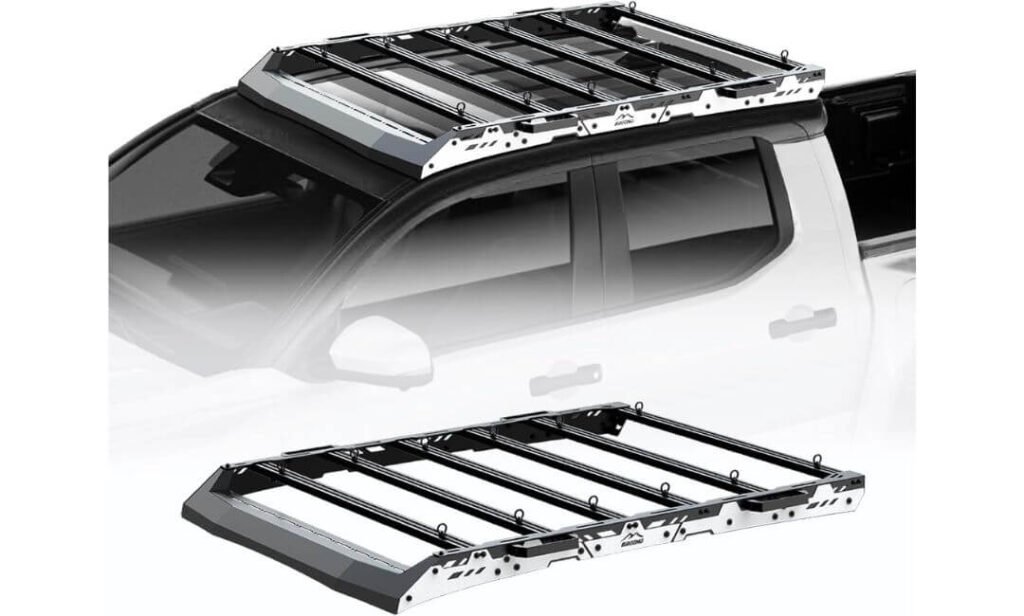
Quick Specs:
- Fitment: 2024–2026 Toyota Tacoma Fourth Generation Double Cab, four-door models; not compatible with Access Cab
- Main Frame: Medium-carbon steel
- Crossbars: 6061-T6 aluminum alloy, as specified in the product listing
- Claimed Load Capacity: 700 lbs static and 400 lbs dynamic
- Mounting Design: Slide grooves and multiple accessory attachment points
- Included Accessories: Two side-awning brackets, four aluminum handles and 12 installation eyelets
- Noise Management: Front weather-stripping included
- Customization: White decorative panels that can be modified to suit your preferred appearance
- Installation: Approximately two hours; two people recommended for lifting the rack
- Warranty: A two-year manufacturer warranty is stated in the supplied product information
A roof rack does not have to look like every other black cargo platform on the road. This design includes removable white decorative panels that can be customised, giving Tacoma owners a way to change its appearance without replacing the entire rack. That is a small but distinctive feature if you want your cargo setup to complement your truck rather than look like a generic add-on.
The construction combines a medium-carbon steel frame with 6061-T6 aluminum crossbars. Its slide-groove layout and 12 installation eyelets provide several attachment points for compatible cargo and accessories, while the included awning brackets make it easier to plan an outdoor setup. You can potentially arrange equipment such as shovels, recovery gear, lighting and camping supplies around your needs, provided each accessory is compatible with the mounting system.
The manufacturer lists 700 lbs static and 400 lbs dynamic capacity. Those figures should not be interpreted as the amount every Tacoma can safely carry on its roof. The rack, mounting hardware, accessories and cargo all contribute to the total load, and Toyota’s vehicle limits still apply. Front weather-stripping is included to help prevent contact and reduce noise, but it does not guarantee silent operation at highway speeds.
Details That Set This Design Apart
- Customisable side panels: The removable white decorative panels offer an option for changing the rack’s appearance to better suit your truck.
- Multiple attachment points: Twelve installation eyelets and slide grooves provide flexibility for arranging compatible cargo and accessories.
- Mixed-material construction: The steel frame and 6061-T6 aluminum crossbars offer a combination of structural support and aluminium accessory-mounting surfaces.
- Included awning brackets: Two side brackets are supplied, reducing the need to source compatible mounting hardware separately.
- Front weather-stripping: Designed to help prevent rubbing and manage noise where the rack approaches the front roof area.
One Thing to Consider Before Buying
The customisable panels are a visual feature, not a substitute for checking the rack’s construction and fitment. The supplied information also does not establish independent load testing or prove that the weather-stripping eliminates wind noise. Confirm the current instructions and warranty terms before purchase.
Why It Earned a Place on Our Tacoma Roof Rack Shortlist
The main appeal is the combination of customisable styling, multiple accessory attachment points and included awning brackets. For owners who want a more personalised setup, the decorative panels offer something different from the all-black platforms that dominate this category. Its mixed steel-and-aluminum construction also gives buyers a specific design to compare against all-aluminum alternatives.
The trade-off is that this is still a rack requiring assembly, and the manufacturer’s load ratings need to be considered alongside the vehicle’s limits. The available information does not independently establish long-term corrosion resistance, highway-noise performance or durability under repeated off-road use. Those points should remain open questions rather than assumed advantages.
The Insider Pro-Tip
During assembly, keep the fasteners slightly loose until the frame and crossbars are correctly aligned, provided the manufacturer’s instructions allow this. Tightening everything too early can make it harder to position the components evenly. Once aligned, tighten the hardware to the specified torque and check that the weather-stripping is seated correctly without obstructing roof features.
Before adding a rooftop tent or heavy equipment, calculate the complete loaded weight and verify the rack’s applicable rating against Toyota’s roof-load limits. If you plan to customise the decorative panels, keep paint or other coatings away from mounting interfaces, fasteners and sliding tracks unless the manufacturer confirms they are suitable. That helps preserve both the rack’s appearance and the function of its attachment points.
#6. KEREEYEA Heavy-Duty Carbon Steel Roof Rack for Toyota Tacoma
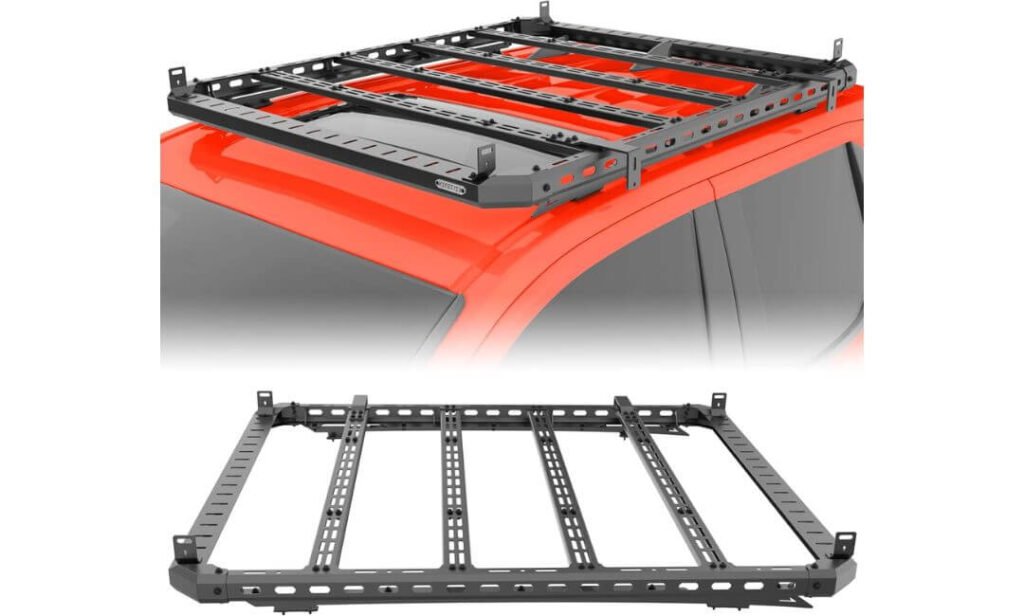
Quick Specs:
- Fitment: 2024–2026 Toyota Tacoma Fourth Generation Double Cab, four full-size doors
- Construction: Carbon steel frame with a corrosion-resistant coated finish, according to the supplied listing
- Claimed Load Capacity: 700 lbs static and 300 lbs dynamic, according to the supplied product information
- Platform Dimensions: 56.5 × 48.3 inches, as stated in the supplied listing
- Mounting: No-drill installation; confirm the exact mounting hardware and procedure before ordering
- Included Accessories: Tent mounting brackets and spotlight brackets
- Cargo Applications: Compatible camping equipment, recovery gear, shovels and other suitably secured accessories
- Fitment Exclusions: Not listed for 2005–2023 Tacoma models or Access Cab configurations
If you want a roof rack primarily for carrying outdoor equipment, a full platform with dedicated mounting brackets can be more useful than basic crossbars. This design includes tent mounting brackets and spotlight brackets, giving Tacoma owners a starting point for building a setup around camping trips, auxiliary lighting and recovery equipment. Check the compatibility of each accessory before installation, particularly if you plan to mount a rooftop tent.
The frame uses carbon steel construction, with a coated finish described as corrosion-resistant in the supplied product information. Its listed platform dimensions are 56.5 × 48.3 inches, which gives you a useful starting point for checking the space available for your cargo. Measure your intended equipment and account for the mounting brackets, roof clearance and any accessories that extend beyond the platform before assuming everything will fit.
The listing advertises 700 lbs static and 300 lbs dynamic capacity. These figures refer to different loading conditions and should not be treated as interchangeable. The rack’s own weight, mounting hardware and accessories count towards the total roof load, and Toyota’s vehicle limits remain applicable. Although the product is advertised as a no-drill design, verify the mounting system and supplied instructions for your exact Tacoma before purchasing.
Features Worth Considering
- Dedicated accessory brackets: The included tent and spotlight brackets provide a starting point for compatible equipment without requiring every mounting component to be purchased separately.
- Steel frame construction: Suits buyers comparing steel platforms with lighter aluminum alternatives; the rack’s actual weight should be checked before purchase.
- Full cargo platform: The listed 56.5 × 48.3-inch dimensions help buyers assess whether their intended gear can fit.
- No-drill installation claim: Intended to avoid drilling into the roof, although the precise mounting procedure should be confirmed against the current instructions.
- Corrosion-resistant coating: Intended to protect the steel frame, but the supplied information does not independently establish long-term resistance to rust or surface damage.
One Important Capacity Check
The supplied product information gives a 700-lb static rating and a 300-lb dynamic rating. Do not interpret the larger figure as the amount you can carry while driving. Confirm the rating conditions in the current manual and check Toyota’s permitted roof load before fitting heavy camping equipment or a rooftop tent.
Why It Made Our Toyota Tacoma Roof Rack Shortlist
This model is worth comparing if you want a steel cargo platform with dedicated tent and lighting brackets rather than a minimal crossbar system. Its stated dimensions and accessory provisions help buyers assess whether the design suits their intended gear. It also offers a clearly defined fitment category for fourth-generation Double Cab trucks instead of claiming universal compatibility.
There are still details to verify. The supplied information does not independently establish the advertised load capacity, exact installation time or long-term durability. Confirm the current fitment listing, mounting hardware, warranty terms and compatibility of the accessories you plan to use before committing to the purchase.
The Insider Pro-Tip
Before ordering, compare the stated platform dimensions with the footprint of your actual cargo. A rooftop tent, for instance, needs compatible mounting rails and sufficient clearance—not merely a platform that appears wide enough. Confirm the tent manufacturer’s mounting requirements and ensure that the brackets supplied with the rack are suitable for that specific model.
During installation, follow the supplied instructions and specified fastener torque rather than relying on advertised installation times. After fitting, check for movement, contact with the roof and interference with any roof features. For loaded travel, calculate the complete weight of the rack, accessories and cargo, then verify that the setup stays within both the rack’s applicable limits and Toyota’s permitted roof load.
#7. POFENZE Heavy-Duty Full-Platform Steel Roof Rack for Toyota Tacoma
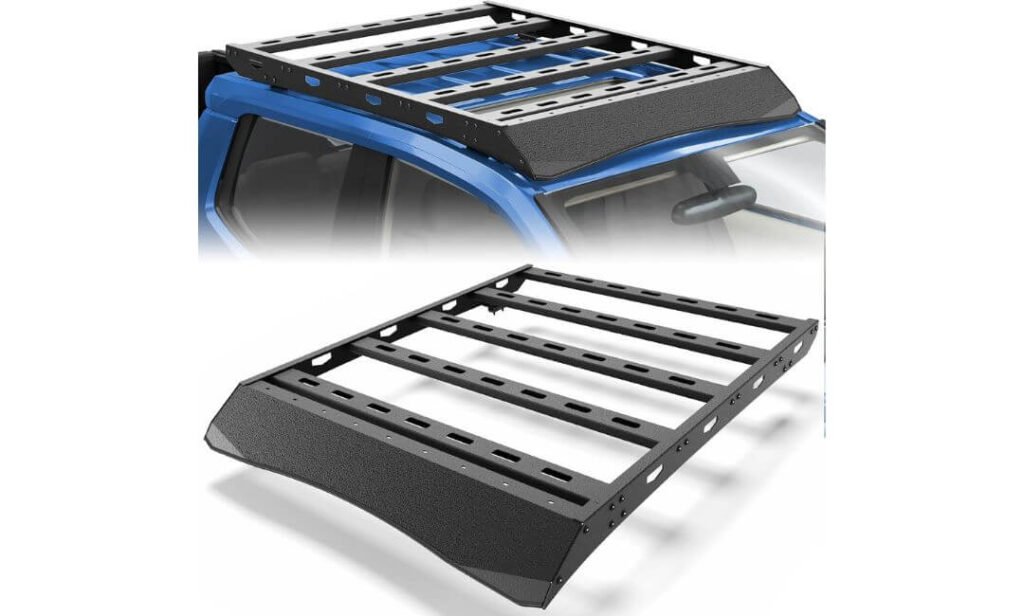
Quick Specs:
- Fitment: Listed for 2024–2026 Toyota Tacoma Double Cab, four-door models; confirm 2026 compatibility with the seller
- Construction: Reinforced carbon steel
- Protective Finish: E-coating and powder coating, according to the product listing
- Platform Dimensions: 61.7 × 48.26 inches, as stated in the supplied product information
- Claimed Load Capacity: 800 lbs; the supplied information identifies this as a static rating
- Mounting: No-drill installation using factory mounting points
- Cargo Applications: Storage boxes, traction boards, camping equipment and compatible overlanding accessories
- Installation: Advertised as a bolt-on setup; confirm the current instructions and hardware requirements
- Warranty: A one-year manufacturer warranty is stated in the supplied product information
There is a practical difference between a pair of crossbars and a full roof platform. Crossbars work well for specific items, but a full-platform design gives you a broader surface for arranging compatible cargo such as storage boxes, traction boards and camping equipment. If your Tacoma regularly carries several pieces of outdoor gear, that extra usable space may be more important than having a minimalist rack.
This model uses a reinforced carbon steel frame with an e-coated and powder-coated finish, according to the listing. Its stated dimensions of 61.7 × 48.26 inches give you a starting point for checking whether your intended cargo will fit. Measure the footprint of your storage boxes or other equipment before buying, and account for the mounting hardware and clearance needed to secure everything properly.
The supplied product information advertises an 800-lb static load capacity. That is not an 800-lb allowance for driving with cargo on the roof, and the information provided does not establish a separate dynamic rating. The rack itself also adds weight to the truck. Before carrying a rooftop tent or heavy equipment, obtain the manufacturer’s full load specifications and check Toyota’s permitted roof load for your exact vehicle.
What Makes This Platform Different
- Broad cargo surface: The listed dimensions offer more continuous mounting area than a basic crossbar arrangement, although usable space depends on the accessories installed.
- Reinforced steel construction: A substantial option for buyers who prefer a steel platform over a lighter crossbar system.
- Dual-layer protective finish: E-coating and powder coating are intended to protect the metal, but regular inspection remains important after exposure to road salt, moisture and trail debris.
- Factory-point mounting: The listing describes a no-drill installation, avoiding the need to create new holes in the truck.
- Overlanding-friendly layout: The platform can accommodate compatible storage boxes, traction boards and camping gear when the mounting system and load limits allow.
One Specification You Should Confirm
The 800-lb figure is stated as a static capacity, and no verified dynamic rating was provided in the supplied details. Do not use the static figure to calculate a safe driving load. Ask the seller for the complete load-rating documentation before purchasing, especially if a rooftop tent is part of your plan.
Why It Earned a Place in Our Toyota Tacoma Roof Rack Comparison
The POFENZE stands out for its large, continuous platform and steel construction. Buyers who need room to arrange several types of cargo may prefer this format to individual crossbars, particularly when their setup includes storage boxes and recovery equipment. Its stated dimensions also make it easier to assess the available surface against the gear you intend to carry.
The trade-off is that a full steel platform can add substantial weight. The supplied information lists a rack weight of 72 lbs, so include that weight when calculating your remaining roof-load allowance. Independent load testing and long-term durability have not been established by the information provided, and the stated warranty should be checked against the current seller terms.
The Insider Pro-Tip
Before choosing a full platform, sketch out where your main cargo items will sit. Leave room for secure straps, mounting brackets and access to anything you need to reach during a trip. A larger platform is only useful if you can distribute the cargo appropriately and secure each item without interfering with other equipment.
Also, confirm the exact model-year fitment before ordering. Although the supplied product information describes 2024–2026 Double Cab compatibility, an earlier listing may specify a narrower year range. For a 2026 truck, get written confirmation from the seller. Finally, verify both the dynamic and static load ratings, then compare them with Toyota’s vehicle limits before putting heavy equipment on the roof.
Toyota Tacoma Roof Racks (2024–2026) Compared by Load Capacity and Construction
| Roof Rack | Fitment | Construction | Advertised Load Rating | Installation | Standout Feature | Before You Buy |
|---|---|---|---|---|---|---|
| TRUMGETA Aluminum Roof RackModular T-slot crossbars | 2024–2026 Tacoma Double Cab; without factory side rails | Aluminum with black powder-coated finish | 1,000 lb static 800 lb dynamic |
No-drill claimed Factory roof points |
T-slot mounting for compatible lights, awnings and cargo accessories | Verify the unusually high ratings against the current manual and Toyota’s roof-load limit. |
| LOX ROX Top Heavy-Duty Roof RackSteel frame and aluminum crossbars | 2024–2026 Tacoma Double Cab with four full-size doors | Carbon steel frame, aluminum crossbars and powder-coated finish | 750 lb static 400 lb dynamic |
No-drill claimed Factory threaded inserts |
Multiple mounting positions and provisions for a light bar up to 40 inches | Assembly required. Confirm roof clearance, hardware and installation instructions. |
| KOKSHELY Heavy-Duty Roof RackOpen cargo platform | 2024–2026 listed; Double Cab only. Verify 2026 fitment. | Carbon steel frame and crossbars with textured black e-coating | 700 lb static 300 lb dynamic |
No-drill claimed Factory threaded inserts |
Spotlight mounts, awning brackets, four side handles and cargo tie-down rings included | Check the lower dynamic rating, supplied hardware and reports of highway noise. |
| X-TALIMU Modular Roof RackCustomisable accessory platform | 2024–2026 Tacoma Double/Crew Cab, four-door models | Carbon steel frame and aluminum crossbars | 750 lb static 400 lb dynamic |
Seal adjustment may be needed No-drill claimed |
Slide tracks, eye-bolt anchors and mounting provisions for accessories | Owner feedback supplied mentions highway wind noise. Check hardware and instructions carefully. |
| IIIREENO Heavy-Duty Roof RackCustomisable side panels | 2024–2026 Tacoma Double Cab, four-door models | Medium-carbon steel frame and 6061-T6 aluminum crossbars | 700 lb static 400 lb dynamic |
No-drill claimed Confirm exact instructions |
12 eyelets, two awning brackets, four aluminum handles and customisable white panels | Verify warranty terms, roof clearance and finish around mounting interfaces. |
| KEREEYEA Heavy-Duty Roof RackFull cargo platform | 2024–2026 listed; Double Cab only | Carbon steel frame with a coated finish, according to the listing | 700 lb static 300 lb dynamic |
No-drill claimed Confirm mounting system |
Listed 56.5 × 48.3 in platform with tent and spotlight brackets | Confirm dimensions, current fitment, load ratings and included hardware with the seller. |
| POFENZE Full-Platform Roof RackSteel cargo deck | 2024–2026 stated in supplied information; verify 2026 fitment | Reinforced carbon steel with e-coating and powder coating | 800 lb static claimed Dynamic rating not supplied |
No-drill claimed Factory mounting points |
Listed 61.7 × 48.26 in platform for arranging bulky cargo | Confirm dynamic capacity, stated 72 lb rack weight, warranty and model-year fitment. |
Buying Guide to Choosing the Right Toyota Tacoma Roof Rack
A roof rack should fit the way you use your Tacoma, not just look good in a product photo. A setup for occasional luggage has different requirements from one carrying recovery boards, an awning or a rooftop tent. Before comparing prices or advertised weight ratings, establish your truck’s exact configuration, what you intend to carry and how often you will drive with the rack loaded.
Check Your Tacoma’s Generation, Cab and Roof Configuration
Start with fitment, because a rack that does not match your truck is not worth buying regardless of its features.
- 2024–2026 fourth-generation Tacoma: The seven options in this guide are primarily listed for the four-door Double Cab configuration. Confirm the specific model year and trim with the seller.
- Double Cab versus XtraCab: These configurations are not interchangeable. Check the number and arrangement of your doors against the rack manufacturer’s fitment information rather than relying on the vehicle name alone.
- Factory side rails: Some designs, including the TRUMGETA option covered here, specify compatibility only with trucks without factory side rails. An existing rail system can change which mounting arrangements are suitable.
- Roof features and clearance: Check sunroof or moonroof operation, antenna clearance, roof seals and the available mounting points. A rack that fits the general cab configuration can still cause problems if a specific roof feature is overlooked.
- Older Tacoma generations: Do not assume a rack listed for 2024–2026 models will fit a 2005–2023 Tacoma. Earlier generations have different body and mounting configurations.
Before ordering, ask the seller to confirm fitment for your exact model year, trim and roof configuration in writing. That is a straightforward way to reduce the risk of buying a rack that arrives with incompatible brackets.
Understand Static and Dynamic Load Ratings
This is one of the most important distinctions when comparing heavy-duty roof racks.
| Rating | What it means | What to check |
|---|---|---|
| Dynamic load | The applicable load limit while the vehicle is moving | The rack’s documented rating, Toyota’s roof-load limit and the installation requirements |
| Static load | The applicable load limit while the vehicle is stationary | Whether the rating covers the intended stationary setup, such as a rooftop tent |
| Complete roof load | The combined weight of the rack, mounting hardware, accessories and cargo | The permitted limit for the vehicle and the rack, including any relevant mounting restrictions |
A rack advertised with a 1,000-lb static rating is not automatically capable of carrying 1,000 lbs while driving. The static and dynamic figures describe different conditions and must not be substituted for one another.
The products in this guide advertise different ratings, and those numbers should be treated as manufacturer claims unless independently verified. For the POFENZE platform, for instance, the supplied information gives an 800-lb static rating but does not establish a dynamic rating. That missing information matters if you intend to travel with cargo on the roof.
For a rooftop tent, calculate the weight of the rack, tent, mounting hardware and other roof-mounted equipment. Also check the tent manufacturer’s requirements and Toyota’s vehicle limits. Never assume that a high rack rating overrides the truck’s permitted roof load.
Choose Between Crossbars and a Full Cargo Platform
The shape of the rack determines how easily you can secure different types of equipment.
Toyota Tacoma roof rack crossbars
Crossbars are useful when you mainly need mounting points for specific accessories, such as a compatible kayak carrier, cargo box or bike rack. They can provide a simpler setup than a full platform, but accessory compatibility and spacing still matter.
Full-platform roof racks
A platform offers a broader surface for arranging compatible cargo, tie-downs and mounting accessories. It can be useful for overlanding equipment, but the added structure may increase the vehicle’s weight and aerodynamic drag.
The TRUMGETA option uses a T-slot crossbar design, while several of the other products in this guide offer a more substantial cargo platform with multiple attachment points. Neither design is automatically better. Choose according to the equipment you actually carry, not the number of accessories shown in the listing.
Compare Aluminum and Steel Construction
Material affects rack weight, construction and maintenance, but it does not determine overall quality on its own.
| Material | Potential advantages | What to consider |
|---|---|---|
| Aluminum | Often lighter than a comparable steel structure; useful when managing added roof weight | Check the design, joints, mounting hardware and documented load ratings |
| Steel | Can provide a substantial frame and flexible mounting arrangements | Added weight matters, and the coating needs attention if scratched or damaged |
| Mixed construction | Can combine a steel frame with aluminum crossbars or other components | Check how the materials are joined and how the complete assembly is protected against corrosion |
An aluminum rack is not automatically stronger or safer than a steel rack, and a steel rack is not automatically more durable. Construction quality, mounting design, corrosion protection and the manufacturer’s documented limits all matter.
For example, the LOX ROX, KOKSHELY and X-TALIMU options use steel frames with aluminum crossbars according to the supplied specifications. TRUMGETA is listed as an aluminum design. Compare the complete rack weights and verified ratings before deciding which material suits your needs.
Check the Mounting System Before Installation
A no-drill claim is useful, but it does not mean every rack installs in exactly the same way.
- Factory mounting points: Confirm that the brackets line up with the mounting points on your exact Tacoma.
- Factory side rails: Check whether the rack requires rails, excludes them or uses a different mounting arrangement.
- Weather seals: Some installations may require adjustment around the existing seal. Follow the manufacturer’s instructions rather than cutting or removing material without guidance.
- Assembly requirements: A rack may need substantial assembly before it can be placed on the roof. Have a second person available when the assembled unit needs lifting.
- Fasteners and torque: Use the specified hardware and tightening procedure. Incorrect fasteners or excessive tightening can damage mounting points.
- Roof clearance: Check sunroof operation, antenna clearance and any other roof-mounted features before loading the rack.
If the product listing and the installation manual disagree, ask the manufacturer to clarify the correct procedure before fitting the rack. Do not assume that a product advertised as a direct fit will work with every trim or roof configuration.
Consider Wind Noise, Height and Fuel Economy
A roof rack changes airflow over the vehicle, and the result depends on the rack’s shape, its position and the accessories attached to it. A low-profile design may help, but it does not guarantee quiet operation.
Noise can change when you add a rooftop tent, light bar, awning or other accessory. Some owners may find the difference minor, while others may notice a persistent whistle or wind roar during highway driving. The supplied feedback for the X-TALIMU option includes noise complaints, so buyers considering it should pay particular attention to this issue.
Fuel economy can also be affected by the rack’s weight and aerodynamic drag. A full platform carrying bulky cargo can create a different aerodynamic profile from a pair of bare crossbars. Claims that a rack eliminates wind noise or has no effect on fuel consumption should be treated cautiously unless supported by reliable testing.
If your Tacoma is primarily a daily driver, consider whether you need a full platform all year. Removing an unused rack or its unnecessary accessories, where the design permits, may help avoid carrying extra weight and creating unnecessary drag.
Check Accessory Compatibility and Security
A rack’s mounting slots are useful only if they work with the accessories you intend to install. Before buying, check the following:
- Rooftop tents: Confirm mounting rail compatibility, the tent manufacturer’s requirements and the applicable static and dynamic load limits.
- Awnings: Check bracket dimensions, mounting positions and whether the rack can accommodate the awning’s attachment system.
- Lighting: Confirm the size and location of the mounting provisions. A listing that mentions a light bar does not mean the light itself is included.
- Recovery boards and tools: Check that suitable attachment points and compatible restraints are available.
- Cargo boxes and bike or kayak carriers: Verify the required crossbar spacing, mounting profile and accessory weight limits.
Security is another point worth checking. Do not assume that a rack includes locking hardware simply because it has T-slots or multiple mounting points. If theft prevention matters, check whether the rack and your intended accessories support compatible locking fasteners or locks. Secure cargo separately, and never rely on a lock as a substitute for properly rated mounting hardware.
Common Buying Mistakes to Avoid
- Buying for the wrong cab: Double Cab and XtraCab fitment should not be treated as interchangeable.
- Confusing static with dynamic capacity: A high stationary rating does not establish a safe load while driving.
- Ignoring the rack’s own weight: The rack, mounting hardware and accessories all count toward the total load.
- Assuming every no-drill rack fits every trim: Factory side rails, roof features and mounting points can change compatibility.
- Treating marketing claims as independent testing: Verify unusually high load ratings and ask for the manufacturer’s documentation.
- Overlooking included hardware: Check whether awning brackets, tent mounts, lighting brackets and fasteners are actually included.
- Ignoring noise and clearance: Consider the effect of accessories on airflow and verify that the rack does not interfere with roof features.
- Skipping the installation instructions: Correct fasteners, alignment and specified torque matter for safe mounting.
The best Toyota Tacoma roof rack is the one that fits your exact truck, accommodates your gear and stays within the applicable vehicle and rack limits. A little time spent checking compatibility and documentation before ordering is far more useful than relying on a large load number or an attractive product photo.
Toyota Tacoma Roof Rack Installation Guide
Installing an aftermarket roof rack is manageable for many DIY owners, but the job is easier when you identify the mounting points, organise the hardware and understand the rack’s assembly sequence before lifting anything onto the truck. On the 2024–2026 Toyota Tacoma, the exact procedure depends on the rack design. Some use factory threaded inserts, while others may require different brackets or adjustments around existing roof seals.
The instructions supplied with your specific rack should always take priority over a generic guide. The steps below cover the usual process for a compatible bolt-on rack; they are not a substitute for model-specific installation instructions or torque specifications.
Tools and Safety Checks Before You Start
Gather the tools and equipment listed in your rack’s installation manual. Depending on the design, you may need:
- A metric socket set and ratchet, with the correct sizes for the supplied fasteners.
- Torque wrench capable of reaching the manufacturer’s specified torque.
- Allen keys or hex bits if the rack uses socket-head bolts.
- A soft cloth and suitable cleaning supplies for the roof mounting areas.
- Protective gloves and eye protection.
- A second person to help lift and position the assembled rack.
- A padded work surface to protect the rack components while assembling them.
Park on level ground, switch off the vehicle and remove loose items from the roof. Inspect the rack components and compare the supplied hardware with the parts list before starting. If a bolt, bracket or mounting point appears damaged, stop and resolve the issue before installation.
Do not guess the tightening torque. The correct value depends on the fastener, mounting design and manufacturer’s instructions. Excessive tightening can damage threads or mounting points, while insufficient tightening can allow movement and vibration.
Step-by-Step Installation for a Bolt-On Roof Rack
Step 1: Confirm the Rack Fits Your Tacoma
Check the model year, cab configuration, trim and roof arrangement against the product’s fitment instructions. The products in this guide are primarily listed for fourth-generation Double Cab Tacomas, but some exclude factory side rails or have other specific requirements.
Confirm that the rack will not interfere with a sunroof, antenna, roof seal or other roof-mounted feature. If the rack requires factory threaded inserts, locate and inspect those mounting points before assembling the platform.
Step 2: Prepare the Roof Mounting Areas
Clean the areas where the brackets will sit, removing dirt and grit that could become trapped between the mounting surfaces. Inspect the mounting points and surrounding seals for damage.
Some racks use existing threaded inserts or roof channels, while others use a different mounting arrangement. Follow the supplied instructions for removing covers or preparing the mounting areas. Do not cut weather stripping, remove seals or modify the roof unless the manufacturer specifically instructs you to do so.
Step 3: Assemble the Rack on the Ground
Lay the components on a padded surface and arrange them according to the assembly diagram. Identify the front and rear sections, side rails, crossbars, brackets and fasteners before joining the pieces.
Start fasteners by hand and leave them slightly loose during initial assembly if the instructions permit it. This gives you some adjustment room to align the components without forcing the holes into position. Make sure the crossbars face the correct direction and that any wind deflector or accessory mounting track is fitted as instructed.
Step 4: Position the Rack on the Roof
With a second person helping, lift the assembled rack onto the truck and lower it carefully onto the intended mounting points. Avoid dragging it across the paint or placing its weight on a roof feature that is not designed to support it.
Align each bracket with its corresponding mounting point. If the holes do not line up naturally, stop and check the rack’s orientation, assembly and fitment. Never force a bolt into a misaligned mounting point or use the fastener to pull the rack into position.
Step 5: Tighten the Mounting Hardware Correctly
Once the rack sits evenly, start all mounting fasteners by hand. Check that the brackets are seated properly and that no weather seal is trapped, folded or pinched.
Tighten the fasteners gradually in the sequence specified by the manufacturer, using a torque wrench where a torque value is provided. Do not substitute an arbitrary torque figure from another rack, even if the products appear similar.
After tightening, inspect the mounting brackets and crossbars for gaps, uneven alignment or visible movement. If a component will not sit correctly, loosen the relevant hardware and investigate rather than applying additional force.
Step 6: Check Crossbar Alignment and Accessory Clearance
Look across the rack from the front and rear to check that the crossbars are aligned and the platform sits evenly. If the rack has adjustable crossbars, position them according to the rack and accessory instructions.
Even spacing can help compatible cargo carriers sit correctly, but it does not by itself guarantee safe weight distribution. Follow the mounting requirements for your specific cargo box, kayak carrier, bike rack or rooftop tent. Confirm that accessories do not obstruct the antenna, interfere with the roof or create contact with the cab.
Step 7: Perform a Final Inspection Before Driving
Check every mounting point, bracket and accessible fastener against the installation instructions. Make sure all accessory mounts are secure and that no tools or loose hardware remain on the roof.
If the manufacturer specifies a follow-up inspection or retightening interval, add it to your maintenance schedule. After the first short trip, inspect the rack again for movement, unusual noises or changes in alignment, following the manufacturer’s guidance.
Before carrying cargo, calculate the combined weight of the rack, mounts, accessories and load. Confirm that the total is within the applicable rack rating and Toyota’s permitted roof load.
Common Installation Problems and How to Address Them
| Problem | Likely cause | What to do |
|---|---|---|
| Mounting holes do not line up | Incorrect orientation, incomplete assembly or incompatible fitment | Check the assembly diagram and exact vehicle compatibility. Do not force the bolts. |
| Rack sits unevenly | Components are misaligned or a bracket is not seated correctly | Recheck the assembly sequence and mounting surfaces before tightening. |
| Wind noise after installation | Airflow around the rack, a poorly positioned deflector or loose components | Check the installation, deflector position and accessory placement against the instructions. |
| Rattling or vibration | Loose hardware, a poorly secured accessory or component contact | Stop and inspect the rack and cargo mounts. Tighten only to the specified torque. |
| Weather seal appears pinched | Incorrect bracket position or an installation method that does not match the vehicle | Recheck the manufacturer’s instructions and contact the seller if the fit remains unclear. |
| Roof feature cannot operate normally | Insufficient clearance or incompatible rack configuration | Do not operate the feature until the interference has been resolved. |
| Cargo shifts during a trip | Inadequate restraint or an unsuitable mounting arrangement | Stop safely, secure the cargo correctly and verify the accessory’s mounting requirements. |
Final Checks for Rooftop Tents and Heavy Cargo
A rack that fits correctly when empty still needs to be suitable for the load you intend to carry. Rooftop tents, fuel containers, spare tires and recovery equipment introduce different weight and mounting considerations.
Before loading, verify the rack’s dynamic rating for travel and static rating for stationary use, along with Toyota’s applicable roof-load limits. Include the weight of the rack and all roof-mounted accessories in your calculation. If the manufacturer does not provide a clear rating for your intended use, obtain clarification before carrying the load.
For a rooftop tent, also check the tent manufacturer’s mounting requirements, the rack’s crossbar or platform compatibility and any restrictions on where the tent can be positioned. A high advertised capacity alone does not establish that the complete rack, tent and vehicle combination is safe.
The most reliable installation is not the one completed in the shortest time. It is the one where the rack fits the exact Tacoma configuration, every mounting point is correctly secured and the final loaded setup stays within the manufacturer’s documented limits.
Real-World Use Cases for Toyota Tacoma Roof Racks and Cargo Capacity
The best roof rack for a Toyota Tacoma depends on what you actually carry, how often you use it and how much extra weight you are willing to put above the cab. A full-length platform offers more places to secure awkward cargo and mount accessories, while a simpler crossbar setup can be a better fit for occasional trips with a kayak, cargo box or other equipment.
For the 2024–2026 Tacoma Double Cab racks covered in this guide, advertised load ratings vary by product. Some listings claim static capacities of 700–1,000 pounds, while their stated dynamic ratings are lower. These figures are manufacturer claims, not proof that your Tacoma roof can safely support the same load. The vehicle’s permitted roof load, rack rating, mounting system and accessory limits all matter. Use the lowest applicable limit, and confirm any unclear ratings with the manufacturer before loading the truck.
Heavy-Duty Roof Racks for Bulky and Oversized Cargo
A heavy-duty platform rack is useful when cargo does not fit neatly inside a conventional roof box or across two crossbars. Its wider mounting surface and multiple attachment points can make it easier to secure long, wide or irregularly shaped equipment.
Common uses include:
- Overlanding equipment: Recovery boards, traction equipment, lightweight storage cases and selected camp accessories.
- Outdoor equipment: Kayaks, paddleboards, fishing gear and compatible bike or sports-equipment carriers.
- Work equipment: Long, lightweight materials and properly secured equipment that cannot fit inside the cab or bed.
- Camping gear: A rooftop tent, compatible awning and selected storage accessories, provided the complete setup meets the relevant load limits.
A full platform does not automatically make an oversized load safe. The cargo must fit within the rack’s usable area, remain clear of the windscreen and other vehicle features, and be secured against forward, backward and sideways movement. Long items can catch the wind, while tall loads raise the vehicle’s centre of gravity and may affect handling.
For heavier equipment, check the actual weight of the cargo before loading it. Do not use a rack’s static rating as permission to carry that weight while driving, and do not assume that distributing cargo across more mounting points increases the Tacoma’s permitted roof load.
Overlanding Setups Versus Everyday Driving
The right configuration can be quite different for a Tacoma used as a daily driver compared with one built for regular camping and off-road travel.
Overlanding and Extended Camping
For overlanding, a modular platform is often more practical because it offers multiple mounting positions for compatible accessories. Depending on the rack design, you may be able to add recovery boards, an awning, auxiliary lighting, storage mounts or a rooftop tent.
A practical setup should prioritise equipment you genuinely need rather than filling every available mounting point. Each accessory adds weight, and several accessories mounted high on the vehicle can affect stability, braking and fuel economy. Loose equipment can also become dangerous during sudden braking or on rough trails.
Before fitting a rooftop tent, verify the rack’s approved dynamic and static ratings, the tent manufacturer’s mounting requirements and the vehicle’s roof-load restrictions. Occupants and other loads must be considered according to the manufacturers’ instructions for the complete setup. Never assume that a high static rating alone confirms suitability for sleeping in the tent.
Daily Driving and Occasional Trips
For normal commuting, shopping and weekend travel, a simpler setup may be more sensible. Crossbars or a relatively low-profile rack can carry a compatible cargo box, kayak carrier or other occasional-use equipment without adding the bulk of a full platform.
Consider these practical trade-offs:
- Fuel economy: Additional weight and aerodynamic drag can increase fuel consumption, particularly with a tall platform or bulky cargo.
- Wind noise: Front deflectors, seals and low-profile designs may help, but actual noise depends on the rack, speed, vehicle and accessories.
- Parking clearance: Measure the vehicle’s total height with the rack and its tallest accessory installed before entering garages or covered parking.
- Everyday convenience: A permanent platform may be worthwhile if you use its mounting options regularly, but unnecessary accessories can make the vehicle heavier without adding useful functionality.
If the rack will remain on the Tacoma throughout the year, compare the convenience of leaving it installed with the noise, drag and maintenance it may introduce. For occasional cargo, removing an unused accessory can be a worthwhile compromise.
Recommended Accessories for Different Rack Types
Accessory compatibility depends on the rack’s mounting channels, crossbar spacing, fastener requirements and documented load limits. A T-slot system, for instance, may accept compatible T-bolts, but that does not mean every T-slot accessory will fit every rack.
| Rack configuration | Accessories worth considering | What to check |
|---|---|---|
| Full-platform rack | Recovery-board mounts, awning brackets, compatible storage mounts and selected rooftop tents | Available mounting positions, accessory weight, platform dimensions and load limits |
| Crossbar system | Cargo box, kayak carrier, bike carrier or ski and snowboard carrier | Crossbar spread, bar profile, clamp compatibility and accessory-specific weight limits |
| Rack with T-slots | Compatible T-bolt mounts, tie-down points and selected lighting brackets | Slot dimensions, bolt size, fastener engagement and the manufacturer’s accessory guidance |
| Work-focused rack | Approved cargo restraints, equipment brackets and suitable load stops | Cargo length, overhang restrictions, restraint points and secure attachment |
| Rack with lighting provisions | Compatible light bar or auxiliary lights | Bracket compatibility, wiring protection, legal requirements and clearance |
For the seven racks compared in this article, modular platforms are generally the more versatile choice when you want multiple attachment points. A simpler crossbar arrangement can be more appropriate if your main goal is to carry one type of equipment at a time. Check each product’s supplied hardware and compatibility documentation rather than assuming that similar-looking racks share the same accessories.
Avoid drilling additional holes or modifying structural components just to fit an accessory unless the rack manufacturer explicitly approves the modification. Unapproved changes can compromise corrosion protection, structural integrity or warranty coverage.
How to Distribute Cargo Without Overloading the Tacoma’s Roof
Weight distribution matters as much as the total load. A rack may have several crossbars or a large platform, but the vehicle’s roof and mounting points still have limits. Placing cargo over a wider area can help avoid unnecessary concentration at one location, yet it does not increase the roof’s rated capacity.
Keep the Load Within Every Applicable Limit
Before loading, establish the limits that apply to the complete setup:
- Toyota’s permitted roof-load limit for the exact vehicle configuration.
- The rack manufacturer’s dynamic rating for travel.
- The rack manufacturer’s static rating for stationary use, where relevant.
- The accessory manufacturer’s limit, including requirements for crossbar spacing and mounting position.
Use the lowest applicable limit. If the documentation does not clearly establish how a rating applies to your configuration, ask Toyota or the rack manufacturer rather than estimating a safe figure.
Position Heavy Items Low and Secure Them Properly
Where the rack and accessory instructions permit it, place heavier cargo low and keep the load balanced from side to side. Avoid placing a dense item at the far edge of the platform simply because that is where space is available. Excessive overhang can create additional leverage on mounting points, particularly when the vehicle moves over uneven ground.
Secure each item with suitable straps or approved mounts. Check that the restraints cannot slide off a smooth surface, loosen against a sharp edge or interfere with doors, the antenna or other vehicle features. Use the attachment points specified for the cargo and rack, not an arbitrary opening that happens to be nearby.
Account for Accessories and the Rack Itself
The usable cargo allowance is not the same as the rack’s headline capacity. A platform, mounting brackets, tent, awning and other roof-mounted equipment all contribute weight.
For example, adding a rooftop tent to a rack already carrying several accessories means you must account for the combined setup, not assess the tent in isolation. The same principle applies to cargo boxes, lighting equipment and recovery gear.
Do not use a rack’s advertised static capacity to justify exceeding its dynamic rating on the road. Stationary and travelling loads place different demands on the system, and the vehicle’s own roof limit remains relevant in both situations.
Recheck the Load Before and During a Trip
After loading, confirm that the cargo is restrained, the rack has no visible movement and all accessories are fitted as instructed. Stop in a safe location after the initial part of the journey to check for shifting cargo or loosened restraints, then inspect again during longer trips as appropriate.
On rough roads, reduce speed to suit the conditions and avoid abrupt manoeuvres with a heavy roof load. A roof rack is not a substitute for suitable cargo restraint, and a heavy load mounted high can make sudden steering inputs less forgiving.
Which Configuration Makes the Most Sense?
- For occasional weekend cargo: Crossbars or a simple rack can be sufficient when paired with an accessory designed for the equipment you carry.
- For regular overlanding: A modular platform may be worth the extra weight if you will use its mounting options for compatible camping and recovery equipment.
- For bulky equipment: Choose based on usable dimensions, approved attachment points and cargo-restraint requirements, not platform size alone.
- For a rooftop tent: Confirm the complete vehicle, rack and tent setup against all relevant load limits before purchase.
- For daily commuting: Consider overall height, wind noise, fuel consumption and whether the rack’s extra mounting capacity will actually be used.
The most useful roof rack is not necessarily the one with the highest advertised capacity. It is the one that fits your exact Tacoma, accommodates your real cargo needs and allows you to stay within the documented limits of the rack, accessories and vehicle.
Toyota Tacoma Roof Rack Maintenance and Long-Term Care
A roof rack can handle years of regular use, but its lifespan depends on more than the material used to build it. Road salt, mud, moisture trapped around mounting points, loose fasteners and neglected surface damage can all contribute to premature wear. For a 2024–2026 Toyota Tacoma, regular maintenance is particularly important if the truck sees winter roads, dusty trails, heavy rain or frequent overlanding trips.
Aluminum racks generally resist red rust, while steel racks rely more heavily on their protective coatings to prevent corrosion. Neither material is maintenance-free. The finish, fasteners, mounting hardware and areas where the rack contacts the vehicle deserve particular attention.
Cleaning Aluminum and Steel Roof Racks
Cleaning removes dirt and contaminants that can damage a protective finish or conceal early signs of wear. You do not need an elaborate detailing routine, but you should clean the rack more thoroughly after driving through mud, coastal environments or roads treated with de-icing salt.
Aluminum Roof Rack Care
Aluminum does not develop the same red rust as ordinary carbon steel, but it can still corrode. Salt deposits, trapped moisture and contact with incompatible metals can contribute to surface deterioration, particularly around fasteners and damaged finishes.
For an aluminum rack:
- Rinse the platform, crossbars, mounting brackets and underside with clean water to remove loose dirt and salt.
- Use a mild automotive soap and a soft brush or microfiber cloth to remove stubborn grime.
- Pay attention to T-slots, accessory mounting channels, joints and areas where water or mud can collect.
- Rinse thoroughly and allow the rack to dry, especially before storing the truck for an extended period.
- Inspect scratches and damaged coating rather than assuming the aluminum underneath is immune to corrosion.
Avoid aggressive abrasive pads and harsh cleaners unless the rack manufacturer approves them. If the rack combines aluminum bars with steel brackets or stainless-steel fasteners, follow the manufacturer’s guidance for protecting dissimilar-metal contact areas.
Steel Roof Rack Care
Steel racks, including the carbon-steel designs featured in this guide, can be strong and durable, but exposed steel is vulnerable to corrosion. Powder coating and e-coating help protect the surface; scratches, chipped edges and damaged joints can leave the underlying metal exposed.
To maintain a steel rack:
- Wash off mud, road salt and other contaminants before they remain on the surface for long periods.
- Inspect welds, corners, mounting plates and fastener holes, where the coating may be more vulnerable to damage.
- Dry areas that retain moisture, especially after off-road use or heavy rain.
- Repair chipped or scratched finishes with a coating or touch-up product approved by the rack manufacturer.
- Check for bubbling paint, spreading rust, flaking coating or corrosion around mounting hardware.
Do not simply paint over active rust and assume the problem is resolved. The affected area may need proper cleaning and preparation before a compatible protective coating is applied. If corrosion affects a weld, mounting plate or structural component, contact the manufacturer before continuing to carry heavy loads.
Preventing Corrosion Around Mounting Points and Hardware
The rack’s visible platform is only part of the system. Mounting brackets, bolts, washers and the vehicle’s roof attachment points also need attention because moisture and debris can accumulate around them.
During cleaning and inspection, look for:
- Rust around steel bolts, brackets or exposed edges.
- White, powdery deposits or surface deterioration around aluminum components.
- Damaged seals, displaced weather stripping or areas where water may collect.
- Loose or missing fasteners, cracked brackets and signs of movement at mounting points.
- Paint damage on the Tacoma’s roof near rack feet or mounting hardware.
Use only compatible anti-corrosion products, lubricants and sealants where the rack or vehicle manufacturer recommends them. Applying grease or threadlocker indiscriminately can affect fastener torque, interfere with specified locking methods or make future servicing difficult. Follow the supplied installation instructions for the exact fastener type.
If water is entering the cabin or you notice moisture around the headliner, inspect the installation promptly. Do not assume that tightening every bolt will fix a leak; the cause could be a displaced seal, incorrect mounting hardware or an installation issue.
Periodic Roof Rack Inspection Schedule
A consistent inspection routine helps catch small problems before they become expensive repairs or a cargo-safety concern. The schedule below is a practical starting point, not a substitute for the inspection intervals specified by the rack manufacturer.
| When to inspect | What to check | What to do if you find a problem |
|---|---|---|
| Before each trip carrying cargo | Cargo restraints, visible rack movement, loose accessories and obvious damage | Secure the cargo correctly and resolve any movement before driving |
| After off-road driving or rough roads | Fasteners, brackets, mounting feet, accessory mounts and coating damage | Clean away debris and inspect any components that may have shifted or been struck |
| After washing or exposure to road salt | Trapped dirt, moisture, corrosion and blocked drainage areas | Rinse thoroughly, dry where practical and address surface damage |
| Monthly during regular use | Mounting hardware, welds, crossbars, seals, T-slots and signs of rust | Follow the manufacturer’s inspection and tightening procedure |
| Before and after winter storage | Corrosion, coating condition, water retention and accessory attachment points | Clean, dry and protect the rack according to the manufacturer’s guidance |
| At the start of a major trip or after changing the setup | Complete installation, load limits, accessory compatibility and fastener security | Recheck the setup against the relevant manuals before carrying the new load |
Do not wait for the next scheduled inspection if you notice a new rattle, sudden increase in wind noise, visible movement or a change in how the rack sits on the roof. These symptoms do not always indicate structural damage, but they justify stopping safely and checking the system before continuing with a loaded rack.
Fastener Checks Without Over-Tightening
Loose hardware can allow movement, vibration and accelerated wear. However, tightening bolts as hard as possible is not the answer. Excessive torque can damage threads, deform mounting parts or affect the vehicle’s mounting points.
Use the torque values and tightening sequence specified by the rack manufacturer and, where applicable, Toyota. If the instructions do not provide the required value for a particular fastener, obtain clarification rather than guessing.
When inspecting fasteners, look for damaged threads, missing washers, corrosion, distorted brackets and signs that a bolt has been rubbing against another component. Replace damaged hardware only with the specified or manufacturer-approved equivalent. Do not substitute a bolt merely because it has the same diameter; its grade, length and thread specification may also matter.
If a mounting point repeatedly loosens, investigate the underlying cause. Incorrect fitment, damaged threads, an unsuitable accessory or movement in the mounting bracket may require repair rather than repeated tightening.
Seasonal Storage and Winter Protection
A roof rack that remains installed year-round is exposed to more than everyday driving conditions. Winter salt, repeated freeze-thaw cycles, heavy rain and long periods of damp weather can accelerate deterioration, especially around steel hardware and damaged coatings.
Winter and Road-Salt Exposure
If you drive through areas where roads are treated with salt or other de-icing chemicals, rinse the rack regularly and inspect its underside and mounting points. Salt can remain trapped around brackets even when the top surface looks clean.
Avoid leaving wet mud or salty residue on the rack for extended periods. After winter driving, pay particular attention to exposed steel, chipped powder coating and hardware that is difficult to see from above.
Monsoon and Wet-Weather Use
During prolonged rainy weather, check that drainage paths remain clear and that water is not collecting around rack feet or accessory mounts. After driving through deep mud, clean the joints and mounting channels before the deposits harden.
If you use an awning or other accessory that catches the wind, follow its instructions for use and removal in adverse weather. A roof rack’s load rating does not mean an attached awning or tall accessory is safe in strong winds.
Long-Term or Seasonal Removal
If you remove the rack for part of the year, clean and dry it before storage. Keep it in a dry, sheltered location where the frame cannot be bent, scratched or exposed to standing water. Store loose fasteners and small brackets in labelled bags so that the correct hardware is available when you reinstall it.
Before removing the rack, follow the product’s instructions and use appropriate lifting help. Some full-platform racks are heavy or awkward to handle alone. Protect the Tacoma’s roof from tools and loose hardware, and follow the vehicle manufacturer’s guidance when removing or reinstalling roof-mounted equipment.
When reinstalling the rack, inspect all components, verify fitment and repeat the specified installation and torque checks. Do not assume that previously tightened hardware remains suitable after removal and reinstallation.
Signs That a Roof Rack Needs Repair or Replacement
Normal surface dirt is not the same as structural deterioration. The important distinction is whether the issue affects the protective finish, a replaceable accessory or a load-bearing component.
Stop carrying cargo and investigate promptly if you notice:
- A cracked bracket, damaged weld or bent structural member.
- Movement at a mounting point despite correct installation.
- Missing or damaged fasteners that cannot be replaced immediately with approved hardware.
- Significant corrosion, flaking metal or deterioration around a load-bearing connection.
- A sudden change in rack alignment, persistent movement or unexplained contact with the vehicle’s roof.
Minor cosmetic damage may be repairable, depending on the material and coating. Structural damage should not be treated as a cosmetic issue or concealed with paint. Contact the rack manufacturer for an assessment and replacement guidance before using the rack again.
How to Extend the Life of Your Tacoma Roof Rack
Long-term reliability comes down to a few consistent habits: clean the rack after exposure to corrosive contaminants, inspect mounting points regularly, repair damaged coatings, use approved hardware and follow the correct load limits. Aluminum may reduce concerns about red rust on the main structure, while steel racks require closer attention to their protective finish, but both need care.
For the racks compared in this guide, do not assume that two products with similar materials or advertised load ratings require identical maintenance. Their coatings, fasteners, mounting designs and warranty terms can differ. Keep the product manual and installation details available, and check the warranty conditions before using a cleaning chemical, modifying a bracket or repairing the finish.
A well-maintained rack should remain secure, properly fitted and free from structural damage. If you find a problem that could affect its mounting or load-bearing strength, resolve it before carrying cargo rather than relying on the rack’s original advertised capacity.
FAQs About Toyota Tacoma Roof Racks
Can a 2026 Toyota Tacoma carry a rooftop tent and overlanding gear on the same roof rack?
Yes, but the real limitation is the permitted load of the complete setup, not simply the rack’s advertised capacity. A rooftop tent, mounting brackets, recovery boards, awning mounts and other accessories all add weight. You need to check Toyota’s roof-load limit for your exact Tacoma configuration, the rack’s dynamic rating for driving and the tent manufacturer’s mounting requirements.
There is another detail worth getting right: a rack advertised with a high static load rating is not automatically suitable for carrying that same weight on the road. Static and dynamic ratings describe different conditions. Before buying, confirm that the rack and tent are compatible and that the combined setup stays within every applicable limit. If a seller cannot clearly explain those limits, do not rely on the headline number alone.
Will an aftermarket roof rack affect the 2026 Toyota Tacoma’s fuel economy, wind noise or highway stability?
It can, particularly if you choose a tall platform and leave it installed with accessories you rarely use. The rack adds weight, while its shape and anything mounted above it can increase aerodynamic drag. A front wind deflector may reduce turbulence on some designs, but it cannot guarantee a quiet cabin or eliminate the effect on fuel consumption.
For regular highway driving, consider the complete setup rather than the empty rack. A low-profile rack with only the accessories you need may be more practical than a fully loaded platform. Before a long trip, check for rattling hardware, loose accessory mounts and cargo that can move in the wind. If noise suddenly increases after installation, inspect the fitment and fasteners instead of assuming that every roof rack naturally sounds that way.
Is a full-platform steel roof rack better than an aluminum roof rack for a Toyota Tacoma?
Neither material is automatically better; the right choice depends on the rack’s construction, your cargo and how you use the truck. Steel racks can provide a substantial structure for demanding applications, while aluminum racks can offer lower rack weight and better resistance to red rust. However, steel’s protective coating can be damaged, and aluminum can still corrode, particularly around dissimilar-metal connections or neglected fasteners.
Compare the complete product rather than choosing by material alone:
- Rack weight: A lighter rack leaves more of the vehicle’s permitted roof-load allowance available for cargo, where the other limits allow it.
- Construction and finish: Inspect the frame design, welds, coating and mounting hardware.
- Actual use: A full platform may suit multiple accessories, while a simpler crossbar setup may be enough for a cargo box or kayak carrier.
- Published ratings: Look for separate static and dynamic figures, not one unexplained maximum-load claim.
A heavy-duty label does not establish real-world quality by itself. Fitment, mounting security, documented ratings and long-term corrosion protection are more useful buying criteria.
Why can two Toyota Tacoma roof racks advertise similar load capacities but have different real-world limits?
Because the advertised number may describe only one part of the system. One manufacturer may publish a static rating and a separate dynamic rating, while another may advertise a maximum load without clearly explaining the conditions. The rack’s mounting arrangement, accessory requirements and the Tacoma’s own roof-load restriction also affect what you can safely carry.
Before comparing ratings, establish what each number actually means. Check whether the figure applies while driving or when parked, whether the rack’s own weight is accounted for, and whether the rating assumes a particular mounting configuration. Never treat a static rating as a driving-load rating or assume that a higher rack rating overrides Toyota’s limit. If a listing does not provide enough information to make a fair comparison, treat that as missing information—not proof that the rack can carry more.
Do Toyota Tacoma roof racks need to be removed in winter, or can they stay installed year-round?
Most racks do not automatically need to be removed for winter, provided they are correctly installed and suitable for the conditions in which you drive. Leaving one installed can be convenient, but road salt, moisture and accumulated mud deserve attention, especially around steel components, fasteners and damaged powder coating. Aluminum racks also need cleaning because corrosion can occur around joints and dissimilar-metal contact points.
If you keep the rack installed, make these checks part of your routine:
- Rinse away road salt and mud, including around mounting feet and underside joints.
- Inspect coating damage, corrosion, loose fasteners and signs of movement.
- Follow the manufacturer’s specified torque and maintenance procedures.
- Remove unused accessories when practical to reduce unnecessary weight and aerodynamic drag.
If you remove the rack seasonally, clean and dry it before storing it in a sheltered place. Reinstallation still requires a proper fitment and fastener check. A rack should not be left in service if you find cracked structural parts, damaged mounting points or corrosion that may affect its strength.
Final Verdict on the Best Roof Racks for Toyota Tacoma
Choosing a roof rack for the 2024–2026 Toyota Tacoma is less about finding the biggest platform or the highest advertised load rating and more about matching the rack to the way you use your truck. A rack that works well for occasional weekend cargo may not be the most practical choice for a rooftop tent, regular overlanding trips or equipment that stays mounted throughout the year.
The TRUMGETA stands out on paper for its advertised load ratings and low-profile aluminum construction, while the LOX ROX and X-TALIMU offer steel-and-aluminum designs worth considering for a more modular setup. The KOKSHELY, IIIREENO and KEREEYEA focus on utility-oriented construction and accessory mounting, while the POFENZE provides a larger full-platform layout. These distinctions are based on the supplied product specifications, not comparative hands-on testing, so they should be treated as a shortlist rather than a definitive performance ranking.
Before placing an order, confirm fitment for your exact Tacoma cab and model year, particularly if a listing does not explicitly confirm 2026 compatibility. Then compare rack weight, mounting hardware, accessory support, warranty terms and clearly stated dynamic and static ratings. Do not interpret a manufacturer’s maximum-load claim as permission to exceed Toyota’s roof-load limit.
Ultimately, buy for the cargo you actually carry, not the capacity you might never use. A correctly fitted rack with sensible weight distribution and secure mounting is a better long-term investment than a heavier platform chosen solely for an impressive specification.
Also Check:


