5 Best Front Bumper for Chevy Silverado 1500 in 2026: Tough Steel, Winch Ready & Off-Road Protection
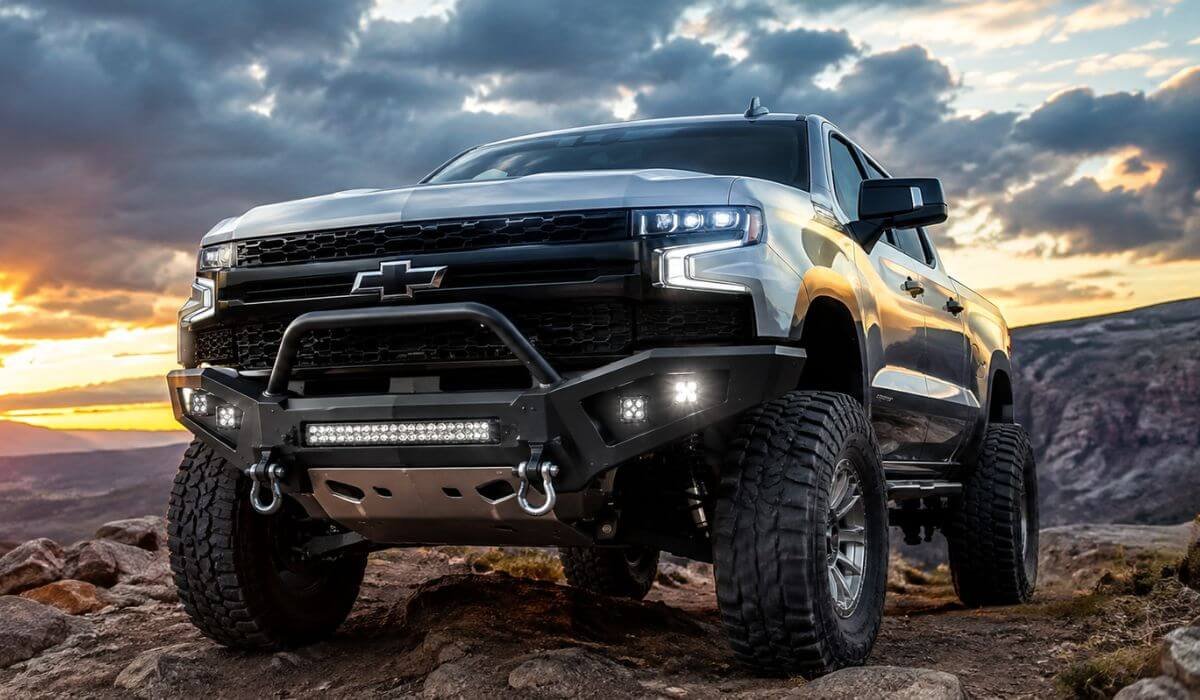
If you drive a 2022–2026 Chevy Silverado 1500, the factory bumper is fine for everyday roads, but it is not what I would choose for serious trail use, recovery work, or front-end protection. The products below are built around the Silverado’s full-size pickup proportions, with features such as full-width steel construction, bull bars, skid plates, winch mounts, sensor openings, and auxiliary-light provisions depending on the model.
One thing worth clearing up before buying: these are not universal Silverado bumpers. The products on this list are primarily designed for the 2022–2026 Silverado 1500, and several specifically exclude the ZR2 and/or 1500 LTD. Older Silverado generations use different front-end designs and mounting points, so I would not assume a 2019–2021 or earlier truck will accept one of these without verified fitment. I selected these five based on the features that actually matter when the bumper has to do more than just look aggressive.
Best Front Bumper for Chevrolet Silverado 1500: Top 2026 Picks for Steel Strength & Trail-Ready Features
#1. Nixon Offroad Front Bumper
Best Front Bumper for 2022-2026 Chevy Silverado 1500 With Heavy-Duty Off-Road Protection and Full-Size Truck Fitment
#2. AUTOWIKI Heavy-Duty Front Bumper
Best Winch-Ready Front Bumper for 2022-2026 Chevy Silverado 1500 With Skid Plate, Side Wings and Bull Bar Protection
#3. WOLFSTORM Full-Width Steel Front Bumper
Best Off-Road Front Bumper for 2022-2026 Chevy Silverado 1500 With Steel Armor, Bull Bar and Sensor Mounting
#4. CPW Heavy-Duty Front Bumper
Best Aftermarket Front Bumper for 2022-2026 Chevy Silverado 1500 Owners Seeking a Tougher Factory Replacement
#5. IRONBISON Front Bumper With LED Lights
Best LED Front Bumper for 2022-2026 Chevy Silverado 1500 With Cube Lights and 30-Inch Light Bar Compatibility
Must Check: Best Chevy Silverado 1500 Winch Bumper
Expert Tip
Before you buy, look at the bumper as a part of the truck’s recovery system, not just a replacement body panel. If you plan to run a winch, the mounting pattern and bumper structure matter far more than a big bull bar. If you want trail protection, the skid plate and approach-area coverage become more important. And if your Silverado has factory parking sensors, check how the bumper handles them before assuming everything will work normally. For these newer trucks, the right fit is worth more than the toughest-looking photo.
How We Choose These Front Bumpers
There is a reason these five are not ranked simply by price or appearance.
With newer 2022–2026 Silverado 1500 bumpers, fitment is where the research starts. The refreshed Silverado front end brought different bumper configurations, and several aftermarket designs specifically leave out the ZR2, LTD, or other configurations. We treated those exclusions as a serious buying factor rather than burying them after the recommendation. A bumper that looks excellent but does not fit your exact truck is not a good recommendation.
From there, we looked at what each design actually gives you.
The Nixon was kept at the top because it makes the most sense as an all-round upgrade rather than being built around one gimmick. The AUTOWIKI earned its position for a very different reason: its winch plate, skid plate, side wings and bull bar make it particularly relevant to owners who expect the front bumper to handle real trail and recovery duties.
WOLFSTORM was judged more from an off-road perspective. Its full-width steel construction, three-piece design and sensor provisions give it a practical advantage for someone building a more purposeful Silverado. Its modular construction is also worth noting because it gives the owner more than one visual and functional configuration.
CPW was not pushed up the list simply because it looks aggressive. We placed it where it makes sense as a straightforward aftermarket alternative for someone who wants a tougher front-end design without necessarily needing every recovery or lighting feature available.
IRONBISON was deliberately left in its own category. Its biggest attraction is not the same as AUTOWIKI or WOLFSTORM. The supplied bumper includes two LED cube lights and provision for a 30-inch light bar, making it a much more logical choice for someone who values auxiliary lighting. It also has a clearly stated 2022 Silverado 1500 LTD exclusion, which is exactly the sort of detail we want readers to notice before ordering.
We also paid attention to the details that are easy to ignore until installation day. Sensor compatibility, mounting hardware, drilling requirements, winch patterns and factory bumper integration can completely change the ownership experience. For example, some current Silverado bumper designs are advertised as direct bolt-ons, while installation guides for certain models specifically state that cutting and drilling are not required. That is useful information because an “easy install” claim means much more when there is actual hardware and installation documentation behind it.
Most importantly, we have not treated the small number of reviews on some of these newer products as proof of long-term durability. That would be misleading. A new bumper can have excellent construction and still not have years of owner history behind it. So where long-term feedback is limited, we leaned more heavily on the stated construction, fitment, mounting design and usable equipment rather than inventing confidence that the available evidence does not support.
That is ultimately how this list was built: not by picking five bumpers that look similar and giving them different badges, but by asking what each one genuinely does better for a Silverado 1500 owner. If your priority is recovery, lighting, trail protection, factory integration or simply a stronger aftermarket front end, the list is designed to make that difference obvious before you spend your money.
#1. Nixon Offroad Front Bumper
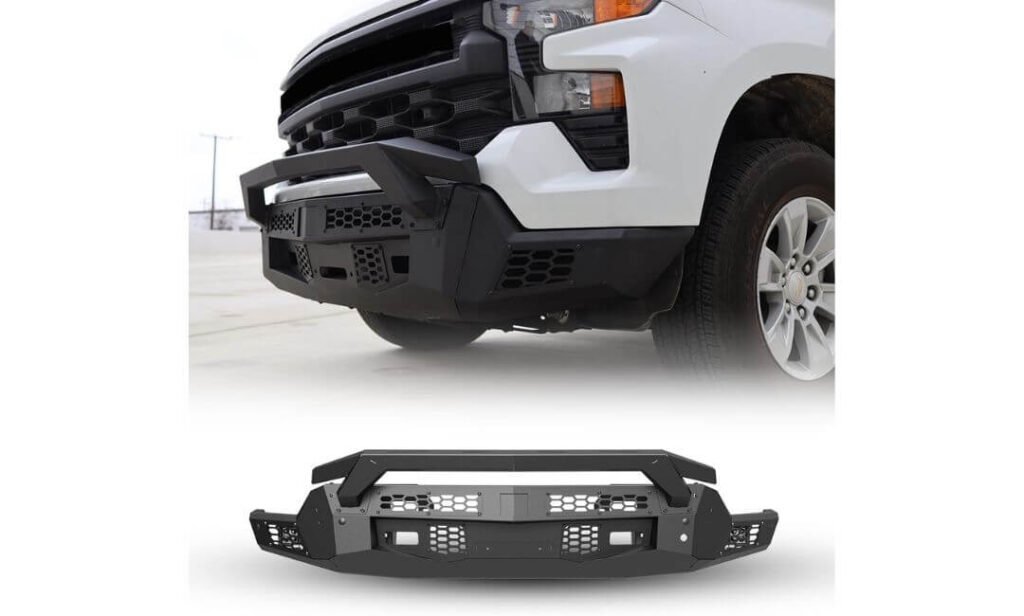
Quick Specs:
- Fitment: 2022–2026 Chevy Silverado 1500, excluding ZR2 and LTD models
- Construction: Q235 low-carbon steel
- Weight: 113.8 lb
- Finish: Textured black powder coat
- Design: Modular bull bar with side wings
- Lighting: Two 4-inch LED pod lights included; supports 20- to 30-inch dual-row light bar
- Recovery: Clevis mounts with ¾-inch D-rings included
- Winch Capacity: Up to 12,000 lb winch
- Factory Systems: Designed to retain parking sensors and adaptive cruise control
- Installation: Bolt-on design with included mounting hardware
- Dimensions: 77.95″W × 20.47″H × 13.31″D
- Warranty: 1 year
What immediately separates this bumper from a typical aggressive-looking Silverado replacement is how much of the factory functionality it tries to keep intact. You are getting a 113.8-pound Q235 steel assembly with a textured powder-coated finish, but the important part is what happens after it goes on the truck. The design accommodates the OEM parking sensors and adaptive cruise control, while the included hardware is intended for a bolt-on installation rather than turning the front of the Silverado into a fabrication project.
The modular setup is where it gets genuinely interesting. The bull bar and side wings give the bumper a broader protective footprint, while the wings provide mounting points for the included 4-inch LED pods. There is also room for a 20- or 30-inch dual-row light bar behind the accent panel, so the lighting setup can grow with the truck instead of forcing you to replace the bumper later. For someone building a Silverado gradually, that flexibility is more useful than a long list of decorative extras.
Then there is the recovery side. The ¾-inch D-ring mounts, included shackles, winch mounting provision and cable guide make this much more than a visual upgrade. A compatible winch can be mounted up to the stated 12,000-pound capacity, while the bumper also provides a jack-stand point and works with the factory skid-plate setup. In other words, the hardware is aimed at an owner who actually plans to use the truck beyond paved roads, not just park it beside one. (A proper fitment check is still the smart move before ordering, especially if your Silverado has a non-standard front-end configuration.)
What Stands Out
- Factory-system compatibility is a major advantage here; retaining parking sensors and ACC makes the upgrade feel far more integrated.
- The modular lighting layout gives you useful options now and later, rather than locking the truck into one lighting arrangement.
- Recovery hardware is built into the concept, with clevis mounts, D-rings and winch provisions all working toward the same purpose.
- At 113.8 pounds, this is a substantial steel bumper, which tells you immediately that it was designed around protection rather than simply changing the Silverado’s appearance.
- The bolt-on approach keeps installation much more approachable for an experienced DIY owner with the right tools and, preferably, a second set of hands.
One Thing to Know
The only thing I would plan for is careful alignment during installation. A bumper this substantial has enough adjustment points that taking your time with positioning is worthwhile, particularly around the lower brackets and factory components. That is not unusual for a heavy-duty modular bumper; it is simply part of getting the finished fit looking properly squared up.
Silverado 1500 Fitment
This particular version is made for the 2022, 2023, 2024, 2025 and 2026 Chevy Silverado 1500, with the manufacturer specifically excluding ZR2 and LTD models. That exclusion matters, so I would match the exact trim against the seller’s current fitment information before placing the order.
For compatible trucks, the design is intended to work around important factory equipment rather than asking you to give it up. Parking sensors, adaptive cruise control, factory tow-hook functionality, camera/radar provisions and factory skid-plate compatibility are all considered in the bumper’s layout, which is exactly the sort of detail worth checking when upgrading a newer Silverado.
The Insider Pro-Tip
If you are choosing this one because of the winch provision, decide on the winch before the bumper goes on the truck. The bumper may support a winch up to the stated 12,000-pound capacity, but the physical winch dimensions, mounting pattern and cable routing still need to make sense together. Doing that homework first can save you from discovering later that the winch you already bought is a poor match for the available space.
And if you are not planning to run a winch, do not overlook the rest of the package. The included LED pods, D-rings, modular bull bar, sensor provisions and bolt-on design give this bumper several useful jobs even without recovery equipment. That is why it makes sense as an overall pick: you are not paying for one feature and ignoring the rest of the truck. You are getting a front-end setup that can evolve as the Silverado does.
#2. AUTOWIKI Heavy-Duty Front Bumper
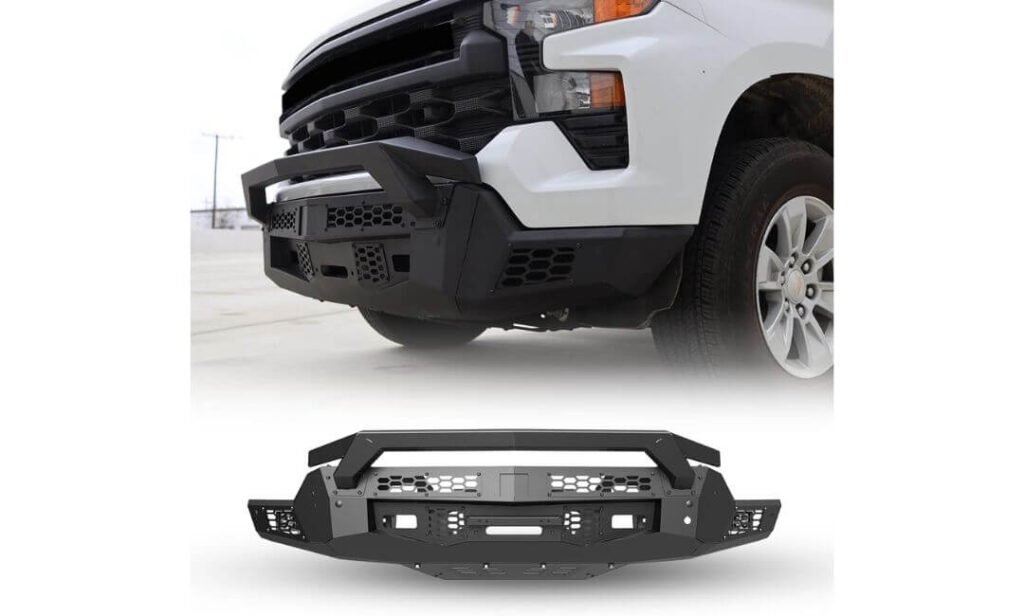
Quick Specs:
- Fitment: 2022–2026 Chevy Silverado 1500, excluding ZR2
- Construction: Q235A alloy steel
- Finish: Textured black powder coat with interior E-coating
- Design: Type A bull bar with side wings and skid plate
- Recovery: Integrated winch plate
- Lighting: Two bright pod lights included
- Sensor Support: Dedicated sensor mounting holes
- Installation: Bolt-on using factory mounting points; no drilling or modification required
- Dimensions: 77.95″W × 23.23″D × 23.19″H
- Warranty: 1 year
- Compliance: DOT and SAE compliant
Some Silverado bumpers are mainly about changing the truck’s appearance. This one takes a different route. The Q235A steel construction, full-width body, side wings, skid plate and Type A bull bar make it a much more substantial front-end upgrade, especially for an owner who wants additional protection without piecing together several separate components.
What I particularly like here is the fact that the major hardware comes as one complete setup. You get the winch plate, skid plate, bull bar, side wings and two pod lights in the package, rather than buying the bumper first and discovering that the accessories you actually wanted cost extra. The pod lights are already part of the package, while the winch plate leaves room for a recovery setup later.
The finish also deserves attention because this is where heavy steel bumpers can become frustrating over time. AUTOWIKI uses a textured black powder coat externally with an E-coating process inside, giving the steel additional protection against corrosion. Add the factory-mounting-point installation and included hardware, and the whole design feels more thought through than a bumper that simply looks heavy in a listing photo. (The best result still comes from checking your exact Silverado configuration before ordering.)
What Makes It Worth Considering
- The package is genuinely complete, with the core protection and recovery components already included.
- The winch plate and skid plate make more sense for trail use than decorative tubing alone.
- Two pod lights add usable forward lighting without requiring a separate bumper-light purchase.
- The interior E-coating is an easy-to-miss detail that matters for a steel component exposed to road moisture and grime.
- Factory mounting points keep the installation considerably cleaner than a design that requires cutting or drilling.
One Small Consideration
The bumper is a substantial full-size assembly, so installation is much easier with a second person to help position and align it. That is more about handling a large steel bumper safely than a complicated installation process.
Silverado 1500 Compatibility
This version is listed specifically for the 2022–2026 Chevy Silverado 1500, with the ZR2 excluded. Because Silverado front-end configurations can differ by trim, I would verify the exact truck against the current fitment information before ordering rather than assuming that every 1500 from these years shares identical mounting requirements.
For the compatible trucks, the design is intended to use factory mounting points without drilling or structural modification. The dedicated sensor mounting holes are another useful touch for owners who do not want to treat factory equipment as an afterthought when moving to a heavier bumper.
The Insider Pro-Tip
If the main reason you are considering this bumper is the winch plate, choose your recovery equipment with the bumper’s available space in mind before installation. A winch-ready bumper gives you the mounting foundation, but the winch itself still needs to match the physical clearance, mounting pattern and cable path.
For an owner who does not need a winch immediately, I would still consider the bumper on its own merits. The skid plate, side wings, bull bar and included lighting give it useful functionality from day one, while the winch provision leaves you an upgrade path instead of forcing another bumper purchase when your Silverado eventually sees more serious trail work.
#3. WOLFSTORM Full-Width Off-Road Front Bumper
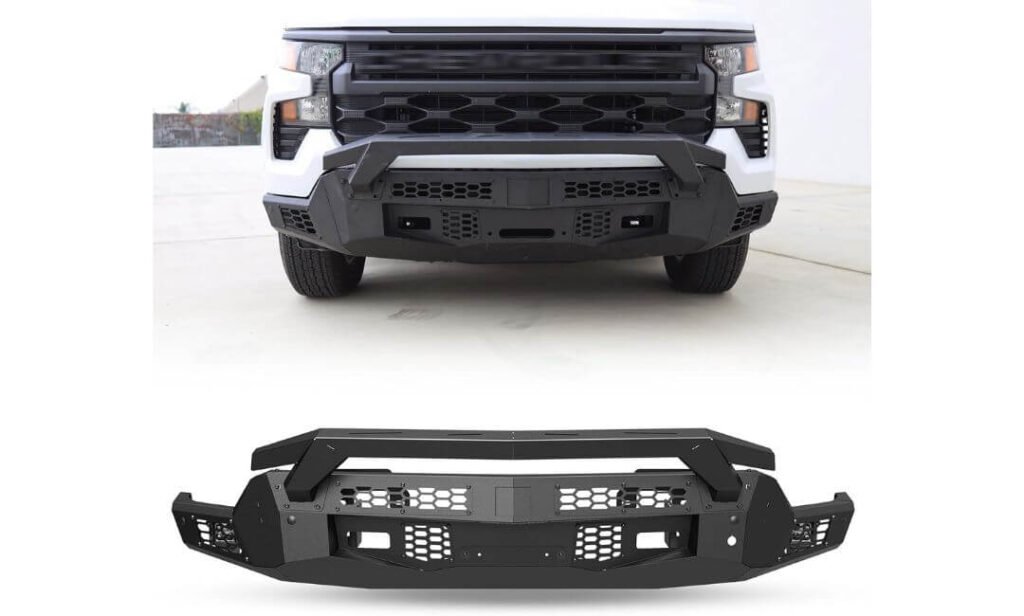
Quick Specs:
- Fitment: 2022–2026 Chevy Silverado 1500, excluding ZR2 and LTD models
- Construction: Q235A carbon steel, precision welded
- Finish: Textured black powder coat
- Design: Full-width bumper with Type A bull bar
- Lighting: Two 4-inch pod lights with wiring harness; supports up to 30-inch light bar
- Recovery: Winch cable-guide and clutch-switch openings; winch-compatible
- Factory Equipment: ACC bracket and factory tow-hook compatibility
- Sensors: Four reserved parking-sensor mounting holes
- Customization: Replaceable honeycomb decorative mesh
- Installation: Bolt-on design with included installation tools; no drilling or cutting required
- Dimensions: 77.95″W × 21.89″H × 19.92″D
- Warranty: 1 year
The first thing that stands out here is not the bull bar or the aggressive shape. It is how much of the Silverado’s original equipment has been considered in the bumper’s layout. WOLFSTORM uses precision-welded Q235A steel for the full-width structure, then adds dedicated provisions for the ACC bracket, factory tow hooks, parking sensors and auxiliary heater wiring. That makes it a more thoughtful option for an owner who wants a serious off-road bumper without stripping away everything that already works on the truck.
The lighting setup is also more practical than it initially looks. You get two 4-inch pod lights and the wiring harness, while the separate light-bar bracket can accommodate a bar up to 30 inches. That gives you usable lighting immediately, but leaves enough room to build a more serious setup later. It is the kind of flexibility that matters if your Silverado starts as a daily driver and gradually turns into a weekend trail truck.
Then there is the detail most buyers probably would not expect to care about until they see it: the interchangeable honeycomb decorative mesh. You can change its colour to suit the truck instead of being stuck with one fixed finish. Combined with the textured powder-coated Q235A steel, the bumper manages to look purpose-built without relying entirely on oversized styling. (That combination of practical mounting provisions and visual customization is what gives this design its own identity.)
What We Like About It
- Factory integration is unusually well considered, with dedicated provisions for ACC, tow hooks, parking sensors and auxiliary heater wiring.
- The 30-inch light-bar capacity gives you considerably more lighting flexibility than a bumper limited to small pods.
- Pod lights and wiring are included, so the truck is not left looking unfinished after installation.
- The replaceable honeycomb mesh gives owners a simple way to personalize the front end without changing the whole bumper.
- The winch cable and clutch-switch openings show that recovery equipment was considered during the design rather than added as an afterthought.
One Thing to Know
Because this is a full-width steel bumper with a bull bar, it is a substantial upgrade over the factory assembly. Having another person help during positioning makes the installation and final alignment much easier, particularly when lining up the sensor openings and factory mounting points.
Silverado 1500 Fitment
WOLFSTORM lists this bumper for the 2022–2026 Chevy Silverado 1500, but specifically excludes ZR2 and LTD models. That is an important distinction because the bumper is designed around particular factory mounting and equipment locations. If your truck falls outside those configurations, do not assume the same bumper will transfer over simply because the model year matches.
For compatible Silverado 1500s, the design retains useful factory provisions while adding its own off-road hardware. Four parking-sensor mounting points, ACC compatibility, factory tow-hook support and the auxiliary-heater harness provision make the fitment story much more convincing than a generic “fits Silverado” claim.
The Insider Pro-Tip
If you are planning to use the truck at night, I would think about your lighting layout before installing the bumper. The included pods are enough to get started, but the bumper’s 30-inch light-bar provision gives you an opportunity to build a much cleaner setup later. Planning the wiring route at the same time is easier than pulling everything apart after the bumper is already aligned.
And there is another reason I like this design for a long-term build: you do not have to decide everything on day one. Start with the included pods, keep the factory sensor and ACC provisions working, then add the light bar or change the mesh when your Silverado’s build actually calls for it. That is a much more sensible upgrade path than buying a bumper packed with features you may never use.
#4. CPW Modular Full-Width Front Bumper
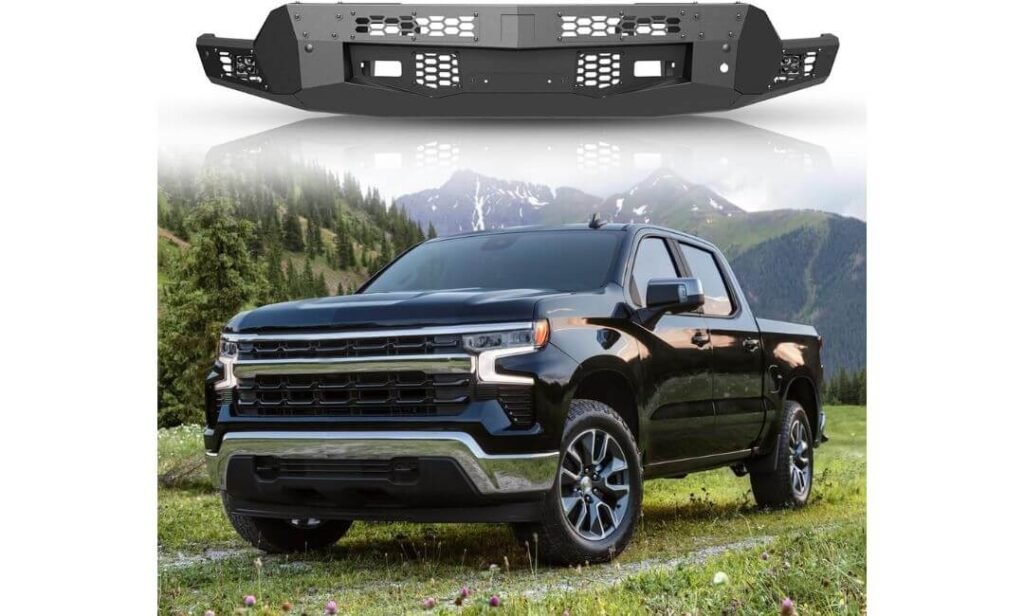
Quick Specs:
- Fitment: 2022–2026 Chevy Silverado 1500, excluding ZR2/LTD models
- Construction: Heavy-duty steel
- Weight: 73.4 lb
- Finish: Black powder coat
- Design: Modular full-width bumper with side wings
- Lighting: Two pod lights with wiring harness included
- Recovery Setup: Optional bull bar, skid plate and winch plate
- Factory Systems: ACC bracket and factory tow-hook access
- Installation: Bolt-on using factory mounting points; no cutting or drilling required
- Dimensions: 77.95″W × 19.92″D × 13.3″H
- Warranty: 1 year
Not every Silverado owner needs a bumper that arrives overloaded with equipment on day one. That is where this CPW design makes sense. At 73.4 pounds, it is noticeably lighter than the heavier options higher on this list, while still using a heavy-duty steel construction with a black powder-coated finish. The full-width shape and side wings give the front end a tougher stance, but the real advantage is the modular approach behind it.
Instead of forcing you to buy every accessory immediately, the design lets you build around your actual needs. The bull bar, skid plate and winch plate can be added according to your setup, which is useful if the Silverado is still a daily driver today but may become more trail-focused later. You also get two pod lights and their wiring harness in the package, so the bumper does not feel stripped down when installed.
Another detail I would pay attention to is the factory-equipment side. CPW provides an ACC mounting bracket and a factory tow-hook operating opening, so the upgrade is not simply about covering the original bumper with a heavier shell. Its angular profile also creates a more favourable approach angle and helps deflect road debris away from the front end. (That balance between a lighter modular build and future upgrade freedom is really the point of this option.)
What We Like About It
- Modularity is the biggest strength — you can add the protection or recovery equipment you actually need instead of paying for everything upfront.
- At 73.4 pounds, it offers a lighter alternative to the substantially heavier steel bumpers on this list.
- Two pod lights with wiring are included, giving the bumper useful functionality straight away.
- The ACC bracket and factory tow-hook provision make the design more compatible with the truck’s existing equipment.
- The factory-mounting-point installation keeps the upgrade straightforward without cutting or drilling.
One Thing to Know
The bull bar, skid plate and winch plate are optional additions rather than all being included with the base bumper. That is not necessarily a downside, but it is worth knowing if you are comparing the package price against bumpers that arrive with more hardware already included.
Silverado 1500 Fitment
This CPW version is intended for 2022–2026 Chevy Silverado 1500 models, with ZR2 and LTD configurations excluded. Because the bumper’s mounting and factory-equipment provisions are designed around the compatible Silverado configuration, checking your exact trim before ordering is still the right move.
For the trucks it is designed to fit, the bumper retains useful provisions for adaptive cruise control and factory tow-hook access, while the full-width body and side wings provide broader front-end coverage. The 77.95-inch width also matches the full-size proportions of the Silverado rather than giving the truck a narrow aftermarket look.
The Insider Pro-Tip
This is the bumper I would look at if you want to build in stages rather than spend everything at once. Start with the main bumper and included lighting, then add a skid plate, bull bar or winch plate when your driving actually demands it. That approach can make more financial sense than buying a heavily equipped bumper and leaving half of its hardware unused.
One more practical point: if a winch is part of your future plan, decide where you want the recovery equipment to sit before adding the optional modules. Planning the final configuration first will give you a cleaner finished setup and prevent you from buying components that later need to be changed around.
#5. IRONBISON Heavy-Duty LED Front Bumper
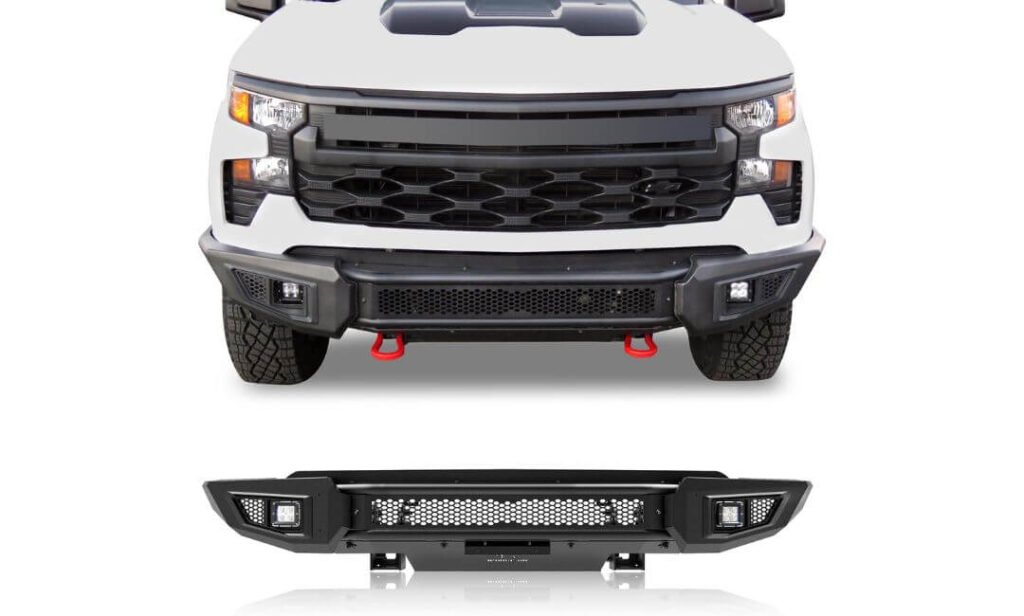
Quick Specs:
- Fitment: 2022–2026 Chevy Silverado 1500, excluding 2022 Silverado 1500 LTD
- Construction: Heavy-duty all-steel frame
- Weight: 113.3 lb
- Finish: 360° E-coating with fine textured black powder coat
- Lighting: Two IP67 LED cube lights included
- Light Bar: Compatible with an additional 30-inch LED light bar
- Design: Foldable bumper construction with splash guard and top fill panel
- Extras: License plate bracket and light-bar mounting brackets
- Installation: Direct bolt-on using factory mounting points
- Dimensions: 63″L × 16″W × 15″H
- Fit Type: Vehicle-specific
If your Silverado spends more time on dark back roads, trails or poorly lit work areas, this bumper has a very clear purpose. The two included IP67 LED cube lights are not simply decorative pieces added to make the bumper look tougher. They give you useful auxiliary lighting from the start, while the supplied brackets leave room for a 30-inch centre light bar when you eventually want more coverage.
The construction is equally serious. At 113.3 pounds, this is another substantial all-steel assembly, finished with 360-degree E-coating underneath a fine textured black powder coat. That combination is particularly relevant on a truck that sees rain, mud, gravel and road salt because the protection is not limited to the visible outer surface. It is a small specification, but one I would rather see than another paragraph about aggressive styling.
There is also a clever bit of engineering that most buyers would never notice once the bumper is installed: the foldable design. It is patented specifically to reduce the chance of shipping damage, which makes practical sense for a large steel component travelling in a box. Installation follows the same straightforward philosophy, using the truck’s factory mounting points with the supplied hardware and instructions. (For a lighting-focused Silverado build, this is one of the more purpose-specific options in the group.)
What We Like About It
- The lighting package is genuinely useful, with two IP67 cube lights already included.
- The ability to add a 30-inch centre light bar gives the bumper a clear upgrade path for serious night driving.
- 360° E-coating plus textured powder coating is a thoughtful combination for a steel component exposed to the elements.
- The foldable construction shows attention to the practical problem of transporting a large, heavy bumper without unnecessary damage.
- The included splash guard, top fill panel and license-plate bracket help complete the installation instead of leaving the owner to source basic finishing pieces separately.
One Thing to Know
This is a lighting-led choice, so I would pick it for the person who actually values auxiliary illumination. If your main priority is a built-in winch and recovery setup, another bumper higher on this list makes more sense for that particular job.
Silverado 1500 Compatibility
IRONBISON lists this bumper for the 2022–2026 Chevy Silverado 1500, with one specific exclusion: the 2022 Silverado 1500 LTD. That is worth checking carefully because the wording is narrower than some of the other products on this list.
For compatible trucks, the direct bolt-on design uses the factory mounting points, with no cutting or drilling stated as necessary. The package also includes the lighting brackets, splash guard, top fill panel and license-plate bracket, giving the finished front end a more complete look once everything is installed.
The Insider Pro-Tip
If you already know you want a 30-inch light bar, buy the bumper with your final lighting plan in mind. The included cube lights can handle immediate needs, but planning the centre light bar, wiring route and switch placement before installation will make the finished setup considerably cleaner.
And I would not underestimate the value of the IP67 rating on the included lights. Auxiliary lighting mounted low on a truck sees plenty of water, dust and mud. Weather resistance is one of those features you appreciate much more after the first bad-weather drive than when you are comparing product photos.
Best Chevy Silverado 1500 Front Bumpers (2022–2026) Compared by Features and Fitment
Buyers Guide to Choosing the Best Front Bumper for Chevy Silverado 1500
A front bumper should solve a problem on your Silverado, not simply make the truck look more aggressive. The right choice depends on how you use the truck, what factory equipment it has, whether you need recovery capability, and how much additional weight you are comfortable putting over the front axle. For a daily-driven 1500, a lighter modular bumper can make more sense; for regular trail use, a full-width steel design with recovery points and a skid plate is a different proposition altogether.
Start With the Exact Silverado Fitment
This is the first check I would make before comparing steel thickness, winches, or lighting. The bumpers in this guide are primarily designed around 2022–2026 Chevy Silverado 1500 configurations, but the exclusions are not identical. Some specifically leave out ZR2 and LTD models, while the IRONBISON option has its own 2022 LTD exclusion.
Do not assume that a Silverado 1500 badge guarantees compatibility. Z71, Trail Boss, 4×4, regular trims, factory sensors, ACC equipment and other front-end configurations can affect what an aftermarket bumper needs to accommodate. Cab and bed configuration are worth checking too, but the more important question for a front bumper is whether your exact front-end configuration matches the manufacturer’s fitment listing.
Steel, Alloy and the Weight Question
For an off-road bumper, material is not just a specification to tick off.
Q235/Q235A steel appears across several of our picks because it gives manufacturers a strong base for building substantial full-width structures, bull bars, recovery provisions and skid plates. But heavier does not automatically mean better. The Nixon and IRONBISON options are around 113 pounds, while CPW is listed at about 73.4 pounds. That difference is significant when the bumper sits at the very front of the truck.
Think about the trade-off:
| What matters | What to look for |
|---|---|
| Front-end protection | Full-width steel construction, reinforced structure |
| Trail recovery | Proper winch provision and recovery mounting points |
| Weight-conscious build | Modular or lighter construction |
| Corrosion resistance | Powder coating plus additional protective coating |
| Long-term use | Strong construction backed by a meaningful warranty |
A heavier bumper can bring useful protection, but it also adds weight ahead of the front axle. If the Silverado is primarily a commuter and occasionally sees a dirt road, there is little reason to choose the heaviest design simply because it sounds tougher.
Decide Whether You Actually Need a Winch
This is where bumper shopping becomes much easier.
If you are searching for the best front bumper for Chevy Silverado 1500 with a winch, look beyond the words “winch-ready.” You want to know whether the bumper actually provides a suitable winch plate, cable routing, clutch access and enough physical room for the winch you intend to install.
The Nixon is particularly interesting here because its design is rated for a winch up to 12,000 pounds, with clevis mounts, D-rings and a cable-guide provision. AUTOWIKI includes a dedicated winch plate, while WOLFSTORM provides openings for the cable guide and winch clutch switch. CPW takes the more modular route, allowing the winch plate to be added according to your build.
That difference matters. A bumper with a recovery path built into its structure is a better starting point than trying to turn a cosmetic bumper into a recovery bumper later.
Look at Approach Angle, Not Just Appearance
A bumper can look extremely aggressive and still be poorly suited to actual trail driving.
If you regularly approach steep terrain, ruts, rocks or uneven ground, pay attention to how far the lower bumper structure extends forward and downward. A design that improves the approach angle can reduce the chance of the bumper becoming the first thing that contacts the terrain.
This is one reason full-width off-road designs like the WOLFSTORM and CPW deserve consideration beyond styling. The shape, lower coverage and side-wing design all affect how the front of the Silverado behaves when the pavement ends.
Skid Plates, Side Wings and Bull Bars Have Different Jobs
These components are often grouped together in product listings, but they are not interchangeable.
- Skid plate: helps shield vulnerable lower-front areas from rocks, debris and trail contact.
- Side wings: extend protection toward the outer sections of the front end.
- Bull bar: adds another protective structure around the central front area and can provide additional accessory mounting space.
- Winch plate: creates the structural mounting area for a compatible winch.
- Recovery points: give you a defined place for appropriate recovery equipment.
If your truck rarely leaves pavement, you may not need all of them. If you are building a genuine trail setup, the combination becomes much more meaningful.
Do Not Ignore Parking Sensors and ACC
This is one of the easiest areas to get wrong on a newer Silverado.
A bumper replacement should not be judged only by whether the bolt holes line up. Parking sensors, adaptive cruise control, cameras and radar-related equipment need to remain properly accommodated where the bumper design supports them.
Nixon specifically provides for OEM parking sensors and ACC, while WOLFSTORM includes reserved sensor holes and an ACC mounting provision. CPW also provides an ACC bracket and factory tow-hook access. Those details matter because keeping the truck’s factory systems functional is part of what makes an aftermarket bumper a good upgrade rather than an expensive compromise.
Think About Lighting Before You Buy the Bumper
If auxiliary lighting is part of the plan, buy around the final setup rather than adding lights as an afterthought.
Nixon gives you two 4-inch LED pods and room for a 20- or 30-inch light bar. WOLFSTORM also includes 4-inch pods and supports a light bar up to 30 inches. IRONBISON takes the lighting angle even further with two IP67 LED cube lights and provisions for an additional 30-inch bar.
If you only need a little extra light, the included pods may be enough. If you spend serious time on dark trails, planning the larger light-bar position, wiring route and switch placement before installation will give you a much cleaner result.
Installation: Bolt-On Does Not Mean Effortless
A bumper advertised as bolt-on with no drilling or cutting is a very good sign, but it does not mean the job is a five-minute driveway project.
These are large steel components. Alignment, safe lifting, access to factory mounting points and reconnecting sensors or lighting can all take time. Having a second person is sensible, particularly with the heavier 100-plus-pound designs.
Before ordering, check whether the package includes mounting brackets, bolts, wiring, installation instructions and accessory hardware. Nixon, AUTOWIKI, WOLFSTORM and CPW all provide substantial installation hardware, while the exact included accessories vary.
Warranty and After-Sale Support Matter More With Newer Bumpers
Several of these products are newer aftermarket designs, so I would not pretend that a small number of customer reviews can prove years of durability. In that situation, the construction details, finish, fitment information and manufacturer support become more important.
A one-year warranty does not guarantee that an installation will be trouble-free, but it does give you a clearer route if there is a manufacturing problem. Also check the seller’s return conditions before installation. Once a bumper has been modified, painted, drilled or otherwise altered, returning it can become considerably more complicated.
Which Type Makes Sense for Your Silverado?
| Your Silverado use | What I would prioritise | Best match from this list |
|---|---|---|
| Daily driving with occasional trails | Balanced weight, factory-system compatibility | Nixon Offroad |
| Regular recovery and winching | Winch plate, recovery points, skid protection | AUTOWIKI |
| Serious off-road build | Full-width steel, sensor support, lighting and recovery provisions | WOLFSTORM |
| Gradual modification | Modular accessories and lighter overall setup | CPW |
| Night trails and auxiliary lighting | Included LED lighting and 30-inch light-bar provision | IRONBISON |
Z71, Trail Boss and 4×4 Buyers: Check Before Checkout
A Z71 or Trail Boss badge does not automatically mean every aftermarket Silverado 1500 bumper will fit. The same applies to a 4×4 truck. Trim names are useful for identifying the vehicle, but the manufacturer’s exact fitment list is what should decide the purchase.
This is especially important with the products in this article because ZR2 and LTD exclusions appear repeatedly. If your Silverado falls into one of those configurations, do not try to make the product fit based on photographs or the fact that the model year matches.
The Bottom Line Before You Order
The best Silverado 1500 front bumper is not necessarily the biggest, heaviest, or most expensive one. It is the one whose structure, recovery capability, factory-system compatibility, lighting provisions and installation requirements actually match the way you use your truck.
If you need a bumper that can grow with the truck, a modular design makes sense. If recovery is the priority, start with the winch and mounting requirements. If trail protection is the goal, pay closer attention to steel construction, approach angle and skid coverage. And if the Silverado remains a daily driver, do not add 100-plus pounds to the nose simply because a heavier bumper looks impressive in a photograph.
Installation & Fit Guide for a Chevy Silverado 1500 Front Bumper
A heavy-duty bumper is one of those jobs where good alignment matters almost as much as the bumper itself. Most of the products in this guide are designed as bolt-on replacements using factory mounting points, but that does not mean you should rush through the installation. These assemblies are wide, heavy, and often have sensor, lighting, ACC, winch, and tow-hook provisions that need to line up properly.
What You Will Need
For most of these Silverado 1500 bumpers, have the following ready before you start:
- Socket and ratchet set suitable for the factory bumper hardware
- Combination wrench set
- Torque wrench
- Trim or panel-removal tools
- Screwdrivers and hex/Allen bits where required
- Jack and quality jack stands or a suitable lifting setup
- Wheel chocks
- Work gloves and eye protection
- A second person to help hold and align the bumper
- Electrical connectors or wiring supplies if adding auxiliary lights
- Manufacturer-supplied brackets, bolts and installation hardware
A transmission jack or adjustable shop jack can also make positioning a large steel bumper considerably easier, particularly with assemblies weighing around 100 pounds or more.
Before You Remove the Factory Bumper
Do not start by removing bolts immediately.
First, park the Silverado on a flat, level surface, engage the parking brake and chock the wheels. Take a few photographs of the original bumper from straight ahead and from both corners. Those photos give you useful reference points for the final height, side-to-side position and panel gaps.
Then identify anything that needs to transfer to the new bumper, including parking sensors, ACC/radar hardware, camera components, tow-hook hardware, wiring connectors and factory brackets.
If your bumper has sensors or electronic equipment, label the connectors before disconnecting them. It is much easier to reconnect everything correctly when each connector already has a clear reference.
Remove the Factory Bumper Without Creating Extra Work
Follow the supplied installation instructions for your exact bumper rather than assuming every Silverado uses identical hardware.
Once the visible fasteners are removed, check carefully for hidden clips, wiring and brackets before pulling the bumper away from the truck. Do not let the assembly hang from an electrical harness.
This is also a good point to compare the aftermarket bumper with the factory unit on the floor. Check the mounting brackets, sensor positions, tow-hook openings and wiring provisions before you attempt to lift the new bumper into place.
Test-Fit the New Bumper First
This is the step that can save you the most frustration later.
With another person supporting the bumper, bring it into position and install the mounting bolts only finger-tight at first. Do not fully tighten one side while the opposite side is still loose.
Start by getting the bumper centred on the truck. Then compare the left and right gaps around the front-end panels. Look at the bumper from directly in front of the Silverado and then from both corners.
The goal is to establish:
- Equal left-to-right positioning
- Consistent panel gaps
- Correct bumper height
- Proper alignment with the grille and fenders
- Clearance around parking sensors
- Correct position of tow-hook openings
- Adequate clearance for wiring and factory components
The Best Way to Prevent Bumper Drift
Heavy bumpers can move slightly while the hardware is being tightened. That is why I would not fully tighten the first bolt you install.
A better approach is to snug the mounting hardware gradually in a cross-pattern, alternating between sides while repeatedly checking the bumper position.
Once the bumper is sitting correctly, tighten the hardware progressively. If the manufacturer’s instructions provide a specific torque value, use that value rather than guessing.
Do not copy a generic torque specification from another Silverado bumper. Fastener size, grade, bracket design and manufacturer requirements can differ between products.
Torque and Final Alignment Checks
A torque wrench is worth using here.
The correct sequence is:
- Position the bumper and install all primary hardware loosely.
- Centre the bumper visually and measure the side-to-side position if necessary.
- Check panel gaps and clearance around factory equipment.
- Snug the hardware evenly from side to side.
- Recheck the bumper position.
- Apply the manufacturer’s specified torque values.
- Perform one final alignment inspection after tightening.
If the product manual does not provide torque specifications, contact the manufacturer rather than inventing a number. That is especially important on a heavy bumper carrying recovery equipment.
Reconnect Sensors, ACC and Other Factory Equipment
This is where a clean installation can quickly turn into an annoying one if you rush.
Reconnect the parking sensors, ACC/radar-related components, camera equipment and factory wiring exactly as required by the bumper’s instructions. Make sure wiring is secured away from sharp steel edges, moving parts and areas where it could be crushed.
For bumpers such as the Nixon, WOLFSTORM and CPW that specifically provide provisions for factory equipment, take the extra time to make sure the components are seated correctly rather than simply plugging everything back in and assuming it is finished.
After installation, check the vehicle for warning messages before driving normally.
Auxiliary Light Installation
If you are using the included LED pods, connect them only after the bumper itself has been properly aligned.
Keep the wiring:
- Away from exhaust and high-heat areas
- Clear of sharp bumper edges
- Secured against vibration
- Protected from water where the manufacturer requires it
- Easy enough to access for future troubleshooting
For a 20- or 30-inch light bar, plan the wiring route before permanently securing the bumper. It is much easier to route cables while you still have reasonable access behind the bumper.
Common Installation Mistakes to Avoid
Tightening One Side Too Early
This is probably the easiest way to create uneven gaps. Keep both sides loose enough to make adjustments until the bumper is properly centred.
Hanging the Bumper From Wiring
Never use sensor or lighting wiring to support the weight of the bumper. Large steel assemblies can damage connectors surprisingly easily.
Skipping the Test Fit
Even a bolt-on bumper deserves a dry fit. Confirm that the brackets, sensors, tow hooks and surrounding bodywork all make sense before final tightening.
Guessing Torque
A bumper is structural equipment. Use the manufacturer’s torque specification whenever one is supplied. If it is missing, ask the manufacturer instead of relying on a random number from an unrelated product.
Forgetting Sensor Clearance
A sensor that is physically installed but poorly positioned may not behave the way you expect. Check the bumper’s sensor provisions and the vehicle’s system operation after installation.
Routing Light Wiring Too Close to Steel Edges
A wire can look perfectly secure during installation and still rub through after months of vibration. Use suitable protection wherever the harness passes near metal.
Installation Time You Should Actually Expect
For an experienced DIY owner with another person helping, a straightforward bolt-on bumper can reasonably take several hours, depending on the bumper design and how many factory components or accessories need to be transferred.
A simpler setup may move faster, while a bumper with bull bars, skid plates, sensors, ACC provisions, LED lighting and winch-related hardware can take considerably longer.
I would rather plan an afternoon for the job than try to finish it in an unrealistic one-hour window. The extra time is usually spent on alignment and checking everything properly, not simply turning bolts.
The Final Driveway Check
Before taking the Silverado onto the road, stand several feet in front of it and look at the bumper from straight ahead. Then check both corners.
Confirm that:
- All mounting hardware is tightened to the specified torque
- The bumper is centred
- Panel gaps look even
- Sensors and factory equipment are secure
- Wiring is properly routed
- LED lights operate correctly
- Tow hooks and recovery hardware are accessible
- Nothing contacts the grille, fenders, suspension or other moving components
Then take a short, slow test drive and listen for unusual movement, rattling or contact. Park again and inspect the mounting points once more.
That final inspection is worth doing. A heavy aftermarket bumper can settle slightly after its first drive, and catching a loose fastener or shifted alignment in the driveway is far better than discovering it halfway down a trail.
Winch & Accessory Compatibility Tips for a Chevy Silverado 1500 Front Bumper
A bumper being advertised as winch-ready is only the starting point. The winch, mounting plate, fairlead, cable path, clutch access, electrical system and available space all have to work together. That is particularly important with these Silverado bumpers because they do not all provide the same recovery hardware. Nixon has a stated 12,000-pound winch capacity, AUTOWIKI includes a winch plate, WOLFSTORM provides dedicated winch-access openings, while CPW takes a more modular approach.
Start With the Winch, Not the Bumper
If you already know a winch is going on the truck, choose the winch and bumper as a matched system rather than buying whichever bumper looks best first.
For a full-size Silverado 1500, the useful starting point is the truck’s actual recovery requirements, not simply choosing the biggest winch available. A properly selected winch should have enough capacity for the truck, its equipment and the conditions in which you expect to recover it, while still fitting the bumper’s mounting area.
As a practical rule, consider the Silverado’s loaded recovery weight, not just its empty curb weight. A truck carrying passengers, tools, recovery gear, larger tyres and other equipment can weigh substantially more than the number you see on a basic specification sheet.
How Much Winch Capacity Do You Need?
There is no single winch rating that is automatically correct for every Silverado 1500 build.
A sensible approach is to establish the truck’s realistic loaded weight and then choose a winch with an appropriate safety margin. More capacity is not automatically better if the winch becomes unnecessarily large, heavy or difficult to package behind the bumper.
For the products in this guide, the Nixon specifically states compatibility with a winch up to 12,000 pounds. That gives you a clear reference point, but it should not be interpreted as a recommendation to install a 12,000-pound winch regardless of your truck’s actual needs.
Check the Mounting Pattern Before Ordering
The physical winch mounting pattern is just as important as the advertised pulling capacity.
Before buying, compare the winch manufacturer’s mounting dimensions with the bumper’s winch plate. Look at:
- Mounting-hole spacing
- Bolt size and grade requirements
- Available mounting depth
- Winch body dimensions
- Motor and gearbox clearance
- Drum position
- Cable or rope exit location
- Access to the winch clutch
- Clearance around the grille and other components
A winch can have the correct capacity and still be the wrong physical fit.
Fairlead Choice Matters More Than It Looks
The fairlead needs to work with both the winch line and the bumper’s opening.
If you are using synthetic rope, an aluminium hawse-style fairlead is commonly used because it provides a smooth surface for the rope. Steel cable is generally paired with a roller fairlead designed for that type of line.
Do not simply assume that the fairlead supplied with your winch will automatically fit the aftermarket bumper. Check the fairlead mounting pattern and the bumper’s cable opening before final assembly.
The line should leave the winch cleanly through the fairlead without rubbing against the bumper structure.
Nixon Offroad: The Most Complete Recovery Setup
The Nixon bumper is particularly straightforward for someone planning a serious recovery setup. It provides a winch mounting provision rated for up to 12,000 pounds, along with a cable-guide provision, clevis mounts and included ¾-inch D-rings.
The important part is that the recovery hardware is not being treated as an isolated accessory. The bumper’s design also considers bull-bar configuration, skid-plate compatibility and factory equipment, giving you more flexibility when building the front end.
AUTOWIKI: Start With the Included Winch Plate
AUTOWIKI takes a more traditional winch-bumper approach, with a dedicated winch plate included in the package.
That makes it attractive if you want the recovery foundation already incorporated rather than purchasing a basic bumper and adding a plate later. Before ordering the winch itself, compare its physical dimensions and mounting pattern with the available plate space.
The package also includes a skid plate and Type A bull bar, so remember to account for those components when checking access to the winch and fairlead.
WOLFSTORM: Pay Attention to Cable and Clutch Access
WOLFSTORM is interesting because the bumper specifically provides a winch cable-guide hole and a winch clutch-switch operation hole.
Those openings are easy to overlook when shopping, but they can make a real difference during installation. A winch that technically fits but leaves the clutch difficult to access is not a particularly good real-world setup.
The design also supports a bull bar, pod lights and a light bar, so plan the entire front-end layout before permanently installing everything.
CPW: Best for a Gradual Recovery Build
CPW approaches recovery differently. The bumper is modular, allowing the bull bar, skid plate and winch plate to be added according to your needs.
That can be useful if you are not installing a winch immediately. You can start with the bumper and included pod lights, then add the recovery hardware when the truck’s use actually demands it.
Just remember that the base bumper does not provide the same complete winch package as some of the higher-ranked options. Verify exactly which winch plate and accessory components are included with the configuration you are ordering.
IRONBISON: Check the Lighting Layout Around the Winch
IRONBISON is primarily interesting here for its lighting setup rather than a dedicated winch package. It includes two IP67 LED cube lights and provisions for a 30-inch light bar.
If you plan to combine auxiliary lighting with a recovery setup, check the available space carefully. A large light bar, winch, fairlead and wiring can quickly make the area behind a bumper crowded.
Plan where each component will sit before installation rather than trying to find room for the winch after the lighting hardware has already been installed.
Do Not Forget the Electrical Side
A winch is not simply a mechanical bolt-on accessory. It draws substantial current, so the electrical installation deserves the same attention as the mounting hardware.
Use the winch manufacturer’s supplied cables, solenoid or control system and recommended connection method. Make sure the battery and charging system are suitable for the winch installation, and route the cables away from sharp edges, excessive heat and moving components.
Do not improvise with undersized wiring simply because the supplied cable seems inconvenient to route. High-current accessories need appropriately sized wiring and secure connections.
Plan for the Battery and Cable Route
Before the bumper goes on, identify the complete cable path from the winch to the electrical connection point.
Look for:
- Safe clearance from exhaust and heat sources
- Protection from sharp metal edges
- Adequate slack for vibration and movement
- Secure attachment points
- Easy access for inspection
- Protection from water and mud where appropriate
The cleanest installation is usually the one that was planned before the bumper was fully tightened.
Verify the Complete Setup Before You Buy
I would use this simple check before placing the order:
| Check | What to Confirm |
|---|---|
| Winch capacity | Suitable for your Silverado’s loaded recovery weight |
| Physical size | Winch body fits the bumper’s available space |
| Mounting pattern | Winch holes match the supplied plate |
| Fairlead | Correct type and mounting pattern |
| Cable path | Line exits cleanly without rubbing |
| Clutch access | Handle or switch remains accessible |
| Electrical system | Manufacturer-specified cables and connections can be routed safely |
| Skid plate | Does not interfere with winch or cable routing |
| Bull bar | Does not block winch access or fairlead |
| Lighting | Pods or light bar do not crowd recovery equipment |
| Factory systems | Sensors, ACC and other supported equipment remain properly positioned |
One Compatibility Check I Would Never Skip
Before buying any winch or accessory, lay the manufacturer’s dimensions next to the bumper specifications and installation diagram.
Do not rely on a product title saying “fits Silverado 1500.” That tells you the vehicle application, not necessarily whether your particular winch, fairlead, light bar or recovery accessory will physically fit the finished bumper.
And if the seller does not provide enough information to verify the combination, ask them before ordering. Spending a few minutes confirming mounting dimensions, clearance and accessory compatibility is much easier than discovering after installation that the winch, fairlead or wiring needs to be changed.
Maintenance and Longevity of a Chevy Silverado 1500 Front Bumper
A heavy-duty bumper does not need complicated maintenance, but it does need regular attention to the areas where water, mud and road debris collect. Steel can be extremely durable, yet the finish is what stands between the metal and the environment. A five-minute inspection after a muddy trail day can do more for long-term condition than waiting until visible rust appears.
Keep the Coating Clean
The simplest habit is also the one most owners skip: wash the bumper regularly, especially after driving through mud, salt, standing water or heavily treated winter roads.
Road grime can sit inside seams, around mounting points, behind brackets and underneath skid-plate sections. Those areas stay damp longer than the exposed front surface.
Use clean water to remove loose dirt first, then a mild automotive soap and a soft brush or wash mitt. Avoid attacking the coating with an unnecessarily aggressive brush simply because the bumper is made from steel.
Pay Extra Attention After Off-Road Driving
After a proper trail day, do not only clean the front face.
Look underneath and check:
- Around the skid plate
- Behind the side wings
- Around bull-bar mounting points
- Inside drainage and recessed areas
- Around winch and recovery hardware
- Near light mounts and wiring brackets
- Around exposed bolts and fasteners
- Along the lower edges where mud tends to remain
This is where a bumper can quietly start developing surface corrosion while still looking perfect from the front.
Deal With Scratches Before They Become Rust
A textured black powder-coated finish is tough, but it is not impossible to damage. Rocks, recovery equipment, tools and even poorly positioned straps can eventually expose the metal underneath.
If you find a small chip or scratch, clean and dry the area first, then use an appropriate corrosion-resistant touch-up coating recommended for the finish. Do not simply cover dirt or moisture with paint.
For a deeper scratch that has reached the metal, removing loose corrosion before applying a compatible protective coating is particularly important.
The Inside of the Bumper Matters Too
One useful detail on several of these designs is the additional protective treatment applied beneath the visible finish. E-coating, where specified, provides another layer of corrosion protection beyond the exterior powder coat.
That does not mean the inside can be ignored.
Mud and moisture can still enter through openings around sensors, winch components, light brackets and mounting areas. If the truck regularly sees wet or muddy conditions, inspect those hidden surfaces occasionally rather than judging the bumper’s condition from its front face alone.
Check Hardware During Routine Service
You do not need to remove the bumper to maintain it.
Whenever the Silverado is being serviced, take a quick look at the major mounting hardware and recovery components. Look for:
- Loose or damaged bolts
- Rust around fasteners
- Cracked or damaged brackets
- Changes in bumper alignment
- Damaged D-rings or recovery mounts
- Chafed wiring
- Loose light brackets
- Damage around the winch plate
If the bumper has been used for actual recovery work, inspect the recovery points and mounting areas carefully. A bumper can look completely fine while a heavily loaded recovery point has experienced stress.
Do Not Ignore the Powder Coat
Powder coating is one of the main reasons these steel bumpers can stay looking good for years, but it still benefits from normal care.
Avoid using harsh chemicals simply because the bumper is marketed as heavy-duty. Regular automotive cleaning products are generally the more sensible approach. If you use a pressure washer, keep the nozzle at a reasonable distance rather than concentrating extreme pressure directly on coating edges, seams, wiring or electrical connectors.
The goal is simple: remove contaminants without creating new damage.
How Long Should a Steel Bumper Last?
There is no honest universal lifespan.
A properly constructed steel bumper that is kept clean, protected from corrosion and not subjected to repeated hard impacts can remain serviceable for many years. The environment and usage pattern matter enormously.
A Silverado that spends most of its life on paved roads in a dry climate will be much easier on its bumper than one regularly exposed to:
- Road salt
- Coastal moisture
- Deep mud
- Standing water
- Rock impacts
- Recovery loads
- Frequent off-road use
So I would not put an artificial “five-year” or “ten-year” lifespan on any of these products. The condition of the coating, steel, mounting hardware and recovery components tells you much more than a calendar number.
What the Warranty Really Tells You
Warranty coverage is useful, but it should not be confused with a promise that the finish will remain perfect forever.
The products in this guide commonly carry one-year manufacturer warranty coverage, while the exact return and damage policies can differ. A warranty is primarily there to provide a route for addressing manufacturing defects or product problems covered by the seller’s terms.
Normal wear, trail scratches, stone chips, improper installation and damage from impacts may be treated differently.
That is why I recommend saving the order confirmation, installation instructions and warranty information after purchase. If something genuinely goes wrong, having the original documentation makes the conversation with the seller much easier.
A Simple Maintenance Routine That Actually Works
You do not need a complicated schedule.
After muddy or salty driving: rinse the bumper thoroughly, including underneath.
Every few weeks: inspect the coating, mounting hardware and exposed brackets.
After trail use: check for impact damage, chips, bent brackets and recovery-point stress.
When you find exposed metal: clean it, dry it and repair the coating rather than waiting for visible rust.
During regular vehicle service: have the mounting hardware and recovery components visually inspected.
That routine is more realistic than promising a bumper will stay perfect simply because it has a powder-coated finish.
One Important Long-Term Reality
A heavy-duty bumper is still a wear item in the sense that its environment determines its condition. The steel itself may be extremely strong, but the finish, fasteners, wiring and accessories experience the daily abuse.
If you take care of those small details, there is no reason a well-maintained Silverado bumper cannot remain a useful part of the truck for a very long time. The biggest mistake is usually not buying the wrong coating or the wrong steel; it is letting a small chip, trapped mud or loose fastener become a much bigger problem because nobody checked it.
FAQs About Chevy Silverado 1500 Front Bumper
Can I install a heavy-duty front bumper on a 2022–2026 Chevy Silverado 1500 without losing parking sensors or adaptive cruise control?
You can, but only when the particular bumper is designed around those factory systems. That is why I would never treat “fits Silverado 1500” as enough information. Nixon, WOLFSTORM and CPW, for example, provide specific provisions for factory sensors or ACC-related equipment, while fitment exclusions such as ZR2 and LTD still need to be checked.
After installation, do not assume everything is working just because there are no obvious warning lights. Check the parking sensors, ACC-related functions and any camera or radar equipment supported by your truck. If a sensor has been moved even slightly, its physical position can matter as much as whether the connector is plugged in.
Is a winch-ready bumper actually enough to choose the right winch for a Chevy Silverado 1500?
No. “Winch-ready” tells you that the bumper has been designed to accommodate a winch; it does not tell you that every winch will physically fit. The winch capacity, mounting pattern, body dimensions, fairlead position, cable route and clutch access all need to work with the bumper.
Before buying, I would compare these points directly:
- Winch mounting-hole pattern
- Overall winch dimensions and available depth
- Fairlead type and mounting position
- Cable exit and drum alignment
- Clutch access
- Electrical cable routing
- Clearance around the grille and bumper structure
The Nixon is the clearest example in this article because its design states support for a winch up to 12,000 pounds, but even that should not be read as “buy any 12,000-pound winch.” Your actual Silverado weight, recovery conditions and the physical dimensions of the chosen winch still matter.
Which is more important for a Silverado 1500: a heavier steel bumper or a better-designed lighter bumper?
This is one of those questions where heavier is not automatically stronger in the way that matters to every owner. A substantial steel bumper can provide excellent protection, but all that extra mass is sitting at the front of the truck. If your Silverado is mostly a daily driver with occasional dirt-road use, carrying unnecessary weight may not give you much practical benefit.
For regular trail use, I would look at the complete design instead:
Steel construction + mounting structure + recovery points + approach angle + skid protection + factory-system integration.
That is why the 73.4-pound CPW deserves consideration alongside the roughly 113-pound designs. Its modular construction lets the owner add recovery equipment when it is actually needed, rather than assuming every Silverado needs the heaviest possible front end from day one.
Do I need to change the Silverado’s suspension after installing a heavy-duty front bumper?
Not automatically. The answer depends on how much additional weight your particular bumper and accessories add and what is already installed on the truck.
A bumper by itself may be perfectly manageable for the factory suspension, but the equation changes when you combine a heavy bumper with a winch, steel skid plates, bull bars, recovery equipment, auxiliary lights and other front-end accessories. At that point, the combined added weight can affect front-end ride height and handling.
If you are building a heavily equipped trail truck, check the actual installed weight rather than guessing from the bumper’s appearance. A sensible build considers the total front-end load, not one accessory in isolation.
How can I tell whether an aftermarket Silverado 1500 bumper is genuinely worth buying when it has very few long-term reviews?
This is probably the most important question for the newer products in this category. A handful of fresh reviews cannot prove years of corrosion resistance, recovery durability or long-term fitment, and I would not pretend otherwise.
When long-term owner history is limited, I would judge the product from several angles:
- Exact year and trim fitment
- Steel or alloy construction
- Welding and structural design
- Coating and corrosion protection
- Mounting-point design
- Sensor and ACC provisions
- Included hardware
- Installation documentation
- Warranty and seller support
- Whether the advertised accessories are actually included
That is also why this article does not treat every new bumper as if it has already survived ten years of trail abuse. The honest answer is that long-term durability has to be earned through time. What we can evaluate today is how thoughtfully the bumper is engineered, what equipment it includes, where it fits, and whether those features make sense for the way you actually use your Silverado.
Final Thoughts on Choosing the Right Silverado 1500 Front Bumper
A front bumper is one of those upgrades that can look like a simple cosmetic change until you actually start comparing weight, fitment, recovery hardware, factory sensors, lighting and installation requirements. That is where the difference between a good-looking bumper and a genuinely useful one becomes obvious.
For this list, the Nixon Offroad makes the strongest all-round case because it brings together recovery capability, lighting, factory-system provisions and a substantial steel structure. AUTOWIKI makes more sense when a winch plate and built-in protection are high on your priority list, while WOLFSTORM is the more natural fit for a Silverado moving toward serious off-road use. CPW gives you a more flexible route if you want to build the bumper gradually, and IRONBISON has a clear advantage for owners who put auxiliary lighting near the top of their list.
The important thing is not to buy the bumper with the most impressive photograph or the longest feature list. Buy the one that fits your exact Silverado configuration and your actual plans for the truck. If you never use a winch, there is little value in paying for recovery hardware you will not touch. If the truck regularly sees trails, then approach angle, skid protection, recovery points and durable construction deserve much more attention than appearance.
And because several of these are newer aftermarket designs, there is one piece of advice I would stand behind: do not confuse limited review history with proven long-term durability. Check the fitment, read the installation information, confirm the included hardware, and verify the manufacturer’s specifications before placing the order. That small amount of homework is what turns an expensive bumper purchase into an upgrade you can actually live with.
In the end, the right Silverado 1500 bumper should feel like it belongs on your truck because it solves the problems you actually have. More protection, better recovery capability, useful lighting and preserved factory functionality are worth far more than an aggressive front end that only looks good in a product photo.
Also Check:


