
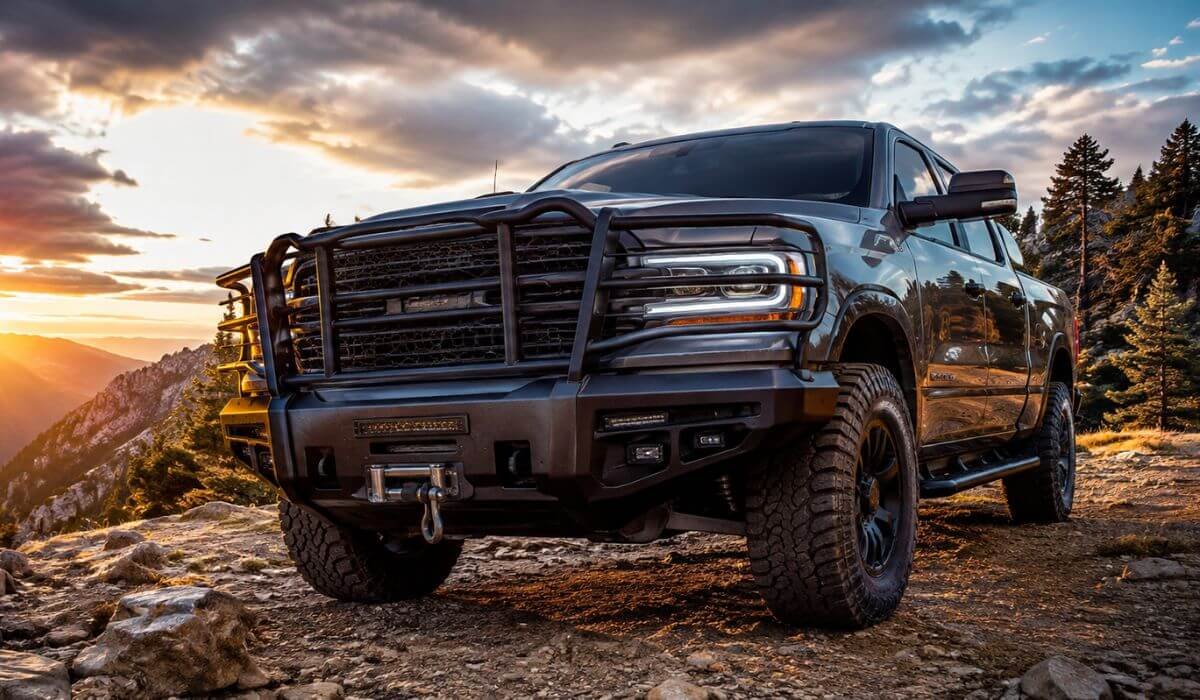
5 Best Grille Guard for Ram 1500 in 2026: Winch Mounts, Full-Front Defense & Rugged Off-Road Builds
If you drive a Ram 1500, I would not choose a grille guard simply because it looks tough in a product photo. The right setup has to match your truck’s generation, trim, front-end equipment, and the kind of protection you actually need. For this guide, I focused on real-world fitment, construction, coverage, mounting, and everyday usability rather than simply choosing the biggest-looking guard.
The Westin 57-93975 is a strong example of what I looked for, combining a one-piece steel design, welded headlight guards, wraparound wings, full punch-plate coverage, and a frame-mounted winch tray. It is listed for 2019–2026 Ram 1500 applications, with specific trim and Classic-model exclusions. That kind of detail matters because a grille guard can look perfect on the screen and still be the wrong choice for your exact truck.
The rest of this guide follows the same approach: real fitment first, useful protection second, and features that actually matter in the real world. Whether you drive your Ram every day, take it down rough roads, or are building it for serious off-road use, the goal is simple—to help you choose a guard that fits the truck properly and earns its place on the front end.
Best Ram 1500 Grille Guard: Top 2026 Picks for Bull Bars, Skid Plates & Trail Use
#1. Westin 57-93975 HDX 1-Piece Winch Mount Grille Guard
Best Winch Mount Grille Guard for Ram 1500 2019–2026 — Heavy-Duty Protection for the Front End
#2. TAC 3-Inch Black Bull Bar Brush Bumper Guard
Best Bull Bar for Ram 1500 2025–2026 — Compact 3-Inch Off-Road Protection and Added Front-End Defense
#3. BLACK HORSE 17DG111MA Modular Grille Brush Bumper Guard
Best Modular Brush Guard for Ram 1500 2019–2026 — Versatile Front-End Coverage for Daily and Off-Road Use
#4. BLACK HORSE Rugged Heavy-Duty Grille Guard
Best Heavy-Duty Grille Guard for Ram 1500 2019–2022 — Rugged Steel Protection for Tougher Driving Conditions
#5. PARTREE Bull Bar Front Bumper Guard
Best Bull Bar for Ram 1500 2009–2018 & Classic 2019–2025 — Practical Front-End Protection for Older Ram Models
Expert Tip
A grille guard should fit the truck before it impresses you. With the Ram 1500, the generation, model year, trim, and even the Classic body style can change what will actually fit behind the bumper. Start with your exact truck, then decide how much protection you really need. A newer 2025–2026 Ram may call for a very different setup than an older 2009–2018 truck or a Ram 1500 Classic.
There is also a simple mistake I would avoid: do not buy extra steel just because it looks impressive. If you mainly drive on pavement, a compact bull bar may be all you need. If you regularly travel rough trails or want recovery capability, a larger frame-mounted grille guard can make far more sense.
How We Choose These Grille Guards
We did not rank these simply by how aggressive they look in photographs or how many features a product page can fit into a bullet list. Exact fitment came first, followed by construction, protection coverage, mounting method, useful features, and the type of Ram owner each guard actually suits.
The Westin HDX 57-93975 leads the list because it brings several important pieces together: a one-piece steel construction, welded headlight guards, wraparound wings, full punch-plate coverage, and a frame-mounted winch tray. Its listed 2019–2026 application gives it particularly strong relevance for current-generation Ram 1500 owners, while its trim exclusions are clearly taken into account.
The TAC 3-inch bull bar is a different kind of choice. It is specifically listed for 2025–2026 Ram 1500s, uses carbon-steel tubing, includes a skid plate and license-plate bracket, and keeps the overall setup much lighter and more compact. We placed it where it belongs for someone who wants useful front-end protection without moving to a full-size grille guard.
The BLACK HORSE 17DG111MA earned its position because of its three-piece modular construction, frame-mounted design, removable light guards, and broad listed 2019–2026 application. Its exclusions for Rebel, TRX, Classic, and certain diesel models are important, so we treated those fitment details as part of the product’s value rather than brushing them aside.
The BLACK HORSE Rugged is a more substantial option for the specific trucks it fits, using 2.25-inch tubing and 5/16-inch vertical steel plates with a custom-punched centre grille. Its listed applications cover 2019–2022 Ram 1500 models along with certain Classic and diesel applications, while Rebel and TRX remain excluded. That makes it a targeted recommendation, not a universal one.
The PARTREE bull bar rounds out the list because it gives older Ram owners a practical route into front-end protection. Its 3-inch carbon-steel tubing, integrated LED lights, paintable trim panel, and bolt-on design make it particularly relevant to 2009–2018 Ram 1500 and 2019–2025 Classic applications. It is not trying to compete with a full winch-mounted guard, and we did not rank it as though it were.
Most importantly, we did not treat these five products as interchangeable. A winch-ready full grille guard, a modular brush guard, and a compact bull bar solve different problems. The ranking reflects what each product genuinely brings to a Ram 1500 owner, including where its fitment ends and where another option becomes the smarter choice.
That is the standard we used throughout this guide: not the loudest product, not the longest specification sheet, but the guard that makes the most sense for the truck and the job.
#1. Westin 57-93975 HDX 1-Piece Winch Mount Grille Guard
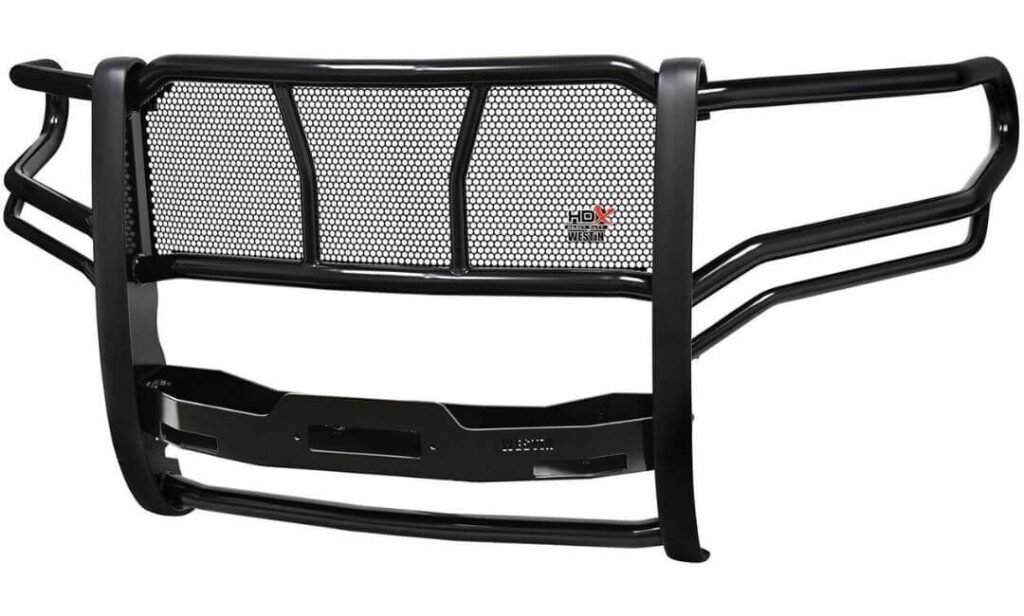
Quick Specs:
- Material: Steel
- Finish: Black powder coat
- Design: One-piece construction with welded headlight guards
- Protection: Full punch-plate grille with 2-inch wraparound wings
- Winch capacity: Suits most 8,000–12,000 lb winches up to 10.25 inches tall
- Winch tray pull rating: Tested to a 16,500 lb straight-line pull
- Mounting: Frame-mounted tray with included hardware
- Weight: 183 lb
- Dimensions: 91 × 35 × 35 inches
- Warranty: 3-year limited manufacturer warranty
Some grille guards look tough in a listing photo but leave you wondering what you are actually getting once you start looking at the construction. This one is different. The one-piece steel body, welded headlight guards and full punch-plate grille give the front of the truck a properly built-up feel rather than simply adding a decorative bar across the bumper.
The winch setup is the bigger story here. The tray mounts directly to the vehicle frame and is tested to a 16,500 lb straight-line pull, while the design accommodates most 8,000–12,000 lb winches up to 10.25 inches tall. That makes this a much more serious choice for someone who actually expects the truck to work off-road, rather than buying a guard purely for appearance.
There is also a practical detail I like: the 2-inch full-wraparound wings extend the protection beyond the centre grille area, while the welded headlight guards finish the job without making the structure look unnecessarily complicated. At 183 lb, it is certainly not a lightweight accessory, but that weight tells you this is built around substantial steel rather than a thin cosmetic shell. (In other words, this is the kind of front-end hardware you notice for the right reasons.)
What We Like About It
- The winch tray is genuinely useful, not just an added styling feature, with support for common 8,000–12,000 lb setups.
- One-piece construction keeps the front end looking clean while the welded headlight guards add useful coverage.
- The full punch plate gives the grille area proper shielding, especially for drivers who spend time on rough roads.
- Frame-mounted support is the right approach for a winch-equipped build because the load is carried through the truck rather than relying on the grille guard alone.
- The black finish suits a working truck, giving it an aggressive appearance without turning the front end into visual clutter.
What We Would Keep in Mind
The only thing worth planning for is the installation effort. At 183 lb and with frame-mounted hardware, this is much easier with another person helping during positioning and fastening. That is not a flaw in the guard; it is simply the reality of fitting a substantial steel assembly to the front of a full-size pickup.
Ram 1500 Fitment You Should Check Before Ordering
This is designed for the 2019–2026 Ram 1500, but fitment is not universal across every Ram wearing that badge. It does not fit the 2019–2024 Ram 1500 Classic, Rebel, Warlock or TRX, so checking the exact trim is more important than simply checking the model year.
If your truck falls within the listed standard Ram 1500 applications, the included mounting kit and frame-mounted tray make the installation path fairly straightforward. Because of the guard’s size and weight, having a second person for positioning is the sensible move, particularly when lining up the frame brackets and securing the assembly.
The Insider Pro-Tip
If you are buying this specifically because you want a winch-equipped Ram 1500, choose the winch first and check its physical height against the 10.25-inch maximum rather than assuming every 8,000–12,000 lb winch will sit perfectly. Rated capacity alone does not tell you whether the actual package will clear the tray and front structure.
And if you are considering it mainly for protection, do not let the winch capability make the decision for you. The real value here is the combination of steel construction, wraparound wings, headlight protection and a full punch-plate grille. If your exact Ram 1500 trim is compatible and you want one front-end setup that can serve both protection and recovery duties, this is the sort of choice that makes sense long after the aggressive look stops being new.
#2. TAC 3-Inch Black Bull Bar Brush Bumper Guard
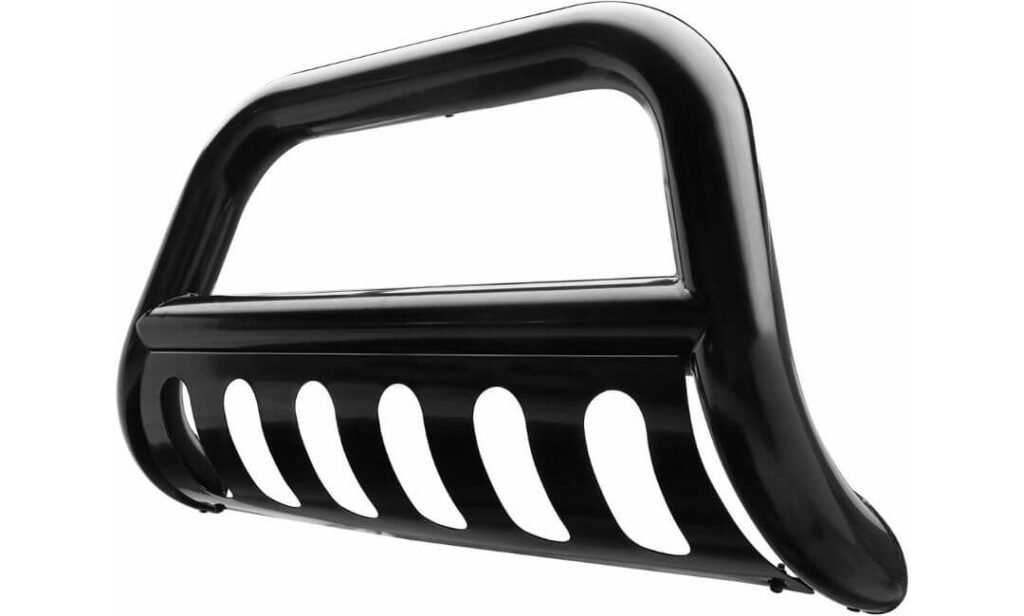
Quick Specs:
- Fitment: 2025–2026 Ram 1500
- Material: Carbon steel
- Tube size: 3 inches
- Finish: Gloss black
- Design: Bull bar with integrated skid plate
- Protection: Front bumper and lower-front coverage
- License plate: Dedicated relocation bracket included
- Installation: Direct bolt-on; no cutting or drilling
- Weight: 37.5 lb
- Dimensions: 49.2 × 22.8 × 9.8 inches
- Warranty: 2-year manufacturer warranty
Here is where this bull bar earns its place: it is built specifically around the 2025–2026 Ram 1500, rather than trying to cover a decade of different front-end designs. The 3-inch carbon-steel tubing gives the truck a noticeably stronger front profile while the included skid plate adds useful protection underneath the bumper area. It is a much more compact approach than the large one-piece guards above it.
The gloss-black finish is another practical touch. It keeps the accessory looking at home on a newer Ram instead of making the front end look overly busy, while the carbon-steel construction is designed to handle everyday exposure to road debris, weather and general wear. The CNC-bent tubing also gives the bar its clean curved shape rather than the rough, boxy appearance some universal-style guards can have.
Installation is refreshingly straightforward on paper: it is a direct bolt-on setup with no drilling or cutting, and a dedicated license-plate bracket is included for relocation. At 37.5 lb, it is also considerably easier to handle than a full-size grille guard. There is one thing I would verify before ordering, though: TAC notes that the bar may interfere with front bumper-mounted sensors, so checking the exact trim and sensor arrangement is worth doing first. (That small check can save a very annoying installation day.)
What We Like About It
- Specific 2025–2026 fitment makes it a focused choice for owners of the latest Ram 1500.
- 3-inch carbon-steel tubing gives meaningful structure without the bulk of a full grille guard.
- Included skid plate adds protection below the main bumper line.
- License-plate relocation bracket means you are not left improvising a mounting solution afterward.
- No-cut, no-drill installation keeps the setup relatively clean for a modern truck.
One Thing We Would Check
The front bumper sensor clearance deserves attention before purchase. TAC itself advises confirming compatibility with the specific trim, so I would treat that as part of the fitment check rather than assuming every 2025–2026 Ram 1500 has identical sensor placement.
Built Specifically for the Latest Ram 1500
Unlike the broader-fit guards in this roundup, this one is listed specifically for the 2025–2026 Ram 1500. That makes it a particularly relevant option if you own a newer truck and want a smaller front-end accessory rather than a large frame-mounted grille guard.
The bolt-on design also means you are not committing to cutting or drilling the factory bumper just to get it installed. If your particular truck clears the sensor requirements, the included hardware and license-plate bracket make the setup much more straightforward than the intimidating appearance might suggest.
The Insider Pro-Tip
For a 2025–2026 Ram 1500, I would choose this based on how much protection you actually want, not because a bull bar looks aggressive. If you mainly want a tougher front profile, some protection from minor road debris and a skid plate without adding nearly 200 lb of hardware, this compact design makes a lot of sense.
Before clicking buy, spend two minutes confirming your exact trim and front bumper sensor setup with the seller. That is the one check I would never skip here. Get that right, and you have a clean, purpose-built accessory that adds protection without swallowing the entire front of a modern Ram.
#3. BLACK HORSE 17DG111MA Modular Grille Brush Bumper Guard
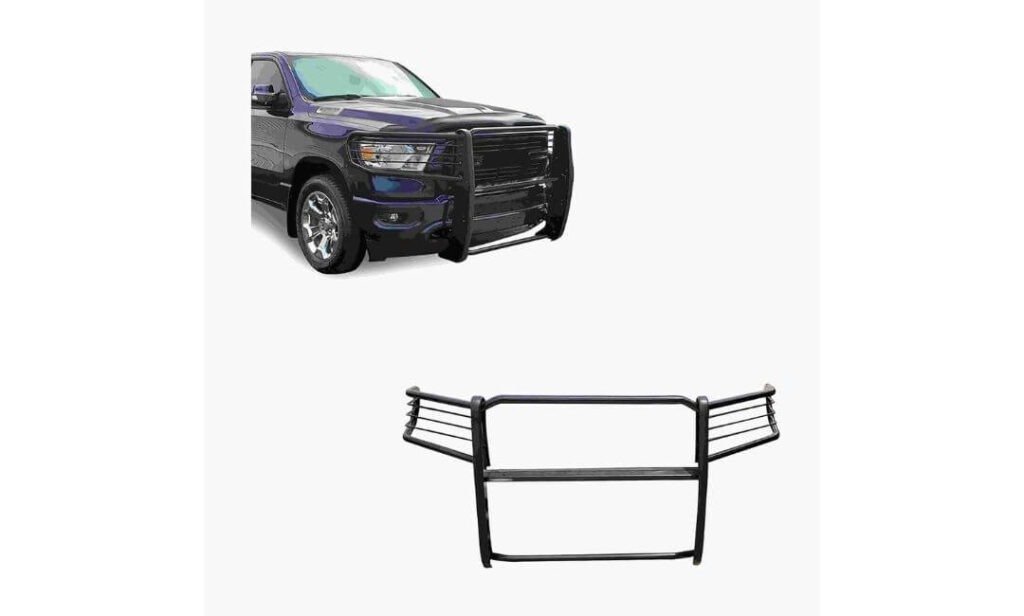
Quick Specs:
- Fitment: 2019–2026 Ram 1500
- Material: Mild steel
- Tubing: 1.5-inch, 16-gauge cold-rolled steel
- Reinforcement: ¼-inch HRPO vertical steel plates
- Construction: 3-piece modular bolt-together design
- Finish: Powder coat over corrosion-resistant E-coat
- Light guards: Removable
- Mounting: Frame-mounted, no-drill bolt-on
- Bumper protection: Vertical vinyl straps
- Weight: 88 lb
- Dimensions: 47 × 12 × 39 inches
- Lighting: Compatible with optional Halogen, LED and OEM-style fog lights
The interesting thing here is not simply that it is a steel grille guard. It is the modular design. The three-piece construction lets you build around the way you actually use the Ram 1500, while the removable front light guards give you the option to keep the front end more open for everyday driving or add that extra layer of protection when the truck sees rougher ground.
Underneath the finish, Black Horse uses 1.5-inch 16-gauge mandrel-bent mild steel tubing with ¼-inch HRPO vertical plates. That combination gives the guard a more substantial structure without going to the enormous weight of a full winch-mount setup. The frame-mounted, no-drill design is another genuine advantage because the hardware is designed around the vehicle rather than asking you to modify the front end.
I also like the small details here. The E-coat underneath the powder coating gives the finish another layer of corrosion resistance, while the vertical vinyl straps are there to help prevent little bumps and scrapes from becoming annoying marks on the truck. Add the removable light guards and optional lighting compatibility, and this becomes more than a fixed piece of steel sitting across the grille. (It gives you room to tailor the front end instead of accepting one rigid setup.)
What We Like About It
- Modular construction gives this guard more flexibility than a conventional fixed design.
- ¼-inch vertical steel plates add meaningful reinforcement where the guard needs strength.
- Removable light guards make sense for owners who switch between daily driving and off-road use.
- E-coat plus powder coat is a thoughtful finish combination for a truck that sees changing weather and road conditions.
- 88-pound weight keeps it substantial without reaching the extreme heft of a full winch-mounted guard.
What We Would Keep in Mind
The main thing is simply to check the exact Ram configuration before ordering. This guard has broad 2019–2026 coverage, but the exclusions are important rather than minor: Rebel and TRX trims, 2019–2024 Ram 1500 Classic models, and 2020–2022 Ram 1500 diesel models are not covered.
A Better Fit for Owners Who Want Options
For the 2019–2026 Ram 1500, this is an appealing middle ground between a compact bull bar and a much heavier winch-ready grille guard. You get frame-mounted steel construction, removable guards and room for optional lighting without turning the truck into an unnecessarily complicated build.
Installation is also refreshingly straightforward. The application is designed for no-drill bolt-on mounting, with the mounting brackets, hardware and instructions included. You still want to take your time during positioning, especially because a modular three-piece guard needs to sit correctly before everything is fully tightened.
The Insider Pro-Tip
If your Ram spends most of its life on the road but occasionally heads somewhere rough, I would pay particular attention to the removable light guards and modular construction. Those details are what make this more versatile than a guard that is permanently configured for one type of driving.
And do not let the 2019–2026 headline fool you into thinking it fits every Ram with those years stamped on the registration. Trim and drivetrain exclusions matter here. Verify your exact truck first, then choose the guard for the way you actually drive. When those two things line up, this is a smart option for getting genuine front-end structure without going straight to a massive winch-mount setup.
#4. BLACK HORSE Rugged Grille Guard
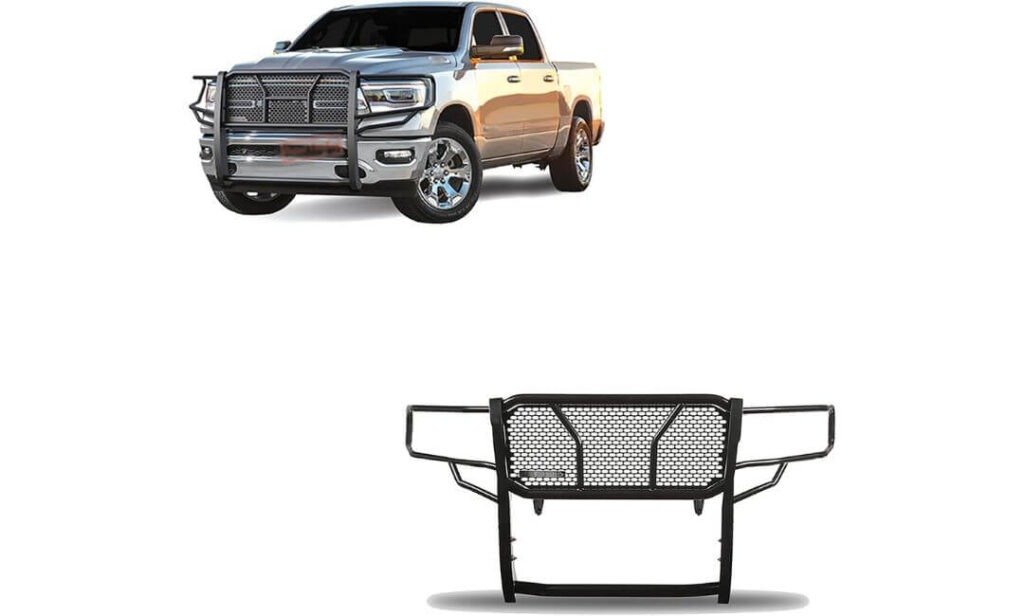
Quick Specs:
- Fitment: 2019–2022 Ram 1500
- Additional coverage: 2019–2023 Ram 1500 Classic; 2020–2022 Ram 1500 Diesel
- Exclusions: Rebel and TRX trims
- Material: Alloy steel / cold-rolled mild steel
- Tubing: 2.25-inch, 16-gauge mandrel-bent steel
- Vertical plates: 5/16-inch HRPO steel
- Centre protection: Custom-punched grille
- Construction: 3-piece modular bolt-together design
- Finish: Powder coat over corrosion-resistant E-coat
- Mounting: Frame-mounted, no-drill bolt-on
- Weight: 99.2 lb
- Dimensions: 48 × 40 × 17 inches
- Lighting: Provision for optional LED lighting
There is a noticeable difference when a grille guard is built around thick vertical plates and properly formed steel tubing rather than just adding a couple of bars to the front bumper. This one uses 2.25-inch, 16-gauge cold-rolled tubing with substantial 5/16-inch HRPO plates, giving the front of the Ram a much more planted feel without turning it into a winch-heavy setup.
The centre section is another detail worth noticing. The custom-punched grille adds coverage directly across the middle while still letting the original front-end design show through. Combined with the frame-mounted construction, it makes the guard feel like part of the truck rather than an accessory sitting on top of it. The three-piece design also makes handling and assembly more manageable than dealing with one enormous steel assembly.
Then there is the finish, which is easy to overlook until a truck starts seeing real weather. Black Horse puts a high-impact powder coat over an E-coat layer, giving the steel another line of defence against corrosion. It is a sensible combination for a truck that works outside, travels on gravel or simply spends a lot of time exposed to road moisture. (The rugged appearance is nice, but the construction underneath is what really earns this spot.)
What We Like About It
- 2.25-inch steel tubing gives it a noticeably stronger structure than lighter front guards.
- 5/16-inch vertical plates provide substantial reinforcement around the outer sections.
- Custom-punched centre grille adds coverage without completely hiding the Ram’s front-end styling.
- E-coat beneath the powder coat is a worthwhile detail for long-term exposure to weather and road grime.
- Modular three-piece construction makes the guard more practical to handle during installation and removal.
One Detail Worth Checking First
The front parking or driver-assistance sensors deserve a fitment check before installation. The manufacturer notes that sensor interference is possible, so owners with factory-mounted sensors should confirm clearance for their particular truck rather than assuming the same setup works across every trim.
A Stronger Choice for Earlier Ram Builds
For a 2019–2022 Ram 1500, this makes sense when you want something more substantial than a basic bull bar but do not need the dedicated winch setup of the Westin above it. The 99.2-pound construction, punched centre section and heavy vertical plates give it a proper protective role while keeping the design relatively clean.
It also covers 2019–2023 Ram 1500 Classic and 2020–2022 Ram 1500 Diesel applications as listed, although the exact truck configuration still matters. The no-drill frame-mounted setup comes with the brackets, hardware and instructions, so there is no need to start modifying the front end just to get the guard mounted.
The Insider Pro-Tip
Before installation, look underneath the truck and confirm whether your factory air dam, shutters, tow hooks or sensor equipment will affect the mounting area. This is one of those jobs where five minutes of checking beforehand can make the whole installation feel dramatically easier.
For the right Ram, I would choose this specifically for its 5/16-inch steel plates and 2.25-inch tubing. Those are not just numbers for a specification sheet—they explain why this guard feels more serious than a small bumper bar. If your truck falls within the listed fitment and you want stronger front-end coverage without stepping into a full winch-mounted system, this is a very sensible middle ground.
#5. PARTREE Bull Bar Front Bumper Guard
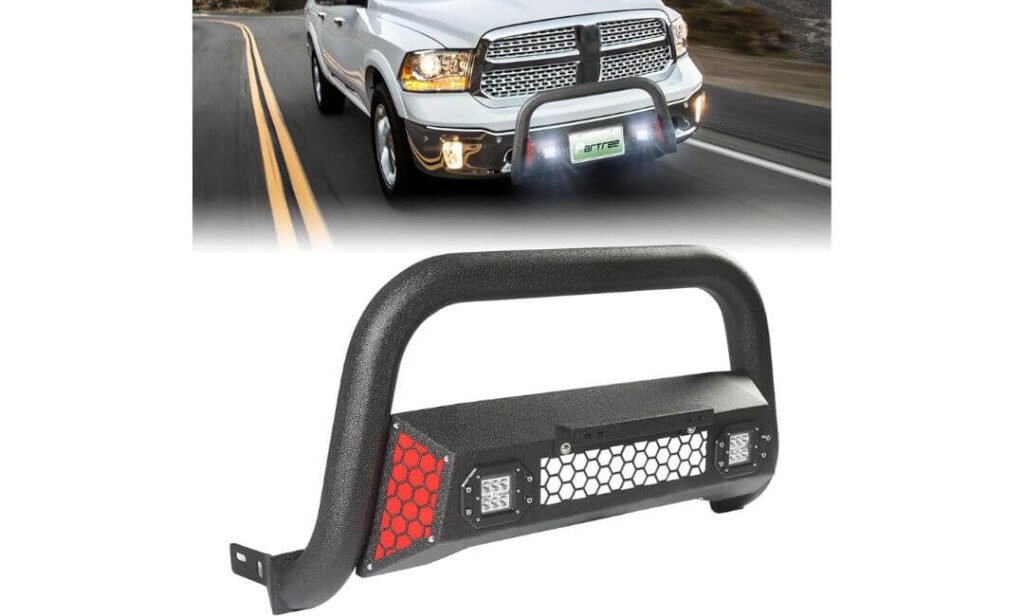
Quick Specs:
- Fitment: 2009–2018 Ram 1500
- Classic coverage: 2019–2025 Ram 1500 Classic
- Exclusions: Rebel, Warlock and Sport trims
- Material: Thickened carbon steel
- Tube size: 3 inches
- Finish: Black powder coat
- Lighting: Integrated LED lights
- License plate: Included relocation bracket
- Trim panel: Paintable for custom colour matching
- Installation: Bolt-on, no drilling
- Radar compatibility: Not supported on trucks with front radar systems
For an older Ram 1500, you do not necessarily need to bolt on a huge grille guard just to make the truck more capable. This 3-inch carbon-steel bull bar takes a simpler route: it adds a stronger visual and physical barrier around the front bumper while keeping the overall setup relatively compact. That makes it particularly interesting for owners of the 2009–2018 trucks and the later Classic models.
The integrated LED lights are probably the feature that separates this from a basic bull bar. If the truck regularly sees poorly lit roads or occasional trail driving after dark, having additional forward lighting built into the setup is genuinely useful rather than being there purely for looks. The included license-plate bracket also saves you from figuring out where the plate goes once the bar is installed.
Another nice touch is the paintable trim panel. You can leave it black for a straightforward factory-style appearance or match it to the truck if you are building something more personalised. Underneath all that, the carbon-steel tubing and powder-coated finish are designed to handle everyday exposure to weather and road grime. (It is a fairly simple idea, but the useful extras make it more than just another black bar across the bumper.)
What We Like About It
- 3-inch carbon-steel tubing gives the bar a substantial presence without the bulk of a full grille guard.
- Integrated LED lighting adds genuine usefulness for dark-road and trail driving.
- Paintable trim panel gives owners an easy way to personalise the front end.
- Included license-plate bracket keeps the installation looking finished.
- No-drill bolt-on design makes it a practical choice for an older truck that you do not want to modify permanently.
One Fitment Detail We Would Not Ignore
This bull bar is not designed for every Ram 1500 configuration. Rebel, Warlock and Sport trims are excluded, and trucks equipped with a front radar system are not supported. That check is worth making before ordering, particularly on later Classic models where equipment can vary.
Made for Older Ram 1500s and the Classic
The strongest reason to consider this one is its specific coverage. It fits 2009–2018 Ram 1500 models and extends to 2019–2025 Ram 1500 Classic applications. So if your truck is outside the newer-generation fitment of the first three choices, this gives you a dedicated option rather than forcing a questionable universal fit.
The bolt-on installation requires no drilling, with mounting hardware and instructions supplied. That makes it a sensible route for an owner who wants a tougher front end, extra lighting and some added protection without turning the installation into a fabrication project.
The Insider Pro-Tip
I would look at this one as an older-Ram specialist, not as a cheaper substitute for a full grille guard. If you want maximum grille coverage, one of the larger guards higher in this list makes more sense. But if your priority is a cleaner bull-bar profile, useful LED lighting and straightforward bolt-on installation, this setup fits that brief very well.
Most importantly, check the front radar system and exact trim before ordering. Once those two boxes are clear, the combination of 3-inch tubing, integrated lights and a paintable centre panel gives an older Ram a surprisingly complete front-end upgrade without making the truck look like it is wearing more hardware than it needs.
Best Ram 1500 Grille Guards Compared for Fitment and Front-End Protection (2009–2026)
| Grille Guard | Ram 1500 Fitment | Build & Protection | Winch / Lighting | Installation | Best Use | Our Take |
|---|---|---|---|---|---|---|
|
Westin 57-93975 HDX
Best Overall
The most complete setup in this group
|
2019–2026 Excludes 2019–2024 Classic, Rebel, Warlock and TRX |
Steel 1-piece construction 2-inch wraparound wings Full punch-plate grille Welded headlight guards |
Winch-ready 8,000–12,000 lb winches Tray tested to 16,500 lb straight-line pull |
Frame-mounted Hardware included Best handled with assistance due to 183-lb weight |
Serious off-road builds Recovery-focused trucks Maximum front-end coverage |
Our #1 Pick The one to choose when protection and recovery capability matter more than keeping the setup small. |
|
TAC 3-Inch Bull Bar
Newer Ram Pick
Compact alternative for the latest trucks
|
2025–2026 Vehicle-specific fit |
Carbon steel 3-inch tubing Included skid plate Gloss-black finish |
No winch tray License-plate bracket included |
Direct bolt-on No cutting or drilling Professional installation recommended |
Daily-driven newer Rams Light off-road use Compact front protection |
Best for 2025–2026 A cleaner choice when you want useful protection without covering the whole front end. |
|
BLACK HORSE 17DG111MA
Best Modular Design
Flexible setup with removable light guards
|
2019–2026 Excludes Rebel, TRX, 2019–2024 Classic and 2020–2022 Diesel models |
Mild steel 1.5-inch 16-gauge tubing ¼-inch HRPO vertical plates 3-piece modular construction |
Optional lighting support Removable front light guards LED and fog-light compatibility |
Frame-mounted No drilling Hardware and brackets included |
Mixed daily/off-road use Custom lighting builds Owners wanting flexibility |
Most Flexible A smart middle ground when you want more than a bull bar without going all the way to a winch guard. |
|
BLACK HORSE Rugged Grille Guard
Heavy-Duty Pick
Substantial steel without a dedicated winch tray
|
2019–2022 Also listed for 2019–2023 Classic and 2020–2022 Diesel models |
Cold-rolled steel 2.25-inch 16-gauge tubing 5/16-inch HRPO vertical plates Custom-punched centre grille |
Optional LED-light provision No dedicated winch tray |
Frame-mounted No drilling 3-piece bolt-together design |
Rough-road use Earlier Ram builds Owners wanting stronger grille coverage |
Built Tough Its thicker vertical plates make it the more serious choice when front-end structure is the priority. |
|
PARTREE Bull Bar
Best for Older Rams
Simple protection with useful extras
|
2009–2018 2019–2025 Ram 1500 Classic Excludes Rebel, Warlock and Sport |
Carbon steel 3-inch tubing Black powder coat Paintable trim panel |
Integrated LED lights License-plate bracket included |
Bolt-on No drilling Hardware and instructions included |
Older Ram 1500s Classic models Night trail driving |
Practical Choice A sensible fit for older Rams when you want lighting, styling and basic front-end protection in one package. |
Buyer’s Guide to Choosing the Best Grille Guard for Ram 1500
A good grille guard is not a universal Ram accessory. The right choice depends on your truck’s exact generation, trim, front-end equipment, and how you actually use it. The five options in this guide are deliberately different, so the goal is not to find the biggest-looking guard; it is to find the one that makes sense for your particular Ram.
Start With Exact Year and Trim Fitment
This is the first check I would make before looking at steel thickness or styling. The 2019–2026 Ram 1500 and Ram 1500 Classic are not the same front-end application, and trim exclusions matter.
For example, the Westin HDX fits listed 2019–2026 Ram 1500 applications but excludes the 2019–2024 Classic, Rebel, Warlock, and TRX. The BLACK HORSE modular guard has its own exclusions, while the PARTREE bull bar is aimed at 2009–2018 Ram 1500 and 2019–2025 Ram 1500 Classic models. That is why simply seeing “Ram 1500” in a product title is not enough.
If you drive a 5th-generation Ram 1500, look specifically for a vehicle-specific application rather than assuming a guard designed for the Classic will transfer over. The same applies to Rebel, TRX, Warlock, Sport, and diesel configurations where the manufacturer lists exclusions.
Decide How Much Front-End Coverage You Actually Need
Think about the job before choosing the shape.
A full grille guard makes more sense when you want protection across the grille, headlights, and wider front section. The Westin HDX is the clearest example here, with its full punch-plate grille, welded headlight guards, and wraparound wings.
A bull bar is a different proposition. It gives you a more compact structure around the bumper area and can make sense for a daily-driven Ram that occasionally sees rough roads. The TAC and PARTREE options follow this approach.
Then there is the middle ground. The BLACK HORSE modular and Rugged guards provide more substantial grille coverage while keeping a modular three-piece construction. For a Ram 1500 4×4, that distinction matters because your ideal setup may depend on whether the truck is primarily a road vehicle, a work truck, or something that regularly sees trails and rough access roads.
Match the Guard to Your Off-Road Plans
If your idea of off-roading means gravel roads, uneven access roads, and occasional trail use, you may not need the largest guard available.
For more demanding builds, a frame-mounted full grille guard is the more convincing route. The Westin stands out because its mounting system is designed around a winch tray, with support for most 8,000–12,000 lb winches and a tested 16,500 lb straight-line pull rating.
If recovery equipment is not part of your plan, a bull bar can be a more sensible choice. You are not carrying a large winch tray and heavy grille structure simply because it looks tough.
Check Winch and Recovery Compatibility
If you are searching for the best grille guard for Ram 1500 with winch capability, do not stop at “winch-ready” in a product title.
Check the actual winch dimensions and mounting arrangement. The Westin tray accommodates most 8,000–12,000 lb winches up to 10.25 inches tall. That physical clearance is just as important as the winch’s advertised pulling capacity.
A bull bar without a dedicated winch tray should not be treated as an equivalent recovery setup. It can still provide useful front-end protection, but the two products are designed for different jobs.
Look at the Steel Construction, Not Just the Finish
Steel is only part of the story. Tube diameter, gauge, plate thickness, construction method, and frame mounting tell you much more about how substantial a guard actually is.
The BLACK HORSE modular guard uses 1.5-inch 16-gauge steel tubing with ¼-inch HRPO vertical plates, while the Rugged model moves to 2.25-inch tubing and 5/16-inch vertical plates. Those differences help explain why the Rugged guard feels like the heavier-duty choice.
The finish matters too. Powder coating gives the exterior a clean appearance and helps deal with everyday exposure, while an E-coat beneath the powder coat adds another layer of corrosion resistance on the BLACK HORSE options.
Think About Sensors Before Installation
Modern Ram trucks can have front-mounted sensors that do not leave much room for guesswork.
The TAC bull bar specifically notes that it may interfere with front bumper-mounted sensors, and the BLACK HORSE Rugged guard carries a similar sensor-clearance consideration. This is not something I would discover after everything is bolted together.
If your Ram has parking sensors, radar, collision-detection equipment, or other factory hardware around the bumper, confirm compatibility for the exact trim before ordering. A grille guard that physically fits but disrupts factory equipment is not a successful fit.
Compare Mounting Style and Installation Reality
All five choices here are based around bolt-on installation, but that does not mean every installation will feel equally simple.
A smaller bull bar is generally easier to handle than a 183-pound full grille guard. The Westin HDX is a substantial frame-mounted assembly, so having another person available during positioning is simply sensible.
The BLACK HORSE products use modular three-piece construction, which can make handling individual sections easier. You should still allow extra time if your truck has factory air dams, shutters, tow hooks, sensors, or other equipment around the mounting area.
And if the product instructions or your truck’s configuration make the job questionable, professional installation is money better spent than forcing a bracket into the wrong position.
Do Not Ignore Lights and Accessories
Lighting can change which guard makes the most sense.
The BLACK HORSE modular guard has removable light guards and supports optional lighting configurations. The Rugged model also provides provision for optional LED lighting. The PARTREE bull bar goes further with integrated LED lights and a dedicated license-plate bracket.
That makes these products particularly interesting if your Ram spends time on dark trails or poorly lit roads.
The important thing is to treat lighting as a useful feature, not the main reason to choose a grille guard. Fitment and protection come first; accessories come second.
Consider Weight and Front-End Balance
A grille guard becomes part of the truck’s front-end hardware, so weight is worth considering.
The Westin weighs around 183 pounds, while the BLACK HORSE modular and Rugged guards are approximately 88 and 99.2 pounds respectively. The TAC bull bar is much lighter at around 37.5 pounds.
That does not automatically make one better than another. It simply shows how different these products are in purpose. A heavy winch-ready guard brings substantially more hardware to the front of the truck, while a compact bull bar gives you a lighter approach.
Make Maintenance Part of the Decision
Even a well-finished steel guard deserves occasional attention.
After muddy trips, wash the areas around the mounting points, brackets, and lower sections where dirt and moisture can sit. Check the powder-coated surface for chips or exposed metal, particularly after gravel-road driving. Pay extra attention to hardware and frame-mounted areas because those are the places most likely to collect road grime.
If the guard includes removable light guards, brackets, or other modular pieces, those parts should also be checked periodically. A few minutes of inspection is much easier than discovering corrosion or a loose mounting point months later.
Match the Guard to Your Ram 1500 Build
For the best grille guard for Ram 1500 5th gen, focus on exact 5th-generation fitment and the truck’s trim before anything else.
For the best grille guard for Ram 1500 4×4, decide whether you need a compact bull bar for occasional rough use or a full frame-mounted guard for more serious protection.
For the best grille guard for Ram 1500 off road, look closely at coverage, frame mounting, steel construction, winch support, and lighting options rather than choosing based on aggressive styling alone.
And for the best grille guard for Ram 1500 with brush guard protection, pay attention to how far the guard extends around the headlights and grille, because that coverage is what separates a proper grille guard from a simple centre bull bar.
The Final Fit Check Before You Buy
Before placing the order, verify model year, trim, Classic versus standard Ram 1500, sensor equipment, bumper configuration, tow-hook requirements, and mounting clearance.
Then look at what you actually want from the accessory. If you need a winch-ready setup and broad protection, the Westin is the obvious direction. If you have a newer 2025–2026 Ram and want something considerably more compact, the TAC makes more sense. If flexibility is the priority, the BLACK HORSE modular design has a strong case. For earlier Ram applications, the Rugged and PARTREE options become more relevant.
That is the real point of this comparison: there is no single “best” grille guard for every Ram 1500. The best one is the guard whose fitment, protection level, hardware, and intended use actually line up with your truck.
Grille Guard for Ram 1500 Installation: A Practical Step-by-Step Overview
Installing a grille guard is one of those jobs that looks straightforward when the truck is sitting in the driveway, but the details around frame brackets, bumper clearance, sensors, and weight are what determine whether the finished installation feels factory-correct. The exact procedure varies by guard and Ram configuration, so the manufacturer’s instructions should always be treated as the final authority for bracket positions and torque values.
Get the Truck and Hardware Ready First
Before touching the factory bumper, park the Ram on a level, stable surface, engage the parking brake, and give yourself enough room to work safely around the front end.
Have the basic tools ready, along with the supplied mounting hardware and instructions. Depending on the particular application, you may need a socket set, ratchet, extensions, wrenches, torque wrench, trim-removal tools, and a second person to help hold and position the guard.
Lay every bracket and fastener out before starting. This sounds basic, but it makes a difference with multi-piece guards because mixing mounting hardware during installation can create unnecessary confusion.
Most importantly, confirm the fitment before installation. Check the exact model year and trim, then inspect the bumper for parking sensors, radar equipment, cameras, tow hooks, air dams, shutters, or other factory components that could occupy the same area as the mounting brackets.
Protect the Factory Front End Before Removing Anything
Put a protective covering over areas that could be scratched while positioning the guard. A heavy steel assembly can mark paint surprisingly easily when it is being held close to the bumper.
If the installation instructions call for removing tow hooks, air dams, grille sections, or other factory pieces, photograph their original position before taking them off. It gives you a useful reference if something needs to be returned to stock later.
Do not assume every Ram 1500 has the same hardware underneath. Classic and newer-generation trucks can have very different front-end layouts, which is why forcing a bracket into place is never a good installation strategy.
Test-Fit the Main Structure Before Tightening Anything
The best approach is to loosely assemble first and tighten later.
Position the mounting brackets according to the supplied instructions, then have a second person hold the guard while you check the alignment from several angles. Look at the gap between the guard and bumper, grille, headlights, lower fascia, and any factory sensors.
At this stage, you are looking for a natural, even fit rather than trying to make everything tight immediately. Once the guard is fully aligned, install the remaining hardware and gradually tighten the mounting points.
This is especially important with a heavy full-width guard. A small alignment error at one bracket can become a surprisingly large gap at the opposite side once everything is tightened.
Secure the Frame-Mounted Hardware Correctly
Once the guard is sitting where it should, tighten the frame-mounted brackets according to the manufacturer’s sequence.
Use the specified torque values from the installation instructions rather than guessing based on how tight a bolt feels. If the supplied instructions give different torque requirements for different fasteners, follow those individually.
Do not substitute random hardware simply because it appears to fit. The supplied mounting hardware is selected for the particular application, and the frame is carrying the load of the entire accessory.
After the initial tightening, step back and check the guard again from the front and both sides. Then complete the final torque procedure.
Handle a Winch Setup as a Separate Job
If your grille guard includes a winch tray, treat the winch installation as its own stage rather than trying to install everything at once.
Before mounting the winch, confirm its physical dimensions, mounting pattern, cable or rope direction, and clearance around the tray. Rated pulling capacity alone does not tell you whether a particular winch will physically fit.
When routing electrical cables, keep them away from sharp edges, moving components, hot exhaust-related areas, and places where the wiring could be crushed by brackets. Use appropriate protective sleeves or loom where needed and secure the cables so they cannot rub against the steel structure.
If you are working directly with the vehicle’s electrical system, disconnect the battery according to the manufacturer’s guidance before making electrical connections. Reconnect it only after the wiring has been properly secured and checked.
Keep Lighting Wiring Clean and Protected
If your setup includes auxiliary lights, plan the wiring route before permanently securing anything.
The wiring should have enough slack for normal movement without forming loose loops that can catch on other components. Keep connectors protected from unnecessary water and mud exposure, and avoid routing wires directly across sharp bracket edges.
For lighting mounted to removable or adjustable sections, leave enough serviceable slack so the component can be removed later without cutting the harness.
A neat wiring job is not just about appearance. Good routing prevents vibration damage, which is particularly important on trucks that regularly travel over rough surfaces.
Check Sensors, Cameras, and Driver-Assistance Equipment
This is the step I would take most seriously on a modern Ram.
Before the installation is considered finished, inspect the area around the front parking sensors, radar equipment, and cameras. The guard should not physically obstruct a sensor or place a metal component directly where the vehicle’s system expects an unobstructed field.
After installation, turn the vehicle on and check for warning messages. Test the relevant parking-assistance or driver-assistance functions in a safe location.
If a system reports an error, do not simply ignore it because the grille guard looks perfectly aligned. A physically perfect installation can still create an electronic compatibility problem.
Where the product manufacturer specifically warns about sensor interference, confirm compatibility before purchase rather than trying to solve the issue after installation.
Check Clearance Around the Entire Front End
Walk around the truck and inspect the finished installation from every angle.
Check for:
- Bumper clearance, especially around curved or lower sections.
- Grille clearance, with no contact during normal vehicle movement.
- Headlight clearance, particularly with guards extending around the lamps.
- Sensor clearance, including any equipment positioned behind or beside the bumper.
- Tow-hook clearance, if the application retains factory recovery points.
- Air dam or shutter clearance, where fitted.
- Winch and fairlead clearance, if a recovery setup is installed.
- License-plate position, making sure it remains secure and visible.
- Wiring clearance, with no cables touching sharp or hot surfaces.
Nothing should be rubbing, pinching, or sitting under unnecessary tension.
Finish the Job With a Proper Hardware Check
Once everything is installed, perform one final inspection rather than immediately taking the truck onto a rough trail.
Check that every visible fastener is seated correctly, the brackets are properly aligned, the guard is centred, and no supplied component has been left unused without a clear reason.
After the first few drives, especially if the truck has travelled over rough roads, inspect the mounting hardware again. Vibration can reveal small alignment or fastening issues that are not obvious during a stationary installation.
For a heavy steel guard, a second inspection is cheap insurance. It takes minutes and gives you much more confidence that the assembly is staying exactly where it should.
Grille Guard for Ram 1500 Maintenance: Keep the Protection Ready for the Next Drive
A grille guard is exposed to everything the front of the truck deals with, so maintenance is not really about making it look new forever. It is about making sure the mounting points stay tight, the steel remains protected, and nothing begins moving or rubbing where it should not. A few minutes of inspection after demanding use can catch a small problem before it becomes an expensive one.
Check the Mounting Points Regularly
Start underneath and work your way around the guard. Look at the frame brackets, mounting bolts, washers, and connection points for anything that has shifted, loosened, or developed unusual marks.
For normal road use, checking the hardware during routine vehicle maintenance is a sensible habit. If the truck regularly travels on gravel, trails, construction sites, or rough access roads, inspect it more often.
Pay particular attention to places where the guard attaches to the frame. If you see a new gap, uneven alignment, or shiny metal around a bolt or bracket, it can indicate that the hardware has been moving.
Inspect Welds and Structural Areas
Do not only look at the large visible tubes. Examine the welded joints, vertical plates, bracket connections, and corners where dirt and moisture can collect.
A good weld should not suddenly develop a visible crack, separation, or unusual deformation. Likewise, a steel plate should not appear bent compared with its original position.
After a hard impact, animal strike, or serious off-road contact, give the entire structure a closer inspection rather than assuming that a guard that still looks straight is automatically fine.
Keep Mud and Road Salt From Sitting on the Steel
Mud is not a problem simply because it makes the guard dirty. The bigger issue is what happens when moisture, salt, and dirt remain trapped around brackets and seams.
After driving through deep mud, rinse the guard thoroughly with clean water. If you live where roads are treated with salt, regular rinsing is even more important because salt residue can accelerate corrosion around exposed areas and hardware.
Use a mild automotive soap when deeper cleaning is needed. Avoid aggressive chemicals, abrasive pads, or anything likely to damage the protective finish.
Protect the Powder-Coated Finish
The black finish does more than make the guard look good; it is part of the protection against the environment.
If a stone chips the coating and exposes bare metal, clean and dry the area rather than leaving it untreated. Small chips are much easier to deal with while they are still small.
Do not attack the surface with harsh solvents simply because the guard has accumulated road grime. A gentle wash, thorough rinse, and proper drying will generally do more good than aggressive cleaning.
Give the Hardware a Seasonal Check
There is no universal re-tightening interval that applies to every grille guard, so the manufacturer’s installation instructions should remain the authority for torque requirements.
As a practical habit, inspect the mounting hardware at least seasonally, and check it sooner after heavy off-road driving, rough-road impacts, or extended vibration.
Do not simply put a socket on every bolt and tighten everything as hard as possible. If a fastener needs attention, use the manufacturer’s specified torque rather than guessing. Over-tightening can be just as unhelpful as leaving hardware loose.
Pay Extra Attention After Off-Road Trips
A truck that spends weekends on trails deserves a different inspection routine from one that only sees pavement.
After a demanding trip, look for fresh scratches, bent brackets, chipped coating, loose hardware, damaged wiring, and contact marks between the guard and the bumper or grille.
If the guard carries auxiliary lights or a winch, inspect those mounting points and wiring at the same time. Vibration can gradually work on connections even when there has been no obvious impact.
Know When a Bracket Needs Replacing
A mounting bracket should not be treated as something that can simply be straightened indefinitely.
Replace a bracket if it has been cracked, badly bent, distorted around a mounting hole, or visibly weakened after an impact. Using a damaged bracket because it still bolts into place defeats the purpose of having a properly mounted guard.
Always use the correct replacement hardware and brackets specified for the particular application. Universal substitutes may look similar but can change how loads are transferred into the frame.
Watch the Bushings and Contact Points
Where the design uses bushings, isolators, or protective contact pieces, inspect them for crushing, splitting, excessive movement, or deterioration.
These small components can prevent metal-on-metal contact and help keep the guard properly positioned. If one has deteriorated, replacing it early is preferable to allowing the surrounding hardware to start wearing against another surface.
Also check any vinyl or rubber protective pieces around the bumper or grille area. If they have moved out of position, restore them before the guard begins rubbing directly against the truck.
Check Sensor and Accessory Clearance Again
Maintenance is also a good opportunity to confirm that nothing has gradually shifted into the path of front parking sensors, radar equipment, cameras, or auxiliary lighting.
If the truck develops a new warning message after an impact or rough trip, inspect the guard and its mounting position before assuming the vehicle’s electronics have developed a separate problem.
The same applies to a winch, fairlead, license-plate bracket, or light wiring. Accessories should remain firmly mounted and should not be allowed to contact moving or hot components.
Replace the Guard When the Structure Is Compromised
Cosmetic scratches are one thing. Structural damage is another.
A guard that has suffered a serious collision, developed cracked welds, severely bent tubing, or major deformation should be professionally assessed before the truck is driven as though nothing happened.
The purpose of a grille guard is to provide protection while remaining securely attached to the vehicle. Once its structural integrity has been compromised, replacing the affected component or the complete guard is the safer approach.
A Simple Maintenance Routine That Actually Works
For most owners, the routine does not need to become complicated:
- Everyday driving: inspect the guard during normal vehicle maintenance.
- After mud or salt exposure: rinse thoroughly and clean before residue sits on the finish.
- After heavy off-road use: inspect brackets, bolts, welds, wiring, and contact points.
- Seasonally: check mounting hardware and corrosion-prone areas.
- After an impact: inspect the entire structure before continuing normal use.
- When replacing parts: use application-specific brackets, hardware, bushings, or replacement components wherever available.
The best grille guard is one you eventually stop thinking about because it simply stays secure, aligned, clean, and ready. That is what good maintenance should accomplish.
Real-World Use Cases and User Tips for a Ram 1500 Grille Guard
The right grille guard depends less on how aggressive the truck looks parked outside the house and more on what the truck actually does when you leave the pavement. A daily-driven Ram, a weekend trail truck, and a work truck can all benefit from front-end protection, but they do not necessarily need the same type of guard.
Weekend Warrior: Protection Without Making the Truck Miserable to Drive
A lot of Ram 1500 owners fall into this category. The truck handles school runs, commuting, shopping, and highway miles during the week, then gets pointed toward a trail or campsite on the weekend.
For that kind of use, I would avoid choosing a guard purely because it is the largest one available. A moderate-weight modular guard or compact bull bar can provide useful front-end protection without adding a huge amount of hardware to the nose of the truck.
Weight matters here. A 37.5-pound bull bar has a very different effect on the truck from a 183-pound winch-mounted grille guard. Neither is automatically better. The sensible choice depends on whether you genuinely need the additional structure and recovery capability.
Trail Driving: Look Beyond the Centre of the Grille
On rocky or uneven trails, the first thing you notice is not always the grille itself. Approach angle, lower bumper clearance, mounting points, and exposed corners can matter just as much.
A full grille guard with wraparound coverage makes sense when the truck regularly encounters brush, branches, loose debris, or narrow trail sections. The additional headlight and side coverage can be valuable when the truck is moving through places where the front corners are likely to make contact.
For more technical terrain, however, make sure the guard does not become the thing that catches on an obstacle. The strongest-looking accessory is not useful if its lower structure repeatedly reduces the clearance you need.
Sand and Loose Terrain: Keep the Front End Functional
Sand driving creates a different kind of problem. You are dealing with heat, dust, vibration, and sometimes repeated recovery work rather than constant impacts.
If your Ram is regularly used on dunes or loose trails, a winch-ready setup becomes more interesting because self-recovery can be a realistic part of the trip. In that situation, the frame-mounted winch support of a dedicated winch guard offers something a simple bull bar cannot.
At the same time, keep the front end clean after dusty trips. Sand can work its way into mounting areas, electrical connections, and moving components, so a proper rinse and inspection after a demanding outing is worth the few extra minutes.
Rock Trails: Strength Is Only Useful When the Fit Is Right
Rock crawling puts much more attention on the structure around the mounting points.
Here, I would pay close attention to steel tubing, plate thickness, frame mounting, welds, and clearance around the lower bumper. A guard built with substantial vertical plates and properly mounted brackets has a different purpose from a light accessory designed mainly for styling.
But do not confuse thick steel with permission to hit obstacles harder. The grille guard is still an accessory, not a replacement for careful line selection. Good driving technique protects the truck far better than simply choosing the heaviest front-end hardware.
Snow and Salt: The Finish Deserves Attention
If your Ram lives somewhere that sees winter road salt, corrosion prevention becomes part of the ownership experience.
The powder-coated finish should be washed regularly, particularly underneath the guard and around frame brackets, fasteners, welds, and plate edges. Salt and wet road grime can stay hidden in these areas long after the visible surfaces look clean.
An E-coat beneath the powder coat, where provided, is a useful extra layer of protection, but it does not make the steel maintenance-free. If the coating is chipped by stones, deal with the exposed area rather than waiting for corrosion to spread.
Rough Gravel Roads: Small Impacts Add Up
You do not need to be rock crawling every weekend to put a grille guard through hard use.
Long stretches of gravel can send stones into the front end continuously, while washboard surfaces introduce vibration through the mounting hardware. Over time, those small stresses can matter more than one dramatic impact.
After repeated gravel-road use, check the mounting bolts, brackets, welds, finish, and wiring. Look for new contact marks or movement around the mounting points. Catching something early is much easier than repairing it after it has become a structural problem.
Night Trail Driving: Use Lighting Intelligently
Additional lighting can be genuinely useful when the truck spends time on dark trails, but it should be treated as part of the overall setup rather than an automatic reason to choose a particular guard.
Integrated or optional LED lighting can improve visibility, while removable light guards and accessory mounting points give some setups more flexibility.
Keep the wiring protected from sharp steel edges, heat, water accumulation, and vibration. A beautifully installed light that develops a wiring fault halfway through a trail is not much use.
Long-Term Ownership: Keep the Truck Looking Like You Care for It
A grille guard can actually help a Ram look more purposeful over time, but only if it remains in good condition.
Wash the steel regularly, repair exposed coating, keep the hardware clean, and do not allow mud to remain packed around the mounting brackets. If the truck is eventually sold, a properly maintained guard is much easier for a buyer to appreciate than one covered in corrosion and neglected hardware.
Keep the original factory hardware and any removed components in a labelled box. It is a small thing, but it can make returning the truck to its original configuration much easier later.
Protect Resale Value by Avoiding Unnecessary Modifications
One of the smartest things you can do is choose a grille guard that installs without permanently altering the truck.
A no-drill, vehicle-specific bolt-on design is generally easier to reverse than an installation requiring cutting or fabrication. Keep the original bumper pieces, brackets, fasteners, and instructions whenever possible.
If you later sell the Ram, you have the option of leaving the guard installed as part of the build or returning the truck closer to stock. That flexibility is worth more than many owners realise.
The Pro Tip Most Owners Learn Later
Do not wait for a grille guard to look damaged before checking it.
The early warning signs are usually much less dramatic: a bolt that has moved, a bracket with fresh wear marks, a chipped coating, a light that starts vibrating, or a sensor that suddenly reports an error.
Those small signs are where good ownership shows. Give the front end a quick inspection after difficult trips, wash away whatever the road has thrown at it, and deal with small problems while they are still small.
A well-maintained grille guard should not become another problem for your Ram to carry. It should quietly do its job, stay properly mounted, and remain ready for the next rough road when you need it.
FAQs About Ram 1500 Grille Guard
Does a grille guard on a Ram 1500 interfere with factory parking sensors or radar?
It can, and this is one of those fitment details that is much easier to check before buying than after installation. A guard can physically bolt onto the truck and still change the way a front-mounted sensor sees its surroundings. That is why newer Ram 1500 owners should treat sensor clearance as part of fitment, not as a minor installation detail.
Before ordering, check:
- Front parking sensor locations
- Radar or collision-detection equipment
- Camera position, if equipped
- Whether the manufacturer specifically mentions sensor interference
- Whether your exact trim has different front-end equipment
The TAC option in this guide specifically warns that it may interfere with front bumper-mounted sensors, while the BLACK HORSE Rugged application also calls for attention to sensor clearance. If your truck has this equipment, I would confirm the exact trim with the manufacturer rather than trusting a generic “fits Ram 1500” statement.
Is a full grille guard actually better for a Ram 1500 than a 3-inch bull bar?
Not automatically. More steel does not always mean a better choice. It depends on what you expect the truck to do.
A full grille guard makes more sense when you want broader coverage around the grille and headlights, particularly for rough trails, brush, wildlife-heavy roads, or a recovery-focused build. A compact bull bar makes more sense when you mainly want some additional front protection without adding a large structure and significant weight.
That difference is clear in this lineup. The heaviest setup here weighs around 183 pounds, while the compact TAC bull bar is about 37.5 pounds. Those are completely different ownership propositions.
If your Ram is mostly a daily driver with occasional off-road use, I would not add a massive guard simply because it looks tougher. Choose the amount of hardware that matches the risks you actually encounter.
Can I install a winch on a Ram 1500 grille guard if the guard does not specifically include a winch tray?
This is where product descriptions can become misleading. A grille guard and a winch mount are not automatically the same thing.
If recovery capability is part of your plan, look for a properly engineered winch tray with a stated winch range and mounting provisions. In this guide, the Westin setup is specifically designed around a winch tray and accommodates most 8,000–12,000 lb winches up to 10.25 inches tall, with the tray tested to a 16,500 lb straight-line pull.
Do not assume a bull bar can simply be modified to carry a winch. The load path, mounting points, clearance, and frame attachment all matter.
A useful rule is simple: if the manufacturer does not specify winch compatibility, treat it as a protection accessory rather than a recovery mount.
What should I check when a grille guard says it fits several Ram 1500 generations or model years?
Look past the headline year range and read the exclusions. That is where the real fitment information usually lives.
For example, a product can advertise broad Ram 1500 coverage while excluding the Classic body style, Rebel, TRX, Warlock, Sport, or certain diesel configurations. That does not necessarily make the product poor; it simply means the application is more specific than the headline suggests.
For a used or older Ram, I would verify these details in this order:
- Exact model year
- Standard Ram 1500 or Classic
- Trim level
- Engine or diesel configuration where applicable
- Factory sensors and radar
- Tow hooks, air dam, shutters, and bumper configuration
- Required mounting brackets or modifications
That seven-point check is far more useful than choosing based on a product photo. It also explains why two guards that appear almost identical can have completely different fitment.
Will adding a grille guard affect the Ram 1500’s long-term ownership or resale value?
It can go either way, which is why the quality of the installation matters more than simply having a grille guard fitted.
A properly matched, vehicle-specific bolt-on guard that remains clean, secure, and free from unnecessary modifications can be an attractive part of a truck built for off-road or work use. A poorly fitted guard, damaged coating, loose hardware, or permanent bumper modification tells a completely different story to the next owner.
If resale matters to you, keep the original parts and installation hardware, retain the manufacturer’s instructions, and avoid unnecessary cutting or drilling where a no-drill solution exists. It gives you the option to return the truck closer to stock later.
And there is one thing I would absolutely keep: the exact fitment information for the guard you installed. Years down the road, that small piece of documentation can save the next owner—and you—a lot of guessing about what was fitted and why.
Final Thoughts
A good grille guard should never be chosen because it makes a Ram 1500 look tougher in a driveway photo. It should make sense for the truck you own, the roads you drive, and the protection you genuinely need. That is the difference between buying an accessory and actually building the front end properly.
For newer Ram 1500 owners, the biggest lesson from this comparison is fitment. Model year alone is not enough. Trim, Classic versus standard body style, factory sensors, radar equipment, and the intended use of the truck can completely change which guard is the sensible choice. A product that fits one Ram perfectly can be the wrong purchase for another Ram carrying the same badge.
The Westin stands apart when winch capability and maximum front-end coverage are priorities. The TAC makes more sense when a newer Ram owner wants something lighter and less imposing. The BLACK HORSE modular option brings useful flexibility, while the Rugged model focuses more heavily on steel structure. For older Ram 1500 and Classic applications, the PARTREE bull bar gives you a simpler route with integrated lighting and straightforward bolt-on installation.
There is no prize for putting the heaviest grille guard on the truck. What matters is getting the fitment, coverage, mounting method, and purpose right.
And honestly, that is what we wanted this guide to do. Not convince you that one product is magically perfect, but help you avoid the far more frustrating situation of buying a guard that looks right online and discovering later that your trim, sensors, bumper, or intended use tells a different story.
Choose the guard that matches your Ram, not the other way around. If you get that part right, the extra protection becomes something you can appreciate every time you leave the pavement—not something you have to second-guess after the purchase.
Also Check:


