
7 Best Bed Rack for Toyota Tacoma in 2026: Adjustable Width & Heavy-Duty Builds
A good Toyota Tacoma bed rack should add usable cargo space without turning the truck bed into a complicated setup. The right choice depends on more than rack height: Tacoma generation, bed length, factory bed rails, adjustable width, mounting style, and the type of gear being carried all affect whether a rack will work properly. That becomes especially important on the newer 2024–2026 Tacoma, where owners may be carrying rooftop-tent equipment, camping gear, recovery equipment, bikes, or bulky cargo while still needing practical access to the bed.
The options below cover Toyota Tacoma models from 2005 through 2026, with the strongest preference given to racks that list 2026 compatibility. Available designs range from compact 12.3-inch and 13.3-inch profiles to taller 22.5-inch and adjustable 25-inch setups, with features such as heavy-duty steel construction, adjustable width, factory-bed-rail mounting, LED lighting, and high cargo capacity. Some racks are specifically designed around the Tacoma 5-foot bed, while others accommodate multiple bed configurations, so matching the rack to the exact truck and bed setup is essential before ordering.
The seven picks below are separated by the features that actually matter on a Tacoma—fitment, usable height, mounting flexibility, construction, cargo capability, and real-world versatility—rather than simply ranking them by appearance or marketing claims.
Best Toyota Tacoma Bed Rack: 2026 Top Picks for Strength & Adjustability
#1. longsun 22.5″ Heavy-Duty Steel Overland Bed Rack
Best Toyota Tacoma Bed Rack for 2005–2026 Models Seeking Adjustable Width, Factory-Rail Mounting and Elevated Cargo Space
#2. CLAMBER Adjustable Overland Bed Rack
Best Overland Bed Rack for 2005–2026 Toyota Tacoma Models Wanting a Strong, Trail-Ready Cargo Platform
#3. Tyger Auto TG-BK2U55347 Plate Style Overland Bed Rack
Best Tacoma Truck Bed Rack for 2005–2026 Models Seeking a Versatile Plate-Style Design and Practical Gear Storage
#4. EYOUHZ 13.3″ High Overland Truck Bed Rack
Best Bed Rack for 2016–2026 Toyota Tacoma Models with LED Lighting, 1,000-Lb Capacity and Bed-Rail Mounting
#5. POFENZE 22.5″ Steel Adjustable Overland Bed Rack
Best Adjustable Tacoma Bed Rack for 2005–2025 Models Seeking Heavy-Duty Steel Construction and Flexible Cargo Support
#6. YZONA Adjustable 16.8–25″ High Bed Rack
Best Flexible Tacoma Bed Rack for 2001–2025 Models Needing Adjustable Height and Versatile Cargo Carrying
#7. Hooke Road 12.3″ High Overland Bed Rack
Best Compact Tacoma Overland Bed Rack for 2005–2025 Models with 5-Foot Beds and Added Cargo Mounting Space
Expert Tip
A bed rack can look impressive in a product photo and still be the wrong choice for a particular Tacoma. The detail worth checking first is fitment, followed by the actual bed setup and mounting method. A taller rack is not automatically better, and a higher stated load rating does not make every setup suitable for every type of cargo.
For a 2026 Tacoma, the safest approach is to start with products that explicitly list 2026 compatibility, then compare the rack’s height, width adjustment, rail mounting, construction, and intended use. The same thinking applies to older trucks: a rack designed around a 5-foot bed should not be treated as universally compatible with every Tacoma configuration. Checking these points before buying can prevent the most frustrating outcome—a rack that technically arrived but does not suit the truck the way expected.
How We Chose These Bed Racks
The seven racks above were not placed together simply because they are popular-looking overland products. The selection was built around the specifications that make the biggest difference when a rack is actually installed on a Toyota Tacoma.
1. Fitment came first.
Products with clearly stated Tacoma compatibility received the strongest consideration. The 2005–2026 coverage matters because it spans multiple Tacoma generations, while newer trucks require extra attention to current-year fitment. Products specifically listing 2026 Tacoma compatibility were therefore given priority over options whose stated range ends in 2025.
2. Bed-rail compatibility was treated as a practical feature, not a marketing phrase.
Several of these racks are designed around factory bed rails, which can make a major difference in installation and everyday usability. That is especially relevant for owners who want a secure elevated platform without turning the bed into a permanent fabrication project.
3. Rack height was compared against the intended use.
These products are not all built at the same height. The list includes compact designs around 12.3 and 13.3 inches, taller 22.5-inch racks, and the YZONA’s adjustable 16.8–25-inch range. That variation matters when deciding whether the rack is mainly for additional cargo mounting, larger overland gear, or creating more clearance around equipment.
4. Adjustability earned real weight.
Adjustable-width designs from longsun and POFENZE are useful because the rack can be configured around the truck and the gear being carried rather than forcing everything into one fixed dimension. That flexibility is one reason adjustable designs rank strongly in this comparison.
5. Construction and carrying capability were checked separately.
Heavy-duty steel construction appears across several of the leading options, but construction material alone does not tell the whole story. Where a product provides a specific capacity—such as the EYOUHZ’s stated 1,000-pound capacity—that specification is called out rather than assuming every rack has the same capability.
6. Useful features were valued over gimmicks.
The EYOUHZ’s integrated LED lights, for example, give it a distinct use case for owners who want additional lighting around their cargo area. Likewise, the Tyger Auto plate-style design and Hooke Road’s lower 12.3-inch profile were considered for what they actually offer rather than being judged against a completely different rack design.
7. Older fitment was not treated as 2026 fitment.
This is an important distinction. The POFENZE, YZONA, and Hooke Road options have useful Tacoma coverage, but their listed ranges end at 2025. They remain relevant for compatible earlier Tacomas, yet they are not presented as confirmed 2026 choices. That separation keeps the recommendations useful without stretching a manufacturer’s stated fitment.
The result is a list built around fitment, dimensions, mounting, construction, adjustability, and practical cargo use—the things that remain important after the product leaves the box and actually goes onto the truck. With newer products that may not yet have a huge volume of long-term owner feedback, sticking closely to those verifiable details is a much more reliable way to narrow down the right rack than relying on star ratings or aggressive product claims.
#1. longsun 22.5″ Heavy-Duty Steel Overland Bed Rack
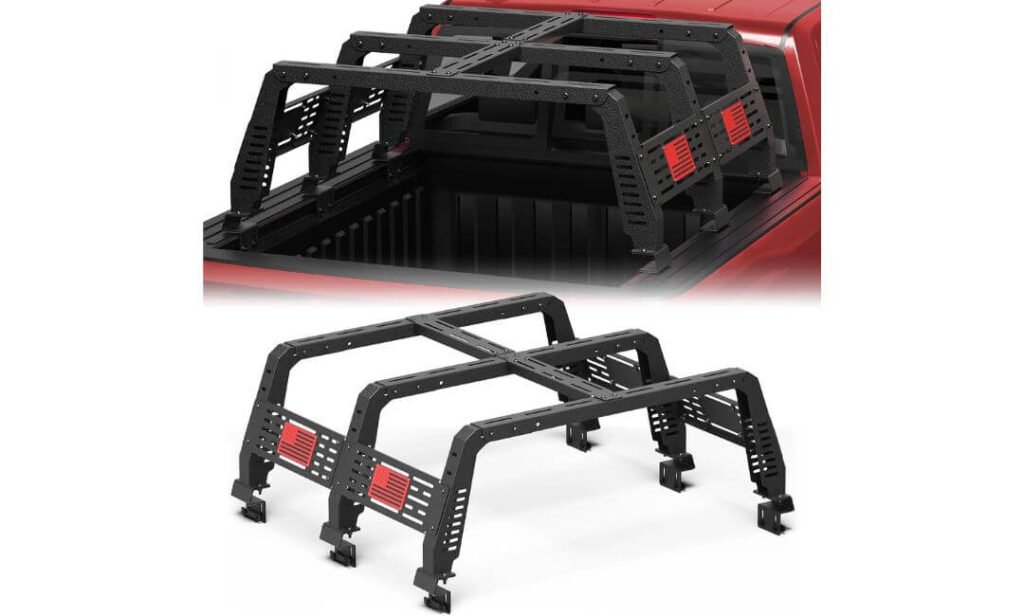
Quick Specs:
- Tacoma fitment: 2005–2026 Toyota Tacoma with factory bed rails
- Rack footprint: 53–61.7″ adjustable length × 47.5–64.5″ adjustable width
- Height: 22.5″, giving taller gear and tent setups more clearance above the cab
- Load rating: 500 lbs dynamic / 900 lbs static
- Build: Heavy-duty carbon steel with e-coating and textured black powder finish
- Installation: Direct bolt-on through the bed-rail system; no cutting, welding, or fabrication
- Rack weight: 110 lbs
- Best suited for: Rooftop tents, kayaks, longer cargo, camping equipment, and heavier overland setups
The standout here is not simply the 900-pound static rating. The useful part is the combination of a tall 22.5-inch profile with genuinely adjustable dimensions. Width can move from 47.5 to 64.5 inches, while length adjusts from 53 to 61.7 inches, giving the rack considerably more flexibility than a fixed-size platform. For a Tacoma owner carrying a rooftop tent, kayak, recovery equipment, or awkward-length gear, that adjustability can be far more valuable than another rack that only looks heavy-duty in the photos.
Construction is equally straightforward. The frame uses carbon steel, receives an e-coating treatment, and gets a textured black powder finish intended to help deal with normal outdoor exposure. The stated 500-pound dynamic and 900-pound static ratings are also worth keeping separate: moving loads and stationary loads are not the same thing, especially when a rooftop tent or other substantial equipment is involved.
Installation is designed to stay relatively simple because the setup is bolt-on and built around factory bed rails. There is no requirement for cutting, welding, or additional fabrication according to the supplied specifications. That makes this a more approachable choice for a Tacoma that needs a serious cargo platform without turning the installation into a custom shop project. (The key is getting the correct bed-rail configuration before ordering.)
What Makes It Stand Out
- Wide adjustment range gives more freedom when positioning gear and accessories.
- 22.5-inch height works well for equipment that needs additional clearance above the cab.
- 500-lb dynamic capacity gives it a meaningful advantage for loaded, moving setups.
- Bolt-on mounting keeps installation much less invasive than fabricated racks.
- Carbon-steel construction with dual protective finishes is a sensible combination for an exposed truck-bed accessory.
One Thing Worth Knowing
The fitment information deserves a little attention before checkout. Customer feedback has been mixed on rail alignment for some Tacoma configurations, particularly certain 2023–2024 trucks. The product is also stated to be incompatible with tonneau and soft bed covers, so anyone planning to keep a bed cover underneath the rack should account for that before buying.
Tacoma Fitment: Check the Bed Rails, Not Just the Year
The stated Tacoma range is 2005–2026, but the year alone should not be the final fitment check. This rack is specifically intended for trucks equipped with factory bed rails, and the exact rail arrangement can determine whether the mounting hardware lines up as intended.
For a Tacoma with the appropriate rail system, the adjustable 53–61.7-inch length and 47.5–64.5-inch width make this one of the more adaptable choices in the lineup. For a truck with a different rail setup—or one running a tonneau or soft bed cover—checking those details first is much more important than relying on the broad year range.
The Insider Pro-Tip
The 500-lb dynamic rating is the number to keep in mind when the Tacoma is actually moving. A 900-lb static figure can sound enormous, but it should not be treated as permission to load 900 pounds onto the rack and drive around. Rooftop tents, kayaks, cargo boxes, and other equipment create different loads once the truck is moving, so the rack’s dynamic rating is the more useful figure for everyday planning.
One more detail often gets overlooked: the rack itself weighs 110 pounds. That weight becomes part of the truck’s overall payload calculation, before any tent, passengers, camping gear, or other accessories are added. In other words, the real advantage of this setup is its adjustability and strong dynamic capacity, not simply the biggest number printed on the listing. For a Tacoma being built around a substantial overland load, that distinction is worth paying attention to.
#2. CLAMBER Overland Bed Rack
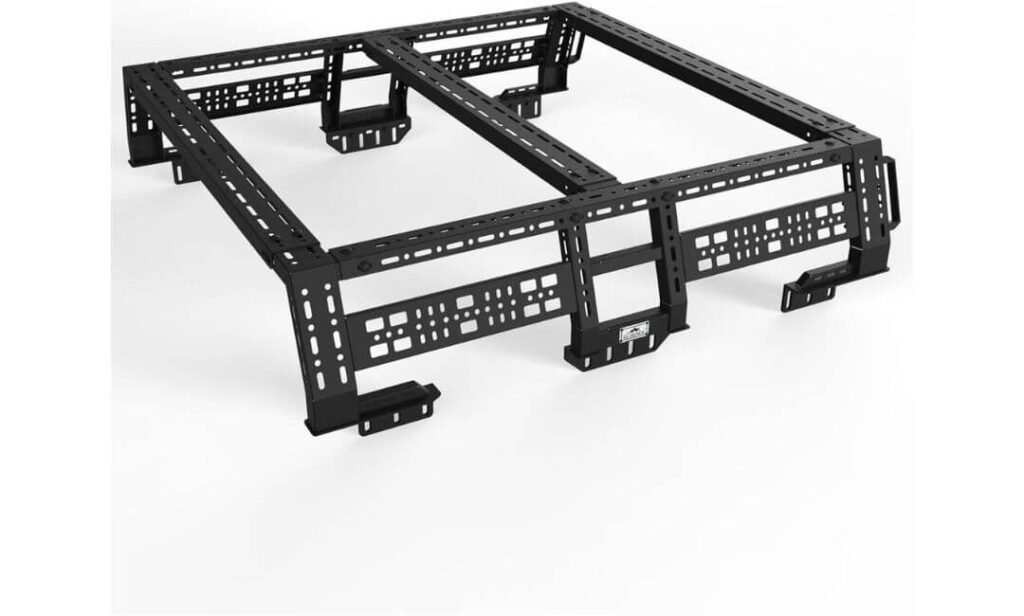
Quick Specs:
- Tacoma coverage: 2005–2026 Toyota Tacoma
- Adjustable width: 53–57″
- Height: 13.6″
- Load rating: 400 lbs dynamic / 800 lbs static
- Construction: Carbon steel
- Mounting: Utility-rail, clamping, or drilling installation
- Mounting flexibility: 150+ accessory positions
- Bed compatibility: Designed for mid-size truck beds with or without utility rails
- Rack weight: 111.7 lbs
- Important limitation: Not compatible with tonneau or bed covers
What makes this rack interesting is how much flexibility is built into a relatively compact 13.6-inch profile. The 53–57-inch adjustable width gives Tacoma owners some room to work with different bed configurations, while more than 150 mounting positions create plenty of places for practical accessories. That can mean anything from a rooftop-tent setup and spare-tire carrier to fuel storage, bicycles, recovery equipment, or auxiliary lighting.
The 800-pound static and 400-pound dynamic ratings are another useful distinction. The larger static number is relevant when the truck is parked, while the dynamic rating is the figure that deserves attention once the Tacoma is moving. That makes this less about chasing a headline load number and more about choosing a rack that has a sensible capacity for the way the truck will actually be used.
Installation is also unusually flexible for this type of rack. It can work with beds with or without utility rails, and the available mounting approaches include multifunctional slots, clamping, and drilling. No-drill installation is available through the appropriate mounting method, while the H-shaped center support doubles as a ladder-style access point for reaching gear higher on the rack. Assembly is required, and with a rack weighing around 111.7 pounds, having another person available during installation is a practical move rather than a bad sign.
What Makes It Stand Out
- 150+ mounting positions make accessory placement far less restrictive.
- 53–57-inch width adjustment gives useful flexibility across mid-size truck beds.
- 400-lb dynamic capacity is the figure that matters most for loaded driving.
- Multiple mounting methods allow the setup to be adapted to the truck and installation preference.
- The H-type center support adds a useful access function instead of being dead structure.
One Thing Worth Knowing
The main limitation is straightforward: this rack is not compatible with tonneau or bed covers. That is worth deciding before purchase because adding a rack is one thing; discovering afterward that the existing cover cannot remain in place is another.
Tacoma Fitment & Bed Setup
The stated fitment covers 2005–2026 Toyota Tacoma, making this one of the broader year-range choices in the comparison. More importantly, the design is intended for mid-size truck beds with or without utility bed rails, so the mounting configuration gives it more flexibility than a rack dependent on one specific rail system.
For a Tacoma being used for camping, hauling, or overland travel, the combination of adjustable width, 150+ attachment locations, 13.6-inch height, and 400-pound dynamic capacity makes the setup particularly versatile. The exact bed configuration should still be checked before ordering, especially if the truck already has accessories mounted around the bed.
The Insider Pro-Tip
The real advantage here is not the 800-pound static rating—it is the ability to build the rack around the gear instead of forcing the gear around the rack. With 150+ mounting positions and three installation approaches, the setup can accommodate a surprisingly different mix of accessories without requiring every owner to use the same layout.
For a Tacoma that regularly carries equipment, keep the 400-pound dynamic rating in mind and account for the rack’s own 111.7-pound weight when considering the total load. That gives a much more realistic picture of what the setup can handle on the road than simply looking at the larger static figure.
#3. Tyger Auto TG-BK2U55347 Plate Style Overland Bed Rack
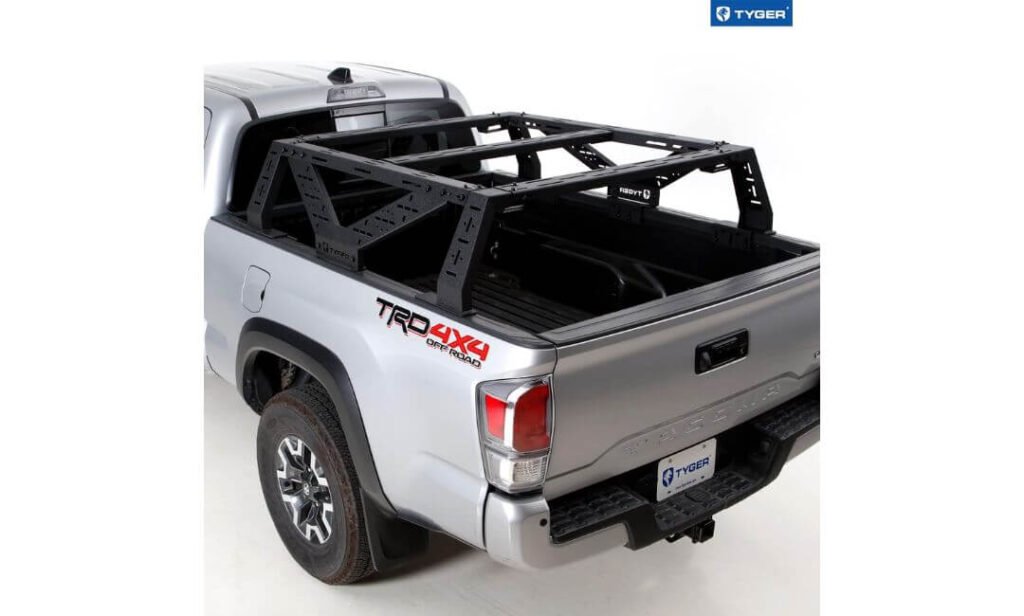
Quick Specs:
- Tacoma coverage: 2005–2026, for 5.5-foot and 6.5-foot beds
- Overall height: 13.6″
- Adjustable base width: 54.58–59.54″
- Adjustable upper width: 49.61–54.62″
- Load rating: 700 lbs static / 150–400 lbs dynamic
- Construction: 3mm thick carbon steel with diagonal V-bracing
- Mounting flexibility: 100+ accessory mounting positions
- Installation: No drilling required; works with or without utility bed rails
- Rack weight: 79 lbs
- Important limitation: Not intended for 8-foot beds or tonneau covers
The first thing worth noticing here is the 79-pound rack weight. Compared with the heavier options above, this keeps the structure considerably lighter while still using 3mm carbon steel and diagonal V-bracing. That combination makes sense for a Tacoma that needs a proper overland platform but does not necessarily need another 100-plus pounds sitting permanently over the bed.
Then comes the part that makes the design genuinely useful: more than 100 mounting positions spread across the V-shaped side plates, corner arms, and upper platform. Recovery boards, shovels, fuel cans, spare tires, lights, bike mounts, and camping equipment can all be positioned around the rack rather than being limited to a handful of predetermined attachment points. The adjustable base width of 54.58–59.54 inches and upper width of 49.61–54.62 inches also gives the structure a more tailored fit instead of relying on one fixed footprint.
The load figures deserve the same attention as the construction. The rack is rated for 700 pounds static, while the stated dynamic capacity varies from 150 to 400 pounds depending on the setup. That difference matters when the Tacoma is moving, particularly with rooftop-tent equipment or other elevated cargo. Installation is relatively straightforward as well: the design works with beds with or without utility rails and does not require drilling when using the intended mounting method.
What Makes It Stand Out
- 79-pound construction keeps the rack lighter than several heavy-duty alternatives.
- 100+ mounting positions provide unusually broad accessory-placement freedom.
- 3mm carbon steel with V-bracing adds structural reinforcement where the rack needs it.
- Dual-width adjustment lets the base and upper section sit at different dimensions.
- 5.5-foot and 6.5-foot bed compatibility covers two important Tacoma bed configurations.
One Thing Worth Knowing
The main catch is the tonneau-cover conflict. The mounting arrangement occupies the inside edge of the bed-rail area, so this setup should not be chosen with the expectation that an existing tonneau cover will continue working underneath it. The listing also excludes 8-foot beds, although that is unlikely to affect the Tacoma configurations this article is targeting.
Tacoma Fitment & Bed Configuration
The stated fitment covers 2005–2026 Toyota Tacoma models with 5.5-foot and 6.5-foot beds. That is useful because bed length matters here; the broad Tacoma year range should not be mistaken for universal compatibility with every possible bed configuration.
For the right Tacoma setup, the combination of 13.6-inch height, adjustable upper and lower widths, and more than 100 mounting locations makes this particularly attractive for owners building around several accessories rather than one single piece of equipment. The exact bed length and rail arrangement should still be matched before ordering.
The Insider Pro-Tip
This is the rack to look at when weight and mounting flexibility matter just as much as raw capacity. At 79 pounds, it leaves more of the Tacoma’s available payload for the equipment that actually goes on the truck, while the V-braced carbon-steel frame still provides a substantial platform.
One detail worth keeping in mind is the 150–400-pound dynamic range. That is intentionally more conservative than the 700-pound static figure, and it should be treated that way. For everyday driving, calculate the weight of the rack plus the gear being carried and stay within the applicable dynamic rating. That simple distinction makes the specification much more useful than treating the biggest load number as the whole story.
#4. EYOUHZ 13.3″ High Overland Truck Bed Rack
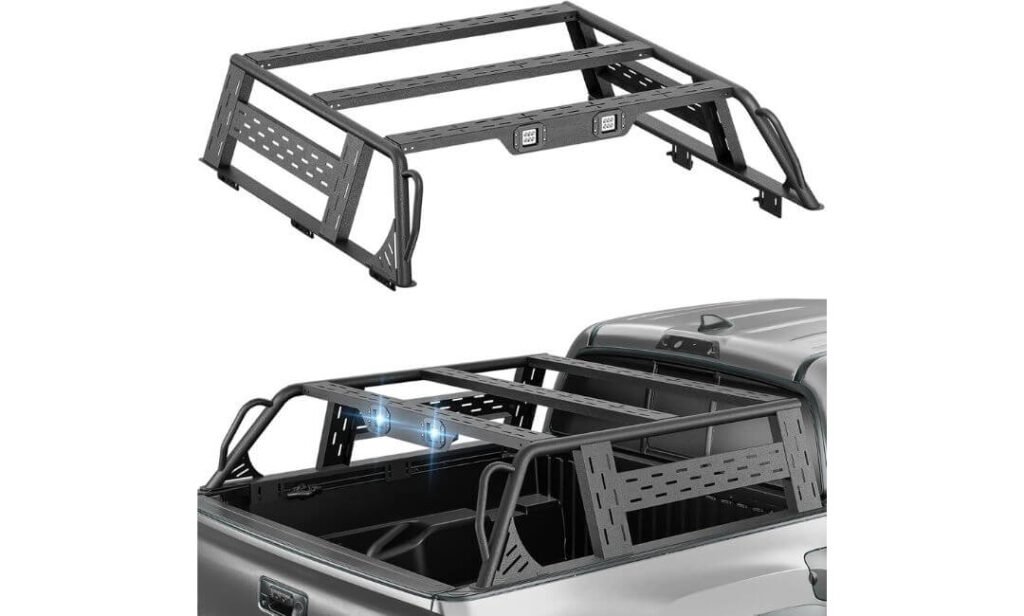
Quick Specs:
- Tacoma coverage: 2016–2026 models with factory bed rails
- Height: 13.3″, with a profile designed to stay below the cab line
- Load rating: 1,000 lbs static / 500 lbs dynamic
- Construction: Heavy-duty carbon steel with textured black powder coating
- Lighting: Includes 2 LED light bars
- Mounting: Bed-rail installation with no drilling, cutting, or truck modification
- Accessory mounting: Multiple elongated slots for gear and tie-downs
- Included hardware: Rack, LED lights, mounting hardware, and installation instructions
- Warranty/support: 1-year factory warranty with lifetime customer service
- Important limitation: Not compatible with tonneau or bed covers
A 13.3-inch rack height makes this setup appealing for a Tacoma that needs extra mounting space without building an especially tall structure above the bed. The two included LED light bars are a genuinely useful addition rather than something that simply changes the appearance of the rack, particularly when loading gear after dark or working around a campsite. The numerous elongated slots on the side panels also give plenty of flexibility for mounting accessories, tie-downs, jacks, bike equipment, or other cargo.
On paper, the numbers are impressive: 1,000 pounds static and 500 pounds dynamic, backed by a heavy-duty carbon-steel construction and textured powder coating. Those figures should still be read in the correct context. The 1,000-pound figure applies to a properly distributed stationary load; once the Tacoma is moving, the 500-pound dynamic rating is the more relevant number. That distinction becomes particularly important when elevated equipment such as a rooftop tent is involved.
Installation is one of the stronger points. The rack is designed to mount to the factory bed-rail system without drilling, cutting, or permanent modification, and the required hardware is included. The manufacturer also recommends checking the mounting hardware periodically for looseness before driving, which is sensible advice for any rack carrying equipment above the bed. A 1-year factory warranty and lifetime customer-service support add some useful backing, although neither should replace checking the rack carefully before committing it to a demanding setup.
What Makes It Stand Out
- Two included LED light bars give the rack useful nighttime functionality from the start.
- 13.3-inch height adds mounting space without creating an unnecessarily tall profile.
- 500-pound dynamic rating provides a substantial stated capacity for moving loads.
- Multiple accessory slots make it easier to configure the sides around different gear.
- No-drill bed-rail mounting keeps installation straightforward and reversible.
One Thing Worth Knowing
The important consideration is long-term durability under demanding use. While the published specifications are strong, customer feedback has included reports of weld cracking, frame flex, rust, and fit inconsistencies, particularly under heavier or repeated off-road loads. That does not mean every unit will experience those problems, but it does make this a better fit for lighter-duty cargo use than for automatically assuming it is the ideal choice for a heavily loaded rooftop-tent build.
Tacoma Fitment & Bed-Rail Setup
The listed fitment covers 2016–2026 Toyota Tacoma models equipped with bed rails. That makes the rack more specifically targeted toward newer Tacoma configurations than several other choices in this lineup, but the factory-rail requirement still matters more than the year printed in the listing.
The rack also has a firm no-tonneau-cover limitation, so owners planning to retain a bed cover should eliminate this option before comparing the other features. For a rail-equipped Tacoma intended for lighter camping gear, kayaks, luggage, bikes, or accessory mounting, the compact height and built-in lighting make considerably more sense.
The Insider Pro-Tip
The 1,000-pound static rating should not be the deciding number here. With the mixed durability feedback, a conservative load plan is the smarter approach—especially for off-road travel where vibration and repeated impacts can put substantially more stress on welds and mounting points than a stationary load does.
Where this rack makes the most sense is as a feature-rich, relatively low-profile cargo platform for owners who value the included lighting and easy bed-rail installation. Before carrying expensive rooftop equipment or committing to serious trail use, inspect the welds, mounting points, coating, and hardware carefully after installation. The specification sheet tells you what the rack is rated for; careful setup and realistic loading determine how confidently those numbers can be used in the real world.
#5. POFENZE 22.5″ Steel Adjustable Overland Bed Rack
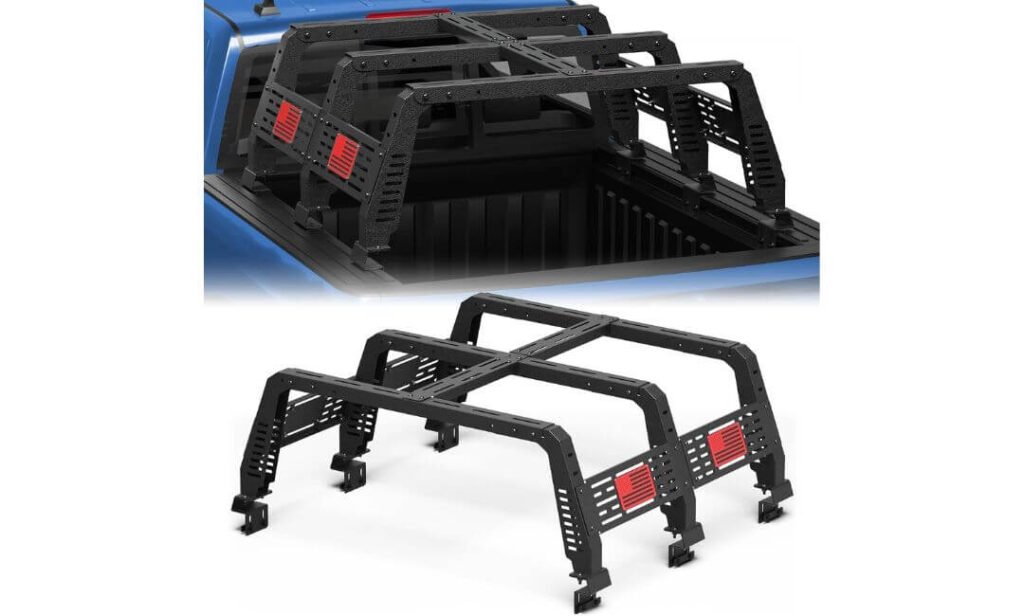
Quick Specs:
- Tacoma coverage: 2005–2025 models with factory bed rails
- Rack height: Fixed at 22.5″
- Adjustable width: 47.5–64.5″
- Load rating: 1,000 lbs static / 500 lbs dynamic
- Construction: Heavy-duty carbon steel
- Finish: E-coating underneath a textured black powder coat
- Mounting: Direct bolt-on to OEM bed rails; no drilling or welding
- Rack weight: 110 lbs
- Bed access: Tailgate functionality is retained
- Important limitation: Not compatible with tonneau or bed covers
There is a good reason to choose a fixed-height rack when stability matters more than endless adjustment. At 22.5 inches, this setup keeps its structure at a consistent height rather than relying on a lifting mechanism, which can be useful when the rack is carrying substantial gear over rough roads. The width still adjusts from 47.5 to 64.5 inches, so the rack is not completely rigid in how it fits the bed.
The load figures are substantial as well: 1,000 pounds static and 500 pounds dynamic, provided the weight is properly distributed. The carbon-steel structure uses reinforced cross supports and panels, while the E-coat plus textured powder-coat finish gives the exposed frame an additional layer of protection against moisture, road salt, and everyday outdoor exposure. For a truck that sees both work and weekend use, that combination is more useful than a finish chosen purely for appearance.
The mounting arrangement keeps things relatively uncomplicated. It attaches directly to the factory bed-rail system without drilling or welding, and the supplied hardware is used for the installation. At approximately 110 pounds, however, this is not a one-person rack that should casually be lifted into position. Two people make much more sense for getting the structure aligned properly before tightening everything down.
What Makes It Stand Out
- Fixed 22.5-inch architecture favors consistent rigidity and predictable clearance.
- 47.5–64.5-inch width adjustment provides substantial fitting flexibility.
- 500-pound dynamic capacity gives the rack meaningful carrying ability while driving.
- Dual-layer protective finish is well suited to an accessory exposed to weather year-round.
- Factory-rail bolt-on mounting avoids cutting, welding, or permanent bed modifications.
One Thing Worth Knowing
The main drawback is its 2025 Tacoma fitment cutoff. Although the same product line is listed for newer Tundra models, the supplied Tacoma fitment specifically ends at 2025, so it should not be presented as a confirmed 2026 Tacoma rack without updated manufacturer fitment. It is also not compatible with tonneau or bed covers, which can be a deal-breaker for some truck builds.
Tacoma Fitment & Factory-Rail Setup
This rack is listed for 2005–2025 Toyota Tacoma models equipped with factory bed rails. The broad year range covers multiple Tacoma generations, but the OEM rail system remains an important part of the compatibility equation. The adjustable width helps accommodate different bed dimensions, but it does not turn the rack into a universal fit for every Tacoma configuration.
For a compatible Tacoma, the 22.5-inch fixed height and adjustable 47.5–64.5-inch width create a sturdy platform for longer cargo and overland equipment while keeping the tailgate usable. The lack of tonneau-cover compatibility should be checked before purchase, particularly if a bed cover is already part of the truck.
The Insider Pro-Tip
The interesting choice here is the trade-off between fixed height and structural simplicity. A 22.5-inch fixed platform gives predictable positioning and avoids adding a height-adjustment mechanism that can introduce another moving component. That makes sense for owners who already know the height they want and prefer a straightforward rack around it.
Also, do not confuse the 1,000-pound static rating with a 1,000-pound road-going payload. The stated dynamic limit is 500 pounds, and the rack itself weighs about 110 pounds. Once a tent, cargo, and other accessories are added, that distinction becomes important. For a properly matched Tacoma setup, the appeal is the combination of high capacity, wide adjustment, fixed geometry, and direct factory-rail mounting rather than the headline number alone.
#6. YZONA Adjustable 16.8–25″ High Bed Rack
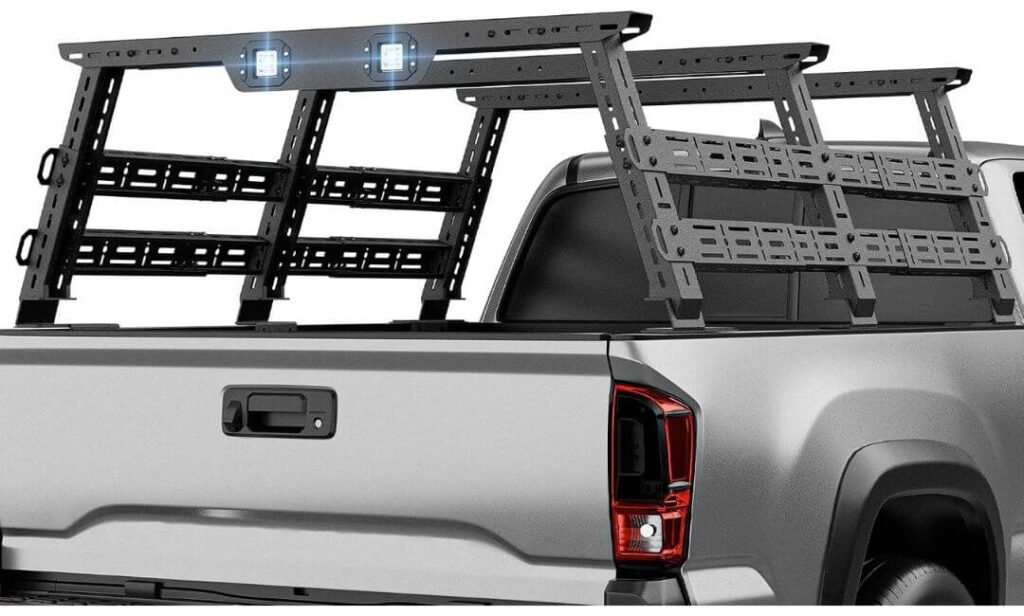
Quick Specs:
- Tacoma coverage: 2001–2025 models
- Adjustable height: 16.8–25″
- Adjustable width: 47.6–66″
- Adjustable rack spacing: 47.6–63.5″
- Load rating: 1,000 lbs static / 500 lbs dynamic
- Construction: Heavy-duty carbon steel with textured black powder coating
- Lighting: Includes 2 LED light bars
- Mounting: Bed-rail installation with no drilling, cutting, or modification
- Bed-cover compatibility: Designed to work with tonneau and bed covers
- Rack weight: 125 lbs
The most useful thing about this setup is the 16.8–25-inch height adjustment. Instead of committing the Tacoma to one rack height, the upper structure can be positioned around the cab and the equipment being carried. That matters when the same truck moves between everyday cargo, kayaks, boards, camping equipment, or a rooftop-tent setup. The 47.6–66-inch width adjustment adds another layer of flexibility, making this considerably more adaptable than a fixed-width rack.
There is plenty of practical mounting space built into the design as well. The side panels use multiple narrow slots for securing cargo and adding accessories such as high-lift jacks, fire extinguishers, lights, bike racks, and rooftop-tent equipment. Two LED light bars are included, so useful nighttime illumination is part of the package rather than something that has to be added immediately afterward.
The underlying structure is heavy-duty carbon steel, finished with a textured black powder coating for corrosion resistance. Its stated capacity is 1,000 pounds when stationary and 500 pounds while moving, which is the distinction that matters when planning real cargo. Installation does not require drilling, cutting, or permanent modification, although checking the supplied hardware carefully and verifying that every mounting point is properly secured is sensible before putting the truck on the road.
What Makes It Stand Out
- 16.8–25-inch height adjustment gives unusually broad control over rack positioning.
- 47.6–66-inch width range helps accommodate different truck-bed dimensions.
- Tonneau-cover compatibility makes it more flexible than several racks higher on this list.
- Two included LED light bars add useful functionality for nighttime loading and camping.
- 1,000-lb static / 500-lb dynamic capacity gives the structure substantial stated carrying capability.
One Thing Worth Knowing
The biggest consideration is its universal design. It covers a very wide range of pickups rather than being developed exclusively around the Tacoma. That flexibility is useful, but buyers looking for a rack engineered around one specific Tacoma generation should pay closer attention to the exact mounting arrangement and bed configuration before ordering.
Tacoma Fitment & Adjustable Setup
The listed Tacoma coverage is 2001–2025, alongside compatibility with numerous Ford, Chevrolet, GMC, Nissan, Toyota, Jeep, and Ram pickups. Because it is designed as a broad-fit system, the year range alone should not be used as the final compatibility check. Bed dimensions, rail arrangement, and the desired mounting position still need to match the truck.
For a compatible Tacoma, the ability to adjust both height and width is the main attraction. The rack can be positioned from 16.8 to 25 inches high and widened up to 66 inches, while its stated tonneau-cover compatibility gives it an advantage for owners who do not want to sacrifice an existing bed-cover setup.
The Insider Pro-Tip
A universal rack becomes most valuable when the truck’s job changes regularly. The YZONA’s broad adjustment range means the setup can be configured lower for ordinary cargo or raised when additional clearance is needed for longer equipment. That is a much more meaningful advantage than simply calling the rack “adjustable.”
The 125-pound rack weight should still be included when calculating the Tacoma’s available payload. And although the 1,000-pound static figure is substantial, the 500-pound dynamic rating is the practical ceiling to consider while driving. For mixed-use Tacoma builds where adjustability and bed-cover compatibility matter, those two characteristics may ultimately be more useful than choosing a rack solely for maximum fixed load capacity.
#7. Hooke Road 12.3″ High Overland Bed Rack
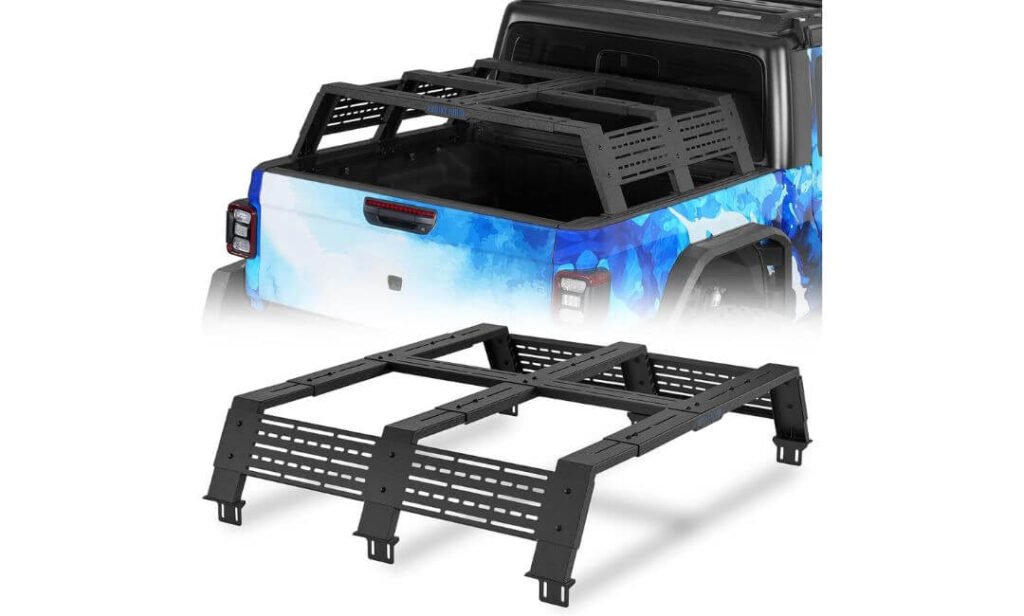
Quick Specs:
- Tacoma coverage: 2005–2025 models with 5-foot bed
- Rack height: 12.3″ from the bed rail to the top of the rack
- Fixed length: 50″
- Adjustable width: 54.3–65″
- Load rating: 400 lbs dynamic / 800 lbs static
- Main structure: 13-gauge (3/32″) high-tensile steel
- Mounting brackets: 9-gauge (5/32″) steel with reinforced ribs
- Mounting: Full bolt-on installation; no drilling required
- Rack weight: Approximately 116 lbs
- Finish: Textured black powder coat with inner e-coating
- Warranty: 2-year manufacturer warranty with lifetime customer support
- Important limitation: Not compatible with tonneau or soft bed covers
A 12.3-inch rack makes a lot of sense when the goal is to add useful mounting space without building a tall structure behind the cab. The lower profile keeps the setup relatively unobtrusive while still leaving room for equipment such as bikes, recovery boards, shovels, high-lift jacks, lights, or a rooftop tent. For a Tacoma with the 5-foot bed, the fixed 50-inch length and adjustable 54.3–65-inch width provide a straightforward footprint without making the rack unnecessarily complicated.
The construction is where this option becomes more interesting than its compact appearance suggests. The main structure uses 13-gauge high-tensile steel, while the mounting brackets step up to 9-gauge steel with reinforced ribs. That is a sensible arrangement because the mounting area takes a different kind of stress from the upper rack itself. The stated 800-pound static and 400-pound dynamic capacity also gives the rack useful room for properly distributed cargo, although the dynamic figure remains the one to watch when the Tacoma is moving.
Another practical advantage is the fully bolt-on installation. The rack can be installed without drilling and is designed to work with trucks with or without bed rails, with mounting hardware and instructions included. At roughly 116 pounds, it is still substantial enough that positioning it with a second person is the sensible approach. The dual-layer finish—textured powder coating over an e-coating layer—is also well suited to a component that will spend its life exposed to weather, road grime, and trail conditions.
What Makes It Stand Out
- 12.3-inch low profile adds cargo mounting capability without an overly tall structure.
- 9-gauge mounting brackets provide a notably substantial foundation for the rack.
- 54.3–65-inch width adjustment gives useful flexibility around the bed.
- 400-pound dynamic capacity is strong for a relatively compact rack design.
- Dual-layer corrosion protection is appropriate for year-round outdoor use.
One Thing Worth Knowing
The fitment is specifically listed for a 2005–2025 Tacoma with a 5-foot bed, so this is not the choice for a Tacoma configuration outside that stated bed setup. It is also not compatible with tonneau or soft bed covers, which should be confirmed before purchase if the truck already has one installed.
Tacoma Fitment & 5-Foot Bed Setup
The stated Tacoma fitment covers 2005–2025 models with a 5-foot bed. That narrower fitment is actually useful information because it removes some of the guesswork found with universal truck racks. The adjustable width still provides room to configure the rack across the bed, but the 5-foot-bed requirement should remain the first compatibility check.
For the appropriate Tacoma, the combination of 12.3-inch height, 50-inch fixed length, and 54.3–65-inch adjustable width creates a relatively compact platform for overland and utility equipment. It is a better match for someone who values a lower-profile setup than for a buyer specifically looking for maximum height or a broad universal fit.
The Insider Pro-Tip
The specification that deserves more attention than it usually gets is the 9-gauge mounting bracket construction. A rack can have an impressive upper frame, but the mounting hardware is where all that weight ultimately gets transferred into the truck. The reinforced bracket design gives this compact rack a more purposeful foundation than its 12.3-inch height might suggest.
Also keep the 400-pound dynamic rating separate from the 800-pound static figure. A rooftop tent, bikes, or other gear may be perfectly reasonable when properly distributed and within the applicable rating, but road movement introduces forces that a parked truck does not experience. For a 5-foot-bed Tacoma that needs a lower-profile, steel-built cargo platform, this is a straightforward option with a sensible balance between structure, adjustability, and everyday usability.
Best Toyota Tacoma Bed Rack (2005–2026): Specs, Capacity & Features
Buying Guide: Choosing the Right Toyota Tacoma Bed Rack for Your Setup
A bed rack is one of those Tacoma accessories where the wrong specification can matter more than the right-looking design. A rack may have an impressive load rating or a large adjustment range, but that does not automatically make it suitable for every bed, rail system, cover, or type of cargo. The best choice comes from matching the rack to the truck first, then choosing the features that fit the way the truck will actually be used.
Start With Your Tacoma’s Exact Bed Configuration
The first check should always be the Tacoma’s year, bed length, and rail arrangement. This comparison includes racks covering different portions of the Tacoma range, from 2001–2025 through 2005–2026, so the broadest year range is not necessarily the most important specification.
Bed length matters just as much. For example, the Hooke Road option is specifically listed for a 5-foot Tacoma bed, while the Tyger Auto rack covers 5.5-foot and 6.5-foot beds. A rack designed around one configuration should not be assumed to fit another simply because both trucks carry the Tacoma name.
Factory bed rails also deserve attention. Some products in this lineup are designed specifically around the OEM rail system, while others offer mounting flexibility for trucks with or without utility rails. Check this before looking at height, accessories, or load capacity.
Dynamic Load Is the Number to Watch on the Road
Bed-rack listings commonly show two load figures, and they should never be treated as interchangeable.
| Load figure | What it actually tells you |
|---|---|
| Static capacity | Maximum stated capacity when the truck is stationary and the load is properly distributed |
| Dynamic capacity | The more relevant figure while driving, because braking, bumps, turns, and trail movement add forces |
| Rack weight | Part of the truck’s payload before cargo and accessories are added |
For example, a rack rated at 1,000 lbs static / 500 lbs dynamic should not be treated as a 1,000-pound road-going platform. The dynamic rating is the practical reference when carrying equipment while driving.
The same principle applies to rooftop tents. The weight of the tent, mounting hardware, bedding, and anything else stored inside or on top should be considered together, rather than looking only at the tent’s advertised weight.
Fixed Height or Adjustable Height?
Rack height changes how useful the system feels once installed.
- A 12.3–13.6-inch rack keeps the setup relatively low and can be attractive for everyday cargo and compact overland builds.
- A 22.5-inch rack creates more elevated space for longer equipment and larger overland setups.
- An adjustable-height rack, such as the YZONA with its 16.8–25-inch range, gives more freedom when the same Tacoma is used for different types of cargo.
There is no universally correct height. A lower rack can be easier to live with day to day, while a taller platform may make more sense for kayaks, rooftop-tent equipment, or other long cargo. The important question is whether the height solves a problem on the truck rather than simply looking more substantial.
Adjustable Width Can Be More Useful Than It Sounds
Width adjustment is not just a convenience feature. It can make installation and accessory positioning considerably easier when bed dimensions or mounting locations vary.
The racks in this guide offer noticeably different adjustment ranges:
| Rack style | Width approach |
|---|---|
| longsun | 47.5–64.5″ adjustable |
| CLAMBER | 53–57″ adjustable |
| Tyger Auto | 54.58–59.54″ base / 49.61–54.62″ upper |
| POFENZE | 47.5–64.5″ adjustable |
| YZONA | 47.6–66″ adjustable |
| Hooke Road | 54.3–65″ adjustable |
A wider adjustment range can be valuable, but it should not be mistaken for universal fitment. The rack still needs to match the Tacoma’s actual mounting points and bed configuration.
Steel Construction: Strong, but Weight Still Counts
Most of the racks here use carbon or heavy-duty steel, which makes sense for equipment that may spend years carrying exposed cargo. Steel can provide a substantial structure, but it also adds weight.
That matters because the rack itself becomes part of the Tacoma’s payload. The difference is noticeable across this group:
- Tyger Auto: approximately 79 lbs
- longsun: approximately 110 lbs
- POFENZE: approximately 110 lbs
- CLAMBER: approximately 111.7 lbs
- Hooke Road: approximately 116 lbs
- YZONA: approximately 125 lbs
A heavier rack is not automatically stronger in every real-world situation, just as a lighter rack is not automatically weaker. Look at the construction, mounting brackets, reinforcement, dynamic rating, and intended use together.
Mounting Method Deserves More Attention
A good rack should attach securely without creating unnecessary work for the truck.
The products here use several approaches, including factory bed-rail mounting, clamping systems, multifunctional slots, and bolt-on hardware. Some can be installed without drilling, while certain configurations may offer additional mounting methods.
For most owners, a no-drill bolt-on installation is attractive because it keeps the truck relatively unmodified and makes the rack easier to remove later. That said, installation should not be rushed. A large steel rack can be awkward to position, so having a second person available is often the sensible choice.
Think About the Accessories Before Buying the Rack
The rack is only the foundation. The useful setup is determined by what gets attached to it.
Common additions include:
- Rooftop tent mounting hardware
- Bike racks
- Recovery boards
- High-lift jack mounts
- Shovel and axe mounts
- Fuel-can holders
- LED lighting
- Spare-tire carriers
- Cargo tie-down points
- Kayak, canoe, and surfboard supports
This is where products with numerous mounting slots can have a real advantage. The CLAMBER, for example, offers 150+ mounting positions, while the Tyger Auto rack provides 100+ positions. That kind of flexibility can be more useful than a small difference in rack height when several accessories are planned.
Tonneau Cover Compatibility Can Change the Entire Decision
This is one of the easiest details to overlook.
Several racks in this comparison are not compatible with tonneau or soft bed covers, while the YZONA is specifically listed as compatible with tonneau and bed covers. If keeping an existing bed cover is important, this should be checked before comparing load ratings or accessory options.
A rack that fits the truck perfectly but forces removal of an accessory that was already important to the owner may not be the best overall choice.
Common Mistakes to Avoid
Buying by model year alone
A Tacoma year range is only the starting point. Bed length, factory rails, and mounting configuration can still determine whether the rack is appropriate.
Comparing static ratings as if they were driving ratings
A 1,000-pound static capacity does not mean 1,000 pounds should be carried while driving. Always look at the dynamic rating for moving loads.
Forgetting the rack’s own weight
A 110- or 125-pound rack uses part of the truck’s available payload before any camping equipment, tools, passengers, or accessories are added.
Assuming adjustable means universal
A rack with a huge width range can still have mounting limitations. Adjustment range and vehicle compatibility are two separate things.
Ignoring existing bed accessories
Tonneau covers, utility rails, bed storage systems, and other accessories can affect installation. Check compatibility before ordering rather than after the rack arrives.
Choosing the tallest rack automatically
More height is not always more useful. A 12.3-inch or 13.3-inch profile may be the better everyday solution, while a 22.5-inch rack may make more sense for larger overland equipment.
A Simple Way to Narrow Down the Choice
For a 2026 Tacoma, start with racks that explicitly list the current model year. From there, check the factory bed-rail requirement and bed configuration. For older Tacomas, use the same process but pay particular attention to whether the stated fitment matches the specific generation and bed length.
Once fitment is confirmed, narrow the choice using three questions: How much cargo will actually be carried? How much height is genuinely needed? And does the truck need to keep its tonneau or other bed accessories? Those answers usually eliminate most of the unsuitable options before price or appearance even becomes the deciding factor.
Deep Dive: How Adjustable Width and Heavy-Duty Construction Actually Work on a Tacoma
An adjustable bed rack sounds simple until it is sitting on an actual truck. The useful part is not the word “adjustable” itself, but where the adjustment happens, how securely it locks, and whether that range matches the Tacoma bed and the equipment being carried. The seven racks in this comparison use different approaches, so their adjustment ranges should be viewed as practical setup tools rather than numbers to compare in isolation.
What Width Adjustment Actually Changes
Most adjustable racks achieve their range through some combination of slotted mounting points, telescoping sections, adjustable rails, or locking hardware. The basic idea is straightforward: the rack can be positioned closer together or farther apart before the mounting points are fully secured.
For the products covered here, the adjustment ranges are quite different:
- longsun: 47.5–64.5 inches
- POFENZE: 47.5–64.5 inches
- YZONA: 47.6–66 inches
- Hooke Road: 54.3–65 inches
- Tyger Auto: 54.58–59.54 inches at the base, with a separate upper-width range of 49.61–54.62 inches
- CLAMBER: 53–57 inches
That difference is meaningful. A rack with a 47.5–64.5-inch range gives substantially more setup freedom than one with only four inches of adjustment. But the widest range is not automatically the winner; the adjustment still needs to place the mounting points correctly on the Tacoma.
Adjustable Width vs. Fixed Width
A fixed-width rack has one major advantage: simplicity. Once the dimensions match the truck, there is less to configure. The POFENZE, for example, uses a fixed 22.5-inch height while retaining adjustable width, giving it a stable vertical structure without sacrificing all dimensional flexibility.
Adjustable designs are more forgiving when the truck, bed configuration, or accessory layout requires some fine-tuning. They can also make it easier to position the rack around existing equipment rather than forcing everything into a predetermined footprint.
| Setup | Where it makes sense | Main trade-off |
|---|---|---|
| Wide-adjustment rack | Different bed dimensions, multiple accessories, changing cargo setups | More adjustment points to configure correctly |
| Narrow-adjustment rack | More predictable, specific bed setup | Less freedom to fine-tune positioning |
| Fixed-height design | Consistent clearance and straightforward structure | Height cannot be changed later |
| Adjustable-height design | Different cargo types and cab-clearance requirements | More moving/adjustable components |
For a Tacoma used for one predictable job, a simpler setup can be perfectly adequate. For a truck that moves between camping, work, bikes, watercraft, and recovery equipment, adjustability becomes much more valuable.
Why Heavy-Duty Construction Matters
The rack is effectively a second structure sitting above the bed, so its strength depends on more than the thickness of one tube or panel. Frame design, mounting brackets, reinforcement, welds, hardware, and load distribution all contribute to how the system behaves under load.
The products in this comparison primarily use carbon or high-strength steel. Hooke Road, for example, specifies 13-gauge steel for the main structure and 9-gauge steel for the mounting brackets, with reinforced ribs. Tyger Auto uses 3mm carbon steel with diagonal V-bracing. These details are more informative than simply calling a rack “heavy duty.”
There is also a practical downside to steel: weight. A rack weighing 100-plus pounds consumes part of the Tacoma’s available payload before a single accessory is installed. That is why construction should always be considered alongside the rack’s own weight and dynamic capacity.
What Happens With a Rooftop Tent?
A rooftop tent is one of the clearest examples of why static and dynamic capacity should be separated.
When parked, the tent and occupants create a relatively predictable load. Once the Tacoma is moving, however, braking, cornering, bumps, and uneven terrain introduce additional forces. That is why the dynamic rating is the more useful figure for evaluating a loaded rack on the road.
A proper rooftop-tent setup should account for:
- Tent weight
- Mounting hardware
- Bedding and equipment stored inside
- Rack weight
- Dynamic load rating
- The Tacoma’s overall payload limit
- How evenly the load is distributed
A tall rack can also be useful for creating clearance around the tent and other equipment, but height alone should never be used as a substitute for checking the actual load limits.
Bike Racks Need a Different Kind of Thinking
Bikes create a different challenge because their weight is not always concentrated directly over the rack’s strongest central points. A bike mounted toward the outside of the structure can create leverage, especially when the truck is bouncing over uneven terrain.
This makes secure mounting points particularly valuable. Racks with numerous accessory slots, such as the CLAMBER with 150+ mounting positions and the Tyger Auto with 100+, provide more freedom to position bike-related hardware where it makes sense.
For heavier bicycles or multiple bikes, the important question is not simply whether the rack can “hold a bike.” The complete mounting arrangement, hardware, attachment point, and dynamic load should all be considered together.
Cargo Boxes and Everyday Gear
Cargo boxes are generally easier to work with because their footprint is predictable. An adjustable rack can be useful when the box needs to sit centrally while leaving room around it for other equipment.
The 22.5-inch racks from longsun and POFENZE are particularly suited to setups where additional vertical clearance is desirable. Lower-profile options such as the 12.3-inch Hooke Road or 13.3-inch EYOUHZ can make more sense when keeping the overall structure compact is a priority.
The same principle applies to kayaks, canoes, surfboards, skis, and other long items: the rack should provide enough support without forcing the cargo into an awkward position.
Recovery Gear and Side-Mounted Accessories
Recovery equipment is where the value of accessory mounting slots becomes obvious. Boards, shovels, jacks, fuel containers, and lighting can consume a surprising amount of bed space when stored conventionally.
A rack with multiple elongated slots and side mounting locations lets those items move upward and outward, freeing the main bed area for luggage or larger equipment. The Tyger Auto and CLAMBER designs are particularly interesting in this respect because their large number of mounting positions allows a more customized layout.
The important detail is to keep heavier accessories mounted as close to the rack’s strongest mounting areas as practical. Adding every possible accessory simply because there is a mounting slot available can quickly turn a useful rack into an unnecessarily heavy one.
The Tacoma Setup Matters More Than the Biggest Adjustment Number
The best adjustable rack is not necessarily the one with the widest published range. What matters is whether that range gives the Tacoma owner useful positioning without compromising mounting security, bed access, or cargo clearance.
For a truck carrying one rooftop tent, a narrower and simpler design may be all that is needed. For another Tacoma carrying bikes, recovery equipment, lighting, watercraft, and camping gear at different times, a larger adjustment range can save considerable hassle.
That is the real value of adjustability: not maximum movement, but better control over how the rack works with the truck once real equipment is attached.
Toyota Tacoma Bed Rack Installation: What to Check Before Tightening the Last Bolt
A bed rack is only as dependable as its installation. Even a well-built steel structure can develop movement, noise, or alignment problems if the mounting points are not seated correctly. The products in this comparison use different rail, clamp, and bolt-on arrangements, so the manufacturer’s instructions for the exact rack should always take priority over any generic installation sequence.
Installation Flow From the First Check to the Final Inspection
The exact hardware and mounting points vary, but the overall process generally follows this order:
- Confirm the truck and bed configuration.
Verify the Tacoma year, bed length, factory or utility rail arrangement, and any existing accessories against the supplied fitment information. - Inspect the complete hardware kit.
Lay out the brackets, bolts, washers, nuts, spacers, and other supplied hardware before starting. This is much easier than discovering halfway through assembly that something is missing. - Prepare a clear work area.
Remove loose cargo and anything that could interfere with the bed rails or mounting locations. If a bed liner, rail system, or other accessory is already installed, check that it does not obstruct the intended mounting points. - Assemble the rack loosely first.
Do not fully tighten every connection immediately. Leave the adjustment points loose enough to position the structure correctly. - Set the required width and height.
For adjustable designs, position the rack according to the truck and intended cargo. Measure both sides rather than relying on appearance to determine whether the structure is centered. - Position the rack on the bed rails or mounting points.
A rack weighing roughly 80–125 pounds can be awkward to handle, so having a second person assist with lifting and positioning is sensible. - Align both sides before final tightening.
Check that the rack sits squarely, the mounting hardware is properly seated, and the structure is not being pulled sideways as the bolts are tightened. - Tighten according to the manufacturer’s instructions.
Use the specified torque values where provided. Avoid guessing torque by simply making every fastener “as tight as possible.” - Check accessory clearance.
Open and close the tailgate, inspect cab clearance, and confirm that planned cargo or accessories will not interfere with the rack. - Perform a final hardware inspection.
Before carrying cargo, check every accessible mounting connection and make sure nothing is loose, misaligned, or rubbing against the truck.
Common Installation Problems That Are Easy to Prevent
The most common mistake is assuming that a broad year range guarantees an effortless installation. Bed configuration and rail design can still affect how the mounting hardware lines up.
Other problems are usually simple setup issues:
- Installing one side completely before aligning the other side can pull an adjustable rack out of square.
- Fully tightening adjustment points too early can make it difficult to achieve the correct final width.
- Ignoring bed-rail condition can create an uneven mounting surface.
- Using incorrect or substitute hardware can change how the mounting brackets seat.
- Skipping a second-person lift can make alignment unnecessarily difficult and increase the chance of scratching the truck.
- Failing to recheck hardware after initial use can allow small amounts of movement to go unnoticed.
- Loading accessories before checking clearance can create interference with the cab, tailgate, or other bed equipment.
One particularly important point is to avoid treating installation as finished the moment the rack stops moving by hand. The structure should be square, evenly positioned, securely mounted, and checked again after the first period of use.
Tools Worth Having Before Starting
The exact requirements depend on the hardware supplied, but a useful installation setup generally includes:
- Metric and standard socket set
- Appropriate ratchet and extensions
- Combination or open-end wrenches
- Torque wrench for final tightening
- Measuring tape
- Allen or hex keys if required by the supplied fasteners
- Work gloves
- A clean cloth or protective padding
- Step stool for taller configurations
- Second person for lifting and alignment
A torque wrench is particularly worthwhile. With a steel rack carrying expensive equipment above the bed, “tight enough” is not a particularly useful specification.
No-Drill Does Not Mean No Preparation
Several options in this comparison are designed for bolt-on or no-drill installation, which is convenient, but that does not eliminate the need for careful preparation.
No-drill mounting means the truck does not need to be permanently modified through drilling or welding for the intended installation method. It does not mean the mounting hardware can be installed casually. The contact surfaces still need to be clean, brackets need to sit correctly, and fasteners need to be tightened according to the supplied instructions.
If the particular configuration requires drilling or offers drilling as an alternative mounting method, that should be treated as a separate installation approach rather than assumed to be equivalent to the no-drill setup.
Check the Rack Again After the First Few Drives
A good habit is to inspect the mounting hardware after the rack has experienced its first few drives, particularly if the truck has travelled over rough roads or trails.
Look for:
- Loose fasteners
- Any visible movement at mounting points
- Changes in rack alignment
- New rattles or knocking sounds
- Contact between the rack and cab
- Cracked or damaged hardware
- Unusual movement when accessories are loaded
This does not mean the rack should constantly require adjustment. It simply gives the owner an opportunity to catch an installation issue before it becomes a larger problem.
Warranty and Maintenance Are Part of the Ownership Cost
Warranty coverage varies across the products, so keep the original purchase information, installation documentation, and warranty details. Some manufacturers in this group provide warranty periods ranging from one to several years, with additional customer-service support.
Warranty coverage should not be confused with a guarantee against damage caused by overloading, incorrect installation, modification, or misuse. Following the manufacturer’s installation procedure and staying within the stated dynamic and static load limits gives the owner a much stronger position if a genuine manufacturing issue develops.
For maintenance, periodically inspect the finish, mounting hardware, adjustment points, and exposed steel. Touching up damaged coating early can help prevent corrosion from becoming a larger issue, especially for trucks regularly exposed to rain, snow, road salt, mud, or coastal air.
One Final Installation Check Before Carrying Gear
Before putting a rooftop tent, bikes, kayaks, recovery equipment, or cargo boxes on top, take a few minutes to look at the complete setup as a system.
The rack should sit square on the truck, the mounting points should be secure, the selected width and height should be locked correctly, and the cargo should have enough clearance from the cab and bed. Once those basics are right, the rack can do what it was purchased for without turning installation into an ongoing problem.
Accessories and Compatibility Notes for a Toyota Tacoma Bed Rack Setup
A bed rack rarely stays a standalone accessory for long. Once the truck starts getting used for camping, hauling, or overland travel, bed mats, tonneau covers, bed organizers, toppers, lighting, bike mounts, and recovery equipment often become part of the same setup. The important point is that these accessories do not all coexist equally well. A rack can be a perfect fit for the truck and still conflict with something already installed in the bed.
Tonneau Covers Are the Biggest Compatibility Check
Among the accessories discussed in this article, a tonneau cover deserves the most attention before purchase.
The compatibility picture is not the same across all seven choices:
| Bed rack | Tonneau / bed-cover consideration |
|---|---|
| longsun | Not compatible with tonneau or soft bed covers |
| CLAMBER | Not compatible with tonneau or bed covers |
| Tyger Auto | Not compatible with tonneau covers |
| EYOUHZ | Not compatible with tonneau or bed covers |
| POFENZE | Not compatible with tonneau or bed covers |
| YZONA | Listed as compatible with tonneau and bed covers |
| Hooke Road | Not compatible with tonneau or soft bed covers |
That makes the decision fairly simple for an owner who already has a cover they want to keep: do not assume the rack will fit around it. The mounting location, rail hardware, and available clearance can prevent the cover from operating normally.
The YZONA stands apart in the supplied specifications because it is specifically listed as compatible with tonneau and bed covers. Even there, the exact cover and mounting arrangement should be checked before ordering, because “compatible with tonneau covers” does not necessarily mean every cover design will operate identically.
Bed Rails Can Change From One Tacoma Generation to Another
A Tacoma year range covers multiple generations, and the presence of a factory bed rail system is not something that should be treated as a universal constant.
Some racks in this comparison are specifically designed around factory rails, while others are described as working with beds with or without utility rails. That distinction matters because the mounting hardware has to physically connect the rack to the truck in the intended locations.
For example, the longsun and POFENZE designs rely heavily on factory bed-rail mounting, while the CLAMBER and Hooke Road designs offer broader mounting approaches. The Tyger Auto rack also states compatibility with beds with or without utility rails.
The practical rule is simple: match the mounting system, not just the model year.
Bed Mats Usually Cause Fewer Problems, But Check the Contact Area
A bed mat is generally less complicated than a tonneau cover because it does not need to open, retract, or move around the rack. However, a thick rubber mat can change the effective height of the mounting surface or interfere with brackets depending on where the rack attaches.
Before installation, check whether the mounting hardware is designed to sit directly against the truck’s intended mounting surface. If the mat needs to be trimmed, folded, or removed around the mounting points, follow the rack manufacturer’s instructions rather than forcing the bracket over the material.
A properly fitted mat can remain useful underneath a rack because it protects the bed from loose equipment, but the mounting interface should remain solid and unobstructed.
Bed Organizers and Storage Systems Need Clearance
Bed organizers are easy to overlook because they usually sit below the rack. The potential problem appears when an organizer occupies the same space as a rack bracket, rail mount, or lower support.
Before adding both, check:
- Whether the organizer attaches to the factory rail
- Whether its hardware occupies the same mounting channel
- Whether the rack brackets reduce usable bed-wall space
- Whether drawers or sliding components can still open
- Whether the rack’s lower structure interferes with stored equipment
The more accessories attached to the rail system, the more important this becomes. A rack with a broad adjustment range can provide some flexibility, but it cannot compensate for two accessories trying to use the exact same mounting location.
Bed Toppers Require a Completely Different Fitment Check
A bed topper or camper shell changes the equation because it occupies the space above the bed rails. A conventional bed rack may interfere with the shell’s mounting points, rear window access, or roof structure.
The rack should only be paired with a topper when the manufacturer specifically supports that combination or provides a compatible mounting solution. Do not assume that a rack designed for a Tacoma bed automatically works around a topper simply because the rack itself fits the truck.
For owners planning a topper from the beginning, it is better to choose the rack and topper as one combined system rather than buying one first and attempting to make the second fit afterward.
Rooftop Tents and Other Top-Mounted Gear
Rooftop tents are one of the main reasons Tacoma owners install bed racks, but the rack itself is only one part of the equation.
The tent’s mounting hardware must fit the rack’s upper structure, and the combined weight needs to remain within the appropriate dynamic and static limits. Remember that the rack’s own weight counts toward the truck’s payload as well.
The rack height also affects the final setup. A 22.5-inch rack can create a substantially different tent position from a 12.3- or 13.3-inch rack, which can influence cab clearance, access, overall vehicle height, and how easy it is to load or reach the tent.
Bike Racks, Recovery Gear, and Accessory Mounts
Accessory-heavy setups benefit from racks with numerous mounting locations. The CLAMBER offers 150+ mounting positions, while the Tyger Auto design provides 100+. These systems give owners more freedom to position recovery boards, shovels, jacks, fuel containers, lights, and bike-related equipment.
The important consideration is not simply the number of holes or slots. Accessory weight and placement matter. A heavy item mounted far away from the strongest support point can create more leverage than the same item positioned closer to the rack structure.
Keep heavier accessories as close to strong mounting areas as practical, and include their weight when calculating the total load.
Cross-Generation Tacoma Fitment Needs More Than a Year Check
The Tacoma has gone through significant changes across its generations, so a product listing covering many years should be read carefully.
A useful fitment check looks like this:
Tacoma year → bed length → rail configuration → mounting method → existing accessories → intended cargo
That sequence is much safer than searching only for “Tacoma bed rack” and assuming every result will fit.
The Tyger Auto option, for example, specifically lists 5.5-foot and 6.5-foot beds, while the Hooke Road rack specifies a 5-foot bed. Those details can be more important than the broad year range printed in the title.
When Multiple Accessories Are Planned, Check the Whole System
The cleanest Tacoma builds are usually planned around the complete setup rather than adding accessories one at a time.
If the truck needs a rack, tonneau cover, bed mat, organizer, rooftop tent, and recovery equipment, check all of those together before purchasing. The rack may fit the truck, but the finished system still has to fit itself.
That is particularly important with these products because several require the factory rail area for mounting and several are explicitly incompatible with tonneau or soft bed covers. A few minutes spent checking those interfaces can prevent replacing an otherwise perfectly usable accessory later.
The Practical Compatibility Rule
For this particular group of racks, bed length and rail configuration come first, accessories come second, and appearance comes last. Once those three areas line up, choosing between adjustable width, rack height, mounting positions, steel construction, and load capacity becomes much easier.
The goal is not to find a rack that claims to fit the largest number of trucks. It is to find one that fits the exact Tacoma configuration and the accessories that will actually remain on it.
Real-World Performance: What These Tacoma Bed Racks Are Likely to Be Like in Daily Use
A bed rack can look excellent in a listing and still behave very differently once it has several hundred pounds of equipment sitting on it, the truck is bouncing over rough pavement, or rain and road salt have had months to work on the finish. There are no controlled laboratory test results available for every rack in this comparison, so the performance notes below are based on the published construction, load ratings, mounting design, dimensions, finish, and the customer-feedback details available for these specific products. That distinction matters; a specification can tell what a rack is designed to handle, but it cannot honestly replace long-term use.
longsun: Built Around Load Capacity and Adjustment
The longsun has the architecture of a rack intended for a more substantial cargo setup. Its 22.5-inch height, carbon-steel construction, 110-pound weight, and 500-pound dynamic / 900-pound static rating give it considerably more structure than a lightweight utility platform.
The particularly useful feature in practice is the 47.5–64.5-inch width and 53–61.7-inch length adjustment. That gives more control over positioning a rooftop tent, kayak, or longer cargo instead of forcing everything into one fixed footprint. The bolt-on factory-rail mounting also keeps the installation relatively straightforward.
For weather exposure, the e-coating underneath a textured powder coat is a sensible combination for a rack that will spend its life outdoors. The more important long-term maintenance point is still the mounting hardware and any area where the coating becomes scratched. Customer feedback supplied for this model includes mixed fitment experiences on some Tacoma configurations, so alignment deserves attention during installation.
CLAMBER: More About Versatility Than Sheer Height
The CLAMBER takes a different approach. Its 13.6-inch height and 53–57-inch adjustable width create a lower, more compact platform, while the 400-pound dynamic / 800-pound static capacity gives it meaningful carrying capability.
The standout in actual use should be the 150+ mounting positions. That is valuable for an overland build where the rack may carry different combinations of recovery boards, fuel containers, bicycles, lights, camping equipment, or other accessories. The H-shaped center support also provides a practical access point rather than simply adding more structure.
The carbon-steel construction should handle normal outdoor exposure appropriately when the finish remains intact. Assembly is required, and the rack weighs around 111.7 pounds, so careful alignment during installation matters. The supplied customer feedback generally points toward solid construction and value, but the lack of tonneau-cover compatibility remains an important part of its real-world ownership picture.
Tyger Auto: A Lighter Structure With Useful Reinforcement
The Tyger Auto rack is interesting because it weighs approximately 79 pounds, noticeably less than most of the steel racks in this group. That does not automatically make it weaker; its frame uses 3mm carbon steel with diagonal V-bracing, and the stated capacity reaches 700 pounds static with a 150–400-pound dynamic range.
The more than 100 mounting positions are useful when accessories need to be distributed around the rack. Its separate base and upper-width adjustments also give the structure a more configurable footprint, while compatibility with 5.5-foot and 6.5-foot Tacoma beds makes the bed-length requirement unusually clear.
For everyday use, the lighter rack weight is a genuine advantage because less of the Tacoma’s payload is consumed before cargo is added. The steel construction and protective finish should be reasonably suited to outdoor exposure, but mounting hardware should still be checked periodically. The supplied customer feedback is generally positive around durability and installation, while the tonneau-cover limitation is the main compatibility issue to resolve beforehand.
EYOUHZ: Feature-Rich, but the Load Rating Needs Context
The EYOUHZ looks attractive on paper because its specifications combine a 13.3-inch height, 1,000-pound static rating, 500-pound dynamic rating, carbon-steel construction, and two LED light bars. For a newer Tacoma owner who wants a compact rack with integrated lighting, that is a useful feature combination.
The important real-world distinction is that the 1,000-pound figure is static. The moving-load figure is 500 pounds, and that is the number that matters when equipment is travelling on the truck. The elongated side slots also provide useful locations for accessories and cargo tie-downs.
There is more reason to be conservative with this particular choice, however. The supplied customer feedback includes reports of weld cracking, frame flexing, rust, and inconsistent fit, especially under demanding off-road or rooftop-tent use. Those reports do not establish that every unit will fail, but they are significant enough that this rack makes more sense for lighter-duty use than for automatically trusting the headline capacity in a severe overland application.
POFENZE: A Fixed-Height Approach With Strong Numbers
The POFENZE uses a fixed 22.5-inch height, which gives it a different feel from adjustable-height designs. Once installed, the vertical structure stays at the same position, avoiding another height-adjustment mechanism and providing predictable clearance.
Its 1,000-pound static / 500-pound dynamic rating, carbon-steel construction, and adjustable 47.5–64.5-inch width make it a substantial platform. The E-coating and textured powder coating are also appropriate for long-term outdoor exposure, particularly where the truck sees wet roads or winter conditions.
One practical consideration is its 110-pound weight. That is not excessive for a steel overland rack, but it is still meaningful when calculating the Tacoma’s available payload. The stated Tacoma fitment ends at 2025, so it should not be treated as a confirmed 2026 option without updated fitment information. The inability to retain a tonneau or bed cover is another important part of the ownership decision.
YZONA: The Most Flexible Setup in the Group
The YZONA is arguably the most configurable rack here. Its 16.8–25-inch height adjustment, 47.6–66-inch width range, and additional rack-spacing adjustment allow the structure to be positioned around different cargo requirements.
Its stated 1,000-pound static / 500-pound dynamic capacity and carbon-steel construction provide a substantial foundation, while the two LED light bars and numerous accessory slots make it particularly suited to a truck that changes roles frequently. The supplied specifications also list compatibility with tonneau and bed covers, giving it an advantage over most of the other choices.
The trade-off is that this is a broad universal-style design, rather than a rack developed solely around the Tacoma. That means the exact mounting arrangement deserves more attention. At approximately 125 pounds, it is also the heaviest rack in this comparison, so the flexibility comes with a real payload cost.
Hooke Road: Compact Height, Serious Steel Underneath
The Hooke Road rack has one of the lowest profiles here at 12.3 inches, but the construction is anything but lightweight. The main structure uses 13-gauge steel, while the mounting brackets use heavier 9-gauge steel, reinforced with ribs.
Its stated 800-pound static / 400-pound dynamic capacity is appropriate for a range of camping and utility equipment. The 54.3–65-inch adjustable width gives useful flexibility, while the 50-inch fixed length and specific 5-foot Tacoma-bed fitment make the intended application relatively clear.
The dual protective finish—e-coating plus textured powder coating—is useful for a component exposed to mud, rain, road salt, and UV exposure. At approximately 116 pounds, however, it is another substantial steel structure. The main ownership limitation is straightforward: it is listed through 2025 for the Tacoma 5-foot bed and is not compatible with tonneau or soft bed covers.
What Noise and Vibration Really Tell You
Bed-rack noise is not necessarily a sign that the rack is poorly made. A large steel structure can naturally transmit some road vibration, wind noise, and accessory movement, particularly when equipment is attached to the upper platform.
What matters is whether the noise is normal movement or a sign of something that needs attention.
Watch for:
- A new rattle that appears after installation
- Hardware that repeatedly loosens
- Movement at the mounting points
- Metal-on-metal contact
- A change in alignment after carrying a heavy load
- Accessory brackets vibrating against the rack
- Cracks around welds or mounting plates
A properly installed rack should feel structurally secure. If a noise suddenly appears after a rough trip, checking the hardware is far more sensible than simply accepting it as “normal rack noise.”
Weather Resistance: Finish Helps, Maintenance Finishes the Job
Most of these products use some combination of powder coating and e-coating, which is a sensible approach for an accessory permanently exposed to the elements. The finish helps protect the steel from moisture, corrosion, scratches, and road contamination.
But no coating makes steel immune to damage.
After muddy trails, winter driving, or exposure to road salt, it is worth rinsing the rack and paying particular attention to:
- Welded joints
- Mounting brackets
- Bolt heads and exposed hardware
- Scratched areas
- Adjustment slots
- Lower portions where mud and water can collect
A small coating chip is not a reason to panic. Leaving bare steel exposed for months is a different story.
What the Seven Options Tell Us About Real-World Use
There is no single rack here that wins every practical situation.
The longsun and POFENZE lean toward substantial, taller setups. The CLAMBER and Tyger Auto put more emphasis on accessory flexibility and a relatively moderate profile. The EYOUHZ adds useful lighting but deserves more conservative expectations because of the reported durability concerns. The YZONA offers the broadest adjustment flexibility, while the Hooke Road combines a low profile with unusually substantial mounting-bracket construction.
That is why load ratings, dimensions, customer feedback, and mounting design need to be considered together. A rack that looks strongest on paper is not automatically the rack that will make the most sense on a particular Tacoma. The best real-world choice is the one whose fitment, capacity, dimensions, accessories, and limitations all line up with how the truck will actually be used.
FAQs About Toyota Tacoma Bed Racks
Is a Toyota Tacoma bed rack actually worth the added weight if I am not carrying a rooftop tent?
Yes, but only if you are using the rack to solve a real cargo problem. A bed rack is not automatically useful just because it makes a Tacoma look more adventure-ready. If the truck regularly carries kayaks, bikes, recovery boards, ladders, long camping gear, traction equipment, or bulky cargo that would otherwise consume the entire bed, the rack can create genuinely useful vertical storage.
The part people often overlook is payload. A steel rack can weigh roughly 80–125 pounds before you add a tent, crossbars, recovery gear, lighting, or other accessories. That weight stays on the truck all the time. So if your Tacoma is primarily a daily driver with an occasionally used bed, a lighter and lower-profile rack can make more sense than installing the heaviest structure available.
For this comparison, that is one reason not to judge the racks solely by their maximum load rating. A well-matched 80-pound rack can be a smarter ownership decision than a 120-pound rack if you never approach the additional structural capacity.
Can a Toyota Tacoma bed rack carry the advertised weight on rough trails, or are those numbers mainly for parked use?
This is where bed-rack specifications need to be read carefully. Static and dynamic capacity are not interchangeable. Static capacity generally refers to weight supported while the truck is stationary, whereas dynamic capacity applies when the vehicle is moving. Once the Tacoma is bouncing over uneven terrain, the rack and its mounting points experience forces that are very different from simply having the same weight sitting in the bed while parked.
For example, a rack advertised at 1,000 pounds static and 500 pounds dynamic should not be interpreted as “safe to carry 1,000 pounds off-road.” The 500-pound dynamic figure is the relevant published rating while travelling, and even that does not mean every trail, speed, load position, or accessory combination is equally suitable.
There is another important detail: where the weight sits matters. A rooftop tent or heavy cargo positioned high above the bed creates more leverage than the same weight positioned close to the mounting structure.
A sensible setup should therefore consider:
- The manufacturer’s dynamic rating
- The total weight of the rack itself
- Cargo and accessory weight
- How high the load sits
- How far the load extends from the mounting points
- The Tacoma’s overall payload limitation
That is the real reason a headline “1,000-lb capacity” should never be the deciding factor by itself.
Why does Tacoma bed length matter more than the advertised width adjustment when choosing a rack?
Because width adjustment cannot compensate for the wrong bed length or mounting configuration. This is one of those details that can easily get lost when comparing racks online because manufacturers often highlight a wide adjustment range as though it automatically means broad Tacoma compatibility.
The seven racks in this guide demonstrate the problem. Some are listed for 5.5-foot and 6.5-foot beds, some specifically target a 5-foot bed, while others use broader Tacoma fitment ranges. A rack can have plenty of lateral adjustment and still be unsuitable if its mounting points, overall length, or rail arrangement do not match your particular bed.
Before buying, confirm these in this order:
- Tacoma model year and generation
- Bed length
- Factory bed-rail configuration
- Mounting method
- Required rack footprint
- Accessory and cover clearance
Only after those are confirmed does the advertised width range become genuinely useful. A 47–66-inch adjustment range sounds impressive, but it does not turn an incompatible bed into a compatible one.
Is it realistic to keep a tonneau cover with a Tacoma overland bed rack?
Sometimes, but never assume it from the rack’s appearance or from a generic “truck bed compatible” description. Tonneau compatibility depends on where the rack mounts, how much space the rails occupy, the cover’s own frame, and whether the rack’s uprights interfere with the cover when it opens or folds.
This comparison makes the difference particularly clear. Several of the steel racks here are explicitly listed as not compatible with tonneau or bed covers, while the YZONA is listed as compatible with tonneau and bed covers. That is a product-specific distinction, not something that can be generalized across all bed racks.
If keeping your tonneau is important, treat it as a first-stage fitment requirement, not an accessory you figure out after installing the rack.
A good approach is to check:
- Where the rack clamps or bolts to the bed
- Whether the cover uses the same rail space
- How far the uprights sit inward
- Whether the cover needs to fold, roll, or retract through the rack area
- Whether the manufacturer specifically confirms compatibility with your exact cover design
And there is a practical truth worth remembering: “compatible with tonneau covers” still does not mean compatible with every tonneau cover. The exact cover design can change the answer.
What is the biggest mistake people make when choosing a heavy-duty Tacoma bed rack for long-term overland use?
Choosing the rack based on maximum capacity and appearance instead of the complete load system.
A rack can have a huge static rating, thick steel construction, and an impressive overland appearance, yet still be a poor choice if its height, weight, mounting system, accessory layout, or fitment does not suit the truck. The rack is only one part of the structure. The bed rails, mounting hardware, cargo attachment points, accessories, and the Tacoma itself all become part of the final system.
For long-term use, I would pay particular attention to these less glamorous details:
- Hardware retention: vibration can expose loose or poorly secured fasteners long before the rack looks damaged.
- Weld quality: inspect high-stress joints periodically, particularly after repeated rough-road use.
- Coating damage: scratches around mounting points can become corrosion starting points.
- Rack weight: every pound used by the rack reduces the payload available for passengers and equipment.
- Accessory leverage: a heavy item mounted high and far outward can place more stress on the structure than its scale weight suggests.
- Actual fitment: a rack that fits “Tacoma 2005–2026” in a listing may still require confirmation for the exact bed, rail arrangement, or truck configuration.
The most honest way to choose a heavy-duty rack is to work backward from the real cargo you intend to carry, not from the biggest number printed on the product page. If the setup is properly matched, the rack becomes a useful part of the truck. If the numbers are chosen just because they look impressive, you can end up carrying unnecessary steel and still have the wrong system for the job.
Final Verdict: Choose the Bed Rack Around the Tacoma You Actually Own
A bed rack should earn its place on a Tacoma. It is easy to get distracted by tall profiles, huge static load numbers, LED bars, accessory slots, and aggressive overland styling, but those features only matter when they solve a problem you actually have. The better buying decision starts with your Tacoma’s exact year, bed length, rail configuration, and the cargo you realistically expect to carry.
For a heavier camping or overland setup, the taller steel racks in this guide make the most sense when their additional structure and capacity will genuinely be used. If your priority is keeping the truck practical for everyday driving, a lower and lighter rack can be the smarter choice. And if a tonneau cover is part of your normal setup, that requirement needs to be settled before anything else because compatibility varies considerably between designs.
The biggest takeaway from comparing these seven options is that “heavy-duty” does not automatically mean “better.” A 1,000-pound static rating is impressive, but it does not tell you how much the rack weighs, how it mounts, what its dynamic rating is, whether it works with your cover, or how well it fits your particular Tacoma. Those details are what determine whether the rack will still feel like a good purchase after the initial excitement wears off.
There is also a difference between a rack that works for occasional weekend use and one that becomes part of a truck that spends months carrying equipment. Regular vibration, weather exposure, changing loads, and repeated accessory installation will eventually reveal weaknesses that a product photograph cannot. That makes installation quality, hardware checks, coating maintenance, and sensible load distribution just as important as the rack’s advertised specifications.
If I were narrowing this list down, I would make the decision in this order:
- Confirm exact Tacoma fitment and bed length.
- Decide whether the tonneau cover stays or goes.
- Calculate the real moving load, not just the parked load.
- Choose the height based on the cargo you actually carry.
- Compare rack weight before spending extra for unnecessary capacity.
- Look at mounting and accessory flexibility only after the fundamentals are right.
That approach may not produce the flashiest-looking setup, but it is much more likely to produce one you are happy to live with. The best Toyota Tacoma bed rack is not the one with the biggest specifications; it is the one that fits correctly, carries your real-world equipment with an appropriate safety margin, works with the rest of your truck, and continues making sense long after the purchase.
Also Check: