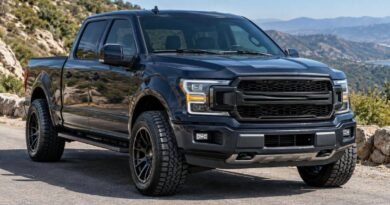
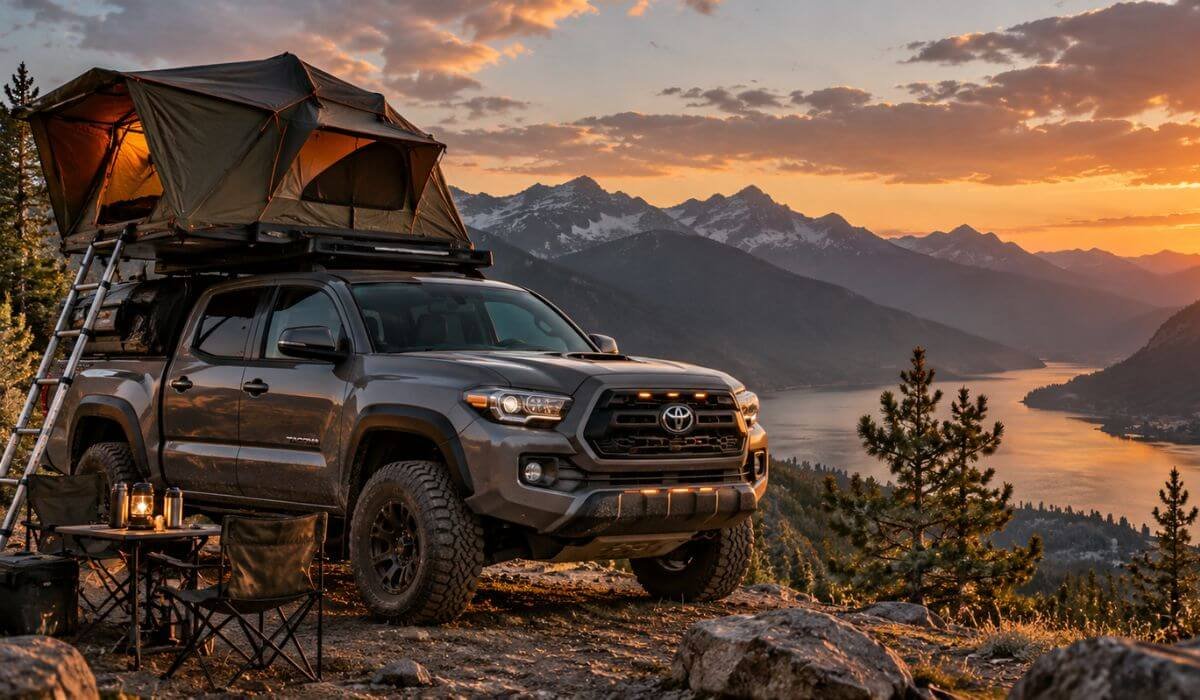
7 Best Rooftop Tents for Toyota Tacoma in 2026: Hard Shell, 4-Season & Fast Setup
If you are shopping for the best rooftop tent for Toyota Tacoma, the right choice comes down to much more than how the tent looks on the truck. Tacoma owners have different bed lengths, rack layouts, and mounting positions, while rooftop tents can range from compact 2-person hard shells to larger 3-person setups with thicker mattresses, insulation, annex space, and faster opening systems. The tent and the truck need to work as one setup.
For this guide, the focus is on the features that make a real difference once you are actually camping: aluminum and hard-shell construction, 2–3 person sleeping layouts, 4-season weather protection, waterproof ratings up to 5,000mm, quick hydraulic or gas-strut opening, thermal insulation, condensation mats, comfortable mattresses, LED lighting, storage, charging ports, and practical mounting flexibility. That gives you a better picture of what each option offers beyond a basic specification sheet.
The seven picks cover very different Tacoma camping styles, from a spacious setup with an annex room to low-profile hard shells designed for quicker deployment and easier everyday travel. Some prioritize comfort and interior organization, while others put more emphasis on weight, weather protection, aluminum construction, or setup speed. Before buying, compare the tent’s weight, footprint, mounting rails, crossbar requirements, and ladder reach with your specific Tacoma generation, bed configuration, and rack system.
Best Toyota Tacoma Rooftop Tent: Top Picks for Space & Comfort
#1. Bayati Naturnest Sirius 1 Rooftop Tent with Annex Room
A standout rooftop tent for Toyota Tacoma builds where generous sleeping space, a private annex, 4-season protection and a more comfortable basecamp experience take priority.
#2. SanHima CapeTop Rooftop Tent
A refined Toyota Tacoma rooftop tent choice pairing a low 9.84-inch closed profile with an 84.65-inch interior, blackout lining, a 2.17-inch mattress and integrated charging controls.
#3. HEYFUN Adventurer Pro Rooftop Tent
A fast-deploying hard-shell option for Tacoma campers who value aircraft-grade aluminum construction, a 5-second hydraulic opening, 3-person capacity and substantial interior load capability.
#4. Jiadrooe Hard Shell Rooftop Tent
A versatile Tacoma rooftop tent setup built around integrated adjustable crossbars, detachable thermal insulation, dual-mode LED lighting and 5,000mm waterproof protection.
#5. ARCTWONDER Hard Shell Rooftop Tent
A cold-weather-focused hard shell for Toyota Tacoma camping, combining an aluminum structure, removable winter thermal layer, 7-inch closed height and a 6cm mattress system.
#6. JOYINRUTE Aluminum Hard Shell Rooftop Tent
A clean, uncomplicated 2-person setup for Tacoma owners who want aircraft-grade aluminum construction, hydraulic opening, blackout fabric, 5,000mm water resistance and practical ventilation.
#7. WildFinder Hard Shell Rooftop Tent
A substantial hard-shell camping option for Tacoma builds, featuring an aircraft-grade aluminum structure, 5cm comfort mattress, condensation management, blackout protection and a 3-person interior.
Must Check: Best Bed Rack for Toyota Tacoma
Expert Tip
A rooftop tent can look perfectly suited to a Toyota Tacoma and still create problems once the truck is being used day after day. The first check should be the entire load path—tent, mounting hardware, crossbars and rack—not simply the tent’s advertised weight. From there, look at how the tent sits on the truck, how much room remains around the bed, how far the ladder extends, and whether the closed setup still works with the way the Tacoma is normally driven and parked.
The best Tacoma rooftop tent is usually the one that works with the truck’s existing setup rather than forcing compromises everywhere else. A lower-profile hard shell can be particularly useful for owners who drive regularly, while a larger 3-person design makes more sense when interior room is a higher priority. For colder camping, thermal insulation, mattress construction and condensation management can have a much greater impact on overnight comfort than a long list of minor accessories.
How We Chose These Rooftop Tents
The ranking is based on how each tent translates from a specification sheet into a practical Toyota Tacoma rooftop tent setup. Hard-shell construction alone was not enough to earn a higher position. The more useful question is whether the combination of structure, sleeping space, weather protection, setup mechanism and supporting hardware makes sense for the way a Tacoma is actually used.
Construction and weather protection were considered first. Several picks use aluminum in the shell or structural components, while others combine rigid shells with coated or ripstop fabrics. Waterproof ratings reach as high as 5,000mm among these options, but weather protection is not determined by that number alone. Seals, fabric construction, shell design, ventilation and the way the tent manages moisture all contribute to how usable the shelter is in changing conditions.
Interior space and sleeping comfort were another major factor. The Bayati Naturnest Sirius 1 stands apart with its 3-person layout, large sleeping area and included annex room, creating useful separation between the sleeping platform and the ground-level living area. Other models take a more compact approach, making them better suited to campers who value a simpler footprint over additional living space.
The comparison also gives proper weight to cold-weather equipment and moisture control. ARCTWONDER includes a removable winter thermal layer, while Jiadrooe adds a detachable thermal insulation liner and anti-condensation mat. These are more meaningful differentiators for four-season camping than simply labeling a tent “4-season.” Mattress thickness matters as well, particularly when a rooftop tent becomes the primary sleeping system for several nights rather than an occasional overnight shelter.
Setup speed and opening mechanism were assessed separately because convenience becomes a major part of the ownership experience. HEYFUN’s hydraulic gas-strut system is designed for extremely rapid deployment, while other hard-shell configurations use hydraulic supports for a similarly straightforward setup. SanHima’s Snap Fold System adds another practical angle, particularly for campers who want a structured setup without spending excessive time assembling the sleeping area at every stop.
The evaluation also considers truck integration, including tent weight, mounting rails, crossbar requirements, available accessory capacity and overall footprint. This is particularly important on a Tacoma because the tent does not operate independently—the rack and mounting hardware become part of the same system. A feature such as Jiadrooe’s integrated adjustable crossbars can therefore be more useful to a gear-heavy camper than another interior accessory, while a low closed profile can matter more to someone who drives the truck frequently between trips.
Interior usability also separates these tents in less obvious ways. LED lighting, storage pockets, USB connectivity, shoe organizers, blackout materials, ventilation openings and condensation mats may sound secondary on paper, but they become noticeable when the tent is being used repeatedly. The strongest setups are not necessarily the ones with the most features; they are the ones where the useful features support the way the truck and tent will actually be used.
There is also an important distinction between manufacturer specifications and proven long-term ownership data. These are relatively newer products, and independent long-term testing is limited for several of them. Manufacturer-stated waterproof ratings, wind resistance, load figures and setup times have therefore been treated as specifications rather than as independently verified durability results. That keeps the comparison useful without turning product claims into guarantees.
Ultimately, the list is designed around the factors that matter after the tent is mounted: how much sleeping room it provides, how quickly it deploys, how well it handles weather, what the mattress and insulation offer, how much weight the Tacoma must carry, and how naturally the complete system works with the truck. That makes the ranking more useful than simply sorting seven tents by price, shell type or the number of features printed on the box.
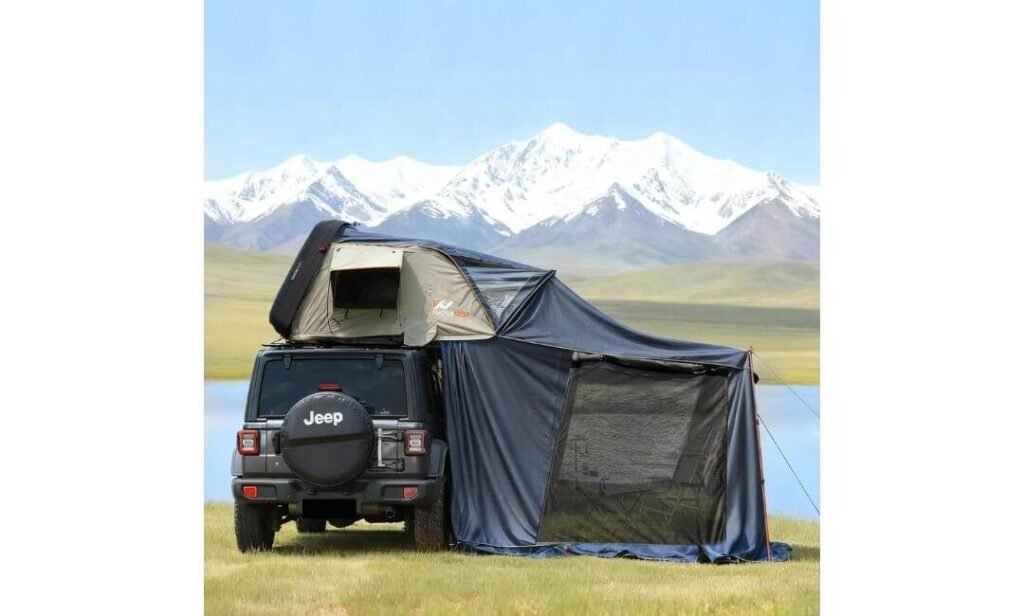
#1. Bayati Naturnest Sirius 1 Rooftop Tent with Annex Room
Quick Specs:
- Sleeping footprint: 82.6 × 63 in
- Closed tent dimensions: 82.7 × 63 × 47.2 in
- Tent weight: 116.3 lb
- Sleeping capacity: 2–3 people
- Shell construction: Impact-resistant ABS polymer
- Frame: Aluminum alloy
- Fabric: 420D ripstop nylon
- Water resistance: 5,000 mm
- Sun protection: UV 50+
- Opening system: Hydraulic pneumatic-assisted lift
- Setup time: Approximately 30 seconds
- Sleeping surface: 1.2-inch cloud foam mattress
- Condensation control: Anti-condensation mat + breathable mesh
- Camp-space advantage: Integrated annex room
- Convenience features: Adjustable LED light, storage pockets and waterproof shoe bags
- Security: Dual key-locking system
The first thing that makes this one interesting for a Toyota Tacoma is its balance of sleeping space and overall design. An 82.6 × 63-inch interior gives two adults a genuinely usable sleeping area, while the 47.2 inches of interior height keeps the tent from feeling like a low rooftop capsule. For a Tacoma build, that extra room matters because the truck already gives you a compact footprint; you want the space above the bed to earn its place.
The ABS hard shell and aluminum frame are another reason it lands near the top of this list. The shell keeps the closed package streamlined, while the hydraulic-assisted opening system means you are not wrestling with poles and fabric every time you reach camp. The advertised roughly 30-second setup is especially appealing for Tacoma owners who like moving between campsites rather than staying parked in one place for days.
What really separates it from a basic hard-shell tent is the combination of 5,000 mm waterproof protection, 420D ripstop nylon, UV 50+ coverage, an anti-condensation mat and full rain canopy. The annex adds another practical layer: it gives wet footwear, bags and changing clothes somewhere to go without taking over your sleeping area. That is the sort of feature you appreciate after actually spending a night in the truck rather than while looking at product photos.
(The appeal here is simple: generous sleeping space above the Tacoma, useful ground-level living space below, and a setup designed to be quick rather than complicated.)
What We Like
- The 82.6 × 63-inch sleeping area gives this a properly comfortable footprint for two adults.
- Hydraulic-assisted opening makes repeated setup and pack-down unusually straightforward.
- The annex room adds useful camp space without increasing the sleeping footprint.
- Anti-condensation and ventilation features show attention to the less glamorous parts of rooftop camping.
- ABS shell + aluminum frame gives the tent a purposeful hard-shell structure rather than a fabric-heavy rooftop design.
What We Don’t
- 116.3 lb is substantial, so the Tacoma’s supporting rack system needs to be chosen around the tent’s real weight rather than assuming any generic bed rack will do.
Toyota Tacoma Fitment & Mounting
This tent is particularly relevant to Tacoma owners because the truck-bed-rack route gives you a practical way to carry a rooftop tent without occupying the Tacoma’s cab roof. The key is matching the tent’s mounting hardware and footprint to a properly rated bed-rack system. The tent itself weighs 116.3 lb, so the rack’s published rooftop-tent/load specifications deserve attention before installation.
Your Tacoma’s bed length, rack height, crossbar spacing and overall rack design also matter. A 5-foot bed, 6-foot bed and 8-foot bed Tacoma can all produce different mounting situations, so the right approach is to measure the actual rack platform and confirm its load rating rather than relying only on a universal “fits Tacoma” statement.
The Insider Pro-Tip
With a tent this substantial, I would make the rack decision before the tent decision. Once you know the rack can properly support the 116.3-lb shell and the expected camping load, the Sirius 1 starts making much more sense because its large sleeping footprint and annex can actually be used without turning the Tacoma into an awkward top-heavy setup.
Also, don’t judge the tent by its closed dimensions alone. The 63-inch width and 82.7-inch length tell you how much roof/rack real estate it needs, while the opened 47.2-inch height tells you what kind of interior experience you are buying. For a Tacoma camping build, those measurements are more useful than a generic “2–3 person” label.
#2. SanHima CapeTop Rooftop Tent
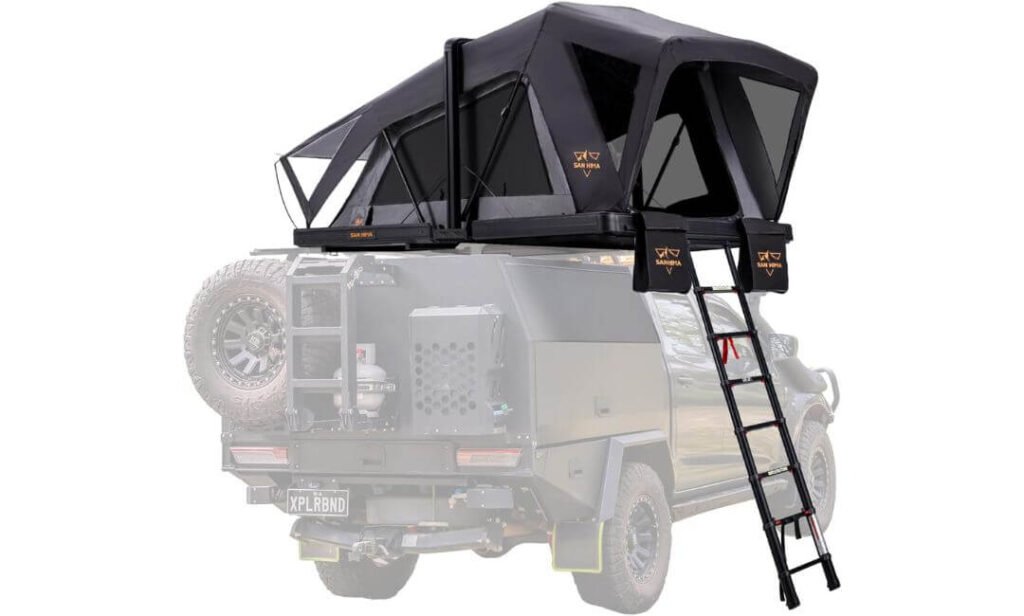
Quick Specs:
- Folded footprint: 56.69 × 42.52 × 9.84 in
- Tent weight: 131.5 lb
- Open interior: 84.65 × 51.18 × 40.94 in
- Sleeping capacity: 3 people
- Construction: Aluminium hard shell with fold-out design
- Main body: 600D Oxford fabric with blackout lining
- Main-body waterproofing: 2,000 mm
- Canopy waterproofing: 3,000 mm
- Canopy sun protection: UPF 50+
- Mattress: 2.17-inch high-density foam
- Setup system: Snap Fold System
- Power: USB-C, USB-A and CIG socket
- Climate connection: Integrated AC duct opening
- Lighting: Adjustable amber LED strip
- Ventilation: Dual side windows, rear window and mesh front door
- Included: Anti-condensation mat, mattress and telescopic ladder
- Warranty: 2 years
What makes this SanHima interesting is the difference between its closed footprint and living space. At only 9.84 inches high when packed, it keeps the folded package relatively tidy on a Tacoma rack, yet unfolds into an 84.65 × 51.18-inch interior with room for up to three people. That is a useful combination when you want sleeping space without carrying a bulky closed tent around the truck.
The 600D Oxford main body with blackout lining is another practical touch. The 2,000 mm waterproof main body is paired with a 3,000 mm full-coverage canopy and UPF 50+ protection, so the weather protection is not dependent on one layer doing everything. Inside, the 2.17-inch high-density foam mattress gives the sleeping platform a more substantial feel than the thin pads found on many basic rooftop tents.
Then there is the part that feels surprisingly well considered for modern truck camping: the digital power panel. USB-C, USB-A and a CIG socket give you straightforward charging options, while the dedicated AC duct opening means you can route a compatible climate-control hose without leaving the tent open to the weather. Add the amber LED strip, blackout lining, shoe pockets and ceiling organizers, and this is clearly designed around spending actual nights inside it rather than simply having a rooftop bed.
(The clever part is how much usable camping space SanHima creates from a surprisingly compact closed package.)
What We Like
- 84.65-inch interior length gives taller campers useful room to stretch out.
- 2.17-inch foam mattress is a meaningful comfort upgrade for multi-night trips.
- Blackout lining and light-shielding construction make early-morning sunlight much less intrusive.
- USB-C, USB-A and CIG power outlets bring useful charging directly into the sleeping space.
- Compact 9.84-inch closed height makes the folded tent easier to live with on a Tacoma rack.
What We Don’t
- 131.5 lb is not truly lightweight once installed on a truck, so the complete Tacoma rack and mounting setup should be selected with the tent’s actual weight in mind.
Toyota Tacoma Fitment & Rack Setup
For a Toyota Tacoma, this fold-out design makes the most sense when paired with a properly rated bed rack or other approved rooftop-tent mounting system. The tent is listed for trucks and SUVs, but the important part of a Tacoma installation is matching the mounting hardware and crossbar arrangement to the rack manufacturer’s specifications.
The open footprint is generous at 84.65 × 51.18 inches, while the packed dimensions are much smaller. That gives Tacoma owners some flexibility when positioning it on a rack, but bed length and rack geometry still matter. Measure the mounting surface and crossbar spacing on your particular Tacoma rather than assuming every rack will place the tent in the same position.
The Insider Pro-Tip
The feature I would pay closest attention to here is not the three-person rating; it is the combination of compact storage dimensions and a long sleeping area. That makes the tent particularly attractive for Tacoma owners who want to preserve a clean-looking truck when travelling but still want proper room once camp is made.
And if you camp in warm weather, the blackout lining, multiple mesh openings and AC duct provision become much more than marketing extras. You get darkness when the sun comes up, airflow when you need it, and the option to connect compatible climate equipment without improvising around the tent fabric. That is the kind of detail that becomes noticeably valuable after several nights on the road.
#3. HEYFUN Adventurer Pro Rooftop Tent
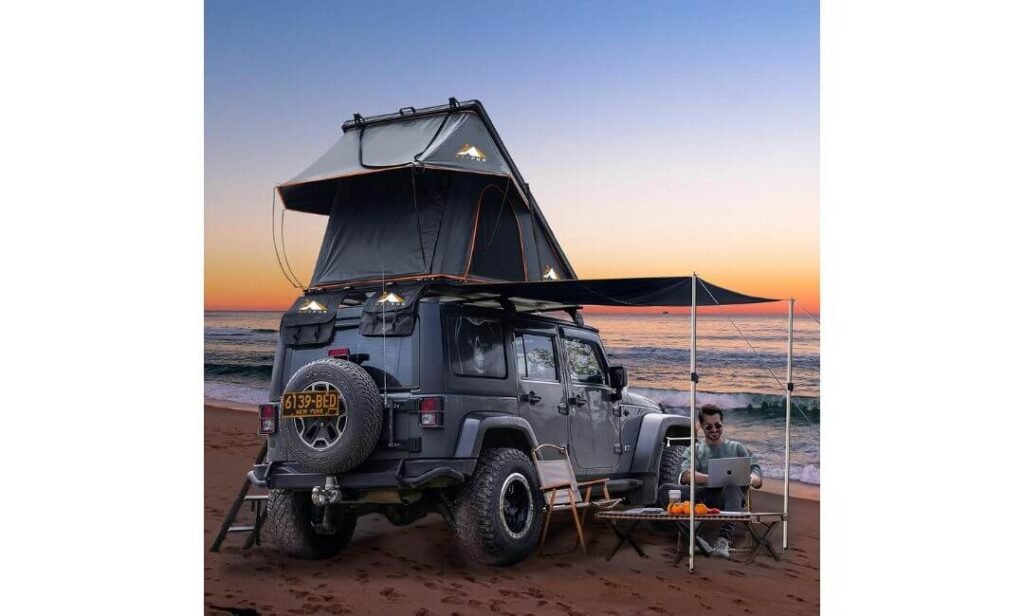
Quick Specs:
- Open footprint: 83.86 × 51.57 in
- Closed profile: 83.86 × 51.57 × 7 in
- Tent weight: 160 lb
- Sleeping capacity: 2–3 people
- Maximum interior load: 660 lb
- Shell: Aircraft-grade aluminum
- Tent material: 320g polyester
- Waterproofing: Up to 5,000 mm
- Opening system: Automatic hydraulic gas struts
- Setup: Approximately 5 seconds
- Sleeping comfort: Sleeping mat + condensation mat
- Weather details: UV-resistant, windproof and all-season construction
- Storage: 13 interior pockets + 2 waterproof shoe bags
- Exterior feature: Detachable side awning
- Lighting: Built-in LED light strip
- Mounting: Universal hardware kit
- Recommended rack rating: At least 165 lb
Five seconds is the number that gets your attention, but the real appeal is what happens around that number. The hydraulic gas-strut system lets the hard shell pop open almost immediately, so the HEYFUN is built around the kind of camping where you arrive, park the Tacoma and get on with the evening instead of spending the first few minutes assembling your bedroom.
Once open, the 83.86 × 51.57-inch footprint gives two adults a comfortable amount of sleeping room, with enough capacity for a child when the setup is used as a three-person tent. The aircraft-grade aluminum shell keeps the closed profile down to about 7 inches, while the included condensation mat, sleeping mat, flocked floor lining and multiple storage pockets make the interior feel deliberately designed rather than simply spacious on paper.
There is also a nice bit of practicality outside the sleeping area. The detachable side awning creates a sheltered spot beside the Tacoma, while the 13 interior pockets and waterproof shoe bags help keep small gear from migrating across the mattress. Add the built-in LED strip and the up-to-5,000 mm weather protection, and this starts looking like a complete camping system rather than a shell with a mattress thrown inside.
(For a Tacoma owner who values fast camp transitions, solid construction and useful accessories, this is one of the more convincing hard-shell packages in the lineup.)
What We Like
- Five-second hydraulic opening is genuinely useful when the Tacoma is being used for frequent campsite changes.
- 7-inch closed height keeps the packed tent surprisingly low for an aluminum hard-shell design.
- 660-lb maximum load gives the sleeping platform useful headroom for two adults and a child.
- 13 storage pockets plus shoe bags solve the small-but-annoying problem of where everyday camping gear goes.
- Side awning included means you get usable shade/shelter without immediately shopping for another accessory.
What We Don’t
- 160 lb is a serious rooftop load, so the rack and mounting system should be treated as part of the purchase rather than an afterthought.
Toyota Tacoma Fitment & Rack Setup
For a Toyota Tacoma, the HEYFUN is designed around a crossbar/rack-mounted installation and includes universal mounting hardware. The manufacturer specifically recommends crossbars capable of supporting at least 165 lb, which is especially important here because the tent itself weighs 160 lb.
The Tacoma’s exact rack arrangement still matters. Check the crossbar load rating, spacing and mounting surface for your particular truck and rack before lifting the tent into position. Because the tent is 83.86 inches long when closed, its placement should also be checked against the rack geometry and the rest of your truck setup rather than assuming every Tacoma bed rack will position it identically.
The Insider Pro-Tip
This is one of those tents where the rack rating deserves as much attention as the tent specification. With a 160-lb tent and a manufacturer recommendation of at least 165 lb for the crossbars, there is very little reason to cut corners on the supporting hardware. A properly matched Tacoma rack lets you enjoy the five-second deployment without turning the installation into a guessing game.
The other number worth remembering is 7 inches. That unusually low closed profile is a major part of the appeal: you get a large 83.86-inch sleeping footprint when deployed without carrying an excessively tall box above the truck while travelling. For Tacoma owners who spend a lot of time on the highway between campsites, that is a genuinely useful design choice—not just a specification that looks good in a comparison table.
#4. Jiadrooe Hard Shell Rooftop Tent
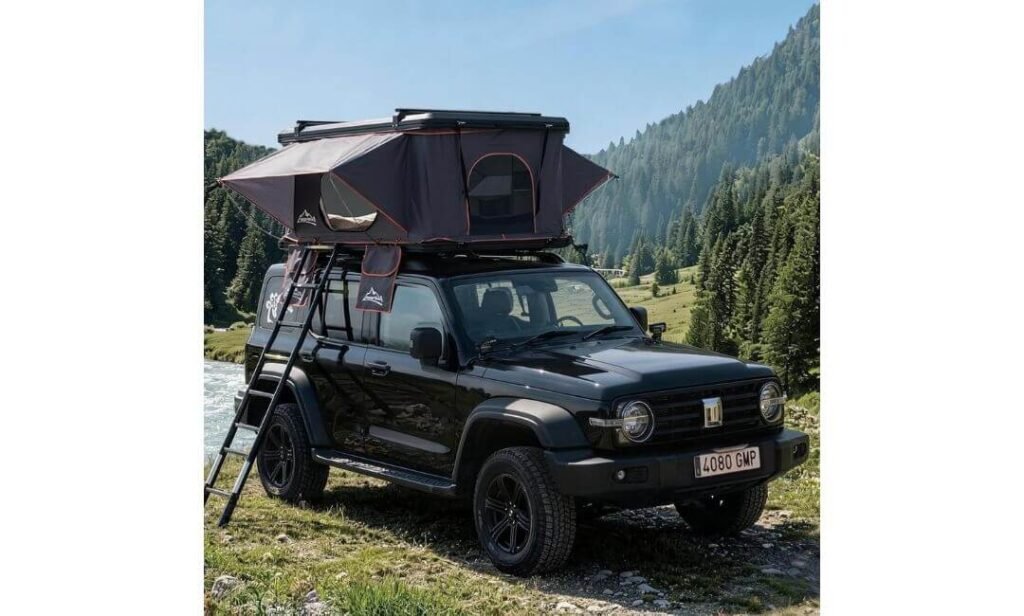
Quick Specs:
- Overall dimensions: 77 × 64 × 40 in
- Tent weight: 176 lb
- Sleeping capacity: 3 people
- Floor width: 132 cm
- Shell: Aerodynamic ABS hard shell
- Fabric: Triple-coated 600D Oxford fabric
- Waterproofing: Up to 5,000 mm hydrostatic rating
- Setup: Hydraulic-assisted pop-up, under 60 seconds
- Built-in crossbars: 150-lb capacity
- Sleeping system: High-density two-layer mattress + anti-condensation mat
- Cold-weather feature: Detachable thermal insulation liner
- Power: Integrated USB power controller
- Lighting: Dual-mode cool/warm LED strips
- Included: Telescoping aluminum ladder, universal mounting hardware and repair kit
The interesting thing about this setup is that it tries to solve two problems at once: where you sleep and where you carry more gear. The integrated aluminum crossbars are rated for 150 lb, giving you the option to carry compatible equipment such as bikes, kayaks or solar gear above the tent instead of automatically sacrificing the Tacoma’s usable bed space.
Inside, the design is clearly aimed at campers who do not want to pack away the tent when temperatures drop. The detachable thermal insulation liner, two-layer high-density mattress and anti-condensation mat make the sleeping area more adaptable across seasons. That combination is considerably more useful than simply putting “4-season” on the product description and leaving the actual cold-weather details vague.
The other strong point is how quickly the hard shell opens. The hydraulic strut system deploys the tent in under a minute, while the ABS shell keeps the closed structure clean and aerodynamic for road travel. Add the integrated USB power controller and cool/warm LED lighting, and Jiadrooe has clearly spent its feature budget on things you can actually use once the Tacoma is parked for the night.
(This is the pick for the Tacoma owner who looks at a rooftop tent and immediately asks, “Can I still carry my adventure gear?”)
What We Like
- Integrated crossbars add genuinely useful cargo flexibility above the tent.
- Detachable thermal liner makes the tent more adaptable for colder trips.
- 77 × 64-inch footprint provides a broad sleeping platform for a three-person configuration.
- USB power hub and dual-mode LEDs make the interior more practical after dark.
- Sub-minute hydraulic setup keeps arrival-to-camp time impressively short.
What We Don’t
- At 176 lb, this is the heaviest tent in our lineup so far, so the Tacoma rack and its dynamic/static ratings deserve careful matching.
Toyota Tacoma Fitment & Rack Setup
On a Toyota Tacoma, the Jiadrooe makes the most sense with a properly rated bed rack or crossbar system designed for rooftop-tent use. The supplied universal mounting hardware helps with installation, but it does not replace checking the specifications of the rack actually carrying the tent.
The standout consideration is the built-in 150-lb crossbar capacity. That capacity is for the gear carried on those crossbars, not a substitute for the rack’s requirement to support the 176-lb tent itself. Check the Tacoma rack’s rated load, mounting locations and crossbar spacing before installation, particularly if you plan to take advantage of the additional cargo-carrying capability.
The Insider Pro-Tip
If your Tacoma already carries bikes, boards, recovery equipment or solar gear, the integrated crossbars are probably the feature worth paying attention to first. They can make a rooftop-tent build considerably more versatile because you are not automatically forced to choose between sleeping space and recreational gear.
Just keep the two load figures separate in your planning: the tent weighs 176 lb, while its integrated crossbars are rated for 150 lb of additional cargo according to the supplied specifications. Treat those as two different parts of the system, and the setup becomes much easier to plan intelligently.
#5. ARCTWONDER Hard Shell Rooftop Tent
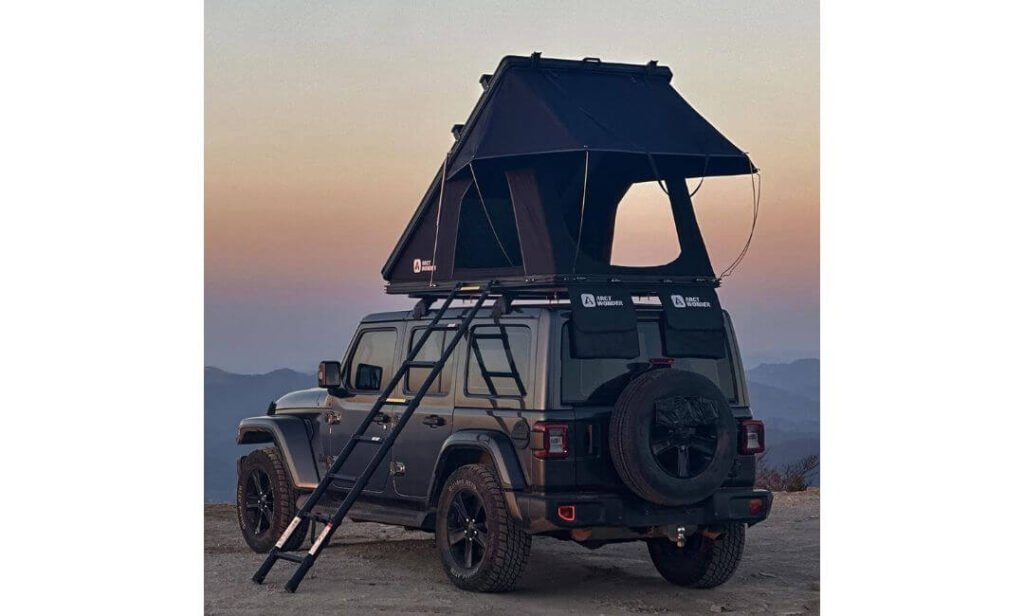
Quick Specs:
- Closed dimensions: 83 × 51 × 7 in
- Tent weight: 166 lb
- Sleeping capacity: 2 people
- Floor width: 48.03 in
- Shell construction: Aluminum top cover, base and reinforced corners
- Hardware: 316 stainless-steel air-pressure rods and buckles
- Fabric: Ripstop polyester/canvas construction
- Water resistance: Up to 5,000 mm
- Opening: Pop-up air-pressure system
- Setup: Approximately 10 seconds to open
- Sleeping system: 5 cm foam mattress + 1 cm condensation pad
- Cold-weather feature: Removable winter thermal layer
- Closed height: Approximately 7 in
- Exterior utility: Two luggage bars
- Lighting: LED eye-protection strip
- Ventilation: Mesh windows
- Storage: 10 interior storage bags + 2 waterproof shoe bags
- Ladder: 7.5-ft telescoping aluminum ladder
There is a reason this tent feels different from a typical lightweight pop-up. ARCTWONDER has put considerable attention into the hard-shell structure itself, using aluminum for the top, bottom and corners rather than relying on plastic corner pieces. That gives the closed tent a more substantial construction, while the 316 stainless-steel hardware is a sensible choice for a component repeatedly exposed to moisture, dirt and outdoor use.
The practical advantage becomes obvious when you look at the packed dimensions. At roughly 7 inches closed, the tent stays remarkably low despite having an 83-inch length. Open it with the pressure-assisted system and you get an 83 × 51-inch overall footprint for two people. That combination is particularly appealing on a Tacoma because you are adding a proper sleeping space without putting a tall, bulky structure above the truck when you are travelling.
The winter package is what gives this model its own identity in the lineup. The removable thermal layer lets you adapt the tent instead of carrying the same insulation arrangement through every season. Underneath, the 6 cm sleeping system combines a 5 cm foam mattress with a 1 cm condensation pad, while the 5,000 mm water-resistance rating and ripstop outer material give the enclosure useful protection when the forecast stops cooperating.
(The clever part here is not one headline feature; it is the low closed profile, aluminum construction and removable insulation working together.)
What We Like
- 7-inch closed height is excellent for keeping the Tacoma’s rooftop profile relatively clean.
- Removable winter insulation makes the tent easier to adapt between cold and warm-weather camping.
- Aluminum shell construction extends beyond the top cover to the base and corners.
- 6 cm sleeping system gives the interior more substance than a basic thin rooftop pad.
- Two luggage bars add useful carrying flexibility without changing the sleeping area.
What We Don’t
- 166 lb is a substantial load, so this is a tent where the Tacoma’s specific rack rating should be checked before anything else.
Toyota Tacoma Fitment & Rack Setup
For a Toyota Tacoma, the important installation detail is the supporting rack rather than the truck’s model year. This tent is intended for crossbar/rack mounting, but the rack needs to be specifically appropriate for rooftop-tent use and capable of handling the tent’s weight and the loads generated while travelling.
The 83-inch length and 51-inch width should also be compared with the actual rack platform and crossbar arrangement on your Tacoma. Different bed lengths and rack designs can change where the tent sits over the truck, so measuring the available mounting area is the sensible final check before installation. The supplied luggage bars are part of the tent’s design, but they should not be confused with the rack system supporting the 166-lb tent.
The Insider Pro-Tip
The strongest reason to consider this one is its low 7-inch closed profile. If you spend long stretches driving between campsites, that matters more than it sounds. You get an 83-inch sleeping platform when camp is made, but the tent folds down into a relatively slim package for the journey.
One thing I would be precise about is the weight. The tent is listed at 166 lb, so I would not base a Tacoma installation on a generic claim that “most Tacomas” can carry it. Check the load rating of your exact rack and vehicle configuration, then account for the tent, mounting hardware and anything else the system is expected to carry. Once that foundation is right, the 10-second opening, removable insulation and aluminum construction make this a very compelling cold-weather-oriented Tacoma setup.
#6. JOYINRUTE Aluminum Hard Shell Rooftop Tent
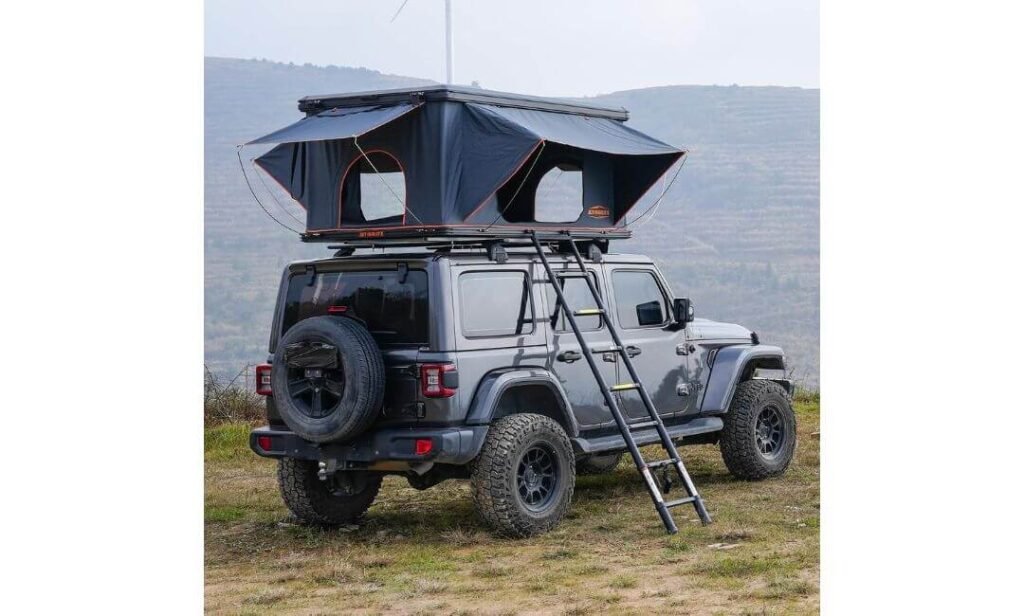
Quick Specs:
- Overall dimensions: 83 × 51.8 × 39.4 in
- Tent weight: 178 lb
- Sleeping capacity: 2 people
- Floor width: 47.27 in
- Shell material: Aircraft-grade aluminum alloy
- Tent fabric: 320g polyester with blackout coating
- Water resistance: Up to 5,000 mm
- UV protection: Up to 99%
- Wind resistance: Up to Grade 6
- Opening system: Four hydraulic support rods
- Sleeping surface: Mattress + condensation pad
- Floor treatment: Flocked lining
- Ventilation: Four windows with mesh and windproof layers
- Lighting: LED strip
- Storage: Five internal storage bags + two shoe organizers
- Ladder: 7.5-ft telescoping aluminum ladder
- Included: Installation tools, storage bag and ladder storage bags
Sometimes the best rooftop tent is the one that does not make camping feel like a project. That is where the JOYINRUTE makes sense. The four hydraulic support rods handle the opening and closing, while the aluminum hard shell gives the tent a solid structure that is well suited to repeated outdoor use. There is no elaborate room system to figure out; it is a straightforward two-person shelter designed to get the Tacoma parked and the sleeping area ready.
The dimensions are useful here. At 83 inches long and 51.8 inches wide, the tent provides a proper sleeping footprint while remaining relatively compact across the rack. The 47.27-inch floor width is worth noting because the usable sleeping platform is narrower than the overall shell dimensions suggest. For two adults who prefer a simple rooftop setup, that is still a workable layout, particularly when the goal is comfortable overnight camping rather than creating a large living room above the truck.
The weather details are where the specification sheet becomes more meaningful. The 320g polyester fabric, blackout coating, 5,000 mm water resistance and four dual-layer windows give you a combination of rain protection, reduced sunlight and ventilation. The flocked floor is another small but useful detail because temperature differences under the mattress can create condensation; pairing it with the included condensation pad gives moisture somewhere to be managed instead of simply leaving the sleeping surface damp.
(It is a refreshingly uncomplicated design: aluminum above, a sensible sleeping space inside and the basic accessories already accounted for.)
What We Like
- Aircraft-grade aluminum construction gives the shell a substantial, durable feel.
- Four hydraulic support rods make opening and closing much simpler than pole-based designs.
- Four mesh-and-windproof windows provide useful airflow without leaving the interior completely exposed.
- Flocked floor + condensation pad shows attention to moisture management.
- Complete camping accessories mean the basic ladder, storage, lighting and shoe organization are already included.
What We Don’t
- 178 lb is the heaviest listed weight in this group, so the supporting Tacoma rack needs particularly careful load matching.
Toyota Tacoma Fitment & Rack Setup
For a Toyota Tacoma, this tent should be treated as a rack-mounted system rather than something that simply sits on the truck by itself. A suitable bed rack or crossbar system designed and rated for rooftop-tent use is required, and its load rating should comfortably accommodate the 178-lb tent plus the applicable mounting and camping loads.
The tent measures 83 × 51.8 inches, so check those dimensions against your Tacoma rack’s usable platform and crossbar spacing. The exact bed length does not automatically determine fitment, but it can affect where the rack and tent sit relative to the cab, bed and surrounding accessories. A quick measurement before installation is far more useful than relying on a generic “fits Tacoma” label.
The Insider Pro-Tip
The aluminum construction is the reason I would look at this model before getting distracted by the accessory list. At 178 lb, it is not a lightweight rooftop addition, so the quality and rating of the Tacoma rack become part of the buying decision. If your rack is already properly rated and positioned, the tent’s hydraulic opening system keeps the actual campsite routine refreshingly simple.
Also pay attention to the 47.27-inch floor width, not just the 51.8-inch overall width. That distinction tells you more about the sleeping experience than the outside measurement does. For two people who want a clean, compact sleeping setup rather than maximum interior space, it is a sensible configuration; just make sure that sleeping footprint matches how you actually camp.
#7. WildFinder Hard Shell Rooftop Tent
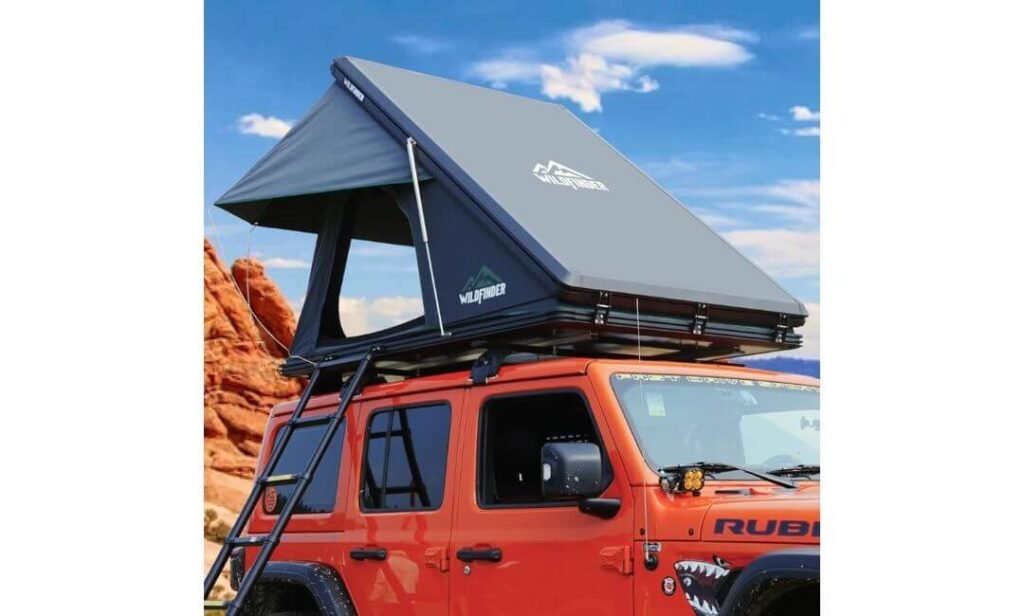
Quick Specs:
- Overall dimensions: 83 × 52 × 9 in
- Tent weight: 197.6 lb
- Sleeping capacity: 3 people
- Construction: Aircraft-grade aluminum alloy shell
- Fabric: Breathable, waterproof polyester
- Closed profile: 9 in
- Weather protection: 5,000 mm rainproof rating
- Sun protection: 99.99%
- Wind protection: Up to Level 6
- Snow protection: Up to Level 4
- Sleeping system: 5 cm non-deforming mattress + condensation pad + recessed marine pad
- Opening system: Stainless-steel air-pressure mechanism
- Ventilation: Three mesh windows
- Lighting: LED strip
- Organization: 10 organizer bags + 2 shoe organizers
- Access: 7.5-ft telescoping ladder
- Rack requirement: Compatible crossbar/rack system required
- Luggage bars: Not included
The WildFinder takes a fairly straightforward approach, but the construction is what gives it some substance. The aircraft-grade aluminum shell, stainless-steel pressure hardware and polyester tent body are aimed at long-term outdoor use rather than making the tent dependent on a lightweight plastic enclosure. For a Tacoma that sees regular camping duty, that solid-shell approach is a sensible foundation.
Inside, the useful part is not simply the three-person rating. The tent combines a 5 cm mattress, recessed marine pad and condensation pad, which tackles comfort and moisture from different angles. The 83 × 52-inch overall footprint also gives two adults a reasonable amount of sleeping space, with the third-person capacity better viewed as an occasional advantage than a reason to squeeze three adults inside.
The weather specification is equally broad: 5,000 mm rain protection, 99.99% sun protection, Level 6 wind resistance and Level 4 heavy-snow protection are substantial figures on paper. The three mesh windows, blackout/privacy-focused fabric and LED strip then make the interior more usable once the weather clears. It is a fairly complete package, although the supplied accessories are doing more of the convenience work than the tent’s core design.
(This is the straightforward choice in the lineup: a substantial aluminum shell, broad weather protection and plenty of included organization.)
What We Like
- Full aluminum shell construction gives the tent a durable, substantial platform.
- 5 cm mattress with condensation management makes the sleeping area more practical for overnight use.
- 5,000 mm waterproofing gives it useful wet-weather protection.
- 10 organizer bags and two shoe organizers make a noticeable difference when three people are sharing the available space.
- 9-inch closed profile keeps the packed tent relatively tidy despite its large overall footprint.
What We Don’t
- 197.6 lb is a significant load, so the supporting Tacoma rack needs to be rated for the complete installation rather than the tent being treated as a standalone accessory.
Toyota Tacoma Fitment & Rack Setup
For a Toyota Tacoma, the WildFinder requires a suitable roof-rack or bed-rack system with crossbars capable of supporting its 197.6-lb weight and the applicable dynamic and static loads. The tent itself does not provide a reason to assume a particular Tacoma generation or bed length will automatically work; the rack is the actual interface between the truck and the tent.
The 83 × 52-inch footprint should be checked against your rack platform and crossbar spacing before installation. One useful detail is that the luggage crossbars are not included, so if you intend to carry additional equipment above the tent, that needs to be planned separately rather than assumed to be part of the package.
The Insider Pro-Tip
With the WildFinder, I would stop thinking about “tent weight” and start thinking about system weight. At 197.6 lb, this is the heaviest option in the lineup, so the Tacoma rack, mounting hardware and anything else carried up there need to be considered together. That is not a reason to dismiss the tent—it is simply the reality of choosing a substantial aluminum rooftop setup.
The other thing I like about this design is its honesty of purpose. You are getting a large hard-shell structure with strong weather specifications and a proper mattress, rather than paying for a long list of electronic extras. If your Tacoma camping style is mostly about getting somewhere, opening the tent, sleeping comfortably and packing everything away again, that simplicity can actually be the feature that matters most.
Best Toyota Tacoma Rooftop Tent (1995–2026): Features, Weight & Setup Compared
Toyota Tacoma Rooftop Tent Buying Guide: What Actually Matters Before You Mount One
A rooftop tent is not a standalone purchase on a Tacoma. The tent, rack, mounting hardware, truck bed, and the load they create together are what determine whether the setup feels solid and practical. That is why the right choice can change considerably depending on how you use your Tacoma, how much gear you carry, and whether the tent will live on the truck all season or only come out for weekend trips.
Start With the Rack, Not the Tent
For a Tacoma, the rack is the foundation of the entire setup. A rooftop tent should be mounted to a properly rated bed rack or crossbar system designed to carry a rooftop tent, not simply to whatever bars happen to be available.
Before buying, check four things:
- Dynamic load rating: This is the rating that matters while the Tacoma is moving. The rack must be capable of carrying the tent while driving, including the effects of bumps, braking and cornering.
- Static load rating: Once parked, the load changes because people are sleeping inside the tent. The rack manufacturer should provide a static or rooftop-tent rating that covers the expected occupied load.
- Crossbar spacing: The mounting rails underneath the tent need to work with the rack’s bar spacing. A tent can have suitable dimensions and still be awkward to mount if the bars cannot land in the correct positions.
- Mounting hardware and anchors: Use the supplied hardware where appropriate and make sure the mounting points sit securely on the rack rather than relying on improvised brackets.
For the seven tents in this guide, weight is particularly important. The listed tent weights range from 116.3 to 197.6 pounds, which is a wide enough spread to change the rack decision entirely.
Tacoma Bed-Rack Mounting vs. Cab-Roof Mounting
For most Tacoma owners, a bed-rack installation is the more natural rooftop-tent configuration because it keeps the tent behind the cab and leaves the vehicle’s passenger roof available for other uses.
A bed rack can also give you a more convenient mounting platform and, depending on its design, additional room underneath for recovery equipment, coolers or other camping gear. The trade-off is that the rack itself adds weight and height to the truck.
Mounting a tent directly over the cab can keep the bed more accessible, but it introduces a different set of considerations: roof-rack compatibility, roof load limitations, cab clearance and the relationship between the tent and the truck’s roof. It is not automatically the better option simply because the tent is marketed for SUVs and trucks.
| Setup | What works well | What deserves attention |
|---|---|---|
| Bed rack | Natural Tacoma layout, keeps cab roof available, good platform for larger tents | Adds rack weight and overall height |
| Cab roof rack | Keeps the bed completely open | Roof load rating, clearance and rack compatibility become critical |
| Integrated rack + tent system | Clean installation with fewer compatibility questions | Less flexible if you later change the tent or rack |
Calculate the Real Load, Not Just Tent Weight
This is where many rooftop-tent purchases become misleading. If the tent weighs 160 pounds, the Tacoma is not carrying only 160 pounds once you leave the driveway.
Your real rooftop system can include:
Tent + mounting hardware + rack/crossbars + bedding + rooftop accessories + any gear carried on the rack
For example, a 176-lb tent does not remain a 176-lb rooftop load after you add a heavy rack and camping equipment. The same applies to the lighter 116.3-lb Sirius 1; its lower tent weight gives you more flexibility, but the rack still has to be rated for the complete installation.
There is another distinction worth understanding:
- Dynamic load: vehicle moving
- Static load: vehicle parked
- Payload: total weight the Tacoma itself is designed to carry, including occupants, cargo and accessories
Do not assume that a truck’s maximum payload figure can simply be compared with the tent weight. The correct number depends on the specific Tacoma configuration, and the rack manufacturer also has its own limits. Check the vehicle’s documentation and the rack manufacturer’s published ratings rather than relying on a generic Tacoma figure.
Measure the Tacoma Before Choosing a Tent
The bed length alone does not tell you whether a rooftop tent will work.
You should measure:
- Rack platform length and width
- Crossbar spacing
- Tent mounting rail positions
- Distance between the cab and rack
- Tent length and width
- Overall truck height after installation
- Clearance around the cab, rear window and other accessories
This matters with the tents in this guide because their footprints are not identical. The Sirius 1 is approximately 82.7 × 63 inches, while the Jiadrooe is 77 × 64 inches, and the WildFinder measures 83 × 52 inches. Those differences may look minor on paper, but they can change where the tent sits on a particular rack.
Also remember that a Tacoma with a 5-foot bed, 6-foot bed or 8-foot bed does not necessarily use the same rack configuration. The tent does not need to match the bed length exactly, but the rack needs to provide a secure mounting arrangement with appropriate positioning.
Give the Closed Height More Attention Than You Think
Once mounted, a rooftop tent changes the Tacoma’s overall height. That affects more than aesthetics.
Think about parking garages, trailhead barriers, low branches, fuel-station canopies and garage storage before committing to a permanent setup.
Closed height varies considerably between designs. The HEYFUN Adventurer Pro, for example, is listed at roughly 7 inches when closed, while other models have a taller packed profile. A lower shell can make everyday driving and storage easier, particularly for owners who keep the tent mounted throughout the year.
Choose the Climate Package for How You Actually Camp
“4-season” is useful terminology, but it should never be the only thing you look at.
For cold-weather camping, pay attention to the actual insulation and sleeping construction. The ARCTWONDER includes a removable winter thermal layer, while the Jiadrooe adds a detachable thermal insulation liner. Those features give campers more control over the interior environment when temperatures drop.
Condensation is just as important. A warm sleeper inside a cold rooftop tent creates moisture, particularly when ventilation is limited. Features such as anti-condensation mats, breathable mesh windows, flocked floors and ventilation openings can make the difference between waking up to a comfortable sleeping surface and dealing with damp bedding.
For warmer climates, ventilation, blackout fabric and sun protection become more valuable. The SanHima, for example, combines blackout lining, multiple windows and Light Shielding Tech, while several of the other tents use mesh ventilation and sun-protection materials.
The better question is therefore not “Is it 4-season?” but:
What does this tent actually do when the weather changes?
Think About Aerodynamics and Everyday Driving
A rooftop tent is not invisible to the wind.
The closed shell becomes another large object above the Tacoma, so height, shape, frontal area and rack design can affect highway noise and fuel consumption. A streamlined hard shell generally makes more sense for frequent road travel than a bulky, poorly positioned setup.
That does not mean one tent will deliver a guaranteed fuel-economy improvement over another. Real-world consumption depends on speed, tires, lift, cargo, wind, rack design and how the tent is positioned.
The practical approach is simple: keep the closed package as streamlined and secure as your setup allows, and remove unnecessary rooftop cargo when you do not need it.
Don’t Ignore Warranty and After-Sales Support
A rooftop tent has moving parts, seals, fabric, hydraulic components, ladders, mounting hardware and electrical accessories. Those are all things you may eventually need help with.
Before purchasing, look beyond the headline warranty and check whether the manufacturer clearly provides:
- Warranty duration and coverage
- Replacement parts availability
- Mounting hardware support
- Replacement fabric or mattress options
- Communication channels for installation questions
- Clear instructions and documentation
- A realistic process for handling damaged components
This matters even more with newer rooftop-tent brands, where long-term owner history may still be limited. A two-year warranty, for example, is useful, but knowing whether replacement parts can actually be obtained is just as important.
Match the Tent to Your Tacoma Camping Style
There is no single “best” rooftop tent for every Tacoma.
If you want maximum sleeping space and an annex, the Sirius 1 makes a strong case. If fast deployment is your priority, the HEYFUN’s hydraulic pop-up design is hard to ignore. If carrying additional equipment above the tent matters, Jiadrooe’s integrated crossbars are unusually relevant. For colder trips, ARCTWONDER’s removable insulation is a feature worth taking seriously.
That is ultimately how this list should be used: start with your Tacoma and your camping habits, then choose the tent that solves the problems you actually have. A tent that looks perfect in a product photo is not necessarily the right one once it is sitting above your truck with a rack, passengers and a weekend’s worth of gear.
Toyota Tacoma Rooftop Tent Installation Guide: Practical Setup Tips for a Secure and Long-Lasting Mount
Installing a rooftop tent on a Toyota Tacoma is not particularly difficult, but it is one of those jobs where small details matter. A tent that is mounted correctly will stay quiet on the highway, remain stable on rough trails and place less stress on the rack system over time. A tent that is rushed onto the truck without checking alignment, load distribution or hardware torque can create unnecessary noise, movement and wear long before the camping season is over.
The goal is not simply getting the tent onto the truck. The goal is creating a setup that remains secure after thousands of miles of driving, changing weather conditions and repeated opening and closing cycles.
Before Installation: Verify the Entire Rack System
Before opening the hardware bag, confirm that the Tacoma’s rack system is capable of supporting the tent and the loads that will be placed on it.
Take a few minutes to verify:
- Crossbar spacing compatibility
- Rack manufacturer’s dynamic load rating
- Rack manufacturer’s static load rating
- Tent mounting rail spacing
- Hardware compatibility
- Bed rack or roof rack mounting points
- Clearance around cab, antenna and rear accessories
- Ladder deployment space
- Overall vehicle height after installation
Many installation problems begin because people focus only on the tent while overlooking the rack itself.
Tools That Make Installation Easier
Most rooftop tents include basic mounting hardware, but having the right tools nearby makes the process smoother and reduces the chances of improperly tightened hardware.
Recommended tools:
- Metric socket set
- Ratchet with extension
- Combination wrench set
- Torque wrench
- Rubber mallet
- Measuring tape
- Marker or masking tape
- Step stool or platform
- Work gloves
- Microfiber cloth
Optional accessories that are often worth adding:
- Anti-vibration mounting pads
- Rubber isolation washers
- Ladder stabilizers
- Locking mounting hardware
- Security nuts
- Thread locker
- Protective crossbar sleeves
- Rack-mounted recovery board brackets
- Accessory crossbars
- Protective paint film for rack contact areas
These accessories are not mandatory, but they can improve long-term durability and reduce rattles that tend to appear after extended use.
Step 1: Prepare the Tacoma and Rack System
Park the truck on a flat, level surface before beginning installation.
Remove unnecessary cargo from the roof rack or bed rack area and inspect all mounting points for damage, rust or loose hardware.
At this stage:
- Clean the crossbars.
- Inspect rack fasteners.
- Verify crossbar spacing.
- Confirm all tent hardware is present.
- Read the tent manufacturer’s mounting instructions.
- Measure overall rack width.
- Identify the tent’s mounting rail locations.
This preparation phase often prevents hours of frustration later.
Step 2: Position the Tent Before Tightening Anything
One of the most common mistakes is tightening hardware before checking the tent’s final position.
With assistance from another person, place the tent onto the rack system and leave the hardware loose enough for adjustment.
Check:
- Side-to-side centering
- Front-to-rear balance
- Ladder deployment angle
- Tailgate clearance
- Rear hatch access
- Cab clearance
- Rack support locations
The tent should sit squarely on the rack rather than hanging excessively beyond supported mounting points.
Step 3: Align the Mounting Rails Correctly
The mounting rails underneath the tent are responsible for distributing loads into the rack system.
The best practice is to position the rails so that:
- Weight is shared evenly across both crossbars.
- Crossbars sit as close as practical to the rail support zones.
- No single mounting point carries excessive load.
- Hardware remains easily accessible for future maintenance.
Avoid positioning both crossbars too close together. Wider support spacing generally creates a more stable installation.
Step 4: Install Hardware and Tighten Gradually
Once the tent position is finalized, install all brackets, plates and mounting fasteners.
Do not fully tighten one corner before installing the others.
Instead:
- Install all hardware loosely.
- Verify alignment.
- Tighten hardware gradually in stages.
- Alternate corners while tightening.
- Perform a final inspection.
- Apply manufacturer-recommended torque values.
This approach helps maintain even pressure across the mounting system.
Step 5: Open the Tent Before the First Trip
Many owners wait until reaching camp before opening the tent for the first time.
A much better approach is to fully deploy it immediately after installation.
Check:
- Ladder operation
- Hinge movement
- Hydraulic strut performance
- Fabric tension
- Window operation
- Rainfly positioning
- Mattress placement
- Interior storage accessibility
Any adjustment is far easier to make at home than at a remote campsite.
Installation Tips for Different Tacoma Configurations
Not every Tacoma uses the same rack layout.
Short-bed setups
- Focus on maximizing rack support spacing.
- Verify ladder placement when parked.
- Pay attention to tailgate operation.
Long-bed setups
- Larger rack platforms provide more mounting flexibility.
- Weight distribution becomes easier to optimize.
- Additional gear storage is often available beneath the tent.
Roof-mounted setups
- Verify roof-rack ratings carefully.
- Keep weight centered.
- Avoid unnecessary rooftop accessories.
Bed-rack setups
- Usually provide the most flexibility.
- Often improve gear organization.
- Frequently simplify ladder access.
The best mounting pattern is the one that keeps the load evenly distributed across the rack while maintaining convenient access around the truck.
Optional Accessories That Improve Daily Use
A rooftop tent installation can become noticeably better with a few carefully chosen additions.
Popular upgrades include:
| Accessory | Why It Helps |
|---|---|
| Anti-vibration pads | Reduce highway rattles and minor movement |
| Ladder stabilizers | Improve ladder stability on uneven ground |
| Locking hardware | Adds security during travel |
| Thread locker | Helps prevent fastener loosening |
| Crossbar sleeves | Protect rack surfaces |
| Storage mounts | Improve organization |
| Accessory brackets | Carry additional equipment safely |
None of these are essential, but several become valuable if the tent stays mounted year-round.
Safety Checklist Before Every Trip
Even a professionally installed rooftop tent should be inspected regularly.
Before leaving:
- Check all mounting bolts.
- Inspect brackets for movement.
- Verify ladder condition.
- Confirm rack fasteners remain tight.
- Inspect tent shell latches.
- Verify crossbar hardware.
- Check fabric for damage.
- Confirm no accessories are loose.
- Verify tent weight remains within rack limits.
- Ensure all locks are secured.
This inspection takes only a few minutes and can prevent much larger problems later.
Common Installation Mistakes That Cause Problems Later
Most rooftop-tent issues are installation related rather than product related.
Mistakes worth avoiding include:
- Ignoring rack load ratings
- Uneven weight distribution
- Overhanging the tent excessively
- Using undersized hardware
- Mixing incompatible mounting components
- Overtightening bolts
- Forgetting torque checks
- Skipping post-installation inspections
- Allowing hardware to loosen after the first few trips
- Mounting additional cargo without recalculating total load
The biggest mistake of all is assuming that once the tent is installed, the job is finished. A rooftop tent should be treated like any other major vehicle-mounted accessory. Regular inspections, periodic torque checks and occasional hardware maintenance are what keep the system secure over the long term.
Final Installation Advice
The most reliable rooftop-tent installations are usually the simplest ones. A properly rated rack, evenly distributed weight, quality hardware and careful alignment will almost always outperform a complicated setup loaded with unnecessary accessories.
Take extra time during the initial installation, double-check measurements before tightening anything and inspect the system after the first few drives. Those small steps often determine whether your Tacoma rooftop-tent setup feels factory-solid for years or becomes something that constantly needs adjustment.
Real-World Toyota Tacoma Rooftop Tent Compatibility: What Fits, What Does Not, and Why
A rooftop tent can be advertised as fitting trucks, SUVs and vans, but vehicle compatibility is only half the story. On a Tacoma, the rack system is the actual connection between the truck and the tent. Bed length, crossbar position, tent dimensions, ladder reach and surrounding clearance all determine whether the finished setup feels properly integrated or simply looks like a tent sitting on a truck.
That is why it is better to check the complete combination of Tacoma configuration + rack + tent rather than searching for a single universal fitment statement.
Tacoma Compatibility Matrix
| Tacoma setup | What to check first | Best suited for | Main consideration |
|---|---|---|---|
| Short-bed Tacoma + bed rack | Rack width, crossbar spacing, tent length | Compact and medium hard-shell tents | Keep the tent properly supported without creating unnecessary rear overhang |
| Long-bed Tacoma + bed rack | Rack platform dimensions and support spacing | Larger sleeping footprints and heavier setups | More mounting flexibility, but rack weight still counts toward payload |
| Cab-roof mounting | Roof rack rating, crossbar spacing, roof clearance | Owners who need the bed completely open | Roof load limitations become especially important |
| Low-profile bed rack | Rack height, tent underside and cab clearance | Highway-focused builds | Better overall vehicle profile, but ladder angle may change |
| Mid/high bed rack | Rack height and ladder reach | Trail and overland setups | Easier tent access, but increases total vehicle height |
| Rack with accessory crossbars | Combined rack and accessory load ratings | Campers carrying additional equipment | Cargo capacity must be considered separately from tent weight |
The table is deliberately configuration-focused because “fits Tacoma” does not mean every Tacoma installation will be identical. The same tent can sit differently on two trucks depending on the rack used underneath it.
Bed Length Is Only One Part of Fitment
Tacoma bed length gets a lot of attention, but it is not the measurement that determines everything.
A rooftop tent does not need to have the same length as the truck bed. What matters is whether the rack provides appropriate support underneath the tent’s mounting rails and whether the finished position leaves sensible clearance around the truck.
For example, the tents in this guide range from approximately 77 inches to more than 83 inches in length. That means the rack needs to be positioned with the tent’s actual mounting points in mind, not simply centered visually over the bed.
A shorter bed can still work with a longer tent when the rack is designed correctly. Conversely, a long bed does not automatically make an incompatible rack-and-tent combination safe.
Roof Mounting and Bed-Rack Mounting Are Not the Same Thing
There is an important distinction between putting the tent on the Tacoma’s cab roof and mounting it on a bed rack.
With a bed-rack setup, the rack becomes the primary support structure. This generally gives Tacoma owners more freedom to choose a larger tent, and it keeps the sleeping platform behind the cab.
With a cab-roof setup, the vehicle’s roof rack and its published load limits become much more important. The tent’s weight, rack weight and other rooftop equipment all become part of the roof-mounted system.
Neither approach is universally better. The right choice depends on whether you value bed accessibility, roof space, overall height, rack flexibility or camping layout.
Crossbar and Rail Compatibility
Before installation, compare the tent’s underside mounting arrangement with the rack’s crossbars.
The important measurements include:
- Distance between crossbars
- Available crossbar width
- Tent mounting rail length
- Mounting-slot adjustment range
- Bracket dimensions
- Fastener size and accessibility
- Clearance between the tent and rack structure
Adjustable mounting rails are particularly useful because they can make it easier to adapt the tent to different rack layouts.
Do not assume that universal mounting hardware means universal positioning. Universal hardware still needs a compatible mounting surface.
Ladder Reach Can Change the Entire Experience
Ladder length is easy to overlook because it sounds like a small detail.
It is not.
A tent mounted on a low bed rack may have a comfortable ladder angle, while the same tent on a taller rack may require more extension. Lifted trucks, taller tires and high-clearance bed racks can increase the distance between the tent floor and the ground.
Before finalizing the installation, deploy the ladder on a level surface and check:
- Whether it reaches the ground comfortably
- Whether the ladder sits at a stable angle
- Whether the feet have enough contact area
- Whether the tailgate interferes with deployment
- Whether uneven campsite ground leaves enough adjustment
- Whether the ladder can be stored without interfering with the tent
A ladder stabilizer or wider foot support can be worthwhile if the truck is frequently parked on uneven terrain.
Tire and Bed-Corner Clearance
Larger tires, aftermarket suspension and wider wheels can change the space around the rear of the truck.
This becomes important when the tent or rack extends toward the rear corners of the bed.
Check for clearance around:
- Rear tires
- Wheel arches
- Bed rails
- Tailgate
- Rack uprights
- Recovery equipment
- Spare-tire access
The goal is not simply to prevent physical contact while parked. You want enough clearance for suspension movement and normal truck articulation when travelling over uneven surfaces.
Cab and Rear-Window Clearance
A tent mounted too close to the cab can create problems even if the rack itself appears correctly installed.
Leave sensible clearance around the:
- Cab roof
- Rear window
- Roof antenna
- Third brake light
- Bed-mounted accessories
- Rack crossbars
Remember that the tent can move slightly with the rack under real driving conditions. A few millimeters of static clearance can disappear once the truck encounters rough pavement or a trail.
Watch the Overall Vehicle Height
Once the tent is installed, measure the actual highest point of the finished Tacoma.
Do not rely solely on the tent’s closed-height specification because the rack contributes additional height.
Write the final measurement somewhere accessible and keep it in the truck.
This becomes particularly useful when entering:
- Parking garages
- Covered fuel stations
- Trailhead structures
- Campground shelters
- Low-clearance roads
- Residential garages
It is an easy measurement to make and one of the easiest mistakes to forget.
Clearance Around Utilities and Accessories
A well-equipped Tacoma can have considerably more equipment around the bed than a stock truck.
Check the tent and rack against:
- Solar panels
- Recovery boards
- Light bars
- Bed-mounted toolboxes
- Bed caps
- Rooftop antennas
- Tonneau covers
- Bed rails
- Rear lighting
- Auxiliary wiring
- Other rack-mounted accessories
The tent should not interfere with equipment that needs to open, slide, fold or be removed regularly.
How to Deal With Common Fitment Limitations
| Limitation | Practical solution |
|---|---|
| Crossbars are too close together | Use a rack with a wider support layout or adjustable mounting positions |
| Tent extends too far rearward | Reposition the rack or choose a mounting configuration with better support distribution |
| Ladder does not reach comfortably | Use a compatible longer ladder or stabilizing accessory |
| Rack sits too high | Consider a lower-profile rack if cab and bed clearance remain adequate |
| Tent interferes with rear-window area | Move the mounting position and verify cab clearance |
| Tonneau cover becomes inaccessible | Check rack compatibility with the cover before installation |
| Additional cargo exceeds rack rating | Reduce rooftop cargo or upgrade to a properly rated rack system |
| Truck becomes too tall for regular parking | Reconsider rack height or remove the tent when not needed |
| Uneven ladder contact at campsites | Add a suitable ladder stabilizer or use a level camping position |
The Real Compatibility Test
The safest way to think about Tacoma rooftop-tent compatibility is as a chain:
Tacoma → rack → crossbars → mounting hardware → tent → occupants and camping gear
Every link needs to make sense.
A tent can have the right dimensions but the wrong rack. A rack can have enough capacity but the wrong crossbar spacing. The mounting hardware can fit but leave the ladder poorly positioned. And a perfectly mounted tent can still become impractical if the finished truck is too tall for where you normally drive and park.
That is why the best Tacoma setup is not necessarily the largest tent or the lightest tent. It is the one where the dimensions, rack structure, load ratings, access and everyday clearance all work together. Once those pieces line up, the tent stops feeling like an add-on and starts feeling like a properly planned part of the truck.
FAQs About Toyota Tacoma Rooftop Tents
Can a rooftop tent be mounted on a Toyota Tacoma without matching the tent to the bed length?
Yes, and this is one of the easiest details to misunderstand. A rooftop tent does not have to be the same length as the Tacoma bed. What matters is whether the bed rack or roof-rack system provides proper support beneath the tent’s mounting rails and whether the final position leaves sensible clearance around the cab, bed, tailgate and ladder.
For example, the tents in this guide range from roughly 77 to 83.86 inches in length, yet their suitability depends much more on mounting geometry than on the Tacoma’s bed length alone. Before buying, measure the rack’s usable platform, crossbar spacing and mounting-slot range. If those three measurements work together, a longer tent can be perfectly practical on a shorter bed.
Is a Toyota Tacoma bed rack better than putting a rooftop tent directly over the cab?
For many Tacoma camping builds, a bed rack is the more natural solution, particularly when the truck is being used for overlanding or longer camping trips. It gives the tent its own support structure behind the cab and leaves the passenger roof available for other equipment.
There is no universal winner, though. A cab-roof installation can preserve full access to the truck bed, while a bed-rack setup can make a larger tent easier to position and gives you a dedicated mounting platform.
The important part is the load path:
- Tent weight goes into the mounting hardware.
- Mounting hardware transfers the load into the crossbars.
- Crossbars transfer it into the rack.
- The rack transfers it into the truck.
If any part of that chain is underrated, the fact that the tent is advertised for a Tacoma does not solve the problem.
How much weight can a Toyota Tacoma rooftop-tent setup actually carry?
There is no single number that applies to every Tacoma rooftop-tent installation. You have to separate vehicle payload, rack capacity, dynamic load and static load rather than treating them as interchangeable.
The seven tents compared here range from 116.3 lb to 197.6 lb before adding the rack, mounting hardware or camping equipment. That difference is large enough to influence which rack makes sense.
A useful way to think about your real load is:
Tent + rack + mounting hardware + rooftop accessories + occupants + other applicable cargo
The rack’s dynamic rating needs to support the moving load, while its static rating needs to account for the occupied tent when the Tacoma is parked. Always use the ratings for your specific truck and rack instead of relying on a generic Tacoma weight figure.
Does a heavier hard-shell rooftop tent necessarily make a Tacoma setup worse?
Not necessarily. Weight is important, but it is not the entire story. A heavier aluminum hard shell can offer a more substantial structure, useful weather protection and a durable mounting platform. The problem starts when the additional weight leaves too little capacity for the rack, occupants, equipment or the rest of the truck’s payload.
There is also a handling difference worth remembering. Putting a large mass high above the Tacoma can affect how the truck feels during cornering, braking and rough-road driving. That does not mean a heavier tent is unsafe by itself; it means the complete build should be planned rather than judged from the tent’s weight alone.
If your setup is already carrying substantial recovery gear, tools, fuel, passengers or other equipment, a lighter tent can sometimes make more sense simply because it leaves more room for the rest of your load.
What should you check after installing a rooftop tent on a Tacoma before taking it on a long trip?
The first trip should be treated as a shakedown, not as the final test.
After installation, open and close the tent several times, inspect every mounting point and make sure the ladder reaches the ground securely. Then drive a short distance and listen for new rattles, movement or unusual wind noise. Recheck the mounting hardware afterward.
Before a longer trip, I would check:
- Rack and mounting fasteners
- Crossbar position
- Tent alignment
- Shell latches
- Hydraulic or pressure-assisted hardware
- Ladder feet and hinges
- Fabric and weather seals
- Clearance around the cab and bed
- Any accessory mounted above the tent
- Overall vehicle height
This is particularly worthwhile with a newer rooftop-tent model that does not yet have years of independent owner history. You can learn far more from your own first few hundred miles than from a generic “fits trucks” statement. If something shifts, rattles or needs adjustment early, finding it at home is considerably better than discovering it halfway to a remote campsite.
Final Thoughts on Choosing a Rooftop Tent for Your Toyota Tacoma
The right rooftop tent for a Tacoma is not the one with the longest feature list or the most impressive-looking shell. It is the one that fits the way you actually use the truck. A solo camper may value a quick pop-up and compact closed profile, while a couple heading out for several nights may get far more value from a wider mattress, better condensation control or an annex. If winter trips are part of the plan, insulation deserves more attention than another convenience feature.
The seven options here deliberately cover those different priorities. Some stand out for sleeping space and livability, others for rapid setup, low-profile travel, insulation, integrated cargo capability or straightforward hard-shell construction. None should be treated as universally perfect, and that is exactly why the comparison matters.
Before placing an order, make the final decision from the truck outward: confirm the rack, verify the applicable dynamic and static load ratings, measure the mounting area, check ladder reach and make sure the finished height works with your normal driving and parking routine. Then choose the tent whose strengths actually match your camping style.
That extra bit of checking is not exciting, but it is what separates a rooftop tent that looks good in a listing from a Tacoma camping setup you will genuinely enjoy using trip after trip.
Also Check: