
5 Best Batteries for Car Audio (2026): AGM & Lithium Picks for High-Power Systems
If you are adding a serious amplifier to a newer SUV, an older pickup, or a daily-driven sedan, the battery becomes part of the audio system—not just something that starts the engine. The right choice comes down to amplifier demand, available space, battery position, charging capability, and whether the battery will serve as the primary or secondary power source. A larger AGM can make more sense for a daily driver that needs useful reserve capacity, while a compact lithium battery can be the smarter solution when space is limited and the system demands high current.
That is why I did not rank these batteries simply by the biggest number printed on the case. The XS Power D3400R brings 80Ah of capacity, 3300A maximum output, 1150 CA and Group 34R fitment, but its reverse-polarity layout still makes terminal orientation an important fitment check. On the other side of the spectrum, the Big Jeff BJ-LI-22AH packs 22Ah and 293Wh into a compact 7.09 × 3.61 × 6.40-inch LFP battery with a manufacturer-rated maximum power capability of 6000W. These are not interchangeable solutions—they are designed around very different electrical demands and installation goals.
I selected the five batteries below based on those differences, looking closely at capacity, current capability, physical size, chemistry, reserve performance, installation requirements and intended amplifier load. Before buying, check the battery tray, terminal orientation, cable requirements and charging system of your vehicle, particularly when switching from a conventional AGM setup to lithium. The right battery should complement the entire electrical system rather than become a temporary fix for an undersized alternator, poor wiring or excessive voltage drop.
High Performance Car Audio Battery (2026): Top Options for Demanding Amplifier Loads
#1. XS Power D3400R 3300A AGM Battery
Best Car Audio Battery for High-Power Amplifiers With 80Ah Capacity, 3300A Maximum Output, 1150 CA and Group 34R Fitment for Demanding Daily-Driven Systems
#2. XS Power PS1200L 2600A AGM Battery
Best AGM Battery for Car Audio Systems With 55Ah Capacity, 2600A Maximum Output, 740 CA and 95-Minute Reserve for 1,500W to 3,000W Amplifier Builds
#3. Big Jeff Audio BJ-LI-22AH 12V LFP Battery
Best Lithium Battery for Car Audio With 22Ah Capacity, 293Wh Energy, 6,000W Rated Maximum Power and Compact 7.75-Pound Design for High-Output Auxiliary Systems
#4. Skar Audio SK-BATT65AH AGM Battery
Best Battery for Car Sound Systems With 65Ah Capacity, 975A Maximum Output, 668 CA and 90-Minute Reserve Capacity for Moderate to High-Demand Audio Builds
#5. Reikken PR1900 Energie AGM Battery
Best Battery for Car Stereo Systems With 28Ah Capacity, 1,900W Amplifier Rating and Compact 20-Pound Design for Space-Constrained Secondary Audio Installations
Expert Tip
Do not choose a car-audio battery simply because its listing shows the highest amp number. That number can look impressive while telling you very little about how the battery will behave in your actual vehicle. Start with the amplifier load, then look at battery capacity, current capability, physical fitment and intended role.
There is also an important distinction between a large AGM used as a main battery and a compact lithium cell used as an auxiliary power source. The XS Power D3400R, for example, gives you 80Ah of capacity and Group 34R packaging, while the Big Jeff BJ-LI-22AH is only 22Ah but uses LFP chemistry and is designed around very high output in a much smaller package. Neither is automatically “better.” They solve different problems. That is the kind of difference worth paying attention to before spending money.
How We Choose These Car Audio Batteries
We did not build this list by taking the five batteries with the biggest numbers from a marketplace page. We looked at what each battery is actually designed to do, then compared those characteristics against the needs of a real car-audio installation.
1. We started with the power requirement
A battery for a modest daily-driver system does not need to be judged by the same standard as one supporting multiple amplifiers and a heavy subwoofer setup. We therefore considered each battery’s stated output capability and recommended audio-system range, rather than treating maximum amperage as the only deciding factor.
That is why the XS Power D3400R sits at the top. Its 80Ah capacity and 3300A maximum output give it substantially more reserve than the smaller power cells in this group, while its Group 34R format makes it a more conventional solution for a suitably equipped vehicle.
2. Capacity mattered just as much as headline output
This is one area where car-audio battery lists often become misleading. A battery can advertise a very high instantaneous output figure without having the same stored energy as a larger battery.
We considered Ah capacity and reserve capability alongside output. The D3400R’s 80Ah rating and the Skar SK-BATT65AH’s 65Ah capacity are meaningful advantages for buyers who need more stored energy. The PS1200L sits between them at 55Ah, making it a sensible middle ground rather than simply a smaller version of the D3400R.
3. We treated AGM and lithium as different tools
We did not force AGM and lithium into one simple ranking system.
The AGM batteries in this list make sense for buyers looking for a substantial 12V power source that can integrate into a more traditional vehicle electrical system. The Big Jeff BJ-LI-22AH, meanwhile, is an LFP battery with only 22Ah of capacity but a very different purpose: compact auxiliary power with a high advertised output capability.
That distinction is important because a reader with limited installation space may value the lithium battery’s small footprint far more than another 30 or 40Ah of AGM capacity.
4. Physical size and fitment were part of the selection
A battery is useless if it does not physically belong in the vehicle.
We looked at case dimensions, terminal arrangement and battery format rather than assuming that every 12V car-audio battery is interchangeable. The D3400R’s Group 34R reverse-polarity configuration is a good example of why this matters. Its specifications may look excellent on paper, but the vehicle still needs the correct tray and terminal orientation.
The same principle applies to compact cells such as the Big Jeff and Reikken. Their smaller dimensions can make installation easier, but their compact size also tells you that they are not direct equivalents to a large-capacity primary battery.
5. We considered the battery’s intended role
This was one of the biggest factors in the final ranking.
A primary battery, a secondary battery and a compact auxiliary power cell should not be judged by exactly the same criteria. The PS1200L, for example, is particularly interesting because it can be used around 1,500W as a primary battery or up to 3,000W in a secondary application, according to its published positioning.
That flexibility gives it a strong place on this list. The Reikken PR1900, on the other hand, is much more appealing when its compact AGM format and roughly 1,900W positioning match the installation rather than when someone is simply chasing the biggest system possible.
6. We did not ignore the less glamorous specifications
Real battery selection involves more than amplifier wattage.
We considered reserve capacity, Ah rating, maximum output, chemistry, dimensions, terminal configuration and intended system size because these details determine whether a battery makes sense once it is actually installed.
This is also why you will see different types of batteries throughout the list. We wanted the recommendations to represent different genuine use cases instead of giving you five batteries that are essentially the same product in different packaging.
7. We kept the ranking honest where the products are difficult to compare
Some of these batteries have much more established specifications and market presence than others. Rather than pretending that every model has the same amount of independent long-term testing behind it, we have kept the recommendations tied to published specifications and intended application.
That matters particularly with newer or less widely reviewed products. A high advertised wattage is worth noting, but it should never be presented as proof that the battery will magically solve voltage drop in every vehicle.
Ultimately, our goal was simple: match the battery to the job, not the marketing number. If you need substantial capacity for a powerful daily-driven system, the larger AGM options make the most sense. If installation space is the problem and you are building around an auxiliary power setup, a compact lithium cell can be the more interesting answer. That is the difference we used to separate these five batteries.
#1. XS Power D3400R 3300A AGM Battery

Quick Specs:
- Battery type: Sealed AGM / lead-acid
- Capacity: 80Ah
- Maximum output: 3,300A
- Starting rating: 1,150 CA
- Size: Group 34R
- Terminals: M6 terminal hardware
- Polarity: Reverse polarity
- Best use: High-demand primary or secondary car-audio systems
If your audio build is starting to outgrow the battery that came with the car, this is the kind of upgrade that makes sense to look at first. The D3400R is not a tiny auxiliary power cell dressed up with a big marketing number; it is a full-size 80Ah AGM power source in a Group 34R case. That matters when the system is pulling hard for more than a few seconds at a time. The 3,300A maximum output, 1,150 CA rating and deep-cycle AGM construction give it the electrical muscle that serious amplifier installations are looking for, while the sealed design is much easier to live with than a conventional flooded battery.
The detail I would pay particular attention to is the “R” in D3400R. This is the reverse-polarity version, so terminal orientation is not something to leave until installation day. The M6 hardware is also a nice touch for properly terminated high-current wiring. In a suitable vehicle, it can work as the main battery; in a demanding build, it can also make sense as part of a dual-battery setup. Just remember that a large battery does not replace a weak charging system—your alternator, grounds, Big 3 wiring and cable sizing still have to support the amplifier load.
(A serious AGM power cell for serious current demand—provided the vehicle fitment and charging system are right.)
What Stands Out in a Real Car Audio Build
- 80Ah capacity gives this battery considerably more stored energy than the smaller power cells in this group.
- The 3,300A maximum output makes it a strong candidate for high-current audio applications.
- Group 34R packaging makes it a genuine full-size battery solution rather than a tiny auxiliary cell.
- Sealed AGM construction avoids the maintenance and spill concerns associated with conventional flooded batteries.
- M6 terminal hardware is useful when the installation involves substantial audio power wiring.
The One Thing to Check Before You Buy
The main catch is fitment, not performance. Reverse polarity means you need to confirm terminal orientation, tray dimensions and cable reach for your particular vehicle before ordering. On some trucks and newer vehicles, the factory fuse block or terminal arrangement may also require additional attention. If the vehicle already has a marginal alternator or undersized charging cables, installing a larger battery alone will not cure every voltage problem.
Why This Car Audio Battery Fits High-Power Builds
Think of this as the capacity-heavy AGM choice in the lineup. It is particularly interesting for a daily-driven vehicle where the audio system needs meaningful reserve rather than just a short burst of current. An 80Ah battery also gives you a different ownership experience from a small auxiliary lithium cell: there is simply more battery behind the system when the music stays loud for longer periods.
For a serious secondary setup, the same characteristics become even more useful. You can dedicate the battery to the audio side of the electrical system while allowing the vehicle’s original battery to remain responsible for starting and normal vehicle electronics. That arrangement still needs to be engineered correctly, but it shows why this particular battery belongs near the top of a high-power car-audio shortlist.
The Insider Pro-Tip
Before spending money on the battery, check the entire electrical chain from the alternator to the amplifier. A D3400R can provide substantial current, but it cannot compensate for a poor ground, undersized power cable or an alternator that cannot replenish what the system is consuming.
And if you’re fitting it into a vehicle such as a Tundra, Silverado, Sierra or another modern truck, do not assume that Group 34R automatically means “drop-in.” Measure the tray, verify the reverse-polarity layout and inspect the factory power distribution around the positive terminal first. Spending five minutes on fitment can save you from turning a premium battery upgrade into an unnecessary wiring project.
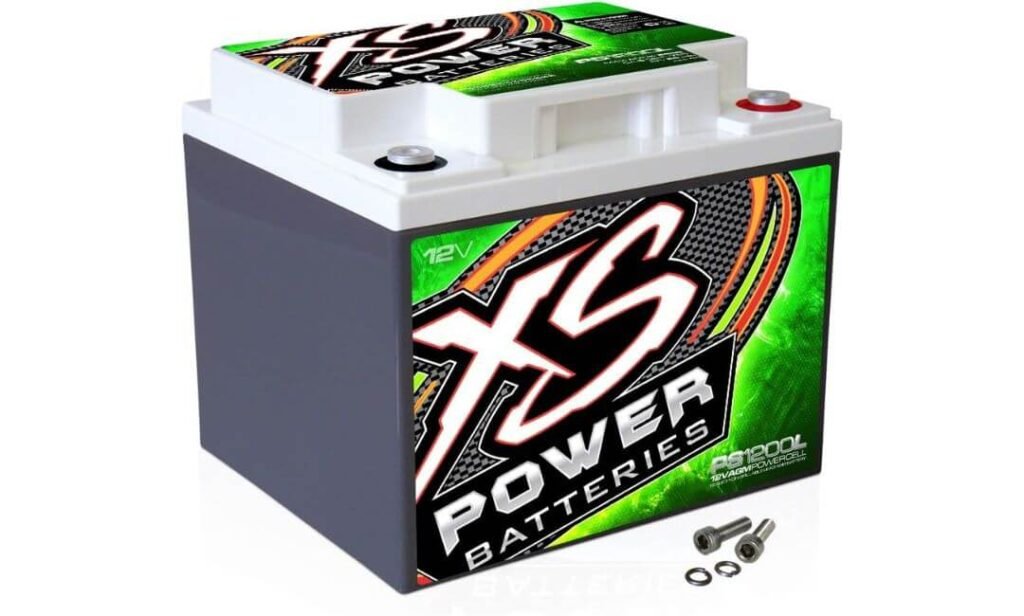
#2. XS Power PS1200L 2600A AGM Battery
Quick Specs:
- Battery type: Sealed AGM / lead-acid
- Capacity: 55Ah
- Maximum output: 2,600A
- Starting rating: 740 CA
- Reserve capacity: 95 minutes
- Terminals: M6 terminal hardware
- Construction: Lead-tin AGM with ultra-thin lead plates
- Best use: 1,500W–3,000W car-audio applications
When a factory battery is starting to struggle with the demands of a serious amplifier, the PS1200L offers a useful middle ground without immediately moving to a much larger battery. Its 55Ah capacity, 2,600A maximum output, 740 CA starting rating and 95-minute reserve capacity give it a strong combination of stored energy and current capability for a properly designed car audio system. The lead-tin AGM construction also makes it considerably more purpose-built for demanding electrical use than an ordinary starting battery.
The construction is where this battery becomes particularly interesting. The ultra-thin lead plates provide a large active surface area for current delivery, while the sealed AGM design keeps the battery non-spillable and better suited to the vibration and movement of a vehicle. The M6 terminal hardware is another useful detail when you’re building an aftermarket power system with properly sized cables. Just keep the bigger picture in mind: the PS1200L can provide reserve and current, but the alternator still has to replace the energy your amplifier consumes.
(A well-balanced AGM power source for serious amplifier demand when you need more reserve without stepping straight into a larger full-size battery.)
What Stands Out in a Real Car Audio Build
- 55Ah capacity gives the system useful stored energy while keeping the battery more manageable than larger high-capacity AGM options.
- 2,600A maximum output gives it substantial high-current capability for demanding car audio applications.
- 740 CA starting rating means it can serve a broader electrical role rather than being viewed only as an auxiliary audio battery.
- 95-minute reserve capacity adds another useful measure of how much electrical reserve the battery carries.
- Lead-tin AGM construction is designed around demanding automotive charging and discharge conditions.
- Ultra-thin lead plates provide a large active surface area intended to support rapid current delivery.
- M6 terminal hardware gives aftermarket installers a practical connection point for correctly sized power wiring.
The One Thing to Check Before You Buy
The first thing to verify is fitment and installation space. Battery dimensions, hold-down points, terminal position and cable reach all need to work with the vehicle before you order. This becomes even more important when the battery is being installed as part of an auxiliary audio system because the mounting location, fuse placement and cable routing all need to be planned rather than improvised.
Also check what is already connected around the factory battery. Modern vehicles can have fuse blocks, battery monitoring equipment and several factory power connections concentrated around the terminals. Make sure your aftermarket wiring has a clean and protected route, and do not assume that a battery’s general automotive application makes it a universal drop-in replacement.
Why This Car Audio Battery Fits 1,500W–3,000W Builds
The PS1200L makes the most sense for a mid-to-high-power car audio system where useful reserve matters but a larger battery is not necessarily required. Its 55Ah capacity gives you considerably more stored energy than a small auxiliary power cell, while the 2,600A maximum-output specification gives it the high-current capability expected from a serious aftermarket audio battery.
For systems in the 1,500W–3,000W range, this battery can be a sensible part of the electrical setup when the alternator, wiring and grounding are appropriately sized. That wattage range should not be treated as a guarantee that the battery alone can sustain a particular amplifier, though. Actual electrical demand depends on amplifier efficiency, music content, listening volume, charging voltage and how long the system is operated under load.
As an auxiliary battery, the PS1200L can also provide additional local reserve near the audio equipment when the installation is designed correctly. It still needs appropriate fusing, cable sizing and a suitable charging arrangement. A second battery adds reserve; it does not turn an undersized alternator into a larger one.
The Insider Pro-Tip
Before installing the PS1200L, look at the entire electrical path rather than the battery in isolation. Check the alternator’s ability to replenish the system, inspect the Big 3 wiring, verify the grounds, size the main power cable correctly and make sure the fuse protection matches the installation. These details determine how effectively the battery can actually support the amplifier.
For a vehicle such as a Tundra, Silverado, Sierra or another high-demand daily driver, I would also measure the battery location before ordering cables or mounting hardware. Check the tray, hold-down, terminal orientation and cable path first. A 55Ah AGM can be an excellent fit for the right build, but the real upgrade comes when the battery, alternator, wiring and amplifier are working as one properly matched electrical system.
Haan, #3 mein content strong tha, lekin #1/#2 ke exact flow ke saath match karne ke liye maine unnecessary repetition hata di hai, lithium ke charging point ko aur precise kiya hai, aur 6,000W rating ko overclaim kiye bina clearly explain kiya hai.
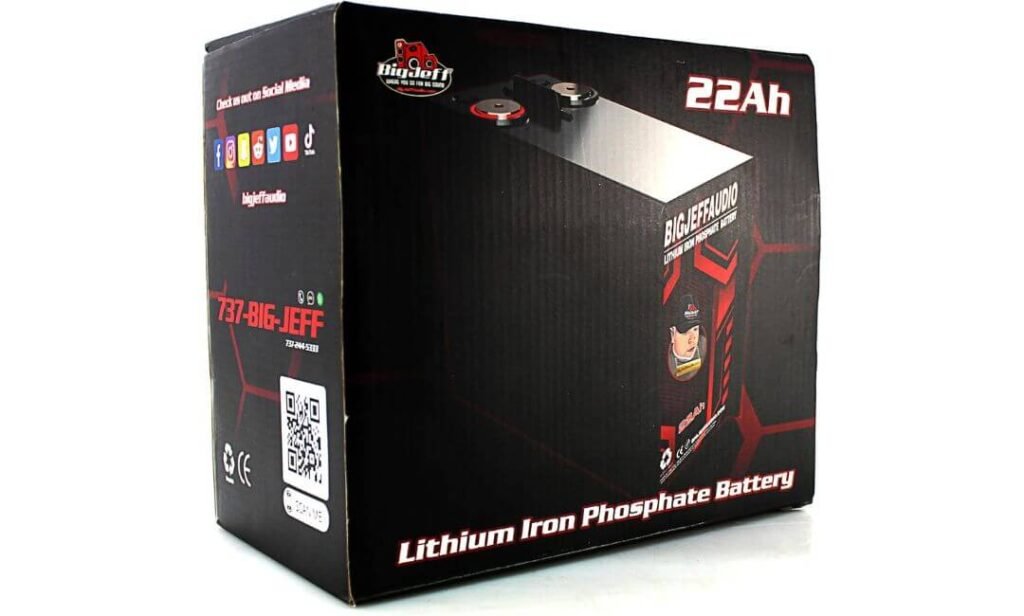
#3. Big Jeff Audio BJ-LI-22AH 12V LFP Battery
Quick Specs:
- Battery type: 12V Lithium LFP
- Capacity: 22Ah
- Energy storage: 293Wh
- Maximum power rating: 6,000W
- Maximum voltage: 14.7V
- Weight: 7.75 lbs
- Dimensions: 3.61 × 7.09 × 6.40 inches
- Key feature: Built-in cell balancing
- Best use: Compact secondary car-audio power
When space is becoming the limiting factor in a serious car audio installation, the Big Jeff BJ-LI-22AH takes a very different approach from the larger AGM batteries in this lineup. At just 7.75 pounds and measuring 3.61 × 7.09 × 6.40 inches, it is small enough to open up mounting possibilities that simply do not make sense with a large lead-acid battery. At the same time, the manufacturer rates it for up to 6,000W of maximum power, making it an interesting option for adding high-current support without carrying another heavy battery.
The important part is understanding what those numbers actually mean. This battery provides 22Ah of capacity and 293Wh of stored energy, so the 6,000W figure should not be interpreted as equivalent to the reserve of an 80Ah AGM. Its appeal comes from the combination of LFP chemistry, compact dimensions, low weight and high advertised power capability. The 14.7V maximum voltage and built-in cell balancing also make the charging and installation setup particularly important. This is best viewed as a specialized auxiliary power source rather than a universal replacement for a larger primary battery.
(A remarkably compact way to add lithium power to a car audio system, provided its capacity and charging requirements match the job.)
What Stands Out in a Real Car Audio Build
- 7.75-pound weight makes it dramatically easier to handle and mount than a conventional full-size AGM.
- 22Ah capacity provides useful auxiliary energy in a very compact package.
- 293Wh of stored energy gives a clearer picture of its actual energy reserve than the maximum power figure alone.
- 6,000W maximum power rating gives it an unusually high advertised power capability for such a small battery.
- 14.7V maximum voltage is an important specification when planning the charging system.
- Built-in cell balancing helps manage the individual cells within the LFP battery during operation.
- Compact dimensions make it particularly attractive for installations where a conventional battery simply will not fit.
The One Thing to Check Before You Buy
The most important detail here is charging compatibility. Moving from AGM to LFP is not simply a matter of connecting another 12V battery and assuming the vehicle’s existing charging setup will work the same way. Check the battery’s charging requirements, the vehicle’s charging voltage and how the auxiliary battery will be connected before installation.
Physical fitment also deserves attention. Because this battery is so compact, it may tempt you to install it in a location that was never designed to hold a battery. Make sure it is securely mounted, protected from damage and positioned with safe cable routing and appropriate fuse protection.
Why This Car Audio Battery Fits Compact High-Power Builds
The BJ-LI-22AH is most interesting when weight and installation space matter as much as electrical capability. A 7.75-pound battery is far easier to position than a 40-plus-pound AGM, and its compact footprint can make an auxiliary installation possible in areas where a conventional battery would be impractical.
Its 22Ah capacity also tells you how to think about this battery. It is not the choice I would make simply because I wanted the largest possible energy reserve. Its role is different: it can provide a compact high-current support source alongside a properly engineered vehicle electrical system. That makes it particularly relevant to powerful audio builds where adding another large AGM would create unnecessary weight or packaging problems.
The Insider Pro-Tip
Do not let the 6,000W maximum rating be the only specification you look at. Start with the amplifier’s actual electrical demand, then consider the alternator, charging voltage, wiring, fuse protection, grounds and the battery’s role in the system. Maximum power and stored energy are two different measurements, and confusing them can lead to an incorrectly sized electrical setup.
For a daily-driven vehicle, I would pay just as much attention to charging compatibility and mounting as I would to the battery’s output rating. The real advantage of the BJ-LI-22AH is its unusually small and lightweight package. When that advantage is matched with the correct charging and wiring strategy, it becomes a genuinely useful alternative to adding another large AGM battery.
Haan, #4 ko bhi #1–#3 ke exact same structure, depth aur tone mein rakhna better hai. Tumhare current draft mein content strong hai, but headings extra ho gayi hain aur flow #1–#3 se match nahi kar raha. Main isko clean karke final article-ready version de raha hoon:
#4. Skar Audio SK-BATT65AH AGM Battery

Quick Specs:
- Battery type: Sealed AGM / lead-acid
- Capacity: 65Ah
- Maximum output: 975A
- Cranking amps: 668A
- Reserve capacity: 90 minutes
- Weight: 43.3 lbs
- Dimensions: 9.875 × 6.25 × 7.00 inches
- Life cycle: 300 cycles at 100% discharge depth
- Terminal hardware: Included
- Best use: Moderate to high-demand daily-driver audio systems and secondary applications
The Skar Audio SK-BATT65AH takes a more capacity-focused approach than the higher-output XS Power batteries above. With 65Ah of capacity and a 90-minute reserve, it gives a daily-driven car, truck or SUV a substantial amount of stored energy without stepping into the larger price and output territory of the top XS Power options. At 43.3 pounds, it is still a serious AGM battery, but that size comes with useful reserve for an aftermarket audio system that spends plenty of time playing.
Its 975A maximum output and 668 cranking amps also give it enough starting capability to remain useful as more than just an auxiliary audio battery. The AGM construction is suited to the vibration and repeated charge-discharge demands associated with vehicle use, while the included terminal hardware removes one small installation headache. The 300-cycle rating at 100% discharge depth is another useful specification, although actual service life will depend heavily on discharge depth, charging conditions and how often the battery is cycled.
(This is the sensible AGM choice when usable capacity and reserve matter more than having the biggest peak-current number on the specification sheet.)
What Stands Out in a Real Car Audio Build
- 65Ah capacity provides useful stored energy for longer audio sessions.
- 90-minute reserve capacity gives it an advantage for sustained electrical demand.
- 975A maximum output provides solid current capability for moderate-to-high-demand systems.
- 668 cranking amps keeps it suitable for starting duties as well as audio support.
- 300 cycles at 100% discharge depth gives a useful indication of its cycling capability.
- Terminal hardware included makes aftermarket installation more straightforward.
The One Thing to Check Before You Buy
The most important thing to check is whether the 9.875 × 6.25 × 7.00-inch case actually works with your vehicle’s battery tray, hold-down and terminal arrangement. A battery can have the right capacity and still create problems if the terminals face the wrong direction, the cables do not reach comfortably or the factory hold-down cannot secure the case properly.
Also look at how you plan to use it. The SK-BATT65AH can provide useful additional reserve, but a second battery does not replace a properly sized alternator, adequate power and ground cables or good chassis grounding. If your voltage is already falling because the charging system cannot keep up with amplifier demand, simply adding another AGM battery may only give you more stored energy rather than solving the underlying problem.
Why This Car Audio Battery Fits Moderate-Power Builds
The SK-BATT65AH makes the most sense for a strong daily-driver car audio system where useful capacity is more important than chasing extreme instantaneous output. Its 65Ah capacity and 90-minute reserve give it a practical advantage for systems that spend extended periods playing music rather than only demanding short bursts of current.
It is also an attractive choice when you want a substantial AGM battery without moving straight into a more specialized electrical setup. You give up the higher peak-current capability of the XS Power D3400R and PS1200L, but in return you get a straightforward 65Ah AGM platform that can work well when properly matched to the vehicle’s charging system and amplifier demand.
The Insider Pro-Tip
Don’t choose the SK-BATT65AH simply because 65Ah is higher than 55Ah on the PS1200L. Capacity and maximum current are different parts of the equation. If your system has very high instantaneous current demand, the higher-output XS Power batteries may make more sense; if your priority is useful reserve for a substantial daily audio setup, the Skar’s capacity becomes much more relevant.
Before installation, measure the battery tray and confirm the terminal orientation, hold-down arrangement and cable reach. Also make sure the battery is firmly secured rather than relying on its weight to keep it in place. In a truck or SUV that regularly sees rough roads, proper mounting is part of the electrical system—not an afterthought.
#5. Reikken PR1900 Energie Battery

Quick Specs:
- Battery type: 12V AGM / lead-acid
- Capacity: 28Ah
- Amplifier wattage rating: 1,900W
- Dimensions: 7.13 × 3 × 6.54 inches
- Weight: 20 lbs
- Best use: Compact secondary car-audio systems and budget-conscious builds
The Reikken PR1900 Energie takes a much more compact approach than the larger AGM batteries in this lineup. With 28Ah of capacity and a manufacturer-rated 1,900W amplifier rating, it is aimed at installations where available space is a bigger concern than having a large battery case. Measuring just 7.13 × 3 × 6.54 inches and weighing 20 pounds, it can be considerably easier to position as an auxiliary battery than a full-size AGM.
The important distinction is that the 1,900W figure should not be compared directly with the 2,600A or 3,300A maximum-output ratings of the XS Power batteries. These are different specifications describing different aspects of the battery’s intended application. The PR1900 is better viewed as a compact AGM power source for a moderate audio build, while its 28Ah capacity provides additional stored energy without trying to replace the electrical reserve of a much larger primary battery.
(A genuinely compact AGM option when installation space is limited and the audio system does not justify carrying a much larger battery.)
What Stands Out in a Real Car Audio Build
- 28Ah capacity provides useful stored energy for a compact secondary setup.
- 1,900W amplifier rating clearly positions it toward moderate-power audio systems.
- 20-pound weight makes handling and auxiliary installation easier.
- 7.13 × 3 × 6.54-inch dimensions give it a major advantage where mounting space is restricted.
- AGM construction makes it suitable for automotive applications involving repeated charge and discharge.
The One Thing to Check Before You Buy
The first thing to check is whether the compact case actually works with your intended mounting location. The 7.13 × 3 × 6.54-inch dimensions are useful when space is tight, but you still need to account for terminal access, cable routing, hold-down hardware and clearance around the battery.
If you are using it as a secondary battery, the electrical connection also deserves attention. A small auxiliary battery still needs correctly sized power and ground cables, appropriate fusing and a charging system capable of replenishing the energy being used. Adding the PR1900 can provide additional reserve, but it should not be treated as a solution for an alternator or wiring system that is already unable to meet the amplifier’s demand.
Why This Car Audio Battery Fits Compact Builds
The PR1900 makes the most sense when available installation space is the limiting factor. A 20-pound AGM battery with a three-inch width can fit into locations where a substantially larger battery simply cannot. That makes it particularly useful for a compact secondary setup where you want additional electrical reserve without dedicating a large section of the vehicle to another battery.
Its 28Ah capacity and 1,900W amplifier rating also give the battery a clear place in a moderate-power system. It does not compete with the larger XS Power batteries for maximum current capability, but that is not really its purpose. Its strength is providing a relatively small AGM power source that can be easier to integrate into a budget-conscious audio build.
The Insider Pro-Tip
Don’t compare the PR1900’s 1,900W rating directly against a battery’s maximum-amp figure and assume the larger number automatically represents a more powerful battery. They are different specifications. When choosing between these batteries, look at capacity, current capability, chemistry, physical size and intended application together.
For a secondary installation, keep the cable run practical and protect the positive connection with appropriately sized fusing. The battery should also be securely mounted so it cannot shift during hard braking or rough-road driving. With a compact battery like this, good installation and correct electrical integration matter just as much as the specification sheet.
Best Battery for Car Sound Systems in 2026: Compare AGM and Lithium Options
| Battery | Battery Type | Capacity | Output / Rating | Reserve / Energy | Size & Weight | Best Role | What Makes It Different | Real Talk |
|---|---|---|---|---|---|---|---|---|
| XS Power D3400R High-current full-size AGM BEST OVERALL |
Sealed AGM Lead-acid |
80Ah |
3,300A max 1,150 CA |
Large stored-energy reserve Built for high current demand |
Group 34R Full-size AGM format |
Primary or secondary High-power daily systems |
80Ah + 3,300A Strong combination of capacity and current capability |
Best balanced choice for a serious daily build, but the reverse-polarity layout must match the vehicle before ordering. |
| XS Power PS1200L Mid-power high-current AGM MID-POWER PICK |
Sealed AGM Lead-tin construction |
55Ah |
2,600A max 740 CA |
95 min Reserve capacity |
More manageable AGM package M6 terminal hardware |
Secondary or primary Approx. 1,500–3,000W builds |
55Ah + 2,600A Useful middle ground between capacity and high-current output |
Excellent middle ground. Its 55Ah capacity is useful, but very large systems may need more battery or a charging-system upgrade. |
| Big Jeff Audio BJ-LI-22AH Compact 12V LFP power cell LITHIUM PICK |
LFP Lithium 12V chemistry |
22Ah 293Wh |
6,000W max* 14.7V max |
293Wh Built-in cell balancing |
7.75 lb 3.61 × 7.09 × 6.40 in |
Compact secondary Space- and weight-sensitive builds |
7.75 lb Very small footprint with manufacturer-rated high power capability |
Not an automatic AGM replacement. The 22Ah capacity is much smaller, and lithium charging compatibility needs to be considered carefully. |
| Skar Audio SK-BATT65AH Capacity-focused AGM VALUE AGM |
Sealed AGM Lead-acid |
65Ah |
975A max 668 CA |
90 min Reserve capacity |
43.3 lb 9.875 × 6.25 × 7.00 in |
Daily / secondary Moderate-power systems |
65Ah capacity More stored capacity than the smaller 55Ah AGM without going premium |
Capacity is its strength. The 975A maximum output is well below the XS Power options, so extreme builds should look higher in the range. |
| Reikken PR1900 Energie Compact budget AGM power cell COMPACT PICK |
12V AGM Lead-acid |
28Ah |
1,900W rating Manufacturer positioning |
Compact reserve Designed around moderate audio loads |
20 lb 7.13 × 3 × 6.54 in |
Secondary battery Compact budget builds |
Tiny footprint Easy option when mounting space matters more than maximum reserve |
Space-saving budget choice. Its 28Ah capacity makes it better suited to compact or moderate systems than extreme multi-amplifier builds. |
*The 6,000W figure for the Big Jeff BJ-LI-22AH is the manufacturer’s maximum power rating and should not be interpreted as continuous battery capacity. Actual system requirements depend on amplifier demand, charging capability, wiring, fusing and installation.
Car Audio Battery Buying Guide: How to Choose the Right Power Source for Your System
Choosing a battery for car audio is not simply a matter of finding the model with the highest amp number. A battery sits between the vehicle’s charging system and the amplifiers, so its capacity, current capability, chemistry, physical size, charging requirements, and intended role all affect how well the complete electrical system works.
The five batteries above show why there is no single specification that makes one model automatically better than another. An 80Ah AGM offers a very different type of reserve from a 22Ah LFP battery, while a compact 28Ah AGM power cell solves a different installation problem altogether. The right choice depends on how much power the amplifiers actually demand, how long that demand lasts, whether the battery is primary or auxiliary, and whether the vehicle can properly recharge it.
Start With the Electrical System, Not the Battery
Before comparing battery brands, look at the complete electrical chain:
Alternator → charging cable → primary battery → auxiliary battery, if used → distribution/fuse → amplifier → ground
Every part has a job. A larger battery can provide more reserve and help supply current during demanding moments, but it cannot create unlimited electrical energy. If an amplifier consistently consumes more power than the alternator can replace, the battery will eventually discharge.
This is particularly important in high-powered systems. A battery can temporarily supply current when the amplifier demands more than the charging system is providing, but repeated heavy discharge without adequate recharge is not a sustainable solution.
A proper upgrade should therefore consider:
- Alternator output and charging voltage
- Battery capacity
- Amplifier power demand
- Power and ground cable size
- Fuse and distribution arrangement
- Ground connections
- Battery location
- Whether the battery is primary or auxiliary
- Other electrical accessories, such as lighting, compressors, winches, refrigeration equipment, or aftermarket electronics
This is why replacing a factory battery with a much larger one does not automatically solve every dimming-light or voltage-drop problem.
Understand What Ah Actually Tells You
Amp-hours, or Ah, describe battery capacity, not instantaneous amplifier power.
That distinction is important.
A battery rated at 80Ah theoretically has substantially more stored energy than one rated at 28Ah, but that does not mean the 80Ah battery will automatically deliver exactly the same amount of current under every condition. Discharge rate, internal construction, temperature, state of charge and battery chemistry all affect actual performance.
For this lineup, the capacity differences are meaningful:
| Battery | Rated Capacity | What That Number Tells You |
|---|---|---|
| XS Power D3400R | 80Ah | Highest stated capacity in this group, useful for substantial reserve |
| Skar SK-BATT65AH | 65Ah | Strong capacity for a conventional AGM setup |
| XS Power PS1200L | 55Ah | Good middle ground between size and reserve |
| Reikken PR1900 | 28Ah | Compact reserve for moderate or auxiliary applications |
| Big Jeff BJ-LI-22AH | 22Ah | Smallest capacity, but lithium provides a different power-to-weight approach |
Do not read that table as a ranking from “best” to “worst.” Capacity has to match the job.
For example, the Big Jeff’s 22Ah capacity is not a weakness in the same way it would be if it were being marketed as a direct replacement for an 80Ah primary battery. Its appeal comes from its compact LFP design, low weight and manufacturer-rated high power capability.
Do Not Confuse Peak Current With Continuous Power
This is one of the easiest places for car-audio shoppers to get misled.
Battery specifications can use terms such as maximum output, peak current, cranking amps, reserve capacity, amplifier wattage and amp-hours. These measurements do not all describe the same thing.
A manufacturer’s maximum-current figure tells you about the battery’s ability to deliver a high amount of current under specified conditions. It should not automatically be interpreted as the amount of current the battery can continuously provide for hours.
Likewise, an amplifier’s advertised wattage does not tell you exactly how much electrical current it will continuously pull from the battery.
A serious comparison should therefore ask:
- What is the amplifier’s real electrical demand?
- How much current can the battery provide when needed?
- How much stored energy does it have?
- How long will the system operate at high demand?
- Can the alternator replenish that energy?
- Is the battery being used as the primary battery or an auxiliary battery?
This is why the 3,300A rating of the D3400R and the 1,900W positioning of the PR1900 should not be compared as though they are measurements from the same test.
Capacity and Current Capability Work Together
For car audio, you generally want a battery that can both support high current demand and provide enough stored energy for the way you actually listen.
Think of the difference this way:
Current capability is important when the amplifier demands a lot of electrical current.
Capacity becomes increasingly important when that demand continues for longer periods.
A system that produces occasional hard bass hits has different electrical requirements from one that runs several amplifiers loudly for extended periods.
This is also why simply looking for the largest peak number can lead to a poor purchase. A battery with an impressive maximum-current specification but insufficient capacity may not be the ideal solution for a system that spends long periods under heavy load.
AGM vs Lithium: They Are Not Interchangeable Choices
The biggest chemistry decision is usually between AGM lead-acid and lithium, and the difference goes beyond weight.
| Factor | AGM | LFP Lithium |
|---|---|---|
| Weight | Generally heavier | Usually much lighter |
| Capacity options | Widely available in larger automotive sizes | Often excellent energy-to-weight ratio |
| Installation | Familiar to most automotive installers | Requires more attention to charging compatibility |
| Vibration resistance | Very good in quality automotive AGM batteries | Generally good when properly packaged |
| Deep cycling | Better suited than conventional flooded starting batteries | Often well suited to repeated cycling |
| Cost | Usually lower than comparable high-end lithium setups | Typically higher upfront |
| Charging | Familiar automotive charging environment | Charging voltage and system compatibility require more attention |
| Space efficiency | Can require substantial physical space | Major advantage in compact installations |
| Best strength | Large reserve and straightforward automotive use | Low weight, compact size and high power-to-weight potential |
There is no universal winner.
AGM is usually the simpler choice when you want a substantial automotive battery with meaningful capacity and your vehicle’s charging system is designed around conventional 12V lead-acid technology.
LFP lithium becomes particularly attractive when weight and available space are major constraints or when the system has been deliberately designed around lithium’s electrical characteristics.
The important part is not choosing lithium because it sounds more advanced. It is choosing it because the entire electrical system is compatible with it.
What to Know Before Switching From AGM to Lithium
Lithium batteries deserve more attention during installation because the charging environment matters.
Before fitting an LFP battery, verify:
- The manufacturer’s recommended charging voltage.
- Whether the vehicle’s alternator is appropriate for the battery.
- Whether a battery management system is included.
- How the battery should be isolated or connected when used as an auxiliary source.
- Whether the battery can safely operate in the intended temperature range.
- Correct cable sizing and fuse placement.
- Proper physical mounting.
A compact lithium battery can be an excellent solution, but small physical size does not mean small electrical responsibility.
That is particularly relevant to the Big Jeff battery in this list. Its low weight and compact dimensions are genuine advantages, but its 22Ah capacity should not be mentally converted into an 80Ah AGM equivalent simply because the manufacturer lists a high maximum power figure.
Choose the Battery Based on Amplifier Demand
Amplifier wattage is a useful starting point, but it should not be the only factor.
A rough shopping framework looks like this:
| System Type | Battery Direction | What Matters Most |
|---|---|---|
| Factory or modest aftermarket audio | Quality AGM | Reliable starting, adequate capacity |
| Moderate single-amplifier system | Mid-size AGM | Capacity, current capability, fitment |
| Serious daily high-power system | High-current AGM | Capacity plus strong current delivery |
| Large multi-amplifier system | Larger AGM or engineered lithium setup | Alternator, wiring, reserve and charging strategy |
| Space-limited high-output auxiliary system | Compact lithium | Weight, footprint, charging compatibility |
| Budget secondary setup | Compact AGM | Price, dimensions and adequate reserve |
These are planning categories, not hard wattage laws. Two amplifiers with the same advertised wattage can place very different demands on the electrical system depending on efficiency, music content, listening level, impedance and how the system is used.
Primary Battery vs Secondary Battery Matters
One of the most important questions is where the new battery will sit in the electrical system.
A primary battery is responsible for starting the vehicle and supporting normal vehicle electronics. In this role, fitment, terminal orientation, starting capability and vehicle compatibility are especially important.
A secondary or auxiliary battery is added to provide additional electrical reserve for an audio system or other high-demand accessories.
For an auxiliary installation, the battery is not simply placed next to the amplifier and connected with whatever cable is available. The system needs appropriate:
- Fusing
- Cable sizing
- Grounding
- Battery isolation or management where required
- Mounting
- Charging arrangement
- Distribution
A secondary battery can be extremely useful, but it should be part of an engineered electrical system rather than a shortcut around an inadequate alternator.
Consider the Alternator Before Buying a Bigger Battery
This is the part many car-audio buying guides overlook.
The battery stores energy. The alternator replenishes it while the engine is running.
If the audio system regularly consumes more electrical power than the alternator can produce, the battery will gradually discharge. A larger battery gives you more reserve, but it does not change the underlying balance between electrical production and consumption.
For a high-power system, check:
- Factory alternator output
- Expected electrical load from the vehicle itself
- Amplifier demand
- Whether the system spends significant time at high volume
- Charging voltage under load
- Big 3 wiring and ground quality
- Whether an upgraded alternator is justified
If the battery is constantly being used to make up for an alternator that cannot keep up, even a premium battery can eventually end up deeply discharged.
Physical Fitment Is More Important Than It Looks
A battery can have excellent specifications and still be the wrong purchase if it does not physically fit the vehicle.
Before ordering, check:
- Length
- Width
- Height
- Terminal position
- Positive and negative cable reach
- Battery tray dimensions
- Hold-down arrangement
- Hood clearance
- Factory fuse blocks near the positive terminal
- Ventilation requirements where applicable
- Weight supported by the mounting location
The D3400R is a good example. Its Group 34R format and reverse-polarity arrangement mean the buyer needs to verify more than just the battery’s electrical specifications.
The compact batteries create a different consideration. The Reikken PR1900 and Big Jeff take up considerably less physical space, but that does not mean they can simply be mounted anywhere without proper protection and secure fastening.
Think About Weight When Choosing an Auxiliary Battery
Weight becomes increasingly relevant when installing a second battery.
A large AGM can provide considerable reserve, but it also adds substantial mass. That may be perfectly reasonable when the battery is mounted in a factory-style location, but it becomes more important when designing an auxiliary installation in a trunk, cargo area, under-seat location or custom enclosure.
The five choices show the spread clearly:
- D3400R: full-size, capacity-focused AGM approach
- PS1200L: more moderate AGM package
- SK-BATT65AH: 65Ah conventional AGM with substantial physical mass
- PR1900: compact 20-pound AGM power cell
- BJ-LI-22AH: extremely lightweight lithium approach at 7.75 pounds
There is a genuine trade-off here. More battery capacity often means more physical size and weight, while lithium can reduce weight dramatically but introduces different charging and installation considerations.
Reserve Capacity Deserves More Attention
Reserve capacity is useful because it gives you another way of thinking about how much electrical reserve a battery has.
The PS1200L, for example, is listed with a 95-minute reserve capacity, while the SK-BATT65AH is listed at 90 minutes.
That does not mean the PS1200L is automatically a better battery because 95 is greater than 90. Reserve-capacity tests are conducted under defined conditions, and actual car-audio operation is not identical to the standardized test.
Still, reserve capacity is valuable because it provides additional context beyond a headline amp number.
When comparing batteries, look at:
Ah + reserve capacity + current capability + charging system
rather than relying on one specification.
Do Not Ignore the Rest of the Vehicle’s Electrical Load
Car audio is rarely the only thing consuming electrical power.
Your vehicle may already be powering:
- Headlights
- Climate-control equipment
- Electric fans
- Fuel pumps
- Heated seats
- Infotainment systems
- ECU and safety systems
- Winches
- Compressors
- Auxiliary lighting
- Other aftermarket accessories
This matters particularly in trucks and SUVs with multiple electrical accessories.
A battery that works well for a clean audio-only build may need a different electrical strategy when the same vehicle also operates a winch, compressor, auxiliary lighting and other high-draw equipment.
How to Choose Based on Your Actual Setup
For a Daily Driver With a Serious Audio System
Prioritize capacity, current capability and straightforward installation.
A substantial AGM is often the easier route when you want the vehicle to remain practical for everyday use. The D3400R and PS1200L represent this approach particularly well, with the appropriate choice depending on the required reserve, physical fitment and system demand.
For a Moderate-Power Budget Build
Look for a battery that gives you useful capacity without paying for specifications your system cannot realistically use.
The SK-BATT65AH is interesting here because its 65Ah capacity and 90-minute reserve give it more of a capacity-focused character than a small auxiliary power cell.
For a Tight Installation Location
Physical dimensions can become the deciding factor.
The Reikken PR1900 is only 7.13 × 3 × 6.54 inches, while the Big Jeff LFP is also exceptionally compact. These choices become relevant when a conventional full-size AGM simply will not fit in the intended location.
For a Lightweight High-Power Auxiliary Setup
This is where lithium deserves consideration.
The Big Jeff’s 7.75-pound weight and compact dimensions make it dramatically different from a large AGM. But the charging system and battery-management requirements need to be considered before installation.
A Simple Decision Framework Before You Buy
Use these questions in order:
1. How much power does the audio system actually require?
Start with the amplifier system rather than the battery brand.
2. Is this the primary or secondary battery?
A primary starting battery has different requirements from an auxiliary audio battery.
3. How much capacity do you need?
Look at Ah and reserve capacity, not only maximum current.
4. Can the alternator keep up?
If not, the battery is only providing temporary reserve.
5. Does the battery physically fit?
Check dimensions, terminals, polarity, tray and mounting.
6. Which chemistry suits the vehicle?
AGM is familiar and straightforward; LFP can save substantial weight and space but requires more attention to charging compatibility.
7. What other accessories share the electrical system?
Winches, compressors, lighting and other high-draw equipment can materially change the requirement.
8. What is the realistic budget?
Do not spend heavily on maximum-current capability that your system will never meaningfully use.
9. How will the battery be maintained and recharged?
A high-quality battery that is repeatedly left undercharged will not deliver its intended service life.
What I Would Prioritize in Real-World Buying
For most buyers, I would rank the decision factors in this order:
| Priority | What to Check | Why It Matters |
|---|---|---|
| 1 | Electrical-system compatibility | Prevents buying a battery the vehicle cannot properly charge or integrate |
| 2 | Actual amplifier demand | Determines how much electrical support the system really needs |
| 3 | Battery capacity | Provides the reserve needed during sustained demand |
| 4 | Current capability | Important for high-demand amplifier operation |
| 5 | Physical fitment | A premium battery is useless if it cannot be mounted correctly |
| 6 | Primary vs secondary role | Changes the installation and electrical requirements |
| 7 | Chemistry | Determines weight, charging behavior, cost and installation considerations |
| 8 | Price and expected service life | Helps determine whether the upgrade is financially worthwhile |
The Real Talk About Battery Upgrades
A battery upgrade is one part of an electrical upgrade, not the entire upgrade.
If your lights dim because the alternator cannot keep up, adding a second battery may provide additional reserve but will not magically create more electrical production. If voltage drops because of an inadequate ground, installing a more expensive battery does not correct the bad connection. If the battery is not being properly recharged, increasing its size can simply give you a larger battery that takes longer to recover.
The best installation is therefore the one where the alternator, wiring, battery and amplifier are working as one system.
That is also why the five batteries in this article are deliberately different. The D3400R is attractive when you want substantial AGM capacity and high-current capability. The PS1200L offers a useful middle ground. The Big Jeff focuses on lightweight lithium power in a tiny package. The Skar emphasizes capacity at a more accessible level, while the Reikken targets buyers who need compact AGM reserve without taking up much space.
Final Buying Rule
Do not buy the battery with the biggest number. Buy the battery whose specifications match the entire electrical system.
For a daily-driven high-power build, prioritize capacity, current capability, fitment and charging support. For a compact auxiliary installation, weight and dimensions can become more important. For lithium, make charging compatibility part of the purchase decision from the beginning.
And before ordering any of these batteries, verify the manufacturer’s current specifications, vehicle fitment, terminal arrangement and installation requirements. Battery technology and product specifications can change, while your vehicle’s electrical system has its own limitations. The best car audio battery is ultimately the one that fits the vehicle, supports the amplifier demand and works properly with the charging system—not simply the one with the most impressive number on the product page.
AGM vs Lithium for Car Audio: Pros, Cons, and the Right Use Case
The AGM versus lithium decision becomes much easier once you stop treating battery chemistry as a simple “old technology versus new technology” comparison. Both can work extremely well in car audio, but they solve different problems.
AGM batteries are familiar to automotive electrical systems, available in substantial capacities, relatively straightforward to install, and generally forgiving when replacing a conventional lead-acid battery. Lithium batteries, particularly lithium iron phosphate (LFP), can provide a major reduction in weight and physical size while offering excellent cycling characteristics and high power capability. The trade-off is that lithium requires more attention to charging compatibility, installation and battery management.
For a daily-driven vehicle, a well-chosen AGM can still be the smarter purchase. For a high-power system where weight, space and repeated cycling are major concerns, lithium can become much more attractive. The correct choice depends on the entire electrical system, not simply the amplifier’s advertised wattage.
AGM Batteries: Why They Still Make Sense for Car Audio
Absorbent Glass Mat, or AGM, batteries are a type of sealed lead-acid battery. The electrolyte is held within fiberglass mats rather than freely flowing inside the case. That construction makes AGM batteries well suited to automotive environments where vibration, repeated cycling and dependable starting performance matter.
For car audio, AGM has another important advantage: it is a familiar technology. Most vehicles were designed around a lead-acid charging system, so moving from a conventional flooded battery to a quality AGM generally requires much less electrical-system planning than moving to lithium.
The batteries in this article demonstrate the range available within AGM technology. The XS Power D3400R provides 80Ah of capacity and a 3,300A maximum-output rating, while the XS Power PS1200L offers 55Ah and a 2,600A maximum-output rating. The Skar SK-BATT65AH takes a more capacity-focused approach with 65Ah and a 90-minute reserve.
That variety is important because AGM does not automatically mean “basic.”
AGM Advantages for Car Audio
Easier Integration With Conventional Vehicles
One of AGM’s biggest advantages is compatibility with conventional automotive electrical systems.
A properly selected AGM can generally be integrated into a vehicle that was designed around lead-acid battery technology without requiring the same level of charging-system consideration associated with lithium.
That makes AGM particularly appealing for:
- Daily-driven cars
- Trucks and SUVs
- Factory electrical systems
- Primary battery replacements
- Secondary audio batteries
- Installations where simplicity matters
This does not mean every AGM battery is a direct replacement for every vehicle. Battery dimensions, terminal orientation, polarity, charging voltage and vehicle-specific battery management still need to be checked.
Strong Combination of Capacity and Current Delivery
AGM batteries are available in sizes that provide substantial stored energy.
That is valuable when an audio system spends extended periods at high output. A battery with meaningful capacity gives the electrical system more reserve than a very small power cell.
For example, the 80Ah capacity of the D3400R gives it a fundamentally different reserve profile from a compact 22Ah lithium battery. That does not make it universally better, but it makes it a strong option for a daily vehicle where battery capacity matters.
Good Vibration Resistance
Car audio installations can subject equipment to considerable vibration, particularly in trucks, SUVs and vehicles with powerful subwoofer systems.
A quality AGM battery is sealed and designed for automotive use, making it well suited to these environments. It also eliminates the liquid-electrolyte concerns associated with conventional flooded batteries.
Maintenance-Free Operation
AGM batteries are generally maintenance-free under normal use.
There is no need for the owner to periodically add water as with traditional serviceable flooded batteries. For a daily-driven vehicle, this is a genuine convenience.
Strong Starting Capability
A car-audio battery still has to live in a vehicle.
Unless it is being used exclusively as an auxiliary battery, it may need to start the engine, support vehicle electronics and then provide additional electrical reserve for the audio system.
That is one reason AGM remains attractive for primary-battery applications.
AGM Drawbacks You Should Understand
AGM is not perfect, especially when a system repeatedly demands large amounts of energy.
AGM Is Heavy
This is the most obvious disadvantage.
Lead is heavy, and a substantial AGM battery can add considerable mass to a vehicle. The difference becomes even more noticeable when installing two batteries.
The comparison in this article illustrates the point. The Skar SK-BATT65AH weighs 43.3 pounds, while the compact Big Jeff lithium battery weighs only 7.75 pounds.
That is a dramatic difference when weight and installation space are important.
Deep Discharge Can Reduce Service Life
AGM batteries are more tolerant of cycling than ordinary starting batteries, but they are still lead-acid batteries.
Repeatedly taking an AGM battery to a very low state of charge and leaving it there can shorten its useful life. A system that repeatedly drains the battery because the alternator cannot keep up is not a healthy operating environment.
This is why a bigger AGM battery should not be treated as a substitute for adequate alternator capacity.
Stored Energy Takes More Physical Space
A larger AGM can provide excellent reserve capacity, but that reserve comes with a physical cost.
When installation space is extremely limited, a large AGM may simply be impractical. This is one area where lithium’s higher energy density becomes genuinely useful.
Heat and Charging Conditions Still Matter
AGM batteries are robust, but they are not immune to heat, improper charging or poor installation.
An engine compartment with high temperatures, inadequate ventilation or an inappropriate charging system can affect battery life. Correct fitment and charging voltage remain important even though AGM is generally easier to integrate than lithium.
Lithium Batteries: Why High-Power Builds Look at Them
For car audio, the lithium category usually means lithium iron phosphate, or LFP, rather than the lithium-ion chemistry used in consumer electronics.
The major attraction is the combination of low weight, compact packaging, high usable energy and strong cycling capability.
The Big Jeff BJ-LI-22AH in this article demonstrates that philosophy clearly. It weighs only 7.75 pounds, measures approximately 3.61 × 7.09 × 6.40 inches, stores 293Wh and carries a manufacturer-rated maximum power figure of 6,000W.
That does not mean it replaces an 80Ah AGM on a one-for-one basis. Its 22Ah capacity is substantially smaller. Its advantage is that it delivers a very different power-to-weight and power-to-volume proposition.
Lithium Advantages for Car Audio
Much Lower Weight
This is probably the easiest advantage to appreciate.
A lithium battery can provide substantial electrical capability without carrying the mass associated with a large lead-acid battery.
That matters when:
- The battery is mounted in a trunk or cargo area.
- You are adding a secondary battery.
- Space is limited.
- Vehicle weight matters.
- The installation needs to be compact.
- Multiple batteries are being used.
For a custom high-power build, saving several tens of pounds can be a meaningful benefit.
Excellent Energy and Power Density
Lithium chemistry allows manufacturers to package considerable electrical capability into relatively small enclosures.
This is particularly useful for car audio because amplifier systems can demand substantial current while installation locations remain limited.
A compact lithium auxiliary battery can sometimes fit into a location where a large AGM simply cannot.
Strong Cycling Characteristics
LFP batteries are generally well suited to repeated cycling when operated within their specified limits.
That can be valuable in car audio, where the battery may repeatedly provide energy during high-demand listening and then be recharged.
However, long cycle life is not a guarantee of long life under every installation condition. Excessive heat, incorrect charging, deep discharge beyond manufacturer limits and poor battery management can all affect longevity.
Lower Weight Can Improve Installation Flexibility
A 7.75-pound battery gives an installer significantly more freedom than a 40-plus-pound AGM.
That does not eliminate the need for secure mounting. It simply means the battery can be positioned more easily without adding a large amount of weight to the vehicle.
Lithium Drawbacks You Should Not Ignore
Lithium’s advantages are real, but this is where buyers need to be more careful.
Higher Upfront Cost
A quality lithium battery generally costs more than a conventional AGM with a similar basic automotive role.
The additional cost can be justified when the buyer genuinely benefits from lower weight, smaller dimensions and cycling capability.
But if the system does not need those characteristics, paying extra simply because the battery is lithium may not provide meaningful value.
Charging Compatibility Matters More
This is the biggest technical consideration.
A lithium battery should not be treated as a conventional AGM battery simply because both are nominally described as 12V batteries.
The actual charging voltage, charging profile, battery-management system and installation method need to be compatible with the battery manufacturer’s requirements.
Before purchasing lithium, verify:
- Recommended charging voltage
- Maximum charging voltage
- Battery management system requirements
- Alternator compatibility
- Temperature limitations
- Series or parallel connection requirements
- Auxiliary-battery isolation requirements
- Fuse and cable requirements
If the manufacturer specifies a particular charging arrangement, follow it.
Lithium Requires More Installation Awareness
The lighter weight can make lithium look deceptively simple.
It is not.
Correct polarity, secure mounting, suitable cabling, appropriate fusing and charging compatibility remain essential. When the battery is installed as part of an auxiliary system, the relationship between the primary battery, alternator and lithium battery also needs to be considered.
Cold-Temperature Operation Can Require Special Attention
LFP batteries can have charging limitations at low temperatures. Depending on the specific battery design, the battery-management system may prevent charging outside its permitted temperature range.
This is one reason you should evaluate the specific battery’s specifications, rather than assuming every lithium battery behaves identically.
AGM vs Lithium: Side-by-Side Reality
| Factor | AGM | LFP Lithium |
|---|---|---|
| Weight | Heavy compared with lithium | Major weight advantage |
| Capacity | Excellent availability in larger automotive sizes | Very good energy-to-weight ratio |
| Current delivery | Strong, particularly in high-performance AGM designs | Excellent power capability in suitable designs |
| Charging compatibility | Generally easier in conventional vehicles | Requires closer attention |
| Deep cycling | Better than basic flooded starting batteries, but repeated deep discharge still causes wear | Generally well suited to cycling within specified limits |
| Upfront price | Usually lower | Usually higher |
| Installation complexity | Relatively straightforward | More system-specific |
| Maintenance | Maintenance-free | Maintenance-free when properly managed |
| Space efficiency | Larger and heavier | Excellent |
| Primary battery use | Often straightforward when correctly fitted | Vehicle compatibility must be checked carefully |
| Auxiliary use | Very common | Particularly attractive for compact high-power setups |
| Best advantage | Capacity, familiarity and simplicity | Weight, size and cycling capability |
Which Chemistry Is Better for High-Watt Car Audio?
There is no honest answer that says “lithium is always better.”
For a serious high-power build where the vehicle has an appropriately designed charging system, lithium can offer substantial advantages. The reduced weight and compact packaging become increasingly valuable as the electrical system grows.
But a high-wattage amplifier does not automatically mean lithium is required.
A properly selected high-performance AGM can still be an excellent choice when the vehicle needs a substantial primary battery, when installation simplicity matters, or when the owner wants a large amount of stored reserve without redesigning the charging system around lithium.
The better question is:
Does your complete electrical system benefit from lithium’s advantages enough to justify its additional cost and installation requirements?
When AGM Is the Better Choice
AGM is generally the safer recommendation when:
- You want a straightforward upgrade from a conventional battery.
- The vehicle is primarily a daily driver.
- You need substantial Ah capacity.
- You want a primary battery that also supports the audio system.
- You prefer a familiar automotive charging environment.
- The installation has adequate space for a larger battery.
- You want to keep the initial purchase cost under control.
- Your electrical system is not specifically designed around lithium.
For many daily-driven car-audio builds, that is more than enough reason to stay with AGM.
When Lithium Is Worth the Extra Cost
Lithium becomes more compelling when:
- Weight is a major concern.
- Installation space is extremely limited.
- The system is genuinely high power.
- A secondary battery is being added specifically for the audio system.
- You value high energy and power density.
- The electrical system can support the required charging profile.
- You are prepared to install and configure the battery correctly.
- The additional upfront cost is justified by the weight and packaging advantages.
In that situation, lithium can be an excellent engineering choice rather than simply an expensive upgrade.
The Biggest Myth: Lithium Does Not Automatically Mean More Power
This is worth stating clearly.
A small lithium battery does not automatically outperform a much larger AGM in every aspect simply because lithium chemistry is more advanced.
The Big Jeff battery, for example, is 22Ah, while the D3400R is 80Ah. Those numbers represent very different amounts of stored capacity.
The lithium battery’s attraction comes from its low weight, compact dimensions and manufacturer-rated high power capability. The AGM’s advantage is its substantial stored capacity and conventional automotive design.
Both can be the correct choice depending on the application.
Real Talk: Battery Chemistry Cannot Fix a Weak Electrical System
This is where many expensive car-audio upgrades go wrong.
If the alternator cannot keep up, the battery will eventually discharge.
If the ground connection is poor, replacing the battery will not magically create a better electrical path.
If the power cable is undersized, a more expensive battery does not make the cable capable of carrying more current.
If the battery is installed incorrectly, chemistry does not protect against poor installation.
The battery should therefore be considered one component of the electrical system, not the solution to every voltage-related problem.
My Practical Take for the Five Batteries in This Article
The five options show that AGM and lithium should not be judged using one universal score.
XS Power D3400R is the strongest fit when you want a substantial AGM with 80Ah capacity and very high current capability, assuming the vehicle’s fitment and reverse-polarity arrangement are correct.
XS Power PS1200L is a useful middle-ground AGM when you want high-current capability without stepping up to the larger capacity of the D3400R.
Big Jeff BJ-LI-22AH is the specialist choice when weight and physical space matter enough to justify lithium and its additional charging considerations.
Skar SK-BATT65AH is the capacity-focused AGM option, offering 65Ah and 90 minutes of reserve for buyers who want a conventional battery with useful stored energy.
Reikken PR1900 is the compact budget-oriented AGM choice, particularly relevant when available installation space is limited and the system does not require the capability of a much larger high-current battery.
The Bottom Line
Choose AGM when you value capacity, conventional installation, straightforward vehicle integration and predictable automotive use.
Choose LFP lithium when low weight, compact size, high power density and repeated cycling justify the higher purchase price and additional charging considerations.
Neither chemistry is automatically superior.
For most buyers, the smartest decision is the one that matches the amplifier demand, alternator capability, battery location, available space, charging system and budget. Once those factors are clear, the AGM-versus-lithium decision becomes much less about marketing and much more about choosing the right electrical tool for the job.
Car Audio Battery Installation Guide: A Safe Step-by-Step Approach
Installing a higher-capacity battery for a car audio system is more involved than simply placing the battery in the tray and connecting two cables. The battery becomes part of a high-current electrical circuit, so mounting, cable sizing, fusing, grounding and charging all need to be planned together.
This matters even more when installing an auxiliary battery. A poorly planned setup can create excessive voltage drop, unnecessary charging losses, overheated wiring, or an unsafe short-circuit path. The goal is not merely to get the system powered; it is to create an electrical path that can safely handle the current the amplifiers are asking for.
Step 1: Decide Where the Battery Will Be Installed
Start with the physical location before buying cables or fabricating brackets.
A primary battery normally has a designated factory location, but an auxiliary battery may need to be installed in the engine compartment, trunk, cargo area, under a seat, or another protected location.
The location should provide:
- Enough clearance around the battery and terminals.
- A solid mounting surface that can handle the battery’s weight.
- Protection from excessive engine heat where possible.
- Protection from water, road spray and direct contamination.
- Enough room to route cables without sharp bends.
- Easy access for inspection and future servicing.
- Adequate clearance from moving components.
- Proper protection around positive terminals and distribution points.
Do not choose a location simply because the battery physically fits. A battery weighing 40-plus pounds needs substantially more secure mounting than a lightweight component sitting inside a temporary enclosure.
Step 2: Make Sure the Battery Is Securely Mounted
Battery movement is not acceptable in a high-current audio installation.
Use a proper battery tray, hold-down or purpose-built mounting system that prevents the battery from moving forward, backward or sideways. This becomes particularly important in a truck or SUV that regularly sees rough roads.
Avoid relying on:
- Loose straps,
- Adhesive alone,
- Improvised brackets,
- Thin sheet metal that can flex,
- Unsecured battery boxes,
- Mounting arrangements that allow the terminals to contact surrounding metal.
The hold-down should keep the battery secure without damaging the case.
A good installation should remain secure under hard braking, acceleration and cornering, not just while the vehicle is parked.
Step 3: Consider Ventilation and Battery Chemistry
Battery chemistry changes the installation requirements.
A sealed AGM battery does not require the same ventilation approach as a conventional flooded battery, but that does not mean it should be installed without considering heat, enclosure design or manufacturer instructions.
Lithium batteries have their own requirements. The specific battery’s documentation should be checked for:
- Permitted mounting orientation.
- Temperature limits.
- Charging requirements.
- Battery-management-system behavior.
- Enclosure requirements.
- Protection from excessive heat.
- Restrictions on charging at low temperatures.
Do not assume that every battery labeled “12V” can be installed in exactly the same way.
For an enclosed passenger compartment or cargo-area installation, follow the battery manufacturer’s instructions regarding ventilation and enclosure requirements rather than relying on assumptions based solely on battery chemistry.
Step 4: Plan the Positive Cable Route
The positive cable is one of the most important parts of the installation because it can carry extremely high current.
Plan the route before cutting the cable.
Keep the cable:
- Away from exhaust components.
- Away from belts, pulleys and fans.
- Away from sharp metal edges.
- Protected where it passes through sheet metal.
- Properly supported so it cannot vibrate against the vehicle.
- As short and direct as practical.
- Appropriately sized for the expected current and cable length.
Whenever a cable passes through a metal firewall or panel, use a proper grommet or equivalent abrasion protection.
A damaged positive cable can turn the vehicle chassis into part of a short-circuit path, which is exactly why proper protection matters.
Step 5: Select the Correct Cable Gauge
Cable gauge should be selected according to current demand and total cable length, not simply because another installation used the same size.
A high-powered amplifier may require substantial current, and an auxiliary battery installation can introduce longer cable runs than a factory battery connection.
When determining cable size, consider:
- Amplifier current demand.
- Total cable length.
- Voltage-drop tolerance.
- Number of amplifiers.
- Continuous versus intermittent demand.
- Ambient temperature.
- Cable construction and quality.
- Future expansion.
The longer the cable run, the more important voltage drop becomes.
This is particularly relevant when the battery is moved from the engine compartment to the rear of the vehicle. A cable that appears adequate over a short distance may produce considerably more voltage drop over a long run.
Step 6: Fuse the Positive Cable Correctly
A battery can deliver enormous current into a short circuit.
That is why the positive cable connecting an auxiliary battery should normally have appropriate overcurrent protection close to the battery, following the battery, cable and vehicle manufacturer’s requirements.
The purpose of the fuse is primarily to protect the cable and electrical system, not to make the amplifier more powerful.
For example, if a long positive cable runs from the engine compartment to the rear of the vehicle, the cable needs protection near its source. If the cable is accidentally damaged somewhere along the route, the fuse should interrupt the circuit before the cable becomes a dangerous heating element.
For multiple amplifiers, a properly designed distribution block or fused distribution system can make the installation cleaner.
Step 7: Use Distribution Blocks or Bus Bars Where Appropriate
A clean high-power installation benefits from organized distribution.
A bus bar can provide a central connection point for multiple positive or negative circuits, while a suitable distribution block can divide power between individual amplifiers or accessories.
This can be useful when the system contains:
- Multiple amplifiers.
- A digital signal processor.
- Cooling fans.
- Auxiliary electronics.
- Additional high-current accessories.
The important point is that every distribution component must be rated for the current it is expected to carry.
Do not install a small distribution block into a circuit simply because it makes the wiring look cleaner.
Step 8: Plan the Negative Side as Carefully as the Positive Side
Grounding is often treated as an afterthought, but it is just as important to the electrical system.
The negative connection needs a low-resistance path back to the battery and vehicle electrical system.
For a primary battery installation, make sure the battery negative connection, engine ground and chassis grounding are clean and appropriately sized.
For an auxiliary battery, determine whether the system requires a direct negative connection, chassis grounding, or another manufacturer-approved arrangement.
Ground connections should have:
- Clean contact surfaces.
- Properly sized cable.
- Secure terminals.
- Minimal unnecessary cable length.
- Protection from corrosion.
- No painted or heavily contaminated contact surface where a solid electrical connection is required.
A premium battery cannot compensate for a poor ground connection.
Step 9: Do Not Forget the Big Three Wiring
For a serious car audio system, the Big Three electrical upgrade can be important.
This generally involves upgrading the major charging and grounding paths:
- Alternator positive to battery positive
- Battery negative to chassis
- Engine block to chassis
The exact configuration depends on the vehicle, but the principle is straightforward: the charging system needs sufficiently sized electrical paths to move current between the alternator, battery and vehicle electrical system.
A large battery connected through inadequate factory wiring can leave part of the electrical system as the bottleneck.
Step 10: Check Alternator Compatibility Before Connecting Everything
This is one of the most important steps.
A battery provides stored electrical energy, but the alternator is responsible for replenishing that energy while the engine is running.
Before adding a second battery or significantly increasing battery capacity, check:
- Alternator rated output.
- Normal vehicle electrical consumption.
- Charging voltage.
- Amplifier demand.
- Additional accessory demand.
- Condition of the alternator.
- Condition of the charging cables.
- Ground connections.
A larger battery does not mean the alternator automatically produces more power.
If the system regularly consumes more electrical energy than the alternator can replace, the batteries will eventually become discharged.
Step 11: Check Charging Voltage Before Installing Lithium
Lithium requires additional attention.
Before connecting an LFP battery to an automotive charging system, verify the battery manufacturer’s requirements for:
- Charging voltage.
- Maximum charging voltage.
- Alternator compatibility.
- Battery-management system.
- Temperature limits.
- Auxiliary-battery charging arrangement.
Do not assume that because both batteries are described as 12V, they have identical charging requirements.
This is particularly important for an auxiliary lithium installation where the primary battery and charging system were originally designed around lead-acid technology.
Step 12: Decide How an Auxiliary Battery Will Be Connected
A second battery should not simply be connected in parallel without considering how the two batteries will interact.
The correct arrangement depends on the vehicle, battery chemistry, charging system and intended use.
Possible approaches can involve:
- Appropriate battery isolators.
- DC-to-DC charging equipment.
- Manufacturer-approved battery-management systems.
- Properly fused parallel connections.
- Dedicated charging arrangements.
The correct solution is application-specific.
For example, combining different battery chemistries in the same bank without understanding their charging characteristics can create problems. AGM and LFP should not automatically be treated as interchangeable parallel batteries.
Step 13: Keep Cable Runs Short and Protected
For high-current car audio, shorter cable runs generally make the installation easier to manage and can reduce voltage drop.
When longer runs are unavoidable:
- Increase cable size where appropriate.
- Protect the cable from abrasion.
- Secure it at regular intervals.
- Keep it away from heat sources.
- Avoid unnecessarily sharp bends.
- Protect all exposed terminals.
- Keep positive cables away from areas where they could contact grounded metal.
Do not allow high-current cables to simply sit loose underneath carpet or behind trim.
Vehicle vibration eventually finds weak points.
Step 14: Install the Amplifier Power Connection Last
Once the battery, distribution, grounding and protection are properly installed, connect the amplifier side of the system.
Before making the final connection:
- Confirm polarity.
- Confirm all fuses are correctly installed.
- Check that cables are properly crimped.
- Verify that terminals are tight.
- Make sure no positive terminal can contact the chassis.
- Confirm amplifier settings are not creating an unnecessarily high electrical load.
- Inspect the entire cable route one final time.
A high-current electrical system deserves a final inspection before power is applied.
Step 15: Inspect the Cable Terminations
A large cable is only as good as its termination.
Poorly crimped terminals can create resistance and heat even when the cable itself is large enough.
Look for:
- Properly sized lugs.
- Correct crimping.
- Tight fasteners.
- No loose strands.
- No exposed conductor where it can contact metal.
- Heat-shrink protection where appropriate.
- Clean connection surfaces.
Avoid relying on makeshift connections, twisted wire or generic hardware that was never intended for high-current automotive use.
Step 16: Perform a Voltage Check After Installation
After the installation is complete, check the electrical system rather than assuming everything is working correctly.
Check voltage:
- With the vehicle switched off.
- With the engine running.
- With the audio system operating.
- During higher-demand listening.
- At relevant battery and amplifier connection points where practical.
The objective is not to chase one particular voltage number without context. You are looking for abnormal voltage drop, charging irregularities or significant differences between connection points.
If voltage falls excessively under load, investigate the entire system rather than immediately blaming the battery.
Possible causes include:
- Insufficient alternator output.
- Undersized cable.
- Poor ground.
- Loose terminal.
- Inadequate fuse or distribution connection.
- Excessive cable length.
- Battery state of charge.
- Excessive amplifier demand.
Installation Safety Rules You Should Not Skip
Disconnect Power Before Working on the System
Whenever practical, disconnect the negative battery connection before modifying high-current wiring.
If working on an auxiliary battery system, understand that more than one battery may remain energized. Disconnecting one battery does not necessarily make the entire electrical system safe.
Protect Every High-Current Positive Cable
Any positive cable that can deliver substantial current needs appropriate overcurrent protection.
The protection should be selected according to the cable, system design and equipment requirements.
Never Work Around an Unprotected Live Positive Terminal With Metal Tools
A tool accidentally bridging a positive terminal to the chassis can create an extremely high-current short circuit.
Remove jewelry when working around batteries and use appropriate insulated tools and safe working practices.
Secure Every Battery
A battery should never be allowed to move around inside the vehicle.
This is both a mechanical and electrical safety issue.
Keep Terminals Protected
Positive terminals should be protected from accidental contact with grounded metal, especially in custom installations.
Do Not Ignore Heat
Keep wiring and battery installations away from exhaust components and other significant heat sources.
High temperatures can affect battery performance, cable insulation and long-term reliability.
What About Winches and Other High-Draw Accessories?
If the vehicle also has a winch, compressor, auxiliary lighting or other high-current equipment, include those loads in the electrical plan.
A battery that appears sufficient for the audio system alone may be inadequate when several accessories are operating at the same time.
This is especially relevant to trucks and off-road vehicles.
Think of the electrical system as one shared pool. The audio amplifiers do not get a private alternator simply because they are connected through a separate fuse.
Real Talk: A Second Battery Is Not a Magic Fix
This is probably the most important installation point in the entire article.
A second battery can provide additional stored energy, but it does not increase alternator output by itself.
If the alternator cannot keep the system supplied, the batteries eventually become the source of the missing energy. That can work temporarily, but continuously operating that way will discharge the batteries and can shorten their service life.
Likewise, adding a battery will not repair:
- A weak alternator.
- Poor grounding.
- Undersized power cable.
- Bad battery terminals.
- Incorrect fuse selection.
- Poor distribution connections.
- Incorrect charging configuration.
Build the electrical system as a complete circuit.
Quick Car Audio Battery Installation Checklist
Before calling the installation finished, check every item below:
- Battery location provides adequate clearance.
- Battery is securely mounted and cannot move.
- Battery chemistry and installation requirements have been verified.
- Positive cable is correctly sized for current and length.
- Positive cable is protected from abrasion and heat.
- Appropriate overcurrent protection is installed close to the power source.
- Distribution blocks or bus bars are correctly rated.
- Negative and ground cables are correctly sized.
- Chassis and engine grounds are clean and secure.
- Big Three wiring has been considered for high-power systems.
- Alternator output is adequate for the complete electrical load.
- Charging voltage has been checked.
- Lithium charging requirements have been verified where applicable.
- Auxiliary battery connection method is appropriate.
- All terminals are tight and properly terminated.
- Positive terminals are protected from accidental contact.
- Cables are secured away from moving and hot components.
- Final voltage checks have been completed.
- The system has been inspected before extended high-volume use.
The Installation Rule That Matters Most
The cleanest car-audio battery installation is not necessarily the one with the largest cables, biggest battery or most complicated distribution system.
It is the one where the battery, alternator, wiring, fusing, grounding and amplifier demand are properly matched.
A well-installed AGM can provide years of dependable service in the right application, while a properly integrated LFP battery can deliver major advantages in weight and packaging. But either chemistry can perform poorly when the installation ignores charging requirements, cable sizing or battery fitment.
Treat the battery as part of the entire electrical system, not as an isolated upgrade. That approach will give you a safer installation, more predictable voltage behavior and a much better chance of getting the performance you actually paid for.
Matching Your Car Audio System: Power, Capacity, and the Right Upgrade Path
A battery should be selected after you understand the electrical demand of the complete audio system, not before. Amplifier wattage is a useful starting point, but it does not tell you exactly how much current the system will draw continuously. Subwoofer configuration, amplifier efficiency, listening level, impedance, music content and the vehicle’s existing electrical load all influence the actual requirement.
The goal is to build enough electrical reserve that the battery can handle short periods of high demand without being repeatedly drained, while making sure the alternator can replace the energy being used. That distinction becomes especially important when deciding whether you need a larger AGM battery, an auxiliary battery or a lightweight lithium solution.
Start With Amplifier Power, Then Work Backward
The simplest way to estimate electrical demand is to begin with the total amplifier power, rather than the battery’s advertised maximum output.
For a rough estimate, the relationship is:
Current ≈ Electrical Power ÷ System Voltage
For example, an amplifier delivering approximately 2,000 watts at around 14 volts would require roughly 143 amps at 100% electrical efficiency.
Real amplifiers are not 100% efficient, so actual current demand can be higher depending on amplifier class and operating conditions. A Class D amplifier can be considerably more efficient than older amplifier designs, but it still converts electrical energy into heat and output power rather than delivering every amp of battery current directly to the speakers.
This is why amplifier wattage should be treated as a starting point, not an exact battery-sizing formula.
Consider the Subwoofer System as Part of the Load
The subwoofer itself does not directly determine battery size.
What matters is the amplifier driving it, the impedance at which that amplifier operates, and how much power the system actually uses.
For example, a system with:
- One subwoofer and a 1,000-watt amplifier,
- Two subwoofers and a 1,500-watt amplifier,
- Two subwoofers and a 3,000-watt amplifier,
can have very different electrical requirements even though all three are simply described as “subwoofer systems.”
The amplifier’s RMS output, efficiency and operating impedance provide much more useful information than the number of subwoofers alone.
RMS Power Is More Useful Than Peak Marketing Numbers
When sizing an electrical system, pay more attention to RMS amplifier power than exaggerated peak or “maximum” figures.
Peak ratings can describe short-duration output under particular conditions, while RMS ratings provide a more useful indication of sustained amplifier capability.
That does not mean an amplifier will constantly draw its maximum RMS-rated power while you are listening to music. Music is dynamic, and actual current consumption changes continuously.
Still, RMS power gives you a sensible starting point for determining whether the electrical system is modest, substantial or genuinely demanding.
Think About Current Draw and Reserve Capacity Separately
This is where battery selection becomes more sophisticated.
Current capability helps the system handle high electrical demand.
Battery capacity determines how much energy is stored and available when the charging system cannot immediately supply everything the amplifiers require.
You need both considerations.
A battery can have impressive current capability but relatively modest capacity. Conversely, a battery can have substantial capacity without being the ideal high-current solution for a particular amplifier installation.
The five batteries in this article demonstrate this difference:
| Battery | Capacity | Main Strength | Better Thought Of As |
|---|---|---|---|
| XS Power D3400R | 80Ah | High capacity + high current capability | Substantial AGM power source |
| Skar SK-BATT65AH | 65Ah | Capacity + reserve | Capacity-focused AGM |
| XS Power PS1200L | 55Ah | High current + useful reserve | Mid-power AGM |
| Reikken PR1900 | 28Ah | Compact AGM packaging | Budget auxiliary power cell |
| Big Jeff BJ-LI-22AH | 22Ah / 293Wh | Low weight + compact high-power capability | Lightweight lithium auxiliary source |
This is why the battery with the largest number is not automatically the correct one.
Estimate the System’s Electrical Demand
A more useful approach is to consider the total electrical load.
Start with:
Total electrical demand = audio-system demand + vehicle demand + accessories
The vehicle itself may already consume significant electrical power through:
- Engine-management electronics
- Fuel system
- Cooling fans
- Headlights
- Climate control
- Heated equipment
- Infotainment
- Safety systems
- Electric pumps
Then add aftermarket equipment such as:
- Amplifiers
- Digital signal processors
- Auxiliary lighting
- Compressors
- Winches
- Cooling fans
- Other high-current accessories
This gives you a much more realistic picture of what the alternator and batteries need to support.
A Practical Current-Demand Example
Imagine a system with approximately 2,000 watts of amplifier output.
At approximately 14 volts, the theoretical minimum current for 2,000 watts is around 143 amps before accounting for amplifier inefficiency.
That does not mean you should simply buy a battery rated at 143 amps.
You still need to consider:
- Amplifier efficiency.
- Actual listening level.
- Music dynamics.
- Vehicle electrical consumption.
- Alternator output.
- Battery capacity.
- Cable length.
- Voltage drop.
- Whether the system is primary or auxiliary.
- How long the vehicle operates at high output.
The calculation helps establish the scale of the electrical demand. It does not replace proper system design.
When a Larger AGM Is the Better Upgrade
A larger AGM generally makes more sense when capacity and conventional automotive compatibility are more important than minimizing weight.
Consider AGM when:
- The vehicle is a daily driver.
- You need a substantial primary battery.
- You want meaningful Ah capacity.
- The vehicle uses a conventional lead-acid charging system.
- There is sufficient physical space.
- Weight is not a major concern.
- You want a comparatively straightforward installation.
- The audio system is powerful but does not justify redesigning the entire electrical system around lithium.
An AGM can be an especially sensible choice for trucks and SUVs that already have adequate space for a full-size battery.
When Lithium Becomes Worth Considering
Lithium becomes more interesting as power demand, space limitations and weight concerns increase.
Consider LFP lithium when:
- The battery is being used as an auxiliary source.
- Available mounting space is very limited.
- Reducing vehicle weight matters.
- The system has high electrical demand.
- You want high power capability from a compact package.
- The charging system can be configured appropriately.
- The additional purchase price is acceptable.
The key point is that lithium’s biggest advantage is not simply “more power.”
It is the combination of low weight, compact dimensions and high power density.
Do Not Use Wattage Alone to Decide Between AGM and Lithium
There is no reliable rule such as:
“Below X watts = AGM, above X watts = lithium.”
That would be too simplistic.
A 2,000-watt system in a daily-driven truck with plenty of battery space may work perfectly well with a substantial AGM.
A 1,500-watt system in a small vehicle with almost no auxiliary mounting space could make a compact lithium battery more attractive.
The vehicle and installation can therefore be just as important as amplifier wattage.
Integrating the Battery With the Existing Electrical System
The new battery should become part of the vehicle’s electrical system rather than operating as an isolated component.
For a primary battery replacement, verify:
- Battery dimensions.
- Terminal position.
- Polarity.
- Factory battery hold-down.
- Cable reach.
- Charging voltage.
- Vehicle battery-management requirements.
- Positive-terminal fuse arrangement.
For an auxiliary battery, consider:
- Battery isolation.
- Charging method.
- Cable size.
- Fuse placement.
- Distribution.
- Grounding.
- Battery chemistry.
- Alternator capacity.
The exact configuration varies by vehicle, so there is no universal wiring diagram that should be copied blindly into every installation.
The Head Unit Usually Is Not the Main Power Problem
The factory or aftermarket head unit does consume electrical power, but in a serious car-audio build, the amplifiers are normally the much larger electrical load.
The head unit still matters because it controls the audio signal and may be integrated with the vehicle’s factory electronics.
When upgrading the battery, do not assume the head unit itself requires a dedicated high-capacity battery. Instead, make sure the vehicle’s original electrical architecture remains properly powered and that aftermarket amplifier wiring is correctly integrated.
For modern vehicles, this can be more complicated than simply replacing a radio and connecting a larger battery. Factory infotainment systems, vehicle computers and charging controls may interact with the electrical system in ways that older vehicles did not.
The Big Three Can Become Important as Power Increases
As amplifier demand rises, the factory charging paths can become a limitation.
A properly planned Big Three upgrade can improve the electrical paths between:
- Alternator and battery positive.
- Battery negative and chassis.
- Engine block and chassis.
The purpose is not to make the battery magically produce more current.
It is to provide sufficiently capable electrical paths so the alternator, battery and vehicle chassis can transfer current with less resistance and unnecessary voltage drop.
When You Actually Need a Second Battery
A second battery can be useful when the system has substantial electrical demand and the installation requires additional reserve.
It becomes particularly relevant when:
- The primary battery is already appropriately sized.
- The alternator is capable of supporting the overall system.
- The amplifier demand creates substantial short-term electrical requirements.
- The audio system operates for extended periods.
- A suitable auxiliary mounting location is available.
But adding a second battery should not be the first response to every voltage problem.
If the alternator is undersized, the second battery can simply become another source of stored energy that eventually gets depleted.
Battery Maintenance Is Part of Performance
Even the best battery will not perform properly if it is consistently abused.
Monitor Battery Voltage
Periodic voltage checks can tell you whether the battery is being properly maintained.
Pay attention to:
- Resting voltage.
- Charging voltage.
- Voltage under audio load.
- Voltage recovery after heavy use.
- Differences between battery and amplifier connection points.
One unusual voltage reading does not automatically prove that the battery is bad. Look for patterns.
Keep the Battery Away From Excessive Heat
Heat is hard on batteries.
Where possible, keep the battery away from:
- Exhaust components.
- Turbocharger heat.
- Extremely hot engine-bay locations.
- Poorly ventilated enclosures.
Follow the manufacturer’s temperature recommendations, particularly for lithium batteries.
Keep Connections Clean and Tight
Inspect:
- Battery terminals.
- Ground connections.
- Fuse holders.
- Distribution blocks.
- Amplifier terminals.
- Auxiliary battery connections.
A loose high-current connection can create resistance and heat, even when the battery itself is perfectly healthy.
Protect Against Moisture and Corrosion
AGM and lithium batteries are sealed designs, but the surrounding electrical connections still need protection.
Moisture and corrosion can increase electrical resistance and compromise terminals over time.
Keep connections clean, protected and appropriately sealed for their location.
Avoid Repeated Deep Discharges
This is especially important for AGM batteries.
A battery that is repeatedly drained deeply and then only partially recharged can suffer reduced service life.
If you regularly find the system has discharged the battery after listening with the engine off, that is a sign to reconsider how the system is being used rather than simply installing an even larger battery.
Monitor the Alternator, Not Just the Battery
A battery can hide an electrical-system problem temporarily.
If the alternator is struggling, a large battery may initially make the system appear better because it has more reserve. Eventually, however, the battery can become chronically undercharged.
Watch for:
- Charging voltage that appears abnormal.
- Voltage falling significantly during sustained electrical demand.
- Battery repeatedly requiring external charging.
- Dimming lights.
- Slow recovery after heavy audio use.
- Electrical accessories behaving inconsistently.
Those symptoms deserve investigation before assuming the battery itself is the problem.
Matching Battery Capacity to Listening Habits
Your listening habits can be just as important as amplifier specifications.
A system that produces occasional loud bass hits while driving normally places a different demand on the battery from a system that sits parked for long periods with the amplifier running.
Ask yourself:
Do I listen at high volume for short periods, or do I regularly run the system hard for extended periods?
For longer high-demand sessions, battery capacity and alternator output become increasingly important.
For short high-current demands, current capability and low-resistance electrical paths can become particularly important.
What I Would Prioritize for Different Builds
| Your Situation | Priority | Battery Direction |
|---|---|---|
| Daily driver, moderate system | Reliability + adequate capacity | AGM |
| Serious daily audio system | Capacity + current capability | High-performance AGM |
| Large system with sufficient space | Electrical reserve + alternator support | Larger AGM or engineered lithium |
| Tight auxiliary mounting location | Weight + physical dimensions | Compact lithium or AGM |
| Extreme weight-sensitive build | Power density + low weight | LFP lithium |
| Budget-conscious auxiliary setup | Price + practical capacity | Compact AGM |
| Vehicle with major additional accessories | Total electrical demand | Charging-system upgrade first, then battery |
Real Talk: The Battery Does Not Determine the Entire System
A battery can only work with what the rest of the electrical system allows.
If the amplifier requires substantial current but the alternator cannot replace the consumed energy, the battery becomes a temporary reservoir.
If the cables are too small, current cannot move efficiently.
If the grounds are poor, resistance remains in the system.
If the battery is incorrectly charged, even an expensive battery can have a shortened service life.
This is why battery selection should come after electrical-system planning, not before it.
A Practical Upgrade Path
For someone building a system gradually, there is no need to buy the most expensive battery on day one.
A sensible progression can be:
Stage 1: Check the Factory Electrical System
Inspect the existing battery, alternator, charging voltage, grounds and major cables.
Stage 2: Upgrade Wiring Where Necessary
Improve the major charging and grounding paths where the system’s current demand justifies it.
Stage 3: Choose the Primary Battery
Select AGM or lithium based on vehicle compatibility, capacity, fitment and electrical demand.
Stage 4: Add Auxiliary Capacity Only When Needed
If the system still requires additional reserve, design the auxiliary battery installation properly rather than simply connecting another battery.
Stage 5: Reassess the Alternator
As amplifier power increases, the alternator may become the limiting component. At that point, an upgraded alternator can be more valuable than continuing to add battery capacity.
The Final Matching Rule
The right battery is the one that matches the electrical system you actually have, not the system you see advertised on an amplifier box.
Start with amplifier RMS power, estimate the likely current demand, consider the rest of the vehicle’s electrical load, then look at battery capacity and current capability. After that, consider physical fitment, weight, chemistry and budget.
For a conventional daily-driven setup, AGM remains a highly practical solution. When space and weight become serious constraints, LFP lithium can be worth the additional complexity. And when the system becomes genuinely high powered, remember that alternator capacity and wiring become just as important as the battery itself.
A properly matched battery should give the electrical system more reserve and stability without becoming a substitute for an undersized charging system. That is the difference between simply buying a bigger battery and actually building a stronger car-audio electrical system.
Car Audio Battery Maintenance, Longevity, and Troubleshooting: What to Check Before Replacing It
A car-audio battery does not usually fail without giving you some warning. In many cases, repeated low voltage, slow recovery after heavy use, poor charging, excessive heat, loose connections, or an electrical drain will show up before the battery reaches the end of its useful life.
This is particularly important with upgraded audio systems because the battery can experience substantially more cycling than a factory vehicle battery. A battery that spends its life near full charge and only occasionally supports the amplifier has a very different workload from one that is repeatedly discharged during long high-volume sessions.
The goal of maintenance is therefore not simply to check whether the vehicle starts. You want to know whether the battery is charging properly, holding voltage, recovering normally and supporting the electrical system without excessive voltage drop.
Check Resting Voltage Before Starting the Vehicle
One of the simplest checks is the battery’s resting voltage.
Ideally, perform this check after the vehicle has been sitting with the engine off long enough for the surface charge to settle. Measuring immediately after driving or charging can give you a misleadingly high reading.
A digital multimeter can provide a useful indication of the battery’s state of charge, but voltage should not be treated as a complete health test.
As a general reference for a conventional 12V lead-acid battery:
| Approximate Resting Voltage | General Interpretation |
|---|---|
| Around 12.6–12.8V | Fully charged or close to fully charged |
| Around 12.4V | Partially discharged |
| Around 12.2V | Significantly discharged |
| Around 12.0V or below | Very low state of charge |
These values are approximate and can vary with battery construction, temperature and measurement conditions.
A lithium battery can show different voltage behavior, so do not apply AGM voltage assumptions directly to LFP. Use the battery manufacturer’s specified voltage ranges.
Check Charging Voltage With the Engine Running
The next useful test is what happens once the engine is running.
Measure the voltage at the battery with the vehicle operating under normal conditions, then observe what happens when electrical loads are introduced.
Check with:
- Engine idling.
- Headlights switched on.
- Climate-control system operating.
- Audio system at a moderate level.
- Higher audio demand where appropriate.
The exact voltage you should see depends on the vehicle’s charging strategy. Modern vehicles can use variable-voltage or intelligent charging systems, so a single universal charging-voltage number does not apply to every vehicle.
That is why comparing your reading with the vehicle manufacturer’s specifications is more useful than assuming the alternator should always show one fixed voltage.
Check Voltage at the Amplifier Too
Checking only the battery can hide a wiring problem.
If the battery voltage looks healthy but the amplifier’s power terminals show a noticeably lower voltage under load, investigate the electrical path between them.
Possible causes include:
- Undersized power cable.
- Excessive cable length.
- Poor ground.
- Loose terminal.
- Corroded connection.
- Poorly crimped lug.
- Inadequate distribution hardware.
- Fuse-holder resistance.
This is an important distinction because battery health and wiring health are not the same thing.
A perfectly healthy battery cannot compensate for excessive resistance in the cable feeding the amplifier.
Watch What Happens During Heavy Bass
Short voltage fluctuations during large bass transients are not automatically evidence of a defective battery.
Car-audio amplifiers can demand substantial current very quickly, and electrical demand changes constantly with the music.
The more useful question is whether the voltage:
- Drops excessively,
- Remains depressed,
- Recovers slowly,
- Continues falling during sustained demand,
- Or returns normally when the demand decreases.
If voltage repeatedly collapses during normal operation, investigate the complete electrical system before buying another battery.
Check the Battery After Heavy Use
After a long high-volume session, pay attention to how quickly the electrical system recovers.
A healthy charging system should begin replenishing the energy consumed by the audio system once the vehicle is running normally.
If the battery repeatedly requires external charging after ordinary driving and audio use, something deserves investigation.
Possible explanations include:
- The alternator is not providing enough output.
- The audio system is being used for long periods with the engine off.
- The battery is being deeply discharged.
- There is an abnormal parasitic draw.
- The battery is aging.
- The charging system has a fault.
Do not automatically blame the battery.
Look for Parasitic Draw
A parasitic draw is electrical consumption that continues when the vehicle is supposed to be switched off.
Some electrical consumption is normal. Modern vehicles need power for computers, security systems, memory functions and other electronics.
The problem is an abnormally high or persistent draw.
In an aftermarket audio system, possible sources can include:
- Amplifiers that fail to enter standby mode.
- Aftermarket processors.
- Remote-control modules.
- Incorrect remote-turn-on wiring.
- Added accessories.
- Faulty relays.
- USB-powered equipment.
- Incorrectly wired auxiliary systems.
A parasitic draw can slowly discharge even a large battery while the vehicle is parked.
Check the Amplifier Remote Turn-On Circuit
This is an easy area to overlook.
The amplifier should normally switch on and off according to the intended remote-control signal.
If the remote wire remains energized after the vehicle and audio system are switched off, the amplifier may continue drawing current.
That can create a situation where the owner thinks the battery is failing when the real problem is an aftermarket component that is not shutting down properly.
If the vehicle repeatedly has a weak battery after sitting overnight or for several days, inspect the aftermarket equipment before replacing the battery.
Watch for Charging-System Problems
A battery that repeatedly becomes discharged may not be the actual problem.
Check:
- Alternator condition.
- Charging voltage.
- Alternator-to-battery wiring.
- Battery terminals.
- Engine and chassis grounds.
- Fuse connections.
- Auxiliary battery charging equipment.
- Battery isolator or DC-to-DC equipment where installed.
A high-powered audio system can expose weaknesses that were not obvious with the factory sound system.
If the vehicle’s charging system was already marginal, adding a large amplifier can simply make the problem visible.
Temperature Has a Real Effect on Battery Performance
Temperature affects both AGM and lithium batteries, although the details differ.
Heat
High temperatures can accelerate battery aging.
Under-hood batteries can experience significant heat, particularly near exhaust components or turbocharged engines.
Repeated exposure to excessive heat can reduce battery service life even when the battery is otherwise correctly charged.
Whenever practical, avoid installing a battery in a location where it is unnecessarily exposed to extreme heat.
Cold
Cold temperatures can reduce available battery performance.
This is especially noticeable during engine starting because battery chemical reactions slow at low temperatures.
Lithium batteries require additional attention because charging at temperatures below the manufacturer’s permitted range can be harmful. Some LFP batteries use battery-management systems that restrict charging when the cells are too cold, but you should not assume every battery provides the same protection.
Always follow the specific battery manufacturer’s temperature requirements.
Keep Battery Terminals Clean
Inspect the terminals periodically.
Look for:
- Corrosion.
- White or powdery deposits.
- Loose fasteners.
- Damaged terminal hardware.
- Frayed cables.
- Heat discoloration.
- Loose crimp connections.
A clean terminal provides a much better electrical connection than one covered in corrosion or contamination.
This becomes particularly important in high-current audio systems because even small amounts of unwanted resistance can create heat and voltage loss when substantial current is flowing.
Inspect the Ground Connections
Ground connections deserve the same attention as positive connections.
Check the:
- Battery negative terminal.
- Chassis ground.
- Engine ground.
- Amplifier ground.
- Auxiliary battery ground.
- Any upgraded Big Three connections.
The contact surfaces should be clean, secure and mechanically stable.
If a ground connection becomes loose or corroded, the resulting resistance can create symptoms that look like battery weakness.
Check Fuses and Distribution Hardware
Do not inspect only the battery.
Look at every high-current connection between the battery and amplifier.
Check for:
- Melted fuse holders.
- Discolored terminals.
- Loose set screws.
- Heat-damaged insulation.
- Loose distribution-block connections.
- Signs of arcing.
- Corroded hardware.
A fuse holder that is getting unusually hot during normal operation deserves attention.
The same applies to a cable lug or distribution connection that has changed color from heat exposure.
Do Not Ignore Cable Temperature
High-current cables should not become excessively hot during normal operation.
If a cable or terminal becomes unusually warm compared with the surrounding wiring, investigate the cause.
Potential reasons include:
- Cable too small for the load.
- Poor crimp.
- Loose connection.
- Corroded terminal.
- Excessive current.
- High resistance in the connection.
The battery may be completely healthy while the cable installation is creating the problem.
Understand AGM Cycle Life Properly
AGM batteries are often described as being suitable for repeated cycling, but cycle life is not a single universal number.
Actual life depends on:
- Depth of discharge.
- Frequency of discharge.
- Temperature.
- Charging method.
- Time spent partially discharged.
- Charging voltage.
- Electrical load.
- Battery construction.
The Skar battery in this article, for example, is listed at 300 cycles at 100% discharge depth. That specification should not be interpreted as “the battery will last exactly 300 cycles.”
A battery repeatedly discharged only a small amount can have a very different service life from one repeatedly taken to its specified maximum depth of discharge.
Lithium Cycle Life Requires the Same Context
Lithium batteries can offer substantially higher cycle-life potential than conventional lead-acid batteries, depending on the battery design and operating conditions.
But advertised cycle counts also need context.
Cycle life depends on:
- Depth of discharge.
- Charge and discharge rate.
- Temperature.
- Charging profile.
- Battery-management system.
- Storage conditions.
- Cell quality.
A manufacturer might quote a large number of cycles under a specific test condition. That does not mean the battery will automatically achieve that number in a hot vehicle running a high-power audio system.
Cycle-life figures are useful for comparison, but they are not guarantees of real-world lifespan.
When Should You Replace an AGM Battery?
Do not replace an AGM battery simply because it has reached a particular age.
Look for actual symptoms.
Potential warning signs include:
- Resting voltage repeatedly becoming unusually low.
- Battery requiring frequent external charging.
- Significant loss of starting performance.
- Voltage dropping unusually quickly under load.
- Battery failing a proper battery health or load test.
- Visible swelling or physical damage.
- Repeated inability to hold a charge.
- Increasingly poor recovery after normal use.
If several of these occur together, the battery deserves testing.
When Should You Replace a Lithium Battery?
Lithium batteries require a slightly different approach because the battery-management system can influence what you observe.
Possible warning signs include:
- Unexpected BMS shutdowns.
- Significant loss of usable capacity.
- Repeated charging interruptions.
- Abnormal voltage behavior.
- Excessive heating.
- Physical swelling or case damage.
- Failure to maintain charge.
- Noticeable reduction in runtime under the same load.
If the battery has a BMS fault or unusual behavior, follow the manufacturer’s diagnostic and replacement procedure rather than attempting to bypass the protection system.
Do Not Diagnose a Bad Battery From One Voltage Reading
This is one of the most important troubleshooting rules.
A low voltage reading can mean:
- The battery is discharged.
- The alternator is not charging correctly.
- There is a parasitic draw.
- A connection has high resistance.
- The vehicle has been sitting for an extended period.
- The battery is aging.
- The measurement was taken under unsuitable conditions.
Likewise, a normal resting voltage does not prove that the battery has excellent capacity.
A proper battery test is more informative than a single multimeter reading.
Common Car Audio Battery Problems and What to Check
| Symptom | Possible Cause | What to Investigate First |
|---|---|---|
| Battery weak after sitting | Parasitic draw | Amplifiers, processors and accessories |
| Voltage low while driving | Charging problem | Alternator and charging cables |
| Amplifier voltage much lower than battery | Voltage drop | Power and ground cables |
| Lights dim during heavy bass | Electrical demand exceeds available supply | Alternator, wiring and battery reserve |
| Battery repeatedly needs charging | Chronic undercharging or excessive use | Alternator and listening habits |
| Battery becomes unusually hot | High resistance or excessive load | Terminals, cables and charging system |
| Lithium battery stops charging | BMS or temperature protection | Battery temperature and manufacturer requirements |
| Battery will not hold charge | Battery degradation | Proper battery health test |
| New battery performs poorly | Installation or charging mismatch | Fitment, wiring and charging voltage |
AGM vs Lithium: Which One Usually Lasts Longer?
There is no honest answer that says one chemistry always lasts longer in every car-audio installation.
A quality AGM can provide dependable service for years when it is correctly charged, kept within a reasonable temperature range and not repeatedly deeply discharged.
A quality LFP battery can offer a much higher cycle-life potential, particularly when it is operated within its specified charge, discharge and temperature limits.
The real-world winner is often the battery that is operated correctly.
A premium lithium battery that is repeatedly exposed to unsuitable charging conditions is not automatically going to outlast a properly maintained AGM.
A Simple Maintenance Schedule
Every Few Weeks
Check:
- Battery terminals.
- Ground connections.
- Visible cable damage.
- Fuse holders.
- Battery mounting.
- Any signs of corrosion or heat.
Every Few Months
Check:
- Resting battery voltage.
- Charging voltage.
- Voltage at the amplifier under load.
- Condition of distribution hardware.
- Any changes in starting performance.
After Major Audio Upgrades
Repeat the electrical checks.
Adding another amplifier or substantially increasing system output changes the electrical load, so an electrical system that was adequate previously may no longer be adequate.
Real Talk: When the Battery Is Not the Problem
If your battery is repeatedly going flat, do not immediately buy another battery.
First ask:
Is something draining it while parked?
Is the alternator actually replacing the energy being consumed?
Are the cables and grounds large enough?
Are the connections clean and tight?
Is the amplifier switching off correctly?
Is the battery being deeply discharged too often?
Is the battery being exposed to excessive heat?
Only after those questions have been answered does replacing the battery become the obvious next step.
The Bottom Line on Battery Longevity
The lifespan of a car-audio battery is determined by much more than the number printed on the specification sheet.
Keep it charged, keep connections clean, control excessive heat, avoid unnecessary deep discharge, monitor voltage and make sure the charging system can keep up with the electrical load.
AGM batteries reward sensible charging and moderate cycling, while lithium batteries can offer impressive cycle-life potential when their charging, temperature and battery-management requirements are respected.
Most importantly, treat unusual voltage behavior as a diagnostic clue rather than an automatic reason to buy another battery. Troubleshoot the alternator, wiring, grounds, parasitic draw and battery condition together. That approach saves money, prevents unnecessary upgrades and gives you a much better idea of what is actually happening inside the car’s electrical system.
FAQs About Car Audio Batteries
Is a larger battery actually better for a high-power car audio system in a Toyota Tundra?
Not automatically. A larger battery gives you more stored electrical energy, but it does not increase the amount of electricity your alternator can produce. That distinction becomes important in a Tundra or any truck running a large amplifier, because the battery may temporarily cover a gap between amplifier demand and alternator output, but it cannot keep doing that indefinitely.
For a serious Tundra audio build, I would look at the system as a complete electrical package:
- Amplifier RMS demand
- Alternator output under real operating conditions
- Battery capacity in Ah
- High-current capability
- Big Three wiring
- Ground quality
- Cable length and voltage drop
- Other accessories such as a winch, compressor or auxiliary lighting
This is why an 80Ah high-current AGM can be a better primary-battery solution than a tiny lithium battery for one build, while a compact LFP battery can be the smarter auxiliary solution for another. The biggest battery is not automatically the best battery; the electrical system has to be able to recharge what the audio system consumes.
Would you choose AGM or lithium for a high-powered Toyota Tundra audio build?
For a daily-driven Tundra, I would not choose lithium simply because the amplifier system is powerful. I would first decide whether the vehicle actually benefits from lithium’s main advantages: low weight, compact dimensions and high power density.
A substantial AGM remains a very practical choice when there is enough room for it and the vehicle is already designed around conventional lead-acid charging. It is particularly attractive when you want substantial Ah capacity in the primary battery.
Lithium becomes more interesting when the system has a genuine space or weight problem, or when you are adding a compact auxiliary battery. But then I would verify the charging requirements before connecting it. A nominally “12V” lithium battery is not automatically a drop-in replacement for every AGM battery.
The real question is not “Which chemistry is more advanced?” It is “Which chemistry fits this vehicle’s charging system and the way the audio system is actually used?”
Can a second battery fix voltage drop in a 3,000W or 5,000W car audio system?
It can help, but saying that a second battery will fix voltage drop is too simplistic.
A second battery adds stored electrical reserve, which can help during short periods when amplifier demand temporarily exceeds what the charging system can immediately supply. But if a 3,000W or 5,000W system continuously demands more electrical power than the alternator can replace, the batteries will eventually discharge.
Before adding another battery, I would check the following:
- Alternator output under load, not just its advertised maximum.
- Voltage at the battery and amplifier during heavy demand.
- Power and ground cable size.
- Big Three connections.
- Battery state of charge and health.
- Whether the amplifier is actually switching off when the vehicle is parked.
If the voltage difference between the battery and amplifier is significant, adding another battery may simply hide a wiring problem for a while. Fix the electrical path first, then add reserve capacity if the system genuinely needs it.
Does a 6,000W battery rating mean a small lithium battery can replace a much larger AGM?
No, and this is one of the easiest specifications to misunderstand in car audio.
A 6,000W maximum power rating and a battery’s Ah capacity describe different aspects of the product. A compact lithium battery can have a very high manufacturer-rated power capability while still storing considerably less energy than an 80Ah AGM.
That difference matters during sustained listening. A small lithium battery may be excellent at delivering substantial current from a compact, lightweight package, but that does not make its stored energy equivalent to a much larger AGM.
For example, the compact LFP option in this article has 22Ah and 293Wh, while the largest AGM option has 80Ah. Those are fundamentally different energy-storage profiles.
So I would never buy a battery purely because its product page says “6,000W.” Look at the complete specification:
- Ah capacity
- Energy in Wh where provided
- Current capability
- Continuous versus maximum ratings
- Charging requirements
- Battery-management system
- Weight and dimensions
- Intended primary or auxiliary use
That gives you a much more honest picture of what the battery can actually contribute to the system.
What is the most overlooked reason a car audio battery dies early even when the battery itself is good?
Chronic undercharging and repeated deep discharge.
This is far more important than many buyers realize. An expensive AGM or lithium battery can have excellent specifications and still have a disappointing life if the electrical system repeatedly leaves it partially charged or drains it deeply.
A common scenario is a powerful audio system being used harder than the alternator can support. The battery supplies the difference, the voltage eventually falls, and the vehicle is driven away assuming the alternator will recharge everything. If the alternator cannot actually replace that energy during normal driving, the battery spends more and more time undercharged.
There are several other hidden causes worth checking:
- An amplifier that does not enter standby.
- A processor or accessory creating a parasitic draw.
- Poor chassis or engine grounding.
- High resistance at a fuse holder or terminal.
- Excessive under-hood heat.
- Incorrect lithium charging conditions.
- Repeatedly leaving the audio system running with the engine off.
The real maintenance rule is simple: don’t diagnose the battery in isolation. Diagnose the entire electrical system. If a healthy battery keeps going flat, the smartest next purchase may not be another battery at all—it may be a multimeter, a proper electrical test, or a charging-system repair.
Final Verdict: Choose the Battery That Completes the Electrical System
A car-audio battery should not be judged by the biggest number printed on its case. The best battery is the one that works with the alternator, amplifier, wiring, available space and the way you actually use the vehicle. That is the difference between buying a battery and properly building an electrical system.
For most daily-driven high-power systems, a well-sized AGM remains the straightforward choice. It gives you meaningful capacity, strong starting performance, familiar charging requirements and plenty of options for primary or auxiliary installations. A larger AGM becomes particularly attractive when the vehicle has room for it and you want substantial reserve rather than simply chasing the highest peak-current figure.
Lithium has a different argument. Its real advantage is not that the word lithium automatically means more power. It is the combination of very low weight, compact packaging and high power density. When space is tight or a serious auxiliary system would otherwise require carrying another large AGM, LFP can be a genuinely smarter solution. But it also asks more from the installer, particularly around charging compatibility, temperature limits and battery management.
The five batteries covered here represent five different approaches:
- XS Power D3400R — the strongest all-around AGM choice when substantial capacity and high-current capability are priorities.
- XS Power PS1200L — a useful middle-ground AGM for serious systems that do not necessarily need the larger battery.
- Big Jeff BJ-LI-22AH — the specialist lightweight option when compact size and lithium power density matter.
- Skar SK-BATT65AH — a capacity-focused AGM for buyers who want useful reserve without moving straight into premium high-current territory.
- Reikken PR1900 — the compact, budget-oriented AGM choice for moderate systems and space-constrained auxiliary installations.
But there is one point I would put above every product recommendation in this article:
Do not use a battery to compensate for an electrical system that was never designed for the amplifier.
If the alternator cannot replenish the energy being consumed, a bigger battery only gives you a larger reservoir. If the ground is poor, a more expensive battery does not fix the connection. If the cable is undersized, the battery cannot make that cable carry current safely. And if an amplifier is creating a parasitic draw while the vehicle is parked, replacing the battery may simply repeat the same problem with a more expensive component.
That is why the smartest upgrade path is usually alternator and wiring first, battery second, additional battery only when the system genuinely requires more reserve.
And when comparing AGM against lithium, forget the idea that one chemistry has permanently “won.” A heavy-duty AGM can be exactly the right answer for a daily driver, while a small LFP battery can be the better engineering decision for a space-limited auxiliary system. Application beats marketing every time.
Before buying, verify the current manufacturer’s specifications, physical dimensions, terminal arrangement, charging requirements and vehicle compatibility. Then size the battery around the real electrical demand, not the most impressive specification on the product page.
That is ultimately what makes a car-audio battery upgrade worthwhile: not the battery that looks strongest on paper, but the battery that remains properly charged, correctly installed and electrically matched to the system every time you turn the volume up.
Also Check:


