
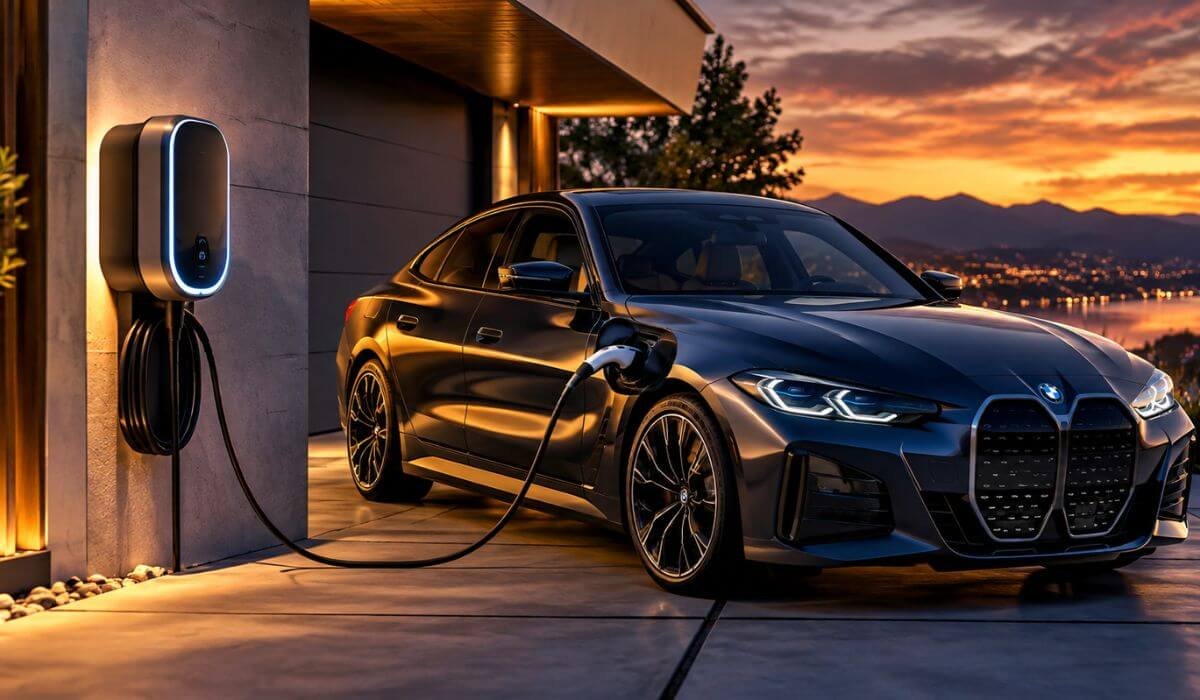
Best Level 2 Chargers for BMW i4 in 2026: 50A Power & Garage-Ready Charging
If you own a BMW i4, choosing the best level 2 charger for BMW i4 is less about buying the charger with the highest amp rating and more about matching the equipment to what the car can actually use. The i4 uses a J1772 connection for Level 2 AC charging on recent model years, and its 83.9-kWh battery makes a dependable home charging setup worth taking seriously. Depending on the version, BMW lists AC charging capability of up to 11 kW to 11.5 kW, so a properly installed 240V charger can make overnight charging far more practical than relying on a standard household outlet.
I looked at these five options from a real-world ownership perspective, focusing on power delivery, installation type, cable reach, charging controls, certification, safety and everyday usability. That distinction matters because a 50A charger is not automatically a better choice for an i4 than a 48A unit. Once you have enough available power for what the BMW can actually accept, the details around the charger and the electrical installation start to matter much more. The right setup is the one that charges the i4 reliably, fits your garage and works properly with your home’s electrical capacity.
Best Plug-In Level 2 Charger for BMW i4: Top 2026 Picks With J1772, WiFi & Long Cables
#1. Autel 50A Level 2 EV Charger
Best Level 2 Charger for BMW i4 With 50A 240V Hardwired Power, Smart WiFi Control & 25-Ft J1772 Cable
#2. ChargePoint HomeFlex Level 2 EV Charger
BMW i4 Home Charger With 50A Level 2 Charging, Smart WiFi Control, J1772 Connection & 23-Ft Cable
#3. EVIQO 48A Level 2 EV Charger
BMW i4 J1772 Charger With 48A 240V Power, Smart WiFi Control, Hardwired Installation & 25-Ft Cable
#4. Leviton EV480 Level 2 EV Charger
BMW i4 Charging Station With 48A 11.6 kW Output, 240V Hardwired Power, J1772 & 18-Ft Cable
#5. IYILO 48A Level 2 EV Charger
BMW i4 240V Charger With 48A 11.5 kW Power, J1772 Connection, Smart App Control & Advanced Safety Protection
Expert Tip
One thing I would not do with a BMW i4 is buy a charger simply because it says 50A on the front. The car has its own charging limit, so once you are in the right 240V Level 2 range, the extra number on the charger does not automatically translate into faster charging.
What matters more is whether the charger makes sense after it leaves the box and goes into your garage. A longer cable can save you from parking in exactly one position every night. A hardwired unit can make more sense for a permanent installation. Smart controls are useful when you actually want to manage charging rather than simply plug in and forget it. And proper electrical certification matters because this is equipment that will be handling high power for hours at a time.
That is why the list above is not arranged by amp rating alone. We looked at the whole charging setup, not just the biggest number printed on the product page.
How We Choose These BMW i4 Chargers
There are plenty of Level 2 chargers that look almost identical on paper. A 48A unit can sit beside a 50A unit, both can advertise 240V charging, and at first glance there may not seem to be much between them. For this list, we went further than that.
1. We started with the BMW i4 itself
The first filter was the vehicle, not the charger. The i4 is a substantial EV with a large battery and a high AC charging capability, so a basic portable charger is not what we were looking for here.
We focused on J1772 Level 2 equipment appropriate to the recent i4 charging setup and concentrated on chargers capable of delivering the kind of power the vehicle can actually make use of. That immediately made the comparison more meaningful than simply collecting five popular EV chargers.
2. We looked at usable power rather than chasing the highest number
The difference between 48A and 50A sounds important until you consider what the BMW can actually accept.
That is why the 48A EVIQO, Leviton and IYILO units were not automatically pushed below the 50A models simply because their headline number is smaller. The useful question is whether the charger provides an appropriate level of power for the i4 and whether its other features make sense for the installation.
In other words, we did not reward an amp number just for being bigger.
3. Installation was treated as part of the charger
A Level 2 charger is only as useful as the electrical installation supporting it. Four of the five options here are particularly suited to a permanent hardwired setup, which is exactly the type of installation many owners consider when building a dedicated home charging point.
We also paid attention to cable length. Autel’s 25-foot cable is genuinely useful when the charger cannot be mounted directly beside the normal parking position. Leviton’s 18-foot cable is more compact, but that is not necessarily a disadvantage in a garage with a convenient wall location.
Those are small details on a specification sheet, but they can become big details once you are using the charger every night.
4. We separated useful smart features from marketing language
Wi-Fi and app control sound impressive, but we did not treat the word smart as an automatic reason to recommend a charger.
Autel’s Wi-Fi capability gives it a practical advantage for an owner who wants connected control, while ChargePoint brings its own established smart-charging ecosystem. The important point is that these features are considered alongside the actual charging hardware, rather than being used to hide weaknesses elsewhere.
For a BMW i4, smart control is a convenience. Correct electrical capacity and a suitable installation come first.
5. Electrical credentials mattered
High-power EV charging is not an area where we wanted to select products purely from a feature list.
That is one reason IYILO remains in the comparison despite being less familiar than some of the larger names. Its listed UL 2594, ETL and Energy Star credentials give us concrete specifications to evaluate rather than relying on vague claims about being “safe” or “premium.”
The same principle applies throughout the list: specific, checkable specifications carry more weight than marketing adjectives.
6. We gave each charger a reason to be here
This is probably the most important part of the selection.
We did not want five chargers that all say essentially the same thing. Each product needed to bring something useful to the comparison.
Autel brings the combination of 50A capability, hardwired installation, Wi-Fi and a 25-foot cable.
ChargePoint HomeFlex gives the list a well-established smart Level 2 charging option with a 50A hardwired configuration.
EVIQO provides a straightforward 48A, 240V hardwired J1772 setup without trying to complicate the basic job.
Leviton EV480 stands out with its 48A capability, 11.6-kW output and established electrical-equipment background.
IYILO earns its place through its 48A, 11.5-kW specification and listed UL 2594, ETL and Energy Star credentials.
That gives the reader five genuinely different reasons to compare them rather than five versions of the same recommendation.
7. We did not pretend that a new charger has years of history
Some of these chargers have far more established brand recognition than others. We think that distinction should be visible rather than buried.
A newer product can have an impressive specification sheet, but specifications are not the same thing as years of ownership history. That is why we have not treated every product here as though it has the same long-term track record.
For a purchase that can remain on a garage wall for years, that distinction matters.
The bottom line
The best Level 2 charger for a BMW i4 is not necessarily the one with the biggest number in its title. It is the one whose power capability, installation requirements, cable reach, controls and electrical credentials make sense for the way you actually charge the car.
That is the standard we used for this list. No product was included simply to fill a fifth spot, and no charger was moved higher just because its headline amperage looked better. The aim was to give the i4 owner enough real information to choose a charger that will make sense not only on the day of purchase, but every time the car is plugged in afterward.
#1. Autel 50A Level 2 EV Charger
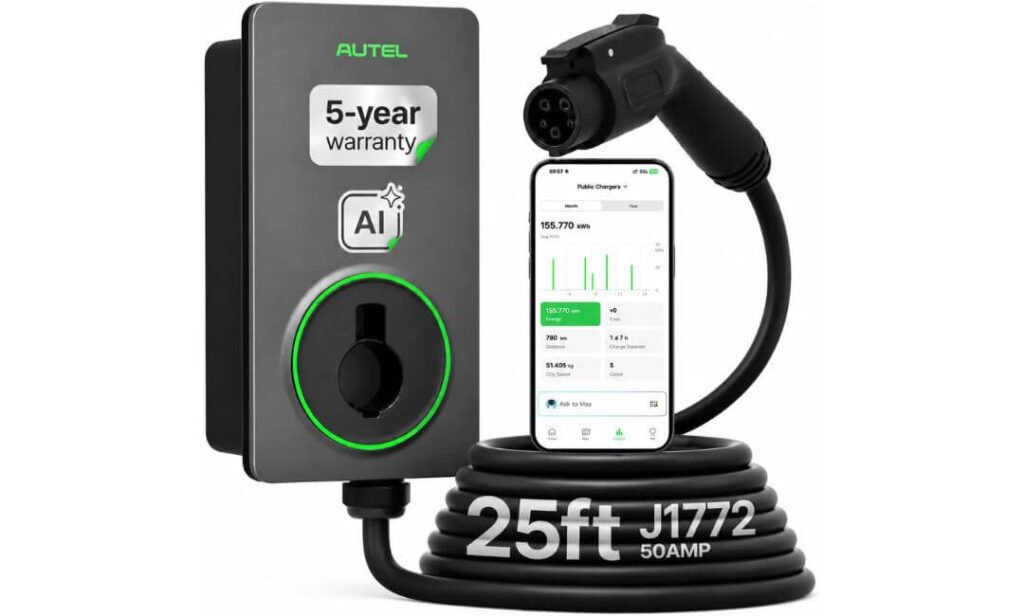
Quick Specs:
- Connection: J1772 — native fit for the North American BMW i4 setup
- Power: Up to 50A / 12 kW charger capacity
- Current adjustment: 6A–50A
- Installation: Hardwired 240V
- Cable: 25-ft heavy-duty J1772
- Smart control: WiFi + Autel Charge app
- Charging management: Scheduling, usage monitoring and cost tracking
- Safety: Real-time temperature monitoring, overcurrent, overvoltage, ground-fault and overtemperature protection
- Certification: UL-certified by CSA
- Warranty: 5 years
- Use: Indoor or outdoor
The first thing I like here is not actually the 50A rating. It is the combination of that output with a 25-foot cable. That sounds like a small specification until you have a two-car garage and realise the charger is mounted on one wall while the BMW is parked several feet away. With this cable length, you have considerably more freedom over where the i4 sits overnight.
The other useful detail is the 6A–50A adjustable current range. A charger like this does not have to run at its maximum simply because it can. Your electrician can configure the installation around the home’s electrical capacity, and the adjustable output gives the setup more flexibility rather than locking you into one charging level. The unit is designed for a hardwired 240V installation, so this is a charger to plan into the garage properly rather than treat like a large portable appliance.
Where it gets more interesting is the connected side. The Autel Charge app lets you monitor charging, schedule sessions and keep an eye on energy use, while the charger also has temperature monitoring and multiple electrical protection layers. I particularly like that combination for an everyday i4 because the useful information is not just “the car is charging”; you can see what the charging session is doing and manage it remotely. The 25-foot cable, WiFi control and hardwired design make this feel much more like a permanent part of the garage than an accessory you occasionally plug in.
(For an i4 owner, the real attraction is the complete package: useful reach, adjustable power and proper connected control—not simply the biggest amp figure.)
What We Like
- 25-foot J1772 cable gives the i4 much more parking flexibility than a short lead.
- 6A–50A adjustment is genuinely useful when your home’s electrical capacity needs to be managed carefully.
- WiFi and app control let you schedule and monitor charging without standing beside the car.
- Real-time thermal monitoring adds another layer of protection during long charging sessions.
- 5-year warranty gives this premium hardwired installation some welcome long-term backing.
One Thing to Know Before Installing
The main consideration is that this is a hardwired charger, so installation is part of the purchase decision. A qualified electrician should verify the available panel capacity and configure the circuit correctly before you commit to the full 50A setting. The source material specifies a 60A circuit for full 50A operation, with reduced output possible when the installation requires it.
Why It Stands Out as a BMW i4 Level 2 Home Charger
For the i4, this unit earns its place near the top because the useful features actually work together. 50A capacity gives the charger plenty of headroom, the 25-foot cable solves a real garage problem, and the adjustable current means the installation does not have to be treated as an all-or-nothing setup.
Then there is the part you notice after the first few weeks: remote control, charging schedules, energy tracking and temperature monitoring. Those aren’t features you buy the i4 for, but they make owning an EV easier once the charger is on the wall. The native J1772 connection also keeps the setup straightforward for the compatible North American i4 configuration described in the source material.
The Insider Pro-Tip
If your BMW is going to live in the same garage for years, I would plan the charger location around the car’s actual parking position, not around the electrical panel alone. The 25-foot cable gives you room to do that, and that flexibility is one of the reasons this particular setup makes sense.
One more thing: don’t ask the electrician to install the largest breaker simply because the charger says 50A. Tell them the charger model, your home’s available electrical capacity and how you intend to use it. The right installation is the one that safely supports the charging power you need; the number on the charger should come after the electrical plan, not before it.
#2. ChargePoint HomeFlex Level 2 EV Fast Charger
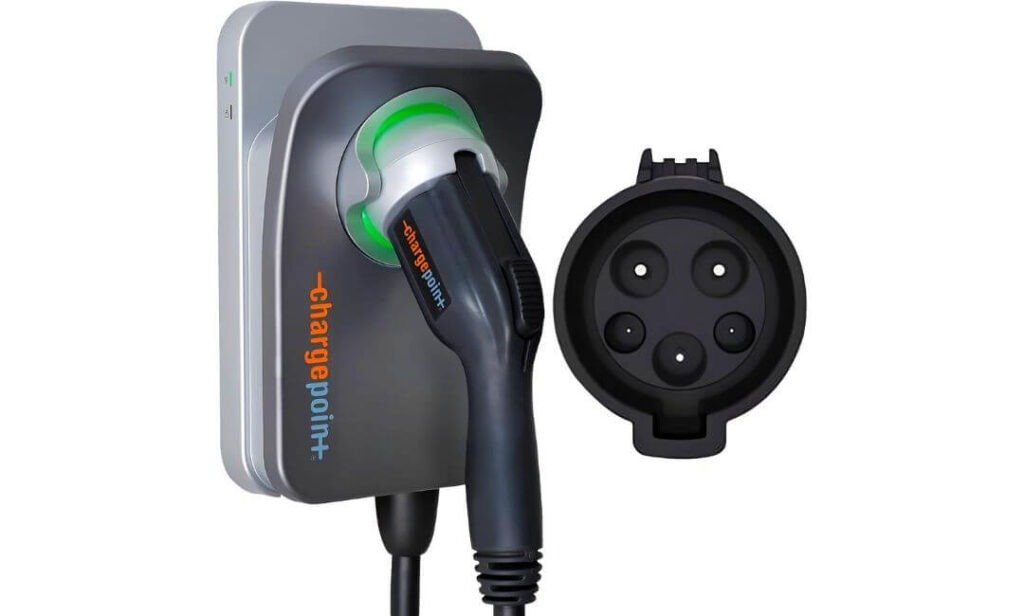
Quick Specs:
- Connection: J1772 — native fit for the North American BMW i4 setup
- Power: Up to 50A / 12 kW charger capacity
- Current settings: 16A, 24A, 32A or 40A
- Installation: Hardwired 240V
- Cable: 23-ft cold-resistant J1772 cable
- Smart control: WiFi + ChargePoint mobile app
- Charging management: Scheduling, reminders, charging data and remote control
- Safety: UL-certified with built-in GFCI protection
- Efficiency: Energy Star certified
- Use: Indoor or outdoor
- Warranty: 3 years
There is a reason the HomeFlex remains an easy charger to understand: it does the important part without making the setup unnecessarily complicated. You get a 50A hardwired Level 2 unit, a J1772 connection and a cable long enough to give you some freedom when positioning the i4 in the garage. The 23-foot lead is particularly useful if your preferred parking spot is not directly in front of the wall where the charger is installed.
The adjustable current settings are another detail worth paying attention to. Instead of assuming every home should run the charger at its maximum, the unit can be configured at 16A, 24A, 32A or 40A to suit the electrical installation. That makes the charger easier to work into different home setups, although the electrician still needs to size the circuit correctly for the selected output.
The smart side is where ChargePoint adds more everyday convenience. Through the ChargePoint app, you can schedule charging, monitor sessions, view charging information and manage the unit remotely. WiFi is required for those connected features, but the charger can still be used for normal plug-and-charge operation if you are not interested in managing every session from your phone.
(For an i4 owner, the appeal here is simple: a mature home-charging setup with useful reach, adjustable output and smart controls that you can actually use day after day.)
What We Like
- 23-foot cable gives the i4 plenty of reach without forcing a very precise parking position.
- Four current settings make it easier to match charging output to the electrical installation.
- ChargePoint app provides scheduling, reminders, monitoring and remote control in one place.
- Cold-resistant cable is a thoughtful touch for garages or outdoor installations exposed to low temperatures.
- UL and Energy Star certification give the electrical and efficiency side of the product more substance than marketing claims alone.
One Thing to Know Before Installing
This version is hardwired, so it needs to be planned as a permanent electrical installation rather than treated like a plug-in charger. Your electrician should verify the available panel capacity and configure the unit for the appropriate current before installation. If you want a plug-in setup, ChargePoint sells separate versions, but those are different configurations from the hardwired model listed here.
Why It Stands Out as a BMW i4 Level 2 Home Charger
The strongest part of this setup is its balance. The 50A-capable hardware gives you plenty of charging capacity, while the selectable current settings mean you are not forced to treat maximum output as the only sensible way to install it.
Then there is the 23-foot cable and ChargePoint app. Those two details are easy to overlook when comparing charger boxes online, but they are exactly the sort of things you notice once the charger is mounted and the BMW becomes part of your daily routine. You can position the car more freely, schedule charging when you want it and check the session without walking out to the garage.
The Insider Pro-Tip
If you are choosing this specifically for an i4, I would make the cable reach and installation location part of the decision before looking at the app features. A smart charger is convenient, but a charger that comfortably reaches your BMW from the wall every night is convenient in a much more practical way.
And remember that 50A on the charger does not mean the i4 has to pull 50A continuously. The vehicle manages how much power it accepts. The job of the electrician is to make sure the circuit, breaker and wiring are correctly matched to the configuration you choose; after that, let the BMW and charger handle the charging handshake.
#3. EVIQO Level 2 EV Charger J1772 48A
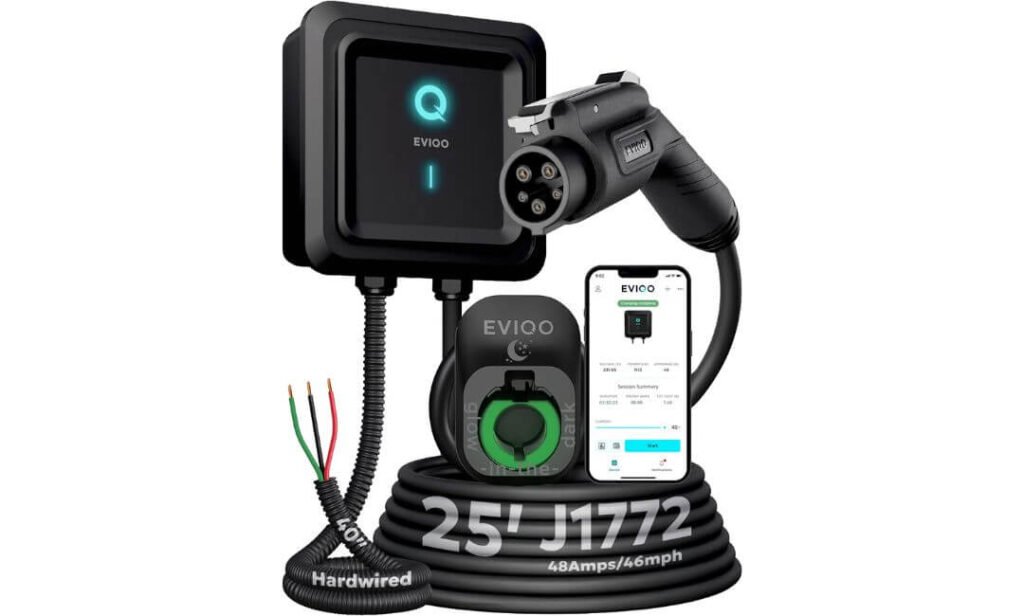
Quick Specs:
- Connection: J1772 — native connection for the North American BMW i4 setup
- Power: Up to 48A / 11.5 kW
- Current adjustment: 6A–48A
- Installation: Hardwired 240V
- Circuit: 60A dedicated circuit for 48A operation
- Cable: 25-ft heavy-duty J1772 cable
- Smart control: 2.4 GHz WiFi + mobile app
- Charging management: Scheduling, energy tracking, cost monitoring and remote start/stop
- Protection: Overcurrent, overvoltage, overtemperature and ground-fault protection
- Enclosure: IP66 / NEMA 4 weatherproof
- Certifications: UL, ETL, FCC and Energy Star
- Warranty: 3 years
- Use: Indoor or outdoor
The first thing that stands out here is the 25-foot cable. On paper, it is just another specification, but in a real garage it can be the difference between comfortably parking the BMW wherever you normally do and constantly thinking about where the charging port will end up. For an i4 owner with a wider garage or a charger mounted farther from the car, that extra reach is genuinely useful.
The 48A output is also a sensible match for this type of vehicle. You are getting up to 11.5 kW of charger capacity, while the i4 ultimately controls how much AC power it accepts. I like that the current can be adjusted from 6A to 48A in 1A increments, because it gives the electrician and homeowner more room to match the charger to the actual electrical installation instead of treating maximum output as the only setting worth using.
Then there is the everyday usability. The built-in 2.4 GHz WiFi connection lets you start and stop charging remotely, schedule sessions and track energy and charging costs through the app. The charger can also continue basic charging without WiFi, which is an important detail: a lost internet connection should not turn your home charger into a wall decoration.
(The real attraction here is the combination of 48A capability, 25-foot reach and flexible control—it is a practical home setup rather than a charger built around one headline number.)
What We Like
- 25-foot J1772 cable gives the i4 considerably more freedom around the garage or driveway.
- 6A–48A adjustment in 1A increments gives unusually fine control over the charging setup.
- IP66 / NEMA 4 enclosure makes it suitable for indoor or outdoor installation.
- UL, ETL, FCC and Energy Star certifications provide useful third-party credentials.
- Glowing holster and side reset button are small touches, but both solve real everyday annoyances—finding the connector at night and resetting the unit without opening the housing.
One Thing to Know Before Installing
This is a hardwired charger, so the installation needs to be planned with an electrician rather than handled like a plug-in unit. The supplied specifications call for a dedicated 60A, 240V circuit for 48A operation; the electrical panel should be checked before ordering. The product information also describes a 50A configuration using a 70A circuit, but that is a separate electrical setup and should only be used when the installation is properly sized for it.
Why It Stands Out as a BMW i4 Level 2 Home Charger
EVIQO’s strongest argument is how much useful hardware you get without making the product complicated. 48A output, 240V hardwiring, a 25-foot cable and adjustable current cover the core requirements for a serious home charging point, while the weatherproof housing gives you more freedom over where the unit can be installed.
I also like the fact that the smart features do not become a dependency. You can use the app for scheduling, energy tracking and remote control, but the basic charging function remains available when WiFi is not. Add the IP66/NEMA 4 enclosure, multiple certifications and 3-year warranty, and the product has a much more complete story than its 48A number alone suggests.
The Insider Pro-Tip
If you are installing this specifically for the i4, do not choose the mounting position until you have considered the 25-foot cable properly. You may find that the extra reach lets you put the charger in a cleaner, more practical location instead of installing it wherever the electrical panel happens to be.
And there is another detail worth getting right: 48A charging requires the electrical installation to be sized for it. Have the electrician verify the panel, breaker and wiring before you commit to that setting. The adjustable output is there for a reason—use it to make the charger fit your home safely, rather than forcing your home’s electrical system to fit the charger.
#4. Leviton EV480 Level 2 EV Charger
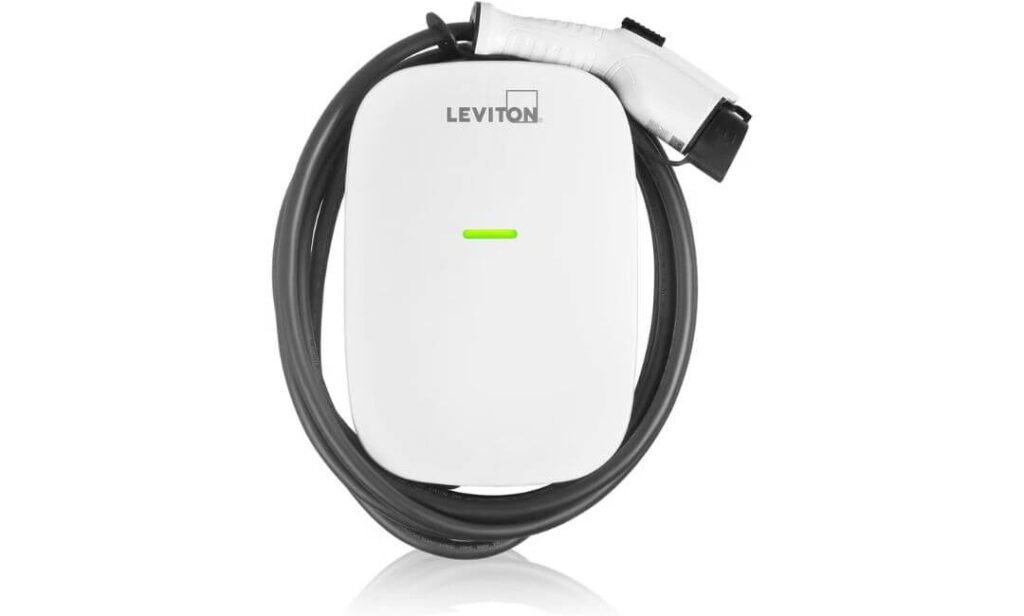
Quick Specs:
- Connection: SAE J1772 — native connection for the North American BMW i4 setup
- Power: 48A / 11.6 kW
- Input: 208/240V
- Installation: Hardwired
- Breaker: 60A
- Cable: 18-ft cold-weather-rated J1772 cable
- Enclosure: NEMA 3R water-resistant housing
- Access control: Optional RFID
- Certification: UL and Energy Star
- Operation: Plug and charge — no WiFi or app required
- Support: 24/7 dedicated Leviton support
- Warranty: 2 years
- Use: Indoor or outdoor
Leviton takes a noticeably different approach from the first three chargers on this list. There is no app to configure, no WiFi connection to maintain and no complicated charging dashboard. You plug the J1772 connector into the BMW and let the car charge. For someone who wants the wall-mounted equipment to simply do its job every night, that simplicity can be a genuine advantage.
The 48A / 11.6 kW specification also puts the charger comfortably in the range we want for an i4-focused Level 2 installation. More importantly, the unit is designed for a hardwired 240V connection with a 60A breaker, so it is intended as a permanent home charging station rather than something you move around when needed.
The detail I would not overlook is the NEMA 3R enclosure and cold-weather-rated cable. If the charger is going into a garage that gets very cold or onto an exterior wall, those details matter more than having another app feature you may never use. The optional RFID access control is also interesting for a shared garage or rental property where you do not necessarily want every person with access to the parking area using the charger.
(This is the straightforward choice in the group: less technology to manage, more emphasis on permanent installation, weather protection and simple charging.)
What We Like
- 48A / 11.6 kW capability gives the i4 a substantial Level 2 charging setup.
- No WiFi or app dependency keeps everyday charging refreshingly simple.
- 18-foot cold-weather cable is practical for most garage installations and is designed to resist freezing and cracking.
- NEMA 3R enclosure gives the unit useful indoor/outdoor flexibility.
- Optional RFID access makes more sense than it first appears for shared parking or multi-user installations.
One Thing to Know Before Installing
The biggest consideration is simply knowing what you are buying: this is a simplicity-first charger. If you want remote charging control, energy tracking or app-based scheduling, those features are not part of this setup. The trade-off is that there is also less technology to troubleshoot when you just want to plug in the BMW and walk away.
Why It Stands Out as a BMW i4 Level 2 Charging Station
The EV480 earns its position by doing something the smart chargers cannot quite replicate: it stays out of your way. The i4 does not need an app to decide when it should charge, and not every owner wants another connected device sitting on the home network. Here, the focus stays on the fundamentals—48A charging, hardwired 240V installation, J1772 compatibility and weather-resistant construction.
The Leviton name also matters in this particular product category because this is not a charger trying to differentiate itself with dozens of software features. It is an electrical product built around a simple charging routine. If your priority is to have the BMW plugged in at night and charging without thinking about WiFi, notifications or schedules, that is a perfectly reasonable approach.
The Insider Pro-Tip
Before choosing this one, be honest about how you actually charge your i4. If you never use charging schedules and have no interest in checking energy data from your phone, paying more for smart features may not improve your experience at all.
But if you regularly use off-peak electricity rates or want to start and stop charging remotely, look at one of the connected options higher on this list. With the EV480, you are deliberately choosing simple, permanent Level 2 charging over software convenience—and that is its strength, not a missing feature.
#5. IYILO Level 2 EV Charger 48A
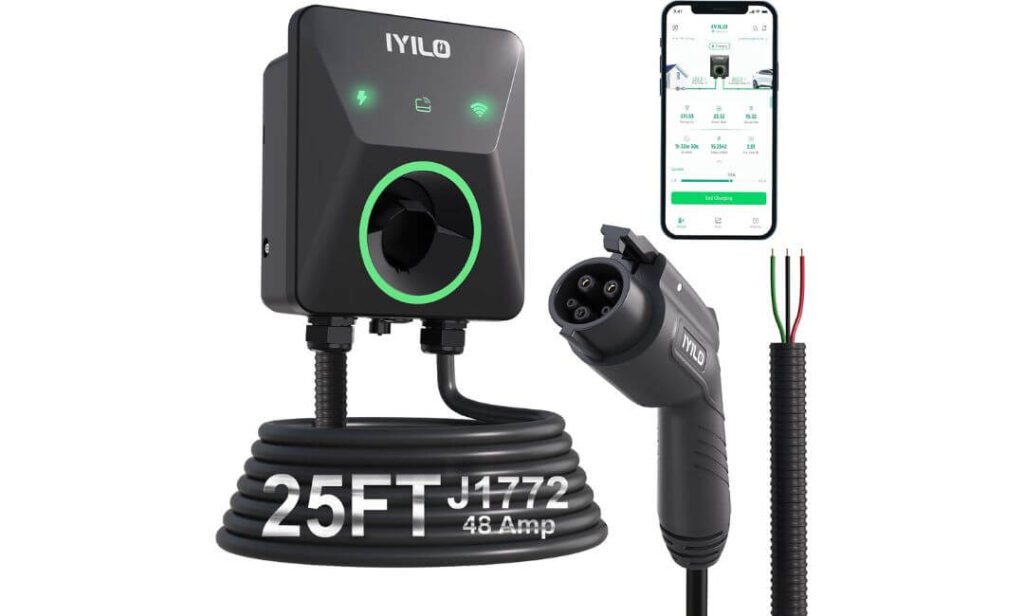
Quick Specs:
- Connection: SAE J1772 — native connection for the North American BMW i4 setup
- Power: 48A / 11.5 kW
- Voltage: 240V
- Current adjustment: 6A–48A in 1A increments
- Installation: NEMA 14-50 plug-in or 240V hardwired
- Cable: 25-ft flexible J1772 cable
- Smart control: 2.4 GHz WiFi + IYILO app
- Safety: Dual temperature monitoring with automatic charging shutdown above 221°F
- Power management: Power Sharing and optional Dynamic Load Balancing
- Enclosure: NEMA 4 / IP66 weatherproof
- Certifications: UL 2594, ETL, Energy Star and CSA
- Warranty: 3 years
- Use: Indoor or outdoor
What makes this one interesting is not simply the 48A / 11.5 kW figure. The more meaningful feature is what happens around that power level. IYILO monitors temperature at both ends of the charging connection—the wall-side connection and the J1772 vehicle connector—and the system is designed to stop charging if either monitored connector gets too hot. For an EV that can spend several hours continuously charging overnight, that is a thoughtful layer of protection rather than another headline specification.
The 25-foot fourth-generation cable is another reason it fits this BMW i4 list. It gives you enough reach for a larger garage or driveway without making the charger itself responsible for where the car has to sit. The current can also be adjusted from 6A to 48A in 1A increments, which is useful when you want the charging setup to work around the home’s electrical capacity instead of always running at its maximum.
Then there is the flexibility of installation. You can use the NEMA 14-50 plug-in configuration if you already have a suitable outlet, or have it hardwired to a 60A circuit for the full 48A capability. Add the app’s TOU scheduling, energy tracking, RFID support and the optional load-balancing capability, and this becomes a surprisingly versatile home charging system for someone who wants more control over how the i4 uses electricity.
(The real story here is flexibility: flexible current, flexible installation, flexible cable reach and—most unusually—temperature information at both charging connections.)
What We Like
- Dual temperature sensors monitor both the wall-side connection and vehicle-side J1772 connector.
- 25-foot flexible cable gives the i4 plenty of room around a garage or driveway.
- 6A–48A adjustment in 1A steps makes the charging setup unusually easy to fine-tune.
- Plug-in or hardwired installation gives you two practical ways to build the charging point.
- Power Sharing and optional Dynamic Load Balancing can be useful for homes where other large electrical loads compete for capacity.
One Thing to Know Before Installing
The smart features require 2.4 GHz WiFi, not 5 GHz. That is not a problem for most modern home networks, but it is worth checking before installation if your router is configured as 5 GHz-only. The charger can still provide basic plug-and-charge operation without the connected features, so losing WiFi does not mean losing the ability to charge the BMW.
Why It Stands Out as a BMW i4 Level 2 Home Charger
IYILO earns its place because it brings together several features that normally require looking at different chargers. You get 48A / 11.5 kW capability, a 25-foot cable, adjustable current, smart scheduling and two installation paths, but the standout detail remains the dual temperature monitoring.
The power-management side is equally interesting for a growing EV household. With the appropriate setup, Power Sharing can allow two IYILO chargers to operate on one circuit, while the optional Energy Meter enables Dynamic Load Balancing to adjust charging around the home’s total electrical demand. That is the sort of feature that becomes genuinely useful when the garage has more than one EV or other heavy loads such as an oven, dryer or HVAC system.
The Insider Pro-Tip
If you are buying this for an i4 and already have a NEMA 14-50 outlet, check the outlet and circuit before assuming you need a new hardwired installation. The plug-in route can make sense when the existing electrical setup is correctly sized, while hardwiring gives you the permanent 48A configuration.
I would also pay attention to the temperature data in the app rather than treating it as a feature you never look at. The value of monitoring is not that you should constantly watch your charger—it is that you have useful information available if something ever behaves differently from normal. That is a much more practical reason to appreciate this feature than simply calling it “smart.”
Best Level 2 Charger for BMW i4 (2026): Compare 48A and 50A Home Charging Options
| BMW i4 Charging Factor |
Autel
50A • 12 kW Class
|
ChargePoint
50A • Smart Home
|
EVIQO
48A • 11.5 kW
|
Leviton EV480
48A • 11.6 kW
|
IYILO
48A • 11.5 kW
|
|---|---|---|---|---|---|
| Best fit for the i4 |
50A headroom A powerful hardwired setup with smart controls. |
Simple smart home charging Strong everyday option with a mature app experience. |
Long-reach smart charging 48A output paired with a 25-ft cable. |
Set-it-and-charge simplicity No app required for everyday charging. |
Feature-rich home setup Dual temperature monitoring plus smart load management. |
| Output & i4 charging match |
50A • up to 12 kW Adjustable current; sized to comfortably support the i4’s AC charging needs. |
50A class High-output Level 2 charging with adjustable current. |
48A • 11.5 kW Closely aligned with the i4’s usable AC charging range. |
48A • 11.6 kW High-power 240V charging without unnecessary app dependence. |
48A • 11.5 kW Designed around the i4’s approximately 11 kW AC charging capability. |
| Connection | SAE J1772 | SAE J1772 | SAE J1772 | SAE J1772 | SAE J1772 |
| Cable reach |
25 ft Useful when the parking position is not directly beside the wall unit. |
23 ft Cold-resistant cable suited to regular garage use. |
25 ft Plenty of reach for larger garages and driveways. |
18 ft More compact and tidy where the charger is mounted close to the car. |
25 ft Flexible fourth-generation cable designed for broad parking layouts. |
| Installation |
Hardwired 60A circuit for full 50A output. |
Hardwired Built for a permanent home charging installation. |
Hardwired 240V installation for full 48A performance. |
Hardwired 60A breaker; straightforward permanent setup. |
Plug-in or hardwired Full 48A output through the appropriate 60A hardwired circuit. |
| Smart controls | WiFi app, scheduling, energy tracking and remote controls. | WiFi-connected controls with scheduling and charging management. | Smart WiFi controls with app-based charging management. |
No app / WiFi Plug-and-charge simplicity with optional RFID access control. |
App control, TOU scheduling, energy/cost tracking, RFID and OTA updates. |
| Electrical management | Adjustable output with built-in electrical and thermal protections. | Adjustable charging current for different home electrical setups. | Adjustable output with smart charging controls. | Straightforward high-output charging without connected load management. |
Power Sharing Optional Dynamic Load Balancing with Energy Meter. |
| Safety & protection | Real-time thermal monitoring, fault protection and weather-resistant construction. | Built for permanent indoor/outdoor home charging. | Weather-resistant construction and integrated charging protection. | NEMA 3R enclosure with UL and Energy Star certification. |
Dual connector temperature monitoring NEMA 4/IP66, built-in GFCI and automatic overheat protection. |
| Certification | UL-certified by CSA | Safety-certified Level 2 charging hardware | Safety-certified EV charging hardware | UL + Energy Star | UL 2594 + ETL + Energy Star + CSA |
| Weather & everyday use | Indoor/outdoor use with weather-resistant housing. | Indoor/outdoor-ready with cold-resistant cable. | Designed for indoor/outdoor charging. | NEMA 3R water-resistant enclosure and cold-weather cable. | NEMA 4 / IP66 weatherproof enclosure; cable rated for extreme temperatures. |
| Warranty | 5 years | Manufacturer-backed coverage | Manufacturer-backed coverage | 2 years | 3 years + U.S.-based support |
| The real-world takeaway |
POWER + SMART CONTROL
A strong choice when you want a powerful hardwired BMW i4 charging station with a long cable and detailed app control. |
EVERYDAY SMART CHARGING
Makes sense if you value a familiar smart-charger ecosystem and want connected home charging without overcomplicating the setup. |
LONG-REACH 48A
A practical middle ground for an i4 owner who wants 48A charging, smart controls and enough cable to reach awkward parking positions. |
SIMPLE & SOLID
The least complicated option here: strong 48A charging, weather-resistant hardware and plug-and-charge operation without an app. |
SAFETY + FLEXIBILITY
Particularly interesting for owners who want detailed smart controls, dual temperature monitoring, long cable reach and future-friendly electrical management. |
Why a 50A Level 2 Charger Matters for the BMW i4
The useful way to think about a BMW i4 Level 2 home charger is not simply, “How many amps can the charger advertise?” The better question is how much AC power the i4 can actually accept, and whether your home installation can deliver that power consistently.
The IYILO, Autel, ChargePoint, EVIQO and Leviton options in this guide all sit comfortably in the high-output Level 2 category. Several are rated around 48A to 50A, with outputs in the roughly 11.5 kW to 12 kW range. That gives the BMW i4 enough charging capacity for practical overnight charging without buying hardware simply because its maximum number looks impressive.
This distinction matters because the charger’s maximum output and the vehicle’s onboard AC charging capability are two different things. A 50A charger does not force the i4 to accept 50A if the vehicle does not request it. The car manages the actual charging power.
How 240V Level 2 charging changes everyday i4 ownership
A standard 120V household outlet is fundamentally different from a dedicated 240V BMW i4 charging station. Level 1 charging can work when driving is light and the car has plenty of time to sit, but it is not particularly well suited to replenishing a large EV battery after regular daily driving.
A properly installed Level 2 charger uses the home’s 240V supply to deliver considerably more power. In practical terms, that means the BMW i4 can recover a meaningful amount of range while it is parked at home overnight rather than requiring you to plan around a slow household outlet.
For an i4 owner, this is where home charging becomes convenient rather than merely possible. You arrive home, plug in, and let the car charge while you sleep. The next morning, you are starting the day with the battery replenished without having made a separate charging stop.
The exact charging time still depends on the i4 version, battery state of charge, temperature, electrical installation and the power the vehicle requests. That is why it is better to think in terms of usable overnight charging rather than promising one exact number of hours for every i4.
What the 50A rating actually means
There is an important technical detail that is often lost in charger shopping.
A 50A Level 2 charger does not mean the BMW i4 will continuously pull 50 amps simply because the charger is capable of doing so. The charger communicates with the vehicle, and the i4’s onboard charging system determines how much AC power it can use.
The same principle applies to a 48A charger. If the vehicle’s practical AC charging ceiling is below the charger’s maximum output, buying a charger with a slightly higher amp rating does not suddenly make the BMW charge faster.
That is why the five chargers selected for this guide are not being separated simply by their maximum amp number. Cable length, installation method, smart controls, electrical protection, weather resistance, current adjustment and long-term usability can matter just as much once you are already in the i4’s useful Level 2 charging range.
Why 50A gives you useful electrical headroom
There is still a good reason to consider a 50A-capable charger.
The extra capacity gives the charging equipment some electrical headroom rather than forcing it to operate at its maximum capability all the time. It can also give you more flexibility when setting the charging current around the requirements of your home’s electrical system.
For example, the Autel charger in this guide can be adjusted rather than being treated as a simple maximum-output device. IYILO also allows current adjustment from 6A to 48A in 1A increments, which can be useful when your home has other substantial electrical loads.
That matters in real homes. Your garage may share electrical capacity with an HVAC system, dryer, oven, heat pump or another EV. A charger that lets you control its current can be more useful than one that simply advertises a larger maximum number.
50A is also about future flexibility, not just today’s charging speed
Future-proofing does not necessarily mean buying the highest-rated charger available.
A better approach is to choose a properly certified Level 2 charger with enough output for the vehicle, a suitable electrical installation, a cable long enough for your parking arrangement and features you are actually likely to use.
A 48A or 50A charger already puts you in a very capable range for the BMW i4. If you later change vehicles, add another EV or change how you use the garage, features such as adjustable amperage, power sharing and load management can become more valuable than another few amps of theoretical capacity.
This is one reason the IYILO’s optional Dynamic Load Balancing and Power Sharing capabilities are worth paying attention to. They are not necessary for every i4 owner, but they become relevant when the home’s electrical demand becomes more complicated.
A higher-amp charger does not automatically mean faster BMW i4 charging
This is probably the biggest misconception when shopping for an EV charger.
A charger rated at 60A is not automatically going to charge an i4 faster than a properly installed 48A or 50A charger. The vehicle is part of the charging equation.
Think of the charger as the equipment supplying available AC power and the BMW as the equipment deciding how much of that available power it can accept. Once the charger has enough capacity to meet the i4’s charging requirement, increasing the charger’s maximum rating may provide little or no additional charging speed.
That is why I would not choose between the chargers in this article based solely on 48A versus 50A. The difference is much smaller in real-world importance than many product listings make it sound.
Why the electrical installation matters just as much as the charger
The charger itself is only one part of a home charging system.
A high-output Level 2 installation needs the appropriate circuit, wiring, breaker and installation method. For example, the IYILO’s full 48A / 11.5 kW capability through a hardwired installation requires a 60A circuit, while the Autel’s full 50A output likewise requires the appropriate electrical installation.
This is why the article separates the charger from the installation. A premium charger connected to an incorrectly sized or unsuitable electrical circuit is not a premium charging setup.
If you are installing a new circuit, have the electrical work evaluated and completed according to the applicable local requirements. If you already have a suitable 240V outlet, verify that the outlet, circuit and charger configuration are actually compatible before assuming it can support the charger’s maximum output.
The real benefit is consistency
The biggest advantage of a high-output Level 2 charger for the BMW i4 is not a dramatic number on a specification sheet. It is consistent home charging that fits naturally into your routine.
You do not need to wait until the battery is nearly empty. You can plug the i4 in after a normal day of driving and let the car recover its energy while parked. If your electricity provider has time-of-use pricing, a smart charger can also schedule charging for the hours you prefer.
That is where features such as scheduled charging, energy tracking, remote control and adjustable current become meaningful. They turn the charger from a simple power source into something you can actually manage around your household’s routine.
What BMW i4 owners should look at beyond the amp rating
Once you know that a charger has enough output for the i4, I would look at these factors before making the final choice:
- Installation type: Decide whether a permanent hardwired installation or a suitable plug-in setup makes more sense for your garage.
- Cable reach: An 18-foot cable may be perfect for one garage, while a 23- or 25-foot cable can make a major difference if the parking position is less predictable.
- Current adjustment: This is useful when you need to work within the limits of your home’s electrical capacity.
- Smart charging: Scheduling and energy tracking can be worthwhile if you use time-of-use electricity rates.
- Safety monitoring: Features such as thermal monitoring, GFCI protection and certified hardware deserve more attention than marketing claims about raw charging speed.
- Outdoor protection: If the charger will live outside, enclosure rating and cable durability matter.
- Load management: Power sharing or dynamic load balancing can become valuable in homes with multiple EVs or heavy electrical loads.
- Warranty and support: A charger is equipment you may use several times every week for years, so support should not be treated as an afterthought.
The bottom line on 50A charging for the BMW i4
For the BMW i4, a 48A to 50A Level 2 charger is already a very capable home-charging setup. The important part is not squeezing every theoretical amp out of the charger. It is installing the equipment correctly and choosing a unit whose power, controls, cable reach and safety features make sense for how you actually use the car.
That is also why the five chargers above are not identical despite sitting in a similar power range. Autel leans toward powerful smart charging and a long cable, ChargePoint focuses heavily on connected everyday usability, EVIQO offers another long-reach smart option, Leviton keeps things deliberately simple, and IYILO adds unusually detailed temperature monitoring and electrical-management features.
For an i4 owner, that is the more useful way to compare them: not “Which box has the biggest amp number?”, but “Which charging setup fits my BMW, my garage and my home’s electrical system without paying for features I will never use?”
Buying Guide: How to Choose the Best Level 2 EV Charger for Your BMW i4
Choosing a BMW i4 home charger is one of those purchases where the specifications on the box can make the decision look easier than it really is. A 48A charger, a 50A charger, a 240V connection and a long cable all sound good, but those numbers only tell part of the story.
The better approach is to start with your home’s electrical capacity, then work backward to the charging speed you actually need. From there, look at installation, cable reach, smart features, safety certification, weather protection and long-term support.
For the i4, you generally do not need to chase the most powerful charger available. You need a properly installed Level 2 system that can provide the power the vehicle can use, fits your electrical service and makes everyday charging easy.
Start with the electrical service before choosing the charger
Before buying a 48A or 50A unit, find out what your home can realistically support.
A dedicated 240V circuit is the normal starting point for high-output Level 2 charging. The important detail is that the charger rating, breaker rating and continuous charging load have to be considered together. You should not assume that an existing 240V outlet is automatically suitable simply because the plug physically fits.
For example, the chargers in this guide use different installation requirements:
| Charger configuration | What matters before installation |
|---|---|
| 48A hardwired charger | Typically requires a properly sized 60A circuit for full output |
| 50A hardwired charger | Requires the appropriate higher-capacity dedicated circuit |
| NEMA 14-50 charger | Requires a correctly installed and rated 14-50 circuit and outlet |
| Lower-current configuration | Can be useful where the home’s available electrical capacity is more limited |
If you are unsure about the service capacity, breaker size, wire size or existing outlet, this is the point where an electrician should inspect the installation rather than guessing from the outlet shape.
Check your main panel before committing to high-output charging
Your electrical panel is just as important as the charger.
A home may have a large enough main service but still have limited spare capacity because of existing loads such as central air conditioning, electric heating, an electric range, dryer, pool equipment or another EV charger.
That does not automatically mean you cannot install a Level 2 charger. It means the installation needs to be planned around the home’s actual electrical demand.
This is also where load management can become useful. A charger with adjustable current can be configured below its maximum output, while systems that support dynamic load balancing can actively adjust charging according to household demand.
For a single i4 household, you may never need advanced load management. For a home with two EVs, however, it can become a much more practical consideration.
Match charging output to the way you actually drive
Do not choose the charger by asking, “What is the highest amp number I can buy?”
Instead, ask:
- How many miles do I normally drive each day?
- Does the i4 sit at home overnight?
- Do I regularly return home with a low battery?
- Do I have time-of-use electricity pricing?
- Will another EV eventually share the electrical system?
- Is the extra installation cost justified by my actual charging needs?
For many BMW i4 owners, a properly installed 48A or 50A Level 2 charger already provides plenty of charging capability for overnight use.
Once you are in this range, the differences between chargers become less about raw speed and more about installation flexibility, cable length, app quality, safety features, electrical management and reliability.
That is why a 48A unit should not automatically be dismissed because another charger says 50A on the front of the box.
Think about the charger as part of your home’s electrical system
A charger does not operate in isolation.
If you have one EV and plenty of electrical capacity, a conventional dedicated circuit may be all you need. If you have two EVs or regularly run several high-demand appliances at the same time, the calculation becomes different.
There are three common situations worth considering:
Single charger, dedicated circuit:
This is the simplest arrangement. The BMW i4 gets its own properly sized circuit, and there is no need to coordinate charging with another EV.
Two chargers with shared electrical capacity:
This can make sense for a two-EV household, but the installation should be designed so the combined load does not exceed what the electrical system can safely provide. Features such as Power Sharing can be useful here.
Charger with dynamic load management:
A compatible energy meter can allow the charging system to respond to other household loads. This can be particularly useful when you want to avoid unnecessarily upgrading the home’s electrical infrastructure, although the equipment and installation still need to be configured correctly.
The important point is that shared charging should be engineered, not improvised.
Decide whether plug-in or hardwired installation makes more sense
This is one of the biggest practical decisions in a home charging installation.
A hardwired charger gives you a permanent installation and is often the cleanest solution for a dedicated garage charging point. It also allows certain high-output chargers to operate at their maximum rated current when connected to the appropriately sized circuit.
A NEMA 14-50 plug-in charger can be more convenient when a correctly installed outlet already exists. It can also make the charger easier to remove or relocate.
Neither approach is automatically better for every i4 owner.
Consider:
- Whether you already have a suitable 240V outlet.
- Where the electrical panel is located.
- How far the cable and conduit need to run.
- Whether the charger will remain in the same location for years.
- Whether you want the ability to remove or relocate the unit later.
- Whether the charger’s maximum output requires hardwiring.
For a completely new installation, I would not choose the plug-in format simply because it sounds easier. The electrician should first determine which configuration makes the most sense for the location and electrical system.
Installation complexity can change the real cost of the charger
The price printed next to the charger is not necessarily the price of getting the BMW i4 charging at home.
Installation cost can vary considerably depending on the distance from the electrical panel, wall construction, conduit routing, panel capacity, breaker requirements and whether new wiring needs to be installed.
A relatively easy garage installation may require a short run from the panel. A charger located on the opposite side of the house or outside may require substantially more electrical work.
Before buying, it is worth getting an installation estimate if you do not already have the required circuit.
A useful way to think about the total purchase is:
Charger + electrical work + required hardware + any panel modifications = actual charging-system cost
That number is more meaningful than comparing two chargers solely by their retail prices.
Do not overlook cable length
Cable length sounds like a minor specification until you park the car.
An 18-foot cable can be perfectly comfortable when the charger is mounted directly beside the parking position. A 23- or 25-foot cable gives considerably more flexibility if you park at an angle, have a two-car garage, occasionally charge outside or cannot mount the charger exactly where you want it.
The longer cable is not automatically better, either. More cable takes up more space and can be heavier to manage.
The right length is the one that reaches the i4’s charging port comfortably without leaving a large amount of unused cable lying across the floor.
Before installation, actually measure the route from the planned charger location to the i4’s charging port. It is a simple step that can prevent a frustrating installation compromise later.
Indoor and outdoor installation require different attention
If the charger will be mounted inside a garage, environmental exposure is relatively straightforward.
Outdoor installation is different. You need to pay attention to the enclosure rating, water resistance, cable construction, temperature range and how the electrical connection is protected.
For example, the IYILO unit used in this guide has a NEMA 4/IP66 weatherproof enclosure, while the Leviton EV480 uses a NEMA 3R enclosure. Those ratings are more useful information than simply seeing the words “outdoor ready” on a product page.
The mounting location also matters. Even a weather-resistant charger should be installed according to the manufacturer’s instructions, with the appropriate electrical protection and cable routing.
Understand GFCI protection before installation
Ground-fault protection is an important part of EV charging because the equipment is delivering substantial electrical power for extended periods.
Some chargers have built-in GFCI protection, while the overall electrical installation may also have requirements for ground-fault protection depending on the charger design and local electrical code.
Do not assume that because a charger advertises built-in GFCI, every part of the installation can be handled without additional requirements. The electrician should verify the complete setup, including the charger manufacturer’s instructions and the applicable electrical code.
This is one area where copying an installation from another garage is a bad idea. Two homes can have completely different electrical requirements even when they use the same charger.
Look beyond the app when comparing smart chargers
Smart charging is useful, but it should not be the deciding factor by itself.
A good app can let you:
- Schedule charging around cheaper electricity periods.
- Monitor energy consumption.
- Track charging sessions.
- Start or stop charging remotely.
- Adjust charging settings.
- Manage multiple users.
- Receive charging notifications.
- Install firmware updates.
But there is an important distinction between useful smart functionality and features that look impressive in a product listing but rarely affect your daily routine.
If you already have simple electricity pricing and only plug in overnight, you may not need an elaborate app. If your utility uses time-of-use rates, smart scheduling can be considerably more useful.
The Leviton EV480 takes the opposite approach in this group, emphasizing straightforward plug-and-charge operation rather than requiring an app. That is not a missing feature for every buyer; for some owners, it is exactly the point.
Check the warranty and support before installation
An EV charger is not something you expect to replace every year.
Look at the warranty period, how support is provided and whether firmware updates are available. A charger installed permanently on the side of your house deserves more consideration than a disposable electronic accessory.
The five chargers in this article take different approaches to support and warranty coverage. IYILO, for example, provides a 3-year warranty and U.S.-based support, while Autel’s source information specifies a 5-year warranty and 24/7 support.
Do not compare warranty length alone. Also consider whether the manufacturer provides firmware updates, troubleshooting documentation and a realistic support channel if the charger develops a problem.
Firmware updates matter more on smart chargers
A connected charger is effectively a piece of networked electrical equipment.
Firmware updates can address bugs, improve app functionality, add features or maintain compatibility. That makes OTA update support worth considering if you are buying a charger specifically for its smart features.
At the same time, a charger should still be fundamentally useful as charging equipment. You should not choose a unit solely because it has the most elaborate software ecosystem.
For a BMW i4, the priorities should remain in roughly this order: safe electrical installation, suitable charging capacity, dependable hardware, practical cable reach, then smart convenience features.
Installation tips and common mistakes to avoid
The following are the mistakes I would be most careful about when installing a high-output Level 2 charger for an i4:
- Do not assume an existing 240V outlet is automatically suitable. Verify the circuit, breaker, wiring and outlet rating.
- Do not select the breaker based only on the charger’s advertised amperage. The complete installation has to be sized correctly for continuous EV charging.
- Do not use an extension cord to compensate for a cable that is too short. Choose the appropriate charger cable length instead.
- Do not install an outdoor charger without checking its environmental rating and mounting requirements.
- Do not ignore the manufacturer’s installation instructions. Different chargers can have different breaker, wiring and configuration requirements.
- Do not assume a higher amp rating means the i4 will charge proportionally faster. The vehicle’s onboard charging capability remains part of the equation.
- Do not route cable where it can become a trip hazard or be repeatedly crushed by the vehicle.
- Do not treat WiFi as essential to basic charging unless the charger specifically requires connected functionality. Several smart chargers can still operate as normal charging equipment when their app features are not being used.
- Do not attempt a high-current hardwired installation if you are not qualified to perform electrical work. A licensed electrician is the sensible choice for new circuits and hardwired installations.
A practical way to choose between the five chargers
If you are still deciding after looking at the specifications, narrow the choice by how you expect to use the BMW i4 rather than by product ranking.
| Your priority | What to look for |
|---|---|
| Maximum practical Level 2 capacity | 48A–50A charger with the appropriate dedicated circuit |
| Long driveway or awkward garage position | 23–25 ft cable |
| Smart scheduling and energy tracking | WiFi-connected charger with a capable app |
| Simple plug-and-charge ownership | Charger that does not depend on an app |
| Two-EV household | Power Sharing or suitable load-management capability |
| Outdoor installation | Appropriate NEMA/IP enclosure and outdoor-rated cable |
| Electrical flexibility | Adjustable current settings |
| Long-term ownership | Strong warranty, support and firmware update policy |
| Existing 14-50 outlet | Compatible plug-in Level 2 configuration |
| New permanent installation | Hardwired charger with properly sized circuit |
What I would verify before the electrician arrives
Before the installation date, have these details settled:
- Where the charger will be mounted.
- How far that location is from the electrical panel.
- Whether the installation will be plug-in or hardwired.
- The charger’s maximum current and required circuit configuration.
- Whether the BMW can comfortably reach the charger with the selected cable length.
- Whether the charger will be exposed to rain, snow or direct outdoor conditions.
- Whether another EV or major appliance will share the home’s available electrical capacity.
- Whether local electrical requirements call for additional protection or specific installation methods.
Having these decisions made beforehand makes the installation much smoother and reduces the chance of discovering after the charger arrives that the electrical setup needs to change.
One final point about choosing the best BMW i4 home charger
The best Level 2 EV charger for a BMW i4 is not necessarily the one with the highest advertised output or the longest feature list.
A charger becomes a good fit when its electrical requirements match the house, its output makes sense for the i4, its cable reaches the car comfortably, its protection is appropriate for the installation environment and its controls genuinely improve the way you charge.
That is why the comparison above focuses on differences that you can actually live with every day. 48A versus 50A is only one part of the decision. For many owners, the better question is whether they want a smart connected charger, a straightforward plug-and-charge unit, longer cable reach, adjustable current, stronger environmental protection or advanced electrical load management.
Get those fundamentals right, and the BMW i4’s home charging routine becomes remarkably simple: plug in when you get home, let the car handle the charging process, and wake up with the battery ready for the next drive.
Installation Considerations for a BMW i4 Level 2 Charger: A Step-by-Step Overview
Installing a high-output BMW i4 home charger is not simply a matter of mounting the box on the wall and plugging in the car. The charger, circuit, breaker, wiring, mounting location and protection requirements all have to work together.
The good news is that the process is fairly straightforward when it is planned properly. The key is to make the electrical decisions before the charger arrives, rather than discovering during installation that the panel, outlet location or cable route needs to change.
Start with a pre-installation electrical checklist
Before choosing the final installation method, establish what your home can support.
The first thing to inspect is the electrical service and panel capacity. A 48A or 50A Level 2 charger represents a substantial continuous electrical load, so the electrician needs to look at the available capacity rather than simply checking whether there is an empty breaker position.
Have these details checked:
- Main electrical service rating.
- Available space in the electrical panel.
- Existing large electrical loads.
- Available capacity for a dedicated EV charging circuit.
- Existing 240V circuits and their ratings.
- Wire size and condition if an existing circuit is being considered.
- Distance between the panel and proposed charger location.
- Whether the installation will be indoors or outdoors.
- Whether conduit or additional protection will be required.
- Local electrical code requirements.
- Whether the local authority requires an electrical permit or inspection.
Do not assume that an empty breaker slot means the panel can automatically accommodate a high-output EV charger. The physical space and the electrical capacity are two different things.
Check permit and local code requirements before the work begins
Permit requirements vary by location, so this should be confirmed before installation rather than after the charger is already mounted.
A professional electrician can normally tell you whether the planned installation requires a permit, inspection or specific equipment. This is particularly important when installing a new dedicated circuit, modifying the electrical panel or running wiring through finished areas.
The same applies to GFCI protection, disconnect requirements, conduit, conductor sizing and outdoor installations. The charger’s manual provides manufacturer requirements, while local electrical requirements determine how the complete installation must be carried out.
For that reason, do not copy an installation simply because another BMW i4 owner has the same charger. Their house may have a completely different electrical configuration.
Decide between hardwired and NEMA 14-50 installation
The two most practical approaches for the chargers covered in this guide are hardwired installation and a compatible NEMA 14-50 receptacle setup.
A hardwired charger is connected directly to the dedicated electrical circuit. This is generally the cleaner permanent solution and is particularly relevant for high-output chargers that are designed to deliver their maximum rated current through a hardwired connection.
The NEMA 14-50 approach makes more sense when you already have a properly installed, appropriately rated receptacle in the right location and the charger is designed for that configuration.
Here is the practical difference:
| Installation approach | Makes more sense when | Main consideration |
|---|---|---|
| Hardwired | You want a permanent installation and maximum configuration flexibility | Requires proper fixed wiring and professional electrical installation |
| NEMA 14-50 | You already have a suitable 14-50 circuit or specifically want a plug-in setup | The receptacle and circuit must be correctly rated for continuous EV charging |
| New NEMA 14-50 installation | You want plug-in convenience but do not currently have the outlet | Requires an electrician to install the appropriate circuit and receptacle |
The important part is not which option looks easier on paper. It is whether the entire circuit is correctly designed for the charger and its continuous load.
Do not confuse the receptacle rating with charging output
This is a common point of confusion.
A NEMA 14-50 receptacle does not automatically mean that every EV charger connected to it can operate at 50A continuously. The charger’s configured current, the circuit design and applicable electrical requirements all matter.
Likewise, buying a 50A-rated charger does not mean the BMW i4 will necessarily draw 50A throughout a charging session.
The car, charger and electrical installation each have a role:
Home electrical system → charger → BMW i4 onboard charging system
The charger can make a certain amount of power available, but the vehicle ultimately determines how much AC power it accepts within its charging capability.
Choose the mounting location before running the cable
Once the electrical configuration is understood, choose exactly where the charger will live.
Do not select the mounting point simply because it is closest to the electrical panel. The charger needs to be positioned where the BMW i4 can comfortably reach it without putting unnecessary strain on the cable or creating a trip hazard.
Before drilling anything, consider:
- Where the i4 normally parks.
- Where the charging port sits relative to the wall.
- Whether you normally park nose-in or reverse-in.
- Whether another vehicle uses the adjacent parking space.
- Whether the cable can reach the car without crossing a walking path.
- Whether the charger can be accessed comfortably for plugging and unplugging.
- Whether the connector can be stored securely when not in use.
- Whether the mounting surface can support the charger properly.
This is where the 18-foot, 23-foot and 25-foot cable differences between chargers become meaningful. A cable that looks generous in a product specification can feel surprisingly short if the charger is mounted several feet away from the ideal parking position.
Think about mounting height and clearance
The charger should be mounted at a practical height that allows you to connect the cable comfortably and access any controls or display without stretching.
At the same time, avoid placing it somewhere that the vehicle could strike it or where the cable connector will constantly be pulled sideways.
The manufacturer’s mounting instructions should take priority over any generic measurement. Different charging units have different mounting brackets, cable-storage arrangements and clearance requirements.
Leave enough room around the unit for:
- Cable movement.
- Connector storage.
- Ventilation or cooling requirements where applicable.
- Access to controls.
- Future servicing.
- Safe operation without the vehicle interfering with the equipment.
A neat installation is not just about making the wall look clean. Good positioning reduces unnecessary stress on the charging cable and makes the equipment easier to use every day.
Plan the cable route before the electrician starts
Cable routing is one of the areas where a little planning can make a major difference.
The ideal route keeps the electrical wiring protected, avoids unnecessary bends and keeps the finished installation visually tidy. If the run passes through exposed areas, the electrician may need to use conduit or another approved wiring method.
For outdoor installations, cable routing also needs to account for exposure to weather and physical damage.
Inside a garage, think about where the cable will sit when it is not connected to the BMW. You do not want it lying across the floor where tires, doors or people can repeatedly damage it.
A charger with a 25-foot cable gives you plenty of flexibility, but that does not mean all 25 feet should be left hanging across the garage. Proper cable management is part of a good installation.
Choose the electrician carefully
For a high-output EV charger, I would use a licensed electrician who has experience installing EV charging equipment, especially for a new 240V circuit or hardwired installation.
You do not necessarily need an electrician who specializes exclusively in BMW vehicles. What matters more is that they understand:
- Continuous EV charging loads.
- Dedicated 240V circuits.
- High-current breaker and conductor requirements.
- Manufacturer installation instructions.
- GFCI requirements.
- Hardwired EV charging equipment.
- NEMA 14-50 EV installations.
- Load calculations.
- Conduit and cable routing.
- Local permitting and inspection requirements.
Before work begins, give the electrician the exact charger model and installation manual. Do not simply say, “I need a 50A EV charger installed.” The exact model determines the installation requirements.
Tell the electrician which charging configuration you actually want
This sounds obvious, but it can prevent unnecessary work.
If you have selected a charger that supports adjustable current, decide whether you actually intend to use its maximum output. If you have selected a 48A unit for a 60A circuit, the installation needs to be configured accordingly. If you are using a plug-in configuration, the circuit and receptacle need to be designed for the intended continuous charging load.
This is also the point to mention future plans.
If you expect to add another EV, install solar equipment or significantly increase electrical loads in the garage, tell the electrician before the circuit is installed. The best time to think about future electrical demand is before the walls are closed and the wiring is finished.
Verify outdoor installation requirements
If the BMW i4 charger will be installed outside, inspect the charger’s environmental specifications before finalizing the location.
Look for the actual enclosure rating rather than relying on phrases such as “weather resistant” or “outdoor capable.”
For example, the IYILO in this guide specifies a NEMA 4/IP66 enclosure, while the Leviton EV480 uses a NEMA 3R enclosure. These are meaningful specifications because they describe the level of environmental protection the equipment is designed to provide.
Outdoor installation should also consider:
- Direct rain exposure.
- Snow and ice.
- Standing water.
- Sun exposure.
- Extreme temperatures.
- Physical impact.
- Cable storage.
- Drainage around the installation.
- Protection of the electrical connection.
The charger should be installed according to its manufacturer’s instructions, not simply because another outdoor wall location happens to look convenient.
Verify GFCI and other electrical protection
EV charging involves high electrical loads over long periods, so electrical protection deserves serious attention.
Depending on the charger and installation configuration, protection can include built-in GFCI functionality, appropriate circuit protection, grounding and other requirements specified by the manufacturer and applicable electrical code.
The IYILO, for example, specifies built-in GFCI protection along with UL 2594, ETL, Energy Star and CSA certifications.
That does not mean you should treat the charger certification as a substitute for correct installation. Certification applies to the equipment; the electrician still needs to make sure the complete electrical system is installed correctly.
Complete the installation before plugging in the BMW
Once the charger is mounted and wired, do not immediately connect the BMW and assume everything is ready.
The electrician should verify the installation first.
A sensible post-installation check should include:
- Correct supply voltage.
- Correct breaker configuration.
- Proper grounding.
- Correct wiring and termination.
- Secure mounting.
- Appropriate GFCI protection.
- Correct charger configuration.
- Cable and connector condition.
- Proper operation of the charger’s controls.
- Any required app or WiFi configuration.
- Confirmation that there are no installation faults.
The exact testing procedure should follow the charger’s installation instructions and the electrician’s professional testing process.
Verify charging performance with the BMW i4 connected
After the electrical installation has been verified, connect the BMW i4 and allow a charging session to begin.
Do not judge the installation solely by the first number you see in an app. Charging power can change during a session because of battery state of charge, temperature, vehicle charging behavior and other factors.
What you want to establish is that:
- The i4 starts charging normally.
- The charger maintains a stable connection.
- There are no fault messages.
- The connector remains properly seated.
- The charger does not unexpectedly stop.
- The electrical installation remains stable.
- The charger reports sensible charging information.
- Smart functions such as scheduling work correctly if you intend to use them.
What “50A continuity” should mean in real use
One important correction to the way this is sometimes described online: you do not need the BMW i4 to continuously pull exactly 50A to prove that a 50A charger installation is working.
The more useful verification is that the installation can safely support the charger’s configured operating current without abnormal heating, fault conditions or voltage problems, while the vehicle accepts the amount of power it is designed to use.
If your charger is configured for 48A, for example, the BMW may not continuously display exactly 48A throughout the entire charging session. That is normal.
The goal is stable, safe and repeatable charging, not forcing a particular amperage number onto the vehicle.
Give the installation a real-world test, not just a five-minute test
If possible, let the BMW i4 charge for a meaningful period after installation.
A charger can appear perfectly normal during a short test and still reveal a connection or installation issue during extended high-current operation.
During the first substantial charging session, pay attention to:
- Unexpected charging interruptions.
- Charger fault indicators.
- Unusual smells.
- Excessive heat at connections.
- Repeated breaker trips.
- Unusual cable or connector behavior.
- App disconnects if smart functions are being used.
If something seems abnormal, stop the charging session and have the installation checked rather than continuing to operate it and hoping the issue disappears.
The finished installation should feel almost boring
That is actually the goal.
A properly installed BMW i4 Level 2 charger should become part of your normal routine. You should be able to park, connect the J1772 cable, and let the car charge without thinking about the electrical system every night.
The best installation is therefore not the one with the most complicated wiring or the highest theoretical charging number. It is the one where the electrical service, circuit, charger, mounting position, cable length and BMW i4 all work together correctly.
If you get those fundamentals right, the charger should spend most of its life doing exactly what you bought it for: quietly putting energy back into the i4 while it sits at home.
Real-World BMW i4 Charging Performance and What You Should Actually Expect
The numbers printed on an EV charger can make charging speed look very predictable, but real charging is more nuanced. A 48A or 50A Level 2 charger tells you how much power the charging equipment can make available; it does not mean the BMW i4 will pull that amount continuously from the moment you plug in until the battery is full.
The i4 manages the charging process itself, adjusting power according to the battery’s condition, temperature, state of charge and the limits of its onboard AC charging system. That is why two charging sessions using the same wall charger can finish at different times.
What a 240V Level 2 charger can realistically do for the BMW i4
A properly installed 240V Level 2 charger puts the i4 in a completely different category from a standard 120V household outlet.
The chargers selected in this guide range from approximately 48A to 50A, with rated outputs around 11.5 kW to 12 kW. The IYILO, for example, is rated at 48A / 11.5 kW, while the Leviton EV480 is rated at 48A / 11.6 kW. Autel’s unit is capable of up to 50A and 12 kW.
For the BMW i4, that is enough charging capability to make overnight home charging practical. The IYILO source specifically estimates approximately 5.5–6 hours for a 10% to 80% charge on an 81 kWh i4, although actual charging time will vary with vehicle conditions and charging circumstances.
That figure should be treated as a useful real-world reference rather than a promise that every i4 will always charge from 10% to 80% in exactly the same amount of time.
Why the charger’s 50A rating does not mean 50A charging all night
This is one of the most important things to understand before judging an EV charger.
Suppose you install a charger capable of 50A. That charger can make a certain amount of electrical capacity available, but the BMW i4 is still responsible for deciding how much AC power it accepts.
The vehicle’s onboard charging system is effectively the limiting point once the charger has enough capacity to satisfy the car.
So if the i4 is operating around its approximately 11 kW AC charging range, moving from a suitable 48A charger to a substantially higher-rated charger does not automatically produce a proportional reduction in charging time.
This is why charger-rated speed and vehicle charging speed should always be discussed separately.
The charging curve changes as the battery fills
An EV does not necessarily charge at its maximum possible power from a low battery percentage all the way to 100%.
Charging behavior can change as the battery approaches a higher state of charge. The vehicle may reduce charging power as part of its battery-management strategy, which means the final portion of a charging session can take disproportionately longer than the early and middle portions.
That is why an owner comparing “10% to 80%” with “10% to 100%” can see a surprisingly large difference in total charging time even though the same charger is being used.
For everyday driving, this is not usually a problem. Most owners do not need to wait for the battery to reach 100% every night. If your daily driving only uses a portion of the battery, plugging in when you get home can replace that energy during the overnight window without requiring you to think about the exact charging curve.
State of charge affects how the i4 uses available power
The starting battery percentage matters.
A BMW i4 arriving home with a relatively low state of charge has more room to accept energy than one that is already near the top of its charging range. As the battery fills, the charging behavior can change.
This is why quoting one universal “hours to full” figure can be misleading.
A more useful way to think about home charging is:
How much energy does the i4 need to recover from today’s driving, and how long will the car be parked?
If you used 20% of the battery during the day and the car sits in the garage overnight, you have a much easier charging requirement than someone trying to replenish almost an entire battery in a short period.
Temperature can change charging behavior
Battery temperature is another variable that can affect charging performance.
Very cold or very hot conditions can influence how quickly the battery can accept energy. The BMW’s battery-management system can adjust charging behavior when conditions are outside the battery’s preferred operating range.
This is particularly relevant for owners who park outside during winter or in very hot climates.
A charger itself may be rated to operate across a wide temperature range, but that does not mean the vehicle battery will always accept maximum charging power at every ambient temperature.
That distinction is important.
The charger’s temperature rating describes the equipment’s ability to operate in those conditions. It does not guarantee that the BMW i4 will charge at its maximum AC rate regardless of battery temperature.
Cold weather can make the difference more noticeable
In colder conditions, the battery may need additional thermal management before it can accept charging at its normal rate.
That can mean a charging session begins more slowly than expected, particularly when the car arrives home with a cold battery.
This is not necessarily a fault with the Level 2 charger.
It is part of how modern EV battery-management systems protect the battery and control charging under different conditions.
The same principle applies in extreme heat. The vehicle may manage charging power differently when battery temperature becomes elevated.
For an owner, the practical takeaway is simple: do not judge a charger’s performance from one unusually cold or hot charging session.
Why two identical BMW i4s can show different charging times
Even when two i4 owners use the same charger model, their charging times may not match.
The difference can come from:
- Battery state of charge when charging begins.
- Battery temperature.
- Ambient temperature.
- Exact i4 configuration.
- Electrical supply conditions.
- Charger configuration.
- Current setting.
- Vehicle charging behavior.
- Whether the charging session is stopped and restarted.
- How close the battery is to its upper state-of-charge range.
This is why owner reports are useful for understanding everyday experience, but they should not be treated as guaranteed charging specifications.
For example, the IYILO source includes customer reports of charging from approximately 20% to 80% in around six hours, along with reports describing consistent charging performance. Those experiences provide useful context, but they do not replace the vehicle and charger specifications.
What “46 miles of range per hour” really means
Some charger manufacturers advertise charging speed in terms of miles of range added per hour.
That is easy to understand, but it should not be treated as a fixed number.
IYILO quotes up to 46 miles of range per hour at 48A / 11.5 kW.
The word “up to” matters.
The amount of driving range recovered from a given amount of electricity depends on the vehicle, driving conditions, speed, temperature, climate-control use, wheel and tire configuration, terrain and other factors.
Two i4 owners can therefore add the same amount of electrical energy but see different estimates of how many miles that energy represents.
For technical comparisons, kilowatts and charging energy are more useful than treating miles-per-hour as a universal charging measurement.
The difference between charging power and recovered range
It helps to separate three different ideas:
Charger power:
How much electrical power the charging equipment can provide, such as 11.5 kW.
Vehicle acceptance:
How much AC power the BMW i4 can actually accept through its onboard charging system.
Driving efficiency:
How far the stored energy will take you on the road.
The first two determine how quickly energy gets into the battery. The third determines how much driving range that stored energy represents.
That is why a charger rated for 11.5 kW does not literally guarantee a specific number of miles added every hour.
What you should expect from a 48A or 50A home charger
For most BMW i4 owners, the biggest improvement is not that every charging session finishes dramatically faster. It is that home charging becomes predictable enough to fit around normal life.
You can come home with a partially depleted battery, connect the J1772 cable and leave the car parked for several hours. By morning, a substantial amount of energy can have been restored.
That is the real advantage of a properly installed 240V system.
You are not necessarily trying to reproduce the experience of a high-power public DC fast charger in your garage. You are building a reliable system for the hours when the car is already parked.
When the BMW i4 does not need maximum charging power
There are situations where running the charger at its maximum setting may not provide any meaningful benefit.
If your i4 sits at home for eight to ten hours every night, you have a generous charging window. You may not need to operate the charger at its highest possible current to replace the energy used during the day.
This is where adjustable-current chargers become useful.
IYILO, for example, allows the current to be adjusted from 6A to 48A in 1A increments, giving owners the ability to reduce charging power when household electrical demand or installation limitations make that appropriate.
The same idea applies to smart charging schedules. If electricity is cheaper during certain hours, you may prefer to charge during that window rather than simply starting immediately at the highest available current.
When maximum available Level 2 power does make sense
There are also good reasons to install a high-output charger even if you do not need maximum power every night.
You may:
- Drive long distances regularly.
- Return home with a substantially depleted battery.
- Have a shorter overnight charging window.
- Want more flexibility before an early departure.
- Own another EV in the household.
- Want additional electrical capacity available for future vehicle use.
- Prefer having the option to reduce the current rather than being limited by the charger.
That is why a capable 48A or 50A charger can still make sense even when your average daily charging requirement is modest.
The most realistic way to judge charging performance
Do not judge your BMW i4 charger by one specification or one charging session.
Look at the complete picture:
Is the charger delivering stable Level 2 power?
Does the i4 charge reliably without unexpected interruptions?
Does the system provide enough energy during your normal parking window?
Does the installation remain stable during longer charging sessions?
Can you adjust the charging current when necessary?
Do the smart features actually help your charging routine?
Those questions tell you much more about the quality of a BMW i4 charging setup than whether the product page says 48A, 50A or “up to 46 miles per hour.”
What to expect from your BMW i4 in everyday use
For a typical home setup using a properly installed 240V Level 2 charger in the 48A–50A range, the expectation should be straightforward: the i4 should be able to recover a meaningful amount of battery energy during an overnight charging window.
The exact result will change with battery percentage, temperature and the vehicle’s charging behavior, particularly as the battery approaches a high state of charge.
That is normal EV behavior, not a sign that the charger is underperforming.
The best home charging setup is therefore one that gives the i4 enough available power, a correctly sized electrical circuit and several hours of uninterrupted parking time. Once those pieces are in place, the difference between a good charging experience and a frustrating one usually comes down less to the headline amp rating and more to installation quality, charger reliability and how well the setup fits your daily routine.
BMW i4-Specific Considerations for Level 2 Home Charging
The BMW i4 is relatively straightforward to charge at home once the relationship between the vehicle, J1772 connector, onboard AC charger and Level 2 charging station is understood. The important thing is not to treat the wall charger as if it controls the entire charging process. The charger supplies available AC power, while the BMW manages how much power it actually accepts.
That distinction becomes particularly useful when choosing between the 48A and 50A chargers in this guide. Once the equipment provides enough available power for the i4, the quality of the installation, charging controls and day-to-day usability become more important than chasing a larger number on the charger label.
How the BMW i4 and a Level 2 charger negotiate charging power
With a J1772 Level 2 setup, the charging process is not simply a matter of connecting two wires and sending maximum electricity into the battery.
The BMW i4 and the charging equipment communicate before and during the charging session. The charger advertises the available current, while the vehicle’s onboard charging system determines how much AC power it can accept.
That is why a 50A BMW i4 charger does not force the vehicle to consume 50A.
The same applies to a 48A charger. If the i4’s charging system is operating within its approximately 11 kW AC range, a charger capable of slightly more output does not automatically make the vehicle charge proportionally faster.
This is also why all five chargers in this guide can be considered from the perspective of the BMW’s actual charging requirements rather than simply ranking them by their maximum amperage.
What the J1772 connection means for the BMW i4
The chargers selected here use the SAE J1772 connection for Level 2 AC charging. The source information supplied for the IYILO specifically identifies the BMW i4 as using a J1772/CCS1 connection in the North American configuration and describes the charger as working natively without an adapter.
That makes the charging process straightforward:
Wall charger → J1772 connector → BMW i4 AC charging system
The J1772 connector handles the AC charging connection, while the vehicle’s onboard charging equipment manages the actual battery charging process.
The CCS1 portion of the vehicle’s charging interface is relevant to DC fast charging, but you should not confuse that with the J1772 connection used for a home Level 2 AC charger.
Why different Level 2 chargers can behave differently with the same i4
If five chargers can all provide enough power for the BMW i4, why does the choice matter?
Because the charging experience is not determined by output alone.
Different chargers can vary in:
- Maximum available current.
- Adjustable current range.
- Cable length.
- Thermal monitoring.
- Electrical protection.
- App controls.
- Charging schedules.
- Energy tracking.
- Load management.
- Weather protection.
- Installation method.
- Firmware support.
For example, IYILO offers 6A–48A adjustment in 1A increments, while its app can also provide scheduling and energy information.
That can be more useful to some i4 owners than simply having a charger with the largest theoretical output.
BMW i4 charging profile: do not expect maximum power at every moment
The i4’s charging behavior can change throughout a charging session.
The car does not necessarily maintain the same charging power from the first percentage of the battery to the last. Battery state of charge and temperature can influence how much power the vehicle accepts.
This is important when evaluating a charger because you may see the charging power change during a session even though nothing is wrong with the wall unit.
A charger should therefore be judged on whether it reliably provides the power the vehicle requests, rather than whether the app shows one maximum number continuously.
For daily home charging, this is generally a non-issue. The car can spend several hours connected while parked, giving the charging system plenty of time to replenish the battery.
How to optimize BMW i4 charging through scheduling
If your electricity provider uses different rates throughout the day, scheduling can be one of the most useful smart-charging features.
Instead of starting the charging session immediately when you arrive home, you can configure charging to occur during the period that makes the most sense for your electricity plan.
A practical routine might look like this:
- Arrive home and connect the i4.
- Leave the vehicle connected.
- Set the charger or vehicle to begin charging during the preferred time window.
- Allow the car to charge while it is parked.
- Have the vehicle ready for the next day’s driving.
The important point is to avoid setting both the vehicle and charger to conflicting schedules without understanding how they interact.
If both systems are programmed to control charging, you can unintentionally create a situation where the charger is waiting for the BMW while the BMW is waiting for the charger.
Decide whether the charger app or BMW controls the schedule
This is an easy detail to overlook.
Smart Level 2 chargers can offer their own scheduling systems, while the BMW may also provide vehicle-side charging controls. The exact features available can vary by vehicle software and charger.
For a clean setup, I would choose one primary scheduling method and use the other system mainly for monitoring unless there is a specific reason to coordinate both.
For example, if you use the charger’s app to schedule charging based on electricity rates, there is little benefit in creating a second complicated schedule in the vehicle unless you specifically need it.
The goal is simple: plug in, allow the system to charge during the desired window, and avoid unnecessary scheduling conflicts.
Use adjustable amperage when your home electrical demand changes
Adjustable current is another useful feature for an i4 owner.
You may have plenty of electrical capacity on a quiet evening but want to reduce the EV charging load when the home’s air conditioning, dryer, oven or other large appliances are operating.
A charger that supports adjustable current gives you that flexibility.
IYILO, for example, supports adjustment from 6A through 48A in 1A increments, which allows the charging rate to be tailored to the electrical situation rather than forcing the charger to operate at maximum output every time.
That does not mean you should constantly adjust charging current manually. In most homes, once the electrician has established an appropriate configuration, you can simply leave it there.
The value is having the option when circumstances change.
Use load management if the i4 shares electrical capacity
A single BMW i4 with its own dedicated circuit is relatively straightforward.
The situation changes when you have another EV or substantial household electrical loads.
IYILO’s Power Sharing feature allows two compatible chargers to share circuit capacity, while its optional Energy Meter can enable Dynamic Load Balancing based on total household demand.
This type of system can be useful when the home’s electrical infrastructure needs to serve several large loads.
It should not be treated as a shortcut around electrical planning, however. The system still needs to be configured correctly, and the circuit must be installed according to the applicable requirements.
Do not mistake a charger fault for a BMW charging decision
If the charging power changes during a normal session, that does not automatically mean the wall charger is malfunctioning.
The first things to consider are:
- Battery state of charge.
- Battery temperature.
- Vehicle charging behavior.
- Charger current configuration.
- Charging schedule.
- Electrical supply.
- Any active vehicle or charger warnings.
If the i4 repeatedly stops charging, reports an error or refuses to begin charging, that is different. In that situation, check the vehicle and charger messages before assuming the issue is simply reduced charging power.
BMW i4 home charging optimization that actually matters
For most owners, the most useful optimization is surprisingly simple.
Keep the car connected when it is parked at home and let the charging system work around your schedule.
Then fine-tune the setup based on your circumstances:
- Use a 240V Level 2 charger rather than relying on a standard household outlet for routine charging.
- Use a 48A–50A charger when your electrical installation supports the appropriate configuration.
- Set the charging current appropriately for the home’s electrical capacity.
- Use scheduled charging if your electricity rates make timing worthwhile.
- Avoid unnecessarily charging at maximum current when the vehicle has a long overnight window.
- Use load management if multiple EVs or large electrical loads share the available capacity.
- Keep the charging cable positioned so it is not repeatedly crushed, sharply bent or left across a walking path.
- If the charger has an app, use energy monitoring to understand actual consumption rather than relying on estimated charging speed alone.
A 25-foot cable can be more useful than another few amps
For the BMW i4, physical installation details can have more impact on daily convenience than small differences in maximum charging power.
If your charger is mounted several feet from where the i4 normally parks, a 25-foot cable can make the difference between an easy connection and constantly repositioning the vehicle.
IYILO’s 25-foot cable is particularly useful for this kind of installation, and the source describes its fourth-generation cable construction as flexible across a broad temperature range.
The same principle applies to the other long-cable options in this guide. Choose the cable length according to the actual parking arrangement, not simply because a longer cable sounds better.
What to do if the BMW i4 does not immediately charge
If you connect the J1772 plug and charging does not begin immediately, do not assume the charger and vehicle are incompatible.
Check the basics first:
- Confirm that the connector is fully inserted into the BMW.
- Check whether the charger is showing a fault or waiting status.
- Check whether a charging schedule is active.
- Check whether the vehicle has a scheduled charging setting.
- Confirm that the charger has power.
- Check the app if the charger uses WiFi.
- Look for a message on the BMW’s charging interface.
- If the problem persists, follow the charger manufacturer’s troubleshooting procedure.
A smart charger can also appear inactive when it is simply waiting for its scheduled charging window.
The BMW i4 does not need a complicated charging routine
There is a temptation with smart EV equipment to configure every possible setting immediately.
I would avoid that.
Start with a basic setup that works reliably. Once you know the charger and BMW are communicating correctly, add scheduling, energy monitoring, load management or other features one at a time.
That makes troubleshooting much easier if something changes.
For most i4 owners, the ideal charging routine should eventually become almost automatic: connect the car, let the charger and vehicle negotiate the available power, charge during the preferred window, and unplug when you are ready to drive.
The important compatibility takeaway
The key compatibility question is not simply whether a charger says “BMW i4” on its product page.
Look at the complete chain:
J1772 connector → compatible Level 2 charging equipment → correctly sized electrical installation → BMW i4 onboard AC charging system
If those pieces are properly matched, the BMW controls the charging session within its capabilities.
That is why a certified 48A charger can be a perfectly sensible BMW i4 charging solution even when another product advertises 50A. Once the charger provides sufficient available power, reliable communication, safe electrical installation, useful controls and practical day-to-day operation become the more meaningful differences.
And that is ultimately what you want from a BMW i4 home charger: not a charger that looks impressive on a specification sheet, but one that the car can communicate with reliably and that quietly does its job every night.
FAQs About BMW i4 Level 2 Charger
Can a 50A Level 2 charger actually charge a BMW i4 faster than a 48A charger?
Not necessarily, and this is one of those areas where EV charger marketing can make a small difference look much bigger than it is. The BMW i4’s onboard AC charging capability ultimately determines how much power the car can accept. A 50A charger can make more electrical capacity available than a 48A unit, but that does not mean the i4 will continuously draw 50A or charge proportionally faster.
For most i4 owners, both a properly installed 48A and 50A Level 2 charger are already in the useful range for high-power home charging. Once the charger can comfortably supply the power the vehicle can use, other factors start becoming more important, including the electrical installation, cable length, thermal protection, charging controls and whether the charger works well with your daily routine.
That is why I would not reject a well-built 48A BMW i4 home charger simply because another product says 50A. The difference on the label can be much less important than the quality of the complete charging setup.
Why can my BMW i4 charge at different speeds from the same home charger on different nights?
This is normal EV behavior, and it does not automatically mean the Level 2 charger is inconsistent.
The BMW i4 does not treat every charging session exactly the same. The vehicle can adjust the amount of AC power it accepts depending on factors such as battery state of charge and battery temperature. As the battery gets closer to a higher state of charge, charging behavior can also change.
So, for example, seeing strong charging power earlier in the session and lower power later does not necessarily indicate a problem with your BMW i4 charger. The car is managing the charging process rather than simply accepting the maximum power available until the battery reaches full.
In real life, I would pay more attention to whether the car reliably recovers the energy you need during your normal parking window than whether an app shows one fixed kilowatt figure throughout the entire session.
A few things can change the result from one session to another:
- Starting battery percentage.
- Battery temperature.
- Outdoor temperature.
- Vehicle charging behavior.
- Charger current setting.
- Scheduled charging settings.
- How close the battery is to its upper state-of-charge range.
That is also why a manufacturer’s “miles of range per hour” figure should be treated as an up-to estimate, not a promise that your i4 will add exactly that amount of range every hour.
Should I use the BMW i4’s charging schedule or the Level 2 charger’s app to control overnight charging?
Either approach can work, but running two independent schedules at the same time can make the system unnecessarily confusing.
If your charger has a good scheduling system, you can use it to control when electricity is supplied to the vehicle. If you prefer the vehicle-side controls, you can let the BMW handle the schedule while the charger simply remains available.
The smarter approach is to choose one primary scheduling system and keep the other as simple as possible.
For example, if you have time-of-use electricity pricing, you could connect the i4 when you arrive home and schedule the charging equipment to operate during your lower-cost period. You then leave the car connected rather than repeatedly plugging and unplugging it.
The important part is that the schedule should match your actual departure time. There is little benefit in creating an elaborate charging routine that saves a small amount on electricity but leaves you checking the app every night.
For owners who do not have time-of-use pricing, there may be even less reason to overcomplicate things. Plugging in and allowing the i4 to charge overnight can be the most sensible setup.
If my BMW i4 uses J1772, why does the charger still need to “negotiate” with the car?
Because J1772 Level 2 charging is not simply a fixed electrical connection where the charger blindly sends its maximum output to the vehicle.
The charging equipment communicates the available current to the vehicle, and the BMW i4’s onboard charging system determines how much power it can accept. This is why installing a 50A charger does not force the i4 to consume 50A.
The distinction becomes particularly important when comparing chargers with different ratings. A 48A BMW i4 J1772 charger can provide a substantial amount of available AC power without requiring the vehicle to use all of it. The same principle applies to a 50A unit.
The IYILO material used for this article specifically identifies its charger as a J1772 unit for the North American BMW i4 configuration, with native compatibility and no adapter required.
If the i4 and charger are compatible and the electrical installation is correct, the normal expectation is simple: connect the J1772 handle, let the vehicle and charging equipment communicate, and allow the car to manage the charging session.
Is it worth installing a 48A or 50A BMW i4 charger if I rarely arrive home with a low battery?
Yes, but the reason is not necessarily that you need maximum charging speed every night.
If your i4 usually comes home with plenty of battery remaining and stays parked for eight or more hours, you may not need to run a Level 2 charger at its maximum current. A high-capacity charger can still be useful because it gives you headroom and flexibility when your driving pattern changes.
You might normally need only a few hours of charging, but a long trip can leave you with a much lower battery level before the next morning. Having a properly installed high-output Level 2 charger means you have more charging capacity available when you actually need it.
There is another practical advantage: adjustable current.
A charger such as the IYILO can be adjusted from 6A to 48A in 1A increments, so the owner has the option to reduce charging power when other household electrical loads are competing for capacity.
So I would not think of a 48A or 50A charger as something that must operate at maximum output every night. Think of it as having enough capacity available when your BMW i4 needs it, while still giving you the ability to configure the system around your home’s electrical situation.
That is a much more useful form of future-proofing than simply buying the charger with the biggest number printed on the front.
Final Thoughts: Choosing the BMW i4 Charger That Makes Sense in the Real World
The best Level 2 charger for BMW i4 is not really about finding the biggest number on a product page. Once you get into the 48A to 50A range, the conversation changes. The i4 already has enough charging capability to make a properly installed 240V home setup extremely practical, so the smarter decision is about how that charger fits into your garage, your electrical system and the way you actually use the car.
That is why the five chargers in this guide are not interchangeable, even though they occupy a similar part of the Level 2 market. One may make more sense because you want a long cable and detailed smart controls. Another may appeal because you want a simpler plug-and-charge experience. A different owner may care more about load management, outdoor protection or additional temperature monitoring. There is no benefit in paying for a feature you will never use simply because it looks impressive in a specification sheet.
The installation deserves just as much attention as the charger itself. A high-output EV charger is part of your home’s electrical system, not an ordinary accessory. The correct circuit, breaker, wiring, grounding, protection, mounting position and cable routing all matter. If those fundamentals are handled properly, the BMW i4 can do what an excellent home-charging system should allow it to do: charge quietly and predictably while you are doing everything else.
There is also no need to obsess over seeing the maximum charging number during every session. Battery temperature, state of charge and the i4’s own charging management can change how much power the vehicle accepts. A charger that occasionally shows a lower charging rate is not automatically underperforming. What matters more is whether it consistently gives the car enough energy during the hours it is parked.
For most owners, that is the real advantage of moving to a BMW i4 240V charger. You stop thinking about charging as an event that needs to be planned around your day. You arrive home, connect the J1772 cable, and let the car recover the energy it used. If your electricity plan rewards off-peak charging, scheduling can make that routine even more efficient.
So when you make the final decision, look past the 48A versus 50A argument. Check the electrical requirements first, make sure the cable reaches where you actually park, consider whether you want smart controls, and decide how much installation complexity you are comfortable with. Then choose the charger that fits those answers.
A good BMW i4 home charger should not feel like a gadget you constantly have to manage. It should become one of those pieces of equipment you install once, trust every night, and almost forget is there. That is the standard I would use when choosing between the five options covered in this guide.
Also Check:


