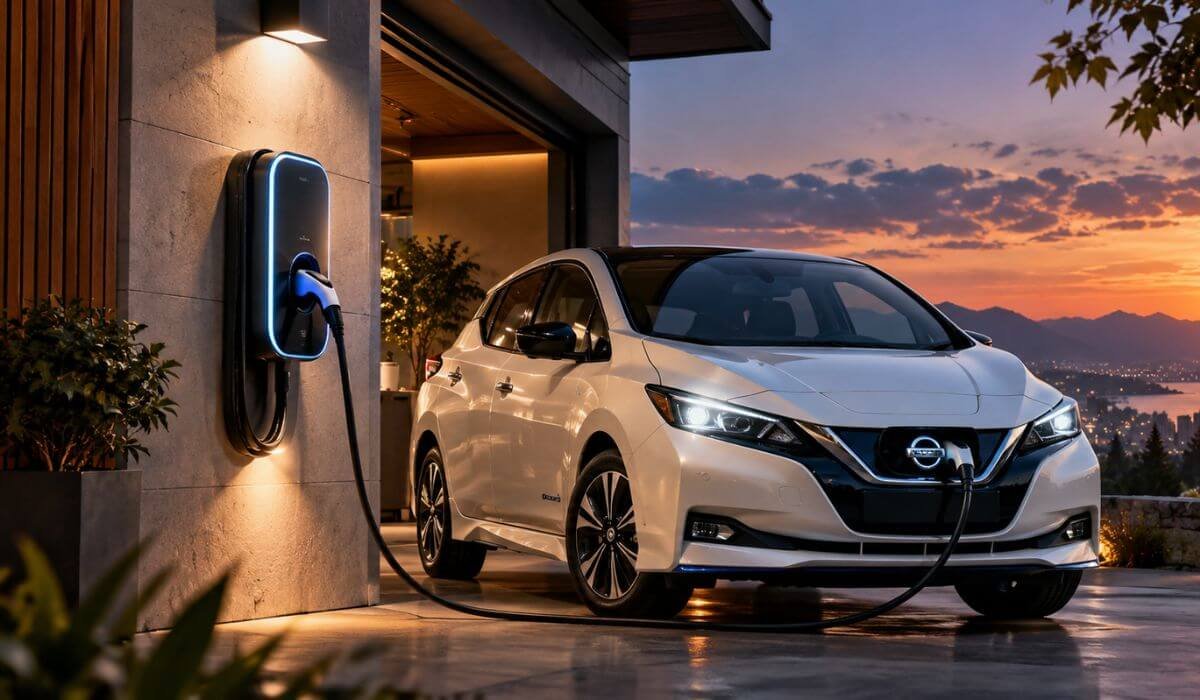
Best Level 2 Chargers for Nissan Leaf in 2026: Smart J1772 Home Charging
If you drive a Nissan LEAF, choosing a Level 2 charger is less about buying the biggest amp number and more about understanding what the car can actually use. Earlier LEAF models used J1772 for AC charging, with charging capability varying by model and battery configuration. The all-new 2026 LEAF continues with a driver-side J1772 port for everyday Level 1 and Level 2 charging, paired with a 75-kWh battery and a 7.2-kW onboard AC charger. Nissan estimates about 6.5 hours for a 20–80% charge under its stated 240V charging conditions.
That is why the charger with the highest output is not automatically the right one for a LEAF. A 40A, 48A or 50A EVSE can offer more electrical capacity than the vehicle may actually use, while factors such as the onboard charger, battery size, starting state of charge, temperature and the home’s electrical setup all affect the real charging experience. Nissan rates Level 2 as 240V charging and notes that it can provide roughly 10–25 miles of range per hour, depending on the vehicle and charging conditions.
The better home setup is one that gets the fundamentals right: a compatible J1772 connection, properly installed 240V power, enough cable to reach the LEAF comfortably, sensible current capacity and useful charging controls. That is what matters when the car is plugged in night after night. The chargers below cover different approaches to home charging, from flexible smart systems and long-reach cables to straightforward 40A setups, giving LEAF owners a practical way to compare what each one actually brings to the driveway or garage.
Best Nissan LEAF Level 2 Charger: Top 2026 Smart Home Options
#1. ChargePoint HomeFlex Level 2 EV Charger
Best Nissan LEAF Level 2 Home Charger for Smart Charging With J1772, Adjustable 16A–50A Power and Hardwired Installation
#2. Autel Level 2 EV Charger 50A
Best 50 Amp Charger for Nissan LEAF With 240V Home Charging, J1772, a 25-Foot Cable and Wi-Fi Connectivity
#3. Leviton EV48W 48A Smart EV Charger
Best Nissan LEAF 240V Home Charger for Smart Charging With 48A Power, J1772, Wi-Fi and My Leviton Controls
#4. EVIQO Level 2 EV Charger 40A
Best 40 Amp Charger for Nissan LEAF With 240V Level 2 Charging, J1772, a 25-Foot Cable and NEMA 14-50 Plug
#5. IYILO Level 2 EV Charger 40A
Best Nissan LEAF EV Home Charger for Overnight Charging With 40A Power, J1772, 25-Foot Cable and Smart Wi-Fi Controls
Expert Tip
The easiest mistake with a Nissan LEAF is to see a 48A or 50A label and assume the car will charge dramatically faster. It will not. The charger supplies AC power; the LEAF’s onboard charging system decides how much it can actually take.
That is why I would put more weight on J1772 compatibility, installation quality, cable reach, charging controls and everyday reliability than on the biggest number printed on the charger. A 40A unit that is properly installed and reaches your parking spot comfortably can be a much better ownership experience than a higher-rated charger that leaves you fighting with cable length or an unsuitable circuit.
For the LEAF, the goal is simple: buy the charger that fits the car and your driveway, not the charger with the most impressive specification sheet.
How We Chose These Nissan LEAF Chargers
We did not build this list by sorting five chargers from the highest amp rating to the lowest. That would be an easy way to make a comparison, but it would not tell a LEAF owner much.
Instead, we looked at what actually matters when a charger becomes part of your home every day.
First, we checked the connection. The LEAF’s AC charging setup is built around the J1772 connector, so compatibility comes before smart features, Wi-Fi or advertised charging output. Every charger on this list was selected with that basic requirement in mind.
Then we looked beyond the amp number. ChargePoint and Autel offer higher-rated hardware, while Leviton sits at 48A and EVIQO and IYILO provide 40A options. Those figures tell you what the EVSE can provide—not necessarily what your particular LEAF will pull. That distinction is important, and it is one of the reasons we have not treated the 50A chargers as automatically better.
Installation was another major filter. The Autel’s 25-foot cable can be genuinely useful when the parking position is awkward. The Leviton offers an 18-foot cable and hardwired installation, while ChargePoint HomeFlex is also aimed at a more permanent home setup. EVIQO and IYILO bring a different proposition with NEMA 14-50 plug-in installation, which can make sense for an owner who already has an appropriately installed outlet.
We also considered smart controls and connectivity, but only where they add something useful. Wi-Fi, Bluetooth and app controls are convenient; they should not distract from the basics of having the correct connector, suitable electrical supply and enough cable to comfortably reach the car.
Finally, we looked at the products as real ownership choices rather than specification-sheet winners. A Nissan LEAF owner charging overnight does not necessarily need the most powerful EVSE available. Someone with a detached garage may care far more about cable reach. Another owner may prefer hardwired installation and app control. That is why these five chargers occupy different positions in the list instead of pretending there is one specification that makes every charger right for everyone.
That is the standard behind this list: the charger has to make sense with the LEAF, make sense at home and make sense after the excitement of the purchase is gone.
#1. ChargePoint HomeFlex Level 2 EV Fast Charger
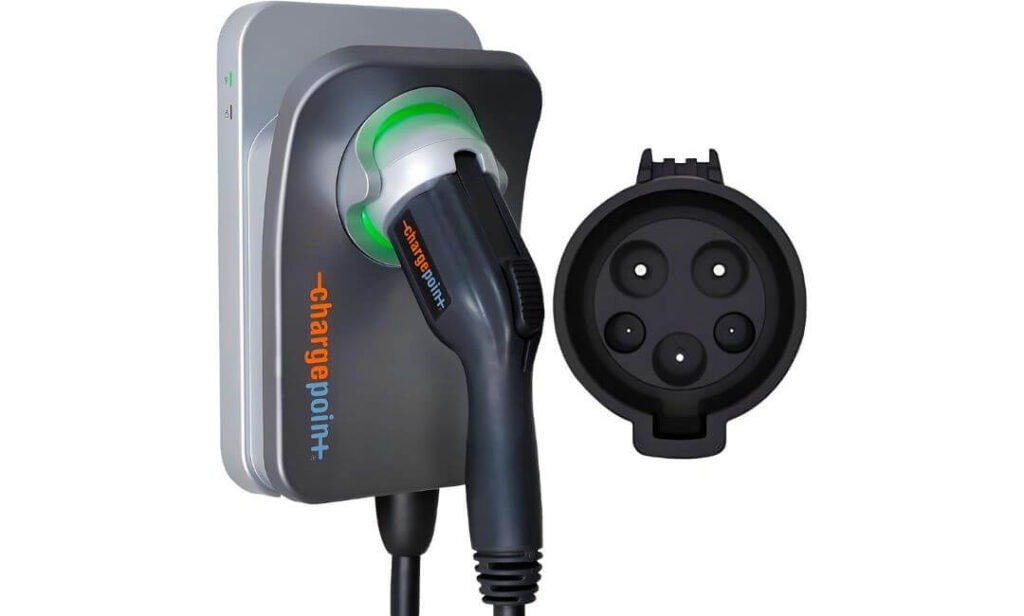
Quick Specs:
- Connector: J1772
- Charging: Level 2, 208/240V AC
- Maximum Output: Up to 50A / 12 kW
- Current Settings: 16A, 24A, 32A, 40A, 48A or 50A
- Cable: 23 feet
- Installation: Hardwired
- Connectivity: 2.4/5 GHz Wi-Fi
- Control: ChargePoint mobile app
- Best Fit: Nissan LEAF owners wanting a permanent, smart home charging setup
A 50-amp rating sounds impressive, but for a Nissan LEAF, the flexibility is more useful than the headline number. The Home Flex can be configured down to 16A and stepped through several charging levels, so your electrician can match the installation to the capacity of your home’s electrical system and the car’s onboard charger. ChargePoint itself says 32A and 40A settings are popular for many drivers, while 48A and 50A may require greater electrical capacity.
The 23-foot cable is another detail that becomes surprisingly important once the charger is on your garage wall. It gives you considerably more freedom over where the LEAF is parked instead of forcing you to position the car directly beside the unit. The hardwired version is also designed for a wide range of circuit ratings and can be installed indoors or outdoors by a licensed electrician.
What makes this one stand apart is that the hardware does not stop at simply sending electricity to the car. Through the ChargePoint app, you can manage charging and change the available charging current, while the built-in Wi-Fi keeps the charger connected to the ChargePoint ecosystem. There is also local storage for charging-session data if the network connection is interrupted, so the unit is not dependent on having a perfect Wi-Fi connection every minute.
(A proper home EV charger should fit your electrical system first; the 50A capability is there when your installation and vehicle can actually make use of it.)
What We Like
- 23-foot cable gives the LEAF plenty of reach in a typical garage or driveway.
- Adjustable 16A–50A output makes it easier to match the charger with the home’s available electrical capacity.
- Native J1772 connection makes the setup straightforward for a Nissan LEAF.
- Hardwired design is a particularly clean choice for a permanent charging location.
- App-based control and Wi-Fi add useful scheduling and charging-management features without changing the basic plug-in experience.
What We Don’t
- The only thing to think about beforehand is electrical capacity. If you want to run the Home Flex at its highest 50A setting, have an electrician confirm that your panel and circuit can support it; you do not need to buy into the maximum setting simply because the charger offers it.
Why This Nissan LEAF Level 2 Charger Stands Out
For a LEAF owner, the real attraction here is flexibility. You get the J1772 connection the car expects for AC charging, but you are not locked into one charging current. That makes this a better long-term home setup than choosing a charger purely because its box says “50A.”
It is also a particularly sensible choice when the charger is going on the wall permanently. The 23-foot lead, hardwired installation and adjustable output solve three of the practical problems that tend to matter after installation: where the car can park, how much power the circuit can safely provide and how easily you can manage charging from day to day.
The Insider Pro-Tip
If this were going into my own garage for a LEAF, I would not tell the electrician to automatically configure it at 50A. I would first look at the LEAF’s onboard charging capability, the home’s existing electrical load and where the charger will actually sit. ChargePoint lets the Home Flex run at several lower settings, so there is little reason to chase maximum amperage if the car cannot use it.
The smarter purchase is the one that leaves you with a comfortable cable reach, a properly sized circuit and predictable overnight charging. The 50A capability is useful headroom; it does not have to be the reason you buy the charger. That is exactly why the Home Flex works so well as a LEAF-focused home charger rather than merely being another high-amperage EVSE.
#2. Autel Level 2 EV Charger 50A
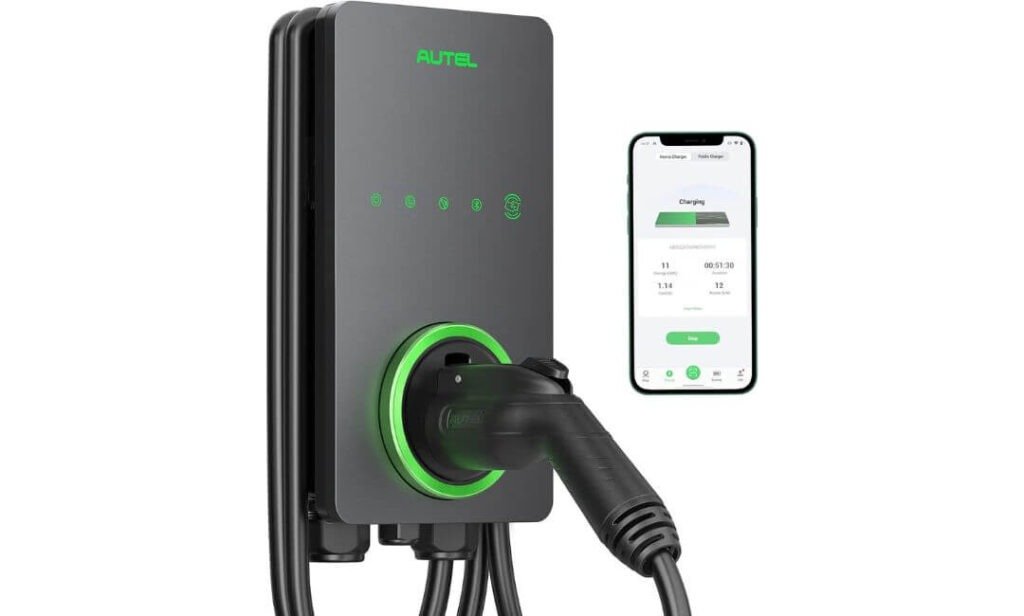
Quick Specs:
- Connector: SAE J1772
- Charging: Level 2, 208/240V AC
- Maximum Output: Up to 50A / 12 kW
- Current Control: Adjustable through the charger/app
- Cable: 25 feet
- Installation: Hardwired
- Connectivity: Wi-Fi, Bluetooth and Ethernet
- Protection: NEMA 4X weather-resistant enclosure
- Warranty: 3 years
- Best Fit: Nissan LEAF owners who want long reach, smart controls and a more rugged outdoor-ready charger
A 25-foot cable is the first thing that makes this Autel interesting for a Nissan LEAF. On paper, it is just another specification. In a real garage, it can be the difference between parking exactly where you want and constantly thinking about whether the connector will reach. The J1772 connection keeps the setup straightforward, while the 50A/12kW capability gives the charger plenty of headroom even though the LEAF itself decides how much AC power it can actually accept.
The other advantage is that this is not built around a single fixed charging current. Autel supports multiple current settings from 16A through 50A, allowing the installation to be configured around the electrical capacity available at your home. That is a much more useful feature for a LEAF owner than simply seeing “50A” printed on the front of the box. Your electrician can set the charger appropriately rather than treating maximum output as the only sensible setting.
Then there is the part you notice after installation. The Autel Charge app can handle charging schedules, remote control and charging information, while Wi-Fi, Bluetooth and Ethernet give you several ways to keep the unit connected. Its NEMA 4X enclosure is also a real advantage if the charger is going outside rather than living in a protected garage. Autel rates this model for operation from -40°F to 131°F, so it is designed with much more than mild-weather garage use in mind.
(The 50A rating is the charger’s ceiling, not a promise that every Nissan LEAF will charge at 50A. The car’s onboard charger remains the final word on AC charging speed.)
What We Like
- 25-foot cable gives you unusually good freedom when the LEAF is parked away from the wall-mounted unit.
- 16A–50A current adjustment makes the installation easier to tailor to the home’s electrical capacity.
- J1772 connection keeps it naturally suited to a Nissan LEAF’s AC charging setup.
- NEMA 4X protection makes it a convincing choice when the charger needs to live outdoors.
- Wi-Fi, Bluetooth and Ethernet give the smart features more flexibility than relying on one connection method alone.
What We Don’t
- The main thing to plan for is the hardwired installation. If your existing electrical setup is not ready for a dedicated EV charger circuit, an electrician will need to size the circuit and configure the unit correctly before you can take advantage of its higher output.
Why This Nissan LEAF Level 2 Charger Makes Everyday Charging Easier
The Autel’s biggest strength is not actually its 50A headline. It is the combination of long reach, adjustable power and smart control. A LEAF owner can have the charger mounted where it makes sense rather than where the cable happens to reach, and the 25-foot lead gives considerably more freedom around a normal two-car garage.
It also feels like a charger designed for people who want to install it once and then mostly forget about the hardware. The app handles scheduling and charging management, while the weather-resistant enclosure means the same unit can make sense in an exposed charging location. Add the three-year warranty and multiple connectivity options, and it becomes a well-rounded home setup rather than simply a high-amperage EVSE.
The Insider Pro-Tip
For a LEAF, I would pay particular attention to where the charger is mounted before worrying about its 50A rating. Put the unit in the right place, make sure the 25-foot cable comfortably reaches both likely parking positions, and have the electrician configure the current for the actual circuit. That approach gives you the benefit of this charger’s flexibility without paying for electrical capacity your car cannot use.
There is also a nice bit of future-proofing here. Even if your current LEAF does not make full use of the charger’s maximum output, the adjustable current and 12kW-capable hardware mean the installation does not have to be replaced simply because your charging needs change later. That is the kind of advantage that is easy to miss when comparing chargers from a specification table, but much more noticeable once the charger is part of your daily routine.
#3. Leviton EV48W 48A Smart EV Charger
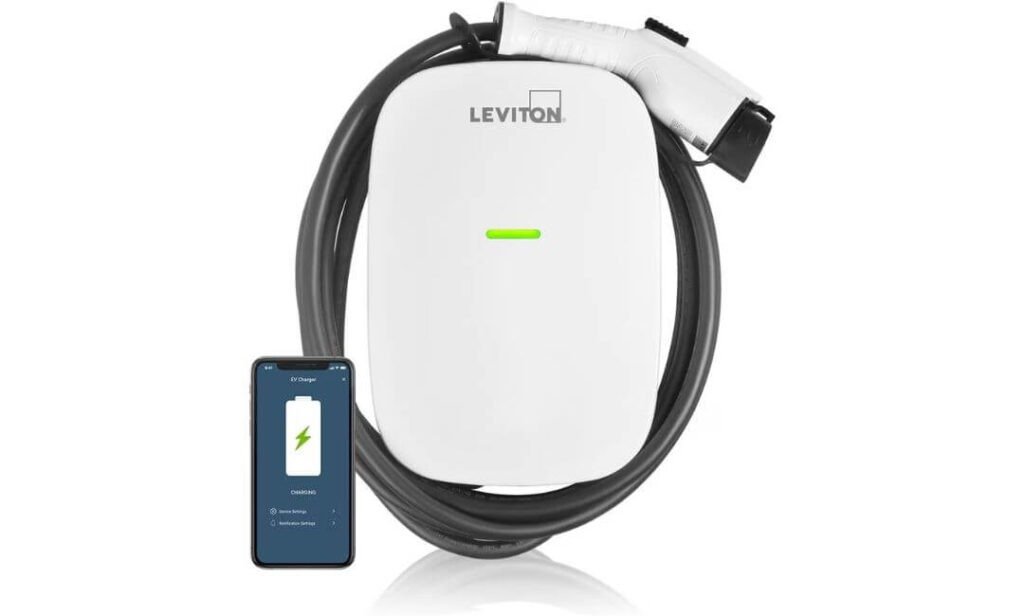
Quick Specs:
- Connector: SAE J1772
- Charging: Level 2, 208/240V AC
- Maximum Output: Up to 48A / 11.6 kW
- Installation: Hardwired
- Cable: 18 feet
- Connectivity: Wi-Fi
- App: My Leviton
- Enclosure: NEMA 3R weather-resistant
- Access Control: Optional RFID
- Certification: UL and ENERGY STAR
- Best Fit: Nissan LEAF owners already using, or planning to build around, the Leviton smart-home ecosystem
Some chargers try to win you over with the biggest number on the label. The EV48W takes a more familiar electrical-home approach: put the charger in the same ecosystem as the rest of the house and make it something you can manage rather than simply plug into. Its SAE J1772 connector makes it a natural match for a Nissan LEAF, while the 48A maximum output gives the hardware plenty of capacity beyond what many LEAF models will actually draw.
The more interesting part is what happens after installation. Through the My Leviton app, you can manage the charger alongside compatible Leviton devices, schedule charging and keep an eye on charging activity. That matters if your home already uses Leviton products because you are not introducing another completely separate smart-home system just to control the car charger.
There is also a practical reason to consider this model if your charging location is exposed. The NEMA 3R enclosure and weather-resistant construction allow indoor or outdoor installation, while the 18-foot cable gives reasonable reach without making the wall-mounted unit unnecessarily bulky. The hardwired design and included mounting hardware also make this feel more like a permanent piece of the home’s electrical system than a temporary EV accessory.
(The 48A rating describes what the EVSE can provide; your Nissan LEAF’s onboard charger determines the actual AC charging rate.)
What We Like
- My Leviton integration is genuinely useful for households already using Leviton smart-home products.
- 48A / 11.6kW capability provides substantial charging headroom without making maximum output mandatory.
- NEMA 3R enclosure makes the unit suitable for both garage and outdoor installations.
- 18-foot cable gives useful reach for normal driveway and garage layouts.
- Optional RFID access control is a thoughtful addition for homes where more than one person may use the charger.
What We Don’t
- The main consideration is that this is hardwired, so you need an electrician to confirm the correct circuit and installation before the charger goes on the wall. That is more commitment than a plug-in EVSE, but it also makes sense for a permanent charging location.
Why This Nissan LEAF Level 2 Charger Fits a Smart Home
The EV48W makes the most sense when you see it as part of the home’s electrical system rather than just another box for charging the LEAF. Its J1772 connector handles the basic vehicle requirement, while My Leviton adds the layer of scheduling and remote management that many owners actually want once home charging becomes part of their routine.
There is also something reassuring about the way Leviton approaches the hardware. You get a hardwired 48A platform, weather-resistant enclosure, 18-foot cable and established electrical-brand support without turning the product into a specification contest. For a LEAF owner who wants a clean permanent installation and already values Leviton’s ecosystem, those details carry more weight than simply chasing the highest amperage.
The Insider Pro-Tip
If your home already has Leviton smart electrical equipment, I would give the EV48W a closer look before comparing chargers purely by charging output. Having the EV charger live inside the same app as other compatible home devices can make everyday management noticeably simpler—and that convenience is something a specification table cannot really show.
And one more thing: do not size the electrical installation around the 48A number automatically. Tell your electrician which LEAF you own, show them where the charger will be mounted and let them work backward from the home’s available electrical capacity. The EV48W has the headroom; your LEAF only takes what its onboard charging system can accept. That is a much cleaner way to build the installation than paying for maximum electrical capacity simply because the charger offers it.
#4. EVIQO Level 2 EV Charger 40A
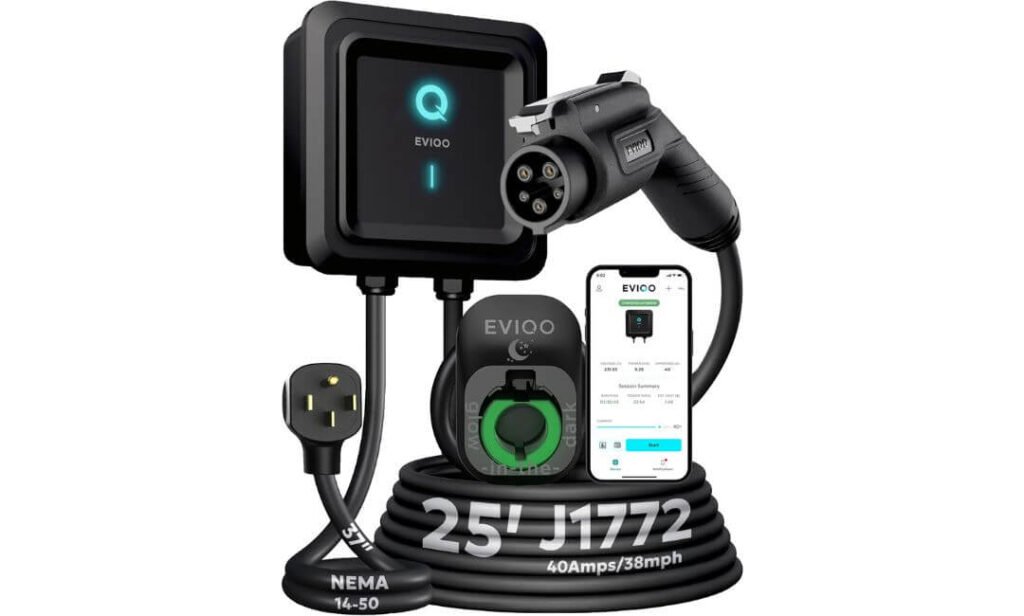
Quick Specs:
- Connector: SAE J1772
- Charging: Level 2, 240V AC
- Maximum Output: 40A / 9.6 kW
- Connection: NEMA 14-50 plug
- Cable: 25 feet
- Current Control: 6A–40A through the app
- Connectivity: 2.4 GHz Wi-Fi
- Enclosure: IP66 / NEMA 4
- Installation: Plug-in
- Warranty: 3 years
- Best Fit: Nissan LEAF owners who already have, or can install, a suitable NEMA 14-50 outlet
The first thing that makes this EVIQO different is how little drama the installation can involve. Instead of hardwiring the charger directly into the panel, it uses a NEMA 14-50 plug, so if you already have the correct 240V outlet on a properly sized dedicated circuit, you can mount the unit, plug it in and get on with charging. For a LEAF owner who does not want a permanent hardwired installation, that is a genuinely useful advantage.
Then there is the 25-foot cable, which is unusually generous for a plug-in home charger. It gives you room to park without having to line the LEAF up perfectly with the wall unit. The charger can deliver up to 40A / 9.6 kW, while the vehicle remains in control of how much AC power it actually draws. You can also adjust the charging current from 6A to 40A through the app, giving you more control when your household electrical demand changes.
The smart side is where this charger becomes more interesting than a basic plug-in EVSE. The 2.4-GHz Wi-Fi connection lets you schedule charging, start or stop a session, adjust current and monitor energy use from your phone. But I particularly like the fact that the everyday charging function does not need to become dependent on the app. You can simply connect the LEAF and use the charger normally, while the connected features are there when you want them.
(The NEMA 14-50 connection is convenient, but it is not permission to use any existing four-prong outlet. The circuit, receptacle and wiring should be correctly rated for EV charging.)
What We Like
- Plug-in NEMA 14-50 design makes this much less involved than a hardwired charger when the right outlet is already available.
- 25-foot cable gives excellent freedom around a garage or driveway.
- 6A–40A adjustment is useful when you want to control charging around your home’s electrical load.
- IP66 / NEMA 4 protection makes it suitable for indoor or outdoor placement.
- Glow-in-the-dark holster and reset button are small details, but both are genuinely useful rather than marketing decoration.
What We Don’t
- The main thing to check before ordering is the NEMA 14-50 installation. If you do not already have a properly installed outlet and dedicated circuit, the plug-in advantage disappears because an electrician will still be needed to create the correct setup.
Why This Nissan LEAF Level 2 Charger Works So Well at Home
This is the option I would look at when the priority is simple installation without giving up the useful features of a smart charger. The LEAF gets its J1772 connection, you get 240V Level 2 charging, and the 25-foot cable gives you plenty of freedom over where the car sits.
It also avoids the trap of making every feature about maximum charging power. The 40A ceiling is more than the LEAF may actually use, but that is perfectly fine—the car controls its own intake. What you are really buying here is the combination of plug-in convenience, long reach, adjustable charging and weather protection in one package.
The Insider Pro-Tip
Before buying this one, look at the outlet, not the charger. A NEMA 14-50 receptacle may look right from the outside, but what matters is whether it was installed on a properly sized dedicated circuit and is suitable for continuous EV charging. If that part checks out, this becomes a particularly convenient setup for a LEAF because you get the flexibility of a plug-in charger without sacrificing smart controls.
And that glow-in-the-dark holster may sound like a tiny feature, but it is exactly the sort of detail you appreciate at 10 p.m. when you’re plugging the LEAF in after getting home. EVIQO has clearly put some thought into the little moments around daily charging—not just the numbers printed on the charger.
#5. IYILO Level 2 EV Charger 40A

Quick Specs:
- Connector: SAE J1772
- Charging: Level 2, 240V AC
- Maximum Output: 40A / 9.6 kW
- Connection: NEMA 14-50P or hardwired configuration
- Cable: 25 feet
- Current Control: 6A–40A in 1A increments
- Connectivity: 2.4 GHz Wi-Fi
- Safety: Built-in GFCI and connector temperature monitoring
- Enclosure: NEMA 4 weather-resistant
- Smart Features: TOU scheduling, energy tracking, RFID and power sharing
- Warranty: 3 years
- Best Fit: Nissan LEAF owners who want detailed charging controls and extra electrical-safety monitoring
What caught my attention here is not simply the 40A output. It is the amount of information this charger gives you while the LEAF is actually charging. The J1772 connector handles the basic compatibility side, but IYILO adds real-time connector temperature monitoring, adjustable current from 6A to 40A and app-based energy tracking. Those are the sorts of features that become useful once home charging stops being something you occasionally do and becomes part of your everyday routine.
The 25-foot cable also gives this charger plenty of practical reach. More importantly, the charging current can be adjusted in 1A increments, so you are not restricted to a few preset power levels. That gives an electrician more flexibility when configuring the charger around your home’s electrical capacity, while the LEAF itself still decides how much AC power it can accept.
Then there is the feature I would pay particular attention to: temperature monitoring at the connector. The system can monitor connector temperature and respond if excessive heat is detected. IYILO also includes power-sharing capability, and with its optional energy meter, dynamic load management can help coordinate charging with the rest of the home’s electrical demand. For someone thinking beyond today’s single LEAF, that is a genuinely interesting bit of future-proofing.
(The smart features are useful extras; the foundation is still a correctly installed circuit, a suitable J1772 connection and an EVSE current setting that matches the home’s electrical capacity.)
What We Like
- Connector temperature monitoring gives you useful visibility into an area most basic EV chargers simply leave invisible.
- 6A–40A adjustment in 1A steps provides unusually fine control over charging current.
- 25-foot cable makes the charger easier to position around a normal garage or driveway.
- Power sharing and optional load management give it room to grow if another EV joins the household.
- RFID and app controls provide different ways to start and manage charging depending on how the household uses the charger.
What We Don’t
- The only thing to keep in mind is the 2.4-GHz Wi-Fi requirement. If your home network is mainly configured around 5-GHz connectivity, you will need to make sure a compatible 2.4-GHz network is available for the smart features.
Why This Nissan LEAF Level 2 Charger Is More Than a 40A EVSE
The interesting part of this IYILO is the attention to what happens around the charging process, rather than just how much electricity the charger can deliver. Temperature information, adjustable current, energy monitoring and load-management capability give the owner more control over the installation than you get from a basic plug-and-charge unit.
For a LEAF owner, that can be especially appealing because the car does not need a huge EVSE to handle everyday AC charging. Instead of paying attention only to maximum output, this charger gives you useful tools for managing the power that is actually going into the car and how that power fits into the rest of your home.
The Insider Pro-Tip
The temperature-monitoring feature is the one I would not overlook. Most owners will never need to think about connector temperature during a normal charging session, which is exactly why having the charger watch it for you is useful. You get another layer of information without having to stand beside the LEAF while it charges.
And if you are planning for more than one EV eventually, power sharing is worth keeping in mind now. You may only have one LEAF today, but installing a charger with the ability to coordinate power later can save you from having to rethink the entire electrical setup when a second EV arrives. That is a much more practical form of future-proofing than simply buying the charger with the biggest amp number.
Best Level 2 Charger for Nissan LEAF (2026): J1772 Home Charging Options Compared
| What Matters for a Nissan LEAF | ChargePoint HomeFlex Best Overall Smart | Autel Level 2 50A Long Reach Smart | Leviton EV48W Smart Home 48A | EVIQO 40A Plug-In J1772 | IYILO 40A Safety Focus Smart |
|---|---|---|---|---|---|
| Charging Connection | J1772 Straightforward match for the LEAF’s AC charging connection. | J1772 Native connection with no special adapter needed for the LEAF. | J1772 Designed around standard North American J1772 EV charging. | J1772 Simple plug-in option for a LEAF at home. | J1772 Standard connection with additional connector temperature monitoring. |
| Maximum EVSE Output | 50A / up to 12 kW The LEAF determines the actual AC draw. | 50A / up to 12 kW Plenty of headroom beyond what many LEAF models require. | 48A / 11.6 kW High-capacity hardware for a permanent installation. | 40A / 9.6 kW More than enough EVSE capacity for typical LEAF home charging. | 40A / 9.6 kW Adjustable output gives more control than the headline rating suggests. |
| Installation Style | Hardwired Permanent wall installation by an electrician. | Hardwired Best suited to a dedicated home charging circuit. | Hardwired Requires appropriate electrical capacity and professional installation. | NEMA 14-50 Convenient if the correct dedicated outlet is already installed. | Plug-In / Hardwire Configuration depends on the version and installation setup. |
| Cable Reach | 23 ft Excellent reach for most two-car garages. | 25 ft Longest reach in this group and useful around awkward parking positions. | 18 ft A practical length for a typical wall-mounted setup. | 25 ft Excellent flexibility for driveway or garage charging. | 25 ft Long, flexible cable with plenty of room around the vehicle. |
| Smart Charging | ChargePoint App Scheduling, charging controls and session information. | Autel Charge App Scheduling, remote management and charging information. | My Leviton Particularly useful when other compatible Leviton devices are already installed. | Wi-Fi App Scheduling, current adjustment and energy information. | IYILO App TOU scheduling, energy tracking, RFID and charging management. |
| Current Adjustment | 16A–50A Multiple settings to suit different electrical installations. | Adjustable Configured according to the installation’s electrical capacity. | 48A capable Electrical installation determines the appropriate operating level. | 6A–40A App-based adjustment gives useful day-to-day control. | 6A–40A Fine 1A increments are particularly useful for load management. |
| Weather & Outdoor Use | Indoor / Outdoor Built for permanent home installation. | Indoor / Outdoor NEMA 4-style weather protection supports exposed installations. | NEMA 3R Weather-resistant enclosure for indoor or outdoor placement. | IP66 / NEMA 4 Strong choice when the charger will live outside. | NEMA 4 Weather-resistant construction for flexible placement. |
| Standout Feature | 23-ft reach + adjustable output A balanced permanent home setup. | 25-ft cable + multi-connectivity Particularly practical for larger or awkward garages. | Leviton smart-home integration The natural choice for an existing Leviton ecosystem. | Plug-in simplicity Avoids hardwiring when the right NEMA 14-50 setup already exists. | Temperature monitoring Adds visibility into connector temperature during charging. |
| Extra Practical Touch | App-based current control Useful when your electrical capacity changes or needs careful management. | Cold-flexible cable Helpful for exposed charging locations in colder climates. | Optional RFID access Useful where several people share one charger. | Glow-in-the-dark holster A small detail that is genuinely handy after dark. | Power sharing Interesting for households that may add another EV later. |
| Best Match for a LEAF Owner | Permanent Smart Setup Strong all-around combination of reach, control and established charging ecosystem. | Maximum Reach A strong fit when the parking position is not close to the wall. | Smart Home Especially compelling for households already using Leviton products. | Easy Plug-In Setup Makes the most sense when a suitable NEMA 14-50 outlet is already available. | Detailed Control Best suited to owners who value monitoring, adjustment and future load management. |
Understanding the Core Charging Options for a Nissan LEAF
Choosing a home charger for a Nissan LEAF is easier once you separate the charger’s capabilities from what the car can actually use. A charger may advertise 40A, 48A, or 50A output, but that does not mean the LEAF will automatically charge at that rate. The onboard AC charger in the vehicle controls how much power the battery can accept.
For most LEAF owners, the useful question is therefore not simply, “Which charger has the highest amperage?” It is, “Which charger gives me the right combination of J1772 compatibility, electrical capacity, cable reach, installation flexibility, and smart features for the way I charge at home?”
Nissan LEAF 240V Charging vs. 208V and Other Electrical Configurations
A 240V Level 2 charger is the configuration most homeowners think of when installing an EV charger in a garage or driveway. It uses the home’s higher-voltage electrical supply to provide substantially more charging power than a standard 120V household outlet.
You may also see Level 2 chargers described as supporting 208/240V. That does not mean the charger is unsuitable for a residential LEAF. The difference generally comes down to the electrical system available at the installation location. A 208V supply is commonly found in commercial or multi-unit electrical environments, while 240V is typical of North American residential installations.
The important part is the charger’s specified operating range and the electrical service available at your property. A charger rated for 208/240V can be useful in more than one type of installation, but your electrician should confirm the actual voltage, breaker arrangement, wiring and available capacity before installation.
There is also an important distinction between voltage and charging speed. Increasing the voltage does not mean the LEAF will automatically accept every watt the EVSE can provide. The vehicle’s onboard charger remains the limiting factor.
For a typical home installation, I would focus on these practical points:
- 120V Level 1: Useful for very light daily driving, but generally slower and less convenient as the primary charging method for many LEAF owners.
- 208V Level 2: A legitimate Level 2 configuration when supported by the property’s electrical system, particularly in commercial or shared environments.
- 240V Level 2: The common residential choice for dedicated home EV charging.
- Higher-amperage EVSE: Provides additional electrical capacity, but does not guarantee that the LEAF itself will charge at the charger’s maximum rating.
Real talk: 240V is not automatically better because the number is larger. What matters is having a properly installed Level 2 circuit that matches the charger and the vehicle’s actual charging capability.
Why J1772 Compatibility Matters for the Nissan LEAF
The connector is one of the first things to check before buying any home EV charger. For the LEAF’s AC Level 1 and Level 2 charging, SAE J1772 is the key connection standard used by the vehicles covered by this guide.
That makes a native J1772 charger particularly straightforward. You plug the connector into the LEAF’s charging port and the EVSE handles the communication and power-delivery process required for AC charging.
This is why the five chargers in this guide were selected around J1772 compatibility, rather than relying on adapters as the primary connection method.
J1772 also matters because it removes unnecessary uncertainty from a home-charging setup. You do not want to buy an otherwise excellent charger only to discover that its connector requires another piece of hardware before it can be used with your vehicle.
When checking a charger, look for:
- SAE J1772 connector for direct compatibility with the LEAF’s AC charging port.
- Level 2 AC operation if you want substantially faster home charging than Level 1.
- A cable long enough to reach the LEAF comfortably from the planned mounting position.
- An electrical rating that makes sense for the home’s circuit and the vehicle’s onboard charging capability.
- Weather protection if the charger will be installed outside.
- Smart controls only if you will actually use scheduling, energy monitoring or remote management.
The connector is the easy part. The more important decision comes after that: making sure the electrical installation and EVSE settings are appropriate for the car and the home.
16A vs. 32A vs. 40A vs. 50A Chargers
Amperage is probably the most misunderstood specification on an EV charger.
A 50A charger is not automatically a faster choice for a Nissan LEAF than a 40A charger. The EVSE advertises how much current it can make available, while the vehicle’s onboard charger determines how much AC power it actually accepts.
That is why the chargers in this guide range from 40A to 50A without treating the highest number as automatically superior.
16A Chargers
A 16A Level 2 charger operates at a relatively modest current level and can make sense where electrical capacity is limited or where the owner’s daily driving needs are relatively small.
It is also useful to understand 16A as an adjustable setting, rather than only as a charger category. Several higher-capacity EVSE units allow their output to be reduced when the electrical installation or household load calls for it.
For a LEAF owner who does not drive many miles every day, there is little reason to chase maximum amperage simply for the sake of having it.
32A Chargers
A 32A Level 2 setup is a practical middle ground for many home charging situations. It provides considerably more capability than Level 1 while avoiding the assumption that every installation needs the largest available circuit.
The key advantage is balance. If your LEAF can make effective use of the available Level 2 power and the charger is installed on a suitable circuit, 32A can be perfectly sensible for overnight charging.
It is also worth remembering that the difference between charger ratings should be considered alongside the vehicle’s onboard charger, not in isolation.
40A Chargers
The 40A class is where several chargers in this guide sit, including the EVIQO and IYILO units.
At 240V, a 40A EVSE has a maximum electrical output of about 9.6 kW before accounting for the vehicle’s own charging limit and normal charging losses. That gives the charger substantial capacity for home Level 2 charging.
For many LEAF owners, this is already more than enough EVSE capacity for routine overnight charging. A 40A charger also leaves useful flexibility through adjustable-current controls, particularly when the charger supports settings below its maximum output.
Real talk: 9.6 kW on the charger label does not mean 9.6 kW is going into the battery every second of the session. The vehicle controls the actual AC intake, and charging conditions can vary.
50A Chargers
A 50A charger raises the EVSE’s maximum capability to around 12 kW at 240V.
That can be useful as additional electrical headroom, but it should not be confused with guaranteed faster LEAF charging. If the vehicle cannot accept the charger’s maximum available current, buying the larger EVSE does not suddenly change the onboard charging hardware.
The ChargePoint Home Flex and Autel unit in this guide use the 50A class, giving them plenty of adjustable capacity for different installations.
A higher-rated charger can still make sense when you want:
- More flexibility in the electrical setup.
- Adjustable current for different household loads.
- A charger that may remain useful if another EV with higher AC charging capability is added later.
- More headroom without operating the charger at its maximum setting.
The smarter approach is to choose the amperage that fits your electrical installation and daily driving, rather than buying based purely on the largest number.
How to Match Charger Amperage to Your Home Electrical System
The charger’s maximum amperage and the circuit’s capacity need to be considered together.
EV charging is a sustained electrical load, so the circuit should be designed specifically for the intended charging current. This is one reason professional installation matters, particularly for hardwired chargers and higher-current setups.
For example, a charger capable of 40A may require an appropriately sized circuit that is designed to support continuous EV charging. A 50A-rated charger can likewise require a larger electrical installation when operated at its maximum setting.
The exact breaker, conductor size and installation method depend on the charger, local electrical requirements and the property itself. Do not choose the breaker size from the charger’s marketing page alone. The installation should be designed and verified by a qualified electrician.
This is also where adjustable-current chargers become genuinely useful. If your home does not need or cannot support the charger’s maximum output, being able to reduce the current can give you a more sensible operating point.
Networked vs. Non-Networked Nissan LEAF Chargers
A smart charger is not necessarily a faster charger.
The main difference between a networked and non-networked EVSE is what you can do beyond simply supplying electricity to the vehicle.
A basic charger can handle the essential job: connect the LEAF, communicate with the vehicle and deliver AC power within the configured limits.
A networked charger, on the other hand, can add features such as:
- Charging schedules.
- Remote start and stop controls.
- Energy-use tracking.
- Charging-history information.
- Electricity-cost monitoring.
- Current adjustment.
- Firmware or over-the-air updates.
- Multiple-user access.
- Time-of-use charging controls, depending on the model and app.
Those features can be genuinely useful if you charge overnight and want the LEAF to begin charging during a cheaper electricity period.
But there is no reason to pay extra for a smart platform simply because it sounds more advanced. If you plug the car in every evening and have no interest in monitoring charging sessions or setting schedules, a simpler EVSE can do the core job just as well.
When Wi-Fi Actually Makes Sense
Wi-Fi becomes useful when you want your charger to communicate with an app.
The ChargePoint, Autel, Leviton, EVIQO and IYILO options in this guide all bring some form of connected functionality, but the exact features vary between them.
For example, an owner who wants to check whether the LEAF is charging without walking into the garage may appreciate remote monitoring. Someone on a time-of-use electricity plan may get more value from scheduling. A household with several users may prefer access controls or multiple accounts.
There is one small detail that is easy to overlook: not every charger supports the same Wi-Fi band. The IYILO unit, for example, specifies 2.4 GHz Wi-Fi, so your home network needs to provide compatible connectivity for its connected features.
The important distinction is that Wi-Fi is generally an additional convenience layer, not the thing that makes the charger deliver Level 2 power.
Hardwired vs. NEMA 14-50 for a Nissan LEAF
The installation method can have as much impact on ownership as the charger itself.
A hardwired charger connects directly to the home’s electrical system and is generally the cleaner choice when you are creating a permanent dedicated EV charging installation. ChargePoint, Autel and Leviton are represented here with hardwired configurations.
A NEMA 14-50 charger uses a plug connection instead. That can be particularly convenient when a correctly installed, dedicated NEMA 14-50 receptacle is already available in the right location.
The EVIQO is a good example of the plug-in approach, while the IYILO configuration offers flexibility depending on the version and installation arrangement.
Neither approach is automatically right for every LEAF owner.
Think about the charger location, cable reach, existing electrical infrastructure, outdoor exposure and whether you want a permanent installation. If you are installing a new circuit anyway, hardwiring may be worth considering. If a properly installed dedicated NEMA 14-50 receptacle already exists, a plug-in EVSE can make the setup more convenient.
What Actually Matters Most for a LEAF Home Charger
After stripping away the marketing numbers, the decision becomes much simpler.
For a Nissan LEAF, I would pay attention to these factors in roughly this order when evaluating an individual charger:
- J1772 compatibility, so the AC connection is straightforward.
- Electrical compatibility, including the home’s voltage, circuit capacity and installation requirements.
- Vehicle charging capability, because the LEAF determines how much AC power it can actually accept.
- Cable length, especially if the charger will be mounted away from the normal parking position.
- Adjustable current, which can be useful when matching the EVSE to the home’s electrical capacity.
- Installation type, whether hardwired or NEMA 14-50 better suits the property.
- Weather protection, if the charger will be exposed to outdoor conditions.
- Smart features, but only when scheduling, monitoring or remote control genuinely add value to your routine.
- Safety and certification information, rather than relying only on a large amperage number printed on the box.
That is the real way to compare these chargers. A Nissan LEAF does not need the charger with the most impressive specification sheet. It needs a properly installed, compatible Level 2 EVSE that fits the vehicle, the electrical system and the way you actually use the car.
Charging Time, Efficiency, and Practical Use
A Nissan LEAF can make excellent use of a Level 2 home charger, but there is one important distinction to keep clear: the charger’s maximum output is not the same thing as the charging speed the LEAF will actually receive.
That is why I would not give a LEAF owner a simple promise such as “a 50A charger will charge your car faster than a 40A charger.” The real charging rate depends on the LEAF’s onboard AC charger, battery state of charge, battery temperature, electrical conditions and charging losses.
The numbers below are therefore best used as a way to understand the differences between charger capacities, rather than as guaranteed charging times for every LEAF.
How Level 2 Charging Time Changes at 16A, 32A, 40A and 50A
At 240V, the theoretical maximum power available from an EVSE can be estimated from voltage multiplied by current. That gives approximately 3.8 kW at 16A, 7.7 kW at 32A, 9.6 kW at 40A and 12 kW at 50A.
But the LEAF may not accept all of that power.
The vehicle’s onboard charger acts as the gatekeeper. If the LEAF’s onboard system is limited below the EVSE’s maximum output, increasing the charger from 40A to 50A will not produce a corresponding increase in charging speed.
Here is the practical way to look at the different charger ratings:
| EVSE setting | Approx. available power at 240V | What it means for a LEAF |
|---|---|---|
| 16A | ~3.8 kW | A lower-power Level 2 setting, useful when electrical capacity is limited or daily mileage is modest. |
| 32A | ~7.7 kW | A very practical Level 2 range for many home charging situations, depending on the LEAF’s onboard charger. |
| 40A | ~9.6 kW | Provides substantial Level 2 capacity and is already more than many LEAF configurations can fully utilise. |
| 50A | ~12 kW | Extra EVSE headroom, but not automatically faster if the LEAF’s onboard charger cannot accept the additional current. |
These figures describe maximum electrical capacity before normal charging losses and vehicle limitations. They should not be interpreted as the number of kilowatts continuously reaching the battery.
That distinction is especially important when comparing the five chargers in this guide. The ChargePoint Home Flex and Autel offer up to 50A, the Leviton reaches 48A, while the EVIQO and IYILO are 40A units. That does not mean the two 50A chargers will necessarily charge a LEAF faster than the 40A models.
Why Nissan LEAF Charging Times Vary So Much
There is no single charging-time figure that applies to every Nissan LEAF.
The LEAF has been sold with different battery capacities and different onboard charging configurations over its production history. Your starting battery percentage also makes a major difference.
For example, charging from 20% to 80% requires much less energy than charging from nearly empty to completely full. A larger-battery LEAF will also require more energy to reach the same percentage increase than a smaller-battery version.
That means a statement such as “this charger fully charges a LEAF in five hours” can be misleading unless the writer specifies:
- Which LEAF model and battery capacity is being used.
- The starting state of charge.
- The target state of charge.
- The vehicle’s onboard AC charging capability.
- The actual voltage available at the installation.
- Ambient and battery temperature.
- Charging losses.
For that reason, I prefer to think about overnight charging rather than chasing an exact number of hours.
If you plug the LEAF in at home with enough time before the next day’s drive, the difference between a theoretical five-hour and six-hour session may not matter nearly as much as having a reliable charger that reaches the vehicle comfortably and works consistently.
The Onboard Charger Is the Real Speed Limit
This is the single most important point when choosing between a 40A and 50A home charger.
An EVSE does not force electricity into the battery at its advertised maximum rate. Instead, it communicates with the vehicle and makes the available current known. The LEAF’s onboard charger then determines how much AC power the vehicle can accept.
Think of the EVSE as the electrical supply available to the car, while the onboard charger controls how much of that supply the car actually uses.
This explains why buying a 50A EVSE solely because its specification sheet says “12 kW” can be unnecessary for some LEAF owners.
A 40A charger capable of approximately 9.6 kW can already provide plenty of available power for home charging. If the LEAF cannot use more than that, moving to a 50A unit does not change the vehicle’s internal charging hardware.
Where the higher-rated charger can still make sense is flexibility. Adjustable current, longer cable options, smart controls and the possibility of using the charger with another EV later can all be legitimate reasons to choose a higher-capacity EVSE.
Battery State of Charge Changes the Charging Experience
Charging does not necessarily happen at one perfectly consistent rate from the beginning to the end of a session.
The vehicle manages the charging process as the battery fills. Near the upper end of the battery’s state of charge, the vehicle can reduce the charging rate as part of its battery-management strategy.
That means the first portion of a charging session may behave differently from the final portion.
For everyday use, this is another reason why 20% to 80% estimates should not be treated as universal full-charge times. They describe a particular charging window, not every possible charging session.
If you only need enough energy for tomorrow’s commute, charging from a lower state of charge to the amount you actually need can also be more practical than automatically waiting for the battery to reach 100% every night.
Temperature Can Affect Charging Performance
Temperature is another factor that is easy to ignore when looking only at charger specifications.
The battery has its own thermal-management requirements, and the charging system can adjust its behaviour when conditions are outside the ideal operating range. Very cold or very hot conditions can therefore affect the charging experience.
This matters more in real life than it does on an Amazon specification sheet.
A charger sitting on a wall may be rated for a certain current, but the battery and vehicle electronics still have to operate within their own thermal limits.
For owners in areas with cold winters, allowing the car to charge while connected to its home power source can also make pre-conditioning more convenient when the vehicle supports the relevant function. Instead of using battery energy to prepare the car immediately before departure, scheduled charging and vehicle pre-conditioning can be coordinated around the departure time where supported.
Charging Losses Are Part of Real-World Efficiency
The electricity drawn from the wall is not identical to the energy that ultimately gets stored in the battery.
There are losses through the EVSE, vehicle charging electronics, wiring and battery-management process. The exact amount varies with charging conditions, equipment and temperature.
This is why multiplying 240V by the charger amperage gives you a useful maximum electrical-power figure, but not an exact battery-energy figure.
For example, a 40A charger has approximately 9.6 kW of theoretical AC capacity at 240V. That does not mean every 9.6 kWh drawn from the electrical system becomes 9.6 kWh of usable energy stored in the battery.
For a homeowner, the practical takeaway is simple: use your electricity bill or the charger’s energy-monitoring data to understand actual energy consumption, rather than trying to calculate household cost from the charger’s maximum amperage alone.
How to Schedule Nissan LEAF Charging More Efficiently
Smart charging becomes useful when your electricity price changes throughout the day.
If your utility offers time-of-use pricing, charging during a lower-cost period can reduce the amount you pay for the same amount of electricity. The exact saving depends entirely on your utility’s rate structure, so there is no honest universal percentage that applies to every LEAF owner.
The basic approach is straightforward:
- Check whether your electricity provider offers time-of-use rates.
- Identify the lower-cost charging window.
- Set the charger or vehicle to begin charging during that period.
- Allow enough time for the LEAF to reach the desired state of charge before departure.
- Avoid scheduling based purely on the charger’s maximum amperage.
- Review your actual electricity bill rather than assuming a particular dollar saving.
Chargers such as the ChargePoint, Autel, Leviton, EVIQO and IYILO models in this guide provide varying levels of app-based scheduling and monitoring. The feature is most valuable when it solves a real problem, such as avoiding expensive peak electricity periods.
Overnight Charging Is Usually the Practical Sweet Spot
For most LEAF owners, home Level 2 charging works best when treated as a routine rather than an emergency service.
Plug the car in after returning home, let the charger handle the scheduled session, and start the next day with enough energy for the planned driving.
You do not need to sit beside the car and watch the percentage climb.
This is also where cable length matters more than many buyers expect. A 25-foot cable that reaches the LEAF easily can be more useful every single day than a charger with a higher theoretical amperage that forces awkward parking.
The same applies to smart controls. If you regularly charge overnight, scheduling can be genuinely useful. If you simply plug in whenever you get home and have plenty of time before the next trip, advanced app features may matter much less.
How to Get the Most From Your LEAF Home Charger
A few simple habits can make the entire charging setup easier to live with:
- Choose the charger around the vehicle, not just the maximum EVSE rating. A 40A charger can be entirely adequate even when a 50A model is available.
- Use the correct charging current for the electrical installation. Do not increase the setting simply because the charger allows it.
- Use scheduled charging when your electricity tariff makes it worthwhile.
- Give the car enough time overnight. There is usually little benefit in forcing the highest possible charging rate when the vehicle will be parked for many hours.
- Keep the cable positioned properly. Avoid unnecessary bends, vehicle traffic or situations where the connector can be pulled or damaged.
- Pay attention to unusual heat, warnings or charging interruptions. A modern EVSE provides several layers of protection, but unusual behaviour should still be investigated.
- Use the vehicle’s charging controls where appropriate. The charger and the LEAF can work together, but the car remains an important part of the charging equation.
- Think about your daily mileage. Someone driving 20 miles a day has very different charging requirements from someone regularly covering 100 miles.
The Real-World Takeaway
The biggest mistake is treating Level 2 charging as a race between 16A, 32A, 40A and 50A.
For a Nissan LEAF, the better question is whether the charger can reliably provide the power the car can use, at a sensible electrical setting, during the hours the vehicle is parked.
That is why a well-installed 40A J1772 charger with a long cable and useful scheduling features can make more sense for one LEAF owner, while another may prefer a 50A smart charger for its adjustable output, installation flexibility or future use with another EV.
The goal is not to buy the biggest charger on paper. The goal is to make home charging predictable, efficient and easy enough that you rarely have to think about it.
Practical Buying Guide for Choosing the Right Nissan LEAF Level 2 Charger
Buying a home charger for a Nissan LEAF becomes much easier when you stop treating the decision as a simple competition between 40A, 48A and 50A numbers. The right charger is the one that fits your LEAF, your electrical system, your parking space, your charging routine and your budget.
Nissan itself recommends a SAE J1772-compliant domestic charging station on a dedicated 208–240V circuit installed by a professional electrician for home Level 2 charging. The 2026 LEAF also uses a driver-side J1772 port for routine Level 1 and Level 2 charging, while its NACS port is intended for DC fast charging.
That gives us a useful starting point: J1772 compatibility first, electrical compatibility second, and maximum amperage somewhere further down the list.
Start With the Way You Actually Charge
Before comparing brands, think about your normal driving.
If the LEAF sits in the garage for eight to ten hours overnight, you have a very different requirement from someone who comes home for only a few hours and needs to add a substantial amount of energy before leaving again.
Ask yourself:
- How many miles do I normally drive in a day?
- How long does the LEAF normally sit at home?
- Is the charger going inside a garage or outside?
- How far is the parking position from the electrical panel?
- Is there already a suitable 240V circuit?
- Do I need a 25-foot cable, or would 18–23 feet be enough?
- Do I actually want Wi-Fi and app controls?
- Could another EV be added to the household later?
- Am I paying for a new electrical circuit as well as the charger?
These questions can eliminate several unsuitable options before you even start comparing specifications.
For example, if your car is parked directly beside the electrical panel and you only need overnight charging, paying considerably more for a charger because it has an extra few kilowatts of theoretical capacity may not provide much practical benefit.
On the other hand, if your parking position is awkward, a 25-foot cable can be worth more to you every day than a higher amperage rating.
Narrow the Choice by Amperage, Space and Budget
Once you understand your routine, narrow the shortlist using three things: electrical capacity, physical layout and total ownership cost.
| Your situation | What to prioritise | What I would avoid |
|---|---|---|
| Modest daily driving and long overnight parking | 32A–40A Level 2 capability, sensible installation cost | Paying heavily for maximum amperage you will rarely use |
| Regular daily driving | Reliable 40A-class Level 2 EVSE, good cable reach | Choosing only by advertised miles per hour |
| Large garage or awkward parking position | 23–25 ft cable, flexible cable management | Short cable that forces you to park differently |
| Existing suitable NEMA 14-50 outlet | Quality plug-in EVSE | Assuming any old 14-50 outlet is automatically suitable |
| New dedicated circuit being installed | Hardwired charger or correctly specified receptacle setup | Designing the circuit around marketing claims rather than the actual EVSE |
| Want scheduled charging | Wi-Fi, app scheduling and energy monitoring | Paying extra for smart features you will never use |
| Planning another EV | Adjustable current, load-management or power-sharing features | Buying solely around today’s LEAF |
| Tight budget | Reliable 40A J1772 charger with the features you actually need | Spending extra for unnecessary smart-home features |
This is also why I would not automatically eliminate a 40A charger just because another model offers 50A.
At 240V, a 40A EVSE has approximately 9.6 kW of theoretical AC capacity. That is already a substantial Level 2 setup. The LEAF’s onboard charging system ultimately determines how much of that available power the vehicle can use.
Compare the Five Chargers by the Job They Are Designed to Do
The five options in this guide are not really five copies of the same charger.
They each have a different ownership angle.
ChargePoint Home Flex is the flexible permanent-installation option. Its adjustable output, 23-foot cable and established smart-charging platform make it a strong fit when you want control over the installation rather than simply the largest fixed output. ChargePoint currently lists Home Flex hardwired configurations supporting circuits from 20A to 80A, with up to 50A charging, depending on configuration.
Autel’s 50A unit makes more sense when cable reach and connected features are high on your list. The official Autel store currently lists its AC Lite 50A at $609 regular price, with the current sale price shown at $456.75, although retail pricing can change.
Leviton EV48W is a different proposition. Its appeal is less about being the cheapest route to Level 2 charging and more about its permanent installation and My Leviton ecosystem. The official specification lists 48A, 11.6 kW, J1772, an 18-foot cable, Wi-Fi and hardwired installation requiring a 60A breaker.
EVIQO 40A is the more straightforward plug-in choice in this group. Its NEMA 14-50 configuration and 25-foot cable make it particularly interesting when the electrical infrastructure is already set up appropriately for a plug-in EVSE.
IYILO 40A takes a more feature-heavy approach to a 40A charger. Its connector-temperature monitoring, detailed app controls and power-sharing capability make it interesting for owners who care about monitoring and future household electrical management rather than simply plugging in and forgetting about the charger.
That distinction is more useful than simply calling one “50A” and another “40A.”
Think About the Total Cost, Not Just the Charger Price
The purchase price displayed beside an EV charger is only one part of the budget.
Your real cost can include:
- The charger itself
- Electrical installation
- A new circuit
- Wiring and conduit
- A NEMA 14-50 receptacle, if applicable
- Additional panel or load-management equipment, if required
- Permitting or inspection costs, where applicable
This is why two chargers with similar retail prices can have very different final costs.
A plug-in EVSE can be financially attractive when a properly installed dedicated NEMA 14-50 circuit already exists in the right location. If you need a new circuit anyway, the difference between plug-in and hardwired installation may become less significant.
On the other hand, a long cable can save you from paying for a poorly positioned installation simply because the charger needs to be mounted closer to the car.
The cheapest charger is not necessarily the cheapest installation.
Typical Price Ranges and What You Are Actually Paying For
EV charger pricing changes regularly, so I would not treat any fixed dollar figure as permanent. Current manufacturer pricing gives a useful picture of where some models sit, though.
ChargePoint has historically positioned Home Flex around the premium mainstream home-charger category, while Autel’s current official store lists its AC Lite 50A at $609 before its currently displayed discount. Leviton’s official store currently lists the EV48W at $1,002.91, although its own product range includes less expensive non-smart alternatives.
That illustrates an important point: price is not directly proportional to charging usefulness for a LEAF.
You are often paying extra for things such as:
- Smart-home integration.
- App quality and software support.
- Longer cables.
- Adjustable current.
- Outdoor-rated construction.
- Load management.
- Better installation flexibility.
- Brand support and warranty coverage.
- Additional monitoring and control features.
If you never use those features, the extra money may not translate into a better daily charging experience.
Where the Long-Term Value Actually Comes From
A good home charger can stay with you for years, so I would look beyond today’s purchase price.
Long-term value comes from a combination of reliability, appropriate electrical capacity, usable cable length, software support, warranty coverage and compatibility with your future needs.
A charger with a 25-foot cable can remain useful if you change where you park. An adjustable-current model can remain useful if your electrical circumstances change. A smart charger may become more valuable if your utility introduces time-of-use pricing.
Likewise, power-sharing or load-management features can become useful if another EV joins the household.
But future-proofing has limits.
There is little point spending hundreds of dollars more today just because a charger supports 50A when your LEAF does not need that additional capacity and you have no realistic plan to use it with another EV.
Future-proofing should solve a plausible future problem, not an imaginary one.
A Simple Way to Match the Charger to Your Budget
If you want to keep the decision practical, divide the options into three broad buying situations.
When Keeping the Initial Cost Sensible Matters Most
Focus on a reliable 40A J1772 Level 2 charger with the cable length and installation method you actually need.
You do not need to pay for every smart feature available.
If you already have suitable electrical infrastructure, a straightforward 40A unit can provide a very sensible home-charging setup.
When You Want a Premium Everyday Setup
Look for adjustable current, a long cable, dependable app controls, good weather protection and strong manufacturer support.
This is where the ChargePoint and Autel approaches become interesting. You are paying for a more complete ownership experience rather than simply buying more electrical capacity.
When Smart-Home Integration Matters
Then features such as Wi-Fi, app control, scheduling and ecosystem integration deserve more weight.
The Leviton EV48W is particularly relevant here because it is designed around the My Leviton platform and is a hardwired 48A unit.
The important thing is to choose those features because you will actually use them.
Do You Need a 50A Charger for a Nissan LEAF?
Usually, I would not make 50A the deciding factor.
The LEAF determines how much AC power it can accept. Nissan also notes that charging time depends on the charging system, battery capacity, maximum vehicle charge rate and environmental conditions.
So if you are deciding between a good 40A charger and a more expensive 50A charger, ask:
- Does my LEAF actually benefit from the additional available current?
- Does my home have the electrical capacity for the higher-current installation?
- Will I use the extra capacity with another EV later?
- Does the 50A model offer better cable reach or controls?
- Is the warranty or support materially better?
- Is the price difference reasonable after installation?
If the answer to most of those questions is no, the 40A option can be the more rational purchase.
When DIY Installation Is Reasonable, and When It Is Not
There is a difference between setting up an EV charger and installing the electrical circuit that powers it.
For a new 208–240V circuit, hardwired EVSE, breaker installation or new NEMA 14-50 circuit, I would hire a licensed electrician. Nissan specifically recommends professional installation of a dedicated 208–240V circuit for its domestic J1772 charging setup.
There are, however, some tasks a homeowner can reasonably handle after the electrical work is complete, depending on the manufacturer’s instructions and local requirements:
- Mounting the charger to a suitable surface.
- Installing the cable holster.
- Routing the charging cable neatly.
- Connecting the charger to its app.
- Setting charging schedules.
- Configuring Wi-Fi.
- Testing normal charging operation after installation.
For the electrical work itself, leave the following to a qualified professional:
- Installing or modifying the breaker.
- Running a new 240V circuit.
- Selecting and installing conductors.
- Installing a new NEMA 14-50 circuit.
- Hardwiring the EVSE.
- Making changes inside the main electrical panel.
- Performing load calculations or service upgrades.
- Resolving grounding or electrical-code issues.
This is one area where saving a few hundred dollars by doing the wrong part yourself is simply not worth it.
What to Check Before Placing the Order
Before buying any of the five chargers, I would run through this checklist:
- Vehicle: Confirm the LEAF’s model year and AC charging capability.
- Connector: Confirm that the charger has the appropriate J1772 connection for the intended AC charging setup.
- Electrical supply: Confirm that your home can support the desired charging configuration.
- Circuit: Decide whether you need a new dedicated circuit.
- Installation: Choose hardwired or NEMA 14-50 based on the property, not preference alone.
- Cable: Measure the real distance from the proposed mounting position to the LEAF’s charging port.
- Location: Decide whether the charger will be indoors or outdoors.
- Connectivity: Check whether your Wi-Fi setup supports the charger if smart functions matter to you.
- Controls: Decide whether scheduling and energy monitoring are genuinely useful.
- Warranty: Read the actual warranty terms before purchase.
- Future use: Consider another EV only if that is a realistic possibility.
- Total cost: Add installation and electrical work to the charger price.
The Best Purchase Is the One That Fits Your Home
After comparing all five chargers, I would not make the buying decision from the product title alone.
The ChargePoint Home Flex makes sense when flexibility and a mature smart-charging ecosystem matter. Autel is attractive when long cable reach and connected features are priorities. Leviton makes particular sense for a homeowner who values permanent installation and My Leviton integration. EVIQO is compelling when a plug-in NEMA 14-50 arrangement fits the property. IYILO stands out for owners who value detailed monitoring, connector temperature information and future load-management capability.
Those are different strengths, not simply five different versions of the same charger.
And that is the real buying lesson for a Nissan LEAF: you do not need the charger with the biggest number on the box. You need the one that can be installed correctly, reaches your parking spot comfortably, works with your vehicle, fits your electrical capacity and gives you the features you will actually use for years.
Nissan’s own guidance supports that basic approach: use a compatible domestic charging station on the appropriate dedicated circuit, with professional electrical installation.
Nissan LEAF-Specific Considerations for Home Level 2 Charging
A Nissan LEAF is a good example of why buying an EV charger should start with the vehicle’s charging system, not the biggest amperage printed on the charger.
Older LEAF models were offered with different battery capacities, including 40 kWh and 62 kWh versions, while the all-new 2026 LEAF moves to a 75 kWh battery in the U.S. Nissan confirms that the 2026 model uses J1772 for Level 1 and Level 2 charging, with NACS used for DC fast charging.
That means the chargers in this guide are primarily about making routine home AC charging convenient and reliable. The important question is how each charger fits the particular LEAF, rather than whether it carries a 40A, 48A or 50A badge.
Nissan LEAF 40 kWh vs. 62 kWh Charging Expectations
Battery size has a direct effect on how much energy needs to be added during a charging session.
A 40 kWh LEAF needs substantially less energy for a comparable percentage increase than a 62 kWh LEAF. That does not necessarily mean the larger-battery model charges at a slower rate. It simply has more energy to put back into the battery when starting from the same state of charge.
Nissan has previously published Level 2 estimates of approximately 7.5 hours for a 40 kWh LEAF and around 11 hours for a 60 kWh LEAF for a full charge, while also noting that charging time varies with the charging system, battery capacity, temperature and other conditions.
Those figures are useful as a general reference, but I would not turn them into a promise for every LEAF.
Your actual session can be shorter or longer depending on:
- Starting battery percentage.
- Desired ending percentage.
- Model year and battery size.
- The LEAF’s onboard AC charging capability.
- Actual voltage at the charger.
- EVSE current setting.
- Battery and ambient temperature.
- Charging losses.
- Whether the vehicle reduces charging power later in the session.
This is why 20% to 80% charging is a more useful comparison for everyday driving than quoting one universal “full charge” number.
A 40 kWh LEAF starting at 20% has much less energy to recover than a 62 kWh LEAF starting at the same percentage. Both vehicles may be connected to the exact same 40A J1772 charger, yet the total time spent charging will be different.
What About the 2026 Nissan LEAF?
The 2026 model changes the conversation somewhat because Nissan moved the LEAF to a 75 kWh liquid-cooled battery in the U.S. Nissan lists up to 303 miles of EPA-estimated range for the LEAF S+ and specifically says the vehicle uses a driver-side J1772 port for routine Level 1 and Level 2 charging.
Nissan also states that charging time depends on the charging system, battery capacity, maximum vehicle charge rate and environmental conditions.
So I would not carry an older 40 kWh or 62 kWh charging-time estimate directly into a 2026 LEAF buying decision.
The 75 kWh battery means there is more energy to replenish, but the correct home charger is still determined by the vehicle’s AC charging capability and your electrical installation.
For someone shopping specifically for a 2026 LEAF, the useful question is therefore:
How much AC power can my particular LEAF accept, and what is the most sensible EVSE installation for providing that power every night?
That question is much more valuable than simply asking whether a charger is rated at 40A or 50A.
Does a 50A Charger Charge a LEAF Faster Than a 40A Charger?
Not automatically.
This is one of the biggest misconceptions in the home EV-charger market.
A 40A EVSE at 240V has approximately 9.6 kW of theoretical AC capacity, while a 50A EVSE has approximately 12 kW. Those are capabilities of the charging equipment and electrical supply, not guaranteed battery charging rates.
The LEAF’s onboard charger decides how much AC power the vehicle can actually accept.
So if your particular LEAF cannot use the additional current offered by a 50A EVSE, moving from a good 40A charger to a 50A charger will not suddenly transform the car’s charging speed.
That is why I would look at the 50A models in this guide differently.
The ChargePoint Home Flex and Autel give you additional EVSE capacity and adjustable-current flexibility. That can be useful for the electrical installation or for a future EV with a higher AC charging capability.
The 40A EVIQO and IYILO, meanwhile, already provide substantial Level 2 capacity. If that capacity matches what your LEAF can actually use, there is no reason to regard them as inferior simply because another charger has a larger number on the label.
Why the LEAF’s Onboard Charger Matters More Than the EVSE Rating
The charging process has two sides.
The EVSE supplies available AC power and communicates the permitted current to the vehicle. The onboard charger inside the LEAF converts that incoming AC electricity into the DC energy used by the battery.
The EVSE cannot force the vehicle to accept more power than the vehicle’s charging system allows.
That is why a charger rated for 12 kW can still be a sensible purchase even when the LEAF does not use the full amount. You are buying the EVSE’s flexibility, cable length, installation options, controls and potential future usefulness, not necessarily 12 kW of battery charging.
Conversely, there is no reason to reject a well-built 40A charger just because a competing model says 48A or 50A.
The car, not the marketing number, determines the practical charging rate.
Your Starting State of Charge Changes Everything
Charging from 10% to 80% is not the same job as charging from 60% to 80%.
This sounds obvious, but it is one of the reasons online charging-time comparisons can be misleading.
If you arrive home with plenty of battery remaining and only need to replace the energy used during your commute, the LEAF may need only a few hours of Level 2 charging.
If you return from a long trip with a very low battery, considerably more energy needs to be added.
That is why I would avoid statements such as:
“This charger charges every Nissan LEAF in five hours.”
There is no single time that applies to every LEAF configuration and every charging situation.
A more honest way to describe home charging is:
A properly installed Level 2 charger can replenish the LEAF during normal overnight parking, with the exact time depending on the vehicle, battery size, starting state of charge, charging rate and conditions.
That is how most owners actually use the car.
Battery Temperature Can Affect Charging
Temperature deserves special attention because the battery is not just a passive storage container.
Nissan states that environmental conditions can affect charging time and battery performance, and its LEAF documentation notes that battery temperature can influence charging behaviour.
The newer 2026 LEAF uses a liquid-cooled 75 kWh battery with battery thermal management, which Nissan says is intended to improve charging performance in cold and hot conditions.
That does not mean temperature becomes irrelevant.
Very cold or very hot conditions can still change how the vehicle manages charging.
For owners who live through significant seasonal temperature changes, this is another reason not to judge a charger solely by its maximum output. A charger may be capable of delivering a particular current, but the vehicle can still adjust the actual charging process according to battery conditions.
State of Charge and Battery Management Go Together
For everyday ownership, you do not necessarily need to charge the LEAF to 100% every time you plug it in.
If you know that tomorrow’s driving only requires a certain amount of range, there is little practical reason to keep charging simply because the battery has not yet reached 100%.
The LEAF also supports charging limits or schedules on applicable models and systems. Nissan’s 2026 owner’s manual, for example, documents charge-limit operation where charging can stop at a selected limit such as 80%.
That can be useful when your normal driving does not require a completely full battery.
The sensible approach is to follow the charging guidance for your specific model year, because battery chemistry, thermal management and charging controls have changed across the LEAF’s generations.
How to Charge a Nissan LEAF With Battery Health in Mind
There is a lot of exaggerated advice online about EV battery care.
You do not need to become obsessed with every percentage point.
Instead, focus on a few sensible habits.
Use Level 2 for Normal Home Charging
Level 2 AC charging is perfectly appropriate for routine home charging.
You do not need to use DC fast charging simply because you want to recharge the LEAF quickly. DC fast charging is designed for situations where you need a much faster top-up while travelling.
For daily home use, a properly installed J1772 Level 2 charger gives you a predictable charging routine without requiring a public fast-charging stop.
Use the Charging Schedule When It Benefits You
If your electricity provider has time-of-use rates, schedule charging for the lower-cost period where practical.
This can reduce charging costs without requiring any change to the amount of energy the vehicle needs.
The LEAF itself and many of the chargers in this guide offer scheduling or smart controls, so you can choose where you want that scheduling to happen.
The important part is to use one clear charging schedule, rather than having multiple systems compete with one another.
For example, if the charger is scheduled for midnight but the vehicle is configured not to charge until 2 a.m., the session will not behave the way you expect.
Avoid Making Maximum Amperage the Goal
This is probably the most useful battery-and-charger lesson in the entire article.
There is no prize for charging at the highest possible amperage every night.
If your LEAF can comfortably meet your next day’s driving requirements with a lower-current Level 2 setting, there is no practical reason to increase the current simply because the charger allows it.
A properly configured 32A or 40A setting can be entirely sensible when it provides enough energy during your normal parking window.
Higher-capacity EVSE equipment is useful for flexibility, but you do not need to operate it at maximum output just because you bought it.
Give the LEAF Time Instead of Chasing Speed
Overnight parking is your biggest advantage as a home-charging owner.
If the car is parked for eight hours, you have a generous charging window. You do not necessarily need to maximise the charging rate to finish as quickly as possible.
For example, if the LEAF only needs a moderate amount of energy after your daily commute, plugging in after dinner and allowing it to charge overnight is often much simpler than trying to maximise the current.
This is also why cable reach, scheduling and reliability can matter more than a 10A difference in the charger’s headline rating.
Do Not Confuse AC Home Charging With DC Fast Charging
The five chargers in this article are for AC Level 2 home charging.
They are not replacements for the LEAF’s DC fast-charging capability.
The 2026 LEAF uses J1772 for Level 1 and Level 2 charging and a NACS port for DC fast charging.
That distinction matters when reading product descriptions because some charger listings use phrases such as “fast charging” very loosely.
A Level 2 home charger can be dramatically faster than Level 1 for routine charging, but it is still fundamentally different from a public DC fast charger.
A Practical Charging Routine for Different LEAF Owners
Your ideal routine depends on how you use the car.
For a light daily commuter:
A sensible Level 2 setting, overnight scheduling and a comfortable charging window may be all you need. There is little reason to prioritise the highest EVSE rating.
For a high-mileage daily driver:
Cable reach, dependable Level 2 power and smart scheduling become more important because you may need to replace a larger amount of energy every night.
For a 40 kWh LEAF:
The smaller battery means less energy is required to recover the same percentage of charge. Nissan’s historical Level 2 estimate of around 7.5 hours for a full charge provides useful context, but your actual time will vary.
For a 62 kWh LEAF:
Expect a longer charging session when replenishing a similar percentage of the battery because there is more energy to add. Nissan has historically cited roughly 11 hours for a full Level 2 charge on its 60 kWh-class LEAF.
For the 2026 75 kWh LEAF:
Do not reuse the older 40 kWh or 62 kWh charging-time figures as though they were exact. The larger battery and updated charging system make the current model a different case, and Nissan specifically says charging time depends on battery capacity, maximum vehicle charge rate and environmental conditions.
The Real LEAF Buying Rule
If I were choosing a home charger specifically for a Nissan LEAF, I would follow one simple rule:
Buy enough charger for the car and the home, not more charger simply because the specification sheet allows it.
A 40A J1772 EVSE with a 25-foot cable, sensible current adjustment and good installation can be an excellent daily solution. A 50A smart charger can also be a smart purchase when its additional flexibility, cable length, software or future-EV compatibility actually matters.
The LEAF’s battery size determines how much energy you need to put back in. The onboard charger determines how much AC power the vehicle can accept. The EVSE determines how much power is available to the vehicle, within the limits of the electrical installation.
Once those three pieces are understood, choosing between the chargers becomes much easier.
And for battery health, the real-world approach is refreshingly simple: use the Level 2 charger for normal home charging, avoid unnecessary extremes when your model’s charging guidance recommends otherwise, use schedules when they make sense, and let the LEAF’s own battery-management system handle the charging process.
FAQs About Level 2 Home Charging for the Nissan LEAF
Can a 40A Level 2 home charger for Nissan LEAF be a better choice than a 50A charger?
A 40A EVSE connected to a 240V supply has roughly 9.6 kW of available AC capacity, while a 50A unit can provide roughly 12 kW under the right electrical configuration. But the LEAF’s onboard AC charging system determines how much power the vehicle can actually accept. The charger cannot force the car to take more than its onboard system allows.
That makes the decision more practical than simply comparing amperage. If a 40A charger already provides the charging capability your particular LEAF can use during its normal parking window, moving to 50A may not materially reduce your overnight charging time.
A 50A unit can still make sense if you want:
- More adjustable-current headroom.
- A charger that may also suit a future EV with higher AC charging capability.
- Particular smart-charging features.
- A longer cable or better mounting flexibility.
- A specific installation configuration that works better for your home.
Real talk: if your LEAF is going to sit in the garage all night, I would rather have a properly installed 40A charger with a cable that comfortably reaches the car than pay extra for 50A that the vehicle cannot fully use.
How should I estimate Nissan LEAF Level 2 charging time when online charger listings give very different numbers?
Start with the amount of energy you actually need to put back into the battery, rather than the advertised “miles per hour” figure on the charger.
A 40 kWh LEAF and a 62 kWh LEAF do not need the same amount of electricity to move from 20% to 80%. The newer 2026 LEAF is different again, with a 75 kWh battery and a published approximately 7.2 kW AC onboard charger; Nissan lists about 6.5 hours for a 20–80% charge for the 2026 LEAF under its stated conditions.
For older LEAF generations, Nissan has published approximate Level 2 full-charge figures of about 7.5 hours for a 40 kWh battery and around 11 hours for a 60 kWh battery. Those are useful reference points, not universal promises.
The number can move because of:
- Starting state of charge.
- Battery capacity and condition.
- The LEAF’s onboard AC charging limit.
- Actual voltage available at the charger.
- Battery and outside temperature.
- Electrical and charging losses.
- The vehicle’s charging behaviour as the battery gets fuller.
So when a charger says “up to 38 miles of range per hour,” treat that as a charger-side headline figure under specified conditions, not a guaranteed LEAF result.
Is a smart Level 2 charger actually worth paying more for a Nissan LEAF, or is Wi-Fi mostly marketing?
It depends on whether you have a reason to use the smart features.
For a LEAF owner with simple charging habits, a non-networked or minimally connected EVSE can do the fundamental job perfectly well: deliver controlled Level 2 AC power to the vehicle.
Smart charging becomes much more interesting when you have a specific use case, such as time-of-use electricity pricing, remote monitoring, scheduled charging, energy tracking or multiple users.
Nissan itself now offers charging-management features through the MyNISSAN app on the 2026 LEAF, including charge-status information and scheduling/optimization functions in supported configurations.
That creates an interesting buying decision: you do not necessarily need to duplicate every smart function in both the vehicle and the EVSE.
If your LEAF already handles the scheduling you need, spending considerably more for an EVSE solely because it has an elaborate app may not add much.
On the other hand, an EVSE-level app can be useful if you want to monitor the charger itself, track energy consumption, manage users or control charging independently of the vehicle.
The best smart charger is therefore not the one with the longest feature list. It is the one whose connected features actually solve something in your charging routine.
Should I charge my Nissan LEAF to 100% every night to protect the battery, or is there a smarter way to use a Level 2 home charger?
For everyday driving, there is usually little reason to make 100% state of charge the automatic target every night if you do not need that much range.
The more sensible approach is to follow the charging guidance for your particular LEAF model and use the vehicle’s available charging controls when they fit your routine. Nissan’s 2026 documentation specifically includes charging-management functions, while its general charging guidance notes that charging time and battery behaviour vary with battery temperature, ambient temperature, battery condition and other factors.
A practical routine looks more like this:
- Return home with the battery at a normal daily-driving level.
- Set a charging schedule if your electricity tariff makes that worthwhile.
- Charge only to the level you expect to need.
- Leave additional headroom when you do not need a completely full battery.
- Reserve a higher state of charge for days when you actually need the extra range.
There is another important point here: do not confuse Level 2 with DC fast charging. Nissan recommends normal AC charging for usual charging of the vehicle and says DC fast charging should be minimized to help prolong Li-ion battery life.
That does not mean you should be afraid of fast charging when travelling. It simply means that a properly installed Level 2 home charger for Nissan LEAF is the natural tool for routine charging, while DC fast charging is there when speed on the road matters.
If the Nissan LEAF already has a J1772 home-charging port, what should I check before buying an EVSE advertised as “universal”?
Look past the word universal and verify the actual connector and electrical specifications.
For the 2026 LEAF, Nissan identifies the driver-side J1772 port for Level 1 and Level 2 charging, while the passenger-side NACS port is used for DC fast charging. Nissan also says the J1772 port fits most existing home chargers.
For a home Level 2 purchase, check these points:
- Connector: Make sure the EVSE has the appropriate J1772 connector for the LEAF’s AC charging setup.
- Voltage: Confirm that the charger and your home’s electrical supply are compatible.
- Current: Check the EVSE’s maximum and adjustable current rather than assuming the car will use the maximum.
- Installation: Determine whether you need hardwiring or a properly installed NEMA 14-50 setup.
- Cable length: Measure the actual distance to the charging port before ordering.
- Certification: Verify the relevant North American safety certification for the exact model.
- Outdoor rating: Important if the charger will be exposed to weather.
- Smart features: Check whether the charger supports the Wi-Fi band and controls you actually intend to use.
One final reality check: a charger being “universal” does not make a poor electrical installation safe. The EVSE, circuit, breaker, wiring and vehicle all have to be compatible as one system. Nissan’s own 2026 LEAF manual recommends a SAE J1772-compliant charging device on a dedicated 220–240V circuit installed by a qualified electrician.
Final Thoughts on Choosing a Level 2 Charger for Nissan LEAF
Choosing a home charger for a Nissan LEAF is easier once you stop looking at the charger as a race for the highest amperage. The LEAF does not become a faster-charging car simply because the EVSE on the wall says 50A instead of 40A. What matters is how the vehicle’s onboard charging system, your electrical installation and the charger itself work together.
That is why the five chargers in this guide are not interchangeable in the real world.
The ChargePoint Home Flex makes sense when you want a well-rounded permanent installation with adjustable current, a long cable and mature smart-charging controls. The Autel brings similarly strong electrical capacity but puts more emphasis on long cable reach and connected functionality. The Leviton EV48W is particularly interesting for homeowners who value a hardwired setup and already use, or plan to use, the My Leviton ecosystem.
The EVIQO 40A takes a more straightforward route with its NEMA 14-50 configuration and 25-foot cable, making it an appealing fit when plug-in installation suits the property. The IYILO 40A takes a different approach, adding detailed monitoring, connector temperature information, smart controls and power-management features for owners who want more visibility into what is happening during a charging session.
There is no need to pretend that one of these characteristics matters equally to every LEAF owner.
If your car sits overnight beside the garage wall, cable reach and reliable charging may matter more than another few amps. If your electrical panel has limited spare capacity, adjustable current can be more valuable than maximum output. If you already have a suitable NEMA 14-50 circuit, a plug-in charger may make more sense than paying for a hardwired installation. And if you plan to add another EV later, power sharing or load-management capability can suddenly become much more relevant.
The Real Buying Lesson
The biggest mistake is buying a charger around the specification that looks most impressive on the product page.
A 50A EVSE can offer more electrical headroom than a 40A model, but the LEAF’s onboard charger still determines how much AC power the vehicle can actually accept. Likewise, a charger advertised with smart features is not automatically a better purchase if you never use scheduling, energy monitoring or remote control.
For most owners, the better checklist is much simpler:
- J1772 compatibility for the LEAF’s AC charging connection.
- A properly designed 208–240V Level 2 installation.
- Enough charging capacity for your actual daily driving.
- A cable long enough to reach the car comfortably.
- Adjustable current when electrical flexibility matters.
- Weather protection when installing outdoors.
- Useful smart features rather than unnecessary app features.
- Recognised safety certification and a meaningful warranty.
- Professional electrical installation where a new circuit or hardwiring is involved.
The right charger should make home charging almost boring. You plug in when you get home, the car charges during the appropriate window, and the next morning you have the energy you need without thinking about the charger itself.
One Last Piece of Real Talk
Do not spend extra money trying to make your Nissan LEAF something it is not.
If a properly installed 40A Level 2 charger can comfortably replenish the energy you use each day, there is nothing wrong with choosing one. If a 50A model gives you better cable reach, better controls or useful future flexibility, then the additional capacity can make sense. The important part is why you are buying it.
Your home charger should be selected around the way you live with the LEAF, not around the biggest number on the box.
And that is ultimately what makes a good Nissan LEAF charging setup: compatible hardware, correctly sized electrical work, sensible charging habits and enough flexibility that you do not have to think about charging every time you park the car.
That is the standard I would use when choosing any of the chargers in this guide.
Also Check:


